WO2015115395A1 - 樹脂組成物及びポリエステルフィルム - Google Patents
樹脂組成物及びポリエステルフィルム Download PDFInfo
- Publication number
- WO2015115395A1 WO2015115395A1 PCT/JP2015/052112 JP2015052112W WO2015115395A1 WO 2015115395 A1 WO2015115395 A1 WO 2015115395A1 JP 2015052112 W JP2015052112 W JP 2015052112W WO 2015115395 A1 WO2015115395 A1 WO 2015115395A1
- Authority
- WO
- WIPO (PCT)
- Prior art keywords
- substituent
- group
- general formula
- mol
- resin composition
- Prior art date
- Legal status (The legal status is an assumption and is not a legal conclusion. Google has not performed a legal analysis and makes no representation as to the accuracy of the status listed.)
- Ceased
Links
Classifications
-
- C—CHEMISTRY; METALLURGY
- C08—ORGANIC MACROMOLECULAR COMPOUNDS; THEIR PREPARATION OR CHEMICAL WORKING-UP; COMPOSITIONS BASED THEREON
- C08K—Use of inorganic or non-macromolecular organic substances as compounding ingredients
- C08K5/00—Use of organic ingredients
- C08K5/16—Nitrogen-containing compounds
- C08K5/29—Compounds containing one or more carbon-to-nitrogen double bonds
Definitions
- the present invention relates to a resin composition and a polyester film containing an aliphatic polyester and a terminal blocking agent.
- Polyester films such as polyethylene terephthalate (PET) films are widely used industrially because they are excellent in heat resistance, mechanical properties and chemical resistance.
- polyester film has poor hydrolysis resistance, the molecular weight decreases due to hydrolysis, and embrittlement progresses, resulting in a decrease in mechanical properties.
- a method for sealing a terminal carboxyl group of polyester using a terminal blocking agent is known.
- Patent Document 1 discloses that the terminal carboxyl group of the yarn-forming polyester is chemically modified with a ketene imine compound. It is described that polyethylene terephthalate which is an aromatic polyester is preferable as the yarn forming polyester.
- Patent Document 2 discloses that the polyester contains 0.00005 to 0.03 mol% of the first compound selected from the group consisting of (i) polyalkylene glycol, polyalkylene glycol endcapped with alkoxy, and a mixture thereof. (Ii) based on the weight of the polyester) and (ii) 0 to 3% by weight of the second compound to produce a blended polyester selected from the group consisting of glycidyl ether, carbodiimide, ketenimine, aziridine and isocyanate. It is disclosed.
- the polyester include aromatic polyesters such as polyethylene terephthalate, polybutylene terephthalate, and polyethylene naphthalate.
- polylactic acid is a material that is easily hydrolyzed in a moist heat environment, is difficult to use as an industrial material, and has poor versatility.
- Patent Document 3 discloses the use of tetramethylenebisoxazoline as a hydrolysis inhibitor of polylactic acid.
- Patent Documents 1 and 2 describe an example using carbodiimide, although there is a description that one or more selected from glycidyl ether, carbodiimide, ketenimine, aziridine and isocyanate may be added to polyester. No examples using ketene imines are disclosed. Further, no detailed description about ketene imine is disclosed. When the present inventors manufactured a polyester film using the resin composition which added carbodiimide to polyester, it turned out that a lot of volatilization gases generate
- Patent Document 3 discloses that tetramethylene bisoxazoline is used as a polylactic acid hydrolysis inhibitor, but according to the study by the present inventors, tetramethylene bisoxazoline is added to polylactic acid. When a polyester film was produced, it was found that a large amount of volatilized gas was generated.
- the inventors proceeded with studies for the purpose of providing a resin composition capable of suppressing the generation of volatile gas during the production of the polyester film and capable of producing a polyester film excellent in hydrolysis resistance.
- the present invention has the following configuration.
- a resin composition comprising an aliphatic polyester and a ketene imine compound represented by the following general formula (1).
- R 1 and R 2 are each independently an alkyl group which may have a substituent, an aryl group which may have a substituent, an alkoxy group which may have a substituent, An alkoxycarbonyl group which may have a substituent, an aminocarbonyl group which may have a substituent, an aryloxy group which may have a substituent, an acyl group which may have a substituent or a substituent; a represents an even better aryloxycarbonyl group, R 3 represents an aryl group which may have an alkyl group or a substituted group may have a substituent.
- R 1 and R 2 are each independently an alkyl group which may have a substituent, an aryl group which may have a substituent, an alkoxy group which may have a substituent, An alkoxycarbonyl group which may have a substituent, an aminocarbonyl group which may have a substituent, an aryloxy group which may have a substituent, an acyl group which may have a substituent or a substituent; Represents an aryloxycarbonyl group which may have, and R 3a represents an n-valent group in which the bond terminal to the nitrogen atom is an alkyl part which may have a substituent or an aryl part which may have a substituent.
- R 1 may have an alkyl group which may have a substituent, an aryl group which may have a substituent, an alkoxy group which may have a substituent, or a substituent.
- a good alkoxycarbonyl group, an aminocarbonyl group which may have a substituent, an aryloxy group which may have a substituent, an acyl group which may have a substituent or an aryloxy which may have a substituent Represents a carbonyl group, and R 2a may have an alkyl part which may have a substituent, an aryl part which may have a substituent, or a substituent, at the bond terminal to the carbon atom.
- An alkoxy part, an optionally substituted alkoxycarbonyl part, an optionally substituted aminocarbonyl part, an optionally substituted aryloxy part, an optionally substituted acyl part or Aryloxycar which may have a substituent Represents an n-valent group which is alkenyl part, R 3 represents an aryl group which may have an alkyl group or a substituted group may have a substituent, n is an integer of from 1 4.
- R 11 , R 12 , R 14 , and R 15 each independently have an alkyl group that may have a substituent, an aryl group that may have a substituent, or a substituent. May have an alkoxy group which may have a substituent, an alkoxycarbonyl group which may have a substituent, an aminocarbonyl group which may have a substituent, an aryloxy group which may have a substituent, and a substituent.
- R 13 represents an aryl which may have an alkyl part which may have a substituent or a substituent at the terminal of the bond to the nitrogen atom.
- R 21 and R 24 are each independently an alkyl group which may have a substituent, an aryl group which may have a substituent, an alkoxy group which may have a substituent, An alkoxycarbonyl group which may have a substituent, an aminocarbonyl group which may have a substituent, an aryloxy group which may have a substituent, an acyl group which may have a substituent or a substituent; Represents an aryloxycarbonyl group which may have, and R 22 represents an alkyl part which may have a substituent, an aryl part which may have a substituent, a substituent, at the bond terminal to the carbon atom.
- the hydrolysis resistance of the aliphatic polyester can be improved by sealing the terminal carboxyl group of the aliphatic polyester with the ketene imine compound having a specific structure.
- aliphatic polyester can be resin-molded at low temperature, generation of volatilized gas derived from a ketene imine compound or a ketene compound can be suppressed during the production of a polyester film. For this reason, the safety
- the increase in the molecular weight of the aliphatic polyester can be promoted to improve the hydrolysis resistance, and further the generation of volatilized gas can be further reduced.
- a numerical range expressed using “to” means a range including numerical values described before and after “to” as a lower limit value and an upper limit value.
- substitution and non-substitution includes what does not have a substituent and what has a substituent.
- the “alkyl group” includes not only an alkyl group having no substituent (unsubstituted alkyl group) but also an alkyl group having a substituent (substituted alkyl group).
- the viscosity in this specification refers to a viscosity at 25 ° C.
- a weight average molecular weight and a number average molecular weight are defined as a polystyrene conversion value by GPC measurement.
- the weight average molecular weight (Mw) and the number average molecular weight (Mn) are, for example, HLC-8220 (manufactured by Tosoh Corporation), and TSKgel Super AWM-H (manufactured by Tosoh Corporation, 6) as a column.
- 0.0 mm ID ⁇ 15.0 cm can be determined by using a 10 mmol / L lithium bromide NMP (N-methylpyrrolidinone) solution as the eluent.
- the resin composition of the present invention contains an aliphatic polyester and a specific ketene imine compound.
- the aliphatic polyester used for the resin composition of the present invention.
- the aliphatic polyester is not particularly limited. Those obtained by polycondensation of an aliphatic dicarboxylic acid and an aliphatic dialcohol can be used. Especially, what has biodegradability is preferable and a plant-derived aliphatic polyester is more preferable.
- Specific examples of the aliphatic polyester having biodegradability include polylactic acid, poly (3-hydroxybutyric acid), polybutylene succinate, polybutylene adipate, polyethylene succinate, polyethylene adipate, polypropylene succinate, polypropylene adipate, Examples include xylene succinate and polyhexylene adipate.
- polylactic acid is preferably used from the viewpoint of biomass.
- One aliphatic polyester may be used alone, or two or more aliphatic polyesters may be used in combination. Two or more kinds of copolymers of these aliphatic polyesters may be used.
- Aliphatic polyester is a material having low hydrolysis resistance.
- polylactic acid is easily hydrolyzed in a moist heat environment.
- the hydrolysis resistance of aliphatic polyester can be improved by sealing the terminal carboxyl group of aliphatic polyester with the specific ketene imine compound mentioned later.
- production of the volatilization gas at the time of film formation can be suppressed, and the work safety at the time of film manufacture can be improved.
- the weight average molecular weight (Mw) of the aliphatic polyester is preferably 10,000 or more, more preferably 30000 or more, and particularly preferably 60000 or more.
- Mw weight average molecular weight
- a value in terms of polymethyl methacrylate (PMMA) measured by gel permeation chromatography (GPC) using hexafluoroisopropanol as a solvent can be used.
- Polylactic acid is a polymer mainly composed of L-lactic acid and / or D-lactic acid.
- the polylactic acid may be a copolymerized polylactic acid copolymerized with other monomer components having ester forming ability.
- Other copolymer components include isophthalic acid, phthalic acid, 1,4-naphthalenedicarboxylic acid, 2,6-naphthalenedicarboxylic acid, diphenyldicarboxylic acid, diphenoxyethanedicarboxylic acid, diphenyletherdicarboxylic acid, diphenylsulfonedicarboxylic acid, etc.
- Arocyclic dicarboxylic acids such as aromatic dicarboxylic acid, 1,3-cyclopentanedicarboxylic acid, 1,3-cyclohexanedicarboxylic acid, 1,4-cyclohexanedicarboxylic acid, malonic acid, dimethylmalonic acid, succinic acid, 3,3 -Aliphatic dicarboxylic acids such as diethyl succinic acid, glutaric acid, 2,2-dimethyl glutaric acid, adipic acid, 2-methyl adipic acid, trimethyl adipic acid, pimelic acid, azelaic acid, sebacic acid, suberic acid, glycolic acid, 3-hydroxybutyric acid, 4-hydro Dicarboxylic acids derived from hydroxycarboxylic acids such as civaleric acid, hydroxypropionic acid, hydroxycaproic acid, hydroxybenzoic acid, and ester-forming derivatives thereof, ethylene glycol, propylene glycol, butanediol,
- the ratio for which the polymer chain derived from another polymerizable monomer accounts for the total amount of the polymer is 50 mol% or less in terms of monomer. Furthermore, it is especially preferable that it is 20 mol% or less.
- the arrangement pattern of the copolymer may be any of a random copolymer, an alternating copolymer, a block copolymer, and a graft copolymer.
- the molecular weight and molecular weight distribution of polylactic acid are not particularly limited as long as it can be substantially molded, but the weight average molecular weight (Mw) is preferably 10,000 or more, more preferably 30000 or more, and 60000 or more. Is particularly preferred.
- Mw weight average molecular weight
- a value in terms of polymethyl methacrylate (PMMA) measured by gel permeation chromatography (GPC) using hexafluoroisopropanol as a solvent can be used.
- polylactic acid Commercial products may be used as polylactic acid.
- An example is the Lacia (registered trademark) series manufactured by Mitsui Chemicals.
- the content of the aliphatic polyester in the resin composition is not particularly limited, but is preferably 10 to 99.9% by mass based on the total amount of the resin composition.
- the lower limit is preferably 10% by mass or more, and more preferably 20% by mass or more. If content of aliphatic polyester is the said range, generation
- the aliphatic polyester may contain 1 type, or 2 or more types. When 2 or more types are included, the total amount is preferably within the above range.
- the content of polylactic acid in the resin composition is not particularly limited, but is preferably 10 to 99.9% by mass based on the total amount of the resin composition. The lower limit is preferably 10% by mass or more, and more preferably 20% by mass or more. Polylactic acid may contain 1 type (s) or 2 or more types. When 2 or more types are included, the total amount is preferably within the above range.
- the resin composition of the present invention may contain a polyester other than the aliphatic polyester (hereinafter referred to as other polyester).
- polyesters are not limited, but saturated polyesters are preferable.
- a saturated polyester By using a saturated polyester, a polyester film that is superior in terms of mechanical strength as compared with a film using an unsaturated polyester can be obtained.
- the saturated polyester is preferably a linear saturated polyester synthesized from an aromatic dibasic acid or an ester-forming derivative thereof and a diol or an ester-forming derivative thereof.
- linear saturated polyester for example, those described in JP-A-2009-155479 and JP-A-2010-235824 can be appropriately used.
- the linear saturated polyester described above is produced, for example, by subjecting an aromatic dibasic acid or an ester-forming derivative thereof and a diol or an ester-forming derivative thereof to an esterification reaction or an ester exchange reaction, and then a polycondensation reaction. be able to.
- the carboxylic acid value and intrinsic viscosity of the polyester can be controlled by selecting the raw material and reaction conditions. In order to effectively advance the esterification reaction or transesterification reaction and polycondensation reaction, it is preferable to add a polymerization catalyst during these reactions.
- Al-based, Sb-based, Ge-based, and Ti-based compounds are preferably used from the viewpoint of keeping the carboxyl group content below a predetermined range, and Ti-based compounds are particularly preferable.
- Ti-based compounds are particularly preferable.
- an embodiment in which polymerization is performed by using the Ti compound as a catalyst in the range of 1 to 30 ppm, more preferably 3 to 15 ppm is preferable.
- the proportion of the Ti compound is within the above-described range, the terminal carboxyl group can be adjusted to a preferable range, and the hydrolysis resistance of the polyimide film can be kept low.
- the methods described in Japanese Patent No. 4000086, Japanese Patent No. 4053837, Japanese Patent No. 4127119, Japanese Patent No. 4134710, Japanese Patent No. 4159154, Japanese Patent No. 4269704, Japanese Patent No. 431538, and the like can be applied.
- the polyester is preferably solid-phase polymerized after polymerization.
- Solid-phase polymerization may be a continuous method (a method in which a tower is filled with a resin, which is slowly heated for a predetermined time and then sent out), or a batch method (a resin is charged into a container). , A method of heating for a predetermined time).
- solid phase polymerization is described in Japanese Patent No. 2621563, Japanese Patent No. 3121876, Japanese Patent No. 3136774, Japanese Patent No. 3603585, Japanese Patent No. 3616522, Japanese Patent No. 3617340, Japanese Patent No. 3680523, Japanese Patent No. 3717392, Japanese Patent No. 4167159, etc. The method can be applied.
- the temperature of the solid phase polymerization is preferably 170 to 240 ° C, more preferably 180 to 230 ° C, and further preferably 190 to 220 ° C.
- the solid phase polymerization time is preferably 5 to 100 hours, more preferably 10 to 75 hours, and further preferably 15 to 50 hours.
- the solid phase polymerization is preferably performed in a vacuum or in a nitrogen atmosphere.
- linear saturated polyester examples include polyethylene terephthalate (PET), polyethylene isophthalate, polybutylene terephthalate, poly (1,4-cyclohexylenedimethylene terephthalate), and polyethylene-2,6-naphthalate.
- PET polyethylene terephthalate
- polyethylene isophthalate polyethylene isophthalate
- polybutylene terephthalate poly (1,4-cyclohexylenedimethylene terephthalate
- polyethylene-2,6-naphthalate polyethylene-2,6-naphthalate
- polyethylene terephthalate or polyethylene-2,6-naphthalate is particularly preferable from the viewpoint of the balance between mechanical properties and cost, and polyethylene terephthalate is more particularly preferable.
- the other polyester may be a homopolymer or a copolymer. Further, polyester may be blended with a small amount of other types of resins such as polyimide. Moreover, as polyester, you may use crystalline polyester which can form anisotropy at the time of melt film forming.
- the weight average molecular weight (Mw) of other polyesters is preferably from 5,000 to 100,000, more preferably from 8,000 to 80,000, particularly preferably from 12,000 to 60,000, from the viewpoints of heat resistance and viscosity.
- the resin composition of the present invention may not contain other polyesters. However, when other polyesters are contained, the content of other polyesters is 0.01 to 10 with respect to 100 parts by mass of the aliphatic polyester. Part by mass is preferable, and 1 to 5 parts by mass is more preferable. If content of other polyester is below the said upper limit, generation
- Another polyester may contain 1 type (s) or 2 or more types. When 2 or more types are included, the total amount is preferably within the above range.
- the ketene imine compound used for the resin composition of the present invention is a compound having a structure represented by the following general formula (1).
- R 1 and R 2 are each independently an alkyl group which may have a substituent, an aryl group which may have a substituent, an alkoxy group which may have a substituent, An alkoxycarbonyl group which may have a substituent, an aminocarbonyl group which may have a substituent, an aryloxy group which may have a substituent, an acyl group which may have a substituent or a substituent; a represents an even better aryloxycarbonyl group, R 3 represents an aryl group which may have an alkyl group or a substituted group may have a substituent. At least one of R 1 to R 3 is preferably an alkyl group which may have a substituent. According to this, it becomes easy to obtain a polyester film with good color.
- the alkyl group represented by R 1 and R 2 is preferably an alkyl group having 1 to 20 carbon atoms, and more preferably an alkyl group having 1 to 12 carbon atoms.
- carbon number of an alkyl group shows carbon number which does not contain a substituent.
- the alkyl group may be linear, branched or cyclic.
- alkyl group examples include methyl group, ethyl group, n-propyl group, iso-propyl group, n-butyl group, tert-butyl group, sec-butyl group, iso-butyl group, n-pentyl group, sec -Pentyl group, iso-pentyl group, n-hexyl group, sec-hexyl group, iso-hexyl group, cyclohexyl group, and the like.
- a methyl group, an ethyl group, an n-propyl group, an iso-propyl group, an iso-butyl group, and a cyclohexyl group are more preferable.
- the aryl group represented by R 1 and R 2 is preferably an aryl group having 6 to 20 carbon atoms, and more preferably an aryl group having 6 to 12 carbon atoms.
- carbon number of an aryl group shows carbon number which does not contain a substituent.
- Specific examples of the aryl group include a phenyl group and a naphthyl group, and among them, the phenyl group is particularly preferable.
- the alkoxy group represented by R 1 and R 2 is preferably an alkoxy group having 1 to 20 carbon atoms, more preferably an alkoxy group having 1 to 12 carbon atoms, and an alkoxy group having 2 to 6 carbon atoms. It is particularly preferred that In addition, carbon number of an alkoxy group shows carbon number which does not contain a substituent.
- the alkoxy group may be linear, branched or cyclic. Preferable examples of the alkoxy group include a group in which —O— is linked to the terminal of the above-described alkyl group.
- the alkoxycarbonyl group represented by R 1 and R 2 is preferably an alkoxycarbonyl group having 2 to 20 carbon atoms, more preferably an alkoxycarbonyl group having 2 to 12 carbon atoms, and 2 to 6 carbon atoms. Particularly preferred is an alkoxycarbonyl group.
- carbon number of an alkoxycarbonyl group shows carbon number which does not contain a substituent. Examples of the alkoxy moiety of the alkoxycarbonyl group include the examples of the alkoxy group described above.
- the aminocarbonyl group represented by R 1 and R 2 is preferably an alkylaminocarbonyl group having 1 to 20 carbon atoms or an arylaminocarbonyl group having 6 to 20 carbon atoms.
- carbon number of an alkylaminocarbonyl group shows carbon number which does not contain a substituent.
- the alkylamino moiety of the alkylaminocarbonyl group having 1 to 20 carbon atoms include a group in which —NH— is linked to the terminal of the above-described alkyl group.
- Preferable examples of the arylamino moiety of the arylaminocarbonyl group having 6 to 20 carbon atoms include a group in which —NH— is linked to the terminal of the aryl group described above.
- the aryloxy group represented by R 1 and R 2 is preferably an aryloxy group having 6 to 20 carbon atoms, and more preferably an aryloxy group having 6 to 12 carbon atoms.
- carbon number of an aryloxy group shows carbon number which does not contain a substituent. Examples of the aryl group of the aryloxy group include the examples of the aryl group described above.
- the acyl group represented by R 1 and R 2 is preferably an acyl group having 2 to 20 carbon atoms, more preferably an acyl group having 2 to 12 carbon atoms, and an acyl group having 2 to 6 carbon atoms. It is particularly preferred that In addition, carbon number of an acyl group shows carbon number which does not contain a substituent.
- the aryloxycarbonyl group represented by R 1 and R 2 is preferably an aryloxycarbonyl group having 7 to 20 carbon atoms, and more preferably an aryloxycarbonyl group having 7 to 12 carbon atoms.
- carbon number of an aryloxycarbonyl group shows carbon number which does not contain a substituent. Examples of the aryl moiety of the aryloxycarbonyl group include the examples of the aryl group described above.
- Each group represented by R 1 and R 2 described above may have a substituent.
- the substituent is not particularly limited as long as the reaction between the ketene imine group and the carboxyl group can proceed.
- the substituent may contain the ketene imine part and may contain the some ketene imine part.
- each group represented by R 1 and R 2 may contain a ketene imine structure represented by the general formula (1) as a repeating unit.
- the ketene imine compound used in the present invention is a compound in which R 1 and R 2 in the general formula (1) are linked in a chain or cyclic manner, each of which is a divalent linking group, or a compound of the general formula (1)
- a repeating unit in which R 2 and R 3 are each a divalent linking group may be linked in a chain or cyclic form.
- R 3 represents an alkyl group which may have a substituent or an aryl group which may have a substituent.
- the alkyl group is preferably an alkyl group having 1 to 20 carbon atoms, and more preferably an alkyl group having 1 to 12 carbon atoms.
- carbon number of an alkyl group shows carbon number which does not contain a substituent.
- the alkyl group may be linear, branched or cyclic.
- alkyl group examples include methyl group, ethyl group, n-propyl group, iso-propyl group, n-butyl group, tert-butyl group, sec-butyl group, iso-butyl group, n-pentyl group, sec -Pentyl group, iso-pentyl group, n-hexyl group, sec-hexyl group, iso-hexyl group, cyclohexyl group, and the like.
- a methyl group, an ethyl group, an n-propyl group, an iso-propyl group, an n-butyl group, an iso-butyl group, and a cyclohexyl group are more preferable.
- the aryl group is preferably an aryl group having 6 to 20 carbon atoms, and more preferably an aryl group having 6 to 12 carbon atoms.
- carbon number of an aryl group shows carbon number which does not contain a substituent.
- Specific examples of the aryl group include a phenyl group and a naphthyl group, and among them, the phenyl group is particularly preferable.
- Each group represented by R 3 may have a substituent.
- the substituent is not particularly limited as long as the reaction between the ketene imine group and the carboxyl group can proceed.
- R 1 or R 2 and R 3 may be connected to each other to form a cyclic structure.
- the cyclic structure may contain a ketene imine moiety, and may contain a repeating unit having a structure represented by the general formula (1).
- the molecular weight of the R 1 —C ( ⁇ C) —R 2 partial structure is preferably 320 or more, preferably 400 or more, and 500 or more. Is more preferable.
- the molar molecular weight of the ketene imine compound with respect to the number of ketene imine sites in one molecule is preferably 1000 or less, more preferably 500 or less, and preferably 400 or less. Further preferred.
- the ketene imine compound represented by the general formula (1) preferably has two or more ketene imine sites.
- volatilization of the ketene imine compound itself and volatilization of the ketene compound that occurs when the terminal carboxyl group of the aliphatic polyester is sealed can be more effectively suppressed. For this reason, generation
- security can be improved.
- ketene imine compound used for this invention is represented by following General formula (2).
- R 1 and R 2 are each independently an alkyl group which may have a substituent, an aryl group which may have a substituent, an alkoxy group which may have a substituent, An alkoxycarbonyl group which may have a substituent, an aminocarbonyl group which may have a substituent, an aryloxy group which may have a substituent, an acyl group which may have a substituent or a substituent; Represents an aryloxycarbonyl group which may have, and R 3a represents an n-valent group in which the bond terminal to the nitrogen atom is an alkyl part which may have a substituent or an aryl part which may have a substituent. Represents a group, and n represents an integer of 1 to 4.
- R 1 and R 2 in general formula (2) is synonymous with R 1 and R 2 in general formula (1), and preferred ranges are also the same.
- R 3a in the general formula (2) is an n-valent group in which the bond terminal with the nitrogen atom of the ketene imine moiety is an alkyl part which may have a substituent or an aryl part which may have a substituent. .
- R 3a represents a monovalent group
- R 3a represents a divalent to tetravalent linking group.
- the monovalent group examples include an alkyl group which may have a substituent and an aryl group which may have a substituent.
- Alkyl group, an aryl group, for a substituent are same meaning as those described in R 3 in the general formula (1), and preferred ranges are also the same.
- Specific examples of the divalent group include an alkylene group which may have a substituent and an arylene group which may have a substituent.
- the bond terminal to the nitrogen atom of the ketene imine moiety is an alkyl part that may have a substituent or an aryl part that may have a substituent
- the partial structure includes a single bond, —NR′—
- R ′ represents a hydrogen atom, an alkyl group which may have a substituent or an aryl group which may have a substituent, preferably a hydrogen atom
- R ′ represents a hydrogen atom, an alkyl group which may have a substituent or an aryl group which may have a substituent, preferably a hydrogen atom
- R ′ represents a hydrogen atom, an alkyl group which may have a substituent or an aryl group which may have a substituent, preferably a hydrogen atom
- R ′ represents a hydrogen atom, an alkyl group which may have a substituent or an aryl group which may have a substituent, preferably a hydrogen atom
- trivalent group examples include a group obtained by removing one hydrogen atom from those having a substituent among the groups listed as examples of the divalent group.
- tetravalent group examples include, for example, a group obtained by removing two hydrogen atoms from a group having a substituent among the groups listed as examples of the divalent group.
- n is preferably 2 to 4, and 2 is particularly preferable.
- n is preferably 2 to 4, and 2 is particularly preferable.
- a compound having two or more ketene imine sites in one molecule can be obtained, and a more excellent end-capping effect can be exhibited.
- the molecular weight per ketene imine moiety can be lowered, and the ketene imine compound and the terminal carboxyl group of the aliphatic polyester can be reacted efficiently. .
- it can suppress that a ketene imine compound and a ketene compound volatilize by having two or more ketene imine site
- the ketene imine compound used in the present invention is preferably represented by the following general formula (3).
- R 1 may have an alkyl group which may have a substituent, an aryl group which may have a substituent, an alkoxy group which may have a substituent, or a substituent.
- a good alkoxycarbonyl group, an aminocarbonyl group which may have a substituent, an aryloxy group which may have a substituent, an acyl group which may have a substituent or an aryloxy which may have a substituent Represents a carbonyl group
- R 2a may have an alkyl part which may have a substituent, an aryl part which may have a substituent, or a substituent, at the bond terminal to the carbon atom.
- An alkoxy part, an optionally substituted alkoxycarbonyl part, an optionally substituted aminocarbonyl part, an optionally substituted aryloxy part, an optionally substituted acyl part or Aryloxycar which may have a substituent Represents an n-valent group which is alkenyl part, R 3 represents an aryl group which may have an alkyl group or a substituted group may have a substituent, n is an integer of from 1 4.
- R 1 and R 3 in the general formula (3) is synonymous with R 1 and R 3 in the general formula (1), and preferred ranges are also the same.
- R 2a in the general formula (3) may have an alkyl part which may have a substituent, an aryl part which may have a substituent, or a substituent, at the bond terminal to the carbon atom.
- Good alkoxy part, alkoxycarbonyl part which may have a substituent, aminocarbonyl part which may have a substituent, aryloxy part which may have a substituent, acyl part which may have a substituent Alternatively, it represents an n-valent group which is an aryloxycarbonyl moiety which may have a substituent.
- the monovalent group examples include an alkyl group which may have a substituent, an aryl group which may have a substituent, an alkoxy group which may have a substituent, and a substituent.
- a good alkoxycarbonyl group, an aminocarbonyl group which may have a substituent, an aryloxy group which may have a substituent, an acyl group which may have a substituent or an aryloxy which may have a substituent A carbonyl group is mentioned. These are the same as those described for R 2 in the general formula (1), and the preferred ranges are also the same.
- Specific examples of the divalent group include an alkylene group which may have a substituent and an arylene group which may have a substituent.
- the bond terminal with the carbon atom of the ketene imine moiety may have an alkyl part which may have a substituent, an aryl part which may have a substituent, an alkoxy part which may have a substituent, a substitution Group having an alkoxycarbonyl part which may have a group, an aminocarbonyl part which may have a substituent, an aryloxy part which may have a substituent, an acyl part which may have a substituent or a substituent.
- -O -, - include groups containing at least one selected from S- and -SO-.
- the trivalent group include a group obtained by removing one hydrogen atom from those having a substituent among the groups listed as examples of the divalent group.
- the tetravalent group include, for example, a group obtained by removing two hydrogen atoms from those having a substituent among the groups listed as examples of the divalent group.
- the substituent is not particularly limited as long as the reaction between the ketene imine group and the carboxyl group can proceed.
- the substituents R 2a may be one that connects R 1 and R 2a together.
- n is preferably 2 to 4, more preferably 3 or 4, and particularly preferably 4.
- n is preferably 2 to 4, more preferably 3 or 4, and particularly preferably 4.
- a ketene imine compound and a ketene compound volatilize by having two or more ketene imine site
- n 3 or 4 even when the small general formula (3) the molar molecular weight of the substituents R 1 or R 2a in, to effectively suppress the volatilization of keteneimines compound Can do.
- n to 4 four ketene imine sites are contained in one molecule, and the ketene imine compound can exhibit a more excellent end-capping effect. Furthermore, volatilization of the ketene imine compound can be more effectively suppressed.
- the ketene imine compound used in the present invention is preferably represented by the following general formula (4).
- R 11 , R 12 , R 14 , and R 15 each independently have an alkyl group that may have a substituent, an aryl group that may have a substituent, or a substituent. May have an alkoxy group which may have a substituent, an alkoxycarbonyl group which may have a substituent, an aminocarbonyl group which may have a substituent, an aryloxy group which may have a substituent, and a substituent.
- R 13 represents an aryl which may have an alkyl part which may have a substituent or a substituent at the terminal of the bond to the nitrogen atom. Represents a divalent group which is a part.
- R 11 , R 12 , R 14 and R 15 in the general formula (4) are the same as R 1 and R 2 in the general formula (1), and preferred ranges are also the same.
- R 13 in the general formula (4) include the divalent groups exemplified for R 3a in the general formula (2).
- the ketene imine compound used in the present invention is preferably represented by the following general formula (5).
- R 21 and R 24 are each independently an alkyl group which may have a substituent, an aryl group which may have a substituent, an alkoxy group which may have a substituent, An alkoxycarbonyl group which may have a substituent, an aminocarbonyl group which may have a substituent, an aryloxy group which may have a substituent, an acyl group which may have a substituent or a substituent; Represents an aryloxycarbonyl group which may have, and R 22 represents an alkyl part which may have a substituent, an aryl part which may have a substituent, a substituent, at the bond terminal to the carbon atom.
- An alkoxy group which may have a substituent an alkoxycarbonyl part which may have a substituent, an aminocarbonyl part which may have a substituent, an aryloxy part which may have a substituent, and a substituent.
- R 21 and R 24 in the general formula (5) are the same as R 1 in the general formula (1), and preferred ranges thereof are also the same.
- R 23 and R 25 in the general formula (5) are the same as R 3 in the general formula (1), and preferred ranges thereof are also the same.
- R 22 in the general formula (5) may be the same as the divalent group described for R 2a in the general formula (3), and the preferred range is also the same.
- the ketene imine compound used in the present invention is a compound having at least one ketene imine moiety.
- the ketene imine compound is preferably bifunctional or higher.
- the sealing effect of the terminal carboxyl group of fatty-acid polyester can be improved more, and also the volatilization of a ketene imine compound and a ketene compound can be suppressed effectively.
- the functional number represents the number of ketene imine sites contained in the compound
- the bifunctional ketene imine compound means a compound containing two ketene imine sites.
- R 1 or R 2 in the general formula (1) and R 3 may be connected to each other to form a cyclic structure.
- R 1 or R 2 and R 3 are linked to form a cyclic structure with the ketene imine moiety as a ring skeleton.
- R 3 is an alkylene group or an arylene group having a ring skeleton.
- R 1 or R 2 has a linking group containing a ketene imine moiety.
- the ketene imine compound may be a polymer.
- Exemplified Compound (21) and Exemplified Compound (43) represent a repeating unit having a repeating number n, and n represents an integer of 3 or more.
- the left terminal shown by exemplary compound (21) is a hydrogen atom, and a right terminal is a phenyl group.
- the resin composition of the present invention preferably contains 0.1 to 5 parts by mass of the ketene imine compound represented by the general formula (1) with respect to 100 parts by mass of the total mass of the polyester and the ketene imine compound. It is more preferably 4 to 4 parts by mass, and particularly preferably 0.1 to 2 parts by mass. Inclusion of the lower limit value or more is preferable from the viewpoint of improving hydrolysis resistance and film thickness uniformity when forming a polyester film. Inclusion of the upper limit or less is preferable from the viewpoint of suppressing the gelation and improving the film thickness uniformity when forming a polyester film.
- the ketene imine compound may contain 1 type (s) or 2 or more types. When 2 or more types are included, the total amount is preferably within the above range.
- the resin composition of the present invention does not refuse to contain a compound other than the ketene imine compound described above unless it is contrary to the spirit of the present invention.
- 70 mass% or more is a ketene imine compound represented by General formula (1) with respect to the mass of organic compounds other than polyester contained in the resin composition of this invention, and 80 mass% or more is further.
- 90 mass% or more is particularly preferable.
- resin composition of the present invention is within the range not inhibiting the effects of the present invention, various additives such as compatibilizers, plasticizers, weathering agents, antioxidants, heat stabilizers, lubricants, antistatic agents. , Whitening agents, colorants, conductive agents, ultraviolet absorbers, flame retardants, flame retardant aids, pigments and dyes.
- Chemical modification of the terminal carboxyl group of the polyester can be performed by mixing the ketene imine compound represented by the general formula (1) and the polyester in a molten state.
- the ketene imine compound represented by the general formula (1) can suppress the volatilization of the ketene imine compound itself by increasing the molecular weight of the R 1 —C ( ⁇ C) —R 2 partial structure. And volatilization of the ketene compound produced when sealing a polyester terminal carboxyl group can also be suppressed.
- the aliphatic polyester can be molded at a low temperature, the molding temperature during the production of the polyester film can be kept low. For this reason, it can suppress that a ketene imine compound, a ketene compound, etc. volatilize at the time of manufacture of a polyester film, and can suppress generation
- a compound having an R 1 —CR 2 partial structure of the ketene imine compound represented by the general formula (1) in the molecule is detected in the resin composition or the polyester film. It can be shown that a resin composition containing a ketene imine compound represented by the general formula (1) and a film using the same exist or have been used in the past. That is, by detecting a compound such as the ketene compound (1) in the resin composition or in the polyester film, a composition containing the ketene imine compound represented by the general formula (1) is used, and the present invention is carried out. Can be shown.
- polyester film The polyester film of the present invention is produced from the resin composition described above.
- the thickness of the polyester film of the present invention varies depending on the application. For example, 25 to 300 ⁇ m is preferable, and 120 to 300 ⁇ m is more preferable. When the thickness is 25 ⁇ m or more, sufficient mechanical strength is obtained, and when the thickness is 300 ⁇ m or less, a merit in cost can be obtained.
- the polyester film of the present invention is preferably stretched, more preferably biaxially stretched, and plane biaxially stretched is particularly preferable as compared with stretch of tubular or the like, and sequential biaxial stretch It is particularly preferred that
- the biaxially stretched polyester film has a longitudinal direction (MD: Machine Direction) stretch (hereinafter also referred to as “longitudinal stretch”) and a width direction (TD: Transverse Direction) stretch (hereinafter also referred to as “lateral stretch”). It is a film that has been applied.
- MD Machine Direction
- TD Transverse Direction stretch
- the terminal carboxyl group content in the polyester film (the carboxylic acid value of the polyester, hereinafter also referred to as AV) is preferably 25 eq / ton or less, more preferably 20 eq / ton or less, particularly preferably 16 eq / ton or less with respect to the polyester. And more particularly preferably 15 eq / ton or less.
- the carboxyl group content is 25 eq / ton or less, by combining with a ketene imine compound, the hydrolysis resistance and heat resistance of the polyester film can be maintained, and a decrease in strength when subjected to wet heat aging can be suppressed to a small level.
- the lower limit of the terminal carboxyl group content is to maintain the adhesion (adhesiveness) between other films and other layers when the polyester film of the present invention is laminated on other films or other layers. In this respect, 10 eq / ton or more is desirable.
- the terminal carboxyl group content in the polyester film can be adjusted by polymerization catalyst species, polymerization time, and film forming conditions (film forming temperature and time).
- the terminal carboxyl group content in the polyester film is H.264. A. Pohl, Anal. Chem. 26 (1954) 2145, and can be measured by a titration method.
- the polyester is dissolved in benzyl alcohol at 205 ° C., a phenol red indicator is added, and titrated with a solution of sodium hydroxide in water / methanol / benzyl alcohol to determine the carboxylic acid value (eq / ton) can be calculated.
- the terminal hydroxyl group content in the polyester film is preferably 120 eq / ton or less, more preferably 90 eq / ton or less, based on the polyester.
- the hydroxyl group content is 120 eq / ton or less, the reaction between the carbodiimide and the hydroxyl group is suppressed, the carboxyl group reacts preferentially, and the carboxylic acid value can be further reduced.
- the lower limit of the hydroxyl group content is that when the polyester film of the present invention is used by being laminated on another film or other layer, the adhesion (adhesion) between the other film or other layer is maintained. Therefore, 20 eq / ton or more is desirable.
- the hydroxyl group content in the polyester film can be adjusted by polymerization catalyst species, polymerization time, and film forming conditions (film forming temperature and time).
- a value measured by 1 H-NMR using a deuterated hexafluoroisopropanol solvent can be used.
- the polyester film of this invention can be manufactured through a film formation process and an extending process, for example.
- the polyester film of the present invention can also be used as a laminate on which a coating layer containing at least one functional group selected from COOH, OH, SO 3 H, NH 2 and a salt thereof is provided.
- the washed solid was purified by recrystallization from ethyl acetate to obtain 244 g (0.85 mol) of Intermediate 1A.
- 1.2 L of toluene, 230 g (0.8 mol) of intermediate 1A, and 324.3 g (3.2 mol) of triethylamine are charged into a three-necked flask and cooled in an ice bath so that the internal temperature becomes 15 ° C. or lower.
- 184.3 g (1.2 mol) of phosphorus oxychloride was added dropwise and stirred for 5 hours, and then cooled to 20 ° C. in a water bath.
- the washed solid was purified by recrystallization from ethyl acetate to obtain 196.1 g (0.82 mol) of Intermediate 2A.
- 1.2 L of toluene, 191 g (0.8 mol) of intermediate 2A, and 324.3 g (3.2 mol) of triethylamine are charged into a three-necked flask and cooled in an ice bath so that the internal temperature becomes 15 ° C. or lower.
- 184.3 g (1.2 mol) of phosphorus oxychloride was added dropwise and stirred for 5 hours, and then cooled to 20 ° C. in a water bath.
- the washed solid was purified by recrystallization from ethyl acetate to obtain 186.2 g (0.85 mol) of Intermediate 3A.
- 1.2 L of toluene, 175 g (0.8 mol) of intermediate 3A, and 324.3 g (3.2 mol) of triethylamine are charged into a three-necked flask and cooled in an ice bath so that the internal temperature becomes 15 ° C. or lower.
- 184.3 g (1.2 mol) of phosphorus oxychloride was added dropwise, heated to 75 ° C. and stirred for 5 hours, and then cooled to 20 ° C. in a water bath.
- Example 1 Pre-dried polylactic acid (Mitsui Chemicals, Lacia H-100) and compound (1) as a terminal blocking agent were premixed in the proportions shown in Table 1, and then a small biaxial kneading extruder (Technobel) And then melt-kneaded at 190 ° C., extruded into a strand, cooled with water, cut and pelletized. The obtained pellets were pressed by a 190 ° C. hot press to produce a polyester film (press film) having a thickness of 250 ⁇ m.
- a small biaxial kneading extruder Technobel
- Example 2 to 19 A polyester film was produced in the same manner as in Example 1 except that polylactic acid and a terminal blocking agent were premixed at a ratio shown in Table 1.
- Example 2 Preliminarily dried polylactic acid (manufactured by Mitsui Chemicals, Lacia H-100), 990 parts, and carbodiimide (Rhein Chemie, Stabaxol P400) 10 parts as end-capping agents, a small biaxial kneading extruder (manufactured by Technobel) A polyester film was prepared in the same manner as in Example 1 except that
- Example 4 A polyester film was produced in the same manner as in Example 1 except that polylactic acid was changed to polyethylene terephthalate (manufactured by Mitsui Chemicals, J125), and the melt kneading temperature and the press working temperature were changed to 280 ° C.
- ⁇ Measurement of viscosity retention> The polyester film was immersed in deionized water heated to 80 ° C., held for 24 hours, cooled, washed and dried, and then hydrothermally treated at 80 ° C. for 24 hours. 3.0 g of the polyester film before and after the hot water treatment was dissolved in 100 ml of chloroform, and the solution reduction specific viscosity was measured at 25 ° C. using an Ostwald viscometer. The viscosity retention was calculated according to the following formula and evaluated according to the following criteria. ⁇ Evaluation criteria> A: Viscosity retention is 90 to 100% B: Viscosity retention is 80 to 90% C: Viscosity retention is 60 to 80% D: Viscosity retention is 0 to 60%
- Examples 1 to 19 using the resin composition obtained by adding the ketene imine compound represented by the general formula (1) as the end-capping agent to the aliphatic polyester almost generate volatilization gas.
- the work safety was excellent.
- the viscosity retention of a polyester film and the strength retention were favorable, and it was excellent in hydrolysis resistance.
- the comparative example 1 which did not use terminal blocker was inferior to hydrolysis resistance.
- Comparative Examples 2 and 3 using carbodiimide and Comparative Example 4 using polyethylene terephthalate which is an aromatic polyester instead of aliphatic polyester volatilization gas was generated during the production of the polyester film.
- volatilization of a ketene imine compound or a ketene compound can be suppressed during the formation of a polyester film.
- the polyester film excellent in hydrolysis resistance can be obtained, and industrial applicability is high.
Landscapes
- Chemical & Material Sciences (AREA)
- Health & Medical Sciences (AREA)
- Chemical Kinetics & Catalysis (AREA)
- Medicinal Chemistry (AREA)
- Polymers & Plastics (AREA)
- Organic Chemistry (AREA)
- Compositions Of Macromolecular Compounds (AREA)
- Biological Depolymerization Polymers (AREA)
Abstract
揮散ガスの発生を抑制でき、耐加水分解性に優れたポリエステルフィルムを製造できる樹脂組成物、および、ポリエステルフィルムを提供する。 脂肪族ポリエステルと、下記一般式(1)で表されるケテンイミン化合物とを含む樹脂組成物。R1およびR2は、それぞれ独立に置換基を有してもよいアルキル基、置換基を有してもよいアリール基、置換基を有してもよいアルコキシ基、置換基を有してもよいアルコキシカルボニル基、置換基を有してもよいアミノカルボニル基、置換基を有してもよいアリールオキシ基、置換基を有してもよいアシル基または置換基を有してもよいアリールオキシカルボニル基を表し、R3は置換基を有してもよいアルキル基または置換基を有してもよいアリール基を表す。
Description
本発明は、脂肪族ポリエステルと末端封止剤とを含む樹脂組成物及びポリエステルフィルムに関する。
ポリエチレンテレフタレート(PET)フィルム等のポリエステルフィルムは、耐熱性、機械特性及び耐薬品性などに優れているため、工業的に広く使用されている。
しかし、ポリエステルフィルムは、耐加水分解性に乏しいため、加水分解により分子量が低下し、脆化が進行して機械物性などが低下する。
ポリエステルの耐加水分解性を向上させる手段として、末端封止剤を用いてポリエステルの末端カルボキシル基を封止する方法が知られている。
ポリエステルの耐加水分解性を向上させる手段として、末端封止剤を用いてポリエステルの末端カルボキシル基を封止する方法が知られている。
特許文献1には、糸形成用ポリエステルの末端カルボキシル基を、ケテンイミン化合物で化学修飾することが開示されている。糸形成用ポリエステルとしては、芳香族ポリエステルであるポリエチレンテレフタレートが好ましいと記載されている。
特許文献2には、ポリエステルに、(i)ポリアルキレングリコール、アルコキシでエンドキャプされたポリアルキレングリコールおよびそれらの混合物から成る群から選ばれる第1番目の化合物の0.00005から0.03mol%(ポリエステルの重量基準)と、(ii)グリシジルエーテル、カルボジイミド、ケテンイミン、アジリジンおよびイソシアネートから成る群から選ばれるブレンドされたポリエステルを生成するための第2番目の化合物の0から3重量%とを添加することが開示されている。ポリエステルとして、ポリエチレンテレフタレート、ポリブチレンテレフタレート、ポリエチレンナフタレート等の芳香族ポリエステルが挙げられている。
特許文献2には、ポリエステルに、(i)ポリアルキレングリコール、アルコキシでエンドキャプされたポリアルキレングリコールおよびそれらの混合物から成る群から選ばれる第1番目の化合物の0.00005から0.03mol%(ポリエステルの重量基準)と、(ii)グリシジルエーテル、カルボジイミド、ケテンイミン、アジリジンおよびイソシアネートから成る群から選ばれるブレンドされたポリエステルを生成するための第2番目の化合物の0から3重量%とを添加することが開示されている。ポリエステルとして、ポリエチレンテレフタレート、ポリブチレンテレフタレート、ポリエチレンナフタレート等の芳香族ポリエステルが挙げられている。
また、バイオマスの観点からポリ乳酸などの脂肪族ポリエステルは工業材料として注目されている。しかしながら、ポリ乳酸は湿熱環境下で容易に加水分解し易い材料であり、工業材料として使用し難く、汎用性に劣るものであった。
ポリ乳酸の耐加水分解性を向上させる方法として、特許文献3には、テトラメチレンビスオキサゾリンをポリ乳酸の加水分解抑制剤として用いることが開示されている。
本発明者らの検討によれば、芳香族ポリエステルにケテンイミン化合物を添加した樹脂組成物を用いてフィルムを製膜したところ、揮散ガスの発生が多いことが判明した。
すなわち、特許文献1、2では、ポリエステルとして芳香族ポリエステルを用いているため、特許文献1、2に開示された方法でポリエステルフィルムを製造すると、揮散ガスの発生が問題となることが判明した。
また、特許文献2には、ポリエステルに、グリシジルエーテル、カルボジイミド、ケテンイミン、アジリジンおよびイソシアネートから選ばれる1種以上を添加してもよいとの記載はあるものの、カルボジイミドを使用した実施例が記載されているのみであって、ケテンイミンを使用した実施例は開示されていない。また、ケテンイミンに関する詳しい記載は何ら開示されていない。本発明者らが、ポリエステルにカルボジイミドを添加した樹脂組成物を用いてポリエステルフィルムを製造したところ、揮散ガスが多く発生することが判明した。
すなわち、特許文献1、2では、ポリエステルとして芳香族ポリエステルを用いているため、特許文献1、2に開示された方法でポリエステルフィルムを製造すると、揮散ガスの発生が問題となることが判明した。
また、特許文献2には、ポリエステルに、グリシジルエーテル、カルボジイミド、ケテンイミン、アジリジンおよびイソシアネートから選ばれる1種以上を添加してもよいとの記載はあるものの、カルボジイミドを使用した実施例が記載されているのみであって、ケテンイミンを使用した実施例は開示されていない。また、ケテンイミンに関する詳しい記載は何ら開示されていない。本発明者らが、ポリエステルにカルボジイミドを添加した樹脂組成物を用いてポリエステルフィルムを製造したところ、揮散ガスが多く発生することが判明した。
また、特許文献3には、テトラメチレンビスオキサゾリンをポリ乳酸の加水分解抑制剤して用いることが開示されているが、本発明者らの検討によれば、テトラメチレンビスオキサゾリンをポリ乳酸に添加してポリエステルフィルムを製造すると、揮散ガスが多く発生することが判明した。
そこで発明者らは、ポリエステルフィルムの製造時における揮散ガスの発生を抑制でき、耐加水分解性に優れたポリエステルフィルムを製造できる樹脂組成物を提供することを目的として検討を進めた。
上記の課題を解決するために鋭意検討を行った結果、発明者らは、脂肪族ポリエステルに特定のケテンイミン化合物を添加した樹脂組成物を用いてポリエステルフィルムを製膜することにより、揮散ガスの発生を抑制でき、耐加水分解性に優れたポリエステルフィルムを得ることができることを見出した。具体的に、本発明は、以下の構成を有する。
[1] 脂肪族ポリエステルと、下記一般式(1)で表されるケテンイミン化合物とを含む樹脂組成物。
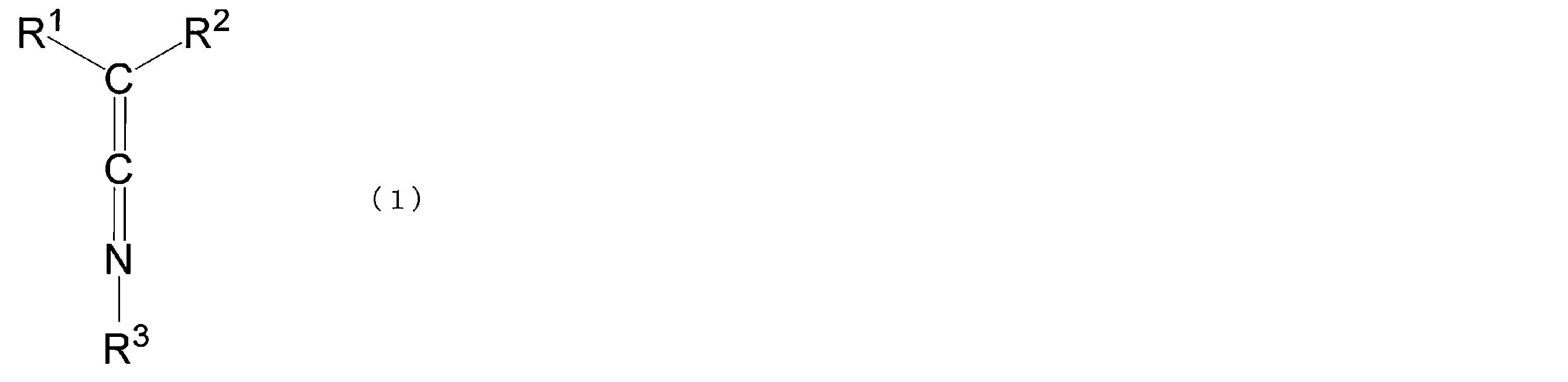
一般式(1)中、R1およびR2は、それぞれ独立に置換基を有してもよいアルキル基、置換基を有してもよいアリール基、置換基を有してもよいアルコキシ基、置換基を有してもよいアルコキシカルボニル基、置換基を有してもよいアミノカルボニル基、置換基を有してもよいアリールオキシ基、置換基を有してもよいアシル基または置換基を有してもよいアリールオキシカルボニル基を表し、R3は置換基を有してもよいアルキル基または置換基を有してもよいアリール基を表す。
[2] 脂肪族ポリエステルがポリ乳酸である[1]に記載の樹脂組成物。
[3] ポリエステルとケテンイミン化合物との合計質量100質量部に対して、ケテンイミン化合物を0.1~5質量部含有する[1]又は[2]に記載の樹脂組成物。
[4] ケテンイミン化合物が下記一般式(2)で表される[1]~[3]のいずれか1つに記載の樹脂組成物。
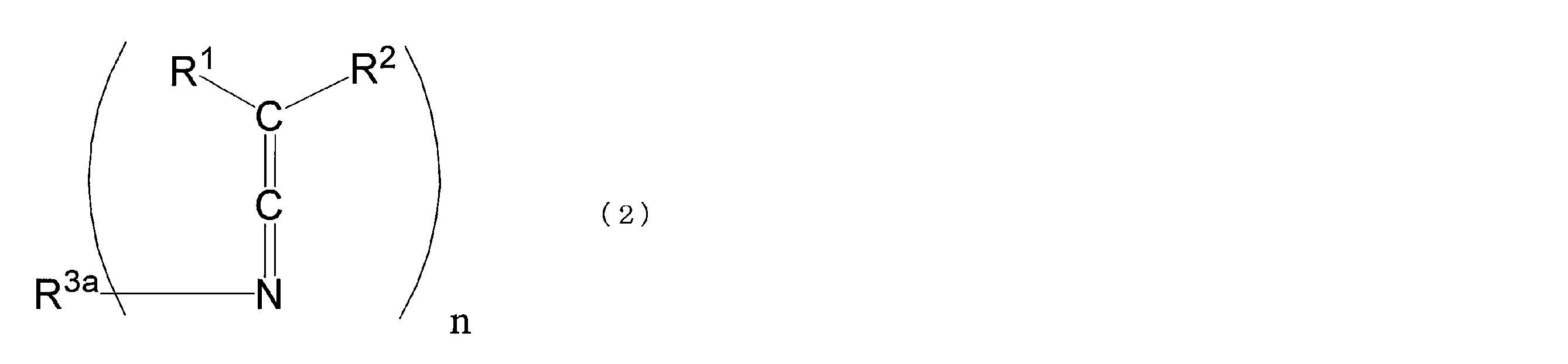
一般式(2)中、R1およびR2は、それぞれ独立に置換基を有してもよいアルキル基、置換基を有してもよいアリール基、置換基を有してもよいアルコキシ基、置換基を有してもよいアルコキシカルボニル基、置換基を有してもよいアミノカルボニル基、置換基を有してもよいアリールオキシ基、置換基を有してもよいアシル基または置換基を有してもよいアリールオキシカルボニル基を表し、R3aは、窒素原子との結合末端が、置換基を有してもよいアルキル部または置換基を有してもよいアリール部であるn価の基を表し、nは1から4の整数を表す。
[5] ケテンイミン化合物が下記一般式(3)で表される[1]~[3]のいずれか1つに記載の樹脂組成物。
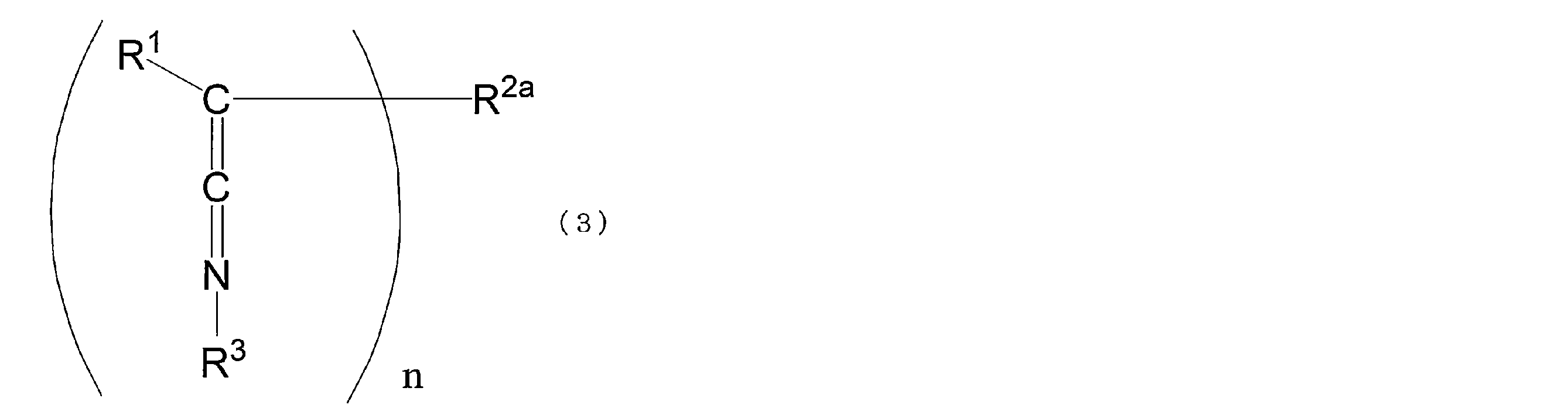
一般式(3)中、R1は置換基を有してもよいアルキル基、置換基を有してもよいアリール基、置換基を有してもよいアルコキシ基、置換基を有してもよいアルコキシカルボニル基、置換基を有してもよいアミノカルボニル基、置換基を有してもよいアリールオキシ基、置換基を有してもよいアシル基または置換基を有してもよいアリールオキシカルボニル基を表し、R2aは、炭素原子との結合末端が、置換基を有していてもよいアルキル部、置換基を有していてもよいアリール部、置換基を有していてもよいアルコキシ部、置換基を有してもよいアルコキシカルボニル部、置換基を有してもよいアミノカルボニル部、置換基を有してもよいアリールオキシ部、置換基を有してもよいアシル部または置換基を有してもよいアリールオキシカルボニル部であるn価の基を表し、R3は置換基を有してもよいアルキル基または置換基を有してもよいアリール基を表し、nは1から4の整数を表す。
[6] ケテンイミン化合物が下記一般式(4)で表される[4]に記載の樹脂組成物。

一般式(4)中、R11、R12、R14、R15は、それぞれ独立に置換基を有してもよいアルキル基、置換基を有してもよいアリール基、置換基を有してもよいアルコキシ基、置換基を有してもよいアルコキシカルボニル基、置換基を有してもよいアミノカルボニル基、置換基を有してもよいアリールオキシ基、置換基を有してもよいアシル基または置換基を有してもよいアリールオキシカルボニル基を表し、R13は、窒素原子との結合末端が、置換基を有してもよいアルキル部または置換基を有してもよいアリール部である2価の基を表す。
[7] ケテンイミン化合物が下記一般式(5)で表される[5]に記載の樹脂組成物。
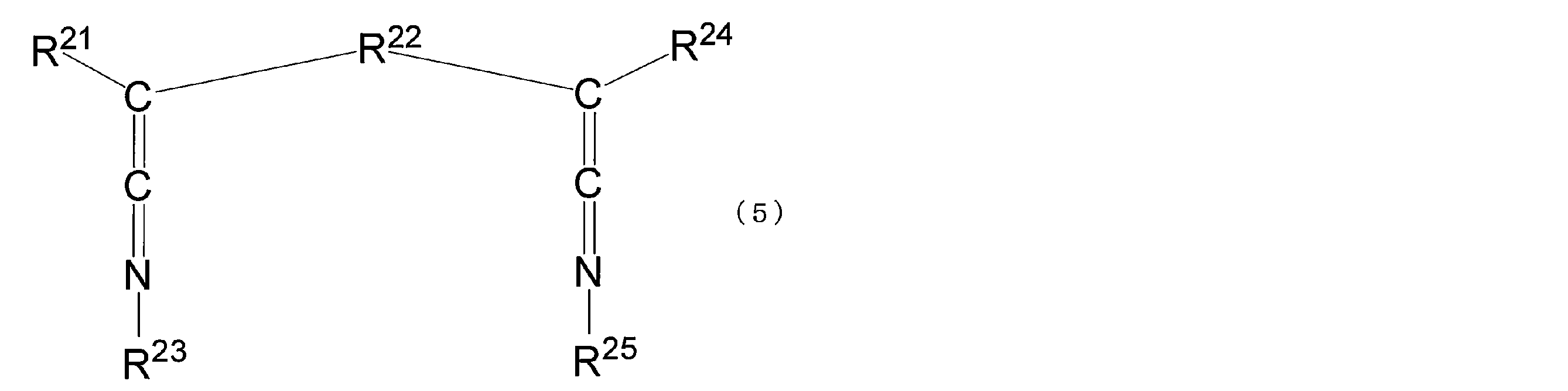
一般式(5)中、R21およびR24は、それぞれ独立に置換基を有してもよいアルキル基、置換基を有してもよいアリール基、置換基を有してもよいアルコキシ基、置換基を有してもよいアルコキシカルボニル基、置換基を有してもよいアミノカルボニル基、置換基を有してもよいアリールオキシ基、置換基を有してもよいアシル基または置換基を有してもよいアリールオキシカルボニル基を表し、R22は、炭素原子との結合末端が、置換基を有していてもよいアルキル部、置換基を有していてもよいアリール部、置換基を有していてもよいアルコキシ部、置換基を有してもよいアルコキシカルボニル部、置換基を有してもよいアミノカルボニル部、置換基を有してもよいアリールオキシ部、置換基を有してもよいアシル部または置換基を有してもよいアリールオキシカルボニル部である2価の基を表し、R23およびR25は、それぞれ独立に置換基を有してもよいアルキル基または置換基を有してもよいアリール基を表す。
[8] [1]~[7]のいずれか1つに記載の樹脂組成物から作製されるポリエステルフィルム。
[2] 脂肪族ポリエステルがポリ乳酸である[1]に記載の樹脂組成物。
[3] ポリエステルとケテンイミン化合物との合計質量100質量部に対して、ケテンイミン化合物を0.1~5質量部含有する[1]又は[2]に記載の樹脂組成物。
[4] ケテンイミン化合物が下記一般式(2)で表される[1]~[3]のいずれか1つに記載の樹脂組成物。
[5] ケテンイミン化合物が下記一般式(3)で表される[1]~[3]のいずれか1つに記載の樹脂組成物。
[6] ケテンイミン化合物が下記一般式(4)で表される[4]に記載の樹脂組成物。
[7] ケテンイミン化合物が下記一般式(5)で表される[5]に記載の樹脂組成物。
[8] [1]~[7]のいずれか1つに記載の樹脂組成物から作製されるポリエステルフィルム。
本発明によれば、脂肪族ポリエステルの末端カルボキシル基を、特定の構造を有するケテンイミン化合物で封止することで、脂肪族ポリエステルの耐加水分解性を向上できる。また、脂肪族ポリエステルは、低温で樹脂成型可能であるため、ポリエステルフィルムの製造時において、ケテンイミン化合物やケテン化合物などに由来する揮散ガスの発生を抑制できる。このため、ポリエステルフィルムの製造時における安全性を高めることができる。特に、分子内におけるケテンイミン部位を2以上含むケテンイミン化合物を用いることで、脂肪族ポリエステルの分子量増大を促進して耐加水分解性をより向上でき、更には、揮散ガスの発生をより低減できる。
以下において、本発明について詳細に説明する。以下に記載する構成要件の説明は、代表的な実施形態や具体例に基づいてなされることがあるが、本発明はそのような実施形態に限定されるものではない。なお、本明細書において「~」を用いて表される数値範囲は「~」前後に記載される数値を下限値および上限値として含む範囲を意味する。
本明細書における基(原子団)の表記において、置換および無置換を記していない表記は、置換基を有さないものと共に置換基を有するものをも包含するものである。例えば「アルキル基」とは、置換基を有さないアルキル基(無置換アルキル基)のみならず、置換基を有するアルキル基(置換アルキル基)をも包含するものである。
本明細書における粘度とは、25℃における粘度をいう。
本明細書において、重量平均分子量および数平均分子量は、GPC測定によるポリスチレン換算値として定義される。本明細書において、重量平均分子量(Mw)及び数平均分子量(Mn)は、例えば、HLC-8220(東ソー(株)製)を用い、カラムとしてTSKgel Super AWM―H(東ソー(株)製、6.0mmID×15.0cmを、溶離液として10mmol/L リチウムブロミドNMP(N-メチルピロリジノン)溶液を用いることによって求めることができる。
本明細書における基(原子団)の表記において、置換および無置換を記していない表記は、置換基を有さないものと共に置換基を有するものをも包含するものである。例えば「アルキル基」とは、置換基を有さないアルキル基(無置換アルキル基)のみならず、置換基を有するアルキル基(置換アルキル基)をも包含するものである。
本明細書における粘度とは、25℃における粘度をいう。
本明細書において、重量平均分子量および数平均分子量は、GPC測定によるポリスチレン換算値として定義される。本明細書において、重量平均分子量(Mw)及び数平均分子量(Mn)は、例えば、HLC-8220(東ソー(株)製)を用い、カラムとしてTSKgel Super AWM―H(東ソー(株)製、6.0mmID×15.0cmを、溶離液として10mmol/L リチウムブロミドNMP(N-メチルピロリジノン)溶液を用いることによって求めることができる。
(樹脂組成物)
本発明の樹脂組成物は、脂肪族ポリエステルと、特定のケテンイミン化合物とを含む。
本発明の樹脂組成物は、脂肪族ポリエステルと、特定のケテンイミン化合物とを含む。
(脂肪族ポリエステル)
まず、本発明の樹脂組成物に用いる脂肪族ポリエステルについて説明する。
脂肪族ポリエステルとしては、特に制限されない。脂肪族ジカルボン酸と、脂肪族ジアルコール類とを重縮合して得られるものを用いることができる。なかでも、生分解性を有するものが好ましく、植物由来の脂肪族ポリエステルがより好ましい。生分解性を有する脂肪族ポリエステルの具体例としては、ポリ乳酸、ポリ(3-ヒドロキシ酪酸)、ポリブチレンサクシネート、ポリブチレンアジペート、ポリエチレンサクシネート、ポリエチレンアジペート、ポリプロピレンサクシネート、ポリプロピレンアジペート、ポリヘキシレンサクシネート、ポリヘキシレンアジペートなどが挙げられる。これらの脂肪族ポリエステルの中でも、ポリ乳酸が、バイオマスの観点から好ましく用いられる。脂肪族ポリエステルは1種を単独で用いてもよく、また、2種以上を組み合わせて用いてもよい。また、これらの脂肪族ポリエステルの2種以上の共重合体を用いてもよい。
脂肪族ポリエステルは、耐加水分解性が低い材料である。特にポリ乳酸は、湿熱環境下で加水分解されやすい。しかし、後述する特定のケテンイミン化合物で、脂肪族ポリエステルの末端カルボキシル基を封止することで、脂肪族ポリエステルの耐加水分解性を向上できる。また、フィルム化時における揮散ガスの発生を抑制でき、フィルム製造時における作業安全性を向上できる。
まず、本発明の樹脂組成物に用いる脂肪族ポリエステルについて説明する。
脂肪族ポリエステルとしては、特に制限されない。脂肪族ジカルボン酸と、脂肪族ジアルコール類とを重縮合して得られるものを用いることができる。なかでも、生分解性を有するものが好ましく、植物由来の脂肪族ポリエステルがより好ましい。生分解性を有する脂肪族ポリエステルの具体例としては、ポリ乳酸、ポリ(3-ヒドロキシ酪酸)、ポリブチレンサクシネート、ポリブチレンアジペート、ポリエチレンサクシネート、ポリエチレンアジペート、ポリプロピレンサクシネート、ポリプロピレンアジペート、ポリヘキシレンサクシネート、ポリヘキシレンアジペートなどが挙げられる。これらの脂肪族ポリエステルの中でも、ポリ乳酸が、バイオマスの観点から好ましく用いられる。脂肪族ポリエステルは1種を単独で用いてもよく、また、2種以上を組み合わせて用いてもよい。また、これらの脂肪族ポリエステルの2種以上の共重合体を用いてもよい。
脂肪族ポリエステルは、耐加水分解性が低い材料である。特にポリ乳酸は、湿熱環境下で加水分解されやすい。しかし、後述する特定のケテンイミン化合物で、脂肪族ポリエステルの末端カルボキシル基を封止することで、脂肪族ポリエステルの耐加水分解性を向上できる。また、フィルム化時における揮散ガスの発生を抑制でき、フィルム製造時における作業安全性を向上できる。
本発明において、脂肪族ポリエステルの重量平均分子量(Mw)は、10000以上が好ましく、30000以上がより好ましく、60000以上が特に好ましい。脂肪族ポリエステルの重量平均分子量は、ヘキサフルオロイソプロパノールを溶媒として用いたゲルパーミエーションクロマトグラフィー(GPC)によって測定したポリメチルメタクリレート(PMMA)換算の値を用いることができる。
次に、ポリ乳酸について説明する。ポリ乳酸は、L-乳酸および/またはD-乳酸を主な構成成分とするポリマーである。ポリ乳酸は、他のエステル形成能を有する単量体成分と共重合した共重合ポリ乳酸であってもよい。他の共重合成分としては、イソフタル酸、フタル酸、1,4-ナフタレンジカルボン酸、2,6-ナフタレンジカルボン酸、ジフェニルジカルボン酸、ジフェノキシエタンジカルボン酸、ジフェニルエーテルジカルボン酸、ジフェニルスルホンジカルボン酸などの芳香族ジカルボン酸、1,3-シクロペンタンジカルボン酸、1,3-シクロヘキサンジカルボン酸、1,4-シクロヘキサンジカルボン酸などの脂環式ジカルボン酸、マロン酸、ジメチルマロン酸、コハク酸、3,3-ジエチルコハク酸、グルタル酸、2,2-ジメチルグルタル酸、アジピン酸、2-メチルアジピン酸、トリメチルアジピン酸、ピメリン酸、アゼライン酸、セバシン酸、スベリン酸などの脂肪族ジカルボン酸、グリコール酸、3-ヒドロキシ酪酸、4-ヒドロキシ吉草酸、ヒドロキシプロピオン酸、ヒドロキシカプロン酸、ヒドロキシ安息香酸などのヒドロキシカルボン酸、およびそれらのエステル形成性誘導体などから誘導されるジカルボン酸、エチレングリコール、プロピレングリコール、ブダンジオール、ヘプタンジオール、ヘキサンジオール、オクタンジオール、ノナンジオール、デカンジオール、1,4-シクロヘキサンジメタノール、ネオペンチルグリコールなどの脂肪族ジオール、2,2-ビス(4-β-ヒドロキシエトキシフェニル)プロパン、2,2-ビス(4-β-ヒドロキシエトキシフェニル)スルホンなどの芳香族ジオール、ポリエチレングリコール、ポリ-1,3-プロピレングリコール、ポリテトラメチレングリコールなどの低分子量ポリアルキレングリコールなどから誘導されるジオール、グリセリン、ペンタエリスリトールなどの分子内に複数の水酸基を含有する化合物又はそれらの誘導体が挙げられる。なお、他の重合性単量体に由来する重合鎖がポリマー全量に占める割合は、モノマー換算で50モル%以下であることが好ましい。さらに、20モル%以下であることが特に好ましい。また、共重合体の配列様式は、ランダム共重合体、交互共重合体、ブロック共重合体、グラフト共重合体の何れであってもよい。
ポリ乳酸の分子量や分子量分布について、実質的に成形加工が可能であれば特に制限されるものではないが、重量平均分子量(Mw)としては、10000以上が好ましく、30000以上がより好ましく、60000以上が特に好ましい。ポリ乳酸の重量平均分子量は、ヘキサフルオロイソプロパノールを溶媒として用いたゲルパーミエーションクロマトグラフィー(GPC)によって測定したポリメチルメタクリレート(PMMA)換算の値を用いることができる。
ポリ乳酸としては、上市品を用いてもよい。例えば、三井化学社製のレイシア(登録商標)シリーズ等が挙げられる。
本発明において、樹脂組成物中における脂肪族ポリエステルの含有量は特に制限されないが、樹脂組成物全量を基準として、10~99.9質量%が好ましい。下限値は、10質量%以上が好ましく、20質量%以上がより好ましい。脂肪族ポリエステルの含有量が上記範囲であれば、ポリエステルフィルムの製造時における揮散ガスの発生をより効果的に抑制できる。
脂肪族ポリエステルは1種又は2種以上含んでいてもよい。2種以上含む場合は、その合計量が上記範囲となることが好ましい。
また、樹脂組成物中におけるポリ乳酸の含有量は特に制限されないが、樹脂組成物全量を基準として、10~99.9質量%が好ましい。下限値は、10質量%以上が好ましく、20質量%以上がより好ましい。
ポリ乳酸は1種又は2種以上含んでいてもよい。2種以上含む場合は、その合計量が上記範囲となることが好ましい。
脂肪族ポリエステルは1種又は2種以上含んでいてもよい。2種以上含む場合は、その合計量が上記範囲となることが好ましい。
また、樹脂組成物中におけるポリ乳酸の含有量は特に制限されないが、樹脂組成物全量を基準として、10~99.9質量%が好ましい。下限値は、10質量%以上が好ましく、20質量%以上がより好ましい。
ポリ乳酸は1種又は2種以上含んでいてもよい。2種以上含む場合は、その合計量が上記範囲となることが好ましい。
(他のポリエステル)
本発明の樹脂組成物は、脂肪族ポリエステル以外のポリエステル(以下、他のポリエステルという)を含有していてもよい。
本発明の樹脂組成物は、脂肪族ポリエステル以外のポリエステル(以下、他のポリエステルという)を含有していてもよい。
他のポリエステルとしては、限定されるものではないが、飽和ポリエステルが好ましい。飽和ポリエステルを用いることで、不飽和ポリエステルを用いたフィルムと比べて力学強度の観点で優れるポリエステルフィルムを得ることができる。
飽和ポリエステルとしては、芳香族二塩基酸又はそのエステル形成性誘導体と、ジオール又はそのエステル形成性誘導体と、から合成される線状飽和ポリエステルであることが好ましい。線状飽和ポリエステルとしては、例えば、特開2009-155479号公報や特開2010-235824号公報に記載のものを適宜用いることができる。
上述した線状飽和ポリエステルは、例えば、芳香族二塩基酸又はそのエステル形成性誘導体とジオール又はそのエステル形成性誘導体とを、エステル化反応又はエステル交換反応させ、次いで重縮合反応させることによって製造することができる。また、原料物質や反応条件を選択することにより、ポリエステルのカルボン酸価や固有粘度を制御することができる。なお、エステル化反応又はエステル交換反応及び重縮合反応を効果的に進めるために、これらの反応時に重合触媒を添加することが好ましい。
重合触媒としては、カルボキシル基含量を所定の範囲以下に抑える観点から、Al系、Sb系、Ge系、及びTi系の化合物を用いることが好ましいが、特にTi系化合物が好ましい。Ti系化合物を用いる場合、Ti系化合物を1~30ppm、より好ましくは3~15ppmの範囲で触媒として用いることにより重合する態様が好ましい。Ti系化合物の割合が上述した範囲内であれば、末端カルボキシル基を好ましい範囲に調整でき、ポリイミドフィルムの耐加水分解性を低く保つことができる。
Ti系化合物を用いたポリエステルの合成は、例えば、特公平8-301198号公報、特許第2543624、特許第3335683、特許第3717380、特許第3897756、特許第3962226、特許第3979866、特許第3996871、特許第4000867、特許第4053837、特許第4127119、特許第4134710、特許第4159154、特許第4269704、特許第4313538等に記載の方法を適用できる。
ポリエステルは、重合後に固相重合されていることが好ましい。これにより、好ましいカルボン酸価を達成することができる。固相重合は、連続法(タワーの中に樹脂を充満させ、これを加熱しながらゆっくり所定の時間滞流させた後、送り出す方法)でもよいし、バッチ法(容器の中に樹脂を投入し、所定の時間加熱する方法)でもよい。具体的には、固相重合には、特許第2621563、特許第3121876、特許第3136774、特許第3603585、特許第3616522、特許第3617340、特許第3680523、特許第3717392、特許第4167159等に記載の方法を適用することができる。
固相重合の温度は、170~240℃が好ましく、より好ましくは180~230℃であり、さらに好ましくは190~220℃である。また、固相重合時間は、5~100時間が好ましく、より好ましくは10~75時間であり、さらに好ましくは15~50時間である。固相重合は、真空中あるいは窒素雰囲気下で行なうことが好ましい。
線状飽和ポリエステルの具体例として、ポリエチレンテレフタレート(PET)、ポリエチレンイソフタレート、ポリブチレンテレフタレート、ポリ(1,4-シクロヘキシレンジメチレンテレフタレート)、ポリエチレン-2,6-ナフタレートが挙げられる。このうち、ポリエチレンテレフタレート又はポリエチレン-2,6-ナフタレートが、力学的物性及びコストのバランスの点で特に好ましく、ポリエチレンテレフタレートがより特に好ましい。
他のポリエステルは、単独重合体であってもよいし、共重合体であってもよい。更に、ポリエステルに他の種類の樹脂、例えばポリイミド等を少量ブレンドしたものであってもよい。また、ポリエステルとして、溶融製膜時に異方性を形成することができる結晶性のポリエステルを用いてもよい。
他のポリエステルの重量平均分子量(Mw)は、耐熱性や粘度の観点から、5000~100000が好ましく、8000~80000が更に好ましく、12000~60000が特に好ましい。
本発明の樹脂組成物は、他のポリエステルを含有しなくてもよいが、他のポリエステルを含有する場合、他のポリエステルの含有量は、脂肪族ポリエステル100質量部に対し、0.01~10質量部が好ましく、1~5質量部がより好ましい。他のポリエステルの含有量が上記上限値以下であれば、ポリエステルフィルムの製造時における揮散ガスの発生をより低減できる。
他のポリエステルは、1種又は2種以上含んでいてもよい。2種以上含む場合は、その合計量が上記範囲となることが好ましい。
他のポリエステルは、1種又は2種以上含んでいてもよい。2種以上含む場合は、その合計量が上記範囲となることが好ましい。
(ケテンイミン化合物)
次に、本発明の樹脂組成物に用いるケテンイミン化合物について説明する。本発明で用いるケテンイミン化合物は、下記一般式(1)で表される構造の化合物である。
次に、本発明の樹脂組成物に用いるケテンイミン化合物について説明する。本発明で用いるケテンイミン化合物は、下記一般式(1)で表される構造の化合物である。
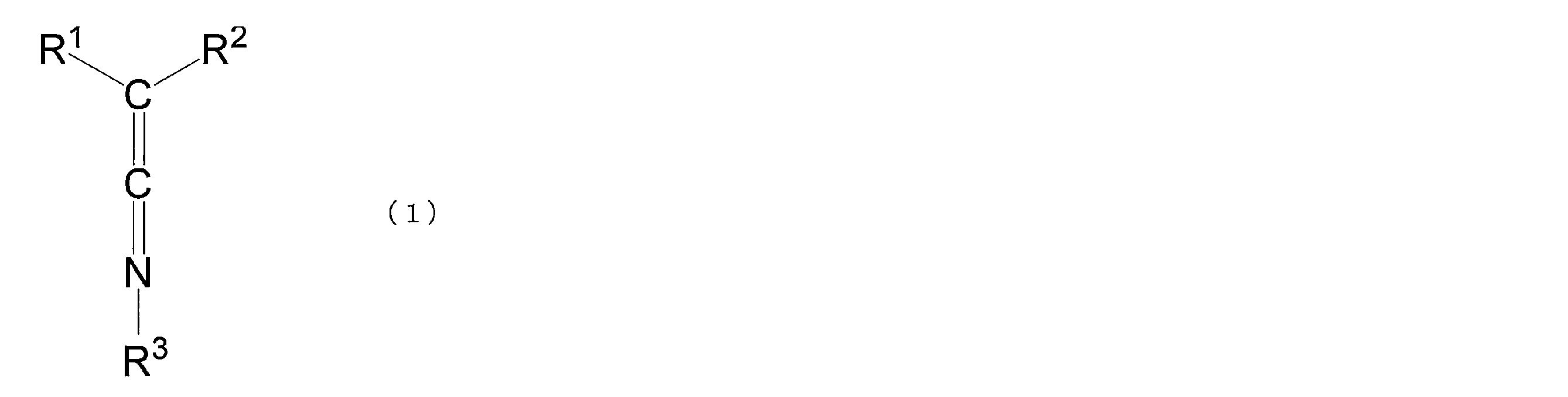
一般式(1)中、R1およびR2は、それぞれ独立に置換基を有してもよいアルキル基、置換基を有してもよいアリール基、置換基を有してもよいアルコキシ基、置換基を有してもよいアルコキシカルボニル基、置換基を有してもよいアミノカルボニル基、置換基を有してもよいアリールオキシ基、置換基を有してもよいアシル基または置換基を有してもよいアリールオキシカルボニル基を表し、R3は置換基を有してもよいアルキル基または置換基を有してもよいアリール基を表す。
R1~R3の少なくとも一つは、置換基を有してもよいアルキル基であることが好ましい。これによれば、色味の良いポリエステルフィルムが得られやすくなる。
R1~R3の少なくとも一つは、置換基を有してもよいアルキル基であることが好ましい。これによれば、色味の良いポリエステルフィルムが得られやすくなる。
R1およびR2で表されるアルキル基は、炭素数1~20のアルキル基であることが好ましく、炭素数1~12のアルキル基であることがより好ましい。なお、アルキル基の炭素数は、置換基を含まない炭素数を示す。アルキル基は、直鎖であってもよく、分枝であってもよく、環状であってもよい。アルキル基の具体例としては、メチル基、エチル基、n-プロピル基、iso-プロピル基、n-ブチル基、tert-ブチル基、sec-ブチル基、iso-ブチル基、n-ペンチル基、sec-ペンチル基、iso-ペンチル基、n-ヘキシル基、sec-ヘキシル基、iso-ヘキシル基、シクロヘキシル基、などを挙げることができる。中でも、メチル基、エチル基、n-プロピル基、iso-プロピル基、iso-ブチル基、シクロヘキシル基がより好ましい。
R1およびR2で表されるアリール基は、炭素数6~20のアリール基であることが好ましく、炭素数6~12のアリール基であることがより好ましい。なお、アリール基の炭素数は、置換基を含まない炭素数を示す。アリール基の具体例としては、フェニル基、ナフチル基などを挙げることができ、その中でもフェニル基が特に好ましい。
R1およびR2で表されるアルコキシ基は、炭素数1~20のアルコキシ基であることが好ましく、炭素数1~12のアルコキシ基であることがより好ましく、炭素数2~6のアルコキシ基であることが特に好ましい。なお、アルコキシ基の炭素数は、置換基を含まない炭素数を示す。アルコキシ基は、直鎖であってもよく、分枝であってもよく、環状であってもよい。アルコキシ基の好ましい例としては、上述したアルキル基の末端に、-O-が連結した基を挙げることができる。
R1およびR2で表されるアルコキシカルボニル基は、炭素数2~20のアルコキシカルボニル基であることが好ましく、炭素数2~12のアルコキシカルボニル基であることがより好ましく、炭素数2~6のアルコキシカルボニル基であることが特に好ましい。なお、アルコキシカルボニル基の炭素数は、置換基を含まない炭素数を示す。アルコキシカルボニル基のアルコキシ部としては、上述したアルコキシ基の例を挙げることができる。
R1およびR2で表されるアミノカルボニル基は、炭素数1~20のアルキルアミノカルボニル基、炭素数6~20のアリールアミノカルボニル基であることが好ましい。なお、アルキルアミノカルボニル基の炭素数は、置換基を含まない炭素数を示す。炭素数1~20のアルキルアミノカルボニル基のアルキルアミノ部の好ましい例としては、上述したアルキル基の末端に、-NH-が連結した基を挙げることができる。炭素数6~20のアリールアミノカルボニル基のアリールアミノ部の好ましい例としては、上述したアリール基の末端に-NH-が連結した基を挙げることができる。
R1およびR2で表されるアリールオキシ基は、炭素数6~20のアリールオキシ基であることが好ましく、炭素数6~12のアリールオキシ基であることがより好ましい。なお、アリールオキシ基の炭素数は、置換基を含まない炭素数を示す。アリールオキシ基のアリール部としては、上述したアリール基の例を挙げることができる。
R1およびR2で表されるアシル基は、炭素数2~20のアシル基であることが好ましく、炭素数2~12のアシル基であることがより好ましく、炭素数2~6のアシル基であることが特に好ましい。なお、アシル基の炭素数は、置換基を含まない炭素数を示す。
R1およびR2で表されるアリールオキシカルボニル基は、炭素数7~20のアリールオキシカルボニル基であることが好ましく、炭素数7~12のアリールオキシカルボニル基であることがより好ましい。なお、アリールオキシカルボニル基の炭素数は、置換基を含まない炭素数を示す。アリールオキシカルボニル基のアリール部としては、上述したアリール基の例を挙げることができる。
上述したR1およびR2で表される各基は、置換基を有していてもよい。置換基は、ケテンイミン基とカルボキシル基との反応を進行させ得る限り、特に制限されることはない。また、置換基は、ケテンイミン部を含んでいてもよく、複数のケテンイミン部を含んでいてもよい。
さらに、R1およびR2で表される各基には、一般式(1)で表されるケテンイミン構造が繰り返し単位として含まれていてもよい。例えば、本発明で用いるケテンイミン化合物は、一般式(1)のR1とR2がそれぞれ2価の連結基となった繰り返し単位が鎖状または環状に連結したものや、一般式(1)のR2とR3がそれぞれ2価の連結基となった繰り返し単位が鎖状または環状に連結したものであってもよい。
さらに、R1およびR2で表される各基には、一般式(1)で表されるケテンイミン構造が繰り返し単位として含まれていてもよい。例えば、本発明で用いるケテンイミン化合物は、一般式(1)のR1とR2がそれぞれ2価の連結基となった繰り返し単位が鎖状または環状に連結したものや、一般式(1)のR2とR3がそれぞれ2価の連結基となった繰り返し単位が鎖状または環状に連結したものであってもよい。
R3は置換基を有してもよいアルキル基または置換基を有してもよいアリール基を表す。
アルキル基は、炭素数1~20のアルキル基であることが好ましく、炭素数1~12のアルキル基であることがより好ましい。なお、アルキル基の炭素数は、置換基を含まない炭素数を示す。アルキル基は、直鎖であってもよく、分枝であってもよく、環状であってもよい。アルキル基の具体例としては、メチル基、エチル基、n-プロピル基、iso-プロピル基、n-ブチル基、tert-ブチル基、sec-ブチル基、iso-ブチル基、n-ペンチル基、sec-ペンチル基、iso-ペンチル基、n-ヘキシル基、sec-ヘキシル基、iso-ヘキシル基、シクロヘキシル基、などを挙げることができる。中でもメチル基、エチル基、n-プロピル基、iso-プロピル基、n-ブチル基、iso-ブチル基、シクロヘキシル基がより好ましい。
アリール基は、炭素数6~20のアリール基であることが好ましく、炭素数6~12のアリール基であることがより好ましい。なお、アリール基の炭素数は、置換基を含まない炭素数を示す。アリール基の具体例としては、フェニル基、ナフチル基などを挙げることができ、その中でもフェニル基が特に好ましい。
アルキル基は、炭素数1~20のアルキル基であることが好ましく、炭素数1~12のアルキル基であることがより好ましい。なお、アルキル基の炭素数は、置換基を含まない炭素数を示す。アルキル基は、直鎖であってもよく、分枝であってもよく、環状であってもよい。アルキル基の具体例としては、メチル基、エチル基、n-プロピル基、iso-プロピル基、n-ブチル基、tert-ブチル基、sec-ブチル基、iso-ブチル基、n-ペンチル基、sec-ペンチル基、iso-ペンチル基、n-ヘキシル基、sec-ヘキシル基、iso-ヘキシル基、シクロヘキシル基、などを挙げることができる。中でもメチル基、エチル基、n-プロピル基、iso-プロピル基、n-ブチル基、iso-ブチル基、シクロヘキシル基がより好ましい。
アリール基は、炭素数6~20のアリール基であることが好ましく、炭素数6~12のアリール基であることがより好ましい。なお、アリール基の炭素数は、置換基を含まない炭素数を示す。アリール基の具体例としては、フェニル基、ナフチル基などを挙げることができ、その中でもフェニル基が特に好ましい。
R3が表す各基は、置換基を有していてもよい。置換基は、ケテンイミン基とカルボキシル基との反応を進行させ得る限り、特に制限されることはない。
なお、一般式(1)におけるR1またはR2と、R3は、互いに連結して環状構造を形成していてもよい。この場合、環状構造には、ケテンイミン部が含まれていてもよく、一般式(1)で表される構造の繰り返し単位を含んでいてもよい。
一般式(1)で表されるケテンイミン化合物は、R1-C(=C)-R2部分構造の分子量は320以上であることが好ましく、400以上であることが好ましく、500以上であることがさらに好ましい。また、一分子中のケテンイミン部位の数に対するケテンイミン化合物のモル分子量(モル分子量/ケテンイミン部位の数)は、1000以下であることが好ましく、500以下であることがより好ましく、400以下であることがさらに好ましい。ケテンイミン化合物のケテンイミン部炭素上の置換基の分子量及びケテンイミン部位の数に対するケテンイミン化合物のモル分子量を上記範囲内とすることにより、ケテンイミン化合物自体の揮散や、脂肪族ポリエステルの末端カルボキシル基を封止する際に生じるケテン化合物の揮散をより効果的に抑制できる。このため、ポリエステルフィルムの製造時における揮散ガスの発生を抑制でき、作業安全性を向上できる。更には、脂肪族ポリエステルの末端カルボキシル基の封止を低添加量のケテンイミン化合物にて行うことができる。
一般式(1)で表されるケテンイミン化合物は、ケテンイミン部位を2以上有していることが好ましい。ケテンイミン部位を2以上有することにより、ケテンイミン化合物自体の揮散や、脂肪族ポリエステルの末端カルボキシル基を封止する際に生じるケテン化合物の揮散をより効果的に抑制できる。このため、ポリエステルフィルムの製造時における揮散ガスの発生を抑制でき、作業安全性を向上できる。
また、本発明に用いるケテンイミン化合物は、下記一般式(2)で表されることが好ましい。

一般式(2)中、R1およびR2は、それぞれ独立に置換基を有してもよいアルキル基、置換基を有してもよいアリール基、置換基を有してもよいアルコキシ基、置換基を有してもよいアルコキシカルボニル基、置換基を有してもよいアミノカルボニル基、置換基を有してもよいアリールオキシ基、置換基を有してもよいアシル基または置換基を有してもよいアリールオキシカルボニル基を表し、R3aは、窒素原子との結合末端が、置換基を有してもよいアルキル部または置換基を有してもよいアリール部であるn価の基を表し、nは1から4の整数を表す。
一般式(2)のR1及びR2は、一般式(1)のR1及びR2と同意であり、好ましい範囲も同様である。
一般式(2)のR3aは、ケテンイミン部位の窒素原子との結合末端が、置換基を有してもよいアルキル部または置換基を有してもよいアリール部であるn価の基である。なお、nが1の場合、R3aは1価の基を表し、nが2~4の場合、R3aは2~4価の連結基を表す。
1価の基の具体例としては、置換基を有してもよいアルキル基、置換基を有してもよいアリール基が挙げられる。アルキル基、アリール基、置換基については、一般式(1)のR3で説明したものと同意であり、好ましい範囲も同様である。
2価の基の具体例としては、置換基を有してもよいアルキレン基、置換基を有してもよいアリーレン基が挙げられる。また、ケテンイミン部位の窒素原子との結合末端が、置換基を有してもよいアルキル部、又は、置換基を有してもよいアリール部であり、部分構造として、単結合、-NR’-(R’は、水素原子、置換基を有していてもよいアルキル基または置換基を有していてもよいアリール基を表し、水素原子が好ましい)で表される構造、-SO2-、-CO-、置換もしくは無置換のアルキレン部、置換もしくは無置換のアルケニレン部、アルキニレン部、置換もしくは無置換のフェニレン部、置換もしくは無置換のビフェニレン部、置換もしくは無置換のナフチレン部、-O-、-S-および-SO-から選ばれる少なくとも一つを含む基が挙げられる。
3価の基の具体例としては、例えば、2価の基の例として挙げた基のうち置換基を有するものから1つの水素原子を取り除いた基が挙げられる。
4価の基の具体例としては、例えば、2価の基の例として挙げた基のうち置換基を有するものから2つの水素原子を取り除いた基が挙げられる。
2価の基の具体例としては、置換基を有してもよいアルキレン基、置換基を有してもよいアリーレン基が挙げられる。また、ケテンイミン部位の窒素原子との結合末端が、置換基を有してもよいアルキル部、又は、置換基を有してもよいアリール部であり、部分構造として、単結合、-NR’-(R’は、水素原子、置換基を有していてもよいアルキル基または置換基を有していてもよいアリール基を表し、水素原子が好ましい)で表される構造、-SO2-、-CO-、置換もしくは無置換のアルキレン部、置換もしくは無置換のアルケニレン部、アルキニレン部、置換もしくは無置換のフェニレン部、置換もしくは無置換のビフェニレン部、置換もしくは無置換のナフチレン部、-O-、-S-および-SO-から選ばれる少なくとも一つを含む基が挙げられる。
3価の基の具体例としては、例えば、2価の基の例として挙げた基のうち置換基を有するものから1つの水素原子を取り除いた基が挙げられる。
4価の基の具体例としては、例えば、2価の基の例として挙げた基のうち置換基を有するものから2つの水素原子を取り除いた基が挙げられる。
一般式(2)において、nは、2~4が好ましく、2が特に好ましい。nを2~4とすることにより、ケテンイミン部位を一分子中に2以上有する化合物とすることができ、より優れた末端封止効果を発揮することができる。また、ケテンイミン部を一分子中に2以上有する化合物とすることにより、ケテンイミン部位1つあたりの分子量を低くすることができ、効率良くケテンイミン化合物と脂肪族ポリエステルの末端カルボキシル基を反応させることができる。さらに、ケテンイミン部位を一分子中に2以上有することにより、ケテンイミン化合物やケテン化合物が揮散することを抑制することができる。
また、本発明に用いるケテンイミン化合物は、下記一般式(3)で表されることが好ましい。
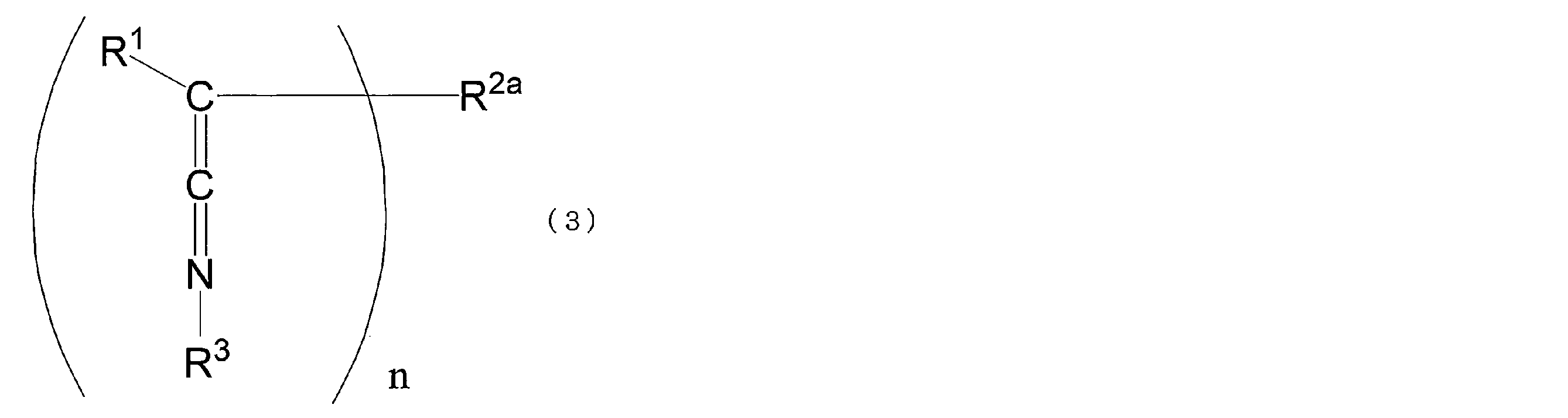
一般式(3)中、R1は置換基を有してもよいアルキル基、置換基を有してもよいアリール基、置換基を有してもよいアルコキシ基、置換基を有してもよいアルコキシカルボニル基、置換基を有してもよいアミノカルボニル基、置換基を有してもよいアリールオキシ基、置換基を有してもよいアシル基または置換基を有してもよいアリールオキシカルボニル基を表し、R2aは、炭素原子との結合末端が、置換基を有していてもよいアルキル部、置換基を有していてもよいアリール部、置換基を有していてもよいアルコキシ部、置換基を有してもよいアルコキシカルボニル部、置換基を有してもよいアミノカルボニル部、置換基を有してもよいアリールオキシ部、置換基を有してもよいアシル部または置換基を有してもよいアリールオキシカルボニル部であるn価の基を表し、R3は置換基を有してもよいアルキル基または置換基を有してもよいアリール基を表し、nは1から4の整数を表す。
一般式(3)のR1及びR3は、一般式(1)におけるR1及びR3と同意であり、好ましい範囲も同様である。
一般式(3)のR2aは、炭素原子との結合末端が、置換基を有していてもよいアルキル部、置換基を有していてもよいアリール部、置換基を有していてもよいアルコキシ部、置換基を有してもよいアルコキシカルボニル部、置換基を有してもよいアミノカルボニル部、置換基を有してもよいアリールオキシ部、置換基を有してもよいアシル部または置換基を有してもよいアリールオキシカルボニル部であるn価の基を表す。
1価の基の具体例としては、置換基を有してもよいアルキル基、置換基を有してもよいアリール基、置換基を有してもよいアルコキシ基、置換基を有してもよいアルコキシカルボニル基、置換基を有してもよいアミノカルボニル基、置換基を有してもよいアリールオキシ基、置換基を有してもよいアシル基または置換基を有してもよいアリールオキシカルボニル基が挙げられる。これらは、一般式(1)のR2で説明したものと同意であり、好ましい範囲も同様である。
2価の基の具体例としては、置換基を有してもよいアルキレン基、置換基を有してもよいアリーレン基等が挙げられる。また、ケテンイミン部位の炭素原子との結合末端が、置換基を有していてもよいアルキル部、置換基を有していてもよいアリール部、置換基を有していてもよいアルコキシ部、置換基を有してもよいアルコキシカルボニル部、置換基を有してもよいアミノカルボニル部、置換基を有してもよいアリールオキシ部、置換基を有してもよいアシル部または置換基を有してもよいアリールオキシカルボニル部であり、部分構造として、単結合、-NR’-(R’は、水素原子、置換基を有していてもよいアルキル基または置換基を有していてもよいアリール基を表し、水素原子が好ましい)で表される構造、-SO2-、-CO-、置換もしくは無置換のアルキレン部、置換もしくは無置換のアルケニレン部、アルキニレン部、置換もしくは無置換のフェニレン部、置換もしくは無置換のビフェニレン部、置換もしくは無置換のナフチレン部、-O-、-S-および-SO-から選ばれる少なくとも一つを含む基が挙げられる。
3価の基の具体例としては、例えば、2価の基の例として挙げた基のうち置換基を有するものから1つの水素原子を取り除いた基が挙げられる。
4価の基の具体例としては、例えば、例えば、2価の基の例として挙げた基のうち置換基を有するものから2つの水素原子を取り除いた基が挙げられる。
置換基は、ケテンイミン基とカルボキシル基との反応を進行させ得る限り、特に制限されることはない。また、R2aの置換基は、R1とR2aを互いに連結するものであってもよい。
1価の基の具体例としては、置換基を有してもよいアルキル基、置換基を有してもよいアリール基、置換基を有してもよいアルコキシ基、置換基を有してもよいアルコキシカルボニル基、置換基を有してもよいアミノカルボニル基、置換基を有してもよいアリールオキシ基、置換基を有してもよいアシル基または置換基を有してもよいアリールオキシカルボニル基が挙げられる。これらは、一般式(1)のR2で説明したものと同意であり、好ましい範囲も同様である。
2価の基の具体例としては、置換基を有してもよいアルキレン基、置換基を有してもよいアリーレン基等が挙げられる。また、ケテンイミン部位の炭素原子との結合末端が、置換基を有していてもよいアルキル部、置換基を有していてもよいアリール部、置換基を有していてもよいアルコキシ部、置換基を有してもよいアルコキシカルボニル部、置換基を有してもよいアミノカルボニル部、置換基を有してもよいアリールオキシ部、置換基を有してもよいアシル部または置換基を有してもよいアリールオキシカルボニル部であり、部分構造として、単結合、-NR’-(R’は、水素原子、置換基を有していてもよいアルキル基または置換基を有していてもよいアリール基を表し、水素原子が好ましい)で表される構造、-SO2-、-CO-、置換もしくは無置換のアルキレン部、置換もしくは無置換のアルケニレン部、アルキニレン部、置換もしくは無置換のフェニレン部、置換もしくは無置換のビフェニレン部、置換もしくは無置換のナフチレン部、-O-、-S-および-SO-から選ばれる少なくとも一つを含む基が挙げられる。
3価の基の具体例としては、例えば、2価の基の例として挙げた基のうち置換基を有するものから1つの水素原子を取り除いた基が挙げられる。
4価の基の具体例としては、例えば、例えば、2価の基の例として挙げた基のうち置換基を有するものから2つの水素原子を取り除いた基が挙げられる。
置換基は、ケテンイミン基とカルボキシル基との反応を進行させ得る限り、特に制限されることはない。また、R2aの置換基は、R1とR2aを互いに連結するものであってもよい。
一般式(3)において、nは、2~4が好ましく、3または4がより好ましく、4が特に好ましい。
nを2~4とすることにより、ケテンイミン部位を一分子中に2以上有する化合物とすることができ、より優れた末端封止効果を発揮することができる。また、ケテンイミン部を一分子中に2以上有する化合物とすることにより、ケテンイミン部位1つあたりの分子量を低くすることができ、効率良くケテンイミン化合物と脂肪族ポリエステルの末端カルボキシル基を反応させることができる。さらに、ケテンイミン部位を一分子中に2以上有することにより、ケテンイミン化合物やケテン化合物が揮散することを抑制することができる。
また、nを3または4とすることにより、一般式(3)中のR1またはR2aの置換基のモル分子量を小さくした場合であっても、ケテンイミン化合物の揮散を効果的に抑制することができる。
また、nを4とすることにより、ケテンイミン部位は一分子中に4個含まれることとなり、ケテンイミン化合物はより優れた末端封止効果を発揮することができる。更には、より効果的にケテンイミン化合物の揮散を抑制することができる。
nを2~4とすることにより、ケテンイミン部位を一分子中に2以上有する化合物とすることができ、より優れた末端封止効果を発揮することができる。また、ケテンイミン部を一分子中に2以上有する化合物とすることにより、ケテンイミン部位1つあたりの分子量を低くすることができ、効率良くケテンイミン化合物と脂肪族ポリエステルの末端カルボキシル基を反応させることができる。さらに、ケテンイミン部位を一分子中に2以上有することにより、ケテンイミン化合物やケテン化合物が揮散することを抑制することができる。
また、nを3または4とすることにより、一般式(3)中のR1またはR2aの置換基のモル分子量を小さくした場合であっても、ケテンイミン化合物の揮散を効果的に抑制することができる。
また、nを4とすることにより、ケテンイミン部位は一分子中に4個含まれることとなり、ケテンイミン化合物はより優れた末端封止効果を発揮することができる。更には、より効果的にケテンイミン化合物の揮散を抑制することができる。
本発明に用いるケテンイミン化合物は、下記一般式(4)で表されることが好ましい。

一般式(4)中、R11、R12、R14、R15は、それぞれ独立に置換基を有してもよいアルキル基、置換基を有してもよいアリール基、置換基を有してもよいアルコキシ基、置換基を有してもよいアルコキシカルボニル基、置換基を有してもよいアミノカルボニル基、置換基を有してもよいアリールオキシ基、置換基を有してもよいアシル基または置換基を有してもよいアリールオキシカルボニル基を表し、R13は、窒素原子との結合末端が、置換基を有してもよいアルキル部または置換基を有してもよいアリール部である2価の基を表す。
一般式(4)のR11、R12、R14、R15は、一般式(1)のR1及びR2と同意であり、好ましい範囲も同様である。
一般式(4)のR13は、一般式(2)のR3aで例示した2価の基を挙げることができる。
一般式(4)のR13は、一般式(2)のR3aで例示した2価の基を挙げることができる。
本発明に用いるケテンイミン化合物は、下記一般式(5)で表されることが好ましい。
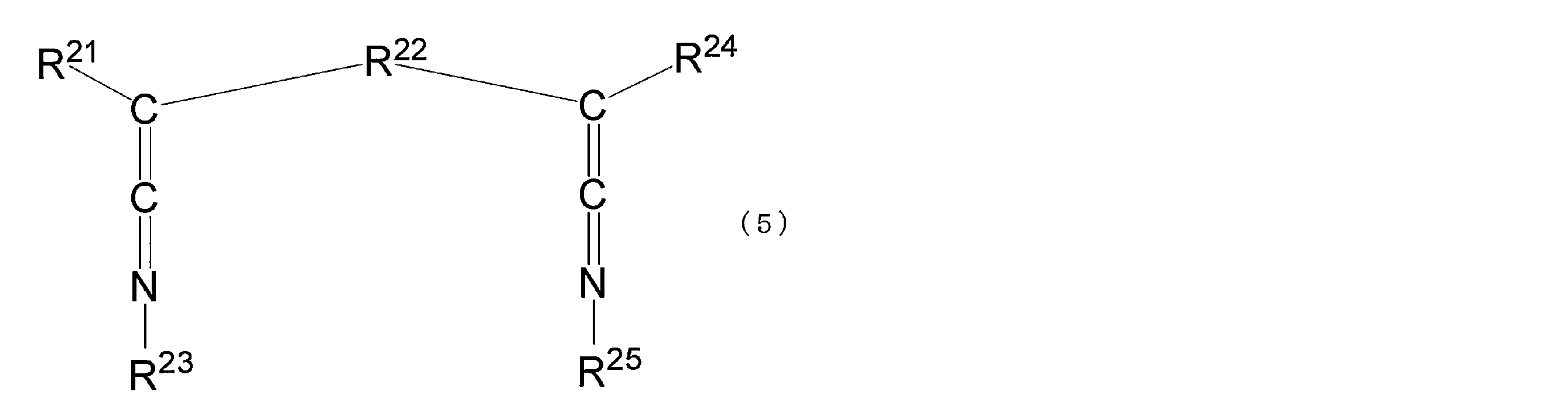
一般式(5)中、R21およびR24は、それぞれ独立に置換基を有してもよいアルキル基、置換基を有してもよいアリール基、置換基を有してもよいアルコキシ基、置換基を有してもよいアルコキシカルボニル基、置換基を有してもよいアミノカルボニル基、置換基を有してもよいアリールオキシ基、置換基を有してもよいアシル基または置換基を有してもよいアリールオキシカルボニル基を表し、R22は、炭素原子との結合末端が、置換基を有していてもよいアルキル部、置換基を有していてもよいアリール部、置換基を有していてもよいアルコキシ部、置換基を有してもよいアルコキシカルボニル部、置換基を有してもよいアミノカルボニル部、置換基を有してもよいアリールオキシ部、置換基を有してもよいアシル部または置換基を有してもよいアリールオキシカルボニル部である2価の基を表し、R23およびR25は、それぞれ独立に置換基を有してもよいアルキル基または置換基を有してもよいアリール基を表す。
一般式(5)のR21、R24は、一般式(1)のR1と同意であり、好ましい範囲も同様である。
一般式(5)のR23、R25は、一般式(1)のR3と同意であり、好ましい範囲も同様である。
一般式(5)のR22は、一般式(3)のR2aで説明した2価の基と同じものが挙げられ、好ましい範囲も同様である。
一般式(5)のR23、R25は、一般式(1)のR3と同意であり、好ましい範囲も同様である。
一般式(5)のR22は、一般式(3)のR2aで説明した2価の基と同じものが挙げられ、好ましい範囲も同様である。
本発明で用いるケテンイミン化合物は、ケテンイミン部位を少なくとも1つ有する化合物であり、例えば、J.Am.Chem.Soc.,1953,75(3),pp 657-660に記載された方法などを参考にして合成することができる。
下記に一般式(1)の好ましい具体例を示すが、本発明はこれに限定されない。


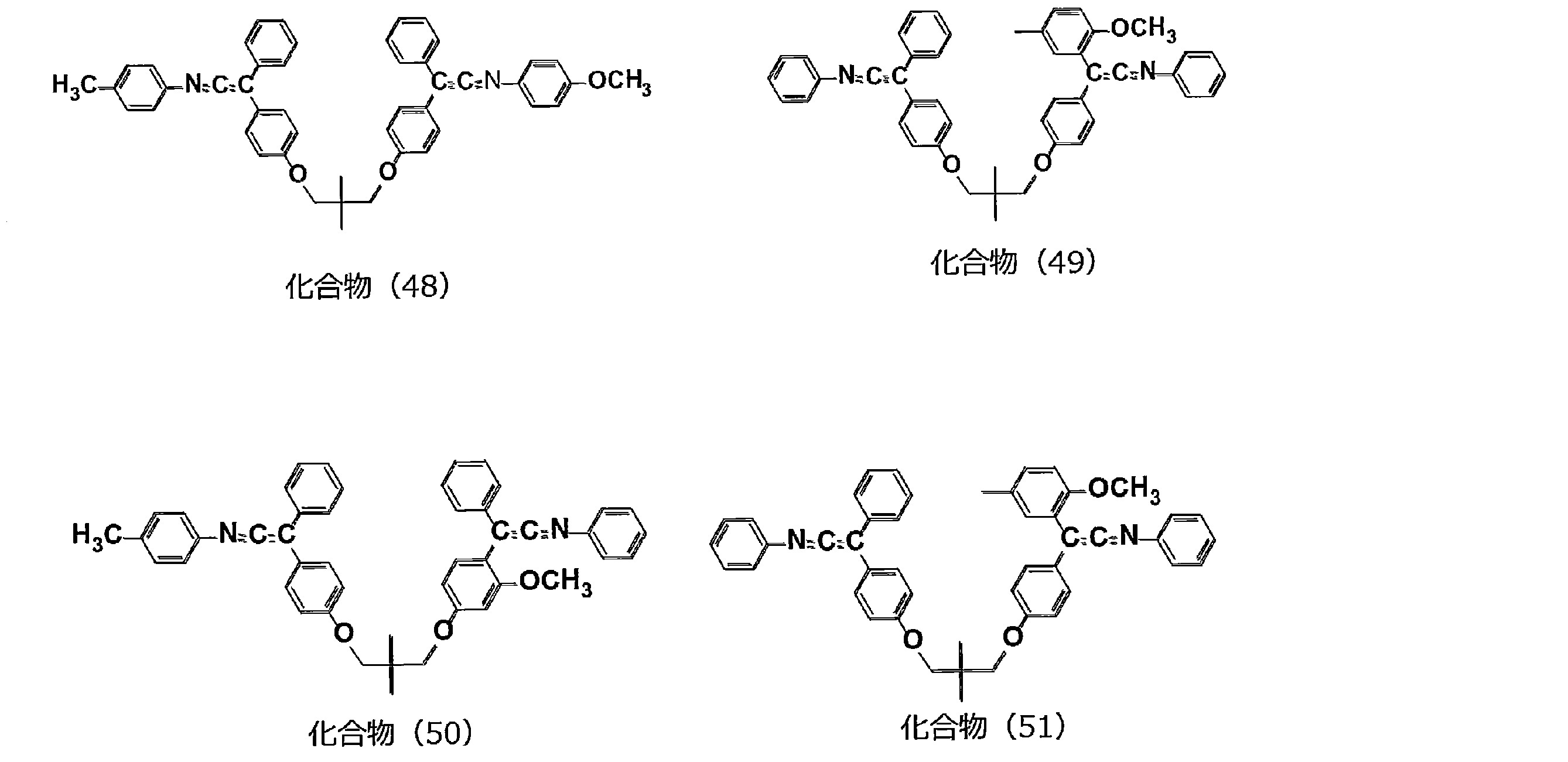
本発明では、ケテンイミン化合物は、2官能以上であることが好ましい。これにより、脂肪酸ポリエステルの末端カルボキシル基の封止効果をより高めることができ、更には、ケテンイミン化合物やケテン化合物の揮散を効果的に抑制することができる。ここで、官能数は、化合物に含まれているケテンイミン部位の数を表し、2官能のケテンイミン化合物は、ケテンイミン部位を2つ含む化合物を意味する。
一般式(1)のR1またはR2と、R3は、互いに連結して環状構造を形成していてもよい。例えば、化合物(17)は、ケテンイミン部位を環骨格として、R1またはR2と、R3が連結して環状構造を形成している。R3は、環骨格のアルキレン基またはアリーレン基からなる。この場合、R1またはR2はケテンイミン部位を含む連結基を有する。
また、ケテンイミン化合物は、ポリマーであってもよい。例えば、例示化合物(21)や例示化合物(43)は繰り返し数nの繰り返し単位を示し、nは3以上の整数を表す。なお、例示化合物(21)に示される左末端は水素原子であり、右末端はフェニル基である。
本発明の樹脂組成物は、ポリエステルとケテンイミン化合物との合計質量100質量部に対して、一般式(1)で表されるケテンイミン化合物を0.1~5質量部含むことが好ましく、0.1~4質量部含むことがより好ましく、0.1~2質量部含むことが特に好ましい。下限値以上含むことは、ポリエステルフィルムを製膜する際に、耐加水分解性および膜厚均一性を改善する観点から好ましい。上限値以下含むことは、ゲル化を抑制し、ポリエステルフィルムを製膜する際に、膜厚均一性を改善する観点から好ましい。
ケテンイミン化合物は、1種又は2種以上含んでいてもよい。2種以上含む場合は、その合計量が上記範囲となることが好ましい。
ケテンイミン化合物は、1種又は2種以上含んでいてもよい。2種以上含む場合は、その合計量が上記範囲となることが好ましい。
(その他成分)
本発明の樹脂組成物は、本発明の趣旨に反しない限りにおいて、上述したケテンイミン化合物以外の化合物を含むことを拒むものではない。例えば、カルボジイミド化合物、エポキシ化合物、オキサゾリン化合物を含有してもよい。
本発明の樹脂組成物中に含まれるポリエステル以外の有機化合物の質量に対して、70質量%以上が、一般式(1)で表されるケテンイミン化合物であることが好ましく、80質量%以上が更に好ましく、90質量%以上が特に好ましい。
本発明の樹脂組成物は、本発明の趣旨に反しない限りにおいて、上述したケテンイミン化合物以外の化合物を含むことを拒むものではない。例えば、カルボジイミド化合物、エポキシ化合物、オキサゾリン化合物を含有してもよい。
本発明の樹脂組成物中に含まれるポリエステル以外の有機化合物の質量に対して、70質量%以上が、一般式(1)で表されるケテンイミン化合物であることが好ましく、80質量%以上が更に好ましく、90質量%以上が特に好ましい。
本発明の樹脂組成物は、本発明の効果を阻害しない範囲内であれば、各種添加剤、例えば、相溶化剤、可塑剤、耐候剤、酸化防止剤、熱安定剤、滑剤、帯電防止剤、増白剤、着色剤、導電剤、紫外線吸収剤、難燃剤、難燃助剤、顔料および染料などを含むこととしても良い。
(ポリエステル末端カルボキシル基の化学修飾方法)
ポリエステル末端カルボキシル基の化学修飾は、一般式(1)で表されるケテンイミン化合物とポリエステルを溶融状態で混合することで行うことができる。
ポリエステル末端カルボキシル基の化学修飾は、一般式(1)で表されるケテンイミン化合物とポリエステルを溶融状態で混合することで行うことができる。
ケテンイミン化合物とポリエステルを溶融状態で混合することは、US3692745号公報に記載があり公知である。この公報によれば、ケテンイミン化合物とポリエステルを溶融状態で混合した場合、下記反応スキームのようにケテンイミン基とポリエステル-COOHが反応し、イミド化合物(1)が生じる。このメカニズムにより、ポリエステル末端カルボキシル基が封止されるとされている。
しかし、本発明者が詳細に検討した結果、溶融混合中にケテンイミン化合物及びケテン化合物(1)が揮散してくることが判明した。このことは、反応にてイミド化合物(1)の一部が熱によりケテン化合物(1)と、末端アミド基にて封止されたポリエステルが得られているものと推定できる。
しかし、本発明者が詳細に検討した結果、溶融混合中にケテンイミン化合物及びケテン化合物(1)が揮散してくることが判明した。このことは、反応にてイミド化合物(1)の一部が熱によりケテン化合物(1)と、末端アミド基にて封止されたポリエステルが得られているものと推定できる。
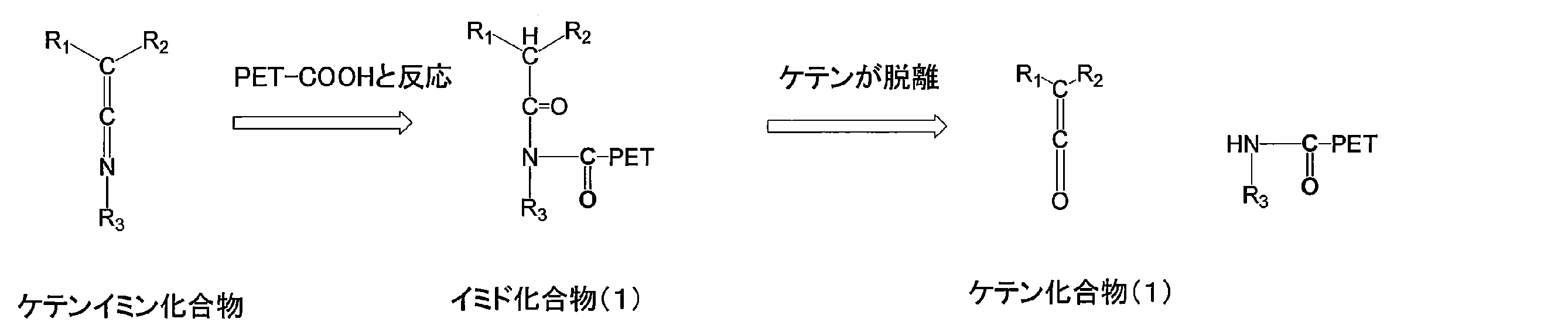
ケテンイミン化合物および上記反応スキームにより生成するケテン化合物(1)が揮散すると、製造環境を悪化させるため大きな問題となる。
これに対し、一般式(1)で表されるケテンイミン化合物は、R1-C(=C)-R2部分構造の分子量を大きくすることで、ケテンイミン化合物自体の揮散を抑制することができ、かつ、ポリエステル末端カルボキシル基を封止する際に生じるケテン化合物の揮散も抑制することができる。
また、脂肪族ポリエステルは、低温で成型可能であるため、ポリエステルフィルムを製造時における成型温度を低く抑えることができる。このため、ポリエステルフィルムの製造時において、ケテンイミン化合物やケテン化合物などが揮散することを抑制でき、揮散ガスの発生を抑制できる。
これに対し、一般式(1)で表されるケテンイミン化合物は、R1-C(=C)-R2部分構造の分子量を大きくすることで、ケテンイミン化合物自体の揮散を抑制することができ、かつ、ポリエステル末端カルボキシル基を封止する際に生じるケテン化合物の揮散も抑制することができる。
また、脂肪族ポリエステルは、低温で成型可能であるため、ポリエステルフィルムを製造時における成型温度を低く抑えることができる。このため、ポリエステルフィルムの製造時において、ケテンイミン化合物やケテン化合物などが揮散することを抑制でき、揮散ガスの発生を抑制できる。
なお、本発明においては、樹脂組成物中やポリエステルフィルム中に、一般式(1)で表されるケテンイミン化合物のR1-C-R2部分構造を分子内に有する化合物を検出することによって、一般式(1)で表されるケテンイミン化合物を含む樹脂組成物やそれを用いたフィルムが現存ないし過去に使用されたことを示すことができる。すなわち、樹脂組成物中やポリエステルフィルム中から上記ケテン化合物(1)のような化合物を検出することにより、一般式(1)で表されるケテンイミン化合物を含む組成物が使用され、本発明が実施されたことを示すことができる。
(ポリエステルフィルム)
本発明のポリエステルフィルムは、上述した樹脂組成物から作製される。
本発明のポリエステルフィルムは、上述した樹脂組成物から作製される。
本発明のポリエステルフィルムの厚みは、用途によって異なる。例えば、25~300μmが好ましく、120~300μmがより好ましい。厚みが25μm以上であることで、十分な力学強度が得られ、300μm以下とすることで、コスト上のメリットが得られる。
本発明のポリエステルフィルムは延伸されていることが好ましく、二軸延伸されていることがさらに好ましく、平面二軸延伸されていることがチューブラーなどの延伸と比較して特に好ましく、逐次二軸延伸されていることがより特に好ましい。二軸延伸されたポリエステルフィルムは、長手方向(MD:Machine Direction)の延伸(以下「縦延伸」ともいう)と幅方向(TD:Transverse Direction)の延伸(以下、「横延伸」ともいう)が施されたフィルムである。縦延伸、横延伸は各々1回で行っても良く、複数回に亘って実施しても良く、同時に縦、横に延伸してもよい
ポリエステルフィルム中の末端カルボキシル基含量(ポリエステルのカルボン酸価、以下、AVともいう)は、ポリエステルに対して25eq/ton以下が好ましく、20eq/ton以下がより好ましく、特に好ましくは16eq/ton以下であり、より特に好ましくは15eq/ton以下である。カルボキシル基含量が25eq/ton以下であると、ケテンイミン化合物と組み合わせることでポリエステルフィルムの耐加水分解性、耐熱性を保持し、湿熱経時したときの強度低下を小さく抑制することができる。末端カルボキシル基含量の下限は、本発明のポリエステルフィルムを他のフィルムや他の層などに積層して用いる場合において、他のフィルムや他の層との間の密着性(接着性)を保持する点で、10eq/ton以上が望ましい。ポリエステルフィルム中の末端カルボキシル基含量は、重合触媒種、重合時間、製膜条件(製膜温度や時間)によって調整することが可能である。ポリエステルフィルム中の末端カルボキシル基含量は、H.A.Pohl,Anal.Chem.26(1954)2145に記載の方法に従って、滴定法にて測定することができる。具体的には、ポリエステルを、ベンジルアルコールに205℃で溶解し、フェノールレッド指示薬を加え、水酸化ナトリウムの水/メタノール/ベンジルアルコール溶液で滴定することで、その適定量からカルボン酸価(eq/ton)を算出することができる。
ポリエステルフィルム中の末端ヒドロキシル基含量は、ポリエステルに対して120eq/ton以下が好ましく、より好ましくは90eq/ton以下である。ヒドロキシル基含量が120eq/ton以下であると、カルボジイミドとヒドロキシル基の反応が抑制され、カルボキシル基と優先的に反応し、カルボン酸価をより低下させることができる。ヒドロキシル基含量の下限は、本発明のポリエステルフィルムを他のフィルムや他の層などに積層して用いる場合において、他のフィルムや他の層との間の密着性(接着性)を保持する点で、20eq/ton以上が望ましい。ポリエステルフィルム中のヒドロキシル基含量は、重合触媒種、重合時間、製膜条件(製膜温度や時間)によって調整することが可能である。ポリエステルフィルム中の末端ヒドロキシル基含量は、重水素化ヘキサフルオロイソプロパノール溶媒を用いて、1H-NMRにより測定した値を用いることできる。
本発明のポリエステルフィルムは、例えば、フィルム形成工程と、延伸工程とを経て製造できる。
本発明のポリエステルフィルムは、その上に、COOH、OH、SO3H、NH2及びその塩から選ばれる少なくとも一つの官能基を含む塗布層を設けた積層体として用いることもできる。
本発明のポリエステルフィルムは、その上に、COOH、OH、SO3H、NH2及びその塩から選ばれる少なくとも一つの官能基を含む塗布層を設けた積層体として用いることもできる。
以下に実施例を挙げて本発明をさらに具体的に説明する。以下の実施例に示す材料、使用量、割合、処理内容、処理手順等は、本発明の趣旨を逸脱しない限り、適宜、変更することができる。従って、本発明の範囲は以下に示す実施例に限定されるものではない。なお、特に断りのない限り、「部」は質量基準である。また、以下の実施例では、「テトラヒドロフラン」を、「THF」と記す。
[合成例1] (化合物(1)の合成)
三口フラスコに、THF1.0L、アニリン94g(1.0モル)、トリエチルアミン120g(1.2モル)を仕込み、内温が15℃以下となるように氷浴で冷却しながらジフェニルアセチルクロリド231g(1.0モル)を分割添加し、3時間攪拌した。次に、1N塩酸水溶液1.0Lを滴下した後、析出した固体をろ過し、1N NaOH水溶液と、純水とで洗浄した。洗浄した固体を酢酸エチルによる再結晶で精製し、中間体1Aを244g(0.85モル)得た。
次に、三口フラスコに、トルエン1.2L、中間体1A 230g(0.8モル)、トリエチルアミン324.3g(3.2モル)を仕込み、内温が15℃以下となるように氷浴で冷却しながらオキシ塩化リン184.3g(1.2モル)を滴下し、5時間攪拌した後、水浴で20℃まで冷却した。次に、5%NaHCO3水溶液で2回、5%NaCl水溶液で1回分液処理し、硫酸マグネシウム100g加え1時間攪拌した。次に、硫酸マグネシウムをろ過して除去した後、減圧濃縮し、メタノールを加え、析出した固体をろ過して、化合物(1)を161.5g(0.6モル)得た。
三口フラスコに、THF1.0L、アニリン94g(1.0モル)、トリエチルアミン120g(1.2モル)を仕込み、内温が15℃以下となるように氷浴で冷却しながらジフェニルアセチルクロリド231g(1.0モル)を分割添加し、3時間攪拌した。次に、1N塩酸水溶液1.0Lを滴下した後、析出した固体をろ過し、1N NaOH水溶液と、純水とで洗浄した。洗浄した固体を酢酸エチルによる再結晶で精製し、中間体1Aを244g(0.85モル)得た。
次に、三口フラスコに、トルエン1.2L、中間体1A 230g(0.8モル)、トリエチルアミン324.3g(3.2モル)を仕込み、内温が15℃以下となるように氷浴で冷却しながらオキシ塩化リン184.3g(1.2モル)を滴下し、5時間攪拌した後、水浴で20℃まで冷却した。次に、5%NaHCO3水溶液で2回、5%NaCl水溶液で1回分液処理し、硫酸マグネシウム100g加え1時間攪拌した。次に、硫酸マグネシウムをろ過して除去した後、減圧濃縮し、メタノールを加え、析出した固体をろ過して、化合物(1)を161.5g(0.6モル)得た。
[合成例2] (化合物(2)の合成)
三口フラスコに、THF1.0L、アニリン94g(1.0モル)、トリエチルアミン120g(1.2モル)を仕込み、内温が15℃以下となるように氷浴で冷却しながら2-フェニル-2-エチルアセチルクロライド182.7gg(1.0モル)を分割添加し、3時間攪拌した。次に、1N塩酸水溶液1.0Lを滴下した後、析出した固体をろ過し、1N NaOH水溶液と、純水とで洗浄した。洗浄した固体を酢酸エチルによる再結晶で精製し、中間体2Aを196.1g(0.82モル)得た。
次に、三口フラスコに、トルエン1.2L、中間体2A 191g(0.8モル)、トリエチルアミン324.3g(3.2モル)を仕込み、内温が15℃以下となるように氷浴で冷却しながらオキシ塩化リン184.3g(1.2モル)を滴下し、5時間攪拌した後、水浴で20℃まで冷却した。次に、5%NaHCO3水溶液で2回、5%NaCl水溶液で1回分液処理し、硫酸マグネシウム100g加え1時間攪拌した。次に、硫酸マグネシウムをろ過して除去した後、減圧濃縮し、シリカゲルカラムで精製して、化合物(2)を111g得た(0.5モル)。
三口フラスコに、THF1.0L、アニリン94g(1.0モル)、トリエチルアミン120g(1.2モル)を仕込み、内温が15℃以下となるように氷浴で冷却しながら2-フェニル-2-エチルアセチルクロライド182.7gg(1.0モル)を分割添加し、3時間攪拌した。次に、1N塩酸水溶液1.0Lを滴下した後、析出した固体をろ過し、1N NaOH水溶液と、純水とで洗浄した。洗浄した固体を酢酸エチルによる再結晶で精製し、中間体2Aを196.1g(0.82モル)得た。
次に、三口フラスコに、トルエン1.2L、中間体2A 191g(0.8モル)、トリエチルアミン324.3g(3.2モル)を仕込み、内温が15℃以下となるように氷浴で冷却しながらオキシ塩化リン184.3g(1.2モル)を滴下し、5時間攪拌した後、水浴で20℃まで冷却した。次に、5%NaHCO3水溶液で2回、5%NaCl水溶液で1回分液処理し、硫酸マグネシウム100g加え1時間攪拌した。次に、硫酸マグネシウムをろ過して除去した後、減圧濃縮し、シリカゲルカラムで精製して、化合物(2)を111g得た(0.5モル)。
[合成例3] (化合物(3)の合成)
三口フラスコに、THF1.0L、アニリン94g(1.0モル)、トリエチルアミン120g(1.2モル)を仕込み、内温が15℃以下となるように氷浴で冷却しながら2-エチルヘキサノイルクロリド162.7g(1.0モル)を分割添加し、3時間攪拌した。次に、1N塩酸水溶液1.0Lを滴下し、析出した固体をろ過し、1N NaOH水溶液と、純水とで洗浄した。洗浄した固体を酢酸エチルによる再結晶で精製し、中間体3Aを186.2g(0.85モル)得た。
次に、三口フラスコに、トルエン1.2L、中間体3A 175g(0.8モル)、トリエチルアミン324.3g(3.2モル)を仕込み、内温が15℃以下となるように氷浴で冷却しながらオキシ塩化リン184.3g(1.2モル)を滴下し、75℃に加熱して5時間攪拌した後、水浴で20℃まで冷却した。次に、5%NaHCO3水溶液で2回、5%NaCl水溶液で1回分液処理し、硫酸マグネシウム100g加え1時間攪拌した。次に、硫酸マグネシウムをろ過して除去した後、減圧濃縮し、シリカゲルカラムで精製して、化合物(3)を120.7g得た(0.6モル)。
三口フラスコに、THF1.0L、アニリン94g(1.0モル)、トリエチルアミン120g(1.2モル)を仕込み、内温が15℃以下となるように氷浴で冷却しながら2-エチルヘキサノイルクロリド162.7g(1.0モル)を分割添加し、3時間攪拌した。次に、1N塩酸水溶液1.0Lを滴下し、析出した固体をろ過し、1N NaOH水溶液と、純水とで洗浄した。洗浄した固体を酢酸エチルによる再結晶で精製し、中間体3Aを186.2g(0.85モル)得た。
次に、三口フラスコに、トルエン1.2L、中間体3A 175g(0.8モル)、トリエチルアミン324.3g(3.2モル)を仕込み、内温が15℃以下となるように氷浴で冷却しながらオキシ塩化リン184.3g(1.2モル)を滴下し、75℃に加熱して5時間攪拌した後、水浴で20℃まで冷却した。次に、5%NaHCO3水溶液で2回、5%NaCl水溶液で1回分液処理し、硫酸マグネシウム100g加え1時間攪拌した。次に、硫酸マグネシウムをろ過して除去した後、減圧濃縮し、シリカゲルカラムで精製して、化合物(3)を120.7g得た(0.6モル)。
[合成例4] (化合物(4)の合成)
三口フラスコに、酢酸150mL、マンデル酸153g(1.0モル)、p-クレゾール130g(1.2モル)を仕込み、内温10℃以下となるように氷浴で冷却しながらメタンスルホン酸150mLを滴下し、60℃に加熱して2時間攪拌した後、氷浴で20℃まで冷却してエタノール500mLを添加した。析出した固体をろ過し、中間体4Cを156.9g(0.7モル)得た。
次に、三口フラスコに、トルエン270mL、中間体4C 135g(0.6モル)、アニリン73g(0.72モル)を仕込み、70℃で20時間攪拌した後、エタノール400mLを加え、析出した固体をろ過して中間体4Bを174g(0.55モル)得た。
次に、三口フラスコに、アセトン800mL、中間体4B 160g(0.5モル)、ジブロモブタン51.9g(0.24モル)、炭酸カリウム209g(1.5モル)を仕込み、60℃で20時間攪拌した後、氷浴で20℃に冷却し、純水2.0Lを加えて、析出した固体をろ過した。フラスコに、アセトニトリル1L、得られた固体を加え、70℃で1時間攪拌した後、氷浴で20℃まで冷却した後、固体をろ過して、中間体4Aを117g(0.17モル)得た。
次に、三口フラスコに、キシレン550mL、中間体4A 107g(0.16モル)、トリエチルアミン126g(1.24モル)を仕込み、内温が15℃以下となるように氷浴で冷却しながらオキシ塩化リン71.5g(0.47モル)を滴下し、5時間攪拌した後、水浴で20℃まで冷却した。次に、5%NaHCO3水溶液で2回、5%NaCl水溶液で1回分液処理し、硫酸マグネシウム30g加え1時間攪拌した。次に、硫酸マグネシウムをろ過して除去した後、減圧濃縮し、メタノールを加え、析出した固体をろ過して、化合物(4)を65.2g(0.1モル)得た。
三口フラスコに、酢酸150mL、マンデル酸153g(1.0モル)、p-クレゾール130g(1.2モル)を仕込み、内温10℃以下となるように氷浴で冷却しながらメタンスルホン酸150mLを滴下し、60℃に加熱して2時間攪拌した後、氷浴で20℃まで冷却してエタノール500mLを添加した。析出した固体をろ過し、中間体4Cを156.9g(0.7モル)得た。
次に、三口フラスコに、トルエン270mL、中間体4C 135g(0.6モル)、アニリン73g(0.72モル)を仕込み、70℃で20時間攪拌した後、エタノール400mLを加え、析出した固体をろ過して中間体4Bを174g(0.55モル)得た。
次に、三口フラスコに、アセトン800mL、中間体4B 160g(0.5モル)、ジブロモブタン51.9g(0.24モル)、炭酸カリウム209g(1.5モル)を仕込み、60℃で20時間攪拌した後、氷浴で20℃に冷却し、純水2.0Lを加えて、析出した固体をろ過した。フラスコに、アセトニトリル1L、得られた固体を加え、70℃で1時間攪拌した後、氷浴で20℃まで冷却した後、固体をろ過して、中間体4Aを117g(0.17モル)得た。
次に、三口フラスコに、キシレン550mL、中間体4A 107g(0.16モル)、トリエチルアミン126g(1.24モル)を仕込み、内温が15℃以下となるように氷浴で冷却しながらオキシ塩化リン71.5g(0.47モル)を滴下し、5時間攪拌した後、水浴で20℃まで冷却した。次に、5%NaHCO3水溶液で2回、5%NaCl水溶液で1回分液処理し、硫酸マグネシウム30g加え1時間攪拌した。次に、硫酸マグネシウムをろ過して除去した後、減圧濃縮し、メタノールを加え、析出した固体をろ過して、化合物(4)を65.2g(0.1モル)得た。
[合成例5] (化合物(5)の合成)
三口フラスコに、塩化チオニル 1.0L、2-(4-ヒドロキシフェニル)-3-メチル酪酸 195g(1.0モル)を仕込み、70℃で3時間攪拌した後、減圧して過剰の塩化チオニルを除去し、氷浴で20℃まで冷却し、THF500mLを加えた。ビーカーに、THF500mL、トリエチルアミン121g(1.2モル)、アニリン93.2g(1.0モル)を加えて攪拌した。三口フラスコに、内温15℃以下となるように氷浴で冷却しながら、ビーカーで調製したTHF溶液を滴下ロートで滴下し、3時間攪拌した後、1N塩酸水溶液1.0Lを滴下した。析出した固体をろ過し、1N NaOH水溶液、純水で洗浄した。洗浄した固体を酢酸エチルによる再結晶で精製して、中間体5Bを188.4g(0.7モル)得た。
次に、三口フラスコに、アセトン810mL、中間体5B 162g(0.6モル)、ジブロモブタン61.9g(0.29モル)、炭酸カリウム250g(1.81モル)を仕込み、60℃で20時間攪拌した後、氷浴で20℃に冷却し、純水2.0Lを加えて、析出した固体をろ過した。フラスコに、アセトニトリル1L、得られた固体を加え、70℃で1時間攪拌した後、氷浴で20℃まで冷却した後、固体をろ過し、中間体5Aを136.2g(0.23モル)得た。
次に、三口フラスコに、トルエン500mL、中間体5A 92.0g(0.16モル)、トリエチルアミン126g(1.24モル)を仕込み、内温が15℃以下となるように氷浴で冷却しながらオキシ塩化リン71.5g(0.47モル)を滴下し、5時間攪拌した後、水浴で20℃まで冷却した。次に、5%NaHCO3水溶液で2回、5%NaCl水溶液で1回分液処理し、硫酸マグネシウム30g加え1時間攪拌した。次に、硫酸マグネシウムをろ過して除去した後、減圧濃縮し、シリカゲルカラムで精製して、化合物(5)を55.6g(0.1モル)得た。
三口フラスコに、塩化チオニル 1.0L、2-(4-ヒドロキシフェニル)-3-メチル酪酸 195g(1.0モル)を仕込み、70℃で3時間攪拌した後、減圧して過剰の塩化チオニルを除去し、氷浴で20℃まで冷却し、THF500mLを加えた。ビーカーに、THF500mL、トリエチルアミン121g(1.2モル)、アニリン93.2g(1.0モル)を加えて攪拌した。三口フラスコに、内温15℃以下となるように氷浴で冷却しながら、ビーカーで調製したTHF溶液を滴下ロートで滴下し、3時間攪拌した後、1N塩酸水溶液1.0Lを滴下した。析出した固体をろ過し、1N NaOH水溶液、純水で洗浄した。洗浄した固体を酢酸エチルによる再結晶で精製して、中間体5Bを188.4g(0.7モル)得た。
次に、三口フラスコに、アセトン810mL、中間体5B 162g(0.6モル)、ジブロモブタン61.9g(0.29モル)、炭酸カリウム250g(1.81モル)を仕込み、60℃で20時間攪拌した後、氷浴で20℃に冷却し、純水2.0Lを加えて、析出した固体をろ過した。フラスコに、アセトニトリル1L、得られた固体を加え、70℃で1時間攪拌した後、氷浴で20℃まで冷却した後、固体をろ過し、中間体5Aを136.2g(0.23モル)得た。
次に、三口フラスコに、トルエン500mL、中間体5A 92.0g(0.16モル)、トリエチルアミン126g(1.24モル)を仕込み、内温が15℃以下となるように氷浴で冷却しながらオキシ塩化リン71.5g(0.47モル)を滴下し、5時間攪拌した後、水浴で20℃まで冷却した。次に、5%NaHCO3水溶液で2回、5%NaCl水溶液で1回分液処理し、硫酸マグネシウム30g加え1時間攪拌した。次に、硫酸マグネシウムをろ過して除去した後、減圧濃縮し、シリカゲルカラムで精製して、化合物(5)を55.6g(0.1モル)得た。
[合成例6] (化合物(6)の合成)
三口フラスコに、ジメチルアセトアミド1.0L、p-フェニレンジアミン97g(0.9モル)、トリエチルアミン101g(1.0モル)を仕込み、内温が15℃以下となるように氷浴で冷却しながらジフェニルアセチルクロリド460g(2.0モル)を分割添加し、3時間攪拌した後、1N塩酸水溶液1.0Lを滴下し、固体をろ過した。次に、三口フラスコに、1N NaOH水溶液と、ろ過した固体とを加え、1時間攪拌した後、ろ過し、メタノールでかけ洗いし、中間体6Aを420.1g(0.85モル)得た。
次に、三口フラスコに、クロロホルム2.0L、中間体6A 397g(0.8モル)、トリエチルアミン650g(6.4モル)を仕込み、内温が15℃以下となるように氷浴で冷却しながらオキシ塩化リン368g(2.4モル)を滴下し、5時間攪拌した後、水浴で20℃まで冷却した。次に、5%NaHCO3水溶液で2回、5%NaCl水溶液で1回分液処理し、硫酸マグネシウム100g加え1時間攪拌した。次に、硫酸マグネシウムをろ過して除去した後、メタノールを加え、析出した固体をろ過して、化合物(6)を322.1g(0.70モル)得た。
三口フラスコに、ジメチルアセトアミド1.0L、p-フェニレンジアミン97g(0.9モル)、トリエチルアミン101g(1.0モル)を仕込み、内温が15℃以下となるように氷浴で冷却しながらジフェニルアセチルクロリド460g(2.0モル)を分割添加し、3時間攪拌した後、1N塩酸水溶液1.0Lを滴下し、固体をろ過した。次に、三口フラスコに、1N NaOH水溶液と、ろ過した固体とを加え、1時間攪拌した後、ろ過し、メタノールでかけ洗いし、中間体6Aを420.1g(0.85モル)得た。
次に、三口フラスコに、クロロホルム2.0L、中間体6A 397g(0.8モル)、トリエチルアミン650g(6.4モル)を仕込み、内温が15℃以下となるように氷浴で冷却しながらオキシ塩化リン368g(2.4モル)を滴下し、5時間攪拌した後、水浴で20℃まで冷却した。次に、5%NaHCO3水溶液で2回、5%NaCl水溶液で1回分液処理し、硫酸マグネシウム100g加え1時間攪拌した。次に、硫酸マグネシウムをろ過して除去した後、メタノールを加え、析出した固体をろ過して、化合物(6)を322.1g(0.70モル)得た。
[合成例7] (化合物(7)の合成)
三口フラスコに、ジメチルアセトアミド1.0L、p-フェニレンジアミン97g(0.9モル)、トリエチルアミン101g(1.0モル)を仕込み、内温が15℃以下となるように氷浴で冷却しながら2-フェニルー2-エチルアセチルクロライド365g(2.0モル)を分割添加し、3時間攪拌した後、1N塩酸水溶液1.0Lを滴下し、固体をろ過した。次に、三口フラスコに、1N NaOH水溶液と、ろ過した固体とを加え、1時間攪拌した後、ろ過し、メタノールでかけ洗いし、中間体7Aを336.2g(0.84モル)得た。
次に、三口フラスコに、クロロホルム1.6L、中間体7A 320g(0.8モル)、トリエチルアミン650g(6.4モル)を仕込み、内温が15℃以下となるように氷浴で冷却しながらオキシ塩化リン368g(2.4モル)を滴下し、5時間攪拌した後、水浴で20℃まで冷却した。次に、5%NaHCO3水溶液で2回、5%NaCl水溶液で1回分液処理し、硫酸マグネシウム100g加え1時間攪拌した。次に、硫酸マグネシウムをろ過して除去した後、シリカゲルカラムで精製して、化合物(7)を254.9g(0.70モル)得た。
三口フラスコに、ジメチルアセトアミド1.0L、p-フェニレンジアミン97g(0.9モル)、トリエチルアミン101g(1.0モル)を仕込み、内温が15℃以下となるように氷浴で冷却しながら2-フェニルー2-エチルアセチルクロライド365g(2.0モル)を分割添加し、3時間攪拌した後、1N塩酸水溶液1.0Lを滴下し、固体をろ過した。次に、三口フラスコに、1N NaOH水溶液と、ろ過した固体とを加え、1時間攪拌した後、ろ過し、メタノールでかけ洗いし、中間体7Aを336.2g(0.84モル)得た。
次に、三口フラスコに、クロロホルム1.6L、中間体7A 320g(0.8モル)、トリエチルアミン650g(6.4モル)を仕込み、内温が15℃以下となるように氷浴で冷却しながらオキシ塩化リン368g(2.4モル)を滴下し、5時間攪拌した後、水浴で20℃まで冷却した。次に、5%NaHCO3水溶液で2回、5%NaCl水溶液で1回分液処理し、硫酸マグネシウム100g加え1時間攪拌した。次に、硫酸マグネシウムをろ過して除去した後、シリカゲルカラムで精製して、化合物(7)を254.9g(0.70モル)得た。
[合成例8] (化合物(8)の合成)
三口フラスコに、ジメチルアセトアミド1.0L、p-フェニレンジアミン97g(0.9モル)、トリエチルアミン101g(1.0モル)を仕込み、内温が15℃以下となるように氷浴で冷却しながら2-エチルヘキサノイルクロリド325g(2.0モル)を分割添加し、3時間攪拌した後、1N塩酸水溶液1.0Lを滴下し、固体をろ過した。次に、三口フラスコに、1N NaOH水溶液と、ろ過した固体とを加え、1時間攪拌した後、ろ過し、メタノールでかけ洗いし、中間体8Aを295.4gg(0.82モル)得た。
次に、三口フラスコに、クロロホルム1.3L、中間体8A 259.5g(0.8モル)、トリエチルアミン650g(6.4モル)を仕込み、内温が15℃以下となるように氷浴で冷却しながらオキシ塩化リン368g(2.4モル)を滴下し、5時間攪拌した後、水浴で20℃まで冷却した。次に、5%NaHCO3水溶液で2回、5%NaCl水溶液で1回分液処理し、硫酸マグネシウム100g加え1時間攪拌した。次に、硫酸マグネシウムをろ過して除去した後、シリカゲルカラムで精製して、化合物(8)を227.1g(0.60モル)得た。
三口フラスコに、ジメチルアセトアミド1.0L、p-フェニレンジアミン97g(0.9モル)、トリエチルアミン101g(1.0モル)を仕込み、内温が15℃以下となるように氷浴で冷却しながら2-エチルヘキサノイルクロリド325g(2.0モル)を分割添加し、3時間攪拌した後、1N塩酸水溶液1.0Lを滴下し、固体をろ過した。次に、三口フラスコに、1N NaOH水溶液と、ろ過した固体とを加え、1時間攪拌した後、ろ過し、メタノールでかけ洗いし、中間体8Aを295.4gg(0.82モル)得た。
次に、三口フラスコに、クロロホルム1.3L、中間体8A 259.5g(0.8モル)、トリエチルアミン650g(6.4モル)を仕込み、内温が15℃以下となるように氷浴で冷却しながらオキシ塩化リン368g(2.4モル)を滴下し、5時間攪拌した後、水浴で20℃まで冷却した。次に、5%NaHCO3水溶液で2回、5%NaCl水溶液で1回分液処理し、硫酸マグネシウム100g加え1時間攪拌した。次に、硫酸マグネシウムをろ過して除去した後、シリカゲルカラムで精製して、化合物(8)を227.1g(0.60モル)得た。
[合成例9] (化合物(9)の合成)
三口フラスコに、アセトン2.5L、上述した合成例4で得られた中間体4B 476g(1.50モル)、ヨードメタン426.0g(3.0モル)、炭酸カリウム622g(4.5モル)を仕込み、60℃に加熱して20時間攪拌した後、氷浴で20℃に冷却し、酢酸エチル1.0L、純水1.0Lを加え、分液操作を行った。有機層に硫酸マグネシウム100gを加え、1時間攪拌した後、硫酸マグネシウムをろ過して除去した。有機層を減圧濃縮した後、シリカゲルカラムで精製して、中間体9Aを465g(1.40モル)得た。
次に、三口フラスコに、クロロホルム1.4L、中間体9A 265g(0.8モル)、トリエチルアミン324g(3.2モル)を仕込み、内温が15℃以下となるように氷浴で冷却しながらオキシ塩化リン184g(1.2モル)を滴下し、5時間攪拌した。次に、水浴で20℃まで冷却した後、5%NaHCO3水溶液で2回、5%NaCl水溶液で1回分液処理し、硫酸マグネシウム100g加え1時間攪拌した。次に、硫酸マグネシウムをろ過して除去した後、メタノールを加え、析出した固体をろ過して、化合物(9)を194.4g(0.65モル)得た。
三口フラスコに、アセトン2.5L、上述した合成例4で得られた中間体4B 476g(1.50モル)、ヨードメタン426.0g(3.0モル)、炭酸カリウム622g(4.5モル)を仕込み、60℃に加熱して20時間攪拌した後、氷浴で20℃に冷却し、酢酸エチル1.0L、純水1.0Lを加え、分液操作を行った。有機層に硫酸マグネシウム100gを加え、1時間攪拌した後、硫酸マグネシウムをろ過して除去した。有機層を減圧濃縮した後、シリカゲルカラムで精製して、中間体9Aを465g(1.40モル)得た。
次に、三口フラスコに、クロロホルム1.4L、中間体9A 265g(0.8モル)、トリエチルアミン324g(3.2モル)を仕込み、内温が15℃以下となるように氷浴で冷却しながらオキシ塩化リン184g(1.2モル)を滴下し、5時間攪拌した。次に、水浴で20℃まで冷却した後、5%NaHCO3水溶液で2回、5%NaCl水溶液で1回分液処理し、硫酸マグネシウム100g加え1時間攪拌した。次に、硫酸マグネシウムをろ過して除去した後、メタノールを加え、析出した固体をろ過して、化合物(9)を194.4g(0.65モル)得た。
[合成例10] (化合物(10)の合成)
三口フラスコに、ヘキサン2.5L、p-クレゾール541g(5.0モル)、グリオキシル酸一水和物253g(2.75モル)を仕込み、60℃に加熱してメタンスルホン酸30mLをゆっくり滴下し、3時間攪拌した後、氷浴で20℃に冷却した。次に、エタノール1.0Lを加え、析出した固体をろ過して、中間体10Cを600g(2.4モル)得た。
次に、三口フラスコに、トルエン1.0L、中間体10C 500g(1.96モル)、アニリン274g(2.94モル)を仕込み、8時間攪拌した後、氷浴で20℃に冷却してエタノール2.0Lを加え、析出した固体をろ過し、中間体10Bを625g(1.8モル)得た。
次に、三口フラスコに、アセトン2.5L、中間体10B 500g(1.44モル)、ヨードメタン816.7g(5.76モル)、炭酸カリウム1.2kg(8.6モル)を仕込み、60℃に加熱して20時間攪拌した後、氷浴で20℃に冷却し、酢酸エチル1.0L、純水1.0Lを加え、分液操作を行った。有機層に硫酸マグネシウム100gを加え、1時間攪拌した後、硫酸マグネシウムをろ過して除去した。有機層を減圧濃縮した後、シリカゲルカラムで精製し、中間体10Aを450g(1.3モル)得た。
次に、三口フラスコに、クロロホルム1.4L、中間体10A 278g(0.8モル)、トリエチルアミン324g(3.2モル)を仕込み、内温が15℃以下となるように氷浴で冷却しながらオキシ塩化リン184g(1.2モル)を滴下し、5時間攪拌した後、水浴で20℃まで冷却した。次に、5%NaHCO3水溶液で2回、5%NaCl水溶液で1回分液処理し、硫酸マグネシウム100g加え1時間攪拌した。次に、硫酸マグネシウムをろ過して除去した後、メタノールを加え、析出した固体をろ過して、化合物(10)を213.9g(0.65モル)得た。
三口フラスコに、ヘキサン2.5L、p-クレゾール541g(5.0モル)、グリオキシル酸一水和物253g(2.75モル)を仕込み、60℃に加熱してメタンスルホン酸30mLをゆっくり滴下し、3時間攪拌した後、氷浴で20℃に冷却した。次に、エタノール1.0Lを加え、析出した固体をろ過して、中間体10Cを600g(2.4モル)得た。
次に、三口フラスコに、トルエン1.0L、中間体10C 500g(1.96モル)、アニリン274g(2.94モル)を仕込み、8時間攪拌した後、氷浴で20℃に冷却してエタノール2.0Lを加え、析出した固体をろ過し、中間体10Bを625g(1.8モル)得た。
次に、三口フラスコに、アセトン2.5L、中間体10B 500g(1.44モル)、ヨードメタン816.7g(5.76モル)、炭酸カリウム1.2kg(8.6モル)を仕込み、60℃に加熱して20時間攪拌した後、氷浴で20℃に冷却し、酢酸エチル1.0L、純水1.0Lを加え、分液操作を行った。有機層に硫酸マグネシウム100gを加え、1時間攪拌した後、硫酸マグネシウムをろ過して除去した。有機層を減圧濃縮した後、シリカゲルカラムで精製し、中間体10Aを450g(1.3モル)得た。
次に、三口フラスコに、クロロホルム1.4L、中間体10A 278g(0.8モル)、トリエチルアミン324g(3.2モル)を仕込み、内温が15℃以下となるように氷浴で冷却しながらオキシ塩化リン184g(1.2モル)を滴下し、5時間攪拌した後、水浴で20℃まで冷却した。次に、5%NaHCO3水溶液で2回、5%NaCl水溶液で1回分液処理し、硫酸マグネシウム100g加え1時間攪拌した。次に、硫酸マグネシウムをろ過して除去した後、メタノールを加え、析出した固体をろ過して、化合物(10)を213.9g(0.65モル)得た。
[合成例11] (化合物(11)の合成)
三口フラスコに、酢酸750ml、p-メチルアニソール610g(5.0モル)、グリオキシル酸一水和物437g(4.75モル)を仕込み、内温が5-10℃となるように氷浴で冷却しながらメタンスルホン酸750mLを滴下した後2時間攪拌し、p-クレゾール650g(6.0モル)を加え、60℃で2時間攪拌した。氷浴で20℃に冷却し、エタノール2.5Lを加え、析出した固体をろ過して、中間体11Cを910g(3.4モル)得た。
次に、三口フラスコに、トルエン1.8L、中間体11C 900g(3.35モル)、m-トルイジン540g(5.0モル)を仕込み、70℃で20時間攪拌した後、氷浴で20℃に冷却し、エタノール2.0Lを加え、析出した固体をろ過して、中間体11Bを1127g(3.0モル)得た。
次に、三口フラスコに、アセトン5.0L、中間体11B 1100g(2.93モル)、ジブロモブタン301g(1.4モル)、炭酸カリウム1200g(8.8モル)を仕込み、60℃で24時間攪拌した後、氷浴で20℃に冷却し、4N塩酸水溶液4.0Lを加え、析出した固体をろ過した。次に、三口フラスコに、アセトニトリル8.5L、得られた固体を仕込み、70℃で1時間攪拌した後、氷浴で20℃に冷却し、固体をろ過して、中間体11Aを800g(1.0モル)得た。
次に、三口フラスコに、トルエン4.0L、中間体11A 800g(1.0モル)、トリエチルアミン807g(8.0モル)を仕込み、内温が15℃以下となるように氷浴で冷却しながらオキシ塩化リン460g(3.0モル)を滴下し、5時間攪拌した後、水浴で20℃まで冷却した。次に、5%NaHCO3水溶液で2回、5%NaCl水溶液で1回分液処理し、硫酸マグネシウム100g加え1時間攪拌した。次に、硫酸マグネシウムをろ過して除去した後、減圧濃縮し、メタノールを加え、析出した固体をろ過して、化合物(11)を615g(0.8モル)得た。
三口フラスコに、酢酸750ml、p-メチルアニソール610g(5.0モル)、グリオキシル酸一水和物437g(4.75モル)を仕込み、内温が5-10℃となるように氷浴で冷却しながらメタンスルホン酸750mLを滴下した後2時間攪拌し、p-クレゾール650g(6.0モル)を加え、60℃で2時間攪拌した。氷浴で20℃に冷却し、エタノール2.5Lを加え、析出した固体をろ過して、中間体11Cを910g(3.4モル)得た。
次に、三口フラスコに、トルエン1.8L、中間体11C 900g(3.35モル)、m-トルイジン540g(5.0モル)を仕込み、70℃で20時間攪拌した後、氷浴で20℃に冷却し、エタノール2.0Lを加え、析出した固体をろ過して、中間体11Bを1127g(3.0モル)得た。
次に、三口フラスコに、アセトン5.0L、中間体11B 1100g(2.93モル)、ジブロモブタン301g(1.4モル)、炭酸カリウム1200g(8.8モル)を仕込み、60℃で24時間攪拌した後、氷浴で20℃に冷却し、4N塩酸水溶液4.0Lを加え、析出した固体をろ過した。次に、三口フラスコに、アセトニトリル8.5L、得られた固体を仕込み、70℃で1時間攪拌した後、氷浴で20℃に冷却し、固体をろ過して、中間体11Aを800g(1.0モル)得た。
次に、三口フラスコに、トルエン4.0L、中間体11A 800g(1.0モル)、トリエチルアミン807g(8.0モル)を仕込み、内温が15℃以下となるように氷浴で冷却しながらオキシ塩化リン460g(3.0モル)を滴下し、5時間攪拌した後、水浴で20℃まで冷却した。次に、5%NaHCO3水溶液で2回、5%NaCl水溶液で1回分液処理し、硫酸マグネシウム100g加え1時間攪拌した。次に、硫酸マグネシウムをろ過して除去した後、減圧濃縮し、メタノールを加え、析出した固体をろ過して、化合物(11)を615g(0.8モル)得た。
[ポリエステルフィルムの作製と評価]
(実施例1)
予備乾燥を行ったポリ乳酸(三井化学社製、レイシアH-100)と、末端封止剤として化合物(1)を表1に示す割合で予備混合した後、小型ニ軸混練押出機(テクノベル社製)に供給して190℃で溶融混練した後、ストランド状に押出し、水冷後、切断してペレット化した。
得られたペレットを、190℃の熱プレス機によりプレス加工して、厚さ250μmのポリエステルフィルム(プレスフィルム)を製作した。
(実施例1)
予備乾燥を行ったポリ乳酸(三井化学社製、レイシアH-100)と、末端封止剤として化合物(1)を表1に示す割合で予備混合した後、小型ニ軸混練押出機(テクノベル社製)に供給して190℃で溶融混練した後、ストランド状に押出し、水冷後、切断してペレット化した。
得られたペレットを、190℃の熱プレス機によりプレス加工して、厚さ250μmのポリエステルフィルム(プレスフィルム)を製作した。
(実施例2~19)
ポリ乳酸と、末端封止剤を表1に示す割合で予備混合した以外は実施例1と同様にしてポリエステルフィルムを製作した。
ポリ乳酸と、末端封止剤を表1に示す割合で予備混合した以外は実施例1と同様にしてポリエステルフィルムを製作した。
(比較例1)
末端封止剤を使用しなかった以外は実施例1と同様にしてポリエステルフィルムを製作した。
末端封止剤を使用しなかった以外は実施例1と同様にしてポリエステルフィルムを製作した。
(比較例2)
予備乾燥を行ったポリ乳酸(三井化学社製、レイシアH-100)990部と、末端封止剤としてカルボジイミド(ラインケミー社製、Stabaxol P400)10部とを小型ニ軸混練押出機(テクノベル社製)に供給した以外は実施例1と同様にしてポリエステルフィルムを製作した。
予備乾燥を行ったポリ乳酸(三井化学社製、レイシアH-100)990部と、末端封止剤としてカルボジイミド(ラインケミー社製、Stabaxol P400)10部とを小型ニ軸混練押出機(テクノベル社製)に供給した以外は実施例1と同様にしてポリエステルフィルムを製作した。
(比較例3)
予備乾燥を行ったポリ乳酸(三井化学社製、レイシアH-100)999部と、末端封止剤としてカルボジイミド(ラインケミー社製、Stabaxol P400)1部とを小型ニ軸混練押出機(テクノベル社製)に供給した以外は実施例1と同様にしてポリエステルフィルムを製作した。
予備乾燥を行ったポリ乳酸(三井化学社製、レイシアH-100)999部と、末端封止剤としてカルボジイミド(ラインケミー社製、Stabaxol P400)1部とを小型ニ軸混練押出機(テクノベル社製)に供給した以外は実施例1と同様にしてポリエステルフィルムを製作した。
(比較例3)
予備乾燥を行ったポリ乳酸(三井化学社製、レイシアH-100)999部と、末端封止剤としてカルボジイミド(ラインケミー社製、Stabaxol P400)1部とを小型ニ軸混練押出機(テクノベル社製)に供給した以外は実施例1と同様にしてポリエステルフィルムを製作した。
予備乾燥を行ったポリ乳酸(三井化学社製、レイシアH-100)999部と、末端封止剤としてカルボジイミド(ラインケミー社製、Stabaxol P400)1部とを小型ニ軸混練押出機(テクノベル社製)に供給した以外は実施例1と同様にしてポリエステルフィルムを製作した。
(比較例4)
ポリ乳酸をポリエチレンテレフタレート(三井化学社製、J125)に変更し、溶融混練の温度とプレス加工の温度を280℃に変更した以外は実施例1と同様にしてポリエステルフィルムを製作した。
ポリ乳酸をポリエチレンテレフタレート(三井化学社製、J125)に変更し、溶融混練の温度とプレス加工の温度を280℃に変更した以外は実施例1と同様にしてポリエステルフィルムを製作した。
実施例、比較例の固有粘度、粘度保持率、強度保持率、色味、揮散性を以下の方法及び基準で評価した。結果を表1にまとめて記す。
(1)耐加水分解性
プレスフィルム(厚さ250μm)を作製し、熱水処理を行った。処理後の粘度保持率および強度保持率を算出し、耐加水分解性を評価した。粘度保持率が大きいほど耐加水分解性が高い。また、強度保持率が大きいほど耐加水分解性が高い。
プレスフィルム(厚さ250μm)を作製し、熱水処理を行った。処理後の粘度保持率および強度保持率を算出し、耐加水分解性を評価した。粘度保持率が大きいほど耐加水分解性が高い。また、強度保持率が大きいほど耐加水分解性が高い。
<粘度保持率の測定>
ポリエステルフィルムを、80℃に加熱した脱イオン水に浸漬し、24時間保持した後に冷却、水洗、乾燥を行った後、80℃で24時間熱水処理した。熱水処理前、熱水処理後のポリエステルフィルム3.0gを、それぞれクロロホルム100mlに溶解し、25℃でオストワルド式粘度計により溶液還元比粘度を測定した。粘度保持率を下式により算出し、以下の基準で評価した。

<評価基準>
A:粘度保持率が90~100%
B:粘度保持率が80~90%
C:粘度保持率が60~80%
D:粘度保持率が0~60%
ポリエステルフィルムを、80℃に加熱した脱イオン水に浸漬し、24時間保持した後に冷却、水洗、乾燥を行った後、80℃で24時間熱水処理した。熱水処理前、熱水処理後のポリエステルフィルム3.0gを、それぞれクロロホルム100mlに溶解し、25℃でオストワルド式粘度計により溶液還元比粘度を測定した。粘度保持率を下式により算出し、以下の基準で評価した。
A:粘度保持率が90~100%
B:粘度保持率が80~90%
C:粘度保持率が60~80%
D:粘度保持率が0~60%
<強度保持率の測定>
ポリエステルフィルムから、引張試験用試験片(サイズ:100mm×15mm)を10枚採取した。
5枚の試験片を、300mm/分の速度で引張テストを行い、引張破断強度の平均値を算出し、80℃熱水処理前の引張強度値とした。
5枚の試験片を、80℃に加熱した脱イオン水に浸漬し、15時間保持した後に冷却、水洗、乾燥を行い、80℃熱水処理後の試験片とした。80℃熱水処理後の試験片を用い、300mm/分の速度で引張試験を行い、引張破断強度の平均値を算出して、80℃熱水処理後の引張強度値とした。
強度保持率を下式により算出し、以下の基準で評価した。

<評価基準>
A:強度保持率が90~100%
B:強度保持率が80~90%
C:強度保持率が60~80%
D:強度保持率が0~60%
ポリエステルフィルムから、引張試験用試験片(サイズ:100mm×15mm)を10枚採取した。
5枚の試験片を、300mm/分の速度で引張テストを行い、引張破断強度の平均値を算出し、80℃熱水処理前の引張強度値とした。
5枚の試験片を、80℃に加熱した脱イオン水に浸漬し、15時間保持した後に冷却、水洗、乾燥を行い、80℃熱水処理後の試験片とした。80℃熱水処理後の試験片を用い、300mm/分の速度で引張試験を行い、引張破断強度の平均値を算出して、80℃熱水処理後の引張強度値とした。
強度保持率を下式により算出し、以下の基準で評価した。
A:強度保持率が90~100%
B:強度保持率が80~90%
C:強度保持率が60~80%
D:強度保持率が0~60%
(2)色味
製作したフィルムを目視で観察し、以下の基準で評価した。
A:黄色味が比較例(1)と同等
B:比較例(1)より黄色味が大きい
製作したフィルムを目視で観察し、以下の基準で評価した。
A:黄色味が比較例(1)と同等
B:比較例(1)より黄色味が大きい
(3)揮散性
樹脂組成物の押し出し時における、白煙、臭いの有無を、以下の基準で評価した。以下の評価基準でA~Cが実用的であり、A~Bが特に好ましい。
A:白煙、臭い、ともになし
B:白煙はないが、ごくわずかに臭いがする
C:白煙はないが、やや臭いがする
D:白煙、臭い、ともにある
樹脂組成物の押し出し時における、白煙、臭いの有無を、以下の基準で評価した。以下の評価基準でA~Cが実用的であり、A~Bが特に好ましい。
A:白煙、臭い、ともになし
B:白煙はないが、ごくわずかに臭いがする
C:白煙はないが、やや臭いがする
D:白煙、臭い、ともにある
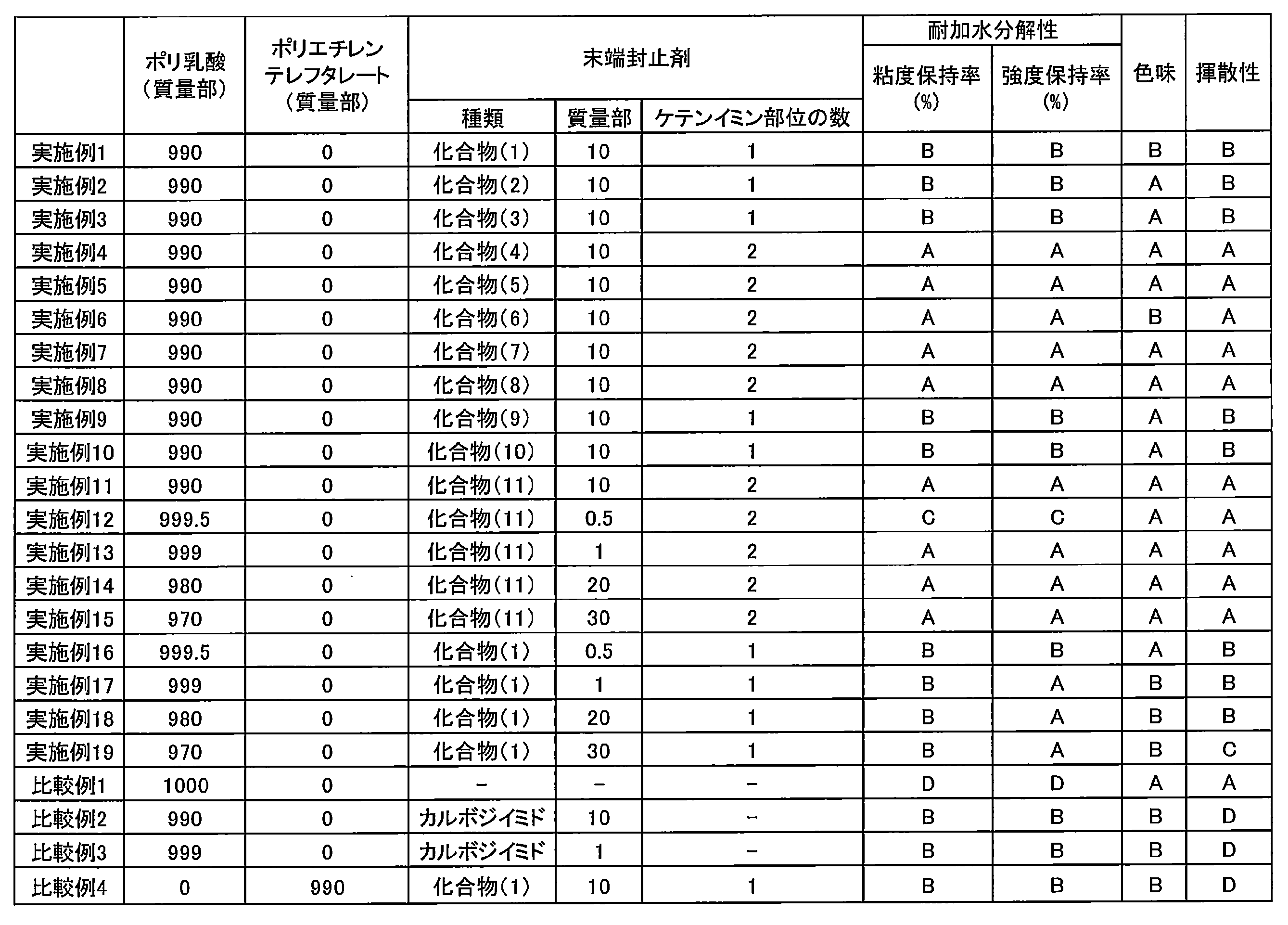
上記結果から明らかなように、脂肪族ポリエステルに、末端封止剤として一般式(1)で表されるケテンイミン化合物を添加した樹脂組成物を用いた実施例1~19は、揮散ガスが殆ど発生せず、作業安全性に優れていた。更には、末端封止剤を含まない比較例1に比べて、ポリエステルフィルムの粘度保持率、強度保持率が良好で、耐加水分解性に優れていた。
一方、末端封止剤を使用しなかった比較例1は、耐加水分解性に劣るものであった。
また、カルボジイミドを使用した比較例2、3、脂肪族ポリエステルのかわりに、芳香族ポリエステルであるポリエチレンテレフタレートを使用した比較例4は、ポリエステルフィルムの製造時に、揮散ガスが発生した。
一方、末端封止剤を使用しなかった比較例1は、耐加水分解性に劣るものであった。
また、カルボジイミドを使用した比較例2、3、脂肪族ポリエステルのかわりに、芳香族ポリエステルであるポリエチレンテレフタレートを使用した比較例4は、ポリエステルフィルムの製造時に、揮散ガスが発生した。
本発明によれば、ポリエステルフィルムの製膜時に、ケテンイミン化合物やケテン化合物の揮散を抑制することができる。これにより、耐加水分解性に優れたポリエステルフィルムを得ることができ、産業上の利用可能性が高い。
Claims (8)
- 脂肪族ポリエステルと、下記一般式(1)で表されるケテンイミン化合物とを含む樹脂組成物;

- 前記脂肪族ポリエステルがポリ乳酸である請求項1に記載の樹脂組成物。
- ポリエステルとケテンイミン化合物との合計質量100質量部に対して、前記ケテンイミン化合物を0.1~5質量部含有する請求項1又は2に記載の樹脂組成物。
- 前記ケテンイミン化合物が下記一般式(2)で表される請求項1~3のいずれか1項に記載の樹脂組成物;

- 前記ケテンイミン化合物が下記一般式(3)で表される請求項1~3のいずれか1項に記載の樹脂組成物;
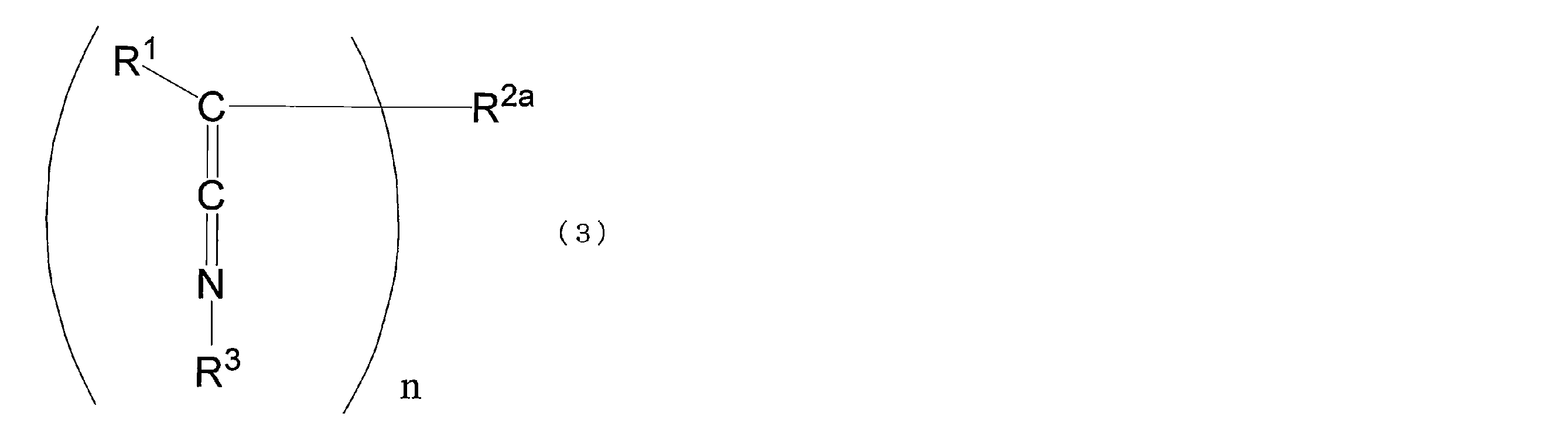
- 前記ケテンイミン化合物が下記一般式(4)で表される請求項4に記載の樹脂組成物;

- 前記ケテンイミン化合物が下記一般式(5)で表される請求項5に記載の樹脂組成物;

- 請求項1~7のいずれか1項に記載の樹脂組成物から作製されるポリエステルフィルム。
Applications Claiming Priority (2)
| Application Number | Priority Date | Filing Date | Title |
|---|---|---|---|
| JP2014013019A JP6205279B2 (ja) | 2014-01-28 | 2014-01-28 | 樹脂組成物、ポリエステルフィルム |
| JP2014-013019 | 2014-01-28 |
Publications (1)
| Publication Number | Publication Date |
|---|---|
| WO2015115395A1 true WO2015115395A1 (ja) | 2015-08-06 |
Family
ID=53756968
Family Applications (1)
| Application Number | Title | Priority Date | Filing Date |
|---|---|---|---|
| PCT/JP2015/052112 Ceased WO2015115395A1 (ja) | 2014-01-28 | 2015-01-27 | 樹脂組成物及びポリエステルフィルム |
Country Status (2)
| Country | Link |
|---|---|
| JP (1) | JP6205279B2 (ja) |
| WO (1) | WO2015115395A1 (ja) |
Citations (5)
| Publication number | Priority date | Publication date | Assignee | Title |
|---|---|---|---|---|
| US3692745A (en) * | 1970-01-24 | 1972-09-19 | Akzona Inc | Method for chemically modifying thread-forming polyesters |
| JPS63243323A (ja) * | 1987-03-16 | 1988-10-11 | アクゾ・エヌ・ヴエー | ポリエチレンテレフタレートを溶融紡糸することによる糸の製造方法 |
| JPH10130482A (ja) * | 1996-10-28 | 1998-05-19 | E I Du Pont De Nemours & Co | 加水分解の安定性を改良した配向型ポリエステル製品の製造方法 |
| WO2014073509A1 (ja) * | 2012-11-06 | 2014-05-15 | 富士フイルム株式会社 | ケテンイミン化合物、ポリエステルフィルム、太陽電池モジュール用バックシートおよび太陽電池モジュール |
| JP2014108623A (ja) * | 2012-12-04 | 2014-06-12 | Fujifilm Corp | 積層フィルム、太陽電池モジュール用バックシート、太陽電池モジュールおよび積層フィルムの製造方法 |
-
2014
- 2014-01-28 JP JP2014013019A patent/JP6205279B2/ja not_active Expired - Fee Related
-
2015
- 2015-01-27 WO PCT/JP2015/052112 patent/WO2015115395A1/ja not_active Ceased
Patent Citations (5)
| Publication number | Priority date | Publication date | Assignee | Title |
|---|---|---|---|---|
| US3692745A (en) * | 1970-01-24 | 1972-09-19 | Akzona Inc | Method for chemically modifying thread-forming polyesters |
| JPS63243323A (ja) * | 1987-03-16 | 1988-10-11 | アクゾ・エヌ・ヴエー | ポリエチレンテレフタレートを溶融紡糸することによる糸の製造方法 |
| JPH10130482A (ja) * | 1996-10-28 | 1998-05-19 | E I Du Pont De Nemours & Co | 加水分解の安定性を改良した配向型ポリエステル製品の製造方法 |
| WO2014073509A1 (ja) * | 2012-11-06 | 2014-05-15 | 富士フイルム株式会社 | ケテンイミン化合物、ポリエステルフィルム、太陽電池モジュール用バックシートおよび太陽電池モジュール |
| JP2014108623A (ja) * | 2012-12-04 | 2014-06-12 | Fujifilm Corp | 積層フィルム、太陽電池モジュール用バックシート、太陽電池モジュールおよび積層フィルムの製造方法 |
Also Published As
| Publication number | Publication date |
|---|---|
| JP6205279B2 (ja) | 2017-09-27 |
| JP2015140376A (ja) | 2015-08-03 |
Similar Documents
| Publication | Publication Date | Title |
|---|---|---|
| JP6787326B2 (ja) | ポリエステル樹脂及び該ポリエステル樹脂の製造方法並びにポリエステル樹脂組成物 | |
| JP6050825B2 (ja) | ポリ乳酸樹脂および共重合ポリエステル樹脂ブレンドおよびこれを利用した成形製品 | |
| TWI408159B (zh) | 母料用熱塑性樹脂組成物、其之成形材料的製造方法、使用其的熱塑性樹脂組成物及其製造方法 | |
| WO2008004490A1 (en) | Aliphatic polyester composition and method for producing the same | |
| JP2010031174A (ja) | ポリエステル樹脂組成物およびそれを用いた二軸配向フィルム | |
| WO2021038512A1 (en) | A process for manufacturing specialty polyesters & co-polyesters from recycled bis 2-hydroxyethyl terephthalate (rbhet) and product thereof | |
| EP3369758B1 (en) | Terminally modified polybutylene terephthalate resin, thermoplastic resin composition including same, and molded article | |
| WO2013015164A1 (ja) | ポリ乳酸樹脂およびその製造方法 | |
| US20220243005A1 (en) | Biodegradable resin composition having improved mechanical property, formability, and weatherproof and method for manufacturing the same | |
| JP6119608B2 (ja) | ブロック共重合体の製造方法 | |
| JP2004277454A (ja) | 生分解性高分子及びその製造方法、並びに成形体 | |
| JP2009040917A (ja) | ポリグリコール酸樹脂組成物、その製造方法およびその成形物 | |
| JP6205279B2 (ja) | 樹脂組成物、ポリエステルフィルム | |
| JP6280646B2 (ja) | 樹脂組成物、ポリエステルフィルム及び成形品 | |
| JP5376749B2 (ja) | ポリ乳酸フィルム | |
| JP6634823B2 (ja) | 末端変性ポリエチレンテレフタレート樹脂の製造方法 | |
| JP2007077193A (ja) | ポリ乳酸加水分解抑制剤およびそれを含有するポリ乳酸樹脂組成物 | |
| CN108603020A (zh) | 聚碳酸亚烷酯树脂组合物,其制备方法,形成的模塑制品以及使用其的模塑制品的制备方法 | |
| KR101941123B1 (ko) | 생분해성 수지 및 이로부터 제조된 생분해성 필름 | |
| JP3783948B2 (ja) | 乳酸系ポリマー組成物 | |
| JP6846990B2 (ja) | 均一延伸性を有するポリエチレンナフタレート系樹脂組成物およびその成形品 | |
| Liu et al. | Tri (3‐alkoxyl‐3‐oxopropyl) phosphine oxides derived from PH3 tail gas as a novel phosphorus‐containing plasticizer for polylactide | |
| JP2015535543A (ja) | 生分解性ポリエステル系重合体の製造方法、及び当該方法で製造された生分解性ポリエステル系重合体 | |
| JPH08113699A (ja) | ポリエステル弾性体 | |
| JPH01221419A (ja) | 全芳香族ポリエステル共重合体 |
Legal Events
| Date | Code | Title | Description |
|---|---|---|---|
| 121 | Ep: the epo has been informed by wipo that ep was designated in this application |
Ref document number: 15742567 Country of ref document: EP Kind code of ref document: A1 |
|
| NENP | Non-entry into the national phase |
Ref country code: DE |
|
| 122 | Ep: pct application non-entry in european phase |
Ref document number: 15742567 Country of ref document: EP Kind code of ref document: A1 |