WO2015114840A1 - α-アルミン酸リチウムの製造方法 - Google Patents
α-アルミン酸リチウムの製造方法 Download PDFInfo
- Publication number
- WO2015114840A1 WO2015114840A1 PCT/JP2014/052650 JP2014052650W WO2015114840A1 WO 2015114840 A1 WO2015114840 A1 WO 2015114840A1 JP 2014052650 W JP2014052650 W JP 2014052650W WO 2015114840 A1 WO2015114840 A1 WO 2015114840A1
- Authority
- WO
- WIPO (PCT)
- Prior art keywords
- lithium aluminate
- mixture
- lithium
- producing
- firing
- Prior art date
- Legal status (The legal status is an assumption and is not a legal conclusion. Google has not performed a legal analysis and makes no representation as to the accuracy of the status listed.)
- Ceased
Links
Images


Classifications
-
- C—CHEMISTRY; METALLURGY
- C01—INORGANIC CHEMISTRY
- C01F—COMPOUNDS OF THE METALS BERYLLIUM, MAGNESIUM, ALUMINIUM, CALCIUM, STRONTIUM, BARIUM, RADIUM, THORIUM, OR OF THE RARE-EARTH METALS
- C01F7/00—Compounds of aluminium
- C01F7/02—Aluminium oxide; Aluminium hydroxide; Aluminates
- C01F7/04—Preparation of alkali metal aluminates; Aluminium oxide or hydroxide therefrom
- C01F7/043—Lithium aluminates
-
- H—ELECTRICITY
- H01—ELECTRIC ELEMENTS
- H01M—PROCESSES OR MEANS, e.g. BATTERIES, FOR THE DIRECT CONVERSION OF CHEMICAL ENERGY INTO ELECTRICAL ENERGY
- H01M8/00—Fuel cells; Manufacture thereof
- H01M8/02—Details
- H01M8/0289—Means for holding the electrolyte
- H01M8/0295—Matrices for immobilising electrolyte melts
-
- H—ELECTRICITY
- H01—ELECTRIC ELEMENTS
- H01M—PROCESSES OR MEANS, e.g. BATTERIES, FOR THE DIRECT CONVERSION OF CHEMICAL ENERGY INTO ELECTRICAL ENERGY
- H01M8/00—Fuel cells; Manufacture thereof
- H01M8/14—Fuel cells with fused electrolytes
- H01M8/141—Fuel cells with fused electrolytes the anode and the cathode being gas-permeable electrodes or electrode layers
- H01M8/142—Fuel cells with fused electrolytes the anode and the cathode being gas-permeable electrodes or electrode layers with matrix-supported or semi-solid matrix-reinforced electrolyte
-
- C—CHEMISTRY; METALLURGY
- C01—INORGANIC CHEMISTRY
- C01P—INDEXING SCHEME RELATING TO STRUCTURAL AND PHYSICAL ASPECTS OF SOLID INORGANIC COMPOUNDS
- C01P2002/00—Crystal-structural characteristics
- C01P2002/70—Crystal-structural characteristics defined by measured X-ray, neutron or electron diffraction data
- C01P2002/72—Crystal-structural characteristics defined by measured X-ray, neutron or electron diffraction data by d-values or two theta-values, e.g. as X-ray diagram
-
- C—CHEMISTRY; METALLURGY
- C01—INORGANIC CHEMISTRY
- C01P—INDEXING SCHEME RELATING TO STRUCTURAL AND PHYSICAL ASPECTS OF SOLID INORGANIC COMPOUNDS
- C01P2004/00—Particle morphology
- C01P2004/01—Particle morphology depicted by an image
- C01P2004/03—Particle morphology depicted by an image obtained by SEM
-
- C—CHEMISTRY; METALLURGY
- C01—INORGANIC CHEMISTRY
- C01P—INDEXING SCHEME RELATING TO STRUCTURAL AND PHYSICAL ASPECTS OF SOLID INORGANIC COMPOUNDS
- C01P2006/00—Physical properties of inorganic compounds
- C01P2006/12—Surface area
-
- C—CHEMISTRY; METALLURGY
- C01—INORGANIC CHEMISTRY
- C01P—INDEXING SCHEME RELATING TO STRUCTURAL AND PHYSICAL ASPECTS OF SOLID INORGANIC COMPOUNDS
- C01P2006/00—Physical properties of inorganic compounds
- C01P2006/32—Thermal properties
- C01P2006/37—Stability against thermal decomposition
-
- C—CHEMISTRY; METALLURGY
- C01—INORGANIC CHEMISTRY
- C01P—INDEXING SCHEME RELATING TO STRUCTURAL AND PHYSICAL ASPECTS OF SOLID INORGANIC COMPOUNDS
- C01P2006/00—Physical properties of inorganic compounds
- C01P2006/40—Electric properties
-
- H—ELECTRICITY
- H01—ELECTRIC ELEMENTS
- H01M—PROCESSES OR MEANS, e.g. BATTERIES, FOR THE DIRECT CONVERSION OF CHEMICAL ENERGY INTO ELECTRICAL ENERGY
- H01M8/00—Fuel cells; Manufacture thereof
- H01M8/14—Fuel cells with fused electrolytes
- H01M2008/147—Fuel cells with molten carbonates
-
- Y—GENERAL TAGGING OF NEW TECHNOLOGICAL DEVELOPMENTS; GENERAL TAGGING OF CROSS-SECTIONAL TECHNOLOGIES SPANNING OVER SEVERAL SECTIONS OF THE IPC; TECHNICAL SUBJECTS COVERED BY FORMER USPC CROSS-REFERENCE ART COLLECTIONS [XRACs] AND DIGESTS
- Y02—TECHNOLOGIES OR APPLICATIONS FOR MITIGATION OR ADAPTATION AGAINST CLIMATE CHANGE
- Y02E—REDUCTION OF GREENHOUSE GAS [GHG] EMISSIONS, RELATED TO ENERGY GENERATION, TRANSMISSION OR DISTRIBUTION
- Y02E60/00—Enabling technologies; Technologies with a potential or indirect contribution to GHG emissions mitigation
- Y02E60/30—Hydrogen technology
- Y02E60/50—Fuel cells
Definitions
- the present invention particularly relates to ⁇ -lithium aluminate (LiAlO 2 ) useful for an electrolyte holding plate of a molten carbonate fuel cell (MCFC) and a method for producing the same.
- MCFC molten carbonate fuel cell
- the MCFC electrolyte holding plate is intended to hold mixed molten carbonates such as lithium carbonate (Li 2 CO 3 ), potassium carbonate (K 2 CO 3 ), and sodium carbonate (Na 2 CO 3 ) in a high temperature range around 650 ° C. Used in. Therefore, characteristics such as high retention with respect to molten carbonate, stability of particle shape, alkali resistance, and heat resistance are required. As a material that satisfies these required characteristics, lithium aluminate is used as the constituent material of the electrolyte holding plate. In particular, fine ⁇ -lithium aluminate having a relatively large specific surface area with excellent electrolyte holding power is preferably used. It was done.
- Patent Document 1 discloses a method for producing highly crystalline ⁇ -lithium aluminate.
- Patent Document 2 discloses a method in which a mixture of an alumina powder having a specific surface area of 100 m 2 / g or more and a carbonate containing lithium carbonate is heat-treated in a molten carbonate at 700 to 800 ° C. .
- Patent Document 3 discloses a method of heat-treating a mixture of aluminum hydroxide powder having a specific surface area of 100 m 2 / g or more and a carbonate containing lithium carbonate in a molten carbonate at 700 to 800 ° C. .
- alumina or lithium aluminate as a raw material is heat-treated in molten carbonate.
- Such a method not only requires a long reaction time of 50 to 100 hours, but also requires a process of washing and drying the product in order to remove the carbonate due to the characteristics of the manufacturing process, which complicates the process. High cost is inevitable.
- Patent Document 4 proposes that ⁇ -lithium aluminate is produced by dry-mixing porous ⁇ -alumina and a lithium compound at a Li / Al molar ratio in the vicinity of the stoichiometric ratio and firing. Yes.
- fine ⁇ -lithium aluminate having a BET specific surface area of 10 m 2 / g or more is produced by this production method, it is difficult to obtain an MCFC electrolyte holding plate having the necessary thermal stability.
- transition alumina As a result of intensive studies to solve the above problems, the present inventors have used transition alumina and mixed the transition alumina and lithium carbonate at a molar ratio of Al / Li in the vicinity of 1.
- the obtained mixture (a) is subjected to a first firing reaction, and then the obtained fired product is mixed with an aluminum compound in a molar ratio of Al atoms in the aluminum compound to Li atoms in the fired product (Al /
- the ⁇ -lithium aluminate produced by subjecting the mixture (b) added in a specific range to Li) to the second baking reaction is thermally stable even if it is a fine one having a BET specific surface area of 10 m 2 / g or more.
- the present invention was completed by finding that it has excellent physical properties and has various physical properties suitable as an electrolyte holding plate for MCFC.
- An object of the present invention is to provide an ⁇ -lithium aluminate having various physical properties suitable as an MCFC electrolyte holding plate having excellent thermal stability in an industrially advantageous manner.
- transition alumina and lithium carbonate are mixed at an Al / Li molar ratio of 0.95 to 1.01, and the resulting mixture (a) is subjected to a first firing reaction and fired.
- An aluminum compound was added to the obtained fired product at a molar ratio (Al / Li) of Al atoms in the aluminum compound to Li atoms in the fired product of 0.001 to 0.05.
- the present invention provides a method for producing ⁇ -lithium aluminate, wherein the mixture (b) is subjected to a second baking reaction.
- the present invention provides a method for producing ⁇ -lithium aluminate having a firing temperature of 650 to 850 ° C. in the first firing reaction.
- the present invention also provides a method for producing ⁇ -lithium aluminate having a firing temperature of 750 to 900 ° C. in the second firing reaction.
- the present invention also provides a method for producing ⁇ -lithium aluminate, wherein the transition alumina is transition alumina containing ⁇ phase or ⁇ -alumina.
- the present invention also provides a method for producing ⁇ -lithium aluminate, wherein the transition alumina is ⁇ -alumina.
- the present invention also provides a method for producing ⁇ -lithium aluminate, wherein the transition alumina has a BET specific surface area of 50 m 2 / g or more.
- the present invention also provides a method for producing ⁇ -lithium aluminate in which the aluminum compound is transition alumina.
- the present invention also provides a method for producing ⁇ -lithium aluminate used as an electrolyte holding plate of a molten carbonate fuel cell.
- the present invention is configured as described above, even if the BET specific surface area is a fine one having a BET specific surface area of 10 m 2 / g or more, it has various physical properties suitable as an MCFC electrolyte holding plate having excellent thermal stability. Lithium aluminate can be provided in an industrially advantageous manner.
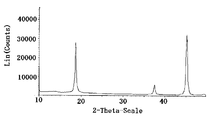
- FIG. 2 is an X-ray diffraction diagram of ⁇ -alumina used in Example 1.
- FIG. 2 is an X-ray diffraction pattern of a fired product ( ⁇ -lithium aluminate (1)) obtained after the first firing reaction of Example 1.
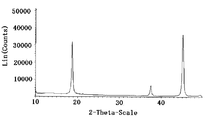
- FIG. FIG. 3 is an X-ray diffraction pattern of ⁇ -lithium aluminate (2) obtained after the second baking reaction of Example 1.
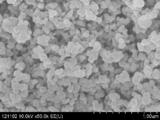
- 2 is an SEM photograph of ⁇ -lithium aluminate (2) obtained after the second firing reaction of Example 1.
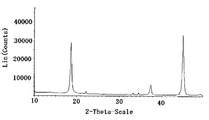
- FIG. FIG. 2 is an X-ray diffraction pattern after thermal stability test of ⁇ -lithium aluminate (2) obtained in Example 1.
- FIG. 4 is an X-ray diffraction pattern after thermal stability test of ⁇ -lithium aluminate obtained in Comparative Example 2.
- ⁇ -lithium aluminate (2) The ⁇ -lithium aluminate obtained by this production method (hereinafter sometimes referred to as “ ⁇ -lithium aluminate (2)”) is a single-phase in X-ray diffraction analysis substantially free of ⁇ -lithium aluminate. ⁇ -lithium aluminate (2).
- ⁇ -lithium aluminate (2) obtained by this production method was found to be ⁇ in X-ray diffraction analysis even after the ⁇ -lithium aluminate (2) sample was heated at 750 ° C. for 200 hours in the air atmosphere.
- - ⁇ -lithium aluminate (2) which is substantially free of lithium aluminate and has excellent thermal stability.
- the BET specific surface area of ⁇ -lithium aluminate (2) obtained by this production method is not particularly limited, but considering the advantageous effects of ⁇ -lithium aluminate (2) obtained by this production method.
- the BET specific surface area is 10 m 2 / g or more, preferably 10 to 40 m 2 / g.
- transition alumina and lithium carbonate are mixed at a molar ratio of Al / Li in a quantity ratio of about 1, and the resulting mixture (a) is mixed with the first.
- a calcined product (hereinafter sometimes referred to as “ ⁇ -lithium aluminate (1)”) is obtained by subjecting to a calcining reaction.
- an aluminum compound is added to the Li atom in the calcined product.
- the mixture (b) mixed at a molar ratio of Al atoms in the aluminum compound (Al / Li) of 0.001 to 0.05 is subjected to the second firing reaction, and this production method comprises: Basically, the following steps (a) to (2) are included.
- the mixture (a) preparation step is a step of preparing a uniform mixture (a) in which transition alumina and lithium carbonate are mixed at a molar ratio of Al / Li in the range of about 0.95 to 1.01. .
- Alumina has various crystal types such as ⁇ , ⁇ , ⁇ , and ⁇ , and ⁇ , ⁇ , and ⁇ crystal types other than ⁇ are low-temperature phases of ⁇ -alumina and are called transition aluminas.
- transition aluminas When the boehmite represented by the structural formula: 4 [AlO (OH)] is heated, a phase change of boehmite phase ⁇ ⁇ phase ⁇ ⁇ phase ⁇ ⁇ phase ⁇ ⁇ phase is caused as the temperature rises.
- transition aluminas having mixed phases such as ⁇ phase, ⁇ phase and ⁇ phase.
- the transition alumina used in this production method may be of any crystal type of ⁇ , ⁇ , ⁇ , and may be a single phase of ⁇ , ⁇ , ⁇ , or a mixed phase of these crystal types.
- a transition alumina containing a ⁇ or ⁇ phase is preferable, and a transition alumina containing a ⁇ phase is particularly preferable from the viewpoint of obtaining ⁇ -lithium aluminate having further improved chemical stability. .
- Transition aluminas containing the ⁇ phase are those of the ⁇ phase, the mixed phase of ⁇ and ⁇ phases, and the mixed phase of ⁇ phase, ⁇ phase, and ⁇ .
- ⁇ -alumina in the ⁇ phase is particularly thermally stable. From the viewpoint of obtaining ⁇ -lithium aluminate having a BET specific surface area of 10 m 2 / g or more, preferably 10 to 40 m 2 / g. Used.
- the mixed-phase transition alumina can be confirmed by X-ray diffraction analysis to determine whether it is a mixed phase (see, for example, JP-A-07-96186).
- a preferable physical property of the transition alumina according to the preparation step of the mixture (a) is that ⁇ -lithium aluminate (2) having a BET specific surface area of 10 m 2 / g or more, preferably 10 to 40 m 2 / g is generated. Therefore, the BET specific surface area is 50 m 2 / g or more, preferably 60 to 200 m 2 / g.
- the process for producing such transition alumina is known per se.
- transition alumina containing a ⁇ phase can be obtained by heat-treating ⁇ -alumina at 800 to 1100 ° C., preferably 900 to 1050 ° C.
- the transition alumina used by this invention can use a commercial item suitably.
- the lithium carbonate relating to the preparation step of the mixture (a) is not particularly limited as long as it is industrially available, but the average obtained by the laser method from the viewpoint of improving the reactivity with transition alumina.
- a particle size of 15 ⁇ m or less, preferably 10 ⁇ m or less is preferably used.
- the transition alumina and lithium carbonate are in an Al / Li molar ratio of 0.95 to 1.01, preferably 0.97 to 1.00 in order to obtain ⁇ -lithium aluminate (1).
- Mix in the quantity ratio when the Al / Li molar ratio is outside the above range, it is difficult to obtain single-phase ⁇ -lithium aluminate (1) by X-ray diffraction with the target composition, and it can be obtained by performing the subsequent steps. This is because it is difficult to obtain an ⁇ -lithium aluminate (2) having excellent thermal stability.
- the method for mixing the transition alumina and lithium carbonate in the preparation step of the mixture (a) may be either dry or wet, and is not particularly limited.
- dry mixing if the interdispersion between the powders is insufficient, the ⁇ -lithium aluminate (1) particles are partially agglomerated and coarsened in the first firing reaction step (b). For this reason, in order to obtain a uniform mixed and dispersed state of the raw materials, it is preferable to perform processing using a high-speed dispersion mixer such as a Henschel mixer or a super mixer.
- the mixture (a) obtained in the preparation step (a) of (a) is subjected to the first baking reaction step (b) to obtain a fired product.
- the fired product itself obtained by the first firing reaction is ⁇ -lithium aluminate (1), but the ⁇ -lithium aluminate (1) itself obtained by performing the first firing reaction is particularly BET specific surface area. Is 10 m 2 / g or more, preferably 10 to 40 m 2 / g, it is inferior to ⁇ -lithium aluminate (2) subjected to the second firing reaction described later in terms of thermal stability.
- the fired product ( ⁇ -lithium aluminate (1)) obtained by the first firing reaction is prepared by using the mixture (b) preparation step (c) described later and the second firing reaction (2).
- ⁇ -lithium aluminate (1) can be converted to ⁇ -lithium aluminate (2) having excellent thermal stability.
- this first firing reaction step it is important to obtain single-phase ⁇ -lithium aluminate (1) particularly in the X-ray diffraction analysis as a fired product from the viewpoint of obtaining a product having excellent thermal stability.
- the firing temperature in the first firing reaction step is 650 to 850 ° C., preferably 700 to 800 ° C. This is because it is difficult to obtain single-phase lithium aluminate (1) when the firing temperature of the first firing reaction is less than 650 ° C., whereas the ⁇ phase and ⁇ are obtained when the firing temperature of the first firing reaction exceeds 800 ° C. This tends to be a mixture of phases, which is not preferable.
- the firing atmosphere is not particularly limited, and may be any of an inert gas atmosphere, a vacuum atmosphere, an oxidizing gas atmosphere, and air.
- the first firing reaction may be performed as many times as desired.
- the obtained fired product can be pulverized and / or crushed as necessary.
- Examples of the aluminum compound related to the preparation step of the mixture (b) include ⁇ -alumina, ⁇ -alumina, ⁇ -alumina transition alumina, or a mixed phase transition alumina containing two or more ⁇ , ⁇ , ⁇ , and ⁇ phases. , Aluminum hydroxide, ammonium dosonite, alum and the like.
- the transition alumina exemplified in the preparation step (a) of the mixture (a) described above can be preferably used.
- the type of transition alumina is not particularly limited, and may be the same as or different from that used in the above-described mixture (a) preparation step. .
- the aluminum compound according to the preparation step of the mixture (a) has ⁇ -alumina having a BET specific surface area of 10 m 2 / g or more, preferably 10 to 40 m 2 / g, and is excellent in thermal stability and chemical stability. This is particularly preferable from the viewpoint of obtaining ⁇ -lithium aluminate.
- the addition form of the aluminum compound to the fired product can be added to the fired product as a slurry dispersed in a powder, solution or aqueous medium.
- the addition amount of the aluminum compound is 0.001 to 0.05, preferably 0.002 to 0.002 in terms of the molar ratio of Al atoms in the aluminum compound to Li atoms in the fired product (Al / Li).
- a value of 0.02 is important for obtaining ⁇ -lithium aluminate (2) having excellent thermal stability. The reason for this is that when the amount of the aluminum compound added is less than 0.001 in terms of the molar ratio of Al atoms in the aluminum compound to the Li atoms in the fired product (Al / Li), thermal stability is lacking. If the Al / Li molar ratio exceeds 0.05, unreacted substances are contained, which is not preferable.
- the means for mixing the calcined product and the aluminum compound can be used without particular limitation as long as it is a method that can obtain a mixture (b) in which the respective raw materials are uniformly dispersed.
- the same method as the process can be used.
- a dry processing method using a high-speed dispersion mixer such as a Henschel mixer or a super mixer, or a wet drying method using a spray dryer can be used.
- the second firing reaction is performed on the uniformly mixed mixture (b), so that it is more stable than the fired product ( ⁇ -lithium aluminate (1)) obtained by the first firing reaction.
- ⁇ -lithium aluminate (2) having significantly improved properties can be obtained.
- the second firing reaction step (2) it is particularly important to obtain single-phase ⁇ -lithium aluminate (2) from the viewpoint of obtaining a product having excellent thermal stability.
- the firing temperature related to the second firing reaction step is 750 to 900 ° C., preferably 770 to 830 ° C. This is because if the firing temperature of the second firing reaction is less than 750 ° C., it becomes difficult to obtain single-phase lithium aluminate (2) by X-ray diffraction, while the firing temperature of the second firing reaction exceeds 830 ° C. And ⁇ phase tend to be contained, which is not preferable.
- the firing atmosphere is not particularly limited, and may be any of an inert gas atmosphere, a vacuum atmosphere, an oxidizing gas atmosphere, and air.
- the second firing reaction may be performed as many times as desired. Moreover, after completion
- the ⁇ -lithium aluminate (2) obtained by the production method of the present invention is an X-ray single-phase ⁇ -lithium aluminate (2) substantially free of ⁇ -lithium aluminate, and has a BET specific surface area. Even if it is 10 m ⁇ 2 > / g or more, it is excellent in thermal stability. Therefore, the ⁇ -lithium aluminate (2) obtained by the production method of the present invention can be suitably used as an electrolyte holding plate for MCFC even if it has a BET specific surface area of 10 m 2 / g or more.
- Example 1 (A): Mixture (a) preparation step; Using a commercially available ⁇ -alumina (XRD; FIG. 1) having a BET specific surface area of 92 m 2 / g, an average particle diameter by laser method of 30 ⁇ m, and lithium carbonate having an average particle diameter of 5 ⁇ m by laser method, a molar ratio (Al / Li ) was weighed to an amount of 1.00 and thoroughly mixed with a Henschel mixer to prepare a uniform mixture (a). (B): first firing reaction step; The uniform mixture (a) was filled in an alumina crucible and subjected to a first firing reaction at 700 ° C. for 25 hours in an air atmosphere to obtain a fired product.
- XRD ⁇ -alumina
- the fired product was single-phase ⁇ -lithium aluminate (1) (see FIG. 2).
- ⁇ -lithium aluminate (2) sample was subjected to X-ray diffraction analysis.
- the ⁇ -lithium aluminate single phase was a single phase (see FIG. 3) and the BET specific surface area was 21.5 m 2 / g. .
- An SEM photograph of the ⁇ -lithium aluminate (2) sample is shown in FIG.
- Example 2 (A): Mixture (a) preparation step; Using a commercially available ⁇ -alumina having a BET specific surface area of 147 m 2 / g, an average particle diameter of 30 ⁇ m by laser method, and lithium carbonate having an average particle diameter of 5 ⁇ m by laser method, the molar ratio (Al / Li) is 1.00. Were weighed and mixed well with a Henschel mixer to prepare a uniform mixture (a). (B): first firing reaction step; The uniform mixture (a) was filled in an alumina crucible and subjected to a first firing reaction at 700 ° C. for 25 hours in an air atmosphere to obtain a fired product.
- the ⁇ -lithium aluminate single phase had a BET specific surface area of 31.2 m 2 / g.
- the amount of aluminum compound added was expressed as the molar ratio (Al / Li) of Al in the added aluminum compound to Li in the fired product ( ⁇ -lithium aluminate (1)).
- X-ray diffraction patterns after heat treatment of the ⁇ -lithium aluminate samples of Example 1 and Comparative Example 2 are shown in FIGS. 5 and 6, respectively.
- Table 2 shows that ⁇ -lithium aluminate obtained by this production method is excellent in thermal stability.
- the use of transition alumina containing the ⁇ phase as the raw material transition alumina provides improved chemical stability.
- ⁇ -lithium aluminate having various physical properties suitable as an electrolyte holding plate for MCFC having excellent thermal stability, even if it has a fine BET specific surface area of 10 m 2 / g or more, is industrially used. Can be provided in an advantageous manner.
Landscapes
- Chemical & Material Sciences (AREA)
- Life Sciences & Earth Sciences (AREA)
- Engineering & Computer Science (AREA)
- Organic Chemistry (AREA)
- Manufacturing & Machinery (AREA)
- Sustainable Development (AREA)
- Sustainable Energy (AREA)
- Chemical Kinetics & Catalysis (AREA)
- Electrochemistry (AREA)
- General Chemical & Material Sciences (AREA)
- Geology (AREA)
- Inorganic Chemistry (AREA)
- Materials Engineering (AREA)
- Fuel Cell (AREA)
- Compounds Of Alkaline-Earth Elements, Aluminum Or Rare-Earth Metals (AREA)
Abstract
Description
上記の方法は、何れにおいても原料となるアルミナ又はアルミン酸リチウムを溶融炭酸塩中で熱処理するものである。かかる方法は50時間から100時間と長い反応時間を要するばかりでなく、さらに製法の特性上、炭酸塩を除去するために製品を洗浄し乾燥する工程を必ず含まねばならず、工程の複雑化と高コスト化が避けられない。
本製法で得られるα-アルミン酸リチウム(以下、「α-アルミン酸リチウム(2)と呼ぶことがある」は、γ-アルミン酸リチウムを実質的に含まないX線回折分析において、単相のα-アルミン酸リチウム(2)である。
(イ):混合物(a)調製工程
(ロ):第1焼成反応工程
(ハ):混合物(b)調製工程
(二):第2焼成反応工程
混合物(a)調製工程は、遷移アルミナと、炭酸リチウムとをAl/Liのモル比で0.95~1.01の1近傍の量比で混合した均一混合物(a)を調製する工程である。
本製造方法で使用する遷移アルミナはγ 、δ 、θの何れの結晶型のであってもよく、また、γ 、δ 、θの単相のものでも、これらの結晶型の混相のものであってもよいが、本発明では、γ或いはθ相を含む遷移アルミナが好ましく、特にθ相を含む遷移アルミナを用いると、更に化学的安定性を向上させたα―アルミン酸リチウムが得られる観点から好ましい。
かかる遷移アルミナの製法自体は、公知であり、例えばθ相を含む遷移アルミナは、γ-アルミナを800~1100℃、好ましくは900~1050℃で加熱処理することにより得ることができる。また、本発明で使用する遷移アルミナは市販品も好適に用いることが出来る。
この理由はAl/Liのモル比が上記範囲を外れると、目的の組成でX線回折的に単相のα-アルミン酸リチウム(1)が得られにくく、また、その後の工程を施して得られるα-アルミン酸リチウム(2)においても熱安定性の優れたものが得られがたくなるからである。
乾式混合の場合、粉末間の相互分散が不十分であると(ロ)の第1焼成反応工程においてα-アルミン酸リチウム(1)粒子が部分的に凝集し、粗粒化する。このため、原料の均一な混合分散状態を得るためには、例えばヘンシェルミキサー、スーパーミキサーのような高速分散混合機を用いて処理することが好ましい。
前記(イ)の混合物(a)調製工程で得られる混合物(a)は、(ロ)の第1焼成反応工程に付して、焼成品を得る。
第1焼成反応により得られる焼成品自体は、α―アルミン酸リチウム(1)であるが、この第1焼成反応を行って得られるα-アルミン酸リチウム(1)自体では、特に、BET比表面積が10m2/g以上、好ましくは10~40m2/gになると熱安定性の点で、後述する第2焼成反応を付したα-アルミン酸リチウム(2)と比べて劣るものである。しかしながら、本製造方法では、この第1焼成反応により得られる焼成品(α―アルミン酸リチウム(1))を、後述する(ハ)の混合物(b)調製工程及び(二)の第2焼成反応工程を施すことにより、α―アルミン酸リチウム(1)を熱安定性の優れたα-アルミン酸リチウム(2)に転換することが出来る。
前記(ロ)の第1焼成反応工程で得られる焼成品は、(ハ)の混合物(b)調製工程に付して、焼成品とアルミニウム化合物とが均一に混合された混合物(b)を得る。
また、混合物(a)調製工程に係るアルミニウム化合物は、θ-アルミナがBET比表面積が10m2/g以上、好ましくは10~40m2/gで、且つ熱安定性及び化学的安定性に優れたα-アルミン酸リチウムを得るという観点から特に好ましい。
前記(ハ)の混合物(b)調製工程で得られた混合物(b)は、第2焼成反応工程に付して、本発明の目的とするα-アルミン酸リチウム(2)を得る。
(イ):混合物(a)調製工程;
BET比表面積92m2/g、レーザー法による平均粒径が30μmの市販のθ-アルミナ(XRD;図1)とレーザー法による平均粒径が5μmの炭酸リチウムとを用い、モル比(Al/Li)が1.00となる分量で計量し、ヘンシェルミキサーで十分混合し、均一混合物(a)を調製した。
(ロ):第1焼成反応工程;
均一混合物(a)をアルミナるつぼ中に充填し、700℃で25時間、大気雰囲気で第1焼成反応を行い焼成品を得た。得られた焼成品についてX線回折分析を行ったところ、焼成品は単相のα-アルミン酸リチウム(1)であった(図2参照)。
(ハ):混合物(b)調製工程;
焼成品に混合物(a)調製工程で使用したものと同じθ-アルミナをα-アルミン酸リチウム(1)中のLiに対するモル比(Al/Li)で0.015となるように添加した後、ヘンシェルミキサーで十分混合し、均一混合物(b)を調製した。
(二):第2焼成反応工程;
均一混合物(b)をアルミナるつぼ中に充填し、800℃で7時間、大気雰囲気で第2焼成反応を行いα-アルミン酸リチウム(2)試料を得た。得られたα-アルミン酸リチウム(2)試料をX線回折分析を行ったところα-アルミン酸リチウム単相(図3参照)で、また、BET比表面積は21.5m2/gであった。また、α-アルミン酸リチウム(2)試料のSEM写真を図4に示した。
(イ):混合物(a)調製工程;
BET比表面積147m2/g、レーザー法による平均粒径が30μmの市販のγ-アルミナとレーザー法による平均粒径が5μmの炭酸リチウムとを用い、モル比(Al/Li)が1.00となる分量で計量し、ヘンシェルミキサーで十分混合し、均一混合物(a)を調製した。
(ロ):第1焼成反応工程;
均一混合物(a)をアルミナるつぼ中に充填し、700℃で25時間、大気雰囲気で第1焼成反応を行い焼成品を得た。得られた焼成品についてX線回折分析を行ったところ、焼成品は単相のα-アルミン酸リチウム(1)であった。
(ハ):混合物(b)調製工程;
焼成品に混合物(a)調製工程で使用したものと同じγ-アルミナをα-アルミン酸リチウム(1)中のLiに対するモル比(Al/Li)で0.015となるように添加した後、ヘンシェルミキサーで十分混合し、均一混合物(b)を調製した。
(二):第2焼成反応工程;
均一混合物(b)をアルミナるつぼ中に充填し、800℃で7時間、大気雰囲気で第2焼成反応を行いα-アルミン酸リチウム(2)試料を得た。得られたα-アルミン酸リチウム(2)試料をX線回折分析を行ったところα-アルミン酸リチウム単相で、また、BET比表面積は31.2m2/gであった。
BET比表面積70m2/g、レーザー法による平均粒径が30μmのθ-アルミナとレーザー法による平均粒径が5μmの炭酸リチウムを実施例1と同様の方法で計量および混合し、均一混合物(a)を得た。
次いで、均一混合物(a)をアルミナるつぼ中に充填し、700℃で25時間、大気雰囲気で焼成し、これをα-アルミン酸リチウム試料とした。得られたα-アルミン酸リチウム試料をX線回折分析したところはα-アルミン酸リチウム単相で、また、BET比表面積は18.7m2/gであった。
BET比表面積70m2/g、レーザー法による平均粒径が30μmのθ-アルミナとレーザー法による平均粒径が5μmの炭酸リチウムとを用い、モル比(Al/Li)が1.00となる分量で計量し、これをビーズミル装置に投入し湿式混合粉砕を行った。次いで得たスラリーを、スプレードライヤーで全量乾燥し、均一混合物を調製した。
この均一混合物をアルミナるつぼ中に充填し、740℃で7時間、さらに800℃で7時間、大気雰囲気下に焼成反応を行い焼成品を得た。得られた焼成品についてX線回折分析を行ったところ、焼成品はα-アルミン酸リチウム単相で、また、BET比表面積は20.1m2/gであった。

実施例及び比較例で得られた各α-アルミン酸リチウム試料について、熱安定性の評価及び化学的安定性を評価した。
実施例及び比較例で得られた各α-アルミン酸リチウム試料10gを大気雰囲気にて電気炉に入れ、750℃で200時間加熱し、X線回折分析を行ってγ-アルミン酸リチウムの存在の有無を確認した。実施例1と比較例2のα-アルミン酸リチウム試料の加熱処理後のX線回折図を図5及び図6にそれぞれ示す。
実施例及び比較例で得られたα-アルミン酸リチウム試料と電解質(成分組成 Li2CO3:K2CO3=53:47mol%) を重量比1:2で混合し、体積比で空気/窒素/CO2=50/40/10に混合された雰囲気に保持された電気炉中で670℃の温度に200時間加熱し、X線回折分析を行ってγ-アルミン酸リチウムの存在の有無を確認した。
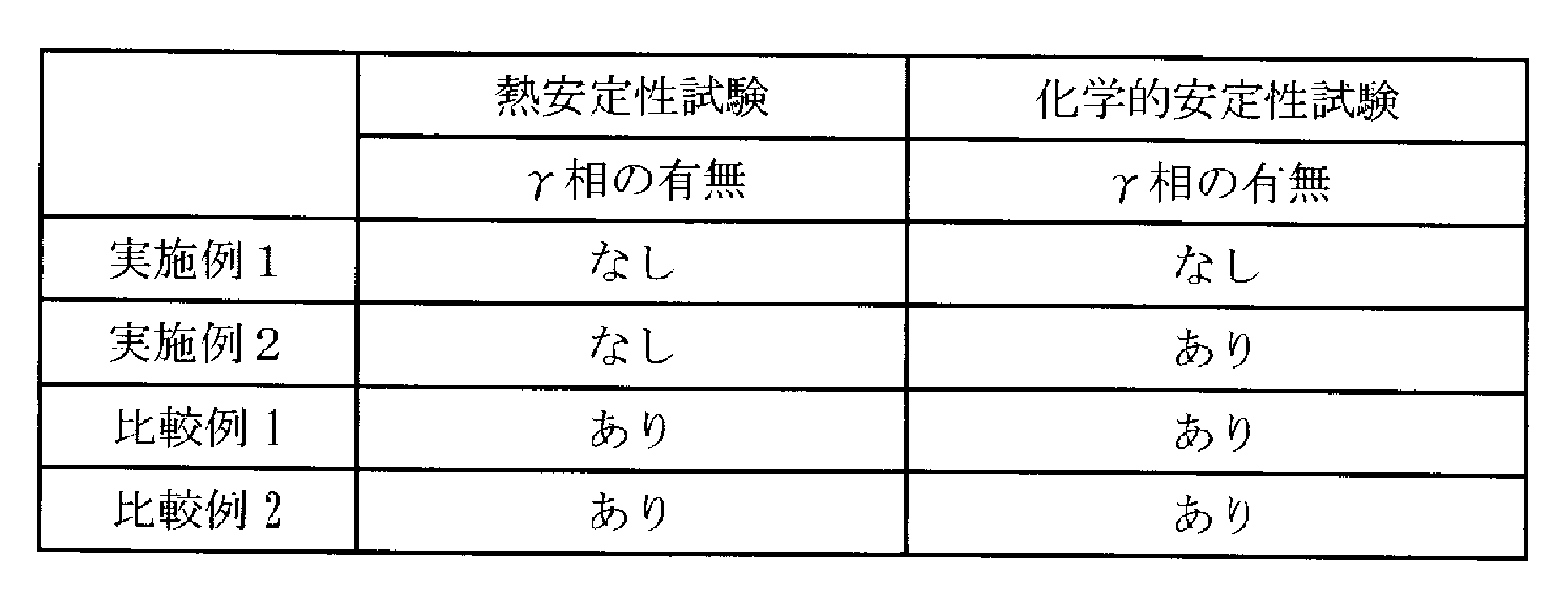
Claims (8)
- 遷移アルミナと、炭酸リチウムとをAl/Liのモル比で0.95~1.01の量比で混合し、得られる混合物(a)を第1焼成反応に付し焼成品を得、次に得られた焼成品に、アルミニウム化合物を、前記焼成品中のLi原子に対するアルミニウム化合物中のAl原子のモル比(Al/Li)で0.001~0.05で加えた混合物(b)を第2焼成反応に付すことを特徴とするα―アルミン酸リチウムの製造方法。
- 前記第1焼成反応の焼成温度が650~850℃であることを特徴とする請求項1記載のα―アルミン酸リチウムの製造方法。
- 前記第2焼成反応の焼成温度が750~900℃であることを特徴とする請求項1記載のα―アルミン酸リチウムの製造方法。
- 前記遷移アルミナが、θ相を含む遷移アルミナ又はγ-アルミナであることを特徴とする請求項1記載のα-アルミン酸リチウムの製造方法。
- 前記遷移アルミナが、θ-アルミナであることを特徴とする請求項1記載のα―アルミン酸リチウムの製造方法。
- 前記遷移アルミナのBET比表面積が50m2/g以上であることを特徴とする請求項1記載のα―アルミン酸リチウムの製造方法。
- 前記アルミニウム化合物が、遷移アルミナであることを特徴とする請求項1記載のα―アルミン酸リチウムの製造方法。
- 溶融溶融炭酸塩型燃料電池の電解質保持板として用いられることを特徴とする請求項1乃至7の何れか1項に記載のα―アルミン酸リチウムの製造方法。
Priority Applications (3)
| Application Number | Priority Date | Filing Date | Title |
|---|---|---|---|
| US15/114,594 US9731977B2 (en) | 2013-02-07 | 2014-02-05 | Method for producing α-lithium aluminate |
| KR1020167019991A KR20160113609A (ko) | 2014-01-28 | 2014-02-05 | α-알루민산리튬의 제조 방법 |
| DE112014006276.6T DE112014006276B4 (de) | 2014-01-28 | 2014-02-05 | Verfahren zur Herstellung von α-Lithiumaluminat |
Applications Claiming Priority (3)
| Application Number | Priority Date | Filing Date | Title |
|---|---|---|---|
| JP2013021868 | 2013-02-07 | ||
| JP2014013268A JP5873117B2 (ja) | 2013-02-07 | 2014-01-28 | α−アルミン酸リチウムの製造方法 |
| JP2014-013268 | 2014-01-28 |
Publications (1)
| Publication Number | Publication Date |
|---|---|
| WO2015114840A1 true WO2015114840A1 (ja) | 2015-08-06 |
Family
ID=51691916
Family Applications (1)
| Application Number | Title | Priority Date | Filing Date |
|---|---|---|---|
| PCT/JP2014/052650 Ceased WO2015114840A1 (ja) | 2013-02-07 | 2014-02-05 | α-アルミン酸リチウムの製造方法 |
Country Status (3)
| Country | Link |
|---|---|
| US (1) | US9731977B2 (ja) |
| JP (1) | JP5873117B2 (ja) |
| WO (1) | WO2015114840A1 (ja) |
Cited By (2)
| Publication number | Priority date | Publication date | Assignee | Title |
|---|---|---|---|---|
| CN107082439A (zh) * | 2017-05-09 | 2017-08-22 | 东北大学 | 一种纳米级铝酸锂的制备方法 |
| US20180131017A1 (en) * | 2016-11-04 | 2018-05-10 | Fuelcell Energy, Inc. | Stable electrolyte matrix for molten carbonate fuel cells |
Families Citing this family (1)
| Publication number | Priority date | Publication date | Assignee | Title |
|---|---|---|---|---|
| JP6254913B2 (ja) | 2014-07-25 | 2017-12-27 | 日本化学工業株式会社 | α−アルミン酸リチウムの製造方法 |
Citations (5)
| Publication number | Priority date | Publication date | Assignee | Title |
|---|---|---|---|---|
| JPH09110422A (ja) * | 1995-10-19 | 1997-04-28 | Nippon Chem Ind Co Ltd | 多孔質アルミン酸リチウムおよびその製造方法 |
| JPH09110421A (ja) * | 1995-10-19 | 1997-04-28 | Nippon Chem Ind Co Ltd | アルミン酸リチウムおよびその製造方法 |
| JP2000195531A (ja) * | 1998-12-28 | 2000-07-14 | Nippon Chem Ind Co Ltd | α―アルミン酸リチウムおよびその製造方法、溶融炭酸塩型燃料電池電解質保持材 |
| JP2004149360A (ja) * | 2002-10-31 | 2004-05-27 | National Institute For Materials Science | 高密度リチウムアルミニウム酸化物とその合成方法 |
| JP2007320837A (ja) * | 2006-06-05 | 2007-12-13 | Denki Kagaku Kogyo Kk | リチウムアルミネートの製造方法及びリチウムアルミネート |
Family Cites Families (3)
| Publication number | Priority date | Publication date | Assignee | Title |
|---|---|---|---|---|
| JPH0280319A (ja) | 1988-09-14 | 1990-03-20 | Toppan Printing Co Ltd | 高比表面積リチウムアルミネートの製造方法 |
| JPH02243511A (ja) | 1989-03-17 | 1990-09-27 | Toppan Printing Co Ltd | 高結晶性リチウムアルミネートの製造方法 |
| JP3445453B2 (ja) | 1996-10-03 | 2003-09-08 | 株式会社東芝 | 溶融炭酸塩型燃料電池 |
-
2014
- 2014-01-28 JP JP2014013268A patent/JP5873117B2/ja active Active
- 2014-02-05 US US15/114,594 patent/US9731977B2/en not_active Expired - Fee Related
- 2014-02-05 WO PCT/JP2014/052650 patent/WO2015114840A1/ja not_active Ceased
Patent Citations (5)
| Publication number | Priority date | Publication date | Assignee | Title |
|---|---|---|---|---|
| JPH09110422A (ja) * | 1995-10-19 | 1997-04-28 | Nippon Chem Ind Co Ltd | 多孔質アルミン酸リチウムおよびその製造方法 |
| JPH09110421A (ja) * | 1995-10-19 | 1997-04-28 | Nippon Chem Ind Co Ltd | アルミン酸リチウムおよびその製造方法 |
| JP2000195531A (ja) * | 1998-12-28 | 2000-07-14 | Nippon Chem Ind Co Ltd | α―アルミン酸リチウムおよびその製造方法、溶融炭酸塩型燃料電池電解質保持材 |
| JP2004149360A (ja) * | 2002-10-31 | 2004-05-27 | National Institute For Materials Science | 高密度リチウムアルミニウム酸化物とその合成方法 |
| JP2007320837A (ja) * | 2006-06-05 | 2007-12-13 | Denki Kagaku Kogyo Kk | リチウムアルミネートの製造方法及びリチウムアルミネート |
Cited By (4)
| Publication number | Priority date | Publication date | Assignee | Title |
|---|---|---|---|---|
| US20180131017A1 (en) * | 2016-11-04 | 2018-05-10 | Fuelcell Energy, Inc. | Stable electrolyte matrix for molten carbonate fuel cells |
| US10756358B2 (en) * | 2016-11-04 | 2020-08-25 | Fuelcell Energy, Inc. | Stable electrolyte matrix for molten carbonate fuel cells |
| US10957918B2 (en) | 2016-11-04 | 2021-03-23 | Fuelcell Energy, Inc. | Stable electrolyte matrix for molten carbonate fuel cells |
| CN107082439A (zh) * | 2017-05-09 | 2017-08-22 | 东北大学 | 一种纳米级铝酸锂的制备方法 |
Also Published As
| Publication number | Publication date |
|---|---|
| JP5873117B2 (ja) | 2016-03-01 |
| JP2014169219A (ja) | 2014-09-18 |
| US20160347623A1 (en) | 2016-12-01 |
| US9731977B2 (en) | 2017-08-15 |
Similar Documents
| Publication | Publication Date | Title |
|---|---|---|
| Galvez et al. | Physico-chemical changes in Ca, Sr and Al-doped La–Mn–O perovskites upon thermochemical splitting of CO 2 via redox cycling | |
| JP5510327B2 (ja) | マイエナイト型化合物およびその製造方法 | |
| PT2099723E (pt) | Composição refractária à base de ítria | |
| Aytimur et al. | Magnesia stabilized zirconia doped with boron, ceria and gadolinia | |
| Tian et al. | Improved durability in thermochemical energy storage using Ti/Al/Mg Co-doped Calcium-based composites with hierarchical Meso/Micro pore structures | |
| Kravtsov et al. | Combined effect of MgO sintering additive and stoichiometry deviation on YAG crystal lattice defects | |
| CN105601308B (zh) | 一种活性α-氧化铝微粉的制备方法 | |
| JP2018108970A (ja) | 六方晶窒化ホウ素粉末及び化粧料 | |
| JP2021059463A (ja) | ジルコニア粉末及びその製造方法 | |
| JP5873117B2 (ja) | α−アルミン酸リチウムの製造方法 | |
| Lee et al. | Phase formation of Na+-beta-aluminas synthesized by double zeta process | |
| JP6254913B2 (ja) | α−アルミン酸リチウムの製造方法 | |
| JP2016028993A (ja) | α−アルミナ微粒子およびその製造方法 | |
| Sherafat et al. | Enhanced BaZrO 3 mechanosynthesis by the use of metastable ZrO 2 precursors | |
| JP4312286B2 (ja) | α−アルミン酸リチウムの製造方法 | |
| JP2025519660A (ja) | 充電式リチウムイオン電池用正極活物質 | |
| Chowdhry et al. | Microstructural evolution during the processing of sodium β-alumina | |
| KR20160113609A (ko) | α-알루민산리튬의 제조 방법 | |
| Hui et al. | Effects of calcination temperature on properties of Li2SiO3 for precursor of Li2FeSiO4 | |
| JPH09110421A (ja) | アルミン酸リチウムおよびその製造方法 | |
| JP4841851B2 (ja) | アルミナ及びその製造方法 | |
| US6290928B1 (en) | Gamma lithium aluminate product and process of making | |
| JP3786457B2 (ja) | 多孔質アルミン酸リチウムの製造方法 | |
| JP2025519661A (ja) | 正極活物質及び正極活物質の製造方法 | |
| JP3333547B2 (ja) | γ−リチウムアルミネートおよびその製造方法 |
Legal Events
| Date | Code | Title | Description |
|---|---|---|---|
| 121 | Ep: the epo has been informed by wipo that ep was designated in this application |
Ref document number: 14880429 Country of ref document: EP Kind code of ref document: A1 |
|
| ENP | Entry into the national phase |
Ref document number: 20167019991 Country of ref document: KR Kind code of ref document: A |
|
| WWE | Wipo information: entry into national phase |
Ref document number: 15114594 Country of ref document: US |
|
| WWE | Wipo information: entry into national phase |
Ref document number: 112014006276 Country of ref document: DE |
|
| 122 | Ep: pct application non-entry in european phase |
Ref document number: 14880429 Country of ref document: EP Kind code of ref document: A1 |