WO2015114686A1 - Additif contenant une matière générant un rayonnement infrarouge lointain - Google Patents
Additif contenant une matière générant un rayonnement infrarouge lointain Download PDFInfo
- Publication number
- WO2015114686A1 WO2015114686A1 PCT/JP2014/000534 JP2014000534W WO2015114686A1 WO 2015114686 A1 WO2015114686 A1 WO 2015114686A1 JP 2014000534 W JP2014000534 W JP 2014000534W WO 2015114686 A1 WO2015114686 A1 WO 2015114686A1
- Authority
- WO
- WIPO (PCT)
- Prior art keywords
- present
- additive
- animal
- matera
- far
- Prior art date
- Legal status (The legal status is an assumption and is not a legal conclusion. Google has not performed a legal analysis and makes no representation as to the accuracy of the status listed.)
- Ceased
Links
Images

Classifications
-
- A—HUMAN NECESSITIES
- A23—FOODS OR FOODSTUFFS; TREATMENT THEREOF, NOT COVERED BY OTHER CLASSES
- A23K—FODDER
- A23K50/00—Feeding-stuffs specially adapted for particular animals
- A23K50/80—Feeding-stuffs specially adapted for particular animals for aquatic animals, e.g. fish, crustaceans or molluscs
-
- A—HUMAN NECESSITIES
- A23—FOODS OR FOODSTUFFS; TREATMENT THEREOF, NOT COVERED BY OTHER CLASSES
- A23K—FODDER
- A23K20/00—Accessory food factors for animal feeding-stuffs
- A23K20/20—Inorganic substances, e.g. oligoelements
- A23K20/28—Silicates, e.g. perlites, zeolites or bentonites
-
- A—HUMAN NECESSITIES
- A23—FOODS OR FOODSTUFFS; TREATMENT THEREOF, NOT COVERED BY OTHER CLASSES
- A23K—FODDER
- A23K50/00—Feeding-stuffs specially adapted for particular animals
- A23K50/30—Feeding-stuffs specially adapted for particular animals for swines
Definitions
- the present invention relates to an additive containing a far infrared ray generating substance.
- the present invention particularly relates to an additive containing a far-infrared ray-generating substance for improving animal meat quality, improving animal umami, reducing fat, promoting growth, and the like.
- the present invention also relates to a pharmaceutical, food or animal feed comprising an additive containing a far infrared ray generating substance.
- the present inventors add far-infrared ray generating substances as an additive or active ingredient (in the present specification, unless otherwise specified, “additive” also includes “active ingredient”) to a medicine, food or feed.
- additive also includes “active ingredient”
- the inventors have unexpectedly discovered that various surprising and useful changes occur in animals that have received such medicines, foods or feeds, and have completed the present invention.
- the meat quality of the animals that ingested food or feed supplemented with far-infrared ray generating substances was significantly improved. More specifically, in animals that received a medicine, food, or feed supplemented with a far-infrared ray generating substance, fat decreased in the meat. Surprisingly, the meat of such fat-reduced animal had an intact texture and rather improved umami.
- the animals that ingested the feed supplemented with far-infrared ray-generating substances were remarkably promoted in spite of the decrease in fat.
- the additive of the present invention also increased the animal's body weight.
- the additive of the present invention can remarkably reduce the amount of food or feed necessary for animal growth by promoting growth and / or increasing body weight.
- the additive of the present invention also has the effect of reducing the amount of fat and changing the body to be muscular.
- the additive of the present invention also has the effect of improving the yield of animals with poor yield. Moreover, even if the additive of this invention is given to the animal with a favorable yield, a yield does not deteriorate, and a favorable yield can be maintained.
- the additive of the present invention is further effective for treatment and / or prevention of various animal infections.
- the present invention provides an additive for animal medicine, food or feed containing a far-infrared ray generating substance.
- the additive is for improving meat quality of animals.
- the additive is for improving the taste of animals.
- the additive is for animal fat reduction.
- the additive is for promoting the growth of animals.
- the additive is for improving animal yield.
- the animal is a terrestrial animal.
- the terrestrial animal is a pig.
- the terrestrial animal is a cow.
- the animal is an aquatic animal.
- the aquatic animal is Thailand.
- the aquatic animal is a shrimp.
- the far infrared ray generating substance is a stone powder that emits far infrared rays.
- the stone is a volcanic rock.
- the volcanic rock is rhyolite.
- the particle size of the powder is 1 ⁇ m or more and / or 50 ⁇ m or less or 10 ⁇ m or less.
- the present invention provides a feed, food or medicine containing the additive.
- the present invention provides a far-infrared ray-generating substance for improving animal meat quality, reducing fat, improving umami, promoting growth, and / or improving yield.
- the present invention provides a method for improving animal meat quality, reducing fat, improving umami, promoting growth, and / or improving yield, comprising administering a far-infrared generating substance to an animal.
- a method for improving animal meat quality, reducing fat, improving umami, promoting growth, and / or improving yield comprising administering a far-infrared generating substance to an animal.
- the far-infrared ray-generating substance-containing additive of the present invention can remarkably improve animal flesh quality, and particularly reduce fat.
- the far-infrared ray generating substance-containing additive of the present invention can not only reduce fat but also improve the taste rather than impairing the texture of the meat.
- the far-infrared ray-generating substance-containing additive of the present invention can also significantly promote the growth of animals despite reducing fat.
- the additive of the present invention also increased the animal's body weight.
- the additive of the present invention can remarkably reduce the amount of feed necessary for animal growth by promoting growth and / or increasing body weight.
- the additive of the present invention can also reduce the amount of fat and change the body to be muscular.
- linear infrared ray generating substance-containing additive of the present invention can improve the yield of animal groups with poor yield.
- the additive of the present invention is further effective for treatment and / or prevention of various animal infections.
- FIG. 1 shows the number of survivors per day of snails (Matera group) bred in a water tank to which matera stone was added and snails bred in a water tank to which no matera stone was added.
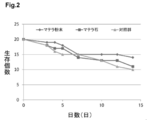
- Fig. 2 shows medaka (Matera powder) bred in a water tank to which Matera powder was added, medaka (Matera stone) bred in a water tank to which Matera stone was added, and medaka (Control group) bred in a water tank to which these were not added. , Indicates the number of survivors per day.
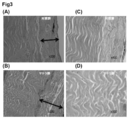
- FIG. 3 is an electron micrograph of each body of Thailand fed with a feed containing matera powder and Thailand fed with a feed containing no matera powder.
- FIG. 3A is an electron micrograph of 200 times that of the control group
- FIG. 3B is 200 times that of the Matera group
- FIG. 3C is 400 times that of the control group
- FIG. 3D is 400 times that of the Matera group.
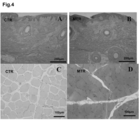
- FIG. 4 is an electron micrograph of muscle tissue in the vicinity of the skin of a pig fed with a diet containing matera powder and a pig fed with a diet not containing matera powder.
- 4A is an electron micrograph of 200 times that of the control group
- FIG. 4B is 200 times that of the Matera group
- FIG. 4C is 400 times that of the control group
- FIG. 4D is 400 times that of the Matera group.
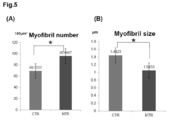
- FIG. 5 shows the number of muscle fibers (FIG.
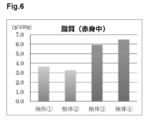
- FIG. 5A shows the amount of lipid in the lean of pigs fed with a diet containing matera powder and pigs fed with a diet not containing matera powder.
- the present invention relates to an additive containing a far infrared ray generating substance.
- the far-infrared ray generating substance-containing additive of the present invention can improve the meat quality of an animal ingesting it.
- the far-infrared ray generating substance-containing additive of the present invention can remarkably reduce the meat fat of an animal ingesting it.
- the meat whose fat has been reduced by the additive of the present invention is rather improved in umami.
- the far-infrared ray generating substance of the present invention can also promote the growth of animals that have taken it. The point of increasing the growth while reducing fat while increasing the weight, that is, the weight is that the additive of the present invention is greatly different from the conventional anti-obesity agent.
- additive in the present specification is interpreted in a broad sense and refers to any component added as a component of a pharmaceutical, food or feed, and includes an active component in a pharmaceutical product or the like.
- far infrared refers to infrared having a long wavelength of about 3 to about 1000 ⁇ m.
- far-infrared ray generating substance refers to any substance that emits infrared rays having a wavelength band of about 3 to about 20 ⁇ m.
- the “emissivity” of far-infrared is the ratio of the amount of energy radiated from the surface of a material at a certain temperature to the amount of energy radiated from a black body at the same temperature.
- animal refers to any animal that can orally ingest or absorb medicines, foods, or feeds to which a far-infrared ray-generating substance is added, and includes both aquatic animals and terrestrial animals.
- An aquatic animal refers to any animal that lives underwater, and a terrestrial animal refers to any animal that lives on land.
- Meeat quality improvement in this specification means that one or more characteristics of animal meat change as desired. Such properties include, but are not limited to, umami, sweetness, fat mass, muscle mass, tightness, texture, and juiciness.
- “improvement of umami” means that the amount or content of glutamic acid, which is a typical umami ingredient, increases.
- “improvement of sweetness” means that the amount or content of glycine, which is a typical sweetening ingredient, increases.
- promotion of growth means that the number of days required to reach a certain standard weight is shortened.
- growth is promoted by X% means that the number of days required to reach a certain body weight is shortened by X% of the number of days required for a control animal.
- the body weight increases by X% means that the body weight after a certain period of time increases by X% compared to the control animal.
- yield improvement or “yield improvement” is used interchangeably and means that the survival rate after a specific period of time increases.
- Yield is improved by X% means that the percentage of survival after a period of time is increased by X compared to control animals.
- “Stone” in this specification includes rocks and minerals.
- “rock” refers to a substance constituting the upper layer of the earth (the crust and the upper mantle). The rocks are solidified by magma cooling or sedimentation by diagenesis. The rocks are roughly divided into igneous rocks, sedimentary rocks, and metamorphic rocks, but the crustal rocks are the most common.
- “Ignition rock” refers to rocks created by cooling and consolidation of magma.
- “Rhyolite” is a kind of igneous rock, which contains 70% by weight or more of silicon dioxide, rich in sodium and potassium, and poor in magnesium, iron and calcium. The types of rocks such as igneous rocks and rhyolite in this specification are determined by classification well known in the art.
- “mineral” refers to a naturally occurring inorganic homogeneous substance that constitutes the crust. Examples of the mineral in the present invention include, but are not limited to, quartz and amphibole.
- particle size means a particle size measured by a laser diffraction / scattering method.
- treatment refers to prevention of worsening of a disease or disorder associated with an infectious disease when a subject (eg, animal) becomes infectious, preferably maintaining the status quo. Preferably, it means reduction, and more preferably elimination.
- prevention of an infectious disease refers to preventing a subject (eg, animal) from becoming in such an infectious disease before it becomes in such a state.
- the occurrence of infectious diseases can be reduced by using the additive, medicine, food or feed of the present invention.
- medicine As used herein, “medicine”, “food” and “feed” are used in a commonly used meaning, and are used for any animal.
- the far-infrared ray generating substance of the present invention may be any substance that generates or emits far-infrared rays, and in particular, water molecules and biopolymers (proteins, sugars, lipids, etc.) constituting 60% of the human body. Is a substance that emits medium to long-wavelength infrared light having a vibration wavelength of about 4 to 20 ⁇ m, which corresponds to
- the far-infrared radiation generating material of the present invention has a far-infrared emissivity in the wavelength range of about 3 to about 20 ⁇ m at about 40 ° C., preferably about 80% or more, more preferably about 85% or more. And particularly preferably far infrared emissivity of about 90% or more.
- the far-infrared generating material of the present invention has a far-infrared emissivity in the wavelength range of about 3 to about 20 ⁇ m at about 35 ° C., preferably about 80% or more, more preferably about 85 % Of far-infrared emissivity of at least 90%, particularly preferably of about 90% or more.
- the far-infrared generating material of the present invention has a far-infrared emissivity in the wavelength range of about 3 to about 20 ⁇ m at about 30 ° C., preferably about 80% or more, more preferably about 85 % Of far-infrared emissivity of at least 90%, particularly preferably of about 90% or more.
- the far-infrared generating material of the present invention has a far-infrared emissivity in the wavelength range of about 3-20 ⁇ m at about 45 ° C., preferably about 80% or more, more preferably about 85% It has the above far infrared emissivity, and particularly preferably has a far infrared emissivity of about 90% or more.
- the far-infrared ray generating substance of the present invention is preferably a rock that emits far-infrared rays, and is preferably a volcanic rock, but is not limited thereto.
- Preferred far-infrared emitting materials of the present invention include rhyolite, tourmaline, quartz diorite (Ioishi), Kiyoishi, horn health, meteorite, obsidian, granite, granite, ryuoishi, koseki, ocher, lava , Sericite, purple crystal, raw light stone, serpentinite, mimuishi, black silica ore (shinko stone, graphite silica), Sansengoku red, Sansengoku blue, sunspot serpentine, quartz metamorphic rocks, amphibole, chlorite , Xenotime stone, samarsky stone, monazite, germanium, beitou stone, amaterite, lava stone, natural stone, and natural stone, but are not limited
- the far-infrared ray generating substance of the present invention is added to food or feed as an additive, when the animal ingests the food or feed, the animal is preferably sized so that the animal does not feel uncomfortable. Specifically, it is in the form of a powder.
- the far-infrared ray-generating substance powder of the present invention is of a size that is not absorbed into cells and is absorbed by the gastrointestinal tract. Small sizes that can be absorbed into cells can cause unexpected effects on ingested animals, while large sizes that are not absorbed by the gastrointestinal tract can add food or feed. This is because it is not suitable as a product, and the effect of the present invention by far-infrared radiation may not be sufficiently exhibited.
- the powder of the present invention has a particle size of about 0.5 ⁇ m or more, about 0.6 ⁇ m or more, about 0.7 ⁇ m or more, about 0.8 ⁇ m or more, about 0.9 ⁇ m or more, preferably about 0.9 ⁇ m or more so as not to be absorbed by cells. 1 ⁇ m or more.
- the powders of the present invention are also suitable as food or feed additives and have a particle size of about 100 ⁇ m or less, about 80 ⁇ m or less, about 60 ⁇ m or less, about 50 ⁇ m or less, about 40 ⁇ m or less so that they can be absorbed by the gastrointestinal tract. , About 30 ⁇ m or less, about 20 ⁇ m or less, preferably about 10 ⁇ m or less.
- the particle size of the powder of the present invention is about 0.5 to about 100 ⁇ m, about 0.5 to about 80 ⁇ m, about 0.5 to about 60 ⁇ m, about 0.5 to about 50 ⁇ m, about 0.5 to about 40 ⁇ m.
- the far infrared ray generating material of the present invention is typically a powder having an emissivity of about 85% or more and a particle size of about 1 to about 50 ⁇ m at a wavelength range of about 3 to about 20 ⁇ m at about 40 ° C.
- the far infrared ray generating material of the present invention is typically a powder having an emissivity of about 90% or more and a particle size of about 1 to about 50 ⁇ m at a wavelength range of about 3 to about 20 ⁇ m at about 40 ° C.
- the far-infrared ray generating substance of the present invention is typically a powder having an emissivity of about 85% or more and a particle size of about 1 to about 10 ⁇ m at a wavelength range of about 3 to about 20 ⁇ m at about 40 ° C.
- the far-infrared ray generating substance of the present invention is typically a powder having an emissivity of about 90% or more and a particle size of about 1 to about 10 ⁇ m at a wavelength range of about 3 to about 20 ⁇ m at about 40 ° C.
- the pulverization of the far-infrared ray generating substance of the present invention can be performed by any means that can achieve the above appropriate particle size.
- a far infrared ray generating material such as rhyolite may be simply pulverized, or the far infrared ray generating material may be fired and fired in advance and then pulverized.
- the far-infrared ray generating material of the present invention can achieve a higher far-infrared emissivity than that when pulverized without firing, by grinding after firing.
- the firing in the present invention may be performed by any firing method as long as the effects of the present invention can be achieved, and may be oxidation firing or reduction firing.
- the far infrared ray generating material of the present invention is pre-fired and then pulverized. In a more preferred embodiment, the far infrared ray generating material of the present invention is preliminarily oxidized and fired and then pulverized.
- the far-infrared ray generating substance of the present invention can be added to any animal medicine, food or feed. Therefore, in the present invention, it may be provided in the form of a medicine, food or feed containing the far infrared ray generating substance of the present invention, or may be provided in the form of an additive to be added separately to the medicine, food or feed.
- the animal of the present invention may be any animal as long as it can ingest or absorb medicines, foods or feeds, and may be an aquatic animal or a terrestrial animal.
- the animal of the present invention is a terrestrial animal, which includes primates, mammals that can be used for food such as pigs, cows, sheep, horses or goats, chickens, geese, Birds that can be used for food, such as ducks and ostriches, are included, but are not limited thereto.
- the animal of the present invention is an aquatic animal, and may be an aquaculture fish or aquaculture shellfish provided for food.
- aquatic animal of the present invention examples include, but are not limited to, Thailand, tuna, horse mackerel, flounder, amberjack, striped mackerel, yellowtail, yellowtail, eel, shrimp, scallop, oyster and the like.
- the animal of the present invention is preferably a pig.
- the animal of the present invention is preferably Thailand.
- the animal of the present invention is preferably shrimp.
- the animal of the present invention is preferably a cow.
- the additive of the present invention when added to the feed, improves the taste while reducing meat lipids in animals fed the feed, and affects the texture and juiciness. (See Examples 3-7). Therefore, due to the recent increase in health consciousness, meat with no change in taste and texture and a reduced amount of fat is in high demand especially from elderly people. Meat with such a reduced amount of fat can be produced by the additive of the present invention, and the additive of the present invention also has an unexpected effect of improving the taste of the meat.
- the additive of the present invention also has the effect of reducing fat and modifying the body to be muscular (see FIG. 5). Therefore, it can be used as a medicine, food or feed.
- the amount of the additive of the present invention added to food or feed is, for example, about 0.001% by weight or more, about 0.01% by weight or more, about 0.015% by weight or more, about 0.02% by weight or more, about 0.03% by weight or more, about 0.04% by weight or more, about 0.05% by weight or more, about 0.1% by weight or more, about 0.2% by weight or more, about 0.3% by weight or more, about 0.0. 4% or more, about 0.5% or more, about 0.6% or more, about 0.7% or more, about 0.8% or more, about 0.9% or more, or about 1.0% % Or more.
- the additive of the present invention promotes animal growth and weight gain, thus reducing the amount of feed, food or medicine required to grow the animal to a certain weight (eg, weight for shipping). (See Example 4).
- the additive of the present invention provides the feed amount in an amount of about 5%, about 6%, about 7%, about 8%, about 9%, about 10%, about 15%, about 20%. %, Preferably about 25% by weight, more preferably about 30% by weight or more. Therefore, cost reduction is achieved by the additive of the present invention. In a preferred embodiment, feed cost reduction is achieved with the additive of the present invention.
- the additive of the present invention is a pharmaceutical, health food (health functional food such as food for specified health use or functional nutrition food according to the classification of the Japanese Ministry of Health, Labor and Welfare), dietary supplement (supplement, dietary in the United States). Supplements, food supplements in Europe, nutritional supplements in Australia and New Zealand, natural health products in Canada, health supplements in ASEAN countries, health foods in China, health functional foods in Korea, health foods in Taiwan), or food It can be an additive.
- this invention is provided as a pharmaceutical, the case where a far-infrared ray generation substance is contained as an active ingredient is included.
- the additive of the present invention is typically added and consumed as an additive to other foods, but the powdered additive of the present invention itself is used as a medicine, health food or dietary supplement (supplement), etc. It may be taken alone.
- the additives of the present invention are processed into pellets, tablets, granules, etc., together with excipients such as dextrin, lactose, starch, and flavoring, pigments, etc., as needed, and are processed into capsules by coating with gelatin or the like. May be.
- the additive of the present invention is also suitable for use as a medicine, health food or dietary supplement (supplement).
- surfactants for example, surfactants, excipients, coloring agents, flavoring agents, preservatives, stabilizers, buffering agents, suspending agents, isotonic agents, It may contain a binder, a disintegrant, a lubricant, a fluidity promoter, a corrigent and the like.
- the additive of the present invention is added to a medicine, food or feed to improve the meat quality of an animal that has consumed it.
- the additives of the present invention typically reduce fat mass in animals.
- the additive of the present invention improves the taste of animal meat.
- the additive of the present invention improves the sweetness of animal meat.
- the additive of the present invention does not substantially change the texture and / or juiciness of the animal's meat.
- the additive of the present invention reduces the amount of fat in the animal and at the same time improves the taste of the meat.
- the additive of the present invention reduces the amount of fat in the animal and at the same time improves the taste and sweetness of the meat.
- the additive of the present invention reduces the amount of fat in the animal and does not substantially change the texture and / or juiciness. In another embodiment, the additive of the present invention reduces the amount of fat in the animal, while at the same time improving the taste of the meat and does not substantially change the texture and / or juiciness. In another embodiment, the additive of the present invention reduces the amount of fat in the animal, while at the same time improving the taste and sweetness of the meat and does not substantially change the texture and / or juiciness.
- An animal that has ingested a medicine, food, or feed to which the additive of the present invention has been added has a fat content of about 30 in the body as compared to the case of taking a pharmaceutical placebo, food, or feed that does not contain the additive of the present invention. %, Or about 40% or more, more preferably about 45% or more, particularly preferably about 50% or more.
- This reduction in fat mass due to the additive of the present invention was observed widely in Thailand, which is an aquatic animal (Example 3, FIG. 3), and in pigs, which are terrestrial animals (Examples 5 and 6). It was shown that the additive of the present invention has an effect of reducing fat mass throughout animals.
- lipid amount is well known in the art, and can typically be measured using a colorimetric enzyme reaction such as iodine method.
- An animal that has been grown by ingesting a feed supplemented with the additive of the present invention has an amount of glutamic acid, which is an umami component, in the meat (muscle) compared to the case of ingesting a feed that does not contain the additive of the present invention.
- An animal that has been grown by ingesting a feed to which the additive of the present invention has been added has a glycine amount that is a sweetening component in its meat (muscle) compared to the case of ingesting a feed that does not contain the additive of the present invention.
- a glycine amount that is a sweetening component in its meat (muscle) compared to the case of ingesting a feed that does not contain the additive of the present invention.
- Measurement of the amount of free amino acids such as glutamic acid or glycine is well known in the art, and can typically be measured using a high performance liquid chromatography system (HPLC).
- HPLC high performance liquid chromatography system
- the additive of the present invention also has the effect of reducing fat and modifying the body to be muscular (see FIG. 12).
- the additive of the present invention is added to a medicine, food or feed to promote the development of an animal that has taken it.
- the point of increasing the growth while reducing fat while increasing the weight, that is, the weight is that the additive of the present invention is greatly different from the conventional anti-obesity agent.
- An animal that has ingested a pharmaceutical, food, or feed to which the additive of the present invention is added has a growth promotion of 1% compared to the case of ingesting a pharmaceutical placebo, food, or feed that does not contain the additive of the present invention, or Growth is promoted by 2%, preferably growth is promoted by 3%, more preferably growth is promoted by 4%, and particularly preferably, growth is promoted by 5% or more.
- the additive of the present invention increases the weight gain of the animal by about 5% or more, about 6% or more, about 7% or more, about 8% or more, about 9% or more, about 10% or more compared to the case where no additive is added. , Preferably about 15% or more, more preferably about 20% or more.
- the additive of the present invention also has a yield improving effect.
- the additive of the present invention improves the yield of an animal, particularly when given to an animal with poor yield in the absence of the additive of the present invention.
- the additive of the present invention can also be maintained in good condition without deteriorating the yield of the animal when given to an animal with good yield even without the additive of the present invention.
- the additive of the present invention provides about 5%, about 6%, about 7%, about 8%, about 9% yield after about 1 week of animals given it compared to the case where no additive is added. %, About 10%, about 20%, about 30%, about 40%, about 50% or more.
- the additive of the present invention also increases the yield after about 2 weeks of the animal given it to about 5%, about 6%, about 7%, about 8%, about 9% compared to the case where no additive is added. %, About 10%, about 20%, about 30%, about 40%, about 50% or more.
- the additive of the present invention also increases the yield after about 1 month of the animal given it to about 5%, about 6%, about 7%, about 8%, about 9% compared to the case where no additive is added. %, About 10%, about 20%, about 30%, about 40%, about 50% or more.
- the additive of the present invention also increases the yield after about 2 months of the animal given it to about 5%, about 6%, about 7%, about 8%, about 9% compared to when no additive is added.
- the additive of the present invention also increases the yield after about 3 months of the animal given it to about 5%, about 6%, about 7%, about 8%, about 9% compared to the case where no additive is added. %, About 10%, about 20%, about 30%, about 40%, about 50% or more.
- the additive of the present invention also increases the yield after about 4 months of the animal given it to about 5%, about 6%, about 7%, about 8%, about 9% compared to the case where no additive is added. %, About 10%, about 20%, about 30%, about 40%, about 50% or more.
- the additive of the present invention also increases the yield after about 5 months of the animal given it to about 5%, about 6%, about 7%, about 8%, about 9% compared to when no additive is added. %, About 10%, about 20%, about 30%, about 40%, about 50% or more.
- the additive of the present invention also increases the yield after about 6 months of the animal given it to about 5%, about 6%, about 7%, about 8%, about 9% compared to the case where no additive is added. %, About 10%, about 20%, about 30%, about 40%, about 50% or more.
- the additive of the present invention also increases the yield after about 1 year of the animal given it to about 5%, about 6%, about 7%, about 8%, about 9% compared to the case where no additive is added. %, About 10%, about 20%, about 30%, about 40%, about 50% or more.
- the additive or medicament, food or feed of the present invention can treat and / or prevent infectious diseases in animals. While not intending to be bound by theory, the additive of the present invention treats and / or prevents infections by making animals active and healthy and / or improving resistance. Since it is considered, the target infection is not limited to a specific one.
- aquatic animal infections that can be treated and / or prevented by the additives of the present invention include edwardieriosis, vibrio disease, columnaris disease, staphylococci, streptococci, etc. It is not limited to.
- the additive of the present invention is particularly effective against Edwardsiella disease.
- terrestrial animal infections that can be treated and / or prevented by the additives of the present invention include Lawsoniasis, Brucella disease, anthrax, hemorrhagic sepsis, tuberculosis, foot-and-mouth disease, rinderpest, cholera, salmonella infections
- Lawsoniasis Brucella disease
- anthrax hemorrhagic sepsis
- tuberculosis tuberculosis
- foot-and-mouth disease rinderpest
- cholera salmonella infections
- salmonella infections it is not limited to these.
- the additive of the present invention can prevent infectious diseases in animals. In another embodiment, the additive of the present invention can treat animal infections.
- the additive of the present invention can significantly improve animal yield by preventing infection.
- the additive of the present invention improves the yield of aquatic animals.
- the additive of the present invention improves tie or shrimp yield.
- the far-infrared ray generating substance-containing additive of the present invention can remarkably improve the meat quality of an animal that has consumed it.
- the far-infrared ray-generating substance-containing additive of the present invention can improve the taste of the meat of an animal that has consumed it and / or can reduce fat.
- the far-infrared ray generating substance of the present invention can also promote the growth of animals that have taken it. The point of increasing the growth while reducing fat while increasing the weight, that is, the weight is that the additive of the present invention is greatly different from the conventional anti-obesity agent.
- it is also an important feature of the present invention that these improvements in meat quality can be achieved without any loss in the texture and juiciness of the meat.
- the far-infrared ray-generating substance-containing additive of the present invention also has the effect of reducing fat and modifying the body to be muscular (see FIG. 5). Therefore, it can also be used for making primate bodies low-fat and muscular.
- the far-infrared ray generating substance-containing additive of the present invention can not only promote the growth of animals but also improve the yield.
- An animal having poor yield without the additive of the present invention was given a feed supplemented with the additive of the present invention, so that the yield was remarkably improved (Example 2).
- the yield was not deteriorated, and a good breeding rate could be maintained (Example 7).
- the additive of the present invention further significantly increased the animal's body weight (Example 3).
- the additive of the present invention was able to significantly reduce the amount of feed required for animal growth by promoting growth and / or increasing body weight (Example 3). This can achieve a significant cost reduction of the feed.
- the additive of the present invention is further effective for treatment and / or prevention of various infectious diseases.
- the additive of the present invention has been able to treat and / or prevent the main infection, Edwardsiellasis, in Thai farming.
- Example 1 Production of far infrared ray generating substance
- Materaite a kind of rhyolite
- Materaite was fired at 1100 ° C. and pulverized to obtain a powder for additives (hereinafter referred to as “Matera powder”).
- Matera stone is a type of rhyolite produced from the foot of Mt. Ishizuchi, Shikoku, on the central tectonic line running from Kanto to Kyushu about 80 million years ago.
- the particle size distribution of the Matera powder was analyzed with a laser particle size meter (LA-950, Horiba, Kyoto), the average particle size was 4.804 ⁇ m and the half-value width was 3.964 ⁇ m.
- This Matera powder was able to radiate far-infrared rays of 3 to 20 ⁇ m peaking at 7 to 12 ⁇ m at an emissivity of about 90.5% at 40 ° C.
- Matera powder 74.7% of silicon oxide, 14.7% of aluminum oxide, and calcium oxide, iron oxide, potassium oxide, sodium oxide, magnesium oxide, titanium oxide and the like were included as components. .
- Matera powder can also be purchased from Matera Power Co., Ltd. (Ehime, Japan).
- Example 2 Effect of Matera stone or Matera powder on aquatic animals
- 2.4 g (0.1%) of rhyolite (Matera stone) was added to the tank containing 2.4 L of ultrapure water in the experimental group (Matera group), and nothing was added to the control group. Snails were bred at 27 ° C. Both snails were put in 22 animals and their survival rate was examined. The survival rate of the control group decreased to 63.6% on the 9th day, 40.9% on the 16th day, 24.0% on the 21st day, and 9.1% on the 35th day. On the other hand, in the Matera group, the survival rate was 100% at 9 days, 100% at 16 days, 100% at 21 days, and 72.7% at 35 days (FIG. 1).
- Example 1 60 Himedaka were reared in three aquariums.
- One aquarium is a matera group, and three matera stones (average 10.92 g) (0.36%) are added to 9.0 L of ultrapure water, and the second aquarium is manufactured in Example 1 as a matera powder group. 50 g of the matera powder was added to 0.56%. None was added for the last control group.
- Example 3 Feeding of Matera powder to aquatic animals
- a representative aquaculture animal was selected.
- Matera powder prepared as in Example 1 and having a particle size of 1 to 10 ⁇ m and a peak of 5 ⁇ m was mixed with normal aquaculture Thai food so that the amount was 0.1% by weight.
- Materia powder-containing food was given to one of two ginger that was cultivated about 10 or so (Matera group), and the other ginger was given a normal food containing no Matera powder as a control group (control group). After rearing for about 3 months, it was subjected to the following study.
- the Matera group was active, and when people approached the ginger, they seemed to bounce around in the water as if demanding food.
- the control group was gentle and did not change significantly as the person approached, and showed active activity when the food was thrown in.
- Thai muscle tissue was fixed in a 10% formalin solution and embedded in paraffin according to a conventional method, and then a sliced specimen (5 ⁇ m) was prepared, stained with hematoxylin and eosin (HE), and observed. .
- HE hematoxylin and eosin
- Example 4 Effect of feeding Matera powder under various conditions on aquatic animals
- Example 3 Similar to Example 3, the effect of the presence or absence of the addition of matella powder to the aquaculture feed was further examined in Thailand.
- Matera powder was able to significantly improve the yield of aquatic animals by treating and / or preventing infections.
- a dry (EP) pellet obtained by processing a dry pellet with an extruder is given to the control group at a fish meal rate of 50%, and 0.03% by weight of matera powder is added to a dry (EP) pellet with a fish meal ratio of 35% Gave.
- the growth of the control group and the Matera group was almost the same.
- Matera powder can be added to the feed to promote the growth of aquatic animals, thereby reducing the amount of feed needed to grow the animals by shipment. Became clear. That is, the cost of feed is reduced by the matera powder of the present invention.
- Example 5 Feeding of Matera powder to terrestrial animals
- Matera powder prepared as in Example 1 and having a particle size of 1 to 10 ⁇ m and a peak of 5 ⁇ m was mixed with normal pig food at 0.1 wt%.
- porcine skin and muscle tissue were fixed in a 10% formalin solution and embedded in paraffin according to a conventional method, and a sliced specimen (5 ⁇ m) was prepared, subjected to H ⁇ E staining and observed.
- the muscle fiber density is about 40% higher in the Matera group than in the control group, and conversely, the muscle fiber diameter is 27.5% in the Matera group than in the control group. It decreased (FIG. 5).
- the area was reduced by about 48.2% and was about half the size. This is because, by ingesting a diet containing Matera powder, muscle fibers are actively formed, many myoblasts are formed, many cells are fused, and many muscle fibers with many nuclei are formed.
- expansion is limited by the fascia such as the endomysium and the pericardium, and it is considered that the muscle has become dense and full. In other words, it was shown that the meat was lean and full.
- Example 6 Meat quality analysis of terrestrial animals fed with Matera powder
- Example 5 Two from the Matera group and two from the control group were subjected to a pork taste element analysis at Japan Authentication Service Co., Ltd. (Kanagawa, Japan). .
- the two test samples in the Matera group are Sample 1 (Sample No .: J13118nM701) and Sample 2 (Sample No .: J131118nM702), and the two test samples in the control group are Sample 3 (Sample No .: J13118nM703). And sample 4 (sample No .: J13118nM704), and various taste element data such as umami components, lipids, fragrance components, texture and juiciness between samples were compared.
- test results of texture and juiciness are shown below. (Table 1. Test results of texture and juiciness)
- samples 1 and 2 were significantly reduced than samples 3 and 4. Therefore, it was shown that the amount of lipids was significantly reduced in pigs that were fed and fed with Matera powder than pigs that were not fed Matera powder.
- the total amount of umami component glutamic acid was measured, and it was 8.7 mg / 100 g for sample 1, 7.6 mg / 100 g for sample 2, 6.3 mg / 100 g for sample 3, and 6.1 mg / 100 mg for sample 4. .
- Example 7 Breeding test of terrestrial animals fed with Matera powder
- the average shipping date in the test plot was 4.6 days shorter than that in the control plot.
- the date for reaching 110 kg was 5.1 days shorter than the control plot.
- Postnatal ADG average daily weight gain was higher in the test group than in the 23.2 g control group.
- the growth rate of the pigs was good in both the test group and the control group, and no adverse effect on the growth rate due to the addition of Matera powder to the feed in the test group was observed.
- the far-infrared ray generating substance-containing additive provided by the present invention is particularly useful as an additive for animal farming feeds or an additive for reducing fat.
Landscapes
- Life Sciences & Earth Sciences (AREA)
- Chemical & Material Sciences (AREA)
- Polymers & Plastics (AREA)
- Animal Husbandry (AREA)
- Zoology (AREA)
- Engineering & Computer Science (AREA)
- Food Science & Technology (AREA)
- Birds (AREA)
- Insects & Arthropods (AREA)
- Marine Sciences & Fisheries (AREA)
- Inorganic Chemistry (AREA)
- Fodder In General (AREA)
Abstract
La présente invention concerne un nouvel additif destiné à être ajouté à des médicaments et à des aliments, ledit additif étant capable de réduire le taux de graisse chez les animaux consommant ces médicaments et aliments. L'additif selon la présente invention pour médicaments et aliments pour animaux contient une matière générant un rayonnement infrarouge lointain. Cet additif contenant la matière générant un rayonnement infrarouge lointain peut améliorer la qualité de la viande des animaux en consommant. L'additif contenant la matière générant un rayonnement infrarouge lointain selon la présente invention peut, plus précisément, réduire le taux de graisse chez les animaux en consommant et/ou améliorer le goût de leur viande. La matière générant un rayonnement infrarouge lointain selon la présente invention peut favoriser la croissance des animaux en consommant ou améliorer leur rendement en viande.
Priority Applications (1)
| Application Number | Priority Date | Filing Date | Title |
|---|---|---|---|
| PCT/JP2014/000534 WO2015114686A1 (fr) | 2014-01-31 | 2014-01-31 | Additif contenant une matière générant un rayonnement infrarouge lointain |
Applications Claiming Priority (1)
| Application Number | Priority Date | Filing Date | Title |
|---|---|---|---|
| PCT/JP2014/000534 WO2015114686A1 (fr) | 2014-01-31 | 2014-01-31 | Additif contenant une matière générant un rayonnement infrarouge lointain |
Publications (1)
| Publication Number | Publication Date |
|---|---|
| WO2015114686A1 true WO2015114686A1 (fr) | 2015-08-06 |
Family
ID=53756315
Family Applications (1)
| Application Number | Title | Priority Date | Filing Date |
|---|---|---|---|
| PCT/JP2014/000534 Ceased WO2015114686A1 (fr) | 2014-01-31 | 2014-01-31 | Additif contenant une matière générant un rayonnement infrarouge lointain |
Country Status (1)
| Country | Link |
|---|---|
| WO (1) | WO2015114686A1 (fr) |
Cited By (3)
| Publication number | Priority date | Publication date | Assignee | Title |
|---|---|---|---|---|
| JP2018019602A (ja) * | 2016-08-01 | 2018-02-08 | 学校法人麻布獣医学園 | 牛、豚、馬、鹿、鯨、鶏等の食用動物の肉質改善方法 |
| JP2018191599A (ja) * | 2017-05-19 | 2018-12-06 | 学校法人麻布獣医学園 | 家禽の飼育方法および飼料添加物 |
| JP7248765B1 (ja) | 2021-11-18 | 2023-03-29 | マルハニチロ株式会社 | ブリ属養殖魚及びブリ属の養殖方法 |
Citations (3)
| Publication number | Priority date | Publication date | Assignee | Title |
|---|---|---|---|---|
| JP2000262225A (ja) * | 1999-03-16 | 2000-09-26 | Sekaicho Rubber Co Ltd | 飼料改良材 |
| JP2004504823A (ja) * | 2000-07-31 | 2004-02-19 | ソボン バイオ ベステク コーポレーション リミティッド | 抗生剤代替のための家畜飼料の組成物 |
| JP2009022177A (ja) * | 2007-07-17 | 2009-02-05 | Oono Kaihatsu Kk | 動物用のアルカリ性の飼料 |
-
2014
- 2014-01-31 WO PCT/JP2014/000534 patent/WO2015114686A1/fr not_active Ceased
Patent Citations (3)
| Publication number | Priority date | Publication date | Assignee | Title |
|---|---|---|---|---|
| JP2000262225A (ja) * | 1999-03-16 | 2000-09-26 | Sekaicho Rubber Co Ltd | 飼料改良材 |
| JP2004504823A (ja) * | 2000-07-31 | 2004-02-19 | ソボン バイオ ベステク コーポレーション リミティッド | 抗生剤代替のための家畜飼料の組成物 |
| JP2009022177A (ja) * | 2007-07-17 | 2009-02-05 | Oono Kaihatsu Kk | 動物用のアルカリ性の飼料 |
Cited By (5)
| Publication number | Priority date | Publication date | Assignee | Title |
|---|---|---|---|---|
| JP2018019602A (ja) * | 2016-08-01 | 2018-02-08 | 学校法人麻布獣医学園 | 牛、豚、馬、鹿、鯨、鶏等の食用動物の肉質改善方法 |
| JP2018191599A (ja) * | 2017-05-19 | 2018-12-06 | 学校法人麻布獣医学園 | 家禽の飼育方法および飼料添加物 |
| JP7017748B2 (ja) | 2017-05-19 | 2022-02-09 | 学校法人麻布獣医学園 | 家禽の飼育方法および飼料添加物 |
| JP7248765B1 (ja) | 2021-11-18 | 2023-03-29 | マルハニチロ株式会社 | ブリ属養殖魚及びブリ属の養殖方法 |
| JP2023074911A (ja) * | 2021-11-18 | 2023-05-30 | マルハニチロ株式会社 | ブリ属養殖魚及びブリ属の養殖方法 |
Similar Documents
| Publication | Publication Date | Title |
|---|---|---|
| KR20180079197A (ko) | 모노소듐 글루타메이트를 포함하는 곤충용 사료 조성물, 이를 이용한 곤충의 사육방법, 그 사육방법으로 사육되어 가바 함량이 증진된 곤충 및 이를 함유하는 식품 조성물 | |
| BUDI et al. | Growth response and feed utilization of giant gourami (Osphronemus goramy) juvenile feeding different protein levels of the diets supplemented with recombinant growth hormone | |
| JP2012528148A (ja) | ブラックカラント又はボイセンベリーを含む栄養補助食品 | |
| Muralisankar et al. | Growth performance, muscle biochemical constituents, amino acid and fatty acid compositions of the giant freshwater prawn, Macrobrachium rosenbergii, fed with herb‐incorporated diet | |
| EP3133935A1 (fr) | Adjuvant comprenant de la baïcaline notamment issue d'un extrait de scutellaria baicalensis et aliment pour animaux comprenant un tel adjuvant | |
| EP1378236B1 (fr) | Agents contre les maladies provoquees par le stress | |
| Bijoy et al. | Fish meal replacement with squilla (Oratosquilla nepa, Latreille) silage in a practical diet for the juvenile giant freshwater prawn, Macrobrachium rosenbergii de man, 1879 | |
| Abasubong et al. | A review of fish waste and byproducts in poultry production: effects on growth, egg quality, carcass traits, and broader knowledge beyond physiological response | |
| Hussain et al. | Lactoferrin in Aquaculture: A Holistic Review of its Health Benefits and Functional Feed Application. | |
| Salaro et al. | Gelatin in replacement of bovine heart in feed training of Lophiosilurus alexandri in different water salinities | |
| WO2012137953A1 (fr) | Composition de nutriments pour animaux | |
| JP2005312365A (ja) | リジン含有抗肥満または抗高脂血食品、飼料またはサプリメント | |
| WO2004084923A1 (fr) | Agent antistress | |
| KR20230068492A (ko) | 반려동물의 심장 건강 개선용 간식 및 이의 제조방법 | |
| WO2014025019A1 (fr) | Aliment pour animaux et agent réducteur de stress pour des animaux dans l'industrie | |
| EP3536162A1 (fr) | Aliment pour animaux, et procédé de fabrication de celui-ci | |
| AU2018101364A4 (en) | Compositions and methods for nourishing mammals | |
| TWI868598B (zh) | 以海木耳萃取物作為抑制水疱性口炎病毒之組合物及其用途 | |
| KR20090111329A (ko) | 어류 및 갑각류의 생장을 향상시키기 위한 조성물 및 방법 | |
| CN118475251A (zh) | 使用自噬诱发剂增强间歇性禁食的组合物和方法 | |
| Islam et al. | Effect of chitosan nanoparticles and vitamin E on the growth, reproductive, and stress-hormones in Ompok pabda (Hamilton, 1822) | |
| JP2010259351A (ja) | 魚類の体色・肉質改善剤及び体色・肉質の改善方法 | |
| JP4911374B2 (ja) | リジン含有抗肥満または抗高脂血食品、飼料またはサプリメント | |
| Čuboň et al. | Meat and Liver Quality of Overfed Duck | |
| JPWO2020096002A1 (ja) | D−アルロースを有効成分とする褐色脂肪・ベージュ脂肪細胞活性化剤 |
Legal Events
| Date | Code | Title | Description |
|---|---|---|---|
| 121 | Ep: the epo has been informed by wipo that ep was designated in this application |
Ref document number: 14880854 Country of ref document: EP Kind code of ref document: A1 |
|
| NENP | Non-entry into the national phase |
Ref country code: DE |
|
| 122 | Ep: pct application non-entry in european phase |
Ref document number: 14880854 Country of ref document: EP Kind code of ref document: A1 |
|
| NENP | Non-entry into the national phase |
Ref country code: JP |