WO2015079692A1 - ウレア誘導体、またはその薬理学的に許容される塩 - Google Patents
ウレア誘導体、またはその薬理学的に許容される塩 Download PDFInfo
- Publication number
- WO2015079692A1 WO2015079692A1 PCT/JP2014/005933 JP2014005933W WO2015079692A1 WO 2015079692 A1 WO2015079692 A1 WO 2015079692A1 JP 2014005933 W JP2014005933 W JP 2014005933W WO 2015079692 A1 WO2015079692 A1 WO 2015079692A1
- Authority
- WO
- WIPO (PCT)
- Prior art keywords
- group
- methoxyphenyl
- urea
- oxopyrrolidin
- alkyl group
- Prior art date
- Legal status (The legal status is an assumption and is not a legal conclusion. Google has not performed a legal analysis and makes no representation as to the accuracy of the status listed.)
- Ceased
Links
- 0 CC(C)[C@](*)CNC Chemical compound CC(C)[C@](*)CNC 0.000 description 8
- PATXACILYQHPNG-CLGNHHSBSA-N CCCCN(C[C@H](C)[C@@H]1C2)C1[C@@H](C)C(F)=C2C=O Chemical compound CCCCN(C[C@H](C)[C@@H]1C2)C1[C@@H](C)C(F)=C2C=O PATXACILYQHPNG-CLGNHHSBSA-N 0.000 description 1
- LNRUJSUKKBJFOM-UHFFFAOYSA-N COC1=CC=CCC1 Chemical compound COC1=CC=CCC1 LNRUJSUKKBJFOM-UHFFFAOYSA-N 0.000 description 1
- NYMDPDNETOLVBS-UHFFFAOYSA-N Cc1cc(N)ccc1F Chemical compound Cc1cc(N)ccc1F NYMDPDNETOLVBS-UHFFFAOYSA-N 0.000 description 1
Classifications
-
- C—CHEMISTRY; METALLURGY
- C07—ORGANIC CHEMISTRY
- C07D—HETEROCYCLIC COMPOUNDS
- C07D207/00—Heterocyclic compounds containing five-membered rings not condensed with other rings, with one nitrogen atom as the only ring hetero atom
- C07D207/02—Heterocyclic compounds containing five-membered rings not condensed with other rings, with one nitrogen atom as the only ring hetero atom with only hydrogen or carbon atoms directly attached to the ring nitrogen atom
- C07D207/18—Heterocyclic compounds containing five-membered rings not condensed with other rings, with one nitrogen atom as the only ring hetero atom with only hydrogen or carbon atoms directly attached to the ring nitrogen atom having one double bond between ring members or between a ring member and a non-ring member
- C07D207/22—Heterocyclic compounds containing five-membered rings not condensed with other rings, with one nitrogen atom as the only ring hetero atom with only hydrogen or carbon atoms directly attached to the ring nitrogen atom having one double bond between ring members or between a ring member and a non-ring member with hetero atoms or with carbon atoms having three bonds to hetero atoms with at the most one bond to halogen, e.g. ester or nitrile radicals, directly attached to ring carbon atoms
- C07D207/24—Oxygen or sulfur atoms
- C07D207/26—2-Pyrrolidones
- C07D207/273—2-Pyrrolidones with hetero atoms or with carbon atoms having three bonds to hetero atoms with at the most one bond to halogen, e.g. ester or nitrile radicals, directly attached to other ring carbon atoms
-
- A—HUMAN NECESSITIES
- A61—MEDICAL OR VETERINARY SCIENCE; HYGIENE
- A61K—PREPARATIONS FOR MEDICAL, DENTAL OR TOILETRY PURPOSES
- A61K31/00—Medicinal preparations containing organic active ingredients
- A61K31/33—Heterocyclic compounds
- A61K31/395—Heterocyclic compounds having nitrogen as a ring hetero atom, e.g. guanethidine or rifamycins
- A61K31/40—Heterocyclic compounds having nitrogen as a ring hetero atom, e.g. guanethidine or rifamycins having five-membered rings with one nitrogen as the only ring hetero atom, e.g. sulpiride, succinimide, tolmetin, buflomedil
- A61K31/4015—Heterocyclic compounds having nitrogen as a ring hetero atom, e.g. guanethidine or rifamycins having five-membered rings with one nitrogen as the only ring hetero atom, e.g. sulpiride, succinimide, tolmetin, buflomedil having oxo groups directly attached to the heterocyclic ring, e.g. piracetam, ethosuximide
-
- A—HUMAN NECESSITIES
- A61—MEDICAL OR VETERINARY SCIENCE; HYGIENE
- A61K—PREPARATIONS FOR MEDICAL, DENTAL OR TOILETRY PURPOSES
- A61K31/00—Medicinal preparations containing organic active ingredients
- A61K31/33—Heterocyclic compounds
- A61K31/395—Heterocyclic compounds having nitrogen as a ring hetero atom, e.g. guanethidine or rifamycins
- A61K31/40—Heterocyclic compounds having nitrogen as a ring hetero atom, e.g. guanethidine or rifamycins having five-membered rings with one nitrogen as the only ring hetero atom, e.g. sulpiride, succinimide, tolmetin, buflomedil
- A61K31/4025—Heterocyclic compounds having nitrogen as a ring hetero atom, e.g. guanethidine or rifamycins having five-membered rings with one nitrogen as the only ring hetero atom, e.g. sulpiride, succinimide, tolmetin, buflomedil not condensed and containing further heterocyclic rings, e.g. cromakalim
-
- A—HUMAN NECESSITIES
- A61—MEDICAL OR VETERINARY SCIENCE; HYGIENE
- A61K—PREPARATIONS FOR MEDICAL, DENTAL OR TOILETRY PURPOSES
- A61K31/00—Medicinal preparations containing organic active ingredients
- A61K31/33—Heterocyclic compounds
- A61K31/395—Heterocyclic compounds having nitrogen as a ring hetero atom, e.g. guanethidine or rifamycins
- A61K31/40—Heterocyclic compounds having nitrogen as a ring hetero atom, e.g. guanethidine or rifamycins having five-membered rings with one nitrogen as the only ring hetero atom, e.g. sulpiride, succinimide, tolmetin, buflomedil
- A61K31/403—Heterocyclic compounds having nitrogen as a ring hetero atom, e.g. guanethidine or rifamycins having five-membered rings with one nitrogen as the only ring hetero atom, e.g. sulpiride, succinimide, tolmetin, buflomedil condensed with carbocyclic rings, e.g. carbazole
-
- A—HUMAN NECESSITIES
- A61—MEDICAL OR VETERINARY SCIENCE; HYGIENE
- A61K—PREPARATIONS FOR MEDICAL, DENTAL OR TOILETRY PURPOSES
- A61K31/00—Medicinal preparations containing organic active ingredients
- A61K31/33—Heterocyclic compounds
- A61K31/395—Heterocyclic compounds having nitrogen as a ring hetero atom, e.g. guanethidine or rifamycins
- A61K31/435—Heterocyclic compounds having nitrogen as a ring hetero atom, e.g. guanethidine or rifamycins having six-membered rings with one nitrogen as the only ring hetero atom
- A61K31/44—Non condensed pyridines; Hydrogenated derivatives thereof
- A61K31/4427—Non condensed pyridines; Hydrogenated derivatives thereof containing further heterocyclic ring systems
- A61K31/4439—Non condensed pyridines; Hydrogenated derivatives thereof containing further heterocyclic ring systems containing a five-membered ring with nitrogen as a ring hetero atom, e.g. omeprazole
-
- A—HUMAN NECESSITIES
- A61—MEDICAL OR VETERINARY SCIENCE; HYGIENE
- A61P—SPECIFIC THERAPEUTIC ACTIVITY OF CHEMICAL COMPOUNDS OR MEDICINAL PREPARATIONS
- A61P1/00—Drugs for disorders of the alimentary tract or the digestive system
- A61P1/02—Stomatological preparations, e.g. drugs for caries, aphtae, periodontitis
-
- A—HUMAN NECESSITIES
- A61—MEDICAL OR VETERINARY SCIENCE; HYGIENE
- A61P—SPECIFIC THERAPEUTIC ACTIVITY OF CHEMICAL COMPOUNDS OR MEDICINAL PREPARATIONS
- A61P1/00—Drugs for disorders of the alimentary tract or the digestive system
- A61P1/04—Drugs for disorders of the alimentary tract or the digestive system for ulcers, gastritis or reflux esophagitis, e.g. antacids, inhibitors of acid secretion, mucosal protectants
-
- A—HUMAN NECESSITIES
- A61—MEDICAL OR VETERINARY SCIENCE; HYGIENE
- A61P—SPECIFIC THERAPEUTIC ACTIVITY OF CHEMICAL COMPOUNDS OR MEDICINAL PREPARATIONS
- A61P11/00—Drugs for disorders of the respiratory system
-
- A—HUMAN NECESSITIES
- A61—MEDICAL OR VETERINARY SCIENCE; HYGIENE
- A61P—SPECIFIC THERAPEUTIC ACTIVITY OF CHEMICAL COMPOUNDS OR MEDICINAL PREPARATIONS
- A61P11/00—Drugs for disorders of the respiratory system
- A61P11/02—Nasal agents, e.g. decongestants
-
- A—HUMAN NECESSITIES
- A61—MEDICAL OR VETERINARY SCIENCE; HYGIENE
- A61P—SPECIFIC THERAPEUTIC ACTIVITY OF CHEMICAL COMPOUNDS OR MEDICINAL PREPARATIONS
- A61P11/00—Drugs for disorders of the respiratory system
- A61P11/06—Antiasthmatics
-
- A—HUMAN NECESSITIES
- A61—MEDICAL OR VETERINARY SCIENCE; HYGIENE
- A61P—SPECIFIC THERAPEUTIC ACTIVITY OF CHEMICAL COMPOUNDS OR MEDICINAL PREPARATIONS
- A61P13/00—Drugs for disorders of the urinary system
- A61P13/08—Drugs for disorders of the urinary system of the prostate
-
- A—HUMAN NECESSITIES
- A61—MEDICAL OR VETERINARY SCIENCE; HYGIENE
- A61P—SPECIFIC THERAPEUTIC ACTIVITY OF CHEMICAL COMPOUNDS OR MEDICINAL PREPARATIONS
- A61P13/00—Drugs for disorders of the urinary system
- A61P13/12—Drugs for disorders of the urinary system of the kidneys
-
- A—HUMAN NECESSITIES
- A61—MEDICAL OR VETERINARY SCIENCE; HYGIENE
- A61P—SPECIFIC THERAPEUTIC ACTIVITY OF CHEMICAL COMPOUNDS OR MEDICINAL PREPARATIONS
- A61P17/00—Drugs for dermatological disorders
- A61P17/06—Antipsoriatics
-
- A—HUMAN NECESSITIES
- A61—MEDICAL OR VETERINARY SCIENCE; HYGIENE
- A61P—SPECIFIC THERAPEUTIC ACTIVITY OF CHEMICAL COMPOUNDS OR MEDICINAL PREPARATIONS
- A61P19/00—Drugs for skeletal disorders
- A61P19/02—Drugs for skeletal disorders for joint disorders, e.g. arthritis, arthrosis
-
- A—HUMAN NECESSITIES
- A61—MEDICAL OR VETERINARY SCIENCE; HYGIENE
- A61P—SPECIFIC THERAPEUTIC ACTIVITY OF CHEMICAL COMPOUNDS OR MEDICINAL PREPARATIONS
- A61P19/00—Drugs for skeletal disorders
- A61P19/06—Antigout agents, e.g. antihyperuricemic or uricosuric agents
-
- A—HUMAN NECESSITIES
- A61—MEDICAL OR VETERINARY SCIENCE; HYGIENE
- A61P—SPECIFIC THERAPEUTIC ACTIVITY OF CHEMICAL COMPOUNDS OR MEDICINAL PREPARATIONS
- A61P25/00—Drugs for disorders of the nervous system
-
- A—HUMAN NECESSITIES
- A61—MEDICAL OR VETERINARY SCIENCE; HYGIENE
- A61P—SPECIFIC THERAPEUTIC ACTIVITY OF CHEMICAL COMPOUNDS OR MEDICINAL PREPARATIONS
- A61P25/00—Drugs for disorders of the nervous system
- A61P25/04—Centrally acting analgesics, e.g. opioids
-
- A—HUMAN NECESSITIES
- A61—MEDICAL OR VETERINARY SCIENCE; HYGIENE
- A61P—SPECIFIC THERAPEUTIC ACTIVITY OF CHEMICAL COMPOUNDS OR MEDICINAL PREPARATIONS
- A61P25/00—Drugs for disorders of the nervous system
- A61P25/28—Drugs for disorders of the nervous system for treating neurodegenerative disorders of the central nervous system, e.g. nootropic agents, cognition enhancers, drugs for treating Alzheimer's disease or other forms of dementia
-
- A—HUMAN NECESSITIES
- A61—MEDICAL OR VETERINARY SCIENCE; HYGIENE
- A61P—SPECIFIC THERAPEUTIC ACTIVITY OF CHEMICAL COMPOUNDS OR MEDICINAL PREPARATIONS
- A61P27/00—Drugs for disorders of the senses
- A61P27/02—Ophthalmic agents
-
- A—HUMAN NECESSITIES
- A61—MEDICAL OR VETERINARY SCIENCE; HYGIENE
- A61P—SPECIFIC THERAPEUTIC ACTIVITY OF CHEMICAL COMPOUNDS OR MEDICINAL PREPARATIONS
- A61P27/00—Drugs for disorders of the senses
- A61P27/02—Ophthalmic agents
- A61P27/06—Antiglaucoma agents or miotics
-
- A—HUMAN NECESSITIES
- A61—MEDICAL OR VETERINARY SCIENCE; HYGIENE
- A61P—SPECIFIC THERAPEUTIC ACTIVITY OF CHEMICAL COMPOUNDS OR MEDICINAL PREPARATIONS
- A61P29/00—Non-central analgesic, antipyretic or antiinflammatory agents, e.g. antirheumatic agents; Non-steroidal antiinflammatory drugs [NSAID]
-
- A—HUMAN NECESSITIES
- A61—MEDICAL OR VETERINARY SCIENCE; HYGIENE
- A61P—SPECIFIC THERAPEUTIC ACTIVITY OF CHEMICAL COMPOUNDS OR MEDICINAL PREPARATIONS
- A61P3/00—Drugs for disorders of the metabolism
- A61P3/08—Drugs for disorders of the metabolism for glucose homeostasis
- A61P3/10—Drugs for disorders of the metabolism for glucose homeostasis for hyperglycaemia, e.g. antidiabetics
-
- A—HUMAN NECESSITIES
- A61—MEDICAL OR VETERINARY SCIENCE; HYGIENE
- A61P—SPECIFIC THERAPEUTIC ACTIVITY OF CHEMICAL COMPOUNDS OR MEDICINAL PREPARATIONS
- A61P31/00—Antiinfectives, i.e. antibiotics, antiseptics, chemotherapeutics
-
- A—HUMAN NECESSITIES
- A61—MEDICAL OR VETERINARY SCIENCE; HYGIENE
- A61P—SPECIFIC THERAPEUTIC ACTIVITY OF CHEMICAL COMPOUNDS OR MEDICINAL PREPARATIONS
- A61P31/00—Antiinfectives, i.e. antibiotics, antiseptics, chemotherapeutics
- A61P31/04—Antibacterial agents
-
- A—HUMAN NECESSITIES
- A61—MEDICAL OR VETERINARY SCIENCE; HYGIENE
- A61P—SPECIFIC THERAPEUTIC ACTIVITY OF CHEMICAL COMPOUNDS OR MEDICINAL PREPARATIONS
- A61P31/00—Antiinfectives, i.e. antibiotics, antiseptics, chemotherapeutics
- A61P31/12—Antivirals
- A61P31/14—Antivirals for RNA viruses
- A61P31/18—Antivirals for RNA viruses for HIV
-
- A—HUMAN NECESSITIES
- A61—MEDICAL OR VETERINARY SCIENCE; HYGIENE
- A61P—SPECIFIC THERAPEUTIC ACTIVITY OF CHEMICAL COMPOUNDS OR MEDICINAL PREPARATIONS
- A61P35/00—Antineoplastic agents
-
- A—HUMAN NECESSITIES
- A61—MEDICAL OR VETERINARY SCIENCE; HYGIENE
- A61P—SPECIFIC THERAPEUTIC ACTIVITY OF CHEMICAL COMPOUNDS OR MEDICINAL PREPARATIONS
- A61P37/00—Drugs for immunological or allergic disorders
-
- A—HUMAN NECESSITIES
- A61—MEDICAL OR VETERINARY SCIENCE; HYGIENE
- A61P—SPECIFIC THERAPEUTIC ACTIVITY OF CHEMICAL COMPOUNDS OR MEDICINAL PREPARATIONS
- A61P37/00—Drugs for immunological or allergic disorders
- A61P37/02—Immunomodulators
-
- A—HUMAN NECESSITIES
- A61—MEDICAL OR VETERINARY SCIENCE; HYGIENE
- A61P—SPECIFIC THERAPEUTIC ACTIVITY OF CHEMICAL COMPOUNDS OR MEDICINAL PREPARATIONS
- A61P37/00—Drugs for immunological or allergic disorders
- A61P37/08—Antiallergic agents
-
- A—HUMAN NECESSITIES
- A61—MEDICAL OR VETERINARY SCIENCE; HYGIENE
- A61P—SPECIFIC THERAPEUTIC ACTIVITY OF CHEMICAL COMPOUNDS OR MEDICINAL PREPARATIONS
- A61P39/00—General protective or antinoxious agents
- A61P39/02—Antidotes
-
- A—HUMAN NECESSITIES
- A61—MEDICAL OR VETERINARY SCIENCE; HYGIENE
- A61P—SPECIFIC THERAPEUTIC ACTIVITY OF CHEMICAL COMPOUNDS OR MEDICINAL PREPARATIONS
- A61P43/00—Drugs for specific purposes, not provided for in groups A61P1/00-A61P41/00
-
- A—HUMAN NECESSITIES
- A61—MEDICAL OR VETERINARY SCIENCE; HYGIENE
- A61P—SPECIFIC THERAPEUTIC ACTIVITY OF CHEMICAL COMPOUNDS OR MEDICINAL PREPARATIONS
- A61P9/00—Drugs for disorders of the cardiovascular system
-
- A—HUMAN NECESSITIES
- A61—MEDICAL OR VETERINARY SCIENCE; HYGIENE
- A61P—SPECIFIC THERAPEUTIC ACTIVITY OF CHEMICAL COMPOUNDS OR MEDICINAL PREPARATIONS
- A61P9/00—Drugs for disorders of the cardiovascular system
- A61P9/10—Drugs for disorders of the cardiovascular system for treating ischaemic or atherosclerotic diseases, e.g. antianginal drugs, coronary vasodilators, drugs for myocardial infarction, retinopathy, cerebrovascula insufficiency, renal arteriosclerosis
-
- C—CHEMISTRY; METALLURGY
- C07—ORGANIC CHEMISTRY
- C07D—HETEROCYCLIC COMPOUNDS
- C07D207/00—Heterocyclic compounds containing five-membered rings not condensed with other rings, with one nitrogen atom as the only ring hetero atom
- C07D207/02—Heterocyclic compounds containing five-membered rings not condensed with other rings, with one nitrogen atom as the only ring hetero atom with only hydrogen or carbon atoms directly attached to the ring nitrogen atom
- C07D207/18—Heterocyclic compounds containing five-membered rings not condensed with other rings, with one nitrogen atom as the only ring hetero atom with only hydrogen or carbon atoms directly attached to the ring nitrogen atom having one double bond between ring members or between a ring member and a non-ring member
- C07D207/22—Heterocyclic compounds containing five-membered rings not condensed with other rings, with one nitrogen atom as the only ring hetero atom with only hydrogen or carbon atoms directly attached to the ring nitrogen atom having one double bond between ring members or between a ring member and a non-ring member with hetero atoms or with carbon atoms having three bonds to hetero atoms with at the most one bond to halogen, e.g. ester or nitrile radicals, directly attached to ring carbon atoms
-
- C—CHEMISTRY; METALLURGY
- C07—ORGANIC CHEMISTRY
- C07D—HETEROCYCLIC COMPOUNDS
- C07D209/00—Heterocyclic compounds containing five-membered rings, condensed with other rings, with one nitrogen atom as the only ring hetero atom
- C07D209/02—Heterocyclic compounds containing five-membered rings, condensed with other rings, with one nitrogen atom as the only ring hetero atom condensed with one carbocyclic ring
- C07D209/54—Spiro-condensed
-
- C—CHEMISTRY; METALLURGY
- C07—ORGANIC CHEMISTRY
- C07D—HETEROCYCLIC COMPOUNDS
- C07D401/00—Heterocyclic compounds containing two or more hetero rings, having nitrogen atoms as the only ring hetero atoms, at least one ring being a six-membered ring with only one nitrogen atom
- C07D401/02—Heterocyclic compounds containing two or more hetero rings, having nitrogen atoms as the only ring hetero atoms, at least one ring being a six-membered ring with only one nitrogen atom containing two hetero rings
- C07D401/04—Heterocyclic compounds containing two or more hetero rings, having nitrogen atoms as the only ring hetero atoms, at least one ring being a six-membered ring with only one nitrogen atom containing two hetero rings directly linked by a ring-member-to-ring-member bond
-
- C—CHEMISTRY; METALLURGY
- C07—ORGANIC CHEMISTRY
- C07D—HETEROCYCLIC COMPOUNDS
- C07D401/00—Heterocyclic compounds containing two or more hetero rings, having nitrogen atoms as the only ring hetero atoms, at least one ring being a six-membered ring with only one nitrogen atom
- C07D401/02—Heterocyclic compounds containing two or more hetero rings, having nitrogen atoms as the only ring hetero atoms, at least one ring being a six-membered ring with only one nitrogen atom containing two hetero rings
- C07D401/06—Heterocyclic compounds containing two or more hetero rings, having nitrogen atoms as the only ring hetero atoms, at least one ring being a six-membered ring with only one nitrogen atom containing two hetero rings linked by a carbon chain containing only aliphatic carbon atoms
-
- C—CHEMISTRY; METALLURGY
- C07—ORGANIC CHEMISTRY
- C07D—HETEROCYCLIC COMPOUNDS
- C07D401/00—Heterocyclic compounds containing two or more hetero rings, having nitrogen atoms as the only ring hetero atoms, at least one ring being a six-membered ring with only one nitrogen atom
- C07D401/02—Heterocyclic compounds containing two or more hetero rings, having nitrogen atoms as the only ring hetero atoms, at least one ring being a six-membered ring with only one nitrogen atom containing two hetero rings
- C07D401/12—Heterocyclic compounds containing two or more hetero rings, having nitrogen atoms as the only ring hetero atoms, at least one ring being a six-membered ring with only one nitrogen atom containing two hetero rings linked by a chain containing hetero atoms as chain links
-
- C—CHEMISTRY; METALLURGY
- C07—ORGANIC CHEMISTRY
- C07D—HETEROCYCLIC COMPOUNDS
- C07D403/00—Heterocyclic compounds containing two or more hetero rings, having nitrogen atoms as the only ring hetero atoms, not provided for by group C07D401/00
- C07D403/02—Heterocyclic compounds containing two or more hetero rings, having nitrogen atoms as the only ring hetero atoms, not provided for by group C07D401/00 containing two hetero rings
- C07D403/04—Heterocyclic compounds containing two or more hetero rings, having nitrogen atoms as the only ring hetero atoms, not provided for by group C07D401/00 containing two hetero rings directly linked by a ring-member-to-ring-member bond
-
- C—CHEMISTRY; METALLURGY
- C07—ORGANIC CHEMISTRY
- C07D—HETEROCYCLIC COMPOUNDS
- C07D403/00—Heterocyclic compounds containing two or more hetero rings, having nitrogen atoms as the only ring hetero atoms, not provided for by group C07D401/00
- C07D403/02—Heterocyclic compounds containing two or more hetero rings, having nitrogen atoms as the only ring hetero atoms, not provided for by group C07D401/00 containing two hetero rings
- C07D403/12—Heterocyclic compounds containing two or more hetero rings, having nitrogen atoms as the only ring hetero atoms, not provided for by group C07D401/00 containing two hetero rings linked by a chain containing hetero atoms as chain links
-
- C—CHEMISTRY; METALLURGY
- C07—ORGANIC CHEMISTRY
- C07D—HETEROCYCLIC COMPOUNDS
- C07D405/00—Heterocyclic compounds containing both one or more hetero rings having oxygen atoms as the only ring hetero atoms, and one or more rings having nitrogen as the only ring hetero atom
- C07D405/02—Heterocyclic compounds containing both one or more hetero rings having oxygen atoms as the only ring hetero atoms, and one or more rings having nitrogen as the only ring hetero atom containing two hetero rings
- C07D405/04—Heterocyclic compounds containing both one or more hetero rings having oxygen atoms as the only ring hetero atoms, and one or more rings having nitrogen as the only ring hetero atom containing two hetero rings directly linked by a ring-member-to-ring-member bond
-
- C—CHEMISTRY; METALLURGY
- C07—ORGANIC CHEMISTRY
- C07D—HETEROCYCLIC COMPOUNDS
- C07D405/00—Heterocyclic compounds containing both one or more hetero rings having oxygen atoms as the only ring hetero atoms, and one or more rings having nitrogen as the only ring hetero atom
- C07D405/02—Heterocyclic compounds containing both one or more hetero rings having oxygen atoms as the only ring hetero atoms, and one or more rings having nitrogen as the only ring hetero atom containing two hetero rings
- C07D405/12—Heterocyclic compounds containing both one or more hetero rings having oxygen atoms as the only ring hetero atoms, and one or more rings having nitrogen as the only ring hetero atom containing two hetero rings linked by a chain containing hetero atoms as chain links
-
- C—CHEMISTRY; METALLURGY
- C07—ORGANIC CHEMISTRY
- C07D—HETEROCYCLIC COMPOUNDS
- C07D405/00—Heterocyclic compounds containing both one or more hetero rings having oxygen atoms as the only ring hetero atoms, and one or more rings having nitrogen as the only ring hetero atom
- C07D405/14—Heterocyclic compounds containing both one or more hetero rings having oxygen atoms as the only ring hetero atoms, and one or more rings having nitrogen as the only ring hetero atom containing three or more hetero rings
-
- C—CHEMISTRY; METALLURGY
- C07—ORGANIC CHEMISTRY
- C07D—HETEROCYCLIC COMPOUNDS
- C07D409/00—Heterocyclic compounds containing two or more hetero rings, at least one ring having sulfur atoms as the only ring hetero atoms
- C07D409/02—Heterocyclic compounds containing two or more hetero rings, at least one ring having sulfur atoms as the only ring hetero atoms containing two hetero rings
- C07D409/04—Heterocyclic compounds containing two or more hetero rings, at least one ring having sulfur atoms as the only ring hetero atoms containing two hetero rings directly linked by a ring-member-to-ring-member bond
-
- C—CHEMISTRY; METALLURGY
- C07—ORGANIC CHEMISTRY
- C07D—HETEROCYCLIC COMPOUNDS
- C07D409/00—Heterocyclic compounds containing two or more hetero rings, at least one ring having sulfur atoms as the only ring hetero atoms
- C07D409/02—Heterocyclic compounds containing two or more hetero rings, at least one ring having sulfur atoms as the only ring hetero atoms containing two hetero rings
- C07D409/12—Heterocyclic compounds containing two or more hetero rings, at least one ring having sulfur atoms as the only ring hetero atoms containing two hetero rings linked by a chain containing hetero atoms as chain links
-
- C—CHEMISTRY; METALLURGY
- C07—ORGANIC CHEMISTRY
- C07D—HETEROCYCLIC COMPOUNDS
- C07D409/00—Heterocyclic compounds containing two or more hetero rings, at least one ring having sulfur atoms as the only ring hetero atoms
- C07D409/14—Heterocyclic compounds containing two or more hetero rings, at least one ring having sulfur atoms as the only ring hetero atoms containing three or more hetero rings
-
- C—CHEMISTRY; METALLURGY
- C07—ORGANIC CHEMISTRY
- C07D—HETEROCYCLIC COMPOUNDS
- C07D413/00—Heterocyclic compounds containing two or more hetero rings, at least one ring having nitrogen and oxygen atoms as the only ring hetero atoms
- C07D413/02—Heterocyclic compounds containing two or more hetero rings, at least one ring having nitrogen and oxygen atoms as the only ring hetero atoms containing two hetero rings
- C07D413/06—Heterocyclic compounds containing two or more hetero rings, at least one ring having nitrogen and oxygen atoms as the only ring hetero atoms containing two hetero rings linked by a carbon chain containing only aliphatic carbon atoms
-
- C—CHEMISTRY; METALLURGY
- C07—ORGANIC CHEMISTRY
- C07D—HETEROCYCLIC COMPOUNDS
- C07D413/00—Heterocyclic compounds containing two or more hetero rings, at least one ring having nitrogen and oxygen atoms as the only ring hetero atoms
- C07D413/02—Heterocyclic compounds containing two or more hetero rings, at least one ring having nitrogen and oxygen atoms as the only ring hetero atoms containing two hetero rings
- C07D413/12—Heterocyclic compounds containing two or more hetero rings, at least one ring having nitrogen and oxygen atoms as the only ring hetero atoms containing two hetero rings linked by a chain containing hetero atoms as chain links
-
- C—CHEMISTRY; METALLURGY
- C07—ORGANIC CHEMISTRY
- C07D—HETEROCYCLIC COMPOUNDS
- C07D413/00—Heterocyclic compounds containing two or more hetero rings, at least one ring having nitrogen and oxygen atoms as the only ring hetero atoms
- C07D413/14—Heterocyclic compounds containing two or more hetero rings, at least one ring having nitrogen and oxygen atoms as the only ring hetero atoms containing three or more hetero rings
-
- C—CHEMISTRY; METALLURGY
- C07—ORGANIC CHEMISTRY
- C07D—HETEROCYCLIC COMPOUNDS
- C07D417/00—Heterocyclic compounds containing two or more hetero rings, at least one ring having nitrogen and sulfur atoms as the only ring hetero atoms, not provided for by group C07D415/00
- C07D417/02—Heterocyclic compounds containing two or more hetero rings, at least one ring having nitrogen and sulfur atoms as the only ring hetero atoms, not provided for by group C07D415/00 containing two hetero rings
- C07D417/12—Heterocyclic compounds containing two or more hetero rings, at least one ring having nitrogen and sulfur atoms as the only ring hetero atoms, not provided for by group C07D415/00 containing two hetero rings linked by a chain containing hetero atoms as chain links
Definitions
- the present invention relates to a urea derivative having a formyl peptide receptor-like 1 (hereinafter sometimes referred to as FPRL1) agonist activity useful as a pharmaceutical, or a pharmacologically acceptable salt thereof, a pharmaceutical composition containing the same, and a pharmaceutical composition thereof It relates to medical use.
- FPRL1 formyl peptide receptor-like 1
- FPRL1 Formyl peptide acceptor like 1, also known as Lipoxin A4 Receptor, ALXR, FPR2
- G is a G protein-coupled receptor cloned as a subtype of N-formyl peptide receptor (FPR) by Murphy et al. 1).
- FPRL1 was discovered as a receptor that mediates calcium mobilization by a high concentration of fMLF (formylmethineine leucine phenylalanine peptide).
- FPRL1 The expression of FPRL1 has been confirmed in neutrophils, monocytes, T lymphocytes, dendritic cells, etc. (Non-Patent Document 2), but the role in vivo is complicated and has been fully elucidated. (Non-Patent Document 3). However, in the foot edema model and the arthritis model using FPRL1-deficient mice, it has been recognized that the reaction is deteriorated (Non-patent Document 4). Therefore, FPRL1 is considered to contribute to the convergence of inflammation.
- Non-Patent Documents 5 and 6 As an agonist that acts on FPRL1, endogenous lipid mediators Lipoxin A4 (LXA4) and Resolvin D1 (RvD1), peptide WKYMVm, and the like have been reported (Non-Patent Documents 5 and 6).
- An FPRL1 agonist can reduce the neutrophil migration ability in vitro (Non-patent Documents 7 and 8). While neutrophils protect the host, they cause vascular damage, leading to increased vascular permeability, edema and subsequent release of chemotactic factors, contributing to inflammation (Non-patent Document 9). ), An FPRL1 agonist is considered to exhibit an anti-inflammatory effect.
- peptide agonists have an inhibitory effect on intestinal inflammation (Non-patent document 10), respiratory tract inflammation (Non-patent document 11), sepsis (Non-patent document 12), and cancer model (Non-patent document 13).
- QuinC1 a small peptide molecule, has been confirmed to suppress bleomycin-induced lung inflammation (Non-patent Document 14).
- FPRL1 is an inflammatory disease, chronic airway disease, cancer, sepsis, allergic symptoms, HIV retrovirus infection, cardiovascular disorder, neuroinflammation, neuropathy, pain, prion disease, amyloidosis, immune disorder, etc. It can be regarded as a target for various diseases, and FPRL1 agonists can be promising therapeutic agents for these diseases.
- Non-peptide small molecules exhibiting FPRL1 agonist activity for example, quinazolinones (Non-Patent Document 15), pyrazolones (Non-Patent Document 16), benzimidazoles (Non-Patent Document 17), aminoazoles ( Patent Documents 1, 2, 3, 4, 5), Spiro [2,4] heptanes (Patent Document 6), Pyridazinones (Non-Patent Document 18), Cycloalkyl or Cycloalkenyl-1,2-dicarboxylic acids (Patent) Document 7), dihydronaphthalenes (Patent Document 8), pyrrolidine-2,5-diones (Patent Document 9), phenylurea derivatives (Patent Documents 10, 11, 12, 13) (Non-Patent Documents 19 and 20), etc. It has been known.
- An object of the present invention is to provide a compound having an FPRL1 agonistic action.
- the present invention is as follows.
- X represents the following a), b) and c): a) oxygen atom or sulfur atom b) NR 4 c) NOR 4 A group selected from the group consisting of: wherein X is b) or c) 4 Is a hydrogen atom, an optionally substituted phenyl group, an optionally substituted heterocyclic group or an optionally substituted C 1 ⁇ C 6 An alkyl group; R 1 May have a hydrogen atom, a hydroxy group, or a substituent.
- Ar 2 are the following A1), A2), A3), A4), A5), A6), A7), A8), A9) and A10): A group selected from the group consisting of; Ar 2 Is A2), W 1 May have a hydrogen atom, a halogen atom or a substituent.
- R 8 May have a hydrogen atom, a halogen atom or a substituent.
- Ar 1 The following B1), B2), B3), B4), B5), B6), B7), B8), B9), B10), B11) and B12): A group selected from the group consisting of; Ar 1 Is B2), B3), B7), B8), B10), B11) or B12) 12 May have a hydrogen atom, a halogen atom, a hydroxy group, a cyano group or a substituent.
- Ar 2 Is A1), A2), A3), A4), or A5) 6 Is a hydrogen atom, a halogen atom, a hydroxy group, a cyano group, C 1 ⁇ C 6 Alkyl group, C 1 ⁇ C 6 Alkoxy group, halo C 1 ⁇ C 6 Alkoxy group, C 1 ⁇ C 6 Acyl group, C 1 ⁇ C 6 Alkylsulfanyl group, C 1 ⁇ C 6 Alkylsulfinyl group, C 1 ⁇ C 6 An alkylsulfonyl group, an optionally substituted heterocyclic group, -CONR 10 R 11 Or -NR 10 R 11 And R 6 -CONR 10 R 11 Or -NR 10 R 11 R 10 Is a hydrogen atom, C 1 ⁇ C 6 Alkyl group, C 1 ⁇ C 6 An acyl group, or C 1 ⁇ C 6 An alkylsulfonyl group, R 11 Is a hydrogen atom or C 1 atom
- R 1 Is a hydrogen atom, a hydroxy group, C 1 ⁇ C 6 Alkyl group, C 1 ⁇ C 6 Alkoxy group, halo C 1 ⁇ C 6 Alkyl group, hydroxy C 1 ⁇ C 6 Alkyl group, carboxy C 1 ⁇ C 6 Alkyl group, carbamoyl C 1 ⁇ C 6 Alkyl group, mono-C 1 ⁇ C 6 Alkylcarbamoyl C 1 ⁇ C 6 Alkyl group, di-C 1 ⁇ C 6 Alkylcarbamoyl C 1 ⁇ C 6 Alkyl group, aminosulfonyl C 1 ⁇ C 6 Aromatic heterocycle C which may have an alkyl group or a substituent 1 ⁇ C 3 Phenyl C which may have an alkyl group or a substituent 1 ⁇ C 3 An alkyl group; R 2 , R 3 Are each independently a hydrogen atom, C 1 ⁇ C 3 An alkyl group or R 2 And R 3 C together 2 ⁇
- Ar 2 are A1), A2a), A3) and A7a): A group selected from the group consisting of: Ar 2 Is A2a), W 2 Is Ar in [2] 2 Is the same as defined for the case of A2), Ar 2 Is A3), W 4 Is Ar in [2] 2 Is the same as that defined for A3), Ar 2 Is A7a), W 6 Is Ar in [2] 2 Is the same as defined for the case of A7), Ar 2 Is A1), A2a), A3) or A7a), R 7 Is Ar in [4] 2 Is the same as defined for the case where A1), A2), A3) or A7), Ar 2 Is A1) or A7a), R 8 Is Ar in [4] 2 Is the same as defined for when A1) or A7) Ar 2 Is A7a), m is Ar in [2] 2 Is the same as defined for the case of A7), Ar 2 Is A1), A2a), or A3),
- Ar 1 Are B1), B2), B6a), B9a) and B9b): A group selected from the group consisting of: Ar 1 Is B6a), R 13 Is [Ar] in [3] 1 Is the same as that defined for the case of B6); Ar 1 Is B9a) or B9b), R 14 , R 15 Is [Ar] in [3] 1 Is synonymous with that defined for B9); Ar 1 Is B2), W 10 , W 11 Is [Ar] in [3] 1 Is the same as defined for the case B2); Ar 1 Is B2), R 12 Is a hydrogen atom, a halogen atom, a hydroxy group, a cyano group, C 1 ⁇ C 6 Alkyl group, halo C 1 ⁇ C 6 Alkyl group, hydroxy C 1 ⁇ C 6 Alkyl group, C 1 ⁇ C 6 Alkoxy group, C 3 ⁇ C 6 A cycloalkyl group, C
- Ar 2 A1a), A2b), A3a) and A7b) A group selected from the group consisting of: Ar 2 Is A1a), R 6 In [6] 2 Is the same as that defined for the case A1); Ar 2 Is A1a) or A7b), R 8 Is Ar in [4] 2 Is the same as defined for when A1) or A7); Ar 2 Is A7b), m is Ar in [2] 2 Is synonymous with that defined for A7); R 1 Is a hydrogen atom, a hydroxy group, C 1 ⁇ C 3 Alkyl group, C 1 ⁇ C 3 Alkoxy group, hydroxy C 1 ⁇ C 4 Alkyl group, carboxy C 1 ⁇ C 3 Alkyl group, carbamoyl C 1 ⁇ C 3 Alkyl group, mono-C 1 ⁇ C 2 Alkylcarbamoyl C 1 ⁇ C 3 Alkyl group or di-C 1 ⁇ C 2 Alkylcarbamoyl
- Ar 2 A1a), A2b) and A7c) A group selected from the group consisting of: Ar 2 Is A2b), R 6a Is Ar in [8] 2 Is the same as defined for the case A2b); Ar 2 Is A1a) or A7c), R 8 Is Ar in [4] 2 Is the same as defined for when A1) or A7); Ar 2 Is A7c), m is Ar in [8] 2 Is the same as that defined for the case A7b); Ar 2 Is A1a), R 6 Is a hydrogen atom, fluorine atom, chlorine atom, cyano group, C 1 ⁇ C 6 Alkyl group, C 1 ⁇ C 6 Alkoxy group, halo C 1 ⁇ C 6 Alkoxy group, C 1 ⁇ C 6 Alkylsulfanyl group, C 1 ⁇ C 6 Alkylsulfinyl group or —CONR 10 R 11 And R 6 -CONR 10 R 11 When R
- Ar 1 are B1), B2), B6b), B9c) and B9d): A group selected from the group consisting of: R 1 Is a hydrogen atom, a hydroxy group, C 1 ⁇ C 3 Alkyl group, C 1 ⁇ C 3 Alkoxy group or hydroxy C 1 ⁇ C 4 An alkyl group; Ar 1 R is B1) or B2) 12 Is a hydrogen atom, fluorine atom, chlorine atom, cyano group, C 1 ⁇ C 3 An alkyl group or C 1 ⁇ C 6 An alkoxy group; Ar 1 Is B1) or B6b), R 13 Is a hydrogen atom, a hydroxy group, a fluorine atom or a chlorine atom; Ar 1 Is B9c) or B9d), R 14 Is a hydrogen atom, a fluorine atom, a chlorine atom, C 1 ⁇ C 3 An alkyl group, a methoxy group or an ethoxy group; Ar
- Ar 1 B1), B6b) and B9c1 A group selected from the group consisting of: Ar 1 Is B1), R 12 Is Ar in [10] 1 Is synonymous with that defined for B1); Ar 1 Is B1) or B6b), R 13 Is Ar in [10] 1 Is the same as defined for when B1) or B6b); Ar 1 Is B9c1), R 14 Is Ar in [10] 1
- Ar2 is A1b), A2b) and A7c): A group selected from the group consisting of: Ar 2 Is A2b), R 6a Is Ar in [8] 2 Is the same as defined when A2b) Ar 2 Is A7c), m is Ar in [8] 2 Is the same as that defined when A7b) Ar 2 Is A1b), R 6 Is a cyano group, an ethyl group or a C1-C3 alkoxy group; R 7 Is a fluorine atom or a chlorine atom; Ar 2 Is A1b) or A7c), R 8 Is a hydrogen atom, a fluorine atom, a chlorine atom or C 1 ⁇ C 3
- the compound of [11] which is an alkyl group, or a pharmaceutically acceptable salt thereof.
- the compound represented by formula (I) is: ( ⁇ )-1- (4-Fluorophenyl) -3-[(3S * , 4R * ) -4- (4-methoxyphenyl) -2-oxopyrrolidin-3-yl] urea, ( ⁇ )-1- (4-Chlorophenyl) -3-[(3S * , 4R * ) -4- (4-methoxyphenyl) -2-oxopyrrolidin-3-yl] urea, ( ⁇ )-1- (3,4-Difluorophenyl) -3-[(3S * , 4R * ) -4- (4-methoxyphenyl) -2-oxopyrrolidin-3-yl] urea, ( ⁇ )-1- (4-Cyanophenyl) -3-[(3S * , 4R * ) -4- (4-methoxyphenyl) -2-oxopyrrolidin-3-yl]
- a medicament comprising as an active ingredient the compound according to any one of [1] to [13], or a pharmacologically acceptable salt thereof.
- An FPRL1 agonist comprising as an active ingredient the compound according to any one of [1] to [13], or a pharmacologically acceptable salt thereof.
- Inflammatory disease, chronic airway disease, cancer, sepsis, allergic symptoms wherein the compound according to any one of [1] to [13] or a pharmacologically acceptable salt thereof is administered,
- a pharmaceutical composition comprising the compound according to any one of [1] to [13] or a pharmaceutically acceptable salt thereof and a pharmaceutically acceptable carrier for use.
- Compound (I) or a pharmacologically acceptable salt thereof showed strong agonist activity in, for example, a calcium influx test into FPRL1-overexpressing cells.
- Compound (I) and its salt strongly suppressed neutrophil infiltration into mouse lung induced by Lipopolysaccharide.
- compound (I) and salts thereof are safe with low toxicity. Therefore, the compound (I) according to the present invention or a pharmacologically acceptable salt thereof is an inflammatory disease, chronic airway disease, cancer, sepsis, allergic symptoms, HIV retroviral infection, cardiovascular disorder, neuroinflammation. It is useful as a therapeutic agent or preventive agent for neuropathy, pain, prion disease, amyloidosis, immune disorder and the like.
- the compound (I) or a pharmacologically acceptable salt thereof according to the present invention may be used in various pathologies involving the FPRL1 receptor (for example, Behcet's disease, Sweet disease, systemic lupus erythematosus (SLE), Wegener's granuloma) , Viral infection, diabetes, amputation, cancer, bacterial infection, physical trauma, physical disorders including radiation exposure, vasoconstriction, anaphylactic reaction, allergic reaction, rhinitis, shock epilepsy (endotoxic, hemorrhagic, traumatic, Visceral ischemic, circulating) hemorrhoids, rheumatoid arthritis, gout, psoriasis, benign prostatic hypertrophy, myocardial ischemia, myocardial infarction, brain injury, lung disease, COPD, COAD, COLD, acute lung injury, acute respiratory distress syndrome, chronic bronchitis , Emphysema, asthma fistula (
- halogen atom shown in the present specification means a fluorine atom, a chlorine atom, a bromine atom or an iodine atom. Preferably, they are a fluorine atom or a chlorine atom.
- the 5-membered aromatic heterocyclic group of the “optionally substituted 5-membered aromatic heterocyclic group” shown in the present specification was selected from a sulfur atom, an oxygen atom, and a nitrogen atom.
- a 5-membered aromatic heterocyclic group containing 1 to 4 atoms in the ring is meant.
- Examples of 5-membered aromatic heterocyclic groups include furyl, thienyl, pyrrolyl, azepinyl, pyrazolyl, imidazolyl, oxazolyl, isoxazolyl, thiazolyl, isothiazolyl, 1,2,3-oxadiazolyl , Triazolyl group, tetrazolyl group, thiadiazolyl group and the like.
- the 6-membered aromatic heterocyclic group in the “optionally substituted 6-membered aromatic heterocyclic group” shown in this specification is a 6-membered member containing 1 to 4 nitrogen atoms in the ring.
- a ring aromatic heterocyclic group is meant.
- Examples of the 6-membered aromatic heterocyclic group include a pyridyl group, a pyridazinyl group, a pyrimidinyl group, and a pyrazinyl group.
- a bicyclic aromatic heterocycle having 8 or 9 atoms of the “bicyclic aromatic heterocyclic group having 8 or 9 atoms which may have a substituent” shown in the present specification The group means a bicyclic aromatic heterocyclic group having 8 or 9 atoms including 1 to 4 atoms selected from a sulfur atom, an oxygen atom and a nitrogen atom.
- bicyclic aromatic heterocyclic group having 8 or 9 atoms examples include, for example, benzofuranyl group, isobenzofuranyl group, benzoxazolyl group, benzoisoxazolyl group, benzothiazolyl group, benzoisothiazolyl Group, benzimidazolyl group, benzothiophenyl group, indolyl group, isoindolyl group, indazolyl group, thiazolopyridyl group, oxazolopyrazinyl group and the like.
- C 1 - C 6 alkoxy group is 1 to 6 carbon atoms Means a straight or branched alkoxy group.
- the C 1 -C 6 alkoxy group include a methoxy group, an ethoxy group, a propoxy group, an isopropoxy group, an isobutoxy group, a butoxy group, a sec-butoxy group, a tert-butoxy group, a pentyloxy group, and a hexyloxy group. It is done.
- a methoxy group and an ethoxy group are mentioned.
- I may have a substituent group C 1 ⁇ C 6 alkyl group” represented herein, and a C 1 ⁇ C 6 alkyl group "C 1 ⁇ C 6 alkyl group” is substituted It means a straight or branched alkyl group having 1 to 6 carbon atoms.
- Examples of the C 1 -C 6 alkyl group include methyl group, ethyl group, propyl group, isopropyl group, butyl group, isobutyl group, sec-butyl group, tert-butyl group, pentyl group, isopentyl group, neopentyl group, 1- Examples thereof include a methylbutyl group, a 2-methylbutyl group, a 1,2-dimethylpropyl group, a hexyl group, and an isohexyl group.
- C 1 ⁇ C 6 acyl group is 1 to 6 carbon atoms It means an acyl group derived from a linear or branched aliphatic carboxylic acid having a group.
- Examples of the C 1 -C 6 acyl group include formyl group, acetyl group, propanoyl group, butanoyl group, pentanoyl group, hexanoyl group and the like.
- C 1 -C 6 alkylsulfanyl group optionally having substituent (s) and the C 1 -C 6 alkylsulfanyl group of “C 1 -C 6 alkylsulfanyl group” shown in this specification are the number of carbon atoms.
- a 1-6 straight-chain or branched alkylsulfanyl group or a cyclic alkylsulfanyl group having 3-6 carbon atoms is meant.
- C 1 -C 6 alkylsulfanyl groups include, for example, methylsulfanyl group, ethylsulfanyl group, propylsulfanyl group, isopropylsulfanyl group, butylsulfanyl group, isobutylsulfanyl group, sec-butylsulfanyl group, tert-butylsulfanyl group, cyclopropyl A sulfanyl group, a cyclobutyl sulfanyl group, a cyclopentyl sulfanyl group, etc. are mentioned.
- C 1 -C 6 alkylsulfinyl group optionally having substituent (s) and the C 1 -C 6 alkylsulfinyl group of “C 1 -C 6 alkylsulfinyl group” shown in the present specification are carbon atoms It means a 1-6 straight-chain or branched alkylsulfinyl group or a cyclic alkylsulfinyl group having 3-6 carbon atoms.
- C 1 -C 6 alkylsulfinyl groups include, for example, methylsulfinyl group, ethylsulfinyl group, propylsulfinyl group, isopropylsulfinyl group, butylsulfinyl group, isobutylsulfinyl group, sec-butylsulfinyl group, tert-butylsulfinyl group, cyclopropyl A sulfinyl group, a cyclobutylsulfinyl group, a cyclopentylsulfinyl group and the like can be mentioned.
- C 1 -C 6 alkylsulfonyl group optionally having substituent (s) and the C 1 -C 6 alkylsulfonyl group of “C 1 -C 6 alkylsulfonyl group” shown in this specification are the number of carbon atoms It means a 1-6 straight-chain or branched alkylsulfonyl group or a cyclic alkylsulfonyl group having 3-6 carbon atoms. .
- Examples of the C 1 -C 6 alkylsulfonyl group include methylsulfonyl group, ethylsulfonyl group, propylsulfonyl group, isopropylsulfonyl group, butylsulfonyl group, isobutylsulfonyl group, sec-butylsulfonyl group, tert-butylsulfonyl group, cyclopropyl A sulfonyl group, a cyclobutyl sulfonyl group, a cyclopentyl sulfonyl group, etc. are mentioned.
- heterocyclic group of the “heterocyclic group optionally having substituent (s)” shown in the present specification is 5 to 5 containing 1 to 4 atoms selected from a sulfur atom, an oxygen atom and a nitrogen atom. Means a 7-membered heterocyclic group.
- heterocyclic group examples include furyl, thienyl, pyrrolyl, azepinyl, pyrazolyl, imidazolyl, oxazolyl, isoxazolyl, thiazolyl, isothiazolyl, 1,2,3-oxadiazolyl, triazolyl, tetrazolyl Group, thiadiazolyl group, pyranyl group, pyridyl group, pyridazinyl group, pyrimidinyl group, pyrazinyl group and other aromatic heterocyclic groups, pyrrolinyl group, imidazolinyl group, pyrazolinyl group, dihydropyranyl group, dihydrothiopyranyl group, dihydropyridyl group Unsaturated heterocyclic groups such as morpholinyl group, thiomorpholinyl group, pyrrolidinyl group, imidazolidinyl group, imidazolinyl group,
- heterocyclic group may be condensed with another cyclic group.
- heterocyclic groups condensed with other cyclic groups include, for example, isobenzofuranyl group, benzoxazolyl group, benzoisoxazolyl group, benzothiazolyl group, benzoisothiazolyl group, chromenyl group, chromanonyl Group, xanthenyl group, phenoxathiinyl group, indolizinyl group, isoindolidinyl group, indolyl group, indazolyl group, purinyl group, quinolidinyl group, isoquinolyl group, quinolyl group, phthalazinyl group, naphthyridinyl group, quinoxalinyl group, quinazolinyl group, Examples thereof include a carbazolyl group, a carbolinyl group, an acridinyl group, and an isoindolinyl group.
- the “C 3 -C 10 heterocycloalkyl group” shown in the present specification refers to a cyclic group which contains one or more nitrogen atoms in a cyclic structure and may further have an oxygen atom or a sulfur atom.
- examples of the C 3 -C 10 heterocycloalkyl group include an azetidinyl group, a pyrrolidinyl group, a piperidyl group, a piperazyl group, and a morpholyl group.
- the “C 3 -C 6 cycloalkyl group optionally having substituent (s)” and the C 3 -C 6 cycloalkyl group of “C 3 -C 6 cycloalkyl group” shown in this specification are the number of carbon atoms 3 to 6 monocyclic saturated alicyclic hydrocarbon groups.
- Examples of the C 3 -C 6 cycloalkyl group include a cyclopropyl group, a cyclobutyl group, a cyclopentyl group, a cyclohexyl group, and the like.
- the “C 3 -C 6 cycloalkoxy group optionally having substituent (s)” and the C 3 -C 6 cycloalkoxy group of “C 3 -C 6 cycloalkoxy group” shown in this specification are carbon atoms Means 3 to 6 cyclic alkoxy groups; Examples of the C 3 -C 6 cycloalkoxy group include a cyclopropyloxy group, a cyclobutyloxy group, a cyclopentyloxy group, a cyclohexyloxy group, and the like.
- C 2 ⁇ C 6 alkenyl group for herein, and a C 2 ⁇ C 6 alkenyl group "C 2 ⁇ C 6 alkenyl group”, at least one of the two It means an unsaturated hydrocarbon group having 2 to 6 carbon atoms on a straight chain or branched chain having a heavy bond.
- C 2 -C 6 alkenyl groups include vinyl, 2-propenyl, 1-propenyl, 3-propenyl, 1-buten-1-yl, 1-buten-2-yl, and 1-butene.
- C 2 ⁇ C 6 alkynyl group of "an optionally substituted C 2 ⁇ C 6 alkynyl group” for herein, having at least one triple bond, straight or branched It means an unsaturated hydrocarbon group having 2 to 6 carbon atoms on the chain.
- Examples of the C 2 -C 6 alkynyl group include ethynyl group, 1-propynyl group, 2-propynyl group, 1-butynyl group, 2-butynyl group, 3-butynyl group, 3-methyl-1-propynyl group, 1- Examples include ethynyl-2-propynyl group, 2-methyl-3-propynyl group, 1-pentynyl group, 1-hexynyl group, 1,3-hexanediinyl group, 1,5-hexanediinyl group and the like.
- the “C 1 -C 6 alkoxycarbonyl group optionally having substituent (s)” and the C 1 -C 6 alkoxycarbonyl group of “C 1 -C 6 alkoxycarbonyl group” shown in this specification are the number of carbon atoms Means 1 to 6 straight or branched alkoxycarbonyl groups;
- Examples of the C 1 -C 6 alkoxycarbonyl group include a methoxycarbonyl group, an ethoxycarbonyl group, a propoxycarbonyl group, an isopropoxycarbonyl group, an isobutoxycarbonyl group, a butoxycarbonyl group, a sec-butoxycarbonyl group, a tert-butoxycarbonyl group, A pentyloxycarbonyl group, a hexyloxycarbonyl group, etc. are mentioned.
- a methoxycarbonyl group and a tert-butoxycarbonyl group are used.
- halo C 1 -C 6 alkoxy group means a C 1 -C 6 alkoxy group substituted with 1 to 5 of the same or different halogen atoms.
- halo C 1 -C 6 alkoxy groups include, for example, fluoromethoxy group, difluoromethoxy group, trifluoromethoxy group, 2-fluoroethoxy group, 2-chloroethoxy group, 2,2-difluoroethoxy group, 1,1-difluoro Ethoxy group, 1,2-difluoroethoxy group, 2,2,2-trifluoroethoxy group, 1,1,2,2,2-pentafluoroethoxy group, 2,2,2-trichloroethoxy group, 3-fluoro Propoxy group, 2-fluoropropoxy group, 1-fluoropropoxy group, 3,3-difluoropropoxy group, 2,2-difluoropropoxy group, 1,1-difluoropropoxy group, 4-fluorobutoxy group,
- hydroxy C 1 -C 6 alkyl group shown in the present specification means a C 1 -C 6 alkyl group substituted with a hydroxy group.
- hydroxy C 1 -C 6 alkyl groups include 2-hydroxyethyl group, 1-hydroxyethyl group, 3-hydroxypropyl group, 2-hydroxypropyl group, 1-hydroxypropyl group, 4-hydroxybutyl group, 3- Examples thereof include a hydroxybutyl group, a 2-hydroxybutyl group, a 1-hydroxybutyl group, a 5-hydroxypentyl group, and a 6-hydroxyhexyl group.
- C 1 -C 2 alkylenedioxy group examples include a methylenedioxy group (—O—CH 2 —O—) and an ethylenedioxy group (—O—CH 2 CH 2 —). O-) and the like.
- the “C 2 -C 6 alkylene group” in the present specification means a divalent straight chain or branched saturated hydrocarbon chain having 2 to 6 carbon atoms.
- Examples of the C 2 -C 6 alkylene group include — (CH 2 ) 2 —, — (CH 2 ) 3 —, —CH (CH 3 ) CH 2 —, —CH 2 CH (CH 3 ) —, — (CH 2 ) 4 —, —CH (CH 3 ) — (CH 2 ) 2 —, — (CH 2 ) 2 —CH (CH 3 ) —, —CH (CH 2 CH 3 ) —CH 2 —, —C (CH 3 ) 2 CH 2 —, —CH 2 —C (CH 3 ) 2 —, —CH (CH 3 ) —CH (CH 3 ) —, — (CH 2 ) 5 —, —CH (CH 3 ) — (CH 2 ) 3 —, —C (
- the “C 3 -C 5 alkylene group” shown in the present specification means a divalent linear or branched saturated hydrocarbon chain having 3 to 5 carbon atoms.
- Examples of the C 3 -C 5 alkylene group include — (CH 2 ) 3 —, —CH (CH 3 ) CH 2 —, —CH 2 CH (CH 3 ) —, — (CH 2 ) 4 —, —CH ( CH 3 ) — (CH 2 ) 2 —, — (CH 2 ) 2 —CH (CH 3 ) —, —CH (CH 2 CH 3 ) —CH 2 —, —C (CH 3 ) 2 CH 2 —, — CH 2 —C (CH 3 ) 2 —, —CH (CH 3 ) —CH (CH 3 ) —, — (CH 2 ) 5 —, —CH (CH 3 ) — (CH 2 ) 3 —, —C ( CH 3 ) 2 CH 2 CH 2 —
- aryloxy group means an aromatic hydrocarbon alkoxy group having 6 to 14 carbon atoms.
- examples of the aryloxy group include a phenyloxy group, an indenyloxy group, a naphthyloxy group, a phenanthrenyloxy group, and an anthracenyloxy group.
- carboxy C 1 -C 6 alkyl group means a C 1 -C 6 alkyl group substituted with a carboxylic acid.
- Examples of the carboxy C 1 -C 6 alkyl group include carboxymethyl group, 2-carboxyethyl group, 2-carboxypropyl group, 3-carboxypropyl group, 4-carboxybutyl group, 5-carboxypentyl group, and 6-carboxyhexyl. Groups and the like.
- the “carbamoyl C 1 -C 6 alkyl group” shown in the present specification means a C 1 -C 6 alkyl group substituted with a carbamoyl group.
- Examples of the carbamoyl C 1 -C 6 alkyl group include carbamoylmethyl group, 2-carbamoylethyl group, 2-carbamoylpropyl group, 3-carbamoylpropyl group, 4-carbamoylbutyl group, 5-carbamoylpentyl group, and 6-carbamoylpentyl group. Groups and the like.
- the “mono C 1 -C 6 alkylcarbamoyl C 1 -C 6 alkyl group” shown in the present specification is substituted with a carbamoyl group in which one hydrogen atom of an amino group is substituted with a C 1 -C 6 alkyl group.
- Mono C 1 -C 6 alkylcarbamoyl C 1 -C 6 alkyl group includes, for example, N-methylcarbamoylmethyl group, N-ethylcarbamoylmethyl group, 2- (N-methylcarbamoyl) ethyl group, 2- (N-ethyl) Carbamoyl) ethyl group, 2- (N-propylcarbamoyl) ethyl group, 3- (N-methylcarbamoyl) propyl group, 4- (N-ethylcarbamoyl) butyl group, 5- (N-ethylcarbamoyl) pentyl group, 6 And-(N-propylcarbamoyl) hexyl group.
- di-C 1 -C 6 alkylcarbamoyl C 1 -C 6 alkyl group refers to a carbamoyl group in which two hydrogen atoms of an amino group are substituted with C 1 -C 6 alkyl groups Means a C 1 -C 6 alkyl group.
- Di-C 1 -C 6 alkylcarbamoyl C 1 -C 6 alkyl group includes, for example, N, N-dimethylcarbamoylmethyl group, N-ethyl-N-methylcarbamoylmethyl group, 2- (N, N-dimethylcarbamoyl) ethyl 2- (N-ethyl-N-methylcarbamoyl) ethyl group, 2- (N-methyl-N-propylcarbamoyl) ethyl group, 3- (N, N-dimethylcarbamoyl) propyl group, 4- (N, N-diethylcarbamoyl) butyl group, 5- (N-ethyl-N-propylcarbamoyl) pentyl group, 6- (N, N-dipropylcarbamoyl) hexyl group and the like.
- the “C 1 -C 6 alkylamino group” shown in the present specification is a linear or branched alkyl group in which one or two hydrogen atoms of the amino group have 1 to 6 carbon atoms. It means a substituted amino group.
- Examples of the C 1 -C 6 alkylamino group include a methylamino group, an ethylamino group, a propylamino group, an isopropylamino group, a butylamino group, an isobutylamino group, a sec-butylamino group, a tert-butylamino group, and pentylamino.
- C 1 -C 6 acylamino group means an amino group substituted with C 1 -C 6 acyl.
- Examples of the C 1 -C 6 acylamino group include formylamino group, acetylamino group, propanoylamino group, butanoylamino group, pentanoylamino group, hexanoylamino group and the like.
- C 1 -C 3 alkyl group means a straight or branched alkyl group having 1 to 3 carbon atoms.
- Examples of the C 1 -C 3 alkyl group include a methyl group, an ethyl group, a propyl group, and an isopropyl group.
- C 1 -C 3 alkoxy group means a straight or branched alkoxy group having 1 to 3 carbon atoms.
- Examples of the C 1 -C 3 alkoxy group include a methoxy group, an ethoxy group, a propoxy group, and an isopropoxy group.
- hydroxy C 1 -C 4 alkyl group shown in the present specification means a linear or branched alkyl group having 1 to 4 carbon atoms substituted with a hydroxy group.
- Examples of the hydroxy C 1 -C 4 alkyl group include a 2-hydroxyethyl group, a 1-hydroxyethyl group, a 3-hydroxypropyl group, a 2-hydroxypropyl group, a 1-hydroxypropyl group, a 4-hydroxybutyl group, 3- Examples thereof include a hydroxybutyl group.
- carboxy C 1 -C 3 alkyl group means a C 1 -C 3 alkyl group substituted with a carboxylic acid.
- Examples of the carboxy C 1 -C 3 alkyl group include a carboxymethyl group, a 2-carboxyethyl group, a 2-carboxypropyl group, a 3-carboxypropyl group, and the like.
- the “carbamoyl C 1 -C 3 alkyl group” shown in the present specification means a C 1 -C 3 alkyl group substituted with a carbamoyl group.
- Examples of the carbamoyl C 1 -C 3 alkyl group include a carbamoylmethyl group, a 2-carbamoylethyl group, a 2-carbamoylpropyl group, and a 3-carbamoylpropyl group.
- “mono C 1 -C 2 alkylcarbamoyl C 1 -C 3 alkyl group” refers to a carbamoyl group in which one hydrogen atom of an amino group is substituted with a C 1 -C 2 alkyl group Means a C 1 -C 3 alkyl group.
- Examples of mono C 1 -C 2 alkylcarbamoyl C 1 -C 3 alkyl groups include, for example, N-methylcarbamoylmethyl group, N-ethylcarbamoylmethyl group, 2- (N-methylcarbamoyl) ethyl group, 2- (N-ethyl) And a carbamoyl) ethyl group and a 3- (N-methylcarbamoyl) propyl group.
- di-C 1 -C 2 alkylcarbamoyl C 1 -C 3 alkyl group refers to a carbamoyl group in which two hydrogen atoms of an amino group are substituted with C 1 -C 2 alkyl groups Means a C 1 -C 3 alkyl group.
- Di-C 1 -C 2 alkylcarbamoyl C 1 -C 3 alkyl group includes, for example, N, N-dimethylcarbamoylmethyl group, N-ethyl-N-methylcarbamoylmethyl group, 2- (N, N-dimethylcarbamoyl) ethyl Group, 2- (N-ethyl-N-methylcarbamoyl) ethyl group, 3- (N, N-dimethylcarbamoyl) propyl group, 3- (N, N-diethylcarbamoyl) propyl group and the like.
- aromatic hydrocarbon ring group examples include, for example, phenyl group, indenyl group, 1-naphthyl group, 2-naphthyl group, azulenyl group, heptaenyl group, biphenyl group, indacenyl group, acenaphthyl group, fluorenyl Group, phenalenyl group, phenanthrenyl group, anthracenyl group, benzocyclooctenyl group and the like.
- aromatic heterocyclic group means a structure having a nitrogen atom, oxygen atom, or sulfur atom in a cyclic structure and having aromaticity.
- aromatic heterocyclic groups include furyl, thienyl, pyrrolyl, azepinyl, pyrazolyl, imidazolyl, oxazolyl, isoxazolyl, thiazolyl, isothiazolyl, 1,2,3-oxadiazolyl, triazolyl Group, tetrazolyl group, thiadiazolyl group, pyranyl group, pyridyl group, pyridazinyl group, pyrimidinyl group, pyrazinyl group and the like.
- heterocyclic group may be condensed with another cyclic group, for example, isobenzofuranyl group, benzoxazolyl group, benzoisoxazolyl group, benzothiazolyl group, benzoisothiazo group.
- Ryl chromenyl, chromanonyl, xanthenyl, phenoxathiinyl, indolizinyl, isoindolidinyl, indolyl, indazolyl, purinyl, quinolidinyl, isoquinolyl, quinolyl, phthalazinyl, naphthyridinyl Quinoxalinyl group, quinazolinyl group, carbazolyl group, carbolinyl group, acridinyl group, isoindolinyl group and the like.
- halo C 1 -C 6 alkyl group shown in the present specification means a C 1 -C 6 alkyl group substituted with 1 to 5 same or different halogen atoms.
- examples of the halo C 1 -C 6 alkyl group include a fluoromethyl group, a difluoromethyl group, a trifluoromethyl group, a 2-fluoroethyl group, a 2-chloroethyl group, a 2,2-difluoroethyl group, and a 1,1-difluoroethyl group.
- substituents examples include a halogen atom, amino group, hydroxy group, cyano group, nitro group, carboxy group, C 1 to C 6 alkoxycarbonyl group, formyl group, C 1 to C 6 acyl group, and C 1 to C 6 alkyl.
- Aromatic hydrocarbon ring group, aromatic heterocyclic group, C 1 -C 6 alkylcarbonylamino group, C 3 -C 6 cycloalkylcarbonylamino group, 4-10 membered heterocycloalkylcarbonyl which may have Examples thereof include an amino group, an aromatic hydrocarbon ring carbonylamino group, and an aromatic heterocyclic carbonylamino group.
- C 1 -C 6 alkoxy group which may have a substituent “C 1 -C 8 alkyl group which may have a substituent”, “C 1 -C 6 which may have a substituent” acyl group "," optionally substituted C 1 ⁇ C 6 alkylsulfanyl group ",” optionally substituted C 1 ⁇ C 6 alkylsulfinyl group ", which may have a” substituent good C 1 ⁇ C 6 alkylsulfonyl group "," optionally substituted C 3 ⁇ C 6 cycloalkyl group ",” optionally substituted C 3 ⁇ C 6 cycloalkoxy group ",” “C 2 -C 6 alkenyl group which may have a substituent”, “C 1 -C 6 alkoxycarbonyl group which may have a substituent”, “Aromatic hetero ring which may have a substituent” C 1 ⁇ C 3 alkyl group ", and” which may have a substituent phenyl C 1 ⁇ C 3 al
- substituents examples include a halogen atom, amino group, hydroxy group, cyano group, nitro group, carboxy group, C 1 to C 6 alkoxycarbonyl group, formyl group, C 1 to C 6 acyl group, and C 1 to C 6 alkyl.
- C 1 -C 6 alkylamino group di-C 1 -C 6 alkylamino group, C 1 -C 6 alkoxy group, C 1 -C 6 alkylthio group, C 3 -C 6 cycloalkyl group, 4-10 member
- the definition of the functional group of the general formula may be omitted with reference to the definition already described.
- the cited definitions refer to the definitions described in the description of the embodiments described below.
- symbol is common among each general formula containing the code
- This embodiment relates to a urea compound represented by the following general formula (I) or a pharmacologically acceptable salt thereof.
- Ar 1 represents a phenyl group which may have a substituent, a 5-membered aromatic heterocyclic group which may have a substituent, and a 6-membered aromatic which may have a substituent.
- Ar 2 represents a phenyl group which may have a substituent (excluding a phenyl group whose substituent is only a halogen atom), a 5-membered aromatic heterocyclic group which may have a substituent, and a substituent.
- a 6-membered aromatic heterocyclic group that may have, or a bicyclic aromatic heterocyclic group having 8 or 9 atoms that may have a substituent;
- X represents the following a), b) and c): a) oxygen atom or sulfur atom b) NR 4 c) NOR 4 And when X is b) or c),
- R 4 is a hydrogen atom or an optionally substituted C 1 -C 6 alkyl group;
- R 1 is a hydrogen atom, a hydroxy group, an optionally substituted C 1 -C 6 alkoxy group or an optionally substituted C 1 -C 6 alkyl group;
- R 2 and R 3 are each independently a hydrogen atom, an optionally substituted C 1 -C 6 alkyl group, or a C 2 -C 6 alkylene in which R 2 and R 3 are combined.
- the carbon atom marked with * represents an asymmetric carbon atom. “Independently” and “independently
- Ar 1 is preferably selected from the group consisting of B1), B2), B3), B4), B5), B6), B7), B8), B9), B10), B11) and B12) below It is a group.
- Ar 1 is more preferably a group selected from the group consisting of B1), B2), B6a), B9a) and B9b) below.
- R 12 is a hydrogen atom, a halogen atom, hydroxy group, cyano group, which may have a substituent C 1 ⁇ C 6 alkyl group which may have a substituent C 1 ⁇ C 6 alkoxy group, a substituted group A C 3 -C 6 cycloalkyl group which may have a substituent, a C 3 -C 6 cycloalkoxy group which may have a substituent, a C 1 -C 6 acyl group which may have a substituent, a substituent which may have a C 2 ⁇ C 6 alkenyl group which may have a substituent C 2 ⁇ C 6 alkynyl group, C 1 ⁇ C 6 alkoxycarbonyl group, an C 1 ⁇ may have a substituent A C 6 alkylsulfanyl group, an optionally substituted C 1 to C 6 alkylsulfinyl group, an optionally substituted C 1 to C 6 alkylsulfonyl group, —CON
- R 10 is a hydrogen atom, a C 1 -C 6 alkyl group which may have a substituent, or a C which may have a substituent.
- R 11 is a hydrogen atom or a C 1 to C 6 alkyl group which may have a substituent Or R 10 and R 11 may be taken together to form a C 3 -C 10 heterocycloalkyl group.
- R 13 may be a hydrogen atom, a halogen atom, a hydroxy group, a cyano group, or a C 1 -C 6 alkyl group.
- R 12 and R 13 may each be the above-described functional group, and R 12 and R 13 may be combined together to form a C 3 to C 5 alkylene group, A C 1 -C 2 alkylenedioxy group may be formed.
- R 14 and R 15 are each independently a hydrogen atom, a halogen atom, a cyano group, a C 1 -C 6 alkyl group or a C 1 -C 6 alkoxy group.
- W 10 and W 11 is a nitrogen atom, and the other is CH or a nitrogen atom.
- W 12 is an oxygen atom, a sulfur atom, or N—R 16 , and when W 12 is N—R 16 , R 16 is a hydrogen atom or a C 1 -C 6 alkyl group.
- W 13 is CH or a nitrogen atom.
- W 10 and W 11 is preferably N and the other is CH.
- W 12 is preferably an oxygen atom or a sulfur atom. More preferably, it is a sulfur atom.
- W 13 is preferably CH.
- R 12 is preferably a hydrogen atom, a halogen atom, a cyano group, an optionally substituted C 1 -C 6 alkyl group or an optionally substituted C 1 -C 6 alkoxy group. More preferably, they are a hydrogen atom, a fluorine atom, a chlorine atom, a cyano group, a C 1 -C 3 alkyl group or a C 1 -C 6 alkoxy group, and even more preferably a hydrogen atom, a fluorine atom, a chlorine atom, a cyano group, Or a C 1 -C 3 alkyl group.
- R 13 is preferably a hydrogen atom, a hydroxy group, a halogen atom or a C 1 -C 6 alkyl group. More preferably, they are a hydrogen atom, a fluorine atom, or a chlorine atom.
- R 14 is preferably a hydrogen atom, a fluorine atom, a chlorine atom, a C 1 -C 3 alkyl group, a methoxy group or an ethoxy group.
- R 15 is preferably a hydrogen atom, a fluorine atom or a chlorine atom, and particularly preferably a hydrogen atom.
- Ar 2 is preferably a group selected from the group consisting of A1), A2), A3), A4), A5), A6), A7), A8), A9) and A10) below.
- Ar 2 is more preferably a group selected from the group consisting of A1), A2a), A3) and A7a) below.
- W 1 is a hydrogen atom, a halogen atom, or CH or a nitrogen atom which may be substituted by a C 1 to C 6 alkyl group which may have a substituent.
- W 2 is CH or a nitrogen atom.
- W 3 is NH optionally substituted by an oxygen atom, a sulfur atom or a C 1 -C 6 alkyl group.
- W 4 is CH or a nitrogen atom.
- W 5 is CH 2 , an oxygen atom or a sulfur atom.
- W 6 is C ⁇ O, CH 2 , CF 2 , CHOH, NH 1, SO 2 , SO 2 , an oxygen atom or a sulfur atom which may be substituted by a C 1 -C 6 alkyl group.
- W 7 is NH or C ⁇ O which may be substituted by a C 1 -C 6 alkyl group.
- W 9 is a nitrogen atom or N ⁇ O.
- R 6 is a hydrogen atom, a halogen atom, hydroxy group, cyano group, which may have a substituent C 1 ⁇ C 6 alkyl group which may have a substituent C 1 ⁇ C 6 alkoxy group, a substituted group A C 1 -C 6 acyl group which may have a substituent, a C 1 -C 6 alkylsulfanyl group which may have a substituent, a C 1 -C 6 alkylsulfinyl group which may have a substituent, a substituent A C 1 -C 6 alkylsulfonyl group which may have a heterocyclic group which may have a substituent, —CONR 10 R 11 or —NR 10 R 11 , and R 6 is —CONR 10 R 11 or When it is —NR 10 R 11 , R 10 is a hydrogen atom, an optionally substituted C 1 -C 6 alkyl group, an optionally substituted C 1 -C 6 acyl group,
- R 11 is a hydrogen atom or a substituent or even a good C 1 ⁇ C 6 alkyl group, or R 10 and R 11 together C 3 ⁇ C 10 heterocycloalkyl group, May be formed.
- R 7 is a hydrogen atom, a halogen atom, an optionally substituted C 1 -C 6 alkyl group or an optionally substituted C 1 -C 6 alkoxy group.
- R 8 is a hydrogen atom, a halogen atom or a C 1 -C 6 alkyl group which may have a substituent.
- R 9 is a hydrogen atom or a C 1 -C 6 alkyl group.
- m is 0 or 1.
- n is 0 or 1.
- the combination of the substituents of R 6 , R 7 and R 8 is a hydrogen atom and a halogen atom.
- W 1 is preferably CH or N. N is more preferable.
- W 2 is preferably CH or N. More preferably, it is CH.
- W 3 is preferably an oxygen atom or a sulfur atom. More preferably, it is a sulfur atom.
- W 5 is preferably CH 2 or O.
- W 6 is preferably C ⁇ O, CH 2 , CF 2 , CHOH or an oxygen atom. More preferred is C ⁇ O, CH 2 , CHOH or an oxygen atom, and particularly preferred is an oxygen atom.
- W 9 is preferably a nitrogen atom.
- m is preferably 0.
- R 6 is preferably a hydrogen atom, a halogen atom, a cyano group, which may have a substituent C 1 ⁇ C 6 alkyl group which may have a substituent C 1 ⁇ C 6 alkoxy group, halo C 1 ⁇ C 6 alkoxy group, which may have a substituent C 1 ⁇ C 6 acyl group, which may have a substituent C 1 ⁇ C 6 alkylsulfanyl group, which may have a substituent group C 1 —C 6 alkylsulfinyl group, —CONR 10 R 11 or —NR 10 R 11 .
- R 6 is —CONR 10 R 11 or —NR 10 R 11 , preferably R 10 is a hydrogen atom, a C 1 -C 6 alkyl group or a C 1 -C 6 acyl group, and R 11 is a hydrogen atom , A C 1 -C 6 alkyl group, or R 10 and R 11 may be combined to form a pyrrolidinyl group, piperidinyl group, piperazinyl group or morpholinyl group.
- R 6 is more preferably a hydrogen atom, a fluorine atom, a chlorine atom, a cyano group, a C 1 -C 6 alkoxy group, a halo C 1 -C 6 alkoxy group, a C 1 -C 6 alkyl group, or a C 1 -C 6
- R 7 is preferably a hydrogen atom, a halogen atom, an optionally substituted C 1 to C 6 alkyl group or an optionally substituted C 1 to C 6 alkoxy group.
- a hydrogen atom, a halogen atom or a C 1 -C 3 alkyl group is more preferred, and a hydrogen atom, a fluorine atom or a chlorine atom is particularly preferred.
- R 8 is preferably a hydrogen atom, a halogen atom, or an optionally substituted C 1 -C 6 alkyl group.
- a hydrogen atom, a halogen atom, or a C 1 -C 6 alkyl group is more preferable, and a hydrogen atom, a fluorine atom, a chlorine atom, or a C 1 -C 3 alkyl group is particularly preferable.
- R 9 is preferably a hydrogen atom, a methyl group or an ethyl group.
- X is preferably an oxygen atom, NOH, N— (C 1 -C 3 alkyl group), N—O— (C 1 -C 3 alkyl group) or N—O— (hydroxy C 1 -C 4 alkyl group) ). More preferred are an oxygen atom, NMe, NOMe, NOH, and NOCH 2 CH 2 OH, and particularly preferred is an oxygen atom.
- R 1 is preferably a hydrogen atom, a hydroxy group, a C 1 -C 6 alkyl group, a C 1 -C 6 alkoxy group, a halo C 1 -C 6 alkyl group, a hydroxy C 1 -C 6 alkyl group, or a carboxy C 1 A C 6 alkyl group, a carbamoyl C 1 -C 6 alkyl group, a monoalkylcarbamoyl C 1 -C 6 alkyl group or a dialkylcarbamoyl C 1 -C 6 alkyl group.
- they are a hydrogen atom, a hydroxy group, a C 1 -C 3 alkyl group, a C 1 -C 3 alkoxy group or a hydroxy C 1 -C 4 alkyl group, and particularly preferably a hydrogen atom, a methyl group, an ethyl group or Hydroxyethyl group.
- R 2 is preferably a hydrogen atom or a C 1 -C 3 alkyl group.
- a hydrogen atom or a methyl group is more preferable, and a hydrogen atom is particularly preferable.
- R 3 is preferably a hydrogen atom or a C 1 -C 3 alkyl group.
- a hydrogen atom or a methyl group is more preferable, and a hydrogen atom is particularly preferable.
- Compound (I) of the present embodiment can be converted into a pharmacologically acceptable salt thereof according to a conventional method as necessary.
- a pharmacologically acceptable salt means a salt with a pharmaceutically acceptable non-toxic base or acid (eg, an inorganic or organic base and an inorganic or organic acid).
- Salts derived from pharmaceutically acceptable non-toxic bases include salts with inorganic bases such as sodium, potassium, calcium and magnesium salts, and organic bases such as piperidine, morpholine, pyrrolidine, arginine and lysine. Salts can be mentioned.
- salts derived from pharmaceutically acceptable non-toxic acids include acid addition salts with mineral acids such as hydrochloric acid, hydrobromic acid, sulfuric acid, nitric acid, formic acid, acetic acid, maleic acid, fumaric acid, succinic acid.
- acid addition salts with organic acids such as lactic acid, malic acid, tartaric acid, citric acid, methanesulfonic acid, p-toluenesulfonic acid, salicylic acid, stearic acid and palmitic acid.
- the compound (I) of the present embodiment or a pharmacologically acceptable salt thereof may exist as a hydrate or a solvate.
- Any hydrate and solvate formed by the urea derivative represented by the above general formula (I) or a salt thereof including the preferred compounds specifically described above are all within the scope of the present invention. Is included.
- Solvents that can form solvates include methanol, ethanol, 2-propanol, acetone, ethyl acetate, dichloromethane, diisopropyl ether, and the like.
- Compound (I) of the present embodiment includes an optically active substance, a stereoisomer, and a rotational isomer in addition to a racemate.
- the configuration of each compound (I) of this embodiment is R configuration or S configuration at each asymmetric carbon atom. Any of these three-dimensional configurations may be used.
- any optical isomer is included in the present invention, and a mixture of these optical isomers is also included.
- a racemate consisting of an equal amount of each optical isomer in a mixture of optically active substances is also included in the scope of the present invention.
- the compound (I) of the present embodiment is a racemic solid or crystal
- a racemate, a racemic mixture and a racemic solid solution are also included in the scope of the present invention.
- the present invention when a geometric isomer exists, the present invention includes any of the geometric isomers. In the compound (I) of this embodiment, when a tautomer exists, the present invention includes any of the tautomers. Alternatively, the pharmacologically acceptable salt thereof includes proton tautomers.
- the compound (I) of the present embodiment or a pharmacologically acceptable salt thereof may be a compound labeled with an isotope (eg, 3 H, 14 C, 35 S etc.). Such compounds are also included in the present invention. Furthermore, the compound (I) of this embodiment, or a pharmacologically acceptable salt thereof, may be a deuterium converter obtained by converting 1 H to 2 H (D). Such compounds are also included in the present invention.
- the “FPRL1 agonistic action” as used in the present embodiment means that it exhibits an agonistic (agonist) activity by acting on formyl peptide receptor-like 1 (FPRL1).
- the compound (I) of the present embodiment, or a pharmacologically acceptable salt thereof, exhibits a strong agonist activity, for example, in a calcium influx test into FPRL1-overexpressing cells.
- the compound (I) of the present embodiment or a pharmacologically acceptable salt thereof is an inflammatory disease, chronic airway disease, cancer, sepsis, allergic symptoms, HIV retroviral infection, cardiovascular disorder, nerve It can be understood that it is useful as a therapeutic agent or preventive agent for inflammation, neuropathy, pain, prion disease, amyloidosis, immune disorder and the like.
- Method for Producing Compound (I) of the Present Embodiment Compound (I) of the present embodiment or a pharmacologically acceptable salt thereof is, for example, a method detailed in the following schemes 1 to 17 or a method analogous thereto, Or it can manufacture in accordance with the method of other literature description, or the method according to them.
- Ar 1 , Ar 2 , R 1 , R 2 , and R 3 have the same meanings as described above, and the carbon atom marked with * represents an asymmetric carbon atom.
- Step 1-1 compound (Ia) is produced by reacting compound (1) with compound (2).
- Compound (Ia) is obtained, for example, by reacting compound (1) with diphenyl phosphate azide (DPPA) or the like in a solvent in the presence or absence of a base, and then reacting compound (2) with the resulting product. It can be produced by reacting.
- the above reaction is usually performed in a solvent that does not adversely influence the reaction, and examples of the solvent used include benzene, toluene, tetrahydrofuran, acetonitrile, dioxane, a mixed solvent thereof and the like.
- the base used include trimethylamine, triethylamine, N-methylmorpholine and the like.
- the amount of the base used is usually about 0.5 to 100 molar equivalents, preferably about 1 to 5 molar equivalents, relative to 1 mol of the compound.
- the reaction temperature is usually from ⁇ 10 ° C. to solvent reflux temperature, preferably 20 ° C. to 120 ° C.
- the reaction time varies depending on the raw material used, solvent, reaction temperature, etc., but is usually 10 minutes to 3 days.
- Compound (1) used in this step can be produced according to the method described in detail below or a method analogous thereto, the method described in other literature or the method analogous thereto.
- the compound (2) used at this process can use a commercial item, and can be manufactured according to the method of other literature description, or the method according to them.
- Step 1-2 This step is a step for producing compound (Ia) by reacting compound (3) with compound (4).
- Compound (Ia) can be produced, for example, by reacting compound (3) with compound (4) in a solvent in the presence or absence of a base.
- the amount of compound (4) to be used is about 0.5-10 molar equivalents, preferably about 1-2 molar equivalents, per 1 mol of compound (3).
- the above reaction is usually performed in a solvent that does not adversely influence the reaction. Examples of the solvent used include dichloromethane, 1,2-dichloroethane, benzene, toluene, tetrahydrofuran, ethyl acetate, methanol, water, and mixtures thereof. A solvent etc. can be mentioned.
- Examples of the base to be used include alkali metal hydrides such as lithium hydride, sodium hydride and potassium hydride, alkali metal hydroxides such as sodium hydroxide and potassium hydroxide, carbonates such as sodium hydrogen carbonate and potassium hydrogen carbonate. Hydrogen salts, carbonates such as sodium carbonate and potassium carbonate, organic acid salts such as sodium acetate, tertiary amines such as trimethylamine, triethylamine and N-methylmorpholine, aromatic amines such as pyridine, picoline, N, N-dimethylaniline And the like.
- the amount of the base used is usually about 1 to 100 molar equivalents, preferably about 1 to 5 molar equivalents, per 1 mol of the compound.
- the reaction temperature is usually from ⁇ 20 ° C. to solvent reflux temperature, and it is preferably performed at about 0 ° C. to 50 ° C.
- the reaction time varies depending on the raw material used, the solvent, the reaction temperature, etc., but is usually about 10 minutes to 48 hours.
- Compound (3) used in this step can be produced according to the method described in detail below or a method analogous thereto, the method described in other literature, or a method analogous thereto.
- the compound (4) used at this process can use a commercial item, and can also manufacture it according to the method of other literature description, or the method according to them.
- a compound in which X is O and R 1 is H (hereinafter also referred to as compound (Ib)) is, for example, the method shown in Scheme 2 or It can be produced according to a method according thereto, a method described in other literature or a method according thereto.
- Ar 1 , Ar 2 , R 2 , and R 3 have the same meanings as described above, and the carbon atom marked with * represents an asymmetric carbon atom.
- Step 2-1 This step is a step of producing compound (Ib) from compound (1a).
- Compound (Ib) according to Step 2-1 can be produced according to the method shown in Step 1-1 of Scheme 1 or a method analogous thereto, other methods described in the literature or methods analogous thereto.
- Step 2-2 This step is a step of producing the compound (3a) by converting the carboxy group of the compound (1a) into a primary amine.
- Compound (3a) is obtained by, for example, reacting compound (1a) in solvent A with diphenylphosphoric acid azide (DPPA) or the like in the presence or absence of a base, It can be produced by reacting with an acid.
- DPPA diphenylphosphoric acid azide
- the solvent A include benzene, toluene, tetrahydrofuran, acetonitrile, dioxane, a mixed solvent thereof and the like.
- examples of the solvent B include dioxane and water.
- the base used include trimethylamine, triethylamine, N-methylmorpholine and the like.
- the reaction temperature is usually from ⁇ 10 ° C. to the solvent reflux temperature, preferably 0 ° C. to 100 ° C.
- the reaction time varies depending on the raw material used, solvent, reaction temperature and the like, but is usually 30 minutes to 3 days.
- Step 2-3 is a step of producing compound (5) from compound (1a).
- Compound (5) is obtained, for example, by reacting compound (1a) with diphenyl phosphate azide (DPPA) or the like in a solvent in the presence or absence of a base, and then in the solvent, or It can be produced by reacting benzyl alcohol in the absence of a solvent.
- the solvent used include benzene, toluene, tetrahydrofuran, acetonitrile, dioxane, a mixed solvent thereof and the like.
- Examples of the base used include trimethylamine, triethylamine, N-methylmorpholine and the like.
- the reaction temperature can usually be carried out at 0 ° C. to the solvent reflux temperature, and is preferably carried out at 10 ° C. to 120 ° C.
- the reaction time varies depending on the raw material used, solvent, reaction temperature and the like, but is usually 30 minutes to 3 days.
- Step 2-4 is a step for producing a compound (3a) by deprotecting the Cbz (benzyloxycarbonyl) group of the compound (5).
- Compound (3a) can be produced, for example, by hydrogenating compound (5) in a solvent in the presence of a catalyst such as 10% palladium carbon (10% Pd—C).
- a catalyst such as 10% palladium carbon (10% Pd—C).
- the solvent used include methanol, ethanol, dichloromethane, tetrahydrofuran, ethyl acetate, a mixed solvent thereof and the like.
- the reaction temperature is usually 0 ° C. to solvent reflux temperature, and it is preferably 10 ° C. to 40 ° C.
- the reaction time varies depending on the raw material used, solvent, reaction temperature and the like, but is usually 30 minutes to 3 days.
- Step 2-5 This step is a step of producing compound (Ib) from compound (3a).
- Compound (Ib) according to Step 2-5 can be produced according to the method shown in Step 1-2 of Scheme 1 or a method analogous thereto, other methods described in the literature or methods analogous thereto.
- Compound (1b) in which R 3 is H is, for example, a method shown in Scheme 3 from Compound (6) or a method analogous thereto, or a method described in other literature or It can be produced according to a method according to them.
- Ar 2 and R 2 have the same meanings as described above;
- Q 1 represents a C 1-6 alkyl group or the like, and a carbon atom marked with * represents an asymmetric carbon atom.
- Step 3-1 This step is a step of producing compound (8) by reacting compound (6) with compound (7).
- Compound (8) can be produced, for example, by reacting compound (6) with compound (7) in the presence of ammonium acetate in acetic acid.
- the reaction temperature is usually from 20 ° C. to solvent reflux temperature, preferably 80 ° C. to 110 ° C.
- compound (8) can be produced by reacting compound (6) with compound (7) in 2-hydroxyethylammonium formate (2-HEAF).
- the reaction temperature is usually 0 ° C. to 80 ° C., preferably 10 ° C. to 50 ° C.
- the reaction time varies depending on the raw material used, solvent, reaction temperature and the like, but is usually 30 minutes to 3 days.
- the compound (6) and compound (7) used at this process can use a commercial item, and can also manufacture them according to the method of other literature description, or the method according to them.
- Step 3-2 This step is a step of producing compound (10) by reacting compound (8) with malonic ester (9).
- Compound (10) can be produced, for example, by reacting compound (8) with compound (9) in a solvent in the presence of a catalyst.
- the solvent used include benzene, toluene, tetrahydrofuran, methyl t-butyl ether, acetonitrile, methanol, ethanol, ethyl acetate and the like.
- nickel (II) bis [(S, S) -N, N′-dibenzylcyclohexane-1,2-diamine] bromide nickel (II) which can be prepared according to the method described in non-patent literature Bis [(R, R) -N, N'-dibenzylcyclohexane-1,2-diamine] bromide, 1- (3,5-bis (trifluoromethyl) phenyl) -3-((1S, 2S)- And 2- (dimethylamino) cyclohexyl) thiourea, 1- (3,5-bis (trifluoromethyl) phenyl) -3-((1R, 2R) -2- (dimethylamino) cyclohexyl) thiourea, and the like.
- the amount of the catalyst to be used is generally 0.001 to 0.2 mol per 1 mol of compound (8).
- the reaction temperature is usually from ⁇ 0 ° C. to the solvent reflux temperature, preferably 10 ° C. to 50 ° C.
- the reaction time varies depending on the raw material used, solvent, reaction temperature and the like, but is usually 30 minutes to 7 days.
- the compound (9) used at this process can use a commercial item, and can also manufacture it according to the method of other literature description, or the method according to them.
- a commercially available product can be used, and it can also be produced according to other methods described in the literature or a method analogous thereto.
- Step 3-3 This step is a step of producing compound (11) from compound (10).
- Compound (11) is produced, for example, by reacting compound (10) with sodium borohydride (NaBH 4 ) in the presence of nickel (II) chloride hexahydrate (NiCl 2 .6H 2 O) in a solvent. can do.
- the solvent used include methanol, ethanol, tetrahydrofuran, methyl tert-butyl ether and the like.
- the reaction temperature is usually from ⁇ 30 ° C. to the solvent reflux temperature, preferably 0 ° C. to 80 ° C.
- the reaction time varies depending on the raw material used, solvent, reaction temperature and the like, but is usually 30 minutes to 3 days.
- Step 3-4 This step is a step of producing compound (1b) by hydrolyzing the ester moiety of compound (11).
- Compound (1b) can be produced, for example, by treating compound (11) with a base in a solvent.
- the solvent used include water, methanol, ethanol, propanol, 2-propanol, butanol, tetrahydrofuran, and mixed solvents thereof.
- the base used include lithium hydroxide, sodium hydroxide, and potassium hydroxide.
- the reaction temperature can usually be carried out at 0 ° C. to solvent reflux temperature, and preferably 10 ° C. to 70 ° C.
- the reaction time varies depending on the raw material used, solvent, reaction temperature and the like, but is usually 30 minutes to 3 days.
- Ar 2 and Q 1 are as defined above, and R 2 ′ and R 3 ′ are each independently a C 1-6 alkyl group which may have a substituent, or R 2 ′
- the carbon atom marked with * is a C 2 to C 6 alkylene group in which R 3 ′ is taken together, and represents an asymmetric carbon atom.
- Step 4-1 is a step of producing compound (12) by reacting compound (6) with compound (9).
- Compound (12) can be produced, for example, by reacting compound (6) with compound (9) in a solvent in the presence of a base.
- the solvent used include benzene, toluene, dimethyl sulfoxide, N, N-dimethylformamide, a mixed solvent thereof and the like.
- the base used include aliphatic amines such as piperidine, pyrrolidine, triethylamine and N-methylmorpholine, aromatic amines such as pyridine, picoline and N, N-dimethylaniline, and organic compounds such as piperidinium acetate and ammonium acetate. There may be mentioned acid salts.
- the reaction temperature is usually 0 ° C. to solvent reflux temperature, preferably 70 ° C. to 110 ° C.
- the reaction time varies depending on the raw material used, solvent, reaction temperature, etc., but is usually 30 minutes to 3 days.
- the compound (6) and compound (9) used at this process can use a commercial item, and can also manufacture them according to the method of other literature description, or the method according to them.
- Step 4-2 compound (14) is produced by reacting compound (12) with compound (13).
- Compound (14) can be produced, for example, by reacting compound (12) with compound (13) in a solvent in the presence of a base.
- the solvent used include toluene, benzene, tetrahydrofuran, acetonitrile, dimethyl sulfoxide, N, N-dimethylformamide, a mixed solvent thereof and the like.
- the base used include alumina-treated potassium fluoride (KF—Al 2 O 3 ).
- the reaction temperature is usually 0 ° C. to solvent reflux temperature, and it is preferably 10 ° C. to 40 ° C.
- the reaction time varies depending on the raw material used, solvent, reaction temperature, etc., but is usually 30 minutes to 3 days.
- Step 4-3 This step is a step of producing compound (15) from compound (14).
- Compound (15) can be produced according to the method shown in Step 3-3 of Scheme 3 or a method analogous thereto, or any other method described in the literature or a method analogous thereto.
- Step 4-4 This step is a step of producing compound (1c) by hydrolyzing the ester moiety of compound (15).
- Compound (1c) can be produced according to the method shown in step 3-4 of Scheme 3 or a method analogous thereto, other methods described in the literature or methods analogous thereto.
- a compound in which R 3 is H (hereinafter also referred to as compound (3b)) is, for example, the method shown in Scheme 5 from compound (8) or a method analogous thereto, Or it can manufacture in accordance with the method of other literature description, or the method according to them.
- Ar 2 , R 2 and Q 1 have the same meanings as described above, and the carbon atom marked with * represents an asymmetric carbon atom.
- Step 5-1 This step is a step of producing compound (17) by reacting compound (8) with compound (16).
- Compound (17) can be produced, for example, by reacting compound (16) with compound (8) in a solvent in the presence of a base.
- the solvent used include tetrahydrofuran, hexane, a mixed solvent thereof and the like.
- Examples of the base used include organic lithium such as lithium diisopropylamide (LDA) and lithium hexamethyldisilazide (LHMDS).
- LDA lithium diisopropylamide
- LHMDS lithium hexamethyldisilazide
- the reaction temperature can usually be carried out at ⁇ 78 ° C. to the solvent reflux temperature, preferably at ⁇ 78 ° C. to 30 ° C.
- reaction time varies depending on the raw material used, solvent, reaction temperature and the like, but is usually 30 minutes to 3 days.
- the compound (8) and compound (16) used at this process can use a commercial item, and can also manufacture them according to the method of other literature description, or the method according to them.
- Step 5-2 This step is a step for producing a compound (18) by converting an imine site of the compound (17).
- Compound (18) is obtained by, for example, reacting compound (17) with water in acetic acid, and then converting the obtained product into di-tert-butyl dicarbonate ((Boc) 2 in a solvent in the presence of a base. It can be produced by reacting with O).
- the solvent used include water, methanol, ethanol, tetrahydrofuran, ethyl acetate, N, N-dimethylformamide, 1,4-dioxane, acetonitrile, a mixed solvent thereof and the like.
- the base used examples include triethylamine, sodium bicarbonate, sodium carbonate and the like.
- the reaction temperature is usually 0 ° C. to solvent reflux temperature, preferably 10 ° C. to 70 ° C.
- the reaction time varies depending on the raw material used, solvent, reaction temperature and the like, but is usually 30 minutes to 3 days.
- Step 5-3 This step is a step of producing compound (19) from compound (18).
- Compound (19) can be produced according to the method shown in Step 3-3 of Scheme 3 or a method analogous thereto, or any other method described in the literature or a method analogous thereto.
- Step 5-4 is a step for producing the compound (3b) by deprotecting the tert-butoxycarbonyl (Boc) group of the compound (19).
- Compound (3b) can be produced, for example, by reacting compound (19) with an acid such as trifluoroacetic acid (TFA) or hydrogen chloride in a solvent.
- the solvent used include dichloromethane, dioxane, ethyl acetate, methanol, water, a mixed solvent thereof and the like.
- the reaction temperature is usually 0 ° C. to solvent reflux temperature, preferably 0 ° C. to 60 ° C.
- the reaction time varies depending on the raw material used, solvent, reaction temperature and the like, but is usually 30 minutes to 3 days.
- a compound in which R 1 is a C 1 -C 6 alkyl group (hereinafter also referred to as compound (1d)) is, for example, a method shown in Scheme 6 from compound (20). Or it can manufacture according to the method according to it, the method of other literature description, or the method according to them.
- Ar 2 , R 2 , R 3 and Q 1 are as defined above, R a is a C 1-6 alkyl group, W is a chlorine atom, bromine atom, iodine atom, methanesulfonyloxy group , A carbon atom marked with * represents an asymmetric carbon atom.
- Step 6-1 This step is a step of producing compound (21) by chlorinating compound (20).
- Compound (21) can be produced, for example, by reacting compound (20) with sulfuryl chloride (SO 2 Cl 2 ) in a solvent. Tetrahydrofuran etc. can be mentioned as a solvent used.
- the reaction temperature is usually 0 ° C. to solvent reflux temperature, preferably 20 ° C. to 70 ° C.
- the reaction time varies depending on the raw material used, solvent, reaction temperature and the like, but is usually 30 minutes to 3 days.
- Compound (20) used in this step can be produced according to the method shown in Scheme 3 or Scheme 4, a method analogous thereto, the method described in other literature or a method analogous thereto.
- Step 6-2 This step is a step of producing compound (23) by reacting compound (21) with compound (22).
- Compound (23) can be produced, for example, by reacting compound (21) with compound (22) in a solvent in the presence of a base.
- the solvent used include tetrahydrofuran, N, N-dimethylformamide, a mixed solvent thereof and the like.
- the base used include alkali metal hydrides such as lithium hydride and sodium hydride, alkali metal hydroxides such as sodium hydroxide and potassium hydroxide, and carbonates such as potassium carbonate and cesium carbonate. It can.
- the reaction temperature is usually from ⁇ 10 ° C. to solvent reflux temperature, preferably 0 ° C. to 60 ° C.
- reaction time varies depending on the raw material used, solvent, reaction temperature and the like, but is usually 30 minutes to 3 days.
- the compound (22) used at this process can use a commercial item, and can also manufacture it according to the method of other literature description, or the method according to them.
- Step 6-3 is a step of producing compound (24) by dechlorinating compound (23).
- Compound (24) can be produced, for example, by reacting compound (23) with zinc powder in a solvent in the presence of acetic acid.
- the solvent used include methanol, ethanol, water, tetrahydrofuran, a mixed solvent thereof and the like.
- the reaction temperature is usually 0 ° C. to solvent reflux temperature, and it is preferably 10 ° C. to 40 ° C.
- the reaction time varies depending on the raw material used, solvent, reaction temperature and the like, but is usually 30 minutes to 3 days.
- Step 6-4 This step is a step of producing compound (1d) by hydrolyzing the ester moiety of compound (24).
- Compound (1d) can be produced according to the method shown in Step 3-4 of Scheme 3 or a method analogous thereto, other methods described in the literature, or methods analogous thereto.
- Ar 2 , R 2 , R 3 , R a , Q 1 and W have the same meaning as described above, and the carbon atom marked with * represents an asymmetric carbon atom.
- Step 7-1 This step is a step of producing compound (25) from compound (14).
- Compound (25) can be produced, for example, by reacting compound (14) with zinc powder in a solvent in the presence of ammonium chloride.
- the solvent used include methanol, ethanol, water, tetrahydrofuran, a mixed solvent thereof and the like.
- the reaction temperature is usually 0 ° C. to solvent reflux temperature, and it is preferably 10 ° C. to 40 ° C.
- the reaction time varies depending on the raw material used, solvent, reaction temperature, etc., but is usually 10 minutes to 3 days.
- Step 7-2 This step is a step of producing compound (26) by reacting compound (25) with compound (22).
- Compound (26) can be produced according to the method shown in Step 6-2 of Scheme 6 or a method analogous thereto, or any other method described in the literature or a method analogous thereto.
- Step 7-3 This step is a step of producing compound (1e) by hydrolyzing the ester moiety of compound (26).
- Compound (1e) can be produced according to the method shown in Step 3-4 of Scheme 3 or a method analogous thereto, or any other method described in the literature or a method analogous thereto.
- a compound (hereinafter also referred to as compound (1f)) in which R 1 is a hydrogen atom and Ar 2 is represented by A7) is, for example, a compound ( 27) to the method shown in Scheme 8 or a method according thereto, or other methods described in the literature or a method according to them.
- R 2 , R 3 , R 7 , R 8 , Q 1 and m are as defined above, and the carbon atom marked with * represents an asymmetric carbon atom.
- Step 8-1 This step is a step for producing the compound (28) by deprotecting the tert-butyldimethylsilyl (TBS) group of the compound (27).
- Compound (28) can be produced, for example, by reacting compound (27) with an aqueous hydrogen chloride solution in a solvent.
- the solvent include tetrahydrofuran, water, a mixed solvent thereof and the like.
- the reaction temperature can usually be carried out at 0 ° C. to the solvent reflux temperature, preferably 20 ° C. to 40 ° C.
- the reaction time varies depending on the raw material used, the solvent, the reaction temperature, etc., but is usually from 30 minutes to 3 days.
- compound (27) used in this step can be produced according to the method shown in Scheme 3 or Scheme 4, a method analogous thereto, the method described in other literature or a method analogous thereto.
- Step 8-2 This step is a step for producing the compound (29) by reducing the hydroxy group of the compound (28).
- Compound (29) can be produced, for example, by hydrogenating compound (28) in the presence of a catalyst such as 10% palladium carbon (10% Pd—C) in a solvent.
- a catalyst such as 10% palladium carbon (10% Pd—C) in a solvent.
- the solvent include methanol, ethanol, dichloromethane, tetrahydrofuran, ethyl acetate, acetic acid, a mixed solvent thereof and the like.
- the reaction temperature is usually 0 ° C. to solvent reflux temperature, preferably 20 to 40 ° C.
- the reaction time varies depending on the raw material used, the solvent, the reaction temperature, etc., but is usually from 30 minutes to 3 days.
- Step 8-3 This step is a step of producing compound (1f) by hydrolyzing the ester moiety of compound (29).
- Compound (1f) can be produced according to the method shown in step 3-4 of Scheme 3 or a method analogous thereto, or other methods described in the literature or methods analogous thereto.
- Ar 2 , R 2 , R 3 , R a , Q 1 and W are as defined above, and R b and R c are each independently a hydrogen atom or a C 1-6 alkyl group.
- Y 1 is C 1-3 alkylene
- Y 2 is a single bond or a C 1-3 alkylene group
- the carbon atom marked with * represents an asymmetric carbon atom.
- Step 9-1 This step is a step for producing a compound (30) by protecting the amino group of the compound (3a) with a tert-butoxycarbonyl (Boc) group.
- Compound (30) can be produced, for example, by reacting compound (3a) with di-tert-butyl dicarbonate ((Boc) 2 O) in a solvent in the presence or absence of a base.
- the solvent used include water, methanol, ethanol, tetrahydrofuran, N, N-dimethylformamide, 1,4-dioxane, acetonitrile, a mixed solvent thereof and the like.
- Examples of the base used include trimethylamine, triethylamine, N-methylmorpholine and the like.
- the reaction temperature is usually 0 ° C. to solvent reflux temperature, and it is preferably 10 ° C. to 60 ° C.
- the reaction time varies depending on the raw material used, solvent, reaction temperature and the like, but is usually 30 minutes to 3 days
- Step 9-2 is a step of producing compound (31) by reacting compound (30) with compound (22).
- Compound (31) can be produced, for example, by reacting compound (30) with compound (22) in a solvent in the presence of a base.
- the solvent used include tetrahydrofuran, N, N-dimethylformamide, a mixed solvent thereof and the like.
- the base used include lithium hydride, sodium hydride, and tert-butoxy potassium.
- the reaction temperature is usually from ⁇ 10 ° C. to solvent reflux temperature, preferably 0 ° C. to 60 ° C.
- the reaction time varies depending on the raw material used, solvent, reaction temperature and the like, but is usually 30 minutes to 3 days.
- the compound (22) used at this process can use a commercial item, and can also manufacture it according to the method of other literature description, or the method according to them.
- Step 9-3 This step is a step for producing the compound (3c) by deprotecting the tert-butoxycarbonyl (Boc) group of the compound (31).
- Compound (3c) can be produced according to the method shown in Step 5-4 of Scheme 5 or a method analogous thereto, or any other method described in the literature or a method analogous thereto.
- Step 9-4 This step is a step of producing compound (33) by reacting compound (30) with compound (32).
- Compound (33) can be produced according to the method shown in Step 9-2 of Scheme 9 or a method analogous thereto, or any other method described in the literature or a method analogous thereto.
- the compound (32) used at this process can use a commercial item, and can also manufacture it according to the method of other literature description, or the method according to them.
- Step 9-5 This step is a step for producing the compound (3d) by deprotecting the TBS group and the Boc group of the compound (33).
- Compound (3d) can be produced, for example, by reacting compound (33) with an acid such as trifluoroacetic acid (TFA) or hydrogen chloride in an aqueous solvent.
- an acid such as trifluoroacetic acid (TFA) or hydrogen chloride
- TBS trifluoroacetic acid
- HFA trifluoroacetic acid
- the reaction temperature is usually from ⁇ 10 ° C. to solvent reflux temperature, preferably 0 ° C. to 60 ° C.
- the reaction time varies depending on the raw material used, solvent, reaction temperature and the like, but is usually 30 minutes to 3 days.
- Step 9-6 This step is a step of producing compound (35) by reacting compound (30) with compound (34).
- Compound (35) can be produced according to the method shown in Step 9-2 of Scheme 9 or a method analogous thereto, other methods described in literature or methods analogous thereto.
- the compound (34) used at this process can use a commercial item, and can also manufacture it according to the method of other literature description, or the method according to them.
- Step 9-7 This step is a step of producing compound (3e) by deprotecting the Boc group of compound (35).
- Compound (3e) can be produced according to the method shown in Step 5-4 of Scheme 5 or a method analogous thereto, or any other method described in the literature or a method analogous thereto.
- Ar 2 , R 2 , R 3 , R a , W and Y 1 have the same meanings as described above, and the carbon atom marked with * represents an asymmetric carbon atom.
- Step 10-1 This step is a step of producing a compound (36) by reacting the compound (5) with the compound (22).
- Compound (36) can be produced according to the method shown in Step 9-2 of Scheme 9 or a method analogous thereto, or any other method described in the literature or a method analogous thereto.
- the compound (22) used at this process can use a commercial item, and can also manufacture it according to the method of other literature description, or the method according to them.
- Step 10-2 This step is a step for producing a compound (3c) by deprotecting the benzyloxycarbonyl (Cbz) group of the compound (36).
- Compound (3c) can be produced according to the method shown in step 2-4 of Scheme 2 or a method analogous thereto, or other methods described in the literature or methods analogous thereto.
- Step 10-3 This step is a step of producing compound (37) by reacting compound (5) with compound (32).
- Compound (37) can be produced according to the method shown in Step 9-2 of Scheme 9 or a method analogous thereto, other methods described in literature or methods analogous thereto.
- the compound (32) used at this process can use a commercial item, and can also manufacture it according to the method of other literature description, or the method according to them.
- Step 10-4 This step is a step of producing compound (38) by deprotecting the TBS group of compound (37).
- Compound (38) can be produced, for example, by reacting compound (37) with tetrabutylammonium fluoride (TBAF) in a solvent.
- TBAF tetrabutylammonium fluoride
- the solvent used include tetrahydrofuran, N, N-dimethylformamide, a mixed solvent thereof and the like.
- the reaction temperature is usually 0 ° C. to solvent reflux temperature, and it is preferably 10 ° C. to 40 ° C.
- the reaction time varies depending on the raw material used, solvent, reaction temperature and the like, but is usually 30 minutes to 3 days.
- Step 10-5 This step is a step for producing a compound (3d) by deprotecting the Cbz group of the compound (38).
- Compound (3d) can be produced according to the method shown in Step 2-4 of Scheme 2 or a method analogous thereto, other methods described in the literature or methods analogous thereto.
- Ar 2 , R 2 , R 3 , R a , Q 1 and W have the same meanings as described above, and the carbon atom marked with * represents an asymmetric carbon atom.
- Step 11-1 This step is a step of producing compound (40) by reacting compound (39) with compound (22).
- Compound (40) can be produced, for example, by reacting compound (39) with compound (22) in a solvent in the presence of a base. Tetrahydrofuran etc. can be mentioned as a solvent used.
- the base used include organic lithium such as lithium diisopropylamide (LDA) and lithium hexamethyldisilazide (LHMDS).
- LDA lithium diisopropylamide
- LHMDS lithium hexamethyldisilazide
- the reaction temperature can usually be carried out at ⁇ 78 ° C. to the solvent reflux temperature, preferably at ⁇ 78 ° C. to 30 ° C.
- the reaction time varies depending on the raw material used, solvent, reaction temperature and the like, but is usually 30 minutes to 3 days.
- Compound (39) used in this step can be produced according to the method shown in Step 9-2 of Scheme 9 or a method analogous thereto, or any other method described in the literature or a method analogous thereto.
- the compound (22) used at this process can use a commercial item, and can also manufacture it according to the method of other literature description, or the method according to them.
- Step 11-2 This step is a step of producing compound (41) by reducing the ester moiety of compound (40).
- Compound (41) is obtained, for example, by reacting compound (40) with a reducing agent such as lithium borohydride (LiBH 4 ), lithium aluminum hydride (LiAlH 4 ), diisobutylaluminum hydride (DIBAL) in a solvent.
- a reducing agent such as lithium borohydride (LiBH 4 ), lithium aluminum hydride (LiAlH 4 ), diisobutylaluminum hydride (DIBAL)
- a solvent can be manufactured. Tetrahydrofuran etc. can be mentioned as a solvent used.
- the reaction temperature is usually from ⁇ 20 ° C. to the solvent reflux temperature, preferably 0 ° C. to 30 ° C.
- the reaction time varies depending on the raw material used, solvent, reaction temperature and the like, but is usually 30 minutes to 3 days.
- Step 11-3 This step is a step of producing compound (3f) by deprotecting the Boc group of compound (41).
- Compound (3f) can be produced according to the method shown in Step 5-4 of Scheme 5 or a method analogous thereto, other methods described in literature or methods analogous thereto.
- Step 11-4 This step is a step of producing a compound (3g) by deprotecting the Boc group of the compound (40).
- Compound (3g) can be produced according to the method shown in Step 5-4 of Scheme 5 or a method analogous thereto, other methods described in the literature or methods analogous thereto.
- Compound (3g) can also be produced, for example, from compound (42) according to the method shown in Scheme 12 or a method analogous thereto, other methods described in the literature, or methods analogous thereto.
- Ar 2 , R 2 , R 3 , Ra and Q 1 have the same meaning as described above, and the carbon atom marked with * represents an asymmetric carbon atom.
- Step 12-1 This step is a step for producing a compound (43) by reacting the compound (42) with the compound (22).
- Compound (43) can be produced according to the method shown in Step 11-1 of Scheme 11 or a method analogous thereto, or any other method described in the literature or a method analogous thereto.
- the compound (42) used in this step can be produced according to the method shown in Step 10-1 of Scheme 10 or a method analogous thereto, other methods described in the literature, or methods analogous thereto.
- Step 12-2 This step is a step for producing a compound (3g) by deprotecting the Cbz group of the compound (43).
- Compound (3g) can be produced according to the method shown in step 2-4 of Scheme 2 or a method analogous thereto, other methods described in the literature or methods analogous thereto.
- Ar 2 , R 2 , R 3 , R a , R b , R c , Q 1 , W and Y 2 are as defined above, and the carbon atom marked with * is an asymmetric carbon Represents an atom.
- Step 13-1 This step is a step for producing the compound (44) by reacting the compound (5) with the compound (34).
- Compound (44) can be produced according to the method shown in Step 9-2 of Scheme 9 or a method analogous thereto, or any other method described in the literature or a method analogous thereto.
- the compound (34) used at this process can use a commercial item, and can also manufacture it according to the method of other literature description, or the method according to them.
- Step 13-2 This step is a step of producing compound (45) by hydrolyzing the ester moiety of compound (44).
- Compound (45) can be produced according to the method shown in Step 3-4 of Scheme 3 or a method analogous thereto, or any other method described in the literature or a method analogous thereto.
- Step 13-3 This step is a step of producing compound (47) by reacting compound (45) with compound (46).
- Compound (47) can be produced, for example, by reacting compound (45) with compound (46) in a solvent in the presence or absence of a base and in the presence of a condensing agent.
- the solvent used include N, N-dimethylformamide, dichloromethane, 1,4-dioxane, tetrahydrofuran, and mixed solvents thereof.
- condensing agent used examples include 1-ethyl-3- (3-dimethylaminopropyl) carbodiimide (EDCI), dicyclohexylcarbodiimide (DCC), 2- (1H-7-azabenzotriazol-1-yl) -1 1,3,3-tetramethyluronium hexafluorophosphate metanaminium (HATU) and the like.
- EDCI 1-ethyl-3- (3-dimethylaminopropyl) carbodiimide
- DCC dicyclohexylcarbodiimide
- N, N-dimethylaminopyridine, pyridine, 1-hydroxybenzotriazole (HOBT) or the like can also be used as a reaction accelerator.
- the reaction temperature is usually 0 ° C. to solvent reflux temperature, preferably
- potassium carbonate, sodium carbonate, triethylamine, N, N-diisopropylethylamine and the like can be used as the base that may be used.
- the reaction time varies depending on the raw material used, solvent, reaction temperature and the like, but is usually 30 minutes to 3 days.
- the compound (46) used at this process can use a commercial item, and can also manufacture it according to the method of other literature description, or the method according to them.
- Step 13-4 This step is a step of producing compound (48) from compound (47).
- Compound (48) can be produced, for example, by reacting compound (47) with triphenylphosphine, triethylamine and 1,1,1,2,2,2-hexachloroethane in a solvent.
- the solvent include dichloromethane.
- the reaction temperature is usually from ⁇ 78 ° C. to the solvent reflux temperature, preferably 0 to 30 ° C.
- the reaction time varies depending on the raw material used, the solvent, the reaction temperature, etc., but is usually from 30 minutes to 3 days.
- Step 13-5 This step is a step for producing a compound (3h) by deprotecting the Cbz group of the compound (48).
- Compound (3h) can be produced according to the method shown in Step 2-4 of Scheme 2 or a method analogous thereto, other methods described in the literature, or methods analogous thereto.
- Step 13-6 This step is a step of producing compound (50) by reacting compound (45) with compound (49).
- Compound (50) can be produced according to the method shown in Step 13-3 of Scheme 13 or a method analogous thereto, or any other method described in the literature or a method analogous thereto.
- Compound (49) used in this step can be a commercially available product, or can be produced according to other methods described in the literature or methods analogous thereto.
- Step 13-7 This step is a step of producing compound (51) by oxidizing the alcohol moiety of compound (50) to a ketone.
- Compound (51) can be produced, for example, by reacting compound (50) with an oxidizing agent such as 2-iodoxybenzoic acid in a solvent.
- the solvent include dimethyl sulfoxide.
- the reaction temperature can usually be carried out at 0 ° C. to the solvent reflux temperature and is preferably carried out at 10 to 30 ° C.
- the reaction time varies depending on the raw material used, the solvent, the reaction temperature, etc., but is usually from 30 minutes to 3 days.
- Step 13-8 This step is a step of producing compound (52) from compound (51).
- Compound (52) can be produced, for example, by reacting compound (51) with triphenylphosphine and triethylamine in a solvent.
- the solvent include carbon tetrachloride.
- the reaction temperature is usually 0 ° C. to solvent reflux temperature, preferably 50 to 90 ° C.
- the reaction time varies depending on the raw material used, the solvent, the reaction temperature, etc., but is usually from 30 minutes to 3 days.
- Step 13-9 This step is a step of producing compound (3i) by deprotecting the Cbz group of compound (52).
- Compound (3i) can be produced according to the method shown in Step 2-4 of Scheme 2 or a method analogous thereto, or any other method described in the literature or a method analogous thereto.
- Ar 2 , R 2 , R 3 and Ra have the same meaning as described above, and the carbon atom marked with * represents an asymmetric carbon atom.
- Step 14-1 is a step of producing compound (54) by converting the sulfanyl group of compound (53) into a sulfonyl group.
- Compound (54) can be produced, for example, by treating compound (53) with an oxidizing agent such as metachloroperbenzoic acid (m-CPBA) in a solvent.
- an oxidizing agent such as metachloroperbenzoic acid (m-CPBA) in a solvent.
- the solvent used include dichloromethane, acetonitrile, tetrahydrofuran, a mixed solvent thereof and the like.
- the amount of the oxidizing agent to be used is generally about 2 to 5 molar equivalents relative to 1 mol of compound (53).
- the reaction temperature is usually 0 ° C. to solvent reflux temperature, preferably 0 ° C. to 30 ° C.
- reaction time varies depending on the raw material used, solvent, reaction temperature and the like, but is usually 30 minutes to 3 days.
- Compound (53) used in this step can be produced according to the method shown in Step 10-1 of Scheme 10 or a method analogous thereto, or any other method described in the literature or a method analogous thereto.
- Step 14-2 This step is a step for producing a compound (3j) by deprotecting the Cbz group of the compound (54).
- Compound (3j) can be produced according to the method shown in Step 2-4 of Scheme 2 or a method analogous thereto, other methods described in the literature, or methods analogous thereto.
- Ar 1 , Ar 2 , R 2 , R 3 , R b , R c , Y 2 and Q 1 are as defined above, and Q 2 and Q 3 are each independently a hydrogen atom, A C 1-6 alkyl group which may have a group, or an alkylene group in which Q 2 and Q 3 are combined, and a carbon atom marked with * represents an asymmetric carbon atom.
- Step 15-1 This step is a step for producing compound (Ic) by reacting compound (3e) with compound (4).
- Compound (Ic) can be produced according to the method shown in step 1-2 of Scheme 1 or a method analogous thereto, or other methods described in the literature or methods analogous thereto.
- Step 15-2 This step is a step of producing compound (Id) by hydrolyzing the ester moiety of compound (Ic).
- Compound (Id) can be produced according to the method shown in Step 3-4 of Scheme 3 or a method analogous thereto, or any other method described in the literature or a method analogous thereto.
- Step 15-3 This step is a step for producing compound (Ie) by reacting compound (Id) with compound (55).
- Compound (Ie) can be produced according to the method shown in Step 13-3 of Scheme 13 or a method analogous thereto, or other methods described in the literature or methods analogous thereto.
- the compound (55) used at this process can use a commercial item, and can also manufacture it according to the method of other literature description, or the method according to them.
- Ar 1 , R 2 , R 3 , R 7 , R 8 , Q 1 , Q 2 , and Q 3 are as defined above, and the carbon atom marked with * represents an asymmetric carbon atom. .
- Step 16-1 This step is a step for producing the compound (57) by protecting the phenolic hydroxy group of the compound (56) with a benzyl (Bn) group.
- Compound (57) can be produced, for example, by reacting compound (56) with benzyl bromide in a solvent in the presence of a base.
- the solvent used include tetrahydrofuran, N, N-dimethylformamide, a mixed solvent thereof and the like.
- the base used include sodium carbonate, potassium carbonate, cesium carbonate and the like.
- the reaction temperature is usually 0 ° C. to solvent reflux temperature, and it is preferably 10 ° C. to 40 ° C.
- reaction time varies depending on the raw material used, solvent, reaction temperature and the like, but is usually 30 minutes to 3 days.
- Compound (56) used in this step can be produced according to the method shown in Scheme 3 or 4 or a method analogous thereto, the method described in other literature, or a method analogous thereto.
- Step 16-2 This step is a step of producing compound (58) by hydrolyzing the ester moiety of compound (57).
- Compound (58) can be produced according to the method shown in Step 3-4 of Scheme 3 or a method analogous thereto, or any other method described in the literature or a method analogous thereto.
- Step 16-3 This step is a step of producing compound (59) from compound (58).
- Compound (59) can be produced according to the method shown in Step 1-1 of Scheme 1 or a method analogous thereto, or any other method described in the literature or a method analogous thereto.
- Step 16-4 This step is a step of producing compound (If) by deprotecting the Bn group of compound (59).
- Compound (If) can be produced, for example, by hydrogenating compound (59) in the presence of a catalyst such as 10% palladium carbon (10% Pd—C) in a solvent.
- a catalyst such as 10% palladium carbon (10% Pd—C) in a solvent.
- the solvent used include methanol, ethanol, dichloromethane, tetrahydrofuran, ethyl acetate, a mixed solvent thereof and the like.
- the reaction temperature is usually 0 ° C. to solvent reflux temperature, and it is preferably 10 ° C. to 40 ° C.
- the reaction time varies depending on the raw material used, solvent, reaction temperature and the like, but is usually 30 minutes to 3 days.
- Step 16-5 This step is a step of producing compound (60) by trifluoromethanesulfonylation of the hydroxy group of compound (If).
- Compound (60) can be produced, for example, by reacting compound (If) with a trifluoromethanesulfonylating agent in the presence of a base in a solvent.
- the solvent used include dichloromethane, 1,2-dichloroethane, pyridine, tetrahydrofuran, N, N-dimethylformamide, 1,4-dioxane, acetonitrile, diethyl ether, a mixed solvent thereof and the like.
- Examples of the trifluoromethanesulfonylating agent used include N-phenylbis (trifluoromethanesulfonimide) and trifluoromethanesulfonic anhydride.
- Examples of the base used include potassium carbonate, sodium carbonate, sodium hydride, potassium phosphate, N, N-diisopropylethylamine, triethylamine, and 2,6-lutidine.
- the reaction temperature can usually be carried out at ⁇ 78 ° C. to solvent reflux temperature, and it is preferably carried out at ⁇ 20 ° C. to 30 ° C.
- the reaction time varies depending on the raw material used, solvent, reaction temperature and the like, but is usually 30 minutes to 3 days.
- Step 16-6 This step is a step of producing compound (Ig) from compound (60).
- Compound (Ig) is, for example, acetonitrile, cesium carbonate, 2,2′-bis (diphenylphosphino) -1,1′-binaphthyl (BINAP), palladium acetate (II), molybdenium hexacarbonyl (Mo ( It can be produced by reacting compound (60) with compound (55) in the presence of CO) 6 ).
- the solvent used include toluene.
- the reaction temperature is usually 0 ° C. to solvent reflux temperature, preferably 50 ° C. to 80 ° C.
- the reaction time varies depending on the raw material used, solvent, reaction temperature and the like, but is usually 30 minutes to 3 days.
- Step 16-7 This step is a step of producing compound (Ih) from compound (60).
- Compound (Ih) can be produced, for example, by reacting compound (60) and zinc cyanide (Zn (CN) 2 ) in a solvent using a palladium reagent as a catalyst.
- the solvent used include 1,4-dioxane, toluene, N, N-dimethylformamide, a mixed solvent thereof and the like.
- the palladium reagent to be used include tetrakis (triphenylphosphine) palladium (0) (Pd (PPh 3 ) 4 ).
- the reaction temperature is usually from 20 ° C. to solvent reflux temperature, preferably 60 ° C. to 100 ° C.
- the reaction time varies depending on the raw material used, solvent, reaction temperature and the like, but is usually 30 minutes to 3 days.
- Step 16-8 This step is a step of producing compound (Ii) by hydrolyzing the cyano group of compound (Ih) to an amide group.
- Compound (Ii) can be produced, for example, by reacting compound (Ih) in a solvent in the presence of a base.
- the solvent include water, methanol, ethanol, propanol, 2-propanol, butanol, tetrahydrofuran, a mixed solvent thereof and the like.
- the base used include lithium hydroxide, sodium hydroxide, potassium hydroxide and the like.
- the reaction temperature is usually 0 ° C. to solvent reflux temperature, preferably 60 ° C. to 100 ° C.
- the reaction time varies depending on the raw material used, solvent, reaction temperature and the like, but is usually 30 minutes to 3 days.
- the compound represented by the following formula (Ij) (hereinafter also referred to as compound (Ij)) is a scheme. It can be produced according to the method shown in 1 or a method according to it, other methods described in the literature or a method according to them.
- compounds represented by the following formula (Ik) and compounds represented by the formula (Il) are:
- compounds (Ik) and (Il) are:
- it can be produced from compound (Ij) according to the method shown in scheme 17 or a method analogous thereto, the method described in other literature or a method analogous thereto.
- Ar 1 , R 1 , R 2 , R 3 , R 7 , R 8 are as defined above, R e is a C 1-6 alkyl group, and the carbon atom marked with * is Represents an asymmetric carbon atom.
- Step 17-1 This step is a step for producing compound (Ik) by converting a sulfanyl group of compound (Ij) to a sulfinyl group.
- Compound (Ik) can be produced, for example, by treating compound (Ij) with an oxidizing agent such as metachloroperbenzoic acid (m-CPBA) in a solvent.
- an oxidizing agent such as metachloroperbenzoic acid (m-CPBA) in a solvent.
- the solvent used include dichloromethane, acetonitrile, tetrahydrofuran, a mixed solvent thereof and the like.
- the amount of the oxidizing agent to be used is generally about 1 to 2 molar equivalents relative to 1 mol of compound (Ij).
- the reaction temperature is usually 0 ° C. to solvent reflux temperature, preferably 0 ° C. to 30 ° C.
- the reaction time varies depending on the raw material used, solvent, reaction temperature and the like, but is usually
- Step 17-2 This step is a step for producing compound (Il) by converting a sulfanyl group of compound (Ij) to a sulfonyl group.
- Compound (Il) can be produced, for example, by treating compound (Ij) with an oxidizing agent such as metachloroperbenzoic acid (m-CPBA) in a solvent.
- an oxidizing agent such as metachloroperbenzoic acid (m-CPBA) in a solvent.
- the solvent used include dichloromethane, acetonitrile, tetrahydrofuran, a mixed solvent thereof and the like.
- the amount of the oxidizing agent to be used is generally about 2 to 5 molar equivalents relative to 1 mol of compound (Ij).
- the reaction temperature is usually 0 ° C. to solvent reflux temperature, preferably 0 ° C. to 30 ° C.
- the reaction time varies depending on the raw material used, solvent, reaction temperature and the like, but is usually
- a compound represented by the following formula (In), a compound represented by the formula (Io), and a compound represented by the formula (Ip) (hereinafter referred to as the compound (In) ), (Io), (also referred to as (Ip)) can be produced, for example, from compound (Im) according to the method shown in scheme 18 or a method analogous thereto, or other methods described in the literature or methods analogous thereto. .
- Ar 2 , R 1 , R 2 , R 3 , R 13 , Q 1 , Q 2 , Q 3 have the same meanings as described above, and the carbon atom marked with * represents an asymmetric carbon atom. .
- Step 18-1 This step is a step of producing compound (In) by reducing the ester moiety of compound (Im).
- Compound (In) can be produced, for example, by treating compound (Im) with a reducing agent such as diisobutylaluminum hydride in a solvent.
- a reducing agent such as diisobutylaluminum hydride
- the solvent used include dichloromethane, tetrahydrofuran, toluene and a mixed solvent thereof.
- the reaction temperature is usually 0 ° C. to solvent reflux temperature, preferably 0 ° C. to 30 ° C.
- the reaction time varies depending on the raw material used, solvent, reaction temperature and the like, but is usually 30 minutes to 3 days.
- Step 18-2 This step is a step of producing compound (Io) by hydrolyzing the ester moiety of compound (Im).
- Compound (Io) can be produced according to the method shown in Step 3-4 of Scheme 3 or a method analogous thereto, other methods described in the literature, or methods analogous thereto.
- Step 18-3 This step is a step for producing compound (Ip) by reacting compound (Io) with compound (55).
- Compound (Ip) can be produced according to the method shown in Step 13-3 of Scheme 13 or a method analogous thereto, other methods described in the literature or methods analogous thereto.
- Ar 1 , Ar 2 , R 2 and R 3 are as defined above, and R f is a C 1-6 alkyl group, a C 1-6 alkoxy group, a TBSO group, etc.
- the carbon atom represents an asymmetric carbon atom.
- Step 19-1 This step is a step of producing compound (Iq) from compound (61).
- Compound (Iq) can be produced according to the method shown in Step 1-2 of Scheme 1 or a method analogous thereto, other methods described in the literature, or methods analogous thereto.
- Compound (61) can be produced, for example, from compound (5) according to the method shown in Scheme 20 or a method analogous thereto, other methods described in literature or methods analogous thereto.
- Ar 2 , R 2 , R 3 and R f have the same meanings as described above, and the carbon atom marked with * represents an asymmetric carbon atom.
- Step 20-1 This step is a step of producing compound (62) from compound (5).
- Compound (62) can be produced, for example, by reacting compound (5) with triethyloxonium hexafluorophosphate (Et 3 OPF 6 ) in a solvent.
- the solvent used include dichloromethane and the like.
- the reaction temperature is usually 0 ° C. to solvent reflux temperature, and it is preferably 10 ° C. to 40 ° C.
- the reaction time varies depending on the raw material used, solvent, reaction temperature and the like, but is usually 30 minutes to 3 days.
- Step 20-2 This step is a step of producing compound (64) by reacting compound (62) with compound (63).
- Compound (64) can be produced, for example, by reacting compound (62) with compound (63) in a solvent in the presence or absence of an acid or a base.
- the solvent used include methanol, ethanol, toluene, tetrahydrofuran, acetonitrile, dioxane, a mixed solvent thereof and the like.
- the acid include hydrogen chloride and ammonium chloride.
- Examples of the base that may be used include trimethylamine, triethylamine, N-methylmorpholine, and the like.
- the reaction temperature is usually 0 ° C. to solvent reflux temperature, preferably 0 ° C.
- reaction time varies depending on the raw material used, solvent, reaction temperature, etc., but is usually 10 minutes to 3 days.
- Compound (63) can be a commercially available product, or can be produced according to a method described in other literature or a method analogous thereto.
- Step 20-3 This step is a step for producing a compound (61) by deprotecting the Cbz group of the compound (64).
- Compound (61) can be produced according to the method shown in Step 2-4 of Scheme 2 or a method analogous thereto, or any other method described in the literature or a method analogous thereto.
- Compound (Ir) can be produced, for example, from compound (65) according to the method shown in Scheme 21 or a method analogous thereto, other methods described in the literature, or methods analogous thereto.
- Ar 1 , Ar 2 , R 2 and R 3 have the same meanings as described above, and the carbon atom marked with * represents an asymmetric carbon atom.
- Step 21-1 This step is a step for producing compound (Ir) by deprotecting the TBS group of compound (65).
- Compound (Ir) can be produced, for example, by reacting compound (65) with an acid such as trifluoroacetic acid (TFA) or hydrogen chloride in a water-dioxane mixed solvent.
- the reaction temperature is usually from ⁇ 20 ° C. to the solvent reflux temperature, preferably 0 ° C. to 30 ° C.
- the reaction time varies depending on the raw material used, solvent, reaction temperature and the like, but is usually 30 minutes to 3 days.
- compound (65) used in this step can be produced according to the method shown in Scheme 19 or a method analogous thereto, other methods described in literature or methods analogous thereto.
- Step 22 Synthesis of Compounds (Is) and (It)
- the compound represented by the following formula (Is) (hereinafter also referred to as the compound (Is)) is the method shown in Scheme 1 or It can be produced according to a method according thereto, a method described in other literature or a method according thereto.
- a compound represented by the following formula (It) (hereinafter, also referred to as compound (It)) is, for example, a method shown in scheme 22 from compound (Is) or It can be produced according to a similar method, a method described in other literature, or a method according to them.
- Ar 2 , R 1 , R 2 , R 3 and R 13 have the same meanings as described above, X is a halogen atom, and a carbon atom marked with * represents an asymmetric carbon atom.
- Step 22-1 compound (67) is produced by reacting compound (Is) with trimethylsilylacetylene (66).
- Compound (67) can be obtained, for example, by reacting compound (Is) with trimethylsilylacetylene (66) in a solvent in the presence of dichlorobis (triphenylphosphine) palladium (II), copper (I) iodide, and triethylamine.
- Examples of the solvent include N, N-dimethylformamide.
- the reaction temperature is usually 0 ° C. to solvent reflux temperature, preferably 40 to 60 ° C.
- the reaction time varies depending on the raw material used, the solvent, the reaction temperature, etc., but is usually from 30 minutes to 3 days.
- Step 22-2 This step is a step of producing compound (It) by deprotecting the TMS group of compound (67).
- Compound (It) can be produced, for example, by reacting compound (67) with potassium carbonate in a solvent.
- the solvent include methanol.
- the reaction temperature is usually 0 ° C. to solvent reflux temperature, preferably 20 to 40 ° C.
- the reaction time varies depending on the raw material used, the solvent, the reaction temperature, etc., but is usually from 30 minutes to 3 days.
- a compound represented by the following formula (Iu) (hereinafter, also referred to as compound (Iu)) can be synthesized, for example, from compound (68) to scheme 23. It can be produced according to the method shown or the method according to it, the method described in the literature or the method according to them.
- Ar 1 , R 1 , R 2 , R 3 , R 7 , R 8 and R a are as defined above, and the carbon atom marked with * represents an asymmetric carbon atom.
- Step 23-1 This step is a step of producing compound (Iu) by deprotecting the Boc group of compound (68).
- Compound (Iu) can be produced according to the method shown in Step 5-4 of Scheme 5 or a method analogous thereto, or other methods described in the literature or methods analogous thereto.
- compound (68) used in this step can be produced according to the method shown in Scheme 1 or a method analogous thereto, other methods described in literature or methods analogous thereto.
- a compound represented by the following formula (Iv) (hereinafter also referred to as compound (Iv)) is a method shown in Scheme 1. Or it can manufacture according to the method according to it, the method of other literature description, or the method according to them.
- a compound represented by the following formula (Iw) (hereinafter also referred to as compound (Iw)) is, for example, a method shown in Scheme 24 from compound (Iv) or It can be produced according to a similar method, a method described in other literature, or a method according to them.
- Ar 1 , R 1 , R 2 , R 3 , R 7 , R 8 and m are as defined above, and the carbon atom marked with * represents an asymmetric carbon atom.
- Step 24-1 This step is a step of producing compound (Iw) by converting the hydroxy group of compound (Iv) into a ketone.
- Compound (Iw) can be produced, for example, by treating compound (Iv) with an oxidizing agent such as Dess-Martin periodinane in a solvent.
- the solvent include dichloromethane, acetonitrile and a mixed solvent thereof.
- the amount of the oxidizing agent used is usually about 1 to 2 molar equivalents relative to 1 mol of the compound.
- the reaction temperature is usually 0 ° C. to solvent reflux temperature, preferably 20 to 30 ° C.
- the reaction time varies depending on the raw material used, the solvent, the reaction temperature, etc., but is usually from 30 minutes to 3 days.
- Step 25 Synthesis of Compound (Ix)
- a compound represented by the following formula (Ix) (hereinafter, also referred to as compound (Ix)) is represented, for example, from compound (69) to scheme 25. It can be produced according to the method shown or the method according to it, the method described in the literature or the method according to them.
- Ar 1 , R 1 , R 2 , R 3 , R 7 , R 8 and m are as defined above, and the carbon atom marked with * represents an asymmetric carbon atom.
- Step 25-1 This step is a step for producing compound (Ix) by deprotecting the Bn group of compound (69).
- Compound (Ix) can be produced, for example, by hydrogenating compound (69) in a solvent in the presence of a catalyst such as 10% palladium carbon (10% Pd—C).
- a catalyst such as 10% palladium carbon (10% Pd—C).
- the solvent include methanol, ethanol, dichloromethane, tetrahydrofuran, ethyl acetate, N, N-dimethylformamide and a mixed solvent thereof.
- the base include triethylamine acetate.
- the reaction temperature is usually 0 ° C. to solvent reflux temperature, preferably 20 to 40 ° C.
- reaction time varies depending on the raw material used, the solvent, the reaction temperature, etc., but is usually from 30 minutes to 3 days.
- compound (69) used in this step can be produced according to the method shown in Scheme 1 or a method analogous thereto, other methods described in literature or methods analogous thereto.
- the compound represented by the following formula (Iy) (hereinafter also referred to as compound (Iy)) is the method shown in Scheme 1 or a method analogous thereto. Or other methods described in the literature or a method analogous thereto.
- a compound represented by the following formula (Iz) (hereinafter, also referred to as compound (Iz)) is, for example, a method shown in Scheme 26 from compound (Iy) or a modification thereof. It can be produced according to a method, a method described in other literature, or a method analogous thereto.
- Ar 1 , Ar 2 , R 2 , R 3 and Y 1 have the same meanings as described above, and the carbon atom marked with * represents an asymmetric carbon atom.
- Step 26-1 This step is a step of producing compound (Iz) from compound (Iy).
- Compound (Iz) can be produced, for example, by reacting compound (Iy) with sodium azide in a solvent in the presence of triethylamine and acetic acid.
- the solvent include toluene, N, N-dimethylformamide, isopropanol, water, a mixed solvent thereof and the like.
- the reaction temperature is usually 0 ° C. to solvent reflux temperature, preferably 100 ° C. to 130 ° C.
- the reaction time varies depending on the raw material used, the solvent, the reaction temperature, etc., but is usually from 30 minutes to 3 days.
- the pharmacologically acceptable salt of compound (I) of this embodiment can be produced according to a conventional method using compound (I) of this embodiment.
- a protective group when required depending on the type of functional group, it can be carried out by appropriately combining the introduction and desorption operations according to a conventional method.
- introduction and elimination of the protecting group see, for example, Theodora W. et al. Green & Peter G. M. The methods described in Wuts, “Green's Protective Groups in Organic Synthesis”, fourth edition, Wiley-Interscience, 2006 can be mentioned.
- the intermediate used for producing the compound (I) of the present embodiment or a pharmacologically acceptable salt thereof may be isolated and purified by means well known to those skilled in the art, if necessary. It can be isolated and purified by certain solvent extraction, crystallization, recrystallization, chromatography, preparative high performance liquid chromatography, and the like.
- FPRL1 agonistic action means that it exhibits an agonistic (agonist) activity by acting on formyl peptide receptor-like 1 (FPRL1).
- FPRL1 formyl peptide receptor-like 1
- the compound (I) of the present embodiment or a pharmacologically acceptable salt thereof exhibits a strong agonist activity, for example, in a calcium influx test into FPRL1-overexpressing cells. Therefore, the compound (I) of the present embodiment or a pharmacologically acceptable salt thereof is an inflammatory disease, chronic airway disease, cancer, sepsis, allergic symptoms, HIV retroviral infection, cardiovascular disorder, neuroinflammation. It is useful as a therapeutic agent or preventive agent for neuropathy, pain, prion disease, amyloidosis, immune disorder and the like.
- the compound (I) of the present embodiment or a pharmacologically acceptable salt thereof is inflammatory disease, chronic airway disease, cancer, sepsis, allergic symptoms, HIV retroviral infection, cardiovascular disorder, neuroinflammation. It can also be used to produce a medicament for treating or preventing neuropathy, pain, prion diseases, amyloidosis, immune disorders and the like.
- the medicament containing the compound (I) of the present embodiment or a pharmacologically acceptable salt thereof as an active ingredient is, for example, various pathological conditions involving FPRL1 receptor (for example, Behcet's disease, Sweet disease, Systemic lupus erythematosus (SLE), Wegener's granulomas, viral infections, diabetes, amputation, cancer, bacterial infection, physical trauma, physical injury including radiation exposure, vasoconstriction, anaphylactic reaction, allergic reaction, rhinitis, shock fistula (inner Toxic, hemorrhagic, traumatic, visceral ischemic, circulating) hemorrhoids, rheumatoid arthritis, gout, psoriasis, benign prostatic hypertrophy, myocardial ischemia, myocardial infarction, brain injury, lung disease, COPD, COAD, COLD, acute lung injury , Acute respiratory distress syndrome, chronic bronchitis, emphyse
- the pharmaceutical containing the compound (I) of the present embodiment, or a pharmaceutically acceptable salt thereof The pharmaceutical containing the compound (I) of the present embodiment or a pharmacologically acceptable salt thereof as an active ingredient, Various dosage forms can be obtained depending on the usage. Examples of such dosage forms include powders, granules, fine granules, dry syrups, tablets, capsules, injections, solutions, ointments, suppositories, patches, sublinguals, etc. It is administered orally or parenterally.
- These pharmaceuticals are prepared by a known method according to the dosage form, using the compound (I) of the present embodiment as an active ingredient, or a pharmacologically acceptable salt thereof, and a pharmacologically acceptable additive. It can comprise as a pharmaceutical composition containing these.
- Additives contained in the pharmaceutical composition include excipients, disintegrants, binders, lubricants, diluents, buffers, isotonic agents, preservatives, wetting agents, emulsifiers, dispersants, stable agents. An agent, a solubilizing agent, etc. can be mentioned.
- the pharmaceutical composition comprises compound (I) of the present embodiment, or a pharmacologically acceptable salt thereof and an appropriate mixture of additives, or compound (I), or a pharmaceutically acceptable salt thereof. It can be prepared by diluting and dissolving with additives. Moreover, when using in combination with chemical
- the medicament according to the present embodiment can be administered systemically or locally, orally or parenterally (nasal, pulmonary, intravenous, rectal, subcutaneous, muscle, transdermal, etc.).
- the pharmaceutical composition containing the compound (I) of the present embodiment or a pharmacologically acceptable salt thereof as an active ingredient is used for actual treatment
- the dosage of the pharmacologically acceptable salt is appropriately determined depending on the age, sex, weight, disease, degree of treatment, etc. of the patient.
- an adult with a body weight of 60 kg
- the daily dose as an oral preparation is preferably 0.06 to 540 mg / body, more preferably 0.18 to 180 mg / body.
- parenteral administration it can be appropriately administered once or in several divided doses in the range of about 0.01 to 300 mg per day for an adult.
- the daily dose as a parenteral preparation is preferably 0.01 to 100 mg / body, more preferably 0.06 to 60 mg / body.
- the dose of the compound (I) of the present embodiment or a pharmacologically acceptable salt thereof can be reduced according to the dose of a drug other than the FPRL1 receptor agonist.
- the wedge-shaped solid line and broken line in the structural formula indicate a relative arrangement in the optically active body, and do not indicate an absolute arrangement.
- the thick solid line and the broken line indicate the relative configuration of the racemic body and the optically active body obtained by the resolution of the racemic body.
- a carbon atom marked with “*” represents an asymmetric carbon.
- the wavy bond of carbon atoms marked with “*” represents a racemate.
- R * and S * both mean the stereo relative configuration on the asymmetric carbon atom.
- the relative steric configuration of the substituent is represented by cis and trans, followed by a hyphen. The name may continue.
- cis indicates that two adjacent substituents are on the same side
- trans indicates that two adjacent substituents are on the opposite side.
- the cis isomer is expressed as “Z” and the trans isomer is expressed as “E” in order to represent isomers at the double bond and the double bond of imine.
- Reference Example 2-1 was carried out using nickel (II) bis [(R, R) -N, N′-dibenzylcyclohexane-1,2-diamine] bromide instead of cyclohexane-1,2-diamine] bromide. In the same manner as described above, the title compound was obtained.
- reaction solution was acidified (pH 1) by adding 1 mol / L hydrochloric acid, stirred at room temperature for 1 hour, and extracted with ethyl acetate. The organic layer was washed successively with water and saturated brine, and dried over anhydrous sodium sulfate. After evaporating the solvent, the crude product was washed with a 6: 1 mixture of ethyl acetate and methanol to give the title compound as a white solid (110 mg).
- the 1st reaction liquid was concentrated under pressure reduction.
- Dioxane (50 mL) and 1 mol / L hydrochloric acid (50 mL) were added to the residue to give a second reaction solution.
- the second reaction was stirred at room temperature for 30 minutes.
- the second reaction mixture was concentrated under reduced pressure, water (40 mL) was added, and the mixture was washed with diethyl ether.
- the aqueous layer was concentrated under reduced pressure, and methanol (77 mL), triethylamine (10 mL) and ditert-butyl dicarbonate (4.28 g) were added to the residue to form a third reaction solution.
- the third reaction was stirred at room temperature for 3 hours.
- the third reaction mixture was concentrated under reduced pressure, water was added to the residue, and the mixture was extracted with ethyl acetate.
- the organic layer was washed with saturated brine and dried over anhydrous sodium sulfate. After concentrating the solvent under reduced pressure, the crude product was washed with chloroform to give the title compound as a white solid (2.97 g).
- reaction solution a reaction solution.
- the reaction was stirred for 30 minutes.
- Methyl iodide (0.31 mL) was added to the reaction solution, the temperature was raised to room temperature, and the mixture was stirred for 24 hours.
- a 10% aqueous citric acid solution was added to the reaction mixture, and the mixture was extracted with ethyl acetate.
- the organic layer was washed successively with water and saturated brine, and dried over anhydrous sodium sulfate.
- Reference Examples 29-8 to 29-13 were obtained in the same manner as in Reference Example 29-1, using the corresponding Cbz isomer and amine. Their structures and spectral data are shown in Tables 45-46.
- CHIRALPAK ID a column for separation of optical isomers
- the title compound was obtained as a white solid as isomer A ( ⁇ ) having a retention time of 13.4 minutes and as isomer B (+) having a retention time of 22.5 minutes.
- CHIRALPAK ID a column for separation of optical isomers
- the title compound was obtained as a white solid as isomer A ( ⁇ ) having a retention time of 7.5 minutes and isomer B (+) having a retention time of 10.2 minutes. .
- the reaction was stirred at room temperature for 5 hours.
- the reaction solution was acidified (pH 1) by adding 1 mol / L hydrochloric acid, and extracted with ethyl acetate. The organic layer was washed with saturated brine and dried over anhydrous sodium sulfate. The title compound was obtained as a white solid by evaporating the solvent (465 mg).
- the reaction was stirred at room temperature for 18 hours.
- a saturated aqueous sodium hydrogen carbonate solution was added to the reaction mixture, and the mixture was extracted with ethyl acetate.
- the organic layer was washed successively with saturated brine and dried over anhydrous sodium sulfate.
- the title compound was obtained by distilling off the solvent (84 mg).
- reaction solution was stirred at 80 ° C. for 30 minutes, dichloromethane (2 mL) was added, and the mixture was stirred at 80 ° C. for 4 hours.
- a saturated aqueous sodium hydrogen carbonate solution was added to the reaction mixture, and the mixture was extracted with dichloromethane.
- the organic layer was washed successively with water and saturated brine, and dried over anhydrous sodium sulfate.
- N- (3,5-difluoro-4-formylphenyl) acetamide A solution of 3,5-difluoro-4-formylphenyltrifluoromethanesulfonate (737 mg) in toluene (15 mL) was added to acetamide (225 mg) and tris (dibenzylideneacetone). Di-palladium (0) (116 mg), xanthophos (145 mg), and cesium carbonate (1.24 g) were added to obtain a reaction solution. The reaction solution was stirred at 100 ° C. for 5 hours under an argon atmosphere. The reaction solution was filtered through celite and washed with ethyl acetate.
- N, N-dimethylformamide (1.26 mL) was added to the reaction solution, and the mixture was stirred at ⁇ 78 ° C. for 1 hour.
- Saturated aqueous sodium chloride solution was added to the reaction mixture, and the mixture was stirred at 0 ° C. for 1 hr, and extracted with ethyl acetate.
- the organic layer was washed with water and saturated brine, and then dried over anhydrous sodium sulfate.
- Example 1-1 The reaction was carried out in the same manner as in Example 1-1 using the corresponding carboxylic acid and aromatic amine, and the following Examples 1-2 to 1-87 were obtained. Their structures and spectral data are shown in Tables 47-75.
- Example 7-1 The reaction was carried out in the same manner as in Example 7-1 using the corresponding isocyanate, and the following Examples 7-2 to 7-14 were obtained. These structures and spectral data are shown in Tables 76 to 80.
- Example 8-1 Using the corresponding carboxylic acid form and amine form, the same method as in Example 8-1 was carried out, and the following Examples 8-2 to 8-3 were obtained. Their structures and spectral data are shown in Table 81.
- the reaction mixture was concentrated under reduced pressure, and ethyl acetate and saturated aqueous sodium hydrogen carbonate solution were added to the residue to adjust the pH of the aqueous layer to 9.
- 4-Fluorophenyl isocyanate (20 ⁇ L) was added to the two-layer solution, and the mixture was stirred at room temperature for 15 minutes, and then extracted with ethyl acetate. The organic layer was washed successively with water and saturated brine, and dried over anhydrous sodium sulfate.
- the reaction mixture was concentrated under reduced pressure, and ethyl acetate and saturated aqueous sodium hydrogen carbonate solution were added to the residue to adjust the pH of the aqueous layer to 9.
- 4-Fluorophenyl isocyanate 180 ⁇ L was added to the two-layer solution, and the mixture was stirred at room temperature for 15 minutes, and then extracted with ethyl acetate. The organic layer was washed successively with water and saturated brine, and dried over anhydrous sodium sulfate.
- the reaction was stirred at room temperature for 3 hours. After the reaction solution was concentrated under reduced pressure, a saturated aqueous sodium hydrogen carbonate solution was added to the residue to adjust the pH of the aqueous layer to 9, and then a mixed solution (10 mL) of ethyl acetate-methanol (5: 1) was added. 4-Chlorophenyl isocyanate (396 mg) was added to the two-layer solution, and the mixture was stirred at room temperature for 1 hour and extracted with ethyl acetate. The organic layer was washed with water and saturated brine, and dried over anhydrous sodium sulfate.
- (+)-Trans-1- (4-chlorophenyl) -3- [1- (2-hydroxyethyl) -4- (4-methoxyphenyl) -2-oxopyrrolidin-3-yl] urea (-)-trans -1- (4-Chlorophenyl) -3- [1- (2-hydroxyethyl) -4- (4-methoxyphenyl) -2-oxopyrrolidin-3-yl] urea ( ⁇ ) -trans-1- (4 -Chlorophenyl) -3- [1- (2-hydroxyethyl) -4- (4-methoxyphenyl) -2-oxopyrrolidin-3-yl] urea using an optical isomer separation column (CHIRALPAK ID) Optical resolution was performed by high performance liquid chromatography (hexane: ethanol 1: 1, flow rate 15.0 mL).
- reaction was stirred at room temperature for 30 minutes.
- the reaction solution was acidified (pH 1) by adding 1 mol / L hydrochloric acid, and extracted with ethyl acetate. The organic layer was washed with saturated brine and dried over anhydrous sodium sulfate. The solvent was concentrated under reduced pressure, and the crude product was washed with diisopropyl ether to give the title compound as a white solid (228 mg).
- Example 16-1 Using the corresponding ester, the same procedure as in Example 16-1 was carried out, and the following Examples 16-2 to 16-3 were obtained. Their structure and spectral data are shown in Table 88.
- Example 17-1 The reaction was carried out in the same manner as in Example 17-1 using the corresponding carboxylic acid compound and amine compound, and the following Examples 17-2 to 17-3 were obtained. Their structure and spectral data are shown in Table 89.
- Example 24-2 to 24-24 were obtained in the same manner as in Example 24-1, using the corresponding Cbz isomer and isocyanate. Their structures and spectral data are shown in Tables 90-100.
- reaction mixture was concentrated under reduced pressure, saturated aqueous sodium hydrogen carbonate solution was added to the residue, and the mixture was extracted with ethyl acetate. The organic layer was washed successively with water and saturated brine, and dried over anhydrous sodium sulfate. The solvent was concentrated under reduced pressure, and the residue was purified by silica gel column chromatography (ethyl acetate) to give the title compound as a colorless solid (30 mg).
Landscapes
- Chemical & Material Sciences (AREA)
- Organic Chemistry (AREA)
- Health & Medical Sciences (AREA)
- Life Sciences & Earth Sciences (AREA)
- Veterinary Medicine (AREA)
- General Health & Medical Sciences (AREA)
- Medicinal Chemistry (AREA)
- Pharmacology & Pharmacy (AREA)
- Public Health (AREA)
- Animal Behavior & Ethology (AREA)
- General Chemical & Material Sciences (AREA)
- Nuclear Medicine, Radiotherapy & Molecular Imaging (AREA)
- Chemical Kinetics & Catalysis (AREA)
- Bioinformatics & Cheminformatics (AREA)
- Engineering & Computer Science (AREA)
- Epidemiology (AREA)
- Immunology (AREA)
- Pulmonology (AREA)
- Biomedical Technology (AREA)
- Neurosurgery (AREA)
- Neurology (AREA)
- Pain & Pain Management (AREA)
- Diabetes (AREA)
- Urology & Nephrology (AREA)
- Rheumatology (AREA)
- Ophthalmology & Optometry (AREA)
- Oncology (AREA)
- Communicable Diseases (AREA)
- Cardiology (AREA)
- Physical Education & Sports Medicine (AREA)
- Heart & Thoracic Surgery (AREA)
- Virology (AREA)
- Orthopedic Medicine & Surgery (AREA)
- Dermatology (AREA)
- Molecular Biology (AREA)
- Psychiatry (AREA)
- Toxicology (AREA)
- Obesity (AREA)
- Hematology (AREA)
- Vascular Medicine (AREA)
Abstract
Description
例えば、ペプチドのアゴニストは腸炎症(非特許文献10)、気道炎症(非特許文献11)、敗血症(非特許文献12)、がんモデル(非特許文献13)に対して抑制効果を示し、非ペプチドの低分子であるQuinC1は、ブレオマイシン誘発肺炎症を抑制(非特許文献14)することが確認されている。

Ar2は、置換基を有しても良いフェニル基(ただし、置換基がハロゲン原子だけのフェニル基は除く)、置換基を有しても良い5員環芳香族複素環基、置換基を有しても良い6員環芳香族複素環基、または置換基を有しても良い原子数8個または9個からなる二環性芳香族複素環基であり;
Xは、以下のa)、b)およびc):
a)酸素原子または硫黄原子
b)NR4
c)NOR4
からなる群から選択される基であり、Xがb)またはc)である場合、R4は、水素原子、置換基を有しても良いフェニル基、置換基を有しても良い複素環基または置換基を有しても良いC1~C6アルキル基であり;
R1は、水素原子、ヒドロキシ基、置換基を有しても良いC1~C6アルコキシ基または置換基を有しても良いC1~C6アルキル基であり;
R2、R3は、それぞれ独立して水素原子、置換基を有しても良いC1~C6アルキル基であるか、またはR2とR3が一緒になったC2~C6アルキレン基であり;
*を付された炭素原子は、不斉炭素原子を表す。]で表される化合物、またはその薬理学的に許容される塩。
[2]式(I)中、Ar2が、以下のA1)、A2)、A3)、A4)、A5)、A6)、A7)、A8)、A9)およびA10):
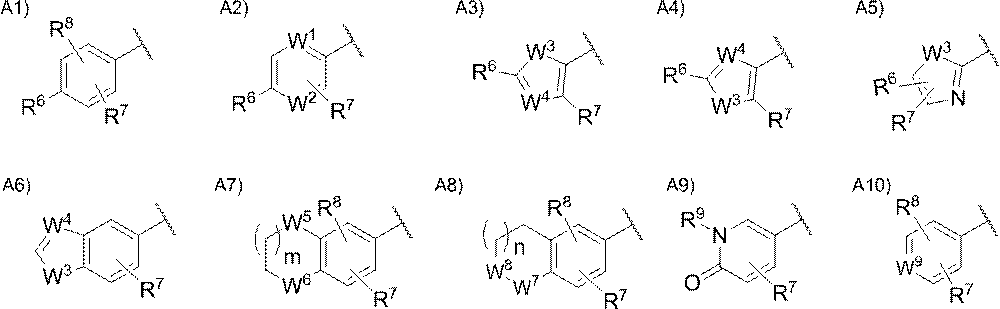
Ar2がA2)である場合、W1は、水素原子、ハロゲン原子または置換基を有しても良いC1~C6アルキル基によって置換されてもよいCHまたは窒素原子であり;
Ar2がA2)である場合、W2は、CHまたは窒素原子であり;
Ar2がA3)、A4)、A5)またはA6)である場合、W3は、酸素原子、硫黄原子またはC1~C6アルキル基によって置換されてもよいNHであり;
Ar2がA3)、A4)またはA6)である場合、W4は、CHまたは窒素原子であり;Ar2がA7)である場合、W5は、CH2、酸素原子または硫黄原子であり;
Ar2がA7)である場合、W6は、C=O、CH2、CF2、CHOH、C1~C6アルキル基によって置換されてもよいNH、SO、SO2、酸素原子または硫黄原子であり;
Ar2がA8)である場合、W7は、C1~C6アルキル基によって置換されてもよいNHまたはC=Oであり;
Ar2がA8)である場合、W8は、W7がC1~C6アルキル基によって置換されてもよいNHのときは、C=O、W7がC=Oのときは、C1~C6アルキル基によって置換されてもよいNHであり;
Ar2がA10)である場合、W9は、窒素原子またはN=Oであり;
Ar2がA1)、A2)、A3)、A4)またはA5)である場合、R6は、水素原子、ハロゲン原子、ヒドロキシ基、シアノ基、置換基を有しても良いC1~C6アルキル基、置換基を有しても良いC1~C6アルコキシ基、置換基を有しても良いC1~C6アシル基、置換基を有しても良いC1~C6アルキルスルファニル基、置換基を有しても良いC1~C6アルキルスルフィニル基、置換基を有しても良いC1~C6アルキルスルホニル基、置換基を有しても良い複素環基、-CONR10R11または-NR10R11であり、R6が-CONR10R11または-NR10R11であるとき、R10は水素原子、置換基を有しても良いC1~C6アルキル基、置換基を有しても良いC1~C6アシル基、または置換基を有しても良いC1~C6アルキルスルホニル基であり、R11は水素原子、または置換基を有しても良いC1~C6アルキル基であるか、またはR10とR11が一緒になってC3~C10ヘテロシクロアルキル基を形成しており;
Ar2がA1)、A2)、A3)、A4)、A5)、A6)、A7)、A8)、A9)またはA10)である場合、R7は、水素原子、ハロゲン原子、置換基を有しても良いC1~C6アルキル基または置換基を有しても良いC1~C6アルキコキシ基であり;Ar2がA1)、A7)、A8)またはA10)である場合、R8は、水素原子、ハロゲン原子または置換基を有しても良いC1~C6アルキル基であり;
Ar2がA9)である場合、R9は、水素原子またはC1~C6アルキル基であり;Ar2がA7)である場合、mは0または1であり;
Ar2がA8)である場合、nは0または1であり;
ただし、Ar2がA1)である場合にR6、R7及びR8の置換基の組み合わせが水素原子とハロゲン原子の場合を除く、[1]記載の化合物、またはその薬理学的に許容される塩。
[3]式(I)中、Ar1が、以下のB1)、B2)、B3)、B4)、B5)、B6)、B7)、B8)、B9)、B10)、B11)およびB12):

Ar1が、B2)、B3)、B7)、B8)、B10)、B11)またはB12)である場合、R12は、水素原子、ハロゲン原子、ヒドロキシ基、シアノ基、置換基を有しても良いC1~C6アルキル基、置換基を有しても良いC1~C6アルコキシ基、置換基を有しても良いC3~C6シクロアルキル基、置換基を有しても良いC3~C6シクロアルコキシ基、置換基を有しても良いC1~C6アシル基、置換基を有しても良いC2~C6アルケニル基、置換基を有しても良いC2~C6アルキニル基、C1~C6アルコキシカルボニル基、置換基を有しても良いC1~C6アルキルスルファニル基、置換基を有しても良いC1~C6アルキルスルフィニル基、置換基を有しても良いC1~C6アルキルスルホニル基、-CONR10R11、-NR10R11、アリールオキシ基、または置換基を有しても良い複素環基であり、R12が-CONR10R11または-NR10R11であるとき、R10は水素原子、置換基を有しても良いC1~C6アルキル基、置換基を有しても良いC1~C6アシル基、または置換基を有しても良いC1~C6アルキルスルホニル基であり、R11は水素原子、または置換基を有しても良いC1~C6アルキル基であるか、またはR10とR11が一緒になってC3~C10ヘテロシクロアルキル基を形成しており;
Ar1が、B1)である場合、R12は、水素原子、ハロゲン原子、ヒドロキシ基、シアノ基、置換基を有しても良いC1~C6アルキル基、置換基を有しても良いC1~C6アルコキシ基、置換基を有しても良いC3~C6シクロアルキル基、置換基を有しても良いC3~C6シクロアルコキシ基、置換基を有しても良いC1~C6アシル基、置換基を有しても良いC2~C6アルケニル基、置換基を有しても良いC2~C6アルキニル基、C1~C6アルコキシカルボニル基、置換基を有しても良いC1~C6アルキルスルファニル基、置換基を有しても良いC1~C6アルキルスルフィニル基、置換基を有しても良いC1~C6アルキルスルホニル基、-CONR10R11、-NR10R11、アリールオキシ基、置換基を有しても良い複素環基であり、R12が-CONR10R11または-NR10R11であるとき、R10は水素原子、置換基を有しても良いC1~C6アルキル基、置換基を有しても良いC1~C6アシル基、または置換基を有しても良いC1~C6アルキルスルホニル基であり、R11は水素原子、または置換基を有しても良いC1~C6アルキル基であるか、またはR10とR11が一緒になってC3~C10ヘテロシクロアルキル基を形成しており、R13は、水素原子、ハロゲン原子、ヒドロキシ基、シアノ基、またはC1~C6アルキル基であるか、またはR12とR13が一緒になってC3~C5アルキレン基または、C1~C2アルキレンジオキシ基を形成してもよく;
Ar1が、B6)である場合、R13は、水素原子、ハロゲン原子、ヒドロキシ基、シアノ基、またはC1~C6アルキル基であり;Ar1が、B9)である場合、R14、R15は、独立して水素原子、ハロゲン原子、シアノ基、C1~C6アルキル基またはC1~C6アルコキシ基であり;
Ar1が、B2)である場合、W10およびW11は、一方が窒素原子であり、他方がCHまたは窒素原子であり;
Ar1が、B6)、B7)、B8)、B9)、B10)、B11)またはB12)である場合、W12は、酸素原子、硫黄原子、またはN-R16であり、W12がN-R16である場合、R16は水素原子またはC1~C6アルキル基であり;Ar1が、B6)、B7)、B8)、またはB9)である場合、W13は、CHまたは窒素原子である、[2]記載の化合物、またはその薬理学的に許容される塩。
[4]Ar2が、A1)、A2)、A3)、A4)、またはA5)である場合、R6は、水素原子、ハロゲン原子、ヒドロキシ基、シアノ基、C1~C6アルキル基、C1~C6アルコキシ基、ハロC1~C6アルコキシ基、C1~C6アシル基、C1~C6アルキルスルファニル基、C1~C6アルキルスルフィニル基、C1~C6アルキルスルホニル基、置換基を有しても良い複素環基、-CONR10R11または-NR10R11であり、R6が-CONR10R11または-NR10R11である場合、R10は、水素原子、C1~C6アルキル基、C1~C6アシル基、またはC1~C6アルキルスルホニル基であり、R11は、水素原子またはC1~C6アルキル基であるか、またはR10とR11が一緒になってC3~C10ヘテロシクロアルキル基を形成しており;
Ar2が、A1)、A2)、A3)、A4)、A5)、A6)、A7)、A8)、A9)またはA10)である場合、R7は、水素原子、ハロゲン原子、C1~C6アルキル基またはC1~C6アルキコキシ基であり;
Ar2が、A1)、A7)、A8)またはA10)である場合、R8は、水素原子、ハロゲン原子またはC1~C6アルキル基であり;
Ar2が、A9)である場合、R9は、水素原子またはC1~C6アルキル基であり;
ただし、Ar2がA1)である場合にR6、R7及びR8の置換基の組み合わせが水素原子とハロゲン原子の場合を除く、[3]記載の化合物、またはその薬理学的に許容される塩。
[5]R1は、水素原子、ヒドロキシ基、C1~C6アルキル基、C1~C6アルコキシ基、ハロC1~C6アルキル基、ヒドロキシC1~C6アルキル基、カルボキシC1~C6アルキル基、カルバモイルC1~C6アルキル基、モノC1~C6アルキルカルバモイルC1~C6アルキル基、ジC1~C6アルキルカルバモイルC1~C6アルキル基、アミノスルホニルC1~C6アルキル基、置換基を有しても良い芳香族ヘテロ環C1~C3アルキル基または置換基を有しても良いフェニルC1~C3アルキル基であり;
R2、R3は、それぞれ独立して水素原子、C1~C3アルキル基、またはR2とR3が一緒になったC2~C6アルキレン基であり;
Ar1が、B2)、B3)、B7)、B8)、B10)、B11)またはB12)である場合、R12は、水素原子、ハロゲン原子、ヒドロキシ基、シアノ基、C1~C6アルキル基、ハロC1~C6アルキル基、ヒドロキシC1~C6アルキル基、C1~C6アルコキシ基、C3~C6シクロアルキル基、C3~C6シクロアルコキシ基、C1~C6アシル基、C2~C6アルケニル基、C2~C6アルキニル基、C1~C6アルコキシカルボニル基、C1~C6アルキルスルファニル基、C1~C6アルキルスルフィニル基、C1~C6アルキルスルホニル基、-CONR10R11、-NR10R11、アリールオキシ基、置換基を有しても良い複素環基であり、R12が-CONR10R11または-NR10R11である場合、R10は、水素原子、C1~C6アルキル基、C1~C6アシル基、またはC1~C6アルキルスルホニル基であり、R11は、水素原子またはC1~C6アルキル基であるか、またはR10とR11が一緒になってC3~C10ヘテロシクロアルキル基を形成しており;
Ar1が、B1)である場合、R12は、水素原子、ハロゲン原子、ヒドロキシ基、シアノ基、C1~C6アルキル基、ハロC1~C6アルキル基、ヒドロキシC1~C6アルキル基、C1~C6アルコキシ基、C3~C6シクロアルキル基、C3~C6シクロアルコキシ基、C1~C6アシル基、C2~C6アルケニル基、C2~C6アルキニル基、C1~C6アルコキシカルボニル基、C1~C6アルキルスルファニル基、C1~C6アルキルスルフィニル基、C1~C6アルキルスルホニル基、-CONR10R11、-NR10R11、アリールオキシ基、置換基を有しても良い複素環基であり、R12が-CONR10R11または-NR10R11である場合、R10は水素原子、C1~C6アルキル基、C1~C6アシル基、またはC1~C6アルキルスルホニル基であり、R11は水素原子またはC1~C6アルキル基であるか、またはR10とR11が一緒になってC3~C10ヘテロシクロアルキル基を形成しており、R13は、水素原子、ハロゲン原子、ヒドロキシ基、シアノ基、またはC1~C6アルキル基であるか、またはR12とR13が一緒になってC3~C5アルキレン基または、C1~C2アルキレンジオキシ基を形成しており;
Xは、以下のa)、b)およびc):
a)酸素原子
b)NR4
c)NOR4
からなる群から選択される基であり、Xがb)またはc)である場合、R4は、水素原子、ヒドロキシC1~C6アルキル基、フェニル基、複素環基またはC1~C6アルキル基である、[4]記載の化合物、またはその薬理学的に許容される塩。
[6]式(I)中、Ar2がA1)、A2a)、A3)およびA7a):

Ar2がA2a)である場合、W2は、[2]においてAr2がA2)である場合について定義したものと同義であり、
Ar2がA3)である場合、W4は、[2]においてAr2がA3)である場合について定義したものと同義であり、
Ar2がA7a)である場合、W6は、[2]においてAr2がA7)である場合について定義したものと同義であり、
Ar2がA1)、A2a)、A3)またはA7a)である場合、R7は、[4]においてAr2がA1)、A2)、A3)またはA7)である場合について定義したものと同義であり、
Ar2がA1)またはA7a)である場合、R8は、[4]においてAr2がA1)またはA7)である場合について定義したものと同義であり、
Ar2がA7a)である場合、mは、[2]においてAr2がA7)である場合について定義したものと同義であり、
Ar2がA1)、A2a)、またはA3)である場合、R6は水素原子、ハロゲン原子、シアノ基、C1~C6アルキル基、C1~C6アルコキシ基、ハロC1~C6アルコキシ基、C1~C6アシル基、C1~C6アルキルスルファニル基、C1~C6アルキルスルフィニル基、-CONR10R11または-NR10R11であり、R6が-CONR10R11または-NR10R11である場合、R10は水素原子、C1~C6アルキル基、またはC1~C6アシル基であり、R11は水素原子、またはC1~C6アルキル基であるか、またはR10とR11が一緒になってピロリジニル基、ピペリジニル基、ピペラジニル基またはモルホリニル基を形成してもよく;
Ar2がA3)である場合、W3は、酸素原子または硫黄原子であり;
ただし、Ar2がA1)である場合にR6、R7及びR8の置換基の組み合わせが水素原子とハロゲン原子の場合を除く、[5]記載の化合物、またはその薬理学的に許容される塩。
[7]式(I)中、Ar1がB1)、B2)、B6a)、B9a)およびB9b):

Ar1がB6a)である場合、R13は、[3]においてAr1がB6)である場合について定義したものと同義であり;
Ar1がB9a)またはB9b)である場合、R14、R15は、[3]においてAr1がB9)である場合について定義したものと同義であり;
Ar1がB2)である場合、W10、W11は、[3]においてAr1がB2)である場合について定義したものと同義であり;Ar1がB2)である場合、R12は、水素原子、ハロゲン原子、ヒドロキシ基、シアノ基、C1~C6アルキル基、ハロC1~C6アルキル基、ヒドロキシC1~C6アルキル基、C1~C6アルコキシ基、C3~C6シクロアルキル基、C3~C6シクロアルコキシ基、C1~C6アシル基、C2~C6アルケニル基、C1~C6アルコキシカルボニル基、C1~C6アルキルスルファニル基、C1~C6アルキルスルフィニル基、C1~C6アルキルスルホニル基、-CONR10R11、-NR10R11、アリールオキシ基、または置換基を有しても良い複素環基であり、R12が-CONR10R11または-NR10R11であるとき、R10は水素原子、C1~C6アルキル基、またはC1~C6アシル基であり、R11は、水素原子、またはC1~C6アルキル基であるか、またはR10とR11が一緒になってピロリジニル基、ピペリジニル基、ピペラジニル基またはモルホリニル基を形成してもよく;
Ar1がB1)である場合、R12は、水素原子、ハロゲン原子、ヒドロキシ基、シアノ基、C1~C6アルキル基、ハロC1~C6アルキル基、ヒドロキシC1~C6アルキル基、C1~C6アルコキシ基、C3~C6シクロアルキル基、C3~C6シクロアルコキシ基、C1~C6アシル基、C2~C6アルケニル基、C1~C6アルコキシカルボニル基、C1~C6アルキルスルファニル基、C1~C6アルキルスルフィニル基、C1~C6アルキルスルホニル基、-CONR10R11、-NR10R11、アリールオキシ基、または置換基を有しても良い複素環基であり、R12が-CONR10R11または-NR10R11であるとき、R10は水素原子、C1~C6アルキル基、またはC1~C6アシル基であり、R11は水素原子、またはC1~C6アルキル基であるか、またはR10とR11が一緒になってピロリジニル基、ピペリジニル基、ピペラジニル基またはモルホリニル基を形成してもよく、R13は、水素原子、ハロゲン原子、ヒドロキシ基、シアノ基、またはC1~C6アルキル基であるか、またはR12とR13が一緒になってC3~C5アルキレン基または、C1~C2アルキレンジオキシ基を形成してもよく;
Ar1がB6a)、B9a)またはB9b)である場合、W12は、酸素原子または硫黄原子である、[6]記載の化合物、またはその薬理学的に許容される塩。
[8]式(I)中、Ar2がA1a)、A2b)、A3a)およびA7b):

Ar2がA1a)である場合、R6は、[6]においてAr2がA1)である場合について定義したものと同義であり;
Ar2がA1a)またはA7b)である場合、R8は、[4]においてAr2がA1)またはA7)である場合について定義したものと同義であり;
Ar2がA7b)である場合、mは、[2]においてAr2がA7)である場合について定義したものと同義であり;
;R1は、水素原子、ヒドロキシ基、C1~C3アルキル基、C1~C3アルコキシ基、ヒドロキシC1~C4アルキル基、カルボキシC1~C3アルキル基、カルバモイルC1~C3アルキル基、モノC1~C2アルキルカルバモイルC1~C3アルキル基またはジC1~C2アルキルカルバモイルC1~C3アルキル基であり;
R2、R3は、それぞれ独立して水素原子またはC1~C3アルキル基であり;
Xがb)またはc)である場合、R4は、水素原子、ヒドロキシC1~C4アルキル基またはC1~C3アルキル基であり;
Ar2がA2b)またはA3a)である場合、R6aは、C1~C3アルコキシ基であり;
Ar2がA1a)、A2b)、A3a)またはA7b)である場合、R7は、水素原子、フッ素原子、塩素原子またはC1~C3アルキル基であり;
Ar2がA7b)である場合、W6は、C=O、CH2、CF2、CHOHまたは酸素原子であり;
ただし、Ar1がA1a)である場合にR6、R7及びR8の置換基の組み合わせが水素原子とハロゲン原子の場合を除く、[7]記載の化合物、またはその薬理学的に許容される塩。
[9]式(I)中、Ar2がA1a)、A2b)およびA7c):

Ar2がA2b)である場合、R6aは[8]においてAr2がA2b)である場合について定義したものと同義であり;
Ar2がA1a)またはA7c)である場合、R8は、[4]においてAr2がA1)またはA7)である場合について定義したものと同義であり;
Ar2がA7c)である場合、mは[8]においてAr2がA7b)である場合について定義したものと同義であり;Ar2がA1a)である場合、R6は水素原子、フッ素原子、塩素原子、シアノ基、C1~C6アルキル基、C1~C6アルコキシ基、ハロC1~C6アルコキシ基、C1~C6アルキルスルファニル基、C1~C6アルキルスルフィニル基または-CONR10R11であり、R6が-CONR10R11であるとき、R10は水素原子、C1~C6アルキル基、またはC1~C6アシル基であり、R11は水素原子、またはC1~C6アルキル基であるか、またはR10とR11が一緒になってピロリジニル基、ピペリジニル基、ピペラジニル基またはモルホリニル基を形成してもよく、;Ar2がA1a)、A2b)またはA7c)である場合、R7は、水素原子、フッ素原子または塩素原子であり;
ただし、Ar2がA1a)である場合にR6、R7及びR8の置換基の組み合わせが水素原子とハロゲン原子の場合を除く、[8]記載の化合物、またはその薬理学的に許容される塩。
[10]式(I)中、Ar1がB1)、B2),B6b)、B9c)およびB9d):

R1は、水素原子、ヒドロキシ基、C1~C3アルキル基、C1~C3アルコキシ基またはヒドロキシC1~C4アルキル基であり;
Ar1がB1)またはB2)である場合、R12は、水素原子、フッ素原子、塩素原子、シアノ基、C1~C3アルキル基またはC1~C6アルコキシ基であり;
Ar1がB1)またはB6b)である場合、R13は、水素原子、ヒドロキシ基、フッ素原子または塩素原子であり;
Ar1がB9c)またはB9d)である場合、R14は、水素原子、フッ素原子、塩素原子、C1~C3アルキル基、メトキシ基またはエトキシ基であり;
Ar1がB9c)またはB9d)である場合、R15は、水素原子、フッ素原子または塩素原子であり;
Ar1がB2)である場合、W10、W11は、一方がNであり、もう片方がCHである、[9]記載の化合物、または薬理学的に許容される塩。
[11]式(I)中、Ar1がB1)、B6b)およびB9c1):

Ar1がB1)である場合、R12は[10]においてAr1がB1)である場合について定義したものと同義であり;
Ar1がB1)またはB6b)である場合、R13は[10]においてAr1がB1)またはB6b)である場合について定義したものと同義であり;
Ar1がB9c1)である場合、R14は[10]においてAr1がB9c)である場合について定義したものと同義である、[10]記載の化合物、またはその薬理学的に許容される塩。
[12]式(I)中、Ar2がA1b)、A2b)およびA7c):

Ar2がA7c)である場合、mは[8]においてAr2がA7b)である場合に定義したものと同義であり、
Ar2がA1b)である場合、R6は、シアノ基、エチル基またはC1~C3アルコキシ基であり;
R7は、フッ素原子または塩素原子であり;
Ar2がA1b)またはA7c)である場合、R8は、水素原子、フッ素原子、塩素原子またはC1~C3アルキル基である、[11]記載の化合物、またはその薬理学的に許容される塩。
[13]式(I)で表される化合物が、
(-)-1-(4-フルオロフェニル)-3-[(3S*,4R*)-4-(4-メトキシフェニル)-2-オキソピロリジン-3-イル]ウレア、
(-)-1-(4-クロロフェニル)-3-[(3S*,4R*)-4-(4-メトキシフェニル)-2-オキソピロリジン-3-イル]ウレア、
(-)-1-(3,4-ジフルオロフェニル)-3-[(3S*,4R*)-4-(4-メトキシフェニル)-2-オキソピロリジン-3-イル]ウレア、
(-)-1-(4-シアノフェニル)-3-[(3S*,4R*)-4-(4-メトキシフェニル)-2-オキソピロリジン-3-イル]ウレア、
(-)-1-(4-クロロフェニル)-3-[(3S*,4R*)-4-(4-メトキシフェニル)-1-メチル-2-オキソピロリジン-3-イル]ウレア、
(-)-1-(4-フルオロフェニル)-3-[(3S*,4R*)-4-(4-メトキシフェニル)-1-メチル-2-オキソピロリジン-3-イル]ウレア、
(-)-1-[(3S*,4R*)-4-(3-フルオロ―4-メトキシフェニル)-2-オキソピロリジン-3-イル]-3-(4-フルオロフェニル)ウレア、
(-)-1-[(3S*,4R*)-4-(2-フルオロ―4-メトキシフェニル)-2-オキソピロリジン-3-イル]-3-(4-フルオロフェニル)ウレア、
1-[(3S*,4R*)-4-(2-クロロ―4-メトキシフェニル)-2-オキソピロリジン-3-イル]-3-(4-フルオロフェニル)ウレア、
(-)-1-(4-フルオロフェニル)-3-[(3S*,4R*)-4-(4-メトキシ―2-メチルフェニル)-2-オキソピロリジン-3-イル]ウレア、
(-)-1-[(3S*,4R*)-4-(2,6-ジフルオロ―4-メトキシフェニル)-2-オキソピロリジン-3-イル]-3-(4-フルオロフェニル)ウレア、
(-)-1-[(3S*,4R*)-4-(2,5-ジフルオロ―4-メトキシフェニル)-2-オキソピロリジン-3-イル]-3-(4-フルオロフェニル)ウレア、
(-)-1-[(3S*,4R*)-4-(3,5-ジフルオロ―4-メトキシフェニル)-2-オキソピロリジン-3-イル]-3-(4-フルオロフェニル)ウレア、
(-)-1-[(3S*,4R*)-4-(6-フルオロ-2,3-ジヒドロベンゾフラン-5-イル)-2-オキソピロリジン-3-イル]-3-(4-フルオロフェニル)ウレア、
(-)-1-[(3S*,4R*)-4-(3-フルオロ-5-メトキシピリジン-2-イル)-2-オキソピロリジン-3-イル]-3-(4-フルオロフェニル)ウレア、
(-)-1-(4-フルオロフェニル)-3-[(3S*,4R*)-4-(5-メトキシチオフェン―2-イル)-2-オキソピロリジン-3-イル]ウレア、
(-)-1-(4-フルオロフェニル)-3-[(3S*,4R*)-4-(4-メチルチオフェニル)-2-オキソピロリジン-3-イル]ウレア、
(-)-1-(4-クロロフェニル)-3-[(3S*,4R*)-4-(2,6-ジフルオロ―4-メトキシフェニル)-2-オキソピロリジン-3-イル]ウレア、
(-)-1-(4-シアノフェニル)-3-[(3S*,4R*)-4-(2,6-ジフルオロ―4-メトキシフェニル)-2-オキソピロリジン-3-イル]ウレア、
(-)-1-[(3S*,4R*)-4-(2,6-ジフルオロ―4-メトキシフェニル)-2-オキソピロリジン-3-イル]-3-(4-メトキシフェニル)ウレア、
(-)-1-(5-クロロチアゾール-2-イル)-3-[(3S*,4R*)-4-(2,6-ジフルオロ―4-メトキシフェニル)-2-オキソピロリジン-3-イル]ウレア、
(-)-1-(6-クロロピリジン-3-イル)-3-[(3S*,4R*)-4-(2,6-ジフルオロ―4-メトキシフェニル)-2-オキソピロリジン-3-イル]ウレア、
(-)-1-(5-クロロピリジン-2-イル)-3-[(3S*,4R*)-4-(2,6-ジフルオロ―4-メトキシフェニル)-2-オキソピロリジン-3-イル]ウレア、
(-)-1-(ベンゾ[b]チオフェン-2-イル)-3-[(3S*,4R*)-4-(2,6-ジフルオロ―4-メトキシフェニル)-2-オキソピロリジン-3-イル]ウレア、
(-)-1-[(3S*,4R*)-4-(2,6-ジフルオロ―4-メトキシフェニル)-2-オキソピロリジン-3-イル]-3-(5-メチルチオフェン-2-イル)ウレア、
(-)-1-(4-フルオロフェニル)-3-[(3S*,4R*,5S*)-4-(4-メトキシフェニル)-5-メチル-2-オキソピロリジン-3-イル]ウレア、
(-)-1-(4-フルオロフェニル)-3-[(3S*,4R*,5R*)-4-(4-メトキシフェニル)-5-メチル-2-オキソピロリジン-3-イル]ウレア、
(+)-1-(4-クロロフェニル)-3-[(3R*,4S*)-2-オキソ-4-フェニルピロリジン-3-イル]ウレア、
(±)-トランス-1-(4-クロロフェニル)-3-[4-(4-メトキシフェニル)-1-メチル-2-オキソピロリジン-3-イル]ウレア、
(±)-トランス-1-(4-フルオロフェニル)-3-[4-(4-メトキシフェニル)-2-オキソピロリジン-3-イル]ウレア、
(±)-トランス-1-(4-クロロフェニル)-3-[4-(4-メトキシフェニル)-1-メチル-2-オキソピロリジン-3-イル]ウレア、
(-)-1-[(3S*,4R*)-4-(2,6-ジフルオロ―4-メトキシフェニル)-2-オキソピロリジン-3-イル]-3-[4-(トリフルオロメトキシ)フェニル]ウレア、
(-)-1-[(3S*,4R*)-4-(2,6-ジフルオロ―4-メトキシフェニル)-2-オキソピロリジン-3-イル]-3-フェニルウレア、
(-)-1-[(3S*,4R*)-4-(2,6-ジフルオロ―4-メトキシフェニル)-2-オキソピロリジン-3-イル]-3-(4-フェノキシフェニル)ウレア、
(-)-1-[(3S*,4R*)-4-(2,6-ジフルオロ―4-メトキシフェニル)-2-オキソピロリジン-3-イル]-3-(3-フルオロフェニル)ウレア、
(-)-1-[(3S*,4R*)-4-(2,6-ジフルオロ―4-メトキシフェニル)-2-オキソピロリジン-3-イル]-3-(3,4-ジフルオロフェニル)ウレア、
(-)-1-(5-クロロチオフェン-2-イル)-3-[(3S*,4R*)-4-(2,6-ジフルオロ―4-メトキシフェニル)-2-オキソピロリジン-3-イル]ウレア、
(-)-1-[(3S*,4R*)-4-(2,6-ジフルオロ―4-メトキシフェニル)-2-オキソピロリジン-3-イル]-3-(p-トリル)ウレア、
(-)-1-[(3S*,4R*)-1-エチル-4-(4-メトキシフェニル)-2-オキソピロリジン-3-イル]-3-(4-フルオロフェニル)ウレア、
(-)-1-(4-フルオロフェニル)-3-[(3S*,4R*)-1-(1-ヒドロキシ-2-メチルプロパン-2-イル)-4-(4-メトキシフェニル)-2-オキソピロリジン-3-イル]ウレア、
(±)-トランス-1-(4-クロロフェニル)-3-[1-(2-ヒドロキシエチル)-4-(4-メトキシフェニル)-2-オキソピロリジン-3-イル]ウレア、
(+)-トランス-1-(4-クロロフェニル)-3-[1-(2-ヒドロキシエチル)-4-(4-メトキシフェニル)-2-オキソピロリジン-3-イル]ウレア、
(-)-トランス-1-(4-クロロフェニル)-3-[1-(2-ヒドロキシエチル)-4-(4-メトキシフェニル)-2-オキソピロリジン-3-イル]ウレア、
(-)-2-{(3S*,4R*)-3-[3-(4-フルオロフェニル)ウレイド]-4-(4-メトキシフェニル)-2-オキソピロリジン-1-イル}-N-メチルアセトアミド、
(-)-2-{(3S*,4R*)-3-[3-(4-フルオロフェニル)ウレイド]-4-(4-メトキシフェニル)-2-オキソピロリジン-1-イル}プロピオン酸(異性体A)、
(-)-2-{(3S*,4R*)-3-[3-(4-フルオロフェニル)ウレイド]-4-(4-メトキシフェニル)-2-オキソピロリジン-1-イル}-N-メチルプロピオン酸アミド(異性体A)、
(-)-2-{(3S*,4R*)-3-[3-(4-フルオロフェニル)ウレイド]-4-(4-メトキシフェニル)-2-オキソピロリジン-1-イル}プロピオン酸(異性体B)、
(-)-2-{(3S*,4R*)-3-[3-(4-フルオロフェニル)ウレイド]-4-(4-メトキシフェニル)-2-オキソピロリジン-1-イル}-N-メチルプロピオン酸アミド(異性体B)、
(-)-2-{(3S*,4R*)-3-[3-(4-フルオロフェニル)ウレイド]-4-(4-メトキシフェニル)-2-オキソピロリジン-1-イル}-N,2-ジメチルプロピオン酸アミド、
(-)-1-[(3S*,4R*)-4-(2,6-ジフルオロ―4-メトキシフェニル)-1-メチル-2-オキソピロリジン-3-イル]-3-(4-フルオロフェニル)ウレア、
(-)-1-[(3S*,4R*)-4-(2-フルオロ―4-メトキシフェニル)-1-(2-ヒドロキシエチル)-2-オキソピロリジン-3-イル]-3-(4-フルオロフェニル)ウレア、
(-)-1-[(3S*,4R*)-4-(2,6-ジフルオロ―4-メトキシフェニル)-1-(2-ヒドロキシエチル)-2-オキソピロリジン-3-イル]-3-(4-フルオロフェニル)ウレア、
(+)-1-(4-フルオロフェニル)-3-[(3R*,4S*)-1-メトキシ-4-(4-メトキシフェニル)-2-オキソピロリジン-3-イル]ウレア、
(-)-3,5-ジフルオロ-4-{(3R*,4S*)-4-[3-(4-フルオロフェニル)ウレイド]-5-オキソピロリジン-3-イル}ベンズアミド、
(-)-1-(4-フルオロフェニル)-3-[(3S*,4R*,Z)-2-(メトキシイミノ)-4-(4-メトキシフェニル)ピロリジン-3-イル]ウレア、
(-)-1-[(3S*,4R*,Z)-4-(2-フルオロ-4-メトキシフェニル)-2-(メトキシイミノ)ピロリジン-3-イル]-3-(4-フルオロフェニル)ウレア、
(-)-1-[(3S*,4R*,Z)-4-(2,6-ジフルオロ-4-メトキシフェニル)-2-(メトキシイミノ)ピロリジン-3-イル]-3-(4-フルオロフェニル)ウレア、
(-)-1-(4-フルオロフェニル)-3-{(3S*,4R*,Z)-2-[(2-ヒドロキシエトキシ)イミノ]-4-(4-メトキシフェニル)ピロリジン-3-イル}ウレア、
(-)-1-{(3S*,4R*,Z)-4-(2,6-ジフルオロ-4-メトキシフェニル)-2-[(2-ヒドロキシエトキシ)イミノ]ピロリジン-3-イル}-3-(4-フルオロフェニル)ウレア、
(-)-1-[(3S*,4R*,Z)-4-(2,6-ジフルオロ-4-メトキシフェニル)-2-(メチルイミノ)ピロリジン-3-イル]-3-(4-フルオロフェニル)ウレア、
(-)-1-(4-フルオロフェニル)-3-[(3S*,4R*,Z)-2-(2-ヒドロキシイミノ)-4-(4-メトキシフェニル)ピロリジン-3-イル]ウレア、
(-)-1-[(3S*,4R*)-4-(2,6-ジフルオロ―4-メトキシフェニル)-2-オキソピロリジン-3-イル]-3-(3-ヒドロキシ-4-メチルフェニル)ウレア、
(-)-1-[(3S*,4R*)-4-(2,6-ジフルオロ―4-メトキシフェニル)-2-オキソピロリジン-3-イル]-3-(4-フルオロ-3-ヒドロキシフェニル)ウレア、
(-)-1-(4-クロロ-3-ヒドロキシフェニル)-3-[(3S*,4R*)-4-(2,6-ジフルオロ―4-メトキシフェニル)-2-オキソピロリジン-3-イル]ウレア、
(-)-1-(4-シアノフェニル)-3-[(3S*,4R*)-4-(6-フルオロ-2,3-ジヒドロベンゾフラン-5-イル)-2-オキソピロリジン-3-イル]ウレア、
(-)-1-{(3S*,4R*,Z)-4-(2,6-ジフルオロ-4-メトキシフェニル)-2-[(2-ヒドロキシエトキシ)イミノ]ピロリジン-3-イル}-3-(p-トリル)ウレア、または
(-)-1-[(3S*,4R*)-4-(2,6-ジフルオロ-4-メトキシフェニル)-1-(2-ヒドロキシエチル)-2-オキソピロリジン-3-イル]-3-フェニルウレアである、[1]記載の化合物、またはその薬理学的に許容される塩。
[14][1]から[13]のいずれか1つに記載の化合物、またはその薬理学的に許容される塩を有効成分として含有する医薬。
[15][1]から[13]のいずれか1つに記載の化合物、またはその薬理学的に許容される塩を有効成分として含有するFPRL1作動薬。
[16][1]から[13]のいずれか1つに記載の化合物、またはその薬理学的に許容される塩を投与する炎症性疾患、慢性気道疾患、がん、敗血症、アレルギー性症状、HIVレトロウイルス感染、循環器障害、神経炎症、神経障害、疼痛、プリオン病、アミロイド症、免疫障害の治療又は予防方法。
[17]炎症性疾患、慢性気道疾患、がん、敗血症、アレルギー性症状、HIVレトロウイルス感染、循環器障害、神経炎症、神経障害、疼痛、プリオン病、アミロイド症、免疫障害の治療又は予防のための医薬を製造するための[1]から[13]のいずれか1つに記載の化合物、またはその薬理学的に許容される塩の使用。
[18]炎症性疾患、慢性気道疾患、がん、敗血症、アレルギー性症状、HIVレトロウイルス感染、循環器障害、神経炎症、神経障害、疼痛、プリオン病、アミロイド症、免疫障害の予防または治療に使用するための、[1]から[13]のいずれか1つに記載の化合物、またはその薬理学的に許容される塩及び薬学的に許容されうる担体を含有する医薬組成物。
なお、上記「複素環基」は他の環式基と縮環していてもよい。他の環式基と縮環している複素環基として、例えば、イソベンゾフラニル基、ベンゾオキサゾリル基、ベンゾイソオキサゾリル基、ベンゾチアゾリル基、ベンゾイソチアゾリル基、クロメニル基、クロマノニル基、キサンテニル基、フェノキサチイニル基、インドリジニル基、イソインドリジニル基、インドリル基、インダゾリル基、プリニル基、キノリジニル基、イソキノリル基、キノリル基、フタラジニル基、ナフチリジニル基、キノキサリニル基、キナゾリニル基、カルバゾリル基、カルボリニル基、アクリジニル基、イソインドリニル基等が挙げられる。
また、一般式が有する官能基についての定義に関し、特に言及しない限り、同一の符号で表される定義は、その符号を含む各一般式の間で共通する。
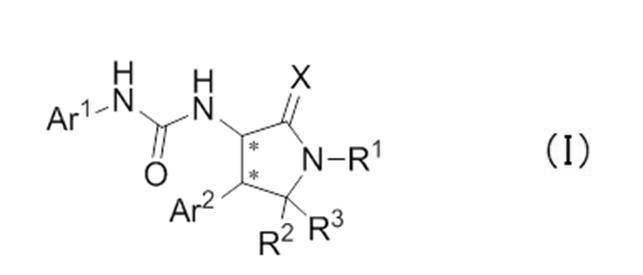
Ar2は、置換基を有しても良いフェニル基(ただし、置換基がハロゲン原子だけのフェニル基は除く)、置換基を有しても良い5員環芳香族複素環基、置換基を有しても良い6員環芳香族複素環基、または置換基を有しても良い原子数8個または9個からなる二環性芳香族複素環基であり;
Xは、以下のa)、b)およびc):
a)酸素原子または硫黄原子
b)NR4
c)NOR4
からなる群から選択される基であり、Xがb)またはc)である場合、R4は、水素原子または置換基を有しても良いC1~C6アルキル基であり;
R1は、水素原子、ヒドロキシ基、置換基を有しても良いC1~C6アルコキシ基または置換基を有しても良いC1~C6アルキル基であり;
R2、R3は、それぞれ独立して水素原子、置換基を有しても良いC1~C6アルキル基であるか、またはR2とR3が一緒になったC2~C6アルキレン基であり;
*を付された炭素原子は、不斉炭素原子を表す。
なお、「独立して」および「独立した」とは、存在し得る2個以上の置換基の間でそれらが同一でも異なっていてもよいことを意味している。


R13は、水素原子、ハロゲン原子、ヒドロキシ基、シアノ基、またはC1~C6アルキル基であってもよい。
また、Ar1がB1)である場合には、R12とR13がそれぞれ上述の官能基であることがあるほか、R12とR13が一緒になってC3~C5アルキレン基または、C1~C2アルキレンジオキシ基を形成してもよい。
R14、R15は、独立して水素原子、ハロゲン原子、シアノ基、C1~C6アルキル基またはC1~C6アルコキシ基である。
W10およびW11は、一方が窒素原子であり、他方がCHまたは窒素原子である。
W12は、酸素原子、硫黄原子、またはN-R16であり、W12がN-R16である場合、R16は水素原子またはC1~C6アルキル基である。
W13は、CHまたは窒素原子である。
W12は、好ましくは、酸素原子または硫黄原子である。より好ましくは、硫黄原子である。
W13は、好ましくは、CHである。
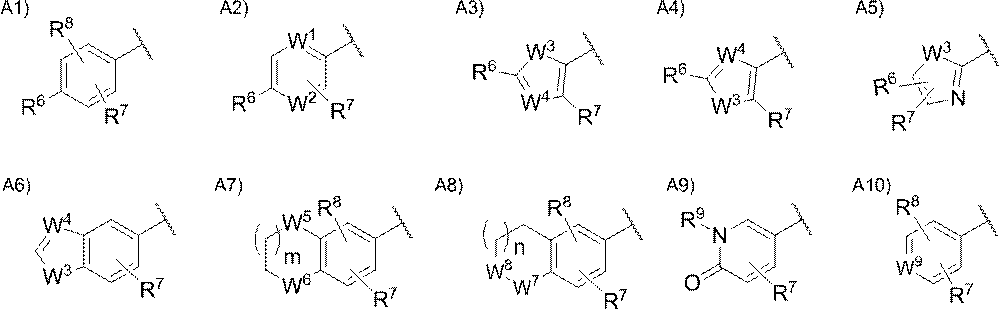

W2は、CHまたは窒素原子である。
W3は、酸素原子、硫黄原子またはC1~C6アルキル基によって置換されてもよいNHである。
W4は、CHまたは窒素原子である。
W5は、CH2、酸素原子または硫黄原子である。
W6は、C=O、CH2、CF2、CHOH、C1~C6アルキル基によって置換されてもよいNH、SO、SO2、酸素原子または硫黄原子である。
W7は、C1~C6アルキル基によって置換されてもよいNHまたはC=Oである。
W8は、W7がC1~C6アルキル基によって置換されてもよいNHのときは、C=O、W7がC=Oのときは、C1~C6アルキル基によって置換されてもよいNHである。
W9は、窒素原子またはN=Oである。
R6は、水素原子、ハロゲン原子、ヒドロキシ基、シアノ基、置換基を有しても良いC1~C6アルキル基、置換基を有しても良いC1~C6アルコキシ基、置換基を有しても良いC1~C6アシル基、置換基を有しても良いC1~C6アルキルスルファニル基、置換基を有しても良いC1~C6アルキルスルフィニル基、置換基を有しても良いC1~C6アルキルスルホニル基、置換基を有しても良い複素環基、-CONR10R11または-NR10R11であり、R6が-CONR10R11または-NR10R11であるとき、R10は、水素原子、置換基を有しても良いC1~C6アルキル基、置換基を有しても良いC1~C6アシル基、または置換基を有しても良いC1~C6アルキルスルホニル基であり、R11は、水素原子、または置換基を有しても良いC1~C6アルキル基であるか、またはR10とR11が一緒になってC3~C10ヘテロシクロアルキル基を形成してもよい。
R7は、水素原子、ハロゲン原子、置換基を有しても良いC1~C6アルキル基または置換基を有しても良いC1~C6アルキコキシ基である。
R8は、水素原子、ハロゲン原子または置換基を有しても良いC1~C6アルキル基である。
R9は、水素原子またはC1~C6アルキル基である。
mは0または1である。
nは0または1である。
Ar2がA1)である場合にR6、R7及びR8の置換基の組み合わせが水素原子とハロゲン原子の場合を除く。
W2は、好ましくは、CHまたはNである。より好ましくは、CHである。
W3は、好ましくは、酸素原子または硫黄原子である。より好ましくは、硫黄原子である。
W5は、好ましくは、CH2またはOである。
W6は、好ましくは、C=O、CH2、CF2、CHOHまたは酸素原子である。より好ましくは、C=O、CH2、CHOHまたは酸素原子であり、特に好ましくは、酸素原子である。
W9は、好ましくは、窒素原子である。
mは、好ましくは0である。
R6が-CONR10R11または-NR10R11である場合、好ましくは、R10は水素原子、C1~C6アルキル基またはC1~C6アシル基であり、R11は水素原子、C1~C6アルキル基であるか、またはR10とR11が一緒になってピロリジニル基、ピペリジニル基、ピペラジニル基またはモルホリニル基を形成してもよい。
R6は、より好ましくは、水素原子、フッ素原子、塩素原子、シアノ基、C1~C6アルコキシ基、ハロC1~C6アルコキシ基、C1~C6アルキル基、C1~C6アルキルスルファニル基、C1~C6アルキルスルフィニル基であり、特に好ましくは、シアノ基、エチル基またはC1~C3アルコキシ基である。
(-)-1-(4-フルオロフェニル)-3-[(3S*,4R*)-4-(4-メトキシフェニル)-2-オキソピロリジン-3-イル]ウレア
(-)-1-(4-クロロフェニル)-3-[(3S*,4R*)-4-(4-メトキシフェニル)-2-オキソピロリジン-3-イル]ウレア
(-)-1-(3,4-ジフルオロフェニル)-3-[(3S*,4R*)-4-(4-メトキシフェニル)-2-オキソピロリジン-3-イル]ウレア
(-)-1-(2,4-ジフルオロフェニル)-3-[(3S*,4R*)-4-(4-メトキシフェニル)-2-オキソピロリジン-3-イル]ウレア
(-)-1-(4-シアノフェニル)-3-[(3S*,4R*)-4-(4-メトキシフェニル)-2-オキソピロリジン-3-イル]ウレア
(-)-1-(4-クロロフェニル)-3-[(3S*,4R*)-4-(4-メトキシフェニル)-1-メチル-2-オキソピロリジン-3-イル]ウレア
1-(4-フルオロフェニル)-3-[(3S*,4R*)-4-(4-メトキシフェニル)-1-メチル-2-オキソピロリジン-3-イル]ウレア
(-)-1-[(3S*,4R*)-4-(3-フルオロ―4-メトキシフェニル)-2-オキソピロリジン-3-イル]-3-(4-フルオロフェニル)ウレア
(-)-1-[(3S*,4R*)-4-(2-フルオロ―4-メトキシフェニル)-2-オキソピロリジン-3-イル]-3-(4-フルオロフェニル)ウレア
1-[(3S*,4R*)-4-(2-クロロ―4-メトキシフェニル)-2-オキソピロリジン-3-イル]-3-(4-フルオロフェニル)ウレア
(-)-1-(4-フルオロフェニル)-3-[(3S*,4R*)-4-(4-メトキシ―2-メチルフェニル)-2-オキソピロリジン-3-イル]ウレア
(-)-1-[(3S*,4R*)-4-(2,6-ジフルオロ-4-メトキシフェニル)-2-オキソピロリジン-3-イル]-3-(4-フルオロフェニル)ウレア
(-)-1-[(3S*,4R*)-4-(2,5-ジフルオロ-4-メトキシフェニル)-2-オキソピロリジン-3-イル]-3-(4-フルオロフェニル)ウレア
(-)-1-[(3S*,4R*)-4-(3,5-ジフルオロ-4-メトキシフェニル)-2-オキソピロリジン-3-イル]-3-(4-フルオロフェニル)ウレア
(-)-1-[(3S*,4R*)-4-(2,3-ジヒドロベンゾフラン-5-イル)-2-オキソピロリジン-3-イル]-3-(4-フルオロフェニル)ウレア
(-)-1-[(3S*,4R*)-4-(6-フルオロ-2,3-ジヒドロベンゾフラン-5-イル)-2-オキソピロリジン-3-イル]-3-(4-フルオロフェニル)ウレア
(-)-1-[(3S*,4R*)-4-(7-フルオロクロマン-6-イル)-2-オキソピロリジン-3-イル]-3-(4-フルオロフェニル)ウレア
(-)-1-[(3S*,4R*)-4-(3-フルオロ-5-メトキシピリジン-2-イル)-2-オキソピロリジン-3-イル]-3-(4-フルオロフェニル)ウレア
(-)-1-(4-フルオロフェニル)-3-[(3S*,4R*)-4-(5-メトキシチオフェン―2-イル)-2-オキソピロリジン-3-イル]ウレア
(-)-1-(4-フルオロフェニル)-3-[(3S*,4R*)-4-(4-メチルチオフェニル)-2-オキソピロリジン-3-イル]ウレア
(-)-1-[(3S*,4R*)-4-(2,6-ジフルオロ-4-メトキシフェニル)-2-オキソピロリジン-3-イル]-3-(4-メチルスルホニルフェニル)ウレア
(-)-1-(4-クロロフェニル)-3-[(3S*,4R*)-4-(2,6-ジフルオロ-4-メトキシフェニル)-2-オキソピロリジン-3-イル]ウレア
(-)-1-(4-シアノフェニル)-3-[(3S*,4R*)-4-(2,6-ジフルオロ-4-メトキシフェニル)-2-オキソピロリジン-3-イル]ウレア
(-)-1-[(3S*,4R*)-4-(2,6-ジフルオロ-4-メトキシフェニル)-2-オキソピロリジン-3-イル]-3-(4-メトキシフェニル)ウレア
(-)-1-(ベンゾ[d][1,3]ジオキソール-5-イル)-3-[(3R*,4R*)-4-(2,6-ジフルオロ-4-メトキシフェニル)-2-オキソピロリジン-3-イル]ウレア
(-)-1-(5-クロロチアゾール-2-イル)-3-[(3S*,4R*)-4-(2,6-ジフルオロ-4-メトキシフェニル)-2-オキソピロリジン-3-イル]ウレア
(-)-1-[(3S*,4R*)-4-(2,6-ジフルオロ-4-メトキシフェニル)-2-オキソピロリジン-3-イル]-3-(ピリミジン-4-イル)ウレア
(-)-1-[(3S*,4R*)-4-(2,6-ジフルオロ-4-メトキシフェニル)-2-オキソピロリジン-3-イル]-3-(ピリジン-2-イル)ウレア
(-)-1-[(3S*,4R*)-4-(2,6-ジフルオロ-4-メトキシフェニル)-2-オキソピロリジン-3-イル]-3-(ピリジン-3-イル)ウレア
(-)-1-[(3S*,4R*)-4-(2,6-ジフルオロ-4-メトキシフェニル)-2-オキソピロリジン-3-イル]-3-(ピリミジン-5-イル)ウレア
(-)-1-(6-クロロピリジン-3-イル)-3-[(3S*,4R*)-4-(2,6-ジフルオロ-4-メトキシフェニル)-2-オキソピロリジン-3-イル]ウレア
(-)-1-(5-クロロピリジン-2-イル)-3-[(3S*,4R*)-4-(2,6-ジフルオロ-4-メトキシフェニル)-2-オキソピロリジン-3-イル]ウレア
(-)-1-[(3S*,4R*)-4-(2,6-ジフルオロ-4-メトキシフェニル)-2-オキソピロリジン-3-イル]-3-(ピラジン-2-イル)ウレア
(-)-1-(ベンゾ[d]チアゾール-2-イル)-3-[(3S*,4R*)-4-(2,6-ジフルオロ-4-メトキシフェニル)-2-オキソピロリジン-3-イル]ウレア
(-)-1-(ベンゾ[b]チオフェン-2-イル)-3-[(3S*,4R*)-4-(2,6-ジフルオロ-4-メトキシフェニル)-2-オキソピロリジン-3-イル]ウレア
(-)-1-(ベンゾ[d]オキサゾール-2-イル)-3-[(3S*,4R*)-4-(2,6-ジフルオロ-4-メトキシフェニル)-2-オキソピロリジン-3-イル]ウレア
(-)-1-[(3S*,4R*)-4-(2,6-ジフルオロ-4-メトキシフェニル)-2-オキソピロリジン-3-イル]-3-(5-メチルイソキサゾール-3-イル)ウレア
(-)-1-[(3S*,4R*)-4-(2,6-ジフルオロ-4-メトキシフェニル)-2-オキソピロリジン-3-イル]-3-(2-フルオロフェニル)ウレア
(-)-1-[(3S*,4R*)-4-(2,6-ジフルオロ-4-メトキシフェニル)-2-オキソピロリジン-3-イル]-3-(5-メチルチオフェン-2-イル)ウレア
(-)-1-(4-フルオロフェニル)-3-[(3S*,4R*,5S*)-4-(4-メトキシフェニル)-5-メチル-2-オキソピロリジン-3-イル]ウレア
(-)-1-(4-フルオロフェニル)-3-[(3S*,4R*,5R*)-4-(4-メトキシフェニル)-5-メチル-2-オキソピロリジン-3-イル]ウレア
1-[(3S*,4R*)-4-(4-エチル-2,6-ジフルオロフェニル)-2-オキソピロリジン-3-イル]-3-(4-フルオロフェニル)ウレア
(+)-1-(4-クロロフェニル)-3-[(3R*,4S*)-2-オキソ-4-フェニルピロリジン-3-イル]ウレア
(+)-1-(4-クロロフェニル)-3-[(3R*,4S*)-4-(4-メトキシフェニル)-2-オキソピロリジン-3-イル]ウレア
(+)-1-(4-クロロフェニル)-3-[(3R*,4S*)-4-(3-メトキシフェニル)-2-オキソピロリジン-3-イル]ウレア
(+)-1-(4-クロロフェニル)-3-[(3R*,4S*)--4-(2-メトキシフェニル)-2-オキソピロリジン-3-イル]ウレア
(+)-1-[(3R*,4S*)-4-(2,6-ジフルオロ-4-メトキシフェニル)-2-オキソピロリジン-3-イル]-3-(4-フルオロフェニル)ウレア
(+)-1-(4-クロロフェニル)-3-[(3R*,4S*)-4-(4-メトキシフェニル)-1-メチル-2-オキソピロリジン-3-イル]ウレア
(+)-1-(4-フルオロフェニル)-3-[(3R*,4S*,5S*)-4-(4-メトキシフェニル)-5-メチル-2-オキソピロリジン-3-イル]ウレア
(+)-1-(4-フルオロフェニル)-3-[(3R*,4S*,5R*)-4-(4-メトキシフェニル)-5-メチル-2-オキソピロリジン-3-イル]ウレア
(+)-1-(4-フルオロフェニル)-3-[(3R*,4S*)-4-(5-メトキシチオフェン―2-イル)-2-オキソピロリジン-3-イル]ウレア
(+)-1-{(3R*,4S*)-4-[4-(ジフルオロメトキシ)フェニル]-2-オキソピロリジン-3-イル}-3-(4-フルオロフェニル)ウレア
(±)-トランス-1-(4-クロロフェニル)-3-[4-(4-メトキシフェニル)-1-メチル-2-オキソピロリジン-3-イル]ウレア
(±)-トランス-1-(4-フルオロフェニル)-3-[4-(4-メトキシフェニル)-2-オキソピロリジン-3-イル]ウレア
(±)-トランス-1-(4-クロロフェニル)-3-[4-(4-メトキシフェニル)-1-メチル-2-オキソピロリジン-3-イル]ウレア
(+)-トランス-1-(4-フルオロフェニル)-3-[4-(4-メトキシフェニル)-5,5-ジメチル-2-オキソピロリジン-3-イル]ウレア
(-)-トランス-1-(4-フルオロフェニル)-3-[4-(4-メトキシフェニル)-5,5-ジメチル-2-オキソピロリジン-3-イル]ウレア
(+)-トランス-1-(4-フルオロフェニル)-3-[4-(4-メトキシフェニル)-2-オキソ-1-アザスピロ[4.4]ノナン-3-イル]ウレア
(-)-トランス-1-(4-フルオロフェニル)-3-[4-(4-メトキシフェニル)-2-オキソ-1-アザスピロ[4.4]ノナン-3-イル]ウレア
(+)-トランス-1-(4-フルオロフェニル)-3-[4-(4-メトキシフェニル)-2-オキソ-1-アザスピロ[4.5]デカン-3-イル]ウレア
(-)-トランス-1-(4-フルオロフェニル)-3-[4-(4-メトキシフェニル)-2-オキソ-1-アザスピロ[4.5]デカン-3-イル]ウレア
(-)-1-(4-フルオロフェニル)-3-[(3S*,4R*)-4-(4-メチルスルフィニルフェニル)-2-オキソピロリジン-3-イル]ウレア
(-)-1-(4-フルオロフェニル)-3-[(3S*,4R*)-4-(4-メチルスルホニルフェニル)-2-オキソピロリジン-3-イル]ウレア
(-)-1-[(3S*,4R*)-4-(2,6-ジフルオロ-4-メトキシフェニル)-2-オキソピロリジン-3-イル]-3-[4-(トリフルオロメトキシ)フェニル]ウレア
(-)-1-[(3S*,4R*)-4-(2,6-ジフルオロ-4-メトキシフェニル)-2-オキソピロリジン-3-イル]-3-フェニルウレア
(-)-1-[4-(tert-ブチル)フェニル]-3-[(3S*,4R*)-4-(2,6-ジフルオロ-4-メトキシフェニル)-2-オキソピロリジン-3-イル]ウレア
(-)-4-{3-[(3S*,4R*)-4-(2,6-ジフルオロ-4-メトキシフェニル)-2-オキソピロリジン-3-イル]ウレイド}安息香酸エチル
(-)-1-[(1,1’-ビフェニル)-4-イル]-3-[(3S*,4R*)-4-(2,6-ジフルオロ-4-メトキシフェニル)-2-オキソピロリジン-3-イル]ウレア
(-)-1-(4-アセチルフェニル)-3-[(3S*,4R*)-4-(2,6-ジフルオロ-4-メトキシフェニル)-2-オキソピロリジン-3-イル]ウレア
(-)-1-[(3S*,4R*)-4-(2,6-ジフルオロ-4-メトキシフェニル)-2-オキソピロリジン-3-イル]-3-(4-フェノキシフェニル)ウレア
(-)-1-[(3S*,4R*)-4-(2,6-ジフルオロ-4-メトキシフェニル)-2-オキソピロリジン-3-イル]-3-(3-フルオロフェニル)ウレア
(-)-1-[(3S*,4R*)-4-(2,6-ジフルオロ-4-メトキシフェニル)-2-オキソピロリジン-3-イル]-3-(3,4-ジフルオロフェニル)ウレア
(-)-1-(5-クロロチオフェン-2-イル)-3-[(3S*,4R*)-4-(2,6-ジフルオロ-4-メトキシフェニル)-2-オキソピロリジン-3-イル]ウレア
(-)-1-[(3S*,4R*)-4-(2,6-ジフルオロ-4-メトキシフェニル)-2-オキソピロリジン-3-イル]-3-(p-トリル)ウレア
(-)-1-[(3S*,4R*)-4-(2,6-ジフルオロ-4-メトキシフェニル)-2-オキソピロリジン-3-イル]-3-[4-(ヒドロキシメチル)フェニル]ウレア
(-)-4-{3-[(3S*,4R*)-4-(2,6-ジフルオロ-4-メトキシフェニル)-2-オキソピロリジン-3-イル]ウレイド}-N-メチルベンズアミド
(-)-1-[(3S*,4R*)-1-エチル-4-(4-メトキシフェニル)-2-オキソピロリジン-3-イル]-3-(4-フルオロフェニル)ウレア
2-{(3S*,4R*)-3-[3-(4-フルオロフェニル)ウレイド]-4-(4-メトキシフェニル)-2-オキソピロリジン-1-イル}酢酸エチル
2-{(3S*,4R*)-3-[3-(4-フルオロフェニル)ウレイド]-4-(4-メトキシフェニル)-2-オキソピロリジン-1-イル}-2-メチルプロピオン酸エチル
(-)-1-(4-フルオロフェニル)-3-[(3S*,4R*)-1-(1-ヒドロキシ-2-メチルプロパン-2-イル)-4-(4-メトキシフェニル)-2-オキソピロリジン-3-イル]ウレア
(-)-2-{(3S*,4R*)-3-[3-(4-フルオロフェニル)ウレイド]-4-(4-メトキシフェニル)-2-オキソピロリジン-1-イル}プロピオン酸エチル(異性体A)
(-)-2-{(3S*,4R*)-3-[3-(4-フルオロフェニル)ウレイド]-4-(4-メトキシフェニル)-2-オキソピロリジン-1-イル}プロピオン酸エチル(異性体B)
(±)-トランス-1-(4-クロロフェニル)-3-[1-(2-ヒドロキシエチル)-4-(4-メトキシフェニル)-2-オキソピロリジン-3-イル]ウレア
(+)-トランス-1-(4-クロロフェニル)-3-[1-(2-ヒドロキシエチル)-4-(4-メトキシフェニル)-2-オキソピロリジン-3-イル]ウレア
(-)-トランス-1-(4-クロロフェニル)-3-[1-(2-ヒドロキシエチル)-4-(4-メトキシフェニル)-2-オキソピロリジン-3-イル]ウレア
(-)-2-{(3S*,4R*)-3-[3-(4-フルオロフェニル)ウレイド]-4-(4-メトキシフェニル)-2-オキソピロリジン-1-イル}酢酸
(-)-2-{(3S*,4R*)-3-[3-(4-フルオロフェニル)ウレイド]-4-(4-メトキシフェニル)-2-オキソピロリジン-1-イル}-N-メチルアセトアミド
(-)-2-{(3S*,4R*)-3-[3-(4-フルオロフェニル)ウレイド]-4-(4-メトキシフェニル)-2-オキソピロリジン-1-イル}プロピオン酸(異性体A)
(-)-2-{(3S*,4R*)-3-[3-(4-フルオロフェニル)ウレイド]-4-(4-メトキシフェニル)-2-オキソピロリジン-1-イル}-N-メチルプロピオン酸アミド(異性体A)
(-)-2-{(3S*,4R*)-3-[3-(4-フルオロフェニル)ウレイド]-4-(4-メトキシフェニル)-2-オキソピロリジン-1-イル}プロピオン酸(異性体B)
(-)-2-{(3S*,4R*)-3-[3-(4-フルオロフェニル)ウレイド]-4-(4-メトキシフェニル)-2-オキソピロリジン-1-イル}-N-メチルプロピオン酸アミド(異性体B)
2-{(3S*,4R*)-3-[3-(4-フルオロフェニル)ウレイド]-4-(4-メトキシフェニル)-2-オキソピロリジン-1-イル}-2-メチルプロピオン酸
(-)-2-{(3S*,4R*)-3-[3-(4-フルオロフェニル)ウレイド]-4-(4-メトキシフェニル)-2-オキソピロリジン-1-イル}-N,2-ジメチルプロピオン酸アミド
(-)-1-[(3S*,4R*)-4-(2,6-ジフルオロ-4-メトキシフェニル)-1-メチル-2-オキソピロリジン-3-イル]-3-(4-フルオロフェニル)ウレア
(-)-1-[(3S*,4R*)-4-(2-フルオロ―4-メトキシフェニル)-1-(2-ヒドロキシエチル)-2-オキソピロリジン-3-イル]-3-(4-フルオロフェニル)ウレア
(-)-1-[(3S*,4R*)-4-(2,6-ジフルオロ-4-メトキシフェニル)-1-(2-ヒドロキシエチル)-2-オキソピロリジン-3-イル]-3-(4-フルオロフェニル)ウレア
(+)-1-(4-フルオロフェニル)-3-[(3R*,4S*)-1-メトキシ-4-(4-メトキシフェニル)-2-オキソピロリジン-3-イル]ウレア
(-)-1-[(3S*,4R*)-4-(2,6-ジフルオロ-4-ヒドロキシフェニル)-2-オキソピロリジン-3-イル]-3-(4-フルオロフェニル)ウレア
(-)-3,5-ジフルオロ-4-{(3R*,4S*)-4-[3-(4-フルオロフェニル)ウレイド]-5-オキソピロリジン-3-イル}-N,N-ジメチルベンズアミド
(-)-3,5-ジフルオロ-4-{(3R*,4S*)-4-[3-(4-フルオロフェニル)ウレイド]-5-オキソピロリジン-3-イル}-N-メチルベンズアミド
(-)-1-[(3S*,4R*)-4-(4-シアノ-2,6-ジフルオロフェニル)-2-オキソピロリジン-3-イル]-3-(4-フルオロフェニル)ウレア
(-)-3,5-ジフルオロ-4-{(3R*,4S*)-4-[3-(4-フルオロフェニル)ウレイド]-5-オキソピロリジン-3-イル}ベンズアミド
(-)-1-(4-フルオロフェニル)-3-[(3S*,4R*,Z)-2-(メトキシイミノ)-4-(4-メトキシフェニル)ピロリジン-3-イル]ウレア
(-)-1-[(3S*,4R*,Z)-4-(2-フルオロ-4-メトキシフェニル)-2-(メトキシイミノ)ピロリジン-3-イル]-3-(4-フルオロフェニル)ウレア
(-)-1-[(3S*,4R*,Z)-4-(2,6-ジフルオロ-4-メトキシフェニル)-2-(メトキシイミノ)ピロリジン-3-イル]-3-(4-フルオロフェニル)ウレア
(-)-1-(4-フルオロフェニル)-3-{(3S*,4R*,Z)-2-[(2-ヒドロキシエトキシ)イミノ]-4-(4-メトキシフェニル)ピロリジン-3-イル}ウレア
(-)-1-{(3S*,4R*,Z)-4-(2,6-ジフルオロ-4-メトキシフェニル)-2-[(2-ヒドロキシエトキシ)イミノ]ピロリジン-3-イル}-3-(4-フルオロフェニル)ウレア
(-)-1-[(3S*,4R*,Z)-4-(2,6-ジフルオロ-4-メトキシフェニル)-2-(メチルイミノ)ピロリジン-3-イル]-3-(4-フルオロフェニル)ウレア
(+)-1-(4-フルオロフェニル)-3-[(3R*,4S*,Z)-2-(メトキシイミノ)-4-(4-メトキシフェニル)ピロリジン-3-イル]ウレア
(-)-1-(4-フルオロフェニル)-3-[(3S*,4R*,Z)-2-(2-ヒドロキシイミノ)-4-(4-メトキシフェニル)ピロリジン-3-イル]ウレア
1-[(3S*,4R*)-4-(2,6-ジフルオロ-4-メトキシフェニル)-2-オキソピロリジン-3-イル]-3-(3-ヒドロキシフェニル)ウレア
(-)-1-[(3S*,4R*)-4-(2,6-ジフルオロ―4-メトキシフェニル)-2-オキソピロリジン-3-イル]-3-(3-メチルイソチアゾール-5-イル)ウレア
(-)-1-(4-シクロプロピルフェニル)-3-[(3S*,4R*)-4-(2,6-ジフルオロ―4-メトキシフェニル)-2-オキソピロリジン-3-イル]ウレア
(-)-1-[(3S*,4R*)-4-(2,6-ジフルオロ―4-メトキシフェニル)-2-オキソピロリジン-3-イル]-3-[4-(トリフルオロメチル)フェニル]ウレア
(-)-1-[(3S*,4R*)-4-(2,6-ジフルオロ―4-メトキシフェニル)-2-オキソピロリジン-3-イル]-3-(3-ヒドロキシ-4-メチルフェニル)ウレア
(-)-1-[(3S*,4R*)-4-(2,6-ジフルオロ―4-メトキシフェニル)-2-オキソピロリジン-3-イル]-3-(4-フルオロ-3-ヒドロキシフェニル)ウレア
(-)-1-(4-クロロ-3-ヒドロキシフェニル)-3-[(3S*,4R*)-4-(2,6-ジフルオロ―4-メトキシフェニル)-2-オキソピロリジン-3-イル]ウレア
1-(4-シアノ-3-ヒドロキシフェニル)-3-[(3S*,4R*)-4-(2,6-ジフルオロ―4-メトキシフェニル)-2-オキソピロリジン-3-イル]ウレア
1-{(3S*,4R*)-4-[4-(ジフルオロメトキシ)-2,6-ジフルオロフェニル]-2-オキソピロリジン-3-イル}-3-(4-フルオロフェニル)ウレア
(-)-1-[(3S*,4R*)-4-(6-フルオロベンゾフラン-5-イル)-2-オキソピロリジン-3-イル]-3-(4-フルオロフェニル)ウレア
1-[(3S*,4R*)-4-(4,6-ジフルオロ-2,3-ジヒドロベンゾフラン-5-イル)-2-オキソピロリジン-3-イル]-3-(4-フルオロフェニル)ウレア
(-)-1-(4-シアノフェニル)-3-[(3S*,4R*)-4-(6-フルオロ-2,3-ジヒドロベンゾフラン-5-イル)-2-オキソピロリジン-3-イル]ウレア
(-)-1-(ベンゾ[b]チオフェン-2-イル)-3-[(3S*,4R*)-4-(6-フルオロ-2,3-ジヒドロベンゾフラン-5-イル)-2-オキソピロリジン-3-イル]ウレア
(-)-1-[(3S*,4R*)-4-(2,6-ジフルオロ-4-メトキシフェニル)-2-オキソピロリジン-3-イル]-3-(4-エチルフェニル)ウレア
(-)-1-(3-シアノフェニル)-3-[(3S*,4R*)-4-(2,6-ジフルオロ―4-メトキシフェニル)-2-オキソピロリジン-3-イル]ウレア
(-)-1-(5-クロロチオフェン-2-イル)-3-[(3S*,4R*)-4-(3-フルオロ-5-メトキシピリジン-2-イル)-2-オキソピロリジン-3-イル]ウレア
(-)-1-(4-クロロフェニル)-3-[4-(4-メトキシフェニル)-2-オキソピロリジン-3-イル]ウレア
(+)-1-(4-クロロフェニル)-3-[4-(4-メトキシフェニル)-2-オキソピロリジン-3-イル]ウレア
(+)-1-(4-フルオロフェニル)-3-[4-(4-メトキシフェニル)-2-オキソピロリジン-3-イル]ウレア
(+)-1-(4-フルオロフェニル)-3-[1-(2-ヒドロキシエチル)-4-(4-メトキシフェニル)-2-オキソピロリジン-3-イル]ウレア
(-)-2-{(3S*,4R*)-4-(2,6-ジフルオロ-4-メトキシフェニル)-3-[3-(4-フルオロフェニル)ウレイド]-2-オキソピロリジン-1-イル}酢酸
(-)-2-{(3S*,4R*)-4-(6-フルオロ-2,3-ジヒドロベンゾフラン-5-イル)-3-[3-(4-フルオロフェニル)ウレイド]-2-オキソピロリジン-1-イル}酢酸
(-)-2-{(3S*,4R*)-4-(2,6-ジフルオロ-4-メトキシフェニル)-3-[3-(4-フルオロフェニル)ウレイド]-2-オキソピロリジン-1-イル}-N-メチルアセタミド
(-)-2-{(3S*,4R*)-4-(6-フルオロ-2,3-ジヒドロベンゾフラン-5-イル)-3-[3-(4-フルオロフェニル)ウレイド]-2-オキソピロリジン-1-イル}アセトアミド
(-)-2-{(3S*,4R*)-4-(6-フルオロ-2,3-ジヒドロベンゾフラン-5-イル)-3-[3-(4-フルオロフェニル)ウレイド]-2-オキソピロリジン-1-イル}-2-メチルプロパン酸
(-)-1-(4-シアノフェニル)-3-[(3S*,4R*)-4-(2,6-ジフルオロ―4-メトキシフェニル)-1-メチル-2-オキソピロリジン-3-イル]ウレア
(-)-1-(6-クロロピリジン-3-イル)-3-[(3S*,4R*)-4-(2,6-ジフルオロ―4-メトキシフェニル)-1-メチル-2-オキソピロリジン-3-イル]ウレア
(-)-1-(ベンゾ[b]チオフェン-2-イル)-3-[(3S*,4R*)-4-(2,6-ジフルオロ―4-メトキシフェニル)-1-メチル-2-オキソピロリジン-3-イル]ウレア
(-)-1-[(3S*,4R*)-4-(2,6-ジフルオロ-4-メトキシフェニル)-1-(2-ヒドロキシエチル)-2-オキソピロリジン-3-イル]-3-フェニルウレア
(-)-1-[(3S*,4R*)-4-(2,6-ジフルオロ-4-メトキシフェニル)-1-(2-ヒドロキシエチル)-2-オキソピロリジン-3-イル]-3-(p-トリル)ウレア
(-)-1-(4-シアノフェニル)-3-[(3S*,4R*)-4-(2,6-ジフルオロ―4-メトキシフェニル)-1-(2-ヒドロキシエチル)-2-オキソピロリジン-3-イル]ウレア
(-)-1-(6-クロロピリジン-3-イル)-3-[(3S*,4R*)-4-(2,6-ジフルオロ―4-メトキシフェニル)-1-(2-ヒドロキシエチル)-2-オキソピロリジン-3-イル]ウレア
(-)-1-(ベンゾ[b]チオフェン-2-イル)-3-[(3S*,4R*)-4-(2,6-ジフルオロ―4-メトキシフェニル)-1-(2-ヒドロキシエチル)-2-オキソピロリジン-3-イル]ウレア
(-)-1-[(3S*,4R*)-4-(2,6-ジフルオロ-4-メトキシフェニル)-2-オキソ-1-プロピルピロリジン-3-イル]-3-(4-フルオロフェニル)ウレア
(-)-1-[(3S*,4R*)-1-ベンジル-4-(2,6-ジフルオロ-4-メトキシフェニル)-2-オキソピロリジン-3-イル]-3-(4-フルオロフェニル)ウレア
(-)-1-[(3S*,4R*)-4-(2,6-ジフルオロ-4-メトキシフェニル)-2-オキソ-1-(ピリジン-3-イルメチル)ピロリジン-3-イル]-3-(4-フルオロフェニル)ウレア
(-)-1-{(3S*,4R*)-4-(2,6-ジフルオロ-4-メトキシフェニル)-1-[(メチルスルホニル)メチル]-2-オキソピロリジン-3-イル}-3-(4-フルオロフェニル)ウレア
(-)-{(3S*,4R*)-4-(2,6-ジフルオロ-4-メトキシフェニル)-3-[3-(4-フルオロフェニル)ウレイド]-2-オキソピロリジン-1-イル}メタンスルホンアミド
(-)-2-{(3S*,4R*)-4-(2,6-ジフルオロ-4-メトキシフェニル)-3-[3-(4-フルオロフェニル)ウレイド]-2-オキソピロリジン-1-イル}酢酸エチル
(-)-1-{(3S*,4R*)-4-(2,6-ジフルオロ-4-メトキシフェニル)-1-[(5-メチルオキサゾール-2-イル)メチル]-2-オキソピロリジン-3-イル}-3-(4-フルオロフェニル)ウレア
(-)-1-{(3S*,4R*)-4-(2,6-ジフルオロ-4-メトキシフェニル)-1-[(5-メチル-1,3,4-オキサジアゾール-2-イル)メチル]-2-オキソピロリジン-3-イル}-3-(4-フルオロフェニル)ウレア
(-)-1-[(3S*,4R*)-4-(6-フルオロ-2,3-ジヒドロベンゾフラン-5-イル)-1-(2-ヒドロキシエチル)-2-オキソピロリジン-3-イル]-3-(4-フルオロフェニル)ウレア
(-)-2-{(3S*,4R*)-4-(6-フルオロ-2,3-ジヒドロベンゾフラン-5-イル)-3-[3-(4-フルオロフェニル)ウレイド]-2-オキソピロリジン-1-イル}酢酸エチル
(-)-2-{(3S*,4R*)-4-(6-フルオロ-2,3-ジヒドロベンゾフラン-5-イル)-3-[3-(4-フルオロフェニル)ウレイド]-2-オキソピロリジン-1-イル}-2-メチルプロパン酸エチル
(-)-1-[(3S*,4R*)-1-(シクロプロピルメチル)-4-(6-フルオロ-2,3-ジヒドロベンゾフラン-5-イル)-2-オキソピロリジン-3-イル]-3-(4-フルオロフェニル)ウレア
(-)-1-[(3S*,4R*)-1-(シアノメチル)-4-(6-フルオロ-2,3-ジヒドロベンゾフラン-5-イル)-2-オキソピロリジン-3-イル]-3-(4-フルオロフェニル)ウレア
(-)-1-{(3S*,4R*)-4-(6-フルオロ-2,3-ジヒドロベンゾフラン-5-イル)-1-[(5-メチル-1,3,4-オキサジアゾール-2-イル)メチル]-2-オキソピロリジン-3-イル}-3-(4-フルオロフェニル)ウレア
(-)-1-[(3S*,4R*)-4-(2,6-ジフルオロ-4-メトキシフェニル)-1-メトキシ-2-オキソピロリジン-3-イル]-3-(4-フルオロフェニル)ウレア
1-[(3S*,4R*)-4-(2,6-ジフルオロ-4-ヒドロキシフェニル)-2-オキソピロリジン-3-イル]-3-(4-フルオロフェニル)ウレア
(-)-1-[(3S*,4R*,Z)-4-(2,6-ジフルオロ-4-メトキシフェニル)-2-(メトキシイミノ)ピロリジン-3-イル]-3-(p-トリル)ウレア
(-)-1-(4-シアノフェニル)-3-[(3S*,4R*,Z)-4-(2,6-ジフルオロ-4-メトキシフェニル)-2-(メトキシイミノ)ピロリジン-3-イル]ウレア
(-)-1-(6-クロロピリジン-3-イル)-3-[(3S*,4R*,Z)-4-
(2,6-ジフルオロ-4-メトキシフェニル)-2-(メトキシイミノ)ピロリジン-3-イル]ウレア
(-)-1-(ベンゾ[b]チオフェン-2-イル)-3-[(3S*,4R*,Z)-4-(2,6-ジフルオロ-4-メトキシフェニル)-2-(メトキシイミノ)ピロリジン-3-イル]ウレア
(-)-1-{(3S*,4R*,Z)-4-(2,6-ジフルオロ-4-メトキシフェニル)-2-[(2-ヒドロキシエトキシ)イミノ]ピロリジン-3-イル}-3-(p-トリル)ウレア
(-)-1-(4-シアノフェニル)-3-{(3S*,4R*,Z)-4-(2,6-ジフルオロ-4-メトキシフェニル)-2-[(2-ヒドロキシエトキシ)イミノ]ピロリジン-3-イル}ウレア
(-)-1-(6-クロロピリジン-3-イル)-3-{(3S*,4R*,Z)-4-
(2,6-ジフルオロ-4-メトキシフェニル)-2-[(2-ヒドロキシエトキシ)イミノ]ピロリジン-3-イル}ウレア
(-)-1-(ベンゾ[b]チオフェン-2-イル)-3-{(3S*,4R*,Z)-4-(2,6-ジフルオロ-4-メトキシフェニル)-2-[(2-ヒドロキシエトキシ)イミノ]ピロリジン-3-イル}ウレア
(-)-1-{(3R*,4S*)-3-(2,6-ジフルオロ-4-メトキシフェニル)-5-[(1-メチル-1H-ピラゾール-3-イル)アミノ]-3,4-ジヒドロ-2H-ピロール-4-イル}-3-(4-フルオロフェニル)ウレア
(-)-1-[(3S*,4R*,Z)-4-(2,6-ジフルオロ-4-メトキシフェニル)-2-(モルホリノイミノ)ピロリジン-3-イル]-3-(4-フルオロフェニル)ウレア
1-[(3R*,4S*)-3-(2,6-ジフルオロ-4-メトキシフェニル)-5-(フェニルアミノ)-3,4-ジヒドロ-2H-ピロール-4-イル]-3-(4-フルオロフェニル)ウレア
(-)-1-((3S*,4R*,Z)-4-(6-フルオロ-2,3-ジヒドロベンゾフラン-5-イル)-2-[(2-ヒドロキシエトキシ)イミノ]ピロリジン-3-イル)-3-(4-フルオロフェニル)ウレア
3-((Z)-{(3S,4R)-4-(2,6-ジフルオロ-4-メトキシフェニル)-3-[3-(4-フルオロフェニル)ウレイド]ピロリジン-2-イリデン}アミノ)プロパン酸エチル
(-)-1-((3S*,4R*,Z)-4-(2,6-ジフルオロ-4-メトキシフェニル)-2-(ヒドロキシイミノ)ピロリジン-3-イル)-3-(4-フルオロフェニル)ウレア
(-)-1-[(3S*,4R*)-4-(2,6-ジフルオロ―4-メトキシフェニル)-2-オキソピロリジン-3-イル]-3-(4-エチニルフェニル)ウレア
(-)-1-{(3S*,4R*)-4-[2,6-ジフルオロ―4-(メチルアミノ)フェニル]-2-オキソピロリジン-3-イル}-3-(4-フルオロフェニル)ウレア
(-)-1-(4-フルオロフェニル)-3-[(3S*,4R*,Z)-2-(メトキシイミノ)-4-(4-メトキシフェニル)ピロリジン-3-イル]ウレア
(-)-1-(4-フルオロフェニル)-3-[(3S*,4R*)-4-(4-メトキシフェニル)-2-オキソピロリジン-3-イル]ウレア
(-)-1-(4-クロロフェニル)-3-[(3S*,4R*)-4-(4-メトキシフェニル)-2-オキソピロリジン-3-イル]ウレア
(-)-1-(3,4-ジフルオロフェニル)-3-[(3S*,4R*)-4-(4-メトキシフェニル)-2-オキソピロリジン-3-イル]ウレア
(-)-1-(4-シアノフェニル)-3-[(3S*,4R*)-4-(4-メトキシフェニル)-2-オキソピロリジン-3-イル]ウレア
(-)-1-(4-クロロフェニル)-3-[(3S*,4R*)-4-(4-メトキシフェニル)-1-メチル-2-オキソピロリジン-3-イル]ウレア
(-)-1-(4-フルオロフェニル)-3-[(3S*,4R*)-4-(4-メトキシフェニル)-1-メチル-2-オキソピロリジン-3-イル]ウレア
(-)-1-[(3S*,4R*)-4-(3-フルオロ―4-メトキシフェニル)-2-オキソピロリジン-3-イル]-3-(4-フルオロフェニル)ウレア
(-)-1-[(3S*,4R*)-4-(2-フルオロ―4-メトキシフェニル)-2-オキソピロリジン-3-イル]-3-(4-フルオロフェニル)ウレア
1-[(3S*,4R*)-4-(2-クロロ―4-メトキシフェニル)-2-オキソピロリジン-3-イル]-3-(4-フルオロフェニル)ウレア
(-)-1-(4-フルオロフェニル)-3-[(3S*,4R*)-4-(4-メトキシ―2-メチルフェニル)-2-オキソピロリジン-3-イル]ウレア
(-)-1-[(3S*,4R*)-4-(2,6-ジフルオロ-4-メトキシフェニル)-2-オキソピロリジン-3-イル]-3-(4-フルオロフェニル)ウレア
(-)-1-[(3S*,4R*)-4-(2,5-ジフルオロ-4-メトキシフェニル)-2-オキソピロリジン-3-イル]-3-(4-フルオロフェニル)ウレア
(-)-1-[(3S*,4R*)-4-(3,5-ジフルオロ-4-メトキシフェニル)-2-オキソピロリジン-3-イル]-3-(4-フルオロフェニル)ウレア
(-)-1-[(3S*,4R*)-4-(6-フルオロ-2,3-ジヒドロベンゾフラン-5-イル)-2-オキソピロリジン-3-イル]-3-(4-フルオロフェニル)ウレア
(-)-1-[(3S*,4R*)-4-(3-フルオロ-5-メトキシピリジン-2-イル)-2-オキソピロリジン-3-イル]-3-(4-フルオロフェニル)ウレア
(-)-1-(4-フルオロフェニル)-3-[(3S*,4R*)-4-(5-メトキシチオフェン―2-イル)-2-オキソピロリジン-3-イル]ウレア
(-)-1-(4-フルオロフェニル)-3-[(3S*,4R*)-4-(4-メチルチオフェニル)-2-オキソピロリジン-3-イル]ウレア
(-)-1-(4-クロロフェニル)-3-[(3S*,4R*)-4-(2,6-ジフルオロ-4-メトキシフェニル)-2-オキソピロリジン-3-イル]ウレア
(-)-1-(4-シアノフェニル)-3-[(3S*,4R*)-4-(2,6-ジフルオロ-4-メトキシフェニル)-2-オキソピロリジン-3-イル]ウレア
(-)-1-[(3S*,4R*)-4-(2,6-ジフルオロ-4-メトキシフェニル)-2-オキソピロリジン-3-イル]-3-(4-メトキシフェニル)ウレア
(-)-1-(5-クロロチアゾール-2-イル)-3-[(3S*,4R*)-4-(2,6-ジフルオロ-4-メトキシフェニル)-2-オキソピロリジン-3-イル]ウレア
(-)-1-(6-クロロピリジン-3-イル)-3-[(3S*,4R*)-4-(2,6-ジフルオロ-4-メトキシフェニル)-2-オキソピロリジン-3-イル]ウレア
(-)-1-(5-クロロピリジン-2-イル)-3-[(3S*,4R*)-4-(2,6-ジフルオロ-4-メトキシフェニル)-2-オキソピロリジン-3-イル]ウレア
(-)-1-(ベンゾ[b]チオフェン-2-イル)-3-[(3S*,4R*)-4-(2,6-ジフルオロ-4-メトキシフェニル)-2-オキソピロリジン-3-イル]ウレア
(-)-1-[(3S*,4R*)-4-(2,6-ジフルオロ-4-メトキシフェニル)-2-オキソピロリジン-3-イル]-3-(5-メチルチオフェン-2-イル)ウレア
(-)-1-(4-フルオロフェニル)-3-[(3S*,4R*,5S*)-4-(4-メトキシフェニル)-5-メチル-2-オキソピロリジン-3-イル]ウレア
(-)-1-(4-フルオロフェニル)-3-[(3S*,4R*,5R*)-4-(4-メトキシフェニル)-5-メチル-2-オキソピロリジン-3-イル]ウレア
(+)-1-(4-クロロフェニル)-3-[(3R*,4S*)-2-オキソ-4-フェニルピロリジン-3-イル]ウレア
(±)-トランス-1-(4-クロロフェニル)-3-[4-(4-メトキシフェニル)-1-メチル-2-オキソピロリジン-3-イル]ウレア
(±)-トランス-1-(4-フルオロフェニル)-3-[4-(4-メトキシフェニル)-2-オキソピロリジン-3-イル]ウレア
(±)-トランス-1-(4-クロロフェニル)-3-[4-(4-メトキシフェニル)-1-メチル-2-オキソピロリジン-3-イル]ウレア
(-)-1-[(3S*,4R*)-4-(2,6-ジフルオロ-4-メトキシフェニル)-2-オキソピロリジン-3-イル]-3-[4-(トリフルオロメトキシ)フェニル]ウレア
(-)-1-[(3S*,4R*)-4-(2,6-ジフルオロ-4-メトキシフェニル)-2-オキソピロリジン-3-イル]-3-フェニルウレア
(-)-1-[(3S*,4R*)-4-(2,6-ジフルオロ-4-メトキシフェニル)-2-オキソピロリジン-3-イル]-3-(4-フェノキシフェニル)ウレア
(-)-1-[(3S*,4R*)-4-(2,6-ジフルオロ-4-メトキシフェニル)-2-オキソピロリジン-3-イル]-3-(3-フルオロフェニル)ウレア
(-)-1-[(3S*,4R*)-4-(2,6-ジフルオロ-4-メトキシフェニル)-2-オキソピロリジン-3-イル]-3-(3,4-ジフルオロフェニル)ウレア
(-)-1-(5-クロロチオフェン-2-イル)-3-[(3S*,4R*)-4-(2,6-ジフルオロ-4-メトキシフェニル)-2-オキソピロリジン-3-イル]ウレア
(-)-1-[(3S*,4R*)-4-(2,6-ジフルオロ-4-メトキシフェニル)-2-オキソピロリジン-3-イル]-3-(p-トリル)ウレア
(-)-1-[(3S*,4R*)-1-エチル-4-(4-メトキシフェニル)-2-オキソピロリジン-3-イル]-3-(4-フルオロフェニル)ウレア
(-)-1-(4-フルオロフェニル)-3-[(3S*,4R*)-1-(1-ヒドロキシ-2-メチルプロパン-2-イル)-4-(4-メトキシフェニル)-2-オキソピロリジン-3-イル]ウレア
(±)-トランス-1-(4-クロロフェニル)-3-[1-(2-ヒドロキシエチル)-4-(4-メトキシフェニル)-2-オキソピロリジン-3-イル]ウレア
(+)-トランス-1-(4-クロロフェニル)-3-[1-(2-ヒドロキシエチル)-4-(4-メトキシフェニル)-2-オキソピロリジン-3-イル]ウレア
(-)-トランス-1-(4-クロロフェニル)-3-[1-(2-ヒドロキシエチル)-4-(4-メトキシフェニル)-2-オキソピロリジン-3-イル]ウレア
(-)-2-{(3S*,4R*)-3-[3-(4-フルオロフェニル)ウレイド]-4-(4-メトキシフェニル)-2-オキソピロリジン-1-イル}-N-メチルアセトアミド
(-)-2-{(3S*,4R*)-3-[3-(4-フルオロフェニル)ウレイド]-4-(4-メトキシフェニル)-2-オキソピロリジン-1-イル}プロピオン酸(異性体A)
(-)-2-{(3S*,4R*)-3-[3-(4-フルオロフェニル)ウレイド]-4-(4-メトキシフェニル)-2-オキソピロリジン-1-イル}-N-メチルプロピオン酸アミド(異性体A)
(-)-2-{(3S*,4R*)-3-[3-(4-フルオロフェニル)ウレイド]-4-(4-メトキシフェニル)-2-オキソピロリジン-1-イル}プロピオン酸(異性体B)
(-)-2-{(3S*,4R*)-3-[3-(4-フルオロフェニル)ウレイド]-4-(4-メトキシフェニル)-2-オキソピロリジン-1-イル}-N-メチルプロピオン酸アミド(異性体B)
(-)-2-{(3S*,4R*)-3-[3-(4-フルオロフェニル)ウレイド]-4-(4-メトキシフェニル)-2-オキソピロリジン-1-イル}-N,2-ジメチルプロピオン酸アミド
(-)-1-[(3S*,4R*)-4-(2,6-ジフルオロ-4-メトキシフェニル)-1-メチル-2-オキソピロリジン-3-イル]-3-(4-フルオロフェニル)ウレア
(-)-1-[(3S*,4R*)-4-(2-フルオロ-4-メトキシフェニル)-1-(2-ヒドロキシエチル)-2-オキソピロリジン-3-イル]-3-(4-フルオロフェニル)ウレア
(-)-1-[(3S*,4R*)-4-(2,6-ジフルオロ-4-メトキシフェニル)-1-(2-ヒドロキシエチル)-2-オキソピロリジン-3-イル]-3-(4-フルオロフェニル)ウレア
(+)-1-(4-フルオロフェニル)-3-[(3R*,4S*)-1-メトキシ-4-(4-メトキシフェニル)-2-オキソピロリジン-3-イル]ウレア
(-)-3,5-ジフルオロ-4-{(3R*,4S*)-4-[3-(4-フルオロフェニル)ウレイド]-5-オキソピロリジン-3-イル}ベンズアミド
(-)-1-(4-フルオロフェニル)-3-[(3S*,4R*,Z)-2-(メトキシイミノ)-4-(4-メトキシフェニル)ピロリジン-3-イル]ウレア
(-)-1-[(3S*,4R*,Z)-4-(2-フルオロ-4-メトキシフェニル)-2-(メトキシイミノ)ピロリジン-3-イル]-3-(4-フルオロフェニル)ウレア
(-)-1-[(3S*,4R*,Z)-4-(2,6-ジフルオロ-4-メトキシフェニル)-2-(メトキシイミノ)ピロリジン-3-イル]-3-(4-フルオロフェニル)ウレア
(-)-1-(4-フルオロフェニル)-3-{(3S*,4R*,Z)-2-[(2-ヒドロキシエトキシ)イミノ]-4-(4-メトキシフェニル)ピロリジン-3-イル}ウレア
(-)-1-{(3S*,4R*,Z)-4-(2,6-ジフルオロ-4-メトキシフェニル)-2-[(2-ヒドロキシエトキシ)イミノ]ピロリジン-3-イル}-3-(4-フルオロフェニル)ウレア
(-)-1-[(3S*,4R*,Z)-4-(2,6-ジフルオロ-4-メトキシフェニル)-2-(メチルイミノ)ピロリジン-3-イル]-3-(4-フルオロフェニル)ウレア
(-)-1-(4-フルオロフェニル)-3-[(3S*,4R*,Z)-2-(2-ヒドロキシイミノ)-4-(4-メトキシフェニル)ピロリジン-3-イル]ウレア
(-)-1-[(3S*,4R*)-4-(2,6-ジフルオロ―4-メトキシフェニル)-2-オキソピロリジン-3-イル]-3-(3-ヒドロキシ-4-メチルフェニル)ウレア
(-)-1-[(3S*,4R*)-4-(2,6-ジフルオロ―4-メトキシフェニル)-2-オキソピロリジン-3-イル]-3-(4-フルオロ-3-ヒドロキシフェニル)ウレア
(-)-1-(4-クロロ-3-ヒドロキシフェニル)-3-[(3S*,4R*)-4-(2,6-ジフルオロ―4-メトキシフェニル)-2-オキソピロリジン-3-イル]ウレア
(-)-1-(4-シアノフェニル)-3-[(3S*,4R*)-4-(6-フルオロ-2,3-ジヒドロベンゾフラン-5-イル)-2-オキソピロリジン-3-イル]ウレア
(-)-1-{(3S*,4R*,Z)-4-(2,6-ジフルオロ-4-メトキシフェニル)-2-[(2-ヒドロキシエトキシ)イミノ]ピロリジン-3-イル}-3-(p-トリル)ウレア
(-)-1-[(3S*,4R*)-4-(2,6-ジフルオロ-4-メトキシフェニル)-1-(2-ヒドロキシエチル)-2-オキソピロリジン-3-イル]-3-フェニルウレア
本実施形態の化合物(I)が1つ以上の不斉炭素原子を有する光学異性体である場合、本実施形態の化合物(I)は、各不斉炭素原子における立体配置がR配置またはS配置のいずれの立体配置であってもよい。また、いずれの光学異性体も本発明に含まれ、それらの光学異性体の混合物も含まれる。さらに、光学活性体の混合物において、等量の各光学異性体からなるラセミ体も本発明の範囲に含まれる。本実施形態の化合物(I)がラセミ体の固体または結晶である場合、ラセミ体、ラセミ混合物およびラセミ固溶体も本発明の範囲に含まれる。
本実施形態の化合物(I)において、互変異性体が存在する場合、本発明はその互変異性体のいずれも包含する。
またはその薬理学的に許容される塩には、プロトン互変異性体も含まれる。
さらに、本実施形態の化合物(I)、またはその薬理学的に許容される塩は、1Hを2H(D)に変換した重水素変換体であってもよい。当該化合物も本発明に含まれる。
本実施形態の化合物(I)、またはその薬理学的に許容される塩は、例えば、FPRL1過剰発現細胞内へのカルシウム流入試験において、強力なアゴニスト活性を示す。その結果、本実施形態の化合物(I)またはその薬理学的に許容される塩は、炎症性疾患、慢性気道疾患、がん、敗血症、アレルギー性症状、HIVレトロウイルス感染、循環器障害、神経炎症、神経障害、疼痛、プリオン病、アミロイド症、免疫障害等の治療薬またはその予防薬として有用であると理解できる。
本実施形態の化合物(I)またはその薬理学的に許容される塩は、例えば、以下のスキーム1~17に詳述する方法もしくはそれに準じた方法、またはその他文献記載の方法もしくはそれらに準じた方法に従って製造することができる。
本実施形態の化合物(I)のうち、XがOである化合物(以下、化合物(Ia)ともいう)は、スキーム1に示す方法もしくはそれに準じた方法、またはその他文献記載の方法もしくはそれに準じた方法に従って製造することができる。
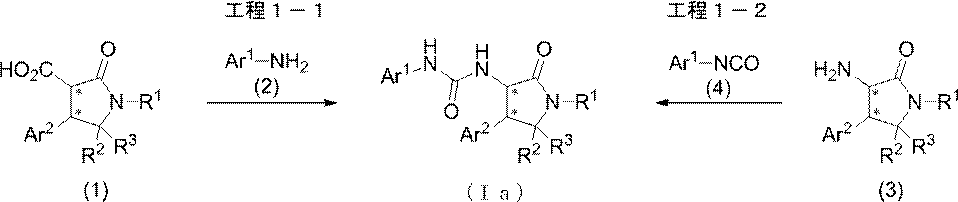
本工程は、化合物(1)と化合物(2)を反応させて化合物(Ia)を製造する工程である。化合物(Ia)は、例えば、化合物(1)に溶媒中、塩基の存在下あるいは非存在下でジフェニルリン酸アジド(DPPA)等を作用させた後、得られた生成物に化合物(2)を反応させることにより製造することができる。
上記反応は、通常、反応に悪影響を及ぼさない溶媒中で行なわれ、用いられる溶媒としては、例えば、ベンゼン、トルエン、テトラヒドロフラン、アセトニトリル、ジオキサン、それらの混合溶媒等を挙げることができる。用いられる塩基としては、例えばトリメチルアミン、トリエチルアミン、N-メチルモルホリンなどを挙げることができる。塩基の使用量は、通常、化合物 1モルに対して、約0.5~100モル当量、好ましくは1~5モル当量程度である。反応温度は、通常-10℃~溶媒還流温度で実施でき、20℃~120℃で行うのが好ましい。反応時間は用いる原料物質、溶媒、反応温度等により異なるが、通常10分~3日間である。
本工程で用いられる化合物(1)は、以下に詳述する方法もしくはそれに準じた方法、またはその他文献記載の方法もしくはそれらに準じた方法に従って製造することができる。
また、本工程で用いられる化合物(2)は、市販品を用いることができるほか、その他文献記載の方法またはそれらに準じた方法に従って製造することができる。
本工程は、化合物(3)と化合物(4)を反応させて化合物(Ia)を製造する工程である。化合物(Ia)は、例えば、化合物(3)を溶媒中、塩基の存在下あるいは非存在下で化合物(4)と反応させることにより製造することができる。化合物(4)の使用量は、化合物(3)1モルに対して約0.5~10モル当量であり、好ましくは約1~2モル当量程度である。
上記反応は、通常、反応に悪影響を及ぼさない溶媒中で行なわれ、用いられる溶媒としては、例えば、ジクロロメタン、1、2-ジクロロエタン、ベンゼン、トルエン、テトラヒドロフラン、酢酸エチル、メタノール、水、それらの混合溶媒等を挙げることができる。用いられる塩基としては、例えば水素化リチウム、水素化ナトリウム、水素化カリウムなどのアルカリ金属水素化物、水酸化ナトリウム、水酸化カリウムなどのアルカリ金属水酸化物、炭酸水素ナトリウム、炭酸水素カリウムなどの炭酸水素塩、炭酸ナトリウム、炭酸カリウムなどの炭酸塩、酢酸ナトリウムなど有機酸塩、トリメチルアミン、トリエチルアミン、N-メチルモルホリンなどの3級アミン類、ピリジン、ピコリン、N、N-ジメチルアニリンなどの芳香族アミン類などを挙げることができる。塩基の使用量は、通常、化合物 1モルに対して、約1~100モル当量、好ましくは1~5モル当量程度である。反応温度は、通常-20℃~溶媒還流温度で実施でき、0℃~50℃程度で行うのが好ましい。反応時間は用いる原料物質、溶媒、反応温度等により異なるが、通常10分~48時間程度である。
本工程で用いられる化合物(3)は、以下に詳述する方法もしくはそれに準じた方法、またはその他文献記載の方法もしくはそれらに準じた方法に従って製造することができる。
また、本工程で用いられる化合物(4)は、市販品を用いることができるほか、その他文献記載の方法またはそれらに準じた方法に従って製造することもできる。
本実施形態の化合物(I)のうち、XがOであり、R1がHである化合物(以下、化合物(Ib)ともいう)は、例えば、スキーム2に示す方法もしくはそれに準じた方法、またはその他文献記載の方法もしくはそれらに準じた方法に従って製造することができる。

本工程は、化合物(1a)から化合物(Ib)を製造する工程である。本工程2-1による化合物(Ib)は、スキーム1の工程1-1に示す方法もしくはそれに準じた方法、またはその他文献記載の方法若しくはそれらに準じた方法に従って製造することができる。
本工程は、化合物(1a)のカルボキシ基を1級アミンへと変換して化合物(3a)を製造する工程である。化合物(3a)は、例えば、化合物(1a)を溶媒A中、塩基の存在下あるいは非存在下でジフェニルリン酸アジド(DPPA)等を作用させた後、得られた生成物を、溶媒B中、酸と反応させることにより製造することができる。溶媒Aとしては、ベンゼン、トルエン、テトラヒドロフラン、アセトニトリル、ジオキサン、それらの混合溶媒等を挙げることができる。溶媒Bとしては、ジオキサンや水等を挙げることができる。用いられる塩基としては、例えばトリメチルアミン、トリエチルアミン、N-メチルモルホリンなどを挙げることができる。用いられる酸としては、濃塩酸、濃硫酸等を挙げることができる。反応温度は、通常-10℃~溶媒還流温度で実施でき、0℃~100℃で行うのが好ましい。反応時間は用いる原料物質、溶媒、反応温度等により異なるが、通常30分~3日間である。
本工程は、化合物(1a)から化合物(5)を製造する工程である。化合物(5)は、例えば、化合物(1a)を溶媒中、塩基の存在下あるいは非存在下でジフェニルリン酸アジド(DPPA)等を作用させた後、得られた生成物に、溶媒中、または無溶媒下でベンジルアルコールを反応させることによって製造することができる。用いられる溶媒としては、ベンゼン、トルエン、テトラヒドロフラン、アセトニトリル、ジオキサン、それらの混合溶媒等を挙げることができる。用いられる塩基としては、トリメチルアミン、トリエチルアミン、N-メチルモルホリンなどが挙げることができる。反応温度は、通常0℃~溶媒還流温度で実施でき、10℃~120℃で行うのが好ましい。反応時間は用いる原料物質、溶媒、反応温度等により異なるが、通常30分~3日間である。
本工程は、化合物(5)のCbz(ベンジルオキシカルボニル)基を脱保護して化合物(3a)を製造する工程である。化合物(3a)は、例えば、溶媒中、10%パラジウムカーボン(10%Pd-C)等の触媒の存在下において、化合物(5)に水素添加させることにより製造することができる。用いられる溶媒としては、メタノール、エタノール、ジクロロメタン、テトラヒドロフラン、酢酸エチル、それらの混合溶媒等を挙げることができる。反応温度は、通常0℃~溶媒還流温度で実施でき、10℃~40℃で行うのが好ましい。反応時間は用いる原料物質、溶媒、反応温度等により異なるが、通常30分~3日間である。
本工程は、化合物(3a)から化合物(Ib)を製造する工程である。本工程2-5による化合物(Ib)は、スキーム1の工程1-2に示す方法もしくはそれに準じた方法、またはその他文献記載の方法若しくはそれらに準じた方法に従って製造することができる。
化合物(1)のうち、R3がHである化合物(1b)は、例えば、化合物(6)からスキーム3に示す方法もしくはそれに準じた方法、またはその他文献記載の方法もしくはそれらに準じた方法に従って製造することができる。
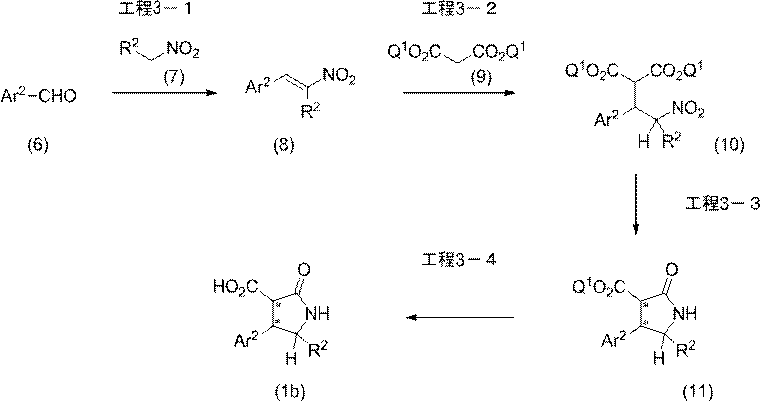
本工程は、化合物(6)と化合物(7)を反応させて化合物(8)を製造する工程である。化合物(8)は、例えば、化合物(6)を酢酸中、酢酸アンモニウム存在下で化合物(7)と反応させることによって製造することができる。反応温度は、通常20℃~溶媒還流温度で実施でき、80℃~110℃で行うのが好ましい。あるいは、化合物(8)は、化合物(6)を2-ヒドロキシエチルアンモニウムホルメート(2-HEAF)中、化合物(7)と反応させることによって製造することができる。反応温度は、通常0℃~80℃で実施でき、10℃~50℃で行うのが好ましい。反応時間は用いる原料物質、溶媒、反応温度等により異なるが、通常30分~3日間である。
また、本工程で用いられる化合物(6)および化合物(7)は、市販品を用いることができるほか、その他文献記載の方法またはそれらに準じた方法に従って製造することもできる。
本工程は、化合物(8)とマロン酸エステル(9)を反応させて化合物(10)を製造する工程である。化合物(10)は、例えば、化合物(8)を溶媒中、触媒の存在下で化合物(9)と反応させることにより製造することができる。用いられる溶媒としては、ベンゼン、トルエン、テトラヒドロフラン、メチルt-ブチルエーテル、アセトニトリル、メタノール、エタノール、酢酸エチル等を挙げることができる。用いられる触媒としては、非特許文献記載の方法に準じて調整できるニッケル(II)ビス[(S,S)-N,N’-ジベンジルシクロヘキサン-1,2-ジアミン]ブロミド、ニッケル(II)ビス[(R、R)-N,N’-ジベンジルシクロヘキサン-1,2-ジアミン]ブロミド、1-(3,5-ビス(トリフルオロメチル)フェニル)-3-((1S,2S)-2-(ジメチルアミノ)シクロヘキシル)チオウレア、1-(3,5-ビス(トリフルオロメチル)フェニル)-3-((1R,2R)-2-(ジメチルアミノ)シクロヘキシル)チオウレア等を挙げることができる。触媒の使用量は、化合物(8)1モルに対して、通常0.001~0.2モルである。反応温度は、通常-0℃~溶媒還流温度で実施でき、10℃~50℃で行うのが好ましい。反応時間は用いる原料物質、溶媒、反応温度等により異なるが、通常30分~7日間である。
また、本工程で用いられる化合物(9)は、市販品を用いることができるほか、その他文献記載の方法またはそれらに準じた方法に従って製造することもできる。化合物(8)も、工程3-1により得られたものに加えて、市販品を用いることができるほか、その他文献記載の方法またはそれらに準じた方法に従って製造することもできる。
本工程は、化合物(10)から化合物(11)を製造する工程である。化合物(11)は、例えば、化合物(10)に溶媒中、ニッケル(II)クロライド6水和物(NiCl2・6H2O)存在下で水素化ホウ素ナトリウム(NaBH4)を作用させることにより製造することができる。用いられる溶媒としては、メタノール、エタノール、テトラヒドロフラン、メチルtert-ブチルエーテル等を挙げることができる。反応温度は、通常-30℃~溶媒還流温度で実施でき、0℃~80℃で行うのが好ましい。反応時間は用いる原料物質、溶媒、反応温度等により異なるが、通常30分~3日間である。
本工程は、化合物(11)のエステル部位を加水分解することにより、化合物(1b)を製造する工程である。化合物(1b)は、例えば、溶媒中、化合物(11)を塩基を用いて処理することにより製造することができる。用いられる溶媒としては、水、メタノール、エタノール、プロパノール、2-プロパノール、ブタノール、テトラヒドロフラン、それらの混合溶媒等を挙げることができる。用いられる塩基としては、例えば、水酸化リチウム、水酸化ナトリウム、水酸化カリウム等を挙げることができる。反応温度は、通常0℃~溶媒還流温度で実施でき、10℃~70℃が好ましい。反応時間は用いる原料物質、溶媒、反応温度等により異なるが、通常30分~3日間である。
化合物(1)のうち、R2およびR3がHではない化合物(以下、化合物(1c)ともいう)は、例えば、化合物(6)からスキーム4に示す方法もしくはそれに準じた方法、またはその他文献記載の方法もしくはそれらに準じた方法に従って製造することができる。

本工程は、化合物(6)と化合物(9)を反応させて化合物(12)を製造する工程である。化合物(12)は、例えば、化合物(6)を溶媒中、塩基の存在下で化合物(9)と反応させることによって製造することができる。用いられる溶媒としては、ベンゼン、トルエン、ジメチルスルホキシド、N,N-ジメチルホルムアミド、それらの混合溶媒等を挙げることができる。用いられる塩基としては、ピペリジン、ピロリジン、トリエチルアミン、N-メチルモルホリンなどの脂肪族アミン類、ピリジン、ピコリン、N,N-ジメチルアニリンなどの芳香族アミン類、ピペリジニウムアセテートやアンモニウムアセテートなどの有機酸塩を挙げることができる。反応温度は、通常0℃~溶媒還流温度で実施でき、70℃~110℃で行うのが好ましい。反応時間は用いる原料物質、溶媒、反応温度等によって異なるが、通常30分~3日間である。
また、本工程で用いられる化合物(6)および化合物(9)は、市販品を用いることができるほか、その他文献記載の方法またはそれらに準じた方法に従って製造することもできる。
本工程は、化合物(12)と化合物(13)を反応させて化合物(14)を製造する工程である。化合物(14)は、例えば、化合物(12)を溶媒中、塩基の存在下で化合物(13)と反応させることによって製造することができる。用いられる溶媒としては、トルエン、ベンゼン、テトラヒドロフラン、アセトニトリル、ジメチルスルホキシド、N,N-ジメチルホルムアミド、それらの混合溶媒等を挙げることができる。用いられる塩基としては、アルミナ処理フッ化カリウム(KF-Al2O3)等を挙げることができる。反応温度は、通常0℃~溶媒還流温度で実施でき、10℃~40℃で行うのが好ましい。反応時間は用いる原料物質、溶媒、反応温度等によって異なるが、通常30分~3日間である。
本工程は、化合物(14)から化合物(15)を製造する工程である。化合物(15)は、スキーム3の工程3-3に示す方法もしくはそれに準じた方法、またはその他文献記載の方法若しくはそれらに準じた方法に従って製造することができる。
本工程は、化合物(15)のエステル部位を加水分解することにより、化合物(1c)を製造する工程である。化合物(1c)は、スキーム3の工程3-4に示す方法もしくはそれに準じた方法、またはその他文献記載の方法若しくはそれらに準じた方法に従って製造することができる。
化合物(3)のうち、R3がHである化合物(以下、化合物(3b)ともいう)は、例えば、化合物(8)からスキーム5に示す方法もしくはそれに準じた方法、またはその他文献記載の方法もしくはそれらに準じた方法に従って製造することができる。
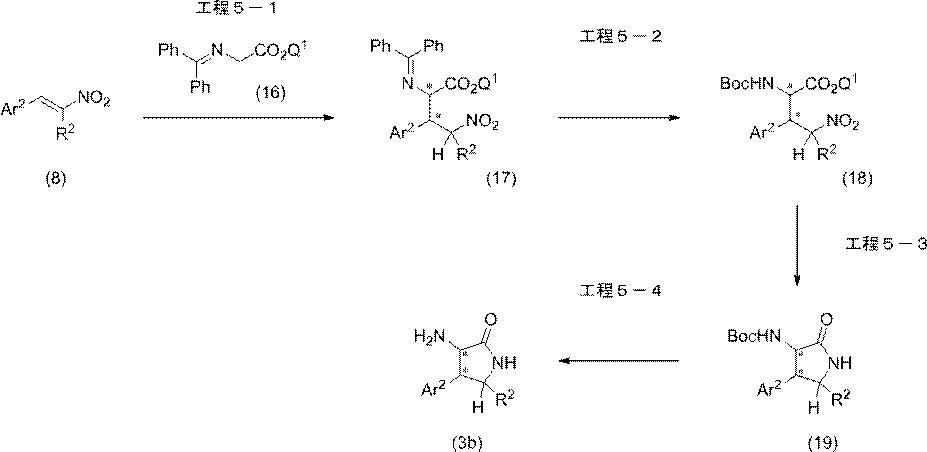
本工程は、化合物(8)と化合物(16)を反応させて化合物(17)を製造する工程である。化合物(17)は、例えば、化合物(16)を溶媒中、塩基の存在下で化合物(8)と反応させることにより製造することができる。用いられる溶媒としては、テトラヒドロフラン,ヘキサン、それらの混合溶媒等を挙げることができる。用いられる塩基としては、例えば、リチウムジイソプロピルアミド(LDA)、リチウム ヘキサメチルジシラジド(LHMDS)などの有機リチウムを挙げることができる。反応温度は、通常-78℃~溶媒還流温度で実施でき、-78℃~30℃で行うのが好ましい。反応時間は用いる原料物質、溶媒、反応温度等により異なるが、通常30分~3日間である。
また、本工程で用いられる化合物(8)および化合物(16)は、市販品を用いることができるほか、その他文献記載の方法またはそれらに準じた方法に従って製造することもできる。
本工程は、化合物(17)のイミン部位を変換して化合物(18)を製造する工程である。化合物(18)は、例えば、化合物(17)を酢酸中、水と反応させた後、得られた生成物を、溶媒中、塩基の存在下で二炭酸ジ-tert-ブチル((Boc)2O)と反応させることにより製造することができる。用いられる溶媒としては、水、メタノール、エタノール、テトラヒドロフラン、酢酸エチル,N,N-ジメチルホルムアミド、1,4-ジオキサン、アセトニトリル、それらの混合溶媒等を挙げることができる。用いられる塩基としては、トリエチルアミン,炭酸水素ナトリウム、炭酸ナトリウム等を挙げることができる。反応温度は、通常0℃~溶媒還流温度で実施でき、10℃~70℃で行うのが好ましい。反応時間は用いる原料物質、溶媒、反応温度等により異なるが、通常30分~3日間である。
本工程は、化合物(18)から化合物(19)を製造する工程である。化合物(19)は、スキーム3の工程3-3に示す方法もしくはそれに準じた方法、またはその他文献記載の方法若しくはそれらに準じた方法に従って製造することができる。
本工程は、化合物(19)のtert-ブトキシカルボニル(Boc)基を脱保護して
化合物(3b)を製造する工程である。化合物(3b)は、例えば、化合物(19)を溶媒中、トリフルオロ酢酸(TFA)や塩化水素などの酸と反応させることにより製造することができる。用いられる溶媒としては、ジクロロメタン、ジオキサン、酢酸エチル、メタノール、水、それらの混合溶媒等を挙げることができる。反応温度は、通常0℃~溶媒還流温度で実施でき、0℃~60℃で行うのが好ましい。反応時間は用いる原料物質、溶媒、反応温度等により異なるが、通常30分~3日間である。
化合物(1)のうち、R1がC1~C6アルキル基である化合物(以下、化合物(1d)ともいう)は、例えば、化合物(20)からスキーム6に示す方法もしくはそれに準じた方法、またはその他文献記載の方法もしくはそれらに準じた方法に従って製造することができる。

本工程は、化合物(20)をクロル化することで化合物(21)を製造する工程である。化合物(21)は、例えば、化合物(20)を溶媒中、スルフリルクロライド(SO2Cl2)と反応させることにより製造することができる。用いられる溶媒としては、テトラヒドロフラン等を挙げることができる。反応温度は、通常0℃~溶媒還流温度で実施でき、20℃~70℃で行うのが好ましい。反応時間は用いる原料物質、溶媒、反応温度等により異なるが、通常30分~3日間である。
本工程で用いられる化合物(20)は、スキーム3もしくはスキーム4に示す方法、もしくはそれに準じた方法、またはその他文献記載の方法もしくはそれらに準じた方法に従って製造することができる。
本工程は、化合物(21)と化合物(22)を反応させて化合物(23)を製造する工程である。化合物(23)は、例えば、化合物(21)を溶媒中、塩基の存在下で化合物(22)と反応させることにより製造することができる。用いられる溶媒としては、テトラヒドロフラン、N,N-ジメチルホルムアミド、それらの混合溶媒等を挙げることができる。用いられる塩基としては、例えば水素化リチウム、水素化ナトリウムなどのアルカリ金属水素化物、水酸化ナトリウム、水酸化カリウムなどのアルカリ金属水酸化物、炭酸カリウム、炭酸セシウムなどの炭酸塩等を挙げることができる。反応温度は、通常-10℃~溶媒還流温度で実施でき、0℃~60℃で行うのが好ましい。反応時間は用いる原料物質、溶媒、反応温度等により異なるが、通常30分~3日間である。
また、本工程で用いられる化合物(22)は、市販品を用いることができるほか、その他文献記載の方法またはそれらに準じた方法に従って製造することもできる。
本工程は、化合物(23)を脱クロル化することで化合物(24)を製造する工程である。化合物(24)は、例えば、化合物(23)を溶媒中、酢酸の存在下で亜鉛粉末(Zn powder)と反応させることにより製造することができる。用いられる溶媒としては、メタノール、エタノール、水、テトラヒドロフラン、それらの混合溶媒等を挙げることができる。反応温度は、通常0℃~溶媒還流温度で実施でき、10℃~40℃で行うのが好ましい。反応時間は用いる原料物質、溶媒、反応温度等により異なるが、通常30分~3日間である。
本工程は、化合物(24)のエステル部位を加水分解することにより、化合物(1d)を製造する工程である。化合物(1d)は、スキーム3の工程3-4に示す方法もしくはそれに準じた方法、またはその他文献記載の方法もしくはそれらに準じた方法に従って製造することができる。
化合物(1)のうち、R1が-O-C1~C6アルキル基である化合物(以下、化合物(1e)ともいう)は、例えば、化合物(14)からスキーム7に示す方法もしくはそれに準じた方法、またはその他文献記載の方法もしくはそれらに準じた方法に従って製造することができる。

本工程は、化合物(14)から化合物(25)を製造する工程である。化合物(25)は、例えば、化合物(14)を溶媒中、塩化アンモニウムの存在下で亜鉛粉末と反応させることにより製造することができる。用いられる溶媒としては、メタノール、エタノール、水、テトラヒドロフラン、それらの混合溶媒等を挙げることができる。反応温度は、通常0℃~溶媒還流温度で実施でき、10℃~40℃で行うのが好ましい。反応時間は用いる原料物質、溶媒、反応温度等により異なるが、通常10分~3日間である。
本工程は、化合物(25)と化合物(22)を反応させて化合物(26)を製造する工程である。化合物(26)は、スキーム6の工程6-2に示す方法もしくはそれに準じた方法、またはその他文献記載の方法もしくはそれらに準じた方法に従って製造することができる。
本工程は、化合物(26)のエステル部位を加水分解することにより、化合物(1e)を製造する工程である。化合物(1e)は、スキーム3の工程3-4に示す方法もしくはそれに準じた方法、またはその他文献記載の方法もしくはそれらに準じた方法に従って製造することができる。
化合物(1)のうち、R1が水素原子であり、Ar2がA7)として表される基である化合物(以下、化合物(1f)ともいう)は、例えば、化合物(27)からスキーム8に示す方法もしくはそれに準じた方法、またはその他文献記載の方法もしくはそれらに準じた方法に従って製造することができる。

本工程は、化合物(27)のtert-ブチルジメチルシリル(TBS)基を脱保護して化合物(28)を製造する工程である。化合物(28)は、例えば、化合物(27)に溶媒中、塩化水素水溶液を反応させることによって製造することができる。溶媒としては、テトラヒドロフラン、水や、それらの混合溶媒等を挙げることができる。反応温度は、通常0℃~溶媒還流温度で実施でき、20℃~40℃で行うのが好ましい。反応時間は用いる原料物質や溶媒、反応温度等によって異なるが、通常30分~3日間である。
また、本工程で用いられる化合物(27)は、スキーム3もしくはスキーム4に示す方法、もしくはそれに準じた方法、またはその他文献記載の方法もしくはそれらに準じた方法に従って製造することができる。
本工程は、化合物(28)のヒドロキシ基を還元して化合物(29)を製造する工程である。化合物(29)は、例えば、溶媒中、10%パラジウムカーボン(10%Pd-C)等の触媒存在下において、化合物(28)に水素添加させることにより製造することができる。溶媒としては、メタノール、エタノール、ジクロロメタン、テトラヒドロフラン、酢酸エチル、酢酸、それらの混合溶媒等を挙げることができる。反応温度は、通常0℃~溶媒還流温度で実施でき、20~40℃で行うのが好ましい。反応時間は用いる原料物質や溶媒、反応温度等によって異なるが、通常30分~3日間である。
本工程は、化合物(29)のエステル部位を加水分解することにより、化合物(1f)を製造する工程である。化合物(1f)は、スキーム3の工程3-4に示す方法もしくはそれに準じた方法、またはその他文献記載の方法もしくはそれらに準じた方法に従って製造することができる。
化合物(3)のうち、R1が置換基を有してもよいC1~C6アルキル基である化合物(以下、化合物(3c)、化合物(3d)、および化合物(3e)ともいう)は、例えば、化合物(3a)からスキーム9に示す方法もしくはそれに準じた方法、またはその他文献記載の方法もしくはそれらに準じた方法に従って製造することができる。
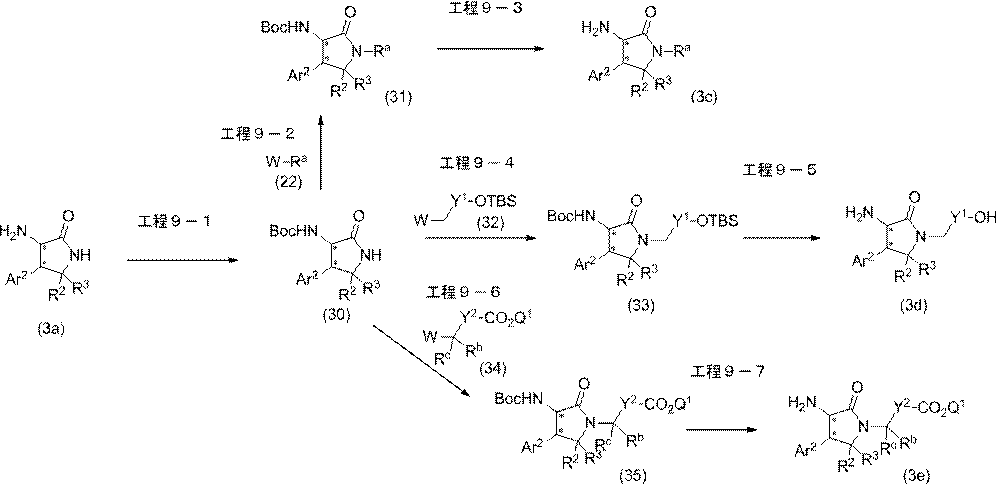
本工程は、化合物(3a)のアミノ基をtert-ブトキシカルボニル(Boc)基で保護することで化合物(30)を製造する工程である。化合物(30)は、例えば、溶媒中、塩基の存在下あるいは非存在下で化合物(3a)を二炭酸ジ-tert-ブチル((Boc)2O)と反応させることにより製造することができる。用いられる溶媒としては、水、メタノール、エタノール、テトラヒドロフラン、N,N-ジメチルホルムアミド、1,4-ジオキサン、アセトニトリル、それらの混合溶媒等を挙げることができる。用いられる塩基としては、トリメチルアミン、トリエチルアミン、N-メチルモルホリンなどを挙げることができる。反応温度は、通常0℃~溶媒還流温度で実施でき、10℃~60℃で行うのが好ましい。反応時間は用いる原料物質や溶媒、反応温度等により異なるが、通常30分~3日間である。
本工程は、化合物(30)と化合物(22)を反応させて化合物(31)を製造する工程である。化合物(31)は、例えば、化合物(30)を溶媒中、塩基の存在下で化合物(22)と反応させることにより製造することができる。用いられる溶媒としては、テトラヒドロフラン、N,N-ジメチルホルムアミド、それらの混合溶媒等を挙げることができる。用いられる塩基としては、例えば水素化リチウム、水素化ナトリウム、tert-ブトキシカリウムなどを挙げることができる。反応温度は、通常-10℃~溶媒還流温度で実施でき、0℃~60℃で行うのが好ましい。反応時間は用いる原料物質、溶媒、反応温度等により異なるが、通常30分~3日間である。
また、本工程で用いられる化合物(22)は、市販品を用いることができるほか、その他文献記載の方法またはそれらに準じた方法に従って製造することもできる。
本工程は、化合物(31)のtert-ブトキシカルボニル(Boc)基を脱保護して化合物(3c)を製造する工程である。化合物(3c)は、スキーム5の工程5-4に示す方法もしくはそれに準じた方法、またはその他文献記載の方法もしくはそれらに準じた方法に従って製造することができる。
本工程は、化合物(30)と化合物(32)を反応させて化合物(33)を製造する工程である。化合物(33)は、スキーム9の工程9-2に示す方法もしくはそれに準じた方法、またはその他文献記載の方法もしくはそれらに準じた方法に従って製造することができる。
また、本工程で用いられる化合物(32)は、市販品を用いることができるほか、その他文献記載の方法またはそれらに準じた方法に従って製造することもできる。
本工程は、化合物(33)のTBS基およびBoc基を脱保護して化合物(3d)を製造する工程である。化合物(3d)は、例えば、化合物(33)を含水溶媒中、トリフルオロ酢酸(TFA)や塩化水素などの酸と反応させることにより製造することができる。用いられる溶媒としては、メタノール、エタノール、ジオキサン等と水との混合溶媒を使用することができる。反応温度は、通常-10℃~溶媒還流温度で実施でき、0℃~60℃で行うのが好ましい。反応時間は用いる原料物質、溶媒、反応温度等により異なるが、通常30分~3日間である。
本工程は、化合物(30)と化合物(34)を反応させて化合物(35)を製造する工程である。化合物(35)は、スキーム9の工程9-2に示す方法もしくはそれに準じた方法、またはその他文献記載の方法もしくはそれらに準じた方法に従って製造することができる。
また、本工程で用いられる化合物(34)は、市販品を用いることができるほか、その他文献記載の方法またはそれらに準じた方法に従って製造することもできる。
本工程は、化合物(35)のBoc基を脱保護することで化合物(3e)を製造する工程である。化合物(3e)は、スキーム5の工程5-4に示す方法もしくはそれに準じた方法、またはその他文献記載の方法もしくはそれらに準じた方法に従って製造することができる。
化合物(3c)、化合物(3d)は、例えば、化合物(5)からスキーム10に示す方法もしくはそれに準じた方法、またはその他文献記載の方法もしくはそれらに準じた方法に従って製造することができる。

本工程は、化合物(5)と化合物(22)を反応させて化合物(36)を製造する工程である。化合物(36)は、スキーム9の工程9-2に示す方法もしくはそれに準じた方法、またはその他文献記載の方法もしくはそれらに準じた方法に従って製造することができる。
また、本工程で用いられる化合物(22)は、市販品を用いることができるほか、その他文献記載の方法またはそれらに準じた方法に従って製造することもできる。
本工程は、化合物(36)のベンジルオキシカルボニル(Cbz)基を脱保護して化合物(3c)を製造する工程である。化合物(3c)は、スキーム2の工程2-4に示す方法もしくはそれに準じた方法、またはその他文献記載の方法もしくはそれらに準じた方法に従って製造することができる。
本工程は、化合物(5)と化合物(32)を反応させて化合物(37)を製造する工程である。化合物(37)は、スキーム9の工程9-2に示す方法もしくはそれに準じた方法、またはその他文献記載の方法もしくはそれらに準じた方法に従って製造することができる。
また、本工程で用いられる化合物(32)は、市販品を用いることができるほか、その他文献記載の方法またはそれらに準じた方法に従って製造することもできる。
本工程は、化合物(37)のTBS基を脱保護して化合物(38)を製造する工程である。化合物(38)は、例えば、化合物(37)に溶媒中、テトラブチルアンモニウムフルオライド(TBAF)を反応させることにより製造することができる。用いられる溶媒としては、テトラヒドロフラン、N,N-ジメチルホルムアミド、それらの混合溶媒等を挙げることができる。反応温度は、通常0℃~溶媒還流温度で実施でき、10℃~40℃で行うのが好ましい。反応時間は用いる原料物質、溶媒、反応温度等により異なるが、通常30分~3日間である。
本工程は、化合物(38)のCbz基を脱保護して化合物(3d)を製造する工程である。化合物(3d)は、スキーム2の工程2-4に示す方法もしくはそれに準じた方法、またはその他文献記載の方法もしくはそれらに準じた方法に従って製造することができる。
化合物(3)のうち、以下の式(3f)により表される化合物(以下、化合物(3f)ともいう)、以下の式(3g)により表される化合物(以下、化合物(3g)ともいう)は、例えば、化合物(39)からスキーム11に示す方法もしくはそれに準じた方法、またはその他文献記載の方法もしくはそれらに準じた方法に従って製造することができる。
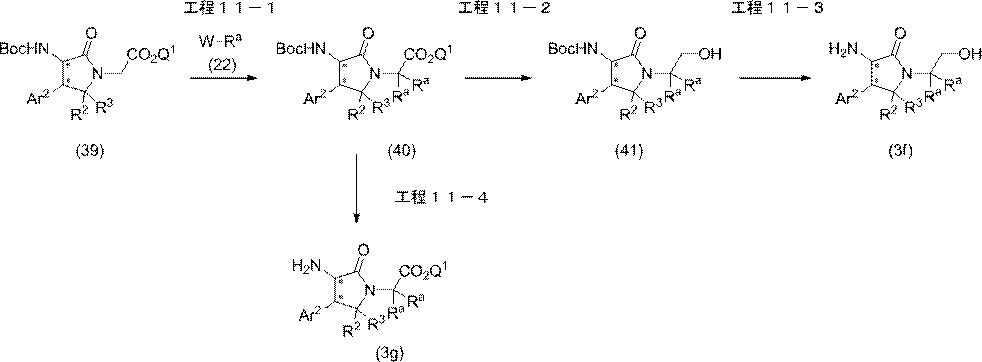
本工程は、化合物(39)と化合物(22)を反応させて化合物(40)を製造する工程である。化合物(40)は、例えば、化合物(39)を溶媒中、塩基の存在下で化合物(22)と反応させることにより製造することができる。用いられる溶媒としては、テトラヒドロフラン等を挙げることができる。用いられる塩基としては、例えば、リチウムジイソプロピルアミド(LDA)、リチウム ヘキサメチルジシラジド(LHMDS)などの有機リチウムを挙げることができる。反応温度は、通常-78℃~溶媒還流温度で実施でき、-78℃~30℃で行うのが好ましい。反応時間は用いる原料物質、溶媒、反応温度等により異なるが、通常30分~3日間である。
本工程で用いられる化合物(39)は、スキーム9の工程9-2に示す方法もしくはそれに準じた方法、またはその他文献記載の方法もしくはそれらに準じた方法に従って製造することができる。
また、本工程で用いられる化合物(22)は、市販品を用いることができるほか、その他文献記載の方法またはそれらに準じた方法に従って製造することもできる。
本工程は、化合物(40)のエステル部位を還元して化合物(41)を製造する工程である。化合物(41)は、例えば、化合物(40)を溶媒中、水素化ホウ素リチウム(LiBH4)、水素化アルミニウムリチウム(LiAlH4)、水素化ジイソブチルアルミニウム(DIBAL)などの還元剤と反応させることにより製造することができる。用いられる溶媒としては、テトラヒドロフラン等を挙げることができる。反応温度は、通常-20℃~溶媒還流温度で実施でき、0℃~30℃で行うのが好ましい。反応時間は用いる原料物質、溶媒、反応温度等により異なるが、通常30分~3日間である。
本工程は、化合物(41)のBoc基を脱保護することで化合物(3f)を製造する工程である。化合物(3f)は、スキーム5の工程5-4に示す方法もしくはそれに準じた方法、またはその他文献記載の方法もしくはそれらに準じた方法に従って製造することができる。
本工程は、化合物(40)のBoc基を脱保護することで化合物(3g)を製造する工程である。化合物(3g)は、スキーム5の工程5-4に示す方法もしくはそれに準じた方法、またはその他文献記載の方法もしくはそれらに準じた方法に従って製造することができる。
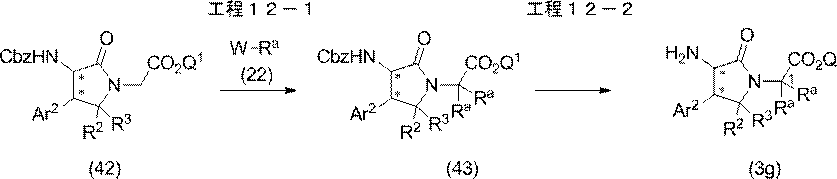
本工程は、化合物(42)と化合物(22)を反応させて化合物(43)を製造する工程である。化合物(43)は、スキーム11の工程11-1に示す方法もしくはそれに準じた方法、またはその他文献記載の方法もしくはそれらに準じた方法に従って製造することができる。
本工程で用いられる化合物(42)は、スキーム10の工程10-1に示す方法もしくはそれに準じた方法、またはその他文献記載の方法もしくはそれらに準じた方法に従って製造することができる。
本工程は、化合物(43)のCbz基を脱保護して化合物(3g)を製造する工程である。化合物(3g)は、スキーム2の工程2-4に示す方法もしくはそれに準じた方法、またはその他文献記載の方法もしくはそれらに準じた方法に従って製造することができる。
化合物(3)のうち、以下の式(3h)により表される化合物(以下、化合物(3h)ともいう)、以下の式(3i)により表される化合物(化合物(3i)ともいう)は、例えば、化合物(5)からスキーム13に示す方法もしくはそれに準じた方法、またはその他文献記載の方法もしくはそれらに準じた方法に従って製造することができる。

本工程は、化合物(5)と化合物(34)を反応させて化合物(44)を製造する工程である。化合物(44)は、スキーム9の工程9-2に示す方法もしくはそれに準じた方法、またはその他文献記載の方法もしくはそれらに準じた方法に従って製造することができる。
また、本工程で用いられる化合物(34)は、市販品を用いることができるほか、その他文献記載の方法またはそれらに準じた方法に従って製造することもできる。
本工程は、化合物(44)のエステル部位を加水分解することにより、化合物(45)を製造する工程である。化合物(45)は、スキーム3の工程3-4に示す方法もしくはそれに準じた方法、またはその他文献記載の方法もしくはそれらに準じた方法に従って製造することができる。
本工程は、化合物(45)と化合物(46)を反応させて化合物(47)を製造する工程である。化合物(47)は、例えば溶媒中、塩基の存在下又は非存在下で、縮合剤の存在下において、化合物(45)を化合物(46)と反応させることにより製造することができる。用いられる溶媒としては、N,N-ジメチルホルムアミド、ジクロロメタン、1,4-ジオキサン、テトラヒドロフラン、それらの混合溶媒等を挙げることができる。用いられる縮合剤としては、例えば、1-エチル-3-(3-ジメチルアミノプロピル)カルボジイミド(EDCI)、ジシクロヘキシルカルボジイミド(DCC)、2-(1H-7-アザベンゾトリアゾール-1-イル)-1,1,3,3-テトラメチルウロニウム ヘキサフルオロホスフェート メタナミニウム(HATU)等が挙げられる。また、必要に応じて、N,N-ジメチルアミノピリジン、ピリジン、1-ヒドロキシベンゾトリアゾール(HOBT)等を反応促進剤として用いることもできる。反応温度は、通常0℃~溶媒還流温度で実施でき、0℃~30℃で行うのが好ましい。使用してもよい塩基としては、炭酸カリウム、炭酸ナトリウム、トリエチルアミン、N,N-ジイソプロピルエチルアミン等を用いることができる。反応時間は用いる原料物質、溶媒、反応温度等により異なるが、通常30分~3日間である。
また、本工程で用いられる化合物(46)は、市販品を用いることができるほか、その他文献記載の方法またはそれらに準じた方法に従って製造することもできる。
本工程は、化合物(47)から化合物(48)を製造する工程である。化合物(48)は、例えば、化合物(47)を溶媒中、トリフェニルホスフィン、トリエチルアミンおよび、1,1,1,2,2,2-ヘキサクロロエタンと反応させることによって製造することができる。溶媒としては、ジクロロメタン等を挙げることができる。反応温度は、通常-78℃~溶媒還流温度で実施でき、0~30℃で行うのが好ましい。反応時間は用いる原料物質や溶媒、反応温度等によって異なるが、通常30分~3日間である。
本工程は、化合物(48)のCbz基を脱保護して化合物(3h)を製造する工程である。化合物(3h)は、スキーム2の工程2-4に示す方法もしくはそれに準じた方法、またはその他文献記載の方法もしくはそれらに準じた方法に従って製造することができる。
本工程は、化合物(45)と化合物(49)を反応させて化合物(50)を製造する工程である。化合物(50)は、スキーム13の工程13-3に示す方法もしくはそれに準じた方法、またはその他文献記載の方法もしくはそれらに準じた方法に従って製造することができる。
また、本工程で用いられる化合物(49)は、市販品を用いることができるほか、その他文献記載の方法またはそれらに準じた方法に従って製造することもできる。
本工程は、化合物(50)のアルコール部位をケトンに酸化して化合物(51)を製造する工程である。化合物(51)は、例えば、化合物(50)を溶媒中、2-ヨードキシ安息香酸などの酸化剤と反応させることによって製造することができる。溶媒としては、ジメチルスルホキシド等を挙げることができる。反応温度は、通常0℃~溶媒還流温度で実施でき、10~30℃で行うのが好ましい。反応時間は用いる原料物質や溶媒、反応温度等によって異なるが、通常30分~3日間である。
本工程は、化合物(51)から化合物(52)を製造する工程である。化合物(52)は、例えば、化合物(51)を溶媒中、トリフェニルホスフィン、およびトリエチルアミンと反応させることによって製造することができる。溶媒としては、四塩化炭素等を挙げることができる。反応温度は、通常0℃~溶媒還流温度で実施でき、50~90℃で行うのが好ましい。反応時間は用いる原料物質や溶媒、反応温度等によって異なるが、通常30分~3日間である。
本工程は、化合物(52)のCbz基を脱保護して化合物(3i)を製造する工程である。化合物(3i)は、スキーム2の工程2-4に示す方法もしくはそれに準じた方法、またはその他文献記載の方法もしくはそれらに準じた方法に従って製造することができる。
化合物(3)のうち、以下の式(3j)により表される化合物(以下、化合物(3jともいう))は、例えば、化合物(53)からスキーム14に示す方法もしくはそれに準じた方法、またはその他文献記載の方法もしくはそれらに準じた方法に従って製造することができる。

本工程は、化合物(53)のスルファニル基をスルホニル基へと変換することにより、化合物(54)を製造する工程である。化合物(54)は、例えば、化合物(53)を溶媒中、メタクロロ過安息香酸(m-CPBA)等の酸化剤で処理することにより製造することができる。用いられる溶媒としては、ジクロロメタン、アセトニトリル、テトラヒドロフラン、それらの混合溶媒等を挙げることができる。酸化剤の使用量は、通常、化合物(53)の1モルに対して、約2~5モル当量程度である。反応温度は、通常0℃~溶媒還流温度で実施でき、0℃~30℃が好ましい。反応時間は用いる原料物質、溶媒、反応温度等により異なるが、通常30分~3日間である。
本工程で用いられる化合物(53)は、スキーム10の工程10-1に示す方法もしくはそれに準じた方法、またはその他文献記載の方法もしくはそれらに準じた方法に従って製造することができる。
本工程は、化合物(54)のCbz基を脱保護して化合物(3j)を製造する工程である。化合物(3j)は、スキーム2の工程2-4に示す方法もしくはそれに準じた方法、またはその他文献記載の方法もしくはそれらに準じた方法に従って製造することができる。
本実施形態の化合物(I)のうち、以下の式(Ic)で表される化合物、式(Id)で表される化合物および式(Ie)で表される化合物(以下、化合物(Ic)、(Id)、(Ie)ともいう)は、例えば、化合物(3e)からスキーム15に示す方法もしくはそれに準じた方法、またはその他文献記載の方法もしくはそれらに準じた方法に従って製造することができる。

本工程は、化合物(3e)と化合物(4)を反応させて化合物(Ic)を製造する工程である。化合物(Ic)は、スキーム1の工程1-2に示す方法もしくはそれに準じた方法、またはその他文献記載の方法もしくはそれらに準じた方法に従って製造することができる。
本工程は、化合物(Ic)のエステル部位を加水分解することにより、化合物(Id)を製造する工程である。化合物(Id)は、スキーム3の工程3-4に示す方法もしくはそれに準じた方法、またはその他文献記載の方法若しくはそれらに準じた方法に従って製造することができる。
本工程は、化合物(Id)と化合物(55)を反応させて化合物(Ie)を製造する工程である。化合物(Ie)は、スキーム13の工程13-3に示す方法もしくはそれに準じた方法、またはその他文献記載の方法もしくはそれらに準じた方法に従って製造することができる。
また、本工程で用いられる化合物(55)は、市販品を用いることができるほか、その他文献記載の方法またはそれらに準じた方法に従って製造することもできる。
本実施形態の化合物(I)のうち、以下の式(If)で表される化合物、式(Ig)で表される化合物、式(Ih)で表される化合物および式(Ii)で表される化合物(以下、化合物(If)、(Ig)、(Ih)、(Ii)ともいう)は、例えば、化合物(56)からスキーム16に示す方法もしくはそれに準じた方法、またはその他文献記載の方法もしくはそれらに準じた方法に従って製造することができる。

本工程は、化合物(56)のフェノール性ヒドロキシ基をベンジル(Bn)基で保護することで、化合物(57)を製造する工程である。化合物(57)は、例えば、化合物(56)を溶媒中、塩基の存在下でベンジルブロマイドと反応させることにより製造することができる。用いられる溶媒としては、テトラヒドロフラン、N,N-ジメチルホルムアミド、それらの混合溶媒等を挙げることができる。用いられる塩基としては、例えば、炭酸ナトリウム、炭酸カリウム、炭酸セシウムなどを挙げることができる。反応温度は、通常0℃~溶媒還流温度で実施でき、10℃~40℃で行うのが好ましい。反応時間は用いる原料物質、溶媒、反応温度等により異なるが、通常30分~3日間である。
本工程で用いられる化合物(56)は、スキーム3もしくはスキーム4に示す方法、もしくはそれに準じた方法、またはその他文献記載の方法もしくはそれらに準じた方法に従って製造することができる。
本工程は、化合物(57)のエステル部位を加水分解することにより、化合物(58)を製造する工程である。化合物(58)は、スキーム3の工程3-4に示す方法もしくはそれに準じた方法、またはその他文献記載の方法若しくはそれらに準じた方法に従って製造することができる。
本工程は、化合物(58)から化合物(59)を製造する工程である。化合物(59)は、スキーム1の工程1-1に示す方法もしくはそれに準じた方法、またはその他文献記載の方法若しくはそれらに準じた方法に従って製造することができる。
本工程は、化合物(59)のBn基を脱保護して化合物(If)を製造する工程である。化合物(If)は、例えば、溶媒中、10%パラジウムカーボン(10%Pd-C)等の触媒の存在下において、化合物(59)に水素添加することにより製造することができる。用いられる溶媒としては、メタノール、エタノール、ジクロロメタン、テトラヒドロフラン、酢酸エチル、それらの混合溶媒等を挙げることができる。反応温度は、通常0℃~溶媒還流温度で実施でき、10℃~40℃で行うのが好ましい。反応時間は用いる原料物質や溶媒、反応温度等により異なるが、通常30分~3日間である。
本工程は、化合物(If)のヒドロキシ基をトリフルオロメタンスルホニル化することにより、化合物(60)を製造する工程である。化合物(60)は、例えば、溶媒中、化合物(If)とトリフルオロメタンスルホニル化剤を塩基の存在下で反応させることにより製造することができる。用いられる溶媒としては、ジクロロメタン、1,2-ジクロロエタン、ピリジン、テトラヒドロフラン、N,N-ジメチルホルムアミド、1,4-ジオキサン、アセトニトリル、ジエチルエーテル、それらの混合溶媒等を挙げることができる。用いられるトリフルオロメタンスルホニル化剤としては、N-フェニルビス(トリフルオロメタンスルホンイミド)、トリフルオロメタンスルホン酸無水物等を挙げることができる。用いられる塩基としては、炭酸カリウム、炭酸ナトリウム、水素化ナトリウム、リン酸カリウム、N,N-ジイソプロピルエチルアミン、トリエチルアミン、2,6-ルチジン等を挙げることができる。反応温度は、通常-78℃~溶媒還流温度で実施でき、-20℃~30℃で行うのが好ましい。反応時間は用いる原料物質や溶媒、反応温度等により異なるが、通常30分~3日間である。
本工程は、化合物(60)から化合物(Ig)を製造する工程である。化合物(Ig)は、例えば溶媒中、アセトニトリル、炭酸セシウム、2、2'-ビス(ジフェニルホスフィノ)-1,1'-ビナフチル(BINAP)、酢酸パラジウム(II)、モリブデニウムヘキサカルボニル(Mo(CO)6)の存在下、化合物(60)と化合物(55)を反応させることにより製造することができる。用いられる溶媒としては、トルエン等を挙げることができる。反応温度は、通常0℃~溶媒還流温度で実施でき、50℃~80℃で行うのが好ましい。反応時間は用いる原料物質、溶媒、反応温度等により異なるが、通常30分~3日間である。
本工程は、化合物(60)から化合物(Ih)を製造する工程である。化合物(Ih)は、例えば、化合物(60)とシアン化亜鉛(Zn(CN)2)を溶媒中、パラジウム試薬を触媒として反応させることにより製造することができる。用いられる溶媒としては、1,4-ジオキサン、トルエン、N,N-ジメチルホルムアミド,それらの混合溶媒等を挙げることができる。用いられるパラジウム試薬としては、テトラキス(トリフェニルホスフィン)パラジウム(0)(Pd(PPh3)4)等を挙げることができる。反応温度は、通常20℃~溶媒還流温度で実施でき、60℃~100℃で行うのが好ましい。反応時間は用いる原料物質、溶媒、反応温度等により異なるが、通常30分~3日間である。
本工程は、化合物(Ih)のシアノ基をアミド基へと加水分解することにより,化合物(Ii)を製造する工程である。化合物(Ii)は、例えば、化合物(Ih)を溶媒中、塩基の存在下で反応させることにより製造することができる。溶媒としては、水、メタノール、エタノール、プロパノール、2-プロパノール、ブタノール、テトラヒドロフラン、それらの混合溶媒等を挙げることができる。用いられる塩基としては、水酸化リチウム、水酸化ナトリウム、水酸化カリウム等を挙げることができる。反応温度は、通常0℃~溶媒還流温度で実施でき、60℃~100℃で行なうことが好ましい。反応時間は用いる原料物質、溶媒、反応温度等により異なるが、通常30分~3日間である。
本実施形態の化合物(I)のうち、以下の式(Ij)で表される化合物(以下、化合物(Ij)ともいう)は、スキーム1に示す方法もしくはそれに準じた方法、またはその他文献記載の方法もしくはそれらに準じた方法に従って製造することができる。
また、本実施形態の化合物(I)のうち、以下の式(Ik)で表される化合物、式(Il)で表される化合物(以下、化合物(Ik)、(Il)ともいう)は、例えば、化合物(Ij)からスキーム17に示す方法もしくはそれに準じた方法、またはその他文献記載の方法もしくはそれらに準じた方法に従って製造することができる。

本工程は、化合物(Ij)のスルファニル基をスルフィニル基へと変換することにより,化合物(Ik)を製造する工程である。化合物(Ik)は、例えば、化合物(Ij)を溶媒中、メタクロロ過安息香酸(m-CPBA)等の酸化剤で処理することにより製造することができる。用いられる溶媒としては、ジクロロメタン,アセトニトリル,テトラヒドロフラン,それらの混合溶媒等を挙げることができる。酸化剤の使用量は、通常、化合物(Ij)の1モルに対して、約1~2モル当量程度である。反応温度は、通常0℃~溶媒還流温度で実施でき、0℃~30℃で行うのが好ましい。反応時間は用いる原料物質、溶媒、反応温度等により異なるが、通常30分~3日間である。
本工程は、化合物(Ij)のスルファニル基をスルホニル基へと変換することにより化合物(Il)を製造する工程である。化合物(Il)は、例えば、化合物(Ij)を溶媒中、メタクロロ過安息香酸(m-CPBA)等の酸化剤で処理することにより製造することができる。用いられる溶媒としては、ジクロロメタン、アセトニトリル、テトラヒドロフラン、それらの混合溶媒等を挙げることができる。酸化剤の使用量は、通常、化合物(Ij)の1モルに対して、約2~5モル当量程度である。反応温度は、通常0℃~溶媒還流温度で実施でき、0℃~30℃が好ましい。反応時間は用いる原料物質、溶媒、反応温度等により異なるが、通常30分~3日間である。
本実施形態の化合物(I)のうち、以下の式(Im)で表される化合物(以下、化合物(Im)ともいう)は、スキーム1に示す方法もしくはそれに準じた方法、またはその他文献記載の方法もしくはそれらに準じた方法に従って製造することができる。
また、本実施形態の化合物(I)のうち、以下の式(In)で表される化合物、式(Io)で表される化合物および式(Ip)で表される化合物(以下、化合物(In)、(Io)、(Ip)ともいう)は、例えば、化合物(Im)からスキーム18に示す方法もしくはそれに準じた方法、またはその他文献記載の方法もしくはそれらに準じた方法に従って製造することができる。
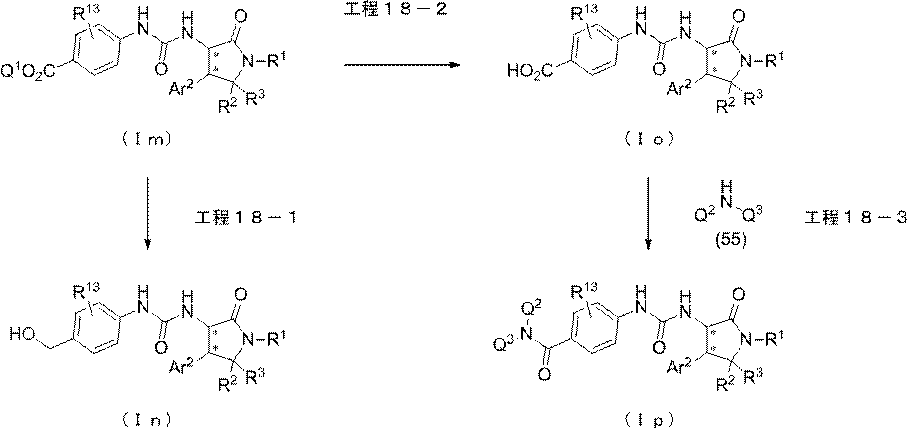
本工程は、化合物(Im)のエステル部位を還元することにより、化合物(In)を製造する工程である。化合物(In)は、例えば、化合物(Im)を溶媒中、水素化ジイソブチルアルミニウム等の還元剤で処理することにより製造することができる。用いられる溶媒としては、ジクロロメタン、テトラヒドロフラン、トルエンそれらの混合溶媒等を挙げることができる。反応温度は、通常0℃~溶媒還流温度で実施でき、0℃~30℃で行うのが好ましい。反応時間は用いる原料物質、溶媒、反応温度等により異なるが、通常30分~3日間である。
本工程は、化合物(Im)のエステル部位を加水分解することにより、化合物(Io)を製造する工程である。化合物(Io)は、スキーム3の工程3-4に示す方法もしくはそれに準じた方法、またはその他文献記載の方法若しくはそれらに準じた方法に従って製造することができる。
本工程は、化合物(Io)と化合物(55)を反応させて化合物(Ip)を製造する工程である。化合物(Ip)は、スキーム13の工程13-3に示す方法もしくはそれに準じた方法、またはその他文献記載の方法若しくはそれらに準じた方法に従って製造することができる。
本実施形態の化合物(I)のうち、以下の式(Iq)で表される化合物(以下、化合物(Iq)ともいう)は、例えば、化合物(61)からスキーム19に示す方法もしくはそれに準じた方法、またはその他文献記載の方法もしくはそれらに準じた方法に従って製造することができる。
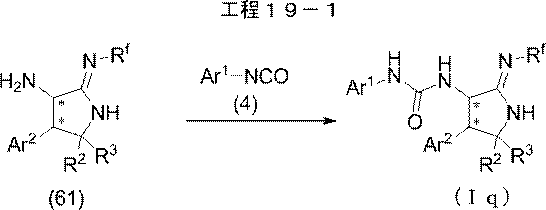
本工程は、化合物(61)から化合物(Iq)を製造する工程である。化合物(Iq)は、スキーム1の工程1-2に示す方法もしくはそれに準じた方法、またはその他文献記載の方法若しくはそれらに準じた方法に従って製造することができる。

本工程は、化合物(5)から化合物(62)を製造する工程である。化合物(62)は、例えば、化合物(5)に溶媒中、トリエチルオキソニウムヘキサフルオルホスファート(Et3OPF6)を反応させることにより製造することができる。用いられる溶媒としては、ジクロロメタン等を挙げることができる。反応温度は、通常0℃~溶媒還流温度で実施でき、10℃~40℃で行うのが好ましい。反応時間は用いる原料物質、溶媒、反応温度等により異なるが、通常30分~3日間である。
本工程は、化合物(62)と化合物(63)を反応させて化合物(64)を製造する工程である。化合物(64)は、例えば、化合物(62)に溶媒中、酸または塩基の存在下あるいは非存在下で化合物(63)を反応させることにより製造することができる。用いられる溶媒としては、例えば、メタノール、エタノール、トルエン、テトラヒドロフラン、アセトニトリル、ジオキサン、それらの混合溶媒等を挙げることができる。用いてもよい酸としては、塩化水素、塩化アンモニウム等を挙げることができる。また、用いてもよい塩基としては、トリメチルアミン、トリエチルアミン、N-メチルモルホリンなどを挙げることができる。反応温度は、通常0℃~溶媒還流温度で実施でき、0℃~50℃で行うのが好ましい。反応時間は用いる原料物質、溶媒、反応温度等により異なるが、通常10分~3日間である。
また、化合物(63)は、市販品を用いることができるほか、その他文献記載の方法またはそれらに準じた方法に従って製造することもできる。
本工程は、化合物(64)のCbz基を脱保護して化合物(61)を製造する工程である。化合物(61)は、スキーム2の工程2-4に示す方法もしくはそれに準じた方法、またはその他文献記載の方法もしくはそれらに準じた方法に従って製造することができる。
化合物(Ir)は、例えば、化合物(65)からスキーム21に示す方法もしくはそれに準じた方法、またはその他文献記載の方法もしくはそれらに準じた方法に従って製造することができる。

本工程は、化合物(65)のTBS基を脱保護して化合物(Ir)を製造する工程である。化合物(Ir)は、例えば、化合物(65)に水-ジオキサンの混合溶媒中、トリフルオロ酢酸(TFA)や塩化水素などの酸と反応させることにより製造することができる。反応温度は、通常-20℃~溶媒還流温度で実施でき、0℃~30℃で行うのが好ましい。反応時間は用いる原料物質、溶媒、反応温度等により異なるが、通常30分~3日間である。
また、本工程で用いられる化合物(65)は、スキーム19に示す方法もしくはそれに準じた方法、またはその他文献記載の方法もしくはそれらに準じた方法に従って製造することができる。
化合物(Is)、(It)の合成
本実施形態の化合物(I)のうち、以下の式(Is)で表される化合物(以下、化合物(Is)ともいう)は、スキーム1に示す方法もしくはそれに準じた方法、またはその他文献記載の方法もしくはそれらに準じた方法に従って製造することができる。
また、本実施形態の化合物(I)のうち、以下の式(It)で表される化合物(以下、化合物(It)ともいう)は、例えば、化合物(Is)からスキーム22に示す方法もしくはそれに準じた方法、またはその他文献記載の方法もしくはそれらに準じた方法に従って製造することができる。

本工程は、化合物(Is)とトリメチルシリルアセチレン(66)を反応させて化合物(67)を製造する工程である。化合物(67)は、例えば、化合物(Is)を溶媒中、ジクロロビス(トリフェニルホスフィン)パラジウム(II)、ヨウ化銅(I)、およびトリエチルアミンの存在下において、トリメチルシリルアセチレン(66)と反応させることにより製造することができる。溶媒としては、N、N-ジメチルホルムアミド等を挙げることができる。反応温度は、通常0℃~溶媒還流温度で実施でき、40~60℃で行うのが好ましい。反応時間は用いる原料物質や溶媒、反応温度等によって異なるが、通常30分~3日間である。
本工程は、化合物(67)のTMS基を脱保護することで化合物(It)を製造する工程である。化合物(It)は、例えば、化合物(67)を溶媒中、炭酸カリウムと反応させることにより製造することができる。溶媒としては、メタノール等を挙げることができる。反応温度は、通常0℃~溶媒還流温度で実施でき、20~40℃で行うのが好ましい。反応時間は用いる原料物質や溶媒、反応温度等によって異なるが、通常30分~3日間である。
本実施形態の化合物(I)のうち、以下の式(Iu)で表される化合物(以下、化合物(Iu)ともいう)は、例えば、化合物(68)からスキーム23に示す方法もしくはそれに準じた方法、またはその他文献記載の方法もしくはそれらに準じた方法に従って製造することができる。

本工程は、化合物(68)のBoc基を脱保護することで化合物(Iu)を製造する工程である。化合物(Iu)は、スキーム5の工程5-4に示す方法もしくはそれに準じた方法、またはその他文献記載の方法もしくはそれらに準じた方法に従って製造することができる。
また、本工程で用いられる化合物(68)は、スキーム1に示す方法もしくはそれに準じた方法、またはその他文献記載の方法もしくはそれらに準じた方法に従って製造することができる。
本実施形態の化合物(I)のうち、以下の式(Iv)で表される化合物(以下、化合物(Iv)ともいう)は、スキーム1に示す方法もしくはそれに準じた方法、またはその他文献記載の方法もしくはそれらに準じた方法に従って製造することができる。
また、本実施形態の化合物(I)のうち、以下の式(Iw)で表される化合物(以下、化合物(Iw)ともいう)は、例えば、化合物(Iv)からスキーム24に示す方法もしくはそれに準じた方法、またはその他文献記載の方法もしくはそれらに準じた方法に従って製造することができる。

本工程は、化合物(Iv)のヒドロキシ基をケトンへと変換することにより,化合物(Iw)を製造する工程である。化合物(Iw)は、例えば、化合物(Iv)を溶媒中、デス-マーチンペルヨージナン等の酸化剤で処理することにより製造することができる。溶媒としては、ジクロロメタン、アセトニトリルそれらの混合溶媒等を挙げることができる。酸化剤の使用量は、通常、化合物1モルに対して、約1~2モル当量程度である。反応温度は、通常0℃~溶媒還流温度で実施でき、20~30℃で行うのが好ましい。反応時間は用いる原料物質や溶媒、反応温度等によって異なるが、通常30分~3日間である。
化合物(Ix)の合成
本実施形態の化合物(I)のうち、以下の式(Ix)で表される化合物(以下、化合物(Ix)ともいう)は、例えば、化合物(69)からスキーム25に示す方法もしくはそれに準じた方法、またはその他文献記載の方法もしくはそれらに準じた方法に従って製造することができる。
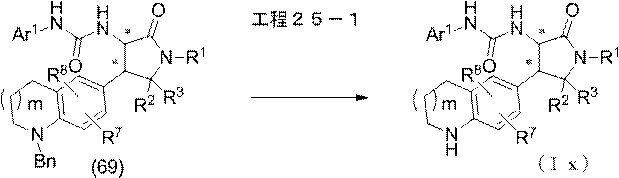
本工程は、化合物(69)のBn基を脱保護して化合物(Ix)を製造する工程である。化合物(Ix)は、例えば、溶媒中、10%パラジウムカーボン(10%Pd-C)等の触媒存在下において、化合物(69)に水素添加させることにより製造することができる。溶媒としては、メタノール、エタノール、ジクロロメタン、テトラヒドロフラン、酢酸エチル、N,N-ジメチルホルムアミドそれらの混合溶媒等を挙げることができる。塩基としてはトリエチルアミンの酢酸塩などを挙げることができる。反応温度は、通常0℃~溶媒還流温度で実施でき、20~40℃で行うのが好ましい。反応時間は用いる原料物質や溶媒、反応温度等によって異なるが、通常30分~3日間である。
また、本工程で用いられる化合物(69)は、スキーム1に示す方法もしくはそれに準じた方法、またはその他文献記載の方法もしくはそれらに準じた方法に従って製造することができる。
本実施形態の化合物(I)のうち、以下の式(Iy)で表される化合物(以下、化合物(Iy)ともいう)は、スキーム1に示す方法もしくはそれに準じた方法、またはその他文献記載の方法もしくはそれらに準じた方法に従って製造することができる。
本実施形態の化合物(I)のうち、以下の式(Iz)で表される化合物(以下、化合物(Iz)ともいう)は、例えば、化合物(Iy)からスキーム26に示す方法もしくはそれに準じた方法、またはその他文献記載の方法もしくはそれらに準じた方法に従って製造することができる。
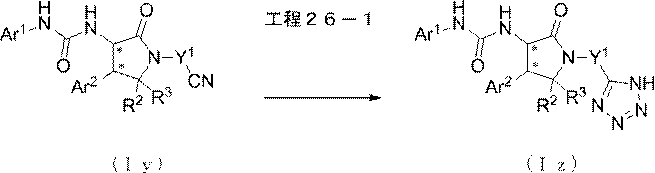
本工程は、化合物(Iy)から、化合物(Iz)を製造する工程である。化合物(Iz)は、例えば、化合物(Iy)を溶媒中、トリエチルアミンおよび酢酸の存在下でアジ化ナトリウムと反応させることによって製造することができる。溶媒としては、トルエン、N,N-ジメチルホルムアミド、イソプロパノール、水、それらの混合溶媒等を挙げることができる。反応温度は、通常0℃~溶媒還流温度で実施でき、100℃~130℃で行うのが好ましい。反応時間は用いる原料物質や溶媒、反応温度等によって異なるが、通常30分~3日間である。
上述したように、FPRL1の内因性アゴニストとして報告されているLXA4やペプチドは、炎症の収束に寄与することが知られている。
さらに、本実施形態の化合物(I)またはその薬理学的に許容される塩は、炎症性疾患、慢性気道疾患、がん、敗血症、アレルギー性症状、HIVレトロウイルス感染、循環器障害、神経炎症、神経障害、疼痛、プリオン病、アミロイド症、免疫障害等の治療または予防するための医薬を製造するためにも使用できる。
本実施形態の化合物(I)またはその薬理学的に許容される塩を有効成分として含有する医薬は、用法に応じ種々の剤形とすることができる。このような剤形としては、例えば、散剤、顆粒剤、細粒剤、ドライシロップ剤、錠剤、カプセル剤、注射剤、液剤、軟膏剤、坐剤、貼付剤、舌下剤等を挙げることができ、経口または非経口的に投与される。
“*”の付いた炭素原子は、不斉炭素を示す。
“*”の付いた炭素原子の波線の結合は、ラセミ体を表す。
構造式中ピロリジン環の2つの位置にそれぞれ共に置換基1個と水素原子1個が結合しているときは、置換基の相対立体配置をシス、トランスで表し、そのあとにハイフンを付けて化合物の名称を続けることもある。
ピロリジン環を面としたときにシスは、2つの隣接する置換基が同じ側にあることを示し、トランスは、2つの隣接する置換基が反対側にあることを示している。
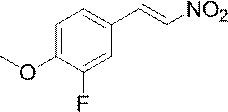
アルゴン雰囲気下、3-フルオロ-4-メトキシベンズアルデヒド(500mg)を2-ヒドロキシルエチルアンモニウムホルメート(1.7g)に溶解し、ニトロメタン(175μL)を加え、反応液とした。反応液を室温で9時間撹拌した。反応液に水を加えて析出した固体をろ取し、水で洗浄した。得られた固体を乾燥することで、黄色固体として表題化合物を得た(607mg)。
1H-NMR (400 MHz, CDCl3) δ 3.96 (3H, s), 7.01 (1H, t, J = 8.5 Hz), 7.27-7.32 (2H, m), 7.48 (1H, d, J = 13.3 Hz), 7.92 (1H, d, J = 13.3 Hz).
これらの構造およびスペクトルデータを表1~表5に示した。

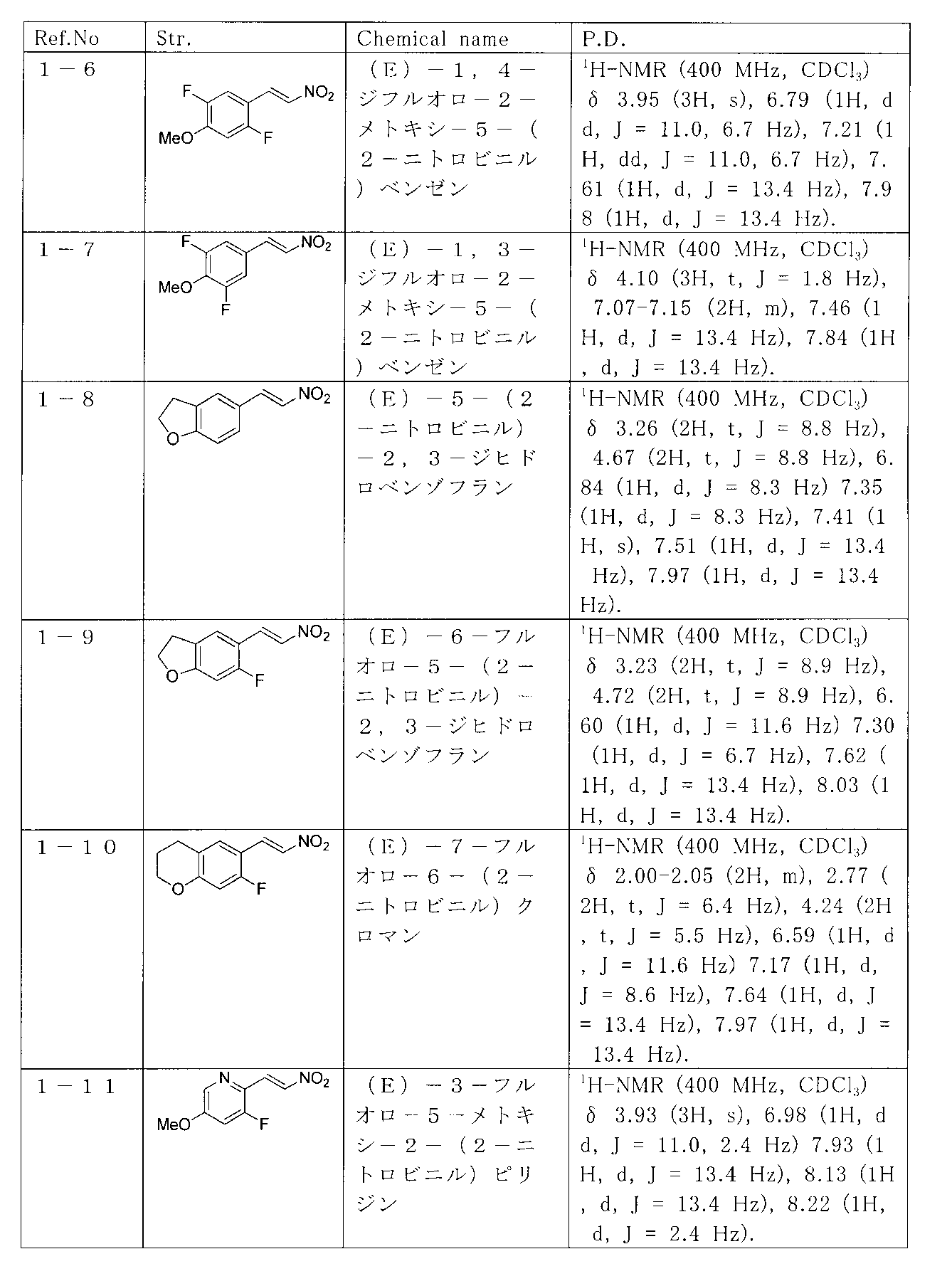
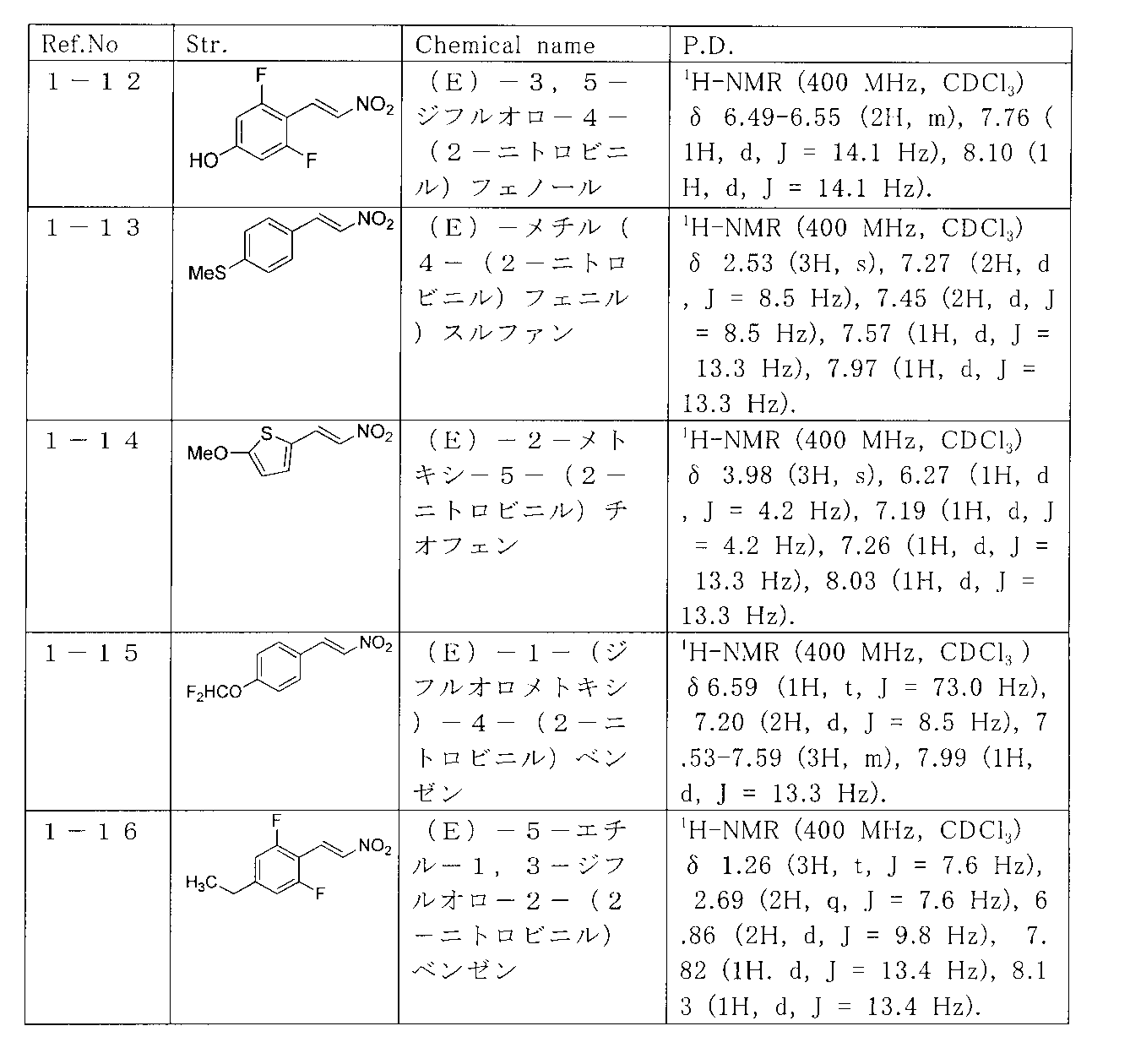
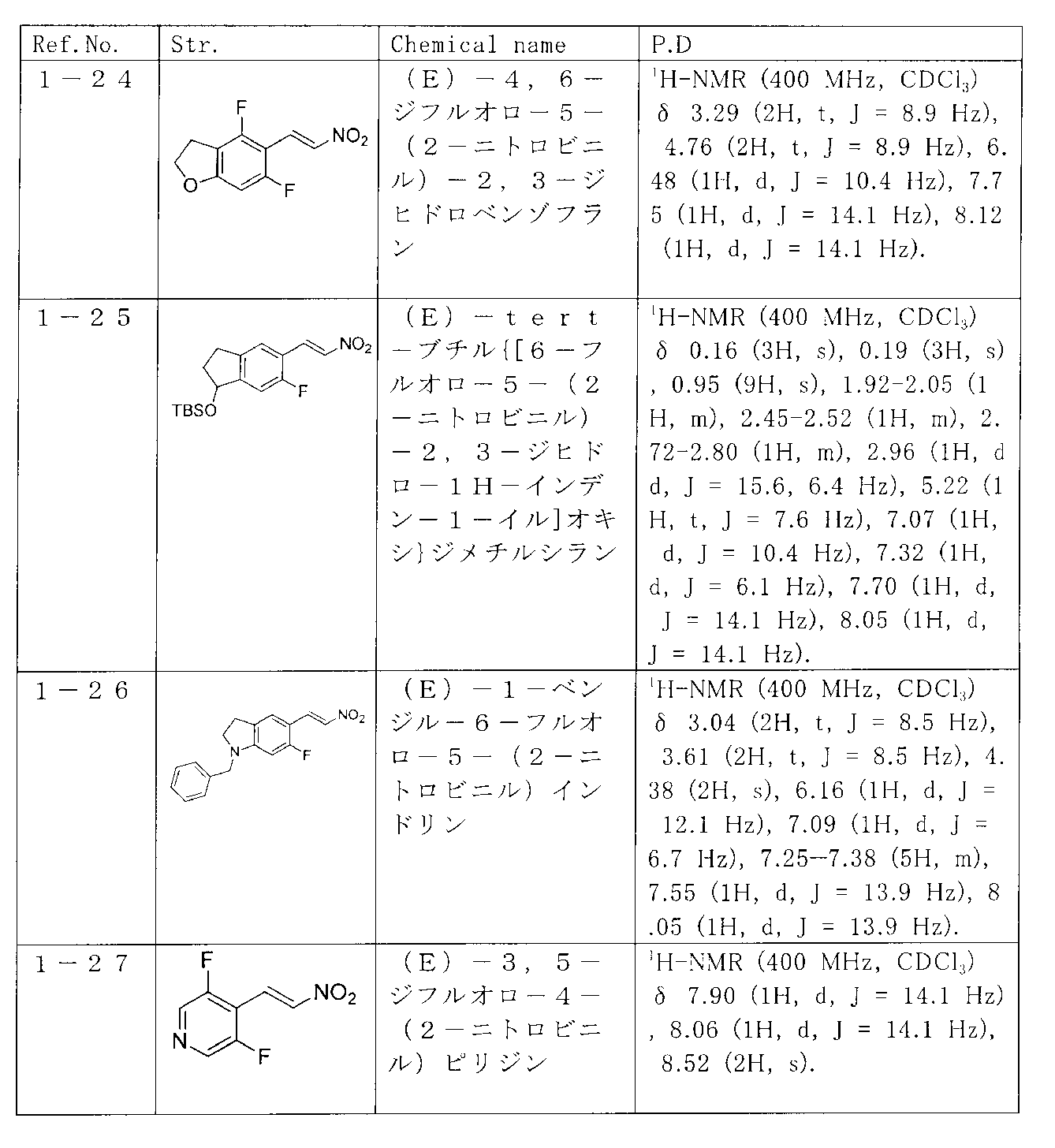

アルゴン雰囲気下、(E)-1-メトキシ-4-(2-ニトロビニル)ベンゼン(500mg)のトルエン溶液(2.8mL)に、マロン酸ジメチル(0.36mL)および、 ニッケル(II)ビス[(S、S)-N、N’-ジベンジルシクロヘキサン-1、2-ジアミン]ブロミド(68mg)を加え、室温で6時間攪拌した。溶媒を減圧下濃縮した後、残渣をシリカゲルカラムクロマトグラフィー(酢酸エチル : ヘキサン = 4 : 1)で精製することで、無色液体として表題化合物を得た(865mg)。
1H-NMR (400 MHz, CDCl3) δ 3.57 (3H, s), 3.76 (3H, s), 3.78 (3H, s), 3.83 (1H, d, J = 9.1 Hz), 4.16-4.22 (1H, m), 4.83 (1H, dd, J = 12.7, 9.1 Hz), 4.89 (1H, dd, J = 12.7, 5.1 Hz), 6.84 (2H, d, J = 9.1 Hz), 7.14 (2H, d, J = 9.1 Hz).
[α]D 25= -20 (c 0.26, EtOH)
これらの構造およびスペクトルデータを表6~表12に示した。
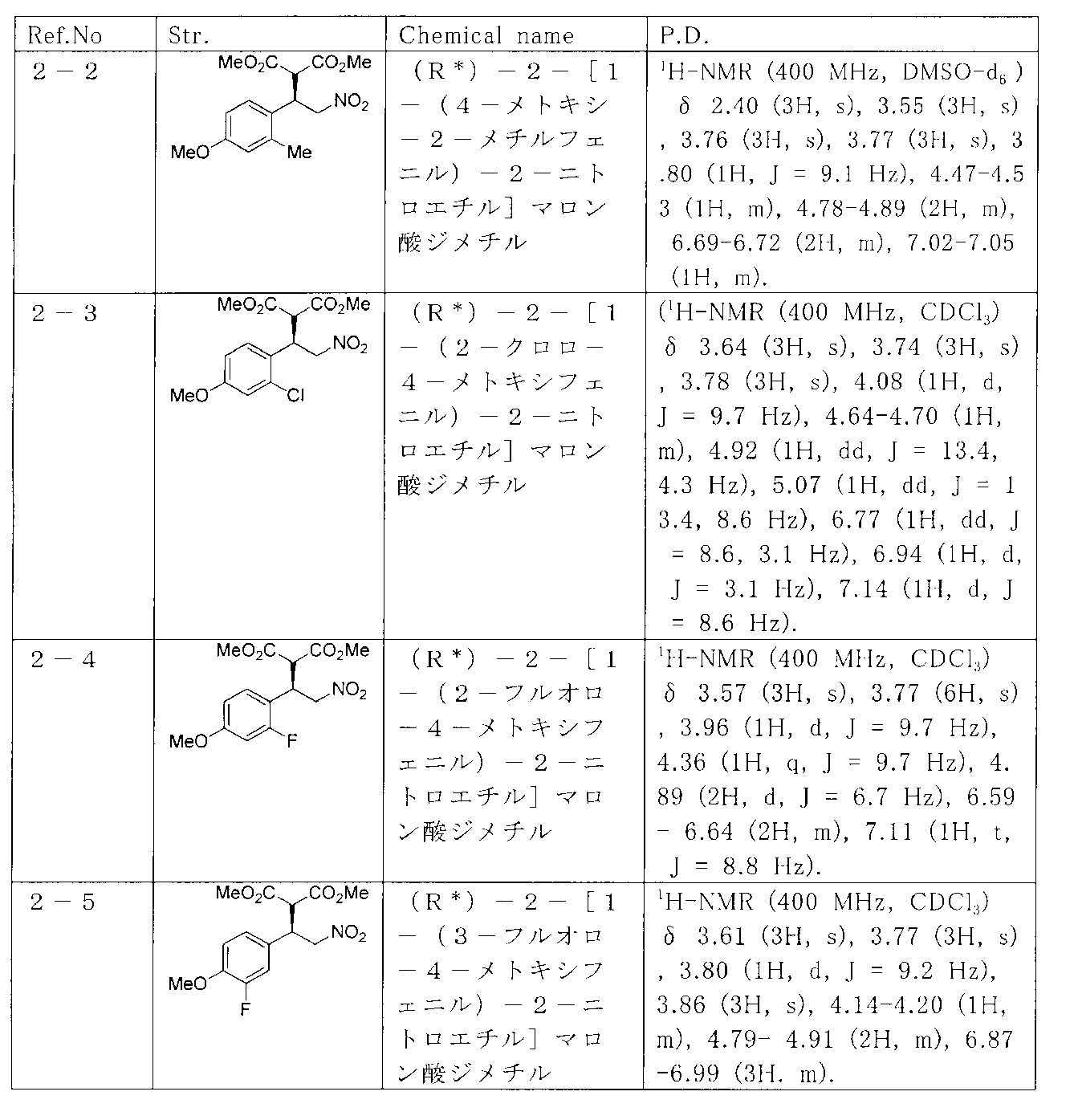
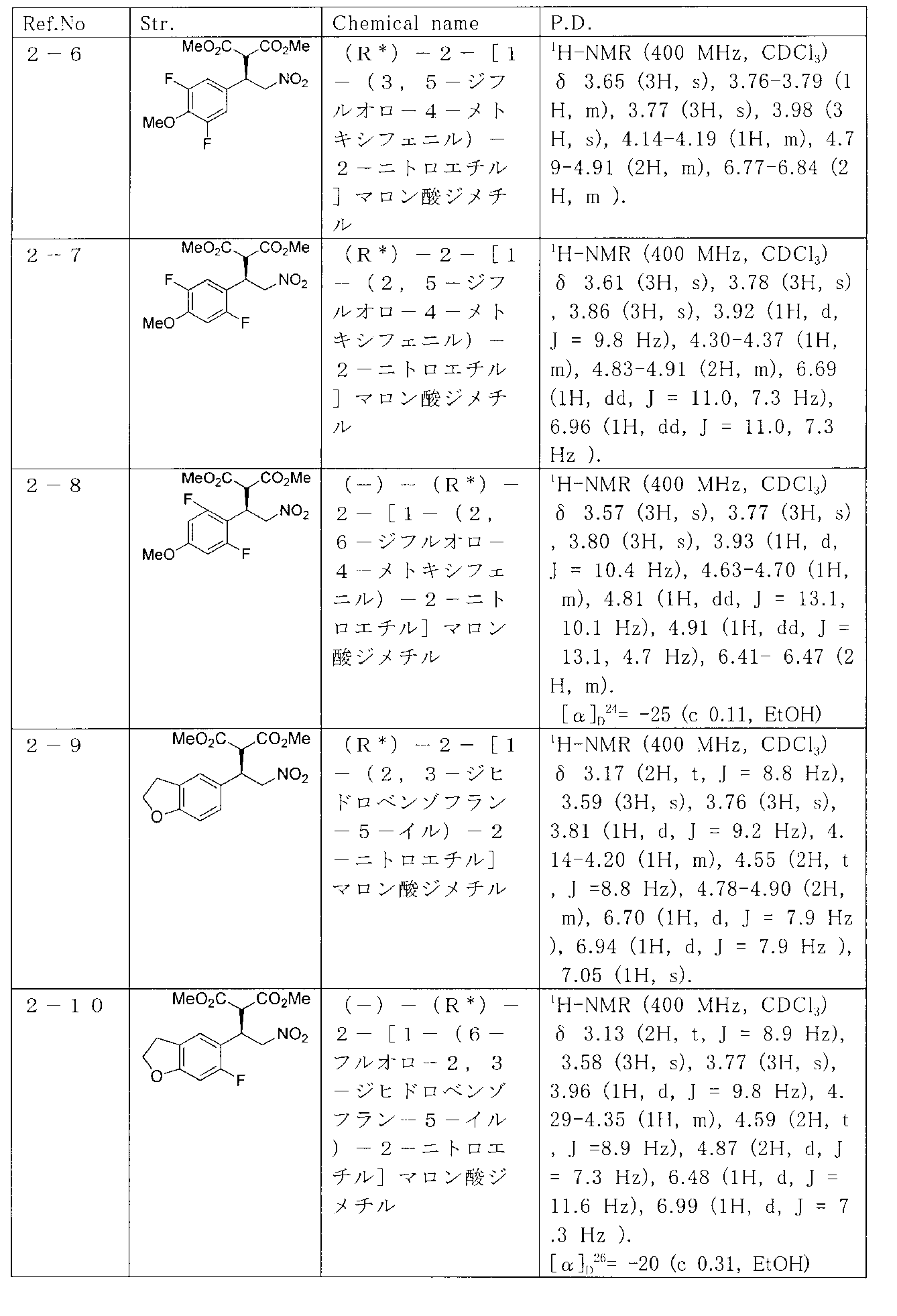


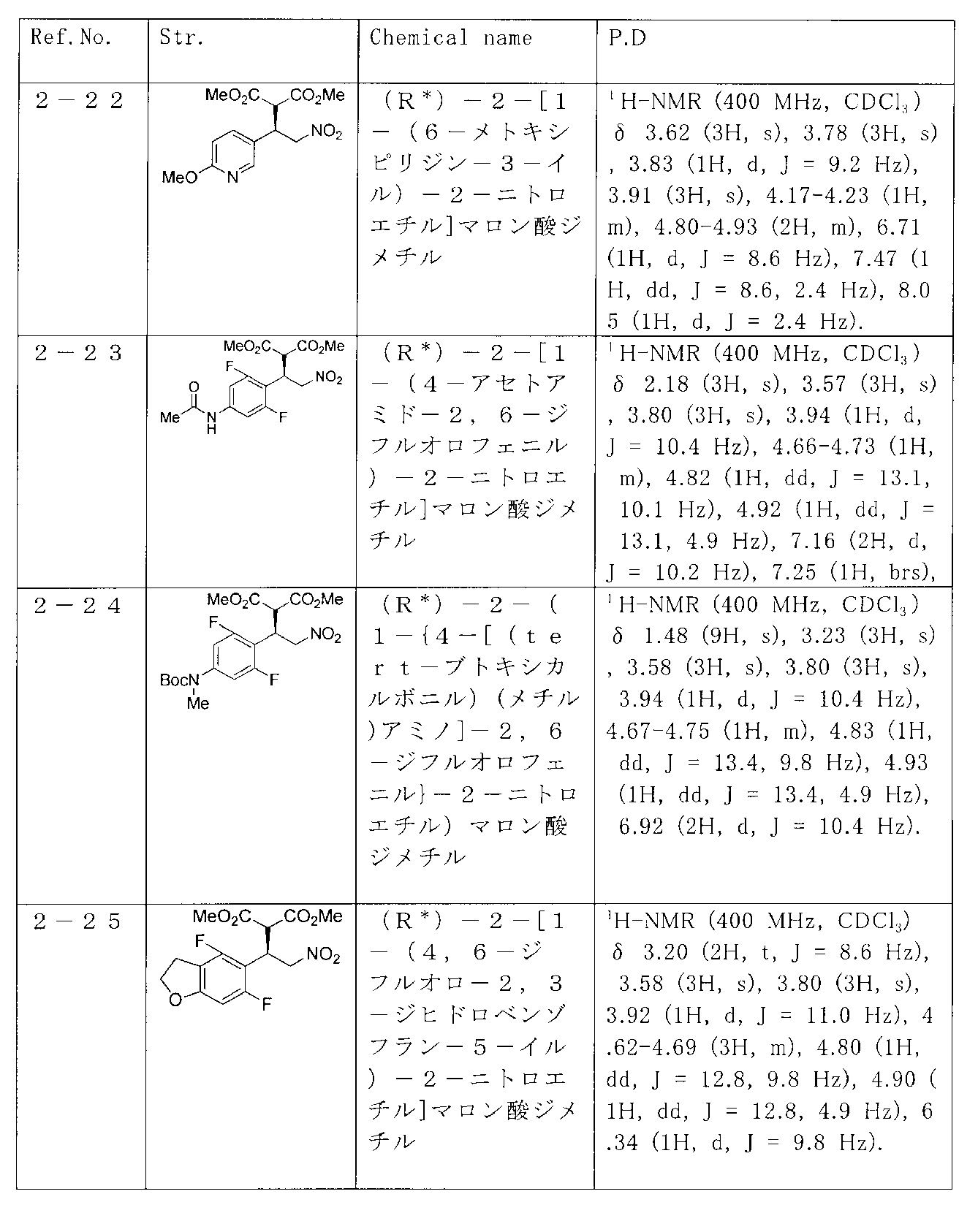

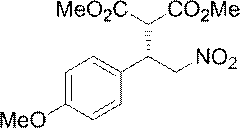
触媒として、ニッケル(II)ビス[(S、S)-N,N’-ジベンジルシクロヘキサン-1、2-ジアミン]ブロミドの代わりに、ニッケル(II)ビス[(R、R)-N,N’-ジベンジルシクロヘキサン-1、2-ジアミン]ブロミドを用いて、参考例2-1と同様の方法で実施し、表題化合物を得た。
1H-NMR (400 MHz, CDCl3) δ 3.57 (3H, s), 3.76 (3H, s), 3.78 (3H, s), 3.83 (1H, d, J = 9.1 Hz), 4.16-4.22 (1H, m), 4.83 (1H, dd, J = 12.7, 9.1 Hz), 4.89 (1H, dd, J = 12.7, 5.1 Hz), 6.84 (2H, d, J = 9.1 Hz), 7.14 (2H, d, J = 9.1 Hz).
[α]D 25= +14 (c 0.26, EtOH)
これらの構造およびスペクトルデータを表13~表14に示した。


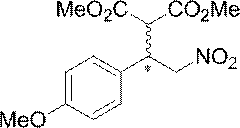
触媒として、ニッケル(II)ビス[(S、S)-N、N’-ジベンジルシクロヘキサン-1、2-ジアミン]ブロミドの代わりに、(±)-ニッケル(II)ビス[N、N’-ジベンジルシクロヘキサン-1、2-ジアミン]ブロミドを用いて、参考例2-1と同様の方法で実施し、表題化合物を得た。
1H-NMR (400 MHz, CDCl3) δ 3.57 (3H, s), 3.76 (3H, s), 3.78 (3H, s), 3.83 (1H, d, J = 9.1 Hz), 4.16-4.22 (1H, m), 4.83 (1H, dd, J = 12.7, 9.1 Hz), 4.89 (1H, dd, J = 12.7, 5.1 Hz), 6.84 (2H, d, J = 9.1 Hz), 7.14 (2H, d, J = 9.1 Hz).
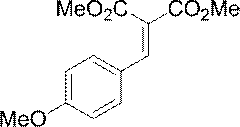
アルゴン雰囲気下、p-アニスアルデヒド(5.0 mL)およびマロン酸ジメチル(4.7 mL)の ベンゼン溶液(0.9mL)に、ピペリジン(0.4mL)および酢酸(0.47mL)を加え、反応液とした。反応液をDean-Stark装置を用いた3時間の加熱還流に供した。反応液に酢酸エチルを加え、1mol/L塩酸、飽和炭酸水素ナトリウム水溶液、および飽和食塩水で順次洗浄し、無水硫酸ナトリウムで乾燥した。溶媒を減圧下濃縮した後、残渣をシリカゲルカラムクロマトグラフィー(酢酸エチル : ヘキサン =4:1)で精製することで、白色固体として表題化合物を得た(9.5g)。
1H-NMR (400 MHz, CDCl3) δ 3.83 (3H, s), 3.84 (3H, s), 3.87 (3H, s), 6.90 (2H, d, J = 8.6 Hz), 7.39 (2H, d, J = 8.6 Hz), 7.71 (s, 1H).
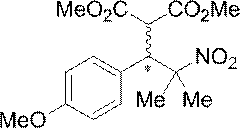
アルゴン雰囲気下、2-(4-メトキシベンジリデン)マロン酸ジメチル(250mg)のジメチルスルホキシド溶液(0.8mL)に、2-ニトロプロパン(0.14mL)およびアルミナ担持フッ化カリウム (KF/Al2O3)(400mg)を加え、反応液とした。反応液を室温で1時間半撹拌した。反応液にジエチルエーテルを加え、不溶物をろ去した後、溶液を水および飽和食塩水で順次洗浄し、無水硫酸ナトリウムで乾燥した。溶媒を減圧下濃縮した後、残渣をシリカゲルカラムクロマトグラフィー(酢酸エチル : ヘキサン =4:1)で精製することで、白色固体として表題化合物を得た(298mg)。
1H-NMR (400 MHz, CDCl3) δ 1.43 (3H, s), 1.64 (3H, s), 3.35 (3H, s), 3.75 (3H, s), 3.78 (3H, s), 4.22 (2H, s), 6.81 (2H, d, J = 9.1 Hz), 7.10 (2H, d, J = 9.1 Hz).

2-ニトロプロパンの代わりに、ニトロシクロペンタンを用いて参考例6-1と同様の方法で実施し、表題化合物を得た。
1H-NMR (400 MHz, CDCl3) δ 1.43-1.86 (6H, m), 2.33-2.42 (1H, m), 2.45-2.53 (1H, m), 3.35 (3H, s), 3.77 (3H, s), 3.80 (3H, s), 4.14 (1H, d, J = 11.5 Hz), 4.31 (1H, d, J = 11.5 Hz), 6.80 (2H, d, J = 8.5 Hz), 7.04 (2H, d, J = 9.1 Hz).
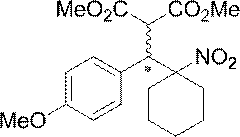
2-ニトロプロパンの代わりに、ニトロシクロヘキサンを用いて参考例6-1と同様の方法で実施し、表題化合物を得た。
1H-NMR (400 MHz, CDCl3) δ 1.10-1.17 (2H, m), 1.22-1.68 (6H, m), 2.35-2.44 (2H, m), 3.28 (3H, s), 3.78 (3H, s), 3.79 (3H, s), 3.94 (1H, d, J = 10.9 Hz), 4.32 (1H, d, J = 10.9 Hz), 6.79 (2H, d, J = 7.9 Hz), 7.02 (2H, brd, J = 7.9 Hz).

アルゴン雰囲気下、(R*)-2-[1-(4-メトキシフェニル)-2-ニトロエチル]マロン酸ジメチル(1.7g)のメタノール溶液(110mL)に、ニッケル(II)クロライド6水和物(1.3g)を加え、反応液とした。反応液に、氷冷下、水素化ホウ素ナトリウム(1.03g)を数回に分けて加え、その後室温まで昇温し2時間攪拌した。反応液に飽和塩化アンモニウム水溶液、および酢酸エチルを加え、室温で1時間攪拌した。反応液を酢酸エチルで抽出し、水、および飽和食塩水で順次洗浄後、無水硫酸ナトリウムで乾燥した。溶媒を減圧下濃縮した後、粗生成物をエタノール-ジイソプロピルエーテルで洗浄することで、白色固体として表題化合物を得た( 840mg)。
1H-NMR (400 MHz, CDCl3) δ 3.40 (1H, t, J = 9.1 Hz), 3.53 (1H, d, J = 9.7 Hz), 3.76-3.81 (1H, m), 3.78 (3H, s), 3.80 (3H, s), 4.08 (1H, q, J = 8.9 Hz), 5.85 (1H, brs), 6.88 (2H, d, J = 8.5 Hz), 7.18 (2H, d, J = 8.5 Hz).
[α]D 25= -96 (c 0.19, EtOH)
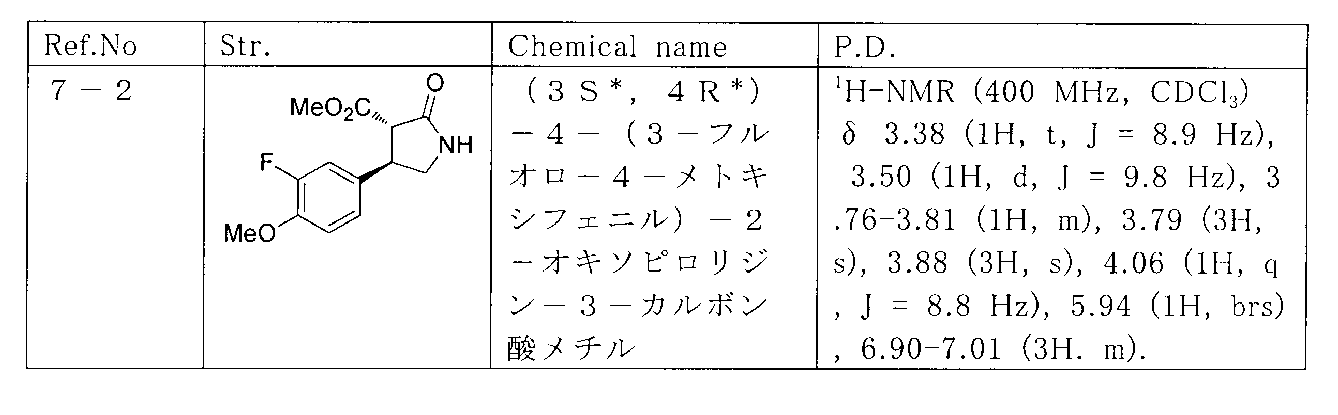
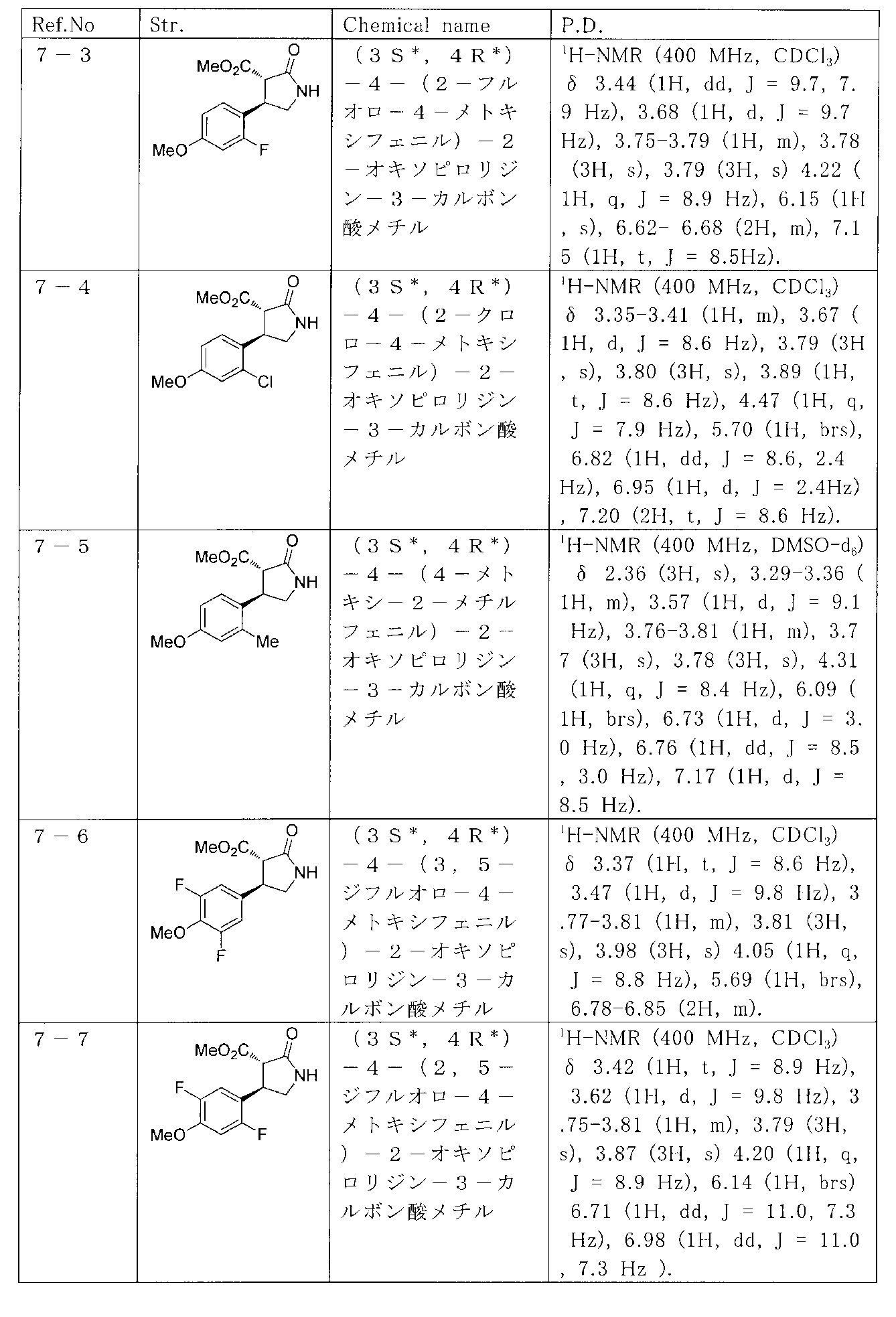
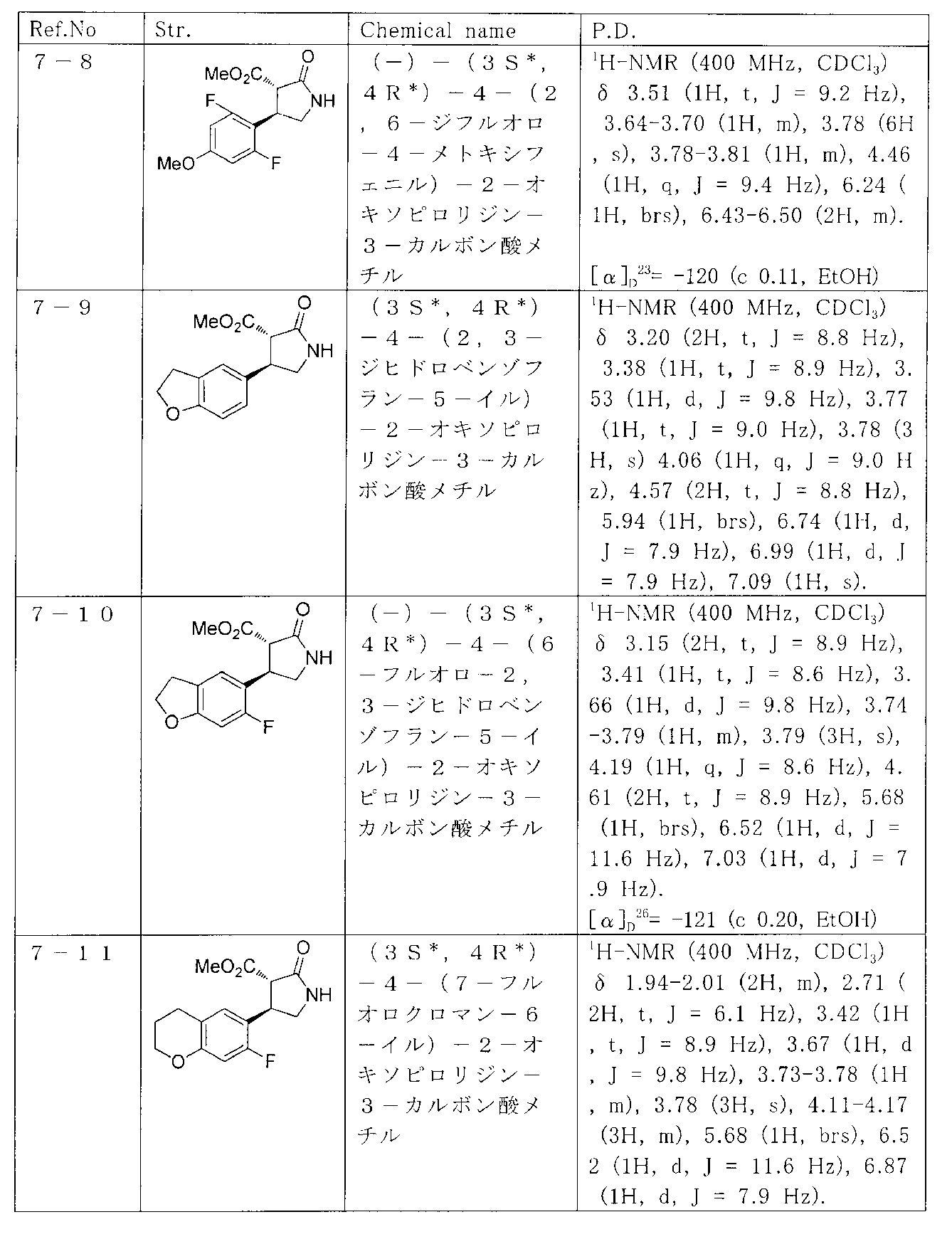
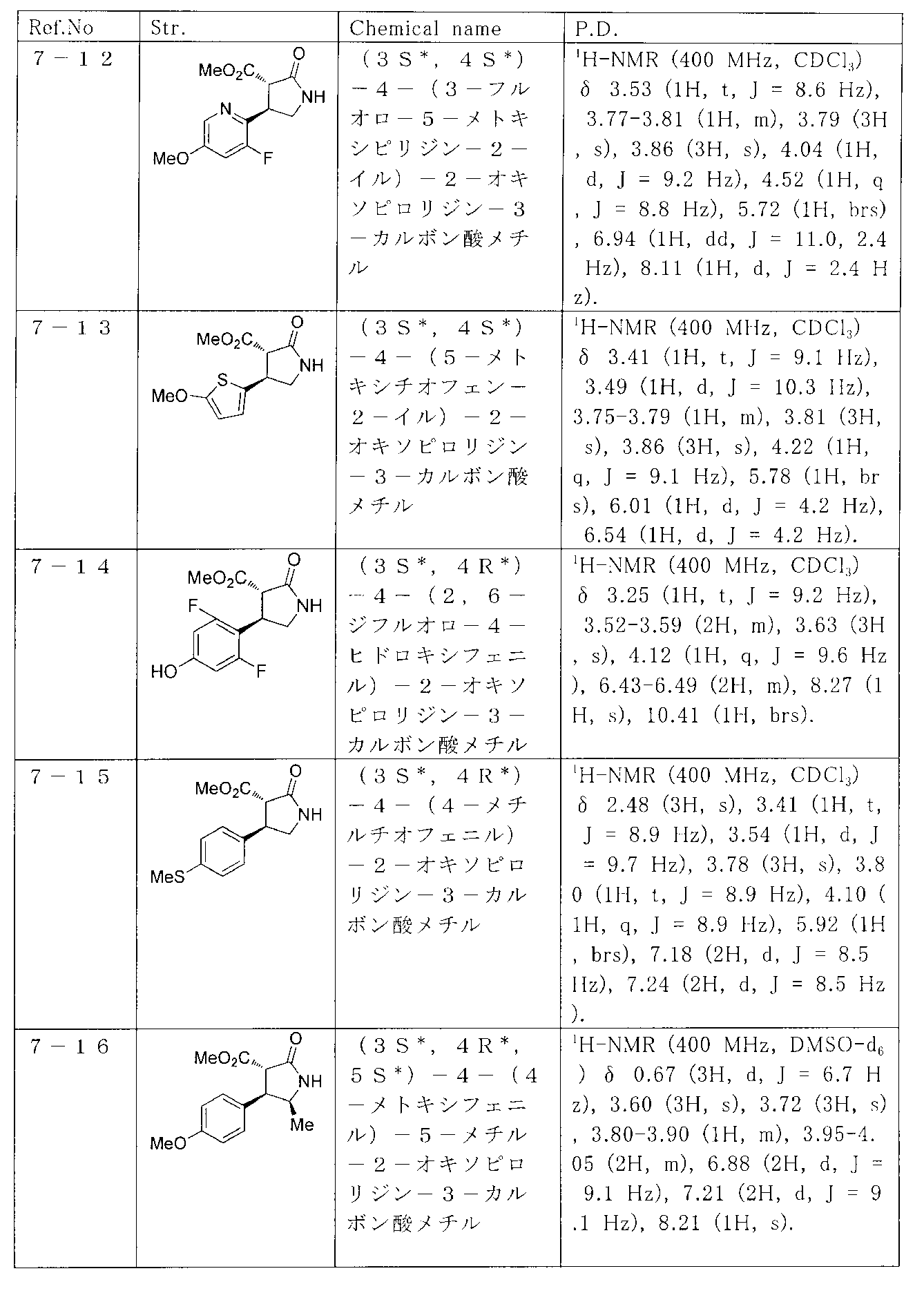


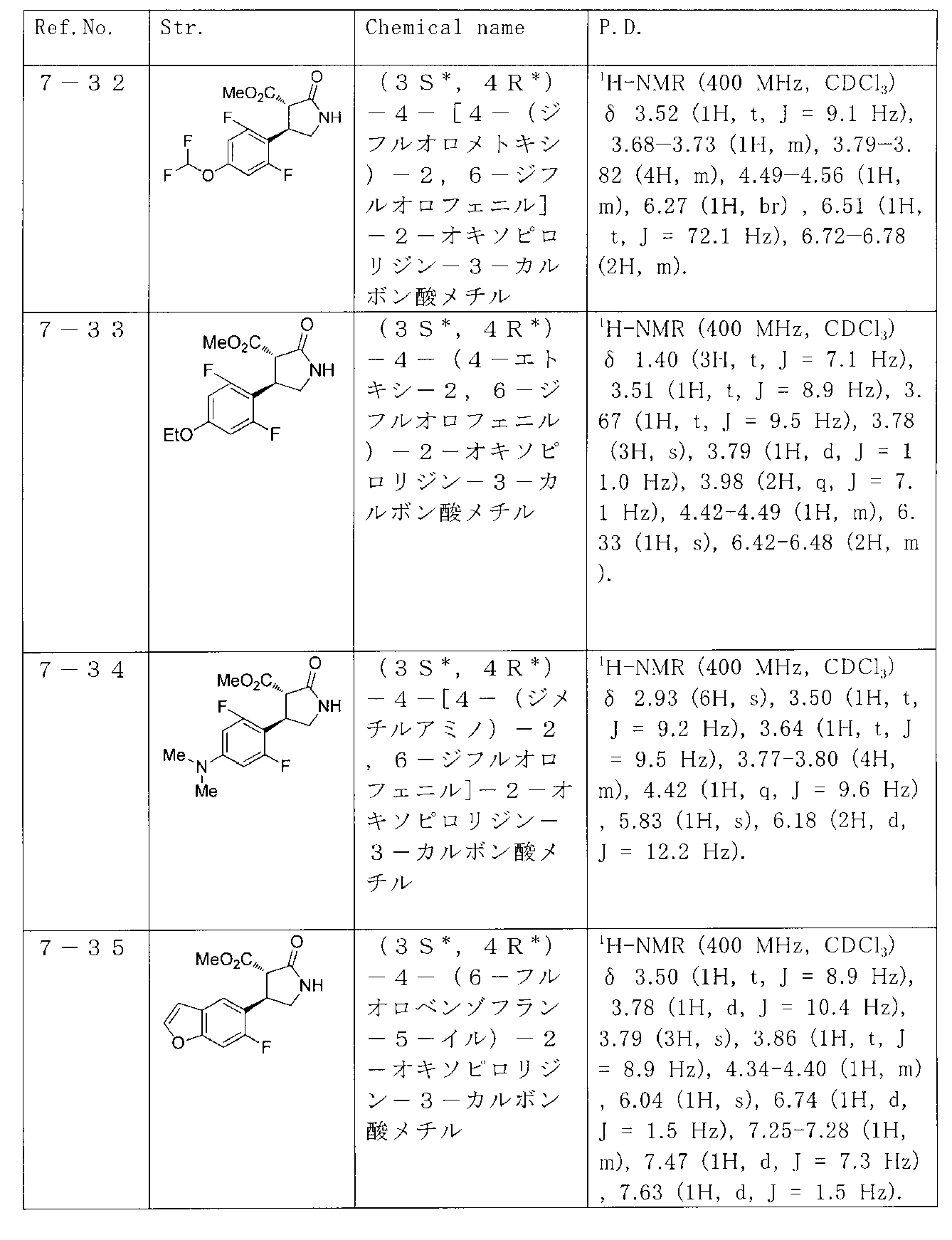


アルゴン雰囲気下、(3S*,4R*)-4-{1-[(tert-ブチルジメチルシリル)オキシ]-6-フルオロ-2,3-ジヒドロ-1H-インデン-5-イル}-2-オキソピロリジン-3-カルボン酸メチル(2.0g)のテトラヒドロフラン溶液(25mL)に、1 mol/L塩酸(15mL)を加えて反応液とした。反応液を室温で8時間撹拌した。反応液を酢酸エチルで抽出し、水、飽和食塩水で順次洗浄後、無水硫酸ナトリウムで乾燥した。溶媒を減圧下濃縮した後、残渣をシリカゲルカラムクロマトグラフィー(ヘキサン: 酢酸エチル = 4:1 ~ 1:4)で精製することで、無色アモルファスとして表題化合物を得た(1.37g)。
1H-NMR (400 MHz, CDCl3) δ 1.80 (1H, dd, J= 7.3. 4.3 Hz), 1.92-2.01 (1H, m), 2.49-2.57 (1H, m), 2.73-2.81 (1H, m), 2.96-3.03 (1H, m), 3.44 (1H, t, J = 8.9 Hz), 3.70 (1H, dd, J = 9.5, 2.1 Hz), 3.78-3.83 (4H, m), 4.27 (1H, q, J = 8.8 Hz), 5.21 (1H, q, J = 6.3 Hz), 5.87 (1H, s), 7.11 (1H, d, J = 4.3 Hz), 7.13 (1H, s).

アルゴン雰囲気下、(3S*,4R*)-4-(6-フルオロ-1-ヒドロキシ-2,3-ジヒドロ-1H-インデン-5-イル)-2-オキソピロリジン-3-カルボン酸メチル(200mg)のメタノール溶液(5mL)に、10%パラジウムカーボン(100mg)を加え、反応液とした。反応液を水素雰囲気下室温で4時間撹拌した。反応液をセライトろ過し、酢酸エチルで洗浄した。溶媒を減圧下留去することで、無色アモルファスとして表題化合物を得た(170mg)。
1H-NMR (400 MHz, CDCl3) δ 2.05-2.13 (2H, m), 2.83-2.89 (4H, m), 3.44 (1H, t, J = 8.9 Hz), 3.70 (1H, d, J = 9.8 Hz), 3.76-3.81 (4H, m), 4.25 (1H, q, J = 8.8 Hz), 5.67 (1H, s), 6.92 (1H, d, J = 10.4 Hz), 7.08 (1H, d, J = 6.7 Hz).
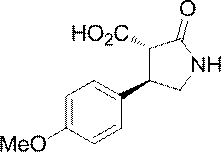
(-)-(3S*,4R*)-4-(4-メトキシフェニル)-2-オキソピロリジン-3-カルボン酸メチル(130mg)のメタノール溶液(2.6mL)に、2 mol/L水酸化ナトリウム水溶液(0.52mL)を加え、反応液とした。反応液を60℃で1時間攪拌した。反応液に1 mol/L塩酸を加えて酸性(pH1)とし、酢酸エチルで抽出した。有機層を水、飽和食塩水で順次洗浄後、無水硫酸ナトリウムで乾燥した。溶媒を減圧下濃縮した後、粗生成物を酢酸エチル-ジイソプロピルエーテルで洗浄することで、白色固体として表題化合物を得た(112mg)。
1H-NMR (400 MHz, DMSO-d6) δ 3.16 (1H, t, J = 9.4 Hz), 3.42 (1H, d, J = 10.9 Hz), 3.55 (1H, t, J = 8.2 Hz), 3.72 (3H, s), 3.79 (1H, q, J = 9.5 Hz), 6.88 (2H, d, J = 8.5 Hz), 7.24 (2H, d, J = 8.5 Hz), 8.03 (1H, s), 12.54 (1H, brs).
[α]D 27= -68 (c 0.15, EtOH)
これらの構造およびスペクトルデータを表26~表35に示した。

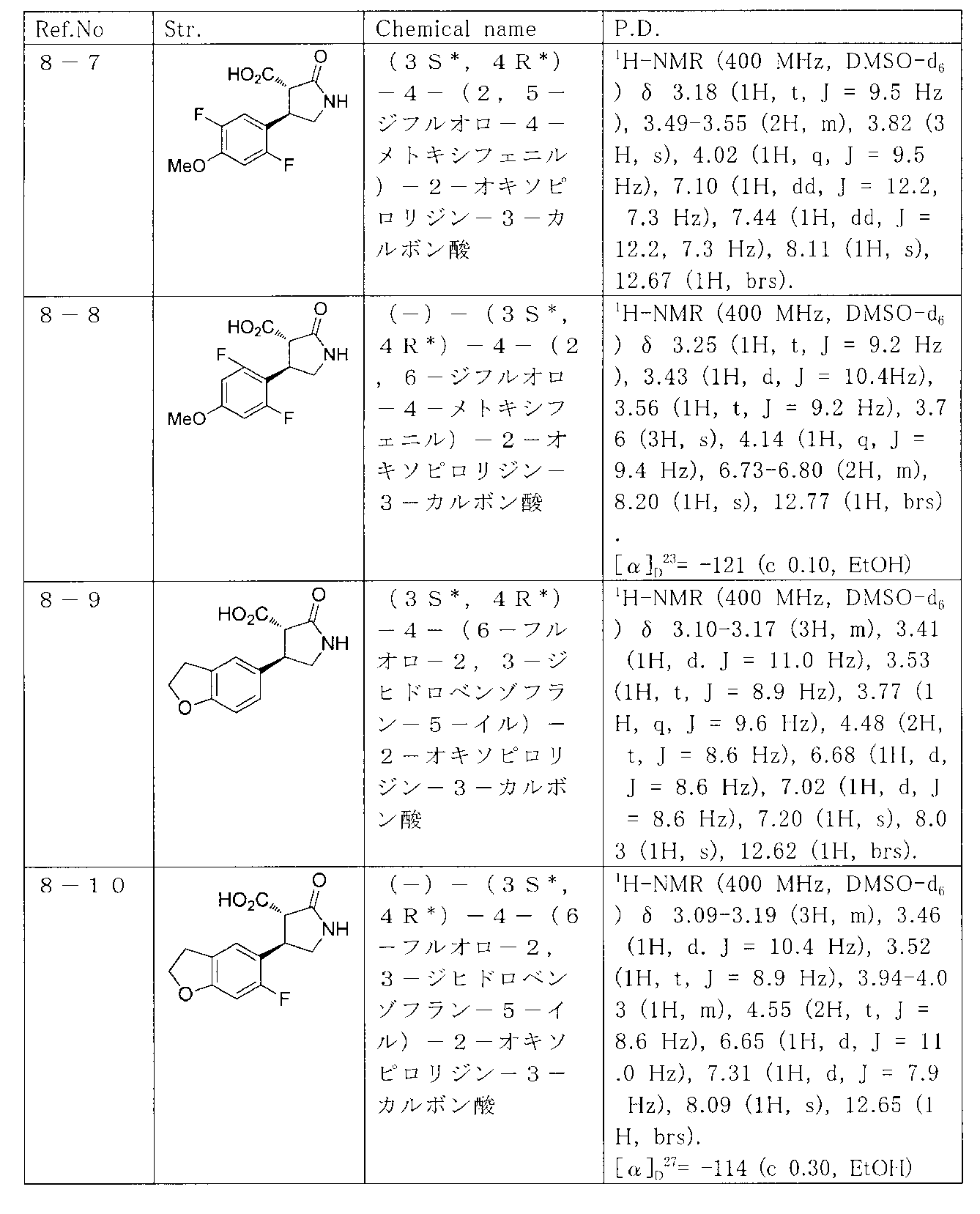


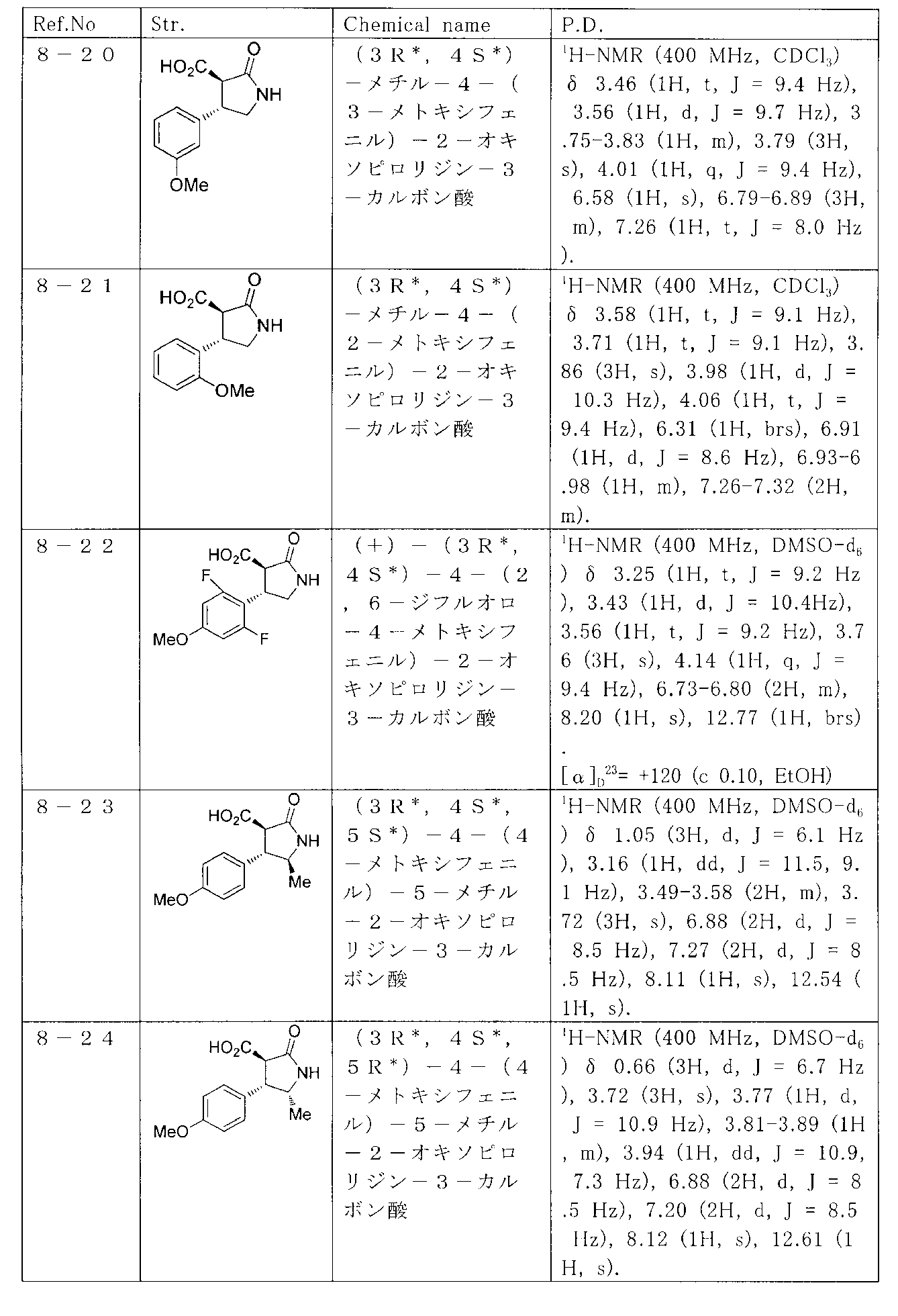
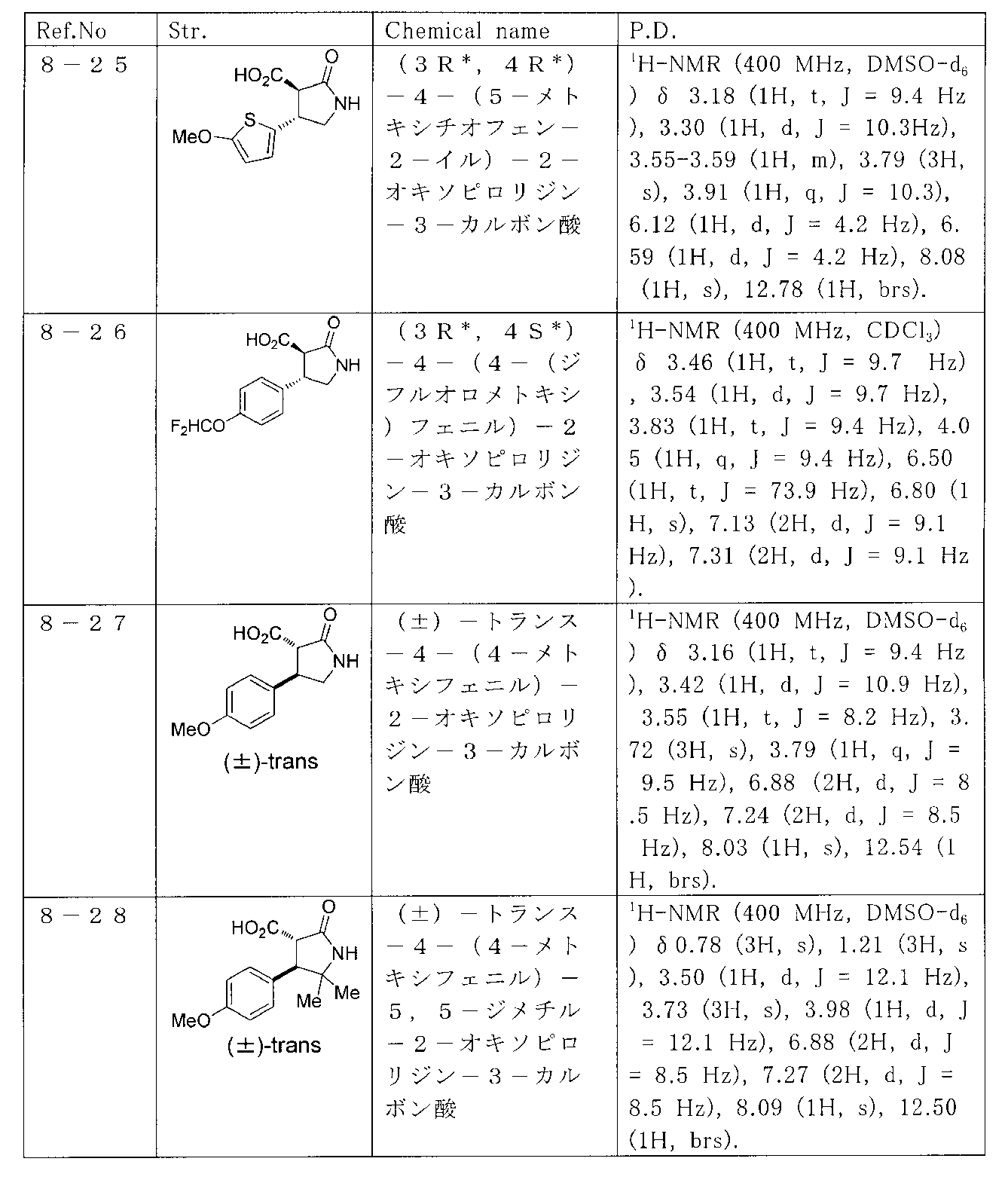
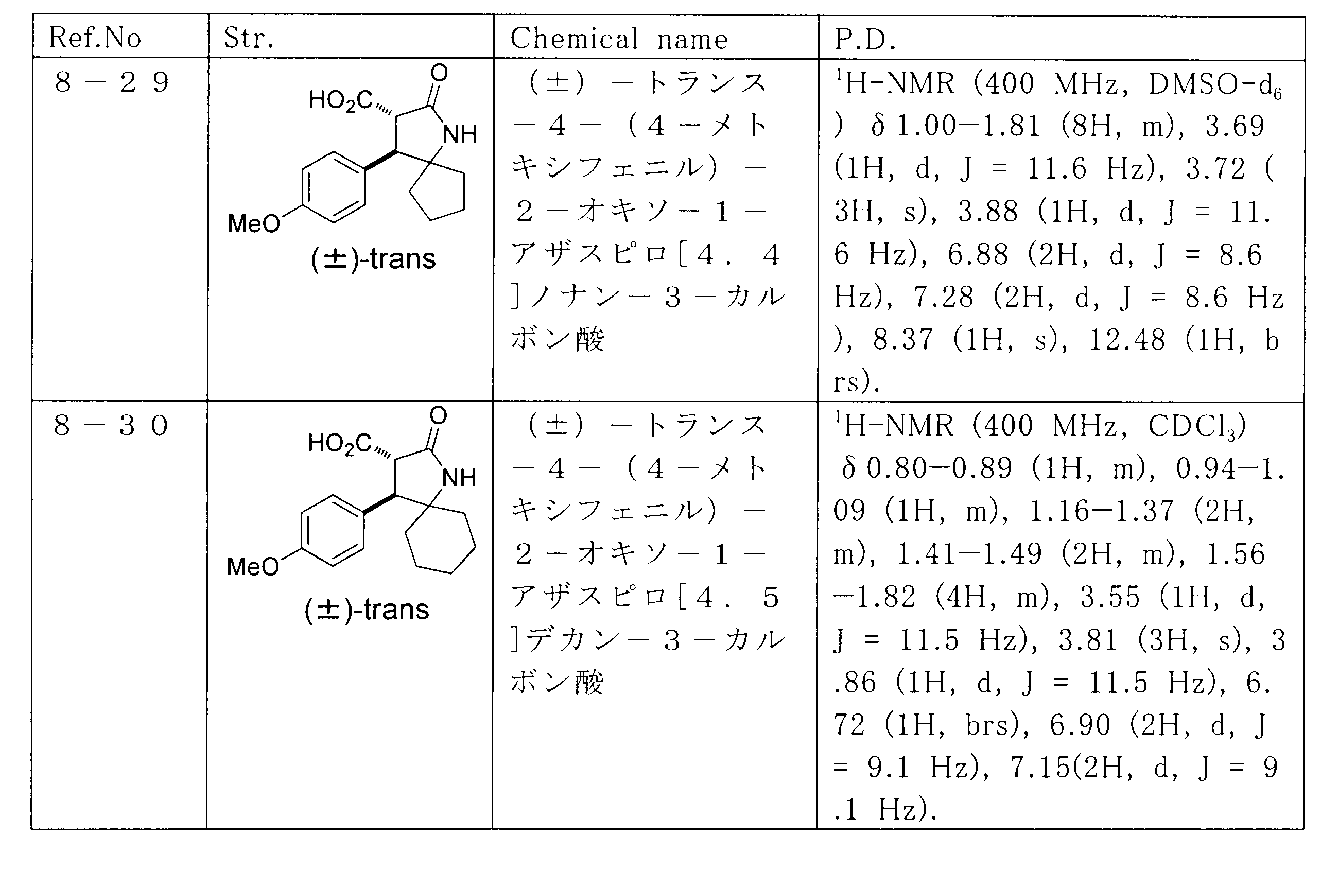

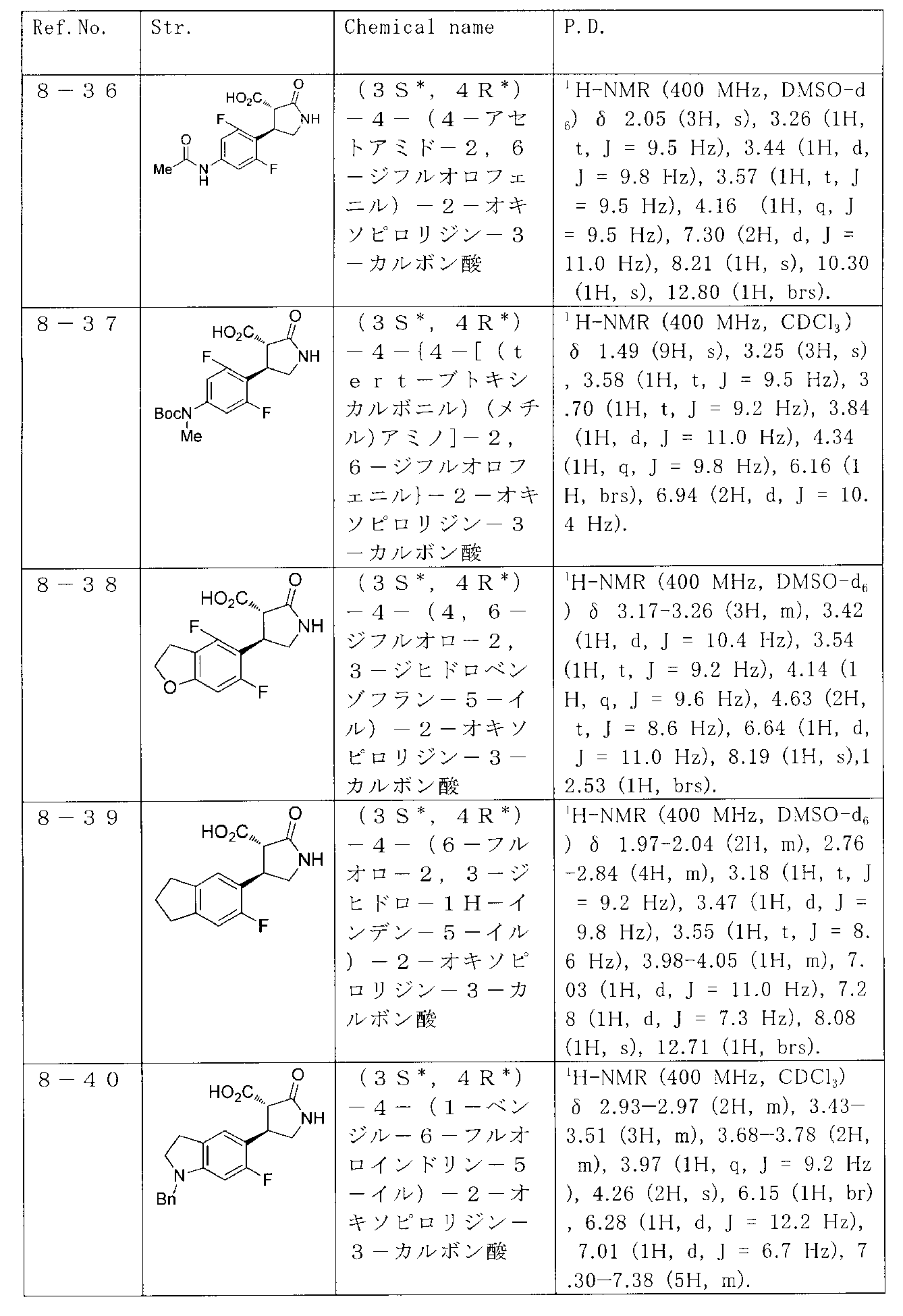
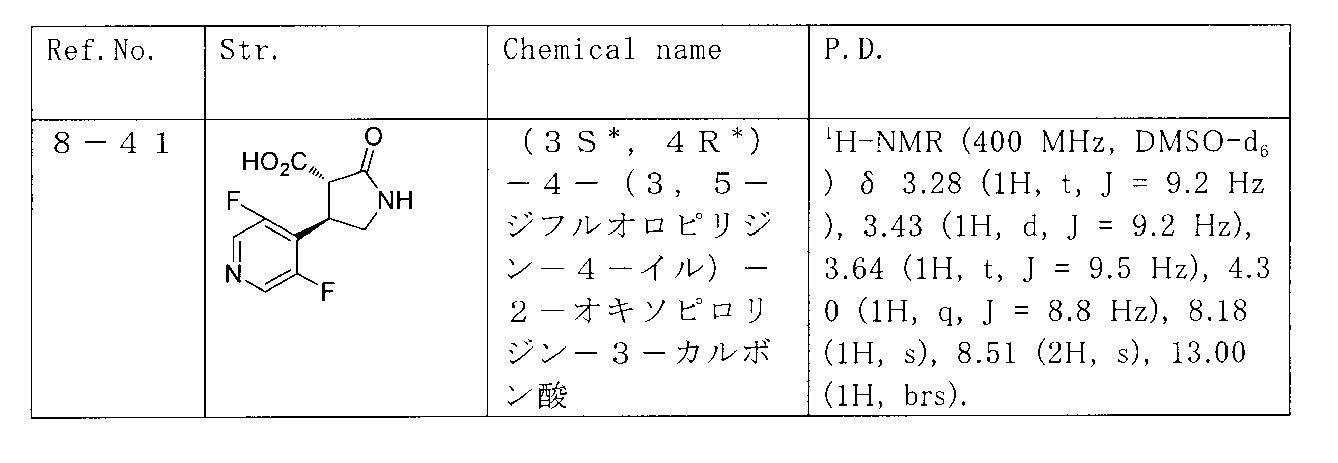

(3S*,4R*)-4-{1-[(tert-ブチルジメチルシリル)オキシ]-6-フルオロ-2,3-ジヒドロ-1H-インデン-5-イル}-2-オキソピロリジン-3-カルボン酸メチル(180mg)のメタノール溶液(0.88mL)に、2 mol/L水酸化ナトリウム水溶液(0.44mL)を加え、反応液とした。反応液を60℃で2時間攪拌した。反応液に1 mol/L塩酸を加えて酸性(pH1)とし、室温で1時間撹拌した後、酢酸エチルで抽出した。有機層を水、飽和食塩水で順次洗浄後、無水硫酸ナトリウムで乾燥した。溶媒を留去後、粗生成物を酢酸エチルとメタノールの6:1混合液で洗浄することで、白色固体として表題化合物を得た(110mg)。
1H-NMR (400 MHz, DMSO-d6) δ 1.74-1.81 (1H, m), 2.29-2.36 (1H, m), 2.61-2.69 (1H, m), 2.81-2.87 (1H, m), 3.19 (1H, t, J = 9.2 Hz), 3.49 (1H, d, J = 10.4 Hz), 3.56 (1H, t, J = 9.2 Hz), 4.04 (1H, q, J = 9.2 Hz), 4.99 (1H, q, J = 6.7 Hz), 5.32 (1H, d, J = 5.5 Hz), 7.06 (1H, d, J = 10.4 Hz), 7.30 (1H, d, J = 7.3 Hz), 8.11 (1H, s), 12.69 (1H, brs).
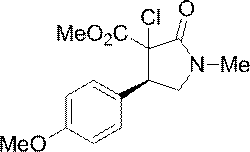
アルゴン雰囲気下、(-)-(3S*,4R*)-4-(4-メトキシフェニル)-2-オキソピロリジン-3-カルボン酸メチル(250mg)のテトラヒドロフラン溶液(5mL)に、スルフリルクロリド (200μL)を加え、反応液とした。反応液を室温で2時間攪拌した。反応液に氷冷下、飽和炭酸水素ナトリウム水溶液を加え、酢酸エチルで抽出した。有機層を水、および飽和食塩水で洗浄後、無水硫酸ナトリウムで乾燥した。溶媒を減圧下濃縮した後、残渣をシリカゲルカラムクロマトグラフィー(酢酸エチル : ヘキサン =9:1~酢酸エチル)で精製することで、中間体化合物(4R*)-3-クロロ-4-(4-メトキシフェニル)2-オキソピロリジン-3-カルボン酸メチルを得た。
得られた(4R*)-3-クロロ-4-(4-メトキシフェニル)2-オキソピロリジン-3-カルボン酸メチル(222mg)のN,N-ジメチルホルムアミド溶液(3.4mL)に、氷冷下、水素化ナトリウム(56mg, 60% in oil)を加え、反応液とした。反応液を5分間撹拌した後、ヨードメタン(97μL)を加え室温で1時間撹拌した。反応液に1 mol/L塩酸を加え、酢酸エチルで抽出した.有機層を、水、および飽和食塩水で順次洗浄後、無水硫酸ナトリウムで乾燥した。溶媒を減圧下濃縮した後、残渣をシリカゲルカラムクロマトグラフィー(酢酸エチル : ヘキサン =9:1~酢酸エチル)で精製することで、白色固体として表題化合物を得た(184mg)。
1H-NMR (400 MHz, CDCl3) δ 3.07 (3H, s), 3.50 (3H, s), 3.61-3.65 (1H, m), 3.80 (3H, s), 3.88-3.99 (2H, m), 6.88 (2H, d, J = 8.5 Hz), 7.23 (2H, d, J = 8.5 Hz).

(-)-(3S*,4R*)-4-(4-メトキシフェニル)-2-オキソピロリジン-3-カルボン酸メチルの代わりに(+)-(3R*,4S*)-4-(4-メトキシフェニル)-2-オキソピロリジン-3-カルボン酸メチルを用いて参考例9-1と同様の方法で実施し、表題化合物を得た。
1H-NMR (400 MHz, CDCl3) δ3.07 (3H, s), 3.50 (3H, s), 3.61-3.65 (1H, m), 3.80 (3H, s), 3.88-3.99 (2H, m), 6.88 (2H, d, J = 8.5 Hz), 7.23 (2H, d, J = 8.5 Hz).

(-)-(3S*,4R*)-4-(4-メトキシフェニル)-2-オキソピロリジン-3-カルボン酸メチルの代わりに(±)-トランス-4-(4-メトキシフェニル)-2-オキソピロリジン-3-カルボン酸メチルを用いて参考例9-1と同様の方法で実施し、表題化合物を得た。
1H-NMR (400 MHz, CDCl3) δ 3.07 (3H, s), 3.50 (3H, s), 3.61-3.65 (1H, m), 3.80 (3H, s), 3.88-3.99 (2H, m), 6.88 (2H, d, J = 8.5 Hz), 7.23 (2H, d, J = 8.5 Hz).

(4R*)-3-クロロ-4-(4-メトキシフェニル)-1-メチル-2-オキソピロリジン-3-カルボン酸メチル(184mg)のメタノール溶液(11mL)に、金属亜鉛(595mg)および酢酸 (0.3mL)を加え、反応液とした。反応液を室温で1時間撹拌した。反応液をセライトろ過して不溶物をろ去した後、溶媒を減圧下濃縮した。残渣に飽和炭酸水素ナトリウム水溶液を加え、酢酸エチルで抽出した。有機層を1 mol/L塩酸および飽和食塩水で洗浄後、無水硫酸ナトリウムで乾燥した。溶媒を減圧下濃縮した後、残渣をシリカゲルカラムクロマトグラフィー(ヘキサン~酢酸エチル : ヘキサン =1:1)を用いて精製することで、中間体化合物として(3S*,4R*)-4-(4-メトキシフェニル)-1-メチル-2-オキソピロリジン-3-カルボン酸メチルを得た。
得られた(3S*,4R*)-4-(4-メトキシフェニル)-1-メチル-2-オキソピロリジン-3-カルボン酸メチル(130mg)のメタノール溶液(2.8mL)に、2 mol/L水酸化ナトリウム水溶液(0.57mL)を加え、反応液とした。反応液を70℃で1時間攪拌した。反応液に1 mol/L塩酸を加えて酸性(pH1)とし、酢酸エチルで抽出した。有機層を水、飽和食塩水で順次洗浄後、無水硫酸ナトリウムで乾燥した。溶媒を減圧下濃縮した後、粗生成物を酢酸エチル-ジイソプロピルエーテルで洗浄することで、白色固体として表題化合物を得た(133mg)。
1H-NMR (400 MHz, DMSO-d6) δ 2.78 (3H, s), 3.27-3.34 (1H, m), 3.45 (1H, d, J = 10.3 Hz), 3.65 (1H, t, J = 8.8 Hz), 3.70-3.77 (1H, m), 3.72 (3H, s), 6.89 (2H, d, J = 8.5 Hz), 7.24 (2H, d, J = 8.5 Hz), 12.70 (1H, brs).
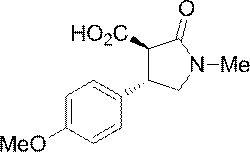
1H-NMR (400 MHz, DMSO-d6) δ 2.78 (3H, s), 3.27-3.34 (1H, m), 3.45 (1H, d, J = 10.3 Hz), 3.65 (1H, t, J = 8.8 Hz), 3.70-3.77 (1H, m), 3.72 (3H, s), 6.89(2H, d, J = 8.5 Hz), 7.24 (2H, d, J = 8.5 Hz), 12.70 (1H, brs).
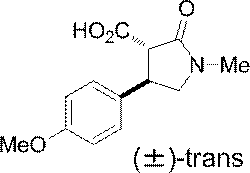
(4R*)-3-クロロ-4-(4-メトキシフェニル)-1-メチル-2-オキソピロリジン-3-カルボン酸メチルの代わりに(±)-3-クロロ-4-(4-メトキシフェニル)-1-メチル-2-オキソピロリジン-3-カルボン酸メチルを用いて、参考例10-1と同様の方法で実施し、表題化合物を得た。
1H-NMR (400 MHz, DMSO-d6) δ 2.78 (3H, s), 3.27-3.34 (1H, m), 3.45 (1H, d, J = 10.3 Hz), 3.65 (1H, t, J = 8.8 Hz), 3.70-3.77 (1H, m), 3.72 (3H, s), 6.89 (2H, d, J = 8.5 Hz), 7.24 (2H, d, J = 8.5 Hz), 12.70 (1H, brs).

(-)-(3S*,4R*)-4-(4-メトキシフェニル)-2-オキソピロリジン-3-カルボン酸(6.04g)のトルエン溶液(128mL)に、トリエチルアミン(3.95mL)、およびジフェニルリン酸アジド(6.2mL)を加え、反応液とした。反応液を室温で4.5時間撹拌した。反応液について反応温度を80℃に昇温して30分間撹拌した後、ベンジルアルコール(13.3mL)を加え、120℃で5時間撹拌した。反応液を減圧下濃縮した後、残渣をシリカゲルカラムクロマトグラフィー(酢酸エチル~酢酸エチル:メタノール=10:1)で精製することで、白色固体として表題化合物を得た(6.3g)。
1H-NMR (400 MHz, CDCl3) δ 3.36 (1H, t, J = 9.1 Hz), 3.49-3.70 (2H, m), 3.80 (3H, s), 4.42 (1H, dd, J = 11.5, 8.5 Hz), 5.07 (2H, s), 5.16 (1H, brs), 5.98 (1H, brs), 6.89 (2H, d, J = 7.9 Hz), 7.22 (2H, d, J = 7.9 Hz), 7.20-7.40 (5H, m).
[α]D 27= -79 (c 0.17, EtOH)
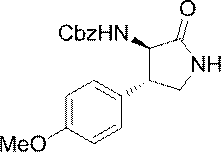
(-)-(3S*,4R*)-4-(4-メトキシフェニル)-2-オキソピロリジン-3-カルボン酸の代わりに、(+)-(3R*,4S*)-4-(2,6-ジフルオロ-4-メトキシフェニル)-2-オキソピロリジン-3-カルボン酸を用いて参考例11-1と同様の方法で実施し、表題化合物を得た。
1H-NMR (400 MHz, CDCl3) δ 3.36 (1H, t, J = 9.1 Hz), 3.49-3.70 (2H, m), 3.80 (3H, s), 4.42 (1H, dd, J = 11.5, 8.5 Hz), 5.07 (2H, s), 5.16 (1H, brs), 5.98 (1H, brs), 6.89 (2H, d, J = 7.9 Hz), 7.22 (2H, d, J = 7.9 Hz), 7.20-7.40 (5H, m).
[α]D 27= +81 (c 0.16, EtOH)
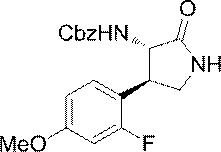
(3S*,4R*)-4-(2-フルオロ-4-メトキシフェニル)-2-オキソピロリジン-3-カルボン酸(1.6g)のトルエン(63mL)とアセトニトリル(10mL)混合溶液に、トリエチルアミン(1.0mL)、およびジフェニルリン酸アジド(1.5mL)を加え、反応液とした。反応液を室温で3時間撹拌した。反応液について、反応温度を80℃に昇温して30分間撹拌した後、ベンジルアルコール(3.3mL)を加えて,110℃で3.5時間撹拌した。反応液に酢酸エチルを加え、1mol/L塩酸、水、飽和食塩水で順次洗浄後、無水硫酸ナトリウムで乾燥した。溶媒を減圧下濃縮した後、残渣をシリカゲルカラムクロマトグラフィー(ヘキサン:酢酸エチル=4:1~酢酸エチル:メタノール=10:1)で精製することで、白色固体として表題化合物を得た( 767mg)。
1H-NMR (400 MHz,CDCl3) δ 3.40 (1H, t, J = 8.6 Hz), 3.63-3.82 (2H, m), 3.79 (3H, s), 4.62 (1H, dd, J = 11.0, 8.6 Hz), 5.07 (2H, brs), 5.16 (1H, brs), 6.01 (1H, brs), 6.58-6.73 (2H, m), 7.25-7.33 (6H, m).
[α]D 24= -134 (c 0.16, EtOH)
これらの構造およびスペクトルデータを表36に示した。
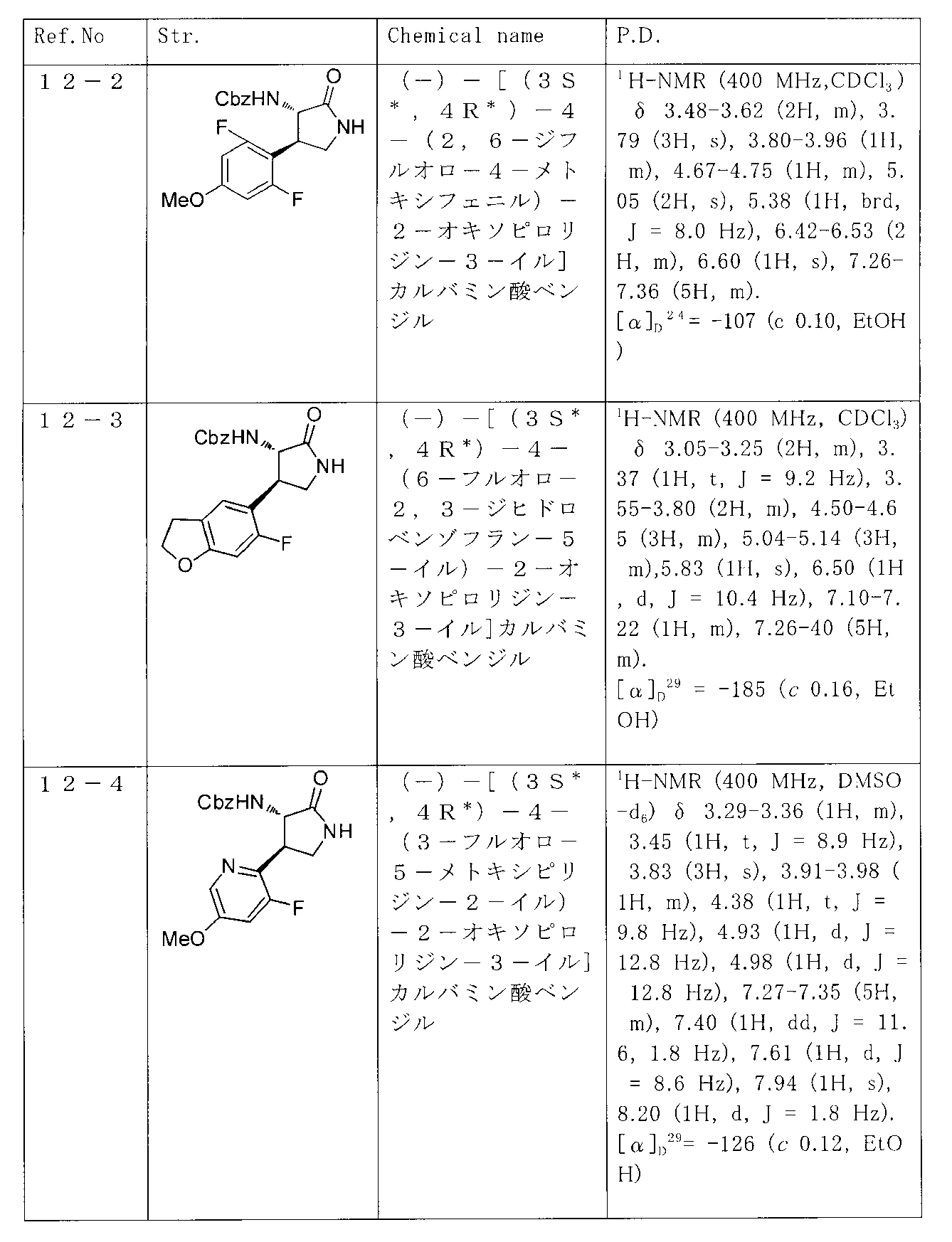

(-)-[(3S*,4R*)-4-(2,6-ジフルオロ-4-メトキシフェニル)-2-オキソピロリジン-3-イル]カルバミン酸ベンジル(811mg)のエタノール溶液(30mL)に10%パラジウムカーボン(81mg)を加え、反応液とした。反応液を水素雰囲気下で2時間撹拌した。反応液をセライトろ過し、溶媒を減圧下濃縮した。残渣をシリカゲルカラムクロマトグラフィー(ヘキサン:酢酸エチル=1:1~酢酸エチル:メタノール=9:1)で精製することで、白色固体として表題化合物を得た( 520mg)。
1H-NMR (400 MHz,DMSO-d6) δ 3.22 (1H, t, J = 8.0 Hz), 3.34-3.43 (2H, m), 3.47 (1H, d, J = 9.8 Hz), 3.76 (3H, s), 6.74 (2H, d, J = 11.0 Hz), 7.88 (1H, s).
[α]D 24= -90 (c 0.11, EtOH)
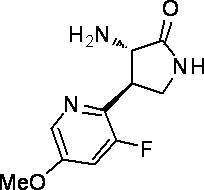
(-)-[(3S*,4R*)-4-(2,6-ジフルオロ-4-メトキシフェニル)-2-オキソピロリジン-3-イル]カルバミン酸ベンジルの代わりに、(-)-[(3S*,4R*)-4-(3-フルオロ-5-メトキシピリジン-2-イル)-2-オキソピロリジン-3-イル]カルバミン酸ベンジルを用いて参考例13-1と同様の方法に従うことで、表題化合物を得た。
1H-NMR (400 MHz, DMSO-d6) δ 1.84 (2H, s), 3.22 (1H, t, J = 9.2 Hz), 3.40 (1H, t, J = 8.6 Hz), 3.51-3.58 (1H, m), 3.61 (1H, d, J = 9.8 Hz), 3.83 (3H, s), 7.41 (1H, dd, J = 11.9, 1.4 Hz), 7.77 (1H, s), 8.19 (1H, d, J = 1.4 Hz).
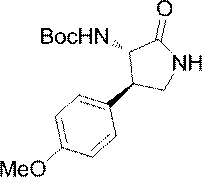
(-)-(3S*,4R*)-4-(4-メトキシフェニル)-2-オキソピロリジン-3-カルボン酸(4.05g)のトルエン溶液(80mL)にトリエチルアミン(2.64mL)とジフェニルリン酸アジド(4.07mL)を加え、第1の反応液とした。第1の反応液を室温で5時間撹拌した。第1の反応液について、反応温度を80℃に昇温して20分間撹拌した後、第1の反応液を減圧下濃縮した。残渣にジオキサン(50mL)および、1 mol/L塩酸(50mL)を加え、第2の反応液とした。第2の反応液を室温で30分撹拌した。第2の反応液を減圧下濃縮し、水(40mL)を加え、ジエチルエーテルで洗浄した。水層を減圧下濃縮した後、残渣にメタノール(77mL),トリエチルアミン(10mL)および、ジtert-ブチルジカルボネート(4.28g)を加え、第3の反応液とした。第3の反応液を室温で3時間撹拌した。第3の反応液を減圧下濃縮した後、残渣に水を加え、酢酸エチルで抽出した。有機層を飽和食塩水で洗浄し、無水硫酸ナトリウムで乾燥した。溶媒を減圧下濃縮した後、粗生成物をクロロホルムで洗浄することで、白色固体として表題化合物を得た(2.97g)。
1H-NMR (400 MHz, CDCl3) δ 1.33 (9H, s), 3.10-3.17 (1H, m), 3.37-3.45 (2H, m), 3.71 (3H, s), 4.12 (1H, t, J = 7.0 Hz), 6.87 (2H, d, J = 8.6 Hz), 7.07 (1H, d, J = 9.2 Hz), 7.23 (2H, d, J = 8.6 Hz), 7.83 (1H, brs).
[α]D 27= -64 (c 0.14, EtOH)
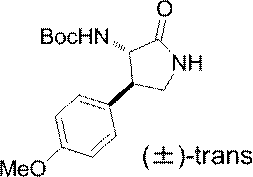
(-)-(3S*,4R*)-4-(4-メトキシフェニル)-2-オキソピロリジン-3-カルボン酸の代わりに、(±)-トランス-4-(4-メトキシフェニル)-2-オキソピロリジン-3-カルボン酸を用いて、参考例14-1と同様の方法で実施し、表題化合物を得た。
1H-NMR (400 MHz, CDCl3) δ 1.33 (9H, s), 3.10-3.17 (1H, m), 3.37-3.45 (2H, m), 3.71 (3H, s), 4.12 (1H, t, J = 7.0 Hz), 6.87 (2H, d, J = 8.6 Hz), 7.07 (1H, d, J = 9.2 Hz), 7.23 (2H, d, J = 8.6 Hz), 7.83 (1H, brs).

水素化ナトリウム(42mg, 60% in oil)のテトラヒドロフラン溶液(2.3mL)に、冷却下で(-)-[(3S*,4R*)-4-(4-メトキシフェニル)-2-オキソピロリジン-3-イル]カルバミン酸tert-ブチル(181mg)のN,N-ジメチルホルムアミド溶液(0.9mL)とヨードエチル(50μL)のテトラヒドロフラン溶液(1.2mL)を加え、室温で4時間撹拌した。反応混合物に水を加え、酢酸エチルで抽出した。有機層を飽和食塩水で洗浄し、無水硫酸ナトリウムで乾燥した。溶媒を減圧下濃縮した後、残渣をシリカゲルカラムクロマトグラフィー(酢酸エチル : ヘキサン =4:1)で精製することで,白色固体として表題化合物を得た(65mg)。
1H-NMR (400 MHz, CDCl3) δ 1.17 (3H, t, J = 7.4 Hz), 1.38 (9H, s), 3.31-3.60 (5H, m), 3.80 (3H, s), 4.30 (1H, t, J = 9.2 Hz), 4.84 (1H, brs), 6.89 (2H, d, J = 8.6Hz), 7.25 (2H, d, J = 8.6 Hz).
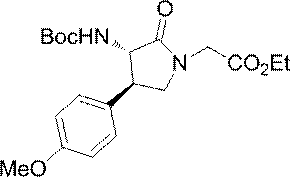
アルキル化試薬として、ヨードエチルの代わりにブロモ酢酸エチルを用いて、参考例15-1と同様の方法で実施し、表題化合物を得た。
1H-NMR (400 MHz, CDCl3) δ 1.30 (3H, t, J = 7.3 Hz), 1.39 (9H, s), 3.50-3.65 (3H, m), 3.80 (3H, s), 3.96 (1H, d, J = 17.8 Hz), 4.21 (2H, q, J = 7.3 Hz), 4.31 (1H, d, J = 17.8 Hz), 4.34 (1H, t, J = 8.6 Hz), 4.87 (1H, brs), 6.89 (2H, d, J = 8.6 Hz), 7.25 (2H, d, J = 8.6 Hz).

アルキル化試薬として、ヨードエチルの代わりに、2-ブロモプロピオン酸エチルを用いて参考例15-1と同様の方法で実施し、表題化合物を得た。
1H-NMR (400 MHz, CDCl3) δ 1.27-1.48 (15H, m), 3.29-3.80 (3H, m), 3.80 (3H, s), 4.15-4.31 (3H, m), 4.57 (0.5H, brs), 4.80 (0.5H, brs), 4.88-4.99 (1H, m), 6.88 (2H, d, J = 8.6 Hz), 7.25 (2H, d, J = 9.2 Hz).

(±)-トランス-(4-(4-メトキシフェニル)-2-オキソピロリジン-3-イル)カルバミン酸tert-ブチル(1.03g)、および2-ブロモエトキシtert-ブチルジメチルシラン(1.44mL)のN,N-ジメチルホルムアミド溶液(10mL)に、冷却下で水素化ナトリウム(141mg, 60% in oil)を数回に分けて加え、反応液とした。反応液を室温で2時間撹拌した。反応液に飽和塩化アンモニウム水溶液を加え、酢酸エチルで抽出した。有機層を水、飽和食塩水で順次洗浄後、無水硫酸ナトリウムで乾燥した。溶媒を減圧下濃縮した後、残渣をシリカゲルカラムクロマトグラフィー(ヘキサン:酢酸エチル=3:1)で精製することで、無色油状物として表題化合物を得た(1.1g)。
1H-NMR (400 MHz, CDCl3) δ 0.06 (6H, s), 0.89 (9H, s), 1.37 (9H, s), 3.30-3.47 (2H, m), 3.52 (1H, t, J = 9.7 Hz), 3.57-3.64 (1H, m), 3.71 (1H, t, J = 9.1 Hz), 3.76-3.80 (2H, m), 3.80 (3H, s), 4.33 (1H, t, J = 9.4 Hz), 4.81 (1H, brs), 6.89 (2H, d, J = 8.8 Hz), 7.22 (2H, d, J = 8.8 Hz).

2-{(3S*,4R*)-3-[(tert-ブトキシカルボニル)アミノ]-4-(4-メトキシフェニル)-2-オキソピロリジン-1-イル}酢酸エチル(384mg)のテトラヒドロフラン溶液(10mL)に、-78℃でリチウム ヘキサメチルジシラジド (3.8mL, 1.3mol/L テトラヒドロフラン溶液) を加え、反応液とした。反応液を30分撹拌した。反応液にヨウ化メチル (0.31mL)を加え、温度を室温まで昇温させて24時間撹拌した。反応液に10%クエン酸水溶液を加え、酢酸エチルで抽出した。有機層を水、および飽和食塩水で順次洗浄し、無水硫酸ナトリウムで乾燥した。溶媒を減圧下濃縮した後、残渣をシリカゲルカラムクロマトグラフィー(酢酸エチル : ヘキサン =4:1 ~ 酢酸エチル)で精製することで、白色固体として表題化合物を得た(222mg)。
1H-NMR (400 MHz, CDCl3) δ 1.29 (3H, t, J = 7.4 Hz), 1.36 (9H, s), 1.50 (3H, s), 1.57 (3H, s), 3.34-3.42 (2H, m), 3.70-3.77 (1H, m), 3.80 (3H, s), 4.20 (2H, q, J = 7.4 Hz), 4.36 (1H, t, J = 10.4 Hz), 4.83 (1H, brs), 6.89 (2H, d, J = 8.6 Hz), 7.25 (2H, d, J = 8.6 Hz).

(-)-[(3S*,4R*)-4-(4-メトキシフェニル)-2-オキソピロリジン-3-イル]カルバミン酸tert-ブチルの代わりに、2-((3S*,4R*)-3-{[(ベンジルオキシ)カルボニル]アミノ}-4-(6-フルオロ-2,3-ジヒドロベンゾフラン-5-イル)-2-オキソピロリジン-1-イル)酢酸エチルを用いて参考例17-1と同様な方法で実施し、表題化合物を得た。
1H-NMR (400 MHz, CDCl3) δ 1.28 (3H, t, J = 7.0 Hz), 1.50 (3H, s), 1.56 (3H, s), 3.10-3.22 (2H, m), 3.37 (1H, t, J = 9.2 Hz), 3.52-3.66 (1H, m), 3.69-3.80 (1H, m), 4.20 (2H, q, J = 7.0 Hz), 4.57-4.65 (1H, m), 4.60 (2H, t, J = 8.6 Hz), 5.00-5.13 (3H, m), 6.51 (1H, d, J = 10.4 Hz), 7.17-7.23 (1H, m), 7.28-7.36 (5H, m).
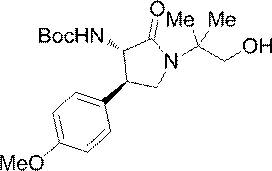
2-{(3S*,4R*)-3-[(tert-ブトキシカルボニル)アミノ]-4-(4-メトキシフェニル)-2-オキソピロリジン-1-イル}-2-メチルプロピオン酸エチル(421mg)のテトラヒドロフラン溶液(10mL)に、氷冷下で水素化ホウ素リチウム(1.5mL,3mol/L テトラヒドロフラン溶液)を加え、反応液とした。反応液を室温で2時間撹拌した。反応液に10%クエン酸水溶液を加え、酢酸エチルで抽出した。有機層を水、および飽和食塩水で順次洗浄し、無水硫酸ナトリウムで乾燥した。溶媒を減圧下濃縮した後、残渣をシリカゲルカラムクロマトグラフィー(酢酸エチル : ヘキサン =4:1)で精製することで、白色固体として表題化合物を得た(88mg)。
1H-NMR (400 MHz, CDCl3) δ 1.30 (3H, s), 1.31 (3H, s), 1.40 (9H, s), 3.28-3.39 (2H, m), 3.65-3.75 (2H, m), 3.81 (3H, s), 3.92 (1H, brs), 4.32 (1H, t, J = 9.2 Hz), 4.57 (1H, brs), 4.86 (1H, brs), 6,89 (2H, d, J = 8.6 Hz), 7.22 (2H, d, J = 8.6 Hz).
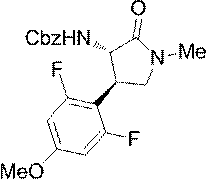
(-)-[(3S*,4R*)-4-(2,6-ジフルオロ-4-メトキシフェニル)-2-オキソピロリジン-3-イル]カルバミン酸ベンジル(200mg)のN,N-ジメチルホルムアミド溶液(5.3mL)に、氷冷下でカリウムtert-ブトキシド(60mg)、およびヨードメタン(33μL)を加え、反応液とした。反応液を2時間撹拌した。反応液に飽和塩化アンモニウム水溶液を加えた後、酢酸エチルで抽出した。有機層を飽和食塩水で洗浄後、無水硫酸ナトリウムで乾燥した。溶媒を減圧下濃縮した後、残渣をシリカゲルカラムクロマトグラフィー(ヘキサン:酢酸エチル=4:1~酢酸エチル)で精製することで、白色固体として表題化合物を得た(100mg)。
1H-NMR (400 MHz,CDCl3) δ 2.95 (3H, s), 3.40-3.62 (2H, m), 3.77 (3H, s), 3.80-3.84 (1H, m), 4.57-4.67 (1H, m), 5.04 (2H s), 5.20 (1H, brs), 6.40-6.51 (2H, m), 7.26-7.33 (5H, m).
これらの構造およびスペクトルデータを表37~39に示した。
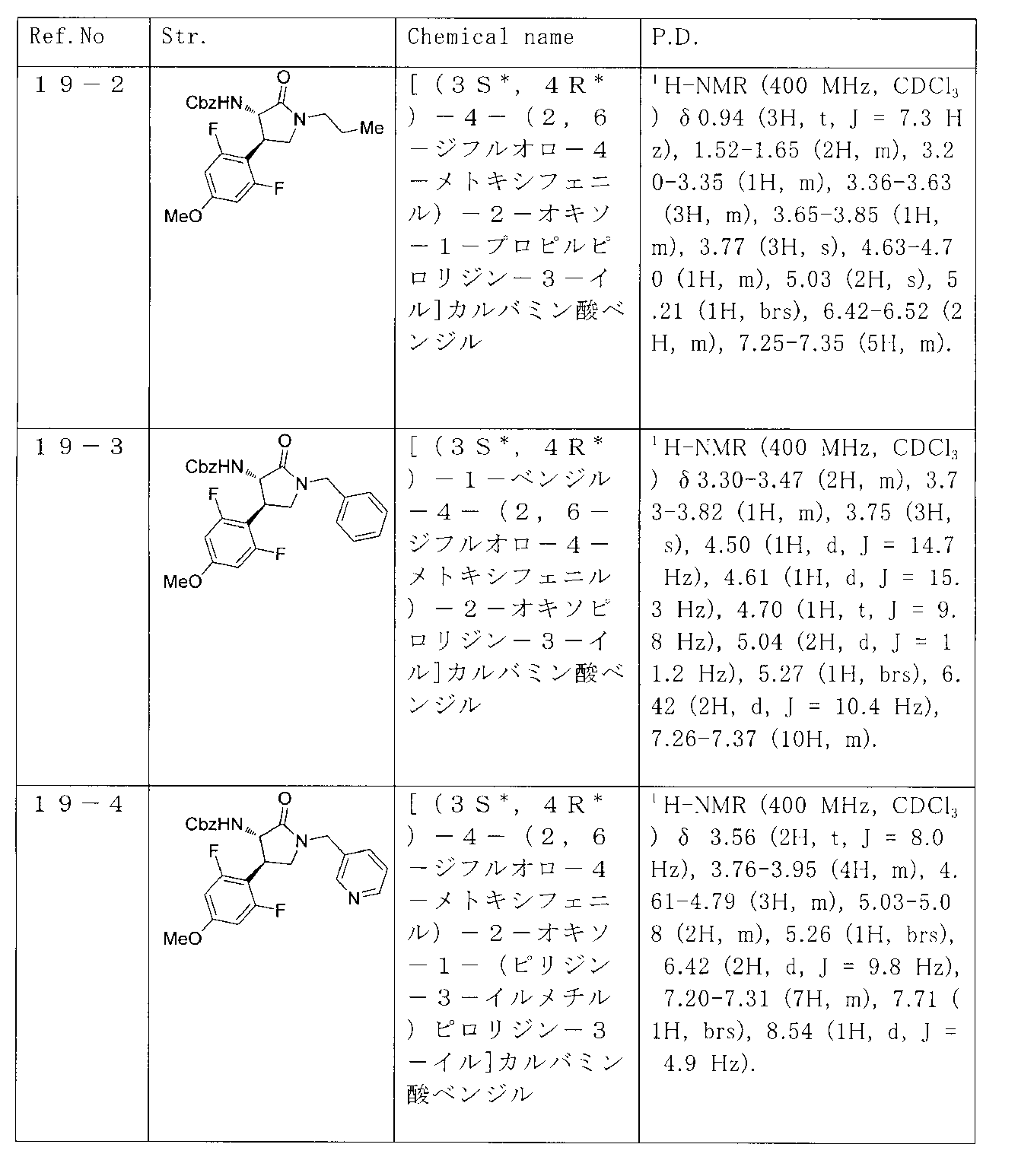

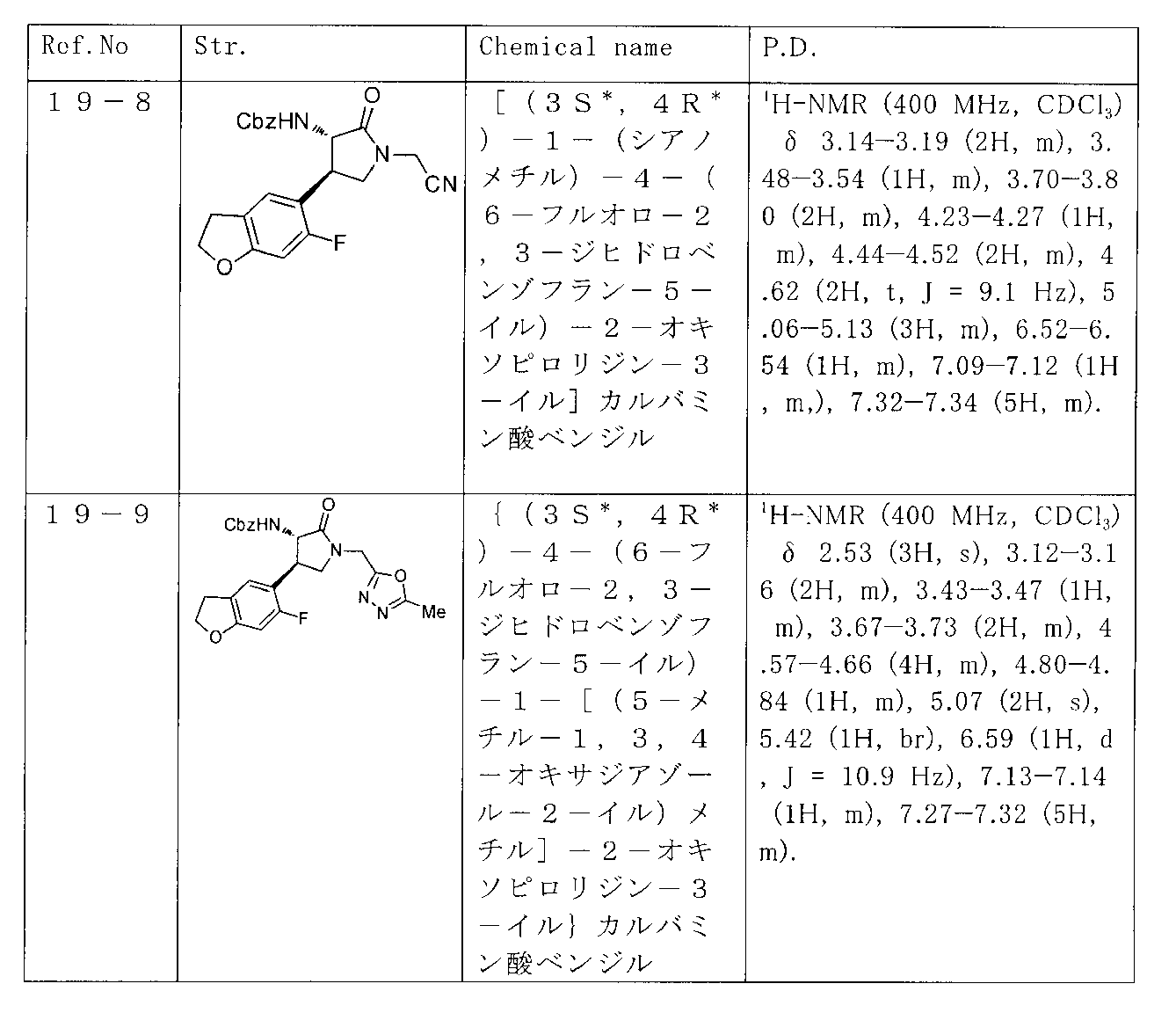
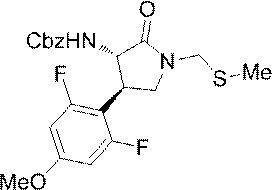
[(3S*,4R*)-4-(2,6-ジフルオロ-4-メトキシフェニル)-2-オキソピロリジン-3-イル]カルバミン酸ベンジル(120mg)のN,N-ジメチルホルムアミド溶液(3.2mL)に、氷冷下でクロロメチルメチルスルフィド(73μL)、テトラブチルアンモニウムヨージド(12mg)、およびカリウムtert-ブトキシド(86mg)を加え、反応液とした。室温で4時間撹拌した。反応液に飽和塩化アンモニウム水溶液を加えた後、酢酸エチルで抽出した。有機層を水、飽和食塩水で順次洗浄後、無水硫酸ナトリウムで乾燥した。溶媒を減圧下濃縮した後、残渣をシリカゲルカラムクロマトグラフィー(ヘキサン:酢酸エチル=9:1~1:1)で精製することで、表題化合物を得た(56mg)。
1H-NMR (400 MHz, CDCl3) δ 2.14 (3H, brs), 3.60-3.69 (2H, m), 3.78 (3H, s), 3.85-3.93 (1H, m), 4.49 (2H, s), 4.58-4.66 (1H, m), 5.03 (1H, d, J = 12.2 Hz), 5.09 (1H, d, J = 12.2 Hz), 5.20 (1H, brs), 6.48 (2H, d, J = 9.8 Hz), 7.28-7.34 (5H, m).
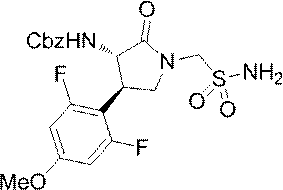
アルキル化試薬としてクロロメチルメチルスルフィドの代わりにクロロメタンスルホンアミドを用いて参考例19-10と同様な方法で実施し、表題化合物を得た。
1H-NMR (400 MHz, CDCl3) δ 3.60-3.70 (1H, m), 3.78 (3H, s), 4.21-4.24 (4H, m), 5.05 (1H, d, J = 12.2 Hz), 5.11-5.17 (2H, m), 5.29 (2H, brs), 5.63 (1H, brs), 6.48 (2H, d, J = 10.4 Hz), 7.29-7.38 (5H, m).
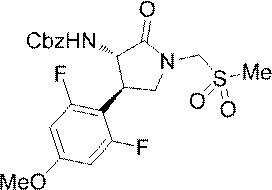
{(3S*,4R*)-4-(2,6-ジフルオロ-4-メトキシフェニル)-1-[(メチルチオ)メチル]-2-オキソピロリジン-3-イル}カルバミン酸ベンジル(56mg)のジクロロメタン溶液(2.2mL)に、氷冷下でメタクロロ過安息香酸(79mg)を加え、反応液とした。反応液を室温で4時間撹拌した。反応液に飽和亜硫酸ナトリウム水溶液を加えた後、ジクロロメタンで抽出した。有機層を飽和炭酸水素ナトリウム水溶液、飽和食塩水で順次洗浄後、無水硫酸ナトリウムで乾燥した。溶媒を減圧下濃縮した後、残渣をシリカゲルカラムクロマトグラフィー(ヘキサン:酢酸エチル=9:1~酢酸エチル)で精製することで、表題化合物を得た(57mg)。
1H-NMR (400 MHz, CDCl3) δ 3.01 (3H, brs), 3.75-3.81 (4H, m), 4.06-4.22 (2H, m), 4.30-4.41 (2H, m), 4.86 (1H, d, J = 14.7 Hz), 5.04 (1H, d, J = 12.2 Hz), 5.12 (1H, d, J = 12.2 Hz), 5.29 (1H, d, J = 4.2 Hz), 6.48 (2H, d, J = 10.4 Hz), 7.28-7.37 (5H, m).
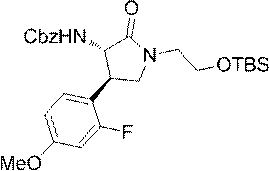
(-)-[(3S*,4R*)-4-(2-フルオロ-4-メトキシフェニル)-2-オキソピロリジン-3-イル]カルバミン酸ベンジル(346mg),および2-ブロモエトキシtert-ブチルジメチルシラン(2.0mL)のN,N-ジメチルホルムアミド溶液(9.7mL)に、カリウムtert-ブトキシド(216mg)を数回に分けて加え、反応液とした。反応液を室温で15時間撹拌した。反応液に飽和塩化アンモニウム水溶液を加えた後、酢酸エチルで抽出した。有機層を水、飽和食塩水で順次洗浄後、無水硫酸ナトリウムで乾燥した。溶媒を減圧下濃縮した後、残渣をシリカゲルカラムクロマトグラフィー(ヘキサン:酢酸エチル=9:1~酢酸エチル)で精製することで、無色油状物として表題化合物を得た(204mg)。
1H-NMR (400 MHz,CDCl3) δ 0.06 (6H, s), 0.88 (9H, s), 3.32-3.41 (1H, m), 3.48-3.63 (3H, m), 3.75- 3.81 (6H, m), 4.64 (1H, dd, J = 11.0, 8.0 Hz), 5.00-5.15 (3H, m), 6.58-6.73 (2H, m), 7.24-7.32 (6H, m).
これらの構造およびスペクトルデータを表40に示した。
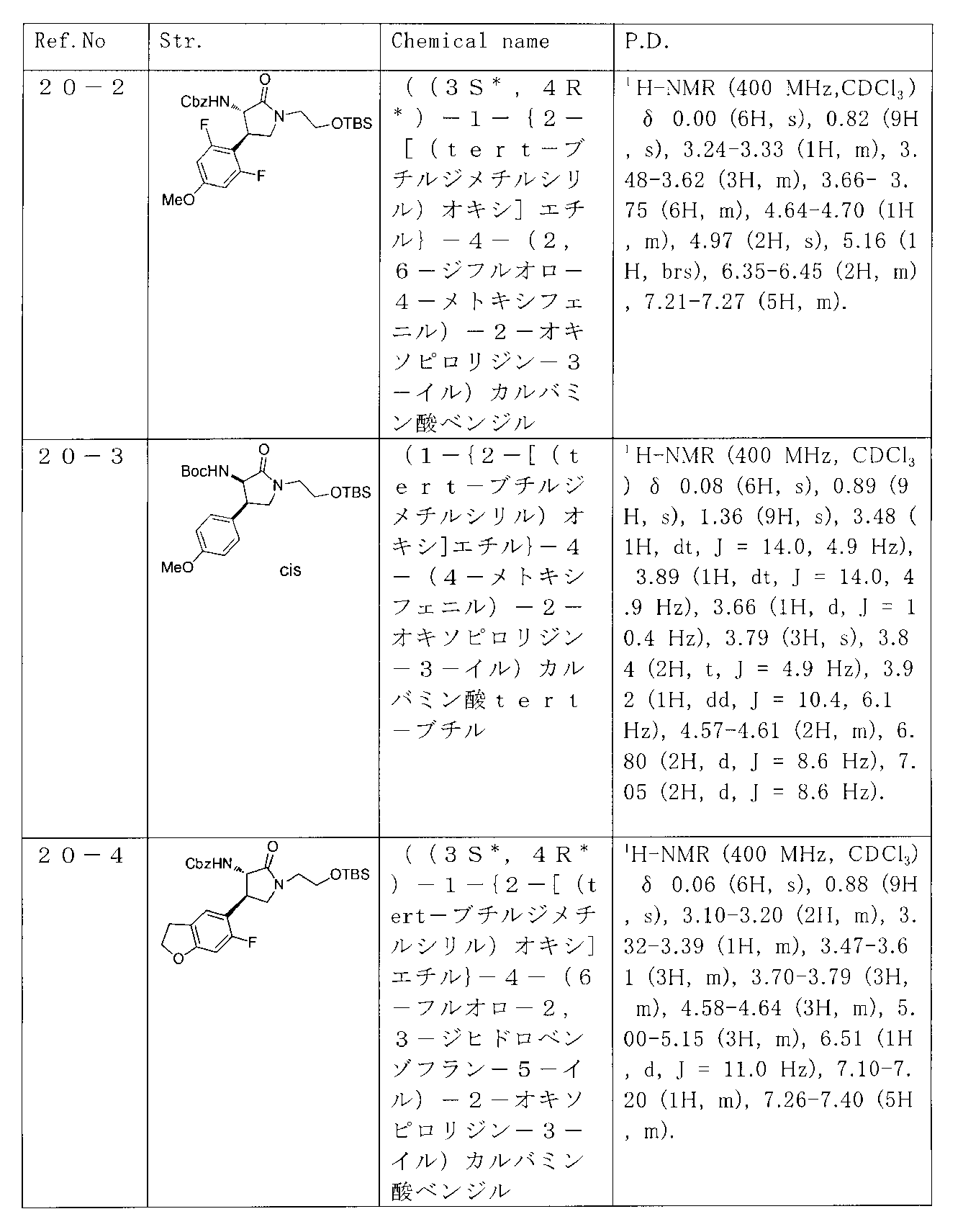
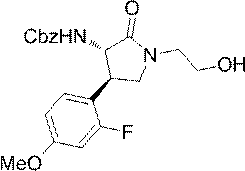
((3S*,4R*)-1-{2-[(tert-ブチルジメチルシリル)オキシ]エチル}-4-(2-フルオロ-4-メトキシフェニル)-2-オキソピロリジン-3-イル)カルバミン酸ベンジル(219mg)のテトラヒドロフラン溶液(4.2mL)にテトラブチルアンモニウムフルオライド(465μL,1.0M テトラヒドロフラン溶液)を加え、反応液とした。反応液を室温で30分間撹拌した。反応液に水を加え、酢酸エチルで抽出した。有機層を水、飽和食塩水で順次洗浄後、無水硫酸ナトリウムで乾燥した。溶媒を減圧下濃縮した後、残渣をシリカゲルカラムクロマトグラフィー(ヘキサン:酢酸エチル=4:1~酢酸エチル~酢酸エチル:メタノール=10:1)で精製することで、白色固体として表題化合物を得た(150mg)。
1H-NMR (400 MHz, CDCl3) δ 2.73 (1H, brs), 3.40-3.64 (3H, m), 3.65-3.89 (7H, m), 4.53 (1H, t, J = 9.2 Hz), 5.00-5.12 (2H, brs), 5.25 (1H, brs), 6.57-6.73 (2H, m), 7.23-7.35 (6H, m).
これらの構造およびスペクトルデータを表41に示した。
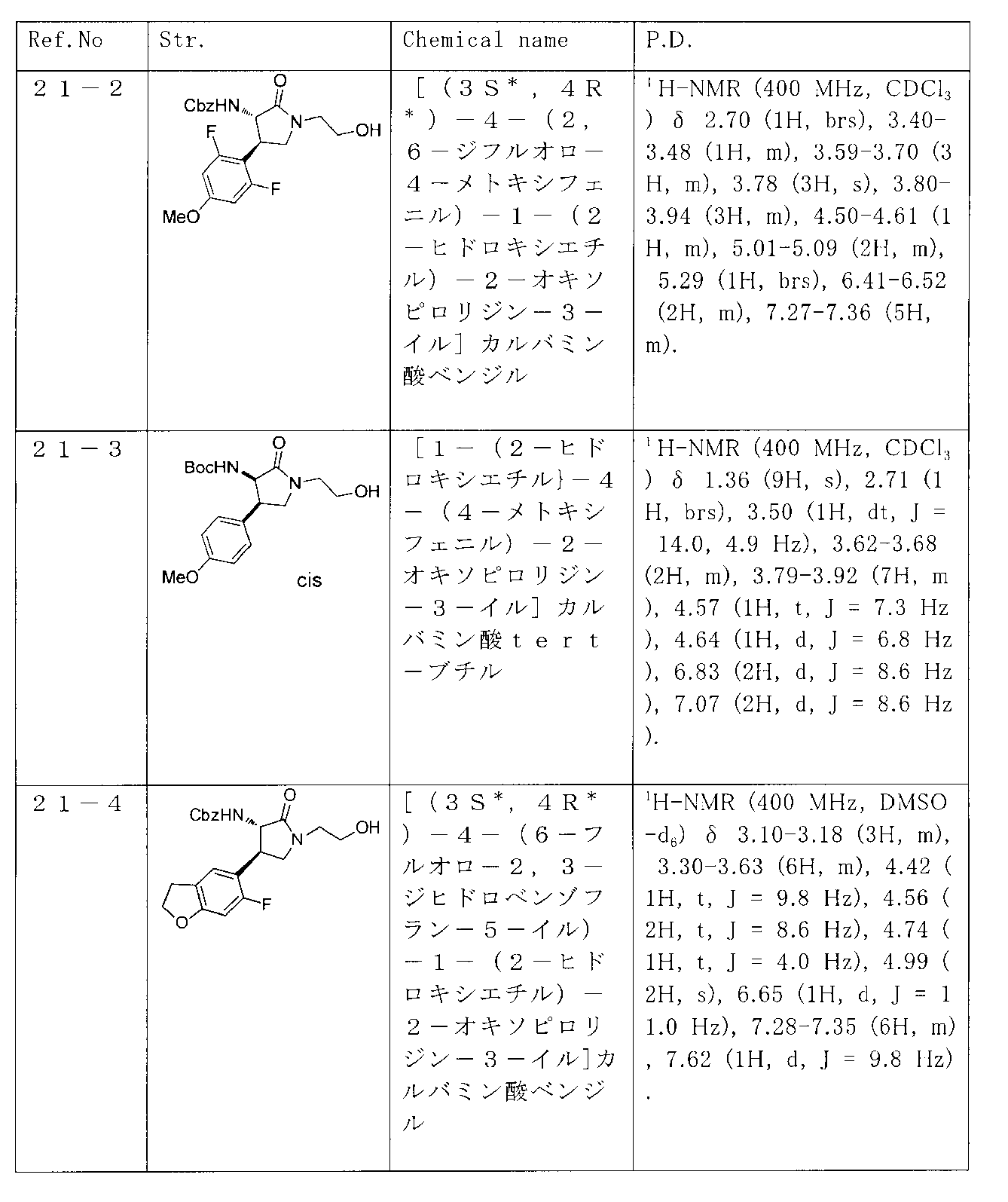

(+)-(S*)-2-[1-(4-メトキシフェニル)-2-ニトロエチル]マロン酸ジメチル(1.04g)のメタノール溶液(30mL)に、亜鉛末(2.0g)と塩化アンモニウム(0.9g)水溶液(5mL)を加え、反応液とした。反応液を1時間攪拌した。反応液に酢酸エチルを加えてセライトろ過し、ろ液を、1 mol/L塩酸,水、および飽和食塩水で順次洗浄後、無水硫酸ナトリウムで乾燥した。溶媒を減圧下濃縮した後、残渣をシリカゲルカラムクロマトグラフィー(酢酸エチル)で精製することで、無色油状物として表題化合物を得た(760mg)。
1H-NMR (400 MHz, CDCl3) δ 3.57 (1H, d, J = 8.5 Hz), 3.68 (1H, t, J = 8.1 Hz), 3.78 (3H, s), 3.79 (3H, s), 3.95 (1H, q, J = 8.1 Hz), 4.03 (1H, t, J = 8.5 Hz), 6.88 (2H, d, J = 8.8 Hz), 7.18 (2H, d, J = 8.8 Hz).

(+)-(S*)-2-[1-(4-メトキシフェニル)-2-ニトロエチル]マロン酸ジメチルの代わりに、(-)-(R)-2-[1-(2,6-ジフルオロ-4-メトキシフェニル)-2-ニトロエチル]マロン酸ジメチルを用いて参考例22-1と同様な方法で実施し、表題化合物を得た。
1H-NMR (400 MHz, CDCl3) δ 3.72-3.82 (8H, m), 3.93 (1H, t, J = 8.8 Hz), 4.33 (1H, q, J = 8.8 Hz), 6.48 (2H, d, J = 8.6 Hz).
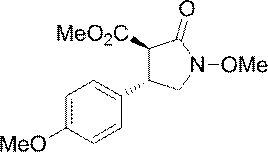
(3R*,4S*)-1-ヒドロキシ-4-(4-メトキシフェニル)-2-オキソピロリジン-3-カルボン酸メチル (265mg)のN,N-ジメチルホルムアミド溶液(2mL)に、炭酸カリウム(276mg)および、ヨードメタン(0.12mL)を加え、反応液とした。反応液を室温で12時間撹拌した。反応液に酢酸エチルを加え、水、および飽和食塩水で順次洗浄後、無水硫酸ナトリウムで乾燥した。溶媒を減圧下濃縮した後、残渣をシリカゲルカラムクロマトグラフィー(酢酸エチル : ヘキサン =1:1)で精製することで、無色油状物として表題化合物を得た(220mg)。
1H-NMR (400 MHz, CDCl3) δ 3.48 (1H, d, J = 9.1 Hz), 3.51 (1H, t, J = 8.5 Hz), 3.78 (3H, s), 3.80 (3H, s), 3.85 (3H, s), 3.90 (1H, dd, J = 8.5, 8.2 Hz), 3.98 (1H, t, J = 8.2 Hz), 6.89 (2H, d, J = 9.1 Hz), 7.16 (2H, d, J = 9.1 Hz).
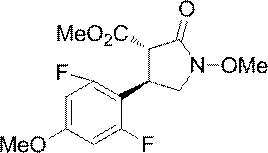
(3R*,4S*)-1-ヒドロキシ-4-(4-メトキシフェニル)-2-オキソピロリジン-3-カルボン酸メチルの代わりに、(3S*,4R*)-4-(2,6-ジフルオロ-4-メトキシフェニル)-1-ヒドロキシ-2-オキソピロリジン-3-カルボン酸メチルを用いて参考例23-1と同様な方法で実施し、表題化合物を得た。
1H-NMR (400 MHz, CDCl3) δ 3.62 (3H, s), 3.62-3.91 (10H, m), 6.43-6.50 (2H, m).
(-)-(3S*,4R*)-4-(4-メトキシフェニル)-2-オキソピロリジン-3-カルボン酸メチルの代わりに、(3R*,4S*)-1-メトキシ-4-(4-メトキシフェニル)-2-オキソピロリジン-3-カルボン酸メチルを用いて参考例8-1と同様の方法で実施し、表題化合物を得た。
1H-NMR (400 MHz, CDCl3) δ 3.47 (1H, d, J = 9.1 Hz), 3.60 (1H, t, J = 8.5 Hz), 3.80 (3H, s), 3.88 (3H, s), 3.85-3.93 (1H, m), 3.99 (1H, t, J = 8.8 Hz), 6.90 (2H, d, J = 9.1 Hz), 7.23 (2H, d, J = 9.1 Hz).
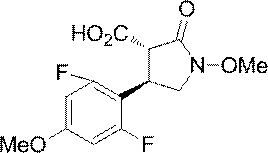
(-)-(3S*,4R*)-4-(4-メトキシフェニル)-2-オキソピロリジン-3-カルボン酸メチルの代わりに、(3S*,4R*)-4-(2,6-ジフルオロ-4-メトキシフェニル)-1-メトキシ-2-オキソピロリジン-3-カルボン酸メチルを用いて参考例8-1と同様な方法で実施し、表題化合物を得た。
1H-NMR (400 MHz, CDCl3) δ 3.68-3.91 (9H, m), 4.18-4.26 (1H, m), 6.46-6.52 (2H, m).

(3S*,4R*)-4-(2,6-ジフルオロ-4-ヒドロキシフェニル)-2-オキソピロリジン-3-カルボン酸メチル(500mg)のN,N-ジメチルホルムアミド溶液(4mL)に、炭酸カリウム(268mg),およびベンジルブロマイド (0.23mL)を加え、反応液とした。反応液を室温で25時間撹拌した。反応液に飽和塩化アンモニウム水溶液を加え、酢酸エチルで抽出した。有機層を、水、飽和食塩水で順次洗浄後、無水硫酸ナトリウムで乾燥した。溶媒を減圧下濃縮した後、残渣をシリカゲルカラムクロマトグラフィー(ヘキサン:酢酸エチル =4:1)で精製することで、無色油状物として表題化合物を得た(643mg)。
1H-NMR (400 MHz, CDCl3) δ 3.50 (1H, t, J = 8.5 Hz), 3.66 (1H, t, J = 8.5 Hz), 3.76-3.80 (1H, m), 3.78 (3H, s), 4.46 (1H, q, J = 9.5 Hz), 5.02 (2H, s), 5.89 (1H, brs), 6.54 (2H, d, J = 10.3 Hz), 7.36-7.40 (5H, m).
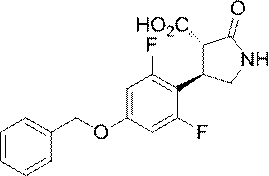
(3S*,4R*)-4-[4-(ベンジルオキシ)-2,6-ジフルオロフェニル]-2-オキソピロリジン-3-カルボン酸メチルを用いて参考例8-1と同様の方法で実施し、表題化合物を得た。
1H-NMR (400 MHz, DMSO-d6) δ 3.25 (1H, t, J = 9.4 Hz), 3.43 (1H, d, J = 10.3 Hz), 3.56 (1H, d, J = 9.1 Hz), 4.15 (1H, q, J = 9.4 Hz), 5.11 (2H, s), 6.85 (2H, d, J = 10.9 Hz), 7.32-7.44 (5H, m), 8.18 (1H, s), 12.76 (1H, brs).
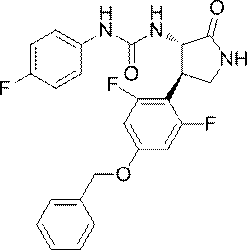
(-)-(3S*,4R*)-4-(4-メトキシフェニル)-2-オキソピロリジン-3-カルボン酸の代わりに、(3S*,4R*)-4-[4-(ベンジルオキシ)-2,6-ジフルオロフェニル]-2-オキソピロリジン-3-カルボン酸を用いて実施例1-1と同様の方法で実施し、表題化合物を得た。
1H-NMR (400 MHz, DMSO-d6) δ 3.27-3.32 (1H, m), 3.44 (1H, t, J = 8.9 Hz), 3.79 (1H, q, J = 9.8 Hz), 4.56 (1H, dd, J = 11.0, 8.6 Hz), 5.10 (2H, s), 6.46 (1H, d, J = 8.6 Hz), 6.82 (2H, d, J = 10.4Hz), 6.99-7.05 (2H, m), 7.30-7.44 (7H, m), 8.05 (1H, s), 8.66 (1H, s).
これらの構造およびスペクトルデータを表42に示した。
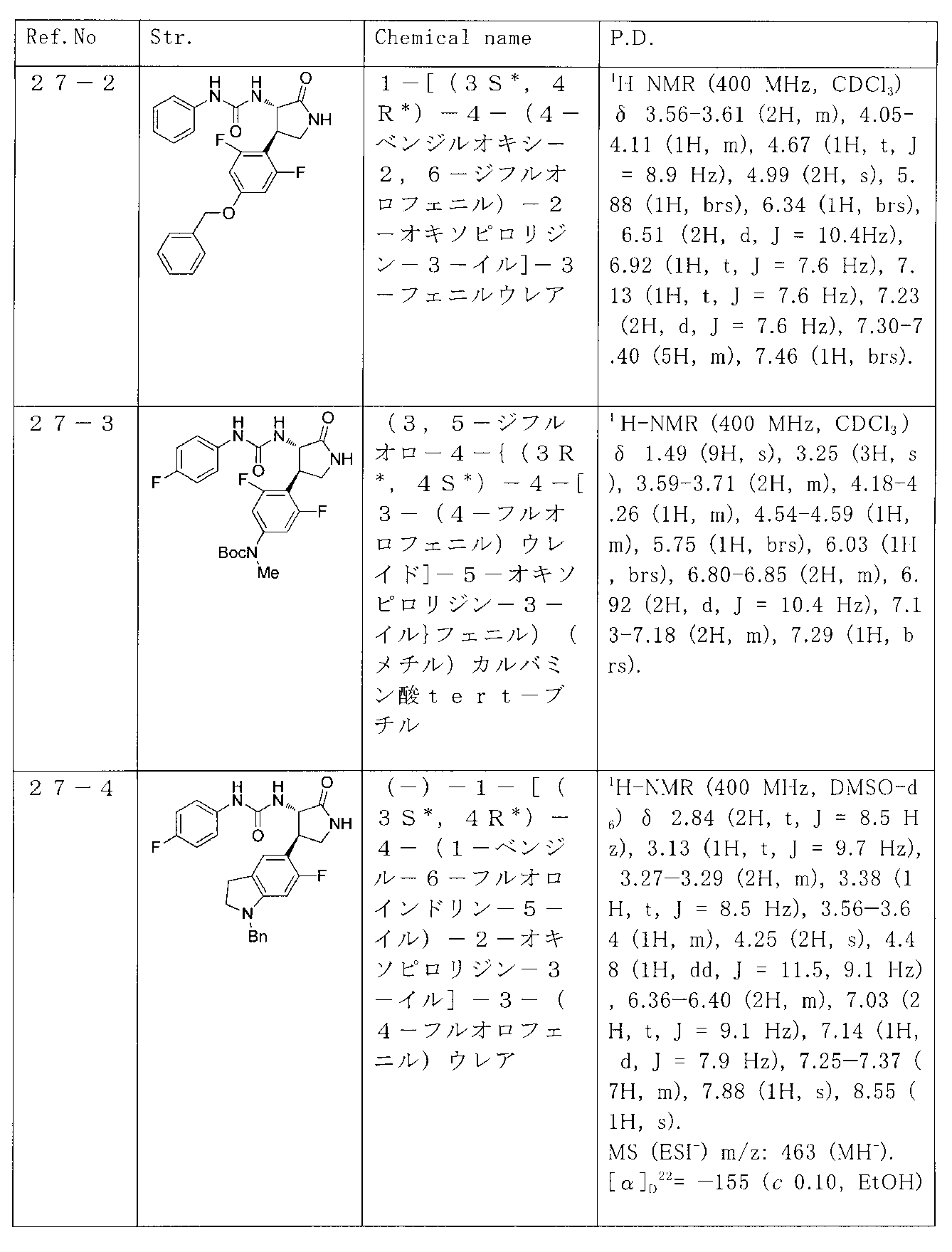
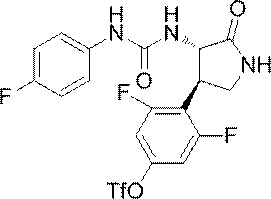
アルゴン雰囲気下、1-[(3S*,4R*)-4-(2,6-ジフルオロ-4-ヒドロキシフェニル)-2-オキソピロリジン-3-イル]-3-(4-フルオロフェニル)ウレア(365mg)のジクロロメタン溶液(5mL)に、氷冷下でピリジン(0.4mL)、およびトリフルオロメタンスルホン酸無水物(0.25mL)を加え、反応液とした。反応液を室温で3時間撹拌した。反応液に水を加え、酢酸エチルで抽出し、水、飽和食塩水で洗浄後、無水硫酸ナトリウムで乾燥した。溶媒を減圧下濃縮した後、残渣をシリカゲルカラムクロマトグラフィー(ヘキサン : 酢酸エチル = 4:1 ~ 酢酸エチル)で精製することで、茶色油状物として表題化合物を得た(388mg)。
1H-NMR (400 MHz, DMSO-d6) δ 3.36 (1H, t, J = 9.5 Hz), 3.52 (1H, t, J = 9.2 Hz), 3.93 (1H, q, J = 9.6 Hz), 4.55 (1H, dd, J = 10.4, 7.9 Hz), 6.51 (1H, d, J =7.9 Hz), 6.98-7.04 (2H, m), 7.27-7.33 (2H, m), 7.58 (2H, d, J =8.6 Hz), 8.13 (1H, s), 8.74 (1H, s).
MS (ESI+) m/z: 498 (MH+).
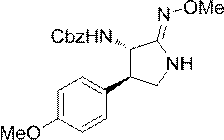
(-)-[(3S*,4R*)-4-(4-メトキシフェニル)-2-オキソピロリジン-3-イル]カルバミン酸ベンジル(500mg)のジクロロメタン懸濁液(3.7mL)に、トリエチルオキソニウムヘキサフルオロホスフェート (446mg)を加え、反応液とした。反応液を室温で20時間撹拌した。その後、飽和炭酸水素ナトリウム水溶液を加えて室温で30分間撹拌後、ジクロロメタンで抽出した。有機層を無水硫酸ナトリウムで乾燥した後、溶媒を減圧下濃縮することで中間体である[(3R*,4S*)-5-エトキシ-3-(4-メトキシフェニル)-3,4-ジヒドロ-2H-ピロロ-4-イル]カルバミン酸ベンジルを黄色油状物として得た。
[(3R*,4S*)-5-エトキシ-3-(4-メトキシフェニル)-3,4-ジヒドロ-2H-ピロロ-4-イル]カルバミン酸ベンジル(325mg)のメタノール溶液(2mL)にO-メチルヒドロキシルアミン塩酸塩(91mg)を加え、反応液とした。反応液を室温で3.5時間撹拌した。その後、氷冷下で反応液に飽和炭酸水素ナトリウム水溶液を加え、酢酸エチルで抽出した。有機層を飽和食塩水で洗浄後、無水硫酸ナトリウムで乾燥した。溶媒を減圧下濃縮した後、残渣をシリカゲルカラムクロマトグラフィー(酢酸エチル : ヘキサン =2:1)で精製することで、無色油状物として表題化合物を得た(228mg)。
1H-NMR (400 MHz, DMSO-d6) δ 3.15 (1H, t, J = 9.1 Hz), 3.22-3.30 (1H, m), 3.45 (1H, t, J = 8.2 Hz), 3.59 (3H, s), 3.72 (3H, s), 4.60 (1H, t, J = 9.7 Hz), 4.96 (2H, s), 6.63 (1H, s), 6.86 (2H, d, J = 8.5 Hz), 7.20-7.34 (7H, m), 7.59 (1H, d, J = 9.1 Hz).
これらの構造およびスペクトルデータを表43~表44に示した。
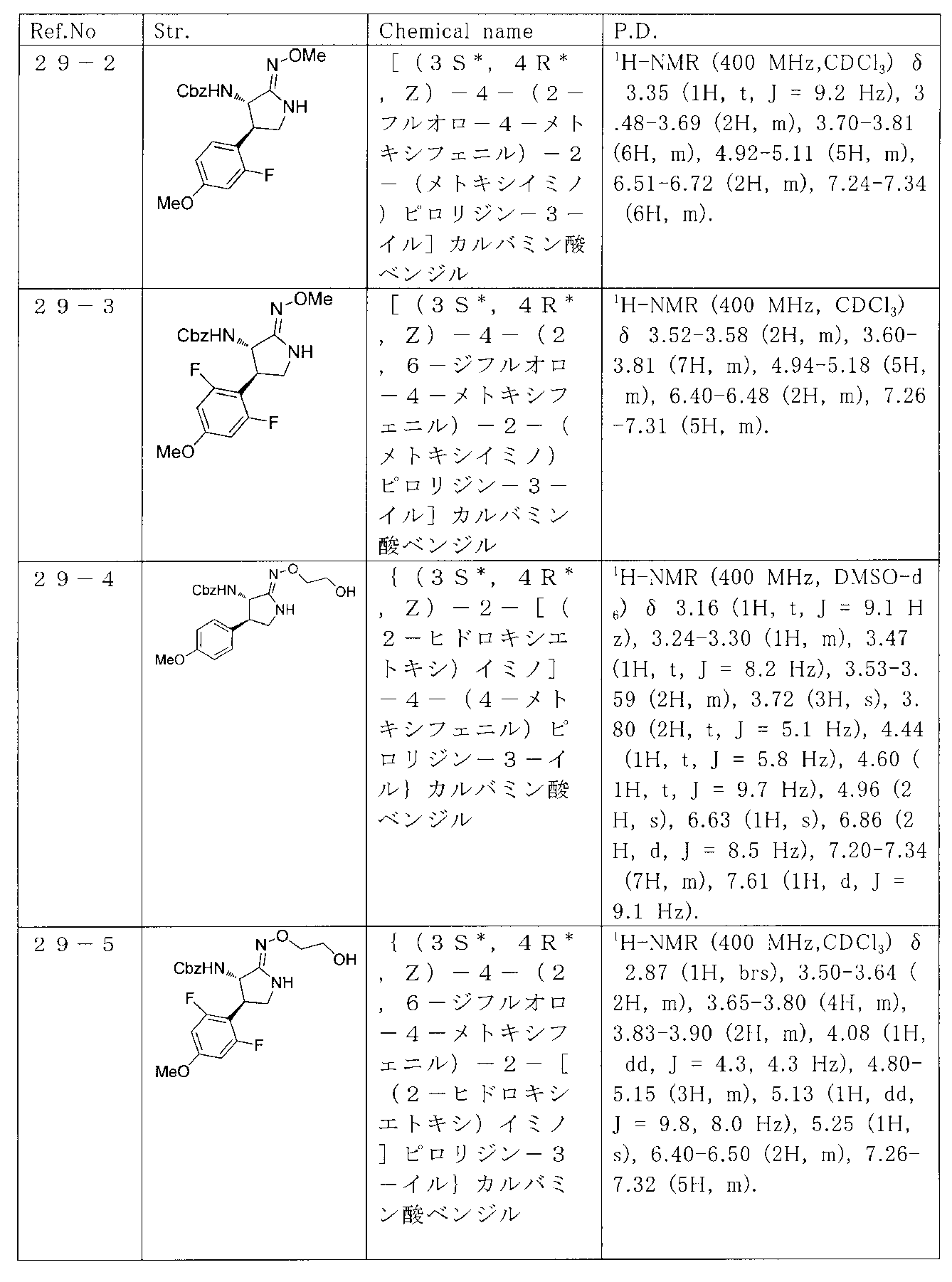
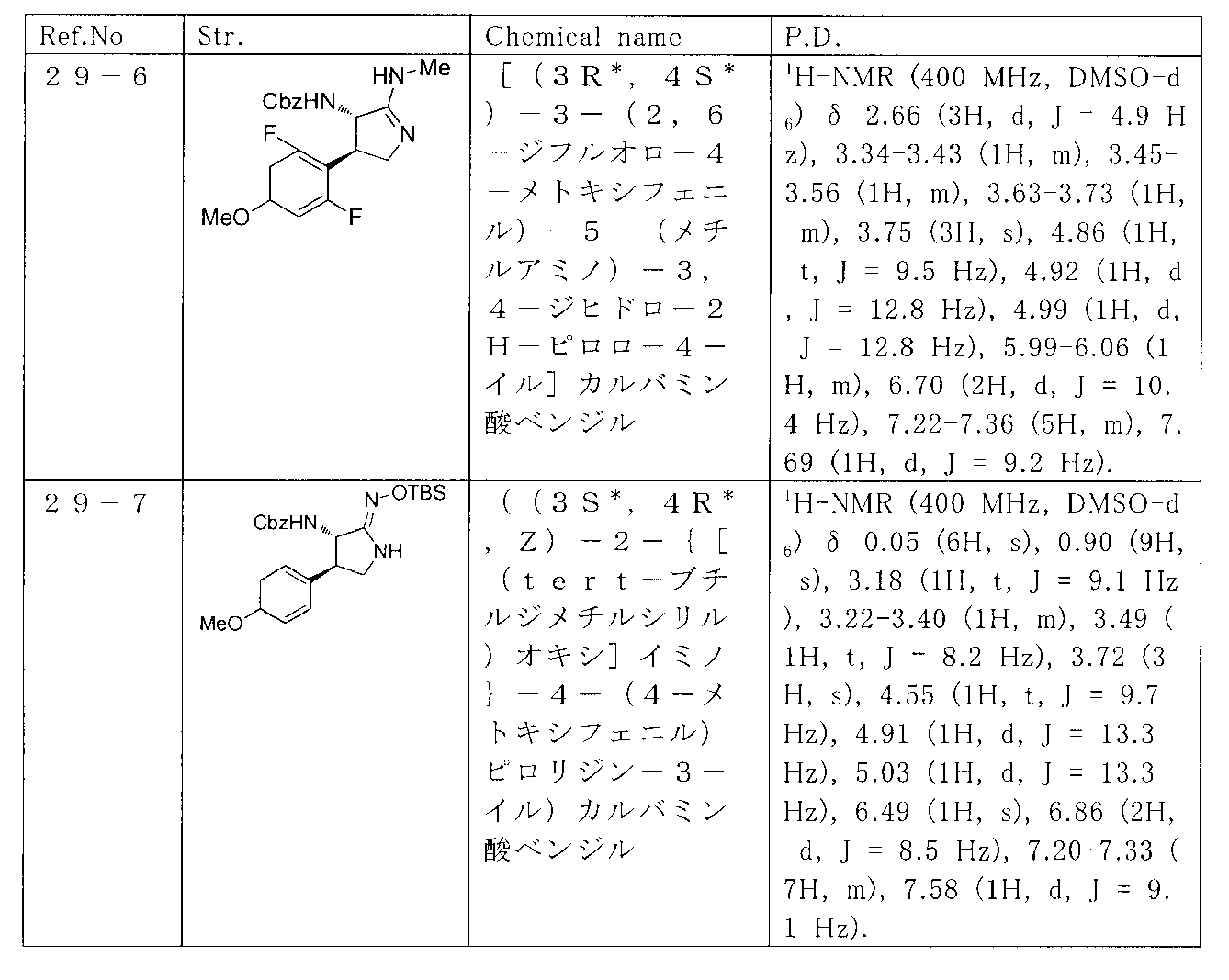
これらの構造およびスペクトルデータを表45~46に示した。


(-)-[(3S*,4R*)-4-(4-メトキシフェニル)-2-オキソピロリジン-3-イル]カルバミン酸ベンジルの代わりに、(+)-[(3R*,4S*)-4-(4-メトキシフェニル)-2-オキソピロリジン-3-イル]カルバミン酸ベンジルを用いて参考例29-1と同様の方法で実施し、表題化合物を得た。
1H-NMR (400 MHz, DMSO-d6) δ 3.15 (1H, t, J = 9.1 Hz), 3.22-3.30 (1H, m), 3.45 (1H, t, J = 8.2 Hz), 3.59 (3H, s), 3.72 (3H, s), 4.60 (1H, t, J = 9.7 Hz), 4.96 (2H, s), 6.63 (1H, s), 6.86 (2H, d, J = 8.5 Hz), 7.20-7.34 (7H, m), 7.59 (1H, d, J = 9.1 Hz).

[(3S*,4R*,Z)-2-(メトキシイミノ)-4-(4-メトキシフェニル)ピロリジン-3-イル)カルバミン酸ベンジルの代わりに、((3S*,4R*,Z)-2-{[(tert-ブチルジメチルシリル)オキシ]イミノ}-4-(4-メトキシフェニル)ピロリジン-3-イル)カルバミン酸ベンジルを用いて実施例32-1と同様の方法に従うことで、表題化合物を得た。
1H-NMR (400 MHz, DMSO-d6) δ 0.04 (3H, s), 0.05 (3H, s), 0.89 (9H, s), 3.17 (1H, t, J = 8.8 Hz), 3.28-3.37 (1H, m), 3.53 (1H, t, J = 8.5 Hz), 3.71 (3H, s), 4.74 (1H, t, J = 9.1 Hz), 6.34 (1H, d, J = 9.1 Hz), 6.56 (1H, s), 6.86 (2H, d, J = 8.5 Hz), 7.00-7.04 (2H, m), 7.27 (2H, d, J = 8.5 Hz), 7.30-7.34 (2H, m), 8.45 (1H, s).
MS (FD+) m/z: 472 (M+).

[(3S*,4R*,Z)-2-(メトキシイミノ)-4-(4-メトキシフェニル)ピロリジン-3-イル]カルバミン酸ベンジルの代わりに、((3S*,4R*,Z)-2-{[(tert-ブチルジメチルシリル)オキシ]イミノ}-4-(2,6-ジフルオロ-4-メトキシフェニル)ピロリジン-3-イル)カルバミン酸ベンジルを用いて実施例32-1と同様の方法に従うことで、表題化合物を得た。
1H-NMR (400 MHz, CDCl3) δ 0.12 (6H, s), 0.93 (9H, s), 3.57-3.64 (2H, m), 3.73-3.82 (1H, m), 3.76 (3H, s), 5.12-5.21 (1H, m), 5.38 (1H, brs), 5.47 (1H, s), 6.46 (2H, d, J = 10.8 Hz), 6.86-6.93 (2H, m), 7.17-7.22 (2H, m), 7.39 (1H, brs).
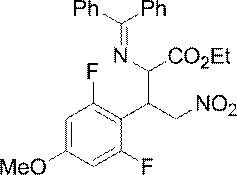
2-[(ジフェニルメチレン)アミノ]酢酸エチル(300mg)の テトラヒドロフラン溶液(2.3mL)に,-78℃でリチウムジイソプロピルアミド(1.1mL, 1.05M in テトラヒドロフラン/ヘキサン)を加え、反応液とした。反応液を1時間撹拌した後、(E)-1,3-ジフルオロ-5-メトキシ-2-(2-ニトロビニル)ベンゼン(241mg)のテトラヒドロフラン溶液を加え、同温度で15分間撹拌した。反応液の温度を徐々に室温まで上げて30分間撹拌した後、反応液に水を加え、酢酸エチルで抽出した。有機層を飽和食塩水で洗浄し、硫酸ナトリウムで乾燥した。溶媒を留去後、残渣をシリカゲルカラムクロマトグラフィー(ヘキサン:酢酸エチル=2:1)で精製することで、黄色油状物質として表題化合物を得た(543mg)。
1H-NMR (400 MHz, CDCl3) δ 1.12 (3H, t, J = 7.3 Hz), 3.73 (3H, s), 4.00-4.06 (2H, m), 4.43 (1H, d, J = 7.8 Hz), 4.73-4.95 (3H, m), 6.36 (2H, d, J = 10.4 Hz), 7.00-7.05 (2H, m), 7.31-7.38 (6H, m), 7.81-7.85 (2H, m).
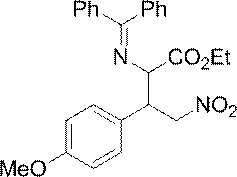
(E)-1,3-ジフルオロ-5-メトキシ-2-(2-ニトロビニル)ベンゼンの代わりに、(E)-1-メトキシ-4-(2-ニトロビニル)ベンゼンを用いて参考例32-1と同様な方法で実施し、表題化合物を得た。
1H-NMR (400 MHz, CDCl3) δ 1.19 (3H, t, J = 6.7 Hz), 3.76 (3H, s), 3.90-4.36 (6H, m), 7.05 (2H, d, J = 8.6 Hz), 7.24-7.47 (10H, m), 7.63 (2H, d, J = 8.6 Hz).

3-(2,6-ジフルオロ―4-メトキシフェニル)-2-[(ジフェニルメチレン)アミノ]-4-ニトロブチル酸エチル(530mg)に室温で酢酸(4.2mL)および水(0.8mL)を加え、第1の反応液とした。第1の反応液を60℃で7時間撹拌した。反応液を減圧濃縮した後、残渣に飽和炭酸水素ナトリウム水溶液をpHが8になるまで加え、第2の反応液とした。その後、第2の反応液にテトラヒドロフラン(5.0mL)を加えた後、ジtert-ブチルジカルボネート(290mg) を加え、室温で16時間撹拌した。第2の反応液を酢酸エチルで抽出した後,有機層を飽和食塩水で洗浄し、無水硫酸ナトリウムで乾燥した。溶媒を留去後、残渣をシリカゲルカラムクロマトグラフィー (トルエン:酢酸エチル=2:1)で精製することで、白色固体として表題化合物を得た(315mg)。
1H-NMR (400 MHz, CDCl3) δ 1.08 (3H, brt), 1.46 (9H, s), 3.78 (3H, s), 4.00-4.10 (2H, m), 4.22-4.33 (1H, m), 4.71 (1H, brt), 4.88 (2H, d, J = 7.9 Hz), 5.22 (1H, brd), 6.45 (2H, d, J = 10.4 Hz).
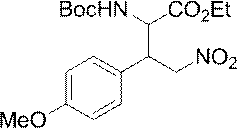
3-(2,6-ジフルオロ―4-メトキシフェニル)-2-[(ジフェニルメチレン)アミノ]-4-ニトロブタン酸エチルの代わりに、2-[(ジフェニルメチレン)アミノ]-3-(4-メトキシフェニル)-4-ニトロブタン酸エチルを用いて参考例33-1と同様な方法で実施し、表題化合物を得た。
1H-NMR (400 MHz, CDCl3) δ 1.08 (3H, brt), 1.46 (9H, s), 3.78 (3H, s), 3.82 (1H, q, J = 8.6 Hz), 4.02 (2H, d, J = 6.7 Hz), 4.55 (1H, t, J = 6.7 Hz), 4.77 (1H, dd, J = 13.4, 9.2 Hz), 4.85 (1H, dd, J = 13.4, 5.5 Hz), 5.12 (1H, brs), 6.85 (2H, d, J = 8.6 Hz), 7.09 (2H, d, J = 8.6 Hz).

(+)-[4-(2,6-ジフルオロ―4-メトキシフェニル)-2-オキソピロリジン-3-イル]カルバミン酸tert-ブチル
(R*)-2-[1-(4-メトキシフェニル)-2-ニトロエチル]マロン酸ジメチルの代わりに、2-[(tert-ブトキシカルボニル)アミノ]-3-(2,6-ジフルオロ―4-メトキシフェニル)-4-ニトロブタン酸エチルを用いて,参考例7-1と同様の方法に従って(±)-[4-(2,6-ジフルオロ―4-メトキシフェニル)-2-オキソピロリジン-3-イル]カルバミン酸tert-ブチルを得た。得られた当該化合物を、光学異性体分離用カラム(CHIRALPAK ID)を用いた高速液体クロマトグラフィー(ヘキサン:メチルtert-ブチルエーテル:エタノール=45:25:30,流速15.0 mL)による光学分割に供した。当該光学分割により、保持時間13.4分の異性体A(-)として、および保持時間22.5分の異性体B(+)として、それぞれ白色固体として表題化合物を得た。
異性体A(-):
1H-NMR (400 MHz, CDCl3) δ 1.26 (9H, s), 3.40 (1H, d, J = 10.4 Hz), 3.78 (3H, s), 3.85 (1H, d, J = 10.4, 8.6 Hz), 4.46 (1H, t, J = 6.6 Hz), 4.60 (1H, dd, J = 9.8, 6.1 Hz), 4.94 (1H, d, J = 5.5 Hz), 5.75 (1H, s) 6.44 (2H, d, J = 10.0 Hz).
[α]D 25 = -131 (c 0.10, EtOH)
異性体B(+):
1H-NMR (400 MHz, CDCl3) δ 1.26 (9H, s), 3.40 (1H, d, J = 10.4 Hz), 3.78 (3H, s), 3.85 (1H, d, J = 10.4, 8.6 Hz), 4.46 (1H, t, J = 6.6 Hz), 4.60 (1H, dd, J = 9.8, 6.1 Hz), 4.94 (1H, d, J = 5.5 Hz), 5.90 (1H, s) 6.44 (2H, d, J = 10.0 Hz).
[α]D 25 = +144(c 0.10, EtOH)

(+)- [4-(4-メトキシフェニル)-2-オキソピロリジン-3-イル] カルバミン酸tert-ブチル
(R*)-2-[1-(4-メトキシフェニル)-2-ニトロエチル]マロン酸ジメチルの代わりに、2-[(tert-ブトキシカルボニル)アミノ]-3-(4-メトキシフェニル)-4-ニトロブタン酸エチルを用いて,参考例7-1と同様の方法に従って(±)- [4-(4-メトキシフェニル)-2-オキソピロリジン-3-イル] カルバミン酸tert-ブチルを得た。得られた当該化合物を、光学異性体分離用カラム(CHIRALPAK ID)を用いた高速液体クロマトグラフィー(ヘキサン:メチルtert-ブチルエーテル:エタノール=45:25:30,流速15.0 mL)による光学分割に供した。当該光学分割により、保持時間7.5分の異性体A(-)、および保持時間10.2分の異性体B(+)として、それぞれ白色固体として表題化合物を得た。。
異性体A(-):
1H-NMR (400 MHz, CDCl3) δ 1.37 (9H, s), 3.56 (1H, d, J = 9.8 Hz), 3.80 (3H, s), 3.84 (1H, dd, J = 10.4, 6.1 Hz), 3.92 (1H, brs), 4.56 (2H, s), 5.75 (1H, s), 6.83 (2H, d, J = 8.6 Hz), 7.10 (2H, d, J = 8.6 Hz).
[α]D 22 = -88 (c 0.10, EtOH)
異性体B(+):
1H-NMR (400 MHz, CDCl3) δ 1.37 (9H, s), 3.56 (1H, d, J = 9.8 Hz), 3.80 (3H, s), 3.84 (1H, dd, J = 10.4, 6.1 Hz), 3.92 (1H, brs), 4.56 (2H, s), 5.75 (1H, s), 6.83 (2H, d, J = 8.6 Hz), 7.10 (2H, d, J = 8.6 Hz).
[α]D 22 = +98 (c 0.10, EtOH)
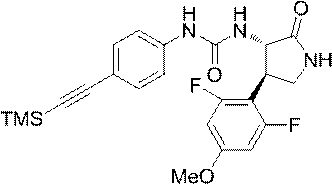
1-[(3S*,4R*)-4-(2,6-ジフルオロ―4-メトキシフェニル)-2-オキソピロリジン-3-イル]-3-(4-イオドフェニル)ウレア(80mg)、ジクロロビス(トリフェニルホスフィン)パラジウム(II)(11.5mg)、およびヨウ化銅(I)(15.6mg)のN,N-ジメチルホルムアミド溶液(2mL)に、トリメチルシリルアセチレン(115μL)およびトリエチルアミン(115μL)を加え、反応液とした。反応液を50℃で9時間撹拌した。反応液を減圧下濃縮し、残渣をシリカゲルカラムクロマトグラフィー(ヘキサン: 酢酸エチル = 1:1 ~ 酢酸エチル~酢酸エチル:メタノール=4:1)で精製することで、無色固体として表題化合物を得た(67mg)。
1H-NMR (400 MHz, CDCl3) δ 0.22 (9H, s), 3.52-3.63 (2H, m), 3.75 (3H, s), 4.09 (1H, q, J = 9.2 Hz), 4.65 (1H, dd, J = 10.4, 7.4 Hz), 6.08 (1H, brs), 6.36-6.45 (3H, m), 7.16 (2H, d, J = 8.6 Hz), 7.21 (2H, d, J = 8.6 Hz), 7.81 (1H, brs).
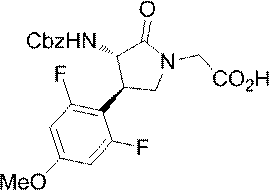
2-((3S*,4R*)-3-{[(ベンジルオキシ)カルボニル]アミノ}-4-(2,6-ジフルオロ-4-メトキシフェニル)-2-オキソピロリジン-1-イル)酢酸エチル(521mg)のメタノール溶液(25mL)に2mol/L水酸化ナトリウム水溶液(1.26mL)を加え、反応液とした。反応液を室温で5時間撹拌した。反応液に1mol/L塩酸を加えて酸性(pH1)とし、酢酸エチルで抽出した。有機層を飽和食塩水で洗浄し、無水硫酸ナトリウムで乾燥した。溶媒を留去することで、白色固体として表題化合物を得た(465mg)。
1H-NMR (400 MHz, DMSO-d6) δ 3.50-3.58 (2H, m), 3.72-3.79 (4H, m), 3.87 (1H, d, J = 17.7 Hz), 4.11 (1H, d, J = 17.7 Hz), 4.48 (1H, t, J = 10.0 Hz), 4.94 (1H, d, J = 12.2 Hz), 4.99 (1H, d, J = 12.2 Hz), 6.78 (2H, d, J = 10.4 Hz), 7.25-7.35 (5H, m), 7.74 (1H, d, J = 9.2 Hz), 12.9 (1H, s).

2-((3S*,4R*)-3-{[(ベンジルオキシ)カルボニル]アミノ}-4-(2,6-ジフルオロ-4-メトキシフェニル)-2-オキソピロリジン-1-イル)酢酸(100mg)のジクロロメタン溶液(1.0mL)に、1-ヒドロキシベンゾトリアゾール(35mg)、1-アミノ-2-プロパノール(20μL)、および1-エチル-3-(3-ジメチルアミノプロピル)カルボジイミド(57mg)を加え、反応液とした。反応液を室温で4時間撹拌した。反応液に水を加え、ジクロロメタンで抽出した。有機層を飽和食塩水で洗浄し、無水硫酸ナトリウムで乾燥した。溶媒を減圧下濃縮した後、残渣をシリカゲルカラムクロマトグラフィー(酢酸エチル~酢酸エチル:メタノール=4:1)で精製することで、表題化合物を得た(96mg)。
1H-NMR (400 MHz, DMSO-d6) δ 1.00 (3H, d, J = 6.1 Hz), 2.98-3.05 (2H, m), 3.54 (2H, t, J = 9.2 Hz), 3.60-3.66 (1H, m), 3.77-3.81 (4H, m), 4.04 (1H, d, J = 16.5 Hz), 4.47 (1H, t, J = 9.8 Hz), 4.68 (1H, q, J = 2.0 Hz), 4.97 (2H, dd, J = 17.4, 12.5 Hz), 6.76 (2H, d, J = 11.0 Hz), 7.26-7.33 (5H, m), 7.73 (1H, d, J = 9.2 Hz), 7.94 (1H, t, J = 5.5 Hz).
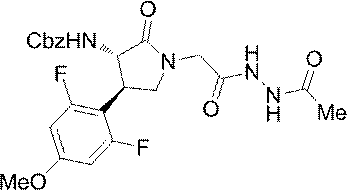
アミンとして、1-アミノ-2-プロパノールの代わりにアセトヒドラジドを用いて参考例37-1と同様な方法で実施し、表題化合物を得た。
1H-NMR (400 MHz, DMSO-d6) δ 1.84 (3H, s), 3.55 (2H, d, J = 10.4 Hz), 3.76 (4H, s), 3.85 (1H, d, J = 16.5 Hz), 4.12 (1H, d, J = 16.5 Hz), 4.50 (1H, t, J = 9.2 Hz), 4.97 (2H, dd, J = 16.5, 12.2 Hz), 6.75 (2H, d, J = 11.0 Hz), 7.25-7.33 (5H, m), 7.70 (1H, d, J = 9.2 Hz), 7.94 (2H, s).
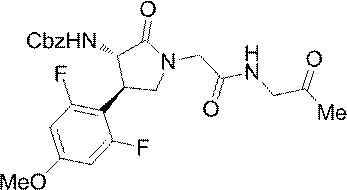
((3S*,4R*)-4-(2,6-ジフルオロ-4-メトキシフェニル)-1-{2-[(2-ヒドロキシプロピル)アミノ]-2-オキソエチル}-2-オキソピロリジン-3-イル)カルバミン酸ベンジル(96mg)のジメチルスルホキシド溶液(2.0mL)に、2-ヨードキシ安息香酸(131mg)を加え、反応液とした。反応液を室温で18時間撹拌した。反応液に飽和炭酸水素ナトリウム水溶液を加えた後、酢酸エチルで抽出した。有機層を飽和食塩水で順次洗浄後、無水硫酸ナトリウムで乾燥した。溶媒を留去することで、表題化合物を得た(84mg)。
1H-NMR (400 MHz, DMSO-d6) δ 2.02 (3H, s), 3.46-3.54 (2H, m), 3.69 (1H, d, J = 9.8 Hz), 3.73 (3H, s), 3.82 (1H, d, J = 16.5 Hz), 3.91 (2H, d, J = 5.5 Hz), 4.07 (1H, d, J = 16.5 Hz), 4.45 (1H, t, J = 11.0 Hz), 4.92 (2H, dd, J = 16.5, 12.2 Hz), 6.72 (2H, d, J = 10.4 Hz), 7.22-7.31 (5H, m), 7.67 (1H, d, J = 9.2 Hz), 8.23 (1H, t, J = 5.5 Hz).

((3S*,4R*)-4-(2,6-ジフルオロ-4-メトキシフェニル)-2-オキソ-1-{2-オキソ-2-[(2-オキソプロピル)アミノ]エチル}ピロリジン-3-イル)カルバミン酸ベンジル(76mg)の四塩化炭素溶液(7.8mL)に、トリフェニルホスフィン(325mg)およびトリエチルアミン(860μL)を加え、反応液とした。反応液を80℃で30分撹拌した後、ジクロロメタン(2mL)を加えて80℃で4時間撹拌した。反応液に飽和炭酸水素ナトリウム水溶液を加えた後、ジクロロメタンで抽出した。有機層を水、飽和食塩水で順次洗浄後、無水硫酸ナトリウムで乾燥した。溶媒を減圧下濃縮した後、残渣をシリカゲルカラムクロマトグラフィー(クロロホルム:メタノール=9:1)で精製することで、表題化合物を得た(15mg)。
1H-NMR (400 MHz,CDCl3) δ 2.30 (3H, s), 3.58 (2H, brs), 3.77 (4H, s), 4.64 (2H, s), 4.75 (1H, dd, J = 10.4, 7.3 Hz), 5.02 (2H, d, J = 12.2 Hz), 5.22 (1H, brs), 6.45 (2H, d, J = 9.8 Hz), 6.67 (1H, s), 7.27-7.35 (5H, m).
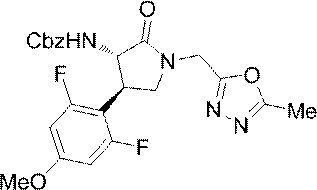
{(3S*,4R*)-1-[2-(2-アセチルヒドラジニル)-2-オキソエチル]-4-(2,6-ジフルオロ-4-メトキシフェニル)-2-オキソピロリジン-3-イル}カルバミン酸ベンジル(113mg)のジクロロメタン溶液(11.5mL)に、トリフェニルホスフィン(151mg)、トリエチルアミン(160μL)、および1,1,1,2,2,2-ヘキサクロロエタン(136mg)を加え、反応液とした。反応液を室温で3時間撹拌した。反応液に飽和炭酸水素ナトリウム水溶液を加えた後、ジクロロメタンで抽出した。有機層を水、飽和食塩水で順次洗浄後、無水硫酸ナトリウムで乾燥した。溶媒を減圧下濃縮した後、残渣をシリカゲルカラムクロマトグラフィー(ヘキサン:酢酸エチル=4:1~酢酸エチル)で精製することで、表題化合物を得た(69mg)。
1H-NMR (400 MHz,CDCl3) δ 2.54 (3H, s), 3.61 (2H, d, J = 8.6 Hz), 3.77 (3H, s), 3.82-3.92 (1H, m), 4.70 (1H, t, J = 9.8 Hz), 4.76 (2H, s), 5.01-5.10 (2H, m), 5.29 (1H, brs), 6.45 (2H, d, J = 9.8 Hz), 7.26-7.35 (5H, m).

2,6-ジフルオロ-4-ヒドロキシベンズアルデヒド(1.41g)、炭酸カリウム(1.48g)、およびクロロジフルオロ酢酸ナトリウム(2.73g)のN,N-ジメチルホルムアミド(15.8mL)と水(1.84mL)混合溶液(反応液)を、100℃で1時間半攪拌した。反応液を氷冷し、水 (4.1mL)と濃塩酸(2.8mL)を加え、室温で終夜攪拌した。氷冷下、反応液に2mol/L水酸化ナトリウム水溶液を加えてpHを10とし、酢酸エチルで抽出した。有機層を飽和食塩水で洗浄後、無水硫酸マグネシウムで乾燥した。溶媒を減圧下濃縮した後、残渣をシリカゲルカラムクロマトグラフィー(ヘキサン:酢酸エチル = 95:5~3:1)で精製することで、淡褐色油状物として表題化合物を得た(1.61g)。
1H-NMR (400 MHz, CDCl3) δ 6.63 (1H, t, J = 71.5 Hz), 6.78 (2H, d, J = 9.1 Hz), 10.26 (1H, s).
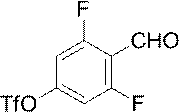
アルゴン雰囲気下、2,6-ジフルオロ-4-ヒドロキシベンズアルデヒド(1.03g)のジクロロメタン溶液(30mL)に、氷冷下でピリジン(0.8mL)、およびトリフルオロメタンスルホン酸無水物(1.18mL)を加え、反応液とした。反応液を室温で3時間撹拌した。反応液に水を加え、酢酸エチルで抽出し、水、飽和食塩水で洗浄後、無水硫酸ナトリウムで乾燥した。溶媒を減圧下濃縮した後、残渣をシリカゲルカラムクロマトグラフィー(ヘキサン : 酢酸エチル = 4:1)で精製することで、無色油状物として表題化合物を得た(1.5g)。
1H-NMR (400 MHz, CDCl3) δ 6.99-7.04 (2H, m), 10.32 (1H, s).

3,5-ジフルオロ-4-ホルミルフェニルトリフルオロメタンスルホネート(737mg)のトルエン溶液(15mL)に、アセトアミド(225mg)、トリス(ジベンジリデンアセトン)ジパラジウム(0)(116mg)、キサントホス(145mg)、および炭酸セシウム(1.24g)を加え、反応液とした。反応液をアルゴン雰囲気下、100℃で5時間撹拌した。反応液をセライトろ過し、酢酸エチルで洗浄した。溶媒を減圧下濃縮した後、残渣をシリカゲルカラムクロマトグラフィー(ヘキサン: 酢酸エチル = 4:1 ~ 酢酸エチル)で精製することで、淡黄色固体として表題化合物を得た(255mg)。
1H-NMR (400 MHz, CDCl3) δ 2.22 (3H, s), 7.24 (2H, d, J = 10.4 Hz), 7.44 (1H, brs), 10.23 (1H, s).

試薬として、アセトアミドの代わりにカルバミン酸tert-ブチルを用いて、参考例42-1と同様な方法で実施し、表題化合物を得た。
1H-NMR (400 MHz, CDCl3) δ 1.53 (9H, s), 6.77 (1H, brs), 7.07 (2H, d, J = 11.0 Hz), 10.20 (1H, s).

1H-NMR (400 MHz, CDCl3) δ 1.53 (9H, s), 3.32 (3H, s), 7.05 (2H, d, J = 11.0 Hz), 10.25 (1H, s).
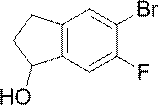
アルゴン雰囲気下、5-ブロモ-6-フルオロ-2,3-ジヒドロ-1H-インデン-1-オン(310mg)のテトラヒドロフラン(7mL)とエタノール(7mL)混合溶液に、氷冷化、水素化ホウ素ナトリウム(56mg)を加え、反応液とした。反応液を室温で1時間撹拌した。反応液に水を加え、酢酸エチルで抽出した。有機層を、水、飽和食塩水で洗浄後、無水硫酸ナトリウムで乾燥した。溶媒を減圧下濃縮した後、残渣をシリカゲルカラムクロマトグラフィー(ヘキサン: 酢酸エチル = 4:1)で精製することで、無色固体として表題化合物を得た(290mg)。
1H-NMR (400 MHz, CDCl3) δ 1.78 (1H, d, J = 7.3 Hz), 1.92-2.01 (1H, m), 2.50-2.58 (1H, m), 2.74-2.82 (1H, m), 2.96-3.03 (1H, m), 5.19 (1H, q, J = 6.7 Hz), 7.15 (1H, d, J = 7.9 Hz), 7.41 (1H, d, J = 6.7 Hz).

アルゴン雰囲気下、5-ブロモ-6-フルオロ-2,3-ジヒドロ-1H-インデン-1-オール(280mg)のN,N-ジメチルホルムアミド溶液(2.4mL)に、トリエチルアミン(0.34mL)、N,N-ジメチル-4-アミノピリジン(7.4mg)、およびtert-ブチルジメチルクロロシラン(274mg)を加え、反応液とした。反応液を室温で3時間撹拌した。反応液に水を加え、酢酸エチルで抽出した後、有機層を、水、飽和食塩水で洗浄後、無水硫酸ナトリウムで乾燥した。溶媒を減圧下濃縮した後、残渣をシリカゲルカラムクロマトグラフィー(ヘキサン: 酢酸エチル = 9:1)で精製することで、無色固体として表題化合物を得た(410mg)。
1H-NMR (400 MHz, CDCl3) δ 0.14 (3H, s), 0.17 (3H, s), 0.94 (9H, s), 1.89-1.98 (1H, m), 2.40-2.48 (1H, m), 2.68-2.76 (1H, m), 2.88-2.94 (1H, m), 5.16 (1H, t, J = 7.0 Hz), 7.01 (1H, d, J = 7.9 Hz), 7.36 (1H, d, J = 6.1 Hz).

アルゴン雰囲気下、[(5-ブロモ-6-フルオロ-2,3-ジヒドロ-1H-インデン-1-イル)オキシ](tert-ブチル)ジメチルシラン(3.45g)のテトラヒドロフラン溶液(50mL)に、-78℃でn-ブチルリチウム(4.15mL, 2.65mol/L ヘキサン溶液)をゆっくり加え、反応液とした。反応液を40分間撹拌した。その後、反応液にN,N-ジメチルホルムアミド(1.26mL)を加え、-78℃で1時間撹拌した。反応液に飽和塩化ナトリウム水溶液を加え、0℃で1時間撹拌した後、酢酸エチルで抽出した。有機層を、水、飽和食塩水で洗浄後、無水硫酸ナトリウムで乾燥した。溶媒を減圧下濃縮した後、残渣をシリカゲルカラムクロマトグラフィー(ヘキサン: 酢酸エチル = 4:1)で精製することで、黄色油状物として表題化合物を得た(2.63g)。
1H-NMR (400 MHz, CDCl3) δ 0.16 (3H, s), 0.19 (3H, s), 0.95 (9H, s), 1.91-2.01 (1H, m), 2.44-2.52 (1H, m), 2.71-2.79 (1H, m), 2.96 (1H, dd, J = 14.7, 7.9 Hz), 5.22 (1H, t, J = 7.6 Hz), 7.05 (1H, d, J = 10.4 Hz), 7.67 (1H, d, J = 6.7 Hz), 10.32 (1H, s).

アルゴン雰囲気下、2-ブロモ-1,3,5-トリフルオロベンゼン(2.0g)にエチレングリコール(2.65mL)、およびN-メチル-2-ピロリドン(2mL)を加え、氷冷下、カリウムtert-ブトキシド(1.28g)を加えて反応液とした。反応液を90℃で2時間加熱撹拌した。反応液を室温まで冷却後、水を加え、酢酸エチルで抽出した。有機層を水、及び飽和食塩水で洗浄後、無水硫酸ナトリウムで乾燥した。溶媒を減圧下濃縮した後、残渣をシリカゲルカラムクロマトグラフィー(ヘキサン: 酢酸エチル = 9:1 ~ 1:1)で精製することで、無色油状物として表題化合物を得た(1.43g)。
1H-NMR (400 MHz, CDCl3) δ 2.10 (1H, t, J = 6.4 Hz), 4.00-4.04 (2H, m), 4.13 (2H, t, J = 4.6 Hz), 6.48-6.52 (1H, m), 6.55-6.61 (1H, m).
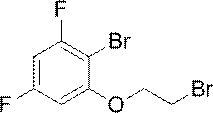
アルゴン雰囲気下、2-(2-ブロモ-3,5-ジフルオロフェノキシ)エタノール(370mg)のジクロロメタン溶液(3.7mL)に、氷冷下、四臭化炭素(606mg)、およびトリフェニルホスフィン(575mg)を加え、反応液とした。反応液を室温で3時間撹拌した。反応液を減圧下濃縮し、酢酸エチルを加えて、析出した固体をろ去した。ろ液を減圧下濃縮した後、残渣をシリカゲルカラムクロマトグラフィー(ヘキサン ~ ヘキサン: 酢酸エチル = 9:1)で精製することで、無色固体として表題化合物を得た(453mg)。
1H-NMR (400 MHz, CDCl3) δ 3.69 (2H, t, J = 6.4 Hz), 4.32 (2H, t, J = 6.4 Hz), 6.47 (1H, dt, J = 10.0, 2.3 Hz), 6.59 (1H, td, J = 8.4, 2.3 Hz).
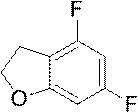
アルゴン雰囲気下、2-ブロモ-1-(2-ブロモエトキシ)-3,5-ジフルオロベンゼン(440mg)のテトラヒドロフラン溶液(5mL)に、-78℃でn-ブチルリチウム(0.55mL, 2.65mol/L ヘキサン溶液)を加え、反応液とした。反応液を2時間撹拌した後、室温で1時間撹拌した。反応液に飽和塩化アンモニウム水溶液を加え、酢酸エチルで抽出した。有機層を水、及び飽和食塩水で洗浄後、無水硫酸ナトリウムで乾燥した。溶媒を減圧下濃縮することで表題化合物を得た(205mg)。
1H-NMR (400 MHz, CDCl3) δ 3.20 (2H, t, J = 8.9 Hz), 4.65 (2H, t, J = 8.9 Hz), 6.28-6.34 (2H, m).

アルゴン雰囲気下、4,6-ジフルオロ-2,3-ジヒドロベンゾフラン(650mg)のN,N-ジメチルホルムアミド溶液(710μL)にオキシ塩化リン(778μL)を加え、反応液とした。反応液を100℃で20時間攪拌した。反応液を室温に放冷後、氷水に加え、酢酸エチルで抽出した。有機層を飽和炭酸水素ナトリウム水溶液、飽和食塩水で洗浄後、無水硫酸ナトリウムで乾燥した。溶媒を減圧下濃縮した後、残渣をシリカゲルカラムクロマトグラフィー(ヘキサン: 酢酸エチル = 4:1)で精製することで、淡黄色油状物として表題化合物を得た(121mg)。
1H-NMR (400 MHz, CDCl3) δ 3.27 (2H, t, J = 8.9 Hz), 4.77 (2H, t, J = 8.9 Hz), 6.41 (1H, d, J = 11.0 Hz), 10.16 (1H, s).

6-フルオロインドリン(4.2g)のメタノール溶液(38mL)に、炭酸カリウム(4.45g)とベンジルブロミド(3.83mL)を加え、反応液とした。反応液を3時間加熱還流した。反応液について、室温に放冷した後、不溶物をろ去した。ろ液を減圧下濃縮した後、残渣をシリカゲルカラムクロマトグラフィー(ヘキサン: 酢酸エチル = 1:1)で精製することで、淡褐色油状物として表題化合物を得た(6.14g)。
1H-NMR (400 MHz, CDCl3) δ 2.92 (2H, t, J = 8.5 Hz), 3.38 (2H, t, J = 8.5 Hz), 4.23 (2H, s), 6.18 (1H, dd, J = 10.9, 2.4 Hz), 6.27-6.32 (1H, m), 6.93-6.97 (1H, m), 7.25-7.34 (5H, m).

1-ベンジル-6-フルオロインドリン(1.0g)のN,N-ジメチルホルムアミド溶液(4.9mL)に、氷冷下、オキシ塩化リン(518μL)を加え、反応液とした。反応液を100℃で2時間攪拌した。反応液を室温に放冷し、氷水に加えた。当該氷水に2mol/L水酸化ナトリウム水溶液を加えてpHを10とした後、クロロホルムで抽出した。有機層を飽和食塩水で洗浄後、無水硫酸ナトリウムで乾燥した。溶媒を減圧下濃縮した後、残渣をシリカゲルカラムクロマトグラフィー(ヘキサン: 酢酸エチル = 8:1 ~ 2:1)で精製することで、淡黄色油状物として表題化合物を得た(1.07g)。
1H-NMR (400 MHz, CDCl3) δ 3.02 (2H, t, J = 8.5 Hz), 3.61 (2H, t, J = 8.5 Hz), 4.39 (2H, s), 6.05 (1H, d, J = 12.1 Hz), 7.25-7.38 (5H, m), 7.48-7.49 (1H, m), 10.02 (1H, s).
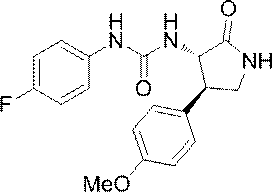
アルゴン雰囲気下、(-)-(3S*,4R*)-4-(4-メトキシフェニル)-2-オキソピロリジン-3-カルボン酸(170mg)のトルエン溶液(3.6mL)に、トリエチルアミン(131μL)、およびジフェニルリン酸アジド(171μL)を加え、反応液とした。反応液を室温で1時間撹拌した後、温度を90℃に昇温して1時間撹拌した。その後、反応液に4-フルオロアニリン(140μL)を加え、120℃で3時間撹拌した。反応液を室温まで冷却後、1mol/L塩酸を加え、酢酸エチルで抽出した。有機層を水、および飽和食塩水で順次洗浄後、無水硫酸ナトリウムで乾燥した。溶媒を減圧下濃縮した後、残渣をシリカゲルカラムクロマトグラフィー(酢酸エチル:ヘキサン = 4:1 ~ 酢酸エチル ~ 酢酸エチル:メタノール = 10:1)で精製することで、白色固体として表題化合物を得た(44mg)。
1H-NMR (400 MHz, DMSO-d6) δ 3.11-3.17 (1H, m), 3.38-3.48 (2H, m), 3.69 (3H, s), 4.45 (1H, dd, J = 10.9, 9.1 Hz), 6.38 (1H, d, J = 9.1 Hz), 6.86 (2H, d, J = 8.5 Hz), 7.01 (2H, t, J = 9.1 Hz), 7.28 (2H, d, J = 8.5 Hz), 7.32-7.35 (2H, m), 7.88 (1H, s), 8.53 (1H, s).
MS (ESI+) m/z: 344 (MH+).
[α]D 28 = -156 (c 0.10, EtOH)
これらの構造およびスペクトルデータを表47~表75に示した。
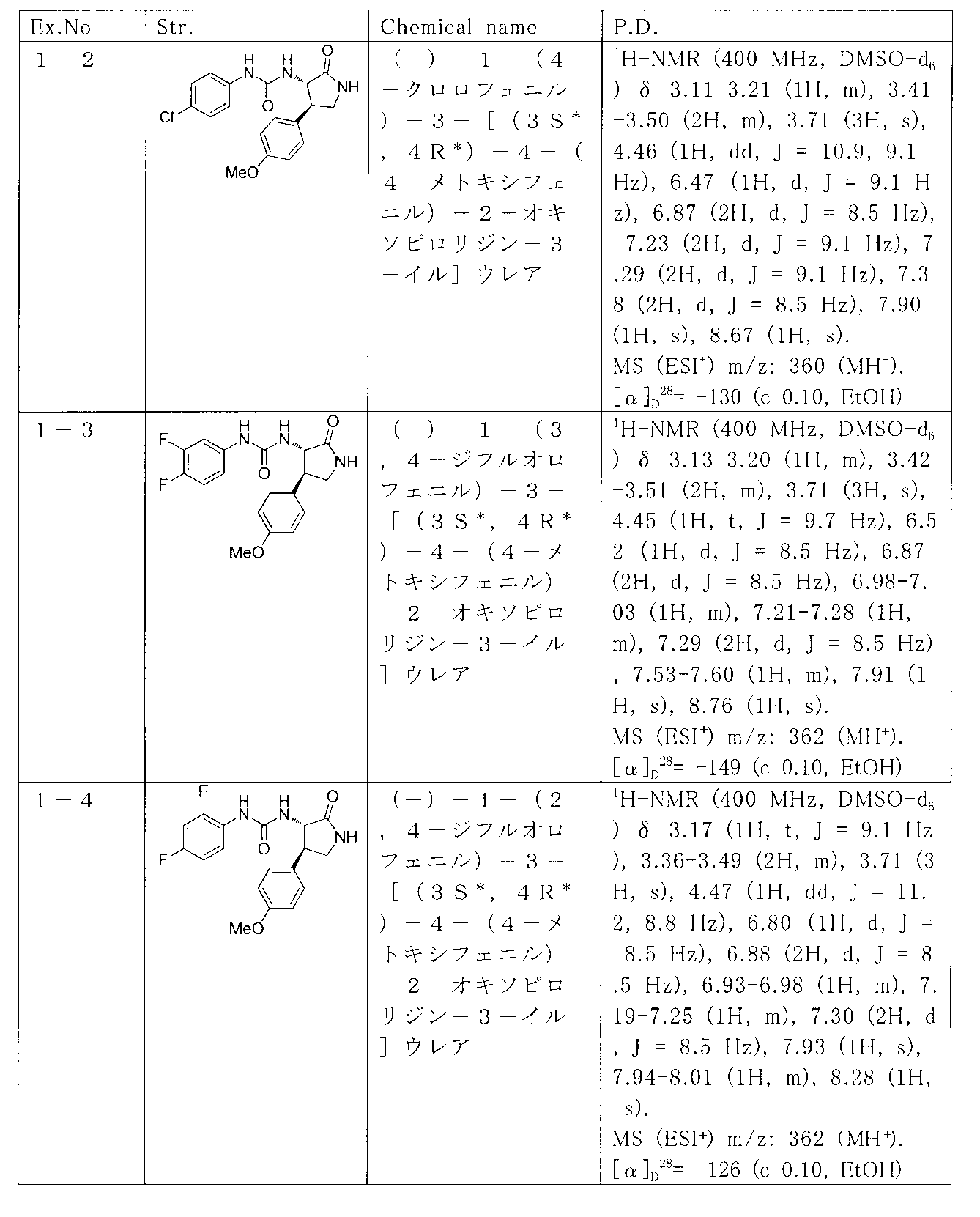
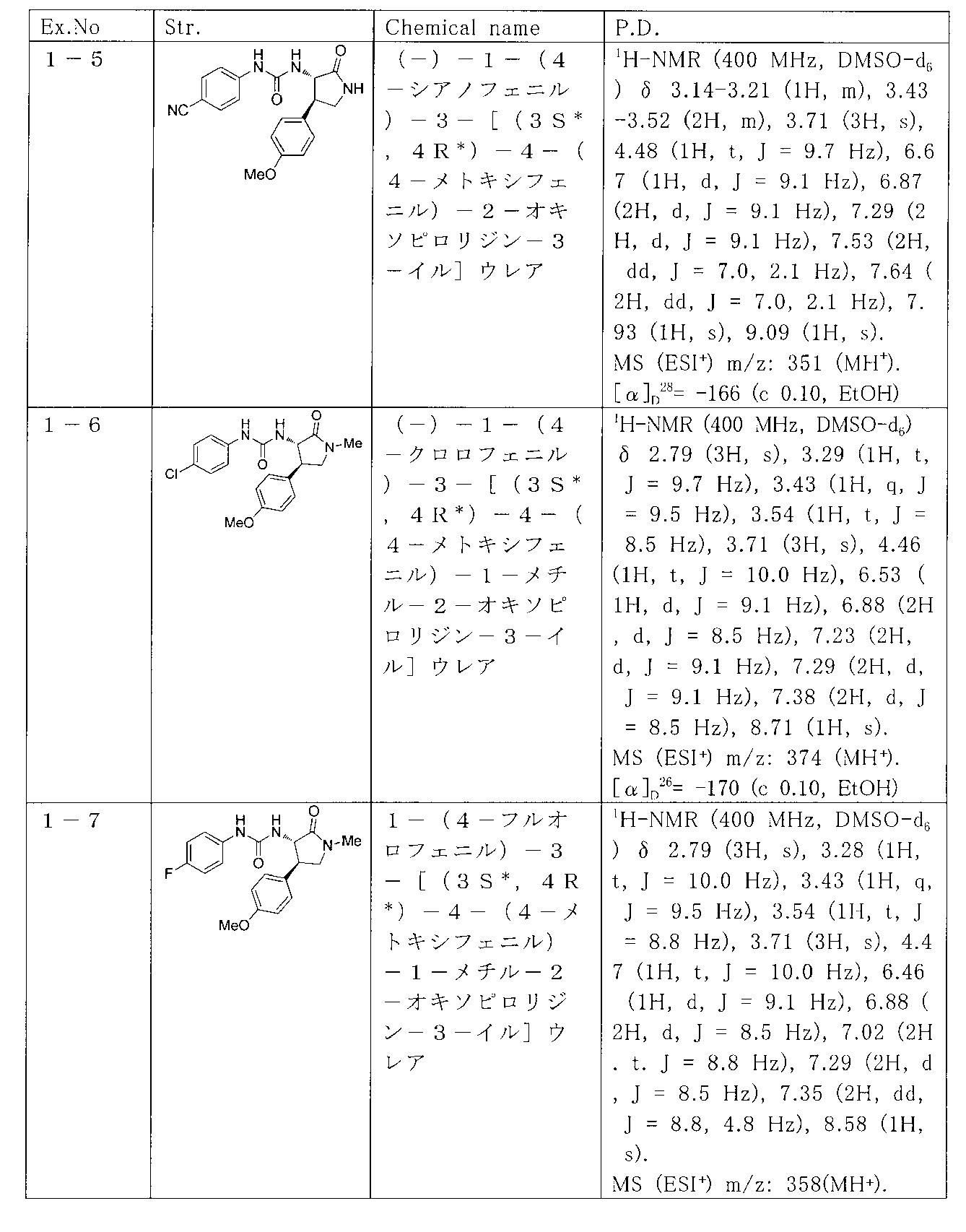


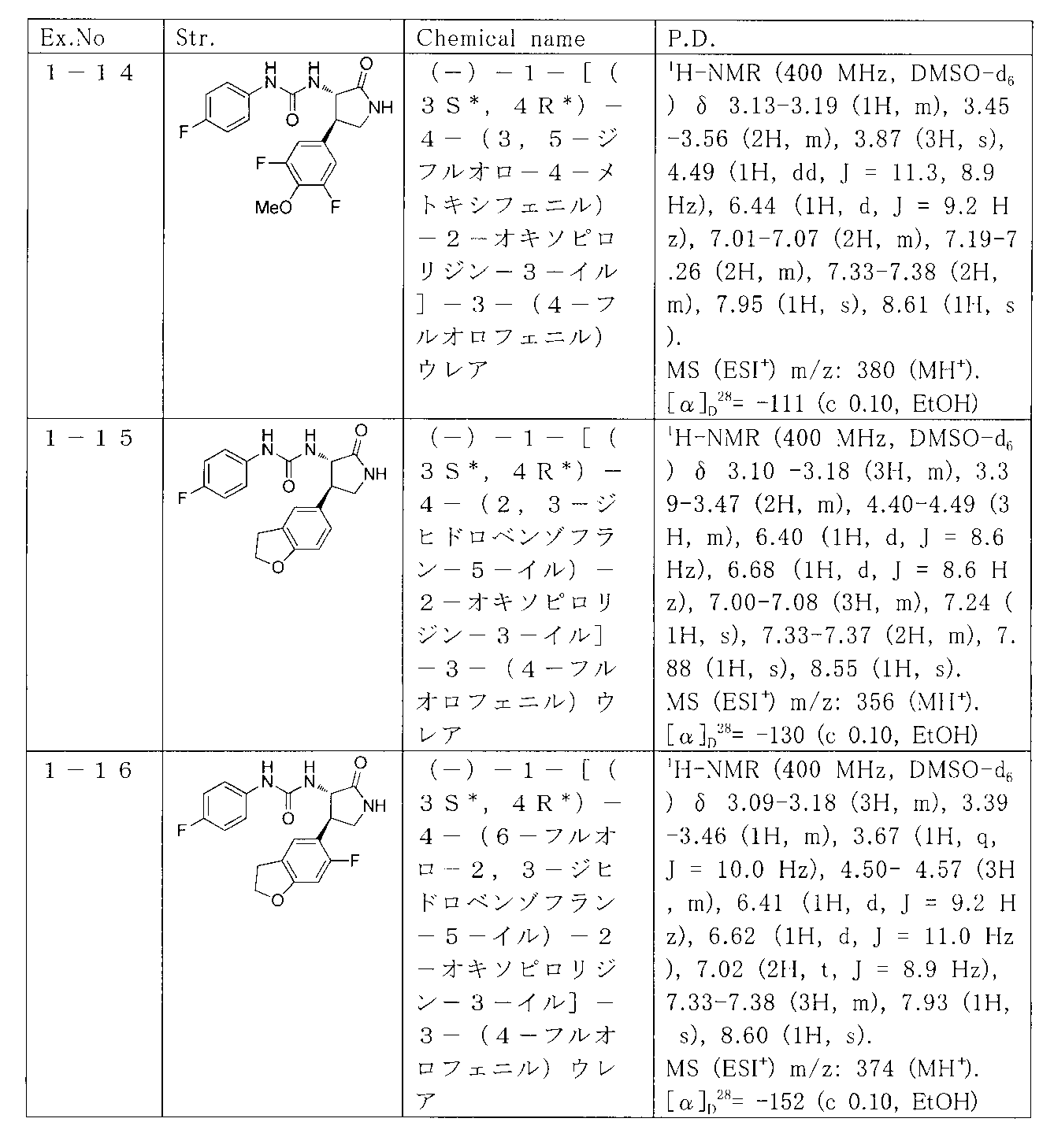


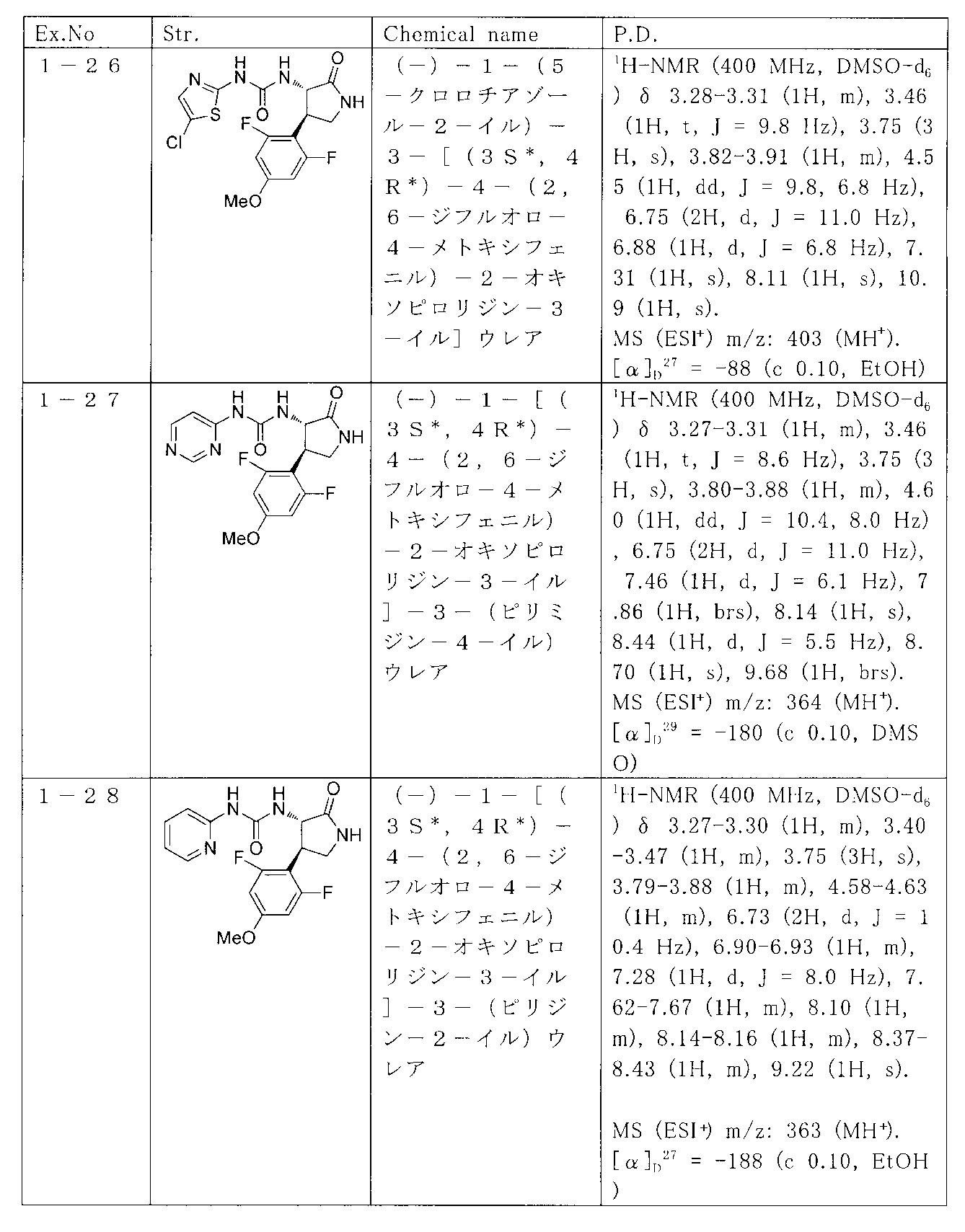

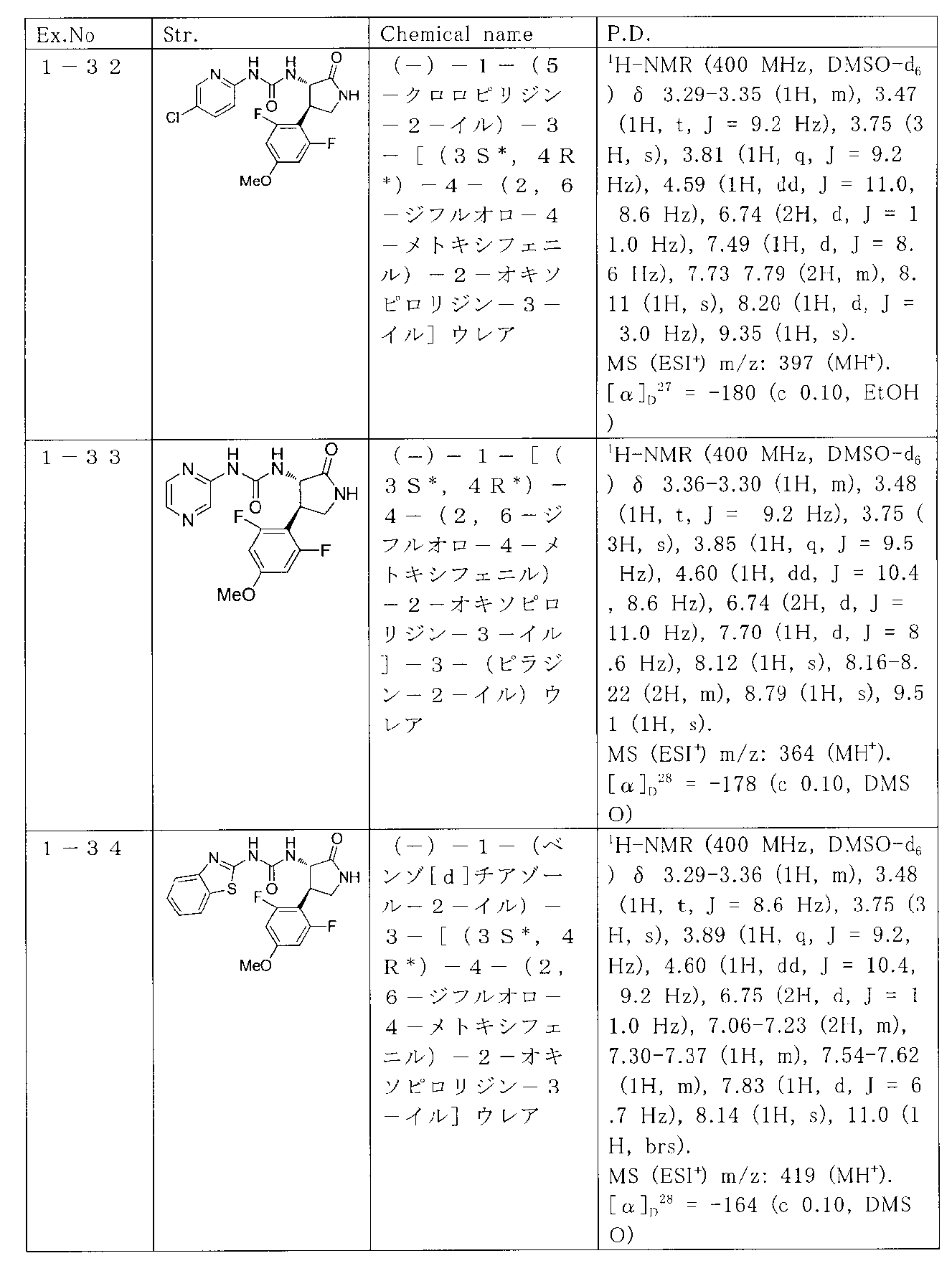
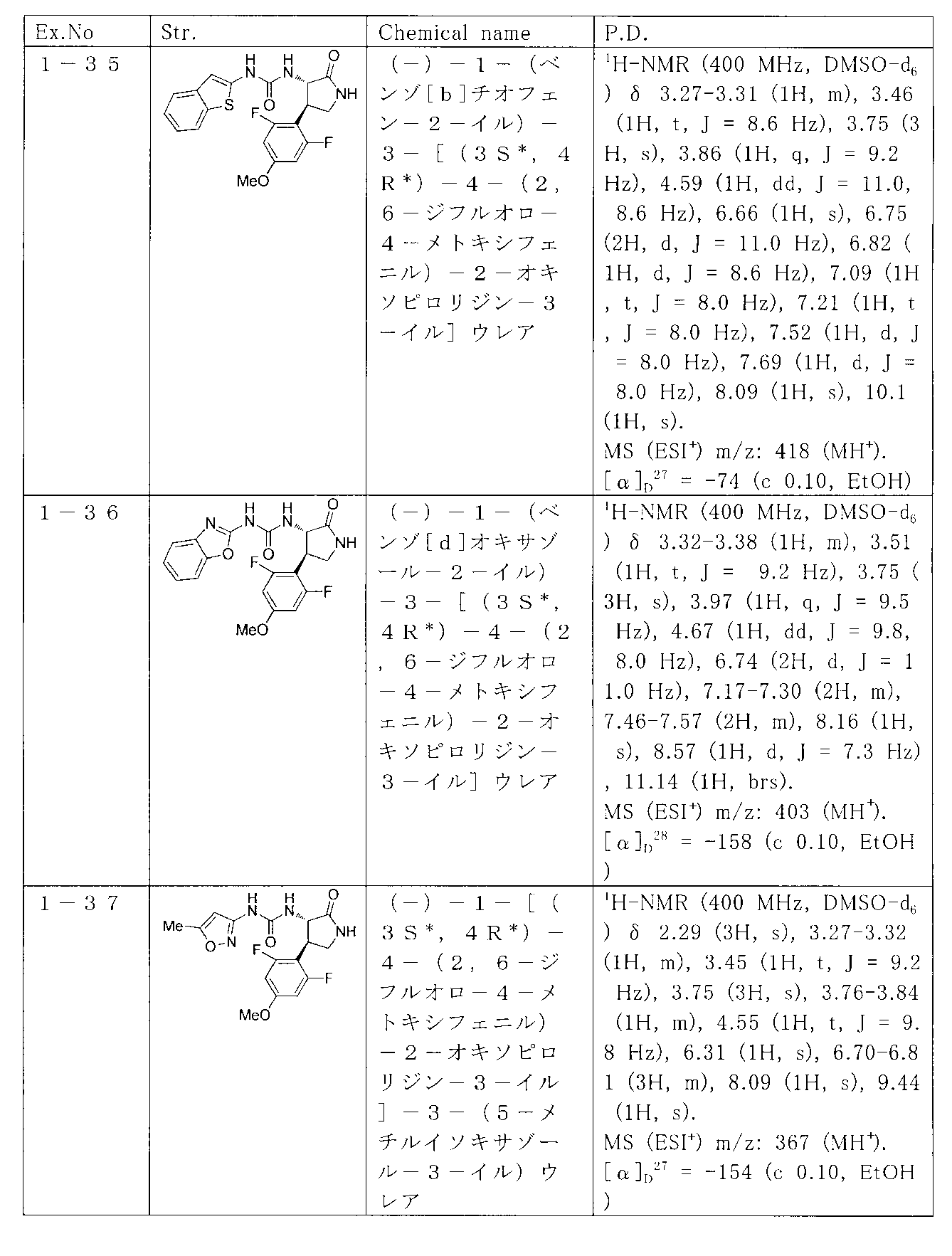
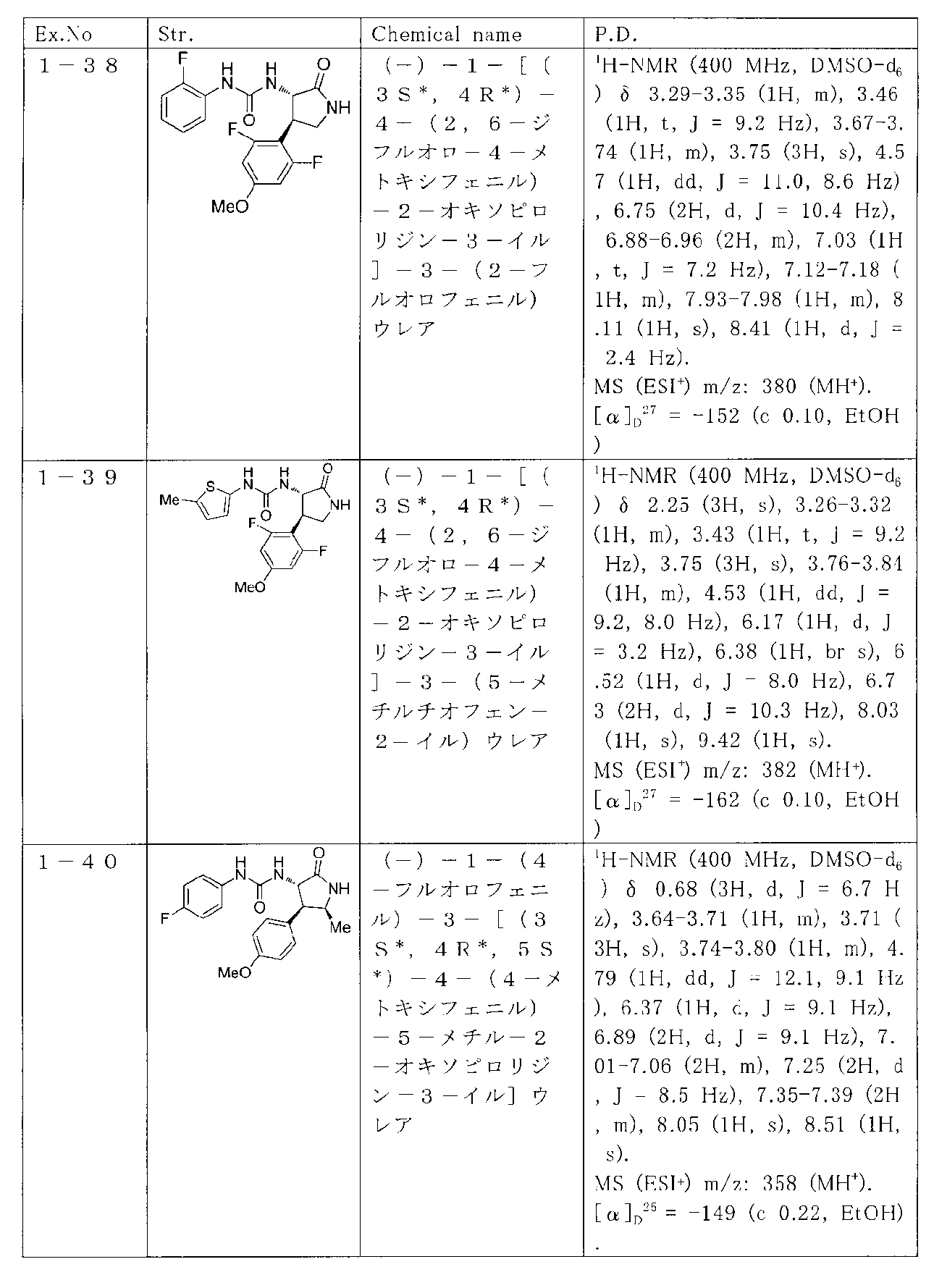

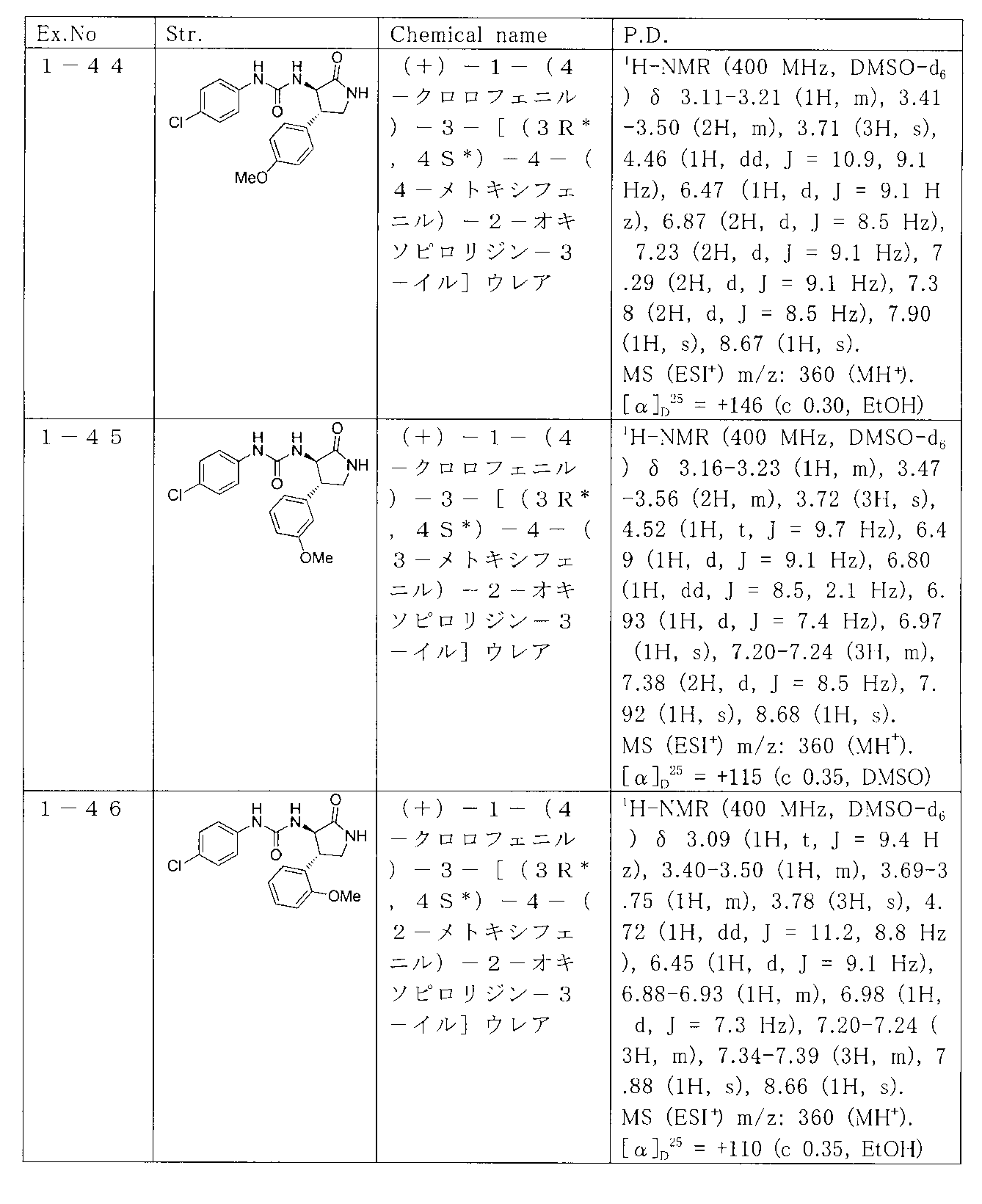
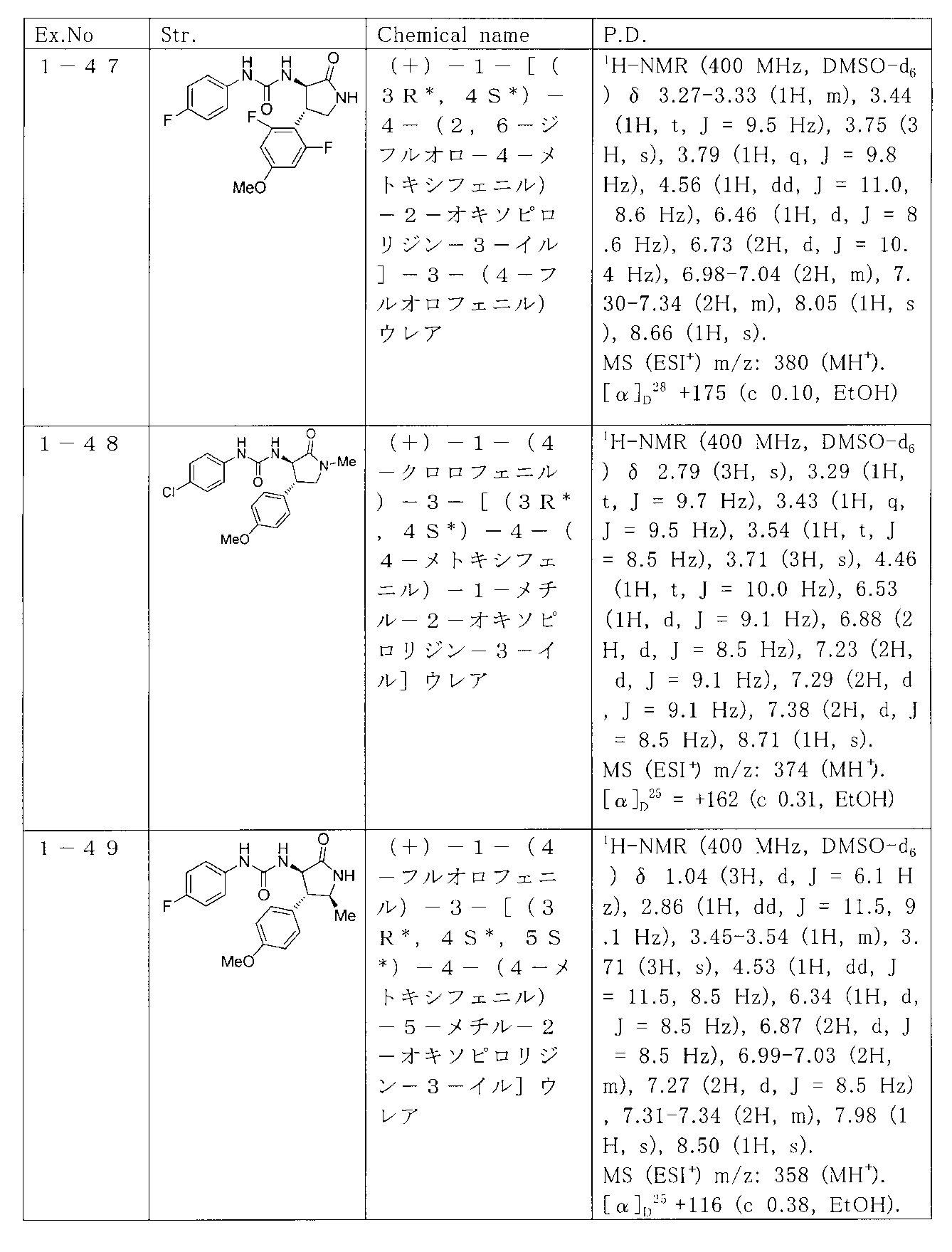


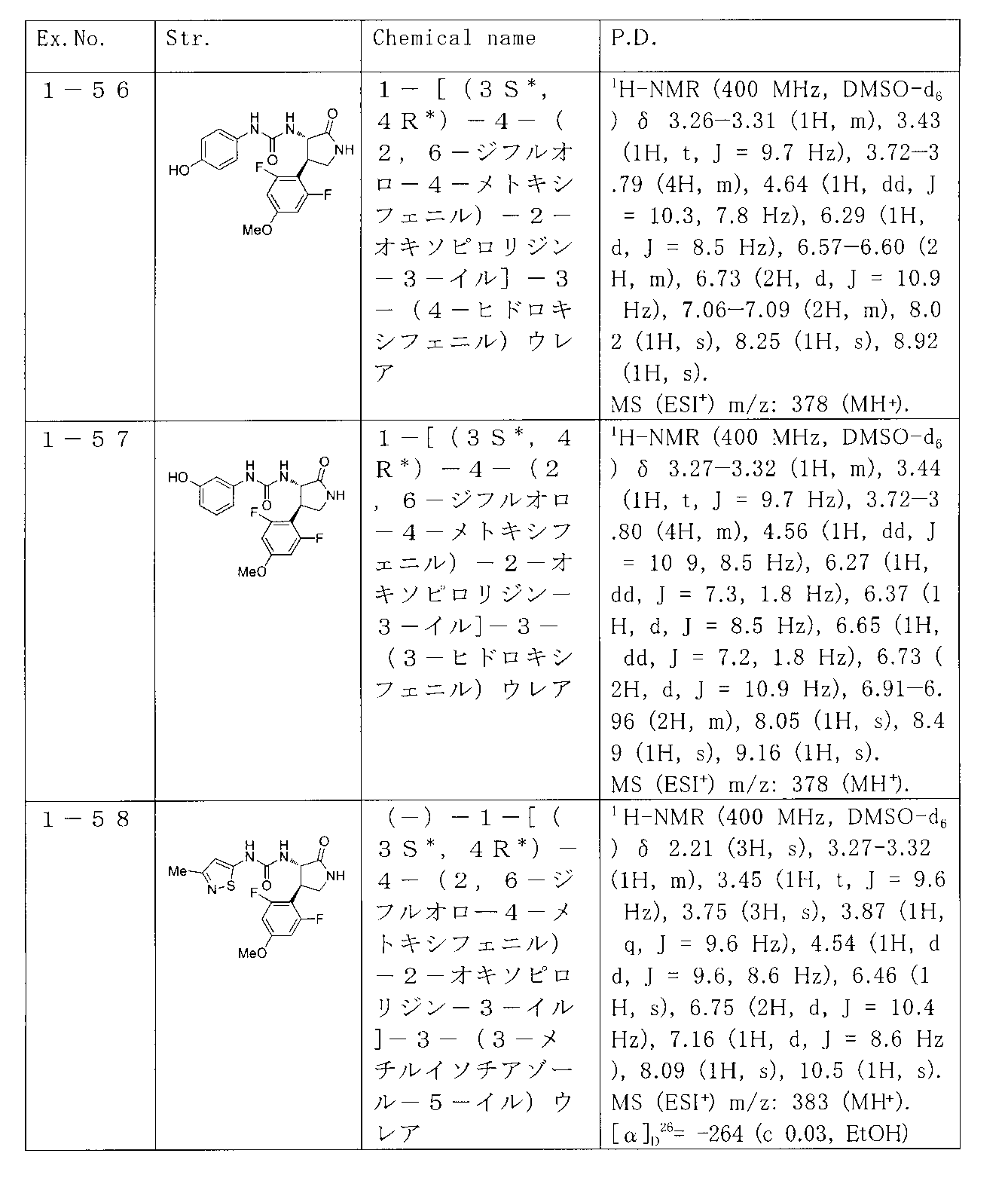
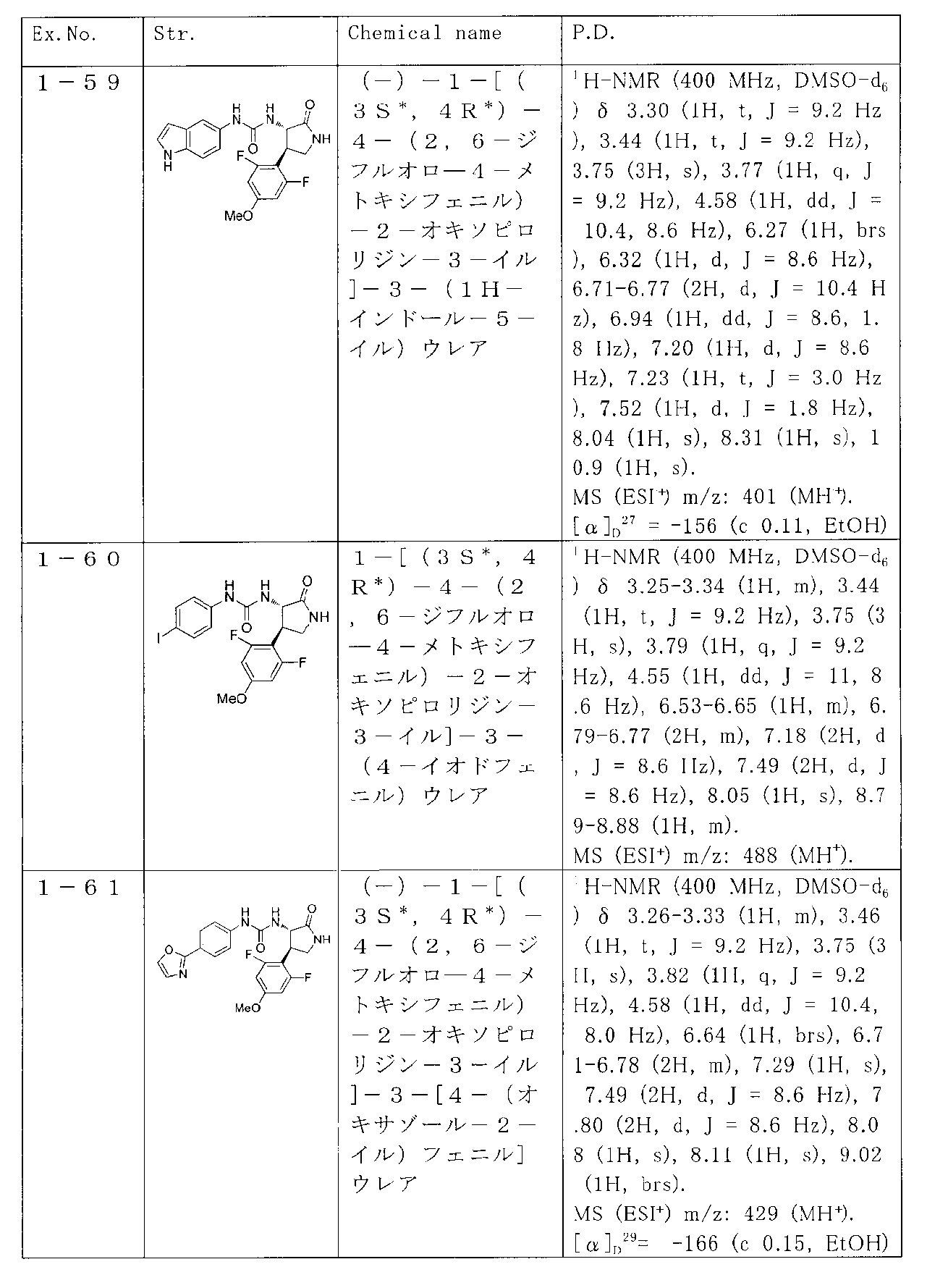
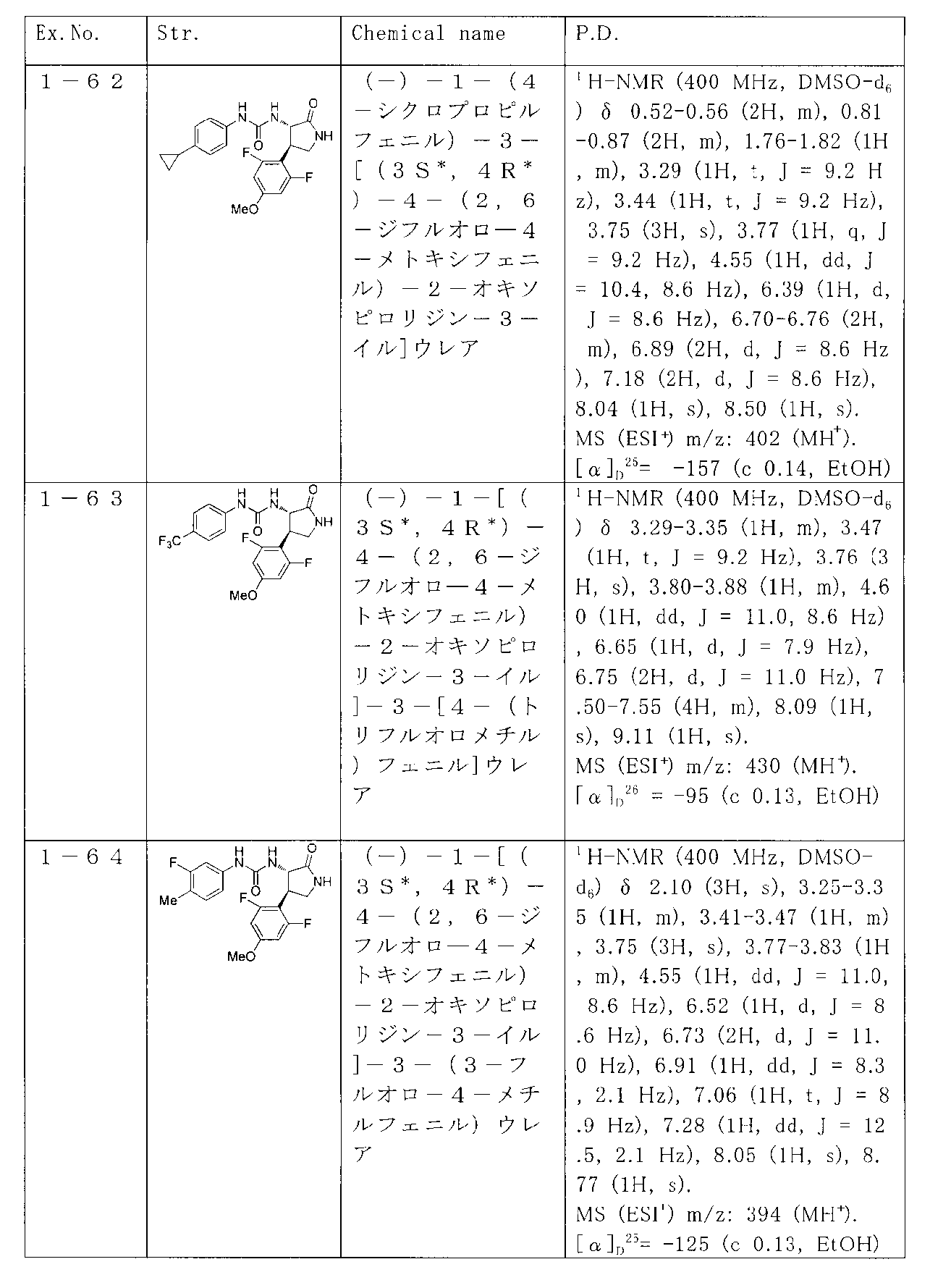
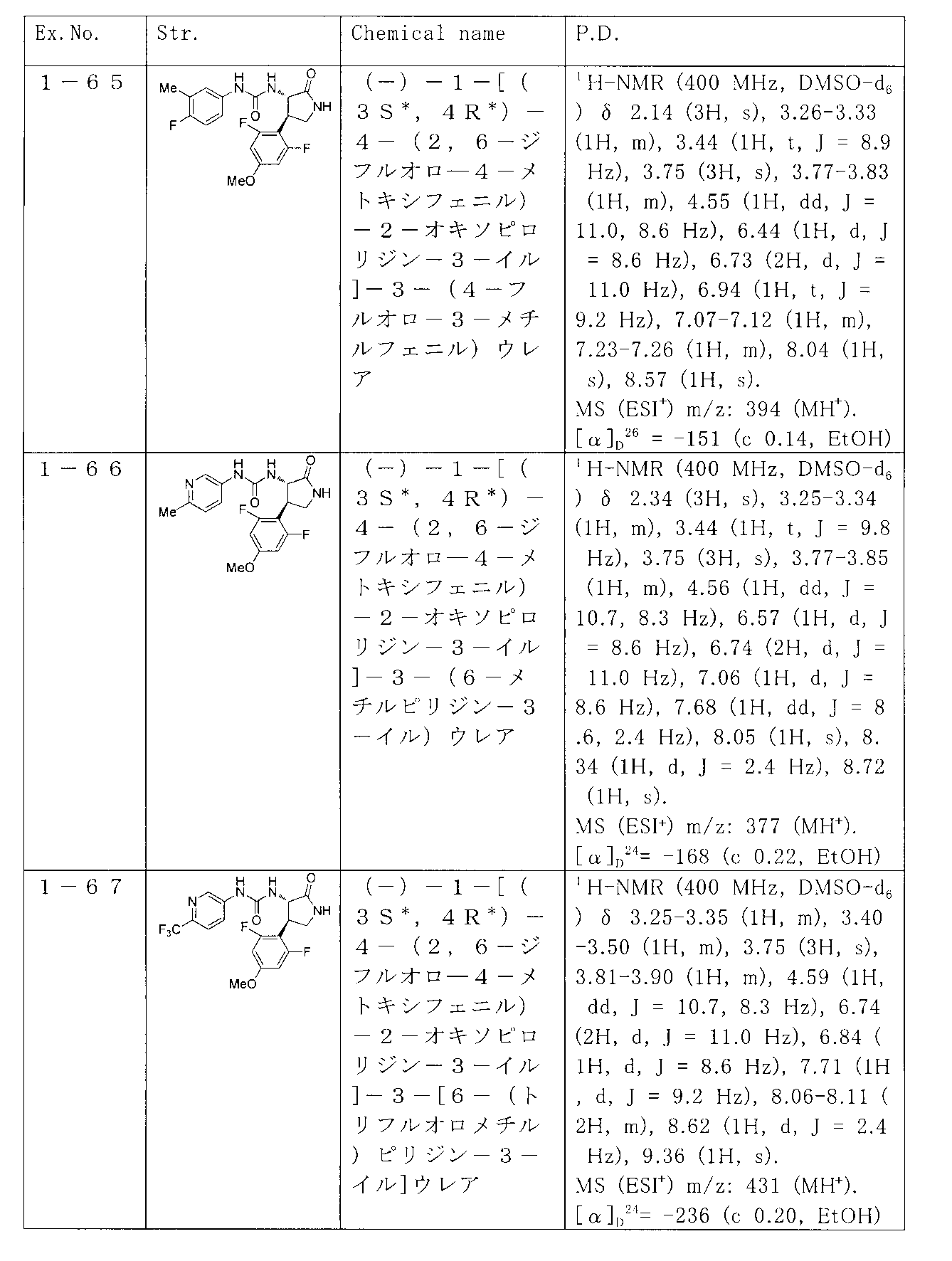
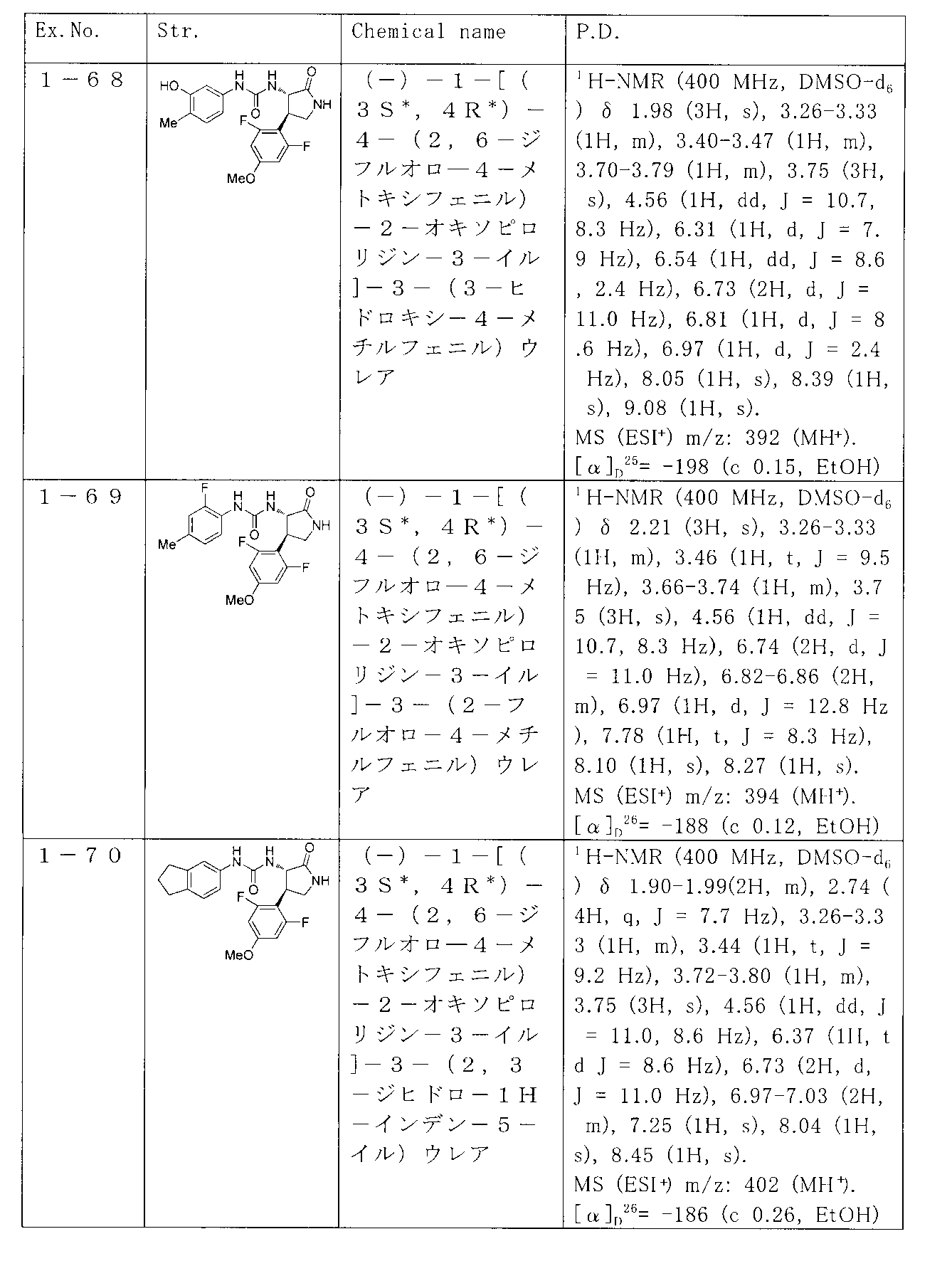


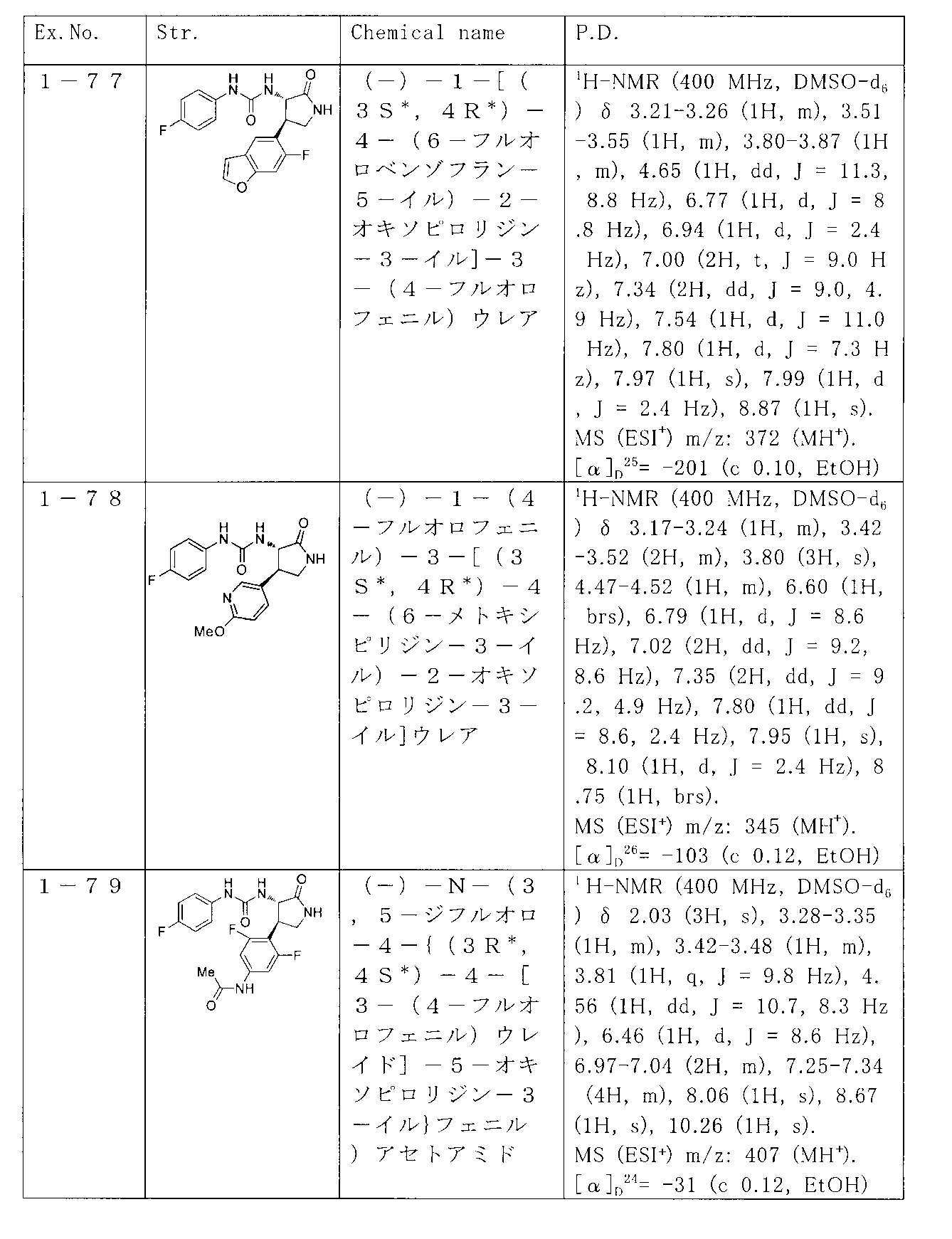

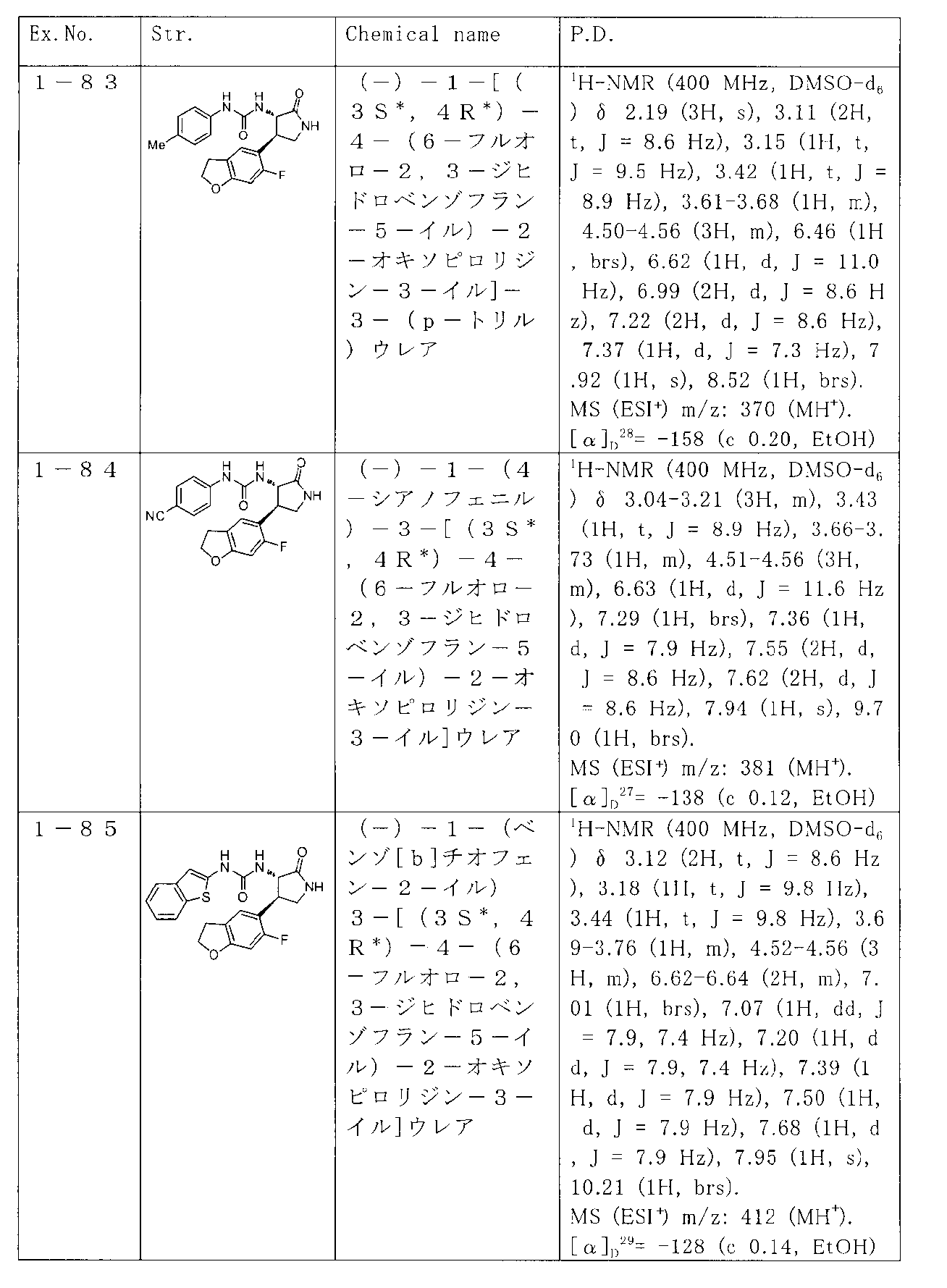
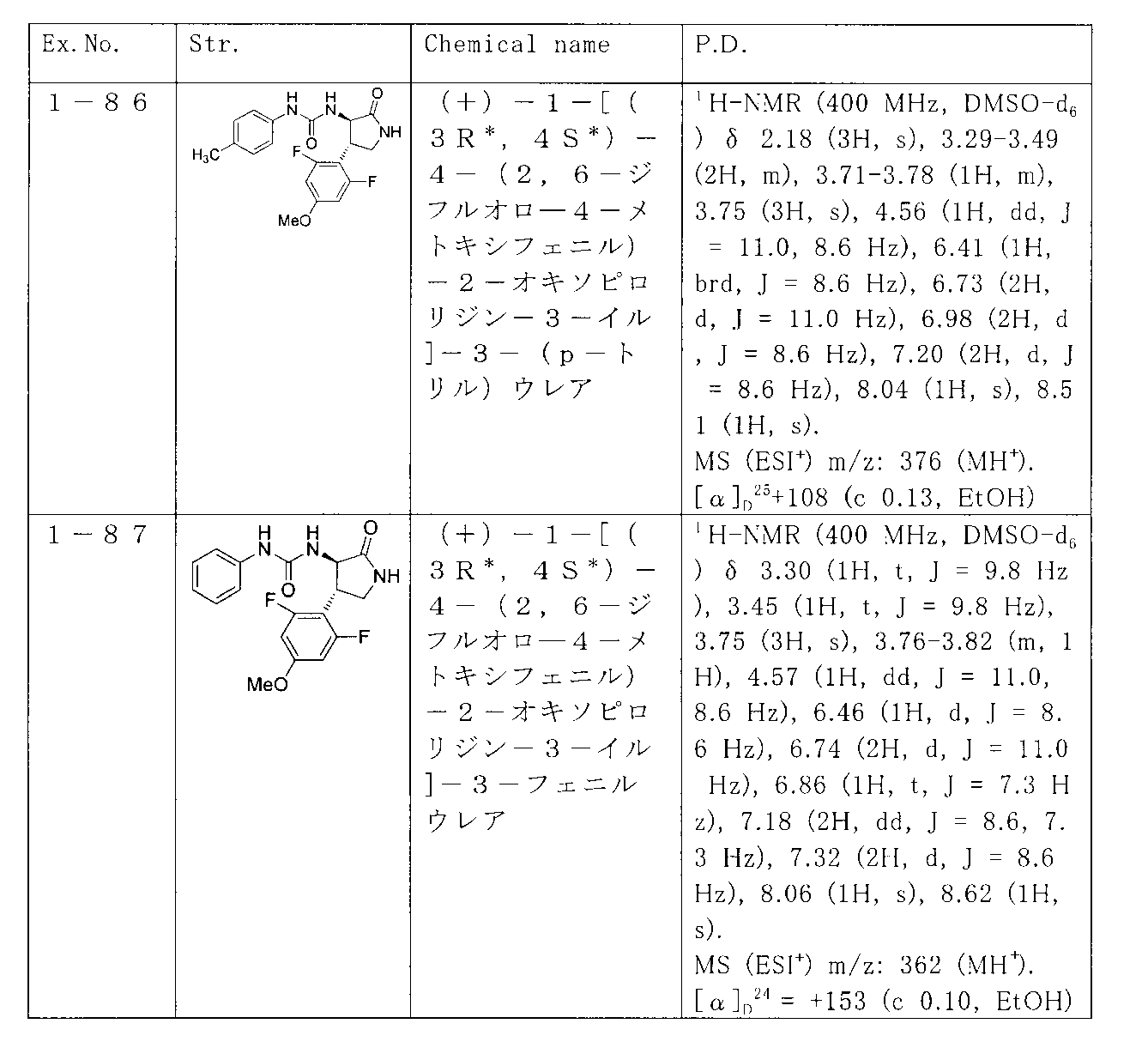

(-)-トランス-1-(4-フルオロフェニル)-3-[4-(4-メトキシフェニル)-5,5-ジメチル-2-オキソピロリジン-3-イル]ウレア
(-)-(3S*,4R*)-4-(4-メトキシフェニル)-2-オキソピロリジン-3-カルボン酸の代わりに、(±)-トランス-4-(4-メトキシフェニル)-5,5-ジメチル-2-オキソピロリジン-3-カルボン酸を用いて実施例1-1と同様の方法に従って実施し、(±)-トランス-1-(4-フルオロフェニル)-3-[4-(4-メトキシフェニル)-5,5-ジメチル-2-オキソピロリジン-3-イル]ウレアを得た。
得られた(±)-トランス-1-(4-フルオロフェニル)-3-[4-(4-メトキシフェニル)-5,5-ジメチル-2-オキソピロリジン-3-イル]ウレアを、光学異性体分離用カラム(ダイセル化学工業、CHIRALPAK ID)を用いて高速液体クロマトグラフィー(メチルtert-ブチルエーテル:エタノール=4:1,流速15.0 mL)による光学分割を行った。保持時間6.94分の異性体A(+)、および保持時間16.14分の異性体B(-)として、それぞれ白色固体として表題化合物を得た。
異性体A(+):
1H-NMR (400 MHz, DMSO-d6) δ 0.78 (3H, s), 1.22 (3H, s), 3.26 (1H, d, J = 12.1 Hz), 3.72 (3H, s), 4.88 (1H, dd, J = 12.1, 9.1 Hz), 6.31 (1H, d, J = 9.1 Hz), 6.89 (2H, d, J = 8.5 Hz), 7.02 (2H, t, J = 9.1 Hz), 7.25 (2H, d, J = 8.5 Hz), 7.34 (2H, dd, J = 9.1, 4.8 Hz), 8.01 (1H, s), 8.48 (1H, s).
MS (ESI+) m/z: 372 (MH+).
[α]D 25 = +133 (c 0.21, CHCl3)
異性体B(-):
1H-NMR (400 MHz, DMSO-d6) δ 0.78 (3H, s), 1.22 (3H, s), 3.26 (1H, d, J = 12.1 Hz), 3.72 (3H, s), 4.88 (1H, dd, J = 12.1, 9.1 Hz), 6.31 (1H, d, J = 9.1Hz), 6.89 (2H, d, J = 8.5 Hz), 7.02 (2H, t, J = 9.1 Hz), 7.25 (2H, d, J = 8.5 Hz), 7.34 (2H, dd, J = 9.1, 4.8 Hz), 8.01 (1H, s), 8.48 (1H, s).
MS (ESI+) m/z: 372 (MH+).
[α] D 25= -147 (c 0.21, CHCl3)

(-)-トランス-1-(4-フルオロフェニル)-3-[4-(4-メトキシフェニル)-2-オキソ-1-アザスピロ[4.4]ノナン-3-イル]ウレア
(-)-(3S*,4R*)-4-(4-メトキシフェニル)-2-オキソピロリジン-3-カルボン酸の代わりに、(±)-トランス-4-(4-メトキシフェニル)-2-オキソ-1-アザスピロ[4.4]ノナン-3-カルボン酸を用いて、実施例1-1と同様の方法に従って実施し、(±)-トランス-1-(4-フルオロフェニル)-3-[4-(4-メトキシフェニル)-2-オキソ-1-アザスピロ[4.4]ノナン-3-イル]ウレアを得た。得られた(±)-トランス-1-(4-フルオロフェニル)-3-[4-(4-メトキシフェニル)-2-オキソ-1-アザスピロ[4.4]ノナン-3-イル]ウレアを、光学異性体分離用カラム(CHIRALPAK ID)を用いて高速液体クロマトグラフィー(メチルtert-ブチルエーテル:エタノール=4:1,流速20.0 mL)による光学分割を行った。保持時間9.02分の異性体A(+)、および保持時間14.27分の異性体B(-)として、それぞれ白色固体として表題化合物を得た。
異性体A(+):
1H-NMR (400 MHz, DMSO-d6) δ 1.05-1.81 (8H, m), 3.45 (1H, d, J = 12.1 Hz), 3.71 (3H, s), 4.82 (1H, dd, J = 12.1, 9.1 Hz), 6.31 (1H, d, J = 9.1 Hz), 6.88 (2H, d, J = 9.1 Hz), 7.02 (2H, t, J = 9.1 Hz), 7.25 (2H, d, J = 9.1 Hz), 7.34 (2H, dd, J = 9.1, 4.8 Hz), 8.28 (1H, s), 8.47 (1H, s).
MS (ESI+) m/z: 398 (MH+).
HRMS (ESI+) for C22H25FN3O3 (MH+): calcd, 398.18799; found, 398.18738.
[α]D 24 = +124 (c 0.31, CHCl3).
異性体B(-):
1H-NMR (400 MHz, DMSO-d6) δ 1.05-1.81 (8H, m), 3.45 (1H, d, J = 12.1 Hz), 3.71 (3H, s), 4.82 (1H, dd, J = 12.1, 9.1 Hz), 6.31 (1H, d, J = 9.1 Hz), 6.88 (2H, d, J = 9.1 Hz), 7.02 (2H, t, J = 9.1 Hz), 7.25 (2H, d, J = 9.1 Hz), 7.34 (2H, dd, J = 9.1, 4.8 Hz), 8.28 (1H, s), 8.47 (1H, s).
MS (ESI+) m/z: 398 (MH+).
HRMS (ESI+) for C22H25FN3O3 (MH+): calcd, 398.18799; found, 398.18880.
[α]D 24 = -125 (c 0.31, CHCl3).
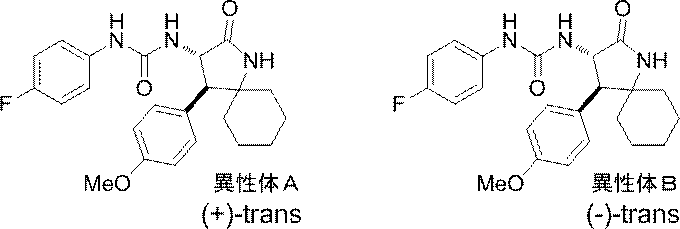
(-)-トランス-1-(4-フルオロフェニル)-3-[4-(4-メトキシフェニル)-2-オキソ-1-アザスピロ[4.5]デカン-3-イル]ウレア
(-)-(3S*,4R*)-4-(4-メトキシフェニル)-2-オキソピロリジン-3-カルボン酸の代わりに、(±)-トランス-4-(4-メトキシフェニル)-2-オキソ-1-アザスピロ[4.5]デカン-3-カルボン酸を用いて、実施例1-1と同様の方法に従って実施し、(±)-トランス-1-(4-フルオロフェニル)-3-[4-(4-メトキシフェニル)-2-オキソ-1-アザスピロ[4.5]デカン-3-イル]ウレアを得た。得られた(±)-トランス-1-(4-フルオロフェニル)-3-[4-(4-メトキシフェニル)-2-オキソ-1-アザスピロ[4.5]デカン-3-イル]ウレアを、光学異性体分離用カラム(CHIRALPAK ID)を用いて高速液体クロマトグラフィー(メチルtert-ブチルエーテル:エタノール=85:15,流速15.0 mL)による光学分割を行った。保持時間12.16分の異性体A(+)、および保持時間17.07分の異性体B(-)として,それぞれ白色固体として表題化合物を得た。異性体A(+):
1H-NMR (400 MHz, DMSO-d6) δ 0.55-0.67 (1H, m), 0.76-0.92 (1H, m), 1.29-1.71 (8H,m), 3.14 (1H, d, J = 12.2 Hz), 3.72 (3H, s), 4.89 (1H, dd, J = 12.2, 8.6 HzH), 6.31 (1H, d, J = 8.6 Hz), 6.88 (2H, d, J = 8.6 Hz), 7.02 (2H, t, J = 8.8 Hz), 7.25 (2H, d, J = 8.5 Hz), 7.34 (2H, dd, J = 9.1, 4.8 Hz), 8.01 (1H, s), 8.48 (1H, s).
MS (ESI+) m/z: 412 (MH+).
HRMS (ESI+) for C23H27FN3O3 (MH+): calcd, 412.20364; found, 412.20364.
[α]D 25 = +133 (c 0.32, CHCl3).
異性体B(-):
1H-NMR (400 MHz, DMSO-d6) δ0.55-0.67 (1H, m), 0.76-0.92 (1H, m), 1.29-1.71 (8H, m), 3.14 (1H, d, J = 12.2 Hz), 3.72 (3H, s), 4.89 (1H, dd, J = 12.2, 8.6 Hz), 6.31 (1H, d, J = 8.6 Hz), 6.88 (2H, d, J = 8.6 Hz), 7.02 (2H, t, J = 8.8 Hz), 7.25 (2H, d, J = 8.5 Hz), 7.34 (2H, dd, J = 9.1, 4.8 Hz), 8.01 (1H, s), 8.48 (1H, s).
MS (ESI+) m/z: 412 (MH+).
HRMS (ESI+) for C23H27FN3O3 (MH+): calcd, 412.20364; found, 412.20416.
[α]D 25 = -137 (c 0.31, CHCl3).
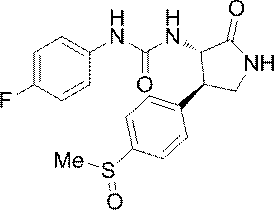
1-(4-フルオロフェニル)-3-[(3S*,4R*)-4-(4-メチルチオフェニル)-2-オキソピロリジン-3-イル]ウレア(100mg)のジクロロメタン溶液(5mL)に、メタクロロ過安息香酸(mCPBA)(70mg)を加え、反応液とした。反応液を室温で1時間撹拌した。反応液に飽和炭酸水素ナトリウム水溶液を加え、ジクロロメタン-メタノール混合液で抽出し、水、および飽和食塩水で順次洗浄後、無水硫酸ナトリウムで乾燥した。溶媒を減圧下濃縮した後、残渣をシリカゲルカラムクロマトグラフィー(酢酸エチル : メタノール =5:1)で精製することで、白色固体として表題化合物を得た(85mg)。
1H-NMR (400 MHz, DMSO-d6) δ 2.71 (3H, s), 3.23 (1H, t, J = 9.4 Hz), 3.50-3.68 (2H, m), 4.55 (1H, dd, J = 11.5, 8.5 Hz), 6.47 (1H, d, J = 8.5 Hz), 7.00-7.05 (2H, m), 7.32-7.37 (2H, m), 7.58-7.64 (4H, m), 7.97 (1H, s), 8.59 (1H, s).
MS (ESI+) m/z: 376 (MH+).
[α]D 26= -168 (c 0.14, EtOH).

1-(4-フルオロフェニル)-3-[(3S*,4R*)-4-(4-メチルチオフェニル)-2-オキソピロリジン-3-イル]ウレア(84mg)のジクロロメタン溶液(5mL)に、メタクロロ過安息香酸(mCPBA)(140mg)を加え、反応液とした。反応液を室温で1時間撹拌した。反応液に飽和炭酸水素ナトリウム水溶液を加え、ジクロロメタン-メタノール混合液で抽出し、水、および飽和食塩水で順次洗浄後、無水硫酸ナトリウムで乾燥した。溶媒を減圧下濃縮した後、残渣をシリカゲルカラムクロマトグラフィー(酢酸エチル : メタノール =5:1)で精製することで、白色固体として表題化合物を得た(67mg)。
1H-NMR (400 MHz, DMSO- d6) δ 3.19 (3H, s), 3.25 (1H, t, J = 9.7 Hz), 3.55 (1H, t, J = 8.5 Hz), 3.64-3.72 (1H, m), 4.57 (1H, dd, J = 10.9, 8.5 Hz), 6.49 (1H, d, J = 8.5 Hz), 7.00-7.05 (2H, m), 7.32-7.36 (2H, m), 7.68 (2H, d, J = 8.5 Hz), 7.87 (2H, d, J = 8.5 Hz), 8.00 (1H, s), 8.61 (1H, s).
MS (ESI+) m/z: 392 (MH+).
[α]D 26= -189 (c 0.14, EtOH).
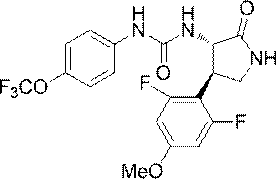
(-)-(3S*,4R*)-3-アミノ-4-(2,6-ジフルオロ-4-メトキシフェニル)ピロリジン-2-オン(58mg)のテトラヒドロフラン溶液(2.4mL)に、4-(トリフルオロメトキシ)フェニルイソシアネート(36μL)を加え、反応液とした。反応液を室温で30分間撹拌した。反応液を濃縮した後、残渣をシリカゲルカラムクロマトグラフィー(ヘキサン:酢酸エチル=9:1~酢酸エチル)で精製することで、白色固体として表題化合物を得た(94mg)。
1H-NMR (400 MHz, DMSO-d6) δ 3.27-3.31 (1H, m), 3.44 (1H, t, J = 9.2 Hz), 3.74 (3H, s), 3.76-3.84 (1H, m), 4.57 (1H, dd, J = 10.4, 8.6 Hz), 6.56 (1H, d, J = 8.6 Hz), 6.74 (2H, d, J = 10.4 Hz), 7.18 (2H, d, J = 8.6 Hz), 7.14 (2H, d, J = 8.6 Hz), 8.06 (1H, s), 8.89 (1H, s).
MS (ESI+) m/z: 446 (MH+).
[α]D 27= -150 (c 0.10, EtOH).
これらの構造およびスペクトルデータを表76~表80に示した。
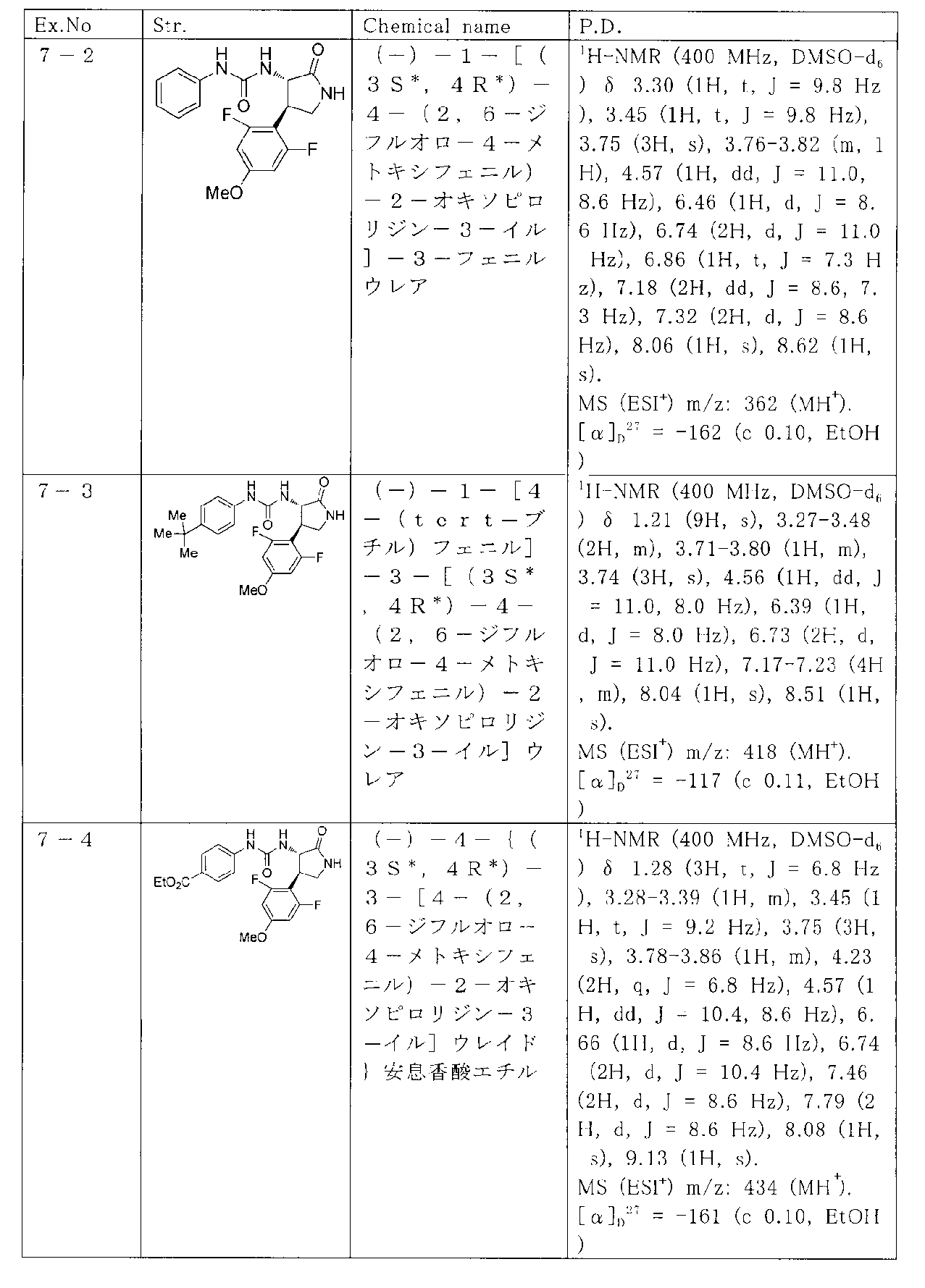

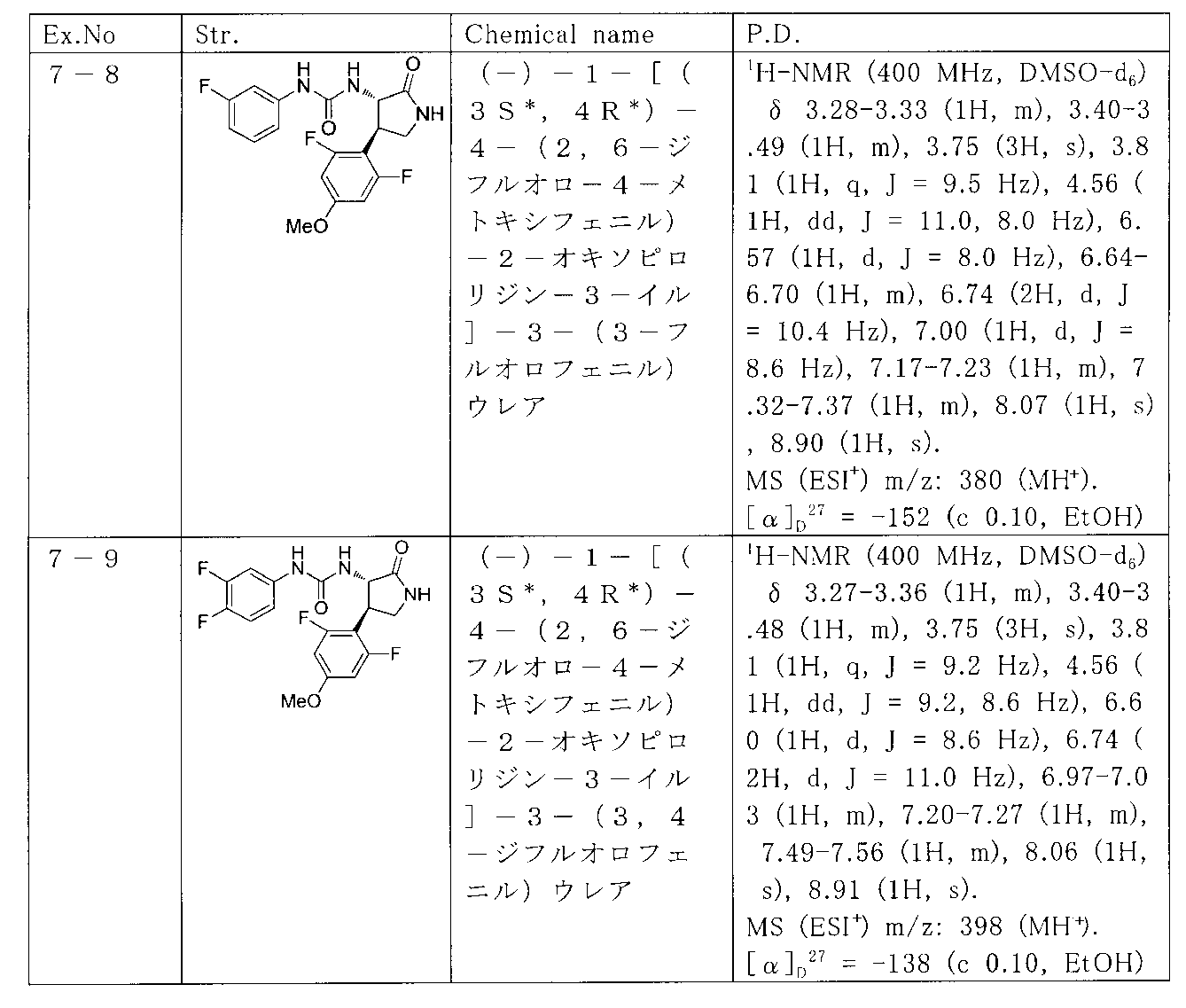

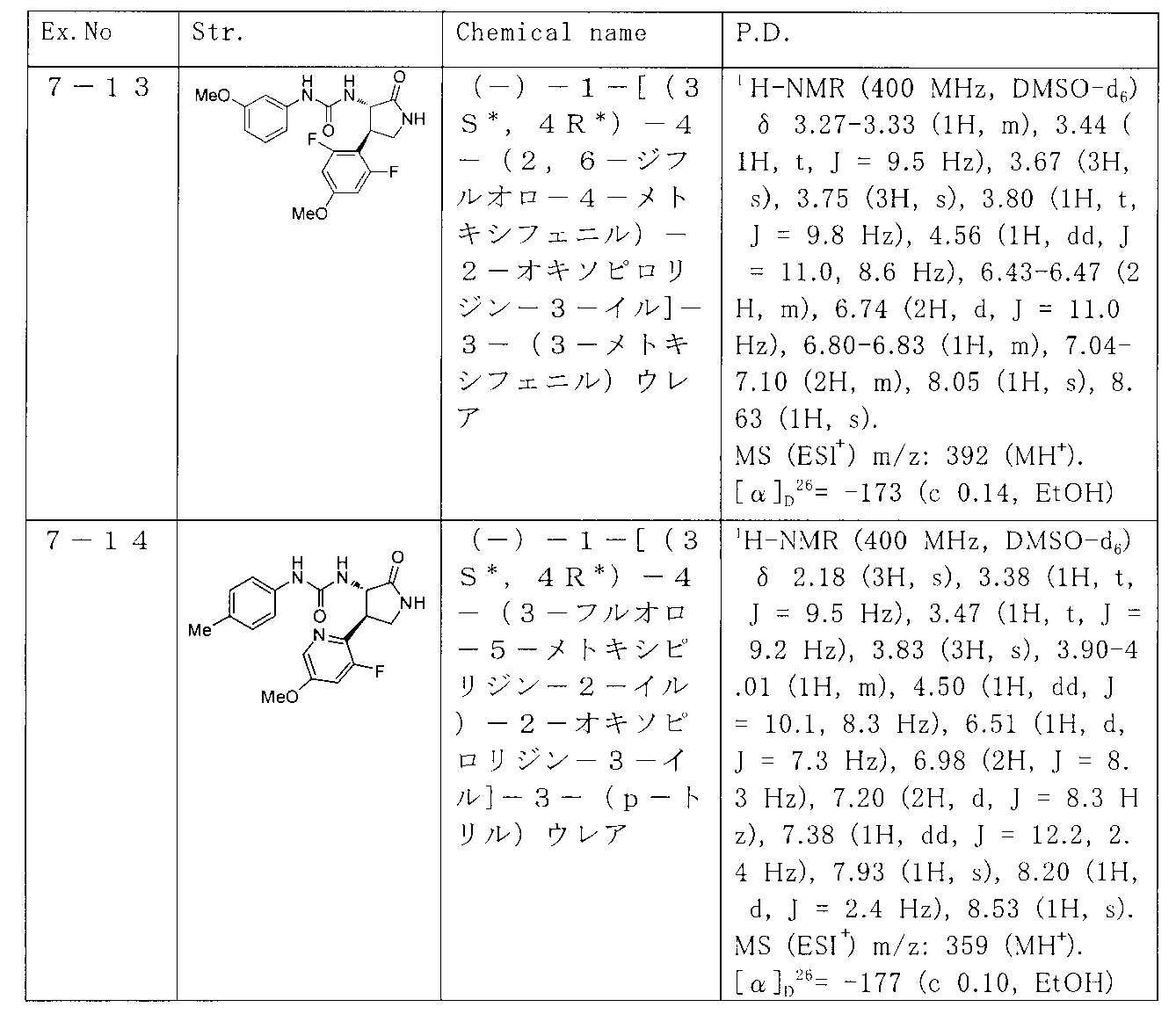
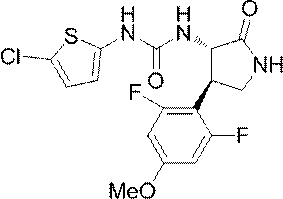
5-クロロチオフェン-2-カルボン酸(60mg)のトルエン溶液(3.7mL)に、トリエチルアミン(51μL)およびジフェニルリン酸アジド(83μL)を加え、反応液とした。反応液を室温で3時間撹拌した。反応温度を100℃に昇温して反応液を1時間撹拌した後、(-)-(3S*,4R*)-3-アミノ-4-(2,6-ジフルオロ-4-メトキシフェニル)ピロリジン-2-オン(71mg)を加えて、100℃で1時間撹拌した。反応液を濃縮した後、残渣をシリカゲルカラムクロマトグラフィー(ヘキサン:酢酸エチル=4:1~酢酸エチル)で精製することで、白色固体として表題化合物を得た(45mg)。
1H-NMR (400 MHz, DMSO-d6) δ 3.27-3.31 (1H, m), 3.44 (1H, t, J = 9.2 Hz), 3.75 (3H, s), 3.80-3.88 (1H, m), 4.52 (1H, dd, J = 11.0, 9.2 Hz), 6.20 (1H, d, J = 4.3 Hz), 6.71-6.81 (4H, m), 8.06 (1H, s), 9.94 (1H, s).
MS (ESI+) m/z: 402 (MH+).
[α]D 27= -135 (c 0.11, EtOH)
これらの構造およびスペクトルデータを表81に示した。
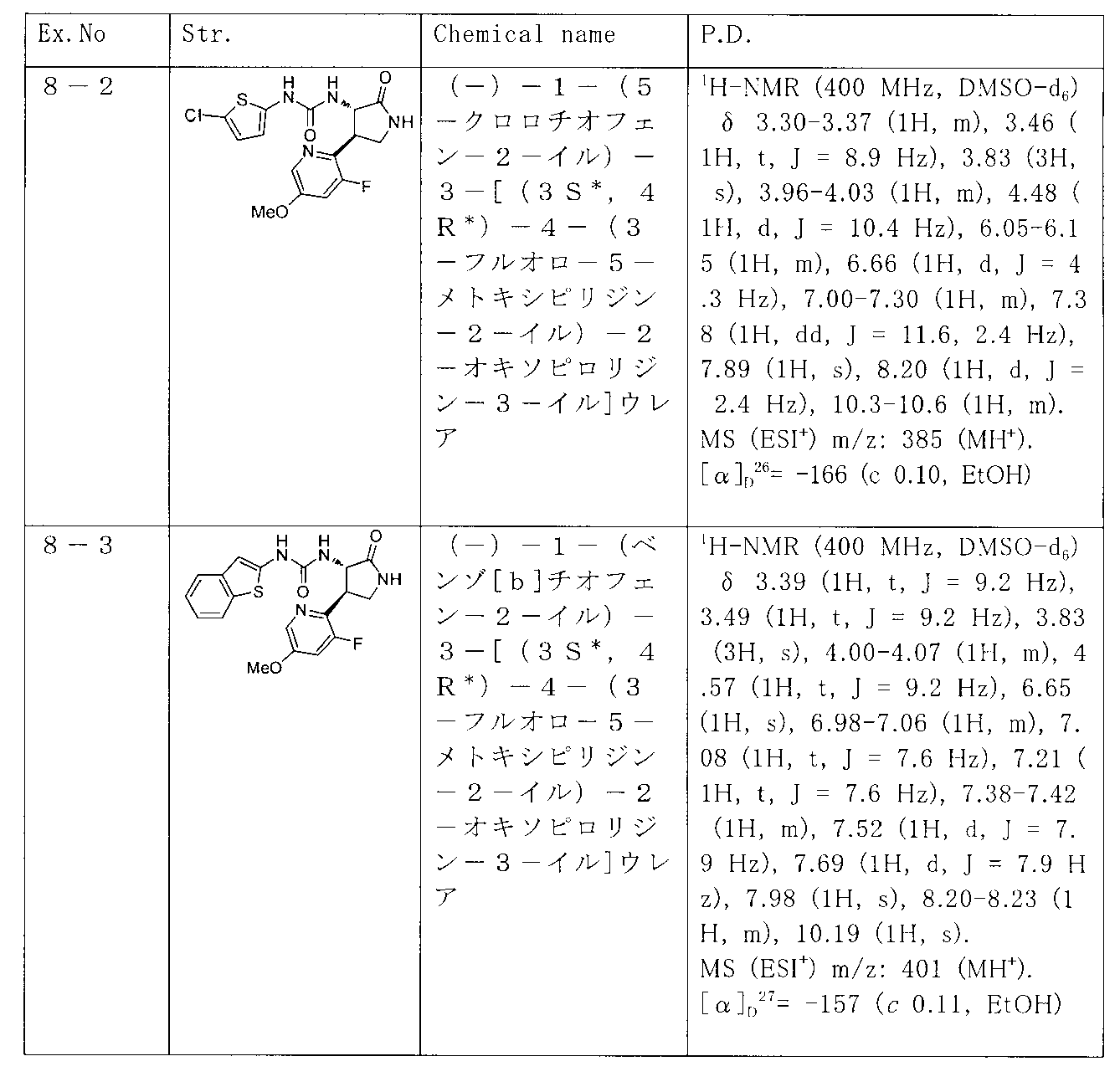

5-クロロチオフェン-2-カルボン酸の代わりに、4-メチル安息香酸を用いて実施例8-1と同様の方法に従い実施し、表題化合物を得た。
1H-NMR (400 MHz, DMSO-d6) δ 2.18 (3H, s), 3.29-3.49 (2H, m), 3.71-3.78 (1H, m), 3.75 (3H, s), 4.56 (1H, dd, J = 11.0, 8.6 Hz), 6.41 (1H, brd, J = 8.6 Hz), 6.73 (2H, d, J = 11.0 Hz), 6.98 (2H, d, J = 8.6 Hz), 7.20 (2H, d, J = 8.6 Hz), 8.04 (1H, s), 8.51 (1H, s).
MS (ESI+) m/z: 376 (MH+).
[α]D 27= -144 (c 0.10, EtOH)

(-)-4-{3-[(3S*,4R*)-4-(2,6-ジフルオロ-4-メトキシフェニル)-2-オキソピロリジン-3-イル]ウレイド}安息香酸エチル(87mg)のジクロロメタン溶液(2.5mL)に、氷冷下で水素化ジイソブチルアルミニウム(1.0mL, 1.04mol/L ヘキサン溶液)を加え、反応液とした。反応液を室温で2.5時間撹拌した。反応液に10%酒石酸ナトリウム/カリウム水溶液、および酢酸エチルを加えて30分間撹拌した後、酢酸エチルで抽出した。有機層を飽和食塩水で洗浄後、無水硫酸ナトリウムで乾燥した。溶媒を減圧下濃縮した後、残渣をシリカゲルカラムクロマトグラフィー(酢酸エチル:メタノール=50:1~酢酸エチル:メタノール=4:1)で精製することで、白色固体として表題化合物を得た(66mg)。
1H-NMR (400 MHz, DMSO-d6) δ 3.30 (1H, dd, J = 9.8, 9.2 Hz), 3.44 (1H, t, J = 9.2 Hz), 3.75 (3H, s), 3.75-3.81 (1H, m), 4.36 (2H, d, J = 5.5 Hz), 4.56 (1H, dd, J = 11.0, 8.6 Hz), 4.99 (1H, t, J = 5.5 Hz), 6.43 (1H, d, J = 7.9 Hz), 6.73 (2H, d, J = 11.0 H), 7.12 (2H, d, J = 8.6 Hz), 7.27 (2H, d, J = 8.6 Hz), 8.05 (1H, s), 8.58 (1H, s).
MS (ESI+) m/z: 392 (MH+).
[α]D 27= -159 (c 0.10, EtOH)
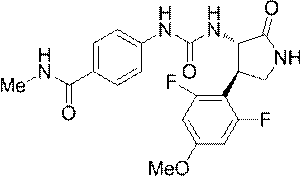
(-)-4-{3-[(3S*,4R*)-4-(2,6-ジフルオロ-4-メトキシフェニル)-2-オキソピロリジン-3-イル]ウレイド}安息香酸エチル(100mg)のメタノール溶液(2.4mL)に2mol/L 水酸化ナトリウム水溶液(0.28mL)を加え、反応液とした。反応液を60℃で9時間撹拌した。反応液を減圧下濃縮した後、残渣に氷冷下で1mol/L塩酸を加えて酸性(pH1)とし、酢酸エチルで抽出した。有機層を飽和食塩水で洗浄後、無水硫酸ナトリウムで乾燥した。溶媒を減圧下濃縮することで、中間体化合物4-{3-[(3S*,4R*)-4-(2,6-ジフルオロ-4-メトキシフェニル)-2-オキソピロリジン-3-イル]ウレイド}安息香酸を得た。
得られた4-{3-[(3S*,4R*)-4-(2,6-ジフルオロ-4-メトキシフェニル)-2-オキソピロリジン-3-イル]ウレイド}安息香酸(45mg)、メチルアミン(45μL,12M/L 水溶液)、ジイソプロピルエチルアミン(DIEA)(40μL)のN,N-ジメチルホルムアミド溶液(1.1mL)に、2-(1H-7-アザベンゾトリアゾール-1-イル)-1,1,3,3-テトラメチルウロニウム ヘキサフルオロホスフェート メタナミニウム(HATU)(92mg)を加え、反応液とした。反応液を室温で1時間撹拌した。反応液に水を加え、酢酸エチルで抽出した。有機層を飽和食塩水で洗浄後、無水硫酸ナトリウムで乾燥した。溶媒を減圧下濃縮することで、白色固体として表題化合物を得た(17mg)。
1H-NMR (400 MHz, DMSO-d6) δ 2.72 (3H, s), 3.55-3.25 (2H, m), 3.75 (3H, s), 3.76-3.86 (1H, m), 4.52-4.61 (1H, m), 6.61 (1H, brs), 6.70-6.79 (2H, m), 7.34-7.41 (2H, m), 7.63-7.71 (2H, m), 8.07 (1H, s), 8.16-8.23 (1H, brs), 8.93 (1H, brs).
MS (ESI-) m/z: 417 (M-H)-.
[α]D 28= -159 (c 0.10, DMSO)

[(3S*,4R*)-1-エチル-4-(4-メトキシフェニル)-2-オキソピロリジン-3-イル]カルバミン酸tert-ブチル(63mg)のジクロロメタン溶液(2mL)にトリフルオロ酢酸(0.4mL)を加え、反応液とした。反応液を室温で1時間撹拌した。反応液を減圧下濃縮した後、残渣に酢酸エチルおよび、飽和炭酸水素ナトリウム水溶液を加えて水層のpHを9とした。2層の溶液に4-フルオロフェニルイソシアネート(20μL)を加え、室温で15分撹拌した後、酢酸エチルで抽出した。有機層を水、および飽和食塩水で順次洗浄し、無水硫酸ナトリウムで乾燥した。溶媒を減圧下濃縮した後、残渣をシリカゲルカラムクロマトグラフィー(酢酸エチル : ヘキサン =4:1~酢酸エチル)で精製することで、白色固体として表題化合物を得た(48mg)。
1H-NMR (400 MHz, CDCl3) δ 1.21 (3H, t, J = 7.3 Hz), 3.31-3.45 (2H, m), 3.52-3.61 (1H, m), 3.71-3.77 (2H, m), 3.80 (3H, s), 4.24 (1H, dd, J = 9.8, 6.7 Hz), 6.13 (1H, brs), 6.76 (2H, t, J = 8.6 Hz), 6.89 (2H, d, J = 8.6 Hz), 7.06-7.10 (2H, m), 7.24 (2H, d, J = 8.6 Hz), 7.84 (1H, brs).
MS (ESI+) m/z: 372 (MH+).
[α]D 24= -135 (c 0.30, EtOH).
これらの構造およびスペクトルデータを表82~表87に示した。
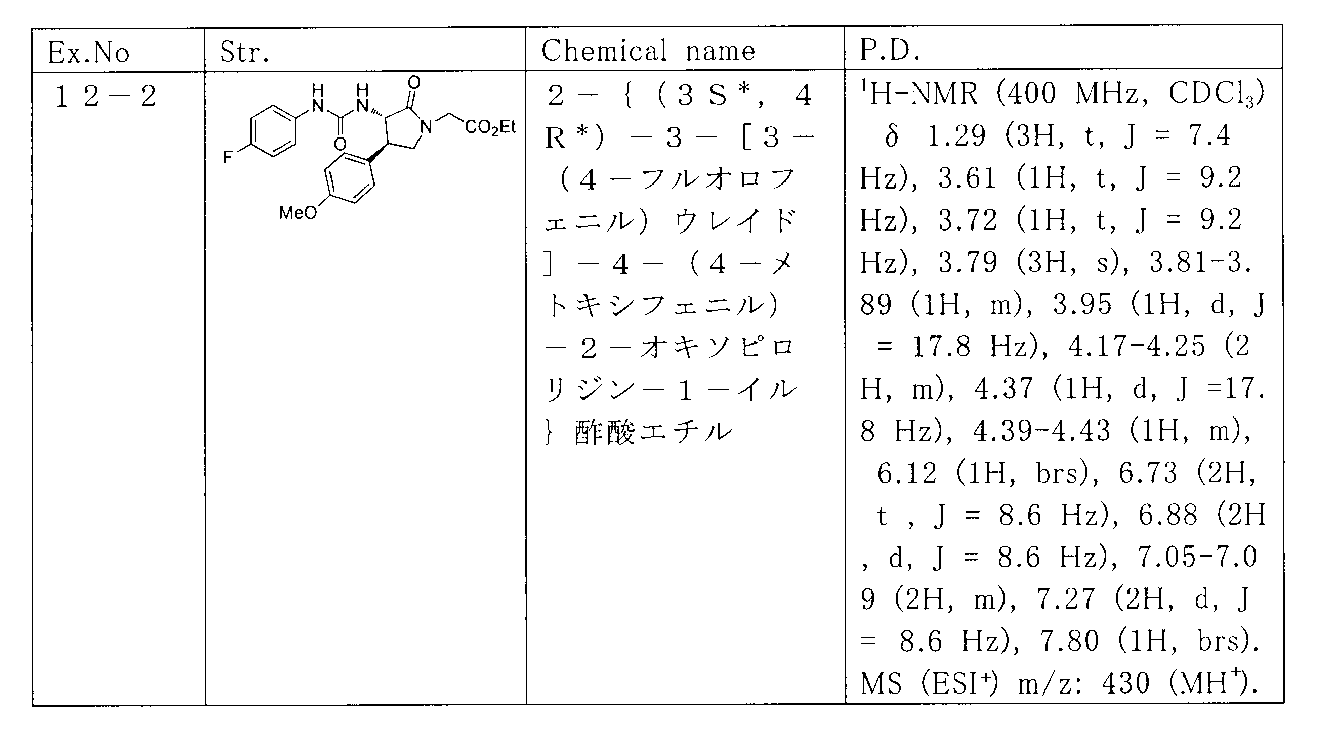
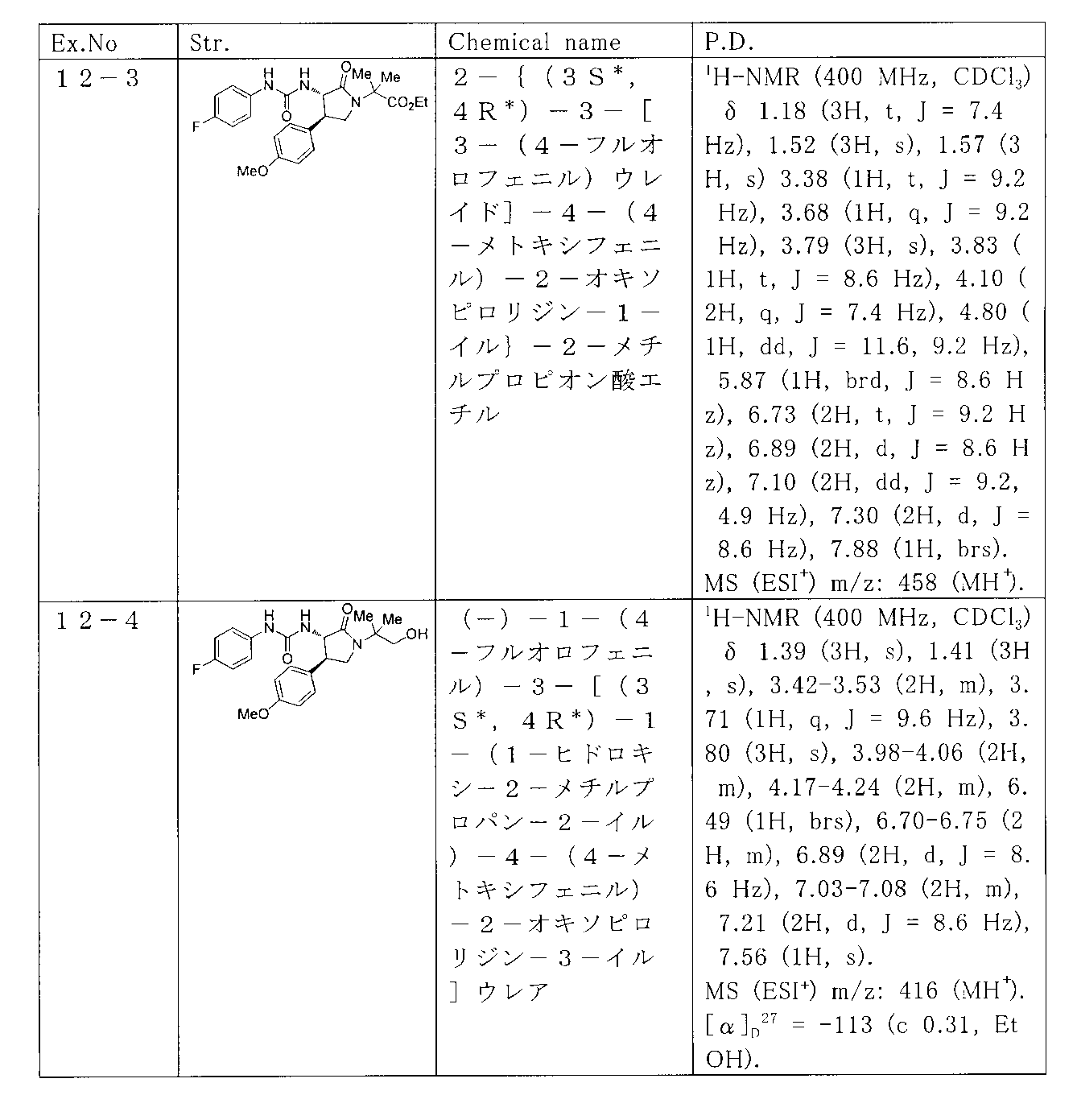

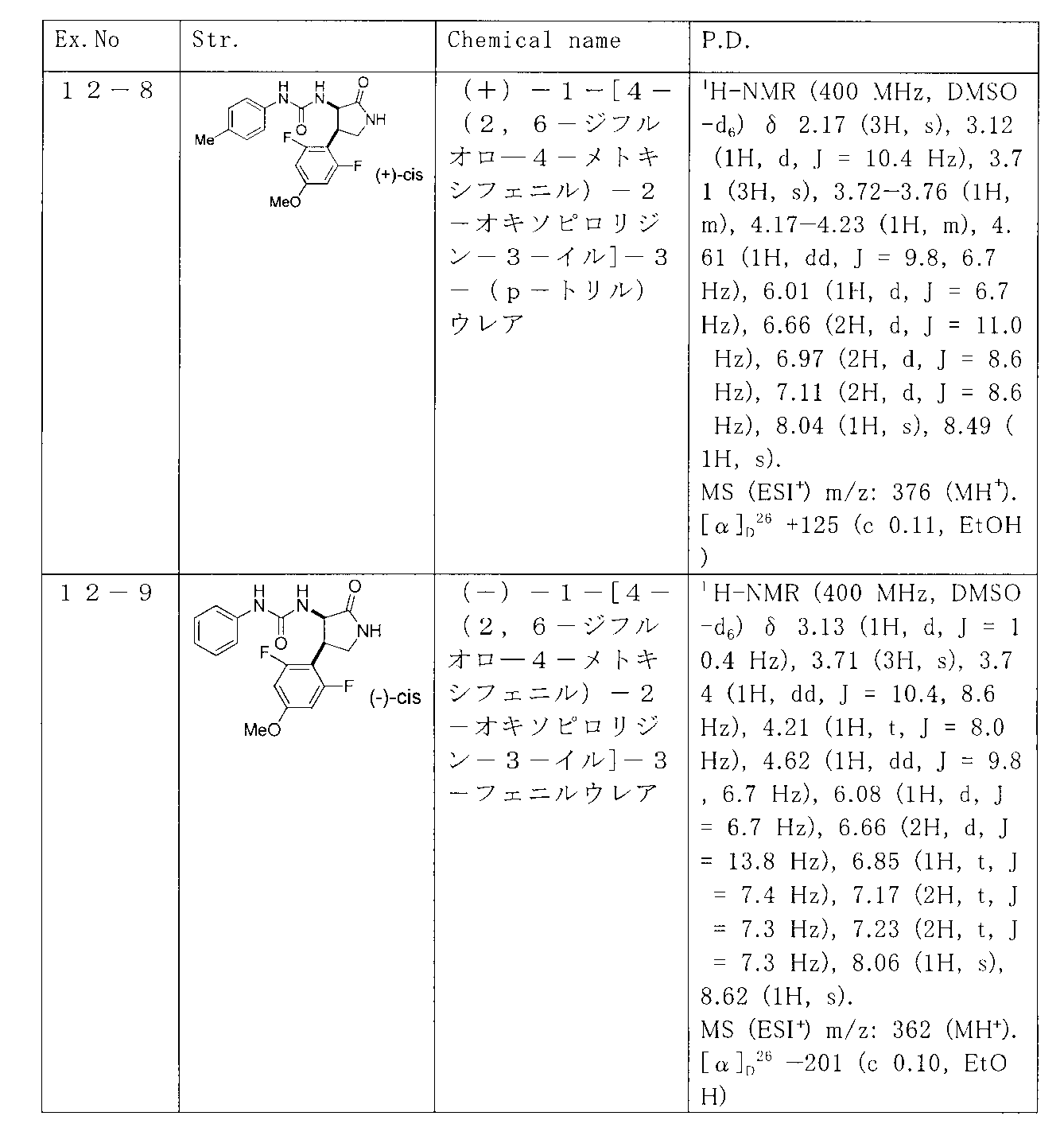

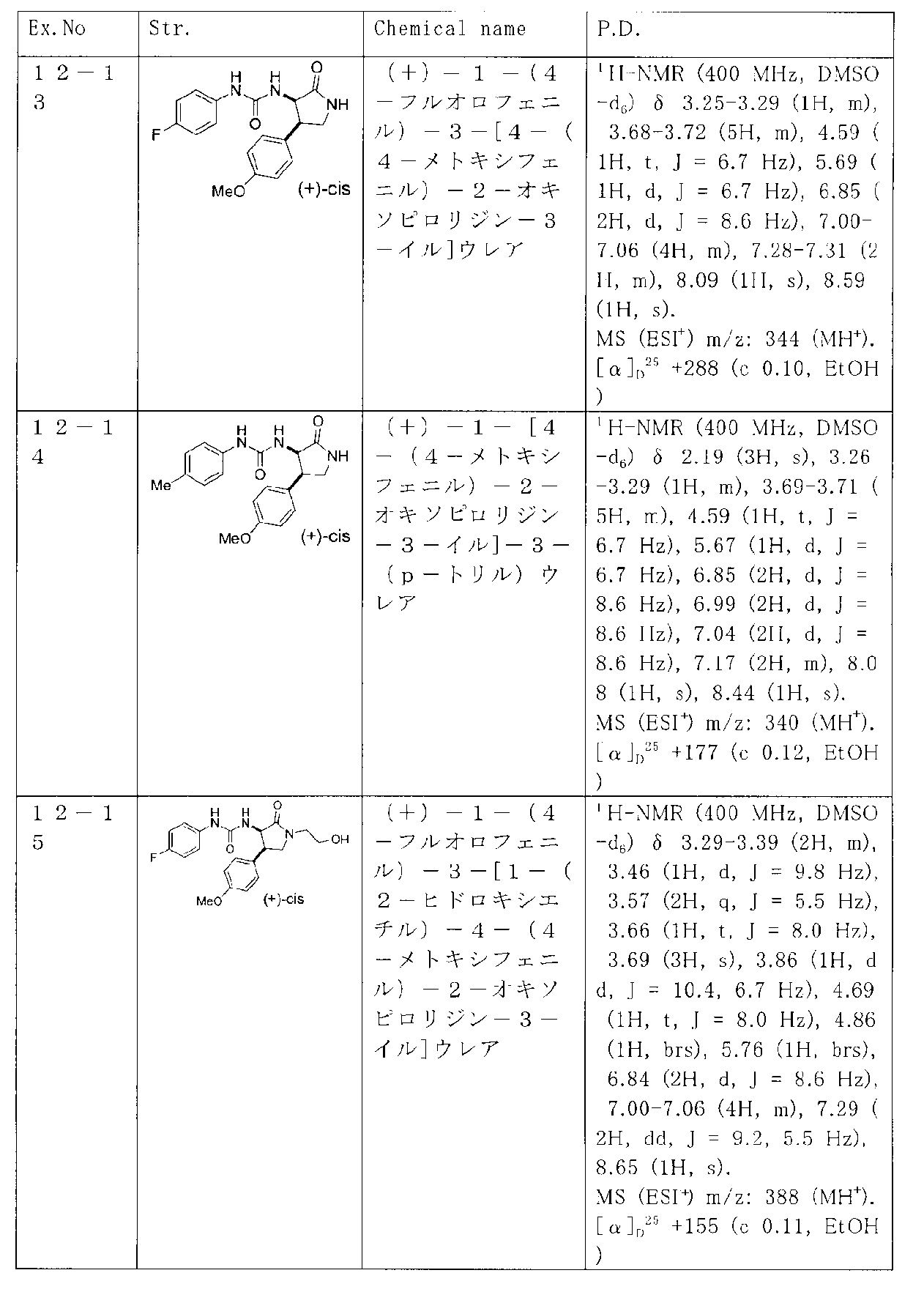
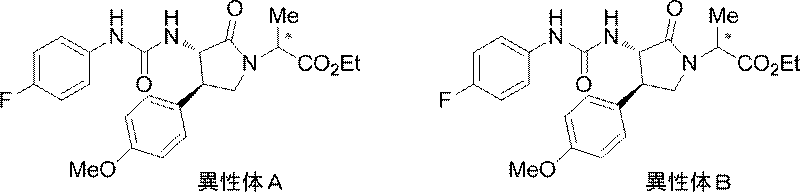
2-{(3S*,4R*)-3-[(tert-ブトキシカルボニル)アミノ]-4-(4-メトキシフェニル)-2-オキソピロリジン-1-イル}プロピオン酸エチル(651mg)のジクロロメタン溶液(12mL)にトリフルオロ酢酸(3mL)を加え、反応液とした。反応液を室温で1時間撹拌した。反応液を減圧下濃縮した後、残渣に酢酸エチルおよび、飽和炭酸水素ナトリウム水溶液を加えて水層のpHを9とした。2層の溶液に4-フルオロフェニルイソシアネート(180μL)を加え、室温で15分撹拌した後、酢酸エチルで抽出した。有機層を水、および飽和食塩水で順次洗浄し、無水硫酸ナトリウムで乾燥した。溶媒を減圧下濃縮した後、残渣をシリカゲルカラムクロマトグラフィー(酢酸エチル : ヘキサン =1:1~1:3)で精製することで、低極性画分の異性体A(298mg)と、高極性画分の異性体B(276mg)として、それぞれ白色固体として表題化合物を得た。
異性体A:
1H-NMR (400 MHz, CDCl3) δ 1.26 (3H, t, J = 7.3 Hz), 1.48 (3H, d, J = 7.4 Hz), 3.35 (1H, t, J = 11.0 Hz), 3.56-3.64 (1H, m), 3.75 (1H, d, J = 9.2 Hz), 3.79 (3H, s), 4.13-4.21 (2H, m), 4.84 (1H, q, J = 7.4 Hz), 5.02 (1H, dd, J = 11.6, 9.2 Hz), 5.65 (1H, d, J = 9.2 Hz), 6.78 (2H, d, J = 9.2 Hz), 6.88 (2H, d, J = 9.2 Hz), 7.14 (2H, dd, J = 4.9, 9.2 Hz), 7.28 (2H, d, J = 9.2 Hz), 7.87 (1H, brs).
MS (ESI+) m/z: 444 (MH+).
[α]D 25 = -102 (c 0.21, EtOH).
異性体B:
1H-NMR (400 MHz, CDCl3) δ 1.28 (3H, t, J = 6.7 Hz), 1.52 (3H, d, J = 7.9 Hz), 3.52 (1H, t, J = 8.6 Hz), 3.80 (3H, s), 3.77-3.88 (2H, m), 4.16-4.22 (3H, m), 4.90 (1H, q, J = 7.9 Hz), 6.13 (1H, brd, J = 6.7 Hz), 6.72-6.77 (2H, m), 6.89 (2H, d, J = 8.6 Hz), 7.04-7.08 (2H, m), 7.26 (2H, d, J = 8.6 Hz), 7.72 (1H, brs).
MS (ESI+) m/z: 444 (MH+).
[α]D 25 = -94 (c 0.21, EtOH).
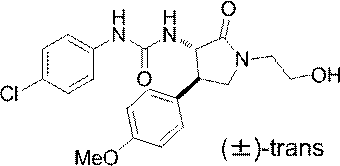
(±)-トランス-1-{2-[(tert-ブチルジメチルシリル)オキシ]エチル}-4-(4-メトキシフェニル)-2-オキソピロリジン-3-イル)カルバミン酸tert-ブチル(1.2g)のジクロロメタン溶液(2mL)にトリフルオロ酢酸(1.5mL)および水(0.5mL)を加え、反応液とした。反応液を室温で3時間撹拌した。反応液を減圧下濃縮した後、残渣に飽和炭酸水素ナトリウム水溶液を加えて水層のpHを9とした後、酢酸エチル-メタノール(5:1)混液(10mL)を加えた.2層の溶液に,4-クロロフェニルイソシアネート(396mg)を加え、室温で1時間撹拌した後、酢酸エチルで抽出した。有機層を水および飽和食塩水で洗浄し、無水硫酸ナトリウムで乾燥した。溶媒を減圧下濃縮した後、残渣をシリカゲルカラムクロマトグラフィー(酢酸エチル~酢酸エチル: メタノール =4:1)で精製することで、白色固体として表題化合物を得た(500mg)。
1H-NMR (400 MHz, DMSO-d6) δ 3.13-3.20 (1H, m), 3.35-3.45 (3H, m), 3.52 (2H, q, J = 5.7 Hz), 3.61 (1H, t, J = 6.7 Hz), 3.71 (3H, s), 4.57 (1H, t, J = 10.0 Hz), 4.75 (1H, t, J = 5.8 Hz), 6.52 (1H, d, J = 9.1 Hz), 6.88 (2H, d, J = 8.5 Hz), 7.23 (2H, d, J = 9.1 Hz), 7.29 (2H, d, J = 9.1 Hz), 7.38 (2H, d, J = 8.5 Hz), 8.71 (1H, s).
MS (ESI+) m/z: 404 (MH+).

(-)-トランス-1-(4-クロロフェニル)-3-[1-(2-ヒドロキシエチル)-4-(4-メトキシフェニル)-2-オキソピロリジン-3-イル]ウレア
(±)-トランス-1-(4-クロロフェニル)-3-[1-(2-ヒドロキシエチル)-4-(4-メトキシフェニル)-2-オキソピロリジン-3-イル]ウレアを,光学異性体分離用カラム(CHIRALPAK ID)を用いて高速液体クロマトグラフィー(ヘキサン:エタノール=1:1,流速15.0 mL)による光学分割を行った。保持時間7.91分の異性体A(-)および、保持時間17.78分の異性体B(+)として、それぞれ白色固体として表題化合物を得た。
異性体A(-):
1H-NMR (400 MHz, DMSO-d6) δ 3.13-3.20 (1H, m), 3.35-3.45 (3H, m), 3.52 (2H, q, J = 5.7 Hz), 3.61 (1H, t, J = 6.7 Hz), 3.71 (3H, s), 4.57 (1H, t, J = 10.0 Hz), 4.75 (1H, t, J = 5.8 Hz), 6.52 (1H, d, J = 9.1 Hz), 6.88 (2H, d, J = 8.5 Hz), 7.23 (2H, d, J = 9.1 Hz), 7.29 (2H, d, J = 9.1 Hz), 7.38 (2H, d, J = 8.5 Hz), 8.71 (1H, s).
MS (ESI+) m/z: 404 (MH+).
[α]D 25= -140 (c 0.1, EtOH)
異性体B(+):
1H-NMR (400 MHz, DMSO-d6) δ 3.13-3.20 (1H, m), 3.35-3.45 (3H, m), 3.52 (2H, q, J = 5.7 Hz), 3.61 (1H, t, J = 6.7 Hz), 3.71 (3H, s), 4.57 (1H, t, J = 10.0 Hz), 4.75 (1H, t, J = 5.8 Hz), 6.52 (1H, d, J = 9.1 Hz), 6.88 (2H, d, J = 8.5 Hz), 7.23 (2H, d, J = 9.1 Hz), 7.29 (2H, d, J = 9.1 Hz), 7.38 (2H, d, J = 8.5 Hz), 8.71 (1H, s).
MS (ESI+) m/z: 404 (MH+).
[α]D 26= +140 (c 0.1, EtOH)
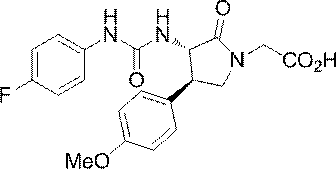
2-{(3S*,4R*)-3-[3-(4-フルオロフェニル)ウレイド]-4-(4-メトキシフェニル)-2-オキソピロリジン-1-イル}酢酸エチル(258mg)のメタノール溶液(3.0mL)に2mol/L水酸化ナトリウム水溶液(0.6mL)を加え、反応液とした。反応液を室温で30分撹拌した。反応液に1mol/L塩酸を加えて酸性(pH1)とし、酢酸エチルで抽出した。有機層を飽和食塩水で洗浄し、無水硫酸ナトリウムで乾燥した。溶媒を減圧下濃縮した後、粗生成物をジイソプロピルエーテルで洗浄することで、白色固体として表題化合物を得た(228mg)。
1H-NMR (400 MHz, DMSO-d6) δ 3.34 (1H, t, J = 9.8 Hz), 3.44-3.51 (1H, m), 3.63 (1H, t, J = 8.6 Hz), 3.71 (3H, s), 3.93 (1H, d, J = 17.7 Hz), 4.05 (1H, d, J = 17.7 Hz), 4.51-4.56 (1H, m), 6.56 (1H, d, J = 9.2 Hz), 6.89 (2H, d, J = 8.6 Hz), 7.03 (2H, t, J = 8.6 Hz), 7.28 (2H, d, J = 8.6 Hz), 7.33-7.37 (2H, m), 8.58 (1H, s), 12.9 (1H, brs).
MS (ESI+) m/z: 402 (MH+).
[α]D 24 = -90 (c 0.31, EtOH).
これらの構造およびスペクトルデータを表88に示した。
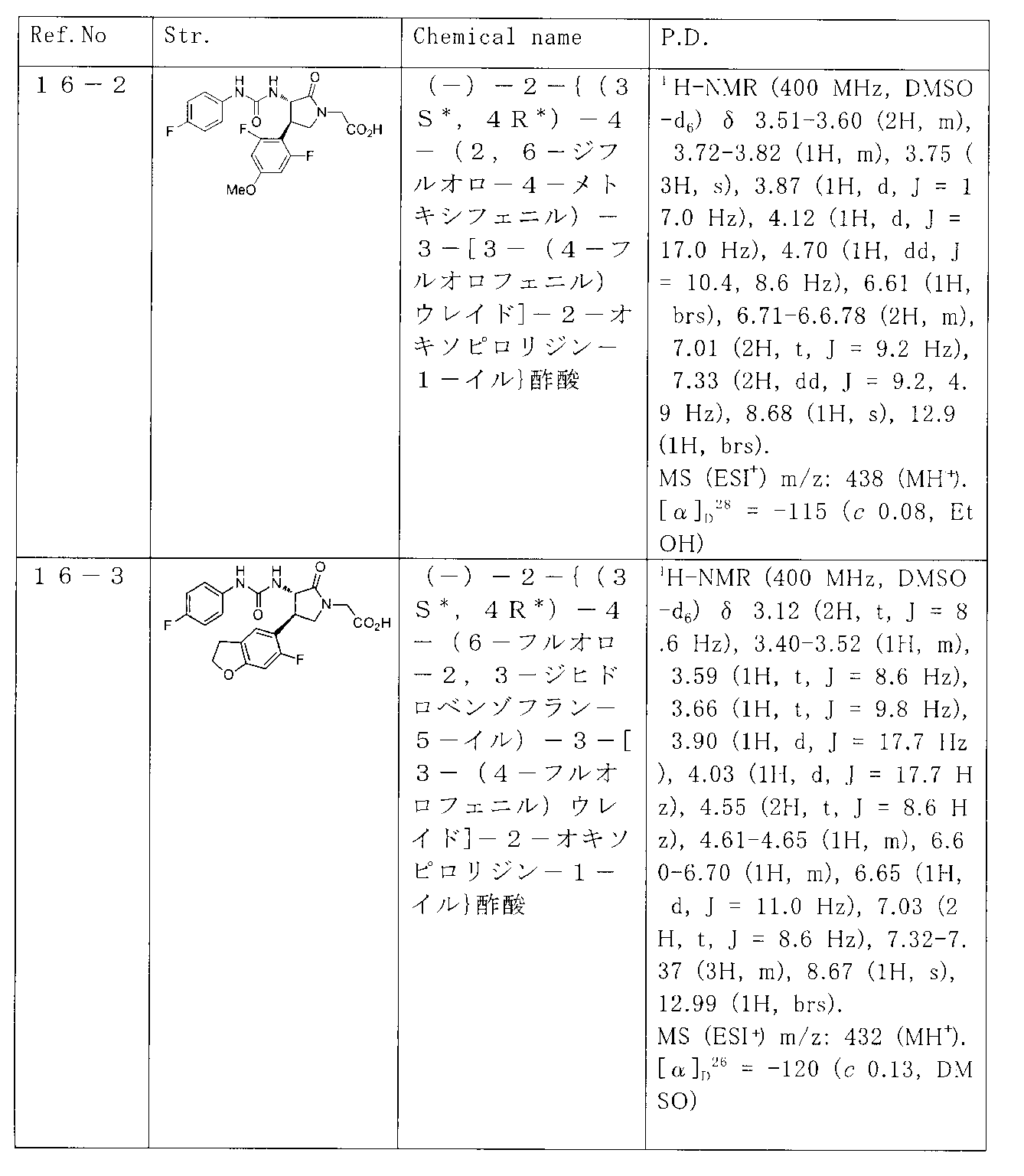

(-)-2-{(3S*,4R*)-3-[3-(4-フルオロフェニル)ウレイド]-4-(4-メトキシフェニル)-2-オキソピロリジン-1-イル}酢酸(103mg)のテトラヒドロフラン溶液(1.3mL)に冷却下で1-ヒドロキシベンゾトリアゾール(46mg)、メチルアミン(0.5mL,2mol/L,テトラヒドロフラン溶液),および1-エチル-3-(3-ジメチルアミノプロピル)カルボジイミド(53mg)を加え、反応液とした。反応液を室温で3時間撹拌した。反応液に水を加え、酢酸エチルで抽出した。有機層を飽和食塩水で洗浄し、無水硫酸ナトリウムで乾燥した。溶媒を減圧下濃縮した後、残渣をプレパラティブTLC(クロロホルム:メタノール=9:1)で精製し、粗生成物をジイソプロピルエーテルで洗浄することで、白色固体として表題化合物を得た(81mg)。
1H-NMR (400 MHz, CDCl3) δ 2.83 (3H, d, J = 4.9 Hz), 3.50 (1H, dd, J = 9.8, 6.7 Hz), 3.57 (1H, d, J = 17.1 Hz), 3.77 (1H, t, J = 7.4 Hz), 3.80 (3H, s), 3.88-3.94 (1H, m), 4.00 (1H, t, J = 9.8 Hz), 4.64 (1H, d, J = 17.1 Hz), 6.67 (2H, t, J = 8.6 Hz), 6.89 (2H, d, J = 8.6 Hz), 6.92-6.96 (2H, m), 7.04 (1H, d, J = 6.7 Hz), 7.15 (2H, d, J = 8.6 Hz), 7.80 (1H, brs), 7.87 (1H, d, J = 4.9 Hz).
MS (ESI+) m/z: 415 (MH+).
[α]D 25 = -152 (c 0.31, EtOH).
これらの構造およびスペクトルデータを表89に示した。


2-{(3S*,4R*)-3-[3-(4-フルオロフェニル)ウレイド]-4-(4-メトキシフェニル)-2-オキソピロリジン-1-イル}酢酸エチルの代わりに、(-)-2-{(3S*,4R*)-3-[3-(4-フルオロフェニル)ウレイド]-4-(4-メトキシフェニル)-2-オキソピロリジン-1-イル}プロピオン酸エチル(異性体A)を用いて実施例16-1と同様の方法に従い実施し、白色固体として表題化合物を得た。
1H-NMR (400 MHz, DMSO-d6) δ 1.35 (3H, d, J = 7.4 Hz), 3.27-3.41 (2H, m), 3.61 (1H, t, J = 9.1 Hz), 3.71 (3H, s), 4.58 (1H, q, J = 7.4 Hz), 4.66 (1H, dd, J = 11.6, 9.2 Hz), 6.55 (1H, d, J = 9.2 Hz), 6.88 (2H, d, J = 8.6 Hz), 7.03 (2H, t, J = 8.6 Hz), 7.31-7.36 (4H, m), 8.46 (1H, s), 12.8 (1H, brs).
MS (ESI+) m/z: 416 (MH+).
[α]D 25 = -103 (c 0.33, EtOH).
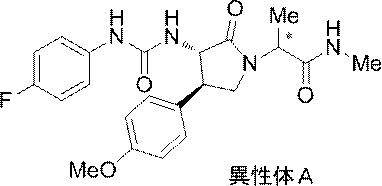
(-)-2-{(3S*,4R*)-3-[3-(4-フルオロフェニル)ウレイド]-4-(4-メトキシフェニル)-2-オキソピロリジン-1-イル}酢酸の代わりに,(-)-2-{(3S*,4R*)-3-[3-(4-フルオロフェニル)ウレイド]-4-(4-メトキシフェニル)-2-オキソピロリジン-1-イル}プロピオン酸(異性体A)を用いて実施例17-1と同様の方法に従い実施し、白色固体として表題化合物を得た。
1H-NMR (400 MHz, DMSO-d6) δ 1.29 (3H, d, J = 7.3 Hz), 2.62 (3H, d, J = 4.9 Hz), 3.28 (1H, t, J = 9.8 Hz), 3.43-3.51 (1H, m), 3.68 (1H, t, J = 8.6 Hz), 3.71 (3H, s), 4.48-4.55 (2H, m), 6.54 (1H, d, J = 9.2 Hz), 6.87 (2H, d, J = 8.6 Hz), 7.04 (2H, t, J = 8.6 Hz), 7.31-7.38 (4H, m), 7.83 (1H, d, J = 4.9 Hz), 8.67 (1H, brs).
MS (ESI+) m/z: 429(MH+).
[α]D 25 = -199 (c 0.34, EtOH).
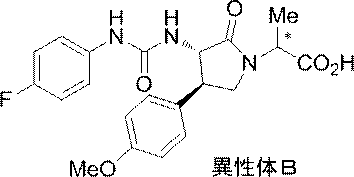
2-{(3S*,4R*)-3-[3-(4-フルオロフェニル)ウレイド]-4-(4-メトキシフェニル)-2-オキソピロリジン-1-イル}酢酸エチルの代わりに、(-)-2-{(3S*,4R*)-3-[3-(4-フルオロフェニル)ウレイド]-4-(4-メトキシフェニル)-2-オキソピロリジン-1-イル}プロピオン酸エチル(異性体B)を用いて実施例16-1と同様の方法に従い実施し、表題化合物を得た。
1H-NMR (400 MHz, DMSO-d6) δ 1.36 (3H, d, J = 7.4 Hz), 3.20 (1H, t, J = 9.2 Hz), 3.43-3.50 (1H, m), 3.68-3.74 (1H, m), 3.72 (3H, s), 4.49 (1H, dd, J = 11.0, 8.6 Hz), 4.62 (1H, q, J = 7.4 Hz), 6.53 (1H, d, J = 8.6 Hz), 6.90 (2H, d, J = 8.6 Hz), 7.03 (2H, t, J = 9.2 Hz), 7.27 (2H, d, J = 8.6 Hz), 7.32-7.38 (2H, m), 8.61 (1H, s), 12.9 (1H, brs).
MS (ESI+) m/z: 416 (MH+).
[α]D 25 =-111 (c 0.32, EtOH).
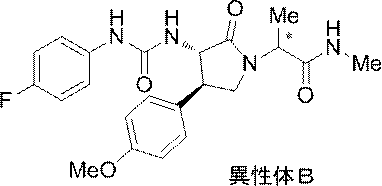
(-)-2-{(3S*,4R*)-3-[3-(4-フルオロフェニル)ウレイド]-4-(4-メトキシフェニル)-2-オキソピロリジン-1-イル}酢酸の代わりに(-)-2-{(3S*,4R*)-3-[3-(4-フルオロフェニル)ウレイド]-4-(4-メトキシフェニル)-2-オキソピロリジン-1-イル}プロピオン酸(異性体B)を用いて実施例17-1と同様の方法に従い実施し、表題化合物を得た。
1H-NMR (400 MHz, DMSO-d6) δ 1.29 (3H, d, J = 7.3 Hz), 2.57 (3H, d, J = 4.9 Hz), 3.24 (1H, t, J = 9.8 Hz), 3.34-3.44 (1H, m), 3.66 (1H, t, J = 8.6 Hz), 3.72 (3H, s), 4.56 (1H, q, J = 7.3 Hz), 4.69 (1H, dd, J = 11.6, 9.2 Hz), 6.50 (1H, d, J = 9.2 Hz), 6.89 (2H, d, J = 8.6 Hz), 7.03 (2H, t, J = 9.2 Hz), 7.30 (2H, d, J = 8.6 Hz), 7.34-7.38 (2H, m), 7.87 (1H, d, J = 4.9 Hz), 8.60 (1H, s).
MS (ESI+) m/z: 429 (MH+).
[α]D 25= -94 (c 0.30, EtOH).

2-{(3S*,4R*)-3-[3-(4-フルオロフェニル)ウレイド]-4-(4-メトキシフェニル)-2-オキソピロリジン-1-イル}プロピオン酸エチルの代わりに、2-{(3S*,4R*)-3-[3-(4-フルオロフェニル)ウレイド]-4-(4-メトキシフェニル)-2-オキソピロリジン-1-イル}-2-メチルプロピオン酸エチルを用いて実施例16-1と同様の方法に従い実施し、表題化合物を得た。
1H-NMR (400 MHz, CDCl3) δ 1.52 (3H, s), 1.53 (3H, s), 3.36 (1H, t, J = 9.2 Hz ), 3.60-3.80 (1H, m), 3.76 (3H, s), 3.78-3.86 (1H, m), 4.60-4.68 (1H, m), 6.06 (1H, brs), 6.72-6.78 (2H, m), 6.84 (2H, d, J = 8.6 Hz), 7.07-7.13 (2H, m), 7.23 (2H, d, J = 8.6 Hz), 7.61 (1H, brs).
MS (ESI+) m/z: 430 (MH+).
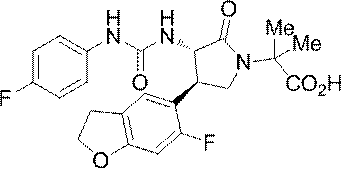
2-{(3S*,4R*)-4-(6-フルオロ-2,3-ジヒドロベンゾフラン-5-イル)-3-[3-(4-フルオロフェニル)ウレイド]-2-オキソピロリジン-1-イル}-2-メチルプロパン酸エチル(18mg)のメタノール溶液(0.2mL)に2mol/L水酸化ナトリウム水溶液(0.2mL)を加え、反応液とした。反応液を室温で18時間撹拌した。反応液に1mol/L塩酸を加えてpHを1とし、減圧下濃縮した。得られた残渣に水を加え、析出物をろ取した後、プレパラティブTLC(クロロホルム: メタノール = 10:1)で精製することで、無色固体として表題化合物を得た(4.4mg)。
1H-NMR (400 MHz, DMSO-d6) δ 1.40 (3H, s), 1.42 (3H, s), 3.12 (2H, t, J = 8.6 Hz), 3.28-3.37 (1H, m), 3.47-3.59 (1H, m), 3.70 (1H, t, J = 8.3 Hz), 4.53-4.62 (3H, m), 6.64 (1H, d, J = 11.6 Hz), 6.70 (1H, brs), 7.02 (2H, t, J = 8.9 Hz), 7.31-7.40 (3H, m), 8.73 (1H, brs), 12.47 (1H, brs).
MS (ESI+) m/z: 460 (MH+).
[α]D 27= -163 (c 0.09, DMSO)
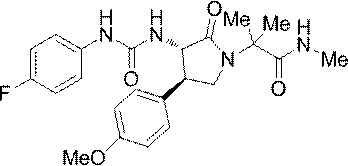
(-)-2-{(3S*,4R*)-3-[3-(4-フルオロフェニル)ウレイド]-4-(4-メトキシフェニル)-2-オキソピロリジン-1-イル}酢酸の代わりに2-{(3S*,4R*)-3-[3-(4-フルオロフェニル)ウレイド]-4-(4-メトキシフェニル)-2-オキソピロリジン-1-イル}-2-メチルプロピオン酸を用いて実施例17-1と同様の方法に従い実施し、表題化合物を得た。
1H-NMR (400 MHz, CDCl3) δ 1.53 (3H, s), 1.72 (3H, s), 2.69 (3H, d, J = 4.9 Hz), 3.45-3.49 (1H, m), 3.80 (3H, s), 3.85 (2H, dd, J = 7.3, 4.3 Hz), 3.93-3.98 (1H, m), 6.73 (1H, brs), 6.78 (2H, t, J = 9.2 Hz), 6.89 (2H, t, J = 8.6 Hz), 7.08 (2H, dd, J = 9.2, 4.9 Hz), 7.17 (2H, d, J = 8.6 Hz), 7.36 (1H, d, J = 4.3 Hz), 7.88 (1H, brs).
MS (ESI+) m/z: 443 (MH+).
[α]D 29 =-109 (c 0.31, EtOH).

[(3S*,4R*)-4-(2,6-ジフルオロ-4-メトキシフェニル)-1-メチル-2-オキソピロリジン-3-イル]カルバミン酸ベンジル(100mg)のエタノール溶液(5mL)に10%パラジウムカーボン(10mg)を加え、反応液とした。反応液を水素雰囲気下で1時間撹拌した。反応液をセライトろ過し、溶媒を減圧下濃縮して無色油状の中間体化合物(3S*,4R*)-3-アミノ-4-(2,6-ジフルオロ-4-メトキシフェニル)-1-メチルピロリジン-2-オンを得た。得られた(3S*,4R*)-3-アミノ-4-(2,6-ジフルオロ-4-メトキシフェニル)-1-メチルピロリジン-2-オン(66mg)のテトラヒドロフラン溶液(2.6mL)に、4-フルオロフェニルイソシアネート(28μL)を加え、反応液とした。反応液を室温で20分間撹拌した。反応液を減圧濃縮後、残渣をシリカゲルカラムクロマトグラフィー(ヘキサン:酢酸エチル=4:1~酢酸エチル)で精製することで、白色固体として表題化合物を得た(91mg)。
1H-NMR (400 MHz, DMSO-d6) δ 2.81 (3H, s), 3.40 (1H, dd, J = 9.8, 9.2 Hz), 3.53 (1H, t, J = 9.2 Hz), 3.73-3.81 (1H, m), 3.75 (3H, s), 4.57 (1H, dd, J = 9.8, 8.6 Hz), 6.52 (1H, d, J = 8.6 Hz), 6.74 (2H, d, J = 11.0 Hz), 6.97-7.05 (2H, m), 7.30-7.36 (2H, m), 8.72 (1H, s).
MS (ESI+) m/z: 394 (MH+).
[α]D 27 =-143 (c 0.10, EtOH)
これらの構造およびスペクトルデータを表90~100に示した。
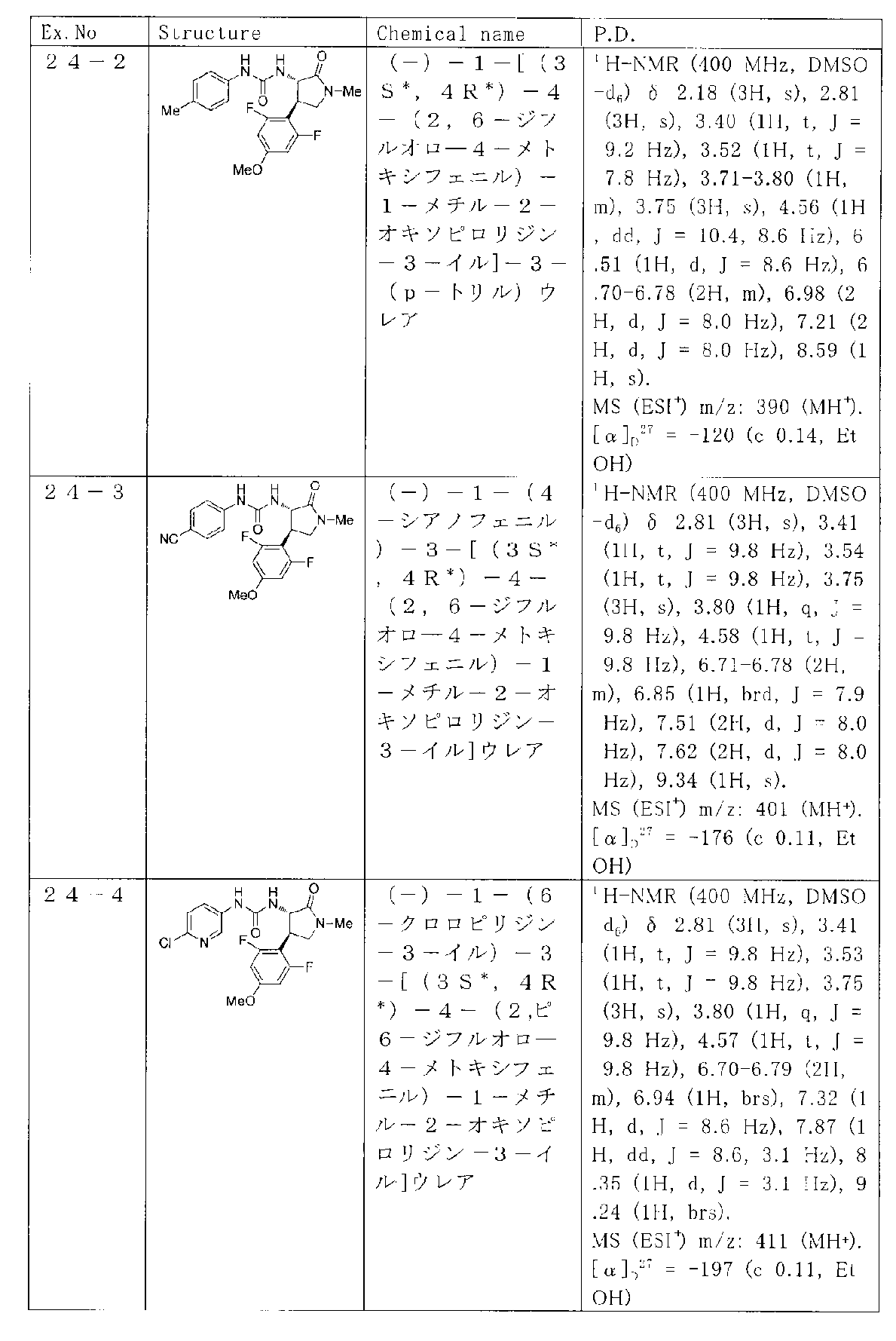
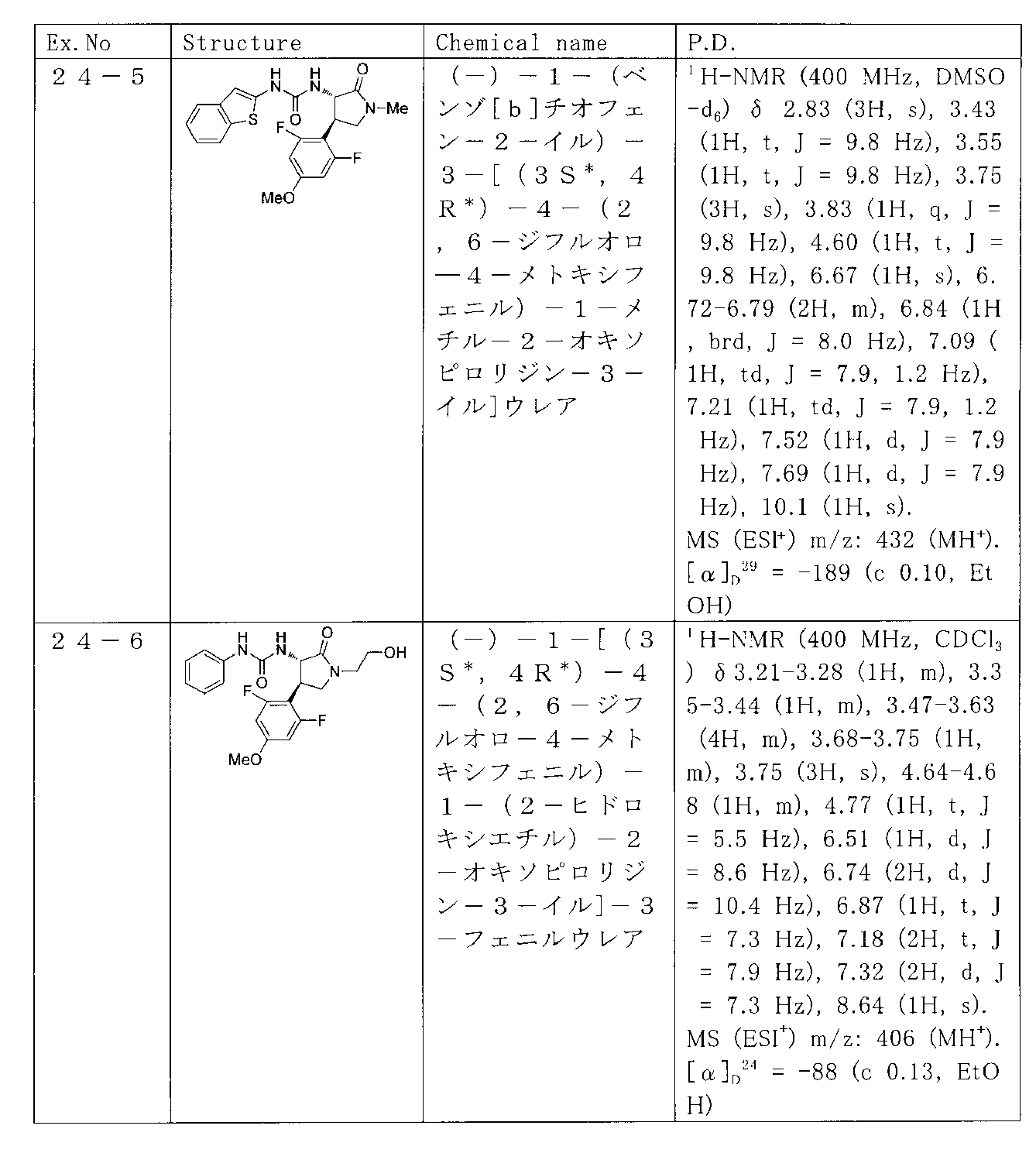

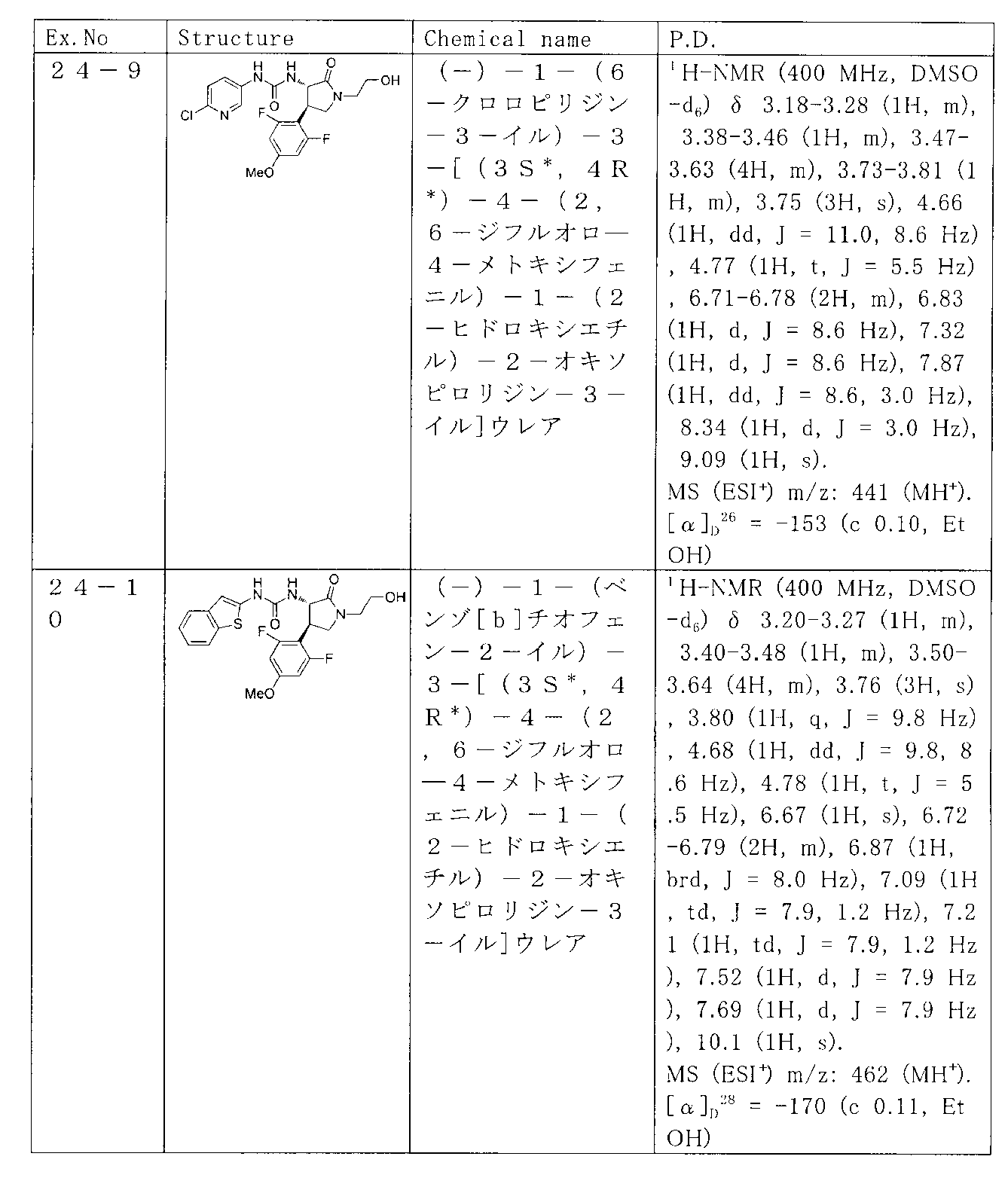

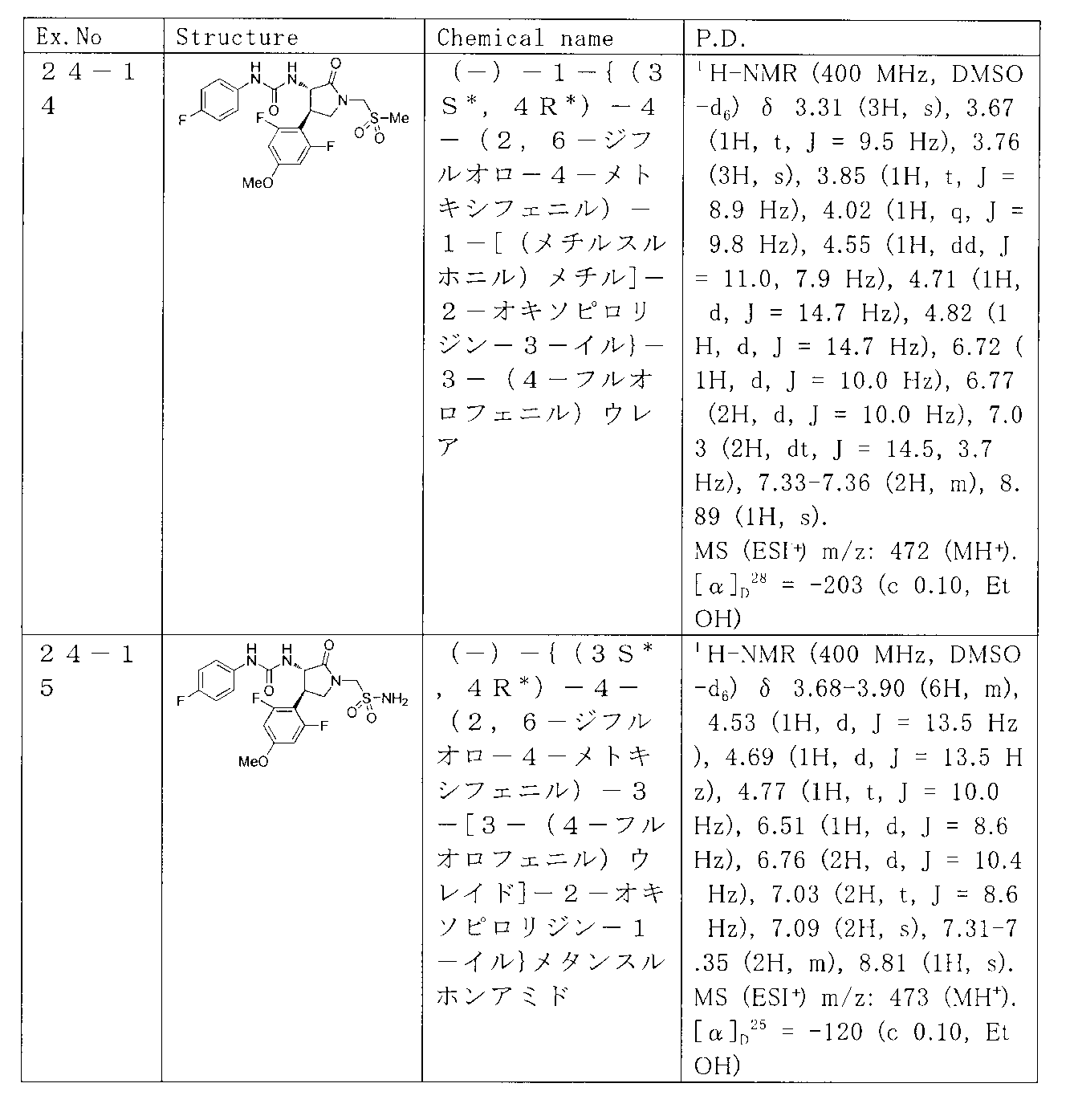
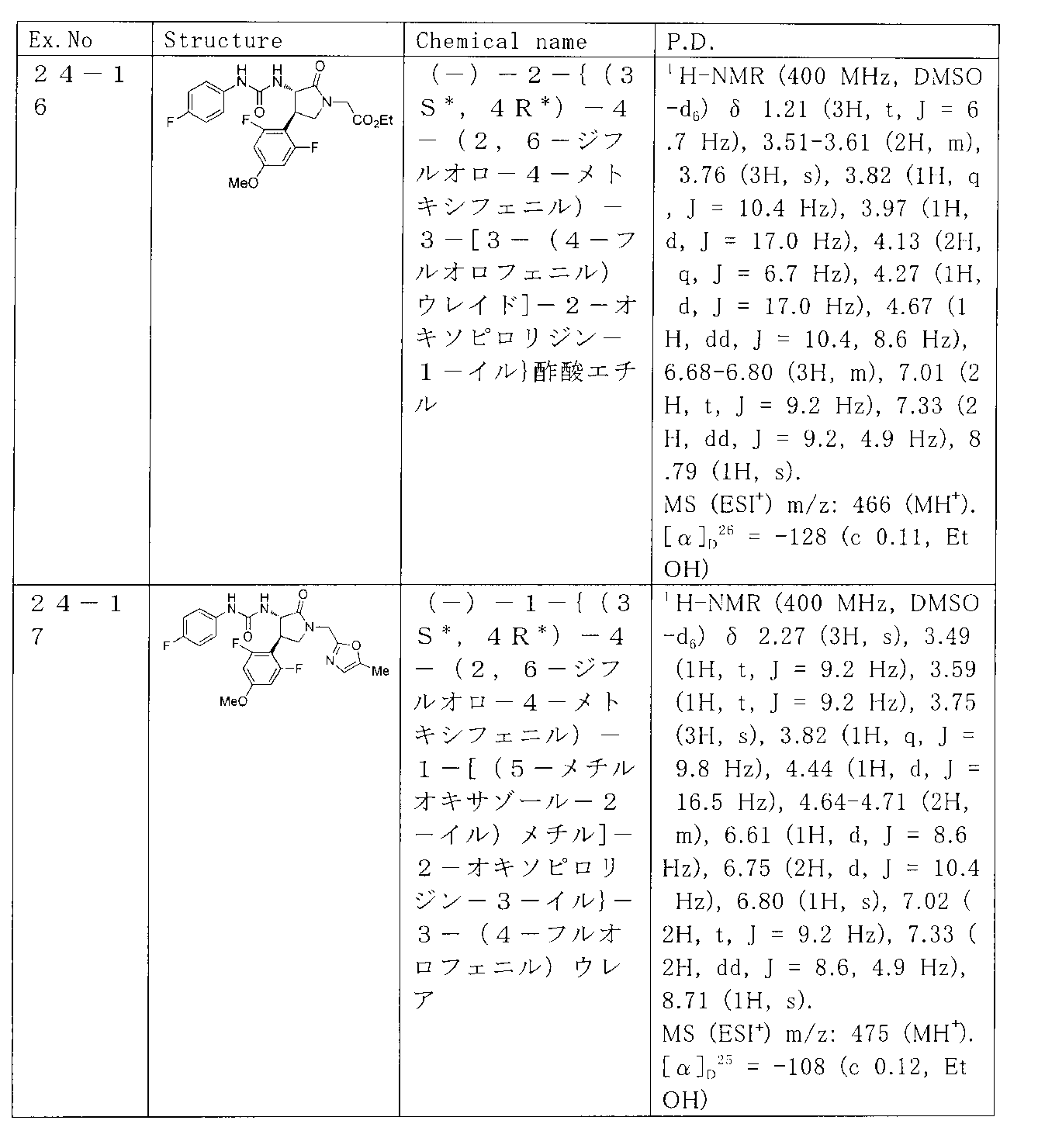
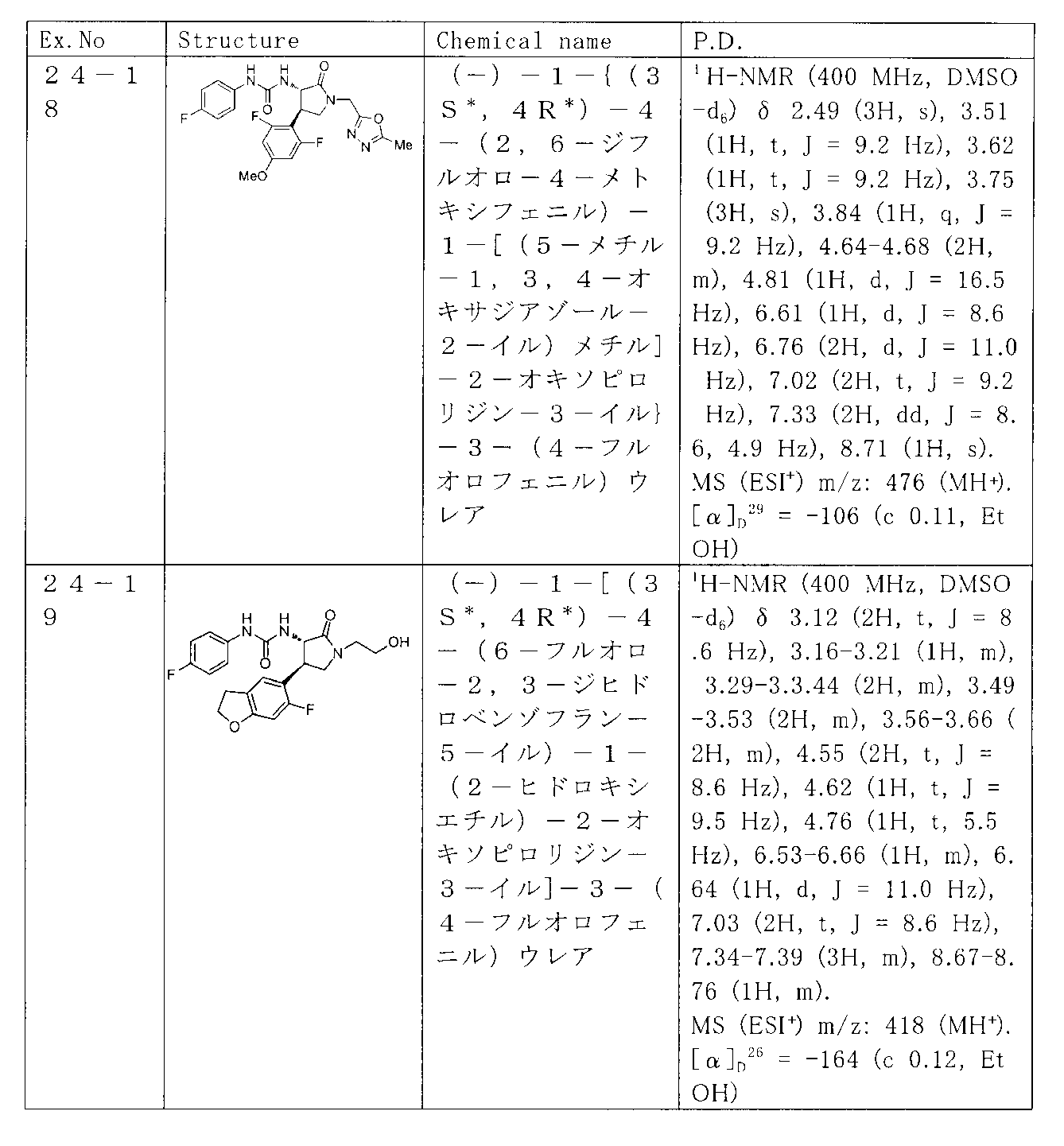

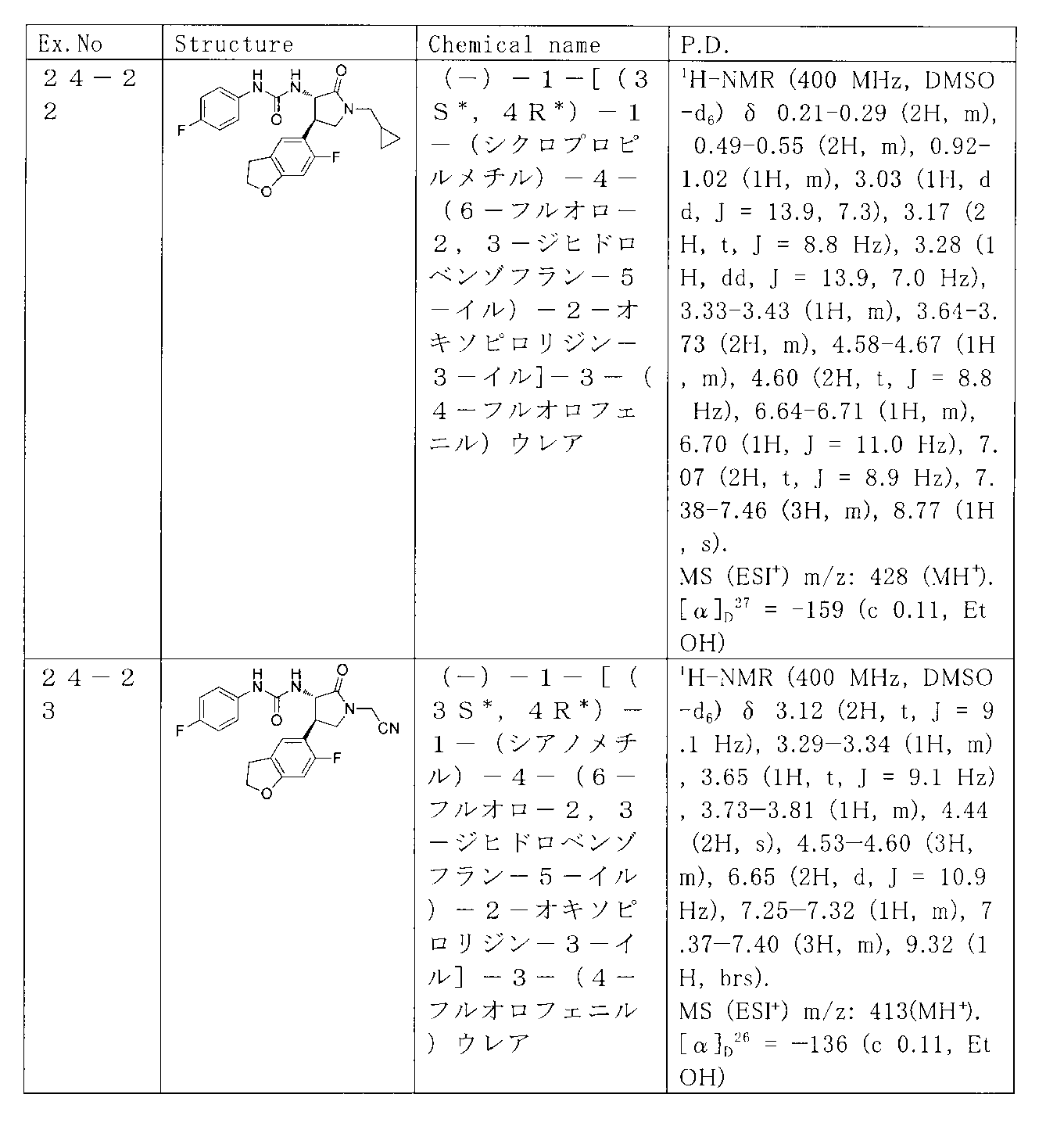
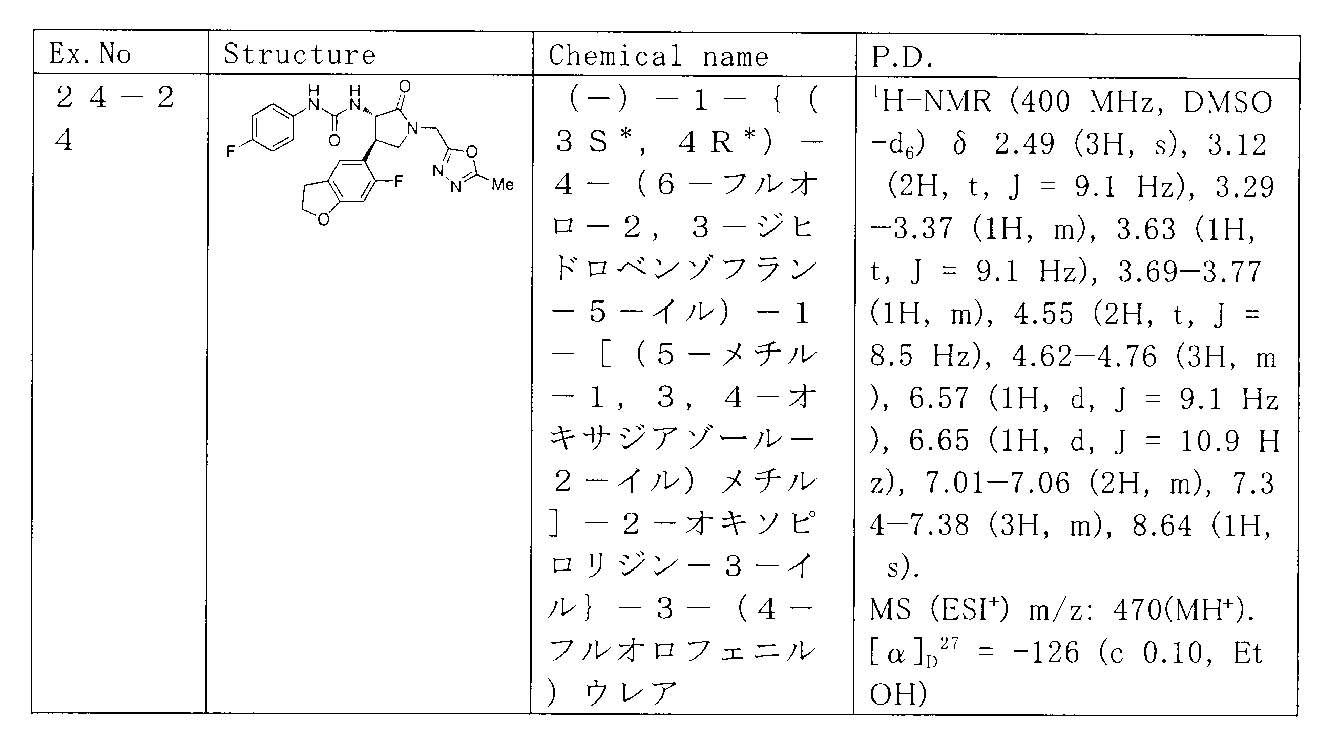
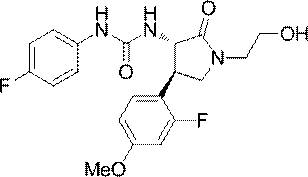
[(3S*,4R*)-4-(2,6-ジフルオロ-4-メトキシフェニル)-1-メチル-2-オキソピロリジン-3-イル]カルバミン酸ベンジルの代わりに,[(3S*,4R*)-4-(2-フルオロ-4-メトキシフェニル)-1-(2-ヒドロキシエチル)-2-オキソピロリジン-3-イル]カルバミン酸ベンジルを用いて実施例24-1と同様の方法に従い実施し、表題化合物を得た。
1H-NMR (400 MHz, DMSO-d6) δ 3.14-3.20 (1H, m), 3.28-3.42 (2H, m), 3.48-3.52 (2H, m), 3.57-3.66 (2H, m), 3.72 (3H, s), 4.66 (1H, dd, J = 11.0, 8.6 Hz), 4.73 (1H, t, J = 5.5 Hz), 6.45 (1H, d, J = 8.6 Hz), 6.75-6.80 (2H, m), 6.98-7.04 (2H, m), 7.30-7.36 (2H, m), 7.44 (1H, dd, J = 9.2, 9.2 Hz), 8.60 (1H, s).
MS (ESI+) m/z: 406 (MH+).
[α]D 27 =-118 (c 0.10, EtOH)

[(3S*,4R*)-4-(2,6-ジフルオロ-4-メトキシフェニル)-1-メチル-2-オキソピロリジン-3-イル]カルバミン酸ベンジルの代わりに,[(3S*,4R*)-4-(2,6-ジフルオロ-4-メトキシフェニル)-1-(2-ヒドロキシエチル)-2-オキソピロリジン-3-イル]カルバミン酸ベンジルを用いて実施例24-1と同様の方法に従い実施し、表題化合物を得た。
1H-NMR (400 MHz, DMSO-d6) δ 3.21-3.30 (1H, m), 3.36-3.45 (1H, m), 3.48-3.62 (4H, m), 3.71-3.78 (1H, m), 3.76 (3H, s), 4.66 (1H, dd, J = 10.4, 8.6 Hz), 4.77 (1H, t, J = 5.5 Hz), 6.51 (1H, d, J = 8.6 Hz), 6.75 (2H, d, J = 11.0 Hz), 6.99-7.06 (2H, m), 7.31-7.37 (2H, m), 8.68 (1H, s).
MS (ESI+) m/z: 424 (MH+).
[α]D 27 =-139 (c 0.11, EtOH)

(-)-(3S*,4R*)-4-(4-メトキシフェニル)-2-オキソピロリジン-3-カルボン酸の代わりに、(3R*,4S*)-1-メトキシ-4-(4-メトキシフェニル)-2-オキソピロリジン-3-カルボン酸を用いて実施例1-1と同様な方法で実施し、表題化合物を得た。
1H-NMR (400 MHz, CDCl3) δ 3.55 (1H, t, J = 8.5 Hz), 3.74-3.82 (1H, m), 3.80 (3H, s), 3.89 (3H, s), 4.01 (1H, t, J = 8.2 Hz), 4.10 (1H, dd, J = 8.5, 8.2 Hz), 6.08 (1H, brs), 6.79 (2H, t, J = 8.8 Hz), 6.89 (2H, d, J = 9.1 Hz), 7.12 (2H, q, J = 4.6 Hz), 7.20 (2H, d, J = 9.1 Hz), 7.50 (1H, brs).
MS (ESI+) m/z: 374 (MH+).
[α]D 27= +144(c 0.12, EtOH)

(-)-(3S*,4R*)-4-(4-メトキシフェニル)-2-オキソピロリジン-3-カルボン酸の代わりに、(3S*,4R*)-4-(2,6-ジフルオロ-4-メトキシフェニル)-1-メトキシ-2-オキソピロリジン-3-カルボン酸を用いて実施例1-1と同様な方法で実施し、表題化合物を得た。
1H-NMR (400 MHz, DMSO-d6) δ 3.54-3.61 (1H, m), 3.73 (3H, s), 3.76 (3H, s), 3.80-3.89 (2H, m), 4.46 (1H, t, J = 8.9 Hz), 6.67 (1H, d, J = 8.6 Hz), 6.77 (2H, d, J = 8.6 Hz), 7.00-7.05 (2H, m), 7.32-7.36 (2H, m), 8.83 (1H, s).
MS (ESI+) m/z: 410 (MH+).
[α]D 25 = -208 (c 0.20, EtOH)

アルゴン雰囲気下、1-[(3S*,4R*)-4-(4-ベンジルオキシ-2,6-ジフルオロフェニル)-2-オキソピロリジン-3-イル]-3-(4-フルオロフェニル)ウレア(490mg)のエタノール溶液(10mL)に、10%パラジウムカーボン(49mg)を加え、反応液とした。反応液を水素雰囲気下室温で4時間撹拌した。反応液をセライトろ過し、溶媒を減圧下濃縮した後、残渣をシリカゲルカラムクロマトグラフィー(ヘキサン : 酢酸エチル = 4:1 ~ 酢酸エチル)で精製することで、白色固体として表題化合物を得た(383mg)。
1H-NMR (400 MHz, DMSO-d6) δ 3.23-3.28 (1H, m), 3.41 (1H, t, J = 9.2 Hz), 3.74 (1H, q, J = 9.6 Hz), 4.52 (1H, dd, J = 10.7, 8.3 Hz), 6.41 (2H, d, J = 10.4 Hz), 6.45 (1H, d, J = 7.9 Hz), 6.99-7.04 (2H, m), 7.31-7.35 (2H, m), 8.01 (1H, s), 8.66 (1H, s).
MS (ESI+) m/z: 366 (MH+).
[α]D 28= -151(c 0.1, EtOH)

1-[(3S*,4R*)-4-(4-ベンジルオキシ-2,6-ジフルオロフェニル)-2-オキソピロリジン-3-イル]-3-(4-フルオロフェニル)ウレアの代わりに、1-[(3S*,4R*)-4-(4-ベンジルオキシ-2,6-ジフルオロフェニル)-2-オキソピロリジン-3-イル]-3-フェニルウレアを用いて実施例28-1と同様な方法で実施し、表題化合物を得た。
1H NMR (400 MHz, DMSO-d6) δ 3.25-3.30 (1H, m), 3.42 (1H, t, J = 8.6 Hz), 3.74 (1H, q, J = 9.6 Hz), 4.53 (1H, dd, J = 11.0, 8.6 Hz), 6.41-6.47 (3H, m), 6.86 (1H, t, J = 7.3 Hz), 7.18 (2H, t, J = 7.9 Hz), 7.32 (2H, d, J = 7.9 Hz), 8.03 (1H, s), 8.60 (1H, s), 10.35 (1H, brs).
MS (ESI+) m/z: 348 (MH+).
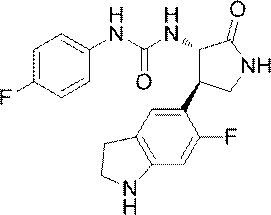
1-[(3S*,4R*)-4-(4-ベンジルオキシ-2,6-ジフルオロフェニル)-2-オキソピロリジン-3-イル]-3-(4-フルオロフェニル)ウレアの代わりに、1-[(3S*,4R*)-4-(1-ベンジル-6-フルオロインドリン-5-イル)-2-オキソピロリジン-3-イル]-3-(4-フルオロフェニル)ウレアを用いて実施例28-1と同様な方法で実施し、表題化合物を得た。
1H-NMR (400 MHz, DMSO-d6) δ 2.83 (2H, t, J = 8.5 Hz), 3.11 (1H, t, J = 9.7 Hz), 3.35-3.44 (3H, m), 3.53-3.61 (1H, m), 4.47 (1H, dd, J = 11.5, 9.1 Hz), 5.68 (1H, br), 6.20 (1H, d, J = 11.5 Hz), 6.36 (1H, d, J = 8.5 Hz), 7.00-7.05 (2H, m), 7.11 (1H, d, J = 7.9 Hz), 7.33-7.37 (2H, m), 7.87 (1H, s), 8.55 (1H, s).
MS (ESI+) m/z: 373 (MH+).
[α]D 27= -202 (c 0.12, EtOH)

1-[(3S*,4R*)-4-(2,6-ジフルオロ―4-メトキシフェニル)-2-オキソピロリジン-3-イル]-3-{4-[(トリメチルシリル)エチニル]フェニル}ウレア(66mg)のメタノール溶液(1.4mL)に、氷冷下で炭酸カリウム(1mg)を加え、反応液とした。反応液を室温で8時間撹拌した。反応液を減圧下濃縮し、残渣をシリカゲルカラムクロマトグラフィー(ヘキサン: 酢酸エチル = 1:1 ~ 酢酸エチル~酢酸エチル:メタノール=4:1)で精製することで、無色固体として表題化合物を得た(44mg)。
1H-NMR (400 MHz, DMSO-d6) δ 3.27-3.32 (1H, m), 3.45 (1H, t, J = 9.2 Hz), 3.75 (3H, s), 3.80 (1H, ddd, J = 11.0, 9.2, 9.2 Hz), 3.98 (1H, s), 4.56 (1H, dd, J = 11.0, 8.6 Hz), 6.57 (1H, d, J = 8.6 Hz), 6.70-6.77 (2H, m), 7.28 (2H, d, J = 8.6 Hz), 7.35 (2H, d, J = 8.6 Hz), 8.07 (1H, s), 8.89 (1H, s).
MS (ESI+) m/z: 386 (MH+).
[α]D 28= -147 (c 0.11, EtOH)
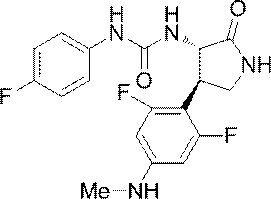
(3,5-ジフルオロ-4-{(3R*,4S*)-4-[3-(4-フルオロフェニル)ウレイド]-5-オキソピロリジン-3-イル}フェニル)(メチル)カルバミン酸tert-ブチル(80mg)にトリフルオロ酢酸(1mL)を加え、反応液とした。反応液を60℃で1時間撹拌した。反応液を減圧下濃縮した後、残渣に飽和炭酸水素ナトリウム水溶液を加え、酢酸エチルで抽出した。有機層を水、飽和食塩水で順次洗浄後、無水硫酸ナトリウムで乾燥した。溶媒を減圧下濃縮した後、残渣をシリカゲルカラムクロマトグラフィー(酢酸エチル)で精製することで、無色固体として表題化合物を得た(30mg)。
1H-NMR (400 MHz, DMSO-d6) δ 2.63 (3H, d, J = 4.9 Hz), 3.25 (1H, t, J = 10.1 Hz), 3.37 (1H, t, J = 8.9 Hz), 3.67 (1H, q, J = 9.8 Hz), 4.52 (1H, dd, J = 11.0, 8.6 Hz), 6.16 (2H, d, J = 12.0 Hz), 6.21 (1H, d, J = 4.9 Hz), 6.40 (1H, d, J = 8.6 Hz), 6.99-7.04 (2H, m), 7.32-7.36 (2H, m), 7.98 (1H, s), 8.61 (1H, s).
MS (ESI+) m/z: 379 (MH+).
[α]D 24= -54 (c 0.14, EtOH)
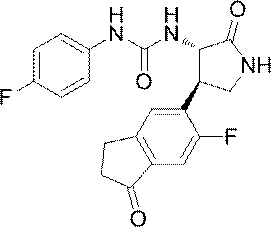
アルゴン雰囲気下、1-[(3S*,4R*)-4-(6-フルオロ-1-ヒドロキシ-2,3-ジヒドロ-1H-インデン-5-イル)-2-オキソピロリジン-3-イル]-3-(4-フルオロフェニル)ウレア(13mg)のジクロロメタン(0.66mL)とアセトニトリル(0.66mL)混合溶液に、冷却下でデス-マーチン試薬(14mg)を加え、反応液とした。反応液を室温で3時間撹拌した。反応液に飽和炭酸水素ナトリウム水溶液を加え、酢酸エチルで抽出した。有機層を飽和食塩水で洗浄し、無水硫酸ナトリウムで乾燥した。溶媒を減圧下濃縮した後、残渣をシリカゲルカラムクロマトグラフィー(ヘキサン: 酢酸エチル = 1:1 ~ 酢酸エチル ~ 酢酸エチル:メタノール=9:1)で精製することで、無色固体として表題化合物を得た(11mg)。
1H-NMR (400 MHz, DMSO-d6) δ 2.64-2.67 (2H, m), 3.15 (2H, t, J = 5.2 Hz), 3.27 (1H, t, J = 8.6 Hz), 3.53 (1H, t, J = 8.9 Hz), 3.89 (1H, q, J = 9.8 Hz), 4.65 (1H, dd, J = 11.6, 8.6 Hz), 6.53 (1H, d, J = 8.6 Hz), 7.00-7.04 (2H, m), 7.32-7.37 (3H, m), 7.82 (1H, d, J = 6.1 Hz), 8.04 (1H, s), 8.69 (1H, s).
MS (ESI+) m/z: 386 (MH+).

3,5-ジフルオロ-4-{(3R*,4S*)-4-[3-(4-フルオロフェニル)ウレイド]-5-オキソピロリジン-3-イル}フェニルトリフルオロメタンスルホネート(300mg)のトルエン溶液(6mL)に、アセトニトリル(3mL)、酢酸パラジウム(II)(14mg)、(±)-2,2’-ビス(ジフェニルホスフィノ)-1,1’-ビナフチル(rac-BINAP)(38mg)、ヘキサカルボニルモリブデン(Mo(CO)6)(240mg)、炭酸セシウム(236mg)、およびジメチルアミン(3mL,2.0M テトラヒドロフラン溶液)を加え、反応液とした。反応液をアルゴン雰囲気下、70℃で3時間撹拌した。反応液をセライトろ過し、酢酸エチルで洗浄した。溶媒を減圧下濃縮した後、残渣をシリカゲルカラムクロマトグラフィー(ヘキサン: 酢酸エチル = 4:1 ~ 酢酸エチル~酢酸エチル:メタノール=9:1)で精製することで、白色固体として表題化合物を得た(192mg)。
1H-NMR (400 MHz, DMSO-d6) δ 2.88 (3H, s), 2.95 (3H, s), 3.35-3.39 (1H, m), 3.51 (1H, t, J = 8.9 Hz), 3.94 (1H, q, J = 9.6 Hz), 4.58 (1H, dd, J = 10.7, 8.3 Hz), 6.50 (1H, d, J = 7.9 Hz), 6.98-7.03 (2H, m), 7.17 (2H, d, J = 9.2 Hz), 7.29-7.33 (2H, m), 8.11 (1H, s), 8.71 (1H, s).
MS (ESI+) m/z: 421 (MH+).
[α]D 28= -111(c 0.1, EtOH)
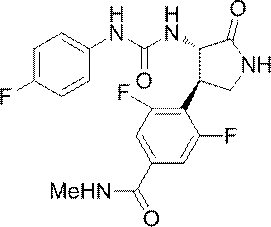
ジメチルアミンの代わりにメチルアミンを用いて、実施例29-1と同様の方法で実施し、表題化合物を得た。
1H-NMR (400 MHz, DMSO-d6) δ 2.77 (3H, d, J = 4.9 Hz), 3.34-3.40 (1H, m), 3.51 (1H, t, J = 9.2 Hz), 3.93 (1H, q, J = 9.6 Hz), 4.60 (1H, dd, J = 10.4, 7.9 Hz), 6.53 (1H, d, J = 7.9 Hz), 6.98-7.03 (2H, m), 7.29-7.32 (2H, m), 7.52 (2H, d, J = 9.8 Hz), 8.13 (1H, s), 8.56-8.60 (1H, m), 8.74 (1H, s).
MS (ESI+) m/z: 407 (MH+).
[α]D 28= -167(c 0.1, EtOH)

アルゴン雰囲気下、3,5-ジフルオロ-4-[(3R*,4S*)-4-(3-(4-フルオロフェニル)ウレイド)-5-オキソピロリジン-3-イル]フェニルトリフルオロメタンスルホネート(150mg)のN,N-ジメチルホルムアミド溶液(3mL)に、シアン化亜鉛(53mg)、およびテトラキス(トリフェニルホスフィン)パラジウム(18mg)を加え、反応液とした。反応液を80℃で5時間撹拌した。反応液をセライトろ過し、溶媒を減圧下濃縮した後、残渣をシリカゲルカラムクロマトグラフィー(ヘキサン : 酢酸エチル = 4:1 ~ 酢酸エチル)で精製することで、白色固体として表題化合物を得た(100mg)。
1H-NMR (400 MHz, DMSO-d6) δ 3.33-3.38 (1H, m), 3.52 (1H, t, J = 10.1 Hz), 3.95 (1H, q, J = 9.8 Hz), 4.58 (1H, dd, J = 10.4, 7.3 Hz), 6.51 (1H, d, J =7.9 Hz), 6.98-7.04 (2H, m), 7.27-7.32 (2H, m), 7.81 (2H, d, J =8.6 Hz), 8.18 (1H, s), 8.75 (1H, s).
MS (ESI+) m/z: 375 (MH+).
[α]D 28= -145 (c 0.1, EtOH)
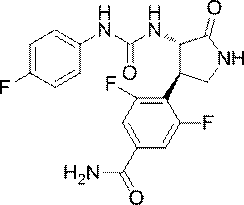
アルゴン雰囲気下、(-)-1-[(3S*,4R*)-4-(4-シアノ-2,6-ジフルオロフェニル)-2-オキソピロリジン-3-イル]-3-(4-フルオロフェニル)ウレア(160mg)のメタノール溶液(4mL)に、2mol/L 水酸化ナトリウム水溶液(0.21mL)を加え、反応液とした。反応液を室温で1時間加熱撹拌した。反応液に1mol/L塩酸(1mL)を加えて酸性(pH1)とし、酢酸エチルで抽出した。有機層を水、飽和食塩水で洗浄後、無水硫酸ナトリウムで乾燥した。溶媒を減圧下濃縮した後、残渣をシリカゲルカラムクロマトグラフィー(ヘキサン : 酢酸エチル = 4:1 ~ 酢酸エチル ~ 酢酸エチル:メタノール = 95:5)で精製することで、白色固体として表題化合物を得た(37mg)。
1H-NMR (400 MHz, DMSO-d6) δ 3.34-3.41 (1H, m), 3.52 (1H, t, J = 9.2 Hz), 3.94 (1H, q, J = 9.6 Hz), 4.62 (1H, dd, J = 10.7, 8.3 Hz), 6.52 (1H, d, J = 7.9 Hz), 6.99-7.05 (2H, m), 7.30-7.34 (2H, m), 7.58 (2H, d, J = 9.8 Hz), 7.64 (1H, s), 8.10 (1H, s), 8.14 (1H, s), 8.74 (1H, s).
MS (ESI-) m/z: 391 (M-H)-.
HRESIMS (-) : 391.10226 (C18H14F3N4O3として計算値 391.10180).
[α]D 28= -130 (c 0.1, EtOH)
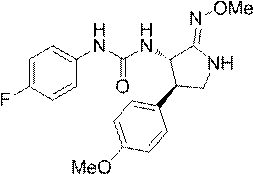
[(3S*,4R*,Z)-2-(メトキシイミノ)-4-(4-メトキシフェニル)ピロリジン-3-イル]カルバミン酸ベンジル223mg)のエタノール溶液(12mL)に10%パラジウムカーボン(22mg)を加え、反応液とした。反応液を水素雰囲気下で1時間撹拌した。反応液をセライトろ過し、ろ液を減圧濃縮して白色固体の(3S*,4R*,Z)-3-アミノ-4-(4-メトキシフェニル)ピロリジン-2-オン O-メチルオキシムを得た。得られた(3S*,4R*,Z)-3-アミノ-4-(4-メトキシフェニル)ピロリジン-2-オン O-メチルオキシム(140mg)のテトラヒドロフラン溶液(2mL)に4-フルオロフェニルイソシアネート(68.3μL)を加え、反応液とした。反応液を室温で1時間撹拌した。反応液を減圧下濃縮した後、残渣をシリカゲルカラムクロマトグラフィー(酢酸エチル : メタノール =10:1)で精製することで、白色固体として表題化合物を得た(156mg)。
1H-NMR (400 MHz, DMSO-d6) δ 3.13 (1H, t, J = 9.1 Hz), 3.22-3.30 (1H, m), 3.48 (1H, t, J = 8.2 Hz), 3.59 (3H, s), 3.70 (3H, s), 4.82 (1H, t, J = 9.4 Hz), 6.40 (1H, d, J = 9.7 Hz), 6.69 (1H, s), 6.86 (2H, d, J = 8.5 Hz), 6.99- 7.05 (2H, m), 7.26 (2H, d, J = 8.5 Hz), 7.32-7.36 (2H, m), 8.45 (1H, s).
MS (ESI+) m/z: 373 (MH+).
[α]D 28 = -72 (c 0.31, DMSO)
これらの構造およびスペクトルデータを表101~表107に示した。
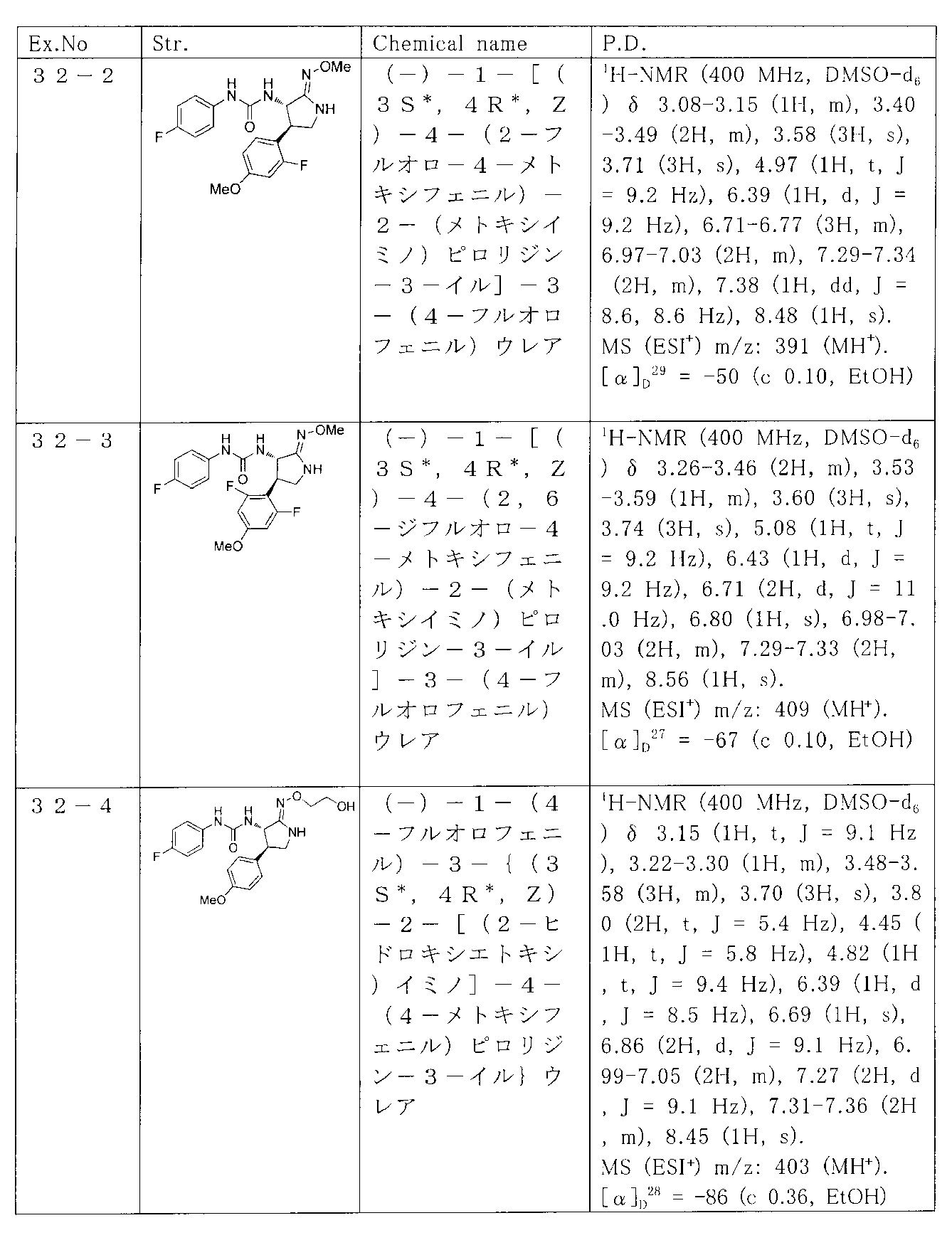
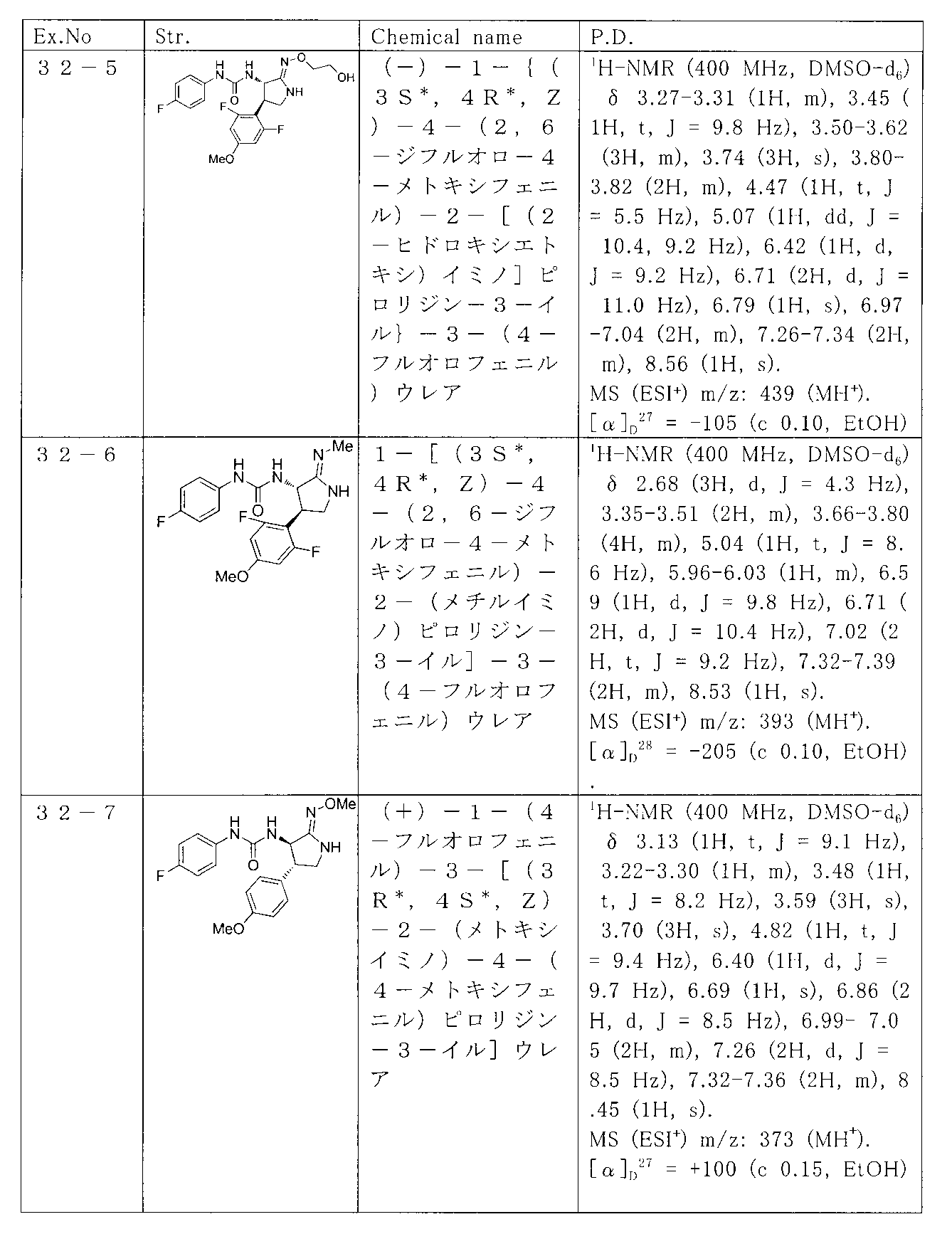
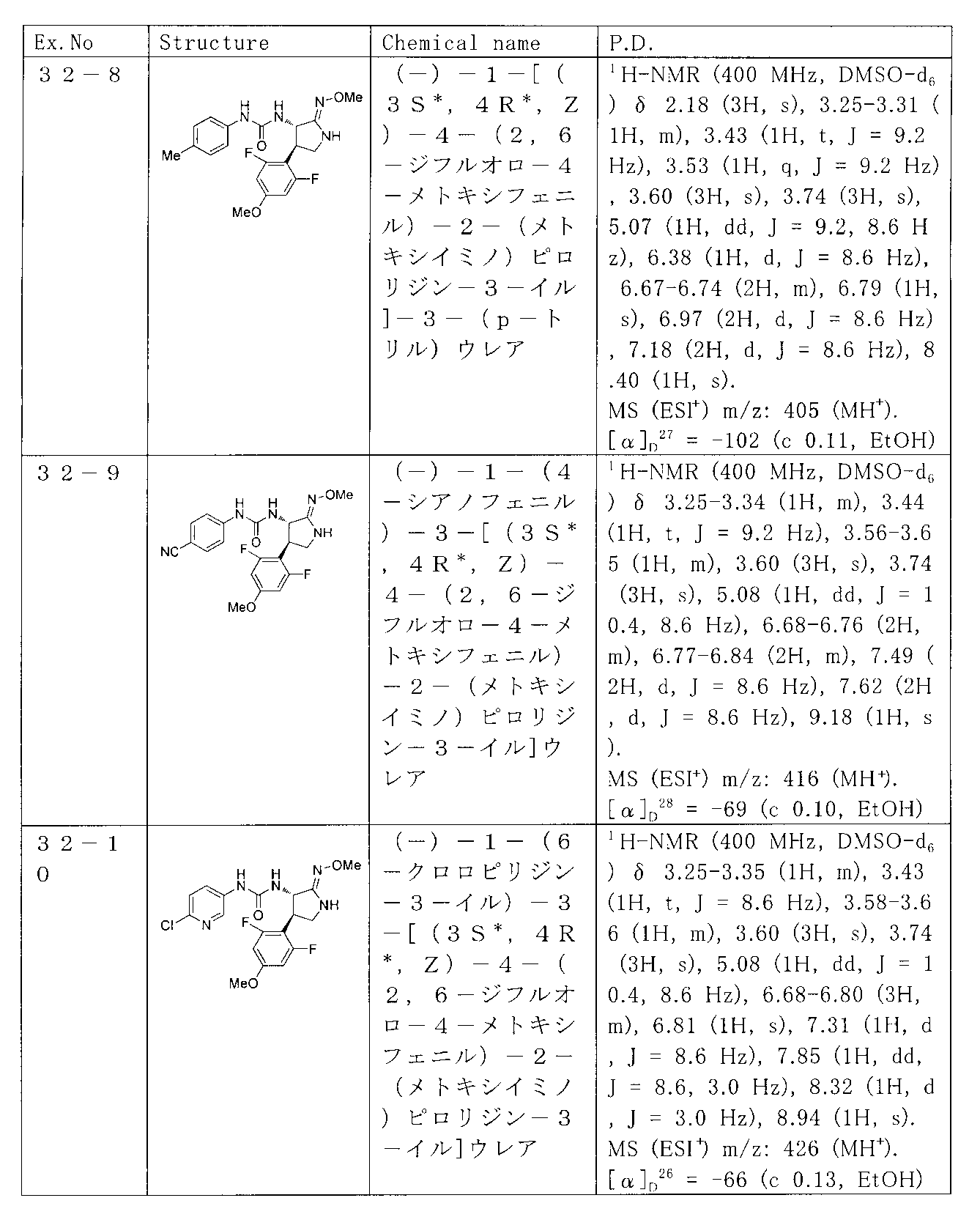
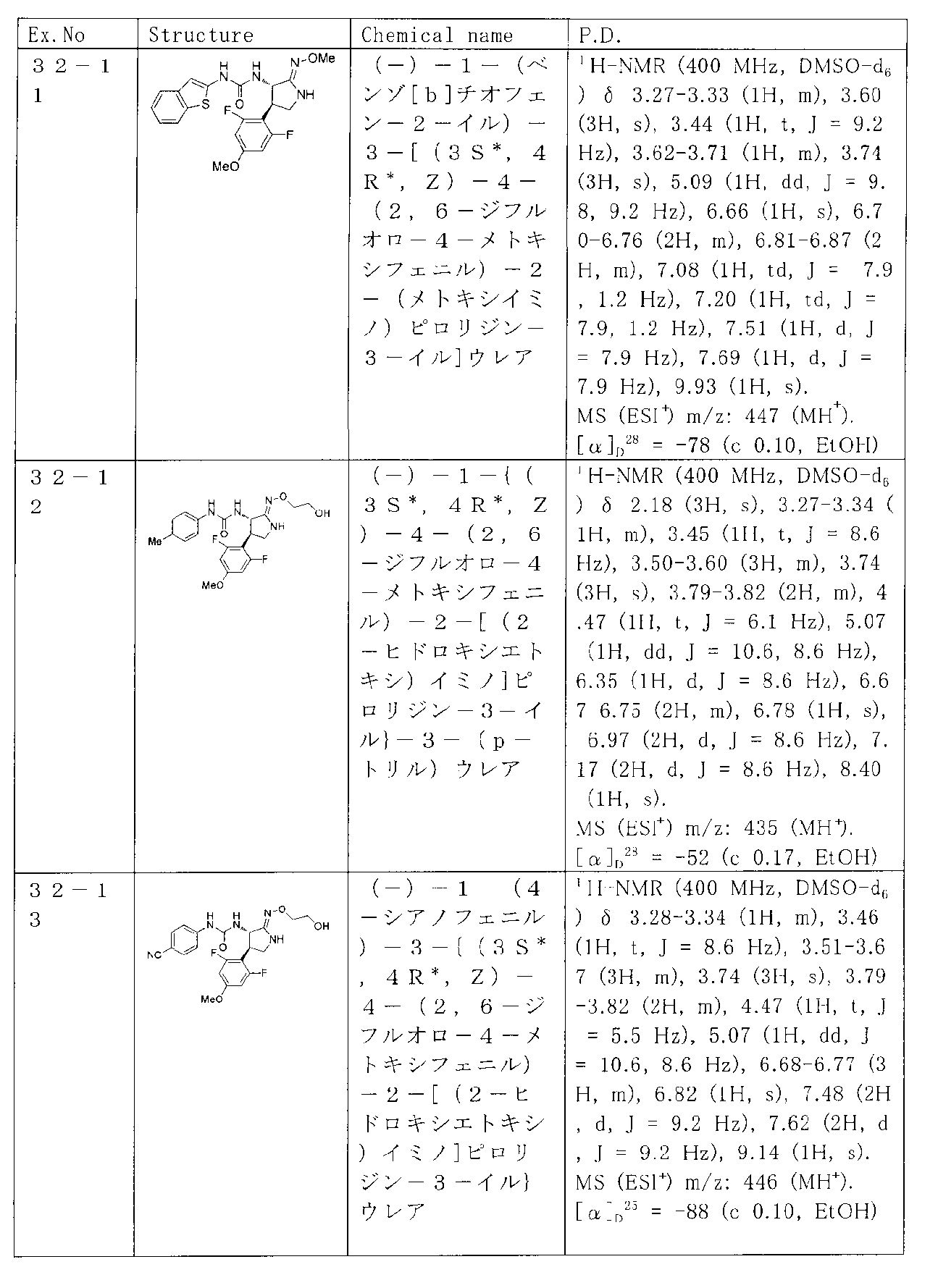


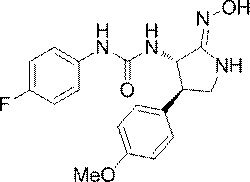
1-((3S*,4R*,Z)-2-{[(tert-ブチルジメチルシリル)オキシ]イミノ}-4-(4-メトキシフェニル)ピロリジン-3-イル)-3-(4-フルオロフェニル)ウレア(290mg)の1,4-ジオキサン溶液(1.5mL)に水(1.35mL)、およびトリフルオロ酢酸(135μL)を加え、反応液とした。反応液を室温で30分間撹拌した。その後、反応液に氷冷下で飽和炭酸水素ナトリウム水溶液を加えて、酢酸エチルで抽出した。有機層を飽和食塩水で洗浄後、無水硫酸ナトリウムで乾燥した。溶媒を減圧下濃縮した後、残渣をジイソプロピルエーテルで洗浄することで、白色固体として表題化合物を得た(212mg)。
1H-NMR (400 MHz, DMSO-d6) δ 3.19 (1H, t, J = 9.1 Hz), 3.30 (1H, q, J = 8.7 Hz), 3.55 (1H, t, J = 8.2 Hz), 3.76 (3H, s), 4.80 (1H, t, J = 9.4 Hz), 6.37 (1H, d, J = 9.1 Hz), 6.43 (1H, s), 6.92 (2H, d, J = 8.5 Hz), 7.04-7.10 (2H, m), 7.32 (2H, d, J = 8.5 Hz), 7.36-7.40 (2H, m), 8.49 (1H, s), 8.89 (1H, s).
MS (ESI+) m/z: 359 (MH+).
[α]D 29 = -95 (c 0.30, EtOH)

1-((3S*,4R*,Z)-2-{[(tert-ブチルジメチルシリル)オキシ]イミノ}-4-(4-メトキシフェニル)ピロリジン-3-イル)-3-(4-フルオロフェニル)ウレアの代わりに、1-((3S*,4R*,Z)-2-{[(tert-ブチルジメチルシリル)オキシ]イミノ}-4-(2,6-ジフルオロ-4-メトキシフェニル)ピロリジン-3-イル)-3-(4-フルオロフェニル)ウレアを用いて実施例33-1と同様な方法で実施し、表題化合物を得た。
1H-NMR (400 MHz, DMSO-d6) δ 3.26-3.33 (1H, m), 3.42 (1H, t, J = 8.6 Hz), 3.49-3.57 (1H, m), 3.75 (3H, s), 5.02 (1H, t, J = 9.8 Hz), 6.33 (1H, d, J = 8.6 Hz), 6.48 (1H, s), 6.72 (2H, d, J = 10.4 Hz), 6.97-7.04 (2H, m), 7.26-7.32 (2H, m), 8.52 (1H, s), 8.90 (1H, s).
MS (ESI+) m/z: 395 (MH+).
[α]D 26 = -21 (c 0.10, EtOH)
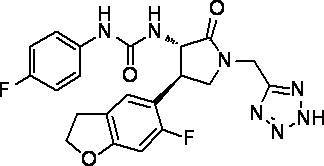
1-[(3S*,4R*)-1-(シアノメチル)-4-(6-フルオロ-2,3-ジヒドロベンゾフラン-5-イル)-2-オキソピロリジン-3-イル]-3-(4-フルオロフェニル)ウレア(35mg)のトルエン(850μL)とN,N-ジメチルホルムアミド(500μL)混合溶液に、アジ化ナトリウム(22mg)、トリエチルアミン(47μL)、および酢酸(19uL)を加え、反応液とした。反応液を125℃で2時間攪拌した。反応液を室温まで放冷した後、10%クエン酸水溶液を加え、酢酸エチルで抽出した。有機層を水、および飽和食塩水で順次洗浄後、無水硫酸ナトリウムで乾燥した。溶媒を減圧下濃縮した後、得られた粗生成物をジエチルエーテルで洗浄することで、薄褐色固体として表題化合物を得た(24mg)。
1H-NMR (400 MHz, DMSO-d6) δ 3.12 (2H, t, J = 8.6 Hz), 3.31-3.35 (1H, m), 3.64 (1H, t, J = 9.2 Hz), 3.71-3.78 (1H, m), 4.55 (2H, t, J = 9.2 Hz), 4.70-4.76 (2H, m), 4.85-4.89 (1H, m), 6.51 (1H, d, J = 9.2 Hz), 6.64 (1H, d, J = 11.0 Hz), 7.01-7.06 (2H, m), 7.34-7.40 (3H, m), 8.67 (1H, s), 16.47 (1H, brs).
MS (ESI+) m/z: 456(MH+).
[α]D 26= -120 (c 0.09, EtOH)
ヒトFPRL1に対するアゴニスト活性測定試験
(1-1)ヒトFPRL1発現ベクターの構築
単球性白血病細胞株THP-1(TIB-202、ATCC)由来のcDNAを鋳型とし、配列番号1に示したフォワードプライマーと配列番号2に示したリバースプライマーを使用し、KOD -plus- ver.2(KOD-211、TOYOBO)を用いたPCR反応によりヒトFPRL(配列番号3)を増幅した。増幅したPCR産物及びpCMV-script vector(212220、STRATAGENE)をHind III(1060A、TaKaRa)及びXhoI(1094A、TaKaRa)を用いて消化し、得られた消化物はLigation high ver.2(LGK-201、TOYOBO)を用いてラーゲーションさせた。ラーゲーション産物はDH5α(DNA-901、TOYOBO)に形質転換し、100 μg/mL kanamycin 含有のLB培地で培養後、HiSpeed Plasmid Maxi Kit(12662、QIAGEN)を用いて精製した。
骨髄性白血病細胞株HL-60(CCL-240、ATCC)由来のcDNAを鋳型とし、配列番号4に示したフォワードプライマーと配列番号5に示したリバースプライマーを使用し、KOD -plus- ver.2を用いたPCR反応によりヒトGα15(配列番号6)を増幅した。増幅したPCR産物及びpCMV-script vectorをHindIII及びXhoIを用いて消化し、得られた消化物はLigation high ver.2を用いてラーゲーションさせた。ラーゲーション産物はDH5αに形質転換し、100 μg/mL kanamycin含有のLB培地で培養後、HiSpeed Plasmid Maxi Kitを用いて精製した。
HEK293(JCRB9068、NIBIO)は10%FBS及び1xPenicillin-Streptomycin(15140-122、GIBCO)を含有したDMEM(11885-092、GIBCO)を用い、5%CO2かつ37oCのインキュベーター内で培養した。継代は、80-90%コンフルエントに達した細胞をPBS(-)で洗浄後、0.25% Trypsin-EDTA(25200-072、GIBCO)で剥がして遠心し、新しい培地で再懸濁した後、Collagen Type 1 Coated dish(4020-010、IWAKI)にsplit ratio = 1:8で播種した(3日間培養)。
80-90%コンフルエントに達したHEK293をPBS(-)で洗浄し、0.25% Trypsin-EDTAで剥がして遠心後、1xPenicillin-Streptomycinを除いた新しい培地で再懸濁した。5x10⁵cells/2.5mL/well となるように、Collagen Type 1 coated 6-well plate(4810-010、IWAKI)に播種し一晩培養した。翌日、ヒトFPRL1及びGα15発現ベクターをLipofectamine 2000 transfection reagent(11668-019、Life technologies)を用いて導入した。まずヒトFPRL1及びGα15発現ベクターを2 μg/250 μL/wellに、Lipofectamine 2000 transfection reagentは4 μL/250 μL/wellとなるように、Opti-MEM I Reduced Serum Medium(31985-070、GIBCO)でそれぞれ希釈した。穏やかに拡散させ、5分間室温でインキュベーションした後に、ベクター溶液とLipofectamine 2000 transfection reagentを等量混合した。さらにベクターとLipofectamine 2000 transfection reagentの複合体を形成させるため室温で20分間インキュベーションした後、播種しておいた細胞の培地中に500 μL/well ずつ加えた。処理した細胞は24時間の培養後、Poly-D-Lysine coated 96-well plate(356640、BD Biosciences)に7x10⁴cells/100 μL/wellの細胞数で播種し、さらに24時間培養した細胞を細胞内カルシウム動員試験測定に用いた。
はじめに各試験化合物を適量秤量し、10-2MとなるようにDimethyl sulfoxide(DMSO)を加えて溶解した。アゴニスト活性のEC50値算出のため化合物溶液をDMSOで10倍ずつ段階希釈し、10-2Mから10-9Mの8つの濃度を作成した。作成した各濃度の化合物溶液をFluo-4 NW Calcium Assay Kit(F36206、Life technologies)に含まれているAssay bufferにて100倍希釈後、V-bottomの96-well plateへ100μLずつ分注し、分注後のplateは測定までFlexstation(Molecular Devices)にセットした。
次に、Fluo-4 NW dye mixに10mLのAssay buffer及び100 μLのプロベネシド溶液(250mM stockに1mLのAssay bufferを加えて溶解したもの)を加え、よく混合して溶解した。前日に播種した細胞の培地を除き、溶解したFluo-4 NW dye mixを90μL/wellずつ添加し、45分間37℃遮光下で反応させた。反応後の細胞と化合物添加用チップをFlexstationにセットし、化合物添加による経時的蛍光強度変化を測定した[化合物添加量=10μL(最終濃度 : 10-5Mから10-12M)、励起波長 485nm、測定波長 525nm、1.5 sec x 54 read]。相対蛍光単位の最大値から、DMSO添加時のベース値を引いた値を算出し、解析に供した。測定データは全てデータ解析ツールであるPrism4を用いて解析した。EC50値として、50%最大活性化を生じるモル濃度を算出した。得られた各試験化合物のEC50値を以下の表I~表Vに示した。

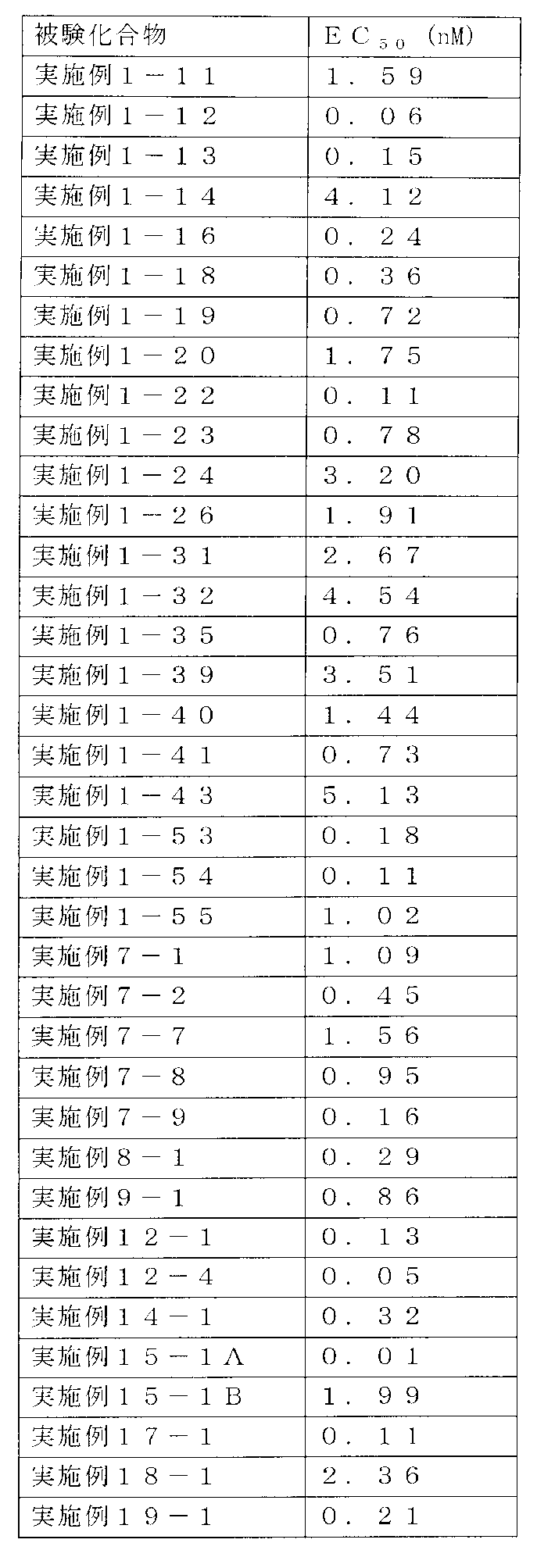


Lipopolysaccharide誘発によるマウス肺への好中球浸潤に対する効果
マウス(BALB/c、雄)に被験化合物を経口投与し、30分後にプラスチック容器へ入れた。生理食塩液に溶解したlpopolysaccharide(0.3 mg/mL)を超音波式吸入器( NE-U17、オムロン )で霧化し、10分間マウスに噴霧した。5時間後、麻酔したマウスを脱血致死させ、気道にカニューレを挿入して0.4% sodium citrateを含む0.85% NaCl液1 mLで気管支洗浄(BAL)を行った。この操作を3回繰り返して、BAL液を得た。BAL液を4℃、5分間、×200 gで遠心し、沈渣に0.1 % BSAを含む生理食塩液に懸濁した。チュルク液を用いて顕微鏡下で白血球数を数えて、総白血球数を算出した。サイトスピン3 (サーモバイオアナリシスジャパン)を用いて、白血球をスライドガラスに固定した。ディフ・クイック (国際試薬)で染色し、顕微鏡下で白血球を数え、好中球の比率を算出した。総白血球数に好中球の比率を乗じて、総好中球数を算出した。被験化合物の効果は、コントロールの好中球数に対する抑制率を百分率(%)で示した。得られた各試験化合物の抑制率を以下の表VI~VIIIに示した。

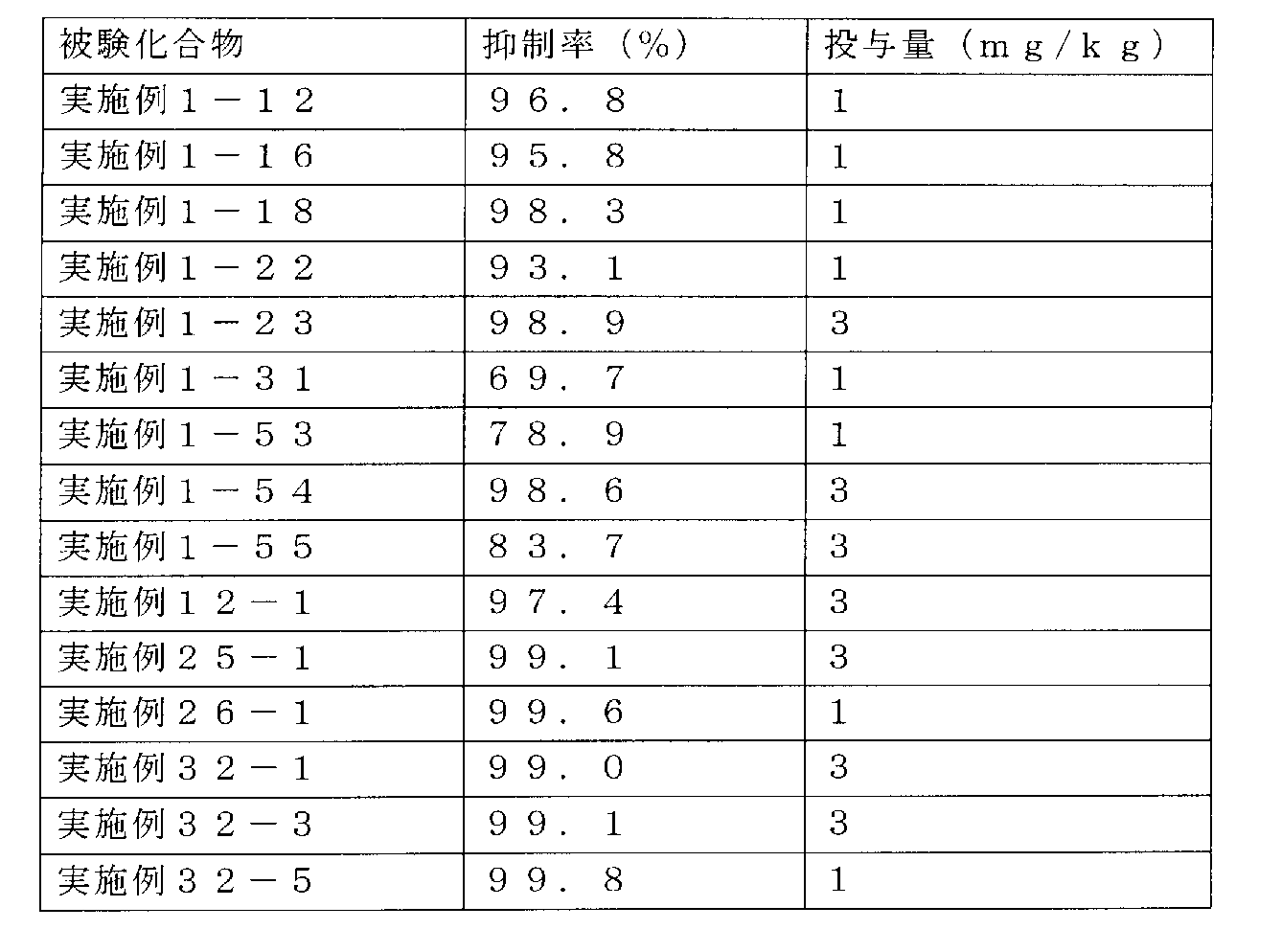

配列番号1は、ヒトFPRL1(配列番号3)のDNAを増幅するために使用されたフォワードプライマーの配列であり、HindIII認識部位を付加している。
<配列表2>
配列番号2は、ヒトFPRL1(配列番号3)のDNAを増幅するために使用されたリバースプライマーの配列であり、XhoI認識部位を付加している。
<配列表3>
配列番号3は、ヒトFPRL1のOpen Reading Frame(ORF)であり、アミノ酸に翻訳される部位のDNA配列である。
<配列番号4>
配列番号4は、ヒトGα15(配列番号6)のDNAを増幅するために使用されたフォワードプライマーの配列であり、HindIII認識部位を付加している。
<配列番号5>
配列番号5は、ヒトGα15(配列番号6)のDNAを増幅するために使用されたリバースプライマーの配列であり、XhoI認識部位を付加している。
<配列番号6>
配列番号6はヒトGα15のOpen Reading Frame(ORF)であり、アミノ酸に翻訳される部位のDNA配列である。
Claims (18)
- 一般式(I):

Ar2は、置換基を有しても良いフェニル基(ただし、置換基がハロゲン原子だけのフェニル基は除く)、置換基を有しても良い5員環芳香族複素環基、置換基を有しても良い6員環芳香族複素環基、または置換基を有しても良い原子数8個または9個からなる二環性芳香族複素環基であり;
Xは、以下のa)、b)およびc):
a)酸素原子または硫黄原子
b)NR4
c)NOR4
からなる群から選択される基であり、Xがb)またはc)である場合、R4は、水素原子、置換基を有しても良いフェニル基、置換基を有しても良い複素環基または置換基を有しても良いC1~C6アルキル基であり;
R1は、水素原子、ヒドロキシ基、置換基を有しても良いC1~C6アルコキシ基または置換基を有しても良いC1~C6アルキル基であり;
R2、R3は、それぞれ独立して水素原子、置換基を有しても良いC1~C6アルキル基であるか、またはR2とR3が一緒になったC2~C6アルキレン基であり;
*を付された炭素原子は、不斉炭素原子を表す。]で表される化合物、またはその薬理学的に許容される塩。 - 式(I)中、Ar2が、以下のA1)、A2)、A3)、A4)、A5)、A6)、A7)、A8)、A9)およびA10):
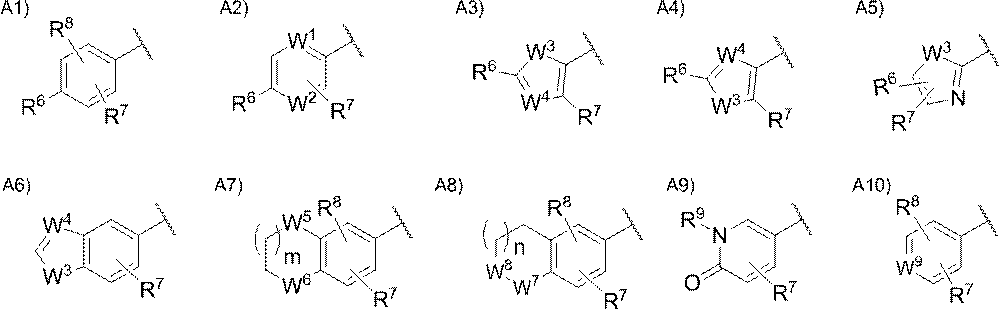
Ar2がA2)である場合、W1は、水素原子、ハロゲン原子または置換基を有しても良いC1~C6アルキル基によって置換されてもよいCHまたは窒素原子であり;
Ar2がA2)である場合、W2は、CHまたは窒素原子であり;
Ar2がA3)、A4)、A5)またはA6)である場合、W3は、酸素原子、硫黄原子またはC1~C6アルキル基によって置換されてもよいNHであり;
Ar2がA3)、A4)またはA6)である場合、W4は、CHまたは窒素原子であり;Ar2がA7)である場合、W5は、CH2、酸素原子または硫黄原子であり;
Ar2がA7)である場合、W6は、C=O、CH2、CF2、CHOH、C1~C6アルキル基によって置換されてもよいNH、SO、SO2、酸素原子または硫黄原子であり;
Ar2がA8)である場合、W7は、C1~C6アルキル基によって置換されてもよいNHまたはC=Oであり;
Ar2がA8)である場合、W8は、W7がC1~C6アルキル基によって置換されてもよいNHのときは、C=O、W7がC=Oのときは、C1~C6アルキル基によって置換されてもよいNHであり;
Ar2がA10)である場合、W9は、窒素原子またはN=Oであり;
Ar2がA1)、A2)、A3)、A4)またはA5)である場合、R6は、水素原子、ハロゲン原子、ヒドロキシ基、シアノ基、置換基を有しても良いC1~C6アルキル基、置換基を有しても良いC1~C6アルコキシ基、置換基を有しても良いC1~C6アシル基、置換基を有しても良いC1~C6アルキルスルファニル基、置換基を有しても良いC1~C6アルキルスルフィニル基、置換基を有しても良いC1~C6アルキルスルホニル基、置換基を有しても良い複素環基、-CONR10R11または-NR10R11であり、R6が-CONR10R11または-NR10R11であるとき、R10は水素原子、置換基を有しても良いC1~C6アルキル基、置換基を有しても良いC1~C6アシル基、または置換基を有しても良いC1~C6アルキルスルホニル基であり、R11は水素原子、または置換基を有しても良いC1~C6アルキル基であるか、またはR10とR11が一緒になってC3~C10ヘテロシクロアルキル基を形成しており;
Ar2がA1)、A2)、A3)、A4)、A5)、A6)、A7)、A8)、A9)またはA10)である場合、R7は、水素原子、ハロゲン原子、置換基を有しても良いC1~C6アルキル基または置換基を有しても良いC1~C6アルキコキシ基であり;Ar2がA1)、A7)、A8)またはA10)である場合、R8は、水素原子、ハロゲン原子または置換基を有しても良いC1~C6アルキル基であり;
Ar2がA9)である場合、R9は、水素原子またはC1~C6アルキル基であり;Ar2がA7)である場合、mは0または1であり;
Ar2がA8)である場合、nは0または1であり;
ただし、Ar2がA1)である場合にR6、R7及びR8の置換基の組み合わせが水素原子とハロゲン原子の場合を除く、請求項1記載の化合物、またはその薬理学的に許容される塩。 - 式(I)中、Ar1が、以下のB1)、B2)、B3)、B4)、B5)、B6)、B7)、B8)、B9)、B10)、B11)およびB12):
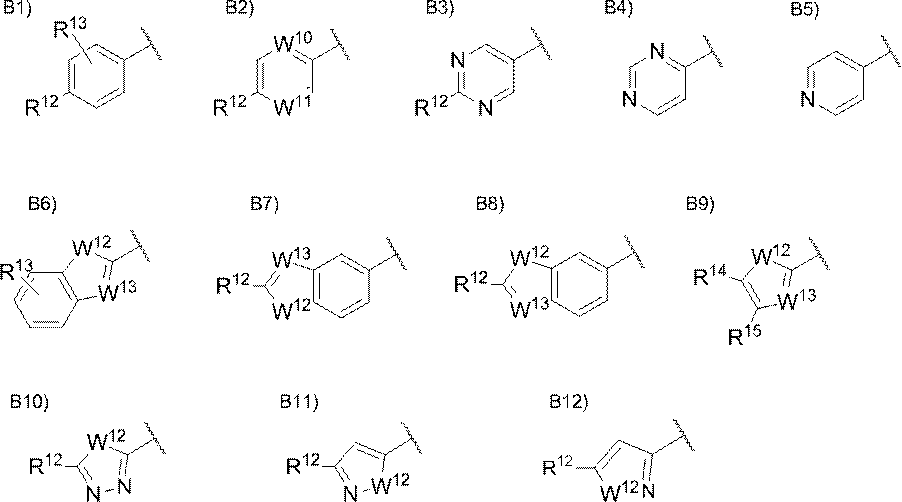
Ar1が、B2)、B3)、B7)、B8)、B10)、B11)またはB12)である場合、R12は、水素原子、ハロゲン原子、ヒドロキシ基、シアノ基、置換基を有しても良いC1~C6アルキル基、置換基を有しても良いC1~C6アルコキシ基、置換基を有しても良いC3~C6シクロアルキル基、置換基を有しても良いC3~C6シクロアルコキシ基、置換基を有しても良いC1~C6アシル基、置換基を有しても良いC2~C6アルケニル基、置換基を有しても良いC2~C6アルキニル基、C1~C6アルコキシカルボニル基、置換基を有しても良いC1~C6アルキルスルファニル基、置換基を有しても良いC1~C6アルキルスルフィニル基、置換基を有しても良いC1~C6アルキルスルホニル基、-CONR10R11、-NR10R11、アリールオキシ基、または置換基を有しても良い複素環基であり、R12が-CONR10R11または-NR10R11であるとき、R10は水素原子、置換基を有しても良いC1~C6アルキル基、置換基を有しても良いC1~C6アシル基、または置換基を有しても良いC1~C6アルキルスルホニル基であり、R11は水素原子、または置換基を有しても良いC1~C6アルキル基であるか、またはR10とR11が一緒になってC3~C10ヘテロシクロアルキル基を形成しており;
Ar1が、B1)である場合、R12は、水素原子、ハロゲン原子、ヒドロキシ基、シアノ基、置換基を有しても良いC1~C6アルキル基、置換基を有しても良いC1~C6アルコキシ基、置換基を有しても良いC3~C6シクロアルキル基、置換基を有しても良いC3~C6シクロアルコキシ基、置換基を有しても良いC1~C6アシル基、置換基を有しても良いC2~C6アルケニル基、置換基を有しても良いC2~C6アルキニル基、C1~C6アルコキシカルボニル基、置換基を有しても良いC1~C6アルキルスルファニル基、置換基を有しても良いC1~C6アルキルスルフィニル基、置換基を有しても良いC1~C6アルキルスルホニル基、-CONR10R11、-NR10R11、アリールオキシ基、置換基を有しても良い複素環基であり、R12が-CONR10R11または-NR10R11であるとき、R10は水素原子、置換基を有しても良いC1~C6アルキル基、置換基を有しても良いC1~C6アシル基、または置換基を有しても良いC1~C6アルキルスルホニル基であり、R11は水素原子、または置換基を有しても良いC1~C6アルキル基であるか、またはR10とR11が一緒になってC3~C10ヘテロシクロアルキル基を形成しており、R13は、水素原子、ハロゲン原子、ヒドロキシ基、シアノ基、またはC1~C6アルキル基であるか、またはR12とR13が一緒になってC3~C5アルキレン基または、C1~C2アルキレンジオキシ基を形成してもよく;
Ar1が、B6)である場合、R13は、水素原子、ハロゲン原子、ヒドロキシ基、シアノ基、またはC1~C6アルキル基であり;
Ar1が、B9)である場合、R14、R15は、独立して水素原子、ハロゲン原子、シアノ基、C1~C6アルキル基またはC1~C6アルコキシ基であり;
Ar1が、B2)である場合、W10およびW11は、一方が窒素原子であり、他方がCHまたは窒素原子であり;
Ar1が、B6)、B7)、B8)、B9)、B10)、B11)またはB12)である場合、W12は、酸素原子、硫黄原子、またはN-R16であり、W12がN-R16である場合、R16は水素原子またはC1~C6アルキル基であり;
Ar1が、B6)、B7)、B8)、またはB9)である場合、W13は、CHまたは窒素原子である、
請求項2記載の化合物、またはその薬理学的に許容される塩。 - Ar2が、A1)、A2)、A3)、A4)、またはA5)である場合、R6は、水素原子、ハロゲン原子、ヒドロキシ基、シアノ基、C1~C6アルキル基、C1~C6アルコキシ基、ハロC1~C6アルコキシ基、C1~C6アシル基、C1~C6アルキルスルファニル基、C1~C6アルキルスルフィニル基、C1~C6アルキルスルホニル基、置換基を有しても良い複素環基、-CONR10R11または-NR10R11であり、R6が-CONR10R11または-NR10R11である場合、R10は、水素原子、C1~C6アルキル基、C1~C6アシル基、またはC1~C6アルキルスルホニル基であり、R11は、水素原子またはC1~C6アルキル基であるか、またはR10とR11が一緒になってC3~C10ヘテロシクロアルキル基を形成しており;
Ar2が、A1)、A2)、A3)、A4)、A5)、A6)、A7)、A8)、A9)またはA10)である場合、R7は、水素原子、ハロゲン原子、C1~C6アルキル基またはC1~C6アルキコキシ基であり;
Ar2が、A1)、A7)、A8)またはA10)である場合、R8は、水素原子、ハロゲン原子またはC1~C6アルキル基であり;
Ar2が、A9)である場合、R9は、水素原子またはC1~C6アルキル基であり;
ただし、Ar2がA1)である場合にR6、R7及びR8の置換基の組み合わせが水素原子とハロゲン原子の場合を除く、請求項3記載の化合物、またはその薬理学的に許容される塩。 - R1は、水素原子、ヒドロキシ基、C1~C6アルキル基、C1~C6アルコキシ基、ハロC1~C6アルキル基、ヒドロキシC1~C6アルキル基、カルボキシC1~C6アルキル基、カルバモイルC1~C6アルキル基、モノC1~C6アルキルカルバモイルC1~C6アルキル基、ジC1~C6アルキルカルバモイルC1~C6アルキル基、アミノスルホニルC1~C6アルキル基、置換基を有しても良い芳香族ヘテロ環C1~C3アルキル基または置換基を有しても良いフェニルC1~C3アルキル基であり;
R2、R3は、それぞれ独立して水素原子、C1~C3アルキル基、またはR2とR3が一緒になったC2~C6アルキレン基であり;
Ar1が、B2)、B3)、B7)、B8)、B10)、B11)またはB12)である場合、R12は、水素原子、ハロゲン原子、ヒドロキシ基、シアノ基、C1~C6アルキル基、ハロC1~C6アルキル基、ヒドロキシC1~C6アルキル基、C1~C6アルコキシ基、C3~C6シクロアルキル基、C3~C6シクロアルコキシ基、C1~C6アシル基、C2~C6アルケニル基、C2~C6アルキニル基、C1~C6アルコキシカルボニル基、C1~C6アルキルスルファニル基、C1~C6アルキルスルフィニル基、C1~C6アルキルスルホニル基、-CONR10R11、-NR10R11、アリールオキシ基、置換基を有しても良い複素環基であり、R12が-CONR10R11または-NR10R11である場合、R10は、水素原子、C1~C6アルキル基、C1~C6アシル基、またはC1~C6アルキルスルホニル基であり、R11は、水素原子またはC1~C6アルキル基であるか、またはR10とR11が一緒になってC3~C10ヘテロシクロアルキル基を形成しており;
Ar1が、B1)である場合、R12は、水素原子、ハロゲン原子、ヒドロキシ基、シアノ基、C1~C6アルキル基、ハロC1~C6アルキル基、ヒドロキシC1~C6アルキル基、C1~C6アルコキシ基、C3~C6シクロアルキル基、C3~C6シクロアルコキシ基、C1~C6アシル基、C2~C6アルケニル基、C2~C6アルキニル基、C1~C6アルコキシカルボニル基、C1~C6アルキルスルファニル基、C1~C6アルキルスルフィニル基、C1~C6アルキルスルホニル基、-CONR10R11、-NR10R11、アリールオキシ基、置換基を有しても良い複素環基であり、R12が-CONR10R11または-NR10R11である場合、R10は水素原子、C1~C6アルキル基、C1~C6アシル基、またはC1~C6アルキルスルホニル基であり、R11は水素原子またはC1~C6アルキル基であるか、またはR10とR11が一緒になってC3~C10ヘテロシクロアルキル基を形成しており、R13は、水素原子、ハロゲン原子、ヒドロキシ基、シアノ基、またはC1~C6アルキル基であるか、またはR12とR13が一緒になってC3~C5アルキレン基または、C1~C2アルキレンジオキシ基を形成しており;
Xは、以下のa)、b)およびc):
a)酸素原子
b)NR4
c)NOR4
からなる群から選択される基であり、Xがb)またはc)である場合、R4は、水素原子、ヒドロキシC1~C6アルキル基、フェニル基、複素環基またはC1~C6アルキル基である、請求項4記載の化合物、またはその薬理学的に許容される塩。 - 式(I)中、Ar2がA1)、A2a)、A3)およびA7a):

Ar2がA2a)である場合、W2は、請求項2においてAr2がA2)である場合について定義したものと同義であり;
Ar2がA3)である場合、W4は、請求項2においてAr2がA3)である場合について定義したものと同義であり;
Ar2がA7a)である場合、W6は、請求項2においてAr2がA7)である場合について定義したものと同義であり;
Ar2がA1)、A2a)、A3)またはA7a)である場合、R7は、請求項4においてAr2がA1)、A2)、A3)またはA7)である場合について定義したものと同義であり;
Ar2がA1)またはA7a)である場合、R8は、請求項4においてAr2がA1)またはA7)である場合について定義したものと同義であり;
Ar2がA7a)である場合、mは、請求項2においてAr2がA7)である場合について定義したものと同義であり;
Ar2がA1)、A2a)、またはA3)である場合、R6は水素原子、ハロゲン原子、シアノ基、C1~C6アルキル基、C1~C6アルコキシ基、ハロC1~C6アルコキシ基、C1~C6アシル基、C1~C6アルキルスルファニル基、C1~C6アルキルスルフィニル基、-CONR10R11または-NR10R11であり、R6が-CONR10R11または-NR10R11である場合、R10は水素原子、C1~C6アルキル基、またはC1~C6アシル基であり、R11は水素原子、またはC1~C6アルキル基であるか、またはR10とR11が一緒になってピロリジニル基、ピペリジニル基、ピペラジニル基またはモルホリニル基を形成してもよく;
Ar2がA3)である場合、W3は、酸素原子または硫黄原子であり;
ただし、Ar2がA1)である場合にR6、R7及びR8の置換基の組み合わせが水素原子とハロゲン原子の場合を除く、請求項5記載の化合物、またはその薬理学的に許容される塩。 - 式(I)中、Ar1がB1)、B2)、B6a)、B9a)およびB9b):

Ar1がB6a)である場合、R13は、請求項3においてAr1がB6)である場合について定義したものと同義であり;
Ar1がB9a)またはB9b)である場合、R14、R15は、請求項3においてAr1がB9)である場合について定義したものと同義であり;
Ar1がB2)である場合、W10、W11は、請求項3においてAr1がB2)である場合について定義したものと同義であり;Ar1がB2)である場合、R12は、水素原子、ハロゲン原子、ヒドロキシ基、シアノ基、C1~C6アルキル基、ハロC1~C6アルキル基、ヒドロキシC1~C6アルキル基、C1~C6アルコキシ基、C3~C6シクロアルキル基、C3~C6シクロアルコキシ基、C1~C6アシル基、C2~C6アルケニル基、C1~C6アルコキシカルボニル基、C1~C6アルキルスルファニル基、C1~C6アルキルスルフィニル基、C1~C6アルキルスルホニル基、-CONR10R11、-NR10R11、アリールオキシ基、または置換基を有しても良い複素環基であり、R12が-CONR10R11または-NR10R11であるとき、R10は水素原子、C1~C6アルキル基、またはC1~C6アシル基であり、R11は、水素原子、またはC1~C6アルキル基であるか、またはR10とR11が一緒になってピロリジニル基、ピペリジニル基、ピペラジニル基またはモルホリニル基を形成してもよく;
Ar1がB1)である場合、R12は、水素原子、ハロゲン原子、ヒドロキシ基、シアノ基、C1~C6アルキル基、ハロC1~C6アルキル基、ヒドロキシC1~C6アルキル基、C1~C6アルコキシ基、C3~C6シクロアルキル基、C3~C6シクロアルコキシ基、C1~C6アシル基、C2~C6アルケニル基、C1~C6アルコキシカルボニル基、C1~C6アルキルスルファニル基、C1~C6アルキルスルフィニル基、C1~C6アルキルスルホニル基、-CONR10R11、-NR10R11、アリールオキシ基、または置換基を有しても良い複素環基であり、R12が-CONR10R11または-NR10R11であるとき、R10は水素原子、C1~C6アルキル基、またはC1~C6アシル基であり、R11は水素原子、またはC1~C6アルキル基であるか、またはR10とR11が一緒になってピロリジニル基、ピペリジニル基、ピペラジニル基またはモルホリニル基を形成してもよく、R13は、水素原子、ハロゲン原子、ヒドロキシ基、シアノ基、またはC1~C6アルキル基であるか、またはR12とR13が一緒になってC3~C5アルキレン基または、C1~C2アルキレンジオキシ基を形成してもよく;
Ar1がB6a)、B9a)またはB9b)である場合、W12は、酸素原子または硫黄原子である、請求項6記載の化合物、またはその薬理学的に許容される塩。 - 式(I)中、Ar2がA1a)、A2b)、A3a)およびA7b):

Ar2がA1a)である場合、R6は、請求項6においてAr2がA1)である場合について定義したものと同義であり;
Ar2がA1a)またはA7b)である場合、R8は、請求項4においてAr2がA1)またはA7)である場合について定義したものと同義であり;
Ar2がA7b)である場合、mは、請求項2においてAr2がA7)である場合について定義したものと同義であり;
R1は、水素原子、ヒドロキシ基、C1~C3アルキル基、C1~C3アルコキシ基、ヒドロキシC1~C4アルキル基、カルボキシC1~C3アルキル基、カルバモイルC1~C3アルキル基、モノC1~C2アルキルカルバモイルC1~C3アルキル基またはジC1~C2アルキルカルバモイルC1~C3アルキル基であり;
R2、R3は、それぞれ独立して水素原子またはC1~C3アルキル基であり;
Xがb)またはc)である場合、R4は、水素原子、ヒドロキシC1~C4アルキル基またはC1~C3アルキル基であり;
Ar2がA2b)またはA3a)である場合、R6aは、C1~C3アルコキシ基であり;
Ar2がA1a)、A2b)、A3a)またはA7b)である場合、R7は、水素原子、フッ素原子、塩素原子またはC1~C3アルキル基であり;
Ar2がA7b)である場合、W6は、C=O、CH2、CF2、CHOHまたは酸素原子であり;
ただし、Ar1がA1a)である場合にR6、R7及びR8の置換基の組み合わせが水素原子とハロゲン原子の場合を除く、請求項7記載の化合物、またはその薬理学的に許容される塩。 - 式(I)中、Ar2がA1a)、A2b)およびA7c):

Ar2がA2b)である場合、R6aは請求項8においてAr2がA2b)である場合について定義したものと同義であり;
Ar2がA1a)またはA7c)である場合、R8は、請求項4においてAr2がA1)またはA7)である場合について定義したものと同義であり;
Ar2がA7c)である場合、mは請求項8においてAr2がA7b)である場合について定義したものと同義であり;Ar2がA1a)である場合、R6は水素原子、フッ素原子、塩素原子、シアノ基、C1~C6アルキル基、C1~C6アルコキシ基、ハロC1~C6アルコキシ基、C1~C6アルキルスルファニル基、C1~C6アルキルスルフィニル基または-CONR10R11であり、R6が-CONR10R11であるとき、R10は水素原子、C1~C6アルキル基、またはC1~C6アシル基であり、R11は水素原子、またはC1~C6アルキル基であるか、またはR10とR11が一緒になってピロリジニル基、ピペリジニル基、ピペラジニル基またはモルホリニル基を形成してもよく、;
Ar2がA1a)、A2b)またはA7c)である場合、R7は、水素原子、フッ素原子または塩素原子であり;ただし、Ar2がA1a)である場合にR6、R7及びR8の置換基の組み合わせが水素原子とハロゲン原子の場合を除く、請求項8記載の化合物、またはその薬理学的に許容される塩。 - 式(I)中、Ar1がB1)、B2),B6b)、B9c)およびB9d):

R1は、水素原子、ヒドロキシ基、C1~C3アルキル基、C1~C3アルコキシ基またはヒドロキシC1~C4アルキル基であり;
Ar1がB1)またはB2)である場合、R12は、水素原子、フッ素原子、塩素原子、シアノ基、C1~C3アルキル基またはC1~C6アルコキシ基であり;
Ar1がB1)またはB6b)である場合、R13は、水素原子、ヒドロキシ基、フッ素原子または塩素原子であり;
Ar1がB9c)またはB9d)である場合、R14は、水素原子、フッ素原子、塩素原子、C1~C3アルキル基、メトキシ基またはエトキシ基であり;
Ar1がB9c)またはB9d)である場合、R15は、水素原子、フッ素原子または塩素原子であり;
Ar1がB2)である場合、W10、W11は、一方がNであり、もう片方がCHである、請求項9記載の化合物、または薬理学的に許容される塩。 - 式(I)中、Ar1がB1)、B6b)およびB9c1):

Ar1がB1)である場合、R12は請求項10においてAr1がB1)である場合について定義したものと同義であり;
Ar1がB1)またはB6b)である場合、R13は請求項10においてAr1がB1)またはB6b)である場合について定義したものと同義であり;
Ar1がB9c1)である場合、R14は請求項10においてAr1がB9c)である場合について定義したものと同義である、請求項10記載の化合物、またはその薬理学的に許容される塩。 - 式(I)中、Ar2がA1b)、A2b)およびA7c):

Ar2がA2b)である場合、R6aは請求項8においてAr2がA2b)である場合に定義したものと同義であり;
Ar2がA7c)である場合、mは請求項8においてAr2がA7b)である場合に定義したものと同義であり;
Ar2がA1b)である場合、R6は、シアノ基、エチル基またはC1~C3アルコキシ基であり;
R7は、フッ素原子または塩素原子であり;
Ar2がA1b)またはA7c)である場合、R8は、水素原子、フッ素原子、塩素原子またはC1~C3アルキル基である、請求項11記載の化合物、またはその薬理学的に許容される塩。 - 式(I)で表される化合物が、
(-)-1-(4-フルオロフェニル)-3-[(3S*,4R*)-4-(4-メトキシフェニル)-2-オキソピロリジン-3-イル]ウレア、
(-)-1-(4-クロロフェニル)-3-[(3S*,4R*)-4-(4-メトキシフェニル)-2-オキソピロリジン-3-イル]ウレア、
(-)-1-(3,4-ジフルオロフェニル)-3-[(3S*,4R*)-4-(4-メトキシフェニル)-2-オキソピロリジン-3-イル]ウレア、
(-)-1-(4-シアノフェニル)-3-[(3S*,4R*)-4-(4-メトキシフェニル)-2-オキソピロリジン-3-イル]ウレア、
(-)-1-(4-クロロフェニル)-3-[(3S*,4R*)-4-(4-メトキシフェニル)-1-メチル-2-オキソピロリジン-3-イル]ウレア、
(-)-1-(4-フルオロフェニル)-3-[(3S*,4R*)-4-(4-メトキシフェニル)-1-メチル-2-オキソピロリジン-3-イル]ウレア、
(-)-1-[(3S*,4R*)-4-(3-フルオロ―4-メトキシフェニル)-2-オキソピロリジン-3-イル]-3-(4-フルオロフェニル)ウレア、
(-)-1-[(3S*,4R*)-4-(2-フルオロ―4-メトキシフェニル)-2-オキソピロリジン-3-イル]-3-(4-フルオロフェニル)ウレア、
1-[(3S*,4R*)-4-(2-クロロ―4-メトキシフェニル)-2-オキソピロリジン-3-イル]-3-(4-フルオロフェニル)ウレア、
(-)-1-(4-フルオロフェニル)-3-[(3S*,4R*)-4-(4-メトキシ―2-メチルフェニル)-2-オキソピロリジン-3-イル]ウレア、
(-)-1-[(3S*,4R*)-4-(2,6-ジフルオロ―4-メトキシフェニル)-2-オキソピロリジン-3-イル]-3-(4-フルオロフェニル)ウレア、
(-)-1-[(3S*,4R*)-4-(2,5-ジフルオロ―4-メトキシフェニル)-2-オキソピロリジン-3-イル]-3-(4-フルオロフェニル)ウレア、
(-)-1-[(3S*,4R*)-4-(3,5-ジフルオロ―4-メトキシフェニル)-2-オキソピロリジン-3-イル]-3-(4-フルオロフェニル)ウレア、
(-)-1-[(3S*,4R*)-4-(6-フルオロ-2,3-ジヒドロベンゾフラン-5-イル)-2-オキソピロリジン-3-イル]-3-(4-フルオロフェニル)ウレア、
(-)-1-[(3S*,4R*)-4-(3-フルオロ-5-メトキシピリジン-2-イル)-2-オキソピロリジン-3-イル]-3-(4-フルオロフェニル)ウレア、
(-)-1-(4-フルオロフェニル)-3-[(3S*,4R*)-4-(5-メトキシチオフェン―2-イル)-2-オキソピロリジン-3-イル]ウレア、
(-)-1-(4-フルオロフェニル)-3-[(3S*,4R*)-4-(4-メチルチオフェニル)-2-オキソピロリジン-3-イル]ウレア、
(-)-1-(4-クロロフェニル)-3-[(3S*,4R*)-4-(2,6-ジフルオロ―4-メトキシフェニル)-2-オキソピロリジン-3-イル]ウレア、
(-)-1-(4-シアノフェニル)-3-[(3S*,4R*)-4-(2,6-ジフルオロ―4-メトキシフェニル)-2-オキソピロリジン-3-イル]ウレア、
(-)-1-[(3S*,4R*)-4-(2,6-ジフルオロ―4-メトキシフェニル)-2-オキソピロリジン-3-イル]-3-(4-メトキシフェニル)ウレア、
(-)-1-(5-クロロチアゾール-2-イル)-3-[(3S*,4R*)-4-(2,6-ジフルオロ―4-メトキシフェニル)-2-オキソピロリジン-3-イル]ウレア、
(-)-1-(6-クロロピリジン-3-イル)-3-[(3S*,4R*)-4-(2,6-ジフルオロ―4-メトキシフェニル)-2-オキソピロリジン-3-イル]ウレア、
(-)-1-(5-クロロピリジン-2-イル)-3-[(3S*,4R*)-4-(2,6-ジフルオロ―4-メトキシフェニル)-2-オキソピロリジン-3-イル]ウレア、
(-)-1-(ベンゾ[b]チオフェン-2-イル)-3-[(3S*,4R*)-4-
(2,6-ジフルオロ―4-メトキシフェニル)-2-オキソピロリジン-3-イル]ウレア、
(-)-1-[(3S*,4R*)-4-(2,6-ジフルオロ―4-メトキシフェニル)-2-オキソピロリジン-3-イル]-3-(5-メチルチオフェン-2-イル)ウレア、
(-)-1-(4-フルオロフェニル)-3-[(3S*,4R*,5S*)-4-(4-メトキシフェニル)-5-メチル-2-オキソピロリジン-3-イル]ウレア、
(-)-1-(4-フルオロフェニル)-3-[(3S*,4R*,5R*)-4-(4-メトキシフェニル)-5-メチル-2-オキソピロリジン-3-イル]ウレア、
(+)-1-(4-クロロフェニル)-3-[(3R*,4S*)-2-オキソ-4-フェニルピロリジン-3-イル]ウレア、
(±)-トランス-1-(4-クロロフェニル)-3-[4-(4-メトキシフェニル)-1-メチル-2-オキソピロリジン-3-イル]ウレア、
(±)-トランス-1-(4-フルオロフェニル)-3-[4-(4-メトキシフェニル)-2-オキソピロリジン-3-イル]ウレア、
(±)-トランス-1-(4-クロロフェニル)-3-[4-(4-メトキシフェニル)-1-メチル-2-オキソピロリジン-3-イル]ウレア、
(-)-1-[(3S*,4R*)-4-(2,6-ジフルオロ―4-メトキシフェニル)-2-オキソピロリジン-3-イル]-3-[4-(トリフルオロメトキシ)フェニル]ウレア、
(-)-1-[(3S*,4R*)-4-(2,6-ジフルオロ―4-メトキシフェニル)-2-オキソピロリジン-3-イル]-3-フェニルウレア、
(-)-1-[(3S*,4R*)-4-(2,6-ジフルオロ―4-メトキシフェニル)-2-オキソピロリジン-3-イル]-3-(4-フェノキシフェニル)ウレア、
(-)-1-[(3S*,4R*)-4-(2,6-ジフルオロ―4-メトキシフェニル)-2-オキソピロリジン-3-イル]-3-(3-フルオロフェニル)ウレア、
(-)-1-[(3S*,4R*)-4-(2,6-ジフルオロ―4-メトキシフェニル)-2-オキソピロリジン-3-イル]-3-(3,4-ジフルオロフェニル)ウレア、
(-)-1-(5-クロロチオフェン-2-イル)-3-[(3S*,4R*)-4-(2,6-ジフルオロ―4-メトキシフェニル)-2-オキソピロリジン-3-イル]ウレア、
(-)-1-[(3S*,4R*)-4-(2,6-ジフルオロ―4-メトキシフェニル)-2-オキソピロリジン-3-イル]-3-(p-トリル)ウレア、
(-)-1-[(3S*,4R*)-1-エチル-4-(4-メトキシフェニル)-2-オキソピロリジン-3-イル]-3-(4-フルオロフェニル)ウレア、
(-)-1-(4-フルオロフェニル)-3-[(3S*,4R*)-1-(1-ヒドロキシ-2-メチルプロパン-2-イル)-4-(4-メトキシフェニル)-2-オキソピロリジン-3-イル]ウレア、
(±)-トランス-1-(4-クロロフェニル)-3-[1-(2-ヒドロキシエチル)-4-(4-メトキシフェニル)-2-オキソピロリジン-3-イル]ウレア、
(+)-トランス-1-(4-クロロフェニル)-3-[1-(2-ヒドロキシエチル)-4-(4-メトキシフェニル)-2-オキソピロリジン-3-イル]ウレア、
(-)-トランス-1-(4-クロロフェニル)-3-[1-(2-ヒドロキシエチル)-4-(4-メトキシフェニル)-2-オキソピロリジン-3-イル]ウレア、
(-)-2-{(3S*,4R*)-3-[3-(4-フルオロフェニル)ウレイド]-4-(4-メトキシフェニル)-2-オキソピロリジン-1-イル}-N-メチルアセトアミド、
(-)-2-{(3S*,4R*)-3-[3-(4-フルオロフェニル)ウレイド]-4-(4-メトキシフェニル)-2-オキソピロリジン-1-イル}プロピオン酸(異性体A)、
(-)-2-{(3S*,4R*)-3-[3-(4-フルオロフェニル)ウレイド]-4-(4-メトキシフェニル)-2-オキソピロリジン-1-イル}-N-メチルプロピオン酸アミド(異性体A)、
(-)-2-{(3S*,4R*)-3-[3-(4-フルオロフェニル)ウレイド]-4-(4-メトキシフェニル)-2-オキソピロリジン-1-イル}プロピオン酸(異性体B)、
(-)-2-{(3S*,4R*)-3-[3-(4-フルオロフェニル)ウレイド]-4-(4-メトキシフェニル)-2-オキソピロリジン-1-イル}-N-メチルプロピオン酸アミド(異性体B)、
(-)-2-{(3S*,4R*)-3-[3-(4-フルオロフェニル)ウレイド]-4-(4-メトキシフェニル)-2-オキソピロリジン-1-イル}-N,2-ジメチルプロピオン酸アミド、
(-)-1-[(3S*,4R*)-4-(2,6-ジフルオロ―4-メトキシフェニル)-1-メチル-2-オキソピロリジン-3-イル]-3-(4-フルオロフェニル)ウレア、
(-)-1-[(3S*,4R*)-4-(2-フルオロ―4-メトキシフェニル)-1-(2-ヒドロキシエチル)-2-オキソピロリジン-3-イル]-3-(4-フルオロフェニル)ウレア、
(-)-1-[(3S*,4R*)-4-(2,6-ジフルオロ―4-メトキシフェニル)-1-(2-ヒドロキシエチル)-2-オキソピロリジン-3-イル]-3-(4-フルオロフェニル)ウレア、
(+)-1-(4-フルオロフェニル)-3-[(3R*,4S*)-1-メトキシ-4-(4-メトキシフェニル)-2-オキソピロリジン-3-イル]ウレア、
(-)-3,5-ジフルオロ-4-{(3R*,4S*)-4-[3-(4-フルオロフェニル)ウレイド]-5-オキソピロリジン-3-イル}ベンズアミド、
(-)-1-(4-フルオロフェニル)-3-[(3S*,4R*,Z)-2-(メトキシイミノ)-4-(4-メトキシフェニル)ピロリジン-3-イル]ウレア、
(-)-1-[(3S*,4R*,Z)-4-(2-フルオロ-4-メトキシフェニル)-2-(メトキシイミノ)ピロリジン-3-イル]-3-(4-フルオロフェニル)ウレア、
(-)-1-[(3S*,4R*,Z)-4-(2,6-ジフルオロ-4-メトキシフェニル)-2-(メトキシイミノ)ピロリジン-3-イル]-3-(4-フルオロフェニル)ウレア、
(-)-1-(4-フルオロフェニル)-3-{(3S*,4R*,Z)-2-[(2-ヒドロキシエトキシ)イミノ]-4-(4-メトキシフェニル)ピロリジン-3-イル}ウレア、
(-)-1-{(3S*,4R*,Z)-4-(2,6-ジフルオロ-4-メトキシフェニル)-2-[(2-ヒドロキシエトキシ)イミノ]ピロリジン-3-イル}-3-(4-フルオロフェニル)ウレア、
(-)-1-[(3S*,4R*,Z)-4-(2,6-ジフルオロ-4-メトキシフェニル)-2-(メチルイミノ)ピロリジン-3-イル]-3-(4-フルオロフェニル)ウレア、
(-)-1-(4-フルオロフェニル)-3-[(3S*,4R*,Z)-2-(2-ヒドロキシイミノ)-4-(4-メトキシフェニル)ピロリジン-3-イル]ウレア、
(-)-1-[(3S*,4R*)-4-(2,6-ジフルオロ―4-メトキシフェニル)-2-オキソピロリジン-3-イル]-3-(3-ヒドロキシ-4-メチルフェニル)ウレア、
(-)-1-[(3S*,4R*)-4-(2,6-ジフルオロ―4-メトキシフェニル)-2-オキソピロリジン-3-イル]-3-(4-フルオロ-3-ヒドロキシフェニル)ウレア、
(-)-1-(4-クロロ-3-ヒドロキシフェニル)-3-[(3S*,4R*)-4-(2,6-ジフルオロ―4-メトキシフェニル)-2-オキソピロリジン-3-イル]ウレア、
(-)-1-(4-シアノフェニル)-3-[(3S*,4R*)-4-(6-フルオロ-2,3-ジヒドロベンゾフラン-5-イル)-2-オキソピロリジン-3-イル]ウレア、
(-)-1-{(3S*,4R*,Z)-4-(2,6-ジフルオロ-4-メトキシフェニル)-2-[(2-ヒドロキシエトキシ)イミノ]ピロリジン-3-イル}-3-(p-トリル)ウレア、または
(-)-1-[(3S*,4R*)-4-(2,6-ジフルオロ-4-メトキシフェニル)-1-(2-ヒドロキシエチル)-2-オキソピロリジン-3-イル]-3-フェニルウレアである、請求項1記載の化合物、またはその薬理学的に許容される塩。 - 請求項1から13のいずれか1項に記載の化合物、またはその薬理学的に許容される塩を有効成分として含有する医薬。
- 請求項1から13のいずれか1項に記載の化合物、またはその薬理学的に許容される塩を有効成分として含有するFPRL1作動薬。
- 請求項1から13のいずれか1項に記載の化合物、またはその薬理学的に許容される塩を投与する炎症性疾患、慢性気道疾患、がん、敗血症、アレルギー性症状、HIVレトロウイルス感染、循環器障害、神経炎症、神経障害、疼痛、プリオン病、アミロイド症、免疫障害の治療又は予防方法。
- 炎症性疾患、慢性気道疾患、がん、敗血症、アレルギー性症状、HIVレトロウイルス感染、循環器障害、神経炎症、神経障害、疼痛、プリオン病、アミロイド症、免疫障害の治療又は予防のための医薬を製造するための請求項1から13のいずれか1項に記載の化合物、またはその薬理学的に許容される塩の使用。
- 炎症性疾患、慢性気道疾患、がん、敗血症、アレルギー性症状、HIVレトロウイルス感染、循環器障害、神経炎症、神経障害、疼痛、プリオン病、アミロイド症、免疫障害の予防または治療に使用するための、請求項1から13のいずれか1項に記載の化合物、またはその薬理学的に許容される塩及び薬学的に許容されうる担体を含有する医薬組成物。
Priority Applications (35)
| Application Number | Priority Date | Filing Date | Title |
|---|---|---|---|
| CA2932010A CA2932010C (en) | 2013-11-28 | 2014-11-27 | Urea derivative or pharmacologically acceptable salt thereof |
| KR1020167014901A KR102252270B1 (ko) | 2013-11-28 | 2014-11-27 | 우레아 유도체 또는 그의 약리학적으로 허용되는 염 |
| SM20180061T SMT201800061T1 (it) | 2013-11-28 | 2014-11-27 | Derivati dell'urea o loro sali farmacologicamente accettabili utili come io agonisti del recettore del peptide formile di tipo i (fprl-1) |
| LTEP14865553.3T LT3075726T (lt) | 2013-11-28 | 2014-11-27 | Karbamido dariniai arba farmakologiniu požiūriu priimtinos jų druskos, naudotini kaip formilpeptido receptoriaus tipo 1 (fprl-1) agonistai |
| SI201430579T SI3075726T1 (en) | 2013-11-28 | 2014-11-27 | DERIVATIVES OF UREA OR ITS PHARMACOLOGICAL RECRUITABLE SALTS USED AS FORMIL PEPTIDAL RECEPTOR LIKE 1 (FPRL-1) AGONISTS |
| NO14865553A NO3075726T3 (ja) | 2013-11-28 | 2014-11-27 | |
| MX2016006500A MX367193B (es) | 2013-11-28 | 2014-11-27 | Derivado de urea o sal farmacologicamente aceptable del mismo. |
| MA39069A MA39069B1 (fr) | 2013-11-28 | 2014-11-27 | Dérivé d'urée ou sel pharmacologiquement acceptable de celui-ci |
| ES14865553.3T ES2659156T3 (es) | 2013-11-28 | 2014-11-27 | Derivados de urea o sales farmacológicamente aceptables de los mismos útiles como agonistas del receptor de péptido formilado 1 (FRPL-1) |
| US15/039,964 US9822069B2 (en) | 2013-11-28 | 2014-11-27 | Urea derivative or pharmacologically acceptable salt thereof |
| EA201691119A EA030474B1 (ru) | 2013-11-28 | 2014-11-27 | Производные мочевины или их фармакологически приемлемые соли |
| EP14865553.3A EP3075726B1 (en) | 2013-11-28 | 2014-11-27 | Urea derivatives or pharmacologically acceptable salts thereof useful as formyl peptide receptor like 1 (fprl-1) agonists |
| TN2016000210A TN2016000210A1 (en) | 2013-11-28 | 2014-11-27 | Urea derivative or pharmacologically acceptable salt thereof. |
| RS20180121A RS57036B1 (sr) | 2013-11-28 | 2014-11-27 | Urea derivati ili njihove farmakološki prihvatljive soli korisni kao agonisti formil peptidnom receptoru-sličnom 1 (fprl-1) |
| CN201480064964.0A CN105814019B (zh) | 2013-11-28 | 2014-11-27 | 脲衍生物、或其药理学上所容许的盐 |
| PL14865553T PL3075726T3 (pl) | 2013-11-28 | 2014-11-27 | Pochodne mocznika lub ich farmakologicznie akceptowalne sole przydatne jako agoniści receptora peptydów formylowanych podobnego 1 (FPRL-1) |
| DK14865553.3T DK3075726T3 (en) | 2013-11-28 | 2014-11-27 | URE ADDITIVES OR PHARMACOLOGICAL ACCEPTABLE SALTS THEREOF USE AS FORMYLPEPTIDE RECEPTOR LIKE 1- (FPRL-1) AGONISTS |
| SG11201604296QA SG11201604296QA (en) | 2013-11-28 | 2014-11-27 | Urea derivative or pharmacologically acceptable salt thereof |
| EP17196539.5A EP3305763B1 (en) | 2013-11-28 | 2014-11-27 | Deuterated or isotopically labeled urea derivatives or pharmacologically acceptable salts thereof useful as fprl-1 agonists |
| NZ720508A NZ720508A (en) | 2013-11-28 | 2014-11-27 | Urea derivative or pharmacologically acceptable salt thereof |
| BR112016011755-7A BR112016011755B1 (pt) | 2013-11-28 | 2014-11-27 | Derivado de ureia ou sal farmacologicamente aceitável do mesmo, seu uso e composição farmacêutica que os compreende |
| JP2015550566A JP6453231B2 (ja) | 2013-11-28 | 2014-11-27 | ウレア誘導体、またはその薬理学的に許容される塩 |
| HRP20180199TT HRP20180199T1 (hr) | 2013-11-28 | 2014-11-27 | Urea derivati ili njihove farmakološki prihvatljive soli korisni kao agonisti formil peptidnom receptoru-sličnom i (fprl-1) |
| AU2014355887A AU2014355887B2 (en) | 2013-11-28 | 2014-11-27 | Urea derivative or pharmacologically acceptable salt thereof |
| PH12016500806A PH12016500806B1 (en) | 2013-11-28 | 2016-04-29 | Urea derivative or pharmacologically acceptable salt thereof |
| IL245823A IL245823B (en) | 2013-11-28 | 2016-05-24 | Urea derivative or acceptable pharmaceutical salt |
| SA516371205A SA516371205B1 (ar) | 2013-11-28 | 2016-05-26 | مشتق يوريا أو ملح مقبول دوائياً منه |
| ZA2016/03624A ZA201603624B (en) | 2013-11-28 | 2016-05-27 | Urea derivative or pharmacologically acceptable salt thereof |
| US15/724,002 US10029983B2 (en) | 2013-11-28 | 2017-10-03 | Urea derivative or pharmacologically acceptable salt thereof |
| CY20181100158T CY1120089T1 (el) | 2013-11-28 | 2018-02-08 | Παραγωγα ουριας ή φαρμακολογικως αποδεκτα αλατα εξ' αυτων χρησιμα ως αγωνιστες του παρομοιου με υποδοχεα πεπτιδιου φορμυλιου 1(fprl-1) |
| US16/011,050 US10252992B2 (en) | 2013-11-28 | 2018-06-18 | Urea derivative or pharmacologically acceptable salt thereof |
| US16/270,363 US10464891B2 (en) | 2013-11-28 | 2019-02-07 | Urea derivative or pharmacologically acceptable salt thereof |
| AU2019203119A AU2019203119B2 (en) | 2013-11-28 | 2019-05-03 | Urea derivative or pharmacologically acceptable salt thereof |
| US16/580,909 US10696630B2 (en) | 2013-11-28 | 2019-09-24 | Urea derivative or pharmacologically acceptable salt thereof |
| US16/880,443 US11261155B2 (en) | 2013-11-28 | 2020-05-21 | Urea derivative or pharmacologically acceptable salt thereof |
Applications Claiming Priority (2)
| Application Number | Priority Date | Filing Date | Title |
|---|---|---|---|
| JP2013245502 | 2013-11-28 | ||
| JP2013-245502 | 2013-11-28 |
Related Child Applications (2)
| Application Number | Title | Priority Date | Filing Date |
|---|---|---|---|
| US15/039,964 A-371-Of-International US9822069B2 (en) | 2013-11-28 | 2014-11-27 | Urea derivative or pharmacologically acceptable salt thereof |
| US15/724,002 Continuation US10029983B2 (en) | 2013-11-28 | 2017-10-03 | Urea derivative or pharmacologically acceptable salt thereof |
Publications (1)
| Publication Number | Publication Date |
|---|---|
| WO2015079692A1 true WO2015079692A1 (ja) | 2015-06-04 |
Family
ID=53198654
Family Applications (1)
| Application Number | Title | Priority Date | Filing Date |
|---|---|---|---|
| PCT/JP2014/005933 Ceased WO2015079692A1 (ja) | 2013-11-28 | 2014-11-27 | ウレア誘導体、またはその薬理学的に許容される塩 |
Country Status (35)
| Country | Link |
|---|---|
| US (6) | US9822069B2 (ja) |
| EP (2) | EP3075726B1 (ja) |
| JP (3) | JP6453231B2 (ja) |
| KR (1) | KR102252270B1 (ja) |
| CN (1) | CN105814019B (ja) |
| AU (2) | AU2014355887B2 (ja) |
| BR (1) | BR112016011755B1 (ja) |
| CA (1) | CA2932010C (ja) |
| CL (1) | CL2016001283A1 (ja) |
| CY (1) | CY1120089T1 (ja) |
| DK (1) | DK3075726T3 (ja) |
| EA (1) | EA030474B1 (ja) |
| ES (2) | ES2752733T3 (ja) |
| HR (1) | HRP20180199T1 (ja) |
| HU (1) | HUE036497T2 (ja) |
| IL (1) | IL245823B (ja) |
| LT (1) | LT3075726T (ja) |
| MA (1) | MA39069B1 (ja) |
| MX (1) | MX367193B (ja) |
| MY (1) | MY179516A (ja) |
| NO (1) | NO3075726T3 (ja) |
| NZ (2) | NZ752095A (ja) |
| PE (1) | PE20161206A1 (ja) |
| PH (1) | PH12016500806B1 (ja) |
| PL (1) | PL3075726T3 (ja) |
| PT (1) | PT3075726T (ja) |
| RS (1) | RS57036B1 (ja) |
| SA (1) | SA516371205B1 (ja) |
| SG (1) | SG11201604296QA (ja) |
| SI (1) | SI3075726T1 (ja) |
| SM (1) | SMT201800061T1 (ja) |
| TN (1) | TN2016000210A1 (ja) |
| TW (1) | TWI649305B (ja) |
| WO (1) | WO2015079692A1 (ja) |
| ZA (1) | ZA201603624B (ja) |
Cited By (13)
| Publication number | Priority date | Publication date | Assignee | Title |
|---|---|---|---|---|
| WO2016189876A1 (en) * | 2015-05-27 | 2016-12-01 | Kyorin Pharmaceutical Co., Ltd. | Urea derivative or pharmacologically acceptable salt thereof |
| WO2018054549A1 (en) | 2016-09-21 | 2018-03-29 | Grünenthal GmbH | 6-membered cyclic amines or lactames substituted with urea and phenyl |
| WO2018092916A1 (ja) * | 2016-11-21 | 2018-05-24 | 宇部興産株式会社 | 含窒素多環式ヘテロ環誘導体 |
| CN108368046A (zh) * | 2015-12-10 | 2018-08-03 | 百时美施贵宝公司 | 哌啶酮甲酰肽2受体和甲酰肽1受体激动剂 |
| WO2018217684A1 (en) | 2017-05-22 | 2018-11-29 | Bristol-Myers Squibb Company | Novel use of a formyl peptide receptor 2/ lipoxin a4 receptor (fpr2/alx) agonist for treatment of heart failure |
| WO2018227067A1 (en) | 2017-06-09 | 2018-12-13 | Bristol-Myers Squibb Company | Cyclopropyl urea formyl peptide 2 receptor and formyl peptide 1 receptor agonists |
| WO2019170904A1 (en) | 2018-03-09 | 2019-09-12 | Grünenthal GmbH | Piperidines or piperidones substituted with urea and phenyl |
| EP3789378A1 (en) | 2019-09-06 | 2021-03-10 | Grünenthal GmbH | Piperidines or piperidones substituted with urea and heteroaryl |
| US11008301B2 (en) * | 2017-06-09 | 2021-05-18 | Bristol-Myers Squibb Company | Piperidinone formyl peptide 2 receptor agonists |
| JP2021516240A (ja) * | 2018-03-05 | 2021-07-01 | ブリストル−マイヤーズ スクイブ カンパニーBristol−Myers Squibb Company | フェニルピロリジノンホルミルペプチド2受容体アゴニスト |
| JP2022508218A (ja) * | 2018-11-26 | 2022-01-19 | ブリストル-マイヤーズ スクイブ カンパニー | ピラゾロンホルミルペプチド2受容体アゴニスト |
| JP2023533037A (ja) * | 2020-07-09 | 2023-08-01 | ブリストル-マイヤーズ スクイブ カンパニー | オキソピロリジン fpr2アゴニスト |
| JP2023537410A (ja) * | 2020-08-12 | 2023-08-31 | ブリストル-マイヤーズ スクイブ カンパニー | オキソピロリジン尿素fpr2アゴニスト |
Families Citing this family (9)
| Publication number | Priority date | Publication date | Assignee | Title |
|---|---|---|---|---|
| ES2752733T3 (es) * | 2013-11-28 | 2020-04-06 | Kyorin Seiyaku Kk | Derivados de urea deuterados o marcados isotópicamente o sales farmacológicamente aceptables de los mismos útiles como agonistas de FPRL-1 |
| CA3049856C (en) * | 2017-01-13 | 2021-10-26 | Tobishi Pharmaceutical Co., Ltd. | Neutrophil activation regulator |
| KR102623473B1 (ko) | 2017-06-09 | 2024-01-09 | 브리스톨-마이어스 스큅 컴퍼니 | 피페리디논 포르밀 펩티드 2 수용체 및 포르밀 펩티드 1 수용체 효능제 |
| CN110997653B (zh) * | 2017-06-09 | 2023-06-06 | 百时美施贵宝公司 | 芳基杂环哌啶酮甲酰肽2受体和甲酰肽1受体激动剂 |
| EP3880655A1 (en) | 2018-11-16 | 2021-09-22 | Bristol-Myers Squibb Company | Synthetic processes for the production of 1-((3s,4r)-4-(2,6-difluoro-4-methoxyphenyl)-2-oxopyrrolidin-3-yl)-3-phenylurea |
| IL299680A (en) | 2020-07-09 | 2023-03-01 | Bristol Myers Squibb Co | Pyrazolone formyl peptide 2 receptor agonists |
| US12479854B2 (en) | 2021-07-29 | 2025-11-25 | Enanta Pharmaceuticals, Inc. | Spiropyrrolidine derived antiviral agents |
| EP4508980A3 (en) | 2021-12-15 | 2025-07-16 | Adama Agan Ltd. | Compounds useful for the preparation of various agrochemicals and markers thereof |
| WO2025217248A1 (en) * | 2024-04-11 | 2025-10-16 | Corteva Agriscience Llc | Formulations containing substituted 5-membered ring pesticides and methods of use |
Citations (15)
| Publication number | Priority date | Publication date | Assignee | Title |
|---|---|---|---|---|
| US13001A (en) | 1855-06-05 | Method of composing- music | ||
| WO2005047899A2 (en) | 2003-11-07 | 2005-05-26 | Acadia Pharmaceuticals Inc. | Use of the lipoxin receptor, fprl1, as a tool for identifying compounds effective in the treatment of pain and inflammation |
| WO2009077990A1 (en) | 2007-12-18 | 2009-06-25 | Actelion Pharmaceuticals Ltd | Aminotriazole derivatives as alx agonists |
| WO2009077954A1 (en) | 2007-12-14 | 2009-06-25 | Actelion Pharmaceuticals Ltd | Aminopyrazole derivatives |
| WO2010032856A1 (ja) * | 2008-09-19 | 2010-03-25 | 武田薬品工業株式会社 | 含窒素複素環化合物およびその用途 |
| WO2010143158A1 (en) | 2009-06-12 | 2010-12-16 | Actelion Pharmaceuticals Ltd | Oxazole and thiazole derivatives as alx receptor agonists |
| WO2011163502A1 (en) | 2010-06-24 | 2011-12-29 | Allergan, Inc. | Derivatives of cycloalkyl- and cycloalkenyl-1,2-dicarboxylic acid compounds having formyl peptide receptor like-1 (fprl-1) agonist or antagonist activity |
| WO2012066488A2 (en) | 2010-11-17 | 2012-05-24 | Actelion Pharmaceuticals Ltd | Bridged spiro[2.4]heptane ester derivatives |
| WO2012074785A1 (en) | 2010-12-03 | 2012-06-07 | Allergan, Inc. | Pharmaceutical compositions comprising 3,4- dihydroisoquinolin-2(1 h)-yl-3-phenylurea derivatives having formyl peptide receptor like-1 (fprl-1) agonist or antagonist activity |
| WO2012077049A1 (en) | 2010-12-07 | 2012-06-14 | Actelion Pharmaceuticals Ltd | Oxazolyl-methylether derivatives as alx receptor agonists |
| WO2012077051A1 (en) | 2010-12-07 | 2012-06-14 | Actelion Pharmaceuticals Ltd | Hydroxylated aminotriazole derivatives as alx receptor agonists |
| WO2012109544A1 (en) | 2011-02-11 | 2012-08-16 | Allergan, Inc. | Novel 1-(1-oxo-1,2,3,4-tetrahydroisoquinolin-7-yl)urea derivatives as n-formyl peptide receptor like-1 (fprl-1) receptor modulators |
| WO2012125305A1 (en) | 2011-03-17 | 2012-09-20 | Allergan, Inc. | Dihydronaphthalene and naphthalene derivatives as n-formyl peptide receptor like-1 (fprl-1) receptor modulators |
| WO2013062947A1 (en) | 2011-10-26 | 2013-05-02 | Allergan, Inc. | Amide derivatives of n-urea substituted amino acids as formyl peptide receptor like-1 (fprl-1) receptor modulators |
| WO2013071203A1 (en) * | 2011-11-10 | 2013-05-16 | Allergan, Inc. | 2,5-dioxoimidazolidin-1-yl-3-phenylurea derivatives as formyl peptide receptor like-1 (fprl-1) receptor modulators |
Family Cites Families (19)
| Publication number | Priority date | Publication date | Assignee | Title |
|---|---|---|---|---|
| US5202344A (en) | 1990-12-11 | 1993-04-13 | G. D. Searle & Co. | N-substituted lactams useful as cholecystokinin antagonists |
| CN1894580A (zh) * | 2003-11-07 | 2007-01-10 | 阿卡蒂亚药品公司 | 脂氧素受体fprl1作为一种用于鉴定能有效治疗疼痛和炎症化合物的工具 |
| CN100506802C (zh) * | 2004-06-04 | 2009-07-01 | 中国科学院上海药物研究所 | 一类甲酰肽样受体-1调节剂、其制备方法和用途 |
| US20070123508A1 (en) | 2005-05-27 | 2007-05-31 | Roger Olsson | PAR2-modulating compounds and their use |
| US7881231B2 (en) | 2009-02-13 | 2011-02-01 | Microsoft Corporation | Detection of home network configuration problems |
| BRPI1007995A2 (pt) | 2009-02-23 | 2019-09-24 | Hoffmann La Roche | orto-aminoamidas para o tratamento de cãncer. |
| CA2835835C (en) | 2011-05-13 | 2019-04-02 | Array Biopharma Inc. | Pyrrolidinyl urea and pyrrolidinyl thiourea compounds as trka kinase inhibitors |
| EP2731931A1 (en) | 2011-07-11 | 2014-05-21 | Allergan, Inc. | Polycyclic pyrrolidine-2,5-dione derivatives as -formyl peptide receptor like-1 (fprl-1) receptor modulators |
| US8541577B2 (en) | 2011-11-10 | 2013-09-24 | Allergan, Inc. | Aryl urea derivatives as N-formyl peptide receptors like-1 (FPRL-1) receptor modulators |
| SG11201406629VA (en) | 2012-04-16 | 2014-11-27 | Allergan Inc | (2-ureidoacetamido)alkyl derivatives as formyl peptide receptor 2 modulators |
| WO2014078372A1 (en) | 2012-11-13 | 2014-05-22 | Array Biopharma Inc. | Pyrrolidinyl urea, thiourea, guanidine and cyanoguanidine compounds as trka kinase inhibitors |
| WO2014078378A1 (en) | 2012-11-13 | 2014-05-22 | Array Biopharma Inc. | Pyrrolidinyl urea, thiourea, guanidine and cyanoguanidine compounds as trka kinase inhibitors |
| MX374242B (es) | 2012-11-13 | 2025-03-05 | Array Biopharma Inc | Compuestos de n-pirrolidinil, n' -pirazolil-urea, tiourea, guanidina y cianoguanidina como inhibidores de trka cinasa. |
| WO2015009545A1 (en) | 2013-07-16 | 2015-01-22 | Allergan, Inc. | Derivatives of n-urea substituted amino acids as formyl peptide receptor modulators |
| AR097279A1 (es) | 2013-08-09 | 2016-03-02 | Actelion Pharmaceuticals Ltd | Derivados de benzimidazolil-metil urea como agonistas del receptor de alx |
| ES2752733T3 (es) * | 2013-11-28 | 2020-04-06 | Kyorin Seiyaku Kk | Derivados de urea deuterados o marcados isotópicamente o sales farmacológicamente aceptables de los mismos útiles como agonistas de FPRL-1 |
| MX2016007259A (es) | 2013-12-03 | 2016-08-04 | Du Pont | Pirrolidinonas como herbicidas. |
| MA40434B1 (fr) | 2014-05-15 | 2019-09-30 | Array Biopharma Inc | 1-((3s,4r)-4-(3-fluorophényl)-1-(2-méthoxyéthyl)pyrrolidin-3-yl)-3-(4-méthyl-3-(2-méthylpyrimidin-5-yl)-1-phényl-1h-pyrazol-5-yl)urée comme inhibiteur de la kinase trka |
| CA2974784A1 (en) | 2015-01-23 | 2016-07-28 | Gvk Biosciences Private Limited | Inhibitors of trka kinase |
-
2014
- 2014-11-27 ES ES17196539T patent/ES2752733T3/es active Active
- 2014-11-27 TW TW103141341A patent/TWI649305B/zh active
- 2014-11-27 RS RS20180121A patent/RS57036B1/sr unknown
- 2014-11-27 WO PCT/JP2014/005933 patent/WO2015079692A1/ja not_active Ceased
- 2014-11-27 TN TN2016000210A patent/TN2016000210A1/en unknown
- 2014-11-27 NZ NZ752095A patent/NZ752095A/en not_active IP Right Cessation
- 2014-11-27 MX MX2016006500A patent/MX367193B/es active IP Right Grant
- 2014-11-27 JP JP2015550566A patent/JP6453231B2/ja active Active
- 2014-11-27 CN CN201480064964.0A patent/CN105814019B/zh active Active
- 2014-11-27 LT LTEP14865553.3T patent/LT3075726T/lt unknown
- 2014-11-27 BR BR112016011755-7A patent/BR112016011755B1/pt active IP Right Grant
- 2014-11-27 MY MYPI2016701933A patent/MY179516A/en unknown
- 2014-11-27 SI SI201430579T patent/SI3075726T1/en unknown
- 2014-11-27 HR HRP20180199TT patent/HRP20180199T1/hr unknown
- 2014-11-27 PE PE2016000697A patent/PE20161206A1/es unknown
- 2014-11-27 HU HUE14865553A patent/HUE036497T2/hu unknown
- 2014-11-27 KR KR1020167014901A patent/KR102252270B1/ko active Active
- 2014-11-27 AU AU2014355887A patent/AU2014355887B2/en active Active
- 2014-11-27 SM SM20180061T patent/SMT201800061T1/it unknown
- 2014-11-27 US US15/039,964 patent/US9822069B2/en active Active
- 2014-11-27 NZ NZ720508A patent/NZ720508A/en unknown
- 2014-11-27 MA MA39069A patent/MA39069B1/fr unknown
- 2014-11-27 CA CA2932010A patent/CA2932010C/en active Active
- 2014-11-27 SG SG11201604296QA patent/SG11201604296QA/en unknown
- 2014-11-27 DK DK14865553.3T patent/DK3075726T3/en active
- 2014-11-27 EP EP14865553.3A patent/EP3075726B1/en active Active
- 2014-11-27 NO NO14865553A patent/NO3075726T3/no unknown
- 2014-11-27 PL PL14865553T patent/PL3075726T3/pl unknown
- 2014-11-27 EA EA201691119A patent/EA030474B1/ru not_active IP Right Cessation
- 2014-11-27 EP EP17196539.5A patent/EP3305763B1/en not_active Not-in-force
- 2014-11-27 PT PT148655533T patent/PT3075726T/pt unknown
- 2014-11-27 ES ES14865553.3T patent/ES2659156T3/es active Active
-
2016
- 2016-04-29 PH PH12016500806A patent/PH12016500806B1/en unknown
- 2016-05-24 IL IL245823A patent/IL245823B/en active IP Right Grant
- 2016-05-26 CL CL2016001283A patent/CL2016001283A1/es unknown
- 2016-05-26 SA SA516371205A patent/SA516371205B1/ar unknown
- 2016-05-27 ZA ZA2016/03624A patent/ZA201603624B/en unknown
-
2017
- 2017-10-03 US US15/724,002 patent/US10029983B2/en active Active
-
2018
- 2018-02-08 CY CY20181100158T patent/CY1120089T1/el unknown
- 2018-06-18 US US16/011,050 patent/US10252992B2/en active Active
- 2018-12-12 JP JP2018232763A patent/JP2019059772A/ja not_active Ceased
-
2019
- 2019-02-07 US US16/270,363 patent/US10464891B2/en active Active
- 2019-05-03 AU AU2019203119A patent/AU2019203119B2/en not_active Ceased
- 2019-09-24 US US16/580,909 patent/US10696630B2/en not_active Expired - Fee Related
-
2020
- 2020-05-21 US US16/880,443 patent/US11261155B2/en active Active
- 2020-09-08 JP JP2020150498A patent/JP2021001181A/ja not_active Withdrawn
Patent Citations (15)
| Publication number | Priority date | Publication date | Assignee | Title |
|---|---|---|---|---|
| US13001A (en) | 1855-06-05 | Method of composing- music | ||
| WO2005047899A2 (en) | 2003-11-07 | 2005-05-26 | Acadia Pharmaceuticals Inc. | Use of the lipoxin receptor, fprl1, as a tool for identifying compounds effective in the treatment of pain and inflammation |
| WO2009077954A1 (en) | 2007-12-14 | 2009-06-25 | Actelion Pharmaceuticals Ltd | Aminopyrazole derivatives |
| WO2009077990A1 (en) | 2007-12-18 | 2009-06-25 | Actelion Pharmaceuticals Ltd | Aminotriazole derivatives as alx agonists |
| WO2010032856A1 (ja) * | 2008-09-19 | 2010-03-25 | 武田薬品工業株式会社 | 含窒素複素環化合物およびその用途 |
| WO2010143158A1 (en) | 2009-06-12 | 2010-12-16 | Actelion Pharmaceuticals Ltd | Oxazole and thiazole derivatives as alx receptor agonists |
| WO2011163502A1 (en) | 2010-06-24 | 2011-12-29 | Allergan, Inc. | Derivatives of cycloalkyl- and cycloalkenyl-1,2-dicarboxylic acid compounds having formyl peptide receptor like-1 (fprl-1) agonist or antagonist activity |
| WO2012066488A2 (en) | 2010-11-17 | 2012-05-24 | Actelion Pharmaceuticals Ltd | Bridged spiro[2.4]heptane ester derivatives |
| WO2012074785A1 (en) | 2010-12-03 | 2012-06-07 | Allergan, Inc. | Pharmaceutical compositions comprising 3,4- dihydroisoquinolin-2(1 h)-yl-3-phenylurea derivatives having formyl peptide receptor like-1 (fprl-1) agonist or antagonist activity |
| WO2012077049A1 (en) | 2010-12-07 | 2012-06-14 | Actelion Pharmaceuticals Ltd | Oxazolyl-methylether derivatives as alx receptor agonists |
| WO2012077051A1 (en) | 2010-12-07 | 2012-06-14 | Actelion Pharmaceuticals Ltd | Hydroxylated aminotriazole derivatives as alx receptor agonists |
| WO2012109544A1 (en) | 2011-02-11 | 2012-08-16 | Allergan, Inc. | Novel 1-(1-oxo-1,2,3,4-tetrahydroisoquinolin-7-yl)urea derivatives as n-formyl peptide receptor like-1 (fprl-1) receptor modulators |
| WO2012125305A1 (en) | 2011-03-17 | 2012-09-20 | Allergan, Inc. | Dihydronaphthalene and naphthalene derivatives as n-formyl peptide receptor like-1 (fprl-1) receptor modulators |
| WO2013062947A1 (en) | 2011-10-26 | 2013-05-02 | Allergan, Inc. | Amide derivatives of n-urea substituted amino acids as formyl peptide receptor like-1 (fprl-1) receptor modulators |
| WO2013071203A1 (en) * | 2011-11-10 | 2013-05-16 | Allergan, Inc. | 2,5-dioxoimidazolidin-1-yl-3-phenylurea derivatives as formyl peptide receptor like-1 (fprl-1) receptor modulators |
Non-Patent Citations (23)
| Title |
|---|
| BURLI R. W ET AL., BIOORGANIC & MEDICINAL CHEMISTRY LETTERS, vol. 16, 2006, pages 3713 - 3718 |
| BURLI R. W. ET AL.: "Potent hFPRL1(ALXR) agonists as potential anti-inflammatory agents", BIOORGANIC & MEDICINAL CHEMISTRY LETTERS, vol. 16, 2006, pages 3713 - 8, XP027965631 * |
| CATTANEO F. ET AL., INTERNATIONAL JOURNAL OF MOLECULAR SCIENCES, vol. 14, no. 4, 2013, pages 7193 - 7230 |
| CILIBRIZZI A ET AL., JOURNAL OF MEDICINAL CHEMISTRY, vol. 52, 2009, pages 5044 - 5057 |
| CILIBRIZZI A. ET AL.: "6-Methyl-2,4- Disubstituted Pyridazin-3(2H)-ones: A Novel Class of Small-Molecule Agonists for Formyl Peptide Receptors", JOURNAL OF MEDICINAL CHEMISTRY, vol. 52, no. 16, 2009, pages 5044 - 57, XP055047389 * |
| DUFTON N ET AL., THE JOURNAL OF IMMUNOLOGY, vol. 184, 2010, pages 2611 - 2619 |
| FROHN M ET AL., BIOORGANIC & MEDICINAL CHEMISTRY LETTERS, vol. 17, 2007, pages 6633 - 6637 |
| GAVINS F. N. E ET AL., TRENDS IN PHARMACOLOGICAL SCIENCES, vol. 31, 2010, pages 266 - 276 |
| KIM S. D ET AL., EXPERIMENTAL & MOLECULAR MEDICINE, vol. 13, no. 45, 2013, pages E40 |
| KIM S. D ET AL., PLOS ON, vol. 7, no. 1, pages E30522 |
| KIM S. D ET AL., THE JOURNAL OF IMMUNOLOGY, vol. 185, 2010, pages 4302 - 4310 |
| KIRPOTINA L. N ET AL., MOLECULAR PHARMACOLOGY, vol. 77, 2010, pages 159 - 170 |
| KRISHNAMOORTHY S, PROCEEDINGS OF THE NATIONAL ACADEMY OF SCIENCES, vol. 107, no. 4, 2010, pages 1660 - 1665 |
| LE Y ET AL., TRENDS IN IMMUNOLOGY, vol. 23, no. 11, 2002, pages 541 - 548 |
| LI B. Q ET AL., BLOOD, vol. 97, 2001, pages 2941 - 2947 |
| MIN H. E ET AL., ACTA PHARMACOLOGICA SINICA, vol. 32, 2011, pages 601 - 610 |
| MURPHY P. M. ET AL., THE JOURNAL OF BIOLOGICAL CHEMISTRY, vol. 267, 1992, pages 7637 - 7643 |
| NANAMORI M ET AL., MOLECULAR PHARMACOLOGY, vol. 66, 2004, pages 1213 - 1222 |
| SCHEPETKIN I. A ET AL., MOLECULAR PHARMACOLOGY, vol. 79, 2011, pages 77 - 90 |
| See also references of EP3075726A4 |
| SOGAWA Y ET AL., IMMUNOLOGY, vol. 14169741, 2011, pages 441 - 450 |
| SUMMERS C ET AL., TRENDS IN IMMUNOLOGY, vol. 31, 2010, pages 318 - 324 |
| TAE Y. M ET AL., THE JOURNAL OF IMMUNOLOGY, vol. 188, 2012, pages 1799 - 808 |
Cited By (23)
| Publication number | Priority date | Publication date | Assignee | Title |
|---|---|---|---|---|
| WO2016189876A1 (en) * | 2015-05-27 | 2016-12-01 | Kyorin Pharmaceutical Co., Ltd. | Urea derivative or pharmacologically acceptable salt thereof |
| US10525058B2 (en) | 2015-05-27 | 2020-01-07 | Kyorin Pharmaceutical Co., Ltd | Urea derivative or pharmacologically acceptable salt thereof |
| CN108368046B (zh) * | 2015-12-10 | 2022-01-14 | 百时美施贵宝公司 | 哌啶酮甲酰肽2受体和甲酰肽1受体激动剂 |
| CN108368046A (zh) * | 2015-12-10 | 2018-08-03 | 百时美施贵宝公司 | 哌啶酮甲酰肽2受体和甲酰肽1受体激动剂 |
| US10265310B2 (en) | 2016-09-21 | 2019-04-23 | Grünenthal GmbH | 6-membered cyclic amines or lactames substituted with urea and phenyl |
| WO2018054549A1 (en) | 2016-09-21 | 2018-03-29 | Grünenthal GmbH | 6-membered cyclic amines or lactames substituted with urea and phenyl |
| WO2018092916A1 (ja) * | 2016-11-21 | 2018-05-24 | 宇部興産株式会社 | 含窒素多環式ヘテロ環誘導体 |
| WO2018217684A1 (en) | 2017-05-22 | 2018-11-29 | Bristol-Myers Squibb Company | Novel use of a formyl peptide receptor 2/ lipoxin a4 receptor (fpr2/alx) agonist for treatment of heart failure |
| JP2020520948A (ja) * | 2017-05-22 | 2020-07-16 | ブリストル−マイヤーズ スクイブ カンパニーBristol−Myers Squibb Company | 心不全の治療用のホルミルペプチド受容体2/リポキシンa4受容体(fpr2/alx)アゴニストの新規な使用 |
| WO2018227067A1 (en) | 2017-06-09 | 2018-12-13 | Bristol-Myers Squibb Company | Cyclopropyl urea formyl peptide 2 receptor and formyl peptide 1 receptor agonists |
| US11008301B2 (en) * | 2017-06-09 | 2021-05-18 | Bristol-Myers Squibb Company | Piperidinone formyl peptide 2 receptor agonists |
| US11180490B2 (en) | 2017-06-09 | 2021-11-23 | Bristol-Myers Squibb Company | Cyclopropyl urea formyl peptide 2 receptor and formyl peptide 1 receptor agonists |
| JP7155276B2 (ja) | 2018-03-05 | 2022-10-18 | ブリストル-マイヤーズ スクイブ カンパニー | フェニルピロリジノンホルミルペプチド2受容体アゴニスト |
| JP2021516240A (ja) * | 2018-03-05 | 2021-07-01 | ブリストル−マイヤーズ スクイブ カンパニーBristol−Myers Squibb Company | フェニルピロリジノンホルミルペプチド2受容体アゴニスト |
| WO2019170904A1 (en) | 2018-03-09 | 2019-09-12 | Grünenthal GmbH | Piperidines or piperidones substituted with urea and phenyl |
| JP2022508218A (ja) * | 2018-11-26 | 2022-01-19 | ブリストル-マイヤーズ スクイブ カンパニー | ピラゾロンホルミルペプチド2受容体アゴニスト |
| JP7398455B2 (ja) | 2018-11-26 | 2023-12-14 | ブリストル-マイヤーズ スクイブ カンパニー | ピラゾロンホルミルペプチド2受容体アゴニスト |
| EP3789378A1 (en) | 2019-09-06 | 2021-03-10 | Grünenthal GmbH | Piperidines or piperidones substituted with urea and heteroaryl |
| JP2023533037A (ja) * | 2020-07-09 | 2023-08-01 | ブリストル-マイヤーズ スクイブ カンパニー | オキソピロリジン fpr2アゴニスト |
| JP7771157B2 (ja) | 2020-07-09 | 2025-11-17 | ブリストル-マイヤーズ スクイブ カンパニー | オキソピロリジン fpr2アゴニスト |
| JP2023537410A (ja) * | 2020-08-12 | 2023-08-31 | ブリストル-マイヤーズ スクイブ カンパニー | オキソピロリジン尿素fpr2アゴニスト |
| JP7802765B2 (ja) | 2020-08-12 | 2026-01-20 | ブリストル-マイヤーズ スクイブ カンパニー | オキソピロリジン尿素fpr2アゴニスト |
| US12565483B2 (en) | 2020-08-12 | 2026-03-03 | Bristol-Myers Squibb Company | Oxopyrrolidine urea FPR2 agonists |
Also Published As
Similar Documents
| Publication | Publication Date | Title |
|---|---|---|
| JP6453231B2 (ja) | ウレア誘導体、またはその薬理学的に許容される塩 | |
| EP3331884B1 (en) | Urea derivative or pharmacologically acceptable salt thereof | |
| HK1229324B (en) | Urea derivatives or pharmacologically acceptable salts thereof useful as formyl peptide receptor like 1 (fprl-1) agonists | |
| HK1229324A1 (en) | Urea derivatives or pharmacologically acceptable salts thereof useful as formyl peptide receptor like 1 (fprl-1) agonists |
Legal Events
| Date | Code | Title | Description |
|---|---|---|---|
| 121 | Ep: the epo has been informed by wipo that ep was designated in this application |
Ref document number: 14865553 Country of ref document: EP Kind code of ref document: A1 |
|
| WWE | Wipo information: entry into national phase |
Ref document number: 12016500806 Country of ref document: PH |
|
| WWE | Wipo information: entry into national phase |
Ref document number: MX/A/2016/006500 Country of ref document: MX |
|
| WWE | Wipo information: entry into national phase |
Ref document number: 245823 Country of ref document: IL |
|
| WWE | Wipo information: entry into national phase |
Ref document number: DZP2016000261 Country of ref document: DZ |
|
| ENP | Entry into the national phase |
Ref document number: 2015550566 Country of ref document: JP Kind code of ref document: A Ref document number: 2932010 Country of ref document: CA |
|
| WWE | Wipo information: entry into national phase |
Ref document number: 15039964 Country of ref document: US Ref document number: 16139830 Country of ref document: CO Ref document number: IDP00201603578 Country of ref document: ID Ref document number: 39069 Country of ref document: MA Ref document number: 000697-2016 Country of ref document: PE |
|
| NENP | Non-entry into the national phase |
Ref country code: DE |
|
| ENP | Entry into the national phase |
Ref document number: 20167014901 Country of ref document: KR Kind code of ref document: A |
|
| REG | Reference to national code |
Ref country code: BR Ref legal event code: B01A Ref document number: 112016011755 Country of ref document: BR |
|
| ENP | Entry into the national phase |
Ref document number: 2014355887 Country of ref document: AU Date of ref document: 20141127 Kind code of ref document: A |
|
| WWE | Wipo information: entry into national phase |
Ref document number: 201691119 Country of ref document: EA |
|
| REEP | Request for entry into the european phase |
Ref document number: 2014865553 Country of ref document: EP |
|
| WWE | Wipo information: entry into national phase |
Ref document number: 2014865553 Country of ref document: EP |
|
| ENP | Entry into the national phase |
Ref document number: 112016011755 Country of ref document: BR Kind code of ref document: A2 Effective date: 20160524 |