WO2015076111A1 - セルロースエステル樹脂用改質剤、セルロースエステル光学フィルム、偏光板用保護フィルム及び液晶表示装置 - Google Patents
セルロースエステル樹脂用改質剤、セルロースエステル光学フィルム、偏光板用保護フィルム及び液晶表示装置 Download PDFInfo
- Publication number
- WO2015076111A1 WO2015076111A1 PCT/JP2014/079422 JP2014079422W WO2015076111A1 WO 2015076111 A1 WO2015076111 A1 WO 2015076111A1 JP 2014079422 W JP2014079422 W JP 2014079422W WO 2015076111 A1 WO2015076111 A1 WO 2015076111A1
- Authority
- WO
- WIPO (PCT)
- Prior art keywords
- cellulose ester
- ester resin
- modifier
- film
- general formula
- Prior art date
- Legal status (The legal status is an assumption and is not a legal conclusion. Google has not performed a legal analysis and makes no representation as to the accuracy of the status listed.)
- Ceased
Links
Classifications
-
- C—CHEMISTRY; METALLURGY
- C08—ORGANIC MACROMOLECULAR COMPOUNDS; THEIR PREPARATION OR CHEMICAL WORKING-UP; COMPOSITIONS BASED THEREON
- C08L—COMPOSITIONS OF MACROMOLECULAR COMPOUNDS
- C08L1/00—Compositions of cellulose, modified cellulose or cellulose derivatives
- C08L1/08—Cellulose derivatives
- C08L1/10—Esters of organic acids, i.e. acylates
- C08L1/14—Mixed esters, e.g. cellulose acetate-butyrate
-
- B—PERFORMING OPERATIONS; TRANSPORTING
- B29—WORKING OF PLASTICS; WORKING OF SUBSTANCES IN A PLASTIC STATE IN GENERAL
- B29D—PRODUCING PARTICULAR ARTICLES FROM PLASTICS OR FROM SUBSTANCES IN A PLASTIC STATE
- B29D11/00—Producing optical elements, e.g. lenses or prisms
- B29D11/0074—Production of other optical elements not provided for in B29D11/00009- B29D11/0073
- B29D11/00788—Producing optical films
-
- C—CHEMISTRY; METALLURGY
- C08—ORGANIC MACROMOLECULAR COMPOUNDS; THEIR PREPARATION OR CHEMICAL WORKING-UP; COMPOSITIONS BASED THEREON
- C08B—POLYSACCHARIDES; DERIVATIVES THEREOF
- C08B3/00—Preparation of cellulose esters of organic acids
-
- C—CHEMISTRY; METALLURGY
- C08—ORGANIC MACROMOLECULAR COMPOUNDS; THEIR PREPARATION OR CHEMICAL WORKING-UP; COMPOSITIONS BASED THEREON
- C08G—MACROMOLECULAR COMPOUNDS OBTAINED OTHERWISE THAN BY REACTIONS ONLY INVOLVING UNSATURATED CARBON-TO-CARBON BONDS
- C08G63/00—Macromolecular compounds obtained by reactions forming a carboxylic ester link in the main chain of the macromolecule
- C08G63/02—Polyesters derived from hydroxycarboxylic acids or from polycarboxylic acids and polyhydroxy compounds
- C08G63/12—Polyesters derived from hydroxycarboxylic acids or from polycarboxylic acids and polyhydroxy compounds derived from polycarboxylic acids and polyhydroxy compounds
- C08G63/16—Dicarboxylic acids and dihydroxy compounds
- C08G63/18—Dicarboxylic acids and dihydroxy compounds the acids or hydroxy compounds containing carbocyclic rings
- C08G63/199—Acids or hydroxy compounds containing cycloaliphatic rings
-
- C—CHEMISTRY; METALLURGY
- C08—ORGANIC MACROMOLECULAR COMPOUNDS; THEIR PREPARATION OR CHEMICAL WORKING-UP; COMPOSITIONS BASED THEREON
- C08J—WORKING-UP; GENERAL PROCESSES OF COMPOUNDING; AFTER-TREATMENT NOT COVERED BY SUBCLASSES C08B, C08C, C08F, C08G or C08H
- C08J5/00—Manufacture of articles or shaped materials containing macromolecular substances
- C08J5/18—Manufacture of films or sheets
-
- C—CHEMISTRY; METALLURGY
- C08—ORGANIC MACROMOLECULAR COMPOUNDS; THEIR PREPARATION OR CHEMICAL WORKING-UP; COMPOSITIONS BASED THEREON
- C08L—COMPOSITIONS OF MACROMOLECULAR COMPOUNDS
- C08L1/00—Compositions of cellulose, modified cellulose or cellulose derivatives
- C08L1/08—Cellulose derivatives
- C08L1/10—Esters of organic acids, i.e. acylates
-
- G—PHYSICS
- G02—OPTICS
- G02F—OPTICAL DEVICES OR ARRANGEMENTS FOR THE CONTROL OF LIGHT BY MODIFICATION OF THE OPTICAL PROPERTIES OF THE MEDIA OF THE ELEMENTS INVOLVED THEREIN; NON-LINEAR OPTICS; FREQUENCY-CHANGING OF LIGHT; OPTICAL LOGIC ELEMENTS; OPTICAL ANALOGUE/DIGITAL CONVERTERS
- G02F1/00—Devices or arrangements for the control of the intensity, colour, phase, polarisation or direction of light arriving from an independent light source, e.g. switching, gating or modulating; Non-linear optics
- G02F1/01—Devices or arrangements for the control of the intensity, colour, phase, polarisation or direction of light arriving from an independent light source, e.g. switching, gating or modulating; Non-linear optics for the control of the intensity, phase, polarisation or colour
- G02F1/13—Devices or arrangements for the control of the intensity, colour, phase, polarisation or direction of light arriving from an independent light source, e.g. switching, gating or modulating; Non-linear optics for the control of the intensity, phase, polarisation or colour based on liquid crystals, e.g. single liquid crystal display cells
- G02F1/133—Constructional arrangements; Operation of liquid crystal cells; Circuit arrangements
- G02F1/1333—Constructional arrangements; Manufacturing methods
- G02F1/1335—Structural association of cells with optical devices, e.g. polarisers or reflectors
-
- G—PHYSICS
- G02—OPTICS
- G02F—OPTICAL DEVICES OR ARRANGEMENTS FOR THE CONTROL OF LIGHT BY MODIFICATION OF THE OPTICAL PROPERTIES OF THE MEDIA OF THE ELEMENTS INVOLVED THEREIN; NON-LINEAR OPTICS; FREQUENCY-CHANGING OF LIGHT; OPTICAL LOGIC ELEMENTS; OPTICAL ANALOGUE/DIGITAL CONVERTERS
- G02F1/00—Devices or arrangements for the control of the intensity, colour, phase, polarisation or direction of light arriving from an independent light source, e.g. switching, gating or modulating; Non-linear optics
- G02F1/01—Devices or arrangements for the control of the intensity, colour, phase, polarisation or direction of light arriving from an independent light source, e.g. switching, gating or modulating; Non-linear optics for the control of the intensity, phase, polarisation or colour
- G02F1/13—Devices or arrangements for the control of the intensity, colour, phase, polarisation or direction of light arriving from an independent light source, e.g. switching, gating or modulating; Non-linear optics for the control of the intensity, phase, polarisation or colour based on liquid crystals, e.g. single liquid crystal display cells
- G02F1/133—Constructional arrangements; Operation of liquid crystal cells; Circuit arrangements
- G02F1/1333—Constructional arrangements; Manufacturing methods
- G02F1/1335—Structural association of cells with optical devices, e.g. polarisers or reflectors
- G02F1/133509—Filters, e.g. light shielding masks
- G02F1/133514—Colour filters
- G02F1/133519—Overcoatings
-
- B—PERFORMING OPERATIONS; TRANSPORTING
- B29—WORKING OF PLASTICS; WORKING OF SUBSTANCES IN A PLASTIC STATE IN GENERAL
- B29D—PRODUCING PARTICULAR ARTICLES FROM PLASTICS OR FROM SUBSTANCES IN A PLASTIC STATE
- B29D11/00—Producing optical elements, e.g. lenses or prisms
- B29D11/00634—Production of filters
- B29D11/00644—Production of filters polarizing
-
- B—PERFORMING OPERATIONS; TRANSPORTING
- B29—WORKING OF PLASTICS; WORKING OF SUBSTANCES IN A PLASTIC STATE IN GENERAL
- B29K—INDEXING SCHEME ASSOCIATED WITH SUBCLASSES B29B, B29C OR B29D, RELATING TO MOULDING MATERIALS OR TO MATERIALS FOR MOULDS, REINFORCEMENTS, FILLERS OR PREFORMED PARTS, e.g. INSERTS
- B29K2067/00—Use of polyesters or derivatives thereof, as moulding material
-
- G—PHYSICS
- G02—OPTICS
- G02F—OPTICAL DEVICES OR ARRANGEMENTS FOR THE CONTROL OF LIGHT BY MODIFICATION OF THE OPTICAL PROPERTIES OF THE MEDIA OF THE ELEMENTS INVOLVED THEREIN; NON-LINEAR OPTICS; FREQUENCY-CHANGING OF LIGHT; OPTICAL LOGIC ELEMENTS; OPTICAL ANALOGUE/DIGITAL CONVERTERS
- G02F1/00—Devices or arrangements for the control of the intensity, colour, phase, polarisation or direction of light arriving from an independent light source, e.g. switching, gating or modulating; Non-linear optics
- G02F1/01—Devices or arrangements for the control of the intensity, colour, phase, polarisation or direction of light arriving from an independent light source, e.g. switching, gating or modulating; Non-linear optics for the control of the intensity, phase, polarisation or colour
- G02F1/13—Devices or arrangements for the control of the intensity, colour, phase, polarisation or direction of light arriving from an independent light source, e.g. switching, gating or modulating; Non-linear optics for the control of the intensity, phase, polarisation or colour based on liquid crystals, e.g. single liquid crystal display cells
- G02F1/133—Constructional arrangements; Operation of liquid crystal cells; Circuit arrangements
- G02F1/1333—Constructional arrangements; Manufacturing methods
- G02F1/1335—Structural association of cells with optical devices, e.g. polarisers or reflectors
- G02F1/133528—Polarisers
-
- G—PHYSICS
- G02—OPTICS
- G02F—OPTICAL DEVICES OR ARRANGEMENTS FOR THE CONTROL OF LIGHT BY MODIFICATION OF THE OPTICAL PROPERTIES OF THE MEDIA OF THE ELEMENTS INVOLVED THEREIN; NON-LINEAR OPTICS; FREQUENCY-CHANGING OF LIGHT; OPTICAL LOGIC ELEMENTS; OPTICAL ANALOGUE/DIGITAL CONVERTERS
- G02F2201/00—Constructional arrangements not provided for in groups G02F1/00 - G02F7/00
- G02F2201/50—Protective arrangements
Definitions
- the present invention is a cellulose ester resin modifier that can be used in various applications including optical films represented by retardation films such as protective films for polarizing plates, and cellulose ester optics containing the modifier.
- the present invention relates to a film, a protective film for a polarizing plate, and a liquid crystal display device.
- the retardation film is an important member that contributes to widening the viewing angle and improving the contrast of the LCD, and it is necessary to control the optical anisotropy of the film (the retardation of the film) in order to increase its functionality There is.
- retardation value of a cellulose ester film conventionally used as a film having retardation changes depending on moisture, that is, humidity of the surrounding environment.
- retardation value of the retardation film having a specific retardation value changes due to humidity, there is a problem that the viewing angle and the color tone from the oblique direction of the LCD change.
- the change in retardation value due to humidity becomes more prominent as the film becomes thinner, and is one of the major issues as the thickness of LCD members is reduced.
- a retardation film having a small retardation due to humidity for example, a film obtained by using a composition containing a compound having a furanose structure or a pyranose structure and a cellulose ester resin is known (see, for example, Patent Document 1).
- Patent Document 1 a film obtained by using a composition containing a compound having a furanose structure or a pyranose structure and a cellulose ester resin is known (see, for example, Patent Document 1).
- Patent Document 1 Even the retardation film disclosed in Patent Document 1 cannot sufficiently suppress the change in retardation accompanying the change in humidity.
- the problem to be solved by the present invention is that a film containing a cellulose ester resin has a small change in retardation due to a change in humidity, and is excellent in transparency, and can be used suitably for optical applications. It is to provide the agent.
- the problem to be solved by the present invention is to provide a cellulose ester optical film, a polarizing plate protective film and a liquid crystal display device using the modifier.
- a polyester resin-based modifier having a skeleton derived from a hydrogenated product of bisphenol A in the main chain skeleton can solve the above problems, and derived from a hydrogenated product of bisphenol A.
- the present inventors have found that the above problems can be solved even with a polyester resin having a hydrogenated bisphenol skeleton as well as a skeleton, and have completed the present invention.
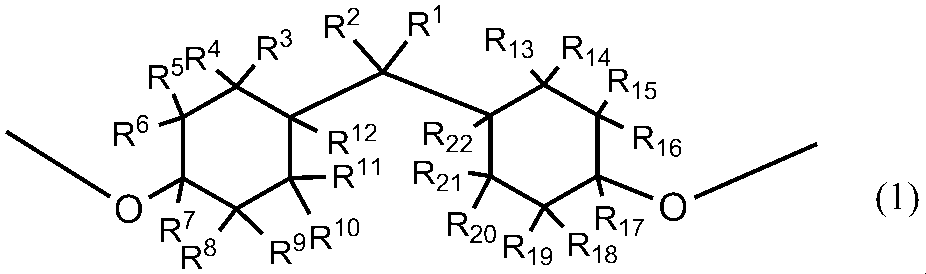
- the main chain skeleton of the polyester resin is represented by the following general formula (1).
- R 1 to R 22 each represent a hydrogen atom, an alkyl group having 1 to 6 carbon atoms, a cycloalkyl group, or an aromatic group having 6 to 10 carbon atoms.
- the polyester resin (A) containing the structure represented by this is contained,
- the modifier for cellulose ester resins characterized by the above-mentioned is provided.
- the present invention also provides a cellulose ester optical film comprising the cellulose ester resin modifier and a cellulose ester resin.
- the present invention provides a resin solution obtained by dissolving the cellulose ester resin modifier and cellulose ester resin in an organic solvent, and casting the solution on a metal support, and then evaporating the organic solvent and drying.
- the protective film for polarizing plates characterized by being obtained is provided.
- the present invention provides a liquid crystal display device comprising the polarizing plate protective film.
- the present invention it is possible to provide a modifier that gives a film that has little variation in retardation due to changes in humidity and that is excellent in transparency and that can be suitably used for optical applications. Moreover, the film of this invention is excellent also in transparency, and can be used suitably for an optical use. Therefore, an optical film having little variation in retardation due to changes in humidity and excellent transparency can be preferably used for a protective film for polarizing plate, an optical compensation film, a retardation film, and the like.
- a resin solution obtained by dissolving the cellulose ester resin modifier and cellulose ester resin in an organic solvent is cast on a metal support, and then the organic solvent is retained.
- a method of leaving and drying (solution pouring method), a method of melt-kneading the cellulose ester resin modifier and the cellulose ester resin with an extruder or the like, and forming it into a film using a T-die or the like (
- a film can be produced by a melt extrusion method).
- a stretched film can also be produced by stretching a film obtained by the solution-flow method or the melt extrusion method.
- Various optical films such as a polarizing plate protective film, an optical compensation film, and a retardation film can be produced by the above method.
- the modifier for cellulose ester resin of the present invention is represented by the following general formula (1)
- R 1 to R 22 each represent a hydrogen atom, an alkyl group having 1 to 6 carbon atoms, a cycloalkyl group, or an aromatic group having 6 to 10 carbon atoms). It contains a polyester resin (A).
- modifiers for cellulose ester resins of the present invention those in which R 1 and R 2 in the general formula (1) are each an alkyl group having 1 to 6 carbon atoms are compatible with the cellulose ester resin. It is preferable because it becomes a good modifier, and it is more preferable that R 1 and R 2 in the general formula (1) are each a methyl group.
- modifiers for cellulose ester resins of the present invention those in which R 3 to R 22 in the general formula (1) are each a hydrogen atom or an alkyl group having 1 to 6 carbon atoms are the same as the cellulose ester resin. Since it becomes a modifier with good compatibility, it is preferable that each has a hydrogen atom.
- R 1 and R 2 in the general formula (1) are each an alkyl group having 1 to 6 carbon atoms
- R 3 to R 22 are respectively Preferred are those having a hydrogen atom or an alkyl group having 1 to 6 carbon atoms, wherein R 1 and R 2 in the general formula (1) are each a methyl group, and R 3 to R 22 are each a hydrogen atom. Is more preferable.
- the modifier for cellulose ester resin of the present invention is obtained, for example, by reacting a divalent alcohol (a1) with a dibasic acid (a2), and the divalent alcohol (a1) is represented by the following general formula (2). )
- R 1 to R 22 each represent a hydrogen atom, an alkyl group having 1 to 6 carbon atoms, a cycloalkyl group, or an aromatic group having 6 to 10 carbon atoms). It can obtain by using what contains.
- Examples of the divalent alcohol represented by the general formula (2) include hydrogenated bisphenol A, hydrogenated bisphenol AP, hydrogenated bisphenol B, hydrogenated bisphenol BP, hydrogenated bisphenol C, hydrogenated bisphenol E, and hydrogen.
- the divalent alcohol represented by the general formula (2) may be a commercially available product, or may be synthesized as necessary.
- the synthesis can be carried out, for example, by the methods described in JP-A-53-119854, JP-A-61-260034, JP-A-4-103548, JP-A-6-329569 and the like.
- R 1 and R 2 in the general formula (2) are each an alkyl group having 1 to 6 carbon atoms are It is preferable because it is a modifier having good compatibility, and R 1 and R 2 in the general formula (2) are more preferably methyl groups.
- R 3 to R 22 in the general formula (2) are each a hydrogen atom or an alkyl group having 1 to 6 carbon atoms, It is preferable because it is a modifier having good compatibility with the cellulose ester resin.
- R 1 and R 2 in the general formula (2) are each an alkyl group having 1 to 6 carbon atoms, and R 3 to R 22 is preferably a hydrogen atom or an alkyl group having 1 to 6 carbon atoms, R 1 and R 2 in the general formula (2) are each a methyl group, and R 3 to R 22 are each More preferred is a hydrogen atom (hydrogenated bisphenol A).
- divalent alcohol (a1) used in the present invention other divalent alcohols in addition to the divalent alcohol represented by the general formula (2) can be used as long as the effects of the present invention are not impaired.
- the content of the divalent alcohol represented by the general formula (2) in the divalent alcohol (a1) is 5 to 100 parts by mass with respect to 100 parts by mass of the divalent alcohol (a1). From the viewpoint of obtaining an optical film with little change in retardation with respect to the thickness, it is preferably from 15 to 100 parts by mass.
- Preferred examples of the other dihydric alcohol include aliphatic alcohols having 2 to 4 carbon atoms.
- examples of such alcohols include ethylene glycol, 1,2-propylene glycol, 1,3-propanediol, 2-methylpropanediol, 1,2-butanediol, 1,3-butanediol, 1,4- Examples include butanediol and 2,3-butanediol.
- the use of ethylene glycol or 1,2-propylene glycol can be expected to provide a cellulose ester resin modifier capable of imparting sufficient moisture resistance to the cellulose ester film.
- these may be used independently and may use 2 or more types together.
- dibasic acid (a2) examples include aliphatic dibasic acids and aromatic dibasic acids.
- aliphatic dibasic acid examples include aliphatic dibasic acids having 2 to 6 carbon atoms. Specific examples include malonic acid, succinic acid, glutaric acid, adipic acid, maleic acid, fumaric acid. An acid etc. are mentioned. These may be used alone or in combination of two or more.
- aromatic dibasic acid examples include phthalic acid, terephthalic acid, isophthalic acid, 1,5-naphthalenedicarboxylic acid, 1,4-naphthalenedicarboxylic acid, and the like. These may be used alone or in combination of two or more.
- dibasic acids (a2) an aliphatic dibasic acid having 3 to 8 carbon atoms is preferable, and succinic acid or adipic acid is more preferable because an optical film with little change in retardation with respect to humidity can be obtained.
- the polyester resin (A) is produced, for example, by subjecting the raw material to an esterification reaction in the presence of an esterification catalyst as necessary, for example, in a temperature range of 180 to 250 ° C. for 10 to 25 hours. can do.
- an esterification catalyst as necessary, for example, in a temperature range of 180 to 250 ° C. for 10 to 25 hours. can do.
- conditions, such as temperature of esterification reaction and time are not specifically limited, You may set suitably.
- esterification catalyst examples include titanium catalysts such as tetraisopropyl titanate and tetrabutyl titanate; tin catalysts such as dibutyltin oxide; and organic sulfonic acid catalysts such as p-toluenesulfonic acid.
- the amount of the esterification catalyst used may be set as appropriate, but usually it is preferably used in the range of 0.001 to 0.1 parts by mass with respect to 100 parts by mass of the total amount of raw materials.
- the number average molecular weight (Mn) of the polyester resin (A) is preferably in the range of 500 to 3,000, more preferably in the range of 500 to 1,500, since the compatibility with the cellulose ester resin is improved.
- the number average molecular weight (Mn) is a value in terms of polystyrene based on gel permeation chromatography (GPC) measurement.
- the measurement conditions for GPC are as follows.
- the properties of the polyester resin (A) vary depending on the number average molecular weight (Mn) and composition, but are usually liquid, solid, paste, etc. at room temperature.
- the polyester resin obtained by reacting the dibasic acid (a2) with the divalent alcohol (a1) has a hydroxyl group or a carboxyl group at the terminal. These hydroxyl groups and carboxyl groups may be reacted with a compound having a reactive group that reacts with them to seal the ends of the polyester resin (A). By sealing the end in this way, it is expected that the storage stability of the added film is further improved.
- Method 1 A method in which a divalent alcohol (a1) containing a divalent alcohol represented by the general formula (2), a dibasic acid (a2), and a monocarboxylic acid are charged in a reaction system and reacted.
- Method 2 A divalent alcohol (a1) containing a divalent alcohol represented by the general formula (2) was reacted with a dibasic acid (a2) to obtain a polyester resin containing a hydroxyl group at the end of the resin. Thereafter, the polyester resin is reacted with a monocarboxylic acid anhydride.
- Method 3 A method in which a divalent alcohol (a1) containing a divalent alcohol represented by the general formula (2), a dibasic acid (a2), and a monoalcohol are charged in a reaction system and reacted.
- Method 4 A divalent alcohol (a1) containing a divalent alcohol represented by the general formula (2) is reacted with a dibasic acid (a2) to obtain a polyester resin containing a carboxyl group at the end of the resin. Then, a method of reacting the polyester resin with monoalcohol.
- Examples of the monocarboxylic acid include aliphatic monocarboxylic acids and aromatic monocarboxylic acids.
- examples of the aliphatic monocarboxylic acid include monocarboxylic acids having 2 to 9 carbon atoms such as acetic acid, propanoic acid, butanoic acid, pentanoic acid, hexanoic acid, heptanoic acid, octanoic acid, 2-ethylhexylic acid, and nonanoic acid. And anhydrides of these aliphatic monocarboxylic acids.
- aromatic monocarboxylic acid examples include benzoic acid, dimethyl benzoic acid, trimethyl benzoic acid, tetramethyl benzoic acid, ethyl benzoic acid, propyl benzoic acid, butyl benzoic acid, cumic acid, para-tert-butyl benzoic acid, orthotoluyl.
- examples include acid, metatoluic acid, p-toluic acid, ethoxybenzoic acid, propoxybenzoic acid, naphthoic acid, nicotinic acid, furoic acid, anisic acid, and methyl esters and acid chlorides thereof.
- These monocarboxylic acids may be used alone or in combination of two or more.
- Examples of the monoalcohol include 1-butanol, 2-butanol, isobutanol, t-butanol, 1-pentanol, isopentyl alcohol, tert-pentyl alcohol, cyclopentanol, 1-hexanol, cyclohexanol, 1- Preferred examples include monoalcohols having 4 to 9 carbon atoms such as heptanol, 1-octanol, 2-ethyl-1-hexanol, isononyl alcohol, 1-nonyl alcohol and the like. These may be used alone or in combination of two or more.
- the acid value of the polyester resin (A) is preferably 3 or less, more preferably 1 or less because it imparts excellent moisture permeability to the film and maintains the stability of the cellulose ester resin modifier itself.
- the hydroxyl value is preferably 200 or less, and more preferably 150 or less.
- the cellulose ester resin modifier of the present invention contains the polyester resin (A).
- the modifier for cellulose ester resin of the present invention may be a modifier composed solely of the polyester resin (A), or may contain a polyester other than the polyester resin (A). Moreover, the modifier other than polyester may be included, and the raw material used for manufacture of the polyester resin (A) may be included.
- the modifier of the present invention can be made into a cellulose ester resin composition by mixing with a cellulose ester resin.
- a cellulose ester resin composition By using this composition, it is possible to obtain an optical film that has little variation in retardation due to a change in humidity, is excellent in transparency, and can be suitably used for optical applications.
- cellulose ester resin examples include those obtained by esterifying part or all of the hydroxyl groups of cellulose obtained from cotton linter, wood pulp, kenaf, etc. Among them, cellulose obtained from cotton linter A film obtained by using a cellulose ester resin obtained by esterifying is preferable because it can be easily peeled off from the metal support constituting the film production apparatus and the production efficiency of the film can be further improved.
- the cellulose ester resin examples include cellulose acetates such as cellulose acetate, cellulose acetate propionate, cellulose acetate butyrate, and cellulose acetate phthalate; and cellulose nitrates.
- cellulose ester optical film is used as a protective film for a polarizing plate, it is preferable to use cellulose acetate because a film excellent in mechanical properties and transparency can be obtained. Among them, cellulose acetate propionate is preferable. More preferred.
- cellulose acetate examples include cellulose triacetate and cellulose diacetate.
- Preferred examples of the cellulose acetate propionate include cellulose acetate propionate that satisfies the following two formulas.
- the number average molecular weight (Mn) of the cellulose acetate is preferably in the range of 70,000 to 300,000, and more preferably in the range of 80,000 to 200,000. If the (Mn) of the cellulose acetate is within such a range, a film having excellent mechanical properties can be obtained.
- the cellulose ester resin modifier of the present invention in the cellulose ester resin composition is preferably in the range of 5 to 30 parts by mass, more preferably in the range of 5 to 15 parts by mass with respect to 100 parts by mass of the cellulose ester resin. preferable. If the cellulose ester resin modifier is used in such a range, the composition can provide a film that has little variation in retardation due to changes in humidity and that is excellent in transparency and can be suitably used for optical applications.
- the cellulose ester film of the present invention is a film comprising the cellulose ester resin, the cellulose ester resin modifier, and various other additives as required, and in particular, a cellulose ester optical film for optical use. Can be preferably used.
- the film thickness of the cellulose ester film of the present invention varies depending on the intended use, but is generally preferably in the range of 10 to 200 ⁇ m.
- the cellulose ester film of the present invention can also be obtained by using a cellulose ester resin composition containing the cellulose ester resin and the cellulose ester resin modifier.
- the cellulose ester optical film may have characteristics such as optical anisotropy or optical isotropy.
- optical anisotropy or optical isotropy.
- the optical film when used as a protective film for a polarizing plate, it does not inhibit light transmission. It is preferable to use an optically isotropic film.
- the cellulose ester optical film can be used in various applications. As the most effective use, for example, there is a protective film for a polarizing plate that requires optical isotropy of a liquid crystal display device, but it is also used for a support for a protective film for a polarizing plate that requires an optical compensation function. Can do.
- the cellulose ester optical film can be used for liquid crystal cells in various display modes. For example, IPS (In-Plane Switching), TN (Twisted Nematic), VA (Vertically Aligned), OCB (Optical Compensation Bend: Opticall ⁇ ⁇ , etc. it can.
- IPS In-Plane Switching
- TN Transmission Nematic
- VA Very Aligned
- OCB Optical Compensation Bend: Opticall ⁇ ⁇ , etc. it can.
- the cellulose ester resin modifier of the present invention contained in the cellulose ester optical film of the present invention is preferably in the range of 5 to 30 parts by mass with respect to 100 parts by mass of the cellulose ester resin. A range of parts is more preferred. By using the modifier for cellulose ester resin in such a range, a film having little variation in retardation due to a change in humidity and excellent in transparency and suitable for optical applications can be obtained.
- the cellulose ester optical film can be produced by, for example, a melt extrusion method.
- the cellulose ester resin composition containing the cellulose ester resin, the cellulose ester resin modifier, and other various additives as necessary is melt-kneaded with an extruder or the like, for example. It can be obtained by forming into a film using a T-die or the like.
- the said cellulose-ester resin composition can also be used instead of the said cellulose-ester resin and the modifier for cellulose-ester resins.
- the cellulose ester optical film may be prepared by, for example, dissolving a resin solution obtained by dissolving the cellulose ester resin and the cellulose ester resin modifier in an organic solvent on a metal support. And then molding by a so-called solution casting method (solvent casting method) in which the organic solvent is distilled off and dried.
- solution casting method solvent casting method
- the solution casting method it is possible to obtain a film that is less likely to have unevenness on the surface and has excellent surface smoothness. Therefore, the film obtained by the solution casting method can be preferably used for optical applications, and particularly preferably used for a protective film for polarizing plates.
- the solution casting method generally includes a first step in which the cellulose ester resin and the cellulose ester resin modifier are dissolved in an organic solvent, and the resulting resin solution is cast on a metal support; A second step of forming a film by distilling off the organic solvent contained in the cast resin solution, followed by peeling the film formed on the metal support from the metal support and drying by heating. It consists of a 3rd process.
- Examples of the metal support used in the first step include endless belt-shaped or drum-shaped metal supports, for example, stainless steel with a mirror-finished surface can be used. .
- the drying method in the second step is not particularly limited.
- it is included in the cast resin solution by applying air in a temperature range of 30 to 50 ° C. to the upper surface and / or the lower surface of the metal support.
- Examples thereof include a method of evaporating 50 to 80% by mass of an organic solvent to form a film on the metal support.
- the third step is a step in which the film formed in the second step is peeled off from the metal support and is heated and dried under a temperature condition higher than that in the second step.
- a heat drying method for example, a method in which the temperature is raised stepwise under a temperature condition of 100 to 160 ° C. is preferable because good dimensional stability can be obtained.
- the organic solvent remaining in the film after the second step can be almost completely removed by heating and drying under the temperature condition.
- the organic solvent can be recovered and reused.
- the organic solvent that can be used when the cellulose ester resin and the cellulose ester resin modifier are mixed and dissolved in an organic solvent is not particularly limited as long as they can be dissolved.
- a poor solvent such as methanol, ethanol, 2-propanol, n-butanol, cyclohexane, cyclohexanone together with the good solvent in order to improve the production efficiency of the film.
- the concentration of the cellulose ester resin in the resin solution is preferably 10 to 50% by mass, more preferably 15 to 35% by mass.
- a fourth step of further heating and stretching the film can be provided.
- the obtained film is heated and stretched.
- the stretching operation may be performed in multiple stages, or biaxial stretching may be performed in the casting direction and the width direction.
- biaxial stretching simultaneous biaxial stretching may be performed and you may implement in steps.
- stepwise means that, for example, stretching in different stretching directions can be sequentially performed, stretching in the same direction is divided into multiple stages, and stretching in different directions is added to any one of the stages. Is also possible.
- simultaneous biaxial stretching includes stretching in one direction and contracting by relaxing the tension in the other direction.
- the preferred draw ratio of simultaneous biaxial stretching is, for example, ⁇ 1.05 to ⁇ 1.5 times in the width direction and ⁇ 0.8 to ⁇ 1.3 times in the longitudinal direction (casting direction), and particularly in the width direction.
- it is x1.1 to x2.0 times in the width direction and x0.9 to x0.99 times in the longitudinal direction.
- the additive examples include other modifiers other than the modifier for cellulose ester resin of the present invention, thermoplastic resins, ultraviolet absorbers, matting agents, deterioration inhibitors (for example, antioxidants, peroxides). Decomposition agents, radical inhibitors, metal deactivators, acid scavengers, etc.) and dyes. These additives can be used together when the cellulose ester resin and the modifier for cellulose ester resin are dissolved and mixed in the organic solvent, and may be used separately. Not limited.
- modifiers other than the cellulose ester resin modifier include, for example, phosphate esters such as triphenyl phosphate (TPP), tricresyl phosphate, and cresyl diphenyl phosphate, dimethyl phthalate, diethyl phthalate, and dibutyl phthalate.
- Phthalic acid esters such as di-2-ethylhexyl phthalate, ethyl phthalyl ethyl glycolate, butyl phthalyl butyl glycolate, trimethylolpropane tribenzoate, pentaerythritol tetraacetate, tributyl acetylcitrate and the like.
- thermoplastic resin is not particularly limited, and examples thereof include polyester resins other than the cellulose ester resin modifier of the present invention, polyester ether resins, polyurethane resins, epoxy resins, and toluenesulfonamide resins.
- the ultraviolet absorber is not particularly limited, and examples thereof include oxybenzophenone compounds, benzotriazole compounds, salicylic acid ester compounds, benzophenone compounds, cyanoacrylate compounds, nickel complex compounds, and the like.
- the ultraviolet absorber is preferably in the range of 0.01 to 2 parts by mass with respect to 100 parts by mass of the cellulose ester resin.
- matting agent examples include silicon oxide, titanium oxide, aluminum oxide, calcium carbonate, calcium silicate, aluminum silicate, magnesium silicate, calcium phosphate, kaolin, and talc.
- the matting agent is preferably in the range of 0.1 to 0.3 parts by mass with respect to 100 parts by mass of the cellulose ester resin.
- the type and amount of the dye are not particularly limited as long as they do not impair the object of the present invention.
- the film thickness of the cellulose ester optical film is preferably in the range of 5 to 120 ⁇ m, more preferably in the range of 8 to 100 ⁇ m, and particularly preferably in the range of 10 to 80 ⁇ m.
- a film thickness in the range of 10 to 80 ⁇ m is suitable for reducing the thickness of a liquid crystal display device, and has sufficient film strength and Rth stability. Excellent performance such as moisture permeability resistance can be maintained.
- the cellulose ester optical film and the polarizing plate protective film have little variation in retardation due to changes in humidity and are excellent in transparency, for example, optical films for liquid crystal display devices and silver halide photographic light-sensitive materials. It can be used for the support of the above.
- the protective film for polarizing plates, retardation film, a reflecting plate, a viewing angle improvement film, an anti-glare film, a non-reflective film, an antistatic film, a color filter etc. are mentioned.
- Example 1 (Modifier for cellulose ester resin of the present invention) Into a 0.5 liter four-necked flask equipped with a thermometer, stirrer and reflux condenser, 216 g of hydrogenated bisphenol A, 142 g of succinic acid, 62 g of n-butanol and 0.01 g of tetraisopropyl titanate as an esterification catalyst
- the polyester resin having the structure represented by the general formula (1) [cellulose ester resin of the present invention] was heated up stepwise to 220 ° C. while stirring under a nitrogen stream and reacted for a total of 15 hours. Modifier (1)] was obtained.
- the modifier for cellulose ester resin (1) was a solid at room temperature, had an acid value of 0.89, a hydroxyl value of 4, and a number average molecular weight of 1,400.
- Example 2 (same as above) A 0.5-liter four-necked flask equipped with a thermometer, stirrer, and reflux condenser was charged with 288 g of hydrogenated bisphenol A, 106 g of succinic acid, and 0.01 g of tetraisopropyl titanate as an esterification catalyst, and a nitrogen stream
- the polyester resin having the structure represented by the general formula (1) is reacted for a total of 20 hours while stirring at 220 ° C. with stirring under the condition [Modifier for cellulose ester resin of the present invention (2 )].
- the modifier for cellulose ester resin (2) was a solid at room temperature, had an acid value of 0.65, a hydroxyl value of 94, and a number average molecular weight of 1,100.
- Example 3 (same as above) In a 0.5-liter four-necked flask equipped with a thermometer, stirrer and reflux condenser, 240 g of hydrogenated bisphenol A, 7 g of propylene glycol, 89 g of succinic acid, 61 g of benzoic acid and tetraisopropyl titanate as an esterification catalyst A polyester resin having a structure represented by the general formula (1) was prepared by adding 0.01 g, raising the temperature stepwise to 220 ° C. while stirring under a nitrogen stream, and reacting for a total of 24 hours. Ester resin modifier (3)] was obtained. The modifier (3) for cellulose ester resin was a solid at room temperature, an acid value of 0.52, a hydroxyl value of 25, and a number average molecular weight of 920.
- Example 4 (same as above) In a 0.5 liter four-necked flask equipped with a thermometer, a stirrer and a reflux condenser, 250 g of cellulose ester resin modifier (2) and 48 g of acetic anhydride were charged and stirred under a nitrogen stream. The temperature is raised stepwise until reaching 120 ° C. and reacted for a total of 4 hours to obtain a polyester resin having the structure represented by the general formula (1) [modifier for cellulose ester resin (4) of the present invention]. It was.
- the modifier (4) for cellulose ester resin was a solid at room temperature, an acid value of 0.50, a hydroxyl value of 2, and a number average molecular weight of 1,200.
- Example 5 (same as above) Into a 0.5 liter four-necked flask equipped with a thermometer, stirrer and reflux condenser, 216 g of hydrogenated bisphenol A, 10 g of propylene glycol, 53 g of succinic acid, 110 g of benzoic acid and tetraisopropyl titanate as an esterification catalyst A polyester resin having a structure represented by the general formula (1) is prepared by adding 0.02 g, raising the temperature stepwise to 220 ° C. while stirring in a nitrogen stream, and reacting for a total of 24 hours. Ester resin modifier (5)] was obtained. The modifier (5) for cellulose ester resin was a solid at room temperature, an acid value of 0.33, a hydroxyl value of 5.3, and a number average molecular weight of 600.
- Example 6 Cellulose acetate propionate (CAP-482-20, manufactured by Eastman Chemical Co., Ltd., acetyl group substitution degree: 0.2, propionyl group substitution degree 2.5, hydroxyl group substitution degree: 0.3, number average molecular weight: 75,000 Hereinafter, it is abbreviated as “CAP”.) 100 parts and 10 parts of cellulose ester resin modifier (1) were dissolved in 670 parts of dichloromethane to prepare a dope solution. The dope solution is cast on a glass plate to a thickness of 0.75 mm, dried at room temperature for 16 hours, then dried at 50 ° C. for 30 minutes, and further at 100 ° C. for 30 minutes to obtain a film thickness of 80 ⁇ m.
- CAP Cellulose acetate propionate
- a cellulose ester film (1A) of the present invention was obtained.
- This cellulose ester film (1A) was heated by a biaxial stretching machine (manufactured by Imoto Seisakusho), stretching temperature: Tg + 20 ° C. of a mixture consisting of 100 parts of CAP and 10 parts of a modifier for cellulose ester resin (1), stretching ratio: width.
- the film was stretched uniaxially by heating under conditions of 1.5 times in the direction (perpendicular to the fluent direction) and a stretching speed of 30 mm / min to obtain a stretched cellulose ester film (1B) having a thickness of 70 ⁇ m.
- the Tg was determined under the following conditions. Tg of the mixture composed of 100 parts of CAP and 10 parts of the modifier for cellulose ester resin (1) was 117 ° C.
- the birefringence in the thickness direction and the change rate of the birefringence in the thickness direction when placed in a high humidity environment were measured.
- the change rate of the dimension accompanying the change of humidity was measured using the obtained cellulose-ester film (1B).
- the HAZE (HAZE of the film before stretching and HAZE of the film after stretching) of the cellulose ester film (1A) and the cellulose ester film (1B) was also measured, and the degree of change in HAZE before and after stretching was determined.
- the measuring method of the birefringence in the thickness direction the measuring method of the change rate, the measuring method of the dimensional change rate accompanying the change of humidity, and the measuring method of the change degree of HAZE before and after stretching are shown below.
- the evaluation results are shown in Table 1.
- ⁇ Measurement method of birefringence in thickness direction The phase difference at 550 nm of the cellulose ester film (1A) was measured using KOBRA-WR (manufactured by Oji Scientific Instruments). The value obtained by dividing the film thickness from the obtained retardation value was defined as the birefringence value [out-of-plane retardation (Rth)] of the cellulose ester film (1A).
- Rth is a value defined by the following formula.
- Rth (nm) out-of-plane birefringence ( ⁇ P) ⁇ thickness d (nm)
- Nx is the refractive index of the slow axis in the film plane
- Ny is the refractive index of the fast axis in the film plane
- Nz is the film. It is the refractive index in the thickness direction.
- ⁇ Measuring method of dimensional change rate with humidity change > The degree of expansion (expansion coefficient) of the sample generated by changing the humidity of the environment where the sample [cellulose ester film (1B)] is present from 20% RH to 80% RH. The degree of shrinkage (shrinkage rate) of the sample generated by changing the environment of the sample expanded by changing the environmental humidity from 20% RH to 80% RH from 80% RH to 20% RH was obtained. Specifically, a film was cut out from the cellulose ester film (1B) into a shape of 20 mm width ⁇ 3 mm width with the stretching direction as the longitudinal direction, and this was used as a sample.
- thermomechanical analyzer TMA / SS6100 manufactured by Seiko Instruments Inc.
- the measurement conditions are measurement mode: tension mode, load: 50 mN, and distance between chucks: 20 mm.
- the humidity was increased from 20% RH at a rate of 2% RH per minute, and the elongation of the chuck distance was measured while humidifying to 80% RH.
- the elongation of the sample with respect to the gap between the chucks at the start of measurement was obtained as a percentage (elongation rate).
- the maximum measured elongation was taken as the expansion rate.
- the humidity is reduced from 20% RH to 2% RH at a rate of 2% RH per minute while maintaining the sample temperature in the furnace at 40 ° C.
- the distance between the chucks was measured while measuring the shrinkage of the sample with respect to the gap between the chucks at the start of measurement (shrinkage ratio). The maximum shrinkage measured was taken as the shrinkage.
- the shrinkage ratio indicates that the closer the absolute value is to 0, the more the expanded cellulose ester film returns to its original size. Therefore, it can be said that a cellulose ester film having a small expansion coefficient and an absolute value of shrinkage ratio close to 0 is a film having more excellent dimensional stability.
- Example 7 (same as above) Cellulose ester resin modifier (1) Cellulose ester film (2A) and cellulose ester film (2B) in the same manner as in Example 5 except that cellulose ester resin modifier (2) was used instead of 10 parts. Got. The same evaluation as in Example 5 was performed, and the results are shown in Table 1. Moreover, Tg of the composition of the cellulose ester resin modifier (2) 10 parts and CAP 100 parts was 117 ° C.
- Example 8 (same as above) Cellulose ester resin modifier (1) Cellulose ester film (3A) and cellulose ester film (3B) in the same manner as in Example 5 except that cellulose ester resin modifier (3) was used instead of 10 parts. Got. The same evaluation as in Example 5 was performed, and the results are shown in Table 1. Moreover, Tg of the composition of the cellulose ester resin modifier (3) 10 parts and CAP 100 parts was 117 ° C.
- Example 9 (same as above) Cellulose ester resin modifier (1) Cellulose ester film (4A) and cellulose ester film (4B) in the same manner as in Example 5 except that cellulose ester resin modifier (4) was used instead of 10 parts. Got. The same evaluation as in Example 5 was performed, and the results are shown in Table 1. The Tg of the composition of the cellulose ester resin modifier (4) 10 parts and CAP 100 parts was 118 ° C.
- Example 10 (same as above) Cellulose ester resin modifier (1) Cellulose ester film (5A) and cellulose ester film (5B) in the same manner as in Example 5 except that cellulose ester resin modifier (5) was used instead of 10 parts. Got. The same evaluation as in Example 5 was performed, and the results are shown in Table 1. In addition, the Tg of the composition of cellulose ester resin modifier (5) 10 parts and CAP 100 parts was 115 ° C.
- Comparative Example 1 (Modifier for Comparative Control Cellulose Ester Resin) Into a 3 liter four-necked flask equipped with a thermometer, stirrer and reflux condenser, 648 g of phthalic anhydride, 132 g of adipic acid, 648 g of propylene glycol, 977 g of benzoic acid and 0.07 g of tetraisopropyl titanate as an esterification catalyst The mixture was heated stepwise to 220 ° C. while stirring under a nitrogen stream and reacted for a total of 12 hours to produce a polyester resin for comparison [modifier for cellulose ester resin for comparison (1 ′)].
- the modifier for cellulose ester resin for comparison (1 ′) was a solid at room temperature, an acid value of 0.07, a hydroxyl value of 8, and a number average molecular weight of 420.
- Comparative Example 2 (same as above) Into a 3 liter four-necked flask equipped with a thermometer, a stirrer and a reflux condenser, 1490 g of succinic acid, 335 g of ethylene glycol, 410 g of propylene glycol, 453 g of n-butanol and 0.16 g of tetraisopropyl titanate as an esterification catalyst The mixture was heated in a stepwise manner to 220 ° C. while stirring under a nitrogen stream, and reacted for a total of 32 hours to obtain a comparative polyester resin for comparison (cellulose modifier resin modifier for comparison (2 ′)). Obtained.
- the modifier for cellulose ester resin for comparison (2 ′) was a solid at room temperature, an acid value of 0.43, a hydroxyl value of 2, and a number average molecular weight of 1,200.
- Comparative Example 3 Comparative Cellulose Ester Film
- Comparative Example 3 Comparative Cellulose Ester Film
- Example 5 Comparative Cellulose Ester Film
- the comparative cellulose ester resin modifier (1') was used instead of 10 parts
- the comparative cellulose ester film (1 ') A) and a comparative cellulose ester film (1′B) were obtained.
- the same evaluation as in Example 5 was performed, and the results are shown in Table 2.
- the Tg of the composition of 10 parts of the modifier for cellulose ester resin (1 ') for comparison and 100 parts of CAP was 123 ° C.
- Comparative Example 4 (same as above) Cellulose ester resin modifier (1 ') The comparative cellulose ester film (2') in the same manner as in Example 5 except that the cellulose ester resin modifier (2 ') was used instead of 10 parts. A) and a comparative cellulose ester film (2′B) were obtained. The same evaluation as in Example 5 was performed, and the results are shown in Table 2. Further, the Tg of the composition of 10 parts of the modifier for cellulose ester resin for comparison (2 ′) and 100 parts of CAP was 112 ° C.
- Comparative Example 5 (same as above) Cellulose ester resin modifier (1) A comparative cellulose ester film (3'A) and a comparative cellulose ester film (3 ') in the same manner as in Example 5 except that sucrose benzoate was used instead of 10 parts. B) was obtained. The same evaluation as in Example 5 was performed, and the results are shown in Table 2. The composition of 10 parts sucrose benzoate and 100 parts CAP had a Tg of 130 ° C.
- Comparative Example 6 (same as above) Cellulose ester resin modifier (1) A comparative cellulose ester film (4'A) and a comparative cellulose ester film (4'B) in the same manner as in Example 5 except that nothing is added instead of 10 parts. ) The same evaluation as in Example 5 was performed, and the results are shown in Table 2.
- the Tg of CAP was 140 ° C.
- the cellulose ester film obtained in Examples is a film that has a small amount of change in birefringence with respect to a change in humidity, is excellent in transparency, and can be suitably used as an optical application.
Landscapes
- Chemical & Material Sciences (AREA)
- Health & Medical Sciences (AREA)
- Medicinal Chemistry (AREA)
- Polymers & Plastics (AREA)
- Organic Chemistry (AREA)
- Chemical Kinetics & Catalysis (AREA)
- Physics & Mathematics (AREA)
- Engineering & Computer Science (AREA)
- Nonlinear Science (AREA)
- Manufacturing & Machinery (AREA)
- Materials Engineering (AREA)
- Optics & Photonics (AREA)
- Mathematical Physics (AREA)
- Crystallography & Structural Chemistry (AREA)
- General Physics & Mathematics (AREA)
- Mechanical Engineering (AREA)
- Ophthalmology & Optometry (AREA)
- Biochemistry (AREA)
- Life Sciences & Earth Sciences (AREA)
- Polarising Elements (AREA)
- Compositions Of Macromolecular Compounds (AREA)
- Manufacture Of Macromolecular Shaped Articles (AREA)
- Polyesters Or Polycarbonates (AREA)
- Liquid Crystal (AREA)
Abstract
Description
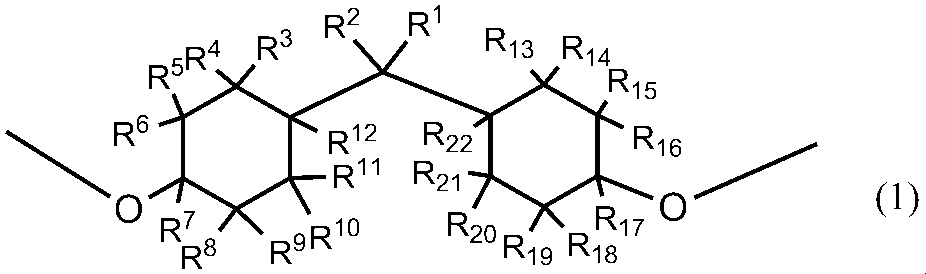
で表される構造を含有するポリエステル樹脂(A)を含有することを特徴とするセルロースエステル樹脂用改質剤を提供するものである。

測定装置:東ソー株式会社製高速GPC装置「HLC-8320GPC」
カラム:東ソー株式会社製「TSK GURDCOLUMN SuperHZ-L」
+東ソー株式会社製「TSK gel SuperHZM-M」
+東ソー株式会社製「TSK gel SuperHZM-M」
+東ソー株式会社製「TSK gel SuperHZ-2000」
+東ソー株式会社製「TSK gel SuperHZ-2000」
検出器:RI(示差屈折計)
データ処理:東ソー株式会社製「EcoSEC Data Analysis バージョン1.07」
カラム温度:40℃
展開溶媒:テトラヒドロフラン
流速:0.35mL/分
測定試料:試料15mgを10mlのテトラヒドロフランに溶解し、得られた溶液をマイクロフィルターでろ過したものを測定試料とした。
試料注入量:20μl
標準試料:前記「HLC-8320GPC」の測定マニュアルに準拠して、分子量が既知の下記の単分散ポリスチレンを用いた。
東ソー株式会社製「A-300」
東ソー株式会社製「A-500」
東ソー株式会社製「A-1000」
東ソー株式会社製「A-2500」
東ソー株式会社製「A-5000」
東ソー株式会社製「F-1」
東ソー株式会社製「F-2」
東ソー株式会社製「F-4」
東ソー株式会社製「F-10」
東ソー株式会社製「F-20」
東ソー株式会社製「F-40」
東ソー株式会社製「F-80」
東ソー株式会社製「F-128」
東ソー株式会社製「F-288」
方法1:前記一般式(2)で表される二価のアルコールを含む二価のアルコール(a1)と二塩基酸(a2)とモノカルボン酸を反応系に一括で仕込み、反応させる方法。
0≦(X)≦2.1・・・(2)
(Xはアセチル基の置換度を表す。Yはプロピオニル基の置換度を表す。)
温度計、攪拌器及び還流冷却器を備えた内容積0.5リットルの四つ口フラスコに、水素化ビスフェノールA 216g、コハク酸142g、n-ブタノール62g及びエステル化触媒としてテトライソプロピルチタネート0.01gを仕込み、窒素気流下で攪拌しながら220℃になるまで段階的に昇温して、合計15時間反応させ、一般式(1)で表される構造を有するポリエステル樹脂〔本発明のセルロースエステル樹脂用改質剤(1)〕を得た。セルロースエステル樹脂用改質剤(1)は常温固体であり、酸価0.89、水酸基価4で、数平均分子量1,400であった。
温度計、攪拌器及び還流冷却器を備えた内容積0.5リットルの四つ口フラスコに、水素化ビスフェノールA 288g、コハク酸106g及びエステル化触媒としてテトライソプロピルチタネート0.01gを仕込み、窒素気流下で攪拌しながら220℃になるまで段階的に昇温して、合計20時間反応させ一般式(1)で表される構造を有するポリエステル樹脂〔本発明のセルロースエステル樹脂用改質剤(2)〕を得た。セルロースエステル樹脂用改質剤(2)は常温固体であり、酸価0.65、水酸基価94で、数平均分子量1,100であった。
温度計、攪拌器及び還流冷却器を備えた内容積0.5リットルの四つ口フラスコに、水素化ビスフェノールA 240g、プロピレングリコール7g、コハク酸89g、安息香酸61g及びエステル化触媒としてテトライソプロピルチタネート0.01gを仕込み、窒素気流下で攪拌しながら220℃になるまで段階的に昇温して、合計24時間反応させ一般式(1)で表される構造を有するポリエステル樹脂〔本発明のセルロースエステル樹脂用改質剤(3)〕を得た。セルロースエステル樹脂用改質剤(3)は常温固体であり、酸価0.52、水酸基価25で、数平均分子量920であった。
温度計、攪拌器及び還流冷却器を備えた内容積0.5リットルの四つ口フラスコに、セルロースエステル樹脂用改質剤(2)250g及び無水酢酸48gを仕込み、窒素気流下で攪拌しながら120℃になるまで段階的に昇温して、合計4時間反応させ、一般式(1)で表される構造を有するポリエステル樹脂〔本発明のセルロースエステル樹脂用改質剤(4)〕を得た。セルロースエステル樹脂用改質剤(4)は常温固体であり、酸価0.50、水酸基価2で、数平均分子量1,200であった。
温度計、攪拌器及び還流冷却器を備えた内容積0.5リットルの四つ口フラスコに、水素化ビスフェノールA 216g、プロピレングリコール10g、コハク酸53g、安息香酸110g及びエステル化触媒としてテトライソプロピルチタネート0.02gを仕込み、窒素気流下で攪拌しながら220℃になるまで段階的に昇温して、合計24時間反応させ一般式(1)で表される構造を有するポリエステル樹脂〔本発明のセルロースエステル樹脂用改質剤(5)〕を得た。セルロースエステル樹脂用改質剤(5)は常温固体であり、酸価0.33、水酸基価5.3で、数平均分子量600であった。
セルロースアセテートプロピオネート(CAP-482-20、イーストマンケミカル社製、アセチル基置換度:0.2、プロピオニル基置換度2.5、水酸基置換度:0.3、数平均分子量:75,000、以下「CAP」と略記する。)100部、セルロースエステル樹脂用改質剤(1)10部をジクロロメタン670部に溶解し、ドープ液を調整した。このドープ液をガラス板上に厚さ0.75mmになるように流延し、室温で16時間乾燥させた後、50℃で30分、さらに100℃で30分乾燥させることで膜厚80μの本発明のセルロースエステルフィルム(1A)を得た。このセルロースエステルフィルム(1A)を加熱二軸延伸機(井本製作所製)により、延伸温度:CAP 100部とセルロースエステル樹脂用改質剤(1)10部からなる混合物のTg+20℃、延伸倍率:幅方向(流涎方向に対して垂直方向)に1.5倍、延伸速度:30mm/minの条件で加熱一軸延伸し、厚さ70μの延伸されたセルロースエステルフィルム(1B)を得た。ここで、前記Tgは以下の条件で求めた。CAP 100部とセルロースエステル樹脂用改質剤(1)10部からなる混合物のTgは117℃であった。
METTLER TOREDO社製のDSC822eを用い、前記混合物約5mgを、専用のアルミニウム製パンに投入し、25℃から200℃まで10℃/minで昇温し(1st run)、次いで、10℃/minで0℃まで冷却した後、再び200℃まで10℃/minで昇温した(2nd run)。2nd runにおける中点ガラス転移点を、ガラス転移点(Tg)とした。
KOBRA-WR(王子計測機器株式会社製)を用いてセルロースエステルフィルム(1A)の550nmにおける位相差を測定した。得られた位相差値からフィルム厚を除した値を、セルロースエステルフィルム(1A)の複屈折値〔面外位相差(Rth)〕とした。ここで、Rthは、下記式で定義された値である。
Rth(nm)=面外複屈折(ΔP)×厚さd(nm)
ここで、ΔPは「ΔP=〔(Nx+Ny)/2〕-Nz」であり、Nxはフィルム面内の遅相軸の屈折率、Nyはフィルム面内の進相軸の屈折率、Nzはフィルム厚み方向の屈折率である。
セルロースエステルフィルム(1A)を23℃、65%RHの環境下に0.5時間静置した後の複屈折と、23℃、40%RHの環境下に0.5時間静置した後の複屈折を測定した。二つの複屈折の値の差を23℃、40%RHの環境下に0.5時間静置した後の複屈折で割った値の絶対値を複屈折変化率(%)とした。この値が小さい程、湿度の変化に伴う位相差の変動が少ないフィルムである。
湿度の変化に伴う寸法の変化率として、試料〔セルロースエステルフィルム(1B)〕がある環境の湿度を20%RHから80%RHに変化させることで発生する試料の膨張の程度(膨張率)と、環境の湿度を20%RHから80%RHに変化させることで膨張した試料の環境を80%RHから20%RHに変化させることで発生する試料が収縮する程度(収縮率)を求めた。具体的には、セルロースエステルフィルム(1B)から延伸方向を長手方向として20mm幅×3mm幅の形状にフィルムを切り出し、これを試料とした。測定器は恒温恒湿度対応湿度制御ユニットを取り付けた熱機械的分析装置TMA/SS6100(セイコーインスツルメンツ社製)を用いた。測定条件は、測定モード:引張モード、荷重:50mN、チャック間距離:20mmである。
HAZEメーターNDH5000(日本電色工業株式会社製)を用い、延伸フィルムのHAZE値と延伸前フィルムのHAZEの差を求めた。HAZEの値が小さい程透明性に優れ、また、延伸フィルムのHAZE値と延伸前フィルムのHAZEの差が小さい程延伸前後でHAZEの変化が少ないフィルムである。
セルロースエステル樹脂用改質剤(1)10部のかわりにセルロースエステル樹脂用改質剤(2)を用いた以外は実施例5と同様にしてセルロースエステルフィルム(2A)及びセルロースエステルフィルム(2B)を得た。実施例5と同様の評価を行い、結果を第1表に示す。また、セルロースエステル樹脂用改質剤(2)10部とCAP 100部の組成物のTgは117℃であった。
セルロースエステル樹脂用改質剤(1)10部のかわりにセルロースエステル樹脂用改質剤(3)を用いた以外は実施例5と同様にしてセルロースエステルフィルム(3A)及びセルロースエステルフィルム(3B)を得た。実施例5と同様の評価を行い、結果を第1表に示す。また、セルロースエステル樹脂用改質剤(3)10部とCAP 100部の組成物のTgは117℃であった。
セルロースエステル樹脂用改質剤(1)10部のかわりにセルロースエステル樹脂用改質剤(4)を用いた以外は実施例5と同様にしてセルロースエステルフィルム(4A)及びセルロースエステルフィルム(4B)を得た。実施例5と同様の評価を行い、結果を第1表に示す。また、セルロースエステル樹脂用改質剤(4)10部とCAP 100部の組成物のTgは118℃であった。
セルロースエステル樹脂用改質剤(1)10部のかわりにセルロースエステル樹脂用改質剤(5)を用いた以外は実施例5と同様にしてセルロースエステルフィルム(5A)及びセルロースエステルフィルム(5B)を得た。実施例5と同様の評価を行い、結果を第1表に示す。また、セルロースエステル樹脂用改質剤(5)10部とCAP 100部の組成物のTgは115℃であった。

温度計、攪拌器及び還流冷却器を備えた内容積3リットルの四つ口フラスコに、無水フタル酸648g、アジピン酸132g、プロピレングリコール648g、安息香酸977g及びエステル化触媒としてテトライソプロピルチタネート0.07gを仕込み、窒素気流下で攪拌しながら220℃になるまで段階的に昇温して、合計12時間反応させ、比較対照用ポリエステル樹脂〔比較対照用セルロースエステル樹脂用改質剤(1´)〕を得た。比較対照用セルロースエステル樹脂用改質剤(1´)は常温固体であり、酸価0.07、水酸基価8で、数平均分子量420であった。
温度計、攪拌器及び還流冷却器を備えた内容積3リットルの四つ口フラスコに、コハク酸1490g、エチレングリコール335g、プロピレングリコール410g、n-ブタノール453g及びエステル化触媒としてテトライソプロピルチタネート0.16gを仕込み、窒素気流下で攪拌しながら220℃になるまで段階的に昇温して、合計32時間反応させ比較対照用ポリエステル樹脂〔比較対照用セルロースエステル樹脂用改質剤(2´)〕を得た。比較対照用セルロースエステル樹脂用改質剤(2´)は常温固体であり、酸価0.43、水酸基価2で、数平均分子量1,200であった。
セルロースエステル樹脂用改質剤(1)10部のかわりに比較対照用セルロースエステル樹脂用改質剤(1´)を用いた以外は実施例5と同様にして比較対照用セルロースエステルフィルム(1´A)及び比較対照用セルロースエステルフィルム(1´B)を得た。実施例5と同様の評価を行い、結果を第2表に示す。また、比較対照用セルロースエステル樹脂用改質剤(1´)10部とCAP 100部の組成物のTgは123℃であった。
セルロースエステル樹脂用改質剤(1)10部のかわりに比較対照用セルロースエステル樹脂用改質剤(2´)を用いた以外は実施例5と同様にして比較対照用セルロースエステルフィルム(2´A)及び比較対照用セルロースエステルフィルム(2´B)を得た。実施例5と同様の評価を行い、結果を第2表に示す。また、比較対照用セルロースエステル樹脂用改質剤(2´)10部とCAP 100部の組成物のTgは112℃であった。
セルロースエステル樹脂用改質剤(1)10部のかわりにスクロースベンゾエートを用いた以外は実施例5と同様にして比較対照用セルロースエステルフィルム(3´A)及び比較対照用セルロースエステルフィルム(3´B)を得た。実施例5と同様の評価を行い、結果を第2表に示す。また、スクロースベンゾエート10部とCAP 100部の組成物のTgは130℃であった。
セルロースエステル樹脂用改質剤(1)10部のかわりに何も添加しない以外は実施例5と同様にして比較対照用セルロースエステルフィルム(4´A)及び比較対照用セルロースエステルフィルム(4´B)を得た。実施例5と同様の評価を行い、結果を第2表に示す。また、CAPのTgは140℃であった。

(3´):スクロースベンゾエート
Claims (13)
- ポリエステル樹脂の主鎖骨格に下記一般式(1)

で表される構造を含有するポリエステル樹脂(A)を含有することを特徴とするセルロースエステル樹脂用改質剤。 - 前記一般式(1)中のR1、R2がそれぞれメチル基であり、R3~R22がそれぞれ水素原子または炭素原子数1~6のアルキル基である請求項1記載のセルロースエステル樹脂用改質剤。
- 前記一般式(1)中のR1、R2がそれぞれメチル基であり、R3~R22がそれぞれ水素原子である請求項1記載のセルロースエステル樹脂用改質剤。
- 前記ポリエステル樹脂(A)が、二価のアルコール(a1)と二塩基酸(a2)とを反応させて得られるものであり、前記二価のアルコール(a1)が下記一般式(2)

で表される二価のアルコールを含むものである請求項1記載のセルロースエステル樹脂用改質剤。 - 前記一般式(2)中のR1、R2がそれぞれメチル基であり、R3~R22がそれぞれ水素原子または炭素原子数1~6のアルキル基である請求項4記載のセルロースエステル樹脂用改質剤。
- 前記一般式(2)中のR1、R2がそれぞれメチル基であり、R3~R22がそれぞれ水素原子である請求項4記載のセルロースエステル樹脂用改質剤。
- 前記二塩基酸(a2)が、炭素原子数3~8の脂肪族二塩基酸である請求項4記載のセルロースエステル樹脂用改質剤。
- 前記脂肪族二塩基酸がコハク酸またはアジピン酸である請求項7記載のセルロースエステル樹脂用改質剤。
- 前記一般式(2)で表されるアルコールを二価アルコール(a1)100質量部に対して5~100質量部用いる請求項4記載のセルロースエステル樹脂用改質剤。
- 請求項1~9の何れか1項記載のセルロースエステル樹脂用改質剤とセルロースエステル樹脂とを含有してなることを特徴とするセルロースエステル光学フィルム。
- セルロースエステル樹脂100質量部に対して、前記セルロースエステル樹脂用改質剤を5~30質量部含んでなる請求項10記載のセルロースエステル光学フィルム。
- 請求項1~9の何れか一項に記載のセルロースエステル樹脂用改質剤とセルロースエステル樹脂とを有機溶剤に溶解して得られる樹脂溶液を、金属支持体上に流延させ、次いで前記有機溶剤を留去し乾燥させて得ることを特徴とする偏光板用保護フィルム。
- 請求項12記載の偏光板用保護フィルムを有することを特徴とする液晶表示装置。
Priority Applications (4)
| Application Number | Priority Date | Filing Date | Title |
|---|---|---|---|
| CN201480063794.4A CN105764972B (zh) | 2013-11-21 | 2014-11-06 | 纤维素酯树脂用改性剂、纤维素酯光学薄膜、偏光板用保护薄膜及液晶显示装置 |
| KR1020167008112A KR102244295B1 (ko) | 2013-11-21 | 2014-11-06 | 셀룰로오스에스테르 수지용 개질제, 셀룰로오스에스테르 광학 필름, 편광판용 보호 필름 및 액정 표시 장치 |
| US15/037,818 US20160289428A1 (en) | 2013-11-21 | 2014-11-06 | Cellulose-ester-resin-modifying agent, cellulose ester optical film, polarizing-plate protective film, and liquid crystal display apparatus |
| JP2015544267A JP5867664B2 (ja) | 2013-11-21 | 2014-11-06 | セルロースエステル樹脂用改質剤、セルロースエステル光学フィルム、偏光板用保護フィルム及び液晶表示装置 |
Applications Claiming Priority (2)
| Application Number | Priority Date | Filing Date | Title |
|---|---|---|---|
| JP2013-240844 | 2013-11-21 | ||
| JP2013240844 | 2013-11-21 |
Publications (1)
| Publication Number | Publication Date |
|---|---|
| WO2015076111A1 true WO2015076111A1 (ja) | 2015-05-28 |
Family
ID=53179378
Family Applications (1)
| Application Number | Title | Priority Date | Filing Date |
|---|---|---|---|
| PCT/JP2014/079422 Ceased WO2015076111A1 (ja) | 2013-11-21 | 2014-11-06 | セルロースエステル樹脂用改質剤、セルロースエステル光学フィルム、偏光板用保護フィルム及び液晶表示装置 |
Country Status (6)
| Country | Link |
|---|---|
| US (1) | US20160289428A1 (ja) |
| JP (1) | JP5867664B2 (ja) |
| KR (1) | KR102244295B1 (ja) |
| CN (1) | CN105764972B (ja) |
| TW (1) | TWI632194B (ja) |
| WO (1) | WO2015076111A1 (ja) |
Families Citing this family (1)
| Publication number | Priority date | Publication date | Assignee | Title |
|---|---|---|---|---|
| TWI622679B (zh) * | 2016-04-29 | 2018-05-01 | 財團法人紡織產業綜合研究所 | 高摩擦性纖維及其製造方法 |
Citations (9)
| Publication number | Priority date | Publication date | Assignee | Title |
|---|---|---|---|---|
| US2106452A (en) * | 1934-10-27 | 1938-01-25 | Reaction product and peocebb | |
| JP2010047705A (ja) * | 2008-08-22 | 2010-03-04 | Dic Corp | セルロースエステル改質用樹脂組成物及びそれを含むセルロースエステルフィルム |
| JP2010077239A (ja) * | 2008-09-25 | 2010-04-08 | Dic Corp | セルロースエステル改質用樹脂組成物及びそれを含むセルロースエステルフィルム |
| JP2010138379A (ja) * | 2008-11-14 | 2010-06-24 | Dic Corp | セルロースエステル樹脂用添加剤、それを用いたセルロースエステル樹脂組成物及びフィルム |
| JP2010248493A (ja) * | 2009-03-27 | 2010-11-04 | Dic Corp | セルロースエステル樹脂用添加剤、それを用いたセルロースエステル樹脂組成物及び光学フィルム |
| WO2011077845A1 (ja) * | 2009-12-25 | 2011-06-30 | 花王株式会社 | 保護層転写シート用樹脂組成物 |
| JP2012177017A (ja) * | 2011-02-25 | 2012-09-13 | Dic Corp | セルロースエステル樹脂組成物及びそれを用いた光学フィルム |
| JP2012177018A (ja) * | 2011-02-25 | 2012-09-13 | Dic Corp | セルロースエステル樹脂組成物及びそれを用いた光学フィルム |
| WO2014027594A1 (ja) * | 2012-08-16 | 2014-02-20 | Dic株式会社 | セルロースエステル樹脂用改質剤、セルロースエステル光学フィルムおよび偏光板用保護フィルム |
Family Cites Families (2)
| Publication number | Priority date | Publication date | Assignee | Title |
|---|---|---|---|---|
| JP2005272485A (ja) * | 2004-03-22 | 2005-10-06 | Fuji Photo Film Co Ltd | セルロースアシレートドープ組成物、セルロースアシレートフィルム及びこれを用いた光学フィルムと液晶表示装置 |
| KR101352677B1 (ko) | 2006-04-25 | 2014-01-16 | 코니카 미놀타 어드밴스드 레이어즈 인코포레이티드 | 위상차 필름, 편광판 및 액정 표시 장치 |
-
2014
- 2014-11-06 JP JP2015544267A patent/JP5867664B2/ja active Active
- 2014-11-06 CN CN201480063794.4A patent/CN105764972B/zh active Active
- 2014-11-06 US US15/037,818 patent/US20160289428A1/en not_active Abandoned
- 2014-11-06 WO PCT/JP2014/079422 patent/WO2015076111A1/ja not_active Ceased
- 2014-11-06 KR KR1020167008112A patent/KR102244295B1/ko active Active
- 2014-11-18 TW TW103139847A patent/TWI632194B/zh active
Patent Citations (9)
| Publication number | Priority date | Publication date | Assignee | Title |
|---|---|---|---|---|
| US2106452A (en) * | 1934-10-27 | 1938-01-25 | Reaction product and peocebb | |
| JP2010047705A (ja) * | 2008-08-22 | 2010-03-04 | Dic Corp | セルロースエステル改質用樹脂組成物及びそれを含むセルロースエステルフィルム |
| JP2010077239A (ja) * | 2008-09-25 | 2010-04-08 | Dic Corp | セルロースエステル改質用樹脂組成物及びそれを含むセルロースエステルフィルム |
| JP2010138379A (ja) * | 2008-11-14 | 2010-06-24 | Dic Corp | セルロースエステル樹脂用添加剤、それを用いたセルロースエステル樹脂組成物及びフィルム |
| JP2010248493A (ja) * | 2009-03-27 | 2010-11-04 | Dic Corp | セルロースエステル樹脂用添加剤、それを用いたセルロースエステル樹脂組成物及び光学フィルム |
| WO2011077845A1 (ja) * | 2009-12-25 | 2011-06-30 | 花王株式会社 | 保護層転写シート用樹脂組成物 |
| JP2012177017A (ja) * | 2011-02-25 | 2012-09-13 | Dic Corp | セルロースエステル樹脂組成物及びそれを用いた光学フィルム |
| JP2012177018A (ja) * | 2011-02-25 | 2012-09-13 | Dic Corp | セルロースエステル樹脂組成物及びそれを用いた光学フィルム |
| WO2014027594A1 (ja) * | 2012-08-16 | 2014-02-20 | Dic株式会社 | セルロースエステル樹脂用改質剤、セルロースエステル光学フィルムおよび偏光板用保護フィルム |
Also Published As
| Publication number | Publication date |
|---|---|
| CN105764972A (zh) | 2016-07-13 |
| JP5867664B2 (ja) | 2016-02-24 |
| TW201527418A (zh) | 2015-07-16 |
| KR20160089340A (ko) | 2016-07-27 |
| US20160289428A1 (en) | 2016-10-06 |
| CN105764972B (zh) | 2017-09-26 |
| TWI632194B (zh) | 2018-08-11 |
| KR102244295B1 (ko) | 2021-04-26 |
| JPWO2015076111A1 (ja) | 2017-03-16 |
Similar Documents
| Publication | Publication Date | Title |
|---|---|---|
| JP5532190B1 (ja) | セルロースエステル樹脂用改質剤、セルロースエステル光学フィルムおよび偏光板用保護フィルム | |
| JP5729627B2 (ja) | セルロースエステル樹脂用ポリエステル系改質剤組成物、セルロースエステル光学フィルム及び偏光板用保護フィルム | |
| JP5578052B2 (ja) | セルロースエステル樹脂組成物、それを用いた光学フィルム及び液晶表示装置用偏光板 | |
| JP5056264B2 (ja) | セルロースエステル樹脂用改質剤、それを用いたセルロースエステル光学フィルム、及び偏光板用保護フィルム | |
| TWI761527B (zh) | 酯樹脂、抗塑化劑、纖維素酯樹脂組成物、光學薄膜及液晶顯示裝置 | |
| JP6008223B1 (ja) | セルロースエステル樹脂用改質剤、セルロースエステル樹脂組成物、光学フィルム、偏光板保護フィルムの製造方法及び液晶表示装置 | |
| TWI704165B (zh) | 抗塑化劑、纖維素酯樹脂組成物、光學薄膜、液晶顯示裝置及酯樹脂之製造方法 | |
| JP2011116912A (ja) | セルロースエステル樹脂組成物、それを用いた光学フィルム及び液晶表示装置用偏光板 | |
| JP5867664B2 (ja) | セルロースエステル樹脂用改質剤、セルロースエステル光学フィルム、偏光板用保護フィルム及び液晶表示装置 | |
| JP2010047705A (ja) | セルロースエステル改質用樹脂組成物及びそれを含むセルロースエステルフィルム | |
| CN106795092A (zh) | 环氧酯化合物、纤维素酯树脂组合物、光学薄膜及液晶显示装置 | |
| JP2016098267A (ja) | セルロースエステル樹脂組成物、セルロースエステルフィルム、偏光板用保護フィルム及び液晶表示装置 | |
| JPWO2014203796A1 (ja) | セルロースエステル樹脂組成物、セルロースエステル光学フィルム、偏光板及び液晶表示装置 | |
| JPWO2019124096A1 (ja) | エステル樹脂、可塑化剤、セルロースエステル樹脂組成物、光学フィルム及び液晶表示装置 |
Legal Events
| Date | Code | Title | Description |
|---|---|---|---|
| 121 | Ep: the epo has been informed by wipo that ep was designated in this application |
Ref document number: 14863516 Country of ref document: EP Kind code of ref document: A1 |
|
| ENP | Entry into the national phase |
Ref document number: 2015544267 Country of ref document: JP Kind code of ref document: A |
|
| ENP | Entry into the national phase |
Ref document number: 20167008112 Country of ref document: KR Kind code of ref document: A |
|
| WWE | Wipo information: entry into national phase |
Ref document number: 15037818 Country of ref document: US |
|
| NENP | Non-entry into the national phase |
Ref country code: DE |
|
| 122 | Ep: pct application non-entry in european phase |
Ref document number: 14863516 Country of ref document: EP Kind code of ref document: A1 |