WO2015075971A1 - ゴム組成物及び該ゴム組成物を用いて作製したトレッドを有する空気入りタイヤ - Google Patents
ゴム組成物及び該ゴム組成物を用いて作製したトレッドを有する空気入りタイヤ Download PDFInfo
- Publication number
- WO2015075971A1 WO2015075971A1 PCT/JP2014/069935 JP2014069935W WO2015075971A1 WO 2015075971 A1 WO2015075971 A1 WO 2015075971A1 JP 2014069935 W JP2014069935 W JP 2014069935W WO 2015075971 A1 WO2015075971 A1 WO 2015075971A1
- Authority
- WO
- WIPO (PCT)
- Prior art keywords
- group
- rubber composition
- mass
- carbon atoms
- copolymer
- Prior art date
- Legal status (The legal status is an assumption and is not a legal conclusion. Google has not performed a legal analysis and makes no representation as to the accuracy of the status listed.)
- Ceased
Links
Classifications
-
- B—PERFORMING OPERATIONS; TRANSPORTING
- B60—VEHICLES IN GENERAL
- B60C—VEHICLE TYRES; TYRE INFLATION; TYRE CHANGING; CONNECTING VALVES TO INFLATABLE ELASTIC BODIES IN GENERAL; DEVICES OR ARRANGEMENTS RELATED TO TYRES
- B60C1/00—Tyres characterised by the chemical composition or the physical arrangement or mixture of the composition
- B60C1/0016—Compositions of the tread
-
- B—PERFORMING OPERATIONS; TRANSPORTING
- B60—VEHICLES IN GENERAL
- B60C—VEHICLE TYRES; TYRE INFLATION; TYRE CHANGING; CONNECTING VALVES TO INFLATABLE ELASTIC BODIES IN GENERAL; DEVICES OR ARRANGEMENTS RELATED TO TYRES
- B60C11/00—Tyre tread bands; Tread patterns; Anti-skid inserts
- B60C11/0008—Tyre tread bands; Tread patterns; Anti-skid inserts characterised by the tread rubber
-
- C—CHEMISTRY; METALLURGY
- C08—ORGANIC MACROMOLECULAR COMPOUNDS; THEIR PREPARATION OR CHEMICAL WORKING-UP; COMPOSITIONS BASED THEREON
- C08F—MACROMOLECULAR COMPOUNDS OBTAINED BY REACTIONS ONLY INVOLVING CARBON-TO-CARBON UNSATURATED BONDS
- C08F2/00—Processes of polymerisation
- C08F2/38—Polymerisation using regulators, e.g. chain terminating agents, e.g. telomerisation
-
- C—CHEMISTRY; METALLURGY
- C08—ORGANIC MACROMOLECULAR COMPOUNDS; THEIR PREPARATION OR CHEMICAL WORKING-UP; COMPOSITIONS BASED THEREON
- C08F—MACROMOLECULAR COMPOUNDS OBTAINED BY REACTIONS ONLY INVOLVING CARBON-TO-CARBON UNSATURATED BONDS
- C08F236/00—Copolymers of compounds having one or more unsaturated aliphatic radicals, at least one having two or more carbon-to-carbon double bonds
- C08F236/02—Copolymers of compounds having one or more unsaturated aliphatic radicals, at least one having two or more carbon-to-carbon double bonds the radical having only two carbon-to-carbon double bonds
- C08F236/04—Copolymers of compounds having one or more unsaturated aliphatic radicals, at least one having two or more carbon-to-carbon double bonds the radical having only two carbon-to-carbon double bonds conjugated
- C08F236/06—Butadiene
-
- C—CHEMISTRY; METALLURGY
- C08—ORGANIC MACROMOLECULAR COMPOUNDS; THEIR PREPARATION OR CHEMICAL WORKING-UP; COMPOSITIONS BASED THEREON
- C08F—MACROMOLECULAR COMPOUNDS OBTAINED BY REACTIONS ONLY INVOLVING CARBON-TO-CARBON UNSATURATED BONDS
- C08F4/00—Polymerisation catalysts
- C08F4/28—Oxygen or compounds releasing free oxygen
- C08F4/32—Organic compounds
- C08F4/34—Per-compounds with one peroxy-radical
-
- C—CHEMISTRY; METALLURGY
- C08—ORGANIC MACROMOLECULAR COMPOUNDS; THEIR PREPARATION OR CHEMICAL WORKING-UP; COMPOSITIONS BASED THEREON
- C08K—Use of inorganic or non-macromolecular organic substances as compounding ingredients
- C08K3/00—Use of inorganic substances as compounding ingredients
- C08K3/02—Elements
- C08K3/04—Carbon
-
- C—CHEMISTRY; METALLURGY
- C08—ORGANIC MACROMOLECULAR COMPOUNDS; THEIR PREPARATION OR CHEMICAL WORKING-UP; COMPOSITIONS BASED THEREON
- C08K—Use of inorganic or non-macromolecular organic substances as compounding ingredients
- C08K3/00—Use of inorganic substances as compounding ingredients
- C08K3/34—Silicon-containing compounds
- C08K3/36—Silica
Definitions
- the present invention relates to a rubber composition and a pneumatic tire having a tread made using the rubber composition.
- the tire tread is mainly required to impart high levels of performance such as fuel economy, abrasion resistance and wet grip performance, and various studies have been made on methods of improving these performances.
- Tg glass transition temperature
- Patent Document 1 discloses a rubber composition for a tire having improved fuel economy, wear resistance and wet grip performance by blending a liquid resin having a softening point of -20 to 45 ° C. and a specific silica. However, there is still room for improvement of these performances in a well-balanced manner while making the processability good.
- the present invention solves the above problems and has a rubber composition having well-balanced improvement in fuel economy, abrasion resistance and wet grip performance while obtaining good processability, and a tread produced using the rubber composition.
- the purpose is to provide a pneumatic tire.
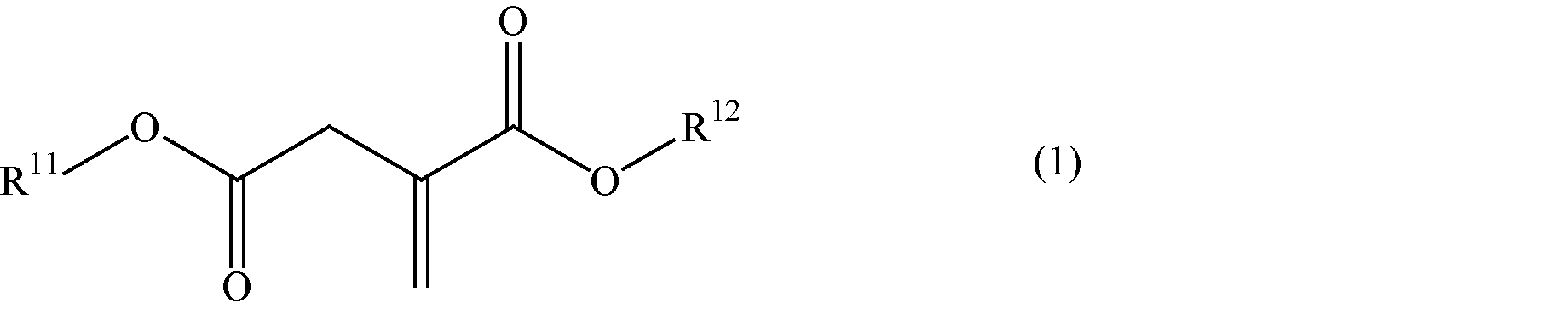
- the present invention relates to a rubber composition containing a copolymer synthesized by copolymerizing a conjugated diene monomer and a compound represented by the following formula (1), and carbon black and / or silica.
- R 11 and R 12 are the same or different and each represents a hydrogen atom or a hydrocarbon group having 1 to 30 carbon atoms.
- the content of the conjugated diene monomer unit is 5 to 95% by mass, and the content of the compound unit represented by the formula (1) is 5 to 95% in 100% by mass of constituent units. % Is preferred.
- the copolymer is synthesized by emulsion polymerization, and preferably has a weight average molecular weight of 5,000 to 2,000,000 and a molecular weight distribution of 2.1 to 11.
- R 11 and R 12 are ethyl groups.
- the conjugated diene monomer is preferably 1,3-butadiene.
- the copolymer is further synthesized by emulsion polymerization of a compound represented by the following formula (2), and the content of the copolymer unit is 1 to 50% by mass in 100% by mass of the structural unit Is preferred.
- R 21 represents a hydrogen atom, an aliphatic hydrocarbon group having 1 to 3 carbon atoms, an alicyclic hydrocarbon group having 3 to 8 carbon atoms, or an aromatic hydrocarbon having 6 to 10 carbon atoms
- R 22 represents a hydrogen atom or a methyl group.
- the copolymer is preferably one synthesized using a compound having a functional group having affinity with the filler and a mercapto group as a chain transfer agent.
- the present invention also relates to a pneumatic tire having a tread made using the above rubber composition.
- a rubber composition containing a copolymer synthesized by copolymerizing a conjugated diene monomer and a compound represented by the above formula (1), and carbon black and / or silica Accordingly, it is possible to provide a pneumatic tire having a tread with well-balanced improvements in fuel economy, abrasion resistance and wet grip performance while obtaining good processability.
- the rubber composition of the present invention contains a copolymer synthesized by copolymerizing a conjugated diene monomer and the compound represented by the above formula (1), and carbon black and / or silica.
- a copolymer synthesized by copolymerizing a conjugated diene monomer and the compound represented by the above formula (1) and carbon black and / or silica.
- the rubber composition of the present invention contains a copolymer synthesized by copolymerizing a conjugated diene monomer and the compound represented by the above formula (1), and carbon black and / or silica.
- the copolymer has a monomer unit based on a conjugated diene-based monomer as a constituent unit.
- conjugated diene-based monomers include 1,3-butadiene, isoprene, 2,3-dimethyl-1,3-butadiene and the like, and among them, low fuel consumption, abrasion resistance and wet grip performance can be obtained. From the viewpoint, 1,3-butadiene and isoprene are preferable, and 1,3-butadiene is more preferable. These may be used alone or in combination of two or more.
- the content of the conjugated diene monomer unit is preferably 5% by mass or more, more preferably 30% by mass or more, and still more preferably 100% by mass of the constituent units constituting the copolymer. It is 50 mass% or more.
- the content is preferably 95% by mass or less, more preferably 90% by mass or less, and still more preferably 80% by mass or less. If the amount is less than 5% by mass, the abrasion resistance may be reduced. If the amount is more than 95% by mass, the fuel consumption may be reduced.
- the copolymer has a monomer unit based on a compound represented by the following formula (1) as a structural unit.
- R 11 and R 12 are the same or different and each represents a hydrogen atom or a hydrocarbon group having 1 to 30 carbon atoms.
- the hydrocarbon group of R 11 and R 12 may be linear, branched or cyclic, and includes an aliphatic hydrocarbon group, an alicyclic hydrocarbon group, an aromatic hydrocarbon group and the like. Among them, aliphatic hydrocarbon groups are preferable.
- the carbon number of the hydrocarbon group is preferably 1 to 20, more preferably 1 to 10.
- the aliphatic hydrocarbon group of R 11 and R 12 preferably has 1 to 20 carbon atoms, and more preferably 1 to 10 carbon atoms.
- Preferred examples include an alkyl group, and specific examples thereof include a methyl group, an ethyl group, an n-propyl group, an isopropyl group, an n-butyl group, an isobutyl group, an sec-butyl group and a tert-butyl group.
- a methyl group and an ethyl group are preferable, and an ethyl group is more preferable, from the viewpoint of being able to remarkably improve the performance balance of fuel economy, abrasion resistance and wet grip performance while obtaining good processability.
- the alicyclic hydrocarbon group is preferably one having 3 to 8 carbon atoms, and specifically, cyclopropyl group, cyclobutyl group, cyclopentyl group, cyclohexyl group, cycloheptyl group, cyclooctyl group, cyclopropenyl group, cyclobutenyl group Groups, cyclopentenyl group, cyclohexenyl group, cycloheptenyl group, cyclooctenyl group and the like.
- the aromatic hydrocarbon group is preferably one having 6 to 10 carbon atoms, and specific examples thereof include a phenyl group, a benzyl group, a phenethyl group, a tolyl group, a xylyl group and a naphthyl group.
- the substitution position of the methyl group on the benzene ring in the tolyl group and the xylyl group may be any position of ortho position, meta position and para position.
- Specific examples of the compound represented by the above formula (1) include, for example, itaconic acid, 1-methyl itaconic acid, 4-methyl itaconate, dimethyl itaconate, 1-ethyl itaconate, 4-ethyl itaconate, Examples thereof include diethyl itaconate, 1-propyl itaconate, 4-propyl itaconate, dipropyl itaconate, 1-butyl itaconate, 4-butyl itaconate, dibutyl itaconate, 1-ethyl 4-methyl itaconate and the like.
- diethyl itaconate, dibutyl itaconate, and 1-propyl itaconate are preferable, since it is possible to remarkably improve the performance balance of fuel economy, abrasion resistance and wet grip performance while obtaining good processability.
- Acid diethyl is more preferred. These may be used alone or in combination of two or more.
- the content of the compound unit represented by the above formula (1) is preferably 5% by mass or more, more preferably 8% by mass or more in 100% by mass of the constituent units constituting the copolymer. More preferably, it is 10% by mass or more.
- the content is preferably 95% by mass or less, more preferably 50% by mass or less, and still more preferably 40% by mass or less. If the amount is less than 5% by mass, the fuel economy may be reduced. If the amount is more than 95% by mass, the abrasion resistance may be reduced.
- the said copolymer has a monomer unit based on the compound represented by following formula (2) as a structural unit.
- the wet grip performance and the abrasion resistance are made more remarkable by the fact that the above-mentioned copolymer has a monomer unit (preferably styrene) based on a compound represented by the following formula (2) in addition to the above-mentioned constitutional unit.
- the performance balance of fuel consumption, abrasion resistance and wet grip performance can be significantly improved while improving and obtaining good processability.
- R 21 represents a hydrogen atom, an aliphatic hydrocarbon group having 1 to 3 carbon atoms, an alicyclic hydrocarbon group having 3 to 8 carbon atoms, or an aromatic hydrocarbon having 6 to 10 carbon atoms
- R 22 represents a hydrogen atom or a methyl group.
- an alkyl group having 1 to 3 carbon atoms such as a methyl group, an ethyl group, an n-propyl group, an isopropyl group, etc. Among them, methyl is preferred.
- Examples of the alicyclic hydrocarbon group having 3 to 8 carbon atoms in the compound represented by the above formula (2) include the same ones as the compound represented by the above formula (1).
- Examples of the aromatic hydrocarbon group having 6 to 10 carbon atoms in the compound represented by the above formula (2) include the same ones as the compound represented by the above formula (1), and in view of high reactivity. , A phenyl group, a tolyl group and a naphthyl group are preferable, and a phenyl group is more preferable.
- R 21 an aromatic hydrocarbon group having 6 to 10 carbon atoms is preferable, and as R 22 , a hydrogen atom is preferable.
- Examples of the compound represented by the above formula (2) include styrene, 2-methylstyrene, 3-methylstyrene, 4-methylstyrene, ⁇ -methylstyrene, 2,4-dimethylstyrene, vinylethylbenzene, ⁇ -vinyl Examples thereof include naphthalene, ⁇ -vinylnaphthalene and vinylxylene. Among them, styrene, ⁇ -methylstyrene, ⁇ -vinylnaphthalene and ⁇ -vinylnaphthalene are preferable, and styrene is more preferable, from the viewpoint of high reactivity.
- the content of the compound unit represented by the above formula (2) is preferably 1% by mass or more, more preferably 5% by mass, in 100% by mass of the constituent units constituting the copolymer.
- the above more preferably 10% by mass or more.
- the content is preferably 50% by mass or less, more preferably 30% by mass or less, and still more preferably 20% by mass or less. The effect of this invention can fully be exhibited as it is in the said range.
- the total content of the compound unit represented by the formula (1) and the compound unit represented by the formula (2) is 100% by mass of the constituent units constituting the copolymer,
- the content is preferably 5% by mass or more, more preferably 8% by mass or more, still more preferably 10% by mass or more, and particularly preferably 15% by mass or more.
- the content is preferably 95% by mass or less, more preferably 70% by mass or less, still more preferably 50% by mass or less, particularly preferably 40% by mass or less, and most preferably 30% by mass or less.
- the effect of this invention can fully be exhibited as it is in the said range.
- the content of various monomer units such as the conjugated diene monomer unit, the compound unit represented by the formula (1) or (2), or the like is NMR (manufactured by Brugger). It can be measured by
- the copolymerization method of the copolymer is not particularly limited, and solution polymerization method, emulsion polymerization method, gas phase polymerization method, bulk polymerization method and the like can be mentioned, but the point that the copolymer can be obtained in high yield And emulsion polymerization is preferred.
- emulsion polymerization it synthesize
- the emulsion can be prepared by emulsifying with a emulsifying agent by a known method.
- the emulsifying agent is not particularly limited, and known materials can be used, and examples thereof include fatty acid salts and rosin acid salts. Examples of fatty acid salts and rosin acid salts include potassium salts or sodium salts of capric acid, lauric acid, myristic acid and the like.
- the emulsion polymerization can be carried out by a known method using a radical polymerization initiator.
- the radical polymerization initiator is not particularly limited, and known materials can be used, and examples thereof include redox initiators such as paramenthane hydroperoxide, persulfates such as ammonium persulfate, and the like.
- the temperature of the emulsion polymerization may be appropriately adjusted according to the type of the radical initiator used, but it is preferably -30 to 50 ° C, more preferably -10 to 20 ° C.
- the termination of the emulsion polymerization is carried out by adding a polymerization terminator to the polymerization system.
- the polymerization terminator is not particularly limited, and known materials can be used, and examples thereof include N, N'-dimethyldithiocarbamate, diethylhydroxylamine, hydroquinone and the like.
- the copolymer in the present invention is preferably prepared by emulsion polymerization in the presence of a chain transfer agent. This further improves the processability, fuel economy and wear resistance.
- the chain transfer agent is a control agent for radical polymerization which can act on the polymer growth terminal to stop the growth of the polymer and can generate a new polymerization initiating radical. This enables control of the molecular weight of the polymer, control of the molecular weight distribution (reduction in molecular weight, narrowing of molecular weight distribution), control of the polymer terminal structure, and the like.
- chain transfer agent examples include n-octyl mercaptan, n-nonyl mercaptan, n-decyl mercaptan, n-dodecyl mercaptan, t-dodecyl mercaptan, n-hexadecyl mercaptan and the like, among which control of molecular weight is In terms of ease, t-dodecyl mercaptan is preferred.
- the compound which has a functional group and mercapto group with affinity with a filler can be used suitably.
- a chain transfer agent a compound having a functional group having an affinity for the filler, together with a mercapto group, a functional group having an affinity for the filler can be introduced at the polymer end, which results in low fuel consumption and abrasion resistance. Can be improved more significantly.
- the functional group having affinity to the filler includes amino group, amide group, alkoxysilyl group, isocyanate group, imino group, imidazole group, urea group, ester group, ether group, carbonyl group, carboxyl group, hydroxyl group, nitrile group And pyridyl group. Among them, an alkoxysilyl group and an ester group are preferable, and an alkoxysilyl group is more preferable.
- the filler means a reinforcing filler such as carbon black and silica.
- a compound having an ester group for example, methyl 3-mercaptopropionate, ethyl 3-mercaptopropionate, propyl 3-mercaptopropionate, butyl 3-mercaptopropionate, pentyl 3-mercaptopropionate, 3-mercaptopropionate Hexyl, heptyl 3-mercaptopropionate, octyl 3-mercaptopropionate, 2-ethylhexyl 3-mercaptopropionate, 2-ethylhexyl mercaptoethaneate, 2-mercaptoethyl methaneate, 2-mercaptoethyl ethanoate, 2-propionate Mercaptoethyl, 2-mercaptoethyl butanoate, 2-mercaptoethyl pentanoate, 2-mercaptoethyl hexanoate, 2-mercaptoethyl heptanoate, 2-mercaptoethyl octanoate
- R 31 to R 33 each represent a branched or unbranched alkyl group having 1 to 12 carbon atoms, a branched or unbranched alkoxy group having 1 to 12 carbon atoms, or —O— (R 35 — O) z -R 36 (z R 35 s represent a branched or unbranched divalent hydrocarbon group having 1 to 30 carbon atoms.
- Z R 35 s may be the same or different.
- R 36 represents a branched or unbranched alkyl group having 1 to 30 carbon atoms, a branched or unbranched alkenyl group having 2 to 30 carbon atoms, an aryl group having 6 to 30 carbon atoms, or an aralkyl group having 7 to 30 carbon atoms
- z represents an integer of 1 to 30. At least one is a branched or unbranched alkoxy group having 1 to 12 carbon atoms, and R 31 to R 33 may be the same or different from each other.
- R 34 may be branched Or an unbranched alkylene group having 1 to 6 carbon atoms.
- R 31 to R 33 each represents a branched or unbranched alkyl group having 1 to 12 carbon atoms, a branched or unbranched alkoxy group having 1 to 12 carbon atoms, or —O— (R 35 —O) z —R 36
- R 31 to R 33 represents a group represented, at least one of which is a branched or unbranched alkoxy group having 1 to 12 carbon atoms.
- at least one of R 31 to R 33 is a group represented by —O— (R 35 —O) z —R 36 , from the viewpoint that the effects of the present invention can be obtained better. and more preferably two are -O- group represented by (R 35 -O) z -R 36 in.
- all of R 31 to R 33 be branched or unbranched alkoxy groups having 1 to 12 carbon atoms (preferably 1 to 5 carbon atoms, more preferably 1 to 3 carbon atoms).
- the branched or unbranched alkyl group having 1 to 12 carbon atoms (preferably 1 to 5 carbon atoms) represented by R 31 to R 33 is, for example, methyl group, ethyl group, n-propyl group, isopropyl group, n-butyl group Groups, iso-butyl group, sec-butyl group, tert-butyl group, pentyl group, hexyl group, heptyl group, 2-ethylhexyl group, octyl group, nonyl group and the like.
- the branched or unbranched alkoxy group having 1 to 12 carbon atoms (preferably 1 to 5 carbon atoms, more preferably 1 to 3 carbon atoms) represented by R 31 to R 33 includes, for example, a methoxy group, an ethoxy group, and n- Propoxy group, isopropoxy group, n-butoxy group, iso-butoxy group, sec-butyl group, tert-butyl group, pentyloxy group, hexyloxy group, heptyloxy group, 2-ethylhexyloxy group, octyloxy group, nonyloxy The basis is given.
- R 35 has a branched or unbranched carbon number of 1 to 30 (preferably 1 to 15 carbon atoms, more preferably 1 carbon atom) And 3) a divalent hydrocarbon group.
- the hydrocarbon group include branched or unbranched alkylene group having 1 to 30 carbon atoms, branched or unbranched alkenylene group having 2 to 30 carbon atoms, and branched or unbranched alkynylene group having 2 to 30 carbon atoms. And an arylene group having 6 to 30 carbon atoms. Among them, branched or unbranched alkylene groups having 1 to 30 carbon atoms are preferable.
- C1-C30 preferably C1-C15, More preferably C1-C3 alkylene group of R 35
- R 35 for example, a methylene group, an ethylene group, a propylene group, a butylene group And pentylene group, hexylene group, heptylene group, octylene group, nonylene group, decylene group, undecylene group, dodecylene group, tridecylene group, tetradecylene group, pentadecylene group, hexadecylene group, heptadecylene group, octadecylene group and the like.
- alkenylene group for R 35 for example, vinylene group, 1-propenylene group, 2-propenylene And 1-butenylene group, 2-butenylene group, 1-pentenylene group, 2-pentenylene group, 1-hexenylene group, 2-hexenylene group, 1-octenylene group and the like.
- C2-C30 preferably C2-C15, more preferably C2-C3 alkynylene group of R 35
- alkynylene group of R 35 for example, ethynylene group, propynylene group, butynylene group, pentynylene group And hexynylene group, heptynylene group, octynylene group, nonynylene group, decynylene group, undecynylene group, dodecynylene group and the like.
- Examples of the arylene group having 6 to 30 carbon atoms (preferably 6 to 15 carbon atoms) represented by R 35 include a phenylene group, a tolylene group, a xylylene group, and a naphthylene group.
- z represents an integer of 1 to 30 (preferably 2 to 20, more preferably 3 to 7, further preferably 5 to 6).
- R 36 represents a branched or unbranched alkyl group having 1 to 30 carbon atoms, a branched or unbranched alkenyl group having 2 to 30 carbon atoms, an aryl group having 6 to 30 carbon atoms or an aralkyl group having 7 to 30 carbon atoms Represent. Among them, a branched or unbranched alkyl group having 1 to 30 carbon atoms is preferable.
- the branched or unbranched alkyl group having 1 to 30 carbon atoms (preferably 3 to 25 carbon atoms, more preferably 10 to 15 carbon atoms) represented by R 36 includes, for example, methyl group, ethyl group, n-propyl group, Isopropyl group, n-butyl group, iso-butyl group, sec-butyl group, tert-butyl group, pentyl group, hexyl group, heptyl group, 2-ethylhexyl group, octyl group, nonyl group, decyl group, undecyl group And dodecyl, tridecyl, tetradecyl, pentadecyl, octadecyl and the like.
- the branched or unbranched alkenyl group having 2 to 30 carbon atoms (preferably 3 to 25 carbon atoms, more preferably 10 to 15 carbon atoms) for R 36 includes, for example, vinyl group, 1-propenyl group, 2-propenyl group Group, 1-butenyl group, 2-butenyl group, 1-pentenyl group, 2-pentenyl group, 1-hexenyl group, 2-hexenyl group, 1-octenyl group, decenyl group, undecenyl group, dodecenyl group, tridecenyl group, tetradecenyl group And pentadecenyl group and octadecenyl group.
- Examples of the aryl group having 6 to 30 carbon atoms (preferably 10 to 20 carbon atoms) represented by R 36 include a phenyl group, a tolyl group, a xylyl group, a naphthyl group and a biphenyl group.
- Examples of the aralkyl group having 7 to 30 carbon atoms (preferably 10 to 20 carbon atoms) represented by R 36 include a benzyl group and a phenethyl group.
- the alkylene group of the branched or unbranched 1 carbon atoms to 6 (preferably 1 to 5 carbon atoms) of R 34 for example, the same groups as the alkylene group of the branched or unbranched 1 to 30 carbon atoms for R 35 You can raise
- Examples of the compound represented by the above formula (3) include 3-mercaptopropyltrimethoxysilane, 3-mercaptopropyltriethoxysilane, 2-mercaptoethyltrimethoxysilane, 2-mercaptoethyltriethoxysilane, and the following formula
- a compound represented by the following formula from the viewpoint that the effects of the present invention can be obtained better, and the compound represented by the following formula is preferable.
- the compound represented by the following formula can be used more suitably. These may be used alone or in combination of two or more.
- the weight average molecular weight (Mw) of the copolymer is preferably 5,000 or more, more preferably 50,000 or more, still more preferably 100,000 or more, particularly preferably 300,000 or more, and most preferably 450,000. It is above. Also, the weight average molecular weight is preferably 2,000,000 or less, more preferably 1,500,000 or less, and still more preferably 1,000,000 or less. If it is less than 5,000, the fuel economy and the abrasion resistance may be deteriorated, and if it exceeds 2,000,000, the processability may be deteriorated.
- the ratio of Mw to the number average molecular weight (Mn) of the copolymer is preferably 2.1 or more, more preferably 2.5 or more, and still more preferably 3.0 or more. .
- the molecular weight distribution is preferably 11 or less, more preferably 8 or less, and still more preferably 5 or less. If it is less than 2.1, the processability may be deteriorated, and if it is more than 11, the fuel economy may be deteriorated.
- Mw and Mn are the values converted from the standard polystyrene, using a gel permeation chromatograph (GPC).
- the glass transition temperature (Tg) of the copolymer is preferably ⁇ 100 to 100 ° C., more preferably ⁇ 70 to 0 ° C.
- Tg is a value measured at a temperature rising rate of 10 ° C./min according to JIS-K7121: 1987 using a differential scanning calorimeter (Q200) manufactured by TA Instruments Japan Co., Ltd. .
- the Mooney viscosity ML 1 + 4 (130 ° C.) of the copolymer is preferably 30 to 100, more preferably 40 to 80.
- the effect of this invention can fully be exhibited as it is in the said range.
- the Mooney viscosity (ML 1 + 4 at 130 ° C.) is a value obtained by measuring the Mooney viscosity at 130 ° C. according to JIS-K6300.
- the content of the copolymer is preferably 1% by mass or more, more preferably 50% by mass or more, still more preferably 70% by mass or more, particularly preferably 80% by mass or more and 100% by mass in 100% by mass of the rubber component. It may be If the content is less than 1% by mass, the content of the copolymer is too small, and the effect of the present invention may not be obtained.
- NR natural rubber
- IR isoprene rubber
- BR butadiene rubber
- SBR styrene butadiene rubber
- SIR styrene isoprene
- diene rubbers such as styrene isoprene butadiene rubber (SIBR), ethylene propylene diene rubber (EPDM), chloroprene rubber (CR), acrylonitrile butadiene rubber (NBR) and butyl rubber (IIR).
- SIBR styrene isoprene butadiene rubber
- EPDM ethylene propylene diene rubber
- CR chloroprene rubber
- NBR acrylonitrile butadiene rubber
- IIR butyl rubber
- the rubber composition of the present invention contains carbon black and / or silica as a filler.
- carbon black those generally used in tire manufacturing can be used, and examples thereof include SAF, ISAF, HAF, FF, FEF, GPF, etc. It is also possible to use these carbon blacks alone, Two or more of them can be used in combination.
- the nitrogen adsorption specific surface area (N 2 SA) of carbon black is preferably 80 m 2 / g or more, and more preferably 100 m 2 / g or more.
- the N 2 SA is preferably 200 m 2 / g or less, more preferably 150 m 2 / g or less.
- N 2 SA of carbon black is less than 80 m 2 / g, the reinforcing property is small and the abrasion resistance tends not to be sufficiently improved, and when it exceeds 200 m 2 / g, carbon black is difficult to disperse and low Fuel efficiency tends to deteriorate.
- the carbon black N 2 SA can be measured in accordance with JIS K 6217-2: 2001.
- the dibutyl phthalate oil absorption (DBP) of carbon black is preferably 50 ml / 100 g or more, more preferably 100 ml / 100 g or more.
- the DBP is preferably 200 ml / 100 g or less and 150 ml / 100 g or less.
- the carbon black DBP can be measured in accordance with JIS K 6217-4: 2001.
- the content of carbon black is preferably 1 part by mass or more, more preferably 3 parts by mass or more, with respect to 100 parts by mass of the rubber component. Also, the content is preferably 50 parts by mass or less and 30 parts by mass or less. If the amount is less than 1 part by mass, abrasion resistance may be deteriorated. If the amount is more than 50 parts by mass, fuel economy may be deteriorated.
- the silica is not particularly limited, and examples thereof include dry method silica (anhydrous silicic acid) and wet method silica (hydrous silicic acid). However, wet method silica is preferable because it has many silanol groups.
- the N 2 SA of silica is preferably 100 m 2 / g or more, more preferably 150 m 2 / g or more.
- the N 2 SA is preferably 300 m 2 / g or less, more preferably 200 m 2 / g or less.
- the N 2 SA of silica is less than 100 m 2 / g, the reinforcing effect tends to be small, and the abrasion resistance tends not to be sufficiently improved.
- it exceeds 300 m 2 / g the silica becomes difficult to disperse, resulting in low fuel consumption. It tends to get worse.
- the silica N 2 SA can be measured in accordance with ASTM D3037-81.
- the content of silica is preferably 1 part by mass or more, more preferably 10 parts by mass or more, with respect to 100 parts by mass of the rubber component. Further, the content is preferably 150 parts by mass or less, more preferably 100 parts by mass or less. If the amount is less than 1 part by mass, the fuel economy and the abrasion resistance tend to be insufficient. If the amount is more than 150 parts by mass, the dispersibility of silica tends to deteriorate and the processability tends to deteriorate.
- the rubber composition of the present invention preferably contains a silane coupling agent together with silica.
- silane coupling agent any silane coupling agent conventionally used in combination with silica can be used in the rubber industry, and examples thereof include sulfides such as bis (3-triethoxysilylpropyl) tetrasulfide, 3 -Mercapto type such as mercaptopropyltrimethoxysilane, vinyl type such as vinyltriethoxysilane, amino type such as 3-aminopropyltriethoxysilane, glycidoxy type of ⁇ -glycidoxypropyltriethoxysilane, 3-nitropropyl tritoxysilane Nitro type such as methoxysilane, chloro type such as 3-chloropropyltrimethoxysilane, and the like can be mentioned. Among them, sulfides are preferable, and bis (3-triethoxysilylpropyl) tetrasulfide is
- the content is preferably 1 part by mass or more, and more preferably 2 parts by mass or more with respect to 100 parts by mass of silica.
- the content is preferably 20 parts by mass or less, and more preferably 15 parts by mass or less. If the amount is less than 1 part by mass, the effect of improving the dispersibility or the like tends not to be obtained sufficiently, and if it exceeds 20 parts by mass, a sufficient coupling effect can not be obtained, and the reinforcing property tends to be deteriorated. .
- the rubber composition of the present invention may contain, in addition to the components described above, compounding agents conventionally used in the rubber industry, such as other reinforcing fillers, anti-aging agents, vulcanizing agents such as oils, waxes and sulfur, and vulcanizing agents.
- compounding agents conventionally used in the rubber industry such as other reinforcing fillers, anti-aging agents, vulcanizing agents such as oils, waxes and sulfur, and vulcanizing agents.
- a vulcanization accelerator etc. can be blended suitably.
- the rubber composition of the present invention can be used for treads (cap treads, base treads), base treads, sidewalls, etc. of tires, and is particularly suitable for treads (particularly, especially cap treads).
- the pneumatic tire of the present invention is manufactured in the usual manner using the above rubber composition. That is, the rubber composition containing the above-mentioned components is extruded in an unvulcanized stage according to the shape of a tire member such as a tread, and molded in a usual manner on a tire molding machine together with other tire members. As a result, an unvulcanized tire is formed. The unvulcanized tire is heated and pressurized in a vulcanizer to obtain a tire.
- the pneumatic tire of the present invention is suitable for tires for passenger cars, for large passenger cars, tires for large SUVs, heavy duty tires such as trucks and buses, and tires for light trucks, and can be used as respective winter tires and studless tires is there.
- Ion exchange water In-house rosin acid potassium salt: Harima Chemicals, Ltd. fatty acid sodium soap: Wako Pure Chemical Industries, Ltd. potassium chloride: Wako Pure Chemical Industries, Ltd. sodium naphthalene sulfonate sodium formalin condensate: Kao ( Co., Ltd. Styrene: Styrene 1,3-butadiene made by Wako Pure Chemical Industries, Ltd .: 1,3-Butadiene t-dodecyl mercaptan made by Takachiho Shoji Co., Ltd .: tert-dodecyl made by Wako Pure Chemical Industries, Ltd.
- Mercaptan (chain transfer agent) Si 363 3- [Ethoxybis (3,6,9,12,15-pentaoxaoctacosan-1-yloxy) silyl] -1-propanethiol (chain transfer agent, compound represented by the following formula) manufactured by Degussa 2-ethylhexyl 3-mercaptopropionate: manufactured by Tokyo Chemical Industry Co., Ltd. (chain transfer agent) 2-mercaptoethyl octanoate: made by Tokyo Chemical Industry Co., Ltd. (chain transfer agent) 3-mercaptopropyltriethoxysilane: manufactured by Tokyo Chemical Industry Co., Ltd.
- SMILIZER BHT manufactured by Sumitomo Chemical Co., Ltd. Diethyl itaconate (IDE): Tokyo Chemical Industry Co., Ltd. dibutyl itaconate (IDB): Tokyo Chemical Industry Co., Ltd.
- Production Example 8 It is manufactured by the same method except changing 750 g of diethyl itaconate (IDE) and 5.74 g of t-dodecyl mercaptan into 6.11 g of 2-ethylhexyl 3-mercaptopropionates in 1500 g of styrene of the above-mentioned Preparation Example 1 Polymer 8 was obtained.
- IDE diethyl itaconate
- t-dodecyl mercaptan into 6.11 g of 2-ethylhexyl 3-mercaptopropionates in 1500 g of styrene of the above-mentioned Preparation Example 1 Polymer 8 was obtained.
- a copolymer 9 is prepared in the same manner as in Production Example 1 except that 1500 g of styrene is changed to 1500 g of diethyl itaconate (IDE) and 5.74 g of t-dodecyl mercaptan to 6.11 g of 2-mercaptoethyl octanoate. Obtained.
- a copolymer was prepared by the same method except that 750 g of the above 1500 g of styrene of the above Production Example 1 was changed to diethyl itaconate (IDE) and 5.74 g of t-dodecyl mercaptan to 6.11 g of 2-mercaptoethyl octanoate. I got ten.
- Production Example 12 It manufactures by the same method except changing 750 g of diethyl itaconate (IDE) and 5.74 g of t-dodecyl mercaptan into 6.11 g of 3-mercaptopropyltriethoxysilane in 1500 g of styrene of the above-mentioned Preparation Example 1 The united body 12 was obtained.
- IDE diethyl itaconate
- t-dodecyl mercaptan into 6.11 g of 3-mercaptopropyltriethoxysilane in 1500 g of styrene of the above-mentioned Preparation Example 1
- the united body 12 was obtained.
- the weight average molecular weight (Mw) and number average molecular weight (Mn) of the copolymer were determined by gel permeation chromatography (GPC) (GPC-8000 series manufactured by Tosoh Corp., detector: differential refractometer, column: Tosoh (stock It calculated
- GPC gel permeation chromatography
- the glass transition temperature (Tg) should be measured according to JIS K 7121, using a differential scanning calorimeter (Q200) manufactured by TA Instruments Japan, while raising the temperature at a heating rate of 10 ° C./min. It calculated
- Mooney viscosity (ML 1 + 4 , 130 ° C.) After preheating at 130 ° C. for 1 minute according to JIS-K 6300 and using a Mooney viscometer (SMV-200) manufactured by Shimadzu Corporation, the Mooney viscosity (ML 1 + 4 , 130 ° C.) of the rubber is measured for 4 minutes. Was measured.
- Rubber component Copolymers 1 to 12 produced in the above Production Examples 1 to 12
- Carbon black Show black N220 (N 2 SA: 111 m 2 / g, DBP: 115 ml / 100 g) manufactured by Cabot Japan Ltd.
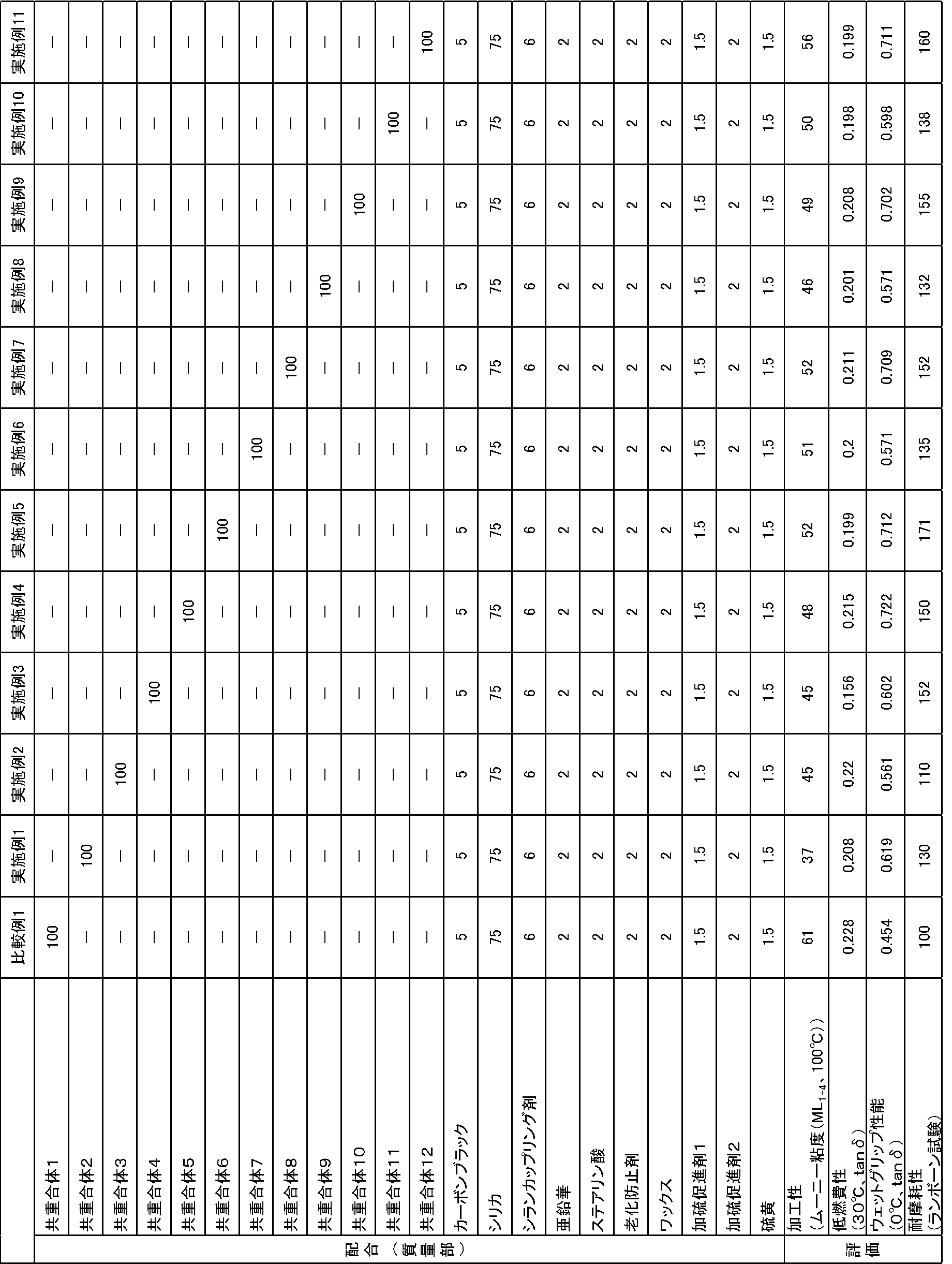
- Example and Comparative Example> According to the compounding contents shown in Table 2, various chemicals except sulfur and a vulcanization accelerator were kneaded at 150 ° C. for 5 minutes in a Banbury mixer. Sulfur and a vulcanization accelerator were added to the obtained kneaded product, and kneading was performed at 170 ° C. for 12 minutes using an open roll, to obtain an unvulcanized rubber composition. The obtained unvulcanized rubber composition was press vulcanized at 170 ° C. for 20 minutes to obtain a vulcanized rubber composition.
- the visco-elastic parameters of the test pieces prepared from each of the vulcanized rubber compositions were measured in a torsional mode using a rheometrics mechanical visco-elastic tester (ARES).
- the tan ⁇ was measured at a frequency of 10 Hz and a strain of 1% at 0 ° C. The larger the tan ⁇ , the better the wet grip performance.
Landscapes
- Chemical & Material Sciences (AREA)
- Polymers & Plastics (AREA)
- Health & Medical Sciences (AREA)
- Chemical Kinetics & Catalysis (AREA)
- Medicinal Chemistry (AREA)
- Organic Chemistry (AREA)
- Engineering & Computer Science (AREA)
- Mechanical Engineering (AREA)
- Materials Engineering (AREA)
- Compositions Of Macromolecular Compounds (AREA)
- Tires In General (AREA)
- Polymerisation Methods In General (AREA)
- Addition Polymer Or Copolymer, Post-Treatments, Or Chemical Modifications (AREA)
Abstract
Description



なお、連鎖移動剤とは、ポリマー生長末端に作用してポリマーの生長を停止するとともに、新たな重合開始ラジカルを発生することができるラジカル重合の制御剤である。これにより、ポリマーの分子量、分子量分布の制御(低分子量化、狭分子量分布化)や、ポリマー末端構造の制御などが可能となる。

R31~R33は、本発明の効果がより良好に得られるという点から、更に少なくとも1つが-O-(R35-O)z-R36で表される基であることが好ましく、残りの2つが-O-(R35-O)z-R36で表される基であることがより好ましい。
また、R31~R33全てが分岐若しくは非分岐の炭素数1~12(好ましくは炭素数1~5、より好ましくは炭素数1~3)のアルコキシ基であることも好ましい。
該炭化水素基としては、例えば、分岐若しくは非分岐の炭素数1~30のアルキレン基、分岐若しくは非分岐の炭素数2~30のアルケニレン基、分岐若しくは非分岐の炭素数2~30のアルキニレン基、炭素数6~30のアリーレン基などがあげられる。中でも、分岐若しくは非分岐の炭素数1~30のアルキレン基が好ましい。

なお、Mw及びMnは、ゲルパーミエーションクロマトグラフ(GPC)を用い、標準ポリスチレンより換算した値である。
なお、Tgは、JIS-K7121:1987に従い、ティー・エイ・インスツルメント・ジャパン社製の示差走査熱量計(Q200)を用いて、昇温速度10℃/分の条件で測定した値である。
なお、ムーニー粘度(ML1+4、130℃)は、JIS-K6300に従い、130℃でムーニー粘度を測定することにより得られる値である。
なお、カーボンブラックのN2SAは、JIS K 6217-2:2001に準拠して測定できる。
なお、カーボンブラックのDBPは、JIS K6217-4:2001に準拠して測定できる。
なお、シリカのN2SAは、ASTM D3037-81に準拠して測定できる。
シランカップリング剤としては、ゴム工業において、従来からシリカと併用される任意のシランカップリング剤を使用することができ、例えば、ビス(3-トリエトキシシリルプロピル)テトラスルフィド等のスルフィド系、3-メルカプトプロピルトリメトキシシランなどのメルカプト系、ビニルトリエトキシシランなどのビニル系、3-アミノプロピルトリエトキシシランなどのアミノ系、γ-グリシドキシプロピルトリエトキシシランのグリシドキシ系、3-ニトロプロピルトリメトキシシランなどのニトロ系、3-クロロプロピルトリメトキシシランなどのクロロ系等が挙げられる。なかでも、スルフィド系が好ましく、ビス(3-トリエトキシシリルプロピル)テトラスルフィドがより好ましい。
すなわち、前記成分を配合したゴム組成物を、未加硫の段階でトレッドなどのタイヤ用部材の形状にあわせて押出し加工し、他のタイヤ部材とともに、タイヤ成型機上にて通常の方法で成形することにより、未加硫タイヤを形成する。この未加硫タイヤを加硫機中で加熱加圧することによりタイヤを得る。
イオン交換水:自社製
ロジン酸カリウム石鹸:ハリマ化成(株)製
脂肪酸ナトリウム石鹸:和光純薬工業(株)製
塩化カリウム:和光純薬工業(株)製
ナフタレンスルホン酸ソーダホルマリン縮合物:花王(株)製
スチレン:和光純薬工業(株)製のスチレン
1,3-ブタジエン:高千穂商事(株)製の1,3-ブタジエン
t-ドデシルメルカプタン:和光純薬工業(株)製のtert-ドデシルメルカプタン(連鎖移動剤)
Si363:デグッサ社製の3-[エトキシビス(3,6,9,12,15-ペンタオキサオクタコサン-1-イルオキシ)シリル]-1-プロパンチオール(連鎖移動剤、下記式で表される化合物)

オクタン酸2-メルカプトエチル:東京化成工業(株)製(連鎖移動剤)
3-メルカプトプロピルトリエトキシシラン:東京化成工業(株)製(連鎖移動剤、式(3)で表される化合物)
ハイドロサルファイドナトリウム:和光純薬工業(株)製
FeSO4:和光純薬工業(株)製の硫酸第二鉄
EDTA:和光純薬工業(株)製のエチレンジアミン四酢酸ナトリウム
ロンガリット:和光純薬工業(株)製のソディウム・ホルムアルデヒド・スルホキシレート
重合開始剤:日油(株)製のパラメンタンヒドロペルオキシド
重合停止剤:和光純薬工業(株)製のN,N-ジエチルヒドロキシルアミン
2,6-ジ-t-ブチル-p-クレゾール:住友化学(株)製のスミライザーBHT
イタコン酸ジエチル(IDE):東京化成工業(株)製
イタコン酸ジブチル(IDB):東京化成工業(株)製
イオン交換水9356g、ロジン酸カリウム石鹸1152g、脂肪酸ナトリウム石鹸331g、塩化カリウム51g、ナフタレンスルホン酸ソーダホルマリン縮合物30gを添加し70℃で2時間撹拌、乳化剤を調製した。
内容積50リットルのステンレス製重合反応機を洗浄、乾燥し、乾燥窒素で置換した後に1,3-ブタジエン3500g、スチレン1500g、t-ドデシルメルカプタン5.74g、上記乳化剤9688g、ハイドロサルファイドナトリウム6.3ml(1.8M)、活性剤(FeSO4/EDTA/ロンガリット)各6.3ml、重合開始剤6.3ml(2.3M)を添加し、攪拌下に10℃で3時間重合を行った。重合完了後、N,N-ジエチルヒドロキシルアミン2.9g添加し、30分反応させ重合反応容器の内容物を取り出し、10gの2,6-ジ-t-ブチル-p-クレゾールを加え、水の大部分を蒸発させた後、55℃で12時間減圧乾燥し、共重合体1を得た。
上記製造例1のスチレン1500gをイタコン酸ジエチル(IDE)1500gに変更した以外は同様の方法で製造し、共重合体2を得た。
上記製造例1のスチレン1500gをイタコン酸ジブチル(IDB)1500gに変更した以外は同様の方法で製造し、共重合体3を得た。
上記製造例1のスチレン1500gをイタコン酸ジエチル(IDE)1500g、t-ドデシルメルカプタン5.74gをSi363 6.40gに変更した以外は同様の方法で製造し、共重合体4を得た。
上記製造例1のスチレン1500g中、750gをイタコン酸ジエチル(IDE)750gに変更した以外は同様の方法で製造し、共重合体5を得た。
上記製造例1のスチレン1500g中、750gをイタコン酸ジエチル(IDE)750g、t-ドデシルメルカプタン5.74gをSi363 6.40gに変更した以外は同様の方法で製造し、共重合体6を得た。
上記製造例1のスチレン1500gをイタコン酸ジエチル(IDE)1500g、t-ドデシルメルカプタン5.74gを3-メルカプトプロピオン酸2-エチルヘキシル6.11gに変更した以外は同様の方法で製造し、共重合体7を得た。
上記製造例1のスチレン1500g中、750gをイタコン酸ジエチル(IDE)、t-ドデシルメルカプタン5.74gを3-メルカプトプロピオン酸2-エチルヘキシル6.11gに変更した以外は同様の方法で製造し、共重合体8を得た。
上記製造例1のスチレン1500gをイタコン酸ジエチル(IDE)1500g、t-ドデシルメルカプタン5.74gをオクタン酸2-メルカプトエチル6.11gに変更した以外は同様の方法で製造し、共重合体9を得た。
上記製造例1のスチレン1500g中、750gをイタコン酸ジエチル(IDE)、t-ドデシルメルカプタン5.74gをオクタン酸2-メルカプトエチル6.11gに変更した以外は同様の方法で製造し、共重合体10を得た。
上記製造例1のスチレン1500gをイタコン酸ジエチル(IDE)、t-ドデシルメルカプタン5.74gを3-メルカプトプロピルトリエトキシシラン6.11gに変更した以外は同様の方法で製造し、共重合体11を得た。
上記製造例1のスチレン1500g中、750gをイタコン酸ジエチル(IDE)、t-ドデシルメルカプタン5.74gを3-メルカプトプロピルトリエトキシシラン6.11gに変更した以外は同様の方法で製造し、共重合体12を得た。
23℃にてブルカー社製NMR装置を用いて1H-NMRを測定し、そのスペクトルより求めた6.5~7.2ppmのスチレン単位に基づくフェニルプロトンと、4.9~5.4ppmのブタジエン単位に基づくビニルプロトンと、3.9~4.2ppmのイソブチルビニルエーテル単位に基づくピークの比から各単量体単位の含有量を決定した。
共重合体の重量平均分子量(Mw)及び数平均分子量(Mn)は、ゲルパーミエーションクロマトグラフ(GPC)(東ソー(株)製GPC-8000シリーズ、検出器:示差屈折計、カラム:東ソー(株)製のTSKGEL SUPERMULTIPORE HZ-M)による測定値を基に標準ポリスチレン換算により求めた。
ガラス転移温度(Tg)は、JIS K 7121に従い、ティー・エイ・インスツルメント・ジャパン社製の示差走査熱量計(Q200)を用いて昇温速度10℃/分で昇温しながら測定することにより、ガラス転移開始温度として求めた。
JIS-K6300に従い、(株)島津製作所製のムーニー粘度計(SMV-200)を使用して、130℃で1分間予熱したのち、4分間測定してゴムのムーニー粘度(ML1+4、130℃)を測定した。

ゴム成分:上記製造例1~12で製造された共重合体1~12
カーボンブラック:キャボットジャパン(株)製のショウブラックN220(N2SA:111m2/g、DBP:115ml/100g)
シリカ:デグッサ社製のウルトラシルVN3(N2SA:175m2/g)
シランカップリング剤:デグッサ社製のSi69(ビス(3-トリエトキシシリルプロピル)テトラスルフィド)
亜鉛華:三井金属鉱業(株)製の亜鉛華1号
ステアリン酸:日油(株)製のステアリン酸
老化防止剤:大内新興化学工業(株)製のノクラック6C(N-1,3-ジメチルブチル-N’-フェニル-p-フェニレンジアミン)
ワックス:大内新興化学工業(株)製のサンノックワックス
加硫促進剤1:大内新興化学工業(株)製のノクセラーCZ(N-シクロヘキシル-2-ベンゾチアゾリルスルフェンアミド)
加硫促進剤2:大内新興化学工業(株)製のノクセラーD(N,N’-ジフェニルグアニジン)
硫黄:鶴見化学工業(株)製の粉末硫黄
表2に示す配合内容に従い、硫黄および加硫促進剤を除く各種薬品を、バンバリーミキサーにて、150℃で5分間混練りした。得られた混練物に、硫黄及び加硫促進剤を添加して、オープンロールを用いて、170℃で12分間混練りし、未加硫ゴム組成物を得た。
得られた未加硫ゴム組成物を、170℃で20分間プレス加硫し、加硫ゴム組成物を得た。
各未加硫ゴム組成物について、JIS K6300に準拠したムーニー粘度の測定方法に従い、100℃で測定した。数値が小さいほど、加工性に優れる。
粘弾性スペクトロメーターVES((株)岩本製作所製)を用いて、温度30℃、初期歪み10%、動歪み2%の条件下で各加硫ゴム組成物のtanδを測定した。tanδが小さいほど低燃費性に優れることを示す。
各加硫ゴム組成物から調製した試験片について、レオメトリックス・サイエンティフィック社製の粘弾性試験機(ARES)を使用して、ねじりモードで、粘弾性パラメータを測定した。0℃において周波数10Hz、ひずみ1%でtanδを測定した。tanδが大きいほどウェットグリップ性能に優れることを示す。
ランボーン型摩耗試験機を用いて、室温、負荷荷重1.0kgf、スリップ率30%の条件で上記加硫ゴム組成物の摩耗量を測定し、下記計算式により指数表示した。数値が大きいほど耐摩耗性に優れることを示す。
(耐摩耗性指数)=(比較例1の摩耗量)/(各配合の摩耗量)×100
Claims (8)
- 共役ジエン系単量体と下記式(1)で表される化合物とを共重合して合成される共重合体と、カーボンブラック及び/又はシリカとを含有するゴム組成物。

- 前記共重合体は、構成単位100質量%中、前記共役ジエン系単量体単位の含有量が5~95質量%、前記式(1)で表される化合物単位の含有量が5~95質量%である請求項1記載のゴム組成物。
- 前記共重合体は、乳化重合して合成され、重量平均分子量5,000~2,000,000、分子量分布2.1~11である請求項1又は2記載のゴム組成物。
- 前記R11及びR12がエチル基である請求項1~3のいずれかに記載のゴム組成物。
- 前記共役ジエン系単量体が1,3-ブタジエンである請求項1~4のいずれかに記載のゴム組成物。
- 前記共重合体は、更に下記式(2)で示される化合物を乳化重合して合成されるもので、かつ構成単位100質量%中、該共重合体単位の含有量が1~50質量%である請求項1~5のいずれかに記載のゴム組成物。

- 前記共重合体は、連鎖移動剤として、フィラーと親和性のある官能基及びメルカプト基を有する化合物を用いて合成されるものである請求項1~6のいずれかに記載のゴム組成物。
- 請求項1~7のいずれかに記載のゴム組成物を用いて作製したトレッドを有する空気入りタイヤ。
Priority Applications (4)
| Application Number | Priority Date | Filing Date | Title |
|---|---|---|---|
| US15/034,715 US10086651B2 (en) | 2013-11-19 | 2014-07-29 | Rubber composition and pneumatic tire having tread fabricated using rubber composition |
| EP14863251.6A EP3072924B1 (en) | 2013-11-19 | 2014-07-29 | Pneumatic tire having tread fabricated using rubber composition |
| CN201480060742.1A CN105873999B (zh) | 2013-11-19 | 2014-07-29 | 橡胶组合物及使用橡胶组合物制成胎面的充气轮胎 |
| JP2015549007A JP6008310B2 (ja) | 2013-11-19 | 2014-07-29 | ゴム組成物及び該ゴム組成物を用いて作製したトレッドを有する空気入りタイヤ |
Applications Claiming Priority (2)
| Application Number | Priority Date | Filing Date | Title |
|---|---|---|---|
| JP2013-239025 | 2013-11-19 | ||
| JP2013239025 | 2013-11-19 |
Publications (1)
| Publication Number | Publication Date |
|---|---|
| WO2015075971A1 true WO2015075971A1 (ja) | 2015-05-28 |
Family
ID=53179250
Family Applications (1)
| Application Number | Title | Priority Date | Filing Date |
|---|---|---|---|
| PCT/JP2014/069935 Ceased WO2015075971A1 (ja) | 2013-11-19 | 2014-07-29 | ゴム組成物及び該ゴム組成物を用いて作製したトレッドを有する空気入りタイヤ |
Country Status (5)
| Country | Link |
|---|---|
| US (1) | US10086651B2 (ja) |
| EP (1) | EP3072924B1 (ja) |
| JP (1) | JP6008310B2 (ja) |
| CN (1) | CN105873999B (ja) |
| WO (1) | WO2015075971A1 (ja) |
Cited By (9)
| Publication number | Priority date | Publication date | Assignee | Title |
|---|---|---|---|---|
| CN104945817A (zh) * | 2015-06-15 | 2015-09-30 | 北京化工大学 | 一种衣康酸酯/丁二烯共聚物型生物工程橡胶及其制备方法 |
| JP2017088769A (ja) * | 2015-11-12 | 2017-05-25 | 住友ゴム工業株式会社 | ゴム組成物及び該ゴム組成物を用いて作製した空気入りタイヤ |
| EP3257688A1 (en) * | 2016-06-14 | 2017-12-20 | Sumitomo Rubber Industries, Ltd. | Rubber composition and pneumatic tire comprising tread formed from said rubber composition |
| JP2018131478A (ja) * | 2017-02-13 | 2018-08-23 | 住友ゴム工業株式会社 | タイヤ用ゴム組成物及び空気入りタイヤ |
| JP2018524417A (ja) * | 2015-12-10 | 2018-08-30 | 北京化工大学Beijing University Of Chemical Technology | シランカップリングを不要とするシリカ/ポリ(イタコナート−イソプレン−グリシジルメタクリレート)バイオベースエラストマー複合材料及びその調製方法 |
| EP3421260A1 (en) | 2017-06-29 | 2019-01-02 | Sumitomo Rubber Industries, Ltd. | Rubber composition and pneumatic tire |
| EP3438178A1 (en) | 2017-08-01 | 2019-02-06 | Sumitomo Rubber Industries, Ltd. | Rubber composition and pneumatic tire |
| EP3348425A4 (en) * | 2015-10-27 | 2019-06-19 | Sumitomo Rubber Industries, Ltd. | AIR TIRES AND NETWORKED RUBBER COMPOSITION |
| JP2022013975A (ja) * | 2020-07-06 | 2022-01-19 | 日本エイアンドエル株式会社 | 共重合体ラテックスの製造方法、タイヤトレッド用ゴム組成物の製造方法、及び空気入りタイヤの製造方法 |
Families Citing this family (1)
| Publication number | Priority date | Publication date | Assignee | Title |
|---|---|---|---|---|
| CN115124653B (zh) * | 2022-07-11 | 2024-02-06 | 山东京博中聚新材料有限公司 | 一种生物基橡胶及其制备方法 |
Citations (5)
| Publication number | Priority date | Publication date | Assignee | Title |
|---|---|---|---|---|
| JPH03109449A (ja) * | 1989-09-22 | 1991-05-09 | Nippon Zeon Co Ltd | 耐寒性、耐熱性が改良されたゴム組成物 |
| JP2006206659A (ja) * | 2005-01-26 | 2006-08-10 | Nippon Zeon Co Ltd | ホースおよびその製造方法 |
| JP2008056793A (ja) * | 2006-08-31 | 2008-03-13 | Nippon Zeon Co Ltd | 架橋性ニトリルゴム組成物およびゴム架橋物 |
| JP2008222891A (ja) * | 2007-03-14 | 2008-09-25 | Nippon Zeon Co Ltd | 架橋性ニトリルゴム組成物及びゴム架橋物 |
| JP2013053296A (ja) | 2011-08-09 | 2013-03-21 | Sumitomo Rubber Ind Ltd | タイヤ用ゴム組成物及び空気入りタイヤ |
Family Cites Families (8)
| Publication number | Priority date | Publication date | Assignee | Title |
|---|---|---|---|---|
| DE60133829T2 (de) | 2000-09-06 | 2009-05-20 | Bridgestone Corp. | Verbundstoff aus dienkautschuk und anorganischer verbindung und verfahren zu dessen herstellung und kautschukzusammensetzung |
| JP2002241507A (ja) * | 2000-12-12 | 2002-08-28 | Jsr Corp | ジエン系ゴム・無機化合物複合体及びその製造方法並びにそれを含有するゴム組成物 |
| JP2002201310A (ja) * | 2000-12-27 | 2002-07-19 | Bridgestone Corp | ゴム組成物 |
| US20050182159A1 (en) | 2003-03-20 | 2005-08-18 | Jrs Corporation | Diene rubber-inorganic compound composite and process for producing the same |
| JP2005068211A (ja) * | 2003-08-28 | 2005-03-17 | Yokohama Rubber Co Ltd:The | タイヤトレッド用ゴム組成物 |
| CN101649025B (zh) * | 2009-06-06 | 2011-07-20 | 中国石油兰州石油化工公司 | 一种羧基丁苯胶乳的制备方法 |
| ES2698391T3 (es) * | 2010-10-14 | 2019-02-04 | Basf Se | Asfalto modificado por polímero |
| JP5788916B2 (ja) * | 2013-01-21 | 2015-10-07 | 住友ゴム工業株式会社 | 繊維コード被覆用ゴム組成物、及び空気入りタイヤ |
-
2014
- 2014-07-29 EP EP14863251.6A patent/EP3072924B1/en active Active
- 2014-07-29 US US15/034,715 patent/US10086651B2/en active Active
- 2014-07-29 WO PCT/JP2014/069935 patent/WO2015075971A1/ja not_active Ceased
- 2014-07-29 JP JP2015549007A patent/JP6008310B2/ja active Active
- 2014-07-29 CN CN201480060742.1A patent/CN105873999B/zh active Active
Patent Citations (5)
| Publication number | Priority date | Publication date | Assignee | Title |
|---|---|---|---|---|
| JPH03109449A (ja) * | 1989-09-22 | 1991-05-09 | Nippon Zeon Co Ltd | 耐寒性、耐熱性が改良されたゴム組成物 |
| JP2006206659A (ja) * | 2005-01-26 | 2006-08-10 | Nippon Zeon Co Ltd | ホースおよびその製造方法 |
| JP2008056793A (ja) * | 2006-08-31 | 2008-03-13 | Nippon Zeon Co Ltd | 架橋性ニトリルゴム組成物およびゴム架橋物 |
| JP2008222891A (ja) * | 2007-03-14 | 2008-09-25 | Nippon Zeon Co Ltd | 架橋性ニトリルゴム組成物及びゴム架橋物 |
| JP2013053296A (ja) | 2011-08-09 | 2013-03-21 | Sumitomo Rubber Ind Ltd | タイヤ用ゴム組成物及び空気入りタイヤ |
Non-Patent Citations (2)
| Title |
|---|
| RUNGUO WANG: "Itaconic acid as an alternative for synthesis rubbers", TECHNICAL MEETING OF THE RUBBER DIVISION, vol. 1, no. 184TH, 2013, pages 174 - 191, XP008183211 * |
| RUNGUO WANG: "Morphology, Interfacial Interaction, and Properties of a Novel Bioelastomer Reinforced by Silica and Carbon Black", JOURNAL OF APPLIED POLYMER SCIENCE, vol. 129, no. 3, 2013, pages 1546 - 1554, XP055343328 * |
Cited By (19)
| Publication number | Priority date | Publication date | Assignee | Title |
|---|---|---|---|---|
| CN104945817A (zh) * | 2015-06-15 | 2015-09-30 | 北京化工大学 | 一种衣康酸酯/丁二烯共聚物型生物工程橡胶及其制备方法 |
| WO2016202175A1 (zh) * | 2015-06-15 | 2016-12-22 | 北京化工大学 | 一种衣康酸酯/丁二烯共聚物型生物工程橡胶及其制备方法 |
| CN104945817B (zh) * | 2015-06-15 | 2017-12-29 | 北京化工大学 | 一种衣康酸酯/丁二烯共聚物型生物工程橡胶及其制备方法 |
| EP3305819A4 (en) * | 2015-06-15 | 2018-06-27 | Beijing University Of Chemical Technology | Itaconate/butadiene copolymer type bioengineering rubber and preparation method therefor |
| JP2018536719A (ja) * | 2015-06-15 | 2018-12-13 | 北京化工大学Beijing University Of Chemical Technology | イタコナート/ブタジエン共重合体型のバイオエンジニアリングゴム及びその調製方法 |
| US10654316B2 (en) | 2015-10-27 | 2020-05-19 | Sumitomo Rubber Industries, Ltd. | Pneumatic tire and crosslinked rubber composition |
| EP3348425A4 (en) * | 2015-10-27 | 2019-06-19 | Sumitomo Rubber Industries, Ltd. | AIR TIRES AND NETWORKED RUBBER COMPOSITION |
| JP2017088769A (ja) * | 2015-11-12 | 2017-05-25 | 住友ゴム工業株式会社 | ゴム組成物及び該ゴム組成物を用いて作製した空気入りタイヤ |
| EP3323841A4 (en) * | 2015-12-10 | 2018-10-24 | Beijing University Of Chemical Technology | White carbon black/poly(itaconate-isoprene-glycidyl methacrylate) bio-based elastomer composite material free of silane coupling agent, and preparation method therefor |
| JP2018524417A (ja) * | 2015-12-10 | 2018-08-30 | 北京化工大学Beijing University Of Chemical Technology | シランカップリングを不要とするシリカ/ポリ(イタコナート−イソプレン−グリシジルメタクリレート)バイオベースエラストマー複合材料及びその調製方法 |
| EP3257688A1 (en) * | 2016-06-14 | 2017-12-20 | Sumitomo Rubber Industries, Ltd. | Rubber composition and pneumatic tire comprising tread formed from said rubber composition |
| JP2018131478A (ja) * | 2017-02-13 | 2018-08-23 | 住友ゴム工業株式会社 | タイヤ用ゴム組成物及び空気入りタイヤ |
| EP3421260A1 (en) | 2017-06-29 | 2019-01-02 | Sumitomo Rubber Industries, Ltd. | Rubber composition and pneumatic tire |
| JP2019011400A (ja) * | 2017-06-29 | 2019-01-24 | 住友ゴム工業株式会社 | ゴム組成物及び空気入りタイヤ |
| EP3438178A1 (en) | 2017-08-01 | 2019-02-06 | Sumitomo Rubber Industries, Ltd. | Rubber composition and pneumatic tire |
| JP2019026777A (ja) * | 2017-08-01 | 2019-02-21 | 住友ゴム工業株式会社 | ゴム組成物及び空気入りタイヤ |
| JP6992308B2 (ja) | 2017-08-01 | 2022-01-13 | 住友ゴム工業株式会社 | ゴム組成物及び空気入りタイヤ |
| JP2022013975A (ja) * | 2020-07-06 | 2022-01-19 | 日本エイアンドエル株式会社 | 共重合体ラテックスの製造方法、タイヤトレッド用ゴム組成物の製造方法、及び空気入りタイヤの製造方法 |
| JP7523264B2 (ja) | 2020-07-06 | 2024-07-26 | 日本エイアンドエル株式会社 | 共重合体ラテックスの製造方法、タイヤトレッド用ゴム組成物の製造方法、及び空気入りタイヤの製造方法 |
Also Published As
| Publication number | Publication date |
|---|---|
| EP3072924B1 (en) | 2018-09-19 |
| CN105873999B (zh) | 2018-11-27 |
| US20160288570A1 (en) | 2016-10-06 |
| CN105873999A (zh) | 2016-08-17 |
| US10086651B2 (en) | 2018-10-02 |
| EP3072924A4 (en) | 2017-06-21 |
| EP3072924A1 (en) | 2016-09-28 |
| JP6008310B2 (ja) | 2016-10-19 |
| JPWO2015075971A1 (ja) | 2017-03-16 |
Similar Documents
| Publication | Publication Date | Title |
|---|---|---|
| JP6008310B2 (ja) | ゴム組成物及び該ゴム組成物を用いて作製したトレッドを有する空気入りタイヤ | |
| EP3257688B1 (en) | Rubber composition and pneumatic tire comprising tread formed from said rubber composition | |
| JP5825819B2 (ja) | ジエン系重合体及びその製造方法 | |
| JP6053495B2 (ja) | タイヤ用ゴム組成物及び空気入りタイヤ | |
| JP2012122015A (ja) | タイヤ用ゴム組成物及び空気入りタイヤ | |
| JP2012158679A (ja) | タイヤ用ゴム組成物及び空気入りタイヤ | |
| JP6009918B2 (ja) | タイヤ用ゴム組成物及び空気入りタイヤ | |
| WO2013094609A1 (ja) | タイヤ用ゴム組成物及び空気入りタイヤ | |
| EP3176189B1 (en) | Rubber composition and pneumatic tire comprising tread formed from said rubber composition | |
| JP2013173893A (ja) | タイヤ用ゴム組成物及び空気入りタイヤ | |
| JP5712106B2 (ja) | タイヤ用ゴム組成物及び空気入りタイヤ | |
| JP5840971B2 (ja) | タイヤ用ゴム組成物及び空気入りタイヤ | |
| WO2016002433A1 (ja) | ゴム組成物及び該ゴム組成物を用いて作製したトレッドを有する空気入りタイヤ | |
| JP6329063B2 (ja) | ゴム組成物及び該ゴム組成物を用いて作製したトレッドを有する空気入りタイヤ | |
| JP6359797B2 (ja) | タイヤ用ゴム組成物及び空気入りタイヤ | |
| JP5670855B2 (ja) | タイヤ用ゴム組成物及び空気入りタイヤ | |
| JP5902584B2 (ja) | トレッド用ゴム組成物及び空気入りタイヤ | |
| JP2015054956A (ja) | 空気入りタイヤ | |
| JP2013057040A (ja) | タイヤ用ゴム組成物及び空気入りタイヤ | |
| JP2014201692A (ja) | ベーストレッド用ゴム組成物及び空気入りタイヤ |
Legal Events
| Date | Code | Title | Description |
|---|---|---|---|
| 121 | Ep: the epo has been informed by wipo that ep was designated in this application |
Ref document number: 14863251 Country of ref document: EP Kind code of ref document: A1 |
|
| ENP | Entry into the national phase |
Ref document number: 2015549007 Country of ref document: JP Kind code of ref document: A |
|
| WWE | Wipo information: entry into national phase |
Ref document number: 15034715 Country of ref document: US |
|
| NENP | Non-entry into the national phase |
Ref country code: DE |
|
| REEP | Request for entry into the european phase |
Ref document number: 2014863251 Country of ref document: EP |
|
| WWE | Wipo information: entry into national phase |
Ref document number: 2014863251 Country of ref document: EP |