WO2015072500A1 - 成形体、およびその製造方法 - Google Patents
成形体、およびその製造方法 Download PDFInfo
- Publication number
- WO2015072500A1 WO2015072500A1 PCT/JP2014/080040 JP2014080040W WO2015072500A1 WO 2015072500 A1 WO2015072500 A1 WO 2015072500A1 JP 2014080040 W JP2014080040 W JP 2014080040W WO 2015072500 A1 WO2015072500 A1 WO 2015072500A1
- Authority
- WO
- WIPO (PCT)
- Prior art keywords
- layer
- sheet
- molded body
- melting point
- pbt
- Prior art date
- Legal status (The legal status is an assumption and is not a legal conclusion. Google has not performed a legal analysis and makes no representation as to the accuracy of the status listed.)
- Ceased
Links
Classifications
-
- B—PERFORMING OPERATIONS; TRANSPORTING
- B32—LAYERED PRODUCTS
- B32B—LAYERED PRODUCTS, i.e. PRODUCTS BUILT-UP OF STRATA OF FLAT OR NON-FLAT, e.g. CELLULAR OR HONEYCOMB, FORM
- B32B27/00—Layered products comprising a layer of synthetic resin
- B32B27/36—Layered products comprising a layer of synthetic resin comprising polyesters
-
- B—PERFORMING OPERATIONS; TRANSPORTING
- B32—LAYERED PRODUCTS
- B32B—LAYERED PRODUCTS, i.e. PRODUCTS BUILT-UP OF STRATA OF FLAT OR NON-FLAT, e.g. CELLULAR OR HONEYCOMB, FORM
- B32B7/00—Layered products characterised by the relation between layers; Layered products characterised by the relative orientation of features between layers, or by the relative values of a measurable parameter between layers, i.e. products comprising layers having different physical, chemical or physicochemical properties; Layered products characterised by the interconnection of layers
- B32B7/02—Physical, chemical or physicochemical properties
- B32B7/027—Thermal properties
-
- B—PERFORMING OPERATIONS; TRANSPORTING
- B32—LAYERED PRODUCTS
- B32B—LAYERED PRODUCTS, i.e. PRODUCTS BUILT-UP OF STRATA OF FLAT OR NON-FLAT, e.g. CELLULAR OR HONEYCOMB, FORM
- B32B27/00—Layered products comprising a layer of synthetic resin
- B32B27/06—Layered products comprising a layer of synthetic resin as the main or only constituent of a layer, which is next to another layer of the same or of a different material
- B32B27/08—Layered products comprising a layer of synthetic resin as the main or only constituent of a layer, which is next to another layer of the same or of a different material of synthetic resin
-
- B—PERFORMING OPERATIONS; TRANSPORTING
- B32—LAYERED PRODUCTS
- B32B—LAYERED PRODUCTS, i.e. PRODUCTS BUILT-UP OF STRATA OF FLAT OR NON-FLAT, e.g. CELLULAR OR HONEYCOMB, FORM
- B32B2307/00—Properties of the layers or laminate
- B32B2307/30—Properties of the layers or laminate having particular thermal properties
- B32B2307/306—Resistant to heat
-
- B—PERFORMING OPERATIONS; TRANSPORTING
- B32—LAYERED PRODUCTS
- B32B—LAYERED PRODUCTS, i.e. PRODUCTS BUILT-UP OF STRATA OF FLAT OR NON-FLAT, e.g. CELLULAR OR HONEYCOMB, FORM
- B32B2307/00—Properties of the layers or laminate
- B32B2307/40—Properties of the layers or laminate having particular optical properties
- B32B2307/412—Transparent
-
- B—PERFORMING OPERATIONS; TRANSPORTING
- B32—LAYERED PRODUCTS
- B32B—LAYERED PRODUCTS, i.e. PRODUCTS BUILT-UP OF STRATA OF FLAT OR NON-FLAT, e.g. CELLULAR OR HONEYCOMB, FORM
- B32B2307/00—Properties of the layers or laminate
- B32B2307/70—Other properties
- B32B2307/704—Crystalline
-
- B—PERFORMING OPERATIONS; TRANSPORTING
- B32—LAYERED PRODUCTS
- B32B—LAYERED PRODUCTS, i.e. PRODUCTS BUILT-UP OF STRATA OF FLAT OR NON-FLAT, e.g. CELLULAR OR HONEYCOMB, FORM
- B32B2605/00—Vehicles
-
- B—PERFORMING OPERATIONS; TRANSPORTING
- B32—LAYERED PRODUCTS
- B32B—LAYERED PRODUCTS, i.e. PRODUCTS BUILT-UP OF STRATA OF FLAT OR NON-FLAT, e.g. CELLULAR OR HONEYCOMB, FORM
- B32B2605/00—Vehicles
- B32B2605/003—Interior finishings
Definitions
- the present invention relates to a molded article excellent in transparency and heat resistance, and a method for producing the same.
- Polybutylene terephthalate (hereinafter sometimes abbreviated as PBT) is one of the five major general-purpose engineering plastics, and has excellent mechanical properties, electrical properties, chemical resistance, and heat resistance due to its high crystallinity. Are widely used as various electrical and electronic equipment parts, interior / exterior parts for vehicles such as automobiles, trains and trains, and other general industrial products.
- a transparent PBT sheet in an amorphous state is characterized by maintaining transparency even when subjected to a crystallization treatment by a heat treatment at a glass transition temperature or higher.
- Patent Document 1 and Patent Document 2 propose a transparent heat-resistant container obtained by thermoforming a sheet made of a blend of PET and PBT.
- Patent Document 3 and Patent Document 4 refer to a laminated sheet of PBT and PET and a molded container comprising the same.
- JP-A-4-212830 Japanese Patent Laid-Open No. 2004-197066 Japanese Patent Laid-Open No. 3-189149 JP-A-4-070333
- Patent Document 1 and Patent Document 2 the characteristics derived from the crystallinity inherent in PBT cannot be sufficiently exhibited due to the decrease in crystallinity due to blending with PET, and in terms of practicality. There was a problem of poor heat resistance. On the other hand, the methods described in Patent Document 3 and Patent Document 4 also do not have sufficient heat resistance.
- the present invention has the following configuration. That is: 1) A molded body obtained from a sheet, The molded body has a layer (hereinafter referred to as “A layer”) containing polybutylene terephthalate (hereinafter referred to as “PBT”) as a main component, and a layer (hereinafter referred to as “B layer”) whose main component is a polyester other than PBT. , In the molded body, the A layer is located on at least one surface, A molded article satisfying the following (1) and (2).
- a layer containing polybutylene terephthalate (hereinafter referred to as “PBT”) as a main component
- B layer whose main component is a polyester other than PBT.
- the GTG fraction of the A layer of the molded body is 0.6 or more and 1 or less.
- the relative crystallinity of the B layer of the molded body is 0% or more and 5% or less.
- the melting point of the B layer of the molded body is higher than the melting point of the A layer of the molded body,
- PET polyethylene terephthalate
- the heat shrinkage rate of the molded body at 100 ° C. is 0% or more and 7% or less.
- the Charpy impact strength at ⁇ 20 ° C. of the molded body is 0.4 MJ / m 2 or more.
- the sheet has an A layer and a B layer, and in the sheet, the A layer is located on at least one surface,
- Body manufacturing method is “melting point of layer A of sheet ⁇ 20” ° C. or more and “melting point of layer A of sheet + 20” ° C. or less.
- the present invention provides a molded article having heat resistance and excellent transparency. Moreover, the manufacturing method which provides the molded object which has heat resistance and was excellent also in transparency is provided.
- the molded body in the present invention refers to a structure having a three-dimensional shape such as a lid shape, a tray shape, or a cup shape.
- the shape of the molded body is not particularly limited as long as it is a three-dimensional shape structure, and preferably includes a rectangular container or a cylindrical container having a polygonal shape on the bottom surface, such as a tray, a cup, a case, and The thing which has the shape of those cover materials is mentioned.
- the shape of the molded product of the present invention is not particularly limited as described above, but it is used for display bottles of beverage vending machines, and other various packaging products such as shape retainers such as blister packs used for display and packaging of products.
- Various industrial materials, such as a molded object and a surface material can be mentioned preferably.
- the molded product of the present invention is obtained from a sheet.
- the molded product of the present invention has a layer containing PBT as a main component (hereinafter referred to as A layer) and a layer containing polyester other than PBT as a main component (hereinafter referred to as B layer).
- a layer is located on at least one surface.
- the layer containing PBT as a main component means that PBT is contained in an amount of 50.1% by mass to 100% by mass with respect to 100% by mass of all components of the A layer.
- the layer which has polyester other than PBT as a main component means that 50.1 mass% or more and 100 mass% or less of specific polyesters other than PBT are contained in 100 mass% of all the components of B layer.
- the specific one type of polyester is reduced to 50. It means containing 1 mass% or more and 100 mass% or less. In addition, the kind here is decided by the composition.
- PBT means that 80 mol% or more and 100 mol% or less of terephthalic acid component is contained in 100 mol% of dicarboxylic acid components, and 80 mol of 1,4-butanediol component in 100 mol% of diol components in total. % Or more and 100 mol% or less polyester.
- Sulfoisophthalic acid component aromatic dicarboxylic acid component such as phthalic acid component, oxalic acid component, succinic acid component, eicoic acid component, adipic acid component, sebacic acid component, dimer acid component, dodecanedioic acid component, maleic acid component, fumaric acid
- aromatic dicarboxylic acid component such as phthalic acid component, oxalic acid component, succinic acid component, eicoic acid component, adipic acid component, sebacic acid component, dimer acid component, dodecanedioic acid component, maleic acid component, fumaric acid
- aliphatic dicarboxylic acid components such as components, aliphatic dicarboxylic acid components such as cyclohexane dicarboxylic acid components, trimellitic acid components, and polyfunctional acid components such as pyromellitic acid components.
- aromatic glycol components such as bisphenol A component and bisphenol S component, diethylene glycol component, and polytetramethylene glycol component.
- the PBT may contain a plurality of these dicarboxylic acid components and / or diol components.
- the PBT which is the main component of the A layer is preferably any of the following (A) to (D).
- a PBT homopolymer containing no copolymerization component (B) When the copolymer component is only a dicarboxylic acid component, PBT in which the copolymer component exceeds 0 mol% and is 20 mol% or less in the total 100 mol% of the dicarboxylic acid component.
- C When the copolymer component is only a diol component, PBT in which the copolymer component exceeds 0 mol% and is 20 mol% or less in the total 100 mol% of the diol component.
- the order of the PBT is maintained, so that the GTG fraction of the A layer of the molded body described later is 0.6 or more. It becomes easy to make it 1 or less.
- the layer A in the present invention can also contain other thermoplastic resins as long as PBT is the main component, and polyesters other than PBT are suitably selected as the other thermoplastic resins.
- polyesters other than PBT polyesters that are completely compatible with PBT, have a lower melting point than PBT, or have no melting point are preferable.
- the term “compatible” refers to a material having only one melting point when DSC measurement is performed on a molten mixture of PBT and another polyester. The melting point of the polyester alone and the presence or absence thereof as well as the melting point of the molten mixture can be confirmed by the same method as the measurement conditions for the melting point of the molded body described later.
- polyester other than PBT contained in the A layer examples include at least selected from the group consisting of polyethylene terephthalate, polyethylene terephthalate / isophthalate, polytrimethylene terephthalate / isophthalate, and poly (ethylene / cyclohexylene-dimethylene) terephthalate.
- One is preferably used.
- the content of the thermoplastic resin other than PBT in the A layer is preferably 0% by mass or more and 49.9% by mass or less with respect to 100% by mass of all components of the A layer.
- the polyester other than PBT which is the main component of the B layer is a polymer containing an ester bond in a repeating unit constituting the polymer, and is a polymer excluding the PBT described above.
- aliphatic polyesters and aromatic polyesters other than PBT are preferably selected.
- aliphatic polyesters other than PBT include polymers composed of hydroxycarboxylic acids and lactones, polycondensates of diols and dicarboxylic acids, and copolymers thereof.
- polystyrene resin examples include polyglycolic acid, poly-L-lactic acid, poly-D-lactic acid, polypropionic acid, polyhydroxybutyric acid, polycaprolactone, and the like.
- Polycondensates of diol and dicarboxylic acid include polybutylene succinate, poly (butylene succinate / butylene adipate), poly (butylene adipate / butylene terephthalate), poly (3-hydroxybutyrate / 3-hydroxyhexanoate) , Etc. *
- polyester other than PBT is an aliphatic polyester because it is derived from biomass, is biodegradable, and can be obtained relatively inexpensively.
- aromatic polyesters other than PBT include at least one acid component selected from terephthalic acid, 2,6-naphthalenedicarboxylic acid, isophthalic acid, and the like, ethylene glycol, propylene glycol, butylene glycol, and hexylene glycol.
- polyalkylene glycols such as polyethyleneglycol and polytetramethyleneglycol, specifically, polypropylene terephthalate (PPT), polyethylene terephthalate ( PET), polyhexylene terephthalate (PHT), polyethylene naphthalate (PBN), polybutylene naphthalate (PBN), poly (1,4-cyclohexylenedimethylene terephthalate) Rate
- PPT polypropylene terephthalate
- PET polyethylene terephthalate
- PHT polyhexylene terephthalate
- PBN polyethylene naphthalate
- PBN polybutylene naphthalate
- poly (1,4-cyclohexylenedimethylene terephthalate) Rate In addition to such, and the like copolymerized polyester such as polyethylene isophthalate-terephthalate (PET / I), poly (ethylene / 1,4-cyclohexylene dimethylene).
- aromatic polyester that is a polyester other than PBT, it can be obtained at a relatively low cost, and the interlaminar adhesion between the A layer and the B layer and the reuse of scraps generated during film formation and molding of the sheet are considered.
- the polyester other than PBT is preferably at least one polyester selected from polyesters such as the above-described aliphatic polyesters or aromatic polyesters.
- the B layer in the present invention contains one kind of polyester other than PBT as a main component and may further contain other polyester. Furthermore, the B layer in the present invention may contain other thermoplastic resins as long as polyester other than PBT is the main component.
- the GTG fraction of the A layer of the molded article is 0.6 or more and 1 or less.
- G and T indicate specific steric structures of PBT in the A layer, where G is an abbreviation for Gauche structure and T is an abbreviation for trans structure.
- the GTG fraction of the A layer of the molded body is preferably 0.65 or more, and more preferably 0.7 or more. Further, the GTG fraction is preferably 0.9 or less, and more preferably 0.8 or less.
- the method is such that the sheet temperature at the end of preheating is “the melting point of the A layer of the sheet ⁇ 20” ° C. or more and “the melting point of the A layer of the sheet + 20” ° C. or less, Can be mentioned.
- the relative crystallinity of the B layer of the molded product is 0% or more and 5% or less because transparency can be imparted to the molded product.
- the relative crystallinity of the B layer of the molded product can be measured by DSC described later.
- Many polyesters are known to form a three-dimensional crystal with a spherical structure called a spherulite with thermal crystallization from an amorphous state. When it reaches the wavelength of visible light, there is a problem that light scattering occurs and transparency is lost.
- Polyester that does not form spherulites by crystallization from an amorphous state such as special polylactic acid having a stereocomplex crystal, or a crystal nucleating agent that can make the spherulite size smaller than the wavelength of visible light
- these polyesters and crystal nucleating agents are generally expensive and are not preferable in terms of raw material costs.
- the relative crystallinity is 0% or more. It is important to set it to 5% or less.
- the relative crystallinity of the B layer of the molded body is more preferably 0% or more and 4% or less, and further preferably 0% or more and 3% or less.
- the melting point of the B layer of the molded body is higher than the melting point of the A layer of the molded body.
- the method of making the difference ((DELTA) Tcg) of the cold crystallization temperature (Tc) and glass transition temperature (Tg) into 35 degreeC or more, and the manufacturing method of the molded object which has a preheating process and a formation process in this order And the method of setting the sheet temperature at the end of preheating to “the melting point of the A layer of the sheet ⁇ 20” ° C. or more and “the melting point of the A layer of the sheet + 20” ° C. or less.
- the difference between the cold crystallization temperature (Tc) and the glass transition temperature (Tg) of the B layer of the molded product. ( ⁇ Tcg) is preferably 35 ° C. or higher.
- the melting point of the B layer of the molded body is higher than the melting point of the A layer of the molded body, and the difference ( ⁇ Tcg) between the cold crystallization temperature (Tc) and the glass transition temperature (Tg) of the B layer of the molded body is 35 ° C. or more.
- ⁇ Tcg of the B layer of the molded body is more preferably 55 ° C. or more, and further preferably 65 ° C.
- the ⁇ Tcg of the B layer of the molded body is preferably as large as possible from the viewpoint of suppressing the crystallization of the B layer, but the upper limit is considered to be 110 ° C. considering that the crystallization during the molding is substantially completely suppressed. It is done.
- a method of making the melting point of the B layer of the molded body higher than the melting point of the A layer of the molded body and setting the ⁇ Tcg of the B layer of the molded body to 35 ° C. or more for example, suitable as the main component of the B layer
- a method of selecting a suitable polyester (appropriate composition and appropriate polymerization degree), a method of incorporating a crosslinking agent or an amorphous polyester in the B layer, and the like are selected as the polyester as the main component of the B layer, and those having a ⁇ Tcg of 35 ° C. or more in the DSC measurement of these polyesters alone are the main components of the B layer. It is preferable to select it as a component.
- the melting point of the A layer of the molded body, the melting point of the B layer of the molded body, the cold crystallization temperature Tc, and the glass transition temperature Tg mean values obtained by measuring the molded body using DSC. To do.
- the melting point of the A layer of the sheet, the glass transition temperature Tg, the melting point of the B layer of the sheet, the cold crystallization temperature Tc, and the glass transition temperature Tg can also be obtained by measuring the sheet using DSC. Mean value.
- the molded body of the present invention has an A layer mainly composed of PBT and a B layer mainly composed of polyester other than PBT, and it is important that the A layer is located on at least one surface. Therefore, as the configuration of the molded body, it is sufficient that the A layer is positioned on at least one surface.
- a two-layer configuration of A layer / B layer a two-type three-layer configuration of A layer / B layer / A layer, A layer / B layer / A layer / B layer and A layer / B layer / A layer / B layer / A layer can also be used.
- the configuration of the molded product is preferably a two-layer / three-layer configuration of A layer / B layer / A layer.
- the sheet as the material of the molded product of the present invention is also a layer A mainly composed of PBT and a polyester mainly composed of polyester other than PBT.
- the layer A is preferably located on at least one surface. Therefore, as a preferable sheet configuration, the A layer may be positioned on at least one surface.
- a two-layer configuration of A layer / B layer a two-type three-layer configuration of A layer / B layer / A layer, A layer / B layer / A layer / B layer and A layer / B layer / A layer / B layer / A layer can also be used.
- the sheet configuration is preferably a two-layer / three-layer configuration of A layer / B layer / A layer.
- the thickness of the sheet used as the material of the molded article of the present invention is not particularly limited, but is preferably 50 ⁇ m or more and 2000 ⁇ m or less, more preferably 100 to 1000 ⁇ m, and still more preferably 150 to 500 ⁇ m.
- the sheet used as the material of the molded body of the present invention preferably contains 5 to 80% of the reuse (recovery) raw material with respect to the entire sheet.
- the recycled (collected) raw material is a used sheet or a sheet that has not become a product for some reason, is cut into small pieces, made into flakes, and used again as a raw material for the B layer.
- the lamination ratio of the sheet and the molded body that are the material of the molded body of the present invention is not particularly limited.
- total thickness of layer A” / “thickness of layer B” Is preferably a ratio of 1/15 to 1/2, more preferably 1/10 to 1 / 2.5, and still more preferably 1/8 to 1/3.
- total thickness of the A layer means the thickness of the A layer when only one A layer is present, and when two or more A layers are present, It means the sum of thickness.
- Total thickness of layer B has the same meaning as layer A.
- the sheet used as the material of the molded body of the present invention is preferably non-oriented in consideration of its moldability.
- the term “non-oriented” means that the plane orientation coefficient measured by the method described later is in the range of 0.00 to 0.05. The smaller the plane orientation coefficient, the better the moldability and the better. Therefore, the sheet orientation coefficient of the sheet used as the material of the molded body of the present invention is more preferably 0.00 to 0.03, and more preferably 0.00 to 0.01. Particularly preferred.
- the molded article of the present invention preferably has a haze of 5% or less when used as a transparent container.
- Haze is closely related to light transmission being blocked by surface roughness and voids and spherulites present in the molded body. Among them, haze is greatly influenced by crystallization of the B layer, and the molded body. By setting the relative crystallinity of the B layer to 5% or less, the haze of the molded product can be set to 5% or less.
- the haze is more preferably 4% or less, and still more preferably 3% or less.
- the lower limit of haze is 0.1% considering that there are factors other than crystallinity that inhibit light transmission.
- the thermal shrinkage at 100 ° C. is preferably 0% or more and 7% or less, more preferably 0% or more and 5% or less.
- the heat shrinkage rate of the molded body is a heat shrinkage rate obtained by a method described later. In order to set the heat shrinkage rate at 100 ° C.
- the method for producing a molded body having the steps in this order include a method of setting the sheet temperature at the end of preheating to “melting point of sheet A layer ⁇ 20” ° C. or more and “melting point of sheet A layer + 20” ° C. or less. it can.
- the molded body of the present invention such as preferably Charpy impact strength 0.4 mJ / m 2 or more at -20 ° C.
- the time used for the chilled vessel 0.5 mJ / m 2 or more preferably, 0.7 mJ / m 2 or more is more preferable.
- the Charpy impact strength at ⁇ 20 ° C. within this range, it is preferable that breakage such as cracking of the container is unlikely to occur during refrigerated transportation such as when used as a chilled container.
- the upper limit is considered to be 2.0 MJ / m 2 from the cutability of the molded body portion after molding during continuous molding.
- a PBT that is a main component of the A layer a method using the PBT of the above-described preferred mode, or a preheating step
- a method for producing a molded body having molding steps in this order wherein the sheet temperature at the end of preheating is “the melting point of the A layer of the sheet ⁇ 20” ° C. or more and “the melting point of the A layer of the sheet + 20” ° C. or less. be able to.
- the manufacturing method of the molded object in this invention is not specifically limited, The manufacturing of the molded object which has the process (henceforth a preheating process) which preheats a sheet
- the method is preferred.
- the manufacturing method of the molded object which has a preheating process and a formation process in this order is hereafter called a thermoforming method.
- examples of such a manufacturing method include various molding methods such as vacuum molding, vacuum / pressure forming, plug assist molding, straight molding, free drawing molding, plug and ring molding, skeleton molding, and the like. .
- the preheating process includes an indirect heating method and a hot plate direct heating method.
- the indirect heating method is a method in which the sheet is preheated by a heating device installed at a position away from the sheet.
- the hot plate direct heating method is a method in which the sheet is preheated by contacting the sheet and the hot plate.
- an indirect heating method or a hot plate direct heating method can be preferably used, but an indirect heating method is more preferable.
- the sheet has an A layer and a B layer, and in such a sheet, the A layer is located on at least one surface, and the sheet temperature at the end of preheating in the preheating step is “
- the melting point of the A layer of the sheet is preferably ⁇ 20 ”° C. or higher and“ the melting point of the A layer of the sheet + 20 ”° C. or lower.
- the sheet temperature refers to the value of the sheet surface detected by a temperature detector such as an infrared radiation thermometer installed at a certain distance from the sheet in the indirect heating method.
- the sheet temperature to be reached by preheating is usually determined in advance.
- the transition of the sheet temperature is measured in real time by the temperature detector, and the sheet temperature is When the sheet temperature to be reached is reached, it is preferable to end the preheating step and move to the forming step within 2 seconds.
- the sheet temperature to be reached is set as the sheet temperature at the end of preheating.
- the sheet temperature at the end of preheating in the preheating step is set to “the melting point of the A layer of the sheet ⁇ 20” ° C. or more and “the melting point of the A layer of the sheet + 20” ° C. or less.
- the fraction became 0.6 or more and 1 or less. It is considered that this is because the molecular mobility of PBT in the A layer is improved and the formation of the three-dimensional structure has advanced, so that a molded body having rigidity even at high temperatures can be obtained.
- the melting of the PBT crystal proceeds in earnest “the melting point of the A layer of the sheet + 20” Up to °C, the temperature at the end of preheating and the GTG fraction are in a proportional relationship, and the sheet temperature at the end of preheating is equal to or higher than the "melting point of the A layer of the sheet" in that the GTG fraction is a higher value.
- the melting point of the A layer of the sheet + 10 ”° C. or lower is more preferable, and the melting point of the A layer of the sheet + 10 ° C. or higher is more preferably equal to or higher than the“ melting point of the A layer of the sheet + 20 ° C. ”.
- the sheet temperature at the end of preheating in the preheating step is set to “melting point of sheet A layer—20” ° C. or more and “melting point of sheet A layer + 20” ° C. or less, so It is possible to suppress the occurrence of the above, and it becomes possible to obtain a heat-resistant molded body in which shrinkage is suppressed even at high temperatures.
- the sheet temperature at the end of preheating is “melting point of the A layer of the sheet ⁇ 20” ° C. or more.
- the melting point of the A layer of the sheet is set to 20 ° C. or less, even if the polyester as the main component of the B layer forms crystals during the preheating, the melting becomes higher than the melting point of the polyester at the end of the preheating. . Therefore, the relative crystallinity of the B layer of the finally obtained molded product can be 0% or more and 5% or less, and as a result, a transparent molded product having a haze of 5% or less can be obtained.
- the preheating is performed after the sheet temperature reaches “Tc-30 of the B layer of the sheet” in the preheating step.
- the average rate of temperature rise until the end is preferably 20 ° C./second or more.
- the average heating rate here is the time when the preheating is completed after the sheet temperature reaches “Tc-30 of the B layer of the sheet” ° C. when the change in the sheet temperature during the preheating is observed with a temperature detector. Assuming that the temperature rise curve of the sheet temperature is linear, the temperature difference between the sheet temperature at the end of preheating and the sheet temperature when “Tc-30 of sheet B layer” is reached The value when divided by the time required to raise the temperature of the region.
- the mean temperature increasing rate from when the sheet temperature reaches “Tc-30 of the B layer of the sheet” ° C. until the end of preheating is 20 ° C./second or more Details are described below.
- the melting point of the B layer of the sheet is higher than the melting point of the A layer of the sheet, if the polyester that is the main component of the B layer is crystallized at the stage of the sheet that is the material of the molded body, It is not easy to melt the polyester which is the main component of the layer. Therefore, in the sheet used for obtaining the molded body, it is assumed that the B layer needs to be in a substantially amorphous state with a relative crystallinity of 0% or more and 5% or less in advance.
- an amorphous polyester has a temperature region in which cold crystallization occurs between the glass transition temperature and the melting point and is lower than the melting point of PBT (melting point: about 225 ° C.).
- the present invention sets the average temperature rising rate from the time when the sheet temperature reaches “Tc-30 of the B layer of the sheet” ° C. to the end of the preheating to 20 ° C./second or more.
- the average heating rate is more preferably 25 ° C./second or more, and further preferably 30 ° C./second or more. The higher the average temperature increase rate, the better. However, considering the mechanical performance, 200 ° C./second is considered the upper limit.
- the sheet used as the material of the molded product of the present invention may contain an additive as long as the object of the present invention is not impaired.
- Additives glass fiber, carbon fiber, metal fiber, natural fiber, organic fiber, glass flake, glass bead, ceramic fiber, ceramic bead, asbestos, wollastonite, talc, clay, mica, sericite, zeolite , Bentonite, montmorillonite, synthetic mica, dolomite, kaolin, fine powder silicic acid, feldspar powder, potassium titanate, shirasu balloon, calcium carbonate, magnesium carbonate, barium sulfate, calcium oxide, aluminum oxide, titanium oxide, aluminum silicate, silicon oxide , Gypsum, novaculite, dosonite or clay), UV absorbers (resorcinol, salicylate, benzotriazole, benzophenone, etc.), heat stabilizers (hindered phenol, hydroquinone, phosphite) And substitutes thereof), lubricants, release agents
- the sheet which is the material of the molded body of the present invention, can be added with one or more crystal nucleating agents as needed within a range that does not impair the object of the present invention.
- the crystal nucleating agent include inorganic nucleating agents such as talc, organic nucleating agents such as dibenzylidene sorbitol, sodium benzoate, and sodium montanate.
- a printing layer can be formed on the surface layer of the sheet, which is the material of the molded body, depending on the purpose.
- the print layer is formed by printing a desired print pattern made up of characters, figures, symbols, patterns, etc.
- the viewpoint of improving the adhesion between the ink used for the printing layer and the surface layer of the molded body of the present invention or the surface layer of the sheet which is the material of the molded body of the present invention hereinafter collectively referred to as the surface layer). Therefore, the surface layer may be subjected to pretreatment such as corona treatment, plasma treatment, ozone treatment, flame treatment or the like in an atmosphere of air, nitrogen, or carbon dioxide gas.
- the printing can be formed by various known printing methods such as gravure printing, offset printing, letterpress printing, screen printing, transfer printing, flexographic printing, and ink jet printing.
- the ink used for printing may be either water-based ink or non-water-based ink such as solvent-based ink.
- the thickness of the printing layer is not particularly limited, but is preferably 0.1 ⁇ m to 10 ⁇ m, more preferably 0.2 ⁇ m to 3 ⁇ m, and further preferably 0.4 ⁇ m to 1 ⁇ m from the viewpoint of printing appearance.
- Each extruder is melt-extruded with the resin composition that is the raw material of the A layer on one side and the B layer on the other side. After removing foreign matter with a wire mesh and optimizing the flow rate with a gear pump, Supply to the installed feed block.
- the multi-manifold base or the feed block is provided with a desired number of channels having a desired shape in accordance with the required layer structure of the film.
- the molten resin extruded from each extruder is merged by the multi-manifold die or the feed block as described above, and coextruded into a sheet form from the die.
- the sheet is brought into close contact with a casting drum by an air knife or a method such as electrostatic application, and is cooled and solidified to form a non-oriented sheet having a haze of 5% or less.
- wire mesh mesh of 50 to 400 mesh in order to prevent surface roughness due to mixing of foreign matters such as gels and thermally deteriorated materials.
- the temperature at the end of preheating in the indirect heating method is “melting point of sheet A layer ⁇ 20” ° C. or more “melting point of sheet A layer + 20” ° C. Molding is performed as follows.
- the lower limit of the mold temperature in the molding step is preferably equal to or higher than the glass transition temperature of the A layer of the sheet from the viewpoint of relaxing and removing strain generated by molding.
- the upper limit is preferably 120 ° C.
- the mold temperature in the molding step is more preferably “glass transition temperature of sheet A layer + 5” ° C. or more and 100 ° C. or less, more preferably “glass transition temperature of sheet A layer + 10” ° C. or more and 90 ° C. or less.
- the GTG fraction is obtained by Equation 1.
- the peak top temperature of the exothermic peak accompanying crystallization observed at this time is defined as the cold crystallization temperature (Tc) of the B layer.
- Tc cold crystallization temperature
- the peak top temperature of the endothermic peak accompanying melting observed at this time is defined as the melting point of the B layer.
- the peak top temperature of the endothermic peak accompanying melting observed at the time of measurement is also defined as the melting point of the A layer.
- the glass transition temperature (Tg) of the B layer is read from the change in the baseline curve observed during the second temperature increase.
- the highest value among the observed melting points is set as the melting point of the B layer of the molded body.
- the highest Tg observed is set as the Tg of the B layer of the molded body.
- the lowest Tc value among the observed Tc is set as the Tc of the B layer of the molded body. The same applies to the melting point, (Tc), and glass transition temperature (Tg) of the B layer of the sheet.
- the highest value among the observed melting points is set as the melting point of the A layer of the molded body.
- the melting point of the A layer of the sheet Similar applies to the melting point of the A layer of the sheet.
- Tg glass transition temperature
- Tg glass transition temperature
- Transparency Haze value (%) Using a haze meter HGM-2DP type (manufactured by Suga Test Instruments Co., Ltd.), the haze value of the molded body and the sheet serving as the material thereof is measured. In the case of a molded body, measurement is performed by cutting a sample from a portion having flatness in order to eliminate light scattering and transmission distance non-uniformity resulting from bending of the sample. The measurement is performed 5 times per sample, and the average value (average haze value) of the 5 measurements is obtained. Subsequently, a value converted to 250 ⁇ m was obtained by Equation 4.
- Haze value average haze value ⁇ 250 ( ⁇ m) / sample thickness ( ⁇ m) (Formula 4)
- the sample thickness is 10 points arbitrarily selected using a dial gauge thickness gauge (JIS B7503: 1997, UPAIGHT DIAL GAUGE (0.001 ⁇ 2 mm), No. 25, measuring element 5 mm ⁇ flat type manufactured by PEACOCK).
- the average value is measured as the sample thickness ( ⁇ m) of the sample.
- Plane orientation coefficient (fn) Using the Abbe refractometer with sodium D-line (wavelength 589 nm) as the light source, the longitudinal refractive index (Nx), the lateral refractive index (Ny) and the refractive index (Nz) in the thickness direction of the sheet surface are measured. From the above, the plane orientation coefficient (fn) is calculated.
- Sheet temperature in the preheating step In the indirect heating method, the temperature is measured by an infrared radiation thermometer installed at a distance of 30 cm from the sheet.
- the lid-shaped molded body is placed in a hot air oven at 90 ° C. for 2 minutes with the bottom of the molded body facing up, and is taken out of the oven after the test and naturally cooled. After completion of cooling, using the initial height before charging the hot air oven and the height after testing after charging the hot air oven, the height maintenance factor is calculated according to Equation 6 to evaluate the heat resistance.
- Height maintenance factor (initial height ⁇ height after test) / initial height ⁇ 100 (Equation 6) When the height maintenance rate obtained by Equation 6 is 70% or more, it is determined that the heat resistance at a practical level is satisfied.
- a sample piece for measurement is cut out from the molded body into a size of 150 mm ⁇ 10 mm.
- This sample piece is left in an atmosphere of 23 ° C. and a relative humidity of 60% for 30 minutes, and in that atmosphere, two marks are made at intervals of about 100 mm in the longitudinal direction of the sample, and a Nikon universal projector (Model V- 16A), the interval between the marks is measured, and the value is A.
- the sample is hung in a gear oven under a load of 3 g and left in an atmosphere at 100 ° C.
- the thermal contraction rate was calculated from the following formula (i). The number of tests is 3, and the average value is adopted.
- Heat shrinkage rate (%) 100 ⁇ (AB) / A (i).
- the raw materials used in the production examples, examples, and comparative examples of the molded body of the present invention are as follows. In the examples and comparative examples, the following abbreviations may be used.
- PBT-A Polybutylene terephthalate (melting point 225 ° C.)
- PBT-B polybutylene (terephthalate / isophthalate) (melting point 205 ° C.
- terephthalic acid: isophthalic acid 90 mol%: 10 mol%)
- PBT-C polybutylene (terephthalate / isophthalate) (melting point 170 ° C.
- PET-A Polyethylene terephthalate (melting point 250 ° C)
- PET-B Polyethylene terephthalate (melting point 250 ° C)
- PET-C polyethylene terephthalate / isophthalate) (melting point 205 ° C.
- the measurement methods used in Examples and Comparative Examples are as described in [Methods for measuring physical properties and methods for evaluating effects] above.
- Example 1 Into the vent type extruder (1), 100% by mass of PBT-A that had been previously vacuum-dried as the raw material of the A layer was charged, melted and kneaded at 250 ° C. while degassing the vacuum vent part, and extruded to 100 mesh. The polymer was filtered through a metal mesh mesh and supplied to a multi-manifold base of two types and three layers. In addition, 100% by mass of PET-A that has been vacuum-dried in advance as a raw material for the B layer is introduced into the vent-type extruder (2), and melt-kneaded at 280 ° C. and extruded while degassing the vacuum vent part.
- the polymer was filtered through a mesh mesh of 100 mesh in a flow path different from that of the extruder (1), and then co-extruded into a sheet form from a T die die set at a die temperature of 270 ° C.
- An electrostatic application method and an air chamber method were used in combination at both ends using a needle-like edge pinning device and electrostatically adhered to a casting drum cooled to 20 ° C. to cool and solidify to obtain an unstretched sheet.
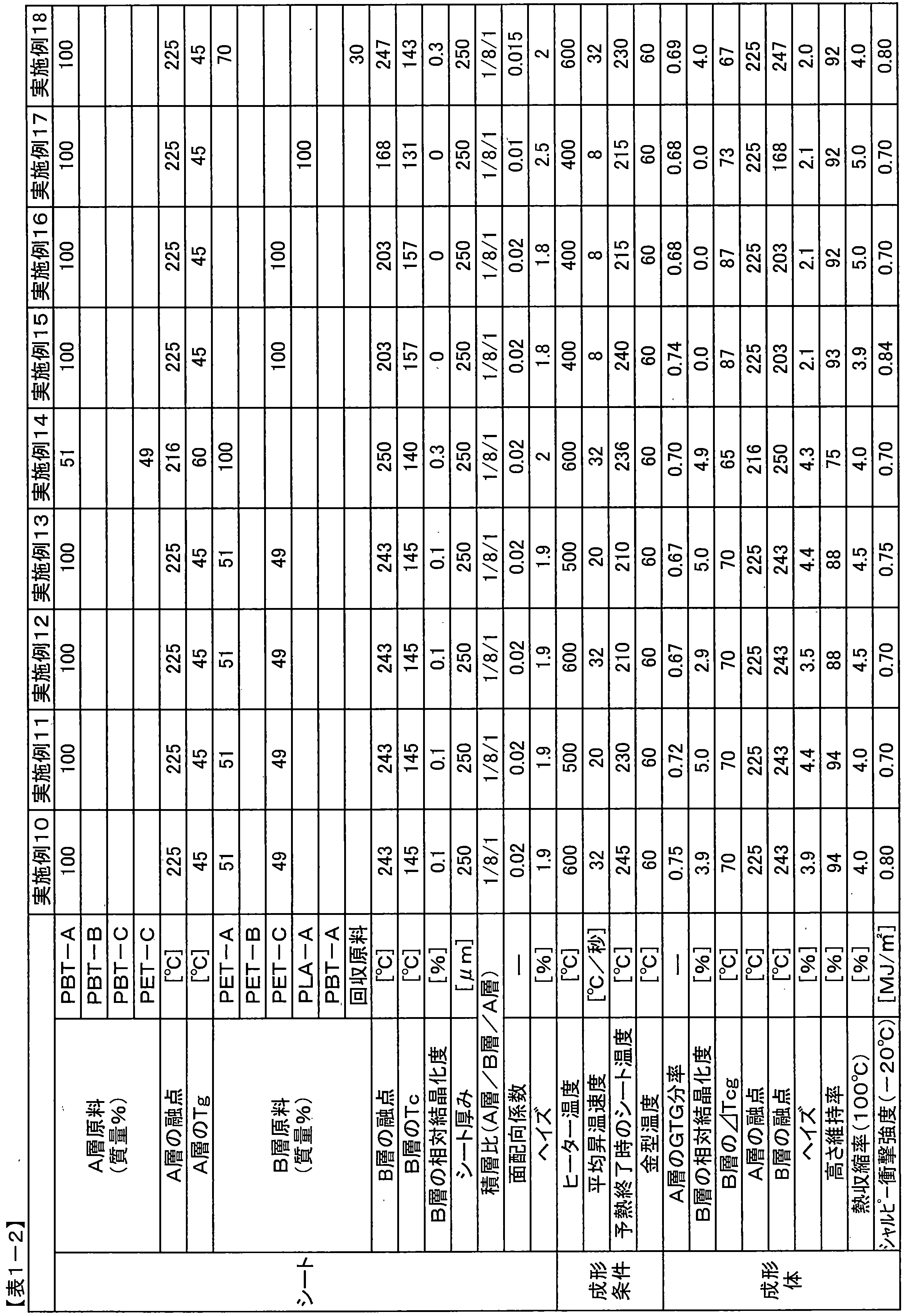
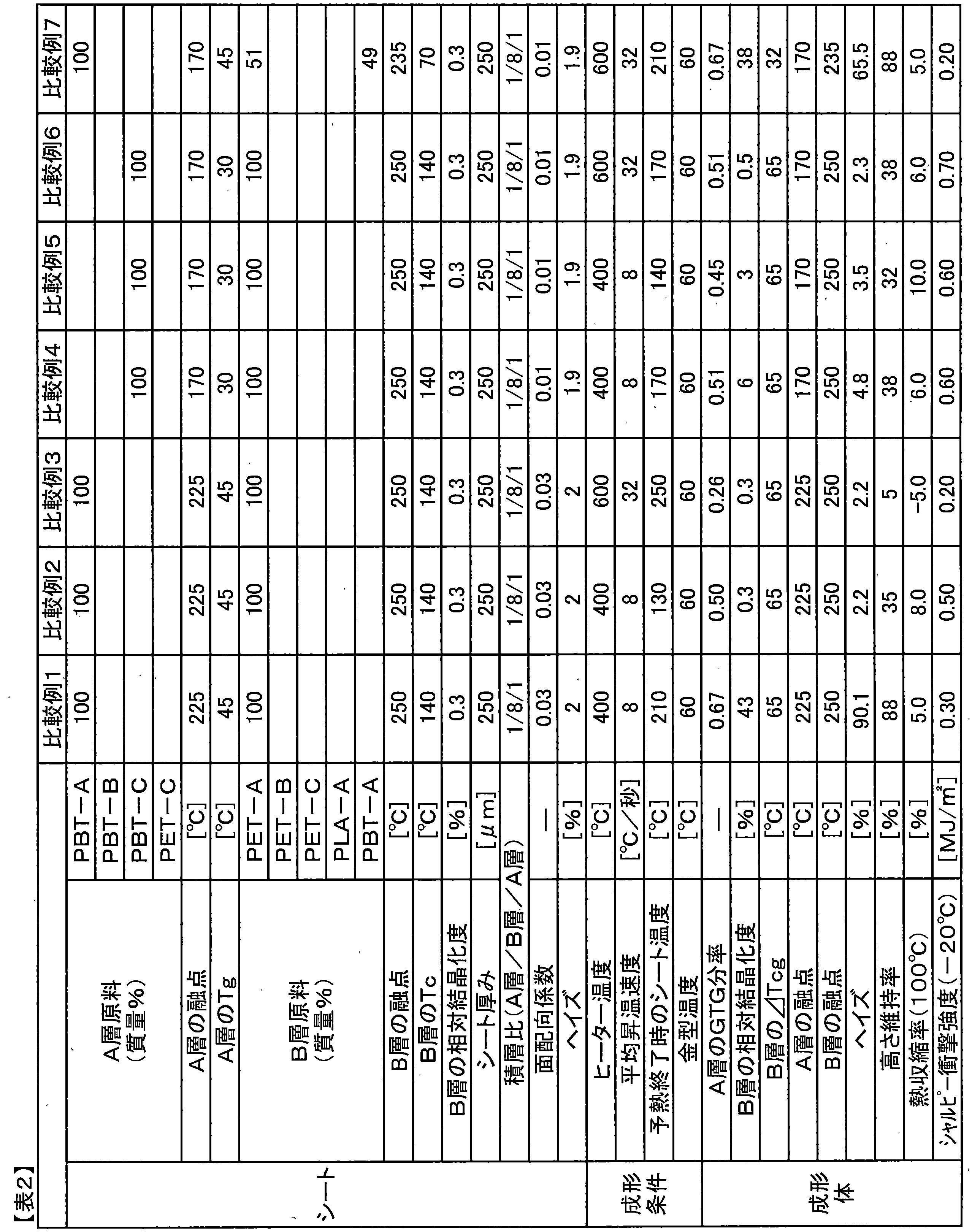
- Example 2 to 17 and Comparative Examples 1 to 7 the raw materials used for the resin of layer A and layer B, the extruder (1), and the extruder (2) are as shown in Table 1 or Table 2, and the molding conditions A sheet and a molded body were obtained in the same manner as in Example 1 except that was changed as shown in Table 1.
- the physical properties of the obtained sheet and molded product are shown in Table 1 or Table 2.
- Example 18 The sheet obtained in Example 1 was finely cut to prepare 30% of a flaky raw material. A sheet and a molded body were obtained in the same manner as in Example 1 except that this raw material and 70% of the PET-A raw material were used as the B layer raw material. The physical properties of the obtained sheet and molded product are shown in Table 1.
Landscapes
- Physics & Mathematics (AREA)
- Thermal Sciences (AREA)
- Laminated Bodies (AREA)
- Blow-Moulding Or Thermoforming Of Plastics Or The Like (AREA)
Abstract
耐熱性、透明性に優れたPBTを含む成形体を提供することを課題とする。 シートから得られる成形体であって、 該成形体は、ポリブチレンテレフタレート(以下、PBTという)を主成分とする層(以下、A層という)、および、PBT以外のポリエステルを主成分とする層(以下、B層という)を有し、 該成形体において、A層は少なくとも一方の表面に位置し、 以下の(1)および(2)を満たす、成形体。 (1)成形体のA層のGTG分率が0.6以上1以下である。 (2)成形体のB層の相対結晶化度が0%以上5%以下である。
Description
本発明は透明性、耐熱性に優れた成形体、およびその製造方法に関するものである。
ポリブチレンテレフタレート(以下、PBTと略記することがある。)は、5大汎用エンジニアリングプラスチックの一つであり、その高い結晶性に起因して優れた機械特性、電気特性、耐薬品性、耐熱性などを示すため、各種の電気・電子機器部品、自動車、列車、電車などの車両用内外装部品、その他の一般工業製品製造用材料として、広く使用されている。また非晶状態の透明なPBTシートは、ガラス転移温度以上での熱処理による結晶化処理が施されても透明性を維持するという特徴がある。このようなPBTの透明性、結晶性に由来する耐熱性に加え他のエンジニアリングプラスチックに比べ価格が比較的安価である点に注目して、他の汎用プラスチックであるポリエチレンテレフタレート(以下、PETと略記することがある。)と併用することで、食品用の成形容器、飲料用カップ蓋等の、透明性と耐熱性が要求される容器としての実用化が検討されてきた。このような例として特許文献1や特許文献2では、PETとPBTのブレンドよりなるシートを熱成形して得られる透明耐熱容器が提案されている。また特許文献3や特許文献4では、PBTとPETの積層シートおよびそれよりなる成形容器について言及されている。
しかしながら、特許文献1や特許文献2に記載の方法では、PETとのブレンドによる結晶性低下のためPBTが本来有する結晶性に由来する特性を十分に発現することができず、実用性の面で耐熱性に劣るという問題があった。一方、特許文献3や特許文献4に記載の方法も、十分な耐熱性を有するものではなかった。
本発明は、上記課題を解決するため、次の構成を有する。すなわち、以下である。
1) シートから得られる成形体であって、
該成形体は、ポリブチレンテレフタレート(以下、PBTという)を主成分とする層(以下、A層という)、および、PBT以外のポリエステルを主成分とする層(以下、B層という)を有し、
該成形体において、A層は少なくとも一方の表面に位置し、
以下の(1)および(2)を満たす、成形体。
1) シートから得られる成形体であって、
該成形体は、ポリブチレンテレフタレート(以下、PBTという)を主成分とする層(以下、A層という)、および、PBT以外のポリエステルを主成分とする層(以下、B層という)を有し、
該成形体において、A層は少なくとも一方の表面に位置し、
以下の(1)および(2)を満たす、成形体。
(1)成形体のA層のGTG分率が0.6以上1以下である。
(2)成形体のB層の相対結晶化度が0%以上5%以下である。
2) 成形体のB層の融点が、成形体のA層の融点よりも高く、
成形体のB層は、その冷結晶化温度(Tc)とガラス転移温度(Tg)の差(ΔTcg)が35℃以上である、前記1)に記載の成形体。
3) 成形体のB層がポリエチレンテレフタレート(以下、PETという)を主成分とする層からなる、前記1)または2)に記載の成形体。
4) 成形体が以下の(1)および/または(2)を満たす前記1)~3)のいずれかに記載の成形体。
2) 成形体のB層の融点が、成形体のA層の融点よりも高く、
成形体のB層は、その冷結晶化温度(Tc)とガラス転移温度(Tg)の差(ΔTcg)が35℃以上である、前記1)に記載の成形体。
3) 成形体のB層がポリエチレンテレフタレート(以下、PETという)を主成分とする層からなる、前記1)または2)に記載の成形体。
4) 成形体が以下の(1)および/または(2)を満たす前記1)~3)のいずれかに記載の成形体。
(1)成形体の100℃における熱収縮率が0%以上7%以下である。
(2)成形体の-20℃におけるシャルピー衝撃強度が0.4MJ/m2以上である。
5) 成形体の積層比率「A層の厚さの合計」/「B層の厚さの合計」が、1/15~1/2の比率である前記1)~4)のいずれかに記載の成形体。
6) シートを予熱する工程(以下、予熱工程という)、および、シートを成形する工程(以下、成形工程という)を、この順に有する成形体の製造方法であって、
該シートはA層およびB層を有し、該シートにおいてA層は少なくとも一方の表面に位置し、
予熱工程における予熱終了時のシート温度が、「シートのA層の融点-20」℃以上「シートのA層の融点+20」℃以下である、前記1)~5)のいずれかに記載の成形体の製造方法。
7) 前記予熱工程において、シート温度が「シートのB層のTc-30」℃となった際から、予熱終了時までの平均昇温速度が、20℃/秒以上である、前記6)に記載の成形体の製造方法。
5) 成形体の積層比率「A層の厚さの合計」/「B層の厚さの合計」が、1/15~1/2の比率である前記1)~4)のいずれかに記載の成形体。
6) シートを予熱する工程(以下、予熱工程という)、および、シートを成形する工程(以下、成形工程という)を、この順に有する成形体の製造方法であって、
該シートはA層およびB層を有し、該シートにおいてA層は少なくとも一方の表面に位置し、
予熱工程における予熱終了時のシート温度が、「シートのA層の融点-20」℃以上「シートのA層の融点+20」℃以下である、前記1)~5)のいずれかに記載の成形体の製造方法。
7) 前記予熱工程において、シート温度が「シートのB層のTc-30」℃となった際から、予熱終了時までの平均昇温速度が、20℃/秒以上である、前記6)に記載の成形体の製造方法。
本発明により、耐熱性を有するとともに、透明性にも優れた成形体が提供される。また、耐熱性を有するとともに、透明性にも優れた成形体を与える製造方法を提供される。
本発明における成形体とは、蓋状、トレー状、カップ状等の3次元形状を有する構造体を指す。成形体の形状は、三次元形状の構造体であれば特に限定されないが、好適には底面部に多角形の形状を有する角型容器または円筒型容器等が挙げられ、トレー、カップ、ケースおよびそれらの蓋材の形状を有するものが挙げられる。さらに本発明の成形体の形状は、前述の通り特に限定されないが、商品の展示包装用に用いられるブリスターパックなどの保形具類等、飲料自動販売機のディスプレイ用ボトル、その他各種包装用の成形体、および表面材などの各種工業材料を好ましく挙げることができる。
そして本発明の成形体は、シートから得られるものである。
さらに本発明の成形体は、PBTを主成分とする層(以下、A層という)、および、PBT以外のポリエステルを主成分とする層(以下、B層という)を有し、該成形体において、A層が少なくとも一方の表面に位置するものである。ここでPBTを主成分とする層とは、A層の全成分100質量%において、PBTを50.1質量%以上100質量%以下含むことを意味する。またPBT以外のポリエステルを主成分とする層とは、B層の全成分100質量%において、PBT以外の特定のポリエステルを50.1質量%以上100質量%以下含むことを意味する。すなわちB層がPBT以外のポリエステルを複数含む場合、B層はある特定の1種類のポリエステルに着目した際に、その特定の1種類のポリエステルを、B層の全成分100質量%において、50.1質量%以上100質量%以下含むことを意味する。なお、ここでいう種類とは、その組成によって決められる。
本発明においてPBTとは、ジカルボン酸成分の合計100モル%において、テレフタル酸成分を80モル%以上100モル%以下含み、ジオール成分の合計100モル%において、1,4-ブタンジオール成分を80モル%以上100モル%以下含むポリエステルを意味する。
PBT中の共重合成分として用い得るジカルボン酸成分として、例えば、イソフタル酸成分、オルトフタル酸成分、ナフタレンジカルボン酸成分、ジフェニルカルボン酸成分、ジフェニルスルホンジカルボン酸成分、ジフェノキシエタンジカルボン酸成分、5-ナトリウムスルホイソフタル酸成分、フタル酸等の芳香族ジカルボン酸成分、シュウ酸成分、コハク酸成分、エイコ酸成分、アジピン酸成分、セバシン酸成分、ダイマー酸成分、ドデカンジオン酸成分、マレイン酸成分、フマル酸成分等の脂肪族ジカルボン酸成分、シクロヘキサンジカルボン酸成分等の脂肪族ジカルボン酸成分、トリメリット酸成分、およびピロメリット酸成分等の多官能酸成分等を挙げることができる。
PBT中の共重合成分として用い得るジオール成分として、例えば、エチレングリコール成分、プロパンジオール成分、ブタンジオール成分、ペンタンジオール成分、ヘキサンジオール成分、ネオペンチルグリコール成分およびトリエチレングリコール成分等の脂肪族グリコール成分、ビスフェノールA成分やビスフェノールS成分などの芳香族グリコール成分、ジエチレングリコール成分、およびポリテトラメチレングリコール成分等を挙げることができる。
またPBTには、これらジカルボン酸成分および/またはジオール成分が複数含まれていてもよい。
これらの中でも耐熱性と成形性の両立を考慮すると、A層の主成分であるPBTは、以下の(A)~(D)のいずれが好ましい。
(A)共重合成分を含まないPBTホモポリマー。
(B)共重合成分がジカルボン酸成分のみの場合、ジカルボン酸成分の全体100モル%中に、共重合成分が0モル%を超えて20モル%以下であるPBT。
(C)共重合成分がジオール成分のみの場合、ジオール成分の全体100モル%中に、共重合成分が0モル%を超えて20モル%以下であるPBT。
(D)共重合成分がジカルボン酸成分とジオール成分の両方に含まれる場合、ジカルボン酸成分の合計100モル%とジオール成分の合計100モル%の和である200モル%に対して、共重合成分の合計が0モル%を超えて20モル%以下であるPBT。
(A)共重合成分を含まないPBTホモポリマー。
(B)共重合成分がジカルボン酸成分のみの場合、ジカルボン酸成分の全体100モル%中に、共重合成分が0モル%を超えて20モル%以下であるPBT。
(C)共重合成分がジオール成分のみの場合、ジオール成分の全体100モル%中に、共重合成分が0モル%を超えて20モル%以下であるPBT。
(D)共重合成分がジカルボン酸成分とジオール成分の両方に含まれる場合、ジカルボン酸成分の合計100モル%とジオール成分の合計100モル%の和である200モル%に対して、共重合成分の合計が0モル%を超えて20モル%以下であるPBT。
A層の主成分として、(A)~(D)のいずれかのPBTを用いることで、PBTの秩序性が保たれるため、後述する成形体のA層のGTG分率を0.6以上1以下とすることが容易となる。
また本発明におけるA層は、PBTが主成分でありさえすれば、他の熱可塑性樹脂を含むことも可能であり、他の熱可塑性樹脂としては、PBT以外のポリエステルが好適に選ばれる。そしてPBT以外のポリエステルの中でもPBTと完全に相溶するか、PBTよりも融点が低い、または融点を持たないポリエステルが好ましい。ここで相溶するとは、PBTと他のポリエステルの溶融混合体のDSC測定を行った際に、融点を1つだけ有するものを指す。溶融混合体の融点とともに該ポリエステルの単体の融点およびその有無は、後述する成形体の融点の測定条件と同様の方法で確認することができる。
A層に含まれるPBT以外のポリエステルとしては、例えば、ポリエチレンテレフタレート、ポリエチレンテレフタレート/イソフタレート、ポリトリメチレンテレフタレート/イソフタレート、および、ポリ(エチレン/シクロヘキシレン‐ジメチレン)テレフタレートからなる群より選ばれる少なくとも1つが好ましく用いられる。
PBT以外の他の熱可塑性樹脂のA層中の含有量は、A層の全成分100質量%に対して、0質量%以上、49.9%質量%以下であることが好ましい。
本発明において、B層の主成分であるPBT以外のポリエステルとは、そのポリマーを構成する繰り返し単位にエステル結合を含むポリマーであって、前述のPBTを除いたポリマーである。その中でもPBT以外の脂肪族ポリエステルや芳香族ポリエステルが好適に選ばれる。
PBT以外のポリエステルである脂肪族ポリエステルとしては、ヒドロキシカルボン酸やラクトンからなる重合体や、ジオールとジカルボン酸の重縮合体、およびそれらの共重合体が挙げられる。
ヒドロキシカルボン酸やラクトンからなる重合体としては、ポリグリコール酸、ポリ-L-乳酸、ポリ-D-乳酸、ポリプロピオン酸、ポリヒドロキシ酪酸、ポリカプロラクトン等が挙げられる。
ジオールとジカルボン酸の重縮合体としては、ポリブチレンサクシネート、ポリ(ブチレンサクシネート/ブチレンアジペート)、ポリ(ブチレンアジペート/ブチレンテレフタレート)、ポリ(3-ヒドロキシブチレート/3-ヒドロキシヘキサノエート)、等が挙げられる。
これらの中でもバイオマス由来であり生分解性を有し、かつ比較的安価に入手できるという点で、PBT以外のポリエステルが脂肪族ポリエステルの場合には、ポリ-L-乳酸またはその共重合ポリエステルが好ましい。
PBT以外のポリエステルである芳香族ポリエステルとしては、テレフタル酸、2,6-ナフタレンジカルボン酸、イソフタル酸などから選ばれた少なくとも1種の酸成分と、エチレングリコール、プロピレングリコール、ブチレングリコール、ヘキシレングリコールあるいはポリエチレングリコール、ポリテトラメチレングリコールなどのポリアルキレングリコールなどから選ばれた少なくとも1種のジオール成分との重縮合によって得られるものが挙げられ、具体的には、ポリプロピレンテレフタレート(PPT)、ポリエチレンテレフタレート(PET)、ポリヘキシレンテレフタレート(PHT)、ポリエチレンナフタレート(PBN)、ポリブチレンナフタレート(PBN)、ポリ(1,4-シクロヘキシレンジメチレンテレフタレート)などのほか、ポリエチレンイソフタレート・テレフタレート(PET/I)、ポリ(エチレン/1,4-シクロヘキシレンジメチレン)などのような共重合ポリエステルなどを挙げることができる。
これらの中でも比較的安価に入手できるとともに、A層とB層の層間密着性および、シート製膜・成形中に発生した屑等の再利用を考えると、PBT以外のポリエステルである芳香族ポリエステルとしては、PBTと相溶性の高いPETまたはその共重合ポリエステルが好ましい。
本発明の成形体のB層において、PBT以外のポリエステルとしては、上述した脂肪族ポリエステルまたは芳香族ポリエステル等のようなポリエステルから選ばれる少なくとも1種類のポリエステルであることが好ましい。また本発明におけるB層は、PBT以外の1種類のポリエステルを主成分として含むとともに、その他のポリエステルをさらに含んでもよい。さらに本発明におけるB層は、PBT以外のポリエステルが主成分でありさえすれば、他の熱可塑性樹脂を含んでいても構わない。
本発明の成形体は、成形体のA層のGTG分率が0.6以上1以下であることが重要である。ここでGおよびTは、A層中におけるPBTの特定の立体構造を指し、Gとはゴーシュ構造、Tとはトランス構造の略である。GTG分率を0.6以上1以下とすることにより、実用可能な耐熱性を有する成形体とすることが可能となる。成形体のA層のGTG分率は、0.65以上が好ましく、0.7以上がより好ましい。またGTG分率は、0.9以下が好ましく、0.8以下がより好ましい。
成形体のA層のGTG分率を0.6以上1以下とするためには、例えば後述する様に、A層の主成分であるPBTとして、前述の好適な態様のPBTを用いる方法や、予熱工程および成形工程をこの順に有する成形体の製造方法において、予熱終了時のシート温度を「シートのA層の融点-20」℃以上「シートのA層の融点+20」℃以下とする方法、を挙げることができる。
本発明の成形体は、成形体のB層の相対結晶化度が0%以上5%以下であることが、成形体に透明性を付与することができる点で重要である。成形体のB層の相対結晶化度は、後述するDSCにより測定することができる。多くのポリエステルは、非晶状態からの熱結晶化に伴い、球晶と呼ばれる球状構造の3次元的な結晶を形成することが知られており、結晶化が進行してその球晶のサイズが可視光の波長に及ぶと光の散乱が起こり、透明性が失われるという問題がある。ステレオコンプレックス結晶を有する特殊なポリ乳酸のように、非晶状態からの結晶化で球晶を形成しないポリエステルや、球晶サイズを可視光の波長以下に微細化させることが可能な結晶核剤を含有するポリエステルにおいては、上記の球晶による透明性低下の問題は解消されるが、これらポリエステルや結晶核剤は一般的に高価であるため、原料コストの点で好ましくない。このような理由から、B層の主成分となるポリエステルとして、ポリ乳酸やPETなどの可視光以上のサイズの球晶を形成する性質を有するポリエステルを用いた場合、相対結晶化度は0%以上5%以下とすることが重要となる。より好ましい成形体のB層の相対結晶化度は、0%以上4%以下であり、さらに好ましくは0%以上3%以下である。
成形体のB層の相対結晶化度を0%以上5%以下とするためには、例えば後述する様に、成形体のB層の融点が、成形体のA層の融点よりも高く、さらに成形体のB層について、その冷結晶化温度(Tc)とガラス転移温度(Tg)の差(ΔTcg)を35℃以上とする方法や、予熱工程および成形工程をこの順に有する成形体の製造方法において、予熱終了時のシート温度を「シートのA層の融点-20」℃以上「シートのA層の融点+20」℃以下とする方法、を挙げることができる。
本発明の成形体において、成形体のB層の融点が、成形体のA層の融点よりも高い場合、成形体のB層の冷結晶化温度(Tc)とガラス転移温度(Tg)の差(ΔTcg)が35℃以上であることが好ましい。成形体のB層の融点が、成形体のA層の融点よりも高く、成形体のB層の冷結晶化温度(Tc)とガラス転移温度(Tg)の差(ΔTcg)が35℃以上であると、成形体のB層の相対結晶化度を0%以上5%以下に制御することが容易となり、結果として、本発明の成形体に透明性を付与することが容易となる。成形体のB層のΔTcgは、より好ましくは55℃以上であり、さらに好ましくは65℃である。成形体のB層のΔTcgは、B層の結晶化を抑制するという観点からは大きいほど好ましいが、実質的に成形中の結晶化が完全抑制されることを踏まえると、上限は110℃と考えられる。
なお、成形体のB層の融点を成形体のA層の融点よりも高くして、かつ成形体のB層のΔTcgを35℃以上とする方法としては、例えば、B層の主成分として適切なポリエステル(適切な組成や適切な重合度)を選択する方法や、B層中に架橋剤や非晶性ポリエステルを含有させる方法等が挙げられる。コストの点を踏まえると、B層の主成分であるポリエステルとしては、ポリエチレンテレフタレートやその共重合ポリエステルを選択して、これらポリエステル単体のDSC測定においてΔTcgが35℃以上となるものをB層の主成分として選択することが好ましい。
ここで、成形体のA層の融点、成形体のB層の融点や、冷結晶化温度Tc、ガラス転移温度Tgとは、成形体について、DSCを用いて測定することで得られる値を意味する。なお、シートのA層の融点、ガラス転移温度Tg、シートのB層の融点や、冷結晶化温度Tc、ガラス転移温度Tgについても同様に、シートについて、DSCを用いて測定することで得られる値を意味する。これらの測定は、測定方法の項に記載の方法に従って行うものとする。
本発明の成形体は、PBTを主成分とするA層、および、PBT以外のポリエステルを主成分とするB層を有し、A層は少なくとも一方の表面に位置することが重要である。よって成形体の構成としては、少なくとも一方の表面にA層が位置していればよいので、例えばA層/B層の2層構成、A層/B層/A層の2種3層構成や、A層/B層/A層/B層、A層/B層/A層/B層/A層のような多層構成をとることも可能である。但し、製造コストおよび成形体保管時のカール等の問題を考えると、成形体の構成は、A層/B層/A層の2種3層構成が好ましい。
本発明の成形体は、シートから得られる成形体であるので、本発明の成形体の材料となるシートも、PBTを主成分とするA層、および、PBT以外のポリエステルを主成分とするB層を有し、A層は少なくとも一方の表面に位置することが好ましい。よって好ましいシートの構成としては、少なくとも一方の表面にA層が位置していればよいので、例えばA層/B層の2層構成、A層/B層/A層の2種3層構成や、A層/B層/A層/B層、A層/B層/A層/B層/A層のような多層構成をとることも可能である。但し、製造コストおよびシート保管時のカール等の問題を考えると、シートの構成は、A層/B層/A層の2種3層構成が好ましい。
本発明の成形体の材料となるシートの厚みは、特に制限はないが、50μm以上2000μm以下であることが好ましく、より好ましくは100~1000μm、さらに好ましくは、150~500μmである。
本発明の成形体の材料となるシートは、該シートの製造コストを低減せしめるために再利用(回収)原料をシート全体に対して5~80%含有することも好ましい。ここで再利用(回収)原料とは、使用済みのシートや、何らかの理由により製品とはならなかったシートを回収し、これらを細かく裁断し、フレーク状にし、再度B層の原料として用いたものを言う。
本発明の成形体の材料となるシートは、該シートの製造コストを低減せしめるために再利用(回収)原料をシート全体に対して5~80%含有することも好ましい。ここで再利用(回収)原料とは、使用済みのシートや、何らかの理由により製品とはならなかったシートを回収し、これらを細かく裁断し、フレーク状にし、再度B層の原料として用いたものを言う。
また、本発明の成形体の材料となるシートおよび成形体について、その積層比率は特に限定されないが、シートの成形性を考慮すると、「A層の厚さの合計」/「B層の厚さの合計」が、1/15~1/2の比率であることが好ましく、より好ましくは1/10~1/2.5、さらに好ましくは1/8~1/3である。ここで「A層の厚さの合計」とは、A層が1層のみ存在する場合には該A層の厚みを意味し、A層が2層以上存在する場合には、該A層の厚みの和を意味する。「B層の厚さの合計」も、A層と同様の意味である。
本発明の成形体の材料となるシートは、その成形性を考慮すると、無配向であることが好ましい。ここで無配向とは、後述する方法によって測定される面配向係数が、0.00~0.05の範囲にあることを指す。面配向係数が小さいほど成形性は良好であり好ましいので、本発明の成形体の材料となるシートの面配向係数は、0.00~0.03がさらに好ましく、0.00~0.01が特に好ましい。
また本発明の成形体は、透明な容器として用いる際にはヘイズが5%以下であることが好ましい。ヘイズは表面の荒れや成形体中に存在するボイドや球晶により、光の透過が阻害されることと密接な関係があるが、この中でもヘイズはB層の結晶化による影響が大きく、成形体のB層の相対結晶化度を5%以下とすることにより、成形体のヘイズを5%以内とすることが可能となる。ヘイズは、より好ましくは4%以下、さらに好ましくは3%以下である。一方、結晶性以外にも光の透過を阻害する要因が存在することを踏まえると、ヘイズの下限は0.1%である。
本発明の成形体は、レンジ加熱する容器などに用いる際には100℃における熱収縮率が0%以上7%以下であることが好ましく、より好ましくは0%以上5%以下である。100℃の熱収縮率をこの範囲内にすることにより、レンジ加熱時などに変形が小さい成形体が得られるので好ましい。ここで、成形体の熱収縮率とは、後述する方法により得られる熱収縮率とする。成形体の100℃における熱収縮率を0%以上7%以下にするためには、例えば、A層の主成分であるPBTとして、前述の好適な態様のPBTを用いる方法や、予熱工程および成形工程をこの順に有する成形体の製造方法において、予熱終了時のシート温度を「シートのA層の融点-20」℃以上「シートのA層の融点+20」℃以下とする方法、を挙げることができる。
また、本発明の成形体は、チルド容器などに用いる際には-20℃におけるシャルピー衝撃強度が0.4MJ/m2以上が好ましく、0.5MJ/m2以上がより好ましく、0.7MJ/m2以上がさらに好ましい。-20℃におけるシャルピー衝撃強度をこの範囲内にすることにより、チルド容器として使用する場合などの冷凍運搬時に容器の割れなどの破損が発生しにくいので好ましい。成形体の-20℃におけるシャルピー衝撃強度は、上記観点から高いほど好ましいが、連続成形時における成形後の成形体部分のカット性から上限は2.0MJ/m2と考えられる。成形体の-20℃におけるシャルピー衝撃強度を0.4MJ/m2以上にするためには、例えば、A層の主成分であるPBTとして、前述の好適な態様のPBTを用いる方法や、予熱工程および成形工程をこの順に有する成形体の製造方法において、予熱終了時のシート温度を「シートのA層の融点-20」℃以上「シートのA層の融点+20」℃以下とする方法、を挙げることができる。
本発明における成形体の製造方法は特に限定されないが、シートを予熱する工程(以下、予熱工程という)、および、シートを成形する工程(以下、成形工程という)を、この順に有する成形体の製造方法が好ましい。このように予熱工程と成形工程とをこの順に有する成形体の製造方法を、以下熱成形方法という。このような製造方法としては、例えば、真空成形法、真空圧空成形法、プラグアシスト成形法、ストレート成形法、フリードローイング成形法、プラグアンドリング成形法、スケルトン成形法などの各種成形法が挙げられる。
前記の各種成形法において、予熱工程は、間接加熱方式と熱板直接加熱方式とがある。間接加熱方式は、シートから離れた位置に設置された加熱装置によってシートを予熱する方式である。熱板直接加熱方式は、シートと熱板とが接触することによってシートを予熱する方式である。本発明の成形体の製造方法における予熱工程は、間接加熱方式と熱板直接加熱方式のいずれの方法も好ましく用いることができるが、間接加熱方式であることがより好ましい。
本発明の成形体の製造方法では、シートはA層およびB層を有し、かかるシートにおいてA層は少なくとも一方の表面に位置するものであり、予熱工程における予熱終了時のシート温度が、「シートのA層の融点-20」℃以上「シートのA層の融点+20」℃以下であることが好ましい。なお、ここでいうシート温度とは、間接加熱方式においてシートから一定の距離をおいて設置された赤外線放射温度計等の温度検出機によって検出されるシート表面の値を指す。また成形体の製造においては、通常、予め予熱により到達させるべきシート温度を決定しておくが、その予熱中に、上記温度検出機によりシート温度の推移をリアルタイムで測定し、シート温度が上記の到達させるべきシート温度に達した時点で、予熱工程を終了させ、2秒以内に成形工程に移ることが好ましい。本発明の成形体の製造方法においては上記の到達させるべきシート温度を予熱終了時のシート温度とする。
本発明において、予熱工程における予熱終了時のシート温度を、「シートのA層の融点-20」℃以上「シートのA層の融点+20」℃以下とすることにより、成形体のA層のGTG分率が0.6以上1以下となった。これは、A層におけるPBTの分子運動性が向上するとともに立体構造の形成が進んだことによって高温下でも剛性を有した耐熱性のある成形体とすることが可能となったものと考えられる。GTG分率が0.6以上1以下となった構造の形成は、分子運動性と密接な関係にあることから、PBTの結晶の融解が本格的に進行する「シートのA層の融点+20」℃までは予熱終了時の温度とGTG分率とが比例関係にあり、GTG分率をより高い値とするという点で、予熱終了時のシート温度は、「シートのA層の融点」以上「シートのA層の融点+10」℃以下がより好ましく、「シートのA層の融点+10」℃以上「シートのA層の融点+20℃」以下であることがさらに好ましい。
また、本発明において、予熱工程における予熱終了時のシート温度を、「シートのA層の融点-20」℃以上「シートのA層の融点+20」℃以下とすることにより、成形時の成形歪の発生を抑制することが可能となり、高温下でも収縮が抑制された耐熱性のある成形体とすることが可能となる。
さらに本発明において、シートのB層の融点が、シートのA層の融点(融点:225℃程度)以下の場合、予熱終了時のシート温度を「シートのA層の融点-20」℃以上「シートのA層の融点+20」℃以下とすることにより、B層の主成分であるポリエステルは予熱中に結晶を形成したとしても、予熱終了時の段階で該ポリエステルの融点以上となり溶融が進行する。そのため、最終的に得られる成形体のB層の相対結晶化度を0%以上5%以内とすることができ、結果としてヘイズ5%以下の透明な成形体とすることが可能となる。
一方、本発明において、シートのB層の融点が、シートのA層の融点よりも高い場合、前記予熱工程において、シート温度が「シートのB層のTc-30」℃となった際から予熱終了時までの平均昇温速度を、20℃/秒以上とすることが好ましい。ここでいう平均昇温速度とは、予熱中のシート温度の推移を温度検出機にて観測した際に、シート温度が「シートのB層のTc-30」℃となった際から予熱終了時までのシート温度の昇温カーブが直線的になると仮定して、予熱終了時のシート温度と「シートのB層のTc-30」℃となった際のシート温度との温度差を、該温度領域の昇温に要した時間で除した時の値をさす。
本発明の成形体の製造方法の予熱工程において、シート温度が「シートのB層のTc-30」℃となった際から予熱終了時までの平均昇温速度を20℃/秒以上とする意味について、以下に詳細を記載する。
シートのB層の融点が、シートのA層の融点よりも高い場合、成形体の材料となるシートの段階で、B層の主成分であるポリエステルが結晶化していると、予熱終了までにB層の主成分であるポリエステルを融解させることが容易ではなくなる。従って、成形体を得るために用いるシートにおいて、B層は相対結晶化度があらかじめ0%以上5%以下の実質的に非晶状態である必要があることが前提になる。しかしながら一般的に、非晶状態のポリエステルはそのガラス転移温度以上から融点までの間に冷結晶化が起こる温度領域を有しており、PBTの融点(融点:225℃程度)よりも低い温度領域に冷結晶化温度を有する、PET(冷結晶化温度:140℃程度)のようなポリエステルをB層の主成分として用いた場合、単純に予熱を行うと結晶化が進行してしまい、得られる成形体中のB層の相対結晶化度が5%より大きくなるとともに、透明性の低いものとなる。このような問題に対して、本発明は、シート温度が「シートのB層のTc-30」℃になった際から予熱終了時までの平均昇温速度を、20℃/秒以上として、B層の冷結晶化速度に対して平均昇温速度を相対的に大きくすることにより、予熱終了時までの結晶化を抑制し、成形体のB層の相対結晶化度を0%以上5%以内とするとともに、成形体に透明性を付与することが可能となることを見いだしたものである。前記平均昇温速度は、より好ましくは25℃/秒以上、さらに好ましくは30℃/秒以上である。平均昇温速度は速いほど好ましいが、機械性能を踏まえると200℃/秒が上限と考えられる。
本発明の成形体の材料となるシートは、本発明の目的を損なわない範囲で添加剤を含有していてもよい。添加剤としては、充填剤(ガラス繊維、炭素繊維、金属繊維、天然繊維、有機繊維、ガラスフレーク、ガラスビーズ、セラミックスファイバー、セラミックビーズ、アスベスト、ワラステナイト、タルク、クレー、マイカ、セリサイト、ゼオライト、ベントナイト、モンモリロナイト、合成マイカ、ドロマイト、カオリン、微粉ケイ酸、長石粉、チタン酸カリウム、シラスバルーン、炭酸カルシウム、炭酸マグネシウム、硫酸バリウム、酸化カルシウム、酸化アルミニウム、酸化チタン、ケイ酸アルミニウム、酸化ケイ素、石膏、ノバキュライト、ドーソナイトまたは白土など)、紫外線吸収剤(レゾルシノール、サリシレート、ベンゾトリアゾール、ベンゾフェノンなど)、熱安定剤(ヒンダードフェノール、ヒドロキノン、ホスファイト類およびこれらの置換体など)、滑剤、離形剤(モンタン酸およびその塩、そのエステル、そのハーフエステル、ステアリルアルコール、ステアラミドおよびポリエチレンワックスなど)、染料(ニグロシンなど)および顔料(硫化カドミウム、フタロシアニンなど)を含む着色剤、着色防止剤(亜リン酸塩、次亜リン酸塩など)、難燃剤(赤燐、燐酸エステル、ブロム化ポリスチレン、臭素化ポリフェニレンエーテル、臭素化ポリカーボネート、水酸化マグネシウム、メラミンおよびシアヌール酸またはその塩、シリコン化合物など)、導電剤あるいは着色剤(カーボンブラックなど)、摺動性改良剤(グラファイト、フッ素樹脂など)、帯電防止剤、耐衝撃剤などが挙げられ、これらの1種または2種以上を含有することができる。
また、本発明の成形体の材料であるシートは、必要に応じて本発明の目的を損なわない範囲で結晶核剤を1種または2種以上を添加することができる。結晶核剤の例としては、タルクなどの無機系核剤、ジベンジリデンソルビトール、安息香酸ナトリウム、モンタン酸ナトリウムなどの有機系核剤等が挙げられる。
本発明の成形体に意匠性を付与するために、目的に応じて、成形体の材料であるシートの表層に、印刷層を形成することができる。印刷層は、文字、図形、記号、絵柄、その他等からなる所望の印刷模様を印刷して形成されるものである。当該印刷層に使用するインキと本発明の成形体の表層または本発明の成形体の材料であるシートの表層(以降、これらを総称して、表層と記す)との接着性を良くするという観点から、表層に、空気、窒素、炭酸ガス雰囲気下でのコロナ処理、プラズマ処理、オゾン処理、フレーム処理等の前処理を施しても構わない。印刷は、例えば、グラビア印刷、オフセット印刷、凸版印刷、スクリーン印刷、転写印刷、フレキソ印刷、インクジェット印刷等の公知の各種印刷方法により形成することができる。また、印刷に使用するインキは、水性インキであっても、溶剤系インキ等の非水性インキのいずれであってもよい。
印刷層の厚みは、特に制限はないが、印刷外観の観点から、0.1μm~10μmである事が好ましく、より好ましくは0.2μm~3μm、さらに好ましくは0.4μm~1μmである。
以下に、本発明の成形体の製造方法について述べる。
各々の押出機に一方にA層、他方にB層の原料である樹脂組成物を溶融押出し、それぞれ金網メッシュによる異物除去、ギアポンプによる流量適性化を行った後、マルチマニホールド口金、または口金上部に設置したフィードブロックに供給する。なお、上記マルチマニホールド口金、またはフィードブロックには、必要なフィルムの層構成に応じて、所望の数、所望の形状の流路が設けられている。各押出機から押し出された溶融樹脂は、上記の通りマルチマニホールド口金、またはフィードブロックにて合流せしめ、口金よりシート状に共押出される。当該シートは、エアナイフ、または静電印加等の方式により、キャスティングドラムに密着させ、冷却固化せしめてヘイズ5%以下の無配向シートとする。
ここで、ゲルや熱劣化物等の異物の混入による表面荒れを防ぐために、50~400meshの金網メッシュを使用することが好ましい。
上記により得られた無配向のシートを成形体とするために、前記間接加熱方式において予熱終了時の温度を「シートのA層の融点-20」℃以上「シートのA層の融点+20」℃以下として、成形を行う。
上記成形工程における金型温度は、成形により発生する歪を緩和除去させる観点から、下限はシートのA層のガラス転移温度以上であることが好ましい。一方で金型の離型性や成形体の冷却サイクルを踏まえると、上限は120℃が好ましい。成形工程における金型温度は、より好ましくは「シートのA層のガラス転移温度+5」℃以上100℃以下、さらに好ましくは「シートのA層のガラス転移温度+10」℃以上90℃以下である。
〔物性の測定方法および効果の評価方法〕
1.成形体のA層のGTG分率
フーリエ変換赤外分光装置Spectrum100(パーキンエルマー社製)にATR測定アクセサリーを取り付け、成形体のA層のスペクトル測定を行う。得られたスペクトルにATR補正を行った後、透過率を吸光度に変換する。次いで891cm-1の吸光度と951cm-1の吸光度を直線で結びベースラインとして、891cm-1から951cm-1の領域において吸収スペクトルとベースラインの差スペクトルをとる。得られた差スペクトルにおける934cm-1の吸光度(以下A934とする)と916cm-1の吸光度(以下A916とする)を用いて、式1によりGTG分率を求める。
1.成形体のA層のGTG分率
フーリエ変換赤外分光装置Spectrum100(パーキンエルマー社製)にATR測定アクセサリーを取り付け、成形体のA層のスペクトル測定を行う。得られたスペクトルにATR補正を行った後、透過率を吸光度に変換する。次いで891cm-1の吸光度と951cm-1の吸光度を直線で結びベースラインとして、891cm-1から951cm-1の領域において吸収スペクトルとベースラインの差スペクトルをとる。得られた差スペクトルにおける934cm-1の吸光度(以下A934とする)と916cm-1の吸光度(以下A916とする)を用いて、式1によりGTG分率を求める。
GTG分率 = A916/(A934+A916) ・・・・(式1)
測定条件は以下とする。
測定条件は以下とする。
積算回数:8回
波長間隔:1cm-1 。
波長間隔:1cm-1 。
2.シートおよび成形体の各層の融点、冷結晶化温度(Tc)、ガラス転移温度(Tg)、ΔTcg
シートまたは成形体からA層またはB層を削り取って試料5mgを採取し、示差走査熱量分析装置DSCII型(Seiko Instrument(株)製)を用いて、20℃から300℃まで昇温速度20℃/分で昇温して5分間保持し、999℃/分で20℃まで急冷、5分保持した後に、再び20℃/分で昇温を行う。
シートまたは成形体からA層またはB層を削り取って試料5mgを採取し、示差走査熱量分析装置DSCII型(Seiko Instrument(株)製)を用いて、20℃から300℃まで昇温速度20℃/分で昇温して5分間保持し、999℃/分で20℃まで急冷、5分保持した後に、再び20℃/分で昇温を行う。
B層の測定において、この時に観測される結晶化に伴う発熱ピークのピークトップ温度をB層の冷結晶化温度(Tc)とする。またB層の測定において、この時に観測される融解に伴う吸熱ピークのピークトップ温度をB層の融点とする。さらにA層についても、同様に測定時に観測される融解に伴う吸熱ピークのピークトップ温度をA層の融点とする。
次に、成形体のB層におけるΔTcgの測定法を下記する。融点、Tcの測定と同様に、2回目の昇温中に観測されるベースライン曲線の変化からB層のガラス転移温度(Tg)を読み取る。
これらの測定により得られた成形体のB層のTcおよびTgから、式2により成形体のB層のΔTcgを求める。
ΔTcg = Tc-Tg ・・・・(式2)
またシートにおけるA層のTgについても、B層と同様に2回目の昇温測定において得られる値をA層のTgとする。
またシートにおけるA層のTgについても、B層と同様に2回目の昇温測定において得られる値をA層のTgとする。
なお、成形体のB層のDSC測定において、融点が2つ以上存在する場合は、観測される融点の中でもっとも高い値を、成形体のB層の融点とする。同様に、成形体のB層のDSC測定において、Tgが2つ以上存在する場合は、観測されるTgの中でもっとも高い値を、成形体のB層のTgとする。そして成形体のB層のDSC測定において、Tcが2つ以上存在する場合は、観測されるうちTcの中で最も低い値を、成形体のB層のTcとする。なお、シートのB層の融点、(Tc)、ガラス転移温度(Tg)についても同様である。
また成形体のA層のDSC測定において、融点が2つ以上存在する場合は、観測される融点の中でもっとも高い値を、成形体のA層の融点とする。なお、シートのA層の融点についても同様である。またシートのA層のガラス転移温度(Tg)については、シートのB層のガラス転移温度(Tg)と同様に、Tgが2つ以上存在する場合は、観測されるTgの中でもっとも高い値を、シートのA層のTgとする。
3.B層の相対結晶化度
成形体の材料となるシートまたは成形体から、B層のみを削り取り試料5mgを採取し、示差走査熱量分析装置DSCII型(Seiko Instrument(株)製)を用いて、20℃から300℃まで昇温速度20℃/分で昇温する。DSC測定にて観測される融解ピークの面積(Sm)および発熱ピークの面積(Sc)を用いて式3により相対結晶化度を算出した。
成形体の材料となるシートまたは成形体から、B層のみを削り取り試料5mgを採取し、示差走査熱量分析装置DSCII型(Seiko Instrument(株)製)を用いて、20℃から300℃まで昇温速度20℃/分で昇温する。DSC測定にて観測される融解ピークの面積(Sm)および発熱ピークの面積(Sc)を用いて式3により相対結晶化度を算出した。
相対結晶化度 =(Sm-Sc)/Sm×100 ・・・(式3) 。
4.透明性:ヘイズ値(%)
ヘイズメーターHGM-2DP型(スガ試験機社製)を用いて、成形体およびその材料となるシートのヘイズ値を測定する。なお、成形体の場合は、試料の屈曲に由来する光の散乱や透過距離の不均一性をなくすために、平面性を有する部分から試料を切り出して測定を行う。測定は1サンプルにつき5回行い、5回の測定の平均値(平均へイズ値)を求める。続いて式4により250μmに換算した値を求めた。
ヘイズメーターHGM-2DP型(スガ試験機社製)を用いて、成形体およびその材料となるシートのヘイズ値を測定する。なお、成形体の場合は、試料の屈曲に由来する光の散乱や透過距離の不均一性をなくすために、平面性を有する部分から試料を切り出して測定を行う。測定は1サンプルにつき5回行い、5回の測定の平均値(平均へイズ値)を求める。続いて式4により250μmに換算した値を求めた。
ヘイズ値 = 平均ヘイズ値 × 250(μm)/サンプル厚み(μm) ・・・(式4)
なお、サンプル厚みは ダイヤルゲージ式厚み計(JIS B7503:1997、PEACOCK製UPRIGHT DIAL GAUGE(0.001×2mm)、No.25、測定子5mmφ平型)を用いて、任意に選択した10点を測定し、その平均値を当該サンプルのサンプル厚み(μm)とする。
なお、サンプル厚みは ダイヤルゲージ式厚み計(JIS B7503:1997、PEACOCK製UPRIGHT DIAL GAUGE(0.001×2mm)、No.25、測定子5mmφ平型)を用いて、任意に選択した10点を測定し、その平均値を当該サンプルのサンプル厚み(μm)とする。
5.面配向係数(fn)
ナトリウムD線(波長589nm)を光源として、アッベ屈折計を用いて、シート表面の長手方向屈折率(Nx)、幅方向屈折率(Ny)および厚み方向屈折率(Nz)を測定し、式5から面配向係数(fn)を算出する。
ナトリウムD線(波長589nm)を光源として、アッベ屈折計を用いて、シート表面の長手方向屈折率(Nx)、幅方向屈折率(Ny)および厚み方向屈折率(Nz)を測定し、式5から面配向係数(fn)を算出する。
fn=(Nx+Ny)/2-Nz ・・・(式5) 。
6.予熱工程におけるシートの温度
間接加熱方式において、シートから30cmの距離をおいて設置された赤外線放射温度計により測定する。
間接加熱方式において、シートから30cmの距離をおいて設置された赤外線放射温度計により測定する。
7.成形体の耐熱性
蓋型の成形体を成形体の底面部が上になるようにして90℃の熱風オーブンに2分間置き、試験後のオーブンから取り出し自然冷却する。冷却終了後、熱風オーブン投入前の初期の高さと熱風オーブン投入後の試験後の高さを用いて、式6に従い高さ維持率を算出し耐熱性を評価する。
蓋型の成形体を成形体の底面部が上になるようにして90℃の熱風オーブンに2分間置き、試験後のオーブンから取り出し自然冷却する。冷却終了後、熱風オーブン投入前の初期の高さと熱風オーブン投入後の試験後の高さを用いて、式6に従い高さ維持率を算出し耐熱性を評価する。
高さ維持率 =(初期の高さ-試験後の高さ)/初期の高さ×100 ・・・・ (式6)
式6にて得られた高さ維持率が70%以上の場合、実用レベルの耐熱性を満たすと判断する。
式6にて得られた高さ維持率が70%以上の場合、実用レベルの耐熱性を満たすと判断する。
8.100℃熱収縮率(%)
成形体から、測定用のサンプル片を150mm×10mmのサイズに切り出す。なお、後述の実施例においては、成形体の底部から切り出したが、このサンプルは成形体の何れの部位から切り出してもよい。このサンプル片を、23℃、相対湿度60%の雰囲気に30分間放置し、その雰囲気下で、サンプル長手方向に約100mmの間隔で2つの印をつけ、Nikon社製万能投影機(Model V-16A)を用いて、その印の間隔を測定し、その値をAとする。次に、サンプルを3gの荷重をかけた状態でギアオーブンの中で吊り、100℃の雰囲気中で30分間放置する。次いで、23℃、相対湿度60%の雰囲気中で1時間冷却、調湿後、先につけた印の間隔を測定し、これをBとする。このとき、下記式(i)より、熱収縮率を求めた。試験数は3とし、その平均値を採用する。
成形体から、測定用のサンプル片を150mm×10mmのサイズに切り出す。なお、後述の実施例においては、成形体の底部から切り出したが、このサンプルは成形体の何れの部位から切り出してもよい。このサンプル片を、23℃、相対湿度60%の雰囲気に30分間放置し、その雰囲気下で、サンプル長手方向に約100mmの間隔で2つの印をつけ、Nikon社製万能投影機(Model V-16A)を用いて、その印の間隔を測定し、その値をAとする。次に、サンプルを3gの荷重をかけた状態でギアオーブンの中で吊り、100℃の雰囲気中で30分間放置する。次いで、23℃、相対湿度60%の雰囲気中で1時間冷却、調湿後、先につけた印の間隔を測定し、これをBとする。このとき、下記式(i)より、熱収縮率を求めた。試験数は3とし、その平均値を採用する。
熱収縮率(%)=100×(A-B)/A ・・・(i) 。
9.-20℃シャルピー衝撃強度(MJ/m2)
成形体から、測定用のサンプル片を50mm×10mmのサイズに切り出す。このサンプル片を、冷凍機で-20℃に冷却しておく。東洋精機製作所製シャルピー衝撃試験器(容量:10kg・cm、ハンマー重量:1.019kg、ハンマーの空持ち上げ角度:127度、軸心より重心までの距離:6.12cm)に冷凍機から取り出したサンプルをサンプルの長尺(50mm)側を固定し、23℃、相対湿度60%の雰囲気下で測定を行う。試験数は10とし、その平均値を採用する。それらの平均値をサンプルの断面積(サンプル厚み×10mm)で除し、MJ/m2の単位に換算する。
成形体から、測定用のサンプル片を50mm×10mmのサイズに切り出す。このサンプル片を、冷凍機で-20℃に冷却しておく。東洋精機製作所製シャルピー衝撃試験器(容量:10kg・cm、ハンマー重量:1.019kg、ハンマーの空持ち上げ角度:127度、軸心より重心までの距離:6.12cm)に冷凍機から取り出したサンプルをサンプルの長尺(50mm)側を固定し、23℃、相対湿度60%の雰囲気下で測定を行う。試験数は10とし、その平均値を採用する。それらの平均値をサンプルの断面積(サンプル厚み×10mm)で除し、MJ/m2の単位に換算する。
10.成形体およびシートの積層厚み
ライカマイクロシステムズ(株)製金属顕微鏡LeicaDMLMを用いて、フィルムの断面を倍率100倍の条件で透過光を写真撮影し、成形体およびシートの各層の層厚みを測定する。
ライカマイクロシステムズ(株)製金属顕微鏡LeicaDMLMを用いて、フィルムの断面を倍率100倍の条件で透過光を写真撮影し、成形体およびシートの各層の層厚みを測定する。
実施例により具体的に示すが、本発明はこれらの実施例に限定されるモノではない。
本発明の成形体の製造例、実施例、比較例で用いた原料は下記の通りである。なお実施例、比較例では下記の略称で表記することがある。
PBT-A:ポリブチレンテレフタレート(融点225℃)
PBT-B:ポリブチレン(テレフタレート/イソフタレート)(融点205℃ テレフタル酸:イソフタル酸=90モル%:10モル%)
PBT-C:ポリブチレン(テレフタレート/イソフタレート)(融点170℃ テレフタル酸:イソフタル酸=70モル%:30モル%)
PET-A:ポリエチレンテレフタレート(融点250℃)
PET-B:ポリエチレンテレフタレート(融点250℃)
PET-C:ポリエチレンテレフタレート/イソフタレート)(融点205℃ テレフタル酸:イソフタル酸=82.5モル%:17.5モル%)
PLA-A:結晶性ポリL-乳酸(Nature Works製“Ingeo”4032D;D体量=1.4mol%、融点=168℃、Tg=58℃)
実施例、比較例で用いた測定の方法は、上記の〔物性の測定方法および効果の評価方法〕に記したとおりである。
PBT-B:ポリブチレン(テレフタレート/イソフタレート)(融点205℃ テレフタル酸:イソフタル酸=90モル%:10モル%)
PBT-C:ポリブチレン(テレフタレート/イソフタレート)(融点170℃ テレフタル酸:イソフタル酸=70モル%:30モル%)
PET-A:ポリエチレンテレフタレート(融点250℃)
PET-B:ポリエチレンテレフタレート(融点250℃)
PET-C:ポリエチレンテレフタレート/イソフタレート)(融点205℃ テレフタル酸:イソフタル酸=82.5モル%:17.5モル%)
PLA-A:結晶性ポリL-乳酸(Nature Works製“Ingeo”4032D;D体量=1.4mol%、融点=168℃、Tg=58℃)
実施例、比較例で用いた測定の方法は、上記の〔物性の測定方法および効果の評価方法〕に記したとおりである。
(実施例1)
ベント式押出機(1)に、A層の原料として、予め真空乾燥処理を行ったPBT-A 100質量%を投入し、真空ベント部を脱気しながら250℃で溶融混練して押出し、100meshの金網メッシュにてポリマーを濾過させ、2種3層積層タイプのマルチマニホールド口金に供給した。また、ベント式押出機(2)に、B層の原料として、予め真空乾燥処理を行ったPET-A 100質量%を投入し、真空ベント部を脱気しながら280℃で溶融混練して押出し、押出機(1)とは別の流路で、100meshの金網メッシュにてポリマーを濾過させた後、口金温度を270℃に設定したTダイ口金よりシート状に共押出し、押し出されたシートの両端部に針状エッジピニング装置を用いて静電印加方式およびエアチャンバー方式を併用して、20℃に冷却されたキャスティングドラムに静電密着させ冷却固化し、未延伸シートを得た。
ベント式押出機(1)に、A層の原料として、予め真空乾燥処理を行ったPBT-A 100質量%を投入し、真空ベント部を脱気しながら250℃で溶融混練して押出し、100meshの金網メッシュにてポリマーを濾過させ、2種3層積層タイプのマルチマニホールド口金に供給した。また、ベント式押出機(2)に、B層の原料として、予め真空乾燥処理を行ったPET-A 100質量%を投入し、真空ベント部を脱気しながら280℃で溶融混練して押出し、押出機(1)とは別の流路で、100meshの金網メッシュにてポリマーを濾過させた後、口金温度を270℃に設定したTダイ口金よりシート状に共押出し、押し出されたシートの両端部に針状エッジピニング装置を用いて静電印加方式およびエアチャンバー方式を併用して、20℃に冷却されたキャスティングドラムに静電密着させ冷却固化し、未延伸シートを得た。
得られたシートは250μmであり、厚み構成は、A層/B層/A層=1/8/1であった。
続いて得られたシートを材料として浅野研究所製FKS真空圧空成形機にて、間接加熱方式の真空圧空成形を行った。成形に際しては、開口部132mm × 183mm 、底部112mm × 160mm 、深さ25mm の蓋状金型を用い、ヒーター温度600℃、圧空圧力3kg/cm2、金型温度60℃の条件にて、成形を行った。得られた成形体の結果は表1の通りであり、透明性・耐熱性を有するものであった。また、100℃における熱収縮率が小さく、-20℃におけるシャルピー衝撃強度は大きな値を示した。
(実施例2~17、比較例1~7)
実施例2~17、比較例1~7は、A層、B層の樹脂、押出機(1)、押出機(2)に用いる原料を表1、または表2のとおりとするとともに、成形条件を表1通りに変更した以外は、実施例1と同様にしてシートおよび成形体を得た。得られたシートおよび成形体の物性を表1または表2に示した。
実施例2~17、比較例1~7は、A層、B層の樹脂、押出機(1)、押出機(2)に用いる原料を表1、または表2のとおりとするとともに、成形条件を表1通りに変更した以外は、実施例1と同様にしてシートおよび成形体を得た。得られたシートおよび成形体の物性を表1または表2に示した。
(実施例18)
実施例1で得られたシートを細かく裁断し、フレーク状にした原料を30%用意した。この原料とPET-A原料70%をB層原料とした以外は、実施例1と同様にしてシートおよび成形体を得た。得られたシートおよび成形体の物性を表1に示した。
実施例1で得られたシートを細かく裁断し、フレーク状にした原料を30%用意した。この原料とPET-A原料70%をB層原料とした以外は、実施例1と同様にしてシートおよび成形体を得た。得られたシートおよび成形体の物性を表1に示した。

Claims (7)
- シートから得られる成形体であって、
該成形体は、ポリブチレンテレフタレート(以下、PBTという)を主成分とする層(以下、A層という)、および、PBT以外のポリエステルを主成分とする層(以下、B層という)を有し、
該成形体において、A層は少なくとも一方の表面に位置し、
以下の(1)および(2)を満たす、成形体。
(1)成形体のA層のGTG分率が0.6以上1以下である。
(2)成形体のB層の相対結晶化度が0%以上5%以下である。 - 成形体のB層の融点が、成形体のA層の融点よりも高く、
成形体のB層は、その冷結晶化温度(Tc)とガラス転移温度(Tg)の差(ΔTcg)が35℃以上である、請求項1に記載の成形体。 - 成形体のB層がポリエチレンテレフタレート(以下、PETという)を主成分とする層からなる、請求項1または請求項2に記載の成形体。
- 成形体が以下の(1)および/または(2)を満たす前記請求項1~3のいずれかに記載の成形体。
(1)成形体の100℃における熱収縮率が0%以上7%以下である。
(2)成形体の-20℃におけるシャルピー衝撃強度が0.4MJ/m2以上である。 - 成形体の積層比率「A層の厚さの合計」/「B層の厚さの合計」が、1/15~1/2の比率である前記請求項1~4のいずれかに記載の成形体。
- シートを予熱する工程(以下、予熱工程という)、および、シートを成形する工程(以下、成形工程という)を、この順に有する成形体の製造方法であって、
該シートはA層およびB層を有し、該シートにおいてA層は少なくとも一方の表面に位置し、
予熱工程における予熱終了時のシート温度が、「シートのA層の融点-20」℃以上「シートのA層の融点+20」℃以下である、請求項1~5のいずれかに記載の成形体の製造方法。 - 前記シートのB層の融点が、A層の融点よりも高く、前記予熱工程において、シート温度が「シートのB層のTc-30」℃となった際から、予熱終了時までの平均昇温速度が、20℃/秒以上である、請求項6に記載の成形体の製造方法。
Priority Applications (1)
| Application Number | Priority Date | Filing Date | Title |
|---|---|---|---|
| JP2014556284A JP6252491B2 (ja) | 2013-11-18 | 2014-11-13 | 成形体、およびその製造方法 |
Applications Claiming Priority (2)
| Application Number | Priority Date | Filing Date | Title |
|---|---|---|---|
| JP2013-237548 | 2013-11-18 | ||
| JP2013237548 | 2013-11-18 |
Publications (1)
| Publication Number | Publication Date |
|---|---|
| WO2015072500A1 true WO2015072500A1 (ja) | 2015-05-21 |
Family
ID=53057434
Family Applications (1)
| Application Number | Title | Priority Date | Filing Date |
|---|---|---|---|
| PCT/JP2014/080040 Ceased WO2015072500A1 (ja) | 2013-11-18 | 2014-11-13 | 成形体、およびその製造方法 |
Country Status (3)
| Country | Link |
|---|---|
| JP (1) | JP6252491B2 (ja) |
| TW (1) | TWI634007B (ja) |
| WO (1) | WO2015072500A1 (ja) |
Cited By (1)
| Publication number | Priority date | Publication date | Assignee | Title |
|---|---|---|---|---|
| JP2021024636A (ja) * | 2019-08-08 | 2021-02-22 | Ckd株式会社 | ブリスタ包装機及びブリスタパックの製造方法 |
Citations (3)
| Publication number | Priority date | Publication date | Assignee | Title |
|---|---|---|---|---|
| JPH03189149A (ja) * | 1989-12-19 | 1991-08-19 | Sekisui Chem Co Ltd | 多層シートおよび成型容器 |
| JPH0470333A (ja) * | 1990-07-02 | 1992-03-05 | Toray Ind Inc | 成形用ポリエステルシートおよびポリエステル成形体 |
| JP2010070581A (ja) * | 2008-09-16 | 2010-04-02 | Toray Ind Inc | ポリエステルフィルム |
Family Cites Families (1)
| Publication number | Priority date | Publication date | Assignee | Title |
|---|---|---|---|---|
| KR100741240B1 (ko) * | 2003-05-09 | 2007-07-19 | 미쓰비시 쥬시 가부시끼가이샤 | 엠보싱 의장 시트 및 엠보싱 의장 시트 피복 금속판 |
-
2014
- 2014-11-13 JP JP2014556284A patent/JP6252491B2/ja not_active Expired - Fee Related
- 2014-11-13 WO PCT/JP2014/080040 patent/WO2015072500A1/ja not_active Ceased
- 2014-11-18 TW TW103139887A patent/TWI634007B/zh not_active IP Right Cessation
Patent Citations (3)
| Publication number | Priority date | Publication date | Assignee | Title |
|---|---|---|---|---|
| JPH03189149A (ja) * | 1989-12-19 | 1991-08-19 | Sekisui Chem Co Ltd | 多層シートおよび成型容器 |
| JPH0470333A (ja) * | 1990-07-02 | 1992-03-05 | Toray Ind Inc | 成形用ポリエステルシートおよびポリエステル成形体 |
| JP2010070581A (ja) * | 2008-09-16 | 2010-04-02 | Toray Ind Inc | ポリエステルフィルム |
Cited By (2)
| Publication number | Priority date | Publication date | Assignee | Title |
|---|---|---|---|---|
| JP2021024636A (ja) * | 2019-08-08 | 2021-02-22 | Ckd株式会社 | ブリスタ包装機及びブリスタパックの製造方法 |
| US11724840B2 (en) | 2019-08-08 | 2023-08-15 | Ckd Corporation | Blister packing machine and blister pack manufacturing method |
Also Published As
| Publication number | Publication date |
|---|---|
| TW201524776A (zh) | 2015-07-01 |
| TWI634007B (zh) | 2018-09-01 |
| JPWO2015072500A1 (ja) | 2017-03-16 |
| JP6252491B2 (ja) | 2017-12-27 |
Similar Documents
| Publication | Publication Date | Title |
|---|---|---|
| JPWO2015016111A1 (ja) | ポリエステルシート、ポリエステルシートから得られる成形体およびカード | |
| KR102023230B1 (ko) | Eg, chdm 및 tmcd를 함유하는 테레프탈레이트 또는 이소프탈레이트 폴리에스터의 3원 블렌드 | |
| US20090297652A1 (en) | Polylactic acid polymer compositon for thermoforming, polylactic acid polymer sheet for thermoforming, and thermoformed object obtained therefrom | |
| JP6307886B2 (ja) | ポリエステルシート、成形体、及びカード | |
| TW202132434A (zh) | 雙軸配向聚酯膜及其製造方法 | |
| JP6519247B2 (ja) | 熱可塑性樹脂シートの製造方法、熱可塑性樹脂シート、およびそれを加熱成型して得られた成形品 | |
| JP6578684B2 (ja) | 熱可塑性樹脂シートの製造方法、熱可塑性樹脂シート、およびそれを加熱成型して得られた成形品 | |
| KR20110127149A (ko) | 폴리락트산계 적층 시트 | |
| JP6596853B2 (ja) | 熱可塑性樹脂容器 | |
| JP6252491B2 (ja) | 成形体、およびその製造方法 | |
| JPWO2014106934A1 (ja) | ポリ乳酸系シート、及びその製造方法 | |
| KR20220038057A (ko) | 폴리에스터 수지, 및 당해 폴리에스터 수지를 포함하는 성형체, 연신 필름 및 보틀 | |
| JP6332027B2 (ja) | ポリ乳酸系樹脂シートおよび成形品 | |
| JP2010229289A (ja) | ポリエステルフィルム | |
| JP2003326594A (ja) | 生分解性ポリエステル延伸成形体 | |
| JP6712040B1 (ja) | ポリエステル樹脂組成物 | |
| JP2014234467A (ja) | シート | |
| JP2021031671A (ja) | ポリエステル樹脂組成物 | |
| JP2016069641A (ja) | シート | |
| JP2019081377A (ja) | 熱可塑性樹脂シート、およびそれを加熱成型して得られた成形品 | |
| JP2013063650A (ja) | インモールド成型用二軸延伸ポリエステルフィルム | |
| JP2015139881A (ja) | 積層フィルム | |
| JP6863500B2 (ja) | 熱可塑性樹脂シート、およびそれを加熱成型して得る、成形品の製造方法。 | |
| JP6160276B2 (ja) | ポリ乳酸系樹脂シート | |
| JPH01121334A (ja) | ポリエステルシート及びその熱成形体 |
Legal Events
| Date | Code | Title | Description |
|---|---|---|---|
| ENP | Entry into the national phase |
Ref document number: 2014556284 Country of ref document: JP Kind code of ref document: A |
|
| 121 | Ep: the epo has been informed by wipo that ep was designated in this application |
Ref document number: 14862356 Country of ref document: EP Kind code of ref document: A1 |
|
| NENP | Non-entry into the national phase |
Ref country code: DE |
|
| 122 | Ep: pct application non-entry in european phase |
Ref document number: 14862356 Country of ref document: EP Kind code of ref document: A1 |