WO2015045995A1 - 水硬性粉体の製造方法 - Google Patents
水硬性粉体の製造方法 Download PDFInfo
- Publication number
- WO2015045995A1 WO2015045995A1 PCT/JP2014/074627 JP2014074627W WO2015045995A1 WO 2015045995 A1 WO2015045995 A1 WO 2015045995A1 JP 2014074627 W JP2014074627 W JP 2014074627W WO 2015045995 A1 WO2015045995 A1 WO 2015045995A1
- Authority
- WO
- WIPO (PCT)
- Prior art keywords
- mass
- hydraulic
- compound
- salt
- less
- Prior art date
- Legal status (The legal status is an assumption and is not a legal conclusion. Google has not performed a legal analysis and makes no representation as to the accuracy of the status listed.)
- Ceased
Links
Classifications
-
- C—CHEMISTRY; METALLURGY
- C04—CEMENTS; CONCRETE; ARTIFICIAL STONE; CERAMICS; REFRACTORIES
- C04B—LIME, MAGNESIA; SLAG; CEMENTS; COMPOSITIONS THEREOF, e.g. MORTARS, CONCRETE OR LIKE BUILDING MATERIALS; ARTIFICIAL STONE; CERAMICS; REFRACTORIES; TREATMENT OF NATURAL STONE
- C04B7/00—Hydraulic cements
- C04B7/36—Manufacture of hydraulic cements in general
- C04B7/48—Clinker treatment
- C04B7/52—Grinding ; After-treatment of ground cement
-
- C—CHEMISTRY; METALLURGY
- C04—CEMENTS; CONCRETE; ARTIFICIAL STONE; CERAMICS; REFRACTORIES
- C04B—LIME, MAGNESIA; SLAG; CEMENTS; COMPOSITIONS THEREOF, e.g. MORTARS, CONCRETE OR LIKE BUILDING MATERIALS; ARTIFICIAL STONE; CERAMICS; REFRACTORIES; TREATMENT OF NATURAL STONE
- C04B40/00—Processes, in general, for influencing or modifying the properties of mortars, concrete or artificial stone compositions, e.g. their setting or hardening ability
- C04B40/0028—Aspects relating to the mixing step of the mortar preparation
- C04B40/0039—Premixtures of ingredients
-
- C—CHEMISTRY; METALLURGY
- C04—CEMENTS; CONCRETE; ARTIFICIAL STONE; CERAMICS; REFRACTORIES
- C04B—LIME, MAGNESIA; SLAG; CEMENTS; COMPOSITIONS THEREOF, e.g. MORTARS, CONCRETE OR LIKE BUILDING MATERIALS; ARTIFICIAL STONE; CERAMICS; REFRACTORIES; TREATMENT OF NATURAL STONE
- C04B2103/00—Function or property of ingredients for mortars, concrete or artificial stone
- C04B2103/52—Grinding aids; Additives added during grinding
-
- Y—GENERAL TAGGING OF NEW TECHNOLOGICAL DEVELOPMENTS; GENERAL TAGGING OF CROSS-SECTIONAL TECHNOLOGIES SPANNING OVER SEVERAL SECTIONS OF THE IPC; TECHNICAL SUBJECTS COVERED BY FORMER USPC CROSS-REFERENCE ART COLLECTIONS [XRACs] AND DIGESTS
- Y02—TECHNOLOGIES OR APPLICATIONS FOR MITIGATION OR ADAPTATION AGAINST CLIMATE CHANGE
- Y02P—CLIMATE CHANGE MITIGATION TECHNOLOGIES IN THE PRODUCTION OR PROCESSING OF GOODS
- Y02P40/00—Technologies relating to the processing of minerals
- Y02P40/10—Production of cement, e.g. improving or optimising the production methods; Cement grinding
Definitions
- the present invention relates to a method for producing hydraulic powder, which includes a step of pulverizing a hydraulic compound.
- the initial strength of concrete is important in determining the initial properties of concrete, such as the formwork sliding speed, frost damage resistance, and the time of removal of the siding plate in the slip foam method.
- the retention period of the formwork is stipulated in JASS 5 and Ministry of Construction Notification No. 110, but the minimum retention period is 2 to 3 days (foundation, pillars, walls, etc.) at an air temperature of 15 ° C or higher.
- the reason is that the expression of long-term strength due to drying of the concrete after demolding is remarkably deteriorated, and it is said that the evaporation of water within 3 days is particularly remarkable. In order to suppress this, it is effective to promote the hydration reaction of the cement and convert it into a cement hydrate that is hard to dry (evaporate). This is important from the viewpoint of suppressing long-term strength reduction due to drying of the cured product.
- cement strength may vary greatly. Cement quality standards are classified into strength classes (3 ranks of 28-day strength and 2 ranks of initial strength) from the viewpoint of strength, as in Europe and China. However, the 3-day strength expressed by the initial strength is dependent on the initial hydration reaction of the cement, and the mineral composition is likely to change due to wastes. For this reason, it is important from the viewpoint of stable production of cement to make the initial strength high.
- blast furnace slag and fly ash which are by-products of other industries, are used as a mixture for cement products, but expressing a high initial strength increases the amount of mixing within the range of quality standards. It becomes possible to reduce the amount of clinker. Reducing the amount of clinker is important from the viewpoint of reducing the emission of greenhouse gases generated during clinker production.
- a grinding aid composition comprising at least one biomass-derived polyol selected from diols, triols, or mixtures thereof is introduced into particles for the production of powders such as cement.
- a method for improving the pulverization efficiency of particles comprising: JP-T-2008-542182 describes that the grinding aid composition may further contain grinding aids such as triethanolamine, triisopropanolamine, and diethanolamine.
- Japanese Patent Laid-Open No. Sho 61-117142 discloses a cement composition containing sodium hydroxymethanesulfonate and sodium thiocyanate as a cement composition with accelerated curing.
- JP 2013-79184 A and JP 2011-26197 A disclose that triethanolamine is used as a cement grinding aid.
- US-A 2008-0308013 discloses an early binder composition based on a calcium salt.
- the present invention relates to a method for producing hydraulic powder, comprising a step of pulverizing a hydraulic compound in the presence of triethanolamine and hydroxymethanesulfonic acid or a salt thereof.
- the present invention also includes triethanolamine and hydroxymethanesulfonic acid or a salt thereof, and a mass ratio of triethanolamine and hydroxymethanesulfonic acid or a salt thereof (triethanolamine / hydroxymethanesulfonic acid or a salt thereof).
- a mass ratio of triethanolamine and hydroxymethanesulfonic acid or a salt thereof triethanolamine / hydroxymethanesulfonic acid or a salt thereof.
- a hydraulic compound is produced by a hydraulic compound for reasons such as improving the productivity of hydraulic powder, improving the productivity of secondary concrete products, and improving the strength of hardened concrete. Further improvement is desired in both the pulverization property and the compressive strength at the time of curing of the hydraulic composition using the obtained hydraulic powder, especially the initial strength.
- the present invention provides a method for producing a hydraulic powder from which a cured product having a high initial strength can be obtained without inhibiting the grindability of the hydraulic compound.
- the method for producing hydraulic powder according to the present invention is characterized in that the hydraulic compound is pulverized in the presence of triethanolamine and hydroxymethanesulfonic acid or a salt thereof, and the pulverizability of the hydraulic compound is inhibited. Without effect, there is an effect of improving the compressive strength at the time of curing of the obtained hydraulic composition, particularly the initial strength. The reason for such an effect is not clear, but is considered as follows.
- the grinding efficiency is a performance obtained by adsorbing a substance on a particle surface
- a low molecular weight substance is effective as an additive to be present during grinding.
- triethanolamine and hydroxymethanesulfonic acid or a salt thereof have a low molecular weight (for example, a molecular weight of 149.19 for triethanolamine and a molecular weight of 134.09 for sodium hydroxymethanesulfonate), both of them are on the particle surface. It is presumed that hydroxymethanesulfonic acid does not inhibit the triethanolamine grinding efficiency.
- triethanolamine is C 4 AF (calcium) which is a mineral component of the hydraulic powder by an appropriate chelating action. It is presumed to promote ion elution of aluminoferrite).
- C 4 AF calcium
- hydroxymethanesulfonic acid promotes ion elution of the mixed material
- triethanolamine also promotes ion elution of the mixed material. The As a result, C 3 S-derived calcium ions contained in the hydraulic powder are efficiently combined with the respective eluted ions from the mixed material and C 4 AF.
- the diethanolamine and triisopropanolamine used in the comparative examples described later are used for triethanolamine in the adsorption of monolayers on the particle surface when crushing hydraulic compounds and ion elution of hydraulic powders when preparing hydraulic compositions. Therefore, it is estimated that the effect of the present invention cannot be obtained.
- the amount of triethanolamine is preferably 0.0005 parts by mass or more, more preferably 0, from the viewpoint of pulverizability and initial strength of the hydraulic compound with respect to 100 parts by mass of the hydraulic compound as a raw material used for pulverization.
- a commercially available product can be used as hydroxymethanesulfonic acid or a salt thereof.
- the salt include alkali metal salts, alkaline earth metal salts, and ammonium salts, and alkali metal salts are preferable from the viewpoint of shortening the time required to reach the required strength of the hydraulic composition.
- the alkali metal salt include sodium salt and potassium salt, and examples of the alkaline earth metal salt include calcium salt, and sodium salt is preferable from the viewpoint of availability.
- the amount of hydroxymethanesulfonic acid or a salt thereof is preferably 0.0005 parts by mass or more from the viewpoint of the pulverizability and initial strength of the hydraulic compound with respect to 100 parts by mass of the hydraulic compound as a raw material used for pulverization. More preferably 0.001 parts by mass or more, still more preferably 0.005 parts by mass or more, and still more preferably 0.010 parts by mass or more, and from the viewpoint of grindability and initial strength of the hydraulic compound, From a viewpoint of the additive cost at the time of a grinding
- the total abundance of triethanolamine and hydroxymethanesulfonic acid or a salt thereof is preferably 0.001 part by mass or more and 0.100 part by mass or less with respect to 100 parts by mass of the raw hydraulic compound used for pulverization.
- This abundance is preferably 0.001 parts by mass or more, more preferably 0.004 parts by mass or more, still more preferably 0.010 parts by mass or more, and still more preferably, from the viewpoints of grindability and initial strength of the hydraulic compound.
- This amount is based on the total amount of triethanolamine and hydroxymethanesulfonic acid or a salt thereof present in the step of pulverizing the hydraulic compound. Specifically, until the pulverization of the hydraulic compound is completed. Further, it is based on the total amount of triethanolamine and hydroxymethanesulfonic acid or a salt thereof present until a target brane value as described later is reached.
- the mass ratio of triethanolamine to hydroxymethanesulfonic acid or a salt thereof is preferably 5/95 or more and 55/45 or less. This mass ratio is more preferably 10/90 or more, still more preferably 15/85 or more, still more preferably 25/75 or more, and still more preferably 35/65, from the viewpoint of grindability and initial strength of the hydraulic compound. More preferably, it is 50/50 or less, and further preferably 45/55 or less from the viewpoint of the initial strength.
- one or more compounds C selected from glycerin, monosaccharide or disaccharide, oxycarboxylic acid or salt thereof, and condensed phosphoric acid or salt thereof are present together with triethanolamine and hydroxymethanesulfonic acid or a salt thereof.
- the hydraulic compound can be pulverized. That is, triethanolamine, hydroxymethanesulfonic acid or a salt thereof, and one or more compounds C selected from glycerin, monosaccharide or disaccharide, oxycarboxylic acid or a salt thereof, and condensed phosphoric acid or a salt thereof,
- a method for producing a hydraulic powder comprising a step of pulverizing a hydraulic compound in the presence.
- Compound C is preferably glycerin.
- Compound C can use 2 or more types, for example, can use 2 or 3 types.
- the compound C contains at least glycerol.
- glycerin is contained in compound C, and in the total amount of compound C, the proportion of glycerin is 50% by mass or more, further 55% by mass or more, and 95% by mass or less. It is preferable that it is 80 mass% or less.
- glycerin is contained in compound C, and the ratio of glycerin is 30% by mass or more, further 40% by mass or more, and 95% by mass or less, and further 80% by mass in the total amount of compound C. % Or less is preferable.
- the proportion of glycerin is 20% by mass or more, further 30% by mass or more, and 95% by mass or less, and further 80 It is preferable that it is below mass%.
- glycerin commercially available purified glycerin, for example, glycerin obtained by transesterification of oil derived from palm can be used. From the viewpoint of shortening the time required to reach the required strength of the hydraulic composition, purified glycerin is preferable. A commercial item can be used for glycerin.
- Monosaccharides include dihydroxyacetone, glyceraldehyde, erythrulose, erythrose, threose, ribulose, xylulose, ribose, arabinose, xylose, lyxose, deoxyribose, psicose, fructose, sorbose, tagatose, allose, altrose, glucose, mannose, Examples include growth, idose, galactose, talose, fucose, fucose, rhamnose, and cedoheptulose.
- disaccharide examples include sucrose, lactose, maltose, trehalose, tunulose, and cellobiose.
- sucrose, fructose, and maltose are preferable from the viewpoint of shortening the time required to reach the required strength of the hydraulic composition.
- monosaccharides or disaccharides commercially available products can be used.
- Examples of the oxycarboxylic acid include gluconic acid, glycolic acid, lactic acid, tartronic acid, glyceric acid, malic acid, tartaric acid, citric acid, salicylic acid, and gallic acid.
- gluconic acid and citric acid are preferable from the viewpoint of shortening the time required to reach the required strength of the hydraulic composition.
- Examples of the oxycarboxylic acid salt include alkali metal salts, alkaline earth metal salts, and ammonium salts, and alkali metal salts are preferable from the viewpoint of shortening the time required to reach the required strength of the hydraulic composition.
- Examples of the alkali metal salt include sodium salt and potassium salt, and examples of the alkaline earth metal salt include calcium salt, and sodium salt is preferable from the viewpoint of availability.
- a commercial item can be used for oxycarboxylic acid or its salt.
- Examples of condensed phosphoric acid include pyrophosphoric acid, tripolyphosphoric acid, tetraphosphoric acid, and hexametaphosphoric acid. Among these, in the present invention, hexametaphosphoric acid and tripolyphosphoric acid are preferable from the viewpoint of shortening the time required to reach the required strength of the hydraulic composition.
- Examples of the salt of condensed phosphoric acid include alkali metal salts, alkaline earth metal salts, and ammonium salts, and alkali metal salts are preferable from the viewpoint of shortening the time required to reach the required strength of the hydraulic composition.
- Examples of the alkali metal salt include sodium salt and potassium salt, and examples of the alkaline earth metal salt include calcium salt, and sodium salt is preferable from the viewpoint of availability.
- a commercial item can be used for condensed phosphoric acid or its salt.
- the mass ratio [triethanolamine / (hydroxymethanesulfonic acid or salt thereof + compound C)] of triethanolamine and the total of hydroxymethanesulfonic acid or salt thereof and compound C is preferably 5/95 or more.
- it is 30/70 or more, more preferably 45/55 or more, and from the viewpoint of improving compressive strength, it is preferably 95/5 or less, more preferably 85/15 or less, and even more preferably 70/30 or less. Further, from the viewpoint of grindability of the hydraulic powder, it is preferably 55/45 or less.
- the mass ratio of hydroxymethanesulfonic acid or a salt thereof and compound C (hydroxymethanesulfonic acid or a salt thereof / compound C) is preferably 5/95 or more, more preferably 20/80 or more, and still more preferably 30. / 70 or more, and preferably 95/5 or less, more preferably 80/20 or less, and still more preferably 70/30 or less.
- the amount of Compound C is preferably 0.0005 parts by mass or more, more preferably 0.0015 parts by mass or more, still more preferably 0.0030 parts by mass or more, and still more preferably 100 parts by mass of the hydraulic compound. It is 0.0035 parts by mass or more, and preferably 0.04 parts by mass or less, more preferably 0.01 parts by mass or less, and further preferably 0.007 parts by mass or less.
- triethanolamine and hydroxymethanesulfonic acid or a salt thereof are added to a raw material containing a hydraulic compound, for example, clinker. It is preferable.
- a method of adding there is a method of supplying a liquid material containing triethanolamine and hydroxymethanesulfonic acid or a salt thereof, preferably an aqueous solution by dropping, spraying or the like.
- Each of triethanolamine and hydroxymethanesulfonic acid or a salt thereof may be separately added to the hydraulic compound as a liquid, preferably an aqueous solution, or may be added to the hydraulic compound after mixing both.
- an antifoaming agent in addition to the above-mentioned compound C, an antifoaming agent, water and the like can be used.
- compound C it is preferable to add it to a hydraulic compound together with triethanolamine and hydroxymethanesulfonic acid or a salt thereof. Addition of triethanolamine and hydroxymethanesulfonic acid or a salt thereof to a raw material containing a hydraulic compound, or addition of triethanolamine and hydroxymethanesulfonic acid or a salt thereof and other components such as Compound C
- the entire amount used may be added all at once, or may be added in divided portions. Moreover, you may add continuously or intermittently.
- a hydraulic compound is pulverized to obtain hydraulic powder.
- a hydraulic compound is a substance that cures by reacting with water, such as clinker, and is not curable alone, such as fly ash or blast furnace slag, but it reacts with water or an alkaline substance. When combined with a substance having the property of being cured, it refers to both substances that form a hydrate by interaction through water and cure.
- a hydraulic compound is a hydraulic substance. Examples of the substance having the property of being cured by reacting with water include oxides of alkaline earth metals, oxides such as SiO 2 , Al 2 O 3 , Fe 2 O 3 , TiO 2 , P 2 O 5 , and ZnO. It is done.
- a substance that forms a hydrate by interaction through water and cures when combined with a substance that has a property of curing by reacting with water or an alkaline substance by itself, a substance that forms a hydrate by interaction through water and cures, for example, examples thereof include those having a pozzolanic action (fly ash, silica fume, volcanic ash, silicate white clay), those having latent hydraulic properties (blast furnace slag), those that react with C 3 A or C 4 AF (limestone), and the like.
- a substance that does not have curing properties by itself but has a property of curing by reacting with water or an alkaline substance is combined with a substance that forms a hydrate by interaction through water and cures. It is defined as “material”.
- the term “hydraulic compound” refers to both a single hydraulic compound and a mixture of a plurality of different hydraulic compounds.
- the hydraulic compound preferably contains a substance capable of curing by reacting with water or an alkaline substance, and further, a substance capable of curing by reacting with water, particularly clinker, blast furnace slag, fly ash.
- one or more mixed materials selected from the group consisting of silica fume (hereinafter referred to as the mixed material (a)) are preferred.
- the content of the mixed material (a) is preferably 8% by mass or more, more preferably 25% by mass or more, and further preferably 40% by mass in the hydraulic compound from the viewpoint of the strength improvement rate from no addition at 3 days strength. % Or more, and preferably 80% by mass or less, more preferably 70% by mass or less, and still more preferably 60% by mass or less.
- the hydraulic compound containing the mixed material (a) has a content of a substance having a property of curing by reacting with water such as clinker in the hydraulic compound, preferably 20% by mass or more, more preferably It is 30% by mass or more, more preferably 40% by mass or more, and preferably 92% by mass or less, more preferably 75% by mass or less, and still more preferably 60% by mass.
- the total content of the mixed material (a) and the substance having the property of reacting with water or an alkaline substance such as clinker and the mixed material (a) is preferably 70% by mass or more, more preferably 90%.
- the content is preferably not less than mass% and not more than 100 mass%, and may be 100 mass%.
- the production method of the present invention is suitable as a production method of mixed cement (for example, JIS R 5211 to 5213).
- Portland cement is a clinker (also called cement clinker, which is a hydraulic compound obtained by firing raw materials such as limestone, clay, iron slag, etc., and contains gypsum. May be pre-ground, added with an appropriate amount of gypsum, finish-ground, and a specific surface area of a predetermined specific surface area, for example, a brain value of 2500 cm 2 / g or more, or a BET specific surface area of 0.8 m 2 / g or more. It is manufactured as a powder having Similarly, a hydraulic powder containing a mixed material can be produced using both the clinker and the mixed material.
- the pulverization conditions may be adjusted so that a powder having an appropriate particle size can be obtained depending on the raw material, application (cement strength class), and the like.
- Blaine value is preferably 2500 cm 2 / g or more, more preferably 3000 cm 2 / g or more, and preferably It is preferable to grind the hydraulic compound until it becomes a powder of 5000 cm 2 / g or less, more preferably 4000 cm 2 / g or less.
- the hydraulic compound contains a material such as a cement clinker that cures by reacting with water and a mixed material
- the density (specific gravity) of the hydraulic compound is unknown and it becomes difficult to measure the brane value.
- a BET specific surface area can be substituted.
- the BET specific surface area is a gas adsorption method in which gas particles such as nitrogen (N 2 ) are adsorbed on solid particles and the surface area is measured from the adsorbed amount.
- the specific surface area is obtained by measuring the monomolecular adsorption amount VM by the BET equation (Brunauer, Emmet and Teller's equation) from the relationship between the pressure P and the adsorption amount V.
- the BET specific surface area is preferably 0.8 m 2 / g or more, more preferably 1 .2m 2 / g or more, and, preferably 3.0 m 2 / g or less, and more preferably until the following powder 2.5 m 2 / g, it is preferable to carry out the grinding of the hydraulic compound.
- the target specific surface area can be obtained by adjusting the pulverization time, for example, in either case of Blaine value or BET specific surface area.
- the specific surface area tends to be large, and if it is shortened, the specific surface area tends to be small.
- the specific surface area for example, in the production method of the present invention, if the BET specific surface area of the hydraulic powder is increased by increasing the pulverization time, the time until the hydraulic composition reaches the required strength can be further shortened. it can.
- the pulverizing apparatus used for pulverizing the hydraulic compound is not particularly limited, and examples thereof include a ball mill which is widely used for pulverizing cement and the like.
- the material of the grinding media (grinding balls) of the apparatus is preferably one having a hardness equal to or higher than that of the material to be ground (for example, calcium aluminate in the case of cement clinker). , Stainless steel, alumina, zirconia, titania, tungsten carbide and the like.
- an antifoaming agent can be used in combination. Moreover, by making an antifoamer exist at the time of the grinding
- a method for producing a hydraulic powder having a step of pulverizing a hydraulic compound in the presence of triethanolamine, hydroxymethanesulfonic acid or a salt thereof, compound C, and an antifoaming agent,
- the time to reach the particle size can be shortened. That is, the pulverization efficiency is good, and a decrease in the compressive strength of the hydraulic composition due to an increase in the air amount can be suppressed.
- a silicone-based antifoaming agent a silicone-based antifoaming agent, a fatty acid ester-based antifoaming agent, and an ether-based antifoaming agent are preferable.
- dimethylpolysiloxane is more preferable, and in the fatty acid ester-based antifoaming agent, polyalkylene glycol. Fatty acid esters are more preferred, and polyalkylene glycol ethers are more preferred for ether-based antifoaming agents.
- the hydraulic composition using the hydraulic powder obtained by the production method of the present invention has improved compressive strength during curing, especially initial strength.
- the hydraulic powder include Portland cement (JIS R 5210), blast furnace cement (JIS R 5211), silica cement (JIS R 5212), fly ash cement (JIS R 5213), and alumina cement.
- a mixed cement mixed at a certain ratio is preferred.
- the hydraulic powder obtained by the production method of the present invention can be used as a material for concrete structures and concrete products. Since the concrete using the hydraulic powder obtained by the production method of the present invention has improved initial compressive strength such as 3 days after water contact, for example, to the hydraulic powder obtained by the production method of the present invention, Compared to the case of using a hydraulic powder not yet implemented in the present invention, even if hydraulic powder with low initial age strength after contact with water (blast furnace slag, fly ash, silica fume, limestone, etc.) is blended and replaced. Thus, it has an advantage that the compressive strength after 3 days from water contact can be obtained, which is equal or better.
- the hydraulic powder production method of the present invention contains triethanolamine and hydroxymethanesulfonic acid or a salt thereof
- the additive composition for pulverizing hydraulic powder of the present invention has a mass ratio of triethanolamine and hydroxymethanesulfonic acid or a salt thereof (triethanolamine / hydroxymethanesulfonic acid or a salt thereof) within the above-mentioned ratio range. It is preferable that
- the additive composition for pulverizing hydraulic powder of the present invention is preferably a liquid composition in terms of improving workability such as addition operation.
- the additive composition for grinding hydraulic powder can contain a solvent.
- the solvent water is preferable.
- the content of the solvent is preferably 20% by mass or more, more preferably 30% by mass or more, further preferably 40% by mass or more, and preferably 95% by mass or less, more preferably 90% by mass or less, still more preferably 80% by mass. It is at most 70% by mass, more preferably at most 70% by mass, even more preferably at most 60% by mass.
- the additive composition for pulverizing the hydraulic powder of the present invention may contain other additives such as an antifoaming agent.
- the total amount of triethanolamine and hydroxymethanesulfonic acid or a salt thereof in the additive composition for grinding hydraulic powder of the present invention is preferably 5 from the viewpoint of improving the 3-day strength of the hydraulic composition. From the viewpoint of workability such as addition operation, more preferably 10% by mass or more, more preferably 10% by mass or more, more preferably 20% by mass or more, still more preferably 30% by mass or more, still more preferably 40% by mass or more. Preferably it is 80 mass% or less, More preferably, it is 70 mass% or less, More preferably, it is 60 mass% or less.
- the additive composition for pulverizing hydraulic powder of the present invention contains one or more compounds C selected from glycerin, monosaccharides or disaccharides, oxycarboxylic acids or salts thereof, and condensed phosphoric acid or salts thereof. be able to. Specific examples and preferred embodiments of Compound C are the same as described above.
- the mass ratio of triethanolamine and the total of hydroxymethanesulfonic acid or salt thereof and compound C is preferably 5/95 or more, more preferably 30/70 or more, still more preferably 45/55 or more, and preferably 95/5 or less, more preferably from the viewpoint of improving compressive strength. It is 85/15 or less, more preferably 70/30 or less, and from the viewpoint of grindability of the hydraulic powder, it is preferably 55/45 or less.
- the mass ratio of hydroxymethanesulfonic acid or a salt thereof to compound C is preferably 95. / 5 or more, more preferably 80/20 or more, still more preferably 70/30 or more, and preferably 5/95 or less, more preferably 20/80 or less, still more preferably 30/70 or less.
- the additive composition for pulverizing the hydraulic powder of the present invention is such that the amount of triethanolamine and hydroxymethanesulfonic acid or a salt thereof and the total amount thereof are the above-mentioned abundance when the hydraulic compound is pulverized.
- the additive composition for grinding hydraulic powder of the present invention can be used as a strength improver composition for hydraulic powder.
- the matters relating to the additive composition for pulverizing hydraulic powder of the present invention described above can be applied to the strength improver composition for hydraulic powder.
- Embodiments of the present invention are exemplified below.
- a method for producing hydraulic powder comprising a step of pulverizing a hydraulic compound in the presence of triethanolamine and hydroxymethanesulfonic acid or a salt thereof.
- the amount of the triethanolamine is preferably 0.0005 parts by mass or more, more preferably 0.001 parts by mass or more, and still more preferably 0.003 parts by mass with respect to 100 parts by mass of the hydraulic compound. More preferably, 0.005 parts by mass or more, still more preferably 0.010 parts by mass or more, still more preferably 0.015 parts by mass or more, still more preferably 0.020 parts by mass or more, and The production method of the hydraulic powder according to ⁇ 1>, preferably 0.040 parts by mass or less, more preferably 0.035 parts by mass or less.
- the abundance of the hydroxymethanesulfonic acid or a salt thereof is preferably 0.0005 parts by mass or more, more preferably 0.001 parts by mass or more, and still more preferably 0 with respect to 100 parts by mass of the hydraulic compound.
- the total amount of the triethanolamine and the hydroxymethanesulfonic acid or a salt thereof is preferably 0.001 part by mass or more, more preferably 0.004 part by mass with respect to 100 parts by mass of the hydraulic compound.
- the mass ratio of the triethanolamine and the hydroxymethanesulfonic acid or a salt thereof is preferably 5/95 or more, more preferably 10/90 or more, and further Preferably it is 15/85 or more, more preferably 25/75 or more, still more preferably 35/65 or more, and 55/45 or less, preferably 50/50 or less, more preferably 45/55 or less.
- the hydraulic compound contains a substance having a property of reacting with water and hardening, and one or more mixed materials selected from the group consisting of blast furnace slag, fly ash and silica fume,
- the content of the substance having the property of curing by reacting with water is preferably 20% by mass or more, more preferably 30% by mass or more, still more preferably 40% by mass or more, and preferably in the hydraulic compound. 92% by mass or less, more preferably 75% by mass or less, still more preferably 60% by mass
- the content of the mixed material is preferably 8% by mass or more, more preferably 25% by mass or more, still more preferably 40% by mass or more, and preferably 80% by mass or less, more preferably 70% in the hydraulic compound. % By mass or less, more preferably 60% by mass or less, The method for producing hydraulic powder according to any one of ⁇ 1> to ⁇ 5>.
- the total content of the substance having the property of reacting with water and curing and the mixed material is preferably 70% by mass or more, more preferably 90% by mass or more, and 100% by mass in the hydraulic compound.
- the hydraulic compound contains a substance having a property of being cured by reacting with water and a mixture, and the BET specific surface area is preferably 0.8 m 2 / g or more, more preferably 1.2 m 2.
- the hydraulic compound is pulverized to a powder of not less than / g and preferably not more than 3.0 m 2 / g, more preferably not more than 2.5 m 2 / g. Method for producing hydraulic powder.
- the pulverizing apparatus used for pulverization is a ball mill, and the material of the pulverized ball is at least one selected from steel, stainless steel, alumina, zirconia, titania, tungsten carbide, ⁇ 1> to ⁇ 8> The manufacturing method of hydraulic powder in any one of these.
- ⁇ 10> One or more compounds C selected from glycerin, monosaccharide or disaccharide, oxycarboxylic acid or salt thereof, and condensed phosphoric acid or salt thereof together with triethanolamine and hydroxymethanesulfonic acid or salt thereof.
- the mass ratio [triethanolamine / (hydroxymethanesulfonic acid or salt thereof + compound C)] of the triethanolamine and the total of the hydroxymethanesulfonic acid or salt thereof and the compound C is 5 / 95 or more, preferably 30/70 or more, more preferably 45/55 or more, and 95/5 or less, preferably 85/15 or less, more preferably 70/30 or less, even more preferably 55/45 or less.
- the mass ratio of the hydroxymethanesulfonic acid or a salt thereof and the compound C (hydroxymethanesulfonic acid or a salt thereof / compound C) is 5/95 or more, more preferably 20/80 or more, and still more preferably. 30/70 or more, and preferably 95/5 or less, more preferably 80/20 or less, and even more preferably 70/30 or less, the production of the hydraulic powder according to ⁇ 10> or ⁇ 11> Method.
- the abundance of the compound C is 0.0005 parts by mass or more, preferably 0.0015 parts by mass or more, more preferably 0.0030 parts by mass or more, and more preferably 100 parts by mass of the hydraulic compound.
- ⁇ 10> to ⁇ 12> preferably 0.0035 parts by mass or more, and 0.04 parts by mass or less, more preferably 0.01 parts by mass or less, and still more preferably 0.007 parts by mass or less.
- the manufacturing method of hydraulic powder in any one of these.
- ⁇ 14> Contains triethanolamine and hydroxymethanesulfonic acid or a salt thereof, and the mass ratio of triethanolamine to hydroxymethanesulfonic acid or a salt thereof (triethanolamine / hydroxymethanesulfonic acid or a salt thereof) is 5 / 95 or more and 55/45 or less additive composition for grinding hydraulic compounds.
- a solvent preferably water is contained, and the content of the solvent is preferably 20% by mass or more, more preferably 30% by mass or more, still more preferably 40% by mass or more, and preferably 95% by mass or less. More preferably 90% by mass or less, still more preferably 80% by mass or less, still more preferably 70% by mass or less, and still more preferably 60% by mass or less,
- the additive for grinding hydraulic compounds according to the above ⁇ 15> Composition preferably water is contained, and the content of the solvent is preferably 20% by mass or more, more preferably 30% by mass or more, still more preferably 40% by mass or more, and preferably 95% by mass or less. More preferably 90% by mass or less, still more preferably 80% by mass or less, still more preferably 70% by mass or less, and still more preferably 60% by mass or less.
- the total amount of the triethanolamine and the hydroxymethanesulfonic acid or salt thereof in the additive composition for grinding hydraulic powder is preferably 5% by mass or more, more preferably 10% by mass or more, and Preferably it is 20 mass% or more, More preferably, it is 30 mass% or more, More preferably, it is 40 mass% or more, Preferably it is 80 mass% or less, More preferably, it is 70 mass% or less, More preferably, it is 60 mass% or less.
- ⁇ 18> Any one of the above ⁇ 14> to ⁇ 17>, containing one or more compounds C selected from glycerin, monosaccharides or disaccharides, oxycarboxylic acid or a salt thereof, and condensed phosphoric acid or a salt thereof An additive composition for crushing a hydraulic compound.
- the mass ratio [glycerin / (hydroxymethanesulfonic acid or salt thereof + compound C)] of the triethanolamine and the total of the hydroxymethanesulfonic acid or salt thereof and the compound C is preferably 5 /. 95 or more, more preferably 30/70 or more, still more preferably 45/55 or more, and preferably 95/5 or less, more preferably 85/15 or less, still more preferably 70/30 or less, still more preferably
- Mass ratio of the hydroxymethanesulfonic acid or a salt thereof and the compound C (hydroxymethanesulfonic acid or a salt thereof / compound C) is 5/95 or more, more preferably 20/80 or more, and still more preferably. 30/70 or more, and preferably 95/5 or less, more preferably 80/20 or less, and still more preferably 70/30 or less, for grinding the hydraulic compound according to the above ⁇ 18> or ⁇ 19> Additive composition.
- the hydraulic compound contains a substance having a property of reacting with water and hardening, and one or more mixed materials selected from the group consisting of blast furnace slag, fly ash and silica fume,
- the content of the substance having the property of curing by reacting with water is preferably 20% by mass or more, more preferably 30% by mass or more, still more preferably 40% by mass or more, and preferably in the hydraulic compound. 92% by mass or less, more preferably 75% by mass or less, still more preferably 60% by mass
- the content of the mixed material is preferably 8% by mass or more, more preferably 25% by mass or more, still more preferably 40% by mass or more, and preferably 80% by mass or less, more preferably 70% in the hydraulic compound. % By mass or less, more preferably 60% by mass or less, Use of the hydraulic compound according to ⁇ 21> for pulverization.
- the total content of the substance having a property of curing by reacting with water and the mixed material is preferably 70% by mass or more, more preferably 90% by mass or more, and 100% by mass in the hydraulic compound.
- Hydraulic compound The following hydraulic compound in which clinker, dihydrate gypsum, and a mixed material were mixed and different in the mixed material content was used.
- a hydraulic compound having a mixed material content of 5% by mass: 90% by mass of clinker, 5% by mass of dihydrate gypsum, and 5% by mass of granulated blast furnace slag were mixed.
- -Hydraulic compound with mixed material content of 10% by mass: 86% by mass of clinker, 4% by mass of dihydrate gypsum, 5% by mass of granulated blast furnace slag, and 5% by mass of fly ash were mixed.
- -Hydraulic compound with mixed material content of 30% by mass: 67% by mass of clinker, 3% by mass of dihydrate gypsum, 15% by mass of granulated blast furnace slag, and 15% by mass of fly ash were mixed.
- a hydraulic compound having a mixed material content of 47% by mass: 50% by mass of clinker, 3% by mass of dihydrate gypsum, 25% by mass of granulated blast furnace slag, and 22% by mass of fly ash were mixed.
- Clinker and dihydrate gypsum are blast furnace granulated slag and fly ash are as follows.
- Ordinary Portland cement clinker (3.5mm sieve passing material) obtained by primary pulverization using a combination of limestone, clay, silica, iron oxide raw materials, etc., with a crusher and grinder ⁇
- Dihydrate gypsum Reagent special grade, manufactured by Wako Pure Chemical Industries, Ltd.
- Blast furnace granulated slag Blast furnace granulated slag obtained by primary pulverization with a crusher and grinder (3.5 mm sieve passing material), "Slag”.
- Fly ash Commercially available product, manufactured by Chubu Electric Power Co., Inc., indicated as “FA” in the table.
- Triethanolamine and sodium hydroxymethanesulfonate were mixed at the mixing ratio shown in Tables 1 to 5, and the solid content concentration (effective content concentration) was 50% by mass. The concentration was adjusted by adding water to form an aqueous solution. None of the pulverizing additive compositions was turbid, and a uniform aqueous solution was obtained.
- Triethanolamine and sodium hydroxymethanesulfonate are as follows. -Triethanolamine: Wako Pure Chemical Industries, Ltd.-Sodium hydroxymethanesulfonate: Tokyo Chemical Industry Co., Ltd.
- BET specific surface area of hydraulic powder
- the BET specific surface area was measured using Macsorb HM-model 1201 (manufactured by Mountaintech) under the following conditions. Degassing: 100 ° C. ⁇ 30 minutes, cooling ⁇ 4 minutes Measurement gas: Helium was used as a carrier gas, and nitrogen was used as a coolant and adsorbate. Further, the mixed gas concentration was 30.4%, and the flow rate was 25 ml / min. It was.
- Example 1 and Comparative Example 1 The additive shown in Table 1 is added to 600 g of a hydraulic compound having a mixed material content of 47% by mass in the form shown in Table 1 in the form of an additive composition for grinding, and in the presence of the additive, a ball mill is added. The powder was pulverized with a hydraulic powder.
- the ball mill uses AXB-15 manufactured by Seiwa Giken Co., Ltd., the capacity of the stainless steel pot is 18 liters (outer diameter 300mm), and the stainless steel balls are 70mm, 30mm ⁇ (Nominal 1/3/16), 20mm ⁇ (Nominal 3/4) A total of 175 balls including 70 balls and 35 30 mm ⁇ alumina balls were used, and the rotation speed of the ball mill was 45 rpm. Further, the BET specific surface area after pulverization for 38 minutes was measured.
- Comparative Example 1-1 neither triethanolamine nor sodium hydroxymethanesulfonate was added during the production of the hydraulic powder (during pulverization), and Comparative Example 1-2 was shown in the table after pulverization. A fixed amount of the additive was added to the kneading water at the time of preparing the mortar in the form of an additive composition for grinding.
- Comparative Example 1-3 only triethanolamine was added in the form of an aqueous solution at the time of production (pulverization) of the hydraulic powder, and Comparative Example 1-4 was performed at the time of production of the hydraulic powder ( During grinding), only sodium hydroxymethanesulfonate was added in the form of a 50% by weight aqueous solution.
- Comparative Examples 1-5 and 1-6 instead of sodium hydroxymethanesulfonate, sodium bisulfite or calcium nitrate, which is a curing accelerator component described in Patent Document 2, is used as an additive for grinding. Used in grinding in the form of a composition.
- Comparative Examples 1-7 and 1-8 instead of triethanolamine, diethanolamine (denoted as “DEA” in the table) or triisopropanolamine (denoted as “TiPA” in the table) is an alkanolamine. Was used during grinding in the form of a grinding additive composition.
- Example 1-1 In Table 1, as shown in Comparative Example 1-2, even when triethanolamine and sodium hydroxymethanesulfonate are added to the hydraulic powder as an additive after pulverization, the 3-day strength is not significantly improved.
- Example 1-1 both triethanolamine and sodium hydroxymethanesulfonate are present at the time of pulverization of the hydraulic compound, so that the pulverization is good with a small amount of addition, and the strength is excellent for 3 days. It turns out that the hydraulic powder from which the hardened
- Example 2 and Comparative Example 2> In Example 1-1, except that Triethanolamine and sodium hydroxymethanesulfonate were added so that the total amount was 0.080 parts by mass with respect to 100 parts by mass of the hydraulic compound, Example 1-1 The experiment was conducted in the same manner. Similarly to Comparative Example 1-2, Comparative Example 2-1 and Comparative Example 2-2 also add the predetermined amount of additives shown in the table after pulverization to the kneading water used in the preparation of the mortar in the form of an additive composition for pulverization. did. The results are shown in Table 2.
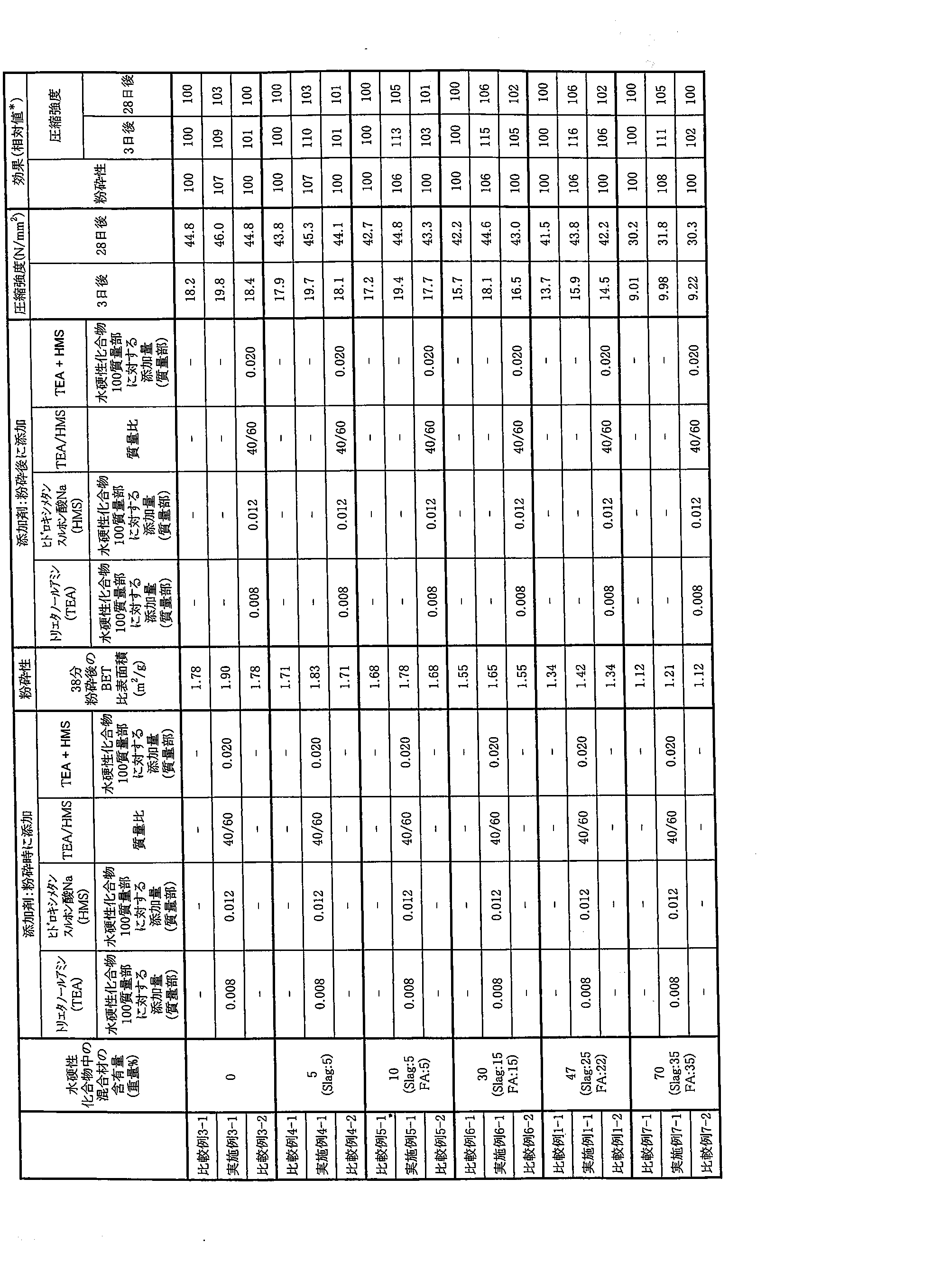
- Example 1-1 an experiment was performed in the same manner as in Example 1-1 except that hydraulic compounds having different mixed material contents were used. Similarly, the comparative example was added to the kneading water at the time of preparing the mortar in the form of an additive composition for pulverization after pulverization. The results are shown in Table 3. Table 3 also shows the results of Example 1-1 and Comparative Examples 1-1 and 1-2.
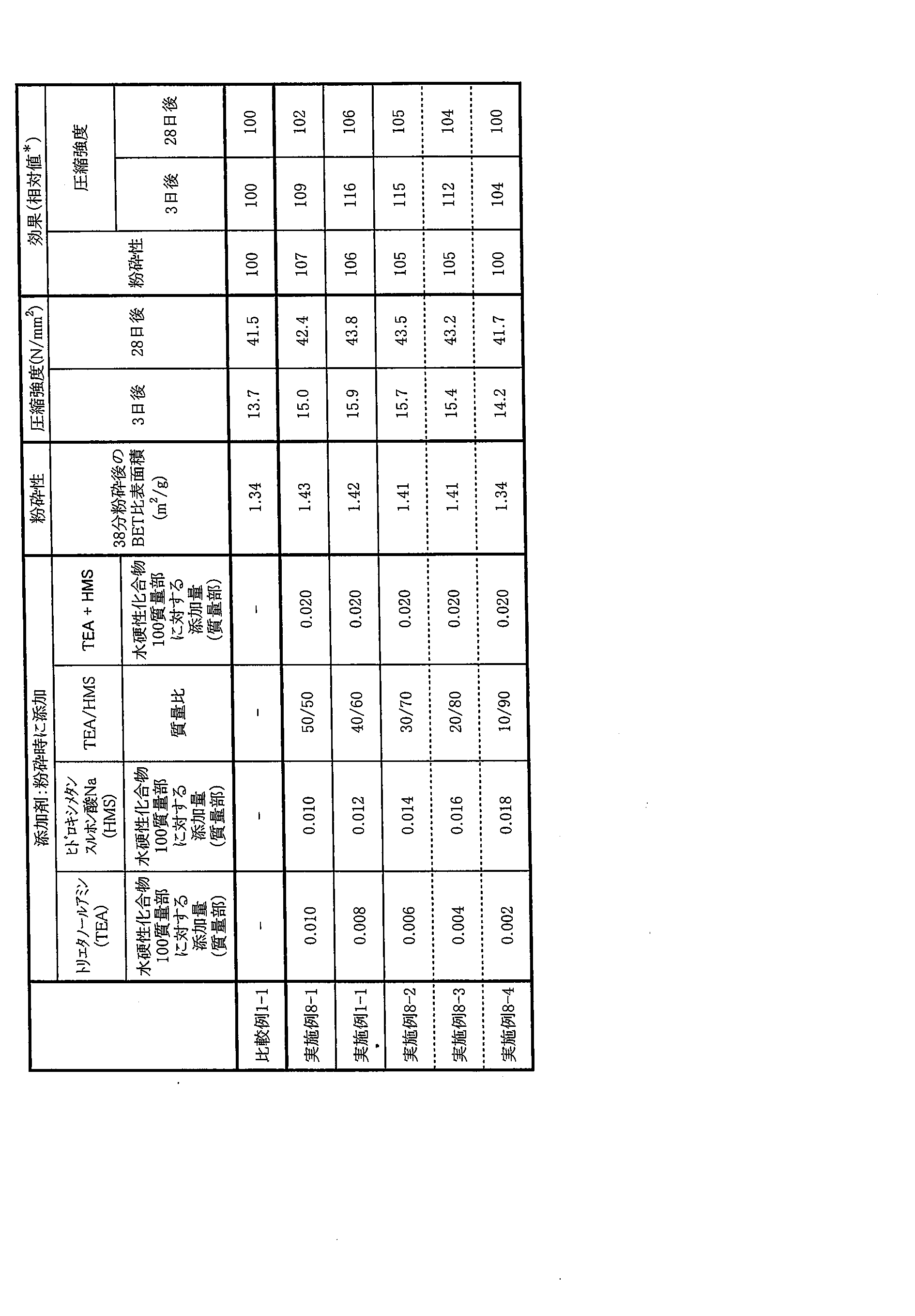
- Example 8> In Example 1-1, the experiment was performed in the same manner as in Example 1-1 except that the mass ratio of triethanolamine to sodium hydroxymethanesulfonate was changed. The results are shown in Table 4. Table 4 also shows the results of Example 1-1 and Comparative Example 1-1.
- Table 4 shows that the mass ratio of triethanolamine to hydroxymethanesulfonic acid or a salt thereof (triethanolamine / hydroxymethanesulfonic acid or a salt thereof) has a more suitable range.
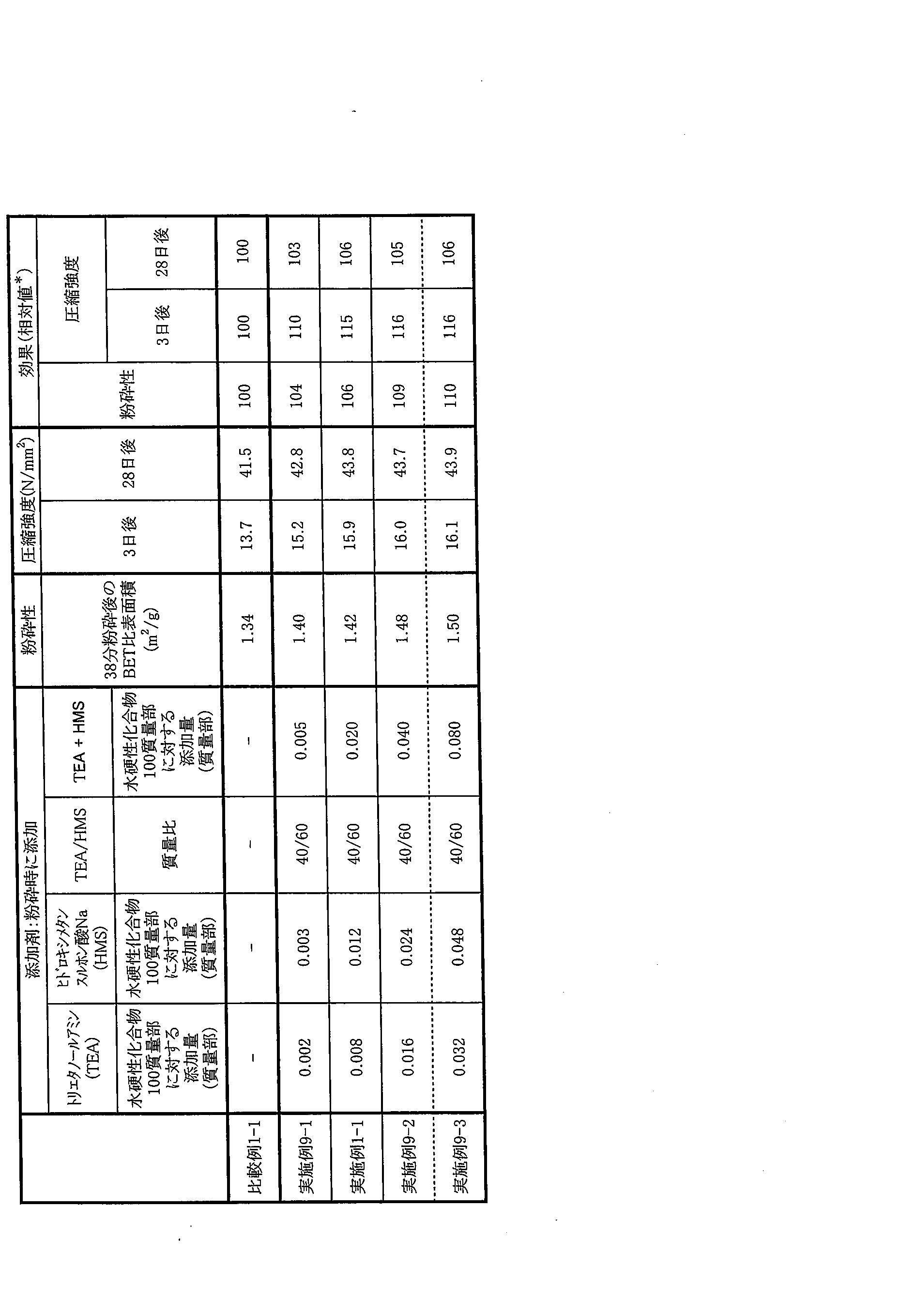
- Example 9 In Example 1-1, an experiment was performed in the same manner as in Example 1-1 except that the total amount of triethanolamine and sodium hydroxymethanesulfonate was changed. The results are shown in Table 5. Table 5 also shows the results of Example 1-1 and Comparative Example 1-1.
- Examples 10 to 13 and Comparative Examples 10 to 13> Hydraulic compound Clinker, dihydrate gypsum, mixed material (fly ash and limestone) are mixed, and the composition is 65 mass% clinker, 6 mass% dihydrate gypsum, 17 mass% fly ash, 12 mass% limestone. The hydraulic compound was obtained.
- the clinker, dihydrate gypsum, fly ash, and limestone are as follows.
- Ordinary Portland cement clinker (3.5mm sieve passing material) obtained by primary pulverization using a combination of limestone, clay, silica, iron oxide raw materials, etc., with a crusher and grinder ⁇
- Dihydrate gypsum Dihydrate gypsum obtained by first grinding dihydrate gypsum for ordinary Portland cement with a crusher and grinder ⁇ Fly ash: Commercial product, manufactured by Chubu Electric Power Co., Ltd.
- ⁇ Limestone Limestone obtained by primary crushing of limestone, which is a clinker raw material, with a crusher and grinder (3.5 mm sieve passing material)
- Triethanolamine, sodium hydroxymethanesulfonate and compound C were mixed at the mixing ratio shown in Tables 6 to 9, and the solid content concentration (effective component concentration) The concentration was adjusted by adding water so as to be a 50% by mass aqueous solution. None of the pulverizing additive compositions was turbid, and a uniform aqueous solution was obtained.
- Triethanolamine, sodium hydroxymethanesulfonate, glycerin, sucrose, fructose, maltose, sodium gluconate, sodium citrate, sodium hexametaphosphate, and sodium tripolyphosphate are as follows. Triethanolamine: Wako Pure Chemical Industries, Ltd.
- one or more compounds C selected from glycerin, monosaccharide or disaccharide, oxycarboxylic acid or salt thereof, and condensed phosphoric acid or salt thereof are present together with triethanolamine and hydroxymethanesulfonic acid or salt thereof.
Landscapes
- Chemical & Material Sciences (AREA)
- Engineering & Computer Science (AREA)
- Ceramic Engineering (AREA)
- Materials Engineering (AREA)
- Structural Engineering (AREA)
- Organic Chemistry (AREA)
- Curing Cements, Concrete, And Artificial Stone (AREA)
- Organic Low-Molecular-Weight Compounds And Preparation Thereof (AREA)
- Disintegrating Or Milling (AREA)
Abstract
Description
コンクリートの初期強度は、スリップフォーム工法における型枠滑動速度、凍害耐力、せき板の取り外し時期などコンクリートの初期における性状の判定に重要なものである。例えば、型枠の在置期間は、JASS5および建設省告示第110号に規定されているが、最小在置期間として気温15℃以上で2~3日(基礎、柱、壁など)とされている。その要因は、脱型後のコンクリートの乾燥による長期強度の発現が著しく悪くなるためであり、特に3日以内の水分の蒸発が著しいと言われている。これを抑制するためには、セメントの水和反応を促進し、水分が乾燥(蒸発)しにくいセメント水和物に変換することが効果的であり、3日強度を高く発現させることは、コンクリート硬化体の乾燥による長期強度低下抑制の観点から重要である。
本発明は、トリエタノールアミンと、ヒドロキシメタンスルホン酸又はその塩との存在下で、水硬性化合物を粉砕する工程を有する、水硬性粉体の製造方法に関する。
従来では、水硬性粉体の生産性の向上、コンクリート二次製品の生産性向上及びコンクリート硬化体の強度向上等の理由により、水硬性粉体の製造方法では、水硬性化合物の粉砕性と得られる水硬性粉体を用いた水硬性組成物の硬化時の圧縮強度、とりわけ初期強度の双方において、さらなる向上が望まれる。
化合物Cは、2種以上を用いることができ、例えば、2種又は3種を用いることができる。化合物Cを2種以上用いる場合、化合物Cに、少なくともグリセリンが含まれていることが好ましい。また、化合物Cを2種用いる場合、化合物Cに、グリセリンが含まれており、化合物Cの全量中、グリセリンの割合が50質量%以上、更に55質量%以上、そして、95質量%以下、更に80質量%以下であることが好ましい。化合物Cを3種用いる場合、化合物Cに、グリセリンが含まれており、化合物Cの全量中、グリセリンの割合が30質量%以上、更に40質量%以上、そして、95質量%以下、更に80質量%以下であることが好ましい。化合物Cを4種以上用いる場合、化合物Cに、グリセリンが含まれており、化合物Cの全量中、グリセリンの割合が20質量%以上、更に30質量%以上、そして、95質量%以下、更に80質量%以下であることが好ましい。
<1> トリエタノールアミンと、ヒドロキシメタンスルホン酸又はその塩との存在下で、水硬性化合物を粉砕する工程を有する、水硬性粉体の製造方法。
前記水と反応して硬化する性質をもつ物質の含有量が、前記水硬性化合物中、好ましくは20質量%以上、より好ましくは30質量%以上、更に好ましくは40質量%以上、そして、好ましくは92質量%以下、より好ましくは75質量%以下、更に好ましくは60質量%であり、
前記混合材の含有量が、前記水硬性化合物中、好ましくは8質量%以上、より好ましくは25質量%以上、更に好ましくは40質量%以上、そして、好ましくは80質量%以下、より好ましくは70質量%以下、更に好ましくは60質量%以下である、
前記<1>~<5>の何れか記載の水硬性粉体の製造方法。
前記水と反応して硬化する性質をもつ物質の含有量が、前記水硬性化合物中、好ましくは20質量%以上、より好ましくは30質量%以上、更に好ましくは40質量%以上、そして、好ましくは92質量%以下、より好ましくは75質量%以下、更に好ましくは60質量%であり、
前記混合材の含有量が、前記水硬性化合物中、好ましくは8質量%以上、より好ましくは25質量%以上、更に好ましくは40質量%以上、そして、好ましくは80質量%以下、より好ましくは70質量%以下、更に好ましくは60質量%以下である、
前記<21>に記載の水硬性化合物の粉砕への使用。
実施例
クリンカー、二水石膏、混合材を混合した、混合材含有量の異なる下記の水硬性化合物を用いた。
・混合材含有量0質量%の水硬性化合物:クリンカー95質量%、二水石膏5質量%を混合した。
・混合材含有量5質量%の水硬性化合物:クリンカー90質量%、二水石膏5質量%、高炉水砕スラグ5質量%を混合した。
・混合材含有量10質量%の水硬性化合物:クリンカー86質量%、二水石膏4質量%、高炉水砕スラグ5質量%、フライアッシュ5質量%を混合した。
・混合材含有量30質量%の水硬性化合物:クリンカー67質量%、二水石膏3質量%、高炉水砕スラグ15質量%、フライアッシュ15質量%を混合した。
・混合材含有量47質量%の水硬性化合物:クリンカー50質量%、二水石膏3質量%、高炉水砕スラグ25質量%、フライアッシュ22質量%を混合した。
・混合材含有量70質量%の水硬性化合物:クリンカー28質量%、二水石膏2質量%、高炉水砕スラグ35質量%、フライアッシュ35質量%を混合した。
・クリンカー:成分が、CaO:約65%、SiO2:約22%、Al2O3:約5%、Fe2O3:約3%、MgO他:約3%(質量基準)となるように、石灰石、粘土、けい石、酸化鉄原料等を組み合わせて焼成したものを、クラッシャー及びグラインダーにより一次粉砕して得た、普通ポルトランドセメント用クリンカー(3.5mmふるい通過物)
・二水石膏:試薬特級、和光純薬工業株式会社製
・高炉水砕スラグ:高炉水砕スラグをクラッシャー及びグラインダーにより一次粉砕して得たもの(3.5mmふるい通過物)、表中、「Slag」と表記した。
・フライアッシュ:市販品、中部電力株式会社製、表中、「FA」と表記した。
表1~5に示した混合比率でトリエタノールアミン及びヒドロキシメタンスルホン酸ナトリウムを混合し、固形分濃度(有効分濃度)が50質量%水溶液になるよう水を加えて濃度を調製した。いずれの粉砕用添加剤組成物も濁り等はなく、均一な水溶液が得られた。なお、トリエタノールアミン、ヒドロキシメタンスルホン酸ナトリウムは以下のものである。
・トリエタノールアミン:和光純薬工業株式会社製
・ヒドロキシメタンスルホン酸ナトリウム:東京化成工業株式会社製
BET比表面積の測定は、Macsorb HM-model 1201(Mountech社製)を用い、以下の条件で行った。
・脱気:100℃×30分、冷却×4分
・測定ガス:キャリアガスとしてヘリウムを用い、冷却剤および吸着質として窒素を用いた。また、混合ガス濃度は30.4%、流量は25ml/min.とした。
セメントの物理試験方法(JIS R 5201)附属書2(セメントの試験方法-強さの測定)に従って水硬性組成物を調製した。得られた水硬性組成物の圧縮強度を、セメントの物理試験方法(JIS R 5201)附属書2(セメントの試験方法-強さの測定)に従って評価した。
混合材含有量47質量%の水硬性化合物600gに、表1で示した添加剤を、粉砕用添加剤組成物の形態で表1に示した量で添加し、添加剤の存在下で、ボールミルで粉砕して水硬性粉体を製造した。

実施例1-1において、トリエタノールアミンとヒドロキシメタンスルホン酸ナトリウムの合計量が、水硬性化合物100質量部に対して0.080質量部となるように添加した以外は、実施例1-1と同様に実験を行った。また比較例1-2と同様に、比較例2-1、比較例2-2も粉砕後に表に示す所定量の添加剤を粉砕用添加剤組成物の形態でモルタル調製時の練り水に添加した。結果を表2に示した。

実施例1-1において、混合材の含有量が異なる水硬性化合物を用いた以外は、実施例1-1と同様に実験を行った。また比較例も同様に、粉砕後に粉砕用添加剤組成物の形態でモルタル調製時の練り水に添加した。結果を表3に示した。表3には、実施例1-1、比較例1-1、1-2の結果も併記した。
実施例1-1において、トリエタノールアミンとヒドロキシメタンスルホン酸ナトリウムの質量比を変えた以外は、実施例1-1と同様に実験を行った。結果を表4に示した。表4には、実施例1-1、比較例1-1の結果も併記した。
実施例1-1において、トリエタノールアミンとヒドロキシメタンスルホン酸ナトリウムの合計添加量を変えた以外は、実施例1-1と同様に実験を行った。結果を表5に示した。表5には、実施例1-1、比較例1-1の結果も併記した。
(1)水硬性化合物
クリンカー、二水石膏、混合材(フライアッシュ及びライムストーン)を混合し、組成がクリンカー65質量%、二水石膏6質量%、フライアッシュ17質量%、ライムストーン12質量%の水硬性化合物を得た。
・クリンカー:成分が、CaO:約65%、SiO2:約22%、Al2O3:約5%、Fe2O3:約3%、MgO他:約3%(質量基準)となるように、石灰石、粘土、けい石、酸化鉄原料等を組み合わせて焼成したものを、クラッシャー及びグラインダーにより一次粉砕して得た、普通ポルトランドセメント用クリンカー(3.5mmふるい通過物)
・二水石膏:普通ポルトランドセメント用二水石膏を、クラッシャー及びグラインダーにより一次粉砕して得た、二水石膏(3.5mmふるい通過物)
・フライアッシュ:市販品、中部電力株式会社製
・ライムストーン:クリンカー原料となる石灰石を、クラッシャー及びグラインダーにより一次粉砕して得たライムストーン(3.5mmふるい通過物)
表6~9に示した混合比率でトリエタノールアミン、ヒドロキシメタンスルホン酸ナトリウム、及び化合物Cを混合し、固形分濃度(有効分濃度)が50質量%水溶液になるよう水を加えて濃度を調製した。いずれの粉砕用添加剤組成物も濁り等はなく、均一な水溶液が得られた。なお、トリエタノールアミン、ヒドロキシメタンスルホン酸ナトリウム、グリセリン、スクロース、フルクトース、マルトース、グルコン酸ナトリウム、クエン酸ナトリウム、ヘキサメタリン酸ナトリウム、トリポリリン酸ナトリウムは以下のものである。
・トリエタノールアミン:和光純薬工業株式会社製
・ヒドロキシメタンスルホン酸ナトリウム:東京化成工業株式会社製
・グリセリン:花王株式会社製「精製グリセリン」
・スクロース:和光純薬工業株式会社製
・フルクトース:和光純薬工業株式会社製
・マルトース:和光純薬工業株式会社製
・グルコン酸ナトリウム:和光純薬工業株式会社製
・クエン酸三ナトリウム(結晶物):和光純薬工業株式会社製
・ヘキサメタリン酸ナトリウム:和光純薬工業株式会社製
・トリポリリン酸ナトリウム:和光純薬工業株式会社製
上記の水硬性化合物600gに、表6~9で示した添加剤を、粉砕用添加剤組成物の形態で表1に示した量で添加し、添加剤の存在下で、ボールミルで粉砕して水硬性粉体を製造した。ボールミルは実施例1と同じものを用い、その使用条件も実施例1と同じとした。ただし、BET比表面積は、100分粉砕後に測定した。100分粉砕後に得られた水硬性粉体を用いて、水硬性組成物調製後、3日後及び28日後の圧縮強度を測定した。結果を表6~9に示した。


Claims (17)
- トリエタノールアミンと、ヒドロキシメタンスルホン酸又はその塩との存在下で、水硬性化合物を粉砕する工程を有する、水硬性粉体の製造方法。
- 前記トリエタノールアミンと前記ヒドロキシメタンスルホン酸又はその塩の合計の存在量が、前記水硬性化合物100質量部に対して、0.001質量部以上0.100質量部以下である、請求項1記載の水硬性粉体の製造方法。
- 前記トリエタノールアミンと前記ヒドロキシメタンスルホン酸又はその塩の質量比(トリエタノールアミン/ヒドロキシメタンスルホン酸又はその塩)が、5/95以上55/45以下である、請求項1又は2に記載の水硬性粉体の製造方法。
- 前記トリエタノールアミンの存在量が、前記水硬性化合物100質量部に対して、0.0005質量部以上0.040質量部以下である、請求項1~3のいずれかに記載の水硬性粉体の製造方法。
- 前記ヒドロキシメタンスルホン酸又はその塩の存在量が、前記水硬性化合物100質量部に対して、0.0005質量部以上0.060質量部以下である、請求項1~4のいずれかに記載の水硬性粉体の製造方法。
- 前記水硬性化合物が、水と反応して硬化する性質をもつ物質と、高炉スラグ、フライアッシュ及びシリカフュームからなる群から選ばれる1種以上の混合材とを含有し、前記水と反応して硬化する性質をもつ物質の含有量が、前記水硬性化合物中、20質量%以上92質量%以下であり、前記混合材の含有量が、前記水硬性化合物中、8質量%以上80質量%以下である、請求項1~5のいずれかに記載の水硬性粉体の製造方法。
- 前記水と反応して硬化する性質をもつ物質と混合材の合計の含有量が、前記水硬性化合物中、70質量%以上100質量%以下である、請求項6に記載の水硬性粉体の製造方法。
- 前記トリエタノールアミンと前記ヒドロキシメタンスルホン酸又はその塩と共に、グリセリン、単糖類もしくは二糖類、オキシカルボン酸又はその塩、及び縮合リン酸又はその塩から選ばれる1種以上の化合物Cを存在させて、水硬性化合物を粉砕する、請求項1~7のいずれかに記載の水硬性粉体の製造方法。
- 前記トリエタノールアミンと、前記ヒドロキシメタンスルホン酸又はその塩と前記化合物Cの合計、との質量比〔トリエタノールアミン/(ヒドロキシメタンスルホン酸又はその塩+化合物C)〕が、5/95以上55/45以下である、請求項8に記載の水硬性粉体の製造方法。
- 前記化合物Cの存在量が、前記水硬性化合物100質量部に対して、0.0005質量部以上0.040質量部以下である、請求項8又は9に記載の水硬性粉体の製造方法。
- トリエタノールアミンと、ヒドロキシメタンスルホン酸又はその塩とを含有し、トリエタノールアミンとヒドロキシメタンスルホン酸又はその塩の質量比(トリエタノールアミン/ヒドロキシメタンスルホン酸又はその塩)が、5/95以上55/45以下である、水硬性化合物の粉砕用添加剤組成物。
- グリセリン、単糖類もしくは二糖類、オキシカルボン酸又はその塩、及び縮合リン酸又はその塩から選ばれる1種以上の化合物Cを含有する、請求項11に記載の水硬性粉体の粉砕用添加剤組成物。
- 前記トリエタノールアミンと、前記ヒドロキシメタンスルホン酸又はその塩と前記化合物Cの合計、との質量比〔グリセリン/(ヒドロキシメタンスルホン酸又はその塩+化合物C)〕が、5/95以上55/45以下である、請求項12に記載の水硬性粉体の粉砕用添加剤組成物。
- 溶媒を含有し、溶媒の含有量が、20質量%以上95質量%以下である、請求項11~13のいずれかに記載の水硬性化合物の粉砕用添加剤組成物。
- 請求項11~14のいずれかに記載の水硬性粉体の粉砕用添加剤組成物の、水硬性化合物の粉砕への使用。
- 前記水硬性化合物が、水と反応して硬化する性質をもつ物質と、高炉スラグ、フライアッシュ及びシリカフュームからなる群から選ばれる1種以上の混合材とを含有し、前記水と反応して硬化する性質をもつ物質の含有量が、前記水硬性化合物中、20質量%以上92質量%以下であり、前記混合材の含有量が、前記水硬性化合物中、8質量%以上80質量%以下である、請求項15に記載の水硬性化合物の粉砕への使用。
- 前記水と反応して硬化する性質をもつ物質と混合材の合計の含有量が、前記水硬性化合物中、70質量%以上100質量%以下である、請求項16に記載の水硬性化合物の粉砕への使用。
Priority Applications (3)
| Application Number | Priority Date | Filing Date | Title |
|---|---|---|---|
| BR112016004217-4A BR112016004217A2 (pt) | 2013-09-27 | 2014-09-18 | Método para produzir um pó hidráulico, e composição aditiva de pulverização para um composto hidráulico |
| MX2016002965A MX383816B (es) | 2013-09-27 | 2014-09-18 | Metodo para producir polvo hidraulico. |
| CN201480042498.6A CN105408275B (zh) | 2013-09-27 | 2014-09-18 | 水硬性粉体的制造方法 |
Applications Claiming Priority (2)
| Application Number | Priority Date | Filing Date | Title |
|---|---|---|---|
| JP2013201200 | 2013-09-27 | ||
| JP2013-201200 | 2013-09-27 |
Publications (1)
| Publication Number | Publication Date |
|---|---|
| WO2015045995A1 true WO2015045995A1 (ja) | 2015-04-02 |
Family
ID=52743135
Family Applications (1)
| Application Number | Title | Priority Date | Filing Date |
|---|---|---|---|
| PCT/JP2014/074627 Ceased WO2015045995A1 (ja) | 2013-09-27 | 2014-09-18 | 水硬性粉体の製造方法 |
Country Status (5)
| Country | Link |
|---|---|
| JP (1) | JP5802815B2 (ja) |
| CN (1) | CN105408275B (ja) |
| BR (1) | BR112016004217A2 (ja) |
| MX (1) | MX383816B (ja) |
| WO (1) | WO2015045995A1 (ja) |
Cited By (1)
| Publication number | Priority date | Publication date | Assignee | Title |
|---|---|---|---|---|
| BE1032163B1 (nl) * | 2023-11-22 | 2025-06-24 | Cemminerals Nv | Werkwijze voor de productie van CEM V, alsook het geproduceerde cementmengsel |
Families Citing this family (5)
| Publication number | Priority date | Publication date | Assignee | Title |
|---|---|---|---|---|
| JP6727182B2 (ja) * | 2016-11-29 | 2020-07-22 | 花王株式会社 | 水硬性組成物用の添加剤 |
| JP6535316B2 (ja) * | 2016-11-29 | 2019-06-26 | 花王株式会社 | 水硬性組成物用の添加剤 |
| WO2018101140A1 (ja) * | 2016-11-29 | 2018-06-07 | 花王株式会社 | 水硬性組成物用の添加剤 |
| JP7746191B2 (ja) * | 2022-03-02 | 2025-09-30 | Ube三菱セメント株式会社 | 水硬性組成物、水硬性組成物の製造方法、硬化体の製造方法、並びに、圧縮強さの変動を抑制する方法 |
| JP7834509B2 (ja) * | 2022-03-02 | 2026-03-24 | Ube三菱セメント株式会社 | 高炉水砕スラグに対する圧縮強さ増進剤 |
Citations (4)
| Publication number | Priority date | Publication date | Assignee | Title |
|---|---|---|---|---|
| JPS61117142A (ja) * | 1984-11-08 | 1986-06-04 | 藤沢薬品工業株式会社 | セメント組成物 |
| JP2008542182A (ja) * | 2005-06-02 | 2008-11-27 | ダブリュー・アール・グレイス・アンド・カンパニー−コネチカット | バイオマス由来粉砕助剤 |
| JP2010042986A (ja) * | 2008-07-18 | 2010-02-25 | Kao Corp | 水硬性粉体の製造方法 |
| JP2012036077A (ja) * | 2010-07-16 | 2012-02-23 | Kao Corp | 水硬性粉体の製造方法 |
Family Cites Families (1)
| Publication number | Priority date | Publication date | Assignee | Title |
|---|---|---|---|---|
| CN1133601C (zh) * | 2001-08-14 | 2004-01-07 | 刘长林 | 一种水泥助磨剂 |
-
2014
- 2014-09-18 CN CN201480042498.6A patent/CN105408275B/zh active Active
- 2014-09-18 WO PCT/JP2014/074627 patent/WO2015045995A1/ja not_active Ceased
- 2014-09-18 BR BR112016004217-4A patent/BR112016004217A2/pt not_active IP Right Cessation
- 2014-09-18 JP JP2014189534A patent/JP5802815B2/ja active Active
- 2014-09-18 MX MX2016002965A patent/MX383816B/es unknown
Patent Citations (4)
| Publication number | Priority date | Publication date | Assignee | Title |
|---|---|---|---|---|
| JPS61117142A (ja) * | 1984-11-08 | 1986-06-04 | 藤沢薬品工業株式会社 | セメント組成物 |
| JP2008542182A (ja) * | 2005-06-02 | 2008-11-27 | ダブリュー・アール・グレイス・アンド・カンパニー−コネチカット | バイオマス由来粉砕助剤 |
| JP2010042986A (ja) * | 2008-07-18 | 2010-02-25 | Kao Corp | 水硬性粉体の製造方法 |
| JP2012036077A (ja) * | 2010-07-16 | 2012-02-23 | Kao Corp | 水硬性粉体の製造方法 |
Cited By (1)
| Publication number | Priority date | Publication date | Assignee | Title |
|---|---|---|---|---|
| BE1032163B1 (nl) * | 2023-11-22 | 2025-06-24 | Cemminerals Nv | Werkwijze voor de productie van CEM V, alsook het geproduceerde cementmengsel |
Also Published As
| Publication number | Publication date |
|---|---|
| BR112016004217A2 (pt) | 2020-10-27 |
| JP2015086130A (ja) | 2015-05-07 |
| CN105408275B (zh) | 2017-10-20 |
| CN105408275A (zh) | 2016-03-16 |
| MX2016002965A (es) | 2016-11-07 |
| JP5802815B2 (ja) | 2015-11-04 |
| MX383816B (es) | 2025-03-14 |
Similar Documents
| Publication | Publication Date | Title |
|---|---|---|
| JP5802815B2 (ja) | 水硬性粉体の製造方法 | |
| EP2594540B1 (en) | Method for producing hydraulic powder | |
| EP2441738B1 (en) | Expansive admixture and method for producing same | |
| KR101713828B1 (ko) | 무시멘트 촉진형 혼화제 및 이를 포함하는 무시멘트 조성물 | |
| JP6137850B2 (ja) | 水硬性組成物 | |
| EP4119517A1 (en) | Cement admixture and cement composition | |
| JP6371701B2 (ja) | 水硬性組成物用添加剤 | |
| JP2008179504A (ja) | 高炉スラグセメント | |
| CN103261116B (zh) | 水泥混合材料、水泥组合物以及使用了水泥组合物的减少六价铬的方法 | |
| JP2013107816A (ja) | 低炭素型セメントペースト組成物 | |
| JP2013018677A (ja) | 水硬性粉体の製造方法 | |
| CN105060923A (zh) | 一种用于废水处理的轻质免烧陶粒及其制备方法 | |
| JP5759801B2 (ja) | 水硬性粉体の製造方法 | |
| JP6039476B2 (ja) | 水硬性粉体の製造方法 | |
| JP5883243B2 (ja) | 水硬性粉体の製造方法 | |
| JP5855902B2 (ja) | アルミナセメント | |
| JP5666281B2 (ja) | 水硬性粉体の製造方法 | |
| JP6022340B2 (ja) | 水硬性粉体の製造方法 | |
| JP2007126294A (ja) | 高硫酸塩スラグセメント・早強スラグセメントおよびこれらの製造方法 | |
| Ding et al. | Utilisation of light calcined magnesite tailings to compensate the autogenous shrinkage of steam-cured cement paste | |
| KR20150022189A (ko) | 콘크리트 결합재 및 이의 제조방법 | |
| JP5805442B2 (ja) | 水硬性粉体の製造方法 | |
| JP6003900B2 (ja) | セメント混和材の製造方法 | |
| JP4498592B2 (ja) | セメント混和材及びセメント組成物 | |
| JP2016121047A (ja) | セメント添加剤及びセメント組成物 |
Legal Events
| Date | Code | Title | Description |
|---|---|---|---|
| WWE | Wipo information: entry into national phase |
Ref document number: 201480042498.6 Country of ref document: CN |
|
| 121 | Ep: the epo has been informed by wipo that ep was designated in this application |
Ref document number: 14848105 Country of ref document: EP Kind code of ref document: A1 |
|
| WWE | Wipo information: entry into national phase |
Ref document number: IDP00201601239 Country of ref document: ID |
|
| WWE | Wipo information: entry into national phase |
Ref document number: MX/A/2016/002965 Country of ref document: MX |
|
| REG | Reference to national code |
Ref country code: BR Ref legal event code: B01A Ref document number: 112016004217 Country of ref document: BR |
|
| NENP | Non-entry into the national phase |
Ref country code: DE |
|
| 122 | Ep: pct application non-entry in european phase |
Ref document number: 14848105 Country of ref document: EP Kind code of ref document: A1 |
|
| ENP | Entry into the national phase |
Ref document number: 112016004217 Country of ref document: BR Kind code of ref document: A2 Effective date: 20160226 |
|
| ENPC | Correction to former announcement of entry into national phase, pct application did not enter into the national phase |
Ref country code: BR Free format text: ANULADA A PUBLICACAO CODIGO 1.3 NA RPI NO 2430 DE 01/08/2017 POR TER SIDO INDEVIDA. |
|
| REG | Reference to national code |
Ref country code: BR Ref legal event code: B01E Ref document number: 112016004217 Country of ref document: BR Kind code of ref document: A2 Free format text: APRESENTE TRADUCAO SIMPLES DA CERTIDAO DE DEPOSITO DA PRIORIDADE NO PAIS DE ORIGEM OU DECLARACAO ASSINADA, AMBAS CONTENDO TODOS OS DADOS IDENTIFICADORES DA PRIORIDADE (TITULO, INVENTORES E TITULARES) CONFORME ART. 16, 2O, DA LPI. |
|
| ENP | Entry into the national phase |
Ref document number: 112016004217 Country of ref document: BR Kind code of ref document: A2 Effective date: 20160226 |