WO2015045656A1 - フィルム用トナー - Google Patents
フィルム用トナー Download PDFInfo
- Publication number
- WO2015045656A1 WO2015045656A1 PCT/JP2014/071212 JP2014071212W WO2015045656A1 WO 2015045656 A1 WO2015045656 A1 WO 2015045656A1 JP 2014071212 W JP2014071212 W JP 2014071212W WO 2015045656 A1 WO2015045656 A1 WO 2015045656A1
- Authority
- WO
- WIPO (PCT)
- Prior art keywords
- resin
- molecular weight
- toner
- film
- resins
- Prior art date
- Legal status (The legal status is an assumption and is not a legal conclusion. Google has not performed a legal analysis and makes no representation as to the accuracy of the status listed.)
- Ceased
Links
Images


Classifications
-
- G—PHYSICS
- G03—PHOTOGRAPHY; CINEMATOGRAPHY; ANALOGOUS TECHNIQUES USING WAVES OTHER THAN OPTICAL WAVES; ELECTROGRAPHY; HOLOGRAPHY
- G03G—ELECTROGRAPHY; ELECTROPHOTOGRAPHY; MAGNETOGRAPHY
- G03G9/00—Developers
- G03G9/08—Developers with toner particles
- G03G9/0819—Developers with toner particles characterised by the dimensions of the particles
-
- G—PHYSICS
- G03—PHOTOGRAPHY; CINEMATOGRAPHY; ANALOGOUS TECHNIQUES USING WAVES OTHER THAN OPTICAL WAVES; ELECTROGRAPHY; HOLOGRAPHY
- G03G—ELECTROGRAPHY; ELECTROPHOTOGRAPHY; MAGNETOGRAPHY
- G03G9/00—Developers
- G03G9/08—Developers with toner particles
- G03G9/087—Binders for toner particles
- G03G9/08702—Binders for toner particles comprising macromolecular compounds obtained by reactions only involving carbon-to-carbon unsaturated bonds
- G03G9/08706—Polymers of alkenyl-aromatic compounds
-
- G—PHYSICS
- G03—PHOTOGRAPHY; CINEMATOGRAPHY; ANALOGOUS TECHNIQUES USING WAVES OTHER THAN OPTICAL WAVES; ELECTROGRAPHY; HOLOGRAPHY
- G03G—ELECTROGRAPHY; ELECTROPHOTOGRAPHY; MAGNETOGRAPHY
- G03G9/00—Developers
- G03G9/08—Developers with toner particles
- G03G9/087—Binders for toner particles
- G03G9/08702—Binders for toner particles comprising macromolecular compounds obtained by reactions only involving carbon-to-carbon unsaturated bonds
- G03G9/08706—Polymers of alkenyl-aromatic compounds
- G03G9/08708—Copolymers of styrene
- G03G9/08711—Copolymers of styrene with esters of acrylic or methacrylic acid
-
- G—PHYSICS
- G03—PHOTOGRAPHY; CINEMATOGRAPHY; ANALOGOUS TECHNIQUES USING WAVES OTHER THAN OPTICAL WAVES; ELECTROGRAPHY; HOLOGRAPHY
- G03G—ELECTROGRAPHY; ELECTROPHOTOGRAPHY; MAGNETOGRAPHY
- G03G9/00—Developers
- G03G9/08—Developers with toner particles
- G03G9/087—Binders for toner particles
- G03G9/08784—Macromolecular material not specially provided for in a single one of groups G03G9/08702 - G03G9/08775
- G03G9/08795—Macromolecular material not specially provided for in a single one of groups G03G9/08702 - G03G9/08775 characterised by their chemical properties, e.g. acidity, molecular weight, sensitivity to reactants
-
- G—PHYSICS
- G03—PHOTOGRAPHY; CINEMATOGRAPHY; ANALOGOUS TECHNIQUES USING WAVES OTHER THAN OPTICAL WAVES; ELECTROGRAPHY; HOLOGRAPHY
- G03G—ELECTROGRAPHY; ELECTROPHOTOGRAPHY; MAGNETOGRAPHY
- G03G9/00—Developers
- G03G9/08—Developers with toner particles
- G03G9/087—Binders for toner particles
- G03G9/08784—Macromolecular material not specially provided for in a single one of groups G03G9/08702 - G03G9/08775
- G03G9/08797—Macromolecular material not specially provided for in a single one of groups G03G9/08702 - G03G9/08775 characterised by their physical properties, e.g. viscosity, solubility, melting temperature, softening temperature, glass transition temperature
-
- G—PHYSICS
- G03—PHOTOGRAPHY; CINEMATOGRAPHY; ANALOGOUS TECHNIQUES USING WAVES OTHER THAN OPTICAL WAVES; ELECTROGRAPHY; HOLOGRAPHY
- G03G—ELECTROGRAPHY; ELECTROPHOTOGRAPHY; MAGNETOGRAPHY
- G03G9/00—Developers
- G03G9/08—Developers with toner particles
- G03G9/097—Plasticisers; Charge controlling agents
- G03G9/09733—Organic compounds
- G03G9/0975—Organic compounds anionic
Definitions
- the present invention relates to a film toner.
- the label is generally manufactured by the following method. First, a pressure-sensitive adhesive layer is provided on one side, and the pressure-sensitive adhesive layer prepares a label sheet covered with a release paper. Then, a pattern is printed on the label sheet, and then the label sheet is cut into an arbitrary shape.
- a negatively chargeable toner is usually used.
- resins capable of achieving the performance required for a film there are those which are positively chargeable or weakly negatively chargeable.
- the negative chargeability is further insufficient.
- the resin having film properties has a low glass transition point and lacks crushability at normal temperature.
- the method of making other resin mix with resin is known, they are described about the solution of the mechanical problem of intensity
- a film electrophotographic toner for the purpose of improving chargeability and pulverization.
- Patent Document 1 Japanese Patent Application Publication No. 2007-283745
- Patent Document 2 Japanese Patent Application Publication No. 2009-108292
- Patent Document 3 Japanese Patent Application Publication No. 2009-108276
- the present invention has been made in view of the above circumstances, and it is an object of the present invention to make it possible to produce a film toner having a sufficient negative chargeability and to facilitate the pulverization carried out in the production.
- a toner for a film comprising a main resin and a low molecular weight resin having a weight average molecular weight lower than that of the main resin, wherein the low molecular weight resin is a terpene resin or an alicyclic resin.
- Hydrocarbon resin ⁇ -methyl polystyrene, modified rosin, novolak resin, modified novolak resin, aliphatic hydrocarbon resin, aromatic hydrocarbon resin, copolymer resin of those resins, esterified modified rosin, coumarone resin, C5 and It is at least one resin selected from the group consisting of C9 petroleum resins, and the film toner contains 5 to 40% by mass of the low molecular weight resin and has an average particle diameter D50 (volume) of 9 to 50 ⁇ m.
- a film toner is provided in the range of
- FIG. 1 is a plan view showing an example of a printer used for printing a film toner of an embodiment.
- FIG. 2 is a view showing an image sample printed using a film toner.
- the film toner comprises a main resin as a binder resin, a low molecular weight resin having a weight average molecular weight lower than that of the main resin, and optionally an internal additive and / or an external additive as an additive. It contains.
- the film toner may further contain a colorant.
- the main resin has film properties.
- the film property refers to a property which can be easily formed into a film by a method such as melt extrusion molding, calendering method and stretching, the embrittlement temperature is in a negative range, and has elasticity at normal temperature.
- the main resin may have positive chargeability or may have negative chargeability.
- the chargeability relationship between the main resin and the low molecular weight resin will be described later.
- the weight average molecular weight of the main resin is, for example, about 10,000 to about 250,000, preferably about 20,000 to about 200,000.
- the softening point of the main resin is, for example, about 90 to about 160 ° C.
- the main resin for example, polybutylene succinate (PBS) resin, polylactic acid resin, low density polyethylene resin, linear low density polyethylene resin, ethylene vinyl acetate polymer, ethylene methacrylic acid copolymer, ionomer resin, acrylonitrile Butadiene styrene copolymer, cyclic polyolefin copolymer, polyester sulfone resin ethylene ethyl acrylate resin, polyethylene terephthalate resin, polypropylene resin, polystyrene resin, acetalized polyvinyl alcohol resin and at least one resin selected from the group consisting of these are used can do.
- PBS polybutylene succinate
- the low molecular weight resin is terpene resin, alicyclic hydrocarbon resin, ⁇ -methyl polystyrene, modified rosin, novolak resin, modified novolak resin, aliphatic hydrocarbon resin, aromatic hydrocarbon resin, copolymer resin of those resins, It is at least one resin selected from the group consisting of esterified rosin, coumarone resin, C5 and C9 petroleum resins, and derivatives thereof.
- C5 petroleum resins those containing, as a main component, isopropylene, piperine, 2-methylbutene, cyclopentadiene and the like can be mentioned.
- C9 petroleum resins include those containing styrene, vinyl toluene, ⁇ -methylstyrene, indene and the like as the main components.
- the weight average molecular weight of the low molecular weight resin is, for example, about 200 to about 10,000, and preferably about 300 to about 5,000.
- Low molecular weight resins have a softening point of about 50 to about 150 ° C. and are solid at ambient temperature.
- Low molecular weight resins are not suitable as binder resins for film toners because they have inferior film properties compared to main resins.
- low molecular weight resins have better brittleness compared to main resins. Therefore, when the kneaded material containing these resins is ground, the grindability is improved due to the brittleness.
- low molecular weight resins typically have negative chargeability, but when the main resin has negative chargeability, low molecular weight resins need not necessarily have negative chargeability. . However, even in this case, it is desirable that the low molecular weight resin does not inhibit the negative chargeability of the main resin. On the other hand, when the main resin is positively charged, the low molecular weight resin needs to be negatively charged.
- At least one negatively charged resin selected from hydrogenated terpene resin, aliphatic saturated hydrocarbon resin, acid-modified ultra-light rosin, etc. is used as low molecular weight resin Is preferred.
- the additive is not particularly limited as long as it is generally used for an electrophotographic toner.
- internal additives such as charge control agents, mold release agents and grinding aids can be used.
- External additives can also be added as needed.
- the proportion of the main resin contained in the film toner is, for example, 50% by mass or more, and typically 55% by mass or more, based on the total mass (hereinafter, toner mass) of the main resin, the low molecular weight resin and the additive. It is.
- the proportion of the low molecular weight resin contained in the film toner is 5 to 40% by mass, more preferably 5 to 30% by mass, with respect to the mass of the toner.
- the proportion of the low molecular weight resin is excessively large, elasticity as a film toner can not be obtained, and cracks and cracks easily occur. If this ratio is excessively small, the pulverizability may deteriorate and the chargeability as a toner may be insufficient.
- the average particle diameter D50 (volume) of the film toner is typically 9 to 50 ⁇ m, preferably 20 to 30 ⁇ m. When the average particle diameter D50 is small, it is difficult to obtain a film having a sufficient thickness. If the average particle size D50 is large, the surface area may be reduced to cause insufficient chargeability.
- the film toner described above can be manufactured, for example, by the following method. First, a main resin is used as a binder resin, to which a low molecular weight resin and an internal additive are added and mixed. Next, this is melt-kneaded with a twin-screw kneader or the like. Thereafter, the kneaded material is cooled and pulverized by a mill or the like to obtain a pulverized material. An external additive is added to the pulverized product to produce a film toner.
- a main resin is used as a binder resin, to which a low molecular weight resin and an internal additive are added and mixed.
- this is melt-kneaded with a twin-screw kneader or the like. Thereafter, the kneaded material is cooled and pulverized by a mill or the like to obtain a pulverized material.
- An external additive is added to the pulverized product to produce a film toner.
- the printer 10 shown in FIG. 1 is a modified version of a commercially available Casio Computer Co., Ltd. “N6000”.
- the TS 12, the developing roll 13, the photosensitive member 14, the transfer unit 15, and the fixing unit 16 are disposed around the printing belt 11.
- a cassette 17 for storing a film adhesive sheet is disposed at the bottom of the printer, and a paper discharge unit 18 for discharging a printed sheet is disposed at the top.
- the film toner is stored in the TS12.
- the printer 10 shown in FIG. 1 operates as follows. First, a film pressure-sensitive adhesive sheet is supplied from the cassette 17 and passes through the sheet path C along the respective portions. An image made of toner developed on the photosensitive member 14 is transferred to the sheet having reached the transfer portion 15. The developed image is obtained by developing the film toner supplied from the TS 12 on the photosensitive member 14 by the developing roll 13.
- the sheet carrying the image (toner) transferred in the transfer unit 15 is further conveyed to the fixing unit along the paper path C, where the fixing process is performed, and the film toner is fixed. Thereafter, the sheet is discharged to the discharge unit 18, and the operation is completed.
- LA920 by Horiba, Ltd. which is a laser diffraction / scattering type particle size distribution measuring apparatus was used for the measurement of a particle size.
- the softening point was measured using “CFT-500D” manufactured by Shimadzu Corporation, using 1 g of sample, heating temperature of 6 ° C./min, load of 20 kg, and using a nozzle with a diameter of 1 mm and a length of 1 mm. The temperature at which half of the sample flowed out by the 1/2 method was taken as the softening point.
- the mixture was melt-kneaded with a twin-screw kneader, and the obtained kneaded product was coarsely crushed with "Pelletizer” manufactured by Nippon Placon.
- the obtained crude product was freeze-ground under liquid nitrogen using Hosokawa Micron "Lin Rex mill” to obtain a ground product with an average particle diameter D50 (volume) of 9 ⁇ m.
- Example 2 As the low molecular weight resin, Example 1 and Example 1 except that “ALCON P100” (weight average molecular weight 1,600) (alicyclic saturated hydrocarbon) manufactured by Arakawa Chemical Co., Ltd. was used instead of “CLEARON M105” manufactured by Yasuhara Chemical Co. Film toner A2 was produced in the same manner.
- ACON P100 weight average molecular weight 1,600
- CLARON M105 alicyclic saturated hydrocarbon
- Example 3 As the low molecular weight resin, Example 1 and Example 1 except that “ALCON M 100” (weight average molecular weight 1,000) (alicyclic saturated hydrocarbon) manufactured by Arakawa Chemical Co., Ltd. was used instead of “CLEARON M 105” manufactured by Yasuhara Chemical Co. A film toner A3 was produced in the same manner.
- Example 4 The same as Example 1, except that “FTR 2140” (weight average molecular weight 2,500) ( ⁇ -methylstyrene-polystyrene) manufactured by Mitsui Chemicals, Inc. was used as the low molecular weight resin instead of “Clearon M105” manufactured by Yashara Chemical Co. Film toner A4 was produced by the method described above.
- Example 5 The same as Example 1, except that “KE-604” (weight-average molecular weight 350) (acid-modified ultra-light rosin) manufactured by Arakawa Chemical Co., Ltd. was used instead of “CLEARON M105” manufactured by Yasuhara Chemical Co., Ltd. as a low molecular weight resin. Film toner A5 was produced by the method described above.
- Example 6 As a low molecular weight resin, Example 1 and Example 1 except that “Clearon P125” (weight average molecular weight 1,500) (aromatic modified hydrogenated terpene resin) manufactured by Yasuhara Chemical Co., Ltd. was used instead of “Clearon M105” manufactured by Yashara Chemical Co., Ltd. A film toner A6 was produced in the same manner.
- “Clearon P125” weight average molecular weight 1,500
- “Clearon M105” manufactured by Yashara Chemical Co., Ltd.
- a film toner A6 was produced in the same manner.
- Example 7 A film toner A7 was produced in the same manner as in Example 1 except that 57.5 parts by mass of PBS as the main resin and 40 parts by mass of "CLEARLON M105" as the low molecular weight resin were used.
- Example 8 A film toner A8 was produced in the same manner as in Example 1 except that the average particle diameter D50 (volume) of the pulverized material before external addition was set to 50 ⁇ m.
- Comparative example 1 97.5 parts by mass of PBS as a main resin was used, and a film toner B1 was produced in the same manner as in Example 1 except that a low molecular weight resin was not used.
- Example 2 A film toner B2 was produced in the same manner as in Example 1 except that 93.5 parts by mass of PBS as the main resin and 4 parts by mass of "CLEARLON M105" as the low molecular weight resin were used.
- Example 3 A film toner B3 was produced in the same manner as in Example 1 except that 56.5 parts by mass of PBS as the main resin and 41 parts by mass of "CLEARLON M105" as the low molecular weight resin were used.
- a film toner B4 was produced in the same manner as in Example 1 except that the average particle diameter D50 (volume) of the pulverized material before external addition was 60 ⁇ m.
- Each example was measured and evaluated by the following method. 1. Grindability of Toner The toner for each film was ground for 10 minutes with a feed of 5 kg / h, the average particle diameter D50 (volume) was measured, and the grindability was evaluated. ⁇ : less than 10 ⁇ m ⁇ : 10 ⁇ m or more and less than 30 ⁇ m x: 30 ⁇ m or more Measurement of Charge Amount In order to measure the charge amount of toner on the developing roll during printing of each toner for film, a solid image was printed on a pressure-sensitive adhesive sheet for film. Then, the printer was turned off at the moment when the center of the sheet passed the transfer unit. In this state, the TS was removed, and the charge amount of the toner on the developing roll before being supplied to the photosensitive member was measured.
- the charge amount was measured using “MODEL 210HS-3” manufactured by TREK. The toner on a fixed area was sucked, and the charge amount was calculated from the charge and the area. ⁇ : -10 ⁇ C / g or more ⁇ : 0 ⁇ C / g or more and less than -10 ⁇ C / g ⁇ : less than 0 ⁇ C / g Load amount (mass) About the image sample of each case, the amount of application (mass) per unit area was measured from the mass difference of the sheet before and after printing.
- ⁇ 40 g / m 2 or more ⁇ : 20 g / m 2 or more and less than 40 g / m 2 ⁇ : less than 20 g / m 2 Mounting amount (visual) The condition of the printed image was visually observed for the image sample of each example. ⁇ : uniformly and evenly. ⁇ : slightly uneven, slightly uneven X: not uniform but uneven.
- the low molecular weight resin used has a lower weight average molecular weight compared to the main resin, and 5 to 40% by mass of the low molecular weight resin based on the toner mass And the average particle diameter D50 (volume) is in the range of 9 to 50 ⁇ m.
- these film toners are good in all five items, such as crushability, charge amount, loading amount (g / m 2 ), loading amount (visual) and bending resistance (visual). The results are shown.
- the film toner B1 according to Comparative Example 1 in which the low molecular weight resin was not added had sufficient performance in terms of grindability, charge amount, applied amount (g / m 2 ) and applied amount (visual). It was not.
Landscapes
- Physics & Mathematics (AREA)
- General Physics & Mathematics (AREA)
- Spectroscopy & Molecular Physics (AREA)
- Chemical & Material Sciences (AREA)
- Chemical Kinetics & Catalysis (AREA)
- Developing Agents For Electrophotography (AREA)
- Compositions Of Macromolecular Compounds (AREA)
Abstract
粉砕性に優れ、十分な負帯電性を有したフィルム用トナーを提供する。 フィルム用トナーは、メイン樹脂と、メイン樹脂と比較して重量平均分子量がより低い低分子量樹脂とを含む。低分子量樹脂は、テルペン樹脂、脂環族炭化水素樹脂、α-メチルポリスチレン、変性ロジン、ノボラック樹脂、変性ノボラック樹脂、脂肪族炭化水素樹脂、芳香族炭化水素樹脂、それらの樹脂の共重合樹脂、エステル化物変性ロジン、クマロン樹脂、C5及びC9系石油樹脂、並びにそれらの誘導体からなる群から選ばれる1種以上の樹脂である。フィルム用トナーは、低分子量樹脂を5乃至40質量%の割合で含み、平均粒径D50(体積)は9乃至50μmの範囲内にある。
Description
本発明は、フィルム用トナーに関する。
ラベルは、一般には、以下の方法で製造している。まず、片面に粘着剤層が設けられ、この粘着剤層が剥離紙によって覆われたラベル用紙を準備する。次いで、ラベル用紙上に絵柄を印刷し、その後、ラベル用紙を任意の形にカットする。
しかしながら、この方法では、絵柄を印刷する版と、ラベル用紙をカットする抜型などの刃型とが必要であり、製造装置の費用が高いことが問題である。
そこで、電子写真方式により、トナーを任意の形状に現像して、その後加熱定着してラベルを作製する方法が提案されている(特許文献1参照)。但し、トナー用樹脂として広く使用されているポリエステル樹脂やスチレンアクリル樹脂は、硬さは十分であるが脆い樹脂である。そのため、これら樹脂は、ラベル基材として使用するにはフィルム特性が悪く、使用できなかった。
そこで、電子写真方式により、トナーを任意の形状に現像して、その後加熱定着してラベルを作製する方法が提案されている(特許文献1参照)。但し、トナー用樹脂として広く使用されているポリエステル樹脂やスチレンアクリル樹脂は、硬さは十分であるが脆い樹脂である。そのため、これら樹脂は、ラベル基材として使用するにはフィルム特性が悪く、使用できなかった。
電子写真方式では、通常、負帯電性のトナーを使用する。しかしながら、フィルムに要求される性能を達成し得る樹脂の中には、正帯電性であるか又は負帯電性が弱いものがある。加えて、フィルム用トナーの粒径を大径化する場合には、更に負帯電性が不足する。
また、フィルム特性を有する樹脂は、ガラス転移点が低く常温で粉砕性に欠ける。
なお、樹脂に対し、他の樹脂を混合させる手法は知られているが、それらは強度や耐衝撃性といった機械的な問題の解決について記載されたものである(例えば、特許文献2,3)。帯電性の向上や粉砕性の向上を目的としたフィルム電子写真方式トナーは開示されていない。
なお、樹脂に対し、他の樹脂を混合させる手法は知られているが、それらは強度や耐衝撃性といった機械的な問題の解決について記載されたものである(例えば、特許文献2,3)。帯電性の向上や粉砕性の向上を目的としたフィルム電子写真方式トナーは開示されていない。
[先行技術文献]
[特許文献]
[特許文献1]特開2007-283745号公報
[特許文献2]特開2009-108292号公報
[特許文献3]特開2009-108276号公報
[特許文献]
[特許文献1]特開2007-283745号公報
[特許文献2]特開2009-108292号公報
[特許文献3]特開2009-108276号公報
本発明は、上記事情に鑑みてなされ、十分な負帯電性を有したフィルム用トナーを製造可能とするとともに、その製造において行う粉砕を容易にすることを目的とする。
本発明の一側面によると、メイン樹脂と、前記メイン樹脂と比較して重量平均分子量がより低い低分子量樹脂とを含んだフィルム用トナーであって、前記低分子量樹脂は、テルペン樹脂、脂環族炭化水素樹脂、α-メチルポリスチレン、変性ロジン、ノボラック樹脂、変性ノボラック樹脂、脂肪族炭化水素樹脂、芳香族炭化水素樹脂、それらの樹脂の共重合樹脂、エステル化物変性ロジン、クマロン樹脂及びC5及びC9系石油樹脂からなる群から選ばれる1種以上の樹脂であり、前記フィルム用トナーは、前記低分子量樹脂を5乃至40質量%の割合で含み、平均粒径D50(体積)は9乃至50μmの範囲内にあるフィルム用トナーが提供される。
本発明によると、十分な負帯電性を有したフィルム用トナーを製造可能とするとともに、その製造において行う粉砕を容易にすることが可能となる。
以下、本発明の一実施形態に係るフィルム用トナーについて説明する。
このフィルム用トナーは、結着樹脂としてのメイン樹脂と、このメイン樹脂と比較して重量平均分子量がより低い低分子量樹脂と、添加剤として、任意に内添剤及び/又は外添剤とを含んでいる。フィルム用トナーは、更に、着色剤を含んでいてもよい。
このフィルム用トナーは、結着樹脂としてのメイン樹脂と、このメイン樹脂と比較して重量平均分子量がより低い低分子量樹脂と、添加剤として、任意に内添剤及び/又は外添剤とを含んでいる。フィルム用トナーは、更に、着色剤を含んでいてもよい。
メイン樹脂は、フィルム特性を有している。本明細書において、フィルム特性とは、溶融押出成形、カレンダー法及び延伸等の方法により容易にフィルム形成でき、且つ脆化温度が負の範囲にあり、常温で弾性を有する性質を指す。
メイン樹脂は、正帯電性を有していてもよく、負帯電性を有していてもよい。メイン樹脂と低分子量樹脂とが有する帯電性の関係については後述する。
メイン樹脂の重量平均分子量は、例えば、約10,000~約250,000であり、好ましくは、約20,000~約200,000である。
メイン樹脂の重量平均分子量は、例えば、約10,000~約250,000であり、好ましくは、約20,000~約200,000である。
メイン樹脂の軟化点は、例えば、約90~約160℃である。
メイン樹脂としては、例えば、ポリブチレンサクシネート(PBS)樹脂、ポリ乳酸樹脂、低密度ポリエチレン樹脂、直鎖状低密度ポリエチレン樹脂、エチレン酢酸ビニル重合体、エチレンメタクリル酸共重合体、アイオノマー樹脂、アクリロニトリルブタジエンスチレン共重合体、環状ポリオレフィンコポリマー、ポリエステルスルホン樹脂エチレンエチルアクリレート樹脂、ポリエチレンテレフタレート樹脂、ポリプロピレン樹脂、ポリスチレン樹脂、アセタール化ポリビニルアルコール樹脂及びそれらの誘導体からなる群より選ばれる1つ以上の樹脂を使用することができる。
メイン樹脂としては、例えば、ポリブチレンサクシネート(PBS)樹脂、ポリ乳酸樹脂、低密度ポリエチレン樹脂、直鎖状低密度ポリエチレン樹脂、エチレン酢酸ビニル重合体、エチレンメタクリル酸共重合体、アイオノマー樹脂、アクリロニトリルブタジエンスチレン共重合体、環状ポリオレフィンコポリマー、ポリエステルスルホン樹脂エチレンエチルアクリレート樹脂、ポリエチレンテレフタレート樹脂、ポリプロピレン樹脂、ポリスチレン樹脂、アセタール化ポリビニルアルコール樹脂及びそれらの誘導体からなる群より選ばれる1つ以上の樹脂を使用することができる。
低分子量樹脂は、テルペン樹脂、脂環族炭化水素樹脂、α-メチルポリスチレン、変性ロジン、ノボラック樹脂、変性ノボラック樹脂、脂肪族炭化水素樹脂、芳香族炭化水素樹脂、それらの樹脂の共重合樹脂、エステル化物変性ロジン、クマロン樹脂、C5及びC9系石油樹脂、並びにそれらの誘導体からなる群から選ばれる1種以上の樹脂である。
C5系石油樹脂としては、イソプロピレン、ピペリン、2-メチルブテン、シクロペンタジエン等を主成分とするものが挙げられる。C9系石油樹脂としては、スチレン、ビニルトルエン、α-メチルスチレン、インデン等を主成分とするものを挙げることができる。
低分子量樹脂の重量平均分子量は、例えば、約200~約10,000であり、好ましくは、約300~約5,000である。
低分子量樹脂は、軟化点が約50~約150℃であり、常温で固体である。
低分子量樹脂は、軟化点が約50~約150℃であり、常温で固体である。
低分子量樹脂は、メイン樹脂と比較してフィルム特性に劣るため、フィルム用トナーの結着樹脂として適したものではない。しかしながら、低分子量樹脂は、メイン樹脂と比較してより優れた脆性を有している。それ故、これら樹脂を含んだ混練物を粉砕する場合には、この脆性に起因して粉砕性が向上する。
また、低分子量樹脂は、典型的には負帯電性を有しているが、メイン樹脂が負帯電性を有している場合、低分子量樹脂は必ずしも負帯電性を有している必要はない。但し、この場合でも、低分子量樹脂はメイン樹脂の負帯電性を阻害しないものが望ましい。他方、メイン樹脂が正帯電性を有している場合、低分子量樹脂は負帯電性を有している必要がある。
メイン樹脂として正帯電性のPBSを使用した場合、低分子量樹脂としては、水添テルペン樹脂、脂肪族飽和炭化水素樹脂、酸変性超淡色ロジンなどから選ばれる少なくとも1つの負帯電性樹脂を使用することが好ましい。
添加剤としては、通常、電子写真用トナーに使用するものであれば特に制限されない。例えば、帯電制御剤、離型剤及び粉砕助剤などの内添剤を使用することができる。外添剤も必要に応じて添加することができる。
フィルム用トナーが含むメイン樹脂の割合は、上記メイン樹脂、低分子量樹脂及び添加剤の合計の質量(以下、トナー質量)に対し、例えば50質量%以上であり、典型的には55質量%以上である。
フィルム用トナーが含む低分子量樹脂の割合は、トナー質量に対し、5乃至40質量%であり、より好ましくは5乃至30質量%の範囲内である。
低分子量樹脂の割合が過度に大きいと、フィルム用トナーとしての弾性が得られず、割れや亀裂が入りやすくなる。この割合が過度に小さいと、粉砕性が悪くなり、トナーとしての帯電性が不足する可能性がある。
低分子量樹脂の割合が過度に大きいと、フィルム用トナーとしての弾性が得られず、割れや亀裂が入りやすくなる。この割合が過度に小さいと、粉砕性が悪くなり、トナーとしての帯電性が不足する可能性がある。
フィルム用トナーの平均粒径D50(体積)は、典型的には9乃至50μmであり、好ましくは20乃至30μmである。平均粒径D50が小さい場合は、十分な厚さのフィルムを得ることが難しい。平均粒径D50が大きい場合は、表面積が減少するため帯電性が不足する可能性がある。
以上説明したフィルム用トナーは、例えば、以下の方法で製造することができる。まず、結着樹脂としてメイン樹脂を使用し、これに低分子量樹脂及び内添剤を加えて混合する。次に、これを二軸混練機等で溶融混練する。その後、混練物を冷却させ、ミル等で粉砕することにより粉砕物を得る。この粉砕物に対し、外添剤を添加することによりフィルム用トナーを製造する。
続いて、図面を参照して、以上で説明したフィルム用トナーをフィルム用粘着シートに印刷するプリンタの一例について説明する。
図1に示すプリンタ10は、市販のカシオ計算機(株)製「N6000」を改造したものである。このプリンタ10では、印字ベルト11の周囲に、TS12、現像ロール13、感光体14、転写部15、定着部16が配置されている。このプリンタの底部にはフィルム用粘着シートを収納するカセット17が配置され、上部には、印字された用紙を排出する排紙部18が配置されている。そして、TS12には、フィルム用トナーが収納されている。
図1に示すプリンタ10は、市販のカシオ計算機(株)製「N6000」を改造したものである。このプリンタ10では、印字ベルト11の周囲に、TS12、現像ロール13、感光体14、転写部15、定着部16が配置されている。このプリンタの底部にはフィルム用粘着シートを収納するカセット17が配置され、上部には、印字された用紙を排出する排紙部18が配置されている。そして、TS12には、フィルム用トナーが収納されている。
図1に示すプリンタ10は次のように動作する。
まず、カセット17からフィルム用粘着シートが供給され、用紙経路Cに沿って各部を通る。転写部15に到達したシートは、感光体14に現像されたトナーからなる画像が転写される。現像された画像は、TS12から供給されたフィルム用トナーを、現像ロール13により感光体14に現像したものである。
まず、カセット17からフィルム用粘着シートが供給され、用紙経路Cに沿って各部を通る。転写部15に到達したシートは、感光体14に現像されたトナーからなる画像が転写される。現像された画像は、TS12から供給されたフィルム用トナーを、現像ロール13により感光体14に現像したものである。
転写部15において転写された画像(トナー)を載せたシートは、用紙経路Cに沿って更に定着部に搬送され、そこで定着処理が行われ、フィルム用トナーが固定される。その後、シートは排紙部18に排紙され、動作が完了する。
以下、本発明の実施例及び比較例について説明する。
なお、粒径の測定には、レーザー回折/散乱式粒度分布測定装置である堀場製作所製「LA920」を用いた。
なお、粒径の測定には、レーザー回折/散乱式粒度分布測定装置である堀場製作所製「LA920」を用いた。
重量平均分子量の測定は、ゲルパーミエイションクロマトグラフィーにより行った。
(例1)
まず、トナーのメイン樹脂として使用するポリブチレンサクシネート(PBS)を以下のように合成した。
(例1)
まず、トナーのメイン樹脂として使用するポリブチレンサクシネート(PBS)を以下のように合成した。
具体的には、リンゴ酸0.4質量部と二酸化ゲルマニウム1質量部とを、100質量部の88質量%乳酸水溶液に溶解させた。この水溶液5.4質量部を、コハク酸100質量部と1,4-ブタンジオール89質量部とに対して添加した。反応系内を窒素雰囲気にした後、220℃で1時間反応させ、次いで230℃まで昇温を行いながら1.5時間かけて70Paまで減圧した。その後、さらに2時間反応させて重合を進行させ、軟化点125℃のPBSを得た。このPBSの重量平均分子量は160,000であった。
なお、軟化点の測定は、島津製作所製「CFT-500D」を用い、試料は1g、昇温温度は6℃/分、荷重を20kgとし、ノズルは直径1mmで長さ1mmのものを用い、1/2法で試料の半分が流出した温度を軟化点とした。
メイン樹脂として、合成したPBS92.5質量部、低分子量樹脂としてヤスハラケミカル社製「クリアロンM105」(重量平均分子量1,400)(芳香族変性水添テルペン樹脂)を5質量部、加藤洋行社輸入品「カルナバWAX1号粉末」2.5質量部を、三井鉱山社製「ヘンシェルミキサー」に投入し、混合した。
その混合物を二軸混練機で溶融混練し、得られた混練物を日本プラコン社製「ペレタイザー」で粗砕した。得られた粗砕物をホソカワミクロン社製「リンレックスミル」を用いて液体窒素下で凍結粉砕し、平均粒径D50(体積)9μmの粉砕物を得た。
その後、この粉砕物100質量部と日本アエロジル社製疎水性シリカ「R972」1質量部とをヘンシェルミキサーで混合し、フィルム用トナーA1を得た。
得られたフィルム用トナーA1を、上で説明したプリンタ10のTS12に充填し、印刷を行った。この時、印字パターンは図2に示すベタ画像とした。
得られたフィルム用トナーA1を、上で説明したプリンタ10のTS12に充填し、印刷を行った。この時、印字パターンは図2に示すベタ画像とした。
(例2)
低分子量樹脂として、ヤスハラケミカル社製「クリアロンM105」に代えて、荒川化学社製「アルコンP100」(重量平均分子量1,600)(脂環族飽和炭化水素)を使用したことを除いて例1と同様の方法でフィルム用トナーA2を作製した。
低分子量樹脂として、ヤスハラケミカル社製「クリアロンM105」に代えて、荒川化学社製「アルコンP100」(重量平均分子量1,600)(脂環族飽和炭化水素)を使用したことを除いて例1と同様の方法でフィルム用トナーA2を作製した。
(例3)
低分子量樹脂として、ヤスハラケミカル社製「クリアロンM105」に代えて、荒川化学社製「アルコンM100」(重量平均分子量1,000)(脂環族飽和炭化水素)を使用したことを除いて例1と同様の方法でフィルム用トナーA3を作製した。
低分子量樹脂として、ヤスハラケミカル社製「クリアロンM105」に代えて、荒川化学社製「アルコンM100」(重量平均分子量1,000)(脂環族飽和炭化水素)を使用したことを除いて例1と同様の方法でフィルム用トナーA3を作製した。
(例4)
低分子量樹脂として、ヤスハラケミカル社製「クリアロンM105」に代えて、三井化学社製「FTR2140」(重量平均分子量2,500)(αメチルスチレン-ポリスチレン)を使用したことを除いて例1と同様の方法でフィルム用トナーA4を作製した。
低分子量樹脂として、ヤスハラケミカル社製「クリアロンM105」に代えて、三井化学社製「FTR2140」(重量平均分子量2,500)(αメチルスチレン-ポリスチレン)を使用したことを除いて例1と同様の方法でフィルム用トナーA4を作製した。
(例5)
低分子量樹脂として、ヤスハラケミカル社製「クリアロンM105」に代えて、荒川化学社製「KE-604」(重量平均分子量350)(酸変性超淡色ロジン)を使用したことを除いて例1と同様の方法でフィルム用トナーA5を作製した。
低分子量樹脂として、ヤスハラケミカル社製「クリアロンM105」に代えて、荒川化学社製「KE-604」(重量平均分子量350)(酸変性超淡色ロジン)を使用したことを除いて例1と同様の方法でフィルム用トナーA5を作製した。
(例6)
低分子量樹脂として、ヤスハラケミカル社製「クリアロンM105」に代えて、ヤスハラケミカル社製「クリアロンP125」(重量平均分子量1,500)(芳香族変性水添テルペン樹脂)を使用したことを除いて例1と同様の方法でフィルム用トナーA6を作製した。
低分子量樹脂として、ヤスハラケミカル社製「クリアロンM105」に代えて、ヤスハラケミカル社製「クリアロンP125」(重量平均分子量1,500)(芳香族変性水添テルペン樹脂)を使用したことを除いて例1と同様の方法でフィルム用トナーA6を作製した。
(例7)
メイン樹脂としてのPBSを57.5質量部、低分子量樹脂としての「クリアロンM105」を40質量部としたことを除いて例1と同様の方法でフィルム用トナーA7を作製した。
メイン樹脂としてのPBSを57.5質量部、低分子量樹脂としての「クリアロンM105」を40質量部としたことを除いて例1と同様の方法でフィルム用トナーA7を作製した。
(例8)
外添前の粉砕物の平均粒径D50(体積)を50μmとしたことを除いて、例1と同様の方法でフィルム用トナーA8を作製した。
(比較例1)
メイン樹脂としてのPBSを97.5質量部とし、低分子量樹脂を使用しなかったことを除いて例1と同様にフィルム用トナーB1を作製した。
外添前の粉砕物の平均粒径D50(体積)を50μmとしたことを除いて、例1と同様の方法でフィルム用トナーA8を作製した。
(比較例1)
メイン樹脂としてのPBSを97.5質量部とし、低分子量樹脂を使用しなかったことを除いて例1と同様にフィルム用トナーB1を作製した。
(比較例2)
メイン樹脂としてのPBSを93.5質量部、低分子量樹脂としての「クリアロンM105」を4質量部としたことを除いて例1と同様の方法でフィルム用トナーB2を作製した。
メイン樹脂としてのPBSを93.5質量部、低分子量樹脂としての「クリアロンM105」を4質量部としたことを除いて例1と同様の方法でフィルム用トナーB2を作製した。
(比較例3)
メイン樹脂としてのPBSを56.5質量部、低分子量樹脂としての「クリアロンM105」を41質量部としたことを除いて例1と同様の方法でフィルム用トナーB3を作製した。
メイン樹脂としてのPBSを56.5質量部、低分子量樹脂としての「クリアロンM105」を41質量部としたことを除いて例1と同様の方法でフィルム用トナーB3を作製した。
(比較例4)
外添前の粉砕物の平均粒径D50(体積)を60μmとしたことを除いて、例1と同様の方法でフィルム用トナーB4を作製した。
それぞれの例について、以下の方法で測定及び評価を行った。
1.トナーの粉砕性
各フィルム用トナーの粉砕を5kg/hのフィードで10分間行い、平均粒径D50(体積)を測定し、粉砕性の評価を行った。
○:10μm未満
△:10μm以上30μm未満
×:30μm以上
2.帯電量測定
各フィルム用トナーの印刷中の現像ロール上のトナー帯電量を測定するために、フィルム用粘着シートにベタ画像を印刷した。そして、シートの中央が転写部を通過する瞬間にプリンタの電源を落とした。この状態でTSを取り外し、感光体に供給する前の現像ロール上のトナーの帯電量を測定した。
外添前の粉砕物の平均粒径D50(体積)を60μmとしたことを除いて、例1と同様の方法でフィルム用トナーB4を作製した。
それぞれの例について、以下の方法で測定及び評価を行った。
1.トナーの粉砕性
各フィルム用トナーの粉砕を5kg/hのフィードで10分間行い、平均粒径D50(体積)を測定し、粉砕性の評価を行った。
○:10μm未満
△:10μm以上30μm未満
×:30μm以上
2.帯電量測定
各フィルム用トナーの印刷中の現像ロール上のトナー帯電量を測定するために、フィルム用粘着シートにベタ画像を印刷した。そして、シートの中央が転写部を通過する瞬間にプリンタの電源を落とした。この状態でTSを取り外し、感光体に供給する前の現像ロール上のトナーの帯電量を測定した。
この帯電量測定は、TREK社製「MODEL210HS-3」を用い、一定面積上のトナーを吸引し、電荷と面積とにより帯電量を算出した。
○:-10μC/g以上
△:0μC/g以上、且つ-10μC/g未満
×:0μC/g未満
3.載り量(質量)
各例の画像サンプルについて、印刷前後のシートの質量差から単位面積当たりの載り量(質量)を測定した。
○:40g/m2以上
△:20g/m2以上、且つ40g/m2未満
×:20g/m2未満
4.載り量(目視)
各例の画像サンプルについて、印刷した画像の状態を目視で観察した。
○:均一にムラ無く載っている。
△:少々不均一であり、少々ムラがある。
×:均一でなく、ムラがある。
○:-10μC/g以上
△:0μC/g以上、且つ-10μC/g未満
×:0μC/g未満
3.載り量(質量)
各例の画像サンプルについて、印刷前後のシートの質量差から単位面積当たりの載り量(質量)を測定した。
○:40g/m2以上
△:20g/m2以上、且つ40g/m2未満
×:20g/m2未満
4.載り量(目視)
各例の画像サンプルについて、印刷した画像の状態を目視で観察した。
○:均一にムラ無く載っている。
△:少々不均一であり、少々ムラがある。
×:均一でなく、ムラがある。
5.耐曲げ性(目視)
各例の画像サンプルについて、画像が印刷されたシートを折り曲げ、画像に割れや剥がれがないか目視で観察した。
○:実用的に問題ない。
△:曲げ部に白濁が生じる。
×:割れや亀裂が生じる。
各例の画像サンプルについて、画像が印刷されたシートを折り曲げ、画像に割れや剥がれがないか目視で観察した。
○:実用的に問題ない。
△:曲げ部に白濁が生じる。
×:割れや亀裂が生じる。
以上の結果を、表1及び2にまとめた。
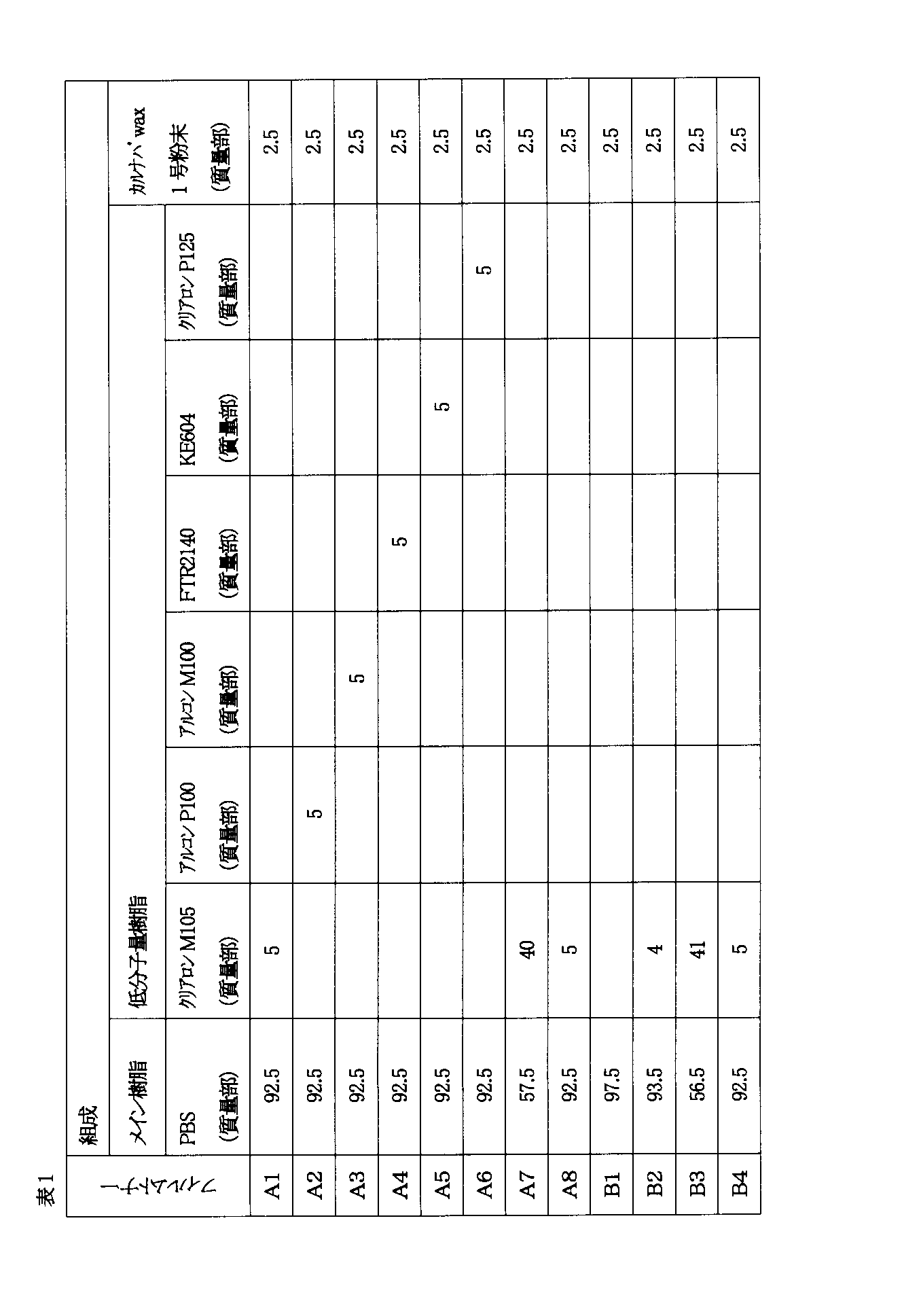
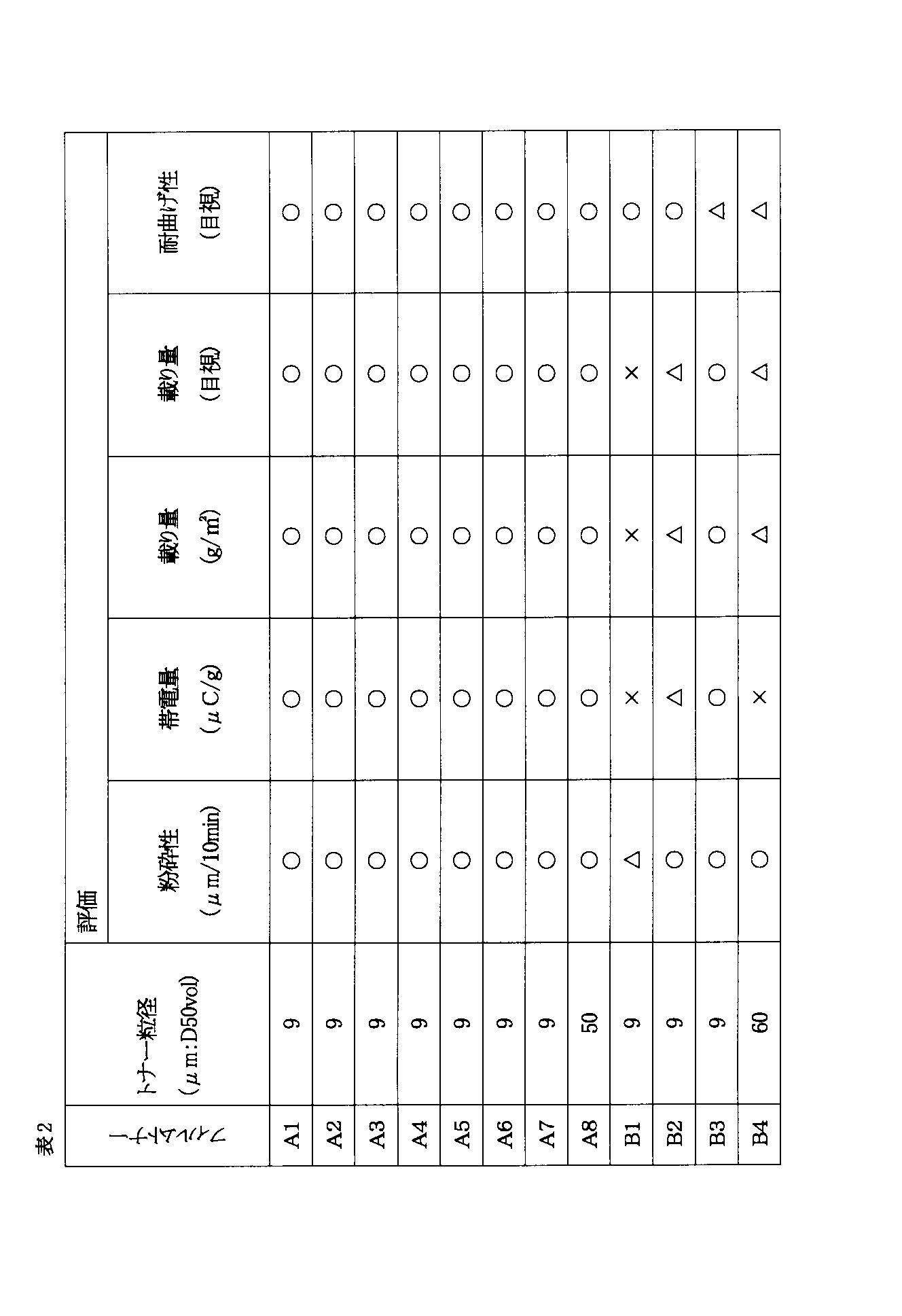
これらフィルム用トナーは、表2に示しているように、粉砕性、帯電量、載り量(g/m2)、載り量(目視)及び耐曲げ性(目視)の5つの項目すべてにおいて良好な結果を示した。
他方、低分子量樹脂を添加しなかった比較例1に係るフィルム用トナーB1は、粉砕性、帯電量、載り量(g/m2)及び載り量(目視)において、十分な性能を有していなかった。
また、トナー質量に対する低分子量樹脂の割合が5乃至40質量%の範囲内にないもの(フィルム用トナーB2及びB3)や、トナーの平均粒径D50が50μmより大きいもの(フィルム用トナーB4)は、5項目のうちの少なくとも1項目において良好な結果を示さなかった。
本願については、2013年9月24日に出願された日本国特許出願第2013-197006を基礎とする優先権を主張し、当該基礎出願の内容をすべて本願にとりこむものとする。
[符号の説明]
10…プリンタ、11…印字ベルト、12…TS、13…現像ロール、14…感光体、15…転写部、16…定着部、17…カセット、18…排紙部、20…フィルム用粘着シート、21…ベタ印字、C…用紙経路。
10…プリンタ、11…印字ベルト、12…TS、13…現像ロール、14…感光体、15…転写部、16…定着部、17…カセット、18…排紙部、20…フィルム用粘着シート、21…ベタ印字、C…用紙経路。
Claims (4)
- メイン樹脂と、
前記メイン樹脂と比較して重量平均分子量がより低い低分子量樹脂と
を含んだフィルム用トナーであって、
前記低分子量樹脂は、テルペン樹脂、脂環族炭化水素樹脂、α-メチルポリスチレン、変性ロジン、ノボラック樹脂、変性ノボラック樹脂、脂肪族炭化水素樹脂、芳香族炭化水素樹脂、それらの樹脂の共重合樹脂、エステル化物変性ロジン、クマロン樹脂、C5及びC9系石油樹脂、並びにそれらの誘導体からなる群から選ばれる1種以上の樹脂であり、
前記フィルム用トナーは、前記低分子量樹脂を5乃至40質量%の割合で含み、
平均粒径D50(体積)は9乃至50μmの範囲内にあるフィルム用トナー。 - 前記メイン樹脂は正帯電性であり、前記低分子量樹脂は負帯電性である請求項1に記載のフィルム用トナー。
- 前記メイン樹脂の重量平均分子量は10,000乃至250,000であり、前記低分子量樹脂の重量平均分子量は200以上10,000未満である請求項2に記載のフィルム用トナー。
- 前記メイン樹脂の重量平均分子量は10,000乃至250,000であり、前記低分子量樹脂の重量平均分子量は200以上10,000未満である請求項1に記載のフィルム用トナー。
Priority Applications (2)
| Application Number | Priority Date | Filing Date | Title |
|---|---|---|---|
| CN201480052587.9A CN105579911A (zh) | 2013-09-24 | 2014-08-11 | 膜用调色剂 |
| US15/055,470 US20160179023A1 (en) | 2013-09-24 | 2016-02-26 | Film-forming toner |
Applications Claiming Priority (2)
| Application Number | Priority Date | Filing Date | Title |
|---|---|---|---|
| JP2013197006A JP6090082B2 (ja) | 2013-09-24 | 2013-09-24 | ラベルの製造方法 |
| JP2013-197006 | 2013-09-24 |
Related Child Applications (1)
| Application Number | Title | Priority Date | Filing Date |
|---|---|---|---|
| US15/055,470 Continuation US20160179023A1 (en) | 2013-09-24 | 2016-02-26 | Film-forming toner |
Publications (1)
| Publication Number | Publication Date |
|---|---|
| WO2015045656A1 true WO2015045656A1 (ja) | 2015-04-02 |
Family
ID=52742811
Family Applications (1)
| Application Number | Title | Priority Date | Filing Date |
|---|---|---|---|
| PCT/JP2014/071212 Ceased WO2015045656A1 (ja) | 2013-09-24 | 2014-08-11 | フィルム用トナー |
Country Status (4)
| Country | Link |
|---|---|
| US (1) | US20160179023A1 (ja) |
| JP (1) | JP6090082B2 (ja) |
| CN (1) | CN105579911A (ja) |
| WO (1) | WO2015045656A1 (ja) |
Families Citing this family (3)
| Publication number | Priority date | Publication date | Assignee | Title |
|---|---|---|---|---|
| JP6604102B2 (ja) * | 2015-09-10 | 2019-11-13 | 横浜ゴム株式会社 | タイヤ用ゴム組成物およびそれを用いた空気入りタイヤ |
| JP6896550B2 (ja) * | 2017-07-31 | 2021-06-30 | キヤノン株式会社 | トナー |
| JP2023097069A (ja) * | 2021-12-27 | 2023-07-07 | 株式会社リコー | トナー、画像形成装置、画像形成方法、及び印刷物の製造方法 |
Citations (10)
| Publication number | Priority date | Publication date | Assignee | Title |
|---|---|---|---|---|
| JPH1172956A (ja) * | 1997-06-23 | 1999-03-16 | Fuji Xerox Co Ltd | 静電荷像現像用トナー、静電荷像現像剤および画像形成方法 |
| JP2006064841A (ja) * | 2004-08-25 | 2006-03-09 | Seiko Epson Corp | トナーの製造方法、および製造装置 |
| JP2006104460A (ja) * | 2004-09-10 | 2006-04-20 | Yupo Corp | 印刷用紙 |
| JP2006117916A (ja) * | 2004-09-10 | 2006-05-11 | Yupo Corp | 無延伸印刷用紙 |
| JP2007283745A (ja) * | 2005-08-31 | 2007-11-01 | Casio Electronics Co Ltd | ラベル作成方法及び装置 |
| JP2010184470A (ja) * | 2009-02-13 | 2010-08-26 | Casio Electronics Co Ltd | ラベル作製方法、ラベル作製装置、及びラベル用トナー |
| JP2012027330A (ja) * | 2010-07-26 | 2012-02-09 | Casio Electronics Co Ltd | 電子写真用トナー |
| JP2013057805A (ja) * | 2011-09-08 | 2013-03-28 | Casio Electronics Co Ltd | 消色型電子写真トナー及びその製造方法 |
| JP2013061405A (ja) * | 2011-09-12 | 2013-04-04 | Casio Electronics Co Ltd | バイオプラスチックを用いた電子写真用トナーおよびその製造方法 |
| JP2013083923A (ja) * | 2011-09-28 | 2013-05-09 | Casio Electronics Co Ltd | ラベル作成方法 |
Family Cites Families (4)
| Publication number | Priority date | Publication date | Assignee | Title |
|---|---|---|---|---|
| EP1153977A4 (en) * | 1998-09-29 | 2004-11-10 | Idemitsu Kosan Co | RESIN COMPOSITION, RESIN BINDERS FOR TONER AND TONER |
| JP3785011B2 (ja) * | 1999-12-10 | 2006-06-14 | 株式会社巴川製紙所 | 電子写真用トナー |
| TWI373368B (en) * | 2008-11-11 | 2012-10-01 | Univ Nat Chiao Tung | Liposome and method for producing the same |
| JP5581908B2 (ja) * | 2010-03-25 | 2014-09-03 | 富士ゼロックス株式会社 | 静電荷像現像用キャリア、静電荷像現像剤、プロセスカートリッジ、及び画像形成装置 |
-
2013
- 2013-09-24 JP JP2013197006A patent/JP6090082B2/ja not_active Expired - Fee Related
-
2014
- 2014-08-11 WO PCT/JP2014/071212 patent/WO2015045656A1/ja not_active Ceased
- 2014-08-11 CN CN201480052587.9A patent/CN105579911A/zh active Pending
-
2016
- 2016-02-26 US US15/055,470 patent/US20160179023A1/en not_active Abandoned
Patent Citations (10)
| Publication number | Priority date | Publication date | Assignee | Title |
|---|---|---|---|---|
| JPH1172956A (ja) * | 1997-06-23 | 1999-03-16 | Fuji Xerox Co Ltd | 静電荷像現像用トナー、静電荷像現像剤および画像形成方法 |
| JP2006064841A (ja) * | 2004-08-25 | 2006-03-09 | Seiko Epson Corp | トナーの製造方法、および製造装置 |
| JP2006104460A (ja) * | 2004-09-10 | 2006-04-20 | Yupo Corp | 印刷用紙 |
| JP2006117916A (ja) * | 2004-09-10 | 2006-05-11 | Yupo Corp | 無延伸印刷用紙 |
| JP2007283745A (ja) * | 2005-08-31 | 2007-11-01 | Casio Electronics Co Ltd | ラベル作成方法及び装置 |
| JP2010184470A (ja) * | 2009-02-13 | 2010-08-26 | Casio Electronics Co Ltd | ラベル作製方法、ラベル作製装置、及びラベル用トナー |
| JP2012027330A (ja) * | 2010-07-26 | 2012-02-09 | Casio Electronics Co Ltd | 電子写真用トナー |
| JP2013057805A (ja) * | 2011-09-08 | 2013-03-28 | Casio Electronics Co Ltd | 消色型電子写真トナー及びその製造方法 |
| JP2013061405A (ja) * | 2011-09-12 | 2013-04-04 | Casio Electronics Co Ltd | バイオプラスチックを用いた電子写真用トナーおよびその製造方法 |
| JP2013083923A (ja) * | 2011-09-28 | 2013-05-09 | Casio Electronics Co Ltd | ラベル作成方法 |
Also Published As
| Publication number | Publication date |
|---|---|
| JP2015064427A (ja) | 2015-04-09 |
| CN105579911A (zh) | 2016-05-11 |
| US20160179023A1 (en) | 2016-06-23 |
| JP6090082B2 (ja) | 2017-03-08 |
Similar Documents
| Publication | Publication Date | Title |
|---|---|---|
| CN103009854B (zh) | 热转印印刷片制作装置、制作方法以及热转印印刷片 | |
| CN104115070B (zh) | 静电显影用调色剂及使用该调色剂的图像形成装置以及图像形成方法 | |
| JP5472409B2 (ja) | ラベル基材用組成物、ラベル基材、ラベル、及びそれらの製造方法 | |
| WO2015045656A1 (ja) | フィルム用トナー | |
| US20240006614A1 (en) | Laminate for electrochemical device and electrochemical device | |
| EP3671349A1 (en) | Positively charged toner for electrostatic-image development | |
| CN104423190B (zh) | 静电潜像显影用调色剂、该调色剂的制造方法及定影方法 | |
| CN101000473A (zh) | 脱模剂、色粉及其制造方法 | |
| CN100401196C (zh) | 有机调色剂以及利用该有机调色剂的画像形成方法 | |
| JP5621536B2 (ja) | ラベル及びその製造方法 | |
| JP2022026742A (ja) | トナー及び粉末接着剤を含む電子写真用現像剤セット並びに接着物の製造方法 | |
| CN101427186A (zh) | 具有优良的带电性能、长期可靠性和转印性的调色剂颗粒及其制备方法和包含该调色剂颗粒的调色剂 | |
| JP2012139982A (ja) | ラベル作製方法及びラベル作製装置 | |
| CN103034080B (zh) | 标签基材用组合物、标签基材的制作方法及标签 | |
| JP2015064433A (ja) | フィルム用トナーの製造方法 | |
| JP2013020113A (ja) | 画像形成方法 | |
| JP2010211016A (ja) | 静電荷像現像トナー、静電荷像現像剤、トナーカートリッジ、プロセスカートリッジ、画像形成方法、並びに、画像形成装置 | |
| JP2015184507A (ja) | フイルム形成用電子写真トナー | |
| JP2015176077A (ja) | バイオプラスチックを用いた電子写真用トナー及びその製造方法 | |
| JP2006267527A (ja) | 電子写真用トナー及びその製造方法、電子写真用現像剤ならびに画像形成方法 | |
| JP7232718B2 (ja) | 静電荷像現像用トナーの製造方法 | |
| JP4322182B2 (ja) | 画像形成装置及び画像形成方法 | |
| JP6167793B2 (ja) | ラベル台紙、ラベル、ラベル台紙の製造方法およびラベルの作製方法 | |
| JP2014186055A (ja) | 画像形成方法及び圧着はがきの製造方法 | |
| JP5652496B2 (ja) | ラベル台紙、台紙付きラベル及び粘着ラベル、並びにそれらの製造方法 |
Legal Events
| Date | Code | Title | Description |
|---|---|---|---|
| WWE | Wipo information: entry into national phase |
Ref document number: 201480052587.9 Country of ref document: CN |
|
| 121 | Ep: the epo has been informed by wipo that ep was designated in this application |
Ref document number: 14849262 Country of ref document: EP Kind code of ref document: A1 |
|
| NENP | Non-entry into the national phase |
Ref country code: DE |
|
| 122 | Ep: pct application non-entry in european phase |
Ref document number: 14849262 Country of ref document: EP Kind code of ref document: A1 |