WO2015040967A1 - 新規アルケニル硫酸エステル又はその塩 - Google Patents
新規アルケニル硫酸エステル又はその塩 Download PDFInfo
- Publication number
- WO2015040967A1 WO2015040967A1 PCT/JP2014/070380 JP2014070380W WO2015040967A1 WO 2015040967 A1 WO2015040967 A1 WO 2015040967A1 JP 2014070380 W JP2014070380 W JP 2014070380W WO 2015040967 A1 WO2015040967 A1 WO 2015040967A1
- Authority
- WO
- WIPO (PCT)
- Prior art keywords
- sweetness
- salt
- sulfate ester
- octenyl sulfate
- octenyl
- Prior art date
- Legal status (The legal status is an assumption and is not a legal conclusion. Google has not performed a legal analysis and makes no representation as to the accuracy of the status listed.)
- Ceased
Links
Images

Classifications
-
- C—CHEMISTRY; METALLURGY
- C07—ORGANIC CHEMISTRY
- C07C—ACYCLIC OR CARBOCYCLIC COMPOUNDS
- C07C305/00—Esters of sulfuric acids
- C07C305/02—Esters of sulfuric acids having oxygen atoms of sulfate groups bound to acyclic carbon atoms of a carbon skeleton
- C07C305/14—Esters of sulfuric acids having oxygen atoms of sulfate groups bound to acyclic carbon atoms of a carbon skeleton being acyclic and unsaturated
-
- A—HUMAN NECESSITIES
- A23—FOODS OR FOODSTUFFS; TREATMENT THEREOF, NOT COVERED BY OTHER CLASSES
- A23L—FOODS, FOODSTUFFS OR NON-ALCOHOLIC BEVERAGES, NOT OTHERWISE PROVIDED FOR; PREPARATION OR TREATMENT THEREOF
- A23L27/00—Spices; Flavouring agents or condiments; Artificial sweetening agents; Table salts; Dietetic salt substitutes; Preparation or treatment thereof
- A23L27/30—Artificial sweetening agents
- A23L27/39—Addition of sweetness inhibitors
-
- A—HUMAN NECESSITIES
- A23—FOODS OR FOODSTUFFS; TREATMENT THEREOF, NOT COVERED BY OTHER CLASSES
- A23L—FOODS, FOODSTUFFS OR NON-ALCOHOLIC BEVERAGES, NOT OTHERWISE PROVIDED FOR; PREPARATION OR TREATMENT THEREOF
- A23L27/00—Spices; Flavouring agents or condiments; Artificial sweetening agents; Table salts; Dietetic salt substitutes; Preparation or treatment thereof
- A23L27/88—Taste or flavour enhancing agents
-
- A—HUMAN NECESSITIES
- A23—FOODS OR FOODSTUFFS; TREATMENT THEREOF, NOT COVERED BY OTHER CLASSES
- A23V—INDEXING SCHEME RELATING TO FOODS, FOODSTUFFS OR NON-ALCOHOLIC BEVERAGES AND LACTIC OR PROPIONIC ACID BACTERIA USED IN FOODSTUFFS OR FOOD PREPARATION
- A23V2002/00—Food compositions, function of food ingredients or processes for food or foodstuffs
Definitions
- the present invention relates to a novel alkenyl sulfate ester or salt thereof, and use thereof.
- alternative sweeteners such as sugar alcohols and artificial sweeteners are mainly used.
- sugar alcohol is less sweet than sugar, it is difficult to digest and absorb in vivo.
- Artificial sweeteners typified by aspartame and acesulfame K are difficult to absorb in the body or have a high degree of sweetness, so that a sufficient amount of sweetness can be imparted with a low use amount.
- the alternative sweetener is useful for realizing a low-calorie food or beverage without impairing the deliciousness.
- alternative sweeteners have been developed for the purpose of reducing costs. Recently, however, it is considered to be one of the means for characterizing products and increasing added value in order to meet various consumer needs with a low calorie orientation. That is, in order to realize a variety of characteristic sweetnesses, there has been a demand for alternative sweeteners having different taste qualities from existing sweeteners.
- long-lasting sweeteners are expected to have functions such as flavor enhancement and masking, so it is possible to provide more delicious foods, and it is useful because it can control calorie and sugar intake without difficulty. Is expensive.
- Non-Patent Document 1 In the development of sweeteners, since a sweet receptor has been identified, screening methods using the sweet receptor have been used, and components that impart or enhance sweetness have been identified using the agonist activity as an index. (Non-Patent Document 1).
- Non-patent Document 2 lactisol
- Lactizol has an antagonistic activity on a sweet receptor, that is, has an action of suppressing sweetness
- Non-patent Document 2 sweetness is induced when drinking water after the lactisole is in the mouth.
- the mechanism of action is thought to be due to the inverse agonist activity of lactisol (Non-patent Document 2).
- sweet receptors which are G protein-coupled receptors, are constantly weakly activated, that is, in a state of high basal activity, whereas inverse agonists such as lactisol actively promote their basal activity. It has the action to suppress.
- Non-patent Document 3 As described above, as a method for inducing sweetness, it is also conceivable to use one kind of antagonist such as an inverse agonist.
- salt is widely contained in many natural ingredients, and there is almost no fear of deficiency in normal life.
- you sweat a lot due to sports, vomiting or diarrhea, or if you have heat stroke a lot of sodium is lost and the amount of blood sodium decreases. Accordingly, it is necessary to appropriately supply minerals such as sodium.
- the Ministry of Health, Labor and Welfare is instructed to take water frequently and take appropriate salt.
- Patent Document 1 a saccharide such as inulin
- Patent Document 2 D-psicose
- a voltage-independent sodium channel (hereinafter also referred to as “ENaC”) whose activity is suppressed by amiloride has been found in recent years. It is known that amiloride suppresses the salty taste in front of the tongue, but does not suppress the salty taste in the back of the tongue, and only suppresses about half the salty taste as a whole sensation in the oral cavity (Non-patent Document 4). From this, it is considered that salty taste receptors that are insensitive to amiloride exist in addition to ENaC in the oral taste of salty taste, and it is suggested that bitterness and sour taste receptors are involved as the receptors.
- ENaC is involved in a low salty taste of 100 mM or less, and a bitter or sour receptor is involved in a high salty taste (Non-patent Document 5). Therefore, it is considered that inhibiting ENaC is effective in suppressing low-concentration salty taste.
- ENaC is expressed in many human epithelial tissues (kidney, bladder, lung, respiratory tract, salivary gland, sweat gland, etc.) and is a sodium ion inflow route (Non-patent Document 6).
- kidney it is known to precisely control the amount of sodium in the body by reabsorbing sodium in the renal cortical collecting duct, and it plays a very important role in regulating body fluid volume, plasma osmotic pressure, blood pressure, etc. have.
- ENaC overexpression and hyperfunction are associated with diseases such as hypertension and renal function deterioration, cystic fibrosis, pulmonary edema, ulcerative colitis, diarrhea, etc. It is reported that it is useful for prevention / improvement of the disease (see Non-Patent Document 6).
- Non-patent Document 7 Non-patent Document 8
- trans-3-decenyl sulfate has been reported to have antibacterial activity (Non-patent Document 9), etc., but alkenyl sulfates having sweetness and salty taste adjustment and ENaC inhibitory activity have never been known.
- Patent Document 1 Japanese Patent Laid-Open No. 2007-209268
- Patent Document 2 Japanese Patent No. 5314207
- Non-Patent Document 1 Servant, G. et al. Proceedings of the National Academy of Sciences, 2010, 107 (10), 4746-4751.
- Non-Patent Document 2 Galindo-Cuspinera, V. et al. Nature, 2006, 441, 354-357.
- Non-Patent Document 3 Schiffman, SS et al. Chemical senses, 1999, 24, 439-447.
- Non-Patent Document 4 Ninomiya, Y. Proceedings of the National Academy of Science of the United States of America, 1998, 95, 5347-5350.
- Non-Patent Document 5 Oka, Y .; et al.
- Non-Patent Document 6 Bhalla, V .; et al. Journal of American Society of Nephrology. 2008, 19, 1845-1854.
- Non-Patent Document 7 Yasumoto, K .; et al. Chemical & Pharmceutical Bulltein, 2008, 56 (1), 133-136.
- Non-Patent Document 8 Yasumoto, K .; et al. Tetrahedron Letters, 2005, 46, 4765-4767.
- Non-Patent Document 9 La, MP .; et al. CHEMISTRY & BIODIVERSITY, 2012, 9, 1166-1171
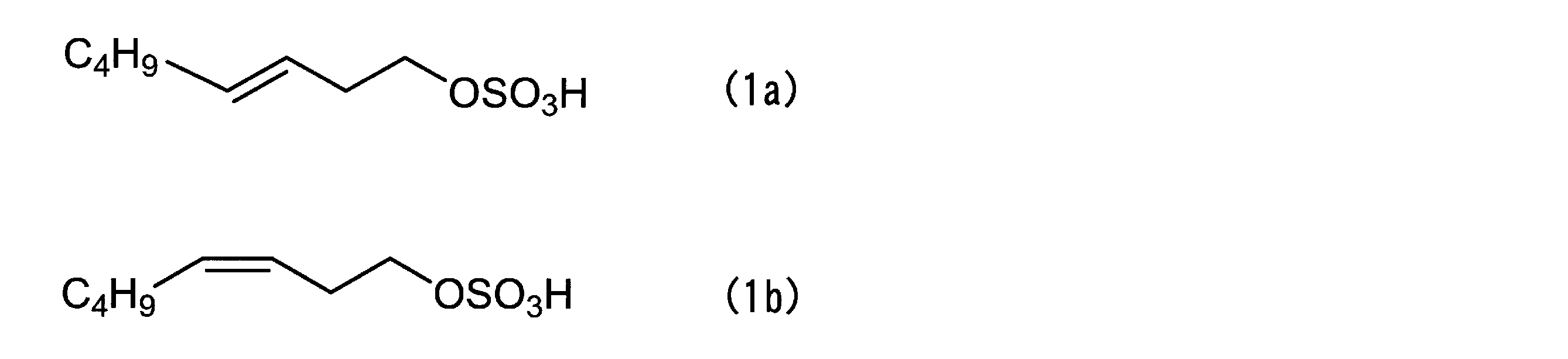
- the present invention relates to the following 1) to 15). 1) Octenyl sulfate represented by the following formula (1) or a salt thereof.
- a sweetness adjuster comprising the octenyl sulfate ester of 1) or a salt thereof as an active ingredient.
- a sweetener composition comprising the octenyl sulfate ester of 1) above or a salt thereof.
- a method for imparting or adjusting sweetness to foods or pharmaceuticals wherein the octenyl sulfate ester of 1) or a salt thereof or the sweetener composition of 2) is contained in foods or pharmaceuticals.
- An epithelial sodium channel inhibitor comprising the octenyl sulfate ester of 1) or a salt thereof as an active ingredient.
- the salty taste inhibitor which uses the octenyl sulfate ester of said 1) or its salt as an active ingredient.
- the salty taste suppression method which uses the salty taste inhibitor of said 6) with respect to a salty substance containing composition.
- the present invention relates to providing a novel compound useful for adjusting sweetness and salty taste or inhibiting ENaC and use thereof.
- octenyl sulfate ester or a salt thereof becomes a sweetness capable of imparting a slow-acting and long-lasting sweetness different from existing sweeteners, and further, a sweetness adjustment that suppresses or enhances the sweetness of sweet substances. It has been found that it can be used as an ENaC inhibitor and a salty taste suppressant, and has an ENaC inhibitory action and a salty taste suppressive action.
- the compound of the present invention exhibits a slow-acting and long-lasting sweetness that is different from existing sweeteners, and is useful as a sweetness quality or sweetness adjuster that can exhibit functions such as flavor enhancing action and masking effect.
- a sweetness quality or sweetness adjuster that can exhibit functions such as flavor enhancing action and masking effect.
- the compound of the present invention can be used as an ENaC inhibitor or a salty taste suppressant for oral compositions containing salty substances such as sodium chloride, foods, etc., without harming safety. Saltiness can be reduced.
- ENaC inhibitors prevent or improve diseases that develop due to overexpression (hyperfunction mutation) of ENaC, such as hypertension, cystic fibrosis, pulmonary edema, ulcerative colitis, diarrhea, etc. Can be used for.
- the octenyl sulfate ester represented by the general formula (1) of the present invention (referred to as octenyl sulfate ester (1)) is composed of trans-3-octenyl sulfate (1a) represented by the following formula and cis-3-octyl sulfate. Although it is tenyl sulfate (1b), the trans form is preferable from the viewpoint of sweetness, salty taste suppression, or ENaC inhibition.
- Suitable salts of the octenyl sulfate ester (1) of the present invention are pharmaceutically acceptable salts such as alkali metal salts (for example, sodium salts, potassium salts and the like), alkaline earth metal salts (for example, Metal salts such as magnesium salts and calcium salts), ammonium salts, or trimethylamine, triethylamine, tributylamine, pyridine, quinoline, piperidine, imidazole, picoline, dimethylaminopyridine, N, N-dimethylaniline, N-methylpiperidine, Nitrogen-containing organic bases such as N-methylmorpholine, diethylamine, cyclohexylamine, procaine, dibenzylamine, N-benzyl- ⁇ -phenethylamine, 1-ephamine, N, N′-dibenzylethylenediamine, N-methyl-D-glucamine , Lysine, arginine It may be mentioned salts with basic amino acids such as
- the octenyl sulfate (1) or a salt thereof of the present invention can exist not only as an unsolvated type but also as a hydrate or a solvate. Accordingly, in the present invention, all crystal forms and hydrates or solvates thereof are included.
- the octenyl sulfate ester (1) of the present invention is obtained by reacting, for example, trans-3-octen-1-ol (2) or cis-3-octen-1-ol (3) with a sulfating reagent in an organic solvent.
- a sulfating reagent in an organic solvent.
- the sulfating reagent used here is not particularly limited as long as it can sulfate alcohols.
- sulfur trioxide pyridine complex sulfur trioxide trimethylamine complex, sulfur trioxide triethylamine complex, sulfur trioxide dimethyl
- sulfur trioxide pyridine complex examples include formamide complex, sulfuric acid-dicyclohexylcarbodiimide, chlorosulfuric acid, concentrated sulfuric acid, sulfamic acid, and the like.
- sulfur trioxide pyridine complex is preferable.
- the reaction solvent is not limited as long as it does not interfere with the esterification reaction, and examples of suitable solvents include tetrahydrofuran, acetonitrile, dimethylformamide, dichloromethane, chloroform, ether, carbon tetrachloride and the like.
- the reaction temperature can be from room temperature to around the boiling point of the solvent, but is preferably ⁇ 20 to 200 ° C., more preferably 0 to 100 ° C.
- the reaction time is 0.1 to 48 hours, preferably 1 to 12 hours.
- Trans-3-octen-1-ol (2) used as a raw material can be obtained, for example, by reacting 1-heptene and paraformaldehyde in the presence of an organoaluminum compound such as dimethylaluminum chloride (Snider). , BB; et al. Journal of American Chemical Society, 1982, 104, 555-563.).
- Cis-3-octen-1-ol (3) is generally available, and can be obtained, for example, by subjecting 3-octin-1-ol to a catalytic hydrogenation reaction using a Lindlar catalyst. (See Mayer, SF; et al. European Journal of Organic Chemistry, 2001, 4537-4542.)
- the salt of octenyl sulfate (1) of the present invention includes basic compounds such as sodium hydroxide, potassium hydroxide, calcium hydroxide, magnesium hydroxide, ammonia, trimethylamine, triethylamine, tributylamine, pyridine, quinoline, piperidine, imidazole.
- Picoline dimethylaminopyridine, N, N-dimethylaniline, N-methylpiperidine, N-methylmorpholine, diethylamine, cyclohexylamine, procaine, dibenzylamine, N-benzyl- ⁇ -phenethylamine, 1-ephenamine, N, N Octenyl sulfate (1) is heated at room temperature or appropriately in the presence of nitrogen-containing organic bases such as' -dibenzylethylenediamine and N-methyl-D-glucamine, and basic amino acids such as lysine, arginine and ornithine. It can be obtained by.
- the octenyl sulfate (1) can be obtained by adsorbing to a basic anion exchange resin and eluting with an eluent containing the basic compound.
- Isolation and / or purification of the octenyl sulfate (1) of the present invention or a salt thereof obtained by the above reaction can be performed by, for example, filtration, washing, drying, recrystallization, various chromatography, and the like.
- the octenyl sulfate ester (1) thus obtained exhibits a slow-acting and long-lasting sweetness as shown in Test Examples 1-4 described later. The sweetness is promoted by water. Furthermore, the octenyl sulfate ester (1) has an effect of adjusting the sweetness of other sweeteners as shown in Test Examples 5 and 6 to be described later. Therefore, the octenyl sulfate ester (1) or a salt thereof can be a sweetness that can impart a slow-acting and long-lasting sweetness, and can be a sweetness adjusting agent that adjusts the sweetness of other sweeteners.
- the composition containing octenyl sulfate (1) or a salt thereof can be a sweetener composition.
- octenyl sulfate (1) or a salt thereof alone or in the form of a composition to foods, pharmaceuticals, feeds, etc.
- Sweeteners eg, sucrose, aspartame, sucralose, glycyrrhizin, etc.
- “slow-acting effect” means that sweetness is not immediately felt when ingested orally, but is delayed, and is synonymous with “sweetness of aftertaste” described later.
- “Adjusting sweetness” means suppressing or enhancing the sweetness of sweet substances other than octenyl sulfate (1) or a salt thereof.
- the suppression of sweetness preferably includes suppressing the sweetness of the taste immediately after ingestion of other sweeteners, and the enhancement of sweetness preferably enhances the sweetness of the aftertaste remaining in the mouth.
- the enhancement of sweetness preferably enhances the sweetness of the aftertaste remaining in the mouth.
- octenyl sulfate (1) or a salt thereof is taken simultaneously with other sweeteners, Suppressing the sweetness of the other sweetener's foresight and further enhancing the sweetness of the aftertaste of the sweetener remaining in the mouth, or ingesting the other sweetener after ingesting octenyl sulfate (1) or a salt thereof in advance
- enhancing the sweetness of the sweetener when ingested When octenyl sulfate ester (1) or a salt thereof is ingested in advance, it is considered that the sweetness sensitivity of other sweeteners is enhanced.
- the sweetener composition of the present invention can be prepared by blending octenyl sulfate (1) or a salt thereof with additives other than sweetening ingredients such as excipients, binders, disintegrants, and lubricants. .
- the sweetening composition may be in any form such as powder, granule, syrup, tablet and the like.
- the sweetener composition includes sugars (sucrose, invert sugar, isomerized sugar, glucose, fructose, lactose, maltose, trehalose, xylose, etc.), sugar alcohols (maltitol, sorbitol, mannitol, erythritol, xylitol).
- the octenyl sulfate ester (1) of the present invention or a salt thereof, or a sweetener composition containing the same is a variety of products that require sweetness or sweetness adjustment such as foods, pharmaceuticals, feeds, etc. ) Can be widely used for imparting or adjusting sweetness. Examples of these foods include beverages and chocolate. Examples of pharmaceuticals include powders, tablets, liquids, syrups and the like, as well as dentifrices and throat preparations that are handled as quasi-drugs, and also include veterinary drugs that like sweetness.
- the sweetener composition of the present invention can be used arbitrarily to the extent necessary for taste-imparting or adjustment.
- the amount to be used varies depending on the form of the target preparation, but in general, as the octenyl sulfate ester (1) or a salt thereof of the present invention, the liquid food has a sucrose concentration equivalent to the required sweetness.
- the density is 1/1000 times or more, preferably 1/500 times the density or more, more preferably 1/400 times the density or more, and 1/20 times the density, preferably 1/50 times the density or less, more preferably 1 Can be used at a concentration of 1/1000 times to 1/20 times, preferably 1/500 times to 1/50 times, more preferably 1/400 times to 1/100 times. Can be used in concentration.
- the concentration is 1/1000 times or more, preferably 1/500 times or more, more preferably 1/400 times or more of the sucrose weight equivalent to the required sweetness, and 1/400 times the concentration. It can be used at a concentration of 20 times or less, preferably at a concentration of 1/50 times or less, more preferably at a concentration of 1/100 times or less. / 50 times concentration, more preferably 1/400 times concentration to 1/100 times concentration.
- Examples of the method of using the octenyl sulfate (1) of the present invention or a salt thereof, or a sweetener composition to a product to be sweetened or adjusted include, for example, the production of foods and pharmaceuticals, and the intake or administration of these.
- an appropriate method such as mixing, kneading, dissolving, dipping, infiltration, spraying, spraying, pouring, etc., is adopted, and the target product is contained.
- the octenyl sulfate ester (1) of the present invention inhibits inflow of sodium ions from ENaC into cells and effectively suppresses salty taste due to sodium chloride, as shown in Examples below. Therefore, the octenyl sulfate (1) or a salt thereof can be an ENaC inhibitor or a salty taste suppressor, and the octenyl sulfate (1) or a salt thereof is used for producing an ENaC inhibitor or a salty taste suppressor. be able to.
- ENaC inhibition means inhibiting the inflow of sodium ions into cells from epithelial sodium channels.
- ENaC inhibitory activity can be tested by measuring the inhibitory effect on ENaC in an appropriate cell-based assay.
- single cell or confluent epithelium designed to endogenously or overexpress ENaC can be used to assess channel function using electrophysiological techniques ( The journal of biological chemistry, 284 (2): pages 792-798 (2009)).
- ENaC is expressed in miso and functions as an amiloride-sensitive salty taste receptor. ENaC is also expressed in many human epithelial tissues such as kidney, bladder, lung, respiratory tract, salivary gland, sweat gland (Non-Patent Document 6), and is responsible for regulating body fluid volume, plasma osmotic pressure, blood pressure, etc. Overexpression of ENaC (hyperfunction mutation) is known to cause diseases such as hypertension, cystic fibrosis, pulmonary edema, ulcerative colitis, and diarrhea (Non-Patent Document 6). Therefore, octenyl sulfate ester (1) or a salt thereof can be used to inhibit ENaC for the purpose of preventing or ameliorating the above diseases.
- the “use” may be a use in a human or non-human animal or a sample derived therefrom, and may be a therapeutic use or a non-therapeutic use.
- non-therapeutic means a concept that does not include medical practice, that is, a concept that does not include a method for operating, treating, or diagnosing a human. More specifically, a doctor or a person who has received instructions from a doctor It is a concept that does not include a method of performing surgery, treatment or diagnosis.
- the composition containing the ENaC inhibitor of the present invention becomes a drug, quasi-drug, or food that exhibits ENaC inhibition or the above-described prevention or improvement effect for each disease, and the ENaC inhibitor is a drug, quasi-drug. Or it is useful as a raw material or formulation for mix
- the food includes foods that indicate ENaC inhibition and improvement of symptoms of the above-mentioned diseases, functional foods, foods for the sick, foods for specified health use, and supplements.
- the pharmaceutical, quasi-drug, and food preparation forms are not particularly limited, and can be prepared by appropriately combining an acceptable carrier and octenyl sulfate (1) or a salt thereof.
- the salty taste suppression using the ENaC inhibitor or salty taste inhibitor of the present invention can suppress the salty taste by using these for a composition containing a salty substance (salt taste-causing substance).
- “suppression of salty taste” includes reducing salty taste and inhibiting salty taste.
- the salty substance-containing composition include oral compositions and foods.
- the salty substance include metal ions derived from minerals such as sodium, potassium, calcium, magnesium, and phosphorus, chloride ions, and one or more metal chlorides composed of the metal ions and chloride ions. Typical examples include sodium chloride and potassium chloride.
- the ENaC inhibitor or salty taste suppressant of the present invention is used for salty taste suppression
- the ENaC inhibitor or salty taste suppressant is added to the salty substance-containing composition
- the combined use is mainly mentioned.
- an aqueous solution of the ENaC inhibitor or salty taste inhibitor is prepared, and this is previously contained in the oral cavity, and then the salty substance-containing composition is orally ingested, or the like
- Examples include a method in which an aqueous solution of an ENaC inhibitor or a salty taste inhibitor and a salty substance-containing composition are orally ingested at the same time.
- the ENaC inhibitor or salty taste inhibitor of the present invention may contain only the octenyl sulfate (1) or a salt thereof, such as water, starch, protein, fiber, carbohydrate, lipid, fatty acid, vitamin.
- octenyl sulfate (1) or a salt thereof such as water, starch, protein, fiber, carbohydrate, lipid, fatty acid, vitamin.
- One or a plurality of raw materials and / or raw materials usually used in pharmaceuticals and foods such as minerals, flavoring agents, coloring agents, sweeteners, seasonings, preservatives, preservatives, and antioxidants may be blended.
- the form is arbitrary and any of solution form, suspension form, syrup form, powder form, granule form, particle form, etc. may be sufficient, and it can shape
- the salty substance-containing composition (for example, oral composition, food, etc.) is in the form of a liquid or paste such as an aqueous solution, suspension or emulsion, or a solid such as powder, granule or particle. Either is acceptable.
- Food includes soft drinks, tea-based beverages, coffee beverages, fruit juice beverages, carbonated beverages, sports drinks, juices, jelly, wafers, biscuits, bread, noodles, sausages and other general food and beverages, nutritional foods, functional foods, etc. Any kind may be sufficient.
- the oral composition include dentifrice, mouthwash, gingival massage cream, and the like.
- Suitable salty substance-containing compositions include various solid foods, beverages, dentifrices, mouthwashes and the like containing salty substances.
- the ENaC inhibitor or salty taste suppressant of the present invention When the ENaC inhibitor or salty taste suppressant of the present invention is applied to such a composition, if the composition is in the form of a liquid or paste such as an aqueous solution, suspension or emulsion, the ENaC of the present invention. A method of adding an inhibitor or a salty taste inhibitor and sufficiently stirring and dispersing can be applied. Moreover, when the form of the composition is a solid such as a powder, a method of simply adding and mixing the ENaC inhibitor or salty taste inhibitor of the present invention can be applied.
- the ENaC inhibitor or salty taste suppressant of the present invention is used for a salty substance-containing composition
- the ENaC inhibitor or salty taste suppressant is octenyl sulfate ester (1 )
- a salt thereof is preferably 0.001 part by mass or more, preferably 0.01 part by mass or more and 90 parts by mass or less, preferably 10 parts by mass or less. Further, 0.001 to 90 parts by mass, preferably 0.01 to 10 parts by mass is more preferably used.
- the content of octenyl sulfate (1) or a salt thereof in a pharmaceutical, quasi-drug or food containing the octenyl sulfate (1) or a salt thereof of the present invention is not particularly limited, but is 0. 1 mass% or more, preferably 1 mass% or more, more preferably 10 mass% or more, and 99 mass% or less, preferably 90 mass% or less, more preferably 50 mass% or less. Further, 0.1 to 99% by mass, preferably 1 to 90% by mass, and more preferably 10% to 50% by mass.
- the dosage may vary according to the condition, body weight, sex, age or other factors of the subject, but oral administration
- the daily dose per adult is usually 0.1 mg or more, preferably 1 mg or more, more preferably 5 mg or more, and 10 g or less, preferably octenyl sulfate (1) or a salt thereof. 1 g or less, more preferably 500 mg or less. Further, 0.1 mg to 10 g, preferably 1 mg to 1 g, more preferably 5 to 500 mg can be mentioned.
- the above-mentioned preparation can be administered according to an arbitrary administration schedule, but it is preferable to administer it once to several times a day and continuously for several weeks to several months.
- the administration or ingestion target is a human who needs or desires it, for example, a human who needs or desires prevention or improvement of a disease caused by overexpression of ENaC such as hypertension or renal dysfunction. Is mentioned.
- a sweetness adjuster comprising the octenyl sulfate ester of ⁇ 1> or a salt thereof as an active ingredient.
- the sweetness adjuster according to the above ⁇ 2> which suppresses the sweetness of other sweeteners.
- the sweetness adjuster according to ⁇ 3> which further enhances the sweetness of aftertaste of other sweeteners.
- ⁇ 5> The sweetness adjuster according to ⁇ 2>, wherein the sweetener of the other sweetener when the octenyl sulfate ester or a salt thereof is ingested in advance and then another sweetener is ingested is enhanced.
- other sweeteners include, for example, sucrose, aspartame, sucralose, and glycyrrhizin, preferably glycyrrhizin.
- ⁇ 9> Use of the octenyl sulfate ester according to ⁇ 1> or a salt thereof for producing a sweetness adjuster.
- ⁇ 10> Use of the octenyl sulfate ester or salt thereof according to ⁇ 1> for producing a sweetener composition.
- the sweetness is slow-acting sweetness.
- ⁇ 12> The octenyl sulfate ester or salt thereof according to ⁇ 1> above, for use in imparting or adjusting sweetness to foods or pharmaceuticals.
- An epithelial sodium channel inhibitor comprising the octenyl sulfate ester of the above ⁇ 1> or a salt thereof as an active ingredient.
- a salty taste inhibitor containing the octenyl sulfate ester or salt thereof according to ⁇ 1> above as an active ingredient.
- ⁇ 17> The octenyl sulfate ester or salt thereof according to ⁇ 1> above, for use in epithelial sodium channel inhibition.
- ⁇ 18> The octenyl sulfate ester of ⁇ 1> or a salt thereof for use in suppressing salty taste.
- An epithelial sodium channel inhibition method comprising administering or ingesting an octenyl sulfate ester or a salt thereof according to ⁇ 1> above to a subject in need thereof in an effective amount.
- ⁇ 20> ⁇ 13> An epithelial sodium channel inhibitor or a ⁇ 14> salty taste inhibitor is used for a salty substance-containing composition.
- ⁇ 21> The method according to ⁇ 20>, wherein an epithelial sodium channel inhibitor or a salty taste inhibitor is used in a salty substance-containing composition.
- the ⁇ 22> salty substance-containing composition is a composition containing a metal ion and / or chloride ion derived from a mineral, or a metal chloride composed of the metal ion and chloride ion.
- ⁇ 23> The method according to ⁇ 22>, wherein the mineral is one or more metals selected from sodium, potassium, calcium, magnesium, and phosphorus.
- ⁇ 24> The method according to any one of ⁇ 20> to ⁇ 23>, wherein the composition is a food or an oral composition.
- the octenyl sulfate (1) or a salt thereof is 0.001 part by mass or more, preferably 0.01 part by mass or more and 90 parts by mass or less, preferably 10 parts by mass with respect to 1 part by mass of the salty substance.
- Tetrahydrofuran (20 mL) and sulfur trioxide pyridine 600 mg, 2 mmol were added to cis-3-octen-1-ol (manufactured by Tokyo Chemical Industry Co., Ltd., 256 mg, 2.00 mmol) and stirred overnight. Subsequently, 1M NaOH aqueous solution was added to make the reaction system basic, and then dry nitrogen was blown to remove tetrahydrofuran. The residue was passed through ODS (Cosmo Seal 140C18 OPN, 10 g, manufactured by Nacalai Tesque), washed with water and eluted with 20% aqueous acetonitrile, and the resulting eluate was concentrated to dryness under reduced pressure. -3-Octenyl sulfate (81 mg) was obtained.
- Test Example 1 Evaluation of sweetness (1) Trans-3-octenyl sulfate was dissolved in water to 1 wt% to obtain a test sample. After containing 50 ⁇ L of the prepared test sample in the mouth, drinking water and determining the presence or absence of sweetness using six testers. As a result, as shown in Table 1, 6 out of 6 persons recognized sweetness, and the sweetness lasted for a certain period of time.
- Test Example 2 Evaluation of sweetness (2) A test sample was prepared by dissolving cis-3-octenyl sulfate in water to 1 wt%. After containing 50 ⁇ L of the adjusted test sample in the mouth, drinking water and determining the presence or absence of sweetness using four testers. As a result, as shown in Table 2, 4 out of 4 people recognized sweetness, and the sweetness lasted for a certain period of time.
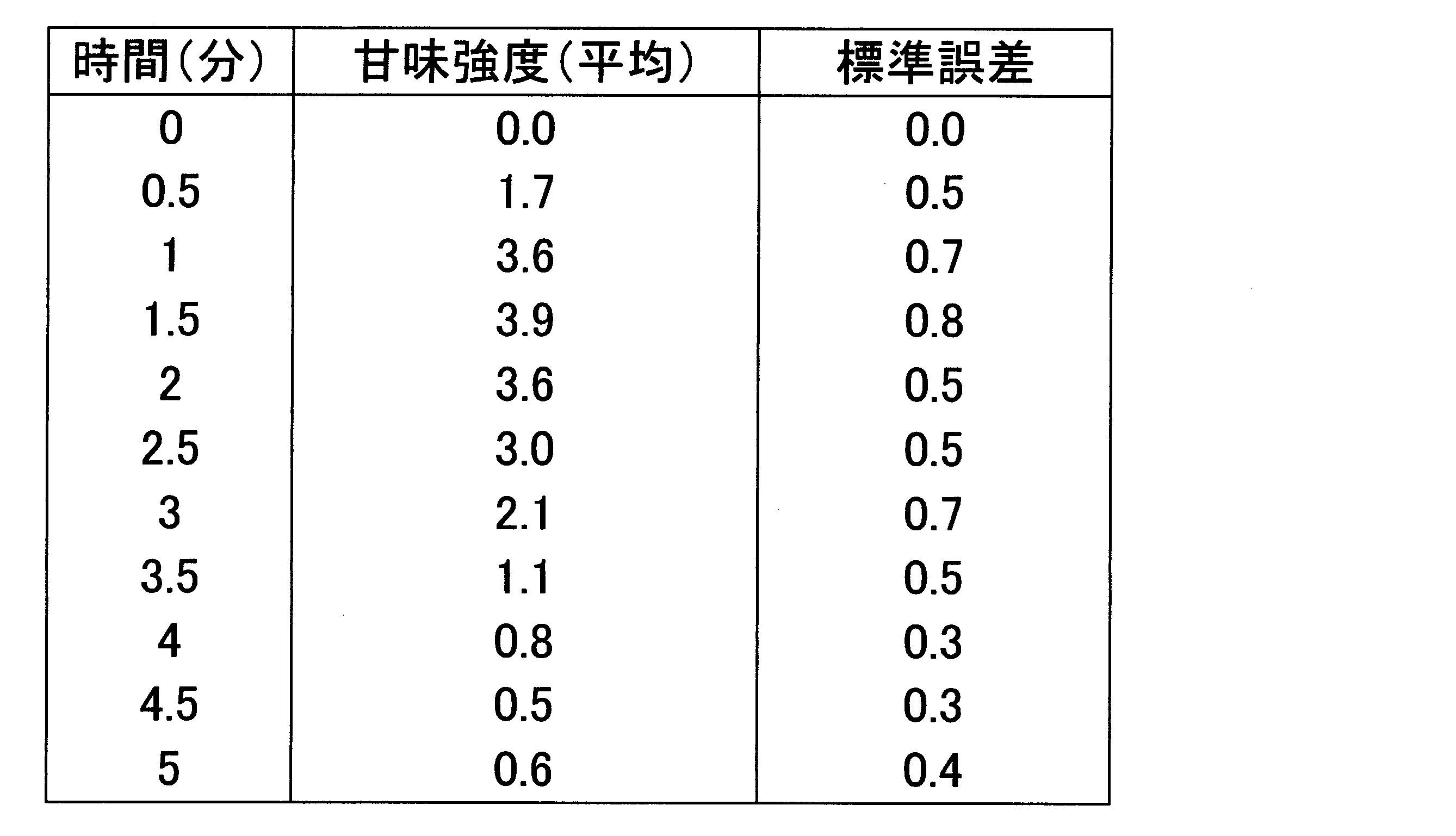
- Test Example 3 Evaluation of sweetness (3) Seven testers were presented with 10 mL (2.5, 5.0, 7.5, 10.0 wt%) of four types of standard sucrose aqueous solutions. The tester was asked to put each solution into the mouth for about 5 seconds and then to exhale and set the sweetness intensity (0 to 15) at that time to 2.5, 5, 7.5, and 10, respectively. Next, after 10 mL of 10 mM trans-3-octenyl sulfate solution was put in the mouth for about 5 seconds, it was discharged, and the sweetness intensity at that time was compared with a sucrose standard aqueous solution and evaluated by a numerical value ranging from 0 to 15. received.
- Test Example 4 Evaluation of sweetness (4) Seven testers were presented with 10 mL (2.5, 5.0, 7.5, 10.0 wt%) of four types of standard sucrose aqueous solutions. The tester was asked to put each solution into the mouth for about 5 seconds and then to exhale and set the sweetness intensity (0 to 15) at that time to 2.5, 5, 7.5, and 10, respectively. Next, 10 mL of 10 mM cis-3-octenyl sulfate solution was put in the mouth for about 5 seconds, and then exhaled. The sweetness intensity at that time was compared with a sucrose standard aqueous solution and evaluated by a numerical value ranging from 0 to 15. received.
- Test Example 5 Sweetness adjusting action (1) Action on sucrose
- sucrose standard aqueous solutions 10 mL (2.5, 5.0, 7.5, 10.0 wt%) were presented to seven testers. The tester was asked to put each solution into the mouth for about 5 seconds and then to exhale and set the sweetness intensity (0 to 15) at that time to 2.5, 5, 7.5, and 10, respectively.
- 10 mL (7.5 wt%) of a sucrose aqueous solution was included in the mouth for about 5 seconds, and then exhaled. The sweetness intensity at that time was compared with the standard sucrose aqueous solution. They were evaluated with numerical values ranging from 0 to 15.
- the concentration of aspartame was prepared according to the literature so that it had a sweetness intensity similar to that of an aqueous sucrose solution (7.5 wt%) (Schiffman, SS et al. Chemical senses, 1999, 24, 439-447.). . In addition, 10 mL of pure water was added to the mouth 30 seconds later, and then discharged, and the sweetness intensity felt at that time was also evaluated in the same manner as compared with the sucrose standard aqueous solution.
- sucrose standard aqueous solutions 10 mL (2.5, 5.0, 7.5, 10.0 wt%) were presented to six testers. The tester was asked to put each solution in the mouth for about 5 seconds and then to exhale, and the sweetness intensity (0 to 15) at that time was 2.5, 5, 7.5, 10 respectively. . Next, the tester was not informed of the type and concentration of the sweetener, and after containing 10 mL (303 ppm) of a glycyrrhizin aqueous solution in his mouth for about 5 seconds, he exhaled and compared the sweetness intensity at that time with the sucrose standard aqueous solution. We had you evaluate in numerical value of 15 range.
- the concentration of glycyrrhizin was adjusted according to the literature so as to have a sweetness intensity similar to that of an aqueous sucrose solution (5 wt%) (Schiffman, SS et al. Chemical senses, 1999, 24, 439-447.). In addition, 10 mL of pure water was added to the mouth 30 seconds later, and then discharged, and the sweetness intensity felt at that time was also evaluated in the same manner as compared with the sucrose standard aqueous solution.
- trans-3-octenyl sulfate suppressed the sweetness of the taste immediately after ingestion of sucrose, aspartame, sucralose, and glycyrrhizin, and enhanced the sweetness of the aftertaste remaining in the mouth.
- the enhancing effect was remarkable.
- Test Example 6 Sweetness enhancing action (1) Sucralose Four types of sucrose standard aqueous solutions 10 mL (2.5, 5.0, 7.5, 10.0 wt%) were presented to 6 testers. The tester was asked to put each solution into the mouth for about 5 seconds and then to exhale and set the sweetness intensity (0 to 15) at that time to 2.5, 5, 7.5, and 10, respectively. Next, without informing the tester of the type and concentration of the sweetener, after containing 10 mL (0.25 mM) of a sucralose aqueous solution in the mouth for about 5 seconds, exhaling, comparing the sweetness intensity at that time with the sucrose standard aqueous solution, We had you evaluate in numerical value of 0-15.
- sucrose standard aqueous solution (2.5, 5.0, 7.5, 10.0 wt%) was presented to six testers. The tester was asked to put each solution into the mouth for about 5 seconds and then to exhale and set the sweetness intensity (0 to 15) at that time to 2.5, 5, 7.5, and 10, respectively. Next, without informing the tester of the type and concentration of the sweetener, after containing 10 mL (0.25 mM) of a glycyrrhizin aqueous solution in the mouth for about 5 seconds, exhaling, comparing the sweetness intensity at that time with the sucrose standard aqueous solution, We had you evaluate in numerical value of 0-15.
- Test Example 7 ENaC inhibitory activity of octenyl sulfate ester According to the method described in The journal of biological chemistry, 284 (2): pages 792-798 (2009), the inhibitory activity of ENaC expressed in Xenopus oocytes was measured. did. Specifically, according to the following procedure, trans-3-octenyl sulfate was added to oocytes expressing the ENaC complex, and the activity of ENaC was analyzed electrophysiologically. First, DNA sequences encoding human ENaC ⁇ , ⁇ , and ⁇ were obtained by performing PCR using a plasmid vector (manufactured by Clontech) in which the same gene was cloned as a template.
- a plasmid vector manufactured by Clontech
- the obtained PCR amplified fragment was incorporated into a transcription vector pSP64 (manufactured by Promega) to prepare pSP64 / ENaC ⁇ , pSP64 / ENaC ⁇ , and pSP64 / ENaC ⁇ .
- the plasmid DNA was linearized by digesting pSP64 / ENaC ⁇ and pSP64 / ENaC ⁇ with EcoRI and pSP64 / ENaC ⁇ with PvuII, respectively.
- SP6 RNA polymerase manufactured by Takara
- cRNA added with a polyA sequence for expressing ENaC ⁇ , ENaC ⁇ , and ENaC ⁇ was synthesized.
- the synthesized cRNA was treated with phenol / chloroform, and the resulting supernatant was collected. Further, isopropyl alcohol was mixed and centrifuged to precipitate cRNA. The precipitated cRNA was washed with 75% ethanol and then dissolved in distilled water to a concentration of 1 mg / ml. Equal amounts of the obtained cRNA aqueous solutions encoding ENaC ⁇ , ENaC ⁇ , and ENaC ⁇ were mixed, and 50 ng was injected per Xenopus oocyte. Specifically, a glass capillary was filled with a cRNA aqueous solution using a manipulator (manufactured by NARISHIGE), and 50 nL was injected per oocyte.
- a manipulator manufactured by NARISHIGE
- ENaCa, ⁇ , ⁇ and the complex were expressed on the oocyte membrane over 2-3 days.
- Two micro glass electrodes are inserted into the oocyte and the membrane potential is fixed at ⁇ 60 mV.
- the inflow of Na + ions induced by the ENaC complex constantly in an active state was measured by replacing it with a change in the amount of current.
- trans-3-octenyl sulfate suppressed the inward current of ENaC-expressing oocytes in a concentration range of 3-30 mM. This effect was similar to the existing ENaC inhibitor amiloride. In addition, since the effect of trans-3-octenyl sulfate was not observed in oocytes not expressing ENaC, it was confirmed to be an effect on ENaC.
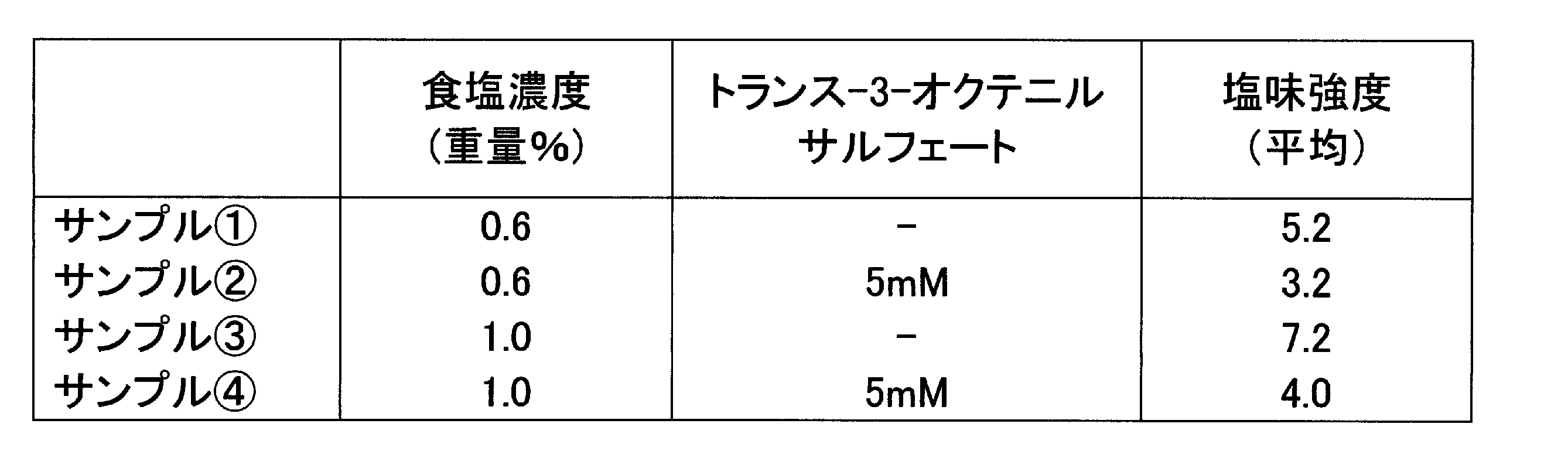
- Test Example 8 Seven subjects presented with 0.6 w / v saline as a salty standard solution, and after putting it in the mouth for about 5 seconds, it was exhaled and the salty intensity (0 to 10) felt was set to a median of 5. Next, after each salt solution (0.6, 1.0 w / v%) was included in the mouth for about 5 seconds, it was exhaled and the intensity felt was 0 if not felt, 10 if it felt very strong, The answer was in the range of 1 to 10. Subsequently, a saline solution (0.6, 1.0 w / v%) containing 5 mM trans-3-octenyl sulfate was prepared and presented to the tester. Each was put in the mouth for about 5 seconds, then exhaled and the intensity felt was answered with a value from 0 to 10. The results are shown in Table 7.
Landscapes
- Chemical & Material Sciences (AREA)
- Organic Chemistry (AREA)
- Life Sciences & Earth Sciences (AREA)
- Health & Medical Sciences (AREA)
- Nutrition Science (AREA)
- Engineering & Computer Science (AREA)
- Food Science & Technology (AREA)
- Polymers & Plastics (AREA)
- Proteomics, Peptides & Aminoacids (AREA)
- Seasonings (AREA)
- Medicinal Preparation (AREA)
Abstract
Description
〔特許文献2〕特許第5314207号公報
〔非特許文献2〕Galindo-Cuspinera, V. et al. Nature, 2006, 441, 354-357.
〔非特許文献3〕Schiffman, S.S. et al. Chemical senses, 1999, 24, 439-447.
〔非特許文献4〕Ninomiya, Y. Proceedings of the National Academy of Science of the United States of America, 1998, 95, 5347-5350.
〔非特許文献5〕Oka, Y.; et al. Nature, 494, 472-475 (2013)
〔非特許文献6〕Bhalla, V.; et al. Journal of American Society of Nephrology. 2008, 19, 1845-1854.
〔非特許文献7〕Yasumoto, K.; et al. Chemical & Pharmceutical Bulltein, 2008, 56(1), 133-136.
〔非特許文献8〕Yasumoto, K.; et al. Tetrahedron Letters, 2005, 46, 4765-4767.
〔非特許文献9〕La, M-P.; et al. CHEMISTRY & BIODIVERSITY, 2012, 9, 1166-1171
1)下記式(1)で表されるオクテニル硫酸エステル又はその塩。

3)上記1)のオクテニル硫酸エステル又はその塩を含有する甘味料組成物。
4)上記1)のオクテニル硫酸エステル又はその塩、又は上記2)の甘味料組成物を食品又は医薬品類へ含有させる、食品又は医薬品類に対する甘味の付与又は調整方法。
5)上記1)のオクテニル硫酸エステル又はその塩を有効成分とする上皮性ナトリウムチャネル阻害剤。
6)上記1)のオクテニル硫酸エステル又はその塩を有効成分とする塩味抑制剤。
7)上記6)の塩味抑制剤を塩味物質含有組成物に対して使用する、塩味抑制方法。
8)甘味調整剤を製造するための、上記1)のオクテニル硫酸エステル又はその塩の使用。
9)甘味料組成物を製造するための、上記1)のオクテニル硫酸エステル又はその塩の使用。
10)食品又は医薬品類に対する甘味の付与又は調整に使用するための、上記1)のオクテニル硫酸エステル又はその塩。
11)上皮性ナトリウムチャネル阻害剤を製造するための、上記1)のオクテニル硫酸エステル又はその塩の使用。
12)塩味抑制剤を製造するための、上記1)のオクテニル硫酸エステル又はその塩の使用。
13)上皮性ナトリウムチャネル阻害に使用するための、上記1)のオクテニル硫酸エステル又はその塩。
14)塩味抑制に使用するための、上記1)のオクテニル硫酸エステル又はその塩。
15)上記1)のオクテニル硫酸エステル又はその塩を、それらを必要とする対象に有効量で投与又は摂取する上皮性ナトリウムチャネル阻害方法。
また、本発明の化合物は、ENaC阻害剤又は塩味抑制剤として、塩化ナトリウム等の塩味物質を含有する口腔用組成物や、食品等に対して使用することにより、安全性を害することなく、当該塩味を低減できる。その結果、当該口腔用組成物の使用感を向上させる、食品の味を向上させる等、それらの製品価値を高めることができる。
また、ENaC阻害剤は、ENaCの過剰発現(機能亢進型変異)に起因して発症する疾患、例えば、高血圧症、嚢胞性線維症、肺水腫、潰瘍性大腸炎、下痢等の予防又は改善のために使用することができる。
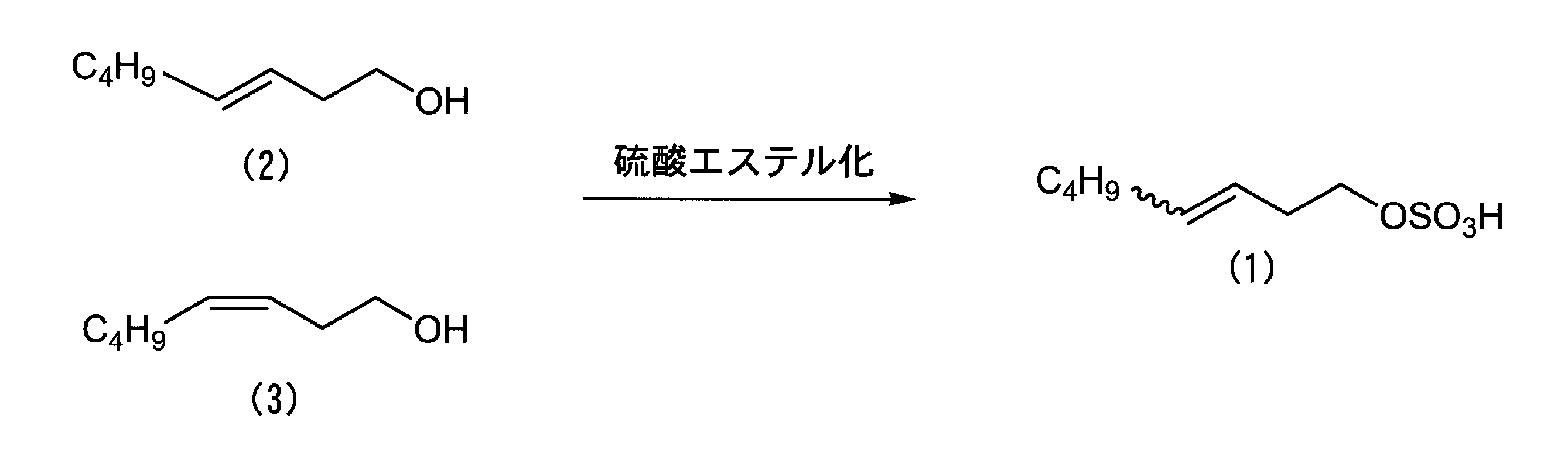
反応溶媒としては、上記エステル化反応を妨害するものでない限り限定されないが、好適な溶媒として、例えば、テトラヒドロフラン、アセトニトリル、ジメチルホルムアミド、ジクロロメタン、クロロホルム、エーテル、四塩化炭素等が挙げられる。
反応温度は、室温からその溶媒の沸点付近で行うことが可能であるが、好ましくは-20~200℃、より好ましくは0~100℃である。また、反応時間は、0.1~48時間、好ましくは1~12時間である。
また、シス-3-オクテン-1-オール(3)は、一般に入手できるが、例えば、3-オクチン-1-オールを、リンドラー触媒を用いた接触水素化反応させることで、得ることができる。(Mayer, S.F.; et al. European Journal of Organic Chemistry, 2001, 4537-4542.参照)
ここで、「遅効性」とは、経口摂取時にはすぐに甘さを感じないが、遅れて甘さを感じることを意味し、後述する「後味の甘味」と同義である。
「甘味の調整」とは、オクテニル硫酸エステル(1)又はその塩以外の、甘味物質の甘味を抑制又は増強することを意味する。甘味の抑制としては、好適には他の甘味料を摂取した直後の先味の甘味を抑制することが挙げられ、甘味の増強としては、好適には口の中に残った後味の甘味を増強することが挙げられる。
オクテニル硫酸エステル(1)又はその塩を用いた他の甘味料の甘味調製のための具体的方法としては、例えば、オクテニル硫酸エステル(1)又はその塩を他の甘味料と同時に摂取して、他の甘味料の先味の甘味を抑制し、さらに口に残った当該甘味料の後味の甘味を増強させること、或いは予めオクテニル硫酸エステル(1)又はその塩を摂取した後に他の甘味料を摂取した場合における当該甘味料の甘味を増強させること等が挙げられる。オクテニル硫酸エステル(1)又はその塩を予め摂取した場合、他の甘味料の甘味の感受性を増強させるものと考えられる。
また、当該甘味料組成物には、糖類(ショ糖、転化糖、異性化糖、ブドウ糖、果糖、乳糖、麦芽糖、トレハロース、キシロース等)、糖アルコール類(マルチトール、ソルビトール、マンニトール、エリスリトール、キシリトール、ラクチトール等)、オリゴ糖類、食物繊維、アスパルテーム、サッカリン、アセスルファムK、スクラロース、ソーマチン、ステビオシド、グリチルリチン等の他の甘味料を含有することができる。この場合、他の甘味料の甘味を調整しつつ、甘味の立ち上がりが緩やかで、持続性の甘味を発揮させることができる。
したがって、オクテニル硫酸エステル(1)又はその塩は、ENaC阻害剤、塩味抑制剤となり得、また、オクテニル硫酸エステル(1)又はその塩は、ENaC阻害剤又は塩味抑制剤を製造するために使用することができる。
したがって、オクテニル硫酸エステル(1)又はその塩は、上記疾患の予防又は改善を目的とし、ENaCを阻害するために使用できる。ここで、「使用」は、ヒト若しくは非ヒト動物、又はそれらに由来する検体における使用であり得、また治療的使用であっても非治療的使用であってもよい。また、「非治療的」とは、医療行為を含まない概念、すなわち人間を手術、治療又は診断する方法を含まない概念、より具体的には医師又は医師の指示を受けた者が人間に対して手術、治療又は診断を実施する方法を含まない概念である。
医薬品、医薬部外品、食品の製剤形態は特に限定されず、夫々許容される担体とオクテニル硫酸エステル(1)又はその塩を適宜組み合わせて調製することができる。
ここで、「塩味の抑制」には、塩味を低減すること、及び塩味を阻害することが含まれる。
塩味物質含有組成物としては、例えば口腔用組成物、食品等が挙げられる。塩味物質としては、ナトリウム、カリウム、カルシウム、マグネシウム、リン等のミネラル由来の金属イオン、塩化物イオン、及び当該金属イオンと塩化物イオンからなる金属塩化物の一種又は二種以上が挙げられる。代表的には塩化ナトリウム、塩化カリウムが挙げられる。
塩味物質含有組成物との併用には、例えば、当該ENaC阻害剤又は塩味抑制剤の水溶液を調製し、これを予め口腔に含み、その後に塩味物質含有組成物を経口摂取等する方法、又は当該ENaC阻害剤又は塩味抑制剤の水溶液と塩味物質含有組成物を同時に経口摂取等する方法が挙げられる。
<1>下記式(1)で表されるオクテニル硫酸エステル又はその塩。

<3>他の甘味料の先味の甘味を抑制する、上記<2>の甘味調整剤。
<4>さらに、他の甘味料の後味の甘味を増強する、上記<3>の甘味調整剤。
<5>オクテニル硫酸エステル又はその塩を予め摂取し、次いで他の甘味料を摂取した場合の当該他の甘味料の甘味を増強する、上記<2>の甘味調整剤。
<6>上記<3>~<5>において、他の甘味料としては、例えばはショ糖、アスパルテーム、スクラロース、グリチルリチンが挙げられ、好ましくはグリチルリチンである。
<7>上記<1>のオクテニル硫酸エステル又はその塩を含有する甘味料組成物。
<8>上記<1>のオクテニル硫酸エステル又はその塩、又は上記<2>~<5>のいずれかの甘味調整剤を食品又は医薬品類へ含有させる、食品又は医薬品類に対する甘味の付与又は調整方法。
<9>甘味調整剤を製造するための、上記<1>のオクテニル硫酸エステル又はその塩の使用。
<10>甘味料組成物を製造するための、上記<1>のオクテニル硫酸エステル又はその塩の使用。
<11><7>又は<10>の甘味料組成物において、甘味は遅効性の甘味である。
<12>食品又は医薬品類に対する甘味の付与又は調整に使用するための、上記<1>のオクテニル硫酸エステル又はその塩。
<13>上記<1>のオクテニル硫酸エステル又はその塩を有効成分とする上皮性ナトリウムチャネル阻害剤。
<14>上記<1>のオクテニル硫酸エステル又はその塩を有効成分とする塩味抑制剤。
<15>上皮性ナトリウムチャネル阻害剤を製造するための、上記<1>のオクテニル硫酸エステル又はその塩の使用。
<16>塩味抑制剤を製造するための、上記<1>のオクテニル硫酸エステル又はその塩の使用。
<17>上皮性ナトリウムチャネル阻害に使用するための、上記<1>のオクテニル硫酸エステル又はその塩。
<18>塩味抑制に使用するための、上記<1>のオクテニル硫酸エステル又はその塩。
<19>上記<1>のオクテニル硫酸エステル又はその塩を、それらを必要とする対象に有効量で投与又は摂取する上皮性ナトリウムチャネル阻害方法。
<20><13>の上皮性ナトリウムチャネル阻害剤又は<14>の塩味抑制剤を塩味物質含有組成物に対して使用する、塩味抑制方法。
<21>上皮性ナトリウムチャネル阻害剤又は塩味抑制剤を塩味物質含有組成物に配合して使用する、<20>の方法。
<22>塩味物質含有組成物がミネラル由来の金属イオン及び/若しくは塩化物イオン、又は当該金属イオンと塩化物イオンからなる金属塩化物を含有する組成物である、<20>又は<21>の方法。
<23>ミネラルがナトリウム、カリウム、カルシウム、マグネシウム及びリンから選ばれる一種以上の金属である、<22>の方法。
<24>組成物が食品又は口腔用組成物である、<20>~<23>のいずれかの方法。
<25>塩味物質1質量部に対して、オクテニル硫酸エステル(1)又はその塩を、0.001質量部以上、好ましくは0.01質量部以上で、90質量部以下、好ましくは10質量部以下で用いるか、或いは0.001~90質量部、好ましくは0.01~10質量部用いる、<20>~<24>のいずれかの方法。
1H NMR(600MHz,CD3OD):δ0.92(3H,t,J=7.8Hz,H-8),1.33-1.37(4H,m,H-6,7),2.08(2H,m,H-5),2.42(2H,tddd,J=7.2,7.2,1.0,1.0Hz,H-2),3.96(2H,t,J=7.2Hz,H-1),5.40(1H,dtt,J=10.7,7.2,1.2Hz,H-3),5.49(1H,dtt,J=10.7,7.7,1.0Hz,H-4)
1H NMR(600MHz,CD3OD):δ0.90(3H,t,J=7.5Hz,H-8),1.29-1.38(4H,m,H-6,7),2.01(2H,dtt,J=6.8,6.8,1.2Hz,H-5),2.35(2H,dtd,J=6.8,6.8,1.2Hz,H-2),3.97(2H,t,J=6.8Hz,H-1),5.44(1H,dtt,J=15.3,6.8,1.2Hz,H-3),5.55(1H,dtt,J=15.3,6.8,1.2Hz,H-4)
トランス-3-オクテニルサルフェートを1wt%になるよう水に溶解し、試験用サンプルとした。調整した試験サンプル50μLを口に含んだのち、水を飲み、甘味の有無を6人の試験者を用いて判定した。その結果、表1に示すとおり、6名中6名が甘味を認識し、その甘味は一定時間持続した。

シス-3-オクテニルサルフェートを1wt%になるよう水に溶解し、試験用サンプルとした。調整した試験サンプル50μLを口に含んだのち、水を飲み、甘味の有無を4人の試験者を用いて判定した。その結果、表2に示すとおり、4名中4名が甘味を認識し、その甘味は一定時間持続した。

試験者7名に、4種類のショ糖標準水溶液10mL(2.5、5.0、7.5、10.0wt%)を提示した。試験者には、それぞれの溶液を5秒ほど口に含んだ後、吐き出し、その時の甘味強度(0~15)を、それぞれ2.5、5、7.5、10とするように依頼した。次に、10mMのトランス-3-オクテニルサルフェート溶液10mLを5秒ほど口に含んだ後、吐き出し、その時の甘味強度をショ糖標準水溶液と比較し、0~15の範囲の数値で評価してもらった。その後、30秒間隔で5分間、純水10mLを口に含んだ後、吐き出し、その時の甘味強度を同様に評価してもらった。その結果、表3に示すとおり、水の摂取により、7名中7名が甘味を認識し、その甘味は一定時間持続した。
試験者7名に、4種類のショ糖標準水溶液10mL(2.5、5.0、7.5、10.0wt%)を提示した。試験者には、それぞれの溶液を5秒ほど口に含んだ後、吐き出し、その時の甘味強度(0~15)を、それぞれ2.5、5、7.5、10とするように依頼した。次に、10mMのシス-3-オクテニルサルフェート溶液10mLを5秒ほど口に含んだ後、吐き出し、その時の甘味強度をショ糖標準水溶液と比較し、0~15の範囲の数値で評価してもらった。その後、30秒間隔で5分間、純水10mLを口に含んだ後、吐き出し、その時の甘味強度を同様に評価してもらった。その結果、表4に示すとおり、水の摂取により、7名中7名が甘味を認識し、その甘味は一定時間持続した。

(1)ショ糖に対する作用
試験者7名に、4種類のショ糖標準水溶液10mL(2.5、5.0、7.5、10.0wt%)を提示した。試験者には、それぞれの溶液を5秒ほど口に含んだ後、吐き出し、その時の甘味強度(0~15)を、それぞれ2.5、5、7.5、10とするように依頼した。次に、試験者には甘味料の種類と濃度を知らせず、ショ糖水溶液10mL(7.5wt%)を5秒ほど口に含んだ後、吐き出し、その時の甘味強度をショ糖標準水溶液と比較し、0~15の範囲の数値で評価してもらった。また、30秒後に純水10mLを口に含んだ後、吐き出し、その時に感じる甘味強度もショ糖標準水溶液と比較し、同様に評価してもらった。続いて、5mMのトランス-3-オクテニルサルフェートを含むショ糖水溶液10mL(7.5wt%)を提示し、5秒ほど口に含んだ後、吐き出し、その時の甘味強度をショ糖標準溶液と甘味強度を比較し、同様に評価してもらった。また、直後に純水10mLを5秒ほど口に含んだ後、吐き出させ、その時の甘味強度をショ糖標準水溶液と比較し、同様に評価してもらった。また、30秒後に純水10mLを口に含んだ後、吐き出し、その時に感じる甘味強度もショ糖標準水溶液と比較し、同様に評価してもらった。結果を下記表5に示す。
試験者7名に、4種類のショ糖標準水溶液10mL(2.5、5.0、7.5、10.0wt%)を提示した。試験者には、それぞれの溶液を5秒ほど口に含んだ後、吐き出し、その時の甘味強度(0~15)を、それぞれ2.5、5、7.5、10とするように依頼した。次に、試験者には甘味料の種類と濃度を知らせず、アスパルテーム水溶液10mL(494ppm)を5秒ほど口に含んだ後、吐き出し、その時の甘味強度をショ糖標準水溶液と比較し、0~15の範囲の数値で評価してもらった。アスパルテームの濃度は、文献に従い、ショ糖水溶液(7.5wt%)と同様の甘味強度になるように調製した(Schiffman, S.S. et al. Chemical senses, 1999, 24, 439-447.)。また、30秒後に純水10mLを口に含んだ後、吐き出し、その時に感じる甘味強度もショ糖標準水溶液と比較し、同様に評価してもらった。続いて、5mMのトランス-3-オクテニルサルフェートを含むアスパルテーム水溶液10mL(494ppm)を提示し、5秒ほど口に含んだ後、吐き出し、その時の甘味強度をショ糖標準溶液と甘味強度を比較し、同様に評価してもらった。また、30秒後に純水10mLを口に含んだ後、吐き出し、その時に感じる甘味強度もショ糖標準水溶液と比較し、同様に評価してもらった。結果を表5に示す。
アスパルテーム水溶液10mL(494ppm)をスクラロース水溶液10mL(0.49mM)に換え、(2)と同様にして、試験者6名に甘味強度を同様に評価してもらった。結果を表5に示す。
試験者6名に、4種類のショ糖標準水溶液10mL(2.5、5.0、7.5、10.0wt%)を提示した。試験者には、それぞれの溶液を5秒ほど口に含んだ後、吐き出させ、その時の甘味強度(0~15)を、それぞれ2.5、5、7.5、10とするように依頼した。次に、試験者には甘味料の種類と濃度を知らせず、グリチルリチン水溶液10mL(303ppm)を5秒ほど口に含んだ後、吐き出し、その時の甘味強度をショ糖標準水溶液と比較し、0~15の範囲の数値で評価してもらった。グリチルリチンの濃度は、文献に従い、ショ糖水溶液(5wt%)と同様の甘味強度になるように調製した(Schiffman, S.S. et al. Chemical senses, 1999, 24, 439-447.)。また、30秒後に純水10mLを口に含んだ後、吐き出し、その時に感じる甘味強度もショ糖標準水溶液と比較し、同様に評価してもらった。続いて、5mMのトランス-3-オクテニルサルフェートを含むグリチルリチン水溶液10mL(494ppm)を提示し、5秒ほど口に含んだ後、吐き出し、その時の甘味強度をショ糖標準溶液と甘味強度を比較し、同様に評価してもらった。また、30秒後に純水10mLを口に含んだ後、吐き出し、その時に感じる甘味強度もショ糖標準水溶液と比較し、同様に評価してもらった。結果を表5に示す。

(1)スクラロース
試験者6名に、4種類のショ糖標準水溶液10mL(2.5、5.0、7.5、10.0wt%)を提示した。試験者には、それぞれの溶液を5秒ほど口に含んだ後、吐き出し、その時の甘味強度(0~15)を、それぞれ2.5、5、7.5、10とするように依頼した。次に、試験者には甘味料の種類と濃度を知らせず、スクラロース水溶液10mL(0.25mM)を5秒ほど口に含んだ後、吐き出し、その時の甘味強度をショ糖標準水溶液と比較し、0~15の範囲の数値で評価してもらった。続いて、事前に5mMのトランス-3-オクテニルサルフェート溶液10mLを事前に5秒ほど口に含んだ後、吐き出し、60秒経過後に、スクラロース水溶液10mL(0.25mM)を5秒ほど口に含んだ後、吐き出し、その時の甘味強度をショ糖標準水溶液と比較し、0~15の範囲の数値で評価してもらった。
試験者6名に、4種類のショ糖標準水溶液10mL(2.5、5.0、7.5、10.0wt%)を提示した。試験者には、それぞれの溶液を5秒ほど口に含んだ後、吐き出し、その時の甘味強度(0~15)を、それぞれ2.5、5、7.5、10とするように依頼した。次に、試験者には甘味料の種類と濃度を知らせず、グリチルリチン水溶液10mL(0.25mM)を5秒ほど口に含んだ後、吐き出し、その時の甘味強度をショ糖標準水溶液と比較し、0~15の範囲の数値で評価してもらった。続いて、事前に5mMのトランス-3-オクテニルサルフェート溶液10mLを5秒ほど口に含んだ後、吐き出し、60秒経過後に、グリチルリチン水溶液10mL(0.25mM)を5秒ほど口に含んだ後、吐き出し、その時の甘味強度をショ糖標準水溶液と比較し、0~15の範囲の数値で評価してもらった。結果を表6に示す。

The journal of biological chemistry, 284(2):pages 792-798 (2009)に記載の方法に準じ、アフリカツメガエル卵母細胞に発現させたENaCの阻害活性を測定した。具体的には以下の手順に従い、ENaC複合体を発現させた卵母細胞にトランス-3-オクテニルサルフェートを添加し、ENaCの活性を電気生理学的に解析した。
まず、ヒトENaCα、β、γそれぞれをコードするDNA配列は、同遺伝子がクローニングされたプラスミドベクター(クロンテック社製)を鋳型としてPCRを行うことで得た。得られたPCR増幅断片を転写用ベクターpSP64(プロメガ社製)に組み込み、pSP64/ENaCα、pSP64/ENaCβ、pSP64/ENaCγそれぞれを作製した。
pSP64/ENaCα、pSP64/ENaCγをEcoRIで、pSP64/ENaCβをPvuIIで、それぞれ消化することで、プラスミドDNAを直鎖化した。これら直鎖化DNAに対してSP6RNAポリメラーゼ(タカラ社製)を使用することで、ENaCα、ENaCβ、ENaCγそれぞれを発現させるpolyA配列が付加したcRNAを合成した。合成したcRNAにフェノール・クロロホルム処理を行い、得られた上清を回収し、さらにイソプロピルアルコールを混和して遠心分離することによりcRNAを沈殿させた。沈殿させたcRNAを75%エタノールで洗浄した後に、蒸留水に1mg/mlの濃度になるように溶解させた。
得られたENaCα、ENaCβ、ENaCγそれぞれをコードするcRNA水溶液を等量混和し、一つのアフリカツメガエル卵母細胞につき50ngずつ注入した。具体的には、マニピュレーター(NARISHIGE社製)を用いてガラスキャピラリーにcRNA水溶液を充填し、一つの卵母細胞につき50nLずつ注入した。その後、2-3日間をかけてENaC a、β、γ、複合体を卵母細胞膜に発現させた。
二本の微小ガラス電極を卵母細胞に刺入し、膜電位を-60mVに固定する。このとき、恒常的に活性状態にあるENaC複合体によって誘起されるNa+イオンの流入を、電流量の変化に置き換えて測定した。すなわち、115mM NaCl溶液(115mM NaCl、2.5mM KCl、1.8mM CaCl2、1mM NaHCO3、1mM MgCl2、10mM HEPES、pH7.4)中にあり、卵母細胞が内向きの電流を引き起こしている状況下で、同溶液に溶解させたトランス-3-オクテニルサルフェートを投与した。
被験者7名に塩味標準溶液として0.6w/vの食塩水を呈示し、5秒ほど口に含んだ後、吐き出し、感じた塩味強度(0~10)を中央値の5とした。
次に、食塩水溶液(0.6,1.0w/v%)をそれぞれ5秒ほど口に含んだ後、吐き出し、感じた強度を、感じない場合は0、非常に強く感じる場合を10とし、1から10の範囲で回答してもらった。続いて、5mMのトランス-3-オクテニルサルフェートを含む食塩水溶液(0.6,1.0w/v%)を調製し、試験者に呈示した。それぞれ5秒ほど口に含んだ後、吐き出し、感じた強度を0から10の値で回答してもらった。その結果を表7に示す。
Claims (22)
- 下記式(1)で示されるオクテニル硫酸エステル又はその塩。

- 請求項1記載のオクテニル硫酸エステル又はその塩を有効成分とする甘味調整剤。
- 他の甘味料の先味の甘味を抑制する、請求項2記載の甘味調整剤。
- さらに、他の甘味料の後味の甘味を増強する、請求項3記載の甘味調整剤。
- 他の甘味料がグリチルリチンである請求項3又は4記載の甘味調整剤。
- オクテニル硫酸エステル又はその塩を予め摂取し、次いで他の甘味料を摂取した場合の当該他の甘味料の甘味を増強する、請求項2記載の甘味調整剤。
- 請求項1記載のオクテニル硫酸エステル又はその塩を含有する甘味料組成物。
- 請求項1記載のオクテニル硫酸エステル又はその塩、又は請求項2記載の甘味調整剤を食品又は医薬品類へ含有させる、食品又は医薬品類に対する甘味の付与又は調整方法。
- 請求項1記載のオクテニル硫酸エステル又はその塩を有効成分とする上皮性ナトリウムチャネル阻害剤。
- 請求項1記載のオクテニル硫酸エステル又はその塩を有効成分とする塩味抑制剤。
- 請求項9記載の上皮性ナトリウムチャネル阻害剤又は請求項10記載の塩味抑制剤を塩味物質含有組成物に対して使用する、塩味抑制方法。
- 塩味物質含有組成物がミネラル由来の金属イオン及び/若しくは塩化物イオン、又は当該金属イオンと塩化物イオンからなる金属塩化物を含有する組成物である、請求項11記載の方法。
- ミネラルがナトリウム、カリウム、カルシウム、マグネシウム及びリンから選ばれる一種以上の金属である、請求項12記載の方法。
- 組成物が食品又は口腔用組成物である、請求項11~13のいずれか1項記載の方法。
- 甘味調整剤を製造するための、請求項1記載のオクテニル硫酸エステル又はその塩の使用。
- 甘味料組成物を製造するための、請求項1記載のオクテニル硫酸エステル又はその塩の使用。
- 食品又は医薬品類に対する甘味の付与又は調整に使用するための、請求項1記載のオクテニル硫酸エステル又はその塩。
- 上皮性ナトリウムチャネル阻害剤を製造するための、請求項1記載のオクテニル硫酸エステル又はその塩の使用。
- 塩味抑制剤を製造するための、請求項1記載のオクテニル硫酸エステル又はその塩の使用。
- 上皮性ナトリウムチャネル阻害に使用するための、請求項1記載のオクテニル硫酸エステル又はその塩。
- 塩味抑制に使用するための、請求項1記載のオクテニル硫酸エステル又はその塩。
- 請求項1記載のオクテニル硫酸エステル又はその塩を、それらを必要とする対象に有効量で投与又は摂取する上皮性ナトリウムチャネル阻害方法。
Priority Applications (2)
| Application Number | Priority Date | Filing Date | Title |
|---|---|---|---|
| CN201480051616.XA CN105555760B (zh) | 2013-09-19 | 2014-08-01 | 链烯基硫酸酯或其盐 |
| US14/917,178 US10364216B2 (en) | 2013-09-19 | 2014-08-01 | Alkenyl sulfate ester or salt thereof |
Applications Claiming Priority (6)
| Application Number | Priority Date | Filing Date | Title |
|---|---|---|---|
| JP2013194188 | 2013-09-19 | ||
| JP2013-194188 | 2013-09-19 | ||
| JP2014-156598 | 2014-07-31 | ||
| JP2014156599A JP5674984B1 (ja) | 2014-07-31 | 2014-07-31 | 上皮性ナトリウムチャネル阻害剤 |
| JP2014156598A JP5639731B1 (ja) | 2013-09-19 | 2014-07-31 | 新規アルケニル硫酸エステル又はその塩 |
| JP2014-156599 | 2014-07-31 |
Publications (1)
| Publication Number | Publication Date |
|---|---|
| WO2015040967A1 true WO2015040967A1 (ja) | 2015-03-26 |
Family
ID=52688624
Family Applications (1)
| Application Number | Title | Priority Date | Filing Date |
|---|---|---|---|
| PCT/JP2014/070380 Ceased WO2015040967A1 (ja) | 2013-09-19 | 2014-08-01 | 新規アルケニル硫酸エステル又はその塩 |
Country Status (3)
| Country | Link |
|---|---|
| US (1) | US10364216B2 (ja) |
| CN (1) | CN105555760B (ja) |
| WO (1) | WO2015040967A1 (ja) |
Families Citing this family (1)
| Publication number | Priority date | Publication date | Assignee | Title |
|---|---|---|---|---|
| JP7159865B2 (ja) * | 2016-09-30 | 2022-10-25 | キリンホールディングス株式会社 | 低糖類のニンジン搾汁液およびニンジン含有飲料 |
Citations (4)
| Publication number | Priority date | Publication date | Assignee | Title |
|---|---|---|---|---|
| JPH0834767A (ja) * | 1994-07-26 | 1996-02-06 | Kao Corp | 不飽和アルコール硫酸エステル塩の製造法 |
| JPH09169720A (ja) * | 1995-12-19 | 1997-06-30 | Kao Corp | 不飽和アルコール硫酸エステル塩の製造法 |
| JP2001294545A (ja) * | 2000-02-08 | 2001-10-23 | Yooyuurabo:Kk | 有機機能性材料の原料化合物 |
| JP2013017459A (ja) * | 2011-07-14 | 2013-01-31 | Kao Corp | 上皮型ナトリウムチャネル活性化剤 |
Family Cites Families (8)
| Publication number | Priority date | Publication date | Assignee | Title |
|---|---|---|---|---|
| JPS5314207B2 (ja) | 1972-04-18 | 1978-05-16 | ||
| WO2006084184A2 (en) * | 2005-02-04 | 2006-08-10 | Senomyx, Inc. | Molecules comprising linked organic moieties as flavor modifiers for comestible compositions |
| US7851005B2 (en) * | 2005-05-23 | 2010-12-14 | Cadbury Adams Usa Llc | Taste potentiator compositions and beverages containing same |
| JP2007209268A (ja) | 2006-02-10 | 2007-08-23 | Fuji Nihon Seito Kk | 飲料、冷菓、デザート、菓子、惣菜及びその他加工品を含む食品全般に渡る呈味改良 |
| JP5379963B2 (ja) | 2007-08-24 | 2013-12-25 | ライオン株式会社 | 拭き取り用洗浄剤組成物および洗浄方法 |
| JP5314207B1 (ja) | 2013-03-14 | 2013-10-16 | 株式会社 伊藤園 | ミネラル含有飲料及びその製造方法、並びにミネラル含有飲料の塩味抑制方法 |
| JP5639731B1 (ja) | 2013-09-19 | 2014-12-10 | 花王株式会社 | 新規アルケニル硫酸エステル又はその塩 |
| JP5674984B1 (ja) | 2014-07-31 | 2015-02-25 | 花王株式会社 | 上皮性ナトリウムチャネル阻害剤 |
-
2014
- 2014-08-01 WO PCT/JP2014/070380 patent/WO2015040967A1/ja not_active Ceased
- 2014-08-01 US US14/917,178 patent/US10364216B2/en active Active
- 2014-08-01 CN CN201480051616.XA patent/CN105555760B/zh active Active
Patent Citations (4)
| Publication number | Priority date | Publication date | Assignee | Title |
|---|---|---|---|---|
| JPH0834767A (ja) * | 1994-07-26 | 1996-02-06 | Kao Corp | 不飽和アルコール硫酸エステル塩の製造法 |
| JPH09169720A (ja) * | 1995-12-19 | 1997-06-30 | Kao Corp | 不飽和アルコール硫酸エステル塩の製造法 |
| JP2001294545A (ja) * | 2000-02-08 | 2001-10-23 | Yooyuurabo:Kk | 有機機能性材料の原料化合物 |
| JP2013017459A (ja) * | 2011-07-14 | 2013-01-31 | Kao Corp | 上皮型ナトリウムチャネル活性化剤 |
Also Published As
| Publication number | Publication date |
|---|---|
| US20160198746A1 (en) | 2016-07-14 |
| US10364216B2 (en) | 2019-07-30 |
| CN105555760A (zh) | 2016-05-04 |
| CN105555760B (zh) | 2017-04-19 |
Similar Documents
| Publication | Publication Date | Title |
|---|---|---|
| JP6954915B2 (ja) | 3−(3−ヒドロキシ−4−メトキシ−フェニル)−1−(2,4,6−トリヒドロキシ−フェニル)−プロパン−1−オンの使用 | |
| JP5876205B2 (ja) | D−ソルボースからなる甘味料におけるd−ソルボースの甘味の不足や、甘味の持続を改良する方法 | |
| JPWO2008059623A1 (ja) | D−プシコース含有甘味料およびそれを使用して得られた飲食品など | |
| JP2009517385A (ja) | 高効能甘味料を用いた医薬組成物 | |
| KR20170102896A (ko) | 단맛을 조정하기 위한 화합물, 조성물 및 방법 | |
| JP2009517352A (ja) | ポリフェノール含有組成物およびイソマルツロースを含む調製品 | |
| KR101659641B1 (ko) | 프로토파낙사트리올 및 프로토파낙사디올 함유 조성물 | |
| CN105555760B (zh) | 链烯基硫酸酯或其盐 | |
| Greisinger et al. | An interesting tour of new research results on umami and umami compounds | |
| JP5674984B1 (ja) | 上皮性ナトリウムチャネル阻害剤 | |
| JP5639731B1 (ja) | 新規アルケニル硫酸エステル又はその塩 | |
| EP3922252A1 (en) | Composition for enhancing vascular endothelial function | |
| JP2009209088A (ja) | アスペルロシドまたはその類縁体を含む筋肉増強剤 | |
| WO2021177335A1 (ja) | 脳機能改善用組成物 | |
| JP6201085B1 (ja) | グルタミン酸を有効成分とする味覚障害及び/又は食欲障害の改善剤 | |
| JP5151083B2 (ja) | 経口用組成物 | |
| EP3960201A1 (en) | Composition for promoting glp-1 secretion | |
| JP5943516B2 (ja) | D−ソルボースを有効成分とする生体機能改善用甘味料 | |
| JP2013017459A (ja) | 上皮型ナトリウムチャネル活性化剤 | |
| TW202106309A (zh) | Glp-1分泌促進劑 | |
| JP2019189572A (ja) | 運動バランス向上剤、及び敏捷性向上剤 | |
| KR102245628B1 (ko) | 내복 조성물 | |
| JP7371851B2 (ja) | 肉体的疲労及び疲労感を予防又は改善するオレアナン型トリテルペンを含有する組成物 | |
| BR112019011831B1 (pt) | Método de mascaramento do sabor residual persistente de um adoçante não açúcar, composição, e, produto de consumo | |
| EP4472443A2 (en) | Sweetener compositions |
Legal Events
| Date | Code | Title | Description |
|---|---|---|---|
| WWE | Wipo information: entry into national phase |
Ref document number: 201480051616.X Country of ref document: CN |
|
| 121 | Ep: the epo has been informed by wipo that ep was designated in this application |
Ref document number: 14846247 Country of ref document: EP Kind code of ref document: A1 |
|
| WWE | Wipo information: entry into national phase |
Ref document number: 14917178 Country of ref document: US |
|
| NENP | Non-entry into the national phase |
Ref country code: DE |
|
| 122 | Ep: pct application non-entry in european phase |
Ref document number: 14846247 Country of ref document: EP Kind code of ref document: A1 |