WO2015037647A1 - 溶解クラフトパルプの製造方法 - Google Patents
溶解クラフトパルプの製造方法 Download PDFInfo
- Publication number
- WO2015037647A1 WO2015037647A1 PCT/JP2014/074024 JP2014074024W WO2015037647A1 WO 2015037647 A1 WO2015037647 A1 WO 2015037647A1 JP 2014074024 W JP2014074024 W JP 2014074024W WO 2015037647 A1 WO2015037647 A1 WO 2015037647A1
- Authority
- WO
- WIPO (PCT)
- Prior art keywords
- prehydrolyzed
- effluent
- prehydrolysis
- absorbance
- pulp
- Prior art date
- Legal status (The legal status is an assumption and is not a legal conclusion. Google has not performed a legal analysis and makes no representation as to the accuracy of the status listed.)
- Ceased
Links
Images







Classifications
-
- D—TEXTILES; PAPER
- D21—PAPER-MAKING; PRODUCTION OF CELLULOSE
- D21C—PRODUCTION OF CELLULOSE BY REMOVING NON-CELLULOSE SUBSTANCES FROM CELLULOSE-CONTAINING MATERIALS; REGENERATION OF PULPING LIQUORS; APPARATUS THEREFOR
- D21C1/00—Pretreatment of the finely-divided materials before digesting
- D21C1/02—Pretreatment of the finely-divided materials before digesting with water or steam
-
- D—TEXTILES; PAPER
- D21—PAPER-MAKING; PRODUCTION OF CELLULOSE
- D21C—PRODUCTION OF CELLULOSE BY REMOVING NON-CELLULOSE SUBSTANCES FROM CELLULOSE-CONTAINING MATERIALS; REGENERATION OF PULPING LIQUORS; APPARATUS THEREFOR
- D21C3/00—Pulping cellulose-containing materials
- D21C3/02—Pulping cellulose-containing materials with inorganic bases or alkaline reacting compounds, e.g. sulfate processes
-
- D—TEXTILES; PAPER
- D21—PAPER-MAKING; PRODUCTION OF CELLULOSE
- D21C—PRODUCTION OF CELLULOSE BY REMOVING NON-CELLULOSE SUBSTANCES FROM CELLULOSE-CONTAINING MATERIALS; REGENERATION OF PULPING LIQUORS; APPARATUS THEREFOR
- D21C7/00—Digesters
-
- G—PHYSICS
- G01—MEASURING; TESTING
- G01N—INVESTIGATING OR ANALYSING MATERIALS BY DETERMINING THEIR CHEMICAL OR PHYSICAL PROPERTIES
- G01N33/00—Investigating or analysing materials by specific methods not covered by groups G01N1/00 - G01N31/00
- G01N33/46—Wood
-
- G—PHYSICS
- G01—MEASURING; TESTING
- G01N—INVESTIGATING OR ANALYSING MATERIALS BY DETERMINING THEIR CHEMICAL OR PHYSICAL PROPERTIES
- G01N21/00—Investigating or analysing materials by the use of optical means, i.e. using sub-millimetre waves, infrared, visible or ultraviolet light
- G01N21/17—Systems in which incident light is modified in accordance with the properties of the material investigated
- G01N21/25—Colour; Spectral properties, i.e. comparison of effect of material on the light at two or more different wavelengths or wavelength bands
- G01N21/31—Investigating relative effect of material at wavelengths characteristic of specific elements or molecules, e.g. atomic absorption spectrometry
- G01N21/33—Investigating relative effect of material at wavelengths characteristic of specific elements or molecules, e.g. atomic absorption spectrometry using ultraviolet light
Definitions
- the present invention relates to a technology for producing dissolved kraft pulp having a prehydrolysis step (hydrothermal treatment step).
- a prehydrolysis step hydrothermothermal treatment step.
- the present invention also relates to a technique for estimating the P factor, which is an important factor in the prehydrolysis process, by analyzing the absorbance and Brix value of the prehydrolyzed effluent and managing the quality of the dissolved kraft pulp.
- Dissolving pulp used for rayon production or the like generally has a high ⁇ -cellulose content of 88 to 98%.
- ⁇ -cellulose is a portion that does not dissolve when pulp is treated with 17.5% sodium hydroxide, and cellulose is the main component (TAPPI standard T203om-83).
- TAPPI standard T203om-83 TAPPI standard T203om-83.
- Known techniques for removing hemicellulose include, for example, a prehydrolysis process (prehydrolysis process) before kraft cooking and a cold caustic extraction process in a bleaching process. Further, if hemicellulose such as pentosan remains in the dissolved pulp, filtration and spinning in the production of rayon may become difficult, and problems may occur in fiber characteristics such as rayon.
- Patent Document 1 lignocellulosic material is prehydrolyzed, followed by alkali neutralization at 140 to 160 ° C., and the neutralized prehydrolyzed lignocellulosic material is kraft-cooked to dissolve kraft.
- a method for producing pulp in a batch mode is disclosed.
- dissolving pulp dissolving kraft pulp
- kraft cooking a technique in which pre-hydrolysis (hydrothermal treatment) is applied to wood chips before kraft cooking to remove hemicellulose and the like contained in the wood chips. Since prehydrolysis (hydrothermal treatment) affects kraft cooking, which is a subsequent process, it is important in the production of dissolved kraft pulp to appropriately manage and control the prehydrolysis.
- the processing temperature and processing time are known as factors affecting the prehydrolysis step (hydrothermal treatment step), and the P factor (Pf) is used as an index representing the total amount of heat given to the reaction system.
- Pf P factor
- an object of the present invention is to develop a technique for appropriately managing the prehydrolysis treatment in the production of dissolved kraft pulp and appropriately controlling the manufacturing process of dissolved kraft pulp.
- the present inventors have found that the prehydrolysis state can be properly grasped by the absorbance of the prehydrolysis drainage near the wavelength of 280 nm, and have completed the present invention. That is, the present inventors have found that the absorbance of the prehydrolyzed effluent at a wavelength of 260 to 300 nm is highly correlated with the P factor of the prehydrolysis treatment, and is also related to the kappa number of the obtained pulp and the amount of hemicellulose.
- this invention includes the following aspect. (1) (a) a step of hydrothermally treating wood chips to hydrolyze hemicellulose contained in the wood chips, (b) a step of separating and recovering the wood chips after the prehydrolysis treatment and the prehydrolysis drainage. And (c) measuring the absorbance of the recovered prehydrolyzed effluent at a wavelength of 260 to 300 nm, and (d) kraftly recovering the recovered wood chips to obtain a dissolved kraft pulp. how to. (2) The method according to (1), further comprising a step of measuring the Brix value of the recovered prehydrolyzed effluent.
- the method further comprises a step of estimating the kappa number and / or hemicellulose content of the dissolved kraft pulp obtained in step (c) from the absorbance of the prehydrolyzed effluent at a wavelength of 260 to 300 nm.
- any of. (5) Any of (1) to (4), wherein the temperature and / or residence time of the prehydrolyzed effluent in step (a) is controlled using the absorbance of the prehydrolyzed effluent at a wavelength of 260 to 300 nm as an index.
- (6) The method according to any one of (1) to (5), wherein the temperature and / or residence time of the prehydrolyzed effluent in step (a) is controlled using the Brix value of the prehydrolyzed effluent as an index. .
- the method described in 1. A pre-hydrolysis kettle for hydrothermally treating wood chips, and an absorbance measuring machine for measuring the absorbance at a wavelength of 260 to 300 nm of the pre-hydrolysis waste liquid discharged from the pre-hydrolysis kettle Equipment for producing dissolving pulp. (9) The apparatus according to (8), further comprising a digester for kraft cooking wood chips hydrothermally treated in the prehydrolysis tank.
- the present invention in the production of a dissolved kraft pulp having a prehydrolysis step, it is possible to easily and appropriately control the manufacturing process of the dissolved kraft pulp using the absorbance at a wavelength of 260 to 300 nm of the prehydrolyzed effluent as an index. it can.
- the absorbance of the prehydrolyzed effluent at a wavelength of 260 to 300 nm is an appropriate index for the prehydrolysis treatment. That is, the prehydrolysis drainage generated by hydrothermal treatment contains organic substances mainly composed of hemicellulose-derived saccharide eluted from the chip, and these organic substances have a maximum absorption peak in the wavelength range of 260 to 300 nm. Therefore, it is considered that the degree of the prehydrolysis treatment can be evaluated by the absorbance of the prehydrolyzed effluent at a wavelength of 260 to 300 nm.
- the dissolved kraft pulp manufacturing process in the production of dissolved kraft pulp having a prehydrolysis step, can be easily and appropriately controlled using the Brix value of the prehydrolyzed effluent as an index.
- the P-factor of the prehydrolysis treatment hydroothermal treatment
- the characteristics of the obtained pulp, and the like in continuous operation, etc. so that the manufacturing process of dissolved kraft pulp can be managed online.
- the reason why the Brix value of the prehydrolysis drainage is an appropriate index for the prehydrolysis treatment is considered as follows.
- the prehydrolysis drainage generated by hydrothermal treatment contains organic substances mainly composed of hemicellulose-derived saccharide eluted from the chip, and the amount of these organic substances and the Brix value are highly correlated. It is considered that the degree of the prehydrolysis treatment can be evaluated by the Brix value of the decomposition effluent.
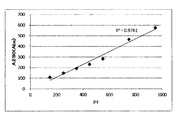
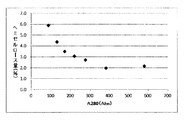
- FIG. 1 is a graph showing the relationship between the absorbance at 280 nm of the prehydrolyzed effluent and the Pf value of the prehydrolysis treatment (Experimental Example 1).
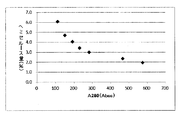
- FIG. 2 is a graph showing the relationship between the Pf value of the prehydrolysis treatment and the hemicellulose content of the dissolved kraft pulp (Experimental Example 1).
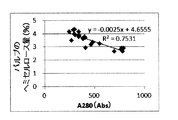
- FIG. 3 is a graph showing the relationship between the absorbance at 280 nm of the prehydrolyzed effluent and the hemicellulose content of the dissolved kraft pulp (Experimental Example 1).
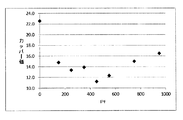
- FIG. 4 is a graph showing the relationship between the Pf value of the prehydrolysis treatment and the kappa number of the dissolved kraft pulp (Experimental Example 1).
- FIG. 1 is a graph showing the relationship between the absorbance at 280 nm of the prehydrolyzed effluent and the Pf value of the prehydrolysis treatment (Experimental Example 1).
- FIG. 2
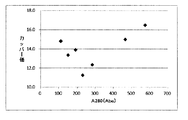
- FIG. 5 is a graph showing the relationship between the absorbance at 280 nm of the prehydrolyzed effluent and the kappa number of dissolved kraft pulp (Experimental Example 1).
- FIG. 6 is a graph showing the relationship between the absorbance at 280 nm of the prehydrolysis waste liquid and the Pf value of the prehydrolysis treatment (Experimental Example 2).
- FIG. 7 is a graph showing the relationship between the absorbance at 280 nm of the prehydrolyzed effluent and the hemicellulose content of the dissolved kraft pulp (Experimental Example 2).
- FIG. 8 is a graph showing the relationship between the absorbance at 280 nm of the prehydrolyzed effluent and the kappa number of dissolved kraft pulp (Experimental Example 2).
- FIG. 9 is a diagram showing an apparatus for carrying out a method for continuously producing dissolved pulp (Experimental Example 3).
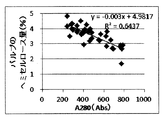
- FIG. 10 is a graph showing the relationship between the absorbance at 280 nm of the prehydrolyzed effluent and the hemicellulose content of the dissolved kraft pulp (Experimental Example 3).
- FIG. 11 is a graph showing the relationship between the Brix value of the prehydrolyzed effluent and the prehydrolyzed solid content (Experimental Example 4).
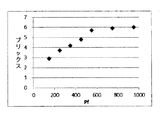
- FIG. 12 is a graph showing the relationship between the Brix value of the prehydrolysis waste liquid and the Pf value of the prehydrolysis treatment (Experimental Example 4).
- FIG. 13 is a graph showing the relationship between the Pf value of the prehydrolysis treatment and the hemicellulose content of the dissolved kraft pulp (Experimental Example 4).
- FIG. 14 is a graph showing the relationship between the Brix value of prehydrolyzed effluent and the hemicellulose content of dissolved kraft pulp (Experimental Example 4).
- FIG. 15 is a graph showing the relationship between the Pf value of the prehydrolysis treatment and the kappa number of the dissolved kraft pulp (Experimental Example 4).
- FIG. 16 is a graph showing the relationship between the Brix value of prehydrolyzed effluent and the kappa number of dissolved kraft pulp (Experimental Example 4).
- FIG. 17 is a graph showing the relationship between the Brix value of the prehydrolysis drainage and the Pf value of the prehydrolysis treatment (Experimental Example 5).
- FIG. 18 is a graph showing the relationship between the Brix value of prehydrolyzed effluent and the hemicellulose content of dissolved kraft pulp (Experimental Example 5).
- FIG. 19 is a graph showing the relationship between the Brix value of prehydrolyzed effluent and the kappa number of dissolved kraft pulp (Experimental Example 5).
- FIG. 20 is a graph showing the relationship between the absorbance at 280 nm of the prehydrolyzed effluent and the hemicellulose content of the dissolved kraft pulp (Experimental Example 6).
- FIG. 21 is a graph showing the relationship between the Brix value of prehydrolyzed effluent and the hemicellulose content of dissolved kraft pulp (Experimental Example 6).
- FIG. 22 is a graph showing the relationship between the ratio of absorbance to Brix value (absorbance / Brix) at 280 nm of the prehydrolyzed effluent and the hemicellulose content of dissolved kraft pulp (Experimental Example 6).
- the present invention relates to a technique for producing dissolved kraft pulp.
- the dissolved kraft pulp (DKP) is a dissolved pulp produced by a kraft cooking method (KP method).
- the dissolving pulp means a chemically purified pulp having a high cellulose purity.
- the ⁇ -cellulose content is 90% or more.
- wood contains three major components of cellulose, lignin, and hemicellulose, and a small amount of resin and ash, but dissolved pulp has high cellulose purity, chemical fiber, cellophane, plastic, synthetic glue, and various other celluloses. Widely used as a raw material for derivatives.
- the raw material of the present invention is wood chips.
- the size and tree species are not particularly limited, and may be a single kind of wood chip or a chip in which two or more kinds of wood are mixed.
- a high-quality dissolving pulp can be efficiently produced even if it is a softwood species that is relatively difficult to digest or bleach.
- a softwood chip used in the present invention for example, a larch genus or a pine genus wood chip can be suitably used.
- L. Larix (hereinafter abbreviated as L.) leptolepis (larch), L. laricina (Tamarac), L.
- Conifers other than the genus Larix include, for example, Pinus ⁇ ⁇ radiata (Pinus radiata) for Pinus genus, Pseudotuga (hereinafter abbreviated as P.) menziesii (Dacrasfer), P. japonica (Togasawara) ) And the like, Cryptomeriapjaponica and the like can be mentioned.
- hardwood wood chips can also be used as raw materials.
- a hardwood wood chip for example, a Eucalyptus wood chip can be suitably used.
- Eucalyptus As for the genus Eucalyptus, Eucalyptus (hereinafter abbreviated as E.), calophylla, E. citriodora, E .; diversiccolor, E.I. globulus, E.I. grandis, E .; gummifera, E .; marginata, E.M. nesophila, E.I. nitens, E.I. amygdalina, E .; camaldulensis, E .; delegenasis, E.I.
- Prehydrolysis process (hydrothermal treatment process)
- the chips are hydrothermally treated to decompose and remove the hemicellulose content in the wood chips into water-soluble sugars.
- Hydrothermal treatment as pretreatment is performed by treating wood chips with high-temperature water.
- the water to be added may be hot water or steam. Since an organic acid or the like is generated by the progress of hydrolysis, the pH of the treatment liquid is generally 2 to 5.
- the hydrothermal treatment is preferably performed in a temperature range of 150 to 180 ° C. If the temperature is less than 150 ° C., the removal of hemicellulose is insufficient, and if it exceeds 180 ° C., hydrolysis becomes excessive and the ⁇ -cellulose content also decreases.
- the treatment time is not particularly limited, but is preferably 15 to 400 minutes, more preferably 20 to 250 minutes, and further preferably 25 to 150 minutes. When the treatment time is too short, the removal of hemicellulose becomes insufficient, and the delignification improving effect due to the removal of hemicellulose is also reduced.
- the treatment temperature and treatment time can be set using the P factor (Pf) as an index.
- Pf is a standard indicating the total amount of heat given to the reaction system in the prehydrolysis treatment, and is expressed by the following formula in the present invention, and time integration is performed from the time when chips and water are mixed until the end of cooking. To calculate.
- the hydrothermal treatment in the present invention is preferably carried out in the range where the P factor (Pf) is 350 to 900, more preferably 500 to 800. If Pf is less than 350, the removal of hemicellulose is insufficient, and the effect of improving delignification due to the removal of hemicellulose is also reduced. On the other hand, if Pf exceeds 900, hydrolysis becomes excessive and ⁇ -cellulose content is reduced, resulting in a decrease in pulp yield, and condensing of lignin leads to deterioration in digestibility in the subsequent kraft cooking process. .
- the hydrothermal treatment step can be performed by putting wood chips and water in a pressure resistant container (prehydrolysis kettle), but the shape and size of the container are not particularly limited.
- the ratio of supplying wood chips and water to the hydrothermal treatment kettle is preferably 1.0 to 2.3 L / kg.
- the ratio of wood chips to water supplied to the prehydrolysis kettle is also called the dynamic liquid ratio and is shown as the amount of water per kg of wood chips. If the dynamic liquid ratio is less than 1.0 L / kg, the amount of water is too small relative to the wood chips, resulting in insufficient hydrolysis. If the liquid ratio exceeds 2.3 L / kg, the top of the prehydrolysis tank In this case, it is not preferable because the gas phase portion cannot be sufficiently secured.
- the water includes not only water supplied with the wood chip but also water contained in the wood chip, drain water, and the like.
- the liquid ratio of wood chips to water in the prehydrolysis kettle can be, for example, 1.0 to 5.0 L / kg, preferably 1.5 to 4.5 L / kg, and 2.0 to 4.0 L / kg is more preferable. If the liquid ratio is less than 1.0 L / kg, hydrolysis is insufficient because the amount of water is too small relative to the wood chips, and if the liquid ratio exceeds 5.0 L / kg, the size of the container becomes excessive. Therefore, it is not preferable. Moreover, you may add a small amount of mineral acid as needed.
- the pre-hydrolysis effluent generated by hydrothermal treatment contains organic substances mainly composed of sugars produced by hydrolysis of hemicellulose.
- organic substances mainly composed of sugars produced by hydrolysis of hemicellulose.
- the residence time may vary. If the relationship between the P factor and the absorbance of the prehydrolyzed effluent at a wavelength of 260 to 300 nm is expressed in advance in a calibration curve or a mathematical formula, the P factor can be estimated from the absorbance of the prehydrolyzed effluent.
- hydrothermal treatment is carried out with different P factors by changing the temperature and residence time, and the absorbance at a wavelength of 260 to 300 nm is measured for the prehydrolyzed effluent obtained at that time, and the relationship between the P factor and the absorbance is measured.
- calibration curve or mathematical formula Expressed in calibration curve or mathematical formula.
- the correlation with the quality (kappa number, hemicellulose content) of the pulp after kraft cooking in the subsequent process is converted into data, it can be used as a measure of the pulp quality after kraft cooking to be obtained.
- the Brix value is an index of the amount of organic matter contained in the prehydrolyzed effluent, and the P factor.
- the Brix value is also called sugar content, and is a measurement value measured with a Brix meter (sugar content meter), which is a measure of the amount of water-soluble organic substances or water-soluble inorganic substances such as sugars, organic acids, salts, etc. in the solution.
- 1 Brix corresponds to a sucrose concentration of 1% by mass.
- the P factor can be estimated from the Brix value of the prehydrolyzed liquid. More specifically, hydrothermal treatment is performed with different P factors by changing the temperature and residence time, the Brix value is measured for the prehydrolyzed liquid obtained at that time, and the relationship between the P factor and the Brix value is expressed by a calibration curve or a mathematical formula. Expressed in Furthermore, if the correlation with the quality (kappa number, hemicellulose content) of the pulp after cooking in the subsequent step is converted into data, it can be used as a measure of the pulp quality after cooking.
- Chip Recovery Step the hydrolyzed wood chip and the prehydrolysis waste liquid are separated, and the prehydrolysis waste liquid and the wood chip are recovered.
- the wood chips after the prehydrolysis treatment are separated from the prehydrolysis waste liquid, and then the chips are sufficiently washed with water and collected. Insufficient cleaning can cause adverse effects in subsequent cooking steps.
- the washing and removal of the prehydrolyzed effluent can be performed by using a general solid-liquid separator.
- a solid-liquid separation device such as an extraction screen or filter cloth is provided in a container used for prehydrolysis, and washing water is introduced from the lower part of the container and extracted from the screen for countercurrent washing.
- the chips after washing are put into the digester together with the kraft cooking liquor and subjected to kraft cooking under general conditions. Moreover, you may use for cooking of correction craft methods, such as MCC, EMCC, ITC, and Lo-solid. Also, there are no particular limitations on cooking types such as 1 vessel liquid phase type, 1 vessel gas phase / liquid phase type, 2 vessel liquid phase / gas phase type, and 2 vessel liquid phase type.
- the unbleached pulp that has been cooked is washed with a washing device such as a diffusion washer after extracting the cooking liquor.
- a washing device such as a diffusion washer after extracting the cooking liquor.
- the kappa number of unbleached pulp after washing is preferably 10-22, and may be 12-20. In the case of hardwood, it is preferably 5-20, and may be 6-16.
- the kraft cooking process can be performed by putting the hydrothermally treated wood chips together with the kraft cooking liquid in a pressure resistant container, but the shape and size of the container are not particularly limited.
- the liquid ratio between the wood chip and the chemical solution can be, for example, 1.0 to 5.0 L / kg, preferably 1.5 to 4.5 L / kg, and more preferably 2.0 to 4.0 L / kg. .
- the cooking liquor preferably has an active alkali addition rate (AA) per weight of dry wood chips of 16 to 22% by mass. If the active alkali addition rate is less than 16% by mass, the removal of lignin and hemilulose becomes insufficient, and if it exceeds 22% by mass, the yield and quality are reduced.
- the active alkali addition rate is obtained by converting the total addition rate of NaOH and Na 2 S as the addition rate of Na 2 O, and multiplying NaOH by 0.775 and Na 2 S by 0.795. It can be converted into the addition ratio of Na 2 O by.
- an alkaline cooking solution containing 0.01 to 1.5% by mass of a quinone compound per absolutely dry chip may be added to the digester. If the addition amount of the quinone compound is less than 0.01% by mass, the addition amount is too small to reduce the kappa number of the pulp after cooking, and the relationship between the kappa number and the pulp yield is not improved. Furthermore, the reduction of wrinkles and the suppression of the decrease in viscosity are insufficient. Moreover, even if the addition amount of a quinone compound exceeds 1.5 mass%, the further reduction of the kappa number of the pulp after cooking and the improvement of the relationship between a kappa number and a pulp yield are not recognized.
- the quinone compound used is a so-called known cooking aid quinone compound, hydroquinone compound or a precursor thereof, and at least one compound selected from these can be used.
- these compounds include anthraquinone, dihydroanthraquinone (eg, 1,4-dihydroanthraquinone), tetrahydroanthraquinone (eg, 1,4,4a, 9a-tetrahydroanthraquinone, 1,2,3,4-tetrahydroanthraquinone).
- Methyl anthraquinone eg 1-methyl anthraquinone, 2-methyl anthraquinone
- methyl dihydroanthraquinone eg 2-methyl-1,4-dihydroanthraquinone
- methyl tetrahydroanthraquinone eg 1-methyl-1,4,4a , 9a-tetrahydroanthraquinone, 2-methyl-1,4,4a, 9a-tetrahydroanthraquinone
- anthrahydroquinone generally 9,10-dihydroxyanthracene
- Tyranthrahydroquinone for example, 2-methylanthrahydroquinone
- dihydroanthrahydroanthraquinone for example, 1,4-dihydro-9,10-dihydroxyanthracene
- an alkali metal salt thereof for example, disodium salt of anthrahydroquinone
- Kraft cooking is preferably performed in a temperature range of 120 to 220 ° C, more preferably 150 to 180 ° C. If the temperature is too low, delignification (decrease in the kappa number) is insufficient, while if the temperature is too high, the degree of polymerization (viscosity) of cellulose decreases.
- the cooking time in the present invention is the time from when the cooking temperature reaches the maximum temperature until the temperature starts to decrease, but the cooking time is preferably 120 minutes or more and 10 hours, preferably 60 minutes or more and 240 minutes or less. preferable. If the cooking time is less than 60 minutes, pulping does not proceed, and if it exceeds 10 hours, the pulp production efficiency deteriorates, which is not preferable.
- the processing temperature and processing time can be set using the H factor (Hf) as an index.
- H factor is a standard representing the total amount of heat given to the reaction system during the cooking process, and is represented by the following equation.
- the H factor is calculated by time integration from the time when chips and water are mixed until the end of cooking.
- the unbleached pulp obtained after cooking can be subjected to various treatments as necessary.
- the oxygen delignification treatment can be performed on the pulp obtained by kraft cooking.
- a known medium concentration method or high concentration method can be applied as it is.
- the pulp concentration is preferably 8 to 15% by mass, and in the case of the high concentration method, it is preferably performed at 20 to 35% by mass.
- the alkali in oxygen delignification sodium hydroxide and potassium hydroxide can be used, and as oxygen gas, oxygen from a cryogenic separation method, oxygen from PSA (Pressure Swing Adsorption), VSA (Vacuum Swing Adsorption) Oxygen etc. from) can be used.
- the reaction conditions for the oxygen delignification treatment are not particularly limited, but the oxygen pressure is 3 to 9 kg / cm 2 , more preferably 4 to 7 kg / cm 2 , the alkali addition rate is 0.5 to 4% by mass, and the temperature is 80 Up to 140 ° C., treatment time of 20 to 180 minutes, other known conditions can be applied.
- the oxygen delignification treatment may be performed a plurality of times.
- the pulp that has been subjected to oxygen delignification treatment is then sent to the washing step, and after washing, it is sent to the multistage bleaching step, where the multistage bleaching treatment can be performed.
- the multi-stage bleaching treatment of the present invention is not particularly limited, but acid (A), chlorine dioxide (D), alkali (E), oxygen (O), hydrogen peroxide (P), ozone (Z), It is preferable to combine a known bleaching agent such as peracid and a bleaching aid.
- the first stage of the multistage bleaching process uses a chlorine dioxide bleaching stage (D) or an ozone bleaching stage (Z), the second stage is an alkali extraction stage (E), the hydrogen peroxide stage (P), the third stage or later.
- a bleaching sequence using chlorine dioxide or hydrogen peroxide is preferably used.
- the number of stages after the third stage is not particularly limited, but considering energy efficiency, productivity, etc., it is preferable to finish in three or four stages in total.
- a chelating agent treatment stage with ethylenediaminetetraacetic acid (EDTA), diethylenetriaminepentaacetic acid (DTPA) or the like may be inserted during the multistage bleaching treatment.
- the absorbance of the recovered prehydrolyzed effluent at a wavelength of 260 to 300 nm is measured.
- the absorbance may be measured by measuring the absorbance in the wavelength range of 260 to 300 nm, and the absorbance of the prehydrolyzed effluent can be measured by a conventional method. Since the prehydrolyzed effluent contains a substance having a peak of absorbance in the wavelength range of 260 to 300 nm, such as furfurals produced from sugar, the absorbance at a wavelength of 260 to 300 nm is measured. The concentration of furfurals can be measured, and the progress of hydrolysis can be estimated.
- the wavelength for measuring absorbance is preferably 270 to 290 nm, more preferably 275 to 285 nm, and further preferably about 280 nm.
- dissolved kraft pulp DKP
- DKP dissolved kraft pulp
- the absorbance at a wavelength of 260 to 300 nm of the prehydrolyzed effluent has a high correlation with the P factor, so that it is not a P factor that is difficult to measure in actual operation. It is possible to estimate the degree of treatment and further the properties of the finally obtained dissolved kraft pulp. Specifically, the relationship between the absorbance of the prehydrolyzed effluent at a wavelength of 260 to 300 nm and the properties such as the kappa number and / or hemicellulose content of the resulting dissolved kraft pulp can be expressed in advance in a calibration curve or a mathematical formula. Based on this correlation data, the quality of the resulting dissolved kraft pulp can be estimated from the absorbance described above.
- the prehydrolysis step can be controlled using the measured value of the absorbance of the prehydrolysis waste liquid at a wavelength of 260 to 300 nm as an index. That is, by controlling the temperature and / or residence time of the prehydrolyzed effluent using the absorbance described above as an index, the entire system can be controlled easily and appropriately.
- the Brix value of the recovered prehydrolyzed effluent is measured.
- the Brix value can be measured by measuring the refractive index with a Brix meter (sugar meter), and the Brix value of the prehydrolyzed effluent can be measured by a conventional method.
- dissolving pulp In the production of dissolving pulp (DP), it is possible to determine whether hemicellulose and various phenols are properly removed by appropriately managing the P factor of the prehydrolysis treatment. High quality dissolving pulp can be easily produced by oxygen delignification treatment or bleaching treatment.
- the degree of prehydrolysis treatment using the above Brix value as an index the degree of prehydrolysis treatment using the above Brix value as an index.
- the properties of the finally obtained dissolving pulp can be estimated. Specifically, if the relationship between the Brix value of the prehydrolyzed effluent and the properties such as the kappa number and / or hemicellulose content of the resulting dissolved pulp is expressed in advance in a calibration curve or a mathematical formula, this correlation data Based on the above Brix value, the quality of the resulting dissolved pulp can be estimated.
- the prehydrolysis step can be controlled using the Brix value of the prehydrolyzed liquid as an index. That is, by controlling the temperature and / or residence time of the prehydrolyzed liquid using the above-mentioned Brix value as an index, the entire system can be easily and appropriately controlled.
- the kappa number and / or hemicellulose content of the resulting dissolved kraft pulp can be estimated from the ratio of the absorbance of the prehydrolyzed effluent at a wavelength of 260 to 300 nm and the Brix value of the prehydrolyzed effluent. Since the Brix value can be approximated with the solid content dissolved in the prehydrolyzed effluent, the ratio of absorbance to Brix value means the absorbance per solid content, in other words, the ratio of furfurals in the solid content. It can also be said. Therefore, even if the solid content concentration fluctuates, the kappa number and / or hemicellulose content of the dissolved kraft pulp can be estimated with higher accuracy than the absorbance or the Brix value alone.
- the present invention can be understood as an apparatus for producing dissolved kraft pulp. That is, the present invention is an apparatus for producing dissolving pulp, a prehydrolysis tank for hydrothermally treating wood chips, and a wavelength of 260 to 300 nm of a prehydrolysis waste liquid discharged from the prehydrolysis tank. And an absorbance measuring device for measuring the absorbance at.
- the apparatus of the present invention further comprises a digester for kraft cooking wood chips hydrothermally treated in the prehydrolysis tank.
- Experimental example 1 Radiata pine wood chips were sieved using a sieve (gyro shifter) to obtain wood chips having a size of 9.5 to 25.4 mm.
- sample 1 is a sample obtained by kraft cooking without pre-hydrolysis treatment.
- the chip and the prehydrolyzed liquid were separated with a 300 mesh filter cloth to obtain a prehydrolyzed chip and a prehydrolyzed waste liquid.
- the light absorbency in wavelength 280nm was measured with the ultraviolet visible spectrophotometer (Shimadzu Corporation UV-1800). The absorbance of the prehydrolyzed effluent was measured after appropriate dilution.
- the prehydrolyzed chip was hand-washed with 60 ° C. hot water 15 times as much as the chip for 30 seconds.
- the kraft cooking chemical solution has an active alkali addition rate (AA) of 16.5%, an active alkali of 105 g / L (converted value of Na 2 O), NaOH of 75.6 g / L (converted value of Na 2 O), Na 2 S of 29.4 g /
- AA active alkali addition rate
- L Na 2 O equivalent value
- sulfidity 28% the liquid ratio of wood chips and cooking chemical liquid was 3.2 (L / kg).
- FIG. 1 shows the relationship between the absorbance of the prehydrolyzed effluent at a wavelength of 280 nm and the P factor.
- FIG. 2 shows the relationship between the P factor and the hemicellulose content of the dissolved kraft pulp
- FIG. 3 shows the relationship between the absorbance of the prehydrolyzed effluent at a wavelength of 280 nm and the hemicellulose content of the dissolved kraft pulp.
- the amount of hemicellulose in the dissolved kraft pulp decreases as the P factor of the prehydrolysis treatment increases, and the amount of hemicellulose in the dissolved kraft pulp decreases by increasing the degree of the prehydrolysis treatment.
- the hemicellulose content of the dissolved kraft pulp decreased as the absorbance at the wavelength of 280 nm of the prehydrolyzed effluent increased. From this result, it is understood that the quality of the dissolved kraft pulp (the amount of hemicellulose) can be predicted using the absorbance at a wavelength of 280 nm of the prehydrolyzed effluent as in the P factor.
- FIG. 4 shows the relationship between the P factor and the kappa number of the dissolved kraft pulp
- FIG. 5 shows the relationship between the absorbance of the prehydrolyzed effluent at a wavelength of 280 nm and the kappa number of the dissolved kraft pulp.
- the relationship between the absorbance at a wavelength of 280 nm of the prehydrolyzed effluent and the kappa number of the pulp was the same as the relationship between the P factor and the kappa number of the dissolved kraft pulp.
- the P-factor was used to predict and control the prehydrolysis treatment and the quality of the resulting dissolved kraft pulp.
- Experimental example 3 Using the apparatus shown in FIG. 9, dissolved kraft pulp was continuously produced at the actual machine level.
- the apparatus used in this experiment includes a pre-hydrolysis tank 4 (capacity: 356 m 3 ) and a kraft digester 6 (capacity: 860 m 3 ).
- the chemical solution had an active alkali addition rate (AA) of 16.5%, an active alkali of 105 g / L (Na 2 O conversion value), NaOH of 75.6 g / L (Na 2 O conversion value), Na 2 S of 29.4 g / L ( Na 2 O equivalent value) and a composition having a sulfidity of 28%, and the liquid ratio between the wood chip and the cooking chemical was 3.2 (L / kg).
- AA active alkali addition rate
- sample 1 is a sample obtained by kraft cooking without pre-hydrolysis treatment.
- the chip and the prehydrolyzed liquid were separated with a 300 mesh filter cloth to obtain a prehydrolyzed chip and a prehydrolyzed waste liquid.
- the prehydrolyzed effluent was filtered through a filter having a pore size of 0.45 ⁇ m, and the Brix value of the filtrate was measured with a Brix meter (PAL-1, manufactured by Atago Co., Ltd.). The solid content concentration of the filtrate was also measured.
- the prehydrolyzed chip was hand-washed with 60 ° C. hot water 15 times as much as the chip for 30 seconds.
- the kraft cooking chemical solution has an active alkali addition rate (AA) of 16.5%, an active alkali of 105 g / L (converted value of Na 2 O), NaOH of 75.6 g / L (converted value of Na 2 O), Na 2 S of 29.4 g /
- AA active alkali addition rate
- L Na 2 O equivalent value
- sulfidity 28% the liquid ratio of wood chips and cooking chemical liquid was 3.2 (L / kg).
- FIG. 11 shows the relationship between the Brix value of the prehydrolyzed effluent and the solid content concentration.
- R 2 0.9487
- FIG. 12 shows the relationship between the Brix value of the prehydrolyzed effluent and the P factor. As is apparent from FIG. 12, the Brix value of the prehydrolyzed effluent and the P factor showed a correlation, and in particular, a high correlation was shown in the region where the P factor was 100 to 700 (Brix value was 2 to 6).
- FIG. 13 shows the relationship between the P factor and the hemicellulose content of the dissolved kraft pulp
- FIG. 14 shows the relationship between the Brix value of the prehydrolyzed effluent and the hemicellulose content of the dissolved kraft pulp.
- the P factor of the prehydrolysis treatment increases, the amount of hemicellulose in the dissolved kraft pulp decreases, and by increasing the degree of the prehydrolysis treatment, the amount of hemicellulose in the dissolved kraft pulp decreases.
- the hemicellulose content of the dissolved kraft pulp decreased as the Brix value of the prehydrolyzed effluent increased. From this result, it is understood that the quality of the dissolved kraft pulp (the amount of hemicellulose) can be predicted using the Brix value of the prehydrolyzed effluent, similarly to the P factor.
- FIG. 15 shows the relationship between the P factor and the kappa number of the dissolved kraft pulp
- FIG. 16 shows the relationship between the Brix value of the prehydrolyzed effluent and the kappa number of the dissolved kraft pulp.
- the relationship between the Brix value of the prehydrolysis waste liquid and the kappa number of the pulp was the same as the relationship between the P factor and the kappa number of the dissolved kraft pulp.
- the P-factor was used to predict and control the prehydrolysis treatment and the quality of the resulting dissolved kraft pulp, but the prehydrolysis treatment and the dissolved kraft were determined using the Brix value of the prehydrolysis wastewater. It was found that the pulp production process can be controlled.
- Experimental Example 5 The experiment was conducted in the same manner as in Experimental Example 1 except that the raw material wood chips were changed from Radiata Pine wood chips to larch wood chips.
- the prehydrolyzed effluent was extracted from the strainer 5 of the prehydrolysis kettle.
- the amount of each prehydrolyzed effluent and diluted water delivered is controlled by a pump using a flow meter as a guide, diluted 1000 times, and the diluted solution is absorbed by a pump (Shimadzu LC-20AD).
- the solution was sent to a photometric detector (SPD-10Ai manufactured by Shimadzu Corporation), and absorbance A280 at a wavelength of 280 nm was continuously measured.
- the Brix value of the prehydrolyzed effluent was measured with a Brix meter (PAL-1, manufactured by Atago Co., Ltd.).
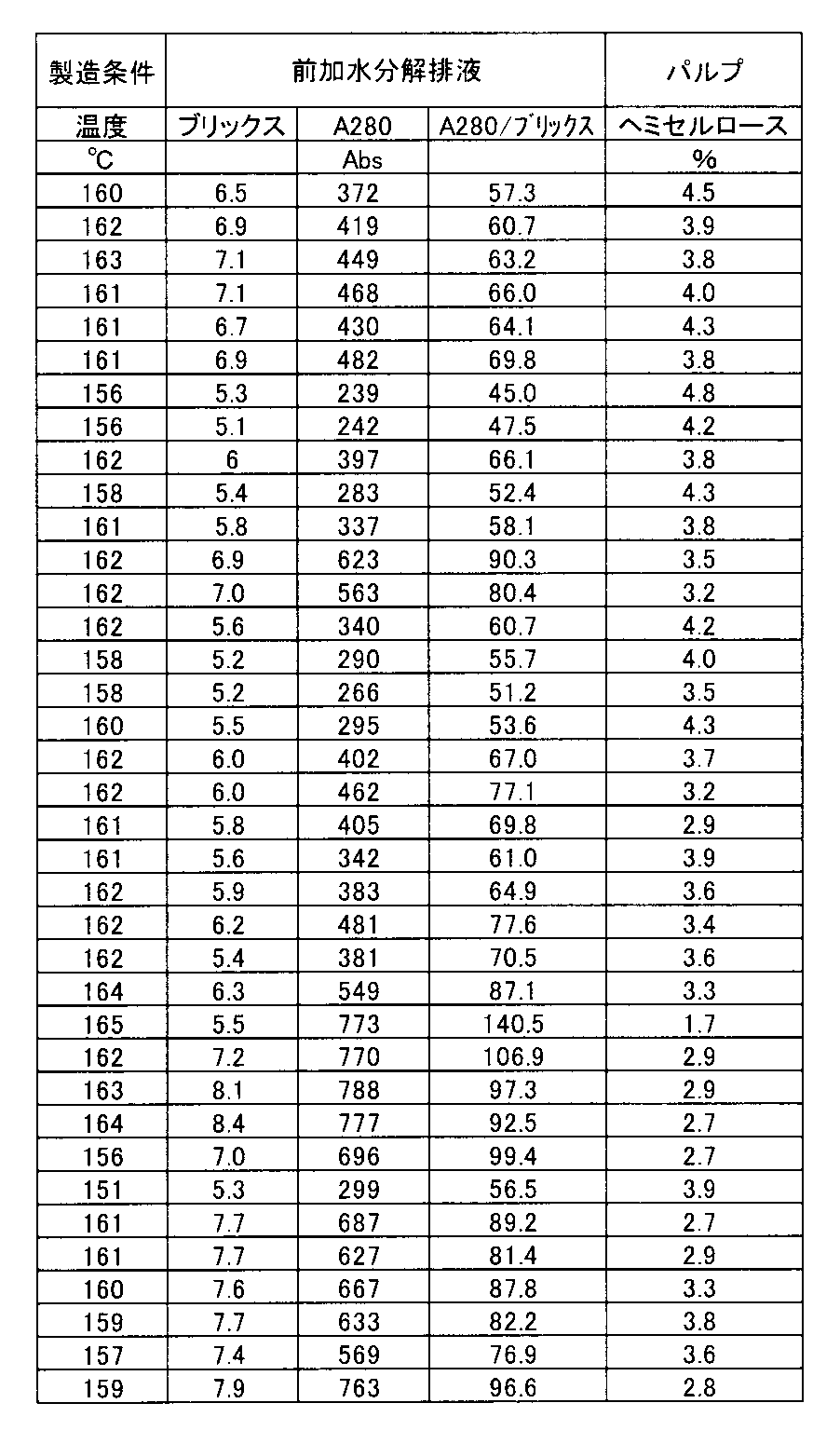
- the results are shown in Table 6 and FIGS.
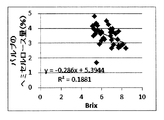
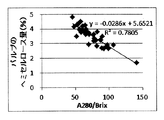
- the ratio of the absorbance at the wavelength of 280 nm and the Brix value of the prehydrolyzed effluent (A280 / Brix value) has a higher correlation with the amount of hemicellulose in the dissolved kraft pulp than the single value of the absorbance at the wavelength of 280 nm and the Brix value. ( Figures 20-22).
- 1 chip bin
- 2 Tip meter screw
- 3 Tip tube
- 4 Pre-hydrolysis kettle
- 5 Strainer
- 6 Craft digester
- 7 Prehydrolysis drainage
Landscapes
- Chemical & Material Sciences (AREA)
- Life Sciences & Earth Sciences (AREA)
- Engineering & Computer Science (AREA)
- Health & Medical Sciences (AREA)
- Analytical Chemistry (AREA)
- Food Science & Technology (AREA)
- Medicinal Chemistry (AREA)
- Physics & Mathematics (AREA)
- Wood Science & Technology (AREA)
- Biochemistry (AREA)
- General Health & Medical Sciences (AREA)
- General Physics & Mathematics (AREA)
- Immunology (AREA)
- Pathology (AREA)
- Inorganic Chemistry (AREA)
- Paper (AREA)
Abstract
本発明の課題は、溶解クラフトパルプの製造における前加水分解処理を適切に管理し、溶解クラフトパルプの製造プロセスを適切に制御する技術を開発することである。 溶解クラフトパルプの製造における前加水分解処理の排液の260~300nmにおける吸光度によって、前加水分解処理の状態を適切に把握し、溶解クラフトパルプの品質を管理することができる。
Description
本発明は、前加水分解工程(水熱処理工程)を備える溶解クラフトパルプの製造技術に関する。特に本発明によれば、溶解クラフトパルプの製造において、前加水分解排液を分析することによって溶解クラフトパルプの製造プロセスを適切に制御することができる。
また、本発明は、前加水分解排液の吸光度やブリックス値を分析することによって、前加水分解工程の重要な因子であるPファクターを推定し、溶解クラフトパルプの品質を管理する技術に関する。
レーヨンの製造などに用いられる溶解パルプは、一般に88~98%という高いα-セルロース含有率を有する。α-セルロースは、パルプを17.5%の水酸化ナトリウムで処理したときに溶解しない部分であり、セルロースが主成分である(TAPPIスタンダードT203om-83)。溶解パルプを製造するには、α-セルロースの含有率を高くする必要があり、そのためには、原料である木材に含まれるかなりの量のヘミセルロースを除去しなければならず、それによりかなりの製造コストがかかる。ヘミセルロースの除去技術としては、例えば、クラフト蒸解前の前加水分解処理(予備加水分解処理)や漂白プロセスにおける冷苛性アルカリ抽出処理などが知られている。また、ペントサンなどのヘミセルロースが溶解パルプに残存していると、レーヨンなどの製造における濾過、紡糸などが困難になったり、レーヨンなどの繊維特性において問題が生じる場合がある。
特許文献1には、リグノセルロース材料を前加水分解して、続いて140~160℃でアルカリ中和処理を行い、中和された前加水分解されたリグノセルロース材料をクラフト蒸解して、溶解クラフトパルプをバッチ様式で製造する方法が開示されている。
クラフト蒸解による溶解パルプ(溶解クラフトパルプ)の製造において、クラフト蒸解前に前加水分解処理(水熱処理)を木材チップに施し、木材チップに含まれるヘミセルロースなどを除去する技術が知られている。前加水分解処理(水熱処理)は、後工程であるクラフト蒸解に影響するため、前加水分解処理を適切に管理し制御することが、溶解クラフトパルプの製造において重要である。
前加水分解工程(水熱処理工程)に影響を与える因子として、処理温度と処理時間(滞留時間)が知られており、反応系に与えられた熱の総量を表す指標としてPファクター(Pf)が知られている。
しかしながら、連続操業において水熱処理工程における滞留時間を正確に測定するのは困難であり、それ故に、実操業における正確なPファクターを算出することは、実際には難しい場合がある。また、滞留時間の把握が困難なために滞留時間を適切に調整できなければ、得られる溶解パルプの品質が悪化することになり、溶解パルプの製造上、大きなロスを生じる。
また、前加水分解処理後の木材チップを実際に分析して、糖分析などによって前加水分解の効果を判定することも可能である。しかし、糖分析等の分析は、煩雑で時間を要するため、実際の溶解クラフトパルプの製造現場において製造プロセスを制御するために糖分析を実施することは難しい。
このように、従来、溶解クラフトパルプの製造における前加水分解処理について、前加水分解の状態を短時間で簡便に評価する方法は存在していなかった。このような状況に鑑み、本発明の課題は、溶解クラフトパルプの製造における前加水分解処理を適切に管理し、溶解クラフトパルプの製造プロセスを適切に制御する技術を開発することである。
上記課題について鋭意検討した結果、本発明者らは、前加水分解排液の波長280nm付近における吸光度によって前加水分解の状態を適切に把握できることを見いだし、本発明を完成させるに至った。すなわち、前加水分解排液の波長260~300nmにおける吸光度が、前加水分解処理のPファクターと高い相関があり、また、得られるパルプのカッパー価やヘミセルロース量とも関係があることを見出した。そして、前加水分解工程を備える溶解クラフトパルプの製造において、前加水分解排液の波長260~300nmにおける吸光度を指標にして溶解クラフトパルプの製造プロセスを簡便かつ適切に制御することが可能になる。
これに限定されるものではないが、本発明は、下記の態様を包含する。
(1) (a)木材チップを水熱処理して木材チップに含まれるヘミセルロースを加水分解する工程、(b)前加水分解処理後の木材チップと前加水分解排液とを分離し、回収する工程、(c)回収した前加水分解排液の波長260~300nmにおける吸光度を測定する工程、(d)回収した木材チップをクラフト蒸解して溶解クラフトパルプを得る工程、を含む、溶解クラフトパルプを製造する方法。
(2) 回収した前加水分解排液のブリックス値を測定する工程をさらに含む、(1)に記載の方法。
(3) 前加水分解排液の波長260~300nmにおける吸光度から、工程(a)における下記式1:
Pf=∫ln-1(40.48-15106/T)dt (式1)
[式中、Tは前加水分解排液の絶対温度を表す]
で示されるPファクター(Pf)を推定する工程をさらに含む、(1)または(2)に記載の方法。
(4) 前加水分解排液の波長260~300nmにおける吸光度から、工程(c)で得られる溶解クラフトパルプのカッパー価および/またはヘミセルロース含量を推定する工程をさらに含む、(1)~(3)のいずれかに記載の方法。
(5) 前加水分解排液の波長260~300nmにおける吸光度を指標として、工程(a)における前加水分解排液の温度および/または滞留時間を制御する、(1)~(4)のいずれかに記載の方法。
(6) 前加水分解排液のブリックス値を指標として、工程(a)における前加水分解排液の温度および/または滞留時間を制御する、(1)~(5)のいずれかに記載の方法。
(7) (前記吸光度)/(前記ブリックス値)の比を指標として、工程(a)における前加水分解排液の温度および/または滞留時間を制御する、(1)~(6)のいずれかに記載の方法。
(8) 木材チップを水熱処理するための前加水分解釜と、前加水分解釜より排出される前加水分解排液の波長260~300nmにおける吸光度を測定するための吸光度測定機と、を備えた、溶解パルプを製造するための装置。
(9) 前加水分解釜で水熱処理された木材チップをクラフト蒸解するための蒸解釜をさらに備えた、(8)に記載の装置。
(10) 前加水分解釜より排出される前加水分解排液のブリックス値を測定するための測定機をさらに備えた、(8)または(9)に記載の装置。
(11) 測定した前記吸光度と前記ブリックス値から(吸光度)/(ブリックス値)の比を算出するための計算機をさらに備えた、(8)~(10)のいずれかに記載の装置。
(1) (a)木材チップを水熱処理して木材チップに含まれるヘミセルロースを加水分解する工程、(b)前加水分解処理後の木材チップと前加水分解排液とを分離し、回収する工程、(c)回収した前加水分解排液の波長260~300nmにおける吸光度を測定する工程、(d)回収した木材チップをクラフト蒸解して溶解クラフトパルプを得る工程、を含む、溶解クラフトパルプを製造する方法。
(2) 回収した前加水分解排液のブリックス値を測定する工程をさらに含む、(1)に記載の方法。
(3) 前加水分解排液の波長260~300nmにおける吸光度から、工程(a)における下記式1:
Pf=∫ln-1(40.48-15106/T)dt (式1)
[式中、Tは前加水分解排液の絶対温度を表す]
で示されるPファクター(Pf)を推定する工程をさらに含む、(1)または(2)に記載の方法。
(4) 前加水分解排液の波長260~300nmにおける吸光度から、工程(c)で得られる溶解クラフトパルプのカッパー価および/またはヘミセルロース含量を推定する工程をさらに含む、(1)~(3)のいずれかに記載の方法。
(5) 前加水分解排液の波長260~300nmにおける吸光度を指標として、工程(a)における前加水分解排液の温度および/または滞留時間を制御する、(1)~(4)のいずれかに記載の方法。
(6) 前加水分解排液のブリックス値を指標として、工程(a)における前加水分解排液の温度および/または滞留時間を制御する、(1)~(5)のいずれかに記載の方法。
(7) (前記吸光度)/(前記ブリックス値)の比を指標として、工程(a)における前加水分解排液の温度および/または滞留時間を制御する、(1)~(6)のいずれかに記載の方法。
(8) 木材チップを水熱処理するための前加水分解釜と、前加水分解釜より排出される前加水分解排液の波長260~300nmにおける吸光度を測定するための吸光度測定機と、を備えた、溶解パルプを製造するための装置。
(9) 前加水分解釜で水熱処理された木材チップをクラフト蒸解するための蒸解釜をさらに備えた、(8)に記載の装置。
(10) 前加水分解釜より排出される前加水分解排液のブリックス値を測定するための測定機をさらに備えた、(8)または(9)に記載の装置。
(11) 測定した前記吸光度と前記ブリックス値から(吸光度)/(ブリックス値)の比を算出するための計算機をさらに備えた、(8)~(10)のいずれかに記載の装置。
本発明によれば、前加水分解工程を備える溶解クラフトパルプの製造において、前加水分解排液の波長260~300nmにおける吸光度を指標にして溶解クラフトパルプの製造プロセスを簡便かつ適切に制御することができる。特に本発明によれば、連続操業などにおいて前加水分解処理(水熱処理)のPファクター、得られるパルプの特性などを推定できるので、溶解クラフトパルプの製造プロセスをオンラインで管理することが可能となる。
前加水分解排液の波長260~300nmにおける吸光度が、前加水分解処理の適切な指標となる理由は、以下のように考えられる。すなわち、水熱処理で発生する前加水分解排液には、チップから溶出したヘミセルロース由来の糖類を主成分とする有機物が含まれており、これらの有機物が波長260~300nmの領域に極大吸収のピークを有するため、前加水分解排液の波長260~300nmにおける吸光度によって前加水分解処理の程度を評価できると考えられる。
また、本発明によれば、前加水分解工程を備える溶解クラフトパルプの製造において、前加水分解排液のブリックス値を指標にして溶解クラフトパルプの製造プロセスを簡便かつ適切に制御することができる。特に本発明によれば、連続操業などにおいて前加水分解処理(水熱処理)のPファクター、得られるパルプの特性などを推定できるので、溶解クラフトパルプの製造プロセスをオンラインで管理することが可能となる。前加水分解排液のブリックス値が、前加水分解処理の適切な指標となる理由は、以下のように考えられる。すなわち、水熱処理で発生する前加水分解排液には、チップから溶出したヘミセルロース由来の糖類を主成分とする有機物が含まれており、これらの有機物量とブリックス値の相関が高いため、前加水分解排液のブリックス値によって前加水分解処理の程度を評価できると考えられる。
本発明は、溶解クラフトパルプの製造技術に関する。本発明において溶解クラフトパルプ(DKP)とは、クラフト蒸解法(KP法)によって製造される溶解パルプである。溶解パルプとは、化学的に精製されたセルロース純度の高いパルプを意味し、好ましい態様においてα-セルロース含有率が90%以上である。一般に木材はセルロース、リグニン、ヘミセルロースの三大成分と少量の樹脂分、灰分などを含んでいるが、溶解パルプはセルロース純度が高く、化学繊維、セロハン、プラスチック、合成糊料、その他いろいろなセルロース系誘導体の原料として広く利用されている。
本発明の原料は木材チップである。本発明においては、針葉樹材の木材チップを含むことが好ましく、そのサイズや樹種は特に制限されず、単一種類の木材のチップでも2種以上の木材が混合されたチップでもよい。本発明においては、比較的、蒸解や漂白が難しいとされる針葉樹材の樹種であっても、高品質な溶解パルプを効率良く製造することができる。本発明において使用される針葉樹材のチップとしては、例えば、カラマツ属やマツ属の木材チップを好適に使用することができる。カラマツ属に関しては、例えば、Larix(以下、L.と略す)leptolepis(カラマツ)、L. laricina(タマラック)、L. occidentalis(セイブカラマツ)、L. decidua(ヨーロッパカラマツ)、L. gmelinii(グイマツ)などが挙げられる。また、カラマツ属以外の針葉樹としては、例えば、マツ属に関しては、Pinus radiata(ラジアータマツ)など、トガサワラ属に関しては、Pseudotuga(以下、P.と略す)menziesii(ダクラスファー)、P. japonica(トガサワラ)など、スギ属に関しては、Cryptomeria japonicaなどを挙げることができる。
本発明において広葉樹材の木材チップを原料として使用することもできる。広葉樹材の木材チップとしては、例えば、ユーカリ属木材チップを好適に使用することができる。ユーカリ属に関しては、Eucalyptus(以下、E.と略す) calophylla、E.citriodora、E.diversicolor、E.globulus、E.grandis、E.gummifera、E.marginata、E.nesophila、E.nitens、E.amygdalina、E.camaldulensis、E.delegatensis、E.gigantea、E.muelleriana、E.obliqua、E.regnans、E.sieberiana、E.viminalis、E.camaldulensis、E.marginataなどを挙げることができる。
前加水分解工程(水熱処理工程)
本発明ではクラフト蒸解を行う前の前処理として、チップに対して水熱処理を行って、木材チップ中のヘミセルロース分を水溶性の糖に分解して、除去する。前処理としての水熱処理(前加水分解)は、木材チップを高温の水で処理することによって実施される。添加する水は、熱水でも水蒸気の状態でもよい。加水分解の進行によって有機酸等が生成するので、処理液のpHは2~5となるのが一般的である。
本発明ではクラフト蒸解を行う前の前処理として、チップに対して水熱処理を行って、木材チップ中のヘミセルロース分を水溶性の糖に分解して、除去する。前処理としての水熱処理(前加水分解)は、木材チップを高温の水で処理することによって実施される。添加する水は、熱水でも水蒸気の状態でもよい。加水分解の進行によって有機酸等が生成するので、処理液のpHは2~5となるのが一般的である。
水熱処理は、150~180℃の温度範囲で行うことが好ましい。温度が150℃未満であれば、ヘミセルロースの除去が不十分となり、180℃を超えると加水分解が過剰となりα-セルロース分も低下してしまう。処理時間は特に制限されないが、15~400分が好ましく、20~250分がより好ましく、25~150分がさらに好ましい。処理時間が短すぎると、ヘミセルロースの除去が不十分となり、ヘミセルロースを除去したことによる脱リグニン性の向上効果も少なくなる。一方、処理時間が長すぎると、加水分解が過剰となりα-セルロース分が減少してパルプ収率の低下を招くとともに、リグニンの縮合により、後に続くクラフト蒸解工程における蒸解性の悪化を招いてしまう。
また、本発明における水熱処理は、Pファクター(Pf)を指標として、処理温度及び処理時間を設定することができる。Pファクターとは、前加水分解処理で反応系に与えられた熱の総量を表す目安であり、本発明では下記式によって表わされ、チップと水が混ざった時点から蒸解終了時点まで時間積分することで算出する。
Pf=∫ln-1(40.48-15106/T)dt
[式中、Tは前加水分解排液の絶対温度を表す]
[式中、Tは前加水分解排液の絶対温度を表す]
本発明における水熱処理は、Pファクター(Pf)が350~900となる範囲で行うことが好ましく、500~800がさらに好ましい。Pfが350未満であれば、ヘミセルロースの除去が不十分となり、ヘミセルロースを除去したことによる脱リグニン性の向上効果も少なくなる。また、Pfが900を超えると、加水分解が過剰となりα-セルロース分が減少してパルプ収率の低下を招くとともに、リグニンの縮合により、後に続くクラフト蒸解工程における蒸解性の悪化を招いてしまう。
水熱処理工程は、木材チップと水を耐圧性容器(前加水分解釜)に入れて行うことができるが、容器の形状や大きさは特に制限されない。
水熱処理釜(前加水分解釜)に木材チップと水を供給する際の比率は1.0~2.3L/kgとすることが好ましい。前加水分解釜に供給する木材チップと水の比率は動的液比とも呼ばれ、木材チップ1kgあたりの水の量として示される。動的液比が1.0L/kg未満であると、木材チップに対して水が少なすぎるために加水分解が不十分となり、液比が2.3L/kgを超えると前加水分解釜の頂部において気相部が十分に確保できないので好ましくない。なお、水には木材チップと共に供給する水だけではなく、木材チップに含まれる水分、ドレン水等も含まれる。
また、前加水分解釜内において木材チップと水の液比は、例えば、1.0~5.0L/kgとすることができ、1.5~4.5L/kgが好ましく、2.0~4.0L/kgがさらに好ましい。液比が1.0L/kg未満であると、木材チップに対して水が少なすぎるために加水分解が不十分となり、液比が5.0L/kgを超えると容器の大きさが過大となるので好ましくない。また、必要に応じて、少量の鉱酸を添加してもよい。
水熱処理で発生する前加水分解排液にはヘミセルロースの加水分解で生成する糖類を主成分とする有機物が含まれている。この前加水分解排液を分光光度計で吸光度を測定すると波長260~300nmの領域に極大吸収のピークを有することが判明した。後述の実験例で実証したように、波長280nm付近の吸光度とPファクターには相関関係があり、前加水分解の進行により溶出する有機物が増加すると上述の吸光度も増加する。
上述したように、高品質の溶解クラフトパルプを得るためにはPファクターを適正な範囲にする必要があるが、連続操業において木材チップの滞留時間を正確に測定するのは困難であり、釜内の状態によって滞留時間は変動することもある。予めPファクターと前加水分解排液の波長260~300nmの吸光度の関係を検量線や数式に表しておけば、前加水分解排液の吸光度からPファクターを推定できる。より具体的には、温度、滞留時間を変化させ異なるPファクターで水熱処理を行い、その際に得られる前加水分解排液について波長260~300nmの吸光度を測定し、Pファクターと吸光度の関係を検量線あるいは数式に表す。さらに、後工程のクラフト蒸解後のパルプの品質(カッパー価、ヘミセルロース含有量)との相関をデータ化しておけば、得られるクラフト蒸解後のパルプ品質の目安とすることができる。
また、前加水分解排液に含まれている有機物量の指標であるブリックス(Brix)値とPファクターにも相関関係があることが判明した。ブリックス(Brix)値とは糖度とも言われ、ブリックス計(糖度計)により測定した測定値で、溶液中の糖類、有機酸、塩類等の水溶性有機物または水溶性無機物の量の尺度となるもので、1ブリックスはショ糖濃度1質量%に相当する。後述の実験例で実証したように、ブリックス値とPファクターには相関関係があり、前加水分解の進行により溶出する有機物が増加すると上述のブリックス値も増加する。
上述したように、高品質の溶解パルプを得るためにはPファクターを適正な範囲にする必要があるが、連続操業において木材チップの滞留時間を正確に測定するのは困難であり、釜内の状態によって滞留時間は変動することもある。予めPファクターと前加水分解液のブリックス値の関係を検量線や数式に表しておけば、前加水分解液のブリックス値からPファクターを推定できる。より具体的には、温度、滞留時間を変化させ異なるPファクターで水熱処理を行い、その際に得られる前加水分解液についてブリックス値を測定し、Pファクターとブリックス値の関係を検量線あるいは数式に表す。さらに、後工程の蒸解後のパルプの品質(カッパー価、ヘミセルロース含有量)との相関をデータ化しておけば、得られる蒸解後のパルプ品質の目安とすることができる。
チップの回収工程
次いで、本発明においては、加水分解処理後の木材チップと前加水分解排液とを分離し、前加水分解排液と木材チップを回収する。好ましい態様において、前加水分解処理後の木材チップは、前加水分解排液と分離した後、チップを十分に水で洗浄して回収する。不十分な洗浄では、後続の蒸解工程において悪影響が生じる場合がある。
次いで、本発明においては、加水分解処理後の木材チップと前加水分解排液とを分離し、前加水分解排液と木材チップを回収する。好ましい態様において、前加水分解処理後の木材チップは、前加水分解排液と分離した後、チップを十分に水で洗浄して回収する。不十分な洗浄では、後続の蒸解工程において悪影響が生じる場合がある。
前加水分解排液の洗浄、除去は、一般的な固液分離装置などを用いることによって行うことができる。例えば、前加水分解に用いる容器に抽出スクリーンや濾布などの固液分離装置を設け、容器下部から洗浄水を導入してスクリーンから抽出して向流洗浄することができる。
クラフト蒸解工程
洗浄後のチップは、クラフト蒸解液と共に蒸解釜へ投入され、一般的な条件でクラフト蒸解に供する。また、MCC、EMCC、ITC、Lo-solidなどの修正クラフト法の蒸解に供しても良い。また、1ベッセル液相型、1ベッセル気相/液相型、2ベッセル液相/気相型、2ベッセル液相型などの蒸解型式なども特に限定はない。好ましくは、蒸解を終えた未晒パルプは蒸解液を抽出後、ディフュージョンウォッシャーなどの洗浄装置で洗浄する。洗浄後の未晒パルプのカッパー価は、針葉樹の場合、10~22にすることが好ましく、12~20としてもよい。広葉樹の場合、5~20にすることが好ましく、6~16としてもよい。
洗浄後のチップは、クラフト蒸解液と共に蒸解釜へ投入され、一般的な条件でクラフト蒸解に供する。また、MCC、EMCC、ITC、Lo-solidなどの修正クラフト法の蒸解に供しても良い。また、1ベッセル液相型、1ベッセル気相/液相型、2ベッセル液相/気相型、2ベッセル液相型などの蒸解型式なども特に限定はない。好ましくは、蒸解を終えた未晒パルプは蒸解液を抽出後、ディフュージョンウォッシャーなどの洗浄装置で洗浄する。洗浄後の未晒パルプのカッパー価は、針葉樹の場合、10~22にすることが好ましく、12~20としてもよい。広葉樹の場合、5~20にすることが好ましく、6~16としてもよい。
クラフト蒸解工程は、水熱処理した木材チップをクラフト蒸解液とともに耐圧性容器に入れて行うことができるが、容器の形状や大きさは特に制限されない。木材チップと薬液の液比は、例えば、1.0~5.0L/kgとすることができ、1.5~4.5L/kgが好ましく、2.0~4.0L/kgがさらに好ましい。
蒸解液は、木材チップが針葉樹の場合、対絶乾木材チップ重量当たりの活性アルカリ添加率(AA)を16~22質量%とすることが好ましい。活性アルカリ添加率を16質量%未満であるとリグニンやヘミルロースの除去が不十分となり、22質量%を超えると収率の低下や品質の低下が起こる。ここで活性アルカリ添加率とは、NaOHとNa2Sの合計の添加率をNa2Oの添加率として換算したもので、NaOHには0.775を、Na2Sには0.795を乗じることでNa2Oの添加率に換算できる。
また、本発明においては、絶乾チップ当たり0.01~1.5質量%のキノン化合物を含むアルカリ性蒸解液を蒸解釜に添加してもよい。キノン化合物の添加量が0.01質量%未満であると添加量が少なすぎて蒸解後のパルプのカッパー価が低減されず、カッパー価とパルプ収率の関係が改善されない。さらに、粕の低減、粘度の低下の抑制も不十分である。また、キノン化合物の添加量が1.5質量%を超えてもさらなる蒸解後のパルプのカッパー価の低減、及びカッパー価とパルプ収率の関係の改善は認められない。
使用されるキノン化合物はいわゆる公知の蒸解助剤としてのキノン化合物、ヒドロキノン化合物又はこれらの前駆体であり、これらから選ばれた少なくとも1種の化合物を使用することができる。これらの化合物としては、例えば、アントラキノン、ジヒドロアントラキノン(例えば、1,4-ジヒドロアントラキノン)、テトラヒドロアントラキノン(例えば、1,4,4a,9a-テトラヒドロアントラキノン、1,2,3,4-テトラヒドロアントラキノン)、メチルアントラキノン(例えば、1-メチルアントラキノン、2-メチルアントラキノン)、メチルジヒドロアントラキノン(例えば、2-メチル-1,4-ジヒドロアントラキノン)、メチルテトラヒドロアントラキノン(例えば、1-メチル-1,4,4a,9a-テトラヒドロアントラキノン、2-メチル-1,4,4a,9a-テトラヒドロアントラキノン)等のキノン化合物であり、アントラヒドロキノン(一般に、9,10-ジヒドロキシアントラセン)、メチルアントラヒドロキノン(例えば、2-メチルアントラヒドロキノン)、ジヒドロアントラヒドロアントラキノン(例えば、1,4-ジヒドロ-9,10-ジヒドロキシアントラセン)又はそのアルカリ金属塩等(例えば、アントラヒドロキノンのジナトリウム塩、1,4-ジヒドロ-9,10-ジヒドロキシアントラセンのジナトリウム塩)等のヒドロキノン化合物であり、アントロン、アントラノール、メチルアントロン、メチルアントラノール等の前駆体が挙げられる。これら前駆体は蒸解条件下ではキノン化合物又はヒドロキノン化合物に変換する可能性を有している。
クラフト蒸解は、120~220℃の温度範囲で行うことが好ましく、150~180℃がより好ましい。温度が低すぎると脱リグニン(カッパー価の低下)が不十分である一方、温度が高すぎるとセルロースの重合度(粘度)が低下する。また、本発明における蒸解時間とは、蒸解温度が最高温度に達してから温度が下降し始めるまでの時間であるが、蒸解時間は、120分以上10時間が好ましく、60分以上240分以下が好ましい。蒸解時間が60分未満ではパルプ化が進行せず、10時間を超えるとパルプ生産効率が悪化するために好ましくない。
また、本発明におけるクラフト蒸解は、Hファクター(Hf)を指標として、処理温度及び処理時間を設定することができる。Hファクターとは、蒸解過程で反応系に与えられた熱の総量を表す目安であり、下記の式によって表わされる。Hファクターは、チップと水が混ざった時点から蒸解終了時点まで時間積分することで算出する。
Hf=∫exp(43.20-16113/T)dt
[式中、Tはある時点の絶対温度を表す]
[式中、Tはある時点の絶対温度を表す]
本発明においては、蒸解後得られた未漂白パルプは、必要に応じて、種々の処理に供することができる。
一つの態様において、クラフト蒸解で得られたパルプに酸素脱リグニン処理を行うことができる。本発明に使用される酸素脱リグニンは、公知の中濃度法あるいは高濃度法がそのまま適用できる。中濃度法の場合はパルプ濃度が8~15質量%、高濃度法の場合は20~35質量%で行われることが好ましい。酸素脱リグニンにおけるアルカリとしては、水酸化ナトリウム、水酸化カリウムを使用することができ、酸素ガスとしては、深冷分離法からの酸素、PSA(Pressure Swing Adsorption)からの酸素、VSA(Vacuum Swing Adsorption)からの酸素等が使用できる。
酸素脱リグニン処理の反応条件は、特に限定はないが、酸素圧は3~9kg/cm2、より好ましくは4~7kg/cm2、アルカリ添加率は0.5~4質量%、温度は80~140℃、処理時間は20~180分、この他の条件は公知のものが適用できる。なお、本発明において、酸素脱リグニン処理は、複数回行ってもよい。
酸素脱リグニン処理が施されたパルプは、例えば、次いで洗浄工程へ送られ、洗浄後、多段漂白工程へ送られ、多段漂白処理を行うことができる。本発明の多段漂白処理は、特に限定されるものではないが、酸(A)、二酸化塩素(D)、アルカリ(E)、酸素(O)、過酸化水素(P)、オゾン(Z)、過酸等の公知の漂白剤と漂白助剤を組み合わせるのが好適である。例えば、多段漂白処理の初段は二酸化塩素漂白段(D)やオゾン漂白段(Z)を用い、二段目にはアルカリ抽出段(E)や過酸化水素段(P)、三段目以降には、二酸化塩素や過酸化水素を用いた漂白シーケンスが好適に用いられる。三段目以降の段数も特に限定されるわけではないが、エネルギー効率、生産性等を考慮すると、合計で三段あるいは四段で終了するのが好適である。また、多段漂白処理中にエチレンジアミンテトラ酢酸(EDTA)、ジエチレントリアミンペンタ酢酸(DTPA)等によるキレート剤処理段を挿入してもよい。
前加水分解排液の吸光度測定工程
本発明においては、回収した前加水分解排液の波長260~300nmにおける吸光度を測定する。吸光度の測定は、波長が260~300nmの領域における吸光度を測定すればよく、常法によって前加水分解排液の吸光度を測定することができる。前加水分解排液中には、糖より生成するフルフラール類等の波長が260~300nmの領域で吸光度のピークを有する物質が含まれているので、波長が260~300nmの吸光度を測定することにより、フルフラール類の濃度を測定でき、加水分解の進行が推測できる。
本発明においては、回収した前加水分解排液の波長260~300nmにおける吸光度を測定する。吸光度の測定は、波長が260~300nmの領域における吸光度を測定すればよく、常法によって前加水分解排液の吸光度を測定することができる。前加水分解排液中には、糖より生成するフルフラール類等の波長が260~300nmの領域で吸光度のピークを有する物質が含まれているので、波長が260~300nmの吸光度を測定することにより、フルフラール類の濃度を測定でき、加水分解の進行が推測できる。
吸光度を測定する波長は、好ましくは270~290nmであり、より好ましくは275~285nmであり、さらに好ましくは約280nmである。
溶解クラフトパルプ(DKP)の製造においては、前加水分解処理のPファクターを適切に管理することにより、ヘミセルロースや各種フェノール類が適切に除去されているかを判断できるため、Pファクターを指標として、通常の酸素脱リグニン処理や漂白処理により高品質の溶解クラフトパルプを容易に製造できる。
上述したように、前加水分解排液の波長260~300nmにおける吸光度は、Pファクターと高い相関関係があるため、実操業においては測定が難しいPファクターではなく、上述の吸光度を指標として前加水分解処理の程度、さらには、最終的に得られる溶解クラフトパルプの特性を推定することができる。具体的には、前加水分解排液の波長260~300nmにおける吸光度と、得られる溶解クラフトパルプのカッパー価および/またはヘミセルロース含量などの特性との関係について、予め検量線あるいは数式に表しておけば、この相関データに基づいて、上述の吸光度から、得られる溶解クラフトパルプの品質を推定することができる。
また、本発明においては、前加水分解排液の波長260~300nmにおける吸光度の測定値を指標として、前加水分解工程を制御することができる。すなわち、上述の吸光度を指標にして、前加水分解排液の温度および/または滞留時間を制御することによって、系全体を簡便かつ適切に制御することが可能になる。
前加水分解排液のブリックス値測定工程
本発明においては、回収した前加水分解排液のブリックス(Brix)値を測定する。ブリックス値の測定は、屈折率をブリックス計(糖度計)によって測定すればよく、常法によって前加水分解排液のブリックス値を測定することができる。
本発明においては、回収した前加水分解排液のブリックス(Brix)値を測定する。ブリックス値の測定は、屈折率をブリックス計(糖度計)によって測定すればよく、常法によって前加水分解排液のブリックス値を測定することができる。
溶解パルプ(DP)の製造においては、前加水分解処理のPファクターを適切に管理することにより、ヘミセルロースや各種フェノール類が適切に除去されているかを判断できるため、Pファクターを指標として、通常の酸素脱リグニン処理や漂白処理により高品質の溶解パルプを容易に製造できる。
上述したように、前加水分解排液のブリックス値と高い相関関係があるため、実操業においては測定が難しいPファクターではなく、上述のブリックス値を指標として前加水分解処理の程度、さらには、最終的に得られる溶解パルプの特性を推定することができる。具体的には、前加水分解排液のブリックス値と、得られる溶解パルプのカッパー価および/またはヘミセルロース含量などの特性との関係について、予め検量線あるいは数式に表しておけば、この相関データに基づいて、上述のブリックス値から、得られる溶解パルプの品質を推定することができる。
また、本発明においては、前加水分解液のブリックス値を指標として、前加水分解工程を制御することができる。すなわち、上述のブリックス値を指標にして、前加水分解液の温度および/または滞留時間を制御することによって、系全体を簡便かつ適切に制御することが可能になる。
さらに、前加水分解排液の波長260~300nmにおける吸光度と前加水分解排液のブリックス値の比から、得られる溶解クラフトパルプのカッパー価および/またはヘミセルロース含量を推定することができる。ブリックス値は前加水分解排液中に溶解している固形分濃度と近似できるので、吸光度とブリックス値の比は固形分当たりの吸光度を意味しており、言い換えると固形分中のフルフラール類の比率とも言える。従って、固形分濃度が変動しても、吸光度あるいはブリックス値のみよりも溶解クラフトパルプのカッパー価および/またはヘミセルロース含量を、より精度が高く推定することができる。
溶解クラフトパルプの製造装置
また別の観点からは、本発明は、溶解クラフトパルプの製造装置と理解することができる。すなわち、本発明は、溶解パルプを製造するための装置であって、木材チップを水熱処理するための前加水分解釜と、前加水分解釜より排出される前加水分解排液の波長260~300nmにおける吸光度を測定するための吸光度測定機とを備える。さらに好ましい態様において本発明の装置は、前加水分解釜で水熱処理された木材チップをクラフト蒸解するための蒸解釜をさらに備える。
また別の観点からは、本発明は、溶解クラフトパルプの製造装置と理解することができる。すなわち、本発明は、溶解パルプを製造するための装置であって、木材チップを水熱処理するための前加水分解釜と、前加水分解釜より排出される前加水分解排液の波長260~300nmにおける吸光度を測定するための吸光度測定機とを備える。さらに好ましい態様において本発明の装置は、前加水分解釜で水熱処理された木材チップをクラフト蒸解するための蒸解釜をさらに備える。
次に実施例に基づき、本発明を更に詳細に説明するが、本発明は以下の実施例に限定されるものではない。なお、特に記載しない限り、本発明において、%などは重量基準であり、数値範囲はその端点を含むものとする。
実験例1
ラジアータパインの木材チップを、篩い分け器(ジャイロシフター)を使用して篩い分けし、サイズが9.5~25.4mmの木材チップを得た。
ラジアータパインの木材チップを、篩い分け器(ジャイロシフター)を使用して篩い分けし、サイズが9.5~25.4mmの木材チップを得た。
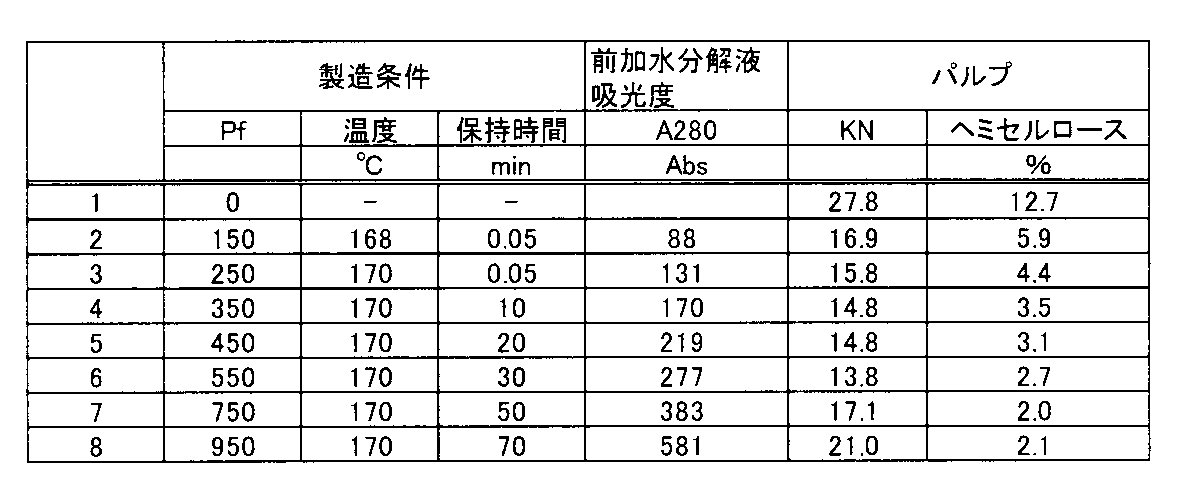
温度計を備えた回転型オートクレーブを用い、この木材チップ絶乾200gに液比3.2(L/kg)となるように水を加え、168~170℃まで昇温して前加水分解処理をバッチ式で行った。最高温度における保持時間(滞留時間)を0.05分間(3秒間)~70分間の範囲で変化させ、Pファクターが150~950の範囲で変化させた(サンプル2~8)。なお、以下の表において、サンプル1は前加水分解処理を行わずにクラフト蒸解によって得られたサンプルである。
前加水分解終了後、チップと前加水分解液とを300メッシュ濾布で分離し、前加水分解済のチップと前加水分解排液を得た。この前加水分解排液について、波長280nmにおける吸光度を紫外可視分光光度計(島津製作所製UV-1800)によって測定した。前加水分解排液の吸光度は、適宜希釈して測定した。
さらに、前加水分解済チップを、チップの15倍量の60℃温水で30秒間手もみ洗浄した。
続いて、再び回転型オートクレーブを用い、150℃、85分間、クラフト蒸解薬液の浸透を行った後、蒸解温度158℃で210分間、Hファクター(Hf)=1500でクラフト蒸解を行って、溶解クラフトパルプを得た。クラフト蒸解薬液は、活性アルカリ添加率(AA)16.5%で、活性アルカリ105g/L(Na2O換算値)、NaOH75.6g/L(Na2O換算値)、Na2S29.4g/L(Na2O換算値)、硫化度28%の組成で、木材チップと蒸解薬液との液比は3.2(L/kg)とした。
クラフト蒸解で得られた未漂白クラフト溶解パルプについて、カッパー価、ヘミセルロース含有量を下記の方法に従って測定した。
・カッパー価(KN):JIS P 8221に従って、測定した。
・ヘミセルロース量:NREL/TP510-42618に従い、測定した。 図1に、前加水分解排液の波長280nmにおける吸光度とPファクターとの関係を示す。図1から明らかなように、前加水分解排液の波長280nmの吸光度とPファクターとは、非常に高い相関を示し(R2=0.9761)、前加水分解排液の280nmの吸光度はPファクターと一次(線形)の関係だった。
・カッパー価(KN):JIS P 8221に従って、測定した。
・ヘミセルロース量:NREL/TP510-42618に従い、測定した。 図1に、前加水分解排液の波長280nmにおける吸光度とPファクターとの関係を示す。図1から明らかなように、前加水分解排液の波長280nmの吸光度とPファクターとは、非常に高い相関を示し(R2=0.9761)、前加水分解排液の280nmの吸光度はPファクターと一次(線形)の関係だった。
また、図2に、Pファクターと溶解クラフトパルプのヘミセルロース含有量との関係、図3に、前加水分解排液の波長280nmにおける吸光度と溶解クラフトパルプのヘミセルロース含有量との関係を示す。図2に示すように、前加水分解処理のPファクターが増大すると溶解クラフトパルプのヘミセルロース量が低下しており、前加水分解処理の程度を強くすることによって溶解クラフトパルプのヘミセルロース量が低下することが分かる。そして、図3から明らかなように、前加水分解排液の波長280nmにおける吸光度が大きくなると溶解クラフトパルプのヘミセルロース量が低下していた。この結果から、Pファクターと同様に、前加水分解排液の波長280nmにおける吸光度を用いて溶解クラフトパルプの品質(ヘミセルロース量)を予測できることが分かる。
さらに、図4に、Pファクターと溶解クラフトパルプのカッパー価との関係、図5に、前加水分解排液の波長280nmにおける吸光度と溶解クラフトパルプのカッパー価との関係を示す。図4、5から明らかなように、前加水分解排液の波長280nmの吸光度とパルプのカッパー価との関係は、Pファクターと溶解クラフトパルプのカッパー価との関係と同様であった。
ここで、図4から分かるように、Pファクターが増大すると、ある領域まではカッパー価が効率的に低下する。この傾向は、前加水分解排液の波長280nmにおける吸光度の場合でも同様であり(図5)、前加水分解排液の波長280nmにおける吸光度を特定の範囲にすると、得られる溶解クラフトパルプのカッパー価を効率的に低下させることができる。
したがって、従来、Pファクターを用いて、前加水分解処理や得られる溶解クラフトパルプの品質を予測・制御していたが、前加水分解排液の波長280nmにおける吸光度を用いて、前加水分解処理や溶解クラフトパルプの製造工程を管理・制御できることが分かった。

実験例2
原料である木材チップを、ラジアータパインの木材チップからカラマツの木材チップに変更した以外は、実験例1と同様にして実験した。 結果を、表2および図6~図8に示す。図6から明らかなように、原料である木材チップを変更しても、前加水分解排液の波長280nmにおける吸光度とPファクターとは非常に高い相関を示した(R2=0.9713)。
原料である木材チップを、ラジアータパインの木材チップからカラマツの木材チップに変更した以外は、実験例1と同様にして実験した。 結果を、表2および図6~図8に示す。図6から明らかなように、原料である木材チップを変更しても、前加水分解排液の波長280nmにおける吸光度とPファクターとは非常に高い相関を示した(R2=0.9713)。
実験例1と同様に、前加水分解排液の波長280nmにおける吸光度は、溶解クラフトパルプのカッパー価およびヘミセルロース量と相関することが示された(図7、8)。
また、実験例1と同様に、前加水分解排液の波長280nmにおける吸光度を指標とすると、カッパー価を効率よく低下させるには適切な範囲があることが判明した。
実験例3
図9に示す装置を用いて、実機レベルで溶解クラフトパルプを連続製造した。本実験で用いた装置は、前加水分解釜4(容量:356m3)とクラフト蒸解釜6(容量:860m3)を備える。
図9に示す装置を用いて、実機レベルで溶解クラフトパルプを連続製造した。本実験で用いた装置は、前加水分解釜4(容量:356m3)とクラフト蒸解釜6(容量:860m3)を備える。
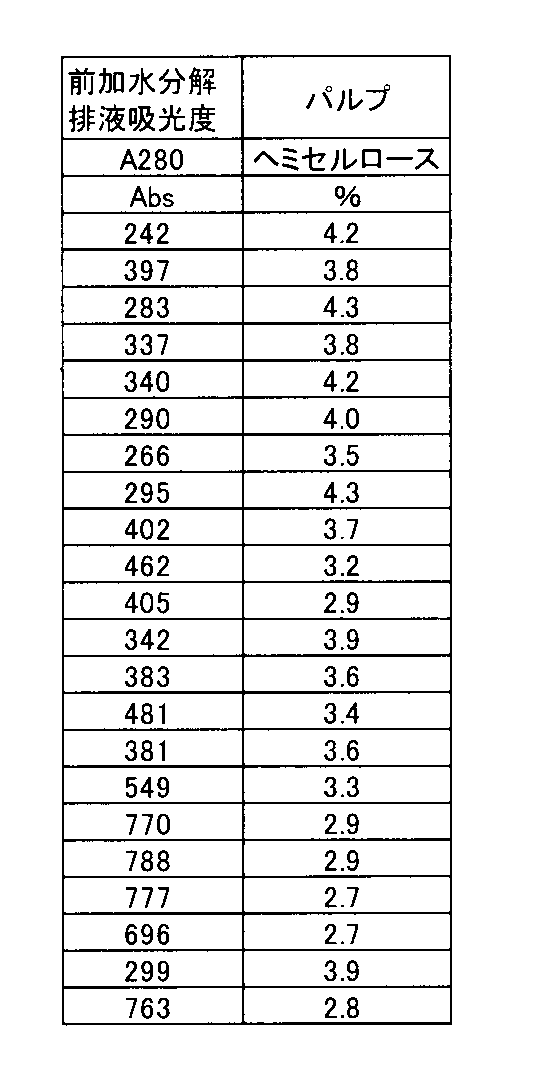
ラジアータパインの木材チップに液比1.8(L/kg)となるようにチップメータースクリュー2にて温水を加え、これを前加水分解釜4に連続的に投入して、前加水分解温度170℃にて加水分解処理を行った。この時、ストレーナー5より前加水分解排液を抽出した。抽出した前加水分解排液と希釈水の各々の送液量を、流量計を目安にしてポンプで制御し、1000倍に希釈し、希釈した液をポンプ(島津社製LC-20AD)で吸光光度検出器(島津社製SPD-10Ai)に送液し、波長280nmにおける吸光度A280を連続的に測定した。
続いて、前加水分解処理した木材チップをクラフト蒸解釜6に投入し、蒸解温度158℃にて210分間、Hファクター(Hf)=1500となるようにクラフト蒸解を行った。薬液は、活性アルカリ添加率(AA)16.5%で、活性アルカリ105g/L(Na2O換算値)、NaOH75.6g/L(Na2O換算値)、Na2S29.4g/L(Na2O換算値)、硫化度28%の組成で、木材チップと蒸解薬液との液比は3.2(L/kg)とした。
クラフト蒸解で得られた未漂白クラフト溶解パルプについて、ヘミセルロース含有量を測定した。結果を表3および図10にまとめるが、実機レベルの連続操業においても、前加水分解排液の波長280nmにおける吸光度と溶解クラフトパルプのヘミセルロース量とが相関することが示された。
実験例4
ラジアータパインの木材チップを、篩い分け器(ジャイロシフター)を使用して篩い分けし、サイズが9.5~25.4mmの木材チップを得た。
ラジアータパインの木材チップを、篩い分け器(ジャイロシフター)を使用して篩い分けし、サイズが9.5~25.4mmの木材チップを得た。
温度計を備えた回転型オートクレーブを用い、この木材チップ絶乾200gに液比3.2(L/kg)となるように水を加え、温度168~170℃で前加水分解処理をバッチ式で行った。前加水分解における滞留時間を0.05分間(3秒間)~70分間の範囲で変化させ、Pファクターが150~950の範囲で変化させた(サンプル2~8)。なお、以下の表において、サンプル1は前加水分解処理を行わずにクラフト蒸解によって得られたサンプルである。
前加水分解終了後、チップと前加水分解液とを300メッシュ濾布で分離し、前加水分解済のチップと前加水分解排液を得た。この前加水分解排液を孔径0.45μmのフィルターで濾過後、この濾液についてブリックス値をブリックス計(PAL-1、アタゴ社製)によって測定した。また、濾液の固形分濃度についても測定した。
さらに、前加水分解済チップを、チップの15倍量の60℃温水で30秒間手もみ洗浄した。
続いて、再び回転型オートクレーブを用い、150℃、85分間、クラフト蒸解薬液の浸透を行った後、蒸解温度158℃で210分間、Hファクター(Hf)=1500でクラフト蒸解を行って、溶解クラフトパルプを得た。クラフト蒸解薬液は、活性アルカリ添加率(AA)16.5%で、活性アルカリ105g/L(Na2O換算値)、NaOH75.6g/L(Na2O換算値)、Na2S29.4g/L(Na2O換算値)、硫化度28%の組成で、木材チップと蒸解薬液との液比は3.2(L/kg)とした。
クラフト蒸解で得られた未漂白クラフト溶解パルプについて、カッパー価、ヘミセルロース含有量を下記の方法に従って測定した。
・カッパー価(KN):JIS P 8221に従って、測定した。
・ヘミセルロース量:NREL/TP510-42618に従い、測定した。
・カッパー価(KN):JIS P 8221に従って、測定した。
・ヘミセルロース量:NREL/TP510-42618に従い、測定した。

図11に、前加水分解排液のブリックス値と固形分濃度との関係を示す。図11から明らかなように、前加水分解排液のブリックス値と固形分濃度とは、非常に高い相関を示し(R2=0.9487)、前加水分解排液のブリックス値は固形分濃度と一次(線形)の関係だった。
図12に、前加水分解排液のブリックス値とPファクターとの関係を示す。図12から明らかなように、前加水分解排液のブリックス値とPファクターとは相関を示し、特にPファクターが100~700(ブリックス値が2~6)の領域において高い相関を示した。
また、図13に、Pファクターと溶解クラフトパルプのヘミセルロース含有量との関係、図14に、前加水分解排液のブリックス値と溶解クラフトパルプのヘミセルロース含有量との関係を示す。図13に示すように、前加水分解処理のPファクターが増大すると溶解クラフトパルプのヘミセルロース量が低下しており、前加水分解処理の程度を強くすることによって溶解クラフトパルプのヘミセルロース量が低下することが分かる。そして、図14から明らかなように、前加水分解排液のブリックス値が大きくなると溶解クラフトパルプのヘミセルロース量が低下していた。この結果から、Pファクターと同様に、前加水分解排液のブリックス値を用いて溶解クラフトパルプの品質(ヘミセルロース量)を予測できることが分かる。
さらに、図15に、Pファクターと溶解クラフトパルプのカッパー価との関係、図16に、前加水分解排液のブリックス値と溶解クラフトパルプのカッパー価との関係を示す。図15、16から明らかなように、前加水分解排液のブリックス値とパルプのカッパー価との関係は、Pファクターと溶解クラフトパルプのカッパー価との関係と同様であった。
ここで、図15から分かるように、Pファクターが増大すると、ある領域まではカッパー価が効率的に低下する。この傾向は、前加水分解排液のブリックス値の場合でも同様であり(図16)、前加水分解排液のブリックス値を特定の範囲にすると、得られる溶解クラフトパルプのカッパー価を効率的に低下させることができる。
したがって、従来、Pファクターを用いて、前加水分解処理や得られる溶解クラフトパルプの品質を予測・制御していたが、前加水分解排液のブリックス値を用いて、前加水分解処理や溶解クラフトパルプの製造工程を制御できることが分かった。
実験例5
原料である木材チップを、ラジアータパインの木材チップからカラマツの木材チップに変更した以外は、実験例1と同様にして実験した。
原料である木材チップを、ラジアータパインの木材チップからカラマツの木材チップに変更した以外は、実験例1と同様にして実験した。

結果を、表5および図17~図19に示す。図17から明らかなように、原料である木材チップを変更しても、前加水分解排液のブリックス値とPファクターとは相関することが示された。
実験例4と同様に、前加水分解排液のブリックス値は、溶解クラフトパルプのカッパー価およびヘミセルロース量と相関することが示された(図18、19)。
また、実験例4と同様に、ブリックス値を指標とすると、カッパー価を効率よく低下させるには適切な範囲があることが判明した。
実験例6
実験例3と同様の装置を用いて、実機レベルで溶解クラフトパルプを連続製造した。
実験例3と同様の装置を用いて、実機レベルで溶解クラフトパルプを連続製造した。
ラジアータパインの木材チップに液比が1.8(L/kg)となるようにチップメータースクリュー2にて温水を加え、これを前加水分解釜4に連続的に投入し、前加水分解温度を変化させながら、加水分解処理を行った。
前加水分解釜のストレーナー5より前加水分解排液を抽出した。抽出した前加水分解排液と希釈水の各々の送液量を、流量計を目安にしてポンプで制御し、1000倍に希釈し、希釈した液をポンプ(島津社製LC-20AD)で吸光光度検出器(島津社製SPD-10Ai)に送液し、波長280nmにおける吸光度A280を連続的に測定した。
また、前加水分解排液のブリックス値をブリックス計(PAL-1、アタゴ社製)にて測定した。
続いて、前加水分解処理した木材チップを実験例3と同様にしてクラフト蒸解し、未漂白クラフト溶解パルプを得た。得られた未漂白クラフト溶解パルプについて、ヘミセルロース含有量を測定した。
表6および図20~22に結果を示す。前加水分解排液の波長280nmにおける吸光度とブリックス値の比(A280/ブリックス値)は、波長280nmにおける吸光度、ブリックス値の単独の値よりも、溶解クラフトパルプのヘミセルロース量との相関が高いことが示された(図20~22)。
1:チップビン;
2:チップメータースクリュー;
3:チップチューブ;
4:前加水分解釜;
5:ストレーナー;
6:クラフト蒸解釜;
7:前加水分解排液;
2:チップメータースクリュー;
3:チップチューブ;
4:前加水分解釜;
5:ストレーナー;
6:クラフト蒸解釜;
7:前加水分解排液;
Claims (11)
- (a)木材チップを水熱処理して木材チップに含まれるヘミセルロースを加水分解する工程、
(b)前加水分解処理後の木材チップと前加水分解排液とを分離し、回収する工程、
(c)回収した前加水分解排液の波長260~300nmにおける吸光度を測定する工程、
(d)回収した木材チップをクラフト蒸解して溶解クラフトパルプを得る工程、
を含む、溶解クラフトパルプを製造する方法。 - 回収した前加水分解排液のブリックス値を測定する工程をさらに含む、請求項1に記載の方法。
- 前加水分解排液の波長260~300nmにおける吸光度から、工程(a)における下記式1:
Pf=∫ln-1(40.48-15106/T)dt (式1)
[式中、Tは前加水分解排液の絶対温度を表す]
で示されるPファクター(Pf)を推定する工程をさらに含む、請求項1または2に記載の方法。 - 前加水分解排液の波長260~300nmにおける吸光度から、工程(c)で得られる溶解クラフトパルプのカッパー価および/またはヘミセルロース含量を推定する工程をさらに含む、請求項1~3のいずれかに記載の方法。
- 前加水分解排液の波長260~300nmにおける吸光度を指標として、工程(a)における前加水分解排液の温度および/または滞留時間を制御する、請求項1~4のいずれかに記載の方法。
- 前加水分解排液のブリックス値を指標として、工程(a)における前加水分解排液の温度および/または滞留時間を制御する、請求項1~5のいずれかに記載の方法。
- (前記吸光度)/(前記ブリックス値)の比を指標として、工程(a)における前加水分解排液の温度および/または滞留時間を制御する、請求項1~6のいずれかに記載の方法。
- 木材チップを水熱処理するための前加水分解釜と、
前加水分解釜より排出される前加水分解排液の波長260~300nmにおける吸光度を測定するための吸光度測定機と、
を備えた、溶解パルプを製造するための装置。 - 前加水分解釜で水熱処理された木材チップをクラフト蒸解するための蒸解釜をさらに備えた、請求項8に記載の装置。
- 前加水分解釜より排出される前加水分解排液のブリックス値を測定するための測定機をさらに備えた、請求項8または9に記載の装置。
- 測定した前記吸光度と前記ブリックス値から(吸光度)/(ブリックス値)の比を算出するための計算機をさらに備えた、請求項8~10のいずれかに記載の装置。
Priority Applications (2)
| Application Number | Priority Date | Filing Date | Title |
|---|---|---|---|
| CN201480049666.4A CN105518212B (zh) | 2013-09-11 | 2014-09-11 | 溶解牛皮纸浆的制造方法 |
| JP2015536614A JP6483021B2 (ja) | 2013-09-11 | 2014-09-11 | 溶解クラフトパルプの製造方法 |
Applications Claiming Priority (2)
| Application Number | Priority Date | Filing Date | Title |
|---|---|---|---|
| JP2013-188479 | 2013-09-11 | ||
| JP2013188479 | 2013-09-11 |
Publications (1)
| Publication Number | Publication Date |
|---|---|
| WO2015037647A1 true WO2015037647A1 (ja) | 2015-03-19 |
Family
ID=52665747
Family Applications (1)
| Application Number | Title | Priority Date | Filing Date |
|---|---|---|---|
| PCT/JP2014/074024 Ceased WO2015037647A1 (ja) | 2013-09-11 | 2014-09-11 | 溶解クラフトパルプの製造方法 |
Country Status (3)
| Country | Link |
|---|---|
| JP (1) | JP6483021B2 (ja) |
| CN (1) | CN105518212B (ja) |
| WO (1) | WO2015037647A1 (ja) |
Cited By (4)
| Publication number | Priority date | Publication date | Assignee | Title |
|---|---|---|---|---|
| JP2015067918A (ja) * | 2013-09-30 | 2015-04-13 | 日本製紙株式会社 | 溶解パルプの製造方法 |
| JP2018105860A (ja) * | 2016-12-19 | 2018-07-05 | バルメット オートメーション オイ | 媒体としての流体と媒体中に非溶解の粒子を持つ流動性材料を光学的に測定する装置および方法 |
| JP2022032825A (ja) * | 2020-08-14 | 2022-02-25 | 日本製紙株式会社 | ユーカリ属植物の生産方法 |
| WO2024252064A1 (en) * | 2023-06-09 | 2024-12-12 | Upm-Kymmene Corporation | Methods and arrangements for controlling pretreatment by optically monitoring steam condesate |
Citations (15)
| Publication number | Priority date | Publication date | Assignee | Title |
|---|---|---|---|---|
| JPS6128093A (ja) * | 1984-06-20 | 1986-02-07 | オ−ワイ・アドバンスド・フオレスト・オ−トメ−シヨン・エイビ− | 急速フルフラ−ル分析による亜硫酸塩パルプ化および加水分解プロセスのコントロ−ル方法 |
| JPS61119791A (ja) * | 1984-11-09 | 1986-06-06 | オーワイ・アドバンスド・フオレスト・オートメーシヨン・エイビー | 有機及び無機蒸解液成分を測定する迅速アナライザによりアルカリパルプ法を制御する方法 |
| JPS61239092A (ja) * | 1985-01-17 | 1986-10-24 | カジヤ−ニ エレクトロニクス リミテツド | アルカリ性パルプ化処理の制御方法 |
| CA1217651A (en) * | 1982-10-19 | 1987-02-10 | Nils-Erik Virkola | Method for rapid determination of the contents of lignin, monosaccharides and organic acids in the process solutions of sulfite pulping |
| US4889593A (en) * | 1983-12-30 | 1989-12-26 | Oy Advanced Forest Automation Ab | Method of determining rapidly the concentration of the total sulphur dioxide and the lignosulphonate present in sulphite pulping process liquors |
| JPH0693586A (ja) * | 1991-03-19 | 1994-04-05 | Sappi Ltd | リグノセルロース含有材料からパルプを製造するための方法 |
| JPH07508834A (ja) * | 1992-07-08 | 1995-09-28 | パルプ アンド ペーパー リサーチ インスチチュート オブ カナダ | 赤外スペクトル法によるクラフト溶液中の有効アルカリ量の測定とコントロール |
| JPH08503744A (ja) * | 1992-12-02 | 1996-04-23 | ホエスト―アルピン・インダストリーアンラーゲンバウ・ゲゼルシャフト・ミット・ベシュレンクテル・ハフツング | ビスコースパルプの製造方法 |
| JPH08134787A (ja) * | 1994-11-07 | 1996-05-28 | Nippon Paper Ind Co Ltd | クラフトパルプ収率の算定方法 |
| JP2007289961A (ja) * | 1999-06-23 | 2007-11-08 | Rm Materiais Refratarios Ltda | バイオマスの前加水分解装置及び方法 |
| JP2008057077A (ja) * | 2006-08-31 | 2008-03-13 | Kawasaki Kasei Chem Ltd | パルプ収率の変化量を測定する方法 |
| JP2012219416A (ja) * | 2011-04-13 | 2012-11-12 | Oji Paper Co Ltd | 溶解パルプの製造方法 |
| JP2013531139A (ja) * | 2010-05-04 | 2013-08-01 | バイーア スペシャルティ セルロース ソシエダッド アノニマ | 高アルファ溶解パルプの製造のための方法及びシステム |
| JP2013227705A (ja) * | 2012-04-27 | 2013-11-07 | Oji Holdings Corp | 溶解パルプの製造方法 |
| JP2014000020A (ja) * | 2012-06-15 | 2014-01-09 | Nippon Paper Industries Co Ltd | ヘミセルロースの糖化方法 |
Family Cites Families (3)
| Publication number | Priority date | Publication date | Assignee | Title |
|---|---|---|---|---|
| FI102301B1 (fi) * | 1994-10-13 | 1998-11-13 | Ahlstrom Machinery Oy | Menetelmä selluloosamassojen käsittelemiseksi |
| CN100485393C (zh) * | 2004-09-09 | 2009-05-06 | 华南理工大学 | 一种无污染的高纯度纤维素的分离分析方法 |
| RU2390760C2 (ru) * | 2005-03-04 | 2010-05-27 | ЭфПиИННОВЕЙШНЗ | Способ определения числа каппа целлюлозы с помощью спектрометрии в видимом и ближнем инфракрасном диапазоне |
-
2014
- 2014-09-11 JP JP2015536614A patent/JP6483021B2/ja active Active
- 2014-09-11 CN CN201480049666.4A patent/CN105518212B/zh not_active Expired - Fee Related
- 2014-09-11 WO PCT/JP2014/074024 patent/WO2015037647A1/ja not_active Ceased
Patent Citations (15)
| Publication number | Priority date | Publication date | Assignee | Title |
|---|---|---|---|---|
| CA1217651A (en) * | 1982-10-19 | 1987-02-10 | Nils-Erik Virkola | Method for rapid determination of the contents of lignin, monosaccharides and organic acids in the process solutions of sulfite pulping |
| US4889593A (en) * | 1983-12-30 | 1989-12-26 | Oy Advanced Forest Automation Ab | Method of determining rapidly the concentration of the total sulphur dioxide and the lignosulphonate present in sulphite pulping process liquors |
| JPS6128093A (ja) * | 1984-06-20 | 1986-02-07 | オ−ワイ・アドバンスド・フオレスト・オ−トメ−シヨン・エイビ− | 急速フルフラ−ル分析による亜硫酸塩パルプ化および加水分解プロセスのコントロ−ル方法 |
| JPS61119791A (ja) * | 1984-11-09 | 1986-06-06 | オーワイ・アドバンスド・フオレスト・オートメーシヨン・エイビー | 有機及び無機蒸解液成分を測定する迅速アナライザによりアルカリパルプ法を制御する方法 |
| JPS61239092A (ja) * | 1985-01-17 | 1986-10-24 | カジヤ−ニ エレクトロニクス リミテツド | アルカリ性パルプ化処理の制御方法 |
| JPH0693586A (ja) * | 1991-03-19 | 1994-04-05 | Sappi Ltd | リグノセルロース含有材料からパルプを製造するための方法 |
| JPH07508834A (ja) * | 1992-07-08 | 1995-09-28 | パルプ アンド ペーパー リサーチ インスチチュート オブ カナダ | 赤外スペクトル法によるクラフト溶液中の有効アルカリ量の測定とコントロール |
| JPH08503744A (ja) * | 1992-12-02 | 1996-04-23 | ホエスト―アルピン・インダストリーアンラーゲンバウ・ゲゼルシャフト・ミット・ベシュレンクテル・ハフツング | ビスコースパルプの製造方法 |
| JPH08134787A (ja) * | 1994-11-07 | 1996-05-28 | Nippon Paper Ind Co Ltd | クラフトパルプ収率の算定方法 |
| JP2007289961A (ja) * | 1999-06-23 | 2007-11-08 | Rm Materiais Refratarios Ltda | バイオマスの前加水分解装置及び方法 |
| JP2008057077A (ja) * | 2006-08-31 | 2008-03-13 | Kawasaki Kasei Chem Ltd | パルプ収率の変化量を測定する方法 |
| JP2013531139A (ja) * | 2010-05-04 | 2013-08-01 | バイーア スペシャルティ セルロース ソシエダッド アノニマ | 高アルファ溶解パルプの製造のための方法及びシステム |
| JP2012219416A (ja) * | 2011-04-13 | 2012-11-12 | Oji Paper Co Ltd | 溶解パルプの製造方法 |
| JP2013227705A (ja) * | 2012-04-27 | 2013-11-07 | Oji Holdings Corp | 溶解パルプの製造方法 |
| JP2014000020A (ja) * | 2012-06-15 | 2014-01-09 | Nippon Paper Industries Co Ltd | ヘミセルロースの糖化方法 |
Cited By (5)
| Publication number | Priority date | Publication date | Assignee | Title |
|---|---|---|---|---|
| JP2015067918A (ja) * | 2013-09-30 | 2015-04-13 | 日本製紙株式会社 | 溶解パルプの製造方法 |
| JP2018105860A (ja) * | 2016-12-19 | 2018-07-05 | バルメット オートメーション オイ | 媒体としての流体と媒体中に非溶解の粒子を持つ流動性材料を光学的に測定する装置および方法 |
| JP2022032825A (ja) * | 2020-08-14 | 2022-02-25 | 日本製紙株式会社 | ユーカリ属植物の生産方法 |
| JP7403413B2 (ja) | 2020-08-14 | 2023-12-22 | 日本製紙株式会社 | ユーカリ属植物の生産方法 |
| WO2024252064A1 (en) * | 2023-06-09 | 2024-12-12 | Upm-Kymmene Corporation | Methods and arrangements for controlling pretreatment by optically monitoring steam condesate |
Also Published As
| Publication number | Publication date |
|---|---|
| CN105518212B (zh) | 2018-09-04 |
| JPWO2015037647A1 (ja) | 2017-03-02 |
| JP6483021B2 (ja) | 2019-03-13 |
| CN105518212A (zh) | 2016-04-20 |
Similar Documents
| Publication | Publication Date | Title |
|---|---|---|
| JP5953909B2 (ja) | 溶解パルプの製造方法 | |
| JP5712754B2 (ja) | 溶解パルプの製造方法 | |
| JP6483021B2 (ja) | 溶解クラフトパルプの製造方法 | |
| RU2753923C2 (ru) | Способ получения растворимой целлюлозы и растворимая целлюлоза, полученная таким способом (варианты) | |
| JPH11241285A (ja) | 前清浄化されたパルプの製造方法 | |
| JP6305715B2 (ja) | 溶解パルプの製造方法 | |
| JP6346400B2 (ja) | 溶解パルプ | |
| JP6196022B2 (ja) | 溶解クラフトパルプの製造方法 | |
| JP6197717B2 (ja) | 溶解パルプの製造方法 | |
| JP2015200056A (ja) | 溶解クラフトパルプを連続製造する方法 | |
| JP6187619B2 (ja) | 溶解パルプの製造方法 | |
| JP6522274B2 (ja) | 溶解クラフトパルプの製造方法。 | |
| JP6358771B2 (ja) | 溶解クラフトパルプの製造方法 | |
| JP2017106160A (ja) | 溶解クラフトパルプの製造方法 | |
| JP6208417B2 (ja) | 溶解パルプ | |
| JP2008308812A (ja) | ソーダおよびアントラキノンを用いた蒸解に続くリグノセルロースパルプの漂白プロセスおよびシステム | |
| JP6518287B2 (ja) | 溶解クラフトパルプの製造方法 | |
| JP6221218B2 (ja) | 溶解クラフトパルプの製造方法 | |
| JP2015030949A (ja) | 溶解クラフトパルプの製造方法 | |
| JP6334083B2 (ja) | 溶解パルプ | |
| JP2014074251A (ja) | 溶解クラフトパルプの製造方法 | |
| JP2020165059A (ja) | 溶解パルプシート | |
| JP2020165061A (ja) | 溶解パルプシート | |
| Chen et al. | Pre-extraction of Hemicelluloses from Poplar Chips and its Effect on Kraft Pulping | |
| JP2014034744A (ja) | 溶解クラフトパルプの製造方法 |
Legal Events
| Date | Code | Title | Description |
|---|---|---|---|
| 121 | Ep: the epo has been informed by wipo that ep was designated in this application |
Ref document number: 14843703 Country of ref document: EP Kind code of ref document: A1 |
|
| ENP | Entry into the national phase |
Ref document number: 2015536614 Country of ref document: JP Kind code of ref document: A |
|
| NENP | Non-entry into the national phase |
Ref country code: DE |
|
| 122 | Ep: pct application non-entry in european phase |
Ref document number: 14843703 Country of ref document: EP Kind code of ref document: A1 |