WO2015033960A1 - 半導体リソグラフィー用共重合体、レジスト組成物、及び、基板の製造方法 - Google Patents
半導体リソグラフィー用共重合体、レジスト組成物、及び、基板の製造方法 Download PDFInfo
- Publication number
- WO2015033960A1 WO2015033960A1 PCT/JP2014/073197 JP2014073197W WO2015033960A1 WO 2015033960 A1 WO2015033960 A1 WO 2015033960A1 JP 2014073197 W JP2014073197 W JP 2014073197W WO 2015033960 A1 WO2015033960 A1 WO 2015033960A1
- Authority
- WO
- WIPO (PCT)
- Prior art keywords
- copolymer
- solution
- group
- composition
- monomer
- Prior art date
- Legal status (The legal status is an assumption and is not a legal conclusion. Google has not performed a legal analysis and makes no representation as to the accuracy of the status listed.)
- Ceased
Links
- 0 CCC(CC1C2)C(C3)*1(C)C2(**)CC3=C Chemical compound CCC(CC1C2)C(C3)*1(C)C2(**)CC3=C 0.000 description 2
Images


Classifications
-
- C—CHEMISTRY; METALLURGY
- C08—ORGANIC MACROMOLECULAR COMPOUNDS; THEIR PREPARATION OR CHEMICAL WORKING-UP; COMPOSITIONS BASED THEREON
- C08F—MACROMOLECULAR COMPOUNDS OBTAINED BY REACTIONS ONLY INVOLVING CARBON-TO-CARBON UNSATURATED BONDS
- C08F220/00—Copolymers of compounds having one or more unsaturated aliphatic radicals, each having only one carbon-to-carbon double bond, and only one being terminated by only one carboxyl radical or a salt, anhydride ester, amide, imide or nitrile thereof
- C08F220/02—Monocarboxylic acids having less than ten carbon atoms; Derivatives thereof
- C08F220/10—Esters
- C08F220/12—Esters of monohydric alcohols or phenols
- C08F220/16—Esters of monohydric alcohols or phenols of phenols or of alcohols containing two or more carbon atoms
- C08F220/18—Esters of monohydric alcohols or phenols of phenols or of alcohols containing two or more carbon atoms with acrylic or methacrylic acids
- C08F220/1808—C8-(meth)acrylate, e.g. isooctyl (meth)acrylate or 2-ethylhexyl (meth)acrylate
-
- C—CHEMISTRY; METALLURGY
- C08—ORGANIC MACROMOLECULAR COMPOUNDS; THEIR PREPARATION OR CHEMICAL WORKING-UP; COMPOSITIONS BASED THEREON
- C08F—MACROMOLECULAR COMPOUNDS OBTAINED BY REACTIONS ONLY INVOLVING CARBON-TO-CARBON UNSATURATED BONDS
- C08F2/00—Processes of polymerisation
-
- C—CHEMISTRY; METALLURGY
- C08—ORGANIC MACROMOLECULAR COMPOUNDS; THEIR PREPARATION OR CHEMICAL WORKING-UP; COMPOSITIONS BASED THEREON
- C08F—MACROMOLECULAR COMPOUNDS OBTAINED BY REACTIONS ONLY INVOLVING CARBON-TO-CARBON UNSATURATED BONDS
- C08F2/00—Processes of polymerisation
- C08F2/04—Polymerisation in solution
- C08F2/06—Organic solvent
-
- C—CHEMISTRY; METALLURGY
- C08—ORGANIC MACROMOLECULAR COMPOUNDS; THEIR PREPARATION OR CHEMICAL WORKING-UP; COMPOSITIONS BASED THEREON
- C08F—MACROMOLECULAR COMPOUNDS OBTAINED BY REACTIONS ONLY INVOLVING CARBON-TO-CARBON UNSATURATED BONDS
- C08F220/00—Copolymers of compounds having one or more unsaturated aliphatic radicals, each having only one carbon-to-carbon double bond, and only one being terminated by only one carboxyl radical or a salt, anhydride ester, amide, imide or nitrile thereof
- C08F220/62—Monocarboxylic acids having ten or more carbon atoms; Derivatives thereof
- C08F220/68—Esters
-
- G—PHYSICS
- G03—PHOTOGRAPHY; CINEMATOGRAPHY; ANALOGOUS TECHNIQUES USING WAVES OTHER THAN OPTICAL WAVES; ELECTROGRAPHY; HOLOGRAPHY
- G03F—PHOTOMECHANICAL PRODUCTION OF TEXTURED OR PATTERNED SURFACES, e.g. FOR PRINTING, FOR PROCESSING OF SEMICONDUCTOR DEVICES; MATERIALS THEREFOR; ORIGINALS THEREFOR; APPARATUS SPECIALLY ADAPTED THEREFOR
- G03F7/00—Photomechanical, e.g. photolithographic, production of textured or patterned surfaces, e.g. printing surfaces; Materials therefor, e.g. comprising photoresists; Apparatus specially adapted therefor
- G03F7/004—Photosensitive materials
- G03F7/0048—Photosensitive materials characterised by the solvents or agents facilitating spreading, e.g. tensio-active agents
-
- G—PHYSICS
- G03—PHOTOGRAPHY; CINEMATOGRAPHY; ANALOGOUS TECHNIQUES USING WAVES OTHER THAN OPTICAL WAVES; ELECTROGRAPHY; HOLOGRAPHY
- G03F—PHOTOMECHANICAL PRODUCTION OF TEXTURED OR PATTERNED SURFACES, e.g. FOR PRINTING, FOR PROCESSING OF SEMICONDUCTOR DEVICES; MATERIALS THEREFOR; ORIGINALS THEREFOR; APPARATUS SPECIALLY ADAPTED THEREFOR
- G03F7/00—Photomechanical, e.g. photolithographic, production of textured or patterned surfaces, e.g. printing surfaces; Materials therefor, e.g. comprising photoresists; Apparatus specially adapted therefor
- G03F7/004—Photosensitive materials
- G03F7/038—Macromolecular compounds which are rendered insoluble or differentially wettable
- G03F7/0382—Macromolecular compounds which are rendered insoluble or differentially wettable the macromolecular compound being present in a chemically amplified negative photoresist composition
-
- G—PHYSICS
- G03—PHOTOGRAPHY; CINEMATOGRAPHY; ANALOGOUS TECHNIQUES USING WAVES OTHER THAN OPTICAL WAVES; ELECTROGRAPHY; HOLOGRAPHY
- G03F—PHOTOMECHANICAL PRODUCTION OF TEXTURED OR PATTERNED SURFACES, e.g. FOR PRINTING, FOR PROCESSING OF SEMICONDUCTOR DEVICES; MATERIALS THEREFOR; ORIGINALS THEREFOR; APPARATUS SPECIALLY ADAPTED THEREFOR
- G03F7/00—Photomechanical, e.g. photolithographic, production of textured or patterned surfaces, e.g. printing surfaces; Materials therefor, e.g. comprising photoresists; Apparatus specially adapted therefor
- G03F7/004—Photosensitive materials
- G03F7/039—Macromolecular compounds which are photodegradable, e.g. positive electron resists
- G03F7/0392—Macromolecular compounds which are photodegradable, e.g. positive electron resists the macromolecular compound being present in a chemically amplified positive photoresist composition
- G03F7/0397—Macromolecular compounds which are photodegradable, e.g. positive electron resists the macromolecular compound being present in a chemically amplified positive photoresist composition the macromolecular compound having an alicyclic moiety in a side chain
-
- G—PHYSICS
- G03—PHOTOGRAPHY; CINEMATOGRAPHY; ANALOGOUS TECHNIQUES USING WAVES OTHER THAN OPTICAL WAVES; ELECTROGRAPHY; HOLOGRAPHY
- G03F—PHOTOMECHANICAL PRODUCTION OF TEXTURED OR PATTERNED SURFACES, e.g. FOR PRINTING, FOR PROCESSING OF SEMICONDUCTOR DEVICES; MATERIALS THEREFOR; ORIGINALS THEREFOR; APPARATUS SPECIALLY ADAPTED THEREFOR
- G03F7/00—Photomechanical, e.g. photolithographic, production of textured or patterned surfaces, e.g. printing surfaces; Materials therefor, e.g. comprising photoresists; Apparatus specially adapted therefor
- G03F7/16—Coating processes; Apparatus therefor
-
- G—PHYSICS
- G03—PHOTOGRAPHY; CINEMATOGRAPHY; ANALOGOUS TECHNIQUES USING WAVES OTHER THAN OPTICAL WAVES; ELECTROGRAPHY; HOLOGRAPHY
- G03F—PHOTOMECHANICAL PRODUCTION OF TEXTURED OR PATTERNED SURFACES, e.g. FOR PRINTING, FOR PROCESSING OF SEMICONDUCTOR DEVICES; MATERIALS THEREFOR; ORIGINALS THEREFOR; APPARATUS SPECIALLY ADAPTED THEREFOR
- G03F7/00—Photomechanical, e.g. photolithographic, production of textured or patterned surfaces, e.g. printing surfaces; Materials therefor, e.g. comprising photoresists; Apparatus specially adapted therefor
- G03F7/20—Exposure; Apparatus therefor
-
- G—PHYSICS
- G03—PHOTOGRAPHY; CINEMATOGRAPHY; ANALOGOUS TECHNIQUES USING WAVES OTHER THAN OPTICAL WAVES; ELECTROGRAPHY; HOLOGRAPHY
- G03F—PHOTOMECHANICAL PRODUCTION OF TEXTURED OR PATTERNED SURFACES, e.g. FOR PRINTING, FOR PROCESSING OF SEMICONDUCTOR DEVICES; MATERIALS THEREFOR; ORIGINALS THEREFOR; APPARATUS SPECIALLY ADAPTED THEREFOR
- G03F7/00—Photomechanical, e.g. photolithographic, production of textured or patterned surfaces, e.g. printing surfaces; Materials therefor, e.g. comprising photoresists; Apparatus specially adapted therefor
- G03F7/26—Processing photosensitive materials; Apparatus therefor
- G03F7/30—Imagewise removal using liquid means
- G03F7/32—Liquid compositions therefor, e.g. developers
Definitions
- the present invention relates to a copolymer for semiconductor lithography, a resist composition using the copolymer for semiconductor lithography, and a method for producing a substrate on which a pattern is formed using the resist composition.
- Patent Document 1 describes a copolymer for resist using (meth) acrylic acid ester as a monomer.
- a copolymer of (meth) acrylic acid ester is generally polymerized by a radical polymerization method.
- a radical polymerization method since the copolymerization reactivity ratio between the monomers is different, the monomer unit in the copolymer to be produced is early and late in the polymerization. And the resulting copolymer has a composition distribution.
- the solubility in the solvent tends to be non-uniform, and it will precipitate when stored at a low temperature, or when the resist composition is prepared.
- preparation of the resist composition is hindered, for example, it takes a long time to dissolve or the number of manufacturing steps increases due to the generation of insoluble matter.
- the sensitivity of the resulting resist composition tends to be insufficient.
- Patent Document 2 has a supply step of supplying a monomer solution and a solution containing a polymerization initiator into a polymerization reaction system in order to obtain a highly sensitive resist. Describes a method for producing a copolymer for a photoresist in which the variation in the composition of unreacted monomers present in the polymerization reaction system is small until the supply of is completed.
- Patent Document 3 among monomers used for the production of a resist copolymer, a part of a monomer having an acid-eliminable group is supplied in advance into a reaction vessel, and the acid-elimination is here. A method is described in which the remainder of the monomer having a functional group and a mixture of other monomers are dropped and polymerized. In the drop polymerization method, a copolymer having a high molecular weight is formed at the beginning of the polymerization reaction, and then a low molecular weight copolymer is formed as the polymerization reaction proceeds. Therefore, only an acid-eliminable group exists in the reaction vessel in advance. By doing so, a copolymer in which low-polar acid-eliminable groups are biased and contained on the high molecular weight side produced in the initial stage of polymerization is obtained.
- Patent Documents 2 and 3 may not sufficiently improve the solubility of the copolymer for lithography or the sensitivity of the resist composition. More specifically, for the purpose of preventing the copolymer solution from being modified, the copolymer solution is often stored in a place where the temperature is lower than room temperature. In many cases, improvement in solubility is not expected. Further, according to the knowledge of the present inventors, the copolymer obtained by the method described in Patent Document 3 has extremely poor solubility in a highly polar solvent.
- the present invention has been made in view of the above circumstances, a lithography copolymer having good low-temperature solubility, a resist composition using the lithography copolymer, and a pattern using the resist composition. It aims at providing the method of manufacturing the formed board
- the present invention also uses a copolymer for lithography that has good solubility in a solvent and can improve sensitivity when used in a resist composition, a method for producing the copolymer, and the copolymer for lithography. It is an object of the present invention to provide a resist composition and a method for producing a substrate on which a pattern is formed using the resist composition.
- One aspect of the present invention relates to the following [1 ′] to [3 ′].
- the turbidity Th (80) of a 20 wt% PGMEA solution of a copolymer for lithography measured under the following conditions (1 ′) to (8 ′) is 4.6 NTU or less, and turbidity Lithographic copolymer having a degree Tm (80) of 3.8 NTU or less.
- (1 ′) A 20 wt% PGMEA solution of a lithography copolymer is prepared.
- the n-heptane addition amount (X) h is determined such that the turbidity when n-heptane is added to the PGMEA solution is 10 NTU.
- a pattern comprising a step of applying the resist composition according to [2 ′] onto a substrate to be processed, a step of exposing with light having a wavelength of 250 nm or less, and a step of developing using a developer.
- [1 ′′] A lithography copolymer obtained by polymerizing at least one monomer containing an acid leaving group and at least one monomer not containing an acid leaving group, Among the five fractions obtained by dividing the eluent showing the peak of the copolymer in the elution curve obtained by gel permeation chromatography (GPC) so that the volumes are equal in the order of elution,
- the ratio of monomer units containing acid-leaving groups out of all monomer units constituting the copolymer contained in the first fraction eluted first is N (v 1 ) mol%
- the ratio of monomer units containing acid-leaving groups out of all monomer units constituting the copolymer contained in the fractions eluted in the second to fourth fractions is N (v 2 ) mol%, respectively.
- N (v 1 ) / N ave is 1.01 to 1.09
- the turbidity Th (80) of a 20 wt% PGMEA solution of the copolymer for lithography measured under the following conditions is 4.7 NTU or less and the turbidity Tm (80) is 3.9 or less Copolymer.
- Measurement conditions for turbidity Th (80) (1 ′′) A 20 wt% PGMEA solution of a copolymer for lithography is prepared. (2 ′′) The n-heptane addition amount (X) h is determined such that the turbidity when n-heptane is added to the PGMEA solution is 10 NTU. (3 ′′) n-heptane in an amount of 80% of the amount of n-heptane added determined in the above (2 ′′) is added to a 20 wt% PGMEA solution of a lithographic copolymer and adjusted to 25 ° C. for 4 hours. Stir.
- a substrate on which a pattern is formed which includes a step of applying the resist composition onto a substrate to be processed, a step of exposing with light having a wavelength of 250 nm or less, and a step of developing using a developer. Production method.
- Turbidity Th (80) is 1.0 or more and 4.6 NTU or less, A lithographic copolymer having a turbidity Tm (80) of 1.0 or more and 3.8 NTU or less, The turbidity Th (80) is 10 NTU when n-heptane is added to the PGMEA solution in which the content of the lithographic copolymer is 20 wt% with respect to the total mass of the PGMEA solution.
- the amount of n-heptane added is (X) h, and the turbidity of the PGMEA solution when 80% of this (X) h n-heptane is added to the PGMEA solution;
- the turbidity Tm is the amount of methanol added so that the turbidity is 5.0 NTU when methanol is added to the PGMEA solution in which the content of the lithographic copolymer is 20 wt% with respect to the total mass of the PGMEA solution.
- (X) m is the turbidity of the PGMEA solution when 80% of this (X) m amount of methanol is added to the PGMEA solution.
- a lithography copolymer obtained by polymerizing a monomer containing at least one acid-leaving group and a monomer not containing at least one acid-leaving group has an N (v1) / Nave of 1.01 to 1.09, a turbidity Th (80) of 1.0 or more and 4.7 NTU or less, and a turbidity Tm (80 ) Is 1.0 or more and 3.9 NTU or less;
- the N (v1) / Nave is divided so that the volume of the eluent showing the peak of the copolymer in the elution curve obtained by gel permeation chromatography (GPC) is equal in the order of elution.
- the ratio of the number of moles of the structural unit containing an acid leaving group to the total number of moles of the structural unit constituting the copolymer contained in the first fraction eluted first is N (V 1 ) mol%
- the ratio of the number of moles of the structural unit containing an acid leaving group to the total number of moles of the structural unit constituting the copolymer contained in all of the five fractions is N ave mole%.
- the turbidity Th (80) is 10 NTU when n-heptane is added to the PGMEA solution in which the content of the lithographic copolymer is 20 wt% with respect to the total mass of the PGMEA solution.
- the amount of n-heptane added is (X) h, and the turbidity of the PGMEA solution when 80% of this (X) h n-heptane is added to the PGMEA solution;
- the turbidity Tm is the amount of methanol added so that the turbidity is 5.0 NTU when methanol is added to the PGMEA solution in which the content of the lithographic copolymer is 20 wt% with respect to the total mass of the PGMEA solution.
- (X) m is the turbidity of the PGMEA solution when 80% of this (X) m amount of methanol is added to the PGMEA solution.
- the structural unit having an acid leaving group is at least one structural unit selected from the group consisting of structural units represented by the following formulas (i) to (iv): [2] to [4]
- the copolymer for lithography as described in any one.
- R 31 , R 32 , R 33 and R 34 each independently represents a hydrogen atom or a methyl group
- R 1 , R 4 and R 5 each independently represents an alkyl having 1 to 5 carbon atoms.
- R 2 and R 3 each independently represents an alkyl group having 1 to 3 carbon atoms
- X 1 , X 2 , X 3 and X 4 each independently represent an alkyl group having 1 to 6 carbon atoms
- N1, n2, n3 and n4 each independently represents an integer of 0 to 4
- n1, n2, n3 or n4 is 2 or more, X 1 , X 2 , X in one structural unit 3 or X 4 there are a plurality, the plurality of X 1, X 2, X 3 and X 4 may be different may be the same as each other
- each R 331, R 332, R 333 and R 334 are independently represents a hydrogen atom or an alkyl group having 1 to 6 carbon atoms and
- Z 1 and Z 2 independently represents —O—, —S—, —NH— or an alkylene group having 1 to 6 carbon atoms
- q represents 0 or 1
- r represents an integer of 0 to 2.
- [7] Further includes a structural unit having at least one group selected from the group consisting of a group represented by —C (CF 3 ) 2 —OH, a hydroxy group, a cyano group, a methoxy group, a carboxy group, and an amino group.
- the copolymer for lithography according to any one of [2] to [6].
- a resist composition comprising the lithography copolymer according to any one of [1] to [7] and a compound that generates an acid upon irradiation with actinic rays or radiation.
- a pattern is formed, which includes a step of applying the resist composition according to [8] onto a substrate to be processed, a step of exposing with light having a wavelength of 250 nm or less, and a step of developing using a developer. Method of manufacturing a manufactured substrate.
- the lithographic copolymer of the present invention is excellent in solubility in a solvent, particularly in a solvent at a low temperature (low temperature solubility), and is dissolved in a developer when used in a resist composition. Property is uniform and high sensitivity is obtained.
- the resist composition obtained by the production method of the present invention is a chemically amplified type, has excellent solubility in a resist solvent, and is excellent in sensitivity. Moreover, the resist composition obtained by the production method of the present invention is excellent in solubility in a resist solvent at a low temperature. According to the substrate manufacturing method of the present invention, a highly accurate fine resist pattern can be stably formed.
- (meth) acrylate means acrylate or methacrylate
- (meth) acrylic acid means acrylic acid or methacrylic acid
- (meth) acryloyloxy means acryloyloxy or methacryloyl. Means oxy.
- low temperature means “temperature of ⁇ 20 ° C. or more and less than 25 ° C.”.
- PGMEA propylene glycol monomethyl ether acetate.
- dissolving means that fine particles are uniformly dispersed in a liquid and do not settle.
- “Solution” means a liquid in which fine particles are uniformly dispersed and not settled, and is visually transparent.
- the “weight average molecular weight (Mw)” and “molecular weight distribution (Mw / Mn)” of the copolymer in the present invention mean values determined in terms of polystyrene by gel permeation chromatography (GPC).
- the copolymer for lithography which is one embodiment of the present invention has a turbidity Th (80) of 1.0 or more and 4.6 NTU or less, and a turbidity Tm (80) of 1.0 or more, 3 It is a copolymer for lithography that is .8 NTU or less.
- the turbidity Th (80) is 10 NTU when n-heptane is added to the PGMEA solution in which the content of the lithographic copolymer is 20 wt% with respect to the total mass of the PGMEA solution.
- the amount of n-heptane added is (X) h, and the turbidity of the PGMEA solution when n-heptane in an amount 80% of (X) h is added to the PGMEA solution.
- the turbidity Tm is the amount of methanol added so that the turbidity is 5.0 NTU when methanol is added to the PGMEA solution in which the content of the lithographic copolymer is 20 wt% with respect to the total mass of the PGMEA solution.
- (X) m is the turbidity of the PGMEA solution when 80% of this (X) m amount of methanol is added to the PGMEA solution.
- the turbidity can be measured under the following conditions (1) to (8).
- “NTU” is an abbreviation for Nephelometric Turbidity Unit, which means a turbidity unit using formazine as a turbidity standard solution.
- the PGMEA solution is prepared such that the content of the copolymer for lithography is 20 wt% with respect to the total mass of the PGMEA solution.
- the PGMEA solution can be adjusted by adding the lithography copolymer to the PGMEA solution and, for example, stirring the solution at 25 ° C. and a rotation speed of 60 rpm for 2 hours.
- n-heptane addition amount (X) h (mass%, addition amount of n-heptane to the total mass of the PGMEA solution) when the turbidity when n-heptane is added to the PGMEA solution is 10 NTU
- (3) Add 80% of the n-heptane addition amount (X) h determined in (2) above to the PGMEA solution prepared in (1) above, and adjust the solution to 25 ° C. And stirred for 4 hours at a rotational speed of 60 rpm.
- the solution temperature of the solution obtained in (3) above is adjusted to 25 ° C., the turbidity of the solution is measured, and the obtained value is defined as turbidity Th (80).
- the turbidity can be measured using, for example, a turbidimeter (TB200 manufactured by Orbeco-Hellige).
- a turbidimeter TB200 manufactured by Orbeco-Hellige.
- the PGMEA solution in which the content of the copolymer for lithography is 20 wt% with respect to the total mass of the PGMEA solution is prepared.
- the PGMEA solution can be adjusted by adding the lithographic copolymer to the PGMEA solution and stirring the solution at 25 ° C. and 60 rpm for 2 hours.
- (6) Determine the methanol addition amount (X) m (mass%, addition amount of n-heptane to the total mass of the PGMEA solution) when the turbidity when methanol is added to the PGMEA solution is 5.0 NTU To do.
- turbidity Tm 80
- the turbidity can be measured using, for example, a turbidimeter (TB200 manufactured by Orbeco-Hellige). Lithographic copolymers that satisfy the above conditions have good low-temperature solubility in solvents.
- the lithography copolymer that is an embodiment of the present invention is not particularly limited as long as it is a copolymer used in a lithography process.
- a positive or negative resist copolymer used for forming a positive or negative resist film an antireflection film (TARC) formed on the upper layer of the resist film, or a lower layer of the resist film Copolymer for antireflection film used for forming antireflection film (BARC); Copolymer for gapfill film used for forming gapfill film; Copolymer for topcoat film used for forming topcoat film Is mentioned.
- Examples of the resist copolymer include a copolymer containing at least one structural unit having an acid-eliminable group and at least one structural unit having a polar group.
- the antireflection film copolymer examples include: a structural unit having a light-absorbing group; and a structural unit having a reactive functional group that can be cured by reacting with a curing agent or the like in order to avoid mixing with the resist film;
- the copolymer containing is mentioned.
- the “light-absorbing group” is a group having high absorption performance with respect to light in a wavelength region in which the photosensitive component in the resist composition is sensitive.
- anthracene ring naphthalene ring
- a group having a ring structure such as a benzene ring, a quinoline ring, a quinoxaline ring, and a thiazole ring.
- KrF laser light is used as irradiation light
- an unsubstituted anthracene ring or an anthracene ring having an arbitrary substituent is preferable
- ArF laser light an unsubstituted benzene ring or an arbitrary A benzene ring having the following substituents is preferred.
- the optional substituent examples include a phenolic hydroxyl group, an alcoholic hydroxyl group, a carboxy group, a carbonyl group, an ester group, an amino group, and an amide group.
- a substituent having a protected or unprotected phenolic hydroxyl group is preferable from the viewpoint of good developability and high resolution.
- the structural unit / monomer having a light absorbing group examples include benzyl (meth) acrylate and p-hydroxyphenyl (meth) acrylate.
- Specific examples of the reactive functional group that can be cured by reacting with a curing agent include an amino group, an amide group, a hydroxyl group, and an epoxy group. Examples thereof include 2-hydroxyethyl (meth) acrylate and 2-hydroxy-n-propyl (meth) acrylate.
- a gap fill film copolymer As an example of a gap fill film copolymer, it has a suitable viscosity for flowing into a narrow gap, and reacts with a curing agent or the like in order to avoid mixing with a resist film or an antireflective film.
- a copolymer containing a structural unit having a functional group is exemplified. Specifically, a copolymer of hydroxystyrene and a monomer of styrene, alkyl (meth) acrylate, hydroxyalkyl (meth) acrylate, or the like is used. Can be mentioned.
- Examples of the copolymer for the topcoat film used for immersion lithography include a copolymer containing a structural unit having a carboxyl group, a copolymer containing a structural unit having a fluorine-containing group substituted with a hydroxyl group, and the like. .
- ⁇ Copolymer for resist> ⁇ Copolymer for resist>
- a resist copolymer hereinafter sometimes simply referred to as a copolymer
- the resist copolymer is not particularly limited as long as it is a copolymer used for forming a resist film.
- a resist copolymer containing at least one structural unit having an acid leaving group and at least one structural unit having a polar group is preferable.
- the resist copolymer can be obtained by polymerizing a monomer mixture comprising at least one monomer having an acid-eliminable group and at least one monomer having a polar group.
- the “acid leaving group” is a group having a bond that is cleaved by an acid, and a part or all of the acid leaving group is removed from the main chain of the copolymer by cleavage of the bond. .
- a copolymer containing a structural unit having an acid-eliminable group is soluble in an alkali solution by an acid, and has an effect of enabling formation of a resist pattern.
- the content of the structural unit having an acid leaving group is preferably 20 mol% or more, more preferably 25 mol% or more, based on the total number of moles of the structural units constituting the copolymer, from the viewpoint of sensitivity and resolution. preferable. Further, from the viewpoint of adhesion to a substrate or the like, 60 mol% or less is preferable, 55 mol% or less is more preferable, and 50 mol% or less is more preferable with respect to the total number of moles of the constituent units constituting the copolymer. .
- the content of the structural unit having an acid leaving group is preferably 20 mol% or more and 60 mol% or less, preferably 25 mol% or more, 60 mol% or less with respect to the total number of moles of the structural units constituting the copolymer.
- the mol% or less is more preferable, 25 mol% or more and 55 mol% or less is particularly preferable, and 25 mol% or more and 50 mol% or less is most preferable.
- the weight average molecular weight (Mw) of the resist copolymer is preferably 1,000 to 100,000, and more preferably 3,000 to 30,000.
- the molecular weight distribution (Mw / Mn) is preferably from 1.0 to 3.0, more preferably from 1.1 to 2.5, still more preferably from 1.1 to 1.7.
- the monomer having an acid leaving group may be a compound having an acid leaving group and a polymerizable multiple bond, and known monomers can be used.
- the polymerizable multiple bond is a multiple bond that is cleaved during the polymerization reaction to form a copolymer chain, and an ethylenic double bond is preferable.
- the monomer having an acid leaving group examples include (meth) acrylic acid esters having an alicyclic hydrocarbon group having 6 to 20 carbon atoms and having an acid leaving group. It is done.
- the alicyclic hydrocarbon group may be directly bonded to an oxygen atom constituting the ester bond of (meth) acrylic acid ester, or may be bonded via a linking group such as an alkylene group.
- Examples of the alicyclic hydrocarbon group having 6 to 20 carbon atoms include 2-methyl-2-adamantyl, 2-ethyl-2-adamantyl, 2-isopropyl-2-adamantyl, 1- (1′-adamantyl)- Examples thereof include 1-methylethyl, 1-methylcyclohexyl, 1-ethylcyclohexyl, 1-methylcyclopentyl, 1-ethylcyclopentyl, 1-isopropylcyclopentyl and 1-t-butylcyclopentyl.
- the (meth) acrylic acid ester has an alicyclic hydrocarbon group having 6 to 20 carbon atoms, and a tertiary carbon atom at the bonding site with the oxygen atom constituting the ester bond of the (meth) acrylic acid ester.
- a (meth) acrylic acid ester having an alicyclic group or an alicyclic hydrocarbon group having 6 to 20 carbon atoms, and the alicyclic hydrocarbon group may have a —COOR group (R may have a substituent).
- R 31 , R 32 , R 33 , and R 34 each independently represent a hydrogen atom or a methyl group.
- R 1 , R 4 , and R 5 each independently represents an alkyl group having 1 to 5 carbon atoms.
- the alkyl group may be linear or branched.
- R 2 and R 3 each independently represents an alkyl group having 1 to 3 carbon atoms.
- the alkyl group may be linear or branched.
- X 1 , X 2 , X 3 , and X 4 each independently represent an alkyl group having 1 to 6 carbon atoms.
- the alkyl group may be linear or branched.
- n1, n2, n3, and n4 each independently represents an integer of 0 to 4.
- a plurality of X 1 , X 2 , X 3 or X 4 are present in one structural unit.
- the plurality of X 1 , X 2 , X 3 and X 4 may be the same as or different from each other.
- R 331 , R 332 , R 333 , and R 334 each independently represent a hydrogen atom or an alkyl group having 1 to 6 carbon atoms.
- the alkyl group may be linear or branched.
- Z 1 and Z 2 in the formula (iii) each independently represent —O—, —S—, —NH— or an alkylene group having 1 to 6 carbon atoms.
- the “methylene group having 1 to 6 carbon atoms” is a divalent group represented by — (CH 2 ) k — (k represents an integer of 1 to 6).
- Q in the formula (iii) represents 0 or 1.
- R in (iv) represents an integer of 0-2.
- preferred examples of the monomer having an acid leaving group include, for example, 2-methyl-2- Adamantyl (meth) acrylate, 2-ethyl-2-adamantyl (meth) acrylate, 2-isopropyl-2-adamantyl (meth) acrylate, 1- (1′-adamantyl) -1-methylethyl (meth) acrylate, 1- Methylcyclohexyl (meth) acrylate, 1-ethylcyclohexyl (meth) acrylate, 1-methylcyclopentyl (meth) acrylate, 1-ethylcyclopentyl (meth) acrylate, 1-isopropylcyclopentyl (meth) acrylate, 1-t-butylcyclopentyl ( (Meth) acrylate, isopropyl Examples include
- 1-ethylcyclohexyl methacrylate, 2-methyl-2-adamantyl methacrylate, 2-ethyl-2-adamantyl methacrylate, 1-ethylcyclopentyl methacrylate, and isopropyl adamantyl methacrylate are more preferable.
- the monomer having an acid leaving group one type may be used alone, or two or more types may be used in combination.
- the “polar group” is a group having a polar functional group or a polar atomic group. Specific examples include a hydroxy group, a cyano group, an alkoxy group, a carboxy group, an amino group, a carbonyl group, and a fluorine atom. A group containing a sulfur atom, a group containing a lactone skeleton, a group containing an acetal structure, a group containing an ether bond, and the like.
- the resist copolymer applied to the pattern forming method that is exposed to light having a wavelength of 250 nm or less preferably has a structural unit having a lactone skeleton as the structural unit having a polar group. It is preferable to have a structural unit having a hydrophilic group.
- the lactone skeleton examples include a lactone skeleton having about 4 to 20 members.
- the lactone skeleton may be a monocycle having only a lactone ring, or an aliphatic or aromatic carbon ring or a heterocyclic ring may be condensed with the lactone ring.
- the content thereof is preferably 20% by mole or more when the total structural unit of the copolymer is 100% by mole from the viewpoint of adhesion to a substrate or the like. 35 mol% or more is more preferable.
- the content of the structural unit having a lactone skeleton is preferably 20% by mole or more and 60% by mole or less, and preferably 20% by mole or more and 55% by mole or less when the total structural unit of the copolymer is 100% by mole. More preferably, it is 35 mol% or more and 55 mol% or less, and most preferably 35 mol% or more and 50 mol% or less.
- a (meth) acrylic acid ester having a substituted or unsubstituted ⁇ -valerolactone ring and a substituted or unsubstituted ⁇ -butyrolactone ring from the viewpoint of excellent adhesion to a substrate or the like
- at least one selected from the group consisting of monomers having a non-substituted ⁇ -butyrolactone ring is particularly preferable.
- the monomer having a lactone skeleton examples include ⁇ - (meth) acryloyloxy- ⁇ -methyl- ⁇ -valerolactone, 4,4-dimethyl-2-methylene- ⁇ -butyrolactone, ⁇ -gammabutyrolactone (meta ) Acrylate, ⁇ - (meth) acryloyloxy- ⁇ -methyl- ⁇ -butyrolactone, ⁇ -gammabutyrolactone (meth) acrylate, 2- (1- (meth) acryloyloxy) ethyl-4-butanolide, (meth) acrylic acid Pantoyl lactone, 5- (meth) acryloyloxy-2,6-norbornanecarbolactone, 8-methacryloxy-4-oxatricyclo [5.2.1.0 2,6 ] decan-3-one, 9-methacryloxy -4-oxatricyclo [5.2.1.0 2,6 ] decan-3-one and the like.
- the “hydrophilic group” in the present specification is at least one selected from the group consisting of a group represented by —C (CF 3 ) 2 —OH, a hydroxy group, a cyano group, a methoxy group, a carboxy group, and an amino group. Species groups are mentioned. Among these, the resist copolymer applied to the pattern forming method that is exposed to light having a wavelength of 250 nm or less has at least one group selected from the group consisting of a hydroxy group and a cyano group as a hydrophilic group. It is preferable to have.
- the content of the structural unit having a hydrophilic group in the copolymer is preferably from 5 to 30 mol% when the total structural unit constituting the copolymer is 100 mol% from the viewpoint of the resist pattern rectangularity. More preferred is ⁇ 25 mol%.
- Examples of the monomer having a hydrophilic group include a (meth) acrylic acid ester having a terminal hydroxy group; a derivative having a substituent such as an alkyl group, a hydroxy group, or a carboxy group on the hydrophilic group of the monomer; Monomers having a cyclic hydrocarbon group (for example, cyclohexyl (meth) acrylate, 1-isobornyl (meth) acrylate, adamantyl (meth) acrylate, tricyclodecanyl (meth) acrylate, dicyclopentyl (meth) acrylate, 2 -Methyl-2-adamantyl (meth) acrylate, 2-ethyl-2-adamantyl (meth) acrylate, etc.) having a hydrophilic group such as a hydroxy group or a carboxy group as a substituent.
- a hydrophilic hydrocarbon group for example, cyclohexyl (meth) acryl
- the monomer having a hydrophilic group examples include (meth) acrylic acid, 2-hydroxyethyl (meth) acrylate, 3-hydroxypropyl (meth) acrylate, 2-hydroxy-n-propyl (meth) acrylate, 4-hydroxybutyl (meth) acrylate, 3-hydroxy-1-adamantyl (meth) acrylate, 2- or 3-cyano-5-norbornyl (meth) acrylate, 2-cyanomethyl-2-adamantyl (meth) acrylate, etc. It is done.
- 3-hydroxy-1-adamantyl (meth) acrylate, 2- or 3-cyano-5-norbornyl (meth) acrylate, 2-cyanomethyl-2-adamantyl (meth) acrylate, and the like are preferable.
- the monomer which has a hydrophilic group may be used individually by 1 type, and may be used in combination of 2 or more type.
- a radical body of the polymerization initiator is generated in the reaction solution, and the successive polymerization of the monomers proceeds from this radical body as a starting point.
- the polymerization initiator used for the production of the resist copolymer of the present invention is preferably a polymerization initiator that efficiently generates radicals by heat, and the 10-hour half-life temperature is equal to or lower than the polymerization temperature of the lithography copolymer. It is preferable to use a polymerization initiator.
- a preferable polymerization temperature is 50 to 150 ° C.
- a polymerization initiator having a 10-hour half-life temperature of 50 to 70 ° C. is preferably used as the polymerization initiator.
- the difference between the 10-hour half-life temperature of the polymerization initiator and the polymerization temperature is preferably 10 ° C. or more and 60 ° C. or less.
- polymerization initiator examples include 2,2′-azobisisobutyronitrile, dimethyl-2,2′-azobisisobutyrate, 2,2′-azobis (2,4-dimethylvaleronitrile), 2 Azo compounds such as 2,2′-azobis [2- (2-imidazolin-2-yl) propane]; 2,5-dimethyl-2,5-bis (tert-butylperoxy) hexane, di (4-tert- And organic peroxides such as butylcyclohexyl) peroxydicarbonate.
- an azo compound is more preferable.
- Dimethyl-2,2′-azobisisobutyrate is particularly preferable because it is excellent in solubility in a solvent and can be suitably used for solution polymerization.
- a polymerization solvent may or may not be used.
- the polymerization solvent include the following solvents. Ethers: linear ethers (eg, diethyl ether, propylene glycol monomethyl ether), cyclic ethers (eg, tetrahydrofuran (hereinafter sometimes referred to as “THF”), 1,4-dioxane, etc.).
- Esters methyl acetate, ethyl acetate, butyl acetate, ethyl lactate, butyl lactate, propylene glycol monomethyl ether acetate (hereinafter sometimes referred to as “PGMEA”), ⁇ -butyrolactone, and the like.
- Ketones acetone, methyl ethyl ketone, methyl isobutyl ketone and the like.
- Amides N, N-dimethylacetamide, N, N-dimethylformamide and the like.
- Sulfoxides dimethyl sulfoxide and the like.
- Aromatic hydrocarbons benzene, toluene, xylene and the like.
- Aliphatic hydrocarbon hexane and the like.
- Alicyclic hydrocarbons cyclohexane and the like.
- a polymerization solvent may be used individually by 1 type, and may use 2 or more types together.
- the amount of the polymerization solvent used is not particularly limited.
- the solid content concentration of the liquid in the reactor (that is, the polymerization reaction solution) at the end of the polymerization reaction is 20 to 40 mass with respect to the total mass of the polymerization reaction solution. An amount of about% is preferred.
- the resist copolymer can be obtained by radical polymerization.
- the polymerization method is not particularly limited, and a known method such as a bulk polymerization method, a solution polymerization method, a suspension polymerization method, or an emulsion polymerization method can be appropriately used.
- the solution radical polymerization method is preferred because the step of removing the monomer remaining after the completion of the polymerization reaction can be easily performed and the molecular weight of the copolymer can be relatively easily lowered in order not to reduce the light transmittance. .
- the drop polymerization method is more preferable from the viewpoint that a variation in average molecular weight, molecular weight distribution, etc. due to the difference in production lots is small and a reproducible copolymer can be easily obtained.
- the inside of the polymerization vessel is heated to a predetermined polymerization temperature, and then the monomer and the polymerization initiator are dropped into the polymerization vessel independently or in any combination.
- a monomer may be dripped only with a monomer, or may be dripped as a monomer solution in which a monomer is dissolved in a solvent.
- the polymerization vessel may be charged with a solvent in advance or may not be charged. When the solvent is not charged in advance in the polymerization vessel, the monomer or the polymerization initiator is dropped into the polymerization vessel in the absence of the solvent.
- the polymerization initiator may be dissolved directly in the monomer, dissolved in the monomer solution, or dissolved only in the solvent.
- the monomer and the polymerization initiator may be dropped into the polymerization vessel after mixing in the same storage tank, or may be dropped from the independent storage tank into the polymerization container. Alternatively, they may be mixed immediately before being supplied from independent storage tanks to the polymerization vessel and dropped into the polymerization vessel.
- One of the monomers and the polymerization initiator may be dropped first, and then the other may be dropped with a delay, or both may be dropped at the same timing.
- the dropping speed may be constant until the dropping is completed, or may be changed in multiple stages according to the consumption speed of the monomer or the polymerization initiator.
- the dripping may be performed continuously or intermittently.
- a purification step may be provided as appropriate.
- the reaction solution after the completion of polymerization is poured into a poor solvent, and the copolymer is precipitated and recovered (reprecipitation).
- the precipitate recovered by reprecipitation is again poured into the poor solvent and generated.
- a method of dissolving the precipitate recovered by reprecipitation in a good solvent and introducing it again into a poor solvent to precipitate and recover the copolymer (reprecipitation).
- copolymers produced separately may be mixed to obtain.
- the manufacturing method of the copolymer of one Embodiment of this invention has a polymerization process which supplies a polymerization initiator and 2 or more types of monomers in a reactor, and obtains a copolymer (P).
- monomers ⁇ 1 to ⁇ n are polymerized to obtain a copolymer composed of structural units ⁇ ′1 to ⁇ ′n.
- the structural units ⁇ ′1 to ⁇ ′n represent structural units derived from the monomers ⁇ 1 to ⁇ n, respectively.
- n represents an integer of 2 or more and 15 or less.
- the monomers ⁇ 1 to ⁇ n include at least one monomer containing an acid leaving group and at least one monomer not containing an acid leaving group.
- the polymerization step is performed by a radical polymerization method, and a dropping polymerization method in which polymerization is performed in the reactor while a monomer and a polymerization initiator are dropped in the reactor is used. That is, two or more types of monomers ⁇ 1 to ⁇ n are polymerized in the reactor while dropping the monomer and the polymerization initiator in the reactor, thereby A polymerization step for obtaining a polymer;
- a monomer-containing solution Sa (a is 1 to d, d is an integer of 1 or more), and a monomer-containing solution Tb (b is 1 to e, e is 1).
- the above integer is used.
- the solution Sa and the solution Tb preferably contain a solvent.
- the solution Tb (hereinafter sometimes simply referred to as Tb) is a general term for the solutions T1, T2,... Te (e is an integer of 1 or more).
- Tb is a general term for the solutions T1, T2,... Te (e is an integer of 1 or more).
- Tb only one solution (only T1) may be used, or two or more solutions (T1, T2,... Te) may be used.
- the upper limit value of e is not particularly limited, but if it is large, the operation becomes complicated, so that it is substantially preferably 4 or less, and more preferably 3 or less. That is, e is preferably an integer of 1 or more and 4 or less, and more preferably an integer of 1 or more and 3 or less.
- the composition of monomer in the solution Tb (second composition, unit: mol%) is the content ratio of the constituent units ⁇ ′1 to ⁇ ′n in the copolymer to be obtained (copolymerization composition, unit: mol%). ) Is the same as the target composition (unit: mol%).
- the “second composition of the solution Tb” means the composition of the monomer in each of T1 to Te.
- the composition of each monomer in T1 to Te is the same as the target composition.
- the copolymer is a ternary copolymer obtained by copolymerizing monomers x, y, and z
- the target composition is x ′: y ′: z ′
- the second composition (mol%) is the same as or close to the target composition (mol%) in order to obtain the desired effect.
- the second composition (mol%) is the same as the target composition (mol%), but the error may be within ⁇ 10%, preferably within ⁇ 5% of the target composition. Is acceptable. That is, if it is the said error range, a 2nd composition and a target composition shall be the composition which is the same or near the same.
- the solution Tb is supplied to the reactor by dropping.
- the solution Sa (hereinafter also referred to simply as Sa) is a general term for the solutions S1, S2,... Sd (d is an integer of 1 or more).
- the solution Sa only one solution (only S1) may be used, or two or more solutions (S1, S2,... Sd) may be used.
- the upper limit value of d is not particularly limited, but if it is large, the operation becomes complicated, and therefore it is substantially preferably 5 or less, and more preferably 4 or less. That is, d is preferably an integer of 1 or more and 5 or less, and more preferably an integer of 1 or more and 4 or less.
- the monomer content ratio (first composition, unit: mol%) in the solution Sa means the monomer composition in the total of S1 to Sd.
- the composition of the monomers in each of the solutions S1 to Sd may be the same as or different from each other, and all are different from the target composition.
- the first composition is a composition in which the ratio of the monomer containing an acid leaving group among the monomers ⁇ 1 to ⁇ n is larger than the target composition.
- the content ratio (first composition) of the monomer in the solution Sa is a composition designed in advance in consideration of the target composition in the copolymer and the reactivity of each monomer used in the polymerization. preferable. The design method of the first composition will be described later.
- the solution Sa may be charged in the reactor in advance, gradually supplied to the reactor by dropping or the like, or a combination thereof.
- the polymerization initiator is supplied dropwise to the reactor.
- a polymerization initiator may be contained in the solution Tb.
- the solution Sa may contain a polymerization initiator.
- a polymerization initiator may be contained in two or more solutions to be dropped (at least one solution selected from the group consisting of Sa and Tb).
- a solution containing a polymerization initiator that is, a polymerization initiator solution
- the amount of the polymerization initiator used is set according to the type of the polymerization initiator and the target value of the weight average molecular weight of the copolymer to be obtained. For example, when the total amount of monomers supplied to the reactor is 100 mol%, the amount of polymerization initiator used is preferably in the range of 1 to 25 mol%, more preferably in the range of 1.5 to 20 mol%. preferable.
- the total amount of monomers used in the polymerization step (that is, the total monomer supply amount) is the sum of the monomers contained in the solution Sa and the solution Tb, and is the amount of the copolymer to be obtained. Set accordingly. Further, if the ratio of the total amount of monomers contained in the solution Sa is too small in the total monomer supply amount, the desired effect by using the solution Sa cannot be sufficiently obtained, and if it is too large The molecular weight of the copolymer produced early in the polymerization process is too high. Accordingly, the total amount of monomers contained in the solution Sa is preferably 3 to 40% by mass, and more preferably 5 to 30% by mass with respect to the total monomer supply amount.
- the dripping start of the solution Tb is preferably simultaneous with the dripping start of the polymerization initiator or after the dripping start of the polymerization initiator. It is preferable that the polymerization initiator starts dropping and the solution Tb starts dropping simultaneously.
- the supply of the solution Sa is finished before the end of dropping of the solution Tb.
- the dropping of the solution Tb may be continuous or intermittent, and the dropping speed may be changed. In order to further stabilize the composition and molecular weight of the copolymer to be produced, it is preferable to continuously drop it at a constant rate. When supplying the solution Sa by dropping, it may be continuous or intermittent, and the dropping speed may be changed. In order to further stabilize the composition and molecular weight of the copolymer to be produced, it is preferable to continuously drop it at a constant rate.
- the supply of the solution Sa is preferably ended before 20% of the reference time has elapsed.
- the reference time is 4 hours, it is preferable to supply the entire amount of the solution Sa into the reactor before 48 minutes have elapsed from the start of the dropping of the polymerization initiator.
- the supply end of the solution Sa is preferably 15% or less of the reference time, and more preferably 10% or less.
- the entire amount of the solution Sa may be supplied at the time of 0% of the reference time. That is, the entire amount of the solution Sa may be charged into the reactor before the start of dropping of the polymerization initiator.
- one aspect of the method for producing a copolymer according to an embodiment of the present invention is: A step of supplying a monomer and a polymerization initiator dropwise into a reactor, and a polymerization step of polymerizing the monomer to obtain a copolymer,
- the step of supplying the monomer and the polymerization initiator and the polymerization step are performed by a dropping polymerization method that proceeds simultaneously in the reactor.
- the step of supplying the monomer and the polymerization initiator includes
- the monomer may include being supplied as a solution Sa having a first composition and a solution Tb having a second composition,
- the solution Sa includes supplying before the polymerization initiator is dropped into the reactor or simultaneously with the start of dropping of the polymerization initiator, and the solution Tb is added to the solution Sa in the reactor.
- Including supplying the solution Sa after starting or simultaneously with starting the supply of the solution Sa Furthermore, it is preferable that the supply of the solution Sa is ended before the end of dropping of the solution Tb.
- the start of dropping of the polymerization initiator and the start of dropping of the solution Tb are simultaneous, and the dropping of the polymerization initiator is It is preferable to carry out until the end of dropping of the solution Tb.
- the dropping of the polymerization initiator may be performed until the dropping of the solution Tb is completed, or may be ended before that. It is preferable to carry out until the end of dropping of the solution Tb.
- the molecular weight generated at each moment gradually decreases from the initial stage to the late stage of the polymerization.
- the initiator is supplied so that the ratio of the molar concentration of radicals generated from the initiator in the reactor to the molar concentration of the monomer in the reactor gradually increases from the initial stage to the late stage of the polymerization,
- the molecular weight of the copolymer produced decreases gradually.
- the reference time from the start of dropping of the polymerization initiator to the end of dropping of the solution Tb is 4 hours
- the mass average molecular weight of the copolymer produced in the entire polymerization step is 100%
- the start of dropping of the polymerization initiator is started.
- the mass average molecular weight of the copolymer produced within 30 minutes is preferably from 101 to 200%, more preferably from 102 to 150%, still more preferably from 103 to 130%.
- Preferable embodiments of the polymerization step include the following (A), (B), and (C).
- (A) The entire amount (S1) of the solution Sa containing the monomers ⁇ 1 to ⁇ n in the first composition is charged in the reactor in advance, and the reactor is heated to a predetermined polymerization temperature (for example, 80 ° C.). After the heating, the solution Tb containing the monomers ⁇ 1 to ⁇ n with the second composition and containing the polymerization initiator is dropped into the reactor. In parallel with Tb, a polymerization initiator solution containing a part of the polymerization initiator may be dropped. The polymerization initiator solution and the solution Tb start dropping simultaneously, or the polymerization initiator solution starts dropping first.
- a predetermined polymerization temperature for example, 80 ° C.
- the time from the start of dropping of the polymerization initiator solution to the start of dropping of the solution Tb is preferably 0 to 10 minutes.
- the dropping speed is preferably constant.
- the polymerization initiator solution finishes dropping before the solution Tb.
- a solution Sa containing the monomers ⁇ 1 to ⁇ n in the first composition and the monomers ⁇ 1 to A solution Tb containing ⁇ n in a second composition and containing a polymerization initiator is dropped.
- Sa may contain part of the polymerization initiator. Both liquids start dropping simultaneously, or the solution Sa starts dropping first.
- the time from the start of dropping of the solution Sa to the start of dropping of the solution Tb is preferably 0 to 10 minutes.
- the dropping speed is preferably constant.
- the dropping of the solution Sa is completed earlier than the solution Tb.
- a part of the solution Sa is charged in the reactor in advance, and the reactor is heated to a predetermined polymerization temperature (for example, 80 ° C.), and then the remainder of the solution Sa is placed in the reactor.
- a solution Tb containing monomers ⁇ 1 to ⁇ n in a second composition and containing a polymerization initiator is dropped.
- a part of the polymerization initiator may be contained in the remainder of the solution Sa.
- the remaining part of the solution Sa and the solution Tb start to be dropped simultaneously, or the remaining part of the solution Sa is started to drop first. Simultaneous is preferred.
- the time from the start of dropping the remainder of the solution Sa to the start of dropping the solution Tb is preferably 0 to 10 minutes.
- the dropping speed is preferably constant.
- the remainder of the solution Sa ends dropping before the solution Tb.
- a holding step for keeping the inside of the reactor at the polymerization temperature, a cooling step, a purification step and the like can be appropriately performed as necessary.
- one aspect of the method for producing a copolymer according to an embodiment of the present invention is: Supplying the total amount (S1) of the solution Sa containing the monomers ⁇ 1 to ⁇ n in the first composition into the reactor; Heating the inside of the reactor to a predetermined polymerization temperature, and supplying the monomers ⁇ 1 to ⁇ n in the reactor with a second composition and dropping a solution Tb containing a polymerization initiator, It is a manufacturing method including.
- the production method may include dropping a polymerization initiator solution containing a part of the polymerization initiator in parallel with the solution Tb,
- the polymerization initiator solution and the solution Tb may be started to drop simultaneously, or the polymerization initiator solution may be started to drop first,
- the time from the start of dropping of the polymerization initiator solution to the start of dropping of the solution Tb may be 0 to 10 minutes, Each of the dropping speeds may be constant,
- the polymerization initiator solution may include terminating the dropping before the solution Tb.
- Another aspect of the method for producing a copolymer according to an embodiment of the present invention is as follows. Supplying only the solvent into the reactor, Heating the solvent to a predetermined polymerization temperature; A solution Sa containing the monomers ⁇ 1 to ⁇ n in the first composition and a solution Tb containing the monomers ⁇ 1 to ⁇ n in the second composition and containing the polymerization initiator are dropped into the reactor. And the solution Sa ends the dropping earlier than the solution Tb. Furthermore, in the production method, the solution Sa may contain a part of the polymerization initiator, The solution Sa and the solution Tb may both start dropping at the same time, or may start dropping the solution Sa first. The time from the start of dropping of the solution Sa to the start of dropping of the solution Tb may be 0 to 10 minutes, The dropping speeds of the two solutions may be constant.
- Another aspect of the method for producing a copolymer according to an embodiment of the present invention is as follows. Feeding a part of the solution Sa into the reactor, Heating the inside of the reactor to a predetermined polymerization temperature; Dropping the remainder of the solution Sa and the solution Tb containing the monomers ⁇ 1 to ⁇ n in the second composition and containing a polymerization initiator into the reactor, and The remaining portion of the solution Sa ends the dropping before the solution Tb.
- the manufacturing method includes: The remainder of the solution Sa may include a part of the polymerization initiator, The remainder of the solution Sa and the solution Tb may be started dropwise at the same time, or the remainder of the solution Sa may be started first.
- the time from the start of dropping the remaining portion of the solution Sa to the start of dropping the solution Tb may be 0 to 10 minutes, Each of the dropping speeds may be constant.
- Each of the production methods further includes at least one step selected from the group consisting of a holding step for keeping the inside of the reactor at a polymerization temperature, a cooling step, and a purification step after the completion of the dropwise addition of the solution Tb. May be.
- the composition of the monomer in the total of the solutions S1 to Sd is determined from the composition (U) of the unreacted monomer determined by the following methods (a) and (b). Also, the ratio of the monomer containing an acid leaving group is high and the ratio of the monomer containing no acid leaving group is designed to be low.
- the monomer composition contains a monomer mixture, a polymerization initiator, and a solvent having the same or similar composition as the target composition ⁇ ′1: ⁇ ′2:.
- the solution is dropped at a constant dropping rate into a reactor adjusted to the polymerization temperature by separately adding only a solvent, and the change over time in the composition of the unreacted monomer present in the reactor is measured.
- “close to the same” means target composition ⁇ 5 mol%.
- the elapsed time from the start of dropping is t1, t2, t3.
- the average value of the composition of the unreacted monomer at tm and the composition of the unreacted monomer at tm + 1 may be the unreacted monomer composition (U) determined in (b). preferable.
- the set time as the elapsed time from the start of dropping is 30 to 90 minutes, and the time interval until the measurement within the set time is the same.
- the composition (U) of the unreacted monomer determined by (b) is the target in the reactor when the content ratio of the unreacted monomer present in the reactor is the composition (U).
- the content ratio of the constituent units of the copolymer molecules generated immediately after the dropping becomes substantially the same as the target composition, and therefore the composition of the unreacted monomer remaining in the reactor is The composition is almost constant.
- dropping of the solution Tb is continuously performed in the reactor in such a state, a steady state is obtained in which copolymer molecules close to the target composition are always generated.
- the ratio of the monomer containing an acid leaving group is higher (for example, 5 to 15 mol% higher) than the composition (U) of the unreacted monomer determined in (b) above,
- the first composition is designed so that the ratio of the monomer not containing an acid leaving group is low (for example, 5 to 15 mol% lower).
- the content ratio (mol%) of the monomer containing an acid-eliminable group in the first composition is the acid elimination in the composition (U) in that a copolymer according to an embodiment of the present invention is easily obtained. It is preferably in the range of 1.1 to 1.9 times the content ratio (mol%) of the monomer containing a functional group, more preferably 1.2 to 1.9 times, and 1.3 to 1.8. Double is more preferred.
- the ratio of the content ratios of the monomers not containing an acid leaving group is substantially the same as the ratio in the composition (U).
- “substantially the same” means within ⁇ 5 mol%.
- the content ratio of each structural unit in the composition of the monomer (that is, the first composition) in the total of the solutions S1 to Sd was calculated by the following methods (1A) to (4A).
- the value of the content ratio of each structural unit in the composition is in the range of 0.75 to 1.25 times, preferably in the range of 0.8 to 1.2 times, and more preferably in the range of 0.9 to 1. Design within 1x range.
- the ratio of ⁇ ′n (unit: mol%) P1: P2:...: Pn is determined.
- the set time as the elapsed time from the start of dropping is 30 to 90 minutes, and the time interval until the measurement within the set time is the same.
- N is the same as described above.
- ⁇ 11 ( ⁇ ′1 / G1) / ( ⁇ ′1 / G1 + ⁇ ′2 / G2 +... + ⁇ ′n / Gn) ⁇ 100
- ⁇ 12 ( ⁇ ′2 / G2) / ( ⁇ ′1 / G1 + ⁇ ′2 / G2 +... + ⁇ ′n / Gn) ⁇ 100
- ... ⁇ 1n ( ⁇ ′n / Gn) / ( ⁇ ′1 / G1 + ⁇ ′2 / G2 +... + ⁇ ′n / Gn) ⁇ 100.
- Factors Fx, Fy, and Fz are obtained from the value of Px: Py: Pz in “between tm and tm + 1” and the value of Mx: My: Mz at the elapsed time tm by the following equation.
- Fx Px / Mx
- Fy Py / My
- Fz Pz / Mz.
- Factors Fx, Fy, and Fz are values that reflect the relative reactivity of each monomer, and change when the combination of monomers used for polymerization or the target composition changes.
- the composition (mol%) x00: y00: z00 of S′a is designed using Gx, Gy, and Gz that are functions of factors Fx, Fy, and Fz.
- the content ratio of the constituent units of the copolymer molecules generated immediately after the dropping becomes almost the same as the target composition and remains in the reactor.
- the composition of the unreacted monomer is almost constant. Therefore, when the solution of the target composition is continuously dropped into the reactor, a steady state is obtained in which copolymer molecules close to the target composition are always generated.
- the first composition is designed using Gx, Gy, and Gz that are functions of the factors Fx, Fy, and Fz.
- the factor F divisor for the monomer containing an acid leaving group is 3. That is, the factor F of the monomer containing an acid-eliminable group is an index representing the high degree of copolymerization reactivity of the monomer, and if the factor F is used as it is (that is, the factor F is divided by 1). And a copolymer having the same copolymer composition ratio as that in the steady state can be obtained.
- the divisor needs to be increased in order to have a higher molecular weight and more acid leaving groups, and the divisor is most preferably 3.
- the design method of the first composition of the solution Sa Determining the monomer composition of the composition (U) of the unreacted monomer by the methods (a) and (b), and as the first composition, the composition of the determined unreacted monomer (U ) Of the monomer in the total of the solutions S1 to Sd so that the ratio of the monomer containing an acid leaving group is high and the ratio of the monomer containing no acid leaving group is low. Designing the composition.
- the design method of the first composition of the solution Sa Obtaining the value of the content ratio of each structural unit in the composition of S′a by the methods (1A) to (4A); and as the first composition, And designing the content ratio of the structural unit within a range of 0.75 to 1.25 times the value of the content ratio of each structural unit in the composition of S′a.
- the first method is simple because the first composition is designed by regarding the state where the composition of the unreacted monomer in the reactor is almost constant as the steady state.
- the second method finds a state in which the copolymer composition of the copolymer produced in the reactor is closest to the target composition, and further uses the factor F that reflects the reaction rate ratio in that state. Since the composition is designed, a state closer to the true steady state is easily obtained in the production of the copolymer.
- the content ratio (mol%) of the monomer containing an acid leaving group in the composition is 1.1 to 1.1 of the value (mol%) of the monomer containing an acid leaving group in the composition (U). It is within the range of 1.9 times, preferably within the range of 1.2 to 1.9 times, and preferably within the range of 1.3 to 1.8 times.
- the first composition designed by the first method may match the first composition designed by the second method.
- the resist composition according to one embodiment of the present invention is prepared by dissolving the lithographic copolymer according to one embodiment of the present invention in a resist solvent.
- the resist solvent include the same solvents as those used in the production of the copolymer.
- the resist composition according to an embodiment of the present invention is a chemically amplified resist composition, a compound that generates an acid upon irradiation with actinic rays or radiation (for example, X-rays or electron beams) (hereinafter, photoacid generation). (Referred to as an agent).
- the photoacid generator can be arbitrarily selected from known photoacid generators in the chemically amplified resist composition.
- a photo-acid generator may be used individually by 1 type, and may use 2 or more types together.
- Examples of the photoacid generator include onium salt compounds, sulfonimide compounds, sulfone compounds, sulfonic acid ester compounds, quinone diazide compounds, diazomethane compounds, and the like.
- the content of the photoacid generator in the resist composition is preferably from 0.1 to 20 parts by weight, more preferably from 0.5 to 10 parts by weight, based on 100 parts by weight of the lithography copolymer.
- the chemically amplified resist composition may contain a nitrogen-containing compound.
- the nitrogen-containing compound By including the nitrogen-containing compound, the resist pattern shape, the stability over time, and the like are further improved. That is, by including a nitrogen-containing compound, the cross-sectional shape of the resist pattern becomes closer to a rectangle.
- the resist film In a mass production line for semiconductor elements, the resist film is irradiated with light, then baked (PEB), and may be left for several hours before the next development process. Occurrence of deterioration of the cross-sectional shape of the resist pattern due to is further suppressed.
- the nitrogen-containing compound is preferably an amine, more preferably a secondary lower aliphatic amine or a tertiary lower aliphatic amine.
- the content of the nitrogen-containing compound in the resist composition is preferably 0.01 to 2 parts by mass with respect to 100 parts by mass of the copolymer.
- the chemically amplified resist composition may contain an organic carboxylic acid, an oxo acid of phosphorus, or a derivative thereof (hereinafter collectively referred to as an acid compound).
- an acid compound By including an acid compound, it is possible to suppress deterioration in sensitivity due to the blending of the nitrogen-containing compound, and further improve the resist pattern shape, stability with time of leaving, and the like.
- the organic carboxylic acid include malonic acid, citric acid, malic acid, succinic acid, benzoic acid, and salicylic acid.
- Examples of phosphorus oxo acids or derivatives thereof include phosphoric acid or derivatives thereof, phosphonic acid or derivatives thereof, phosphinic acid or derivatives thereof, and the like.
- the content of the acid compound in the resist composition is preferably 0.01 to 5 parts by mass with respect to 100 parts by mass of the copolymer.
- the resist composition according to an embodiment of the present invention contains various additives such as a surfactant, other quenchers, sensitizers, antihalation agents, storage stabilizers, and antifoaming agents as necessary. May be.
- a surfactant such as a surfactant, other quenchers, sensitizers, antihalation agents, storage stabilizers, and antifoaming agents as necessary. May be.
- any additive known in this field can be used. Further, the amount of these additives is not particularly limited, and may be determined as appropriate.
- a method for manufacturing a substrate on which a pattern is formed which is an embodiment of the present invention, will be described.
- a resist composition according to an embodiment of the present invention is applied by spin coating or the like on a processed surface of a substrate such as a silicon wafer on which a desired fine pattern is to be formed.
- the resist film is formed on a board
- the resist film is exposed through a photomask to form a latent image.
- the exposure light is preferably light having a wavelength of 250 nm or less.
- KrF excimer laser, ArF excimer laser, F2 excimer laser and EUV light are preferable, and ArF excimer laser is particularly preferable.
- immersion is performed by irradiating light with a high refractive index liquid such as pure water, perfluoro-2-butyltetrahydrofuran, or perfluorotrialkylamine interposed between the resist film and the final lens of the exposure apparatus. Exposure may be performed.
- the developing method may be either a positive type or a negative type. In the case of the positive type, the thin film in the exposed region is dissolved. In the case of the negative type, the thin film other than the exposed area is dissolved. After development, it is washed with a washing solution.
- the development method is not particularly limited.
- the substrate is immersed in a tank filled with a developer for a certain period of time (dip method), and the developer is raised on the surface of the substrate by surface tension and left stationary for a certain time.
- Method spraying the developer on the substrate surface (spray method), coating the developer while scanning the developer coating nozzle at a constant speed on the substrate rotating at a constant speed
- Continued method dynamic dispensing method
- one aspect of the method for manufacturing a substrate on which a pattern according to an embodiment of the present invention is formed is as follows. Applying a resist composition according to an embodiment of the present invention on a work surface of the substrate; drying the substrate coated with the resist composition to form a resist film on the substrate; The resist film is exposed through a photomask to form a latent image; and after the exposure, development is performed using a developer.
- the exposure is preferably performed with light having a wavelength of 250 nm or less.
- an alkaline developer When performing positive development, an alkaline developer is preferably used.
- An alkaline aqueous solution is preferably used as the alkaline developer.
- inorganic alkalis such as sodium hydroxide, potassium hydroxide, sodium carbonate, sodium silicate, sodium metasilicate, aqueous ammonia; primary amines such as ethylamine, n-propylamine; diethylamine, di-n-butylamine, etc.
- Secondary amines such as triethylamine and methyldiethylamine; alcohol amines such as dimethylethanolamine and triethanolamine; quaternary ammonium salts such as tetramethylammonium hydroxide and tetraethylammonium hydroxide; pyrrole, An aqueous solution of cyclic amines such as pihelidine; As a cleaning liquid in the cleaning process performed after the positive development, pure water can be used, and an appropriate amount of a surfactant can be added.
- organic developer When performing negative development, it is preferable to use a developer containing an organic solvent (hereinafter also referred to as an organic developer).
- organic developers used in negative development include ketone solvents such as acetone and methyl ethyl ketone; ester solvents such as methyl acetate, butyl acetate, ethyl acetate, and propylene glycol monomethyl ether acetate; methyl alcohol, Alcohol solvents such as ethyl alcohol, isopropyl alcohol, 1-methoxy-2-propanol; hydrocarbon solvents such as toluene, xylene, pentane, hexane, heptane, etc. can be used.
- the substrate on which the resist pattern is formed can be appropriately heat-treated (post-baked) to strengthen the resist and selectively etch portions without the resist. After the etching, the resist is removed with a release agent to obtain a substrate on which a fine pattern is formed.
- the lithographic copolymer obtained by the production method of the present invention is excellent in solubility in a solvent, and when used in a resist composition, the solubility in a developing solution is uniform and a highly sensitive resist film can be formed. . Therefore, the copolymer can be easily and satisfactorily dissolved in the resist solvent when preparing the resist composition.
- excellent solubility in an alkaline developer is obtained, which contributes to an improvement in sensitivity.
- the insoluble content in the resist composition is small, defects due to the insoluble content are less likely to occur in pattern formation.
- excellent solubility in an organic solvent that is a negative developer is obtained, which contributes to an improvement in sensitivity.
- the insoluble content in the resist composition is small, defects due to the insoluble content are less likely to occur in pattern formation.
- a highly accurate fine resist pattern with few defects can be stably formed on the substrate by using the resist composition of the present invention.
- pattern formation by photolithography using electron beam lithography using an exposure light with a wavelength of 250 nm or less, such as lithography using ArF excimer laser (193 nm), which requires use of a resist composition with high sensitivity and high resolution is required. It can be used suitably.
- a monomer is appropriately selected and used so that the copolymer is transparent at the wavelength of the exposure light. It is preferable.
- the lithographic copolymer according to an embodiment of the present invention is obtained by adding n-heptane to the PGMEA solution in which the content of the lithographic copolymer is 20 wt% with respect to the total mass of the PGMEA solution.
- the amount of n-heptane added to give a turbidity of 10 NTU is (X) h, and when 80% of this (X) h n-heptane is added to the PGMEA solution, the turbidity Th of the PGMEA solution (80) is a copolymer for lithography that is 1.0 or more and 4.6 NTU or less.
- Th (80) is preferably 1.0 or more and 4.5 NTU or less, more preferably 1.3 or more and 4.4 NTU or less in that it has high solubility in a PGMEA solvent and can be suitably used as a lithography material. 1.6 to 4.3 NTU is more preferable, and 2.0 to 4.2 NTU is particularly preferable.
- a solution obtained by adding n-heptane to the PGMEA solution in which the content of the lithographic copolymer is 20 wt% with respect to the total mass of the PGMEA solution is adjusted to 25 ° C., stirred for 4 hours, and then turbid. Measure.
- the lithography copolymer according to an embodiment of the present invention is obtained by adding methanol to the PGMEA solution in which the content of the lithography copolymer is 20 wt% with respect to the total mass of the PGMEA solution.
- the amount of methanol added to give a turbidity of 5.0 NTU is (X) m, and when 80% of this (X) m of methanol is added to the PGMEA solution, the turbidity Tm of the PGMEA solution (80 ) Is a copolymer for lithography that is 1.0 or more and 3.8 NTU or less.
- Tm (80) is preferably 1.2 or more and 3.7 NTU or less, more preferably 1.4 or more and 3.6 NTU or less in that it has high solubility in a PGMEA solvent and can be suitably used as a lithography material.
- 1.6 or more and 3.5 NTU or less are more preferable, and 1.8 or more and 3.4 NTU or less are particularly preferable.
- the turbidity Th (80) and the turbidity Tm (80) are the PGMEA in which the content of the lithographic copolymer is 20 wt% with respect to the total mass of the PGMEA solution before adding n-heptane and methanol, respectively. It is higher than the turbidity of the solution.
- the copolymer according to an embodiment of the present invention includes a PGMEA solution of 20 wt% (that is, the PGMEA solution in which the content of the lithography copolymer is 20 wt% with respect to the total mass of the PGMEA solution) than PGMEA.
- the increase in turbidity is moderate both in the case of adding n-heptane having a low polarity and in the case of adding methanol having a polarity higher than that of PGMEA, and the dissolution stability in a solvent is excellent.
- the method for producing a copolymer satisfying the turbidity Th (80) of 4.6 NTU or less and the turbidity Tm (80) of 3.8 NTU or less includes a production method by the polymerization reaction described above, Examples thereof include a method of removing a copolymer having a desired copolymer composition and molecular weight by washing and separation operations, a method of mixing copolymers having different copolymer composition distribution and molecular weight distribution, and the like.
- the production method based on the above-described polymerization reaction is preferable in that it can be obtained with high productivity by a single polymerization reaction.
- the copolymer which is one embodiment of the present invention can be evaluated for low-temperature solubility by the following method. Specifically, the temperature of the test solution in which a copolymer comprising a copolymer for lithography, a good solvent for the copolymer, and a poor solvent for the copolymer is not precipitated is lowered, and the copolymer is precipitated. And (A) a test solution adjustment step for adjusting the test solution, and (B) an evaluation step for measuring the precipitation temperature by lowering the temperature.
- the test solution contains a copolymer for lithography, a good solvent for the copolymer, and a poor solvent for the copolymer.
- the preparation procedure may be to completely dissolve the copolymer in a good solvent, and then add a poor solvent, or the copolymer may be dissolved in a mixed solvent of a good solvent and a poor solvent. You may mix a copolymer, a good solvent, and a poor solvent simultaneously.
- the method in which the copolymer is completely dissolved in a good solvent and then the poor solvent is added is most preferable in that the copolymer is hardly precipitated and the solution is less likely to be non-uniform.
- the kind of good solvent and the ratio of the copolymer for lithography and the good solvent are not particularly limited as long as the copolymer and the good solvent are uniformly mixed as a whole and no copolymer is precipitated.
- the ratio of the copolymer to the good solvent is preferably 0.5% by mass to 30% by mass, more preferably 5% by mass to 25% by mass with respect to 100% by mass of the good solvent.
- the solubility of the copolymer in the good solvent is lowered, and the temperature is further lowered to measure the precipitation temperature of the copolymer.
- the concentration of the copolymer is from 0.5% by mass to 30% by mass, the copolymer is completely dissolved in the good solvent and is likely to precipitate at a low temperature due to the coexistence of the poor solvent of the copolymer.
- the “good solvent” in the present specification refers to a solvent that can completely dissolve a lithography copolymer at a normal temperature (for example, 25 ° C.) in a solvent amount of 5 mass times or less of the lithography copolymer. .
- a solvent that can completely dissolve the copolymer for lithography in a solvent amount of 3 mass times or less.
- the good solvent used for the test solution may be a single solvent or a mixture of two or more. In the case of a mixed solvent, it can be used as a good solvent as long as it satisfies the conditions of the good solvent after mixing.
- “Completely soluble” means a state in which the solution is visually transparent.
- the “poor solvent” means that the lithographic copolymer is not dissolved at all even when a single solvent of 5 mass times the lithographic copolymer is added and stirred at room temperature (for example, 25 ° C.). Refers to the solvent. In particular, it is preferable to use a solvent that does not dissolve at all even when a single solvent in an amount 10 times by mass of the copolymer for lithography is added. In the case of a mixed solvent, it can be used as a poor solvent as long as it satisfies the above poor solvent conditions after mixing. “No dissolution at all” means a state where the polymer can be visually detected as an insoluble matter.
- the amount of the poor solvent is not particularly limited as long as it does not cause precipitation of the lithography copolymer, and the optimum amount varies depending on the molecular weight and composition of the lithography copolymer, but the following is generally a guideline. It becomes. That is, a poor solvent is added to a solution prepared only with the above-described lithography copolymer and a good solvent, and the poor solvent addition amount at which the polymer starts to precipitate is examined.
- the poor solvent addition amount is 95.0 to 99.99. It is preferable to adjust the test solution with an amount of the poor solvent that is 5%, and it is more preferable to adjust the test solution with the amount of the poor solvent that is 97.0 to 99.0%.
- the solubility of the copolymer in a good solvent is lowered by the coexistence of a poor solvent.
- aggregation of hardly soluble components in the copolymer occurs, and the temperature of the copolymer further decreases to cause precipitation of the entire copolymer.
- the solubility of the copolymer at a low temperature can be evaluated by measuring the precipitation temperature.
- precipitation occurs at a temperature close to room temperature by adding the amount of the poor solvent as described above, the evaluation can be easily performed in a short time.
- a good solvent it can select suitably from the well-known lithography solvent used when preparing the composition for lithography. You may use individually by 1 type and may be used in combination of 2 or more type. Specific examples of preferable good solvents include tetrahydrofuran (THF), 1,4-dioxane, acetone, methyl ethyl ketone, methyl isobutyl ketone, propylene glycol monomethyl ether (PGME), propylene glycol monomethyl ether acetate (PGMEA), methyl lactate, ethyl lactate Butyl lactate, ⁇ -butyrolactone, and the like.
- THF tetrahydrofuran
- PGME propylene glycol monomethyl ether
- PGMEA propylene glycol monomethyl ether acetate
- lactate ethyl lactate Butyl lactate, ⁇ -butyrolactone, and the like.
- pentane, hexane, heptane, octane, cyclohexane, methylcyclohexane, benzene, toluene, xylene, diethyl ether, diisopropyl ether (IPE), methanol, ethanol, isopropanol, water, and the like can be used.
- a poor solvent may be used individually by 1 type, and may be used in combination of 2 or more type.
- the resist copolymer to be evaluated is an acrylic copolymer
- PGMEA propylene glycol monomethyl ether acetate
- ethyl lactate ethyl lactate
- THF tetrahydrofuran
- PGME propylene glycol monomethyl ether
- IPE diisopropyl ether
- hexane heptane
- methanol methanol
- isopropanol is used as the poor solvent.
- the temperature of the test solution is lowered and the temperature at which the copolymer precipitates is measured.
- the method of lowering the temperature is not particularly limited, but the method of lowering the temperature of the thermostatic bath by placing the test solution in a thermostatic bath capable of fine temperature control (minimum setting width is 0.1 ° C. or less), the room where the test solution is placed.
- the method of lowering temperature, the method of installing a thermometer directly in a test solution, and putting in a refrigerator etc. are mentioned.
- the container containing the test solution is a sealed or substantially sealed container.
- the “sealed or substantially sealed container” is not particularly limited as long as the volatilization of the solvent and the dew condensation of the test solution can be suppressed, and the container may be covered with a dedicated lid or covered.
- the test solution is preferably stirred for a certain time from the time when the poor solvent is added until the measurement.
- the stirring time is not particularly limited as long as the test solution becomes uniform, but is preferably 1 to 8 hours, and more preferably 2 to 6 hours. Addition of the poor solvent lowers the solubility of the copolymer in the good solvent, and temporarily precipitates or is in a state close thereto.
- the stirring time is 1 hour or less, measurement is performed before the test solution becomes uniform, and a correct value cannot be obtained.
- the stirring time is 8 hours or more, volatilization of the good solvent and the poor solvent gradually occurs during stirring, and the composition of the solution may change from the initial state.
- the difference in stirring time is preferably within 1 hour, and more preferably within 30 minutes.
- the preparation and stirring temperature of the test solution is not particularly limited, but is preferably 15 ° C to 35 ° C, more preferably 20 ° C to 30 ° C. Since the solubility in the copolymer varies depending on the solution temperature, it is preferable that the test solution is adjusted and stirred at the same temperature. Therefore, the temperature is easy to stabilize, and the temperature is adjusted to a temperature close to room temperature and stirred. It is preferable. In addition, in order to perform accurate measurement, the test solution is adjusted and stirred at a temperature within a range of ⁇ 3 ° C. of the specified temperature, more preferably within a range of ⁇ 2 ° C., and ⁇ 1 Most preferably, it is carried out in the range of ° C.
- the temperature can be lowered by a width of 1.0 ° C., more preferably 0.5 ° C. In order to realize this temperature drop width, it is preferable to use a thermostatic bath capable of setting the temperature in increments of 0.1 ° C. When comparing two or more kinds of copolymers, it is desirable to unify the temperature in each step of adjusting the test solution, stirring, and lowering the temperature.
- the lithographic copolymer according to the second aspect of the present invention (hereinafter sometimes referred to as copolymer (P)) has structural units ⁇ ′ 1 to ⁇ ′ n (where ⁇ ′ 1 to ⁇ ′ n are single units).
- mer represent the alpha 1 .n which ⁇ represents the constituent units derived from each of alpha n is an integer of 2 or more.)
- a the structural unit ⁇ '1 ⁇ ⁇ ' n is at least 1 containing an acid leaving group It contains at least one structural unit that does not contain an acid leaving group.
- the copolymer (P) is a copolymer obtained by polymerizing at least one monomer containing an acid leaving group and at least one monomer not containing an acid leaving group. is there.
- the upper limit of n is preferably 6 or less in that the effect of the present invention can be easily obtained.
- the copolymer (P) is a resist copolymer, it is preferably 5 or less, more preferably 4 or less. That is, n is preferably 2 or more and 6 or less, more preferably 2 or more and 5 or less, and still more preferably 2 or more and 4 or less.
- the lithographic copolymer (P) may be any one containing an acid-eliminable group.
- a resist copolymer used for forming a resist film an antireflection film (TARC) formed on the resist film, and the like.
- a copolymer for antireflection film used for forming an antireflection film (BARC) formed under the resist film may be any one containing an acid-eliminable group.
- a resist copolymer used for forming a resist film an antireflection film (TARC) formed on the resist film, and the like.
- BARC antireflection film
- the copolymer (P) is obtained by polymerizing monomers ⁇ 1 to ⁇ n corresponding to the structural units ⁇ ′ 1 to ⁇ ′ n , respectively.
- the monomer is a compound having a polymerizable multiple bond.
- the polymerizable multiple bond is a multiple bond that is cleaved during the polymerization reaction to form a copolymer chain, and an ethylenic double bond is preferable.
- the monomer is preferably a compound having a vinyl group, and is preferably a monomer that easily undergoes radical polymerization.
- (meth) acrylic acid esters are preferred because of their high transparency to exposure light having a wavelength of 250 nm or less.
- Examples of the monomer having an acid leaving group include the same compounds as the monomers having an acid leaving group listed in the first embodiment. Further, the content of the structural unit having an acid leaving group is the same as the content of the structural unit having an acid leaving group mentioned in the first embodiment.
- (meth) acrylic acid ester having an alicyclic hydrocarbon group having 6 to 20 carbon atoms and having an acid leaving group, which is a monomer having an acid leaving group.
- the structural unit include structural units similar to the structural units represented by the above formulas (i) to (iv).
- the examples mentioned in the first embodiment are used.
- Monomers similar to the “preferred examples of the monomer having an acid leaving group” can be mentioned.
- the structural unit which does not contain an acid-eliminable group in the copolymer for lithography is not particularly limited, and a structural unit known in the field of the copolymer for lithography is appropriately selected according to the use and required characteristics.
- the “structural unit / monomer not containing an acid leaving group” mentioned in the first embodiment can be used.
- the copolymer (P) is a copolymer for resist
- the ratio of the structural unit having an acid leaving group in the resist copolymer is the same as that described in the first embodiment.
- the weight average molecular weight (Mw) of the resist copolymer is synonymous with the weight average molecular weight mentioned in the first embodiment, and preferred examples are also the same.
- substitutional unit / monomer having a polar group examples include the same structural unit / monomer as the “structural unit / monomer having a polar group” mentioned in the first embodiment.
- the structural unit / monomer having a lactone skeleton include the same structural unit / monomer as the “structural unit / monomer having a lactone skeleton” mentioned in the first embodiment.
- the resist copolymer includes a structural unit having a lactone skeleton, the content is the same as the content described in the first embodiment.
- Specific examples of the monomer having a lactone skeleton include the same monomers as the specific examples of the monomer having a lactone skeleton described in the first embodiment.
- Monomers having a lactone skeleton include ⁇ -gamma butyrolactone (meth) acrylate, ⁇ -gamma butyrolactone (meth) acrylate, 5-methacryloyloxy-2,6-norbornanecarbolactone, and 8-methacryloxy-4-oxatricyclo. [5.2.1.0 2,6 ] decan-3-one is more preferred.
- Monomers having a lactone skeleton may be used alone or in combination of two or more.
- structural unit / monomer having a hydrophilic group examples include the same structural unit / monomer as the “structural unit / monomer having a hydrophilic group” mentioned in the first embodiment.
- the hydrophilic group may include a linking group containing a fluorine group or the like, for example, a group represented by —C (CF 3 ) 2 —OH.
- the content of the structural unit having a hydrophilic group in the resist copolymer is the same as the content described in the first embodiment.
- the monomer having a hydrophilic group 3-hydroxyadamantyl methacrylate, 2- or 3-cyano-5-norbornyl (meth) acrylate, and 2-cyanomethyl-2-adamantyl methacrylate are more preferable.
- the monomer which has a hydrophilic group may be used individually by 1 type, and may be used in combination of 2 or more type.
- Examples of the polymerization initiator used in the method for producing a lithographic copolymer (P) according to the present invention include the same polymerization initiators as those mentioned in the first embodiment. These are available from commercial products. For example, dimethyl-2,2′-azobisisobutyrate (manufactured by Wako Pure Chemical Industries, V601 (trade name), 10 hour half-life temperature 66 ° C.), 2,2′-azobis (2,4-dimethylvaleronitrile) ) (Manufactured by Wako Pure Chemical Industries, Ltd., V65 (trade name), 10 hour half-life temperature 51 ° C.) and the like can be suitably used.
- dimethyl-2,2′-azobisisobutyrate manufactured by Wako Pure Chemical Industries, V601 (trade name), 10 hour half-life temperature 66 ° C.
- 2,2′-azobis (2,4-dimethylvaleronitrile) Manufactured by Wako Pure Chemical Industries, Ltd., V65 (
- solvent examples of the polymerization solvent in the method for producing a lithographic copolymer (P) of the present invention include the same polymerization solvents as those mentioned in the first embodiment.
- the lithographic copolymer (P) comprises an eluent that exhibits a peak related to the copolymer (P) in an elution curve obtained by gel permeation chromatography (GPC).
- N (v 1 ) mol% The ratio of the number of moles of the structural unit containing the group is N (v 1 ) mol%, and the acid-leaving group is included with respect to the total number of moles of the structural unit constituting the copolymer contained in the total of the five fractions.
- N (v 1 ) / N ave is 1.01 to 1.09 when the ratio of the number of moles of the structural unit is N ave mol%.
- N (v 2 ) / N ave , N (v 3 ) / N ave , and N (v 4 ) / N ave are expressed as mol%, N (v 3 ) mol%, and N (v 4 ) mol%. Each is preferably 0.95 to 1.05.
- FIG. 1 is a diagram schematically showing an example of an elution curve obtained by GPC, in which the horizontal axis represents the elution volume V (that is, elution volume) represented by the cumulative value of the eluent flowing out of the column and passing through the detector. Speed ⁇ elution time), the vertical axis represents the signal intensity detected when passing through the detector.
- V that is, elution volume
- the vertical axis represents the signal intensity detected when passing through the detector.
- the logarithm of the molecular weight of the copolymer in the eluent passing through the detector monotonously decreases as the elution volume V increases. That is, the larger the molecular weight, the faster the elution from the column.
- the signal intensity is proportional to the amount of copolymer present in the eluent passing through the detector.
- the “eluent showing the peak of the copolymer in the elution curve obtained by GPC” refers to the peak start (indicated by the symbol Ps in the figure) to the peak end (indicated by the symbol Pe in the figure). It means an eluent containing a copolymer that passes through a detector during
- the base line B connecting the peak start and peak end in the elution curve is drawn to the elution curve
- the intersection of the elution curve and the base line B on the smaller elution volume is Ps
- the elution on the larger elution volume side Let Pe be the intersection of the curve and the baseline.
- the eluent showing the peak is divided into five fractions so that the volumes are equal in the order of elution means that the elution volume V from the peak start Ps to the peak end Pe is indicated by a broken line in FIG. As shown in the figure, it means that the eluate is equally divided into five in the elution order, and the eluate corresponding to each elution volume after the division is fractionated as a fraction. That is, in the example of FIG. 1, the fraction 1 obtained when the elution volume is between V1 and V2, the fraction 2 obtained when the elution volume is between V2 and V3,... The fraction 5 obtained when the elution volume is between V5 and V6. The 5 fractions are collected separately.
- N (v 1 ) it is preferable to determine the copolymer composition (ratio of each structural unit) of the copolymer contained in the first fraction eluted first among the five fractions, of which The ratio of structural units containing an acid leaving group is N (v 1 ) mol%.
- the copolymer composition of a copolymer in one fraction (hereinafter sometimes referred to as a fraction copolymer composition) can be measured by analyzing the collected fraction by 1 H-NMR.
- N (v 1 ) is an average value in the one fraction. When two or more kinds of structural units containing an acid leaving group are present, the sum of their ratios in the copolymer composition is N (v 1 ) mol%.
- fraction 1 obtained in FIG. 1 with an elution volume between V1 and V2.
- fraction 1 of fractions 1-5 has the highest average molecular weight of the copolymer.
- N (v 2 ), N (v 3 ), and N (v 4 ) can be similarly determined.
- the copolymer composition of the copolymer contained in the total of the five fractions is preferably obtained, and the ratio of the structural units containing an acid leaving group is N ave mol%.
- N ave is an average value in the entire copolymer (P).
- the total of their ratios in the copolymer composition is N ave mol%.
- N (v 1 ) / N ave is 1.01 to 1.09 in the copolymer of fraction 1 in which the ratio of the structural unit containing an acid leaving group in the copolymer composition is high in molecular weight. It means that it is slightly higher than the overall average (N ave ).
- the copolymer in fractions 2 to 4 is This means that the ratio of structural units containing an acid-eliminable group in the copolymer composition is about the same as the overall average (N ave ).
- the solubility in a solvent is not uniform, and there are components that are likely to have insufficient solubility in a developer when used in a resist composition.
- the solubility in a solvent such as a developer is based on (i ′) the molecular weight of the copolymer and (ii ′) acid elimination in the copolymer chain. It depends on the amount of the structural unit having a functional group (that is, a component whose bond is cleaved by an acid to increase solubility).
- the acid-eliminable group contributes to improving the dissolution rate of the copolymer chain in an organic solvent such as a resist solvent or a negative developer in a state where the bond is not cleaved by an acid, and is bonded by an acid.
- the cleavage rate of the copolymer chain in an alkaline aqueous solution such as a positive developer is remarkably increased.
- the higher the ratio of the structural unit having an acid-eliminable group the faster the dissolution rate in the developer, and conversely, the lower the ratio of the structural unit having an acid-eliminable group.
- the dissolution rate in the developer becomes slower.
- the copolymer (P) having N (v 1 ) / N ave of 1.01 or more is an acid-eliminating group in the molecular chain of the copolymer of fraction 1 having the highest molecular weight among fractions 1 to 5. Many are included. Therefore, in the high molecular weight polymer of the copolymer (P), the slow dissolution rate due to the large molecular weight (the effect of (i ′) above) is the dissolution rate due to the large amount of the acid leaving group. (The action of (ii ′) above), the solubility of the high molecular weight body is selectively improved. As a result, the solubility of the copolymer (P) in the solvent as a whole is improved.
- the copolymer of the fraction 1 can be satisfactorily suppressed non-uniformity of solubility due to excessive inclusion of acid-eliminable groups.
- the copolymer (P) having good and uniform solubility in the solvent as a whole can be obtained.
- the copolymer (P) of the present invention has a moderately large number of acid-eliminable groups on the high molecular weight side, so the decrease in the dissolution rate in the solvent due to the large molecular weight of the copolymer chain is This is compensated by an increase in the dissolution rate due to the high composition distribution of the structural unit having a functional group, so that the solubility in a solvent is improved and the uniformity of the dissolution rate is improved. Therefore, when the copolymer (P) of the present invention is used in a chemically amplified resist composition, the solubility in the developer and the uniformity of the dissolution rate are improved, and a highly sensitive chemically amplified resist composition is obtained. Obtainable.
- a method for producing a copolymer (P) in which the above N (v 1 ) / N ave satisfies 1.01 to 1.09 includes a polymerization method, a desired copolymer composition by washing and separation operations, and the like. And a method of removing a polymer having a molecular weight, a method of mixing polymers having different copolymer composition distribution and molecular weight distribution, and the like.
- a production method by polymerization is preferred in that it can be obtained with high productivity by a single polymerization reaction.
- n-heptane is added to the PGMEA solution in which the content of the copolymer (P) is 20 wt% with respect to the total mass of the PGMEA solution.
- the amount of n-heptane added to give a turbidity of 10 NTU is (X ′) h (mass%, the amount of n-heptane added to the total mass of the PGMEA solution), and 80% of this (X ′) h
- the turbidity Th ′ (80) of the PGMEA solution is a copolymer of 1.0 or more and 4.7 NTU or less.
- Th '(80) is preferably 1.0 or more and 4.6 or less, and preferably 1.0 or more and 4.5 or less in that it has high solubility in a PGMEA solvent and can be suitably used as a lithography material.
- a solution obtained by adding n-heptane to the PGMEA solution in which the content of the copolymer (P) is 20 wt% with respect to the total mass of the PGMEA solution is adjusted to 25 ° C., stirred for 4 hours, and then turbid. Measure the degree.
- the turbidity can be measured by using, for example, TB200 manufactured by Orbeco-Helloge and adjusting the solution temperature to 25 ° C.
- the copolymer (P) has a turbidity when methanol is added to the PGMEA solution in which the content of the copolymer (P) is 20 wt% with respect to the total mass of the PGMEA solution.
- the amount of methanol added so that the degree becomes 5.0 NTU is (X ′) m (mass%, the amount of methanol added relative to the total mass of the PGMEA solution), and 80% of methanol of (X ′) m is
- the PGMEA solution has a turbidity Tm ′ (80) of 1.0 or more and 3.9 NTU or less.
- Tm ′ (80) is preferably 1.2 or more and 3.8 or less, and preferably 1.4 or more and 3.7 or less in that it has high solubility in a PGMEA solvent and can be suitably used as a lithography material. More preferably, it is 1.6 or more and 3.6 or less, more preferably 1.8 or more and 3.5 or less.
- the turbidity Th ′ (80) and Tm ′ (80) can be measured under the same conditions as the conditions (1) to (8) mentioned in the first embodiment.
- the copolymer (P) of the present invention is obtained by adding n-heptane having a lower polarity than PGMEA to the PGMEA solution in which the content of the copolymer (P) is 20 wt% with respect to the total mass of the PGMEA solution.
- n-heptane having a lower polarity than PGMEA is added to the PGMEA solution in which the content of the copolymer (P) is 20 wt% with respect to the total mass of the PGMEA solution.
- methanol having a polarity higher than that of PGMEA is added, the increase in turbidity is moderate, and the dissolution stability in a solvent is excellent.
- the method for producing the copolymer (P) having the turbidity Th ′ (80) of 4.7 NTU or less and the turbidity Tm ′ (80) of 3.9 or less is described above.
- Examples include a production method using a polymerization reaction, a method of removing a copolymer having a desired copolymer composition and molecular weight by washing and separation operations, and a method of mixing copolymers having different copolymer composition distribution and molecular weight distribution. .
- the production method based on the above-described polymerization reaction is preferable in that it can be obtained with high productivity by a single polymerization reaction.
- the copolymer (P) which is one embodiment of the present invention can be evaluated by the same low temperature solubility evaluation method as the “low temperature solubility evaluation method” mentioned in the first aspect.
- the copolymer (P) which is one embodiment of the present invention can be evaluated for particle size distribution by a dynamic light scattering (DLS) method. Specifically, a 20% by mass solution of the copolymer (P) dissolved in a good solvent (that is, the content of the copolymer (P) is 20 wt% with respect to the total mass of the PGMEA solution). For the PGMEA solution), the particle size distribution is evaluated by the DLS method.
- the “good solvent” is a solvent that can dissolve the copolymer (P), and a known solvent can be used. For example, the solvent mentioned as a polymerization solvent mentioned later can be used.
- the copolymer (P) When the copolymer (P) is used in the production of a resist composition, it is preferable to evaluate using the same solvent as the resist solvent in the resist composition as a good solvent. “Evaluation by DLS method” is, for example, using FPAR-1000 (manufactured by Otsuka Electronics Co., Ltd.) with high sensitivity specifications, measuring the particle size distribution using a dilute probe, and the autocorrelation function obtained by the measurement is the Marquardt method Can be evaluated by obtaining a particle size distribution curve.
- the copolymer (P) preferably has one peak for the peak related to the copolymer (P).
- peak top is a point where the particle size distribution curve shows a maximum value.
- the manufacturing method of the copolymer for lithography of this embodiment is a method suitable for manufacturing the copolymer (P) which is one Embodiment of this invention.
- a suitable method for producing the copolymer (P) for example, a production method similar to the “one embodiment of the method for producing a copolymer” described in the first aspect may be mentioned.
- the solution Sa containing the monomer (a is 1 to d, d is an integer of 1 to 5), and Tb containing the monomer (b is 1 to e, e is An integer of 1 or more and 4 or less).
- the solutions Sa and Tb preferably contain a solvent.
- the composition of the solution Sa and the solution Tb is the same as the “composition of the solution Sa and the solution Tb” mentioned in the first embodiment.
- the content of the monomer in the solution Sa is the same as the “content of the monomer in the solution Sa” described in the first embodiment.
- the dropping of the polymerization initiator in the polymerization step may be performed until the dropping of the solution Tb is completed, or may be terminated before that. It is preferable to carry out until the end of dropping of the solution Tb.
- the molecular weight generated at each moment gradually decreases from the early stage to the late stage of the polymerization.
- the copolymer (P) according to one embodiment of the present invention preferably satisfies N (v 1 ) / N ave of 1.01 to 1.09, and further satisfies the following formula (1).
- Sw is a value represented by the following formula (2)
- Sc is a value represented by the following formula (3).
- N (v j ) represents the ratio [unit: mol%] of the structural unit containing an acid-leaving group to the total number of moles of the structural unit constituting the copolymer contained in each of the five fractions;
- a (v j ) represents the ratio [unit:%] of the area value of each fraction in the elution curve to the sum of the area values of all fractions,
- W (v j ) represents the mass average molecular weight of the copolymer contained in each of the five fractions.
- Formula (1) is a ratio N (v j of an acid-leaving group to the total number of moles of the constituent units constituting the copolymer contained in each of the five fractions 1 to 5 ) [Unit: mol%]; ratio of the area value of each fraction in the elution curve to the sum of the area values of all fractions (hereinafter sometimes referred to as area value ratio) A (v j ) [unit:%]; And the mass average molecular weight W (v j ) of the copolymer contained in each of the five fractions 1 to 5 is calculated.
- N (v j ) preferably for each of fractions 1 to 5, as in the case of N (v 1 ), the copolymer composition in each fraction is analyzed by 1 H-NMR, The ratio of the structural unit containing an acid leaving group is N (v j ) mol%.
- the area value ratio A (v j ) is the ratio of the area value of each fraction to the sum of the area values of all fractions.
- the “area value in the elution curve” means the area between the elution curve and the baseline B.
- the hatched portion in FIG. 1 is the area value of the fraction 2
- the ratio of the area value of the fraction 2 to the sum of the area values of all the fractions is (Area value of fraction 2 / total of area values of fractions 1 to 5) ⁇ 100 [unit:%].
- the area value ratio A (v j ) in the elution curve is, for example, a chromatographic data collection system JDS-300 manufactured by Nihon Analytical Industries, Ltd. Calculated by etc.
- the area value ratio A (v j ) is proportional to the abundance ratio of the copolymer in each fraction.
- a GPC detector a differential refractometer and an evaporative light scattering detector are preferable from the viewpoint of the proportional accuracy of the area ratio A (v j ) and the abundance ratio of the copolymer in each fraction.
- a rate meter is particularly preferred.
- the mass average molecular weight W (v j ) is obtained by polystyrene conversion of the mass average molecular weight of each fraction.
- Sw represented by the above formula (2) is a value obtained by weighting the above formula (3) with a mass average molecular weight (W (v j )). That is, Sw represents an average value (weighted average) obtained by weighting the ratio of the structural unit containing an acid leaving group to the total amount of the copolymer (P) by the mass average molecular weight. Therefore, (Sw-Sc) / Sc ⁇ 100 of the above formula (1) is larger than zero, which means that there are more structural units containing an acid leaving group on the high molecular weight side than on the low molecular weight side. To do.
- (Sw-Sc) / Sc ⁇ 100 when (Sw-Sc) / Sc ⁇ 100 is used as an index, the degree of bias of the acid-leaving group is evaluated over the entire molecular weight region as compared with the case where N (v 1 ) / N ave is used as an index. It is more preferable because it is possible. It is easy to obtain better solubility in a solvent such as a resist solvent, a negative developer or a rinsing solution, and after the acid-eliminable group is cleaved by an acid, the solvent is removed into a positive developer or the like.
- (Sw ⁇ Sc) / Sc ⁇ 100 in the formula (1) is preferably 0.1 or more from the standpoint that better solubility is easily obtained.
- a preferred embodiment of the polymerization step is the same as the “preferred embodiment of the polymerization step” mentioned in the first embodiment.
- the method for designing the first composition of the solution Sa is the same method as the “method for designing the first composition of the solution Sa (first method)” mentioned in the first embodiment. It is done. According to the present method, a copolymer molecule having a high molecular weight and a large amount of acid-eliminable groups is generated at the initial stage of polymerization, and the steady state is obtained thereafter. Therefore, the N (v 1 ) / A copolymer (P) in which N ave is within the scope of the present invention or a copolymer (P) in which the relationship between the molecular weight distribution and the composition distribution satisfies the above formula (1) can be obtained.
- ⁇ Method for Designing First Composition of Solution Sa (Second Method)>
- a design method (second method) of the first composition of the solution Sa a method similar to the “design method of the first composition of the solution Sa (second method)” mentioned in the first embodiment is used.
- the divisor needs to be increased in the initial stage of polymerization in order to increase the molecular weight and contain more acid-eliminable groups.
- the divisor is most preferably 3.
- the resist composition according to one embodiment of the present invention is prepared by dissolving the lithographic copolymer (P) according to one embodiment of the present invention in a resist solvent.
- the resist solvent include the same solvents as those used in the production of the copolymer.
- the resist composition of the present invention is a chemically amplified resist composition, a compound that generates an acid upon irradiation with actinic rays or radiation (hereinafter referred to as a photoacid generator) is further contained.
- Photoacid generator examples of the photoacid generator include the same photoacid generator as the “photoacid generator” mentioned in the first embodiment.
- nitrogen-containing compounds examples include the same nitrogen-containing compounds as the “nitrogen-containing compound” mentioned in the first embodiment.
- Organic carboxylic acid, phosphorus oxo acid or derivative thereof As the organic carboxylic acid, phosphorus oxo acid or derivative thereof, the same organic carboxylic acid, phosphorus oxo acid or derivative thereof as the “organic carboxylic acid, phosphorus oxo acid or derivative thereof” mentioned in the first embodiment may be used. Can be mentioned.
- additive examples include the same additive as the “additive” mentioned in the first aspect.
- ⁇ Manufacturing method of substrate on which pattern is formed As a method for manufacturing a substrate on which a pattern is formed, a method for manufacturing a substrate on which a pattern similar to the “method for manufacturing a substrate on which a pattern is formed” described in the first aspect is formed.
- the lithographic copolymer obtained by the production method of the present invention is excellent in solubility in a solvent, and when used in a resist composition, the solubility in a developing solution is uniform and a highly sensitive resist film can be formed. . Therefore, the copolymer can be easily and satisfactorily dissolved in the resist solvent when preparing the resist composition.
- a positive resist composition excellent solubility in an alkaline developer is obtained, which contributes to an improvement in sensitivity.
- the insoluble content in the resist composition is small, defects due to the insoluble content are less likely to occur during pattern formation.
- excellent solubility in an organic solvent that is a negative developer is obtained, which contributes to an improvement in sensitivity.
- the insoluble content in the resist composition is small, defects due to the insoluble content are less likely to occur during pattern formation.
- a highly accurate fine resist pattern with few defects can be stabilized on the substrate.
- pattern formation by photolithography using an exposure light having a wavelength of 250 nm or less or lithography using an electron beam lithography such as ArF excimer laser (193 nm), which requires the use of a resist composition with high sensitivity and high resolution is also required. It can be used suitably.
- a monomer is appropriately selected and used so that the copolymer is transparent at the wavelength of the exposure light. It is preferable.
- the weight average molecular weight is 1000 to 100,000 and the content of the structural unit having an acid-eliminable group is all of the structural units constituting the copolymer. It is 20 mol% or more and 60 mol% or less with respect to the number of moles.
- the monomers (M-1) to (M-3) used for the synthesis of the copolymer are shown below.
- M-1 ⁇ -GBLMA ( ⁇ -gamma butyrolactone methacrylate)
- M-2 ECHMA (1-ethylcyclohexyl methacrylate)
- M-3 HAdMA (3-hydroxy-1-adamantyl methacrylate)
- Step 1 In a flask equipped with a nitrogen inlet, a stirrer, a condenser, two dropping funnels, and a thermometer, the mixed solution prepared at the mixing ratio described in Step 1 of Table 1A is placed in a nitrogen atmosphere and stirred. The temperature of the hot water bath was raised to 80 ° C.
- the mixing ratio is a composition obtained in advance by taking into account the target composition of each copolymer and the reactivity of each monomer used for polymerization.
- Step 2 The mixed solution prepared at the mixing ratio described in Step 2 of Table 1A was dropped into the flask at a constant rate from the dropping funnel over 4 hours, and then held at a temperature of 80 ° C. for 3 hours.
- Step 3 Simultaneously with the start of dropping of the mixed solution in Step 2, the mixed solution prepared at the mixing ratio described in Step 3 of Table 1A was dropped into the flask from another dropping funnel over 0.1 hour.
- the weight average molecular weight of the copolymer produced at the initial stage of the polymerization step varies depending on the amount of the polymerization initiator dropped in this step, but it is set to be close to the target polymerization average molecular weight of each copolymer.
- Step 4 Next, prepare a mixed solvent prepared at the mixing ratio described in Step 4 part of Table 1A in an amount of about 7 times that of the obtained reaction solution. A precipitate of a product was obtained and filtered off.
- Step 5 The same amount of the mixed solvent prepared in the mixing ratio described in Step 5 of Table 1A was prepared as in Step 4, and the precipitate separated by filtration was put into this mixed solvent. This was separated by filtration, collected, and dried under reduced pressure at 60 ° C. for about 40 hours to obtain a powder of each copolymer.
- Comparative Example 1A A copolymer A-2 was synthesized in the same procedure as in Example 1A, except that the formulation was changed to the content of Comparative Example 1A shown in Table 1A.
- Copolymer A-3 was synthesized in the same procedure as in Example 1A, except that the formulation was changed to the content of Comparative Example 2A described in Table 1A.
- Example 1A Weight average molecular weight of the copolymer for lithography
- Mw weight average molecular weight
- Mw / Mn molecular weight distribution
- This sample solution is prepared by Tosoh Gel Permeation Chromatography (GPC) apparatus: HCL-8220 ( Product name), the weight average molecular weight (Mw) and the number average molecular weight (Mn) were measured, and the molecular weight distribution (Mw / Mn) was determined.
- GPC Tosoh Gel Permeation Chromatography
- Mw weight average molecular weight
- Mn number average molecular weight
- Mw / Mn molecular weight distribution
- composition ratio of constituent units in the copolymer for lithography The composition ratio (unit: mol%) of each structural unit in the copolymer for lithography was determined by 1 H-NMR measurement. In this measurement, JNM-GX270 type superconducting FT-NMR manufactured by JEOL Ltd. was used, and about 5% by mass of sample solution (A-1 to 3) (solvent was deuterated dimethyl sulfoxide, copolymer ( A1-1-3) is contained in a sample tube having a diameter of 5 mm ⁇ in a single-pulse mode with a 1 H 64 Accumulation of times was performed. The measurement temperature was 60 ° C. The measurement results are shown in Table 2A.
- Test solution preparation The copolymers (A-1, A-2, A-3) of Example 1A, Comparative Example 1A, and Comparative Example 2A were blended as shown in Table 3A, and test solutions A-1, A-2, A -3 was prepared.
- Test solutions A-1-1 to A-2-1 were prepared in glass bottles that could be sealed using the formulations described in Table 7A. After completely dissolving the copolymer in a good solvent, the procedure for adding the poor solvent was followed by stirring for 4 hours after the addition of the poor solvent to obtain a test solution. The temperature at the time of solution adjustment and stirring was set to 25 ° C. ⁇ 1 ° C.
- test solutions A-1-1 to A-2-1 placed in a sealable glass bottle were placed in a thermostatic bath at 25 ° C., and the temperature of the thermostatic bath was lowered by 0.5 ° C. increments. Each time the temperature was lowered by 0.5 ° C., the temperature was maintained for 5 minutes, and it was visually confirmed whether or not the copolymer was precipitated. This operation was repeated, and the copolymer deposition temperature was measured. The results are shown in Table 8A.
- a resist composition was prepared using each of the obtained copolymers. That is, to 100 parts of the copolymer, 2 parts of triphenylsulfonium triflate, a photoacid generator, was added, and PGMEA, a solvent, was added at a polymer concentration of 12.5 with respect to the total mass of the solution. After adding and mixing so that it might become mass%, it was set as the uniform solution, and it filtered with the membrane filter with the hole diameter of 0.1 micrometer, and obtained the resist composition. The resist composition was spin-coated on a 6-inch silicon wafer and prebaked (PAB) at 120 ° C.
- PAB prebaked
- the copolymer of the present invention (Example 1A) has a lower precipitation temperature in the above evaluation than the copolymer other than the present invention (Comparative Examples 1A to 2A), and it can be dissolved in a solvent at low temperature. It was confirmed that the solubility was excellent. Moreover, it could be used suitably as a resist composition.
- the weight average molecular weight (Mw) and molecular weight distribution (Mw / Mn) of the copolymer were determined in terms of polystyrene by gel permeation chromatography under the following conditions (GPC conditions).
- GPC conditions Equipment: Tosoh Corporation, Tosoh High Speed GPC Equipment HLC-8220GPC (trade name), Separation column: manufactured by Showa Denko, Shodex GPC K-805L (trade name) connected in series, Measurement temperature: 40 ° C.
- THF Tetrahydrofuran
- Sample in the case of a copolymer: a solution in which about 20 mg of the copolymer is dissolved in 5 mL of THF and filtered through a 0.5 ⁇ m membrane filter
- Sample in the case of polymerization reaction solution: a solution in which about 30 mg of the sampled polymerization reaction solution was dissolved in 5 mL of THF and filtered through a 0.5 ⁇ m membrane filter
- Flow rate 1 mL / min
- Injection volume 0.1 mL
- Detector differential refractometer.
- Calibration curve I About 20 mg of standard polystyrene was dissolved in 5 mL of THF, and the solution was filtered through a 0.5 ⁇ m membrane filter and injected into a separation column under the above conditions, and the relationship between elution time and molecular weight was determined.
- the amount of unreacted monomer remaining in the polymerization reaction solution was determined by the following method. 0.5 g of the polymerization reaction solution in the reactor was collected, diluted with acetonitrile, and the total volume was adjusted to 50 mL using a volumetric flask. The diluted solution was filtered through a 0.2 ⁇ m membrane filter, and the amount of unreacted monomer in the diluted solution was determined for each monomer using a high performance liquid chromatograph HPLC-8020 (product name) manufactured by Tosoh Corporation. Asked.
- HPLC-8020 product name
- a separation column is manufactured by GL Sciences, and one Inertsil ODS-2 (trade name) is used, the mobile phase is a water / acetonitrile gradient system, the flow rate is 0.8 mL / min, and the detector is manufactured by Tosoh Corporation.
- Inertsil ODS-2 (trade name) as a separation column was a column having a silica gel particle diameter of 5 ⁇ m, a column inner diameter of 4.6 mm ⁇ column length of 450 mm.
- the gradient conditions of the mobile phase were as follows, with the liquid A being water and the liquid B being acetonitrile. In order to quantify the amount of unreacted monomer, three types of monomer solutions having different concentrations were used as standard solutions.
- Fractionation method In the elution curve, the eluent showing the peak related to the copolymer was divided into five equal parts in the order of elution so that the volumes were equal, and five fractions were fractionated.
- each fractionated copolymer composition in the 5 fractions fractionated by the above method was measured by the following method. About 5 parts by mass of the solid obtained by distilling off the solvent from each fraction was dissolved in about 95 parts by mass of deuterated dimethyl sulfoxide to prepare a sample solution. This sample solution was put in an NMR tube and analyzed using 1 H-NMR (manufactured by JEOL, resonance frequency: 270 MHz). The copolymer composition of the copolymer was calculated from the integrated intensity ratio of signals derived from each structural unit.
- the resist composition was spin-coated on a 6-inch silicon wafer and pre-baked (PAB) at 120 ° C. for 60 seconds on a hot plate to form a resist film having a thickness of 300 nm.
- PAB ArF excimer laser exposure apparatus
- 18 shots having an area of 10 mm ⁇ 10 mm were exposed while changing the exposure amount.
- PEB post-baking
- a 2.38% tetrahydroxide hydroxide was used at 23.5 ° C. using a resist development analyzer (product name: RDA-806).
- the exposure amount (mJ / cm 2 ) at the point where the exposure amount-residual film rate curve intersects a straight line with a residual film rate of 0% was determined as Eth.
- the value of Eth represents sensitivity, and the smaller the value, the higher the sensitivity.
- ⁇ Reference Example 1B Design of Composition of Solution Sa>
- the second method is used as a design method for the first composition of the solution Sa.
- the composition of Sa in the case of producing a copolymer having a target weight average molecular weight of 10,000 was determined.
- monomer m-2 is a monomer having an acid leaving group.
- the polymerization initiator used in this example is dimethyl-2,2′-azobisisobutyrate (V601 (trade name)).
- the polymerization temperature was 80 ° C.
- a flask (reactor) equipped with a nitrogen inlet, a stirrer, a condenser, a dropping funnel, and a thermometer
- 67.8 parts of ethyl lactate was placed under a nitrogen atmosphere.
- the flask was placed in a hot water bath, and the temperature of the hot water bath was raised to 80 ° C. while stirring the flask.
- a dropping solution containing the following monomer mixture, solvent, and polymerization initiator was dropped into the flask at a constant dropping rate over 4 hours from a dropping funnel, and the temperature of 80 ° C. was further maintained for 3 hours. Seven hours after the start of dropping of the dropping solution, the reaction was stopped by cooling to room temperature.
- the total mass of each monomer supplied by each sampling is obtained from the mass (total supply amount) of each monomer supplied to the flask at a constant rate for 4 hours.
- the mass of each monomer that had been converted to a copolymer among the monomers supplied so far was calculated for each monomer.
- the mass converted to the copolymer between the sampling time and the sampling time was determined for each monomer, and converted into a mole fraction. The value of this mole fraction was generated during each sampling and during the sampling, that is, when the elapsed time (reaction time) from dropping was from t1 to t2, from t2 to t3, and so on.
- the content ratio of the structural unit in the copolymer (sometimes referred to as a copolymer composition) corresponds to Px: Py: Pz.
- Fx Px / Mx
- Fy Py / My
- Fz Pz / Mz
- composition x 0 : y 0 : z 0 of Sa was determined using the factor value and the target composition.
- the first composition of the solution Sa is that the ratio of the monomer m-2 having an acid leaving group out of the monomers m-1, m-2, and m-3 is the My ′ 1.5 times.
- the (m-1 ratio) / (m-3 ratio) in the first composition is the same as Mx ′ / Mz ′.
- the first composition of the solution Sa is as follows. Monomer m-1: 14.1 mol%, Monomer m-2: 78.6 mol%, Monomer m-3: 7.3 mol%.
- Example 1B a step of supplying S1 into the reactor in advance and dropping T1 and a polymerization initiator solution was provided.
- the composition of Sa obtained in Reference Example 1B was used as the composition of S1.
- the type of monomer used, the type of polymerization initiator, the polymerization temperature, the target composition of the copolymer, and the target values of the weight average molecular weight are the same as in Reference Example 1B.
- the monomer composition of S1 (first composition) is almost the same as the composition of Sa designed by the method using the above-mentioned factors, and the monomer composition of T1 (second composition) is the same as the target composition. .
- the single group containing an acid-eliminable group in the first composition was used.
- the content ratio (mol%) of the monomer was 1.46 times the content ratio (mol%) of the monomer having an acid leaving group in the composition (U) (shown in Table 8B).
- the amount of n-heptane added (X) h that gives a turbidity of 10 NTU is calculated from the measurement results of turbidity at two points across the turbidity of 10 NTU. Further, the amount of 80% of (X) h is calculated. The amount of n-heptane added was determined. The results are shown in Table 5B. Further, from the measurement results of turbidity at two points sandwiching a turbidity of 5.0 NTU, the amount of methanol added (X) m with a turbidity of 5.0 NTU is obtained by calculation, and further, the amount of 80% of (X) m The amount of methanol added was determined. The results are shown in Table 6B.
- Example 2B The same procedure as in Example 1B was performed, except that the monomer m-1 of Example 1B was changed to the following formula (m-1 ′). The results are shown in Table 10B and Table 11B.
- Example 1B it carried out similarly to Example 1 except having changed the composition of S1 and T1, and the initiator solution as follows.
- the composition of Sa x 0 : y 0 : z 0 was determined.
- the monomer composition of S1 was almost the same as the composition of Sa, and the monomer composition of T1 was the same as the target composition.
- Example 1B comparative copolymer Q1 was obtained from the polymerization reaction solution in the flask after 7 hours of reaction time. About the obtained comparative copolymer Q1, the same measurement and evaluation as Example 1B were performed. In the same manner as in Example 1B, N (v j ) in this example was obtained. The results are shown in Table 7B. Mw, Mw / Mn, and N (v j ) / Nave were determined in the same manner as in Example 1B. Similar to Example 1B, solubility (turbidity) and sensitivity were evaluated.
- Example 1B the same procedure as in Example 1B was performed except that the composition of S1, T1, and the initiator solution was changed as follows.
- the monomer in S1 supplied into the reactor in advance was only a monomer containing an acid leaving group.
- the monomer composition of T1 was the same as the target composition. Comparing the monomer composition (first composition) of S1 in this example with the composition (U) of the unreacted monomer in Reference Example 2B, acid detachment in the first composition relative to the composition (U) The group ratio was 1.91 times.
- Example 1B In the same manner as in Example 1B, a comparative copolymer Q2 was obtained from the polymerization reaction solution in the flask after 7 hours of reaction time. About the obtained comparative copolymer Q2, the same measurement and evaluation as Example 1B were performed. N (v j ) in this example was determined in the same manner as in Example 1B. The results are shown in Table 8B. Mw, Mw / Mn, and N (v j ) / Nave were determined in the same manner as in Example 1B. Similar to Example 1B, solubility (turbidity) and sensitivity were evaluated.
- a dropping solution containing a monomer mixture, a polymerization initiator, and a solvent is dropped at a constant dropping rate into a reactor containing only the solvent.
- Two types of copolymers (Q4-1 and Q4-2) having different content ratios were synthesized, and a copolymer for lithography (Q4) was produced by a method of mixing them.
- a flask (reactor) equipped with a nitrogen inlet, a stirrer, a condenser, a dropping funnel, and a thermometer 81.8 parts of ethyl lactate was placed under a nitrogen atmosphere.
- the flask was placed in a hot water bath, and the temperature of the hot water bath was raised to 80 ° C. while stirring the flask. Thereafter, a dropping solution containing the following monomer mixture, solvent, and polymerization initiator was dropped into the flask at a constant dropping rate over 4 hours from a dropping funnel, and the temperature of 80 ° C. was further maintained for 3 hours. Seven hours after the start of dropping of the dropping solution, the reaction was stopped by cooling to room temperature.
- Comparative copolymer Q4-1 was obtained from the polymerization reaction solution in the flask after 7 hours of reaction time in the same manner as in Example 1B. Comparative copolymer Q4-1 had Mw of 12,200 and Mw / Mn of 1.75.
- a flask (reactor) equipped with a nitrogen inlet, a stirrer, a condenser, a dropping funnel, and a thermometer, 79.6 parts of ethyl lactate was placed under a nitrogen atmosphere.
- the flask was placed in a hot water bath, and the temperature of the hot water bath was raised to 80 ° C. while stirring the flask.
- a dropping solution containing the following monomer mixture, solvent, and polymerization initiator was dropped into the flask at a constant dropping rate over 4 hours from a dropping funnel, and the temperature of 80 ° C. was further maintained for 3 hours. Seven hours after the start of dropping of the dropping solution, the reaction was stopped by cooling to room temperature.
- Comparative copolymer Q4-2 was obtained from the polymerization reaction solution in the flask after 7 hours of reaction time in the same manner as in Example 1. Comparative copolymer Q4-2 had an Mw of 8500 and an Mw / Mn of 1.65.
- Example 1B is a particle size distribution curve of Example 1B
- FIG. 3 is a particle size distribution curve of Comparative Example 4B.
- the peak top was 1 point, whereas in Comparative Example 4B, 2 peak tops were detected.
- the copolymer of Example 1B in which the values of N (v 1 ) / Nave, turbidity Th (80), and turbidity Tm (80) are within the scope of the present invention.
- P1 has a low turbidity and excellent solubility so that it can be visually judged to be transparent even if a low polarity solvent (heptane) or a high polarity solvent (methanol) is added. Accordingly, good uniformity can be obtained in the solubility in the developer in both positive development and negative development.
- the resist composition prepared using the copolymer P1 obtained in Example 1B is excellent in sensitivity.
- the comparative copolymers Q1 and Q3 of Comparative Examples 1B and 3B are inferior in sensitivity as compared with Example 1B.
- the solubility in low polar solvents is poor.
- the comparative copolymer Q2 of Comparative Example 2B has the same sensitivity and solubility in a low polarity solvent as Example 1B, but the acid-leaving group is too biased toward the high molecular weight.
- the solubility in a highly polar solvent is remarkably inferior.
- Comparative mixed copolymer Q4 of Comparative Example 4B which is a mixture of two types of copolymers, has low solubility in a low polarity solvent (heptane) and cannot be measured because the polymer is precipitated in a high polarity solvent (methanol). there were.
- the resist composition prepared using the comparative mixed copolymer Q4 was inferior in sensitivity.
- the lithographic copolymer of the present invention is excellent in solubility in a solvent, particularly in a solvent at a low temperature (low temperature solubility), and is dissolved in a developer when used in a resist composition.
- the resist composition obtained by the production method of the present invention is uniform in chemical properties and has high sensitivity.
- the resist composition is chemically amplified, has excellent solubility in a resist solvent, excellent sensitivity, and low temperature in a resist solvent. Is extremely useful in industry.
Landscapes
- Physics & Mathematics (AREA)
- Chemical & Material Sciences (AREA)
- General Physics & Mathematics (AREA)
- Spectroscopy & Molecular Physics (AREA)
- Health & Medical Sciences (AREA)
- Chemical Kinetics & Catalysis (AREA)
- Medicinal Chemistry (AREA)
- Polymers & Plastics (AREA)
- Organic Chemistry (AREA)
- Addition Polymer Or Copolymer, Post-Treatments, Or Chemical Modifications (AREA)
- Materials For Photolithography (AREA)
Abstract
Description
本願は、2013年9月3日に、日本に出願された特願2013-182468号、及び2013年9月3日に、日本に出願された特願2013-182469号に基づき優先権を主張し、その内容をここに援用する。
最近では、KrFエキシマレーザー(波長:248nm)リソグラフィー技術が導入され、さらなる短波長化を図ったArFエキシマレーザー(波長:193nm)リソグラフィー技術及びEUV(波長:13.5nm)リソグラフィー技術が研究されている。
共重合体における単量体単位の組成にばらつきがあると、溶媒への溶解性が不均一になりやすく、低温で保管された場合に析出したり、レジスト組成物を調製する際に、溶媒に溶解させるのに長時間を要したり、不溶分が発生することで製造工程数が増加したりする等、レジスト組成物の調製に支障を来たす場合がある。また、得られるレジスト組成物の感度が不充分となりやすい。
より具体的には、共重合体溶液の変性を防ぐ目的で、共重合体溶液は室温よりも温度の低い場所で保管されることが多いが、その状態での溶解の安定性(即ち、低温溶解性)については、改善が見込めないことが多い。
また、本発明者等の知見によれば、特許文献3に記載の方法で得られる共重合体は、高極性溶剤への溶解性が著しく劣る。
また、本発明は、溶媒への溶解性が良好であり、レジスト組成物に用いたときの感度を向上できるリソグラフィー用共重合体、前記共重合体の製造方法、前記リソグラフィー用共重合体を用いたレジスト組成物、及び前記レジスト組成物を用いて、パターンが形成された基板を製造する方法を提供することを目的とする。
[1’]下記(1’)~(8’)の条件で測定した場合のリソグラフィー用共重合体の20wt%のPGMEA溶液の濁度Th(80)が、4.6NTU以下であり、かつ濁度Tm(80)が3.8NTU以下であるリソグラフィー用共重合体。
(1’)リソグラフィー用共重合体の20wt%のPGMEA溶液を調整する。
(2’)前記PGMEA溶液に、n-ヘプタンを添加した際の濁度が10NTUになる、n-ヘプタン添加量(X)hを決定する。
(3’)前記(2’)で決定したn-ヘプタン添加量の80%の量のn-ヘプタンを、リソグラフィー用共重合体の20wt%のPGMEA溶液に添加し、25℃に調整し4時間攪拌する。
(4’)前記(3’)で得られた溶液の溶液温度を25℃に調整して、濁度計(Orbeco-Hellige製TB200)を用いて濁度Th(80)を測定する。
(5’)リソグラフィー用共重合体の20wt%のPGMEA溶液を調整する。
(6’)前記PGMEA溶液に、メタノールを添加した際の濁度が5.0NTUになる、メタノール添加量(X)mを決定する。
(7’)前記(6’)で決定したメタノール添加量の80%の量のメタノールを、リソグラフィー用共重合体の20wt%のPGMEA溶液に添加し、25℃に調整し4時間攪拌する。
(8’)前記(7’)で得られた溶液の溶液温度を25℃に調整して、濁度計(Orbeco-Hellige製TB200)を用いて濁度Tm(80)を測定する。
[2’][1’]に記載のリソグラフィー用共重合体と、活性光線又は放射線の照射により酸を発生する化合物とを含有するレジスト組成物。
[3’][2’]に記載のレジスト組成物を被加工基板上に塗布する工程と、250nm以下の波長の光で露光する工程と、現像液を用いて現像する工程とを含む、パターンが形成された基板の製造方法。
[1”] 酸脱離性基を含む少なくとも1種の単量体及び酸脱離性基を含まない少なくとも1種の単量体を重合して得られるリソグラフィー用共重合体であって、
ゲル・パーミエイション・クロマトグラフィー(GPC)により得られる溶出曲線において前記共重合体に係るピークを示す溶離液を、溶出順に、体積が均等になるように分割した5個のフラクションのうち、
最も先に溶出された1番目のフラクションに含まれる共重合体を構成する全単量体単位のうちの酸脱離性基を含む単量体単位の比率をN(v1)モル%とし、2~4番目に溶出された各フラクションに含まれる共重合体を構成する全単量体単位のうちの酸脱離性基を含む単量体単位の比率を、それぞれN(v2)モル%、N(v3)モル%、N(v4)モル%とし、前記5個のフラクションの合計に含まれる共重合体を構成する全単量体単位のうちの酸脱離性基を含む単量体単位の比率をNaveモル%としたとき、N(v1)/Naveが1.01~1.09であり、
下記条件で測定した場合のリソグラフィー用共重合体の20wt%のPGMEA溶液の濁度Th(80)が、4.7NTU以下であり、かつ濁度Tm(80)が3.9以下であるリソグラフィー用共重合体。
濁度Th(80)の測定条件
(1”)リソグラフィー用共重合体の20wt%のPGMEA溶液を調整する。
(2”)前記PGMEA溶液に、n-ヘプタンを添加した際の濁度が10NTUになる、n-ヘプタン添加量(X)hを決定する。
(3”)前記(2”)で決定したn-ヘプタン添加量の80%の量のn-ヘプタンを、リソグラフィー用共重合体の20wt%のPGMEA溶液に添加し、25℃に調整し4時間攪拌する。
(4”)前記(3”)で得られた溶液の溶液温度を25℃に調整して、濁度計(Orbeco-Hellige製TB200)を用いて濁度Th(80)を測定する。
濁度Tm(80)の測定条件
(5”)リソグラフィー用共重合体の20wt%のPGMEA溶液を調整する。
(6”)前記PGMEA溶液に、メタノールを添加した際の濁度が5.0NTUになる、メタノール添加量(X)mを決定する。
(7”)前記(6”)で決定したメタノール添加量の80%の量のメタノールを、リソグラフィー用共重合体の20wt%のPGMEA溶液に添加し、25℃に調整し4時間攪拌する。
(8”)前記(7”)で得られた溶液の溶液温度を25℃に調整して、濁度計(Orbeco-Hellige製TB200)を用いて濁度Tm(80)を測定する。
[2”]上記リソグラフィー用重合体と、活性光線又は放射線の照射により酸を発生する化合物を混合する工程を含むレジスト組成物の製造方法。
[3”]上記レジスト組成物を被加工基板上に塗布する工程と、250nm以下の波長の光で露光する工程と、現像液を用いて現像する工程とを含む、パターンが形成された基板の製造方法。
[1]濁度度Th(80)が、1.0以上、4.6NTU以下であり、
濁度Tm(80)が、1.0以上、3.8NTU以下である、リソグラフィー用共重合体であって、
前記濁度度Th(80)は、リソグラフィー用共重合体の含有量がPGMEA溶液の総質量に対して20wt%である前記PGMEA溶液に、n-ヘプタンを添加した際の濁度が10NTUになるn-ヘプタン添加量を(X)hとし、この(X)hの80%の量のn-ヘプタンを前記PGMEA溶液に添加した際の、前記PGMEA溶液の濁度であり;
前記濁度Tmは、前記リソグラフィー用共重合体の含有量がPGMEA溶液の総質量に対して20wt%であるPGMEA溶液に、メタノールを添加した際の濁度が5.0NTUになるメタノール添加量を(X)mとし、この(X)mの80%の量のメタノールを、前記PGMEA溶液に添加した際の、前記PGMEA溶液の濁度である。
前記リソグラフィー用共重合体のN(v1)/Naveが1.01~1.09であり、濁度度Th(80)が、1.0以上、4.7NTU以下であり、濁度Tm(80)が、1.0以上、3.9NTU以下であり;
前記N(v1)/Naveは、ゲル・パーミエイション・クロマトグラフィー(GPC)により得られる溶出曲線において前記共重合体に係るピークを示す溶離液を、溶出順に、体積が均等になるように分割した5個のフラクションのうち、最も先に溶出された1番目のフラクションに含まれる共重合体を構成する構成単位の全モル数に対する酸脱離性基を含む構成単位のモル数の比率をN(v1)モル%とし、前記5個のフラクションの全部に含まれる共重合体を構成する構成単位の全モル数に対する酸脱離性基を含む構成単位のモル数の比率をNaveモル%としたとき、N(v1)をNaveで割った数値であり;
前記濁度度Th(80)は、リソグラフィー用共重合体の含有量がPGMEA溶液の総質量に対して20wt%である前記PGMEA溶液に、n-ヘプタンを添加した際の濁度が10NTUになるn-ヘプタン添加量を(X)hとし、この(X)hの80%の量のn-ヘプタンを前記PGMEA溶液に添加した際の、前記PGMEA溶液の濁度であり;
前記濁度Tmは、前記リソグラフィー用共重合体の含有量がPGMEA溶液の総質量に対して20wt%であるPGMEA溶液に、メタノールを添加した際の濁度が5.0NTUになるメタノール添加量を(X)mとし、この(X)mの80%の量のメタノールを、前記PGMEA溶液に添加した際の、前記PGMEA溶液の濁度である。

本発明の製造方法で得られるレジスト組成物は、化学増幅型であり、レジスト溶媒への溶解性が優れ、感度に優れる。また、本発明の製造方法で得られるレジスト組成物は、レジスト溶媒への低温での溶解性が優れる。
本発明の基板の製造方法によれば、高精度の微細なレジストパターンを安定して形成できる。
また、「低温」とは、「-20℃以上、25℃未満の温度」を意味する。
また、「PGMEA」とは、プロピレングリコールモノメチルエーテルアセテートを意味する。
また、「溶解」とは、微粒子が液体に均一に分散して沈降していない状態になることを意味する。
「溶液」とは、微粒子が均一に分散して沈降していない状態であり、目視において透明である液体を意味する。
本発明における共重合体の「重量平均分子量(Mw)」及び「分子量分布(Mw/Mn)」は、ゲル・パーミエーション・クロマトグラフィー(GPC)により、ポリスチレン換算で求めた値を意味する。
<リソグラフィー用共重合体>
本発明の一実施形態であるリソグラフィー用共重合体は、濁度度Th(80)が、1.0以上、4.6NTU以下であり、濁度Tm(80)が、1.0以上、3.8NTU以下である、リソグラフィー用共重合体である。
・前記濁度度Th(80)は、リソグラフィー用共重合体の含有量がPGMEA溶液の総質量に対して20wt%である前記PGMEA溶液に、n-ヘプタンを添加した際の濁度が10NTUになるn-ヘプタン添加量を(X)hとし、この(X)hの80%の量のn-ヘプタンを前記PGMEA溶液に添加した際の、前記PGMEA溶液の濁度である。
・前記濁度Tmは、前記リソグラフィー用共重合体の含有量がPGMEA溶液の総質量に対して20wt%であるPGMEA溶液に、メタノールを添加した際の濁度が5.0NTUになるメタノール添加量を(X)mとし、この(X)mの80%の量のメタノールを、前記PGMEA溶液に添加した際の、前記PGMEA溶液の濁度である。
前記濁度は、下記(1)~(8)の条件で測定することができる。
「NTU」はNephelometric Turbidity Unitの略であり、ホルマジンを濁度標準液とする濁度単位を意味する。
(1)リソグラフィー用共重合体の含有量が、前記PGMEA溶液の総質量に対して20wt%である前記PGMEA溶液を調整する。前記PGMEA溶液の調整は、前記リソグラフィー用共重合体を、PGMEA溶液に添加し、例えば、前記溶液を25℃、回転数60rpmで2時間撹拌することによって調整することができる。
(2)前記PGMEA溶液に、n-ヘプタンを添加した際の濁度が10NTUになる、n-ヘプタン添加量(X)h(質量%、前記PGMEA溶液の総質量に対するn-ヘプタンの添加量)を決定する。
(3)前記(2)で決定したn-ヘプタン添加量(X)hの80%の量のn-ヘプタンを、前記(1)で調整したPGMEA溶液に添加し、前記溶液を25℃に調整し、回転数60rpmで4時間攪拌する。
(4)前記(3)で得られた溶液の溶液温度を25℃に調整して、前記溶液の濁度を測定し、得られた値を濁度Th(80)とする。前記濁度は、例えば、濁度計(Orbeco-Hellige製TB200)を用いて測定することができる。
(5)リソグラフィー用共重合体の含有量が、PGMEA溶液の総質量に対して20wt%である前記PGMEA溶液を調整する。前記PGMEA溶液の調整は、前記リソグラフィー用共重合体を、PGMEA溶液に添加し、前記溶液を25℃、60rpmで2時間撹拌することによって調整することができる。
(6)前記PGMEA溶液に、メタノールを添加した際の濁度が5.0NTUになる、メタノール添加量(X)m(質量%、前記PGMEA溶液の総質量に対するn-ヘプタンの添加量)を決定する。
(7)前記(6)で決定したメタノール添加量(X)mの80%の量のメタノールを、前記(5)で調整したPGMEA溶液に添加し、前記溶液を25℃に調整し、回転数60rpmで4時間攪拌する。
(8)前記(7)で得られた溶液の溶液温度を25℃に調整して、前記溶液の濁度を測定し、得られた値を濁度Tm(80)とする。前記濁度は、例えば、濁度計(Orbeco-Hellige製TB200)を用いて測定することができる。
上記条件を満たすリソグラフィー用共重合体は、溶媒への低温溶解性が良好である。
例えば、ポジ型又はネガ型のレジスト膜の形成に用いられるポジ型又はネガ型レジスト用共重合体;レジスト膜の上層に形成される反射防止膜(TARC)、又はレジスト膜の下層に形成される反射防止膜(BARC)の形成に用いられる反射防止膜用共重合体;ギャップフィル膜の形成に用いられるギャップフィル膜用共重合体;トップコート膜の形成に用いられるトップコート膜用共重合体が挙げられる。
ここで、「吸光性基」とは、レジスト組成物中の感光成分が感度を有する波長領域の光に対して、高い吸収性能を有する基であり、具体例としては、アントラセン環、ナフタレン環、ベンゼン環、キノリン環、キノキサリン環、チアゾール環等の環構造(任意の置換基を有していてもよい。)を有する基が挙げられる。
特に、照射光として、KrFレーザ光が用いられる場合には、無置換のアントラセン環又は任意の置換基を有するアントラセン環が好ましく、ArFレーザ光が用いられる場合には、無置換のベンゼン環又は任意の置換基を有するベンゼン環が好ましい。
これらのうち、吸光性基として、保護された又は保護されていないフェノール性水酸基を有する置換基が、良好な現像性・高解像性の観点から好ましい。
上記吸光性基を有する構成単位・単量体として、例えば、ベンジル(メタ)アクリレート、p-ヒドロキシフェニル(メタ)アクリレート等が挙げられる。
液浸リソグラフィーに用いられるトップコート膜用共重合体の例としては、カルボキシル基を有する構成単位を含む共重合体、水酸基が置換したフッ素含有基を有する構成単位を含む共重合体等が挙げられる。
以下、リソグラフィー用共重合体の代表例としてレジスト用共重合体(以下、単に共重合体ということもある。)を挙げて本発明を説明するが、他のリソグラフィー用共重合体としても同様に適用できる。
レジスト用共重合体としては、レジスト膜の形成に用いられる共重合体であれば、特に限定されずに適用することができる。
「酸脱離性基」とは、酸により開裂する結合を有する基であり、前記結合の開裂により酸脱離性基の一部又は全部が共重合体の主鎖から脱離する基である。
酸脱離性基を有する構成単位を含む共重合体は、レジスト組成物として用いた場合、酸によってアルカリ溶液に可溶となり、レジストパターンの形成を可能とする作用を奏する。 酸脱離性基を有する構成単位の含有量は、感度及び解像度の点から、共重合体を構成する構成単位の全モル数に対して、20モル%以上が好ましく、25モル%以上がより好ましい。また、基板等への密着性の点から、共重合体を構成する構成単位の全モル数に対して、60モル%以下が好ましく、55モル%以下がより好ましく、50モル%以下がさらに好ましい。
即ち、酸脱離性基を有する構成単位の含有量は、共重合体を構成する構成単位の全モル数に対して、20モル%以上、60モル%以下が好ましく、25モル%以上、60モル%以下がより好ましく、25モル%以上、55モル%以下が特に好ましく、25モル%以上、50モル%以下が最も好ましい。
レジスト用共重合体の重量平均分子量(Mw)は1,000~100,000が好ましく、3,000~30,000がより好ましい。分子量分布(Mw/Mn)は1.0~3.0が好ましく、1.1~2.5がより好ましく、1.1~1.7がさらに好ましい。
炭素数6~20の脂環式炭化水素基としては、例えば、2-メチル-2-アダマンチル、2-エチル-2-アダマンチル、2-イソプロピル-2-アダマンチル、1-(1’-アダマンチル)-1-メチルエチル、1-メチルシクロヘキシル、1-エチルシクロヘキシル、1-メチルシクロペンチル、1-エチルシクロペンチル、1-イソプロピルシクロペンチル、1-t-ブチルシクロペンチルが挙げられる。
前記(メタ)アクリル酸エステルには、炭素数6~20の脂環式炭化水素基を有するとともに、(メタ)アクリル酸エステルのエステル結合を構成する酸素原子との結合部位に第3級炭素原子を有する(メタ)アクリル酸エステル、又は、炭素数6~20の脂環式炭化水素基を有するとともに、前記脂環式炭化水素基に-COOR基(Rは置換基を有していてもよい第3級炭化水素基、テトラヒドロフラニル基、テトラヒドロピラニル基、又はオキセパニル基を表す。)が直接又は連結基を介して結合している(メタ)アクリル酸エステルが含まれる。
エステルの酸素原子が第3級炭素原子に結合しているため、酸発生剤より発生した酸により分解、脱離してカルボキシル基が生成するのでアルカリ現像の際、現像液に可溶となる。
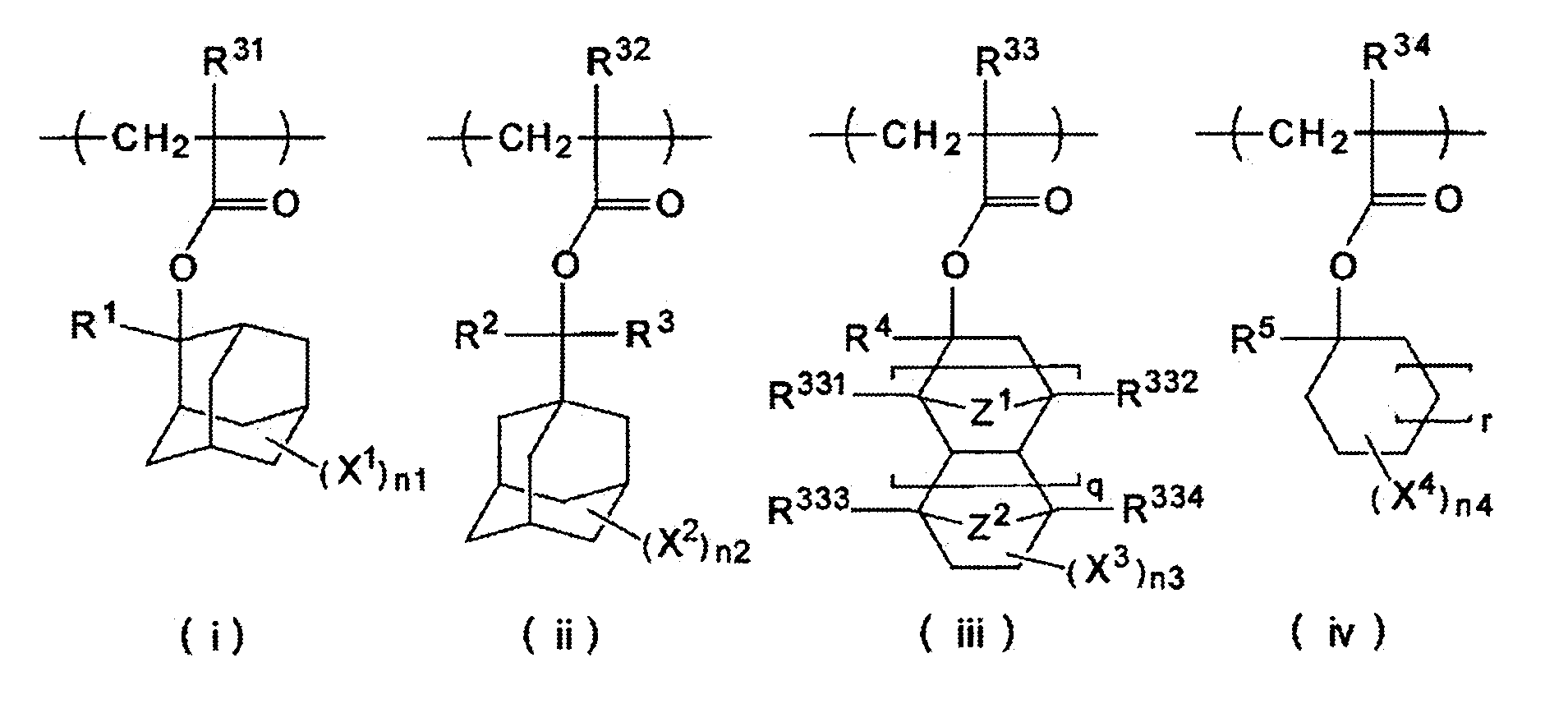
R1、R4、及びR5は、それぞれ独立して炭素数1~5のアルキル基を表す。前記アルキル基は直鎖状でもよく分岐状でもよい。
R2、及びR3はそれぞれ独立して炭素数1~3のアルキル基を表す。前記アルキル基は直鎖状でもよく分岐状でもよい。
X1、X2、X3、及びX4は、それぞれ独立して炭素数1~6のアルキル基を表す。前記アルキル基は直鎖状でもよく分岐状でもよい。
n1、n2、n3、及びn4は、それぞれ独立して0~4の整数を表す。n1、n2、n3又はn4が2以上の場合、1つの構成単位中にX1、X2、X3又はX4は複数存在する。前記複数のX1、X2、X3及びX4は互いに同じであってもよく異なってもよい。
式(iii)中のR331、R332、R333、及びR334はそれぞれ独立して水素原子又は炭素数1~6のアルキル基を表す。前記アルキル基は直鎖状でもよく分岐状でもよい。
式(iii)中のZ1、及びZ2はそれぞれ独立して-O-、-S-、-NH-又は炭素数1~6のアルキレン基を表す。「炭素数1~6のメチレン基」とは-(CH2)k-(kは1~6の整数を表す)で表される2価基である。 式(iii)中のqは0又は1を表す。
(iv)中のrは0~2の整数を表す。
これらの中でも、1-エチルシクロヘキシルメタクリレート、2-メチル-2-アダマンチルメタクリレート、2-エチル-2-アダマンチルメタクリレート、1-エチルシクロペンチルメタクリレート、イソプロピルアダマンチルメタクリレートがより好ましい。
酸脱離性基を有する単量体は、1種を単独で用いてもよく、2種以上を組み合わせて用いてもよい。
「極性基」とは、極性を持つ官能基又は極性を持つ原子団を有する基であり、具体例としては、ヒドロキシ基、シアノ基、アルコキシ基、カルボキシ基、アミノ基、カルボニル基、フッ素原子を含む基、硫黄原子を含む基、ラクトン骨格を含む基、アセタール構造を含む基、エーテル結合を含む基等が挙げられる。
これらのうちで、波長250nm以下の光で露光するパターン形成方法に適用されるレジスト用共重合体は、極性基を有する構成単位として、ラクトン骨格を有する構成単位を有することが好ましく、さらに後述の親水性基を有する構成単位を有することが好ましい。
ラクトン骨格としては、例えば、4~20員環程度のラクトン骨格が挙げられる。ラクトン骨格は、ラクトン環のみの単環であってもよく、ラクトン環に脂肪族又は芳香族の炭素環又は複素環が縮合していてもよい。共重合体がラクトン骨格を有する構成単位を含む場合、その含有量は、基板等への密着性の点から、共重合体の全構成単位を100モル%としたとき、20モル%以上が好ましく、35モル%以上がより好ましい。また、感度及び解像度の点から、60モル%以下が好ましく、55モル%以下がより好ましく、50モル%以下がさらに好ましい。
即ち、ラクトン骨格を有する構成単位の含有量は、共重合体の全構成単位を100モル%としたとき、20モル%以上、60モル%以下が好ましく、20モル%以上、55モル%以下がより好ましく、35モル%以上、55モル%以下が特に好ましく、35モル%以上、50モル%以下が最も好ましい。
ラクトン骨格を有する単量体は、1種を単独で用いてもよく、2種以上を組み合わせて用いてもよい。
本明細書における「親水性基」としては、-C(CF3)2-OHで表される基、ヒドロキシ基、シアノ基、メトキシ基、カルボキシ基及びアミノ基からなる群から選択される少なくとも1種の基が挙げられる。
これらのうちで、波長250nm以下の光で露光するパターン形成方法に適用されるレジスト用共重合体は、親水性基としてヒドロキシ基、及びシアノ基からなる群から選択される少なくとも1種の基を有することが好ましい。
共重合体における親水性基を有する構成単位の含有量は、レジストパターン矩形性の点から、共重合体を構成する全構成単位を100モル%としたとき、5~30モル%が好ましく、10~25モル%がより好ましい。
親水性基を有する単量体は、1種を単独で用いてもよく、2種以上を組み合わせて用いてもよい。
[重合開始剤]
重合開始剤を使用する重合では、重合開始剤のラジカル体が反応溶液中に生じ、このラジカル体を起点として単量体の逐次重合が進行する。本発明のレジスト用共重合体の製造に用いられる重合開始剤は、熱により効率的にラジカルを発生する重合開始剤が好ましく、10時間半減期温度がリソグラフィー用共重合体の重合温度以下である重合開始剤を用いることが好ましい。例えばリソグラフィー用共重合体を製造する場合の好ましい重合温度は50~150℃であり、重合開始剤としては10時間半減期温度が50~70℃の重合開始剤を用いることが好ましい。また重合開始剤が効率的に分解するためには、重合開始剤の10時間半減期温度と重合温度との差が10℃以上、60℃以下であることが好ましい。
重合開始剤の例としては、2,2’-アゾビスイソブチロニトリル、ジメチル-2,2’-アゾビスイソブチレート、2,2’-アゾビス(2,4-ジメチルバレロニトリル)、2,2’-アゾビス[2-(2-イミダゾリン-2-イル)プロパン]等のアゾ化合物;2,5-ジメチル-2,5-ビス(tert-ブチルパーオキシ)ヘキサン、ジ(4-tert-ブチルシクロヘキシル)パーオキシジカーボネート等の有機過酸化物;が挙げられる。重合開始剤としては、アゾ化合物がより好ましい。溶媒への溶解性に優れ、溶液重合に好適に用いることができる点でジメチル-2,2’-アゾビスイソブチレートが特に好ましい。
本発明の一実施形態である共重合体の製造方法においては重合溶媒を用いてもよく、用いなくてもよい。
重合溶媒としては、例えば、下記の溶媒が挙げられる。
エーテル類:鎖状エーテル(例えばジエチルエーテル、プロピレングリコールモノメチルエーテル等。)、環状エーテル(例えばテトラヒドロフラン(以下、「THF」と記すこともある。)、1,4-ジオキサン等。)等。
エステル類:酢酸メチル、酢酸エチル、酢酸ブチル、乳酸エチル、乳酸ブチル、プロピレングリコールモノメチルエーテルアセテート(以下、「PGMEA」と記すこともある。)、γ-ブチロラクトン等。
ケトン類:アセトン、メチルエチルケトン、メチルイソブチルケトン等。
アミド類:N,N-ジメチルアセトアミド、N,N-ジメチルホルムアミド等。
スルホキシド類:ジメチルスルホキシド等。
芳香族炭化水素:ベンゼン、トルエン、キシレン等。
脂肪族炭化水素:ヘキサン等。
脂環式炭化水素:シクロヘキサン等。
重合溶媒は、1種を単独で用いてもよく、2種以上を併用してもよい。
重合溶媒の使用量は特に限定されないが、例えば、重合反応終了時の反応器内の液(即ち、重合反応溶液)の固形分濃度が、重合反応溶液の総質量に対して、20~40質量%程度となる量が好ましい。
以下、リソグラフィー用共重合体の製造方法の代表例としてレジスト用共重合体の製造方法を挙げて説明するが、他のリソグラフィー用共重合体にも同様に適用できる。
レジスト用共重合体は、ラジカル重合法によって得ることができる。重合方法は特に限定されず、塊状重合法、溶液重合法、懸濁重合法、乳化重合法等の公知の方法を適宜用いることができる。
特に、光線透過率を低下させないために、重合反応終了後に残存する単量体を除去する工程を容易に行える点、共重合体の分子量を比較的低くしやすい点から、溶液ラジカル重合法が好ましい。そのうちで、製造ロットの違いによる平均分子量、分子量分布等のばらつきが小さく、再現性のある共重合体を簡便に得やすい点から、滴下重合法が更に好ましい。
また、各々独立した貯槽から重合容器に供給する直前で混合して、重合容器中に滴下してもよい。
上記単量体及び重合開始剤は、一方を先に滴下した後、遅れて他方を滴下してもよく、両方を同じタイミングで滴下してもよい。
なお、滴下速度は、滴下終了まで一定であってもよく、又は単量体や重合開始剤の消費速度に応じて、多段階に変化させてもよい。滴下は、連続的又は間欠的に行ってもよい。
本発明の一実施形態の共重合体の製造方法は、反応器内に重合開始剤及び2種以上の単量体を供給し、共重合体(P)を得る重合工程を有する。例えば単量体α1~αnを重合して、構成単位α’1~α’nからなる共重合体を得る。構成単位α’1~α’nは、単量体α1~αnからそれぞれ導かれる構成単位を表す。nは2以上、15以下の整数を表す。単量体α1~αnには、酸脱離性基を含む少なくとも1種の単量体と、酸脱離性基を含まない少なくとも1種の単量体が含まれる。
本発明の一実施形態において、前記重合工程はラジカル重合法で行われ、単量体及び重合開始剤を反応器内に滴下しながら、前記反応器内で重合を行う滴下重合法を用いる。
即ち、反応器内に単量体及び重合開始剤を滴下しながら、前記反応器内で2種以上の単量体α1~αnを重合して、構成単位α’1~α’nからなる共重合体を得る重合工程を有する。
溶液Tb(以下、単にTbということもある。)は、溶液T1、T2、…Te(eは1以上の整数)の総称である。溶液Tbとして、1つの溶液のみ(T1のみ)を用いてもよく、2つ以上の溶液(T1、T2…Te)を用いてもよい。eの上限値は特に限定されないが、多いと操作が煩雑になるため実質的には4以下が好ましく、3以下がより好ましい。
即ち、eは1以上、4以下の整数が好ましく、1以上、3以下の整数がより好ましい。
溶液Tbにおける単量体の組成(第2の組成、単位:モル%)は、得ようとする共重合体における構成単位α’1~α’nの含有比率(共重合組成、単位:モル%)を表す目標組成(単位:モル%)と同じである。
溶液Tbとして2つ以上の溶液を用いる場合、「溶液Tbの第2の組成」とは、T1~Teそれぞれにおける単量体の組成を意味する。即ち、T1~Teにおける各単量体の組成はいずれも目標組成と同じである。
例えば、共重合体が、単量体x、y、zを共重合させて得られる3元系の共重合体であって、目標組成がx’:y’:z’であるとき、第2の組成x:y:zはx’:y’:z’と同じにする。
なお本発明の一実施形態態において、所期の効果を得るうえで、第2の組成(モル%)は目標組成(モル%)と同一又は同一に近い組成である。第2の組成(モル%)は目標組成(モル%)と同一であることが最も好ましいが、前記目標組成に対して±10%の範囲内、好ましくは±5%の範囲内の誤差であれば許容される。即ち前記誤差範囲であれば、第2の組成と目標組成とが同一又は同一に近い組成であるものとする。
溶液Tbは滴下により反応器に供給する。
溶液Sa(以下。単にSaということもある。)は、溶液S1、S2、…Sd(dは1以上の整数)の総称である。溶液Saとして、1つの溶液のみ(S1のみ)を用いてもよく、2つ以上の溶液(S1、S2…Sd)を用いてもよい。dの上限値は特に限定されないが、多いと操作が煩雑になるため実質的には5以下が好ましく、4以下がより好ましい。
即ち、dは1以上、5以下の整数が好ましく、1以上、4以下の整数がより好ましい。
溶液Saとして2つ以上の溶液を用いる場合、溶液Saにおける単量体の含有比率(第1の組成、単位:モル%)は、S1~Sdの合計における単量体の組成を意味する。
溶液S1~Sdのそれぞれにおける単量体の組成は、互いに同じでもよく、異なっていてもよく、いずれも目標組成とは異なる。第1の組成は、単量体α1~αnのうち、酸脱離性基を含む単量体の比率が目標組成より多い組成である。溶液Saにおける単量体の含有比率(第1の組成)は、共重合体における目標組成と、重合に用いられる各単量体の反応性とを加味して予め設計された組成であることが好ましい。第1の組成の設計方法は後述する。
溶液Saは、予め反応器内に仕込んでおいてもよく、滴下等により反応器に徐々に供給してもよく、これらを組み合わせてもよい。
重合開始剤は滴下により反応器に供給する。溶液Tbに重合開始剤を含有させてもよい。溶液Saを滴下する場合は、前記溶液Saに重合開始剤を含有させてもよい。滴下する2以上の溶液(Sa及びTbからなる群から選択される少なくとも1の溶液)に、重合開始剤を含有させてもよい。溶液Sa、溶液Tbとは別に、重合開始剤を含有する溶液(即ち、重合開始剤溶液)を滴下してもよい。また、これらを組み合わせてもよい。
重合開始剤の使用量は、重合開始剤の種類に応じて、また得ようとする共重合体の重量平均分子量の目標値に応じて設定される。例えば、反応器に供給される単量体の合計量を100モル%とした場合、重合開始剤の使用量は1~25モル%の範囲が好ましく、1.5~20モル%の範囲がより好ましい。
重合工程で使用される単量体の合計量(即ち、全単量体供給量)は、溶液Sa、溶液Tbに含まれる単量体の総和であり、得ようとする共重合体の量に応じて設定される。
また前記全単量体供給量のうち、溶液Saに含まれる単量体の合計量が占める比率が少なすぎると、溶液Saを用いることによる所期の効果が充分に得られず、多すぎると重合工程の初期に生成される共重合体の分子量が高くなりすぎる。従って、全単量体供給量に対して、溶液Saに含まれる単量体の合計量は3~40質量%が好ましく、5~30質量%がより好ましい。
重合工程において、反応器内に重合開始剤を滴下したときに、前記反応器内に溶液Saが存在していることが必要である。従って、反応器内に重合開始剤を滴下する前又は重合開始剤の滴下開始と同時に、前記反応器内に溶液Saを供給開始する。
また反応器内に溶液Tbを滴下したときに、前記反応器内に溶液Saが存在していることが必要である。従って、反応器内に溶液Saを供給開始した後又は溶液Saの供給開始と同時に、前記反応器内に溶液Tbを滴下開始する。溶液Tbの滴下開始は、前記重合開始剤の滴下開始と同時又は前記重合開始剤の滴下開始より後であることが好ましい。
重合開始剤の滴下開始と溶液Tbの滴下開始は同時であることが好ましい。溶液Tbの滴下終了よりも前に、溶液Saの供給を終了する。
溶液Tbの滴下は、連続的でもよく、断続的でもよく、滴下速度が変化してもよい。生成される共重合体の組成及び分子量をより安定させるためには、連続的に、一定速度で滴下することが好ましい。
溶液Saを滴下により供給する場合、連続的でもよく、断続的でもよく、滴下速度が変化してもよい。生成される共重合体の組成及び分子量をより安定させるためには、連続的に、一定速度で滴下することが好ましい。
溶液Saの供給終了は、基準時間の15%以前が好ましく、10%以前がより好ましい。
また基準時間の0%の時点で溶液Saの全量が供給されていてもよい。即ち重合開始剤の滴下開始前に、反応器内に溶液Saの全量を仕込んでおいてもよい。
反応器内に単量体及び重合開始剤を滴下により供給する工程、及び
前記単量体を重合させて共重合体を得る重合工程、を含み、
前記単量体及び重合開始剤を供給する工程と前記重合工程とが、前記反応器内で同時に進行する滴下重合法により行われる、製造方法である。
また、前記単量体及び重合開始剤を供給する工程は、
前記単量体が第1の組成を有する溶液Sa及び第2の組成を有する溶液Tbとして供給されることを含んでいてもよく、
前記溶液Sa及び前記溶液Tbとして前記反応器に供給される場合は、
前記溶液Saは、前記反応器内に前記重合開始剤を滴下する前又は前記重合開始剤の滴下開始と同時に供給されることを含み、かつ
前記溶液Tbは、前記反応器内に前記溶液Saの供給を開始した後又は前記溶液Saの供給開始と同時に供給されることを含み、
さらに、前記溶液Tbの滴下終了よりも前に、前記溶液Saの供給が終了することを含む、ことが好ましい。
さらに、前記溶液Sa及び前記溶液Tbとして前記反応器に供給される場合は、前記重合開始剤の滴下開始と前記溶液Tbの滴下開始は同時であることが好ましく、前記重合開始剤の滴下は、前記溶液Tbの滴下終了時まで行うことが好ましい。
重合開始剤の滴下は、溶液Tbの滴下終了時まで行ってもよく、その前に終了してもよい。溶液Tbの滴下終了時まで行うことが好ましい。
例えば、重合開始剤の滴下開始から溶液Tbの滴下終了までの基準時間が4時間である場合、全重合工程で生成する共重合体の質量平均分子量を100%とすると、重合開始剤の滴下開始後30分以内に生成する共重合体の質量平均分子量は、101~200%であることが好ましく、102~150%であることがより好ましく、103~130%がさらに好ましい。
重合工程の好ましい態様としては、以下の(A)、(B)、(C)が挙げられる。
(A)予め反応器内に、単量体α1~αnを第1の組成で含有する溶液Saの全量(S1)を仕込んでおき、反応器内を所定の重合温度(例えば、80℃)まで加熱した後、前記反応器内に、単量体α1~αnを第2の組成で含有するとともに、重合開始剤を含む溶液Tbを滴下する。Tbと並行して、重合開始剤の一部を含む重合開始剤溶液を滴下しても良い。重合開始剤溶液と溶液Tbは同時に滴下開始するか、又は重合開始剤溶液を先に滴下開始する。同時が好ましい。重合開始剤溶液の滴下開始から溶液Tbの滴下開始までの時間は0~10分が好ましい。
滴下速度はそれぞれ一定であることが好ましい。重合開始剤溶液は溶液Tbよりも先に滴下を終了する。
滴下速度はそれぞれ一定であることが好ましい。溶液Tbよりも溶液Saの方が先に滴下を終了する。
滴下速度はそれぞれ一定であることが好ましい。溶液Saの残部は溶液Tbよりも先に滴下を終了する。
反応器内に、単量体α1~αnを第1の組成で含有する溶液Saの全量(S1)を供給すること、
前記反応器内を所定の重合温度まで加熱すること、及び
前記反応器内に、単量体α1~αnを第2の組成で供給するとともに、重合開始剤を含む溶液Tbを滴下すること、を含む製造方法である。
前記製造方法は、前記重合開始剤の一部を含む重合開始剤溶液を、前記溶液Tbと並行して滴下することを含んでいてもよく、
前記重合開始剤溶液を滴下する場合は、前記重合開始剤溶液と前記溶液Tbとを同時に滴下開始するか、又は前記重合開始剤溶液を先に滴下開始することを含んでいてもよく、
前記重合開始剤溶液の滴下開始から前記溶液Tbの滴下開始までの時間が、0~10分間であってもよく、
前記滴下速度はそれぞれ一定であってもよく、
前記重合開始剤溶液は前記溶液Tbよりも先に滴下を終了することを含んでいてもよい。
反応器内に溶媒のみを供給すること、
前記溶媒を所定の重合温度まで加熱すること、
前記反応器内に、単量体α1~αnを第1の組成で含有する溶液Saと、単量体α1~αnを第2の組成で含有するとともに重合開始剤を含む溶液Tbをそれぞれ滴下すること、及び
前記溶液Tbよりも前記溶液Saの方が先に滴下を終了すること、を含む製造方法である。
さらに、前記製造方法は、前記溶液Saが前記重合開始剤の一部を含有していてもよく、
前記溶液Saと前記溶液Tbとの両溶液を、同時に滴下開始するか、又は前記溶液Saを先に滴下開始することを含んでいてもよく、
前記溶液Saの滴下開始から前記溶液Tbの滴下開始までの時間が0~10分間であってもよく、
前記両溶液の滴下速度がそれぞれ一定であってもよい。
反応器内に、溶液Saの一部を供給すること、
前記反応器内を所定の重合温度まで加熱すること、
前記反応器内に、前記溶液Saの残部と、単量体α1~αnを第2の組成で含有するとともに重合開始剤を含む溶液Tbと、をそれぞれ滴下すること、及び、
前記溶液Saの残部が前記溶液Tbよりも先に滴下を終了すること、を含む製造方法である。
前記製造方法は、
前記溶液Saの残部が前記重合開始剤の一部を含んでいてもよく、
前記溶液Saの残部と前記溶液Tbとを、同時に滴下開始するか、又は前記溶液Saの残部を先に滴下開始することを含んでいてもよく、
前記溶液Saの残部の滴下開始から前記溶液Tbの滴下開始までの時間が0~10分間であってもよく、
前記滴下速度がそれぞれ一定であってもよい。
前記各製造方法は、前記溶液Tbの滴下終了後、所望により、前記反応器内を重合温度に保持する保持工程、冷却工程、精製工程からなる群から選択される少なくとも1つの工程をさらに含んでいてもよい。
以下、第1の組成の好ましい設計方法の1つの側面(即ち、第1の方法)について説明する。
本方法では、溶液S1~Sdの合計における単量体の組成(即ち、第1の組成)は、下記方法(a)及び(b)により決定される未反応単量体の組成(U)よりも、酸脱離性基を含む単量体の比率が高く、かつ酸脱離性基を含まない単量体の比率が低くなるように設計する。
(a):まず、単量体組成が前記目標組成α’1:α’2:…:α’nと同一又は同一に近い組成の単量体混合物と重合開始剤と溶媒とを含有する滴下溶液を、別途溶媒のみを入れて重合温度に調整した反応器内に一定の滴下速度で滴下し、前記反応器内に存在する未反応単量体の組成の時間変化を測定する。
(b):前記(a)で測定した未反応単量体の組成が一定又は一定に近い状態となるときの未反応単量体の組成(U)を決定する。 なお、ここでいう「同一に近い」とは、目標組成±5モル%を意味する。
(b)では、その反応中盤の安定状態となった時の未反応単量体の組成を測定する。なお、「未反応単量体の組成の安定状態(一定又は一定に近い状態)」とは、各単量体それぞれの含有比率(モル%)の測定値が、直前の測定時の測定値を100%とするとき、90~110%、好ましくは95~105%、より好ましくは96~104%である状態をいう。
例えば、滴下開始からの経過時間がt1、t2、t3…のときに、時間tm(mは1以上、20以下の整数。)における測定値と、時間tm+1における測定値との変動幅が最も小さいときの、tmにおける未反応単量体の組成と、tm+1における未反応単量体の組成との平均値を、(b)で決定される未反応単量体の組成(U)とすることが好ましい。
なお、滴下開始からの経過時間としての設定時間は30~90分間であり、前記設定時間内における測定までの時間の間隔は同じである。
本方法では、前記(b)により決定された未反応単量体の組成(U)よりも、酸脱離性基を含む単量体の比率が高く(例えば、5~15モル%高く)、かつ酸脱離性基を含まない単量体の比率が低く(例えば5~15モル%低く)なるように第1の組成を設計する。
これにより、重合初期には、分子量が高くて酸脱離性基を多く含む共重合体分子が生成し、その後に上記定常状態が得られるため、目的とする共重合体を得ることができる。
本発明の一実施形態である共重合体が得られやすい点で、第1の組成における酸脱離性基を含む単量体の含有比率(モル%)は、組成(U)における酸脱離性基を含む単量体の含有比率(モル%)の値の1.1~1.9倍の範囲内が好ましく、1.2~1.9倍がより好ましく、1.3~1.8倍がさらに好ましい。
第1の組成における、酸脱離性基を含まない単量体どうしの含有比率の比は、組成(U)における比とほぼ同じであることが好ましい。
なお、ここでいう「ほぼ同じ」とは、±5モル%以内であることを意味する。
以下、第1の組成の好ましい設計方法の別の側面(即ち、第2の方法)について説明する。
本方法では、溶液S1~Sdの合計における単量体の組成(即ち、第1の組成)の、各構成単位の含有比率を、下記方法(1A)~(4A)により求めたS’aの組成における各構成単位の含有比率の値のそれぞれ0.75倍~1.25倍の範囲内、好ましくは0.8倍~1.2倍の範囲内、より好ましくは0.9倍~1.1倍の範囲内に設計する。
なお、滴下開始からの経過時間としての設定時間は30~90分間であり、前記設定時間内における測定までの時間の間隔は同じである。
(2A)前記P1:P2:…:Pnが、前記目標組成α’1:α’2:…:α’nに最も近い時間帯「tmからtm+1までの間(mは1以上、20以下の整数。)」を見つける。
(3A)前記「tmからtm+1までの間」におけるP1:P2:…:Pnの値と、経過時間tmにおけるM1:M2:…:Mnの値とから、下記式により、ファクターF1、F2、…Fnを求める。
F1=P1/M1、F2=P2/M2、…Fn=Pn/Mn
(4A)S’aの組成(単位:モル%)を、α11:α12:…:α1nで表わすと、上記(3A)で求めたファクターF1、F2、…Fnの関数であるG1、G2…Gnと、前記目標組成α’1:α’2:…:α’nとから、下記式によりS’aの組成(単位:モル%)を求める。
Gi=Fi
ただし、α1iが酸脱離性基を含む単量体の含有比率であるときはGi=Fi/3である。(iは1以上n以下の自然数。nは前記と同様である。)
α11=(α’1/G1)/(α’1/G1+α’2/G2+…+α’n/Gn)×100、
α12=(α’2/G2)/(α’1/G1+α’2/G2+…+α’n/Gn)×100、
…α1n=(α’n/Gn)/(α’1/G1+α’2/G2+…+α’n/Gn)×100。
以下、第2の方法を、共重合体が3元系の共重合体である場合を例に挙げて説明するが、2元系又は4元系以上でも同様にしてファクターを求めることができる。
(1B)まず、単量体組成が目標組成x’:y’:z’と同じである単量体混合物と溶媒と重合開始剤とを含有する滴下溶液を、重合温度に調整した反応器内に一定の滴下速度vで滴下する。反応器内には、予め溶媒のみを入れておく。
滴下開始からの経過時間がt1、t2、t3…のときに、それぞれ反応器内に残存している単量体x、y、zの組成(モル%)Mx:My:Mzと、t1からt2までの間、t2からt3までの間…にそれぞれ生成した共重合体における構成単位の比率(モル%)Px:Py:Pzを求める。
(2B)Px:Py:Pzが、前記目標組成x’:y’:z’に最も近い時間帯「tmからtm+1までの間(mは1以上、20以下の整数。)」を見つける。(3B)その「tmからtm+1までの間」におけるPx:Py:Pzの値と、経過時間tmにおけるMx:My:Mzの値とから、下記式により、ファクターFx、Fy、Fzを求める。
Fx=Px/Mx、Fy=Py/My、Fz=Pz/Mz。
ファクターFx、Fy、Fzは、各単量体の相対的な反応性を反映する値であり、重合に用いられる単量体の組み合わせ又は目標組成が変わると変化する。
(4B)S’aの組成(モル%)x00:y00:z00は、ファクターFx、Fy、Fzの関数であるGx、Gy、Gzを用いて設計する。x00が酸脱離性基を含む単量体の含有比率であり、y00、z00が酸脱離性基を含まない単量体の含有比率である場合、Gx=Fx/3、Gy=Fy、Gz=Fzとし、x00=x’/Gx、y00=y’/Gy、z00=z’/Gzにより算出する。
このように、酸脱離性基を含む単量体についてのみ、ファクターFの値を3で除した値を用いて第1の組成を設計することにより、重合初期には、分子量が高くて酸脱離性基を適度に多く含む共重合体分子が生成し、その後、上記定常状態が得られる。
本発明者等の知見によれば、酸脱離性基を含む単量体についてのファクターFの除数を3とすることが最も好ましい。
即ち、酸脱離性基を含む単量体のファクターFは前記単量体の共重合反応性の高さを表す指標であり、ファクターFをそのまま用いると(即ち、ファクターFを1で除すと)、定常状態と同一の共重合組成比の共重合体が得られる。重合初期に、分子量が高くて酸脱離性基をより多く含むためには除数を大きくする必要があり、除数は3が最も好ましい。
前記方法(a)及び(b)により、未反応単量体の組成(U)の単量体組成を決定すること、及び
第1の組成として、前記決定した未反応単量体の組成(U)よりも、酸脱離性基を含む単量体の比率が高く、かつ酸脱離性基を含まない単量体の比率が低くなるように、溶液S1~Sdの合計における単量体の組成を設計すること、を含む。
前記方法(1A)~(4A)によりS’aの組成における各構成単位の含有比率の値を求めること;及び
第1の組成として、溶液S1~Sdの合計における単量体の組成の、各構成単位の含有比率を、前記S’aの組成における各構成単位の含有比率の値のそれぞれ0.75倍~1.25倍の範囲内に設計すること、を含む。
前記第2の方法は、反応器内で生成される共重合体の共重合組成が目標組成に最も近くなる状態を見つけ、さらにその状態における反応速度比を反映したファクターFを用いて第1の組成を設計するため、共重合体の製造において、真の定常状態により近い状態が得られやすい。
第2の方法で設計された第1の組成と、第1の方法における方法(a)、(b)により決定される未反応単量体の組成(U)との関係において、前記第1の組成における酸脱離性基を含む単量体の含有比率(モル%)は、組成(U)における酸脱離性基を含む単量体の含有比率(モル%)の値の1.1~1.9倍の範囲内であり、1.2~1.9倍の範囲内となっていることが好ましく、1.3~1.8倍の範囲内となっていることが好ましい。
第1の方法で設計した第1の組成と、第2の方法で設計した第1の組成とが一致する場合もあり得る。
本発明の一実施形態であるレジスト組成物は、本発明の一実施形態であるリソグラフィー用共重合体をレジスト溶媒に溶解して調製される。レジスト溶媒としては、共重合体の製造における上記重合溶媒と同様の溶媒が挙げられる。
本発明の一実施形態であるレジスト組成物が化学増幅型レジスト組成物である場合は、さらに活性光線又は放射線(例えばX線、電子線)の照射により酸を発生する化合物(以下、光酸発生剤という。)を含有させる。
光酸発生剤は、化学増幅型レジスト組成物において公知の光酸発生剤の中から任意に選択できる。光酸発生剤は、1種を単独で用いてもよく、2種以上を併用してもよい。
光酸発生剤としては、例えば、オニウム塩化合物、スルホンイミド化合物、スルホン化合物、スルホン酸エステル化合物、キノンジアジド化合物、ジアゾメタン化合物等が挙げられる。
レジスト組成物における光酸発生剤の含有量は、リソグラフィー用共重合体100質量部に対して、0.1~20質量部が好ましく、0.5~10質量部がより好ましい。
化学増幅型レジスト組成物は、含窒素化合物を含んでいてもよい。含窒素化合物を含むことにより、レジストパターン形状、引き置き経時安定性等がさらに向上する。即ち、含窒素化合物を含むことにより、レジストパターンの断面形状が矩形により近くなる。また半導体素子の量産ライン等では、レジスト膜に光を照射し、次いでベーク(PEB)した後、次の現像処理までの間に数時間放置されることがあるが、そのような放置(経時)によるレジストパターンの断面形状の劣化の発生がより抑制される。
含窒素化合物としては、アミンが好ましく、第2級低級脂肪族アミン、第3級低級脂肪族アミンがより好ましい。
レジスト組成物における含窒素化合物の含有量は、共重合体100質量部に対して、0.01~2質量部が好ましい。
化学増幅型レジスト組成物は、有機カルボン酸、リンのオキソ酸又はその誘導体(以下、これらをまとめて酸化合物と記す。)を含んでいてもよい。酸化合物を含むことにより、含窒素化合物の配合による感度劣化を抑えることができ、また、レジストパターン形状、引き置き経時安定性等がさらに向上する。
有機カルボン酸としては、マロン酸、クエン酸、リンゴ酸、コハク酸、安息香酸、サリチル酸等が挙げられる。
リンのオキソ酸又はその誘導体としては、リン酸又はその誘導体、ホスホン酸又はその誘導体、ホスフィン酸又はその誘導体等が挙げられる。
レジスト組成物における酸化合物の含有量は、共重合体100質量部に対して、0.01~5質量部が好ましい。
本発明の一実施形態であるレジスト組成物は、必要に応じて、界面活性剤、その他のクエンチャー、増感剤、ハレーション防止剤、保存安定剤、消泡剤等の各種添加剤を含んでいてもよい。前記添加剤は、この分野で公知の添加剤であればいずれも使用可能である。また、これら添加剤の量は、特に限定されず、適宜決めればよい。
本発明の一実施形態である、パターンが形成された基板の製造方法の一例について説明する。
まず、所望の微細パターンを形成しようとするシリコンウエハー等の基板の被加工面上に、本発明の一実施形態であるレジスト組成物をスピンコート等により塗布する。そして、前記レジスト組成物が塗布された基板を、ベーキング処理(プリベーク)等で乾燥することにより、基板上にレジスト膜を形成する。
ついで、レジスト膜に対して、フォトマスクを介して露光を行い、潜像を形成する。露光光としては、250nm以下の波長の光が好ましい。例えばKrFエキシマレーザー、ArFエキシマレーザー、F2エキシマレーザー、EUV光が好ましく、ArFエキシマレーザーが特に好ましい。また、電子線を照射してもよい。
また、前記レジスト膜と露光装置の最終レンズとの間に、純水、パーフルオロ-2-ブチルテトラヒドロフラン、パーフルオロトリアルキルアミン等の高屈折率液体を介在させた状態で光を照射する液浸露光を行ってもよい。
露光後、現像処理を行うことにより、基材上の薄膜の一部を溶解させる。現像後、基板を純水等で適宜洗浄処理(リンス処理)する。このようにして被加工基板上にレジストパターンが形成される。
現像方法は、ポジ型、ネガ型のどちらでもよい。ポジ型の場合は、露光された領域の薄膜が溶解する。ネガ型の場合は、露光された領域以外の薄膜が溶解する。現像後は洗浄液で洗浄処理する。
現像方法は特に限定されないが、例えば現像液が満たされた槽中に基材を一定時間浸漬する方法(ディップ法)、基材表面に現像液を表面張力によって盛り上げて一定時間静止することで現像する方法(パドル法)、基材表面に現像液を噴霧する方法(スプレー法)、一定速度で回転している基材上に一定速度で現像液塗出ノズルをスキャンしながら現像液を塗出しつづける方法(ダイナミックディスペンス法)等を適用できる。
基板の被加工面上に、本発明の一実施形態であるレジスト組成物を塗布すること;前記レジスト組成物が塗布された基板を乾燥することにより、基板上にレジスト膜を形成すること;前記レジスト膜に対して、フォトマスクを介して露光を行い、潜像を形成すること;及び、前記露光後、現像液を用いて現像を行うこと;を含む製造方法である。
前記露光は、250nm以下の波長の光で行うことが好ましい。
ポジ型現像を行う場合は、アルカリ現像液を使用することが好ましい。アルカリ現像液としてはアルカリ性水溶液が好適に用いられる。例えば、水酸化ナトリウム、水酸化カリウム、炭酸ナトリウム、ケイ酸ナトリウム、メタケイ酸ナトリウム、アンモニア水等の無機アルカリ類;エチルアミン、n-プロピルアミン等の第一アミン類;ジエチルアミン、ジ-n-ブチルアミン等の第二アミン類;トリエチルアミン、メチルジエチルアミン等の第三アミン類;ジメチルエタノールアミン、トリエタノールアミン等のアルコールアミン類;テトラメチルアンモニウムヒドロキシド、テトラエチルアンモニウムヒドロキシド等の第四級アンモニウム塩;ピロール、ピヘリジン等の環状アミン類;等の水溶液を使用することができる。
ポジ型現像の後に行う洗浄処理における洗浄液としては、純水を使用し、界面活性剤を適当量添加して使用することもできる。
エッチング後、レジストを剥離剤によって除去することによって、微細パターンが形成された基板が得られる。
従って、レジスト組成物を調製する際のレジスト溶媒への共重合体の溶解を容易にかつ良好に行うことができる。
またポジ型のレジスト組成物の場合は、アルカリ現像液に対する優れた溶解性が得られ、感度の向上に寄与する。またレジスト組成物中の不溶分が少ないため、パターン形成において、前記不溶分に起因する欠陥が生じにくい。
ネガ型のレジスト組成物の場合は、ネガ型現像液である有機溶剤に対する優れた溶解性が得られ、感度の向上に寄与する。またレジスト組成物中の不溶分が少ないため、パターン形成において、前記不溶分に起因する欠陥が生じにくい。
なお、波長250nm以下の露光光を用いるフォトリソグラフィーに用いられるレジスト組成物を製造する場合には、共重合体が前記露光光の波長において透明であるように、単量体を適宜選択して用いることが好ましい。
本発明の一実施形態であるリソグラフィー用共重合体は、前記リソグラフィー用共重合体の含有量が、PGMEA溶液の総質量に対して20wt%である前記PGMEA溶液に、n-ヘプタンを添加した際の濁度が10NTUになるn-ヘプタン添加量を(X)hとし、この(X)hの80%の量のn-ヘプタンを、前記PGMEA溶液に添加した際、前記PGMEA溶液の濁度Th(80)が、1.0以上、4.6NTU以下となるリソグラフィー用共重合体である。
PGMEA溶媒への溶解性が高く、リソグラフィー用材料として好適に用いることができる点でTh(80)は1.0以上、4.5NTU以下が好ましく、1.3以上、4.4NTU以下がより好ましく、1.6以上、4.3NTU以下がさらに好ましく、2.0以上、4.2NTU以下が特に好ましい。
前記リソグラフィー用共重合体の含有量が、PGMEA溶液の総質量に対して20wt%である前記PGMEA溶液にn-ヘプタンを添加した溶液は、25℃に調整し、4時間攪拌してから濁度の測定を行う。
濁度の測定には、例えば、Orbeco-Hellige製TB200を用いることができ、溶液温度を25℃に調整して測定することができる。
また、本発明の一実施形態であるリソグラフィー用共重合体は、前記リソグラフィー用共重合体の含有量が、PGMEA溶液の総質量に対して20wt%である前記PGMEA溶液に、メタノールを添加した際の濁度が5.0NTUになるメタノール添加量を(X)mとし、この(X)mの80%の量のメタノールを、前記PGMEA溶液に添加した際、前記PGMEA溶液の濁度Tm(80)が、1.0以上、3.8NTU以下となるリソグラフィー用共重合体である。
PGMEA溶媒への溶解性が高く、リソグラフィー用材料として好適に用いることができる点でTm(80)は、1.2以上、3.7NTU以下が好ましく、1.4以上、3.6NTU以下がより好ましく、1.6以上、3.5NTU以下がさらに好ましく、1.8以上、3.4NTU以下が特に好ましい。
濁度Th(80)と濁度Tm(80)は、それぞれn-ヘプタンとメタノールを添加する前の、リソグラフィー用共重合体の含有量がPGMEA溶液の総質量に対して20wt%である前記PGMEA溶液の濁度より高い。
本発明の一実施形態である共重合体は、20wt%のPGMEA溶液(即ち、リソグラフィー用共重合体の含有量がPGMEA溶液の総質量に対して20wt%である前記PGMEA溶液)に、PGMEAより極性の低いn-ヘプタンを添加した場合と、PGMEAより極性の高いメタノールを添加した場合の両方において濁度の上昇が緩やかであり、溶媒への溶解安定性に優れる。
特に限定されないが、上記濁度Th(80)が4.6NTU以下でありかつ濁度Tm(80)が3.8NTU以下を満たす共重合体の製造方法としては、上述した重合反応による製造方法、洗浄や分離操作により所望の共重合組成と分子量を有する共重合体を除去する方法、異なる共重合組成分布と分子量分布を有する共重合体同士を混合する方法等が挙げられる。一度の重合反応で生産性良く得られる点で、上述した重合反応による製造方法が好ましい。
本発明の一実施形態である共重合体は、以下の方法により低温溶解性を評価することができる。具体的には、リソグラフィー用共重合体、前記共重合体の良溶媒、前記共重合体の貧溶媒から成る共重合体の析出していない試験溶液の温度を下げて、前記共重合体が析出する温度を測定する評価する方法であり、(A)試験溶液を調整する試験溶液調整工程と、(B)温度を下げて析出温度を測定する評価工程を含む。
試験溶液はリソグラフィー用共重合体、前記共重合体の良溶媒、及び前記共重合体の貧溶媒を含む。
調製の手順は、共重合体を良溶媒に完全溶解させた後、貧溶媒を添加しても良いし、又は良溶媒と貧溶媒の混合溶媒に共重合体を溶解させても良く、さらに、共重合体、良溶媒、貧溶媒の混合を同時に行っても良い。このうち、共重合体の析出が起こりにくく、溶液が不均一になりにくい点で、共重合体を良溶媒に完全溶解させた後、貧溶媒を添加する方法が、最も好ましい。
良溶媒の種類及びリソグラフィー用共重合体と良溶媒の比は、共重合体と良溶媒が全体に均一に混合し、共重合体が析出していない状態になれば、特に制限はない。共重合体と良溶媒の比は、良溶媒100質量%に対して、共重合体が0.5質量%~30質量%が好ましく、5質量%~25質量%が更に好ましい。本評価方法では、貧溶媒の共存により、共重合体の良溶媒に対する溶解性を低下させ、さらに温度を下げて、共重合体の析出温度を測定するため、良溶媒100質量%に対して、共重合体が0.5質量%~30質量%の濃度であれば、共重合体が良溶媒に完全に溶解するとともに、共重合体の貧溶媒の共存により低温で析出しやすくなる。
「完全に溶解できる」とは、目視で透明状態の溶液である状態を意味する。
本評価方法では、貧溶媒を共存させることで、前記共重合体の良溶媒に対する溶解性を低下させる。これにより、前記共重合体中の難溶解成分の凝集が起こり、さらに温度を下げることで、前記共重合体全体の析出が起こる。本評価方法では、この析出温度を測定することで、前記共重合体の低温での溶解性を評価することができる。
また、上記の通りの貧溶媒量を添加することで、室温に近い温度で析出が起こるため、評価を短時間で簡便に行うことが可能である。
好ましい良溶媒の具体例としては、テトラヒドロフラン(THF)、1,4―ジオキサン、アセトン、メチルエチルケトン、メチルイソブチルケトン、プロピレングリコールモノメチルエーテル(PGME)、プロピレングリコールモノメチルエーテルアセテート(PGMEA)、乳酸メチル、乳酸エチル、乳酸ブチル、γ-ブチロラクトン等が挙げられる。
特に、評価対象のレジスト用共重合体がアクリル系共重合体である場合、良溶媒としてPGMEA(プロピレングリコールモノメチルエーテルアセテート)、乳酸エチル、THF(テトラヒドロフラン)、又はPGME(プロピレングリコールモノメチルエーテル)を用い、貧溶媒としてIPE(ジイソプロピルエーテル)、ヘキサン、ヘプタン、メタノール、又はイソプロパノールを用いることが好ましい。
上記試験溶液の温度を下げ、前記共重合体が析出する温度を測定する。温度を下げる方法は特に限定されないが、細かい温度制御(最小設定幅が0.1℃以下)が可能な恒温槽に試験溶液を入れて恒温槽の温度を下げる方法、試験溶液を置いた部屋の温度を下げる方法、試験溶液に直接温度計を設置し冷蔵庫に入れる方法等が挙げられる。
また試験溶液内が常に均一な温度になるよう、撹拌しながら試験が行うことが望ましい。
また、2種以上の共重合体の比較を行う場合は、撹拌時間の差は1時間以内であることが望ましく、30分以内であることがさらに望ましい。
また、正確な測定を行うために、試験溶液の調整及び撹拌温度は、指定した温度の±3℃の範囲で実施するのが好ましく、±2℃の範囲で実施するのが更に好ましく、±1℃の範囲で実施するのが最も好ましい。
降温は、1.0℃ずつの幅で実施できることが好ましく、0.5℃ずつの幅で実施できることが更に好ましい。またこの降温幅を実現するために、0.1℃刻みで温度設定が可能な恒温槽を使用することが好ましい。
また、2種以上の共重合体の比較を行う場合は、試験溶液の調整、撹拌、降温の各工程で、温度を統一することが望ましい。
<リソグラフィー用共重合体(P)>
本発明の第2の態様であるリソグラフィー用共重合体(以下、共重合体(P)ということもある)は構成単位α’1~α’n(ただし、α’1~α’nは単量体α1~αnからそれぞれ導かれる構成単位を表す。nは2以上の整数を表す。)からなり、前記構成単位α’1~α’nは、酸脱離性基を含む少なくとも1種の構成単位と、酸脱離性基を含まない少なくとも1種の構成単位を含む。即ち、共重合体(P)は、酸脱離性基を含む少なくとも1種の単量体及び酸脱離性基を含まない少なくとも1種の単量体を重合して得られる共重合体である。
前記nの上限は、本発明による効果が得られやすい点で6以下が好ましい。特に共重合体(P)がレジスト用共重合体である場合には、5以下がより好ましく、4以下がさらに好ましい。
即ち、前記nは、2以上、6以下が好ましく、2以上、5以下がより好ましく、2以上、4以下がさらに好ましい。
酸脱離性基を有する単量体は、上記第1の態様において挙げた酸脱離性基を有する単量体と同様の化合物が挙げられる。
また、酸脱離性基を有する構成単位の含有量は、上記第1の態様において挙げた酸脱離性基を有する構成単位の含有量と同様である。
リソグラフィー用共重合体(P)中の酸脱離性基を含まない構成単位は特に限定されず、リソグラフィー用共重合体の分野で公知の構成単位を、用途や要求特性に応じて適宜選択して用いることができ、例えば、前記第1の態様で挙げた「酸脱離性基を含まない構成単位・単量体」が挙げられる。
レジスト用共重合体における酸脱離性基を有する構成単位の比率は、前記第1の態様で挙げた比率と同様である。
レジスト用共重合体の重量平均分子量(Mw)は前記第1の態様で挙げた重量平均分子量と同義であり、好ましい例も同様である。
極性基を有する構成単位・単量体としては、前記第1の態様で挙げた「極性基を有する構成単位・単量体」と同様の構成単位・単量体が挙げられる。
ラクトン骨格を有する構成単位・単量体としては、前記第1の態様で挙げた「ラクトン骨格を有する構成単位・単量体」と同様の構成単位・単量体が挙げられる。
レジスト用共重合体がラクトン骨格を有する構成単位を含む場合、その含有量は、前記第1の態様で挙げた含有量と同様である。
ラクトン骨格を有する単量体としては、β―ガンマブチロラクトン(メタ)アクリレート、α―ガンマブチロラクトン(メタ)アクリレート、5-メタクリロイルオキシ-2,6-ノルボルナンカルボラクトン、8-メタクリロキシ-4-オキサトリシクロ[5.2.1.02,6]デカン-3-オンがより好ましい。
ラクトン骨格を有する単量体は、1種を単独で用いてもよく、2種以上を組み合わせて用いてもよい。
親水性基を有する構成単位・単量体は、前記第1の態様で挙げた「親水性基を有する構成単位・単量体」と同様の構成単位・単量体が挙げられる。
また、親水性基は、例えば、-C(CF3)2-OHで表される基のように、フッ素基等を含む連結基を含むものであってもよい。
レジスト用共重合体における親水性基を有する構成単位の含有量は、前記第1の態様で挙げた含有量と同様である。
親水性基を有する単量体は、1種を単独で用いてもよく2種以上を組み合わせて用いてもよい。
[重合開始剤]
本発明のリソグラフィー用共重合体(P)の製造方法で用いられる重合開始剤としては、前記第1の態様で挙げた重合開始剤と同様の重合開始剤が挙げられる。これらは市販品から入手可能である。例えばジメチル-2,2’-アゾビスイソブチレート(和光純薬工業社製、V601(商品名)、10時間半減期温度66℃)、2,2’-アゾビス(2,4-ジメチルバレロニトリル)(和光純薬工業社製、V65(商品名)、10時間半減期温度51℃)等を好適に用いることができる。
本発明のリソグラフィー用共重合体(P)の製造方法における重合溶媒としては、前記第1の態様で挙げた重合溶媒と同様の重合溶媒が挙げられる。
本発明の一実施形態であるリソグラフィー用共重合体(P)は、ゲル・パーミエイション・クロマトグラフィー(GPC)により得られる溶出曲線において前記共重合体(P)に係るピークを示す溶離液を、溶出順に、体積が均等になるように分割した5個のフラクションのうち、最も先に溶出された1番目のフラクションに含まれる共重合体を構成する構成単位の全モル数に対する酸脱離性基を含む構成単位のモル数の比率をN(v1)モル%とし、前記5個のフラクションの合計に含まれる共重合体を構成する構成単位の全モル数に対する酸脱離性基を含む構成単位のモル数の比率をNaveモル%としたとき、N(v1)/Naveが1.01~1.09である。
また、2~4番目に溶出された各フラクションに含まれる共重合体を構成する構成単位の全モル数に対する酸脱離性基を含む構成単位のモル数の比率を、それぞれN(v2)モル%、N(v3)モル%、N(v4)モル%としたとき、N(v2)/Nave、N(v3)/Nave、N(v4)/Naveは、それぞれ0.95~1.05であることが好ましい。
なお、溶出曲線に、溶出曲線におけるピークスタートとピークエンドを結んだベースラインBを引き、溶出体積の小さい側での溶出曲線とベースラインBとの交点をPs、溶出体積の大きい側での溶出曲線とベースラインとの交点をPeとする。
また「ピークを示す溶離液を、溶出順に、体積が均等になるように5個のフラクションに分割する」とは、ピークスタートPsからピークエンドPeまでの溶出体積Vを、図1中に破線で示すように、溶出順に、均等に5個に分割し、分割後の各溶出体積に該当する溶離液を、それぞれフラクションとして分取することを意味する。即ち、図1の例では、溶出体積がV1~V2の間に得られるフラクション1、溶出体積がV2~V3の間に得られるフラクション2、…溶出体積がV5~V6の間に得られるフラクション5の、5個のフラクションをそれぞれ分けて収集する。
最も先に溶出されたフラクションは、図1において、溶出体積がV1~V2の間に得られるフラクション1である。GPCにおいて、分子量が大きいほどカラムからの溶出が早いため、フラクション1~5のうちフラクション1が、共重合体の平均分子量が最も高い。
N(v2)、N(v3)、N(v4)も同様にして求めることができる。
N(v1)/Naveが1.01~1.09であるということは、共重合組成における酸脱離性基を含む構成単位の比率が、分子量が大きいフラクション1の共重合体において、全体平均(Nave)よりもやや高くなっていることを意味する。
N(v2)/Nave、N(v3)/Nave、N(v4)/Naveがそれぞれ0.95~1.05である場合は、フラクション2~4中の共重合体は、共重合組成における酸脱離性基を含む構成単位の比率が全体平均(Nave)と同程度であることを意味する。
酸脱離性基を含む構成単位を有する共重合体において、現像液等の溶媒への溶解性は(i’)共重合体の分子量と、(ii’)共重合体鎖中の酸脱離性基を有する構成単位(即ち、酸によって結合が開裂して溶解性が増す成分)の量とに依存する。
(i’)については、共重合組成における酸脱離性基を有する構成単位の比率が同じである場合、共重合体の分子量が大きいほど溶媒への溶解速度は遅くなり、逆に分子量が小さいほど溶媒への溶解速度は速くなる。
(ii’)については、酸脱離性基は、酸によって結合が開裂しない状態では共重合体鎖のレジスト溶媒やネガ型現像液等の有機溶剤への溶解速度向上に寄与し、酸によって結合が開裂することにより共重合体鎖のポジ型現像液等のアルカリ水溶液への溶解速度が格段に増す。従って、同じ分子量の共重合体鎖では、酸脱離性基を有する構成単位の比率が高いほど現像液への溶解速度は速くなり、逆に酸脱離性基を有する構成単位の比率が低いほど現像液への溶解速度は遅くなる。
一方、上記(i’)の効果を上記(ii’)の効果が上回った場合、即ち、フラクション1の共重合体の分子鎖に酸脱離性基が過剰に多く含まれた場合には、共重合体(P)のうちの高分子量体において、溶媒への溶解速度が速くなりすぎるために、共重合体(P)の全体としての溶媒への溶解性が不均一となる傾向がある。また、レジスト溶媒やネガ型現像液等の有機溶剤より極性の高い成分に対する溶解性が極端に悪くなり、共重合体(P)をレジスト組成物として用いた場合に他の混合物との相溶性が悪くなり、低温環境下や長期保存時の溶解安定性が悪くなる傾向がある。
前記N(v1)/Naveが1.09以下であると、かかるフラクション1の共重合体に酸脱離性基が過剰に多く含まれることによる、溶解性の不均一化が良好に抑えられ、全体としての溶媒への溶解性が良好かつ均一な共重合体(P)を得ることができる。
従って、本発明の共重合体(P)を化学増幅型レジスト組成物に用いた場合に、現像液への溶解性及び溶解速度の均一性が向上し、高感度な化学増幅型レジスト組成物を得ることができる。
特に限定されないが、上記N(v1)/Naveが1.01~1.09を満たす共重合体(P)の製造方法としては、重合による方法、洗浄や分離操作により所望の共重合組成と分子量を有する重合体を除去する方法、異なる共重合組成分布と分子量分布を有する重合体同士を混合する方法等が挙げられる。一度の重合反応で生産性良く得られる点で、重合による製造方法が好ましい。
本発明の一実施形態である共重合体(P)は、共重合体(P)の含有量が、PGMEA溶液の総質量に対して20wt%である前記PGMEA溶液に、n-ヘプタンを添加した際の濁度が10NTUになるn-ヘプタンの添加量を(X’)h(質量%、前記PGMEA溶液の総質量に対するn-ヘプタンの添加量)とし、この(X’)hの80%の量のn-ヘプタンを、前記PGMEA溶液に添加した際、前記PGMEA溶液の濁度Th’(80)が、1.0以上、4.7NTU以下である共重合体である。PGMEA溶媒への溶解性が高く、リソグラフィー用材料として好適に用いることができる点でTh’(80)は、1.0以上、4.6以下が好ましく、1.0以上、4.5以下がより好ましく、1.3以上、4.4以下がさらに好ましく、1.6以上、4.3以下が特に好ましい。
前記共重合体(P)の含有量が、PGMEA溶液の総質量に対して20wt%である前記PGMEA溶液にn-ヘプタンを添加した溶液は、25℃に調整し、4時間攪拌してから濁度の測定を行う。
濁度の測定は、例えば、Orbeco-Hellige製TB200を用いることができ、溶液温度を25℃に調整して測定することができる。
前記濁度Th’(80)及びTm’(80)の測定は、前記第1の態様において挙げた(1)~(8)の条件と同様の条件により測定することができる。
本発明の一実施形態である共重合体(P)は、上記第1の態様で挙げた「低温溶解性評価方法」と同様の低温溶解性評価方法で評価することができる。
本発明の一実施形態である共重合体(P)は、動的光散乱(DLS)法により粒子径分布を評価することができる。
具体的には、共重合体(P)を良溶媒に溶解させた20質量%の溶液(即ち、共重合体(P)の含有量が、PGMEA溶液の総質量に対して20wt%であ前記PGMEA溶液)について、DLS法により粒子径分布を評価する。
「良溶媒」とは共重合体(P)を溶解させることができる溶媒であり、公知の溶媒を使用できる。例えば後述する重合溶媒として挙げる溶媒を用いることができる。共重合体(P)がレジスト組成物の製造に用いられる場合、前記レジスト組成物におけるレジスト溶媒と同じ溶媒を良溶媒として用いて評価することが好ましい。
「DLS法による評価」は、例えば、高感度仕様のFPAR-1000(大塚電子製)を用い、希薄系プローブを用いて粒子径分布を測定し、前記測定により得られた自己相関関数はMarquardt法により解析し、粒子径分布曲線を得ることにより評価することができる。
共重合体(P)は前記動的光散乱(DLS)法により得られる粒子径分布曲線において、共重合体(P)に関わるピークのピークトップが1点であることが好ましい。本発明において「ピークトップ」とは粒子径分布曲線が極大値を示す点である。
本実施形態のリソグラフィー用共重合体の製造方法は、本発明の一実施形態である共重合体(P)を製造するのに好適な方法である。共重合体(P)を製造するのに好適な方法としては、例えば、前記第1の態様で説明した「共重合体の製造方法の一実施形態」と同様の製造方法が挙げられる。
溶液Sa、及び溶液Tbの組成は、前記第1の態様で挙げた「溶液Sa、及び溶液Tbの組成」と同様である。
重合開始剤の供給については、前記第1の態様で挙げた「重合開始剤の供給」と同様である。
溶液Saにおける単量体の含有量は、前記第1の態様で挙げた「溶液Saにおける単量体の含有量」と同様である。
溶液Sa、溶液Tbの供給については、前記第1の態様の「溶液Sa、溶液Tbの供給」の説明と同様である。
重合工程における重合開始剤の滴下は、溶液Tbの滴下終了時まで行ってもよく、その前に終了してもよい。溶液Tbの滴下終了時まで行うことが好ましい。下記N(v1)/Naveが本発明の範囲である共重合体(P)、または分子量分布と組成分布の関係が下記式(1)を満たす共重合体(P)が得られやすい点で、重合の初期から後期にかけて、各瞬間に生成する分子量は緩やかに減少することが好ましい。


N(vj)は前記5個の各フラクションに含まれる共重合体を構成する構成単位の全モル数に対する酸脱離性基を含む構成単位の比率[単位:モル%]を表し、
A(vj)は溶出曲線における各フラクションの面積値の、全フラクションの面積値の合計に対する比率[単位:%]を表し、
W(vj)は前記5個の各フラクションに含まれる共重合体の質量平均分子量を表す。
(フラクション2の面積値/フラクション1~5の面積値の合計)×100[単位:%]で得られる値である。
かかる溶出曲線における面積値比A(vj)は、溶出曲線を溶出体積が均等に成るように5分割したj番目のピーク面積比率として、例えば、日本分析工業製、クロマトデータ収集システムJDS-300等によって計算される。面積値比A(vj)は、各フラクション中の共重合体の存在量比に比例する。GPCの検出器としては、面積比A(vj)と各フラクション中の共重合体の存在量比の比例精度の観点から、示差屈折率計、及び蒸発型光散乱検出器が好ましく、示差屈折率計が特に好ましい。
従って、上記式(1)の(Sw-Sc)/Sc×100がゼロより大きいことは、酸脱離性基を含む構成単位が、低分子量側よりも高分子量側に多く存在することを意味する。
上記式(1)の(Sw-Sc)/Sc×100が0.05以上であると、共重合体(P)のうちの高分子量側において、分子量が大きいことによる溶解速度の遅さ(即ち、上記(i)の作用)が、酸脱離性基の量が多いことによる溶解速度の速さ(即ち、上記(ii)の作用)によって補われ、共重合体(P)の全体としての溶媒への溶解性が向上する。
また、(Sw-Sc)/Sc×100を指標として用いると、N(v1)/Naveを指標とする場合に比べて、酸脱離性基の偏り度合いを全分子量領域に渡って評価できるためより好ましい。
レジスト用溶媒、ネガ型現像液、又はリンス液等の溶媒へのより良好な溶解性が得られやすい点、また、酸脱離性基が酸によって開裂した後はポジ型現像液等の溶媒へのより良好な溶解性が得られやすい点で、前記式(1)の(Sw-Sc)/Sc×100が0.1以上であることが好ましい。
重合工程の好ましい態様は、前記第1の態様で挙げた「重合工程の好ましい態様」と同様である。
溶液Saの第1の組成の設計方法(第1の方法)は、前記第1の態様で挙げた「溶液Saの第1の組成の設計方法(第1の方法)」と同様の方法が挙げられる。
なお、本方法によれば、重合初期には、分子量が高くて酸脱離性基を多く含む共重合体分子が生成し、その後に上記定常状態が得られるため、上記N(v1)/Naveが本発明の範囲である共重合体(P)または分子量分布と組成分布の関係が上式(1)を満たす共重合体(P)を得ることができる。
溶液Saの第1の組成の設計方法(第2の方法)としては、前記第1の態様で挙げた「溶液Saの第1の組成の設計方法(第2の方法)」と同様の方法が挙げられる。
なお、ファクターFの序数としては、重合初期に、分子量が高くて酸脱離性基をより多く含むためには除数を大きくする必要があるが、その偏りの程度を表す前記式(1)が0.1~0.5の範囲に相当するためには、除数は3が最も好ましい
本発明の一実施形態であるレジスト組成物は、本発明の一実施形態であるリソグラフィー用共重合体(P)をレジスト溶媒に溶解して調製される。レジスト溶媒としては、共重合体の製造における上記重合溶媒と同様の溶媒が挙げられる。
本発明のレジスト組成物が化学増幅型レジスト組成物である場合は、さらに活性光線又は放射線の照射により酸を発生する化合物(以下、光酸発生剤という。)を含有させる。
光酸発生剤としては、前記第1の態様で挙げた「光酸発生剤」と同様の光酸発生剤が挙げられる。
含窒素化合物としては、前記第1の態様で挙げた「含窒素化合物」と同様の含窒素化合物が挙げられる。
有機カルボン酸、リンのオキソ酸又はその誘導体としては、前記第1の態様で挙げた「有機カルボン酸、リンのオキソ酸又はその誘導体」と同様の有機カルボン酸、リンのオキソ酸又はその誘導体が挙げられる。
添加剤としては、前記第1の態様で挙げた「添加剤」と同様の添加剤が挙げられる。
パターンが形成された基板の製造方法としては、前記第1の態様で挙げた「パターンが形成された基板の製造方法」と同様のパターンが形成された基板の製造方法が挙げられる。
従って、レジスト組成物を調製する際のレジスト溶媒への共重合体の溶解を容易にかつ良好に行うことができる。
またポジ型のレジスト組成物の場合は、アルカリ現像液に対する優れた溶解性が得られ、感度の向上に寄与する。またレジスト組成物中の不溶分が少ないため、パターン形成において、該不溶分に起因する欠陥が生じにくい。
ネガ型のレジスト組成物の場合は、ネガ型現像液である有機溶剤に対する優れた溶解性が得られ、感度の向上に寄与する。またレジスト組成物中の不溶分が少ないため、パターン形成において、該不溶分に起因する欠陥が生じにくい。
なお、波長250nm以下の露光光を用いるフォトリソグラフィーに用いられるレジスト組成物を製造する場合には、共重合体が該露光光の波長において透明であるように、単量体を適宜選択して用いることが好ましい。
[実施例1A]
表1Aに記載の配合を用い、下記合成手順にて、共重合体A-1を合成した。
溶剤(S)
S-1:乳酸エチル
S-3:メタノール
S-4:水
重合開始剤(R)
R-1:ジメチル-2,2’-アゾビスイソブチレート(和光純薬工業社製、V-601(製品名))
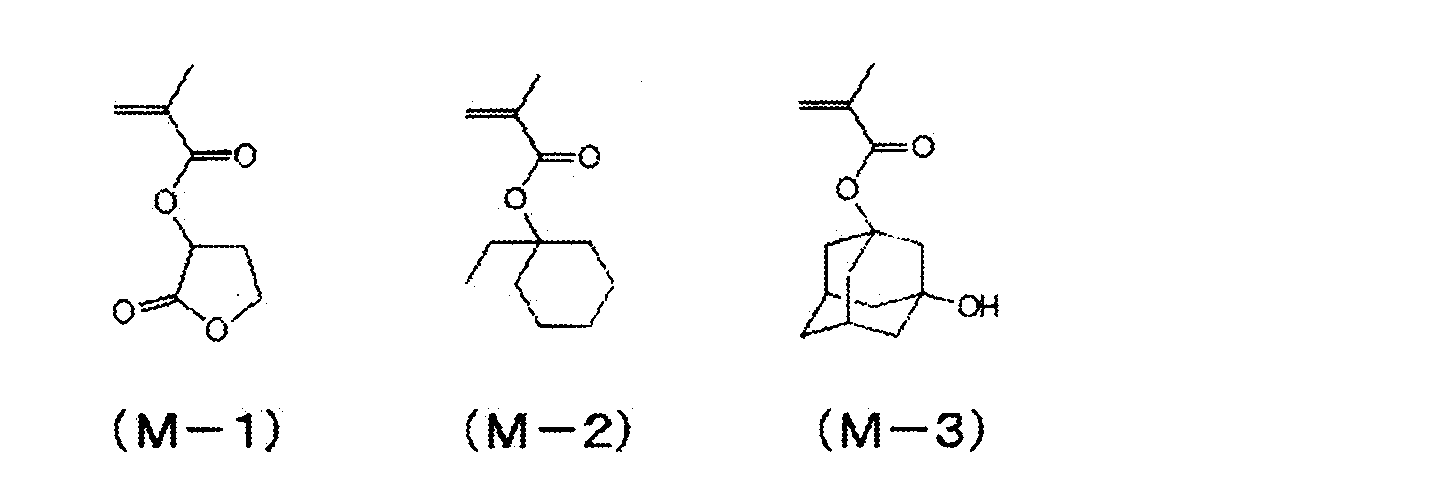
M-2:ECHMA(1-エチルシクロヘキシルメタクリレート)
M-3:HAdMA(3-ヒドロキシ-1-アダマンチルメタクリレート)
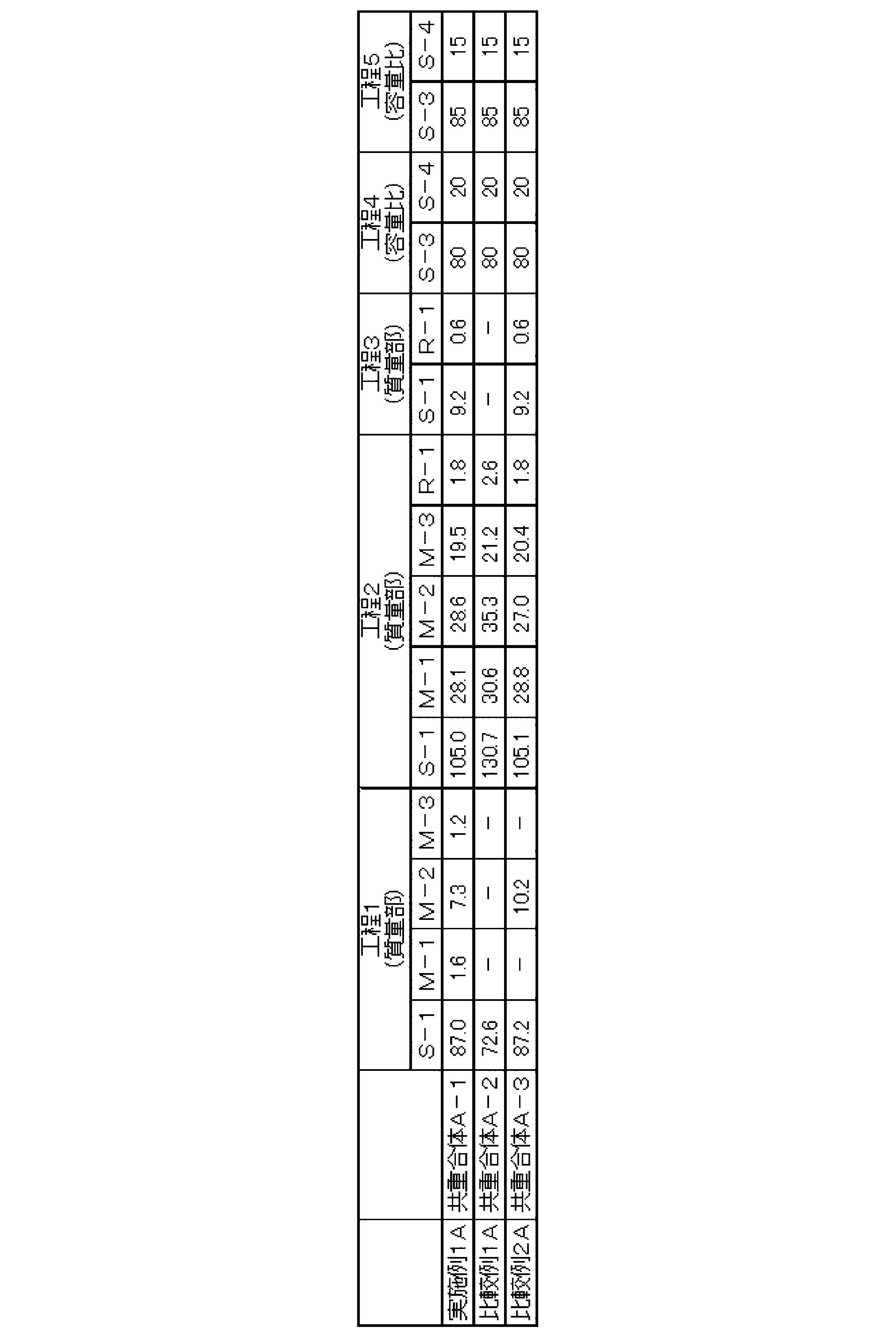
分子設計における構成単位の組成比は、α-GBLMA:ECHMA:HAdMA=40:40:20(モル%)としている。
(工程1)窒素導入口、攪拌機、コンデンサー、滴下漏斗2個及び温度計を備えたフラスコに、窒素雰囲気下で、表1Aの工程1部分に記載の混合比で調製した混合溶液を入れ、攪拌しながら湯浴の温度を80℃に上げた。上記混合比は、各共重合体における目標組成と、重合に用いられる各単量体の反応性とを加味して予め求められた組成である。
(工程2)表1Aの工程2部分に記載の混合比で調製した混合溶液を滴下漏斗より一定速度で4時間かけてフラスコ中に滴下し、その後、80℃の温度で3時間保持した。
(工程3)工程2における混合溶液の滴下開始と同時に、表1Aの工程3部分に記載の混合比で調製した混合溶液を別の滴下漏斗より0.1時間かけてフラスコ内に滴下した。本工程で滴下する重合開始剤量によって、重合工程の初期に生成する共重合体の重量平均分子量が変化するが、各共重合体の目標とする重合平均分子量に近くなるよう設定している。
(工程4)次いで、表1Aの工程4部分に記載の混合比で調製した混合溶媒を、得られた反応溶液の約7倍量準備し、攪拌しながら反応溶液を滴下して、白色のゲル状物の沈殿を得て、濾別した。
(工程5)表1Aの工程5部分に記載の混合比で調製した混合溶媒を、工程4と同量準備し、濾別した沈殿をこの混合溶媒中に投入した。これを濾別、回収し、減圧下60℃で約40時間乾燥し、各共重合体の粉末を得た。
実施例1Aと同様の手順で、配合を表1Aに記載の比較例1Aの内容に変えて、共重合体A-2を合成した。
実施例1Aと同様の手順で、配合を表1Aに記載の比較例2Aの内容に変えて、共重合体A-3を合成した。
実施例1A、比較例1A、比較例2A(共重合体A-1、A-2、A-3)について重量平均分子量(Mw)及び分子量分布(Mw/Mn)を以下の方法で測定した。
約20mgのサンプルを5mLのTHFに溶解し、0.5μmのメンブランフィルターで濾過して試料溶液を調製し、この試料溶液を東ソー製ゲル・パーミエーション・クロマトグラフィー(GPC)装置:HCL-8220(製品名)を用いて、重量平均分子量(Mw)及び数平均分子量(Mn)を測定し、分子量分布(Mw/Mn)を求めた。この測定において、分離カラムは、昭和電工社製、Shodex GPC LF-804L(製品名)を3本直列にしたものを用い、溶剤はTHF(テトラヒドロフラン)、流量1.0mL/min、検出器は示差屈折計、測定温度40℃、注入量0.1mLで、標準ポリマーとしてポリスチレンを使用した。測定結果を表2Aに示す。
リソグラフィー用共重合体における、各構成単位の組成比(単位:モル%)を、1H-NMRの測定により求めた。
この測定において、日本電子(株)製、JNM-GX270型 超伝導FT-NMRを用い、約5質量%のサンプル溶液(A-1~3)(溶媒は重水素化ジメチルスルホキシド、共重合体(A1-1~3)の含有量が、サンプル溶液の総質量に対して、約5質量%である溶液)を直径5mmφのサンプル管に入れ、観測周波数270MHz、シングルパルスモードにて、1H 64回の積算を行った。測定温度は60℃で行った。測定結果を表2Aに示す。

実施例1A、比較例1A、比較例2Aの共重合体(A-1、A-2、A-3)を、表3Aに記載の配合を用い、試験溶液A-1、A-2、A-3を準備した。
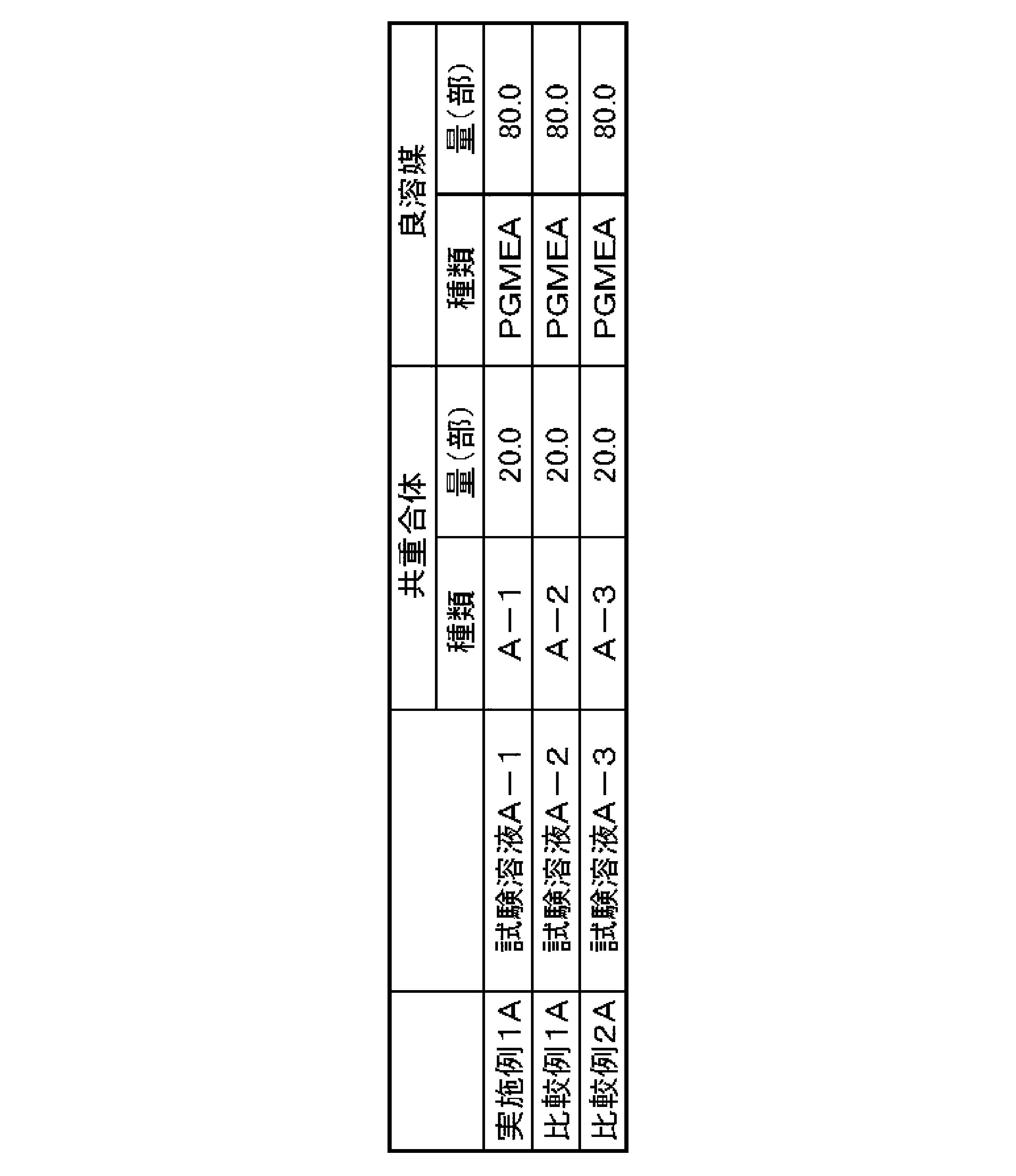
試験溶液A-1、A-2、A-3に、表4Aに示す量のn-ヘプタン、もしくはメタノールを添加して、4時間撹拌した。4時間撹拌後、濁度計(Orbeco-Hellige製TB200)を用いて、各溶液の濁度を測定した。撹拌、測定は25℃で行った。測定結果を表4Aに示す。
この結果より、濁度10NTUを挟む2点の濁度の測定結果より、濁度10NTUとなるn-ヘプタン添加量(X)hを計算で求め、さらに、(X)hの80%のn-ヘプタン添加量を求めた。また、濁度5.0NTUを挟む2点の濁度の測定結果より、濁度5.0NTUとなるメタノール添加量(X)mを計算で求め、さらに、(X)mの80%のメタノール添加量を求めた。結果を表5Aに示す。
次いで、(X)hの80%の量のn-ヘプタンと、(X)mの80%の量のメタノールを、実施例1A、比較例1A、2Aの共重合体の20wt%PGMEA溶液にそれぞれ添加し、4時間撹拌後、濁度計を用いて、濁度を測定した。結果を表6Aに示す。
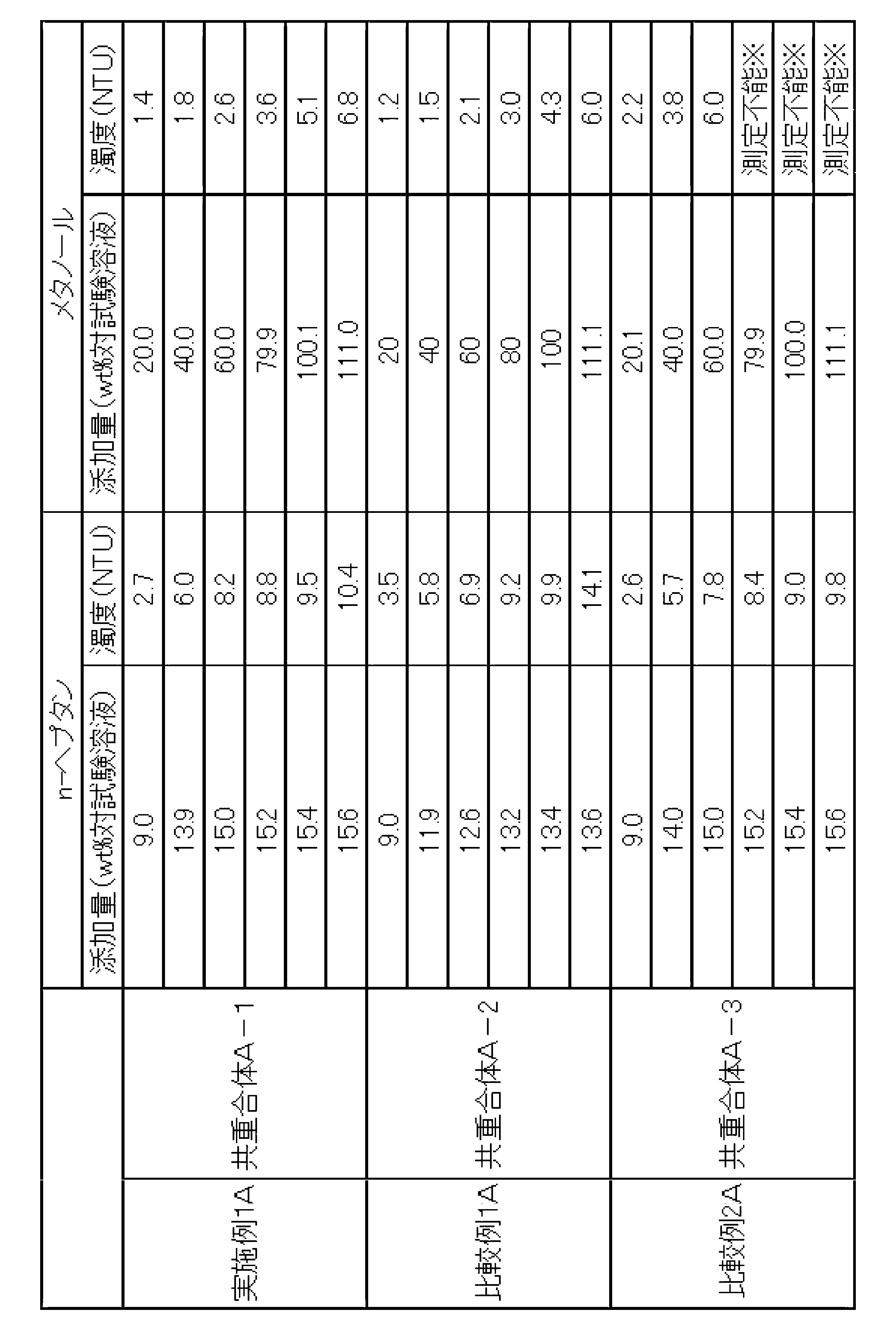

試験溶液A-1を撹拌しつつ、貧溶媒としてメタノールを徐々に添加し、室温(25℃)で析出する添加量を調べたところ、試験溶液の110重量部のメタノールを加えたところで、共重合体が析出した。この値を元に、貧溶媒添加量は108.5重量部(110重量部の98.6%)とした。
(試験溶液の調製)
共重合体A-1~2を、表7Aに記載の配合を用い、密閉可能なガラスびん中に試験溶液A-1-1~A-2-1を準備した。良溶媒に共重合体を完全溶解させたあとに、貧溶媒を添加する手順とし、貧溶媒添加後4時間撹拌して、試験溶液とした。溶液調整時・撹拌時の温度は25℃±1℃とした。
密閉可能なガラスびんに入れた試験溶液A-1-1~A-2-1を25℃の恒温槽に入れ、恒温槽の温度を0.5℃刻みで下げた。0.5℃下げるたびに、その温度で5分間保持し、共重合体の析出が起こるか否かを目視で確認した。この操作を繰り返し、共重合体の析出温度を測定した。結果を表8Aに示す。
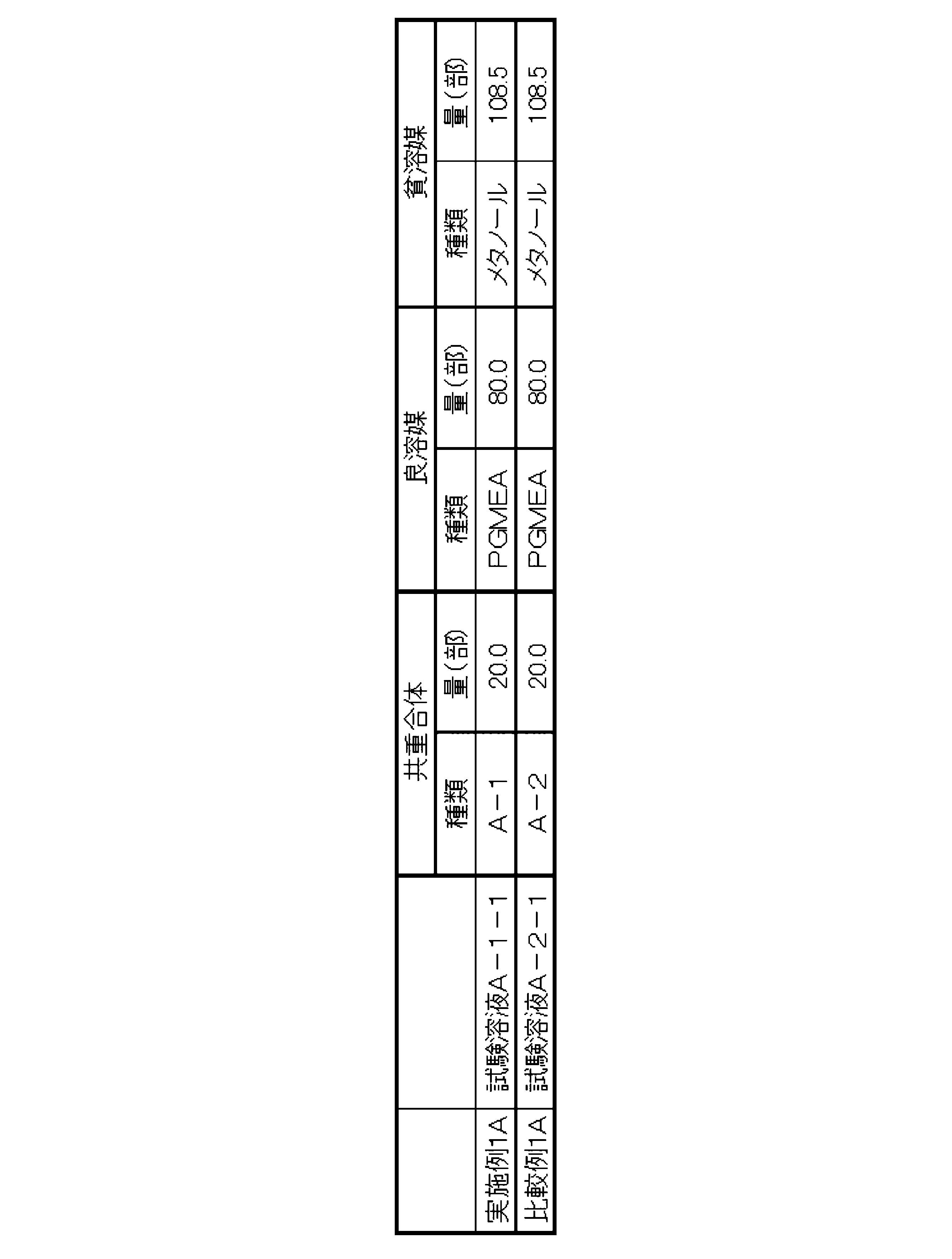

[感度、現像コントラスト測定]
得られたそれぞれの共重合体を用いてレジスト組成物を調製した。即ち、前記共重合体の100部に、光酸発生剤であるトリフェニルスルホニウムトリフレートの2部を添加し、さらに溶媒であるPGMEAを重合体濃度が、溶液の総質量に対して12.5質量%になるように加えて混合して均一溶液とした後、孔径0.1μmのメンブレンフィルターで濾過し、レジスト組成物を得た。レジスト組成物を、6インチシリコンウエハー上に回転塗布し、ホットプレート上で120℃、60秒間プリベーク(PAB)して、厚さ300nmの薄膜を形成した。ArFエキシマレーザー露光装置(リソテックジャパン製、商品名:VUVES-4500)を用い、露光量を変えて10mm×10mm2の18ショットを露光した。次いで110℃、60秒間のポストベーク(PEB)を行った後、レジスト現像アナライザー(リソテックジャパン製。商品名:RDA-800)を用い、23℃にて2.38質量%テトラメチルアンモニウムヒドロキシド水溶液で65秒間現像し、各露光量における現像中のレジスト膜厚の経時変化を測定した。
得られたデータを基に、露光量(mJ/cm2)の対数と、初期膜厚に対する60秒間現像した時点での残存膜厚率(以下、残膜率という)(%)をプロットした曲線(以下、露光量-残膜率曲線という)を作成し、Eth感度(残膜率0%とするための必要露光量であり、感度を表す。)を以下の通り求めた。Eth感度の値が小さいほどレジスト組成物の感度が高いことを示す。
Eth感度:露光量-残膜率曲線が残膜率0%と交わる露光量(mJ/cm2)。
結果を表9Aに示す。
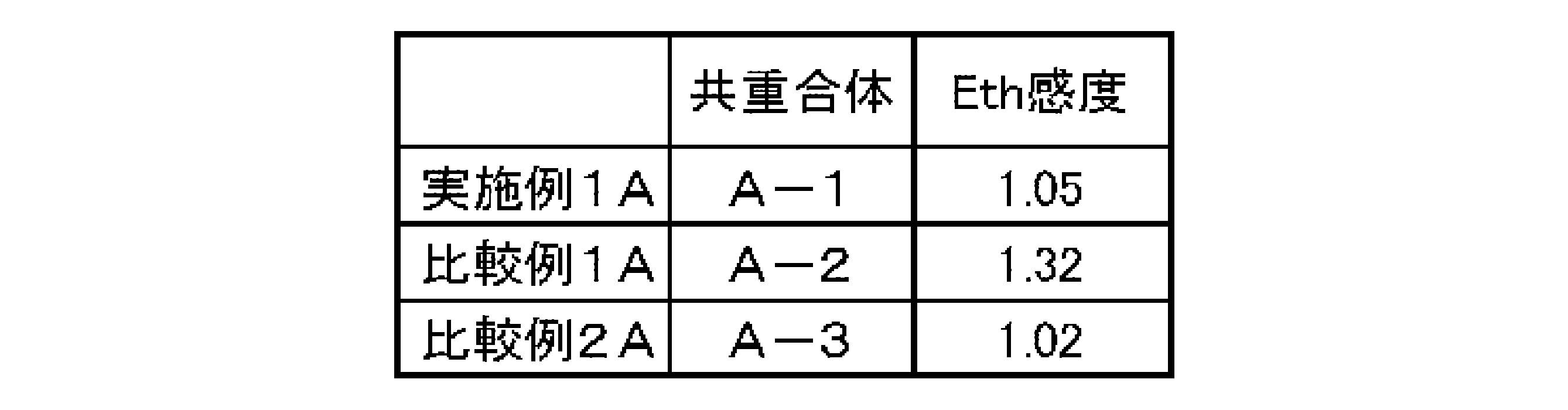
(重量平均分子量及び分子量分布の測定)
共重合体の重量平均分子量(Mw)及び分子量分布(Mw/Mn)は、下記の条件(GPC条件)でゲル・パーミエーション・クロマトグラフィーにより、ポリスチレン換算で求めた。
[GPC条件]
装置:東ソー社製、東ソー高速GPC装置 HLC-8220GPC(商品名)、
分離カラム:昭和電工社製、Shodex GPC K-805L(商品名)を3本直列に連結したもの、
測定温度:40℃、
溶離液:テトラヒドロフラン(THF)、
試料(共重合体の場合):共重合体の約20mgを5mLのTHFに溶解し、0.5μmメンブレンフィルターで濾過した溶液、
試料(重合反応溶液の場合):サンプリングした重合反応溶液の約30mgを5mLのTHFに溶解し、0.5μmメンブレンフィルターで濾過した溶液、
流量:1mL/分間、
注入量:0.1mL、
検出器:示差屈折計。
F-80(Mw=706,000)、
F-20(Mw=190,000)、
F-4(Mw=37,900)、
F-1(Mw=10,200)、
A-2500(Mw=2,630)、
A-500(Mw=682、578、474、370、260の混合物)。
重合反応溶液中に残存する未反応の単量体量は次の方法で求めた。
反応器内の重合反応溶液を0.5g採取し、これをアセトニトリルで希釈し、メスフラスコを用いて全量を50mLとした。この希釈液を0.2μmのメンブレンフィルターで濾過し、東ソー社製、高速液体クロマトグラフHPLC-8020(製品名)を用いて、前記希釈液中の未反応単量体量を、単量体ごとに求めた。
測定時間3~24分:A液/B液=90体積%/10体積%から、50体積%/50体積%まで。
測定時間24~36.5分:A液/B液=50体積%/50体積%から、0体積%/100体積%まで。
測定時間36.5~44分:A液/B液=0体積%/100体積%。
共重合体の分割は下記の条件(GPC条件)でGPCによりおこなった。各フラクションの溶液から溶媒を留去して固形物を得ることにより、各フラクションに含まれる共重合体を得た。
[GPC条件]
装置:日本分析工業、分取型LC、LC-9105(商品名)、
分離カラム:日本分析工業製、JAIGEL-2H、JAIGEL-3H(商品名)を直列に連結したもの、
測定温度:40℃、
溶離液:THF、
試料:共重合体の約1gを10mLのTHFに溶解し、0.5μmメンブレンフィルターで濾過した溶液、
流量:3.5mL/分間、
注入量:10mL、
検出器:示差屈折計、
分取方法:溶出曲線において、共重合体に係るピークを示す溶離液を、溶出順に、体積が均等になるように5等分して、5個のフラクションを分取した。
上記の方法で分取した5個のフラクションにおけるそれぞれの分画共重合組成を以下の方法で測定した。
各フラクションから溶媒を留去して得られた固形物の約5質量部を重ジメチルスルホキシドの約95質量部に溶解して試料溶液を調製した。この試料溶液をNMRチューブに入れ、1H-NMR(JEOL社製、共鳴周波数:270MHz)を用いて分析した。各構成単位に由来するシグナルの積分強度比から、共重合体の共重合組成を算出した。
レジスト組成物を6インチシリコンウエハー上に回転塗布し、ホットプレート上で120℃、60秒間のプリベーク(PAB)を行い、厚さ300nmのレジスト膜を形成した。ArFエキシマレーザー露光装置(リソテックジャパン社製、製品名:VUVES-4500)を用い、露光量を変えながら10mm×10mmの面積の18ショットを露光した。次いで110℃、60秒間のポストベーク(PEB)を行った後、レジスト現像アナライザー(リソテックジャパン社製、製品名:RDA-806)を用い、23.5℃にて2.38%水酸化テトラメチルアンモニウム水溶液で65秒間現像した。各露光量のレジスト膜それぞれについて、現像中のレジスト膜厚の経時変化を測定した。
得られたレジスト膜厚の経時変化のデータを基に、露光量(単位:mJ/cm2)の対数と、初期膜厚に対する30秒間現像した時点での残存膜厚の比率(単位:%、以下残膜率という。)との関係をプロットして、露光量-残膜率曲線作成した。この曲線に基づいて、残膜率0%とするための必要露光量(Eth)の値を求めた。即ち、露光量-残膜率曲線が、残膜率0%の直線と交わる点における露光量(mJ/cm2)をEthとして求めた。このEthの値は感度を表し、この値が小さいほど、感度が高いことを示す。
共重合体の20部とPGMEAの80部とを混合し、25℃に保ちながら撹拌を行い、目視で完全溶解を判断した。希薄系プローブを備えた高感度仕様のFPAR-1000(大塚電子製)を用い粒子径分布を測定した。
得られた自己相関関数はMarquardt法により解析し、粒子径分布曲線を得た。
本例は、溶液Saの第1の組成の設計方法として上記第2の方法を用いた例である。
本例では、下記式(m-1)、(m-2)、(m-3)で表される単量体m-1、m-2、m-3を重合して、目標組成がm-1:m-2:m-3=40:40:20(モル%)、重量平均分子量の目標値が10,000の共重合体を製造する場合の、Saの組成を求めた。3種の単量体のうち、単量体m-2が酸脱離性基を有する単量体である。
本例で使用した重合開始剤はジメチル-2,2’-アゾビスイソブチレート(前記V601(商品名))である。重合温度は80℃とした。

その後、下記の単量体混合物、溶媒、及び重合開始剤を含む滴下溶液を、滴下漏斗より4時間かけて一定の滴下速度でフラスコ内に滴下し、さらに80℃の温度を3時間保持した。滴下溶液の滴下開始から7時間後に、室温まで冷却して反応を停止させた。
単量体m-1を28.56部(40モル%)、
単量体m-2を32.93部(40モル%)、
単量体m-3を19.82部(20モル%)、
乳酸エチルを122.0部、
ジメチル-2,2’-アゾビスイソブチレートを2.415部(単量体の全供給量に対して2.5モル%)。

その結果、例えば滴下開始から2、3、4時間後の結果は表2Bの通りであった。
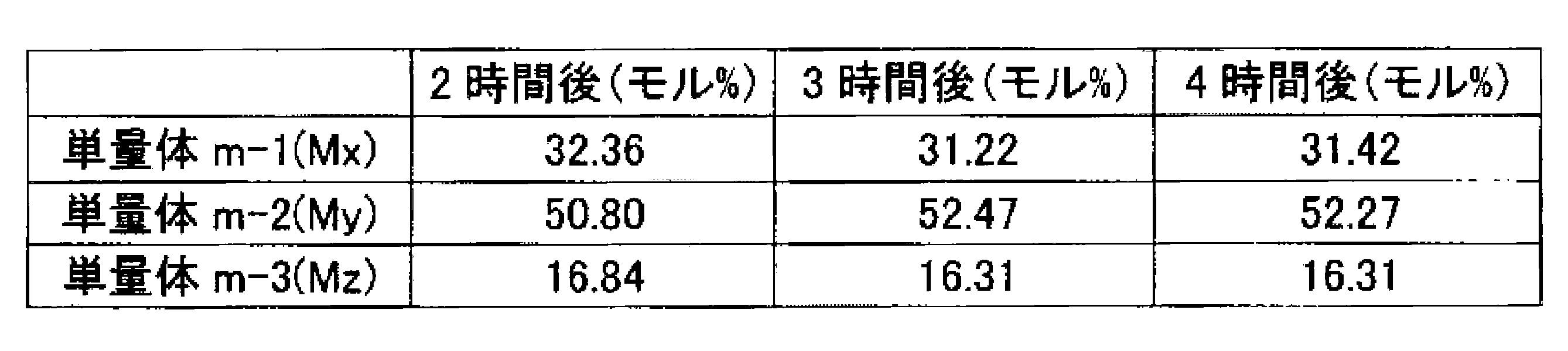
次いで差分データをとることによって、サンプリング時とサンプリング時の間に共重合体へ転化したもの質量を、各単量体について求め、モル分率に換算した。このモル分率の値は、各サンプリング時とサンプリング時の間に生成した共重合体、即ち滴下からの経過時間(反応時間)がt1からt2までの間、t2からt3までの間…にそれぞれ生成した共重合体における構成単位の含有比率(共重合組成ということもある。)Px:Py:Pzに該当する。
この値と、滴下開始からの経過時間が2時間後におけるMx:My:Mzの値(表2B)を用い、Fx=Px/Mx、Fy=Py/My、Fz=Pz/Mzより、ファクターFx、Fy、Fzを求めると、Fx=1.27、Fy=0.76、Fz=1.22となる。また、Gx=Fx=1.27、Gy=Fy/3=0.25、Gz=Fz=1.22となる。
前記ファクターの値と、目標組成を用いてSaの組成x0:y0:z0を求めた。
x0=((40/1.27)/(40/1.27+40/0.25+20/1.22))=15.3モル%。
y0=((40/0.25)/(40/1.27+40/0.25+20/1.22))=76.7モル%。
z0=((20/1.22)/(40/1.27+40/0.25+20/1.22))=8.0モル%。
参考例1Bと同じ条件において、溶液Saの第1の組成の設計方法として上記第1の方法を用いる場合について説明する。
表1B、2Bに示されるように、未反応単量体の組成の時間変化において、滴下開始から3時間後と4時間後との変動幅がもっとも小さかった。
従って、滴下開始から3時間後の未反応単量体のモル分率(Mx:My:Mz)と、4時間後の未反応単量体のモル分率(Mx:My:Mz)の平均値を、未反応単量体の組成(U)として採用する。
組成(U)のMx’:My’:Mz’は以下の通りとなる。
Mx’=31.3モル%、
My’=52.4モル%、
Mz’=16.3モル%。
本例において、溶液Saの第1の組成は、単量体m-1、m-2、m-3のうち、酸脱離性基を有する単量体m-2の比率を上記My’の1.5倍とする。第1の組成における(m-1の比率)/(m-3の比率)は、Mx’/Mz’と同じとする。
その結果、溶液Saの第1の組成は以下の通りとなる。
単量体m-1:14.1モル%、
単量体m-2:78.6モル%、
単量体m-3:7.3モル%。
本例では、予めS1を反応器内に供給し、T1及び重合開始剤溶液を滴下する工程を設けた。
参考例1Bで求めたSaの組成をS1の組成として用いた。使用する単量体の種類、重合開始剤の種類、重合温度、共重合体の目標組成、及び重量平均分子量の目標値は参考例1Bと同じである。S1の単量体組成(第1の組成)は上述のファクターを用いた方法で設計したSaの組成とほぼ同じとし、T1の単量体組成(第2の組成)は目標組成と同じとした。
本例におけるS1の単量体組成(第1の組成)と、参考例2Bにおける未反応単量体の組成(U)との関係において、前記第1の組成における酸脱離性基を含む単量体の含有比率(モル%)は、組成(U)における酸脱離性基を含む単量体の含有比率(モル%)に対して、1.46倍であった(表8Bに示す。以下同様。以下「組成(U)に対する第1の組成における酸脱離性基の割合」という。)。
その後、別個の滴下漏斗より下記のT1と重合開始剤溶液の供給を同時に開始し、T1を4時間かけて、重合開始剤溶液を20分かけてフラスコ内に滴下した。さらにT1の供給終了直後より、80℃の温度を2時間保持した。T1の滴下開始から7時間後に、室温まで冷却して反応を停止させた。
単量体m-1を1.69部(15.3モル%)、
単量体m-2を9.42部(76.7モル%)、
単量体m-3を1.21部(8.0モル%)、
乳酸エチルを99.3部。
(T1)
単量体m-1を29.75部(40モル%)、
単量体m-2を34.30部(40モル%)、
単量体m-3を20.65部(20モル%)、
乳酸エチルを118.8部、
ジメチル-2,2’-アゾビスイソブチレートを2.119部(S1及びT1における単量体の合計量に対して1.84モル%)。
(重合開始剤溶液)
乳酸エチルを8.3部、
ジメチル-2,2’-アゾビスイソブチレートを0.530部(S1及びT1における単量体の合計量に対して0.48モル%)。
反応時間7時間が経過した後に、室温まで冷却して反応を停止させ、フラスコ内の重合反応溶液を、約10倍量のメタノール及び水の混合溶媒(メタノール/水=80/20容量比)に撹拌しながら滴下し、白色の析出物(共重合体P1)の沈殿を得た。沈殿を濾別し、再度、前記と同じ量のメタノール及び水の混合溶媒(メタノール/水=90/10容量比)へ投入し、撹拌しながら沈殿の洗浄を行った。そして、洗浄後の沈殿を濾別し、共重合体湿粉160部を得た。この共重合体湿粉のうち10部を減圧下40℃で約40時間乾燥した。
得られた白色粉体(共重合体P1)を1H-NMRとGPCにて分析しMw、Mw/Mnを求めた。結果を表7Bに示す(以下、同様)。また共重合体の溶解性(濁度)を評価した。結果を表8Bに示す(以下、同様)。
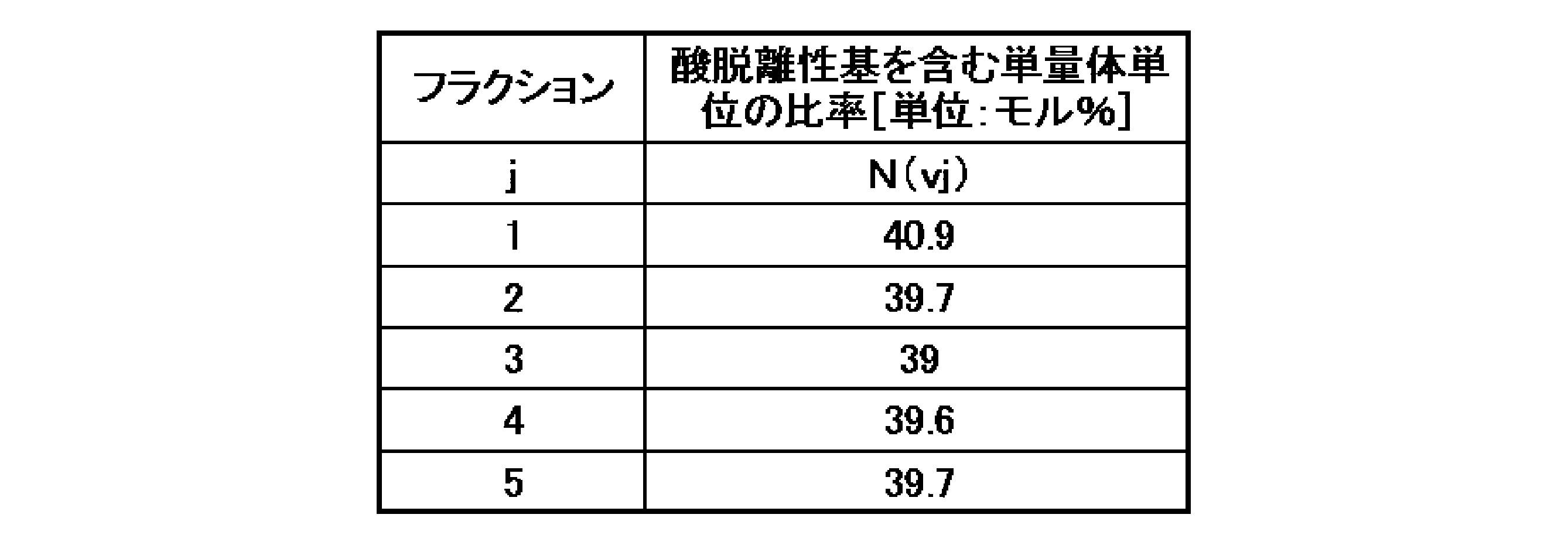
上記共重合体P1の20部をPGMEAの80部へ完全に溶解させ(即ち、2リソグラフィー用共重合体を総質量に対して20wt%で含むPGMEA溶液)、表4Bに示す量のn-ヘプタン、若しくはメタノールを添加して、4時間撹拌した。4時間撹拌後、濁度計(Orbeco-Hellige製TB200)を用いて、各溶液の濁度を測定した。撹拌、測定は25℃で行った。測定結果を表4Bに示す。
この結果より、濁度10NTUを挟む2点の濁度の測定結果より、濁度10NTUとなるn-ヘプタン添加量(X)hを計算で求め、さらに、(X)hの80%の量のn-ヘプタン添加量を求めた。結果を表5Bに示す。また、濁度5.0NTUを挟む2点の濁度の測定結果より、濁度5.0NTUとなるメタノール添加量(X)mを計算で求め、さらに、(X)mの80%の量のメタノール添加量を求めた。結果を表6Bに示す。
次いで、(X)hの80%の量のn-ヘプタンと、(X)mの80%の量のメタノールを、リソグラフィー用共重合体を総質量に対して20wt%で含むPGMEA溶液にそれぞれ添加し、4時間撹拌後濁度計を用いて濁度を測定した。結果を表11Bに示す。

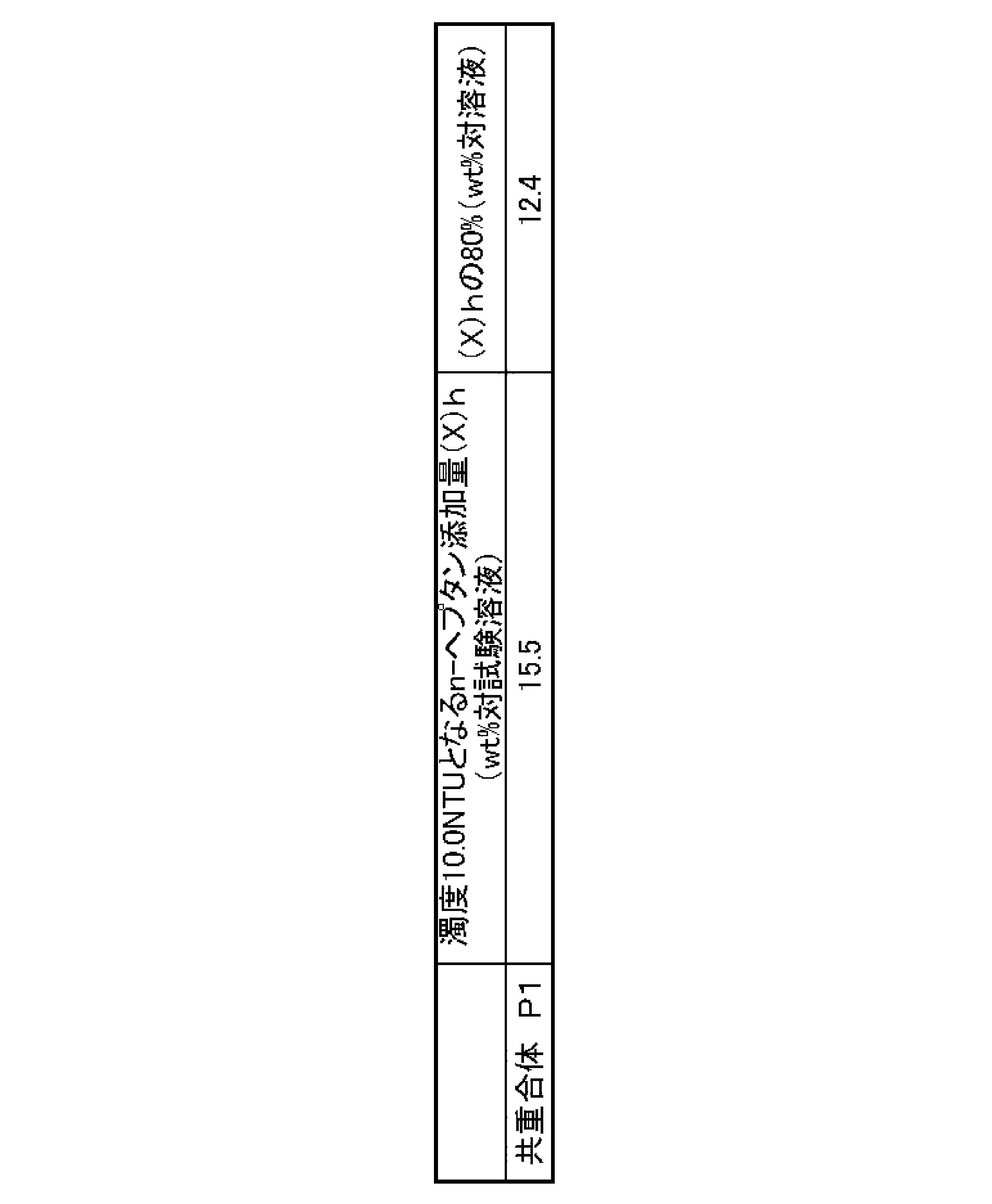
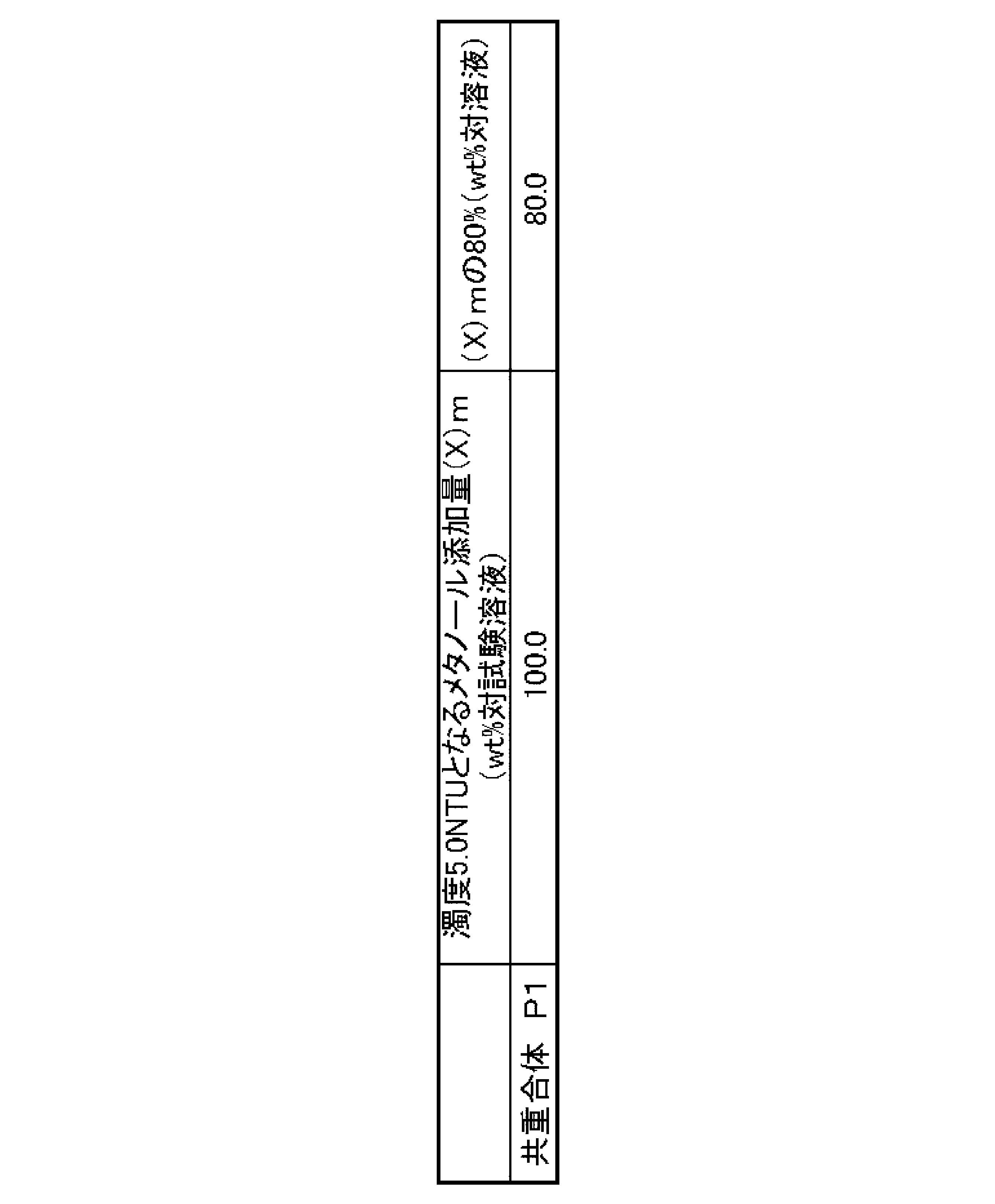
上記共重合体湿粉の残りを、PGMEA880gへ投入し、完全に溶解させて共重合体溶液とした後、孔径0.04μmのナイロン製フィルター(日本ポール社製、P-NYLON N66FILTER0.04M(商品名))へ通液して、共重合体溶液を濾過した。
得られた共重合体溶液を減圧下で加熱してメタノール及び水を留去し、さらにPGMEAを留去し、共重合体の濃度が共重合体P1溶液の総質量に対して25質量%である共重合体P1溶液を得た。この際、最高到達真空度は0.7kPa、最高溶液温度は65℃、留去時間は8時間であった。
実施例1Bの単量体m-1を下記式(m-1’)に変更したほかは、実施例1Bと同様に行った。結果を表10B、表11Bに示す。
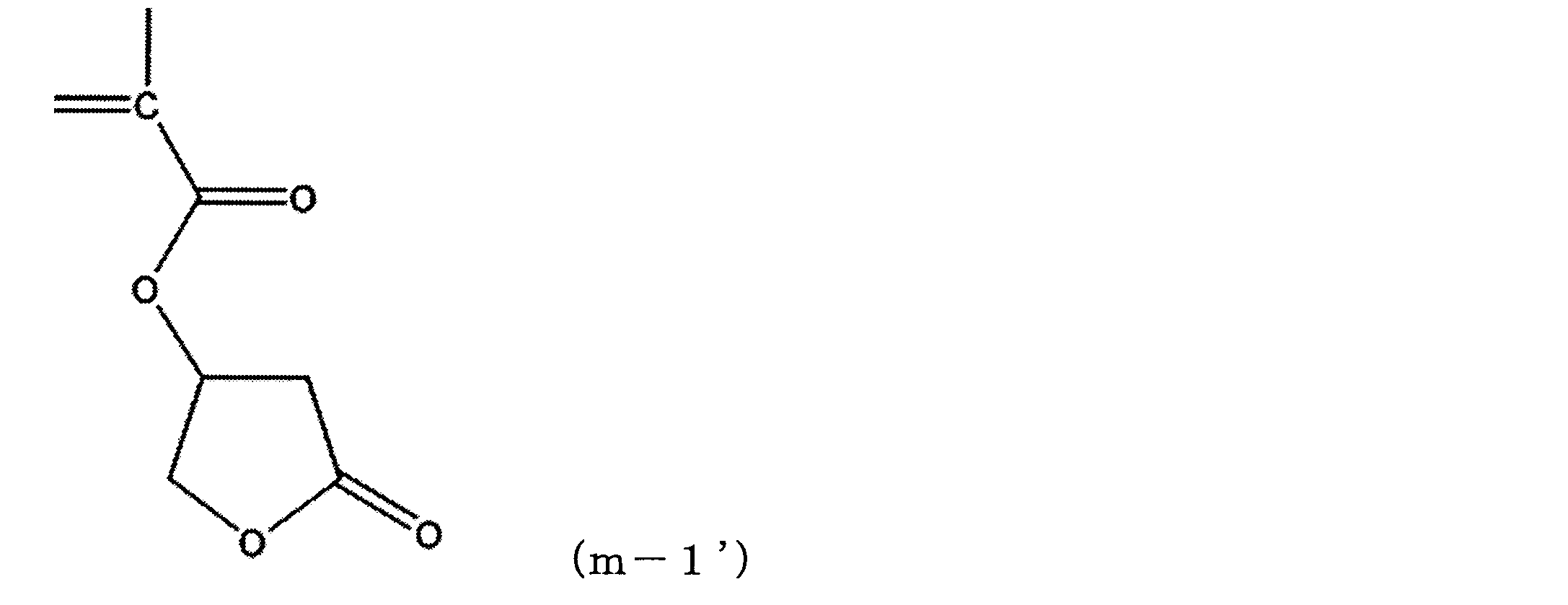
実施例1Bにおいて、S1及びT1、開始剤溶液の組成をそれぞれ以下の通りに変更したほかは、実施例1と同様に行った。
本例では、参考例1Bで得たファクターの値(Fx=1.27、Fy=0.76、Fz=1.22)と目標組成を用い、下記の計算式によりSaの組成x0:y0:z0を決めた。S1の単量体組成は前記Saの組成とほぼ同じとし、T1の単量体組成は目標組成と同じとした。
本例におけるS1の単量体組成(第1の組成)と、参考例2Bにおける未反応単量体の組成(U)とを比べると、組成(U)に対する第1の組成における酸脱離性基の割合は1.00倍であった。
x0=40/1.27=31.45モル
y0=40/0.76=52.63モル
z0=20/1.22=16.39モル
単量体m-1を3.99部(31.3モル%)、
単量体m-2を7.68部(52.4モル%)、
単量体m-3を2.88部(16.3モル%)、
乳酸エチルを99.3部。
(T1)
単量体m-1を24.03部(40モル%)、
単量体m-2を27.71部(40モル%)、
単量体m-3を16.68部(20モル%)、
乳酸エチルを101.8部、
ジメチル-2,2’-アゾビスイソブチレートを0.690部(S1及びT1における単量体の合計量に対して0.7モル%)。
(重合開始剤溶液)
乳酸エチルを2.0部、
ジメチル-2,2’-アゾビスイソブチレートを1.280部(S1及びT1における単量体の合計量に対して1.3モル%)。
実施例1Bと同様に、本例におけるN(vj)、を求めた。結果を表7Bに示す。実施例1Bと同様に、Mw、Mw/Mn、N(vj)/Naveを求めた。実施例1Bと同様に、溶解性(濁度)、感度を評価した。

実施例1Bにおいて、S1及びT1、開始剤溶液の組成をそれぞれ以下の通りに変更したほかは、実施例1Bと同様に行った。
本例では、予め反応器内に供給するS1中の単量体を、酸脱離性基を含有する単量体のみとした。T1の単量体組成は目標組成と同じとした。
本例におけるS1の単量体組成(第1の組成)と、参考例2Bにおける未反応単量体の組成(U)とを比べると、組成(U)に対する第1の組成における酸脱離性基の割合は1.91倍であった。
(S1)
単量体m-1を0部(0モル%)、
単量体m-2を12.89部(100モル%)、
単量体m-3を0部(0モル%)、
乳酸エチルを100.7部、
(T1)
単量体m-1を29.75部(40モル%)、
単量体m-2を34.30部(40モル%)、
単量体m-3を20.65部(20モル%)、
乳酸エチルを116.5部、
ジメチル-2,2’-アゾビスイソブチレートを1.997部(S1及びT1における単量体の合計量に対して1.73モル%)。
(重合開始剤溶液)
乳酸エチルを10.4部、
ジメチル-2,2’-アゾビスイソブチレートを0.666部(S1及びT1における単量体の合計量に対して0.58モル%)。
実施例1Bと同様に本例におけるN(vj)を求めた。結果を表8Bに示す。実施例1Bと同様に、Mw、Mw/Mn、N(vj)/Naveを求めた。実施例1Bと同様に、溶解性(濁度)、感度を評価した。
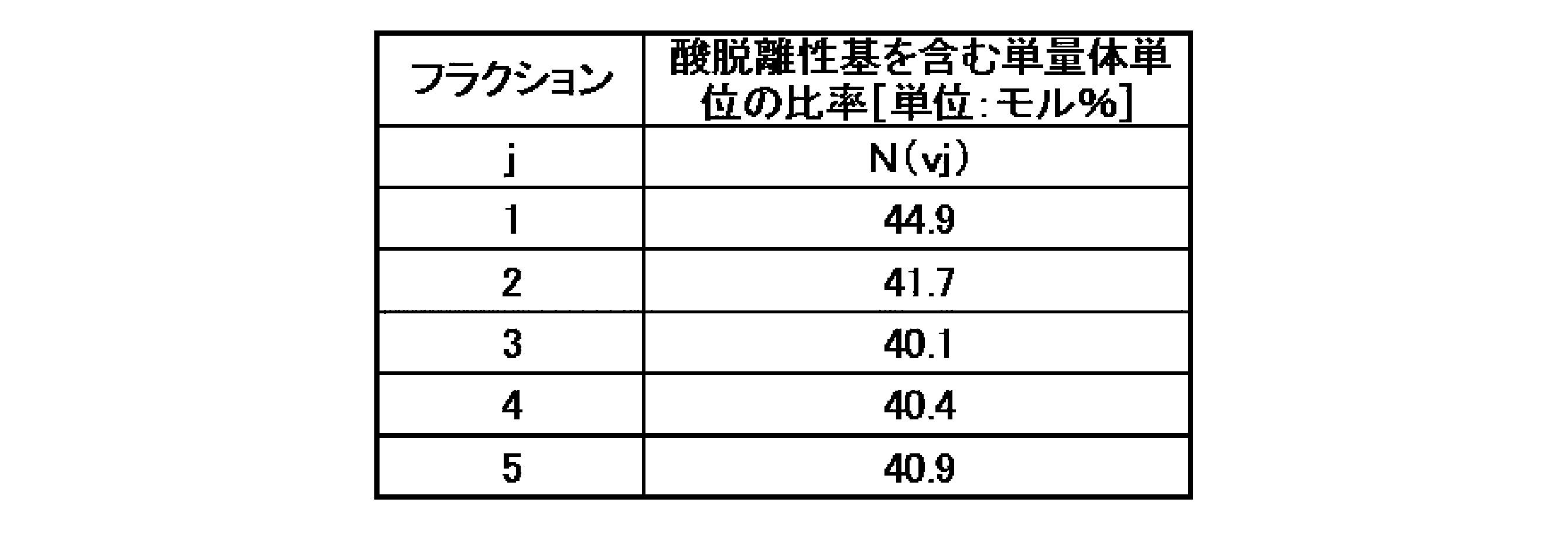
参考例1Bにおいて、反応時間7時間が経過した後に、室温まで冷却して反応を停止させて得られるフラスコ内の重合反応溶液を用い、実施例1Bの共重合体の精製工程と同様にして比較共重合体Q3を得た。得られた比較共重合体Q3について、実施例1Bと同様の測定及び評価を行った。
実施例1Bと同様に、本例におけるN(vj)、を求めた。結果を表9Bに示す。実施例1Bと同様に、Mw、Mw/Mn、N(vj)/Naveを求めた。実施例1Bと同様に、溶解性(濁度)、感度を評価した。

本例では、単量体混合物と重合開始剤と溶媒を含有する滴下溶液を、溶媒のみを入れた反応器内に一定の滴下速度で滴下する方法で、酸脱離性基を含む構成単位の含有比率が異なる2種の共重合体(Q4-1及びQ4-2)をそれぞれ合成し、これらを混合する方法でリソグラフィー用共重合体(Q4)を製造した。
窒素導入口、撹拌機、コンデンサー、滴下漏斗、及び温度計を備えたフラスコ(反応器)に、窒素雰囲気下で、乳酸エチルを81.8部入れた。フラスコを湯浴に入れ、フラスコ内を撹拌しながら湯浴の温度を80℃に上げた。
その後、下記の単量体混合物、溶媒、及び重合開始剤を含む滴下溶液を、滴下漏斗より4時間かけて一定の滴下速度でフラスコ内に滴下し、さらに80℃の温度を3時間保持した。滴下溶液の滴下開始から7時間後に、室温まで冷却して反応を停止させた。
単量体m-1を25.50部(30モル%)、
単量体m-2を49.00部(50モル%)、
単量体m-3を23.60部(20モル%)、
乳酸エチルを147.2部、
ジメチル-2,2’-アゾビスイソブチレートを2.070部(単量体の全供給量に対して1.8モル%)。
その後、下記の単量体混合物、溶媒、及び重合開始剤を含む滴下溶液を、滴下漏斗より4時間かけて一定の滴下速度でフラスコ内に滴下し、さらに80℃の温度を3時間保持した。滴下溶液の滴下開始から7時間後に、室温まで冷却して反応を停止させた。
単量体m-1を42.50部(50モル%)、
単量体m-2を29.40部(30モル%)、
単量体m-3を23.60部(20モル%)、
乳酸エチルを143.3部、
ジメチル-2,2’-アゾビスイソブチレートを4.600部(単量体の全供給量に対して4.0モル%)。
得られた比較混合共重合体Q4について、実施例1Bと同様にして、表10B、表11Bに示す項目についての測定及び評価を行った。

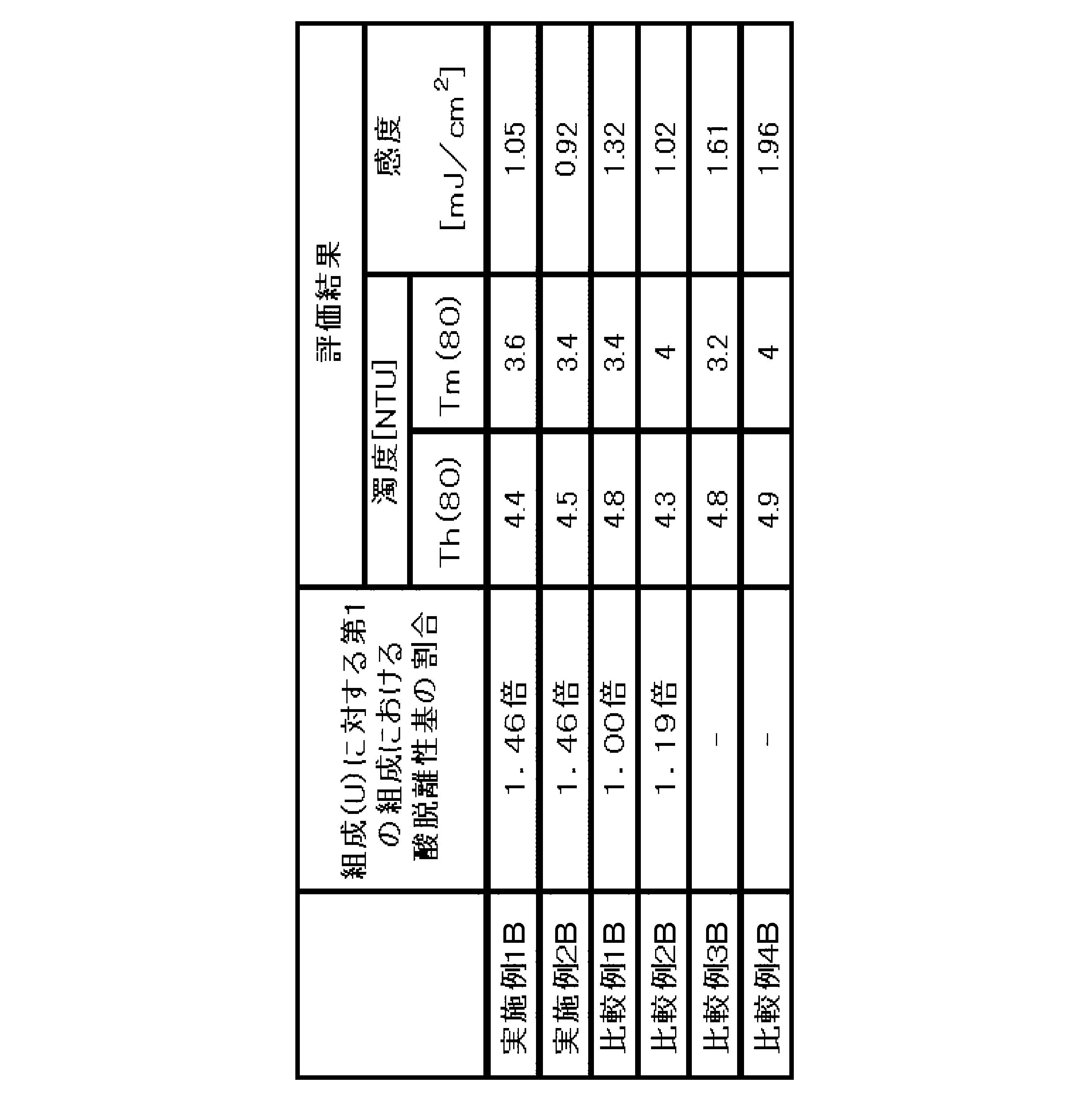
実施例1Bで得られた共重合体P1、及び比較例4Bで得られた比較混合共重合体Q4について動的光散乱法による粒子径分布の評価を実施した。図2は実施例1Bの粒度分布曲線、図3は比較例4Bの粒度分布曲線である。実施例1Bではピークトップが1点であったのに対し、比較例4Bではピークトップが2点検出された。
また、実施例1Bで得た共重合体P1を用いて調製したレジスト組成物は感度に優れる。
これに対して、比較例1B及び3Bの比較共重合体Q1、Q3は、実施例1Bと比較して感度が劣る。また特に低極性溶剤への溶解性が悪い。
また、比較例2Bの比較共重合体Q2は、感度及び低極性溶剤への溶解性は実施例1Bと同程度であるが、酸脱離性基の高分子量側への偏りが大きすぎるために、高極性溶剤への溶解性が著しく劣る。
Claims (9)
- 濁度度Th(80)が、1.0以上、4.6NTU以下であり、
濁度Tm(80)が、1.0以上、3.8NTU以下である、リソグラフィー用共重合体であって、
前記濁度度Th(80)は、リソグラフィー用共重合体の含有量がPGMEA溶液の総質量に対して20wt%である前記PGMEA溶液に、n-ヘプタンを添加した際の濁度が10NTUになるn-ヘプタン添加量を(X)hとし、この(X)hの80%の量のn-ヘプタンを前記PGMEA溶液に添加した際の、前記PGMEA溶液の濁度であり;
前記濁度Tmは、前記リソグラフィー用共重合体の含有量がPGMEA溶液の総質量に対して20wt%であるPGMEA溶液に、メタノールを添加した際の濁度が5.0NTUになるメタノール添加量を(X)mとし、この(X)mの80%の量のメタノールを、前記PGMEA溶液に添加した際の、前記PGMEA溶液の濁度である。 - リソグラフィー用共重合体が酸脱離性基を含む請求項1記載のリソグラフィー用共重合体。
- 少なくとも1種の酸脱離性基を含む単量体、及び少なくとも1種の酸脱離性基を含まない単量体を重合して得られるリソグラフィー用共重合体であって、
前記リソグラフィー用共重合体のN(v1)/Naveが1.01~1.09であり、濁度度Th(80)が、1.0以上、4.7NTU以下であり、濁度Tm(80)が、1.0以上、3.9NTU以下であり;
前記N(v1)/Naveは、ゲル・パーミエイション・クロマトグラフィー(GPC)により得られる溶出曲線において前記共重合体に係るピークを示す溶離液を、溶出順に、体積が均等になるように分割した5個のフラクションのうち、最も先に溶出された1番目のフラクションに含まれる共重合体を構成する構成単位の全モル数に対する酸脱離性基を含む構成単位のモル数の比率をN(v1)モル%とし、前記5個のフラクションの全部に含まれる共重合体を構成する構成単位の全モル数に対する酸脱離性基を含む構成単位のモル数の比率をNaveモル%としたとき、N(v1)をNaveで割った数値であり;
前記濁度度Th(80)は、リソグラフィー用共重合体の含有量がPGMEA溶液の総質量に対して20wt%である前記PGMEA溶液に、n-ヘプタンを添加した際の濁度が10NTUになるn-ヘプタン添加量を(X)hとし、この(X)hの80%の量のn-ヘプタンを前記PGMEA溶液に添加した際の、前記PGMEA溶液の濁度であり;
前記濁度Tmは、前記リソグラフィー用共重合体の含有量がPGMEA溶液の総質量に対して20wt%であるPGMEA溶液に、メタノールを添加した際の濁度が5.0NTUになるメタノール添加量を(X)mとし、この(X)mの80%の量のメタノールを、前記PGMEA溶液に添加した際の、前記PGMEA溶液の濁度である。 - 酸脱離性基が、(メタ)アクリロイルオキシ基との結合部位に第3級炭素原子を有する(メタ)アクリル酸エステル残基である、請求項2又は3のリソグラフィー用共重合体。
- 酸脱離性基を有する構成単位が下記式(i)~(iv)で表される構成単位からなる群から選ばれる少なくとも1種の構成単位である、請求項2~4のいずれか1項に記載のリソグラフィー用共重合体。

R1、R4、及びR5は、それぞれ独立して炭素数1~5のアルキル基を表し;R2、及びR3はそれぞれ独立して炭素数1~3のアルキル基を表し;X1、X2、X3、及びX4は、それぞれ独立して炭素数1~6のアルキル基を表し;n1、n2、n3、及びn4は、それぞれ独立して0~4の整数を表し;n1、n2、n3又はn4が2以上の場合、1つの構成単位中にX1、X2、X3又はX4は複数存在し、前記複数のX1、X2、X3及びX4は互いに同じであってもよく異なってもよく;R331、R332、R333及びR334はそれぞれ独立して水素原子又は炭素数1~6のアルキル基を表し;Z1及びZ2はそれぞれ独立して-O-、-S-、-NH-又は炭素数1~6のアルキレン基を表し;qは0又は1を表し;rは0~2の整数を表す。) - さらにラクトン骨格を有する構成単位を含む請求項2~5のいずれか1項に記載のリソグラフィー用共重合体。
- さらに-C(CF3)2-OHで表される基、ヒドロキシ基、シアノ基、メトキシ基、カルボキシ基及びアミノ基からなる群から選択される少なくとも1つの基を有する構成単位を含む、請求項2~6のいずれか1項に記載のリソグラフィー用共重合体。
- 請求項1~7のいずれか1項に記載のリソグラフィー用共重合体と、活性光線又は放射線の照射により酸を発生する化合物と、を含有するレジスト組成物。
- 請求項8に記載のレジスト組成物を被加工基板上に塗布する工程と、250nm以下の波長の光で露光する工程と、現像液を用いて現像する工程とを含む、パターンが形成された基板の製造方法。
Priority Applications (4)
| Application Number | Priority Date | Filing Date | Title |
|---|---|---|---|
| CN201480048455.9A CN105518041B (zh) | 2013-09-03 | 2014-09-03 | 半导体光刻用共聚物、抗蚀剂组合物以及基板的制造方法 |
| US14/912,798 US10336851B2 (en) | 2013-09-03 | 2014-09-03 | Copolymer for semiconductor lithography, resist composition, and method for manufacturing substrate |
| JP2014546002A JP6455148B2 (ja) | 2013-09-03 | 2014-09-03 | 半導体リソグラフィー用共重合体、レジスト組成物、及び、基板の製造方法 |
| KR1020167004638A KR101748097B1 (ko) | 2013-09-03 | 2014-09-03 | 반도체 리소그래피용 공중합체, 레지스트 조성물 및 기판의 제조 방법 |
Applications Claiming Priority (4)
| Application Number | Priority Date | Filing Date | Title |
|---|---|---|---|
| JP2013-182469 | 2013-09-03 | ||
| JP2013182468 | 2013-09-03 | ||
| JP2013182469 | 2013-09-03 | ||
| JP2013-182468 | 2013-09-03 |
Publications (1)
| Publication Number | Publication Date |
|---|---|
| WO2015033960A1 true WO2015033960A1 (ja) | 2015-03-12 |
Family
ID=52628431
Family Applications (1)
| Application Number | Title | Priority Date | Filing Date |
|---|---|---|---|
| PCT/JP2014/073197 Ceased WO2015033960A1 (ja) | 2013-09-03 | 2014-09-03 | 半導体リソグラフィー用共重合体、レジスト組成物、及び、基板の製造方法 |
Country Status (5)
| Country | Link |
|---|---|
| US (1) | US10336851B2 (ja) |
| JP (1) | JP6455148B2 (ja) |
| KR (1) | KR101748097B1 (ja) |
| CN (1) | CN105518041B (ja) |
| WO (1) | WO2015033960A1 (ja) |
Cited By (1)
| Publication number | Priority date | Publication date | Assignee | Title |
|---|---|---|---|---|
| WO2015159530A1 (en) * | 2014-04-14 | 2015-10-22 | Toyo Gosei Co., Ltd. | Manufacturing method of polymer |
Families Citing this family (1)
| Publication number | Priority date | Publication date | Assignee | Title |
|---|---|---|---|---|
| US20240175814A1 (en) * | 2021-03-31 | 2024-05-30 | Maruzen Petrochemical Co., Ltd. | Method for evaluating resist polymer |
Citations (8)
| Publication number | Priority date | Publication date | Assignee | Title |
|---|---|---|---|---|
| JP2003043690A (ja) * | 2001-08-03 | 2003-02-13 | Fuji Photo Film Co Ltd | ポジ型レジスト組成物 |
| JP2003280201A (ja) * | 2002-03-25 | 2003-10-02 | Jsr Corp | 感放射線性樹脂組成物 |
| WO2008053877A1 (fr) * | 2006-10-30 | 2008-05-08 | Mitsubishi Rayon Co., Ltd. | Polymère, composition de réserve, et procédé destiné à produire un substrat présentant un motif |
| JP2009173749A (ja) * | 2008-01-23 | 2009-08-06 | Mitsubishi Rayon Co Ltd | レジスト用重合体、レジスト組成物、および微細パターンが形成された基板の製造方法 |
| WO2011004840A1 (ja) * | 2009-07-07 | 2011-01-13 | 三菱レイヨン株式会社 | 重合体の製造方法、リソグラフィー用重合体、レジスト組成物、および基板の製造方法 |
| WO2013133250A1 (ja) * | 2012-03-05 | 2013-09-12 | 三菱レイヨン株式会社 | リソグラフィー用共重合体およびその製造方法、レジスト組成物、ならびに基板の製造方法 |
| JP2013214032A (ja) * | 2012-03-07 | 2013-10-17 | Mitsubishi Rayon Co Ltd | 半導体リソグラフィー用重合体の評価方法、および、該評価方法を含む半導体リソグラフィー用重合体製造方法 |
| JP2013221125A (ja) * | 2012-04-18 | 2013-10-28 | Mitsubishi Rayon Co Ltd | 重合体の製造方法、レジスト組成物の製造方法、及びパターンが形成された基板の製造方法 |
Family Cites Families (11)
| Publication number | Priority date | Publication date | Assignee | Title |
|---|---|---|---|---|
| TWI225865B (en) | 1998-03-27 | 2005-01-01 | Mitsubishi Rayon Co | Copolymer, preparation thereof and resist composition |
| JP4768152B2 (ja) | 2000-09-01 | 2011-09-07 | ダイセル化学工業株式会社 | フォトレジスト用高分子化合物及びフォトレジスト用樹脂組成物 |
| JP4284358B2 (ja) * | 2004-04-30 | 2009-06-24 | 丸善石油化学株式会社 | 半導体リソグラフィー用共重合体とその製造方法、および組成物 |
| JP2006171472A (ja) * | 2004-12-16 | 2006-06-29 | Kitano:Kk | レジストパターンの形成方法 |
| JP4554665B2 (ja) | 2006-12-25 | 2010-09-29 | 富士フイルム株式会社 | パターン形成方法、該パターン形成方法に用いられる多重現像用ポジ型レジスト組成物、該パターン形成方法に用いられるネガ現像用現像液及び該パターン形成方法に用いられるネガ現像用リンス液 |
| WO2008081822A1 (ja) | 2006-12-27 | 2008-07-10 | Mitsubishi Rayon Co., Ltd. | レジスト用重合体、レジスト組成物、および微細パターンが形成された基板の製造方法 |
| JP5653583B2 (ja) * | 2009-02-27 | 2015-01-14 | 丸善石油化学株式会社 | 半導体リソグラフィー用共重合体の製造方法 |
| JP5631550B2 (ja) | 2009-02-27 | 2014-11-26 | 丸善石油化学株式会社 | フォトレジスト用共重合体の製造方法 |
| JP5394119B2 (ja) * | 2009-04-24 | 2014-01-22 | 三菱レイヨン株式会社 | 重合体の製造方法、レジスト組成物の製造方法、および基板の製造方法 |
| JP5761550B2 (ja) * | 2010-09-24 | 2015-08-12 | 三菱レイヨン株式会社 | リソグラフィー用共重合体の評価方法 |
| JP2012189982A (ja) * | 2011-02-25 | 2012-10-04 | Mitsubishi Rayon Co Ltd | リソグラフィー用共重合体の評価方法および製造方法 |
-
2014
- 2014-09-03 CN CN201480048455.9A patent/CN105518041B/zh active Active
- 2014-09-03 US US14/912,798 patent/US10336851B2/en active Active
- 2014-09-03 JP JP2014546002A patent/JP6455148B2/ja active Active
- 2014-09-03 KR KR1020167004638A patent/KR101748097B1/ko active Active
- 2014-09-03 WO PCT/JP2014/073197 patent/WO2015033960A1/ja not_active Ceased
Patent Citations (8)
| Publication number | Priority date | Publication date | Assignee | Title |
|---|---|---|---|---|
| JP2003043690A (ja) * | 2001-08-03 | 2003-02-13 | Fuji Photo Film Co Ltd | ポジ型レジスト組成物 |
| JP2003280201A (ja) * | 2002-03-25 | 2003-10-02 | Jsr Corp | 感放射線性樹脂組成物 |
| WO2008053877A1 (fr) * | 2006-10-30 | 2008-05-08 | Mitsubishi Rayon Co., Ltd. | Polymère, composition de réserve, et procédé destiné à produire un substrat présentant un motif |
| JP2009173749A (ja) * | 2008-01-23 | 2009-08-06 | Mitsubishi Rayon Co Ltd | レジスト用重合体、レジスト組成物、および微細パターンが形成された基板の製造方法 |
| WO2011004840A1 (ja) * | 2009-07-07 | 2011-01-13 | 三菱レイヨン株式会社 | 重合体の製造方法、リソグラフィー用重合体、レジスト組成物、および基板の製造方法 |
| WO2013133250A1 (ja) * | 2012-03-05 | 2013-09-12 | 三菱レイヨン株式会社 | リソグラフィー用共重合体およびその製造方法、レジスト組成物、ならびに基板の製造方法 |
| JP2013214032A (ja) * | 2012-03-07 | 2013-10-17 | Mitsubishi Rayon Co Ltd | 半導体リソグラフィー用重合体の評価方法、および、該評価方法を含む半導体リソグラフィー用重合体製造方法 |
| JP2013221125A (ja) * | 2012-04-18 | 2013-10-28 | Mitsubishi Rayon Co Ltd | 重合体の製造方法、レジスト組成物の製造方法、及びパターンが形成された基板の製造方法 |
Cited By (3)
| Publication number | Priority date | Publication date | Assignee | Title |
|---|---|---|---|---|
| WO2015159530A1 (en) * | 2014-04-14 | 2015-10-22 | Toyo Gosei Co., Ltd. | Manufacturing method of polymer |
| JP2017514934A (ja) * | 2014-04-14 | 2017-06-08 | 東洋合成工業株式会社 | ポリマーの製造方法 |
| US9850334B2 (en) | 2014-04-14 | 2017-12-26 | Toyo Gosei Co., Ltd. | Manufacturing method of polymer |
Also Published As
| Publication number | Publication date |
|---|---|
| CN105518041B (zh) | 2019-08-30 |
| JPWO2015033960A1 (ja) | 2017-03-02 |
| CN105518041A (zh) | 2016-04-20 |
| US20160200849A1 (en) | 2016-07-14 |
| US10336851B2 (en) | 2019-07-02 |
| KR20160037188A (ko) | 2016-04-05 |
| KR101748097B1 (ko) | 2017-06-15 |
| JP6455148B2 (ja) | 2019-01-23 |
Similar Documents
| Publication | Publication Date | Title |
|---|---|---|
| JP5793867B2 (ja) | 重合体の製造方法 | |
| JP5394119B2 (ja) | 重合体の製造方法、レジスト組成物の製造方法、および基板の製造方法 | |
| JP6056753B2 (ja) | リソグラフィー用共重合体およびその製造方法、レジスト組成物、ならびに基板の製造方法 | |
| JP2019059957A (ja) | リソグラフィー用共重合体の製造方法、レジスト組成物の製造方法及びパターンが形成された基板の製造方法 | |
| JP6455148B2 (ja) | 半導体リソグラフィー用共重合体、レジスト組成物、及び、基板の製造方法 | |
| JP6244756B2 (ja) | リソグラフィー用共重合体の製造方法、レジスト組成物の製造方法、および基板の製造方法 | |
| JP5942562B2 (ja) | 重合体の製造方法、レジスト組成物の製造方法、及びパターンが形成された基板の製造方法 | |
| JP5771942B2 (ja) | リソグラフィー用重合体の製造方法、レジスト組成物の製造方法、ならびに基板の製造方法 | |
| JP5707699B2 (ja) | 重合体の製造方法、レジスト組成物の製造方法、および基板の製造方法 | |
| JP5821317B2 (ja) | リソグラフィー用重合体の製造方法、レジスト組成物の製造方法、およびパターンが形成された基板の製造方法 | |
| JP2013127023A (ja) | リソグラフィー用重合体の製造方法、リソグラフィー用重合体、レジスト組成物、および基板の製造方法 | |
| JP5942564B2 (ja) | 重合体の製造方法、レジスト組成物の製造方法、及びパターンが形成された基板の製造方法 | |
| JP5659570B2 (ja) | 重合体の製造方法、半導体リソグラフィー用重合体、レジスト組成物、およびパターンが形成された基板の製造方法 | |
| JP6074834B2 (ja) | レジスト材料の評価方法 | |
| JP2014115640A (ja) | 半導体リソグラフィー用共重合体の評価方法、および、該評価方法を含む半導体リソグラフィー用共重合体の製造方法 | |
| JP2015227419A (ja) | リソグラフィー用重合体の製造方法、レジスト組成物の製造方法、およびパターンが形成された基板の製造方法 |
Legal Events
| Date | Code | Title | Description |
|---|---|---|---|
| ENP | Entry into the national phase |
Ref document number: 2014546002 Country of ref document: JP Kind code of ref document: A |
|
| 121 | Ep: the epo has been informed by wipo that ep was designated in this application |
Ref document number: 14842399 Country of ref document: EP Kind code of ref document: A1 |
|
| WWE | Wipo information: entry into national phase |
Ref document number: 14912798 Country of ref document: US |
|
| ENP | Entry into the national phase |
Ref document number: 20167004638 Country of ref document: KR Kind code of ref document: A |
|
| NENP | Non-entry into the national phase |
Ref country code: DE |
|
| 122 | Ep: pct application non-entry in european phase |
Ref document number: 14842399 Country of ref document: EP Kind code of ref document: A1 |