WO2015029648A1 - 鉄シアノ錯体を含む低濃度シアン含有水の処理方法 - Google Patents
鉄シアノ錯体を含む低濃度シアン含有水の処理方法 Download PDFInfo
- Publication number
- WO2015029648A1 WO2015029648A1 PCT/JP2014/069398 JP2014069398W WO2015029648A1 WO 2015029648 A1 WO2015029648 A1 WO 2015029648A1 JP 2014069398 W JP2014069398 W JP 2014069398W WO 2015029648 A1 WO2015029648 A1 WO 2015029648A1
- Authority
- WO
- WIPO (PCT)
- Prior art keywords
- water
- concentration
- cyanide
- cyano complex
- low
- Prior art date
- Legal status (The legal status is an assumption and is not a legal conclusion. Google has not performed a legal analysis and makes no representation as to the accuracy of the status listed.)
- Ceased
Links
Images
Classifications
-
- C—CHEMISTRY; METALLURGY
- C02—TREATMENT OF WATER, WASTE WATER, SEWAGE, OR SLUDGE
- C02F—TREATMENT OF WATER, WASTE WATER, SEWAGE, OR SLUDGE
- C02F1/00—Treatment of water, waste water, or sewage
- C02F1/72—Treatment of water, waste water, or sewage by oxidation
- C02F1/76—Treatment of water, waste water, or sewage by oxidation with halogens or compounds of halogens
-
- C—CHEMISTRY; METALLURGY
- C02—TREATMENT OF WATER, WASTE WATER, SEWAGE, OR SLUDGE
- C02F—TREATMENT OF WATER, WASTE WATER, SEWAGE, OR SLUDGE
- C02F1/00—Treatment of water, waste water, or sewage
- C02F1/66—Treatment of water, waste water, or sewage by neutralisation; pH adjustment
-
- C—CHEMISTRY; METALLURGY
- C02—TREATMENT OF WATER, WASTE WATER, SEWAGE, OR SLUDGE
- C02F—TREATMENT OF WATER, WASTE WATER, SEWAGE, OR SLUDGE
- C02F2101/00—Nature of the contaminant
- C02F2101/10—Inorganic compounds
- C02F2101/16—Nitrogen compounds, e.g. ammonia
- C02F2101/18—Cyanides
-
- C—CHEMISTRY; METALLURGY
- C02—TREATMENT OF WATER, WASTE WATER, SEWAGE, OR SLUDGE
- C02F—TREATMENT OF WATER, WASTE WATER, SEWAGE, OR SLUDGE
- C02F2101/00—Nature of the contaminant
- C02F2101/10—Inorganic compounds
- C02F2101/20—Heavy metals or heavy metal compounds
- C02F2101/203—Iron or iron compound
-
- C—CHEMISTRY; METALLURGY
- C02—TREATMENT OF WATER, WASTE WATER, SEWAGE, OR SLUDGE
- C02F—TREATMENT OF WATER, WASTE WATER, SEWAGE, OR SLUDGE
- C02F2101/00—Nature of the contaminant
- C02F2101/30—Organic compounds
- C02F2101/303—Complexing agents
-
- C—CHEMISTRY; METALLURGY
- C02—TREATMENT OF WATER, WASTE WATER, SEWAGE, OR SLUDGE
- C02F—TREATMENT OF WATER, WASTE WATER, SEWAGE, OR SLUDGE
- C02F2209/00—Controlling or monitoring parameters in water treatment
- C02F2209/02—Temperature
Definitions
- Low-concentration cyanide-containing wastewater containing iron cyano complexes is discharged from coal handling furnaces, beneficiation refineries, coke manufacturing plants, and the like. Such wastewater is also discharged when ferrocyanide complexes are used for the adsorption and agglomeration treatment of radioactive pollutants.
- Patent Documents 1 and 2 disclose a treatment method of cyanate-containing wastewater that can decompose and remove an iron cyano complex.
- the hypochlorous acid concentration in the first oxidation step and the second oxidation step is controlled by the oxidation-reduction potential (ORP).
- ORP oxidation-reduction potential
- the residence time in the first oxidation step is 10 minutes to 120 minutes, and the residence time in the second oxidation step is 20 to 150 minutes.
- Patent Document 2 discloses a method in which hypochlorite is added to a waste liquid containing a cyano complex under an alkaline condition to perform an oxidative decomposition treatment, and the waste liquid containing at least one cyano complex of iron and gold is heated at room temperature to 80 ° C. Raise the temperature within the range of the boiling point and maintain the temperature within the above range, measure the oxidation-reduction potential of the waste liquid from room temperature, and the oxidation-reduction potential of the waste liquid within the range is the oxidation-reduction potential of hypochlorate
- a process for treating cyan waste liquid is disclosed in which the hypochlorite is continuously or intermittently added from room temperature until it reaches
- Patent Document 1 When processing low-concentration cyanide-containing wastewater having a total cyanide concentration of 300 mg / L or less by the method described in Patent Document 1, the inflection point of ORP due to addition of hypochlorite cannot be clearly confirmed, It is difficult to control drug injection by ORP. Therefore, the method of Patent Document 1 is inappropriate for the treatment of wastewater containing low-concentration cyanide.
- An object of the present invention is to solve the above conventional problems and to provide a method for efficiently decomposing and removing cyanide in low-concentration cyanide-containing water containing an iron cyano complex by treatment at a relatively low temperature.
- the present inventors have added an alkali agent and a chlorine source to low-concentration cyanide-containing water containing an iron cyano complex to achieve a predetermined pH, water temperature, and free chlorine concentration.
- a simple facility such as a water tank, simple chemical injection means, heating means, etc.
- it does not require complicated chemical injection management, and it is a relatively low temperature treatment and contains low-concentration cyanide. It was found that all cyanide including iron cyano complex in water can be efficiently decomposed and removed, and it can sufficiently cope with the treatment of wastewater containing low concentration iron cyano complex that occurs suddenly.
- the present invention has been achieved on the basis of such knowledge, and the gist thereof is as follows.
- treatment at a relatively low temperature of 40 ° C. or more and 100 ° C. or less, preferably 40 ° C. or more and less than 80 ° C., more preferably 60 ° C. or more and less than 80 ° C. is possible, and expensive heat-resistant equipment is unnecessary.
- the method of the present invention can be carried out only with a water tank, simple chemical injection means, and heating means, it can be easily carried out using existing equipment.
- the method of the present invention does not require treatment of the generated sludge, and can be carried out with simple equipment and simple operation, so that it can also be used for the treatment of wastewater containing a low concentration iron cyano complex that occurs suddenly. It can correspond to.
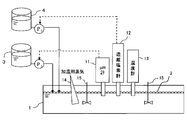
- FIG. 1 It is a schematic diagram of the processing facility which shows embodiment of the processing method of the low concentration cyanide containing water containing the iron cyano complex of this invention.
- low-concentration cyanide-containing water containing an iron cyano complex such as a ferrocyanide complex or a ferricyanide complex.
- raw water low-concentration cyanide-containing water
- an iron cyano complex such as a ferrocyanide complex or a ferricyanide complex.
- An alkaline agent and a chlorine source are added to the raw water to adjust the pH to 11 to 13, a free chlorine concentration of 10 mg / L or more, a water temperature of 40 to 100 ° C., preferably 40 to 80 ° C., more preferably 60 to 80 ° C. Maintain for a predetermined time under the conditions below.
- sodium hydroxide (NaOH), potassium hydroxide (KOH) or the like can be used as the alkaline agent added to the raw water.
- the alkaline agent is usually used as an aqueous solution of about 10 to 48% by weight.
- the raw water is adjusted to pH 11 to 13, preferably 11 to 12.5, more preferably 11 to 12 by adding an alkaline agent.
- the pH after this adjustment is less than 11, the iron cyano complex is not sufficiently decomposed and removed. Even if the pH after adjustment exceeds 13, the effect of improving the effect of decomposing and removing iron cyano complex is not obtained, and there are problems such as an increase in the amount of alkaline agent used, alkali resistance of equipment used, and handling of high pH water. This is disadvantageous in terms of economy and safety.
- a source of free chlorine such as sodium hypochlorite (NaClO), bleaching powder, chlorine gas, etc.
- the chlorine source is preferably used as an aqueous solution of about 10 to 13% by weight.
- Raw water is adjusted to a free chlorine concentration of 10 mg / L or more, preferably 10 to 1000 mg / L by adding a chlorine source. If this adjusted free chlorine concentration is less than 10 mg / L, the iron cyano complex cannot be sufficiently decomposed and removed. Even if the concentration of free chlorine is excessively high, the effect of improving the effect of decomposing and removing the iron cyano complex is not obtained, which is disadvantageous in terms of increase in the amount of chlorine source used, economy and safety.
- the corrosion rate of steel in water having a pH of 11 or more and a free chlorine concentration of more than 1000 mg / L is smaller than the corrosion rate of steel in raw water. Therefore, the method of the present invention hardly corrodes the steel material.
- the water temperature of the raw water is maintained at 40 ° C. or higher and 100 ° C. or lower, preferably 40 ° C. or higher and lower than 80 ° C., more preferably 60 ° C. or higher and lower than 80 ° C.
- the water temperature is less than 40 ° C., the iron cyano complex cannot be sufficiently decomposed and removed.
- the water temperature may be 80 to 100 ° C., but the water temperature is preferably less than 80 ° C. from the viewpoints of economy, safety, equipment durability, and the like.
- the raw water temperature In order to set the raw water temperature to 40 ° C. or higher, steam may be blown into the raw water, a water tank with a heating facility such as a heater may be used, or the raw water may be heated with a heat exchanger. According to the steam blowing, the water temperature can be adjusted only with a simple steam blowing nozzle. The pH and free chlorine concentration of the raw water after steam blowing must be within the above ranges.
- raw water adjusted to a predetermined water temperature, pH, and free chlorine concentration is maintained for a predetermined time.
- the predetermined time is preferably as follows. i) When the water temperature is 40 ° C. or higher and lower than 50 ° C., 300 hours or longer, preferably 300 to 1440 hours, more preferably 300 to 720 hours. ii) When the water temperature is 50 ° C. or higher and lower than 60 ° C., 48 hours or longer, preferably 48 to 300 hours, more preferably 150 to 250 hours. iii) When the water temperature is 60 ° C. or higher and lower than 80 ° C., it is 6 hours or longer, preferably 6 to 48 hours, more preferably 24 to 48 hours.
- the water temperature is 80 ° C. or higher and 100 ° C. or lower, it is 3 hours or more, preferably 3 to 6 hours, more preferably 4 to 6 hours.
- pH and free chlorine it is determined so that all cyanide in the raw water is sufficiently decomposed.
- reference numeral 1 denotes a water tank that holds raw water, and is provided with a pH meter 11, a free chlorine meter 12, and a thermometer 13.
- a heating steam blowing nozzle 14 and a stirrer 15 are inserted in water.
- covering material 2 is provided so that the water surface in a tank may be covered.
- the water surface covering material 2 it is preferable to provide synthetic resin particles having a specific gravity smaller than 1 and preferably a resin hemisphere such as polyethylene spread on the water surface.
- a commercially available fine ball (registered trademark of Nippon Paper Pack Co., Ltd.) can be used.
- the treated water that has been kept in the water tank 1 for a predetermined time and decomposed and removed all cyanide in the water is discharged out of the system.
- the present invention can be processed not only in a batch system but also in a continuous system, and in the case of a continuous system, it may be designed so that the residence time of the water tank is the predetermined time.
- the method for treating low-concentration cyanide-containing water containing an iron cyano complex of the present invention includes adsorption, agglomeration treatment of iron cyano complex-containing wastewater generated in coal handling furnaces, beneficiation smelters, coke production plants, etc., radioactive pollutants, etc. It is effective for the treatment of wastewater containing low-concentration iron cyano complex discharged from a wide range of fields, such as wastewater containing iron cyano complex that is generated when ferrocyanate complex is used.
- test water having the following water quality was used as raw water. This test water simulates dust collection water from a power generation facility that handles coal. A 48 wt% NaOH aqueous solution was used as the alkaline agent, and a 12 wt% NaClO aqueous solution was used as the chlorine source.
- Test No. 1-21 The test water having the water temperature, pH, and free chlorine concentration shown in Table 1 by adding steam and a chlorine source to a glass container with a lid (sample capacity: 500 mL) as shown in Table 1 is shown in Table 1. Held for hours. The total cyan concentration of the test water after a predetermined time was measured, and the results are shown in Table 1.
- Table 1 shows that according to the present invention, the iron cyano complex in water can be efficiently decomposed and removed at a temperature of less than 80 ° C. (Test Nos. 1 to 8).
Landscapes
- Life Sciences & Earth Sciences (AREA)
- Hydrology & Water Resources (AREA)
- Engineering & Computer Science (AREA)
- Environmental & Geological Engineering (AREA)
- Water Supply & Treatment (AREA)
- Chemical & Material Sciences (AREA)
- Organic Chemistry (AREA)
- Treatment Of Water By Oxidation Or Reduction (AREA)
- Removal Of Specific Substances (AREA)
Abstract
鉄シアノ錯体を含む低濃度シアン含有水中のシアンが、大掛かりな設備を必要とすることなく、比較的低温の処理で効率的に分解除去される。鉄シアノ錯体を含む低濃度シアン含有水に、アルカリ剤と塩素源を添加して、pH11~13、遊離塩素濃度10mg/L以上、水温40℃以上100℃以下、好ましくは40℃以上80℃未満、より好ましくは60℃以上80℃未満の条件で、所定時間維持する鉄シアノ錯体を含む低濃度シアン含有水の処理方法。必要に応じて熱源を加えることにより水温40℃以上100℃以下に加温する。
Description
本発明は、鉄シアノ錯体を含む低濃度シアン含有水中のシアンを分解する方法に関する。詳しくは、本発明は、鉄シアノ錯体(フェロシアン錯体、フェリシアン錯体等)を含有する低濃度シアン含有排水中の全シアンを、該排水のpH、水温、及び遊離塩素濃度を所定の範囲に所定時間維持することにより分解する方法に関する。
石炭を扱う炉、選鉱精錬所、コークス製造工場等からは、鉄シアノ錯体を含有する低濃度のシアン含有排水が排出される。放射能汚染物質等の吸着、凝集処理などでフェロシアン錯体等を利用した場合にも、このような排水が排出される。
鉄シアノ錯体は難分解性であるため、酸化分解処理が困難とされている。紺青法や全シアン法により鉄シアノ錯体を沈降分離して除去する方法では、設備が大掛りとなる上に、沈降分離で発生したシアン含有汚泥の処理が必要となる。このため、紺青法又は全シアン法では、突発的に発生した低濃度の鉄シアノ錯体を含む排水の処理には、即時的に対応できない。
特許文献1,2は、鉄シアノ錯体をも分解除去し得るシアン含有排水の処理方法を開示する。
特許文献1は、遊離シアン、錯シアン及びアンモニアを含む廃液を常温又は80℃未満に保持して次亜塩素酸塩を添加し、遊離シアンとアンモニアの一部とを分解する第1酸化工程と、第1酸化工程処理液を80℃以上に保持して次亜塩素酸塩を添加し、錯シアン化合物と残りのアンモニアとを分解する第2酸化工程と、第2酸化工程処理液を80℃以上に保持して錯シアン化合物の分解とアンモニアの分解とを完全に行わせるエージング工程とを備えるシアン・アンモニア含有廃液の同時連続処理方法を開示する。
この方法では、第1酸化工程及び第2酸化工程の次亜塩素酸濃度を酸化還元電位(ORP)で制御する。第1酸化工程の滞留時間は10分~120分、第2酸化工程の滞留時間は20~150分である。
特許文献2は、シアノ錯体を含む廃液にアルカリ性条件下で次亜塩素酸塩を添加して酸化分解処理する方法において、鉄及び金の少なくとも1種のシアノ錯体を含む前記廃液を室温から80℃~沸点の範囲内に昇温し且つ前記範囲内で温度を維持し、室温から前記廃液の酸化還元電位を測定し、前記範囲内において該廃液の酸化還元電位が次塩素酸塩の酸化還元電位に達するまで、前記次亜塩素酸塩を室温から連続的もしくは断続的に添加するシアン廃液の処理方法を開示する。
特許文献1に記載の方法で、全シアン濃度300mg/L以下の低濃度シアン含有排水を処理する場合、次亜塩素酸塩の添加によるORPの変局点を明確に確認することができず、ORPによる薬注制御が困難である。従って、特許文献1の方法は、低濃度シアン含有排水の処理には不適当である。
特許文献1及び2のいずれの方法においても、水温80℃以上での処理が必要となり、80℃以上の温度条件に耐え得る材質の配管、処理水槽があり、設備費用が高くなる。
本発明は上記従来の問題点を解決し、鉄シアノ錯体を含む低濃度シアン含有水中のシアンを、比較的低温の処理で効率的に分解除去する方法を提供することを目的とする。
本発明者らは、上記課題を解決すべく鋭意検討を重ねた結果、鉄シアノ錯体を含む低濃度シアン含有水にアルカリ剤と塩素源を添加して、所定のpH、水温及び遊離塩素濃度に所定時間維持することで、水槽と簡易な薬注手段、加温手段等といった簡易な設備を用いて、煩雑な薬注管理を必要とすることなく、比較的低温の処理で、低濃度シアン含有水中の鉄シアノ錯体を含む全シアンを効率的に分解除去することができ、突発的に発生した低濃度の鉄シアノ錯体を含む排水の処理にも十分に対応することができることを見出した。
本発明はこのような知見に基いて達成されたものであり、以下を要旨とする。
[1] 鉄シアノ錯体を含む低濃度シアン含有水中のシアンを分解する方法において、該鉄シアノ錯体を含む低濃度シアン含有水にアルカリ剤と塩素源を添加して、pH11~13、遊離塩素濃度10mg/L以上、水温40℃以上100℃以下の条件で、所定時間維持することを特徴とする鉄シアノ錯体を含む低濃度シアン含有水の処理方法。
[2] [1]において、前記所定時間は、前記水温に応じて、以下のi)~iv)のいずれかであることを特徴とする鉄シアノ錯体を含む低濃度シアン含有水の処理方法。
i) 水温が40℃以上50℃未満の場合、300時間以上
ii) 水温が50℃以上60℃未満の場合、48時間以上
iii) 水温が60℃以上80℃未満の場合、6時間以上
iv) 水温が80℃以上100℃以下の場合、3時間以上
i) 水温が40℃以上50℃未満の場合、300時間以上
ii) 水温が50℃以上60℃未満の場合、48時間以上
iii) 水温が60℃以上80℃未満の場合、6時間以上
iv) 水温が80℃以上100℃以下の場合、3時間以上
[3] [1]又は[2]において、前記鉄シアノ錯体を含む低濃度シアン含有水を水温40℃以上100℃以下に加温することを特徴とする鉄シアノ錯体を含む低濃度シアン含有水の処理方法。
[4] [1]ないし[3]のいずれかにおいて、前記鉄シアノ錯体を含む低濃度シアン含有水を、水面被覆材を設けた水槽内にて前記所定時間保持することを特徴とする鉄シアノ錯体を含む低濃度シアン含有水の処理方法。
[5] [1]ないし[4]のいずれかにおいて、前記鉄シアノ錯体を含む低濃度シアン含有水の全シアン濃度が300mg/L以下であることを特徴とする鉄シアノ錯体を含む低濃度シアン含有水の処理方法。
本発明によれば、40℃以上100℃以下、好ましくは40℃以上80℃未満、より好ましくは60℃以上80℃未満の比較的低温での処理が可能となり、高価な耐熱設備が不要である。本発明方法は、水槽と簡易な薬注手段、加温手段のみで実施することができるため、既存の設備を利用して容易に実施することができる。
本発明では、pH、水温、及び遊離塩素濃度と維持時間を管理することによりシアン含有水が処理されるので、煩雑な薬注管理等が不要である。
本発明方法は、発生汚泥の処理の必要がなく、また、簡易な設備かつ簡易な操作で実施することができるため、突発的に発生した低濃度の鉄シアノ錯体を含む排水の処理にも迅速に対応することができる。
本発明によると、鉄シアノ錯体を含む低濃度シアン含有水中の全シアンを0.1mg/L未満の低濃度にまで効率的に分解除去することができる。
以下に本発明の鉄シアノ錯体を含む低濃度シアン含有水の処理方法の実施の形態を詳細に説明する。
本発明の鉄シアノ錯体を含む低濃度シアン含有水の処理方法では、フェロシアン錯体、フェリシアン錯体等の鉄シアノ錯体を含む低濃度シアン含有水(以下「原水」ということがある。)中のシアンを分解する。該原水にアルカリ剤と塩素源を添加して、pH11~13、遊離塩素濃度10mg/L以上、水温40℃以上100℃以下、好ましくは40℃以上80℃未満、より好ましくは60℃以上80℃未満の条件で、所定時間維持する。
シアン含有水のpH、水温、及び遊離塩素濃度を上記条件とし、シアン含有水を水槽等で所定時間維持することにより、原水中の鉄シアノ錯体を含む全シアンが分解される。水温40℃以上、pH11以上、遊離塩素濃度10mg/L以上の条件では、シアンの酸化分解反応が活発となり、難分解性の鉄シアノ錯体が徐々に分解する。
本発明では、水温、pH、及び遊離塩素濃度を所定の範囲として所定の反応時間を確保するのみで、鉄シアノ錯体濃度407mg/L以下、例えば0.7~407mg/Lで、全シアン濃度300mg/L以下、例えば0.5~300mg/Lの低シアン濃度の原水中の全シアンを0.1mg/L未満に分解除去することができる。
原水に添加するアルカリ剤としては、水酸化ナトリウム(NaOH)、水酸化カリウム(KOH)等を用いることができる。アルカリ剤は通常10~48重量%程度の水溶液として用いられる。
原水のpHが6~10の場合、原水はアルカリ剤の添加でpH11~13、好ましくは11~12.5、より好ましくは11~12に調整される。この調整後のpHが11未満では、鉄シアノ錯体を十分に分解除去されない。調整後のpHが13を超えても、それに見合う鉄シアノ錯体分解除去効果の向上効果は得られず、アルカリ剤の使用量の増加、使用設備の耐アルカリ性、高pH水の取り扱い性といった問題が生じ、経済性、安全性の点において実用上不利である。
原水に添加する塩素源としては、次亜塩素酸ナトリウム(NaClO)、さらし粉、塩素ガス等の遊離塩素源となるものを用いることができる。塩素源は好ましくは、10~13重量%程度の水溶液として用いられる。
原水は塩素源の添加で遊離塩素濃度10mg/L以上、好ましくは10~1000mg/Lに調整される。この調整遊離塩素濃度が10mg/L未満では鉄シアノ錯体を十分に分解除去し得ない。遊離塩素濃度を過度に高くしても、それに見合う鉄シアノ錯体分解除去効果の向上効果は得られず、塩素源の使用量の増加、経済性、安全性の点において実用上不利である。pH11以上かつ遊離塩素濃度1000mg/L超の水中における鋼材の腐食速度は、原水中の鋼材の腐食速度よりも小さい。従って、本発明方法は、鋼材を腐食させにくい。
本発明では原水の水温を40℃以上100℃以下、好ましくは40℃以上80℃未満、より好ましくは60℃以上80℃未満に維持する。水温が40℃未満では、鉄シアノ錯体を十分に分解除去し得ない。水温は80~100℃であってもよいが、経済性、安全性、設備の耐久性などの観点から、水温は80℃未満が好ましい。
原水の水温を40℃以上とするためには、蒸気を原水に吹き込んだり、ヒーター等の加温設備のある水槽を用いたり、熱交換器で原水を加温してもよい。蒸気の吹き込みによれば簡易な蒸気吹き込みノズルのみで水温調整することができる。蒸気吹き込み後の原水のpH及び遊離塩素濃度が上記範囲となる必要がある。
水槽内の原水の水温を維持するために、水槽には保温ジャケットなどの保温手段を設けてもよい。特に、後述のファインボール(日本紙パック(株)の登録商標)等の水面被覆材を設けることにより、水面からの放熱による水温低下を防止することができる。水面被覆材は、容易に敷設及び取り外しを行うことができる。水面被覆材で覆われた水中に加温のための蒸気吹き込みノズルが容易に挿入される。
本発明では、所定の水温、pH及び遊離塩素濃度に調整した原水を所定時間維持するが、その所定時間は、好ましくは次の通りである。
i) 水温が40℃以上50℃未満の場合は300時間以上、好ましくは300~1440時間、より好ましくは300~720時間
ii) 水温が50℃以上60℃未満の場合、48時間以上、好ましくは48~300時間、より好ましくは150~250時間
iii) 水温が60℃以上80℃未満の場合、6時間以上、好ましくは6~48時間、より好ましくは24~48時間
iv) 水温が80℃以上100℃以下の場合、3時間以上、好ましくは3~6時間、より好ましくは4~6時間
この所定時間は、原水の鉄シアノ錯体濃度及び全シアン濃度と、原水の水温、pH及び遊離塩素との関係で、原水中の全シアンが十分に分解されるように決定される。
i) 水温が40℃以上50℃未満の場合は300時間以上、好ましくは300~1440時間、より好ましくは300~720時間
ii) 水温が50℃以上60℃未満の場合、48時間以上、好ましくは48~300時間、より好ましくは150~250時間
iii) 水温が60℃以上80℃未満の場合、6時間以上、好ましくは6~48時間、より好ましくは24~48時間
iv) 水温が80℃以上100℃以下の場合、3時間以上、好ましくは3~6時間、より好ましくは4~6時間
この所定時間は、原水の鉄シアノ錯体濃度及び全シアン濃度と、原水の水温、pH及び遊離塩素との関係で、原水中の全シアンが十分に分解されるように決定される。
以下に図1を参照して本発明によるシアン分解処理の具体的な実施形態を説明する。
図1において、1は原水を保持する水槽であり、pH計11、遊離塩素計12、温度計13が設けられている。加温用蒸気の吹き込みノズル14と攪拌機15が水中に挿入されている。水槽1内には、水面被覆材2が槽内の水面を覆うように設けられている。
水槽1内の原水にはアルカリ剤貯槽3及び塩素源貯槽4よりそれぞれアルカリ剤及び塩素源が添加される。アルカリ剤はpH計11と連動するポンプP1によりその添加量が調整される。塩素源は遊離塩素計12と連動するポンプP2によりその添加量が調整される。加温用蒸気の吹き込みノズル14への蒸気吹き込み量は、温度計13と連動するバルブ(図示せず)等により調整される。
原水は撹拌機15による攪拌下にアルカリ剤及び塩素源の添加でpH11~13、遊離塩素濃度10mg/L以上に調整され、蒸気の吹き込みで水温40℃以上100℃以下、好ましくは40℃以上80℃未満、更に好ましくは60℃以上80℃未満に調整された状態で所定時間水槽1内に保持される。
この保持期間中、原水の水面は、水面被覆材2により覆われているため、水面からの放熱による水温の低下が防止され、加温のための蒸気吹き込み量を低減することができる。
この水面被覆材2としては、比重が1よりも小さい合成樹脂の粒体、好ましくはポリエチレン等の樹脂製半球体を水面に敷き詰めて設けることが好ましい。水面被覆材としては、例えばファインボール(日本紙パック(株)の登録商標)として市販されているものを用いることができる。
水槽1内で所定時間保持されて水中の全シアンが分解除去された処理水は、系外へ排出される。本発明は、バッチ式に限らず連続式で処理することも可能であり、連続式の場合には、水槽の滞留時間が前記所定時間となるように設計すればよい。
本発明の鉄シアノ錯体を含む低濃度シアン含有水の処理方法は、石炭を扱う炉、選鉱精錬所、コークス製造工場等で発生する鉄シアノ錯体含有排水、放射能汚染物質等の吸着、凝集処理などでフェロシアン錯体等を利用した場合に発生する鉄シアノ錯体含有排水等、幅広い分野から排出される低濃度鉄シアノ錯体含有排水の処理に有効である。
以下に実施例及び比較例を挙げて本発明をより具体的に説明する。
なお、以下の実施例及び比較例では、原水として下記水質の試験水を用いた。この試験水は、石炭を取り扱う発電設備の集塵水を模擬している。アルカリ剤としては48重量%NaOH水溶液を用い、塩素源としては12重量%NaClO水溶液を用いた。
<試験水水質>
pH:9.2
全シアン:11mg/L
(フェロシアン試薬:5.5mg/LasCN、フェリシアン試薬:5.5mg/LasCN)
pH:9.2
全シアン:11mg/L
(フェロシアン試薬:5.5mg/LasCN、フェリシアン試薬:5.5mg/LasCN)
水中の全シアン及び遊離塩素濃度の分析方法は以下の通りである。
全シアン:試験水にL(+)-アスコルビン酸を添加して水中の残留塩素を還元した後、NaOHでpH12に調整し、濾過せずにJIS K 0102に準拠した4-ピリジン-ピラゾロン吸光光度法により全シアンを測定した。
遊離塩素:試験水をガラスフィルター製濾紙で濾過後、純水で所定濃度に希釈し、JIS K 0102に準拠したDPD法にて測定した。
遊離塩素:試験水をガラスフィルター製濾紙で濾過後、純水で所定濃度に希釈し、JIS K 0102に準拠したDPD法にて測定した。
[試験No.1~21]
蓋付きのガラス製容器(サンプル容量500mL)に、蒸気を吹き込むと共に、アルカリ剤と塩素源を添加して、表1に示す水温、pH、及び遊離塩素濃度とした試験水を表1に示す所定時間保持した。所定時間後の試験水の全シアン濃度を測定し、結果を表1に示した。
蓋付きのガラス製容器(サンプル容量500mL)に、蒸気を吹き込むと共に、アルカリ剤と塩素源を添加して、表1に示す水温、pH、及び遊離塩素濃度とした試験水を表1に示す所定時間保持した。所定時間後の試験水の全シアン濃度を測定し、結果を表1に示した。

表1より、本発明によれば、80℃未満の温度で水中の鉄シアノ錯体を効率的に分解除去することができることが分かる(試験No.1~8)。
これに対して、遊離塩素濃度が10mg/L未満の試験No.10~13や、pHが11未満の試験No.14,15、水温が40℃未満の試験No.16,17では、鉄シアノ錯体を十分に分解することができず、水温、pH、及び遊離塩素濃度のすべてが本発明の条件を満たす必要があることが分かる。
試験No.7,8より、水温40℃又は50℃の条件においても、遊離塩素濃度が10mg/L以上の条件で、反応時間を延ばすことで鉄シアノ錯体を十分に分解できることがわかる。
試験No.9より、水温90℃の条件においても、4時間以上の所定時間の反応で、遊離塩素濃度が10mg/L以上の条件で、全シアン濃度が0.1mg/L未満となることがわかる。
試験No.18~21のように反応時間が短い場合は鉄シアノ錯体を十分に分解することができない。従って、水温等の実施する処理条件に応じて、表1の試験結果あるいは追加の試験結果に基づいて、処理に要する所定時間を決定するのが好ましい。
本発明を特定の態様を用いて詳細に説明したが、本発明の意図と範囲を離れることなく様々な変更が可能であることは当業者に明らかである。
本出願は、2013年8月27日付で出願された日本特許出願2013-175823に基づいており、その全体が引用により援用される。
本出願は、2013年8月27日付で出願された日本特許出願2013-175823に基づいており、その全体が引用により援用される。
1 水槽
2 水面被覆材
3 アルカリ剤貯槽
4 塩素源貯槽
2 水面被覆材
3 アルカリ剤貯槽
4 塩素源貯槽
Claims (8)
- 鉄シアノ錯体を含む低濃度シアン含有水中のシアンを分解する方法において、該鉄シアノ錯体を含む低濃度シアン含有水にアルカリ剤と塩素源を添加して、pH11~13、遊離塩素濃度10mg/L以上、水温40℃以上100℃以下の条件で、所定時間維持することを特徴とする鉄シアノ錯体を含む低濃度シアン含有水の処理方法。
- 請求項1において、前記所定時間は、前記水温に応じて、以下のi)~iv)のいずれかであることを特徴とする鉄シアノ錯体を含む低濃度シアン含有水の処理方法。
i) 水温が40℃以上50℃未満の場合、300時間以上
ii) 水温が50℃以上60℃未満の場合、48時間以上
iii) 水温が60℃以上80℃未満の場合、6時間以上
iv) 水温が80℃以上100℃以下の場合、3時間以上 - 請求項1又は2において、前記鉄シアノ錯体を含む低濃度シアン含有水を水温40℃以上100℃以下に加温することを特徴とする鉄シアノ錯体を含む低濃度シアン含有水の処理方法。
- 請求項3において、前記鉄シアノ錯体を含む低濃度シアン含有水を蒸気の吹き込みにより加温することを特徴とする鉄シアノ錯体を含む低濃度シアン含有水の処理方法。
- 請求項1ないし4のいずれか1項において、前記鉄シアノ錯体を含む低濃度シアン含有水を、水面被覆材を設けた水槽内にて前記所定時間保持することを特徴とする鉄シアノ錯体を含む低濃度シアン含有水の処理方法。
- 請求項1ないし5のいずれか1項において、前記鉄シアノ錯体を含む低濃度シアン含有水の全シアン濃度が300mg/L以下であることを特徴とする鉄シアノ錯体を含む低濃度シアン含有水の処理方法。
- 請求項1ないし6のいずれか1項において、鉄シアノ錯体濃度0.7~407mg/Lで、全シアン濃度0.5~300mg/Lの前記低濃度シアン含有水を処理して全シアン濃度0.1mg/L未満の処理水を得ることを特徴とする鉄シアノ錯体を含む低濃度シアン含有水の処理方法。
- 鉄シアノ錯体を含む低濃度シアン含有水に、アルカリ剤と塩素源を添加して、所定のpH、遊離塩素濃度及び水温の条件下に、所定時間維持することにより、該低濃度シアン含有水中のシアンを分解する装置であって、
該低濃度シアン含有水を保持する水槽と、
該水槽内の水を撹拌する攪拌機と、
該水槽内の水のpHを測定するpH計、遊離塩素濃度を測定する遊離塩素計、及び水温を測定する温度計と、
該水槽内の水の水面を覆う水面被覆材と、
該水槽内の水中に挿入された加温用蒸気の吹き込みノズルと、
前記pH計に連動するアルカリ剤添加手段と、
前記遊離塩素計に連動する塩素源添加手段と、
前記温度計に連動して前記加温用蒸気の吹き込みノズルへの蒸気吹き込み量を調整する手段と
を備えてなる鉄シアノ錯体を含む低濃度シアン含有水の処理装置。
Applications Claiming Priority (2)
| Application Number | Priority Date | Filing Date | Title |
|---|---|---|---|
| JP2013175823A JP6152751B2 (ja) | 2013-08-27 | 2013-08-27 | 鉄シアノ錯体を含む低濃度シアン含有水の処理方法 |
| JP2013-175823 | 2013-08-27 |
Publications (1)
| Publication Number | Publication Date |
|---|---|
| WO2015029648A1 true WO2015029648A1 (ja) | 2015-03-05 |
Family
ID=52586223
Family Applications (1)
| Application Number | Title | Priority Date | Filing Date |
|---|---|---|---|
| PCT/JP2014/069398 Ceased WO2015029648A1 (ja) | 2013-08-27 | 2014-07-23 | 鉄シアノ錯体を含む低濃度シアン含有水の処理方法 |
Country Status (3)
| Country | Link |
|---|---|
| JP (1) | JP6152751B2 (ja) |
| TW (1) | TW201509829A (ja) |
| WO (1) | WO2015029648A1 (ja) |
Cited By (1)
| Publication number | Priority date | Publication date | Assignee | Title |
|---|---|---|---|---|
| CN112266095A (zh) * | 2020-09-29 | 2021-01-26 | 江苏阿尔法药业有限公司 | 废水中氰化物的氧化降解方法 |
Citations (4)
| Publication number | Priority date | Publication date | Assignee | Title |
|---|---|---|---|---|
| JPS492770A (ja) * | 1972-04-28 | 1974-01-11 | ||
| JPS6171890A (ja) * | 1984-09-17 | 1986-04-12 | Mitsubishi Heavy Ind Ltd | 排水処理方法 |
| JPH01107893A (ja) * | 1987-10-22 | 1989-04-25 | Mitsubishi Heavy Ind Ltd | 洗浄排水の処理方法 |
| JP2006334508A (ja) * | 2005-06-02 | 2006-12-14 | Nippon Parkerizing Co Ltd | シアン・アンモニア含有廃液の同時連続処理方法および同時連続処理装置 |
-
2013
- 2013-08-27 JP JP2013175823A patent/JP6152751B2/ja active Active
-
2014
- 2014-07-23 WO PCT/JP2014/069398 patent/WO2015029648A1/ja not_active Ceased
- 2014-08-11 TW TW103127411A patent/TW201509829A/zh unknown
Patent Citations (4)
| Publication number | Priority date | Publication date | Assignee | Title |
|---|---|---|---|---|
| JPS492770A (ja) * | 1972-04-28 | 1974-01-11 | ||
| JPS6171890A (ja) * | 1984-09-17 | 1986-04-12 | Mitsubishi Heavy Ind Ltd | 排水処理方法 |
| JPH01107893A (ja) * | 1987-10-22 | 1989-04-25 | Mitsubishi Heavy Ind Ltd | 洗浄排水の処理方法 |
| JP2006334508A (ja) * | 2005-06-02 | 2006-12-14 | Nippon Parkerizing Co Ltd | シアン・アンモニア含有廃液の同時連続処理方法および同時連続処理装置 |
Cited By (1)
| Publication number | Priority date | Publication date | Assignee | Title |
|---|---|---|---|---|
| CN112266095A (zh) * | 2020-09-29 | 2021-01-26 | 江苏阿尔法药业有限公司 | 废水中氰化物的氧化降解方法 |
Also Published As
| Publication number | Publication date |
|---|---|
| TW201509829A (zh) | 2015-03-16 |
| JP6152751B2 (ja) | 2017-06-28 |
| JP2015044139A (ja) | 2015-03-12 |
Similar Documents
| Publication | Publication Date | Title |
|---|---|---|
| JP4121368B2 (ja) | 鉄酸塩イオンの製造方法 | |
| KR101957548B1 (ko) | 석탄 가스화 배수의 처리 시스템 및 석탄 가스화 배수의 처리 방법 | |
| Fajardo et al. | Treatment of a synthetic phenolic mixture by electrocoagulation using Al, Cu, Fe, Pb, and Zn as anode materials | |
| CN107098518A (zh) | 化学镀镍废水的处理方法和处理系统 | |
| US5160632A (en) | Cyanide removal from coke oven wash waters | |
| KR101543551B1 (ko) | 전기분해를 이용한 하·폐수처리시스템 | |
| CN106232531A (zh) | 含有氰和氨的废水的处理方法 | |
| JP2020032412A (ja) | シアン含有水の処理方法及び処理設備 | |
| JP4954131B2 (ja) | ホウフッ化物含有水の処理方法 | |
| CN104787933B (zh) | 黄金冶炼含氰废水的处理方法 | |
| CN104817157A (zh) | 化工废水预处理方法及续批式碱解反应设备 | |
| CN205170590U (zh) | 一种废水处理系统 | |
| WO2015029648A1 (ja) | 鉄シアノ錯体を含む低濃度シアン含有水の処理方法 | |
| JP2013056328A (ja) | シアン含有水の処理方法及び処理装置 | |
| CN104556540B (zh) | 一种含硒废水的处理方法 | |
| CN119707168A (zh) | 基于医废蒸汽法处理废水的烧结机头灰处理系统及方法 | |
| JP5617862B2 (ja) | シアン含有排水の処理方法 | |
| CN112897672A (zh) | 固体硫化剂、微蚀含铜废水资源化处理系统及控制方法 | |
| Yasar et al. | Comparative performance evaluation of ozone oxidation and coagulation for the treatment of electroplating wastewater | |
| CN110818123A (zh) | 三价铬镀铬废水的处理方法 | |
| Rabah et al. | Characterization of ammonia removal from municipal wastewater using microwave energy: batch experiment | |
| CN109942115A (zh) | 一种焦化脱硫废液的处理方法及系统 | |
| CN106232532B (zh) | 含有氨的废水的处理方法 | |
| JP7318869B2 (ja) | シアン化合物を含む廃水処理方法、シアン化合物を含む廃水を処理するための薬剤の自動制御システム | |
| Ahmed et al. | Relationship between chlorine decay and nanobubble application in secondary treated wastewater |
Legal Events
| Date | Code | Title | Description |
|---|---|---|---|
| 121 | Ep: the epo has been informed by wipo that ep was designated in this application |
Ref document number: 14840864 Country of ref document: EP Kind code of ref document: A1 |
|
| NENP | Non-entry into the national phase |
Ref country code: DE |
|
| 122 | Ep: pct application non-entry in european phase |
Ref document number: 14840864 Country of ref document: EP Kind code of ref document: A1 |