WO2015019955A1 - 複合銅粒子及びその製造方法 - Google Patents
複合銅粒子及びその製造方法 Download PDFInfo
- Publication number
- WO2015019955A1 WO2015019955A1 PCT/JP2014/070334 JP2014070334W WO2015019955A1 WO 2015019955 A1 WO2015019955 A1 WO 2015019955A1 JP 2014070334 W JP2014070334 W JP 2014070334W WO 2015019955 A1 WO2015019955 A1 WO 2015019955A1
- Authority
- WO
- WIPO (PCT)
- Prior art keywords
- copper
- particles
- inorganic oxide
- copper particles
- composite
- Prior art date
- Legal status (The legal status is an assumption and is not a legal conclusion. Google has not performed a legal analysis and makes no representation as to the accuracy of the status listed.)
- Ceased
Links
Images
Classifications
-
- H—ELECTRICITY
- H01—ELECTRIC ELEMENTS
- H01B—CABLES; CONDUCTORS; INSULATORS; SELECTION OF MATERIALS FOR THEIR CONDUCTIVE, INSULATING OR DIELECTRIC PROPERTIES
- H01B1/00—Conductors or conductive bodies characterised by the conductive materials; Selection of materials as conductors
- H01B1/14—Conductive material dispersed in non-conductive inorganic material
- H01B1/16—Conductive material dispersed in non-conductive inorganic material the conductive material comprising metals or alloys
-
- B—PERFORMING OPERATIONS; TRANSPORTING
- B22—CASTING; POWDER METALLURGY
- B22F—WORKING METALLIC POWDER; MANUFACTURE OF ARTICLES FROM METALLIC POWDER; MAKING METALLIC POWDER; APPARATUS OR DEVICES SPECIALLY ADAPTED FOR METALLIC POWDER
- B22F1/00—Metallic powder; Treatment of metallic powder, e.g. to facilitate working or to improve properties
- B22F1/05—Metallic powder characterised by the size or surface area of the particles
-
- B—PERFORMING OPERATIONS; TRANSPORTING
- B22—CASTING; POWDER METALLURGY
- B22F—WORKING METALLIC POWDER; MANUFACTURE OF ARTICLES FROM METALLIC POWDER; MAKING METALLIC POWDER; APPARATUS OR DEVICES SPECIALLY ADAPTED FOR METALLIC POWDER
- B22F1/00—Metallic powder; Treatment of metallic powder, e.g. to facilitate working or to improve properties
- B22F1/06—Metallic powder characterised by the shape of the particles
- B22F1/068—Flake-like particles
-
- B—PERFORMING OPERATIONS; TRANSPORTING
- B22—CASTING; POWDER METALLURGY
- B22F—WORKING METALLIC POWDER; MANUFACTURE OF ARTICLES FROM METALLIC POWDER; MAKING METALLIC POWDER; APPARATUS OR DEVICES SPECIALLY ADAPTED FOR METALLIC POWDER
- B22F1/00—Metallic powder; Treatment of metallic powder, e.g. to facilitate working or to improve properties
- B22F1/16—Metallic particles coated with a non-metal
Definitions
- the present invention relates to composite copper particles and a method for producing the same.
- the flaky copper particles have a large specific surface area due to their flat shape and a large contact area between the particles, so that the electrical conductivity can be improved by adding them to the conductive composition. , And has the advantage that the viscosity can be adjusted.
- the present applicant has previously proposed a flake copper powder and a conductive paste containing the same (see Patent Document 1).
- flaky copper powder are listed values of D 90 / D 10 is the ratio of the weight-cumulative particle diameter D 90 and the weight cumulative particle diameter D 10 of 4.0 or less.
- the same document also discloses a flake copper powder having a particle size of 10 ⁇ m or less, an SD / D 50 value of 0.15 to 0.35, and an aspect ratio ([thickness] / [D 50 ]). Flakes copper powder with a value of 0.3 to 0.7 is described. According to the flake copper powder described in the document having such a configuration, a fine pattern circuit can be formed.
- an object of the present invention is to provide a composite copper particle and a method for producing the same that can eliminate the various disadvantages of the above-described conventional technology.
- the present invention is a composite of flat copper particles and a plurality of finer inorganic oxide particles than the flat copper particles,
- the inorganic oxide particles provide composite copper particles in which the flat copper particles are uniformly present on the surface.
- the present invention is to disperse a mixed powder of a spherical raw material copper powder and an inorganic oxide powder using beads, to flatly plastically deform the copper particles of the raw material copper powder,
- a method for producing composite copper particles in which particles of the inorganic oxide are disposed on a surface As the inorganic oxide powder, the ratio between the volume cumulative particle diameter D 50 (nm) at a cumulative volume of 50 vol% by the dynamic light scattering particle size distribution measurement method and the particle diameter D BET converted from the BET specific surface area.
- a method for producing composite copper particles using a material having a D 50 / D BET of less than 60 is provided.
- the present invention disperses a spherical raw material copper powder containing particles of the second inorganic oxide using beads, and plastically deforms the copper particles of the raw material copper powder flatly, and on the surface of the copper particles.
- the present invention provides a method for producing composite copper particles in which the second inorganic oxide particles are arranged.
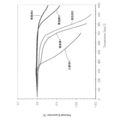
- FIG. 1 is a graph showing thermomechanical analysis measurement results for the copper particles obtained in Examples 1 to 4 and Comparative Example 1.
- FIG. 1 is a graph showing thermomechanical analysis measurement results for the copper particles obtained in Examples 1 to 4 and Comparative Example 1.
- the composite copper particles of the present invention are composed of a composite of copper particles as a base material and a plurality of inorganic oxide particles.
- the copper particles as the base material are flat copper particles having a flat shape.
- the inorganic oxide particles combined with the base material are finer than the flat copper particles that are the base material.
- the composite copper particles of the present invention have one of the characteristics in the composite state of inorganic oxide particles with flat copper particles as a base material. Specifically, the inorganic oxide particles are uniformly present on the surface of the flat copper particles. “Uniformly on the surface” means that the inorganic oxide particles are uniformly present over the entire surface of the flat copper particles. The presence of the inorganic oxide particles uniformly on the surface of the flat copper particles has the following advantages.
- the inorganic oxide particles when preparing a conductive composition such as a conductive paste using the composite copper particles of the present invention, and firing a coating film of the conductive composition to form an electronic circuit or the like, the inorganic oxide particles If they are uniformly present on the surface of the flat copper particles, the bonding between the composite copper particles is difficult to occur at the position where the inorganic oxide particles are present.
- the sintering temperature varies depending on the amount of inorganic oxide particles present on the surface of the flat copper particles. Specifically, the sintering temperature increases as the amount of inorganic oxide particles present on the surface of the flat copper particles increases.
- the sintering temperature can be easily controlled by controlling the amount of inorganic oxide particles arranged on the surface of the flat copper particles.
- the bonding between the composite copper particles is difficult to occur at the position where the inorganic oxide particles are present, the position where the bonding is difficult to occur acts as a passage for the gas generated during firing.
- the swelling of the electrode that may occur during firing is effectively improved.
- an increase in electrical resistance of an electronic circuit or the like formed using the composite copper particles of the present invention can be suppressed, and surface smoothness can be improved.
- the flat copper particles having no inorganic oxide particles on the surface are used, the flat copper particles are easy to bond with each other at the time of firing, and it is difficult to form a gas escape path. As a result, the continuity of the electrodes tends to deteriorate during firing.
- the inorganic oxide particles are formed on the surface of the flat copper particles. It is preferable to disperse and dispose on the surface so that copper is not completely covered and copper is exposed.
- the inorganic oxide particles are uniformly present when the composite copper particles of the present invention are subjected to, for example, UMT processing to form a cross section and element mapping is performed on the cross section. It means that inorganic oxide particles are observed in a uniform distribution state throughout the entire periphery. On the other hand, when both the presence area
- some of the plurality of inorganic oxide particles may be completely embedded near the surface of the flat copper particles.
- the other part is arranged on the surface of the flat copper particle by the anchor effect generated by being embedded in the surface of the flat copper particle while being partially exposed on the surface of the flat copper particle. It may be.
- the inorganic oxide particles are arranged on the surface of the flat copper particles in such a state, the occurrence of swelling of the electrodes is more effectively suppressed, and the increase in electric resistance of electronic circuits and the like is more effective. Can be suppressed.
- the composite copper particles of the present invention may be produced according to the production method described later.
- the proportion of the inorganic oxide particles in the composite copper particles of the present invention is 0.00. It is preferably 1% by mass or more and 20% by mass or less, more preferably 0.1% by mass or more and 17% by mass or less, and further preferably 0.1% by mass or more and 16% by mass or less.
- the ratio of the inorganic oxide particles can be measured by, for example, an inductively coupled plasma optical emission spectrometer (ICP-AES).
- the inorganic oxide particles only need to be present on the surface of the flat copper particles, and may not be present inside the flat copper particles. However, the presence of the inorganic oxide particles inside the flat copper particles is not hindered. From the viewpoint of making the effect exhibited when the inorganic oxide particles uniformly exist on the surface of the flat copper particles, the ratio of the inorganic oxide particles present in the flat copper particles is small. Is preferred. From this viewpoint, the proportion of the inorganic oxide particles present in the flat copper particles among the inorganic oxide particles contained in the composite copper particles of the present invention is preferably 1.0% by mass or less. More preferably, it is 0.7 mass% or less. This ratio can be measured, for example, by element mapping for the cross section of the composite copper particle of the present invention.
- the composite copper particles of the present invention have a flat shape reflecting the shape of the flat copper particles that are the base material.
- the flatness of the composite copper particles of the present invention is preferably 5 or more and 30 or less, preferably 5 or more and 25 or less, when expressed by an aspect ratio that is d / t, which is the ratio of the major axis d to the thickness t of the plate surface. More preferably, it is 7 or more and 20 or less. Since the composite copper particles of the present invention have such a flatness, the electronic circuit or the like formed from the composite copper particles of the present invention has high density, and an increase in electrical resistance is effective. To be suppressed.
- the major axis d and thickness t of the plate surface of the particles are measured by observation with an electron microscope. Specifically, after taking a photograph of the particles using a scanning electron microscope (SEM), the particle diameter is calculated from the ratio between the major axis d and the thickness t of the plate surface of the particles in the photograph.
- SEM scanning electron microscope
- the composite copper particles of the present invention are preferably fine particles.
- the composite copper particles of the present invention preferably has a volume cumulative particle diameter D 50 in the cumulative volume of 50 vol% is 0.1 ⁇ m or more 10 ⁇ m or less by a laser diffraction scattering particle size distribution measuring method, 0.2 [mu] m or more It is more preferable that it is 9.0 micrometers or less, and it is still more preferable that they are 0.3 micrometer or more and 7.0 micrometers or less.
- Copper particles generally tend to have a lower sintering start temperature as the particle size decreases. This tendency also applies to the composite copper particles of the present invention. However, depending on the specific application of the composite copper particles of the present invention, a decrease in the sintering start temperature may not be desirable. In this regard, in the composite copper particles of the present invention, a decrease in the sintering start temperature is suppressed due to the presence of inorganic oxide particles on the surface of the flat copper particles that are the base material. . In other words, despite the fact that the composite copper particles of the present invention are fine, they can maintain a sintering start temperature comparable to the sintering start temperature of conventionally used copper powder.
- the composite copper particles of the present invention preferably have a wide particle size distribution.
- the composite copper particles of the present invention having a flat shape have a wide particle size distribution, the electronic circuit or the like formed from the composite copper particles of the present invention has high density. As a result, there is an advantageous effect that an increase in electrical resistance is effectively suppressed.
- this value is 3 It is preferably 10 or less, more preferably 3 or more and 9 or less, and still more preferably 3 or more and 8 or less.
- the conditions for flattening the raw material copper powder are as follows. Appropriately set.
- size of the flat copper particle which is a base material which comprises the composite copper particle of this invention is the same as the magnitude
- the particle size converted from the BET specific surface area (hereinafter also referred to as “BET converted particle size”) is flat.
- the copper particles is the underlying than 5% 0.1% relative to the volume cumulative particle diameter D 50 in the cumulative volume 50% by volume of the raw material copper powder, it is 4% or less than 0.1% It is more preferable that it is 0.1% or more and 3% or less.
- the measurement of the BET specific surface area for obtaining the BET equivalent particle diameter of the inorganic oxide particles is performed as follows, for example. That is, the measurement is performed using a gas adsorption method in which the specific surface area is calculated from the amount of gas adsorbed on the surface.
- a specific measuring apparatus for example, a mono soap manufactured by Yuasa Ionics can be used.
- the inorganic oxide particles it is possible to use those having a hardness higher than copper, and in the preferred method for producing the composite copper particles of the present invention described later, the inorganic oxide particles are arranged on the surface of the flat copper particles. It is preferable from the viewpoint of easy. Hardness refers to the hardness of a material measured using a Mohs hardness meter.
- preferable materials as the inorganic oxide particles are, for example, alumina, zirconia, silica, barium titanate, yttrium oxide, zinc oxide and the like. These substances can be used alone or in combination of two or more.
- the flat copper particles combined with the inorganic oxide particles may be composed only of copper, or in addition to copper, other metal elements or metalloid elements (hereinafter collectively referred to as “ It may be configured to include a “metal element”.
- the metal elements for example, materials such as aluminum, zirconium, yttrium, and silicon that exhibit a different sintering behavior from copper can be used. These metal elements can be used individually by 1 type or in combination of 2 or more types.
- the flat copper particles contain other metal elements, there is an advantageous effect that the sintering behavior of copper can be controlled.
- Other metal elements contained in the flat copper particles may be present in the form of a simple metal, or may be present in an alloy state with copper or a compound of metal elements (for example, an oxide). Good. From the viewpoint of making the above-described effects exhibited by adding other metal elements more remarkable, the other metal elements are contained in the flat copper particles in the state of a compound of a metal element such as an oxide. Preferably it is.
- metal elements may be present uniformly in the flat copper particles, or may be unevenly distributed in specific parts. As a result of the study by the inventors, it has been found that other metal elements are preferably unevenly distributed on the surface of the flat copper particles. The inventor believes that this is because the vicinity of the surface tends to affect the sintering behavior.
- the metal elements are preferably present almost uniformly over the entire surface of the flat copper particles. This is preferable because it has a high thermal shrinkage resistance and can form a flat electrode.
- the content ratio of the other metal elements is preferably 0.001% by mass or more and 5.0% by mass or less, and 0.01% by mass or more and 3.0% by mass with respect to the mass of copper in the flat copper particles of the present invention. % Or less, more preferably 0.05% by mass or more and 1.0% by mass or less.
- a mixed powder of a spherical raw material copper powder and an inorganic oxide powder is dispersed using beads.
- the copper particles of the raw material copper powder are flatly plastically deformed, and the inorganic oxide particles are arranged on the surfaces of the copper particles.
- What is important at this time is to use an inorganic oxide powder having a low degree of aggregation.
- the inorganic oxide particles can be uniformly dispersed when the spherical raw material copper powder and the inorganic oxide powder are combined.
- a volume cumulative particle diameter D 50 (nm) at a cumulative volume of 50 vol% by a dynamic light scattering particle size distribution measurement method and a particle diameter D BET converted from a BET specific surface area are used. It is advantageous to use one having a D 50 / D BET ratio of less than 60.
- D 50 / D BET is an index representing the degree of aggregation of the powder, and the larger the value, the higher the degree of aggregation of the powder.
- the powder of the inorganic oxide whose D 50 / D BET is less than 60 the aggregation state is reflected in the composite copper particles as the target product, and the inorganic oxide particles are in a uniformly dispersed state. It will be arrange
- the value of D 50 / D BET is preferably closer to 1, but in reality, technical difficulties are accompanied. As a result of investigations by the present inventors, it was found that if the value of D 50 / D BET of the inorganic oxide particles is as small as about 1.5, the desired effect of the present invention is exhibited. From this viewpoint, the value of D 50 / D BET is preferably 1.5 or more and less than 60, and more preferably 1.5 or more and 10 or less.
- the diameter of the beads is preferably 0.005 mm to 1.0 mm, more preferably 0.05 mm to 0 mm. 0.5 mm or less, more preferably 0.05 mm or more and 0.3 mm or less is used.
- the material of the beads only needs to be higher than that of copper and inorganic oxide particles, and for example, alumina or zirconia is preferably used.
- the amount of the beads used is preferably 50% by mass or more and 90% by mass or less, more preferably 60% by mass or more and 85% by mass or less, and still more preferably 65% by mass or more and 85% with respect to the capacity of the processing machine to be processed. It is below mass%.
- a bead mill can be used for the dispersion treatment using beads.
- the time required for the dispersion treatment depends on the capacity of the processing machine, but generally when using a bead mill with a capacity of 0.1L or more and 300L or less, it takes 5 minutes or more to 1 kg of the raw material copper powder. It is preferable that the time is not more than 10 minutes, and it is more preferable that the time is 10 minutes or more and 70 minutes or less.
- the spherical raw material copper powder can be successfully flattened while preventing the inorganic oxide powder from agglomerating, and the dispersed inorganic oxide powder can be flattened. Can be arranged and fixed uniformly on the surface of the copper particles.
- the inorganic oxide particles have no change in the particle size (primary particle size) before and after being combined with the flat copper powder. Therefore, the particle size of the inorganic oxide powder used as a raw material is the same as the particle size of the inorganic oxide particles contained in the composite copper particles of the present invention. On the other hand, since the raw material copper powder used as a raw material is flattened by a dispersion process using beads, the shape and dimensions change before and after the composite.
- the raw material of copper powder is made of an aggregate of copper particles spherical, 8 [mu] m volume cumulative particle diameter D 50 in the cumulative volume 50% by volume or more 0.03 ⁇ m by a laser diffraction scattering particle size distribution measurement method
- copper particles of shapes other than spherical as raw material copper powder, in that case, it may be difficult to obtain composite copper particles having a desired flat shape.
- Spherical copper particles are advantageous because they are easier to manufacture than other shapes of copper particles.
- the raw material copper powder preferably has a high degree of aggregation. Thereby, the degree of aggregation of the obtained composite copper particles can be increased.
- the value of D max / D 50 which is the ratio of the maximum particle diameter D max and D 50 according to the measured laser diffraction scattering particle size distribution measurement method for the raw material of copper powder, it is 2 to 15 Preferably, it is 3 or more and 13 or less, more preferably 3 or more and 10 or less.
- conditions for producing the raw material copper powder by a dry method such as atomization or wet reduction may be appropriately set. Or it can obtain by mixing or classifying the copper powder manufactured by these methods.
- the target composite copper particles contain a metal element other than copper
- an aluminum element is used as another metal element
- the following method can be employed.
- aluminum is mixed in a molten copper melt.
- aluminum is added during the reduction of copper.
- the aluminum element is mainly present at a position near the surface in the particle.
- the raw material copper powder a material in which a plurality of particles of the second inorganic oxide finer than the copper particles are contained inside the copper particles of the raw material copper powder can be used.
- the second inorganic oxide particles may be the same type as the inorganic oxide particles described above, or may be different types. In the case of the same type, there are one kind of inorganic oxide particles contained in the obtained composite copper particles, and in the case of different kinds, there are two kinds of inorganic oxide particles contained in the obtained composite copper particles.
- the inorganic oxide particles can be arranged more uniformly on the surface of the flat copper particles.
- the raw material copper powder containing the second inorganic oxide particles in the copper particles of the raw material copper powder, some of the plurality of second inorganic oxide particles are made up of the copper particles. It is preferable that the surface is completely embedded in the vicinity of the surface and the other part is embedded in the surface of the copper particle in a state of being partially exposed on the surface of the copper particle.
- the inorganic oxide particles can be arranged even more uniformly on the surface of the flat copper particles.
- the raw material copper powder and the manufacturing method thereof in such a state are described in, for example, Japanese Patent Application Laid-Open Nos. 2000-345201 and 2005-133119 related to the earlier application of the present applicant.
- the ratio of the second inorganic oxide particles in the raw material copper powder can be appropriately set according to the ratio of the inorganic oxide particles in the target composite copper particles.
- the ratio is preferably 0.01% by mass or more and 10% by mass or less, and more preferably 0.05% by mass or more and 5% by mass or less.
- the inorganic oxide particles described above may not be used in the dispersion treatment using the bead mill described above. That is, a spherical raw material copper powder containing particles of the second inorganic oxide is dispersed using beads, the copper particles of the raw material copper powder are flatly plastically deformed, and the second surface of the copper particles is formed on the surface of the copper particles.
- the target composite copper particles can also be produced by a method of arranging the inorganic oxide particles. According to this method, there is an advantage that the operation of mixing the raw material copper powder and the inorganic oxide powder becomes unnecessary. Further, there is an advantage that the inorganic oxide particles can be reliably fixed to the surface of the flat copper particles.
- target composite copper particles By performing the dispersion treatment as described above, target composite copper particles can be obtained.
- the composite copper particles thus obtained are used in the form of a conductive composition containing the composite copper particles.
- This conductive paste contains the composite copper particles of the present invention, an organic vehicle, and glass frit.
- This organic vehicle includes a resin component and a solvent.
- the resin component include acrylic resin, epoxy resin, ethyl cellulose, carboxyethyl cellulose, and the like.
- the solvent include terpene solvents such as terpineol and dihydroterpineol, and ether solvents such as ethyl carbitol and butyl carbitol.
- the glass frit examples include borosilicate glass, borosilicate barium glass, and borosilicate zinc glass.
- the proportion of the fine particle aggregate in the conductive paste is preferably 36 to 97.5% by mass.
- the glass frit ratio is preferably 1.5 to 14% by mass.
- the proportion of the organic vehicle is preferably 1 to 50% by mass.
- the conductive component in the conductive paste only the composite copper particles of the present invention may be used, or the fine particle aggregate and other copper fine particles may be used in combination. By using the composite copper particles of the present invention in combination with other copper fine particles, it becomes easy to adjust the viscosity of the paste more precisely.
- Example 1 (1) Preparation of raw material copper powder CA-3000, which is a copper powder manufactured by Mitsui Mining & Mining Co., Ltd., and 300CF, which is a silica powder manufactured by Nippon Aerosil Co., Ltd., were stirred and mixed for 15 minutes. Silica powder was used at a ratio of 0.5% to copper powder. The silica powder had a BET equivalent particle size D BET of 7 nm and a D 50 of 53 nm. The D BET was measured using a monosoap manufactured by Yuasa Ionics. D 50 was measured using a Malvern Co. Zetasizer ZS.
- this mixed powder was circulated at 3000 rpm for 30 minutes using Mechanofusion (manufactured by Hosokawa Micron) to produce a raw material copper powder.
- This raw material copper powder had a value of D max / D 50 of 2.4 and D 50 of 3.1 ⁇ m.
- D 50 and D max were measured using a Nikkiso Microtrack X-100 (the same applies below).
- the proportion of silica in the copper powder was 0.5%.
- Silica had a BET equivalent particle size of 7 nm.
- the cross section of the obtained composite copper powder was cut out by UMT (Ultramicrotom) processing, and the element mapping of the cross section was performed by STEM (Scanning Transmission Electron Microscopy) -EDS (Energy Dispersive Spectroscopy).
- the mapped elements are copper and silicon.
- the composite copper particles had a flat shape and the silica particles were uniformly present on the surface.
- the silica particles were dispersedly arranged so that copper was exposed.
- Example 2 In the raw material copper powder used in Example 1, composite copper particles were obtained in the same manner as in Example 1 except that the content of silica was increased. When the ratio of the inorganic oxide particles to the composite copper particles was measured by the method described above, they were 1% (Example 2) and 3% (Example 3).
- Example 4 CB-3000 manufactured by Mitsui Mining & Mining Co., Ltd. was used as the copper powder.
- This copper powder had a D max / D 50 value of 3.5 and a D 50 of 3.2 ⁇ m. D 50 and D max were measured using a Nikkiso Microtrack X-100.
- This copper powder contains 0.25% aluminum, and an aluminum element was present on the inner surface of the particles.
- raw material copper powder was produced in the same manner as in Example 3, and composite copper particles were obtained in the same manner as in Example 3 except that this raw material copper powder was used.
- the ratio of the inorganic oxide particles to the composite copper particles was measured by the method described above, it was 3%.
- the proportion of aluminum in the composite copper particles was 0.13%.
- Example 1 the raw material copper powder which does not contain a silica and consists only of copper was used. Except this, flat copper particles were obtained in the same manner as in Example 1.
- thermomechanical analysis (TMA) measurement was performed.
- a TMA / SS6300 manufactured by Seiko Instruments Inc. was used as a measuring device.
- the atmosphere was nitrogen, and the measurement was performed at a heating rate of 10 ° C./min.
- the result is shown in FIG.
- the composite copper particles obtained in each example have a higher heat shrinkage start temperature, that is, the sintering start temperature, than the copper particles obtained in the comparative example.
- the sintering start temperature can be controlled by changing the content of the inorganic oxide particles.
- Conductive paste was prepared using the copper particles obtained in the examples and comparative examples as raw materials.
- the conductive paste had a copper particle ratio of 70%, a terpineol ratio of 25%, and an ethyl cellulose ratio of 5%.
- This conductive paste was applied to the surface of the alumina substrate using an applicator to form a coating film having a thickness of 20 ⁇ m.
- This coating film was baked at 800 ° C. for 1 hour in a nitrogen atmosphere.
- the surface state of the conductive film obtained by firing was visually observed to evaluate the continuity of the electrodes.
- the case where there was continuity of the electrode was evaluated as “ ⁇ ”, and the case where there was no continuity was evaluated as “x”.
- the results are shown in Table 1 below. As is clear from the results shown in the table, when the composite copper particles obtained in the examples were used, no swelling of the electrodes was observed, whereas in the case where the copper particles obtained in the comparative examples were used. The swelling of the electrode was observed.
- composite copper particles that can easily control the sintering temperature by controlling the amount of inorganic oxide particles arranged on the surface of the flat copper particles, and a method for producing the same. Moreover, according to this invention, the composite copper particle which can manufacture the electrode with improved continuity easily, and its manufacturing method are provided.
Landscapes
- Chemical & Material Sciences (AREA)
- Dispersion Chemistry (AREA)
- Inorganic Chemistry (AREA)
- Engineering & Computer Science (AREA)
- Nanotechnology (AREA)
- Powder Metallurgy (AREA)
- Conductive Materials (AREA)
- Non-Insulated Conductors (AREA)
Abstract
Description
前記無機酸化物粒子が、前記扁平状銅粒子の表面に均一に存在している複合銅粒子を提供するものである。
前記無機酸化物の粉体として、動的光散乱式粒度分布測定法による累積体積50容量%における体積累積粒径D50(nm)と、BET比表面積から換算された粒径DBETとの比であるD50/DBETが60未満であるものを用いた、複合銅粒子の製造方法を提供するものである。
(1)原料銅粉の準備
三井金属鉱業社製の銅粉であるCA-3000と、日本アエロジル社製のシリカ粉である300CFとを15分間撹拌混合した。シリカ粉は、銅粉に対して0.5%の比率で使用した。シリカ粉のBET換算粒径DBETは7nmであり、D50は53nmであった。DBETは、ユアサアイオニクス社製のモノソープを用いて測定した。D50はマルバーン社製のゼータサイザーZSを用いて測定した。次いでメカノフュージョン(ホソカワミクロン製)を用い、この混合粉を3000rpmで30分間循環させて原料銅粉を作製した。この原料銅粉は、Dmax/D50の値が2.4であり、D50が3.1μmであった。D50及びDmaxは、日機装社製マイクロトラックX-100を用いて測定した(以下においても同じ。)。またこの銅粉に占めるシリカの割合は0.5%であった。シリカのBET換算粒径は7nmであった。
原料銅粉1000gをビーズミルに投入し、更に直径0.2mmであるニッカトー社製のビーズ(材質:ジルコニア)も投入して分散処理を行った。ビーズの量は、処理機の容量に対して70%とした。ビーズミルの容積は2Lであり、分散処理時間は25分間とした。これによって、目的とする複合銅粒子を得た。上述した方法で複合銅粒子に占める無機酸化物粒子の割合を測定したところ0.5%であった。
実施例1で用いた原料銅粉において、シリカの含有量を増加させた以外は実施例1と同様にして複合銅粒子を得た。上述した方法で複合銅粒子に占める無機酸化物粒子の割合を測定したところ1%(実施例2)、3%(実施例3)であった。
銅粉として三井金属鉱業社製のCB-3000を用いた。この銅粉は、Dmax/D50の値が3.5であり、D50が3.2μmであった。D50及びDmaxは、日機装社製マイクロトラックX-100を用いて測定した。この銅粉は、アルミニウムを0.25%含むもので、アルミニウム元素が粒子中の内表面に存在していた。この銅粉を用い、実施例3と同様にして原料銅粉を製造し、この原料銅粉を用いた以外は実施例3と同様にして複合銅粒子を得た。上述した方法で複合銅粒子に占める無機酸化物粒子の割合を測定したところ3%であった。また、複合銅粒子に占めるアルミニウムの割合は0.13%であった。
実施例1においてシリカを含まず、銅のみからなる原料銅粉を用いた。これ以外は実施例1と同様にして扁平状銅粒子を得た。
実施例及び比較例で得られた銅粒子について、熱機械分析(TMA)測定を行った。測定装置としてセイコーインスツルメンツ社製のTMA/SS6300を用いた。雰囲気は窒素とし、昇温速度10℃/minで測定を行った。その結果を図1に示す。同図に示す結果から明らかなとおり、各実施例で得られた複合銅粒子は、比較例で得られた銅粒子に比べて、熱収縮開始温度、つまり焼結開始温度が高いことが判る。また無機酸化物粒子の含有量を変更することで、焼結開始温度をコントロールすることができることが判る。
実施例及び比較例で得られた銅粒子を原料として用いて導電性ペーストを調製した。導電性ペーストは、銅粒子の割合が70%、ターピネオールの割合が25%、エチルセルロースの割合が5%であった。この導電性ペーストを、アルミナ基板の表面にアプリケーターを用いて塗布して膜厚20μmの塗膜を形成した。この塗膜を、窒素雰囲気下に、800℃で1時間にわたって焼成した。焼成によって得られた導電膜の表面状態を目視によって観察し、電極の連続性を評価した。電極の連続性がある場合を「○」とし、連続性がない場合を「×」と評価した。その結果を以下の表1に示す。同表に示す結果から明らかなとおり、実施例で得られた複合銅粒子を用いた場合には電極の膨れは観察されなかったのに対し、比較例で得られた銅粒子を用いた場合には、電極の膨れが観察された。

Claims (14)
- 扁平状銅粒子と該扁平状銅粒子よりも微粒の複数の無機酸化物粒子とが複合化されてなり、
前記無機酸化物粒子が、前記扁平状銅粒子の表面において均一に存在している複合銅粒子。 - レーザー回折散乱式粒度分布測定法による累積体積50体積%における体積累積粒径D50が0.1μm以上10μm以下である請求項1に記載の複合銅粒子。
- 板面の長径dと厚みtの比であるd/tで表されるアスペクト比が5以上30以下である請求項1又は2に記載の複合銅粒子。
- 前記無機酸化物粒子は、BET比表面積から換算された粒径が、原料銅粒子の累積体積50体積%における体積累積粒径D50に対して0.1%以上5%以下である請求項1ないし3のいずれか一項に記載の複合銅粒子。
- レーザー回折散乱式粒度分布測定法による最大粒径DmaxとD50との比であるDmax/D50の値が3以上10以下である請求項1ないし4のいずれか一項に記載の複合銅粒子。
- 前記無機酸化物が、銅よりも高硬度である請求項1ないし5のいずれか一項に記載の複合銅粒子。
- 複数の前記無機酸化物粒子のうちの一部は、前記扁平状銅粒子の表面近傍に完全包埋されているとともに、他の一部は、該扁平状銅粒子の表面に一部露出した状態で該扁平状銅粒子の表面に包埋されている請求項1ないし6のいずれか一項に記載の複合銅粒子。
- 請求項1ないし7のいずれか一項に記載の複合銅粒子を含む導電性組成物。
- 球状の原料銅粉と無機酸化物の粉体との混合粉を、ビーズを用いて分散処理し、該原料銅粉の銅粒子を扁平に塑性変形させるとともに、該銅粒子の表面に該無機酸化物の粒子を配置する複合銅粒子の製造方法であって、
前記無機酸化物の粉体として、動的光散乱式粒度分布測定法による累積体積50容量%における体積累積粒径D50(nm)と、BET比表面積から換算された粒径DBETとの比であるD50/DBETが60未満であるものを用いた、複合銅粒子の製造方法。 - 前記原料銅粉の銅粒子として、該銅粒子の内部に、該銅粒子よりも微粒の第2の無機酸化物の粒子が複数含まれているものを用い、
第2の無機酸化物の粒子は、前記無機酸化物の粒子と同種のものであるか、又は異種のものである請求項9に記載の製造方法。 - 第2無機酸化物の粒子を含む球状の原料銅粉を、ビーズを用いて分散処理し、該原料銅粉の銅粒子を扁平に塑性変形させるとともに、該銅粒子の表面に該第2の無機酸化物の粒子を配置する複合銅粒子の製造方法。
- 前記原料銅粉の銅粒子においては、複数の前記第2の無機酸化物の粒子のうちの一部は、該銅粒子の表面近傍に完全包埋されているとともに、他の一部は、該銅粒子の表面に一部露出した状態で該銅粒子の表面に包埋されている請求項10又は11に記載の製造方法。
- 前記原料銅粉について測定されたレーザー回折散乱式粒度分布測定法による最大粒径DmaxとD50との比であるDmax/D50の値が2以上15以下である請求項9ないし12のいずれか一項に記載の製造方法。
- 前記原料銅粉として、銅に加えて他の金属元素を含むものを用いた請求項9ないし13のいずれか一項に記載の製造方法。
Priority Applications (2)
| Application Number | Priority Date | Filing Date | Title |
|---|---|---|---|
| KR1020157025598A KR20160040131A (ko) | 2013-08-07 | 2014-08-01 | 복합 구리입자 및 그 제조방법 |
| CN201480016455.0A CN105073306A (zh) | 2013-08-07 | 2014-08-01 | 复合铜粒子及其制造方法 |
Applications Claiming Priority (2)
| Application Number | Priority Date | Filing Date | Title |
|---|---|---|---|
| JP2013-164446 | 2013-08-07 | ||
| JP2013164446A JP2015034310A (ja) | 2013-08-07 | 2013-08-07 | 複合銅粒子及びその製造方法 |
Publications (1)
| Publication Number | Publication Date |
|---|---|
| WO2015019955A1 true WO2015019955A1 (ja) | 2015-02-12 |
Family
ID=52461291
Family Applications (1)
| Application Number | Title | Priority Date | Filing Date |
|---|---|---|---|
| PCT/JP2014/070334 Ceased WO2015019955A1 (ja) | 2013-08-07 | 2014-08-01 | 複合銅粒子及びその製造方法 |
Country Status (5)
| Country | Link |
|---|---|
| JP (1) | JP2015034310A (ja) |
| KR (1) | KR20160040131A (ja) |
| CN (1) | CN105073306A (ja) |
| TW (1) | TW201509565A (ja) |
| WO (1) | WO2015019955A1 (ja) |
Families Citing this family (1)
| Publication number | Priority date | Publication date | Assignee | Title |
|---|---|---|---|---|
| JP6956459B2 (ja) * | 2015-03-19 | 2021-11-02 | Dowaエレクトロニクス株式会社 | 銀被覆金属粉末およびその製造方法 |
Citations (7)
| Publication number | Priority date | Publication date | Assignee | Title |
|---|---|---|---|---|
| JPH0463124A (ja) * | 1990-06-29 | 1992-02-28 | Kurimoto Ltd | 固体粒子同志の固着方法 |
| JP2000345201A (ja) | 1999-05-31 | 2000-12-12 | Mitsui Mining & Smelting Co Ltd | 複合銅微粉末及びその製造方法 |
| JP2003119501A (ja) | 2001-08-07 | 2003-04-23 | Mitsui Mining & Smelting Co Ltd | フレーク銅粉及びそのフレーク銅粉の製造方法並びにそのフレーク銅粉を用いた銅ペースト |
| JP2005133119A (ja) | 2003-10-28 | 2005-05-26 | Mitsui Mining & Smelting Co Ltd | 二層コート金属粉及びその二層コート金属粉の製造方法並びにその二層コート金属粉を用いた導電性ペースト |
| JP2009072679A (ja) * | 2007-09-20 | 2009-04-09 | Utsunomiya Univ | コーティング方法及び装置並びに複合粒子 |
| JP2011006770A (ja) * | 2009-06-29 | 2011-01-13 | Mitsui Mining & Smelting Co Ltd | 複合銅粒子 |
| JP2013019002A (ja) * | 2011-07-07 | 2013-01-31 | Mitsui Mining & Smelting Co Ltd | 扁平金属粒子及びその製造方法 |
Family Cites Families (2)
| Publication number | Priority date | Publication date | Assignee | Title |
|---|---|---|---|---|
| JP4168116B2 (ja) * | 2002-03-06 | 2008-10-22 | Dowaエレクトロニクス株式会社 | 箔片状銅粉およびこれを用いた導電ペースト |
| JP4145127B2 (ja) * | 2002-11-22 | 2008-09-03 | 三井金属鉱業株式会社 | フレーク銅粉及びそのフレーク銅粉の製造方法並びにそのフレーク銅粉を用いた導電性ペースト |
-
2013
- 2013-08-07 JP JP2013164446A patent/JP2015034310A/ja active Pending
-
2014
- 2014-08-01 WO PCT/JP2014/070334 patent/WO2015019955A1/ja not_active Ceased
- 2014-08-01 CN CN201480016455.0A patent/CN105073306A/zh active Pending
- 2014-08-01 KR KR1020157025598A patent/KR20160040131A/ko not_active Withdrawn
- 2014-08-06 TW TW103126969A patent/TW201509565A/zh unknown
Patent Citations (7)
| Publication number | Priority date | Publication date | Assignee | Title |
|---|---|---|---|---|
| JPH0463124A (ja) * | 1990-06-29 | 1992-02-28 | Kurimoto Ltd | 固体粒子同志の固着方法 |
| JP2000345201A (ja) | 1999-05-31 | 2000-12-12 | Mitsui Mining & Smelting Co Ltd | 複合銅微粉末及びその製造方法 |
| JP2003119501A (ja) | 2001-08-07 | 2003-04-23 | Mitsui Mining & Smelting Co Ltd | フレーク銅粉及びそのフレーク銅粉の製造方法並びにそのフレーク銅粉を用いた銅ペースト |
| JP2005133119A (ja) | 2003-10-28 | 2005-05-26 | Mitsui Mining & Smelting Co Ltd | 二層コート金属粉及びその二層コート金属粉の製造方法並びにその二層コート金属粉を用いた導電性ペースト |
| JP2009072679A (ja) * | 2007-09-20 | 2009-04-09 | Utsunomiya Univ | コーティング方法及び装置並びに複合粒子 |
| JP2011006770A (ja) * | 2009-06-29 | 2011-01-13 | Mitsui Mining & Smelting Co Ltd | 複合銅粒子 |
| JP2013019002A (ja) * | 2011-07-07 | 2013-01-31 | Mitsui Mining & Smelting Co Ltd | 扁平金属粒子及びその製造方法 |
Also Published As
| Publication number | Publication date |
|---|---|
| KR20160040131A (ko) | 2016-04-12 |
| JP2015034310A (ja) | 2015-02-19 |
| TW201509565A (zh) | 2015-03-16 |
| CN105073306A (zh) | 2015-11-18 |
Similar Documents
| Publication | Publication Date | Title |
|---|---|---|
| TWI778997B (zh) | 銅粉、該銅粉的製造方法、使用該銅粉之導電性糊、及使用該導電性糊之導電性膜的製造方法 | |
| JP4660701B2 (ja) | 銀被覆銅粉およびその製造方法並びに導電ペースト | |
| JP6158461B1 (ja) | 銀粉末および銀ペーストならびにその利用 | |
| EP3915939A1 (en) | Filler composition, silicone resin composition, and heat dissipation component | |
| JP7150144B2 (ja) | 加圧接合用組成物、並びに導電体の接合構造及びその製造方法 | |
| CN104078183B (zh) | 近场用电波吸收片材及其制造方法 | |
| CN109478572A (zh) | 用于从毛细管悬浮液生产高导电性可印刷浆料的工艺 | |
| JP7171703B2 (ja) | 導電膜形成用組成物及び導電膜の製造方法 | |
| JP6151017B2 (ja) | ニッケル超微粉、導電ペーストおよびニッケル超微粉の製造方法 | |
| CN109021963A (zh) | 含荧光体粒子以及使用该含荧光体粒子的发光装置、含荧光体薄片 | |
| WO2015019955A1 (ja) | 複合銅粒子及びその製造方法 | |
| JP6060225B1 (ja) | 銅粉及びその製造方法 | |
| JP6107394B2 (ja) | 導電性ペーストとその製造方法およびそれを用いたセラミック電子部品 | |
| JP2013019002A (ja) | 扁平金属粒子及びその製造方法 | |
| WO2015019959A1 (ja) | 複合銅粒子及びその製造方法 | |
| JP2011174121A (ja) | ニッケル粉末およびその製造方法 | |
| US5588983A (en) | Production of copper powder | |
| TWI860315B (zh) | 銀糊膏 | |
| JP4930149B2 (ja) | 積層型電子部品の製造方法 | |
| JP7785909B1 (ja) | フレーク状銅粉末及び該フレーク状銅粉末を含有する導電ペースト | |
| KR101606042B1 (ko) | 상분리를 통해 소결능이 제어되는 금속 나노 입자 및 이를 이용한 소결방법 | |
| JP2015149259A (ja) | 多層回路基板用導電ペーストおよびその製造方法 | |
| JP2000017196A (ja) | 厚膜ペースト、厚膜ペースト用粉末及び配線基板、並びにそれらの製造方法 | |
| JP2016125117A (ja) | 複合銅粒子 | |
| JP2025019863A (ja) | 導電性ペースト及び太陽電池セル |
Legal Events
| Date | Code | Title | Description |
|---|---|---|---|
| WWE | Wipo information: entry into national phase |
Ref document number: 201480016455.0 Country of ref document: CN |
|
| 121 | Ep: the epo has been informed by wipo that ep was designated in this application |
Ref document number: 14834175 Country of ref document: EP Kind code of ref document: A1 |
|
| WWE | Wipo information: entry into national phase |
Ref document number: 2014834175 Country of ref document: EP |
|
| ENP | Entry into the national phase |
Ref document number: 20157025598 Country of ref document: KR Kind code of ref document: A |
|
| NENP | Non-entry into the national phase |
Ref country code: DE |