WO2015012262A1 - 水素化フェノール類の製造方法 - Google Patents
水素化フェノール類の製造方法 Download PDFInfo
- Publication number
- WO2015012262A1 WO2015012262A1 PCT/JP2014/069314 JP2014069314W WO2015012262A1 WO 2015012262 A1 WO2015012262 A1 WO 2015012262A1 JP 2014069314 W JP2014069314 W JP 2014069314W WO 2015012262 A1 WO2015012262 A1 WO 2015012262A1
- Authority
- WO
- WIPO (PCT)
- Prior art keywords
- formula
- catalyst
- group
- hydrogenated
- solvent
- Prior art date
- Legal status (The legal status is an assumption and is not a legal conclusion. Google has not performed a legal analysis and makes no representation as to the accuracy of the status listed.)
- Ceased
Links
- 0 CCC1=C=CCC*1C Chemical compound CCC1=C=CCC*1C 0.000 description 1
Classifications
-
- C—CHEMISTRY; METALLURGY
- C07—ORGANIC CHEMISTRY
- C07C—ACYCLIC OR CARBOCYCLIC COMPOUNDS
- C07C29/00—Preparation of compounds having hydroxy or O-metal groups bound to a carbon atom not belonging to a six-membered aromatic ring
- C07C29/17—Preparation of compounds having hydroxy or O-metal groups bound to a carbon atom not belonging to a six-membered aromatic ring by hydrogenation of carbon-to-carbon double or triple bonds
- C07C29/19—Preparation of compounds having hydroxy or O-metal groups bound to a carbon atom not belonging to a six-membered aromatic ring by hydrogenation of carbon-to-carbon double or triple bonds in six-membered aromatic rings
- C07C29/20—Preparation of compounds having hydroxy or O-metal groups bound to a carbon atom not belonging to a six-membered aromatic ring by hydrogenation of carbon-to-carbon double or triple bonds in six-membered aromatic rings in a non-condensed rings substituted with hydroxy groups
-
- C—CHEMISTRY; METALLURGY
- C07—ORGANIC CHEMISTRY
- C07C—ACYCLIC OR CARBOCYCLIC COMPOUNDS
- C07C35/00—Compounds having at least one hydroxy or O-metal group bound to a carbon atom of a ring other than a six-membered aromatic ring
- C07C35/21—Compounds having at least one hydroxy or O-metal group bound to a carbon atom of a ring other than a six-membered aromatic ring polycyclic, at least one hydroxy group bound to a non-condensed ring
Definitions
- the present invention relates to a resin raw material excellent in heat resistance, hydrolysis resistance, weather resistance, transparency and the like, and a method for producing hydrogenated phenols important as an intermediate thereof.
- Patent Document 1 discloses ethyl acetate, methyl-t-butyl ether, ethanol, or cyclohexane alone or as a solvent to which 2% by volume of water is added in the presence of a catalyst in which palladium is supported on activated carbon.
- a method of using and hydrogenating 4,4′-biphenol to produce 4,4′-bicyclohexanol is disclosed.
- Patent Document 2 discloses a method for producing 4,4′-bicyclohexanol by hydrogenating 4,4′-biphenol using 2-propanol as a solvent in the presence of anhydrous sodium carbonate and a palladium carbon catalyst. It is disclosed.
- Patent Documents 3 and 4 disclose methods for producing 4,4′-bicyclohexanol by hydrogenating 4,4′-biphenol using glycol monoalkyl ether as a solvent.
- the melting point of phenols having two hydroxyphenyl groups in the molecule is high (for example, 4,4′-biphenol has a melting point of 280 ° C.). It is necessary to use the above phenols in a solution or slurry state to improve fluidity to improve the contact with the catalyst and hydrogen and to promote the hydrogenation reaction.
- a solvent such as ethyl acetate, methyl-t-butyl ether, ethanol, cyclohexane, 2-propanol, glycol monoalkyl ether, or the like is used. .
- the above phenols for example, 4,4′-biphenol
- the above phenols have low solubility in the above-mentioned solvent, and it is necessary to use a large amount of solvent in order to increase the fluidity by making the above phenols into a solution or slurry state. was there.
- the generated hydrogenated phenols eg, 4,4′-bicyclohexanol
- the solvent is completely dissolved in the solvent in order to separate the hydrogenation catalyst and the hydrogenation reaction liquid. From this point of view, it was necessary to use a large amount of solvent.
- Patent Document 2 1,000 mL (780 g) of isopropanol is used as a solvent for 100 g of 4,4′-biphenol, and the concentration of 4,4′-biphenol in the resulting slurry or solution is only 11 % By weight. Further, in Patent Document 3, 2,000 mL (1,850 g) of propylene glycol monomethyl ether is used as a solvent with respect to 500 g of 4,4′-biphenol, and 4,4′-biphenol in the resulting slurry or solution. The concentration of is only 21% by weight.
- an object of the present invention is to provide an efficient and inexpensive method for producing hydrogenated phenols that can reduce the amount of solvent used.
- the present invention provides the following formula (1): [In Formula (1), X shows a single bond, an alkylene group, a cycloalkylene group, or a cycloalkylidene group.
- R 1 and R 2 are the same or different and each represents an alkyl group having 1 to 5 carbon atoms.
- m and n are the same or different and each represents an integer of 0 to 4.
- a hydrogenation reaction of a compound represented by the following formula (2) [In the formula (2), X, R 1 , R 2 , m, and n are the same as described above. ]
- the present invention provides a method for producing the hydrogenated phenol compound, wherein the dihydric alcohol is an aliphatic diol or a polyalkylene glycol.
- the present invention relates to the following.
- the following formula (1) [In Formula (1), X shows a single bond, an alkylene group, a cycloalkylene group, or a cycloalkylidene group.
- R 1 and R 2 are the same or different and each represents an alkyl group having 1 to 5 carbon atoms.
- m and n are the same or different and each represents an integer of 0 to 4.
- a hydrogenation reaction of a compound represented by the following formula (2) [In the formula (2), X, R 1 , R 2 , m, and n are the same as described above. ]
- [7] The method for producing a hydrogenated phenol compound according to any one of [1] to [6], wherein the dihydric alcohol is an aliphatic diol or a polyalkylene glycol.
- the amount of the dihydric alcohol used is preferably 0.5 to 10 parts by weight, more preferably 0.5 to 5 parts by weight with respect to 1 part by weight of the compound represented by the formula (1).
- the amount of the reaction solvent used is preferably 0.5 to 10 parts by weight, more preferably 0.5 to 5 parts by weight with respect to 1 part by weight of the compound represented by the formula (1).
- the manufacturing method of the hydrogenated phenol compound as described in one.
- the hydrogenation catalyst is preferably a nickel catalyst, more preferably a Raney nickel catalyst.
- the method for producing hydrogenated phenols of the present invention has the above-described configuration, the amount of solvent used can be reduced, and hydrogenated phenols can be produced efficiently and inexpensively. For this reason, if the hydrogenated phenols obtained by the method for producing hydrogenated phenols of the present invention are used, a resin or resin raw material excellent in heat resistance, hydrolysis resistance, weather resistance, transparency, etc. can be inexpensively produced. Obtainable.
- the method for producing hydrogenated phenols of the present invention produces a compound (hydrogenated phenol) represented by the following formula (2) by hydrogenation reaction of a compound (phenol) represented by the following formula (1).
- the method is characterized in that a dihydric alcohol is used as a reaction solvent for the hydrogenation reaction.
- X represents a single bond, an alkylene group, a cycloalkylene group, or a cycloalkylidene group.
- alkylene group examples include a linear alkylene group such as a linear alkylene group having 1 to 6 carbon atoms such as a methylene group, an ethylene group, a trimethylene group, a tetramethylene group, and a pentamethylene group; a propylene group (propane-1 , 2-diyl group), propane-2,2-diyl group, dimethylethylene group, butane-2,2-diyl group, etc., a branched alkylene group such as a branched alkylene group having 3 to 6 carbon atoms, etc.
- Examples of the cycloalkylene group include 1,2-cyclopentylene group, 1,3-cyclopentylene group, 1,2-cyclohexylene group, 1,3-cyclohexylene group, 1,4-cyclohexylene group, and the like. Is mentioned.
- Examples of the cycloalkylidene group include a cyclopentylidene group and a cyclohexylidene group.
- X is preferably a single bond, a linear alkylene group having 1 to 4 carbon atoms, a branched alkylene group having 3 or 4 carbon atoms, or a cycloalkylidene group, and is preferably a single bond or a linear chain having 1 to 3 carbon atoms.
- An alkylene group, a branched alkylene group having 3 carbon atoms, and a cycloalkylidene group are particularly preferred.
- R 1 and R 2 are the same or different and each represents an alkyl group having 1 to 5 carbon atoms.
- the alkyl group having 1 to 5 carbon atoms include a methyl group, an ethyl group, an n-propyl group, an isopropyl group, an n-butyl group, an isobutyl group, an s-butyl group, a t-butyl group, and an n-pentyl group. Is mentioned.
- m (or n) is 2 or more, a plurality of R 1 (or R 2 ) may be the same or different.
- m and n are the same or different and represent an integer of 0 to 4 (preferably an integer of 0 to 2).
- m 0, left benzene rings in the formula (1) (or formula (2) left cyclohexane ring in) as a substituent in, indicating that the R 1 is not present.
- n 0, it indicates that R 2 is not present as a substituent in the right benzene ring in formula (1) (or the right cyclohexane ring in formula (2)).
- the bonding position of the hydroxy group in the benzene ring (or cyclohexane ring) in formula (1) (or formula (2)) is not particularly limited.
- the position of the carbon atom to which X is directly bonded in the formula is the 1st position. Then, for example, the fourth position can be mentioned.
- examples of the compound represented by the formula (1) include 4,4′-biphenol, bisphenol A [4,4 ′-(propane-2,2-diyl) diphenol], and bisphenol F.
- bisphenol A 4,4 ′-(propane-2,2-diyl) diphenol
- bisphenol F [Bis (4-hydroxyphenyl) methane], bisphenol B [2,2-bis (4-hydroxyphenyl) butane], bisphenol E [1,1-bis (4-hydroxyphenyl) ethane], bisphenol C [2, 2-bis (3-methyl-4-hydroxyphenyl) propane], bisphenol Z [1,1-bis (4-hydroxyphenyl) cyclohexane] and the like.
- examples of the compound represented by the formula (2) include 4,4′-bicyclohexanol, hydrogenated bisphenol A [2,2′-bis (4-hydroxycyclohexyl) propane], hydrogenated Bisphenol F, hydrogenated bisphenol B, hydrogenated bisphenol E, hydrogenated bisphenol C, hydrogenated bisphenol Z and the like can be mentioned.
- the dihydric alcohol used as the reaction solvent in the hydrogenation reaction of the compound represented by the formula (1) can be selected from, for example, aliphatic diols, polyalkylene glycols, and the like.
- the aliphatic diol include ethylene glycol, 1,2-propylene glycol, 1,3-propylene glycol, 1,2-butanediol, 1,3-butanediol, 1,4-butanediol, 2,3 Carbon numbers such as butanediol, 1,2-pentanediol, 1,3-pentanediol, 1,5-pentanediol, 2,4-pentanediol, 1,2-hexanediol, 1,6-hexanediol ( (Total number) of 2 to 6 aliphatic diols.
- polyalkylene glycol examples include polyalkylene glycol obtained by adding two or more molecules of alkylene oxide such as ethylene oxide, propylene oxide, butylene oxide, and more specifically, HOC 2 H 4. (OC 2 H 4 ) n1 OC 2 H 4 OH [n1 is an integer of 0 to 5] polyethylene glycol, HOC 3 H 6 (OC 3 H 6 ) n2 OC 3 H 6 OH [n2 is 0 to And polypropylene glycol represented by HOC 4 H 8 (OC 4 H 8 ) n 3 OC 4 H 8 OH [n3 is an integer of 0 to 5].
- the dihydric alcohol is not particularly limited, but a dihydric alcohol that is liquid at normal temperature (25 ° C.) and 1 atm is preferable. Although a dihydric alcohol that is solid at 25 ° C. and 1 atm can be used, for example, by using together with a dihydric alcohol that is liquid at 25 ° C. and 1 atm, a liquid mixture (reaction at 25 ° C. and 1 atm) can be used. It is preferable to use it as a solvent.
- the boiling point of the dihydric alcohol at 1 atm is not particularly limited, but is preferably 180 to 300 ° C., more preferably 180 to 250 ° C., for example, from the viewpoint of handling in purification of the product and reuse of the reaction solvent. It is.
- dihydric alcohol from the viewpoint of the solubility of the compound represented by the formula (1) and the compound represented by the formula (2), handling of the product, purification of the product, reuse of the reaction solvent, and the like, A dihydric alcohol having 2 to 6 carbon atoms (total number) is preferable, and a dihydric alcohol having 2 to 4 carbon atoms (total number) is more preferable.
- the dihydric alcohol as a reaction solvent in the manufacturing method of hydrogenated phenols of this invention can also be used individually by 1 type, and can also be used in combination of 2 or more type.
- the amount of dihydric alcohol used is not particularly limited, but is preferably 0.5 to 10 parts by weight, more preferably 0.5 to 5 parts by weight with respect to 1 part by weight of the compound represented by formula (1). is there.
- 4,4′-biphenol is used as the compound represented by the formula (1) and a dihydric alcohol is used in the above ratio as a reaction solvent
- 4,4′-biphenol is converted into a dihydric alcohol at room temperature.
- the boiling point of dihydric alcohol is as high as 180 ° C. or higher, and it can be heated to a relatively high temperature at normal pressure.
- a slurry or solution of 4′-biphenol can be prepared.
- a slurry or solution of 4,4′-biphenol having a high fluidity is prepared at a temperature of 60 ° C. or higher. be able to.
- the amount of dihydric alcohol used is less than 0.5 parts by weight relative to 1 part by weight of the compound represented by the formula (1), the fluidity of the slurry of the compound represented by the formula (1) decreases, Moreover, the compound represented by Formula (2) may precipitate and it may become impossible to isolate
- productivity may decrease.
- the dihydric alcohol shows only a low vapor pressure at the reaction temperature of the hydrogenation reaction, there is an advantage that the partial pressure of the hydrogen gas can be increased and the speed of the hydrogenation reaction can be increased.
- a reaction solvent in the method for producing hydrogenated phenols of the present invention only a dihydric alcohol can be used, and in addition to the dihydric alcohol, a solvent other than the dihydric alcohol ("other solvent" May be used in combination.
- the other solvents include water; esters such as ethyl acetate; ethers such as methyl-t-butyl ether; alcohols such as ethanol and 2-propanol; cyclic hydrocarbons such as cyclohexane; ethylene glycol monomethyl ether and propylene glycol monomethyl.
- examples include ethers, alkylene glycol monoethers such as diethylene glycol monomethyl ether, and polyalkylene glycol monoethers.
- the said other solvent can also be used individually by 1 type, and can also be used in combination of 2 or more type.
- the ratio of the dihydric alcohol to the total amount (100% by weight) of the reaction solvent used in the method for producing hydrogenated phenols of the present invention is not particularly limited, but is preferably 50 to 100% by weight, more preferably 90%, for example. % By weight or more.
- the reaction solvent is substantially composed only of a dihydric alcohol (for example, the proportion of dihydric alcohol is 98 to 100% by weight).
- the proportion of the dihydric alcohol is less than 50% by weight, the fluidity of the slurry of the compound represented by the formula (1) is reduced, and the compound represented by the formula (2) is precipitated to form a hydrogenation catalyst. And hydrogenation reaction liquid may not be separated.
- the amount (total amount) of the reaction solvent used in the method for producing hydrogenated phenols of the present invention is not particularly limited, but is 0.5 to 10 parts by weight with respect to 1 part by weight of the compound represented by the formula (1).
- the amount is preferably 0.5 to 5 parts by weight.
- the amount of the reaction solvent used is less than 0.5 parts by weight relative to 1 part by weight of the compound represented by the formula (1), the fluidity of the slurry of the compound represented by the formula (1) decreases, and the formula In some cases, the compound represented by (2) precipitates, making it impossible to separate the hydrogenation catalyst and the hydrogenation reaction liquid.
- productivity may decrease.
- Hydrogenation catalyst used in the hydrogenation reaction in the method for producing hydrogenated phenols of the present invention
- a known or conventional hydrogenation catalyst can be used, and is not particularly limited.
- a catalyst, a copper-based catalyst, a cobalt-based catalyst, a platinum-based catalyst, a palladium-based catalyst, a ruthenium-based catalyst, a rhodium-based catalyst, or the like can be appropriately selected and used.
- a nickel-based catalyst is preferable, and a Raney nickel catalyst is more preferable.
- the shape of the hydrogenation catalyst is not particularly limited, and may be, for example, a powder form or a molded body.
- the hydrogenation catalyst may be not supported on a carrier, or may be supported on a carrier.
- a hydrogenation catalyst in the manufacturing method of hydrogenated phenols of this invention, can also be used individually by 1 type, and can also be used in combination of 2 or more type.
- the amount of the hydrogenation catalyst used is not particularly limited and can be appropriately adjusted according to the type of the hydrogenation catalyst, the type of the reactor, and the like, and can be appropriately selected from known or commonly used amounts.
- the type of the reactor used in the hydrogenation reaction of the compound represented by the formula (1) is not particularly limited.
- the operation of the hydrogenation reaction may be a continuous operation or a batch operation.
- reaction conditions The reaction pressure and reaction temperature of the hydrogenation reaction of the compound represented by the formula (1) are not particularly limited, and the conditions can be arbitrarily selected in consideration of productivity and facility controllability. More specifically, the reaction pressure can be appropriately selected from the range of 0.1 to 30 MPa (gauge pressure), for example, and the reaction temperature can be appropriately selected from the range of room temperature to 250 ° C., for example.
- the reaction time of the hydrogenation reaction of the compound represented by the formula (1) is not particularly limited, and can be appropriately set according to the progress of the hydrogenation reaction.
- the degree of progress of the hydrogenation reaction can be confirmed by known or conventional analysis means such as gas chromatography.
- a reaction mixture containing a compound represented by formula (2) as a product (a mixture containing at least a compound represented by formula (2) and a dihydric alcohol) is obtained.
- the reaction mixture contains a catalyst, it is necessary to separate the catalyst from the reaction mixture, but the compound represented by the formula (2) as a product is represented by the formula (1) as a raw material.
- the compound represented by the formula (2) is completely dissolved by heating the reaction mixture (usually a slurry) to an appropriate temperature. Due to the dissolution, the catalyst can be separated from the reaction mixture. If necessary, it is also possible to increase the solubility of the compound represented by the formula (2) by adding a dihydric alcohol or other solvent to the reaction mixture (usually slurry).
- the method for separating the catalyst from the reaction solution can be appropriately selected from known or conventional methods, and is not particularly limited, and examples thereof include filtration separation and centrifugation.
- the compound represented by the formula (2) can also be separated by a known or conventional purification means such as crystallization or distillation.
- the reaction mixture can be used in the next step as it is.
- the amount of solvent used can be greatly reduced as compared with a conventionally known method, and the compound represented by the formula (2) is obtained efficiently and inexpensively. be able to.
- a resin excellent in heat resistance, hydrolysis resistance, weather resistance, transparency and the like for example, Epoxy resins, alkyd resins, polyester resins, polyurethane resins, polycarbonate resins, and the like and their raw materials (epoxy compounds, etc.)] can be obtained at low cost.
- Example 1 50 g of 4,4′-biphenol, 50 g of ethylene glycol (boiling point 197 ° C.), and 2.5 g of Raney nickel catalyst (catalyst) are charged into a 300 mL stainless steel autoclave equipped with a stirrer, and after replacing with nitrogen, the gauge pressure becomes 4.0 MPa. Hydrogen was charged until. Subsequently, the temperature was raised to 160 ° C., and a hydrogenation reaction was carried out for 7 hours while supplying hydrogen so that the gauge pressure was 6.0 MPa. Then, hydrogen was purged and replaced with nitrogen, and the catalyst was separated by filtration at 140 ° C. Only the catalyst remained on the filter paper.
- a total of 100 g of the filtrate contained 92.4% by weight of 4,4′-bicyclohexanol and 7.6% by weight of 4-cyclohexylcyclohexanol, excluding the solvent ethylene glycol. 4,4′-biphenol was not detected.
- the filtrate was a milky white slurry having fluidity at 70 ° C. or higher, and the viscosity at 90 ° C. was 365 mPa ⁇ s.
- the suspended component in the slurry was completely dissolved at 133 ° C. or higher to become a colorless transparent liquid, and the viscosity at 133 ° C. was 11 mPa ⁇ s.
- Example 2 50 g of 4,4′-biphenol, 50 g of 1,2-propylene glycol (boiling point 188 ° C.) and 2.5 g of Raney nickel catalyst (catalyst) were charged into a 300 mL stainless steel autoclave equipped with a stirrer. Hydrogen was charged until the pressure became 0.0 MPa. Subsequently, the temperature was raised to 160 ° C., and a hydrogenation reaction was carried out for 7 hours while supplying hydrogen so that the gauge pressure was 6.0 MPa. Then, hydrogen was purged and replaced with nitrogen, and the catalyst was separated by filtration at 140 ° C. Only the catalyst remained on the filter paper.
- a total of 100 g of the filtrate contained 88.4% by weight of 4,4′-bicyclohexanol and 11.6% by weight of 4-cyclohexylcyclohexanol, excluding the solvent 1,2-propylene glycol. 4,4′-biphenol was not detected in the filtrate.
- Example 3 50 g of 4,4′-biphenol, 50 g of 1,4-butanediol (boiling point 228 ° C.) and 2.5 g of Raney nickel catalyst (catalyst) were charged into a 300 mL stainless steel autoclave equipped with a stirrer. After nitrogen substitution, the gauge pressure was 4 Hydrogen was charged until the pressure became 0.0 MPa. Subsequently, the temperature was raised to 160 ° C., and a hydrogenation reaction was carried out for 7 hours while supplying hydrogen so that the gauge pressure was 6.0 MPa. Then, hydrogen was purged and replaced with nitrogen, and the catalyst was separated by filtration at 140 ° C. Only the catalyst remained on the filter paper.
- Example 4 Charge 50 g of 4,4′-biphenol, 50 g of diethylene glycol (boiling point 244 ° C.) and 2.5 g of Raney nickel catalyst (catalyst) into a 300 mL stainless steel autoclave equipped with a stirrer, and after substituting with nitrogen, until the gauge pressure reaches 4.0 MPa Hydrogen was charged, and then the temperature was raised to 160 ° C., and hydrogenation reaction was carried out for 7 hours while supplying hydrogen so that the gauge pressure was 6.0 MPa. Then, hydrogen was purged and replaced with nitrogen, and the catalyst was separated by filtration at 140 ° C. Only the catalyst remained on the filter paper.
- Example 5 A stainless steel autoclave with a 300 mL stirrer was charged with 50 g of 4,4′-biphenol, 50 g of dipropylene glycol (boiling point 232 ° C.) and 2.5 g of Raney nickel catalyst (catalyst), and after replacing with nitrogen, the gauge pressure was 4.0 MPa. Hydrogen was charged until. Subsequently, the temperature was raised to 160 ° C., and a hydrogenation reaction was carried out for 7 hours while supplying hydrogen so that the gauge pressure was 6.0 MPa. Then, hydrogen was purged and replaced with nitrogen, and the catalyst was separated by filtration at 140 ° C. Only the catalyst remained on the filter paper.
- a total of 100 g of the filtrate contained 88.4% by weight of 4,4′-bicyclohexanol and 11.6% by weight of 4-cyclohexylcyclohexanol, excluding the solvent dipropylene glycol. 4,4′-biphenol was not detected.
- Example 6 50 g of bisphenol A, 50 g of ethylene glycol (boiling point 197 ° C.) and 2.5 g of Raney nickel catalyst (catalyst) are charged into a stainless steel autoclave with a 300 mL stirrer, and after nitrogen substitution, hydrogen is charged until the gauge pressure becomes 4.0 MPa. It is. Subsequently, the temperature was raised to 160 ° C., and a hydrogenation reaction was carried out for 7 hours while supplying hydrogen so that the gauge pressure was 6.0 MPa. Then, hydrogen was purged and replaced with nitrogen, and the catalyst was separated by filtration at 140 ° C. Only the catalyst remained on the filter paper. A total of 100 g of the filtrate contained 92.0% by weight of hydrogenated bisphenol A and 8.0% by weight of perhydrogenated product, excluding the solvent ethylene glycol, but bisphenol A was contained in the filtrate. Not detected.
- Comparative Example 1 50 g of 4,4′-biphenol, 50 g of 2-propanol (boiling point 82 ° C.), and 2.5 g of Raney nickel catalyst (catalyst) were charged into a 300 mL stainless steel autoclave equipped with a stirrer, and after replacing with nitrogen, the gauge pressure was 4.0 MPa. Hydrogen was charged until. Subsequently, the temperature was raised to 160 ° C., and a hydrogenation reaction was carried out for 7 hours while supplying hydrogen so that the gauge pressure was 6.0 MPa. Next, after cooling to 60 ° C., hydrogen was purged and replaced with nitrogen. However, the contents were solidified and could not be filtered as they were.
- Comparative Example 2 Bisphenol A 50 g, 2-propanol (boiling point 82 ° C.) 50 g, and Raney nickel catalyst (catalyst) 2.5 g were charged into a stainless steel autoclave equipped with a 300 mL stirrer, and after nitrogen substitution, hydrogen was added until the gauge pressure reached 4.0 MPa. Prepared. Subsequently, the temperature was raised to 160 ° C., and a hydrogenation reaction was carried out for 7 hours while supplying hydrogen so that the gauge pressure was 6.0 MPa. Next, after cooling to 60 ° C., hydrogen was purged and replaced with nitrogen. However, the contents were solidified and could not be filtered as they were.
- the method for producing hydrogenated phenols of the present invention it is possible to significantly reduce the amount of solvent used as compared with conventionally known methods, and hydrogenated phenols can be obtained efficiently and inexpensively. Therefore, for example, if hydrogenated phenols obtained by the above production method are used, resins and raw materials excellent in heat resistance, hydrolysis resistance, weather resistance, transparency, etc. [for example, epoxy resins, alkyd resins, etc. , Resins such as polyester resins, polyurethane resins, and polycarbonate resins and their raw materials (epoxy compounds, etc.)] can be obtained at low cost.
Landscapes
- Chemical & Material Sciences (AREA)
- Organic Chemistry (AREA)
- Organic Low-Molecular-Weight Compounds And Preparation Thereof (AREA)
Abstract
本発明の目的は、溶媒の使用量の削減が可能であり、効率が良く安価な水素化フェノール化合物の製造方法を提供することにある。 本発明は、下記式(1)で表される化合物の水素化反応により下記式(2)で表される化合物を製造する方法であって、前記水素化反応の反応溶媒として2価アルコールを使用することを特徴とする水素化フェノール化合物の製造方法に関する。 (1)[式(1)中、Xは、単結合、アルキレン基、シクロアルキレン基、又は、シクロアルキリデン基を示す。R1及びR2は、同一又は異なって、炭素数1~5のアルキル基を示す。m及びnは、同一又は異なって、0~4の整数を示す。](2) [式(2)中、X、R1、R2、m、及びnは、前記に同じ。]
Description
本発明は、耐熱性、耐加水分解性、耐候性、透明性等に優れた樹脂原料やその中間体として重要な水素化フェノール類を製造する方法に関する。本願は、2013年7月26日に日本に出願した特願2013-156051号及び2013年9月17日に日本に出願した特願2013-192052号の優先権を主張し、その内容をここに援用する。
従来、4,4'-ビフェノール等の分子内に2個のヒドロキシフェニル基を有するフェノール類を溶媒の存在下で水素化して、対応する水素化フェノール類(例えば、4,4'-ビフェノールを使用した場合には4,4'-ビシクロヘキサノール)を生成させる方法がいくつか提案されている。例えば、特許文献1には、パラジウムを活性炭に担持させた触媒の存在下、溶媒として単独の、又は、2容量%までの水を添加した酢酸エチル、メチル-t-ブチルエーテル、エタノール、若しくはシクロヘキサンを使用し、4,4'-ビフェノールを水素化して4,4'-ビシクロヘキサノールを製造する方法が開示されている。
また、例えば、特許文献2には、無水炭酸ナトリウム及びパラジウムカーボン触媒の存在下、2-プロパノールを溶媒として、4,4'-ビフェノールを水素化して4,4'-ビシクロヘキサノールを製造する方法が開示されている。
さらに、例えば、特許文献3及び4には、グリコールモノアルキルエーテルを溶媒として、4,4'-ビフェノールを水素化して4,4'-ビシクロヘキサノールを製造する方法が開示されている。
一般に、分子内に2個のヒドロキシフェニル基を有するフェノール類の融点は高いため(例えば、4,4'-ビフェノールの融点は280℃である)、その水素化反応を行う場合には、溶媒を用いて上記フェノール類を溶液又はスラリー状態にして流動性を高めて触媒及び水素との接触を良好にし、水素化反応を促進することが必要である。そして、上記溶媒としては、上述の特許文献1~4に開示されているように、酢酸エチル、メチル-t-ブチルエーテル、エタノール、シクロヘキサン、2-プロパノール、グリコールモノアルキルエーテル等の溶媒が使用される。
しかしながら、上記フェノール類(例えば、4,4'-ビフェノール)は上述の溶媒に対する溶解性が低く、上記フェノール類を溶液又はスラリー状態にして流動性を高めるためには、大量の溶媒を使用する必要があった。また、水素化反応を終了させた後には、水素化触媒と水素化反応液を分離するため、生成した水素化フェノール類(例えば、4,4'-ビシクロヘキサノール)が完全に溶媒に溶解している必要があり、このような点からも大量の溶媒を使用する必要があった。
このため、上述の溶媒を使用して上記フェノール類の水素化反応を行うためには、水素化フェノール類の生産量に比べて非常に大きな水素化反応設備が必要となり、その結果、得られる製品も高価となってしまうのが現状であった。例えば、特許文献1では、4,4'-ビフェノール40gに対して溶媒として酢酸エチルを500mL(445g)使用しており、得られるスラリー又は溶液における4,4'-ビフェノールの濃度は僅かに8.2重量%である。また、特許文献2では、4,4'-ビフェノール100gに対して溶媒としてイソプロパノールを1,000mL(780g)使用しており、得られるスラリー又は溶液における4,4'-ビフェノールの濃度は僅かに11重量%である。さらに、特許文献3では、4,4'-ビフェノール500gに対して、溶媒としてプロピレングリコールモノメチルエーテルを2,000mL(1,850g)使用しており、得られるスラリー又は溶液における4,4'-ビフェノールの濃度は僅かに21重量%である。
従って、本発明の目的は、溶媒の使用量の削減が可能であり、効率が良く安価な水素化フェノール類の製造方法を提供することにある。
本発明者らは上記課題を解決するため鋭意検討した結果、原料である分子内に2個のヒドロキシフェニル基を有するフェノール類(フェノール化合物)及び生成物である水素化フェノール類(水素化フェノール化合物)の溶解性がともに高く、上記フェノール類の水素化反応に適した溶媒の検討を行った結果、2価アルコールが上記水素化反応に適する反応溶媒であることを見出し、本発明を完成させた。
すなわち、本発明は、下記式(1)
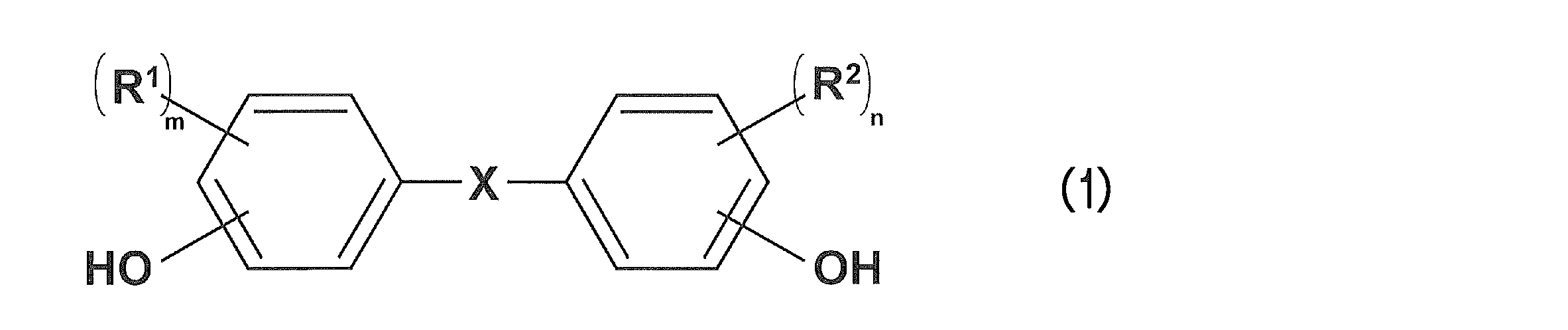
[式(1)中、Xは、単結合、アルキレン基、シクロアルキレン基、又は、シクロアルキリデン基を示す。R1及びR2は、同一又は異なって、炭素数1~5のアルキル基を示す。m及びnは、同一又は異なって、0~4の整数を示す。]
で表される化合物の水素化反応により下記式(2)
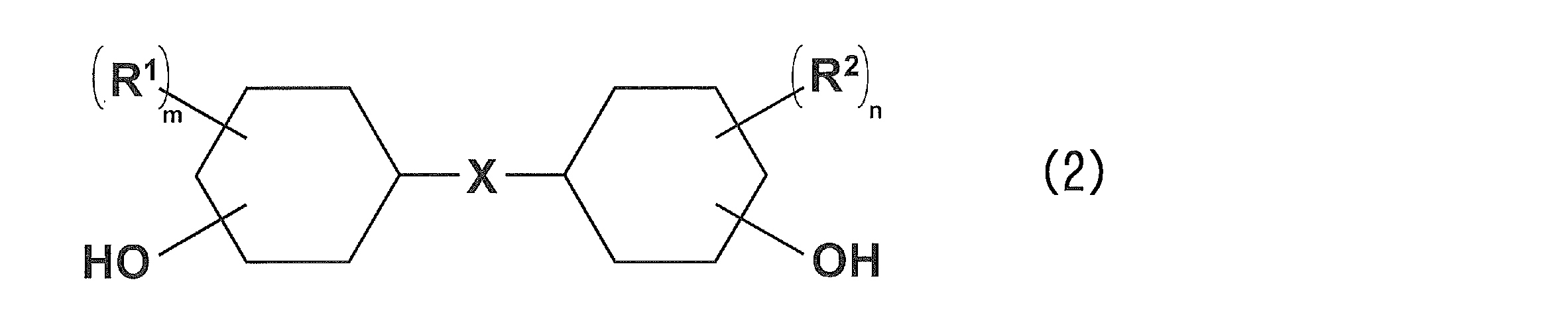
[式(2)中、X、R1、R2、m、及びnは、前記に同じ。]
で表される化合物を製造する方法であって、前記水素化反応の反応溶媒として2価アルコールを使用することを特徴とする水素化フェノール化合物の製造方法を提供する。
で表される化合物の水素化反応により下記式(2)
で表される化合物を製造する方法であって、前記水素化反応の反応溶媒として2価アルコールを使用することを特徴とする水素化フェノール化合物の製造方法を提供する。
さらに、前記2価アルコールが、脂肪族ジオール又はポリアルキレングリコールである前記の水素化フェノール化合物の製造方法を提供する。
すなわち、本発明は以下に関する。
[1]下記式(1)

[式(1)中、Xは、単結合、アルキレン基、シクロアルキレン基、又は、シクロアルキリデン基を示す。R1及びR2は、同一又は異なって、炭素数1~5のアルキル基を示す。m及びnは、同一又は異なって、0~4の整数を示す。]
で表される化合物の水素化反応により下記式(2)
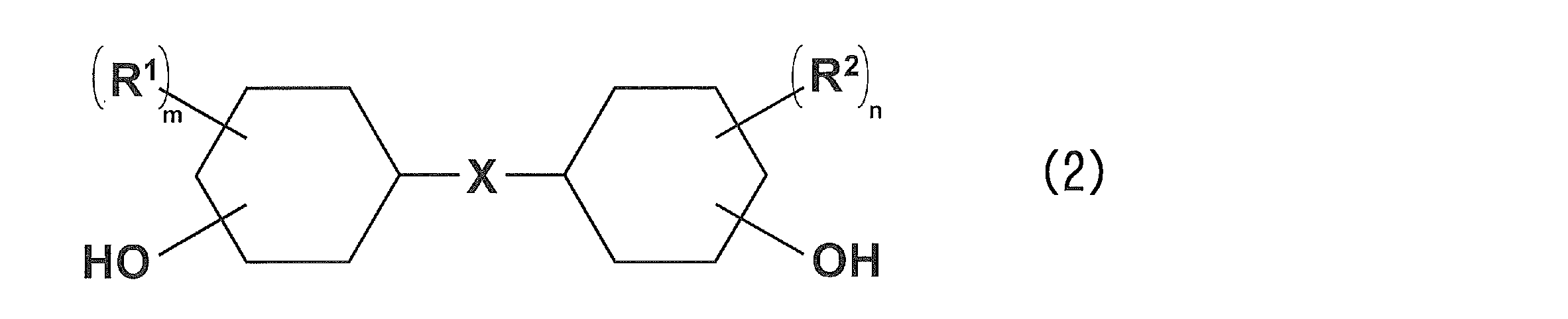
[式(2)中、X、R1、R2、m、及びnは、前記に同じ。]
で表される化合物を製造する方法であって、前記水素化反応の反応溶媒として2価アルコールを使用することを特徴とする水素化フェノール化合物の製造方法。
[2]Xが、単結合、炭素数1~4の直鎖状アルキレン基、炭素数3若しくは4の分岐鎖状アルキレン基、又はシクロアルキリデン基である[1]に記載の水素化フェノール化合物の製造方法。
[3]式(1)中のベンゼン環におけるヒドロキシ基の結合位置が、Xが直接結合した炭素原子の位置を1位とすると、4位である[1]又は[2]に記載の水素化フェノール化合物の製造方法。
[4]前記2価アルコールが、25℃、1気圧において液体の2価アルコールである[1]~[3]のいずれか1つに記載の水素化フェノール化合物の製造方法。
[5]前記2価アルコールが、1気圧における沸点が180~300℃の2価アルコールである[1]~[4]のいずれか1つに記載の水素化フェノール化合物の製造方法。
[6]前記2価アルコールが、好ましくは炭素数(総数)2~6の2価アルコール、より好ましくは炭素数(総数)2~4の2価アルコールである[1]~[5]のいずれか1つに記載の水素化フェノール化合物の製造方法。
[7]前記2価アルコールが、脂肪族ジオール又はポリアルキレングリコールである[1]~[6]のいずれか1つに記載の水素化フェノール化合物の製造方法。
[8]前記2価アルコールの使用量が、式(1)で表される化合物1重量部に対して、好ましくは0.5~10重量部、より好ましくは0.5~5重量部である[1]~[7]のいずれか1つに記載の水素化フェノール化合物の製造方法。
[9]前記反応溶媒の使用量が、式(1)で表される化合物1重量部に対して、好ましくは0.5~10重量部、より好ましくは0.5~5重量部である[1]~[8]のいずれか1つに記載の水素化フェノール化合物の製造方法。
[10]前記反応溶媒の全量(100重量%)に対する前記2価アルコールの割合が、好ましくは50~100重量%、より好ましくは90重量%以上である[1]~[9]のいずれか1つに記載の水素化フェノール化合物の製造方法。
[11]前記水素化反応において水素化触媒を使用する[1]~[10]のいずれか1つに記載の水素化フェノール化合物の製造方法。
[12]前記水素化触媒が、好ましくはニッケル系触媒、より好ましくはラネーニッケル触媒である[11]に記載の水素化フェノール化合物の製造方法。
[13]前記水素化反応の反応圧力が0.1~30MPa(ゲージ圧力)である[1]~[12]のいずれか1つに記載の水素化フェノール化合物の製造方法。
[14]前記水素化反応の反応温度が常温~250℃である[1]~[13]のいずれか1つに記載の水素化フェノール化合物の製造方法。
[1]下記式(1)
で表される化合物の水素化反応により下記式(2)
で表される化合物を製造する方法であって、前記水素化反応の反応溶媒として2価アルコールを使用することを特徴とする水素化フェノール化合物の製造方法。
[2]Xが、単結合、炭素数1~4の直鎖状アルキレン基、炭素数3若しくは4の分岐鎖状アルキレン基、又はシクロアルキリデン基である[1]に記載の水素化フェノール化合物の製造方法。
[3]式(1)中のベンゼン環におけるヒドロキシ基の結合位置が、Xが直接結合した炭素原子の位置を1位とすると、4位である[1]又は[2]に記載の水素化フェノール化合物の製造方法。
[4]前記2価アルコールが、25℃、1気圧において液体の2価アルコールである[1]~[3]のいずれか1つに記載の水素化フェノール化合物の製造方法。
[5]前記2価アルコールが、1気圧における沸点が180~300℃の2価アルコールである[1]~[4]のいずれか1つに記載の水素化フェノール化合物の製造方法。
[6]前記2価アルコールが、好ましくは炭素数(総数)2~6の2価アルコール、より好ましくは炭素数(総数)2~4の2価アルコールである[1]~[5]のいずれか1つに記載の水素化フェノール化合物の製造方法。
[7]前記2価アルコールが、脂肪族ジオール又はポリアルキレングリコールである[1]~[6]のいずれか1つに記載の水素化フェノール化合物の製造方法。
[8]前記2価アルコールの使用量が、式(1)で表される化合物1重量部に対して、好ましくは0.5~10重量部、より好ましくは0.5~5重量部である[1]~[7]のいずれか1つに記載の水素化フェノール化合物の製造方法。
[9]前記反応溶媒の使用量が、式(1)で表される化合物1重量部に対して、好ましくは0.5~10重量部、より好ましくは0.5~5重量部である[1]~[8]のいずれか1つに記載の水素化フェノール化合物の製造方法。
[10]前記反応溶媒の全量(100重量%)に対する前記2価アルコールの割合が、好ましくは50~100重量%、より好ましくは90重量%以上である[1]~[9]のいずれか1つに記載の水素化フェノール化合物の製造方法。
[11]前記水素化反応において水素化触媒を使用する[1]~[10]のいずれか1つに記載の水素化フェノール化合物の製造方法。
[12]前記水素化触媒が、好ましくはニッケル系触媒、より好ましくはラネーニッケル触媒である[11]に記載の水素化フェノール化合物の製造方法。
[13]前記水素化反応の反応圧力が0.1~30MPa(ゲージ圧力)である[1]~[12]のいずれか1つに記載の水素化フェノール化合物の製造方法。
[14]前記水素化反応の反応温度が常温~250℃である[1]~[13]のいずれか1つに記載の水素化フェノール化合物の製造方法。
本発明の水素化フェノール類の製造方法は上記構成を有するため、溶媒の使用量の削減が可能であり、効率が良く安価に水素化フェノール類を製造することができる。このため、本発明の水素化フェノール類の製造方法により得られた水素化フェノール類を使用すれば、耐熱性、耐加水分解性、耐候性、透明性等に優れた樹脂又は樹脂原料を安価に得ることができる。
本発明の水素化フェノール類の製造方法は、下記式(1)で表される化合物(フェノール類)の水素化反応により下記式(2)で表される化合物(水素化フェノール類)を製造する方法であって、上記水素化反応の反応溶媒として2価アルコールを使用することを特徴とする方法である。
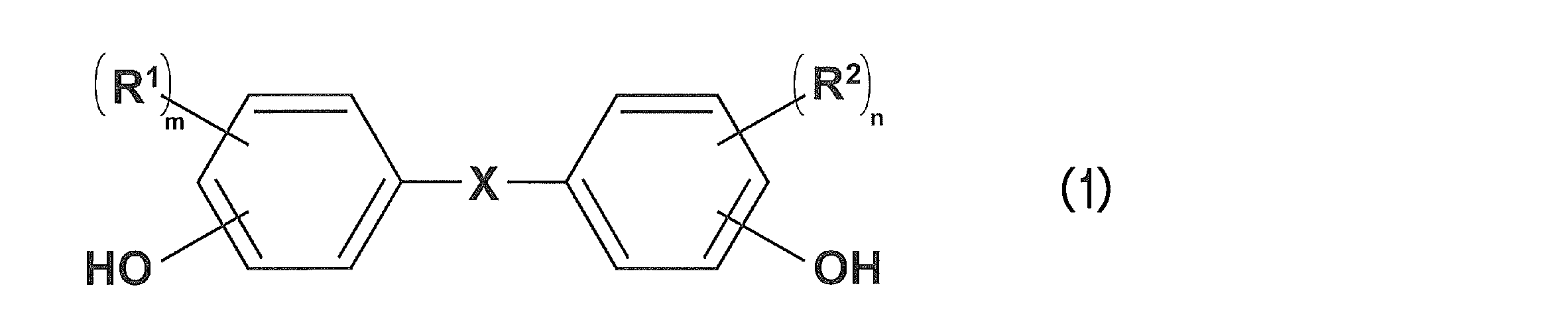
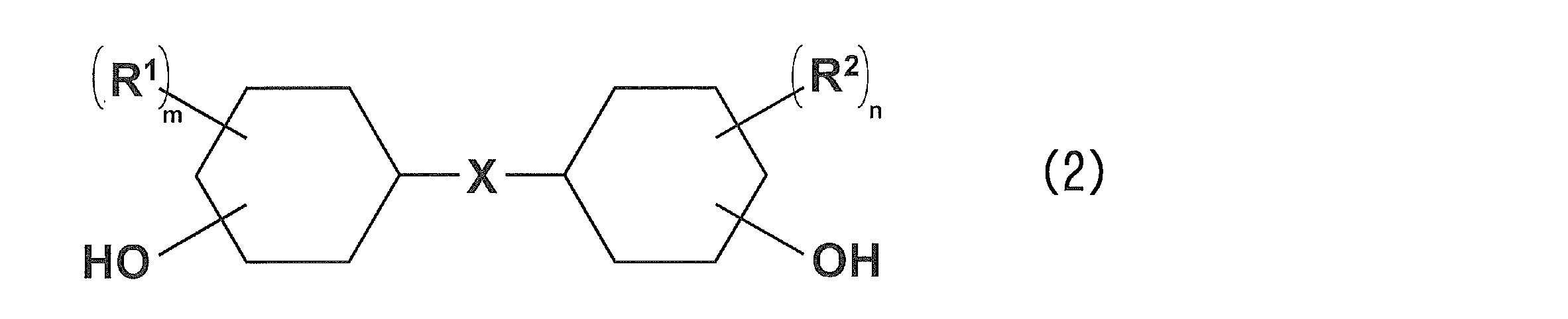
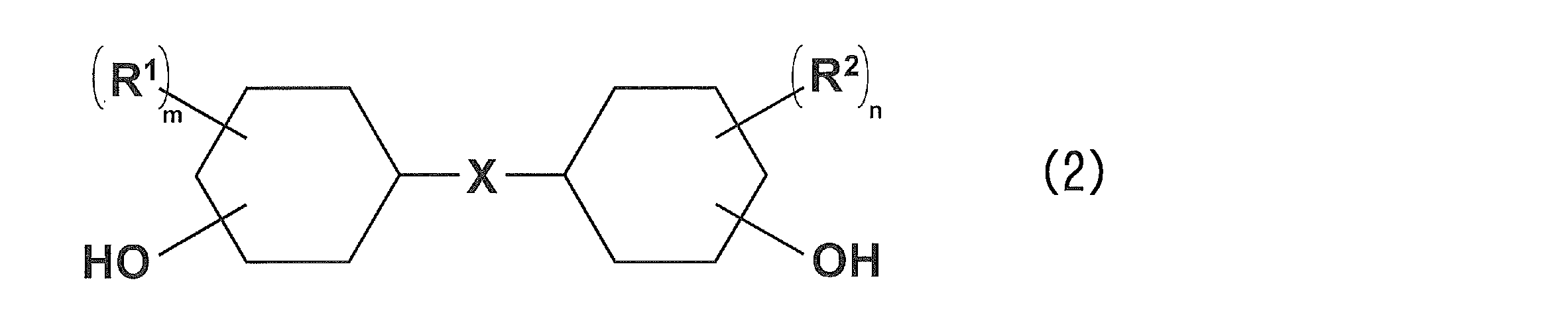
式(1)及び式(2)中、Xは、単結合、アルキレン基、シクロアルキレン基、又はシクロアルキリデン基を示す。アルキレン基としては、例えば、メチレン基、エチレン基、トリメチレン基、テトラメチレン基、ペンタメチレン基等の炭素数1~6の直鎖状アルキレン基等の直鎖状アルキレン基;プロピレン基(プロパン-1,2-ジイル基)、プロパン-2,2-ジイル基、ジメチルエチレン基、ブタン-2,2-ジイル基等の炭素数3~6の分岐鎖状アルキレン基等の分岐鎖状アルキレン基等が挙げられる。シクロアルキレン基としては、例えば、1,2-シクロペンチレン基、1,3-シクロペンチレン基、1,2-シクロヘキシレン基、1,3-シクロヘキシレン基、1,4-シクロヘキシレン基等が挙げられる。シクロアルキリデン基としては、例えば、シクロペンチリデン基、シクロヘキシリデン基等が挙げられる。中でも、Xとしては、単結合、炭素数1~4の直鎖状アルキレン基、炭素数3又は4の分岐鎖状アルキレン基、シクロアルキリデン基が好ましく、単結合、炭素数1~3の直鎖状アルキレン基、炭素数3の分岐鎖状アルキレン基、シクロアルキリデン基が特に好ましい。
式(1)及び式(2)中、R1及びR2は、同一又は異なって、炭素数1~5のアルキル基を示す。炭素数1~5のアルキル基としては、例えば、メチル基、エチル基、n-プロピル基、イソプロピル基、n-ブチル基、イソブチル基、s-ブチル基、t-ブチル基、n-ペンチル基等が挙げられる。なお、m(又はn)が2以上の場合、複数のR1(又はR2)はそれぞれ同一であってもよいし、異なっていてもよい。また、式(1)及び式(2)中、m及びnは、同一又は異なって、0~4の整数(好ましくは0~2の整数)を示す。なお、mが0の場合には、式(1)中の左側のベンゼン環(又は、式(2)中の左側のシクロヘキサン環)における置換基として、R1が存在しないことを示す。同様に、nが0の場合には、式(1)中の右側のベンゼン環(又は、式(2)中の右側のシクロヘキサン環)における置換基として、R2が存在しないことを示す。
式(1)(又は式(2))中のベンゼン環(又はシクロヘキサン環)におけるヒドロキシ基の結合位置は、特に限定されないが、例えば、式中でXが直接結合した炭素原子の位置を1位とすると、例えば、4位が挙げられる。
式(1)で表される化合物としては、より具体的には、例えば、4,4'-ビフェノール、ビスフェノールA[4,4'-(プロパン-2,2-ジイル)ジフェノール]、ビスフェノールF[ビス(4-ヒドロキシフェニル)メタン]、ビスフェノールB[2,2-ビス(4-ヒドロキシフェニル)ブタン]、ビスフェノールE[1,1-ビス(4-ヒドロキシフェニル)エタン]、ビスフェノールC[2,2-ビス(3-メチル-4-ヒドロキシフェニル)プロパン]、ビスフェノールZ[1,1-ビス(4-ヒドロキシフェニル)シクロヘキサン]等が挙げられる。
式(2)で表される化合物としては、より具体的には、例えば、4,4'-ビシクロヘキサノール、水素化ビスフェノールA[2,2'-ビス(4-ヒドロキシシクロヘキシル)プロパン]、水素化ビスフェノールF、水素化ビスフェノールB、水素化ビスフェノールE、水素化ビスフェノールC、水素化ビスフェノールZ等が挙げられる。
[反応溶媒]
式(1)で表される化合物の水素化反応において反応溶媒として用いられる2価アルコールとしては、例えば、脂肪族ジオール、ポリアルキレングリコール等から選択することができる。上記脂肪族ジオールとしては、例えば、エチレングリコール、1,2-プロピレングリコール、1,3-プロピレングリコール、1,2-ブタンジオール、1,3-ブタンジオール、1,4-ブタンジオール、2,3-ブタンジオール、1,2-ペンタンジオール、1,3-ペンタンジオール、1,5-ペンタンジオール、2,4-ペンタンジオール、1,2-ヘキサンジオール、1,6-ヘキサンジオール等の炭素数(総数)2~6の脂肪族ジオール等が挙げられる。また、上記ポリアルキレングリコールとしては、例えば、エチレンオキシド、プロピレンオキシド、ブチレンオキシド等のアルキレンオキシドの2分子以上を付加させて得られるポリアルキレングリコール等が挙げられ、より具体的には、HOC2H4(OC2H4)n1OC2H4OH[n1は0~5の整数である]で示されるポリエチレングリコール、HOC3H6(OC3H6)n2OC3H6OH[n2は0~5の整数である]で示されるポリプロピレングリコール、HOC4H8(OC4H8)n3OC4H8OH[n3は0~5の整数である]で示されるポリブチレングリコール等が挙げられる。
式(1)で表される化合物の水素化反応において反応溶媒として用いられる2価アルコールとしては、例えば、脂肪族ジオール、ポリアルキレングリコール等から選択することができる。上記脂肪族ジオールとしては、例えば、エチレングリコール、1,2-プロピレングリコール、1,3-プロピレングリコール、1,2-ブタンジオール、1,3-ブタンジオール、1,4-ブタンジオール、2,3-ブタンジオール、1,2-ペンタンジオール、1,3-ペンタンジオール、1,5-ペンタンジオール、2,4-ペンタンジオール、1,2-ヘキサンジオール、1,6-ヘキサンジオール等の炭素数(総数)2~6の脂肪族ジオール等が挙げられる。また、上記ポリアルキレングリコールとしては、例えば、エチレンオキシド、プロピレンオキシド、ブチレンオキシド等のアルキレンオキシドの2分子以上を付加させて得られるポリアルキレングリコール等が挙げられ、より具体的には、HOC2H4(OC2H4)n1OC2H4OH[n1は0~5の整数である]で示されるポリエチレングリコール、HOC3H6(OC3H6)n2OC3H6OH[n2は0~5の整数である]で示されるポリプロピレングリコール、HOC4H8(OC4H8)n3OC4H8OH[n3は0~5の整数である]で示されるポリブチレングリコール等が挙げられる。
上記2価アルコールとしては、特に限定されないが、常温(25℃)、1気圧において液体である2価アルコールが好ましい。なお、25℃、1気圧において固体である2価アルコールも使用できるが、例えば、25℃、1気圧において液体である2価アルコールと併用することによって、25℃、1気圧において液体の混合物(反応溶媒)として使用することが好ましい。
上記2価アルコールの1気圧における沸点は、特に限定されないが、生成物の精製や反応溶媒の再使用等における取り扱い性の観点で、例えば、180~300℃が好ましく、より好ましくは180~250℃である。
中でも、上記2価アルコールとしては、式(1)で表される化合物及び式(2)で表される化合物の溶解性、生成物の精製や反応溶媒の再使用等における取り扱い性の観点で、炭素数(総数)2~6の2価アルコールが好ましく、より好ましくは、炭素数(総数)2~4の2価アルコールである。
なお、本発明の水素化フェノール類の製造方法における反応溶媒としての2価アルコールは、1種を単独で使用することもできるし、2種以上を組み合わせて使用することもできる。
2価アルコールの使用量は、特に限定されないが、式(1)で表される化合物1重量部に対して、0.5~10重量部が好ましく、より好ましくは0.5~5重量部である。例えば、式(1)で表される化合物として4,4'-ビフェノールを使用し、反応溶媒として2価アルコールを上記割合で使用した場合、常温において、4,4'-ビフェノールは2価アルコールに完全には溶解しないが、2価アルコールの沸点が180℃以上と高く、常圧で比較的高い温度まで昇温させることができるため、適当な温度まで加熱することによって、流動性の高い4,4'-ビフェノールのスラリー又は溶液を調製することができる。例えば、4,4'-ビフェノール1重量部に対して2価アルコール1重量部を使用した場合には、60℃以上の温度で流動性の高い4,4'-ビフェノールのスラリー又は溶液を調製することができる。一方、2価アルコールの使用量が式(1)で表される化合物1重量部に対して0.5重量部未満では、式(1)で表される化合物のスラリーの流動性が低下し、また、式(2)で表される化合物が析出して水素化触媒と水素化反応液の分離ができなくなる場合がある。一方、2価アルコールの使用量が式(1)で表される化合物1重量部に対して10重量部を超えると、生産性が低下する場合がある。
また、2価アルコールは水素化反応の反応温度において低い蒸気圧力しか示さないため、水素ガスの分圧を高めることができ、水素化反応の速度を速めることができるというメリットがある。
なお、本発明の水素化フェノール類の製造方法における反応溶媒としては、2価アルコールのみを使用することもできるし、2価アルコールに加え、さらに、2価アルコール以外の溶媒(「その他の溶媒」と称する場合がある)を併用することもできる。上記その他の溶媒としては、例えば、水;酢酸エチル等のエステル;メチル-t-ブチルエーテル等のエーテル;エタノール、2-プロパノール等のアルコール;シクロヘキサン等の環状炭化水素;エチレングリコールモノメチルエーテル、プロピレングリコールモノメチルエーテル、ジエチレングリコールモノメチルエーテル等のアルキレングリコールモノエーテル又はポリアルキレングリコールモノエーテル等が挙げられる。上記その他の溶媒は、1種を単独で使用することもできるし、2種以上を組み合わせて使用することもできる。
本発明の水素化フェノール類の製造方法において使用される反応溶媒の全量(100重量%)に対する2価アルコールの割合は、特に限定されないが、例えば、50~100重量%が好ましく、より好ましくは90重量%以上である。上記反応溶媒は、実質的に2価アルコールのみにより構成されたものであること(例えば、2価アルコールの割合が98~100重量%)が最も好ましい。2価アルコールの割合が50重量%未満であると、式(1)で表される化合物のスラリーの流動性が低下し、また、式(2)で表される化合物が析出して水素化触媒と水素化反応液の分離ができなくなる場合がある。
本発明の水素化フェノール類の製造方法における反応溶媒の使用量(全量)は、特に限定されないが、式(1)で表される化合物1重量部に対して、0.5~10重量部が好ましく、より好ましくは0.5~5重量部である。反応溶媒の使用量が式(1)で表される化合物1重量部に対して0.5重量部未満では、式(1)で表される化合物のスラリーの流動性が低下し、また、式(2)で表される化合物が析出して水素化触媒と水素化反応液の分離ができなくなる場合がある。一方、反応溶媒の使用量が式(1)で表される化合物1重量部に対して10重量部を超えると、生産性が低下する場合がある。
[水素化触媒]
本発明の水素化フェノール類の製造方法における水素化反応で使用される触媒(水素化触媒)としては、公知乃至慣用の水素化触媒を使用することができ、特に限定されないが、例えば、ニッケル系触媒、銅系触媒、コバルト系触媒、白金系触媒、パラジウム系触媒、ルテニウム系触媒、ロジウム系触媒等から適宜選択して使用することができる。中でも、ニッケル系触媒が好ましく、より好ましくはラネーニッケル触媒である。
本発明の水素化フェノール類の製造方法における水素化反応で使用される触媒(水素化触媒)としては、公知乃至慣用の水素化触媒を使用することができ、特に限定されないが、例えば、ニッケル系触媒、銅系触媒、コバルト系触媒、白金系触媒、パラジウム系触媒、ルテニウム系触媒、ロジウム系触媒等から適宜選択して使用することができる。中でも、ニッケル系触媒が好ましく、より好ましくはラネーニッケル触媒である。
上記水素化触媒の形状は、特に限定されず、例えば、粉末状、成型体等のいずれであってもよい。また、上記水素化触媒は、担体に担持していないものであってもよいし、担体に担持したものであってもよい。
なお、本発明の水素化フェノール類の製造方法において水素化触媒は、1種を単独で使用することもできるし、2種以上を組み合わせて使用することもできる。
上記水素化触媒の使用量は、特に限定されず、水素化触媒の種類や反応器の形式等に応じて適宜調整することができ、公知乃至慣用の使用量から適宜選択することができる。
[反応器]
式(1)で表される化合物の水素化反応において使用される反応器の形式は、特に限定されないが、例えば、攪拌機、ポンプ、又は水素ガスで触媒を分散させる懸濁床や、触媒を充填した固定床であってもよい。また、上記水素化反応の運転操作は、連続操作であってもよいし、回分操作であってもよい。
式(1)で表される化合物の水素化反応において使用される反応器の形式は、特に限定されないが、例えば、攪拌機、ポンプ、又は水素ガスで触媒を分散させる懸濁床や、触媒を充填した固定床であってもよい。また、上記水素化反応の運転操作は、連続操作であってもよいし、回分操作であってもよい。
[反応条件]
式(1)で表される化合物の水素化反応の反応圧力、反応温度は、特に限定されず、生産性や設備の制御性を考慮して、任意に条件を選択することができる。より具体的には、反応圧力は、例えば、0.1~30MPa(ゲージ圧力)の範囲から、反応温度は、例えば、常温~250℃の範囲から適宜選択することができる。
式(1)で表される化合物の水素化反応の反応圧力、反応温度は、特に限定されず、生産性や設備の制御性を考慮して、任意に条件を選択することができる。より具体的には、反応圧力は、例えば、0.1~30MPa(ゲージ圧力)の範囲から、反応温度は、例えば、常温~250℃の範囲から適宜選択することができる。
式(1)で表される化合物の水素化反応の反応時間は、特に限定されず、水素化反応の進行の程度に応じて適宜設定可能である。なお、水素化反応の進行の程度は、ガスクロマトグラフィー等の公知乃至慣用の分析手段により確認することができる。
上述の水素化反応の結果、生成物としての式(2)で表される化合物を含む反応混合物(式(2)で表される化合物及び2価アルコールを少なくとも含む混合物)が得られる。上記反応混合物に触媒が含まれている場合には、上記反応混合物から触媒を分離する必要があるが、生成物である式(2)で表される化合物は原料である式(1)で表される化合物よりも2価アルコールに対してさらに溶解性が高い傾向があり、上記反応混合物(通常、スラリー)を適当な温度まで加温することによって式(2)で表される化合物が完全に溶解するため、反応混合物から触媒を分離することが可能となる。なお、必要に応じて、反応混合物(通常、スラリー)に2価アルコールやその他の溶媒を追加して式(2)で表される化合物の溶解性を上げることも可能である。
反応液から触媒を分離する方法は、公知乃至慣用の方法から適宜選択することができ、特に限定されないが、例えば、ろ過分離、遠心分離等が挙げられる。
式(1)で表される化合物の水素化反応により得られた反応混合物からは、晶析や蒸留等の公知乃至慣用の精製手段によって式(2)で表される化合物を分離することもできるし、また、上記反応混合物をそのまま次の工程に使用することもできる。
本発明の水素化フェノール類の製造方法によると、従来知られている方法と比べて溶媒の使用量の大幅な減量が可能であり、式(2)で表される化合物を効率良く安価に得ることができる。このため、例えば、上記製造方法により得られた式(2)で表される化合物を使用すれば、耐熱性、耐加水分解性、耐候性、透明性等に優れた樹脂やその原料[例えば、エポキシ樹脂、アルキッド樹脂、ポリエステル樹脂、ポリウレタン樹脂、ポリカーボネート樹脂等の樹脂やその原料(エポキシ化合物等)]を安価に得ることができる。
以下に、実施例に基づいて本発明をより詳細に説明するが、本発明はこれらの実施例により限定されるものではない。
実施例1
4,4'-ビフェノール50g、エチレングリコール(沸点197℃)50g、及び、ラネーニッケル触媒(触媒)2.5gを、300mL攪拌機付きステンレス製オートクレーブに仕込み、窒素置換後、ゲージ圧力が4.0MPaとなるまで水素を仕込んだ。続いて、160℃まで昇温し、ゲージ圧力が6.0MPaになるように水素を補給しながら7時間水素化反応を行った。その後、水素をパージして窒素置換し、140℃で触媒をろ過分離した。ろ紙上には触媒のみが残った。合計100gのろ液は、溶媒のエチレングリコールを除いて、4,4'-ビシクロヘキサノールを92.4重量%、4-シクロヘキシルシクロヘキサノールを7.6重量%含んでいたが、上記ろ液中には4,4'-ビフェノールは検出されなかった。なお、ろ液は70℃以上で流動性がある乳白色のスラリーであり、90℃における粘度は365mPa・sであった。また、上記スラリーにおける懸濁成分は133℃以上で完全溶解して無色透明液体となり、133℃における粘度は11mPa・sであった。
4,4'-ビフェノール50g、エチレングリコール(沸点197℃)50g、及び、ラネーニッケル触媒(触媒)2.5gを、300mL攪拌機付きステンレス製オートクレーブに仕込み、窒素置換後、ゲージ圧力が4.0MPaとなるまで水素を仕込んだ。続いて、160℃まで昇温し、ゲージ圧力が6.0MPaになるように水素を補給しながら7時間水素化反応を行った。その後、水素をパージして窒素置換し、140℃で触媒をろ過分離した。ろ紙上には触媒のみが残った。合計100gのろ液は、溶媒のエチレングリコールを除いて、4,4'-ビシクロヘキサノールを92.4重量%、4-シクロヘキシルシクロヘキサノールを7.6重量%含んでいたが、上記ろ液中には4,4'-ビフェノールは検出されなかった。なお、ろ液は70℃以上で流動性がある乳白色のスラリーであり、90℃における粘度は365mPa・sであった。また、上記スラリーにおける懸濁成分は133℃以上で完全溶解して無色透明液体となり、133℃における粘度は11mPa・sであった。
実施例2
4,4'-ビフェノール50g、1,2-プロピレングリコール(沸点188℃)50g、及び、ラネーニッケル触媒(触媒)2.5gを、300mL攪拌機付きステンレス製オートクレーブに仕込み、窒素置換後、ゲージ圧力が4.0MPaとなるまで水素を仕込んだ。続いて、160℃まで昇温し、ゲージ圧力が6.0MPaになるように水素を補給しながら7時間水素化反応を行った。その後、水素をパージして窒素置換し、140℃で触媒をろ過分離した。ろ紙上には触媒のみが残った。合計100gのろ液は、溶媒の1,2-プロピレングリコールを除いて、4,4'-ビシクロヘキサノールを88.4重量%、4-シクロヘキシルシクロヘキサノールを11.6重量%含んでいたが、上記ろ液中には4,4'-ビフェノールは検出されなかった。
4,4'-ビフェノール50g、1,2-プロピレングリコール(沸点188℃)50g、及び、ラネーニッケル触媒(触媒)2.5gを、300mL攪拌機付きステンレス製オートクレーブに仕込み、窒素置換後、ゲージ圧力が4.0MPaとなるまで水素を仕込んだ。続いて、160℃まで昇温し、ゲージ圧力が6.0MPaになるように水素を補給しながら7時間水素化反応を行った。その後、水素をパージして窒素置換し、140℃で触媒をろ過分離した。ろ紙上には触媒のみが残った。合計100gのろ液は、溶媒の1,2-プロピレングリコールを除いて、4,4'-ビシクロヘキサノールを88.4重量%、4-シクロヘキシルシクロヘキサノールを11.6重量%含んでいたが、上記ろ液中には4,4'-ビフェノールは検出されなかった。
実施例3
4,4'-ビフェノール50g、1,4-ブタンジオール(沸点228℃)50g、及び、ラネーニッケル触媒(触媒)2.5gを、300mL攪拌機付きステンレス製オートクレーブに仕込み、窒素置換後、ゲージ圧力が4.0MPaとなるまで水素を仕込んだ。続いて、160℃まで昇温し、ゲージ圧力が6.0MPaになるように水素を補給しながら7時間水素化反応を行った。その後、水素をパージして窒素置換し、140℃で触媒をろ過分離した。ろ紙上には触媒のみが残った。合計100gのろ液は、溶媒の1,4-ブタンジオールを除いて、4,4'-ビシクロヘキサノールを91.3重量%、4-シクロヘキシルシクロヘキサノールを8.7重量%含んでいたが、上記ろ液中には4,4'-ビフェノールは検出されなかった。
4,4'-ビフェノール50g、1,4-ブタンジオール(沸点228℃)50g、及び、ラネーニッケル触媒(触媒)2.5gを、300mL攪拌機付きステンレス製オートクレーブに仕込み、窒素置換後、ゲージ圧力が4.0MPaとなるまで水素を仕込んだ。続いて、160℃まで昇温し、ゲージ圧力が6.0MPaになるように水素を補給しながら7時間水素化反応を行った。その後、水素をパージして窒素置換し、140℃で触媒をろ過分離した。ろ紙上には触媒のみが残った。合計100gのろ液は、溶媒の1,4-ブタンジオールを除いて、4,4'-ビシクロヘキサノールを91.3重量%、4-シクロヘキシルシクロヘキサノールを8.7重量%含んでいたが、上記ろ液中には4,4'-ビフェノールは検出されなかった。
実施例4
4,4'-ビフェノール50g、ジエチレングリコール(沸点244℃)50g、及び、ラネーニッケル触媒(触媒)2.5gを、300mL攪拌機付きステンレス製オートクレーブに仕込み、窒素置換後、ゲージ圧力が4.0MPaとなるまで水素を仕込んだ、続いて、160℃まで昇温し、ゲージ圧力が6.0MPaになるように水素を補給しながら7時間水素化反応を行った。その後、水素をパージして窒素置換し、140℃で触媒をろ過分離した。ろ紙上には触媒のみが残った。合計100gのろ液は、溶媒のジエチレングリコールを除いて、4,4'-ビシクロヘキサノールを86.2重量%、4-シクロヘキシルシクロヘキサノールを13.8重量%含んでいたが、上記ろ液中には4,4'-ビフェノールは検出されなかった。
4,4'-ビフェノール50g、ジエチレングリコール(沸点244℃)50g、及び、ラネーニッケル触媒(触媒)2.5gを、300mL攪拌機付きステンレス製オートクレーブに仕込み、窒素置換後、ゲージ圧力が4.0MPaとなるまで水素を仕込んだ、続いて、160℃まで昇温し、ゲージ圧力が6.0MPaになるように水素を補給しながら7時間水素化反応を行った。その後、水素をパージして窒素置換し、140℃で触媒をろ過分離した。ろ紙上には触媒のみが残った。合計100gのろ液は、溶媒のジエチレングリコールを除いて、4,4'-ビシクロヘキサノールを86.2重量%、4-シクロヘキシルシクロヘキサノールを13.8重量%含んでいたが、上記ろ液中には4,4'-ビフェノールは検出されなかった。
実施例5
4,4'-ビフェノール50g、ジプロピレングリコール(沸点232℃)50g、及び、ラネーニッケル触媒(触媒)2.5gを、300mL攪拌機付きステンレス製オートクレーブに仕込み、窒素置換後、ゲージ圧力が4.0MPaとなるまで水素を仕込んだ。続いて、160℃まで昇温し、ゲージ圧力が6.0MPaになるように水素を補給しながら7時間水素化反応を行った。その後、水素をパージして窒素置換し、140℃で触媒をろ過分離した。ろ紙上には触媒のみが残った。合計100gのろ液は、溶媒のジプロピレングリコールを除いて、4,4'-ビシクロヘキサノールを88.4重量%、4-シクロヘキシルシクロヘキサノールを11.6重量%含んでいたが、上記ろ液中には4,4'-ビフェノールは検出されなかった。
4,4'-ビフェノール50g、ジプロピレングリコール(沸点232℃)50g、及び、ラネーニッケル触媒(触媒)2.5gを、300mL攪拌機付きステンレス製オートクレーブに仕込み、窒素置換後、ゲージ圧力が4.0MPaとなるまで水素を仕込んだ。続いて、160℃まで昇温し、ゲージ圧力が6.0MPaになるように水素を補給しながら7時間水素化反応を行った。その後、水素をパージして窒素置換し、140℃で触媒をろ過分離した。ろ紙上には触媒のみが残った。合計100gのろ液は、溶媒のジプロピレングリコールを除いて、4,4'-ビシクロヘキサノールを88.4重量%、4-シクロヘキシルシクロヘキサノールを11.6重量%含んでいたが、上記ろ液中には4,4'-ビフェノールは検出されなかった。
実施例6
ビスフェノールA 50g、エチレングリコール(沸点197℃)50g、及び、ラネーニッケル触媒(触媒)2.5gを、300mL攪拌機付きステンレス製オートクレーブに仕込み、窒素置換後、ゲージ圧力が4.0MPaとなるまで水素を仕込んだ。続いて、160℃まで昇温し、ゲージ圧力が6.0MPaになるように水素を補給しながら7時間水素化反応を行った。その後、水素をパージして窒素置換し、140℃で触媒をろ過分離した。ろ紙上には触媒のみが残った。合計100gのろ液は、溶媒のエチレングリコールを除いて、水素化ビスフェノールAを92.0重量%、過水添物を8.0重量%含んでいたが、上記ろ液中にはビスフェノールAは検出されなかった。
ビスフェノールA 50g、エチレングリコール(沸点197℃)50g、及び、ラネーニッケル触媒(触媒)2.5gを、300mL攪拌機付きステンレス製オートクレーブに仕込み、窒素置換後、ゲージ圧力が4.0MPaとなるまで水素を仕込んだ。続いて、160℃まで昇温し、ゲージ圧力が6.0MPaになるように水素を補給しながら7時間水素化反応を行った。その後、水素をパージして窒素置換し、140℃で触媒をろ過分離した。ろ紙上には触媒のみが残った。合計100gのろ液は、溶媒のエチレングリコールを除いて、水素化ビスフェノールAを92.0重量%、過水添物を8.0重量%含んでいたが、上記ろ液中にはビスフェノールAは検出されなかった。
比較例1
4,4'-ビフェノール50g、2-プロパノール(沸点82℃)50g、及び、ラネーニッケル触媒(触媒)2.5gを、300mL攪拌機付きステンレス製オートクレーブに仕込み、窒素置換後、ゲージ圧力が4.0MPaとなるまで水素を仕込んだ。続いて、160℃まで昇温し、ゲージ圧力が6.0MPaになるように水素を補給しながら7時間水素化反応を行った。次に、60℃まで冷却した後、水素をパージして窒素置換したが、内容物は固化していたため、このままではろ過できなかった。このため、ここに2-プロパノール400gを追加して内容物を溶解させ、60℃で触媒を分離ろ過した。このように、当該製造方法では大量の溶媒(2-プロパノール)を使用する必要が生じた。なお、合計500gのろ液は、溶媒の2-プロパノールを除いて、4,4'-ビシクロヘキサノールを90.6重量%、4-シクロヘキシルシクロヘキサノールを9.4重量%含んでいたが、上記ろ液中には4,4'-ビフェノールは検出されなかった。
4,4'-ビフェノール50g、2-プロパノール(沸点82℃)50g、及び、ラネーニッケル触媒(触媒)2.5gを、300mL攪拌機付きステンレス製オートクレーブに仕込み、窒素置換後、ゲージ圧力が4.0MPaとなるまで水素を仕込んだ。続いて、160℃まで昇温し、ゲージ圧力が6.0MPaになるように水素を補給しながら7時間水素化反応を行った。次に、60℃まで冷却した後、水素をパージして窒素置換したが、内容物は固化していたため、このままではろ過できなかった。このため、ここに2-プロパノール400gを追加して内容物を溶解させ、60℃で触媒を分離ろ過した。このように、当該製造方法では大量の溶媒(2-プロパノール)を使用する必要が生じた。なお、合計500gのろ液は、溶媒の2-プロパノールを除いて、4,4'-ビシクロヘキサノールを90.6重量%、4-シクロヘキシルシクロヘキサノールを9.4重量%含んでいたが、上記ろ液中には4,4'-ビフェノールは検出されなかった。
比較例2
ビスフェノールA 50g、2-プロパノール(沸点82℃)50g、及び、ラネーニッケル触媒(触媒)2.5gを、300mL攪拌機付きステンレス製オートクレーブに仕込み、窒素置換後、ゲージ圧力が4.0MPaとなるまで水素を仕込んだ。続いて、160℃まで昇温し、ゲージ圧力が6.0MPaになるように水素を補給しながら7時間水素化反応を行った。次に、60℃まで冷却した後、水素をパージして窒素置換したが、内容物は固化していたため、このままではろ過できなかった。このため、ここに2-プロパノール400gを追加して内容物を溶解させ、60℃で触媒を分離ろ過した。このように、当該製造方法では大量の溶媒(2-プロパノール)を使用する必要が生じた。なお、合計500gのろ液は、溶媒の2-プロパノールを除いて、水素化ビスフェノールAを90.6重量%、過水添物を9.4重量%含んでいたが、上記ろ液中にはビスフェノールAは検出されなかった。
ビスフェノールA 50g、2-プロパノール(沸点82℃)50g、及び、ラネーニッケル触媒(触媒)2.5gを、300mL攪拌機付きステンレス製オートクレーブに仕込み、窒素置換後、ゲージ圧力が4.0MPaとなるまで水素を仕込んだ。続いて、160℃まで昇温し、ゲージ圧力が6.0MPaになるように水素を補給しながら7時間水素化反応を行った。次に、60℃まで冷却した後、水素をパージして窒素置換したが、内容物は固化していたため、このままではろ過できなかった。このため、ここに2-プロパノール400gを追加して内容物を溶解させ、60℃で触媒を分離ろ過した。このように、当該製造方法では大量の溶媒(2-プロパノール)を使用する必要が生じた。なお、合計500gのろ液は、溶媒の2-プロパノールを除いて、水素化ビスフェノールAを90.6重量%、過水添物を9.4重量%含んでいたが、上記ろ液中にはビスフェノールAは検出されなかった。
本発明の水素化フェノール類の製造方法によると、従来知られている方法と比べて溶媒の使用量の大幅な減量が可能であり、水素化フェノール類を効率良く安価に得ることができる。このため、例えば、上記製造方法により得られた水素化フェノール類を使用すれば、耐熱性、耐加水分解性、耐候性、透明性等に優れた樹脂やその原料[例えば、エポキシ樹脂、アルキッド樹脂、ポリエステル樹脂、ポリウレタン樹脂、ポリカーボネート樹脂等の樹脂やその原料(エポキシ化合物等)]を安価に得ることができる。
Claims (2)
- 下記式(1)

で表される化合物の水素化反応により下記式(2)
で表される化合物を製造する方法であって、前記水素化反応の反応溶媒として2価アルコールを使用することを特徴とする水素化フェノール化合物の製造方法。 - 前記2価アルコールが、脂肪族ジオール又はポリアルキレングリコールである請求項1に記載の水素化フェノール化合物の製造方法。
Applications Claiming Priority (4)
| Application Number | Priority Date | Filing Date | Title |
|---|---|---|---|
| JP2013-156051 | 2013-07-26 | ||
| JP2013156051 | 2013-07-26 | ||
| JP2013-192052 | 2013-09-17 | ||
| JP2013192052 | 2013-09-17 |
Publications (1)
| Publication Number | Publication Date |
|---|---|
| WO2015012262A1 true WO2015012262A1 (ja) | 2015-01-29 |
Family
ID=52393297
Family Applications (1)
| Application Number | Title | Priority Date | Filing Date |
|---|---|---|---|
| PCT/JP2014/069314 Ceased WO2015012262A1 (ja) | 2013-07-26 | 2014-07-22 | 水素化フェノール類の製造方法 |
Country Status (2)
| Country | Link |
|---|---|
| TW (1) | TW201509889A (ja) |
| WO (1) | WO2015012262A1 (ja) |
Citations (7)
| Publication number | Priority date | Publication date | Assignee | Title |
|---|---|---|---|---|
| JPH03275637A (ja) * | 1990-03-23 | 1991-12-06 | New Japan Chem Co Ltd | ビスシクロヘキサノールの製造方法 |
| JPH04279537A (ja) * | 1991-03-05 | 1992-10-05 | New Japan Chem Co Ltd | ビシクロヘキシルジオールの製造方法 |
| JP2000044503A (ja) * | 1998-07-28 | 2000-02-15 | New Japan Chem Co Ltd | 水素化ビスフェノールa異性体組成物 |
| JP2000302719A (ja) * | 1999-04-21 | 2000-10-31 | Arakawa Chem Ind Co Ltd | ヒドロキシシクロヘキシルシクロヘキサノン類の製造法 |
| JP2001002616A (ja) * | 1999-04-21 | 2001-01-09 | Arakawa Chem Ind Co Ltd | ビシクロヘキサジオン類の製造法 |
| WO2013153957A1 (ja) * | 2012-04-09 | 2013-10-17 | 株式会社ダイセル | 水素化ビフェノールの製造方法 |
| WO2013161594A1 (ja) * | 2012-04-24 | 2013-10-31 | 住友化学株式会社 | ヒドロキシフェニルシクロヘキサノール化合物の製造方法 |
-
2014
- 2014-07-22 WO PCT/JP2014/069314 patent/WO2015012262A1/ja not_active Ceased
- 2014-07-25 TW TW103125437A patent/TW201509889A/zh unknown
Patent Citations (7)
| Publication number | Priority date | Publication date | Assignee | Title |
|---|---|---|---|---|
| JPH03275637A (ja) * | 1990-03-23 | 1991-12-06 | New Japan Chem Co Ltd | ビスシクロヘキサノールの製造方法 |
| JPH04279537A (ja) * | 1991-03-05 | 1992-10-05 | New Japan Chem Co Ltd | ビシクロヘキシルジオールの製造方法 |
| JP2000044503A (ja) * | 1998-07-28 | 2000-02-15 | New Japan Chem Co Ltd | 水素化ビスフェノールa異性体組成物 |
| JP2000302719A (ja) * | 1999-04-21 | 2000-10-31 | Arakawa Chem Ind Co Ltd | ヒドロキシシクロヘキシルシクロヘキサノン類の製造法 |
| JP2001002616A (ja) * | 1999-04-21 | 2001-01-09 | Arakawa Chem Ind Co Ltd | ビシクロヘキサジオン類の製造法 |
| WO2013153957A1 (ja) * | 2012-04-09 | 2013-10-17 | 株式会社ダイセル | 水素化ビフェノールの製造方法 |
| WO2013161594A1 (ja) * | 2012-04-24 | 2013-10-31 | 住友化学株式会社 | ヒドロキシフェニルシクロヘキサノール化合物の製造方法 |
Also Published As
| Publication number | Publication date |
|---|---|
| TW201509889A (zh) | 2015-03-16 |
Similar Documents
| Publication | Publication Date | Title |
|---|---|---|
| KR102355574B1 (ko) | 폴리카보네이트 수지 및 광학 렌즈 | |
| KR102386166B1 (ko) | 폴리(에스테르)카보네이트, 및 폴리(에스테르)카보네이트의 제조 방법 | |
| CN102753516B (zh) | 碳酸二芳基酯的制造方法 | |
| TWI436977B (zh) | 製備碳酸二芳酯之方法 | |
| KR102074690B1 (ko) | 고분자량화된 방향족 폴리카보네이트 수지의 제조 방법 | |
| TWI469960B (zh) | Compounds containing alcoholic hydroxyl groups and methods for their manufacture | |
| JP5412583B2 (ja) | フルオレン誘導体からなる熱可塑性樹脂の製造方法 | |
| Sweileh et al. | Synthesis and characterization of polycarbonates by melt phase interchange reactions of alkylene and arylene diacetates with alkylene and arylene diphenyl dicarbonates | |
| US20190262801A1 (en) | Rhenium catalysts for glycerin to allyl alcohol conversion | |
| KR102828128B1 (ko) | 열가소성 수지, 성형체, 및 열가소성 수지용 모노머 | |
| TW201406714A (zh) | 烯丙醇之氫甲醯化的速率及選擇性上的改良 | |
| JP6480867B2 (ja) | 水素化フェノール化合物の製造方法、及び水素化フェノール化合物の分離方法 | |
| WO2015012262A1 (ja) | 水素化フェノール類の製造方法 | |
| CN101084180A (zh) | 芳香族碳酸酯的制造方法 | |
| JP2013216582A (ja) | ビスフェノール類のビスヒドロキシエチルエーテルの製造方法 | |
| JP7669202B2 (ja) | ポリカーボネートおよび樹脂成形体 | |
| KR102727742B1 (ko) | 알릴 알코올 히드로포밀화 용매로서의 메틸시클로헥산 | |
| TWI602859B (zh) | 製備環己烷乙二醇酯及其衍生物的方法 | |
| JP2014224245A (ja) | ポリカーボネート樹脂の製造方法 | |
| KR102105891B1 (ko) | 신규 착화합물 및 이를 이용한 폴리(알킬렌 카보네이트)의 제조방법 | |
| JP2005296826A (ja) | ポリエステルの連続的水素化分解方法 | |
| JP2023124422A (ja) | イソプロペニルフェノール含有溶液の製造方法、ビスフェノールa含有溶液の製造方法、ビスフェノールaの製造方法及びポリカーボネート樹脂の製造方法 | |
| JP2023160599A (ja) | ポリカーボネート樹脂、ポリカーボネート樹脂組成物、光学部品、及びポリカーボネート樹脂の製造方法 |
Legal Events
| Date | Code | Title | Description |
|---|---|---|---|
| 121 | Ep: the epo has been informed by wipo that ep was designated in this application |
Ref document number: 14828849 Country of ref document: EP Kind code of ref document: A1 |
|
| NENP | Non-entry into the national phase |
Ref country code: DE |
|
| NENP | Non-entry into the national phase |
Ref country code: JP |
|
| 122 | Ep: pct application non-entry in european phase |
Ref document number: 14828849 Country of ref document: EP Kind code of ref document: A1 |