WO2014208656A1 - 硬化性組成物 - Google Patents
硬化性組成物 Download PDFInfo
- Publication number
- WO2014208656A1 WO2014208656A1 PCT/JP2014/066956 JP2014066956W WO2014208656A1 WO 2014208656 A1 WO2014208656 A1 WO 2014208656A1 JP 2014066956 W JP2014066956 W JP 2014066956W WO 2014208656 A1 WO2014208656 A1 WO 2014208656A1
- Authority
- WO
- WIPO (PCT)
- Prior art keywords
- group
- curable composition
- general formula
- bis
- composition according
- Prior art date
- Legal status (The legal status is an assumption and is not a legal conclusion. Google has not performed a legal analysis and makes no representation as to the accuracy of the status listed.)
- Ceased
Links
Classifications
-
- C—CHEMISTRY; METALLURGY
- C08—ORGANIC MACROMOLECULAR COMPOUNDS; THEIR PREPARATION OR CHEMICAL WORKING-UP; COMPOSITIONS BASED THEREON
- C08G—MACROMOLECULAR COMPOUNDS OBTAINED OTHERWISE THAN BY REACTIONS ONLY INVOLVING UNSATURATED CARBON-TO-CARBON BONDS
- C08G75/00—Macromolecular compounds obtained by reactions forming a linkage containing sulfur with or without nitrogen, oxygen, or carbon in the main chain of the macromolecule
- C08G75/02—Polythioethers
- C08G75/06—Polythioethers from cyclic thioethers
- C08G75/08—Polythioethers from cyclic thioethers from thiiranes
-
- C—CHEMISTRY; METALLURGY
- C09—DYES; PAINTS; POLISHES; NATURAL RESINS; ADHESIVES; COMPOSITIONS NOT OTHERWISE PROVIDED FOR; APPLICATIONS OF MATERIALS NOT OTHERWISE PROVIDED FOR
- C09J—ADHESIVES; NON-MECHANICAL ASPECTS OF ADHESIVE PROCESSES IN GENERAL; ADHESIVE PROCESSES NOT PROVIDED FOR ELSEWHERE; USE OF MATERIALS AS ADHESIVES
- C09J181/00—Adhesives based on macromolecular compounds obtained by reactions forming in the main chain of the macromolecule a linkage containing sulfur, with or without nitrogen, oxygen, or carbon only; Adhesives based on polysulfones; Adhesives based on derivatives of such polymers
- C09J181/02—Polythioethers; Polythioether-ethers
Definitions
- the present invention contains a photobase generator useful for producing optical materials such as optical element adhesives, optical element coating agents, resist materials, prisms, optical fibers, information recording substrates, filters, plastic lenses, light guide plates, etc. It relates to a photocurable composition.
- Non-Patent Documents 1 and 2 The main problems of these photobase generators are that the light absorption up to about 300 nm of the episulfide compound almost overlaps with the light absorption region of the photobase generator, and the base generation efficiency by photolysis is low, and The basicity of the base generated by photolysis is weak, and the polymerization and curing of the episulfide compound is slow.
- Patent Document 9 As a photobase generator for improving the above problems, Patent Document 9 has been proposed.
- the pot life of a composition obtained by adding the photobase generator to an episulfide compound is short, and it takes several hours to several tens of hours.
- the pot life (potential time) of the composition is short and the handling becomes difficult, such as the viscosity of the composition remarkably increasing and curing within a few days.
- Japanese Patent Laid-Open No. 9-71580 Japanese Patent Laid-Open No. 9-110979 Japanese Patent Laid-Open No. 9-255781 International Publication No. 01/57113 JP 2002-047346 A JP 2002-105110 A US Patent Application Publication No. 2003/0022956 JP 2003-026806 A JP 2011-038050 A
- the present invention includes a curable composition containing an episulfide compound which contains a photobase generator exhibiting high activity with a sufficient pot life, and is easily cured by ultraviolet irradiation, as well as a cured product obtained by ultraviolet irradiation,
- the object is to provide an optical material comprising a cured product.
- the present inventors have used a compound represented by the following general formula (1) as a photobase generator, so that a composition containing an episulfide compound has a sufficient pot life. It has been found that it can be easily cured by irradiation with ultraviolet rays to obtain the desired cured product.
- R 1 , R 2 , R 3 , R 4 and R 5 may be the same or different and each represents an alkyl group having 1 to 8 carbon atoms;
- Ar 1 , Ar 2 and Ar 3 may be the same or different and each represents a group selected from the group consisting of a phenyl group, a naphthyl group, an anthracenyl group, and a phenanthryl group, and these groups are alkyl groups, aryl groups, alkenyl groups, cycloalkyl groups, And a substituent selected from the group consisting of heterocyclic groups.
- a curable composition comprising (A) an episulfide compound and (B) a photobase generator containing an organoboron compound represented by the general formula (1).
- m represents an integer of 0 to 4
- n represents an integer of 0 to 2.
- An optical adhesive comprising the curable composition according to any one of [1] to [5].
- An optical material having a fine structure formed on a substrate surface wherein the curable composition according to any one of [1] to [5] is used for fine structure formation.
- the present invention includes a curable composition containing an episulfide compound which contains a photobase generator exhibiting high activity with a sufficient pot life, and is easily cured by ultraviolet irradiation, as well as a cured product obtained by ultraviolet irradiation, An optical material containing a cured product can be provided.
- the present invention is described in detail below.
- the (A) episulfide compound used in the present invention may be a compound having at least one episulfide group in one molecule that forms a cured product by ring-opening polymerization.
- a compound having two or more episulfide groups in one molecule is preferable.
- the compound represented by the general formula (2) is more preferable from the viewpoint of handling property, availability, and physical property balance of the cured product.
- One or more episulfide compounds selected from the group consisting of thiopropylthio) butane and bis ( ⁇ -epithiopropylthioethyl) sulfide are preferred.
- preferred specific examples are bis ( ⁇ -epithiopropyl) sulfide (formula (3)) and / or bis ( ⁇ -epithiopropyl) disulfide (formula (4)), and the most preferred specific example is bis ( ⁇ -epithiopropyl) sulfide.
- bis ( ⁇ -epithiopropyl) sulfide bis ( ⁇ -epithiopropyl) sulfide.
- the proportion of the (A) episulfide compound in the curable composition of the present invention is usually 10 to 99.99% by mass, preferably 20 to 99.9% by mass, more preferably 30 to 99.9% by mass, The amount is particularly preferably 50 to 99.5% by mass.
- R 1 , R 2 , R 3 , R 4 and R 5 may be the same or different and each has 1 carbon number.
- Ar 1 , Ar 2 and Ar 3 are groups selected from the group consisting of phenyl group, naphthyl group, anthracenyl group and phenanthryl group, which may be the same or different, and The group may have a substituent selected from the group consisting of an alkyl group, an aryl group, an alkenyl group, a cycloalkyl group, and a heterocyclic group.
- R 1 , R 2 , R 3 and R 4 are the same, preferably an alkyl group having 2 to 5 carbon atoms, more preferably a linear alkyl group, and all of R 1 , R 2 , R 3 and R 4 are Most preferred is an n-butyl group.
- R 5 is preferably an alkyl group having 2 to 5 carbon atoms, more preferably a linear alkyl group, and most preferably an n-butyl group.
- Ar 1 , Ar 2 and Ar 3 are the same and are a phenyl group or a naphthyl group, and the aromatic ring may have a substituent such as an alkyl group or an aryl group.
- Ar 1 , Ar 2 and Ar 3 are the same and are any one of a phenyl group, a 4-tert-butylphenyl group, a 1-naphthyl group and a 4-methyl-1-naphthyl group.
- Tetrabutylammonium butyltri (1-naphthyl) borate is most preferred from the viewpoints of solubility in episulfide compounds, polymerizability of episulfide compounds, and pot life of the composition.
- the amount of the compound represented by (B) the general formula (1) is usually 0.01 parts by mass or more, preferably 0.05 to 10 parts by mass with respect to 100 parts by mass of the (A) episulfide compound. More preferably, it is 0.05 to 3 parts by mass, and most preferably 0.1 to 1 part by mass. From the viewpoint of the refractive index of the optical material obtained by curing the curable composition, the amount of the component (B) used is preferably 1 part by mass or less.
- the curable composition of the present invention can contain (C) a sensitizer in addition to components (A) and (B).
- a sensitizer By adding (C) the sensitizer to the curable composition, the base can be more efficiently liberated from the component (B). As a result, the exposure time can be shortened and the polymerization of the curable composition can be promoted.
- Preferred (C) sensitizers include substituted or unsubstituted benzophenones, aromatic ketones such as thioxanthone and anthraquinone or dyes such as oxazine, acridine, phenazine and rhodamine, and compounds having a conjugated heterocycle such as fluorene, fluorenone and naphthalene. It is.
- benzophenone 4,4′-bis (dimethylamino) benzophenone, 4,4′-bis- (diethylamino) benzophenone, 4,4′-bis (ethylmethylamino) benzophenone, 4,4′-diphenyl Benzophenone, 4,4′-diphenoxybenzophenone, 4,4′-bis (p-isopropylphenoxy) benzophenone, 4-methylbenzophenone, 2,4,6-trimethylbenzophenone, 4-phenylbenzophenone, 2-methoxycarbonylbenzophenone, 4-benzoyl-4′-methyldiphenyl sulfide, 4-methoxy-3,3′-methylbenzophenone, isopropylthioxanthone, chlorothioxanthone, 1-chloro-4-propoxythioxanthone, 2- (
- (C) sensitizers are exemplified, but these may be used alone or in combination of two or more.
- the amount of the (C) sensitizer used is 0.01 parts by mass or more, preferably 0.05 to 10 parts by mass, more preferably 0.05 with respect to 100 parts by mass of the (A) episulfide compound. To 3 parts by mass, most preferably 0.1 to 1 part by mass.
- a thiol compound can be added to the curable composition of the present invention as necessary. By adding the thiol compound, a cured product with little coloration and excellent transparency can be obtained.
- the thiol compound here is an organic compound having one or two or more thiol groups in one molecule, but a compound having two or more thiol groups is preferable in order to increase the mechanical strength of the cured product.
- (D) thiol compounds include methanedithiol, methanetrithiol, 1,2-dimercaptoethane, bis (2-mercaptoethyl) sulfide, bis (2,3-dimercaptopropyl) sulfide, 1, 2,3-trimercaptopropane, 2-mercaptomethyl-1,3-dimercaptopropane, 4-mercaptomethyl-1,8-dimercapto-3,6-dithiaoctane, 2,4-bis (mercaptomethyl) -1, 5-Dimercapto-3-thiapentane, 4,8-bis (mercaptomethyl) -1,11-dimercapto-3,6,9-trithiaundecane, 4,7-bis (mercaptomethyl) -1,11-dimercapto- 3,6,9-trithiaundecane, 5,7-bis (mercaptomethyl) -1,11-dimercapto 3,6,9-trithiaunde
- the addition amount of the (D) thiol compound is preferably 1 to 50 parts by mass, more preferably 3 to 40 parts by mass with respect to 100 parts by mass in total of the (A) episulfide compound and the (D) thiol compound. More preferably, it is 5 to 30 parts by mass.
- the curable composition of the present invention contains epoxy compounds, iso (thio (thiophene)) for the purpose of improving various properties such as weather resistance, oxidation resistance, strength, surface hardness, adhesion to a substrate, refractive index, and dyeability.
- Cyanates, phenols, amines, inorganic compounds having a sulfur atom, inorganic compounds having a selenium atom, and the like may be added.
- a known polymerization curing catalyst can be added separately as necessary.
- the curable composition of the present invention is cured by irradiation with ultraviolet rays or visible rays.
- the light source used in that case is an apparatus which generate
- Specific examples include a high pressure mercury lamp, an ultra high pressure mercury lamp, a metal halide lamp, a high power metal halide lamp, a xenon lamp, and a light emitting diode (ultraviolet LED).
- the curable composition of the present invention When the curable composition of the present invention is photocured, it may be subject to polymerization inhibition due to the influence of oxygen in the air. Therefore, it is preferable to perform exposure in an atmosphere having a low oxygen concentration in order to shorten the exposure time and to sufficiently polymerize the curable composition.
- an atmosphere having a low oxygen concentration there is a method of performing exposure by substituting the atmosphere surrounding the curable composition with nitrogen gas or carbon dioxide gas.
- the oxygen concentration is preferably 10% or less, and more preferably 5% or less.
- a method of performing exposure by coating the surface of the curable composition with a transparent film such as a polypropylene film and a method of performing exposure by sealingly injecting the curable composition into a transparent mold made of glass or the like. Can be mentioned.
- Curing can be further accelerated
- the heating temperature and time can be appropriately selected according to the degree of curing required for the optical material.
- the heating temperature is preferably room temperature to 150 ° C., and the heating time is preferably 1 minute to 3 days.
- tetrabutylammonium butyltri (1-naphthyl) borate is PBG1
- tetrabutylammonium butyltriphenylborate is PBG2
- tetrabutylammonium butyltri (4-methyl-1-naphthyl) borate is PBG6
- tetrabutylammonium Butyltri (4-tert-butylphenyl) borate is referred to as PBG7.
- methyl 4-((hexahydropyrrolo [1,2- ⁇ ] pyrimidin-1 (2H) -yl) methyl) benzoate (hereinafter referred to as PBG3) is produced by the method described in JP 2005-511536 A. Based on this, 1- (4′-phenylthio) phenacyl- (5-azonia-1-azabicyclo [4,3,0] -5-nonene) tetraphenylborate (hereinafter referred to as PBG4) is disclosed in JP-A-2005-264156. On the basis of the method described in Japanese Patent Publication No. JP-A. Phys. Chem. 1996, 100, 12386-12393 and J. Org. Phys. Chem.
- DMDS bis (2-mercaptoethyl) sulfide
- PETP pentaerythritol tetrakisthiopropionate
- PE1 Pentaerythritol tetrakis (3-mercaptobutyrate)
- 1,2-bis [(2-mercaptoethyl) thio] -3-mercaptopropane (hereinafter referred to as GST) was synthesized based on the method described in WO2007 / 129450.
- the metal halide lamp (30 mW / cm ⁇ 2 >, with a heat ray cut filter, the eye graphics company make) was used for the light source at the time of exposing a curable composition.
- the photocurability of the curable composition is evaluated based on the exposure time required for curing in a state in which no tack (stickiness) remains on the surface. When curing in less than 20 seconds, “A”, 20 seconds to 40 seconds.
- the case was evaluated as “B” when cured at less than “B”, “C” when cured at 40 seconds or more and less than 60 seconds, and “D” when the curing required 1 minute or longer or uncured. Further, the refractive index (nD) of the obtained cured product was measured on the D-line using an Abbe refractometer (“NAR-4T” manufactured by Atago Co., Ltd.). The measurement temperature was 20 ° C.
- the pot life of the curable composition is “good” when the viscosity of the curable composition when stored at 30 ° C. for 7 days is 20% or less from the initial viscosity, and 20% or more from the initial viscosity. When it was noticeably thickened or solidified, it was evaluated as “bad”. In the manufacturing process of optical materials using photo-curable compositions, since the continuous production usually takes several days to a week, the viscosity stability of the curable composition under light shielding at around room temperature (in terms of productivity) ( Polymerization inhibition is very important.
- Example 1 (A) Bis ( ⁇ -epithiopropyl) sulfide (100 parts by mass) was mixed with (B) PBG1 (0.5 parts by mass) and stirred until uniform to prepare a curable composition liquid. .
- the viscosity (initial viscosity) at 20 ° C. of the curable composition liquid was 12 mPa ⁇ s.
- An appropriate amount of this curable composition liquid was dropped on a slide glass, and a PET film (“Lumirror T60” manufactured by Toray Industries, Inc., thickness: 250 ⁇ m) was placed thereon so that the thickness of the curable composition liquid was about 10 ⁇ m.
- Examples 2 to 22 A curing test was conducted in the same manner as in Example 1 except that the components (B), (C), and (D) were changed to the compounds shown in Table 1 and the amounts added. In addition, predetermined amount of component (B) and (C) was added with respect to a total of 100 mass parts of component (A) and (D). The exposure time required for curing, the refractive index of the cured film, and the color of the cured film were as shown in Table 1. Further, when the pot life was confirmed by the same method as in Example 1, the curable composition liquid was “good” with no noticeable viscosity change even after standing at 30 ° C. for 7 days.
- Comparative Examples 1 to 4 A curing test was conducted in the same manner as in Example 1 except that the components (B), (C), and (D) were changed to the compounds shown in Table 1 and the amounts added. In addition, predetermined amount of component (B) and (C) was added with respect to a total of 100 mass parts of component (A) and (D). Table 1 shows the exposure time required for curing, the refractive index of the cured film, and the color of the cured film. When the pot life was confirmed by the same method as in Example 1, the curable composition liquid was solid after standing at 30 ° C. for 7 days and was “bad”.
- Examples 23-28 (A) Except that the episulfide compound was changed to bis ( ⁇ -epithiopropyl) disulfide, and the addition amounts of BMS (component (C)) and DMDS (component (D)) were changed as shown in Table 2, A curing experiment was conducted in the same manner as in No. 10. Table 2 shows the exposure time required for curing, the refractive index of the cured film, the color of the cured film, and the pot life.
- Examples 29-33 A curing test was conducted in the same manner as in Example 8 except that the sensitizer was changed to the compounds and addition amounts shown in Table 3. The exposure time required for curing, the color of the cured film, and the pot life were as shown in Table 3.
- Examples 34-39 (D) A curing test was conducted in the same manner as in Example 10 except that the thiol compound was changed to the compounds and addition amounts shown in Table 4. Table 4 shows the exposure time required for curing, the refractive index of the cured film, the color of the cured film, and the pot life.
- Example 40 (A) Bis ( ⁇ -epithiopropyl) sulfide (100 parts by mass) was mixed with (B) PBG1 (0.5 parts by mass) and stirred until uniform to prepare a curable composition liquid. .
- This curable composition solution was applied to a 1 mm thick quartz glass to prepare a sample (with a spacer so that the thickness after curing was 40 ⁇ m ⁇ 2 ⁇ m) sandwiched between 1 mm thick quartz glass. Subsequently, the metal halide lamp was irradiated for 1 minute. The sample sandwiched between 1 mm thick quartz glass was firmly bonded, and the adhesive hardened layer had no cloudiness and was colorless and showed good transparency.
- Example 41 (B) PBG1 (1 part by mass) and (C) BMS (1 part by mass) with respect to (A) bis ( ⁇ -epithiopropyl) sulfide (90 parts by mass) and (D) DMDS (10 parts by mass) Were mixed and stirred until uniform to prepare a curable composition liquid.
- This curable composition liquid was filtered with a 0.45 ⁇ m diameter PTFE filter, and an appropriate amount was dropped on an easy-adhesion PET film (Cosmo Shine A4100, thickness 100 ⁇ m, manufactured by Toyobo Co., Ltd.).
- a nickel mold on which a prism array (vertical angle 90 °, pitch 50 ⁇ m) was formed was placed thereon, and light from a metal halide lamp was irradiated from the PET film side for 1 minute. After the light irradiation, the PET film on which the structure was transferred was peeled off from the mold. By the above procedure, an optical film to which the prism row was transferred was produced. When the surface structure was observed with an SEM (scanning electron microscope), the prism structure of the mold was accurately transferred, and the transferability was good.
- SEM scanning electron microscope
Landscapes
- Chemical & Material Sciences (AREA)
- Chemical Kinetics & Catalysis (AREA)
- Organic Chemistry (AREA)
- Health & Medical Sciences (AREA)
- Medicinal Chemistry (AREA)
- Polymers & Plastics (AREA)
- Polymers With Sulfur, Phosphorus Or Metals In The Main Chain (AREA)
- Adhesives Or Adhesive Processes (AREA)
- Compositions Of Macromolecular Compounds (AREA)
- Epoxy Resins (AREA)
Abstract
Description
エピスルフィド化合物の光硬化に関しては、特許文献4,5,6,7,8に記載がある。これらの文献においては開始剤としてラジカル発生剤、酸発生剤、塩基発生剤等が開示されているが、エピスルフィド化合物の重合に対しては塩基触媒が最も活性が高いことから、塩基発生剤の使用が最も望ましいと考えられている。しかしながら、光塩基発生剤に関する研究の歴史は浅く、実用に耐えうる重合活性を示す光塩基発生剤はこれまで見出されていない。光塩基発生剤に関する研究については、非特許文献1,2に記載がある。
これらの光塩基発生剤の主な問題点は、エピスルフィド化合物の300nm付近までの光吸収が、光塩基発生剤の光吸収領域とほぼ重なっており、光分解による塩基の発生効率が低いこと、および、光分解により発生する塩基の塩基性が弱く、エピスルフィド化合物の重合硬化が遅いことであった。
上記の問題点を改良する光塩基発生剤として、特許文献9が提案されているが、エピスルフィド化合物に当該の光塩基発生剤を添加した組成物のポットライフが短く、数時間~十数時間で組成物の粘度が顕著に増加し、数日間以内に硬化するなど、組成物のポットライフ(可使時間)が短く取り扱いが困難となる問題があった。

[1](A)エピスルフィド化合物と、(B)前記一般式(1)で表される有機ホウ素化合物を含有する光塩基発生剤を含むことを特徴とする硬化性組成物。
[2](A)エピスルフィド化合物が下記一般式(2)で表わされる化合物である[1]に記載の硬化性組成物。
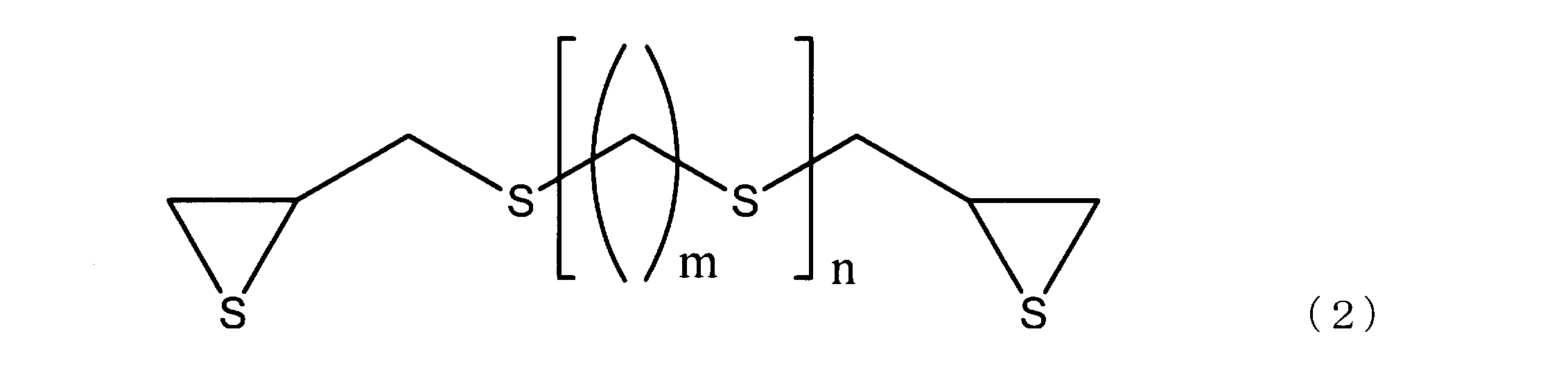
[3]一般式(2)で表わされる化合物がビス(β-エピチオプロピル)スルフィドである[2]に記載の硬化性組成物。
[4]さらに、(C)増感剤を含むことを特徴とする[1]から[3]のいずれかに記載の硬化性組成物。
[5] さらに、(D)チオール化合物を含むことを特徴とする[1]から[4]のいずれかに記載の硬化性組成物。
[6][1]から[5]のいずれかに記載の硬化性組成物を、紫外線もしくは可視光の照射により硬化させることを特徴とする硬化物の製造方法。
[7][6]記載の製造方法により得られた硬化物。
[8][7]に記載の硬化物を含む光学材料。
[9][1]から[5]のいずれかに記載の硬化性組成物を含む光学接着剤。
[10]基板表面に微細構造が形成された光学材料であって、[1]から[5]のいずれかに記載の硬化性組成物を微細構造形成に用いることを特徴とする光学材料。
本発明で使用する(A)エピスルフィド化合物は、開環重合することにより硬化物を生成するエピスルフィド基を1分子中に1個以上有する化合物であれば良い。硬化性組成物の架橋性および得られる硬化物の高屈折率を追求する場合、1分子内に2個以上のエピスルフィド基を有する化合物が好ましい。ハンドリング性、入手容易性、硬化物の物性バランスから前記一般式(2)で表される化合物がより好ましい。


好ましい(B)前記一般式(1)で表される有機ホウ素化合物は、テトラブチルアンモニウム=ブチルトリフェニルボラート、テトラブチルアンモニウム=ブチルトリ(4-tert-ブチルフェニル)ボラート、テトラブチルアンモニウム=ブチルトリ(1-ナフチル)ボラート、テトラブチルアンモニウム=ブチルトリ(4-メチル-1-ナフチル)ボラートである。なお、化合物名における「=」は、イオン結合を意味する。エピスルフィド化合物への溶解性、エピスルフィド化合物の重合性、及び組成物のポットライフのバランスの点で、テトラブチルアンモニウム=ブチルトリ(1-ナフチル)ボラートが最も好ましい。
好ましい(C)増感剤は、置換または非置換のベンゾフェノン、チオキサントン、アントラキノンなどの芳香族ケトンまたはオキサジン、アクリジン、フェナジンおよびローダミンなどの染料、およびフルオレン、フルオレノン、ナフタレンなどの共役複素環をもつ化合物である。特に好ましくは、置換または非置換のベンゾフェノン、チオキサントン、およびフルオレンである。具体的には、ベンゾフェノン、4,4’-ビス(ジメチルアミノ)ベンゾフェノン、4,4’-ビス-(ジエチルアミノ)ベンゾフェノン、4,4’-ビス(エチルメチルアミノ)ベンゾフェノン、4,4’-ジフェニルベンゾフェノン、4,4’-ジフェノキシベンゾフェノン、4,4’-ビス(p-イソプロピルフェノキシ)ベンゾフェノン、4-メチルベンゾフェノン、2,4,6-トリメチルベンゾフェノン、4-フェニルベンゾフェノン、2-メトキシカルボニルベンゾフェノン、4-ベンゾイル-4’-メチルジフェニルスルフィド、4-メトキシ-3,3’-メチルベンゾフェノン、イソプロピルチオキサントン、クロロチオキサントン、1-クロロ-4-プロポキシチオキサントン、2-(トリフルオロメチル) チオキサントン、2,4-ジメチルチオキサントン、2,4-ジエチルチオキサントン、1,3-ジメチル-2-(2-エチルヘキシルオキシ)チオキサントン、フルオレン、9,9-ジメチルフルオレン、9,9-ビス[4-(2-ヒドロキシエトキシ)フェニル]フルオレン等が挙げられる。
以上、好ましい(C)増感剤を例示したが、これらは単独でも2種類以上を混合して使用してもかまわない。(C)増感剤の使用量は、(A)エピスルフィド化合物100質量部に対して、0.01質量部以上であり、好ましくは0.05~10質量部であり、より好ましくは0.05~3質量部であり、最も好ましくは0.1~1質量部である。
以上、好ましい(D)チオール化合物を例示したが、これらは単独でも2種類以上を混合して使用してもかまわない。(D)チオール化合物の添加量は、(A)エピスルフィド化合物および(D)チオール化合物の合計100質量部に対して、好ましくは1~50質量部であり、より好ましくは3~40質量部であり、更に好ましくは5~30質量部である。
なお、実施例中において、(A)エピスルフィド化合物は、特開平9-110979号公報および特開2001-163874号公報に記載の方法に基づいて合成した。また、(B)一般式(1)で表わされる化合物は、いずれも昭和電工株式会社より入手し、そのまま実験に用いた。
以下、テトラブチルアンモニウム=ブチルトリ(1-ナフチル)ボラートをPBG1、テトラブチルアンモニウム=ブチルトリフェニルボラートをPBG2、テトラブチルアンモニウム=ブチルトリ(4-メチル-1-ナフチル)ボラートをPBG6、テトラブチルアンモニウム=ブチルトリ(4-tert-ブチルフェニル)ボラートをPBG7と呼称する。また、メチル4-((ヘキサヒドロピロロ[1,2-α]ピリミジン-1(2H)-イル)メチル)ベンゾエート(以下PBG3と呼称する)は、特表2005-511536号公報に記載の方法に基づいて、1-(4’-フェニルチオ)フェナシル-(5-アゾニア-1-アザビシクロ[4,3,0]-5-ノネン)テトラフェニルボレート(以下PBG4と呼称する)は、特開2005-264156号公報に記載の方法に基づいて、トリブチルナフトイルメチルアンモニウムブチルトリフェニルボーレート(以下PBG5と呼称する)は、J.Phys.Chem.1996,100,12386-12393およびJ.Phys.Chem.A 1998,102,5375-5382の記載の方法に基づいてそれぞれ合成した。また、(C)増感剤である4-ベンゾイル-4’-メチルジフェニルスルフィドは、DKSHジャパン社より製品名Lunacure BMS(以下BMSと呼称する)を入手し、そのまま用いた。その他の増感剤は、いずれも東京化成工業株式会社より入手し、そのまま用いた。また、(D)チオール化合物であるビス(2-メルカプトエチル)スルフィド(以下DMDSと呼称する)は東京化成工業株式会社より、ペンタエリスリトールテトラキスチオプロピオネート(以下PETPと呼称する)は淀化学株式会社より、ペンタエリスリトール テトラキス(3-メルカプトブチレート)(以下PE1と呼称する)は昭和電工株式会社より入手し、そのまま用いた。1,2-ビス[(2-メルカプトエチル)チオ]-3-メルカプトプロパン(以下GSTと呼称する)はWO2007/129450号公報に記載の方法に基づいて合成した。
また、硬化性組成物に露光を行う際の光源にはメタルハライドランプ(30mW/cm2、熱線カットフィルター付き、アイグラフィックス社製)を使用した。
硬化性組成物の光硬化性は、表面にタック(べた付き)が残らない状態で硬化するまでに要する露光時間により評価し、20秒未満で硬化する場合に「A」、20秒以上40秒未満で硬化する場合に「B」、40秒以上60秒未満で硬化する場合に「C」、硬化に1分以上を要する場合あるいは未硬化の場合を「D」と評価した。
また、得られた硬化物の屈折率(nD)は、アッベ屈折計(アタゴ社製「NAR-4T」)を用いて、D線での値を測定した。測定温度は20℃とした。
また、硬化性組成物のポットライフは、30℃で7日間保存した際の硬化性組成物の粘度が初期粘度から2割以下の粘度上昇の場合に「良好」、初期粘度から2割以上の顕著な増粘あるいは固化した場合に「不良」と評価した。光硬化性組成物を使用する光学材料の製造プロセスでは通常数日から1週間程度の連続した製造が行われるため、生産性の面から室温付近遮光下での硬化性組成物の粘度安定性(重合抑制)は非常に重要である。
(A)ビス(β-エピチオプロピル)スルフィド(100質量部)に対して、(B)PBG1(0.5質量部)を混合し、均一になるまで撹拌して硬化性組成液を調製した。硬化性組成液の20℃での粘度(初期粘度)は、12mPa・sであった。この硬化性組成液をスライドグラス上に適量垂らし、その上にPETフィルム(東レ社製「ルミラーT60」、厚み250μm)を被せ、硬化性組成液の厚みが約10μmになるようにした。続いてPETフィルム側からメタルハライドランプの光を照射し、硬化性組成物が表面にタック(べた付き)が残らない状態で硬化するまでに要する時間を確認したところ、40秒以上60秒未満であった。
1分間露光した後にPETフィルムを剥がし、硬化膜の屈折率を測定したところ、nD=1.71であった。硬化膜は無色であった。
さらに、未露光の硬化性組成液を遮光瓶に入れ、30℃の恒温試験機中で7日間静置してポットライフを確認したところ、硬化性組成液は静置後も液状であり、20℃での粘度は、13mPa・sであり顕著な粘度変化は見られず「良好」であった。
成分(B)、成分(C)、成分(D)を表1に示す化合物および添加量に変えた以外は、実施例1と同様の方法で硬化試験を行った。なお、成分(A)および(D)の合計100質量部に対し、成分(B)および(C)を所定量添加した。
硬化に要する露光時間、硬化膜の屈折率、硬化膜の色は表1に示すとおりであった。また、実施例1と同様の方法でポットライフを確認したところ、硬化性組成液は30℃7日間静置後も顕著な粘度変化は見られず「良好」であった。
成分(B)、成分(C)、成分(D)を表1に示す化合物および添加量に変えた以外は、実施例1と同様の方法で硬化試験を行った。なお、成分(A)および(D)の合計100質量部に対し、成分(B)および(C)を所定量添加した。
硬化に要する露光時間、硬化膜の屈折率および硬化膜の色は表1に示す通りであった。実施例1と同様の方法でポットライフを確認したところ、硬化性組成液は30℃7日間静置後にはいずれも固化しており「不良」であった。

(A)エピスルフィド化合物をビス(β-エピチオプロピル)ジスルフィドに変え、BMS(成分(C))およびDMDS(成分(D))の添加量を表2に示すように変更した以外は、実施例10と同様の方法で硬化実験を行った。
硬化に要する露光時間、硬化膜の屈折率、硬化膜の色、ポットライフは表2に示すとおりであった。

(C)増感剤を表3に示す化合物および添加量に変えた以外は、実施例8と同様の方法で硬化試験を行った。
硬化に要する露光時間、硬化膜の色、ポットライフは表3に示すとおりであった。
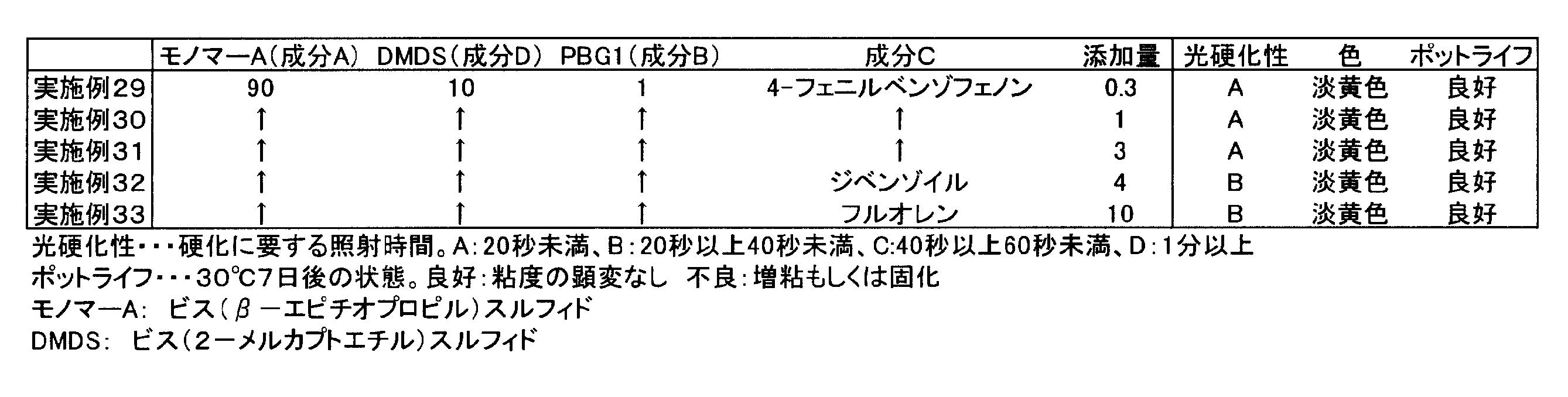
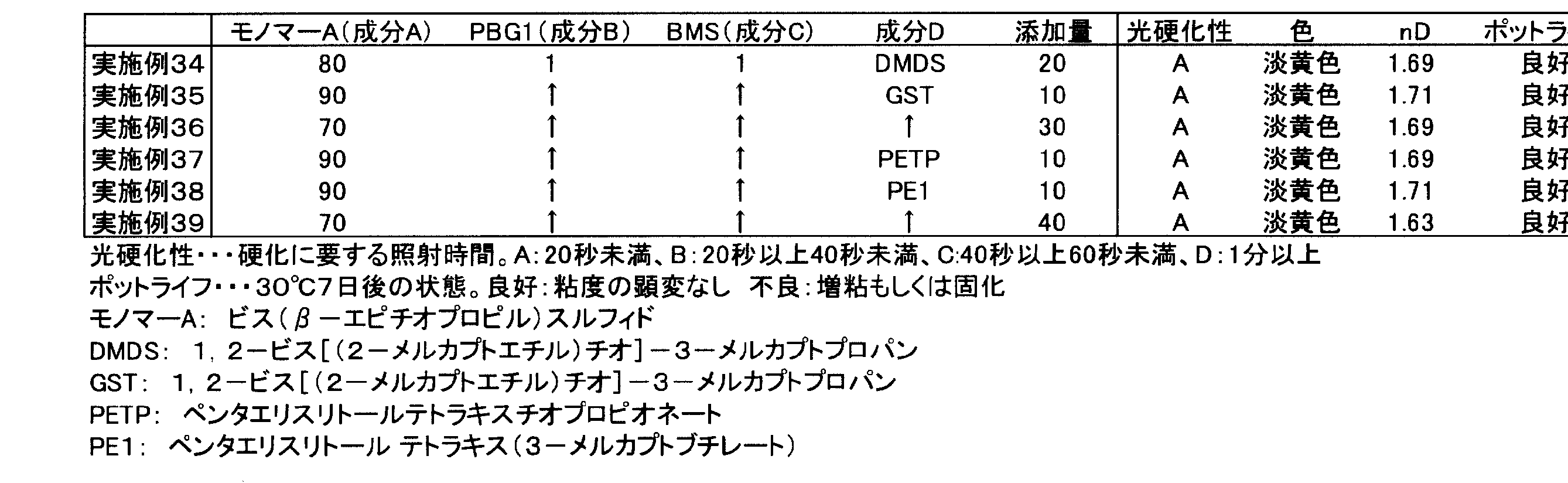
(D)チオール化合物を表4に示す化合物および添加量に変えた以外は、実施例10と同様の方法で硬化試験を行った。
硬化に要する露光時間、硬化膜の屈折率、硬化膜の色およびポットライフは表4に示すとおりであった。
(A)ビス(β-エピチオプロピル)スルフィド(100質量部)に対して、(B)PBG1(0.5質量部)を混合し、均一になるまで撹拌して硬化性組成液を調製した。この硬化性組成液を1mm厚の石英ガラスに塗布し、同じく1mm厚の石英ガラスではさんだサンプル(硬化後の厚さが40μm±2μmとなるようにスペーサーを入れたもの)を作製した。続いてメタルハライドランプの光を1分間照射した。1mm厚の石英ガラスではさんだサンプルは、強固に接着しており、接着硬化層は、白濁がなく、無色で良好な透明性を示した。
(A)ビス(β-エピチオプロピル)スルフィド(90質量部)および(D)DMDS(10質量部)に対して、(B)PBG1(1質量部)および(C)BMS(1質量部)を混合し、均一になるまで撹拌して硬化性組成液を調製した。この硬化性組成液を0.45μm径のPTFEフィルターでろ過し、易接着PETフィルム(コスモシャインA4100、厚み100μm、東洋紡績社製)の上に適量垂らした。その上にプリズム列(頂角90°、ピッチ50μm)が形成されたニッケルの型を被せ、PETフィルム側からメタルハライドランプの光を1分間照射した。光照射後、構造が転写されたPETフィルムを型から剥離したところ、硬化物が型に残ることはなく離型性は良好であった。以上の手順により、プリズム列が転写された光学フィルムを作製した。その表面構造をSEM(走査型電子顕微鏡)で観察したところ、型のプリズム構造が正確に転写されており、転写性は良好であった。
Claims (10)
- (A)エピスルフィド化合物と、(B)下記一般式(1)で表される有機ホウ素化合物を含有する光塩基発生剤とを含むことを特徴とする硬化性組成物。

- (A)エピスルフィド化合物が下記一般式(2)で表わされる化合物である請求項1に記載の硬化性組成物。

- 一般式(2)で表わされる化合物がビス(β-エピチオプロピル)スルフィドである請求項2に記載の硬化性組成物。
- さらに、(C)増感剤を含むことを特徴とする請求項1から3のいずれかに記載の硬化性組成物。
- さらに、(D)チオール化合物を含むことを特徴とする請求項1から4のいずれかに記載の硬化性組成物。
- 請求項1から5のいずれか1項に記載の硬化性組成物を、紫外線もしくは可視光の照射により硬化させることを特徴とする硬化物の製造方法。
- 請求項6に記載の製造方法により得られた硬化物。
- 請求項7に記載の硬化物を含む光学材料。
- 請求項1から5のいずれか1項に記載の硬化性組成物を含む光学接着剤。
- 基板表面に微細構造が形成された光学材料であって、請求項1から5のいずれか1項に記載の硬化性組成物を微細構造形成に用いることを特徴とする光学材料。
Priority Applications (3)
| Application Number | Priority Date | Filing Date | Title |
|---|---|---|---|
| JP2014561641A JP5761474B2 (ja) | 2013-06-27 | 2014-06-26 | 硬化性組成物 |
| US14/899,509 US9920169B2 (en) | 2013-06-27 | 2014-06-26 | Curable composition |
| PH12015502851A PH12015502851B1 (en) | 2013-06-27 | 2015-12-22 | Curable composition |
Applications Claiming Priority (2)
| Application Number | Priority Date | Filing Date | Title |
|---|---|---|---|
| JP2013134629 | 2013-06-27 | ||
| JP2013-134629 | 2013-06-27 |
Publications (1)
| Publication Number | Publication Date |
|---|---|
| WO2014208656A1 true WO2014208656A1 (ja) | 2014-12-31 |
Family
ID=52141983
Family Applications (1)
| Application Number | Title | Priority Date | Filing Date |
|---|---|---|---|
| PCT/JP2014/066956 Ceased WO2014208656A1 (ja) | 2013-06-27 | 2014-06-26 | 硬化性組成物 |
Country Status (4)
| Country | Link |
|---|---|
| US (1) | US9920169B2 (ja) |
| JP (1) | JP5761474B2 (ja) |
| PH (1) | PH12015502851B1 (ja) |
| WO (1) | WO2014208656A1 (ja) |
Cited By (5)
| Publication number | Priority date | Publication date | Assignee | Title |
|---|---|---|---|---|
| JP2017066188A (ja) * | 2015-09-28 | 2017-04-06 | 積水化学工業株式会社 | 半導体用接着剤及び半導体装置 |
| WO2017098798A1 (ja) * | 2015-12-10 | 2017-06-15 | 三菱瓦斯化学株式会社 | 光硬化性組成物及び光学材料 |
| KR20180018482A (ko) * | 2015-06-17 | 2018-02-21 | 미츠비시 가스 가가쿠 가부시키가이샤 | 광학 재료용 조성물 및 그것을 사용한 광학 재료 |
| JP2021109898A (ja) * | 2020-01-08 | 2021-08-02 | 公立大学法人大阪 | 硬化性組成物ならびに硬化物およびその製造方法 |
| WO2023063398A1 (ja) | 2021-10-15 | 2023-04-20 | 三井化学株式会社 | 光硬化性組成物、硬化物、積層体、硬化物の製造方法、及び、レンズの製造方法 |
Families Citing this family (1)
| Publication number | Priority date | Publication date | Assignee | Title |
|---|---|---|---|---|
| WO2021029693A1 (ko) | 2019-08-14 | 2021-02-18 | 주식회사 엘지화학 | 회절 도광판 및 회절 도광판의 제조 방법 |
Citations (3)
| Publication number | Priority date | Publication date | Assignee | Title |
|---|---|---|---|---|
| JPH06329711A (ja) * | 1993-05-25 | 1994-11-29 | Showa Denko Kk | 光重合開始剤及び光重合性組成物 |
| WO2005014696A1 (ja) * | 2003-08-06 | 2005-02-17 | Mitsubishi Gas Chemical Company, Inc. | 光硬化性組成物及びコーティング剤組成物 |
| JP2014133875A (ja) * | 2012-12-13 | 2014-07-24 | Three Bond Co Ltd | 硬化性組成物 |
Family Cites Families (10)
| Publication number | Priority date | Publication date | Assignee | Title |
|---|---|---|---|---|
| JP3491660B2 (ja) | 1995-08-16 | 2004-01-26 | 三菱瓦斯化学株式会社 | 新規な直鎖アルキルスルフィド型エピスルフィド化合物 |
| JP3864998B2 (ja) | 1995-09-08 | 2007-01-10 | 三菱瓦斯化学株式会社 | 新規な分岐アルキルスルフィド型エピスルフィド化合物 |
| JPH09255781A (ja) | 1996-01-17 | 1997-09-30 | Mitsubishi Gas Chem Co Inc | 新規なエピスルフィド化合物 |
| US6635195B1 (en) | 2000-02-04 | 2003-10-21 | Essilor International Compagnie Generale D'optique | Cationic photopolymerization of diepisulfides and application to the manufacture of optical lenses |
| JP3918411B2 (ja) | 2000-08-01 | 2007-05-23 | 三菱化学株式会社 | 硬化性組成物及びその硬化物 |
| JP2002105110A (ja) | 2000-10-04 | 2002-04-10 | Mitsubishi Chemicals Corp | 硬化性組成物、その硬化物および用途 |
| US6592801B2 (en) | 2001-04-30 | 2003-07-15 | Essilor International Compagnie Generale D'optique | Photopolymerization of episulfides using metal complexes and its use for making ophthalmic lenses |
| JP4952966B2 (ja) | 2001-07-19 | 2012-06-13 | 三菱瓦斯化学株式会社 | 樹脂の製造方法 |
| CN102803205B (zh) * | 2009-06-17 | 2015-12-16 | 三键精密化学有限公司 | 碱和自由基产生剂、使用其的组合物及固化所述组合物的方法 |
| JP2011038050A (ja) | 2009-08-18 | 2011-02-24 | Mitsubishi Gas Chemical Co Inc | 光硬化性組成物、硬化方法及び硬化物 |
-
2014
- 2014-06-26 JP JP2014561641A patent/JP5761474B2/ja active Active
- 2014-06-26 WO PCT/JP2014/066956 patent/WO2014208656A1/ja not_active Ceased
- 2014-06-26 US US14/899,509 patent/US9920169B2/en active Active
-
2015
- 2015-12-22 PH PH12015502851A patent/PH12015502851B1/en unknown
Patent Citations (3)
| Publication number | Priority date | Publication date | Assignee | Title |
|---|---|---|---|---|
| JPH06329711A (ja) * | 1993-05-25 | 1994-11-29 | Showa Denko Kk | 光重合開始剤及び光重合性組成物 |
| WO2005014696A1 (ja) * | 2003-08-06 | 2005-02-17 | Mitsubishi Gas Chemical Company, Inc. | 光硬化性組成物及びコーティング剤組成物 |
| JP2014133875A (ja) * | 2012-12-13 | 2014-07-24 | Three Bond Co Ltd | 硬化性組成物 |
Cited By (13)
| Publication number | Priority date | Publication date | Assignee | Title |
|---|---|---|---|---|
| EP3312216A4 (en) * | 2015-06-17 | 2019-02-20 | Mitsubishi Gas Chemical Company, Inc. | COMPOSITION FOR OPTICAL MATERIAL AND OPTICAL MATERIAL THEREWITH |
| KR20180018482A (ko) * | 2015-06-17 | 2018-02-21 | 미츠비시 가스 가가쿠 가부시키가이샤 | 광학 재료용 조성물 및 그것을 사용한 광학 재료 |
| CN107735428A (zh) * | 2015-06-17 | 2018-02-23 | 三菱瓦斯化学株式会社 | 光学材料用组合物及使用其的光学材料 |
| US10508173B2 (en) | 2015-06-17 | 2019-12-17 | Mitsubishi Gas Chemical Company, Inc. | Composition for optical material and optical material using the same |
| KR102522740B1 (ko) | 2015-06-17 | 2023-04-17 | 미츠비시 가스 가가쿠 가부시키가이샤 | 광학 재료용 조성물 및 그것을 사용한 광학 재료 |
| JP2017066188A (ja) * | 2015-09-28 | 2017-04-06 | 積水化学工業株式会社 | 半導体用接着剤及び半導体装置 |
| WO2017098798A1 (ja) * | 2015-12-10 | 2017-06-15 | 三菱瓦斯化学株式会社 | 光硬化性組成物及び光学材料 |
| JP6179690B1 (ja) * | 2015-12-10 | 2017-08-16 | 三菱瓦斯化学株式会社 | 光硬化性組成物及び光学材料 |
| CN107735429A (zh) * | 2015-12-10 | 2018-02-23 | 三菱瓦斯化学株式会社 | 光固化性组合物和光学材料 |
| JP2021109898A (ja) * | 2020-01-08 | 2021-08-02 | 公立大学法人大阪 | 硬化性組成物ならびに硬化物およびその製造方法 |
| JP7368806B2 (ja) | 2020-01-08 | 2023-10-25 | 公立大学法人大阪 | 硬化性組成物ならびに硬化物およびその製造方法 |
| WO2023063398A1 (ja) | 2021-10-15 | 2023-04-20 | 三井化学株式会社 | 光硬化性組成物、硬化物、積層体、硬化物の製造方法、及び、レンズの製造方法 |
| KR20240053641A (ko) | 2021-10-15 | 2024-04-24 | 미쓰이 가가쿠 가부시키가이샤 | 광경화성 조성물, 경화물, 적층체, 경화물의 제조 방법, 및 렌즈의 제조 방법 |
Also Published As
| Publication number | Publication date |
|---|---|
| PH12015502851B1 (en) | 2018-11-28 |
| JP5761474B2 (ja) | 2015-08-12 |
| US9920169B2 (en) | 2018-03-20 |
| JPWO2014208656A1 (ja) | 2017-02-23 |
| PH12015502851A1 (en) | 2016-03-21 |
| US20160152774A1 (en) | 2016-06-02 |
Similar Documents
| Publication | Publication Date | Title |
|---|---|---|
| CN107735429B (zh) | 光固化性组合物和光学材料 | |
| JP5761474B2 (ja) | 硬化性組成物 | |
| JP4765626B2 (ja) | 光硬化性組成物及びコーティング剤組成物 | |
| JP2011038050A (ja) | 光硬化性組成物、硬化方法及び硬化物 | |
| JP2019210358A (ja) | 硬化性組成物及び光学材料 | |
| BR112016022846B1 (pt) | Composição para materiais ópticos, métodos para produzir um material óptico e uma matéria-prima para materiais ópticos, material óptico, e, lentes ópticas | |
| JP6565160B2 (ja) | 硬化性組成物および光学接着剤 | |
| TWI521035B (zh) | A hardening composition and an optical follower | |
| WO2025252160A1 (zh) | 一种基于生物质厚朴酚与和厚朴酚的高折光材料 | |
| JP5621458B2 (ja) | 光学デバイス | |
| JP4702508B2 (ja) | 樹脂の製造方法 | |
| JP4886962B2 (ja) | (アルコキシフェニル)ホスフィンで触媒されるエピスルフィド系重合性組成物、それから得られる物品およびその製造方法 | |
| JP7845198B2 (ja) | 光硬化性組成物及びその硬化物並びに該硬化物を含む光学材料 | |
| JP2004182686A (ja) | 含硫ポリチオール化合物および高屈折率硬化物 | |
| JP4952966B2 (ja) | 樹脂の製造方法 | |
| KR100339636B1 (ko) | 중합성 조성물 및 이를 함유하는 광학수지의 제조방법 | |
| CN1351009A (zh) | 光学产品、用于其制备的非对称二硫化物化合物、制备该非对称二硫化物化合物的方法 | |
| JP2007091613A (ja) | スルフィド化合物及びその製造方法 | |
| JP4015338B2 (ja) | エピスルフィド系重合性組成物及び樹脂の製造方法 | |
| JP2006316283A (ja) | レンズ用樹脂の離型性を改良する方法 |
Legal Events
| Date | Code | Title | Description |
|---|---|---|---|
| ENP | Entry into the national phase |
Ref document number: 2014561641 Country of ref document: JP Kind code of ref document: A |
|
| 121 | Ep: the epo has been informed by wipo that ep was designated in this application |
Ref document number: 14817069 Country of ref document: EP Kind code of ref document: A1 |
|
| WWE | Wipo information: entry into national phase |
Ref document number: 14899509 Country of ref document: US |
|
| WWE | Wipo information: entry into national phase |
Ref document number: 12015502851 Country of ref document: PH |
|
| NENP | Non-entry into the national phase |
Ref country code: DE |
|
| 122 | Ep: pct application non-entry in european phase |
Ref document number: 14817069 Country of ref document: EP Kind code of ref document: A1 |