WO2014203995A1 - セパレータ付粘着剤層およびその製造方法、セパレータ付粘着剤層付偏光フィルムおよびその製造方法、ならびに画像表示装置 - Google Patents
セパレータ付粘着剤層およびその製造方法、セパレータ付粘着剤層付偏光フィルムおよびその製造方法、ならびに画像表示装置 Download PDFInfo
- Publication number
- WO2014203995A1 WO2014203995A1 PCT/JP2014/066443 JP2014066443W WO2014203995A1 WO 2014203995 A1 WO2014203995 A1 WO 2014203995A1 JP 2014066443 W JP2014066443 W JP 2014066443W WO 2014203995 A1 WO2014203995 A1 WO 2014203995A1
- Authority
- WO
- WIPO (PCT)
- Prior art keywords
- adhesive layer
- sensitive adhesive
- pressure
- separator
- polarizing film
- Prior art date
- Legal status (The legal status is an assumption and is not a legal conclusion. Google has not performed a legal analysis and makes no representation as to the accuracy of the status listed.)
- Ceased
Links
Images

Classifications
-
- G—PHYSICS
- G02—OPTICS
- G02B—OPTICAL ELEMENTS, SYSTEMS OR APPARATUS
- G02B5/00—Optical elements other than lenses
- G02B5/30—Polarising elements
- G02B5/3025—Polarisers, i.e. arrangements capable of producing a definite output polarisation state from an unpolarised input state
- G02B5/3033—Polarisers, i.e. arrangements capable of producing a definite output polarisation state from an unpolarised input state in the form of a thin sheet or foil, e.g. Polaroid
-
- B—PERFORMING OPERATIONS; TRANSPORTING
- B32—LAYERED PRODUCTS
- B32B—LAYERED PRODUCTS, i.e. PRODUCTS BUILT-UP OF STRATA OF FLAT OR NON-FLAT, e.g. CELLULAR OR HONEYCOMB, FORM
- B32B27/00—Layered products comprising a layer of synthetic resin
- B32B27/30—Layered products comprising a layer of synthetic resin comprising vinyl (co)polymers; comprising acrylic (co)polymers
-
- B—PERFORMING OPERATIONS; TRANSPORTING
- B32—LAYERED PRODUCTS
- B32B—LAYERED PRODUCTS, i.e. PRODUCTS BUILT-UP OF STRATA OF FLAT OR NON-FLAT, e.g. CELLULAR OR HONEYCOMB, FORM
- B32B7/00—Layered products characterised by the relation between layers; Layered products characterised by the relative orientation of features between layers, or by the relative values of a measurable parameter between layers, i.e. products comprising layers having different physical, chemical or physicochemical properties; Layered products characterised by the interconnection of layers
- B32B7/04—Interconnection of layers
- B32B7/12—Interconnection of layers using interposed adhesives or interposed materials with bonding properties
-
- C—CHEMISTRY; METALLURGY
- C08—ORGANIC MACROMOLECULAR COMPOUNDS; THEIR PREPARATION OR CHEMICAL WORKING-UP; COMPOSITIONS BASED THEREON
- C08L—COMPOSITIONS OF MACROMOLECULAR COMPOUNDS
- C08L33/00—Compositions of homopolymers or copolymers of compounds having one or more unsaturated aliphatic radicals, each having only one carbon-to-carbon double bond, and only one being terminated by only one carboxyl radical, or of salts, anhydrides, esters, amides, imides or nitriles thereof; Compositions of derivatives of such polymers
- C08L33/04—Homopolymers or copolymers of esters
- C08L33/06—Homopolymers or copolymers of esters of esters containing only carbon, hydrogen and oxygen, which oxygen atoms are present only as part of the carboxyl radical
-
- C—CHEMISTRY; METALLURGY
- C09—DYES; PAINTS; POLISHES; NATURAL RESINS; ADHESIVES; COMPOSITIONS NOT OTHERWISE PROVIDED FOR; APPLICATIONS OF MATERIALS NOT OTHERWISE PROVIDED FOR
- C09J—ADHESIVES; NON-MECHANICAL ASPECTS OF ADHESIVE PROCESSES IN GENERAL; ADHESIVE PROCESSES NOT PROVIDED FOR ELSEWHERE; USE OF MATERIALS AS ADHESIVES
- C09J133/00—Adhesives based on homopolymers or copolymers of compounds having one or more unsaturated aliphatic radicals, each having only one carbon-to-carbon double bond, and at least one being terminated by only one carboxyl radical, or of salts, anhydrides, esters, amides, imides, or nitriles thereof; Adhesives based on derivatives of such polymers
- C09J133/04—Homopolymers or copolymers of esters
- C09J133/06—Homopolymers or copolymers of esters of esters containing only carbon, hydrogen and oxygen, the oxygen atom being present only as part of the carboxyl radical
-
- C—CHEMISTRY; METALLURGY
- C09—DYES; PAINTS; POLISHES; NATURAL RESINS; ADHESIVES; COMPOSITIONS NOT OTHERWISE PROVIDED FOR; APPLICATIONS OF MATERIALS NOT OTHERWISE PROVIDED FOR
- C09J—ADHESIVES; NON-MECHANICAL ASPECTS OF ADHESIVE PROCESSES IN GENERAL; ADHESIVE PROCESSES NOT PROVIDED FOR ELSEWHERE; USE OF MATERIALS AS ADHESIVES
- C09J5/00—Adhesive processes in general; Adhesive processes not provided for elsewhere, e.g. relating to primers
- C09J5/06—Adhesive processes in general; Adhesive processes not provided for elsewhere, e.g. relating to primers involving heating of the applied adhesive
-
- C—CHEMISTRY; METALLURGY
- C09—DYES; PAINTS; POLISHES; NATURAL RESINS; ADHESIVES; COMPOSITIONS NOT OTHERWISE PROVIDED FOR; APPLICATIONS OF MATERIALS NOT OTHERWISE PROVIDED FOR
- C09J—ADHESIVES; NON-MECHANICAL ASPECTS OF ADHESIVE PROCESSES IN GENERAL; ADHESIVE PROCESSES NOT PROVIDED FOR ELSEWHERE; USE OF MATERIALS AS ADHESIVES
- C09J7/00—Adhesives in the form of films or foils
- C09J7/10—Adhesives in the form of films or foils without carriers
-
- C—CHEMISTRY; METALLURGY
- C09—DYES; PAINTS; POLISHES; NATURAL RESINS; ADHESIVES; COMPOSITIONS NOT OTHERWISE PROVIDED FOR; APPLICATIONS OF MATERIALS NOT OTHERWISE PROVIDED FOR
- C09J—ADHESIVES; NON-MECHANICAL ASPECTS OF ADHESIVE PROCESSES IN GENERAL; ADHESIVE PROCESSES NOT PROVIDED FOR ELSEWHERE; USE OF MATERIALS AS ADHESIVES
- C09J7/00—Adhesives in the form of films or foils
- C09J7/20—Adhesives in the form of films or foils characterised by their carriers
- C09J7/22—Plastics; Metallised plastics
-
- C—CHEMISTRY; METALLURGY
- C09—DYES; PAINTS; POLISHES; NATURAL RESINS; ADHESIVES; COMPOSITIONS NOT OTHERWISE PROVIDED FOR; APPLICATIONS OF MATERIALS NOT OTHERWISE PROVIDED FOR
- C09J—ADHESIVES; NON-MECHANICAL ASPECTS OF ADHESIVE PROCESSES IN GENERAL; ADHESIVE PROCESSES NOT PROVIDED FOR ELSEWHERE; USE OF MATERIALS AS ADHESIVES
- C09J7/00—Adhesives in the form of films or foils
- C09J7/30—Adhesives in the form of films or foils characterised by the adhesive composition
- C09J7/38—Pressure-sensitive adhesives [PSA]
-
- G—PHYSICS
- G02—OPTICS
- G02B—OPTICAL ELEMENTS, SYSTEMS OR APPARATUS
- G02B1/00—Optical elements characterised by the material of which they are made; Optical coatings for optical elements
- G02B1/10—Optical coatings produced by application to, or surface treatment of, optical elements
- G02B1/14—Protective coatings, e.g. hard coatings
-
- G—PHYSICS
- G02—OPTICS
- G02B—OPTICAL ELEMENTS, SYSTEMS OR APPARATUS
- G02B5/00—Optical elements other than lenses
- G02B5/30—Polarising elements
- G02B5/3025—Polarisers, i.e. arrangements capable of producing a definite output polarisation state from an unpolarised input state
- G02B5/3033—Polarisers, i.e. arrangements capable of producing a definite output polarisation state from an unpolarised input state in the form of a thin sheet or foil, e.g. Polaroid
- G02B5/3041—Polarisers, i.e. arrangements capable of producing a definite output polarisation state from an unpolarised input state in the form of a thin sheet or foil, e.g. Polaroid comprising multiple thin layers, e.g. multilayer stacks
- G02B5/305—Polarisers, i.e. arrangements capable of producing a definite output polarisation state from an unpolarised input state in the form of a thin sheet or foil, e.g. Polaroid comprising multiple thin layers, e.g. multilayer stacks including organic materials, e.g. polymeric layers
-
- G—PHYSICS
- G02—OPTICS
- G02F—OPTICAL DEVICES OR ARRANGEMENTS FOR THE CONTROL OF LIGHT BY MODIFICATION OF THE OPTICAL PROPERTIES OF THE MEDIA OF THE ELEMENTS INVOLVED THEREIN; NON-LINEAR OPTICS; FREQUENCY-CHANGING OF LIGHT; OPTICAL LOGIC ELEMENTS; OPTICAL ANALOGUE/DIGITAL CONVERTERS
- G02F1/00—Devices or arrangements for the control of the intensity, colour, phase, polarisation or direction of light arriving from an independent light source, e.g. switching, gating or modulating; Non-linear optics
- G02F1/01—Devices or arrangements for the control of the intensity, colour, phase, polarisation or direction of light arriving from an independent light source, e.g. switching, gating or modulating; Non-linear optics for the control of the intensity, phase, polarisation or colour
- G02F1/13—Devices or arrangements for the control of the intensity, colour, phase, polarisation or direction of light arriving from an independent light source, e.g. switching, gating or modulating; Non-linear optics for the control of the intensity, phase, polarisation or colour based on liquid crystals, e.g. single liquid crystal display cells
- G02F1/133—Constructional arrangements; Operation of liquid crystal cells; Circuit arrangements
- G02F1/1333—Constructional arrangements; Manufacturing methods
- G02F1/1335—Structural association of cells with optical devices, e.g. polarisers or reflectors
- G02F1/133528—Polarisers
-
- B—PERFORMING OPERATIONS; TRANSPORTING
- B32—LAYERED PRODUCTS
- B32B—LAYERED PRODUCTS, i.e. PRODUCTS BUILT-UP OF STRATA OF FLAT OR NON-FLAT, e.g. CELLULAR OR HONEYCOMB, FORM
- B32B2307/00—Properties of the layers or laminate
- B32B2307/40—Properties of the layers or laminate having particular optical properties
- B32B2307/42—Polarizing, birefringent, filtering
-
- B—PERFORMING OPERATIONS; TRANSPORTING
- B32—LAYERED PRODUCTS
- B32B—LAYERED PRODUCTS, i.e. PRODUCTS BUILT-UP OF STRATA OF FLAT OR NON-FLAT, e.g. CELLULAR OR HONEYCOMB, FORM
- B32B2307/00—Properties of the layers or laminate
- B32B2307/70—Other properties
- B32B2307/732—Dimensional properties
- B32B2307/734—Dimensional stability
-
- B—PERFORMING OPERATIONS; TRANSPORTING
- B32—LAYERED PRODUCTS
- B32B—LAYERED PRODUCTS, i.e. PRODUCTS BUILT-UP OF STRATA OF FLAT OR NON-FLAT, e.g. CELLULAR OR HONEYCOMB, FORM
- B32B2457/00—Electrical equipment
- B32B2457/20—Displays, e.g. liquid crystal displays, plasma displays
- B32B2457/202—LCD, i.e. liquid crystal displays
-
- C—CHEMISTRY; METALLURGY
- C08—ORGANIC MACROMOLECULAR COMPOUNDS; THEIR PREPARATION OR CHEMICAL WORKING-UP; COMPOSITIONS BASED THEREON
- C08K—Use of inorganic or non-macromolecular organic substances as compounding ingredients
- C08K5/00—Use of organic ingredients
- C08K5/0008—Organic ingredients according to more than one of the "one dot" groups of C08K5/01 - C08K5/59
- C08K5/005—Stabilisers against oxidation, heat, light, ozone
-
- C—CHEMISTRY; METALLURGY
- C08—ORGANIC MACROMOLECULAR COMPOUNDS; THEIR PREPARATION OR CHEMICAL WORKING-UP; COMPOSITIONS BASED THEREON
- C08K—Use of inorganic or non-macromolecular organic substances as compounding ingredients
- C08K5/00—Use of organic ingredients
- C08K5/04—Oxygen-containing compounds
- C08K5/13—Phenols; Phenolates
-
- C—CHEMISTRY; METALLURGY
- C08—ORGANIC MACROMOLECULAR COMPOUNDS; THEIR PREPARATION OR CHEMICAL WORKING-UP; COMPOSITIONS BASED THEREON
- C08K—Use of inorganic or non-macromolecular organic substances as compounding ingredients
- C08K5/00—Use of organic ingredients
- C08K5/04—Oxygen-containing compounds
- C08K5/14—Peroxides
-
- C—CHEMISTRY; METALLURGY
- C09—DYES; PAINTS; POLISHES; NATURAL RESINS; ADHESIVES; COMPOSITIONS NOT OTHERWISE PROVIDED FOR; APPLICATIONS OF MATERIALS NOT OTHERWISE PROVIDED FOR
- C09J—ADHESIVES; NON-MECHANICAL ASPECTS OF ADHESIVE PROCESSES IN GENERAL; ADHESIVE PROCESSES NOT PROVIDED FOR ELSEWHERE; USE OF MATERIALS AS ADHESIVES
- C09J2203/00—Applications of adhesives in processes or use of adhesives in the form of films or foils
- C09J2203/318—Applications of adhesives in processes or use of adhesives in the form of films or foils for the production of liquid crystal displays
-
- C—CHEMISTRY; METALLURGY
- C09—DYES; PAINTS; POLISHES; NATURAL RESINS; ADHESIVES; COMPOSITIONS NOT OTHERWISE PROVIDED FOR; APPLICATIONS OF MATERIALS NOT OTHERWISE PROVIDED FOR
- C09J—ADHESIVES; NON-MECHANICAL ASPECTS OF ADHESIVE PROCESSES IN GENERAL; ADHESIVE PROCESSES NOT PROVIDED FOR ELSEWHERE; USE OF MATERIALS AS ADHESIVES
- C09J2301/00—Additional features of adhesives in the form of films or foils
- C09J2301/30—Additional features of adhesives in the form of films or foils characterized by the chemical, physicochemical or physical properties of the adhesive or the carrier
- C09J2301/302—Additional features of adhesives in the form of films or foils characterized by the chemical, physicochemical or physical properties of the adhesive or the carrier the adhesive being pressure-sensitive, i.e. tacky at temperatures inferior to 30°C
-
- C—CHEMISTRY; METALLURGY
- C09—DYES; PAINTS; POLISHES; NATURAL RESINS; ADHESIVES; COMPOSITIONS NOT OTHERWISE PROVIDED FOR; APPLICATIONS OF MATERIALS NOT OTHERWISE PROVIDED FOR
- C09J—ADHESIVES; NON-MECHANICAL ASPECTS OF ADHESIVE PROCESSES IN GENERAL; ADHESIVE PROCESSES NOT PROVIDED FOR ELSEWHERE; USE OF MATERIALS AS ADHESIVES
- C09J2301/00—Additional features of adhesives in the form of films or foils
- C09J2301/40—Additional features of adhesives in the form of films or foils characterized by the presence of essential components
- C09J2301/408—Additional features of adhesives in the form of films or foils characterized by the presence of essential components additives as essential feature of the adhesive layer
-
- C—CHEMISTRY; METALLURGY
- C09—DYES; PAINTS; POLISHES; NATURAL RESINS; ADHESIVES; COMPOSITIONS NOT OTHERWISE PROVIDED FOR; APPLICATIONS OF MATERIALS NOT OTHERWISE PROVIDED FOR
- C09J—ADHESIVES; NON-MECHANICAL ASPECTS OF ADHESIVE PROCESSES IN GENERAL; ADHESIVE PROCESSES NOT PROVIDED FOR ELSEWHERE; USE OF MATERIALS AS ADHESIVES
- C09J2433/00—Presence of (meth)acrylic polymer
Definitions
- the present invention relates to a pressure-sensitive adhesive layer with a separator and a method for producing the same, a polarizing film with a pressure-sensitive adhesive layer with a separator, and a method for producing the same. Furthermore, the present invention relates to an image display device such as a liquid crystal display device, an organic EL display device, or a PDP using the polarizing film with an adhesive layer with a separator.
- the pressure-sensitive adhesive has a pressure-sensitive adhesive layer provided in advance as a pressure-sensitive adhesive layer on one side of the polarizing film because it has a merit that a drying step is not required to fix the polarizing film.
- a film is generally used.
- image display devices for mobile applications such as mobile phones have a tendency to make the entire module thinner and lighter, particularly from the viewpoint of design and portability.
- usage environments such as outdoor use in harsh environments are diversifying, and durability is required more than ever. Under such circumstances, there is a demand for a thin polarizing film having excellent optical characteristics, and it is also necessary to develop a pressure-sensitive adhesive layer applicable to such a thin polarizing film.
- the separator (release film) bonded to the surface of the polarizing film via the adhesive layer is peeled to expose the adhesive layer, and then the polarizing film and There is a method of pasting together with a liquid crystal display panel.
- the polarizing film is adsorbed and held on the stage surface, a release tape is attached to one end of the surface of the separator (release film), and the separator is peeled off from the polarizing film by pulling the other end side of the separator. Is common.
- a crosslinking agent is often blended together with, for example, a (meth) acrylic polymer for the purpose of improving durability.
- Patent Document 1 describes a pressure-sensitive adhesive containing a peroxide and an isocyanate compound in addition to a (meth) acrylic polymer.
- the adhesive containing a peroxide and an isocyanate type crosslinking agent is described with respect to the (meth) acrylic-type polymer containing a (meth) acrylic-type monomer and a nitrogen-containing monomer.
- a pressure-sensitive adhesive layer comprising a first step of providing a layer of a pressure-sensitive adhesive composition containing a (meth) acrylic polymer and a peroxide as a base polymer on the release-treated surface of a silicone release liner.
- a method for producing a pressure-sensitive adhesive layer with a silicone release liner comprising a second step of adjusting the release force of a silicone release liner by thermally decomposing part or all of the peroxide performed after the first step Is described.
- Such a problem is more likely to occur particularly when a thin polarizing film is used. Specifically, when a thin polarizing film is used, in addition to the possibility that the pressure-sensitive adhesive layer is peeled off from the polarizing film, the possibility that the polarizing film is lifted or peeled off is increased. On the other hand, if the peeling force of the separator with respect to the pressure-sensitive adhesive layer is too low, the separator may float from the pressure-sensitive adhesive layer.
- An object of the present invention is to provide a pressure-sensitive adhesive layer with a separator having excellent moderate workability and durability, and a method for producing the same, while the separator has moderate light releasability with respect to the pressure-sensitive adhesive layer.
- an object of this invention is to provide the polarizing film with an adhesive layer provided with the said adhesive layer with a separator, the image display apparatus using the said polarizing film with an adhesive layer, and its manufacturing method.
- the present inventors formulated a phenolic antioxidant as a peeling force adjusting agent for the separator together with a peroxide in the pressure-sensitive adhesive composition forming the pressure-sensitive adhesive layer. By doing, it discovered that the peeling force of the separator with respect to an adhesive layer can be adjusted moderately.
- the present invention includes a first step of forming a layer of a pressure-sensitive adhesive composition containing a (meth) acrylic polymer, a peroxide, and a phenolic antioxidant on the release-treated surface of a release-treated separator, It is related with the manufacturing method of the adhesive layer with a separator characterized by including the 2nd process of heating and crosslinking the said adhesive composition after a 1st process and forming an adhesive layer.
- 0.05 to 3 parts by weight of the phenolic antioxidant is contained with respect to 100 parts by weight of the (meth) acrylic polymer.
- the (meth) acrylic polymer preferably contains an alkyl (meth) acrylate and a hydroxyl group-containing monomer as monomer units.
- the (meth) acrylic polymer preferably has a weight average molecular weight of 500,000 to 3,000,000.
- 0.001 to 5 parts by weight of a silane coupling agent is preferably further contained with respect to 100 parts by weight of the (meth) acrylic polymer.
- the second step is preferably a step in which the pressure-sensitive adhesive composition is crosslinked at a temperature of 70 to 170 ° C. for 30 to 240 seconds.
- this invention relates to the adhesive layer with a separator manufactured by the manufacturing method of the adhesive layer with a separator in any one of the said.
- the gel fraction is preferably 45 to 95% by weight.
- the peeling force of the separator with respect to the pressure-sensitive adhesive layer is 0.05 to 0.30 N / 50 mm.
- the present invention is also a method for producing a polarizing film with a pressure-sensitive adhesive layer with a separator in which a pressure-sensitive adhesive layer with a separator is bonded to at least one side of a polarizing film having a transparent protective film on at least one side of the polarizer from the pressure-sensitive adhesive layer side.
- the total thickness of the polarizing film is preferably 100 ⁇ m or less.
- the present invention provides an image using at least one polarizing film with a pressure-sensitive adhesive layer with a separator and a polarizing film with a pressure-sensitive adhesive layer with a separator produced by the method for producing a polarizing film with a pressure-sensitive adhesive layer with a separator described above.
- the present invention relates to a display device.
- the pressure-sensitive adhesive composition for forming the pressure-sensitive adhesive layer is combined with a (meth) acrylic polymer and a peroxide as a separator for adjusting the peeling force of the phenol-based antioxidant.
- An adhesive is blended, and this is heated and crosslinked to form an adhesive layer.
- the adhesive layer with a separator by which the peeling force of the separator with respect to an adhesive layer was adjusted moderately can be manufactured.
- the phenolic antioxidant is blended with the (meth) acrylic polymer and the peroxide in the pressure-sensitive adhesive composition forming the pressure-sensitive adhesive layer, the gel of the pressure-sensitive adhesive layer is produced from the initial stage of production. The fraction can be increased. As a result, a pressure-sensitive adhesive layer with a separator excellent in processability can be produced.
- the adhesive layer with a separator manufactured by the manufacturing method of the adhesive layer with a separator concerning the present invention is used, and the total thickness of a polarizing film with an adhesive layer with a separator, especially a polarizing film is 100 micrometers or less.
- a polarizing film with a pressure-sensitive adhesive layer with a separator is produced, a polarizing film with a pressure-sensitive adhesive layer with a separator having a moderate light peelability from the pressure-sensitive adhesive layer and excellent workability can be produced.
- the step of peeling the separator from the polarizing film is generally performed by fixing the polarizing film to an adsorption fixing device.
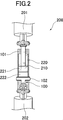
- the suction fixing device is a device that has a suction stage having a plurality of suction ports for sucking air by a vacuum pump or the like, and fixes a device arranged on the stage by a suction force (suction force) of air.
- suction force suction force
- the polarizing film according to the present invention has a separator peeling force of 0.10 N / min so that the polarizing film does not fall off from the stage when the separator is peeled from the thin polarizing film even with a low adsorption force.
- the applications of thin polarizing films are widespread, and it is required to have excellent durability even in high temperature and / or high humidity environments.
- the polarizing film with an adhesive layer is caused by the thinning.
- Such deformation is presumed to be caused by the fact that the polarizer and / or the transparent protective film easily contracts as the thickness is reduced, and that peeling or foaming occurs at the end of the pressure-sensitive adhesive layer.
- a pressure-sensitive adhesive layer formed from a pressure-sensitive adhesive composition in which a phenol-based antioxidant is blended together with a (meth) acrylic polymer and a peroxide.
- a pressure-sensitive adhesive layer when the (meth) acrylic polymer is cross-linked, inhibition of radical cross-linking by oxygen is effectively suppressed by the antioxidant, whereby a three-dimensional cross-linked network of the pressure-sensitive adhesive layer is efficiently formed.
- the That is, by combining the antioxidant and the peroxide in the pressure-sensitive adhesive composition forming the pressure-sensitive adhesive layer, it is possible to more effectively prevent the occurrence of abnormal appearance at the end of the pressure-sensitive adhesive layer.
- the polarizing film with a separator pressure-sensitive adhesive layer with a relatively thick total thickness of the polarizing film but also the polarizing film with a pressure-sensitive adhesive layer with a separator whose total thickness is 100 ⁇ m or less, Can be produced with improved durability.
- the method for producing a pressure-sensitive adhesive layer with a separator comprises a layer of a pressure-sensitive adhesive composition containing a (meth) acrylic polymer, a peroxide and a phenolic antioxidant on a release-treated surface of a release-treated separator. And a second step of forming a pressure-sensitive adhesive layer by heating and crosslinking the pressure-sensitive adhesive composition after the first step.
- a silicone release liner is preferably used as the separator subjected to the release treatment.
- the heating temperature Is preferably 70 to 170 ° C, more preferably 125 to 165 ° C, still more preferably 140 to 160 ° C.
- the heating time is preferably 30 to 240 seconds, more preferably 60 to 180 seconds.
- the silicone release liner has a condensation reaction type silicone release agent (for example, a base polymer at both ends).
- a polydimethylsiloxane having a hydroxyl group, a polymethylhydrosiloxane siloxane as a crosslinking agent, and a tin-based catalyst as a catalyst are generally used, and an addition reaction type silicone release agent (for example, both ends as a base polymer)
- a polydimethylsiloxane having a hydroxyl group in which a part of the methyl group is substituted with a vinyl group, a polymethylhydrosiloxane siloxane as a crosslinking agent, and a platinum catalyst as a catalyst are generally used
- the present invention is not particularly limited, and any release agent is used. It may be a release liner had.
- the pressure-sensitive adhesive composition layer of the present invention As a method of forming the pressure-sensitive adhesive composition layer on the release-treated surface of the release-treated separator, the pressure-sensitive adhesive composition is directly applied to the separator. You may form by apply
- Various methods are used as a method for forming the pressure-sensitive adhesive layer. Specifically, for example, roll coat, kiss roll coat, gravure coat, reverse coat, roll brush, spray coat, dip roll coat, bar coat, knife coat, air knife coat, curtain coat, lip coat, die coater, etc. Examples thereof include an extrusion coating method.
- the thickness of the adhesive layer is not particularly limited and is, for example, about 3 to 35 ⁇ m.
- the thickness is preferably 5 to 30 ⁇ m, more preferably 8 to 25 ⁇ m.
- constituent material of the separator examples include, for example, plastic films such as polyethylene, polypropylene, polyethylene terephthalate, and polyester films, porous materials such as paper, cloth, and nonwoven fabric, nets, foam sheets, metal foils, and laminates thereof.
- plastic films such as polyethylene, polypropylene, polyethylene terephthalate, and polyester films
- porous materials such as paper, cloth, and nonwoven fabric, nets, foam sheets, metal foils, and laminates thereof.
- a plastic film is used suitably from the point which is excellent in surface smoothness.
- the plastic film is not particularly limited as long as it can protect the pressure-sensitive adhesive layer.
- a polyethylene film, a polypropylene film, a polybutene film, a polybutadiene film, a polymethylpentene film, a polyvinyl chloride film, and a vinyl chloride co-polymer are used.
- examples thereof include a polymer film, a polyethylene terephthalate film, a polybutylene terephthalate film, a polyurethane film, and an ethylene-vinyl acetate copolymer film.
- the thickness of the separator is usually about 5 to 200 ⁇ m, preferably about 5 to 100 ⁇ m.
- mold release and antifouling treatment with a silicone type, fluorine type, long chain alkyl type or fatty acid amide type release agent, silica powder, etc., coating type, kneading type, vapor deposition type It is also possible to carry out antistatic treatment such as.
- the release property from the pressure-sensitive adhesive layer can be further improved by appropriately performing a release treatment such as silicone treatment, long-chain alkyl treatment, or fluorine treatment on the surface of the separator.
- the pressure-sensitive adhesive layer is obtained using a pressure-sensitive adhesive composition as a raw material, and the pressure-sensitive adhesive composition contains a (meth) acrylic polymer as a base polymer.
- the (meth) acrylic polymer usually contains an alkyl (meth) acrylate as a main component as a monomer unit.
- (Meth) acrylate refers to acrylate and / or methacrylate, and (meth) of the present invention has the same meaning.
- alkyl (meth) acrylate constituting the main skeleton of the (meth) acrylic polymer examples include linear or branched alkyl groups having 1 to 18 carbon atoms.
- the alkyl group includes methyl group, ethyl group, propyl group, isopropyl group, butyl group, isobutyl group, amyl group, hexyl group, cyclohexyl group, heptyl group, 2-ethylhexyl group, isooctyl group, nonyl group, decyl group.
- alkyl groups preferably have an average carbon number of 3 to 9.
- the (meth) acrylic polymer has a hydroxyl group-containing monomer as a monomer unit, specifically, for example, 2-hydroxyethyl (meth) acrylate, 3-hydroxypropyl (meth) acrylate, 4-methacrylic acid 4- Hydroxybutyl, 6-hydroxyhexyl (meth) acrylate, 8-hydroxyoctyl (meth) acrylate, 10-hydroxydecyl (meth) acrylate, 12-hydroxylauryl (meth) acrylate and (4-hydroxymethylcyclohexyl) -It preferably contains methyl acrylate or the like.
- the ratio of the hydroxyl group-containing monomer in the (meth) acrylic polymer is preferably 0.1 to 10% by weight, more preferably 0.2 to 5% by weight, based on the weight ratio of all the constituent monomers (100% by weight). .
- an isocyanate-based crosslinking agent is used as the crosslinking agent, 4-hydroxybutyl acrylate is preferable among these in order to efficiently secure a crosslinking point with an isocyanate group.
- alkyl (meth) acrylates containing aromatic rings such as phenoxyethyl (meth) acrylate and benzyl (meth) acrylate are used from the viewpoints of adhesive properties, durability, retardation adjustment, refractive index adjustment, and the like. be able to.
- the alkyl (meth) acrylate containing an aromatic ring can be used by mixing a polymer obtained by polymerizing it with the (meth) acrylic polymer exemplified above, but from the viewpoint of transparency, it contains an aromatic ring.
- the alkyl (meth) acrylate is preferably copolymerized with the alkyl (meth) acrylate.
- the ratio of the alkyl (meth) acrylate containing the aromatic ring in the (meth) acrylic polymer is 50 in the weight ratio of all the constituent monomers (100% by weight) of the hydroxyl group-containing (meth) acrylic polymer (A). It can contain in the ratio of the weight% or less. Further, the content of the alkyl (meth) acrylate containing an aromatic ring is preferably 1 to 35% by weight, more preferably 5 to 30% by weight, and further preferably 10 to 25% by weight.
- the (meth) acrylic polymer one or more having a polymerizable functional group having an unsaturated double bond such as a (meth) acryloyl group or a vinyl group for the purpose of improving adhesiveness and heat resistance
- copolymerizable monomers can be introduced by copolymerization.
- Specific examples of such copolymerizable monomers include, for example, carboxyl groups such as (meth) acrylic acid, carboxyethyl (meth) acrylate, carboxypentyl (meth) acrylate, itaconic acid, maleic acid, fumaric acid, crotonic acid and the like.
- Monomer Monomer anhydride, itaconic anhydride and other acid anhydride group-containing monomers; acrylic acid caprolactone adduct; styrene sulfonic acid and allyl sulfonic acid, 2- (meth) acrylamido-2-methylpropane sulfonic acid, (meth) Examples thereof include sulfonic acid group-containing monomers such as acrylamide propanesulfonic acid, sulfopropyl (meth) acrylate, and (meth) acryloyloxynaphthalene sulfonic acid; and phosphoric acid group-containing monomers such as 2-hydroxyethylacryloyl phosphate.
- (N-substituted) amides such as (meth) acrylamide, N, N-dimethyl (meth) acrylamide, N-butyl (meth) acrylamide, N-methylol (meth) acrylamide, N-methylolpropane (meth) acrylamide, etc.
- Further modifying monomers include vinyl acetate, vinyl propionate, N-vinyl pyrrolidone, methyl vinyl pyrrolidone, vinyl pyridine, vinyl piperidone, vinyl pyrimidine, vinyl piperazine, vinyl pyrazine, vinyl pyrrole, vinyl imidazole, vinyl oxazole, vinyl morpholine, N- Vinyl monomers such as vinylcarboxylic amides, styrene, ⁇ -methylstyrene, N-vinylcaprolactam; cyanoacrylate monomers such as acrylonitrile and methacrylonitrile; epoxy group-containing acrylic monomers such as glycidyl (meth) acrylate; (Meth) acrylic acid polyethylene glycol, (meth) acrylic acid polypropylene glycol, (meth) acrylic acid methoxyethylene glycol, (meth) acrylic acid meso Glycol acrylic ester monomers such as xypolypropylene glycol; acrylic ester monomers such as
- examples of copolymerizable monomers other than the above include silane-based monomers containing silicon atoms.
- examples of the silane monomer include 3-acryloxypropyltriethoxysilane, vinyltrimethoxysilane, vinyltriethoxysilane, 4-vinylbutyltrimethoxysilane, 4-vinylbutyltriethoxysilane, and 8-vinyloctyltrimethoxysilane.
- copolymer monomers examples include tripropylene glycol di (meth) acrylate, tetraethylene glycol di (meth) acrylate, 1,6-hexanediol di (meth) acrylate, bisphenol A diglycidyl ether di (meth) acrylate, neo Pentyl glycol di (meth) acrylate, trimethylolpropane tri (meth) acrylate, pentaerythritol tri (meth) acrylate, pentaerythritol tetra (meth) acrylate, dipentaerythritol penta (meth) acrylate, dipentaerythritol hexa (meth) acrylate (Meth) acrylic acid such as esterified product of (meth) acrylic acid and polyhydric alcohol such as caprolactone-modified dipentaerythritol hexa (meth) acrylate Polyfunctional monomers having two or more uns
- Polyester (meth) acrylate, epoxy (meth) acrylate, urethane (meth) acrylate and the like to which two or more unsaturated double bonds are added can also be used.
- the (meth) acrylic polymer has alkyl (meth) acrylate as a main component in the weight ratio of all constituent monomers, and the ratio of the copolymerizable monomer in the (meth) acrylic polymer is not particularly limited, but the copolymer
- the ratio of the monomer is preferably about 0 to 20%, about 0.1 to 15%, and more preferably about 0.1 to 10% in the weight ratio of all the constituent monomers.
- a carboxyl group-containing monomer is preferably used from the viewpoint of adhesion and durability.
- the pressure-sensitive adhesive composition contains a cross-linking agent
- the carboxyl group-containing monomer becomes a reaction point with the cross-linking agent.
- the carboxyl group-containing monomer is rich in reactivity with the intermolecular crosslinking agent, it is preferably used for improving the cohesiveness and heat resistance of the resulting pressure-sensitive adhesive layer.
- a carboxyl group-containing monomer is preferable in terms of achieving both durability and reworkability.
- the proportion is preferably 0.05 to 10% by weight, more preferably 0.1 to 8% by weight, and further preferably 0.2 to 6% by weight. .
- the (meth) acrylic polymer of the present invention those having a weight average molecular weight in the range of 500,000 to 3,000,000 are usually suitably used. In view of durability, particularly heat resistance, it is preferable to use those having a weight average molecular weight of 1,000,000 to 2,700,000. Further, it is preferably 1.3 to 2.5 million. A weight average molecular weight of less than 500,000 is not preferable in terms of heat resistance. On the other hand, if the weight average molecular weight is more than 3 million, a large amount of dilution solvent is required to adjust the viscosity for coating, which is not preferable.
- the weight average molecular weight is a value measured by GPC (gel permeation chromatography) and calculated in terms of polystyrene.
- the production of such a (meth) acrylic polymer can be appropriately selected from known production methods such as solution polymerization, bulk polymerization, emulsion polymerization, and various radical polymerizations. Further, the (meth) acrylic polymer obtained may be any of a random copolymer, a block copolymer, a graft copolymer, and the like.
- solution polymerization for example, ethyl acetate, toluene or the like is used as a polymerization solvent.
- the reaction is carried out under an inert gas stream such as nitrogen and a polymerization initiator is added, usually at about 50 to 70 ° C. under reaction conditions for about 5 to 30 hours.
- the polymerization initiator, chain transfer agent, emulsifier and the like used for radical polymerization are not particularly limited and can be appropriately selected and used.
- the weight average molecular weight of a (meth) acrylic-type polymer can be controlled by the usage-amount of a polymerization initiator and a chain transfer agent, and reaction conditions, The usage-amount is suitably adjusted according to these kinds.
- polymerization initiator examples include 2,2′-azobisisobutyronitrile, 2,2′-azobis (2-amidinopropane) dihydrochloride, 2,2′-azobis [2- (5-methyl-2 -Imidazolin-2-yl) propane] dihydrochloride, 2,2'-azobis (2-methylpropionamidine) disulfate, 2,2'-azobis (N, N'-dimethyleneisobutylamidine), 2,2 Azo initiators such as' -azobis [N- (2-carboxyethyl) -2-methylpropionamidine] hydrate (VA-057, manufactured by Wako Pure Chemical Industries, Ltd.), persulfates such as potassium persulfate and ammonium persulfate , Di (2-ethylhexyl) peroxydicarbonate, di (4-tert-butylcyclohexyl) peroxydicarbonate, di-sec-butyl Peroxydicarbonate, t
- the polymerization initiator may be used singly or as a mixture of two or more, but the total content is 0.005 to 1 part by weight with respect to 100 parts by weight of the monomer. Is preferably about 0.02 to 0.5 parts by weight.
- the polymerization initiator Is preferably about 0.06 to 0.2 parts by weight, more preferably about 0.08 to 0.175 parts by weight, based on 100 parts by weight of the total amount of monomer components.
- chain transfer agent examples include lauryl mercaptan, glycidyl mercaptan, mercaptoacetic acid, 2-mercaptoethanol, thioglycolic acid, 2-ethylhexyl thioglycolate, and 2,3-dimercapto-1-propanol.
- the chain transfer agent may be used alone or in combination of two or more, but the total content is 0.1 parts by weight with respect to 100 parts by weight of the total amount of monomer components. Less than or equal to
- emulsifier used in emulsion polymerization examples include anionic emulsifiers such as sodium lauryl sulfate, ammonium lauryl sulfate, sodium dodecylbenzenesulfonate, ammonium polyoxyethylene alkyl ether sulfate, sodium polyoxyethylene alkyl phenyl ether sulfate, and polyoxy Nonionic emulsifiers such as ethylene alkyl ether, polyoxyethylene alkyl phenyl ether, polyoxyethylene fatty acid ester, polyoxyethylene-polyoxypropylene block polymer and the like can be mentioned. These emulsifiers may be used alone or in combination of two or more.
- reactive emulsifiers emulsifiers into which radical polymerizable functional groups such as propenyl groups and allyl ether groups are introduced, specifically, for example, Aqualon HS-10, HS-20, KH-10, BC-05 BC-10, BC-20 (all of which are manufactured by Daiichi Kogyo Seiyaku Co., Ltd.), Adekaria Soap SE10N (manufactured by Asahi Denka Kogyo Co., Ltd.) Reactive emulsifiers are preferable because they are incorporated into the polymer chain after polymerization and thus have improved water resistance.
- the amount of the emulsifier used is preferably 0.3 to 5 parts by weight with respect to 100 parts by weight of the total amount of monomer components, and more preferably 0.5 to 1 part by weight from the viewpoint of polymerization stability and mechanical stability.
- a peroxide is contained in the pressure-sensitive adhesive composition forming the pressure-sensitive adhesive layer.
- any radical active species can be used as long as it generates radical active species by heating or light irradiation to advance the crosslinking of the base polymer of the pressure-sensitive adhesive composition.
- peroxides examples include di (2-ethylhexyl) peroxydicarbonate (1 minute half-life temperature: 90.6 ° C.), di (4-t-butylcyclohexyl) peroxydicarbonate (1 Minute half-life temperature: 92.1 ° C.), di-sec-butyl peroxydicarbonate (1 minute half-life temperature: 92.4 ° C.), t-butyl peroxyneodecanoate (1 minute half-life temperature: 103 0.5 ° C.), t-hexyl peroxypivalate (1 minute half-life temperature: 109.1 ° C.), t-butyl peroxypivalate (1 minute half-life temperature: 110.3 ° C.), dilauroyl peroxide ( 1 minute half-life temperature: 116.4 ° C.), di-n-octanoyl peroxide (1 minute half-life temperature: 117.4 ° C.), 1,1,3,3-tetramethylbutyl
- di (4-t-butylcyclohexyl) peroxydicarbonate (1 minute half-life temperature: 92.1 ° C.)
- dilauroyl peroxide (1 minute half-life temperature: 116. 4 ° C)
- dibenzoyl peroxide (1 minute half-life temperature: 130.0 ° C) and the like are preferably used.
- the peroxide half-life is an index representing the decomposition rate of the peroxide, and means the time until the remaining amount of peroxide is reduced to half.
- the decomposition temperature for obtaining a half-life at an arbitrary time and the half-life time at an arbitrary temperature are described in the manufacturer catalog, for example, “Organic peroxide catalog 9th edition by Nippon Oil & Fats Co., Ltd.” (May 2003) ".
- the peroxide content is preferably 0.05 to 2 parts by weight, more preferably 0.1 to 1 part by weight, based on 100 parts by weight of the (meth) acrylic polymer.
- the amount is less than 0.05 parts by weight, the peeling force of the separator tends to be too small, while when the amount is more than 2 parts by weight, the peeling force tends to be too large, and the pressure-sensitive adhesive layer is overoxidized. Since a large amount of the material remains, the adhesive property may change over time.
- the peroxide decomposition amount remaining after the reaction treatment for example, it can be measured by HPLC (High Performance Liquid Chromatography).
- the pressure-sensitive adhesive composition after the reaction treatment is taken out, immersed in 10 ml of ethyl acetate, extracted by shaking at 25 ° C. and 120 rpm for 3 hours with a shaker, and then at room temperature. Leave for 3 days. Next, 10 ml of acetonitrile was added, shaken at 120 rpm at 25 ° C. for 30 minutes, and about 10 ⁇ l of the extract obtained by filtration through a membrane filter (0.45 ⁇ m) was injected into the HPLC for analysis. The amount of peroxide can be set.
- an isocyanate crosslinking agent may be used in combination with a peroxide.
- the compound relating to the isocyanate-based crosslinking agent include isocyanate monomers such as tolylene diisocyanate, chlorophenylene diisocyanate, tetramethylene diisocyanate, xylylene diisocyanate, diphenylmethane diisocyanate, hydrogenated diphenylmethane diisocyanate, and these isocyanate monomers.
- Examples include isocyanate compounds added with trimethylolpropane, isocyanurates, burette compounds, and urethane prepolymer isocyanates such as polyether polyols, polyester polyols, acrylic polyols, polybutadiene polyols, and polyisoprene polyols. be able to.
- a polyisocyanate compound which is one or a polyisocyanate compound derived from one selected from the group consisting of hexamethylene diisocyanate, hydrogenated xylylene diisocyanate, and isophorone diisocyanate.
- hexamethylene diisocyanate, hydrogenated xylylene diisocyanate, isophorone diisocyanate, polyol-modified is selected from the group consisting of hexamethylene diisocyanate, hydrogenated xylylene diisocyanate, and isophorone diisocyanate or a polyisocyanate compound derived therefrom.
- examples include hexamethylene diisocyanate, polyol-modified hydrogenated xylylene diisocyanate, trimer-type hydrogenated xylylene diisocyanate, and polyol-modified isophorone diisocyanate.
- the exemplified polyisocyanate compound is preferable because the reaction with a hydroxyl group proceeds rapidly, particularly using an acid or base contained in the polymer as a catalyst, and thus contributes to the speed of crosslinking.
- the content of the isocyanate crosslinking agent is preferably 0.02 to 2 parts by weight with respect to 100 parts by weight of the (meth) acrylic polymer. 0.05 to 1 part by weight is more preferable.
- an isocyanate type crosslinking agent when an isocyanate type crosslinking agent is contained in an adhesive composition, an isocyanate type crosslinking agent tends to require time for reaction compared with a peroxide. For this reason, the workability, appearance, and durability of the pressure-sensitive adhesive layer may be deteriorated due to dirt or missing of the pressure-sensitive adhesive layer.
- the content of the isocyanate-based crosslinking agent in the pressure-sensitive adhesive composition is preferably 5 to 1000, more preferably 20 to 300, where the peroxide content is 100.
- the pressure-sensitive adhesive composition forming the pressure-sensitive adhesive layer can contain a known crosslinking agent in addition to the peroxide and the isocyanate-based crosslinking agent.
- a crosslinking agent an organic crosslinking agent or a polyfunctional metal chelate can be used.
- the organic crosslinking agent include an epoxy crosslinking agent and an imine crosslinking agent.
- a polyfunctional metal chelate is one in which a polyvalent metal is covalently or coordinately bonded to an organic compound. Examples of the polyvalent metal atom include Al, Cr, Zr, Co, Cu, Fe, Ni, V, Zn, In, Ca, Mg, Mn, Y, Ce, Sr, Ba, Mo, La, Sn, and Ti.
- Examples of the atom in the organic compound that is covalently or coordinately bonded include an oxygen atom, and examples of the organic compound include an alkyl ester, an alcohol compound, a carboxylic acid compound, an ether compound, and a ketone compound.
- the pressure-sensitive adhesive composition for forming the pressure-sensitive adhesive layer is characterized in that a phenol-based antioxidant is contained as a peeling regulator for adjusting the peeling force with respect to the separator. It is.
- phenolic antioxidant examples include 2,6-di-t-butyl-p-cresol, 2,6-di-t-butyl-4-ethylphenol, 2,6- Dicyclohexyl-4-methylphenol, 2,6-diisopropyl-4-ethylphenol, 2,6-di-t-amyl-4-methylphenol, 2,6-di-t-octyl-4-n-propylphenol, 2,6-dicyclohexyl-4-n-octylphenol, 2-isopropyl-4-methyl-6-t-butylphenol, 2-t-butyl-4-ethyl-6-t-octylphenol, 2-isobutyl-4-ethyl- 6-t-hexylphenol, 2-cyclohexyl-4-n-butyl-6-isopropylphenol, styrenated mixed cresol, DL- -Tocopherol, stearyl ⁇ - (3,5-d
- the content of the phenolic antioxidant is preferably 0.05 to 3 parts by weight, preferably 0.1 to 1.5 parts by weight, based on 100 parts by weight of the (meth) acrylic polymer. More preferred.
- the amount is less than 0.05 parts by weight, the peeling force of the separator with respect to the pressure-sensitive adhesive layer becomes high, and the peeling of the separator becomes difficult, and the process workability may be deteriorated.
- it exceeds 3 parts by weight the peeling force of the separator with respect to the pressure-sensitive adhesive layer becomes low, and the separator floats.
- the pressure-sensitive adhesive composition of the present invention can contain a silane coupling agent.
- the durability can be improved by using a silane coupling agent.
- the silane coupling agent include 3-glycidoxypropyltrimethoxysilane, 3-glycidoxypropyltriethoxysilane, 3-glycidoxypropylmethyldiethoxysilane, 2- (3, Epoxy group-containing silane coupling agents such as 4-epoxycyclohexyl) ethyltrimethoxysilane, 3-aminopropyltrimethoxysilane, N-2- (aminoethyl) -3-aminopropylmethyldimethoxysilane, 3-triethoxysilyl- Amino group-containing silane coupling agents such as N- (1,3-dimethylbutylidene) propylamine, N-phenyl- ⁇ -aminopropyltrimethoxysilane, 3-acryloxypropyltrimethoxysi
- the silane coupling agent may be used alone or in combination of two or more, but the total content is 100 parts by weight of the (meth) acrylic polymer.
- the silane coupling agent is preferably 0.001 to 5 parts by weight, more preferably 0.01 to 1 part by weight, still more preferably 0.02 to 1 part by weight. This is an amount that improves the durability and appropriately maintains the adhesive force to an optical member such as a liquid crystal cell.
- polyether-modified silicone can be blended in the pressure-sensitive adhesive composition forming the pressure-sensitive adhesive layer.
- the polyether-modified silicone for example, those disclosed in JP 2010-275522 A can be used.
- the polyether-modified silicone has a polyether skeleton, and at least one terminal has the following general formula (1): —SiRaM3-a (wherein R may have a substituent, the number of carbon atoms.
- R may have a substituent, the number of carbon atoms.
- M is a hydroxyl group or a hydrolyzable group
- a is an integer of 0 to 2, provided that when a plurality of R are present, the plurality of R are the same as each other.
- the plurality of M may be the same or different from each other.
- R is a monovalent organic group having 1 to 20 carbon atoms which may have a substituent
- M is a hydroxyl group or a hydrolyzable group
- a is an integer of 0 to 2.
- R is a monovalent organic group having 1 to 20 carbon atoms which may have a substituent
- M is a hydroxyl group or a hydrolyzable group
- a is an integer of 0 to 2.
- the plurality of R may be the same or different from each other, and a plurality of M are present.
- AO represents a linear or branched oxyalkylene group having 1 to 10 carbon atoms
- n is 1 to 1700
- oxyalkylene group X represents a linear or branched alkylene group having 1 to 20 carbon atoms
- Y represents an ether bond, an ester bond, a urethane bond, or a carbonate bond
- Z is a hydrogen atom, a monovalent hydrocarbon group having 1 to 10 carbon atoms
- Y1 is a single bond, —CO— bond, —CONH— bond, or —COO—) Indicates binding), or Formula (2B): —Q ⁇ — (OA) n—Y—X—SiRaM3-a ⁇ m (wherein R, M, X, Y, and a are the same as described above.
- OA is the same as AO described above
- N is the same as above
- Q is a divalent or higher hydrocarbon group having 1 to 10 carbon atoms
- m is the same as the valence of the hydrocarbon group.
- polyether-modified silicone examples include, for example, MS polymer S203, S303, S810 manufactured by Kaneka Corporation; SILYL EST250, EST280; , S2420 or S3430.
- the pressure-sensitive adhesive composition forming the pressure-sensitive adhesive layer may contain other known additives, such as powders such as colorants and pigments, dyes, surfactants, plastics, and the like.
- Agents, tackifiers, surface lubricants, leveling agents, softeners, anti-aging agents, light stabilizers, UV absorbers, polymerization inhibitors, inorganic or organic fillers, metal powders, particles, foils, etc. Can be added as appropriate according to the intended use.
- the pressure-sensitive adhesive layer with a separator according to the present invention can be produced by the production method described above.
- the gel fraction of the pressure-sensitive adhesive layer after heating and crosslinking is preferably 45 to 95% by weight, It is preferable to set it as weight%. A method for measuring the gel fraction of the pressure-sensitive adhesive layer will be described later.
- the pressure-sensitive adhesive layer with a separator according to the present invention is formed by heating and crosslinking a pressure-sensitive adhesive composition containing a (meth) acrylic polymer, a peroxide and a phenolic antioxidant.
- the separation force of the separator is adjusted to an appropriate value.
- the peeling force of the separator with respect to the pressure-sensitive adhesive layer is preferably 0.05 to 0.30 N / 50 mm, and preferably 0.06 to 0.17 N. / 50 mm is more preferable, and 0.07 to 0.15 N / 50 mm is particularly preferable.
- a polarizing plate having a polarizing film and a pressure-sensitive adhesive layer including a polarizing film and a protective film can be provided using the pressure-sensitive adhesive layer.
- the pressure-sensitive adhesive layer has a pressure-sensitive adhesive strength such that the peeling force of the separator with respect to the polarizing film is 0.10 N / 50 mm or less.
- the peeling force of the separator with respect to the polarizing film is 0.10 N / 50 mm, in Example 3, 0.09 N / 50 mm, in Example 5, 0.08 N / 50 mm
- the adhesive strength is 0.07 N / 50 mm
- Example 14 the adhesive strength is 0.05 N / 50 mm.
- the adhesive force of the pressure-sensitive adhesive layer is low and the separator can be peeled off with a small force, when the separator is peeled off from the polarizing film, the force applied to the polarizing film from the separator can be reduced, and the polarizing film is adsorbed.
- the polarizing film is less likely to drop off from the stage.
- the adhesive force of the adhesive layer with respect to glass is 2.0 N / 25mm width or more and 5.0 N / 25mm width or less. When the adhesive force is less than 2.0 N / 25 mm width, in the heating durability test of the polarizing film, there may be a problem that the polarizing film is peeled off from the liquid crystal display panel having a glass surface. .
- the polarizing film breaks when the polarizing film needs to be peeled off after the polarizing film is attached to the liquid crystal display panel. There may be a problem that the polarizing film cannot be peeled off.
- a polarizing film with a pressure-sensitive adhesive layer with a separator is a pressure-sensitive adhesive layer with a separator in which a pressure-sensitive adhesive layer with a separator is bonded to at least one side of a polarizing film having a transparent protective film on at least one side of a polarizer from the pressure-sensitive adhesive layer side. It is obtained by the manufacturing method of an attached polarizing film, and the point which uses the thing manufactured by the manufacturing method of the said description is used as the said adhesive layer with a separator.
- the polarizing film When producing a polarizing film with a pressure-sensitive adhesive layer with a separator using the pressure-sensitive adhesive layer with a separator produced by the method for producing a pressure-sensitive adhesive layer with a separator according to the present invention, the polarizing film has any thickness.
- the peeling force of the separator with respect to the pressure-sensitive adhesive layer can be adjusted to an appropriate value.
- the separator is moderately light with respect to the pressure-sensitive adhesive layer.
- the polarizing film with an adhesive layer with a separator which has peelability and was excellent in workability can be manufactured.
- the obtained polarizing film with a pressure-sensitive adhesive layer with a separator is prevented from being abnormal in appearance at the end, and has improved durability. Therefore, when considering the demand for thinning the polarizing film with the pressure-sensitive adhesive layer, the pressure-sensitive adhesive layer with a separator according to the present invention is a separator having a total polarizing film thickness of 100 ⁇ m or less, more preferably 70 ⁇ m or less, particularly 50 ⁇ m or less. It can be suitably used for a polarizing film with a pressure-sensitive adhesive layer. Although it does not specifically limit as a minimum of the total thickness of a polarizing film, For example, 10 micrometers is mentioned.
- the total thickness of the polarizing film is preferably 100 ⁇ m or less in order to meet the demand for thinning the polarizing film with a pressure-sensitive adhesive layer with a separator.
- the polarizer which comprises a polarizing film is not specifically limited, Various things can be used, but it is preferable to use the thin polarizer whose thickness is 10 micrometers or less from the said viewpoint of thickness reduction. Further, from the viewpoint of thinning, the thickness is more preferably 1 to 7 ⁇ m.
- Such a thin polarizer is preferable in that the thickness unevenness is small, the visibility is excellent, the dimensional change is small, the durability is excellent, and the thickness of the polarizing film can be reduced.
- the thin polarizer typically, JP-A-51-069644, JP-A-2000-338329, WO2010 / 100917, PCT / JP2010 / 001460, or Japanese Patent Application No. 2010- And a thin polarizing film (polarizer) described in the specification of 269002 and the specification of Japanese Patent Application No. 2010-263692.
- These thin polarizing films can be obtained by a production method including a step of stretching a polyvinyl alcohol-based resin (hereinafter also referred to as PVA-based resin) layer and a stretching resin base material in a laminated state and a step of dyeing. With this manufacturing method, even if the PVA-based resin layer is thin, it can be stretched without problems such as breakage due to stretching by being supported by the stretching resin substrate.
- PVA-based resin polyvinyl alcohol-based resin
- the thin polarizing film among the production methods including the step of stretching in the state of a laminate and the step of dyeing, WO2010 / 100917 pamphlet, PCT / PCT / PCT / JP 2010/001460 specification, or Japanese Patent Application No. 2010-269002 and Japanese Patent Application No. 2010-263692, the one obtained by a production method including a step of stretching in a boric acid aqueous solution is preferable. What is obtained by the manufacturing method including the process of extending
- the thin high-performance polarizing film described in the specification of PCT / JP2010 / 001460 is a thin film having a thickness of 7 ⁇ m or less made of a PVA-based resin oriented with a dichroic material, which is integrally formed on a resin base material. It is a high-functional polarizing film, and has optical properties such as a single transmittance of 42.0% or more and a degree of polarization of 99.95% or more.
- the thin high-performance polarizing film generates a PVA-based resin layer by applying and drying a PVA-based resin on a resin substrate having a thickness of at least 20 ⁇ m, and the generated PVA-based resin layer is used as a dichroic dyeing solution. So that the dichroic substance is adsorbed on the PVA resin layer, and the PVA resin layer on which the dichroic substance is adsorbed is integrated with the resin base material in the boric acid aqueous solution so that the total draw ratio is the original length. It can manufacture by extending
- a method for producing a laminate film including a thin high-performance polarizing film in which a dichroic substance is oriented and includes a resin base material having a thickness of at least 20 ⁇ m and a PVA resin on one side of the resin base material.
- the said laminated body containing the process of producing
- the polarizing film with the pressure-sensitive adhesive layer is a continuous web polarizing film made of a PVA resin in which a dichroic substance is oriented as a polarizer having a thickness of 10 ⁇ m or less, What was obtained by extending
- stretching process which consists of air auxiliary
- the thermoplastic resin substrate is preferably an amorphous ester thermoplastic resin substrate or a crystalline ester thermoplastic resin substrate.
- the thin polarizing films in the above-mentioned Japanese Patent Application Nos. 2010-269002 and 2010-263692 are continuous web polarizing films made of a PVA-based resin in which a dichroic material is oriented, and are amorphous.
- the laminate including the PVA-based resin layer formed on the ester-based thermoplastic resin base material was stretched in a two-stage stretching process consisting of air-assisted stretching and boric acid-water stretching, so that the thickness was 10 ⁇ m or less. Is.
- Such a thin polarizing film has P> ⁇ (100.929T ⁇ 42.4-1) ⁇ 100 (where T ⁇ 42.3) and P ⁇ 99, where T is the single transmittance and P is the polarization degree. .9 (where T ⁇ 42.3) is preferable.
- the thin polarizing film is a stretch intermediate formed of an oriented PVA resin layer by high-temperature stretching in the air with respect to the PVA resin layer formed on the amorphous ester thermoplastic resin substrate of the continuous web.
- a colored intermediate product comprising a PVA-based resin layer in which a dichroic material (preferably iodine or a mixture of iodine and an organic dye) is oriented by adsorption of the dichroic material to the stretched intermediate product and a step of generating the product.
- a thin polarizing film comprising: a step of producing a product; and a step of producing a polarizing film having a thickness of 10 ⁇ m or less comprising a PVA resin layer in which a dichroic substance is oriented by stretching in a boric acid solution with respect to a colored intermediate product It can manufacture with the manufacturing method of.
- the total draw ratio of the PVA resin layer formed on the amorphous ester thermoplastic resin base material by high-temperature drawing in air and drawing in boric acid solution should be 5 times or more. desirable.
- stretching can be 60 degreeC or more.
- the colored intermediate product is added to the aqueous boric acid solution whose liquid temperature does not exceed 40 ° C. It is desirable to do so by dipping.
- the amorphous ester-based thermoplastic resin base material is amorphous polyethylene containing copolymerized polyethylene terephthalate copolymerized with isophthalic acid, copolymerized polyethylene terephthalate copolymerized with cyclohexanedimethanol, or other copolymerized polyethylene terephthalate. It can be terephthalate and is preferably made of a transparent resin, and the thickness thereof can be 7 times or more the thickness of the PVA resin layer to be formed.
- the draw ratio of high-temperature drawing in the air is preferably 3.5 times or less, and the drawing temperature of high-temperature drawing in the air is preferably not less than the glass transition temperature of the PVA resin, specifically in the range of 95 ° C to 150 ° C.
- the total stretching ratio of the PVA resin layer formed on the amorphous ester thermoplastic resin base material is preferably 5 to 7.5 times .
- the total stretching ratio of the PVA-based resin layer formed on the amorphous ester-based thermoplastic resin base material is 5 times or more and 8.5 times or less. Is preferred. More specifically, a thin polarizing film can be produced by the following method.
- a base material for a continuous web of isophthalic acid copolymerized polyethylene terephthalate (amorphous PET) in which 6 mol% of isophthalic acid is copolymerized is prepared.
- the glass transition temperature of amorphous PET is 75 ° C.
- a laminate comprising a continuous web of amorphous PET substrate and a polyvinyl alcohol (PVA) layer is prepared as follows. Incidentally, the glass transition temperature of PVA is 80 ° C.
- a 200 ⁇ m-thick amorphous PET base material and a 4-5% PVA aqueous solution in which PVA powder having a polymerization degree of 1000 or more and a saponification degree of 99% or more are dissolved in water are prepared.
- an aqueous PVA solution is applied to a 200 ⁇ m thick amorphous PET substrate and dried at a temperature of 50 to 60 ° C. to obtain a laminate in which a 7 ⁇ m thick PVA layer is formed on the amorphous PET substrate. .
- a thin and highly functional polarizing film having a thickness of 3 ⁇ m is manufactured from the laminate including the PVA layer having a thickness of 7 ⁇ m through the following steps including a two-stage stretching process of air-assisted stretching and boric acid water stretching.
- the laminate including the 7 ⁇ m-thick PVA layer is integrally stretched with the amorphous PET substrate to produce a stretched laminate including the 5 ⁇ m-thick PVA layer.
- a laminate including a 7 ⁇ m-thick PVA layer is subjected to a stretching apparatus disposed in an oven set to a stretching temperature environment of 130 ° C. so that the stretching ratio is 1.8 times. Are stretched uniaxially at the free end.
- the PVA layer contained in the stretched laminate is changed to a 5 ⁇ m thick PVA layer in which PVA molecules are oriented.
- this colored laminate has a single layer transmittance of the PVA layer constituting the high-functional polarizing film that is finally produced by using the stretched laminate in a staining solution containing iodine and potassium iodide at a liquid temperature of 30 ° C.
- Iodine is adsorbed to the PVA layer contained in the stretched laminate by dipping for an arbitrary period of time so as to be 40 to 44%.
- the staining solution uses water as a solvent, and an iodine concentration within the range of 0.12 to 0.30% by weight and a potassium iodide concentration within the range of 0.7 to 2.1% by weight.
- concentration ratio of iodine and potassium iodide is 1 to 7.
- potassium iodide is required to dissolve iodine in water. More specifically, by immersing the stretched laminate in a dyeing solution having an iodine concentration of 0.30% by weight and a potassium iodide concentration of 2.1% by weight for 60 seconds, iodine is applied to a 5 ⁇ m-thick PVA layer in which PVA molecules are oriented. A colored laminate is adsorbed on the substrate.
- the colored laminated body is further stretched integrally with the amorphous PET base material by the second stage boric acid underwater stretching step to produce an optical film laminate including a PVA layer constituting a highly functional polarizing film having a thickness of 3 ⁇ m.
- the optical film laminate is subjected to stretching by applying the colored laminate to a stretching apparatus provided in a treatment apparatus set to a boric acid aqueous solution having a liquid temperature range of 60 to 85 ° C. containing boric acid and potassium iodide. It is stretched uniaxially at the free end so that the magnification is 3.3 times. More specifically, the liquid temperature of the boric acid aqueous solution is 65 ° C.
- the colored laminate having an adjusted iodine adsorption amount is first immersed in an aqueous boric acid solution for 5 to 10 seconds. After that, the colored laminate is passed as it is between a plurality of sets of rolls with different peripheral speeds, which is a stretching apparatus installed in the processing apparatus, and the stretching ratio can be freely increased to 3.3 times over 30 to 90 seconds. Stretch uniaxially.
- the PVA layer contained in the colored laminate is changed into a PVA layer having a thickness of 3 ⁇ m in which the adsorbed iodine is oriented higher in one direction as a polyiodine ion complex.
- This PVA layer constitutes a highly functional polarizing film of the optical film laminate.
- the optical film laminate was removed from the boric acid aqueous solution and adhered to the surface of the 3 ⁇ m-thick PVA layer formed on the amorphous PET substrate by the washing step. It is preferable to wash boric acid with an aqueous potassium iodide solution. Thereafter, the washed optical film laminate is dried by a drying process using hot air at 60 ° C.
- the cleaning process is a process for eliminating appearance defects such as boric acid precipitation.
- an adhesive is applied to the surface of a 3 ⁇ m-thick PVA layer formed on an amorphous PET substrate by a bonding and / or transfer process.
- the amorphous PET substrate can be peeled off, and the 3 ⁇ m thick PVA layer can be transferred to the 80 ⁇ m thick triacetyl cellulose film.
- the manufacturing method of said thin-shaped polarizing film may contain another process other than the said process.
- examples of other processes include an insolubilization process, a crosslinking process, and a drying (control of moisture content) process.
- the other steps can be performed at any appropriate timing.
- the insolubilization step is typically performed by immersing the PVA resin layer in a boric acid aqueous solution. By performing the insolubilization treatment, water resistance can be imparted to the PVA resin layer.
- the concentration of the boric acid aqueous solution is preferably 1 to 4 parts by weight with respect to 100 parts by weight of water.
- the liquid temperature of the insolubilizing bath (boric acid aqueous solution) is preferably 20 ° C. to 50 ° C.
- the insolubilization step is performed after the laminate is manufactured and before the dyeing step and the underwater stretching step.
- the crosslinking step is typically performed by immersing the PVA resin layer in an aqueous boric acid solution.
- the concentration of the boric acid aqueous solution is preferably 1 to 4 parts by weight with respect to 100 parts by weight of water.
- blend iodide it is preferable to mix
- the blending amount of iodide is preferably 1 to 5 parts by weight with respect to 100 parts by weight of water. Specific examples of the iodide are as described above.
- the liquid temperature of the crosslinking bath is preferably 20 ° C. to 50 ° C.
- the crosslinking step is performed before the second boric acid aqueous drawing step.
- the dyeing step, the crosslinking step, and the second boric acid aqueous drawing step are performed in this order.
- thermoplastic resin excellent in transparency, mechanical strength, thermal stability, moisture barrier property, isotropy and the like is used.
- thermoplastic resins include cellulose resins such as triacetyl cellulose, polyester resins, polyethersulfone resins, polysulfone resins, polycarbonate resins, polyamide resins, polyimide resins, polyolefin resins, (meth) acrylic resins, cyclic Examples thereof include polyolefin resins (norbornene resins), polyarylate resins, polystyrene resins, polyvinyl alcohol resins, and mixtures thereof.
- a transparent protective film is bonded to one side of the polarizer by an adhesive layer.
- thermosetting resin such as a system or an ultraviolet curable resin
- a thermosetting resin such as a system or an ultraviolet curable resin
- the additive include an ultraviolet absorber, an antioxidant, a lubricant, a plasticizer, a mold release agent, an anti-coloring agent, a flame retardant, a nucleating agent, an antistatic agent, a pigment, and a coloring agent.
- the content of the thermoplastic resin in the transparent protective film is preferably 50 to 100% by weight, more preferably 50 to 99% by weight, still more preferably 60 to 98% by weight, and particularly preferably 70 to 97% by weight. .
- content of the said thermoplastic resin in a transparent protective film is 50 weight% or less, there exists a possibility that the high transparency etc. which a thermoplastic resin originally has cannot fully be expressed.
- the thickness of the transparent protective film is, for example, preferably about 10 to 90 ⁇ m, more preferably 15 to 60 ⁇ m, and more preferably 20 to 50 ⁇ m, in response to the demand for thinning the polarizing film with the pressure-sensitive adhesive layer with separator. Is particularly preferred.
- An adhesive is used for the adhesion treatment between the polarizer and the transparent protective film.
- the adhesive include isocyanate adhesives, polyvinyl alcohol adhesives, gelatin adhesives, vinyl latexes, and water-based polyesters.
- the adhesive is usually used as an adhesive made of an aqueous solution, and usually contains 0.5 to 60% by weight of a solid content.
- examples of the adhesive between the polarizer and the transparent protective film include an ultraviolet curable adhesive and an electron beam curable adhesive.
- the electron beam curable polarizing film adhesive exhibits suitable adhesiveness to the various transparent protective films.
- the adhesive used in the present invention can contain a metal compound filler.
- the polarizing film can be laminated with other optical films.
- other optical films include the formation of liquid crystal display devices such as reflectors, anti-transmission plates, retardation plates (including wavelength plates such as 1/2 and 1/4), visual compensation films, and brightness enhancement films.
- the thing used as the optical layer which may be used is mentioned. These can be laminated on the polarizing film for practical use, and one layer or two or more layers can be used.
- An optical film obtained by laminating the optical layer on a polarizing film can be formed by a method of laminating separately sequentially in the manufacturing process of a liquid crystal display device or the like. It is excellent in stability and assembly work, and has the advantage of improving the manufacturing process of a liquid crystal display device and the like.
- Appropriate bonding means such as an adhesive layer can be used for lamination. When adhering the polarizing film and the other optical layer, their optical axes can be set at an appropriate arrangement angle in accordance with a target retardation characteristic or the like.
- the polarizing film with an adhesive layer of the present invention can be preferably used for forming various image display devices such as a liquid crystal display device.
- the liquid crystal display device can be formed according to the conventional method.
- a liquid crystal display device is generally formed by appropriately assembling components such as a display panel such as a liquid crystal cell, a polarizing film with an adhesive layer, and an illumination system as necessary, and incorporating a drive circuit.
- a display panel such as a liquid crystal cell
- a polarizing film with an adhesive layer such as a liquid crystal cell
- an illumination system as necessary
- an arbitrary type such as an arbitrary type such as a TN type, STN type, ⁇ type, VA type, or IPS type can be used.
- liquid crystal display devices such as a liquid crystal display device in which a polarizing film with an adhesive layer is disposed on one or both sides of a display panel such as a liquid crystal cell, or a lighting system using a backlight or a reflector can be formed.
- the polarizing film with an adhesive layer by this invention can be installed in the one side or both sides of display panels, such as a liquid crystal cell.
- optical films are provided on both sides, they may be the same or different.
- liquid crystal display device for example, a single layer or a suitable layer such as a diffusing plate, an antiglare layer, an antireflection film, a protective plate, a prism array, a lens array sheet, a light diffusing plate, a backlight, etc. Two or more layers can be arranged.
- a laminated body in which a PVA layer having a thickness of 9 ⁇ m is formed on an amorphous PET substrate is produced by air-assisted stretching at a stretching temperature of 130 ° C., and then stretched.
- a colored laminate is produced by dyeing the laminate, and the colored laminate is further stretched integrally with an amorphous PET substrate so that the total draw ratio is 5.94 times by stretching in boric acid water at a stretching temperature of 65 degrees.
- An optical film laminate including a 4 ⁇ m thick PVA layer was produced.
- the PVA molecules in the PVA layer formed on the amorphous PET substrate by such two-stage stretching are oriented in the higher order, and the iodine adsorbed by the dyeing is oriented in the one direction as the polyiodine ion complex. It was possible to produce an optical film laminate including a PVA layer having a thickness of 4 ⁇ m that constitutes a highly functional polarizer. Furthermore, after applying a saponified 40 ⁇ m thick acrylic resin film (transparent protective film (1)) while applying a polyvinyl alcohol-based adhesive on the surface of the polarizer of the optical film laminate, amorphous PET The base material was peeled off to produce a polarizing film using a thin polarizer. Hereinafter, this is referred to as a thin polarizing film (1). Table 1 shows the polarizer, the transparent protective film, and the total thickness.
- ⁇ Creation of polarizing film (2)> A polyvinyl alcohol film having a thickness of 80 ⁇ m was stretched up to 3 times while being dyed for 1 minute in an iodine solution of 0.3% concentration at 30 ° C. between rolls having different speed ratios. Thereafter, the film was stretched so that the total stretch ratio was 6 times while immersed in an aqueous solution containing 60% at 4% concentration of boric acid and 10% concentration of potassium iodide for 0.5 minutes. Next, after washing by immersing in an aqueous solution containing potassium iodide at 30 ° C. and 1.5% concentration for 10 seconds, drying was performed at 50 ° C. for 4 minutes to obtain a polarizer having a thickness of 4 ⁇ m.
- amorphous PET After peeling off the base material, a 40 ⁇ m-thick norbornene-based film (transparent protective film (2)) was bonded to each other with a polyvinyl alcohol-based adhesive to prepare a film.
- this is referred to as a thin polarizing film (2).
- Table 1 shows the polarizer, the transparent protective film, and the total thickness.
- ⁇ Creation of polarizing film (3)> A polyvinyl alcohol film having a thickness of 80 ⁇ m was stretched up to 3 times while being dyed for 1 minute in an iodine solution of 0.3% concentration at 30 ° C. between rolls having different speed ratios. Thereafter, the film was stretched so that the total stretch ratio was 6 times while immersed in an aqueous solution containing 60% at 4% concentration of boric acid and 10% concentration of potassium iodide for 0.5 minutes. Next, after washing by immersing in an aqueous solution containing potassium iodide at 30 ° C. and 1.5% concentration for 10 seconds, drying was performed at 50 ° C. for 4 minutes to obtain a polarizer having a thickness of 20 ⁇ m.
- amorphous PET After peeling off the base material, a norbornene-based film (transparent protective film (2)) having a thickness of 60 ⁇ m was bonded to the other surface with a polyvinyl alcohol-based adhesive, respectively, to prepare films.
- a polarizing film (3) This is referred to as a polarizing film (3).
- Table 1 shows the polarizer, the transparent protective film, and the total thickness.
- Production Example 2 ⁇ Preparation of (meth) acrylic polymer (A-2)>
- a monomer mixture containing 99 parts of butyl acrylate and 1 part of 2-hydroxyethyl acrylate (HEA) was used in the same manner as in Production Example 1, except that a weight average molecular weight of 1.6 million was used.
- a solution of the (meth) acrylic polymer (A-2) was prepared.
- Table 2 shows the composition and molecular weight of the (meth) acrylic polymer (A-2).
- Production Example 3 ⁇ Preparation of (meth) acrylic polymer (A-3)> A solution of a (meth) acrylic polymer (A-4) having a weight average molecular weight of 1.6 million was prepared in the same manner as in Production Example 1 except that 100 parts of butyl acrylate was used in Production Example 1. Table 2 shows the composition and molecular weight of the (meth) acrylic polymer (A-4).
- Example 1 Adjustment of optical adhesive composition
- Range isocyanate (C-1; manufactured by Mitsui Chemicals, Inc .: Takenate D110N), 0.3 part of dibenzoyl peroxide (C-2) and 0.075 part of ⁇ -glycidoxypropylmethoxysilane (D; Shin-Etsu) Chemical Industry Co., Ltd .: KBM-403) and pentaerythritol tetrakis [3- (3,5-di-tert-butyl-4-hydroxyphenyl) propionate (B -1; 0.3 part of IRGANAOX 1010) manufactured by BASF Japan Ltd. was blended to obtain an adhesive composition.
- the pressure-sensitive adhesive composition is uniformly coated with a fountain coater on the surface of a polyethylene terephthalate film (base material) treated with a silicone-based release agent (first step) for 2 minutes in an air circulation type thermostatic oven at 155 ° C. It dried and formed the 20-micrometer-thick adhesive layer on the surface of the base material (2nd process). Subsequently, a separator film (MRF38 manufactured by Mitsubishi Chemical Polyester Film Co., Ltd.) having a pressure-sensitive adhesive layer formed thereon was transferred to the polarizing film to prepare a polarizing film with a pressure-sensitive adhesive layer with a separator.
- a separator film MRF38 manufactured by Mitsubishi Chemical Polyester Film Co., Ltd.
- Example 2 Comparative Examples 1 to 7
- the amount of each component used was changed as shown in Table 1 in the preparation of the pressure-sensitive adhesive composition, and the type of polarizing film was shown in Table 1 in preparing the polarizing film with the pressure-sensitive adhesive layer with a separator.
- a polarizing film with a pressure-sensitive adhesive layer with a separator was produced in the same manner as in Example 1, except that the change was made.
- tris (2,4-di-t-butylphenyl) phosphite B-2; IRGAFOS 168 manufactured by BASF Japan Ltd.
- B-2 2,4-di-t-butylphenyl) phosphite
- Example 13 A polarizing film with a pressure-sensitive adhesive layer with a separator was produced in the same manner as in Example 1 except that the heating temperature in the second step (corresponding to the temperature of the air circulation type thermostatic oven) was changed to 130 ° C.
- Example 14 A polarizing film with a pressure-sensitive adhesive layer with a separator was produced in the same manner as in Example 1 except that the heating temperature in the second step (corresponding to the temperature of the air circulation type thermostatic oven) was changed to 90 ° C.
- each pressure-sensitive adhesive composition before sample preparation is applied so that the thickness after drying is 20 ⁇ m, and after coating, under the same drying conditions (temperature, time) as in each example
- the pressure-sensitive adhesive layer was formed by curing, and the gel fraction was measured for the pressure-sensitive adhesive layer after being left for 1 hour under conditions of a temperature of 23 ° C. and a humidity of 65% RH.
- the gel fraction was obtained by taking about 0.2 g of the pressure-sensitive adhesive layer, wrapping it in a fluororesin (TEMISHNTF-1122, manufactured by Nitto Denko Corporation) whose weight (Wa) was measured in advance, and binding the pressure-sensitive adhesive layer so that it did not leak.
- the polarizing film with a separator pressure-sensitive adhesive layer using the pressure-sensitive adhesive layer with a separator produced by the method for producing a pressure-sensitive adhesive layer with a separator according to Examples 1 to 12 is excellent in peeling workability, and It turns out that it is excellent in durability and workability.
- the polarizing film with the pressure-sensitive adhesive layer with a separator having a relatively thick polarizing film is used regardless of the presence or absence of a peeling force adjusting agent (phenolic antioxidant).
- a peeling force adjusting agent phenolic antioxidant
- the peeling workability is not so different.
- the presence or absence of a peeling force adjusting agent (phenolic antioxidant) is evident as compared with Example 1 and Comparative Example 1, for example.
- a large difference occurs in the peeling workability.
- acetoacetyl-modified PVA manufactured by Nippon Synthetic Chemical Industry Co., Ltd., trade name: Gohsephimer Z200 (degree of polymerization 1200, degree of saponification 99.0% or more, degree of acetoacetyl modification 4.6%)
- Gohsephimer Z200 degree of polymerization 1200, degree of saponification 99.0% or more, degree of acetoacetyl modification 4.6%)
- Prepared PVA (polymerization degree 4200, saponification degree 99.2%) was applied so that the film thickness after drying was 12 ⁇ m, dried in hot air at 60 ° C. for 10 minutes, A laminate in which a PVA resin layer was provided on the material was produced.
- this laminate was first stretched 2.0 times in air at 130 ° C. to produce a stretched laminate.
- a step of insolubilizing the PVA layer in which the PVA molecules contained in the stretched laminate were oriented was performed by immersing the stretched laminate in a boric acid insolubilized aqueous solution having a liquid temperature of 30 ° C. for 30 seconds.
- the boric acid insolubilized aqueous solution in this step had a boric acid content of 3% by weight with respect to 100% by weight of water.
- a colored laminate was produced by dyeing this stretched laminate.
- the stretched laminate is used as a dyeing solution containing iodine and potassium iodide at a liquid temperature of 30 ° C., and the single transmittance of the PVA layer constituting the high-functional polarizing film finally produced is 42.5%.
- iodine is adsorbed to the PVA layer contained in the stretched laminate by immersing in an arbitrary iodine concentration and arbitrary time.
- the staining solution was adjusted to an iodine concentration in the range of 0.08 to 0.25% by weight and a potassium iodide concentration in the range of 0.56 to 1.75% by weight using water as a solvent.
- the concentration ratio of iodine and potassium iodide is 1 to 7.
- the colored laminated body was immersed in a 30 ° C. boric acid crosslinking aqueous solution for 60 seconds to perform a crosslinking treatment between PVA molecules of the PVA layer on which iodine was adsorbed.
- the boric acid crosslinking aqueous solution in this step had a boric acid content of 3% by weight with respect to 100% by weight of water and a potassium iodide content of 3% by weight with respect to 100% by weight of water.
- the obtained colored laminate was stretched 2.7 times in the same direction as stretching in the air at a stretching temperature of 70 ° C. in a boric acid aqueous solution, and the final stretch ratio was 5.4.
- a sample polarizing film having a magnification of 2 was obtained.
- the boric acid crosslinking aqueous solution in this step had a boric acid content of 4.0% by weight with respect to 100% by weight of water and a potassium iodide content of 5% by weight with respect to 100% by weight of water.
- the optical film laminate was taken out from the boric acid aqueous solution, and boric acid adhering to the surface of the PVA layer was washed with an aqueous solution having a potassium iodide content of 4% by weight with respect to 100% by weight of water.
- the washed optical film laminate was dried by a drying process using hot air at 60 ° C. to prepare a polarizing film having a thickness of 5 ⁇ m laminated on the A-PET film, and then aged at room temperature for 7 days.
- the thickness of the polarizing film may be other than 5 ⁇ m.
- the thickness of the polarizing film may be 10 ⁇ m or less, preferably 8 ⁇ m or less, particularly preferably 6 ⁇ m or less.
- the stretching force generated in the polarizing film increases, so it is necessary to bond a protective film or retardation layer having a certain thickness to suppress the stretching of the polarizing film.
- the thickness of the protective film and retardation layer bonded to the polarizing film can be designed to be thin, and the total thickness of the optical laminate Can be made thinner. Further, since the thickness of the polarizing film is thin and the stretching force generated in the polarizing film due to changes in the surrounding environment is small, the stress generated between the bonded members is reduced and the optical generated in the bonded members is reduced. There is an effect that distortion is also suppressed.
- the single transmittance and degree of polarization of the polarizing film obtained by the above method were measured by the following methods.
- the single transmittance T, the parallel transmittance Tp, and the orthogonal transmittance Tc of the polarizing film were measured using an ultraviolet-visible spectrophotometer (V7100 manufactured by JASCO Corporation). These T, Tp, and Tc are Y values that are measured with a 2 degree visual field (C light source) of JIS Z 8701 and corrected for visibility.
- the protective film acrylic resin film or cycloolefin resin film
- the transmittance of the laminate was taken as the transmittance of the polarizing film.
- the degree of polarization P was determined by the following equation using the above transmittance.
- Polarization degree P (%) ⁇ (Tp ⁇ Tc) / (Tp + Tc) ⁇ 1/2 ⁇ 100
- the polarizing film obtained by the above method had a single transmittance of 42.5% and a degree of polarization of 99.99% or more.
- polarizing films having other single transmittance and degree of polarization may be used.
- the single transmittance of the polarizing film may be 40.0% or more, preferably 41.0% or more, more preferably 41.5% or more, and particularly preferably 42.0% or more. It is not limited to this.
- the polarization degree of the polarizing film may be, for example, preferably 99.8% or more, preferably 99.9% or more, more preferably 99.95% or more, and particularly preferably 99.99% or more. There is, but is not limited to this.
- any appropriate resin film can be adopted as the protective film for protecting the polarizing film.
- cycloolefin resins such as norbornene resins, olefin resins such as polyethylene and polypropylene, polyester resins, (meth) acrylic resins, and the like can be used.
- the “(meth) acrylic resin” refers to an acrylic resin and / or a methacrylic resin.
- the thickness of the protective film is typically 10 ⁇ m to 50 ⁇ m, preferably 15 ⁇ m to 45 ⁇ m, but may be other thicknesses. In this experiment, a (meth) acrylic resin having a thickness of 20 ⁇ m was used.
- Example A> For the polarizing film having a thickness of 5 ⁇ m laminated on the A-PET film prepared as described above, it was prepared as described above via a photo-curing adhesive on the surface opposite to the A-PET. An acrylic protective film having a thickness of 20 ⁇ m was bonded. Furthermore, the PET film was peeled from this laminate to obtain a polarizing film comprising a polarizing film and a protective film. Next, a separator (trade name, manufactured by Toray Film Processing Co., Ltd.) is disposed on the polarizing film side surface of the polarizing film composed of the polarizing film and the protective film via the acrylic adhesive layer similar to Example 1 having a thickness of 20 ⁇ m.
- a separator trade name, manufactured by Toray Film Processing Co., Ltd.
- a brightness enhancement film (trade name: APF, thickness 20 ⁇ m) manufactured by Sumitomo 3M Co., Ltd. is attached to the surface of the polarizing film made of a polarizing film and a protective film through an acrylic adhesive layer having a thickness of 5 ⁇ m.
- a polarizing plate 1 as Example A was produced.
- Example B The polarizing plate 1 produced as Example A was stored at room temperature for 1 month to produce the polarizing plate 2 as Example B.
- Example C The polarizing plate 1 produced as Example A was stored at room temperature for 3 months to produce the polarizing plate 3 as Example C.
- Example D> A polarizing film with a thickness of 5 ⁇ m laminated on the A-PET film prepared as described above, an acrylic protective film with a thickness of 40 ⁇ m on the surface opposite to the A-PET via a photocurable adhesive. Were pasted together. Furthermore, the PET film was peeled from this laminate to obtain a polarizing film comprising a polarizing film and a protective film. Next, the same separator (thickness 38 ⁇ m) as in Example A is pasted on the polarizing film side surface of the polarizing film comprising the polarizing film and the protective film through the acrylic adhesive layer of Example 1 having a thickness of 20 ⁇ m.
- the separators were peeled off after being stored for 2 days, and the peeled separators were pasted together. Furthermore, the same brightness enhancement film (thickness 30 ⁇ m) as in Example A was bonded to the surface on the protective film side of the polarizing film composed of the polarizing film and the protective film through an acrylic adhesive layer having a thickness of 5 ⁇ m. A polarizing plate 4 as Example D was prepared.
- Example E The same method as in Example A except that the step of peeling the separator and bonding the peeled separator again is not performed, and the amount of peroxide in the adhesive is reduced from 0.3 part to 0.2 part. Thus, a polarizing plate 5 as Example E was produced.
- Example F By the same method as in Example D except that the step of peeling the separator and bonding the peeled separator again is not performed, and the amount of the peroxide peroxide is reduced from 0.3 part to 0.17 part. A polarizing plate 6 as Example F was produced.
- Comparative Example A A polarizing plate 7 as Comparative Example A was produced by the same method as Example A, except that the step of peeling the separator and bonding the peeled separator again was not performed.
- Comparative Example B A polarizing plate 8 as Comparative Example B was produced by the same method as Example D, except that the step of peeling the separator and bonding the peeled separator again was not performed.
- the adhesive force of an adhesive layer is prescribed
- tool 100 for the peeling force test shown in FIG. 1 was prepared. This jig 100 is obtained by attaching a clip 102 for fixing a polarizing plate to a metal plate 101. Further, a guiding tape was prepared that was affixed to the separator and guided from the polarizing plate by guiding the separator in the peeling direction.
- Fig. 2 shows the experimental situation of peel force measurement.
- the tensile testing machine 200 used in this experiment has an upper part 201 and a lower part 201, grips one side of the peel force measurement target with the upper part, grips the other with the lower part, However, the peel force is measured by measuring the force required to move upward.
- one end of the guiding tape 210 was held by the upper part 201 of the tensile tester so that the front surface in FIG. 2 was an adhesive surface.
- a peeling force test jig 100 was fixed to the lower side portion 202 of the tensile tester. At this time, the mouth of the clip 102 of the jig faces upward as shown in FIG.
- the separator 221 corresponding to 20 mm out of the length of 150 mm is previously peeled off by hand. Then, the portion 222 of the polarizing plate where the separator is peeled off is fixed to the clip 102 of the peeling force test jig so that the separator 221 faces the front side of the drawing, and the separator 221 peeled off from the polarizing plate is attached. Affixed to the guiding tape 210.
- the upper part 201 of the tensile tester is moved upward to guide the separator upward (that is, an angle of 180 degrees from the extending direction of the separator in the state of being bonded to the polarizing film before peeling), and from the polarizing plate to the separator.
- the peel force was measured by peeling off.
- the tensile speed was 300 mm / min.
- ⁇ Peeling power to glass plate> The adhesive force of the pressure-sensitive adhesive layer to the glass plate was measured using the same tensile tester in the same inspection environment as the method for measuring the peel force to the separator.
- the polarizing plate to be measured was cut to a size of 25 mm ⁇ 100 mm, and the separator was peeled off to obtain a polarizing film. And the adhesive layer which became bare was affixed on the alkali free glass plate.
- the guiding tape was held on the upper part of the tensile tester. Further, 20 mm of 100 mm of the polarizing film was previously peeled off by hand. And the glass plate was horizontally fixed to the lower part of the tensile tester with the surface on which the polarizing plate was attached as the upper surface, and the part peeled off from the glass plate of the polarizing plate was attached to the guiding tape. The upper part of the tensile tester was moved upward, the polarizing plate was guided upward (that is, an angle of 90 degrees from the horizontal direction), and the peeling force was measured by peeling the polarizing plate from the glass plate. The tensile speed was 300 mm / min.
- the suction fixing device 300 includes a suction stage 301 provided with a plurality of suction ports 302, an air passage 303 disposed inside the suction stage 301 through the suction ports 302, an air pipe 304 connected to an outlet of the air passage, It consists of a vacuum pump 305 connected to the tip of the air piping.
- the suction fixing device 300 sucks air at the suction port 302 via the air pipe 304 and the air passage 303 by the vacuum pump 305 and generates a suction force. With this suction force, the polarizing film sample 310 disposed on the suction stage 301 can be fixed to the surface of the suction stage 301. As shown in FIG. 3, the brightness enhancement film side of the polarizing plate sample 310 is adsorbed and fixed to the adsorption stage 301 with the adsorption port 302 facing downward, and an adhesive tape is attached to one end of the separator from below. By pulling the tape, the separator was peeled off, and it was confirmed that the polarizing plate did not fall off from the adsorption stage.
- the adsorption force of the polarizing plate can be adjusted by the suction strength (pump rotation speed) of the vacuum pump 305, and is 45 KPa (kilopascal). Further, for Comparative Example A, a comparative experiment in which the suction force of the suction fixing device 300 was 70 KPa was also performed as Comparative Example A ′.
- Table 4 shows the experimental results of the above experiment.
- the separator could be peeled from the polarizing film without dropping the polarizing film from the adsorption stage. Moreover, after peeling a separator, the polarizing film was visually inspected, but the adsorption trace was not attached to the polarizing film.
- the pressure-sensitive adhesive layers of Examples A to F have an adhesive strength such that the separator peel strength with respect to the pressure-sensitive adhesive layer is 0.10 N / 50 mm width or less. Therefore, at least the peel force is 0.10 N / 50 mm width or less. In the case of the adhesive force to be obtained, it is possible to peel the separator without any trouble even if it is a thin polarizing film having a thickness of 90 ⁇ m or less such as 80 ⁇ m or 50 ⁇ m.
- Comparative Examples A and B when the separator was peeled from the polarizing film, the polarizing film was dropped from the adsorption fixing device.
- the pressure-sensitive adhesive layers of Comparative Examples A and B have a pressure-sensitive adhesive strength such that the separation force of the separator with respect to the pressure-sensitive adhesive layer is 0.14 N / 50 mm width. Requires power. This strong peeling force is applied to the polarizing film through the separator and the pressure-sensitive adhesive layer, and it is considered that the polarizing film has fallen off from the adsorption stage.
- a thin polarizing film has low rigidity, and thus it is considered that the peeling force is easily transmitted to the polarizing film. Therefore, in a thin polarizing film, if a pressure sensitive adhesive having a high separator peeling force is used, there is a risk of dropping off, making it difficult to perform a step of peeling the separator from the polarizing film.
- Comparative Example A ′ has an adhesive strength such that the separation force of the separator with respect to the adhesive layer is 0.14 N / 50 mm width, but the adsorption force to the adsorption fixing device of the polarizing film is as high as 70 KPa.
- the polarizing film does not fall off from the adsorption fixing device. However, when the polarizing film was visually observed after the separator was peeled off, the adsorption marks of the adsorption stage remained on the polarizing film. If there is a suction mark on the liquid crystal display device panel, the image cannot be displayed correctly, and therefore a polarizing film having the suction mark cannot be used in the product.
- the adhesive force of the adhesive layer with respect to a glass plate is 2.0 N / 25mm width or more and 5.0 N / 25mm width or less.
- the adhesive force is less than 2.0 N / 25 mm width, there may be a problem that the polarizing film is peeled off from the liquid crystal cell (glass plate).
- the polarizing film contracts due to heating. Therefore, when the adhesive strength is less than 2.0 N / 25 mm width, the polarizing film is removed from the glass plate. There is a case where a problem of peeling occurs.
- the adhesive strength exceeds 5.0 N / 25 mm width, for example, when the polarizing film is damaged, the polarizing film is bonded to the liquid crystal cell. It may break and cause a defect that cannot be peeled off (cannot be reworked).
- the adhesive strength of the adhesive layers of Examples A to F and Comparative Examples A and B to the glass plate is 2.0 N / 25 mm width or more. There was no problem that the film peeled off from the glass plate. Moreover, since the adhesive force with respect to the glass plate of an adhesive layer is 5.0 N / 25mm width or less in all of Examples A to F and Comparative Examples A and B, the polarizing film can be peeled from the liquid crystal cell. It was. Therefore, the pressure-sensitive adhesive layers of any of the examples and comparative examples have an appropriate adhesive force to the glass plate.
- the pressure-sensitive adhesive layer has a pressure-sensitive adhesive layer with a separator peel strength of 0.10 N / 50 mm or less, a thin polarizing film with a suction force that does not leave a suction mark remains on the stage. It can be seen that the separator can be peeled off without being dropped when fixed, but only in Examples A to F described above, this effect is not obtained, and the peeling force of the polarizing film with respect to the separator is 0. If it is 10 N / 50 mm width or less, it will be exhibited in various optical laminates.
- Example 3 Example 5, Example 6, Example 13, and Example 14 shown in Table 3 also have the same effect because the peeling force of the polarizing film on the separator is 0.10 N / 50 mm width or less. It can be seen that Moreover, the optical film laminate having the above effect forms a layer of a pressure-sensitive adhesive composition containing a (meth) acrylic polymer, a peroxide and a phenolic antioxidant on the release-treated surface of the release-treated separator.
- a method for producing a pressure-sensitive adhesive layer with a separator comprising: a first step of forming a pressure-sensitive adhesive layer by heating and crosslinking the pressure-sensitive adhesive composition after the first step. It can create by laminating
Landscapes
- Physics & Mathematics (AREA)
- Chemical & Material Sciences (AREA)
- Organic Chemistry (AREA)
- General Physics & Mathematics (AREA)
- Optics & Photonics (AREA)
- Nonlinear Science (AREA)
- Mathematical Physics (AREA)
- Crystallography & Structural Chemistry (AREA)
- Health & Medical Sciences (AREA)
- Chemical Kinetics & Catalysis (AREA)
- Medicinal Chemistry (AREA)
- Polymers & Plastics (AREA)
- Adhesives Or Adhesive Processes (AREA)
- Polarising Elements (AREA)
- Adhesive Tapes (AREA)
- Liquid Crystal (AREA)
- Laminated Bodies (AREA)
Abstract
Description
特に架橋剤として、イソシアネート系架橋剤を用いる場合には、イソシアネート基との架橋点を効率よく確保するうえから、これらのなかでもアクリル酸4-ヒドロキシブチルが好適である。
一般式(2):RaM3-aSi-X-Y-(AO)n-Z(式中、Rは、置換基を有していてもよい、炭素数1~20の1価の有機基であり、Mは水酸基または加水分解性基であり、aは0~2の整数である。但し、Rが複数存在するとき複数のRは互いに同一であっても異なっていてもよく、Mが複数存在するとき複数のMは互いに同一であっても異なっていてもよい。AOは、直鎖または分岐鎖の炭素数1~10のオキシアルキレン基を示し、nは1~1700であり、オキシアルキレン基の平均付加モル数を示す。Xは、炭素数1~20の直鎖または分岐鎖のアルキレン基を示す。Yは、エーテル結合、エステル結合、ウレタン結合、またはカーボネート結合を示す。
Zは、水素原子、1価の炭素数1~10の炭化水素基、
一般式(2A):-Y1-X-SiRaM3-a(式中、R、M、X、aは、前記と同じ。Y1は単結合、-CO-結合、-CONH-結合、または-COO-結合を示す。)、または、
一般式(2B):-Q{-(OA)n-Y-X-SiRaM3-a}m(式中、R、M、X、Y、aは、前記と同じ。OAは前記のAOに同じで、nは前記と同じ。Qは、2価以上の炭素数1~10の炭化水素基であり、mは当該炭化水素基の価数と同じ。)で表される基である。)で表される化合物が挙げられる。
更に具体的には、次のような方法により、薄型偏光膜を製造することができる。
上記の薄型偏光膜の製造方法は、上記工程以外に、その他の工程を含み得る。その他の工程としては、例えば、不溶化工程、架橋工程、乾燥(水分率の調節)工程などが挙げられる。その他の工程は、任意の適切なタイミングで行い得る。
上記不溶化工程は、代表的には、ホウ酸水溶液にPVA系樹脂層を浸漬させることにより行う。不溶化処理を施すことにより、PVA系樹脂層に耐水性を付与することができる。当該ホウ酸水溶液の濃度は、水100重量部に対して、好ましくは1重量部~4重量部である。不溶化浴(ホウ酸水溶液)の液温は、好ましくは20℃~50℃である。好ましくは、不溶化工程は、積層体作製後、染色工程や水中延伸工程の前に行う。
上記架橋工程は、代表的には、ホウ酸水溶液にPVA系樹脂層を浸漬させることにより行う。架橋処理を施すことにより、PVA系樹脂層に耐水性を付与することができる。当該ホウ酸水溶液の濃度は、水100重量部に対して、好ましくは1重量部~4重量部である。また、上記染色工程後に架橋工程を行う場合、さらに、ヨウ化物を配合することが好ましい。ヨウ化物を配合することにより、PVA系樹脂層に吸着させたヨウ素の溶出を抑制することができる。ヨウ化物の配合量は、水100重量部に対して、好ましくは1重量部~5重量部である。ヨウ化物の具体例は、上述のとおりである。架橋浴(ホウ酸水溶液)の液温は、好ましくは20℃~50℃である。好ましくは、架橋工程は上記第2のホウ酸水中延伸工程の前に行う。好ましい実施形態においては、染色工程、架橋工程および第2のホウ酸水中延伸工程をこの順で行う。
ヒドロキシル基含有(メタ)アクリル系ポリマー(A)の重量平均分子量は、GPC(ゲル・パーミエーション・クロマトグラフィー)により測定した。・分析装置:東ソー社製、HLC-8120GPC・カラム:東ソー社製、G7000HXL+GMHXL+GMHXL・カラムサイズ:各7.8mmφ×30cm 計90cm・カラム温度:40℃・流量:0.8ml/min・注入量:100μl・溶離液:テトラヒドロフラン・検出器:示差屈折計(RI)・標準試料:ポリスチレン
薄型偏光子を作製するため、まず、非晶性PET基材に9μm厚のPVA層が製膜された積層体を延伸温度130℃の空中補助延伸によって延伸積層体を生成し、次に、延伸積層体を染色によって着色積層体を生成し、さらに着色積層体を延伸温度65度のホウ酸水中延伸によって総延伸倍率が5.94倍になるように非晶性PET基材と一体に延伸された4μm厚のPVA層を含む光学フィルム積層体を生成した。このような2段延伸によって非晶性PET基材に製膜されたPVA層のPVA分子が高次に配向され、染色によって吸着されたヨウ素がポリヨウ素イオン錯体として一方向に高次に配向された高機能偏光子を構成する、厚さ4μmのPVA層を含む光学フィルム積層体を生成することができた。更に、当該光学フィルム積層体の偏光子の表面にポリビニルアルコール系接着剤を塗布しながら、けん化処理した40μm厚のアクリル樹脂フィルム(透明保護フィルム(1))を貼合せたのち、非晶性PET基材を剥離し、薄型偏光子を用いた偏光フィルムを作製した。以下、これを薄型偏光フィルム(1)という。偏光子、透明保護フィルムおよび総厚みを表1に示す。
厚さ80μmのポリビニルアルコールフィルムを、速度比の異なるロール間において、30℃、0.3%濃度のヨウ素溶液中で1分間染色しながら、3倍まで延伸した。その後、60℃、4%濃度のホウ酸、10%濃度のヨウ化カリウムを含む水溶液中に0.5分間浸漬しながら総合延伸倍率が6倍になるように延伸した。次いで、30℃、1.5%濃度のヨウ化カリウムを含む水溶液中に10秒間浸漬することで洗浄した後、50℃で4分間乾燥を行い、厚さ4μmの偏光子を得た。更に、当該光学フィルム積層体の偏光子の表面にポリビニルアルコール系接着剤を塗布しながら、けん化処理した40μm厚のアクリル樹脂フィルム(透明保護フィルム(1))を貼合せたのち、非晶性PET基材を剥離した後、他の片面に厚さ40μmのノルボルネン系フィルム(透明保護フィルム(2))を、それぞれ、ポリビニルアルコール系接着剤により貼り合せて、フィルムを作成した。以下、これを薄型偏光フィルム(2)という。偏光子、透明保護フィルムおよび総厚みを表1に示す。
厚さ80μmのポリビニルアルコールフィルムを、速度比の異なるロール間において、30℃、0.3%濃度のヨウ素溶液中で1分間染色しながら、3倍まで延伸した。その後、60℃、4%濃度のホウ酸、10%濃度のヨウ化カリウムを含む水溶液中に0.5分間浸漬しながら総合延伸倍率が6倍になるように延伸した。次いで、30℃、1.5%濃度のヨウ化カリウムを含む水溶液中に10秒間浸漬することで洗浄した後、50℃で4分間乾燥を行い、厚さ20μmの偏光子を得た。更に、当該光学フィルム積層体の偏光子の表面にポリビニルアルコール系接着剤を塗布しながら、けん化処理した40μm厚のアクリル樹脂フィルム(透明保護フィルム(1))を貼合せたのち、非晶性PET基材を剥離した後、他の片面に厚さ60μmのノルボルネン系フィルム(透明保護フィルム(2))を、それぞれ、ポリビニルアルコール系接着剤により貼り合せて、フィルムを作成した。以下、これを偏光フィルム(3)という。偏光子、透明保護フィルムおよび総厚みを表1に示す。

<(メタ)アクリル系ポリマー(A-1)の調製>
冷却管、窒素導入管、温度計および撹拌装置を備えた反応容器に、アクリル酸ブチル99部、アクリル酸4-ヒドロキシブチル(HBA)1部、および開始剤として、AIBNをモノマー(固形分)100部に対して1部を酢酸エチルと共に加えて窒素ガス気流下、60℃で7時間反応させた後、その反応液に酢酸エチルを加えて、重量平均分子量160万のヒドロキシル基含有(メタ)アクリル系ポリマー(A-1)を含有する溶液を得た(固形分濃度30重量%)。(メタ)アクリル系ポリマー(A-1)の配合および分子量を表2に示す。
<(メタ)アクリル系ポリマー(A-2)の調製>
製造例1において、モノマー混合物として、ブチルアクリレート99部、アクリル酸2-ヒドロキシエチル(HEA)1部を含有するモノマー混合物を用いたこと以外は、製造例1と同様にして、重量平均分子量160万の(メタ)アクリル系ポリマー(A-2)の溶液を調製した。(メタ)アクリル系ポリマー(A-2)の配合および分子量を表2に示す。
<(メタ)アクリル系ポリマー(A-3)の調製>
製造例1において、ブチルアクリレート100部を用いたこと以外は、製造例1と同様にして、重量平均分子量160万の(メタ)アクリル系ポリマー(A-4)の溶液を調製した。(メタ)アクリル系ポリマー(A-4)の配合および分子量を表2に示す。

(光学用粘着剤組成物の調整)
製造例1で製造した(メタ)アクリル系ポリマー(A-1)、架橋剤として、前記(メタ)アクリル系ポリマー(A-1)溶液の固形分100部あたり0.1部のトリメチロールプロパンキシリレンジイソシアネート(C-1;三井化学株式会社製:タケネートD110N)と、ジベンゾイルパーオキサイド(C-2)0.3部と、0.075部のγ-グリシドキシプロピルメトキシシラン(D;信越化学工業株式会社製:KBM-403)と、剥離力調整剤として、フェノール系酸化防止剤であるペンタエリトリトールテトラキス[3-(3,5-ジ-tert-ブチル-4-ヒドロキシフェニル)プロピオナート(B-1;BASFジャパン社製 IRGANAOX 1010)0.3部を配合して、粘着剤組成物を得た。
前記粘着剤組成物をシリコーン系剥離剤で処理されたポリエチレンテレフタレートフィルム(基材)の表面に、ファウンテンコータで均一に塗工し(第1工程)、155℃の空気循環式恒温オーブンで2分間乾燥し、基材の表面に厚さ20μmの粘着剤層を形成した(第2工程)。次いで、偏光フィルムに、粘着剤層を形成したセパレータフィルム(三菱化学ポリエステルフィルム社製、MRF38を移着させ、セパレータ付粘着層付偏光フィルムを作製した。
実施例1において、粘着剤組成物の調製にあたり、各成分の使用量を表1に示すように変えたこと、セパレータ付粘着剤層付偏光フィルムの作製にあたり偏光フィルムの種類を表1に示すように変えたこと以外は、実施例1と同様にして、セパレータ付粘着剤層付偏光フィルムを作製した。なお、比較例4では、剥離力調整剤として、リン系酸化防止剤であるトリス(2,4-ジ-t-ブチルフェニル)ホスファイト(B-2;BASFジャパン社製 IRGAFOS 168)を使用した。
第2工程における加熱温度(空気循環式恒温オーブンの温度に相当)を130℃に変更したこと以外は、実施例1と同様にして、セパレータ付粘着剤層付偏光フィルムを作製した。
第2工程における加熱温度(空気循環式恒温オーブンの温度に相当)を90℃に変更したこと以外は、実施例1と同様にして、セパレータ付粘着剤層付偏光フィルムを作製した。
シリコーン処理を施したポリエチレンテレフタレートフィルムに、サンプル作成前の各粘着剤組成物を乾燥後の厚さが20μmになるように塗工し、塗工後に各例と同じ乾燥条件(温度,時間)で硬化処理して粘着剤層を形成し、さらに温度23℃、湿度65%RHの条件に1時間放置した後に当該粘着剤層についてゲル分率を測定した。ゲル分率は、前記粘着剤層を約0.2gとり、予め重量(Wa)を測定したフッ素樹脂(TEMISHNTF-1122,日東電工社製)に包み、粘着剤層が漏れないように縛った後、その重量(Wb)を測定し、これを、約40mlの酢酸エチル中に23℃で、7日間浸漬し可溶分を抽出した。その後、粘着剤層を包んだフッ素樹脂を取り出し、アルミカップ上において130℃で2時間乾燥させて、可溶分が除去された粘着剤層を包んだフッ素樹脂の重量(Wc)を測定した。これらの測定値から、下記の式に従って、粘着剤層のゲル分率(重量%)を求めた。
ゲル分率(重量%)={(Wc-Wa)/(Wc-Wa)}×100
実施例、比較例で得られたセパレータ付粘着剤付偏光フィルムを室温下で7日間エージングをした後に、セパレータを偏光フィルムから剥離し、偏光フィルムの粘着剤層側を無アルカリガラス製の板に貼り合わせた。そして、偏光フィルムを引張試験機によって、ガラスに対して90度の方向に偏光フィルムを300mm/minの速度で引張して、ガラス板に対する粘着剤層の粘着力を測定した。引張試験機には、島津製作所製のオートグラフを使用した。
<セパレータ付粘着剤層付偏光フィルムの耐久性試験(剥がれおよび発泡)>
実施例、比較例で得られたセパレータ付粘着剤層付偏光フィルムのセパレータフィルムを剥がし、無アルカリガラスに貼り合わせ、50℃、5atm、15分間のオートクレーブ処理を行った後、85℃の加熱オーブンおよび60℃/90%RHの恒温恒湿機に投入した。
500h後の偏光フィルムの剥がれおよび発泡を目視で観察した。全く剥がれまたは発泡が認められなかったものを◎、目視では確認できない程度の剥がれまたは発泡を○、目視で確認できる小さな剥がれまたは発泡を△、明らかな剥がれまたは発泡が認められたものを×とした。
上記サンプルを作成後、24時間以内に1辺の長さが270mmの正方形に打ち抜いたものについて、目視、手触りで観察して、偏光フィルム側面の粘着感の有無があるか否か、また、偏光フィルムの表面が粘着剤によって汚れているか否かを判断した。
◎:粘着剤による汚れが見られない。
○:粘着剤による汚れが問題ない程度ではあるが見られる。
×:粘着感があり、汚れが確認される。
実施例、比較例で得られたセパレータ付粘着剤層付偏光フィルムのサンプルを幅50mm、長さ100mmに裁断した後、サンプルからセパレータフィルムを引張り試験機にて、剥離角度180°、剥離速度300mm/minで引き剥がす際の剥離力(N/50mm)を測定した。
実施例、比較例で得られたセパレータ付粘着剤層付偏光フィルムのサンプルについて、セパレータフィルムを手剥離した際の状況、及び得られたサンプルの端部のセパレータフィルムの浮きを以下の基準で判定した。
◎:10枚中失敗は0枚。
○:10枚中失敗が1枚。具体的には、サンプル端部でセパレータフィルムの浮きが1枚、目視で確認される。
×:10枚中失敗が1枚以上。具体的には、サンプル端部でセパレータフィルムの浮きが1枚以上目視で確認される。
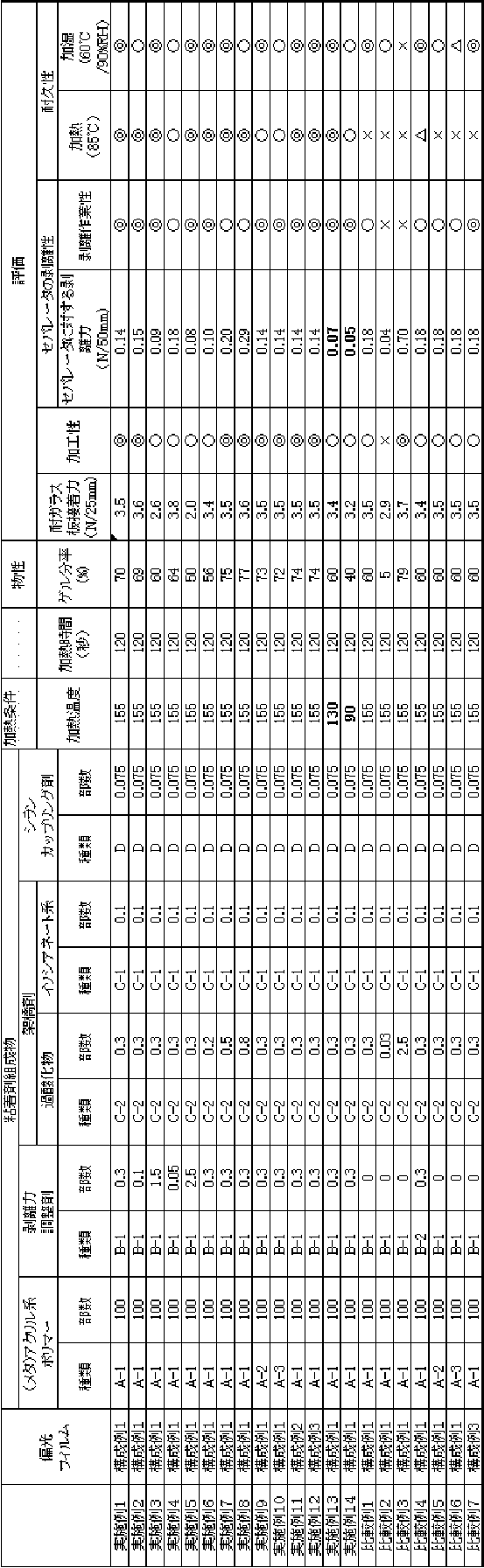
本発明について、偏光フィルムに対するセパレータの剥離力と、セパレータ剥離工程における偏光フィルムのステージからの脱落との関係を明らかにするため、以下の実験を行った。
本実験で使用した偏光フィルムに含まれる偏光膜の作成方法を以下に記載するが、本発明では、以下の方法以外の方法で作成した偏光膜を用いてもよい。A-PET(アモルファス‐ポリエチレンテレフタレート)フィルム、(三菱樹脂(株)製 商品名:ノバクリア SH046 200μm)を基材として用意し、表面にコロナ処理(58W/m2/min)を施した。一方、アセトアセチル変性PVA(日本合成化学工業(株)製 商品名:ゴーセファイマー Z200(重合度1200、ケン化度99.0%以上、アセトアセチル変性度4.6%))を1wt%添加したPVA(重合度4200、ケン化度99.2%)を用意して、乾燥後の膜厚が12μmになるように塗布し、60℃の雰囲気下において熱風乾燥により10分間乾燥して、基材上にPVA系樹脂の層を設けた積層体を作製した。
偏光度P(%)={(Tp-Tc)/(Tp+Tc)}1/2×100
上記の方法で得られた偏光膜の単体透過率は42.5%であり、偏光度は99.99%以上であった。しかし、本発明では、上記の値だけでなく、他の単体透過率及び偏光度を有する偏光膜を用いてもよい。例えば、偏光膜の単体透過率は、40.0%以上であってもよく、好ましくは41.0%以上、より好ましくは41.5%以上、特に好ましくは42.0%以上であるが、これに限られない。また、偏光膜の偏光度は、例えば、好ましくは99.8%以上であってもよく、好ましくは99.9%以上、より好ましくは99.95%以上、特に好ましくは99.99%以上であるが、これに限られない。
偏光膜を保護する保護フィルムは、任意の適切な樹脂フィルムを採用することができる。例えば、保護フィルムの材料として、ノルボルネン系樹脂等のシクロオレフィン系樹脂、ポリエチレン、ポリプロピレン等のオレフィン系樹脂、ポリエステル系樹脂、(メタ)アクリル系樹脂等を用いることができる。なお、「(メタ)アクリル系樹脂」とは、アクリル系樹脂および/またはメタクリル系樹脂をいう。また、保護フィルムの厚みは、典型的には10μmから50μmであり、好ましくは15μmから45μmであるが、他の厚さであってもよい。本実験においては、厚さ20μmの(メタ)アクリル系樹脂を用いた。
上記の通り作成されたA-PETフィルム上に積層された厚みが5μmの偏光膜に対し、A-PETとは反対側の面に、光硬化型接着剤を介して、上記の通り作成された厚さ20μmのアクリル系保護フィルムを貼り合せた。更に、この積層体からPETフィルムを剥離して、偏光膜と保護フィルムとからなる偏光フィルムを得た。次に偏光膜と保護フィルムとからなる偏光フィルムの偏光膜側の面に、厚み20μmの上記実施例1と同様のアクリル系粘着剤層を介して、東レフィルム加工株式会社製のセパレータ(商品名:セラピール、厚み38μm)を貼り合せ、2日間保管した後、粘着剤層の粘着力を低下させるために、セパレータを剥離し、再度剥離したセパレータを貼り合せた。更に、偏光膜と保護フィルムとからなる偏光フィルムの保護フィルム側の面に、厚み5μmのアクリル系接着層を介して、住友スリーエム社製の輝度向上フィルム(商品名:APF、厚み20μm)を貼り合せて実施例Aとしての偏光板1を作製した。
実施例Aとして作製した偏光板1を1か月間、常温で保存して、実施例Bとしての偏光板2を作製した。
実施例Aとして作製した偏光板1を3か月間、常温で保存して、実施例Cとしての偏光板3を作製した。
上記の通り作成されたA-PETフィルムに積層された厚みが5μmの偏光膜に対し、A-PETとは反対側の面に、光硬化型接着剤を介して厚さ40μmのアクリル系保護フィルムを貼り合せた。更に、この積層体からPETフィルムを剥離して、偏光膜と保護フィルムとからなる偏光フィルムを得た。次に偏光膜と保護フィルムとからなる偏光フィルムの偏光膜側の面に、厚み20μmの上記実施例1のアクリル系粘着剤層を介して、実施例Aと同一のセパレータ(厚み38μm)を貼り合せ、2日間保管した後、セパレータを剥離し、再度剥離したセパレータを貼り合せた。更に、偏光膜と保護フィルムとからなる偏光フィルムの保護フィルム側の面に、厚み5μmのアクリル系接着層を介して、実施例Aと同一の輝度向上フィルム(厚み30μm)を貼り合せて、実施例Dとしての偏光板4を作製した。
セパレータを剥離し、再度剥離したセパレータを貼り合せる工程を行わないこと及び粘着剤の過酸化物の量を0.3部から0.2部に減らしたことと以外は実施例Aと同様の方法により実施例Eとしての偏光板5を作製した。
セパレータを剥離し、再度剥離したセパレータを貼り合せる工程を行わないこと及び粘着剤の過酸化物の量を0.3部から0.17部に減らしたこと以外は実施例Dと同様の方法により実施例Fとしての偏光板6を作製した。
セパレータを剥離し、再度剥離したセパレータを貼り合せる工程を行わないこと以外は実施例Aと同様の方法により比較例Aとしての偏光板7を作製した。
セパレータを剥離し、再度剥離したセパレータを貼り合せる工程を行わないこと以外は実施例Dと同様の方法により比較例Bとしての偏光板8を作製した。
本発明では、セパレータを偏光フィルムから剥離するために必要な力である剥離力を測定して、指標とすることによって、粘着剤層の粘着力を規定する。そこで、偏光フィルムに対するセパレータの剥離力の測定を以下の方法で行った。検査環境として、温度23±2℃、湿度65±15%の環境で測定を行った。また、引張試験機には、島津製作所製のオートグラフを剥離力の測定に使用した。この引張試験機は、JISB7221に規定する引張試験機、又はこれに準ずるものである。測定には、後述の実施例AからE及び比較例AからCの偏光板を切断して、長さ150mm×幅50mmの大きさにしたサンプルを用いた。また、図1に示す剥離力試験用の治具100を用意した。この治具100は、金属板101に、偏光板を固定するクリップ102を取り付けたものである。さらに、セパレータに貼り付けて、セパレータを剥離方向へ導いて偏光板から剥離させる導き用のテープを用意した。
ガラス板に対する粘着剤層の接着力の測定は、セパレータに対する剥離力の測定方法と同様の検査環境で、同一の引張試験機を用いて行った。測定対象の偏光板を切断して、25mm×100mmの大きさにして、セパレータを剥がして偏光フィルムとした。そして、むき出しとなった粘着剤層を無アルカリガラス板に貼りつけた。
実際に偏光板からセパレータを剥がす際に不具合が発生しないか、確認するために、図3に示す吸着固定装置300を用いて、以下の実験を各偏光板のサンプル310に対して行った。吸着固定装置300は、複数の吸着口302が設けられた吸着ステージ301と、吸着口302を通じて吸着ステージ301内部に配置された空気通路303と、空気通路の出口に接続されたエア配管304と、エア配管の先端に接続された真空ポンプ305から構成される。吸着固定装置300は、真空ポンプ305によって、エア配管304及び空気通路303を介して、吸着口302において空気を吸い込み、吸着力を発生させる。この吸着力によって、吸着ステージ301に配置された偏光膜のサンプル310を吸着ステージ301面に固定することができる。図3に示すように、吸着口302を下方に向けた吸着ステージ301に偏光板のサンプル310の輝度向上フィルム側を吸着させて固定し、粘着テープを下方からセパレータの一端に貼り付けて、粘着テープを引っ張ることにより、セパレータを剥離して、偏光板が吸着ステージから脱落しないか、確認を行った。偏光板の吸着力は、真空ポンプ305の吸引強さ(ポンプの回転数)によって調整することができ、45KPa(キロパスカル)とした。また、比較例Aについては、吸着固定装置300の吸着力を70KPaとした比較実験も比較例A’として行った。
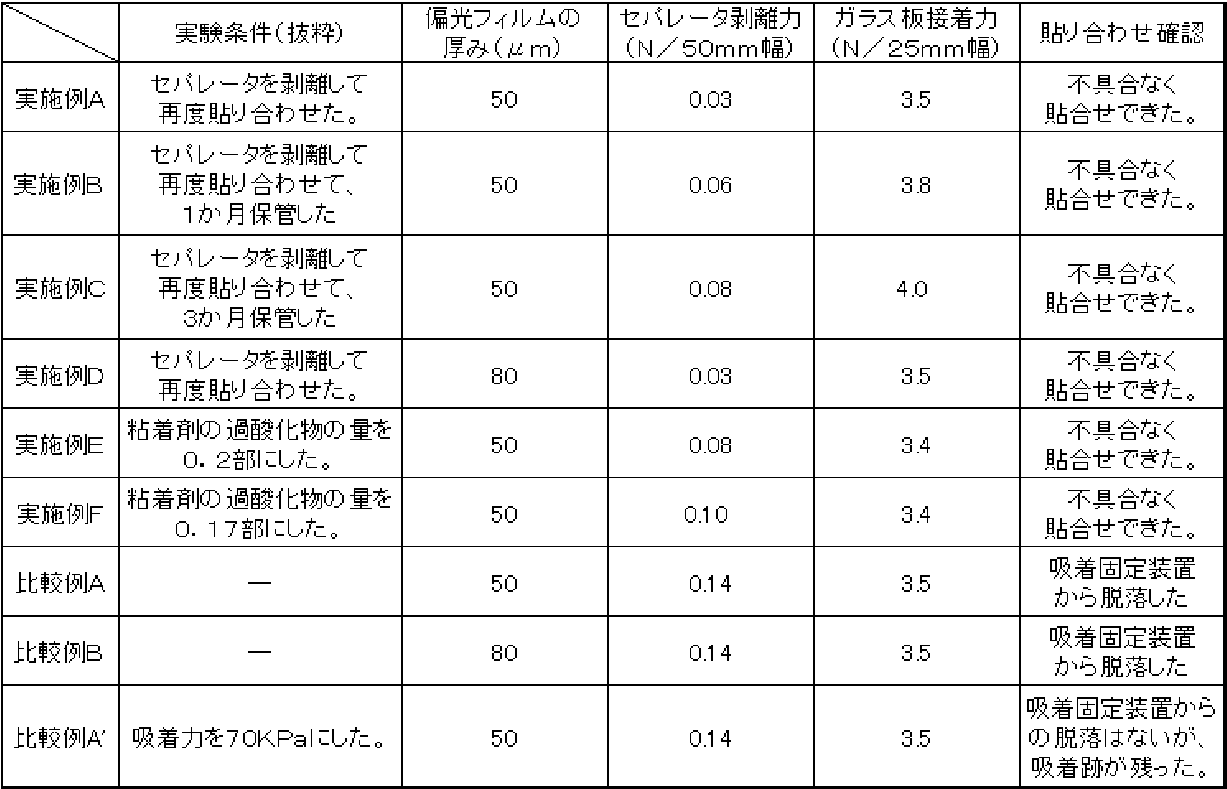
101 金属板
102 クリップ
200 引張試験機
201 引張試験機の上側部
202 引張試験機の下側部
210 導き用のテープ
220 偏光板のサンプル
221 セパレータ
222 偏光板のセパレータが剥がされた部分
300 吸着固定装置
301 吸着ステージ
302 吸着口
303 空気通路
304 エア配管
305 真空ポンプ
310 偏光板のサンプル
Claims (22)
- 剥離処理されたセパレータの剥離処理面に、(メタ)アクリル系ポリマー、過酸化物およびフェノール系酸化防止剤を含有する粘着剤組成物の層を形成する第1工程と、前記第1工程の後に前記粘着剤組成物を加熱し、架橋させて、粘着剤層を形成する第2工程とを含むことを特徴とするセパレータ付粘着剤層の製造方法。
- 前記(メタ)アクリル系ポリマー100重量部に対し、前記フェノール系酸化防止剤を0.05~3重量部含有する請求項1に記載のセパレータ付粘着剤層の製造方法。
- 前記(メタ)アクリル系ポリマー100重量部に対し、前記過酸化物を0.05~2重量部含有する請求項1または2に記載のセパレータ付粘着剤層の製造方法。
- 前記(メタ)アクリル系ポリマーが、モノマー単位として、アルキル(メタ)アクリレートおよびヒドロキシル基含有モノマーを含有するものである請求項1~3のいずれかに記載のセパレータ付粘着剤層の製造方法。
- 前記(メタ)アクリル系ポリマーの重量平均分子量が、50万~300万である請求項1~4のいずれかに記載のセパレータ付粘着剤層の製造方法。
- 前記(メタ)アクリル系ポリマー100重量部に対し、さらに、シランカップリング剤を0.001~5重量部含有する請求項1~5のいずれかに記載のセパレータ付粘着剤層の製造方法。
- 前記第2工程が、前記粘着剤組成物を温度70~170℃で、30~240秒間加熱し、架橋させる工程である請求項1~6のいずれかに記載のセパレータ付粘着剤層の製造方法。
- 請求項1~7のいずれかに記載のセパレータ付粘着剤層の製造方法により製造されたセパレータ付粘着剤層。
- ゲル分率が45~95重量%である請求項8に記載のセパレータ付粘着剤層。
- 前記粘着剤層に対する前記セパレータの剥離力が、0.05~0.30N/50mmである請求項8または9に記載のセパレータ付粘着剤層。
- 偏光子の少なくとも片面に透明保護フィルムを有する偏光フィルムの少なくとも片面に、セパレータ付粘着剤層を粘着剤層側から貼り合わせるセパレータ付粘着剤層付偏光フィルムの製造方法であって、
前記セパレータ付粘着剤層が、請求項8~10のいずれかに記載のセパレータ付粘着剤層であることを特徴とするセパレータ付粘着剤層付偏光フィルムの製造方法。 - 前記偏光フィルムの総厚みが100μm以下である請求項11に記載のセパレータ付粘着剤層付偏光フィルムの製造方法。
- 請求項11または12に記載の製造方法により製造されたセパレータ付粘着剤層付偏光フィルム。
- 請求項13に記載のセパレータ付粘着剤層付偏光フィルムを少なくとも1つ用いたことを特徴とする画像表示装置。
- 偏光膜及び保護フィルムを含む偏光フィルム及び、前記偏光フィルムの前記偏光膜側に積層される粘着剤層を有する、液晶セルに貼られて用いられる光学フィルム積層体であって、
前記偏光フィルムの厚みは、90μm以下であり、
前記粘着剤層は、偏光フィルムに対するセパレータの剥離力が0.10N/50mm幅以下となる粘着力を有する、
ことを特徴とする光学フィルム積層体。 - 前記粘着層は、ガラスに対する偏光フィルムの剥離力が、2.0N/25mm幅以上5.0N/25mm幅以下となる剥離力を有する、
ことを特徴とする請求項15に記載の光学フィルム積層体。 - 前記粘着剤層は、(メタ)アクリル系ポリマー、過酸化物およびフェノール系酸化防止剤を含有する、
ことを特徴とする請求項15又は16に記載の光学フィルム積層体。 - 前記粘着剤層は、前記(メタ)アクリル系ポリマー100重量部に対し、前記フェノール系酸化防止剤を0.3重量部~2.5重量部含有する、
ことを特徴とする請求項15から17のいずれか1項に記載の光学フィルム積層体。 - 前記粘着剤層は、前記(メタ)アクリル系ポリマー100重量部に対し、前記過酸化物を0.17重量部~0.30重量部含有する、
ことを特徴とする請求項15から18のいずれか1項に記載の光学フィルム積層体。 - 前記偏光フィルムは、前記保護フィルム側にさらに輝度向上フィルムを有する、
ことを特徴とする請求項15から19のいずれか1項に記載の光学フィルム積層体積層体。 - 前記粘着剤層は、偏光フィルムに対するセパレータの剥離力が0.08N/50mm幅以下となる粘着力を有する、
ことを特徴とする請求項15から20のいずれか1項に記載の光学フィルム積層体。 - 前記粘着剤層は、偏光フィルムに対するセパレータの剥離力が0.06N/50mm幅以下となる粘着力を有する、
ことを特徴とする請求項15から21のいずれか1項に記載の光学フィルム積層体。
Priority Applications (3)
| Application Number | Priority Date | Filing Date | Title |
|---|---|---|---|
| CN201480035333.6A CN105518092B (zh) | 2013-06-21 | 2014-06-20 | 带隔膜的粘合剂层及其制造方法、带有带隔膜的粘合剂层的偏光膜及其制造方法、以及图像显示装置 |
| US14/900,568 US10551540B2 (en) | 2013-06-21 | 2014-06-20 | Separator-attached adhesive layer structure and production method therefor, separator-attached adhesive layer and polarizing film combination structure and production method therefor, and image display device |
| KR1020167001164A KR102260530B1 (ko) | 2013-06-21 | 2014-06-20 | 세퍼레이터 부착 점착제층 및 그 제조 방법, 세퍼레이터 부착 점착제층 형성 편광 필름 및 그 제조 방법, 그리고 화상 표시 장치 |
Applications Claiming Priority (2)
| Application Number | Priority Date | Filing Date | Title |
|---|---|---|---|
| JP2013130464 | 2013-06-21 | ||
| JP2013-130464 | 2013-06-21 |
Publications (1)
| Publication Number | Publication Date |
|---|---|
| WO2014203995A1 true WO2014203995A1 (ja) | 2014-12-24 |
Family
ID=52104720
Family Applications (1)
| Application Number | Title | Priority Date | Filing Date |
|---|---|---|---|
| PCT/JP2014/066443 Ceased WO2014203995A1 (ja) | 2013-06-21 | 2014-06-20 | セパレータ付粘着剤層およびその製造方法、セパレータ付粘着剤層付偏光フィルムおよびその製造方法、ならびに画像表示装置 |
Country Status (6)
| Country | Link |
|---|---|
| US (1) | US10551540B2 (ja) |
| JP (4) | JP5992473B2 (ja) |
| KR (1) | KR102260530B1 (ja) |
| CN (1) | CN105518092B (ja) |
| TW (2) | TWI695874B (ja) |
| WO (1) | WO2014203995A1 (ja) |
Cited By (3)
| Publication number | Priority date | Publication date | Assignee | Title |
|---|---|---|---|---|
| JP2016157081A (ja) * | 2015-02-26 | 2016-09-01 | 日東電工株式会社 | 位相差層付偏光板および画像表示装置 |
| JP2017207585A (ja) * | 2016-05-17 | 2017-11-24 | 日東電工株式会社 | 光学積層体、ならびに該光学積層体を用いた光学フィルム片の製造方法 |
| WO2024019154A1 (ja) * | 2022-07-22 | 2024-01-25 | 日東電工株式会社 | 粘着剤組成物、粘着シート、粘着シート付き光学フィルム、並びに、粘着シート及び粘着シート付き光学フィルムの製造方法 |
Families Citing this family (23)
| Publication number | Priority date | Publication date | Assignee | Title |
|---|---|---|---|---|
| EP3022543A4 (en) * | 2013-07-18 | 2017-03-01 | Hewlett-Packard Development Company, L.P. | Testing a peel force of an adhesive medium |
| JP2017003906A (ja) * | 2015-06-15 | 2017-01-05 | 日東電工株式会社 | 両面粘着剤層付偏光フィルムおよび画像表示装置 |
| JP7334024B2 (ja) * | 2016-02-08 | 2023-08-28 | 日東電工株式会社 | 光学フィルム及び光学表示パネル |
| JP6771913B2 (ja) * | 2016-03-22 | 2020-10-21 | 日東電工株式会社 | 表面保護フィルム付偏光フィルム、及び偏光フィルムの製造方法 |
| CN108885297A (zh) * | 2016-03-29 | 2018-11-23 | 日东电工株式会社 | 挠性偏振膜、其制造方法及图像显示装置 |
| KR102262499B1 (ko) * | 2016-03-29 | 2021-06-09 | 닛토덴코 가부시키가이샤 | 플렉서블 편광막, 그 제조 방법 및 화상 표시 장치 |
| JPWO2017170516A1 (ja) * | 2016-03-29 | 2018-10-18 | 日東電工株式会社 | フレキシブル偏光膜、その製造方法および画像表示装置 |
| JPWO2017170525A1 (ja) * | 2016-03-29 | 2018-10-18 | 日東電工株式会社 | フレキシブル偏光膜、その製造方法および画像表示装置 |
| JP6905312B2 (ja) | 2016-03-30 | 2021-07-21 | 日東電工株式会社 | 光学フィルム、剥離方法及び光学表示パネルの製造方法 |
| JP2018013583A (ja) * | 2016-07-20 | 2018-01-25 | 住友化学株式会社 | セパレータフィルム積層粘着剤層付き光学フィルム |
| KR101886576B1 (ko) * | 2016-07-20 | 2018-08-07 | 스미또모 가가꾸 가부시키가이샤 | 세퍼레이터 필름 적층 점착제층을 지닌 광학 필름 |
| JP2018022135A (ja) * | 2016-07-20 | 2018-02-08 | 住友化学株式会社 | セパレータフィルム積層粘着剤層付き光学フィルム |
| KR20180034188A (ko) * | 2016-09-27 | 2018-04-04 | 엘지엠엠에이 주식회사 | 광학필름 제조용 도프용액 및 이를 이용한 광학필름 |
| KR102292450B1 (ko) * | 2016-12-28 | 2021-08-20 | 니폰 제온 가부시키가이샤 | 광학 필름의 제조 방법, 편광판, 및 표시 장치 |
| JP6925808B2 (ja) * | 2017-01-26 | 2021-08-25 | 日東電工株式会社 | 光学積層体の製造方法および画像表示装置の製造方法 |
| JP2018120119A (ja) * | 2017-01-26 | 2018-08-02 | 日東電工株式会社 | 光学積層体および画像表示装置 |
| JPWO2018174012A1 (ja) * | 2017-03-23 | 2019-12-12 | 日東電工株式会社 | 光学積層体 |
| WO2019073869A1 (ja) * | 2017-10-13 | 2019-04-18 | 住友化学株式会社 | 樹脂及び粘着剤組成物 |
| JP2019109329A (ja) * | 2017-12-18 | 2019-07-04 | 住友化学株式会社 | 積層体 |
| KR102126055B1 (ko) * | 2017-12-22 | 2020-06-23 | 삼성에스디아이 주식회사 | 편광판 및 이를 포함하는 광학표시장치 |
| JP2020052170A (ja) * | 2018-09-26 | 2020-04-02 | 住友化学株式会社 | 光学積層体 |
| KR20220156846A (ko) * | 2020-03-31 | 2022-11-28 | 닛토덴코 가부시키가이샤 | 세퍼레이터를 갖는 점착체 |
| CN116997625A (zh) * | 2021-03-29 | 2023-11-03 | 住友化学株式会社 | 无基材双面粘合片 |
Citations (9)
| Publication number | Priority date | Publication date | Assignee | Title |
|---|---|---|---|---|
| JP2002030264A (ja) * | 2000-07-18 | 2002-01-31 | Lintec Corp | 粘着剤組成物及びそれを用いた粘着性光学部材 |
| JP2003049143A (ja) * | 2001-05-31 | 2003-02-21 | Soken Chem & Eng Co Ltd | 光学フィルム用粘着剤及び該粘着剤を用いた光学フィルム |
| JP2006299257A (ja) * | 2005-03-25 | 2006-11-02 | Kaneka Corp | 接着剤組成物 |
| JP2008176270A (ja) * | 2006-12-19 | 2008-07-31 | Nitto Denko Corp | 粘着型光学フィルムおよび画像表示装置 |
| JP2008174595A (ja) * | 2007-01-16 | 2008-07-31 | Somar Corp | 冷却剥離型粘着剤組成物及びこれを用いた冷却剥離型粘着シート |
| JP2009120805A (ja) * | 2007-10-22 | 2009-06-04 | Nitto Denko Corp | 光学フィルム用粘着剤組成物、光学フィルム用粘着剤層、その製造方法、粘着型光学フィルムおよび画像表示装置 |
| WO2010126054A1 (ja) * | 2009-04-30 | 2010-11-04 | 日東電工株式会社 | 光学フィルム用粘着剤組成物、光学フィルム用粘着剤層、粘着型光学フィルムおよび画像表示装置 |
| JP2012097162A (ja) * | 2010-10-29 | 2012-05-24 | Cheil Industries Inc | 粘着剤組成物 |
| JP2012140579A (ja) * | 2010-12-13 | 2012-07-26 | Nitto Denko Corp | 光学フィルム用粘着剤組成物、光学フィルム用粘着剤層、粘着型光学フィルム、および画像表示装置 |
Family Cites Families (17)
| Publication number | Priority date | Publication date | Assignee | Title |
|---|---|---|---|---|
| JPS62253681A (ja) * | 1985-07-11 | 1987-11-05 | Dainippon Ink & Chem Inc | ノンカ−ル性粘着シ−トの製造方法並びに装置 |
| TW554025B (en) | 2000-04-13 | 2003-09-21 | Lintec Corp | Adhesive compositions and adhesive optical elements using thereof |
| JP3822213B2 (ja) | 2004-06-03 | 2006-09-13 | 日東電工株式会社 | 剥離力調整方法、光学部材用粘着剤層およびその製造方法、ならびに粘着剤付光学部材 |
| JP3916638B2 (ja) | 2004-12-02 | 2007-05-16 | 日東電工株式会社 | 粘着型光学フィルムおよび画像表示装置 |
| JP4869015B2 (ja) | 2005-10-18 | 2012-02-01 | 日東電工株式会社 | 粘着剤組成物、粘着剤層およびその製造方法、ならびに粘着剤付光学部材 |
| US8663798B2 (en) * | 2006-12-19 | 2014-03-04 | Nitto Denko Corporation | Pressure-sensitive adhesive optical film and image display |
| JP2010133987A (ja) * | 2007-03-12 | 2010-06-17 | Toagosei Co Ltd | 光学フィルム積層体及びそれを用いた表示装置 |
| JP5004655B2 (ja) * | 2007-05-18 | 2012-08-22 | 日東電工株式会社 | 光重合物層の製造方法 |
| EP2053109A1 (en) * | 2007-10-22 | 2009-04-29 | Nitto Denko Corporation | Pressure-sensitive adhesive composition for optical film, pressure-sensitive adhesive layer for optical film, production method thereof, pressure-sensitive adhesive optical film and image display |
| JP2010152334A (ja) * | 2008-11-25 | 2010-07-08 | Nitto Denko Corp | 偏光板付ガラス板の製造方法、偏光板付ガラス板、偏光板付液晶セル |
| JP5187973B2 (ja) | 2009-04-30 | 2013-04-24 | 日東電工株式会社 | 光学フィルム用粘着剤組成物、光学フィルム用粘着剤層、粘着型光学フィルムおよび画像表示装置 |
| CN102464960B (zh) * | 2010-10-29 | 2014-10-15 | 第一毛织株式会社 | 粘合剂组合物、光学元件、表面保护膜和粘合剂片 |
| JP2013125262A (ja) * | 2011-12-16 | 2013-06-24 | Technology Research Association For Advanced Display Materials | 貼合材料、表示素子及び表示素子の製造方法 |
| JP5976528B2 (ja) * | 2012-12-27 | 2016-08-23 | リンテック株式会社 | 再剥離性粘着シートの製造方法 |
| JP6370029B2 (ja) * | 2013-03-13 | 2018-08-08 | 日東電工株式会社 | 粘着剤層付偏光フィルムおよび画像表示装置 |
| JP6391916B2 (ja) * | 2013-06-21 | 2018-09-19 | 日東電工株式会社 | 光学用粘着剤層、粘着剤層付光学フィルムおよび画像表示装置 |
| JP6138002B2 (ja) * | 2013-09-09 | 2017-05-31 | 日東電工株式会社 | 透明導電膜用粘着剤層付偏光フィルム、積層体、及び、画像表示装置 |
-
2014
- 2014-06-20 JP JP2014126889A patent/JP5992473B2/ja active Active
- 2014-06-20 KR KR1020167001164A patent/KR102260530B1/ko active Active
- 2014-06-20 CN CN201480035333.6A patent/CN105518092B/zh active Active
- 2014-06-20 WO PCT/JP2014/066443 patent/WO2014203995A1/ja not_active Ceased
- 2014-06-20 TW TW103137796A patent/TWI695874B/zh active
- 2014-06-20 TW TW103121363A patent/TWI695047B/zh active
- 2014-06-20 US US14/900,568 patent/US10551540B2/en active Active
-
2015
- 2015-05-20 JP JP2015102884A patent/JP2015165030A/ja active Pending
- 2015-09-24 JP JP2015186457A patent/JP6045669B2/ja active Active
-
2016
- 2016-08-17 JP JP2016159984A patent/JP6045742B1/ja active Active
Patent Citations (9)
| Publication number | Priority date | Publication date | Assignee | Title |
|---|---|---|---|---|
| JP2002030264A (ja) * | 2000-07-18 | 2002-01-31 | Lintec Corp | 粘着剤組成物及びそれを用いた粘着性光学部材 |
| JP2003049143A (ja) * | 2001-05-31 | 2003-02-21 | Soken Chem & Eng Co Ltd | 光学フィルム用粘着剤及び該粘着剤を用いた光学フィルム |
| JP2006299257A (ja) * | 2005-03-25 | 2006-11-02 | Kaneka Corp | 接着剤組成物 |
| JP2008176270A (ja) * | 2006-12-19 | 2008-07-31 | Nitto Denko Corp | 粘着型光学フィルムおよび画像表示装置 |
| JP2008174595A (ja) * | 2007-01-16 | 2008-07-31 | Somar Corp | 冷却剥離型粘着剤組成物及びこれを用いた冷却剥離型粘着シート |
| JP2009120805A (ja) * | 2007-10-22 | 2009-06-04 | Nitto Denko Corp | 光学フィルム用粘着剤組成物、光学フィルム用粘着剤層、その製造方法、粘着型光学フィルムおよび画像表示装置 |
| WO2010126054A1 (ja) * | 2009-04-30 | 2010-11-04 | 日東電工株式会社 | 光学フィルム用粘着剤組成物、光学フィルム用粘着剤層、粘着型光学フィルムおよび画像表示装置 |
| JP2012097162A (ja) * | 2010-10-29 | 2012-05-24 | Cheil Industries Inc | 粘着剤組成物 |
| JP2012140579A (ja) * | 2010-12-13 | 2012-07-26 | Nitto Denko Corp | 光学フィルム用粘着剤組成物、光学フィルム用粘着剤層、粘着型光学フィルム、および画像表示装置 |
Cited By (7)
| Publication number | Priority date | Publication date | Assignee | Title |
|---|---|---|---|---|
| JP2016157081A (ja) * | 2015-02-26 | 2016-09-01 | 日東電工株式会社 | 位相差層付偏光板および画像表示装置 |
| WO2016136509A1 (ja) * | 2015-02-26 | 2016-09-01 | 日東電工株式会社 | 位相差層付偏光板および画像表示装置 |
| US10156671B2 (en) | 2015-02-26 | 2018-12-18 | Nitto Denko Corporation | Polarizing plate with phase-difference layer and image display device |
| JP2017207585A (ja) * | 2016-05-17 | 2017-11-24 | 日東電工株式会社 | 光学積層体、ならびに該光学積層体を用いた光学フィルム片の製造方法 |
| WO2024019154A1 (ja) * | 2022-07-22 | 2024-01-25 | 日東電工株式会社 | 粘着剤組成物、粘着シート、粘着シート付き光学フィルム、並びに、粘着シート及び粘着シート付き光学フィルムの製造方法 |
| JP2024014616A (ja) * | 2022-07-22 | 2024-02-01 | 日東電工株式会社 | 粘着剤組成物、粘着シート、粘着シート付き光学フィルム、並びに、粘着シート及び粘着シート付き光学フィルムの製造方法 |
| JP7644735B2 (ja) | 2022-07-22 | 2025-03-12 | 日東電工株式会社 | 粘着剤組成物、粘着シート、粘着シート付き光学フィルム、並びに、粘着シート及び粘着シート付き光学フィルムの製造方法 |
Also Published As
| Publication number | Publication date |
|---|---|
| JP2016033215A (ja) | 2016-03-10 |
| JP6045669B2 (ja) | 2016-12-14 |
| JP2017016137A (ja) | 2017-01-19 |
| KR102260530B1 (ko) | 2021-06-03 |
| JP6045742B1 (ja) | 2016-12-14 |
| US10551540B2 (en) | 2020-02-04 |
| KR20160023781A (ko) | 2016-03-03 |
| TW201506122A (zh) | 2015-02-16 |
| JP5992473B2 (ja) | 2016-09-14 |
| JP2015165030A (ja) | 2015-09-17 |
| TW201510133A (zh) | 2015-03-16 |
| US20160161652A1 (en) | 2016-06-09 |
| CN105518092A (zh) | 2016-04-20 |
| TWI695047B (zh) | 2020-06-01 |
| TWI695874B (zh) | 2020-06-11 |
| CN105518092B (zh) | 2019-04-23 |
| JP2015025125A (ja) | 2015-02-05 |
Similar Documents
| Publication | Publication Date | Title |
|---|---|---|
| JP6045742B1 (ja) | セパレータ付粘着剤層およびその製造方法、セパレータ付粘着剤層付偏光フィルムおよびその製造方法、ならびに画像表示装置 | |
| JP5860673B2 (ja) | 粘着剤組成物、粘着剤層、粘着剤層付偏光板および画像形成装置 | |
| JP6105314B2 (ja) | アクリル系またはシクロオレフィン系偏光フィルム用粘着剤組成物、粘着剤層、粘着剤層付アクリル系またはシクロオレフィン系偏光フィルムおよび画像形成装置 | |
| JP6370029B2 (ja) | 粘着剤層付偏光フィルムおよび画像表示装置 | |
| JP6725674B2 (ja) | 光学用粘着剤層、光学用粘着剤層の製造方法、粘着剤層付光学フィルム、及び、画像表示装置 | |
| JP5875106B2 (ja) | 粘着剤組成物、粘着剤層、粘着剤層付偏光板および画像形成装置 | |
| JP6916196B2 (ja) | 光学用粘着剤層、光学用粘着剤層の製造方法、粘着剤層付光学フィルム、及び、画像表示装置 | |
| JP5425258B2 (ja) | 粘着剤組成物、粘着剤層、粘着剤層付偏光フィルムおよび画像形成装置 | |
| JP7128945B2 (ja) | 光学用粘着剤層、光学用粘着剤層の製造方法、粘着剤層付光学フィルム、及び、画像表示装置 | |
| JP2012247574A (ja) | 粘着型偏光板および画像表示装置 | |
| JP2018163302A (ja) | 粘着剤層付偏光フィルムおよび画像表示装置 | |
| JP6038268B2 (ja) | 粘着剤組成物、粘着剤層、粘着剤層付偏光板および画像形成装置 | |
| JP2019085436A (ja) | 光学フィルム用粘着剤組成物、光学フィルム用粘着剤層、及び、粘着剤層付光学フィルム | |
| JP7307749B2 (ja) | 光学フィルム用粘着剤組成物、光学フィルム用粘着剤層、及び、粘着剤層付光学フィルム | |
| JP2016028289A (ja) | 粘着型偏光板および画像表示装置 | |
| JP2016028287A (ja) | 粘着型偏光板および画像表示装置 |
Legal Events
| Date | Code | Title | Description |
|---|---|---|---|
| 121 | Ep: the epo has been informed by wipo that ep was designated in this application |
Ref document number: 14814143 Country of ref document: EP Kind code of ref document: A1 |
|
| NENP | Non-entry into the national phase |
Ref country code: DE |
|
| WWE | Wipo information: entry into national phase |
Ref document number: 14900568 Country of ref document: US |
|
| ENP | Entry into the national phase |
Ref document number: 20167001164 Country of ref document: KR Kind code of ref document: A |
|
| 122 | Ep: pct application non-entry in european phase |
Ref document number: 14814143 Country of ref document: EP Kind code of ref document: A1 |