WO2014199892A1 - 太陽電池用封止材組成物およびその製造方法、ならびに、それを用いた太陽電池用封止材層および太陽電池モジュール - Google Patents
太陽電池用封止材組成物およびその製造方法、ならびに、それを用いた太陽電池用封止材層および太陽電池モジュール Download PDFInfo
- Publication number
- WO2014199892A1 WO2014199892A1 PCT/JP2014/064943 JP2014064943W WO2014199892A1 WO 2014199892 A1 WO2014199892 A1 WO 2014199892A1 JP 2014064943 W JP2014064943 W JP 2014064943W WO 2014199892 A1 WO2014199892 A1 WO 2014199892A1
- Authority
- WO
- WIPO (PCT)
- Prior art keywords
- solar cell
- ethylene
- ethylene copolymer
- copolymer
- cell encapsulant
- Prior art date
- Legal status (The legal status is an assumption and is not a legal conclusion. Google has not performed a legal analysis and makes no representation as to the accuracy of the status listed.)
- Ceased
Links
Images


Classifications
-
- C—CHEMISTRY; METALLURGY
- C09—DYES; PAINTS; POLISHES; NATURAL RESINS; ADHESIVES; COMPOSITIONS NOT OTHERWISE PROVIDED FOR; APPLICATIONS OF MATERIALS NOT OTHERWISE PROVIDED FOR
- C09D—COATING COMPOSITIONS, e.g. PAINTS, VARNISHES OR LACQUERS; FILLING PASTES; CHEMICAL PAINT OR INK REMOVERS; INKS; CORRECTING FLUIDS; WOODSTAINS; PASTES OR SOLIDS FOR COLOURING OR PRINTING; USE OF MATERIALS THEREFOR
- C09D123/00—Coating compositions based on homopolymers or copolymers of unsaturated aliphatic hydrocarbons having only one carbon-to-carbon double bond; Coating compositions based on derivatives of such polymers
- C09D123/02—Coating compositions based on homopolymers or copolymers of unsaturated aliphatic hydrocarbons having only one carbon-to-carbon double bond; Coating compositions based on derivatives of such polymers not modified by chemical after-treatment
- C09D123/04—Homopolymers or copolymers of ethene
- C09D123/08—Copolymers of ethene
- C09D123/0846—Copolymers of ethene with unsaturated hydrocarbons containing other atoms than carbon or hydrogen atoms
- C09D123/0853—Vinylacetate
-
- H—ELECTRICITY
- H10—SEMICONDUCTOR DEVICES; ELECTRIC SOLID-STATE DEVICES NOT OTHERWISE PROVIDED FOR
- H10F—INORGANIC SEMICONDUCTOR DEVICES SENSITIVE TO INFRARED RADIATION, LIGHT, ELECTROMAGNETIC RADIATION OF SHORTER WAVELENGTH OR CORPUSCULAR RADIATION
- H10F19/00—Integrated devices, or assemblies of multiple devices, comprising at least one photovoltaic cell covered by group H10F10/00, e.g. photovoltaic modules
- H10F19/80—Encapsulations or containers for integrated devices, or assemblies of multiple devices, having photovoltaic cells
- H10F19/804—Materials of encapsulations
-
- C—CHEMISTRY; METALLURGY
- C08—ORGANIC MACROMOLECULAR COMPOUNDS; THEIR PREPARATION OR CHEMICAL WORKING-UP; COMPOSITIONS BASED THEREON
- C08L—COMPOSITIONS OF MACROMOLECULAR COMPOUNDS
- C08L2203/00—Applications
- C08L2203/20—Applications use in electrical or conductive gadgets
- C08L2203/204—Applications use in electrical or conductive gadgets use in solar cells
-
- Y—GENERAL TAGGING OF NEW TECHNOLOGICAL DEVELOPMENTS; GENERAL TAGGING OF CROSS-SECTIONAL TECHNOLOGIES SPANNING OVER SEVERAL SECTIONS OF THE IPC; TECHNICAL SUBJECTS COVERED BY FORMER USPC CROSS-REFERENCE ART COLLECTIONS [XRACs] AND DIGESTS
- Y02—TECHNOLOGIES OR APPLICATIONS FOR MITIGATION OR ADAPTATION AGAINST CLIMATE CHANGE
- Y02E—REDUCTION OF GREENHOUSE GAS [GHG] EMISSIONS, RELATED TO ENERGY GENERATION, TRANSMISSION OR DISTRIBUTION
- Y02E10/00—Energy generation through renewable energy sources
- Y02E10/50—Photovoltaic [PV] energy
Definitions
- the present invention relates to a solar cell encapsulant composition and a method for producing the same, and a solar cell encapsulant layer and a solar cell module using the same.
- a solar cell module generally has a structure in which a glass substrate, a solar cell encapsulant, a power generation element, a solar cell encapsulant, and a back sheet are sequentially laminated.
- the said solar cell sealing material uses the resin sheet which uses an ethylene-type copolymer as a matrix from viewpoints, such as low cost and high transmittance
- the ethylene copolymer contains an organic peroxide, a crosslinking aid and the like in order to improve durability.
- a silane coupling agent is generally blended in order to ensure the adhesiveness of organic substances, glass, and solar cell elements having an absorption region in the ultraviolet region such as an ultraviolet absorber. ing.
- the sheet-shaped solar cell encapsulant is molded by a T-die extrusion film forming machine or a calendar molding machine.
- the above-mentioned additives are pre-dry blended into an ethylene copolymer, then supplied from a hopper of a T-die extruder, and extruded into a sheet at a molding temperature at which the organic peroxide is not substantially decomposed.
- a method see, for example, Patent Document 1).
- a masterbatch is prepared by kneading only an organic substance having a high melting point above its melting point into the ethylene copolymer in advance using a melt kneader such as a twin-screw extruder, and the masterbatch is obtained as an ethylene copolymer. And a method of melting and kneading together with an organic peroxide at a low temperature to form a sheet.
- a melt kneader such as a twin-screw extruder
- the present invention is a solar in which an organic compound additive having a melting point higher than the molding temperature is uniformly dispersed in an ethylene copolymer at a molding temperature at which the organic peroxide is not substantially decomposed. It aims at providing the composition for batteries, and its manufacturing method.
- the present invention also provides a solar cell encapsulant layer in which an organic compound additive having a melting point higher than the molding temperature is uniformly dispersed in an ethylene copolymer, and a solar cell module using the same. For the purpose.
- the present inventors have found the following solar cell encapsulant composition and method for producing the same, and solar cell encapsulant layer and solar cell module using the same.
- the inventors have found that the above object can be achieved, and have completed the present invention.
- the manufacturing method of the sealing material composition for solar cells of this invention is a manufacturing method of the sealing material composition for solar cells containing an ethylene-type copolymer (A) and an organic compound additive (B),
- the ethylene copolymer (A) and the organic polymer are within a temperature range from the Vicat softening point of the ethylene copolymer (A) to 10 ° C. below the melting point of the ethylene copolymer (A).
- a blending step of mixing the compound additive (B) is included.
- an organic compound additive having a melting point higher than the molding temperature at an molding temperature at which the organic peroxide is not substantially decomposed is ethylene-based. It becomes possible to disperse uniformly in the coalescence. Further, even when a liquid additive is contained, a resin composition that does not block and that does not block the liquid component does not remain on the resin surface due to impregnation or dispersion inside the resin.
- the dispersion state of the organic compound having a high melting point is improved by stirring and mixing in the above temperature range.
- the temperature is below the Vicat softening point
- the high melting point compound is difficult to adhere to the resin (particularly in the case of pellets)
- the temperature is not lower than 10 ° C. below the melting point
- the resins block each other. End up. More specifically, when blending for a long time without controlling the temperature during the blending step (pre-blending) as in the past, the internal temperature increases due to friction between the pellets and rotating blades, friction between the pellets, and the like. Therefore, the resins may be blocked.
- pre-blending within the above temperature range in the present invention, the above problem can be effectively avoided.
- the ethylene copolymer (A) is preferably in the form of pellets.
- an ethylene-based resin that is a matrix resin for a solar cell encapsulant layer even if it is a pellet-shaped ethylene copolymer that is generally less likely to mix and disperse additives than powder. It becomes possible to disperse uniformly in the copolymer. Moreover, it becomes possible to use a pellet and the production workability of the solar cell sealing material composition is improved.
- the pellet shape means a particle shape having a diameter or length of about 1 to 10 mm mainly for improving workability, for example, a substantially cylindrical shape, a substantially spherical shape, a substantially disk shape, Examples thereof include grains having a substantially triangular prism shape, a substantially quadrangular prism shape, a substantially polyhedral shape, an elliptical spherical shape, and the like.
- the organic peroxide (C) is further included, and melting
- the temperature is preferably 10 ° C. or more lower than the one-hour half-life temperature of the peroxide (C).
- the organic compound additive (B) having a melting point near or higher than the one-hour half-life temperature of the organic peroxide (C), which is usually difficult to disperse uniformly.
- the organic compound additive (B) can be uniformly dispersed in the ethylene copolymer without substantially decomposing the organic peroxide.
- the method for producing a solar cell encapsulant composition of the present invention it is preferable that no solvent is used in the blending step.
- a separate solvent other than the components of the solar cell encapsulant composition such as a liquid additive (dry process)
- An organic compound additive having a melting point higher than the molding temperature can be uniformly dispersed in the ethylene-based copolymer.
- a liquid additive may be further included in the blending step.
- a liquid additive such as a silane coupling agent or a liquid crosslinking aid
- liquid components do not remain on the resin surface due to impregnation or dispersion inside the resin, and blocking is also possible. Can be obtained.
- a master batch can also be easily produced.
- the said liquid additive means the additive which is liquid at the time of a blending process, and the compound whose melting
- a melt-kneading step after the blending step.
- a composition for a solar cell in which an organic compound additive having a melting point higher than the molding temperature after the melt-kneading step is uniformly dispersed in the ethylene copolymer can be easily obtained, rather than going through the blending step first.
- a sheet having a high dispersibility of the organic compound having a high melting point can be formed even in a melt-kneading process at a temperature lower than usual.
- the melt kneading step is preferably performed by a single screw extruder, a twin screw extruder, a Banbury mixer, a kneader, or a mixing roll.
- distributed to the ethylene-type copolymer can be obtained more effectively.
- the sheet is formed (formation of the sealing material layer) by calendar extrusion, T-die, or melt extrusion by inflation.
- the said organic compound additive (B) is a ultraviolet absorber, antioxidant, light stabilizer, anti-aging agent, or solid bridge
- An auxiliary is preferred.
- the ethylene copolymer contains an ethylene-vinyl acetate copolymer as a main component.
- an ethylene-vinyl acetate copolymer as a main component as the ethylene-based copolymer, a solar cell encapsulant layer having more excellent light transmittance and durability can be obtained more reliably.
- the said main component shall mean the case where 50 weight% or more is contained by weight ratio, when the matrix resin of the said solar cell sealing material composition is a mixture of several resin.
- the weight ratio is more preferably 70% by weight or more, and still more preferably 90% by weight or more.
- the solar cell encapsulant layer of the present invention is characterized by being formed using the solar cell encapsulant composition.
- the sealing material layer for solar cells in which the organic compound additive which has melting
- the solar cell module of the present invention is characterized by including a solar cell encapsulant layer formed using the solar cell encapsulant composition. Since the said solar cell module has the said solar cell sealing material layer, it becomes a solar cell module by which the organic compound additive which has melting
- the solar cell is a crystalline silicon solar cell, a cadmium sulfide / cadmium telluride solar cell, a copper indium gallium diselenide solar cell, an amorphous silicon solar cell, or a microcrystalline silicon.
- a solar cell is preferred.
- the said solar cell module can improve photoelectric conversion efficiency more effectively by using it for the solar cell module which laminates
- the example of the solar cell module using the sealing material layer for solar cells of this invention is shown.
- the example of the solar cell module using the sealing material layer for solar cells of this invention is shown.
- the manufacturing method of the sealing material composition for solar cells of this invention is a manufacturing method of the sealing material composition for solar cells containing an ethylene-type copolymer (A) and an organic compound additive (B),
- the ethylene copolymer (A) and the organic polymer are within a temperature range from the Vicat softening point of the ethylene copolymer (A) to 10 ° C. below the melting point of the ethylene copolymer (A).
- a blending step of mixing the compound additive (B) is included.
- the solar cell encapsulant composition of the present invention is characterized by containing at least an ethylene copolymer (A) and an organic compound additive (B).
- the solar cell encapsulant composition includes, for example, at least an organic compound additive (B) dispersed in an optically transparent matrix resin containing an ethylene copolymer (A) as a main component. Or the like.
- Examples of the ethylene copolymer (A) include a copolymer of ethylene and a polar monomer, and a copolymer of ethylene and an ⁇ -olefin having 3 or more carbon atoms.
- the ethylene unit content is preferably 50 to 90% by weight, more preferably 60 to 80% by weight, and even more preferably 65 to 75% by weight. .
- flexibility, transparency, a moldability, blocking resistance, and a solar cell element protective property can be obtained more reliably.
- Examples of the polar monomer include vinyl esters such as vinyl acetate and vinyl propionate, methyl acrylate, ethyl acrylate, isopropyl acrylate, isobutyl acrylate, n-butyl acrylate, isooctyl acrylate, methyl methacrylate, methacrylic acid
- Unsaturated carboxylic acid esters such as isobutyl acid, dimethyl maleate, acrylic acid, methacrylic acid, fumaric acid, itaconic acid, monomethyl maleate, monoethyl maleate, maleic anhydride, itaconic anhydride, and the like, and Examples of these salts include carboxylates.
- Examples of the carboxylic acid salt include monovalent metals such as lithium, sodium and potassium, and salts of polyvalent metals such as magnesium, calcium and zinc. These may be used singly or in combination of two or more.
- Examples of the ⁇ -olefin having 3 or more carbon atoms include propylene, 1-butene, 2-butene, 1-hexene, 1-octene, 4-methyl-1-pentene and the like. These may be used singly or in combination of two or more.
- Examples of the ethylene copolymer (A) include ethylene-vinyl ester copolymers such as ethylene-vinyl acetate copolymers, ethylene-methyl acrylate copolymers, ethylene-ethyl acrylate copolymers, ethylene -Methyl methacrylate copolymer, ethylene-isobutyl acrylate copolymer, ethylene-unsaturated carboxylic acid ester copolymer such as ethylene / n-butyl acrylate copolymer, ethylene-acrylic acid copolymer, ethylene -Methacrylic acid copolymer, ethylene-unsaturated carboxylic acid copolymer such as ethylene / isobutyl acrylate-methacrylic acid copolymer and its ionomer. These may be used singly or in combination of two or more.
- the ethylene-based copolymer (A) preferably contains an ethylene-vinyl acetate copolymer as a main component.
- an ethylene-vinyl acetate copolymer as a main component as the ethylene-based copolymer, a solar cell encapsulant layer having more excellent light transmittance and durability can be obtained more reliably.
- the ethylene-vinyl acetate copolymer (A) preferably has a vinyl acetate monomer unit content of 20 to 40 parts by weight with respect to 100 parts by weight of the ethylene-vinyl acetate copolymer, The content is more preferably 35 parts by weight, and the above content is preferable from the viewpoint of uniform dispersibility in a matrix resin such as a rare earth complex.
- ethylene-vinyl acetate copolymer (A) When using the ethylene-vinyl acetate copolymer (A), commercially available products can be used as appropriate.
- examples of commercially available ethylene-vinyl acetate copolymers include Ultrasen (manufactured by Tosoh Corporation), Everflex (manufactured by Mitsui DuPont Polychemical Co., Ltd.), Suntec EVA (manufactured by Asahi Kasei Chemicals Corporation), UBE EVA copolymer ( Ube Maruzen Polyethylene Co., Ltd.), Evertate (Sumitomo Chemical Co., Ltd.), Novatec EVA (Nihon Polyethylene Co., Ltd.), Smitate (Sumitomo Chemical Co., Ltd.), Nipoflex (Tosoh Corp.), and the like. These may be used singly or in combination of two or more.
- the refractive index of the ethylene-vinyl acetate copolymer (A) is, for example, in the range of 1.4 to 1.7, in the range of 1.45 to 1.65, or in the range of 1.45 to 1.55. is there. In some embodiments, the ethylene-vinyl acetate copolymer (A) has a refractive index of 1.5.
- an optically transparent matrix resin as the solar cell encapsulant composition.
- said matrix resin you may use suitably other matrix resin with the said ethylene-type copolymer (A), unless the characteristic of the said ethylene-type copolymer (A) is impaired.
- other matrix resins include polyolefins such as polyethylene terephthalate, poly (meth) acrylate, polyethylene tetrafluoroethylene, polyimide, amorphous polycarbonate, siloxane sol-gel, polyurethane, polystyrene, polyethersulfone, polyarylate And epoxy resins and silicone resins. These matrix resins may be used alone or in admixture of two or more.
- a crosslinkable monomer may be added to obtain a resin having a crosslinked structure.
- crosslinkable monomer examples include compounds obtained by reacting ⁇ , ⁇ -unsaturated carboxylic acid with dicyclopentenyl (meth) acrylate, tetrahydrofurfuryl (meth) acrylate, benzyl (meth) acrylate, and polyhydric alcohol (for example, polyethylene glycol di (meth) acrylate (having 2 to 14 ethylene groups), trimethylolpropane di (meth) acrylate, trimethylolpropane tri (meth) acrylate, trimethylolpropane ethoxytri (meth) acrylate, Trimethylolpropane propoxy tri (meth) acrylate, tetramethylol methane tri (meth) acrylate, tetramethylol methane tetra (meth) acrylate, polypropylene glycol di (meth) acrylate (pro Having 2 to 14 pyrene groups), dipentaerythritol penta (
- crosslinkable monomers may be used alone or in admixture of two or more.
- trimethylolpropane tri (meth) acrylate, dipentaerythritol tetra (meth) acrylate, dipentaerythritol hexa (meth) acrylate, and bisphenol A polyoxyethylene dimethacrylate are preferred as the crosslinkable monomer.
- a thermal polymerization initiator or a photopolymerization initiator can be added to the crosslinkable monomer, and polymerized and crosslinked by heating or light irradiation to form a crosslinked structure.
- thermoplastic resin polymerization initiator examples include 2,5-dimethylhexane-2,5-dihydroperoxide, 2,5-dimethyl-2,5-di (t-butylperoxy) hexane-3, Di-t-butyl peroxide, dicumyl peroxide, 2,5-dimethyl-2,5-di (t-butylperoxy) hexane, dicumyl peroxide, ⁇ , ⁇ '-bis (t-butylperoxy) Isopropyl) benzene, n-butyl-4,4-bis (t-butylperoxy) butane, 2,2-bis (t-butylperoxy) butane, 1,1-bis (t-butylperoxy) cyclohexane, 1,1-bis (t-butylperoxy) 3,3,5-trimethylcyclohexane, t-butyl
- the blending amount of the thermal polymerization initiator can be, for example, 0.1 to 2 parts by weight with respect to 100 parts by weight of the matrix resin.
- the photopolymerization initiator a known photoinitiator that generates a free radical by ultraviolet light or visible light can be appropriately used.
- the photopolymerization initiator include benzoin ethers such as benzoin methyl ether, benzoin ethyl ether, benzoin propyl ether, benzoin isobutyl ether, and benzoin phenyl ether, benzophenone, N, N′-tetramethyl-4,4′-diamino Benzophenones (Michler's ketone), benzophenones such as N, N′-tetraethyl-4,4′-diaminobenzophenone, benzyl ketals such as benzyldimethyl ketal (manufactured by Ciba Japan Chemicals, Irgacure 651), benzyl diethyl ketal, Acetophenones such as 2,2-dimethoxy-2-phenylacetophenone,
- photopolymerization initiator examples include a combination of 2,4,5-triallylimidazole dimer and 2-mercaptobenzoxazole, leucocrystal violet, tris (4-diethylamino-2-methylphenyl) methane, and the like. Etc. Further, for example, known additives may be used as appropriate, such as tertiary amines such as triethanolamine for benzophenone.
- the blending amount of the photopolymerization initiator is usually 0.1 to 5 parts by weight with respect to 100 parts by weight of the matrix resin, for example.
- the organic compound additive (B) is preferably an organic compound having a melting point higher than the melting point of the ethylene copolymer (A).
- an organic compound additive having a melting point higher than the molding temperature can be uniformly dispersed in the ethylene copolymer.
- the organic compound additive (B) is preferably, for example, an ultraviolet absorber, an antioxidant, a light stabilizer, an anti-aging agent, or a solid crosslinking aid. These may be used singly or in combination of two or more.
- the melting point is preferably 100 to 250 ° C., more preferably 150 to 200 ° C., and further preferably 160 to 180 ° C.
- the above melting point is measured by observing the temperature at which the crystalline state changes to the liquid state in the temperature raising process (10 ° C./min).
- the content of the organic compound additive (B) is preferably 0.01 to 10 parts by weight, more preferably 0.05 to 5 parts by weight, based on 100 parts by weight of the matrix resin. More preferably, it is 1 to 1 part by weight.
- the ultraviolet absorbing compound known compounds can be appropriately used.
- the ultraviolet absorbing compound include benzophenone, benzotriazole, triazine, salicylic acid, and cyanoacrylate. These compounds may be used alone or in combination of two or more.
- benzophenone-based ultraviolet absorbing compound examples include 2,2′-dihydroxy-4,4′-di (hydroxymethyl) benzophenone and 2,2′-dihydroxy-4,4′-di (2-hydroxyethyl) benzophenone.
- benzotriazole ultraviolet absorbing compound examples include 2- [2′-hydroxy-5 ′-(hydroxymethyl) phenyl] -2H-benzotriazole, 2- [2′-hydroxy-5 ′-(2-hydroxy). Ethyl) phenyl] -2H-benzotriazole, 2- [2'-hydroxy-5 '-(3-hydroxypropyl) phenyl] -2H-benzotriazole, 2- [2'-hydroxy-3'-methyl-5' -(Hydroxymethyl) phenyl] -2H-benzotriazole, 2- [2'-hydroxy-3'-methyl-5 '-(2-hydroxyethyl) phenyl] -2H-benzotriazole, 2- [2'-hydroxy -3'-methyl-5 '-(3-hydroxypropyl) phenyl] -2H-benzotriazole, 2- [2'-hydroxy -3'-methyl-5 '-(3-hydroxypropyl) phenyl] -2H-benzotri
- Examples of the triazine-based ultraviolet absorbing compound include 2- (2-hydroxy-4-hydroxymethylphenyl) -4,6-diphenyl-s-triazine and 2- (2-hydroxy-4-hydroxymethylphenyl) -4. , 6-bis (2,4-dimethylphenyl) -s-triazine, 2- [2-hydroxy-4- (2-hydroxyethyl) phenyl] -4,6-diphenyl-s-triazine, 2- [2- Hydroxy-4- (2-hydroxyethyl) phenyl] -4,6-bis (2,4-dimethylphenyl) -s-triazine, 2- [2-hydroxy-4- (2-hydroxyethoxy) phenyl] -4 , 6-Diphenyl-s-triazine, 2- [2-hydroxy-4- (2-hydroxyethoxy) phenyl] -4,6-bis (2,4-dimethyl) Phenyl) -s-triazine, 2- [2-hydroxy-4- (3-
- salicylic acid-based ultraviolet absorbing compound examples include phenyl salicylate, p-tert-butylphenyl salicylate, p-octylphenyl salicylate, and the like.
- Examples of the cyanoacrylate-based ultraviolet absorbing compound include 2-ethylhexyl-2-cyano-3,3′-diphenyl acrylate, ethyl-2-cyano-3,3′-diphenyl acrylate, and the like.
- examples of the ultraviolet absorbing compound include fluorescent compounds that absorb light in a wavelength region of 350 to 400 nm more than light in a wavelength region exceeding 400 nm. be able to.
- examples of the fluorescent compound include organic fluorescent compounds and inorganic fluorescent compounds.
- organic fluorescent compound known organic pigment compounds (such as organic fluorescent dyes) can be used.
- organic fluorescent compound include naphthalimide, perylene, anthraquinone, coumarin, benzocoumarin, xanthene, phenoxazine, benzo [a] phenoxazine, benzo [b] phenoxazine, benzo [c] phenoxazine, and naphthalimide.
- inorganic fluorescent compound examples include complex compounds having europium or samarium as the emission center. These compounds may be used alone or in combination of two or more.
- the absorbance of the fluorescent compound is, for example, preferably from 0.1 to 6, more preferably from 0.5 to 4, and further preferably from 0.8 to 3.
- the ultraviolet absorbing compound preferably has a maximum absorption wavelength in the range of 200 to 400 nm, particularly 280 to 380 nm.
- a maximum absorption wavelength of the said ultraviolet absorption compound can be measured using a commercially available ultraviolet ray measuring apparatus etc. using a well-known method.
- a benzophenone ultraviolet absorbing compound from the viewpoint of preventing photodegradation of the ethylene-vinyl acetate copolymer, and the benzophenone ultraviolet absorbing containing two or less hydroxyl groups in one molecule. It is particularly preferred to use a compound.
- the ultraviolet absorbing compound include 2-hydroxy-4-methoxybenzophenone, 2,4-dihydroxybenzophenone, and 2-hydroxy-4-n-octoxy-benzophenone.
- the above compound has a maximum absorption wavelength in the range of 320 to 350 nm, and can more effectively suppress the photodegradation of the ethylene-based copolymer (A) such as an ethylene-vinyl acetate copolymer.
- the antioxidant known ones can be used as appropriate.
- the photo-antioxidant include phenol-based antioxidants, phosphorus-based antioxidants, sulfur-based antioxidants, amine-based antioxidants, lactone-based antioxidants, vitamin E-based antioxidants, and the like. it can. These compounds may be used alone or in combination of two or more.
- 2,6-di-t-butyl-4-methylphenol which is a phenolic antioxidant
- pentaerythritol tetrakis (3- (3,5 -Di-t-butyl-4-hydroxyphenyl) propionate) and the like are preferred.
- the light stabilizer known ones can be used as appropriate.
- the light stabilizer include compounds having a function of capturing radical species harmful to the polymer and preventing generation of new radicals.
- examples of the light stabilizer include hindered amine light stabilizers. These compounds may be used alone or in combination of two or more. By including the light stabilizer, it is possible to suppress degradation of the matrix resin due to the influence of irradiated light and the like, and yellowing of the solar cell sealing film.
- low molecular weight hindered amine light stabilizer examples include, for example, decanedioic acid bis (2,2,6,6-tetramethyl-1 (octyloxy) -4-piperidinyl) ester, 1,1-dimethylethyl hydroper 70% by weight of a reaction product of oxide and octane (molecular weight 737) and 30% by weight of polypropylene; bis (1,2,2,6,6-pentamethyl-4-piperidyl) [[3,5-bis (1 , 1-dimethylethyl) -4-hydroxyphenyl] methyl] butyl malonate (molecular weight 685); bis (1,2,2,6,6-pentamethyl-4-piperidyl) sebacate and methyl-1,2,2, 6,6-pentamethyl-4-piperidyl sebacate mixture (molecular weight 509); bis (2,2,6,6-tetramethyl-4-piperi ) Sebacate (molecular weight 481); t
- hindered amine light stabilizers examples include LA-52, LA-57, LA-62, LA-63LA-63p, LA-67, LA-68 (all manufactured by ADEKA), Tinuvin 744, Tinuvin 770, Tinuvin 765, Tinuvin 123, Tinuvin 144, Tinuvin 622LD, CHIMASORB 944LD (all manufactured by BASF), UV-3034 (manufactured by BF Goodrich), and the like can be mentioned.
- crosslinking aid known ones can be used as appropriate.
- the crosslinking aid include compounds having a radical polymerizable group as a functional group.
- the crosslinking aid include trifunctional crosslinking aids such as triallyl cyanurate and triallyl isocyanurate, and monofunctional or bifunctional crosslinking aids such as (meth) acrylic esters (NK esters, etc.). It can. These may be used singly or in combination of two or more.
- NK esters, etc. monofunctional or bifunctional crosslinking aids
- the crosslinking aid is more preferably used as the liquid additive, but a solid crosslinking aid may be used alone or in combination with a liquid crosslinking aid.
- antioxidants such as N, N′-hexane-1,6-diylbis [3- (3,5-di-tert-butyl-4-hydroxyphenyl) propionamide].
- Phosphorus heat stabilizers lactone heat stabilizers, vitamin E heat stabilizers, sulfur heat stabilizers, and the like. These compounds may be used alone or in combination of two or more.
- the components are mixed and dispersed in the matrix resin.
- the solar cell encapsulant composition may contain a known additive as long as the desired performance is not impaired.
- the additive include a thermoplastic polymer, a filler, a plasticizer, a silane coupling agent, an acid acceptor, and clay. These may be used singly or in combination of two or more. Moreover, as long as it is an organic compound among these other additives, you may use as said organic compound additive (B).
- an organic peroxide (C) is further included, and the melting point of the organic compound additive (B) is 10 ° C. or more lower than the one-hour half-life temperature of the organic peroxide (C). It is preferable that
- the thermal polymerization initiator can be appropriately used.
- the one-hour half-life temperature is preferably 90 to 180 ° C, more preferably 100 to 160 ° C, and more preferably 110 to 140 ° C. More preferably.
- polymerization initiator examples include tertiary butyl peroxyisopropyl carbonate, tertiary butyl peroxyacetate, tertiary butyl peroxybenzoate, dicumyl peroxide, 2,5-dimethyl-2,5-bis (tertiary butyl Peroxy) hexane, di-tert-butyl peroxide, 2,5-dimethyl-2,5-bis (tert-butylperoxy) hexyne-3, 1,1-bis (tert-butylperoxy) -3,3 , 5-trimethylcyclohexane, 1,1-bis (tert-butylperoxy) cyclohexane, methyl ethyl ketone peroxide, 2,5-dimethylhexyl-2,5-bisperoxybenzoate, tert-butyl hydroperoxide, p-menthane Hydroperoxide, benzoyl peroxide, p-chloro
- the melting point of the organic compound additive (B) is preferably at least 10 ° C lower than the one-hour half-life temperature of the organic peroxide (C), and may be at least 20 ° C lower than the temperature.
- the temperature may be 30 ° C. or lower, or 40 ° C. or lower.
- the manufacturing method of the sealing material composition for solar cells of this invention is a manufacturing method of the sealing material composition for solar cells containing an ethylene-type copolymer (A) and an organic compound additive (B),
- the ethylene copolymer (A) and the organic polymer are within a temperature range from the Vicat softening point of the ethylene copolymer (A) to 10 ° C. below the melting point of the ethylene copolymer (A).
- a blending step of mixing the compound additive (B) is included.
- the Vicat Softening Temperature (VST) of the ethylene copolymer (A) is JIS K7206 (test load is method A (10N), heating rate of heat transfer medium is 50 ° C / hour) Means the value measured by The temperature at the time when the end surface having a cross-sectional area of 1 mm 2 bites in by 1 mm is defined as the Vicat softening point temperature.
- the blending step is carried out within a temperature range from the Vicat softening point of the ethylene copolymer (A) to 10 ° C lower than the melting point of the ethylene copolymer (A).
- A) and the organic compound additive (B) are mixed.
- the temperature range in which the blending process is performed is X ° C. Above (Y-10) ° C.
- the upper limit of the temperature range may be a temperature lower by 13 ° C., a temperature lower by 15 ° C., a temperature lower by 20 ° C., a temperature lower by 25 ° C., etc.
- the mixing time of the blending step can be, for example, 1 minute to 60 minutes, 3 minutes to 40 minutes, 5 minutes to 30 minutes, 10 minutes to 15 minutes. be able to.
- each material (compound) can be mixed (stirred and mixed) using a known method as appropriate.
- a method of adding the organic compound additive (B) to the ethylene copolymer (A) a method of adding the ethylene copolymer (A) to the organic compound additive (B)
- Examples include a method of simultaneously or sequentially charging in a kneading apparatus and mixing in the apparatus, a method of simultaneously or sequentially charging the ethylene copolymer (A), the organic compound additive (B), and the liquid additive. be able to.
- the ethylene copolymer (A) when the ethylene copolymer (A) is in the form of pellets, it is preferable to use a method in which the organic compound additive (B) is mixed and stirred to adhere to the pellet surface. Furthermore, when the ethylene-based copolymer (A) is in the form of pellets and a liquid additive is used, it is preferable to use a method in which the liquid additive is mixed and stirred and impregnated inside the pellet. Moreover, the said blending process has the preferable method (it performs by a dry process) which does not use a solvent separately except the structural component of solar cell sealing material compositions, such as a liquid additive.
- the ethylene copolymer (A) is preferably in the form of pellets.
- the pellet form refers to, for example, a particle having a diameter or length of about 1 to 10 mm, for example, 2 to 7 mm, or 3 to 5 mm.
- examples of the pellet shape include particles in the form of a substantially columnar shape, a substantially spherical shape, a substantially disc shape, a substantially triangular prism shape, a substantially quadrangular prism shape, a substantially polyhedral shape, an elliptical sphere, and the like.
- the blending step it is preferable to control the temperature of the blended mixture (matrix resin or the like) using, for example, a jacket or a cooler.
- Preferred examples of the equipment used in the blending process include a single screw extruder, a twin screw extruder, a Banbury mixer, a kneader, and a mixing roll.
- a melt kneading step is included after the blending step.
- melt-kneading step a known method can be used as appropriate.
- the melt kneading step can be performed by, for example, heat kneading, a roll mill, a plast mill, a melt extruder, a Banbury mixer, a kneader, or the like.
- the mixing temperature in the melt-kneading step can be, for example, 40 to 150 ° C., 80 to 140 ° C., 90 to 120 ° C., or 100 to 110 ° C. . In order to prevent gelation due to peroxide, it is preferably performed at 110 ° C. or lower.
- the mixing time in the melt kneading step can be, for example, 1 to 20 minutes, 3 to 10 minutes, 3 to 7 minutes, 3 to 5 minutes. It can be carried out.
- the solar cell encapsulant layer of the present invention is formed using the solar cell encapsulant composition obtained by the above-described production method.
- a known method can be used as appropriate.
- a composition obtained by heating and mixing the above-described solar cell encapsulant composition (or each material thereof) with a known method using heat kneading, a roll mill, a plast mill, etc. is subjected to ordinary extrusion molding, calendar molding (calendering). ), And can be appropriately produced by a method of forming a sheet-like material by vacuum hot pressing or the like.
- after forming the said layer on PET film etc. it can manufacture by the method of transcribe
- a method is preferred in which the blending step and the melt-kneading step are performed in a kneading apparatus such as a melt extruder, and the molding is continuously performed as a sealing material layer such as a sheet or film.
- the solar cell encapsulant composition obtained by the production method may be applied and formed as it is on a surface protective layer or a separator, or the material may be mixed with other materials. You may apply
- the melting point of the matrix resin of the solar cell encapsulant composition is 50 to 120 ° C.
- the kneading and melting and application temperature of the composition are: It is preferable to carry out at a temperature obtained by adding 30 to 100 ° C. to the above melting point.
- a method is preferred in which the blending step and the melt-kneading step are performed in a kneading apparatus such as a melt extruder, and the molding is continuously performed as a sheet-like or film-like sealing material layer.
- a solar cell encapsulant layer is produced into a thin film structure by the following steps: (i) polymer (matrix resin) powder is a solvent (eg, A step of preparing a polymer solution dissolved in tetrachloroethylene (TCE), cyclopentanone, dioxane, etc.), (ii) a luminescent dye (fluorescent compound) containing the polymer mixture, and the polymer solution with a luminescent dye at a predetermined weight ratio Mixing to obtain a dye-containing polymer solution, (iii) pouring the dye / polymer thin film directly onto the glass substrate, after which the substrate is allowed to warm up from room temperature in 2 hours Formed by heat treatment to 100 ° C and complete removal of residual solvent by further vacuum heating overnight at 130 ° C And (iv) peeling the dye / polymer thin film in water before use and then completely drying the free-standing polymer film; (v) the thickness of the film, the concentration of the dye /
- the thickness of the solar cell encapsulant layer is preferably 20 to 2000 ⁇ m, more preferably 50 to 1000 ⁇ m, and even more preferably 100 to 800 ⁇ m.
- the thickness is less than 20 ⁇ m, the sealing material function is hardly exhibited.
- the thickness of a solar cell module will become large and it will be disadvantageous also in cost.
- the solar cell encapsulant layer is usually used for encapsulating solar cells, but is laminated so as to appropriately seal interconnector materials, electrodes, and the like as necessary. As long as the function of the solar cell encapsulant layer is not impaired, other layers such as each layer may be interposed as required.
- the solar cell module 1 of the present invention includes a surface protective layer 10, the solar cell sealing material layer 20, and solar cells 30. 1 and 2 show simple schematic diagrams as an example, but the present invention is not limited to these. Moreover, the sealing material layer 40 and the back sheet
- the solar cell for example, a cadmium sulfide / cadmium telluride solar cell, a copper indium gallium diselenide solar cell, an amorphous silicon solar cell, a microcrystalline silicon solar cell, or a crystalline silicon solar cell can be used.
- the solar battery cell is preferably a crystalline silicon solar battery.
- the solar cell encapsulant layer may be transferred to the solar cell or the like, or may be directly coated on the solar cell. Moreover, you may form the said sealing material layer for solar cells, and another layer simultaneously.
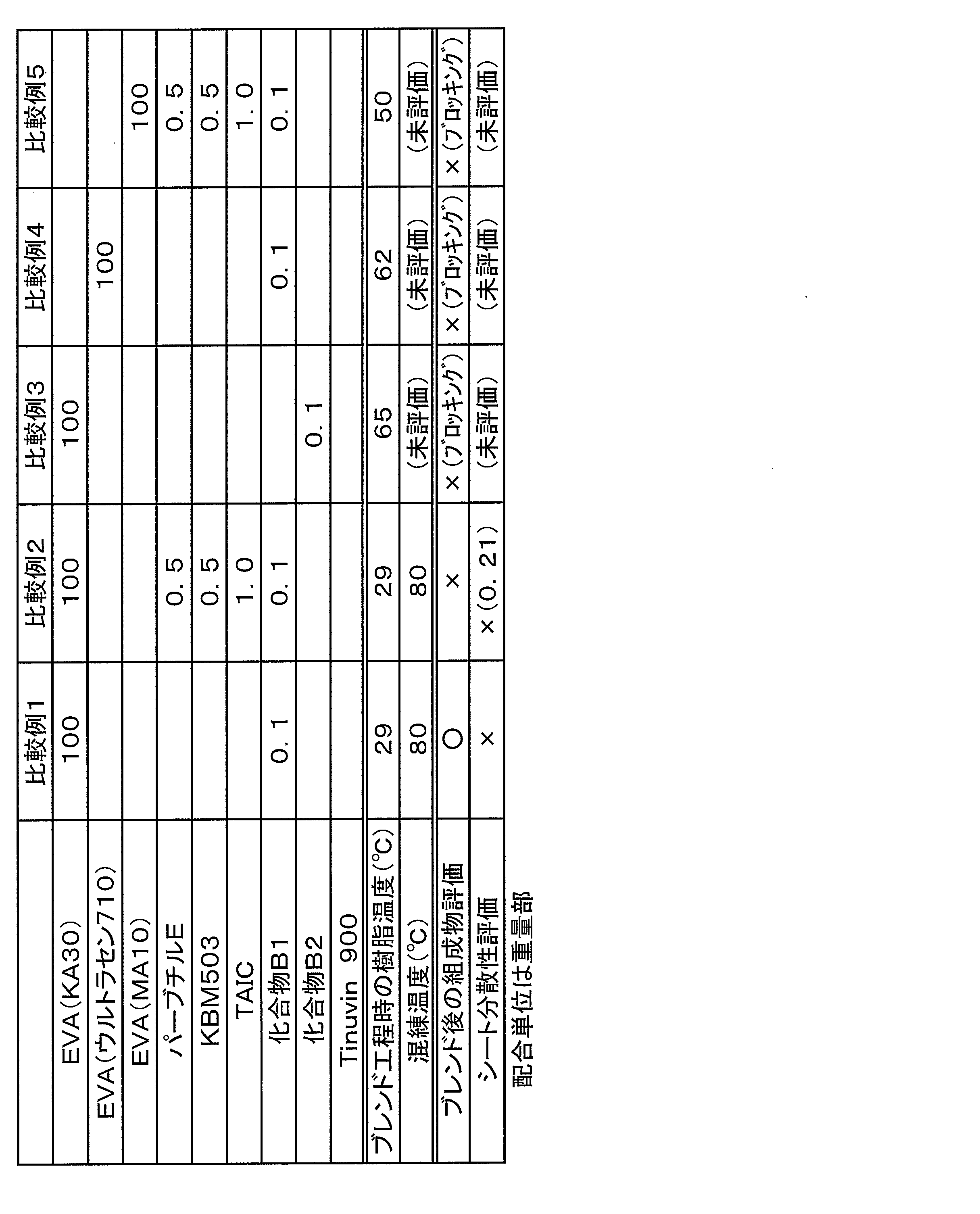
- each sealing material layer was produced by the following method based on the compounds shown in Table 1.
- each material (compound) was mixed and stirred using a small pulverizer (manufactured by ASONE Co., Ltd.) while controlling the temperature in the system with a cooler so that each temperature range was reached Pre-blending (5 minutes) was performed. Thereafter, the pre-blended resin composition was put into a Laboplast Mill 4C150 type (roller shape: Sigma type, manufactured by Toyo Seiki Co., Ltd.) and kneaded at 80 ° C. and 10 rpm for 5 minutes. The obtained kneaded product was pressed at 100 ° C. and 20 kN for 5 minutes using a vacuum heat press VS20-3430 (manufactured by Mikado Technos) to form a 400 ⁇ m-thick sealing material sheet.
- a small pulverizer manufactured by ASONE Co., Ltd.
- Tables 1 and 2 below show the respective measurement results when each compounding (part by weight) and the obtained sealing material layer resin sheet were used.
Landscapes
- Chemical & Material Sciences (AREA)
- Organic Chemistry (AREA)
- Compositions Of Macromolecular Compounds (AREA)
- Materials Engineering (AREA)
- Wood Science & Technology (AREA)
- Engineering & Computer Science (AREA)
- Life Sciences & Earth Sciences (AREA)
- Photovoltaic Devices (AREA)
- Health & Medical Sciences (AREA)
- Chemical Kinetics & Catalysis (AREA)
- Medicinal Chemistry (AREA)
- Polymers & Plastics (AREA)
- Crystallography & Structural Chemistry (AREA)
Abstract
Description
上記エチレン系共重合体(A)のビカット軟化点以上、上記エチレン系共重合体(A)の融点より10℃低い温度以下の温度範囲内で、上記エチレン系共重合体(A)および上記有機化合物添加剤(B)を混合するブレンド工程を含むことを特徴とする。
上記エチレン系共重合体(A)のビカット軟化点以上、上記エチレン系共重合体(A)の融点より10℃低い温度以下の温度範囲内で、上記エチレン系共重合体(A)および上記有機化合物添加剤(B)を混合するブレンド工程を含むことを特徴とする。
本発明の太陽電池用封止材組成物は、少なくともエチレン系共重合体(A)および有機化合物添加剤(B)を含むことを特徴とする。上記太陽電池用封止材組成物は、たとえば、エチレン系共重合体(A)を主成分として含む、光学的に透明なマトリックス樹脂の中に、少なくとも有機化合物添加剤(B)を分散させること等により形成することができる。
本発明の太陽電池用封止材組成物の製造方法は、エチレン系共重合体(A)および有機化合物添加剤(B)を含む太陽電池用封止材組成物の製造方法であって、
上記エチレン系共重合体(A)のビカット軟化点以上、上記エチレン系共重合体(A)の融点より10℃低い温度以下の温度範囲内で、上記エチレン系共重合体(A)および上記有機化合物添加剤(B)を混合するブレンド工程を含むことを特徴とする。
一方、本発明の太陽電池用封止材層は、上記製造方法で得られた太陽電池用封止材組成物を用いて形成されたことを特徴とする。
本発明の太陽電池モジュール1は、表面保護層10、上記太陽電池用封止材層20および太陽電池セル30を含むことを特徴とする。一例として図1、2に簡易な模式図を示すが、本発明がこれらに限定されるものではない。また、太陽電池セルの背面側にさらに封止材層40、バックシート50を適宜備えることもできる。また、これらの各層間に、上記太陽電池用封止材層の上記機能を損なわない限り、接着材層、粘着剤層などの他の層を適宜介在してもよい。また、上記背面用の封止材層として、適宜、本発明の太陽電池用封止材層を用いてもよい。
実施例・比較例では、以下の化合物を用いた。
[エチレン系共重合体(A)]
・スミテートKA30:マトリックス樹脂、エチレンビニルアセテート樹脂(EVA)(住友化学社製、融点74℃、ビカット軟化点39℃)
・ウルトラセン710:マトリックス樹脂、エチレンビニルアセテート樹脂(EVA)(東ソー社製、融点71℃、ビカット軟化点40℃)
・スミテートMA10:マトリックス樹脂、エチレンビニルアセテート樹脂(EVA)(住友化学社製、融点57℃、ビカット軟化点33℃)
[有機化合物添加剤(B)]
・化合物B1:4,7-ビス(4-メトキシフェニル)-2,1,3-ベンゾチアジアゾール(融点201℃)
・化合物B2:4,7-ビス(4-イソブチルオキシフェニル)-2-イソブチル-2H-ベンゾトリアゾール(融点167℃)
・Tinuvin900:2-(2H-ベンゾチアジアゾール-2-イル)-4,6-(1-メチル-1-フェニルエチル)フェノール(BASF社製、融点138℃)
[有機過酸化物(C)]
・Perbutyl E:t-ブチルパーオキシ-2-エチルヘキシルモノカルボネート(日油社製、一時間半減期温度119℃)
[シランカップリング剤]
・KBM503:3-メタクリロキシプロピルトリメトキシシラン(信越シリコーン社製)
[架橋助剤]
・TAIC:架橋助剤、トリアリルイソシアヌレート(日本化成社製)
実施例・比較例において、各化合物を表1の配合に基づき、各封止材層(封止材シート)を下記方法により製造した。
プレブレンド後の樹脂組成物に対し、肉眼での外観形状の評価を実施した。評価基準は以下のように行った。
・ブロッキングの発生がなかった場合、液体成分が表面に残っていなかった場合:○
・樹脂同士のブロッキングが生じていた場合、液体成分が樹脂表面に残っていた場合:×
まず、得られた封止材シートに対し、肉眼での外観形状の評価を行い、上記有機化合物添加剤(B)が残っていた場合は不合格とした。一方、肉眼では上記化合物の残存が判別できないものに対して、以下の評価を続けた。
・標準偏差が0.1未満であった場合:○
・標準偏差が0.1以上であった場合:×

10 表面保護層
20 太陽電池用封止材層
30 太陽電池セル
40 裏面用封止材層
50 バックシート
Claims (13)
- エチレン系共重合体(A)および有機化合物添加剤(B)を含む太陽電池用封止材組成物の製造方法であって、
前記エチレン系共重合体(A)のビカット軟化点以上、前記エチレン系共重合体(A)の融点より10℃低い温度以下の温度範囲内で、前記エチレン系共重合体(A)および前記有機化合物添加剤(B)を混合するブレンド工程を含むことを特徴とする、太陽電池用封止材組成物の製造方法。 - 前記エチレン系共重合体(A)がペレット状である、請求項1に記載の太陽電池用封止材組成物の製造方法。
- 前記ブレンド工程において、さらに有機過酸化物(C)を含み、かつ、前記有機化合物添加剤(B)の融点が、前記有機過酸化物(C)の一時間半減期温度より10℃低い温度以上である、請求項1または2に記載の太陽電池用封止材組成物の製造方法。
- 前記ブレンド工程において、溶剤を用いない、請求項1~3のいずれかに記載の太陽電池用封止材組成物の製造方法。
- 前記ブレンド工程において、さらに液状添加剤を含む、請求項1~4のいずれかに記載の太陽電池用封止材組成物の製造方法。
- 前記ブレンド工程に次いで、溶融混練工程を含む、請求項1~5のいずれかに記載の太陽電池用封止材組成物の製造方法。
- 前記溶融混練工程が一軸押出機、二軸押出機、バンバリーミキサー、ニーダー、またはミキシングロールによりなされる、請求項1~6のいずれかに記載の太陽電池用封止材組成物の製造方法。
- 前記有機化合物添加剤(B)が、紫外線吸収剤、酸化防止剤、光安定剤、老化防止剤、または、架橋助剤である、請求項1~7のいずれかに記載の太陽電池用封止材組成物の製造方法。
- 前記エチレン系共重合体(A)が、エチレン-酢酸ビニル共重合体を主成分とする、請求項1~8のいずれかに記載の太陽電池用封止材組成物の製造方法。
- 請求項1~9のいずれかに記載の製造方法により得られた太陽電池用封止材組成物。
- 請求項1~9のいずれかに記載の太陽電池用封止材組成物を用いて形成された太陽電池用封止材層。
- 請求項1~9のいずれかに記載の太陽電池用封止材組成物を用いて形成された太陽電池用封止材層を含む太陽電池モジュール。
- 前記太陽電池セルが、結晶シリコン太陽電池、硫化カドミウム/テルル化カドミウム太陽電池、銅インジウムガリウム二セレン化物太陽電池、非晶質シリコン太陽電池、または微結晶シリコン太陽電池である、請求項12に記載の太陽電池モジュール。
Priority Applications (2)
| Application Number | Priority Date | Filing Date | Title |
|---|---|---|---|
| CN201480033780.8A CN105308113B (zh) | 2013-06-14 | 2014-06-05 | 太阳能电池用密封材料组合物及其制造方法、及使用其的太阳能电池用密封材料层和太阳能电池模组 |
| KR1020167000063A KR20160019921A (ko) | 2013-06-14 | 2014-06-05 | 태양 전지용 봉지재 조성물 및 그 제조 방법, 그리고 그것을 사용한 태양 전지용 봉지재층 및 태양 전지 모듈 |
Applications Claiming Priority (2)
| Application Number | Priority Date | Filing Date | Title |
|---|---|---|---|
| JP2013-125401 | 2013-06-14 | ||
| JP2013125401A JP6178126B2 (ja) | 2013-06-14 | 2013-06-14 | 太陽電池用封止材組成物およびその製造方法、ならびに、それを用いた太陽電池用封止材層および太陽電池モジュール |
Publications (1)
| Publication Number | Publication Date |
|---|---|
| WO2014199892A1 true WO2014199892A1 (ja) | 2014-12-18 |
Family
ID=52022188
Family Applications (1)
| Application Number | Title | Priority Date | Filing Date |
|---|---|---|---|
| PCT/JP2014/064943 Ceased WO2014199892A1 (ja) | 2013-06-14 | 2014-06-05 | 太陽電池用封止材組成物およびその製造方法、ならびに、それを用いた太陽電池用封止材層および太陽電池モジュール |
Country Status (4)
| Country | Link |
|---|---|
| JP (1) | JP6178126B2 (ja) |
| KR (1) | KR20160019921A (ja) |
| CN (1) | CN105308113B (ja) |
| WO (1) | WO2014199892A1 (ja) |
Families Citing this family (1)
| Publication number | Priority date | Publication date | Assignee | Title |
|---|---|---|---|---|
| CN106336816A (zh) * | 2016-08-10 | 2017-01-18 | 佛山市三水永恒达粘合剂有限公司 | 一种用于光伏组件封装的粘合剂 |
Citations (7)
| Publication number | Priority date | Publication date | Assignee | Title |
|---|---|---|---|---|
| JP2003104976A (ja) * | 2001-07-24 | 2003-04-09 | Mitsubishi Chemicals Corp | ベンゾチアジアゾール誘導体、液晶組成物、液晶表示素子、波長変換素子、エレクトロルミネッセンス素子、電荷輸送材料、および光電変換素子 |
| JP2003171421A (ja) * | 2001-12-05 | 2003-06-20 | Tosoh Corp | 微架橋性エチレン−酢酸ビニル共重合体とその製造方法 |
| WO2011016537A1 (ja) * | 2009-08-06 | 2011-02-10 | 国立大学法人千葉大学 | 光電変換装置 |
| JP2011216829A (ja) * | 2010-04-02 | 2011-10-27 | Toppan Printing Co Ltd | 組成物、シート及び太陽電池モジュール |
| JP2012119455A (ja) * | 2010-11-30 | 2012-06-21 | C I Kasei Co Ltd | 太陽電池モジュール用封止フィルム、およびそれを用いた太陽電池モジュール |
| WO2012104298A1 (de) * | 2011-01-31 | 2012-08-09 | United Initiators Gmbh & Co. Kg | Peroxidabmischungen für die beschleunigte vernetzung von ethylenvinylacetat |
| JP2013118302A (ja) * | 2011-12-05 | 2013-06-13 | Bridgestone Corp | 一対の太陽電池用封止膜 |
Family Cites Families (2)
| Publication number | Priority date | Publication date | Assignee | Title |
|---|---|---|---|---|
| JP2006186233A (ja) | 2004-12-28 | 2006-07-13 | Du Pont Mitsui Polychem Co Ltd | 太陽電池封止材 |
| KR101304834B1 (ko) * | 2009-08-07 | 2013-11-04 | 도요컬러주식회사 | 태양전지 봉지재용 수지 조성물의 제조방법, 태양전지 봉지재용 수지 조성물, 태양전지 봉지재, 및 태양전지 모듈 |
-
2013
- 2013-06-14 JP JP2013125401A patent/JP6178126B2/ja active Active
-
2014
- 2014-06-05 KR KR1020167000063A patent/KR20160019921A/ko not_active Ceased
- 2014-06-05 CN CN201480033780.8A patent/CN105308113B/zh active Active
- 2014-06-05 WO PCT/JP2014/064943 patent/WO2014199892A1/ja not_active Ceased
Patent Citations (7)
| Publication number | Priority date | Publication date | Assignee | Title |
|---|---|---|---|---|
| JP2003104976A (ja) * | 2001-07-24 | 2003-04-09 | Mitsubishi Chemicals Corp | ベンゾチアジアゾール誘導体、液晶組成物、液晶表示素子、波長変換素子、エレクトロルミネッセンス素子、電荷輸送材料、および光電変換素子 |
| JP2003171421A (ja) * | 2001-12-05 | 2003-06-20 | Tosoh Corp | 微架橋性エチレン−酢酸ビニル共重合体とその製造方法 |
| WO2011016537A1 (ja) * | 2009-08-06 | 2011-02-10 | 国立大学法人千葉大学 | 光電変換装置 |
| JP2011216829A (ja) * | 2010-04-02 | 2011-10-27 | Toppan Printing Co Ltd | 組成物、シート及び太陽電池モジュール |
| JP2012119455A (ja) * | 2010-11-30 | 2012-06-21 | C I Kasei Co Ltd | 太陽電池モジュール用封止フィルム、およびそれを用いた太陽電池モジュール |
| WO2012104298A1 (de) * | 2011-01-31 | 2012-08-09 | United Initiators Gmbh & Co. Kg | Peroxidabmischungen für die beschleunigte vernetzung von ethylenvinylacetat |
| JP2013118302A (ja) * | 2011-12-05 | 2013-06-13 | Bridgestone Corp | 一対の太陽電池用封止膜 |
Also Published As
| Publication number | Publication date |
|---|---|
| KR20160019921A (ko) | 2016-02-22 |
| CN105308113A (zh) | 2016-02-03 |
| JP6178126B2 (ja) | 2017-08-09 |
| JP2015000902A (ja) | 2015-01-05 |
| CN105308113B (zh) | 2018-03-16 |
Similar Documents
| Publication | Publication Date | Title |
|---|---|---|
| JP5866857B2 (ja) | 太陽電池モジュール用封止材組成物、太陽電池モジュール用封止材シート | |
| WO2016031421A1 (ja) | 発光性エチレン系共重合体、太陽電池用封止材組成物、および、それを用いた太陽電池モジュール | |
| JP2016023286A (ja) | ベンゾトリアゾール構造を有する蛍光色素化合物および高分子蛍光色素化合物、ならびに、それを用いた波長変換型封止材組成物 | |
| JP5891745B2 (ja) | 太陽電池モジュール用封止材シート及びそれを用いた太陽電池モジュール | |
| JP2016021433A (ja) | 太陽電池モジュール用の封止材シート及びその製造方法 | |
| WO2013084849A1 (ja) | 太陽電池モジュール | |
| JP6303365B2 (ja) | 太陽電池モジュール用の封止材シートの製造方法 | |
| JP5967115B2 (ja) | 太陽電池モジュール用の封止材組成物の組合せセット、封止材シート、及び封止材シートの製造方法 | |
| JP2013115212A (ja) | 太陽電池モジュール用封止材シートの製造方法及びそれを用いた太陽電池モジュールの製造方法 | |
| WO2016039013A1 (ja) | 太陽電池用封止材組成物、およびそれを用いた太陽電池用封止材層ならびに太陽電池モジュール | |
| JP2014232792A (ja) | 波長変換型封止材層およびその製造方法 | |
| JP6178126B2 (ja) | 太陽電池用封止材組成物およびその製造方法、ならびに、それを用いた太陽電池用封止材層および太陽電池モジュール | |
| JP6413411B2 (ja) | 太陽電池モジュール用の封止材シートの製造方法 | |
| KR20140017044A (ko) | 마스터 배치 방법을 이용한 고 방열성 및 고 방습성 태양전지용 봉지재 시트 및 그 제조방법 | |
| JP6446868B2 (ja) | 太陽電池モジュール用の封止材シート及びその製造方法 | |
| JP6287006B2 (ja) | 太陽電池モジュール用の封止材シートの製造方法 | |
| JP6173789B2 (ja) | 太陽電池用封止材組成物、太陽電池用封止材層、および、それを用いた太陽電池モジュール | |
| JP2017025334A (ja) | 太陽電池用封止材組成物、およびそれを用いた太陽電池用封止材層ならびに太陽電池モジュール | |
| JP6026683B2 (ja) | 太陽電池用封止材組成物、およびそれを用いた太陽電池用封止材層ならびに太陽電池モジュール | |
| JP2016021432A (ja) | 太陽電池モジュール | |
| JP2010258436A (ja) | 太陽電池用封止シートの製造方法 | |
| JP6369144B2 (ja) | 樹脂組成物の製造方法ならびに太陽電池封止材用樹脂組成物、太陽電池封止材及び太陽電池モジュール | |
| WO2015064688A1 (ja) | 波長変換型封止材組成物、波長変換型封止材層、および、それを用いた太陽電池モジュール | |
| JP2018164110A (ja) | 太陽電池モジュール | |
| JP2016072391A (ja) | 非受光面側用封止材シート及びそれを用いてなる太陽電池モジュール |
Legal Events
| Date | Code | Title | Description |
|---|---|---|---|
| WWE | Wipo information: entry into national phase |
Ref document number: 201480033780.8 Country of ref document: CN |
|
| 121 | Ep: the epo has been informed by wipo that ep was designated in this application |
Ref document number: 14811572 Country of ref document: EP Kind code of ref document: A1 |
|
| NENP | Non-entry into the national phase |
Ref country code: DE |
|
| ENP | Entry into the national phase |
Ref document number: 20167000063 Country of ref document: KR Kind code of ref document: A |
|
| 122 | Ep: pct application non-entry in european phase |
Ref document number: 14811572 Country of ref document: EP Kind code of ref document: A1 |