WO2014196664A1 - 液体適用装置及び液体適用方法 - Google Patents
液体適用装置及び液体適用方法 Download PDFInfo
- Publication number
- WO2014196664A1 WO2014196664A1 PCT/JP2014/067388 JP2014067388W WO2014196664A1 WO 2014196664 A1 WO2014196664 A1 WO 2014196664A1 JP 2014067388 W JP2014067388 W JP 2014067388W WO 2014196664 A1 WO2014196664 A1 WO 2014196664A1
- Authority
- WO
- WIPO (PCT)
- Prior art keywords
- web
- liquid
- suction
- liquid application
- air
- Prior art date
- Legal status (The legal status is an assumption and is not a legal conclusion. Google has not performed a legal analysis and makes no representation as to the accuracy of the status listed.)
- Ceased
Links
Images


Classifications
-
- A—HUMAN NECESSITIES
- A61—MEDICAL OR VETERINARY SCIENCE; HYGIENE
- A61F—FILTERS IMPLANTABLE INTO BLOOD VESSELS; PROSTHESES; DEVICES PROVIDING PATENCY TO, OR PREVENTING COLLAPSING OF, TUBULAR STRUCTURES OF THE BODY, e.g. STENTS; ORTHOPAEDIC, NURSING OR CONTRACEPTIVE DEVICES; FOMENTATION; TREATMENT OR PROTECTION OF EYES OR EARS; BANDAGES, DRESSINGS OR ABSORBENT PADS; FIRST-AID KITS
- A61F13/00—Bandages or dressings; Absorbent pads
- A61F13/15—Absorbent pads, e.g. sanitary towels, swabs or tampons for external or internal application to the body; Supporting or fastening means therefor; Tampon applicators
- A61F13/15577—Apparatus or processes for manufacturing
- A61F13/15804—Plant, e.g. involving several steps
-
- A—HUMAN NECESSITIES
- A61—MEDICAL OR VETERINARY SCIENCE; HYGIENE
- A61F—FILTERS IMPLANTABLE INTO BLOOD VESSELS; PROSTHESES; DEVICES PROVIDING PATENCY TO, OR PREVENTING COLLAPSING OF, TUBULAR STRUCTURES OF THE BODY, e.g. STENTS; ORTHOPAEDIC, NURSING OR CONTRACEPTIVE DEVICES; FOMENTATION; TREATMENT OR PROTECTION OF EYES OR EARS; BANDAGES, DRESSINGS OR ABSORBENT PADS; FIRST-AID KITS
- A61F13/00—Bandages or dressings; Absorbent pads
- A61F13/15—Absorbent pads, e.g. sanitary towels, swabs or tampons for external or internal application to the body; Supporting or fastening means therefor; Tampon applicators
- A61F13/15577—Apparatus or processes for manufacturing
- A61F13/15764—Transferring, feeding or handling devices; Drives
-
- A—HUMAN NECESSITIES
- A61—MEDICAL OR VETERINARY SCIENCE; HYGIENE
- A61F—FILTERS IMPLANTABLE INTO BLOOD VESSELS; PROSTHESES; DEVICES PROVIDING PATENCY TO, OR PREVENTING COLLAPSING OF, TUBULAR STRUCTURES OF THE BODY, e.g. STENTS; ORTHOPAEDIC, NURSING OR CONTRACEPTIVE DEVICES; FOMENTATION; TREATMENT OR PROTECTION OF EYES OR EARS; BANDAGES, DRESSINGS OR ABSORBENT PADS; FIRST-AID KITS
- A61F13/00—Bandages or dressings; Absorbent pads
- A61F13/15—Absorbent pads, e.g. sanitary towels, swabs or tampons for external or internal application to the body; Supporting or fastening means therefor; Tampon applicators
- A61F13/15577—Apparatus or processes for manufacturing
- A61F2013/15821—Apparatus or processes for manufacturing characterized by the apparatus for manufacturing
- A61F2013/15829—Apparatus or processes for manufacturing characterized by the apparatus for manufacturing using pressure liquid jet
-
- A—HUMAN NECESSITIES
- A61—MEDICAL OR VETERINARY SCIENCE; HYGIENE
- A61F—FILTERS IMPLANTABLE INTO BLOOD VESSELS; PROSTHESES; DEVICES PROVIDING PATENCY TO, OR PREVENTING COLLAPSING OF, TUBULAR STRUCTURES OF THE BODY, e.g. STENTS; ORTHOPAEDIC, NURSING OR CONTRACEPTIVE DEVICES; FOMENTATION; TREATMENT OR PROTECTION OF EYES OR EARS; BANDAGES, DRESSINGS OR ABSORBENT PADS; FIRST-AID KITS
- A61F13/00—Bandages or dressings; Absorbent pads
- A61F13/15—Absorbent pads, e.g. sanitary towels, swabs or tampons for external or internal application to the body; Supporting or fastening means therefor; Tampon applicators
- A61F13/15577—Apparatus or processes for manufacturing
- A61F2013/15821—Apparatus or processes for manufacturing characterized by the apparatus for manufacturing
- A61F2013/15837—Apparatus or processes for manufacturing characterized by the apparatus for manufacturing using solvent
Definitions
- the present invention relates to a liquid applying apparatus and a liquid applying method for applying a liquid to a web being conveyed.
- Patent Document 1 in order to improve the feel and feel of absorbent articles such as paper diapers and sanitary napkins, low-viscosity liquids such as lotions, softeners and water-soluble antibacterial agents are used to constitute absorbent articles. Methods are disclosed that apply to the
- Patent Document 2 discloses a method of manufacturing an absorbent article, which continuously manufactures an absorbent article in which a liquid (skin care agent) is applied to a web (constituting sheet) being transported.
- a liquid skin care agent
- the liquid applied to the web which becomes semi-solid or solid at 20 ° C., is cooled using a suction device, a fluid jet gun, or the like, whereby the liquid adheres to the transfer facility Make it difficult.
- Patent Documents 1 and 2 do not mention this at all.
- an object of the present invention is to provide a liquid application apparatus and a liquid application method capable of sufficiently impregnating the low viscosity liquid applied to the web in the thickness direction.
- a liquid application apparatus for applying a liquid having a viscosity in the range of 0.05 to 4 Pa ⁇ s to a continuously conveyed web used for producing an absorbent article,
- a tank for containing the liquid;
- a liquid application nozzle for applying the liquid to one side of the web;
- a pump for supplying the liquid in the tank to the liquid application nozzle through a tube;
- a suction device having a surface facing the other side of the web;
- An air blow nozzle for blowing air to a portion to which liquid is applied on the one surface of the web; Equipped with The surface of the suction device at least includes a suction area for suctioning the web,
- a liquid application device is provided.
- a liquid application method of applying a liquid having a viscosity in the range of 0.05 to 4 Pa ⁇ s to a continuously conveyed web used for producing an absorbent article A tank for containing the liquid; A liquid application nozzle for applying the liquid to one side of the web; A pump for supplying the liquid in the tank to the liquid application nozzle through a tube; A suction device having a surface facing the other side of the web; An air blow nozzle for blowing air to a portion of the one surface of the web to which the liquid is applied; Equipped with The surface of the suction device at least includes a suction area for suctioning the web, Providing a liquid application device; Suctioning the web in the suction area by the suction device; Applying the liquid to the web by the liquid application nozzle; Air blowing the web with the air blow nozzle; including, A liquid application method is provided.
- a liquid applying apparatus and a liquid applying method capable of sufficiently impregnating a low viscosity liquid applied to a web in the thickness direction.
- FIG. 5 is a diagram for illustrating the positional relationship between a suction drum, a liquid application nozzle and an air blow nozzle of the liquid application device according to the first embodiment of the present invention.
- FIG. 2 is a diagram showing the outer circumferences of a suction drum, an inlet roll and an outlet roll of the liquid application apparatus according to the first embodiment of the present invention.
- the schematic enlarged view of the liquid application apparatus which concerns on the modification of 1st embodiment of this invention similar to FIG. VII arrow view of FIG.
- the partial cross section schematic of the liquid application apparatus which concerns on 2nd embodiment of this invention.
- the partial cross-sectional schematic of the liquid application apparatus which concerns on the modification of 2nd embodiment of this invention which is similar to FIG.
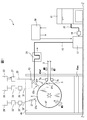
- FIG. 1 is a schematic view of a liquid application apparatus 1 according to a first embodiment of the present invention.
- the liquid application apparatus 1 applies a low viscosity liquid to one surface 3 ff of the web 3 being conveyed.
- the web 3 is composed of a bonding sheet in which an absorbent is attached to a top sheet of disposable diapers or a sanitary napkin at a constant interval in the transport direction MD.
- the web 3 is a product, semi-finished product or material of absorbent articles.
- Absorbent articles include paper diapers, sanitary napkins and the like.
- the liquid application device 1 includes a suction drum 5 (corresponding to a suction device).
- the suction drum 5 has a surface 5 f facing the other surface 3 fs of the web 3.
- the web 3 is sucked on the surface 5 f of the suction drum 5 and the liquid is applied on the surface 5 f of the suction drum 5.
- the structure and operation of the suction drum 5 will be described in detail later.
- the liquid application device 1 further includes an inlet roll 7a and an outlet roll 7b, which are, for example, free rolls having no drive source.
- the web 3 is guided by the inlet roll 7a to the suction drum 5, in particular onto the surface 5f of the suction drum 5, and by the outlet roll 7b to a post-processing step.
- the liquid application apparatus 1 includes a tank 11 for containing the liquid, and a liquid application nozzle 13 for applying the liquid to the sheet 3.
- the liquid application apparatus 1 further includes a pump 17 that supplies the liquid contained in the tank 11 to the liquid application nozzle 13 via the tube 15.
- the supply amount of the pump 17 can be changed.
- the tank 11 is disposed higher than the pump 17. As a result, the liquid in the tank 11 reaches the pump 17 by its own weight. Further, in the tube 15 between the tank 11 and the pump 17, a filter 19 for removing impurities mixed in the liquid is disposed.
- a liquid meter 21 is disposed in the portion of the tube 15 between the pump 17 and the liquid application nozzle 13.
- the liquid level meter 21 detects the amount of liquid flowing in the tube 15, that is, the amount of liquid actually applied to the sheet 3. Therefore, the amount of liquid actually applied to the sheet 3 can be easily detected.
- the amount of liquid supplied from the liquid application device 1 to the sheet 3 is very small, about 10 ml / min.
- the liquid flow meter 21 used in the first embodiment is a Coriolis flow meter. Coriolis flowmeters are suitable for measuring such small amounts of liquid.
- the fluid meter 21 is of another type.
- the Coriolis flowmeter is a flowmeter using the Coriolis force principle. That is, for example, when the tube is vibrated while a liquid to be measured flows in a U-shaped or straight tube, the tube is distorted. The magnitude of this strain depends on the flow rate of the liquid flowing in the tube. Therefore, if the magnitude of strain in the tube is detected, the liquid flow rate can be detected.
- the liquid application nozzle 13 includes a liquid jet passage (not shown), a pneumatically driven nozzle valve (not shown) for opening or closing the liquid jet passage, and an air chamber (not shown).
- a liquid jet passage (not shown)
- a pneumatically driven nozzle valve (not shown) for opening or closing the liquid jet passage
- an air chamber (not shown).
- the nozzle valve is opened and the liquid is ejected from the liquid flow passage.
- the nozzle valve is closed and the ejection of the liquid is stopped.
- the liquid application device 1 further comprises a first compressor 23.
- the air chamber of the liquid application nozzle 13 and the first compressor 23 are connected via a first air tube 25.
- a solenoid valve 27 for opening and closing a nozzle valve is disposed in the first air tube 25 between the liquid application nozzle 13 and the first compressor 23.
- the nozzle valve opening / closing solenoid valve 27 is opened, air pressure is applied to the liquid application nozzle 13 to open the nozzle valve.
- the nozzle valve opening / closing solenoid valve 27 is closed, the nozzle valve is closed.
- the liquid application nozzle 13 also includes an air flow passage (not shown) in communication with or adjacent to the liquid flow passage.
- the liquid application device 1 further comprises a second compressor 29.
- the air flow passage of the liquid application nozzle 13 is connected to the second compressor 29 via the second air tube 31.
- Another solenoid valve 33 and a regulator 35 for adjusting the air pressure in the second air tube 31 are attached to the second air tube 31.
- the solenoid valve 33 When the solenoid valve 33 is opened, compressed air is ejected from the air flow passage, so that the liquid ejected from the liquid flow passage via the outlet 13o is atomized and applied to the sheet 3.
- the solenoid valve 33 is closed, the supply of compressed air to the air flow passage is stopped.
- liquid is ejected from the liquid application nozzle 13 without using compressed air.
- liquid is applied to the web 3 by, for example, brushing or rollers.
- the liquid application nozzle 13 is provided with a single outlet 13o, which is directed perpendicularly to the center of the suction drum 5 and thus to one side 3ff of the web 3. It is done.
- the liquid ejected from the outlet 13o spreads in, for example, a conical shape with the outlet 13o at the top, and is applied to one surface 3ff of the web 3 with a certain area.
- the liquid application nozzle 13 is used to change the application range of the liquid to the web 3, particularly the application direction of the width direction CD of the web orthogonal to the transport direction MD (FIG. 3), using the existing liquid application nozzle 13.
- the distance between the outlet 13 o and one surface 3 ff of the web 3 is changed.
- the application time of a liquid is lengthened.
- the liquid application nozzle is provided with a plurality of outlets aligned with the width direction CD of the web 3 in order to widen the liquid coverage of the width direction CD (FIG. 3) of the web. .
- the application range of the liquid in the width direction CD of the web can be changed without changing the distance from the surface 5 f of the suction drum 5 of the liquid application nozzle 13.
- the liquid has a viscosity in the range of 0.05 to 4 Pa ⁇ s at least when applied to the sheet 3.
- the liquid has a viscosity in the range of 0.05 to 4 Pa ⁇ s at 20 to 25 ° C. and 1 atm.
- the liquid is a liquid having a higher viscosity than this.
- the liquid is a liquid having a lower viscosity.
- the liquid is, for example, petroleum hydrocarbon, animal and vegetable fat and oil, animal and vegetable wax, fatty acid ester compound, alkyl ethoxylate, fatty acid ester ethoxylate, fatty alcohol, polysiloxane and the like.
- the liquid is a pH adjuster, an antibacterial agent, an aromatic agent, a fragrance and the like.
- the liquid is intermittently applied, for example, to a portion corresponding to a longitudinally central portion of the disposable diaper, where the web is a combination sheet of the top sheet of the disposable diaper and the absorbent.
- the liquid is applied intermittently to another part of the disposable diaper or any part of another absorbent article.
- liquid is applied to the web 3 continuously from the liquid application device 1 in the transport direction MD.
- the liquid application device 1 further comprises an air blow nozzle 37.
- the air blow nozzle 37 blows air to the portion of the web 3 to which the liquid is applied, that is, blows air.
- the air blow nozzle 37 has a plurality of outlets 37 o aligned in the width direction CD of the web 3.
- the air outlet 37o of the air blow nozzle 37 is one.
- the liquid application device 1 further comprises another compressor 29 '.
- the air blow nozzle 37 includes an air flow passage (not shown) therein.
- the air flow passage of the air blow nozzle 37 is connected to another compressor 29 'via another air tube 31'. Attached to another air tube 31 'is another solenoid valve 33' and another regulator 35 'for adjusting the air pressure in the other air tube 31'.
- the solenoid valve 33 ' is opened, air is continuously blown out from the air flow passage through the air outlet 37o.
- the solenoid valve 33 ' is closed, the supply of compressed air to the air flow passage of the air blow nozzle 37 is stopped.
- the liquid application device 1 further comprises a controller 39.
- the controller 39 is constituted by, for example, a computer provided with a CPU (microprocessor), a memory, an input port, and an output port.
- a liquid meter 21 or the like is connected to the input port of the controller 39.
- the pump 17 and the nozzle valve opening / closing solenoid valve 27 etc. are connected to the output port of the controller 39.
- the pump 17 and the solenoid valve 27 are controlled based on a signal from the controller 39.
- the transport operation of the web 3 is controlled by the controller 39, and intermittent liquid ejection by the nozzle 13, specifically, the timing of opening and closing of the nozzle valve opening / closing solenoid valve 27. Synchronized with. As a result, the liquid can be applied to a desired location on one side 3ff of the web 3.
- FIG. 2 is an enlarged view of FIG. 1 at the periphery of the suction drum 5, and FIG. 3 is a cross-sectional view taken along the line III-III of FIG.
- the suction drum 5 includes a rotating portion 5r rotating with the drum shaft 5ds and a non-rotating non-rotating portion 5s located inside the suction drum 5, which are made of a hard material such as metal.
- the rotating portion 5r and the non-rotating portion 5s extend continuously in the rotational direction of the suction drum 5, respectively.
- the drum shaft 5ds is connected at one end (not shown) to a rotational drive device (not shown), which is, for example, a motor, and can rotate the rotating portion 5r of the suction drum 5 by its driving force.
- the radial direction RD means a direction orthogonal to the extending direction of the drum shaft 5ds.
- the rotating portion 5 r includes side portions 5 rs, an outer peripheral base 5 rc, and a mesh portion 5 rm.
- the side surface portion 5rs constituting one side surface of the suction drum 5 is connected at the other end 5dse of the drum shaft 5ds by a connecting means such as a bolt.
- the outer peripheral base portion 5rc, which constitutes the outer peripheral portion of the suction drum 5 together with the mesh portion 5rm, is connected to the radially outermost portion of the side surface portion 5rs by a connecting means such as a bolt.
- the mesh portion 5rm is formed by overlapping a plurality of mesh-like sheets, which are nets made of, for example, metal, resin material, and the like.
- the non-rotating portion 5s includes a hollow shaft 5ss and a side wall 5sw.
- the hollow shaft 5ss has a drum shaft 5ds inserted substantially coaxially in its hollow portion.
- a bearing 5br is provided between the outer peripheral surface of the drum shaft 5ds and the inner peripheral surface of the hollow shaft 5ss.
- the hollow shaft 5 ss is fixed, for example, to a wall (not shown) of the equipment so as not to rotate and to support the load of the entire suction drum 5.
- the hollow shaft 5 ss is connected on its outer peripheral surface to a side wall 5 sw expanding in the radial direction RD of the suction drum 5 between the outer surface of the hollow shaft 5 ss and the inner surface of the outer peripheral base 5 rc There is.
- a ring-shaped member 5sr made of, for example, felt is attached to the radially outermost portion of the side wall 5sw in contact with the inner peripheral surface of the outer peripheral base 5rc.
- the ring-shaped body 5 sr has a ring shape because it continuously extends in the rotational direction of the suction drum 5.
- the ring-shaped body 5 sr reduces the sliding resistance between the rotating outer peripheral base 5 rc and the non-rotating side wall 5 sw while securing a certain degree of airtightness.
- the material of the ring-shaped body 5sr is not limited to felt as long as it exhibits the above-mentioned function, and may be another material.
- a hollow portion 5h whose range is defined by the hollow shaft 5ss, the side wall 5sw, the ring-shaped body 5sr and the outer peripheral base 5rc is defined in the suction drum 5.
- an exhaust hole 5 swv is provided in the side wall 5 sw of the suction drum 5, and one end of the duct 41 is connected to the suction drum 5 in the exhaust hole 5 swv.
- the inside of the duct 41 communicates with the hollow portion 5h.
- the other end of the duct 41 is connected to an exhaust pump (not shown) for discharging the air in the hollow portion 5h in the direction F.
- one duct 41 and one exhaust pump are used.
- a plurality of exhaust holes 5swv are provided in the side wall 5sw, and the plurality of exhaust pumps are respectively connected with the suction drum 5 via the duct 41. By connecting, the suction amount can be increased.
- the outer peripheral base 5rc is provided with a large number of through holes 5rcp penetrating from the outer peripheral surface of the outer peripheral base 5rc to the inner peripheral surface.
- the through holes 5 rcp are provided to be substantially uniformly distributed on the surface of the outer peripheral base 5 rc.
- the through-hole 5rcp provided in the inner surface of outer periphery base 5rc is shown in FIG. 3, from the viewpoint of the legibility of a figure, only one part of these is shown in the same figure.
- the mesh portion 5 rm configured by a plurality of mesh-like sheets can pass air. Therefore, the hollow portion 5 h communicates with the outside of the suction drum 5.
- the exhaust pump (not shown) exhausts the air of the hollow portion 5h, while the hollow portion 5h receives the web 3 located on the mesh portion 5rm from the outside of the suction drum 5, and the mesh portion 5rm.
- the air is introduced through the through holes 5 rcp of the outer peripheral base 5 rc.
- the surface 5 f of the suction drum 5 facing the other surface 3 fs of the web 3 is the outer surface of the mesh portion 5 rm due to the configuration of the suction drum 5 described above.
- the suction drum 5 is provided with a screen 43 in contact with a part of the inner surface of the outer peripheral base 5rc inside the hollow portion 5h.
- the partition 43 is attached to the hollow shaft 5ss or the side wall 5sw by a jig (not shown).
- the contact portion between the partition 43 and the inner surface of the outer peripheral base 5rc is made of, for example, felt from the same effect as the ring-shaped member 5sr.
- the partitions 43 prevent the intake air from the outside of the suction drum 5 through the through holes 5 rcp of the outer peripheral base 5 rc in the contact portion.
- the surface 5f of the suction drum 5 is a length area along the outer periphery of the suction drum 5, a suction area AS for suctioning the web 3, and the web 3 and a non-suction area AN which does not suction.
- the suction drum 5 is not provided with the partition 43, and the surface 5f of the suction drum 5 is a suction area AS whose entire circumference sucks the web 3, and thus does not include the non-suction area AN. .
- the suction drum 5 sucks the web 3 in the suction area AS including the surface 5 f opposed to the surface 3 f on one side to which the liquid is applied and the other surface 3 f on the opposite side.
- the through holes 5 rcp are provided so as to be substantially uniformly distributed on the surface of the outer peripheral base 5 rc.
- the mesh portion 5rm having the above-described configuration is provided on the outer surface of the suction drum 5, the intake paths from the outside of the suction drum 5 to the respective through holes 5rcp are diverse. Therefore, on the surface 5f, the portion of the web 3 located in the suction area AS can be suctioned with substantially uniform suction regardless of the position.
- the suction drum 5 By the configuration of the suction drum 5 described above, the web 3 is attracted to the surface 5 f and held by being sucked by the suction drum 5. As a result, the web 3 is conveyed along with the rotation of the suction drum 5 and is conveyed by the suction drum 5 in the liquid application device 1 of the first embodiment.
- the web 3 of the first embodiment is a bonding sheet of the top sheet and the absorbent as described above, and generally does not include a low breathable material such as a plastic film contained in the back sheet of the absorbent article or the like. Therefore, the breathability of the web 3 is high and preferable.
- the air blowing direction of the air of the air blow nozzle 37 may be any direction as long as it contributes to impregnating the web 3 with the liquid.
- the direction in which the air is blown out from the air outlet 37o of the air blow nozzle 37 is directed to the transport direction MD side of the web 3 rather than the direction perpendicular to one surface 3ff of the web 3. ( ⁇ > 0 (see FIG. 2)).
- the air blow nozzle 37 blows out the air in this way, the web 3 does not move backward in the conveyance direction MD, so the air blow out direction is opposite to the conveyance direction MD of the web 3 ( ⁇ In contrast to ⁇ 0 (see FIG. 2), the web 3 is less likely to be wrinkled.
- the liquid applied to the surface of one surface 3ff of the web 3 is biased by the air in the transport direction MD, whereby the application range of the liquid can be expanded.
- the portion of the web 3 located in the suction area AS of the surface 5f of the suction drum 5 is held by the surface 5f by being suctioned with a substantially uniform suction force as a whole. It is transported. As a result, when the web 3 is transported, the occurrence of wrinkles and sags of the web 3 can be reduced, and the meandering of the web 3 can be suppressed.
- the suction area AS of the surface 5f of the suction drum 5 is at least a length area along the outer periphery of the suction drum 5 corresponding to the application range of the liquid by the liquid application nozzle 13 to the web 3.
- the liquid application area AA is included.
- the suction area AS of the surface 5 f of the suction drum 5 since sagging does not easily occur in the web 3, the liquid can be appropriately applied to the desired range of one surface 3 ff of the web 3.
- the suction area AS does not include the liquid application area AA.
- FIG. 4 is a diagram for illustrating the positional relationship between the suction drum 5, the liquid application nozzle 13 and the air blow nozzle 37 of the liquid application device 1 according to the first embodiment of the present invention. 4 is a view of the suction drum 5, the liquid application nozzle 13 and the air blow nozzle 37 as viewed in the direction in which the drum shaft 5ds of the suction drum 5 extends.
- the distance from the outlet 13o of the liquid application nozzle 13 to the surface 5f of the suction drum 5 is Lla
- the distance from the outlet 37o of the air blow nozzle 37 to the surface 5f of the suction drum 5 is Laf.
- the two distances Lla and Laf are Lla> Laf
- the air outlet 37 o of the air blow nozzle 37 be positioned closer to the surface 5 f of the suction drum 5 than the air outlet 13 o of the liquid application nozzle 13.
- the air blow nozzle 37 By positioning the air blow nozzle 37 closer to the surface 5 f of the suction drum 5 than the liquid application nozzle 13 and hence to one surface 3 ff of the web 3, turbulence of the air blow air flow is reduced, and higher pressure air can be obtained. Of the liquid applied to the web 3 can be impregnated by the thickness direction.
- the outlet 37o of the air blow nozzle 37 is farther from the surface 5f of the suction drum 5 than the outlet 13o of the liquid application nozzle 13, or these 13o, 37o are the surface 5f of the suction drum 5. Are positioned at the same distance from (Lla ⁇ Laf).
- the blowout port 13o of the liquid application nozzle 13 is a virtual line Lim extended in a direction to blow out air from the blowout port 37o of the air blow nozzle 37, and the outer peripheral surface 5f of the suction drum 5 (suction device
- the suction drum 5 is positioned closer to the outer circumferential surface 5 f of the suction drum 5 than the tangent Lta of the outer circumference of the suction drum 5 at the intersection point Pim with the surface 5 f).
- the air blown out from the air blow nozzle 37 strikes one surface 3 ff of the web 3. As a result, the collided air is diffused and reflected toward the air blow nozzle 37 more than at least the tangent Lta.
- the suction from the tangent Lta such that the outlet 13o of the liquid application nozzle 13 is not located in the area AF closer to the air blow nozzle 37 than the tangent Lta so that the direct reflection from the air blow nozzle 37 does not reach at least.
- the outlet 13o of the liquid application nozzle 13 is disposed in the area AC near the outer peripheral surface 5f of the drum.
- the outlet 13o of the liquid application nozzle 13 is at the intersection point Pim of the virtual line Lim extended in the direction in which the air is blown out from the outlet 37o of the air blow nozzle 37 and the outer peripheral surface 5f of the suction drum 5. It is positioned farther from the outer peripheral surface 5 f of the suction drum 5 than the tangent Lta of the outer periphery of the suction drum.
- FIG. 5 is a diagram showing the outer circumferences of the suction drum 5, the inlet roll 7a and the outlet roll 7b of the liquid application apparatus according to the first embodiment of the present invention.
- FIG. 5 is a view of the suction drum 5, the inlet roll 7a and the outlet roll 7b as viewed in the direction in which the drum shaft 5ds of the suction drum 5 extends.
- the contact point between the common tangent L1 of the outer periphery of the suction drum 5 and the inlet roll 7a and the outer periphery of the suction drum 5 is a first point P1, and the common tangent L2 of the outer periphery of the suction drum 5 and the outlet roll 7b.
- the point of contact between the two and the outer periphery of the suction drum 5 is taken as a second point P2.
- the surface 5f of the suction drum 5 has a length along the surface 5f of the suction drum 5 from the first point P1 to a second point P2 along the outer periphery in the reverse direction of the rotation direction R of the suction drum 5.
- non-suction area AN (FIG. 2) in which the web 3 is not suctioned in the thread area APP. If the web 3 is sucked by the suction drum 5 between the suction drum 5 and the inlet roll 7a and / or between the suction drum 5 and the outlet roll 7b, the web 3 is not conveyed linearly, It is because there is a possibility that conveyance of web 3 may not be performed normally.
- the area APP does not include the non-suction area AN.
- the range of the non-suction area AN (FIG. 2) is defined by the size and position of the partition 43 in the circumferential direction of the suction drum 5.
- the liquid application device 1 further includes a cover 45 in which the suction drum 5 and the liquid application nozzle 13 are accommodated. It is possible to prevent the liquid jetted from the liquid application nozzle 13 from scattering around, and to prevent the dust such as fiber debris flying from the outside of the liquid application device 1 from adhering to the web 3 It is.
- the cover 45 has a box-like shape in which the four sides and the upper side are surrounded. In another embodiment, the liquid application device 1 does not include the cover 45.
- At least one surface of the cover 45 is made of a transparent material so that the inside of the cover 45 can be viewed during use.
- the front surface of the cover 45 is made of a transparent material.
- the cover 45 is provided with a first opening 45 wf for carrying the web 3 into and out of the cover 45.
- the cover 45 be provided with a second opening 45 ws located vertically below the first opening 45 wf.
- the second opening 45 ws By providing the second opening 45 ws separately from the first opening 45 wf, more air can be introduced into the cover, and the intake efficiency from the outside of the suction drum 5 can be improved.
- the second opening 45 ws in the vertical direction lower than the first opening 45 wf, dust such as fiber waste that may fly up around the cover 45 is sucked into the cover 45. Can be suppressed.
- a plurality of second openings 45 ws can be provided on any surface of the cover 45 as long as the second openings 45 ws are vertically lower than the first opening 45 wf.
- the second opening 45 ws is provided with a filter (not shown) so as not to suction dust such as fiber waste.
- the cover 45 is not provided with the second opening 45 ws.
- FIG. 6 is an enlarged view of the periphery of the suction drum 5 of the schematic view of the liquid application apparatus 1 according to the modification of the first embodiment of the present invention, similar to FIG.
- the liquid application device 1 includes a plurality of, specifically, four air blow nozzles 37a, 37b, 37c, and 37d. Although not shown, compressed air is commonly supplied to the air blow nozzles 37a, 37b, 37c and 37d from another compressor 29 '(FIG. 1).
- liquid application device 1 of this modification is provided with a plurality of air blow nozzles 37a, 37b, 37c, 37d which perform air blow a plurality of times under relatively low air pressure. As a result, air is blown to the web 3 in stages without interfering with the stable transport of the web 3, and as a result, the liquid can be sufficiently impregnated in the thickness direction of the web 3.
- the liquid application device 1 includes the plurality of air blow nozzles 37a, 37b, 37c, 37d, whereby the web sequentially transported on the surface 5f of the suction drum 5 The air blowing time can be extended for the part 3. As a result, even when the transport speed of the web 3 is high, the liquid applied to the web 3 can be more fully impregnated in the thickness direction of the web 3.
- FIG. 7 is a view on arrow VII of FIG. It should be noted that in FIG. 7 the description of the two air blow nozzles 37c, 37d is omitted for ease of explanation.
- the blowout ports 37ao and 37bo of the air blow nozzles 37a and 37b are respectively aligned in the width direction CD of the web 3 perpendicular to the transport direction MD, and the air blow nozzles 37a and 37b are It is preferable that the outlets 37ao and 37bo of the air blow nozzles 37a and 37b adjacent in the transport direction MD be positioned to be offset in the width direction CD of the web 3 for the following reason.
- FIG. 7 the structure which offsets these blower outlets 37ao and 37bo using two air blow nozzles 37a, 37b was shown.
- three adjacent air blow nozzles 37a, 37b, and 37c, and these air outlets 37o each have a width of the web 3 in order to reduce the portion of the web 3 to which air is not blown. It can also be positioned so as to offset each other in the direction CD, in other words, in a zigzag manner in the transport direction MD.
- adjacent air blow nozzles 37a, 37b, 37c and 37d are arbitrarily combined to reduce the portion of the web 3 to which the air is not blown, and the positions of these blowouts 37o are in the width direction of the web 3. It can be positioned to be offset to the CD.
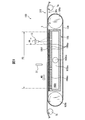
- FIG. 8 is a schematic partial cross-sectional view of a liquid application apparatus 100 according to a second embodiment of the present invention.
- the mechanism for ejecting the liquid from the liquid application nozzle 13 and the mechanism for ejecting the air from the air blow nozzle 37 are the same as those in FIG.
- the second embodiment is mainly different from the first embodiment in that the web 3 is sucked using a suction box 105 (corresponding to a suction device) instead of the suction drum 5 (FIG. 1, etc.).
- the web 3 is transported in the transport direction MD by the transport devices 107 a and 107 b on the surface 105 f on the upper side in the vertical direction of the suction box 105. Then, as in the first embodiment, a low viscosity liquid is applied to one surface 3 ff of the web 3 being conveyed using the liquid application nozzle 13, and then the liquid is discharged using the air blow nozzle 37. Air blow is performed on the portion of the applied web 3.
- the suction box 105 is in the form of a rectangular parallelepiped as a whole, and includes a main body portion 105b forming an outer shell portion of the suction box 105 and a hollow portion 105h located inside the main body portion 105b.
- an exhaust hole 105bv is provided in the lower portion 105bl of the main body portion 105b of the suction box 105, and one end of the duct 41 is connected to the suction box 105 at the exhaust hole 105bv. .
- the inside of the duct 41 is in communication with the hollow portion 105 h.
- the other end of the duct 41 is connected to an exhaust pump (not shown) for discharging the air of the hollow portion 105 h in the direction F.
- the suction amount is provided by providing the plurality of exhaust holes 105bv in the main body portion 105b and connecting the plurality of exhaust pumps to the suction box 105 via the duct 41, respectively. Can be increased.
- the upper portion 105bu of the main body portion 105b is provided with a large number of through holes 105bp.
- the through holes 105bp are provided substantially uniformly distributed over the entire surface of the upper portion 105bu.
- a mesh portion 105m similar to the mesh portion 5rm of the first embodiment is provided on the upper surface of the suction box 105 in the vertical direction.
- seat can pass air. Therefore, the hollow portion 105 h is in communication with the outside of the suction box 105.
- the surface 105 f of the suction box 105 facing the other surface 3 fs of the web 3 is the outer surface of the mesh portion 105 m due to the above-described configuration of the suction box 105.
- the surface 105 f of the suction box 105 can suction the web 3, which is a length area of the surface 105 f in the range where the through holes 105 bp are provided. Includes area AS.
- the web 3 is different from the first embodiment in that the web 3 slides on the surface 105 f of the suction box 105.
- the suction box 105 is conveyed while being suctioned with a substantially uniform suction force as a whole.
- the occurrence of wrinkles and sags of the web 3 can be reduced, and in turn, the meandering of the web 3 can be suppressed.
- the suction area AS is at least a length area of the surface 105 f of the suction box 105 and includes the liquid application area AA to which the liquid is applied.
- the suction area AS of the surface 5 f of the suction drum 5 since sagging does not easily occur in the web 3, the liquid can be appropriately applied to the desired area of one surface 3 ff of the web 3.
- the suction area AS does not include the liquid application area AA.
- the outlet 37o of the air blow nozzle 37 is positioned closer to the surface 5f of the suction drum 5 than the outlet 13o of the liquid application nozzle 13. Is preferred.
- FIG. 9 is a partial cross-sectional schematic view of a liquid application apparatus 100 according to a modification of the second embodiment of the present invention, similar to FIG.
- the liquid application device 100 further includes a mesh belt 109.
- the mesh belt 109 is wound around a pair of rollers 109 a and 109 b around the suction box 105.
- the mesh belt 109 is a breathable endless belt formed of a mesh-like sheet, which is a net made of a material such as metal or resin.
- At least one of the pair of rollers 109a and 109b is rotationally driven by a drive source, for example, a servomotor (not shown) so that the mesh belt 109 moves in the transport direction MD on the surface 105f of the suction box 105. Ru.
- a drive source for example, a servomotor (not shown) so that the mesh belt 109 moves in the transport direction MD on the surface 105f of the suction box 105.
- an exhaust hole 105bv is provided in one side portion 105bs of the main body portion 105b, and one end of the duct is an exhaust hole so that the suction belt 109 and the duct (not shown) do not interfere. Connected to 105bv. The other end of the duct is connected to an exhaust pump (not shown).
- the liquid application apparatus 100 of the present modification includes an inlet roll 7a and an outlet roll 7b.
- the web 3 is guided on the mesh belt 109 by the inlet roll 7a and is guided to the post-process by the outlet roll 7b.
- the web 3 located on the mesh belt 109 is sucked and held on the outer surface of the mesh belt 109 by being sucked by the suction box 105 in the suction area AS. As a result, the web 3 is conveyed along with the movement of the mesh belt 109, and is conveyed by the mesh belt 109 in the liquid application device 100 of the present modification.
- the portion of the web 3 located above the suction area AS of the surface 105f of the suction box 105 is held on the outer surface of the mesh belt 109 by being suctioned with a substantially uniform suction force as a whole. It is transported while. As a result, the occurrence of wrinkles and sags during transport can be reduced, which in turn can suppress the meandering of the web 3.
- the liquid application device 100 according to the second embodiment does not include the cover 45 provided in the liquid application device 1 according to the first embodiment.
- a modified embodiment in which the liquid application apparatus 100 according to the second embodiment includes the cover 45 that houses the liquid application nozzle 13 and the suction box 105 is also included in the scope of the present invention.
- the liquid application device 100 according to the second embodiment includes one air blow nozzle 37, but includes a plurality of air blow nozzles 37, for example, as in the modification of the first embodiment.
- Such modified embodiments are also included in the scope of the present invention.
- adjacent air blow nozzles 37 are positioned such that their outlets 37 o are mutually offset in the width direction CD of the web 3.
- Such modified embodiments are also included in the scope of the present invention.
- the present invention is defined as follows.
- a liquid application apparatus for applying a liquid having a viscosity in the range of 0.05 to 4 Pa ⁇ s to a continuously conveyed web used for producing an absorbent article, A tank for containing the liquid; A liquid application nozzle for applying the liquid to one side of the web; A pump for supplying the liquid in the tank to the liquid application nozzle through a tube; A suction device having a surface facing the other side of the web; An air blow nozzle for blowing air to a portion to which liquid is applied on the one surface of the web; Equipped with The surface of the suction device at least includes a suction area for suctioning the web, Liquid application device.
- the suction device is a suction drum
- the surface of the suction device is an outer peripheral surface of the suction drum
- the suction port of the liquid application nozzle is the suction line rather than a tangent of the outer periphery of the suction drum at an intersection point of a virtual line extended in a direction to blow air from the blow port of the air blow nozzle and the outer peripheral surface of the suction drum.
- the liquid application apparatus as described in (1) or (2).
- the surface of the suction device has a first point of contact between the common tangent of the outer periphery of the suction drum and the inlet roll and the outer periphery of the suction drum as a first point, and the common tangent of the outer periphery of the suction drum and the outlet roll
- the point of contact with the outer periphery of the suction drum is a second point
- the web is placed in a region from the first point to the second point along the outer periphery in the direction opposite to the rotation direction of the suction drum.
- the suction device is a suction box,
- the surface of the suction device is the surface above the suction box in the vertical direction,
- the web is conveyed on the surface of the suction box while being sucked by the suction box.
- the liquid application apparatus as described in (1) or (2).
- the mesh box further comprises a mesh belt wound around the suction box, The web is transported with the movement of the mesh belt.
- the liquid application apparatus as described in (6).
- a plurality of air blow nozzles are provided, The liquid application apparatus as described in any one of (1) to (7).
- Each of the air blow nozzles is provided with a plurality of outlets.
- the liquid application apparatus as described in any one of (1) to (10).
- a liquid application method of applying a liquid having a viscosity in the range of 0.05 to 4 Pa ⁇ s to a continuously conveyed web used for producing an absorbent article A tank for containing the liquid; A liquid application nozzle for applying the liquid to one side of the web; A pump for supplying the liquid in the tank to the liquid application nozzle through a tube; A suction device having a surface facing the other side of the web; An air blow nozzle for blowing air to a portion of the one surface of the web to which the liquid is applied; Equipped with The surface of the suction device at least includes a suction area for suctioning the web, Providing a liquid application device; Suctioning the web in the suction area by the suction device; Applying the liquid to the web by the liquid application nozzle; Air blowing the web with the air blow nozzle; including, Liquid application method.
Landscapes
- Health & Medical Sciences (AREA)
- Engineering & Computer Science (AREA)
- Life Sciences & Earth Sciences (AREA)
- Vascular Medicine (AREA)
- Biomedical Technology (AREA)
- Heart & Thoracic Surgery (AREA)
- Epidemiology (AREA)
- Manufacturing & Machinery (AREA)
- Animal Behavior & Ethology (AREA)
- General Health & Medical Sciences (AREA)
- Public Health (AREA)
- Veterinary Medicine (AREA)
- Botany (AREA)
- Absorbent Articles And Supports Therefor (AREA)
Priority Applications (3)
| Application Number | Priority Date | Filing Date | Title |
|---|---|---|---|
| CN201480001999.XA CN104519845B (zh) | 2013-07-22 | 2014-06-30 | 液体施加装置及液体施加方法 |
| KR1020157021782A KR102047581B1 (ko) | 2013-07-22 | 2014-06-30 | 액체 적용 장치 및 액체 적용 방법 |
| IN363DEN2015 IN2015DN00363A (https=) | 2013-07-22 | 2014-06-30 |
Applications Claiming Priority (2)
| Application Number | Priority Date | Filing Date | Title |
|---|---|---|---|
| JP2013151698A JP5748807B2 (ja) | 2013-07-22 | 2013-07-22 | 液体適用装置及び液体適用方法 |
| JP2013-151698 | 2013-07-22 |
Publications (1)
| Publication Number | Publication Date |
|---|---|
| WO2014196664A1 true WO2014196664A1 (ja) | 2014-12-11 |
Family
ID=52008288
Family Applications (1)
| Application Number | Title | Priority Date | Filing Date |
|---|---|---|---|
| PCT/JP2014/067388 Ceased WO2014196664A1 (ja) | 2013-07-22 | 2014-06-30 | 液体適用装置及び液体適用方法 |
Country Status (6)
| Country | Link |
|---|---|
| JP (1) | JP5748807B2 (https=) |
| KR (1) | KR102047581B1 (https=) |
| CN (1) | CN104519845B (https=) |
| IN (1) | IN2015DN00363A (https=) |
| TW (1) | TWI636774B (https=) |
| WO (1) | WO2014196664A1 (https=) |
Cited By (1)
| Publication number | Priority date | Publication date | Assignee | Title |
|---|---|---|---|---|
| CN107106349A (zh) * | 2014-12-25 | 2017-08-29 | 尤妮佳股份有限公司 | 吸收性物品的制造方法及吸收性物品的制造装置 |
Families Citing this family (2)
| Publication number | Priority date | Publication date | Assignee | Title |
|---|---|---|---|---|
| JP5748806B2 (ja) * | 2013-07-22 | 2015-07-15 | ユニ・チャーム株式会社 | 液体適用装置及び液体適用方法 |
| JP7094240B2 (ja) * | 2019-04-01 | 2022-07-01 | ユニ・チャーム株式会社 | 吸収性物品を製造する方法 |
Citations (6)
| Publication number | Priority date | Publication date | Assignee | Title |
|---|---|---|---|---|
| US5711994A (en) * | 1995-12-08 | 1998-01-27 | Kimberly-Clark Worldwide, Inc. | Treated nonwoven fabrics |
| JP2000505847A (ja) * | 1996-12-20 | 2000-05-16 | ザ、プロクター、エンド、ギャンブル、カンパニー | 粒子状材料を含むドライレイされた構造体 |
| WO2011122355A1 (ja) * | 2010-03-29 | 2011-10-06 | ユニ・チャーム株式会社 | 不織布シート |
| JP2011200633A (ja) * | 2010-03-01 | 2011-10-13 | Kao Corp | 吸収性物品の製造方法 |
| JP2013063385A (ja) * | 2011-09-16 | 2013-04-11 | Kao Corp | 塗布方法及び吸収性物品の製造方法 |
| WO2013150835A1 (ja) * | 2012-04-02 | 2013-10-10 | ユニ・チャーム株式会社 | 適用装置及び適用方法 |
Family Cites Families (10)
| Publication number | Priority date | Publication date | Assignee | Title |
|---|---|---|---|---|
| JP3462232B2 (ja) * | 1993-03-25 | 2003-11-05 | 花王株式会社 | 吸収体の製造方法及び製造装置 |
| DE19912905A1 (de) | 1999-03-22 | 2000-09-28 | Fleissner Maschf Gmbh Co | Verfahren und Vorrichtung zur Herstellung von perforierten Vliesstoffen mittels hydrodynamischer Vernadelung |
| US7082645B2 (en) | 2002-10-16 | 2006-08-01 | Kimberly-Clark Worldwide, Inc. | Fiber blending apparatus and method |
| JP3992597B2 (ja) | 2002-11-21 | 2007-10-17 | 花王株式会社 | 嵩高不織布の製造方法 |
| US7943813B2 (en) * | 2002-12-30 | 2011-05-17 | Kimberly-Clark Worldwide, Inc. | Absorbent products with enhanced rewet, intake, and stain masking performance |
| JP4025212B2 (ja) | 2003-01-31 | 2007-12-19 | 大王製紙株式会社 | 吸収性物品の製造方法 |
| CN102573732B (zh) * | 2009-12-14 | 2016-06-08 | 花王株式会社 | 吸收性物品的制造方法 |
| JP2011143240A (ja) | 2009-12-14 | 2011-07-28 | Kao Corp | 吸収性物品の製造方法 |
| JP5748806B2 (ja) * | 2013-07-22 | 2015-07-15 | ユニ・チャーム株式会社 | 液体適用装置及び液体適用方法 |
| US9572729B2 (en) | 2013-09-30 | 2017-02-21 | Kimberly-Clark Worldwide, Inc. | Method of forming an absorbent structure |
-
2013
- 2013-07-22 JP JP2013151698A patent/JP5748807B2/ja active Active
-
2014
- 2014-06-30 CN CN201480001999.XA patent/CN104519845B/zh active Active
- 2014-06-30 WO PCT/JP2014/067388 patent/WO2014196664A1/ja not_active Ceased
- 2014-06-30 IN IN363DEN2015 patent/IN2015DN00363A/en unknown
- 2014-06-30 KR KR1020157021782A patent/KR102047581B1/ko active Active
- 2014-07-22 TW TW103125114A patent/TWI636774B/zh active
Patent Citations (6)
| Publication number | Priority date | Publication date | Assignee | Title |
|---|---|---|---|---|
| US5711994A (en) * | 1995-12-08 | 1998-01-27 | Kimberly-Clark Worldwide, Inc. | Treated nonwoven fabrics |
| JP2000505847A (ja) * | 1996-12-20 | 2000-05-16 | ザ、プロクター、エンド、ギャンブル、カンパニー | 粒子状材料を含むドライレイされた構造体 |
| JP2011200633A (ja) * | 2010-03-01 | 2011-10-13 | Kao Corp | 吸収性物品の製造方法 |
| WO2011122355A1 (ja) * | 2010-03-29 | 2011-10-06 | ユニ・チャーム株式会社 | 不織布シート |
| JP2013063385A (ja) * | 2011-09-16 | 2013-04-11 | Kao Corp | 塗布方法及び吸収性物品の製造方法 |
| WO2013150835A1 (ja) * | 2012-04-02 | 2013-10-10 | ユニ・チャーム株式会社 | 適用装置及び適用方法 |
Cited By (1)
| Publication number | Priority date | Publication date | Assignee | Title |
|---|---|---|---|---|
| CN107106349A (zh) * | 2014-12-25 | 2017-08-29 | 尤妮佳股份有限公司 | 吸收性物品的制造方法及吸收性物品的制造装置 |
Also Published As
| Publication number | Publication date |
|---|---|
| CN104519845B (zh) | 2016-10-05 |
| KR20160033648A (ko) | 2016-03-28 |
| KR102047581B1 (ko) | 2019-11-21 |
| CN104519845A (zh) | 2015-04-15 |
| JP5748807B2 (ja) | 2015-07-15 |
| TWI636774B (zh) | 2018-10-01 |
| IN2015DN00363A (https=) | 2015-06-12 |
| TW201529054A (zh) | 2015-08-01 |
| JP2015019935A (ja) | 2015-02-02 |
Similar Documents
| Publication | Publication Date | Title |
|---|---|---|
| JP4542900B2 (ja) | 複数の重ね合わされた繊維層を持つ物品を空気形成する方法及び装置 | |
| US12115045B2 (en) | Absorbent cores and methods for forming absorbent cores | |
| US11684927B2 (en) | Discretizer and method of using same | |
| CN101495241A (zh) | 喷嘴装置、使用该喷嘴装置的药液的供给方法及药液 | |
| WO2014192980A4 (ja) | 液体適用装置及び液体適用方法 | |
| WO2014196664A1 (ja) | 液体適用装置及び液体適用方法 | |
| CN102112080B (zh) | 用于制造吸收体的装置及方法 | |
| JP2006115999A (ja) | 吸収体の製造装置 | |
| JP2006115999A5 (https=) | ||
| CN104704170A (zh) | 喷嘴装置 | |
| US20200289342A1 (en) | Absorbent cores and methods for forming absorbent cores | |
| US20190105203A1 (en) | Absorbent cores and methods for forming absorbent cores | |
| JP6942112B2 (ja) | 吸収性物品を製造する方法及び装置 | |
| CN104514108B (zh) | 无纺布的体积恢复装置以及无纺布的体积恢复方法 | |
| JP2013027588A (ja) | 吸収体の製造装置及び製造方法 | |
| CN203700776U (zh) | 无纺布的体积恢复装置 | |
| JP2005304815A (ja) | 吸収性物品の製造装置 |
Legal Events
| Date | Code | Title | Description |
|---|---|---|---|
| 121 | Ep: the epo has been informed by wipo that ep was designated in this application |
Ref document number: 14807770 Country of ref document: EP Kind code of ref document: A1 |
|
| WWE | Wipo information: entry into national phase |
Ref document number: IDP00201500525 Country of ref document: ID |
|
| ENP | Entry into the national phase |
Ref document number: 20157021782 Country of ref document: KR Kind code of ref document: A |
|
| NENP | Non-entry into the national phase |
Ref country code: DE |
|
| 122 | Ep: pct application non-entry in european phase |
Ref document number: 14807770 Country of ref document: EP Kind code of ref document: A1 |