WO2014196462A1 - チタン酸リチウム及びその製造方法並びにそれを用いた蓄電デバイス - Google Patents
チタン酸リチウム及びその製造方法並びにそれを用いた蓄電デバイス Download PDFInfo
- Publication number
- WO2014196462A1 WO2014196462A1 PCT/JP2014/064398 JP2014064398W WO2014196462A1 WO 2014196462 A1 WO2014196462 A1 WO 2014196462A1 JP 2014064398 W JP2014064398 W JP 2014064398W WO 2014196462 A1 WO2014196462 A1 WO 2014196462A1
- Authority
- WO
- WIPO (PCT)
- Prior art keywords
- lithium titanate
- metatitanic acid
- lithium
- raw material
- mass
- Prior art date
- Legal status (The legal status is an assumption and is not a legal conclusion. Google has not performed a legal analysis and makes no representation as to the accuracy of the status listed.)
- Ceased
Links
Classifications
-
- H—ELECTRICITY
- H01—ELECTRIC ELEMENTS
- H01M—PROCESSES OR MEANS, e.g. BATTERIES, FOR THE DIRECT CONVERSION OF CHEMICAL ENERGY INTO ELECTRICAL ENERGY
- H01M4/00—Electrodes
- H01M4/02—Electrodes composed of, or comprising, active material
- H01M4/36—Selection of substances as active materials, active masses, active liquids
- H01M4/48—Selection of substances as active materials, active masses, active liquids of inorganic oxides or hydroxides
- H01M4/485—Selection of substances as active materials, active masses, active liquids of inorganic oxides or hydroxides of mixed oxides or hydroxides for inserting or intercalating light metals, e.g. LiTi2O4 or LiTi2OxFy
-
- C—CHEMISTRY; METALLURGY
- C01—INORGANIC CHEMISTRY
- C01G—COMPOUNDS CONTAINING METALS NOT COVERED BY SUBCLASSES C01D OR C01F
- C01G23/00—Compounds of titanium
- C01G23/003—Titanates
- C01G23/005—Alkali titanates
-
- C—CHEMISTRY; METALLURGY
- C01—INORGANIC CHEMISTRY
- C01G—COMPOUNDS CONTAINING METALS NOT COVERED BY SUBCLASSES C01D OR C01F
- C01G23/00—Compounds of titanium
- C01G23/04—Oxides; Hydroxides
-
- H—ELECTRICITY
- H01—ELECTRIC ELEMENTS
- H01M—PROCESSES OR MEANS, e.g. BATTERIES, FOR THE DIRECT CONVERSION OF CHEMICAL ENERGY INTO ELECTRICAL ENERGY
- H01M4/00—Electrodes
- H01M4/02—Electrodes composed of, or comprising, active material
- H01M4/04—Processes of manufacture in general
- H01M4/0402—Methods of deposition of the material
- H01M4/0404—Methods of deposition of the material by coating on electrode collectors
-
- H—ELECTRICITY
- H01—ELECTRIC ELEMENTS
- H01M—PROCESSES OR MEANS, e.g. BATTERIES, FOR THE DIRECT CONVERSION OF CHEMICAL ENERGY INTO ELECTRICAL ENERGY
- H01M4/00—Electrodes
- H01M4/02—Electrodes composed of, or comprising, active material
- H01M4/13—Electrodes for accumulators with non-aqueous electrolyte, e.g. for lithium-accumulators; Processes of manufacture thereof
- H01M4/139—Processes of manufacture
- H01M4/1391—Processes of manufacture of electrodes based on mixed oxides or hydroxides, or on mixtures of oxides or hydroxides, e.g. LiCoOx
-
- C—CHEMISTRY; METALLURGY
- C01—INORGANIC CHEMISTRY
- C01P—INDEXING SCHEME RELATING TO STRUCTURAL AND PHYSICAL ASPECTS OF SOLID INORGANIC COMPOUNDS
- C01P2002/00—Crystal-structural characteristics
- C01P2002/70—Crystal-structural characteristics defined by measured X-ray, neutron or electron diffraction data
- C01P2002/72—Crystal-structural characteristics defined by measured X-ray, neutron or electron diffraction data by d-values or two theta-values, e.g. as X-ray diagram
-
- C—CHEMISTRY; METALLURGY
- C01—INORGANIC CHEMISTRY
- C01P—INDEXING SCHEME RELATING TO STRUCTURAL AND PHYSICAL ASPECTS OF SOLID INORGANIC COMPOUNDS
- C01P2004/00—Particle morphology
- C01P2004/51—Particles with a specific particle size distribution
-
- C—CHEMISTRY; METALLURGY
- C01—INORGANIC CHEMISTRY
- C01P—INDEXING SCHEME RELATING TO STRUCTURAL AND PHYSICAL ASPECTS OF SOLID INORGANIC COMPOUNDS
- C01P2004/00—Particle morphology
- C01P2004/60—Particles characterised by their size
- C01P2004/61—Micrometer sized, i.e. from 1-100 micrometer
-
- C—CHEMISTRY; METALLURGY
- C01—INORGANIC CHEMISTRY
- C01P—INDEXING SCHEME RELATING TO STRUCTURAL AND PHYSICAL ASPECTS OF SOLID INORGANIC COMPOUNDS
- C01P2004/00—Particle morphology
- C01P2004/60—Particles characterised by their size
- C01P2004/62—Submicrometer sized, i.e. from 0.1-1 micrometer
-
- C—CHEMISTRY; METALLURGY
- C01—INORGANIC CHEMISTRY
- C01P—INDEXING SCHEME RELATING TO STRUCTURAL AND PHYSICAL ASPECTS OF SOLID INORGANIC COMPOUNDS
- C01P2006/00—Physical properties of inorganic compounds
- C01P2006/11—Powder tap density
-
- C—CHEMISTRY; METALLURGY
- C01—INORGANIC CHEMISTRY
- C01P—INDEXING SCHEME RELATING TO STRUCTURAL AND PHYSICAL ASPECTS OF SOLID INORGANIC COMPOUNDS
- C01P2006/00—Physical properties of inorganic compounds
- C01P2006/12—Surface area
-
- C—CHEMISTRY; METALLURGY
- C01—INORGANIC CHEMISTRY
- C01P—INDEXING SCHEME RELATING TO STRUCTURAL AND PHYSICAL ASPECTS OF SOLID INORGANIC COMPOUNDS
- C01P2006/00—Physical properties of inorganic compounds
- C01P2006/19—Oil-absorption capacity, e.g. DBP values
-
- C—CHEMISTRY; METALLURGY
- C01—INORGANIC CHEMISTRY
- C01P—INDEXING SCHEME RELATING TO STRUCTURAL AND PHYSICAL ASPECTS OF SOLID INORGANIC COMPOUNDS
- C01P2006/00—Physical properties of inorganic compounds
- C01P2006/40—Electric properties
-
- C—CHEMISTRY; METALLURGY
- C01—INORGANIC CHEMISTRY
- C01P—INDEXING SCHEME RELATING TO STRUCTURAL AND PHYSICAL ASPECTS OF SOLID INORGANIC COMPOUNDS
- C01P2006/00—Physical properties of inorganic compounds
- C01P2006/80—Compositional purity
-
- Y—GENERAL TAGGING OF NEW TECHNOLOGICAL DEVELOPMENTS; GENERAL TAGGING OF CROSS-SECTIONAL TECHNOLOGIES SPANNING OVER SEVERAL SECTIONS OF THE IPC; TECHNICAL SUBJECTS COVERED BY FORMER USPC CROSS-REFERENCE ART COLLECTIONS [XRACs] AND DIGESTS
- Y02—TECHNOLOGIES OR APPLICATIONS FOR MITIGATION OR ADAPTATION AGAINST CLIMATE CHANGE
- Y02E—REDUCTION OF GREENHOUSE GAS [GHG] EMISSIONS, RELATED TO ENERGY GENERATION, TRANSMISSION OR DISTRIBUTION
- Y02E60/00—Enabling technologies; Technologies with a potential or indirect contribution to GHG emissions mitigation
- Y02E60/10—Energy storage using batteries
Definitions
- the present invention relates to lithium titanate and a method for producing the same, and more particularly to a lithium titanate granule, a lithium titanate powder, and a method for producing them. Moreover, it is related with the titanium raw material for manufacturing the lithium titanate. Furthermore, this invention relates to the electrode using the lithium titanate, the electrical storage device using the same, and those manufacturing methods.
- Electrode active materials used in such electricity storage devices are required to have long-term reliability and high input / output characteristics, and in particular, negative electrode active materials are required to have safety and life characteristics. Yes. Therefore, lithium titanate having excellent characteristics is promising.
- Patent Document 1 describes a compound in which 0.8 ⁇ x ⁇ 1.4 and 1.6 ⁇ y ⁇ 2.2 in a lithium titanate represented by the general formula LixTiyO 4. Examples include LiTi 2 O 4 , Li 1.33 Ti 1.66 O 4, and Li 0.8 Ti 2.2 O 4 .
- Patent Document 2 a predetermined amount of a lithium compound and a titanium compound are mixed in a liquid medium, dried and then fired (Patent Document 2).
- Patent Document 3 A method of performing drying (Patent Document 3) is known.
- Patent Document 4 titanium oxide having a specific surface area of 50 to 450 m 2 / g measured by the BET single point method by nitrogen adsorption is used as a raw material, mixed with a predetermined amount of lithium compound, and fired. It has been.
- Lithium titanate is manufactured by firing a lithium compound and a titanium compound in both the dry method and the wet method, but due to the solid phase diffusion reaction, the reactivity between these raw materials is low, and the firing is performed. If the temperature is low, in addition to the target lithium titanate, byproducts and unreacted raw materials having different compositions are likely to remain, and there is a problem that sufficient electric capacity cannot be obtained when used in a battery. On the other hand, a higher firing temperature is advantageous in terms of reactivity, but lithium volatilization loss tends to occur, and lithium titanate particles shrink, sinter, and grain growth progress. There is a problem that even when mixed with an adhesive, it is difficult to be finely divided and cannot be sufficiently dispersed. In addition, there is a problem in that battery characteristics such as low-temperature characteristics and rate characteristics are liable to be lowered when the lithium titanate particles have a reduced specific surface area and are used in a battery.
- the present inventors have found the present invention as a result of various studies to produce lithium titanate that is easily finely divided and easily dispersed when mixed with a binder to produce an electrode.
- the present invention is a lithium titanate granule having a pulverization degree Zd represented by the following formula 1 of 2 or more.
- Zd D50, 1 / D50, 2
- D50,1 is a cumulative 50% particle size ( ⁇ m) of lithium titanate before pulverization
- D50,2 is a sample of 1 g placed in a circle with an area of 2 cm 2 on which a pressure of 35 MPa is applied. Is a cumulative 50% particle size ( ⁇ m) of lithium titanate after pulverization by applying a load for 1 minute.
- the method for producing lithium titanate according to the present invention includes the following steps (1) to (3).
- the inventors of the present invention manufactured metatitanic acid having a specific specific surface area and a specific sulfuric acid content by adjusting and neutralizing the pH of a slurry of metatitanic acid manufactured by hydrolyzing titanyl sulfate and the like. Then, after mixing the metatitanic acid and the lithium compound, it was found that the desired lithium titanate that can be easily pulverized and dispersed can be produced by firing, and the present invention has been completed.
- the titanium raw material containing metatitanic acid may be produced by solid-liquid separation of metatitanic acid, followed by drying and dry pulverization in the step (2).
- the step (3) may be a step of firing after preparing a mixed slurry of a titanium raw material containing metatitanic acid and a lithium compound.
- a mixed slurry of a titanium raw material and a lithium compound is prepared, and then wet pulverized.
- the cumulative 50% particle size of the titanium raw material is wet pulverized to a range of 0.5 to 3.0 ⁇ m, and then fired. It may be a process of.
- the firing temperature is preferably 600 to 950 ° C.
- the produced lithium titanate may be dry pulverized.
- the lithium titanate of the present invention is a lithium titanate that is easily pulverized and easily dispersed when mixed with a binder to produce an electrode, and is pulverized or mixed before being mixed with the binder.
- the degree of pulverization can be reduced, or these pulverizations need not be performed.
- the lithium titanate obtained in this way is well dispersed when mixed with the binder, and the mixture is firmly fixed to the current collector and has the desired characteristics, and a desired electricity storage device is produced using the electrode. can do.
- the method for producing lithium titanate of the present invention includes a specific specific surface area and a specific sulfuric acid content by adjusting and neutralizing the pH of a slurry containing metatitanic acid manufactured by hydrolyzing titanyl sulfate and the like.
- a titanium raw material containing metatitanic acid having an amount is manufactured, and then the titanium raw material containing metatitanic acid and a lithium compound are mixed and then fired. According to this method, desired lithium titanate which is easy to be pulverized and soft can be produced.
- the present invention is a lithium titanate granule having a pulverization degree Zd represented by the following formula 1 of 2 or more.
- Zd D50, 1 / D50, 2
- the pulverization degree Zd is an index indicating the difficulty level of pulverization, and if it is 2 or more, it is easy to pulverize.
- the lithium titanate granule in this range can reduce the degree of finish pulverization, or does not need to be subjected to finish pulverization and is well dispersed when mixed with a binder.
- the pulverization degree Zd is preferably 2 to 20, more preferably 3 to 19, and still more preferably 4 to 18.
- the pulverization degree Zd is measured by measuring the cumulative 50% particle size before and after pulverization, and the ratio thereof is D50, 1 / D50,2.
- D50,1 is the cumulative 50% particle size ( ⁇ m) of the lithium titanate granule before pulverization
- D50,2 is a sample of 1 g placed in a circle with an area of 2 cm 2 on which a pressure of 35 MPa is applied. Is a cumulative 50% particle size ( ⁇ m) of lithium titanate after pulverization by applying a load for 1 minute.
- the apparatus used for pulverization is not particularly limited, and a known dry pulverizer can be used.
- a dry pulverizer can be used.
- flake crusher, hammer mill, pin mill, bantam mill, jet mill, cyclone mill, fret mill, pan mill, edge runner, roller mill Mix-Muller, vibration mill, sample mill, Reikiki etc. can be used.
- the term granulated material is used for distinction from the powder after pulverization, and does not necessarily mean that it has undergone any granulation process, but preferably has undergone a granulation process.
- the cumulative 50% particle size of the lithium titanate granule (here, represented by D50 and the same as before D50,1) is preferably in the range of 0.5 to 50 ⁇ m, preferably 0.5 to 30 ⁇ m. More preferred is 0.5 to 10 ⁇ m.
- the cumulative 50% particle size of the lithium titanate granule is in the above range, it is easy to handle, and even if it is used as it is, there are few secondary particles of large particle size, so it firmly adheres to the current collector of the electrode. It is preferable because it is difficult to peel off.
- the particle size distribution of the lithium titanate granule is preferably narrower.
- it is preferably 2.0 to 8.0 ⁇ m, more preferably 3.0 to 6.0 ⁇ m, and still more preferably 3.5 to 4.5 ⁇ m.
- (Formula 2) SD ( ⁇ m) (D90 ⁇ D10) / 2
- the lithium titanate granule is easily pulverized, it is pulverized even when measuring the 330 mesh sieve residue, and the 330 mesh sieve residue is easily less than 0.1% by mass, 0.1 mass.
- the 330 mesh sieve residue is more preferably 0.05% by mass or less, and further preferably 0.02% by mass or less.
- the present invention also relates to a lithium titanate powder obtained by pulverizing a lithium titanate granule.
- the cumulative 50% particle size (D50) of the lithium titanate powder of the present invention is preferably from 0.1 to 5 ⁇ m, more preferably from 0.5 to 5 ⁇ m. It is preferable that the cumulative 50% particle size of the lithium titanate powder is in the range of 0.1 to 5 ⁇ m because the handleability is good and the number of coarse particles is small, so that the lithium titanate powder is firmly fixed to the current collector of the electrode and hardly peels off.
- the cumulative 50% particle size is more preferably 0.5 to 3 ⁇ m, still more preferably 0.5 to 2 ⁇ m.
- the particle size distribution of the lithium titanate powder is preferably narrower, for example, a parameter SD value indicating the particle size distribution obtained by the above formula 2 from the cumulative 10% particle size (D10) and the cumulative 90% particle size (D90).
- 0.2 to 3.0 ⁇ m is preferable, 0.3 to 2.5 ⁇ m is more preferable, and 0.5 to 2.0 ⁇ m is still more preferable.
- the residual content of the 330 mesh sieve of the lithium titanate powder is 0.1% by mass or less, the secondary particles are firmly fixed to the current collector of the electrode because there are few coarse particles aggregated during firing. It is preferable because it is difficult to peel off.
- the 330 mesh sieve residue is more preferably 0.05% by mass or less, and further preferably 0.02% by mass or less.
- the lithium titanate of the present invention includes compounds having various compositions. Specifically, in lithium titanate represented by the general formula LixTiyO 4 , 0.8 ⁇ x ⁇ 1.4, 1.6 ⁇ y ⁇ 2.2. Typical examples include LiTi 2 O 4 , Li 1.33 Ti 1.66 O 4 (Li 4 Ti 5 O 12 ) or Li 0.8 Ti 2.2. It can be arbitrarily prepared such as O 4 .
- the single-phase rate is an index representing the content of the target lithium titanate represented by the following formula 3, and is preferably 90% or more, more preferably 93% or more, and 95% or more. Is more preferable, 96% or more is more preferable, 97% or more is further preferable, and 98% or more is more preferable.
- X is the main peak intensity of the target lithium titanate in powder X-ray diffraction measurement using Cuk ⁇ rays
- Yi is the main peak intensity of each subphase.
- lithium titanate has a large specific surface area, battery characteristics are good, and is preferably 5 to 50 m 2 / g, specifically 5 to 20 m 2 / g. Is more preferably 5 to 10 m 2 / g.
- the bulk density of the lithium titanate may be appropriately set, the bulk density is preferably 0.1 ⁇ 0.8g / cm 3, more preferably 0.2 ⁇ 0.7g / cm 3, 0.4 Is more preferably 0.6 to 0.6 g / cm 3 , further preferably 0.4 to 0.5 g / cm 3 .
- the tap density can also be set as appropriate.
- the tap density is preferably 0.4 to 1.2 g / cm 3 , more preferably 0.5 to 1.0 g / cm 3 , and 0.6 to 0.8. More preferred is g / cm 3 .
- the oil absorption of lithium titanate is preferably 10 to 50 g / 100 g, more preferably 10 to 40 g / 100 g, more preferably 15 to 40 g / 100 g, further preferably 20 to 40 g / 100 g, and further preferably 20 to 35 g / 100 g. preferable.
- the amount of oil absorption is the amount of oil necessary for kneading lithium titanate, and the amount of binder and the peel strength of the electrode necessary for producing the electrode can be predicted.
- the amount of the binder is also an appropriate amount, and the lithium titanate is firmly fixed on the current collector by the binder.
- the evaluation of peel strength using the cross-cut method JIS K5600-5-6 (ISO 2409) shows a preferable numerical value of 3 or less.
- the titanium raw material for producing lithium titanate has a BET specific surface area of 100 to 400 m 2 / g, and the content of sulfuric acid (SO 4 ) is 0. 0 relative to the TiO 2 equivalent of metatitanic acid.
- the content of sulfuric acid (SO 4 ) is preferably 0.2 to 2.0% by mass with respect to the TiO 2 equivalent of metatitanic acid.
- Metatitanic acid TiO (OH) 2 or TiO 2 ⁇ H 2 or a compound represented by O, the same TiO 2n (OH) 2n or TiO 2 ⁇ nH 2 O (0 having a similar composition ⁇ n ⁇ 1) containing a non-stoichiometric compound represented by 1), which is different from orthotitanic acid represented by Ti (OH) 4 or TiO 2 .2H 2 O obtained by neutralizing titanium tetrachloride; This is also different from titanium dioxide represented by TiO 2 obtained by baking acid or orthotitanic acid at a temperature of 500 to 1000 ° C.
- the titanium raw material preferably contains 70% by mass or more, more preferably 90% by mass or more, and still more preferably 95% by mass or more, based on metatitanic acid as a main component.
- An added seed (nuclear crystal), orthotitanic acid or a salt thereof, titanic acid or a salt thereof, titanium dioxide, titanium oxide, or the like may be included.
- BET specific surface area of the metatitanic acid is preferably 150 ⁇ 400m 2 / g because better reactivity with the lithium compound, more preferably from 250 ⁇ 400m 2 / g, more preferably 300 ⁇ 350m 2 / g.
- the content of sulfuric acid (SO 4 ) in metatitanic acid is preferably small because it reacts with the lithium compound to form lithium sulfate as a by-product, and considering industrial productivity, the amount of metatitanic acid in terms of TiO 2 0.2 to 2.0 mass% is preferable, 0.2 to 1.5 mass% is more preferable, and 0.2 to 0.7 mass% is more preferable.
- the content of nitrogen such as alkali metal, alkaline earth metal, ammonia, and amines of metatitanic acid is expressed as a total amount, preferably 2% by mass or less, more preferably 1% by mass or less, based on metatitanic acid. More preferably, 5% by mass.
- the alkali metal and alkaline earth metal are each 0.2% by mass or less, and the nitrogen content is preferably 1% by mass or less, more preferably 0.8% by mass or less, and further 0.5% by mass. preferable.
- Metatitanic acid preferably has a high purity, usually has a purity of 90% by mass or more, and more preferably 99% by mass or more.
- Silicon 1000 ppm or less
- calcium 1000 ppm or less
- iron 1000 ppm or less
- niobium 0.3 mass% or less
- zirconium 0.2 mass% or less
- the metatitanic acid is preferably fine in terms of reactivity with the lithium compound, and the average primary particle size (electron microscopy) is preferably in the range of 0.001 ⁇ m to 0.3 ⁇ m, and 0.005 to 0.05 ⁇ m. Is more preferable, and the range of 0.005 ⁇ m to 0.03 ⁇ m is more preferable.
- the measuring method of each characteristic of lithium titanate (granulated body, powder), metatitanic acid, a titanium raw material, a lithium compound, and a mixture is demonstrated.
- (1) BET specific surface area The specific surface area is measured by the BET single point method by nitrogen adsorption.
- Monosorb manufactured by Yuasa Ionics or Monosorb model MS-22 manufactured by Quantachrome Instruments was used.
- the average particle diameter of primary particles of metatitanic acid is obtained by measuring the particle diameter of 100 primary particles in an image using a transmission electron microscope and taking the average value (electron microscopy).
- the cumulative 50% particle size of metatitanic acid is measured by a laser diffraction method. Specifically, using a laser diffraction / scattering particle size distribution analyzer, pure water is used as a dispersion medium, the refractive index is 1.33 for pure water, and the refractive index of metatitanic acid is 2.52. To do.
- a laser diffraction / scattering particle size distribution measuring apparatus LA-950 manufactured by Horiba Ltd. was used.
- the cumulative 10% particle size (D10), cumulative 50% particle size (D50), and cumulative 90% particle size (D90) of lithium titanate are measured by a laser diffraction method. Specifically, using a laser diffraction / scattering particle size distribution measuring device, pure water is used as the dispersion medium, the refractive index is 1.33 for water, and lithium titanate is set appropriately according to the compound type. And measure. When the lithium titanate is Li 4 Ti 5 O 12 , the refractive index is 2.70. In the present invention, LA-950 manufactured by Horiba Ltd. was used as the laser diffraction / scattering particle size distribution measuring apparatus.
- the cumulative 50% particle size of the lithium compound is measured by a laser diffraction method. Specifically, using a laser diffraction / scattering type particle size distribution measuring device, ethanol is used as the dispersion medium, the refractive index is 1.36 for ethanol, and the lithium compound is appropriately set according to the compound type. It is a thing. For example, when the lithium compound is lithium carbonate, the refractive index is 1.50. As a laser diffraction / scattering particle size distribution measuring apparatus, LA-950 manufactured by Horiba Ltd. was used.
- Particle size (mixture (dried product and granulated product)
- the cumulative 50% particle size is measured by a laser diffraction method. Specifically, using a laser diffraction / scattering particle size distribution analyzer, water is used as the dispersion medium, the refractive index is 1.33 for water, and the mixture is refracted when the lithium compound is lithium carbonate. The rate uses 2.52 of metatitanic acid, which is higher than lithium carbonate.
- LA-950 manufactured by Horiba Ltd. was used as a laser diffraction / scattering particle size distribution measuring apparatus.
- Impurities such as sodium and potassium are measured by atomic absorption method, SO 4 and chlorine are measured by ion chromatography or fluorescent X-ray measuring device, silicon, calcium, iron, chromium, nickel, manganese, Other elements such as copper, zinc, aluminum, magnesium, niobium and zirconium are measured by the ICP method.
- SO 4 a fluorescent X-ray measurement apparatus (RIGAKU RIX-2200) was used. Ammonia was measured by a neutralization titration method after being released with a strong alkali.
- the method for producing lithium titanate of the present invention includes the following steps. (1) a step of producing metatitanic acid by heating and hydrolyzing titanyl sulfate or titanium sulfate; (2) A slurry containing the metatitanic acid is prepared, and the pH of the slurry is neutralized to 6.0 to 9.0, followed by solid-liquid separation, and a BET specific surface area of 100 to 400 m 2 / g.
- titanium containing metatitanic acid having a content of sulfuric acid (SO 4 ) of 0.01 to 2.0% by mass, preferably 0.2 to 2.0% by mass, based on TiO 2 content of metatitanic acid
- SO 4 sulfuric acid
- step (1) is a step of producing metatitanic acid, in which titanyl sulfate or titanium sulfate dissolved in a solvent such as water is hydrolyzed by heating.
- the hydrolysis temperature is preferably from 80 to 95 ° C, more preferably from 87 to 93 ° C. It is preferable to add seeds (nuclear crystals) in an amount of 0.1 to 1.0% by mass during the hydrolysis because the hydrolysis tends to proceed.
- the produced metatitanic acid is in a slurry state, but may be solid-liquid separated or washed as necessary. In this case, for example, a solvent such as water, alcohol, hexane, toluene, methylene chloride, or silicone. Suspend again into slurry.
- the step (2) is a step of producing a titanium raw material containing metatitanic acid by removing the sulfuric acid content (SO 4 ) contained in the metatitanic acid, and the pH of the slurry containing metatitanic acid is 6.0 to 9 After neutralization to 0.0, solid-liquid separation with water-soluble sulfate is performed.
- the slurry pH is adjusted to a range of 6.0 to 9.0, the content of sulfuric acid (SO 4 ) can be made a desired amount, and the remaining amount of the neutralizing agent can be reduced.
- a preferred pH is 6.5 to 8.0, more preferably 7.0 to 7.5, and even more preferably 7.0 to 7.4.
- an alkali compound is used, but an alkali compound that does not remain in lithium titanate is preferable.
- an ammonium compound such as ammonia or ammonium hydroxide, or an amine compound such as alkanolamine is more preferable.
- the solid content concentration of the slurry containing metatitanic acid is not particularly limited.
- the solid content concentration is preferably adjusted to a solid content concentration of 10 to 30% by mass.
- the slurry temperature is not particularly limited, but is usually in the range of 10 to 30 ° C.
- a normal apparatus, a filter filter, a vacuum filter, etc. can be used for solid-liquid separation. After solid-liquid separation, it may be washed or dried as necessary.
- the drying temperature is preferably 50 to 500 ° C, more preferably 50 to 300 ° C, and further preferably 50 to 250 ° C. Drying at a temperature higher than 500 ° C. is not preferable because the BET specific surface area of metatitanic acid decreases or completely changes to titanium dioxide crystals.
- the BET specific surface area is 100 to 400 m 2 / g
- the content of sulfuric acid (SO 4 ) is 0.01 to 2.0% by mass with respect to the TiO 2 equivalent of metatitanic acid, preferably Metatitanic acid having a content of 0.2 to 2.0% by mass can be produced.
- the metatitanic acid produced in this way can reduce the nitrogen content of alkali metals, alkaline earth metals, ammonia, amines, etc., and expressed as a total amount of 2% by mass with respect to metatitanic acid.
- the following is preferable, 1 mass% or less is more preferable, and 0.5 mass% is still more preferable.
- the alkali metal and alkaline earth metal are each 0.2% by mass or less, and the nitrogen content is preferably 1% by mass or less, more preferably 0.8% by mass or less, and further 0.5% by mass. preferable.
- dry pulverization is preferable because the burden of wet pulverization in the step (3) can be reduced.
- dry pulverizer ordinary ones can be used, for example, flake crusher, hammer mill, pin mill, bantam mill, jet mill, cyclone mill, fret mill, pan mill, edge runner, roller mill, mix muller, vibration mill, etc. It is done.
- the metatitanic acid thus produced can be used as a titanium raw material, and if necessary, orthotitanic acid or a salt thereof, titanic acid or a salt thereof, titanium dioxide, titanium oxide, or the like may be mixed to form a titanium raw material.
- the titanium raw material and the lithium compound are mixed and then fired.
- the titanium raw material produced in the previous step (2) is in a wet state, slurry state, or dry state like a cake, but it can be mixed with a lithium compound. This is preferable because it is easy to come into contact with the compound and a highly reactive mixture of the titanium raw material and the lithium compound is easily obtained.
- Such a method of mixing in a wet state or a slurry state is called a wet method, and both are more preferable than a dry method in which a dry titanium raw material and a lithium compound are mixed.
- a mixer for mixing the wet or dry titanium raw material and the lithium compound is not particularly limited, and an ordinary stirrer, mixer, mixer, kneader, dry pulverizer, or the like can be used.
- the lithium compound hydroxides, salts, oxides and the like can be used without particular limitation, and examples thereof include lithium hydroxide, lithium carbonate, lithium nitrate, lithium sulfate, lithium oxide and the like, and one of these is used. Two or more kinds may be used in combination.
- lithium compounds lithium hydroxide, lithium carbonate, and lithium oxide are preferably used in order to avoid remaining acidic roots in lithium titanate, and lithium hydroxide and lithium carbonate are more preferably used. Is more preferable.
- the lithium compound preferably has a high purity, and usually has a purity of 98.0% by mass or more.
- LiOH is 56.0% by mass or more, preferably 57.0% by mass or more, and an impurity metal such as Na, Ca, K, Mg, etc.
- the element is 1000 ppm or less, preferably 500 ppm or less, and Cl and SO 4 are 1000 ppm or less, preferably 500 ppm or less.
- the acidic root means a sulfate group (SO 4 ) and a chlorine group (Cl). What is necessary is just to match the compounding ratio of a lithium compound and a titanium raw material with the composition of the target lithium titanate. For example, when Li 4 Ti 5 O 12 is produced as lithium titanate, it is blended so that the Li / Ti ratio is 0.79 to 0.85.
- a mixed slurry of the titanium raw material and lithium compound produced in the previous step (2) is made into a slurry by suspending or dissolving the titanium raw material and the lithium compound in a solvent such as water, alcohol, hexane, toluene, methylene chloride, or silicone.
- the lithium compound may be soluble in a solvent or insoluble. It is preferable to mix a solution in which a lithium compound is dissolved with a titanium raw material in a wet state or a dry state or a titanium raw material in a slurry state.
- a normal stirrer, a mixer, a mixer, a wet pulverizer etc. can be used.
- the solid content concentration of the slurry is not particularly limited, but for example, the solid content concentration is adjusted to 10 to 30% by mass.
- the slurry temperature is not particularly limited, but is usually adjusted to a range of 10 to 30 ° C. Next, it is more preferable to wet pulverize the mixed slurry containing the titanium raw material and the lithium compound.
- the wet pulverization means an operation of dispersing or pulverizing using a pulverizer or a disperser capable of applying a strong shearing force while preventing agglomeration (agglomeration) of slurry components.
- the apparatus used for wet pulverization is not particularly limited as long as the object of the present invention can be achieved.
- a batch type bead mill such as a basket mill, a horizontal type, a vertical type, or an annular type continuous type.
- wet media stirring mills such as bead mills, sand grinder mills, and ball mills.
- the cumulative 50% particle size of the titanium raw material in the mixed slurry by wet pulverization is preferably in the range of 0.5 to 3.0 ⁇ m, more preferably in the range of 0.5 to 2.0 ⁇ m. preferable. When it is larger than 3.0 ⁇ m, the reactivity with the lithium compound is deteriorated, which is not preferable.
- any lithium compound can be used as long as it dissolves in the solvent, but if it does not dissolve, it is preferable to make the lithium compound fine by wet pulverization, and the cumulative 50% particle size of the lithium compound particles is 0.3-3. It is preferably in the range of 0 ⁇ m, more preferably in the range of 2.0 to 3.0 ⁇ m.
- the mixture is a wet cake, it may be dried as necessary. If the mixture is in a slurry state, it may be solid-liquid separated, dried or granulated as necessary. It is preferable to dry it for firing.
- a normal dryer can be used, For example, a heat dryer, a hot air dryer, pressure reduction, or a vacuum dryer etc. can be used.
- a wet cake, a viscous slurry, or the like can be used.
- the wet cake may be obtained by directly mixing a wet titanium raw material and a lithium compound, or may be obtained by solid-liquid separation of a mixed slurry of both.
- a method of instantaneously dispersing and drying the cake-slurry hydrated powder in a high-temperature, high-speed air stream like a spin flash dryer is preferable.
- spray drying which can perform solid-liquid separation, drying, and granulation by one method.
- a conventionally known method such as a rotating disk method, a pressurized nozzle method, a two-fluid nozzle method, or a four-fluid nozzle method can be employed.
- the four-fluid nozzle method is preferable because it can obtain spherical fine particle aggregates having a uniform particle size distribution and can easily control the average particle size.
- the drying temperature at this time varies depending on the concentration of the mixed slurry, the processing speed, and the like.
- the inlet temperature of the spray dryer is 100 to 300 ° C.
- the outlet temperature is 40 to 200 ° C. preferable.
- the spray rate is not particularly limited, but it is usually carried out at a spray rate of 0.5 to 3 L / min.
- the treatment is performed at, for example, 10,000 to 40,000 rpm (number of revolutions / minute), but is not limited to this range.
- the cumulative 50% particle size is preferably 3 to 15 ⁇ m, more preferably 5 to 12 ⁇ m, and more preferably 7 to 8 ⁇ m is more preferable.
- the bulk density of the dried product or granulated product is preferably 0.1 to 0.8 g / cm 3 , more preferably 0.2 to 0.7 g / cm 3 , and more preferably 0.4 to 0.6 g / cm 3. 0.4 to 0.5 g / cm 3 is more preferable.
- a wet or dry mixture, a dried product or a granulated product obtained by mixing a titanium raw material and a lithium compound may be dried, pulverized, or pressurized as necessary.
- a material having a large specific surface area is bulky (low bulk density) and has a large occupied volume per mass, so that productivity, for example, throughput per unit time or equipment (material input amount) is lowered. Therefore, it is preferable to pulverize the mixture or apply pressure to obtain an appropriate bulk density. Crushing or applying pressure is preferable because the titanium raw material and the lithium compound are easily brought into contact with each other, and a highly reactive mixture of the titanium raw material and the lithium compound is easily obtained.
- the above-described known pulverizers such as a jet mill and a cyclone mill can be used.
- a means for applying pressure a means for pressurizing (compressing), a means for pressurizing (compressing) and pulverizing can be used, and a known pressure molding machine and a compression molding machine can be used. Examples include a roller compactor, a roller crusher, and a pellet molding machine.
- a pressure applied to the powder is 58.8 MPa or less, a precursor mixture having a bulk density in the above range can be easily obtained, more preferably less than 49.0 MPa, and 14.7 to 44.1 MPa. Further preferred.
- a mixture obtained by mixing the titanium raw material and the lithium compound is placed in a heating furnace, heated to a predetermined temperature, and held for a predetermined time for firing.
- the mixture may be in the form of a mixed slurry or in a wet state, and may be dried, granulated, pulverized, or subjected to pressure. If it is in the state of mixed slurry, it may be put into the heating furnace by spraying it in the heating furnace, and if it is in other states, it is heated by gas transportation such as air or mechanical transportation such as a conveyor belt or bucket elevator. Can be put in the furnace.
- a heating furnace a fluidized furnace, a stationary furnace, a rotary kiln, a tunnel kiln etc.
- the firing temperature is preferably 600 ° C. or higher, and preferably 950 ° C. or lower.
- the firing temperature is preferably 600 ° C. or higher, and preferably 950 ° C. or lower.
- the temperature is lower than 600 ° C., the single phase ratio of the target lithium titanate is low, and unreacted titanium raw material is increased. Since an impurity phase (Li 2 TiO 3 or Li 2 Ti 3 O 7 ) is generated, it is not preferable.
- a preferable firing temperature is 650 ° C. to 800 ° C., more preferably 680 to 780 ° C., and still more preferably 700 to 750 ° C.
- the firing time can be appropriately set, and about 3 to 6 hours is appropriate.
- the firing atmosphere is not limited, but is preferably an oxidizing atmosphere such as air or oxygen gas, a non-oxidizing atmosphere such as nitrogen gas or argon gas, or a reducing atmosphere such as hydrogen gas or carbon monoxide gas. Is preferred. Although calcination may be performed, it is not particularly necessary.
- the lithium titanate Since the lithium titanate thus obtained has little sintering and grain growth and can be easily pulverized, the lithium titanate can be used in a process for producing an electrode without being pulverized after cooling. However, you may perform the process (4) which further dry-grinds the lithium titanate manufactured in the process of said (3) as needed.
- the lithium titanate obtained in the present invention is easily pulverized as described above. However, when dry pulverization is performed, it is more easily pulverized and easily dispersed in a paste when an electrode of an electricity storage device is produced. For the pulverization, a known dry pulverizer can be used.
- lithium titanate obtained by baking dry titanated lithium titanate may be classified by passing through a sieve to reduce coarse particles and remove coarse impurities, or a certain size. It may be shaped to reduce the fine particles.
- the present invention is an electrode for an electricity storage device, and the above-described lithium titanate that is not subjected to dry pulverization, or lithium titanate that is subjected to dry pulverization, and further, lithium titanate classified through a sieve is used as an electrode active material. It is characterized by including. Further, the present invention is an electricity storage device, characterized by using the above-described lithium titanate of the present invention. This electricity storage device is composed of the above electrode, its counter electrode, and an electrolyte, and includes a separator as necessary.
- the electrode is obtained by using the lithium titanate of the present invention as an electrode active material, adding a binder (binder) to the electrode active material, further adding a conductive material as necessary, and forming or applying the material appropriately and fixing it to the current collector.
- a binder binder
- the binder include fluorine resins such as polytetrafluoroethylene, polyvinylidene fluoride, and fluorine rubber, and water-soluble resins such as styrene butadiene rubber, carboxymethyl cellulose, and polyacrylic acid.
- the conductive material include conductive assistants such as carbon black, acetylene black, and ketjen black.
- the electrode active material can be used as a positive electrode, and a metal-containing material such as metallic lithium, a lithium alloy, or graphite can be used as a counter electrode.
- the electrode active material is used as a negative electrode, and a lithium / manganese composite oxide, a lithium / cobalt composite oxide, a lithium / nickel composite oxide, a lithium / cobalt / manganese / nickel composite oxide, or a lithium / vanadine composite oxide is used as the positive electrode.
- Lithium / transition metal composite oxides such as olivine, and olivine type compounds such as lithium / iron / composite phosphate compounds can be used.
- a porous polypropylene film or the like is used, and for the electrolyte, propylene carbonate, ethylene carbonate, dimethyl carbonate, diethyl carbonate, ethyl methyl carbonate, ⁇ -butyl lactone, 1,2-dimethoxyethane, or the like is used.
- Usable materials such as those obtained by dissolving lithium salts such as LiPF 6 , LiClO 4 , LiCF 3 SO 3 , LiN (CF 3 SO 2 ) 2 , and LiBF 4 in a solvent can be used.
- the lithium titanate of the present invention is used not only as an active material of a lithium secondary battery, but also attached to the surface of another type of active material, blended with an electrode, contained in a separator, or as a lithium ion conductor. You may use it. Moreover, you may use as an active material of a sodium ion battery.
- Example 1 (1) metatitanic acid seed 0.5 mass% in terms of TiO 2 (core crystal) added by the manufacturing terms of TiO 2 of the metatitanic acid in aqueous sulfuric acid solution of titanyl sulfate of 220 g / L, for 4 hours under heating at 90 ° C., A mixture of metatitanic acid precipitate and sulfuric acid was obtained. Next, the precipitate was filtered and washed with a suction filter and then repulped to obtain an aqueous slurry having a TiO 2 concentration of 220 g / L.
- Example 2 Metatitanic acid (sample b), lithium titanate granule (sample) except that the neutralization pH was changed to 6.9 instead of 7.3 in (2) of Example 1 B) was obtained.
- Example 3 Metatitanic acid (sample c), lithium titanate granule (sample), except that the neutralization pH was changed to 7.8 instead of 7.3 in (2) of Example 1 C) was obtained.
- Example 4 Metatitanic acid (sample d) and lithium titanate granule (sample D) were prepared in the same manner as in Example 1 except that the drying temperature was changed to 150 ° C. instead of 150 ° C. in Example 1 (2). Obtained.
- Example 5 A lithium titanate granule (sample E) of the present invention was obtained in the same manner as in Example 1 except that the firing temperature was changed to 740 ° C. instead of 700 ° C. in Example 1 (3).
- Example 6 Sample A obtained in Example 1 was pulverized with a fret mill (grinding roller 40 kg, roller rotation speed 50 rpm), and the pulverized product was classified with a mesh having an opening of 0.5 mm while coarsely pulverizing. Of lithium titanate powder (Sample F) was obtained.
- Example 7 Sample A obtained in Example 1 was pulverized with a hammer mill to obtain a lithium titanate powder (sample G) of the present invention.
- Example 8 Sample A obtained in Example 1 was pulverized with a jet mill to obtain a lithium titanate powder (Sample H) of the present invention.
- Example 1 (2) titanium dioxide (sample i) and lithium titanate granule (sample I) were prepared in the same manner as in Example 1 except that the drying temperature was changed to 150 ° C. and 550 ° C. Manufactured.
- Lithium titanate was produced by the following method using crystalline titanium dioxide and orthotitanic acid instead of metatitanic acid as the titanium raw material. 9. 3 mol of an ammonia aqueous solution of 9.14 mol / L and 1.5 L of pure water were put in a reaction vessel and heated so that the temperature of the solution became 50 to 60 ° C. while stirring, An aqueous titanium tetrachloride solution (4.5 L) was added over 2 hours and then aged for 1 hour. The produced precipitate was filtered and washed with 2 L of pure water to obtain a titanic acid compound (orthotitanic acid).
- the obtained orthotitanic acid was dispersed in pure water to obtain a slurry of 150 g / L in terms of TiO 2 .
- 371 g of crystalline titanium oxide (having anatase type and rutile type diffraction peaks) was added and dispersed in 1.6 L of 3.5 mol / L lithium hydroxide aqueous solution. While stirring this slurry, the liquid temperature was kept at 80 ° C., and 1.2 L of the above orthotitanic acid slurry (150 g / L) was added to obtain a mixed slurry containing titanium dioxide, orthotitanic acid and a lithium compound.
- Example J the inlet temperature of a spray dryer (L-8i type manufactured by Okawara Koki Co., Ltd.) was adjusted to 190 ° C., the outlet temperature was adjusted to 90 ° C., and the mixed slurry was spray-dried. The obtained dried granulated product was heated and fired at 700 ° C. in the air for 3 hours to obtain a lithium titanate granulated product (Sample J).
- a spray dryer Li-8i type manufactured by Okawara Koki Co., Ltd.
- Table 1 shows the results of examining the BET specific surface area of samples a to d and i obtained in Examples and Comparative Examples, SO 4 content relative to TiO 2 equivalent of metatitanic acid, and ammonia content. Show. It was found that when the drying temperature of metatitanic acid is 500 ° C. or less, the BET specific surface area becomes appropriate. It was also found that when the neutralization pH was in the range of 6 to 9, both SO 4 content and ammonia-derived nitrogen content were appropriate.
- the evaluation sample was prepared by mixing the sample obtained in the example, acetylene black powder as a conductive agent, and polyvinylidene fluoride resin as a binder at a mass ratio of 100: 5: 8, and kneading to prepare a paste.
- the paste was applied onto an aluminum foil, dried at 120 ° C. for 10 minutes, and then pressed at 17 MPa.
- This working electrode was vacuum-dried at a temperature of 120 ° C. for 4 hours and then incorporated as a positive electrode in a sealable coin cell in a glove box having a dew point of ⁇ 70 ° C. or lower.
- As the negative electrode a metal lithium having a thickness of 0.5 mm formed into a circle having a diameter of 12 mm was used.
- a mixed solution of ethylene carbonate and dimethyl carbonate (mixed at a volume ratio of 1: 2) in which LiPF6 was dissolved at a concentration of 1 mol / L was used as the nonaqueous electrolyte.
- the working electrode was placed in a lower can of a coin-type cell, a porous polypropylene film was placed thereon as a separator, and a non-aqueous electrolyte was dropped thereon. Furthermore, a negative electrode, a 0.5 mm thick spacer for adjusting the thickness, and a spring (both made of SUS316) are put thereon, and an upper can with a polypropylene gasket is covered and the outer peripheral edge is caulked to be sealed. Obtained.
- the lithium titanate of the present invention is easily pulverized and easily dispersed in a binder, and when it is used as an electrode active material, an electricity storage device having excellent battery characteristics can be produced. Moreover, the manufacturing method of the lithium titanate of this invention is low-cost, and it can manufacture reliably stably also with the calcination temperature lower than the conventional manufacturing method.
Landscapes
- Chemical & Material Sciences (AREA)
- Organic Chemistry (AREA)
- Inorganic Chemistry (AREA)
- General Chemical & Material Sciences (AREA)
- Electrochemistry (AREA)
- Chemical Kinetics & Catalysis (AREA)
- Geology (AREA)
- Life Sciences & Earth Sciences (AREA)
- General Life Sciences & Earth Sciences (AREA)
- Environmental & Geological Engineering (AREA)
- Engineering & Computer Science (AREA)
- Manufacturing & Machinery (AREA)
- Materials Engineering (AREA)
- Inorganic Compounds Of Heavy Metals (AREA)
- Battery Electrode And Active Subsutance (AREA)
Abstract
Description
(式1) Zd=D50,1/D50,2
ここで、D50,1は、粉砕する前のチタン酸リチウムの累積50%粒径(μm)であり、D50,2は、試料1gを面積2cm2の円形内に置き、その上に圧力35MPaとなる荷重を1分間加えて粉砕した後のチタン酸リチウムの累積50%粒径(μm)である。
(1)硫酸チタニル又は硫酸チタンを加熱加水分解してメタチタン酸を製造する工程、
(2)前記のメタチタン酸を含むスラリーを調製し、前記のスラリーのpHを6.0~9.0に中和した後、固液分離して、BET比表面積が100~400m2/gであり、硫酸分(SO4)の含有量がメタチタン酸のTiO2換算量に対して0.01~2.0質量%であるメタチタン酸を含むチタン原料を製造する工程、
(3)前記のチタン原料とリチウム化合物を混合した後、焼成する工程。
また、本発明では、前記(2)の工程において、メタチタン酸を固液分離した後、乾燥し、乾式粉砕してメタチタン酸を含むチタン原料を製造してもよい。前記(3)の工程は、メタチタン酸を含むチタン原料とリチウム化合物の混合スラリーを調製した後、焼成する工程であってよい。また、この工程は、チタン原料とリチウム化合物の混合スラリーを調製した後、湿式粉砕し、好ましくはチタン原料の累積50%粒径を0.5~3.0μmの範囲に湿式粉砕し、次いで焼成する工程であってよい。さらに焼成前に混合スラリーを乾燥して造粒する工程を含んでよい。焼成温度は好ましくは600~950℃である。製造したチタン酸リチウムを乾式粉砕してもよい。
また、本発明のチタン酸リチウムの製造方法は、硫酸チタニル等を加熱加水分解して製造したメタチタン酸を含むスラリーのpHを調整し中和することにより、特定の比表面積と特定の硫酸分含有量を有するメタチタン酸を含むチタン原料を製造し、次いで、そのメタチタン酸を含むチタン原料とリチウム化合物とを混合した後、焼成する方法である。かかる方法によれば、微粉化し易く、柔らかい所望のチタン酸リチウムを製造できる。
(式1) Zd=D50,1/D50,2
粉砕度Zdは、微粉化の難易度を示す指標であり、それが2以上であると微粉化し易いものである。この範囲のチタン酸リチウム造粒体は、仕上げ粉砕の程度を低くすることができ、あるいは、仕上げ粉砕を行わなくてもよく、結着剤と混合する際によく分散する。粉砕度Zdは2~20が好ましく、3~19の範囲がより好ましく、4~18の範囲が更に好ましい。粉砕度Zdが2より小さいと、強い粉砕が必要となり、結着剤と十分に混合分散しない。
粉砕度Zdは、粉砕前後の累積50%粒径を測定し、それらの比D50,1/D50,2で表す。D50,1は、粉砕する前のチタン酸リチウム造粒体の累積50%粒径(μm)であり、D50,2は、試料1gを面積2cm2の円形内に置き、その上に圧力35MPaとなる荷重を1分間加えて粉砕した後のチタン酸リチウムの累積50%粒径(μm)である。
粉砕に用いる装置は特に限定されず、公知の乾式粉砕機を用いることができ、例えば、フレーククラッシャ、ハンマーミル、ピンミル、バンタムミル、ジェットミル、サイクロンミル、フレットミル、パンミル、エッジランナー、ローラーミル、ミックスマーラー、振動ミル、サンプルミル、ライカイキなどが使用できる。
また造粒体の用語は粉砕後の粉体との区別のために用いたものであり、必ずしも何らかの造粒工程を経たことを意味しないが、造粒工程を経たものであることが好ましい。
(式2) SD(μm)=(D90-D10)/2
また、チタン酸リチウム造粒体は微粉化され易いため、330メッシュ篩残分を測定する際にも微粉化され、330メッシュ篩残分は0.1質量%以下になり易く、0.1質量%以下であると二次粒子が焼成の際に凝集した粗大粒が少ないため電極の集電体に強固に固着して剥離し難いため好ましい。330メッシュ篩残分は0.05質量%以下がより好ましく、0.02質量%以下が更に好ましい。
また、チタン酸リチウム粉体の粒度分布はより狭いのが好ましく、例えば累積10%粒径(D10)、累積90%粒径(D90)から上記式2で求められる粒度分布を示すパラメーターSD値で表すと0.2~3.0μmが好ましく、0.3~2.5μmがより好ましく、0.5~2.0μmが更に好ましい。
また、チタン酸リチウム粉体の330メッシュ篩残分が0.1質量%以下であると、二次粒子が焼成の際に凝集した粗大粒が少ないため電極の集電体に強固に固着して剥離し難いため好ましい。330メッシュ篩残分は0.05質量%以下がより好ましく、0.02質量%以下が更に好ましい。
(1)組成
本発明のチタン酸リチウムは、種々の組成の化合物があり、具体的には一般式LixTiyO4で表されるチタン酸リチウムにおいて、0.8≦x≦1.4,1.6≦y≦2.2である化合物であり、代表的なものとして、LiTi2O4、Li1.33Ti1.66O4(Li4Ti5O12)あるいはLi0.8Ti2.2O4など任意に調製することができる。
単相率とは、下記式3で表され、目的とするチタン酸リチウムの含有率を示す指標であり、90%以上が好ましく、93%以上がより好ましく、95%以上がより好ましく、96%以上がより好ましく、97%以上が更に好ましく、98%以上が更に好ましい。
(式3) 単相率(%)=100×(1-Σ(Yi/X))
ここで、Xは、Cukα線を用いた粉末X線回折測定における、目的とするチタン酸リチウムのメインピーク強度、Yiは各副相のメインピーク強度である。Li4Ti5O12の場合、Xは2θ=18°付近のピーク強度であり、アナタース型又はルチル型TiO2やLi2TiO3が副相として存在し易いのでYiには2θ=25°付近のピーク強度(アナタース型TiO2)、2θ=27°付近のピーク強度(ルチル型TiO2)と2θ=44°付近のピーク強度(Li2TiO3)を用いる。
チタン酸リチウムは、大きな比表面積を有すると電池特性がよいため好ましく、具体的には5~50m2/gが好ましく、5~20m2/gがより好ましく、5~10m2/gが更に好ましい。
また、チタン酸リチウムの嵩密度は、適宜設定することができ、嵩密度は0.1~0.8g/cm3が好ましく、0.2~0.7g/cm3がより好ましく、0.4~0.6g/cm3がより好ましく、0.4~0.5g/cm3がさらに好ましい。タップ密度も適宜設定することができ、タップ密度は、0.4~1.2 g/cm3が望ましく、0.5~1.0 g/cm3がより好ましく、0.6~0.8 g/cm3がさらに好ましい。
チタン酸リチウムの吸油量は、10~50g/100gが好ましく、10~40g/100gがより好ましく、15~40g/100gがより好ましく、20~40g/100gが更に好ましく、20~35g/100gが更に好ましい。吸油量はチタン酸リチウムを練るのに必要な油の量であり、電極を作製する際に必要とする結着剤の量や電極の剥離強度を予想できる。吸油量が10~50g/100g、特に10~40g/100gの範囲であれば、結着剤の量も適量であり、その結着剤によってチタン酸リチウムを集電体上に強固に固着することができ、例えばクロスカット法JIS K5600-5-6(ISO2409)を用いた剥離強度の評価で3以下の好ましい数値を示す。
また、不純物は少ないことが好ましく、具体的には次の範囲がより好ましい。ナトリウム(1000ppm以下)、カリウム(500ppm以下)、ケイ素(1000ppm以下)、カルシウム(1000ppm以下)、鉄(500ppm以下)、クロム(500ppm以下)、ニッケル(500ppm以下)、マンガン(500ppm以下)、銅(500ppm以下)、亜鉛(500ppm以下)、アルミニウム(500ppm以下)、マグネシウム(500ppm以下)、ニオブ(0.3質量%以下)、ジルコニウム(0.2質量%以下)、SO4(1.0質量%以下)、塩素(1.0質量%以下)。
メタチタン酸のBET比表面積は、リチウム化合物との反応性が良いことから150~400m2/gが好ましく、250~400m2/gがより好ましく、300~350m2/gが更に好ましい。メタチタン酸のBET比表面積が100m2/gより小さいと、リチウム化合物との反応性が悪くなるため好ましくない。一方、400m2/gより大きいと、微細なため固液分離が難しくなり好ましくない。
メタチタン酸の硫酸分(SO4)の含有量は、リチウム化合物と反応して硫酸リチウムを副成するため少ないのが好ましく、工業的な生産性を考慮すると、メタチタン酸のTiO2換算量に対して0.2~2.0質量%が好ましく、0.2~1.5質量%がより好ましく、0.2~0.7質量%がより好ましい。
また、メタチタン酸のアルカリ金属、アルカリ土類金属、アンモニア、アミン類等の窒素の含有量は合計量で表してメタチタン酸に対して2質量%以下が好ましく、1質量%以下がより好ましく、0.5質量%が更に好ましい。特に、アルカリ金属、アルカリ土類金属がそれぞれ0.2質量%以下であり、窒素の含有量は、1質量%以下が好ましく、0.8質量%以下がより好ましく、0.5質量%が更に好ましい。メタチタン酸は、高純度のものが好ましく、通常純度90質量%以上が良く、99質量%以上がより好ましい。また、その他の元素の含有量は具体的にはメタチタン酸に対して次の範囲がより好ましい。ケイ素(1000ppm以下)、カルシウム(1000ppm以下)、鉄(1000ppm以下)、ニオブ(0.3質量%以下)、ジルコニウム(0.2質量%以下)。
(1)BET比表面積
比表面積は、窒素吸着によるBET一点法にて測定したものである。装置はユアサアイオニクス社製モノソーブ又はQuantachrome Instruments社製Monosorb型番MS-22を用いた。
メタチタン酸の一次粒子の平均粒径は、透過型電子顕微鏡を用い、画像中の一次粒子100個の粒子径を測定し、その平均値を取ったものである(電子顕微鏡法)。
また、メタチタン酸の累積50%粒径は、レーザー回折法で測定する。具体的には、レーザー回折/散乱式粒度分布測定装置を用い、分散媒に純水を使用し、屈折率を、純水については1.33とし、メタチタン酸の屈折率は2.52を使用する。レーザー回折/散乱式粒度分布測定装置は、堀場製作所社製 LA-950を用いた。
チタン酸リチウムの累積10%粒径(D10)、累積50%粒径(D50)、累積90%粒径(D90)は、レーザー回折法で測定する。具体的には、レーザー回折/散乱式粒度分布測定装置を用い、分散媒に純水を使用し、屈折率を、水については1.33とし、チタン酸リチウムについては化合物種に応じて適宜設定して測定する。チタン酸リチウムがLi4Ti5O12である場合、屈折率は2.70を使用する。また、本発明においてはレーザー回折/散乱式粒度分布測定装置は、堀場製作所社製LA-950を用いた。
リチウム化合物の累積50%粒径は、レーザー回折法で測定する。具体的には、レーザー回折/散乱式粒度分布測定装置を用い、分散媒にエタノールを使用し、屈折率をエタノールについては1.36とし、リチウム化合物については化合物種に応じて適宜設定して測定したものである。例えば、リチウム化合物が炭酸リチウムである場合、屈折率は1.50を使用する。レーザー回折/散乱式粒度分布測定装置としては、堀場製作所社製LA-950を用いた。
チタン原料とリチウム化合物との混合物が、乾燥物及び造粒物である場合、その累積50%粒径は、レーザー回折法で測定する。具体的には、レーザー回折/散乱式粒度分布測定装置を用い、分散媒に水を使用し、屈折率を、水については1.33とし、リチウム化合物が炭酸リチウムである場合は、混合物の屈折率は、炭酸リチウムよりも高いメタチタン酸の2.52を使用する。レーザー回折/散乱式粒度分布測定装置は、堀場製作所社製 LA-950を用いた。
嵩密度は、シリンダー式(シリンダーに試料を入れ、体積と質量から算出)により求める。また、タップ密度は、試料を入れたシリンダーを200回5cmの高さからタップして算出する。
吸油量は、JIS K-5101-13-2に準ずる。試料と煮アマニ油を少しずつ混ぜ、ヘラを用いてらせん状に巻くことができる状態になったときの試料100gあたりの煮アマニ油の使用量(式4)で表す。
(式4) 吸油量(g/100g)=煮アマニ油の量(g)/試料質量(g)×100
JIS Z 8901「試験用粉体及び試験用粒子」に基づいて、330メッシュの標準篩を用いてオーバサイズ(330メッシュ篩に残る造粒体、粉体の全粉体量に対する質量百分率)で表す。
(8)剥離強度
クロスカット法JIS K 5600-5-6(ISO2409)を用いて0~5の6段階で評価する。数値が小さいほど、剥離強度が強いことを示す。
(9)単相率
(式3) 単相率(%)=100×(1-Σ(Yi/X))で示す。
ここで、Xは、Cukα線を用いた粉末X線回折測定における、目的とするチタン酸リチウムのメインピーク強度、Yiは各副相のメインピーク強度である。粉末X線回折装置は、リガク社製、Ultima IVを用いた。
不純物である、ナトリウム、カリウムは原子吸光法により測定し、SO4、塩素はイオンクロマトグラフィー法又は蛍光X線測定装置により測定し、ケイ素、カルシウム、鉄、クロム、ニッケル、マンガン、銅、亜鉛、アルミニウム、マグネシウム、ニオブ、ジルコニウムなどのその他の元素はICP法により測定する。SO4ついては、蛍光X線測定装置(RIGAKU RIX-2200)を用いた。アンモニアは、強アルカリで遊離した後、中和滴定法により測定した。
(1)硫酸チタニル又は硫酸チタンを加熱加水分解してメタチタン酸を製造する工程、
(2)前記のメタチタン酸を含むスラリーを調製し、前記のスラリーのpHを6.0~9.0に中和した後、固液分離して、BET比表面積が100~400m2/gであり、硫酸分(SO4)の含有量がメタチタン酸のTiO2換算量に対して0.01~2.0質量%、好ましくは0.2~2.0質量%であるメタチタン酸を含むチタン原料を製造する工程、
(3)前記のチタン原料とリチウム化合物を混合した後、焼成する工程。
メタチタン酸を含むスラリーの固形分濃度は、特に制限されるものではないが、例えば、好ましくは固形分濃度10~30質量%となるように調整する。スラリー温度は、特に制限されるものではないが、通常は10~30℃の範囲である。固液分離には通常の装置、フィルターろ過機、真空ろ過機等を用いることができる。固液分離した後、必要に応じて洗浄したり乾燥してもよく、乾燥温度は50~500℃が好ましく、50~300℃がより好ましく、50~250℃が更に好ましい。500℃より高い温度で乾燥すると、メタチタン酸のBET比表面積が低下したり、完全に二酸化チタン結晶に変化するため好ましくない。このようにして、BET比表面積が100~400m2/gであり、硫酸分(SO4)の含有量がメタチタン酸のTiO2換算量に対して0.01~2.0質量%、好ましくは0.2~2.0質量%であるメタチタン酸を製造することができる。また、このように製造したメタチタン酸には、アルカリ金属、アルカリ土類金属、アンモニア、アミン類等の窒素の含有量を少なくすることができ、合計量で表してメタチタン酸に対して2質量%以下が好ましく、1質量%以下がより好ましく、0.5質量%が更に好ましい。特に、アルカリ金属、アルカリ土類金属がそれぞれ0.2質量%以下であり、窒素の含有量は、1質量%以下が好ましく、0.8質量%以下がより好ましく、0.5質量%が更に好ましい。
更に、乾燥した後、必要に応じて、乾式粉砕すると(3)の工程での湿式粉砕の負担が少なくてすむため好ましい。乾式粉砕機は通常のものを用いることができ、例えば、フレーククラッシャ、ハンマーミル、ピンミル、バンタムミル、ジェットミル、サイクロンミル、フレットミル、パンミル、エッジランナー、ローラーミル、ミックスマーラー、振動ミルなどが挙げられる。このようにして製造したメタチタン酸をチタン原料とすることができ、必要に応じてオルトチタン酸又はその塩、チタン酸又はその塩、二酸化チタン、酸化チタン等を混合してチタン原料としてもよい。
湿潤状態あるいは乾燥状態のチタン原料とリチウム化合物とを混合するための混合機は特に制限はなく、通常の撹拌機、混合機、ミキサー、混練機、乾式粉砕機等を用いることができる。
リチウム化合物は、水酸化物、塩、酸化物等を特に制限なく用いることができ、例えば、水酸化リチウム、炭酸リチウム、硝酸リチウム、硫酸リチウム、酸化リチウム等が挙げられ、これらの1種を用いることができ、2種以上を併用してもよい。前記リチウム化合物の中でも、チタン酸リチウムへの酸性根の残存を避けるため、水酸化リチウム、炭酸リチウム、酸化リチウムを用いるのが好ましく、水酸化リチウム、炭酸リチウムを用いるのがより好ましく、水酸化リチウムが更に好ましい。リチウム化合物は高純度のものが好ましく、通常、純度98.0質量%以上がよい。例えば、水酸化リチウム一水和物をリチウム化合物として用いる場合には、LiOHが56.0質量%以上、好ましくは57.0質量%以上であって、Na、Ca、K、Mg等の不純物金属元素が1000ppm以下、好ましくは500ppm以下で、Cl、SO4が1000ppm以下、好ましくは500ppm以下がよい。本発明において酸性根とは、硫酸根(SO4)及び塩素根(Cl)を意味する。
リチウム化合物とチタン原料の配合比は、目的とするチタン酸リチウムの組成に合わせればよい。例えば、チタン酸リチウムとしてLi4Ti5O12を製造する場合には、Li/Ti比が0.79~0.85となるように配合する。
次に、このチタン原料と前記のリチウム化合物を含む混合スラリーを湿式粉砕するのがより好ましい。湿式粉砕とは、強力剪断力を加えることができる粉砕機又は分散機を用い、スラリー成分のアグロメレーション(塊状化)を防ぎながら分散又は粉砕させる操作を意味する。湿式粉砕に使用する装置としては、本発明の目的を達成できるものであれば格別に限定されるものではないが、例えば、バスケットミル等のバッチ式ビーズミル、横型・縦型・アニュラー型の連続式のビーズミル、サンドグラインダーミル、ボールミル等の湿式媒体撹拌ミル(湿式粉砕機)が例示される。湿式媒体撹拌ミルに用いるビーズとしては、ガラス、アルミナ、ジルコニア、スチール、フリント石等を原料としたビーズが使用可能である。
本発明においては、湿式粉砕により混合スラリー中のチタン原料の累積50%粒径を0.5~3.0μmの範囲にすることが好ましく、0.5~2.0μmの範囲にするのがより好ましい。3.0μmより大きいと、リチウム化合物との反応性が悪くなるため好ましくない。
リチウム化合物が溶媒に溶解するものであればよいが、溶解しないものであれば、リチウム化合物も湿式粉砕により微細にするのが好ましく、リチウム化合物粒子の累積50%粒径を0.3~3.0μmの範囲にすることが好ましく、2.0~3.0μmの範囲にすることがより好ましい。
また、固液分離、乾燥、造粒を一つの方法で行える噴霧乾燥を行うのがより好ましい。混合スラリーの噴霧乾燥は、回転ディスク法、加圧ノズル法、2流体ノズル法、4流体ノズル法など従来公知の方法を採用することができる。特に、4流体ノズル法は、粒度分布の均一な球状微粒子集合体を得ることができ、また平均粒子径をコントロールすることが容易であるので好ましい。このときの乾燥温度は、混合スラリー濃度、処理速度等によっても異なるが、スプレードライヤーを使用する場合、例えば、スプレードライヤーの入口温度としては100~300℃、出口温度40~200℃などの条件が好ましい。噴霧速度については、格別に制限されるものではないが、通常は噴霧速度0.5~3L/分の範囲で行われる。尚、アトマイザー式噴霧乾燥機を使用する場合は、例えば、10000~40000rpm(回転数/分)で処理されるが、この範囲に限定されるものではない。
このように混合スラリーを噴霧乾燥等により造粒して二次粒子として用いる場合は、その累積50%粒径(レーザー回折法)は3~15μmとすると好ましく、5~12μmがより好ましく、7~8μmが更に好ましい。
乾燥物又は造粒物の嵩密度は0.1~0.8g/cm3が好ましく、0.2~0.7g/cm3がより好ましく、0.4~0.6g/cm3がより好ましく、0.4~0.5g/cm3がより好ましい。嵩密度が前記範囲より低いと、焼成炉によっては、装置当たりの仕込み量が減少し、生産能力が低下する。加熱工程において反応中に発生するガスが抜けづらくなったり、熱伝導が阻害されるなどして、この場合も反応性が低下するため好ましくない。その結果、いずれの場合も得られるチタン酸リチウムの単相率が低下し易い。
粉砕する手段としては、前記した公知の粉砕機、例えばジェットミル、サイクロンミルなどを用いることができる。圧力をかける手段としては、加圧(圧縮)する手段、加圧(圧縮)して粉砕する手段等を用いることができ、公知の加圧成形機、圧縮成形機を用いることができ、例えば、ローラーコンパクター、ローラークラッシャー、ペレット成型機などが挙げられる。圧力をかける場合、粉末への付加圧力を58.8MPa以下とすると、嵩密度が前記範囲の前駆体混合物が得られやすく、49.0MPa未満とするとより好ましく、14.7~44.1MPaとすると更に好ましい。
焼成温度は、600℃以上の温度が好ましく、950℃以下が好ましい。例えばLi4Ti5O12の場合、600℃より低いと、目的とするチタン酸リチウムの単相率が低くなり、未反応のチタン原料が多くなるため好ましくなく、一方、950℃より高くすると、不純物相(Li2TiO3やLi2Ti3O7)が生成するため好ましくない。好ましい焼成温度は650℃~800℃であり、より好ましくは680~780℃であり、更に好ましくは700~750℃である。この範囲であれば、前述の単相率を好ましい範囲とすることができ、且つ焼結や粒成長の抑制されたチタン酸リチウムを、安定して製造できる。
焼成時間は適宜設定することができ、3~6時間程度が適当である。焼成雰囲気としては、制限がないが、大気、酸素ガスなどの酸化性雰囲気、窒素ガス、アルゴンガスなどの非酸化性雰囲気、水素ガス、一酸化炭素ガスなどの還元性雰囲気がよく、酸化性雰囲気が好ましい。仮焼は行ってもよいが、特に必要はない。
また、本発明は蓄電デバイスであって、上述した本発明のチタン酸リチウムを用いることを特徴とする。この蓄電デバイスは、前記の電極、その対極及び電解質とからなり、必要に応じてセパレータを備える。電極は、本発明のチタン酸リチウムを電極活物質に用い、それに結着剤(バインダー)を加え、必要に応じて導電材を更に加え、適宜成形又は塗布し集電体に固着して得られる。結着剤(バインダー)としては、例えば、ポリ四フッ化エチレン、ポリフッ化ビニリデン、フッ素ゴム等のフッ素樹脂や、スチレンブタジエンゴム、カルボキシメチルセルロース、ポリアクリル酸等の水溶性樹脂が挙げられる。導電材としては、例えば、カーボンブラック、アセチレンブラック、ケッチェンブラック等の導電助剤が挙げられる。リチウム電池の場合、前記電極活物質を正極に用い、対極として金属リチウム、リチウム合金など、又は黒鉛等の炭素含有物質を用いることができる。あるいは、前記電極活物質を負極として用い、正極にリチウム・マンガン複合酸化物、リチウム・コバルト複合酸化物、リチウム・ニッケル複合酸化物、リチウム・コバルト・マンガン・ニッケル複合酸化物、リチウム・バナジン複合酸化物等のリチウム・遷移金属複合酸化物、リチウム・鉄・複合リン酸化合物等のオリビン型化合物等を用いることができる。セパレータには、いずれにも、多孔性ポリプロピレンフィルムなどが用いられ、電解質には、プロピレンカーボネート、エチレンカーボネート、ジメチルカーボネート、ジエチルカーボネート、エチルメチルカーボネート、γ-ブチルラクトン、1,2-ジメトキシエタンなどの溶媒にLiPF6、LiClO4、LiCF3SO3、LiN(CF3SO2)2、LiBF4等のリチウム塩を溶解させたものなど常用の材料を用いることができる。本発明のチタン酸リチウムは、リチウム二次電池の活物質としてだけでなく、他の種類の活物質の表面に付着させたり、電極に配合したり、セパレータに含有させたり、リチウムイオン伝導体として使用したりなどしてもよい。また、ナトリウムイオン電池の活物質として使用してもよい。
(1)メタチタン酸の作製
TiO2換算で220g/Lの硫酸チタニルの硫酸水溶液にTiO2換算で0.5質量%のメタチタン酸シード(核晶)を加え、90℃で4時間加熱を行い、メタチタン酸沈殿物と硫酸の混合物を得た。次いで、沈殿物を吸引濾過機によりろ過洗浄後、リパルプし、TiO2濃度が220g/Lの水性スラリーを得た。
次に、前記のメタチタン酸スラリー(濃度220g/L)10Lを撹拌しながら、スラリーのpHが7.3になるまでアンモニア水(16.5%)を25分かけ添加し、2時間の熟成後、吸引濾過機によりろ過洗浄し、150℃にて15時間乾燥し、得られた乾燥物をハンマーミルにより粉砕して、チタン原料(試料a)を作製した。
純水13Lに水酸化リチウム一水和物1.9kgを溶解し、上記の方法で得たチタン原料を加え、30分撹拌し、チタン原料の濃度がTiO2換算で23質量%の混合スラリーを調製した。その後、ビーズミルにて湿式粉砕を行い、チタン原料の累積50%粒径を1.1μmとした。粉砕後のスラリーの粘度は1200mPa・sであった。
次いで、スプレードライヤー(大河原化工機製L-8i型)の入り口温度を190℃、出口温度を90℃に調整し、前記混合スラリーを噴霧乾燥した。噴霧乾燥により得られた造粒体を加熱炉に入れ、大気中で700℃の温度で3時間加熱焼成を行い、本発明のチタン酸リチウム造粒体(試料A)を得た。
実施例1の(2)において中和pHを7.3に代えて6.9にすること以外は、実施例1と同様にして、メタチタン酸(試料b)、チタン酸リチウム造粒体(試料B)を得た。
実施例1の(2)において中和pHを7.3に代えて7.8にすること以外は、実施例1と同様にして、メタチタン酸(試料c)、チタン酸リチウム造粒体(試料C)を得た。
実施例1の(2)において乾燥温度を150℃に代えて300℃にすること以外は、実施例1と同様にして、メタチタン酸(試料d)、チタン酸リチウム造粒体(試料D)を得た。
実施例1の(3)において焼成温度を700℃に代えて740℃にすること以外は、実施例1と同様にして、本発明のチタン酸リチウム造粒体(試料E)を得た。
実施例1で得られた試料Aをフレットミル(粉砕ローラー40kg、ローラー回転数50rpm)にて粉砕し、粉砕物を目開き0.5mmのメッシュにて、粗砕しながら分級して、本発明のチタン酸リチウム粉体(試料F)を得た。
実施例1で得られた試料Aをハンマーミルにて粉砕して、本発明のチタン酸リチウム粉体(試料G)を得た。
実施例1で得られた試料Aをジェットミルにて粉砕して、本発明のチタン酸リチウム粉体(試料H)を得た。
実施例1の(2)において、乾燥温度を150℃に代えて550℃にすること以外は実施例1と同様にして、二酸化チタン(試料i)、チタン酸リチウム造粒体(試料I)を製造した。
チタン原料にメタチタン酸に代えて結晶性の二酸化チタンとオルトチタン酸を用いて以下の方法でチタン酸リチウムを製造した。
9.14モル/Lのアンモニア水溶液3Lと、純水1.5Lとを反応容器に入れ、撹拌しながら溶液の温度が50~60℃になるように加熱して、1.25モル/Lの四塩化チタン水溶液4.5Lを2時間かけて加え、その後1時間熟成し、生成した沈殿物を濾過し、2Lの純水で洗浄してチタン酸化合物(オルトチタン酸)を得た。次いで、得られたオルトチタン酸を純水に分散させ、TiO2換算で150g/Lのスラリーを得た。
次に、3.5モル/Lの水酸化リチウム水溶液1.6Lに結晶性酸化チタン(アナタース型とルチル型の回折ピークを有する)371gを添加し分散させた。このスラリーを撹拌しながら液温を80℃に保ち、前記のオルトチタン酸スラリー(150g/L)1.2Lを添加して二酸化チタンとオルトチタン酸とリチウム化合物を含む混合スラリーを得た。
次に、スプレードライヤー(大河原化工機製L-8i型)の入り口温度を190℃、出口温度を90℃に調整し、前記混合スラリーを噴霧乾燥した。得られた乾燥造粒物を大気中700℃の温度で3時間加熱焼成を行い、チタン酸リチウム造粒体(試料J)を得た。
実施例及び比較例で得られた試料a~d、iのBET比表面積、メタチタン酸のTiO2換算量に対するSO4含有量、アンモニア含有量を調べた結果を表1に示す。メタチタン酸の乾燥温度を500℃以下であれば、BET比表面積が適度なものとなることがわかった。また、中和pHは6~9の範囲であると、SO4含有量、アンモニア由来の窒素含有量がいずれも適量であることがわかった。

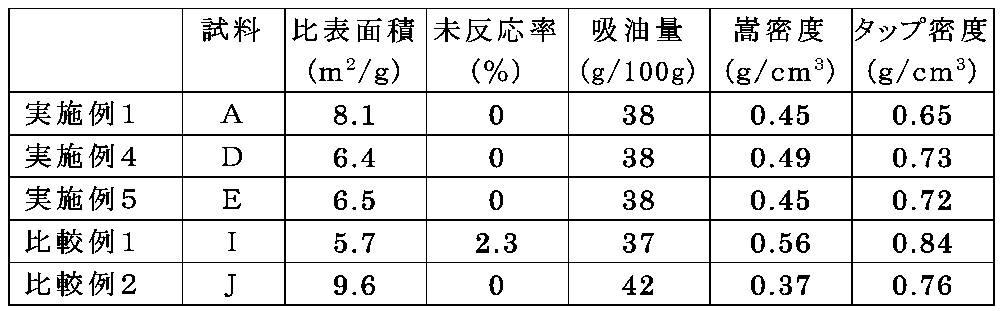
実施例及び比較例で得られた試料のD10、D50,1、D90を測定し、また、D50,2を測定してZd、SDを求め、表2に示した。また、BET比表面積、未反応率、吸油量、嵩密度、タップ密度を測定し、その結果を表3に示した。実施例の試料はZdが2以上であり、粉砕し易いものであった。また、比表面積も比較的大きく、未反応率は低く、吸油量、嵩密度も適度であることがわかった。
尚、得られた試料の未反応率は次のようにして測定した。粉末X線回折装置を用いて粉末X線回折パターンを測定した。その結果、いずれの試料もLi4Ti5O12を主成分とすることを確認した。また、測定されたピーク強度のうち、Xとして、2θ=18°付近のLi4Ti5O12のピーク強度を、Yとして2θ=27°付近のルチル型TiO2のピーク強度、2θ=25°付近のアナタース型TiO2のピーク強度及び2θ=44°付近のLi2TiO3のピーク強度を用いて前述の単相率を算出し、未反応率=100-単相率とした。
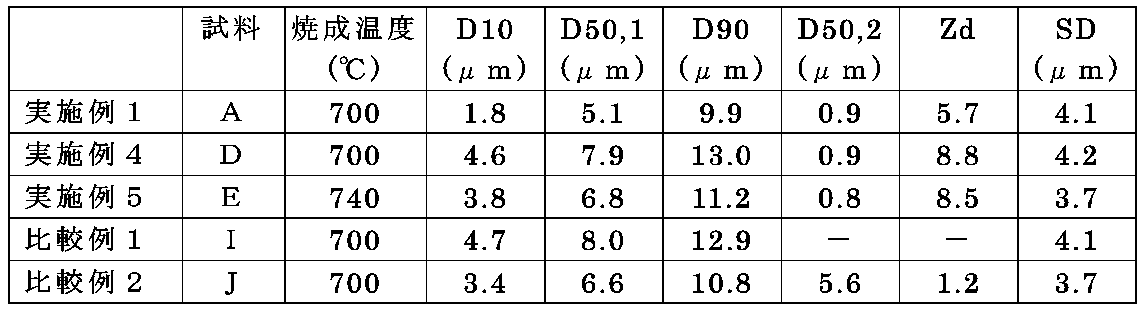
実施例で得られた粉砕した試料のD10、D50、D90、SD、比表面積、未反応率、吸油量と、剥離強度の結果を表4に示す。実施例の試料は、電極活物質として良好な粉体特性を有しており、しかも、剥離強度が強く、集電体に強固に固着することがわかった。
尚、剥離強度は、クロスカット法JIS K5600-5-6(ISO2409)を用いて0~5の6段階で評価した。下記の評価試料をカッターナイフを用いて、25個の碁盤目を作り、碁盤目部分にセロテープ(登録商標)を強く圧着させ、テープの端を60°の角度で一気に引き剥がした後の碁盤目の状態を標準図と比較して評価する。0~5の数値が小さいほど剥離強度が強いことを示す。評価試料は、実施例で得られた試料と、導電剤としてのアセチレンブラック粉末、及び結着剤としてのポリフッ化ビニリデン樹脂を質量比で100:5:8で混合し、練り合わせ、ペーストを調製し、このペーストをアルミ箔上に塗布し、120℃の温度で10分乾燥した後、17MPaでプレスして作製した。

実施例及び比較例で得られた試料と、導電剤としてのアセチレンブラック粉末、及び結着剤としてのポリフッ化ビニリデン樹脂を質量比で100:5:7で混合し、練り合わせ、ペーストを調製した。このペーストをアルミ箔上に塗布し、120℃の温度で10分乾燥した後、直径12mmの円形に打ち抜き、17MPaでプレスして作用極とした。電極中に含まれる活物質量は、3mgであった。
上記で作製した蓄電デバイスについて、種々の電流量で放電容量を測定して容量維持率(%)を算出した。放電電流は1C~30Cの範囲に設定して行った。環境温度は25℃とした。容量維持率は、1Cでの放電容量の測定値をX1、10Cでの測定値をX10とすると、(X10/X1)×100の式で算出した。尚、ここで1Cとは、1時間で満充電できる電流値を言い、本評価では、0.48mAが1Cに相当する。結果を表5に示す。実施例の試料を用いた蓄電デバイスは容量維持率が高く、レート特性がよいことがわかった。
上記で作製した蓄電デバイスについて、低温環境(-40℃)で電圧範囲を1~3Vに、電流範囲を0.25C~1.0Cとして上記と同様な充放電を行いった。25℃での放電時の容量Xnに対して低温環境下での放電時容量を比較したX0.25(-40℃)/X0.25(25℃)×100を低温特性とすると、この値が大きければ低温特性が優れている。結果を表5に示す。実施例の試料を用いた蓄電デバイスは低温特性がよいことがわかった。

また、本発明のチタン酸リチウムの製造方法は、低コストで、従来の製造方法よりも低い焼成温度でも確実に安定して製造することができる。
Claims (17)
- 次の式1で表される粉砕度Zdが2以上であるチタン酸リチウム造粒体。
(式1) Zd=D50,1/D50,2
(ここで、D50,1は、粉砕する前のチタン酸リチウムの累積50%粒径(μm)であり、D50,2は、試料1gを面積2cm2の円形内に置き、その上に圧力35MPaとなる荷重を1分間加えて粉砕した後のチタン酸リチウムの累積50%粒径(μm)である。) - 累積50%粒径(D50,1)が0.5~50μmであり、しかも、330メッシュ篩残分が0.1質量%以下である、請求項1に記載のチタン酸リチウム造粒体。
- 累積50%粒径が0.1~5μmであり、しかも、330メッシュ篩残分が0.1質量%以下である、チタン酸リチウム粉体。
- BET比表面積が5~50m2/gである、請求項1~3のいずれか一項に記載のチタン酸リチウム造粒体又はチタン酸リチウム粉体。
- BET比表面積が100~400m2/gであり、硫酸分(SO4)の含有量がメタチタン酸のTiO2換算量に対して0.01~2.0質量%であるメタチタン酸を含む、請求項1~4のいずれか一項に記載のチタン酸リチウムを製造するためのチタン原料。
- (1)硫酸チタニル又は硫酸チタンを加熱加水分解してメタチタン酸を製造する工程、
(2)前記のメタチタン酸を含むスラリーを調製し、前記のスラリーのpHを6.0~9.0に中和した後、固液分離して、BET比表面積が100~400m2/gであり、硫酸分(SO4)の含有量がメタチタン酸のTiO2換算量に対して0.01~2.0質量%であるメタチタン酸を含むチタン原料を製造する工程、
(3)前記のチタン原料とリチウム化合物を混合した後、焼成する工程、
を含むチタン酸リチウムの製造方法。 - 前記の(2)の工程においてメタチタン酸を固液分離した後、乾燥し、乾式粉砕してメタチタン酸を含むチタン原料を製造する、請求項6に記載のチタン酸リチウムの製造方法。
- 前記の(3)の工程が、メタチタン酸を含むチタン原料とリチウム化合物の混合スラリーを調製した後、焼成する工程、である請求項6に記載のチタン酸リチウムの製造方法。
- 前記の(3)の工程が、メタチタン酸を含むチタン原料とリチウム化合物の混合スラリーを調製した後、湿式粉砕し、次いで、焼成する工程、である請求項6に記載のチタン酸リチウムの製造方法。
- 前記の(3)の工程においてチタン原料の累積50%粒径を0.5~3.0μmの範囲に湿式粉砕する、請求項9に記載のチタン酸リチウムの製造方法。
- 前記の(3)の工程において焼成前に混合スラリーを乾燥して造粒する、請求項8~10のいずれか一項に記載のチタン酸リチウムの製造方法。
- 前記の(3)の工程において600~950℃の温度で焼成する、請求項6~11のいずれか一項に記載のチタン酸リチウムの製造方法。
- (4)前記の請求項6~12のいずれか一項に記載の方法で製造したチタン酸リチウムを更に乾式粉砕する工程、を含むチタン酸リチウムの製造方法。
- 少なくとも、請求項1~4のいずれか一項に記載のチタン酸リチウム造粒体又はチタン酸リチウム粉体と結着剤とを混合し、集電体に固着してなる、蓄電デバイス用電極。
- 少なくとも、請求項14に記載の電極、その対極及び電解質を含む、蓄電デバイス。
- 少なくとも、前記の請求項6~13のいずれか一項に記載の方法で製造したチタン酸リチウムを結着剤と混合し、集電体に固着する工程、を含む蓄電デバイス用電極の製造方法。
- 少なくとも、請求項16に記載の方法で製造した電極と、その対極及び電解質を含む、蓄電デバイス。
Priority Applications (5)
| Application Number | Priority Date | Filing Date | Title |
|---|---|---|---|
| CN201480031603.6A CN105307979B (zh) | 2013-06-04 | 2014-05-30 | 钛酸锂、其制备方法以及使用其的蓄电装置 |
| KR1020157034440A KR20160014636A (ko) | 2013-06-04 | 2014-05-30 | 티탄산 리튬 및 그 제조 방법, 그리고 그것을 사용한 축전 디바이스 |
| US14/895,202 US9966599B2 (en) | 2013-06-04 | 2014-05-30 | Process for manufacturing lithium titanium oxides |
| EP14808309.0A EP3006403A4 (en) | 2013-06-04 | 2014-05-30 | Lithium titanate, production method for same, and electrical storage device employing same |
| JP2015521422A JP6390975B2 (ja) | 2013-06-04 | 2014-05-30 | チタン酸リチウム及びその製造方法並びにそれを用いた蓄電デバイス |
Applications Claiming Priority (2)
| Application Number | Priority Date | Filing Date | Title |
|---|---|---|---|
| JP2013117992 | 2013-06-04 | ||
| JP2013-117992 | 2013-06-04 |
Publications (1)
| Publication Number | Publication Date |
|---|---|
| WO2014196462A1 true WO2014196462A1 (ja) | 2014-12-11 |
Family
ID=52008107
Family Applications (1)
| Application Number | Title | Priority Date | Filing Date |
|---|---|---|---|
| PCT/JP2014/064398 Ceased WO2014196462A1 (ja) | 2013-06-04 | 2014-05-30 | チタン酸リチウム及びその製造方法並びにそれを用いた蓄電デバイス |
Country Status (7)
| Country | Link |
|---|---|
| US (1) | US9966599B2 (ja) |
| EP (1) | EP3006403A4 (ja) |
| JP (1) | JP6390975B2 (ja) |
| KR (1) | KR20160014636A (ja) |
| CN (1) | CN105307979B (ja) |
| TW (1) | TWI636014B (ja) |
| WO (1) | WO2014196462A1 (ja) |
Cited By (5)
| Publication number | Priority date | Publication date | Assignee | Title |
|---|---|---|---|---|
| CN105470490A (zh) * | 2015-12-16 | 2016-04-06 | 苏州迪思伏新能源科技有限公司 | 一种类球形钛酸锂电极材料的制备方法 |
| WO2018003929A1 (ja) | 2016-06-30 | 2018-01-04 | 宇部興産株式会社 | 蓄電デバイスの電極用チタン酸リチウム粉末および活物質材料、並びにそれを用いた電極シートおよび蓄電デバイス |
| EP3210941A4 (en) * | 2014-10-24 | 2018-07-04 | Otsuka Chemical Co., Ltd. | Porous titanate compound particles and method for producing same |
| JP2022094799A (ja) * | 2020-12-15 | 2022-06-27 | Ube株式会社 | チタン酸リチウム粉末、それを用いた電極シート、及び蓄電デバイス |
| JP2023059834A (ja) * | 2021-10-15 | 2023-04-27 | テイカ株式会社 | アニオン捕捉機能を有する含水酸化チタン及びその製造方法 |
Families Citing this family (8)
| Publication number | Priority date | Publication date | Assignee | Title |
|---|---|---|---|---|
| CN106404584A (zh) * | 2016-04-15 | 2017-02-15 | 南京国轩电池有限公司 | 一种锂离子电池合浆粉料干混均匀性的评价方法 |
| JP6443421B2 (ja) * | 2016-10-12 | 2018-12-26 | トヨタ自動車株式会社 | 電極の製造方法 |
| WO2018097429A1 (ko) * | 2016-11-22 | 2018-05-31 | 주식회사 포스코이에스엠 | 리튬 티탄 복합 산화물, 이의 제조 방법 및 이를 포함하는 리튬 이차 전지 |
| CN110137565B (zh) * | 2019-05-20 | 2021-05-11 | 天目湖先进储能技术研究院有限公司 | 一种硫化物固态电解质的大规模制备方法 |
| CN113224372A (zh) * | 2021-04-08 | 2021-08-06 | 刘迪 | 一种快充固态聚合物锂离子电池浆料的制备工艺 |
| CN115679122B (zh) * | 2022-11-23 | 2024-03-15 | 陈畅 | 一种复合结构的电极及其制作方法与应用 |
| JPWO2024195719A1 (ja) * | 2023-03-23 | 2024-09-26 | ||
| CN116692933A (zh) * | 2023-06-08 | 2023-09-05 | 北京华特源科技有限公司 | 一种钛基锂离子筛的制备方法、由其制备得到的产品和应用 |
Citations (8)
| Publication number | Priority date | Publication date | Assignee | Title |
|---|---|---|---|---|
| JP2001192208A (ja) | 1999-06-03 | 2001-07-17 | Titan Kogyo Kk | リチウムチタン複合酸化物及びその製造方法、並びにその用途 |
| JP2001213622A (ja) | 2000-01-26 | 2001-08-07 | Toho Titanium Co Ltd | チタン酸リチウムの製造方法およびリチウムイオン電池並びにその電極 |
| JP2008150232A (ja) * | 2006-12-15 | 2008-07-03 | Titan Kogyo Kk | 光触媒酸化チタン原料用メタチタン酸スラリー及びその製造方法 |
| JP4153192B2 (ja) * | 2001-10-31 | 2008-09-17 | チタン工業株式会社 | 電極用チタン酸リチウム及びその用途 |
| JP2010140863A (ja) * | 2008-12-15 | 2010-06-24 | Titan Kogyo Kk | 電極用酸化チタン化合物及びそれを用いたリチウム二次電池 |
| JP2011113795A (ja) * | 2009-11-26 | 2011-06-09 | Nippon Chem Ind Co Ltd | リチウム二次電池活物質用チタン酸リチウムの製造方法 |
| WO2012147856A1 (ja) | 2011-04-28 | 2012-11-01 | 石原産業株式会社 | チタン酸リチウム製造用チタン原料及びかかる原料を用いたチタン酸リチウムの製造方法 |
| JP2013095647A (ja) * | 2011-11-02 | 2013-05-20 | Taiyo Yuden Co Ltd | リチウムチタン複合酸化物、その製造方法、それを用いた電池用電極およびリチウムイオン二次電池 |
Family Cites Families (5)
| Publication number | Priority date | Publication date | Assignee | Title |
|---|---|---|---|---|
| JP3502118B2 (ja) | 1993-03-17 | 2004-03-02 | 松下電器産業株式会社 | リチウム二次電池およびその負極の製造法 |
| JP3894778B2 (ja) | 2000-11-20 | 2007-03-22 | 石原産業株式会社 | チタン酸リチウム及びそれを用いてなるリチウム電池 |
| CN101675547B (zh) * | 2007-11-01 | 2013-05-08 | Agc清美化学股份有限公司 | 锂离子二次电池用正极活性物质的制造方法 |
| PL2358640T3 (pl) * | 2008-11-04 | 2017-11-30 | Sachtleben Pigments Oy | Sposób wytwarzania tytanianów metali alkalicznych |
| WO2013081231A1 (ko) * | 2011-11-30 | 2013-06-06 | 주식회사 휘닉스소재 | 이종 금속이 도핑된 리튬 티탄 복합 산화물의 제조 방법, 및 이에 의하여 제조된 이종 금속이 도핑된 리튬 티탄 복합 산화물 |
-
2014
- 2014-05-30 WO PCT/JP2014/064398 patent/WO2014196462A1/ja not_active Ceased
- 2014-05-30 KR KR1020157034440A patent/KR20160014636A/ko not_active Withdrawn
- 2014-05-30 CN CN201480031603.6A patent/CN105307979B/zh not_active Expired - Fee Related
- 2014-05-30 US US14/895,202 patent/US9966599B2/en not_active Expired - Fee Related
- 2014-05-30 EP EP14808309.0A patent/EP3006403A4/en not_active Withdrawn
- 2014-05-30 JP JP2015521422A patent/JP6390975B2/ja not_active Expired - Fee Related
- 2014-06-04 TW TW103119358A patent/TWI636014B/zh not_active IP Right Cessation
Patent Citations (8)
| Publication number | Priority date | Publication date | Assignee | Title |
|---|---|---|---|---|
| JP2001192208A (ja) | 1999-06-03 | 2001-07-17 | Titan Kogyo Kk | リチウムチタン複合酸化物及びその製造方法、並びにその用途 |
| JP2001213622A (ja) | 2000-01-26 | 2001-08-07 | Toho Titanium Co Ltd | チタン酸リチウムの製造方法およびリチウムイオン電池並びにその電極 |
| JP4153192B2 (ja) * | 2001-10-31 | 2008-09-17 | チタン工業株式会社 | 電極用チタン酸リチウム及びその用途 |
| JP2008150232A (ja) * | 2006-12-15 | 2008-07-03 | Titan Kogyo Kk | 光触媒酸化チタン原料用メタチタン酸スラリー及びその製造方法 |
| JP2010140863A (ja) * | 2008-12-15 | 2010-06-24 | Titan Kogyo Kk | 電極用酸化チタン化合物及びそれを用いたリチウム二次電池 |
| JP2011113795A (ja) * | 2009-11-26 | 2011-06-09 | Nippon Chem Ind Co Ltd | リチウム二次電池活物質用チタン酸リチウムの製造方法 |
| WO2012147856A1 (ja) | 2011-04-28 | 2012-11-01 | 石原産業株式会社 | チタン酸リチウム製造用チタン原料及びかかる原料を用いたチタン酸リチウムの製造方法 |
| JP2013095647A (ja) * | 2011-11-02 | 2013-05-20 | Taiyo Yuden Co Ltd | リチウムチタン複合酸化物、その製造方法、それを用いた電池用電極およびリチウムイオン二次電池 |
Non-Patent Citations (1)
| Title |
|---|
| See also references of EP3006403A4 * |
Cited By (7)
| Publication number | Priority date | Publication date | Assignee | Title |
|---|---|---|---|---|
| EP3210941A4 (en) * | 2014-10-24 | 2018-07-04 | Otsuka Chemical Co., Ltd. | Porous titanate compound particles and method for producing same |
| US10106464B2 (en) | 2014-10-24 | 2018-10-23 | Otsuka Chemical Co., Ltd. | Porous titanate compound particles and method for producing same |
| CN105470490A (zh) * | 2015-12-16 | 2016-04-06 | 苏州迪思伏新能源科技有限公司 | 一种类球形钛酸锂电极材料的制备方法 |
| WO2018003929A1 (ja) | 2016-06-30 | 2018-01-04 | 宇部興産株式会社 | 蓄電デバイスの電極用チタン酸リチウム粉末および活物質材料、並びにそれを用いた電極シートおよび蓄電デバイス |
| JP2022094799A (ja) * | 2020-12-15 | 2022-06-27 | Ube株式会社 | チタン酸リチウム粉末、それを用いた電極シート、及び蓄電デバイス |
| JP7654971B2 (ja) | 2020-12-15 | 2025-04-02 | Ube株式会社 | チタン酸リチウム粉末、それを用いた電極シート、及び蓄電デバイス |
| JP2023059834A (ja) * | 2021-10-15 | 2023-04-27 | テイカ株式会社 | アニオン捕捉機能を有する含水酸化チタン及びその製造方法 |
Also Published As
| Publication number | Publication date |
|---|---|
| JP6390975B2 (ja) | 2018-09-19 |
| EP3006403A1 (en) | 2016-04-13 |
| US20160118657A1 (en) | 2016-04-28 |
| CN105307979A (zh) | 2016-02-03 |
| CN105307979B (zh) | 2018-05-29 |
| JPWO2014196462A1 (ja) | 2017-02-23 |
| EP3006403A4 (en) | 2017-01-25 |
| TWI636014B (zh) | 2018-09-21 |
| TW201504151A (zh) | 2015-02-01 |
| KR20160014636A (ko) | 2016-02-11 |
| US9966599B2 (en) | 2018-05-08 |
Similar Documents
| Publication | Publication Date | Title |
|---|---|---|
| JP6390975B2 (ja) | チタン酸リチウム及びその製造方法並びにそれを用いた蓄電デバイス | |
| JP5612856B2 (ja) | チタン酸化合物及びその製造方法並びに該チタン酸化合物を含む電極活物質、該電極活物質を用いてなる蓄電デバイス | |
| JP3894778B2 (ja) | チタン酸リチウム及びそれを用いてなるリチウム電池 | |
| JP5896994B2 (ja) | チタン酸リチウムの製造方法 | |
| JP4668539B2 (ja) | チタン酸リチウムの製造方法及びリチウム電池の製造方法 | |
| JP5990512B2 (ja) | チタン酸リチウム製造用チタン原料及びかかる原料を用いたチタン酸リチウムの製造方法 | |
| JP5927182B2 (ja) | チタン酸リチウム前駆体の製造方法およびチタン酸リチウムの製造方法 | |
| JP4597546B2 (ja) | チタン酸リチウムの製造方法及びリチウム電池の製造方法 | |
| JP5270634B2 (ja) | チタン酸リチウムの製造方法及びリチウム電池の製造方法 | |
| JP2017178688A (ja) | チタン酸リチウム前駆体粉体及びその製造方法、該前駆体を用いたチタン酸リチウムの製造方法及びチタン酸リチウム並びに該チタン酸リチウムを用いた電極及び蓄電デバイス | |
| JP5830842B2 (ja) | チタン酸リチウム粒子粉末の製造法及び非水電解質二次電池 | |
| CN121285526A (zh) | 锂钴系复合氧化物颗粒的制造方法 | |
| JP2016150868A (ja) | チタン酸リチウム及びその製造方法並びにそれを用いたリチウム二次電池 |
Legal Events
| Date | Code | Title | Description |
|---|---|---|---|
| WWE | Wipo information: entry into national phase |
Ref document number: 201480031603.6 Country of ref document: CN |
|
| 121 | Ep: the epo has been informed by wipo that ep was designated in this application |
Ref document number: 14808309 Country of ref document: EP Kind code of ref document: A1 |
|
| ENP | Entry into the national phase |
Ref document number: 2015521422 Country of ref document: JP Kind code of ref document: A |
|
| WWE | Wipo information: entry into national phase |
Ref document number: 2014808309 Country of ref document: EP |
|
| WWE | Wipo information: entry into national phase |
Ref document number: 14895202 Country of ref document: US |
|
| ENP | Entry into the national phase |
Ref document number: 20157034440 Country of ref document: KR Kind code of ref document: A |
|
| NENP | Non-entry into the national phase |
Ref country code: DE |