WO2014168095A1 - 乳化組成物及び化粧料 - Google Patents
乳化組成物及び化粧料 Download PDFInfo
- Publication number
- WO2014168095A1 WO2014168095A1 PCT/JP2014/060026 JP2014060026W WO2014168095A1 WO 2014168095 A1 WO2014168095 A1 WO 2014168095A1 JP 2014060026 W JP2014060026 W JP 2014060026W WO 2014168095 A1 WO2014168095 A1 WO 2014168095A1
- Authority
- WO
- WIPO (PCT)
- Prior art keywords
- group
- mass
- carbon atoms
- glutamate
- vitamin
- Prior art date
- Legal status (The legal status is an assumption and is not a legal conclusion. Google has not performed a legal analysis and makes no representation as to the accuracy of the status listed.)
- Ceased
Links
Images

Classifications
-
- A—HUMAN NECESSITIES
- A61—MEDICAL OR VETERINARY SCIENCE; HYGIENE
- A61K—PREPARATIONS FOR MEDICAL, DENTAL OR TOILETRY PURPOSES
- A61K8/00—Cosmetics or similar toiletry preparations
- A61K8/02—Cosmetics or similar toiletry preparations characterised by special physical form
- A61K8/04—Dispersions; Emulsions
- A61K8/06—Emulsions
-
- A—HUMAN NECESSITIES
- A61—MEDICAL OR VETERINARY SCIENCE; HYGIENE
- A61K—PREPARATIONS FOR MEDICAL, DENTAL OR TOILETRY PURPOSES
- A61K8/00—Cosmetics or similar toiletry preparations
- A61K8/18—Cosmetics or similar toiletry preparations characterised by the composition
- A61K8/30—Cosmetics or similar toiletry preparations characterised by the composition containing organic compounds
- A61K8/40—Cosmetics or similar toiletry preparations characterised by the composition containing organic compounds containing nitrogen
- A61K8/42—Amides
-
- A—HUMAN NECESSITIES
- A61—MEDICAL OR VETERINARY SCIENCE; HYGIENE
- A61K—PREPARATIONS FOR MEDICAL, DENTAL OR TOILETRY PURPOSES
- A61K8/00—Cosmetics or similar toiletry preparations
- A61K8/18—Cosmetics or similar toiletry preparations characterised by the composition
- A61K8/30—Cosmetics or similar toiletry preparations characterised by the composition containing organic compounds
- A61K8/67—Vitamins
- A61K8/678—Tocopherol, i.e. vitamin E
-
- A—HUMAN NECESSITIES
- A61—MEDICAL OR VETERINARY SCIENCE; HYGIENE
- A61Q—SPECIFIC USE OF COSMETICS OR SIMILAR TOILETRY PREPARATIONS
- A61Q19/00—Preparations for care of the skin
Definitions
- the present invention relates to an emulsified composition and a cosmetic.
- Japanese Patent Nos. 5134197, 2831800, and 9-169618 describe a method for preparing an oil-in-water emulsion composition. Further, as an emulsification technique using a surfactant, Japanese Patent No. 4524098 discloses an emulsified dispersion obtained by combining an alkylated polysaccharide with a phospholipid and an ionic surfactant.
- the type and blending amount of the surfactant When the type and blending amount of the surfactant are limited, the type and blending amount of the oil, the fragrance, or the functional oil component blended in the emulsion composition may be limited accordingly.
- transparency is often required for an emulsion composition applied to cosmetics.
- emulsified particles when emulsified particles are contained in the emulsified composition, light scattering due to the emulsified particles may occur depending on the average particle diameter of the emulsified particles or the content of the oil agent, and the like.
- the turbidity of the emulsified composition may occur, and the transparency of the cosmetic may be impaired, which may be undesirable in appearance. Under such circumstances, it has been desired to develop an emulsified composition capable of realizing long-term emulsification stability while containing a functional oil component at a high concentration.
- an emulsified composition in order to reduce turbidity and suppress the content of the oil or surfactant in the cosmetic when applied to the cosmetic, it is necessary to add a functional oil component at a high concentration. desirable.
- a large amount of vitamins may be used to sufficiently dissolve a high concentration of functional oily components.
- a large amount of phospholipid or the like is preferably blended in the emulsion composition in order to improve salt resistance. According to the study by the present inventors, it has been clarified that an increase in the concentration of vitamin E or phospholipid contained in the emulsion composition causes a problem that the emulsion stability of the emulsion composition is impaired.
- An object of the present invention is to provide an emulsified composition containing a functional oil component and vitamin E and having excellent emulsification stability and a cosmetic containing the emulsified composition.
- R 1 represents an alkyl group having 8 to 22 carbon atoms, an alkenyl group having 8 to 22 carbon atoms, or an alkynyl group having 8 to 22 carbon atoms.
- R 2 and R 3 each independently represent an alkyl group having 8 to 30 carbon atoms, an alkenyl group having 8 to 30 carbon atoms, or a sterol group.
- vitamin E includes at least one selected from the group consisting of tocopherol and derivatives thereof, and tocotrienol and derivatives thereof.
- R 21 represents an alkyl group having 12 to 18 carbon atoms, an alkenyl group having 12 to 18 carbon atoms, or an alkynyl group having 12 to 18 carbon atoms.
- R 22 and R 23 each independently represent an alkyl group having 12 to 24 carbon atoms, an alkenyl group having 12 to 24 carbon atoms, or a sterol group.
- the acylglutamate represented by the general formula (1) is dihexyldecyl lauroylglutamate, diisostearyl lauroylglutamate, bis (hexyldecyl / octyldodecyl) lauroylglutamate, dioctyldecyl lauroylglutamate, dilauroylglutamate (cholesteryl / Octyldodecyl), dilauroylglutamate (cholesteryl / behenyl / octyldodecyl), dilauroylglutamate (phytosteryl / octyldodecyl), dilauroylglutamate (octyldodecyl / phytosteryl / behenyl), lauroylglutamate (phytosteryl / stedecyl / stenyl) ) And stearoyl
- the content ratio (II / I) of the content (II) of the acyl glutamate ester represented by the general formula (1) with respect to the content (I) of vitamin E is 0.60 or less on a mass basis.
- the functional oily component is an oil-soluble component that dissolves in vitamin E at 0.5% by mass or more at 25 ° C.
- a cosmetic comprising the emulsified composition according to any one of [1] to [8].
- the cosmetic according to [9] further containing a phospholipid.
- an emulsified composition and a cosmetic containing the emulsified composition which contain a functional oily component and vitamin E and have excellent emulsification stability.
- a numerical range indicated by using “to” indicates a range including the numerical values described before and after “to” as the minimum value and the maximum value, respectively.
- aqueous phase is used as a term for “oil phase” regardless of the type of solvent.
- process is not limited to an independent process, and is included in the term if the intended purpose of this process is achieved even when it cannot be clearly distinguished from other processes.
- the amount of each component in the composition is the sum of the plurality of substances present in the composition unless there is a specific indication when there are a plurality of substances corresponding to each component in the composition. Means quantity.
- the emulsified composition of the present invention contains a functional oily component, vitamin E, and an acyl glutamate ester represented by the following general formula (1).
- R 1 represents an alkyl group having 8 to 22 carbon atoms, an alkenyl group having 8 to 22 carbon atoms, or an alkynyl group having 8 to 22 carbon atoms.
- R 2 and R 3 each independently represent an alkyl group having 8 to 30 carbon atoms, an alkenyl group having 8 to 30 carbon atoms, or a sterol group.
- the emulsified composition of the present invention has excellent emulsification stability by having the above configuration. Moreover, the emulsion composition of this invention is excellent in transparency, and becomes excellent in stability and its sustainability. Furthermore, the emulsion composition of the present invention can maintain the effect expected of the functional oil component over a long period of time.
- the emulsion form of the emulsion composition of the present invention is not particularly limited, but is preferably an oil-in-water emulsion composition.
- the essential components and optional components contained in the emulsion composition of the present invention will be described in detail.
- the emulsified composition of the present invention contains a functional oil component.
- the functional oily component is an oily component that can exhibit a desired function for a living body.
- the functional oily component is an oily component that can exhibit a desired function for a living body and is dissolved in vitamin E, which will be described later, at 0.5% by mass (100% by mass or less) at 25 ° C. Is preferred. Specific examples include fat-soluble vitamins other than vitamin E, glycyrrhetinic acid or its derivatives, and carotenoids.
- glycyrrhetinic acid or derivatives thereof include glycyrrhetinic acid, stearyl glycyrrhetinate, pyridoxine glycyrrhetinate, and the like. Among them, stearyl glycyrrhetinate and glycyrrhetinic acid are preferable, and stearyl glycyrrhetinate is more preferable.
- Stearyl glycyrrhetinate is a CAS No. It is a compound of 13832-70-7, which is a fat-soluble substance and a compound with low compatibility with general oils.
- Stearyl glycyrrhetinate has been conventionally used as an anti-inflammatory or antiallergic agent in soaps, creams, emulsions, etc., but is applied to highly transparent emulsified compositions because of its low solubility in aqueous compositions. There was hardly anything.
- the method for producing stearyl glycyrrhetic acid is not particularly limited. It can be obtained by reaction.
- fat-soluble vitamins other than vitamin E examples include vitamin A such as retinol, retinol palmitate, and retinol acetate, and vitamin D such as ergocalciferol and cholecalciferol, and derivatives thereof.
- carotenoids examples include astaxanthin, lycopene, fucoxanthin and the like. Astaxanthin is contained in Haematococcus prubiaris oil, krill extract and the like. Astaxanthin may be an extract that is separated and extracted from these natural products. Moreover, astaxanthin may be a product obtained by appropriately purifying the extract as necessary, or may be a synthetic product.
- Lycopene is contained in tomatoes, strawberries, watermelons or pink grapefruits. Lycopene may be an extract that is extracted separately from these natural products. The lycopene may be an extract, a product obtained by appropriately purifying the extract as necessary, or a synthetic product.
- Fucoxanthin is contained in brown algae or other unequal hairy algae. Fucoxanthin may be an extract that is separated and extracted from these natural products. In addition, fucoxanthin may be an extract or a product obtained by appropriately purifying the extract as necessary.
- any one kind may be used alone, or two or more kinds may be used in combination.
- the functional oily component of the present invention may be liquid or solid at 25 ° C., but in the case of a solid, it is preferably present in the emulsion composition dissolved or melted in the oil.
- dissolution the state in which the solid functional oily component is dissolved or melted in the oil.
- examples of the oil used for dissolving the functional oil component include vitamin E.
- the solubility of the functional oil component in vitamin E refers to the solubility at 25 ° C. and normal pressure, and can be specifically confirmed by the following method.
- the solvent vitamin E is not particularly limited, but tocopherol (Riken Vitamin Co., Ltd., Riken Oil 800: trade name) should be used. Is preferred.
- vitamin E and the functional oil component are weighed so that the content of the functional oil component is 0.5% by mass.
- vitamin E containing 0.5% by mass of a functional oil component is appropriately heated to 70 ° C. to 120 ° C. to completely dissolve the functional oil component. Thereafter, the mixture is allowed to stand overnight at 25 ° C.
- the functional oily component has solubility in vitamin E that can be suitably used in the emulsion composition.
- the content of the functional oil component in the emulsion composition of the present invention is preferably 0.001% by mass or more and less than 15% by mass, and 0.01% by mass or more and 15% by mass with respect to the total mass of the emulsion composition. % Is more preferable, and 0.03 to 15% by mass is even more preferable.
- the content of the functional oil component in the emulsion composition is within the above range, high transparency can be stably maintained over a long period of time while containing the functional oil component in a high concentration.
- the highly transparent emulsion composition of the present invention when applied to a cosmetic that is one of its preferred uses, it contains excellent functional oil components at a high concentration, but has excellent stability over time. Can be obtained.
- Vitamin E in the present invention is a kind of fat-soluble vitamin.
- vitamin E means at least one compound selected from the group consisting of tocopherol, its isomer, its derivative, tocotrienol, its isomer and its derivative.
- vitamin E Since it does not restrict
- Tocopherol and its derivatives mean tocopherol and derivatives having the basic skeleton as tocopherol.
- Specific examples of tocopherol include ⁇ -tocopherol, ⁇ -tocopherol, ⁇ -tocopherol, ⁇ -tocopherol, and mixtures thereof.
- Examples of tocopherol derivatives include tocopherol acetate in which the OH group of tocopherol is modified with a fatty acid, tocopherol succinate, tocopherol nicotinate, tocopherol linoleate, tocopherol (linol / olein), and the like.
- tocopherol is not particularly limited, and specifically, it may be obtained from any of sunflower, corn, olive, rapeseed, soybean, peanut or almond.
- Commercial products can be used for tocopherol and its derivatives.
- Commercially available products include Riken E Oil 800 (trade name, Riken Vitamin), Vitamin E Eisai (trade name, Eisai Food Chemical), Gamma Bright 90 (trade name, Eisai Food Chemical, Emix D (trade name, Eisai Food Chemical Co., Ltd.).
- Riken E Oil 800 trade name, Riken Vitamin
- Vitamin E Eisai trade name, Eisai Food Chemical
- Gamma Bright 90 trade name, Eisai Food Chemical
- Emix D trade name, Eisai Food Chemical Co., Ltd.
- any of tocopherols and derivatives thereof may be used alone or in combination of two or more.
- Tocotrienol and its derivatives mean tocotrienol and derivatives having the basic skeleton as tocotrienol. Specific examples of tocotrienol include ⁇ -tocotrienol, ⁇ -tocotrienol, ⁇ -tocotrienol, ⁇ -tocotrienol, and mixtures thereof.
- tocotrienol and its derivatives The origin of tocotrienol and its derivatives is not particularly limited, and specifically, it may be obtained from any of sunflower, corn, olive, rapeseed, soybean, peanut or almond.
- Commercially available products can be used for tocotrienol and its derivatives.
- Tocolit 92 (trade name, Eisai Food Chemical Co., Ltd.) and the like can be mentioned.
- any kind of tocotrienol and derivatives thereof may be used alone, or two or more kinds thereof may be used in combination.
- vitamin E may be used alone or in combination of two or more.
- the content of vitamin E in the emulsified composition of the present invention is preferably 0.5% by mass or more and less than 35% by mass, and preferably 5% by mass or more and less than 25% by mass with respect to the total mass of the emulsified composition. More preferably, it is 7.5 mass% or more and less than 20 mass%.
- the emulsified composition of the present invention contains an acyl glutamic acid ester represented by the following general formula (1).
- the acyl glutamate represented by the following general formula (1) is also referred to as “specific acyl glutamate”.
- R 1 represents an alkyl group having 8 to 22 carbon atoms, an alkenyl group having 8 to 22 carbon atoms, or an alkynyl group having 8 to 22 carbon atoms.
- R 2 and R 3 each independently represent an alkyl group having 8 to 30 carbon atoms, an alkenyl group having 8 to 30 carbon atoms, or a sterol group.
- the emulsion stability of the emulsion composition containing a functional oil component and vitamin E can be improved. It is speculated that the specific acylglutamic acid ester can improve the stability of the emulsion composition because it can increase the solubility of the functional oil component and reduce the viscosity of the emulsion composition.
- R 1 represents an alkyl group having 8 to 22 carbon atoms, an alkenyl group having 8 to 22 carbon atoms, or an alkynyl group having 8 to 22 carbon atoms.
- the alkyl group for R 1 is preferably an alkyl group having 10 to 22 carbon atoms, and more preferably an alkyl group having 12 to 18 carbon atoms.
- the alkenyl group for R 1 is preferably an alkenyl group having 10 to 22 carbon atoms, and more preferably an alkenyl group having 12 to 18 carbon atoms.
- the alkynyl group for R 1 is preferably an alkynyl group having 10 to 22 carbon atoms, and more preferably an alkynyl group having 12 to 18 carbon atoms.
- the alkyl group, alkenyl group and alkynyl group may be linear or branched.
- the alkyl group, alkenyl group, and alkynyl group may be unsubstituted or substituted with a substituent.
- alkyl group for R 1 examples include a lauryl group, a myristyl group, a palmitoyl group, a stearyl group, and an isostearyl group.
- alkenyl group for R 1 examples include an oleyl group, a linole group, and a linolenic group.
- alkynyl group for R 1 include a dodecynyl group, a tridecynyl group, an eicosinyl group, and the like.
- R 2 and R 3 each independently represent an alkyl group having 8 to 30 carbon atoms, an alkenyl group having 8 to 30 carbon atoms, or a sterol group.
- the alkyl group for R 2 and R 3 is preferably an alkyl group having 12 to 24 carbon atoms, more preferably an alkyl group having 14 to 22 carbon atoms.
- an alkenyl group having 12 to 24 carbon atoms is preferable, and an alkenyl group having 14 to 22 carbon atoms is more preferable.
- the sterol group in R 2 and R 3 include phytosteryl group, sitosteryl group, campesteryl group, stigmasteryl group, brassicasteryl group, ergosteryl group, lanosteryl group, cholesteryl group, cycloartanyl group, cycloartyl group and the like.
- a phytosteryl group, a sitosteryl group, a campesteryl group, a stigmasteryl group, a brassasteryl group, and a cholesteryl group are more preferable.
- the alkyl group and alkenyl group may be linear or branched.
- the alkyl group, alkenyl group, and sterol group may be unsubstituted or substituted with a substituent.
- alkyl group for R 2 examples include lauryl, myristyl, palmitoyl, stearyl, isostearyl, butyldodecyl, hexyldecyl, hexyldecyl, octyldecyl, octyldecyl, octyldecyl, octyl A tetradecyl group, a decyl dodecyl group, a decyl tetradecyl group, etc. are mentioned.
- alkenyl group for R 2 include an oleyl group, a linole group, and a linolenic group.
- alkyl group in R 3 include lauryl group, myristyl group, palmitoyl group, stearyl group, isostearyl group, butyldodecyl group, hexyldecyl group, hexyldecyl group, octyldecyl group, octyldodecyl group, octyl group A tetradecyl group, a decyl dodecyl group, a decyl tetradecyl group, etc. are mentioned.
- alkenyl group for R 3 include an oleyl group, a linole group, and a linolenic group.
- an acyl glutamate represented by the following general formula (2) is preferable.
- R 21 represents an alkyl group having 12 to 18 carbon atoms, an alkenyl group having 12 to 18 carbon atoms, or an alkynyl group having 12 to 18 carbon atoms.
- R 22 and R 23 each independently represent an alkyl group having 12 to 24 carbon atoms, an alkenyl group having 12 to 24 carbon atoms, or a sterol group.
- R 1 in the general formula (1) represents an alkyl group having 12 to 18 carbon atoms
- R 2 represents an alkyl group having 14 to 22 carbon atoms or an alkenyl group having 14 to 22 carbon atoms
- R 3 preferably represents an alkyl group having 14 to 22 carbon atoms or an alkenyl group having 14 to 22 carbon atoms.
- Acylglutamate esters include dihexyldecyl lauroyl glutamate, diisostearyl lauroyl glutamate, bis (hexyldecyl / octyldodecyl) lauroylglutamate, dioctyldodecyl lauroylglutamate, di (cholesteryl / octyldodecyl) lauroylglutamate, / Octyldodecyl), dilauroylglutamate (phytosteryl / octyldodecyl), dilauroglutamate (octyldecyl / phytosteryl / behenyl), lauroylglutamate (phytosteryl / behenyl / octyldodecyl / isostearyl) and preferred stearoylglutadecylate dioctyldecyl
- acyl glutamate from the viewpoint of emulsion stability of the emulsion composition, dihexyldecyl lauroyl glutamate, diisostearyl lauroyl glutamate, bis (hexyldecyl / octyldodecyl) lauroyl glutamate, dioctyl dodecyl lauroyl glutamate, and stearoyl glutamic acid Dioctyldecyl is more preferred.
- one kind of the specific acyl glutamate ester may be used alone, or two or more kinds may be used in combination.
- the content of the specific acyl glutamic acid ester in the emulsion composition of the present invention is preferably 0.001% by mass or more and less than 15% by mass, and 0.01% by mass or more and 10% by mass with respect to the total mass of the emulsion composition. More preferably, it is less than 0.1% by mass, and more preferably 0.1% by mass or more and less than 7.5% by mass.
- the ratio of both, that is, [specific acyl glutamate content / vitamin E content ] [(II) / (I)] is preferably 0.6 or less.
- the ratio [(II) / (I)] of the content of the specific acyl glutamate to the content of vitamin E is 0.6 or less, the emulsion composition containing no specific acyl glutamate Since the effect of improving the emulsion stability of an emulsion composition containing a specific acyl glutamate ester is further increased, it is preferable. Further, the ratio [(II) / (I)] of the content of acyl glutamate to the content of vitamin E is more preferably 0.3 or less.
- the emulsified composition of the present invention preferably further contains a polyglycerol fatty acid ester.
- the emulsified composition of the present invention contains a polyglycerin fatty acid ester, the interfacial tension generated between the oil phase and the aqueous phase can be lowered. Moreover, it is estimated that the average particle diameter of the emulsified particles contained in the emulsified composition can be further reduced.
- the polyglycerin fatty acid ester used in the emulsified composition of the present invention is not necessarily highly purified by distillation or the like, and may be a reaction mixture.
- Examples of the polyglycerol fatty acid ester that can be used in the present invention include esters of polyglycerol having an average degree of polymerization of 2 or more, preferably 6 to 15, more preferably 8 to 10, and a fatty acid having 8 to 18 carbon atoms. More specifically, for example, a poly which is an ester of polyglycerin having an average degree of polymerization of 8 to 10 and caprylic acid, capric acid, lauric acid, myristic acid, palmitic acid, stearic acid, oleic acid, or linoleic acid Examples include glycerin fatty acid esters.
- the polyglycerol fatty acid ester is more preferably HLB 11 to 15 from the viewpoint of emulsifying power.
- HLB is a numerical value representing a balance between hydrophilicity and hydrophobicity that is usually used in the field of surfactants.
- the HLB can be calculated using a calculation formula that is normally used, for example, a calculation formula such as the Kawakami formula.
- M w molecular weight of the hydrophilic groups, M O is the molecular weight of the hydrophobic group.
- HLB for HLB of polyglyceryl fatty acid ester.
- a polyglycerin fatty acid ester as an emulsifier having an arbitrary HLB value can be obtained by utilizing the additivity of HLB.
- polyglycerol fatty acid esters include hexaglycerol monooleate, hexaglycerol monostearate, hexaglycerol monopalmitate, hexaglycerol monomyristate, hexaglycerol monolaurate, decaglycerol monooleate , Decaglycerin monostearic acid ester, decaglycerin monopalmitic acid ester, decaglycerin monomyristic acid ester, decaglycerin monolauric acid ester and the like.
- decaglycerin monooleate decaglycerin monostearate, decaglycerin monopalmitate, decaglycerin monomyristate, decaglycerin monolaurate, and the like.
- a commercially available product may be used as the polyglycerol fatty acid ester.
- one kind of polyglycerin fatty acid ester may be used alone, or two or more kinds may be used in combination.
- the content of the polyglycerol fatty acid ester in the emulsion composition of the present invention is preferably 0.5% by mass to 30% by mass, more preferably 1% by mass to 20% by mass, with respect to the total mass of the emulsion composition. More preferred is from 15% by weight to 15% by weight.
- the content of the polyglycerin fatty acid ester is 0.5% by mass or more, the solubility of the functional oil component is improved, and the interfacial tension generated between the oil phase and the aqueous phase can be easily reduced. By setting it as mass% or less, it is preferable at the point which does not make excess amount of surfactant and foaming of an emulsion composition does not occur easily.
- the emulsion composition of the present invention can contain a polyhydric alcohol.
- a polyhydric alcohol is a compound having a moisturizing function, a viscosity adjusting function, and the like.
- the interface tension in the interface of the aqueous solvent and oil-fat component which an emulsion composition contains can be reduced, and an interface can be made easy to spread.
- the emulsion composition of the present invention contains a polyhydric alcohol, fine and stable emulsion particles can be easily formed.
- the average particle diameter of the emulsified particles can be further refined, and the emulsified particles having a fine average particle diameter can be stably held for a long period of time while maintaining the fine average particle diameter.
- the addition of a polyhydric alcohol can lower the water activity of the emulsion composition and suppress the growth of microorganisms.
- the polyhydric alcohol in the present invention is not particularly limited as long as it is a dihydric or higher alcohol.
- the polyhydric alcohol include glycerin, diglycerin, triglycerin, polyglycerin, 3-methyl-1,3-butanediol, 1,3-butylene glycol, isoprene glycol, polyethylene glycol, 1,2-pentanediol, Examples include 1,2-hexanediol, propylene glycol, dipropylene glycol, ethylene glycol, diethylene glycol, neopentyl glycol and the like.
- polyhydric alcohol any one kind may be used alone, or two or more kinds may be used in combination.
- the polyhydric alcohol those having 3 or more hydroxyl groups in one molecule are preferably used. Thereby, the interfacial tension between the aqueous solvent and the oil and fat component can be reduced more effectively, and more fine and stable emulsified particles can be formed. As a result, when the emulsified composition of the present invention is applied to a cosmetic, the transdermal absorbability of the fat and oil component can be made higher.
- the average particle size of the emulsified particles becomes smaller, and the emulsified particles with the small average particle size remain stable for a long time. It is preferable because it is retained.
- the content of the polyhydric alcohol in the emulsion composition of the present invention is preferably 10% by mass to 60% by mass, more preferably 20% by mass to 55% by mass, and still more preferably 30% by mass with respect to the total mass of the emulsion composition. % To 50% by mass. It is preferable that the content of the polyhydric alcohol is 10% by mass or more from the viewpoint that sufficient storage stability of the emulsion composition can be easily obtained regardless of the type and content of the fat and oil component. On the other hand, when the content of the polyhydric alcohol is 60% by mass or less, the maximum effect is obtained, which is preferable in that it is easy to suppress an increase in the viscosity of the emulsion composition.
- additive components usually used in the field of food or cosmetics can be appropriately contained depending on the form.
- the other additive component can be contained in the emulsion composition of the present invention as an oil-soluble or water-soluble additive component depending on its characteristics.
- additive components examples include glucose, sucrose, copper carrageenan, locust bean gum, guar gum, hydroxypropyl guar gum, xanthan gum, karaya gum, tamarind seed polysaccharide, gum arabic, tragacanth gum, hyaluronic acid, sodium hyaluronate, sodium chondroitin sulfate Monosaccharides or polysaccharides such as dextrin; sugar alcohols such as sorbitol, mannitol, maltitol, lactose, maltotriitol, xylitol; inorganic salts such as sodium chloride and sodium sulfate; casein, albumin, methylated collagen, hydrolyzed collagen , Proteins having a molecular weight exceeding 5000, such as water-soluble collagen and gelatin; glycine, alanine, valine, leucine, isoleucine, serine, threonine, a Amino acids
- additive components may be included as functional components, excipients, viscosity modifiers, radical scavengers, and the like based on the functions of the additive components.
- various medicinal components pH adjusters, pH buffers, ultraviolet absorbers, preservatives, fragrances, and coloring agents, and other additives that are usually used for cosmetics, foods, etc. Things can be used together.
- a pH adjuster can be appropriately used.
- the pH value of the emulsion composition of the present invention adjusted with a pH adjuster is preferably in the range of 4-10.
- the measurement of pH is not particularly limited, but can be performed by, for example, a pH meter (model number: HM-30V, manufactured by Toa DKK Corporation).
- the pH adjuster may be used either before or after preparing the emulsified composition.
- the pH adjuster is preferably used before the preparation of the emulsified composition from the viewpoint that the pH fluctuation range can be reduced and the pH can be adjusted under milder conditions. In that case, you may add a pH adjuster to any of the water phase composition before preparing an emulsion composition, and an oil phase composition.
- the pH adjuster is not particularly limited, and examples thereof include inorganic acids, organic acids, inorganic bases and salts thereof.
- Specific examples of the pH adjuster include citric acid, gluconic acid, carboxylic acid, tartaric acid, succinic acid, acetic acid or phthalic acid, trifluoroacetic acid, morpholinoethanesulfonic acid, 2- [4- (2-hydroxyethyl) -1-piperazinyl] ethanesulfonic acid and other organic acids and salts thereof; organic bases such as tris (hydroxymethyl), aminomethane and ammonia; inorganic acids and salts thereof such as hydrochloric acid, perchloric acid and carbonic acid; sodium phosphate, Examples thereof include inorganic bases such as potassium phosphate, calcium hydroxide, sodium hydroxide, potassium hydroxide, and magnesium hydroxide; inorganic hydrogen salts such as sodium hydrogen phosphate and sodium hydrogen carbonate.
- the emulsified particles contained in the emulsified composition of the present invention is not particularly limited, but the average particle diameter is preferably 5 nm to 300 nm.
- the “average particle size of the emulsified particles” or simply “average particle size” means the volume average particle size of the emulsified particles present in the emulsion composition.
- the average particle size of the emulsified particles in the present invention is preferably 5 nm to 300 nm, more preferably 10 nm to 200 nm, and even more preferably 50 nm to 150 nm, from the viewpoint of storage stability and composition transparency.
- the average particle diameter of the emulsified particles contained in the emulsified composition of the present invention can be determined by a known method such as an electron microscope, a centrifugal sedimentation method, a liquid exclusion chromatography method, a laser scattering diffraction method, or a dynamic light scattering method.
- a dynamic light scattering method from the viewpoint of accuracy and simplicity of measurement, it is preferable to measure using a dynamic light scattering method.
- Examples of commercially available measuring devices using dynamic light scattering include a concentrated particle size analyzer FPAR-1000 (manufactured by Otsuka Electronics Co., Ltd.), Nanotrac UPA (manufactured by Nikkiso Co., Ltd.), and Nanosizer (manufactured by Malvern).
- the average particle size of the emulsion particles includes stirring conditions such as shearing force, temperature, pressure, and the content ratio of the oil phase and the water phase in the production process of the emulsion composition. It can be adjusted according to factors.
- turbidity of emulsion composition In the present invention, turbidity is used as an index of transparency.
- the turbidity of the emulsion composition was 9.9 g of pure water to obtain a water dilution of an emulsion composition obtained by diluting 0.1 g of the emulsion composition, and the resulting water dilution was irradiated with light having a wavelength of 650 nm. And is defined by the absorbance measured at 25 ° C.
- the turbidity (absorbance) of the emulsified composition is preferably 0.001 to 0.2, more preferably 0.001 to 0.175, and still more preferably 0.001 to 0.15.
- the absorbance (turbidity) serving as an index of transparency is not particularly limited, but can be measured using the spectrophotometer described above (for example, V-630, manufactured by JASCO Corporation).
- the manufacturing method of the emulsion composition of the present invention is not particularly limited.
- the emulsified composition of the present invention can be produced according to a known method.
- a method for producing the emulsified composition of the present invention for example, a polyglycerin fatty acid ester is dissolved in an aqueous medium (water, etc.) to obtain an aqueous phase composition, and a functional oily component and vitamin E are mixed.
- Manufacturing including steps of dissolving, obtaining an oil phase composition, and then mixing the aqueous phase composition and the oil phase composition under stirring, emulsifying and dispersing to obtain an emulsified composition A method is mentioned.
- the ratio (mass) of the oil phase composition and the aqueous phase composition in the emulsification dispersion is not particularly limited, but the ratio (mass%) of the oil phase composition / aqueous phase composition is 0.1 / 99.9 to 50/50 is preferable, 0.5 / 99.5 to 30/70 is more preferable, and 1/99 to 20/80 is still more preferable.
- the ratio of the oil phase composition / water phase composition to 0.1 / 99.9 or more, the active ingredient does not become low, and the problem of practical use of the emulsion composition tends not to occur.
- the emulsion stability of an emulsion composition is maintained favorable by making ratio of an oil phase composition / water phase composition into 50/50 or less, it is preferable.
- concentration of the polyglycerol fatty acid ester in an emulsion composition does not become low and the emulsion stability of an emulsion composition is maintained better, it is preferable.
- the emulsification and dispersion performed during the production of the emulsion composition may be performed by one step of emulsification. However, more uniform and fine emulsified particles can be obtained by performing two or more steps of emulsification. It is preferable to perform an emulsification operation of steps or more. Specifically, the emulsification operation of two steps or more is a one-step emulsification in which emulsification is performed using a normal emulsification apparatus (for example, stirrer, impeller stirring, homomixer, continuous flow type shearing apparatus, etc.) using a shearing action.
- a normal emulsification apparatus for example, stirrer, impeller stirring, homomixer, continuous flow type shearing apparatus, etc.
- Examples of the method include performing an operation and then performing an emulsification operation using a high-pressure homogenizer or an ultrasonic disperser.
- a high-pressure homogenizer or an ultrasonic disperser In the emulsification operation of two steps or more, as described above, it is particularly preferable to use two or more types of emulsification apparatuses in combination.
- the emulsification particles can be made into even more uniform fine particles by performing the second step emulsification operation using a high-pressure homogenizer. Further, the emulsification operation may be performed three or more times for the purpose of obtaining emulsified particles having a more uniform average particle size.
- the cosmetic of the present invention contains an emulsified composition containing a functional oily component, vitamin E, and an acyl glutamate represented by the general formula (1).
- the content of the emulsified composition in the cosmetic is not particularly limited.
- the cosmetic of the present invention is excellent in emulsion stability.
- the matters described above in the section of the emulsified composition apply.
- the emulsified composition and the cosmetic of the present invention preferably further contain a phospholipid.
- the phospholipid include glycerophospholipid.
- glycerophospholipids include phosphatidic acid, bisphosphatidic acid, lecithin (phosphatidylcholine), phosphatidylethanolamine, phosphatidylmethylethanolamine, phosphatidylserine, phosphatidylinositol, phosphatidyl.
- Examples include glycerin or diphosphatidyl glycerin (cardiolipin).
- glycerophospholipids that can be used in emulsified compositions and cosmetics
- glycerophospholipid-containing soybeans, corn, peanuts, rapeseed, wheat and other plant-derived ones, egg yolks, cattle-derived animal-derived ones, and microorganisms such as Escherichia coli And the like.
- glycerophospholipid that has been enzymatically degraded can be used as glycerophospholipid.
- lysolecithin obtained by enzymatic degradation of lecithin can be obtained by hydrolysis of lecithin with an acid or alkali catalyst, but can also be obtained by hydrolysis of lecithin using phospholipase A 1 or A 2 .
- lysophosphatidic acid lysophosphatidylglycerin
- lysophosphatidylinositol lysophosphatidylethanolamine
- lysophosphatidylmethyl examples include ethanolamine, lysophosphatidylcholine (lysolecithin), and lysophosphatidylserine.
- one type of phospholipid may be used alone, or two or more types may be used in combination.
- the content of the phospholipid is preferably 0.1% by mass to 10% by mass with respect to the total mass in the emulsified composition. 0.2 mass% to 8 mass% is more preferable, and 1 mass% to 4 mass% is particularly preferable.
- lecithin or hydrogenated lecithin is preferable as the phospholipid contained in the cosmetic.
- the transparency of the cosmetic can be improved.
- Lecithin having a lecithin purity of 60% by mass or more is industrially used as lecithin.
- lecithin purity generally referred to as “high purity lecithin” 80
- the thing of the mass% or more is preferable, More preferably, it is 90 mass% or more.
- Lecithin may be a commercially available product.
- Examples of commercially available products include SLP-White (manufactured by Sakai Oil), Emmeletic 900 (manufactured by Lucas Meyer), Phospholipon 50 (manufactured by Lipoid), Recion P (manufactured by Riken Vitamin), and the like.
- the cosmetics of this invention may further contain the other additive component which shows a useful effect when it uses for cosmetics etc.
- Other additive components include, for example, polyhydric alcohols such as glycerin and 1,3-butylene glycol; copper carrageenan, locust bean gum, guar gum, hydroxypropyl guar gum, xanthan gum, caraya gum, tamarind seed polysaccharide, gum arabic, acacia gum, Alkalinegenes-producing polysaccharide (also referred to as “alkathylan”), tragacanth gum, gellan gum, native gellan gum, hyaluronic acid, sodium hyaluronate, chondroitin sulfate sodium, dextrin, inulin and other monosaccharides or polysaccharides; sorbitol, mannitol, multi Sugar alcohols such as tall, lactose, maltotriitol, xylitol; inorganic salts
- Polymers water-soluble cellulose derivatives such as hydroxyethyl cellulose and methyl cellulose; catechins, anthocyanins, flavones, isof Flavonoids such as bon, flavan, flavanone, rutin; ascorbic acid, sodium ascorbate, potassium ascorbate, calcium ascorbate, L-ascorbyl phosphate, ascorbyl magnesium phosphate, ascorbyl phosphate sodium, ascorbyl sulfate, ascorbyl sulfate 2 Ascorbic acid or derivatives thereof such as sodium salt and ascorbyl-2-glucoside; and phenolic compounds such as chlorogenic acid, ellagic acid, gallic acid, propyl gallate, lignan, curcumin, coumarin, pterostilbene, hydroxystilbene .
- Flavonoids such as bon, flavan, flavanone, rutin
- ascorbic acid sodium ascorbate, potassium ascorbate, calcium ascorbate, L-
- the cosmetic of the present invention preferably contains 0.001% by mass to 1.0% by mass of vitamin E based on the total mass of the cosmetic.
- Vitamin E is more preferably contained in an amount of 0.01% by mass to 1% by mass, and more preferably 0.1% by mass to 1% by mass with respect to the total mass of the cosmetic.
- Cosmetics include cosmetics such as lotion, cosmetic liquid, milky lotion, cream pack, mask, pack, cosmetics for hair washing, fragrance cosmetics, liquid body cleaning, UV care cosmetics, deodorant cosmetics, oral care cosmetics and the like.
- the emulsified composition of the present invention is preferably applied to an aqueous cosmetic such as a lotion that requires transparency.
- Water-based cosmetics such as skin lotions are generally required to have transparency, and are required to maintain transparency after the lapse of time.
- the term “transparency” used herein refers to the turbidity described above as an index, and is defined by the absorbance of cosmetics measured at 25 ° C. using light having a wavelength of 650 nm.
- the cosmetic preferably has an absorbance (turbidity) measured using light having a wavelength of 650 nm of 0.001 to 0.2, more preferably an absorbance of 0.001 to 0.175, and an absorbance of More preferably, it is 0.001 to 0.15.
- the method for preparing the cosmetic is not particularly limited.
- the cosmetic of the present invention can be obtained, for example, by mixing the emulsified composition of the present invention and other components that can be added together as necessary, using a stirrer, impeller stirring or a homomixer. it can.
- the temperature of the aqueous phase composition was set to 70 ° C., and the oil phase composition was added while stirring and maintained, and then dispersed for 4 minutes using a high-pressure homogenizer to obtain a preliminary emulsion.
- the obtained preliminary emulsified product was cooled to about 60 ° C., and high-pressure emulsification was performed at a pressure of 245 MPa using an optimizer HJP-25005 (manufactured by Sugino Machine Co., Ltd.). Thereafter, the obtained emulsified composition was filtered through a microfilter having an average pore diameter of 1 ⁇ m and sterilized by heating at 80 ° C. for 30 minutes to prepare an emulsified composition EM-1.
- Example 1 is the same as Example 1-1 except that the types and amounts of each component used for the preparation of emulsion composition EM-1 were changed as shown in Tables 1 to 5 and Table 7 below. Thus, emulsified compositions EM-2 to EM-28 of Examples 1-2 to 1-15 and Comparative Examples 1-1 to 1-13 were obtained.
- the unit of the numerical values in the compositions of Table 1 to Table 5, Table 7 or Table 9 is mass%, and “-” indicates that the component is not blended.
- the functional oily component is denoted by the reference symbol (A)
- vitamin E is denoted by the component (B)
- the acyl glutamate ester represented by the general formula (1) is denoted by the symbol (C).
- the turbidity fluctuation rate is the change in absorbance from the initial turbidity immediately after preparation by measuring the absorbance of the turbidity after aging for 2 weeks at 40 ° C. in the same manner as the initial turbidity.
- the emulsion composition (Example 1-1) containing (C) the acyl glutamate ester was compared with the emulsion composition containing no (C) component (Comparative Examples 1-1 to 1-4). It was found that the stability over time was excellent. Further, as shown in Table 7 below, also in the temporal stability of the cosmetics using EM-1 to EM-5, an emulsion composition containing component (C) acyl glutamate (Examples 1-1 and 2- It was found that 1-2) was excellent. From the above, it was found that the emulsion composition containing (C) acyl glutamate ester is excellent in stability over time with both the emulsion composition and the cosmetic blended with the emulsion composition.
- an emulsified composition (Example 1-1) comprising (B) component tocopherol and (C) component acyl glutamate is used in combination.
- the stability over time was excellent as compared with the emulsified compositions not using the component (B) (Comparative Examples 1-5 and 1-7). From the above, it was confirmed that the emulsified composition in which the (B) component tocopherol and the (C) component acylglutamate are used in combination can contain a high concentration of the functional oil component and is excellent in stability over time.
- the emulsion composition using the (B) component tocopherol and the (C) component acyl glutamate ester together can contain the (A) functional oil component and is stable over time. It was confirmed to be excellent.
- Lauroylglutamate dihexyldecyl, lauroylglutamate diisostearyl, lauroylglutamate bis (hexyldecyl / octyldodecyl), lauroylglutamate dioctyldodecyl, stearoylglutamate dioctyldodecyl, AMITE LG1GLL SG2000 was used.
- dilauroyl glutamate cholesteryl / behenyl / octyldodecyl
- dilauroyl glutamate phytosteryl / octyldodecyl
- Tri (caprylic acid / capric acid) glyceryl used was Coconut MT manufactured by Kao Corporation.
- Triethylhexanoin uses EMALEX OTG manufactured by Nippon Emulsion Co., Ltd.
- Isostearyl isostearate uses HAI ISIS manufactured by Higher Alcohol Industry Co., Ltd.
- Persic Oil uses NIKKOL Apricot Oil manufactured by Nikko Chemicals Co., Ltd. did.
- emulsified compositions (Examples 1-1 to 1-2, 1-9 to 1-12, 1-13 to 15 and Comparative Examples 1-1 to 1-4) were used.
- lotion was prepared, and the turbidity fluctuation rate was calculated and the stability over time was evaluated.
- the emulsified compositions EM-26 to EM-28 of Examples 1-13 to 1-15 show the types and amounts of the components used for the preparation of the emulsified composition EM-1, as shown in Table 7 below. Except for changes, all were prepared in the same manner as in Example 1-1.
- the unit of the numerical values in the composition of Table 7 is mass%, and “-” indicates unblended.
- Examples 2-1 to 2-6, Comparative Examples 2-1 to 2-4 ⁇ Preparation of lotion> Using the emulsified composition described in Table 7 or Table 8, diluted with a lotion preparation simulated liquid prepared as follows so that the tocopherol content in the lotion becomes the amount shown in Table 7 or Table 8, A sample for evaluation was prepared by stirring for 10 minutes using a tic stirrer. The tocopherol content in the skin lotion of each example is as described in Table 6 or Table 8.
- the skin lotion preparation simulated solution is obtained by adding 10% by mass of polyhydric alcohol: 1,3 butylene glycol (BG) and preservative: 0.3% by mass of phenoxyethanol to a 10 mM citrate buffer aqueous solution (pH 7) and mixing them. Prepared.
- Rate of change A (%) absorbance of turbidity after time / absorbance of initial turbidity ⁇ 100 The closer the change rate A (%) is to 100%, the better the cosmetics are over time.
- Examples 2-7 to 2-16 ⁇ Preparation of lotion and serum> As shown in the following Table 10, Table 11, and the following text, cosmetics were prepared using the emulsified compositions of Examples. The prepared cosmetics were all excellent in stability over time.
- Glycacil 2000 (manufactured by Lonza) contains propynyl butylcarbamate and cyclodextrin.
- Example 2-18 ⁇ Preparation of cream> A cream was prepared according to a conventional method according to the following formulation. The following numerical value means the mass% with respect to the total mass of prescription.
- (Ingredient) (mass%) Stearyl glycyrrhetinate (EM-1) 0.6 Cetostearyl alcohol 3.0 Glycerin fatty acid ester 2.0 Polyoxyethylene (20) sorbitan monooleate 1.0 Sorbitan monostearate 1.0 N-stearoyl-N-methyltaurine sodium 0.5 Vaseline 5.0 Lecithin 0.5 Dimethylpolysiloxane (100 mPa ⁇ s) 3.0 Glyceryl tri-2-ethylhexanoate 20.0 Lactic acid 1.0 Magnesium ascorbate phosphate 0.5 Dipropylene glycol 10.0 Sodium citrate 0.5 Titanium oxide 0.1 Perfume proper amount edetate disodium 0.03 Ethyl paraoxybenzoate 0.05 Purified water remaining
- a jelly-like cosmetic liquid was prepared based on a conventional method.
- the following numerical value means the mass% with respect to the total mass of prescription.
- (Ingredient) (mass%) Stearyl glycyrrhetinate emulsion (EM-1) 0.13 Ceramide 3, 6 0.01 (PEG-240 / decyltetradeceth-20 / HDI) copolymer 0.5 Hydrolyzed collagen 1.0 Acetylhydroxyproline 1.0 Ethylhexyl glycerol 0.05 Oleic acid 0.05 1,3-butylene glycol 1.0 Glycerin 2.0 Methylparaben 0.2 Sucrose stearate 0.01 Polyglyceryl stearate-2 0.01 Phenoxyethanol 0.2 Collagen 1.0 Sodium citrate 1.0 Damask rose flower oil appropriate amount perfume appropriate amount purified water remaining
Landscapes
- Health & Medical Sciences (AREA)
- Life Sciences & Earth Sciences (AREA)
- Animal Behavior & Ethology (AREA)
- General Health & Medical Sciences (AREA)
- Public Health (AREA)
- Veterinary Medicine (AREA)
- Birds (AREA)
- Epidemiology (AREA)
- Chemical & Material Sciences (AREA)
- Dispersion Chemistry (AREA)
- Dermatology (AREA)
- Cosmetics (AREA)
Abstract
機能性油性成分と、ビタミンEと、下記一般式(1)で表されるアシルグルタミン酸エステルと、を含有する乳化安定性に優れた乳化組成物。下記一般式(1)中、R1は、炭素数8~22のアルキル基、炭素数8~22のアルケニル基、又は炭素数8~22のアルキニル基を表す。R2及びR3は、互いに独立して、炭素数8~30のアルキル基、炭素数8~30のアルケニル基、又はステロール基を表す。
Description
本発明は、乳化組成物及び化粧料に関する。
近年、各種の機能性油性成分を化粧料等に配合することが行なわれている。一般に、機能性油性成分は、その性質上、油が配合されている乳液又はクリーム等に配合される場合が多い。
一方、化粧水等の水性組成物に機能性油性成分を配合する方法としては、界面活性剤により機能性油性成分を可溶化する方法、又は、油相成分と水相成分とを含有する乳化組成物の油相成分中に、多量の油剤又は乳化剤等を用いて機能性油性成分を配合する方法等が挙げられる。
一方、化粧水等の水性組成物に機能性油性成分を配合する方法としては、界面活性剤により機能性油性成分を可溶化する方法、又は、油相成分と水相成分とを含有する乳化組成物の油相成分中に、多量の油剤又は乳化剤等を用いて機能性油性成分を配合する方法等が挙げられる。
特許第5134197号公報、特許第2831800号公報、及び、特開平9-169618号公報には水中油型の乳化組成物の調製方法が記載されている。また、界面活性剤を用いた乳化技術として、特許第4524098号公報には、アルキル化多糖類にリン脂質及びイオン性界面活性剤を組み合わせて得られる乳化分散物が開示されている。
しかしながら、特許第5134197号公報、特許第2831800号公報、及び、特開平9-169618号公報に記載された乳化組成物の調製方法では、高濃度の機能性油性成分を配合することができないと懸念される。また、特許第4524098号公報に記載された乳化技術では、イオン性界面活性剤を用いる必要があるが、イオン性界面活性剤を用いて得られる乳化組成物は、化粧料等に適用した場合に皮膚刺激性を示すことが懸念される。
そのため、機能性油性成分を可溶化するために、界面活性剤を用いる場合には、皮膚への刺激を考慮して、界面活性剤の種類及び配合量を制限する必要が生じる。界面活性剤の種類及び配合量を制限すると、それに伴って乳化組成物に配合される油分、香料又は機能性油性成分等の種類及び配合量が制限される可能性もある。
また、化粧料に適用される乳化組成物には透明性が要求される場合も多い。しかし、乳化組成物中に乳化粒子が含まれる場合、乳化粒子の平均粒子径、又は油剤の含有量等の各要素に依存して乳化粒子に起因する光散乱が生じることがあり、光り散乱による乳化組成物の濁りが生じて、化粧料の透明性が損なわれ、外観上好ましくない場合がある。
このような中で、機能性油性成分を高濃度に含有しつつも、長期の乳化安定性を実現し得る乳化組成物の開発が望まれていた。
そのため、機能性油性成分を可溶化するために、界面活性剤を用いる場合には、皮膚への刺激を考慮して、界面活性剤の種類及び配合量を制限する必要が生じる。界面活性剤の種類及び配合量を制限すると、それに伴って乳化組成物に配合される油分、香料又は機能性油性成分等の種類及び配合量が制限される可能性もある。
また、化粧料に適用される乳化組成物には透明性が要求される場合も多い。しかし、乳化組成物中に乳化粒子が含まれる場合、乳化粒子の平均粒子径、又は油剤の含有量等の各要素に依存して乳化粒子に起因する光散乱が生じることがあり、光り散乱による乳化組成物の濁りが生じて、化粧料の透明性が損なわれ、外観上好ましくない場合がある。
このような中で、機能性油性成分を高濃度に含有しつつも、長期の乳化安定性を実現し得る乳化組成物の開発が望まれていた。
乳化組成物において、濁度を低減させ、且つ化粧料に適用した場合の化粧料中の油剤又は界面活性剤の含有量を抑制するためには、機能性油性成分を高濃度で配合することが望ましい。
また、高濃度の機能性油性成分を十分に溶解させるためには多量のビタミンを使用することがある。多量のビタミンEを含有する乳化組成物の化粧料等への配合を想定する場合には、耐塩性を向上させるために多量のリン脂質等を乳化組成物に配合するが好ましい。
本発明者らの検討によれば、乳化組成物中に含まれるビタミンE又はリン脂質の濃度が高くなることで、乳化組成物の乳化安定性が損なわれる問題が生じることが明らかになった。
また、高濃度の機能性油性成分を十分に溶解させるためには多量のビタミンを使用することがある。多量のビタミンEを含有する乳化組成物の化粧料等への配合を想定する場合には、耐塩性を向上させるために多量のリン脂質等を乳化組成物に配合するが好ましい。
本発明者らの検討によれば、乳化組成物中に含まれるビタミンE又はリン脂質の濃度が高くなることで、乳化組成物の乳化安定性が損なわれる問題が生じることが明らかになった。
本発明の課題は、機能性油性成分及びビタミンEを含有し、乳化安定性に優れた乳化組成物及び乳化組成物を含有する化粧料を提供することである。
前記課題を解決するための手段は、以下の通りである。
[1] 機能性油性成分と、ビタミンEと、下記一般式(1)で表されるアシルグルタミン酸エステルと、を含有する乳化組成物。
[1] 機能性油性成分と、ビタミンEと、下記一般式(1)で表されるアシルグルタミン酸エステルと、を含有する乳化組成物。
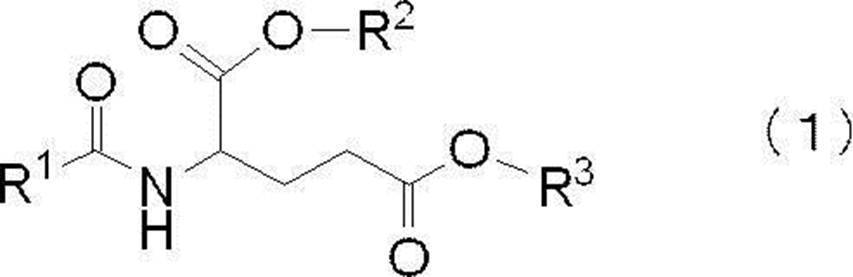
一般式(1)中、R1は、炭素数8~22のアルキル基、炭素数8~22のアルケニル基、又は炭素数8~22のアルキニル基を表す。R2及びR3は、互いに独立して、炭素数8~30のアルキル基、炭素数8~30のアルケニル基、又はステロール基を表す。
[2] ビタミンEが、トコフェロール及びその誘導体と、トコトリエノール及びその誘導体とからなる群より選択される少なくとも1種を含む、[1]に記載の乳化組成物。
[3] 一般式(1)で表されるアシルグルタミン酸エステルが、下記一般式(2)で表されるアシルグルタミン酸エステルである、[1]又は[2]に記載の乳化組成物。
[2] ビタミンEが、トコフェロール及びその誘導体と、トコトリエノール及びその誘導体とからなる群より選択される少なくとも1種を含む、[1]に記載の乳化組成物。
[3] 一般式(1)で表されるアシルグルタミン酸エステルが、下記一般式(2)で表されるアシルグルタミン酸エステルである、[1]又は[2]に記載の乳化組成物。

一般式(2)中、R21は、炭素数12~18のアルキル基、炭素数12~18のアルケニル基、又は炭素数12~18のアルキニル基を表す。R22及びR23は、互いに独立して、炭素数12~24のアルキル基、炭素数12~24のアルケニル基、又はステロール基を表す。
[4] 更に、ポリグリセリン脂肪酸エステルを含有する、[1]~[3]のいずれか1つに記載の乳化組成物。
[5] 一般式(1)で表されるアシルグルタミン酸エステルが、ラウロイルグルタミン酸ジヘキシルデシル、ラウロイルグルタミン酸ジイソステアリル、ラウロイルグルタミン酸ビス(ヘキシルデシル/オクチルドデシル)、ラウロイルグルタミン酸ジオクチルドデシル、ラウロイルグルタミン酸ジ(コレステリル/オクチルドデシル)、ラウロイルグルタミン酸ジ(コレステリル/ベヘニル/オクチルドデシル)、ラウロイルグルタミン酸ジ(フィトステリル/オクチルドデシル)、ラウロイルグルタミン酸ジ(オクチルドデシル/フィトステリル/ベヘニル)、ラウロイルグルタミン酸(フィトステリル/ベヘニル/オクチルドデシル/イソステアリル)、及び、ステアロイルグルタミン酸ジオクチルドデシルからなる群より選択される少なくとも1種である、[1]~[4]のいずれか1つに記載の乳化組成物。
[6] ビタミンEの含有量(I)に対する、一般式(1)で表されるアシルグルタミン酸エステルの含有量(II)の含有割合(II/I)が、質量基準で0.60以下である[1]~[5]のいずれか1つに記載の乳化組成物。
[7] 乳化組成物の全質量に対して、5質量%以上25質量%未満のビタミンEを含有する、[1]~[6]のいずれか1つに記載の乳化組成物。
[8] 機能性油性成分が、ビタミンEに、25℃で0.5質量%以上溶解する油溶性成分である、[1]~[7]のいずれか1つに記載の乳化組成物。
[9] [1]~[8]のいずれか1つに記載の乳化組成物を含有する化粧料。
[10] 更に、リン脂質を含有する[9]に記載の化粧料。
[11] ビタミンEを、化粧料の全質量に対して0.001質量%~1.0質量%含有する[9]又は[10]に記載の化粧料。
[4] 更に、ポリグリセリン脂肪酸エステルを含有する、[1]~[3]のいずれか1つに記載の乳化組成物。
[5] 一般式(1)で表されるアシルグルタミン酸エステルが、ラウロイルグルタミン酸ジヘキシルデシル、ラウロイルグルタミン酸ジイソステアリル、ラウロイルグルタミン酸ビス(ヘキシルデシル/オクチルドデシル)、ラウロイルグルタミン酸ジオクチルドデシル、ラウロイルグルタミン酸ジ(コレステリル/オクチルドデシル)、ラウロイルグルタミン酸ジ(コレステリル/ベヘニル/オクチルドデシル)、ラウロイルグルタミン酸ジ(フィトステリル/オクチルドデシル)、ラウロイルグルタミン酸ジ(オクチルドデシル/フィトステリル/ベヘニル)、ラウロイルグルタミン酸(フィトステリル/ベヘニル/オクチルドデシル/イソステアリル)、及び、ステアロイルグルタミン酸ジオクチルドデシルからなる群より選択される少なくとも1種である、[1]~[4]のいずれか1つに記載の乳化組成物。
[6] ビタミンEの含有量(I)に対する、一般式(1)で表されるアシルグルタミン酸エステルの含有量(II)の含有割合(II/I)が、質量基準で0.60以下である[1]~[5]のいずれか1つに記載の乳化組成物。
[7] 乳化組成物の全質量に対して、5質量%以上25質量%未満のビタミンEを含有する、[1]~[6]のいずれか1つに記載の乳化組成物。
[8] 機能性油性成分が、ビタミンEに、25℃で0.5質量%以上溶解する油溶性成分である、[1]~[7]のいずれか1つに記載の乳化組成物。
[9] [1]~[8]のいずれか1つに記載の乳化組成物を含有する化粧料。
[10] 更に、リン脂質を含有する[9]に記載の化粧料。
[11] ビタミンEを、化粧料の全質量に対して0.001質量%~1.0質量%含有する[9]又は[10]に記載の化粧料。
本発明によれば、機能性油性成分、及びビタミンEを含有し、乳化安定性に優れた、乳化組成物及び乳化組成物を含有する化粧料を提供することができる。
以下、本発明について詳細に説明する。
なお、本明細書において「~」を用いて示された数値範囲は、「~」の前後に記載される数値をそれぞれ最小値及び最大値として含む範囲を示す。
本明細書において「水相」とは、溶媒の種類にかかわらず「油相」に対する語として使用する。
本明細書において「工程」との語は、独立した工程だけでなく、他の工程と明確に区別できない場合であっても本工程の所期の目的が達成されれば、本用語に含まれる。
本明細書において、組成物中の各成分の量は、組成物中に各成分に該当する物質が複数存在する場合には、特に断らない限り、組成物中に存在する当該複数の物質の合計量を意味する。
なお、本明細書において「~」を用いて示された数値範囲は、「~」の前後に記載される数値をそれぞれ最小値及び最大値として含む範囲を示す。
本明細書において「水相」とは、溶媒の種類にかかわらず「油相」に対する語として使用する。
本明細書において「工程」との語は、独立した工程だけでなく、他の工程と明確に区別できない場合であっても本工程の所期の目的が達成されれば、本用語に含まれる。
本明細書において、組成物中の各成分の量は、組成物中に各成分に該当する物質が複数存在する場合には、特に断らない限り、組成物中に存在する当該複数の物質の合計量を意味する。
[乳化組成物]
本発明の乳化組成物は、機能性油性成分と、ビタミンEと、下記一般式(1)で表されるアシルグルタミン酸エステルと、を含有する。
本発明の乳化組成物は、機能性油性成分と、ビタミンEと、下記一般式(1)で表されるアシルグルタミン酸エステルと、を含有する。
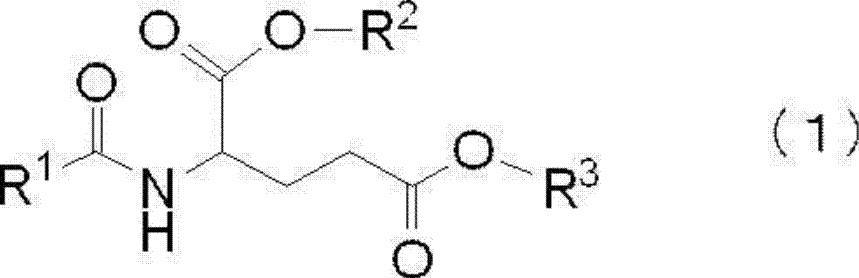
一般式(1)中、R1は、炭素数8~22のアルキル基、炭素数8~22のアルケニル基、又は炭素数8~22のアルキニル基を表す。R2及びR3は、互いに独立して、炭素数8~30のアルキル基、炭素数8~30のアルケニル基、又はステロール基を表す。
本発明の乳化組成物は、上記構成を有することにより、乳化安定性に優れる。また、本発明の乳化組成物は、透明性に優れ、安定性及びその持続性に優れたものとなる。更に、本発明の乳化組成物は、機能性油性成分に期待される効果を長期間に亘って維持しうる。
本発明の乳化組成物の乳化形態は、特に限定されないが、水中油型の乳化組成物であることが好ましい。
本発明の乳化組成物に含有される必須成分及び任意成分について詳細に説明する。
本発明の乳化組成物に含有される必須成分及び任意成分について詳細に説明する。
<機能性油性成分>
本発明の乳化組成物は機能性油性成分を含有する。
機能性油性成分とは、生体に対して所望される機能を奏し得る油性成分である。
機能性油性成分は、生体に対して所望される機能を奏し得るものであり、且つ後述するビタミンEに、25℃で0.5質量%以上(100質量%以下)溶解する油性成分であることが好ましい。具体的には、ビタミンE以外の脂溶性ビタミン、グリチルレチン酸又はその誘導体、カロチノイドが挙げられる。
本発明の乳化組成物は機能性油性成分を含有する。
機能性油性成分とは、生体に対して所望される機能を奏し得る油性成分である。
機能性油性成分は、生体に対して所望される機能を奏し得るものであり、且つ後述するビタミンEに、25℃で0.5質量%以上(100質量%以下)溶解する油性成分であることが好ましい。具体的には、ビタミンE以外の脂溶性ビタミン、グリチルレチン酸又はその誘導体、カロチノイドが挙げられる。
グリチルレチン酸又はその誘導体としては、グリチルレチン酸、グリチルレチン酸ステアリル、グリチルレチン酸ピリドキシン等が挙げられる。中でも、グリチルレチン酸ステアリル、グリチルレチン酸が好ましく、グリチルレチン酸ステアリルがより好ましい。
グリチルレチン酸ステアリルは、CASNo.13832-70-7の化合物であり、脂溶性物質である上に、一般的な油剤に対する相溶性の低い化合物である。
グリチルレチン酸ステアリルは、従来、抗炎症又は抗アレルギー剤として、石鹸、クリーム、乳液等に用いられていたが、水性組成物への溶解性が低いため、透明性の高い乳化組成物に適用されることは殆どなかった。
グリチルレチン酸ステアリルは、CASNo.13832-70-7の化合物であり、脂溶性物質である上に、一般的な油剤に対する相溶性の低い化合物である。
グリチルレチン酸ステアリルは、従来、抗炎症又は抗アレルギー剤として、石鹸、クリーム、乳液等に用いられていたが、水性組成物への溶解性が低いため、透明性の高い乳化組成物に適用されることは殆どなかった。
グリチルレチン酸ステアリルの製法としては、特に限定されるものではないが、例えば、甘草から抽出されるグリチルリチン酸を加水分解することで、グリチルレチン酸を生成させ、生成したグリチルレチン酸を、ステアリルアルコールとエステル化反応させて得ることができる。
ビタミンE以外の脂溶性ビタミンとしては、レチノール、パルミチン酸レチノール、酢酸レチノール等のビタミンA及びその誘導体、エルゴカルシフェロール、コレカルシフェロール等のビタミンD及びその誘導体等が挙げられる。
カロチノイドとしては、アスタキサンチン、リコピン、フコキサンチン等が挙げられる。
アスタキサンチンは、ヘマトコッカスプルビアリス油、オキアミ抽出物等に含まれる。アスタキサンチンは、これらの天然物から分離して抽出される抽出物であってもよい。また、アスタキサンチンは、抽出物を必要に応じて適宜精製したものであってもよく、合成品であってもよい。
アスタキサンチンは、ヘマトコッカスプルビアリス油、オキアミ抽出物等に含まれる。アスタキサンチンは、これらの天然物から分離して抽出される抽出物であってもよい。また、アスタキサンチンは、抽出物を必要に応じて適宜精製したものであってもよく、合成品であってもよい。
リコピンは、トマト、柿、スイカ又はピンクグレープフルーツ等に含まれている。リコピンはこれらの天然物から分離して抽出される抽出物であってもよい。また、リコピンは、抽出物、抽出物を必要に応じて適宜精製したものであってもよく、合成品であってもよい。
フコキサンチンは、褐藻又はその他の不等毛藻に含まれる。フコキサンチンは、これらの天然物から分離して抽出される抽出物であってもよい。また、フコキサンチンは、抽出物、抽出物を必要に応じて適宜精製したものでよい。
機能性油性成分は、いずれかの種類を1種単独で使用してもよく、2種以上を併用してもよい。
本発明の機能性油性成分としては、25℃において液体又は固体であってもよいが、固体の場合は、油剤に溶解又は融解した状態で乳化組成物中に存在することが好ましい。以下、固体の機能性油性成分が油剤に溶解又は融解した状態を溶解と称する。
機能性油性成分を溶解するために用いる油剤としては、例えばビタミンEを挙げることができる。
機能性油性成分を溶解するために用いる油剤としては、例えばビタミンEを挙げることができる。
機能性油性成分のビタミンEへの溶解性は、本明細書においては、25℃、常圧での溶解性を指し、具体的には以下の方法により確認することができる。なお、機能性油性成分のビタミンEへの溶解性を確認する際には、溶媒であるビタミンEは特に限定されないが、トコフェロール(理研ビタミン(株)製 理研オイル800:商品名)を使用することが好ましい。
ガラスバイアルに、機能性油性成分の含有量が0.5質量%となるように、ビタミンE及び機能性油性成分をそれぞれ秤量する。その後、0.5質量%の機能性油性成分を含有したビタミンEを、70℃~120℃に適宜加温し、機能性油性成分を完全に溶解させる。その後、25℃、常圧にて一晩静置し、機能性油性成分由来の析出物の有無を観察する。析出物が目視により確認されない場合には、当該機能性油性成分は、乳化組成物により好適に使用し得るビタミンEへの溶解性を有すると判断することができる。
ガラスバイアルに、機能性油性成分の含有量が0.5質量%となるように、ビタミンE及び機能性油性成分をそれぞれ秤量する。その後、0.5質量%の機能性油性成分を含有したビタミンEを、70℃~120℃に適宜加温し、機能性油性成分を完全に溶解させる。その後、25℃、常圧にて一晩静置し、機能性油性成分由来の析出物の有無を観察する。析出物が目視により確認されない場合には、当該機能性油性成分は、乳化組成物により好適に使用し得るビタミンEへの溶解性を有すると判断することができる。
本発明の乳化組成物における機能性油性成分の含有量は、乳化組成物の全質量に対して、0.001質量%以上15質量%未満であることが好ましく、0.01質量%以上15質量%未満であることがより好ましく、0.03質量%以上15質量%未満であることが更に好ましい。
乳化組成物における機能性油性成分の含有量が、上記の範囲であることで、機能性油性成分を高濃度に含有しながらも、高い透明性を長期間に亘って安定に維持することができる。また、本発明の透明性の高い乳化組成物を、その好適な用途の一つである化粧料に適用した場合においては、機能性油性成分を高濃度に含有しながらも、優れた経時安定性を有する化粧料を得ることができる。
<ビタミンE>
本発明の乳化組成物は、ビタミンEを含有する。
本発明におけるビタミンEは、脂溶性ビタミンの一種である。本明細書において「ビタミンE」とは、トコフェロール、その異性体、その誘導体、トコトリエノール、その異性体及びその誘導体からなる群より選択される少なくとも1種の化合物を意味する。
本発明の乳化組成物がビタミンEを含有することにより、高濃度の機能性油性成分を乳化組成物中に配合することが可能となる。
本発明の乳化組成物は、ビタミンEを含有する。
本発明におけるビタミンEは、脂溶性ビタミンの一種である。本明細書において「ビタミンE」とは、トコフェロール、その異性体、その誘導体、トコトリエノール、その異性体及びその誘導体からなる群より選択される少なくとも1種の化合物を意味する。
本発明の乳化組成物がビタミンEを含有することにより、高濃度の機能性油性成分を乳化組成物中に配合することが可能となる。
ビタミンEとしては、特に制限されるものではないが、高濃度の機能性油性成分の溶解が可能であることから、トコフェロール及びその誘導体と、トコトリエノール及びその誘導体とからなる群より選択される少なくとも1種が好ましい。
<<トコフェロール及びその誘導体>>
トコフェロール及びその誘導体とは、トコフェロール及び基本骨格をトコフェロールとした誘導体を意味する。
トコフェロールとしては、具体的には、α-トコフェロール、β-トコフェロール、γ-トコフェロール、δ-トコフェロール、及びこれらの混合物が挙げられる。
トコフェロール誘導体としては、トコフェロールの有するOH基が脂肪酸で修飾された酢酸トコフェロール、コハク酸トコフェロール、ニコチン酸トコフェロール、リノール酸トコフェロール、(リノール/オレイン)酸トコフェロール等が挙げられる。
トコフェロール及びその誘導体とは、トコフェロール及び基本骨格をトコフェロールとした誘導体を意味する。
トコフェロールとしては、具体的には、α-トコフェロール、β-トコフェロール、γ-トコフェロール、δ-トコフェロール、及びこれらの混合物が挙げられる。
トコフェロール誘導体としては、トコフェロールの有するOH基が脂肪酸で修飾された酢酸トコフェロール、コハク酸トコフェロール、ニコチン酸トコフェロール、リノール酸トコフェロール、(リノール/オレイン)酸トコフェロール等が挙げられる。
トコフェロールの由来は特に限定されず、具体的には、ひまわり、とうもろこし、オリーブ、菜種、大豆、落花生又はアーモンドのいずれから得られたものであってもよい。
トコフェロール及びその誘導体は市販品を用いることができる。市販品としては、理研Eオイル800(商品名、理研ビタミン社)、ビタミンEエーザイ(商品名、エーザイフードケミカル社)、ガンマブライト90(商品名、エーザイフードケミカル社、イーミックスD(商品名、エーザイフードケミカル社)等が挙げられる。
本発明の乳化組成物には、トコフェロール及びその誘導体は、いずれかの種類を1種単独で使用してもよく、2種以上を併用してもよい。
トコフェロール及びその誘導体は市販品を用いることができる。市販品としては、理研Eオイル800(商品名、理研ビタミン社)、ビタミンEエーザイ(商品名、エーザイフードケミカル社)、ガンマブライト90(商品名、エーザイフードケミカル社、イーミックスD(商品名、エーザイフードケミカル社)等が挙げられる。
本発明の乳化組成物には、トコフェロール及びその誘導体は、いずれかの種類を1種単独で使用してもよく、2種以上を併用してもよい。
<<トコトリエノール及びその誘導体>>
トコトリエノール及びその誘導体とは、トコトリエノール及び基本骨格をトコトリエノールとした誘導体を意味する。
トコトリエノールとしては、具体的には、α-トコトリエノール、β-トコトリエノール、γ-トコトリエノール、δ-トコトリエノール及びこれらの混合物が挙げられる。
トコトリエノール及びその誘導体とは、トコトリエノール及び基本骨格をトコトリエノールとした誘導体を意味する。
トコトリエノールとしては、具体的には、α-トコトリエノール、β-トコトリエノール、γ-トコトリエノール、δ-トコトリエノール及びこれらの混合物が挙げられる。
トコトリエノール及びその誘導体の由来は特に限定されず、具体的には、ひまわり、とうもろこし、オリーブ、菜種、大豆、落花生又はアーモンドのいずれから得られたものであってもよい。
トコトリエノール及びその誘導体は市販品を用いることができる。市販品としては、トコリット92(商品名、エーザイフードケミカル社)等が挙げられる。
本発明の乳化組成物には、トコトリエノール及びその誘導体は、いずれかの種類を1種単独で使用してもよく、2種以上を併用してもよい。
トコトリエノール及びその誘導体は市販品を用いることができる。市販品としては、トコリット92(商品名、エーザイフードケミカル社)等が挙げられる。
本発明の乳化組成物には、トコトリエノール及びその誘導体は、いずれかの種類を1種単独で使用してもよく、2種以上を併用してもよい。
本発明の乳化組成物には、ビタミンEは、いずれかの種類を1種単独で使用してもよく、2種以上を併用してもよい。
本発明の乳化組成物におけるビタミンEの含有量は、乳化組成物の全質量に対して、0.5質量%以上35質量%未満であることが好ましく、5質量%以上25質量%未満であることがより好ましく、7.5質量%以上20質量%未満であることが更に好ましい。
<アシルグルタミン酸エステル>
本発明の乳化組成物は、下記一般式(1)で表されるアシルグルタミン酸エステルを含有する。以下、下記一般式(1)で表されるアシルグルタミン酸エステルを「特定のアシルグルタミン酸エステル」とも称する。
本発明の乳化組成物は、下記一般式(1)で表されるアシルグルタミン酸エステルを含有する。以下、下記一般式(1)で表されるアシルグルタミン酸エステルを「特定のアシルグルタミン酸エステル」とも称する。
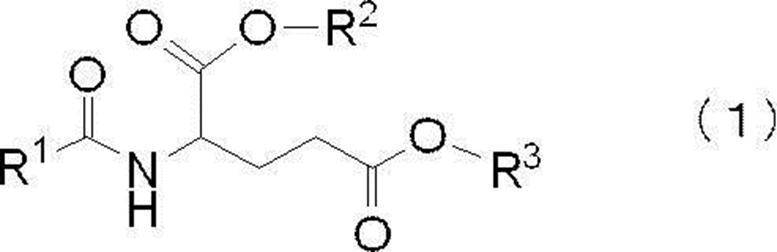
一般式(1)中、R1は、炭素数8~22のアルキル基、炭素数8~22のアルケニル基、又は炭素数8~22のアルキニル基を表す。R2及びR3は、互いに独立して、炭素数8~30のアルキル基、炭素数8~30のアルケニル基、又はステロール基を表す。
本発明の乳化組成物は、特定のアシルグルタミン酸エステルを含有するため、機能性油性成分及びビタミンEを含有する乳化組成物の乳化安定性を高めることができる。特定のアシルグルタミン酸エステルが、機能性油性成分の溶解性を高めるとともに、乳化組成物の粘性を低下することができるため、乳化組成物の安定性が向上すると推測される。
上記一般式(1)中、R1は炭素数8~22のアルキル基、炭素数8~22のアルケニル基、又は炭素数8~22のアルキニル基を表す。
R1におけるアルキル基としては、炭素数10~22のアルキル基が好ましく、炭素数12~18のアルキル基がより好ましい。
R1におけるアルケニル基としては、炭素数10~22のアルケニル基が好ましく、炭素数12~18のアルケニル基がより好ましい。
R1におけるアルキニル基としては、炭素数10~22のアルキニル基が好ましく、炭素数12~18のアルキニル基がより好ましい。
なお、アルキル基、アルケニル基及びアルキニル基は、直鎖でも、分岐を有するものでもよい。また、アルキル基、アルケニル基及びアルキニル基は、無置換でもよく、置換基によって置換されていてもよい。
R1におけるアルケニル基としては、炭素数10~22のアルケニル基が好ましく、炭素数12~18のアルケニル基がより好ましい。
R1におけるアルキニル基としては、炭素数10~22のアルキニル基が好ましく、炭素数12~18のアルキニル基がより好ましい。
なお、アルキル基、アルケニル基及びアルキニル基は、直鎖でも、分岐を有するものでもよい。また、アルキル基、アルケニル基及びアルキニル基は、無置換でもよく、置換基によって置換されていてもよい。
R1におけるアルキル基としては、具体的には、ラウリル基、ミリスチル基、パルミトイル基、ステアリル基、イソステアリル基等が挙げられる。
R1におけるアルケニル基としては、具体的には、オレイル基、リノール基、リノレン基等が挙げられる。
R1におけるアルキニル基としては、具体的には、ドデシニル基、トリデシニル基、エイコシニル基等が挙げられる。
R1におけるアルケニル基としては、具体的には、オレイル基、リノール基、リノレン基等が挙げられる。
R1におけるアルキニル基としては、具体的には、ドデシニル基、トリデシニル基、エイコシニル基等が挙げられる。
上記一般式(1)中、R2及びR3は、互いに独立して、炭素数8~30のアルキル基、炭素数8~30のアルケニル基又はステロール基を表す。
R2及びR3におけるアルキル基としては、炭素数12~24のアルキル基が好ましく、炭素数14~22のアルキル基がより好ましい。
R2及びR3におけるアルケニル基としては、炭素数12~24のアルケニル基が好ましく、炭素数14~22のアルケニル基がより好ましい。
R2及びR3におけるステロール基としては、フィトステリル基、シトステリル基、カンペステリル基、スティグマステリル基、ブラスカステリル基、エルゴステリル基、ラノステリル基、コレステリル基、シクロアルタニル基、シクロアルテニル基等が好ましく、フィトステリル基、シトステリル基、カンペステリル基、スティグマステリル基、ブラスカステリル基、コレステリル基がより好ましい。
なお、アルキル基及びアルケニル基は、直鎖でも、分岐を有するものでもよい。また、アルキル基、アルケニル基、ステロール基は、無置換であってもよく、置換基によって置換されていてもよい。
R2及びR3におけるアルケニル基としては、炭素数12~24のアルケニル基が好ましく、炭素数14~22のアルケニル基がより好ましい。
R2及びR3におけるステロール基としては、フィトステリル基、シトステリル基、カンペステリル基、スティグマステリル基、ブラスカステリル基、エルゴステリル基、ラノステリル基、コレステリル基、シクロアルタニル基、シクロアルテニル基等が好ましく、フィトステリル基、シトステリル基、カンペステリル基、スティグマステリル基、ブラスカステリル基、コレステリル基がより好ましい。
なお、アルキル基及びアルケニル基は、直鎖でも、分岐を有するものでもよい。また、アルキル基、アルケニル基、ステロール基は、無置換であってもよく、置換基によって置換されていてもよい。
R2におけるアルキル基としては、具体的には、ラウリル基、ミリスチル基、パルミトイル基、ステアリル基、イソステアリル基、ブチルドデシル基、ヘキシルデシル基、ヘキシルドデシル基、オクチルデシル基、オクチルドデシル基、オクチルテトラデシル基、デシルドデシル基、デシルテトラデシル基等が挙げられる。
R2におけるアルケニル基としては、具体的には、オレイル基、リノール基、リノレン基等が挙げられる。
R2におけるアルケニル基としては、具体的には、オレイル基、リノール基、リノレン基等が挙げられる。
R3におけるアルキル基としては、具体的には、ラウリル基、ミリスチル基、パルミトイル基、ステアリル基、イソステアリル基、ブチルドデシル基、ヘキシルデシル基、ヘキシルドデシル基、オクチルデシル基、オクチルドデシル基、オクチルテトラデシル基、デシルドデシル基、デシルテトラデシル基等が挙げられる。
R3におけるアルケニル基としては、具体的には、オレイル基、リノール基、リノレン基等が挙げられる。
R3におけるアルケニル基としては、具体的には、オレイル基、リノール基、リノレン基等が挙げられる。
一般式(1)で表されるアシルグルタミン酸エステルとしては、下記一般式(2)で表されるアシルグルタミン酸エステルが好ましい。
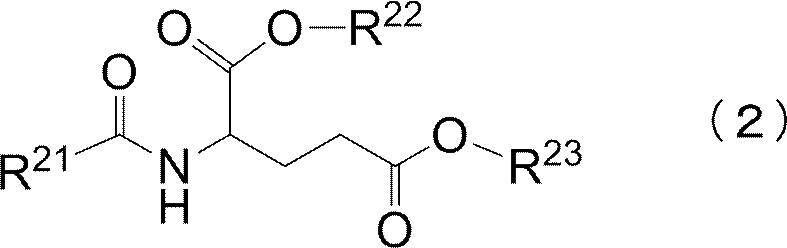
一般式(2)中、R21は炭素数12~18のアルキル基、炭素数12~18のアルケニル基、又は炭素数12~18のアルキニル基を表す。R22及びR23は、互いに独立して、炭素数12~24のアルキル基、炭素数12~24のアルケニル基、又はステロール基を表す。
さらに、アシルグルタミン酸エステルとしては、一般式(1)におけるR1が炭素数12~18のアルキル基を表し、R2が炭素数14~22のアルキル基又は炭素数14~22のアルケニル基を表し、R3が炭素数14~22のアルキル基又は炭素数14~22のアルケニル基を表すことが好ましい。
アシルグルタミン酸エステルとしては、ラウロイルグルタミン酸ジヘキシルデシル、ラウロイルグルタミン酸ジイソステアリル、ラウロイルグルタミン酸ビス(ヘキシルデシル/オクチルドデシル)、ラウロイルグルタミン酸ジオクチルドデシル、ラウロイルグルタミン酸ジ(コレステリル/オクチルドデシル)、ラウロイルグルタミン酸ジ(コレステリル/ベヘニル/オクチルドデシル)、ラウロイルグルタミン酸ジ(フィトステリル/オクチルドデシル)、ラウロイルグルタミン酸ジ(オクチルドデシル/フィトステリル/ベヘニル)、ラウロイルグルタミン酸(フィトステリル/ベヘニル/オクチルドデシル/イソステアリル)及び、ステアロイルグルタミン酸ジオクチルドデシルが好ましい。
また、アシルグルタミン酸エステルとしては、乳化組成物の乳化安定性の観点から、ラウロイルグルタミン酸ジヘキシルデシル、ラウロイルグルタミン酸ジイソステアリル、ラウロイルグルタミン酸ビス(ヘキシルデシル/オクチルドデシル)、ラウロイルグルタミン酸ジオクチルドデシル、及び、ステアロイルグルタミン酸ジオクチルドデシルがより好ましい。
本発明の乳化組成物には、特定のアシルグルタミン酸エステルは、いずれかの種類を1種単独で使用してもよく、2種以上を併用してもよい。
本発明の乳化組成物における特定のアシルグルタミン酸エステルの含有量は、乳化組成物の全質量に対して、0.001質量%以上15質量%未満であることが好ましく、0.01質量%以上10質量%未満であることがより好ましく、0.1質量%以上7.5質量%未満であることがさらに好ましい。
また、ビタミンEの含有量を(I)とし、特定のアシルグルタミン酸エステルの含有量を(II)とした場合、両者の割合、即ち、[特定のアシルグルタミン酸エステルの含有量/ビタミンEの含有量]=[(II)/(I)]は、0.6以下であることが好ましい。ビタミンEの含有量に対する、特定のアシルグルタミン酸エステルの含有量の割合[(II)/(I)]が、0.6以下である場合には、特定のアシルグルタミン酸エステルを含有しない乳化組成物に対する、特定のアシルグルタミン酸エステルを含有する乳化組成物の乳化安定性の改善効果がより大きくなるため、好ましい。
また、ビタミンEの含有量に対する、アシルグルタミン酸エステルの含有量の割合[(II)/(I)]は、0.3以下であることがより好ましい。
また、ビタミンEの含有量を(I)とし、特定のアシルグルタミン酸エステルの含有量を(II)とした場合、両者の割合、即ち、[特定のアシルグルタミン酸エステルの含有量/ビタミンEの含有量]=[(II)/(I)]は、0.6以下であることが好ましい。ビタミンEの含有量に対する、特定のアシルグルタミン酸エステルの含有量の割合[(II)/(I)]が、0.6以下である場合には、特定のアシルグルタミン酸エステルを含有しない乳化組成物に対する、特定のアシルグルタミン酸エステルを含有する乳化組成物の乳化安定性の改善効果がより大きくなるため、好ましい。
また、ビタミンEの含有量に対する、アシルグルタミン酸エステルの含有量の割合[(II)/(I)]は、0.3以下であることがより好ましい。
<ポリグリセリン脂肪酸エステル>
本発明の乳化組成物は、更にポリグリセリン脂肪酸エステルを含有することが好ましい。本発明の乳化組成物がポリグリセリン脂肪酸エステルを含有することにより、油相と水相との間に生じる界面張力を下げることができる。また、乳化組成物中に含まれる乳化粒子の平均粒子径をより小さくすることができると推測される。
本発明の乳化組成物は、更にポリグリセリン脂肪酸エステルを含有することが好ましい。本発明の乳化組成物がポリグリセリン脂肪酸エステルを含有することにより、油相と水相との間に生じる界面張力を下げることができる。また、乳化組成物中に含まれる乳化粒子の平均粒子径をより小さくすることができると推測される。
本発明の乳化組成物に用いられるポリグリセリン脂肪酸エステルは、蒸留などで高度に精製されたものであることは必ずしも必要ではなく、反応混合物であってもよい。
本発明に用いうるポリグリセリン脂肪酸エステルとしては、平均重合度が2以上、好ましくは6~15、より好ましくは8~10のポリグリセリンと、炭素数8~18の脂肪酸とのエステルが挙げられる。より具体的には、例えば、平均重合度が8~10のポリグリセリンと、カプリル酸、カプリン酸、ラウリン酸、ミリスチン酸、パルミチン酸、ステアリン酸、オレイン酸、又はリノール酸とのエステルであるポリグリセリン脂肪酸エステルが挙げられる。
また、ポリグリセリン脂肪酸エステルは、乳化力の観点から、HLB11~15であることがより好ましい。
ここで、HLBは、通常界面活性剤の分野で使用される親水性-疎水性のバランスを表す数値である。HLBは、通常用いる計算式、例えば川上式等の計算式を使用して算出できる。代表的なHLBを求める川上式を以下に示す。
HLB=7+11.7log(Mw/MO)
ここで、Mwは親水基の分子量、MOは疎水基の分子量である。
また、ポリグリセリン脂肪酸エステルのHLBは、カタログ等に記載されているHLBの数値を使用してもよい。
また、上記の式からも分かるように、HLBの加成性を利用して、任意のHLB値をもつ乳化剤としてのポリグリセリン脂肪酸エステルを得ることができる。
ここで、HLBは、通常界面活性剤の分野で使用される親水性-疎水性のバランスを表す数値である。HLBは、通常用いる計算式、例えば川上式等の計算式を使用して算出できる。代表的なHLBを求める川上式を以下に示す。
HLB=7+11.7log(Mw/MO)
ここで、Mwは親水基の分子量、MOは疎水基の分子量である。
また、ポリグリセリン脂肪酸エステルのHLBは、カタログ等に記載されているHLBの数値を使用してもよい。
また、上記の式からも分かるように、HLBの加成性を利用して、任意のHLB値をもつ乳化剤としてのポリグリセリン脂肪酸エステルを得ることができる。
ポリグリセリン脂肪酸エステルの好ましい例としては、ヘキサグリセリンモノオレイン酸エステル、ヘキサグリセリンモノステアリン酸エステル、ヘキサグリセリンモノパルミチン酸エステル、ヘキサグリセリンモノミリスチン酸エステル、ヘキサグリセリンモノラウリン酸エステル、デカグリセリンモノオレイン酸エステル、デカグリセリンモノステアリン酸エステル、デカグリセリンモノパルミチン酸エステル、デカグリセリンモノミリスチン酸エステル、デカグリセリンモノラウリン酸エステル等が挙げられる。
これらの中でも、より好ましくは、デカグリセリンモノオレイン酸エステル、デカグリセリンモノステアリン酸エステル、デカグリセリンモノパルミチン酸エステル、デカグリセリンモノミリスチン酸エステル、デカグリセリンモノラウリン酸エステル等である。
これらの中でも、より好ましくは、デカグリセリンモノオレイン酸エステル、デカグリセリンモノステアリン酸エステル、デカグリセリンモノパルミチン酸エステル、デカグリセリンモノミリスチン酸エステル、デカグリセリンモノラウリン酸エステル等である。
ポリグリセリン脂肪酸エステルは、市販品を用いてもよい。市販品の例としては、イソステアリン酸ポリグリセリル-10(HLB=12)(日光ケミカル製)、オレイン酸ポリグリセリル-10(HLB=12)(日光ケミカル製)、ミリスチン酸ポリグリセリル-10(HLB=14)、ステアリン酸ポリグリセリル-10(HLB=12)、ミリスチン酸ポリグリセリル-6(HLB=11)等が挙げられる。
本発明の乳化組成物には、ポリグリセリン脂肪酸エステルは、いずれかの種類を1種単独で使用してもよく、2種以上を併用してもよい。
本発明の乳化組成物におけるポリグリセリン脂肪酸エステルの含有量は、乳化組成物の全質量に対して、0.5質量%~30質量%が好ましく、1質量%~20質量%がより好ましく、2質量%~15質量%が更に好ましい。
ポリグリセリン脂肪酸エステルの含有量を0.5質量%以上とすることにより、機能性油性成分の溶解性を向上させると共に、油相と水相との間で生じる界面張力を下げ易く、また、30質量%以下とすることにより、界面活性剤を過剰量とすることがなく、乳化組成物の泡立ち等が生じ難い点で好ましい。
ポリグリセリン脂肪酸エステルの含有量を0.5質量%以上とすることにより、機能性油性成分の溶解性を向上させると共に、油相と水相との間で生じる界面張力を下げ易く、また、30質量%以下とすることにより、界面活性剤を過剰量とすることがなく、乳化組成物の泡立ち等が生じ難い点で好ましい。
<多価アルコール>
本発明の乳化組成物は、多価アルコールを含有することができる。
多価アルコールは、保湿機能、粘度調整機能等を有する化合物である。また、乳化組成物が、多価アルコールを含有することで、乳化組成物が含有する水系溶媒と油脂成分との界面における界面張力を低下させ、界面を広がりやすくすることができる。
更に、本発明の乳化組成物が多価アルコールを含有することで、微細で安定な乳化粒子を形成しやすくすることができる。そのため、乳化粒子の平均粒子径をより微細化でき、且つ平均粒子径が微細な乳化粒子を微細な平均粒子径の状態のまま長期に亘り安定して保持できるため好ましい。
また、多価アルコールの添加により、乳化組成物の水分活性を下げることができ、微生物の繁殖を抑えることができる。
本発明の乳化組成物は、多価アルコールを含有することができる。
多価アルコールは、保湿機能、粘度調整機能等を有する化合物である。また、乳化組成物が、多価アルコールを含有することで、乳化組成物が含有する水系溶媒と油脂成分との界面における界面張力を低下させ、界面を広がりやすくすることができる。
更に、本発明の乳化組成物が多価アルコールを含有することで、微細で安定な乳化粒子を形成しやすくすることができる。そのため、乳化粒子の平均粒子径をより微細化でき、且つ平均粒子径が微細な乳化粒子を微細な平均粒子径の状態のまま長期に亘り安定して保持できるため好ましい。
また、多価アルコールの添加により、乳化組成物の水分活性を下げることができ、微生物の繁殖を抑えることができる。
本発明における多価アルコールは、二価以上のアルコールであれば特に限定されず用いることができる。
多価アルコールとしては、例えば、グリセリン、ジグリセリン、トリグリセリン、ポリグリセリン、3-メチル-1,3-ブタンジオール、1,3-ブチレングリコール、イソプレングリコール、ポリエチレングリコール、1,2-ペンタンジオール、1,2-ヘキサンジオール、プロピレングリコール、ジプロピレングリコール、エチレングリコール、ジエチレングリコール、ネオペンチルグリコール等が挙げられる。
多価アルコールとしては、例えば、グリセリン、ジグリセリン、トリグリセリン、ポリグリセリン、3-メチル-1,3-ブタンジオール、1,3-ブチレングリコール、イソプレングリコール、ポリエチレングリコール、1,2-ペンタンジオール、1,2-ヘキサンジオール、プロピレングリコール、ジプロピレングリコール、エチレングリコール、ジエチレングリコール、ネオペンチルグリコール等が挙げられる。
多価アルコールは、いずれかの種類を1種単独で使用してもよく、2種以上を併用してもよい。
多価アルコールとしては、その1分子中における水酸基の数が、3個以上であるものを用いることが好ましい。これにより、水系溶媒と油脂成分との界面張力をより効果的に低下させることができ、更に、より微細で、且つ、安定な乳化粒子を形成させることができる。その結果、本発明の乳化組成物を化粧料に適用した場合においては、油脂成分の経皮吸収性をより高いものとすることができる。
上述したような条件を満足する多価アルコールの中でも、特に、グリセリンを用いた場合、乳化粒子の平均粒子径がより小さくなり、且つ平均粒子径が小さいままの乳化粒子が長期に亘り安定して保持されるため、好ましい。
本発明の乳化組成物における多価アルコールの含有量は、乳化組成物の全質量に対して10質量%~60質量%が好ましく、より好ましくは20質量%~55質量%、更に好ましくは30質量%~50質量%である。
多価アルコールの含有量が10質量%以上であると、油脂成分の種類や含有量等に拘らず、乳化組成物の十分な保存安定性が得られ易い点で好ましい。一方、多価アルコールの含有量が60質量%以下であると、最大限の効果が得られ、乳化組成物の粘度が高くなるのを抑え易い点で好ましい。
多価アルコールの含有量が10質量%以上であると、油脂成分の種類や含有量等に拘らず、乳化組成物の十分な保存安定性が得られ易い点で好ましい。一方、多価アルコールの含有量が60質量%以下であると、最大限の効果が得られ、乳化組成物の粘度が高くなるのを抑え易い点で好ましい。
<その他の添加成分>
本発明の乳化組成物には、上記成分の他、食品又は化粧品等の分野において通常用いられる添加成分を、その形態に応じて適宜含有させることができる。
他の添加成分は、その特性によって、油溶性又は水溶性の添加成分として、本発明の乳化組成物に含有させることができる。
本発明の乳化組成物には、上記成分の他、食品又は化粧品等の分野において通常用いられる添加成分を、その形態に応じて適宜含有させることができる。
他の添加成分は、その特性によって、油溶性又は水溶性の添加成分として、本発明の乳化組成物に含有させることができる。
その他の添加成分としては、例えば、グルコース、ショ糖、カッパーカラギーナン、ローカストビーンガム、グアーガム、ヒドロキシプロピルグアガム、キサンタンガム、カラヤガム、タマリンド種子多糖、アラビアガム、トラガカントガム、ヒアルロン酸、ヒアルロン酸ナトリウム、コンドロイチン硫酸ナトリウム、デキストリン等の単糖類又は多糖類;ソルビトール、マンニトール、マルチトール、ラクトース、マルトトリイトール、キシリトールなどの糖アルコール;塩化ナトリウム、硫酸ナトリウムなどの無機塩;カゼイン、アルブミン、メチル化コラーゲン、加水分解コラーゲン、水溶性コラーゲン、ゼラチン等の分子量5000超のタンパク質;グリシン、アラニン、バリン、ロイシン、イソロイシン、セリン、スレオニン、アスパラギン酸、グルタミン酸、シスチン、メチオニン、リジン、ヒドロキシリジン、アルギニン、ヒスチジン、フェニルアラニン、チロシン、トリプトファン、プロリン、ヒドロキシプロリン、アセチルヒドロキシプロリン等のアミノ酸又はそれらの誘導体;カルボキシビニルポリマー、ポリアクリル酸ナトリウム、ポリビニルアルコール、ポリエチレングリコール、酸化エチレン/酸化プロピレンブロック共重合体等の合成高分子;ヒドロキシエチルセルロース、メチルセルロース等の水溶性セルロース誘導体;フラボノイド(カテキン、アントシアニン、フラボン、イソフラボン、フラバン、フラバノン、ルチン)、アスコルビン酸又はその誘導体(アスコルビン酸、アスコルビン酸ナトリウム、アスコルビン酸カリウム、アスコルビン酸カルシウム、L-アスコルビン酸リン酸エステル、リン酸アスコルビルマグネシウム、リン酸アスコルビルナトリウム、硫酸アスコルビル、硫酸アスコルビル2ナトリウム塩、及びアスコルビル-2-グルコシド等)、フェノール酸化合物(クロロゲン酸、エラグ酸、没食子酸、没食子酸プロピル)、リグナン、クルクミン、クマリン、プテロスチルベン等を含むヒドロキシスチルベンなどを挙げることができる。その他の添加成分は、添加成分が有する機能に基づいて、例えば、機能性成分、賦形剤、粘度調整剤、ラジカル捕捉剤などとして含んでもよい。
その他、本発明においては、例えば、種々の薬効成分、pH調整剤、pH緩衝剤、紫外線吸収剤、防腐剤、香料又は着色剤など、通常、化粧品、食品等の用途で使用される他の添加物を併用することができる。
その他、本発明においては、例えば、種々の薬効成分、pH調整剤、pH緩衝剤、紫外線吸収剤、防腐剤、香料又は着色剤など、通常、化粧品、食品等の用途で使用される他の添加物を併用することができる。
本発明における乳化組成物は、適宜pH調整剤を使用することができる。pH調整剤により調整された本発明の乳化組成物のpH値は、4~10の範囲であることが好ましい。
pHの測定は、特に限定されないが、例えば、pHメータ(型番:HM-30V、東亜ディーケーケー(株)製)により行うことができる。
pHの測定は、特に限定されないが、例えば、pHメータ(型番:HM-30V、東亜ディーケーケー(株)製)により行うことができる。
pH調整剤は、乳化組成物を調製する前及び後のいずれに使用してもよい。pHの変動幅を小さくして、より緩和な条件でpHを調整することが可能である点から、pH調整剤は、乳化組成物の調製前に使用することが好ましい。その際には、pH調整剤は、乳化組成物を調製する前の水相組成物、及び油相組成物のいずれに添加してもよい。
pH調整剤としては、特に限定されるものではないが、無機酸、有機酸、無機塩基及びそれらの塩等が挙げられる。pH調整剤としては、具体的には、クエン酸、グルコン酸、カルボン酸、酒石酸、コハク酸、酢酸またはフタル酸、トリフルオロ酢酸、モルホリノエタンスルホン酸、2-〔4-(2-ヒドロキシエチル)-1-ピペラジニル〕エタンスルホン酸等の有機酸とその塩;トリス(ヒドロキシメチル)、アミノメタン、アンモニア等の有機塩基;塩酸、過塩素酸、炭酸等の無機酸とその塩;リン酸ナトリウム、リン酸カリウム、水酸化カルシウム、水酸化ナトリウム、水酸化カリウム、水酸化マグネシウム等の無機塩基;リン酸水素ナトリウム、炭酸水素ナトリウム等の無機水素塩が挙げられる。
(乳化粒子の平均粒子径)
本発明の乳化組成物に含有される乳化粒子、即ち、乳化組成物がO/W型乳化物の場合における油滴は、特に限定されないが、平均粒子径が5nm~300nmであることが好ましい。
本明細書において、「乳化粒子の平均粒子径」、又は単に「平均粒子径」とは、乳化組成物中に存在する乳化粒子の体積平均粒子径を意味する。
本発明における乳化粒子の平均粒子径は、保存安定性及び組成物の透明性の観点から、5nm~300nmであることが好ましく、10nm~200nmがより好ましく、50nm~150nmが更に好ましい。
本発明の乳化組成物に含有される乳化粒子、即ち、乳化組成物がO/W型乳化物の場合における油滴は、特に限定されないが、平均粒子径が5nm~300nmであることが好ましい。
本明細書において、「乳化粒子の平均粒子径」、又は単に「平均粒子径」とは、乳化組成物中に存在する乳化粒子の体積平均粒子径を意味する。
本発明における乳化粒子の平均粒子径は、保存安定性及び組成物の透明性の観点から、5nm~300nmであることが好ましく、10nm~200nmがより好ましく、50nm~150nmが更に好ましい。
本発明の乳化組成物中に含まれる乳化粒子の平均粒子径は、電子顕微鏡、遠心沈降法、液体排除クロマト法、レーザー散乱回折法、動的光散乱法などの公知の方法で求めることができるが、精度と測定の簡便さから、動的光散乱法を用いて測定することが好ましい。
動的光散乱を用いた市販の測定装置としては、濃厚系粒径アナライザーFPAR-1000(大塚電子(株)製)、ナノトラックUPA(日機装(株)製)、ナノサイザー(マルバーン社製)等が挙げられるが、本発明における平均粒子径は、ナノトラックUPAを用いて25℃で測定した値を採用する。
具体的には、乳化組成物を希釈せず原液のまま測定し、メジアン径(d=50)として求める。
なお、乳化粒子の平均粒子径は、乳化組成物の成分以外に、乳化組成物の製造工程における、せん断力、温度、圧力等の攪拌条件や、油相と水相との含有比率、などの要因によって調整することができる。
動的光散乱を用いた市販の測定装置としては、濃厚系粒径アナライザーFPAR-1000(大塚電子(株)製)、ナノトラックUPA(日機装(株)製)、ナノサイザー(マルバーン社製)等が挙げられるが、本発明における平均粒子径は、ナノトラックUPAを用いて25℃で測定した値を採用する。
具体的には、乳化組成物を希釈せず原液のまま測定し、メジアン径(d=50)として求める。
なお、乳化粒子の平均粒子径は、乳化組成物の成分以外に、乳化組成物の製造工程における、せん断力、温度、圧力等の攪拌条件や、油相と水相との含有比率、などの要因によって調整することができる。
(乳化組成物の濁度)
本発明においては、透明性の指標として濁度を使用する。
乳化組成物の濁度は、9.9gの純水で、0.1gの乳化組成物を希釈した乳化組成物の水希釈液を得て、得られた水希釈液を、波長650nmの光を用いて、25℃にて測定した吸光度により規定される。
乳化組成物の濁度(吸光度)は、0.001~0.2であることが好ましく、より好ましくは0.001~0.175、更に好ましくは0.001~0.15である。
透明性の指標となる吸光度(濁度)は、特に限定されないが、既述の分光光度計(例えば、V-630、株式会社日本分光製)を用いて測定することができる。
本発明においては、透明性の指標として濁度を使用する。
乳化組成物の濁度は、9.9gの純水で、0.1gの乳化組成物を希釈した乳化組成物の水希釈液を得て、得られた水希釈液を、波長650nmの光を用いて、25℃にて測定した吸光度により規定される。
乳化組成物の濁度(吸光度)は、0.001~0.2であることが好ましく、より好ましくは0.001~0.175、更に好ましくは0.001~0.15である。
透明性の指標となる吸光度(濁度)は、特に限定されないが、既述の分光光度計(例えば、V-630、株式会社日本分光製)を用いて測定することができる。
[乳化組成物の製造方法]
本発明の乳化組成の製造方法は、特に限定されない。本発明の乳化組成物は、公知の方法に従い製造することができる。本発明の乳化組成物の製造方法としては、例えば、水性媒体(水等)に、ポリグリセリン脂肪酸エステルを溶解させて、水相組成物を得ること、機能性油性成分及びビタミンE等を混合し、溶解して、油相組成物を得ること、その後、攪拌下で水相組成物と油相組成物とを混合して、乳化分散を行い、乳化組成物を得ること、というステップを含む製造方法が挙げられる。
本発明の乳化組成の製造方法は、特に限定されない。本発明の乳化組成物は、公知の方法に従い製造することができる。本発明の乳化組成物の製造方法としては、例えば、水性媒体(水等)に、ポリグリセリン脂肪酸エステルを溶解させて、水相組成物を得ること、機能性油性成分及びビタミンE等を混合し、溶解して、油相組成物を得ること、その後、攪拌下で水相組成物と油相組成物とを混合して、乳化分散を行い、乳化組成物を得ること、というステップを含む製造方法が挙げられる。
乳化分散における油相組成物と水相組成物との比率(質量)は、特に限定されるものではないが、油相組成物/水相組成物の比率(質量%)として、0.1/99.9~50/50が好ましく、0.5/99.5~30/70がより好ましく、1/99~20/80が更に好ましい。油相組成物/水相組成物の比率を0.1/99.9以上とすることにより、有効成分が低くならないため乳化組成物の実用上の問題が生じない傾向となり好ましい。また、油相組成物/水相組成物の比率を50/50以下とすることにより、乳化組成物の乳化安定性が良好に維持されるため好ましい。また、乳化組成物にポリグリセリン脂肪酸エステルを用いる場合でも、乳化組成物中におけるポリグリセリン脂肪酸エステルの濃度が低くなることがなく、乳化組成物の乳化安定性がより良好に維持されるため好ましい。
乳化組成物の製造時に行われる乳化分散は、1ステップの乳化操作を行うことでもよいが、2ステップ以上の乳化操作を行うことで、より均一で微細な乳化粒子を得ることができるため、2ステップ以上の乳化操作を行うことが好ましい。
2ステップ以上の乳化操作は、具体的には、剪断作用を利用する通常の乳化装置(例えば、スターラーやインペラー攪拌、ホモミキサー、連続流通式剪断装置等)を用いて乳化するという1ステップの乳化操作を行ない、その後、さらに、高圧ホモジナイザー又は超音波分散機等を用いた乳化操作を行う等の方法が挙げられる。2ステップ以上の乳化操作においては、既述のように、2種以上の乳化装置を併用することが特に好ましい。通常の乳化操作に加え、さらに高圧ホモジナイザーを使用する2ステップ目の乳化操作を行うことで、乳化粒子を更に均一な微粒子に揃えることができる。
また、更に均一な平均粒子径の乳化粒子とする目的で、乳化操作を3回以上行ってもよい。
2ステップ以上の乳化操作は、具体的には、剪断作用を利用する通常の乳化装置(例えば、スターラーやインペラー攪拌、ホモミキサー、連続流通式剪断装置等)を用いて乳化するという1ステップの乳化操作を行ない、その後、さらに、高圧ホモジナイザー又は超音波分散機等を用いた乳化操作を行う等の方法が挙げられる。2ステップ以上の乳化操作においては、既述のように、2種以上の乳化装置を併用することが特に好ましい。通常の乳化操作に加え、さらに高圧ホモジナイザーを使用する2ステップ目の乳化操作を行うことで、乳化粒子を更に均一な微粒子に揃えることができる。
また、更に均一な平均粒子径の乳化粒子とする目的で、乳化操作を3回以上行ってもよい。
[化粧料]
本発明の化粧料は、機能性油性成分と、ビタミンEと、一般式(1)で表されるアシルグルタミン酸エステルとを含む乳化組成物を含有する。化粧料における、乳化組成物の含有量は特に限定されない。
既述の本発明の乳化組成物を含有することにより、本発明の化粧料は、乳化安定性に優れる。
乳化組成物の詳細については、乳化組成物の項で前述した事項を適用する。
本発明の化粧料は、機能性油性成分と、ビタミンEと、一般式(1)で表されるアシルグルタミン酸エステルとを含む乳化組成物を含有する。化粧料における、乳化組成物の含有量は特に限定されない。
既述の本発明の乳化組成物を含有することにより、本発明の化粧料は、乳化安定性に優れる。
乳化組成物の詳細については、乳化組成物の項で前述した事項を適用する。
<リン脂質>
本発明の乳化組成物及び化粧料は、更に、リン脂質を含有することが好ましい。
リン脂質としては、グリセロリン脂質が挙げられる。グリセロリン脂質としては、例えば、フォスファチジン酸、ビスホスファチジン酸、レシチン(フォスファチジルコリン)、フォスファチジルエタノールアミン、フォスファチジルメチルエタノールアミン、フォスファチジルセリン、フォスファチジルイノシトール、フォスファチジルグリセリン又はジフォスファチジルグリセリン(カルジオリピン)等が挙げられる。また、乳化組成物、化粧料に用いうるグリセロリン脂質として、グリセロリン脂質を含む大豆、トウモロコシ、落花生、ナタネ、麦等の植物由来のもの、卵黄、牛等の動物由来のもの、又は大腸菌等の微生物等由来の各種レシチン等を挙げることができる。
本発明の乳化組成物及び化粧料は、更に、リン脂質を含有することが好ましい。
リン脂質としては、グリセロリン脂質が挙げられる。グリセロリン脂質としては、例えば、フォスファチジン酸、ビスホスファチジン酸、レシチン(フォスファチジルコリン)、フォスファチジルエタノールアミン、フォスファチジルメチルエタノールアミン、フォスファチジルセリン、フォスファチジルイノシトール、フォスファチジルグリセリン又はジフォスファチジルグリセリン(カルジオリピン)等が挙げられる。また、乳化組成物、化粧料に用いうるグリセロリン脂質として、グリセロリン脂質を含む大豆、トウモロコシ、落花生、ナタネ、麦等の植物由来のもの、卵黄、牛等の動物由来のもの、又は大腸菌等の微生物等由来の各種レシチン等を挙げることができる。
また、本発明の乳化組成物、化粧料には、グリセロリン脂質として、酵素分解したグリセロリン脂質を使用することができる。例えば、レシチンを酵素分解したリゾレシチン(酵素分解レシチン)は、酸、又はアルカリ触媒によるレシチンの加水分解により得られるが、ホスホリパーゼA1、又はA2を用いたレシチンの加水分解により得ることもできる。
リゾレシチンに代表される、本発明の乳化組成物、化粧料に使用しうるリゾ化合物の例を化合物名で示すと、リゾホスファチジン酸、リゾホスファチジルグリセリン、リゾホスファチジルイノシトール、リゾホスファチジルエタノールアミン、リゾホスファチジルメチルエタノールアミン、リゾホスファチジルコリン(リゾレシチン)、リゾホスファチジルセリン等が挙げられる。
リゾレシチンに代表される、本発明の乳化組成物、化粧料に使用しうるリゾ化合物の例を化合物名で示すと、リゾホスファチジン酸、リゾホスファチジルグリセリン、リゾホスファチジルイノシトール、リゾホスファチジルエタノールアミン、リゾホスファチジルメチルエタノールアミン、リゾホスファチジルコリン(リゾレシチン)、リゾホスファチジルセリン等が挙げられる。
本発明の乳化組成物、化粧料には、リン脂質は、いずれかの種類を1種単独で使用してもよく、2種以上を併用してもよい。
本発明の乳化組成物、化粧料が、リン脂質を含有する場合のリン脂質の含有量は、乳化組成物中の全質量に対して、0.1質量%~10質量%であることが好ましく、0.2量%~8質量%であることがより好ましく、1質量%~4質量%が特に好ましい。
本発明の乳化組成物、化粧料が、リン脂質を含有する場合のリン脂質の含有量は、乳化組成物中の全質量に対して、0.1質量%~10質量%であることが好ましく、0.2量%~8質量%であることがより好ましく、1質量%~4質量%が特に好ましい。
本発明の化粧料の透明性向上という観点では、化粧料に含まれるリン脂質としては、レシチン又は水添レシチンが好ましい。レシチンを含有することで、化粧料の透明性を向上させることができる。中でもレシチンを含有することがより好ましい。
レシチンは、レシチンの純度が60質量%以上のものが産業的にはレシチンとして利用されているが、本発明の化粧料に用いレシチンとしては、一般に「高純度レシチン」と称されるレシチン純度80質量%以上のものが好ましく、より好ましくは90質量%以上のものである。
レシチンは市販品を用いてもよい。市販品の例としては、SLP-ホワイト(辻製油製)、エメルメティック900(ルーカスマイヤー製)、フォスフォリポン50(リポイド製)、レシオンP(理研ビタミン製)などが挙げられる。
また、本発明の化粧料は、化粧品等に使用した際に有用な効果を示すその他の添加成分をさらに含んでいてもよい。
その他の添加成分としては、例えば、グリセリン、1,3-ブチレングリコール等の多価アルコール;カッパーカラギーナン、ローカストビーンガム、グアーガム、ヒドロキシプロピルグアガム、キサンタンガム、カラヤガム、タマリンド種子多糖、アラビアガム、アカシアガム、アルカリゲネス産生多糖体(「アルカシーラン」とも称される。)、トラガカントガム、ジェランガム、ネイティブジェランガム、ヒアルロン酸、ヒアルロン酸ナトリウム、コンドロイチン硫酸ナトリウム、デキストリン、イヌリン等の単糖類又は多糖類;ソルビトール、マンニトール、マルチトール、ラクトース、マルトトリイトール、キシリトールなどの糖アルコール;塩化ナトリウム、硫酸ナトリウムなどの無機塩;カゼイン、アルブミン、メチル化コラーゲン、加水分解コラーゲン、水溶性コラーゲン、ゼラチン等の分子量5000超のタンパク質;グリシン、アラニン、バリン、ロイシン、イソロイシン、セリン、スレオニン、アスパラギン酸、グルタミン酸、シスチン、メチオニン、リジン、ヒドロキシリジン、アルギニン、ヒスチジン、フェニルアラニン、チロシン、トリプトファン、プロリン、ヒドロキシプロリン、アセチルヒドロキシプロリン等のアミノ酸及びそれらの誘導体;カルボキシビニルポリマー、ポリアクリル酸ナトリウム、ポリビニルアルコール、ポリエチレングリコール、酸化エチレン/酸化プロピレンブロック共重合体等の合成高分子;ヒドロキシエチルセルロース、メチルセルロース等の水溶性セルロース誘導体;カテキン、アントシアニン、フラボン、イソフラボン、フラバン、フラバノン、ルチンなどのフラボノイド;アスコルビン酸、アスコルビン酸ナトリウム、アスコルビン酸カリウム、アスコルビン酸カルシウム、L-アスコルビン酸リン酸エステル、リン酸アスコルビルマグネシウム、リン酸アスコルビルナトリウム、硫酸アスコルビル、硫酸アスコルビル2ナトリウム塩、及びアスコルビル-2-グルコシド等のアスコルビン酸又はその誘導体;クロロゲン酸、エラグ酸、没食子酸、没食子酸プロピル、リグナン、クルクミン、クマリン、プテロスチルベン、ヒドロキシスチルベン等のフェノール化合物を挙げることができる。
その他の添加成分としては、例えば、グリセリン、1,3-ブチレングリコール等の多価アルコール;カッパーカラギーナン、ローカストビーンガム、グアーガム、ヒドロキシプロピルグアガム、キサンタンガム、カラヤガム、タマリンド種子多糖、アラビアガム、アカシアガム、アルカリゲネス産生多糖体(「アルカシーラン」とも称される。)、トラガカントガム、ジェランガム、ネイティブジェランガム、ヒアルロン酸、ヒアルロン酸ナトリウム、コンドロイチン硫酸ナトリウム、デキストリン、イヌリン等の単糖類又は多糖類;ソルビトール、マンニトール、マルチトール、ラクトース、マルトトリイトール、キシリトールなどの糖アルコール;塩化ナトリウム、硫酸ナトリウムなどの無機塩;カゼイン、アルブミン、メチル化コラーゲン、加水分解コラーゲン、水溶性コラーゲン、ゼラチン等の分子量5000超のタンパク質;グリシン、アラニン、バリン、ロイシン、イソロイシン、セリン、スレオニン、アスパラギン酸、グルタミン酸、シスチン、メチオニン、リジン、ヒドロキシリジン、アルギニン、ヒスチジン、フェニルアラニン、チロシン、トリプトファン、プロリン、ヒドロキシプロリン、アセチルヒドロキシプロリン等のアミノ酸及びそれらの誘導体;カルボキシビニルポリマー、ポリアクリル酸ナトリウム、ポリビニルアルコール、ポリエチレングリコール、酸化エチレン/酸化プロピレンブロック共重合体等の合成高分子;ヒドロキシエチルセルロース、メチルセルロース等の水溶性セルロース誘導体;カテキン、アントシアニン、フラボン、イソフラボン、フラバン、フラバノン、ルチンなどのフラボノイド;アスコルビン酸、アスコルビン酸ナトリウム、アスコルビン酸カリウム、アスコルビン酸カルシウム、L-アスコルビン酸リン酸エステル、リン酸アスコルビルマグネシウム、リン酸アスコルビルナトリウム、硫酸アスコルビル、硫酸アスコルビル2ナトリウム塩、及びアスコルビル-2-グルコシド等のアスコルビン酸又はその誘導体;クロロゲン酸、エラグ酸、没食子酸、没食子酸プロピル、リグナン、クルクミン、クマリン、プテロスチルベン、ヒドロキシスチルベン等のフェノール化合物を挙げることができる。
本発明の化粧料は、ビタミンEを、化粧料の全質量に対して0.001質量%~1.0質量%含有することが好ましい。
また、ビタミンEを、化粧料の全質量に対して0.01質量%~1質量%含有することがより好ましく、0.1質量%~1質量%含有することが更に好ましい。
また、ビタミンEを、化粧料の全質量に対して0.01質量%~1質量%含有することがより好ましく、0.1質量%~1質量%含有することが更に好ましい。
化粧料としては、化粧水、美容液、乳液、クリームパック、マスク、パック、洗髪用化粧品、フレグランス化粧品、液体ボディ洗浄料、UVケア化粧品、防臭化粧品、オーラルケア化粧品等の化粧料が挙げられる。本発明の乳化組成物は、透明性が要求される化粧水等の水性の化粧料に適用されることが好ましい。
化粧水等の水性化粧料については、一般的に透明性を有することが求められ、その経時後も透明性を維持することが要求される。ここでいう透明性とは、既述した濁度を指標とするものであり、化粧料を波長650nmの光を用いて、25℃にて測定した吸光度により規定される。
化粧料は、波長650nmの光を用いて測定した吸光度(濁度)が0.001~0.2であることが好ましく、吸光度が0.001~0.175であることがより好ましく、吸光度が0.001~0.15であることがさらに好ましい。
化粧料の調製方法は特に制限されない。本発明の化粧料は、例えば、本発明の乳化組成物及び必要に応じて併用される添加可能な他の成分を、スターラー、インペラー攪拌又はホモミキサー等を用いて、混合等して得ることができる。
以下、本発明を実施例にて詳細に説明するが、本発明はそれらに何ら限定されるものではない。
1.乳化組成物の調製と評価
[実施例1-1]
<乳化組成物(EM-1)の調製>
下記の成分を、70℃で加熱しながら1時間溶解して、水相組成物を得た。
・モノオレイン酸デカグリセリル(HLB=12) 9.40g
・グリセリン 40.42g
・純水 26.95g
[実施例1-1]
<乳化組成物(EM-1)の調製>
下記の成分を、70℃で加熱しながら1時間溶解して、水相組成物を得た。
・モノオレイン酸デカグリセリル(HLB=12) 9.40g
・グリセリン 40.42g
・純水 26.95g
また、下記成分を、70℃で加熱しながら1時間溶解して、油相組成物を得た。
・グリチルレチン酸ステアリル((A)成分) 0.5g
・トコフェロール((B)成分) 16.52g
・ラウロイルグルタミン酸ジヘキシルデシル((C)成分)
2.91g
・精製レシチン(大豆由来) 3.30g
・グリチルレチン酸ステアリル((A)成分) 0.5g
・トコフェロール((B)成分) 16.52g
・ラウロイルグルタミン酸ジヘキシルデシル((C)成分)
2.91g
・精製レシチン(大豆由来) 3.30g
水相組成物の温度を70℃とし攪拌しに状態に維持しながら、油相組成物を加えた後、高圧ホモジナイザーを用いて4分間分散することで予備乳化物を得た。
続いて、得られた予備乳化物を約60℃まで冷却し、アルティマイザーHJP-25005((株)スギノマシン製)を用いて、245MPaの圧力で高圧乳化を行った。
その後、得られた乳化組成物を平均孔径1μmのミクロフィルターでろ過し、80℃で30分加熱滅菌することで乳化組成物EM-1を調製した。
その後、得られた乳化組成物を平均孔径1μmのミクロフィルターでろ過し、80℃で30分加熱滅菌することで乳化組成物EM-1を調製した。
なお、水相組成物及び油相組成物の調製に用いた各成分の詳細は後述の通りである。
[実施例1-2~1-15、比較例1-1~1-13]
実施例1において、乳化組成物EM-1の調製に用いた各成分の種類及び量を、下記表1~表5、表7に示すように変更した以外は、全て実施例1-1と同様にして、実施例1-2~1-15及び比較例1-1~1-13の乳化組成物EM-2~EM-28を得た。表1~表5及び表7又は表9の組成における数値の単位は質量%であり、「-」は当該成分が未配合であることを示す。
なお、以下、便宜上、機能性油性成分を(A)成分、ビタミンEを(B)成分、一般式(1)で表されるアシルグルタミン酸エステルを(C)成分、とそれぞれ符号を付して説明することがある。
実施例1において、乳化組成物EM-1の調製に用いた各成分の種類及び量を、下記表1~表5、表7に示すように変更した以外は、全て実施例1-1と同様にして、実施例1-2~1-15及び比較例1-1~1-13の乳化組成物EM-2~EM-28を得た。表1~表5及び表7又は表9の組成における数値の単位は質量%であり、「-」は当該成分が未配合であることを示す。
なお、以下、便宜上、機能性油性成分を(A)成分、ビタミンEを(B)成分、一般式(1)で表されるアシルグルタミン酸エステルを(C)成分、とそれぞれ符号を付して説明することがある。
[乳化組成物の評価]
上記で得られた各乳化組成物について、初期濁度の測定、濁度変動率の算出又は経時安定性の評価を行なった。詳細は以下の通りである。
上記で得られた各乳化組成物について、初期濁度の測定、濁度変動率の算出又は経時安定性の評価を行なった。詳細は以下の通りである。
(初期濁度の測定方法)
各乳化組成物0.1gを、それぞれ、9.9gの純水に添加して、マグネッチックスターラーを用いて、10分間攪拌を行い、水稀釈液を得た。
得られた各乳化組成物の水希釈液を用い、濁度の指標として650nmにおける吸光度を、分光光度計(V-630、株式会社日本分光製)を用いて、25℃にて測定した。
各乳化組成物0.1gを、それぞれ、9.9gの純水に添加して、マグネッチックスターラーを用いて、10分間攪拌を行い、水稀釈液を得た。
得られた各乳化組成物の水希釈液を用い、濁度の指標として650nmにおける吸光度を、分光光度計(V-630、株式会社日本分光製)を用いて、25℃にて測定した。
(濁度変動率の算出方法)
濁度変動率は、乳化組成物を、40℃で2週間経時させた後における経時後濁度の吸光度を、初期濁度と同様にして測定し、調製直後の初期濁度からの吸光度の変化率A(%)を、下記式に基づき求めた。
変化率A(%)=経時後濁度の吸光度/初期濁度の吸光度×100
変化率A(%)が100%に近い程、乳化組成物は経時安定性に優れることを示す。
濁度変動率は、乳化組成物を、40℃で2週間経時させた後における経時後濁度の吸光度を、初期濁度と同様にして測定し、調製直後の初期濁度からの吸光度の変化率A(%)を、下記式に基づき求めた。
変化率A(%)=経時後濁度の吸光度/初期濁度の吸光度×100
変化率A(%)が100%に近い程、乳化組成物は経時安定性に優れることを示す。
(経時安定性の評価方法)
経時安定性の評価(透明性の持続性)は、上記式に基づき算出した濁度変動率A(%)を用いて下記評価基準に基づき評価した。
-乳化組成物の経時安定性評価基準-
A:130%未満
B:130%以上150%未満
C:150%以上
経時安定性の評価(透明性の持続性)は、上記式に基づき算出した濁度変動率A(%)を用いて下記評価基準に基づき評価した。
-乳化組成物の経時安定性評価基準-
A:130%未満
B:130%以上150%未満
C:150%以上
以上の結果を下記表1~表6に示す。
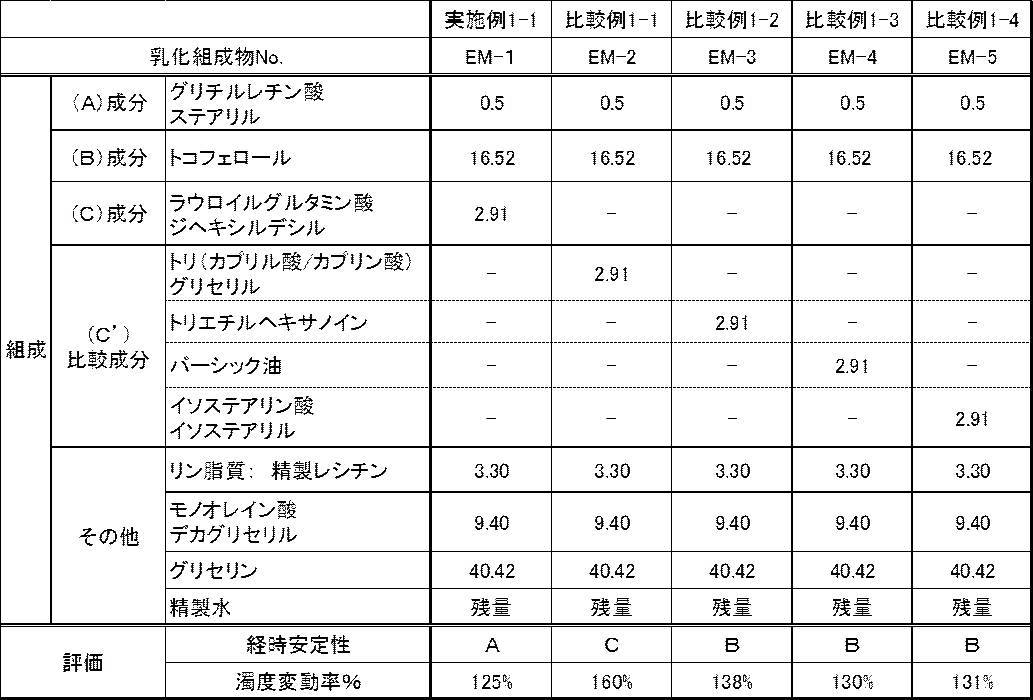
表1に示すように、(C)アシルグルタミン酸エステルを含む乳化組成物(実施例1-1)は、(C)成分を含まない乳化組成物(比較例1-1~1-4)に比べ、経時安定性に優れることがわかった。
また、下記表7に示すように、EM-1~EM-5を用いた化粧料の経時安定性においても、成分(C)アシルグルタミン酸エステルを含む乳化組成物(実施例1-1、2-1~2-3)が優れることがわかった。
以上より、(C)アシルグルタミン酸エステルを含む乳化組成物は、乳化組成物および乳化組成物を配合した化粧料ともに経時安定性に優れることがわかった。
また、下記表7に示すように、EM-1~EM-5を用いた化粧料の経時安定性においても、成分(C)アシルグルタミン酸エステルを含む乳化組成物(実施例1-1、2-1~2-3)が優れることがわかった。
以上より、(C)アシルグルタミン酸エステルを含む乳化組成物は、乳化組成物および乳化組成物を配合した化粧料ともに経時安定性に優れることがわかった。
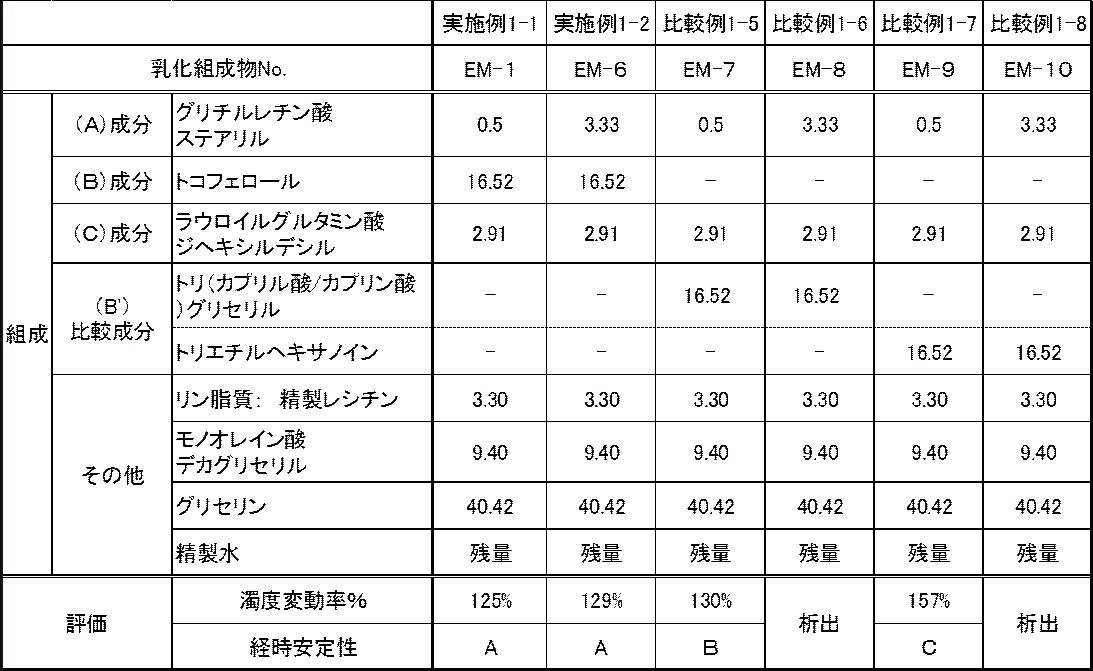
乳化組成物中に機能性油性成分を高濃度配合する為には、機能性油性成分の溶解に適した油剤が必要となる。そこで、(A)成分機能性油性成分としてグリルレチン酸ステアリルを用い、化粧品汎用油剤への溶解性を評価した結果、(B)成分トコフェロールは、(B’)比較成分トリ(カプリル酸/カプリン酸)グリセリル、トリエチルヘキサノインに比べ溶解性に優れることがわかった。
表2に示すように、(A)成分グリルレチン酸ステアリルを高濃度配合した場合、油剤として(B)成分トコフェロールを使用した乳化組成物(実施例1-2)は安定であるのに対し、(B’)比較成分トリ(カプリル酸/カプリン酸)グリセリル、トリエチルヘキサノインを使用した乳化組成物(比較例1-6、1-8)では、冷蔵経時にて析出した。
また、(A)成分グリチルレチン酸ステアリルが溶解する濃度領域(0.5質量%)において、(B)成分トコフェロールと(C)成分アシルグルタミン酸エステルを併用した乳化組成物(実施例1-1)は、(B)成分を用いない乳化組成物(比較例1-5、1-7)に比べ、経時安定性においても優れることがわかった。
以上より、(B)成分トコフェロールと(C)成分アシルグルタミン酸エステルを併用した乳化組成物は、機能性油性成分を高濃度配合する事ができ、かつ経時安定性に優れることを確認した。
表2に示すように、(A)成分グリルレチン酸ステアリルを高濃度配合した場合、油剤として(B)成分トコフェロールを使用した乳化組成物(実施例1-2)は安定であるのに対し、(B’)比較成分トリ(カプリル酸/カプリン酸)グリセリル、トリエチルヘキサノインを使用した乳化組成物(比較例1-6、1-8)では、冷蔵経時にて析出した。
また、(A)成分グリチルレチン酸ステアリルが溶解する濃度領域(0.5質量%)において、(B)成分トコフェロールと(C)成分アシルグルタミン酸エステルを併用した乳化組成物(実施例1-1)は、(B)成分を用いない乳化組成物(比較例1-5、1-7)に比べ、経時安定性においても優れることがわかった。
以上より、(B)成分トコフェロールと(C)成分アシルグルタミン酸エステルを併用した乳化組成物は、機能性油性成分を高濃度配合する事ができ、かつ経時安定性に優れることを確認した。
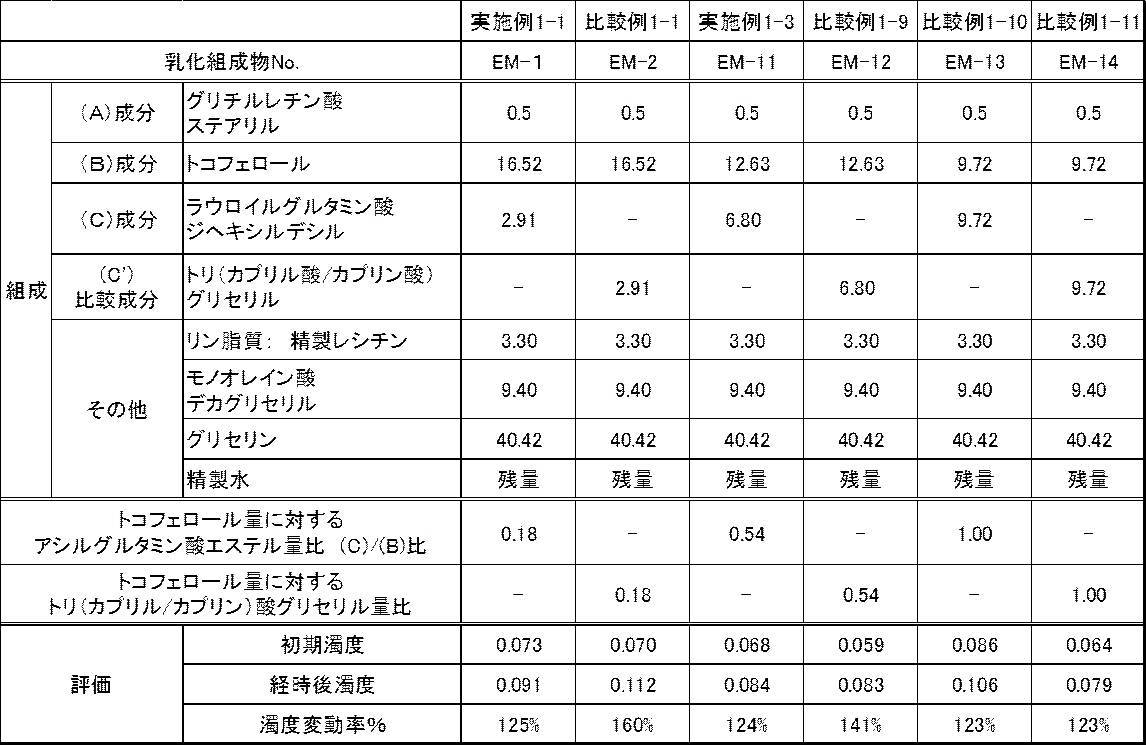
表3、図1に示すように、(B)成分トコフェロール量に対する(C)成分アシルグルタミン酸エステル量の比(C/B)が、0.54以下では、アシルグルタミン酸エステル配合により乳化組成物の経時安定性が改善されることがわかった。

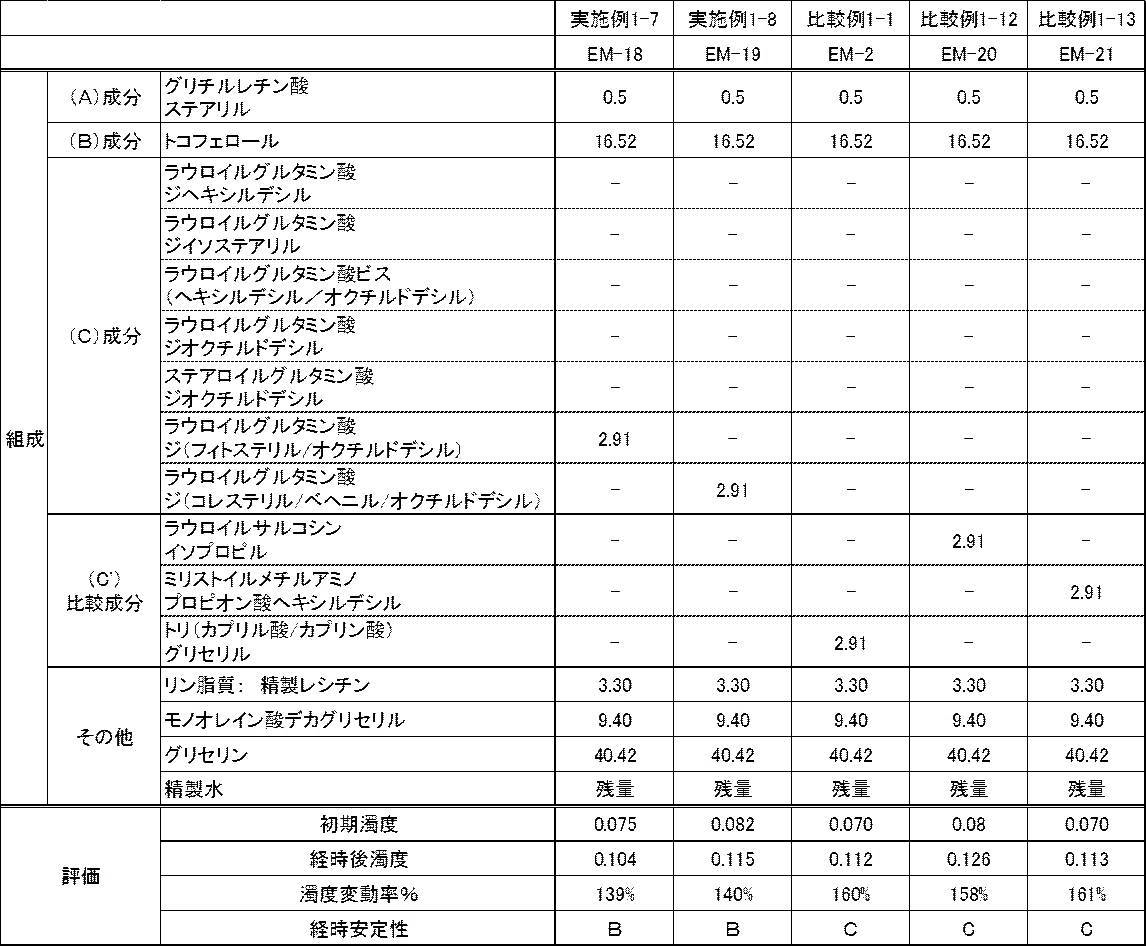

表4、表5、及び表6に示すように、(B)成分トコフェロールと(C)成分アシルグルタミン酸エステルを併用した乳化組成物は、(A)機能性油性成分を配合でき、かつ経時安定性に優れることが確認された。
上記表1~表6及び下記表7及び表8に示される各成分の詳細は、以下の通りである。
モノオレイン酸デカグリセリル(別名デカグリセリンモノオレイン酸エステル)は、日光ケミカルズ株式会社製NIKKOL Decaglyn 1-O(HLB=12)を使用した。
ラウロイルグルタミン酸ジヘキシルデシル、ラウロイルグルタミン酸ジイソステアリル、ラウロイルグルタミン酸ビス(ヘキシルデシル/オクチルドデシル)、ラウロイルグルタミン酸ジオクチルドデシル、ステアロイルグルタミン酸ジオクチルドデシルは、それぞれ、日本エマルジョン(株)製のAMITER LG1600、LG1800、LG2016、LG200、SG2000を使用した。
ラウロイルグルタミン酸ジ(コレステリル/ベヘニル/オクチルドデシル)、ラウロイルグルタミン酸ジ(フィトステリル/オクチルドデシル)は、味の素ヘルシーサプライ(株)製のELDEW CL-301、PS-203を使用した。
モノオレイン酸デカグリセリル(別名デカグリセリンモノオレイン酸エステル)は、日光ケミカルズ株式会社製NIKKOL Decaglyn 1-O(HLB=12)を使用した。
ラウロイルグルタミン酸ジヘキシルデシル、ラウロイルグルタミン酸ジイソステアリル、ラウロイルグルタミン酸ビス(ヘキシルデシル/オクチルドデシル)、ラウロイルグルタミン酸ジオクチルドデシル、ステアロイルグルタミン酸ジオクチルドデシルは、それぞれ、日本エマルジョン(株)製のAMITER LG1600、LG1800、LG2016、LG200、SG2000を使用した。
ラウロイルグルタミン酸ジ(コレステリル/ベヘニル/オクチルドデシル)、ラウロイルグルタミン酸ジ(フィトステリル/オクチルドデシル)は、味の素ヘルシーサプライ(株)製のELDEW CL-301、PS-203を使用した。
トコフェロールは、理研ビタミン株式会社製の理研Eオイル800を使用した。
トリ(カプリル酸/カプリン酸)グリセリルは、花王株式会社製のココナードMTを使用した。
トリエチルヘキサノインは、日本エマルジョン(株)製のEMALEX OTGを、イソステアリン酸イソステアリルは、高級アルコール工業(株)製のHAI ISISをパーシック油は、日光ケミカルズ(株)製のNIKKOL 杏仁油をそれぞれ使用した。
精製レシチン(SLP-ホワイト)リゾレシチン(ホワイトリゾ)、水添レシチン(SLP-ホワイトH)。それぞれ、辻製油株式会社製(大豆由来)を使用した。
トリエチルヘキサノインは、日本エマルジョン(株)製のEMALEX OTGを、イソステアリン酸イソステアリルは、高級アルコール工業(株)製のHAI ISISをパーシック油は、日光ケミカルズ(株)製のNIKKOL 杏仁油をそれぞれ使用した。
精製レシチン(SLP-ホワイト)リゾレシチン(ホワイトリゾ)、水添レシチン(SLP-ホワイトH)。それぞれ、辻製油株式会社製(大豆由来)を使用した。
2.化粧料の調製と評価
次に、乳化組成物(実施例1-1~1-2、1-9~1-12、1-13~15及び比較例1-1~1-4)を用いて、化粧料の例として、化粧水を調製し、濁度変動率の算出及び経時安定性の評価を行った。
なお、実施例1-13~1-15の乳化組成物EM-26~EM-28は、乳化組成物EM-1の調製に用いた各成分の種類及び量を、下記表7に示すように変更した以外は、全て実施例1-1と同様にして調製した。表7の組成における数値の単位は質量%であり、「-」は未配合を示す。
次に、乳化組成物(実施例1-1~1-2、1-9~1-12、1-13~15及び比較例1-1~1-4)を用いて、化粧料の例として、化粧水を調製し、濁度変動率の算出及び経時安定性の評価を行った。
なお、実施例1-13~1-15の乳化組成物EM-26~EM-28は、乳化組成物EM-1の調製に用いた各成分の種類及び量を、下記表7に示すように変更した以外は、全て実施例1-1と同様にして調製した。表7の組成における数値の単位は質量%であり、「-」は未配合を示す。
[実施例2-1~2-6、比較例2-1~2-4]
<化粧水の調製>
表7又は表8に記載される乳化組成物を用い、化粧水におけるトコフェロールの含有量が表7又は表8に示す量となるように、下記により調製した化粧水製剤模擬液で希釈し、マグネッチックスターラーを用いて、10分間攪拌を行い、評価用試料を調製した。
各実施例の化粧水におけるトコフェロールの含有率は、表6又は表8に記載される通りである。
<化粧水の調製>
表7又は表8に記載される乳化組成物を用い、化粧水におけるトコフェロールの含有量が表7又は表8に示す量となるように、下記により調製した化粧水製剤模擬液で希釈し、マグネッチックスターラーを用いて、10分間攪拌を行い、評価用試料を調製した。
各実施例の化粧水におけるトコフェロールの含有率は、表6又は表8に記載される通りである。
-化粧水製剤模擬液の調製-
化粧水製剤模擬液は、10mMクエン酸バッファー水溶液(pH7)に、多価アルコール:1,3ブチレングリコール(BG)10質量%、防腐剤:フェノキシエタノール0.3質量%を添加し、混合することで調製した。
化粧水製剤模擬液は、10mMクエン酸バッファー水溶液(pH7)に、多価アルコール:1,3ブチレングリコール(BG)10質量%、防腐剤:フェノキシエタノール0.3質量%を添加し、混合することで調製した。
[評価]
上記で得られた各化粧水を用い、濁度変動率の算出及び経時安定性の評価を行った。詳細は以下の通りである。
上記で得られた各化粧水を用い、濁度変動率の算出及び経時安定性の評価を行った。詳細は以下の通りである。
(濁度変動率の算出方法)
化粧料を用い、濁度の指標として650nmにおける吸光度を、分光光度計(V-630、株式会社日本分光製)を用いて、25℃にて初期濁度を測定した。
化粧料を用い、濁度の指標として650nmにおける吸光度を、分光光度計(V-630、株式会社日本分光製)を用いて、25℃にて初期濁度を測定した。
化粧料を、40℃で2週間経時させた後における経時後濁度の吸光度を、初期濁度と同様にして測定した。結果を表7及び表9に示す。
濁度変動率は、調製直後の初期濁度からの吸光度の変化率A(%)を、下記式に基づき求めた。
変化率A(%)=経時後濁度の吸光度/初期濁度の吸光度×100
変化率A(%)が100%に近い程、化粧料は経時安定性に優れることを示す。
濁度変動率は、調製直後の初期濁度からの吸光度の変化率A(%)を、下記式に基づき求めた。
変化率A(%)=経時後濁度の吸光度/初期濁度の吸光度×100
変化率A(%)が100%に近い程、化粧料は経時安定性に優れることを示す。
(経時安定性の評価方法)
経時安定性の評価(透明性の持続性)は、上記式に基づき算出した濁度変動率A(%)を用いて下記評価基準に基づき評価した。結果を表7及び表9に示す。
-化粧料の経時安定性評価基準-
A:110%未満
B:110%以上130%未満
C:130%以上
経時安定性の評価(透明性の持続性)は、上記式に基づき算出した濁度変動率A(%)を用いて下記評価基準に基づき評価した。結果を表7及び表9に示す。
-化粧料の経時安定性評価基準-
A:110%未満
B:110%以上130%未満
C:130%以上

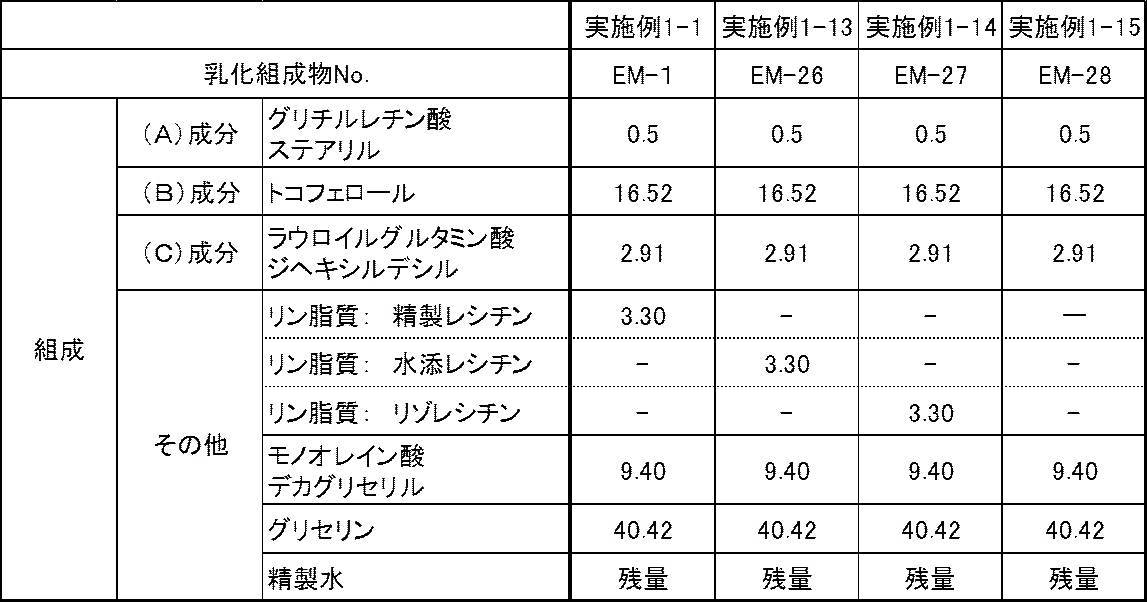

[実施例2-7~2-16]
<化粧水及び美容液の調製>
下記表10、表11及び下記本文に示すように、実施例の乳化組成物を用いて化粧料を調製した。調製した化粧料は、いずれも経時安定性に優れるものであった。
<化粧水及び美容液の調製>
下記表10、表11及び下記本文に示すように、実施例の乳化組成物を用いて化粧料を調製した。調製した化粧料は、いずれも経時安定性に優れるものであった。
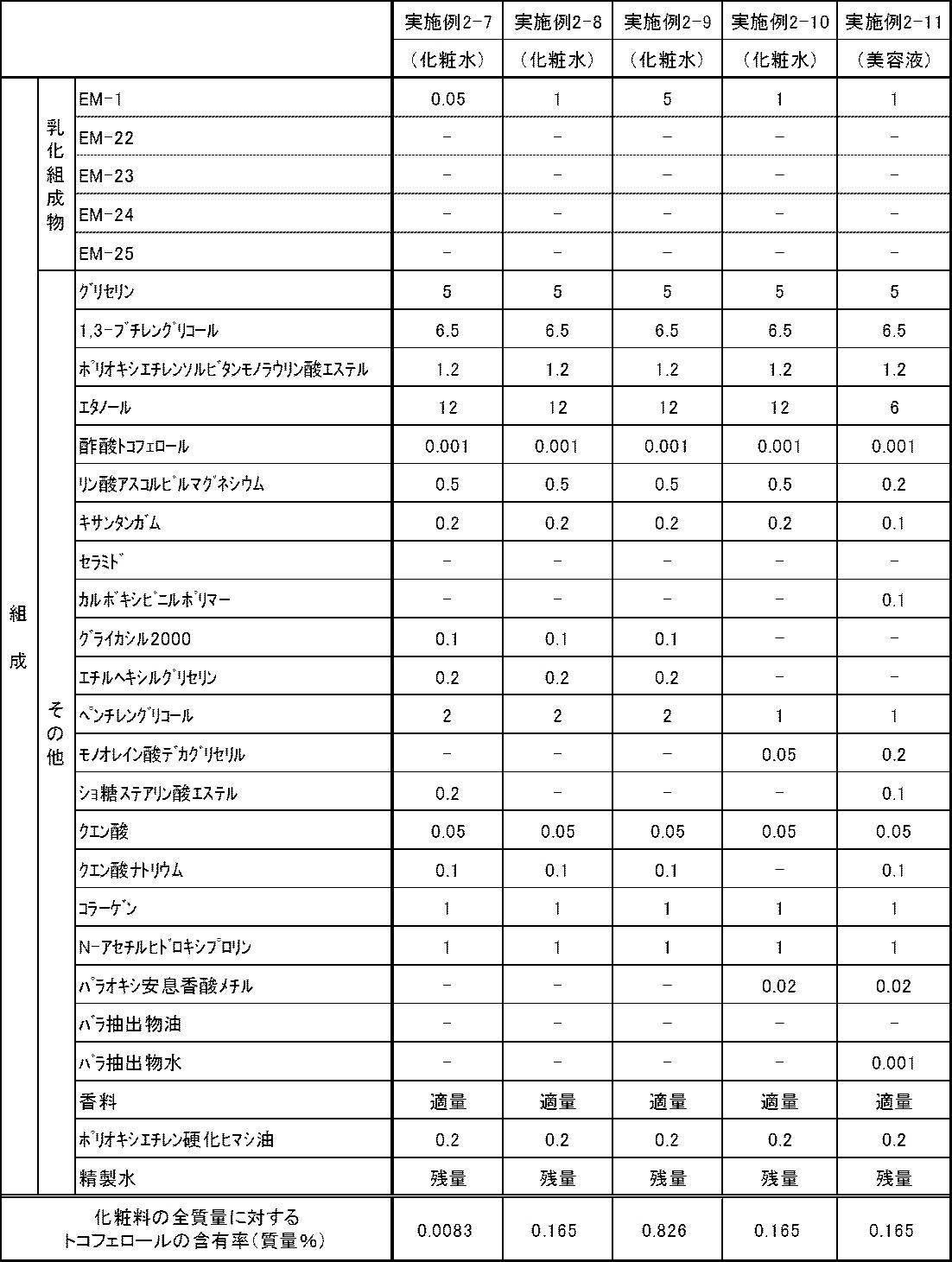

グライカシル2000(ロンザ(株)製)はブチルカルバミン酸ヨウ化プロピニルとシクロデキストリンを含有する。
[実施例2-17]
<乳液の調製>
以下の処方に従って、常法に基づいて乳液を調製した。以下の数値は処方の全質量に対する質量%を意味する。
(成分) (質量%)
グリチルレチン酸ステアリル乳化物(EM-1) 0.6
ルテイン 0.01
ヘマトコッカス藻抽出物 0.5
スクワラン 8.0
ホホバ油 7.0
パラアミノ安息香酸グリセリル 1.0
セチルアルコール 1.5
グリセリンモノステアレート 2.0
ポリオキシエチレンセチルエーテル 3.0
ポリオキシエチレンソオルビタンモノオレート 2.0
1,3-ブチレングリコール 1.0
グリセリン 2.0
メチルパラベン 0.04
ステアリン酸スクロース 0.1
オレイン酸ポリグリセリル-10 0.1
酢酸トコフェロール 0.01
フェノキシエタノール 0.2
コラーゲン 1.0
クエン酸ナトリウム 1.0
香料 適量
精製水 残量
なお、上記組成において、ルテインに代えてフコキサンチンを用いた場合にも、同様に乳液を調製できること確認した。
<乳液の調製>
以下の処方に従って、常法に基づいて乳液を調製した。以下の数値は処方の全質量に対する質量%を意味する。
(成分) (質量%)
グリチルレチン酸ステアリル乳化物(EM-1) 0.6
ルテイン 0.01
ヘマトコッカス藻抽出物 0.5
スクワラン 8.0
ホホバ油 7.0
パラアミノ安息香酸グリセリル 1.0
セチルアルコール 1.5
グリセリンモノステアレート 2.0
ポリオキシエチレンセチルエーテル 3.0
ポリオキシエチレンソオルビタンモノオレート 2.0
1,3-ブチレングリコール 1.0
グリセリン 2.0
メチルパラベン 0.04
ステアリン酸スクロース 0.1
オレイン酸ポリグリセリル-10 0.1
酢酸トコフェロール 0.01
フェノキシエタノール 0.2
コラーゲン 1.0
クエン酸ナトリウム 1.0
香料 適量
精製水 残量
なお、上記組成において、ルテインに代えてフコキサンチンを用いた場合にも、同様に乳液を調製できること確認した。
[実施例2-18]
<クリームの調製>
以下の処方に従って、常法に基づいてクリームを調製した。以下の数値は処方の全質量に対する質量%を意味する。
(成分) (質量%)
グリチルレチン酸ステアリル乳化物(EM-1) 0.6
セトステアリルアルコール 3.0
グリセリン脂肪酸エステル 2.0
モノオレイン酸ポリオキシエチレン(20)ソルビタン 1.0
モノステアリン酸ソルビタン 1.0
N-ステアロイル-N-メチルタウリンナトリウム 0.5
ワセリン 5.0
レシチン 0.5
ジメチルポリシロキサン(100mPa・s) 3.0
トリ-2-エチルヘキサン酸グリセリル 20.0
乳酸 1.0
アスコルビン酸リン酸マグネシウム 0.5
ジプロピレングリコール 10.0
クエン酸ナトリウム 0.5
酸化チタン 0.1
香料 適量
エデト酸2ナトリウム 0.03
パラオキシ安息香酸エチル 0.05
精製水 残量
<クリームの調製>
以下の処方に従って、常法に基づいてクリームを調製した。以下の数値は処方の全質量に対する質量%を意味する。
(成分) (質量%)
グリチルレチン酸ステアリル乳化物(EM-1) 0.6
セトステアリルアルコール 3.0
グリセリン脂肪酸エステル 2.0
モノオレイン酸ポリオキシエチレン(20)ソルビタン 1.0
モノステアリン酸ソルビタン 1.0
N-ステアロイル-N-メチルタウリンナトリウム 0.5
ワセリン 5.0
レシチン 0.5
ジメチルポリシロキサン(100mPa・s) 3.0
トリ-2-エチルヘキサン酸グリセリル 20.0
乳酸 1.0
アスコルビン酸リン酸マグネシウム 0.5
ジプロピレングリコール 10.0
クエン酸ナトリウム 0.5
酸化チタン 0.1
香料 適量
エデト酸2ナトリウム 0.03
パラオキシ安息香酸エチル 0.05
精製水 残量
[実施例2-19]
<ジェリー状美容液の調製>
以下の処方に従って、常法に基づいてジェリー状美容液を調製した。以下の数値は処方の全質量に対する質量%を意味する。
(成分) (質量%)
グリチルレチン酸ステアリル乳化物(EM-1) 0.13
セラミド3、6 0.01
(PEG-240/デシルテトラデセス-20/HDI)コポリマー
0.5
加水分解コラーゲン 1.0
アセチルヒドロキシプロリン 1.0
エチルヘキシルグリセリン 0.05
オレイン酸 0.05
1,3-ブチレングリコール 1.0
グリセリン 2.0
メチルパラベン 0.2
ステアリン酸スクロース 0.01
ステアリン酸ポリグリセリル-2 0.01
フェノキシエタノール 0.2
コラーゲン 1.0
クエン酸ナトリウム 1.0
ダマスクバラ花油 適量
香料 適量
精製水 残量
<ジェリー状美容液の調製>
以下の処方に従って、常法に基づいてジェリー状美容液を調製した。以下の数値は処方の全質量に対する質量%を意味する。
(成分) (質量%)
グリチルレチン酸ステアリル乳化物(EM-1) 0.13
セラミド3、6 0.01
(PEG-240/デシルテトラデセス-20/HDI)コポリマー
0.5
加水分解コラーゲン 1.0
アセチルヒドロキシプロリン 1.0
エチルヘキシルグリセリン 0.05
オレイン酸 0.05
1,3-ブチレングリコール 1.0
グリセリン 2.0
メチルパラベン 0.2
ステアリン酸スクロース 0.01
ステアリン酸ポリグリセリル-2 0.01
フェノキシエタノール 0.2
コラーゲン 1.0
クエン酸ナトリウム 1.0
ダマスクバラ花油 適量
香料 適量
精製水 残量
表1~表6に示されるように、実施例の乳化組成物は、高い透明性を有し、経時安定性に優れることが確認された。
また、表7、表9~表11に示されるように、実施例の乳化組成物を含有する化粧料は、高い透明性を有し、経時安定性に優れることが確認された。
2013年4月12日に出願された日本国特許出願2013-084203号の開示は、その全体が参照により本明細書に取り込まれる。
本明細書に記載された全ての文献、特許出願、及び技術規格は、個々の文献、特許出願、及び技術規格が参照により取り込まれることが具体的かつ個々に記された場合と同程度に、本明細書中に参照により取り込まれる。
また、表7、表9~表11に示されるように、実施例の乳化組成物を含有する化粧料は、高い透明性を有し、経時安定性に優れることが確認された。
2013年4月12日に出願された日本国特許出願2013-084203号の開示は、その全体が参照により本明細書に取り込まれる。
本明細書に記載された全ての文献、特許出願、及び技術規格は、個々の文献、特許出願、及び技術規格が参照により取り込まれることが具体的かつ個々に記された場合と同程度に、本明細書中に参照により取り込まれる。
Claims (11)
- 機能性油性成分と、
ビタミンEと、
下記一般式(1)で表されるアシルグルタミン酸エステルと、を含有する乳化組成物。
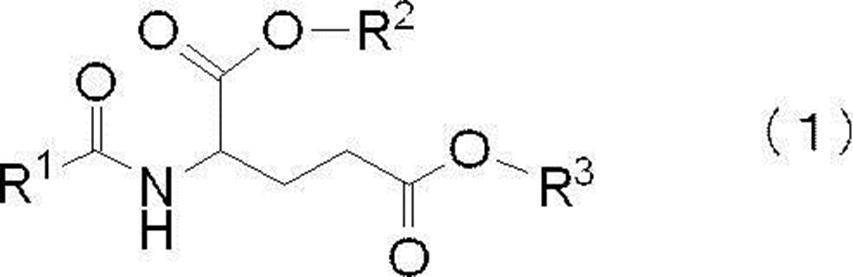
一般式(1)中、R1は、炭素数8~22のアルキル基、炭素数8~22のアルケニル基、又は炭素数8~22のアルキニル基を表す。R2及びR3は、互いに独立して、炭素数8~30のアルキル基、炭素数8~30のアルケニル基、又はステロール基を表す。 - ビタミンEが、トコフェロール及びその誘導体と、トコトリエノール及びその誘導体とからなる群より選択される少なくとも1種を含む、請求項1に記載の乳化組成物。
- 一般式(1)で表されるアシルグルタミン酸エステルが、下記一般式(2)で表されるアシルグルタミン酸エステルである、請求項1又は請求項2に記載の乳化組成物。

一般式(2)中、R21は、炭素数12~18のアルキル基、炭素数12~18のアルケニル基、又は炭素数12~18のアルキニル基を表す。R22及びR23は、互いに独立して、炭素数12~24のアルキル基、炭素数12~24のアルケニル基、又はステロール基を表す。 - 更に、ポリグリセリン脂肪酸エステルを含有する、請求項1~請求項3のいずれか1項に記載の乳化組成物。
- 一般式(1)で表されるアシルグルタミン酸エステルが、ラウロイルグルタミン酸ジヘキシルデシル、ラウロイルグルタミン酸ジイソステアリル、ラウロイルグルタミン酸ビス(ヘキシルデシル/オクチルドデシル)、ラウロイルグルタミン酸ジオクチルドデシル、ラウロイルグルタミン酸ジ(コレステリル/オクチルドデシル)、ラウロイルグルタミン酸ジ(コレステリル/ベヘニル/オクチルドデシル)、ラウロイルグルタミン酸ジ(フィトステリル/オクチルドデシル)、ラウロイルグルタミン酸ジ(オクチルドデシル/フィトステリル/ベヘニル)、ラウロイルグルタミン酸(フィトステリル/ベヘニル/オクチルドデシル/イソステアリル)、及び、ステアロイルグルタミン酸ジオクチルドデシルからなる群より選択される少なくとも1種である、請求項1~請求項4のいずれか1項に記載の乳化組成物。
- ビタミンEの含有量に対する、一般式(1)で表されるアシルグルタミン酸エステルの含有量の含有割合が、質量基準で0.60以下である請求項1~請求項5のいずれか1項に記載の乳化組成物。
- 乳化組成物の全質量に対して、5質量%以上25質量%未満のビタミンEを含有する、請求項1~請求項6のいずれか1項に記載の乳化組成物。
- 機能性油性成分が、ビタミンEに、25℃で0.5質量%以上溶解する油溶性成分である、請求項1~請求項7のいずれか1項に記載の乳化組成物。
- 請求項1~請求項8のいずれか1項に記載の乳化組成物を含有する化粧料。
- 更に、リン脂質を含有する請求項9に記載の化粧料。
- ビタミンEを、化粧料の全質量に対して0.001質量%~1.0質量%含有する請求項9又は請求項10に記載の化粧料。
Applications Claiming Priority (2)
| Application Number | Priority Date | Filing Date | Title |
|---|---|---|---|
| JP2013084203A JP6120653B2 (ja) | 2013-04-12 | 2013-04-12 | 乳化組成物及び化粧料 |
| JP2013-084203 | 2013-04-12 |
Publications (1)
| Publication Number | Publication Date |
|---|---|
| WO2014168095A1 true WO2014168095A1 (ja) | 2014-10-16 |
Family
ID=51689504
Family Applications (1)
| Application Number | Title | Priority Date | Filing Date |
|---|---|---|---|
| PCT/JP2014/060026 Ceased WO2014168095A1 (ja) | 2013-04-12 | 2014-04-04 | 乳化組成物及び化粧料 |
Country Status (2)
| Country | Link |
|---|---|
| JP (1) | JP6120653B2 (ja) |
| WO (1) | WO2014168095A1 (ja) |
Cited By (1)
| Publication number | Priority date | Publication date | Assignee | Title |
|---|---|---|---|---|
| EP3501484A4 (en) * | 2016-08-18 | 2020-03-25 | H&A Pharmachem Co., Ltd | COMPOSITION WITH NANO EMULSION AND MODIFIED LAYERED DOUBLE HYDROXIDE FOR TRANSDERMAL ADMINISTRATION |
Families Citing this family (3)
| Publication number | Priority date | Publication date | Assignee | Title |
|---|---|---|---|---|
| JP2016169209A (ja) * | 2015-03-11 | 2016-09-23 | 御木本製薬株式会社 | シート状化粧料 |
| WO2018145828A1 (en) * | 2017-02-08 | 2018-08-16 | Unilever Plc | Novel nanoemulsions comprising glycerol in aqueous phase |
| JP2018203634A (ja) * | 2017-05-31 | 2018-12-27 | 花王株式会社 | 水中油型乳化化粧料 |
Citations (9)
| Publication number | Priority date | Publication date | Assignee | Title |
|---|---|---|---|---|
| JP2007077077A (ja) * | 2005-09-14 | 2007-03-29 | Noevir Co Ltd | 水中油型マイクロエマルション及びその製造方法 |
| JP2008115112A (ja) * | 2006-11-06 | 2008-05-22 | Pola Chem Ind Inc | 乳化剤形の皮膚外用剤 |
| JP2008297301A (ja) * | 2007-05-01 | 2008-12-11 | Fancl Corp | セラミド溶液及び皮膚外用剤 |
| JP2009179599A (ja) * | 2008-01-31 | 2009-08-13 | Pola Chem Ind Inc | N−アシルアミノ酸誘導体を含有する皮膚外用剤 |
| JP2009249342A (ja) * | 2008-04-07 | 2009-10-29 | Noevir Co Ltd | 皮膚外用剤 |
| JP2011178733A (ja) * | 2010-03-02 | 2011-09-15 | Nippon Emulsion Kk | N−長鎖アシル酸性アミノ酸ジエステル化合物及びこれを用いた化粧料及び洗浄料 |
| JP2013006790A (ja) * | 2011-06-24 | 2013-01-10 | Mikimoto Pharmaceut Co Ltd | O/w型エマルジョン |
| JP2013056858A (ja) * | 2011-09-08 | 2013-03-28 | Yoshida Kikai Co Ltd | 乳化物及びその製造方法 |
| WO2013141263A1 (ja) * | 2012-03-22 | 2013-09-26 | 富士フイルム株式会社 | 透明性の高い乳化組成物及び透明性の高い化粧料 |
-
2013
- 2013-04-12 JP JP2013084203A patent/JP6120653B2/ja active Active
-
2014
- 2014-04-04 WO PCT/JP2014/060026 patent/WO2014168095A1/ja not_active Ceased
Patent Citations (9)
| Publication number | Priority date | Publication date | Assignee | Title |
|---|---|---|---|---|
| JP2007077077A (ja) * | 2005-09-14 | 2007-03-29 | Noevir Co Ltd | 水中油型マイクロエマルション及びその製造方法 |
| JP2008115112A (ja) * | 2006-11-06 | 2008-05-22 | Pola Chem Ind Inc | 乳化剤形の皮膚外用剤 |
| JP2008297301A (ja) * | 2007-05-01 | 2008-12-11 | Fancl Corp | セラミド溶液及び皮膚外用剤 |
| JP2009179599A (ja) * | 2008-01-31 | 2009-08-13 | Pola Chem Ind Inc | N−アシルアミノ酸誘導体を含有する皮膚外用剤 |
| JP2009249342A (ja) * | 2008-04-07 | 2009-10-29 | Noevir Co Ltd | 皮膚外用剤 |
| JP2011178733A (ja) * | 2010-03-02 | 2011-09-15 | Nippon Emulsion Kk | N−長鎖アシル酸性アミノ酸ジエステル化合物及びこれを用いた化粧料及び洗浄料 |
| JP2013006790A (ja) * | 2011-06-24 | 2013-01-10 | Mikimoto Pharmaceut Co Ltd | O/w型エマルジョン |
| JP2013056858A (ja) * | 2011-09-08 | 2013-03-28 | Yoshida Kikai Co Ltd | 乳化物及びその製造方法 |
| WO2013141263A1 (ja) * | 2012-03-22 | 2013-09-26 | 富士フイルム株式会社 | 透明性の高い乳化組成物及び透明性の高い化粧料 |
Cited By (2)
| Publication number | Priority date | Publication date | Assignee | Title |
|---|---|---|---|---|
| EP3501484A4 (en) * | 2016-08-18 | 2020-03-25 | H&A Pharmachem Co., Ltd | COMPOSITION WITH NANO EMULSION AND MODIFIED LAYERED DOUBLE HYDROXIDE FOR TRANSDERMAL ADMINISTRATION |
| US10925816B2 (en) | 2016-08-18 | 2021-02-23 | H&A Pharmachem Co., Ltd. | Composition for transdermal delivery, comprising nanoemulsion and modified layered double hydroxide |
Also Published As
| Publication number | Publication date |
|---|---|
| JP2014205638A (ja) | 2014-10-30 |
| JP6120653B2 (ja) | 2017-04-26 |
Similar Documents
| Publication | Publication Date | Title |
|---|---|---|
| JP5918163B2 (ja) | 透明性の高い乳化組成物及び透明性の高い化粧料 | |
| JP6016700B2 (ja) | 水中油型エマルション組成物 | |
| CN103619319A (zh) | 含虾青素的组合物及其制造方法以及化妆品 | |
| CN104135994A (zh) | 含番茄红素的组合物 | |
| CN104755071A (zh) | 皮肤外用剂 | |
| JP6120653B2 (ja) | 乳化組成物及び化粧料 | |
| JP2013199474A (ja) | 皮膚外用剤及び正常皮膚細胞賦活化剤 | |
| JP6005018B2 (ja) | 化粧料及びグリチルレチン酸誘導体含有乳化組成物 | |
| CN104936577B (zh) | 水包油型乳液组合物及其用途 | |
| JP6522033B2 (ja) | 乳化組成物 | |
| JP2015105249A (ja) | 化粧料 | |
| JP5306676B2 (ja) | ショ糖脂肪酸エステル及び水中油型乳化組成物用乳化剤 | |
| WO2015034046A1 (ja) | エマルション及びその製造方法 | |
| JP2024021931A (ja) | 乳化組成物及び化粧料 | |
| JP2024021930A (ja) | 乳化組成物及び化粧料 | |
| JP2024157500A (ja) | グリチルレチン酸を含有する水中油型乳化組成物 | |
| JP2024093989A (ja) | 化粧料組成物、角層改善剤及び保湿機能改善剤 | |
| CN116803363A (zh) | 水包油型乳化组合物及其制造方法、以及化妆品 | |
| JP2013173695A (ja) | 皮膚外用剤 | |
| JP6284895B2 (ja) | エアゾル化粧料 | |
| JP2023143666A (ja) | 水中油型乳化組成物及びその製造方法、並びに化粧料 |
Legal Events
| Date | Code | Title | Description |
|---|---|---|---|
| 121 | Ep: the epo has been informed by wipo that ep was designated in this application |
Ref document number: 14782808 Country of ref document: EP Kind code of ref document: A1 |
|
| NENP | Non-entry into the national phase |
Ref country code: DE |
|
| 122 | Ep: pct application non-entry in european phase |
Ref document number: 14782808 Country of ref document: EP Kind code of ref document: A1 |