WO2014156641A1 - 粘着剤およびそれを用いた画像表示装置 - Google Patents
粘着剤およびそれを用いた画像表示装置 Download PDFInfo
- Publication number
- WO2014156641A1 WO2014156641A1 PCT/JP2014/056462 JP2014056462W WO2014156641A1 WO 2014156641 A1 WO2014156641 A1 WO 2014156641A1 JP 2014056462 W JP2014056462 W JP 2014056462W WO 2014156641 A1 WO2014156641 A1 WO 2014156641A1
- Authority
- WO
- WIPO (PCT)
- Prior art keywords
- image display
- pressure
- sensitive adhesive
- weight
- base polymer
- Prior art date
- Legal status (The legal status is an assumption and is not a legal conclusion. Google has not performed a legal analysis and makes no representation as to the accuracy of the status listed.)
- Ceased
Links
Images
Classifications
-
- G—PHYSICS
- G06—COMPUTING OR CALCULATING; COUNTING
- G06F—ELECTRIC DIGITAL DATA PROCESSING
- G06F3/00—Input arrangements for transferring data to be processed into a form capable of being handled by the computer; Output arrangements for transferring data from processing unit to output unit, e.g. interface arrangements
- G06F3/01—Input arrangements or combined input and output arrangements for interaction between user and computer
- G06F3/03—Arrangements for converting the position or the displacement of a member into a coded form
- G06F3/041—Digitisers, e.g. for touch screens or touch pads, characterised by the transducing means
- G06F3/0414—Digitisers, e.g. for touch screens or touch pads, characterised by the transducing means using force sensing means to determine a position
-
- C—CHEMISTRY; METALLURGY
- C08—ORGANIC MACROMOLECULAR COMPOUNDS; THEIR PREPARATION OR CHEMICAL WORKING-UP; COMPOSITIONS BASED THEREON
- C08F—MACROMOLECULAR COMPOUNDS OBTAINED BY REACTIONS ONLY INVOLVING CARBON-TO-CARBON UNSATURATED BONDS
- C08F220/00—Copolymers of compounds having one or more unsaturated aliphatic radicals, each having only one carbon-to-carbon double bond, and only one being terminated by only one carboxyl radical or a salt, anhydride ester, amide, imide or nitrile thereof
- C08F220/02—Monocarboxylic acids having less than ten carbon atoms; Derivatives thereof
- C08F220/10—Esters
- C08F220/12—Esters of monohydric alcohols or phenols
- C08F220/16—Esters of monohydric alcohols or phenols of phenols or of alcohols containing two or more carbon atoms
- C08F220/18—Esters of monohydric alcohols or phenols of phenols or of alcohols containing two or more carbon atoms with acrylic or methacrylic acids
- C08F220/1808—C8-(meth)acrylate, e.g. isooctyl (meth)acrylate or 2-ethylhexyl (meth)acrylate
-
- C—CHEMISTRY; METALLURGY
- C09—DYES; PAINTS; POLISHES; NATURAL RESINS; ADHESIVES; COMPOSITIONS NOT OTHERWISE PROVIDED FOR; APPLICATIONS OF MATERIALS NOT OTHERWISE PROVIDED FOR
- C09J—ADHESIVES; NON-MECHANICAL ASPECTS OF ADHESIVE PROCESSES IN GENERAL; ADHESIVE PROCESSES NOT PROVIDED FOR ELSEWHERE; USE OF MATERIALS AS ADHESIVES
- C09J133/00—Adhesives based on homopolymers or copolymers of compounds having one or more unsaturated aliphatic radicals, each having only one carbon-to-carbon double bond, and at least one being terminated by only one carboxyl radical, or of salts, anhydrides, esters, amides, imides, or nitriles thereof; Adhesives based on derivatives of such polymers
- C09J133/04—Homopolymers or copolymers of esters
- C09J133/06—Homopolymers or copolymers of esters of esters containing only carbon, hydrogen and oxygen, the oxygen atom being present only as part of the carboxyl radical
- C09J133/08—Homopolymers or copolymers of acrylic acid esters
-
- C—CHEMISTRY; METALLURGY
- C09—DYES; PAINTS; POLISHES; NATURAL RESINS; ADHESIVES; COMPOSITIONS NOT OTHERWISE PROVIDED FOR; APPLICATIONS OF MATERIALS NOT OTHERWISE PROVIDED FOR
- C09J—ADHESIVES; NON-MECHANICAL ASPECTS OF ADHESIVE PROCESSES IN GENERAL; ADHESIVE PROCESSES NOT PROVIDED FOR ELSEWHERE; USE OF MATERIALS AS ADHESIVES
- C09J133/00—Adhesives based on homopolymers or copolymers of compounds having one or more unsaturated aliphatic radicals, each having only one carbon-to-carbon double bond, and at least one being terminated by only one carboxyl radical, or of salts, anhydrides, esters, amides, imides, or nitriles thereof; Adhesives based on derivatives of such polymers
- C09J133/04—Homopolymers or copolymers of esters
- C09J133/14—Homopolymers or copolymers of esters of esters containing halogen, nitrogen, sulfur or oxygen atoms in addition to the carboxy oxygen
-
- C—CHEMISTRY; METALLURGY
- C09—DYES; PAINTS; POLISHES; NATURAL RESINS; ADHESIVES; COMPOSITIONS NOT OTHERWISE PROVIDED FOR; APPLICATIONS OF MATERIALS NOT OTHERWISE PROVIDED FOR
- C09J—ADHESIVES; NON-MECHANICAL ASPECTS OF ADHESIVE PROCESSES IN GENERAL; ADHESIVE PROCESSES NOT PROVIDED FOR ELSEWHERE; USE OF MATERIALS AS ADHESIVES
- C09J165/00—Adhesives based on macromolecular compounds obtained by reactions forming a carbon-to-carbon link in the main chain; Adhesives based on derivatives of such polymers
-
- C—CHEMISTRY; METALLURGY
- C09—DYES; PAINTS; POLISHES; NATURAL RESINS; ADHESIVES; COMPOSITIONS NOT OTHERWISE PROVIDED FOR; APPLICATIONS OF MATERIALS NOT OTHERWISE PROVIDED FOR
- C09J—ADHESIVES; NON-MECHANICAL ASPECTS OF ADHESIVE PROCESSES IN GENERAL; ADHESIVE PROCESSES NOT PROVIDED FOR ELSEWHERE; USE OF MATERIALS AS ADHESIVES
- C09J7/00—Adhesives in the form of films or foils
- C09J7/30—Adhesives in the form of films or foils characterised by the adhesive composition
- C09J7/38—Pressure-sensitive adhesives [PSA]
- C09J7/381—Pressure-sensitive adhesives [PSA] based on macromolecular compounds obtained by reactions involving only carbon-to-carbon unsaturated bonds
- C09J7/385—Acrylic polymers
-
- C—CHEMISTRY; METALLURGY
- C09—DYES; PAINTS; POLISHES; NATURAL RESINS; ADHESIVES; COMPOSITIONS NOT OTHERWISE PROVIDED FOR; APPLICATIONS OF MATERIALS NOT OTHERWISE PROVIDED FOR
- C09J—ADHESIVES; NON-MECHANICAL ASPECTS OF ADHESIVE PROCESSES IN GENERAL; ADHESIVE PROCESSES NOT PROVIDED FOR ELSEWHERE; USE OF MATERIALS AS ADHESIVES
- C09J2203/00—Applications of adhesives in processes or use of adhesives in the form of films or foils
- C09J2203/318—Applications of adhesives in processes or use of adhesives in the form of films or foils for the production of liquid crystal displays
Definitions
- the present invention relates to an adhesive used for forming an image display device having a transparent plate or a touch panel on the front surface of an image display panel. Furthermore, this invention relates to the manufacturing method of the image display apparatus using the said adhesive.
- a gap of about 0.5 to 1.5 mm is provided between these layers in order to protect the panel surface.
- An air gap structure (hollow structure) is configured.
- the refractive index of air in the air gap structure portion is about 1
- the refractive index of the plastic material or glass material constituting the polarizing plate or front transparent member of the image display panel is about 1.5. Therefore, reflection and refraction at the interface increase.
- increasing the fluidity of the pressure-sensitive adhesive is effective in suppressing bubbles around the printed step.
- As a method for increasing the fluidity of the pressure-sensitive adhesive material it is common to lower the molecular weight of the base polymer constituting the pressure-sensitive adhesive material or to reduce the degree of crosslinking.
- the molecular weight of the base polymer is lowered or the degree of crosslinking is reduced, transfer of the pressure-sensitive adhesive layer and protrusion from the end surface are liable to occur, and there is a tendency for workability and surrounding contamination to be caused. That is, in general, when trying to improve the step following property, the handling property of the adhesive tends to be lowered.
- the interlayer filler may become cloudy.
- the base polymer which comprises an interlayer filler (adhesive) contains a polar group containing monomer component, it describes that white turbidity can be eliminated.
- the highly polar base polymer has low fluidity, the step following ability is low, and the above-described bubble problem is likely to occur. Therefore, there is a demand for the development of an optical pressure-sensitive adhesive that achieves both step followability and handling properties when used as an interlayer filler and hardly causes white turbidity in a high temperature and high humidity environment.
- the pressure-sensitive adhesive containing a predetermined polymer and a tackifier has good handling properties during normal handling, excellent step following performance, and further suppresses the occurrence of white turbidity.
- the present invention has been achieved.
- the present invention relates to an adhesive used by being disposed between a front transparent plate and a touch panel, between a front transparent plate and an image display panel, or between a touch panel and an image display panel.
- the pressure-sensitive adhesive of the present invention contains an acrylic base polymer and a hydrogenated terpene phenol resin having a softening point of 70 ° C. to 150 ° C.
- the hydrogenated terpene phenol resin preferably has a terpene molar ratio of 0.1 to 0.7.
- the content of the acrylic base polymer with respect to 100 parts by weight of the total pressure-sensitive adhesive composition is preferably 45 to 95 parts by weight.
- the total content of the acrylic base polymer and the hydrogenated terpene phenol resin is preferably 70 parts by weight or more.
- the acrylic base polymer preferably has a polar monomer unit content of 3 to 50% by weight based on the total amount of the constituent monomer components.
- the present invention relates to an image display device.
- the image display device of the present invention includes at least one of a touch panel and a front transparent plate on the surface of the image display panel, between the front transparent plate and the touch panel, between the front transparent plate and the image display panel, and between the touch panel and the image.
- a pressure-sensitive adhesive layer made of the pressure-sensitive adhesive is provided between the display panel and the display panel.
- the pressure-sensitive adhesive of the present invention contains a predetermined tackifier, when used as an interlayer filler, it has excellent handling properties, has step-following properties, and is less prone to white turbidity in a high-temperature, high-humidity environment. . Therefore, the adhesive of the present invention is used for forming an image display device as an interlayer filler between the front transparent plate and the touch panel, between the front transparent plate and the image display panel, or between the touch panel and the image display panel. Preferably used.
- the base polymer a polymer mainly composed of an acrylic polymer is used.
- the acrylic polymer is excellent in optical transparency and adhesiveness, and has appropriate flexibility.
- the acrylic base polymer one having a monomer unit of (meth) acrylic acid alkyl ester as a main skeleton is used.
- (meth) acryl means acryl and / or methacryl.
- a (meth) acrylic acid alkyl ester having an alkyl group having 1 to 20 carbon atoms is preferably used.
- the acrylic base polymer may contain a (meth) acrylic acid alkyl ester having a branched alkyl group as a monomer unit of the (meth) acrylic acid alkyl ester. preferable.
- branched alkyl (meth) acrylates include 2-ethylhexyl (meth) acrylate, isooctyl (meth) acrylate, isononyl (meth) acrylate, isodecyl (meth) acrylate, ( (Meth) isotetradecyl acrylate, isooctadecyl (meth) acrylate and the like are preferably used.
- 2 or more types of branched alkyl (meth) acrylic acid esters can be used in combination.
- these branched alkyl (meth) acrylic acid esters may be used in combination with a linear alkyl (meth) acrylic acid ester.
- the content of the (meth) acrylic acid alkyl ester is preferably 40% by weight or more, more preferably 50% by weight or more, and still more preferably 60% by weight or more based on the total amount of monomer components constituting the base polymer. is there.
- the content of the alkyl (meth) acrylate having a branched alkyl group with respect to the total amount of the (meth) acrylic acid alkyl ester component is preferably 50% by weight or more, and more preferably 60% by weight or more.
- Nitrogen-containing monomers include N-vinyl pyrrolidone, methyl vinyl pyrrolidone, vinyl pyridine, vinyl piperidone, vinyl pyrimidine, vinyl piperazine, vinyl pyrazine, vinyl pyrrole, vinyl imidazole, vinyl oxazole, vinyl morpholine, N-vinyl carboxylic acid amides, N -Vinyl caprolactam and the like.
- the content of the crosslinking agent is usually in the range of 0 to 10 parts by weight, preferably 0 to 5 parts by weight with respect to 100 parts by weight of the acrylic base polymer.
- a crosslinking agent used as the pressure-sensitive adhesive composition, it is preferable to undergo a heating step in order to form a crosslinked structure.
- the heating temperature and the heating time are appropriately set according to the type of the crosslinking agent to be used.
- the crosslinking is performed in the range of 20 ° C. to 160 ° C. by heating for 1 minute to 7 days.
- the softening point of the hydrogenated terpene phenol resin as the tackifier is within the above range, the desired temperature dependence can be imparted to the elastic modulus of the adhesive.
- the elastic modulus is high at room temperature (low fluidity), while suppressing the transfer of the adhesive layer and the protrusion from the end surface, in the heating environment at the time of bonding with the adherend as an interlayer filler,
- the elastic modulus of the pressure-sensitive adhesive is low (high fluidity), and step following ability can be imparted.
- the hydrogenated terpene phenol resin preferably has a terpene molar ratio of 0.1 to 0.7, more preferably 0.2 to 0.6.
- a hydrogenated terpene phenol resin having a terpene molar ratio within the above range is excellent in compatibility with the above-mentioned polar group-containing acrylic base polymer. Therefore, by using a hydrogenated terpene phenol resin having a predetermined softening point and a terpene content in a predetermined range as a tackifier, white turbidity in a high-temperature and high-humidity environment is suppressed, and has step following ability. An adhesive is obtained.
- the pressure-sensitive adhesive of the present invention is preferably photocurable from the viewpoint of control of the timing of curing and certainty.
- a photocuring method a method of irradiating a system containing a photocurable monomer or photocurable oligomer and a photoradical generator with actinic rays such as ultraviolet rays is preferable.
- a system using an ethylenically unsaturated compound and a photo radical generator is preferable because of high photosensitivity and abundant materials that can be selected.
- the photocurable ethylenically unsaturated compound may be a monofunctional compound or a polyfunctional compound.
- the content of the photocurable compound is preferably 2 to 50 parts by weight with respect to 100 parts by weight of the total solid content of the pressure-sensitive adhesive composition, and 5 to 30. Part by weight is more preferred.
- the content of the photocurable compound is excessively large, the fluidity of the pressure-sensitive adhesive before curing is increased, which may cause a decrease in handling properties and contamination.
- Various methods are used as a method of forming the pressure-sensitive adhesive layer. Specifically, for example, by roll coat, kiss roll coat, gravure coat, reverse coat, roll brush, spray coat, dip roll coat, bar coat, knife coat, air knife coat, curtain coat, lip coat, die coater, etc. Examples thereof include an extrusion coating method. Among these, it is preferable to use a die coater, and it is particularly preferable to use a die coater using a fountain die or a slot die.
- the adhesive layer preferably has a storage elastic modulus G ′ at 25 ° C. of 25 ° C. of 1.0 ⁇ 10 4 Pa to 1.0 ⁇ 10 7 Pa, and preferably 3.0 ⁇ 10 4 Pa to 7.0 ⁇ . 10 6 Pa is more preferable, and 5.0 ⁇ 10 4 Pa to 5.0 ⁇ 10 6 Pa is even more preferable.
- the storage elastic modulus at 25 ° C. room temperature
- the pressure-sensitive adhesive may protrude from the end surface due to pressure applied when the pressure-sensitive adhesive layer is cut or bonded, leading to problems such as contamination.
- the storage elastic modulus at 25 ° C. is excessively large, cracks and chips tend to occur on the end face (cut face) of the pressure-sensitive adhesive during or after cutting.
- the pressure-sensitive adhesive layer preferably has a storage elastic modulus G ′ of 80 ° C. at 80 ° C. of 1.0 ⁇ 10 2 Pa to 1.0 ⁇ 10 5 Pa.
- G ′ 80 ° C. of the pressure-sensitive adhesive layer is more preferably 5.0 ⁇ 10 4 Pa or less, further preferably 3.0 ⁇ 10 4 Pa or less, and particularly preferably 1.0 ⁇ 10 4 Pa or less.
- the pressure-sensitive adhesive of the present invention is suitably used as an interlayer filler between the image display panel and the touch panel, between the touch panel and the front transparent plate, and between the image display panel and the front transparent plate.
- the protective sheet is attached in a peelable manner as necessary.
- plastic films such as polyethylene, polypropylene, polyethylene terephthalate, and polyester films, porous materials such as paper, cloth, and nonwoven fabric, nets, foam sheets, metal foils, and laminates thereof, etc. Appropriate thin leaves and the like can be mentioned.
- a plastic film is preferably used from the viewpoint of excellent surface smoothness.
- Comparative Examples 3 to 5 bubbles were not generated because an adhesive containing a tackifier having a softening point within a predetermined range was used.
- the adhesive had become cloudy before being exposed to a high temperature and high humidity environment. This is presumably due to the low compatibility between the acrylic base polymer constituting the pressure-sensitive adhesive and the hydrogenated terpene phenol having a high terpene ratio.
- Comparative Examples 4 and 5 although no white turbidity occurred at the initial stage, white turbidity was observed in the pressure-sensitive adhesive layer after exposure to a high temperature and high humidity environment.
Landscapes
- Chemical & Material Sciences (AREA)
- Organic Chemistry (AREA)
- Engineering & Computer Science (AREA)
- Chemical Kinetics & Catalysis (AREA)
- Theoretical Computer Science (AREA)
- General Engineering & Computer Science (AREA)
- Health & Medical Sciences (AREA)
- Polymers & Plastics (AREA)
- Medicinal Chemistry (AREA)
- Human Computer Interaction (AREA)
- Physics & Mathematics (AREA)
- General Physics & Mathematics (AREA)
- Adhesives Or Adhesive Processes (AREA)
- Liquid Crystal (AREA)
Abstract
Description
本発明の粘着剤は、ベースポリマーおよび粘着付与剤を含有する。
粘着剤層の形成方法としては、各種方法が用いられる。具体的には、例えば、ロールコート、キスロールコート、グラビアコート、リバースコート、ロールブラッシュ、スプレーコート、ディップロールコート、バーコート、ナイフコート、エアーナイフコート、カーテンコート、リップコート、ダイコーター等による押出しコート法等の方法が挙げられる。これらの中でも、ダイコーターを使用することが好ましく、特にファウンテンダイ、スロットダイを用いるダイコーターを使用することがより好ましい。
粘着剤層は、25℃における貯蔵弾性率G’25℃が、1.0×10⁴Pa~1.0×10⁷Paであることが好ましく、3.0×10⁴Pa~7.0×10⁶Paであることがより好ましく、5.0×10⁴Pa~5.0×10⁶Paであることがさらに好ましい。25℃(常温)における貯蔵弾性率が過度に小さいと、粘着剤層をカットする際や、貼り合せの際の加圧によって、端面から粘着剤がはみ出して、汚染等の不具合を招く場合がある。一方、25℃における貯蔵弾性率が過度に大きいと、カット時またはカット後に、粘着剤の端面(カット面)において、割れや欠けが発生し易くなる傾向がある。
前述のように、本発明の粘着剤は、画像表示パネルとタッチパネルとの間、タッチパネルと前面透明板との間、画像表示パネルと前面透明板との間の層間充填剤として好適に用いられる。粘着剤層は、実用に供するまでの間、粘着剤層の露出面を保護する目的で、必要に応じて、保護シートが剥離可能に貼着されることが好ましい。保護シートの構成材料としては、例えば、ポリエチレン、ポリプロピレン、ポリエチレンテレフタレート、ポリエステルフィルム等のプラスチックフィルム、紙、布、不織布等の多孔質材料、ネット、発泡シート、金属箔、およびこれらのラミネート体等の適宜な薄葉体等が挙げられる。表面平滑性に優れる点からプラスチックフィルムが好適に用いられる。
<合成例1>
温度計、攪拌機、還流冷却管および窒素ガス導入管を備えたセパラブルフラスコに、2-エチルヘキシルアクリレート(2EHA)を75重量部、N-ビニルピロリドン(NVP)を25重量部、重合開始剤としてアゾビスイソブチロニトリル(AIBN)を0.2重量部、および酢酸エチル233重量部を投入した後、窒素ガスを流し、攪拌しながら約1時間窒素置換を行った。その後、70℃にフラスコを加熱し、5時間反応させて重量平均分子量(Mw)80万のアクリル系ポリマーを得た(以下、このベースポリマーを「ポリマー1」と称する)。
温度計、攪拌機、還流冷却管および窒素ガス導入管を備えたセパラブルフラスコに、2EHAを65重量部、メタクリル酸メチル(MMA)を10重量部、NVPを15重量部、ヒドロキシエチルアクリレート(HEA)を10重量部、重合開始剤としてAIBNを0.2重量部、および酢酸エチル233重量部を投入した後、窒素ガスを流し、攪拌しながら約1時間窒素置換を行った。その後、70℃にフラスコを加熱し、5時間反応させて重量平均分子量(Mw)80万のアクリル系ポリマーを得た(以下、このベースポリマーを「ポリマー2」と称する)。
上記ポリマー1,2をベースポリマーとして用い、表1に示す化合物を混合溶解して、粘着剤組成物を調製した(表1中の粘着剤組成の数字は、いずれも重量部)。調製した粘着剤組成物溶液を、PETセパレータ上に、乾燥後厚みが100μmとなるように塗布・乾燥して、粘着剤層を得た。
なお、表1において、粘着付与剤1(YSポリスターNH)は、ヤスハラケミカル製の水素添加型テルペンフェノール樹脂であり、軟化点は130℃、テルペン比率は0.5モルである。粘着付与剤2(YSポリスターUH)は、ヤスハラケミカル製の水素添加型テルペンフェノール樹脂であり、軟化点は115℃、テルペン比率は0.8モルである。粘着付与剤3(YSレジン SX100)は、ヤスハラケミカル製のスチレンオリゴマーであり、軟化点は100℃である。粘着付与剤4(パインクリスタル KE-311)は、荒川化学工業製の水素化ロジンエステルであり、軟化点は95℃である。光硬化性化合物(NKエステル APG‐400)は、新中村化学工業製のポリエチレングリコールジアクリレート(二官能アクリレート)である。重合開始剤(イルガキュア184)は、チバスペシャリティケミカル製のアルキルフェノン系の光重合開始剤である。
<評価用疑似画像表示装置の作製>
平坦なガラス板(0.7mm×50mm×100mm)に、各実施例および比較例で得られた粘着剤層を貼り合わせた後、PETセパレータを剥離した。セパレータ剥離後の粘着剤の露出面上に、黒色インク(厚み20μm)が周縁部に枠状に印刷されたガラス板(0.7mm×50mm×100mm、インク印刷幅:端部から10mm)を、印刷面と粘着剤層が接するよう載置した後、真空熱圧着装置で熱圧着して貼り合せを行った(温度80℃、圧力0.3MPa、圧力保持時間5秒)。その後、オートクレーブ処理を行った(50℃、0.5MPa、30分)。実施例2のみ、オートクレーブ処理後に、ガラス板側からメタルハライドランプ(300mW/cm2)で紫外線を照射し、光硬化性粘着剤の硬化を行った(積算光量:3000mJ/cm2)。このようにして、評価用疑似画像表示装置が得られた。
評価用疑似画像表示装置の黒色インク印刷部の内側近傍を、倍率20倍のデジタルマイクロスコープで観察し、粘着剤層中の気泡の有無を確認した(初期評価)。また、85℃のオーブンに48時間投入後、同様の方法で気泡の有無を確認した。
上記の試料(評価用疑似画像表示装置)における、粘着剤層の白濁の有無を目視で確認した(初期評価)。60℃95%RHの恒温恒湿槽内に、試料を240時間投入した。その後、試料後取り出し、25℃50%RHの環境下で24時間保管後に、粘着剤層の白濁の有無を目視で確認した。

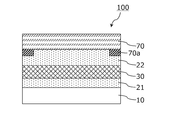
21,22:粘着剤層(層間充填剤)
30 :タッチパネル
70 :前面透明板
100 :画像表示装置
Claims (3)
- 前面透明板とタッチパネルとの間、前面透明板と画像表示パネルとの間、またはタッチパネルと画像表示パネルとの間に配置して用いられる粘着剤であって、
アクリル系ベースポリマーと、軟化点が70℃~150℃の水素添加型テルペンフェノール樹脂とを含有し、
前記水素添加型テルペンフェノール樹脂は、テルペンのモル比率が0.1~0.7であり、
粘着剤組成物の全量100重量部に対する、前記アクリル系ベースポリマーの含有量が45~95重量部であり、かつ、前記アクリル系ベースポリマーと前記水素添加型テルペンフェノール樹脂の含有量の合計が、70重量部以上である、粘着剤。 - 前記アクリル系ベースポリマーは、構成モノマー成分全量に対する極性モノマーユニットの含有率が、3~50重量%である、請求項1に記載の粘着剤。
- 画像表示パネルの表面に、タッチパネルおよび前面透明板の少なくとも一方を備え、
前記前面透明板と前記タッチパネルとの間、前記前面透明板と前記画像表示パネルとの間、および前記タッチパネルと前記画像表示パネルとの間のいずれかに、請求項1または2に記載の粘着剤からなる粘着剤層を備える、画像表示装置。
Priority Applications (3)
| Application Number | Priority Date | Filing Date | Title |
|---|---|---|---|
| US14/771,524 US20160002505A1 (en) | 2013-03-29 | 2014-03-12 | Pressure sensitive adhesive and image display device using the same |
| CN201480018762.2A CN105073935B (zh) | 2013-03-29 | 2014-03-12 | 粘合剂及使用该粘合剂的图像显示装置 |
| KR1020157024006A KR102248655B1 (ko) | 2013-03-29 | 2014-03-12 | 점착제 및 그것을 사용한 화상 표시 장치 |
Applications Claiming Priority (2)
| Application Number | Priority Date | Filing Date | Title |
|---|---|---|---|
| JP2013075184A JP6073173B2 (ja) | 2013-03-29 | 2013-03-29 | 粘着剤およびそれを用いた画像表示装置 |
| JP2013-075184 | 2013-03-29 |
Publications (1)
| Publication Number | Publication Date |
|---|---|
| WO2014156641A1 true WO2014156641A1 (ja) | 2014-10-02 |
Family
ID=51623624
Family Applications (1)
| Application Number | Title | Priority Date | Filing Date |
|---|---|---|---|
| PCT/JP2014/056462 Ceased WO2014156641A1 (ja) | 2013-03-29 | 2014-03-12 | 粘着剤およびそれを用いた画像表示装置 |
Country Status (6)
| Country | Link |
|---|---|
| US (1) | US20160002505A1 (ja) |
| JP (1) | JP6073173B2 (ja) |
| KR (1) | KR102248655B1 (ja) |
| CN (1) | CN105073935B (ja) |
| TW (2) | TW201726872A (ja) |
| WO (1) | WO2014156641A1 (ja) |
Cited By (1)
| Publication number | Priority date | Publication date | Assignee | Title |
|---|---|---|---|---|
| JP2016094569A (ja) * | 2014-11-17 | 2016-05-26 | 日東電工株式会社 | 光学用両面粘着シート |
Families Citing this family (8)
| Publication number | Priority date | Publication date | Assignee | Title |
|---|---|---|---|---|
| JP6526951B2 (ja) * | 2014-08-29 | 2019-06-05 | スリーエム イノベイティブ プロパティズ カンパニー | 光学的に透明な接着剤及び光学積層体 |
| JP6654362B2 (ja) * | 2015-06-04 | 2020-02-26 | 日東電工株式会社 | 粘着剤付き光学フィルム、および画像表示装置の製造方法 |
| KR20240125695A (ko) * | 2015-10-07 | 2024-08-19 | 세키스이가가쿠 고교가부시키가이샤 | 터치 패널용 층간 충전 재료 및 터치 패널 적층체 |
| JP6944759B2 (ja) * | 2015-10-13 | 2021-10-06 | 日東電工株式会社 | 粘着剤層付き偏光板 |
| KR20180090980A (ko) * | 2015-12-21 | 2018-08-14 | 세키스이가가쿠 고교가부시키가이샤 | 점착제 조성물 및 점착 테이프 |
| WO2019004160A1 (ja) * | 2017-06-26 | 2019-01-03 | 大日本印刷株式会社 | 調光部材、サンバイザ及び移動体 |
| KR102784995B1 (ko) * | 2020-12-03 | 2025-03-20 | 엘지디스플레이 주식회사 | 표시 장치 |
| EP4638534A1 (en) * | 2022-12-22 | 2025-10-29 | 3M Innovative Properties Company | Adhesive film with clean removal after aging |
Citations (6)
| Publication number | Priority date | Publication date | Assignee | Title |
|---|---|---|---|---|
| JP2006342258A (ja) * | 2005-06-09 | 2006-12-21 | Nitto Denko Corp | 粘着剤組成物、粘着剤層、粘着部材、粘着型光学部材および画像表示装置 |
| JP2007224258A (ja) * | 2006-02-24 | 2007-09-06 | Yasuhara Chemical Co Ltd | アクリル系粘着剤組成物 |
| WO2012026118A1 (ja) * | 2010-08-27 | 2012-03-01 | 日東電工株式会社 | アクリル系粘着剤組成物、アクリル系粘着剤層およびアクリル系粘着テープ |
| JP2012087240A (ja) * | 2010-10-21 | 2012-05-10 | Nitto Denko Corp | 光学用粘着シート、光学フィルムおよび表示装置 |
| JP2013032472A (ja) * | 2011-08-03 | 2013-02-14 | Lintec Corp | 両面粘着シート |
| JP2014025056A (ja) * | 2012-06-18 | 2014-02-06 | Yasuhara Chemical Co Ltd | 光硬化型粘着剤組成物およびそれを使用した光学部材 |
Family Cites Families (4)
| Publication number | Priority date | Publication date | Assignee | Title |
|---|---|---|---|---|
| JP2002249596A (ja) * | 2001-02-27 | 2002-09-06 | Jsr Corp | 液晶表示装置に用いる表面保護板 |
| JP5298605B2 (ja) | 2007-04-03 | 2013-09-25 | デクセリアルズ株式会社 | 画像表示装置の製造方法 |
| JP5139736B2 (ja) | 2007-06-27 | 2013-02-06 | 東レエンジニアリング株式会社 | 液晶部品の製造方法および製造装置 |
| JP5790148B2 (ja) * | 2010-12-10 | 2015-10-07 | 日立化成株式会社 | 画像表示装置及び画像表示装置の製造方法 |
-
2013
- 2013-03-29 JP JP2013075184A patent/JP6073173B2/ja active Active
-
2014
- 2014-03-12 US US14/771,524 patent/US20160002505A1/en not_active Abandoned
- 2014-03-12 WO PCT/JP2014/056462 patent/WO2014156641A1/ja not_active Ceased
- 2014-03-12 KR KR1020157024006A patent/KR102248655B1/ko active Active
- 2014-03-12 CN CN201480018762.2A patent/CN105073935B/zh active Active
- 2014-03-26 TW TW106116025A patent/TW201726872A/zh unknown
- 2014-03-26 TW TW103111307A patent/TWI588227B/zh active
Patent Citations (6)
| Publication number | Priority date | Publication date | Assignee | Title |
|---|---|---|---|---|
| JP2006342258A (ja) * | 2005-06-09 | 2006-12-21 | Nitto Denko Corp | 粘着剤組成物、粘着剤層、粘着部材、粘着型光学部材および画像表示装置 |
| JP2007224258A (ja) * | 2006-02-24 | 2007-09-06 | Yasuhara Chemical Co Ltd | アクリル系粘着剤組成物 |
| WO2012026118A1 (ja) * | 2010-08-27 | 2012-03-01 | 日東電工株式会社 | アクリル系粘着剤組成物、アクリル系粘着剤層およびアクリル系粘着テープ |
| JP2012087240A (ja) * | 2010-10-21 | 2012-05-10 | Nitto Denko Corp | 光学用粘着シート、光学フィルムおよび表示装置 |
| JP2013032472A (ja) * | 2011-08-03 | 2013-02-14 | Lintec Corp | 両面粘着シート |
| JP2014025056A (ja) * | 2012-06-18 | 2014-02-06 | Yasuhara Chemical Co Ltd | 光硬化型粘着剤組成物およびそれを使用した光学部材 |
Cited By (1)
| Publication number | Priority date | Publication date | Assignee | Title |
|---|---|---|---|---|
| JP2016094569A (ja) * | 2014-11-17 | 2016-05-26 | 日東電工株式会社 | 光学用両面粘着シート |
Also Published As
| Publication number | Publication date |
|---|---|
| CN105073935B (zh) | 2017-09-26 |
| TWI588227B (zh) | 2017-06-21 |
| CN105073935A (zh) | 2015-11-18 |
| KR20150138183A (ko) | 2015-12-09 |
| US20160002505A1 (en) | 2016-01-07 |
| JP6073173B2 (ja) | 2017-02-01 |
| KR102248655B1 (ko) | 2021-05-04 |
| TW201446910A (zh) | 2014-12-16 |
| TW201726872A (zh) | 2017-08-01 |
| JP2014198798A (ja) | 2014-10-23 |
Similar Documents
| Publication | Publication Date | Title |
|---|---|---|
| JP6104706B2 (ja) | 粘着シートおよび積層体 | |
| TWI625244B (zh) | 附雙面黏著劑之光學薄膜、及使用其之圖像顯示裝置之製造方法 | |
| JP6073173B2 (ja) | 粘着剤およびそれを用いた画像表示装置 | |
| TWI727494B (zh) | 雙面附黏著劑之光學膜、及使用其之圖像顯示裝置之製造方法、以及雙面附黏著劑之光學膜之捲曲抑制方法 | |
| JP6663628B2 (ja) | 粘着シート、粘着層付き光学フィルム、および画像表示装置 | |
| JP5322968B2 (ja) | 粘着剤組成物、粘着フィルム、粘着剤組成物の製造方法及び粘着フィルムの製造方法 | |
| KR101488274B1 (ko) | 적층체의 제조 방법 및 적층체 | |
| JP5945000B2 (ja) | 再剥離性を備えた両面粘着シート及びその再剥離方法 | |
| JP2018091974A (ja) | 粘着剤付き偏光板および画像表示装置 | |
| JP2017075998A (ja) | 粘着シート、粘着剤層付き偏光板、および画像表示装置 | |
| JP2020083996A (ja) | 粘着シートおよびその製造方法、ならびに画像表示装置の製造方法 | |
| JP7052726B2 (ja) | 粘着シート及びその製造方法 | |
| JP7278967B2 (ja) | 光学透明粘着シート | |
| JP2017179230A (ja) | 光学用透明粘着シート | |
| TWI700676B (zh) | 圖像顯示裝置用積層體之製造方法 | |
| JP2018172571A (ja) | 光学用粘着剤組成物、光学用粘着シート及び光学積層体 | |
| JP2017101246A (ja) | 粘着剤およびそれを用いた画像表示装置 |
Legal Events
| Date | Code | Title | Description |
|---|---|---|---|
| WWE | Wipo information: entry into national phase |
Ref document number: 201480018762.2 Country of ref document: CN |
|
| 121 | Ep: the epo has been informed by wipo that ep was designated in this application |
Ref document number: 14775410 Country of ref document: EP Kind code of ref document: A1 |
|
| WWE | Wipo information: entry into national phase |
Ref document number: 14771524 Country of ref document: US |
|
| ENP | Entry into the national phase |
Ref document number: 20157024006 Country of ref document: KR Kind code of ref document: A |
|
| NENP | Non-entry into the national phase |
Ref country code: DE |
|
| 122 | Ep: pct application non-entry in european phase |
Ref document number: 14775410 Country of ref document: EP Kind code of ref document: A1 |