WO2014148346A1 - ポリオレフィン繊維補強セメント用混和剤 - Google Patents
ポリオレフィン繊維補強セメント用混和剤 Download PDFInfo
- Publication number
- WO2014148346A1 WO2014148346A1 PCT/JP2014/056629 JP2014056629W WO2014148346A1 WO 2014148346 A1 WO2014148346 A1 WO 2014148346A1 JP 2014056629 W JP2014056629 W JP 2014056629W WO 2014148346 A1 WO2014148346 A1 WO 2014148346A1
- Authority
- WO
- WIPO (PCT)
- Prior art keywords
- acid
- admixture
- olefin resin
- parts
- polyolefin fiber
- Prior art date
- Legal status (The legal status is an assumption and is not a legal conclusion. Google has not performed a legal analysis and makes no representation as to the accuracy of the status listed.)
- Ceased
Links
Classifications
-
- D—TEXTILES; PAPER
- D06—TREATMENT OF TEXTILES OR THE LIKE; LAUNDERING; FLEXIBLE MATERIALS NOT OTHERWISE PROVIDED FOR
- D06M—TREATMENT, NOT PROVIDED FOR ELSEWHERE IN CLASS D06, OF FIBRES, THREADS, YARNS, FABRICS, FEATHERS OR FIBROUS GOODS MADE FROM SUCH MATERIALS
- D06M15/00—Treating fibres, threads, yarns, fabrics, or fibrous goods made from such materials, with macromolecular compounds; Such treatment combined with mechanical treatment
- D06M15/01—Treating fibres, threads, yarns, fabrics, or fibrous goods made from such materials, with macromolecular compounds; Such treatment combined with mechanical treatment with natural macromolecular compounds or derivatives thereof
- D06M15/03—Polysaccharides or derivatives thereof
- D06M15/11—Starch or derivatives thereof
-
- C—CHEMISTRY; METALLURGY
- C04—CEMENTS; CONCRETE; ARTIFICIAL STONE; CERAMICS; REFRACTORIES
- C04B—LIME, MAGNESIA; SLAG; CEMENTS; COMPOSITIONS THEREOF, e.g. MORTARS, CONCRETE OR LIKE BUILDING MATERIALS; ARTIFICIAL STONE; CERAMICS; REFRACTORIES; TREATMENT OF NATURAL STONE
- C04B24/00—Use of organic materials as active ingredients for mortars, concrete or artificial stone, e.g. plasticisers
- C04B24/24—Macromolecular compounds
- C04B24/26—Macromolecular compounds obtained by reactions only involving carbon-to-carbon unsaturated bonds
- C04B24/2611—Polyalkenes
-
- C—CHEMISTRY; METALLURGY
- C04—CEMENTS; CONCRETE; ARTIFICIAL STONE; CERAMICS; REFRACTORIES
- C04B—LIME, MAGNESIA; SLAG; CEMENTS; COMPOSITIONS THEREOF, e.g. MORTARS, CONCRETE OR LIKE BUILDING MATERIALS; ARTIFICIAL STONE; CERAMICS; REFRACTORIES; TREATMENT OF NATURAL STONE
- C04B28/00—Compositions of mortars, concrete or artificial stone, containing inorganic binders or the reaction product of an inorganic and an organic binder, e.g. polycarboxylate cements
- C04B28/02—Compositions of mortars, concrete or artificial stone, containing inorganic binders or the reaction product of an inorganic and an organic binder, e.g. polycarboxylate cements containing hydraulic cements other than calcium sulfates
Definitions
- the present invention relates to a cement admixture for molding and constructing polyolefin fiber reinforced cement products with high strength.
- reinforcing fibers such as steel fibers, vinylon fibers, polyolefin fibers, carbon fibers, and aramid fibers are blended in the cement.
- polyolefin fibers are often used for spray concrete applications and secondary product applications because of their excellent heat resistance and alkali resistance.
- an olefin resin which is a resin component of a polyolefin fiber, has low hydrophilicity. Therefore, when used for a cement application, the adhesion with the cement is low, and the strength of the cured product cannot be sufficiently expressed.
- Patent Document 1 a method of treating the surface of a polyolefin fiber with a surfactant
- Patent Document 3 a method of treating with a carboxyl-modified polyolefin-based low molecular weight substance
- Patent Document 3 a method of treating with a carboxyl-modified polyolefin-based low molecular weight substance
- the problem to be solved by the present invention is to provide a cement admixture capable of improving the adhesion between cement and polyolefin fibers to obtain a hardened cement product having high strength performance in polyolefin fiber reinforced cement products. It is.
- the present invention relates to an admixture (C) for polyolefin fiber reinforced cement which is an emulsion (E) obtained by emulsifying acid-modified olefin resin (B1) and / or a salt thereof (B2) in water; ), Aggregate (G), polyolefin fiber (A), water and polyolefin fiber reinforced cement composition (P) comprising water and the admixture (C); production method of the polyolefin fiber reinforced cement composition (P) A cured cement obtained by curing the polyolefin fiber reinforced cement composition (P).
- the admixture (C) (hereinafter also simply referred to as admixture (C)) for the polyolefin fiber reinforced cement of the present invention is a cement hardened material having high strength performance by improving the adhesion between cement and polyolefin fibers ( Including mortar and concrete).
- the admixture (C) of the present invention is an emulsion (E) obtained by emulsifying the acid-modified olefin resin (B1) and / or its salt (B2) in water.
- the acid-modified olefin resin (B1), its salt (B2), and the mixture of (B1) and (B2) are collectively referred to as the acid-modified olefin resin (B).
- the acid-modified olefin resin (B1) is obtained by modifying an olefin resin (a) having an unsaturated bond with an organic acid (b) having an unsaturated bond or an acid anhydride (k) of (b).
- the olefin resin (a) having an unsaturated bond there are two types: an olefin resin (a1) obtained by copolymerizing a monomer having an unsaturated bond and an olefin resin (a2) obtained by thermal degradation.
- the olefin resin (a1) include olefin resins obtained by copolymerizing propylene, ethylene, C4-12 ⁇ -olefins and the like with diene monomers such as butadiene and isoprene, polyethylene, polypropylene, and ethylene-propylene copolymers. It is done.
- the olefin resin (a2) is obtained by thermal degradation by the following two methods.
- Olefin resin polyethylene, polypropylene, ethylene-propylene copolymer, 1-butene, 1-pentene, 4-methyl-1-pentene, 1-hexene, 1-octene, 1-decene and 1-containing ethylene or propylene as main components
- Resin copolymerized with C4-12 ⁇ -olefin such as dodecene) under nitrogen aeration (1) in the absence of organic peroxide, usually at 300-450 ° C. for 0.5-10 hours continuously
- a method of continuously performing thermal degradation at 180 to 300 ° C. for 0.5 to 10 hours in the presence of an organic peroxide.
- the method (1) is preferable.
- (A1) and (a2) are preferably polypropylene resins, that is, (a1) is preferably an olefin resin obtained by copolymerizing propylene with a diene monomer such as butadiene or isoprene, polyethylene, polypropylene, or an ethylene-propylene copolymer. ) And those obtained by thermal degradation of these are preferred.
- the proportion of the organic acid (b) having an unsaturated bond or the acid anhydride (k) of (b) may be increased. it can. For this reason, an olefin resin (a2) is preferable.
- the olefin resin (a) having an unsaturated bond is present in the molecular terminal and / or in the molecular chain.
- the number of double bonds in the molecular terminal and / or molecular chain per 1,000 carbons (also referred to as 1,000 carbon atoms) in (a) is usually 0.1 to 20, preferably 0.2. ⁇ 18, more preferably 0.3 to 16.
- modification with (b) or (k) described later is sufficient, and the productivity of (a) is improved.
- the number of double bonds can be determined from the spectrum of 1 H-NMR (nuclear magnetic resonance) spectroscopy of (a). That is, the peaks in the spectrum are assigned, and from the integrated value derived from the double bond and the integrated value derived from (a) at 4.5 to 6 ppm in (a), the number of double bonds in (a) and (a The relative value of the number of carbon atoms in () is determined, and the number of double bonds in the molecular ends and / or molecular chains per 1,000 carbon atoms in (a) is calculated. The number of double bonds in the examples described later followed this method.
- the number average molecular weight (Mn) of the olefin resin (a1) is usually 1000 to 100,000, preferably 1,500 to 90,000. When the number average molecular weight of (a1) is 1,000 to 100,000, (a1) has sufficient strength and can increase the degree of acid modification, so that the polyolefin fiber (A) and cement The adhesiveness of is improved.
- the number average molecular weight (Mn) of the olefin resin (a2) is usually 800 to 100,000. Preferably, it is 1,000 to 30,000, and more preferably 1,200 to 7,000. When the number average molecular weight of (a2) is 800 to 100,000, the strength of (a2) itself is sufficient and the degree of acid modification can be increased, so that the adhesion is good. Mn can be measured by high temperature gel permeation chromatography (hereinafter referred to as high temperature GPC).
- a method for producing the olefin resin (a1) a known method is used. Specifically, a method in which a monomer is blown into a pressure-resistant reaction vessel substituted with an inert gas, and the reaction is performed at 30 to 120 ° C. and 0.1 to 5 MPa for 1 to 10 hours in the presence of a catalyst.
- a catalyst for example, a Ziegler-Natta catalyst (such as titanium trichloride / organoaluminum) or a metallocene catalyst can be used, but a metallocene catalyst is preferably used.
- the metallocene catalyst known ones described in JP-A Nos. 2003-147157 and 7-118316 can be used.
- biscyclopentadienyl zirconium dichloride ethylene bis (indenyl) zirconium dichloride, and ethylene bis (tetrahydroindenyl) zirconium dichloride.
- a transition metal compound in which zirconium metal is replaced with titanium metal or hafnium metal in the above-described zirconium compound can also be used.
- These catalysts can be used in combination with an organoaluminum compound such as methylaluminoxane, trimethylaluminum, triethylaluminum, triisobutylaluminum.
- the organic acid (b) having an unsaturated bond is not particularly limited as long as it adsorbs a cation (calcium ion or the like) in the cement.
- the unsaturated carboxylic acid (b1) and the unsaturated sulfonic acid (b2 ) And unsaturated phosphoric acid (b3) are preferred, and from the viewpoint of production, unsaturated carboxylic acid (b1) or acid anhydride (k1) of (b1) is preferred.
- Examples of the unsaturated carboxylic acid (b1) include dicarboxylic acid (b11) [for example, aliphatic (C4 to 24, such as maleic acid, fumaric acid, itaconic acid, citraconic acid and mesaconic acid), and alicyclic (C8 to 24, eg cyclohexene dicarboxylic acid and cycloheptene dicarboxylic acid)]; trivalent to tetravalent or higher polycarboxylic acids [eg aliphatic polycarboxylic acids (C5-24, eg aconitic acid)].
- dicarboxylic acid (b11) for example, aliphatic (C4 to 24, such as maleic acid, fumaric acid, itaconic acid, citraconic acid and mesaconic acid), and alicyclic (C8 to 24, eg cyclohexene dicarboxylic acid and cycloheptene dicarboxylic acid)
- Examples of the monovalent carboxylic acid include aliphatic (C3-30, such as acrylic acid, methacrylic acid, ⁇ -ethylacrylic acid, crotonic acid, isocrotonic acid) and alicyclic (C6-24, such as cyclohexenecarboxylic acid). Acid). Of these, dicarboxylic acid (b11) is preferable, and maleic acid is more preferable.
- Examples of the unsaturated sulfonic acid (b2) include vinyl sulfonic acid, (meth) allyl sulfonic acid, styrene sulfonic acid, styrene disulfonic acid, 2-hydroxy-3-allyloxy-1-propane sulfonic acid, and sulfoethyl (meth) acrylate.
- vinyl sulfonic acid, (meth) allyl sulfonic acid, and styrene sulfonic acid are preferable.
- Examples of unsaturated phosphoric acid (b3) include (meth) acryloyloxyalkyl (C2-24) mono- and diphosphates [2- (meth) acryloyloxyethyl phosphate and phenyl-2- (meth) acryloyloxyethyl phosphate Etc.]. Of these, (meth) acryloyloxyalkyl (C2-24) mono- and diphosphates are preferred.
- the unsaturated polycarboxylic acid anhydrides such as maleic anhydride, itaconic anhydride, citraconic anhydride, cyclohexenedicarboxylic acid anhydride, anhydrous Examples include aconitic acid.
- the unsaturated carboxylic acid (b1) or the acid anhydride (k1) of (b1) may be used alone or in combination of two. Of these, maleic anhydride is preferred.
- Examples of the acid anhydride (k2) of the unsaturated sulfonic acid (b2) include styrene disulfonic acid, ⁇ -methylstyrene disulfonic acid, and (meth) acrylamide disulfonic acid anhydride.
- the acid anhydride (k2) of (b2) or (b2) may be used alone or in combination of two kinds.
- Examples of the acid anhydride (k3) of the unsaturated phosphoric acid (b3) include (meth) acryloyloxyalkyl (C2-24) diphosphate acid anhydrides.
- the acid anhydride (k3) of (b3) or (b3) may be used alone or in combination of two kinds.
- the ratio of the total weight of the organic acid (b) having an unsaturated bond that modifies the olefin resin (a) and the acid anhydride (k) of (b) to the weight of (a) is preferably 50/50 to 1 / 99, more preferably 45/55 to 2/98, particularly preferably 40/60 to 3/97.
- the total weight of the organic acid (b) having an unreacted unsaturated bond in the acid-modified olefin resin (B1) thus obtained and the acid anhydride (k) of (b) is determined by the adhesion to cement. From the viewpoint of (B1), it is preferably 10% by weight or less, more preferably 1% by weight or less, and particularly preferably 0.1% by weight or less with respect to the weight of (B1).
- An acid-modified olefin resin (B1) obtained by modifying an olefin resin (a) having an unsaturated bond with an organic acid (b) having an unsaturated bond or an acid anhydride (k) having an unsaturated bond (B1) further comprises an aliphatic group.
- the saturated hydrocarbon (h) is also preferably modified.
- the aliphatic unsaturated hydrocarbon (h) include ⁇ -olefins having 6 to 36 carbon atoms and straight and branched chains. Preferred among these are, for example, 1-hexene, 1-octene, 1-nonene, 1-decene, propylene trimer, propylene tetramer, and mixtures of two or more thereof.
- the content of these modifying components is preferably 0 to 50 mol%.
- the olefin resin (a), the organic acid (b) having an unsaturated bond or the acid anhydride (k) of the unsaturated bond (k), and the aliphatic unsaturated hydrocarbon (h), if necessary, are modified.
- the graft reaction can be carried out in the presence or absence of a radical initiator, the reaction is preferably carried out in the presence of a radical initiator from the viewpoint of reactivity.
- radical initiator examples include azo compounds (for example, azobisisobutyronitrile and azobisisovaleronitrile) and peroxides [monofunctional (having one peroxide group in the molecule)] [for example, benzoyl peroxide, -T-butyl peroxide, lauroyl peroxide and dicumyl peroxide] and polyfunctional (having two or more peroxide groups in the molecule) [eg 2,2-bis (4,4-di-t-butyl peroxide) Oxycyclohexyl) propane, 1,1-bis (t-butylperoxy) 3,3,5-trimethylcyclohexane, di-t-butylperoxyhexahydroterephthalate, diallylperoxydicarbonate and t-butylperoxyallylcarbonate ]].
- azo compounds for example, azobisisobutyronitrile and azobisisovaleronitrile
- peroxides monofunctional (hav
- peroxides are preferable from the viewpoint of reactivity, monofunctional peroxides are more preferable, and di-t-butyl peroxide, lauroyl peroxide, and dicumyl peroxide are particularly preferable.
- the amount of the radical polymerization initiator used is the total weight of the organic acid (b) having an unsaturated bond or the acid anhydride (k) of (b) and the aliphatic unsaturated hydrocarbon (h) used as necessary. Based on 0.001 to 100% by weight, more preferably 0.01 to 50% by weight, particularly preferably 0.1 to 30% by weight.
- Radical initiator if necessary [or radical initiator in a suitable organic solvent (the same as that described above) was dissolved solution] heated and stirred to a method by addition of (melting method, a suspension method and a solution method), And [2] polyolefin resin (a), (b) or (k), and if necessary, (h) a chain transfer agent, a polymerization inhibitor and a radical initiator are premixed as necessary, and an extruder, a Banbury mixer or A method (melt kneading method) of melt kneading using a kneader or the like is included.
- the method [1] is preferable, and the melting method and the solution method are more preferable.
- the reaction temperature in the melting method may be a temperature at which the olefin resin (a) melts, and is preferably 120 to 260 ° C, more preferably 130 to 240 ° C.
- the reaction temperature in the solution method may be a temperature at which the olefin resin (a) is dissolved in a solvent, preferably 50 to 220 ° C., more preferably 110 to 210 ° C., and particularly preferably 120 to 180 ° C.
- olefin resins (B1) a preferred combination of an olefin resin (a) having an unsaturated bond and an organic acid (b) having an unsaturated bond or an acid anhydride (k) of (b) is an unsaturated bond.
- a modified resin of polypropylene (PP) having maleic acid or maleic anhydride a modified resin of polypropylene (PP) having maleic acid or maleic anhydride.
- the acid value of the acid-modified olefin resin (B1) is preferably 5 to 250 mgKOH / g. From the viewpoint of adhesion, it is more preferably 20 to 250 mgKOH / g, and further preferably 30 to 200 mgKOH / g.
- the number average molecular weight (Mn) of the acid-modified olefin resin (B1) is preferably 1,000 to 100,000, more preferably 1,200 to 30,000, still more preferably 1,500 to 8,000. is there.
- Mn The number average molecular weight of the acid-modified olefin resin
- the strength of (B1) itself is sufficient, and when it is 100,000 or less, the flow when molding the polyolefin fiber reinforced cement composition of the present invention. Good adhesion results in good adhesion.
- a part or all of the carboxylic acid of the acid-modified olefin resin (B1) can be neutralized to obtain the salt (B2).
- the cation constituting the neutralized salt include alkali metals such as sodium and potassium, alkaline earth metals such as magnesium, alkanolamines such as diethanolamine and triethanolamine, alkylamines such as triethylamine and oleylamine, and ammonia. It is done. Of these, potassium and sodium are preferable.
- the neutralization rate of the acid-modified olefin resin (B1) is preferably 20 to 100%, more preferably 30 to 100%, and still more preferably 50 to 100%. When the neutralization rate of (B1) is 20% or more, the emulsifiability of (B1) is improved and the storage stability is also improved.
- the admixture (C) of the present invention is an emulsion (E) obtained by uniformly mixing and emulsifying the acid-modified olefin resin (B1) and / or its salt (B2) in water.
- the emulsion (E) preferably contains the acid-modified olefin resin (B1) and / or a salt (B2) thereof and a surfactant (J).
- (J) includes nonionic, cationic, anionic and amphoteric surfactants.
- Nonionic surfactant for example, alkylene oxide (hereinafter abbreviated as AO) addition type nonionics, for example, an activity having a hydrophobic group (carbon number (hereinafter referred to as C) 8 to 24 or more)
- AO addition type nonionics
- Poly oxyalkylene derivatives (saturated and unsaturated, higher alcohols (C8-18), higher aliphatic amines (C8-24) and higher fatty acids (C8-24), etc.)) (including AO adducts and Higher fatty acid mono- and di-esters of polyalkylene glycols);
- Poly oxyalkylene derivatives of (alkanol) amides
- Cationic surfactants for example, quaternary ammonium salt type cationics [tetraalkylammonium salt (C11-100) alkyl (C8-18) trimethylammonium salt and dialkyl (C8-18) dimethylammonium salt, etc.]; Trialkylbenzylammonium salt (C17-80) (lauryldimethylbenzylammonium salt, etc.); Alkyl (C8-60) pyridinium salt (cetylpyridinium salt, etc.); (Poly) oxyalkylene (C2-4) trialkylammonium salt (C12) ⁇ 100) (polyoxyethylene lauryl dimethyl ammonium salt, etc.); and acyl (C8-18) aminoalkyl (C2-4) or acyl (C8-18) oxyalkyl (C2-4) tri [(hydroxy) alkyl (C1 ⁇ 4)] Ammonium salts (sapamine-type quaternary ammonium salts)
- Anionic surfactant For example, higher fatty acid (above) salt (sodium laurate, etc.), ether carboxylic acid [carboxymethylated product of EO (1-10 mol) adduct, etc.], and salts thereof; sulfate ester Salts (alkyl and alkyl ether sulfates, etc.), sulfated oils, sulfated fatty acid esters and sulfated olefins; sulfonates [alkyl benzene sulfonates, alkyl naphthalene sulfonates, dialkyl ester sulfosuccinates, ⁇ -olefins (C12- 18) Sulfonate, N-acyl-N-methyltaurine (Igepon T type, etc.), etc .; and phosphate ester salt (alkyl, alkyl ether, alkylphenyl ether phosphate, etc.).
- Amphoteric surfactants For example, carboxylic acid (salt) type amphoterics [amino acid type amphoterics (such as laurylaminopropionic acid (salt)), and betaine type amphoterics (alkyldimethylbetaine, alkyl) Sulfate ester (salt) type amphoterics [sulfuric ester (salt) of laurylamine, hydroxyethylimidazoline sulfate ester (salt), etc.]; sulfonic acid (salt) type amphoterics [ Pentadecyl sulfotaurine, imidazoline sulfonic acid (salt), etc.]; and phosphate ester (salt) type amphoterics, etc. [phosphate ester (salt) of glycerol lauryl ester, etc.].
- carboxylic acid (salt) type amphoterics [amino acid type amphoteric
- Salts in the above anionic and amphoteric surfactants include metal salts, such as salts of alkali metals (lithium, sodium, potassium, etc.), alkaline earth metals (calcium, magnesium, etc.) and group IIB metals (zinc, etc.); Ammonium salts; and amine salts and quaternary ammonium salts.
- the preferred surfactant (J) is (1) a nonionic surfactant and (3) an anionic surfactant.
- the emulsion emulsified in (1) and (3) has improved stability.
- the acid-modified olefin resin (B1) and its salt (B2) are collectively referred to as an acid-modified olefin resin (B).
- the emulsion (E) can be produced such that the weight of (B) is 5 to 60% by weight based on the weight of the emulsion (E), and water can be added to adjust the concentration arbitrarily.
- the surfactant (J) is used in (E)
- the added weight of (J) is preferably 1 to 50% by weight, more preferably 2 to 40% by weight with respect to (B). is there.
- Examples of basic substances to be added at the time of emulsification include metal potassium, metal sodium, potassium oxide, sodium oxide, magnesium oxide, calcium hydroxide, potassium hydroxide, sodium hydroxide, magnesium hydroxide, calcium hydroxide, alkanolamine, Examples include alkylamine and ammonia. Of these, preferred are calcium hydroxide and potassium hydroxide.
- additives such as an antifoaming agent, an antibacterial agent and a preservative can be blended as necessary. When these additives are used, the amount added is usually 0.5% by weight or less.
- polyolefin fiber (A) used in the present invention examples include polyethylene fiber, polypropylene fiber, 1-butene, 1-pentene, 4-methyl-1-pentene, 1-hexene, 1-octene, 1-decene and Polymers obtained by polymerizing C4-12 ⁇ -olefins such as 1-dodecene can be used.
- polyethylene fibers and polypropylene fibers are preferable, and polypropylene fibers are more preferable.
- Polypropylene fiber has high heat resistance and is suitable for curing at high temperatures such as autoclave curing.
- the fiber length of the polyolefin fiber (A) is preferably 2 to 50 mm from the viewpoint of dispersibility and reinforcing effect, and the fiber length is preferably 0.05 to 3 mm from the reinforcing strength of cement.
- the fiber length is preferably 0.05 to 3 mm from the reinforcing strength of cement.
- circular, elliptical, and rectangular cross-sections of fibers, cross-shaped, star-shaped, and uneven ones are used to increase the surface area.
- the surface of the polyolefin fiber (A) used in the present invention may be coated with a water-soluble fiber surface treating agent (D).
- the water-soluble fiber surface treatment agent (D) means that the fiber surface treatment agent is water-soluble.
- the coverage ratio of the treatment agent for the convergent fibers is generally estimated to be close to 100% because of the immersion treatment.
- the adhesion amount of the water-soluble fiber surface treating agent (D) is preferably 0.1 to 5% by weight with respect to the weight of (A).
- (D) is used as a sizing agent in (A).
- (D) is preferably a water-soluble polymer, and examples thereof include polyvinyl alcohol, polyacrylic acid, sodium alginate, methyl cellulose, ethyl cellulose, hydroxyethyl cellulose, carboxymethyl cellulose and other cellulose derivatives, starch, and starch derivatives. Among these, polyvinyl alcohol and starch are preferable.
- a water-soluble polymer sizing agent dispersibility is improved because the fiber can be defibrated by the kneading water when the cement is kneaded.
- the polyolefin fiber (A) is further used in combination with, for example, steel fibers, inorganic fibers (glass fibers and carbon fibers) and pulp fibers, and organic fibers other than polyolefin fibers (polyamide fibers, polyester fibers, vinylon fibers, etc.). Can be used.
- the polyolefin fiber reinforced cement composition (P) of the present invention contains cement (F), aggregate (G), polyolefin fiber (A), admixture (C) and water. Further, known cement admixtures and admixtures may be contained.
- Examples of the cement (F) used in the polyolefin fiber reinforced cement composition (P) of the present invention include ordinary Portland cement, early-strength Portland cement, alumina cement, blast furnace cement, and colored cement.
- the aggregate (G) for example, aggregate river sand, crushed sand, cinnabar sand, meteorite powder, wollastonite, limestone, mica, lightweight aggregate, silica fume, fly ash, slag, pozzolana, and cement board Recycled powder obtained by crushing defective products, scraps generated at the time of cement board construction, cement board waste generated at the time of building demolition, and the like.
- cement admixtures and admixtures include, for example, expansion materials, high performance water reducing agents, water reducing agents, AE water reducing agents, high performance AE water reducing agents, fluidizing agents, curing accelerators, antifoaming agents (foam suppressors) And foam breakers), rapid setting agents, cure retarders, rust inhibitors, and polymer dispersions for polymer cement concrete or polymer mortar, cellulosic thickeners, dispersants, fiber materials, and lightening materials.
- the ratio of cement (F) to aggregate (G) in the polyolefin fiber reinforced cement composition (P) is preferably 5/95 to 90/10% by weight, more preferably 10/90 to 85/15% by weight. Particularly preferred is 15/85 to 80/20% by weight. If it is said range, since the intensity
- the blending amount of water in the polyolefin fiber reinforced cement composition (P) is preferably 20/100 with respect to the total amount of cement (F) and aggregate (G) from the viewpoint of productivity at the time of molding or construction. ⁇ 200/100.
- the content of the admixture (C) in the polyolefin fiber reinforced cement composition (P) is based on the total weight of the cement (F), the aggregate (G), the polyolefin fiber (A), water, and the admixture (C). Preferably, it is 0.01 to 10% by weight, more preferably 0.02 to 8% by weight, and more preferably 0.05 to 5% by weight.
- the method for producing the polyolefin fiber reinforced cement composition (P) includes at least one (R) selected from the group consisting of cement (F), aggregate (G), and water, that is, (F), (G), water. A mixture of (F) and (G), (F) and water, (G) and water, or (F), (G) and water, and admixture (C) And (P) by mixing the remaining ingredients; Alternatively, there is a method in which the mixture (Q) of the (R) and the polyolefin fiber (A) and the admixture (C) are mixed, and then the remaining components are mixed to obtain (P).
- the polyolefin fiber reinforced cement composition (P) of the present invention can be kneaded by using a kneader such as a kneader, an Omni mixer (registered trademark), or an Eirich mixer.
- the composition (P) obtained by the above method can be molded into a desired shape by an extrusion molding method, a press molding method, or the like, or can be sprayed onto a structure by spraying.
- the molded product can be further cut into a predetermined length using a cutting machine, and steam curing (60 to 100 ° C. for 4 to 36 hours) and / or autoclave curing (120 to 200 ° C. for 5 to 15 hours). It hardens
- Analytical method ⁇ Acid value measuring method> Dissolve the sample, 1-2 g of acid-modified olefin resin (B1) or its salt (B2) in 20 ml of hot xylene heated to 130 ° C, add phenolphthalein, and use 0.1 mol / L potassium methyl alcohol titration solution. The acid value was determined by titration.
- ⁇ Volume average particle diameter measurement method The volume average particle diameter was measured with a sample whose concentration was adjusted to obtain a predetermined transmittance by diluting the emulsion (E) with water.
- Apparatus Laser diffraction / scattering measurement apparatus (LA-750, manufactured by Horiba, Ltd.)
- Example 1 Polyolefin (a0-1) having a structural unit of 98 mol% propylene and 2 mol% ethylene in a reaction vessel [trade name “Sun Allomer PZA20A”, manufactured by Sun Allomer Co., Ltd., Mn 100,000, and so on. 100 parts were charged in a nitrogen atmosphere, heated and melted with a mantle heater while nitrogen was passed through the gas phase, and heat-degraded at 360 ° C. for 70 minutes with stirring to obtain an olefin resin (a-1). It was. The number of double bonds in the molecular end and / or polymer chain per 1,000 carbon atoms was 7.2, and Mn was 3,000.
- a reaction vessel was charged with 100 parts of (a-1), 32.7 parts of maleic anhydride (b-1), 23.6 parts of 1-decene (h-1), and 100 parts of xylene.
- the solution was heated up to 130 ° C. and dissolved uniformly.
- a solution prepared by dissolving 0.5 part of dicumyl peroxide [trade name “Park Mill D”, manufactured by NOF Corporation] in 10 parts of xylene was added dropwise over 10 minutes, and stirring was continued for 3 hours under reflux of xylene. It was. Thereafter, xylene and unreacted maleic anhydride were distilled off under reduced pressure (1.5 kPa, the same shall apply hereinafter) to obtain an acid-modified olefin resin (B1-1).
- (B1-1) had an acid value of 120 mgKOH / g and Mn of 5,000.
- a pressure-resistant reaction vessel equipped with a stirrer and a temperature control function was charged with 300 parts of (B1-1), 20.6 parts of sodium hydroxide corresponding to a neutralization rate of 80%, 20 parts of sodium oleate, and 690 parts of water. The mixture was stirred for 1 hour at ° C to emulsify to obtain 1000 parts of an admixture (C-1).
- the obtained emulsion (E-1) had a volume average particle size of 60 nm.
- Example 2 In Example 1, instead of 32.7 parts maleic anhydride (b-1) and 23.6 parts 1-decene (h-1), 24.0 parts (b-1), (h-1) 18 A carboxyl-modified olefin resin (B1-2) was obtained in the same manner as in Example 1 except that 0.5 part was used. The acid value of (B1-2) was 96 mgKOH / g, and Mn was 5,000. In Example 1, 300 parts of (B1-1) was changed to 300 parts of (B1-2) and 41.1 parts of sodium hydroxide were changed to 16.5 parts, and the mixture was emulsified under the same conditions, and the admixture (C-2) Got. The obtained emulsion (E-2) had a volume average particle size of 58 nm.
- Example 3 In Example 1, by changing the thermal degradation time from 70 minutes to 100 minutes, the number of double bonds in molecular ends and / or polymer chains per 1,000 carbons was 18, and Mn was 1,200.
- An olefin resin (a-2) was obtained. (A-1) 100 parts, maleic anhydride (b-1) 32.7 parts, 1-decene (h-1) 23.6 parts instead of (a-2) 100 parts, (b-1)
- An acid-modified olefin resin (B1-3) was obtained in the same manner as in Example 1, except that 100.0 parts and 85.7 parts of (h-1) were used.
- the acid value of (B1-3) was 200 mgKOH / g, and Mn was 3,000.
- Example 1 300 parts of (B1-1) was changed to 300 parts of (B1-3) and 41.1 parts of sodium hydroxide were changed to 34.3 parts, and the mixture was emulsified under the same conditions. )
- the obtained emulsion (E-3) had a volume average particle size of 60 nm.
- Example 4 In Example 1, instead of 100 parts of (a-1), 32.7 parts of maleic anhydride (b-1) and 23.6 g of 1-decene (h-1), 100 parts of (a-2), ( b-1) An acid-modified olefin resin (B1-4) was obtained in the same manner as in Example 1 except that 116.8 parts and 10.5 of hexene (h-2) were used. The acid value of (B1-4) was 250 mgKOH / g, and Mn was 2,500.
- Example 1 300 parts of (B1-1) was changed to 300 parts of (B1-4) and 41.1 parts of sodium hydroxide were changed to 42.9 parts, and the mixture was emulsified under the same conditions except for admixture (C-4 )
- the obtained emulsion (E-4) had a volume average particle size of 55 nm.
- Example 5 In Example 1, instead of 100 parts of (a-1), 32.7 parts of maleic anhydride (b-1) and 23.6 g of 1-decene (h-1), 100 parts of (a-2), ( b-1) An acid-modified olefin resin (B1-5) was obtained in the same manner as in Example 1 except that 19.0 parts and (h-1) 0 parts were used. The acid value of (B1-5) was 91 mgKOH / g, and Mn was 1,600.
- Example 1 300 parts of (B1-1) was changed to 300 parts of (B1-5) and 41.1 parts of sodium hydroxide were changed to 15.6 parts, and the mixture was emulsified under the same conditions except that the admixture (C-5 ) The obtained emulsion (E-5) had a volume average particle size of 64 nm.
- Example 6 In Example 1, by changing the thermal degradation time from 70 minutes to 20 minutes, the number of double bonds in the molecular end and / or polymer chain per 1,000 carbons is 0.3, and the Mn is 45, An olefin resin (a-3) of 000 was obtained.
- a carboxyl-modified olefin resin (B1-6) was obtained in the same manner as in Example 1 except that 13.4 parts of (b-1) and 8.5 parts of (h-2) were used.
- the acid value of (B1-6) was 63 mgKOH / g, and Mn was 50,000.
- Example 1 300 parts of (B1-1) was changed to 300 parts of (B1-6) and 41.1 parts of sodium hydroxide were changed to 10.8 parts, and the mixture was emulsified under the same conditions. )
- the obtained emulsion (E-6) had a volume average particle diameter of 62 nm.
- Example 7 In Example 1, instead of 32.7 parts of maleic anhydride (b-1) and 23.6 g of 1-decene (h-1), 31.0 parts of itaconic acid (b-2), (h-1) An acid-modified olefin resin (B1-7) was obtained in the same manner as in Example 1 except for using 18.5 parts.
- the acid value of (B1-7) was 179 mgKOH / g, and Mn was 4,600.
- Example 1 300 parts of (B1-1) was changed to 300 parts of (B1-7) and 41.1 parts of sodium hydroxide were changed to 30.7 parts, and the mixture was emulsified under the same conditions, and the admixture (C-7 ) The obtained emulsion (E-7) had a volume average particle diameter of 70 nm.
- Example 8 In Example 1, instead of 100 parts of polyolefin (a0-1), polyolefin (a0-2) having a structural unit of 80 mol% of propylene and 20 mol% of 1-butene [trade name “Tafmer XM-5080”, Mitsui Chemical Co., Ltd., Mn 90,000, and so on. To obtain an olefin resin (a-4) having a molecular terminal per 1,000 carbon atoms and / or 0.5 double bonds in the polymer chain and Mn of 65,000.
- Example 1 instead of 100 parts of (a-1), 32.7 parts of maleic anhydride (b-1), and 23.6 parts of 1-decene (h-1), 100 parts of (a-4), an acid-modified olefin resin (B1-8) was obtained in the same manner as in Example 1 except that 7.8 parts of (b-1) and 3.3 parts of (h-2) were used.
- the acid value of (B1-8) was 40 mgKOH / g, and Mn was 75,000.
- Example 1 300 parts of (B1-1) was changed to 300 parts of (B1-8) and 41.1 parts of sodium hydroxide were changed to 6.9 parts, and the mixture was emulsified under the same conditions except that the admixture (C-8 ) The volume average particle diameter of the obtained emulsion (E-8) was 80 nm.
- Example 9 In Example 1, instead of 32.7 parts of maleic anhydride (b-1) and 23.6 g of 1-decene (h-1), 15.1 parts of acrylic acid (b-3), (h-1) An acid-modified olefin resin (B1-9) was obtained in the same manner as in Example 1 except for using 18.5 parts. The acid value of (B1-9) was 88 mgKOH / g, and Mn was 4,900.
- Example 1 300 parts of (B1-1) were changed to 300 parts of (B1-9) and 41.1 parts of sodium hydroxide were changed to 15.1 parts, and the mixture was emulsified under the same conditions except for admixture (C-9 ) The volume average particle diameter of the obtained emulsion (E-9) was 90 nm.
- Example 10 In Example 1, instead of 32.7 parts of maleic anhydride (b-1) and 23.6 g of 1-decene (h-1), 1.7 parts of maleic anhydride (b-1), (h-1 The acid-modified olefin resin (B1-10) was obtained in the same manner as in Example 1 except that 18.5 parts were used. The acid value of (B1-10) was 8 mgKOH / g, and Mn was 4,400.
- Example 1 300 parts of (B1-1) was changed to 300 parts of (B1-10), and 41.1 parts of sodium hydroxide was changed to 1.4 parts, and the mixture was emulsified under the same conditions, and the admixture (C-10 ) The volume average particle diameter of the obtained emulsion (E-10) was 84 nm.
- Example 11 In Example 1, instead of 32.7 parts of maleic anhydride (b-1) and 23.6 parts of 1-decene (h-1), 15.1 parts of allylsulfonic acid (b-4) and 1-decene (H-1) An acid-modified olefin resin (B1-11) was obtained in the same manner as in Example 1 except that 18.5 parts were used. The acid value of (B1-11) was 78 mgKOH / g, and Mn was 4,900. In Example 1, 300 parts of (B1-1) was changed to 300 parts of (B1-11), and 41.1 parts of sodium hydroxide was changed to 13.4 parts, and the mixture was emulsified under the same conditions except for admixture (C-11). ) The volume average particle diameter of the obtained emulsion (E-11) was 86 nm.
- Example 12 After immersing the polypropylene fiber aggregate (2.2 dtex) in a 5% by weight aqueous solution of high amylose type etherified corn starch (trade name: Piostarch KY, manufactured by Nissho Chemical Co., Ltd.) (D-1), A high amylose type etherified corn starch was adhered to the squeezed polypropylene fiber aggregate. High amylose type etherified corn starch is used as a sizing agent for polypropylene fibers. After drying at about 110 ° C. for 15 minutes, a polyolefin fiber (A-1) was produced by cutting into 6 mm length with a cutter.
- A-1 polyolefin fiber
- Example 13 The polypropylene fiber aggregate (2.2 dtex) was immersed in a 5% aqueous solution of Poval (trade name: Denka Poval K-17C, manufactured by Denki Kagaku Kogyo Co., Ltd.) (D-2), and then squeezed with a squeeze roll to collect the polypropylene fiber aggregate Poval was attached to the body. Poval is used as a sizing agent for polypropylene fibers. After drying at about 110 ° C. for 15 minutes, a polyolefin fiber (A-2) was prepared by cutting into 6 mm length with a cutter.
- Poval trade name: Denka Poval K-17C, manufactured by Denki Kagaku Kogyo Co., Ltd.
- Example 13 In the same manner as in Example 12, except that the polyolefin fiber (A-1) was replaced with (A-2) and the admixture (C-1) was replaced with (C-2), the polyolefin fiber reinforced cement of Example 13 A composition (P-2) was produced.
- Examples 14 to 22 were carried out in the same manner as in Examples 14 to 22, except that the admixture (C-1) of Example 12 was replaced with (C-3) to (C-11), respectively. -22 polyolefin fiber reinforced cement compositions (P-3) to (P-11) were prepared.
- Example 23 Polypropylene fiber aggregate (2.2 dtex) was cut into a length of 6 mm with a cutter without using a sizing agent to produce polyolefin fiber (A-3).
- polyolefin fiber (A-1) and the admixture (C-1) were replaced by (A-3) and (C-11), respectively, the polyolefin fiber reinforced cement of Example 23 A composition (P-12) was produced.
- Example 12 Except for changing 1 part by weight (in terms of solid content) of the admixture (C-1) of Example 12 to lauryl phosphate potassium salt (Pionin A-71-K, Takemoto Yushi Kogyo Co., Ltd.) (C′-1), A comparative polyolefin fiber reinforced cement composition (P′-12) was prepared in the same manner as in Example 12.
- Tables 2 and 3 show the polyolefin fiber reinforced cement compositions (P-1) to (P-12) and comparative polyolefin fiber reinforced cement compositions (P'-1) to (P'-12) of the present invention.
- ⁇ The fiber is defibrated and uniformly dispersed.
- X The fiber which was not defibrated but was gathered remains.
- the polyolefin fiber reinforced cement composition (P) was molded into a 40 ⁇ 40 ⁇ 160 mm specimen using an extrusion molding machine [trade name “SY-50E”, Ishikawa Tokiko Co., Ltd.] Cured for 48 hours at 0 ° C. to obtain a cured product.
- the cured product was measured for bending strength (bending strength) in accordance with JIS R5201-1997 (cement physical test method).
- the cement composition (P) prepared by adding the admixture (C) of the present invention by the production method of the polyolefin fiber reinforced cement composition (P) of the present invention is a comparative example.
- the dispersed state of the polyolefin fiber (A) was good, and the cured product had a higher bending strength than the comparative example.
- the admixture of the present invention improves the strength of the hardened cement, it is an additive for siding materials such as outer wall materials and roofing materials (tiles), concrete used for tunnel peeling prevention, repair, and shotcrete. As applicable.
Landscapes
- Chemical & Material Sciences (AREA)
- Engineering & Computer Science (AREA)
- Ceramic Engineering (AREA)
- Organic Chemistry (AREA)
- Materials Engineering (AREA)
- Structural Engineering (AREA)
- Chemical Kinetics & Catalysis (AREA)
- Inorganic Chemistry (AREA)
- Textile Engineering (AREA)
- Addition Polymer Or Copolymer, Post-Treatments, Or Chemical Modifications (AREA)
- Curing Cements, Concrete, And Artificial Stone (AREA)
- Treatments For Attaching Organic Compounds To Fibrous Goods (AREA)
- Compositions Of Macromolecular Compounds (AREA)
Abstract
セメントとポリオレフィン繊維の密着性を向上させて高い強度性能を持つセメント成形体を提供する。セメント(F)、骨材(G)、ポリオレフィン繊維(A)、水、およびポリオレフィン繊維(A)補強セメントのための混和剤であって、酸変性オレフィン樹脂(B1)および/またはその塩(B2)を水中に乳化してなるエマルション(E)であるポリオレフィン繊維補強セメントのための混和剤(C)を含有してなるポリオレフィン繊維補強セメント用組成物(P)を使用してセメント成形体を得る。
Description
本発明は、ポリオレフィン繊維補強セメント製品を高強度に成形、施工するためのセメント用混和剤に関する。
モルタル、コンクリート等のセメント硬化物は、圧縮強度に比べて曲げ強度が弱いため、セメントに鋼繊維、ビニロン繊維、ポリオレフィン繊維、炭素繊維、アラミド繊維等の補強繊維を配合している。これらの補強繊維の中でポリオレフィン繊維は、耐熱性や耐アルカリ性に優れる特徴から、吹き付けコンクリート用途や二次製品用途に多く使用されている。
従来、ポリオレフィン繊維の樹脂成分であるオレフィン樹脂は、親水性が低いため、セメント用途に使用する場合には、セメントとの密着性が低く、硬化物の強度を十分に発現できていなかった。これらの問題に対して、ポリオレフィン繊維の表面を界面活性剤で処理する方法(特許文献1、特許文献2)やカルボキシル変性ポリオレフィン系低分子量物で処理する方法が提案されている(特許文献3、特許文献4)。しかしながら従来の方法では、特に水/(セメント等の粉末成分)の比率が高い粘稠性のセメントスラリーに対しては、混練中に表面処理剤がはげ落ちることにより表面処理の効果が失われたり、表面処理をすることにより繊維のスラリー中での分散性が低下することにより、繊維補強の効果が十分発揮されないといった問題があった。
従来、ポリオレフィン繊維の樹脂成分であるオレフィン樹脂は、親水性が低いため、セメント用途に使用する場合には、セメントとの密着性が低く、硬化物の強度を十分に発現できていなかった。これらの問題に対して、ポリオレフィン繊維の表面を界面活性剤で処理する方法(特許文献1、特許文献2)やカルボキシル変性ポリオレフィン系低分子量物で処理する方法が提案されている(特許文献3、特許文献4)。しかしながら従来の方法では、特に水/(セメント等の粉末成分)の比率が高い粘稠性のセメントスラリーに対しては、混練中に表面処理剤がはげ落ちることにより表面処理の効果が失われたり、表面処理をすることにより繊維のスラリー中での分散性が低下することにより、繊維補強の効果が十分発揮されないといった問題があった。
本発明が解決しようとする課題は、ポリオレフィン繊維補強セメント製品において、セメントとポリオレフィン繊維との密着性を向上させて高い強度性能を持つセメント硬化物を得ることができるセメント用混和剤を提供することである。
本発明者は上記課題を解決するため鋭意検討した結果、本発明に到達した。
即ち、本発明は、酸変性オレフィン樹脂(B1)および/またはその塩(B2)を水中に乳化してなるエマルション(E)であるポリオレフィン繊維補強セメントのための混和剤(C);セメント(F)、骨材(G)、ポリオレフィン繊維(A)、水および上記混和剤(C)を含有してなるポリオレフィン繊維補強セメント組成物(P);上記ポリオレフィン繊維補強セメント組成物(P)の製造方法;上記ポリオレフィン繊維補強セメント組成物(P)を硬化してなるセメント硬化物である。
即ち、本発明は、酸変性オレフィン樹脂(B1)および/またはその塩(B2)を水中に乳化してなるエマルション(E)であるポリオレフィン繊維補強セメントのための混和剤(C);セメント(F)、骨材(G)、ポリオレフィン繊維(A)、水および上記混和剤(C)を含有してなるポリオレフィン繊維補強セメント組成物(P);上記ポリオレフィン繊維補強セメント組成物(P)の製造方法;上記ポリオレフィン繊維補強セメント組成物(P)を硬化してなるセメント硬化物である。
本発明のポリオレフィン繊維補強セメントのための混和剤(C)(以下、単に混和剤(C)ともいう。)は、セメントとポリオレフィン繊維の密着性を向上させて高い強度性能を持つセメント硬化物(モルタル及びコンクリートを含む。)を提供することができる。
本発明の混和剤(C)は、酸変性オレフィン樹脂(B1)および/またはその塩(B2)を水中に乳化してなるエマルション(E)である。ここで、酸変性オレフィン樹脂(B1)、その塩(B2)、および(B1)と(B2)の混合物を総称して酸変性オレフィン樹脂(B)と記載するものとする。
酸変性オレフィン樹脂(B1)は、不飽和結合を有するオレフィン樹脂(a)を不飽和結合を有する有機酸(b)または(b)の酸無水物(k)で変性してなるものである。
酸変性オレフィン樹脂(B1)は、不飽和結合を有するオレフィン樹脂(a)を不飽和結合を有する有機酸(b)または(b)の酸無水物(k)で変性してなるものである。
不飽和結合を有するオレフィン樹脂(a)としては、不飽和結合を有するモノマーを共重合させたオレフィン樹脂(a1)と熱減成して得られるオレフィン樹脂(a2)の2種類がある。
オレフィン樹脂(a1)としては、例えば、プロピレン、エチレン、C4~12のα-オレフィン等に、ブタジエン、イソプレン等のジエンモノマーを共重合させたオレフィン樹脂、ポリエチレン、ポリプロピレン、エチレンプロピレン共重合体が挙げられる。
オレフィン樹脂(a2)は以下の2通りの方法で熱減成して得られる。
オレフィン樹脂(ポリエチレン、ポリプロピレン、エチレンプロピレン共重合体、エチレンまたはプロピレンを主成分として1-ブテン、1-ペンテン、4-メチル-1-ペンテン、1-ヘキセン、1-オクテン、1-デセンおよび1-ドデセンなどのC4~12のα-オレフィンを共重合した樹脂等)を窒素通気下で、(1)有機過酸化物不存在下で、通常300~450℃で0.5~10時間、連続的に熱減成する方法、および(2)有機過酸化物存在下で、通常180~300℃で0.5~10時間、連続的に熱減成する方法が含まれる。これらのうち好ましいのは(1)の方法である。熱減成法は、例えば特公昭43-9368号公報、特公昭44-29742号公報、特公平6-70094号公報等に記載されている。(a1)、(a2)ともポリプロピレン系樹脂、すなわち、(a1)としてプロピレンに、ブタジエン、イソプレン等のジエンモノマーを共重合させたオレフィン樹脂、ポリエチレン、ポリプロピレン、エチレンプロピレン共重合体が好ましく、(a2)としてこれらを熱減成したもの、が好ましい。
オレフィン樹脂(a1)としては、例えば、プロピレン、エチレン、C4~12のα-オレフィン等に、ブタジエン、イソプレン等のジエンモノマーを共重合させたオレフィン樹脂、ポリエチレン、ポリプロピレン、エチレンプロピレン共重合体が挙げられる。
オレフィン樹脂(a2)は以下の2通りの方法で熱減成して得られる。
オレフィン樹脂(ポリエチレン、ポリプロピレン、エチレンプロピレン共重合体、エチレンまたはプロピレンを主成分として1-ブテン、1-ペンテン、4-メチル-1-ペンテン、1-ヘキセン、1-オクテン、1-デセンおよび1-ドデセンなどのC4~12のα-オレフィンを共重合した樹脂等)を窒素通気下で、(1)有機過酸化物不存在下で、通常300~450℃で0.5~10時間、連続的に熱減成する方法、および(2)有機過酸化物存在下で、通常180~300℃で0.5~10時間、連続的に熱減成する方法が含まれる。これらのうち好ましいのは(1)の方法である。熱減成法は、例えば特公昭43-9368号公報、特公昭44-29742号公報、特公平6-70094号公報等に記載されている。(a1)、(a2)ともポリプロピレン系樹脂、すなわち、(a1)としてプロピレンに、ブタジエン、イソプレン等のジエンモノマーを共重合させたオレフィン樹脂、ポリエチレン、ポリプロピレン、エチレンプロピレン共重合体が好ましく、(a2)としてこれらを熱減成したもの、が好ましい。
オレフィン樹脂(a2)の分子末端には二重結合が導入されているため、不飽和結合を有する有機酸(b)もしくは(b)の酸無水物(k)で変性する割合を多くすることができる。このためオレフィン樹脂(a2)が好ましい。
不飽和結合を有するオレフィン樹脂(a)は、後述の不飽和結合を有する有機酸(b)もしくは(b)の酸無水物(k)で変性する観点から、分子末端および/または分子鎖中に二重結合を有する。
(a)の炭素1,000個(炭素数1,000個ともいう)当たりの該分子末端および/または分子鎖中の二重結合数は、通常0.1~20個、好ましくは0.2~18個、さらに好ましくは0.3~16個である。該二重結合数が0.1~20個であると、後述の(b)もしくは(k)との変性が十分であり、(a)の生産性が良好となる。
ここにおいて、該二重結合数は、(a)の1H-NMR(核磁気共鳴)分光法のスペクトルから求めることができる。すなわち、該スペクトル中のピークの帰属を行い、(a)の4.5~6ppmにおける二重結合由来の積分値および(a)由来の積分値から、(a)の二重結合数と(a)の炭素数の相対値を求め、(a)の炭素1,000個当たりの該分子末端および/または分子鎖中の二重結合数を算出する。後述の実施例における二重結合数は該方法に従った。
(a)の炭素1,000個(炭素数1,000個ともいう)当たりの該分子末端および/または分子鎖中の二重結合数は、通常0.1~20個、好ましくは0.2~18個、さらに好ましくは0.3~16個である。該二重結合数が0.1~20個であると、後述の(b)もしくは(k)との変性が十分であり、(a)の生産性が良好となる。
ここにおいて、該二重結合数は、(a)の1H-NMR(核磁気共鳴)分光法のスペクトルから求めることができる。すなわち、該スペクトル中のピークの帰属を行い、(a)の4.5~6ppmにおける二重結合由来の積分値および(a)由来の積分値から、(a)の二重結合数と(a)の炭素数の相対値を求め、(a)の炭素1,000個当たりの該分子末端および/または分子鎖中の二重結合数を算出する。後述の実施例における二重結合数は該方法に従った。
オレフィン樹脂(a1)の数平均分子量(Mn)は、通常、1000~100,000であり、好ましくは1,500~90,000である。(a1)の数平均分子量が1,000~100,000であると、(a1)自身の強度が十分であり、かつ酸変性度を高くすることができるため、ポリオレフィン繊維(A)とセメントとの密着性が良好となる。
また、オレフィン樹脂(a2)の数平均分子量(Mn)は、通常、800~100,000である。好ましくは、1,000~30,000であり、さらに好ましくは1,200~7,000である。(a2)の数平均分子量が800~100,000であると、(a2)自身の強度が十分であり、かつ酸変性度を高くすることができるため、密着性が良好となる。
Mnは高温ゲルパーミィエーションクロマトグラフィー(以下高温GPCと記載。)で測定することができる。
また、オレフィン樹脂(a2)の数平均分子量(Mn)は、通常、800~100,000である。好ましくは、1,000~30,000であり、さらに好ましくは1,200~7,000である。(a2)の数平均分子量が800~100,000であると、(a2)自身の強度が十分であり、かつ酸変性度を高くすることができるため、密着性が良好となる。
Mnは高温ゲルパーミィエーションクロマトグラフィー(以下高温GPCと記載。)で測定することができる。
オレフィン樹脂(a1)の製造方法としては、公知の方法が用いられる。具体的には、単量体を不活性ガスで置換した耐圧反応容器中に吹き込み、触媒存在下、30~120℃、0.1~5MPaで1~10時間反応させる方法が挙げられる。触媒としては、例えば、チーグラ・ナッタ系触媒(三塩化チタン/有機アルミニウムなど)やメタロセン触媒を用いることができるが、メタロセン触媒を用いることが好ましい。メタロセン触媒としては、特開2003-147157号公報や特開平7-118316号公報などに記載の公知のものが使用できる。具体的には、例えば、ビスシクロペンタジエニルジルコニウムジクロリド、エチレンビス(インデニル)ジルコニウムジクロリドやエチレンビス(テトラヒドロインデニル)ジルコニウムジクロリドが例示できる。上記のようなジルコニウム化合物に於いてジルコニウム金属をチタン金属、ハフニウム金属に換えた遷移金属化合物を使用することも出来る。また、これらの触媒は、メチルアルミノキサン、トリメチルアルミニウム、トリエチルアルミニウム、トリイソブチルアルミニウムなどの有機アルミニウム化合物と併用することができる。
不飽和結合を有する有機酸(b)としては、セメント中の陽イオン(カルシウムイオンなど)を吸着するものであれば特に限定はされないが、不飽和カルボン酸(b1)、不飽和スルホン酸(b2)、不飽和リン酸(b3)が好ましく、製造面から不飽和カルボン酸(b1)または(b1)の酸無水物(k1)が好ましい。
不飽和カルボン酸(b1)としては、例えば、ジカルボン酸(b11)[例えば脂肪族(C4~24、例えばマレイン酸、フマル酸、イタコン酸、シトラコン酸およびメサコン酸)、および脂環式(C8~24、例えばシクロヘキセンジカルボン酸およびシクロヘプテンジカルボン酸)];3価~4価またはそれ以上のポリカルボン酸[例えば脂肪族ポリカルボン酸(C5~24、例えばアコニット酸)]が挙げられる。1価のカルボン酸としては、例えば、脂肪族(C3~30、例えば、アクリル酸、メタクリル酸、α-エチルアクリル酸、クロトン酸、イソクロトン酸)および脂環式(C6~24、例えば、シクロヘキセンカルボン酸)が挙げられる。これらの中で好ましいのはジカルボン酸(b11)であり、マレイン酸がさらに好ましい。
不飽和スルホン酸(b2)としては、例えば、ビニルスルホン酸、(メタ)アリルスルホン酸、スチレンスルホン酸、スチレンジスルホン酸、2-ヒドロキシ-3-アリルオキシ-1-プロパンスルホン酸、スルホエチル(メタ)アクリレート、α-メチルスチレンスルホン酸、α-メチルスチレンジスルホン酸、(メタ)アクリルアミドジスルホン酸、2-(メタ)アクリルアミド-2-ヒドロキシプロパンスルホン酸、スルホプロピル(メタ)アクリレート、2-ヒドロキシ-3-(メタ)アクリロキシプロパンスルホン酸、2-(メタ)アクリロイルアミノ-2,2-ジメチルエタンスルホン酸および2-(メタ)アクリロイルオキシエタンスルホン酸等のスルホン基含有単量体類;ポリオキシエチレン(付加モル数9)モノ(メタ)アクリレートの硫酸エステル化物等の硫酸エステル基含有単量体類が挙げられる。これらのうち好ましいのは、ビニルスルホン酸、(メタ)アリルスルホン酸、スチレンスルホン酸である。
不飽和リン酸(b3)としては、例えば、(メタ)アクリロイルオキシアルキル(C2~24)モノ-およびジホスフェート[2-(メタ)アクリロイルオキシエチルホスフェートおよびフェニル-2-(メタ)アクリロイルオキシエチルホスフェート等]が挙げられる。これらの中で好ましいのは(メタ)アクリロイルオキシアルキル(C2~24)モノ-およびジホスフェートである。
また、不飽和カルボン酸(b1)の酸無水物(k1)としては、上記不飽和ポリカルボン酸の無水物、例えば、無水マレイン酸、無水イタコン酸、無水シトラコン酸、シクロヘキセンジカルボン酸無水物、無水アコニット酸が挙げられる。不飽和カルボン酸(b1)若しくは(b1)の酸無水物(k1)は1種単独でも、2種併用してもいずれでもよい。これらの中で好ましいのは無水マレイン酸である。
不飽和スルホン酸(b2)の酸無水物(k2)としては、例えば、スチレンジスルホン酸、α-メチルスチレンジスルホン酸、(メタ)アクリルアミドジスルホン酸の酸無水物が挙げられる。(b2)若しくは(b2)の酸無水物(k2)は1種単独でも、2種併用してもいずれでもよい。
不飽和リン酸(b3)の酸無水物(k3)としては、例えば、(メタ)アクリロイルオキシアルキル(C2~24)ジホスフェートの酸無水物が挙げられる。(b3)若しくは(b3)の酸無水物(k3)は1種単独でも、2種併用してもいずれでもよい。
不飽和スルホン酸(b2)の酸無水物(k2)としては、例えば、スチレンジスルホン酸、α-メチルスチレンジスルホン酸、(メタ)アクリルアミドジスルホン酸の酸無水物が挙げられる。(b2)若しくは(b2)の酸無水物(k2)は1種単独でも、2種併用してもいずれでもよい。
不飽和リン酸(b3)の酸無水物(k3)としては、例えば、(メタ)アクリロイルオキシアルキル(C2~24)ジホスフェートの酸無水物が挙げられる。(b3)若しくは(b3)の酸無水物(k3)は1種単独でも、2種併用してもいずれでもよい。
オレフィン樹脂(a)を変性する不飽和結合を有する有機酸(b)および(b)の酸無水物(k)の合計重量と(a)の重量との比は、好ましくは50/50~1/99、さらに好ましくは45/55~2/98、特に好ましくは40/60~3/97である。
このようにして得られた酸変性オレフィン樹脂(B1)中の未反応の不飽和結合を有する有機酸(b)および(b)の酸無水物(k)の合計重量は、セメントとの密着性の観点から(B1)の重量に対して、好ましくは10重量%以下、さらに好ましくは1重量%以下、特に好ましくは0.1重量%以下である。
このようにして得られた酸変性オレフィン樹脂(B1)中の未反応の不飽和結合を有する有機酸(b)および(b)の酸無水物(k)の合計重量は、セメントとの密着性の観点から(B1)の重量に対して、好ましくは10重量%以下、さらに好ましくは1重量%以下、特に好ましくは0.1重量%以下である。
不飽和結合を有するオレフィン樹脂(a)を不飽和結合を有する有機酸(b)若しくは(b)の酸無水物(k)で変性してなる酸変性オレフィン樹脂(B1)は、さらに脂肪族不飽和炭化水素(h)でもまた変性されてなるものが好ましい。
脂肪族不飽和炭化水素(h)としては、炭素数6~36の直鎖および分岐鎖を有するα-オレフィンが挙げられる。これらの中で好ましいのは、例えば、1-ヘキセン、1-オクテン、1-ノネン、1-デセン、プロピレン三量体、プロピレン四量体およびこれらの2種以上の混合物が挙げられる。これら変性成分の含有量は、好ましくは0~50モル%である。
脂肪族不飽和炭化水素(h)としては、炭素数6~36の直鎖および分岐鎖を有するα-オレフィンが挙げられる。これらの中で好ましいのは、例えば、1-ヘキセン、1-オクテン、1-ノネン、1-デセン、プロピレン三量体、プロピレン四量体およびこれらの2種以上の混合物が挙げられる。これら変性成分の含有量は、好ましくは0~50モル%である。
オレフィン樹脂(a)と、それを変性する、不飽和結合を有する有機酸(b)若しくは(b)の酸無水物(k)、必要に応じて脂肪族不飽和炭化水素(h)とは、ラジカル開始剤の存在下または非存在下のいずれにおいてもグラフト反応させることができるが、反応性の観点からラジカル開始剤の存在下で反応させるのが好ましい。
ラジカル開始剤としては、例えばアゾ化合物(例えばアゾビスイソブチロニトリルおよびアゾビスイソバレロニトリル)および過酸化物〔単官能(分子内にパーオキシド基を1個有するもの)[例えばベンゾイルパーオキシド、ジ-t-ブチルパーオキシド、ラウロイルパーオキシドおよびジクミルパーオキシド]および多官能(分子内にパーオキシド基を2個以上有するもの)[例えば2,2-ビス(4,4-ジ-t-ブチルパーオキシシクロヘキシル)プロパン、1,1-ビス(t-ブチルパーオキシ)3,3,5-トリメチルシクロヘキサン、ジ-t-ブチルパーオキシヘキサヒドロテレフタレート、ジアリルパーオキシジカーボネートおよびt-ブチルパーオキシアリルカーボネート]〕が挙げられる。
これらのうち、反応性の観点から好ましいのは過酸化物、さらに好ましいのは単官能過酸化物、とくに好ましいのはジ-t-ブチルパーオキシド、ラウロイルパーオキシドおよびジクミルパーオキシドである。
ラジカル重合開始剤の使用量は、不飽和結合を有する有機酸(b)若しくは(b)の酸無水物(k)、および必要に応じて用いる脂肪族不飽和炭化水素(h)の合計重量に基づいて、0.001~100重量%、さらに好ましくは0.01~50重量%、特に好ましくは0.1~30重量%である。
ラジカル開始剤としては、例えばアゾ化合物(例えばアゾビスイソブチロニトリルおよびアゾビスイソバレロニトリル)および過酸化物〔単官能(分子内にパーオキシド基を1個有するもの)[例えばベンゾイルパーオキシド、ジ-t-ブチルパーオキシド、ラウロイルパーオキシドおよびジクミルパーオキシド]および多官能(分子内にパーオキシド基を2個以上有するもの)[例えば2,2-ビス(4,4-ジ-t-ブチルパーオキシシクロヘキシル)プロパン、1,1-ビス(t-ブチルパーオキシ)3,3,5-トリメチルシクロヘキサン、ジ-t-ブチルパーオキシヘキサヒドロテレフタレート、ジアリルパーオキシジカーボネートおよびt-ブチルパーオキシアリルカーボネート]〕が挙げられる。
これらのうち、反応性の観点から好ましいのは過酸化物、さらに好ましいのは単官能過酸化物、とくに好ましいのはジ-t-ブチルパーオキシド、ラウロイルパーオキシドおよびジクミルパーオキシドである。
ラジカル重合開始剤の使用量は、不飽和結合を有する有機酸(b)若しくは(b)の酸無水物(k)、および必要に応じて用いる脂肪族不飽和炭化水素(h)の合計重量に基づいて、0.001~100重量%、さらに好ましくは0.01~50重量%、特に好ましくは0.1~30重量%である。
オレフィン樹脂(a)に不飽和結合を有する有機酸(b)若しくは(b)の酸無水物(k)、必要に応じて(h)をグラフトさせる具体的な製造方法には、
[1]オレフィン樹脂(a)および不飽和結合を有する有機酸(b)若しくは(b)の酸無水物(k)、必要に応じて(h)を加熱溶融、あるいは適当な有機溶媒[炭素数3~18、例えば、炭化水素(例えばヘキサン、ヘプタン、オクタン、デカン、ドデカン、ベンゼン、トルエンおよびキシレン)、ハロゲン化炭化水素(例えば、ジ-、トリ-およびテトラクロロエタンおよびジクロロブタン)、ケトン(例えば、アセトン、メチルエチルケトン、ジエチルケトンおよびジ-t-ブチルケトン)およびエーテル(例えば、エチル-n-プロピルエーテル、ジ-i-プロピルエーテル、ジ-n-ブチルエーテル、ジ-t-ブチルエーテルおよびジオキサン)]に懸濁あるいは溶解させ、必要により連鎖移動剤または重合禁止剤を加え、これに必要によりラジカル開始剤[もしくはラジカル開始剤を適当な有機溶媒(上記に同じ)に溶解させた溶液]を加えて加熱撹拌する方法(溶融法、懸濁法および溶液法)、
および[2]ポリオレフィン樹脂(a)、(b)若しくは(k)、必要に応じて(h)に必要により連鎖移動剤、重合禁止剤、ラジカル開始剤を予め混合し、押出機、バンバリーミキサーまたはニーダーなどを用いて溶融混練する方法(溶融混練法)が含まれる。これらのうち好ましいのは[1]の方法、さらに好ましいのは溶融法および溶液法である。
溶融法での反応温度は、オレフィン樹脂(a)が溶融する温度であればよく、好ましくは120~260℃、さらに好ましくは130~240℃である。
溶液法での反応温度は、オレフィン樹脂(a)が溶媒に溶解する温度であればよく、好ましくは50~220℃、さらに好ましくは110~210℃、特に好ましくは120~180℃である。
[1]オレフィン樹脂(a)および不飽和結合を有する有機酸(b)若しくは(b)の酸無水物(k)、必要に応じて(h)を加熱溶融、あるいは適当な有機溶媒[炭素数3~18、例えば、炭化水素(例えばヘキサン、ヘプタン、オクタン、デカン、ドデカン、ベンゼン、トルエンおよびキシレン)、ハロゲン化炭化水素(例えば、ジ-、トリ-およびテトラクロロエタンおよびジクロロブタン)、ケトン(例えば、アセトン、メチルエチルケトン、ジエチルケトンおよびジ-t-ブチルケトン)およびエーテル(例えば、エチル-n-プロピルエーテル、ジ-i-プロピルエーテル、ジ-n-ブチルエーテル、ジ-t-ブチルエーテルおよびジオキサン)]に懸濁あるいは溶解させ、必要により連鎖移動剤または重合禁止剤を加え、これに必要によりラジカル開始剤[もしくはラジカル開始剤を適当な有機溶媒(上記に同じ)に溶解させた溶液]を加えて加熱撹拌する方法(溶融法、懸濁法および溶液法)、
および[2]ポリオレフィン樹脂(a)、(b)若しくは(k)、必要に応じて(h)に必要により連鎖移動剤、重合禁止剤、ラジカル開始剤を予め混合し、押出機、バンバリーミキサーまたはニーダーなどを用いて溶融混練する方法(溶融混練法)が含まれる。これらのうち好ましいのは[1]の方法、さらに好ましいのは溶融法および溶液法である。
溶融法での反応温度は、オレフィン樹脂(a)が溶融する温度であればよく、好ましくは120~260℃、さらに好ましくは130~240℃である。
溶液法での反応温度は、オレフィン樹脂(a)が溶媒に溶解する温度であればよく、好ましくは50~220℃、さらに好ましくは110~210℃、特に好ましくは120~180℃である。
酸変性オレフィン樹脂(B1)の内、不飽和結合を有するオレフィン樹脂(a)と不飽和結合を有する有機酸(b)若しくは(b)の酸無水物(k)の好ましい組み合わせは、不飽和結合を有するポリプロピレン(PP)とマレイン酸または無水マレイン酸との変性樹脂が挙げられる。
酸変性オレフィン樹脂(B1)の酸価は5~250mgKOH/gであることが好ましい。密着性の観点から、より好ましくは20~250mgKOH/gであり、さらに好ましくは30~200mgKOH/gである。
酸変性オレフィン樹脂(B1)の数平均分子量(Mn)は1,000~100,000であることが好ましく、より好ましくは1,200~30,000、さらに好ましくは1,500~8,000である。(B1)の数平均分子量が1,000以上であると(B1)自身の強度が十分であり、また、100,000以下であると本発明のポリオレフィン繊維補強セメント組成物を成形する際の流動性が良好ため密着性が良好となる。
酸変性オレフィン樹脂(B1)のカルボン酸の一部または全部を中和し、その塩(B2)とすることが出来る。中和塩を構成する陽イオンとしては、例えば、ナトリウム、カリウムなどのアルカリ金属、マグネシウムなどのアルカリ土類金属、ジエタノールアミン、トリエタノールアミンなどのアルカノールアミン、トリエチルアミン、オレイルアミンなどのアルキルアミン、アンモニアが挙げられる。これらの内、好ましいものは、カリウム、ナトリウムである。
酸変性オレフィン樹脂(B1)の中和率は、20~100%であることが好ましく、より好ましくは30~100%、さらに好ましくは50~100%である。(B1)の中和率は20%以上であると(B1)の乳化性が良くなり、保存安定性も良くなる。
酸変性オレフィン樹脂(B1)の中和率は、20~100%であることが好ましく、より好ましくは30~100%、さらに好ましくは50~100%である。(B1)の中和率は20%以上であると(B1)の乳化性が良くなり、保存安定性も良くなる。
本発明の混和剤(C)は、酸変性オレフィン樹脂(B1)および/またはその塩(B2)を水中に均一に混合乳化したエマルション(E)である。(E)を製造する際に、界面活性剤(J)を用いて乳化することが好ましい。従って、エマルション(E)は、酸変性オレフィン樹脂(B1)および/またはその塩(B2)と界面活性剤(J)とを含有してなるものであることが好ましい。
(J)としては、非イオン性、カチオン性、アニオン性および両性の界面活性剤が挙げられる。
(1)非イオン性界面活性剤
例えば、アルキレンオキシド(以下AOと略記)付加型ノニオニックス、例えば、疎水性基(炭素数(以下Cと記載する。)8~24またはそれ以上)を有する活性水素原子含有化合物[飽和および不飽和の、高級アルコール(C8~18)、高級脂肪族アミン(C8~24)および高級脂肪酸(C8~24)等]の(ポリ)オキシアルキレン誘導体(AO付加物およびポリアルキレングリコールの高級脂肪酸モノ-およびジ-エステル);多価アルコール(C3~60)の高級脂肪酸(C8~24)エステルの(ポリ)オキシアルキレン誘導体(ツイーン型ノニオニックス等);高級脂肪酸(上記)の(アルカノール)アミドの(ポリ)オキシアルキレン誘導体;多価アルコール(上記)アルキル(C3~60)エーテルの(ポリ)オキシアルキレン誘導体;およびポリオキシプロピレンポリオール[多価アルコールおよびポリアミン(C2~10)のポリオキシプロピレン誘導体(プルロニック型およびテトロニック型ノニオニックス)];多価アルコール(上記)型ノニオニックス(例えば多価アルコールの脂肪酸エステル、多価アルコールアルキル(C3~60)エーテル、および脂肪酸アルカノールアミド);並びに、アミンオキシド型ノニオニックス[例えば(ヒドロキシ)アルキル(C10~18)ジ(ヒドロキシ)アルキル(C1~3)アミンオキシド]。
(J)としては、非イオン性、カチオン性、アニオン性および両性の界面活性剤が挙げられる。
(1)非イオン性界面活性剤
例えば、アルキレンオキシド(以下AOと略記)付加型ノニオニックス、例えば、疎水性基(炭素数(以下Cと記載する。)8~24またはそれ以上)を有する活性水素原子含有化合物[飽和および不飽和の、高級アルコール(C8~18)、高級脂肪族アミン(C8~24)および高級脂肪酸(C8~24)等]の(ポリ)オキシアルキレン誘導体(AO付加物およびポリアルキレングリコールの高級脂肪酸モノ-およびジ-エステル);多価アルコール(C3~60)の高級脂肪酸(C8~24)エステルの(ポリ)オキシアルキレン誘導体(ツイーン型ノニオニックス等);高級脂肪酸(上記)の(アルカノール)アミドの(ポリ)オキシアルキレン誘導体;多価アルコール(上記)アルキル(C3~60)エーテルの(ポリ)オキシアルキレン誘導体;およびポリオキシプロピレンポリオール[多価アルコールおよびポリアミン(C2~10)のポリオキシプロピレン誘導体(プルロニック型およびテトロニック型ノニオニックス)];多価アルコール(上記)型ノニオニックス(例えば多価アルコールの脂肪酸エステル、多価アルコールアルキル(C3~60)エーテル、および脂肪酸アルカノールアミド);並びに、アミンオキシド型ノニオニックス[例えば(ヒドロキシ)アルキル(C10~18)ジ(ヒドロキシ)アルキル(C1~3)アミンオキシド]。
(2)カチオン性界面活性剤
例えば、第4級アンモニウム塩型カチオニックス[テトラアルキルアンモニウム塩(C11~100)アルキル(C8~18)トリメチルアンモニウム塩およびジアルキル(C8~18)ジメチルアンモニウム塩等];トリアルキルベンジルアンモニウム塩(C17~80)(ラウリルジメチルベンジルアンモニウム塩等);アルキル(C8~60)ピリジニウム塩(セチルピリジニウム塩等);(ポリ)オキシアルキレン(C2~4)トリアルキルアンモニウム塩(C12~100)(ポリオキシエチレンラウリルジメチルアンモニウム塩等);およびアシル(C8~18)アミノアルキル(C2~4)もしくはアシル(C8~18)オキシアルキル(C2~4)トリ[(ヒドロキシ)アルキル(C1~4)]アンモニウム塩(サパミン型4級アンモニウム塩)[これらの塩には、例えばハライド(クロライド、ブロマイド等)、アルキルサルフェート(メトサルフェート等)および有機酸(下記)の塩が含まれる];並びにアミン塩型カチオニックス:1~3級アミン〔例えば高級脂肪族アミン(C12~60)、脂肪族アミン(メチルアミン、ジエチルアミン等)のポリオキシアルキレン誘導体[エチレンオキシド(以下EOと略記)付加物等]、およびアシルアミノアルキルもしくはアシルオキシアルキル(上記)ジ(ヒドロキシ)アルキル(上記)アミン(ステアロイロキシエチルジヒドロキシエチルアミン、ステアラミドエチルジエチルアミン等)〕の、無機酸(塩酸、硫酸、硝酸およびリン酸等)塩および有機酸(C2~22)塩。
例えば、第4級アンモニウム塩型カチオニックス[テトラアルキルアンモニウム塩(C11~100)アルキル(C8~18)トリメチルアンモニウム塩およびジアルキル(C8~18)ジメチルアンモニウム塩等];トリアルキルベンジルアンモニウム塩(C17~80)(ラウリルジメチルベンジルアンモニウム塩等);アルキル(C8~60)ピリジニウム塩(セチルピリジニウム塩等);(ポリ)オキシアルキレン(C2~4)トリアルキルアンモニウム塩(C12~100)(ポリオキシエチレンラウリルジメチルアンモニウム塩等);およびアシル(C8~18)アミノアルキル(C2~4)もしくはアシル(C8~18)オキシアルキル(C2~4)トリ[(ヒドロキシ)アルキル(C1~4)]アンモニウム塩(サパミン型4級アンモニウム塩)[これらの塩には、例えばハライド(クロライド、ブロマイド等)、アルキルサルフェート(メトサルフェート等)および有機酸(下記)の塩が含まれる];並びにアミン塩型カチオニックス:1~3級アミン〔例えば高級脂肪族アミン(C12~60)、脂肪族アミン(メチルアミン、ジエチルアミン等)のポリオキシアルキレン誘導体[エチレンオキシド(以下EOと略記)付加物等]、およびアシルアミノアルキルもしくはアシルオキシアルキル(上記)ジ(ヒドロキシ)アルキル(上記)アミン(ステアロイロキシエチルジヒドロキシエチルアミン、ステアラミドエチルジエチルアミン等)〕の、無機酸(塩酸、硫酸、硝酸およびリン酸等)塩および有機酸(C2~22)塩。
(3)アニオン性界面活性剤
例えば、高級脂肪酸(上記)塩(ラウリル酸ナトリウム等)、エーテルカルボン酸[EO(1~10モル)付加物のカルボキシメチル化物等]、およびそれらの塩;硫酸エステル塩(アルキルおよびアルキルエーテルサルフェート等)、硫酸化油、硫酸化脂肪酸エステルおよび硫酸化オレフィン;スルホン酸塩[アルキルベンゼンスルホン酸塩、アルキルナフタレンスルホン酸塩、スルホコハク酸ジアルキルエステル型、α-オレフィン(C12~18)スルホン酸塩、N-アシル-N-メチルタウリン(イゲポンT型等)等];並びにリン酸エステル塩等(アルキル、アルキルエーテルおよびアルキルフェニルエーテルホスフェート等)。
例えば、高級脂肪酸(上記)塩(ラウリル酸ナトリウム等)、エーテルカルボン酸[EO(1~10モル)付加物のカルボキシメチル化物等]、およびそれらの塩;硫酸エステル塩(アルキルおよびアルキルエーテルサルフェート等)、硫酸化油、硫酸化脂肪酸エステルおよび硫酸化オレフィン;スルホン酸塩[アルキルベンゼンスルホン酸塩、アルキルナフタレンスルホン酸塩、スルホコハク酸ジアルキルエステル型、α-オレフィン(C12~18)スルホン酸塩、N-アシル-N-メチルタウリン(イゲポンT型等)等];並びにリン酸エステル塩等(アルキル、アルキルエーテルおよびアルキルフェニルエーテルホスフェート等)。
(4)両性界面活性剤
例えば、カルボン酸(塩)型アンフォテリックス[アミノ酸型アンフォテリックス(ラウリルアミノプロピオン酸(塩)等)、およびベタイン型アンフォテリックス(アルキルジメチルベタイン、アルキルジヒドロキシエチルベタイン等)等];硫酸エステル(塩)型アンフォテリックス[ラウリルアミンの硫酸エステル(塩)、ヒドロキシエチルイミダゾリン硫酸エステル(塩)等];スルホン酸(塩)型アンフォテリックス[ペンタデシルスルホタウリン、イミダゾリンスルホン酸(塩)等];並びにリン酸エステル(塩)型アンフォテリックス等[グリセリンラウリル酸エステルのリン酸エステル(塩)等]。
例えば、カルボン酸(塩)型アンフォテリックス[アミノ酸型アンフォテリックス(ラウリルアミノプロピオン酸(塩)等)、およびベタイン型アンフォテリックス(アルキルジメチルベタイン、アルキルジヒドロキシエチルベタイン等)等];硫酸エステル(塩)型アンフォテリックス[ラウリルアミンの硫酸エステル(塩)、ヒドロキシエチルイミダゾリン硫酸エステル(塩)等];スルホン酸(塩)型アンフォテリックス[ペンタデシルスルホタウリン、イミダゾリンスルホン酸(塩)等];並びにリン酸エステル(塩)型アンフォテリックス等[グリセリンラウリル酸エステルのリン酸エステル(塩)等]。
上記のアニオン性および両性界面活性剤における塩には、金属塩、例えばアルカリ金属(リチウム、ナトリウム、カリウム等)、アルカリ土類金属(カルシウム、マグネシウム等)およびIIB族金属(亜鉛等)の塩;アンモニウム塩;並びにアミン塩および4級アンモニウム塩が含まれる。
界面活性剤(J)の好ましいものは、(1)非イオン性界面活性剤と(3)アニオン性界面活性剤である。(1)および(3)で乳化したエマルションは安定性が良くなる。
界面活性剤(J)の好ましいものは、(1)非イオン性界面活性剤と(3)アニオン性界面活性剤である。(1)および(3)で乳化したエマルションは安定性が良くなる。
酸変性オレフィン樹脂(B1)およびその塩(B2)を合わせて酸変性オレフィン樹脂(B)と記載する。
(B)の重量をエマルション(E)の重量に対して5~60重量%になるようにエマルション(E)を製造し、更に水を加えて任意に濃度調整して使用することが出来る。
また、(E)において、界面活性剤(J)を使用する場合は、(J)の添加重量は(B)に対し好ましくは1~50重量%、さらに好ましくは2~40重量%の範囲である。
本発明の混和剤(C)の製法を例示すると、(B1)および/またはその塩(B2)と(E)を例えば錨型攪拌羽根を有する乳化槽に仕込み、(B1)の軟化点以上の温度で混合、乳化することにより得ることができる。
(B)の重量をエマルション(E)の重量に対して5~60重量%になるようにエマルション(E)を製造し、更に水を加えて任意に濃度調整して使用することが出来る。
また、(E)において、界面活性剤(J)を使用する場合は、(J)の添加重量は(B)に対し好ましくは1~50重量%、さらに好ましくは2~40重量%の範囲である。
本発明の混和剤(C)の製法を例示すると、(B1)および/またはその塩(B2)と(E)を例えば錨型攪拌羽根を有する乳化槽に仕込み、(B1)の軟化点以上の温度で混合、乳化することにより得ることができる。
乳化時に添加する塩基性物質としては、例えば、金属カリウム、金属ナトリウム、酸化カリウム、酸化ナトリウム、酸化マグネシウム、水酸化カルシウム、水酸化カリウム、水酸化ナトリウム、水酸化マグネシウム、水酸化カルシウム、アルカノールアミン、アルキルアミン、アンモニアがあげられる。これらの内好ましいものは、水酸化カルシウム、水酸化カリウムである。
本発明の混和剤(C)には、必要により、消泡剤、抗菌剤および防腐剤などの添加剤を配合することができる。これらの添加剤を用いる場合の添加量は、通常0.5重量%以下である。
本発明の混和剤(C)には、必要により、消泡剤、抗菌剤および防腐剤などの添加剤を配合することができる。これらの添加剤を用いる場合の添加量は、通常0.5重量%以下である。
本発明に使用されるポリオレフィン繊維(A)としては、ポリエチレン繊維や、ポリプロピレン繊維、あるいは1-ブテン、1-ペンテン、4-メチル-1-ペンテン、1-ヘキセン、1-オクテン、1-デセンおよび1-ドデセンなどのC4~12のα-オレフィンを重合したものが使用できる。これらのうち、好ましいものは、ポリエチレン繊維や、ポリプロピレン繊維であり、さらに好ましくはポリプロピレン繊維である。ポリプロピレン繊維は耐熱性が高いため、オートクレーブ養生など高温で養生する用途に適している。
ポリオレフィン繊維(A)の繊維長としては、分散性と補強効果の観点から、2~50mmが好ましく、繊維経はセメントの補強強度から0.05~3mmが好ましい。繊維の断面は円形、楕円形、四角形のものの他、表面積を増やすために十字形、星形、凹凸のあるものが使用される。
ポリオレフィン繊維(A)の繊維長としては、分散性と補強効果の観点から、2~50mmが好ましく、繊維経はセメントの補強強度から0.05~3mmが好ましい。繊維の断面は円形、楕円形、四角形のものの他、表面積を増やすために十字形、星形、凹凸のあるものが使用される。
本発明に使用するポリオレフィン繊維(A)は、その表面を水溶性繊維表面処理剤(D)で被覆されていてもよい。水溶性繊維表面処理剤(D)は繊維表面処理剤が水溶性であるものを意味する。
収束繊維の処理剤の被覆率は、一般的に浸漬処理するためほぼ100%に近いと推定される。また、水溶性繊維表面処理剤(D)の付着量は、(A)の重量に対して0.1~5重量%であることが好ましい。
(D)は(A)の集束剤として使用されているものである。
(D)は水溶性高分子が好ましく、例えば、ポリビニルアルコール、ポリアクリル酸、アルギン酸ソーダ、メチルセルロース、エチルセルロース、ヒドロキシエチルセルロース、カルボキシメチルセルロースなどのセルロース誘導体、澱粉、澱粉の誘導体が挙げられる。これらの中で好ましいのは、ポリビニルアルコール、澱粉である。水溶性高分子の集束剤であれば、セメントを混練する時の混練水により、解繊ができるため、分散性も良くなる。
収束繊維の処理剤の被覆率は、一般的に浸漬処理するためほぼ100%に近いと推定される。また、水溶性繊維表面処理剤(D)の付着量は、(A)の重量に対して0.1~5重量%であることが好ましい。
(D)は(A)の集束剤として使用されているものである。
(D)は水溶性高分子が好ましく、例えば、ポリビニルアルコール、ポリアクリル酸、アルギン酸ソーダ、メチルセルロース、エチルセルロース、ヒドロキシエチルセルロース、カルボキシメチルセルロースなどのセルロース誘導体、澱粉、澱粉の誘導体が挙げられる。これらの中で好ましいのは、ポリビニルアルコール、澱粉である。水溶性高分子の集束剤であれば、セメントを混練する時の混練水により、解繊ができるため、分散性も良くなる。
ポリオレフィン繊維(A)は、更に、例えば、鋼繊維、無機繊維(ガラス繊維及び炭素繊維等)及びパルプ系繊維、ポリオレフィン繊維以外の有機繊維(ポリアミド繊維、ポリエステル繊維及びビニロン繊維等)と併用して使用することができる。
本発明のポリオレフィン繊維補強セメント組成物(P)としては、セメント(F)、骨材(G)、ポリオレフィン繊維(A)、そして混和剤(C)および水を含有するものであるが、これら以外に、公知のセメント用混和材及び混和剤等を含有しても良い。
本発明のポリオレフィン繊維補強セメント組成物(P)に使用されるセメント(F)としては、例えば、普通ポルトランドセメント、早強ポルトランドセメント、アルミナセメント、高炉セメント、及び着色セメントが挙げられる。
また、骨材(G)としては、例えば、骨材川砂、砕砂、硅砂、硅石粉、ワラストナイト、石灰石、マイカ類、軽量骨材、シリカフューム、フライアッシュ、スラグ、ポゾラン、セメント板製造時の不良品、セメント板施工時に発生する端材及び建築物解体時に発生するセメント板廃棄物等を破砕したリサイクル粉末が挙げられる。
公知のセメント用混和材及び混和剤としては、例えば、膨張材、高性能減水剤、減水剤、AE減水剤、高性能AE減水剤、流動化剤、硬化促進剤,消泡剤(抑泡剤及び破泡剤)、急結剤、硬化遅延剤、防錆剤、及びポリマーセメントコンクリート又はポリマーモルタル用のポリマーディスパージョン、セルロース系増粘剤、分散剤、繊維材料、軽量化材が挙げられる。
また、骨材(G)としては、例えば、骨材川砂、砕砂、硅砂、硅石粉、ワラストナイト、石灰石、マイカ類、軽量骨材、シリカフューム、フライアッシュ、スラグ、ポゾラン、セメント板製造時の不良品、セメント板施工時に発生する端材及び建築物解体時に発生するセメント板廃棄物等を破砕したリサイクル粉末が挙げられる。
公知のセメント用混和材及び混和剤としては、例えば、膨張材、高性能減水剤、減水剤、AE減水剤、高性能AE減水剤、流動化剤、硬化促進剤,消泡剤(抑泡剤及び破泡剤)、急結剤、硬化遅延剤、防錆剤、及びポリマーセメントコンクリート又はポリマーモルタル用のポリマーディスパージョン、セルロース系増粘剤、分散剤、繊維材料、軽量化材が挙げられる。
ポリオレフィン繊維補強セメント組成物(P)におけるセメント(F)と骨材(G)の比率は、好ましくは5/95~90/10重量%であり、更に好ましくは10/90~85/15重量%、特に好ましくは15/85~80/20重量%である。
上記の範囲であれば、セメント成形品の強度が向上するため好ましい。
ポリオレフィン繊維補強セメント組成物(P)における水の配合量は、成形又は施工する時の生産性の観点から、セメント(F)、骨材(G)の合計量に対して、好ましくは20/100~200/100である。
ポリオレフィン繊維補強セメント組成物(P)における混和剤(C)の含有量は、セメント(F)、骨材(G)、ポリオレフィン繊維(A)、水、および混和剤(C)の合計重量に基づいて、好ましくは0.01~10重量%、より好ましくは0.02~8重量%、より好ましくは0.05~5重量%である。
上記の範囲であれば、セメント成形品の強度が向上するため好ましい。
ポリオレフィン繊維補強セメント組成物(P)における水の配合量は、成形又は施工する時の生産性の観点から、セメント(F)、骨材(G)の合計量に対して、好ましくは20/100~200/100である。
ポリオレフィン繊維補強セメント組成物(P)における混和剤(C)の含有量は、セメント(F)、骨材(G)、ポリオレフィン繊維(A)、水、および混和剤(C)の合計重量に基づいて、好ましくは0.01~10重量%、より好ましくは0.02~8重量%、より好ましくは0.05~5重量%である。
ポリオレフィン繊維補強セメント組成物(P)の製造方法としては、セメント(F)、骨材(G)および水からなる群より選ばれる少なくとも1種(R)、すなわち(F)、(G)、水、(F)と(G)の混合物、(F)と水の混合物、(G)と水の混合物、または(F)と(G)と水の混合物と、混和剤(C)を混合した後、残りの成分を混合して(P)とする方法;
または上記(R)とポリオレフィン繊維(A)の混合物(Q)と、混和剤(C)を混合した後、残りの成分を混合して(P)とする方法;が挙げられる。
これらの方法の中で、(1)水に混和剤(C)を加えた後、他の成分を添加する方法、(2)セメント(F)、骨材(G)、ポリオレフィン繊維(A)と水を混練する工程途中で、(C)を添加する方法が好ましい。
または上記(R)とポリオレフィン繊維(A)の混合物(Q)と、混和剤(C)を混合した後、残りの成分を混合して(P)とする方法;が挙げられる。
これらの方法の中で、(1)水に混和剤(C)を加えた後、他の成分を添加する方法、(2)セメント(F)、骨材(G)、ポリオレフィン繊維(A)と水を混練する工程途中で、(C)を添加する方法が好ましい。
本発明のポリオレフィン繊維補強セメント組成物(P)は、ニーダー、オムニミキサー(登録商標)、アイリッヒミキサー等の混練機を使用して混練することができる。
上記の方法で得られた組成物(P)は、押出成形法や、プレス成形法などによって所望の形状に成形することができ、又スプレーにより構造物へ吹き付けて塗布することもできる。
成形加工した製品は、更に切断機を用いて所定の長さに切断でき、蒸気養生(60~100℃で4~36時間)及び/又はオートクレーブ養生(120~200℃で5~15時間)することにより硬化し、セメント硬化物とすることができる。
上記の方法で得られた組成物(P)は、押出成形法や、プレス成形法などによって所望の形状に成形することができ、又スプレーにより構造物へ吹き付けて塗布することもできる。
成形加工した製品は、更に切断機を用いて所定の長さに切断でき、蒸気養生(60~100℃で4~36時間)及び/又はオートクレーブ養生(120~200℃で5~15時間)することにより硬化し、セメント硬化物とすることができる。
以下、実施例により本発明を更に説明するが本発明はこれに限定されるものではない。以下において特記しない限り、部は重量部を表す。
分析方法
<酸価測定方法>
試料、酸変性オレフィン樹脂(B1)またはその塩(B2)1~2gを130℃に加熱した熱キシレン20mlに溶解後、フェノールフタレインを加え、0.1mol/Lカリウム・メチルアルコール滴定用溶液で滴定を行って、酸価を求めた。
<酸価測定方法>
試料、酸変性オレフィン樹脂(B1)またはその塩(B2)1~2gを130℃に加熱した熱キシレン20mlに溶解後、フェノールフタレインを加え、0.1mol/Lカリウム・メチルアルコール滴定用溶液で滴定を行って、酸価を求めた。
<数平均分子量(Mn)測定方法>
酸変性オレフィン樹脂(B1)、(B1)の塩(B2)、不飽和結合を有するオレフィン樹脂(a)について以下の条件で、数平均分子量(Mn)を測定した。
装置:高温GPC(装置名Alliance 型番GPCV2000、メーカーWaters製)
溶媒:オルトジクロロベンゼン
基準物質:ポリスチレン
サンプル濃度:3mg/ml
カラム温度:135℃
酸変性オレフィン樹脂(B1)、(B1)の塩(B2)、不飽和結合を有するオレフィン樹脂(a)について以下の条件で、数平均分子量(Mn)を測定した。
装置:高温GPC(装置名Alliance 型番GPCV2000、メーカーWaters製)
溶媒:オルトジクロロベンゼン
基準物質:ポリスチレン
サンプル濃度:3mg/ml
カラム温度:135℃
<体積平均粒子径測定方法>
エマルション(E)を水で希釈することにより所定の透過率になるよう濃度調整されたサンプルにて体積平均粒子径を測定した。
装置:レーザー回折散乱測定装置(LA-750、堀場製作所製)
エマルション(E)を水で希釈することにより所定の透過率になるよう濃度調整されたサンプルにて体積平均粒子径を測定した。
装置:レーザー回折散乱測定装置(LA-750、堀場製作所製)
実施例1
反応容器に、プロピレン98モル%およびエチレン2モル%を構成単位とするポリオレフィン(a0-1)[商品名「サンアロマーPZA20A」、サンアロマー(株)製、Mn100,000、以下同じ。]100部を窒素雰囲気下に仕込み、気相部分に窒素を通気しながらマントルヒーターにて加熱溶融し、撹拌しながら360℃で70分間熱減成を行い、オレフィン樹脂(a-1)を得た。炭素1,000個当たりの分子末端および/またはポリマー鎖中の二重結合数は7.2個、Mnは3,000であった。
反応容器に(a-1)100部、無水マレイン酸(b-1)32.7部、1-デセン(h-1)23.6部、およびキシレン100部を仕込み、窒素置換後、窒素通気下に130℃まで加熱昇温して均一に溶解させた。ここにジクミルパーオキシド[商品名「パークミルD」、日油(株)製]0.5部をキシレン10部に溶解させた溶液を10分間で滴下した後、キシレン還流下3時間撹拌を続けた。その後、減圧下(1.5kPa、以下同じ。)でキシレンおよび未反応の無水マレイン酸を留去して、酸変性オレフィン樹脂(B1-1)を得た。(B1-1)は、酸価は120mgKOH/g、Mnは5,000であった。
撹拌機及び温度調節機能を備えた耐圧反応容器に(B1-1)300部、中和率80%に相当する水酸化ナトリウム20.6部、オレイン酸ナトリウム20部、水690部を仕込み、150℃で1時間攪拌することにより、乳化して混和剤(C-1)1000部を得た。得られたエマルション(E-1)の体積平均粒子径は60nmであった。
反応容器に、プロピレン98モル%およびエチレン2モル%を構成単位とするポリオレフィン(a0-1)[商品名「サンアロマーPZA20A」、サンアロマー(株)製、Mn100,000、以下同じ。]100部を窒素雰囲気下に仕込み、気相部分に窒素を通気しながらマントルヒーターにて加熱溶融し、撹拌しながら360℃で70分間熱減成を行い、オレフィン樹脂(a-1)を得た。炭素1,000個当たりの分子末端および/またはポリマー鎖中の二重結合数は7.2個、Mnは3,000であった。
反応容器に(a-1)100部、無水マレイン酸(b-1)32.7部、1-デセン(h-1)23.6部、およびキシレン100部を仕込み、窒素置換後、窒素通気下に130℃まで加熱昇温して均一に溶解させた。ここにジクミルパーオキシド[商品名「パークミルD」、日油(株)製]0.5部をキシレン10部に溶解させた溶液を10分間で滴下した後、キシレン還流下3時間撹拌を続けた。その後、減圧下(1.5kPa、以下同じ。)でキシレンおよび未反応の無水マレイン酸を留去して、酸変性オレフィン樹脂(B1-1)を得た。(B1-1)は、酸価は120mgKOH/g、Mnは5,000であった。
撹拌機及び温度調節機能を備えた耐圧反応容器に(B1-1)300部、中和率80%に相当する水酸化ナトリウム20.6部、オレイン酸ナトリウム20部、水690部を仕込み、150℃で1時間攪拌することにより、乳化して混和剤(C-1)1000部を得た。得られたエマルション(E-1)の体積平均粒子径は60nmであった。
実施例2
実施例1において、無水マレイン酸(b-1)32.7部、1-デセン(h-1)23.6部に代えて、(b-1)24.0部、(h-1)18.5部を用いた他は実施例1と同様にしてカルボキシル変性オレフィン樹脂(B1-2)を得た。(B1-2)の酸価は96mgKOH/g、Mnは5,000であった。実施例1において(B1-1)300部を(B1-2)300部、水酸化ナトリウム41.1部を16.5部に変えて他は同じ条件で乳化して混和剤(C-2)を得た。得られたエマルション(E-2)の体積平均粒子径は58nmであった。
実施例1において、無水マレイン酸(b-1)32.7部、1-デセン(h-1)23.6部に代えて、(b-1)24.0部、(h-1)18.5部を用いた他は実施例1と同様にしてカルボキシル変性オレフィン樹脂(B1-2)を得た。(B1-2)の酸価は96mgKOH/g、Mnは5,000であった。実施例1において(B1-1)300部を(B1-2)300部、水酸化ナトリウム41.1部を16.5部に変えて他は同じ条件で乳化して混和剤(C-2)を得た。得られたエマルション(E-2)の体積平均粒子径は58nmであった。
実施例3
実施例1において、熱減成時間を70分間から100分間に変えることで、炭素1,000個当たりの分子末端および/またはポリマー鎖中の二重結合数が18個、Mnは1,200であるオレフィン樹脂(a-2)を得た。(a-1)100部、無水マレイン酸(b-1)32.7部、1-デセン(h-1)23.6部に代えて、(a-2)100部、(b-1)100.0部、(h-1)85.7部を用いた他は実施例1と同様にして酸変性オレフィン樹脂(B1-3)を得た。(B1-3)の酸価は200mgKOH/g、Mnは3,000であった。実施例1において、(B1-1)300部を(B1-3)300部、水酸化ナトリウム41.1部を34.3部に変えて他は同じ条件で乳化して混和剤(C-3)を得た。得られたエマルション(E-3)の体積平均粒子径は60nmであった。
実施例1において、熱減成時間を70分間から100分間に変えることで、炭素1,000個当たりの分子末端および/またはポリマー鎖中の二重結合数が18個、Mnは1,200であるオレフィン樹脂(a-2)を得た。(a-1)100部、無水マレイン酸(b-1)32.7部、1-デセン(h-1)23.6部に代えて、(a-2)100部、(b-1)100.0部、(h-1)85.7部を用いた他は実施例1と同様にして酸変性オレフィン樹脂(B1-3)を得た。(B1-3)の酸価は200mgKOH/g、Mnは3,000であった。実施例1において、(B1-1)300部を(B1-3)300部、水酸化ナトリウム41.1部を34.3部に変えて他は同じ条件で乳化して混和剤(C-3)を得た。得られたエマルション(E-3)の体積平均粒子径は60nmであった。
実施例4
実施例1において、(a-1)100部、無水マレイン酸(b-1)32.7部、1-デセン(h-1)23.6gに代えて、(a-2)100部、(b-1)116.8部、1-ヘキセン(h-2)50.5部を用いた他は実施例1と同様にして酸変性オレフィン樹脂(B1-4)を得た。(B1-4)の酸価は250mgKOH/g、Mnは2,500であった。実施例1において、(B1-1)300部を(B1-4)300部、水酸化ナトリウム41.1部を42.9部に変えて他は同じ条件で乳化して混和剤(C-4)を得た。得られたエマルション(E-4)の体積平均粒子径は55nmであった。
実施例1において、(a-1)100部、無水マレイン酸(b-1)32.7部、1-デセン(h-1)23.6gに代えて、(a-2)100部、(b-1)116.8部、1-ヘキセン(h-2)50.5部を用いた他は実施例1と同様にして酸変性オレフィン樹脂(B1-4)を得た。(B1-4)の酸価は250mgKOH/g、Mnは2,500であった。実施例1において、(B1-1)300部を(B1-4)300部、水酸化ナトリウム41.1部を42.9部に変えて他は同じ条件で乳化して混和剤(C-4)を得た。得られたエマルション(E-4)の体積平均粒子径は55nmであった。
実施例5
実施例1において、(a-1)100部、無水マレイン酸(b-1)32.7部、1-デセン(h-1)23.6gに代えて、(a-2)100部、(b-1)19.0部、(h-1)0部を用いた他は実施例1と同様にして酸変性オレフィン樹脂(B1-5)を得た。(B1-5)の酸価は91mgKOH/g、Mnは1,600であった。実施例1において、(B1-1)300部を(B1-5)300部、水酸化ナトリウム41.1部を15.6部に変えて他は同じ条件で乳化して混和剤(C-5)を得た。得られたエマルション(E-5)の体積平均粒子径は64nmであった。
実施例1において、(a-1)100部、無水マレイン酸(b-1)32.7部、1-デセン(h-1)23.6gに代えて、(a-2)100部、(b-1)19.0部、(h-1)0部を用いた他は実施例1と同様にして酸変性オレフィン樹脂(B1-5)を得た。(B1-5)の酸価は91mgKOH/g、Mnは1,600であった。実施例1において、(B1-1)300部を(B1-5)300部、水酸化ナトリウム41.1部を15.6部に変えて他は同じ条件で乳化して混和剤(C-5)を得た。得られたエマルション(E-5)の体積平均粒子径は64nmであった。
実施例6
実施例1において、熱減成時間を70分間から20分間に変えることで、炭素1,000個当たりの分子末端および/またはポリマー鎖中の二重結合数が0.3個、Mnは45,000であるオレフィン樹脂(a-3)を得た。製造法1において、(a-1)100部、無水マレイン酸(b-1)32.7部、1-デセン(h-1)23.6部に代えて、(a-3)100部、(b-1)13.4部、(h-2)8.5部を用いた他は実施例1と同様にしてカルボキシル変性オレフィン樹脂(B1-6)を得た。(B1-6)の酸価は63mgKOH/g、Mnは50,000であった。実施例1において、(B1-1)300部を(B1-6)300部、水酸化ナトリウム41.1部を10.8部に変えて他は同じ条件で乳化して混和剤(C-6)を得た。得られたエマルション(E-6)の体積平均粒子径は62nmであった。
実施例1において、熱減成時間を70分間から20分間に変えることで、炭素1,000個当たりの分子末端および/またはポリマー鎖中の二重結合数が0.3個、Mnは45,000であるオレフィン樹脂(a-3)を得た。製造法1において、(a-1)100部、無水マレイン酸(b-1)32.7部、1-デセン(h-1)23.6部に代えて、(a-3)100部、(b-1)13.4部、(h-2)8.5部を用いた他は実施例1と同様にしてカルボキシル変性オレフィン樹脂(B1-6)を得た。(B1-6)の酸価は63mgKOH/g、Mnは50,000であった。実施例1において、(B1-1)300部を(B1-6)300部、水酸化ナトリウム41.1部を10.8部に変えて他は同じ条件で乳化して混和剤(C-6)を得た。得られたエマルション(E-6)の体積平均粒子径は62nmであった。
実施例7
実施例1において、無水マレイン酸(b-1)32.7部、1-デセン(h-1)23.6gに代えて、イタコン酸(b-2)31.0部、(h-1)18.5部を用いた他は実施例1と同様にして酸変性オレフィン樹脂(B1-7)を得た。(B1-7)の酸価は179mgKOH/g、Mnは4,600であった。実施例1において、(B1-1)300部を(B1-7)300部、水酸化ナトリウム41.1部を30.7部に変えて他は同じ条件で乳化して混和剤(C-7)を得た。得られたエマルション(E-7)の体積平均粒子径は70nmであった。
実施例1において、無水マレイン酸(b-1)32.7部、1-デセン(h-1)23.6gに代えて、イタコン酸(b-2)31.0部、(h-1)18.5部を用いた他は実施例1と同様にして酸変性オレフィン樹脂(B1-7)を得た。(B1-7)の酸価は179mgKOH/g、Mnは4,600であった。実施例1において、(B1-1)300部を(B1-7)300部、水酸化ナトリウム41.1部を30.7部に変えて他は同じ条件で乳化して混和剤(C-7)を得た。得られたエマルション(E-7)の体積平均粒子径は70nmであった。
実施例8
実施例1において、ポリオレフィン(a0-1)100部に代えて、プロピレン80モル%、1-ブテン20モル%を構成単位とするポリオレフィン(a0-2)[商品名「タフマーXM-5080」、三井化学(株)製、Mn90,000、以下同じ。]に変更することで、炭素1,000個当たりの分子末端および/またはポリマー鎖中の二重結合数が0.5個、Mnは65000であるオレフィン樹脂(a-4)を得た。実施例1において、(a-1)100部、無水マレイン酸(b-1)32.7部、1-デセン(h-1)23.6部に代えて、(a-4)100部、(b-1)7.8部、(h-2)3.3部を用いた他は実施例1と同様にして酸変性オレフィン樹脂(B1-8)を得た。(B1-8)の酸価は40mgKOH/g、Mnは75,000であった。実施例1において、(B1-1)300部を(B1-8)300部、水酸化ナトリウム41.1部を6.9部に変えて他は同じ条件で乳化して混和剤(C-8)を得た。得られたエマルション(E-8)のの体積平均粒子径は80nmであった。
実施例1において、ポリオレフィン(a0-1)100部に代えて、プロピレン80モル%、1-ブテン20モル%を構成単位とするポリオレフィン(a0-2)[商品名「タフマーXM-5080」、三井化学(株)製、Mn90,000、以下同じ。]に変更することで、炭素1,000個当たりの分子末端および/またはポリマー鎖中の二重結合数が0.5個、Mnは65000であるオレフィン樹脂(a-4)を得た。実施例1において、(a-1)100部、無水マレイン酸(b-1)32.7部、1-デセン(h-1)23.6部に代えて、(a-4)100部、(b-1)7.8部、(h-2)3.3部を用いた他は実施例1と同様にして酸変性オレフィン樹脂(B1-8)を得た。(B1-8)の酸価は40mgKOH/g、Mnは75,000であった。実施例1において、(B1-1)300部を(B1-8)300部、水酸化ナトリウム41.1部を6.9部に変えて他は同じ条件で乳化して混和剤(C-8)を得た。得られたエマルション(E-8)のの体積平均粒子径は80nmであった。
実施例9
実施例1において、無水マレイン酸(b-1)32.7部、1-デセン(h-1)23.6gに代えて、アクリル酸(b-3)15.1部、(h-1)18.5部を用いた他は実施例1と同様にして酸変性オレフィン樹脂(B1-9)を得た。(B1-9)の酸価は88mgKOH/g、Mnは4,900であった。実施例1において、(B1-1)300部を(B1-9)300部、水酸化ナトリウム41.1部を15.1部に変えて他は同じ条件で乳化して混和剤(C-9)を得た。得られたエマルション(E-9)の体積平均粒子径は90nmであった。
実施例1において、無水マレイン酸(b-1)32.7部、1-デセン(h-1)23.6gに代えて、アクリル酸(b-3)15.1部、(h-1)18.5部を用いた他は実施例1と同様にして酸変性オレフィン樹脂(B1-9)を得た。(B1-9)の酸価は88mgKOH/g、Mnは4,900であった。実施例1において、(B1-1)300部を(B1-9)300部、水酸化ナトリウム41.1部を15.1部に変えて他は同じ条件で乳化して混和剤(C-9)を得た。得られたエマルション(E-9)の体積平均粒子径は90nmであった。
実施例10
実施例1において、無水マレイン酸(b-1)32.7部、1-デセン(h-1)23.6gに代えて、無水マレイン酸(b-1)1.7部、(h-1)18.5部を用いた他は実施例1と同様にして酸変性オレフィン樹脂(B1-10)を得た。(B1-10)の酸価は8mgKOH/g、Mnは4,400であった。実施例1において、(B1-1)300部を(B1-10)300部、水酸化ナトリウム41.1部を1.4部に変えて他は同じ条件で乳化して混和剤(C-10)を得た。得られたエマルション(E-10)の体積平均粒子径は84nmであった。
実施例1において、無水マレイン酸(b-1)32.7部、1-デセン(h-1)23.6gに代えて、無水マレイン酸(b-1)1.7部、(h-1)18.5部を用いた他は実施例1と同様にして酸変性オレフィン樹脂(B1-10)を得た。(B1-10)の酸価は8mgKOH/g、Mnは4,400であった。実施例1において、(B1-1)300部を(B1-10)300部、水酸化ナトリウム41.1部を1.4部に変えて他は同じ条件で乳化して混和剤(C-10)を得た。得られたエマルション(E-10)の体積平均粒子径は84nmであった。
実施例11
実施例1において、無水マレイン酸(b-1)32.7部、1-デセン(h-1)23.6部に代えて、アリルスルホン酸(b-4)15.1部、1-デセン(h-1)18.5部を用いた他は実施例1と同様にして酸変性オレフィン樹脂(B1-11)を得た。(B1-11)の酸価は78mgKOH/g、Mnは4,900であった。実施例1において、(B1-1)300部を(B1-11)300部、水酸化ナトリウム41.1部を13.4部に変えて他は同じ条件で乳化して混和剤(C-11)を得た。得られたエマルション(E-11)の体積平均粒子径は86nmであった。
実施例1において、無水マレイン酸(b-1)32.7部、1-デセン(h-1)23.6部に代えて、アリルスルホン酸(b-4)15.1部、1-デセン(h-1)18.5部を用いた他は実施例1と同様にして酸変性オレフィン樹脂(B1-11)を得た。(B1-11)の酸価は78mgKOH/g、Mnは4,900であった。実施例1において、(B1-1)300部を(B1-11)300部、水酸化ナトリウム41.1部を13.4部に変えて他は同じ条件で乳化して混和剤(C-11)を得た。得られたエマルション(E-11)の体積平均粒子径は86nmであった。
本発明の混和剤(C-1)~(C-11)を表1に示した。

<実施例12>
ポリプロピレン繊維集合体(2.2dtex)をハイアミロース型エーテル化トウモロコシ澱粉(商品名:パイオスターチKY、日澱化学社製)(D-1)の5重量%水溶液に浸漬した後、絞りロールにて絞り、ポリプロピレン繊維集合体にハイアミロース型エーテル化トウモロコシ澱粉を付着させた。ハイアミロース型エーテル化トウモロコシ澱粉はポリプロピレン繊維の集束剤として用いるものである。約110℃にて15分間乾燥後、カッターにて6mm長に切断してポリオレフィン繊維(A-1)を作成した。
「普通ポルトランドセメント」(F-1)[太平洋セメント(株)製]800重量部、「フライアッシュ」(G-1)[骨材、JIS2種適合品、(株)テクノ中部製]200重量部、セルロース系増粘剤(製品名SHV-PF、信越化学工業社製)5重量部、上記ポリオレフィン繊維(A-1)10重量部をドライブレンドした後、水250重量部に予め実施例に記載の混和剤(C-1)1重量部(固形分換算)を加えて均一分散させた分散液を添加して、ニーダーで10分間混練してポリオレフィン繊維補強セメント組成物(P-1)を作製した。
ポリプロピレン繊維集合体(2.2dtex)をハイアミロース型エーテル化トウモロコシ澱粉(商品名:パイオスターチKY、日澱化学社製)(D-1)の5重量%水溶液に浸漬した後、絞りロールにて絞り、ポリプロピレン繊維集合体にハイアミロース型エーテル化トウモロコシ澱粉を付着させた。ハイアミロース型エーテル化トウモロコシ澱粉はポリプロピレン繊維の集束剤として用いるものである。約110℃にて15分間乾燥後、カッターにて6mm長に切断してポリオレフィン繊維(A-1)を作成した。
「普通ポルトランドセメント」(F-1)[太平洋セメント(株)製]800重量部、「フライアッシュ」(G-1)[骨材、JIS2種適合品、(株)テクノ中部製]200重量部、セルロース系増粘剤(製品名SHV-PF、信越化学工業社製)5重量部、上記ポリオレフィン繊維(A-1)10重量部をドライブレンドした後、水250重量部に予め実施例に記載の混和剤(C-1)1重量部(固形分換算)を加えて均一分散させた分散液を添加して、ニーダーで10分間混練してポリオレフィン繊維補強セメント組成物(P-1)を作製した。
<実施例13>
ポリプロピレン繊維集合体(2.2dtex)をポバール(商品名:デンカポバールK-17C、電気化学工業社製)(D-2)の5%水溶液に浸漬した後、絞りロールにて絞り、ポリプロピレン繊維集合体にポバールを付着させた。ポバールはポリプロピレン繊維の集束剤として用いるものである。約110℃にて15分間乾燥後、カッターにて6mm長に切断してポリオレフィン繊維(A-2)を作成した。
実施例12において、ポリオレフィン繊維(A-1)を(A-2)に、混和剤(C-1)を(C-2)に代えた他は同様にして、実施例13のポリオレフィン繊維補強セメント組成物(P-2)を作製した。
ポリプロピレン繊維集合体(2.2dtex)をポバール(商品名:デンカポバールK-17C、電気化学工業社製)(D-2)の5%水溶液に浸漬した後、絞りロールにて絞り、ポリプロピレン繊維集合体にポバールを付着させた。ポバールはポリプロピレン繊維の集束剤として用いるものである。約110℃にて15分間乾燥後、カッターにて6mm長に切断してポリオレフィン繊維(A-2)を作成した。
実施例12において、ポリオレフィン繊維(A-1)を(A-2)に、混和剤(C-1)を(C-2)に代えた他は同様にして、実施例13のポリオレフィン繊維補強セメント組成物(P-2)を作製した。
<実施例14~22>実施例14~22において、実施例12の混和剤(C-1)をそれぞれ(C-3)~(C-11)に代えた他は同様にして、実施例14~22のポリオレフィン繊維補強セメント組成物(P-3)~(P-11)を作製した。
<実施例23>
ポリプロピレン繊維集合体(2.2dtex)を集束剤を使用せずにカッターにて6mm長に切断してポリオレフィン繊維(A-3)を作成した。
実施例12において、ポリオレフィン繊維(A-1)、混和剤(C-1)をそれぞれ(A-3)、(C-11)に代えた他は同様にして、実施例23のポリオレフィン繊維補強セメント組成物(P-12)を作製した。
ポリプロピレン繊維集合体(2.2dtex)を集束剤を使用せずにカッターにて6mm長に切断してポリオレフィン繊維(A-3)を作成した。
実施例12において、ポリオレフィン繊維(A-1)、混和剤(C-1)をそれぞれ(A-3)、(C-11)に代えた他は同様にして、実施例23のポリオレフィン繊維補強セメント組成物(P-12)を作製した。
<比較例1~11>
実施例12~22において、混和剤(C-1)~(C-11)を使用しないこと以外は、同様にして比較例1~11のポリオレフィン繊維補強セメント組成物(P’-1)~(P’-11)を作製した。
実施例12~22において、混和剤(C-1)~(C-11)を使用しないこと以外は、同様にして比較例1~11のポリオレフィン繊維補強セメント組成物(P’-1)~(P’-11)を作製した。
<比較例12>
実施例12の混和剤(C-1)1重量部(固形分換算)をラウリルフォスフェートカリウム塩(パイオニンA-71-K竹本油脂工業社製)(C’-1)に変えた以外は、実施例12と同様にして比較ポリオレフィン繊維補強セメント用組成物(P’-12)を作製した。
実施例12の混和剤(C-1)1重量部(固形分換算)をラウリルフォスフェートカリウム塩(パイオニンA-71-K竹本油脂工業社製)(C’-1)に変えた以外は、実施例12と同様にして比較ポリオレフィン繊維補強セメント用組成物(P’-12)を作製した。
本発明のポリオレフィン繊維補強セメント組成物(P-1)~(P-12)、比較ポリオレフィン繊維補強セメント組成物(P’-1)~(P’-12)を表2、3に示した。
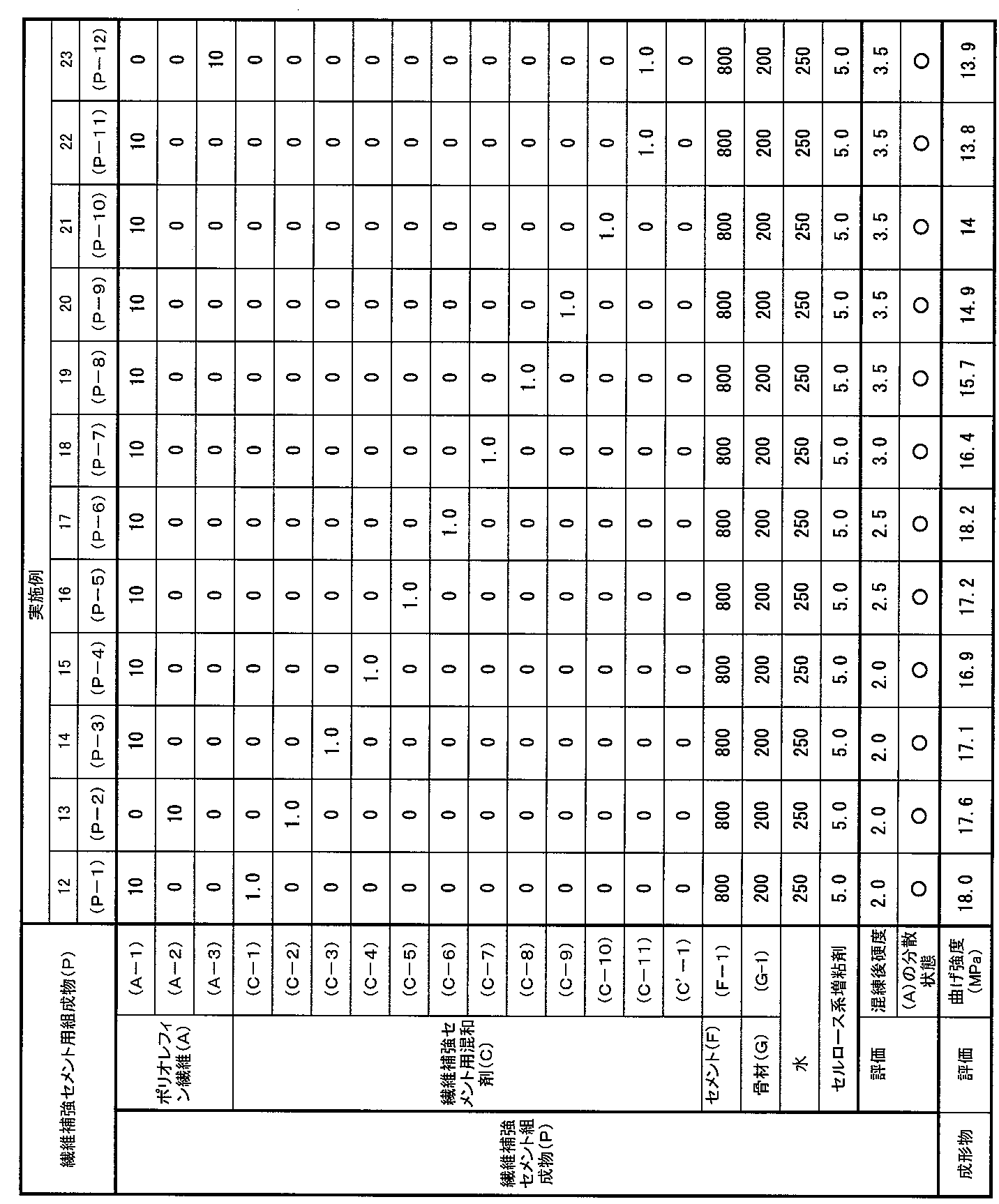

ポリオレフィン繊維補強セメント組成物の混練後硬度、該組成物の分散状態、該組成物を硬化させて得た硬化物について、以下の評価方法で評価を行い、評価結果を上記表2、3に記載した。
評価方法
<混練後硬度>
混練したポリオレフィン繊維補強セメント組成物(P)を取り出し、その表面に測定用探針が垂直になるようにして、NGK式硬度計(日本ガイシ製)を用いて硬度を測定した。上記の方法で異なる箇所について10回測定し、この算術平均値を混練後硬度とした。
<混練後硬度>
混練したポリオレフィン繊維補強セメント組成物(P)を取り出し、その表面に測定用探針が垂直になるようにして、NGK式硬度計(日本ガイシ製)を用いて硬度を測定した。上記の方法で異なる箇所について10回測定し、この算術平均値を混練後硬度とした。
<分散状態>
硬度測定に使用したポリオレフィン繊維補強セメント組成物(P)を断面積が10cm2になる大きさに手で破断し、目視にて断面中の繊維の分散状態を観察した。
○:繊維は解繊され、均一に分散されている。
△:繊維は解繊されているが、均一には分散できていない。
×:解繊されず集束した繊維が残っている。
硬度測定に使用したポリオレフィン繊維補強セメント組成物(P)を断面積が10cm2になる大きさに手で破断し、目視にて断面中の繊維の分散状態を観察した。
○:繊維は解繊され、均一に分散されている。
△:繊維は解繊されているが、均一には分散できていない。
×:解繊されず集束した繊維が残っている。
<曲げ強度>
ポリオレフィン繊維補強セメント用組成物(P)を押出成形機[商品名「SY-50E」、石川時鉄工所(株)]を用い、40×40×160mmの大きさの試験体に成形し、70℃で48時間硬化させて硬化物を得た。この硬化物について、JIS R5201-1997(セメントの物理試験方法)に準拠した曲げ強度(曲げ強さ)を測定した。
ポリオレフィン繊維補強セメント用組成物(P)を押出成形機[商品名「SY-50E」、石川時鉄工所(株)]を用い、40×40×160mmの大きさの試験体に成形し、70℃で48時間硬化させて硬化物を得た。この硬化物について、JIS R5201-1997(セメントの物理試験方法)に準拠した曲げ強度(曲げ強さ)を測定した。
表2、3に示すように、本発明の混和剤(C)を本発明のポリオレフィン繊維補強セメント組成物(P)の製造方法により添加して作成したセメント組成物(P)は、比較例に比べてポリオレフィン繊維(A)の分散状態も良く、またその硬化物は、比較例に比べて曲げ強度が大きくなった。
本発明の混和剤は、セメント硬化物の強度を向上することから、外壁材、屋根材(瓦)などのサイディング材や、トンネルの剥落防止や、補修に使用するコンクリート、吹付けコンクリートの添加剤として適用できる。
Claims (13)
- 酸変性オレフィン樹脂(B1)および/またはその塩(B2)を水中に乳化してなるエマルション(E)であるポリオレフィン繊維補強セメントのための混和剤(C)。
- 酸変性オレフィン樹脂(B1)が、5~250mgKOH/gの酸価を有し、1,000~100,000の数平均分子量を有する請求項1に記載の混和剤(C)。
- 酸変性オレフィン樹脂(B1)が、不飽和結合を有するオレフィン樹脂(a)を不飽和結合を有する有機酸(b)または(b)の酸無水物(k)で変性してなるものである請求項1または2に記載の混和剤(C)。
- 酸変性オレフィン樹脂(B1)が、不飽和結合を有するオレフィン樹脂(a)を不飽和結合を有する有機酸(b)または(b)の酸無水物(k)および脂肪族不飽和炭化水素(h)で変性してなるものである請求項3に記載の混和剤(C)。
- 不飽和結合を有する有機酸(b)が不飽和カルボン酸(b1)である請求項3または4に記載の混和剤(C)。
- 不飽和カルボン酸(b1)が不飽和ジカルボン酸(b11)である請求項5に記載の混和剤(C)。
- 不飽和結合を有するオレフィン樹脂(a)が、炭素数1000個当たり0.1~20個の不飽和結合を有する請求項3~6のいずれか1項に記載の混和剤(C)。
- エマルション(E)が、酸変性オレフィン樹脂(B1)および/またはその塩(B2)と界面活性剤(J)とを含有してなる請求項1~7のいずれか1項に記載の混和剤(C)。
- セメント(F)、骨材(G)、ポリオレフィン繊維(A)、水および請求項1~8のいずれか1項に記載の混和剤(C)を含有してなるポリオレフィン繊維補強セメント組成物(P)。
- ポリオレフィン繊維(A)が水溶性繊維表面処理剤(D)で被覆されてなる請求項9に記載の組成物(P)。
- 混和剤(C)の含有量が、セメント(F)、骨材(G)、ポリオレフィン繊維(A)、水、および混和剤(C)の合計重量に基づいて0.01~10重量%である請求項9または10に記載の組成物(P)。
- セメント(F)、骨材(G)および水からなる群より選ばれる少なくとも1種(R)、または(R)とポリオレフィン繊維(A)との混合物(Q)と、混和剤(C)との混合物を製造する工程、を有する請求項9~11のいずれか1項に記載のポリオレフィン繊維補強セメント組成物(P)の製造方法。
- 請求項9~11のいずれか1項に記載のポリオレフィン繊維補強セメント組成物(P)を硬化してなるセメント硬化物。
Applications Claiming Priority (2)
| Application Number | Priority Date | Filing Date | Title |
|---|---|---|---|
| JP2013-056158 | 2013-03-19 | ||
| JP2013056158A JP2016106064A (ja) | 2013-03-19 | 2013-03-19 | ポリオレフィン繊維補強セメント用添加剤 |
Publications (1)
| Publication Number | Publication Date |
|---|---|
| WO2014148346A1 true WO2014148346A1 (ja) | 2014-09-25 |
Family
ID=51580032
Family Applications (1)
| Application Number | Title | Priority Date | Filing Date |
|---|---|---|---|
| PCT/JP2014/056629 Ceased WO2014148346A1 (ja) | 2013-03-19 | 2014-03-13 | ポリオレフィン繊維補強セメント用混和剤 |
Country Status (2)
| Country | Link |
|---|---|
| JP (1) | JP2016106064A (ja) |
| WO (1) | WO2014148346A1 (ja) |
Families Citing this family (1)
| Publication number | Priority date | Publication date | Assignee | Title |
|---|---|---|---|---|
| JP7352488B2 (ja) * | 2019-03-14 | 2023-09-28 | 三洋化成工業株式会社 | 低分子量ポリオレフィン |
Citations (5)
| Publication number | Priority date | Publication date | Assignee | Title |
|---|---|---|---|---|
| JPS61261367A (ja) * | 1985-05-15 | 1986-11-19 | Dainippon Ink & Chem Inc | エマルジヨン塗料用組成物 |
| JPH08176308A (ja) * | 1994-12-27 | 1996-07-09 | Ube Ind Ltd | ポリオレフィン乳化物の連続製造方法 |
| JP2000128599A (ja) * | 1998-10-23 | 2000-05-09 | Mitsui Chemicals Inc | セメント混和用ポリマーエマルション組成物 |
| JP2005239512A (ja) * | 2004-02-27 | 2005-09-08 | Mitsui Chemicals Inc | セメント補強用集束繊維 |
| JP2012219123A (ja) * | 2011-04-05 | 2012-11-12 | Chuo Rika Kogyo Corp | 酸変性ポリオレフィン系樹脂水性分散液の製造方法 |
-
2013
- 2013-03-19 JP JP2013056158A patent/JP2016106064A/ja active Pending
-
2014
- 2014-03-13 WO PCT/JP2014/056629 patent/WO2014148346A1/ja not_active Ceased
Patent Citations (5)
| Publication number | Priority date | Publication date | Assignee | Title |
|---|---|---|---|---|
| JPS61261367A (ja) * | 1985-05-15 | 1986-11-19 | Dainippon Ink & Chem Inc | エマルジヨン塗料用組成物 |
| JPH08176308A (ja) * | 1994-12-27 | 1996-07-09 | Ube Ind Ltd | ポリオレフィン乳化物の連続製造方法 |
| JP2000128599A (ja) * | 1998-10-23 | 2000-05-09 | Mitsui Chemicals Inc | セメント混和用ポリマーエマルション組成物 |
| JP2005239512A (ja) * | 2004-02-27 | 2005-09-08 | Mitsui Chemicals Inc | セメント補強用集束繊維 |
| JP2012219123A (ja) * | 2011-04-05 | 2012-11-12 | Chuo Rika Kogyo Corp | 酸変性ポリオレフィン系樹脂水性分散液の製造方法 |
Also Published As
| Publication number | Publication date |
|---|---|
| JP2016106064A (ja) | 2016-06-16 |
Similar Documents
| Publication | Publication Date | Title |
|---|---|---|
| CN102372470B (zh) | 一种高性能砂浆的制备方法 | |
| EP2372018B1 (en) | Aqueous dispersion for treatment of fibers | |
| CN104016615B (zh) | 缓释型高效聚羧酸减水剂及其制备方法 | |
| Wang et al. | A strong and tough interpenetrating network hydrogel with ultrahigh compression resistance | |
| ITRM940369A1 (it) | Composizione mista additiva per il controllo della fluidita' di miscugli cementizi. | |
| JP4381923B2 (ja) | 水硬性組成物用添加剤 | |
| CN110183149A (zh) | 一种防水隔热保温涂料及其施工工艺 | |
| JP6193087B2 (ja) | 酸変性ポリオレフィン水性エマルジョン組成物 | |
| CN100393658C (zh) | 用于改善混凝土耐久性能的组合物 | |
| WO2014148346A1 (ja) | ポリオレフィン繊維補強セメント用混和剤 | |
| JP5023294B2 (ja) | 水硬化性無機組成物用の流動性改良剤 | |
| CN105722804A (zh) | 与梳形聚合物型的减水剂相容的用于水硬性组合物的保坍剂 | |
| JP7513771B2 (ja) | 収縮低減剤及びセメント組成物 | |
| JP2006089906A (ja) | 鉱物繊維用バインダー | |
| JPH038748A (ja) | コンクリートの急速凝結硬化方法 | |
| CN1673162A (zh) | 两性羧酸类梳形接枝共聚物混凝土超塑化剂 | |
| JP2006342012A (ja) | 水硬性組成物用起泡剤組成物 | |
| JPS63297255A (ja) | 粉じん低減剤 | |
| JP7562589B2 (ja) | グラウト材添加繊維、それを含むグラウト材、及びグラウト材の製造方法 | |
| JP5758597B2 (ja) | 補強用材料および該補強用材料を含有する成形物 | |
| JP2022011743A (ja) | アルミノシリケート含有組成物及びその製造方法 | |
| JP2013035266A (ja) | 木質系複合材およびその製造方法 | |
| JP2000256048A (ja) | セメント補強用ポリプロピレンフラットヤーン | |
| CN107936838A (zh) | 一种液体橡胶喷涂料 | |
| JP4271676B2 (ja) | 地盤改良用プレミックス粉末セメント組成物 |
Legal Events
| Date | Code | Title | Description |
|---|---|---|---|
| 121 | Ep: the epo has been informed by wipo that ep was designated in this application |
Ref document number: 14769808 Country of ref document: EP Kind code of ref document: A1 |
|
| NENP | Non-entry into the national phase |
Ref country code: DE |
|
| 122 | Ep: pct application non-entry in european phase |
Ref document number: 14769808 Country of ref document: EP Kind code of ref document: A1 |
|
| NENP | Non-entry into the national phase |
Ref country code: JP |