WO2014142103A1 - 組成物及び単層塗布型水平配向フィルム - Google Patents
組成物及び単層塗布型水平配向フィルム Download PDFInfo
- Publication number
- WO2014142103A1 WO2014142103A1 PCT/JP2014/056275 JP2014056275W WO2014142103A1 WO 2014142103 A1 WO2014142103 A1 WO 2014142103A1 JP 2014056275 W JP2014056275 W JP 2014056275W WO 2014142103 A1 WO2014142103 A1 WO 2014142103A1
- Authority
- WO
- WIPO (PCT)
- Prior art keywords
- group
- polymer
- formula
- methyl
- represented
- Prior art date
- Legal status (The legal status is an assumption and is not a legal conclusion. Google has not performed a legal analysis and makes no representation as to the accuracy of the status listed.)
- Ceased
Links
- KYLUHLJIAMFYKW-RXMQYKEDSA-N C[C@H](CC1=C)OC1=O Chemical compound C[C@H](CC1=C)OC1=O KYLUHLJIAMFYKW-RXMQYKEDSA-N 0.000 description 1
Images
Classifications
-
- G—PHYSICS
- G02—OPTICS
- G02B—OPTICAL ELEMENTS, SYSTEMS OR APPARATUS
- G02B5/00—Optical elements other than lenses
- G02B5/30—Polarising elements
- G02B5/3083—Birefringent or phase retarding elements
-
- C—CHEMISTRY; METALLURGY
- C08—ORGANIC MACROMOLECULAR COMPOUNDS; THEIR PREPARATION OR CHEMICAL WORKING-UP; COMPOSITIONS BASED THEREON
- C08F—MACROMOLECULAR COMPOUNDS OBTAINED BY REACTIONS ONLY INVOLVING CARBON-TO-CARBON UNSATURATED BONDS
- C08F220/00—Copolymers of compounds having one or more unsaturated aliphatic radicals, each having only one carbon-to-carbon double bond, and only one being terminated by only one carboxyl radical or a salt, anhydride ester, amide, imide or nitrile thereof
- C08F220/02—Monocarboxylic acids having less than ten carbon atoms; Derivatives thereof
- C08F220/10—Esters
- C08F220/26—Esters containing oxygen in addition to the carboxy oxygen
- C08F220/30—Esters containing oxygen in addition to the carboxy oxygen containing aromatic rings in the alcohol moiety
- C08F220/303—Esters containing oxygen in addition to the carboxy oxygen containing aromatic rings in the alcohol moiety and one or more carboxylic moieties in the chain
-
- C—CHEMISTRY; METALLURGY
- C09—DYES; PAINTS; POLISHES; NATURAL RESINS; ADHESIVES; COMPOSITIONS NOT OTHERWISE PROVIDED FOR; APPLICATIONS OF MATERIALS NOT OTHERWISE PROVIDED FOR
- C09D—COATING COMPOSITIONS, e.g. PAINTS, VARNISHES OR LACQUERS; FILLING PASTES; CHEMICAL PAINT OR INK REMOVERS; INKS; CORRECTING FLUIDS; WOODSTAINS; PASTES OR SOLIDS FOR COLOURING OR PRINTING; USE OF MATERIALS THEREFOR
- C09D133/00—Coating compositions based on homopolymers or copolymers of compounds having one or more unsaturated aliphatic radicals, each having only one carbon-to-carbon double bond, and at least one being terminated by only one carboxyl radical, or of salts, anhydrides, esters, amides, imides, or nitriles thereof; Coating compositions based on derivatives of such polymers
- C09D133/04—Homopolymers or copolymers of esters
- C09D133/06—Homopolymers or copolymers of esters of esters containing only carbon, hydrogen and oxygen, the oxygen atom being present only as part of the carboxyl radical
-
- G—PHYSICS
- G02—OPTICS
- G02B—OPTICAL ELEMENTS, SYSTEMS OR APPARATUS
- G02B5/00—Optical elements other than lenses
- G02B5/30—Polarising elements
- G02B5/3025—Polarisers, i.e. arrangements capable of producing a definite output polarisation state from an unpolarised input state
-
- C—CHEMISTRY; METALLURGY
- C08—ORGANIC MACROMOLECULAR COMPOUNDS; THEIR PREPARATION OR CHEMICAL WORKING-UP; COMPOSITIONS BASED THEREON
- C08F—MACROMOLECULAR COMPOUNDS OBTAINED BY REACTIONS ONLY INVOLVING CARBON-TO-CARBON UNSATURATED BONDS
- C08F224/00—Copolymers of compounds having one or more unsaturated aliphatic radicals, each having only one carbon-to-carbon double bond, and at least one being terminated by a heterocyclic ring containing oxygen
Definitions
- the present invention relates to a composition and a single-layer coating type horizontal alignment film.
- a material having optical properties suitable for applications such as display devices and recording materials in particular, a composition comprising a liquid crystalline polymer suitable for optical compensation films such as polarizing plates and retardation plates for liquid crystal displays, And a single-layer coated horizontal alignment film obtained from the composition.
- the polymerizable liquid crystal compound used here is generally a liquid crystal compound having a polymerizable group and a liquid crystal structure part (a structure part having a spacer part and a mesogen part), and an acrylic group is widely used as the polymerizable group. ing.
- Such a polymerizable liquid crystal compound is generally formed into a polymer (film) by a method of polymerizing by irradiation with radiation such as ultraviolet rays.
- a method of polymerizing by irradiation with radiation such as ultraviolet rays.
- a method in which a specific polymerizable liquid crystal compound having an acrylic group is supported between supports and a polymer is obtained by irradiating radiation while maintaining the compound in a liquid crystal state Patent Document 1
- Patent Document 2 a method of obtaining a polymer by adding a photopolymerization initiator to a mixture of two kinds of polymerizable liquid crystal compounds or a composition obtained by mixing a chiral liquid crystal with this mixture and irradiating ultraviolet rays.
- Patent Documents 3 and 4 an alignment film using a polymerizable liquid crystal compound or polymer that does not require a liquid crystal alignment film
- Patent Documents 5 and 6 an alignment film using a polymer containing a photocrosslinking site
- Various single-layer coated orientation films have been reported.
- the orientation direction of the film obtained by the film production process has a problem that a shift due to the influence of the surface of the substrate is observed, and it has been desired to solve such a problem.
- JP-A-62-70407 JP-A-9-208957 European Patent Application No. 1093025 International Publication No. 2008/031243 JP 2008-164925 A Japanese Patent Laid-Open No. 11-189665
- the present invention has been made in view of the above problems, a composition capable of producing a single-layer coating type horizontal alignment film by a simple process, and capable of solving the problem of misalignment of the alignment direction, and the composition It aims at providing the single layer application type
- a polymer containing a ⁇ -butyrolactone skeleton in the main chain and having a cinnamate structure on the side chain extending from the ⁇ position of the lactone ring Can be used to form a single layer coating type horizontal alignment film having a high refractive index anisotropy ( ⁇ n) without using a liquid crystal alignment film. Furthermore, it has been found that by introducing an alkyl chain into the polymer, solubility in an organic solvent is improved, and a single-layer coating type horizontal alignment film having a higher ⁇ n can be produced under low temperature conditions.
- the present inventor added a poly (meth) acrylic acid ester as an additive to the composition containing the above polymer, so that the control of the orientation direction is more excellent, and the single layer coating type horizontal that exhibits high optical anisotropy.
- the inventors have found that an oriented film can be easily obtained, and completed the present invention.
- this invention provides the following composition and a single layer application type
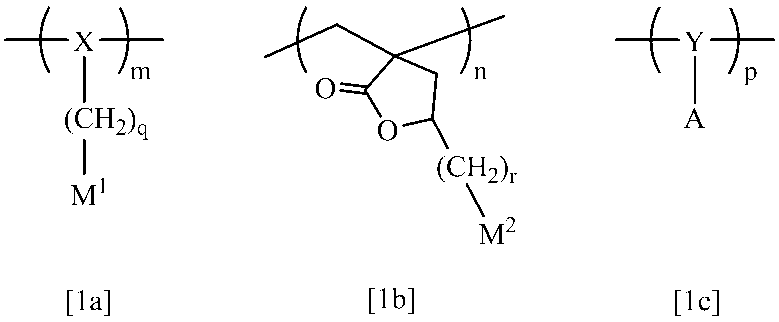
- X and Y are each independently a group represented by the following formula [2] or [3], (In the formula [3], R 1 is a hydrogen atom or a methyl group.
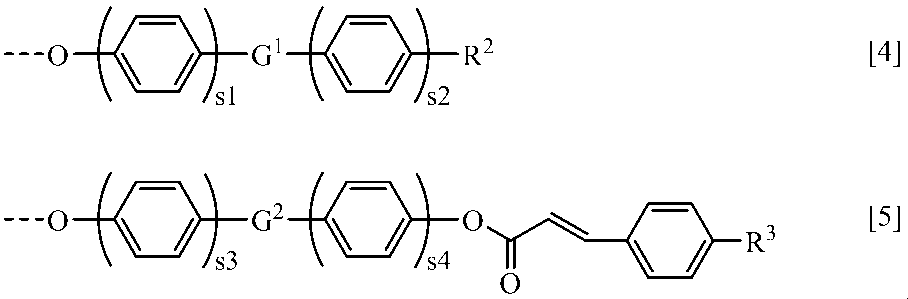
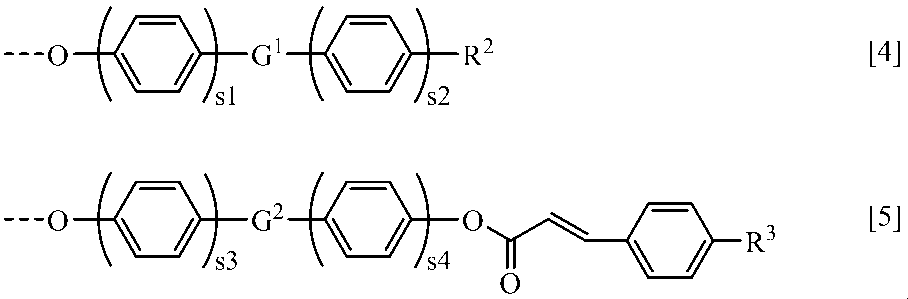
- M 1 is a group represented by the following formula [4]
- M 2 is a group represented by the following formula [5]
- s1, s2, s3 and s4 are each independently 1 or 2
- G 1 and G 2 are each independently a single bond, —COO— or —OCO—.
- R 2 and R 3 are each independently a hydrogen atom, a halogen atom, a cyano group, an alkyl group having 1 to 10 carbon atoms, or an alkoxy group having 1 to 10 carbon atoms.
- A is a linear or branched alkyl group having 2 to 15 carbon atoms
- m, n, and p are numbers satisfying 0 ⁇ m ⁇ 1, 0 ⁇ n ⁇ 1, 0 ⁇ p ⁇ 0.5, and m + n + p ⁇ 1, respectively.
- q and r are each independently an integer of 2 to 9.
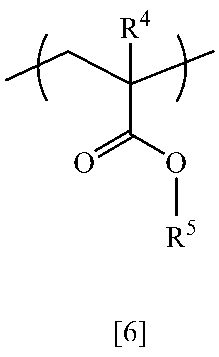
- R 4 is a hydrogen atom or a methyl group
- R 5 is a methyl group, an ethyl group, an n-propyl group, an isopropyl group, or a cyclopropyl group.
- the polymer of the present invention contains a ⁇ -butyrolactone skeleton in the main chain. Therefore, it is possible to produce a single-layer coated horizontal alignment film exhibiting high ⁇ n by a process of applying a composition containing this polymer, irradiating linearly polarized light at room temperature, and performing post-baking. Further, by using a polymer containing a unit having an alkyl group side chain, solubility in a solvent can be improved. In addition, by adding a poly (meth) acrylate that does not exhibit liquid crystallinity to a solution of a liquid crystalline base polymer having a cinnamic acid ester structure, deviation of the orientation angle (horizontal direction) of the resulting oriented film is reduced. A single-layer coated horizontal alignment film can be obtained.
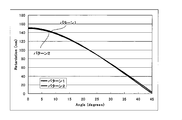
- FIG. 1 It is a figure which shows the retardation value angle dependence ((alpha) angle) in wavelength 550nm of the pattern of the film obtained in Example 1.
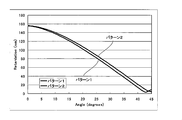
- FIG. 2 It is a figure which shows the retardation value angle dependence ((alpha) angle) in wavelength 550nm of the pattern of the film obtained by the comparative example 1.
- FIG. 1 shows the retardation value angle dependence ((alpha) angle) in wavelength 550nm of the pattern of the film obtained by the comparative example 1.
- polymer A which is the component (A) of the composition of the present invention contains repeating units represented by the following formulas [1a] and [1b]. It contains a repeating unit represented by [1c].
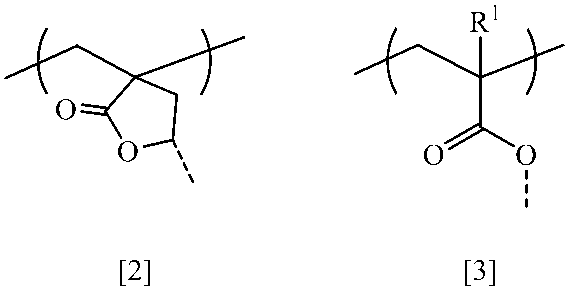
- X and Y are each independently a group represented by the following formula [2] or [3].
- R 1 is a hydrogen atom or a methyl group. The broken line is a bond (the same applies hereinafter).)
- a group represented by the formula [3] is preferable for both X and Y.
- M 1 is a group represented by the following formula [4]
- M 2 is a group represented by the following formula [5].
- s1, s2, s3 and s4 are each independently 1 or 2
- G 1 and G 2 are each independently a single bond, —COO— or —OCO—.
- R 2 and R 3 are each independently a hydrogen atom, a halogen atom, a cyano group, an alkyl group having 1 to 10 carbon atoms, or an alkoxy group having 1 to 10 carbon atoms.
- examples of the halogen atom include a fluorine atom, a chlorine atom, a bromine atom, and an iodine atom.
- a fluorine atom is preferable.
- the alkyl group may be linear, branched or cyclic, and the carbon number thereof is not particularly limited. In the present invention, a linear alkyl group having 1 to 10 carbon atoms is used. preferable.
- alkyl group examples include methyl group, ethyl group, n-propyl group, isopropyl group, cyclopropyl group, n-butyl group, isobutyl group, s-butyl group, t-butyl group, cyclobutyl group, n- Examples include a pentyl group, a cyclopentyl group, an n-hexyl group, a cyclohexyl group, an n-heptyl group, an n-octyl group, an n-nonyl group, and an n-decyl group. Of these, alkyl groups having 1 to 3 carbon atoms are more preferable, and methyl group, ethyl group, and the like are particularly preferable.
- the alkoxy group may be linear, branched or cyclic, and the number of carbon atoms is not particularly limited. In the present invention, a straight-chain alkoxy group having 1 to 10 carbon atoms is used. preferable. Specific examples of the alkoxy group include methoxy group, ethoxy group, n-propoxy group, isopropoxy group, n-butoxy group, isobutoxy group, s-butoxy group, t-butoxy group, n-pentoxy group, n-hexyl. Examples thereof include an oxy group, n-heptyloxy group, n-octyloxy group, n-nonyloxy group, n-decyloxy group and the like.
- an alkoxy group having 1 to 3 carbon atoms is more preferable, and a methoxy group, an ethoxy group, and the like are particularly preferable.
- part or all of the hydrogen atoms may be substituted with a halogen atom such as a fluorine atom.
- R 2 or R 3 is more preferably a hydrogen atom, a fluorine atom, a cyano group, a methyl group, a methoxy group or the like.
- G 1 is preferably —COO— or —OCO—, and G 2 is preferably a single bond.
- A is a linear or branched alkyl group having 2 to 15 carbon atoms.
- Specific examples of the alkyl group include ethyl group, n-propyl group, isopropyl group, n-butyl group, isobutyl group, s-butyl group, t-butyl group, n-pentyl group, 1-methyl-n-butyl.
- an alkyl group having 4 to 15 carbon atoms, particularly 4 to 12 carbon atoms is preferable, and an n-butyl group, 2-ethyl-n-hexyl group, n -Dodecyl group and the like are more preferable.
- m, n, and p are numbers satisfying 0 ⁇ m ⁇ 1, 0 ⁇ n ⁇ 1, 0 ⁇ p ⁇ 0.5, and m + n + p ⁇ 1, respectively.
- m, n, and p are 0.2 ⁇ m ⁇ 0.9, 0.1 ⁇ n ⁇ 0.8, and 0 ⁇ p ⁇ 0. Is preferably a number satisfying 0.2 ⁇ m ⁇ 0.8, 0.1 ⁇ n ⁇ 0.5, and 0.1 ⁇ p ⁇ 0.3.
- q and r are each independently an integer of 2 to 9, preferably 3 to 6, and more preferably 5 or 6 as q.
- the polymer A preferably has a weight average molecular weight of 3,000 to 200,000, more preferably 4,000 to 150,000, and still more preferably 5,000 to 100,000. If the weight average molecular weight exceeds 200,000, the solubility in a solvent may be reduced and handling properties may be reduced. If the weight average molecular weight is less than 3,000, curing is insufficient at the time of thermosetting, resulting in solvent resistance and heat resistance. May decrease.
- the weight average molecular weight is a measured value in terms of polystyrene by gel permeation chromatography (GPC).
- the polymer A may contain other repeating units other than the formulas [1a] to [1c] as long as the effects of the present invention are not impaired.
- the polymerizable compound that gives other repeating units include acrylic acid ester compounds, methacrylic acid ester compounds, maleimide compounds, acrylamide compounds, acrylonitrile, maleic anhydride, and styrene compounds.
- the content of the other repeating units is preferably 0 to 10 mol% in 100 mol% of all repeating units.
- characteristics, such as liquid crystallinity, of the polymer A may deteriorate.
- Polymer A can be used alone or in combination of two or more.
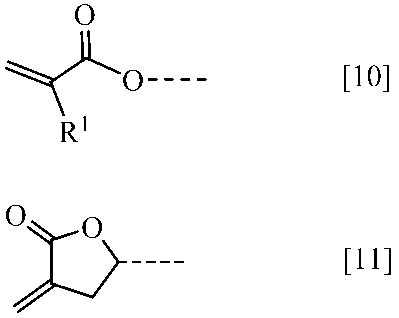
- the polymerizable compound that is a raw material of the polymer A is represented by the following formula [7], [8], or [9]. [Wherein, R 2 , R 3 , G 1 , G 2 , A, q, r, and s1 to s4 are the same as above.
- X ′ and Y ′ are each independently a polymerizable group represented by the following formula [10] or [11]. (Wherein R 1 is the same as above)]
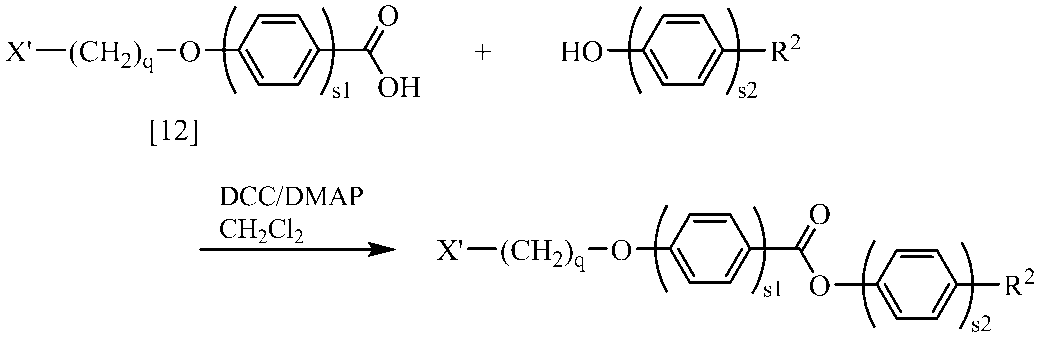
- the polymerizable compound represented by the above formula [7] is produced, for example, as follows.
- G 1 is —COO—, as shown in the following scheme, it is produced by condensing a benzoic acid derivative represented by the formula [12] and a phenol derivative in a solvent in the presence of a condensing agent.
- the (In the formula, R 2 , X ′, q, s1 and s2 are the same as above.
- DCC represents N, N′-dicyclohexylcarbodiimide and DMAP represents 4-dimethylaminopyridine.
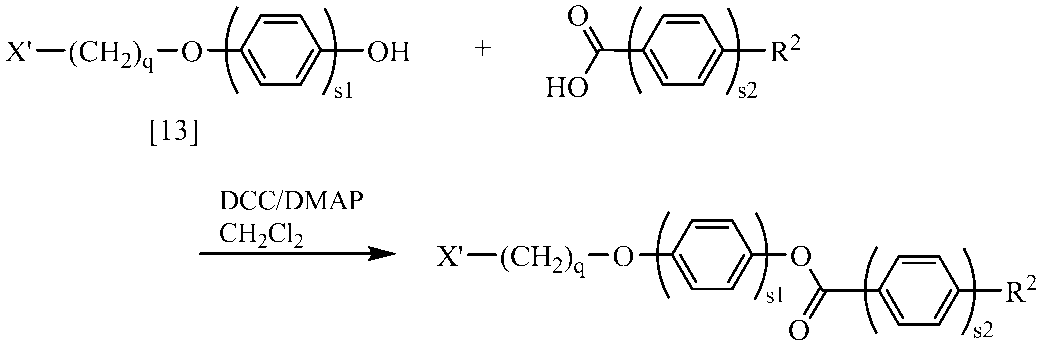
- G 1 is —OCO—, it is produced by condensing a phenol derivative represented by the formula [13] and a benzoic acid derivative in a solvent in the presence of a condensing agent, as represented by the following scheme.
- a condensing agent as represented by the following scheme. The (Wherein R 2 , X ′, q, s1 and s2 are the same as above)
- the compounds represented by the above formulas [12] and [13] are commercially available from SYNTHON Chemicals or Midori Chemical Co., when X ′ is a group represented by the formula [10].
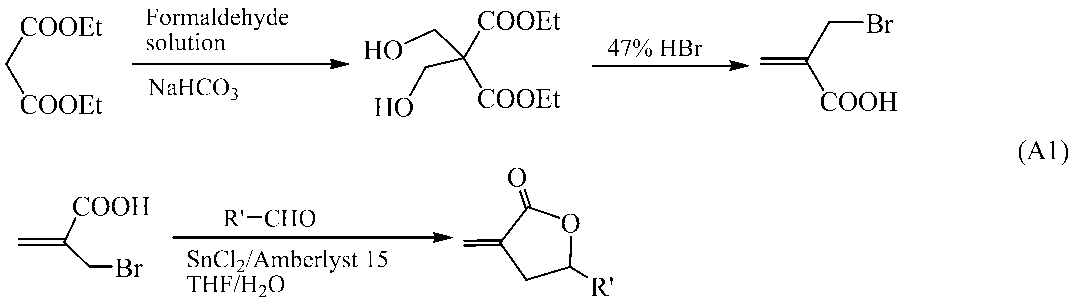
- the compounds represented by the above formulas [12] and [13] are, for example, Talaga et al. (P. Talaga, M. Schaeffer, C. Benezra) when X ′ is a group represented by the formula [11]. and JL Stampf, Synthesis, 530 (1990)).
- This method is a method of reacting 2- (bromomethyl) acrylic acid with an aldehyde or a ketone using SnCl 2 as represented by the following synthesis scheme (A1).
- 2- (Bromomethyl) acrylic acid can be obtained by a method proposed by Ramarajan et al. (K. Ramarajan, K. Kamalingam, DJ O'Donnell and KD Berlin, Organic Synthesis, vol. 61, pp. 56- 59 (1983)).
- R ′ represents a monovalent organic group
- Amberlyst (registered trademark) 15 is an ion exchange resin manufactured by Rohm and Haas
- THF represents tetrahydrofuran
- Et represents an ethyl group.
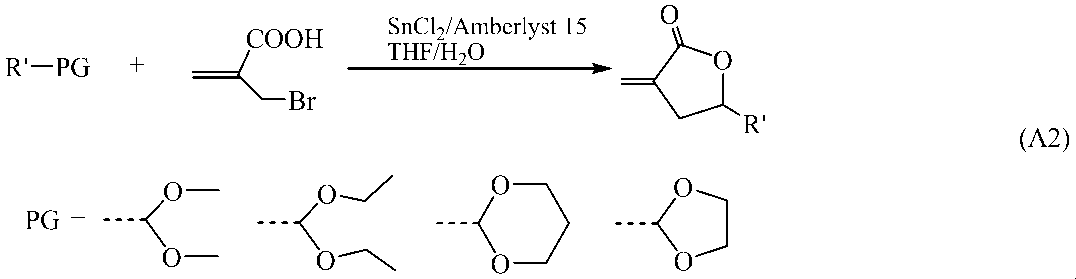
- an ⁇ -methylene- ⁇ -butyrolactone structure can also be obtained by reaction with a corresponding acetal or ketal instead of an aldehyde or a ketone.
- the acetal or ketal include compounds having a dimethyl acetal group, a diethyl acetal group, a 1,3-dioxane group, a 1,3-dioxolane group, and the like.
- a synthesis method and a protecting group when acetal or ketal is used are shown in the following synthesis scheme (A2).
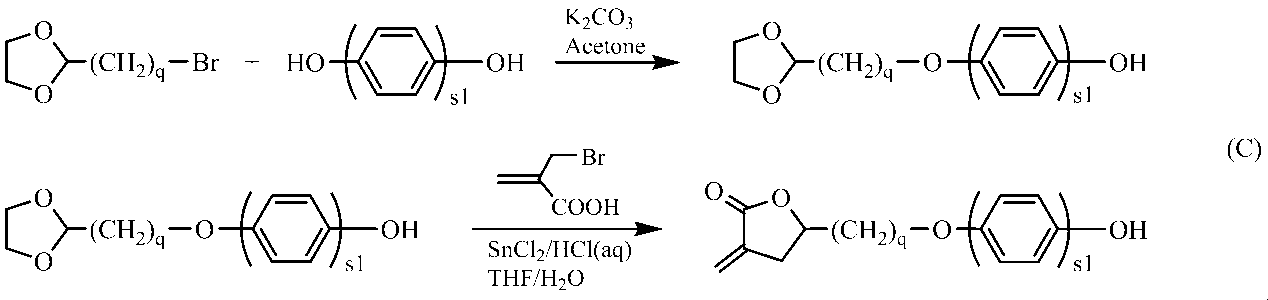
- a compound represented by the formula [12] or [13] can be synthesized by the method of the following synthesis scheme (B) or (C) to which the method of the synthesis scheme (A1) or (A2) is applied.
- q and s1 are the same as above.
- Me represents a methyl group.
- PCC represents pyridinium chlorochromate.
- the compound represented by the formula [8] is, for example, condensed with a compound represented by the formula [14] and a cinnamic acid compound in a solvent in the presence of a condensing agent, as represented by the following scheme. It is manufactured by. (In the formula, R 3 , G 2 , r, s3 and s4 are the same as above.)
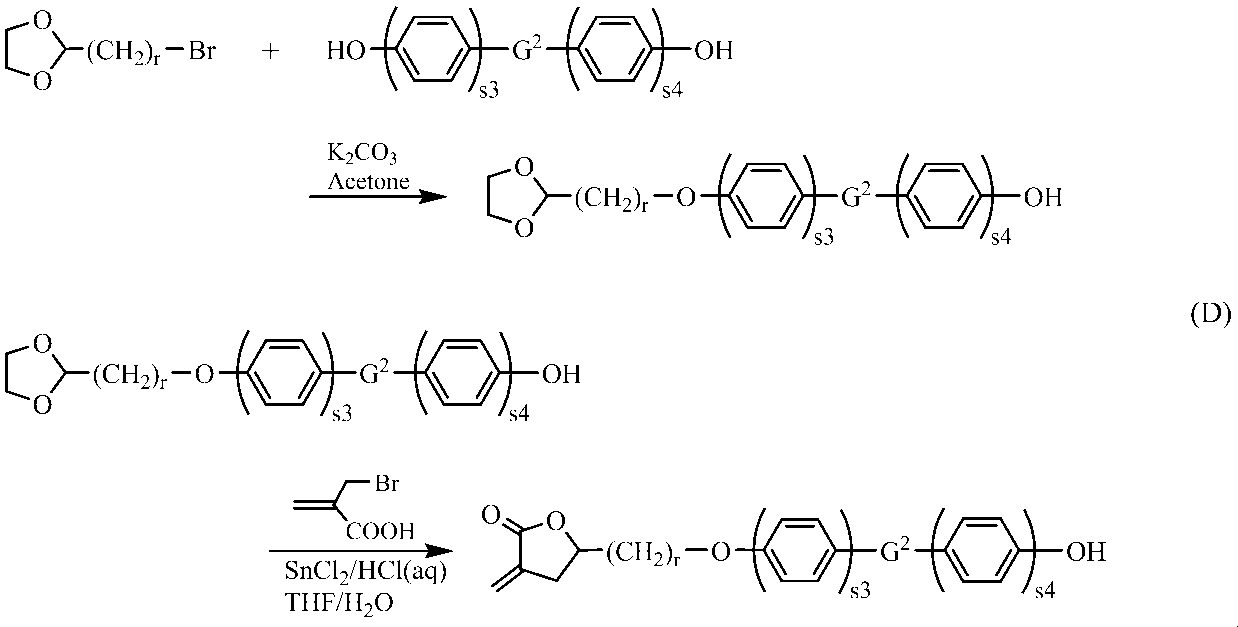
- the compound represented by the formula [14] can be obtained, for example, by the method shown in the following synthesis scheme (D). (In the formula, G 2 , r, s3 and s4 are the same as above.)
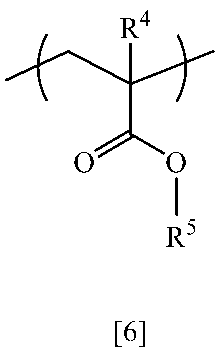
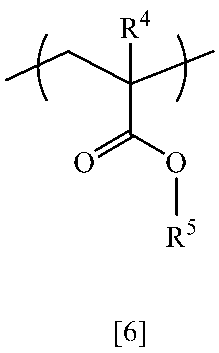
- polymer B contains a repeating unit represented by the following formula [6].
- R 4 is a hydrogen atom or a methyl group
- R 5 is a methyl group, an ethyl group, an n-propyl group, an isopropyl group or a cyclopropyl group.
- R 4 is preferably a methyl group.
- R 5 is preferably a methyl group.
- the polymer B preferably has a weight average molecular weight of 3,000 to 1,000,000, more preferably 5,000 to 600,000, and further preferably 5,000 to 100,000. preferable. When the weight average molecular weight exceeds 1,000,000, the solubility in a solvent may be lowered, and the handling property may be lowered.
- the polymer B may be a homopolymer composed of one type of repeating unit or a copolymer composed of a plurality of repeating units. When the polymer B is a copolymer, it is preferable that all repeating units satisfy the formula [6].
- the polymer B is particularly preferably a homopolymer.
- the addition amount of the polymer B is preferably 1 to 15 parts by mass, more preferably 2 to 10 parts by mass with respect to 100 parts by mass of the polymer A.
- Polymer B can be used singly or in combination of two or more.
- the method for synthesizing the polymers A and B is not particularly limited, and radical polymerization, anionic polymerization, cationic polymerization, and the like can be employed. Of these, radical polymerization is particularly preferred. Specifically, a polymerizable compound capable of giving the above-mentioned repeating unit is heated in the presence of a polymerization initiator in a solvent and polymerized.
- the polymerization initiator can be appropriately selected from conventionally known ones.
- peroxides such as benzoyl peroxide, cumene hydroperoxide, t-butyl hydroperoxide; persulfates such as sodium persulfate, potassium persulfate, ammonium persulfate; azobisisobutyronitrile (AIBN), azo
- AIBN azobisisobutyronitrile
- azo compounds such as bismethylbutyronitrile and azobisisovaleronitrile. These can be used individually by 1 type or in combination of 2 or more types.
- the amount of the polymerization initiator used is preferably about 0.01 to 0.05 mol with respect to 1 mol of the polymerizable compound.
- the reaction temperature may be appropriately set from 0 ° C. to the boiling point of the solvent used, but is preferably about 20 to 100 ° C.
- the reaction time is preferably about 0.1 to 30 hours.
- the solvent used in the polymerization reaction is not particularly limited, and may be appropriately selected from various solvents generally used in the polymerization reaction. Specifically, water; methanol, ethanol, 1-propanol, 2-propanol, 1-butanol, 2-butanol, isobutanol, t-butanol, 1-pentanol, 2-pentanol, 3-pentanol, iso Alcohols such as pentanol, t-pentanol, 1-hexanol, 1-heptanol, 2-heptanol, 3-heptanol, 2-octanol, 2-ethyl-1-hexanol, benzyl alcohol, cyclohexanol; diethyl ether, diisopropyl Ethers such as ether, dibutyl ether, cyclopentyl methyl ether, tetrahydrofuran, and 1,4-dioxane; Halogenated hydrocarbons
- the synthesis method may be polymerization in the presence of a polymerizable compound that gives the other repeating units during the polymerization.
- the polymers A and B may be any of random copolymers, alternating copolymers, and block copolymers.
- organic solvent of component (C) examples include ethers such as tetrahydrofuran and dioxane; aromatic hydrocarbons such as benzene, toluene and xylene; polarities such as N, N-dimethylformamide and N-methyl-2-pyrrolidone Solvents; Esters such as ethyl acetate, butyl acetate, ethyl lactate; methyl 3-methoxypropionate, methyl 2-methoxypropionate, ethyl 3-methoxypropionate, ethyl 2-methoxypropionate, ethyl 3-ethoxypropionate, Alkoxy esters such as ethyl 2-ethoxypropionate; glycol dialkyl ethers such as ethylene glycol dimethyl ether and propylene glycol dimethyl ether; diethylene glycol dimethyl ether, diethylene glycol diethyl ether, and diethylene glycol Diglycol dialky
- propylene glycol monomethyl ether propylene glycol monomethyl ether acetate, ethyl lactate, cyclohexanone, a mixed solvent of toluene and cyclohexanone, and the like are preferable.
- the amount of the organic solvent used is preferably about 60 to 95% by mass in the composition.
- a surfactant may be added to the composition of the present invention for the purpose of improving the affinity with the substrate.
- the surfactant is not particularly limited, and examples thereof include fluorine-based surfactants, silicone-based surfactants, nonionic surfactants, etc., but fluorine-based surfactants having a high effect of improving affinity with the substrate. Agents are preferred.
- fluorosurfactant hereinafter referred to as “trade name”), F-top EF301, EF303, EF352 (manufactured by Tochem Products), MegaFuck F171, F173, R-30 (manufactured by DIC Corporation) , FLORARD FC430, FC431 (Sumitomo 3M Co., Ltd.), Asahi Guard AG710, Surflon S-382, SC101, SC102, SC103, SC104, SC105, SC106 (Asahi Glass Co., Ltd.), etc. Not.
- surfactant can be used individually by 1 type or in combination of 2 or more types, The addition amount is 5 mass parts or less with respect to 100 mass parts of polymers A and B in total.
- Adhesion promoters include chlorosilanes such as trimethylchlorosilane, dimethylvinylchlorosilane, methyldiphenylchlorosilane, chloromethyldimethylchlorosilane; trimethylmethoxysilane, dimethyldiethoxysilane, methyldimethoxysilane, dimethylvinylethoxysilane, diphenyldimethoxysilane, phenyltri Alkoxysilanes such as ethoxysilane; silazanes such as hexamethyldisilazane, N, N′-bis (trimethylsilyl) urea, dimethyltrimethylsilylamine, trimethylsilylimidazole; vinyltrichlorosilane, ⁇ -chloropropyltrimethoxysilane, ⁇ -amino Propyl
- the adhesion promoter can be used singly or in combination of two or more, and the addition amount is preferably 1 part by mass or less with respect to 100 parts by mass in total of the polymers A and B.
- composition The composition of the present invention is obtained by mixing (A) at least one polymer A, (B) at least one polymer B, (C) an organic solvent, and other components as necessary. .
- the method for preparing the composition of the present invention is not particularly limited, and the polymer A, the polymer B, and other components may be added to the organic solvent simultaneously or in any order and mixed.
- the composition of the present invention described above is a substrate (for example, a silicon / silicon dioxide coated substrate, a silicon nitride substrate, a substrate coated with a metal such as aluminum, molybdenum, chromium, etc., a glass substrate, a quartz substrate, an ITO substrate, etc.
- a substrate for example, a silicon / silicon dioxide coated substrate, a silicon nitride substrate, a substrate coated with a metal such as aluminum, molybdenum, chromium, etc., a glass substrate, a quartz substrate, an ITO substrate, etc.
- films for example, triacetyl cellulose (TAC) film, cycloolefin polymer film, polyethylene terephthalate film, resin film such as acrylic film), etc., bar coat, spin coat, flow coat, roll coat, slit coat,
- TAC triacetyl cellulose
- a film can be formed by applying a slit coat followed by spin coating, an ink jet method, a printing method, or the like to form a coating film, followed by heat drying with a hot plate or an oven.
- a heating temperature and a heating time appropriately selected from the range of a temperature of 50 to 100 ° C. and a time of 0.1 to 60 minutes are employed.
- the heating temperature and heating time are preferably 50 to 80 ° C. and 0.1 to 2 minutes.
- the film formed in this manner is irradiated with linearly polarized light and post-baked to obtain a single-layer coating type horizontal alignment film.
- a method of irradiating linearly polarized light ultraviolet light to visible light having a wavelength of 150 to 450 nm is usually used, and it is performed by irradiating the linearly polarized light at room temperature or in a heated state.
- the post-bake may be heated with a hot plate or an oven, and the temperature and time are preferably 90 to 150 ° C. and 2 to 20 minutes, more preferably 95 to 120 ° C. and 5 to 20 minutes. is there.
- the film thickness of the single-layer coating type horizontal alignment film of the present invention can be appropriately selected in consideration of the level difference of the substrate to be used and the optical and electrical properties, and is preferably 0.1 to 3 ⁇ m, for example.
- the thus obtained single-layer coating type horizontal alignment film of the present invention is a material having optical characteristics suitable for applications such as display devices and recording materials, and in particular, polarizing plates and retardation plates for liquid crystal displays. It is suitable as an optical compensation film.
- Retardation value of film The ⁇ angle dependency of the retardation value at a wavelength of 550 nm was measured using a retardation measuring device (RETS-100, manufactured by Otsuka Electronics Co., Ltd.).
- FTS-100 retardation measuring device
- Polarization microscope observation Observation was performed using a polarizing microscope E600-Pol manufactured by Nikon Corporation.
- the precipitated DCC urea was filtered off, and the filtrate was washed with 0.5 mol / L hydrochloric acid 150 mL, saturated aqueous sodium hydrogen carbonate solution 150 mL and saturated brine 150 mL successively, dried over magnesium sulfate, and the solvent was removed. Distilled off and purified by recrystallization with ethanol to obtain 39.6 g of the target polymerizable compound (M1) (yield 89%). The measurement results of NMR are shown below.
- surfactant R-30 manufactured by DIC Corporation
- Example 2 300 mg of polymer (1), 15 mg of PMMA synthesized in Synthesis Example 4, and 0.6 mg of surfactant R-30 (manufactured by DIC), 1.700 g of toluene / cyclohexanone (75/25, w / w) To obtain a composition.
- Example 3 300 mg of polymer (1), 30 mg of PMMA synthesized in Synthesis Example 4 and 0.6 mg of surfactant R-30 (manufactured by DIC), 1.700 g of toluene / cyclohexanone (75/25, w / w) To obtain a composition.
- PEMA polyethyl methacrylate
- Pattern 1 Irradiation with linearly polarized ultraviolet rays 20 mJ / cm 2 was performed without a mask.
- Pattern 2 After exposure with Pattern 1, half of the film was masked and further irradiated with linearly polarized ultraviolet rays 60 mJ / cm 2 from the vertical direction (angle 90 °). By this method, a patterned film showing a difference of 90 ° in the orientation direction was obtained. During the exposure, the TAC film was stretched in the stretching direction and irradiated so that the patterns 1 and 2 were symmetrical with respect to the stretching direction.
- Table 1 shows the retardation value ( ⁇ nd) and ⁇ of the obtained film. Note that ⁇ represents an angle deviation from the orientation angle (90 °).
- Example 1 and 2 show the ⁇ angle dependency of the retardation values of the films of Example 1 and Comparative Example 1.
- Comparing Example 1 (FIG. 1) and Comparative Example 1 (FIG. 2) in Example 1, the retardation value of both patterns is about 0 nm when the ⁇ angle is 45 °, whereas in Comparative Example 1, A shift in the retardation value of each pattern was observed.
Landscapes
- Chemical & Material Sciences (AREA)
- Physics & Mathematics (AREA)
- Organic Chemistry (AREA)
- Optics & Photonics (AREA)
- General Physics & Mathematics (AREA)
- Health & Medical Sciences (AREA)
- Chemical Kinetics & Catalysis (AREA)
- Medicinal Chemistry (AREA)
- Polymers & Plastics (AREA)
- Life Sciences & Earth Sciences (AREA)
- Engineering & Computer Science (AREA)
- Materials Engineering (AREA)
- Wood Science & Technology (AREA)
- Addition Polymer Or Copolymer, Post-Treatments, Or Chemical Modifications (AREA)
- Polarising Elements (AREA)
- Compositions Of Macromolecular Compounds (AREA)
- Treatments Of Macromolecular Shaped Articles (AREA)
Abstract
Description
1.(A)下記式[1a]、[1b]及び[1c]で表される繰り返し単位を含有する重合体A、
(B)下記式[6]で表される繰り返し単位を含有する重合体B、及び
(C)有機溶媒
を含有することを特徴とする組成物。
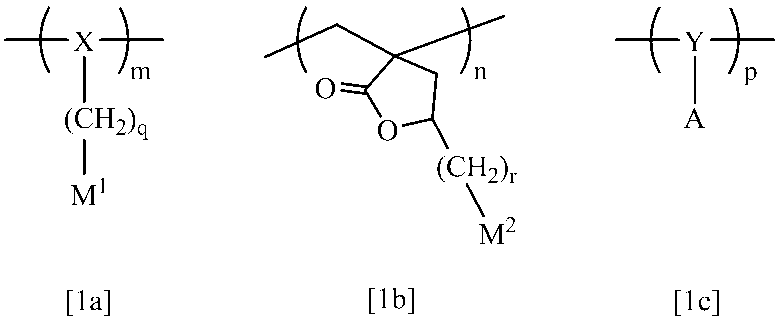
M1は下記式[4]で表される基であり、M2は下記式[5]で表される基であり、
Aは、炭素数2~15の直鎖状又は分岐状のアルキル基であり、
m、n及びpは、それぞれ0<m<1、0<n<1、0≦p≦0.5、かつ、m+n+p≦1を満たす数であり、
q及びrは、それぞれ独立に2~9の整数である。]
2.1の組成物を基板に塗布し、次いで偏光を照射し、硬化させることにより得られる単層塗布型水平配向フィルム。
3.上記偏光が、直線偏光紫外線である2の単層塗布型水平配向フィルム。
4.2又は3の単層塗布型水平配向フィルムを備える光学部材。
また、ケイ皮酸エステル構造を有する液晶性のベースポリマーの溶液に液晶性を示さないポリ(メタ)アクリル酸エステルを添加することにより、得られる配向フィルムの配向角度(水平方向)のずれが低減された単層塗布型水平配向フィルム得ることができる。
本発明の組成物の(A)成分である重合体(以下、重合体A)は、下記式[1a]及び[1b]で表される繰り返し単位を含有し、必要に応じて、更に下記式[1c]で表される繰り返し単位を含有するものである。

これらのうち、X、Yともに式[3]で表される基が好ましい。
上記アルキル基としては、直鎖状、分岐状、環状のいずれでもよく、またその炭素数も特に限定されるものではないが、本発明においては、直鎖の炭素数1~10のアルキル基が好ましい。上記アルキル基の具体例としては、メチル基、エチル基、n-プロピル基、イソプロピル基、シクロプロピル基、n-ブチル基、イソブチル基、s-ブチル基、t-ブチル基、シクロブチル基、n-ペンチル基、シクロペンチル基、n-ヘキシル基、シクロヘキシル基、n-ヘプチル基、n-オクチル基、n-ノニル基、n-デシル基等が挙げられる。これらのうち、炭素数1~3のアルキル基が更に好ましく、特にメチル基、エチル基等が好ましい。
なお、上記アルキル基、アルコキシ基において、その水素原子の一部又は全部がフッ素原子等のハロゲン原子で置換されていてもよい。
なお、本発明において、重量平均分子量はゲルパーミエーションクロマトグラフィー(GPC)によるポリスチレン換算測定値である。
重合体Aの原料となる重合性化合物は、下記式[7]、[8]又は[9]で表される。

X'及びY'は、それぞれ独立に下記式[10]又は[11]で表される重合性基である。
また、上記式[12]及び[13]で表される化合物は、X'が式[11]で表される基の場合は、例えば、Talaga等(P. Talaga,M. Schaeffer,C. Benezra and J. L. Stampf,Synthesis,530 (1990))が提案する手法を用いて合成することができる。この手法は、下記合成スキーム(A1)で表されるように、SnCl2を用いて2-(ブロモメチル)アクリル酸と、アルデヒド又はケトンとを反応させる方法である。なお、2-(ブロモメチル)アクリル酸は、Ramarajan等が提案する方法で得ることができる(K. Ramarajan,K. Kamalingam,D. J. O'Donnell and K. D. Berlin,Organic Synthesis,vol. 61,pp. 56-59 (1983))。
アセタール又はケタールとしては、ジメチルアセタール基、ジエチルアセタール基、1,3-ジオキサン基、1,3-ジオキソラン基等を有する化合物が挙げられる。下記合成スキーム(A2)に、アセタール又はケタールを用いた場合の合成法及び保護基を示す。


(式中、R3、G2、r、s3及びs4は、上記と同じ。)

(B)成分の重合体(以下、重合体B)は、下記式[6]で表される繰り返し単位を含有するものである。
重合体A及びBを合成する方法としては、特に限定されず、ラジカル重合、アニオン重合、カチオン重合等を採用し得る。これらのうち、特にラジカル重合が好ましく、具体的には、溶媒中、上記繰り返し単位を与え得る重合性化合物を重合開始剤の存在下で加熱し、重合させればよい。
反応温度は、0℃から使用する溶媒の沸点までで適宜設定すればよいが、20~100℃程度が好ましい。反応時間は、0.1~30時間程度が好ましい。
(C)成分の有機溶媒としては、例えば、テトラヒドロフラン、ジオキサン等のエーテル類;ベンゼン、トルエン、キシレン等の芳香族炭化水素類;N,N-ジメチルホルムアミド、N-メチル-2-ピロリドン等の極性溶媒;酢酸エチル、酢酸ブチル、乳酸エチル等のエステル類;3-メトキシプロピオン酸メチル、2-メトキシプロピオン酸メチル、3-メトキシプロピオン酸エチル、2-メトキシプロピオン酸エチル、3-エトキシプロピオン酸エチル、2-エトキシプロピオン酸エチル等のアルコキシエステル類;エチレングリコールジメチルエーテル、プロピレングリコールジメチルエーテル等のグリコールジアルキルエーテル類;ジエチレングリコールジメチルエーテル、ジエチレングリコールジエチルエーテル、ジエチレングリコールメチルエチルエーテル、ジプロピレングリコールジメチルエーテル等のジグリコールジアルキルエーテル類;エチレングリコールモノメチルエーテル、エチレングリコールモノエチルエーテル、プロピレングリコールモノメチルエーテル、プロピレングリコールモノエチルエーテル等のグリコールモノアルキルエーテル類;ジエチレングリコールモノメチルエーテル、ジエチレングリコールモノエチルエーテル、ジプロピレングリコールモノメチルエーテル、ジプロピレングリコールモノエチルエーテル等のジグリコールモノアルキルエーテル類;プロピレングリコールモノメチルエーテルアセテート、カルビトールアセテート、エチルセロソルブアセテート等のグリコールモノアルキルエーテルエステル類;シクロヘキサノン、メチルエチルケトン、メチルイソブチルケトン、2-ヘプタノン等のケトン類等を挙げることができる。これらの有機溶媒は、1種単独で又は2種以上を混合して使用することができる。
有機溶媒の使用量は、組成物中、60~95質量%程度とすることが好適である。
また、本発明の組成物には、基板との親和性を向上させる目的で、界面活性剤を添加してもよい。界面活性剤としては、特に限定されるものではなく、フッ素系界面活性剤、シリコーン系界面活性剤、ノニオン系界面活性剤等が挙げられるが、基板との親和性改善効果の高いフッ素系界面活性剤が好ましい。
本発明の組成物は、(A)少なくとも1種の重合体A、(B)少なくとも1種の重合体B、(C)有機溶媒、及び必要に応じてその他の成分を混合することにより得られる。本発明の組成物の調製方法は特に限定されるものではなく、有機溶媒に、重合体A、重合体B及びその他の成分を同時に又は任意の順序で添加し、混合すればよい。
以上説明した本発明の組成物を基板(例えば、シリコン/二酸化シリコン被覆基板、シリコンナイトライド基板、金属、例えば、アルミニウム、モリブデン、クロム等が被覆された基板、ガラス基板、石英基板、ITO基板等)やフィルム(例えば、トリアセチルセルロース(TAC)フィルム、シクロオレフィンポリマーフィルム、ポリエチレンテレフタレートフィルム、アクリルフィルム等の樹脂フィルム)等の上に、バーコート、スピンコート、フローコート、ロールコート、スリットコート、スリットコートに続いたスピンコート、インクジェット法、印刷法等の方法によって塗布して塗膜を形成し、その後、ホットプレート又はオーブン等で加熱乾燥することにより、膜を形成することができる。
直線偏光の照射方法としては、通常150~450nmの波長の紫外線~可視光線が用いられ、室温又は加熱した状態で、直線偏光を照射することによって行われる。
[1]NMR
化合物を重水素化クロロホルム(CDCl3)に溶解し、核磁気共鳴装置(300MHz、ジオール社製)を用いて1H-NMRを測定した。
[2]平均分子量測定
昭和電工(株)製Shodex GPC-101(溶媒:テトラヒドロフラン、検量線:標準ポリスチレン)を用いて、数平均分子量(Mn)、重量平均分子量(Mw)を測定した。
[3]フィルムのリタデーション値
リタデーション測定装置(RETS-100、大塚電子(株)製)を用いて波長550nmのリタデーション値のα角度依存性を測定した。
[4]偏光顕微鏡観察
(株)ニコン製の偏光顕微鏡E600-Polを用いて観察を行った。
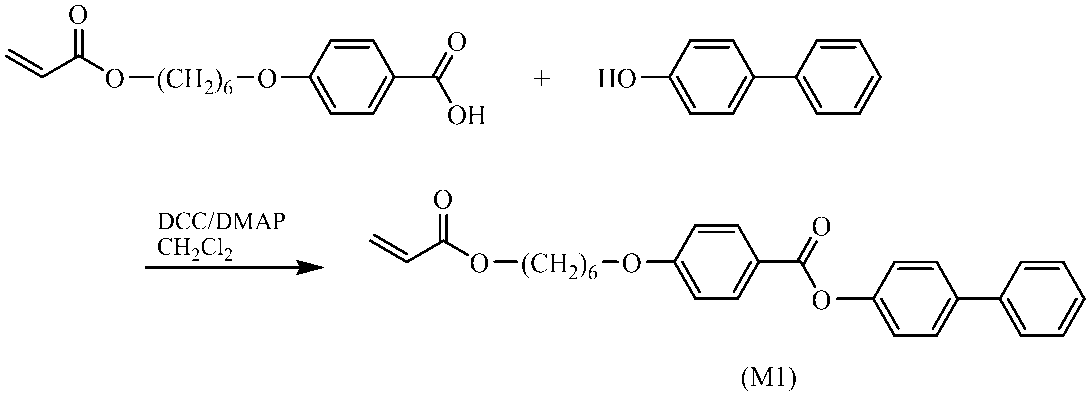
1H-NMR(CDCl3) δ: 1.57(m,4H),1.70(m,2H),1.86(m, 2H),4.00(m,2H),4.19(m,2H),5.82(m,1H),6.12(m,1H),6.39(m,1H),6.97(d,2H),7.29(m,2H),7.36(m,1H),7.47(m,2H),7.62(m,4H),8.18(m,2H)
(1)中間体化合物(P2)の合成
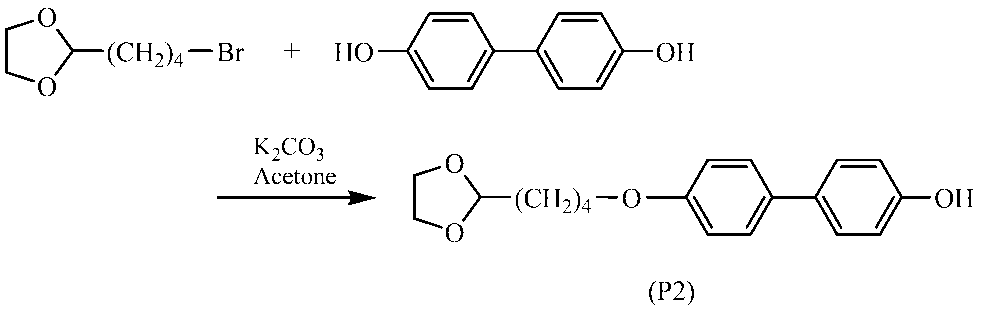
1H-NMR (CDCl3) δ: 1.62 (m, 2H), 1.76 (m, 2H), 1.87 (m, 2H),3.85 (m, 2H), 4.00 (m, 4H), 4.90 (m, 1H), 6.87 (m, 4H), 7.42 (m, 4H)
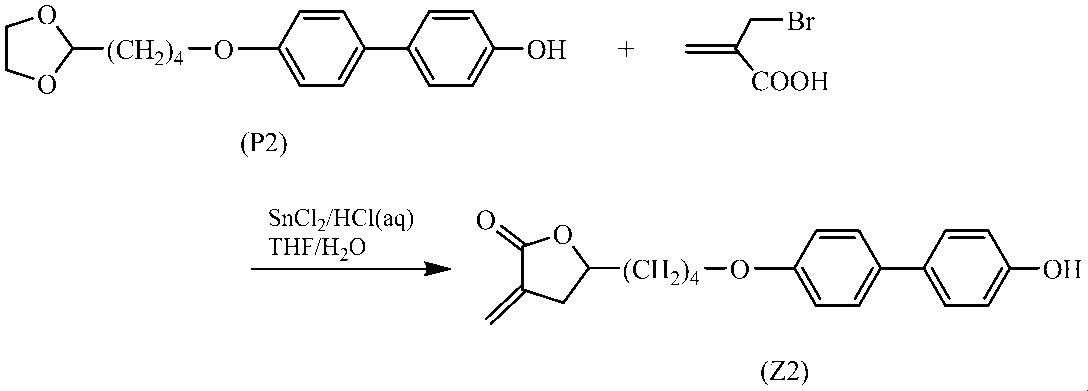
1H-NMR (CDCl3) δ: 1.60-1.95 (m, 6H), 2.64 (m, 1H), 3.11 (s, 1H), 4.02 (t, 2H), 4.60(m, 1H), 4.82(s, 1H), 5.64 (s, 1H), 6.24 (s, 1H), 6.88 (d, 2H), 6.94 (d, 2H), 7.44 (m, 4H)
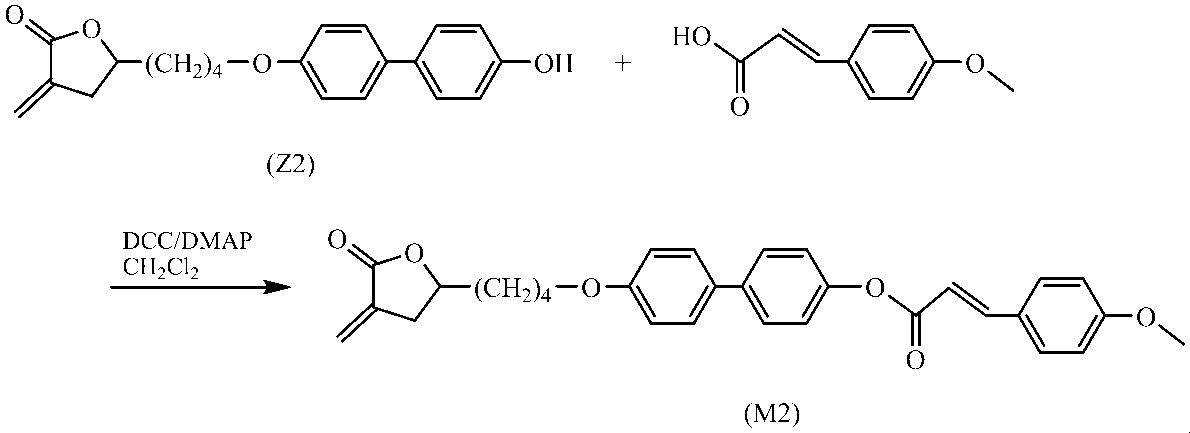
1H-NMR(CDCl3) δ: 1.60-1.90(m,6H),2.63(m,1H),3.09(m,1H),3.87(s,3H),4.03(m,2H),4.57(m,1H),5.64(m,1H),6.24 (d,1H),6.54 (d,1H),6.95(m,4H),7.26(m,2H),7.44(m,2H),7.57(m,4H),7.86(d,1H)
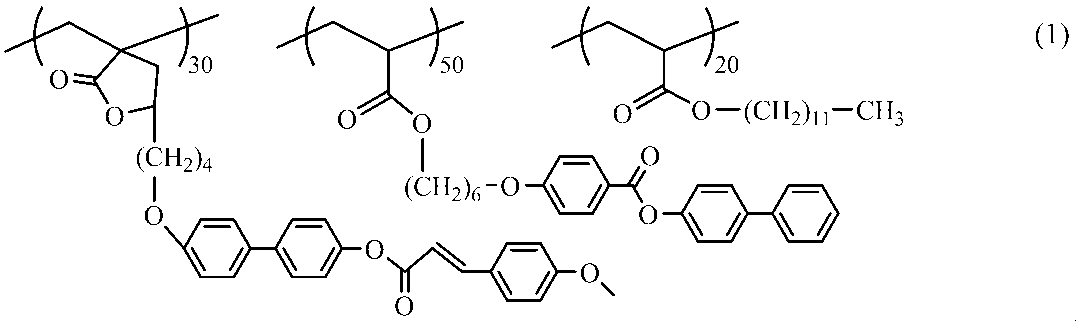
得られた重合体のMnは10,828、Mwは23,822であった(Mw/Mn=2.2)。
冷却管を備えたフラスコに、メチルメタクリレート10.0g(100mmol)、トルエン100mL、AIBN160mgを仕込み、フラスコ内を窒素置換した後、温度60℃で20時間攪拌して反応させた。得られた反応溶液を600mLのヘキサンに投入し、白色粉末を沈殿させた。この白色粉末をろ過した後、室温で真空乾燥を行い、PMMAを8.1g得た(収率81%)。
得られた重合体のMnは9,045、Mwは19,899であった(Mw/Mn=2.2)。
冷却管を備えたフラスコに、n-ドデシルアクリレート12.0g(50mmol)、1,4-ジオキサン100g、AIBN80mgを仕込み、フラスコ内を窒素置換した後、温度60℃で20時間攪拌して反応させた後、得られた反応溶液を2,000mLの水/メタノール(1/1)に投入した。得られた生成物が粘性液体であったため、生成物をデカンテーションにより分離し、乾燥させることにより、PDAを7.4g得た(収率62%)。
得られた重合体のMnは14,120、Mwは38,124であった(Mw/Mn=2.7)。
合成例で得られた重合体を用いて組成物を調製し、フィルムを作製し、その特性を検討した。
重合体(1)300mg、PMMA(ALDRICH社製、Mw=120,000)15mg、及び界面活性剤であるR-30(DIC(株)製)0.6mgをトルエン/シクロヘキサノン(75/25、w/w)1.700gに溶解し、組成物を得た。
重合体(1)300mg、合成例4で合成したPMMA15mg、及び界面活性剤であるR-30(DIC(株)製)0.6mgをトルエン/シクロヘキサノン(75/25、w/w)1.700gに溶解し、組成物を得た。
重合体(1)300mg、合成例4で合成したPMMA30mg、及び界面活性剤であるR-30(DIC(株)製)0.6mgをトルエン/シクロヘキサノン(75/25、w/w)1.700gに溶解し、組成物を得た。
重合体(1)300mg、ポリメタクリル酸エチル(PEMA)(ALDRICH社製、Mw=515,000)15mg、及び界面活性剤であるR-30(DIC(株)製)0.6mgをトルエン/シクロヘキサノン(75/25、w/w)1.700gに溶解し、組成物を得た。
重合体(1)300mg及び界面活性剤であるR-30(DIC(株)製)0.6mgをトルエン/シクロヘキサノン(75/25、w/w)1.700gに溶解し、組成物を得た。
重合体(1)300mg、ポリメタクリル酸ブチル(PBMA)(ALDRICH社製、Mw=337,000)15mg、及び界面活性剤であるR-30(DIC(株)製)0.6mgをトルエン/シクロヘキサノン(75/25、w/w)1.700gに溶解し、組成物を得た。
重合体(1)300mg、ポリメタクリル酸t-ブチル(PtBMA)(ALDRICH社製、Mw=170,000)15mg、及び界面活性剤であるR-30(DIC(株)製)0.6mgをトルエン/シクロヘキサノン(75/25、w/w)1.700gに溶解し、組成物を得た。
重合体(1)300mg、合成例5で合成したPDA15mg、及び界面活性剤であるR-30(DIC(株)製)0.6mgをトルエン/シクロヘキサノン(75/25、w/w)1.700gに溶解し、組成物を得た。
各組成物をTACフィルム上にバーコート(バー#5)により塗布し、ホットプレートを用いて60℃で2分間プリベークした後、室温まで放冷した。このとき、フィルム上に得られた膜は透明であった。
次に、10×10cmのTACフィルムに形成された塗膜を下記プロセスによって露光した後、オーブンを用いて110℃で15分間ポストベークした。得られたフィルムの膜厚は1μm程度であり、偏光顕微鏡でそれを観察したところ、フィルムが基板面に対して水平配向していることを確認した。
[露光方法(パターン化プロセス)]
・パターン1:マスクなしで直線偏光紫外線20mJ/cm2照射を行った。
・パターン2:パターン1による露光後、フィルムの半分をマスクし、更に垂直の方向(角度90°)から直線偏光紫外線60mJ/cm2照射を行った。この方法により、配向方向90°の差を示すパターン化フィルムを得た。なお、露光の際、TACフィルムの延伸方向を定めて照射を行い、パターン1とパターン2が延伸方向を軸に左右対称となるように照射を行った。
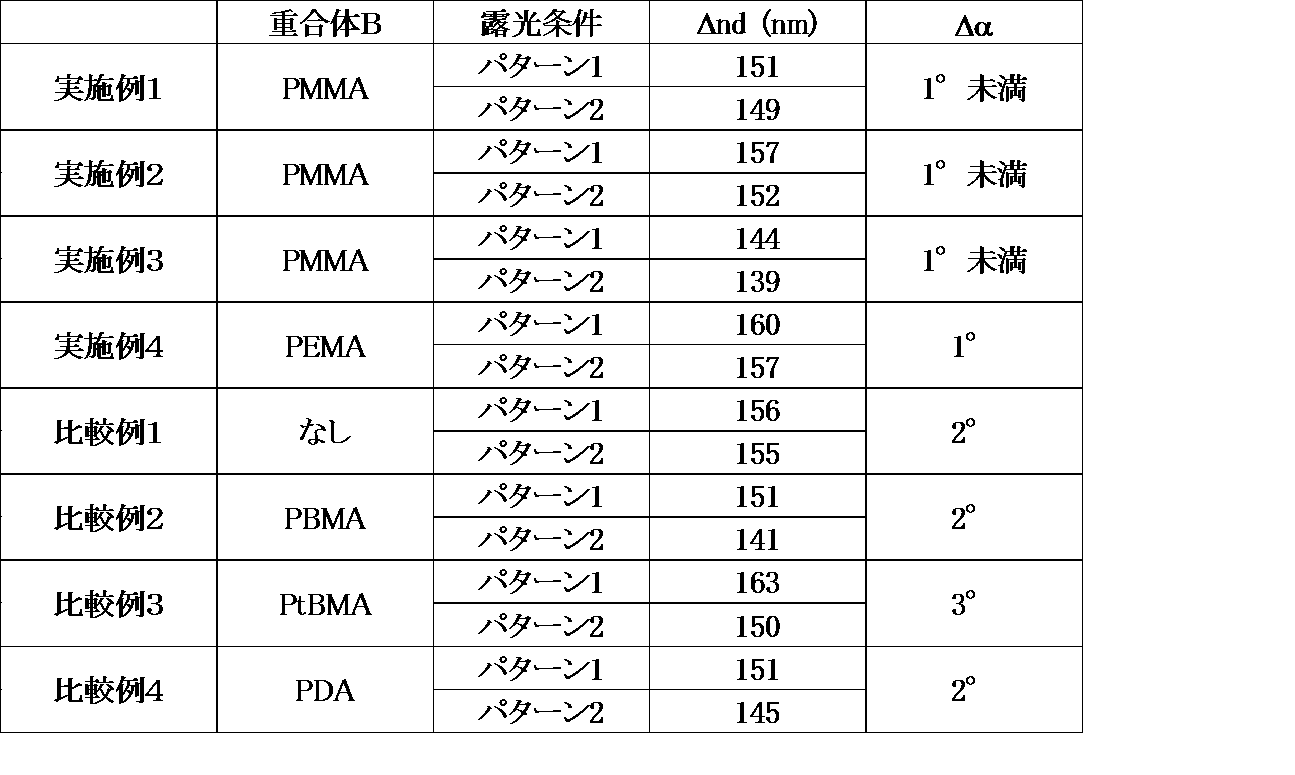
Claims (4)
- (A)下記式[1a]、[1b]及び[1c]で表される繰り返し単位を含有する重合体A、
(B)下記式[6]で表される繰り返し単位を含有する重合体B、及び
(C)有機溶媒
を含有することを特徴とする組成物。

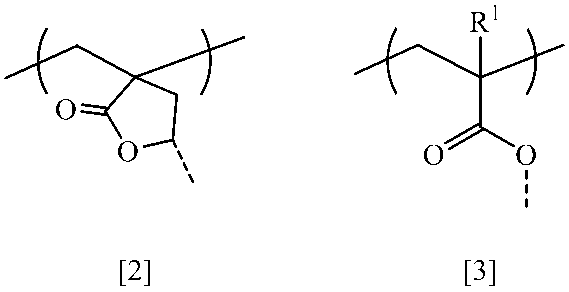
M1は下記式[4]で表される基であり、M2は下記式[5]で表される基であり、
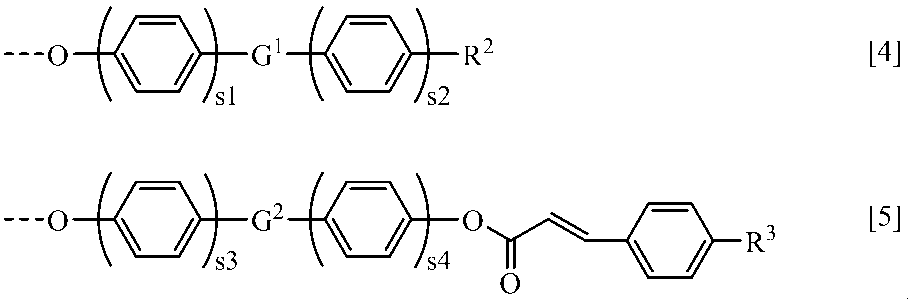
Aは、炭素数2~15の直鎖状又は分岐状のアルキル基であり、
m、n及びpは、それぞれ0<m<1、0<n<1、0≦p≦0.5、かつ、m+n+p≦1を満たす数であり、
q及びrは、それぞれ独立に2~9の整数である。]
- 請求項1記載の組成物を基板に塗布し、次いで偏光を照射し、硬化させることにより得られる単層塗布型水平配向フィルム。
- 上記偏光が、直線偏光紫外線である請求項2記載の単層塗布型水平配向フィルム。
- 請求項2又は3記載の単層塗布型水平配向フィルムを備える光学部材。
Priority Applications (3)
| Application Number | Priority Date | Filing Date | Title |
|---|---|---|---|
| KR1020157028175A KR102128784B1 (ko) | 2013-03-15 | 2014-03-11 | 조성물 및 단층 도포형 수평 배향 필름 |
| JP2015505483A JP6319292B2 (ja) | 2013-03-15 | 2014-03-11 | 組成物及び単層塗布型水平配向フィルム |
| CN201480015560.2A CN105051104B (zh) | 2013-03-15 | 2014-03-11 | 组合物和单层涂布型水平取向膜 |
Applications Claiming Priority (2)
| Application Number | Priority Date | Filing Date | Title |
|---|---|---|---|
| JP2013-052597 | 2013-03-15 | ||
| JP2013052597 | 2013-03-15 |
Publications (1)
| Publication Number | Publication Date |
|---|---|
| WO2014142103A1 true WO2014142103A1 (ja) | 2014-09-18 |
Family
ID=51536757
Family Applications (1)
| Application Number | Title | Priority Date | Filing Date |
|---|---|---|---|
| PCT/JP2014/056275 Ceased WO2014142103A1 (ja) | 2013-03-15 | 2014-03-11 | 組成物及び単層塗布型水平配向フィルム |
Country Status (5)
| Country | Link |
|---|---|
| JP (2) | JP6319292B2 (ja) |
| KR (1) | KR102128784B1 (ja) |
| CN (1) | CN105051104B (ja) |
| TW (1) | TWI610949B (ja) |
| WO (1) | WO2014142103A1 (ja) |
Cited By (1)
| Publication number | Priority date | Publication date | Assignee | Title |
|---|---|---|---|---|
| WO2018043529A1 (ja) * | 2016-08-31 | 2018-03-08 | 日産化学工業株式会社 | 水蒸気バリア性を有する位相差膜及びその製造方法 |
Families Citing this family (1)
| Publication number | Priority date | Publication date | Assignee | Title |
|---|---|---|---|---|
| WO2017138509A1 (ja) * | 2016-02-10 | 2017-08-17 | 日産化学工業株式会社 | 液晶組成物、及び単層塗布型水平配向フィルム |
Citations (5)
| Publication number | Priority date | Publication date | Assignee | Title |
|---|---|---|---|---|
| WO2008044536A1 (en) * | 2006-10-05 | 2008-04-17 | Nissan Chemical Industries, Ltd. | Bifunctional polymerizable compound, polymerizable liquid crystal composition, and oriented film |
| WO2008072652A1 (ja) * | 2006-12-15 | 2008-06-19 | Nissan Chemical Industries, Ltd. | 重合性液晶化合物および重合性液晶組成物並びに配向フィルム |
| WO2010044384A1 (ja) * | 2008-10-14 | 2010-04-22 | 日産化学工業株式会社 | 重合性液晶化合物および重合性液晶組成物並びに配向フィルム |
| WO2012077600A1 (ja) * | 2010-12-07 | 2012-06-14 | 日産化学工業株式会社 | 重合性化合物、重合性液晶組成物、重合体及び配向フィルム |
| WO2013133078A1 (ja) * | 2012-03-09 | 2013-09-12 | 日産化学工業株式会社 | 重合体、該重合体を含む組成物、及び単層塗布型水平配向フィルム |
Family Cites Families (11)
| Publication number | Priority date | Publication date | Assignee | Title |
|---|---|---|---|---|
| JPS6270407A (ja) | 1985-09-25 | 1987-03-31 | Fuji Photo Film Co Ltd | 配向膜の作成方法 |
| JPH09208957A (ja) | 1996-01-31 | 1997-08-12 | Teijin Ltd | 光学異方体の製造方法 |
| JP3945790B2 (ja) | 1997-12-25 | 2007-07-18 | 林テレンプ株式会社 | 複屈折フィルムとその製造方法 |
| WO2006115112A1 (ja) * | 2005-04-20 | 2006-11-02 | Nissan Chemical Industries, Ltd. | 重合性液晶化合物及びそれを含有する重合性液晶組成物並びにそれらを用いて得られる重合体 |
| US8123977B2 (en) * | 2005-11-07 | 2012-02-28 | Lg Chem, Ltd. | Copolymer for liquid crystal alignment, liquid crystal aligning layer including copolymer for liquid crystal alignment, and liquid crystal display including liquid crystal aligning layer |
| CN101517440B (zh) | 2006-09-13 | 2012-12-12 | 罗利克有限公司 | 体积光学配向延迟器 |
| JP2008164925A (ja) | 2006-12-28 | 2008-07-17 | Hayashi Telempu Co Ltd | 位相差フィルムおよびその製造方法 |
| JP4955594B2 (ja) * | 2008-03-17 | 2012-06-20 | 富士フイルム株式会社 | 光軸方向および位相差量がパターニングされた光学材料 |
| KR101090325B1 (ko) | 2009-03-18 | 2011-12-07 | 동방에프티엘(주) | 고순도 올메사탄 메독소밀의 제조방법 |
| JP5640984B2 (ja) * | 2009-09-16 | 2014-12-17 | 日産化学工業株式会社 | 重合性液晶化合物、重合性液晶組成物および配向フィルム |
| CN103328459B (zh) * | 2011-02-25 | 2015-09-30 | 日产化学工业株式会社 | 聚合性液晶化合物、聚合性液晶组合物及取向膜 |
-
2014
- 2014-03-11 CN CN201480015560.2A patent/CN105051104B/zh active Active
- 2014-03-11 KR KR1020157028175A patent/KR102128784B1/ko active Active
- 2014-03-11 WO PCT/JP2014/056275 patent/WO2014142103A1/ja not_active Ceased
- 2014-03-11 JP JP2015505483A patent/JP6319292B2/ja active Active
- 2014-03-14 TW TW103109667A patent/TWI610949B/zh active
-
2018
- 2018-02-16 JP JP2018025963A patent/JP6516028B2/ja active Active
Patent Citations (5)
| Publication number | Priority date | Publication date | Assignee | Title |
|---|---|---|---|---|
| WO2008044536A1 (en) * | 2006-10-05 | 2008-04-17 | Nissan Chemical Industries, Ltd. | Bifunctional polymerizable compound, polymerizable liquid crystal composition, and oriented film |
| WO2008072652A1 (ja) * | 2006-12-15 | 2008-06-19 | Nissan Chemical Industries, Ltd. | 重合性液晶化合物および重合性液晶組成物並びに配向フィルム |
| WO2010044384A1 (ja) * | 2008-10-14 | 2010-04-22 | 日産化学工業株式会社 | 重合性液晶化合物および重合性液晶組成物並びに配向フィルム |
| WO2012077600A1 (ja) * | 2010-12-07 | 2012-06-14 | 日産化学工業株式会社 | 重合性化合物、重合性液晶組成物、重合体及び配向フィルム |
| WO2013133078A1 (ja) * | 2012-03-09 | 2013-09-12 | 日産化学工業株式会社 | 重合体、該重合体を含む組成物、及び単層塗布型水平配向フィルム |
Cited By (2)
| Publication number | Priority date | Publication date | Assignee | Title |
|---|---|---|---|---|
| WO2018043529A1 (ja) * | 2016-08-31 | 2018-03-08 | 日産化学工業株式会社 | 水蒸気バリア性を有する位相差膜及びその製造方法 |
| JPWO2018043529A1 (ja) * | 2016-08-31 | 2019-06-24 | 日産化学株式会社 | 水蒸気バリア性を有する位相差膜及びその製造方法 |
Also Published As
| Publication number | Publication date |
|---|---|
| TWI610949B (zh) | 2018-01-11 |
| JP6516028B2 (ja) | 2019-05-22 |
| CN105051104A (zh) | 2015-11-11 |
| KR20150131129A (ko) | 2015-11-24 |
| TW201439130A (zh) | 2014-10-16 |
| JP2018119149A (ja) | 2018-08-02 |
| JP6319292B2 (ja) | 2018-05-09 |
| CN105051104B (zh) | 2017-04-05 |
| KR102128784B1 (ko) | 2020-07-01 |
| JPWO2014142103A1 (ja) | 2017-02-16 |
Similar Documents
| Publication | Publication Date | Title |
|---|---|---|
| TWI519527B (zh) | A polymerizable liquid crystal compound, a polymerizable liquid crystal composition, and a alignment film | |
| JP6003977B2 (ja) | 重合体、該重合体を含む組成物、及び単層塗布型水平配向フィルム | |
| JP5870932B2 (ja) | 重合性化合物、重合性液晶組成物、重合体及び配向フィルム | |
| JP6516028B2 (ja) | 組成物及び単層塗布型水平配向フィルム | |
| JP6879219B2 (ja) | 液晶組成物、及び単層塗布型水平配向フィルム | |
| JP6409780B2 (ja) | 重合性液晶化合物、液晶性重合体、液晶性組成物、及び単層塗布型水平配向フィルム | |
| JP6536403B2 (ja) | 膜形成用組成物及び単層塗布型水平配向フィルム |
Legal Events
| Date | Code | Title | Description |
|---|---|---|---|
| WWE | Wipo information: entry into national phase |
Ref document number: 201480015560.2 Country of ref document: CN |
|
| 121 | Ep: the epo has been informed by wipo that ep was designated in this application |
Ref document number: 14764480 Country of ref document: EP Kind code of ref document: A1 |
|
| ENP | Entry into the national phase |
Ref document number: 2015505483 Country of ref document: JP Kind code of ref document: A |
|
| NENP | Non-entry into the national phase |
Ref country code: DE |
|
| ENP | Entry into the national phase |
Ref document number: 20157028175 Country of ref document: KR Kind code of ref document: A |
|
| 122 | Ep: pct application non-entry in european phase |
Ref document number: 14764480 Country of ref document: EP Kind code of ref document: A1 |