WO2014137166A1 - 리튬 전이 금속 산화물을 f 패시베이션 시키는 방법 - Google Patents
리튬 전이 금속 산화물을 f 패시베이션 시키는 방법 Download PDFInfo
- Publication number
- WO2014137166A1 WO2014137166A1 PCT/KR2014/001827 KR2014001827W WO2014137166A1 WO 2014137166 A1 WO2014137166 A1 WO 2014137166A1 KR 2014001827 W KR2014001827 W KR 2014001827W WO 2014137166 A1 WO2014137166 A1 WO 2014137166A1
- Authority
- WO
- WIPO (PCT)
- Prior art keywords
- transition metal
- lithium transition
- metal oxide
- plasma
- passivation
- Prior art date
- Legal status (The legal status is an assumption and is not a legal conclusion. Google has not performed a legal analysis and makes no representation as to the accuracy of the status listed.)
- Ceased
Links
Images
Classifications
-
- C—CHEMISTRY; METALLURGY
- C01—INORGANIC CHEMISTRY
- C01D—COMPOUNDS OF ALKALI METALS, i.e. LITHIUM, SODIUM, POTASSIUM, RUBIDIUM, CAESIUM, OR FRANCIUM
- C01D15/00—Lithium compounds
- C01D15/02—Oxides; Hydroxides
-
- C—CHEMISTRY; METALLURGY
- C01—INORGANIC CHEMISTRY
- C01D—COMPOUNDS OF ALKALI METALS, i.e. LITHIUM, SODIUM, POTASSIUM, RUBIDIUM, CAESIUM, OR FRANCIUM
- C01D15/00—Lithium compounds
-
- B—PERFORMING OPERATIONS; TRANSPORTING
- B01—PHYSICAL OR CHEMICAL PROCESSES OR APPARATUS IN GENERAL
- B01J—CHEMICAL OR PHYSICAL PROCESSES, e.g. CATALYSIS OR COLLOID CHEMISTRY; THEIR RELEVANT APPARATUS
- B01J19/00—Chemical, physical or physico-chemical processes in general; Their relevant apparatus
- B01J19/08—Processes employing the direct application of electric or wave energy, or particle radiation; Apparatus therefor
- B01J19/087—Processes employing the direct application of electric or wave energy, or particle radiation; Apparatus therefor employing electric or magnetic energy
- B01J19/088—Processes employing the direct application of electric or wave energy, or particle radiation; Apparatus therefor employing electric or magnetic energy giving rise to electric discharges
-
- B—PERFORMING OPERATIONS; TRANSPORTING
- B01—PHYSICAL OR CHEMICAL PROCESSES OR APPARATUS IN GENERAL
- B01J—CHEMICAL OR PHYSICAL PROCESSES, e.g. CATALYSIS OR COLLOID CHEMISTRY; THEIR RELEVANT APPARATUS
- B01J19/00—Chemical, physical or physico-chemical processes in general; Their relevant apparatus
- B01J19/08—Processes employing the direct application of electric or wave energy, or particle radiation; Apparatus therefor
- B01J19/12—Processes employing the direct application of electric or wave energy, or particle radiation; Apparatus therefor employing electromagnetic waves
-
- B—PERFORMING OPERATIONS; TRANSPORTING
- B01—PHYSICAL OR CHEMICAL PROCESSES OR APPARATUS IN GENERAL
- B01J—CHEMICAL OR PHYSICAL PROCESSES, e.g. CATALYSIS OR COLLOID CHEMISTRY; THEIR RELEVANT APPARATUS
- B01J19/00—Chemical, physical or physico-chemical processes in general; Their relevant apparatus
- B01J19/24—Stationary reactors without moving elements inside
- B01J19/2415—Tubular reactors
-
- H—ELECTRICITY
- H01—ELECTRIC ELEMENTS
- H01M—PROCESSES OR MEANS, e.g. BATTERIES, FOR THE DIRECT CONVERSION OF CHEMICAL ENERGY INTO ELECTRICAL ENERGY
- H01M10/00—Secondary cells; Manufacture thereof
- H01M10/05—Accumulators with non-aqueous electrolyte
- H01M10/052—Li-accumulators
-
- H—ELECTRICITY
- H01—ELECTRIC ELEMENTS
- H01M—PROCESSES OR MEANS, e.g. BATTERIES, FOR THE DIRECT CONVERSION OF CHEMICAL ENERGY INTO ELECTRICAL ENERGY
- H01M4/00—Electrodes
- H01M4/02—Electrodes composed of, or comprising, active material
- H01M4/04—Processes of manufacture in general
- H01M4/0402—Methods of deposition of the material
- H01M4/0421—Methods of deposition of the material involving vapour deposition
-
- H—ELECTRICITY
- H01—ELECTRIC ELEMENTS
- H01M—PROCESSES OR MEANS, e.g. BATTERIES, FOR THE DIRECT CONVERSION OF CHEMICAL ENERGY INTO ELECTRICAL ENERGY
- H01M4/00—Electrodes
- H01M4/02—Electrodes composed of, or comprising, active material
- H01M4/04—Processes of manufacture in general
- H01M4/0438—Processes of manufacture in general by electrochemical processing
-
- H—ELECTRICITY
- H01—ELECTRIC ELEMENTS
- H01M—PROCESSES OR MEANS, e.g. BATTERIES, FOR THE DIRECT CONVERSION OF CHEMICAL ENERGY INTO ELECTRICAL ENERGY
- H01M4/00—Electrodes
- H01M4/02—Electrodes composed of, or comprising, active material
- H01M4/13—Electrodes for accumulators with non-aqueous electrolyte, e.g. for lithium-accumulators; Processes of manufacture thereof
- H01M4/131—Electrodes based on mixed oxides or hydroxides, or on mixtures of oxides or hydroxides, e.g. LiCoOx
-
- H—ELECTRICITY
- H01—ELECTRIC ELEMENTS
- H01M—PROCESSES OR MEANS, e.g. BATTERIES, FOR THE DIRECT CONVERSION OF CHEMICAL ENERGY INTO ELECTRICAL ENERGY
- H01M4/00—Electrodes
- H01M4/02—Electrodes composed of, or comprising, active material
- H01M4/13—Electrodes for accumulators with non-aqueous electrolyte, e.g. for lithium-accumulators; Processes of manufacture thereof
- H01M4/139—Processes of manufacture
- H01M4/1391—Processes of manufacture of electrodes based on mixed oxides or hydroxides, or on mixtures of oxides or hydroxides, e.g. LiCoOx
-
- H—ELECTRICITY
- H01—ELECTRIC ELEMENTS
- H01M—PROCESSES OR MEANS, e.g. BATTERIES, FOR THE DIRECT CONVERSION OF CHEMICAL ENERGY INTO ELECTRICAL ENERGY
- H01M4/00—Electrodes
- H01M4/02—Electrodes composed of, or comprising, active material
- H01M4/36—Selection of substances as active materials, active masses, active liquids
- H01M4/362—Composites
-
- H—ELECTRICITY
- H01—ELECTRIC ELEMENTS
- H01M—PROCESSES OR MEANS, e.g. BATTERIES, FOR THE DIRECT CONVERSION OF CHEMICAL ENERGY INTO ELECTRICAL ENERGY
- H01M4/00—Electrodes
- H01M4/02—Electrodes composed of, or comprising, active material
- H01M4/36—Selection of substances as active materials, active masses, active liquids
- H01M4/48—Selection of substances as active materials, active masses, active liquids of inorganic oxides or hydroxides
- H01M4/485—Selection of substances as active materials, active masses, active liquids of inorganic oxides or hydroxides of mixed oxides or hydroxides for inserting or intercalating light metals, e.g. LiTi2O4 or LiTi2OxFy
-
- H—ELECTRICITY
- H01—ELECTRIC ELEMENTS
- H01M—PROCESSES OR MEANS, e.g. BATTERIES, FOR THE DIRECT CONVERSION OF CHEMICAL ENERGY INTO ELECTRICAL ENERGY
- H01M4/00—Electrodes
- H01M4/02—Electrodes composed of, or comprising, active material
- H01M4/36—Selection of substances as active materials, active masses, active liquids
- H01M4/58—Selection of substances as active materials, active masses, active liquids of inorganic compounds other than oxides or hydroxides, e.g. sulfides, selenides, tellurides, halogenides or LiCoFy; of polyanionic structures, e.g. phosphates, silicates or borates
-
- B—PERFORMING OPERATIONS; TRANSPORTING
- B01—PHYSICAL OR CHEMICAL PROCESSES OR APPARATUS IN GENERAL
- B01J—CHEMICAL OR PHYSICAL PROCESSES, e.g. CATALYSIS OR COLLOID CHEMISTRY; THEIR RELEVANT APPARATUS
- B01J2219/00—Chemical, physical or physico-chemical processes in general; Their relevant apparatus
- B01J2219/08—Processes employing the direct application of electric or wave energy, or particle radiation; Apparatus therefor
- B01J2219/0873—Materials to be treated
- B01J2219/0881—Two or more materials
- B01J2219/0886—Gas-solid
-
- B—PERFORMING OPERATIONS; TRANSPORTING
- B01—PHYSICAL OR CHEMICAL PROCESSES OR APPARATUS IN GENERAL
- B01J—CHEMICAL OR PHYSICAL PROCESSES, e.g. CATALYSIS OR COLLOID CHEMISTRY; THEIR RELEVANT APPARATUS
- B01J2219/00—Chemical, physical or physico-chemical processes in general; Their relevant apparatus
- B01J2219/08—Processes employing the direct application of electric or wave energy, or particle radiation; Apparatus therefor
- B01J2219/0894—Processes carried out in the presence of a plasma
-
- Y—GENERAL TAGGING OF NEW TECHNOLOGICAL DEVELOPMENTS; GENERAL TAGGING OF CROSS-SECTIONAL TECHNOLOGIES SPANNING OVER SEVERAL SECTIONS OF THE IPC; TECHNICAL SUBJECTS COVERED BY FORMER USPC CROSS-REFERENCE ART COLLECTIONS [XRACs] AND DIGESTS
- Y02—TECHNOLOGIES OR APPLICATIONS FOR MITIGATION OR ADAPTATION AGAINST CLIMATE CHANGE
- Y02E—REDUCTION OF GREENHOUSE GAS [GHG] EMISSIONS, RELATED TO ENERGY GENERATION, TRANSMISSION OR DISTRIBUTION
- Y02E60/00—Enabling technologies; Technologies with a potential or indirect contribution to GHG emissions mitigation
- Y02E60/10—Energy storage using batteries
-
- Y—GENERAL TAGGING OF NEW TECHNOLOGICAL DEVELOPMENTS; GENERAL TAGGING OF CROSS-SECTIONAL TECHNOLOGIES SPANNING OVER SEVERAL SECTIONS OF THE IPC; TECHNICAL SUBJECTS COVERED BY FORMER USPC CROSS-REFERENCE ART COLLECTIONS [XRACs] AND DIGESTS
- Y02—TECHNOLOGIES OR APPLICATIONS FOR MITIGATION OR ADAPTATION AGAINST CLIMATE CHANGE
- Y02P—CLIMATE CHANGE MITIGATION TECHNOLOGIES IN THE PRODUCTION OR PROCESSING OF GOODS
- Y02P20/00—Technologies relating to chemical industry
- Y02P20/10—Process efficiency
- Y02P20/133—Renewable energy sources, e.g. sunlight
Definitions
- the present invention relates to a method for passivating a lithium transition metal oxide, comprising: (a) preparing a lithium transition metal oxide in powder or bulk form; (b) generating a plasma using a source gas containing fluorine; And (c) treating the lithium transition metal oxide using the plasma.
- a secondary cell is a device that converts external electrical energy into chemical energy, stores it, and generates electricity when needed.
- Commonly used secondary batteries include lead storage batteries, nickel cadmium (NiCd) secondary batteries, nickel hydrogen (NiH) secondary batteries, lithium (Li) secondary batteries, and lithium ion polymer (Li-ion polymer) secondary batteries. .
- lithium secondary batteries are devices that store electricity based on the redox reaction principle of lithium.
- Lithium secondary batteries have an energy density more than twice that of nickel hydride secondary batteries used in the related art, and are advantageous in miniaturization and long use time because they are smaller and lighter than other secondary batteries.
- it has the advantages of having much less self discharge and memory effects than other secondary batteries and having an excellent charge and discharge cycle. Thanks to these advantages, especially the memory effect that the discharge capacity is reduced even after frequent charging and discharging, lithium secondary battery is not only a power source for small electronic devices such as mobile phones, laptops and digital cameras, but also hybrid cars, plug-in cars, It is widely used as a medium-large battery for an electric vehicle and a large battery for storing solar energy.
- a material currently used in an anode of the lithium secondary battery is a silicate, such as LiCoO 2, LiNiO 2, such as layer-phase material, LiMn 2 O 4, such as the spin nelgye material, LiFePO 4, etc. up bingye material, Li 2 MnSiO 4 of the system There is material.
- a silicate such as LiCoO 2, LiNiO 2, such as layer-phase material, LiMn 2 O 4, such as the spin nelgye material, LiFePO 4, etc. up bingye material, Li 2 MnSiO 4 of the system There is material.
- a lithium secondary battery using the positive electrode active material has a problem in that its life is rapidly decreased as charging and discharging are repeated. This is due to a phenomenon caused by decomposition of the electrolyte or deterioration of the active material due to moisture or other effects inside the battery, and an increase in the internal resistance of the battery. Therefore, many efforts are being made to solve this problem.
- the present invention aims to improve performance of a lithium ion secondary battery by blocking fluorine (F) passivation on a lithium transition metal oxide used as a lithium ion secondary battery cathode material to block unnecessary reaction with an electrolyte.
- the present invention (a) preparing a lithium transition metal oxide in powder or bulk form; (b) generating a plasma using a source gas containing fluorine; (c) providing a method for F passivating a lithium transition metal oxide, comprising treating the lithium transition metal oxide using the plasma.
- Fluorine-containing source gases include fluorine-containing gases such as nitrogen trifluoride (NF 3 ), fluorine (F 2 ), fluorine carbide (CxHyFz), hydrogen fluoride (HF), carbon tetrafluoride (CF 4 ), and hexafluoride Term (SF 6 ).
- the gas may be used alone or in admixture with other predetermined gases.
- the gas to be mixed and used may be any kind of gas that can be generated at atmospheric pressure. Depending on the purpose it may be in gaseous form or aerosol form.
- the method of generating the plasma is also not particularly limited.
- devices commonly used to generate plasma may also be used in the present invention.
- a plasma barrier discharge (DBD) type plasma device that generates plasma at atmospheric pressure
- a plasma device of capacitively coupled plasma (CCP) type a plasma device of transformer coupled plasma (ICP) / inductively coupled plasma (ICP) type
- ECR Electron cyclotron resonance
- SWP plasma wave plasma
- the plasma used in the present invention may mean a low temperature plasma, but is not necessarily limited thereto. Therefore, it should be understood that the high temperature plasma generated by using various known plasma torches is also included in the scope of the plasma used in the present invention.
- the lithium transition metal oxide is LiCoO 2 , LiNiO 2 , LiMn 2 O 4 , LiFePO 4 , Li 2 MnSiO 4 , and LiNi 1-xy Co x M y O 2 (M is Co, Mn, Mg, Fe, Ni, Al And one metal selected from the group consisting of a combination thereof, 0 ⁇ x + y ⁇ 1).
- the treatment in step (c) is a contact reaction between the plasma generated in step (b) and the lithium transition metal oxide.
- the contact reaction includes an indirect contact manner as well as a direct contact reaction with the plasma.
- the method according to this aspect is a method according to the direct or indirect contact method of the plasma.
- This is referred to Korean Patent Application No. 10-2012-0008332, which is a patent of the inventor, which is hereby incorporated by reference in its entirety.
- the present invention (a) preparing a lithium transition metal oxide in powder or bulk form; (b) plasma-processing the source gas containing fluorine to prepare an active gas; (c) providing a method of F passivating a lithium transition metal oxide, comprising treating the metal oxide with the active gas.
- the method according to this aspect is that according to the remote contact method of plasma.
- This apparatus is a method in which the plasma generating region and the processing region are formed in separate spaces, and the active gas generated from the plasma is not a method of directly processing the powder with plasma by transferring the active gas obtained from the plasma generating region to the powder processing region. It is a device for processing powders.
- the active gas is a gas that is produced by plasma treatment of the source gas through ionization and molecular dissociation.
- Plasma for generating an active gas may mean a generally used in physics, that is, a collection of particles including ions and free electrons generated by applying energy to a gaseous material.
- fluorine passivation can be performed by plasma direct, indirect or remote treatment of lithium transition metal oxides.
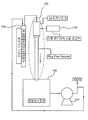
- FIG. 1 is a schematic diagram of an apparatus used in an embodiment of the present invention.
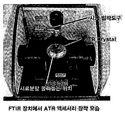
- FIG. 2 is a photograph of an ATR-FTIR spectrometer used to confirm F passivation.
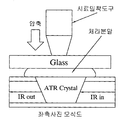
- FIG. 3 is a schematic of use of the ATR-FTIR spectrometer of FIG. 2.
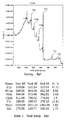
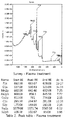
- FIG. 5 is an XPS graph and table data of Example 2.
- the apparatus of the present invention comprises a lithium transition metal oxide powder supply 110; An active gas supply unit 120, the active gas supply unit 120 to generate a plasma, plasma processing the raw material gas containing fluorine to provide the generated active gas; And a powder treatment unit 130 for treating the lithium transition metal powder with the active gas.
- Plasma was generated by the DBD method. The plasma generation region and the powder treatment region are spaced apart. The powder is not exposed directly to the plasma, but rather to the active gas generated from the plasma.
- the source gas was N 2 , SF 6 and H 2 . Each gas was supplied through a separate feed. Their feed rates were 25 lpm, 2.5 lpm and 0.25 lpm.
- the lithium transition metal oxide is a mixture of Ni 0.83 Co 0.15 Al 0.02 (OH) 2 and LiOH.H 2 O at a ratio of 1: 1.03 and then heat treated at 480 ° C. for 4 hours and at 740 ° C. for 15 hours, The obtained powder was sieved to obtain a lithium transition metal oxide (LiNi 0.83 Co 0.15 Al 0.02 O 2 ) having an average particle size of 13 ⁇ m.
- the feed rate of the oxide through the powder feed was 12 kg / hr.
- the plasma generating module in the active gas supply was a DBD whose power was 3 kw and had a frequency of 30 kHz.
- the treatment section was a plug flow reactor, in which the supplied activated gas and the supplied lithium transition metal oxide powder were contacted.
- An ATR-FTIR spectrometer as illustrated in FIG. 2 was prepared.
- the treated lithium transition metal oxide powder was placed in an ATR crystal, and the powder was adhered with a slide glass, pressed with a sample adhesion tool of an ATR-FTIR spectrometer, and measured with a spectrometer. It was.
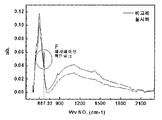
- the plasma-free lithium transition metal oxide powder of the present invention was measured with an ATR-FTIR spectrometer in the same manner as the above method. The results are confirmed graphically in FIG.
- the results according to the example showed a peak at a value of 667.32 cm ⁇ 1 .
- the peak is the intrinsic infrared absorption value of the Li-F binder. Therefore, it can be confirmed that the lithium ion transition metal oxide treated by the method of the present invention according to the embodiment has become F passivation.
- Treatment was carried out under the same conditions as in Example 1 except that the feed ratios of the source gases N 2 , SF 6 and H 2 were set to 10: 3: 0.3.
- Example 2 a powder treated with a lithium ion transition metal oxide and an untreated powder were separately prepared and analyzed by XPS.
- FIG. 5A shows XPS values of lithium ion transition metal oxides not plasma treated by the method of Example 2
- FIG. 5B shows XPS values of lithium ion transition metal oxides plasma treated by the method of Example 2.
- the lithium ion transition metal oxide treated by the method of Example 2 can confirm that F is bonded to the surface.
Landscapes
- Chemical & Material Sciences (AREA)
- Chemical Kinetics & Catalysis (AREA)
- Engineering & Computer Science (AREA)
- Electrochemistry (AREA)
- General Chemical & Material Sciences (AREA)
- Organic Chemistry (AREA)
- Materials Engineering (AREA)
- Manufacturing & Machinery (AREA)
- Inorganic Chemistry (AREA)
- Toxicology (AREA)
- Health & Medical Sciences (AREA)
- General Health & Medical Sciences (AREA)
- Electromagnetism (AREA)
- Physics & Mathematics (AREA)
- Composite Materials (AREA)
- Battery Electrode And Active Subsutance (AREA)
- Physical Or Chemical Processes And Apparatus (AREA)
Abstract
Description
Claims (9)
- (a) 분말 또는 벌크 형태의 리튬 전이금속 산화물을 준비하는 단계;(b) 불소를 함유하는 원료가스를 이용하여 플라즈마를 생성시키는 단계;(c) 상기 플라즈마를 이용하여 상기 리튬 전이금속 산화물을 처리시키는 단계를 포함하는,리튬 전이 금속 산화물을 F 패시베이션 시키는 방법.
- 제 1항에 있어서,상기 원료 가스는 삼불화질소(NF3), 불소(F2), 탄화불소(CxHyFz), 불화수소(HF), 사불화탄소(CF4), 및 육불화항(SF6) 및 이들의 조합으로 이루어진 군에서 선택되는 가스와;메탄(CH4), 아세틸렌(C2H2), 하이드라진(N2H2), 수소(H2), 사염화탄소(CCl4), 이산화염소(ClO2), 염소(Cl2), 브롬화수소 (HBr), 및 브롬(Br2) 중 적어도 어느 하나의 가스와의 혼합 가스인,리튬 전이 금속 산화물을 F 패시베이션 시키는 방법.
- 제 1항 또는 제 2항에 있어서,상기 리튬 전이금속 산화물은 LiCoO2, LiNiO2, LiMn2O4, LiFePO4, Li2MnSiO4, 및 LiNi1-x-yCoxMyO2 (M은 Co, Mn, Mg, Fe, Ni, Al 및 이들의 조합으로 이루어진 군에서 선택되는 1종의 금속, 0<x+y<1)로 이루어진 군에서 선택된 어느 하나 이상을 포함하는 것을 특징으로 하는,리튬 전이 금속 산화물을 F 패시베이션 시키는 방법.
- 제 1항 또는 제 2항에 있어서,상기 (c) 단계에서의 처리가 상기 (b) 단계에서 생성된 플라즈마와 상기 리튬 전이금속 산화물의 접촉 반응인,리튬 전이 금속 산화물을 F 패시베이션 시키는 방법.
- (a) 분말 또는 벌크 형태의 리튬 전이금속 산화물을 준비하는 단계;(b) 불소를 함유하는 원료가스를 플라즈마 처리하여 활성 가스를 준비하는 단계;(c) 상기 활성 가스로 상기 금속산화물을 처리시키는 단계를 포함하는,리튬 전이 금속 산화물을 F 패시베이션 시키는 방법.
- 제 5항에 있어서,상기 원료 가스는 삼불화질소(NF3), 불소(F2), 탄화불소(CxHyFz), 불화수소(HF), 사불화탄소(CF4), 및 육불화항(SF6) 및 이들의 조합으로 이루어진 군에서 선택되는 가스와;메탄(CH4), 아세틸렌(C2H2), 하이드라진(N2H2), 수소(H2), 사염화탄소(CCl4), 이산화염소(ClO2), 염소(Cl2), 브롬화수소 (HBr), 및 브롬(Br2) 중 적어도 어느 하나의 가스와의 혼합 가스인,리튬 전이 금속 산화물을 F 패시베이션 시키는 방법.
- 제 5항 또는 제 6항에 있어서,상기 리튬 전이금속 산화물은 LiCoO2, LiNiO2, LiMn2O4, LiFePO4, Li2MnSiO4, 및 LiNi1-x-yCoxMyO2 (M은 Co, Mn, Mg, Fe, Ni, Al 및 이들의 조합으로 이루어진 군에서 선택되는 1종의 금속, 0<x+y<1)로 이루어진 군에서 선택된 어느 하나 이상을 포함하는 것을 특징으로 하는,리튬 전이 금속 산화물을 F 패시베이션 시키는 방법.
- 제 5항 또는 제 6항에 있어서,상기 활성 가스는 플라즈마 처리 되어 상기 원료가스가 이온화 및 분자 해리과정을 통하여 생성되는 것을 특징으로 하는,리튬 전이 금속 산화물을 F 패시베이션 시키는 방법.
- 제 5항 또는 제 6항에 있어서,상기 (c) 단계에서의 처리가 상기 (b) 단계에서 생성된 활성 가스와 상기 리튬 전이금속 산화물의 접촉 반응인,리튬 전이 금속 산화물을 F 패시베이션 시키는 방법.
Priority Applications (2)
| Application Number | Priority Date | Filing Date | Title |
|---|---|---|---|
| JP2015561271A JP6280572B2 (ja) | 2013-03-08 | 2014-03-06 | リチウム遷移金属酸化物をfパッシベーションする方法 |
| CN201480012796.0A CN105189355B (zh) | 2013-03-08 | 2014-03-06 | 锂过渡金属氧化物的氟钝化方法 |
Applications Claiming Priority (2)
| Application Number | Priority Date | Filing Date | Title |
|---|---|---|---|
| KR1020130024765A KR101532997B1 (ko) | 2013-03-08 | 2013-03-08 | 리튬 전이 금속 산화물을 f 패시베이션 시키는 방법 |
| KR10-2013-0024765 | 2013-03-08 |
Publications (1)
| Publication Number | Publication Date |
|---|---|
| WO2014137166A1 true WO2014137166A1 (ko) | 2014-09-12 |
Family
ID=51491616
Family Applications (1)
| Application Number | Title | Priority Date | Filing Date |
|---|---|---|---|
| PCT/KR2014/001827 Ceased WO2014137166A1 (ko) | 2013-03-08 | 2014-03-06 | 리튬 전이 금속 산화물을 f 패시베이션 시키는 방법 |
Country Status (4)
| Country | Link |
|---|---|
| JP (1) | JP6280572B2 (ko) |
| KR (1) | KR101532997B1 (ko) |
| CN (1) | CN105189355B (ko) |
| WO (1) | WO2014137166A1 (ko) |
Families Citing this family (2)
| Publication number | Priority date | Publication date | Assignee | Title |
|---|---|---|---|---|
| CN107213884A (zh) * | 2017-05-31 | 2017-09-29 | 华中科技大学 | 一种利用等离子体技术增强金属氧化物氧化性的方法 |
| CN116314718A (zh) * | 2023-04-14 | 2023-06-23 | 浙江吉利控股集团有限公司 | 一种电池正极复合材料、制备方法和固态锂离子电池 |
Citations (3)
| Publication number | Priority date | Publication date | Assignee | Title |
|---|---|---|---|---|
| KR20010102593A (ko) * | 2000-05-01 | 2001-11-16 | 윤덕용 | 플라즈마 처리에 의한 리튬전이금속 산화물 박막의 결정화방법 |
| KR20110110701A (ko) * | 2010-04-01 | 2011-10-07 | 한국기초과학지원연구원 | 환원성 분위기에서 처리된 리튬 이차전지의 전극, 그 제조 방법 및 이를 포함하는 리튬 이차전지 |
| KR101146993B1 (ko) * | 2010-06-03 | 2012-05-22 | 삼성모바일디스플레이주식회사 | 실리콘층의 결정화 방법 및 상기 결정화 방법을 이용한 박막 트랜지스터의 형성방법 |
Family Cites Families (12)
| Publication number | Priority date | Publication date | Assignee | Title |
|---|---|---|---|---|
| JPH0768382B2 (ja) * | 1988-01-29 | 1995-07-26 | 幸子 岡崎 | プラズマによる粉体表面処理装置 |
| JP3530544B2 (ja) * | 1992-09-14 | 2004-05-24 | キヤノン株式会社 | 二次電池 |
| JP2771406B2 (ja) * | 1992-11-30 | 1998-07-02 | キヤノン株式会社 | 二次電池 |
| JPH08213014A (ja) * | 1995-02-06 | 1996-08-20 | Sony Corp | 非水電解液二次電池 |
| JP2002343358A (ja) * | 2001-05-22 | 2002-11-29 | Mitsubishi Cable Ind Ltd | リチウムイオン2次電池の正極の製造方法 |
| JP2006202678A (ja) * | 2005-01-24 | 2006-08-03 | Gs Yuasa Corporation:Kk | 正極活物質及びその製造方法、並びに、それを用いた非水電解質電池 |
| JP5208353B2 (ja) * | 2005-03-31 | 2013-06-12 | 東洋炭素株式会社 | 正極活物質及びその製造方法 |
| JP2009021214A (ja) * | 2007-06-12 | 2009-01-29 | Panasonic Corp | 非水電解質二次電池用電極の製造方法 |
| JP2009164138A (ja) * | 2009-04-20 | 2009-07-23 | Toyo Tanso Kk | 非水電解液二次電池用正極活物質 |
| KR101492175B1 (ko) * | 2011-05-03 | 2015-02-10 | 주식회사 엘지화학 | 양극 활물질 입자의 표면 처리 방법 및 이로부터 형성된 양극 활물질 입자 |
| CN102544505B (zh) * | 2011-12-15 | 2014-09-24 | 湖北万润新能源科技发展有限公司 | 磷酸铁锂正极材料的表面改性方法 |
| KR101348946B1 (ko) * | 2012-01-27 | 2014-01-09 | 한국기초과학지원연구원 | 리튬 전이 금속 산화물의 불순물을 제거하는 방법 |
-
2013
- 2013-03-08 KR KR1020130024765A patent/KR101532997B1/ko active Active
-
2014
- 2014-03-06 JP JP2015561271A patent/JP6280572B2/ja active Active
- 2014-03-06 CN CN201480012796.0A patent/CN105189355B/zh active Active
- 2014-03-06 WO PCT/KR2014/001827 patent/WO2014137166A1/ko not_active Ceased
Patent Citations (3)
| Publication number | Priority date | Publication date | Assignee | Title |
|---|---|---|---|---|
| KR20010102593A (ko) * | 2000-05-01 | 2001-11-16 | 윤덕용 | 플라즈마 처리에 의한 리튬전이금속 산화물 박막의 결정화방법 |
| KR20110110701A (ko) * | 2010-04-01 | 2011-10-07 | 한국기초과학지원연구원 | 환원성 분위기에서 처리된 리튬 이차전지의 전극, 그 제조 방법 및 이를 포함하는 리튬 이차전지 |
| KR101146993B1 (ko) * | 2010-06-03 | 2012-05-22 | 삼성모바일디스플레이주식회사 | 실리콘층의 결정화 방법 및 상기 결정화 방법을 이용한 박막 트랜지스터의 형성방법 |
Also Published As
| Publication number | Publication date |
|---|---|
| JP2016518958A (ja) | 2016-06-30 |
| KR20140110448A (ko) | 2014-09-17 |
| CN105189355A (zh) | 2015-12-23 |
| JP6280572B2 (ja) | 2018-02-14 |
| KR101532997B1 (ko) | 2015-07-09 |
| CN105189355B (zh) | 2017-03-15 |
Similar Documents
| Publication | Publication Date | Title |
|---|---|---|
| US5968683A (en) | Fluoridated electrode materials and associated process for fabrication | |
| KR102157183B1 (ko) | 음극 활물질, 상기 음극 활물질을 포함하는 음극, 및 상기 음극을 포함하는 이차 전지 | |
| CN104067419B (zh) | 电池及处理其电极的方法 | |
| KR20150026864A (ko) | 리튬 전이금속 복합 입자, 이의 제조방법, 및 이를 포함하는 양극 활물질 | |
| Hudaya et al. | SnO2-coated LiCoO2 cathode material for high-voltage applications in lithium-ion batteries | |
| EP2793302A1 (en) | Si/c composite, method for manufacturing same, and cathode active material including same for lithium secondary battery | |
| Wang et al. | Trimethyl borate as an electrolyte additive for high potential layered cathode with concurrent improvement of rate capability and cyclic stability | |
| KR20210077487A (ko) | 음극 및 상기 음극을 포함하는 이차 전지 | |
| KR101249974B1 (ko) | 환원성 분위기에서 처리된 리튬 이차전지의 전극, 그 제조 방법 및 이를 포함하는 리튬 이차전지 | |
| KR20190073758A (ko) | 흑연 물질의 정제 방법 및 흑연 물질 | |
| Liu et al. | Effectively enhanced structural stability and electrochemical properties of LiNi 0.5 Mn 1.5 O 4 cathode materials via poly-(3, 4-ethylenedioxythiophene)-in situ coated for high voltage Li-ion batteries | |
| JP2002117855A (ja) | 二次電池およびその製造方法 | |
| CN107437614A (zh) | 负极活性物质和电池 | |
| WO2014137166A1 (ko) | 리튬 전이 금속 산화물을 f 패시베이션 시키는 방법 | |
| KR101943481B1 (ko) | 양극 활물질 입자의 표면 처리 방법 및 이로부터 수득된 양극 활물질 입자 | |
| KR101354481B1 (ko) | 리튬 전이 금속 산화물의 불순물을 제거하는 방법 | |
| KR102805082B1 (ko) | 코팅층이 형성된 양극 활물질 및 이의 제조방법 | |
| EP3964481A1 (en) | Cathode active material for lithium secondary battery, method of manufacturing the same and lithium secondary battery including the same | |
| KR20140022310A (ko) | 리튬 전이 금속 산화물의 불순물을 제거하고 물질 용량 감소 없이 탄소 코팅과 반응을 가속시킬 수 있는 방법 | |
| KR101348946B1 (ko) | 리튬 전이 금속 산화물의 불순물을 제거하는 방법 | |
| EP4723243A1 (en) | Positive electrode active material and preparation method therefor, positive electrode plate, battery, and electrical apparatus | |
| KR101905921B1 (ko) | 양극 활물질, 이의 제조방법, 및 이를 포함하는 리튬 이차전지 | |
| KR20180104450A (ko) | 음극 활물질의 제조 방법 | |
| WO2013183848A1 (ko) | 리튬 이차 전지용 전극, 이의 형성 방법 및 리튬 이차 전지 | |
| US20250038183A1 (en) | Positive electrode composite material, preparation method thereof, positive electrode and lithium ion secondary battery |
Legal Events
| Date | Code | Title | Description |
|---|---|---|---|
| WWE | Wipo information: entry into national phase |
Ref document number: 201480012796.0 Country of ref document: CN |
|
| 121 | Ep: the epo has been informed by wipo that ep was designated in this application |
Ref document number: 14759827 Country of ref document: EP Kind code of ref document: A1 |
|
| ENP | Entry into the national phase |
Ref document number: 2015561271 Country of ref document: JP Kind code of ref document: A |
|
| NENP | Non-entry into the national phase |
Ref country code: DE |
|
| 122 | Ep: pct application non-entry in european phase |
Ref document number: 14759827 Country of ref document: EP Kind code of ref document: A1 |