WO2014136196A1 - 二次電池負極用水系バインダー液、およびこれを用いてなる二次電池負極用水系ペースト、二次電池負極、二次電池 - Google Patents
二次電池負極用水系バインダー液、およびこれを用いてなる二次電池負極用水系ペースト、二次電池負極、二次電池 Download PDFInfo
- Publication number
- WO2014136196A1 WO2014136196A1 PCT/JP2013/055903 JP2013055903W WO2014136196A1 WO 2014136196 A1 WO2014136196 A1 WO 2014136196A1 JP 2013055903 W JP2013055903 W JP 2013055903W WO 2014136196 A1 WO2014136196 A1 WO 2014136196A1
- Authority
- WO
- WIPO (PCT)
- Prior art keywords
- secondary battery
- acid
- negative electrode
- mass
- polyolefin resin
- Prior art date
- Legal status (The legal status is an assumption and is not a legal conclusion. Google has not performed a legal analysis and makes no representation as to the accuracy of the status listed.)
- Ceased
Links
Classifications
-
- H—ELECTRICITY
- H01—ELECTRIC ELEMENTS
- H01M—PROCESSES OR MEANS, e.g. BATTERIES, FOR THE DIRECT CONVERSION OF CHEMICAL ENERGY INTO ELECTRICAL ENERGY
- H01M4/00—Electrodes
- H01M4/02—Electrodes composed of, or comprising, active material
- H01M4/62—Selection of inactive substances as ingredients for active masses, e.g. binders, fillers
- H01M4/621—Binders
- H01M4/622—Binders being polymers
-
- H—ELECTRICITY
- H01—ELECTRIC ELEMENTS
- H01M—PROCESSES OR MEANS, e.g. BATTERIES, FOR THE DIRECT CONVERSION OF CHEMICAL ENERGY INTO ELECTRICAL ENERGY
- H01M4/00—Electrodes
- H01M4/02—Electrodes composed of, or comprising, active material
- H01M4/13—Electrodes for accumulators with non-aqueous electrolyte, e.g. for lithium-accumulators; Processes of manufacture thereof
- H01M4/134—Electrodes based on metals, Si or alloys
-
- H—ELECTRICITY
- H01—ELECTRIC ELEMENTS
- H01M—PROCESSES OR MEANS, e.g. BATTERIES, FOR THE DIRECT CONVERSION OF CHEMICAL ENERGY INTO ELECTRICAL ENERGY
- H01M10/00—Secondary cells; Manufacture thereof
- H01M10/05—Accumulators with non-aqueous electrolyte
- H01M10/052—Li-accumulators
- H01M10/0525—Rocking-chair batteries, i.e. batteries with lithium insertion or intercalation in both electrodes; Lithium-ion batteries
-
- Y—GENERAL TAGGING OF NEW TECHNOLOGICAL DEVELOPMENTS; GENERAL TAGGING OF CROSS-SECTIONAL TECHNOLOGIES SPANNING OVER SEVERAL SECTIONS OF THE IPC; TECHNICAL SUBJECTS COVERED BY FORMER USPC CROSS-REFERENCE ART COLLECTIONS [XRACs] AND DIGESTS
- Y02—TECHNOLOGIES OR APPLICATIONS FOR MITIGATION OR ADAPTATION AGAINST CLIMATE CHANGE
- Y02E—REDUCTION OF GREENHOUSE GAS [GHG] EMISSIONS, RELATED TO ENERGY GENERATION, TRANSMISSION OR DISTRIBUTION
- Y02E60/00—Enabling technologies; Technologies with a potential or indirect contribution to GHG emissions mitigation
- Y02E60/10—Energy storage using batteries
Definitions
- the present invention relates to an aqueous binder liquid for secondary battery negative electrode, and further to a paste, a negative electrode and a secondary battery using this binder liquid.
- lithium-ion batteries are being developed for use in electric vehicles in addition to applications such as mobile phones and notebook computers, and the range of their use is expanding greatly.
- an electrode having a configuration in which a separator is disposed between a positive electrode and a negative electrode is placed in a container together with an electrolytic solution (in the case of a lithium ion polymer battery, a gel or all solid electrolyte instead of a liquid electrolytic solution). It has a structure housed in.
- An electrode of a lithium ion battery is formed by layering an active material on a metal current collector such as an aluminum foil or a copper foil using a binder together with a conductive material mainly made of a carbon material as necessary.
- a metal current collector such as an aluminum foil or a copper foil using a binder together with a conductive material mainly made of a carbon material as necessary.
- a lithium composite oxide containing a transition metal such as lithium cobaltate
- a carbon material or the like is mainly used.
- Such an electrode of a lithium ion battery is usually kneaded and prepared in the presence of a solvent such as N-methyl-2-pyrrolidone (NMP) by adding a binder or, if necessary, a conductive material to the active material.
- NMP N-methyl-2-pyrrolidone
- the obtained electrode paste is applied on a metal current collector by a doctor blade or the like and dried.
- the binder is used for bonding the active material and the conductive material
- a fluororesin such as polyvinylidene fluoride (PVDF) resin is mainly used, and a solution obtained by dissolving this in NMP is often used.
- PVDF polyvinylidene fluoride
- NMP NMP
- PVDF polyvinylidene fluoride
- it is inferior in adhesiveness between active materials and between conductive materials, and also inferior in adhesiveness at the interface between the active material and the conductive material and the metal current collector.
- a part of the active material and the conductive material is peeled off from the metal current collector, causing a slight short circuit and a variation in battery capacity.
- PVDF is inferior in swelling resistance to the electrolytic solution
- the binder swells in the electrolytic solution by repeating charging and discharging, and between the active material and the conductive material, and between the active material and the conductive material and the metal current collector.
- the contact resistance between the active material and the conductive material may be partly peeled off from the metal current collector, resulting in inferior battery characteristics and further safety problems.
- NMP used as a solvent for dissolving PVDF evaporates when the electrode paste is applied and dried on the metal current collector, it must be recovered safely.
- some processing sites cannot use organic solvents that may affect the environment.
- a negative electrode active material having a charge / discharge capacity that greatly exceeds the theoretical capacity of a carbon material has been developed as a negative electrode active material of a lithium ion secondary battery.
- a material containing a metal that can be alloyed with lithium such as silicon or tin is expected.
- the active material for secondary battery negative electrodes when materials containing silicon atoms, tin atoms, or germanium atoms are used as the active material for secondary battery negative electrodes, the volume change associated with insertion and extraction of lithium during charging and discharging is large. It is difficult to maintain good adhesion with the body. These active materials repeatedly expand and contract during the charge / discharge cycle as lithium is inserted and extracted. Due to such expansion and contraction, the active material particles are pulverized or detached from the current collector. Due to the pulverization and desorption of the active material, the cycle characteristics of the lithium ion secondary battery are greatly deteriorated.
- Patent Document 1 proposes a negative electrode for a secondary battery that uses an alkoxysilyl group-containing resin as a binder resin.
- an alkoxysilyl group-containing resin as a binder resin.
- various studies have been made on a combination of an active material and a binder resin for binding the active material, but there is still room for improvement in cycle performance. Therefore, there is still a need for a negative electrode for a lithium ion secondary battery with better cycle performance.
- Patent Document 2 proposes a negative electrode for a secondary battery that uses a polyimide resin as a binder resin.
- the polyimide resin is used by dissolving it in NMP, and it was still necessary to recover the organic solvent that evaporates when drying.
- the present invention solves the above-described problems, and when applied to an active material for a secondary battery negative electrode containing a silicon atom, a tin atom, or a germanium atom, it has excellent adhesiveness between the active material and the current collector.
- An object of the present invention is to provide an aqueous binder liquid that can produce a negative electrode with little change in thickness even after repeated discharges. Furthermore, it aims at providing the paste, negative electrode, and secondary battery using this binder liquid.
- the gist of the present invention is as follows.
- An acid-modified polyolefin resin which is a binder liquid for forming a secondary battery negative electrode having an active material containing a silicon atom, a tin atom or a germanium atom, and contains 0.1 to 10% by mass of an unsaturated carboxylic acid component (A), a crosslinking agent (B), and an aqueous medium, and the content of the crosslinking agent (B) is 10 to 100 parts by mass with respect to 100 parts by mass of the acid-modified polyolefin resin (A).
- An aqueous binder solution for a secondary battery negative electrode is as follows.
- An acid-modified polyolefin resin which is a binder liquid for forming a secondary battery negative electrode having an active material containing a silicon atom, a tin atom or a germanium atom, and contains 0.1 to 10% by mass of an unsaturated carboxylic acid component
- the acid-modified polyolefin resin (A) contains 50 to 98% by mass of an acid-modified polyolefin resin (a) containing 50 to 98% by mass of an ethylene component and / or at least one of a propylene component and a 1-butene component.
- the unsaturated carboxylic acid component of the acid-modified polyolefin resin (A) is at least one selected from the group consisting of maleic anhydride, maleic acid, acrylic acid and methacrylic acid.
- the aqueous binder solution for secondary battery negative electrode according to any one of 3).
- An aqueous paste for secondary battery negative electrode comprising the aqueous binder liquid for secondary battery negative electrode according to any one of (1) to (6) above and an active material containing a silicon atom, a tin atom or a germanium atom .
- the aqueous binder liquid for secondary battery negative electrode of the present invention is excellent in adhesiveness between the active material containing silicon atom, tin atom or germanium atom and the current collector.
- the secondary battery negative electrode formed using this binder liquid and an active material containing silicon atom, tin atom or germanium atom has little change in the thickness of the electrode even after repeated charge and discharge. Therefore, a secondary battery having excellent cycle characteristics can be obtained.
- the aqueous binder liquid for secondary battery negative electrodes of this invention uses an aqueous medium as a medium, the problem of organic solvents, such as an organic solvent evaporating at the time of electrode manufacture, can be eliminated.
- the aqueous binder liquid for secondary battery negative electrode of the present invention contains an acid-modified polyolefin resin (A), a cross-linking agent (B), and an aqueous medium.
- the content of the cross-linking agent (B) is an acid-modified polyolefin resin.
- the acid-modified polyolefin resin (A) needs to have an unsaturated carboxylic acid component content of 0.1 to 10% by mass from the viewpoint of satisfying dispersion of the resin and resistance to the electrolytic solution. It is preferably 0.3 to 8% by mass, more preferably 0.5 to 6% by mass, and further preferably 1 to 5% by mass. If the content of the unsaturated carboxylic acid component is less than 0.1% by mass, the adhesion between the active material and the conductive material and the metal current collector may be lowered, and the resin is dispersed in the aqueous medium as described later. In such a case, the dispersion tends to be difficult.
- the resistance to the electrolytic solution may decrease.
- the unsaturated carboxylic acid component include unsaturated carboxylic acids and anhydrides thereof. Specifically, acrylic acid, methacrylic acid, maleic acid, maleic anhydride, itaconic acid, itaconic anhydride, fumaric acid, croton In addition to acids, examples include half esters and half amides of unsaturated dicarboxylic acids. Of these, acrylic acid, methacrylic acid, maleic acid, and maleic anhydride are preferable, and acrylic acid and maleic anhydride are particularly preferable.
- the form of the unsaturated carboxylic acid component is not particularly limited as long as it is copolymerized in the acid-modified polyolefin resin (A) by, for example, random copolymerization, block copolymerization, graft copolymerization, thermal degradation method or the like.
- the acid anhydride introduced into the resin forms an acid anhydride structure in which the adjacent carboxyl group is dehydrated and cyclized in the dry state of the resin. May open to take the structure of a carboxylic acid or salt thereof.
- the acid-modified polyolefin resin (A) preferably contains 50 to 98% by mass of an unsaturated hydrocarbon component having 2 to 6 carbon atoms from the viewpoint of dispersion of the resin and resistance to the electrolyte.
- the content is more preferably 98% by mass, still more preferably 70 to 98% by mass, and most preferably 75 to 95% by mass.
- the content of the unsaturated hydrocarbon component having 2 to 6 carbon atoms is less than 50% by mass, the resistance to the electrolytic solution may be reduced.
- the content exceeds 98% by mass the content of the unsaturated carboxylic acid component is relatively low. Since it will fall, it may become difficult to make the resin water-based.
- Examples of unsaturated hydrocarbons having 2 to 6 carbon atoms include alkenes such as ethylene, propylene, 1-butene, isobutene, 1-pentene, 4-methyl-1-pentene, 3-methyl-1-pentene and 1-hexene And dienes such as butadiene and isoprene. From the viewpoint of ease of production of the resin, ease of aqueous formation, and resistance to electrolytes, ethylene, propylene or butene components (1-butene, isobutene Etc.) and these may be used in combination.
- the acid-modified polyolefin resin (A) is an acid-modified polyolefin resin (a) containing 50 to 98% by mass of an ethylene component or an acid-modified polyolefin resin containing 50 to 98% by mass of at least one of a propylene component and a 1-butene component.
- the polyolefin resin (b) is preferable, and the acid-modified polyolefin resins (a) and (b) can be used in combination.
- the acid-modified polyolefin resin (b) preferably further contains 1.5 to 45% by mass of an ethylene component, and preferably 2 to 30% by mass. More preferred. By containing an ethylene component, the flexibility of the resin increases and it becomes easy to be aqueous.
- the following components may be contained within the range which does not impair the effect of this invention. That is, examples of such components include acrylic acid esters such as methyl acrylate, methyl methacrylate, and ethyl acrylate, and methacrylic acid esters, 1-pentene, 4-methyl-1-pentene, 3-methyl- Alkenes and dienes such as 1-pentene, 1-hexene and 1-octene, maleates such as dimethyl maleate, diethyl maleate and dibutyl maleate, (meth) acrylic acid amides, methyl vinyl ether, ethyl vinyl ether Alkyl vinyl ethers such as vinyl formate, vinyl acetate, vinyl propionate, vinyl pivalate, vinyl versatate, vinyl esters, vinyl alcohol, 2-hydroxyethyl acrylate, glycidyl (meth) acrylate, (meth) acrylo Tolyl,
- the acid-modified polyolefin resin (a) include ethylene- (meth) acrylic acid copolymer, ethylene-acrylic acid ester-maleic anhydride terpolymer, or ethylene-methacrylic acid ester-maleic anhydride terpolymer.
- An original copolymer is most preferred.
- Such resins include Lexpearl EAA series (Nippon Polyethylene), Primacol (Dow Chemical Japan), Nuclel series (Mitsui / DuPont Polychemical), Bondine series (Arkema), Lexpearl ET series. (Nippon Polyethylene Co., Ltd.).
- acid-modified polyolefin resin (b) examples include, for example, REXTAC (Rexene, USA), Bestplast 408, Bestplast 708 (Huls, Germany), Ubetak APAO ( Ube Lexen) and the like, and polyolefin resins in which an unsaturated carboxylic acid component is introduced into these commercially available resins by the above-mentioned method, Yumex series (Sanyo Kasei Co., Ltd.), and the like. Of the above-mentioned commercially available resins, it is preferable to use Bestplast 408, Bestplast 708, and Umex series.
- the acid-modified polyolefin resin (A) is prepared by mixing two or more kinds of arbitrary polyolefin resins so that the unsaturated carboxylic acid component and the unsaturated hydrocarbon component having 2 to 6 carbon atoms have the constituent component ratio of the present invention. It is good.
- the molecular weight of the acid-modified polyolefin resin (A) is not particularly limited, but the mass average molecular weight is preferably 10,000 or more, more preferably 10,000 to 150,000, and 12,000 to 120,000. Is more preferable, 15,000 to 100,000 is particularly preferable, and 20,000 to 90,000 is most preferable.
- the mass average molecular weight is less than 10,000, the electrodes are fragile, and the adhesiveness between the active materials and the adhesiveness between the active material and the current collector may be reduced.
- the weight average molecular weight of resin can be calculated
- GPC gel permeation chromatography
- the binder liquid of the present invention must contain a crosslinking agent (B) or the acid-modified polyolefin resin (A) must be crosslinked by irradiation with radiation.
- the content of the crosslinking agent (B) in the binder liquid needs to be 10 to 100 parts by weight, preferably 15 to 80 parts by weight, with respect to 100 parts by weight of the acid-modified polyolefin resin (A). 20 to 80 parts by mass is more preferable, and 30 to 50 parts by mass is particularly preferable.
- the content of the crosslinking agent (B) is less than 10 parts by mass, the suppression of expansion and contraction of the active material associated with the charge / discharge cycle tends not to be expressed.
- the content exceeds 100 parts by mass, the binder liquid The resulting coating film tends to swell easily with the electrolytic solution, and the obtained electrode tends to have poor adhesiveness and flexibility, or deteriorate the stability of the binder solution.
- examples of the crosslinking agent (B) include a crosslinking agent having a self-crosslinking property and a crosslinking agent having a plurality of functional groups that react with a carboxyl group in the molecule.
- Specific examples include isocyanate compounds, melanin compounds, urea compounds, epoxy compounds, carbodiimide compounds, oxazoline group-containing compounds, adipic acid dihydrazide compounds, among which oxazoline group-containing compounds, carbodiimide compounds, and isocyanate compounds are used. It is preferable.
- an oxazoline compound containing 2-isopropenyl-2-oxazoline is preferable.
- carbodiimide compound examples include water-soluble and / or water-dispersible polyfunctional carbodiimide resins having two or more carbodiimide groups in one molecule.
- an isocyanate compound contained in hexamethylene diisocyanate is a preferable compound.
- non-blocking polyfunctional isocyanate compounds that is, compounds containing two or more non-blocking isocyanate groups in one molecule are preferable.
- “non-block type” means that the isocyanate group is not blocked (sometimes referred to as “protection” or “mask”) by a lactam-based or oxime-based compound (so-called blocking agent).
- cross-linking agents (B) that can be used in the present invention
- commercially available oxazoline group-containing compounds include Nippon Shokubai Epochros series. Specifically, water-soluble type WS-500, WS-700, emulsion type K-1010E, K-1020E, K-1030E, K-2010E, K-2020E, K-2030E and the like can be mentioned.
- commercially available carbodiimide compounds include carbodilite series manufactured by Nisshinbo Chemical Co., Ltd. as water-based compounds suitable for the present invention.
- water-soluble type V-02, SV-02, emulsion type E-01, E-03A and the like can be mentioned.
- isocyanate compounds examples include BASONAT PLR 8878 and BASONAT HW-100 manufactured by BASF, Bayhydur 3100, Bayhydur VPLS2150 / 1, SBU Isocyanate L801, and Desmodur N3400 manufactured by Sumitomo Bayer Urethane.
- Death Module VPLS2102 Death Module VPLS2025 / 1, SBU Isocyanate 0772, Death Module DN, Takenate WD720, Takenate WD725, Takenate WD730, etc., Duranate WB40-100, Duranate WB40-80D, manufactured by Asahi Kasei Corporation , Duranate WX-1741, Coronate series made by Nippon Polyurethane, etc. And the like.
- the binder liquid of the present invention may use a cross-linked acid-modified polyolefin resin (A) obtained by irradiating radiation instead of adding the cross-linking agent (B) to the acid-modified polyolefin resin (A). .
- ⁇ -rays, ⁇ (electron) rays, ⁇ -rays, X-rays, ultraviolet rays, etc. can be used as the radiation source to be used.
- ⁇ (electron) rays, ⁇ rays, and X rays from cobalt 60 are preferable, and ⁇ ray irradiation treatment is most preferable.
- One of these radiations may be irradiated alone, or two may be irradiated at the same time, and further, one or more types of radiation may be irradiated after a certain period of time.
- Examples of the method of crosslinking by irradiating the acid-modified polyolefin resin (A) with radiation include a method of irradiating the aqueous dispersion of the acid-modified polyolefin resin (A) described later with radiation.
- the aqueous dispersion placed in a container is placed near the radiation source. At this time, it is preferable to irradiate substantially uniformly during irradiation by either changing the position of the radiation source or the container or stirring the aqueous dispersion.
- the radiation dose is not particularly limited, but is preferably 1 to 100 kGy, more preferably 10 to 75 kGy, and further preferably 25 to 50 kGy.
- the irradiation amount is less than 1 kGy or exceeds 100 kGy, the suppression of expansion and contraction of the active material accompanying the charge / discharge cycle tends to be less manifested or decreased.
- the irradiation dose exceeds 100 kGy, the flexibility of the obtained electrode tends to be lowered, the electrode adhesiveness is lowered, and the adhesive strength as a binder becomes insufficient.
- the binder liquid of the present invention needs to contain an aqueous medium.
- the medium of the binder liquid preferably contains water as a main component from the viewpoint of safety to workers and work environments.
- the medium may contain an organic solvent in addition to water.
- the amount of the organic solvent in the total amount of the medium is preferably 5% by mass or less, more preferably 3% by mass or less, and further preferably 1% by mass or less.
- the medium may contain a water-soluble basic compound that is added when the acid-modified polyolefin resin (A) is made aqueous.
- the solid content concentration of the acid-modified polyolefin resin (A) and the crosslinking agent (B) is preferably 1 to 50% by mass, more preferably 3 to 40% by mass.
- the content is preferably 5 to 30% by mass.
- the solid content concentration of (A) and (B) is more than 50% by mass, the handleability tends to decrease due to a significant increase in viscosity or solidification of the binder liquid.
- the solid content concentration is less than 1% by mass, the handleability tends to be reduced due to a significant decrease in the viscosity of the binder liquid.
- the binder liquid of the present invention preferably uses water as an aqueous medium, and the binder liquid is preferably an aqueous dispersion.
- the aqueous dispersion it is preferable that the acid-modified polyolefin resin (A) and the crosslinking agent (B) are uniformly mixed and dispersed.
- aqueous dispersion for example, a method in which a liquid material of an acid-modified polyolefin resin (A) prepared in advance and a liquid material of a crosslinking agent (B) are mixed, or an acid-modified polyolefin resin (A And a raw material resin of a crosslinking agent (B) are mixed and heated and stirred together with water and a solvent to obtain an aqueous dispersion.
- the former is more preferable.
- the method for dispersing the acid-modified polyolefin resin (A) in the aqueous medium is not particularly limited.
- the acid-modified polyolefin resin (A), the basic compound and the aqueous medium are heated and stirred in a sealed container under pressure.
- the aqueous medium of the acid-modified polyolefin resin (A) is a medium mainly composed of water, and may contain a water-soluble organic solvent or a basic compound.
- the acid-modified polyolefin resin (A) By adding a basic compound during dispersion of the acid-modified polyolefin resin (A) in the aqueous medium, the acid-modified polyolefin resin (A) can be uniformly dispersed in the aqueous medium, thereby improving the dispersion stability.
- An excellent binder liquid can be obtained.
- basic compounds include ammonia and amines such as organic amine compounds.
- organic amine compound examples include triethylamine, N, N-dimethylethanolamine, isopropylamine, iminobispropylamine, ethylamine, diethylamine, 3-ethoxypropylamine, 3-diethylaminopropylamine, sec-butylamine, propylamine, Examples include methylaminopropylamine, methyliminobispropylamine, 3-methoxypropylamine, monoethanolamine, morpholine, N-methylmorpholine, N-ethylmorpholine. Of these, triethylamine, N, N-dimethylethanolamine is preferably used.
- the content of the basic compound in the aqueous dispersion of the acid-modified polyolefin resin (A) is preferably 0.01 to 100% by mass, more preferably 0.05 to 40% by mass, based on the resin solid content. Preferably, the content is 0.1 to 15% by mass.
- the content of the basic compound is less than 0.01% by mass, the effect of adding the basic compound is poor, and it is difficult to obtain an aqueous dispersion excellent in dispersion stability.
- the content of the basic compound exceeds 100% by mass, the binder is likely to be colored or gelled.
- the dispersion By adding an organic solvent when the acid-modified polyolefin resin (A) is dispersed in an aqueous medium, the dispersion can be promoted and the dispersed particle size can be reduced.
- the amount of the organic solvent to be used is preferably 50% by mass or less in the aqueous medium, more preferably 1 to 45% by mass, further preferably 2 to 40% by mass, and 3 to 35% by mass. It is particularly preferred that When the amount of the organic solvent exceeds 50% by mass, the stability of the aqueous dispersion may be lowered depending on the organic solvent used.
- organic solvent those having a solubility in water at 20 ° C. of 10 g / L or more are preferably used from the viewpoint of obtaining a good aqueous dispersion. More preferably, it is 20 g / L or more, Most preferably, it is 50 g / L or more.
- organic solvent those having a boiling point of less than 250 ° C. at normal pressure are preferable from the viewpoint of easy removal, and those having a temperature of 50 ° C. or more and less than 185 ° C. are particularly preferable.
- An organic solvent having a boiling point of 250 ° C. or higher is difficult to be scattered from the resin coating film by drying, and may deteriorate the adhesion between the materials.
- Specific examples of the organic solvent used include, for example, methanol, ethanol, n-propanol, isopropanol, n-butanol, isobutanol, sec-butanol, tert-butanol, n-amyl alcohol, isoamyl alcohol, sec-amyl alcohol.
- Alcohols such as tert-amyl alcohol, 1-ethyl-1-propanol, 2-methyl-1-butanol, n-hexanol and cyclohexanol, ketones such as methyl ethyl ketone, methyl isobutyl ketone, ethyl butyl ketone and cyclohexanone, tetrahydrofuran , Ethers such as dioxane, ethyl acetate, acetic acid-n-propyl, isopropyl acetate, acetic acid-n-butyl, isobutyl acetate, acetic acid-sec-butyl, acetic acid-3-methoxybutyl, Esters such as methyl lopionate, ethyl propionate, diethyl carbonate, dimethyl carbonate, glycol derivatives such as ethylene glycol monomethyl ether, ethylene glycol monoethyl ether, ethylene glyco
- ethanol, n-propanol, isopropanol, n-butanol, methyl ethyl ketone, cyclohexanone, tetrahydrofuran, dioxane, ethylene glycol monoethyl ether, ethylene glycol monopropyl are effective because they are highly effective in promoting aqueous formation of resins.
- Ether, ethylene glycol monobutyl ether, and diethylene glycol monomethyl ether are preferable.
- organic solvents having one hydroxyl group in the molecule are more preferable, and n-propanol, isopropanol, tetrahydrofuran, ethylene are preferable because the resin can be made aqueous with a small amount of addition. More preferred are glycol alkyl ethers.
- the above-mentioned organic solvent is used for dispersing the acid-modified polyolefin resin (A)
- a part of the organic solvent is distilled out of the system by a solvent removal process generally called “stripping” after the dispersion.
- the amount of organic solvent can be reduced.
- the content of the organic solvent in the aqueous dispersion can be 10% by mass or less, and if it is 5% by mass or less, it is environmentally preferable.
- the acid-modified polyolefin resin (A) can be used after being hydrophilized.
- the hydrophilic treatment include sulfonation treatment, fluorine gas treatment, graft polymerization treatment, or discharge treatment, and one or more of these hydrophilic treatments can be performed.
- the sulfonation treatment is not particularly limited, but for example, a treatment immersed in a solution such as fuming sulfuric acid, sulfuric acid, chlorosulfuric acid, or sulfuryl chloride, a treatment in contact with SO 3 gas, or SO gas and / or or SO 2 discharge in the presence of gas can be cited a process to act.
- the sulfonation treatment with fuming sulfuric acid is preferable because it has high reactivity and can be sulfonated relatively easily. In this case, sulfonic acid groups are mainly introduced.
- the aqueous dispersion of the acid-modified polyolefin resin (A) prepared as described above contains the acid-modified polyolefin resin (A), a basic compound, and an aqueous medium, and contains a non-volatile aqueous dispersion aid. It is preferable not to contain.
- an aqueous dispersion of another polymer may be added to the aqueous dispersion of the acid-modified polyolefin resin (A) as long as the effect of the present invention is not impaired.
- examples include aqueous dispersions such as acrylonitrile resin, (meth) acrylamide resin, chlorinated polyethylene resin, chlorinated polypropylene resin, polyester resin, modified nylon resin, phenol resin, silicone resin, epoxy resin, urethane resin, and mixtures thereof. .
- the aqueous paste for a secondary battery negative electrode of the present invention contains the binder liquid of the present invention, a lithium ion battery negative electrode active material containing a silicon atom, a tin atom or a germanium atom, and, if necessary, a conductive material.
- a negative electrode active material has a large charge / discharge capacity per unit volume, and is useful for increasing the capacity of a battery.
- the volume change of the electrode active material layer due to charging / discharging is about five times that when a conventional graphite-based active material is used. Therefore, higher adhesiveness is required for the binder. Yes.
- Each of these negative electrode active materials and conductive materials may be contained in two or more.
- Examples of the negative electrode active material containing a silicon atom include (1) silicon fine particles, (2) tin, nickel, copper, iron, cobalt, manganese, zinc, indium, silver, titanium, germanium, bismuth, antimony or chromium, Examples include alloys with silicon, (3) compounds of boron, nitrogen, oxygen or carbon and silicon, and those having the metal exemplified in (2).
- silicon alloys or compounds include SiB 4 , SiB 6 , Mg 2 Si, Ni 2 Si, TiSi 2 , MoSi 2 , CoSi 2 , NiSi 2 , CaSi 2 , CrSi 2 , Cu 5 Si, FeSi 2 , MnSi 2 , NbSi 2 , TaSi 2 , VSi 2 , WSi 2 , ZnSi 2 , SiC, Si 3 N 4 , Si 2 N 2 O, SiO v (0 ⁇ v ⁇ 2) or LiSiO.
- Examples of the negative electrode active material containing a tin atom include (1) an alloy of silicon, nickel, copper, iron, cobalt, manganese, zinc, indium, silver, titanium, germanium, bismuth, antimony or chromium and tin, ( 2) Oxygen or a compound of carbon and tin, and those having the metal exemplified in (1).
- Examples of tin alloys or compounds include SnO w (0 ⁇ w ⁇ 2), SnSiO 3 , LiSnO, Mg 2 Sn, and the like.
- Examples of the negative electrode active material containing germanium atoms include silicon, tin and germanium alloys.
- the average particle diameter of the negative electrode active material is preferably 0.1 to 10 ⁇ m.
- the surface of the negative electrode active material may be subjected to a surface treatment with a silane coupling agent or the like.
- a carbon material As the conductive material, a carbon material, a metal, or a compound thereof can be used.
- the carbon material include ketjen black, acetylene black, furnace black, graphite, and carbon fiber.
- the metal or compound thereof include nickel, cobalt, titanium, cobalt oxide, and titanium oxide. However, it is not limited to these.
- the content of the acid-modified polyolefin resin (A) and the crosslinking agent (B) in the aqueous paste for secondary battery negative electrode (the total content of (A) and (B)) is 0.01 to 8% by mass. Is preferred. When it exceeds 8 mass%, the electrical resistance value in the obtained electrode tends to increase. Moreover, when it is less than 0.01% by mass, it tends to be difficult to obtain sufficient adhesion between the active material, the conductive material, and the metal current collector.
- a water-soluble polymer may be added to the aqueous paste for secondary battery negative electrode as necessary within a range not impairing the effects of the present invention.
- the water-soluble polymer include cellulosic polymers such as carboxymethylcellulose, methylcellulose, and hydroxypropylcellulose, polyacrylates such as sodium polyacrylate, polyvinyl alcohol, polyethylene oxide, polyvinylpyrrolidone, acrylic acid, and acrylate.
- Examples include vinyl alcohol copolymers, maleic anhydride or copolymers of maleic acid or fumaric acid and vinyl alcohol, modified polyvinyl alcohol, and modified polyacrylic acid.
- cellulose derivatives such as methylcellulose, carboxymethylcellulose, and hydroxymethylcellulose are effective. These celluloses improve the wettability between the metal current collector, the active material, and the conductive material.
- the blending amount of the water-soluble polymer is preferably 0.01 to 5 parts by mass with respect to 100 parts by mass in total of the acid-modified polyolefin resin (A), the crosslinking agent (B), the active material, and the conductive material. -3 parts by mass is more preferable, and 0.01-1.5 parts by mass is more preferable.
- the conditions and method for producing the secondary battery negative electrode aqueous paste in the present invention are not particularly limited, and the secondary battery negative electrode aqueous binder liquid, an active material containing a silicon atom, a tin atom or a germanium atom, and as necessary.
- the secondary battery negative electrode aqueous binder liquid an active material containing a silicon atom, a tin atom or a germanium atom, and as necessary.
- mechanical dispersion treatment, ultrasonic dispersion treatment, or the like can be used.
- the mixing order is not particularly limited.
- the other component mentioned above, a solvent, etc. can also be added as needed.
- the secondary battery negative electrode of the present invention can be formed by using the secondary battery negative electrode aqueous binder liquid of the present invention.
- the secondary battery negative electrode aqueous paste produced as described above is applied on the current collector.
- the current collector may be any material having conductivity, and examples thereof include aluminum, nickel, and copper.
- the thickness of the current collector is not particularly limited, but a thin film of 5 to 50 ⁇ m is usually used.
- Examples of the method for applying the paste onto the current collector include a method using a doctor blade.
- Examples of the method for removing the aqueous medium include drying at 60 to 150 ° C., preferably 70 to 130 ° C. for 5 to 120 minutes.
- the thickness of the electrode after coating and drying is preferably 30 to 150 ⁇ m.
- the secondary battery of the present invention is formed using the secondary battery negative electrode of the present invention.
- the secondary battery negative electrode manufactured as described above is combined with the secondary battery positive electrode, the separator, and the electrolyte.
- a secondary battery can be formed by enclosing in a container according to a conventional method.
- Examples of the active material of the positive electrode constituting the secondary battery include lithium cobaltate, lithium nickelate, lithium manganate, lithium iron phosphate, and the separator includes polyethylene microporous membrane, polypropylene microporous membrane, polyethylene nonwoven fabric. , Polypropylene non-woven fabric, polyamide non-woven fabric, glass fiber, etc.
- the electrolyte is lithium hexafluorophosphate in a mixed solvent in which one or more non-aqueous solvents such as ethylene carbonate, diethyl carbonate, and propylene carbonate are mixed. And those to which a supporting electrolytic salt such as lithium perchlorate is added. Further, a solid electrolyte or a gel electrolyte may be used instead of the separator.
- electrolyte examples include tetraethylammonium tetrafluoroborate, triethylmonomethylammonium tetrafluoroborate, tetraethylammonium hexafluorophosphate, ionic liquid, aqueous sulfuric acid solution, and aqueous potassium hydroxide solution.
- the solvent for dissolving the electrolyte is not particularly limited as long as it is generally used as an electrolytic solution solvent.
- carbonates such as propylene carbonate, ethylene carbonate, and butylene carbonate
- lactones such as ⁇ -butyrolactone
- sulfolanes such as acetonitrile
- ionic liquids and the like. It can be used as a mixed solvent.
- a secondary binder negative electrode aqueous binder solution was coated on a copper foil with a Mayer bar so that the coating thickness after drying was 3 ⁇ m, and dried at 150 ° C. for 90 seconds.
- the coating film hardness was evaluated by conducting a pencil scratch test on the binder liquid coated surface.
- the density symbol 9H is the hardest and 6B is the softest, and for two pencils whose density symbols are adjacent to each other, a pair of scratches on the coating film is 2 times or more and less than 2 times.
- the density symbol of the pencil that was determined and was less than twice was taken as the coating film hardness value.
- aqueous binder liquid for secondary battery negative electrode is dropped on the PTFE film, it is dried in hot air at 90 ° C. for 3 hours, and further dried in vacuum at 120 ° C. for 2 hours to form a binder liquid coating film. Obtained.
- the electrolytic solution swelling ratio of the coating film was calculated as follows, and the electrolytic solution swelling property of the coating film was evaluated.
- Electrolyte swelling rate [%] of coating film ((total weight of coating film piece after immersion in electrolytic solution [g] ⁇ total weight of coating film piece before immersion in electrolytic solution [g]) / coating before immersion in electrolytic solution Total weight of membrane pieces [g]) ⁇ 100
- Electrode bonding strength A test sample having a width of 2.5 cm and a length of 10 cm was cut out from a secondary battery negative electrode formed by applying an aqueous paste for a secondary battery negative electrode on a copper foil, and the copper foil side had a sufficient thickness.
- the steel plate having the above was bonded with a double-sided tape.
- Cellophane tape (Nichiban Co., Ltd., CT-18, 18 mm width) was affixed to the active material layer of the test sample, and the stress was measured when it was peeled off from one side in the direction of 180 ° at a speed of 50 mm / min. The measurement was carried out three times for each sample, and the average value was taken as the adhesive strength.
- Electrode flexibility After the electrode obtained in (6) is cut into a strip shape having a width of 1 cm and a length of 5 cm, the active material layer side is bent so that the outer side (copper foil side is the inner side) ( The state of the active material layer in the bent portion was evaluated as follows. ⁇ : No crack ⁇ : Slightly fallen from surface layer ⁇ : Cracked ⁇ : Active material layer peeled
- Cycle characteristics The charge / discharge test was done using the coin-type battery produced combining the secondary battery negative electrode and the lithium cobalt oxide electrode. The cycle characteristics were evaluated by repeatedly performing 1C-2.5V constant current discharge after 1C-4.1V constant current constant voltage charging in a 50 ° C environment. The discharge capacity at the first cycle was taken as 100%, the discharge capacity after 100 cycles was determined, and the discharge capacity retention rate was calculated as cycle characteristics.
- the system temperature was kept at 140 ° C. and further stirred for 60 minutes. Then, it cooled to room temperature (about 25 degreeC), stirring with air-cooling with the rotational speed of 300 rpm, and obtained the milky white uniform dispersion (solid content concentration 20 mass%).
- 290 g of the dispersion and 80 g of distilled water were placed in a 1 L eggplant flask, placed in an evaporator, and the aqueous medium was distilled off by reducing the pressure at 60 ° C. When about 87 g of the aqueous medium was distilled off, the heating was terminated, and the pressure was returned to normal pressure and cooled to room temperature.
- the liquid component in the flask was subjected to pressure filtration (air pressure 0.2 MPa) with a 300 mesh stainless steel filter (wire diameter 0.035 mm, plain weave) to obtain a milky white uniform aqueous dispersion “E-1” (solid A partial concentration of 20% by mass) was obtained.
- Reference example 2 ⁇ Production of aqueous dispersion “E-2” of acid-modified polyolefin resin>
- a sealable pressure-resistant 1 liter glass container equipped with a stirrer and a heater 90 g of Umex 1001 (manufactured by Sanyo Chemical Co., Ltd.) as acid-modified polyolefin resin (b) and 8 g of N, N-dimethylethanolamine as a basic compound
- 240 g of organic solvent tetrahydrofuran and 260 g of distilled water were charged, sealed, and then heated to 130 ° C. (internal temperature) with stirring at 300 rpm. After being kept at 130 ° C.
- the heater was turned off and naturally cooled to 60 ° C. to obtain a milky white uniform dispersion (solid content concentration 15% by mass).
- 290 g of the dispersion and 40 g of distilled water were placed in a 1 L eggplant flask, placed in an evaporator, and the aqueous medium was distilled off by reducing the pressure at 60 ° C.
- the heating was terminated, and the pressure was returned to normal pressure and cooled to room temperature.
- liquid component in the flask was filtered under pressure (air pressure 0.2 MPa) through a 300 mesh stainless steel filter (wire diameter 0.035 mm, plain weave) to obtain a milky white uniform aqueous dispersion “E-2” (solid A partial concentration of 25% by weight).
- Table 1 shows the composition and molecular weight of the acid-modified polyolefin resin (A) used for the production of the aqueous dispersions “E-1” to “E-3”.
- K-1 Epochros WS-700 manufactured by Nippon Shokubai Co., Ltd. (2-isopropenyl-2-oxazoline-containing oxazoline compound aqueous solution, solid concentration 40% by mass)
- K-2 Carbodilite E-01 manufactured by Nisshinbo Chemical Co., Ltd. (water-dispersible polyfunctional carbodiimide resin, solid content concentration 40% by mass)
- K-3 Basonto HW-100 (non-blocking polyfunctional isocyanate compound, isocyanate content: about 17%) manufactured by BASF was diluted with water, and a solution having a solid content concentration of 10% by mass was used.
- Example 1 Using the acid-modified polyolefin resin aqueous dispersion “E-1” and the crosslinking agent “K-1”, the acid-modified polyolefin resin (solid content) is 100 parts by mass, and the crosslinking agent (solid content) is 10 parts by mass. The resulting mixture was mixed and stirred at room temperature for 5 minutes to obtain a secondary battery negative electrode aqueous binder liquid “T-1”. Table 2 shows the evaluation results of the coating film hardness and electrolyte swellability of the obtained aqueous binder liquid for secondary battery negative electrode.
- metal silicon fine powder manufactured by Mobara Rare Metals
- acetylene black manufactured by Denki Kagaku Co., Ltd., Denka Black
- CMC carboxymethyl cellulose
- T-1 secondary battery negative electrode aqueous binder solution
- the obtained paste was applied to one side of the copper foil using a film applicator so that the thickness after drying was about 100 ⁇ m, and dried with hot air at 80 ° C. for 30 minutes. Then, in order to further remove moisture, it was vacuum-dried at 120 ° C. for 15 hours to form an active material layer on the copper foil to prepare a secondary battery negative electrode.
- the active material layer formed on the copper foil was cut into a circular shape with an area of 2 cm 2 and the electrode thickness was 60 ⁇ m and the electrode density was 1
- a coin-type battery was fabricated by molding the composite electrode so as to be 4 g / cm 3 and combining it with a lithium cobalt oxide electrode, and sandwiching a polypropylene membrane separator (Cell Guard # 2400, manufactured by Cellguard) between both electrodes. Table 2 shows the characteristic values and evaluation results of the obtained negative electrode and battery.
- Examples 2 to 28, Comparative Examples 1 to 9 The same method as in Example 1 except that the type of the aqueous dispersion of the acid-modified polyolefin resin, the type of the crosslinking agent, the solid content, the radiation source, and the irradiation amount were changed as shown in Table 2. Thus, in Examples 2 to 28 and Comparative Examples 4 to 9, secondary battery negative electrode aqueous binder liquids “T-2” to “T-34” were obtained. In Comparative Examples 1 to 3, aqueous dispersions “E-1” to “E-3” of acid-modified polyolefin resins were used as aqueous binder solutions for secondary battery negative electrodes.
- Table 2 shows the evaluation results of the coating film hardness and electrolyte swellability of the obtained aqueous binder liquid for secondary battery negative electrode.
- a secondary battery negative electrode aqueous paste, a secondary battery negative electrode, and a coin-type battery were prepared in the same manner as in Example 1 except that the obtained secondary battery negative electrode aqueous binder liquid was used.
- Table 2 shows the characteristic values and evaluation results of the obtained negative electrode and battery.
- Comparative Example 10 As a secondary battery negative electrode binder, an NMP solution of PVDF resin (Kureha KF-L # 9210) “T-35” was used. Table 2 shows the evaluation results of coating film hardness and electrolyte swellability. Also, a secondary battery negative electrode paste, a secondary battery negative electrode, and a coin-type battery were produced in the same manner as in Example 1 except that this binder solution was used. Table 2 shows the characteristic values and evaluation results of the obtained negative electrode and battery.
- the aqueous binder liquid for secondary battery negative electrodes obtained in Examples 1 to 28 contains a specific amount of the crosslinking agent (B) or is acid-modified polyolefin crosslinked by irradiation. Since the resin (A) is included, the coating film formed by applying the binder liquid has high coating film hardness, and the secondary battery negative electrode formed from the paste containing the binder liquid includes an active material layer and a copper foil. The adhesive strength was high. Moreover, the obtained secondary battery had a small negative electrode expansion / contraction associated with the charge / discharge cycle, and as a result, showed good cycle characteristics.
- the secondary battery negative electrodes obtained in Comparative Examples 1 to 6 had high adhesive strength between the active material layer and the copper foil, but the binder liquid used had a content of the crosslinking agent (B).
- the resulting secondary battery has a large expansion / contraction of the negative electrode accompanying the charge / discharge cycle, as a result, because it does not contain a small amount of acid-modified polyolefin resin (A) crosslinked by radiation irradiation. Was inferior.
- Comparative Examples 7 to 9 since the binder liquid used had a high content of the crosslinking agent (B), the coating film obtained from this binder liquid was easily swelled by the electrolytic solution.
- the obtained secondary battery negative electrode had a low adhesive strength between the active material layer and the copper foil and a low flexibility.
- the obtained secondary battery had large expansion / contraction of the negative electrode accompanying the charge / discharge cycle, and the cycle characteristics were poor.
- Comparative Example 10 since a PVDF resin was used as the resin constituting the binder liquid, the coating film obtained from the binder liquid was easily swelled by the electrolytic solution.
- the obtained secondary battery negative electrode had a low adhesive strength between the active material layer and the copper foil. The obtained secondary battery had large expansion / contraction of the negative electrode accompanying the charge / discharge cycle, and the cycle characteristics were poor.
Landscapes
- Chemical & Material Sciences (AREA)
- Chemical Kinetics & Catalysis (AREA)
- Electrochemistry (AREA)
- General Chemical & Material Sciences (AREA)
- Engineering & Computer Science (AREA)
- Materials Engineering (AREA)
- Battery Electrode And Active Subsutance (AREA)
Abstract
本発明は、二次電池負極用水系バインダー液に関する。近年、リチウムイオン二次電池の負極材料として、ケイ素やスズなどのリチウムと合金化可能な金属を含む材料が期待されているが、充放電時のリチウムの吸蔵・放出に伴う体積変化が大きいため、これらの活物質と集電体との接着状態を良好に維持することが難しいという問題があった。本発明は、ケイ素原子、スズ原子またはゲルマニウム原子を含む活物質を含む二次電池負極を形成するための水系バインダー液について、不飽和カルボン酸成分を0.1~10質量%含有する酸変性ポリオレフィン樹脂(A)と、架橋剤(B)と、水性媒体とを含有し、架橋剤(B)の含有量が、酸変性ポリオレフィン樹脂(A)100質量部に対して、10~100質量部とすることにより、活物質と集電体との接着状態を良好とし、サイクル特性に優れた二次電池を得ることを可能とするものである。
Description
本発明は、二次電池負極用水系バインダー液、さらにはこのバインダー液を用いてなるペースト、負極および二次電池に関するものである。
近年、携帯電話やデジタルカメラなどの携帯電子機器の小型軽量化や高機能化の要求に伴い、高性能電池の開発が積極的に進められており、エネルギー密度の高い二次電池の需要が大きく伸びている。特に、リチウムイオン電池は、携帯電話やノートパソコンなどの用途に加え、電気自動車用途への展開も進められ、その利用範囲は非常に拡大している。
リチウムイオン電池は、正極と負極との間にセパレーターが配置された構成の電極を電解液(リチウムイオンポリマー電池の場合は、液状電解液の代わりにゲル状もしくは全固体型の電解質)と共に容器内に収納した構造を有するものである。
リチウムイオン電池の電極は、活物質が、必要に応じて主に炭素材料からなる導電材とともに、バインダーを用いてアルミニウム箔や銅箔などの金属集電体上に層形成されたものである。正極用活物質としては、コバルト酸リチウムなどの遷移金属を含むリチウム複合酸化物などが用いられ、負極用活物質としては、炭素材料などが主に用いられる。そして、このようなリチウムイオン電池の電極は、通常、活物質に、バインダーや必要に応じて導電材を添加し、N-メチル-2-ピロリドン(NMP)などの溶媒の存在下で混練・調製した電極ペーストを、金属集電体上にドクターブレードなどにより塗布し、乾燥することによって得られる。ここでバインダーは、活物質と導電材、さらにこれらと金属集電体とを接着するために用いられる。
従来、二次電池電極用のバインダーとしては、ポリフッ化ビニリデン(PVDF)樹脂などの主にフッ素系樹脂が用いられ、これをNMPに溶解した溶液が多く使用されている。
しかしながら、PVDFをバインダーとして使用した場合、活物質間や導電材との接着性に劣り、また、活物質および導電材と金属集電体との界面の接着性にも劣るため、極板の裁断工程や捲回工程などの製造工程時に、活物質や導電材の一部が金属集電体から剥離・脱落し、微少短絡や電池容量のばらつきを生じる原因となっていた。
さらに、PVDFは電解液に対する耐膨潤性に劣るため、充放電を繰り返すことによってバインダーが電解液中で膨潤し、活物質と導電材との間や、活物質および導電材と金属集電体との間の接触抵抗が増大したり、活物質および導電材の一部が金属集電体から剥離したりすることがあり、電池特性に劣り、さらには安全上の問題があった。
また、PVDFを溶解させる溶媒として用いられているNMPは、電極ペーストを金属集電体上に塗布・乾燥する際に蒸発するため、これを安全に回収する必要がある。また昨今の環境関連の法規制によって、加工場によっては、環境に影響を及ぼす可能性のある有機溶媒を使用できないところも多くなっている。
しかしながら、PVDFをバインダーとして使用した場合、活物質間や導電材との接着性に劣り、また、活物質および導電材と金属集電体との界面の接着性にも劣るため、極板の裁断工程や捲回工程などの製造工程時に、活物質や導電材の一部が金属集電体から剥離・脱落し、微少短絡や電池容量のばらつきを生じる原因となっていた。
さらに、PVDFは電解液に対する耐膨潤性に劣るため、充放電を繰り返すことによってバインダーが電解液中で膨潤し、活物質と導電材との間や、活物質および導電材と金属集電体との間の接触抵抗が増大したり、活物質および導電材の一部が金属集電体から剥離したりすることがあり、電池特性に劣り、さらには安全上の問題があった。
また、PVDFを溶解させる溶媒として用いられているNMPは、電極ペーストを金属集電体上に塗布・乾燥する際に蒸発するため、これを安全に回収する必要がある。また昨今の環境関連の法規制によって、加工場によっては、環境に影響を及ぼす可能性のある有機溶媒を使用できないところも多くなっている。
また近年リチウムイオン二次電池の負極活物質として、炭素材料の理論容量を大きく超える充放電容量を持つ負極活物質の開発が進められている。例えば、ケイ素やスズなどリチウムと合金化可能な金属を含む材料が期待されている。
しかし、ケイ素原子、スズ原子またはゲルマニウム原子を含む材料などを二次電池負極用活物質に用いる場合、充放電時のリチウムの吸蔵・放出に伴う体積変化が大きいため、これらの活物質と集電体との接着状態を良好に維持することが難しい。これらの活物質はリチウムの挿入、脱離に伴い、充放電サイクル中に膨張、収縮を繰り返す。そのような膨張、収縮により、活物質粒子が微粉化したり、集電体から脱離したりしてしまう。活物質の微粉化、脱離により、リチウムイオン二次電池のサイクル特性が非常に劣化する。
これらの問題に対して、二次電池電極用バインダーに関して以下のような技術が開示されている。
すなわち、特許文献1では、バインダー樹脂としてアルコキシシリル基含有樹脂を用いる二次電池用負極が提案されている。特許文献1に記載のように、活物質と、それを結着させるバインダー樹脂との組み合わせについて各種検討されているが、まだサイクル性能向上の余地がある。そのため、よりサイクル性能の優れたリチウムイオン二次電池用負極が今も求められている。
すなわち、特許文献1では、バインダー樹脂としてアルコキシシリル基含有樹脂を用いる二次電池用負極が提案されている。特許文献1に記載のように、活物質と、それを結着させるバインダー樹脂との組み合わせについて各種検討されているが、まだサイクル性能向上の余地がある。そのため、よりサイクル性能の優れたリチウムイオン二次電池用負極が今も求められている。
特許文献2では、バインダー樹脂としてポリイミド樹脂を用いる二次電池用負極が提案されている。しかし、ポリイミド樹脂をNMPに溶解して使用しており、乾燥する際に蒸発する有機溶媒を回収することが依然として必要であった。
本発明は、上記課題を解決するものであり、ケイ素原子、スズ原子またはゲルマニウム原子を含む二次電池負極用活物質に適用した際に、活物質と集電体との接着性に優れ、充放電を繰り返しても厚み変化が少ない負極を製造することができるバインダー液であって、水系であるバインダー液を提供することを目的とするものである。さらには、このバインダー液を用いたペースト、負極および二次電池を提供することを目的とするものである。
本発明者らは、上記課題について検討した結果、本発明に到達した。すなわち、本発明の要旨は以下のとおりである。
(1)ケイ素原子、スズ原子またはゲルマニウム原子を含む活物質を有する二次電池負極を形成するためのバインダー液であり、不飽和カルボン酸成分を0.1~10質量%含有する酸変性ポリオレフィン樹脂(A)と、架橋剤(B)と、水性媒体とを含有し、架橋剤(B)の含有量が、酸変性ポリオレフィン樹脂(A)100質量部に対して、10~100質量部であることを特徴とする二次電池負極用水系バインダー液。
(2)ケイ素原子、スズ原子またはゲルマニウム原子を含む活物質を有する二次電池負極を形成するためのバインダー液であり、不飽和カルボン酸成分を0.1~10質量%含有する酸変性ポリオレフィン樹脂(A)と、水性媒体とを含有し、酸変性ポリオレフィン樹脂(A)が放射線照射により架橋されていることを特徴とする二次電池負極用水系バインダー液。
(3)酸変性ポリオレフィン樹脂(A)が、エチレン成分を50~98質量%含有する酸変性ポリオレフィン樹脂(a)および/またはプロピレン成分と1-ブテン成分の少なくとも一つを50~98質量%含有する酸変性ポリオレフィン樹脂(b)であることを特徴とする(1)または(2)記載の二次電池負極用水系バインダー液。
(4)酸変性ポリオレフィン樹脂(A)の不飽和カルボン酸成分が、無水マレイン酸、マレイン酸、アクリル酸およびメタクリル酸からなる群から選ばれる少なくとも一種であることを特徴とする(1)~(3)のいずれかに記載の二次電池負極用水系バインダー液。
(5)架橋剤(B)が、オキサゾリン化合物、カルボジイミド化合物またはイソシアネート化合物であることを特徴とする(1)または(3)または(4)記載の二次電池負極用水系バインダー液。
(6)放射線照射の線源がγ線であり、照射量が1~100kGyであることを特徴とする(2)~(4)のいずれかに記載の二次電池負極用水系バインダー液。
(7)上記(1)~(6)のいずれかに記載の二次電池負極用水系バインダー液と、ケイ素原子、スズ原子またはゲルマニウム原子を含む活物質とを含有する二次電池負極用水系ペースト。
(8)上記(7)記載の二次電池負極用水系ペーストを用いて形成された二次電池負極。
(9)上記(8)記載の二次電池負極を用いて形成された二次電池。
(1)ケイ素原子、スズ原子またはゲルマニウム原子を含む活物質を有する二次電池負極を形成するためのバインダー液であり、不飽和カルボン酸成分を0.1~10質量%含有する酸変性ポリオレフィン樹脂(A)と、架橋剤(B)と、水性媒体とを含有し、架橋剤(B)の含有量が、酸変性ポリオレフィン樹脂(A)100質量部に対して、10~100質量部であることを特徴とする二次電池負極用水系バインダー液。
(2)ケイ素原子、スズ原子またはゲルマニウム原子を含む活物質を有する二次電池負極を形成するためのバインダー液であり、不飽和カルボン酸成分を0.1~10質量%含有する酸変性ポリオレフィン樹脂(A)と、水性媒体とを含有し、酸変性ポリオレフィン樹脂(A)が放射線照射により架橋されていることを特徴とする二次電池負極用水系バインダー液。
(3)酸変性ポリオレフィン樹脂(A)が、エチレン成分を50~98質量%含有する酸変性ポリオレフィン樹脂(a)および/またはプロピレン成分と1-ブテン成分の少なくとも一つを50~98質量%含有する酸変性ポリオレフィン樹脂(b)であることを特徴とする(1)または(2)記載の二次電池負極用水系バインダー液。
(4)酸変性ポリオレフィン樹脂(A)の不飽和カルボン酸成分が、無水マレイン酸、マレイン酸、アクリル酸およびメタクリル酸からなる群から選ばれる少なくとも一種であることを特徴とする(1)~(3)のいずれかに記載の二次電池負極用水系バインダー液。
(5)架橋剤(B)が、オキサゾリン化合物、カルボジイミド化合物またはイソシアネート化合物であることを特徴とする(1)または(3)または(4)記載の二次電池負極用水系バインダー液。
(6)放射線照射の線源がγ線であり、照射量が1~100kGyであることを特徴とする(2)~(4)のいずれかに記載の二次電池負極用水系バインダー液。
(7)上記(1)~(6)のいずれかに記載の二次電池負極用水系バインダー液と、ケイ素原子、スズ原子またはゲルマニウム原子を含む活物質とを含有する二次電池負極用水系ペースト。
(8)上記(7)記載の二次電池負極用水系ペーストを用いて形成された二次電池負極。
(9)上記(8)記載の二次電池負極を用いて形成された二次電池。
本発明の二次電池負極用水系バインダー液は、ケイ素原子、スズ原子またはゲルマニウム原子を含む活物質と集電体との接着性に優れる。このバインダー液と、ケイ素原子、スズ原子またはゲルマニウム原子を含む活物質とを用いて形成された二次電池負極は、充放電を繰り返しても電極の厚み変化が少ないため、接着性と導電性を維持することができ、したがって、サイクル特性に優れた二次電池を得ることが可能となる。また本発明の二次電池負極用水系バインダー液は、水性媒体を媒体として使用するため、電極製造時に有機溶媒が蒸発するなどの有機溶媒の問題を解消することができる。
以下、本発明について詳細に説明する。
本発明の二次電池負極用水系バインダー液は、酸変性ポリオレフィン樹脂(A)、架橋剤(B)および水性媒体を含有するものであり、架橋剤(B)の含有量は、酸変性ポリオレフィン樹脂(A)100質量部に対して、10~100質量部である。
本発明の二次電池負極用水系バインダー液は、酸変性ポリオレフィン樹脂(A)、架橋剤(B)および水性媒体を含有するものであり、架橋剤(B)の含有量は、酸変性ポリオレフィン樹脂(A)100質量部に対して、10~100質量部である。
本発明において酸変性ポリオレフィン樹脂(A)は、樹脂の分散化、および電解液に対する耐性を満足させる点から、不飽和カルボン酸成分の含有量が0.1~10質量%であることが必要であり、0.3~8質量%であることが好ましく、0.5~6質量%であることがより好ましく、1~5質量%であることがさらに好ましい。
不飽和カルボン酸成分の含有量が0.1質量%未満では、活物質および導電材と金属集電体との接着性が低下する場合があり、また後述するように樹脂を水性媒体中に分散させる場合には、その分散化が困難になりやすい。不飽和カルボン酸成分の含有量が10質量%を超えると電解液に対する耐性が低下する場合がある。
不飽和カルボン酸成分としては、不飽和カルボン酸や、その無水物が挙げられ、具体的には、アクリル酸、メタクリル酸、マレイン酸、無水マレイン酸、イタコン酸、無水イタコン酸、フマル酸、クロトン酸などのほか、不飽和ジカルボン酸のハーフエステル、ハーフアミドなどが挙げられる。中でもアクリル酸、メタクリル酸、マレイン酸、無水マレイン酸が好ましく、特にアクリル酸、無水マレイン酸が好ましい。
不飽和カルボン酸成分は、酸変性ポリオレフィン樹脂(A)中に、例えばランダム共重合、ブロック共重合、グラフト共重合、熱減成法などにより共重合されていれば特にその形態は限定されない。
なお、樹脂中に導入された酸無水物は、樹脂の乾燥状態では隣接カルボキシル基が脱水環化した酸無水物構造を形成しているが、後述する水性媒体中では、その一部、または全部が開環してカルボン酸、あるいはその塩の構造をとる場合がある。
不飽和カルボン酸成分の含有量が0.1質量%未満では、活物質および導電材と金属集電体との接着性が低下する場合があり、また後述するように樹脂を水性媒体中に分散させる場合には、その分散化が困難になりやすい。不飽和カルボン酸成分の含有量が10質量%を超えると電解液に対する耐性が低下する場合がある。
不飽和カルボン酸成分としては、不飽和カルボン酸や、その無水物が挙げられ、具体的には、アクリル酸、メタクリル酸、マレイン酸、無水マレイン酸、イタコン酸、無水イタコン酸、フマル酸、クロトン酸などのほか、不飽和ジカルボン酸のハーフエステル、ハーフアミドなどが挙げられる。中でもアクリル酸、メタクリル酸、マレイン酸、無水マレイン酸が好ましく、特にアクリル酸、無水マレイン酸が好ましい。
不飽和カルボン酸成分は、酸変性ポリオレフィン樹脂(A)中に、例えばランダム共重合、ブロック共重合、グラフト共重合、熱減成法などにより共重合されていれば特にその形態は限定されない。
なお、樹脂中に導入された酸無水物は、樹脂の乾燥状態では隣接カルボキシル基が脱水環化した酸無水物構造を形成しているが、後述する水性媒体中では、その一部、または全部が開環してカルボン酸、あるいはその塩の構造をとる場合がある。
また、酸変性ポリオレフィン樹脂(A)は、樹脂の分散化、および電解液に対する耐性の観点から、炭素数2~6の不飽和炭化水素成分を50~98質量%含有することが好ましく、60~98質量%含有することがより好ましく、70~98質量%含有することがさらに好ましく、75~95質量%含有することが最も好ましい。
炭素数2~6の不飽和炭化水素成分の含有量が50質量%未満では電解液に対する耐性が低下する場合があり、98質量%を超えると、相対的に不飽和カルボン酸成分の含有量が低下してしまうため、樹脂の水性化が困難になる場合がある。
炭素数2~6の不飽和炭化水素成分の含有量が50質量%未満では電解液に対する耐性が低下する場合があり、98質量%を超えると、相対的に不飽和カルボン酸成分の含有量が低下してしまうため、樹脂の水性化が困難になる場合がある。
炭素数2~6の不飽和炭化水素としては、エチレン、プロピレン、1-ブテン、イソブテン、1-ペンテン、4-メチル-1-ペンテン、3-メチル-1-ペンテン、1-ヘキセンなどのアルケン類や、ブタジエンやイソプレンなどのジエン類が挙げられ、樹脂の製造のし易さ、水性化のし易さ、および電解液に対する耐性などの点から、エチレン、プロピレンまたはブテン成分(1-ブテン、イソブテンなど)であることが好ましく、これらを併用することもできる。
酸変性ポリオレフィン樹脂(A)は、エチレン成分を50~98質量%含有する酸変性ポリオレフィン樹脂(a)、または、プロピレン成分と1-ブテン成分の少なくとも一つを50~98質量%含有する酸変性ポリオレフィン樹脂(b)であることが好ましく、酸変性ポリオレフィン樹脂(a)、(b)を併用することもできる。
酸変性ポリオレフィン樹脂(b)としては、プロピレン成分と1-ブテン成分以外に、さらにエチレン成分を1.5~45質量%含有していることが好ましく、2~30質量%含有していることがより好ましい。エチレン成分を含有することで樹脂の柔軟性が増し、水性化しやすくなる。
酸変性ポリオレフィン樹脂(A)中に含まれる共重合成分として、本発明の効果を損なわない範囲内で、以下のような成分を含有していてもよい。すなわち、このような成分としては、例えば、アクリル酸メチルやメタクリル酸メチル、アクリル酸エチルなどのアクリル酸エステル類およびメタクリル酸エステル類、1-ペンテン、4-メチル-1-ペンテン、3-メチル-1-ペンテン、1-ヘキセン、1-オクテンなどのアルケン類やジエン類、マレイン酸ジメチル、マレイン酸ジエチル、マレイン酸ジブチルなどのマレイン酸エステル類、(メタ)アクリル酸アミド類、メチルビニルエーテル、エチルビニルエーテルなどのアルキルビニルエーテル類、ぎ酸ビニル、酢酸ビニル、プロピオン酸ビニル、ピバリン酸ビニル、バーサチック酸ビニルなどのビニルエステル類、ビニルアルコール、2-ヒドロキシエチルアクリレート、グリシジル(メタ)アクリレート、(メタ)アクリロニトリル、スチレン、置換スチレン、ハロゲン化ビニル類、ハロゲン化ビニリデン類、一酸化炭素、二酸化硫黄など、およびこれらの混合物が挙げられる。
このような成分は、酸変性ポリオレフィン樹脂(A)の20質量%以下であることが好ましい。20質量%を超えると、バインダーとした際に上記したような本発明の効果を奏することが困難となりやすい。
このような成分は、酸変性ポリオレフィン樹脂(A)の20質量%以下であることが好ましい。20質量%を超えると、バインダーとした際に上記したような本発明の効果を奏することが困難となりやすい。
酸変性ポリオレフィン樹脂(a)の具体例としては、エチレン-(メタ)アクリル酸共重合体、エチレン-アクリル酸エステル-無水マレイン酸三元共重合体、またはエチレン-メタクリル酸エステル-無水マレイン酸三元共重合体が最も好ましい。このような樹脂は、レクスパールEAAシリーズ(日本ポリエチレン社)、プリマコール(ダウ・ケミカル日本社)、ニュクレルシリーズ(三井・デュポンポリケミカル社)、ボンダインシリーズ(アルケマ社)、レクスパールETシリーズ(日本ポリエチレン社)などとして市販されている。
酸変性ポリオレフィン樹脂(b)の具体例としては、例えば、レクスタック(REXTAC)(アメリカのレキセン(Rexene)社)、ベストプラスト408、ベストプラスト708(ドイツのヒュルス(Huls)社)、ウベタックAPAO(宇部レキセン社)などを用い、これらの市販樹脂に前記の方法で不飽和カルボン酸成分を導入したポリオレフィン樹脂や、ユーメックスシリーズ(三洋化成社)などが挙げられる。上記の市販樹脂のうち、ベストプラスト408、ベストプラスト708、ユーメックスシリーズを用いることが好ましい。
なお、不飽和カルボン酸成分と炭素数2~6の不飽和炭化水素成分が本発明の構成成分比率となるように、2種以上の任意のポリオレフィン樹脂を混合して酸変性ポリオレフィン樹脂(A)としてもよい。
酸変性ポリオレフィン樹脂(A)の分子量は特に限定されないが、質量平均分子量は10,000以上であることが好ましく、10,000~150,000であることがより好ましく、12,000~120,000であることがさらに好ましく、15,000~100,000であることが特に好ましく、20,000~90,000であることが最も好ましい。質量平均分子量が10,000未満の場合は、電極がもろくなり、活物質同士の接着性、活物質と集電体の接着性が低下するおそれがある。質量平均分子量が150,000を超える場合は、樹脂の水性化が困難になる傾向がある。なお、樹脂の重量平均分子量はゲルパーミエーションクロマトグラフィー(GPC)を用いてポリスチレン樹脂を標準として求めることができる。
本発明のバインダー液は、架橋剤(B)を含有するかまたは、酸変性ポリオレフィン樹脂(A)が放射線照射により架橋されていることが必要である。このようなバインダー液を用いることで、充放電サイクルに伴う活物質の膨張、収縮を抑制することができる。
バインダー液における架橋剤(B)の含有量は、酸変性ポリオレフィン樹脂(A)100質量部に対して、10~100質量部であることが必要であり、15~80質量部であることが好ましく、20~80質量部であることがより好ましく、30~50質量部であることが特に好ましい。架橋剤(B)の含有量が10質量部未満の場合には、充放電サイクルに伴う活物質の膨張、収縮の抑制が発現しなくなる傾向にあり、100質量部を超える場合には、バインダー液から得られる塗膜は、電解液により膨潤しやすくなる傾向にあり、また得られる電極は、接着性や柔軟性が低下したり、バインダー液の安定性が悪化したりする傾向にある。
本発明において、架橋剤(B)としては、自己架橋性を有する架橋剤や、カルボキシル基と反応する官能基を分子内に複数個有する架橋剤が挙げられる。具体的には、イソシアネート化合物、メラニン化合物、尿素化合物、エポキシ化合物、カルボジイミド化合物、オキサゾリン基含有化合物、アジピン酸ジヒドラジド化合物などが挙げられ、その中でも、オキサゾリン基含有化合物、カルボジイミド化合物、イソシアネート化合物を使用することが好ましい。
オキサゾリン基含有化合物としては、2-イソプロペニル-2-オキサゾリンを含有するオキサゾリン化合物が好ましい化合物として挙げられる。
カルボジイミド化合物としては、1分子中に2個以上のカルボジイミド基を有する、水溶性および/または水分散性多官能カルボジイミド樹脂が好ましい化合物として挙げられる。
イソシアネート化合物としては、ヘキサメチレンジイソシアネートが含有するイソシアネート化合物が好ましい化合物として挙げられる。中でも、非ブロック型の多官能イソシアネート化合物、すなわち、非ブロック型のイソシアネート基を1分子中に2個以上含有する化合物が好ましい。ここで「非ブロック型」とは、イソシアネート基がラクタム系やオキシム系の化合物(いわゆるブロック剤)でブロック(「保護」あるいは「マスク」ということもある。)されていないことを示す。
本発明に使用可能な架橋剤(B)のうち、市販のオキサゾリン基含有化合物としては、日本触媒社製エポクロスシリーズが挙げられる。具体的には、水溶性タイプのWS-500、WS-700、エマルションタイプのK-1010E、K-1020E、K-1030E、K-2010E、K-2020E、K-2030Eなどが挙げられる。
市販のカルボジイミド化合物としては、本発明に適した水系のものとしては、例えば、日清紡ケミカル社製のカルボジライトシリーズが挙げられる。具体的には、水溶性タイプのV-02、SV-02、エマルションタイプのE-01、E-03Aなどが挙げられる。
市販のイソシアネート化合物としては、BASF社製のバソナート(BASONAT)PLR8878、バソナートHW-100など、住友バイエルウレタン社製のバイヒジュール(Bayhydur)3100、バイヒジュールVPLS2150/1、SBUイソシアネートL801、デスモジュール(Desmodur)N3400、デスモジュールVPLS2102、デスモジュールVPLS2025/1、SBUイソシアネート0772、デスモジュールDNなど、武田薬品工業社製のタケネートWD720、タケネートWD725、タケネートWD730など、旭化成工業社製のデュラネートWB40-100、デュラネートWB40-80D、デュラネートWX-1741など、日本ポリウレタン社製のコロネートシリーズなどが挙げられる。
市販のカルボジイミド化合物としては、本発明に適した水系のものとしては、例えば、日清紡ケミカル社製のカルボジライトシリーズが挙げられる。具体的には、水溶性タイプのV-02、SV-02、エマルションタイプのE-01、E-03Aなどが挙げられる。
市販のイソシアネート化合物としては、BASF社製のバソナート(BASONAT)PLR8878、バソナートHW-100など、住友バイエルウレタン社製のバイヒジュール(Bayhydur)3100、バイヒジュールVPLS2150/1、SBUイソシアネートL801、デスモジュール(Desmodur)N3400、デスモジュールVPLS2102、デスモジュールVPLS2025/1、SBUイソシアネート0772、デスモジュールDNなど、武田薬品工業社製のタケネートWD720、タケネートWD725、タケネートWD730など、旭化成工業社製のデュラネートWB40-100、デュラネートWB40-80D、デュラネートWX-1741など、日本ポリウレタン社製のコロネートシリーズなどが挙げられる。
また、本発明のバインダー液は、酸変性ポリオレフィン樹脂(A)に架橋剤(B)を添加する代わりに、放射線を照射して得られる架橋された酸変性ポリオレフィン樹脂(A)を用いてもよい。
この場合、使用する放射線の線源としては、α線、β(電子)線、γ線、X線、紫外線などを使用することができる。そのうち、コバルト60からのβ(電子)線、γ線、X線が好ましく、中でもγ線照射処理が最も好ましい。これらの放射線は、1種を単独で照射してもよいし、または、2種を同時に照射してもよく、さらには一定期間をおいて、1種以上の放射線を照射してもよい。
放射線を酸変性ポリオレフィン樹脂(A)に照射して架橋する方法としては、後述する酸変性ポリオレフィン樹脂(A)の水性分散体に、放射線を照射する方法が挙げられる。放射線を酸変性ポリオレフィン樹脂(A)の水性分散体に照射する際には、容器に入れた水性分散体を放射線源付近に配置する。このとき、照射中に、射源もしくは容器の位置を変えるか、または、水性分散体を攪拌するかのいずれかによって、実質的に均一に照射することが好ましい。
放射線の照射量は特に限定されないが、1~100kGyが好ましく、10~75kGyがより好ましく、25~50kGyがさらに好ましい。照射量が1kGy未満の場合や、100kGyを超える場合には、充放電サイクルに伴う活物質の膨張、収縮の抑制が発現しなくなったり、低下したりする傾向にある。また照射量が100kGyを超えると、得られる電極の柔軟性が低下する傾向にあり、電極接着性が低下し、バインダーとしての接着力が不十分となる。
本発明のバインダー液は、水性媒体を含有することが必要である。バインダー液の媒体は、作業者や作業環境への安全性の観点から、水を主成分とすることが好ましい。酸変性ポリオレフィン樹脂(A)や架橋剤(B)の水性化、溶解、乾燥負荷低減などの目的のために、媒体には、水以外に有機溶剤が含まれていても差し支えない。有機溶剤が媒体全量に占める量は5質量%以下が好ましく、3質量%以下がさらに好ましく、1質量%以下がさらに好ましい。媒体には、酸変性ポリオレフィン樹脂(A)などを水性化する際に添加される水溶性の塩基性化合物を含む場合もある。
本発明のバインダー液において、酸変性ポリオレフィン樹脂(A)と架橋剤(B)とを合わせた固形分濃度が、1~50質量%であることが好ましく、3~40質量%であることがより好ましく、5~30質量%であることが特に好ましい。(A)と(B)を合わせた固形分濃度が50質量%を超えると、バインダー液の著しい粘度増加あるいは固化により取扱い性が低下する傾向がある。一方、固形分濃度が1質量%未満ではバインダー液の著しい粘度低下により取扱い性が低下する傾向がある。
上記したように、本発明のバインダー液は、水性媒体として水を用いることが好ましく、バインダー液は水性分散体であることが好ましい。水性分散体中では、酸変性ポリオレフィン樹脂(A)と架橋剤(B)が均一に混合・分散されていることが好ましい。このような水性分散体を得るには、例えば、それぞれあらかじめ調製された酸変性ポリオレフィン樹脂(A)の液状物と架橋剤(B)の液状物とを混合する方法や、酸変性ポリオレフィン樹脂(A)と架橋剤(B)の各原料樹脂を混合し、水や溶媒とともに加熱・攪拌を行って水性分散体を得る方法が挙げられる。中でも、前者の方がより好ましい。
酸変性ポリオレフィン樹脂(A)を水性媒体に分散する方法は、特に限定されないが、例えば、加圧下、酸変性ポリオレフィン樹脂(A)、塩基性化合物および水性媒体を密閉容器中で加熱、攪拌することで分散する方法を用いることができる。酸変性ポリオレフィン樹脂(A)の水性媒体は、水を主成分とする媒体であり、水溶性の有機溶剤や塩基性化合物を含有していてもよい。
酸変性ポリオレフィン樹脂(A)の水性媒体への分散化の際に塩基性化合物を添加することにより、酸変性ポリオレフィン樹脂(A)を水性媒体中に均一に分散させることができ、分散安定性に優れたバインダー液を得ることができる。
塩基性化合物としては、アンモニア、有機アミン化合物などのアミン類などが挙げられる。有機アミン化合物の具体例としては、トリエチルアミン、N、N-ジメチルエタノールアミン、イソプロピルアミン、イミノビスプロピルアミン、エチルアミン、ジエチルアミン、3-エトキシプロピルアミン、3-ジエチルアミノプロピルアミン、sec-ブチルアミン、プロピルアミン、メチルアミノプロピルアミン、メチルイミノビスプロピルアミン、3-メトキシプロピルアミン、モノエタノールアミン、モルホリン、N-メチルモルホリン、N-エチルモルホリンなどを挙げることができる。中でもトリエチルアミン、N、N-ジメチルエタノールアミンを用いることが好ましい。
塩基性化合物としては、アンモニア、有機アミン化合物などのアミン類などが挙げられる。有機アミン化合物の具体例としては、トリエチルアミン、N、N-ジメチルエタノールアミン、イソプロピルアミン、イミノビスプロピルアミン、エチルアミン、ジエチルアミン、3-エトキシプロピルアミン、3-ジエチルアミノプロピルアミン、sec-ブチルアミン、プロピルアミン、メチルアミノプロピルアミン、メチルイミノビスプロピルアミン、3-メトキシプロピルアミン、モノエタノールアミン、モルホリン、N-メチルモルホリン、N-エチルモルホリンなどを挙げることができる。中でもトリエチルアミン、N、N-ジメチルエタノールアミンを用いることが好ましい。
また、酸変性ポリオレフィン樹脂(A)の水性分散体中の塩基性化合物の含有量は、樹脂固形分に対して0.01~100質量%であることが好ましく、中でも0.05~40質量%であることが好ましく、0.1~15質量%であることがより好ましい。塩基性化合物の含有量が0.01質量%未満では、塩基性化合物を添加する効果に乏しく、分散安定性に優れた水性分散体を得ることが困難となりやすい。一方、塩基性化合物の含有量が100質量%を超えると、バインダーの着色やゲル化が生じやすくなる。
酸変性ポリオレフィン樹脂(A)の水性媒体への分散化の際に有機溶剤を添加することにより、分散化を促進し、分散粒子径を小さくすることができる。使用する有機溶剤量は、水性媒体中の50質量%以下であることが好ましく、1~45質量%であることがより好ましく、2~40質量%であることがさらに好ましく、3~35質量%であることが特に好ましい。有機溶剤量が50質量%を超える場合には、使用する有機溶剤によっては水性分散体の安定性が低下してしまう場合がある。
有機溶剤としては、良好な水性分散体を得るという点から、20℃における水に対する溶解性が10g/L以上のものが好ましく用いられる。さらに好ましくは20g/L以上、特に好ましくは50g/L以上である。
有機溶剤としては、除去し易い点から常圧時の沸点が250℃未満のものが好ましく、50℃以上かつ185℃未満のものが特に好ましい。沸点が250℃以上の有機溶剤は樹脂塗膜から乾燥によって飛散させることが困難であり、材料間の密着性を悪化させる場合がある。使用される有機溶剤の具体例としては、例えば、メタノール、エタノール、n-プロパノール、イソプロパノール、n-ブタノール、イソブタノール、sec-ブタノール、tert-ブタノール、n-アミルアルコール、イソアミルアルコール、sec-アミルアルコール、tert-アミルアルコール、1-エチル-1-プロパノール、2-メチル-1-ブタノール、n-ヘキサノール、シクロヘキサノールなどのアルコール類、メチルエチルケトン、メチルイソブチルケトン、エチルブチルケトン、シクロヘキサノンなどのケトン類、テトラヒドロフラン、ジオキサンなどのエーテル類、酢酸エチル、酢酸-n-プロピル、酢酸イソプロピル、酢酸-n-ブチル、酢酸イソブチル、酢酸-sec-ブチル、酢酸-3-メトキシブチル、プロピオン酸メチル、プロピオン酸エチル、炭酸ジエチル、炭酸ジメチルなどのエステル類、エチレングリコールモノメチルエーテル、エチレングリコールモノエチルエーテル、エチレングリコールモノプロピルエーテル、エチレングリコールモノブチルエーテル、エチレングリコールエチルエーテルアセテートなどのグリコール誘導体、さらには、1-メトキシ-2-プロパノール、1-エトキシ-2-プロパノール、3-メトキシ-3-メチル-1-ブタノール、メトキシブタノール、アセトニトリル、ジメチルホルムアミド、ジメチルアセトアミド、ジアセトンアルコール、アセト酢酸エチル、1,2-ジメチルグリセリン、1,3-ジメチルグリセリン、トリメチルグリセリンなどが挙げられる。これらの有機溶剤は2種以上を混合して使用してもよい。
上記の有機溶剤の中でも、樹脂の水性化促進に効果が高いという点から、エタノール、n-プロパノール、イソプロパノール、n-ブタノール、メチルエチルケトン、シクロヘキサノン、テトラヒドロフラン、ジオキサン、エチレングリコールモノエチルエーテル、エチレングリコールモノプロピルエーテル、エチレングリコールモノブチルエーテル、ジエチレングリコールモノメチルエーテルが好ましく、これらの中でも水酸基を分子内に1つ有する有機溶剤がより好ましく、少量の添加で樹脂を水性化できる点からn-プロパノール、イソプロパノール、テトラヒドロフラン、エチレングリコールアルキルエーテル類がさらに好ましい。
酸変性ポリオレフィン樹脂(A)の分散化の際に上記の有機溶剤を用いた場合には、分散化の後に、その一部を、一般に「ストリッピング」と呼ばれる脱溶剤処理によって系外へ留去させ、有機溶剤量の低減を図ることができる。ストリッピングにより、水性分散体中の有機溶剤含有量は、10質量%以下とすることができ、5質量%以下とすれば、環境上好ましい。
酸変性ポリオレフィン樹脂(A)は、親水化処理して使用することができる。親水処理としては、例えば、スルホン化処理、フッ素ガス処理、グラフト重合処理、又は放電処理などを挙げることができ、これら1種類以上の親水化処理を実施することができる。スルホン化処理としては、特に限定するものではないが、例えば、発煙硫酸、硫酸、クロロ硫酸、又は塩化スルフリルなどの溶液中に浸漬する処理、SO3ガスと接触させる処理、あるいは、SOガス及び/又はSO2ガス存在下で放電を作用させる処理を挙げることができる。これらの中でも、発煙硫酸によるスルホン化処理は、反応性が高く、比較的容易にスルホン化することができるため好適である。この場合、主としてスルホン酸基が導入される。
上記のようにして調製される酸変性ポリオレフィン樹脂(A)の水性分散体は、酸変性ポリオレフィン樹脂(A)、塩基性化合物、水性媒体を含有するものであり、不揮発性水性分散化助剤を含有しないことが好ましい。
また、酸変性ポリオレフィン樹脂(A)の水性分散体には、必要に応じ、本発明の効果を損なわない範囲内で、さらに他の重合体の水性分散体を添加してもよい。例えば、ポリ酢酸ビニル、エチレン-酢酸ビニル共重合体、ポリ塩化ビニル、ポリ塩化ビニリデン、ポリフッ化ビニリデン樹脂、スチレン-マレイン酸樹脂、スチレン-ブタジエン樹脂、ブタジエン樹脂、アクリロニトリル-ブタジエン樹脂、ポリ(メタ)アクリロニトリル樹脂、(メタ)アクリルアミド樹脂、塩素化ポリエチレン樹脂、塩素化ポリプロピレン樹脂、ポリエステル樹脂、変性ナイロン樹脂、フェノール樹脂、シリコーン樹脂、エポキシ樹脂、ウレタン樹脂などの水性分散体、およびこれらの混合物が挙げられる。
本発明の二次電池負極用水系ペーストは、本発明のバインダー液と、ケイ素原子、スズ原子またはゲルマニウム原子を含むリチウムイオン電池負極活物質と、必要に応じて導電材とを含有する。このような負極活物質は単位体積あたりの充放電容量が大きく、電池の大容量化に有用である。一方でこれら活物質を用いた場合、充放電による電極活物質層の体積変化は従来の黒鉛系活物質を用いた場合の5倍程度となるため、バインダーにはより高い接着性が求められている。これら負極活物質や導電材は、それぞれ2種以上含有してもよい。
ケイ素原子を含む負極活物質としては、例えば、(1)シリコン微粒子、(2)スズ、ニッケル、銅、鉄、コバルト、マンガン、亜鉛、インジウム、銀、チタン、ゲルマニウム、ビスマス、アンチモンまたはクロムと、ケイ素との合金、(3)ホウ素、窒素、酸素または炭素と、ケイ素との化合物や、これらにさらに(2)に例示した金属を有するものなどが挙げられる。ケイ素の合金あるいは化合物の一例としては、SiB4、SiB6、Mg2Si、Ni2Si、TiSi2、MoSi2、CoSi2、NiSi2、CaSi2、CrSi2、Cu5Si、FeSi2、MnSi2、NbSi2、TaSi2、VSi2、WSi2、ZnSi2、SiC、Si3N4、Si2N2O、SiOv(0<v≦2)あるいはLiSiOなどが挙げられる。
スズ原子を含む負極活物質としては、例えば、(1)ケイ素、ニッケル、銅、鉄、コバルト、マンガン、亜鉛、インジウム、銀、チタン、ゲルマニウム、ビスマス、アンチモンまたはクロムと、スズとの合金、(2)酸素または炭素とスズとの化合物や、これらにさらに(1)に例示した金属を有するものなどが挙げられる。スズの合金あるいは化合物の一例としては、SnOw(0<w≦2)、SnSiO3、LiSnOあるいはMg2Snなどが挙げられる。
ゲルマニウム原子を含む負極活物質としては、ケイ素やスズとゲルマニウムとの合金などが挙げられる。
負極活物質の平均粒径は0.1~10μmが好ましい。また、負極活物質の表面には、シランカップリング剤などによる表面処理が施されていてもよい。
導電材としては、炭素材または金属もしくはその化合物を用いることができる。炭素材としては、ケッチェンブラック、アセチレンブラック、ファーネスブラック、グラファイト、炭素繊維などを挙げることができ、金属もしくはその化合物としては、ニッケル、コバルト、チタン、酸化コバルト、酸化チタンなどを挙げることができるが、これらに限定されるものではない。
二次電池負極用水系ペーストにおける酸変性ポリオレフィン樹脂(A)と架橋剤(B)の含有量((A)と(B)の合計の含有量)は、0.01~8質量%であることが好ましい。8質量%を超えると、得られる電極における電気抵抗値が高くなる傾向がある。また0.01質量%未満であると、活物質と導電材および金属集電体との十分な接着性を得ることが困難となりやすい。
また、二次電池負極用水系ペーストに、必要に応じ、本発明の効果を損なわない範囲内で酸変性ポリオレフィン樹脂(A)と架橋剤(B)以外に、水溶性ポリマーを添加してもよい。水溶性ポリマーの具体例としては、カルボキシメチルセルロース、メチルセルロース、ヒドロキシプロピルセルロースなどのセルロース系ポリマー、ポリアクリル酸ナトリウムなどのポリアクリル酸塩、ポリビニルアルコール、ポリエチレンオキシド、ポリビニルピロリドン、アクリル酸またはアクリル酸塩とビニルアルコールの共重合体、無水マレイン酸またはマレイン酸もしくはフマル酸とビニルアルコールの共重合体、変性ポリビニルアルコール、変性ポリアクリル酸などが例示される。
中でも、メチルセルロース、カルボキシメチルセルロース、ヒドロキシメチルセルロースなどのセルロース誘導体が効果的である。これらのセルロース類は、金属集電体、活物質、導電材料の各材料間の濡れ性を向上させる。
水溶性ポリマーの配合量としては、酸変性ポリオレフィン樹脂(A)、架橋剤(B)、活物質、導電材の計100質量部に対して、0.01~5質量部が好ましく、0.01~3質量部がより好ましく、0.01~1.5質量部がさらに好ましい。
中でも、メチルセルロース、カルボキシメチルセルロース、ヒドロキシメチルセルロースなどのセルロース誘導体が効果的である。これらのセルロース類は、金属集電体、活物質、導電材料の各材料間の濡れ性を向上させる。
水溶性ポリマーの配合量としては、酸変性ポリオレフィン樹脂(A)、架橋剤(B)、活物質、導電材の計100質量部に対して、0.01~5質量部が好ましく、0.01~3質量部がより好ましく、0.01~1.5質量部がさらに好ましい。
本発明において二次電池負極用水系ペーストを製造する条件や方法は特に限定されず、二次電池負極用水系バインダー液と、ケイ素原子、スズ原子またはゲルマニウム原子を含む活物質と、必要に応じて導電材とを、常温もしくは適当に制御された温度で混合した後、機械的分散処理、超音波分散処理などが使用できる。混合順序については特に限定されない。また、必要に応じて上述した他成分や溶媒などを添加することもできる。
本発明の二次電池負極は、本発明の二次電池負極用水系バインダー液を用いて形成することができ、例えば上記のようにして製造した二次電池負極用水系ペーストを集電体上に塗布・乾燥することにより、二次電池負極を形成することができる。
集電体としては、導電性を有する物質であればよく、例えば、アルミニウム、ニッケル、銅などが挙げられる。集電体の厚みに特に制限はないが、通常5~50μmの薄膜が用いられる。
ペーストを集電体上に塗布する方法としては、例えばドクターブレードを用いる方法が挙げられ、水性媒体を除去する方法としては、例えば60~150℃、好ましくは70~130℃で5~120分間乾燥し、さらに例えば120℃で12時間減圧乾燥する方法が挙げられる。塗布、乾燥後の電極の厚みは30~150μmが好ましい。電極の厚みや密度を制御するために、例えばロールプレス機によってプレスすることが好ましい。
集電体としては、導電性を有する物質であればよく、例えば、アルミニウム、ニッケル、銅などが挙げられる。集電体の厚みに特に制限はないが、通常5~50μmの薄膜が用いられる。
ペーストを集電体上に塗布する方法としては、例えばドクターブレードを用いる方法が挙げられ、水性媒体を除去する方法としては、例えば60~150℃、好ましくは70~130℃で5~120分間乾燥し、さらに例えば120℃で12時間減圧乾燥する方法が挙げられる。塗布、乾燥後の電極の厚みは30~150μmが好ましい。電極の厚みや密度を制御するために、例えばロールプレス機によってプレスすることが好ましい。
本発明の二次電池は、本発明の二次電池負極を用いて形成されたものであり、例えば、上記のようにして製造した二次電池負極を、二次電池正極、セパレーターおよび電解液とともに常法に従って容器に封入することにより二次電池を形成することができる。
二次電池を構成する正極の活物質としては、コバルト酸リチウム、ニッケル酸リチウム、マンガン酸リチウム、リン酸鉄リチウムなどが挙げられ、セパレーターとしては、ポリエチレン微多孔膜、ポリプロピレン微多孔膜、ポリエチレン不織布、ポリプロピレン不織布、ポリアミド不織布、ガラス繊維などが挙げられ、電解液としては、エチレンカーボネートやジエチルカーボネート、プロピレンカーボネートなどの非水溶媒を1種類および2種類以上混合した混合溶媒に六フッ化リン酸リチウム、過塩素酸リチウムなどの支持電解塩が添加されたものが挙げられる。また、セパレーターに代えて固体電解質あるいはゲル電解質を用いてもよい。電解質としては、テトラエチルアンモニウムテトラフルオロボレート、トリエチルモノメチルアンモニウムテトラフルオロボレート、テトラエチルアンモニウムヘキサフルオロフォスフェート、イオン性液体、硫酸水溶液、水酸化カリウム水溶液などが挙げられる。電解質を溶解させる溶媒(電解液溶媒)も、一般的に電解液溶媒として用いられるものであれば特に限定されない。具体的には、プロピレンカーボネート、エチレンカーボネート、ブチレンカーボネートなどのカーボネート類;γ-ブチロラクトンなどのラクトン類;スルホラン類;アセトニトリルなどのニトリル類;イオン性液体などが挙げられ、これらは単独または二種以上の混合溶媒として使用することができる。
以下、本発明を実施例により詳細に説明する。
なお、後述する各種の特性は、以下の方法によって測定または評価した。
なお、後述する各種の特性は、以下の方法によって測定または評価した。
(1)酸変性ポリオレフィン樹脂(A)の不飽和カルボン酸含有量
酸変性ポリオレフィン樹脂(A)の酸価をJIS K5407に記載の方法に準じて測定し、その値から、(A)の不飽和カルボン酸含有量を求めた。
酸変性ポリオレフィン樹脂(A)の酸価をJIS K5407に記載の方法に準じて測定し、その値から、(A)の不飽和カルボン酸含有量を求めた。
(2)酸変性ポリオレフィン樹脂(A)の樹脂の構成
オルトジクロロベンゼン(d4)中で、120℃にて1H-NMR分析(バリアン社製、300MHz)を行い求めた。
オルトジクロロベンゼン(d4)中で、120℃にて1H-NMR分析(バリアン社製、300MHz)を行い求めた。
(3)酸変性ポリオレフィン樹脂(A)の分子量
GPC分析(東ソー社製HLC-8020、カラムはTSK-GEL)を用いて、試料をテトラヒドロフランに溶解して40℃下で測定した。このとき、ポリスチレン標準試料で作成した検量線から質量平均分子量を求めた。なお、試料がテトラヒドロフランに溶解し難い場合は、オルトジクロロベンゼンを用いた。
GPC分析(東ソー社製HLC-8020、カラムはTSK-GEL)を用いて、試料をテトラヒドロフランに溶解して40℃下で測定した。このとき、ポリスチレン標準試料で作成した検量線から質量平均分子量を求めた。なお、試料がテトラヒドロフランに溶解し難い場合は、オルトジクロロベンゼンを用いた。
(4)塗膜硬度評価
二次電池負極用水系バインダー液を銅箔に乾燥後の塗膜厚みが3μmになるようにメイヤーバーでコートし、150℃で90秒間乾燥した。バインダー液塗布面に対して鉛筆引っかき試験を行うことで、塗膜硬度を評価した。なお、鉛筆の硬度は濃度記号の9Hが最も硬く、6Bが最も柔らかいものとし、濃度記号が互いに隣り合う二つの鉛筆について、塗膜のすり傷が2回以上と2回未満となる一組を求め、2回未満となる鉛筆の濃度記号を塗膜硬度値とした。
二次電池負極用水系バインダー液を銅箔に乾燥後の塗膜厚みが3μmになるようにメイヤーバーでコートし、150℃で90秒間乾燥した。バインダー液塗布面に対して鉛筆引っかき試験を行うことで、塗膜硬度を評価した。なお、鉛筆の硬度は濃度記号の9Hが最も硬く、6Bが最も柔らかいものとし、濃度記号が互いに隣り合う二つの鉛筆について、塗膜のすり傷が2回以上と2回未満となる一組を求め、2回未満となる鉛筆の濃度記号を塗膜硬度値とした。
(5)電解液膨潤性評価
二次電池負極用水系バインダー液をPTFEフィルム上に滴下後、90℃で3時間熱風乾燥し、さらに120℃で2時間真空乾燥することで、バインダー液塗膜を得た。得られた塗膜を、複数の塗膜片(5mm×5mm)に裁断したのち、合計の重量が1gになる量の塗膜片を、炭酸ジエチル/炭酸エチレン/炭酸エチルメチル=1/1/1(体積比)の混合溶媒10gに浸漬して、密閉容器中、50℃で2週間インキュベートした。塗膜の電解液膨潤率は次式のようにして計算し、塗膜の電解液膨潤性を評価した。
塗膜の電解液膨潤率[%]=((電解液浸漬後の塗膜片の合計重量[g]-電解液浸漬前の塗膜片の合計重量[g])/電解液浸漬前の塗膜片の合計重量[g])×100
二次電池負極用水系バインダー液をPTFEフィルム上に滴下後、90℃で3時間熱風乾燥し、さらに120℃で2時間真空乾燥することで、バインダー液塗膜を得た。得られた塗膜を、複数の塗膜片(5mm×5mm)に裁断したのち、合計の重量が1gになる量の塗膜片を、炭酸ジエチル/炭酸エチレン/炭酸エチルメチル=1/1/1(体積比)の混合溶媒10gに浸漬して、密閉容器中、50℃で2週間インキュベートした。塗膜の電解液膨潤率は次式のようにして計算し、塗膜の電解液膨潤性を評価した。
塗膜の電解液膨潤率[%]=((電解液浸漬後の塗膜片の合計重量[g]-電解液浸漬前の塗膜片の合計重量[g])/電解液浸漬前の塗膜片の合計重量[g])×100
(6)電極接着強度
銅箔上に二次電池負極用水系ペーストを塗布して形成した二次電池負極から、幅2.5cm、長さ10cmの試験サンプルを切り出し、銅箔側を十分な厚みを有する鋼板に両面テープで貼り合わせた。試験サンプルの活物質層にセロハンテープ(ニチバン社製、CT-18、18mm幅)を貼り付け、その一辺から180°の方向に50mm/分の速度で引き剥がしたときの応力を測定した。なお測定は各サンプル3回実施し、その平均値を接着強度とした。
銅箔上に二次電池負極用水系ペーストを塗布して形成した二次電池負極から、幅2.5cm、長さ10cmの試験サンプルを切り出し、銅箔側を十分な厚みを有する鋼板に両面テープで貼り合わせた。試験サンプルの活物質層にセロハンテープ(ニチバン社製、CT-18、18mm幅)を貼り付け、その一辺から180°の方向に50mm/分の速度で引き剥がしたときの応力を測定した。なお測定は各サンプル3回実施し、その平均値を接着強度とした。
(7)電極柔軟性
上記(6)によって得られた電極について、幅1cm、長さ5cmの短冊状に裁断した後、活物質層側を外側(銅箔側を内側)になるように屈曲(折り曲げ)し、折り曲げ部の活物質層の状態を下記のように評価した。
◎:クラックなし
○:表層から僅かに粉落ちあり
△:クラックあり
×:活物質層が剥離
上記(6)によって得られた電極について、幅1cm、長さ5cmの短冊状に裁断した後、活物質層側を外側(銅箔側を内側)になるように屈曲(折り曲げ)し、折り曲げ部の活物質層の状態を下記のように評価した。
◎:クラックなし
○:表層から僅かに粉落ちあり
△:クラックあり
×:活物質層が剥離
(8)サイクル特性
二次電池負極とコバルト酸リチウム電極と組み合わせて作製したコイン型電池を使用して、充放電試験を行った。50℃環境下、1C-4.1V定電流定電圧充電後、1C-2.5V定電流放電を繰り返し行うことにより、サイクル特性の評価を行った。1サイクル目の放電容量を100%とし、100サイクル後の放電容量を求め、放電容量の維持率をサイクル特性として算出した。
二次電池負極とコバルト酸リチウム電極と組み合わせて作製したコイン型電池を使用して、充放電試験を行った。50℃環境下、1C-4.1V定電流定電圧充電後、1C-2.5V定電流放電を繰り返し行うことにより、サイクル特性の評価を行った。1サイクル目の放電容量を100%とし、100サイクル後の放電容量を求め、放電容量の維持率をサイクル特性として算出した。
(9)活物質層の厚み変化
上記(8)と同様方法で2つのコイン型電池を評価した。ただし、1つのコイン型電池は100サイクル目の充電後に電池を解体して負極を取り出した。電極表面に付着した電解液をキムワイプで拭き取り、活物質層の厚みを測定した。また、もう1つのコイン型電池は100サイクル目の放電後に電池を解体して負極を取り出した。電極表面に付着した電解液をキムワイプで拭き取り、活物質層の厚みを測定した。充電前の活物質層の厚みと比較することで、充放電に伴う負極活物質の厚み変化を評価した。
上記(8)と同様方法で2つのコイン型電池を評価した。ただし、1つのコイン型電池は100サイクル目の充電後に電池を解体して負極を取り出した。電極表面に付着した電解液をキムワイプで拭き取り、活物質層の厚みを測定した。また、もう1つのコイン型電池は100サイクル目の放電後に電池を解体して負極を取り出した。電極表面に付着した電解液をキムワイプで拭き取り、活物質層の厚みを測定した。充電前の活物質層の厚みと比較することで、充放電に伴う負極活物質の厚み変化を評価した。
参考例1
<酸変性ポリオレフィン樹脂の水性分散体「E-1」の製造>
ヒーター付きの密閉できる耐圧1L容ガラス容器を備えた撹拌機を用いて、酸変性ポリオレフィン樹脂(a)として60.0gのボンダインTX-8030(アルケマ社製)、48.0gのイソプロパノール、塩基性化合物として3.9gのN,N-ジメチルエタノールアミンおよび188.1gの蒸留水をガラス容器内に仕込み、撹拌翼の回転速度を300rpmとして撹拌したところ、容器底部には樹脂の沈澱は認められず、浮遊状態となっていることが確認された。そこでこの状態を保ちつつ、10分後にヒーターの電源を入れ加熱した。そして系内温度を140℃に保ってさらに60分間撹拌した。その後、空冷にて、回転速度300rpmのまま攪拌しつつ室温(約25℃)まで冷却し、乳白色の均一な分散体(固形分濃度20質量%)を得た。
前記分散体290g、蒸留水80gを1Lのナスフラスコに入れ、エバポレーターに設置し、60℃で減圧することにより水性媒体を留去した。約87gの水性媒体を留去したところで、加熱を終了し、常圧に戻して室温まで冷却した。冷却後、フラスコ内の液状成分を300メッシュのステンレス製フィルター(線径0.035mm、平織)で加圧濾過(空気圧0.2MPa)し、乳白色の均一な水性分散体「E-1」(固形分濃度20質量%)を得た。
<酸変性ポリオレフィン樹脂の水性分散体「E-1」の製造>
ヒーター付きの密閉できる耐圧1L容ガラス容器を備えた撹拌機を用いて、酸変性ポリオレフィン樹脂(a)として60.0gのボンダインTX-8030(アルケマ社製)、48.0gのイソプロパノール、塩基性化合物として3.9gのN,N-ジメチルエタノールアミンおよび188.1gの蒸留水をガラス容器内に仕込み、撹拌翼の回転速度を300rpmとして撹拌したところ、容器底部には樹脂の沈澱は認められず、浮遊状態となっていることが確認された。そこでこの状態を保ちつつ、10分後にヒーターの電源を入れ加熱した。そして系内温度を140℃に保ってさらに60分間撹拌した。その後、空冷にて、回転速度300rpmのまま攪拌しつつ室温(約25℃)まで冷却し、乳白色の均一な分散体(固形分濃度20質量%)を得た。
前記分散体290g、蒸留水80gを1Lのナスフラスコに入れ、エバポレーターに設置し、60℃で減圧することにより水性媒体を留去した。約87gの水性媒体を留去したところで、加熱を終了し、常圧に戻して室温まで冷却した。冷却後、フラスコ内の液状成分を300メッシュのステンレス製フィルター(線径0.035mm、平織)で加圧濾過(空気圧0.2MPa)し、乳白色の均一な水性分散体「E-1」(固形分濃度20質量%)を得た。
参考例2
<酸変性ポリオレフィン樹脂の水性分散体「E-2」の製造>
撹拌機とヒーターを備えた密閉できる耐圧1リットル容ガラス容器に、酸変性ポリオレフィン樹脂(b)として、ユーメックス1001(三洋化成社製)を90g、塩基性化合物としてN,N-ジメチルエタノールアミンを8g、有機溶剤テトラヒドロフランを240g、蒸留水を260g仕込み、密閉した後、300rpmで撹拌しながら130℃(内温)まで加熱した。撹拌下、130℃で1時間保持した後、ヒーターの電源を切り60℃まで自然冷却し、乳白色の均一な分散体(固形分濃度15質量%)を得た。
前記分散体290g、蒸留水40gを1Lのナスフラスコに入れ、エバポレーターに設置し、60℃で減圧することにより水性媒体を留去した。約160gの水性媒体を留去したところで、加熱を終了し、常圧に戻して室温まで冷却した。冷却後、フラスコ内の液状成分を300メッシュのステンレス製フィルター(線径0.035mm、平織)で加圧濾過(空気圧0.2MPa)し、乳白色の均一な水性分散体「E-2」(固形分濃度25質量%)を得た。
<酸変性ポリオレフィン樹脂の水性分散体「E-2」の製造>
撹拌機とヒーターを備えた密閉できる耐圧1リットル容ガラス容器に、酸変性ポリオレフィン樹脂(b)として、ユーメックス1001(三洋化成社製)を90g、塩基性化合物としてN,N-ジメチルエタノールアミンを8g、有機溶剤テトラヒドロフランを240g、蒸留水を260g仕込み、密閉した後、300rpmで撹拌しながら130℃(内温)まで加熱した。撹拌下、130℃で1時間保持した後、ヒーターの電源を切り60℃まで自然冷却し、乳白色の均一な分散体(固形分濃度15質量%)を得た。
前記分散体290g、蒸留水40gを1Lのナスフラスコに入れ、エバポレーターに設置し、60℃で減圧することにより水性媒体を留去した。約160gの水性媒体を留去したところで、加熱を終了し、常圧に戻して室温まで冷却した。冷却後、フラスコ内の液状成分を300メッシュのステンレス製フィルター(線径0.035mm、平織)で加圧濾過(空気圧0.2MPa)し、乳白色の均一な水性分散体「E-2」(固形分濃度25質量%)を得た。
参考例3
<酸変性ポリオレフィン樹脂の水性分散体「E-3」の製造>
プロピレン-ブテン-エチレン三元共重合体(ヒュルスジャパン社製、ベストプラスト708、プロピレン/ブテン/エチレン=64.8/23.9/11.3質量%)280gを、4つ口フラスコ中において、窒素雰囲気下で加熱溶融させた。その後、系内温度を170℃に保って、撹拌下、不飽和カルボン酸としての無水マレイン酸32.0gとラジカル発生剤としてのジクミルパーオキサイド6.0gとをそれぞれ1時間かけて加え、その後1時間反応させた。反応終了後、得られた反応物を多量のアセトン中に投入し、樹脂を析出させた。この樹脂をさらにアセトンで数回洗浄し、未反応の無水マレイン酸を除去した後、減圧乾燥機中で減圧乾燥して、酸変性ポリオレフィン樹脂(b)「P-1」を得た。
酸変性ポリオレフィン樹脂(b)として、「P-1」を用いた以外は、参考例2と同様の方法で、乳白色の均一な水性分散体「E-3」(固形分濃度25質量%)を得た。
<酸変性ポリオレフィン樹脂の水性分散体「E-3」の製造>
プロピレン-ブテン-エチレン三元共重合体(ヒュルスジャパン社製、ベストプラスト708、プロピレン/ブテン/エチレン=64.8/23.9/11.3質量%)280gを、4つ口フラスコ中において、窒素雰囲気下で加熱溶融させた。その後、系内温度を170℃に保って、撹拌下、不飽和カルボン酸としての無水マレイン酸32.0gとラジカル発生剤としてのジクミルパーオキサイド6.0gとをそれぞれ1時間かけて加え、その後1時間反応させた。反応終了後、得られた反応物を多量のアセトン中に投入し、樹脂を析出させた。この樹脂をさらにアセトンで数回洗浄し、未反応の無水マレイン酸を除去した後、減圧乾燥機中で減圧乾燥して、酸変性ポリオレフィン樹脂(b)「P-1」を得た。
酸変性ポリオレフィン樹脂(b)として、「P-1」を用いた以外は、参考例2と同様の方法で、乳白色の均一な水性分散体「E-3」(固形分濃度25質量%)を得た。
上記水性分散体「E-1」~「E-3」の製造に使用した酸変性ポリオレフィン樹脂(A)の組成、分子量を表1に示す。

架橋剤として、下記のものを使用した。
K-1:日本触媒社製エポクロスWS-700(2-イソプロペニル-2-オキサゾリン含有オキサゾリン化合物水性溶液、固形分濃度40質量%)
K-2:日清紡ケミカル社製カルボジライトE-01(水分散性多官能カルボジイミド樹脂、固形分濃度40質量%)
K-3:BASF社製バソナートHW-100(非ブロック型の多官能イソシアネート化合物、イソシアネート含有率約17%)を水で希釈し、固形分濃度が10質量%の溶液を使用した。
K-1:日本触媒社製エポクロスWS-700(2-イソプロペニル-2-オキサゾリン含有オキサゾリン化合物水性溶液、固形分濃度40質量%)
K-2:日清紡ケミカル社製カルボジライトE-01(水分散性多官能カルボジイミド樹脂、固形分濃度40質量%)
K-3:BASF社製バソナートHW-100(非ブロック型の多官能イソシアネート化合物、イソシアネート含有率約17%)を水で希釈し、固形分濃度が10質量%の溶液を使用した。
実施例1
酸変性ポリオレフィン樹脂の水性分散体「E-1」と、架橋剤「K-1」とを用い、酸変性ポリオレフィン樹脂(固形分)100質量部に、架橋剤(固形分)10質量部となるように配合し、室温で5分間、混合攪拌し、二次電池負極用水系バインダー液「T-1」を得た。得られた二次電池負極用水系バインダー液の塗膜硬度や電解液膨潤性の評価結果を表2に示す。
また、負極活物質として金属シリコン微細粉末(茂原希少金属社製)と、導電材としてアセチレンブラック(電気化学工業社製、デンカブラック)と、増粘剤としてカルボキシメチルセルロース(CMC)(第一工業製薬社製、セロゲンBSH-6)水溶液と、二次電池負極用水系バインダー液として「T-1」を用い、それぞれの固形分濃度が、91質量%、4質量%、1質量%、4質量%になるように配合し、さらに、ペーストの固形分濃度が45質量%になるように蒸留水で希釈した後、十分に混練することによって二次電池負極用水系ペーストを調製した。
集電体として厚さ18μmの銅箔を用い、得られたペーストを銅箔の片面に、乾燥後の厚さが約100μmになるようフィルムアプリケーターを用いて塗布し、80℃で30分熱風乾燥させた後、さらに水分を除去するために120℃で15時間真空乾燥して、銅箔上に活物質層を形成して二次電池負極を調製した。
上記調製方法で得られた二次電池負極を用い、面積が2cm2の円形になるように切断し、銅箔上に形成した活物質層をプレスにて電極厚みが60μmに、電極密度が1.4g/cm3となるように成形し、コバルト酸リチウム電極と組み合わせるとともに、両極の間にポリプロピレンメンブレンセパレーター(セルガード社製、セルガード#2400)を挟んでコイン型電池を作製した。得られた負極、電池の特性値と評価結果を表2に示す。
酸変性ポリオレフィン樹脂の水性分散体「E-1」と、架橋剤「K-1」とを用い、酸変性ポリオレフィン樹脂(固形分)100質量部に、架橋剤(固形分)10質量部となるように配合し、室温で5分間、混合攪拌し、二次電池負極用水系バインダー液「T-1」を得た。得られた二次電池負極用水系バインダー液の塗膜硬度や電解液膨潤性の評価結果を表2に示す。
また、負極活物質として金属シリコン微細粉末(茂原希少金属社製)と、導電材としてアセチレンブラック(電気化学工業社製、デンカブラック)と、増粘剤としてカルボキシメチルセルロース(CMC)(第一工業製薬社製、セロゲンBSH-6)水溶液と、二次電池負極用水系バインダー液として「T-1」を用い、それぞれの固形分濃度が、91質量%、4質量%、1質量%、4質量%になるように配合し、さらに、ペーストの固形分濃度が45質量%になるように蒸留水で希釈した後、十分に混練することによって二次電池負極用水系ペーストを調製した。
集電体として厚さ18μmの銅箔を用い、得られたペーストを銅箔の片面に、乾燥後の厚さが約100μmになるようフィルムアプリケーターを用いて塗布し、80℃で30分熱風乾燥させた後、さらに水分を除去するために120℃で15時間真空乾燥して、銅箔上に活物質層を形成して二次電池負極を調製した。
上記調製方法で得られた二次電池負極を用い、面積が2cm2の円形になるように切断し、銅箔上に形成した活物質層をプレスにて電極厚みが60μmに、電極密度が1.4g/cm3となるように成形し、コバルト酸リチウム電極と組み合わせるとともに、両極の間にポリプロピレンメンブレンセパレーター(セルガード社製、セルガード#2400)を挟んでコイン型電池を作製した。得られた負極、電池の特性値と評価結果を表2に示す。
実施例2~28、比較例1~9
酸変性ポリオレフィン樹脂の水性分散体の種類、架橋剤の種類、その固形分の含有量、放射線照射の線源、及び照射量を表2に示すように変更した以外は実施例1と同様の方法で、実施例2~28、比較例4~9において、二次電池負極用水系バインダー液「T-2」~「T-34」を得た。また、比較例1~3では、酸変性ポリオレフィン樹脂の水性分散体「E-1」~「E-3」を、二次電池負極用水系バインダー液として用いた。得られた二次電池負極用水系バインダー液の塗膜硬度や電解液膨潤性の評価結果を表2に示す。
また、得られた二次電池負極用水系バインダー液を用いた以外は、実施例1と同様の方法で二次電池負極用水系ペースト、二次電池負極、コイン型電池を作製した。得られた負極、電池の特性値と評価結果を表2に示す。
酸変性ポリオレフィン樹脂の水性分散体の種類、架橋剤の種類、その固形分の含有量、放射線照射の線源、及び照射量を表2に示すように変更した以外は実施例1と同様の方法で、実施例2~28、比較例4~9において、二次電池負極用水系バインダー液「T-2」~「T-34」を得た。また、比較例1~3では、酸変性ポリオレフィン樹脂の水性分散体「E-1」~「E-3」を、二次電池負極用水系バインダー液として用いた。得られた二次電池負極用水系バインダー液の塗膜硬度や電解液膨潤性の評価結果を表2に示す。
また、得られた二次電池負極用水系バインダー液を用いた以外は、実施例1と同様の方法で二次電池負極用水系ペースト、二次電池負極、コイン型電池を作製した。得られた負極、電池の特性値と評価結果を表2に示す。
比較例10
二次電池負極用バインダーとして、PVDF樹脂のNMP溶液(クレハ社製、KF-L#9210)「T-35」を用いた。塗膜硬度や電解液膨潤性の評価結果を表2に示す。
また、このバインダー液を用いた以外は、実施例1と同様の方法で二次電池負極用ペースト、二次電池負極、コイン型電池を作製した。得られた負極、電池の特性値と評価結果を表2に示す。
二次電池負極用バインダーとして、PVDF樹脂のNMP溶液(クレハ社製、KF-L#9210)「T-35」を用いた。塗膜硬度や電解液膨潤性の評価結果を表2に示す。
また、このバインダー液を用いた以外は、実施例1と同様の方法で二次電池負極用ペースト、二次電池負極、コイン型電池を作製した。得られた負極、電池の特性値と評価結果を表2に示す。
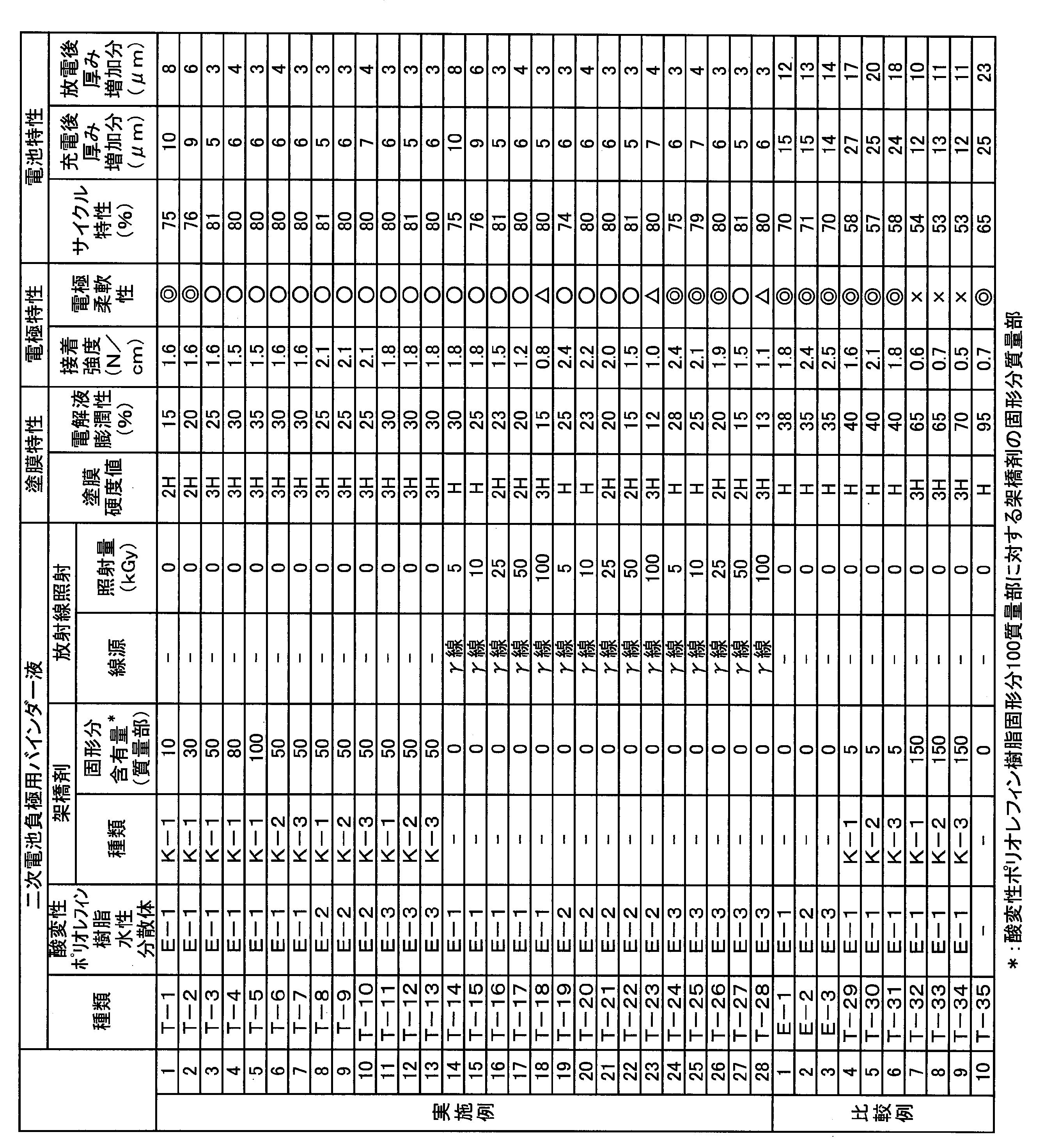
表2から明らかなように、実施例1~28で得られた二次電池負極用水系バインダー液は、特定量の架橋剤(B)を含有するか、または放射線照射により架橋された酸変性ポリオレフィン樹脂(A)を含むため、このバインダー液を塗布してなる塗膜は、塗膜硬度が高く、またこのバインダー液を含有するペーストから形成された二次電池負極は、活物質層と銅箔との接着強度が高いものであった。また、得られた二次電池は、充放電サイクルに伴う負極の膨張・収縮が小さいものであり、結果として、良好なサイクル特性を示した。
一方、比較例1~6で得られた二次電池負極は、活物質層と銅箔との接着強度が高いものであったが、使用したバインダー液は、架橋剤(B)の含有量が少ない、または放射線照射により架橋された酸変性ポリオレフィン樹脂(A)を含有しないものであったため、得られた二次電池は、充放電サイクルに伴う負極の膨張・収縮が大きく、結果として、サイクル特性が劣るものであった。
また、比較例7~9では、使用したバインダー液は、架橋剤(B)の含有量が多いものであったため、このバインダー液から得られる塗膜は、電解液により膨潤しやすいものであり、また得られた二次電池負極は、活物質層と銅箔との接着強度が低く、柔軟性も低いものであった。得られた二次電池は、充放電サイクルに伴う負極の膨張・収縮が大きく、サイクル特性が劣るものであった。
また、比較例10では、バインダー液を構成する樹脂として、PVDF樹脂を使用したため、このバインダー液から得られる塗膜は、電解液により膨潤しやすいものであった。また得られた二次電池負極は、活物質層と銅箔との接着強度が低いものであった。得られた二次電池は、充放電サイクルに伴う負極の膨張・収縮が大きく、サイクル特性が劣るものであった。
一方、比較例1~6で得られた二次電池負極は、活物質層と銅箔との接着強度が高いものであったが、使用したバインダー液は、架橋剤(B)の含有量が少ない、または放射線照射により架橋された酸変性ポリオレフィン樹脂(A)を含有しないものであったため、得られた二次電池は、充放電サイクルに伴う負極の膨張・収縮が大きく、結果として、サイクル特性が劣るものであった。
また、比較例7~9では、使用したバインダー液は、架橋剤(B)の含有量が多いものであったため、このバインダー液から得られる塗膜は、電解液により膨潤しやすいものであり、また得られた二次電池負極は、活物質層と銅箔との接着強度が低く、柔軟性も低いものであった。得られた二次電池は、充放電サイクルに伴う負極の膨張・収縮が大きく、サイクル特性が劣るものであった。
また、比較例10では、バインダー液を構成する樹脂として、PVDF樹脂を使用したため、このバインダー液から得られる塗膜は、電解液により膨潤しやすいものであった。また得られた二次電池負極は、活物質層と銅箔との接着強度が低いものであった。得られた二次電池は、充放電サイクルに伴う負極の膨張・収縮が大きく、サイクル特性が劣るものであった。
Claims (9)
- ケイ素原子、スズ原子またはゲルマニウム原子を含む活物質を有する二次電池負極を形成するためのバインダー液であり、不飽和カルボン酸成分を0.1~10質量%含有する酸変性ポリオレフィン樹脂(A)と、架橋剤(B)と、水性媒体とを含有し、架橋剤(B)の含有量が、酸変性ポリオレフィン樹脂(A)100質量部に対して、10~100質量部であることを特徴とする二次電池負極用水系バインダー液。
- ケイ素原子、スズ原子またはゲルマニウム原子を含む活物質を有する二次電池負極を形成するためのバインダー液であり、不飽和カルボン酸成分を0.1~10質量%含有する酸変性ポリオレフィン樹脂(A)と、水性媒体とを含有し、酸変性ポリオレフィン樹脂(A)が放射線照射により架橋されていることを特徴とする二次電池負極用水系バインダー液。
- 酸変性ポリオレフィン樹脂(A)が、エチレン成分を50~98質量%含有する酸変性ポリオレフィン樹脂(a)および/またはプロピレン成分と1-ブテン成分の少なくとも一つを50~98質量%含有する酸変性ポリオレフィン樹脂(b)であることを特徴とする請求項1または2記載の二次電池負極用水系バインダー液。
- 酸変性ポリオレフィン樹脂(A)の不飽和カルボン酸成分が、無水マレイン酸、マレイン酸、アクリル酸およびメタクリル酸からなる群から選ばれる少なくとも一種であることを特徴とする請求項1~3のいずれかに記載の二次電池負極用水系バインダー液。
- 架橋剤(B)が、オキサゾリン化合物、カルボジイミド化合物またはイソシアネート化合物であることを特徴とする請求項1または3または4記載の二次電池負極用水系バインダー液。
- 放射線照射の線源がγ線であり、照射量が1~100kGyであることを特徴とする請求項2~4のいずれかに記載の二次電池負極用水系バインダー液。
- 請求項1~6のいずれかに記載の二次電池負極用水系バインダー液と、ケイ素原子、スズ原子またはゲルマニウム原子を含む活物質とを含有する二次電池負極用水系ペースト。
- 請求項7記載の二次電池負極用水系ペーストを用いて形成された二次電池負極。
- 請求項8記載の二次電池負極を用いて形成された二次電池。
Priority Applications (1)
| Application Number | Priority Date | Filing Date | Title |
|---|---|---|---|
| PCT/JP2013/055903 WO2014136196A1 (ja) | 2013-03-05 | 2013-03-05 | 二次電池負極用水系バインダー液、およびこれを用いてなる二次電池負極用水系ペースト、二次電池負極、二次電池 |
Applications Claiming Priority (1)
| Application Number | Priority Date | Filing Date | Title |
|---|---|---|---|
| PCT/JP2013/055903 WO2014136196A1 (ja) | 2013-03-05 | 2013-03-05 | 二次電池負極用水系バインダー液、およびこれを用いてなる二次電池負極用水系ペースト、二次電池負極、二次電池 |
Publications (1)
| Publication Number | Publication Date |
|---|---|
| WO2014136196A1 true WO2014136196A1 (ja) | 2014-09-12 |
Family
ID=51490762
Family Applications (1)
| Application Number | Title | Priority Date | Filing Date |
|---|---|---|---|
| PCT/JP2013/055903 Ceased WO2014136196A1 (ja) | 2013-03-05 | 2013-03-05 | 二次電池負極用水系バインダー液、およびこれを用いてなる二次電池負極用水系ペースト、二次電池負極、二次電池 |
Country Status (1)
| Country | Link |
|---|---|
| WO (1) | WO2014136196A1 (ja) |
Cited By (1)
| Publication number | Priority date | Publication date | Assignee | Title |
|---|---|---|---|---|
| CN115771893A (zh) * | 2021-09-07 | 2023-03-10 | 贝特瑞新材料集团股份有限公司 | 负极材料前驱体、负极材料及其制备方法、负极片及锂离子电池 |
Citations (5)
| Publication number | Priority date | Publication date | Assignee | Title |
|---|---|---|---|---|
| WO2008029502A1 (fr) * | 2006-08-29 | 2008-03-13 | Unitika Ltd. | Liant pour fabrication d'électrode, boue pour fabrication d'électrode utilisant le liant, électrode utilisant la boue, batterie secondaire utilisant l'électrode et condensateur utilisant l'électrode |
| JP2009079078A (ja) * | 2007-09-25 | 2009-04-16 | Toyo Kasei Kogyo Co Ltd | 水性樹脂分散組成物の製造方法 |
| JP2010189632A (ja) * | 2009-01-21 | 2010-09-02 | Unitika Ltd | 酸変性ポリオレフィン樹脂水性分散体、二次電池電極用バインダー、電極および二次電池 |
| JP2011204573A (ja) * | 2010-03-26 | 2011-10-13 | Nippon Zeon Co Ltd | 二次電池負極用バインダー組成物、二次電池負極用スラリー組成物、二次電池用負極、二次電池及び二次電池負極用バインダー組成物の製造方法 |
| JP2012113894A (ja) * | 2010-11-22 | 2012-06-14 | Unitika Ltd | 二次電池電極のバインダー用樹脂組成物、及びこれを用いてなるバインダー液、二次電池電極、二次電池 |
-
2013
- 2013-03-05 WO PCT/JP2013/055903 patent/WO2014136196A1/ja not_active Ceased
Patent Citations (5)
| Publication number | Priority date | Publication date | Assignee | Title |
|---|---|---|---|---|
| WO2008029502A1 (fr) * | 2006-08-29 | 2008-03-13 | Unitika Ltd. | Liant pour fabrication d'électrode, boue pour fabrication d'électrode utilisant le liant, électrode utilisant la boue, batterie secondaire utilisant l'électrode et condensateur utilisant l'électrode |
| JP2009079078A (ja) * | 2007-09-25 | 2009-04-16 | Toyo Kasei Kogyo Co Ltd | 水性樹脂分散組成物の製造方法 |
| JP2010189632A (ja) * | 2009-01-21 | 2010-09-02 | Unitika Ltd | 酸変性ポリオレフィン樹脂水性分散体、二次電池電極用バインダー、電極および二次電池 |
| JP2011204573A (ja) * | 2010-03-26 | 2011-10-13 | Nippon Zeon Co Ltd | 二次電池負極用バインダー組成物、二次電池負極用スラリー組成物、二次電池用負極、二次電池及び二次電池負極用バインダー組成物の製造方法 |
| JP2012113894A (ja) * | 2010-11-22 | 2012-06-14 | Unitika Ltd | 二次電池電極のバインダー用樹脂組成物、及びこれを用いてなるバインダー液、二次電池電極、二次電池 |
Cited By (2)
| Publication number | Priority date | Publication date | Assignee | Title |
|---|---|---|---|---|
| CN115771893A (zh) * | 2021-09-07 | 2023-03-10 | 贝特瑞新材料集团股份有限公司 | 负极材料前驱体、负极材料及其制备方法、负极片及锂离子电池 |
| CN115771893B (zh) * | 2021-09-07 | 2024-08-09 | 贝特瑞新材料集团股份有限公司 | 负极材料前驱体、负极材料及其制备方法、负极片及锂离子电池 |
Similar Documents
| Publication | Publication Date | Title |
|---|---|---|
| JP2013127959A (ja) | 二次電池負極用水系バインダー液、およびこれを用いてなる二次電池負極用水系ペースト、二次電池負極、二次電池 | |
| JP6877130B2 (ja) | 多孔性接着層を含む分離膜およびこれを含む電気化学電池 | |
| JP2014063676A (ja) | 二次電池正極用水系バインダー液、およびこれを用いてなる二次電池正極用水系ペースト、二次電池正極、二次電池 | |
| US9202631B2 (en) | Porous film and secondary battery electrode | |
| CN104471762B (zh) | 锂离子二次电池负极用浆料、锂离子二次电池用电极及其制造方法、以及锂离子二次电池 | |
| US20110062378A1 (en) | Cathode active material for lithium secondary battery | |
| KR102737631B1 (ko) | 비수계 이차 전지 전극용 바인더 조성물, 비수계 이차 전지 전극용 도전재 페이스트 조성물, 비수계 이차 전지 전극용 슬러리 조성물, 비수계 이차 전지용 전극 및 비수계 이차 전지 | |
| TW200410439A (en) | Binder composition for electrode of nonaqueous electrolyte battery, and use thereof | |
| JP2010189632A (ja) | 酸変性ポリオレフィン樹脂水性分散体、二次電池電極用バインダー、電極および二次電池 | |
| JP5553583B2 (ja) | 二次電池電極用バインダー、二次電池電極用バインダーを用いてなる電極及び二次電池 | |
| JP2010055972A (ja) | 二次電池電極用バインダー、それを用いてなる電極及び二次電池 | |
| JP6070266B2 (ja) | リチウムイオン二次電池正極用スラリー組成物、リチウムイオン二次電池用正極の製造方法、リチウムイオン二次電池用正極、及び、リチウムイオン二次電池 | |
| JP2016009544A (ja) | 二次電池電極用バインダー、スラリー、二次電池電極および二次電池 | |
| JP2012234707A (ja) | 二次電池電極のバインダー用樹脂組成物、及びこれを用いてなるバインダー液、二次電池電極、二次電池 | |
| JP5195429B2 (ja) | 非水電解質二次電池用電極、およびこれを用いた非水電解質二次電池 | |
| CN115956309A (zh) | 具有优异湿粘附性的用于电极的绝缘性组合物和其制备方法 | |
| JP2017033871A (ja) | 負極及びリチウムイオン二次電池並びにその製造方法 | |
| JP2010277959A (ja) | 二次電池電極用バインダー用樹脂組成物、二次電池電極用バインダー、二次電池電極用バインダーを用いてなる電極及び二次電池 | |
| CN116830318A (zh) | 负极粘合剂组合物、负极和二次电池 | |
| JP7110986B2 (ja) | 導電性組成物 | |
| JP2012113894A (ja) | 二次電池電極のバインダー用樹脂組成物、及びこれを用いてなるバインダー液、二次電池電極、二次電池 | |
| CN116420252A (zh) | 使用包含经非水性溶剂置换的水性粘合剂的绝缘组合物制造二次电池用电极的方法 | |
| JP2020198275A (ja) | 全固体電池用集電体および全固体電池 | |
| WO2022230517A1 (ja) | エネルギー貯蔵デバイス電極用薄膜形成用組成物 | |
| JP7729479B2 (ja) | エネルギー貯蔵デバイス電極用薄膜形成組成物 |
Legal Events
| Date | Code | Title | Description |
|---|---|---|---|
| 121 | Ep: the epo has been informed by wipo that ep was designated in this application |
Ref document number: 13876860 Country of ref document: EP Kind code of ref document: A1 |
|
| NENP | Non-entry into the national phase |
Ref country code: DE |
|
| 122 | Ep: pct application non-entry in european phase |
Ref document number: 13876860 Country of ref document: EP Kind code of ref document: A1 |
|
| NENP | Non-entry into the national phase |
Ref country code: JP |