WO2014122852A1 - パターン形成方法、感活性光線性又は感放射線性樹脂組成物、レジスト膜、電子デバイスの製造方法、及び、電子デバイス - Google Patents
パターン形成方法、感活性光線性又は感放射線性樹脂組成物、レジスト膜、電子デバイスの製造方法、及び、電子デバイス Download PDFInfo
- Publication number
- WO2014122852A1 WO2014122852A1 PCT/JP2013/083238 JP2013083238W WO2014122852A1 WO 2014122852 A1 WO2014122852 A1 WO 2014122852A1 JP 2013083238 W JP2013083238 W JP 2013083238W WO 2014122852 A1 WO2014122852 A1 WO 2014122852A1
- Authority
- WO
- WIPO (PCT)
- Prior art keywords
- group
- carbon atoms
- formula
- hydrocarbon group
- acid
- Prior art date
- Legal status (The legal status is an assumption and is not a legal conclusion. Google has not performed a legal analysis and makes no representation as to the accuracy of the status listed.)
- Ceased
Links
Classifications
-
- G—PHYSICS
- G03—PHOTOGRAPHY; CINEMATOGRAPHY; ANALOGOUS TECHNIQUES USING WAVES OTHER THAN OPTICAL WAVES; ELECTROGRAPHY; HOLOGRAPHY
- G03F—PHOTOMECHANICAL PRODUCTION OF TEXTURED OR PATTERNED SURFACES, e.g. FOR PRINTING, FOR PROCESSING OF SEMICONDUCTOR DEVICES; MATERIALS THEREFOR; ORIGINALS THEREFOR; APPARATUS SPECIALLY ADAPTED THEREFOR
- G03F7/00—Photomechanical, e.g. photolithographic, production of textured or patterned surfaces, e.g. printing surfaces; Materials therefor, e.g. comprising photoresists; Apparatus specially adapted therefor
- G03F7/004—Photosensitive materials
- G03F7/038—Macromolecular compounds which are rendered insoluble or differentially wettable
-
- G—PHYSICS
- G03—PHOTOGRAPHY; CINEMATOGRAPHY; ANALOGOUS TECHNIQUES USING WAVES OTHER THAN OPTICAL WAVES; ELECTROGRAPHY; HOLOGRAPHY
- G03F—PHOTOMECHANICAL PRODUCTION OF TEXTURED OR PATTERNED SURFACES, e.g. FOR PRINTING, FOR PROCESSING OF SEMICONDUCTOR DEVICES; MATERIALS THEREFOR; ORIGINALS THEREFOR; APPARATUS SPECIALLY ADAPTED THEREFOR
- G03F7/00—Photomechanical, e.g. photolithographic, production of textured or patterned surfaces, e.g. printing surfaces; Materials therefor, e.g. comprising photoresists; Apparatus specially adapted therefor
- G03F7/004—Photosensitive materials
- G03F7/0045—Photosensitive materials with organic non-macromolecular light-sensitive compounds not otherwise provided for, e.g. dissolution inhibitors
-
- G—PHYSICS
- G03—PHOTOGRAPHY; CINEMATOGRAPHY; ANALOGOUS TECHNIQUES USING WAVES OTHER THAN OPTICAL WAVES; ELECTROGRAPHY; HOLOGRAPHY
- G03F—PHOTOMECHANICAL PRODUCTION OF TEXTURED OR PATTERNED SURFACES, e.g. FOR PRINTING, FOR PROCESSING OF SEMICONDUCTOR DEVICES; MATERIALS THEREFOR; ORIGINALS THEREFOR; APPARATUS SPECIALLY ADAPTED THEREFOR
- G03F7/00—Photomechanical, e.g. photolithographic, production of textured or patterned surfaces, e.g. printing surfaces; Materials therefor, e.g. comprising photoresists; Apparatus specially adapted therefor
- G03F7/004—Photosensitive materials
- G03F7/039—Macromolecular compounds which are photodegradable, e.g. positive electron resists
- G03F7/0392—Macromolecular compounds which are photodegradable, e.g. positive electron resists the macromolecular compound being present in a chemically amplified positive photoresist composition
- G03F7/0397—Macromolecular compounds which are photodegradable, e.g. positive electron resists the macromolecular compound being present in a chemically amplified positive photoresist composition the macromolecular compound having an alicyclic moiety in a side chain
-
- G—PHYSICS
- G03—PHOTOGRAPHY; CINEMATOGRAPHY; ANALOGOUS TECHNIQUES USING WAVES OTHER THAN OPTICAL WAVES; ELECTROGRAPHY; HOLOGRAPHY
- G03F—PHOTOMECHANICAL PRODUCTION OF TEXTURED OR PATTERNED SURFACES, e.g. FOR PRINTING, FOR PROCESSING OF SEMICONDUCTOR DEVICES; MATERIALS THEREFOR; ORIGINALS THEREFOR; APPARATUS SPECIALLY ADAPTED THEREFOR
- G03F7/00—Photomechanical, e.g. photolithographic, production of textured or patterned surfaces, e.g. printing surfaces; Materials therefor, e.g. comprising photoresists; Apparatus specially adapted therefor
- G03F7/004—Photosensitive materials
- G03F7/09—Photosensitive materials characterised by structural details, e.g. supports, auxiliary layers
- G03F7/11—Photosensitive materials characterised by structural details, e.g. supports, auxiliary layers having cover layers or intermediate layers, e.g. subbing layers
-
- G—PHYSICS
- G03—PHOTOGRAPHY; CINEMATOGRAPHY; ANALOGOUS TECHNIQUES USING WAVES OTHER THAN OPTICAL WAVES; ELECTROGRAPHY; HOLOGRAPHY
- G03F—PHOTOMECHANICAL PRODUCTION OF TEXTURED OR PATTERNED SURFACES, e.g. FOR PRINTING, FOR PROCESSING OF SEMICONDUCTOR DEVICES; MATERIALS THEREFOR; ORIGINALS THEREFOR; APPARATUS SPECIALLY ADAPTED THEREFOR
- G03F7/00—Photomechanical, e.g. photolithographic, production of textured or patterned surfaces, e.g. printing surfaces; Materials therefor, e.g. comprising photoresists; Apparatus specially adapted therefor
- G03F7/20—Exposure; Apparatus therefor
- G03F7/2041—Exposure; Apparatus therefor in the presence of a fluid, e.g. immersion; using fluid cooling means
-
- G—PHYSICS
- G03—PHOTOGRAPHY; CINEMATOGRAPHY; ANALOGOUS TECHNIQUES USING WAVES OTHER THAN OPTICAL WAVES; ELECTROGRAPHY; HOLOGRAPHY
- G03F—PHOTOMECHANICAL PRODUCTION OF TEXTURED OR PATTERNED SURFACES, e.g. FOR PRINTING, FOR PROCESSING OF SEMICONDUCTOR DEVICES; MATERIALS THEREFOR; ORIGINALS THEREFOR; APPARATUS SPECIALLY ADAPTED THEREFOR
- G03F7/00—Photomechanical, e.g. photolithographic, production of textured or patterned surfaces, e.g. printing surfaces; Materials therefor, e.g. comprising photoresists; Apparatus specially adapted therefor
- G03F7/26—Processing photosensitive materials; Apparatus therefor
- G03F7/30—Imagewise removal using liquid means
- G03F7/32—Liquid compositions therefor, e.g. developers
- G03F7/325—Non-aqueous compositions
Definitions
- the present invention relates to a pattern forming method, an actinic ray-sensitive or radiation-sensitive resin composition, a resist film, an electronic device manufacturing method, and an electronic device. More specifically, the present invention relates to a pattern forming method suitable for a semiconductor manufacturing process such as an IC, a manufacturing process of a circuit board such as a liquid crystal and a thermal head, and other photofabrication lithography processes. The present invention relates to an actinic ray-sensitive or radiation-sensitive resin composition used, a resist film formed from the composition, an electronic device manufacturing method including the pattern forming method, and an electronic device.
- the present invention relates to an ArF exposure apparatus using far ultraviolet light having a wavelength of 300 nm or less as a light source, a pattern forming method suitable for exposure in an ArF immersion projection exposure apparatus, and an actinic ray used in the pattern forming method.
- the present invention relates to a photosensitive or radiation-sensitive resin composition, a resist film, a method for producing an electronic device, and an electronic device.
- a pattern formation method using chemical amplification has been used to compensate for the sensitivity reduction due to light absorption.
- a photoacid generator contained in an exposed portion is decomposed by light irradiation to generate an acid.
- PEB Post Exposure Bake
- the alkali-insoluble group contained in the photosensitive composition is changed to an alkali-soluble group by the catalytic action of the generated acid.
- development is performed using, for example, an alkaline solution.
- an exposed part is removed and a desired pattern is obtained.
- various alkali developers have been proposed.
- an aqueous alkaline developer such as 2.38 mass% TMAH (tetramethylammonium hydroxide aqueous solution) is generally used as the alkaline developer.
- the exposure light source has become shorter in wavelength and the projection lens has a higher numerical aperture (high NA).
- high NA numerical aperture
- a method of filling a liquid having a high refractive index (hereinafter also referred to as “immersion liquid”) between the projection lens and the sample that is, an immersion method
- EUV lithography in which exposure is performed with ultraviolet light having a shorter wavelength (13.5 nm) has also been proposed.
- Patent Documents 5 and 6 use a process of applying a resist composition whose solubility in an organic developer is reduced by irradiation with actinic rays or radiation on a substrate, an exposure process, and an organic developer.
- a pattern forming method including a developing step is disclosed. According to these methods, it is supposed that a highly accurate fine pattern can be stably formed.
- the present invention has the following configuration.
- Compound (a) A pattern forming method comprising: exposing the film; and (c) developing the exposed film with a developer containing an organic solvent to form a negative pattern.
- R 4 is selected from a carbonyl group: —C ( ⁇ O) —, a sulfonyl group: —S ( ⁇ O) 2 —, and a sulfinyl group: —S ( ⁇ O) — at the linking site with the adjacent N atom.
- Two groups selected from R 1 , R 2 and L 1 in formula (C-1) may be linked to form a ring structure.
- R 1 and L 1 in the general formula (C-2) may be linked to form a ring structure.
- Two or more groups selected from R 1 , R 2 , R 3 and L 1 in the general formula (C-3) may be linked to form a ring structure.
- Two or more groups selected from R 1 , R 2 , R 3 and L 1 in formula (C-4) may be linked to form a ring structure.
- the developer is a developer containing at least one organic solvent selected from the group consisting of ketone solvents, ester solvents, alcohol solvents, amide solvents and ether solvents, [1] to [1] [3]
- LWR is small, development defects are small, pattern profile, pattern forming method excellent in CDU, actinic ray-sensitive or radiation-sensitive resin composition used therefor, resist film, method for producing electronic device, and An electronic device can be provided.
- a notation that does not indicate substitution or non-substitution refers to a group (atomic group) having a substituent together with a group (atomic group) having no substituent.
- the “alkyl group” includes not only an alkyl group having no substituent (unsubstituted alkyl group) but also an alkyl group having a substituent (substituted alkyl group).
- active light or “radiation” means, for example, the emission line spectrum of a mercury lamp, far ultraviolet rays represented by excimer laser, extreme ultraviolet rays (EUV light), X-rays, electron beams (EB), etc. To do.
- light means actinic rays or radiation.
- exposure in the present specification is not limited to exposure to deep ultraviolet rays, extreme ultraviolet rays, X-rays, EUV light, etc. represented by mercury lamps and excimer lasers, but also particles such as electron beams and ion beams. Line drawing is also included in the exposure.
- (meth) acrylate” and “(meth) acrylic acid” mean “at least one of acrylate and methacrylate” and “at least one of acrylic acid and methacrylic acid”, respectively.
- the pattern forming method of the present invention comprises: (A) forming a film with an actinic ray-sensitive or radiation-sensitive resin composition containing the following (A) to (C): (A) a resin whose polarity increases by the action of an acid and whose solubility in a developer containing an organic solvent decreases, (B) a compound that generates an acid upon irradiation with actinic rays or radiation, and (C) a cation moiety and an anion moiety in the same molecule, and the cation moiety and the anion moiety are linked by a covalent bond.
- a pattern forming method having small LWR, few development defects, and excellent pattern profile and CDU, an actinic ray-sensitive or radiation-sensitive resin composition used therefor, a resist film, a method for producing an electronic device, and An electronic device can be provided.
- the compound (C) contained in the actinic ray-sensitive or radiation-sensitive resin composition used in the pattern forming method of the present invention has an anion portion and a cation portion in the same molecule, so that the cation portion is decomposed during exposure. And the molecular weight of the said compound (C) falls. As a result, the solubility of the exposed portion in the developer containing the organic solvent is further lowered, and as a result, the dissolution contrast is improved, so that the LWR and the number of development defects of the formed pattern are reduced, and the pattern profile and CDU are improved. It is thought to do.
- the pattern forming method of the present invention preferably further includes (d) a step of cleaning with a rinse liquid containing an organic solvent.
- the rinsing liquid may be a rinsing liquid containing at least one organic solvent selected from the group consisting of hydrocarbon solvents, ketone solvents, ester solvents, alcohol solvents, amide solvents, and ether solvents. preferable.
- the pattern forming method of the present invention preferably includes (e) a heating step after (b) the exposure step.
- the resin (A) is also a resin whose polarity is increased by the action of an acid and its solubility in an alkaline developer is increased. Therefore, the pattern forming method of the present invention may further include (f) a step of developing using an alkali developer.
- the pattern forming method of the present invention can have (b) an exposure step a plurality of times.
- the pattern forming method of the present invention can include (e) a heating step a plurality of times.
- the resist film of the present invention is a film formed from the actinic ray-sensitive or radiation-sensitive resin composition, and is formed, for example, by applying an actinic ray-sensitive or radiation-sensitive resin composition to a substrate. It is a film to be made.
- the present invention also relates to an actinic ray-sensitive or radiation-sensitive resin composition described below.
- the actinic ray-sensitive or radiation-sensitive resin composition of the present invention contains the following components.
- Resin (A) is a resin whose polarity increases due to the action of an acid and its solubility in an organic solvent decreases.
- resin (A) is a resin whose polarity increases due to the action of an acid and its solubility in an organic solvent decreases.
- a part or all of the hydrophilic group in the molecule is protected by a protecting group that can be removed by contact with an acid, and the resin (A) is in contact with an acid. Then, this protecting group is eliminated and the solubility of the resin (A) in the organic solvent decreases.
- the hydrophilic group protected by this protecting group is hereinafter referred to as “acid labile group”.
- the resin (A) can be produced by polymerizing a monomer having an acid labile group (hereinafter sometimes referred to as “monomer (a1)”). In the polymerization, only one type of monomer (a1) may be used, or two or more types may be used in combination.
- the monomer (a1) has an acid labile group.
- the acid labile group is a group in which the hydrogen atom of the carboxy group is replaced with an organic residue, and the atom of the organic residue bonded to the oxy group is a tertiary carbon atom. It is done.
- acid labile groups preferred acid labile groups are represented, for example, by the following formula (1) (hereinafter sometimes referred to as “acid labile groups (1)”).
- R a1 , R a2 and R a3 are each independently an aliphatic hydrocarbon group (preferably having a carbon number 1 to 8) or an alicyclic hydrocarbon group (preferably having 3 to 20 carbon atoms), or R a1 and R a2 are bonded to each other, and a ring (preferably having a carbon number) together with the carbon atom to which they are bonded. 3 to 20).
- the aliphatic hydrocarbon group the alicyclic hydrocarbon group or the ring formed by combining R a1 and R a2 with each other has a methylene group
- the methylene group is an oxy group, —S— or a carbonyl group. May be replaced. * Represents a bond. ]
- Examples of the aliphatic hydrocarbon group represented by R a1 to R a3 include alkyl groups such as a methyl group, an ethyl group, a propyl group, a butyl group, a pentyl group, and a hexyl group.
- the alicyclic hydrocarbon group of R a1 to R a3 may be monocyclic or polycyclic, and may be either unsaturated or saturated that does not exhibit aromaticity.
- Examples of the monocyclic alicyclic hydrocarbon group include cycloalkyl groups such as a cyclopentyl group, a cyclohexyl group, a methylcyclohexyl group, a dimethylcyclohexyl group, a cycloheptyl group, and a cyclooctyl group.
- Examples of the polycyclic alicyclic hydrocarbon group include decahydronaphthyl group, adamantyl group, norbornyl group and methylnorbornyl group, and groups shown below.
- the alicyclic hydrocarbon group of R a1 to R a3 is preferably a saturated hydrocarbon group, and preferably has 3 to 16 carbon atoms.
- examples of the group represented by —C (R a1 ) (R a2 ) (R a3 ) include the following groups.
- the number of carbon atoms in the ring formed by combining R a1 and R a2 with each other is preferably 3 to 12.
- the acid labile group (1) are: 1,1-dialkylalkoxycarbonyl group (in formula (1), all of R a1 to R a3 are alkyl groups, and one of these alkyl groups is preferably a tert-butoxycarbonyl group), 2-alkyladamantan-2-yloxycarbonyl group (in formula (1), R a1 and R a2 are bonded to each other to form an adamantyl ring together with the carbon atoms to which they are bonded, and R a3 is an alkyl group) And 1- (adamantan-1-yl) -1-alkylalkoxycarbonyl group (in the formula (1), R a1 and R a2 are alkyl groups, and R a3 is an adamantyl group).
- examples of the acid labile group in the case where the hydrophilic group is a hydroxy group include those in which the hydrogen atom of the hydroxy group is replaced with an organic residue to become a group containing an acetal structure.
- preferred acid labile groups are, for example, those represented by the following formula (2) (hereinafter sometimes referred to as “acid labile groups (2)”).
- R b1 and R b2 each independently represent a hydrogen atom or a hydrocarbon group (preferably having 1 to 12 carbon atoms), and R b3 represents a hydrocarbon group (preferably having 1 to 12 carbon atoms).
- R b2 and R b3 are bonded to each other to form a ring (preferably having 3 to 20 carbon atoms) together with the carbon atom and the oxygen atom to which they are bonded.
- the ring formed by combining the hydrocarbon group or R b2 and R b3 with each other has a methylene group, the methylene group may be replaced with an oxy group, —S— or a carbonyl group. * Represents a bond.
- hydrocarbon group examples include an aliphatic hydrocarbon group, an alicyclic hydrocarbon group, and an aromatic hydrocarbon group.
- R b1 and R b2 at least one is preferably a hydrogen atom.
- acid labile group (2) examples include the following groups.
- the monomer (a1) having an acid labile group is preferably a monomer having an acid labile group and a carbon-carbon double bond, more preferably a (meth) acrylic monomer having an acid labile group.
- the monomer (a1) is preferably a monomer having both an acid labile group (1) and / or an acid labile group (2) and a carbon-carbon double bond in the molecule, more preferably It is a (meth) acrylic monomer having an acid labile group (1).
- the acid labile group (1) is preferably a group having an alicyclic hydrocarbon structure having 5 to 20 carbon atoms.
- the resin (A) obtained by polymerizing the monomer (a1) having a group having such a sterically bulky alicyclic hydrocarbon structure uses the resist composition of the present invention containing the resin (A).
- the resist pattern can be manufactured with better resolution.
- (meth) acryl represents acryl and / or methacryl.
- (meth) acrylic monomers having an acid labile group (1) containing an alicyclic hydrocarbon structure a monomer represented by the formula (a1-1) (hereinafter referred to as “monomer (a1-1)”) And a monomer represented by the formula (a1-2) (hereinafter sometimes referred to as “monomer (a1-2)”) are preferable.
- resin (A) contains at least one selected from a repeating unit derived from a monomer represented by formula (a1-1) and a repeating unit derived from a monomer represented by formula (a1-2) Is preferred.
- the resin (A) preferably contains at least one repeating unit derived from the monomer represented by the formula (a1-1) and one repeating unit derived from the monomer represented by the formula (a1-2). . In another embodiment, the resin (A) preferably contains two or more repeating units derived from the monomer represented by the formula (a1-2). In the resin (A), the ratio of the total amount of the repeating units derived from the monomer represented by the formula (a1-1) and the repeating units derived from the monomer represented by the formula (a1-2) to the total repeating units is: It is preferably 40 mol% or more, more preferably 45 mol% or more, and further preferably 50 mol% or more.
- the ratio of the repeating unit derived from the monomer represented by the formula (a1-2) to the total repeating units is preferably 30 mol% or more, more preferably 35 mol% or more, and 40 mol % Or more is more preferable.
- the content ratio of each repeating unit in the resin (A) can be measured by, for example, 13 C-NMR.
- L a1 and L a2 each independently represent an oxy group or a group represented by * —O— (CH 2 ) k1 —CO—O—.
- k1 represents an integer of 1 to 7
- * is a bond with a carbonyl group (—CO—).
- R a4 and R a5 each independently represent a hydrogen atom or a methyl group.
- R a6 and R a7 each independently represents an aliphatic hydrocarbon group (preferably having 1 to 8 carbon atoms) or an alicyclic hydrocarbon group (preferably having 3 to 10 carbon atoms).
- m1 represents an integer of 0 to 14
- n1 represents an integer of 0 to 10.
- n1 ′ represents an integer of 0 to 3.
- the notation “— (CH 3 ) m1 ” in the adamantane ring is a hydrogen atom bonded to a carbon atom constituting the adamantane ring (that is, a hydrogen atom of a methylene group and / or a methine group). Is replaced by a methyl group, and the number of the methyl group is m1.
- L a1 and L a2 are preferably an oxy group or * —O— (CH 2 ) f1 —CO—O— (where f1 is 1 to 4 represents an integer of 4, and more preferably an oxy group. f1 is more preferably 1.
- R a4 and R a5 are preferably methyl groups.
- the aliphatic hydrocarbon group for R a6 or R a7 is preferably a group having 6 or less carbon atoms.
- the alicyclic hydrocarbon group for R a6 or R a7 preferably has 8 or less carbon atoms, more preferably 6 or less.
- R a6 or R a7 is an alicyclic hydrocarbon group
- the alicyclic hydrocarbon group may be monocyclic or polycyclic, and may be either saturated or unsaturated, but saturated hydrocarbon It is preferably a group.
- m1 is preferably an integer of 0 to 3, more preferably 0 or 1.
- n1 is preferably an integer of 0 to 3, more preferably 0 or 1.
- n1 ′ is preferably 0 or 1.
- Examples of the monomer (a1-1) include the following.
- 2-methyladamantan-2-yl (meth) acrylate, 2-ethyladamantan-2-yl (meth) acrylate and 2-isopropyladamantan-2-yl (meth) Acrylates are preferred, with 2-methyladamantan-2-yl methacrylate, 2-ethyladamantan-2-yl methacrylate and 2-isopropyladamantan-2-yl methacrylate being more preferred.
- Examples of the monomer (a1-2) include the following. Among these, as the monomer (a1-2), 1-ethylcyclohexyl (meth) acrylate is preferable, and 1-ethylcyclohexyl methacrylate is more preferable.
- the content of the structural unit derived from the monomer (a1) is preferably in the range of 10 to 95 mol%, more preferably in the range of 15 to 90 mol%, still more preferably in the range of 20 to 85 mol%, and 50 to 85 mol%.
- a range of mol% is particularly preferred.
- the usage amount of the monomer (a1) with respect to the usage amount of all monomers should be adjusted. That's fine.
- the resin (A) in addition to the (meth) acrylic monomer (that is, the monomer (a1-1) and the monomer (a1-2)), an acid labile group (1), a carbon-carbon double bond, Other monomers having in the molecule can also be used.
- the monomer (a1) having an acid labile group (2) is preferably a (meth) acrylic monomer.
- a monomer represented by the formula (a1-5) hereinafter referred to as “monomer (a1-5)”) There is a).
- R 31 represents a hydrogen atom, a halogen atom or an alkyl group (preferably having 1 to 6 carbon atoms) which may have a halogen atom.
- L 1 to L 3 each represents an oxy group, a group represented by —S— or * —O— (CH 2 ) k1 —CO—O—.
- k1 represents an integer of 1 to 7
- * is a bond with a carbonyl group (—CO—).
- Z 1 is a single bond or an alkylene group (preferably having 1 to 6 carbon atoms), and the methylene group contained in the alkylene group may be replaced with an oxy group or a carbonyl group.
- s1 and s1 ′ each independently represents an integer of 0 to 4. ]
- R 31 is preferably a hydrogen atom or a methyl group.
- L 1 is preferably an oxy group.
- One of L 2 and L 3 is preferably an oxy group and the other is —S—.
- s1 is preferably 1.
- s1 ′ is preferably 0-2.
- Z 1 is preferably a single bond or —CH 2 —CO—O—.
- the content thereof is in the range of 10 to 95 mol% with respect to all the structural units (100 mol%) of the resin (A).
- the range of 15 to 90 mol% is more preferable, and the range of 20 to 85 mol% is more preferable.
- the resin (A) used in the resist composition is a copolymer obtained by using a monomer having no acid labile group (hereinafter sometimes referred to as “acid-stable monomer”) in addition to the monomer (a1). Preferably there is.
- the amount of acid-stable monomer can be determined based on the amount of monomer (a1) used.
- the ratio of the amount of monomer (a1) used and the amount of acid-stable monomer used is expressed as [monomer (a1)] / [acid-stable monomer], and is preferably 10 to 80 mol% / 90 to 20 mol%. More preferably, it is 20 to 60 mol% / 80 to 40 mol%.
- the monomer having an adamantyl group particularly, monomer (a1-1)
- the monomer having an adamantyl group with respect to the total amount (100 mol%) of the monomer (a1) used It is preferable to use 15 mol% or more. Thereby, there exists a tendency for the dry etching tolerance of the resist pattern obtained from the resist composition containing resin (A) to become more favorable.
- acid-stable monomer examples include those having a hydroxy group or a lactone ring in the molecule.
- Acid-stable monomer having a hydroxy group hereinafter sometimes referred to as “acid-stable monomer (a2)” and / or acid-stable monomer having a lactone ring (hereinafter referred to as “acid-stable monomer (a3)”)
- the resin (A) having a structural unit derived from.) Is a coating film formed on the substrate or a composition layer obtained from the coating film when the resist composition containing the resin (A) is applied to the substrate. It becomes easy to express the outstanding adhesiveness between. Further, such a resist composition can produce a resist pattern with good resolution.
- a suitable acid-stable monomer (a2) is used depending on the type of exposure source when obtaining a resist pattern from the resist composition containing the resin (A).
- the resist composition of the present invention is used for KrF excimer laser exposure (wavelength: 248 nm), high energy beam exposure such as electron beam or EUV light, a phenolic hydroxy group is used as the acid stable monomer (a2).
- the acid-stable monomer (a2-0) [for example, hydroxystyrenes] having for the production of the resin (A).
- an acid-stable monomer represented by the formula (a2-1) described later is used for the production of the resin (A) as the acid-stable monomer (a2).
- the acid-stable monomer (a2) used for the production of the resin (A) can be preferably selected depending on the exposure source used for producing the resist pattern.
- the acid-stable monomer (a2) The resin (A) may be produced using only one kind of monomer suitable for the kind of the resin, or the resin (A) may be produced using two or more kinds of suitable monomers for the kind of the exposure source. Alternatively, the resin (A) may be produced using a suitable monomer according to the type of exposure source and two or more of the other acid stable monomers (a2).
- acid stable monomer (a2) a styrene monomer such as p- or m-hydroxystyrene represented by the following formula (a2-0) (hereinafter referred to as “acid stable monomer (a2-0)”). Can be mentioned.
- the formula (a2-0) is shown in a form in which the phenolic hydroxy group is not protected with a suitable protecting group.
- R a30 represents an alkyl group (preferably having 1 to 6 carbon atoms) which may have a halogen atom, a hydrogen atom or a halogen atom.
- R a31 is a halogen atom, a hydroxy group, an alkyl group (preferably having 1 to 6 carbon atoms), an alkoxy group (preferably having 1 to 6 carbon atoms), an acyl group (preferably having 2 to 4 carbon atoms), an acyloxy group (preferably Represents an acryloyl group or a methacryloyl group having 2 to 4 carbon atoms.
- ma represents an integer of 0 to 4. When ma is an integer of 2 or more, each of the plurality of R a31 is independent.
- R a30 and the alkyl group having 1 to 6 carbon atoms which may have a halogen atom include the same groups as those exemplified in the description of R a32 of the monomer (a1-4).
- R a30 is preferably an alkyl group having 1 to 4 carbon atoms, more preferably a methyl group or an ethyl group, and further preferably a methyl group.
- the alkyl group for R 31 an alkyl group having 1 to 4 carbon atoms is preferable, an alkyl group having 1 or 2 carbon atoms is more preferable, and a methyl group is particularly preferable.
- R a31 examples include the same groups as those exemplified in the description of R a33 of the monomer (a1-4).
- R a31 is preferably an alkoxy group having 1 to 4 carbon atoms, more preferably a methoxy group or an ethoxy group, and further preferably a methoxy group.
- ma is preferably 0, 1 or 2, more preferably 0 or 1, and still more preferably 0.
- the resin (A) having a structural unit derived from such an acid stable monomer (a2-0) is produced, the phenolic hydroxy group in the acid stable monomer (a2-0) is protected with a protecting group.
- Monomers can be used.
- the protecting group include a protecting group that is eliminated with an acid. Since the phenolic hydroxy group protected with a protecting group capable of leaving with an acid can be deprotected by contact with an acid, a structural unit derived from an acid stable monomer (a2-0) can be easily formed. Can do.
- the resin (A) since the resin (A) has the structural unit (a1) containing an acid labile group, an acid stable monomer in which a phenolic hydroxy group is protected with a protective group that can be deprotected with a base ( When carrying out the polymerization using a2-0) and deprotecting, it is preferable to deprotect by contact with a base so as not to significantly impair the acid labile group of the structural unit (a1).
- the protecting group that can be deprotected with a base include an acetyl group and the like.
- the base include 4-dimethylaminopyridine, triethylamine and the like.
- Examples of the acid stable monomer (a2-0) include the following monomers.
- the phenolic hydroxy group is not protected by a protecting group.
- 4-hydroxystyrene or 4-hydroxy- ⁇ -methylstyrene is particularly preferable.
- the resin (A) is produced using 4-hydroxystyrene or 4-hydroxy- ⁇ -methylstyrene, it is preferable to use those obtained by protecting the phenolic hydroxy group in these with a protective group.
- the content thereof is 5 to 95 mol% with respect to the total structural unit (100 mol%) of the resin (A). Is preferably selected from the range of 10 to 80 mol%, more preferably 15 to 80 mol%.
- Examples of the acid stable monomer (a2-1) include monomers represented by the following formula (a2-1).
- L a3 represents an oxy group or * —O— (CH 2 ) k2 —CO—O—, k2 represents an integer of 1 to 7.
- R a14 represents a hydrogen atom or a methyl group.
- R a15 and R a16 each independently represent a hydrogen atom, a methyl group or a hydroxy group.
- o1 represents an integer of 0 to 10.
- L a3 is preferably an oxy group, —O— (CH 2 ) f1 —CO—O— (where f1 is an integer of 1 to 4), more preferably Is an oxy group.
- R a14 is preferably a methyl group.
- R a15 is preferably a hydrogen atom.
- R a16 is preferably a hydrogen atom or a hydroxy group.
- o1 is preferably an integer of 0 to 3, more preferably 0 or 1.
- Examples of the acid stable monomer (a2-1) include the following. Among these, 3-hydroxyadamantan-1-yl (meth) acrylate, 3,5-dihydroxyadamantan-1-yl (meth) acrylate and (meth) acrylic acid 1- (3,5-dihydroxyadamantan-1-yl Oxycarbonyl) methyl is preferred, 3-hydroxyadamantan-1-yl (meth) acrylate and 3,5-dihydroxyadamantan-1-yl (meth) acrylate are more preferred, 3-hydroxyadamantan-1-yl methacrylate and 3, More preferred is 5-dihydroxyadamantan-1-yl methacrylate.
- the content thereof is 3 to 40 mol% with respect to the total structural unit (100 mol%) of the resin (A). Is preferably selected from the range of 5 to 35 mol%, more preferably 5 to 30 mol%, and particularly preferably 5 to 15 mol%.
- the lactone ring possessed by the acid-stable monomer (a3) may be monocyclic such as ⁇ -propiolactone ring, ⁇ -butyrolactone ring and ⁇ -valerolactone ring, and the monocyclic lactone ring and other rings Or a condensed ring.
- lactone rings a ⁇ -butyrolactone ring and a condensed ring of ⁇ -butyrolactone ring with other rings are preferable.
- the acid stable monomer (a3) is preferably represented by the following formula (a3-1), formula (a3-2) or formula (a3-3). In manufacture of resin (A), only 1 type may be used among these and 2 or more types may be used together.
- the resin (A) more preferably contains at least one repeating unit derived from the monomer represented by the formula (a3-1).
- the resin (A) includes at least one repeating unit derived from the monomer represented by the formula (a3-1) and at least one repeating unit derived from the monomer represented by the formula (a3-2). It is particularly preferable to include it.
- acid-stable monomer (a3) represented by the formula (a3-1) is referred to as “acid-stable monomer (a3-1)”
- acid-stable monomer represented by the formula (a3-2) ( a3) is referred to as “acid-stable monomer (a3-2)”
- acid-stable monomer (a3) represented by formula (a3-3) is referred to as “acid-stable monomer (a3-3)”.
- L a4 , L a5 and L a6 each independently represent —O— or * —O— (CH 2 ) k3 —CO—O—.
- k3 represents an integer of 1 to 7.
- R a18 , R a19 and R a20 each independently represent a hydrogen atom or a methyl group.
- R a21 represents an aliphatic hydrocarbon group (preferably having 1 to 4 carbon atoms).
- R a22 and R a23 each independently represent a carboxy group, a cyano group or an aliphatic hydrocarbon group (preferably having 1 to 4 carbon atoms).
- q1 and r1 each independently represents an integer of 0 to 3.
- p1, q1 or r1 is 2 or more, a plurality of R a21 , R a22 or R a23 may be the same as or different from each other.
- L a4 to L a6 in formula (a3-1) to formula (a3-3) include those described for L a3 .
- L a4 to L a6 are each independently preferably —O— or * —O— (CH 2 ) d1 —CO—O— (where d1 is an integer of 1 to 4), and more -O- is preferable.
- R a18 to R a21 are preferably methyl groups.
- R a22 and R a23 are each independently preferably a carboxy group, a cyano group or a methyl group.
- p1, q1 and r1 are each independently preferably an integer of 0 to 2, more preferably 0 or 1.
- Examples of the acid stable monomer (a3-1) include the following.
- Examples of the acid-stable monomer (a3-2) having a condensed ring of ⁇ -butyrolactone ring and norbornane ring include the following.
- Examples of the acid-stable monomer (a3-3) having a condensed ring of ⁇ -butyrolactone ring and cyclohexane ring include the following.
- acid-stable monomers (a3) having a lactone ring (meth) acrylic acid (5-oxo-4-oxatricyclo [4.2.1.0 3,7 ] nonan-2-yl), (meth) Tetrahydro-2-oxo-3-furyl acrylate, 2- (5-oxo-4-oxatricyclo [4.2.1.0 3,7 ] nonan-2-yloxy) -2- (meth) acrylate More preferred are methacrylate esters such as oxoethyl.
- the resin (A) is a structural unit selected from the group consisting of a structural unit derived from the monomer (a3-1), a structural unit derived from the monomer (a3-2), and a structural unit derived from the monomer (a3-3) [
- the total content thereof is preferably in the range of 5 to 60 mol% with respect to all the structural units (100 mol%) of the resin (A).
- the range of ⁇ 50 mol% is more preferred, the range of 10 ⁇ 40 mol% is further preferred, and the range of 15 ⁇ 40 mol% is particularly preferred.
- a structural unit derived from the acid-stable monomer (a3) (preferably a structural unit derived from the monomer (a3-1), a structural unit derived from the monomer (a3-2), and a monomer (a3-3)
- the content of each structural unit is preferably in the range of 5 to 60 mol%, more preferably in the range of 10 to 55 mol%, and more preferably in the range of 20 to The range of 50 mol% is more preferable.
- acid-stable monomers other than the acid-stable monomer (a2) and the acid-stable monomer (a3) include anhydrous anhydrides represented by the formula (a4-1)
- maleic acid, itaconic anhydride represented by formula (a4-2) and an acid-stable monomer having a norbornene ring represented by formula (a4-3) hereinafter referred to as “acid-stable monomer (a4-3)”.
- R a25 and R a26 each independently represent a hydrogen atom, an aliphatic hydrocarbon group (preferably having 1 to 3 carbon atoms) optionally having a hydroxy group, a cyano group, a carboxy group, or —COOR a27 [wherein , R a27 represents an aliphatic hydrocarbon group (preferably having 1 to 18 carbon atoms) or an alicyclic hydrocarbon group (preferably having 3 to 18 carbon atoms), and the aliphatic hydrocarbon group and the alicyclic carbon group
- the methylene group contained in the hydrogen group may be replaced with an oxy group or a carbonyl group.
- examples of the aliphatic hydrocarbon group which may have a hydroxy group include a methyl group, an ethyl group, a propyl group, a hydroxymethyl group, and 2-hydroxyethyl. Groups and the like.
- the aliphatic hydrocarbon group for R a27 is preferably a group having 1 to 8 carbon atoms, more preferably 1 to 6 carbon atoms.
- the alicyclic hydrocarbon group is preferably a group having 4 to 18 carbon atoms, more preferably 4 to 12 carbon atoms.
- Examples of R a27 include a methyl group, an ethyl group, a propyl group, a 2-oxo-oxolan-3-yl group, and a 2-oxo-oxolan-4-yl group.
- Examples of the acid-stable monomer (a4-3) having a norbornene ring include 2-norbornene, 2-hydroxy-5-norbornene, 5-norbornene-2-carboxylic acid, methyl 5-norbornene-2-carboxylate, Examples thereof include 2-hydroxy-1-ethyl norbornene-2-carboxylic acid, 5-norbornene-2-methanol, and 5-norbornene-2,3-dicarboxylic acid anhydride.
- the resin (A) is a structural unit derived from maleic anhydride represented by the formula (a4-1), a structural unit derived from itaconic anhydride represented by the formula (a4-2), and a monomer (a4-3)
- the total content is based on all structural units (100 mol%) of the resin (A).
- the range of 2 to 40 mol% is preferable, the range of 3 to 30 mol% is more preferable, and the range of 5 to 20 mol% is more preferable.
- Examples of the acid stable monomer (a4) include an acid stable monomer having a sultone ring represented by the formula (a4-4) (hereinafter sometimes referred to as “acid stable monomer (a4-4)”). Is mentioned.
- L a7 represents —O— or * —O— (CH 2 ) k2 —CO—O—, k2 represents an integer of 1 to 7.
- R a28 represents a hydrogen atom or a methyl group.
- W 1 represents a residue containing a sultone ring which may have a substituent.
- sultone ring examples include those shown below.
- Residues containing sultone ring, for example, one of the hydrogen atoms in the sultone ring include those replaced by bond to L a7.
- the residue containing a sultone ring which may have a substituent is a group in which a hydrogen atom other than a hydrogen atom replaced with a bond to Laa7 described above is further substituted with a substituent.
- a hydroxy group a cyano group, an alkyl group having 1 to 6 carbon atoms, a fluorinated alkyl group having 1 to 6 carbon atoms, a hydroxyalkyl group having 1 to 6 carbon atoms, an alkoxy group having 1 to 6 carbon atoms, Examples thereof include an alkoxycarbonyl group having 1 to 7 carbon atoms, an acyl group having 1 to 7 carbon atoms, and an acyloxy group having 1 to 8 carbon atoms.
- fluorinated alkyl group examples include a difluoromethyl group, a trifluoromethyl group, a 1,1-difluoroethyl group, a 2,2-difluoroethyl group, a 2,2,2-trifluoroethyl group, a perfluoroethyl group, 1 , 1,2,2-tetrafluoropropyl group, 1,1,2,2,3,3-hexafluoropropyl group, perfluoroethylmethyl group, 1- (trifluoromethyl) -1,2,2,2- Tetrafluoroethyl group, perfluoropropyl group, 1,1,2,2-tetrafluorobutyl group, 1,1,2,2,3,3-hexafluorobutyl group, 1,1,2,2,3,3 , 4,4-octafluorobutyl group, perfluorobutyl group, 1,1-bis (trifluoro) methyl-2,2,2-trifluoroethy
- the number of carbon atoms is preferably 1 to 4, more preferably a trifluoromethyl group, a perfluoroethyl group, and a perfluoropropyl group, and particularly preferably a trifluoromethyl group.
- the hydroxyalkyl group include a hydroxymethyl group and a 2-hydroxyethyl group.
- the content thereof is 2 to 40 mol% with respect to the total structural unit (100 mol%) of the resin (A).
- the range of 3 to 35 mol% is more preferable, and the range of 5 to 30 mol% is more preferable.
- Preferred resin (A) is a copolymer obtained by polymerizing the monomer (a1), the acid stable monomer (a2) and / or the acid stable monomer (a3).
- this preferable copolymer it is preferable to use at least one of the above-mentioned monomer (a1-1) and monomer (a1-2) as monomer (a1), and more preferable to use monomer (a1-1).
- the acid stable monomer (a2) is preferably an acid stable monomer (a2-1)
- the acid stable monomer (a3) is at least one of an acid stable monomer (a3-1) and an acid stable monomer (a3-2). It is preferable to use both the acid stable monomer (a3-1) and the acid stable monomer (a3-2).
- Resin (A) uses monomer (a1) and, if necessary, an acid-stable monomer selected from the group consisting of acid-stable monomer (a2), acid-stable monomer (a3) and acid-stable monomer (a4), After adjusting the amount of use such that these are suitable for the total structural unit of the resin (A) as described above, it can be produced by a known polymerization method (for example, radical polymerization method).
- the weight average molecular weight of the resin (A) is preferably 2,500 or more, more preferably 3,000 or more, and further preferably 4,000 or more.
- the weight average molecular weight is preferably 50,000 or less, more preferably 30,000 or less, and even more preferably 10,000 or less.
- the weight average molecular weight here is calculated
- the weight average molecular weight (Mw) of the resin (A) is, for example, HLC-8120 (manufactured by Tosoh Corporation), and TSK gel Multipore HXL-M (manufactured by Tosoh Corporation, 7.8 mm ID) as a column. ⁇ 30.0 cm) can be determined by using THF (tetrahydrofuran) as the eluent.
- the resin (A) of the present invention may be used alone or in combination.
- the content of the resin (A) (the total amount when a plurality of types are used) in the actinic ray-sensitive or radiation-sensitive resin composition as a whole is the total content of the actinic ray-sensitive or radiation-sensitive resin composition.
- the solid content is preferably 30 to 99% by mass, more preferably 55 to 95% by mass.
- ⁇ (B) Compound that generates acid upon irradiation with actinic ray or radiation (hereinafter sometimes referred to as acid generator (B))>
- the acid generator (B) a nonionic acid generator, an ionic acid generator, or a combination thereof can be used.
- Nonionic acid generators include organic halides, sulfonate esters (for example, 2-nitrobenzyl ester, aromatic sulfonate, oxime sulfonate, N-sulfonyloxyimide, sulfonyloxyketone, diazonaphthoquinone 4-sulfonate) and sulfones.
- the ionic acid generator include onium salts containing onium cations (for example, diazonium salts, phosphonium salts, sulfonium salts, iodonium salts) and the like.
- onium salts containing onium cations for example, diazonium salts, phosphonium salts, sulfonium salts, iodonium salts
- anion of the onium salt include a sulfonate anion, a sulfonylimide anion, and a sulfonylmethide anion.
- Examples of the acid generator (B) include not only an acid generator (particularly a photoacid generator) used in the technical field of the present invention, but also a photoinitiator for photocationic polymerization, a photodecolorant for dyes, or a photochromic agent. You may use the well-known compound and mixture thereof which generate
- a photoinitiator for photocationic polymerization e.g., a photodecolorant for dyes, or a photochromic agent.
- the acid generator (B) a fluorine-containing acid generator having a fluorine atom is preferable.
- the acid generator (B) represented by the following formula (B1) (hereinafter referred to as “acid generator (B1)”). Is particularly preferred.
- the resist composition containing the acid generator (B1) and the compound (I) has an advantage that not only a resist pattern having a good LER can be produced but also a resist pattern can be produced with a good focus margin (DOF).
- Z + having a positive charge is referred to as an “organic cation”
- a negative charge obtained by removing the organic cation is referred to as a “sulfonate anion”.
- the acid generator (B) may be in the form of a low molecular compound or may be incorporated in a part of the polymer. Further, the form of the low molecular compound and the form incorporated in a part of the polymer may be used in combination.
- the molecular weight is preferably 3000 or less, more preferably 2000 or less, and even more preferably 1000 or less.
- the acid generator (B) is in a form incorporated in a part of the polymer, it may be incorporated in a part of the acid-decomposable resin described above or incorporated in a resin different from the acid-decomposable resin. Also good.
- Q 1 and Q 2 each independently represents a fluorine atom or a perfluoroalkyl group (preferably having 1 to 6 carbon atoms).
- L b1 represents a single bond or a divalent saturated hydrocarbon group (preferably having 1 to 17 carbon atoms). When the divalent saturated hydrocarbon group has a methylene group, the methylene group is an oxy group or a carbonyl group. It may be replaced with a group.
- Y represents an aliphatic hydrocarbon group (having 1 to 18 carbon atoms) which may have a substituent or an alicyclic hydrocarbon group (preferably having 3 to 18 carbon atoms) which may have a substituent.
- the aliphatic hydrocarbon group and the alicyclic hydrocarbon group contain a methylene group
- the methylene group may be replaced by an oxy group, —SO 2 — or a carbonyl group.
- Z + represents an organic cation.
- the perfluoroalkyl group of Q 1 and Q 2 includes, for example, a trifluoromethyl group, a perfluoroethyl group, a perfluoropropyl group, a perfluoroisopropyl group, a perfluorobutyl group, a perfluoro sec-butyl group, a perfluorotert-butyl group, a perfluoropentyl group, and A perfluorohexyl group etc. are mentioned.
- Q1 and Q2 are each independently preferably a trifluoromethyl group or a fluorine atom, and both Q1 and Q2 are more preferably a fluorine atom.
- Examples of the divalent saturated hydrocarbon group for L b1 include a linear alkanediyl group, a branched alkanediyl group, a monocyclic or polycyclic divalent alicyclic hydrocarbon group, and these A combination of two or more of the groups may be used.
- methylene group ethylene group, propane-1,3-diyl group, propane-1,2-diyl group, butane-1,4-diyl group, pentane-1,5-diyl group, hexane-1,6- Diyl group, heptane-1,7-diyl group, octane-1,8-diyl group, nonane-1,9-diyl group, decane-1,10-diyl group, undecane-1,11-diyl group, dodecane- 1,12-diyl group, tridecane-1,13-diyl group, tetradecane-1,14-diyl group, pentadecane-1,15-diyl group, hexadecane-1,16-diyl group, heptadecane-1,17-diyl
- a linear alkanediyl group such as a group, ethane
- a monocyclic divalent alicyclic hydrocarbon group which is a cycloalkanediyl group; a norbornane-1,4-diyl group, a norbornane-2,5-diyl group, a 1,5-adamantane-1,5-diyl group , Adama
- Such polycyclic divalent alicyclic hydrocarbon groups such as Tan-2,6-diyl group.
- Examples of the methylene group contained in the divalent saturated hydrocarbon group in L b1 replaced by an oxy group or a carbonyl group include any of the following formulas (b1-1) to (b1-6): The group shown by these is mentioned.
- L b1 is preferably a group represented by any one of formulas (b1-1) to (b1-4), more preferably a group represented by formula (b1-1) or a formula (b1-2). It is the group shown.
- the left and right sides are described in accordance with the formula (B1), and the left hand * is a bond with C (Q 1 ) (Q 2 ).
- the right hand * is bonded to Y.
- L b2 represents a single bond or a divalent saturated hydrocarbon group (preferably having 1 to 15 carbon atoms).
- L b3 represents a single bond or a divalent saturated hydrocarbon group (preferably having 1 to 12 carbon atoms).
- L b4 represents a divalent saturated hydrocarbon group (preferably having 1 to 13 carbon atoms).
- the upper limit of the total carbon number of L b3 and L b4 is 13.
- L b5 represents a divalent saturated hydrocarbon group (preferably having a carbon number of 1 to 15).
- L b6 and L b7 each independently represent a divalent saturated hydrocarbon group (preferably having a carbon number of 1 to 15).
- L b6 and L b7 represent a divalent saturated hydrocarbon group (preferably having 1 to 14 carbon atoms).
- L b9 and L b10 each independently represent a divalent saturated hydrocarbon group (preferably having a carbon number of 1 to 11). However, the upper limit of the total carbon number of L b9 and L b10 is 12. ]
- the acid generator (B1) those having a divalent group represented by the formula (b1-1) as L b1 are preferable, and the formula (b1-) wherein L b2 is a single bond or a methylene group. Those having a divalent group represented by 1) are more preferred.
- Examples of the divalent group represented by the formula (b1-1) include the following.
- Examples of the divalent group represented by the formula (b1-2) include the following.
- Examples of the divalent group represented by the formula (b1-3) include the following.
- Examples of the divalent group represented by the formula (b1-4) include * —CH 2 —O—CH 2 — *.
- Examples of the divalent group represented by the formula (b1-5) include the following.
- Examples of the divalent group represented by the formula (b1-6) include the following.
- the divalent saturated hydrocarbon group for L b1 may have a substituent.
- substituents include a halogen atom, a hydroxy group, a carboxy group, an aromatic hydrocarbon group having 6 to 18 carbon atoms, an aralkyl group having 7 to 21 carbon atoms, an acyl group having 2 to 4 carbon atoms, and a glycidyloxy group.
- Etc examples of the aralkyl group include benzyl group, phenethyl group, phenylpropyl group, trityl group, naphthylmethyl group, and naphthylethyl group.
- an alkyl group is preferable, and an alkyl group having 1 to 6 carbon atoms is more preferable.
- the alicyclic hydrocarbon group for Y is preferably a cycloalkyl group, and more preferably a cycloalkyl group having 3 to 12 carbon atoms.
- the cycloalkyl group may be monocyclic or polycyclic. Further, not only a cycloalkyl group having a carbon atom as an atom constituting a ring but also a group in which an alkyl group is bonded to a carbon atom of an atom constituting a ring is a cycloalkyl group.
- the aliphatic hydrocarbon group and alicyclic hydrocarbon group of Y optionally have a substituent.
- the “aliphatic hydrocarbon group having a substituent” means a group in which a hydrogen atom contained in the aliphatic hydrocarbon group is substituted with a substituent.
- an alicyclic hydrocarbon group having a substituent means a group in which a hydrogen atom contained in the alicyclic hydrocarbon group is substituted with a substituent.
- substituents examples include a halogen atom (excluding a fluorine atom), a hydroxy group, an alkoxy group having 1 to 12 carbon atoms, an aromatic hydrocarbon group having 6 to 18 carbon atoms, and an aralkyl group having 7 to 21 carbon atoms.
- the substituent alicyclic hydrocarbon group, aromatic hydrocarbon group and aralkyl group may have, for example, an alkyl group, a halogen atom or a hydroxy group.
- the optional substituent in the aliphatic hydrocarbon group may be an alicyclic hydrocarbon group having 3 to 16 carbon atoms.
- the methylene group contained in the aliphatic hydrocarbon group or alicyclic hydrocarbon group of Y may be replaced with an oxy group, a sulfonyl group (—SO 2 —) or a carbonyl group.
- Examples of the group in which the methylene group contained in the alicyclic hydrocarbon group is replaced with an oxy group, a sulfonyl group or a carbonyl group include, for example, a cyclic ether group (one or two of the methylene groups contained in the alicyclic hydrocarbon group are A group substituted with an oxy group), a cyclic ketone group (a group in which one or two methylene groups contained in an alicyclic hydrocarbon group are replaced with a carbonyl group), a sultone ring group (included in an alicyclic hydrocarbon group)
- Two adjacent methylene groups in the methylene group are groups in which the oxy group and the sulfonyl group are substituted, respectively,
- Examples of the alicyclic hydrocarbon group for Y include groups represented by any of the following formulas (Y1) to (Y26). Of these, groups in which 1 to 3 methylene groups contained in the alicyclic hydrocarbon group are each replaced by a divalent group selected from the group consisting of —O—, —SO 2 — and —CO— are as follows: And groups represented by formula (Y12) to formula (Y26). In the groups represented by these formulas (Y1) to (Y26), * represents a bond bonded to L b1 .
- Y is preferably a group represented by any one of formulas (Y1) to (Y19).
- formula (Y11), formula (Y14), formula (Y15), or formula (Y19) The group represented is more preferable, and the group represented by the formula (Y11) or the formula (Y14) is more preferable.
- Examples of the alicyclic hydrocarbon group in which an alkyl group is bonded to the carbon atom of the atoms constituting the ring include the following.
- Examples of the alicyclic hydrocarbon group having a hydroxy group include the following.
- Examples of the alicyclic hydrocarbon group having an aromatic hydrocarbon group include the following.
- Examples of the alicyclic hydrocarbon group having a group represented by — (CH 2) j 2 —O—CO—R b 1 include the following.
- Y is preferably an adamantyl group which may have a hydroxy group or the like as a substituent, and specifically, preferably an adamantyl group or a hydroxyadamantyl group.
- sulfonate anion examples include sulfonate anions represented by the following formulas (b1-1-1) to (b1-1-9).
- L b1 is preferably a group represented by the formula (b1-1).
- R b2 and R b3 are each independently the same as those exemplified as the substituent that the aliphatic hydrocarbon group or alicyclic hydrocarbon group of Y may have, and have 1 to 4 carbon atoms.
- Examples of the sulfonate anion in which Y is an unsubstituted aliphatic hydrocarbon group or an unsubstituted alicyclic hydrocarbon group and L b1 is a group represented by the formula (b1-1) include the following: Is mentioned.
- Y is an unsubstituted alicyclic hydrocarbon group or an alicyclic hydrocarbon group having an aliphatic hydrocarbon group as a substituent
- L b1 is a group represented by the formula (b1-1)
- Y is an alicyclic hydrocarbon group having a group represented by — (CH 2 ) j2 —O—CO—R b1
- L b1 is a group represented by the formula (b1-1)
- Examples of the sulfonate anion in which Y is an alicyclic hydrocarbon group having a hydroxy group and L b1 is a group represented by the formula (b1-1) include the following.
- Examples of the sulfonate anion in which Y is an alicyclic hydrocarbon group having an aromatic hydrocarbon group or an aralkyl group and L b1 is a group represented by the formula (b1-1) include the following. It is done.
- Examples of the sulfonate anion in which Y is a group containing the cyclic ether structure and L b1 is a group represented by the formula (b1-1) include the following.
- Examples of the sulfonate anion in which Y is a group containing the lactone ring structure and L b1 is a group represented by the formula (b1-1) include the following.
- Examples of the sulfonate anion in which Y is a group containing the cyclic ketone structure and L b1 is a group represented by the formula (b1-1) include the following.
- Examples of the sulfonate anion in which Y is a group containing the sultone ring structure and L b1 is a group represented by the formula (b1-1) include the following.
- Examples of the sulfonate anion in which Y is an aliphatic hydrocarbon group or an unsubstituted alicyclic hydrocarbon group, and L b1 is a group represented by the formula (b1-2) include the following. .
- Y is a alicyclic hydrocarbon group having a group represented by — (CH 2 ) j2 —O—CO—R b1
- L b1 is a group represented by the formula (b1-2)
- anion include the following.
- Examples of the sulfonate anion in which Y is an alicyclic hydrocarbon group having a hydroxy group and L b1 is a group represented by the formula (b1-2) include the following.
- Examples of the sulfonate anion in which Y is an alicyclic hydrocarbon group having an aromatic hydrocarbon group and L b1 is a group represented by the formula (b1-2) include the following.
- Examples of the sulfonate anion in which Y is a group containing a cyclic ether structure and L b1 is a group represented by the formula (b1-2) include the following.
- Examples of the sulfonate anion in which Y is a group containing the lactone ring structure and L b1 is a group represented by the formula (b1-2) include the following.
- Examples of the sulfonate anion in which Y is a group containing the cyclic ketone structure and L b1 is a group represented by the formula (b1-2) include the following.
- Examples of the sulfonate anion in which Y is a group containing the sultone ring structure and L b1 is a group represented by the formula (b1-2) include the following.
- Examples of the sulfonate anion in which Y is an aliphatic hydrocarbon group and L b1 is a divalent group represented by the formula (b1-3) include the following.
- Examples of the sulfonate anion in which Y is an alicyclic hydrocarbon group having an alkoxy group and L b1 is a group represented by the formula (b1-3) include the following.
- Examples of the sulfonate anion in which Y is an alicyclic hydrocarbon group having a hydroxy group and L b1 is a divalent group represented by the formula (b1-3) include the following.
- Examples of the sulfonate anion in which Y is a group containing the cyclic ketone structure and L b1 is a group represented by the formula (b1-3) include the following.
- Examples of the sulfonate anion in which Y is an alicyclic hydrocarbon group and L b1 is a group represented by the formula (b1-4) include the following.
- Examples of the sulfonate anion in which Y is an alicyclic hydrocarbon group having an alkoxy group and L b1 is a group represented by the formula (b1-4) include the following.
- Examples of the sulfonate anion in which Y is an alicyclic hydrocarbon group having a hydroxy group and L b1 is a group represented by the formula (b1-4) include the following.
- Examples of the sulfonate anion in which Y is a group containing the cyclic ketone structure and L b1 is a divalent group represented by the formula (b1-4) include the following.
- L b1 is a group represented by the formula (b1-1) are preferable. More preferred sulfonate anions are shown below.
- Examples of the cation contained in the acid generator include an onium cation, a sulfonium cation, an iodonium cation, an ammonium cation, a benzothiazolium cation, and a phosphonium cation.
- an onium cation a sulfonium cation and an iodonium cation are preferable, and an arylsulfonium cation is more preferable.
- the organic cation (Z +) in the acid generator (B1) is also preferably a sulfonium cation and an iodonium cation, and more preferably an organic cation represented by any of the following formulas (b2-1) to (b2-4): Cations [hereinafter referred to as “cation (b2-1)”, “cation (b2-2)”, “cation (b2-3)” and “cation (b2-4)” according to the number of each formula] is there. ].
- R b4 , R b5 and R b6 are each independently an aliphatic hydrocarbon group (preferably having 1 to 30 carbon atoms), an alicyclic hydrocarbon group (preferably having 3 to 18 carbon atoms) or an aromatic hydrocarbon group. (Preferably having 6 to 18 carbon atoms).
- the hydrogen atom contained in the aliphatic hydrocarbon group may be substituted with a hydroxy group, an alkoxy group (preferably having a carbon number of 1 to 12) or an aromatic hydrocarbon group (preferably having a carbon number of 6 to 18),
- the hydrogen atom contained in the alicyclic hydrocarbon group may be substituted with a halogen atom, an acyl group (preferably having 2 to 4 carbon atoms) or a glycidyloxy group
- the aromatic hydrocarbon group is a halogen atom Substituted with a hydroxy group, an aliphatic hydrocarbon group (preferably having 1 to 18 carbon atoms), an alicyclic hydrocarbon group (preferably having 3 to 18 carbon atoms) or an alkoxy group (preferably having 1 to 12 carbon atoms). May be.
- R b7 and R b8 each independently represent a hydroxy group, an aliphatic hydrocarbon group (preferably having 1 to 12 carbon atoms) or an alkoxy group (preferably having 1 to 12 carbon atoms).
- M2 and n2 each independently represents an integer of 0 to 5.
- R b9 and R b10 each independently represent an aliphatic hydrocarbon group (preferably having 1 to 18 carbon atoms) or an alicyclic hydrocarbon group (preferably having 3 to 18 carbon atoms).
- R b11 represents a hydrogen atom, an aliphatic hydrocarbon group (preferably having a carbon number of 1 to 18), an alicyclic hydrocarbon group (preferably having a carbon number of 3 to 18) or an aromatic hydrocarbon group (preferably having a carbon number of 6 to 18).
- R b9 to R b11 are each independently an aliphatic hydrocarbon group or an alicyclic hydrocarbon group, and when these are aliphatic hydrocarbon groups, the carbon number thereof is preferably 1 to 12, In the case of an alicyclic hydrocarbon group, the carbon number thereof is preferably 3 to 18, and more preferably 4 to 12.
- R b12 represents an aliphatic hydrocarbon group (preferably having 1 to 12 carbon atoms), an alicyclic hydrocarbon group (preferably having 3 to 18 carbon atoms) or an aromatic hydrocarbon group (preferably having 6 to 18 carbon atoms).
- the hydrogen atom contained in the aromatic hydrocarbon group is an aliphatic hydrocarbon group (preferably having 1 to 12 carbon atoms), an alkoxy group (preferably having 1 to 12 carbon atoms), an alicyclic hydrocarbon group (preferably carbon atoms). And may be substituted with an alkylcarbonyloxy group (preferably having a carbon number of 1 to 12).
- R b9 and R b10 may be bonded to each other together with the sulfur atom to which they are bonded to form a 3-membered to 12-membered ring (preferably a 3-membered to 7-membered ring) alicyclic hydrocarbon ring.
- the methylene group contained in the alicyclic hydrocarbon ring may be replaced with an oxy group, a thioxy group or a carbonyl group.
- R b13, R b14, R b15 , R b16, R b17 and R b18 (hereinafter, may be referred to as "R b13 ⁇ R b18".) are each independently a hydroxy group, of 1 to 12 carbon atoms It represents an aliphatic hydrocarbon group or an alkoxy group having 1 to 12 carbon atoms.
- L b11 represents -S- or -O-.
- O2, p2, s2, and t2 each independently represents an integer of 0 to 5.
- Q2 and r2 each independently represents an integer of 0 to 4.
- U2 represents 0 or 1.
- the plurality of R b13 may be the same or different from each other.
- the plurality of R b14 may be the same or different from each other, and s2 is 2 or more.
- the plurality of R b15 may be the same or different from each other, and when t2 is 2 or more, the plurality of R b18 may be the same or different from each other.
- alkoxy group examples include methoxy group, ethoxy group, propoxy group, butoxy group, pentyloxy group, hexyloxy group, heptyloxy group, octyloxy group, decyloxy group and dodecyloxy group.
- halogen atom examples include a fluorine atom, a chlorine atom, a bromine atom and an iodine atom.
- the acyl group examples include an acetyl group, a propionyl group, and a butyryl group.
- alkylcarbonyloxy group examples include a methylcarbonyloxy group, an ethylcarbonyloxy group, an n-propylcarbonyloxy group, an isopropylcarbonyloxy group, an n-butylcarbonyloxy group, a sec-butylcarbonyloxy group, a tert-butylcarbonyloxy group, Examples thereof include a pentylcarbonyloxy group, a hexylcarbonyloxy group, an octylcarbonyloxy group, and a 2-ethylhexylcarbonyloxy group.
- Preferred alkyl groups are methyl, ethyl, n-propyl, isopropyl, n-butyl, sec-butyl, tert-butyl, pentyl, hexyl, octyl and 2-ethylhexyl.
- the alkyl group of R b9 to R b12 preferably has 1 to 12 carbon atoms.
- Preferred alicyclic hydrocarbon groups are cyclopropyl, cyclobutyl, cyclopentyl, cyclohexyl, cycloheptyl, cyclodecyl, 2-alkyladamantan-2-yl, 1- (adamantan-1-yl) -1 -Alkyl groups and isobornyl groups.
- the alicyclic hydrocarbon group of R b9 to R b11 preferably has 3 to 18 carbon atoms, more preferably 4 to 12 carbon atoms.
- Preferred aromatic hydrocarbon groups include a phenyl group, a 4-methylphenyl group, a 4-ethylphenyl group, a 4-tert-butylphenyl group, a 4-cyclohexylphenyl group, a 4-methoxyphenyl group, a biphenylyl group, and a naphthyl group. Etc. are preferable.
- An aromatic hydrocarbon group substituted with an alkyl group is typically an aralkyl group, and examples thereof include a benzyl group, a phenethyl group, a phenylpropyl group, a trityl group, a naphthylmethyl group, and a naphthylethyl group.
- Examples of the ring formed together with the sulfur atom to which R b9 and R b10 are bonded include, for example, a thiolane-1-ium ring (tetrahydrothiophenium ring), a thian-1-ium ring, and a 1,4-oxathian-4-ium. A ring etc. are mentioned.
- Examples of the ring formed with —CH—CO— in which R b11 and R b12 are bonded include an oxocycloheptane ring, an oxocyclohexane ring, an oxonorbornane ring, and an oxoadamantane ring.
- a cation (b2-1) is preferable, and an organic cation represented by the following formula (b2-1-1) [hereinafter referred to as “cation (b2-1-1)”.
- R b19 to R b21 each independently represent a halogen atom (more preferably a fluorine atom) hydroxy group, an alkyl group (preferably 1 to 12 carbon atoms), an alkoxy group (preferably 1 to 12 carbon atoms) or an alicyclic group.
- v2, w2 and x2 each independently represents an integer of 0 to 5 (preferably 0 or 1).
- R b19 When v2 is 2 or more, a plurality of R b19 may be the same or different, and when w2 is 2 or more, a plurality of R b20 may be the same or different, and when x2 is 2 or more, a plurality of R b19 R b21 may be the same as or different from each other.
- R b19 , R b20 and R b21 are preferably each independently a halogen atom (more preferably a fluorine atom), a hydroxy group, an alkyl group (preferably having 1 to 12 carbon atoms) or an alkoxy group (preferably The number of carbon atoms is 1 to 12).
- the resist composition of the present invention containing the acid generator (B1) having such an organic cation and the compound (I) can produce a resist pattern with a better focus margin.
- the acid generator (B1) can arbitrarily combine the sulfonate anion and the organic cation.
- an acid generator (B1) which is a combination of a sulfonate anion and a cation (b2-1-1) represented by any one of formulas (b1-1-1) to (b1-1-9)
- an acid generator (B1) that is a combination of a sulfonate anion and a cation (b2-3) represented by any one of formulas (b1-1-3) to (b1-1-5) is preferable.
- a resist composition containing such an acid generator (B1) and compound (I) can produce a resist pattern with a wider focus margin.
- Preferred acid generators (B1) include those represented by any of the following formulas (B1-1) to (B1-17).
- the acid generator (B1) containing a triphenylsulfonium cation or a tolylsulfonium cation is a formula (B1-1), a formula (B1-2), a formula (B1-6), a formula (B1-11), a formula Those represented by any of (B1-12), formulas (B1-13) and (B1-14) and those represented by formula (B1-3) are more preferred.
- the acid generator (B) may be used alone or in combination.
- the content of the acid generator (B) in the actinic ray-sensitive or radiation-sensitive resin composition (the total amount when plural types are used) is the total solid content of the actinic ray-sensitive or radiation-sensitive resin composition.
- the standard is preferably 0.1 to 30% by mass, more preferably 0.5 to 25% by mass, still more preferably 3 to 20% by mass, and particularly preferably 3 to 15% by mass.
- the actinic ray-sensitive or radiation-sensitive resin composition used in the present invention has (C) a cation moiety and an anion moiety in the same molecule, and the cation moiety and the anion moiety are linked by a covalent bond. Containing compounds.
- the compound (C) is preferably a compound represented by any one of the following general formulas (C-1) to (C-4).
- R 1 , R 2 and R 3 each independently represent a substituent having 1 or more carbon atoms.
- L 1 represents a divalent linking group or a single bond linking the cation moiety and the anion moiety.
- -X - it is, -COO -, -SO 3 - represents an anion portion selected from -R 4 -, -SO 2 -, -N.
- R 4 is selected from a carbonyl group: —C ( ⁇ O) —, a sulfonyl group: —S ( ⁇ O) 2 —, and a sulfinyl group: —S ( ⁇ O) — at the linking site with the adjacent N atom.
- Two or more groups selected from R 1 , R 2 and L 1 in general formula (C-1) may be linked to form a ring structure (R 1 or R 2 and L 1 are linked).
- L 1 represents a trivalent linking group, and when R 1, R 2 and L 1 are linked to form a ring structure, L 1 represents a tetravalent linking group.
- R 1 and L 1 in the general formula (C-2) may be linked to form a ring structure (when R 1 and L 1 are linked to form a ring structure, L 1 is a trivalent linkage) Represents a group).
- Two or more groups selected from R 1 , R 2 , R 3 and L 1 in the general formula (C-3) may be linked to form a ring structure (of R 1 , R 2 and R 3
- L 1 represents a trivalent linking group
- two of R 1 , R 2 and R 3 and L 1 are linked to form a ring.
- L 1 represents a tetravalent linking group
- L 1 is a pentavalent linking group.
- Two or more groups selected from R 1 , R 2 , R 3 and L 1 in the general formula (C-4) may be linked to form a ring structure (of R 1 , R 2 and R 3
- L 1 represents a trivalent linking group
- two of R 1 , R 2 and R 3 and L 1 are linked to form a ring.
- L 1 represents a tetravalent linking group
- L 1 is a pentavalent linking group.
- Examples of the substituent having 1 or more carbon atoms in R 1 to R 3 include alkyl group, cycloalkyl group, aryl group, alkyloxycarbonyl group, cycloalkyloxycarbonyl group, aryloxycarbonyl group, alkylaminocarbonyl group, cycloalkylamino A carbonyl group, an arylaminocarbonyl group, etc. are mentioned. Preferably, they are an alkyl group, a cycloalkyl group, and an aryl group.
- L 1 as the divalent linking group is a linear or branched alkylene group, cycloalkylene group, arylene group, carbonyl group, ether bond, ester bond, amide bond, urethane bond, urea bond, and two types thereof. Examples include groups formed by combining the above. L 1 is more preferably an alkylene group, an arylene group, an ether bond, an ester bond, or a group formed by combining two or more of these.
- the ring that may be formed by linking two groups selected from R 1 , R 2 and L 1 in formula (C-1) is preferably a sulfur-containing heterocycle.
- the sulfur-containing heterocyclic structure may be monocyclic, polycyclic or spirocyclic, and is preferably a monocyclic sulfur-containing heterocyclic structure, preferably having 3 to 10 carbon atoms. Of these, a dibenzothiophene ring or a dibenzothioxan ring is preferable.
- the ring that may be formed by linking R 1 and L 1 in formula (C-2) is preferably an iodine-containing heterocycle.
- the iodine-containing heterocyclic structure may be monocyclic, polycyclic, or spirocyclic, and is preferably a monocyclic iodine-containing heterocyclic structure, and preferably has 3 to 10 carbon atoms.
- the ring that may be formed by linking two or more groups selected from R 1 , R 2 , R 3 and L 1 in formula (C-3) is preferably a nitrogen-containing heterocycle.
- the nitrogen-containing heterocyclic structure may be monocyclic, polycyclic or spirocyclic, and is preferably a monocyclic nitrogen-containing heterocyclic structure, and the number of carbon atoms is preferably 3 to 10.
- the ring that may be formed by linking two or more groups selected from R 1 , R 2 , R 3 and L 1 in formula (C-4) is preferably a phosphorus-containing heterocycle.
- the phosphorus-containing heterocyclic structure may be monocyclic, polycyclic or spirocyclic, and is preferably a monocyclic phosphorus-containing heterocyclic structure, and preferably has 3 to 10 carbon atoms.
- Compound (C) is preferably a compound represented by the following formula (I1).
- a 1 and A 2 each independently monovalent (preferably 1 to 18 carbon atoms) aliphatic hydrocarbon group represents a or a monovalent aromatic hydrocarbon group (preferably having a carbon number of 6 ⁇ 18),
- a 3 Represents a divalent aliphatic hydrocarbon group (preferably having 1 to 18 carbon atoms) or a divalent aromatic hydrocarbon group (preferably having 6 to 18 carbon atoms).
- a 1 and A 2 or A 3 may be bonded to each other, and together with the sulfur atom to which they are bonded, a heterocyclic ring (preferably having 3 to 20 carbon atoms) may be formed.
- a hydrogen atom contained in the monovalent aliphatic hydrocarbon group and the divalent aliphatic hydrocarbon group may be substituted with a hydroxy group, and the monovalent aromatic hydrocarbon group, the divalent
- the hydrogen atom contained in the aromatic hydrocarbon group and the heterocyclic ring is substituted with a hydroxy group, an aliphatic hydrocarbon group (preferably having 1 to 12 carbon atoms) or an alkoxy group (preferably having 1 to 12 carbon atoms). Also good.
- the methylene group constituting the monovalent aliphatic hydrocarbon group and the divalent aliphatic hydrocarbon group may be replaced with an oxygen atom or a carbonyl group.
- X 1 represents a divalent aliphatic saturated hydrocarbon group (preferably having 1 to 10 carbon atoms).
- X 2 represents an oxycarbonyl group, a carbonyloxy group or an oxygen atom.
- the monovalent aliphatic hydrocarbon group of A 1 and A 2 is typically an alkyl group or an alicyclic hydrocarbon group, and specific examples thereof are those already exemplified in the range of 18 or less carbon atoms. Including. Among them, an aliphatic hydrocarbon group (preferably having 1 to 12 carbon atoms) is preferable.
- the monovalent aromatic hydrocarbon group of A 1 and A 2 include those already exemplified in the range of 6 to 18 carbon atoms.
- the monovalent aromatic hydrocarbon group may have, for example, an alkyl group, and the number of carbon atoms of the aromatic hydrocarbon groups of A 1 and A 2 including the carbon number of the alkyl group.
- Specific examples of the aromatic hydrocarbon group and the aromatic hydrocarbon group having an alkyl group include a phenyl group, a naphthyl group, an anthranyl group, a p-methylphenyl group, a p-tert-butylphenyl group, and a p-adamantylphenyl.
- a 3 represents a divalent aliphatic hydrocarbon group or a divalent aromatic hydrocarbon group. Specific examples of the divalent aliphatic hydrocarbon group and the divalent aromatic hydrocarbon group include those already exemplified in each carbon number range.
- the methylene group constituting the divalent aliphatic hydrocarbon group for A 3 may be replaced with an oxygen atom or a carbonyl group.
- R s1 , R s2 , R s3 and R s4 are each independently a hydroxy group, an alkyl group having 1 to 12 carbon atoms, an alkoxy group (preferably having 1 to 12 carbon atoms) or an alicyclic hydrocarbon group (preferably Represents a carbon number of 3 to 12).
- T1 represents an integer from 0 to 4
- t2 represents an integer from 0 to 5
- t3 represents an integer from 0 to 8
- t4 represents an integer from 0 to 8.
- the alkyl group, alkoxy group, and alicyclic hydrocarbon group mentioned here include those already exemplified in the respective ranges of the carbon number.
- one or two of the methylene groups constituting the ring may be replaced with an oxygen atom or a carbonyl group.
- the heterocyclic ring formed by bonding A 1 and A 2 to each other is more preferably in the range of 4 to 6 carbon atoms.
- R s1 , R s2 , R s3 , R s4 , t1, t2, t3, t4, A 2 and X 2 represent the same meaning as described above.
- Specific examples of the aliphatic hydrocarbon group and the alkoxy group herein include those already exemplified in the respective carbon number ranges, including the number of carbon atoms having such a substituent, and aromatic hydrocarbons. The number of carbon atoms of the group and the heterocyclic ring.
- a 1 to A 3 in the formula (I1) have been described with specific examples, but at least one of A 1 to A 3 is preferably a group containing an aromatic ring.
- a 1 and A 2 are each independently more preferably a phenyl group or a naphthyl group, and more preferably both A 1 and A 2 are phenyl groups.
- a 3 is more preferably a phenylene group, and further preferably a p-phenylene group.
- R 1 and R 2 are each independently a hydrocarbon group (preferably having 1 to 12 carbon atoms), an alkoxy group (preferably having 1 to 6 carbon atoms), an acyl group (preferably having 2 to 7 carbon atoms), an acyloxy group (Preferably having 2 to 7 carbon atoms), an alkoxycarbonyl group (preferably having 2 to 7 carbon atoms), a nitro group or a halogen atom.
- m and n each independently represents an integer of 0 to 4. When m is 2 or more, the plurality of R 1 may be the same or different, and when n is 2 or more, the plurality of R 2 may be the same. May be different.
- Examples of the hydrocarbon group for R 1 and R 2 include an aliphatic hydrocarbon group, an alicyclic hydrocarbon group, an aromatic hydrocarbon group, and combinations thereof.
- Examples of the aliphatic hydrocarbon group include alkyl groups such as methyl group, ethyl group, propyl group, isopropyl group, butyl group, isobutyl group, t-butyl group, pentyl group, hexyl group and nonyl group.
- the alicyclic hydrocarbon group may be monocyclic or polycyclic, and may be either saturated or unsaturated.
- Examples thereof include cycloalkyl groups such as cyclopropyl group, cyclobutyl group, cyclopentyl group, cyclohexyl group, cyclononyl group, and cyclododecyl group, norbornyl group, adamantyl group, and the like.
- cycloalkyl groups such as cyclopropyl group, cyclobutyl group, cyclopentyl group, cyclohexyl group, cyclononyl group, and cyclododecyl group, norbornyl group, adamantyl group, and the like.
- alicyclic hydrocarbons are preferred.
- Aromatic hydrocarbon groups include phenyl group, 1-naphthyl group, 2-naphthyl group, 2-methylphenyl group, 3-methylphenyl group, 4-methylphenyl group, 4-ethylphenyl group, 4-propylphenyl group 4-isopropylphenyl group, 4-butylphenyl group, 4-t-butylphenyl group, 4-hexylphenyl group, 4-cyclohexylphenyl group, anthranyl group, p-adamantylphenyl group, tolyl group, xylyl group, cumenyl group And aryl groups such as mesityl group, biphenyl group, anthryl group, phenanthryl group, 2,6-diethylphenyl group and 2-methyl-6-ethylphenyl.
- alkyl-cycloalkyl groups include alkyl-cycloalkyl groups, cycloalkyl-alkyl groups, aralkyl groups (eg, phenylmethyl group, 1-phenylethyl group, 2-phenylethyl group, 1-phenyl-1-propyl group, 1-phenyl group, Phenyl-2-propyl group, 2-phenyl-2-propyl group, 3-phenyl-1-propyl group, 4-phenyl-1-butyl group, 5-phenyl-1-pentyl group, 6-phenyl-1-hexyl Group) and the like.
- aralkyl groups eg, phenylmethyl group, 1-phenylethyl group, 2-phenylethyl group, 1-phenyl-1-propyl group, 1-phenyl group, Phenyl-2-propyl group, 2-phenyl-2-propyl group, 3-phenyl-1-propyl group, 4-phenyl-1-butyl
- Examples of the alkoxy group include a methoxy group and an ethoxy group.
- Examples of the acyl group include an acetyl group, a propanoyl group, a benzoyl group, and a cyclohexanecarbonyl group.
- Examples of the acyloxy group include groups in which an oxy group (—O—) is bonded to the acyl group.
- Examples of the alkoxycarbonyl group include groups in which a carbonyl group (—CO—) is bonded to the above alkoxy group.
- Examples of the halogen atom include a fluorine atom, a chlorine atom, and a bromine atom.
- R 1 and R 2 are each independently an alkyl group having 1 to 8 carbon atoms, a cycloalkyl group having 3 to 10 carbon atoms, an alkoxy group having 1 to 6 carbon atoms, or 2 to 2 carbon atoms.
- Preferred are an acyl group having 4 carbon atoms, an acyloxy group having 2 to 4 carbon atoms, an alkoxycarbonyl group having 2 to 4 carbon atoms, a nitro group or a halogen atom.
- m and n are each independently preferably an integer of 0 to 2.
- Examples of the compound represented by the formula (I2) include the following compounds.
- a 1 , A 2 and A 3 are each independently a hydrogen atom, a monovalent aliphatic hydrocarbon group (preferably having 1 to 18 carbon atoms) or a monovalent aromatic hydrocarbon group (preferably having 6 to 6 carbon atoms).
- 18) and A 4 represents a divalent aliphatic hydrocarbon group (preferably having 1 to 18 carbon atoms) or a divalent aromatic hydrocarbon group (preferably having 6 to 18 carbon atoms).
- a 2 and A 3 or A 4 may be bonded to each other, and together with the nitrogen atom to which they are bonded, a heterocyclic ring (preferably having 3 to 20 carbon atoms) may be formed.
- a hydrogen atom contained in the monovalent aliphatic hydrocarbon group and the divalent aliphatic hydrocarbon group may be substituted with a hydroxy group, and the monovalent aromatic hydrocarbon group, the divalent
- the hydrogen atom contained in the aromatic hydrocarbon group and the heterocyclic ring is substituted with a hydroxy group, an aliphatic hydrocarbon group (preferably having 1 to 12 carbon atoms) or an alkoxy group (preferably having 1 to 12 carbon atoms). Also good.
- the methylene group constituting the monovalent aliphatic hydrocarbon group and the divalent aliphatic hydrocarbon group may be replaced with an oxygen atom or a carbonyl group.
- X 1 represents a divalent aliphatic hydrocarbon group (preferably having 1 to 10 carbon atoms).
- X 2 represents a single bond, an oxycarbonyl group, a carbonyloxy group or an oxygen atom.
- the monovalent aliphatic hydrocarbon group of A 1 , A 2 and A 3 is typically an alkyl group or an alicyclic hydrocarbon group, and specific examples thereof are those having a carbon number of 18 or less. Includes examples. Among these, an aliphatic hydrocarbon group having 1 to 12 carbon atoms is preferable.
- the monovalent aromatic hydrocarbon group of A 1 , A 2 and A 3 include those already exemplified in the range of 6 to 18 carbon atoms.
- the monovalent aromatic hydrocarbon group may have, for example, an alkyl group, and the number of carbon atoms of the aromatic hydrocarbon group including the number of carbon atoms of the alkyl group.
- Specific examples of the aromatic hydrocarbon group and the aromatic hydrocarbon group having an alkyl group include a phenyl group, a naphthyl group, an anthranyl group, a p-methylphenyl group, a p-tert-butylphenyl group, and a p-adamantylphenyl.
- a 4 represents a divalent aliphatic hydrocarbon group or a divalent aromatic hydrocarbon group.
- Specific examples of the divalent aliphatic hydrocarbon group and the divalent aromatic hydrocarbon group include those already exemplified in each carbon number range. Note that the methylene group constituting the divalent aliphatic hydrocarbon group of A 4 may be replaced with an oxygen atom or a carbonyl group.
- R s1 and R s2 are each independently a hydroxy group, an alkyl group (preferably having 1 to 12 carbon atoms), an alkoxy group (preferably having 1 to 12 carbon atoms) or an alicyclic hydrocarbon group (preferably having 3 carbon atoms).
- T1 represents an integer of 0 to 4
- t2 represents an integer of 0 to 5, respectively.
- each specific example of an alkyl group, an alkoxy group, and an alicyclic hydrocarbon group here includes what was already illustrated in carbon number in each range. Of these, the following partial structures
- one or two of the methylene groups constituting the ring may be replaced with an oxygen atom or a carbonyl group.
- the heterocyclic ring formed by combining A 2 and A 3 with each other preferably has 4 to 6 carbon atoms.
- R s1 and t1 represent the same meaning as described above.
- R s3 represents a hydroxy group, an alkyl group (preferably having 1 to 12 carbon atoms), an alkoxy group (preferably having 1 to 12 carbon atoms) or an alicyclic hydrocarbon group (preferably having 3 to 12 carbon atoms).
- T3 represents an integer of 0-2.
- R s1 and t2 represent the same meaning as described above.
- R s4 represents a hydroxy group, an alkyl group (preferably having 1 to 12 carbon atoms), an alkoxy group (preferably having 1 to 12 carbon atoms) or an alicyclic hydrocarbon group (preferably having 3 to 12 carbon atoms).
- T4 represents an integer of 0 to 6.
- Specific examples of each of the aliphatic hydrocarbon group and the alkoxy group herein include those already exemplified in the range of the respective carbon number, and include the number of carbon atoms having such a substituent, and the aromatic carbon group. The number of carbon atoms in the hydrogen group and heterocyclic ring.
- a 1 to A 3 of the compound represented by the formula (I3) have been described with specific examples, but A 1 is preferably a hydrogen atom or a methyl group.
- a 2 and A 3 are each independently preferably a methyl group, an ethyl group, a propyl group or a butyl group, and more preferably a methyl group, an ethyl group or a propyl group.
- Compound (C) may be used alone or in combination.
- the content of the compound (C) in the actinic ray-sensitive or radiation-sensitive resin composition (the total amount when plural types are used) is based on the total solid content of the actinic ray-sensitive or radiation-sensitive resin composition. 0.01 to 15% by mass, more preferably 0.05 to 10% by mass, still more preferably 0.1 to 5% by mass, and particularly preferably 0.03 to 3% by mass.
- the actinic ray-sensitive or radiation-sensitive resin composition of the present invention may contain a hydrophobic resin (hereinafter also referred to as “hydrophobic resin (HR)”), particularly when applied to immersion exposure.
- the hydrophobic resin (HR) is a resin having a relatively small surface free energy as compared with the resin (A).
- the hydrophobic resin (HR) is unevenly distributed on the surface of the resist film, and the immersion medium is In the case of water, the static / dynamic contact angle of the resist film surface with respect to water can be improved, and immersion liquid followability can be improved.
- Hydrophobic resin (HR) is unevenly distributed at the interface as described above, but unlike a surfactant, it does not necessarily have a hydrophilic group in the molecule, and polar / nonpolar substances should be mixed uniformly. It does not have to contribute to
- the hydrophobic resin (HR) preferably contains a fluorine atom and / or a silicon atom.
- the fluorine atom and / or silicon atom in the hydrophobic resin (HR) may be contained in the main chain of the resin or may be contained in the side chain.
- the hydrophobic resin (HR) has a hydrophobic group such as a branched alkyl group or a long-chain alkyl group (preferably having 4 or more carbon atoms, more preferably 6 or more carbon atoms, and particularly preferably 8 or more carbon atoms). It is also preferable.
- the content of the hydrophobic resin (HR) in the actinic ray-sensitive or radiation-sensitive resin composition can be used by appropriately adjusting the receding contact angle of the actinic ray-sensitive or radiation-sensitive resin film to be in the above range,
- the content is preferably 0.01 to 20% by mass, more preferably 0.1 to 15% by mass, and still more preferably 0.1 to 20% by mass based on the total solid content of the actinic ray-sensitive or radiation-sensitive resin composition.
- the content is 10% by mass, particularly preferably 0.2 to 8% by mass.
- One type of hydrophobic resin (HR) may be used, or a plurality of types may be used.
- the hydrophobic resin (HR) may have a structural unit derived from a compound represented by the formula (a) (hereinafter referred to as “compound (a)”).
- R 1 represents a hydrogen atom or a methyl group.
- R 2 represents an aliphatic hydrocarbon group (preferably having 1 to 18 carbon atoms) which may have a substituent.
- a 1 represents an alkanediyl group (preferably having 1 to 6 carbon atoms) which may have a substituent or a group represented by the formula (a-g1).
- a 10 and A 12 each independently represents an aliphatic hydrocarbon group (preferably having 1 to 5 carbon atoms) which may have a substituent.
- a 11 represents an aliphatic hydrocarbon group (preferably having 1 to 5 carbon atoms) which may have a substituent or a single bond.
- X 10 and X 11 are each independently an oxygen atom (in this specification, the oxygen atom may be represented by “—O—”), a carbonyl group (in this specification, the carbonyl group is represented by “—CO—”).
- a carbonyloxy group in the present specification, the carbonyloxy group may be represented by “—CO—O—”) or an oxycarbonyl group (in the present specification, the oxycarbonyl group is represented by It may be represented by “—O—CO—”. However, the total number of carbon atoms of A 10 , A 11 , A 12 , X 10 and X 11 is 6 or less. ]]
- a 1 is an alkanediyl group having 1 to 6 carbon atoms or a group represented by the above formula (a-g1) (hereinafter referred to as “group (a-g1)”).
- Alkanediyl group of A 1 may be linear, may be branched, for example, methylene group, ethylene group, propane-diyl group, butanediyl group, pentanediyl group, and the like hexanediyl group.
- the hydrogen atom constituting the alkanediyl group may be replaced with a substituent. Examples of the substituent include a hydroxy group and an alkoxy group having 1 to 6 carbon atoms.
- Examples of the group having a carbonyloxy group (ag1) include the following groups:
- Examples of the group having an oxycarbonyl group (ag1) include the following groups:
- a 1 is preferably an alkanediyl group, more preferably an alkanediyl group having no substituent, further preferably an alkanediyl group having 1 to 4 carbon atoms, and particularly preferably an ethylene group.
- the aliphatic hydrocarbon group for R 2 may have a carbon-carbon unsaturated bond, but is preferably an aliphatic saturated hydrocarbon group.
- an alkyl group (the alkyl group may be linear or branched) and an alicyclic hydrocarbon group, and an aliphatic combination of an alkyl group and an alicyclic hydrocarbon group A hydrocarbon group etc. are mentioned.
- alkyl group examples include a methyl group, an ethyl group, a propyl group, a butyl group, a pentyl group, a hexyl group, a heptyl group, and an octyl group.
- the alicyclic hydrocarbon group may be monocyclic or polycyclic. Examples of the monocyclic alicyclic hydrocarbon group include cycloalkyl groups such as a cyclopentyl group, a cyclohexyl group, a methylcyclohexyl group, a dimethylcyclohexyl group, a cycloheptyl group, and a cyclooctyl group.
- Examples of the polycyclic alicyclic hydrocarbon group include a decahydronaphthyl group, an adamantyl group, a norbornyl group, a methylnorbornyl group, and the groups shown below.
- Aliphatic hydrocarbon group R 2 may not have even have a substituent, R 2 is preferably an aliphatic hydrocarbon group having a substituent.
- R 2 is preferably an aliphatic hydrocarbon group having a substituent.
- a halogen atom or a group represented by the formula (ag3) (hereinafter referred to as “group (ag3)”) is preferable.
- X 12 represents an oxygen atom, a carbonyl group, a carbonyloxy group or an oxycarbonyl group.
- a 14 represents an aliphatic hydrocarbon group (preferably having 3 to 17 carbon atoms) which may have a halogen atom. )
- the aliphatic hydrocarbon group having a halogen atom is typically an alkyl group having a halogen atom and an alicyclic hydrocarbon group having a halogen atom (preferably a cycloalkyl group having a halogen atom).
- An alkyl group having a halogen atom is one in which a hydrogen atom constituting the alkyl group is substituted with a halogen atom.
- an alicyclic hydrocarbon group having a halogen atom is a group in which a hydrogen atom constituting the alicyclic hydrocarbon group is substituted with a halogen atom.
- a halogen atom a fluorine atom, a chlorine atom, a bromine atom, or an iodine atom is mentioned, Preferably it is a fluorine atom.
- the aliphatic hydrocarbon group having a halogen atom of R 2 is a perfluoroalkyl group in which all of the hydrogen atoms constituting the alkyl group are substituted with fluorine atoms, or all of the hydrogen atoms in the cycloalkyl group are substituted with fluorine atoms.
- Perfluorocycloalkyl groups are preferred. Among these, a perfluoroalkyl group is preferable, a perfluoroalkyl group having 1 to 6 carbon atoms is more preferable, and a perfluoroalkyl group having 1 to 3 carbon atoms is still more preferable.
- perfluoroalkyl group examples include a trifluoromethyl group, a perfluoroethyl group, a perfluoropropyl group, a perfluorobutyl group, a perfluoropentyl group, a perfluorohexyl group, a perfluoroheptyl group, and a perfluorooctyl group.
- X 12 ′ is preferably a carbonyloxy group or an oxycarbonyl group.
- Examples of the compound (a) in which R 2 is an aliphatic hydrocarbon group having a fluorine atom and A 1 is an ethylene group include compounds represented by the following formulas (a1) to (a16).
- the aliphatic hydrocarbon group having a group represented by the formula (a-g3) may have one or a plurality of groups (ag3), but is included in the group (ag3).
- the total number of carbon atoms of the aliphatic hydrocarbon group including the number of carbon atoms is preferably 15 or less, and more preferably 12 or less. To meet such preferred total carbon number, a group having one group (a-g3) is preferred as R 2.
- the aliphatic hydrocarbon group having the group (ag3) that is, R 2 having the group (ag3) is a group represented by the following formula (ag2) (hereinafter referred to as “group (ag2)”) ").
- a 13 represents an aliphatic hydrocarbon group (preferably having 3 to 17 carbon atoms) which may have a halogen atom.
- X 12 represents a carbonyloxy group or an oxycarbonyl group.
- a 14 represents an aliphatic hydrocarbon group (preferably having 3 to 17 carbon atoms) which may have a halogen atom. However, the total number of carbon atoms of A 13 , A 14 and X 12 is 18 or less.
- R 2 is a compound which is an aliphatic hydrocarbon group having one group represented by the formula (a-g3) (a) , i.e., compounds wherein R 2 is a group represented by the formula (a-g2) Specifically, (a) is represented by the following formula (a ′) (hereinafter referred to as “compound (a ′)”).
- a 13 represents an aliphatic hydrocarbon group (preferably having 3 to 17 carbon atoms) which may have a halogen atom.
- X 12 represents a carbonyloxy group or an oxycarbonyl group.
- a 14 represents an aliphatic hydrocarbon group (preferably having 3 to 17 carbon atoms) which may have a halogen atom. However, the total number of carbon atoms of A 13 and A 14 is 17 or less.
- a 1 and R 1 are as defined above.
- the compound (a ′) is a useful compound as a raw material for producing the hydrophobic resin (HR) contained in the resist composition, and the present invention includes the invention according to the compound (a ′).
- both A 13 and A 14 may have a halogen atom, but only A 13 is an aliphatic hydrocarbon group having a halogen atom, or only A 14 has a halogen atom.
- the aliphatic hydrocarbon group is preferable.
- only A 13 is preferably an aliphatic hydrocarbon group having a halogen atom.
- a 13 is more preferably an alkanediyl group having a fluorine atom, and further preferably a perfluoroalkanediyl group.
- the “perfluoroalkanediyl group” refers to an alkanediyl group in which all of the hydrogen atoms are substituted with fluorine atoms.
- Examples of the compound (a ′) in which R 2 is a perfluoroalkanediyl group and A 1 is an ethylene group include compounds represented by the following formulas (a′1) to (a′10).
- a 13 and A 14 are arbitrarily selected as long as the total number of carbon atoms is 17 or less, and the carbon number of A 13 is preferably 1 to 6, and more preferably 1 to 3.
- the number of carbon atoms of A 14 is preferably 4 to 15, more preferably from 5 to 12.
- Further preferred A 14 is an alicyclic hydrocarbon group having 6 to 12 carbon atoms, and the alicyclic hydrocarbon group is preferably a cyclohexyl group or an adamantyl group.
- the resist composition may further contain a basic compound (E) (however, different from the compound (C)).
- the “basic compound” as used herein means a compound having a property of capturing an acid, particularly a compound having a property of capturing an acid generated from the acid generator described above.
- the basic compound may be an ionic compound composed of an onium cation and an acid anion of a weak acid such as carboxylic acid.
- the basic compound (E) is preferably a basic nitrogen-containing organic compound, and examples thereof include amines and ammonium hydroxides.
- the amine may be an aliphatic amine or an aromatic amine.
- As the aliphatic amine any of primary amine, secondary amine and tertiary amine can be used.
- the aromatic amine may be either an aromatic ring such as aniline with an amino group bonded thereto or a heteroaromatic amine such as pyridine.
- Preferred basic compounds (E) include aromatic amines represented by the following formula (E2), particularly anilines represented by the following formula (E2-1).
- Ar c1 represents an aromatic hydrocarbon group.
- R c5 and R c6 each independently represent a hydrogen atom, an aliphatic hydrocarbon group (preferably an aliphatic hydrocarbon group having about 1 to 6 carbon atoms, and more preferably an alkyl group having about 1 to 6 carbon atoms. Group), an alicyclic hydrocarbon group (preferably an alicyclic hydrocarbon group having about 5 to 10 carbon atoms) or an aromatic hydrocarbon group (preferably having about 6 to 10 carbon atoms). Represents an aromatic hydrocarbon group.
- the hydrogen atom contained in the aliphatic hydrocarbon group, the alicyclic hydrocarbon group, and the aromatic hydrocarbon group is substituted with a hydroxy group, an amino group, or an alkoxy group having 1 to 6 carbon atoms.
- the amino group may further have an alkyl group having 1 to 4 carbon atoms.
- R c7 is an aliphatic hydrocarbon group (preferably an aliphatic hydrocarbon group having about 1 to 6 carbon atoms, more preferably an alkyl group having about 1 to 6 carbon atoms), or 1 to C carbon atoms.
- Alkoxy group having about 6 or alicyclic hydrocarbon group (preferably an alicyclic hydrocarbon group having about 5 to 10 carbon atoms, more preferably a cycloalkyl group having about 5 to 10 carbon atoms).
- an aromatic hydrocarbon group (preferably an aromatic hydrocarbon group having about 6 to 10 carbon atoms).
- the hydrogen atom contained in the aliphatic hydrocarbon group, the alkoxy group, the alicyclic hydrocarbon group, and the aromatic hydrocarbon group is also a hydroxy group, an amino group, or an alkoxy group having 1 to 6 carbon atoms.
- the amino group may further have an alkyl group having 1 to 4 carbon atoms.
- m3 represents an integer of 0 to 3. When m3 is 2 or more, the plurality of R c7 may be the same as or different from each other.
- Examples of the aromatic amine represented by the formula (E2) include 1-naphthylamine and 2-naphthylamine.
- the anilines represented by the formula (E2-1) include, for example, aniline, diisopropylaniline, 2-, 3- or 4-methylaniline, 4-nitroaniline, N-methylaniline, N, N-dimethylaniline and diphenylamine. Etc.
- R c8 represents any of the groups described for R c7 above.
- R c20 , R c21 , R c23 , R c24 , R c25 , R c26 , R c27, and R c28 represent any of the groups described for R c7 above.
- R c9 , R c10 , R c11 , R c12 , R c13 , R c14 , R c16 , R c17 , R c18 , R c19 and R c22 bonded to the nitrogen atom are independent of each other, and R c5 and R c above It represents one of the groups described in c6 .
- o3, p3, q3, r3, s3, t3 and u3 each independently represents an integer of 0 to 3.
- the plurality of R c20 may be the same or different from each other.
- the plurality of R c21 may be the same or different from each other, and q3 is 2 or more.
- R c15 is an aliphatic hydrocarbon group (preferably an aliphatic hydrocarbon group having about 1 to 6 carbon atoms), an alicyclic hydrocarbon group (preferably an alicyclic group having about 3 to 6 carbon atoms).
- a hydrocarbon group) or an alkanoyl group (preferably an alkanoyl group having about 2 to 6 carbon atoms).
- n3 represents an integer of 0 to 8. When n3 is 2 or more, the plurality of R c15 may be the same as or different from each other.
- L c1 and L c2 are each independently a divalent aliphatic hydrocarbon group (preferably an aliphatic hydrocarbon group having about 1 to 6 carbon atoms, more preferably an alkylene having about 1 to 6 carbon atoms).
- a carbonyl group, —C ( ⁇ NH) —, —C ( ⁇ NR c3 ) — (wherein R c3 represents an alkyl group having 1 to 4 carbon atoms), —S—, — S—S— or a combination thereof is represented.
- the aliphatic hydrocarbon group for R c15 preferably has about 1 to 6 carbon atoms, and the alicyclic hydrocarbon group preferably has about 3 to 6 carbon atoms.
- alkanoyl group examples include an acetyl group, a 2-methylacetyl group, a 2,2-dimethylacetyl group, a propionyl group, a butyryl group, an isobutyryl group, a pentanoyl group, and a 2,2-dimethylpropionyl group. It is about 2-6.
- Examples of the compound (E3) include hexylamine, heptylamine, octylamine, nonylamine, decylamine, dibutylamine, dipentylamine, dihexylamine, diheptylamine, dioctylamine, dinonylamine, didecylamine, triethylamine, trimethylamine, tripropylamine, tripropylamine Butylamine, tripentylamine, trihexylamine, triheptylamine, trioctylamine, trinonylamine, tridecylamine, methyldibutylamine, methyldipentylamine, methyldihexylamine, methyldicyclohexylamine, methyldiheptylamine, methyldioctylamine Methyldinonylamine, methyldidecylamine, ethyldibutylamine, ethyldipentyl
- Examples of the compound (E4) include piperazine.
- Examples of the compound (E5) include morpholine.
- Examples of the compound (E6) include piperidine and hindered amine compounds having a piperidine skeleton described in JP-A No. 11-52575.
- Examples of the compound (E7) include 2,2′-methylenebisaniline.
- Examples of the compound (E8) include imidazole and 4-methylimidazole.
- Examples of the compound (E9) include pyridine and 4-methylpyridine.
- Examples of the compound (E10) include 1,2-di (2-pyridyl) ethane, 1,2-di (4-pyridyl) ethane, 1,2-di (2-pyridyl) ethene, 1,2-di ( 4-pyridyl) ethene, 1,3-di (4-pyridyl) propane, 1,2-di (4-pyridyloxy) ethane, di (2-pyridyl) ketone, 4,4′-dipyridyl sulfide, 4,4 Examples include '-dipyridyl disulfide, 2,2'-dipyridylamine, and 2,2'-dipiconylamine.
- Examples of the compound (E11) include bipyridine.
- ammonium hydroxide examples include tetramethylammonium hydroxide, tetraisopropylammonium hydroxide, tetrabutylammonium hydroxide, tetrahexylammonium hydroxide, tetraoctylammonium hydroxide, phenyltrimethylammonium hydroxide, 3- (trifluoromethyl) Examples include phenyltrimethylammonium hydroxide and choline.
- diisopropylaniline is preferable as the basic compound (E), and 2,6-diisopropylaniline is particularly preferable.
- a basic compound (E) may be used by 1 type, and may use 2 or more types.
- the actinic ray-sensitive or radiation-sensitive resin composition of the present invention may or may not contain the basic compound (E), but when it is contained, the content of the basic compound (when containing a plurality of types) The total) is 0.001 to 10% by mass, preferably 0.01 to 5% by mass, based on the solid content of the actinic ray-sensitive or radiation-sensitive resin composition.
- the resist composition may contain a solvent (D).
- the solvent (D) depends on the type and amount of the compound (C) used, the type and amount of the resin (A), and the type and amount of the acid generator (B). In production, an optimum one can be appropriately selected from the viewpoint that the coating property when the resist composition of the present invention is coated on a substrate is improved.
- glycol ether esters such as ethyl cellosolve acetate, methyl cellosolve acetate and propylene glycol monomethyl ether acetate (PGMEA); glycol ethers such as propylene glycol monomethyl ether (PGME); ethyl lactate, butyl acetate, acetic acid Examples thereof include esters such as amyl and ethyl pyruvate; ketones such as acetone, methyl isobutyl ketone, 2-heptanone and cyclohexanone; cyclic esters such as ⁇ -butyrolactone, and carbonates such as propylene carbonate.
- esters such as amyl and ethyl pyruvate
- ketones such as acetone, methyl isobutyl ketone, 2-heptanone and cyclohexanone
- cyclic esters such as ⁇ -butyrolactone
- carbonates such as propylene carbonate.
- a solvent (D) Only 1 type may be used for a solvent (D) and it may use 2 or more types together.
- Preferred solvents include propylene glycol monomethyl ether acetate, propylene glycol monomethyl ether, 2-heptanone, cyclohexanone and ⁇ -butyrolactone.
- a solvent containing at least one of 2-heptanone and ⁇ -butyrolactone is more preferable, and a mixed solvent of two or more containing 2-heptanone and ⁇ -butyrolactone is particularly preferable.
- two mixed solvents selected from PGMEA / ethyl lactate, PGMEA / PGME, PGMEA / cyclohexanone, PGMEA / ethyl lactate / ⁇ -butyrolactone, PGMEA / cyclohexanone / ⁇ -butyrolactone, PGMEA / 2-heptanone / propylene
- the resist composition may contain components other than the compound (C), the resin (A), the acid generator (B), the solvent (D), and the basic compound (E) as necessary.
- This component is referred to as “component (F)”.
- component (F) is not particularly limited, and examples thereof include additives known in the resist field, such as sensitizers, dissolution inhibitors, surfactants, stabilizers, and dyes.
- the pattern formation method of the present invention (negative pattern formation method) (A) forming a film (resist film) containing the actinic ray-sensitive or radiation-sensitive resin composition of the present invention, (A) a step of irradiating the film with actinic rays or radiation, and (c) a step of developing the film irradiated with the actinic rays or radiation using a developer containing an organic solvent, At least.
- the exposure in the step (ii) may be immersion exposure.
- the pattern formation method of the present invention preferably includes (i) a heating step after (b) the exposure step.
- the pattern forming method of the present invention may further include (e) a step of developing using an alkali developer. A portion having a low exposure intensity is removed by a development process using a developer containing an organic solvent, but a part having a high exposure intensity is also removed by performing an alkali development process.
- Japanese Patent Laid-Open No. 2008-292975 Japanese Patent Laid-Open No. 2008-292975.
- the step of developing using an alkaline developer can be performed either before or after the step of developing using (c) a developer containing an organic solvent, but (c) using a developer containing an organic solvent. More preferably, it is performed before the developing step.
- the pattern forming method of the present invention may include (a) an exposure step a plurality of times.
- the pattern forming method of the present invention may include (d) a heating step a plurality of times.
- the resist film of the present invention is formed from the above-described actinic ray-sensitive or radiation-sensitive resin composition of the present invention, and more specifically, the substrate is coated with an actinic ray-sensitive or radiation-sensitive resin.
- a film formed by applying the composition is preferred.
- a step of forming a film of an actinic ray-sensitive or radiation-sensitive resin composition on a substrate, a step of exposing the film, and a developing step are generally known methods. Can be performed.
- PB preheating step
- PEB post-exposure heating step
- the heating temperature is preferably 70 to 130 ° C., more preferably 80 to 120 ° C. for both PB and PEB.
- the heating time is preferably 30 to 300 seconds, more preferably 30 to 180 seconds, and still more preferably 30 to 90 seconds. Heating can be performed by means provided in a normal exposure / developing machine, and may be performed using a hot plate or the like. The reaction of the exposed part is promoted by baking, and the sensitivity and pattern profile are improved.
- Infrared light, visible light, ultraviolet light, far ultraviolet light, extreme ultraviolet light, X-rays, an electron beam, etc. can be mentioned, Preferably it is 250 nm or less.
- KrF excimer laser 248 nm
- ArF excimer laser (193 nm)
- F 2 excimer laser 157 nm
- X-ray EUV
- EUV 13 nm
- electron beam etc.
- KrF excimer laser, ArF excimer laser, EUV or electron beam are preferable, and ArF excimer laser is more preferable.
- the immersion exposure method can be applied in the step of performing exposure according to the present invention.
- the immersion exposure method is a technology for filling and exposing a projection lens and a sample with a liquid having a high refractive index (hereinafter also referred to as “immersion liquid”) as a technique for increasing the resolving power.
- the resolving power and the focus margin (DOF) can be expressed by the following equations.
- k 1 and k 2 are coefficients related to the process.
- a step of washing the surface of the membrane with an aqueous chemical may be performed.
- the immersion liquid is preferably a liquid that is transparent to the exposure wavelength and has a refractive index temperature coefficient as small as possible so as to minimize distortion of the optical image projected onto the film.
- an ArF excimer laser (wavelength: 193 nm)
- an additive liquid that decreases the surface tension of water and increases the surface activity may be added in a small proportion.
- This additive is preferably one that does not dissolve the resist layer on the wafer and can ignore the influence on the optical coating on the lower surface of the lens element.
- an aliphatic alcohol having a refractive index substantially equal to that of water is preferable, and specific examples include methyl alcohol, ethyl alcohol, isopropyl alcohol and the like.
- the optical image projected on the resist is distorted. Therefore, distilled water is preferable as the water to be used. Further, pure water filtered through an ion exchange filter or the like may be used.
- the electrical resistance of the water used as the immersion liquid is preferably 18.3 M ⁇ cm or more, the TOC (organic substance concentration) is preferably 20 ppb or less, and deaeration treatment is preferably performed.
- an additive that increases the refractive index may be added to water, or heavy water (D 2 O) may be used instead of water.
- the receding contact angle of the resist film formed using the actinic ray-sensitive or radiation-sensitive resin composition in the present invention is preferably 70 ° or more at a temperature of 23 ⁇ 3 ° C. and a humidity of 45 ⁇ 5%. It is suitable for the case of exposing via a light source, more preferably 75 ° or more, and further preferably 75 to 85 °. If the receding contact angle is too small, it cannot be suitably used for exposure through an immersion medium, and the effect of reducing water residue (watermark) defects cannot be sufficiently exhibited.
- the resist film can be obtained by adding the hydrophobic resin (HR) to the actinic ray-sensitive or radiation-sensitive resin composition in the present invention.
- the receding contact angle of the surface can be improved.
- the hydrophobic resin (HR) preferably has at least one of the repeating units represented by the general formula (II) or (III).
- the ClogP value of the hydrophobic resin (HR) is preferably 1.5 or more.
- the mass content of the CH 3 partial structure of the side chain portion in the hydrophobic resin (HR) in the hydrophobic resin (HR) is 12.0%. The above is preferable.
- the immersion head In the immersion exposure process, the immersion head needs to move on the wafer following the movement of the exposure head to scan the wafer at high speed to form the exposure pattern.
- the contact angle of the immersion liquid with respect to the resist film is important, and the resist is required to follow the high-speed scanning of the exposure head without remaining droplets.
- the substrate on which the film is formed is not particularly limited, and silicon, SiN, inorganic substrates such as SiO 2 and SiN, coated inorganic substrates such as SOG, semiconductor manufacturing processes such as IC, liquid crystal, thermal head
- silicon, SiN, inorganic substrates such as SiO 2 and SiN coated inorganic substrates such as SOG
- semiconductor manufacturing processes such as IC, liquid crystal, thermal head
- a substrate generally used in a circuit board manufacturing process or other photofabrication lithography process can be used.
- an organic antireflection film may be formed between the film and the substrate as necessary.
- the pattern forming method of the present invention further includes a step of developing using an alkali developer
- examples of the alkali developer include sodium hydroxide, potassium hydroxide, sodium carbonate, sodium silicate, sodium metasilicate, and ammonia.
- Inorganic alkalis such as water, primary amines such as ethylamine and n-propylamine, secondary amines such as diethylamine and di-n-butylamine, tertiary amines such as triethylamine and methyldiethylamine, dimethylethanolamine, Alkaline aqueous solutions such as alcohol amines such as ethanolamine, quaternary ammonium salts such as tetramethylammonium hydroxide and tetraethylammonium hydroxide, and cyclic amines such as pyrrole and piperidine can be used.
- an appropriate amount of alcohol or surfactant may be added to the alkaline aqueous solution.
- the alkali concentration of the alkali developer is usually from 0.1 to 20% by mass.
- the pH of the alkali developer is usually from 10.0 to 15.0.
- an aqueous solution of 2.38% by mass of tetramethylammonium hydroxide is desirable.
- a rinsing solution in the rinsing treatment performed after alkali development pure water can be used, and an appropriate amount of a surfactant can be added.
- a process of removing the developing solution or the rinsing liquid adhering to the pattern with a supercritical fluid can be performed.
- an organic developer As the developer (hereinafter also referred to as an organic developer) in the step of developing using a developer containing an organic solvent, which is included in the pattern forming method of the present invention, a ketone solvent, an ester solvent, an alcohol solvent Polar solvents such as solvents, amide solvents, ether solvents, and hydrocarbon solvents can be used.
- ketone solvents include 1-octanone, 2-octanone, 1-nonanone, 2-nonanone, acetone, 2-heptanone (methyl amyl ketone), 4-heptanone, 1-hexanone, 2-hexanone, diisobutyl ketone, Examples include cyclohexanone, methylcyclohexanone, phenylacetone, methylethylketone, methylisobutylketone, acetylacetone, acetonylacetone, ionone, diacetylalcohol, acetylcarbinol, acetophenone, methylnaphthylketone, isophorone, and propylene carbonate.
- ester solvents include methyl acetate, butyl acetate, ethyl acetate, isopropyl acetate, pentyl acetate, isopentyl acetate, amyl acetate, propylene glycol monomethyl ether acetate, ethylene glycol monoethyl ether acetate, diethylene glycol monobutyl ether acetate, diethylene glycol monoethyl.
- Examples include ether acetate, ethyl-3-ethoxypropionate, 3-methoxybutyl acetate, 3-methyl-3-methoxybutyl acetate, methyl formate, ethyl formate, butyl formate, propyl formate, ethyl lactate, butyl lactate, and propyl lactate. be able to.
- the alcohol solvents include methyl alcohol, ethyl alcohol, n-propyl alcohol, isopropyl alcohol, n-butyl alcohol, sec-butyl alcohol, tert-butyl alcohol, isobutyl alcohol, n-hexyl alcohol, n-heptyl alcohol, alcohols such as n-octyl alcohol and n-decanol, glycol solvents such as ethylene glycol, diethylene glycol and triethylene glycol, ethylene glycol monomethyl ether, propylene glycol monomethyl ether, ethylene glycol monoethyl ether, propylene glycol monoethyl ether, Diethylene glycol monomethyl ether, triethylene glycol monoethyl ether, methoxymethylbuta Glycol ether solvents such as Lumpur can be mentioned.
- Examples of the ether solvent include dioxane, tetrahydrofuran and the like in addition to the glycol ether solvent.
- Examples of amide solvents include N-methyl-2-pyrrolidone, N, N-dimethylacetamide, N, N-dimethylformamide, hexamethylphosphoric triamide, 1,3-dimethyl-2-imidazolidinone and the like.
- Examples of the hydrocarbon solvent include aromatic hydrocarbon solvents such as toluene and xylene, and aliphatic hydrocarbon solvents such as pentane, hexane, octane and decane.
- a plurality of the above solvents may be mixed, or may be used by mixing with a solvent other than those described above or water.
- the water content of the developer as a whole is preferably less than 10% by mass, and more preferably substantially free of moisture. That is, the amount of the organic solvent used relative to the organic developer is preferably 90% by mass or more and 100% by mass or less, and more preferably 95% by mass or more and 100% by mass or less with respect to the total amount of the developer. .
- the organic developer is preferably a developer containing at least one organic solvent selected from the group consisting of ketone solvents, ester solvents, alcohol solvents, amide solvents and ether solvents. .
- the vapor pressure of the organic developer is preferably 5 kPa or less, more preferably 3 kPa or less, and particularly preferably 2 kPa or less at 20 ° C.
- Specific examples having a vapor pressure of 5 kPa or less include 1-octanone, 2-octanone, 1-nonanone, 2-nonanone, 2-heptanone (methyl amyl ketone), 4-heptanone, 2-hexanone, diisobutyl ketone, Ketone solvents such as cyclohexanone, methylcyclohexanone, phenylacetone, methyl isobutyl ketone, butyl acetate, pentyl acetate, isopentyl acetate, amyl acetate, propylene glycol monomethyl ether acetate, ethylene glycol monoethyl ether acetate, diethylene glycol monobutyl ether acetate, diethylene glycol monoethyl Ether acetate, ethyl-3-ethoxypropionate, 3-methoxybutyl acetate, 3-methyl-3-methoxybutyl acetate, formic acid Ester solvents such
- a vapor pressure of 2 kPa or less which is a particularly preferable range include 1-octanone, 2-octanone, 1-nonanone, 2-nonanone, 4-heptanone, 2-hexanone, diisobutyl ketone, cyclohexanone, methylcyclohexanone , Ketone solvents such as phenylacetone, butyl acetate, amyl acetate, propylene glycol monomethyl ether acetate, ethylene glycol monoethyl ether acetate, diethylene glycol monobutyl ether acetate, diethylene glycol monoethyl ether acetate, ethyl-3-ethoxypropionate, 3- Methoxybutyl acetate, 3-methyl-3-methoxybutyl acetate, ester solvents such as ethyl lactate, butyl lactate and propyl lactate, n-butyl alcohol Alcohol solvents such as sec-butyl alcohol
- the surfactant is not particularly limited, and for example, ionic or nonionic fluorine-based and / or silicon-based surfactants can be used.
- fluorine and / or silicon surfactants include, for example, JP-A No. 62-36663, JP-A No. 61-226746, JP-A No. 61-226745, JP-A No. 62-170950, JP-A-63-34540, JP-A-7-230165, JP-A-8-62834, JP-A-9-54432, JP-A-9-5988, US Pat. No. 5,405,720,
- it is a nonionic surfactant.
- it does not specifically limit as a nonionic surfactant, It is still more preferable to use a fluorochemical surfactant or a silicon-type surfactant.
- the amount of the surfactant used is usually from 0.001 to 5% by mass, preferably from 0.005 to 2% by mass, more preferably from 0.01 to 0.5% by mass, based on the total amount of the developer.
- the developer containing the organic solvent may contain a basic compound. Specific examples and preferred examples of the basic compound that can be contained in the developer used in the present invention are the same as those in the basic compound that can be contained in the actinic ray-sensitive or radiation-sensitive resin composition described above.
- a developing method for example, a method in which a substrate is immersed in a tank filled with a developer for a certain period of time (dip method), a method in which the developer is raised on the surface of the substrate by surface tension and is left stationary for a certain time (paddle) Method), a method of spraying the developer on the substrate surface (spray method), a method of continuously discharging the developer while scanning the developer discharge nozzle on the substrate rotating at a constant speed (dynamic dispensing method) Etc.
- dip method a method in which a substrate is immersed in a tank filled with a developer for a certain period of time
- paddle a method in which the developer is raised on the surface of the substrate by surface tension and is left stationary for a certain time
- spray method a method of spraying the developer on the substrate surface
- the discharge pressure of the discharged developer (the flow rate per unit area of the discharged developer) is Preferably it is 2 mL / sec / mm 2 or less, More preferably, it is 1.5 mL / sec / mm 2 or less, More preferably, it is 1 mL / sec / mm 2 or less.
- the flow rate is no particular lower limit on the flow rate, but 0.2 mL / sec / mm 2 or more is preferable in consideration of throughput.
- the developer discharge pressure (mL / sec / mm 2 ) is a value at the developing nozzle outlet in the developing device.
- Examples of the method for adjusting the discharge pressure of the developer include a method of adjusting the discharge pressure with a pump or the like, and a method of changing the pressure by adjusting the pressure by supply from a pressurized tank.
- the rinsing solution used in the rinsing step after the step of developing with a developer containing an organic solvent is not particularly limited as long as the resist pattern is not dissolved, and a solution containing a general organic solvent can be used.
- a rinsing liquid containing at least one organic solvent selected from the group consisting of hydrocarbon solvents, ketone solvents, ester solvents, alcohol solvents, amide solvents and ether solvents is used. It is preferable.
- hydrocarbon solvent ketone solvent, ester solvent, alcohol solvent, amide solvent and ether solvent
- hydrocarbon solvent ketone solvent, ester solvent, alcohol solvent, amide solvent and ether solvent
- it contains at least one organic solvent selected from the group consisting of ketone solvents, ester solvents, alcohol solvents, and amide solvents after the step of developing using a developer containing an organic solvent.
- a step of washing with a rinsing liquid is performed, more preferably, a step of washing with a rinsing liquid containing an alcohol solvent or an ester solvent is carried out, and particularly preferably, a rinsing liquid containing a monohydric alcohol is used. And, most preferably, the step of cleaning with a rinse solution containing a monohydric alcohol having 5 or more carbon atoms is performed.
- examples of the monohydric alcohol used in the rinsing step include linear, branched, and cyclic monohydric alcohols. Specific examples include 1-butanol, 2-butanol, and 3-methyl-1-butanol. Tert-butyl alcohol, 1-pentanol, 2-pentanol, 1-hexanol, 4-methyl-2-pentanol, 1-heptanol, 1-octanol, 2-hexanol, cyclopentanol, 2-heptanol, 2 -Octanol, 3-hexanol, 3-heptanol, 3-octanol, 4-octanol and the like can be used, and particularly preferable monohydric alcohols having 5 or more carbon atoms are 1-hexanol, 2-hexanol, 4-methyl- Use 2-pentanol, 1-pentanol, 3-methyl-1-butanol, etc. It can be. A plurality of these components may be
- the water content in the rinse liquid is preferably 10% by mass or less, more preferably 5% by mass or less, and particularly preferably 3% by mass or less. By setting the water content to 10% by mass or less, good development characteristics can be obtained.
- the vapor pressure of the rinsing solution used after the step of developing with a developer containing an organic solvent is preferably 0.05 kPa or more and 5 kPa or less, more preferably 0.1 kPa or more and 5 kPa or less at 20 ° C. 12 kPa or more and 3 kPa or less are the most preferable.
- the cleaning method is not particularly limited. For example, a method of continuing to discharge the rinse liquid onto the substrate rotating at a constant speed (rotary coating method), or immersing the substrate in a tank filled with the rinse liquid for a certain period of time. A method (dip method), a method of spraying a rinsing liquid onto the substrate surface (spray method), etc. can be applied. Among these, a cleaning process is performed by a spin coating method, and after cleaning, the substrate is rotated at a speed of 2000 rpm to 4000 rpm.
- the developing solution and the rinsing solution remaining between the patterns and inside the patterns are removed by baking.
- the heating step after the rinsing step is usually performed at 40 to 160 ° C., preferably 70 to 95 ° C., usually 10 seconds to 3 minutes, preferably 30 seconds to 90 seconds.
- the present invention also relates to an electronic device manufacturing method including the above-described negative pattern forming method of the present invention, and an electronic device manufactured by this manufacturing method.
- the electronic device of the present invention is suitably mounted on electrical and electronic equipment (home appliances, OA / media related equipment, optical equipment, communication equipment, etc.).
- Resins A1 to A10 were used as the resin (A). Resins A1 to A10 were synthesized according to the method described in JP2013-8020A. The structures, composition ratios (molar ratios), molecular weights, and dispersities of the resins A1 to A10 are shown below.
- HR1 to HR4 were used as the hydrophobic resin (HR).
- Hydrophobic resins HR1 to HR4 were synthesized according to the method described in JP2012-256011A. The structures, composition ratios (molar ratios), molecular weights, and dispersities of the hydrophobic resins HR1 to HR4 are shown below.
- W-1 Megafuck F176 (manufactured by DIC Corporation) (fluorine-based)
- W-2 Megafuck R08 (manufactured by DIC Corporation) (fluorine and silicon)
- W-3 Polysiloxane polymer KP-341 (manufactured by Shin-Etsu Chemical Co., Ltd.) (silicon-based)
- W-4 Troisol S-366 (manufactured by Troy Chemical Co., Ltd.)
- W-5 KH-20 (Asahi Kasei Corporation)
- W-6 PolyFox TM PF-6320 (manufactured by OMNOVA solution inc.) (Fluorine-based)
- SL-1 Propylene glycol monomethyl ether acetate (PGMEA)
- SL-2 Propylene glycol monomethyl ether propionate
- SL-3 2-heptanone group
- b SL-4: Ethyl lactate
- SL-5 Propylene glycol monomethyl ether
- SL-6 Cyclohexanone group
- c SL-7: ⁇ -butyrolactone
- SL-8 Propylene carbonate
- a resist pattern was formed by the following method.
- Example 1 ARC29SR (Nissan Chemical Co., Ltd.) for forming an organic antireflection film was applied on a silicon wafer, and baked at 205 ° C. for 60 seconds to form an antireflection film having a thickness of 86 nm.
- the resist composition of Example 1 was applied thereon and baked (PB) at 100 ° C. for 60 seconds to form a resist film having a thickness of 100 nm.
- the obtained wafer was used with an ArF excimer laser immersion scanner (manufactured by ASML, XT1700i, NA 1.20, C-Quad, outer sigma 0.981, inner sigma 0.895, XY deflection) with a line width of 50 nm, 1: 1.
- Pattern exposure was performed through a 6% halftone mask of a line and space pattern. Ultra pure water was used as the immersion liquid.
- the developer butyl acetate
- the wafer was rotated at 4000 rpm for 30 seconds and then baked at 90 ° C. for 60 seconds to obtain a 1: 1 line and space resist pattern having a line width of 50 nm.
- Examples 2 to 12 Comparative Examples 1 and 2 A 1: 1 line and space resist pattern having a line width of 50 nm was obtained in the same manner as in Example 1 except that the resist composition shown in Table 1 was employed.
- a development defect was detected from the pattern obtained by the above method using a defect inspection apparatus UVition (trade name) manufactured by Applied Materials under the conditions of pixel size: 120 nm, light source polarization Horizontal, and inspection mode Gray Field. The number of development defects per unit area (number / cm 2 ) was calculated, and development defect performance was evaluated according to the following criteria.
- ⁇ ArF immersion exposure 2 contact hole pattern>
- An ARC29SR manufactured by Nissan Chemical Industries
- An ARC29SR for forming an organic antireflection film was applied on a silicon wafer, and baked at 205 ° C. for 60 seconds to form an antireflection film having a thickness of 86 nm.
- a resist composition was applied thereon and baked at 100 ° C. for 60 seconds to form a resist film having a thickness of 100 nm.
- the hole portion is 60 nm.
- Pattern exposure was performed through a square array halftone mask having a pitch of 90 nm between the holes (here, a portion corresponding to the holes is shielded for forming a negative image).
- Ultra pure water was used as the immersion liquid. Then, it heated at 105 degreeC for 60 second (PEB: Post ExposureBake).
- Examples 1 to 12 using the actinic ray-sensitive or radiation-sensitive resin composition of the present invention are actinic ray-sensitive or radiation-sensitive compounds containing no compound (C). It can be seen that the LWR is small, the number of development defects is small, and the cross-sectional shape of the pattern and the CDU are excellent as compared with Comparative Examples 1 and 2 using the conductive resin composition.
- Examples 1, 3, 5 to 9, 11 and 12 using an actinic ray-sensitive or radiation-sensitive resin composition containing a resin having a repeating unit derived from the monomer (a3-1) have development defects. It turns out that it is especially rare.
- Examples 6 and 11 in which the content of repeating units derived from the monomer (a1) are 50 mol% or more are particularly excellent in LWR and CDU.
Landscapes
- Physics & Mathematics (AREA)
- General Physics & Mathematics (AREA)
- Spectroscopy & Molecular Physics (AREA)
- Engineering & Computer Science (AREA)
- Architecture (AREA)
- Structural Engineering (AREA)
- Materials For Photolithography (AREA)
- Photosensitive Polymer And Photoresist Processing (AREA)
- Exposure And Positioning Against Photoresist Photosensitive Materials (AREA)
Abstract
本発明のパターン形成方法は、(ア)下記(A)~(C)を含有する感活性光線性又は感放射線性樹脂組成物によって膜を形成する工程、 (A)酸の作用により極性が増大して有機溶剤を含む現像液に対する溶解性が減少する樹脂、 (B)活性光線又は放射線の照射により酸を発生する化合物、及び (C)カチオン部位とアニオン部位を同一分子内に有し、かつ、該カチオン部位と該アニオン部位が共有結合によって連結している化合物 (イ)該膜を露光する工程、及び (ウ)該露光された膜を、有機溶剤を含む現像液を用いて現像してネガ型のパターンを形成する工程 を有する。
Description
本発明は、パターン形成方法、感活性光線性又は感放射線性樹脂組成物、レジスト膜、電子デバイスの製造方法、及び電子デバイスに関する。より詳細には、本発明は、IC等の半導体製造工程、液晶及びサーマルヘッド等の回路基板の製造工程、更にはその他のフォトファブリケーションのリソグラフィー工程に好適なパターン形成方法、該パターン形成方法に用いられる感活性光線性又は感放射線性樹脂組成物、当該組成物により形成されるレジスト膜、該パターン形成方法を含む電子デバイスの製造方法、及び電子デバイスに関する。特には、本発明は、波長が300nm以下の遠紫外線光を光源とするArF露光装置及びArF液浸式投影露光装置での露光に好適なパターン形成方法、該パターン形成方法に用いられる感活性光線性又は感放射線性樹脂組成物、レジスト膜、電子デバイスの製造方法、及び電子デバイスに関する。
KrFエキシマレーザー(248nm)用レジストが開発されて以降、光吸収による感度低下を補うべく、化学増幅を利用したパターン形成方法が用いられている。例えば、ポジ型の化学増幅法では、まず、露光部に含まれる光酸発生剤が、光照射により分解して酸を発生する。そして、露光後のベーク(PEB:Post Exposure Bake)過程等において、発生した酸の触媒作用により、感光性組成物に含まれるアルカリ不溶性の基をアルカリ可溶性の基に変化させる。その後、例えばアルカリ溶液を用いて、現像を行う。これにより、露光部を除去して、所望のパターンを得る。
上記方法において、アルカリ現像液としては、種々のものが提案されている。例えば、このアルカリ現像液として、2.38質量%TMAH(テトラメチルアンモニウムヒドロキシド水溶液)等の水系アルカリ現像液が汎用的に用いられている。
上記方法において、アルカリ現像液としては、種々のものが提案されている。例えば、このアルカリ現像液として、2.38質量%TMAH(テトラメチルアンモニウムヒドロキシド水溶液)等の水系アルカリ現像液が汎用的に用いられている。
また半導体素子の微細化のために、露光光源の短波長化及び投影レンズの高開口数(高NA)化が進み、現在では、193nmの波長を有するArFエキシマレーザーを光源とする露光機が開発されている。解像力を更に高める技術として、投影レンズと試料との間に高屈折率の液体(以下、「液浸液」ともいう)を満たす方法(即ち、液浸法)が提唱されている。また、更に短い波長(13.5nm)の紫外光で露光を行なうEUVリソグラフィーも提唱されている。
例えば、上記ポジ型の化学増幅法において、微細パターン形成に使用されるレジスト組成物の性能を向上させる目的で、添加剤を使用する技術が提案されている(例えば特許文献1~4参照)。
また近年では、有機溶剤を含んだ現像液(有機系現像液)を用いたパターン形成方法も開発されつつある(例えば、特許文献5及び6参照)。例えば、特許文献5及び6には、基板上に、活性光線又は放射線の照射により、有機系現像液に対する溶解度が減少するレジスト組成物を塗布する工程、露光工程、及び有機系現像液を用いて現像する工程を含むことを特徴とするパターン形成方法が開示されている。これらの方法によると、高精度な微細パターンを安定的に形成することが可能になるとされている。
しかしながら、有機溶剤を含んだ現像液を用いた、上記従来のパターン形成方法によって、良好なパターン形状は得られるようになってはきているものの、レジスト組成物に対して、ラインウィドゥスラフネス(LWR)及び現像欠陥の更なる低減、並びに、パターンプロファイル及びCDUの更なる性能向上が求められているのが、実状である。
本発明者は、上記課題を解決すべく鋭意検討した結果、本発明を完成するに至った。
すなわち、本発明は、以下の構成を有する。
すなわち、本発明は、以下の構成を有する。
〔1〕
(ア)下記(A)~(C)を含有する感活性光線性又は感放射線性樹脂組成物によって膜を形成する工程、
(A)酸の作用により極性が増大して有機溶剤を含む現像液に対する溶解性が減少する樹脂、
(B)活性光線又は放射線の照射により酸を発生する化合物、及び
(C)カチオン部位とアニオン部位を同一分子内に有し、かつ、該カチオン部位と該アニオン部位が共有結合によって連結している化合物
(イ)該膜を露光する工程、及び
(ウ)該露光された膜を、有機溶剤を含む現像液を用いて現像してネガ型のパターンを形成する工程
を有するパターン形成方法。
〔2〕
前記化合物(C)が下記一般式(C-1)~(C-4)のいずれかで表される化合物である〔1〕に記載のパターン形成方法。

一般式(C-1)~(C-4)中、
R1、R2、R3は、それぞれ独立に炭素数1以上の置換基を表す。
L1は、カチオン部位とアニオン部位を連結する2価の連結基又は単結合を表す。
-X-は、-COO-、-SO3 -、-SO2 -、-N--R4から選択されるアニオン部位を表す。R4は、隣接するN原子との連結部位に、カルボニル基:-C(=O)-、スルホニル基:-S(=O)2-、スルフィニル基:-S(=O)-から選択される基を有する1価の置換基を表す。
一般式(C-1)におけるR1、R2及びL1から選択される2つの基が連結して環構造を形成しても良い。
一般式(C-2)におけるR1及びL1は連結して環構造を形成しても良い。
一般式(C-3)におけるR1、R2、R3及びL1から選択される2つ以上の基が連結して環構造を形成しても良い。
一般式(C-4)におけるR1、R2、R3及びL1から選択される2つ以上の基が連結して環構造を形成しても良い。
〔3〕
前記有機溶剤を含む現像液における有機溶剤の含有量が、前記現像液の全量に対して、90質量%以上100質量%以下である、〔1〕又は〔2〕に記載のパターン形成方法。
〔4〕
前記現像液が、ケトン系溶剤、エステル系溶剤、アルコール系溶剤、アミド系溶剤及びエーテル系溶剤からなる群より選択される少なくとも1種類の有機溶剤を含有する現像液である、〔1〕~〔3〕のいずれか1項に記載のパターン形成方法。
〔5〕
前記感活性光線性又は感放射線性樹脂組成物が、前記樹脂(A)とは異なる、疎水性樹脂(HR)を更に含有する、〔1〕~〔4〕のいずれか1項に記載のパターン形成方法。
〔6〕
前記工程(イ)における露光が液浸露光である、〔1〕~〔5〕のいずれか1項に記載のパターン形成方法。
〔7〕
〔1〕~〔6〕のいずれか1項に記載のパターン形成方法に供せられる感活性光線性又は感放射線性樹脂組成物。
〔8〕
〔7〕に記載の感活性光線性又は感放射線性樹脂組成物により形成されるレジスト膜。
〔9〕
〔1〕~〔6〕のいずれか1項に記載のパターン形成方法を含む、電子デバイスの製造方法。
〔10〕
〔9〕に記載の電子デバイスの製造方法により製造された電子デバイス。
(ア)下記(A)~(C)を含有する感活性光線性又は感放射線性樹脂組成物によって膜を形成する工程、
(A)酸の作用により極性が増大して有機溶剤を含む現像液に対する溶解性が減少する樹脂、
(B)活性光線又は放射線の照射により酸を発生する化合物、及び
(C)カチオン部位とアニオン部位を同一分子内に有し、かつ、該カチオン部位と該アニオン部位が共有結合によって連結している化合物
(イ)該膜を露光する工程、及び
(ウ)該露光された膜を、有機溶剤を含む現像液を用いて現像してネガ型のパターンを形成する工程
を有するパターン形成方法。
〔2〕
前記化合物(C)が下記一般式(C-1)~(C-4)のいずれかで表される化合物である〔1〕に記載のパターン形成方法。
一般式(C-1)~(C-4)中、
R1、R2、R3は、それぞれ独立に炭素数1以上の置換基を表す。
L1は、カチオン部位とアニオン部位を連結する2価の連結基又は単結合を表す。
-X-は、-COO-、-SO3 -、-SO2 -、-N--R4から選択されるアニオン部位を表す。R4は、隣接するN原子との連結部位に、カルボニル基:-C(=O)-、スルホニル基:-S(=O)2-、スルフィニル基:-S(=O)-から選択される基を有する1価の置換基を表す。
一般式(C-1)におけるR1、R2及びL1から選択される2つの基が連結して環構造を形成しても良い。
一般式(C-2)におけるR1及びL1は連結して環構造を形成しても良い。
一般式(C-3)におけるR1、R2、R3及びL1から選択される2つ以上の基が連結して環構造を形成しても良い。
一般式(C-4)におけるR1、R2、R3及びL1から選択される2つ以上の基が連結して環構造を形成しても良い。
〔3〕
前記有機溶剤を含む現像液における有機溶剤の含有量が、前記現像液の全量に対して、90質量%以上100質量%以下である、〔1〕又は〔2〕に記載のパターン形成方法。
〔4〕
前記現像液が、ケトン系溶剤、エステル系溶剤、アルコール系溶剤、アミド系溶剤及びエーテル系溶剤からなる群より選択される少なくとも1種類の有機溶剤を含有する現像液である、〔1〕~〔3〕のいずれか1項に記載のパターン形成方法。
〔5〕
前記感活性光線性又は感放射線性樹脂組成物が、前記樹脂(A)とは異なる、疎水性樹脂(HR)を更に含有する、〔1〕~〔4〕のいずれか1項に記載のパターン形成方法。
〔6〕
前記工程(イ)における露光が液浸露光である、〔1〕~〔5〕のいずれか1項に記載のパターン形成方法。
〔7〕
〔1〕~〔6〕のいずれか1項に記載のパターン形成方法に供せられる感活性光線性又は感放射線性樹脂組成物。
〔8〕
〔7〕に記載の感活性光線性又は感放射線性樹脂組成物により形成されるレジスト膜。
〔9〕
〔1〕~〔6〕のいずれか1項に記載のパターン形成方法を含む、電子デバイスの製造方法。
〔10〕
〔9〕に記載の電子デバイスの製造方法により製造された電子デバイス。
本発明によれば、LWRが小さく、現像欠陥が少なく、パターンプロファイル、CDUに優れるパターン形成方法、それに用いられる感活性光線性又は感放射線性樹脂組成物、レジスト膜、電子デバイスの製造方法、及び電子デバイスを提供することができる。
以下、本発明の実施形態について詳細に説明する。
本明細書に於ける基(原子団)の表記に於いて、置換及び無置換を記していない表記は、置換基を有さない基(原子団)と共に置換基を有する基(原子団)をも包含するものである。例えば、「アルキル基」とは、置換基を有さないアルキル基(無置換アルキル基)のみならず、置換基を有するアルキル基(置換アルキル基)をも包含するものである。
本明細書中における「活性光線」又は「放射線」とは、例えば、水銀灯の輝線スペクトル、エキシマレーザーに代表される遠紫外線、極紫外線(EUV光)、X線、電子線(EB)等を意味する。また、本発明において光とは、活性光線又は放射線を意味する。
本明細書中における「露光」とは、特に断らない限り、水銀灯、エキシマレーザーに代表される遠紫外線、極紫外線、X線、EUV光などによる露光のみならず、電子線、イオンビーム等の粒子線による描画も露光に含める。
本明細書では、「(メタ)アクリル系モノマー」とは、「CH2=CH-CO-」又は「CH2=C(CH3)-CO-」の構造を有するモノマーの少なくとも1種を意味する。同様に「(メタ)アクリレート」及び「(メタ)アクリル酸」とは、それぞれ「アクリレート及びメタクリレートの少なくとも1種」並びに「アクリル酸及びメタクリル酸の少なくとも1種」を意味する。
本明細書に於ける基(原子団)の表記に於いて、置換及び無置換を記していない表記は、置換基を有さない基(原子団)と共に置換基を有する基(原子団)をも包含するものである。例えば、「アルキル基」とは、置換基を有さないアルキル基(無置換アルキル基)のみならず、置換基を有するアルキル基(置換アルキル基)をも包含するものである。
本明細書中における「活性光線」又は「放射線」とは、例えば、水銀灯の輝線スペクトル、エキシマレーザーに代表される遠紫外線、極紫外線(EUV光)、X線、電子線(EB)等を意味する。また、本発明において光とは、活性光線又は放射線を意味する。
本明細書中における「露光」とは、特に断らない限り、水銀灯、エキシマレーザーに代表される遠紫外線、極紫外線、X線、EUV光などによる露光のみならず、電子線、イオンビーム等の粒子線による描画も露光に含める。
本明細書では、「(メタ)アクリル系モノマー」とは、「CH2=CH-CO-」又は「CH2=C(CH3)-CO-」の構造を有するモノマーの少なくとも1種を意味する。同様に「(メタ)アクリレート」及び「(メタ)アクリル酸」とは、それぞれ「アクリレート及びメタクリレートの少なくとも1種」並びに「アクリル酸及びメタクリル酸の少なくとも1種」を意味する。
本発明のパターン形成方法は、
(ア)下記(A)~(C)を含有する感活性光線性又は感放射線性樹脂組成物によって膜を形成する工程、
(A)酸の作用により極性が増大して有機溶剤を含む現像液に対する溶解性が減少する樹脂、
(B)活性光線又は放射線の照射により酸を発生する化合物、及び
(C)カチオン部位とアニオン部位を同一分子内に有し、かつ、該カチオン部位と該アニオン部位が共有結合によって連結している化合物
(イ)該膜を露光する工程、及び
(ウ)該露光された膜を、有機溶剤を含む現像液を用いて現像してネガ型のパターンを形成する工程
を有する。
(ア)下記(A)~(C)を含有する感活性光線性又は感放射線性樹脂組成物によって膜を形成する工程、
(A)酸の作用により極性が増大して有機溶剤を含む現像液に対する溶解性が減少する樹脂、
(B)活性光線又は放射線の照射により酸を発生する化合物、及び
(C)カチオン部位とアニオン部位を同一分子内に有し、かつ、該カチオン部位と該アニオン部位が共有結合によって連結している化合物
(イ)該膜を露光する工程、及び
(ウ)該露光された膜を、有機溶剤を含む現像液を用いて現像してネガ型のパターンを形成する工程
を有する。
本発明によれば、LWRが小さく、現像欠陥が少なく、パターンプロファイル及びCDUに優れるパターン形成方法、それに用いられる感活性光線性又は感放射線性樹脂組成物、レジスト膜、電子デバイスの製造方法、及び電子デバイスを提供することができる。
その理由は定かではないが、例えば、以下のように推定される。
本発明のパターン形成方法に用いられる感活性光線性又は感放射線性樹脂組成物が含有する化合物(C)が、アニオン部及びカチオン部を同一の分子内に有することにより、露光時にカチオン部が分解し、上記化合物(C)の分子量が低下する。
これにより、露光部の有機溶剤を含む現像液に対する溶解性がより低下し、結果として溶解コントラストが向上するため、形成されたパターンのLWR及び現像欠陥数が低減され、パターンプロファイル及びCDUが良化するものと考えられる。
本発明のパターン形成方法に用いられる感活性光線性又は感放射線性樹脂組成物が含有する化合物(C)が、アニオン部及びカチオン部を同一の分子内に有することにより、露光時にカチオン部が分解し、上記化合物(C)の分子量が低下する。
これにより、露光部の有機溶剤を含む現像液に対する溶解性がより低下し、結果として溶解コントラストが向上するため、形成されたパターンのLWR及び現像欠陥数が低減され、パターンプロファイル及びCDUが良化するものと考えられる。
本発明のパターン形成方法は、更に、(エ)有機溶剤を含むリンス液を用いて洗浄する工程を含むことが好ましい。
リンス液は、炭化水素系溶剤、ケトン系溶剤、エステル系溶剤、アルコール系溶剤、アミド系溶剤及びエーテル系溶剤からなる群より選択される少なくとも1種類の有機溶剤を含有するリンス液であることが好ましい。
本発明のパターン形成方法は、(イ)露光工程の後に、(オ)加熱工程を有することが好ましい。
また、樹脂(A)は、酸の作用により極性が増大してアルカリ現像液に対する溶解度が増大する樹脂でもある。よって、本発明のパターン形成方法は、(カ)アルカリ現像液を用いて現像する工程を更に有していてもよい。
本発明のパターン形成方法は、(イ)露光工程を、複数回有することができる。
本発明のパターン形成方法は、(オ)加熱工程を、複数回有することができる。
本発明のレジスト膜は、上記感活性光線性又は感放射線性樹脂組成物によって形成される膜であり、例えば、基材に、感活性光線性又は感放射線性樹脂組成物を塗布することにより形成される膜である。
以下、本発明で使用し得る感活性光線性又は感放射線性樹脂組成物について説明する。
また、本発明は以下に説明する感活性光線性又は感放射線性樹脂組成物に関するものでもある。
本発明の感活性光線性又は感放射線性樹脂組成物は、以下に示す成分を含有する。
また、本発明は以下に説明する感活性光線性又は感放射線性樹脂組成物に関するものでもある。
本発明の感活性光線性又は感放射線性樹脂組成物は、以下に示す成分を含有する。
<(A)酸の作用により極性が増大して有機溶剤に対する溶解性が減少する樹脂(以下、樹脂(A)という場合がある。)>
樹脂(A)は、酸の作用により極性が増大して有機溶剤に対する溶解性が減少する樹脂である。このような樹脂(A)は、分子内にある親水性基の一部又は全部が、酸との接触により脱離し得る保護基により保護されているものであり、樹脂(A)が酸と接触するとこの保護基が脱離して、樹脂(A)は有機溶剤への溶解性が減少する。この保護基により保護されている親水性基を、以下「酸不安定基」と称する。前記親水性基としては、ヒドロキシ基又はカルボキシ基が挙げられ、カルボキシ基がより好ましい。
樹脂(A)は、酸不安定基を有するモノマー(以下、「モノマー(a1)」という場合がある。)を重合することによって製造できる。かかる重合の際には、モノマー(a1)を1種のみ使用してもよいし、2種以上を併用してもよい。
樹脂(A)は、酸の作用により極性が増大して有機溶剤に対する溶解性が減少する樹脂である。このような樹脂(A)は、分子内にある親水性基の一部又は全部が、酸との接触により脱離し得る保護基により保護されているものであり、樹脂(A)が酸と接触するとこの保護基が脱離して、樹脂(A)は有機溶剤への溶解性が減少する。この保護基により保護されている親水性基を、以下「酸不安定基」と称する。前記親水性基としては、ヒドロキシ基又はカルボキシ基が挙げられ、カルボキシ基がより好ましい。
樹脂(A)は、酸不安定基を有するモノマー(以下、「モノマー(a1)」という場合がある。)を重合することによって製造できる。かかる重合の際には、モノマー(a1)を1種のみ使用してもよいし、2種以上を併用してもよい。
<モノマー(a1)>
モノマー(a1)は酸不安定基を有する。親水性基がカルボキシ基である場合の酸不安定基は、カルボキシ基の水素原子が、有機残基に置き換わり、オキシ基と結合する有機残基の原子が第三級炭素原子である基が挙げられる。このような酸不安定基のうち、好ましい酸不安定基は例えば、以下の式(1)で表される(以下、「酸不安定基(1)」ということがある)。
モノマー(a1)は酸不安定基を有する。親水性基がカルボキシ基である場合の酸不安定基は、カルボキシ基の水素原子が、有機残基に置き換わり、オキシ基と結合する有機残基の原子が第三級炭素原子である基が挙げられる。このような酸不安定基のうち、好ましい酸不安定基は例えば、以下の式(1)で表される(以下、「酸不安定基(1)」ということがある)。

[式(1)中、Ra1、Ra2及びRa3(以下、「Ra1~Ra3」のように表記する。以下同様)は、それぞれ独立に、脂肪族炭化水素基(好ましくは炭素数1~8)又は脂環式炭化水素基(好ましくは炭素数3~20)を表すか、或いは、Ra1及びRa2は互いに結合して、それらが結合する炭素原子とともに環(好ましくは炭素数3~20)を形成する。該脂肪族炭化水素基、該脂環式炭化水素基又はRa1及びRa2が互いに結合して形成される環がメチレン基を有する場合、そのメチレン基は、オキシ基、-S-又はカルボニル基に置き換わっていてもよい。*は結合手を表す。]
Ra1~Ra3の脂肪族炭化水素基としては、メチル基、エチル基、プロピル基、ブチル基、ペンチル基、ヘキシル基等のアルキル基が挙げられる。
Ra1~Ra3の脂環式炭化水素基は、単環式及び多環式のいずれでもよく、芳香性を示さない不飽和及び飽和のいずれでもよい。
単環の脂環式炭化水素基としては、例えば、シクロペンチル基、シクロへキシル基、メチルシクロヘキシル基、ジメチルシクロへキシル基、シクロヘプチル基及びシクロオクチル基などのシクロアルキル基が挙げられる。多環式の脂環式炭化水素基としては、デカヒドロナフチル基、アダマンチル基、ノルボルニル基及びメチルノルボルニル基、並びに下記に示す基などが挙げられる。
Ra1~Ra3の脂環式炭化水素基は、単環式及び多環式のいずれでもよく、芳香性を示さない不飽和及び飽和のいずれでもよい。
単環の脂環式炭化水素基としては、例えば、シクロペンチル基、シクロへキシル基、メチルシクロヘキシル基、ジメチルシクロへキシル基、シクロヘプチル基及びシクロオクチル基などのシクロアルキル基が挙げられる。多環式の脂環式炭化水素基としては、デカヒドロナフチル基、アダマンチル基、ノルボルニル基及びメチルノルボルニル基、並びに下記に示す基などが挙げられる。

Ra1~Ra3の脂環式炭化水素基は、飽和炭化水素基であることが好ましく、その炭素数が3~16の範囲であると好ましい。
Ra1及びRa2が互いに結合して形成する環では、-C(Ra1)(Ra2)(Ra3)で表される基として、以下に示すような基が挙げられる。

Ra1及びRa2が互いに結合して形成する環の炭素数は、好ましくは3~12である。
酸不安定基(1)の具体例は、
1,1-ジアルキルアルコキシカルボニル基(式(1)中、Ra1~Ra3が全てアルキル基である基、このアルキル基のうち、1つはtert-ブトキシカルボニル基であると好ましい。)、
2-アルキルアダマンタン-2-イルオキシカルボニル基(式(1)中、Ra1及びRa2が互いに結合し、これらが結合する炭素原子とともにアダマンチル環を形成し、Ra3がアルキル基である基)及び1-(アダマンタン-1-イル)-1-アルキルアルコキシカルボニル基(式(1)中、Ra1及びRa2がアルキル基であり、Ra3がアダマンチル基である基)などが挙げられる。
1,1-ジアルキルアルコキシカルボニル基(式(1)中、Ra1~Ra3が全てアルキル基である基、このアルキル基のうち、1つはtert-ブトキシカルボニル基であると好ましい。)、
2-アルキルアダマンタン-2-イルオキシカルボニル基(式(1)中、Ra1及びRa2が互いに結合し、これらが結合する炭素原子とともにアダマンチル環を形成し、Ra3がアルキル基である基)及び1-(アダマンタン-1-イル)-1-アルキルアルコキシカルボニル基(式(1)中、Ra1及びRa2がアルキル基であり、Ra3がアダマンチル基である基)などが挙げられる。
一方、親水性基がヒドロキシ基である場合の酸不安定基は、ヒドロキシ基の水素原子が、有機残基に置き換わり、アセタール構造を含む基となったものが挙げられる。このような酸不安定基のうち、好ましい酸不安定基は、例えば、以下の式(2)で表されるもの(以下、場合により「酸不安定基(2)」という)である。
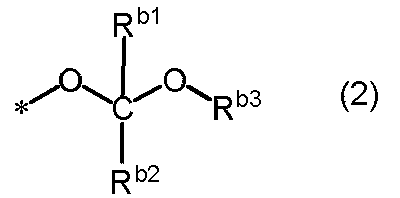
[式(2)中、Rb1及びRb2は、それぞれ独立に、水素原子又は炭化水素基(好ましくは炭素数1~12)を表し、Rb3は、炭化水素基(好ましくは炭素数1~20)を表すか、或いは、Rb2及びRb3は互いに結合して、それらが各々結合する炭素原子及び酸素原子とともに環(好ましくは炭素数3~20)を形成する。炭化水素基又はRb2及びRb3は互いに結合して形成される環がメチレン基を有する場合、そのメチレン基は、オキシ基、-S-又はカルボニル基に置き換わっていてもよい。*は結合手を表す。]
炭化水素基は、例えば、脂肪族炭化水素基、脂環式炭化水素基及び芳香族炭化水素基が挙げられる。
Rb1~Rb2のうち、少なくとも1つは水素原子であることが好ましい。
Rb1~Rb2のうち、少なくとも1つは水素原子であることが好ましい。
酸不安定基(2)の具体例としては、以下の基が挙げられる。
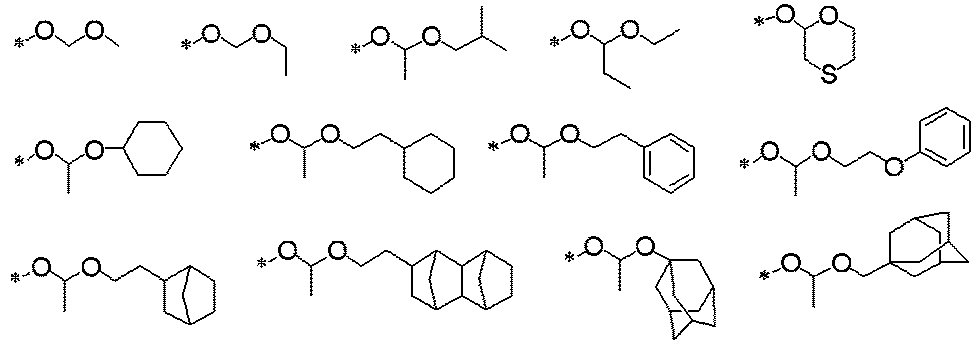
酸不安定基を有するモノマー(a1)は、好ましくは、酸不安定基と炭素-炭素二重結合とを有するモノマー、より好ましくは酸不安定基を有する(メタ)アクリル系モノマーである。
特に、モノマー(a1)は、好ましくは、酸不安定基(1)及び/又は酸不安定基(2)と、炭素-炭素二重結合とをともに分子内に有するモノマーであり、より好ましくは酸不安定基(1)を有する(メタ)アクリル系モノマーである。
特に、モノマー(a1)は、好ましくは、酸不安定基(1)及び/又は酸不安定基(2)と、炭素-炭素二重結合とをともに分子内に有するモノマーであり、より好ましくは酸不安定基(1)を有する(メタ)アクリル系モノマーである。
酸不安定基(1)を有する(メタ)アクリル系モノマーの中でも、酸不安定基(1)が、炭素数5~20の脂環式炭化水素構造を有する基が好ましい。このような立体的に嵩高い脂環式炭化水素構造を有する基を有するモノマー(a1)を重合して得られる樹脂(A)は、該樹脂(A)を含む本発明のレジスト組成物を用いてレジストパターンを製造したとき、より良好な解像度でレジストパターンを製造することができる。ここで、(メタ)アクリルとは、アクリル及び/又はメタクリルを表す。
脂環式炭化水素構造を含む酸不安定基(1)を有する(メタ)アクリル系モノマーの中でも、式(a1-1)で表されるモノマー(以下、「モノマー(a1-1)」という場合がある。)及び式(a1-2)で表されるモノマー(以下、「モノマー(a1-2)」という場合がある。)が好ましい。樹脂(A)を製造する際、これらは単独で使用してもよく、2種以上を併用してもよい。樹脂(A)は、式(a1-1)で表されるモノマーに由来する繰り返し単位及び式(a1-2)で表されるモノマーに由来する繰り返し単位から選択される少なくとも1種を含有することが好ましい。また、樹脂(A)は、式(a1-1)で表されるモノマーに由来する繰り返し単位及び式(a1-2)で表されるモノマーに由来する繰り返し単位を少なくとも1種ずつ含むことが好ましい。また、別の態様において、樹脂(A)は、式(a1-2)で表されるモノマーに由来する繰り返し単位を2種以上含むことが好ましい。樹脂(A)において、式(a1-1)で表されるモノマーに由来する繰り返し単位及び式(a1-2)で表されるモノマーに由来する繰り返し単位の総量が全繰り返し単位に占める割合が、40モル%以上であることが好ましく、45モル%以上であることがより好ましく、50モル%以上であることがさらに好ましい。特に、式(a1-2)で表されるモノマーに由来する繰り返し単位が全繰り返し単位に占める割合が、30モル%以上であることが好ましく、35モル%以上であることがより好ましく、40モル%以上であることがさらに好ましい。樹脂(A)における各繰り返し単位の含有比率は、例えば、13C-NMRによって測定することができる。

[式(a1-1)及び式(a1-2)中、
La1及びLa2は、それぞれ独立に、オキシ基又は*-O-(CH2)k1-CO-O-で表される基を表す。ここで、k1は1~7の整数を表し、*はカルボニル基(-CO-)との結合手である。
Ra4及びRa5は、それぞれ独立に、水素原子又はメチル基を表す。
Ra6及びRa7は、それぞれ独立に、脂肪族炭化水素基(好ましくは炭素数1~8)又は脂環式炭化水素基(好ましくは炭素数3~10)を表す。
m1は0~14の整数を表し、n1は0~10の整数を表す。
n1’は0~3の整数を表す。]
なお、式(a1-1)においてアダマンタン環にある「-(CH3)m1」の表記は、アダマンタン環を構成する炭素原子に結合する水素原子(すなわちメチレン基及び/又はメチン基の水素原子)が、メチル基に置き換わっており、該メチル基の個数がm1個であることを意味する。
La1及びLa2は、それぞれ独立に、オキシ基又は*-O-(CH2)k1-CO-O-で表される基を表す。ここで、k1は1~7の整数を表し、*はカルボニル基(-CO-)との結合手である。
Ra4及びRa5は、それぞれ独立に、水素原子又はメチル基を表す。
Ra6及びRa7は、それぞれ独立に、脂肪族炭化水素基(好ましくは炭素数1~8)又は脂環式炭化水素基(好ましくは炭素数3~10)を表す。
m1は0~14の整数を表し、n1は0~10の整数を表す。
n1’は0~3の整数を表す。]
なお、式(a1-1)においてアダマンタン環にある「-(CH3)m1」の表記は、アダマンタン環を構成する炭素原子に結合する水素原子(すなわちメチレン基及び/又はメチン基の水素原子)が、メチル基に置き換わっており、該メチル基の個数がm1個であることを意味する。
式(a1-1)及び式(a1-2)においては、La1及びLa2は、好ましくは、オキシ基又は*-O-(CH2)f1-CO-O-(但し、f1は1~4の整数を表す)で表される基であり、より好ましくはオキシ基である。f1は、より好ましくは1である。
Ra4及びRa5は、好ましくはメチル基である。
Ra6又はRa7の脂肪族炭化水素基は、好ましくは炭素数6以下の基である。Ra6又はRa7の脂環式炭化水素基は、好ましくは炭素数8以下であり、より好ましくは6以下である。
Ra6又はRa7が脂環式炭化水素基である場合、この脂環式炭化水素基は単環式及び多環式のいずれでもよく、飽和及び不飽和のいずれでもよいが、飽和式炭化水素基であることが好ましい。
m1は、好ましくは0~3の整数、より好ましくは0又は1である。
n1は、好ましくは0~3の整数、より好ましくは0又は1である。
n1’は、好ましくは0又は1である。
Ra4及びRa5は、好ましくはメチル基である。
Ra6又はRa7の脂肪族炭化水素基は、好ましくは炭素数6以下の基である。Ra6又はRa7の脂環式炭化水素基は、好ましくは炭素数8以下であり、より好ましくは6以下である。
Ra6又はRa7が脂環式炭化水素基である場合、この脂環式炭化水素基は単環式及び多環式のいずれでもよく、飽和及び不飽和のいずれでもよいが、飽和式炭化水素基であることが好ましい。
m1は、好ましくは0~3の整数、より好ましくは0又は1である。
n1は、好ましくは0~3の整数、より好ましくは0又は1である。
n1’は、好ましくは0又は1である。
モノマー(a1-1)としては、例えば、以下のものが挙げられる。

これらの中でも、モノマー(a1-1)としては、2-メチルアダマンタン-2-イル(メタ)アクリレート、2-エチルアダマンタン-2-イル(メタ)アクリレート及び2-イソプロピルアダマンタン-2-イル(メタ)アクリレートが好ましく、2-メチルアダマンタン-2-イルメタクリレート、2-エチルアダマンタン-2-イルメタクリレート及び2-イソプロピルアダマンタン-2-イルメタクリレートがより好ましい。
モノマー(a1-2)としては、例えば、以下のものが挙げられる。これらの中でも、モノマー(a1-2)としては、1-エチルシクロヘキシル(メタ)アクリレートが好ましく、1-エチルシクロヘキシルメタクリレートがより好ましい。
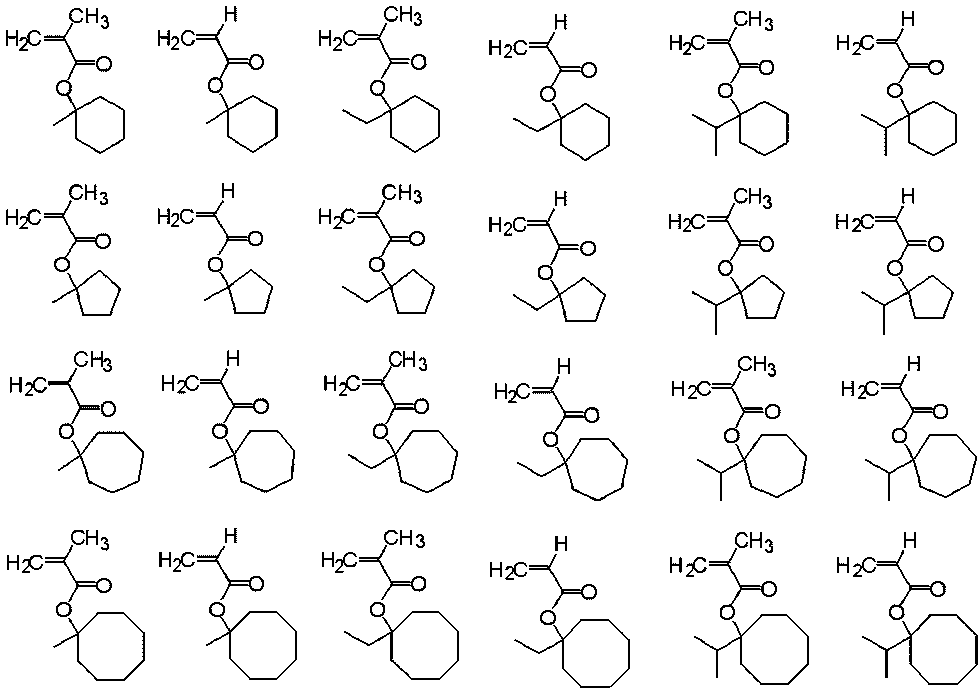
樹脂(A)の全構造単位を100モル%としたとき、モノマー(a1)に由来する構造単位の含有量(好ましくは、モノマー(a1-1)に由来する構造単位及び/又はモノマー(a1-2)に由来する構造単位の含有量の合計)は、10~95モル%の範囲が好ましく、15~90モル%の範囲がより好ましく、20~85モル%の範囲がさらに好ましく、50~85モル%の範囲が特に好ましい。モノマー(a1)に由来する構造単位の含有量を、このような範囲にするためには、樹脂(A)を製造する際に、全モノマーの使用量に対するモノマー(a1)の使用量を調整すればよい。
樹脂(A)の製造には、該(メタ)アクリル系モノマー(すなわちモノマー(a1-1)及びモノマー(a1-2))以外に、酸不安定基(1)と炭素-炭素二重結合とを分子内に有する他のモノマーを用いることもできる。
酸不安定基(2)を有するモノマー(a1)は、(メタ)アクリル系モノマーが好ましく、例えば、式(a1-5)で表されるモノマー(以下、「モノマー(a1-5)」という場合がある。)が挙げられる。
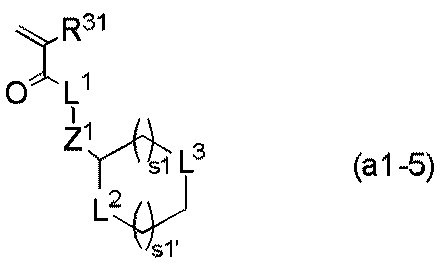
[式(a1-5)中、
R31は、水素原子、ハロゲン原子又はハロゲン原子を有してもよいアルキル基(好ましくは炭素数1~6)を表す。
L1~L3は、オキシ基、-S-又は*-O-(CH2)k1-CO-O-で表される基を表す。ここで、k1は1~7の整数を表し、*はカルボニル基(-CO-)との結合手である。
Z1は、単結合又はアルキレン基(好ましくは炭素数1~6)であり、該アルキレン基中に含まれるメチレン基は、オキシ基又はカルボニル基に置き換わっていてもよい。
s1及びs1’は、それぞれ独立して、0~4の整数を表す。]
R31は、水素原子、ハロゲン原子又はハロゲン原子を有してもよいアルキル基(好ましくは炭素数1~6)を表す。
L1~L3は、オキシ基、-S-又は*-O-(CH2)k1-CO-O-で表される基を表す。ここで、k1は1~7の整数を表し、*はカルボニル基(-CO-)との結合手である。
Z1は、単結合又はアルキレン基(好ましくは炭素数1~6)であり、該アルキレン基中に含まれるメチレン基は、オキシ基又はカルボニル基に置き換わっていてもよい。
s1及びs1’は、それぞれ独立して、0~4の整数を表す。]
式(a1-5)においては、R31は、水素原子又はメチル基が好ましい。
L1は、オキシ基が好ましい。
L2及びL3は、一方がオキシ基、他方が-S-であること好ましい。
s1は、1が好ましい。
s1’は、0~2が好ましい。
Z1は、単結合又は-CH2-CO-O-が好ましい。
L1は、オキシ基が好ましい。
L2及びL3は、一方がオキシ基、他方が-S-であること好ましい。
s1は、1が好ましい。
s1’は、0~2が好ましい。
Z1は、単結合又は-CH2-CO-O-が好ましい。
モノマー(a1-5)の具体例としては、例えば、以下のとおりである。
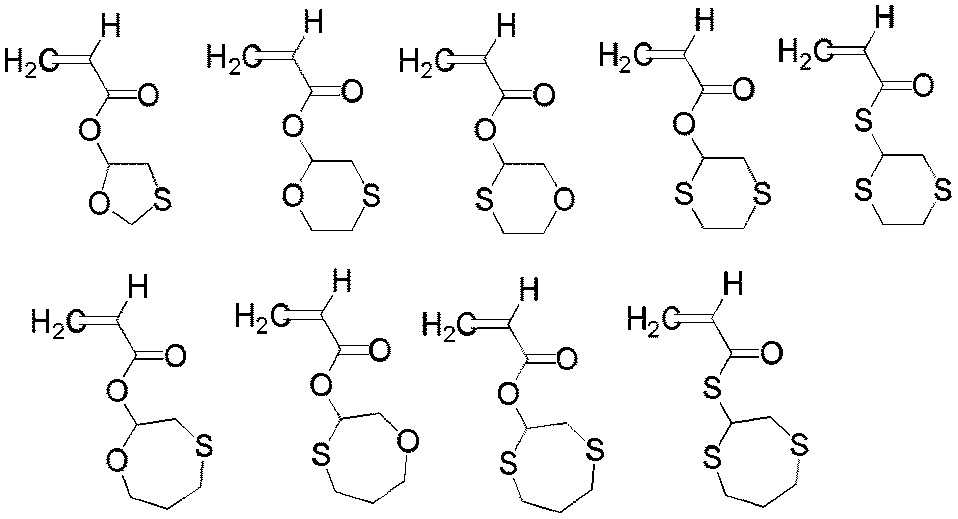
樹脂(A)が、モノマー(a1-5)に由来する構造単位を有する場合、その含有量は、樹脂(A)の全構造単位(100モル%)に対して、10~95モル%の範囲が好ましく、15~90モル%の範囲がより好ましく、20~85モル%の範囲がさらに好ましい。
<酸安定モノマー>
レジスト組成物に用いる樹脂(A)としては、モノマー(a1)に加えて、酸不安定基を有さないモノマー(以下「酸安定モノマー」という場合がある)を用いて得られる共重合体であることが好ましい。
レジスト組成物に用いる樹脂(A)としては、モノマー(a1)に加えて、酸不安定基を有さないモノマー(以下「酸安定モノマー」という場合がある)を用いて得られる共重合体であることが好ましい。
酸安定モノマーを併用して樹脂(A)を製造する場合、モノマー(a1)の使用量を基準にして、酸安定性モノマーの使用量を定めることができる。モノマー(a1)の使用量と酸安定モノマーの使用量の割合は、〔モノマー(a1)〕/〔酸安定モノマー〕で表して、好ましくは10~80モル%/90~20モル%であり、より好ましくは20~60モル%/80~40モル%である。また、アダマンチル基を有するモノマー(特に、モノマー(a1-1))を、モノマー(a1)に用いる場合、モノマー(a1)の使用量の総量(100モル%)に対して、アダマンチル基を有するモノマーの使用量を15モル%以上とすることが好ましい。これにより、樹脂(A)を含むレジスト組成物から得られるレジストパターンのドライエッチング耐性がより良好になる傾向がある。
酸安定モノマーとしては、ヒドロキシ基又はラクトン環を分子内に有するものが挙げられる。ヒドロキシ基を有する酸安定モノマー(以下、「酸安定モノマー(a2)」という場合がある。)及び/又はラクトン環を含有する酸安定モノマー(以下、「酸安定モノマー(a3)」という場合がある。)に由来する構造単位を有する樹脂(A)は、樹脂(A)を含むレジスト組成物を基板に塗布したとき、基板上に形成される塗布膜又は塗布膜から得られる組成物層が基板との間に優れた密着性を発現し易くなる。また、このようなレジスト組成物は良好な解像度で、レジストパターンを製造することができる。
<酸安定モノマー(a2)>
酸安定モノマー(a2)を樹脂(A)の製造に用いる場合、樹脂(A)を含むレジスト組成物からレジストパターンを得る際の露光源の種類によって、各々、好適な酸安定モノマー(a2)を挙げることができる。すなわち、本発明のレジスト組成物を、KrFエキシマレーザ露光(波長:248nm)、電子線あるいはEUV光などの高エネルギー線露光に用いる場合には、酸安定モノマー(a2)として、フェノール性ヒドロキシ基を有する酸安定モノマー(a2-0)〔例えば、ヒドロキシスチレン類等〕を樹脂(A)の製造に用いることが好ましい。短波長のArFエキシマレーザ露光(波長:193nm)を用いる場合は、酸安定モノマー(a2)として、後述の式(a2-1)で表される酸安定モノマーを樹脂(A)の製造に用いることが好ましい。このように、樹脂(A)製造に用いる酸安定モノマー(a2)は各々、レジストパターンを製造する際の露光源によって好ましいものを選ぶことができるが、当該酸安定モノマー(a2)は、露光源の種類に応じて好適なモノマー1種のみを用いて樹脂(A)を製造してもよく、露光源の種類に応じて好適なモノマー2種以上を用いて樹脂(A)を製造してもよく、或いは、露光源の種類に応じて好適なモノマーと、それ以外の酸安定モノマー(a2)の2種以上とを用いて樹脂(A)を製造してもよい。
酸安定モノマー(a2)を樹脂(A)の製造に用いる場合、樹脂(A)を含むレジスト組成物からレジストパターンを得る際の露光源の種類によって、各々、好適な酸安定モノマー(a2)を挙げることができる。すなわち、本発明のレジスト組成物を、KrFエキシマレーザ露光(波長:248nm)、電子線あるいはEUV光などの高エネルギー線露光に用いる場合には、酸安定モノマー(a2)として、フェノール性ヒドロキシ基を有する酸安定モノマー(a2-0)〔例えば、ヒドロキシスチレン類等〕を樹脂(A)の製造に用いることが好ましい。短波長のArFエキシマレーザ露光(波長:193nm)を用いる場合は、酸安定モノマー(a2)として、後述の式(a2-1)で表される酸安定モノマーを樹脂(A)の製造に用いることが好ましい。このように、樹脂(A)製造に用いる酸安定モノマー(a2)は各々、レジストパターンを製造する際の露光源によって好ましいものを選ぶことができるが、当該酸安定モノマー(a2)は、露光源の種類に応じて好適なモノマー1種のみを用いて樹脂(A)を製造してもよく、露光源の種類に応じて好適なモノマー2種以上を用いて樹脂(A)を製造してもよく、或いは、露光源の種類に応じて好適なモノマーと、それ以外の酸安定モノマー(a2)の2種以上とを用いて樹脂(A)を製造してもよい。
酸安定モノマー(a2)としては、以下の式(a2-0)で表されるp-又はm-ヒドロキシスチレンなどのスチレン系モノマー(以下、「酸安定モノマー(a2-0)」という。)が挙げられる。なお、この式(a2-0)は、フェノール性ヒドロキシ基が適当な保護基で保護されていない形式で示す。
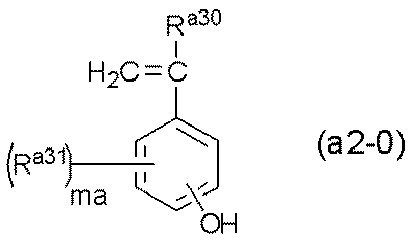
[式(a2-0)中、
Ra30は、ハロゲン原子を有してもよいアルキル基(好ましくは炭素数1~6)、水素原子又はハロゲン原子を表す。
Ra31は、ハロゲン原子、ヒドロキシ基、アルキル基(好ましくは炭素数1~6)、アルコキシ基(好ましくは炭素数1~6)、アシル基(好ましくは炭素数2~4)、アシルオキシ基(好ましくは炭素数2~4)、アクリロイル基又はメタクリロイル基を表す。
maは0~4の整数を表す。maが2以上の整数である場合、複数のRa31はそれぞれ独立である。]
Ra30は、ハロゲン原子を有してもよいアルキル基(好ましくは炭素数1~6)、水素原子又はハロゲン原子を表す。
Ra31は、ハロゲン原子、ヒドロキシ基、アルキル基(好ましくは炭素数1~6)、アルコキシ基(好ましくは炭素数1~6)、アシル基(好ましくは炭素数2~4)、アシルオキシ基(好ましくは炭素数2~4)、アクリロイル基又はメタクリロイル基を表す。
maは0~4の整数を表す。maが2以上の整数である場合、複数のRa31はそれぞれ独立である。]
Ra30のハロゲン原子及びハロゲン原子を有してもよい炭素数1~6のアルキル基としては、前記モノマー(a1-4)のRa32の説明で例示したものと同じものを挙げることができる。これらのうち、Ra30は、炭素数1~4のアルキル基が好ましく、メチル基又はエチル基がより好ましく、メチル基がさらに好ましい。
R31のアルキル基としては、炭素数1~4のアルキル基が好ましく、炭素数1又は2のアルキル基がより好ましく、メチル基が特に好ましい。
Ra31のアルコキシ基としては、前記モノマー(a1-4)のRa33の説明で例示したものと同じものを挙げることができる。これらのうち、Ra31は、炭素数1~4のアルコキシ基が好ましく、メトキシ基又はエトキシ基がより好ましく、メトキシ基がさらに好ましい。
maは0、1又は2が好ましく、0又は1がより好ましく、0がさらに好ましい。
R31のアルキル基としては、炭素数1~4のアルキル基が好ましく、炭素数1又は2のアルキル基がより好ましく、メチル基が特に好ましい。
Ra31のアルコキシ基としては、前記モノマー(a1-4)のRa33の説明で例示したものと同じものを挙げることができる。これらのうち、Ra31は、炭素数1~4のアルコキシ基が好ましく、メトキシ基又はエトキシ基がより好ましく、メトキシ基がさらに好ましい。
maは0、1又は2が好ましく、0又は1がより好ましく、0がさらに好ましい。
このような酸安定モノマー(a2-0)に由来する構造単位を有する樹脂(A)を製造する場合は、酸安定モノマー(a2-0)にあるフェノール性ヒドロキシ基が保護基で保護されてなるモノマーを用いることができる。保護基としては、例えば、酸で脱離する保護基などが挙げられる。酸で脱離する保護基で保護されたフェノール性ヒドロキシ基は、酸との接触により、脱保護することができるため、容易に酸安定モノマー(a2-0)に由来する構造単位を形成することができる。
ただし、樹脂(A)は上述の通り、酸不安定基を含む構造単位(a1)を有しているため、塩基で脱保護可能な保護基でフェノール性ヒドロキシ基が保護された酸安定モノマー(a2-0)を用いて重合を行い、脱保護する際には、構造単位(a1)の酸不安定基を著しく損なわないよう、塩基との接触により脱保護することが好ましい。塩基で脱保護可能な保護基としては、例えば、アセチル基等が挙げられる。塩基としては、例えば、4-ジメチルアミノピリジン、トリエチルアミン等が挙げられる。
ただし、樹脂(A)は上述の通り、酸不安定基を含む構造単位(a1)を有しているため、塩基で脱保護可能な保護基でフェノール性ヒドロキシ基が保護された酸安定モノマー(a2-0)を用いて重合を行い、脱保護する際には、構造単位(a1)の酸不安定基を著しく損なわないよう、塩基との接触により脱保護することが好ましい。塩基で脱保護可能な保護基としては、例えば、アセチル基等が挙げられる。塩基としては、例えば、4-ジメチルアミノピリジン、トリエチルアミン等が挙げられる。
酸安定モノマー(a2-0)としては、例えば、以下のモノマーが挙げられる。なお、以下の例示でも、フェノール性ヒドロキシ基が保護基で保護されていない形式で示す。

なかでも、4-ヒドロキシスチレン又は4-ヒドロキシ-α-メチルスチレンが特に好ましい。
4-ヒドロキシスチレン又は4-ヒドロキシ-α-メチルスチレンを用いて樹脂(A)を製造する際には、これらにあるフェノール性ヒドロキシ基を保護基で保護したものを用いることが好ましい。
4-ヒドロキシスチレン又は4-ヒドロキシ-α-メチルスチレンを用いて樹脂(A)を製造する際には、これらにあるフェノール性ヒドロキシ基を保護基で保護したものを用いることが好ましい。
樹脂(A)が、酸安定モノマー(a2-0)に由来する構造単位を有する場合、その含有量は、樹脂(A)の全構造単位(100モル%)に対して、5~95モル%の範囲から選ばれることが好ましく、10~80モル%の範囲がより好ましく、15~80モル%の範囲がさらに好ましい。
酸安定モノマー(a2-1)としては、以下の式(a2-1)で表されるモノマーが挙げられる。

[式(a2-1)中、
La3は、オキシ基又は*-O-(CH2)k2-CO-O-を表し、
k2は1~7の整数を表す。*は-CO-との結合手を表す。
Ra14は、水素原子又はメチル基を表す。
Ra15及びRa16は、それぞれ独立に、水素原子、メチル基又はヒドロキシ基を表す。
o1は、0~10の整数を表す。
La3は、オキシ基又は*-O-(CH2)k2-CO-O-を表し、
k2は1~7の整数を表す。*は-CO-との結合手を表す。
Ra14は、水素原子又はメチル基を表す。
Ra15及びRa16は、それぞれ独立に、水素原子、メチル基又はヒドロキシ基を表す。
o1は、0~10の整数を表す。
式(a2-1)では、La3は、好ましくは、オキシ基、-O-(CH2)f1-CO-O-(ここでf1は、1~4の整数である)であり、より好ましくはオキシ基である。
Ra14は、好ましくはメチル基である。
Ra15は、好ましくは水素原子である。
Ra16は、好ましくは水素原子又はヒドロキシ基である。
o1は、好ましくは0~3の整数、より好ましくは0又は1である。]
Ra14は、好ましくはメチル基である。
Ra15は、好ましくは水素原子である。
Ra16は、好ましくは水素原子又はヒドロキシ基である。
o1は、好ましくは0~3の整数、より好ましくは0又は1である。]
酸安定モノマー(a2-1)としては、例えば、以下のものが挙げられる。これらの中でも、3-ヒドロキシアダマンタン-1-イル(メタ)アクリレート、3,5-ジヒドロキシアダマンタン-1-イル(メタ)アクリレート及び(メタ)アクリル酸1-(3,5-ジヒドロキシアダマンタン-1-イルオキシカルボニル)メチルが好ましく、3-ヒドロキシアダマンタン-1-イル(メタ)アクリレート及び3,5-ジヒドロキシアダマンタン-1-イル(メタ)アクリレートがより好ましく、3-ヒドロキシアダマンタン-1-イルメタクリレート及び3,5-ジヒドロキシアダマンタン-1-イルメタクリレートがさらに好ましい。
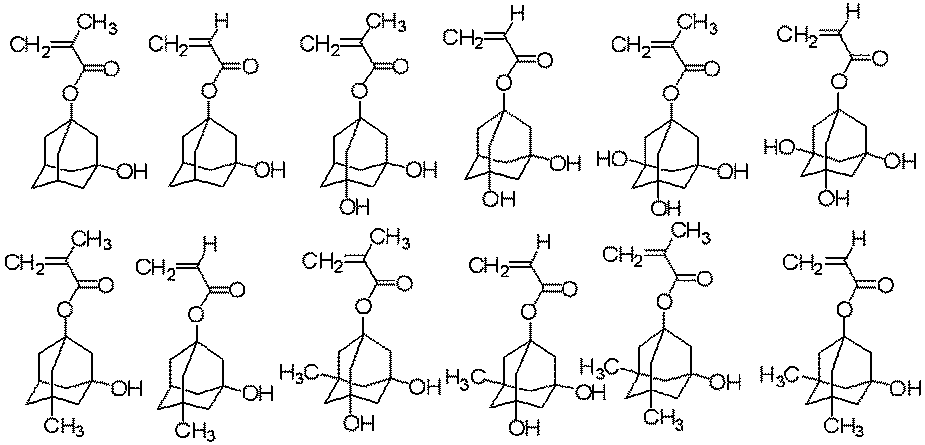
樹脂(A)が、酸安定モノマー(a2-1)に由来する構造単位を有する場合、その含有量は、樹脂(A)の全構造単位(100モル%)に対して、3~40モル%の範囲から選ばれることが好ましく、5~35モル%の範囲がより好ましく、5~30モル%の範囲がさらに好ましく、5~15モル%が特に好ましい。
<酸安定モノマー(a3)>
酸安定モノマー(a3)が有するラクトン環は、例えば、β-プロピオラクトン環、γ-ブチロラクトン環及びδ-バレロラクトン環のような単環式でもよく、単環式のラクトン環と他の環との縮合環でもよい。これらラクトン環の中でも、γ-ブチロラクトン環及びγ-ブチロラクトン環と他の環との縮合環が好ましい。
酸安定モノマー(a3)が有するラクトン環は、例えば、β-プロピオラクトン環、γ-ブチロラクトン環及びδ-バレロラクトン環のような単環式でもよく、単環式のラクトン環と他の環との縮合環でもよい。これらラクトン環の中でも、γ-ブチロラクトン環及びγ-ブチロラクトン環と他の環との縮合環が好ましい。
酸安定モノマー(a3)は、好ましくは、以下の式(a3-1)、式(a3-2)又は式(a3-3)で表される。樹脂(A)の製造においては、これらのうち1種のみを使用してもよく、2種以上を併用してもよい。樹脂(A)は、式(a3-1)で表されるモノマーに由来する繰り返し単位を少なくとも1種含むことがより好ましい。また、樹脂(A)は、式(a3-1)で表されるモノマーに由来する繰り返し単位を少なくとも1種と、式(a3-2)で表されるモノマーに由来する繰り返し単位を少なくとも1種含むことが特に好ましい。なお、以下の説明においては、式(a3-1)で示される酸安定モノマー(a3)を「酸安定モノマー(a3-1)」といい、式(a3-2)で示される酸安定モノマー(a3)を「酸安定モノマー(a3-2)」といい、式(a3-3)で示される酸安定モノマー(a3)を「酸安定モノマー(a3-3)」という。

[式(a3-1)、式(a3-2)及び式(a3-3)中、
La4、La5及びLa6(以下、「La4~La6」のように表記する。)は、それぞれ独立に、-O-又は*-O-(CH2)k3-CO-O-を表す。
k3は1~7の整数を表す。*は-CO-との結合手を表す。
Ra18、Ra19及びRa20(以下、「Ra18~Ra20」のように表記する。)は、それぞれ独立に、水素原子又はメチル基を表す。
Ra21は、脂肪族炭化水素基(好ましくは炭素数1~4)を表す。
p1は0~5の整数を表す。
Ra22及びRa23は、それぞれ独立に、カルボキシ基、シアノ基又は脂肪族炭化水素基(好ましくは炭素数1~4)を表す。
q1及びr1は、それぞれ独立に0~3の整数を表す。p1、q1又はr1が2以上のとき、複数のRa21、Ra22又はRa23は互いに同一でも異なっていてもよい。]
La4、La5及びLa6(以下、「La4~La6」のように表記する。)は、それぞれ独立に、-O-又は*-O-(CH2)k3-CO-O-を表す。
k3は1~7の整数を表す。*は-CO-との結合手を表す。
Ra18、Ra19及びRa20(以下、「Ra18~Ra20」のように表記する。)は、それぞれ独立に、水素原子又はメチル基を表す。
Ra21は、脂肪族炭化水素基(好ましくは炭素数1~4)を表す。
p1は0~5の整数を表す。
Ra22及びRa23は、それぞれ独立に、カルボキシ基、シアノ基又は脂肪族炭化水素基(好ましくは炭素数1~4)を表す。
q1及びr1は、それぞれ独立に0~3の整数を表す。p1、q1又はr1が2以上のとき、複数のRa21、Ra22又はRa23は互いに同一でも異なっていてもよい。]
式(a3-1)~式(a3-3)中のLa4~La6としては、La3で説明したものが挙げられる。
La4~La6は、それぞれ独立に、-O-又は*-O-(CH2)d1-CO-O-であることが好ましく(ここでd1は、1~4の整数である)、より好ましくは-O-である。
Ra18~Ra21は、好ましくはメチル基である。
Ra22及びRa23は、それぞれ独立に、好ましくはカルボキシ基、シアノ基又はメチル基である。
p1、q1及びr1は、それぞれ独立に、好ましくは0~2の整数であり、より好ましくは0又は1である。
La4~La6は、それぞれ独立に、-O-又は*-O-(CH2)d1-CO-O-であることが好ましく(ここでd1は、1~4の整数である)、より好ましくは-O-である。
Ra18~Ra21は、好ましくはメチル基である。
Ra22及びRa23は、それぞれ独立に、好ましくはカルボキシ基、シアノ基又はメチル基である。
p1、q1及びr1は、それぞれ独立に、好ましくは0~2の整数であり、より好ましくは0又は1である。
酸安定モノマー(a3-1)としては、例えば、以下のものが挙げられる。

γ-ブチロラクトン環とノルボルナン環との縮合環を有する酸安定モノマー(a3-2)としては、例えば以下のものが挙げられる。
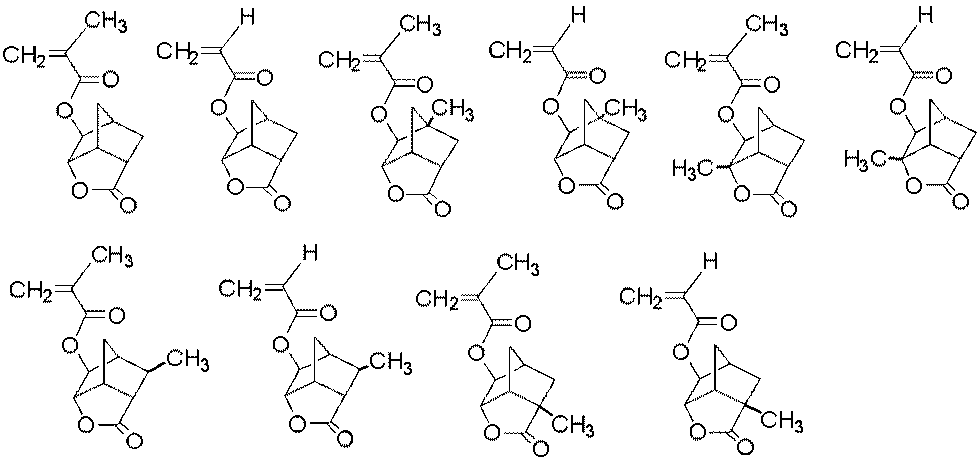

γ-ブチロラクトン環とシクロヘキサン環との縮合環を有する酸安定モノマー(a3-3)は例えば、以下のものが挙げられる。

ラクトン環を有する酸安定モノマー(a3)の中でも、(メタ)アクリル酸(5-オキソ-4-オキサトリシクロ[4.2.1.03,7]ノナン-2-イル)、(メタ)アクリル酸テトラヒドロ-2-オキソ-3-フリル、(メタ)アクリル酸2-(5-オキソ-4-オキサトリシクロ[4.2.1.03,7]ノナン-2-イルオキシ)-2-オキソエチルといったメタクリレートエステル類がより好ましい。
樹脂(A)が、モノマー(a3-1)に由来する構造単位、モノマー(a3-2)に由来する構造単位及びモノマー(a3-3)に由来する構造単位からなる群より選ばれる構造単位〔酸安定モノマー(a3)に由来する構造単位〕を有する場合、その合計含有量は、樹脂(A)の全構造単位(100モル%)に対して、5~60モル%の範囲が好ましく、5~50モル%の範囲がより好ましく、10~40モル%の範囲がさらに好ましく、15~40モル%の範囲が特に好ましい。
また、酸安定性モノマー(a3)に由来する構造単位(好ましくは、モノマー(a3-1)に由来する構造単位、モノマー(a3-2)に由来する構造単位及びモノマー(a3-3)に由来する構造単位それぞれ)の含有量は、樹脂(A)の全構造単位(100モル%)に対して、5~60モル%の範囲が好ましく、10~55モル%の範囲がより好ましく、20~50モル%の範囲がさらに好ましい。
また、酸安定性モノマー(a3)に由来する構造単位(好ましくは、モノマー(a3-1)に由来する構造単位、モノマー(a3-2)に由来する構造単位及びモノマー(a3-3)に由来する構造単位それぞれ)の含有量は、樹脂(A)の全構造単位(100モル%)に対して、5~60モル%の範囲が好ましく、10~55モル%の範囲がより好ましく、20~50モル%の範囲がさらに好ましい。
<酸安定モノマー(a4)>
さらに、酸安定モノマー(a2)及び酸安定モノマー(a3)以外の酸安定モノマー(以下「酸安定モノマー(a4)」という場合がある。)としては、式(a4-1)で表される無水マレイン酸、式(a4-2)で表される無水イタコン酸及び式(a4-3)で表されるノルボルネン環を有する酸安定モノマー(以下、「酸安定モノマー(a4-3)」という場合がある。)などが挙げられる。
さらに、酸安定モノマー(a2)及び酸安定モノマー(a3)以外の酸安定モノマー(以下「酸安定モノマー(a4)」という場合がある。)としては、式(a4-1)で表される無水マレイン酸、式(a4-2)で表される無水イタコン酸及び式(a4-3)で表されるノルボルネン環を有する酸安定モノマー(以下、「酸安定モノマー(a4-3)」という場合がある。)などが挙げられる。

[式(a4-3)中、
Ra25及びRa26は、それぞれ独立に、水素原子、ヒドロキシ基を有していてもよい脂肪族炭化水素基(好ましくは炭素数1~3)、シアノ基、カルボキシ基又は-COORa27〔ここで、Ra27は、脂肪族炭化水素基(好ましくは炭素数1~18)又は脂環式炭化水素基(好ましくは炭素数3~18)を表し、該脂肪族炭化水素基及び該脂環式炭化水素基に含まれるメチレン基は、オキシ基又はカルボニル基で置き換わっていてもよい。但し-COORa27が酸不安定基となるものは除く(即ちRa27は、第三級炭素原子が-O-と結合するものを含まない)。〕を表すか、或いはRa25及びRa26は互いに結合して-CO-O-CO-を形成する。]
Ra25及びRa26は、それぞれ独立に、水素原子、ヒドロキシ基を有していてもよい脂肪族炭化水素基(好ましくは炭素数1~3)、シアノ基、カルボキシ基又は-COORa27〔ここで、Ra27は、脂肪族炭化水素基(好ましくは炭素数1~18)又は脂環式炭化水素基(好ましくは炭素数3~18)を表し、該脂肪族炭化水素基及び該脂環式炭化水素基に含まれるメチレン基は、オキシ基又はカルボニル基で置き換わっていてもよい。但し-COORa27が酸不安定基となるものは除く(即ちRa27は、第三級炭素原子が-O-と結合するものを含まない)。〕を表すか、或いはRa25及びRa26は互いに結合して-CO-O-CO-を形成する。]
モノマー(a4-3)のRa25及びRa26において、ヒドロキシ基を有していてもよい脂肪族炭化水素基としては、例えば、メチル基、エチル基、プロピル基、ヒドロキシメチル基及び2-ヒドロキシエチル基などが挙げられる。
Ra27の脂肪族炭化水素基は、好ましくは炭素数1~8、より好ましくは炭素数1~6の基である。脂環式炭化水素基は、好ましくは炭素数4~18、より好ましくは炭素数4~12の基である。このRa27としては、例えば、メチル基、エチル基、プロピル基、2-オキソ-オキソラン-3-イル基及び2-オキソ-オキソラン-4-イル基などが挙げられる。
Ra27の脂肪族炭化水素基は、好ましくは炭素数1~8、より好ましくは炭素数1~6の基である。脂環式炭化水素基は、好ましくは炭素数4~18、より好ましくは炭素数4~12の基である。このRa27としては、例えば、メチル基、エチル基、プロピル基、2-オキソ-オキソラン-3-イル基及び2-オキソ-オキソラン-4-イル基などが挙げられる。
ノルボルネン環を有する酸安定モノマー(a4-3)としては、例えば、2-ノルボルネン、2-ヒドロキシ-5-ノルボルネン、5-ノルボルネン-2-カルボン酸、5-ノルボルネン-2-カルボン酸メチル、5-ノルボルネン-2-カルボン酸2-ヒドロキシ-1-エチル、5-ノルボルネン-2-メタノール、5-ノルボルネン-2,3-ジカルボン酸無水物などが挙げられる。
樹脂(A)が、式(a4-1)で表される無水マレイン酸に由来する構造単位、式(a4-2)で表される無水イタコン酸に由来する構造単位及びモノマー(a4-3)に由来する構造単位からなる群より選ばれる構造単位〔酸安定モノマー(a4)に由来する構造単位〕を有する場合、その合計含有量は、樹脂(A)の全構造単位(100モル%)に対して、2~40モル%の範囲が好ましく、3~30モル%の範囲がより好ましく、5~20モル%の範囲がさらに好ましい。
また、酸安定モノマー(a4)としては、例えば、式(a4-4)で表されるスルトン環を有する酸安定モノマー(以下、「酸安定モノマー(a4-4)」という場合がある。)などが挙げられる。

[式(a4-4)中、
La7は、-O-又は*-O-(CH2)k2-CO-O-を表し、
k2は1~7の整数を表す。*は-CO-との結合手を表す。
Ra28は、水素原子又はメチル基を表す。
W1は、置換基を有していてもよいスルトン環を含む残基を表す。]
La7は、-O-又は*-O-(CH2)k2-CO-O-を表し、
k2は1~7の整数を表す。*は-CO-との結合手を表す。
Ra28は、水素原子又はメチル基を表す。
W1は、置換基を有していてもよいスルトン環を含む残基を表す。]
スルトン環としては、下記に示すものが挙げられる。スルトン環を含む残基は、例えば、スルトン環にある水素原子の1つが、La7との結合手に置き換わったものが挙げられる。

置換基を有していてもよいスルトン環を含む残基とは、上述のLa7との結合手に置き換わった水素原子以外の水素原子がさらに置換基で置換されたものであり、該置換基としては、ヒドロキシ基、シアノ基、炭素数1~6のアルキル基、炭素数1~6のフッ素化アルキル基、炭素数1~6のヒドロキシアルキル基、炭素数1~6のアルコキシ基、炭素数1~7のアルコキシカルボニル基、炭素数1~7のアシル基又は炭素数1~8のアシルオキシ基等が挙げられる。
フッ素化アルキル基としては、例えば、ジフルオロメチル基、トリフルオロメチル基、1,1-ジフルオロエチル基、2,2-ジフルオロエチル基、2,2,2-トリフルオロエチル基、ペルフルオロエチル基、1,1,2,2-テトラフルオロプロピル基、1,1,2,2,3,3-ヘキサフルオロプロピル基、ペルフルオロエチルメチル基、1-(トリフルオロメチル)-1,2,2,2-テトラフルオロエチル基、ペルフルオロプロピル基、1,1,2,2-テトラフルオロブチル基、1,1,2,2,3,3-ヘキサフルオロブチル基、1,1,2,2,3,3,4,4-オクタフルオロブチル基、ペルフルオロブチル基、1,1-ビス(トリフルオロ)メチル-2,2,2-トリフルオロエチル基、2-(ペルフルオロプロピル)エチル基、1,1,2,2,3,3,4,4-オクタフルオロペンチル基、ペルフルオロペンチル基、1,1,2,2,3,3,4,4,5,5-デカフルオロペンチル基、1,1-ビス(トリフルオロメチル)-2,2,3,3,3-ペンタフルオロプロピル基、ペルフルオロペンチル基、2-(ペルフルオロブチル)エチル基、1,1,2,2,3,3,4,4,5,5-デカフルオロヘキシル基、1,1,2,2,3,3,4,4,5,5,6,6-ドデカフルオロヘキシル基、ペルフルオロペンチルメチル基及びパーフルオロヘキシル基が挙げられる。なかでも、その炭素数が1~4であることが好ましく、トリフルオロメチル基、ペルフルオロエチル基及びペルフルオロプロピル基がより好ましく、トリフルオロメチル基が特に好ましい。
ヒドロキシアルキル基としては、ヒドロキシメチル基及び2-ヒドロキシエチル基などが挙げられる。
ヒドロキシアルキル基としては、ヒドロキシメチル基及び2-ヒドロキシエチル基などが挙げられる。
酸安定モノマー(a4-4)の具体例を下記に示す。
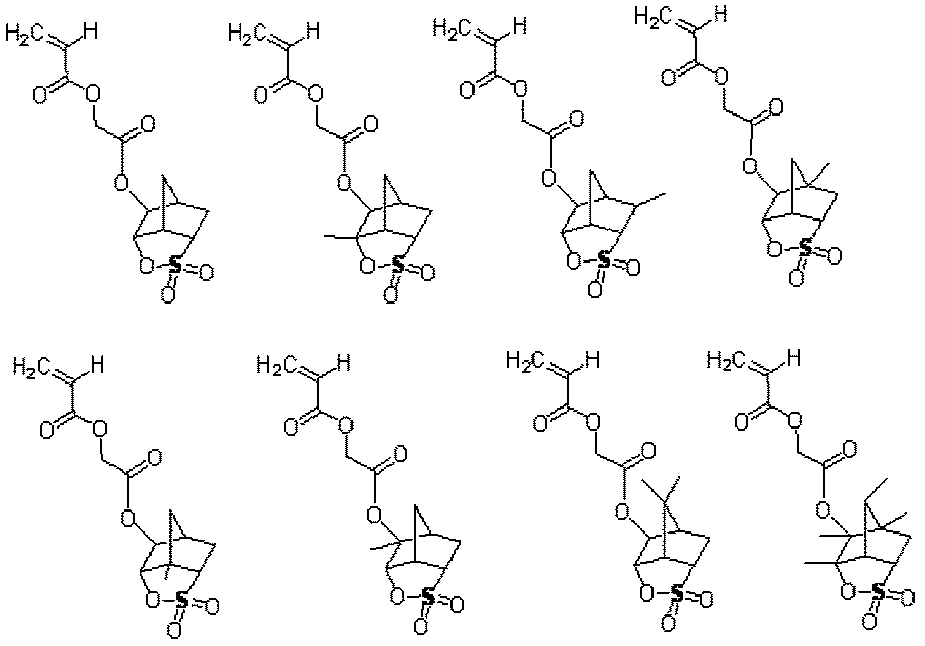
樹脂(A)が、酸安定モノマー(a4-4)に由来する構造単位を有する場合、その含有量は、樹脂(A)の全構造単位(100モル%)に対して、2~40モル%が好ましく、3~35モル%の範囲がより好ましく、5~30モル%の範囲がさらに好ましい。
好ましい樹脂(A)は、モノマー(a1)、酸安定モノマー(a2)及び/又は酸安定モノマー(a3)とを重合させて得られる共重合体である。この好ましい共重合体において、モノマー(a1)として、上述のモノマー(a1-1)及びモノマー(a1-2)の少なくとも1種を用いることが好ましく、モノマー(a1-1)を用いることがさらに好ましい。酸安定モノマー(a2)としては、酸安定モノマー(a2-1)が好ましく、酸安定モノマー(a3)としては、酸安定モノマー(a3-1)及び酸安定モノマー(a3-2)の少なくとも1種が好ましく、酸安定モノマー(a3-1)及び酸安定モノマー(a3-2)を両方とも用いることがより好ましい。
樹脂(A)は、モノマー(a1)と、必要に応じて、酸安定モノマー(a2)、酸安定モノマー(a3)及び酸安定モノマー(a4)からなる群より選ばれる酸安定モノマーとを用い、これらが上述のとおりの樹脂(A)の全構造単位に対する好適な含有量になるようにして使用量を調節した後、公知の重合法(例えばラジカル重合法)により製造することができる。
樹脂(A)の重量平均分子量は、好ましくは2,500以上であり、より好ましくは3,000以上、さらに好ましくは4,000以上である。該重量平均分子量は50,000以下が好ましく、30,000以下がより好ましく、10,000以下がさらに好ましい。なお、ここでいう重量平均分子量は、ゲルパーミエーションクロマトグラフィー分析により、標準ポリスチレン基準の換算値として求められるものである。本発明において、樹脂(A)の重量平均分子量(Mw)は、例えば、HLC-8120(東ソー(株)製)を用い、カラムとしてTSK gel Multipore HXL-M (東ソー(株)製、7.8mmID×30.0cm)を、溶離液としてTHF(テトラヒドロフラン)を用いることによって求めることができる。
樹脂(A)の重量平均分子量は、好ましくは2,500以上であり、より好ましくは3,000以上、さらに好ましくは4,000以上である。該重量平均分子量は50,000以下が好ましく、30,000以下がより好ましく、10,000以下がさらに好ましい。なお、ここでいう重量平均分子量は、ゲルパーミエーションクロマトグラフィー分析により、標準ポリスチレン基準の換算値として求められるものである。本発明において、樹脂(A)の重量平均分子量(Mw)は、例えば、HLC-8120(東ソー(株)製)を用い、カラムとしてTSK gel Multipore HXL-M (東ソー(株)製、7.8mmID×30.0cm)を、溶離液としてTHF(テトラヒドロフラン)を用いることによって求めることができる。
本発明の樹脂(A)は、1種で使用してもよいし、複数種を使用してもよい。本発明において樹脂(A)(複数種を使用する場合は合計量)の感活性光線性又は感放射線性樹脂組成物全体中の含有率は、感活性光線性又は感放射線性樹脂組成物の全固形分中30~99質量%が好ましく、より好ましくは55~95質量%である。
<(B)活性光線又は放射線の照射により酸を発生する化合物(以下、酸発生剤(B)という場合がある。)>
酸発生剤(B)には、非イオン系酸発生剤、イオン系酸発生剤又はこれらを組み合わせて用いることができる。非イオン系酸発生剤としては、有機ハロゲン化物、スルホネートエステル類(例えば2-ニトロベンジルエステル、芳香族スルホネート、オキシムスルホネート、N-スルホニルオキシイミド、スルホニルオキシケトン、ジアゾナフトキノン4-スルホネート)及びスルホン類(例えばジスルホン、ケトスルホン、スルホニルジアゾメタン)等が挙げられる。イオン系酸発生剤としては、オニウムカチオンを含むオニウム塩(例えばジアゾニウム塩、ホスホニウム塩、スルホニウム塩、ヨードニウム塩)等が挙げられる。オニウム塩のアニオンとしては、スルホン酸アニオン、スルホニルイミドアニオン及びスルホニルメチドアニオン等が挙げられる。
酸発生剤(B)には、非イオン系酸発生剤、イオン系酸発生剤又はこれらを組み合わせて用いることができる。非イオン系酸発生剤としては、有機ハロゲン化物、スルホネートエステル類(例えば2-ニトロベンジルエステル、芳香族スルホネート、オキシムスルホネート、N-スルホニルオキシイミド、スルホニルオキシケトン、ジアゾナフトキノン4-スルホネート)及びスルホン類(例えばジスルホン、ケトスルホン、スルホニルジアゾメタン)等が挙げられる。イオン系酸発生剤としては、オニウムカチオンを含むオニウム塩(例えばジアゾニウム塩、ホスホニウム塩、スルホニウム塩、ヨードニウム塩)等が挙げられる。オニウム塩のアニオンとしては、スルホン酸アニオン、スルホニルイミドアニオン及びスルホニルメチドアニオン等が挙げられる。
酸発生剤(B)としては、本発明の技術分野で使用される酸発生剤(特に光酸発生剤)だけでなく、光カチオン重合の光開始剤、色素類の光消色剤又は光変色剤等の放射線(光)によって酸を発生する公知化合物及びそれらの混合物を使用してもよい。例えば、特開昭63-26653号、特開昭55-164824号、特開昭62-69263号、特開昭63-146038号、特開昭63-163452号、特開昭62-153853号、特開昭63-146029号、米国特許第3,779,778号、米国特許第3,849,137号、独国特許第3914407号、欧州特許第126,712号等に記載されている、放射線によって酸を発生する化合物を、酸発生剤(B)として使用してもよい。
酸発生剤(B)としては、フッ素原子を有するフッ素含有酸発生剤が好ましく、以下の式(B1)で表される酸発生剤(B)(以下、「酸発生剤(B1)」という。)が特に好ましい。この酸発生剤(B1)と化合物(I)とを含むレジスト組成物は、LERが良好なレジストパターンを製造できるだけでなく、良好なフォーカスマージン(DOF)でレジストパターンを製造できるという利点がある。なお、以下の説明において、この酸発生剤(B1)のうち、正電荷を有するZ+は「有機カチオン」といい、該有機カチオンを除去してなる負電荷を有するものを「スルホン酸アニオン」ということがある。
酸発生剤(B)は、低分子化合物の形態であっても良く、重合体の一部に組み込まれた形態であっても良い。また、低分子化合物の形態と重合体の一部に組み込まれた形態を併用しても良い。
酸発生剤(B)が、低分子化合物の形態である場合、分子量が3000以下であることが好ましく、2000以下であることがより好ましく、1000以下であることが更に好ましい。
酸発生剤(B)が、重合体の一部に組み込まれた形態である場合、前述した酸分解性樹脂の一部に組み込まれても良く、酸分解性樹脂とは異なる樹脂に組み込まれても良い。
酸発生剤(B)は、低分子化合物の形態であっても良く、重合体の一部に組み込まれた形態であっても良い。また、低分子化合物の形態と重合体の一部に組み込まれた形態を併用しても良い。
酸発生剤(B)が、低分子化合物の形態である場合、分子量が3000以下であることが好ましく、2000以下であることがより好ましく、1000以下であることが更に好ましい。
酸発生剤(B)が、重合体の一部に組み込まれた形態である場合、前述した酸分解性樹脂の一部に組み込まれても良く、酸分解性樹脂とは異なる樹脂に組み込まれても良い。
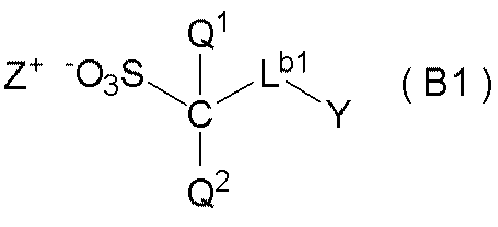
[式(B1)中、
Q1及びQ2は、それぞれ独立に、フッ素原子又はペルフルオロアルキル基(好ましくは炭素数1~6)を表す。
Lb1は、単結合又は2価の飽和炭化水素基(好ましくは炭素数1~17)を表し、前記2価の飽和炭化水素基がメチレン基を有する場合、このメチレン基は、オキシ基又はカルボニル基で置き換わっていてもよい。
Yは、置換基を有していてもよい脂肪族炭化水素基(炭素数1~18)又は置換基を有していてもよい脂環式炭化水素基(好ましくは炭素数3~18)を表し、該脂肪族炭化水素基及び該脂環式炭化水素基がメチレン基を含む場合、そのメチレン基は、オキシ基、-SO2-又はカルボニル基で置き換わっていてもよい。
Z+は、有機カチオンを表す。]
Q1及びQ2は、それぞれ独立に、フッ素原子又はペルフルオロアルキル基(好ましくは炭素数1~6)を表す。
Lb1は、単結合又は2価の飽和炭化水素基(好ましくは炭素数1~17)を表し、前記2価の飽和炭化水素基がメチレン基を有する場合、このメチレン基は、オキシ基又はカルボニル基で置き換わっていてもよい。
Yは、置換基を有していてもよい脂肪族炭化水素基(炭素数1~18)又は置換基を有していてもよい脂環式炭化水素基(好ましくは炭素数3~18)を表し、該脂肪族炭化水素基及び該脂環式炭化水素基がメチレン基を含む場合、そのメチレン基は、オキシ基、-SO2-又はカルボニル基で置き換わっていてもよい。
Z+は、有機カチオンを表す。]
Q1及びQ2のペルフルオロアルキル基は、例えば、トリフルオロメチル基、ペルフルオロエチル基、ペルフルオロプロピル基、ペルフルオロイソプロピル基、ペルフルオロブチル基、ペルフルオロsec-ブチル基、ペルフルオロtert-ブチル基、ペルフルオロペンチル基及びペルフルオロヘキシル基等が挙げられる。
Q1及びQ2は、それぞれ独立に、トリフルオロメチル基又はフッ素原子であることが好ましく、Q1及びQ2がともにフッ素原子がより好ましい。Q1及びQ2がともにフッ素原子である酸発生剤(B1)を、化合物(I)を含むレジスト組成物に用いることにより、より広いフォーカスマージンでレジストパターンを製造することができる。
Q1及びQ2は、それぞれ独立に、トリフルオロメチル基又はフッ素原子であることが好ましく、Q1及びQ2がともにフッ素原子がより好ましい。Q1及びQ2がともにフッ素原子である酸発生剤(B1)を、化合物(I)を含むレジスト組成物に用いることにより、より広いフォーカスマージンでレジストパターンを製造することができる。
Lb1における前記2価の飽和炭化水素基としては、直鎖状アルカンジイル基、分岐状アルカンジイル基、単環式又は多環式の2価の脂環式炭化水素基が挙げられ、これらの基のうち2種以上を組み合わせたものでもよい。例えば、 メチレン基、エチレン基、プロパン-1,3-ジイル基、プロパン-1,2-ジイル基、ブタン-1,4-ジイル基、ペンタン-1,5-ジイル基、ヘキサン-1,6-ジイル基、ヘプタン-1,7-ジイル基、オクタン-1,8-ジイル基、ノナン-1,9-ジイル基、デカン-1,10-ジイル基、ウンデカン-1,11-ジイル基、ドデカン-1,12-ジイル基、トリデカン-1,13-ジイル基、テトラデカン-1,14-ジイル基、ペンタデカン-1,15-ジイル基、ヘキサデカン-1,16-ジイル基、ヘプタデカン-1,17-ジイル基、エタン-1,1-ジイル基、プロパン-1,1-ジイル基、プロパン-2,2-ジイル基等の直鎖状アルカンジイル基; 直鎖状アルカンジイル基に、アルキル基(特に、炭素数1~4のアルキル基、例えば、メチル基、エチル基、プロピル基、イソプロピル基、ブチル基、sec-ブチル基、tert-ブチル基等)の側鎖を有したもの、例えば、ブタン-1,3-ジイル基、2-メチルプロパン-1,3-ジイル基、2-メチルプロパン-1,2-ジイル基、ペンタン-1,4-ジイル基、2-メチルブタン-1,4-ジイル基等の分岐状アルカンジイル基; シクロブタン-1,3-ジイル基、1,3-シクロペンタン-1,3-ジイル基、シクロヘキサン-1,4-ジイル基、シクロオクタン-1,5-ジイル基、等のシクロアルカンジイル基である単環式の2価の脂環式炭化水素基;ノルボルナン-1,4-ジイル基、ノルボルナン-2,5-ジイル基、1,5-アダマンタン-1,5-ジイル基、アダマンタン-2,6-ジイル基等の多環式の2価の脂環式炭化水素基等が挙げられる。
Lb1における前記2価の飽和炭化水素基に含まれるメチレン基が、オキシ基又はカルボニル基で置き換わったものとしては、例えば、以下の式(b1-1)~式(b1-6)のいずれかで示される基が挙げられる。Lb1は、好ましくは式(b1-1)~式(b1-4)のいずれかで示される基であり、さらに好ましくは式(b1-1)で示される基又は式(b1-2)で示される基である。なお、式(b1-1)~式(b1-6)は、その左右を式(B1)に合わせて記載しており、左側の結合手*は、C(Q1)(Q2)と結合し、右側の結合手*はYと結合している。以下の式(b1-1)~式(b1-6)の具体例も同様である。

[式(b1-1)~式(b1-6)中、
Lb2は、単結合又は2価の飽和炭化水素基(好ましくは炭素数1~15)を表す。
Lb3は、単結合又は2価の飽和炭化水素基(好ましくは炭素数1~12)を表す。
Lb4は、2価の飽和炭化水素基(好ましくは炭素数1~13)を表す。但しLb3及びLb4の合計炭素数の上限は13である。
Lb5は、2価の飽和炭化水素基(好ましくは炭素数1~15)を表す。
Lb6及びLb7は、それぞれ独立に、2価の飽和炭化水素基(好ましくは炭素数1~15)を表す。但しLb6及びLb7の合計炭素数の上限は16である。
Lb8は、2価の飽和炭化水素基(好ましくは炭素数1~14)を表す。
Lb9及びLb10は、それぞれ独立に、2価の飽和炭化水素基(好ましくは炭素数1~11)を表す。
但しLb9及びLb10の合計炭素数の上限は12である。]
Lb2は、単結合又は2価の飽和炭化水素基(好ましくは炭素数1~15)を表す。
Lb3は、単結合又は2価の飽和炭化水素基(好ましくは炭素数1~12)を表す。
Lb4は、2価の飽和炭化水素基(好ましくは炭素数1~13)を表す。但しLb3及びLb4の合計炭素数の上限は13である。
Lb5は、2価の飽和炭化水素基(好ましくは炭素数1~15)を表す。
Lb6及びLb7は、それぞれ独立に、2価の飽和炭化水素基(好ましくは炭素数1~15)を表す。但しLb6及びLb7の合計炭素数の上限は16である。
Lb8は、2価の飽和炭化水素基(好ましくは炭素数1~14)を表す。
Lb9及びLb10は、それぞれ独立に、2価の飽和炭化水素基(好ましくは炭素数1~11)を表す。
但しLb9及びLb10の合計炭素数の上限は12である。]
酸発生剤(B1)としては、これらの中でも、式(b1-1)で表される2価の基をLb1として有するものが好ましく、Lb2が単結合又はメチレン基である式(b1-1)で表される2価の基を有するものがより好ましい。
式(b1-1)で表される2価の基は例えば、以下のものが挙げられる。
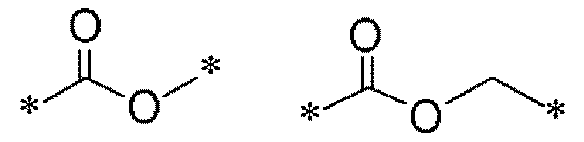
式(b1-2)で表される2価の基は例えば、以下のものが挙げられる。
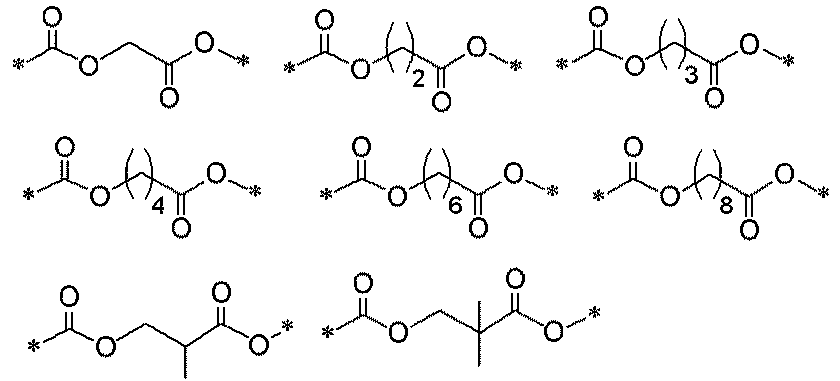
式(b1-3)で表される2価の基は例えば、以下のものが挙げられる。

式(b1-4)で表される2価の基は例えば、*-CH2-O-CH2-*が挙げられる。
式(b1-5)で表される2価の基は例えば、以下のものが挙げられる。
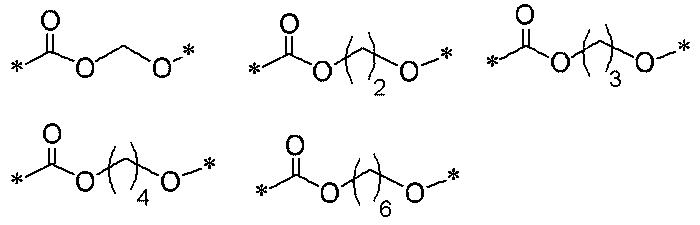
式(b1-6)で表される2価の基は例えば、以下のものが挙げられる。
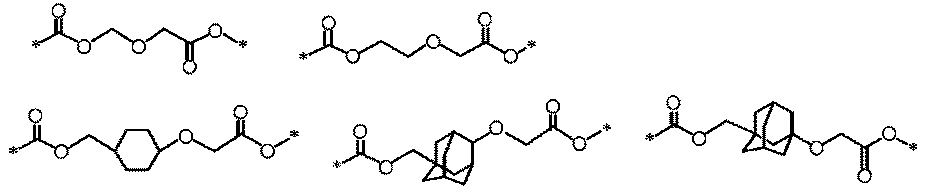
Lb1の2価の飽和炭化水素基は、置換基を有していてもよい。この置換基としては、例えば、ハロゲン原子、ヒドロキシ基、カルボキシ基、炭素数6~18の芳香族炭化水素基、炭素数7~21のアラルキル基、炭素数2~4のアシル基及びグリシジルオキシ基等が挙げられる。
アラルキル基は、例えば、ベンジル基、フェネチル基、フェニルプロピル基、トリチル基、ナフチルメチル基及びナフチルエチル基等が挙げられる。
アラルキル基は、例えば、ベンジル基、フェネチル基、フェニルプロピル基、トリチル基、ナフチルメチル基及びナフチルエチル基等が挙げられる。
式(B1)におけるYの脂肪族炭化水素基としては、アルキル基が好ましく、炭素数1~6のアルキル基がさらに好ましい。また、Yの脂環式炭化水素基は、シクロアルキル基が好ましく、炭素数3~12のシクロアルキル基がさらに好ましい。シクロアルキル基は単環式であっても、多環式であってもよい。また、環を構成する原子としてのみ炭素原子を有するシクロアルキル基に留まらず、環を構成する原子の炭素原子にアルキル基が結合してなる基もシクロアルキル基とする。
Yの脂肪族炭化水素基及び脂環式炭化水素基は任意に置換基を有する。ここで、「置換基を有する脂肪族炭化水素基」とは、該脂肪族炭化水素基に含まれる水素原子が、置換基で置換されている基を意味する。一方、「置換基を有する脂環式炭化水素基」とは、該脂環式炭化水素基に含まれる水素原子が、置換基で置換されている基を意味する。置換基としては、例えば、ハロゲン原子(但し、フッ素原子を除く)、ヒドロキシ基、炭素数1~12のアルコキシ基、炭素数6~18の芳香族炭化水素基、炭素数7~21のアラルキル基、炭素数2~4のアシル基、グリシジルオキシ基又は-(CH2)j2-O-CO-Rb1で表される基(式中、Rb1は、炭素数1~16の脂肪族炭化水素基、炭素数3~16の脂環式炭化水素基及び炭素数6~18の芳香族炭化水素基を表す。j2は、0~4の整数を表す。)等が挙げられる。
置換基である脂環式炭化水素基、芳香族炭化水素基及びアラルキル基には、例えば、アルキル基、ハロゲン原子又はヒドロキシ基を有していてもよい。また、脂肪族炭化水素基に任意に有する置換基としては、炭素数3~16の脂環式炭化水素基でもよい。
Yの脂肪族炭化水素基又は脂環式炭化水素基に含まれるメチレン基は、オキシ基、スルホニル基(-SO2-)又はカルボニル基で置き換わっていてもよい。脂環式炭化水素基に含まれるメチレン基が、オキシ基、スルホニル基又はカルボニル基に置き換わった基としては例えば、環状エーテル基(脂環式炭化水素基に含まれるメチレン基の1つ又は2つがオキシ基に置き換わった基)、環状ケトン基(脂環式炭化水素基に含まれるメチレン基の1つ又は2つがカルボニル基に置き換わった基)、スルトン環基(脂環式炭化水素基に含まれるメチレン基のうち隣り合う2つのメチレン基が、それぞれ、オキシ基及びスルホニル基に置き換わった基)及びラクトン環基(脂環式炭化水素基に含まれるメチレン基のうち隣り合う2つのメチレン基が、それぞれ、オキシ基及びカルボニル基に置き換わった基)等が挙げられる。
Yの脂環式炭化水素基としては、以下の式(Y1)~式(Y26)のいずれかで表される基が挙げられる。このうち、脂環式炭化水素基に含まれるメチレン基の1~3個がそれぞれ、-O-、-SO2-及び-CO-からなる群より選ばれる2価の基に置き換わった基としては、式(Y12)~式(Y26)で表される基が挙げられる。なお、これら式(Y1)~式(Y26)で表される基において、*はLb1に結合している結合手を表す。
Yとしては、これらの例示の中でも、式(Y1)~式(Y19)のいずれかで表される基が好ましく、式(Y11)、式(Y14)、式(Y15)又は式(Y19)で表される基がさらに好ましく、式(Y11)又は式(Y14)で表される基がより好ましい。
環を構成する原子の炭素原子にアルキル基が結合してなる脂環式炭化水素基としては、例えば以下のものが挙げられる。

ヒドロキシ基を有する脂環式炭化水素基としては、例えば以下のものが挙げられる。

芳香族炭化水素基を有する脂環式炭化水素基としては、例えば以下のものが挙げられる。
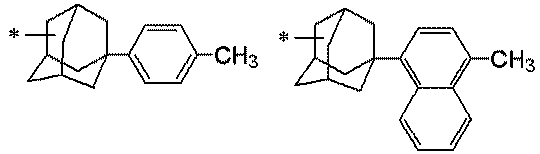
-(CH2)j2-O-CO-Rb1で表される基を有する脂環式炭化水素基としては、例えば以下のものが挙げられる。
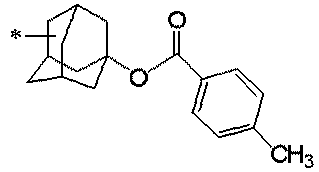
Yとしては、ヒドロキシ基等を置換基として有していてもよいアダマンチル基であると好ましく、具体的には、好ましくは、アダマンチル基又はヒドロキシアダマンチル基である。
スルホン酸アニオンとしては、以下の式(b1-1-1)~式(b1-1-9)で表されるスルホン酸アニオンが挙げられる。この式(b1-1-1)~式(b1-1-9)のいずれかで表されるスルホン酸アニオンにおいて、Lb1は式(b1-1)で表される基が好ましい。また、Rb2及びRb3は、それぞれ独立に、Yの脂肪族炭化水素基又は脂環式炭化水素基が有していてもよい置換基として挙げたものと同じであり、炭素数1~4の脂肪族炭化水素基及びヒドロキシ基が好ましく、メチル基及びヒドロキシ基がより好ましい。
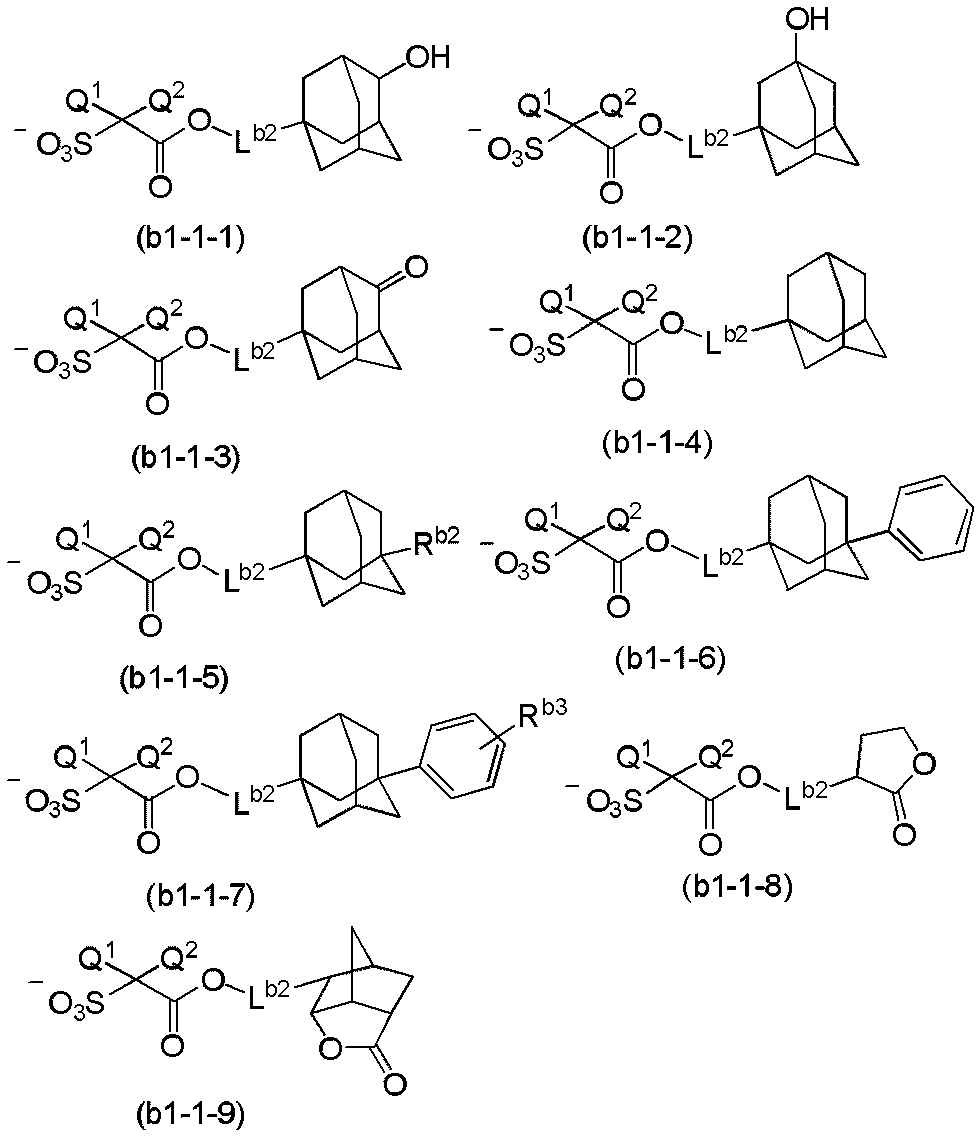
Yが、無置換の脂肪族炭化水素基又は無置換の脂環式炭化水素基であり、Lb1が式(b1-1)で表される基であるスルホン酸アニオンとしては例えば、以下のものが挙げられる。
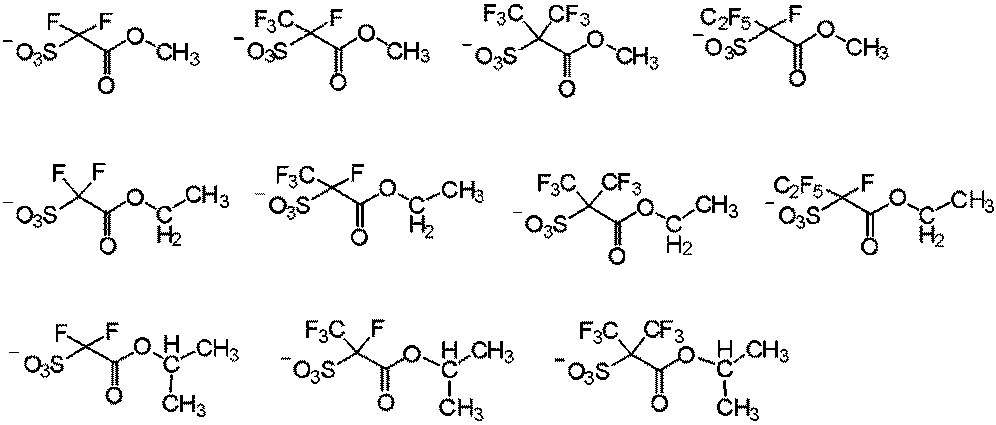
Yが無置換の脂環式炭化水素基又は置換基として脂肪族炭化水素基を有する脂環式炭化水素基であり、Lb1が式(b1-1)で表される基であるスルホン酸アニオンとしては例えば、以下のものが挙げられる。
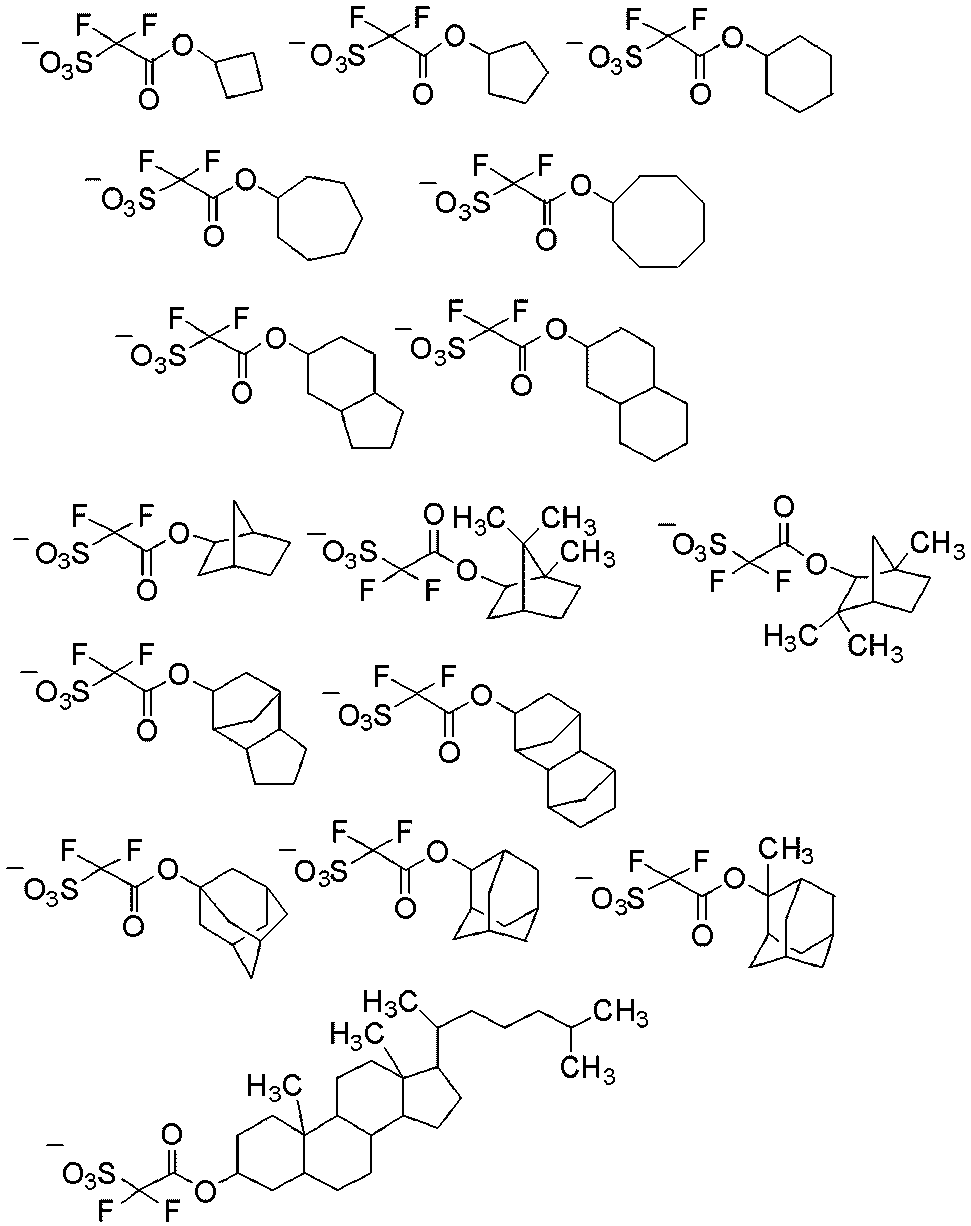
Yが-(CH2)j2-O-CO-Rb1で表される基を有する脂環式炭化水素基であり、Lb1が式(b1-1)で表される基であるスルホン酸アニオンとしては例えば、以下のものが挙げられる。
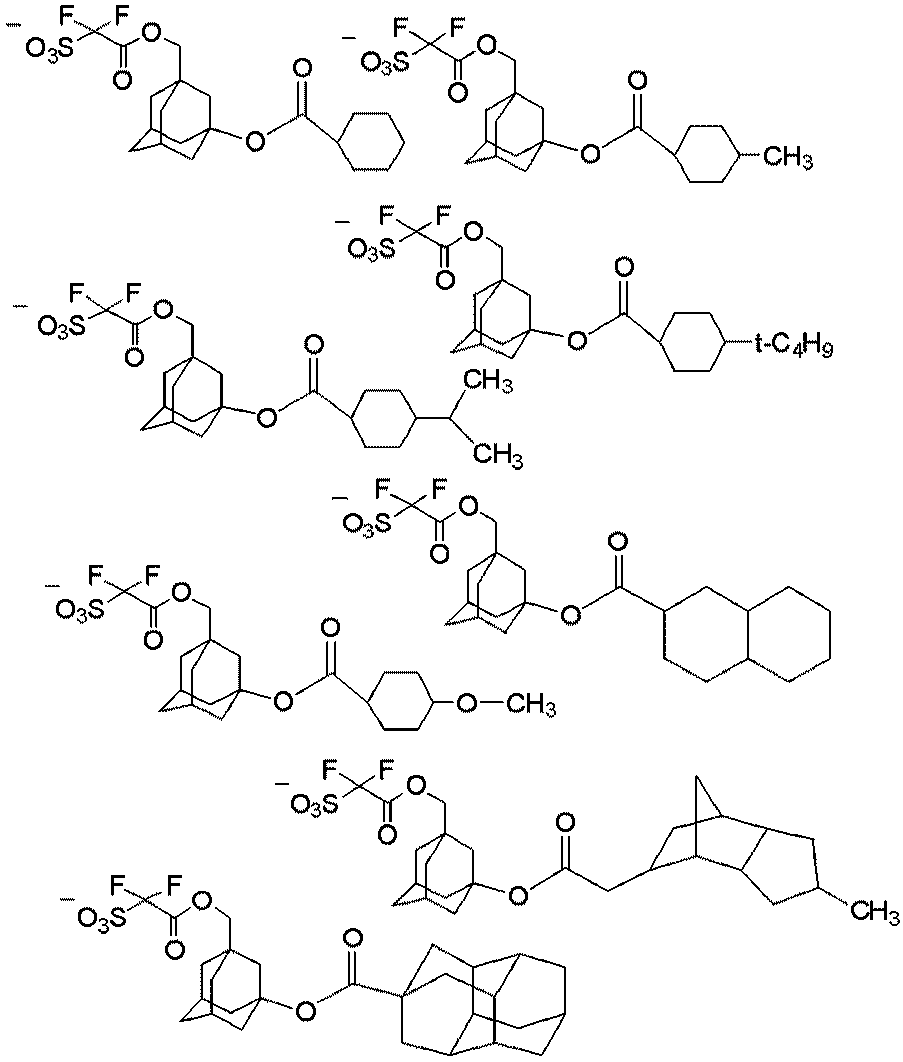
Yが、ヒドロキシ基を有する脂環式炭化水素基であり、Lb1が式(b1-1)で表される基であるスルホン酸アニオンとしては例えば、以下のものが挙げられる。
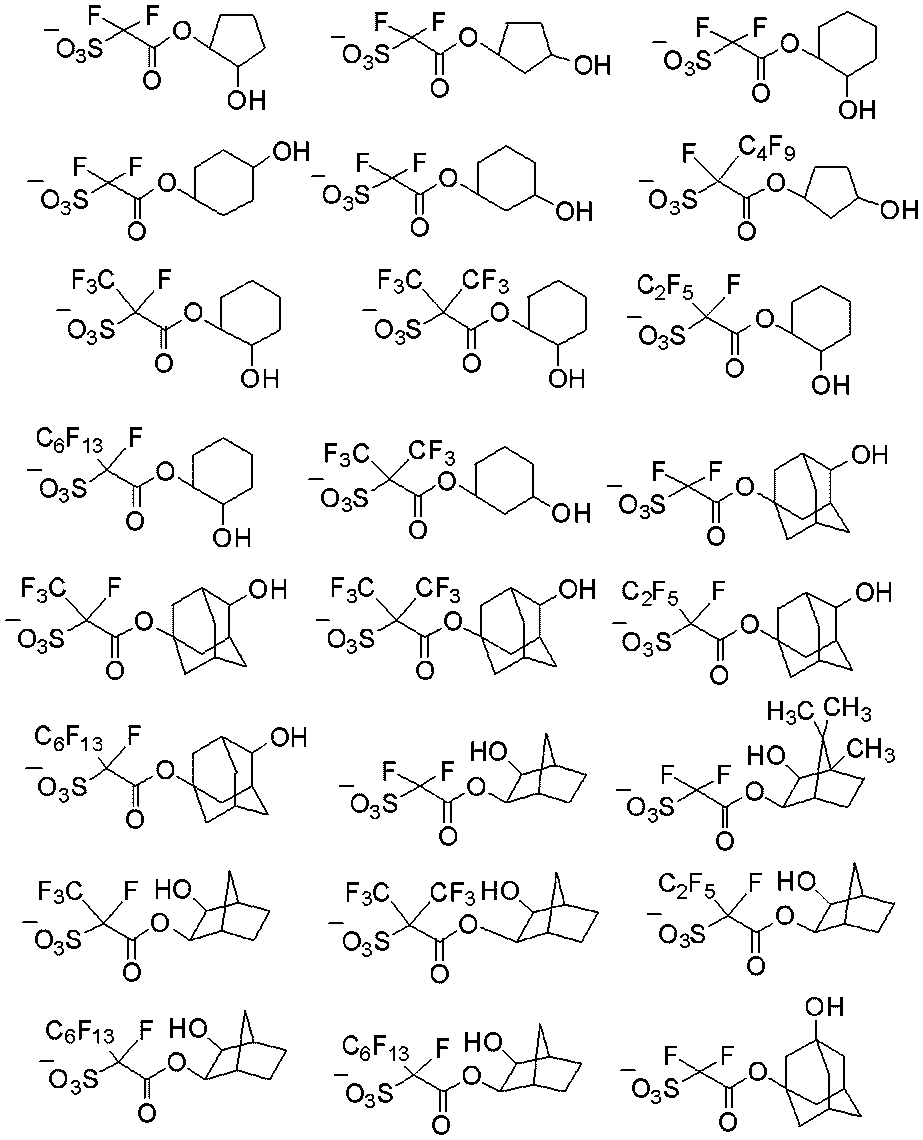
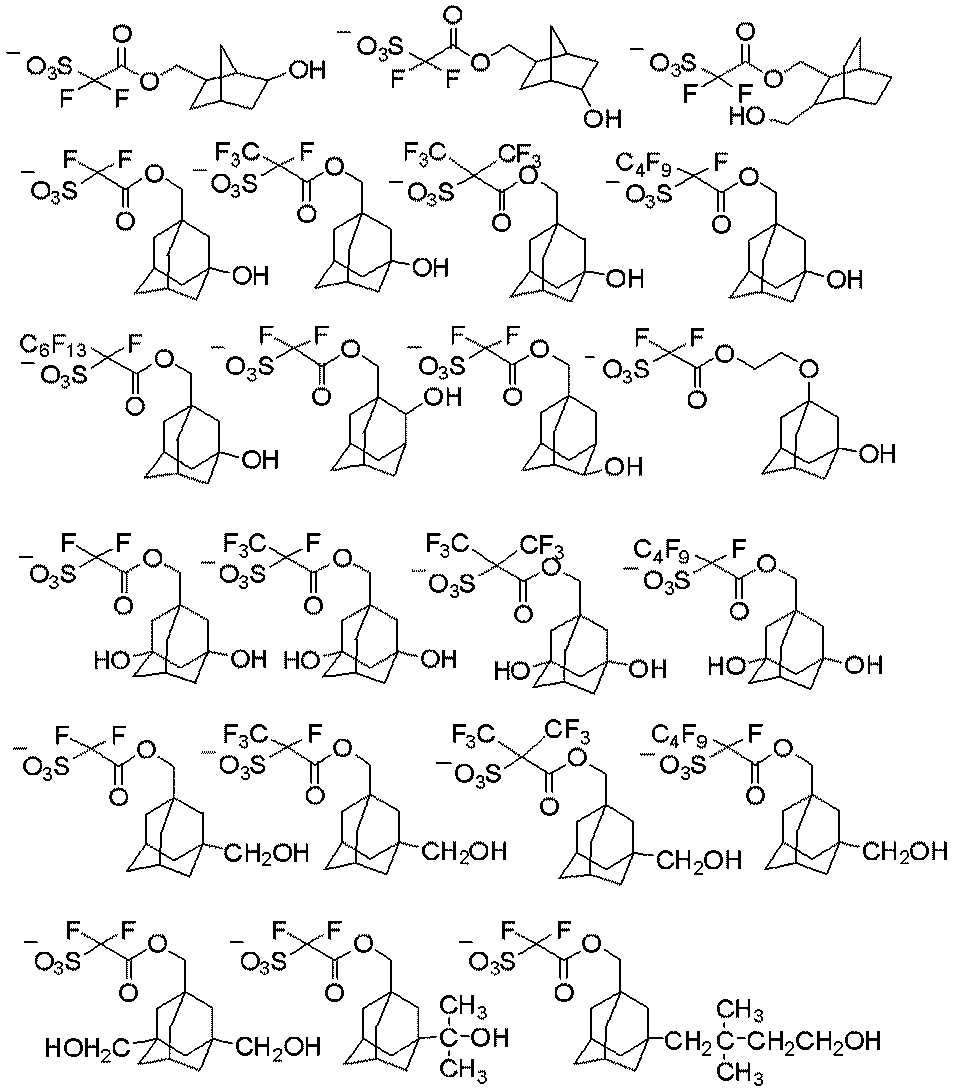
Yが、芳香族炭化水素基又はアラルキル基を有する脂環式炭化水素基であり、Lb1が式(b1-1)で表される基であるスルホン酸アニオンとしては例えば、以下のものが挙げられる。
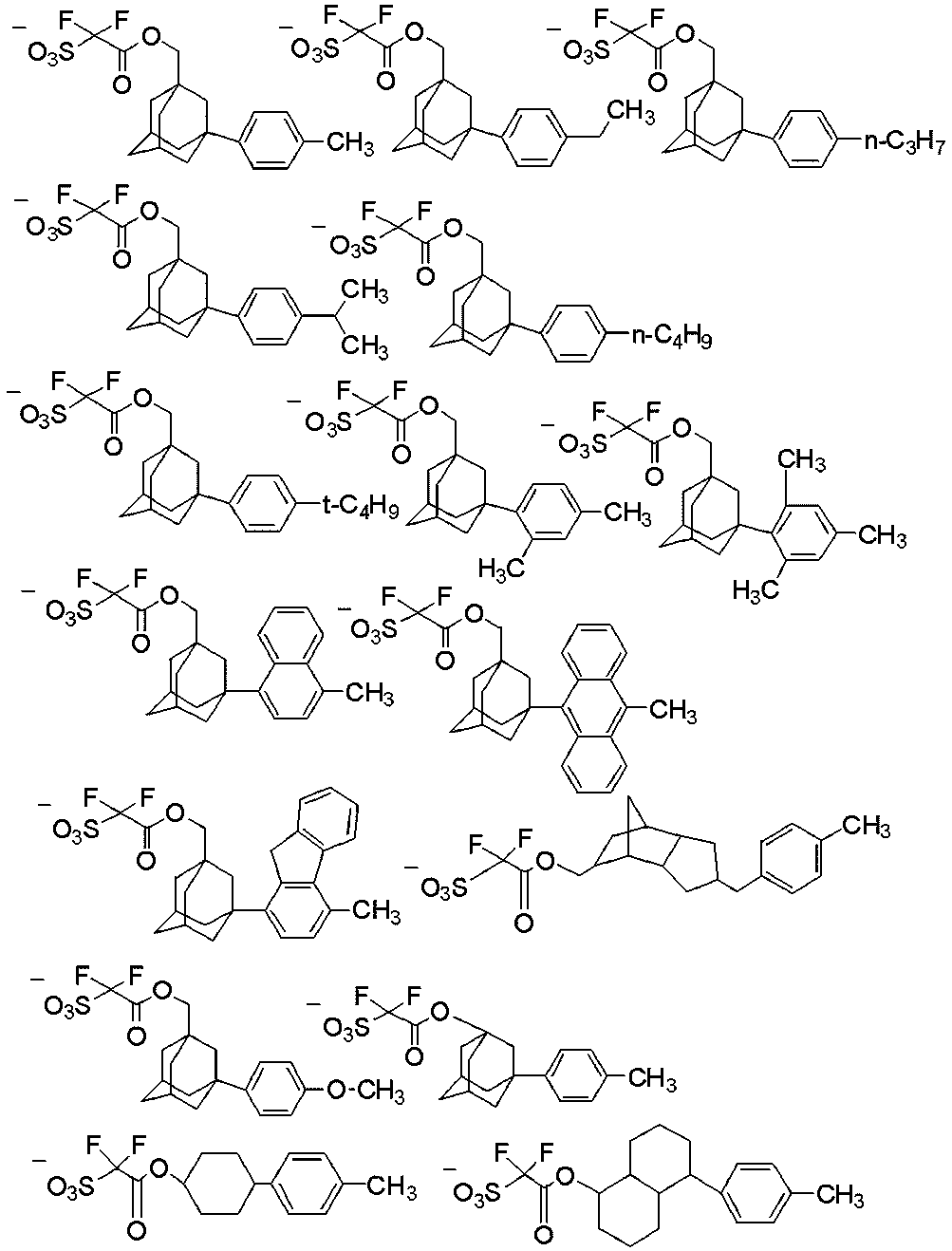
Yが、前記環状エーテル構造を含む基であり、Lb1が式(b1-1)で表される基であるスルホン酸アニオンとしては例えば、以下のものが挙げられる。
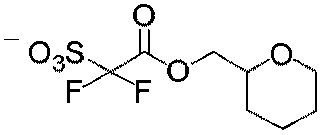
Yが、前記ラクトン環構造を含む基であり、Lb1が式(b1-1)で表される基であるスルホン酸アニオンとしては例えば、以下のものが挙げられる。

Yが、前記環状ケトン構造を含む基であり、Lb1が式(b1-1)で表される基であるスルホン酸アニオンとしては例えば、以下のものが挙げられる。
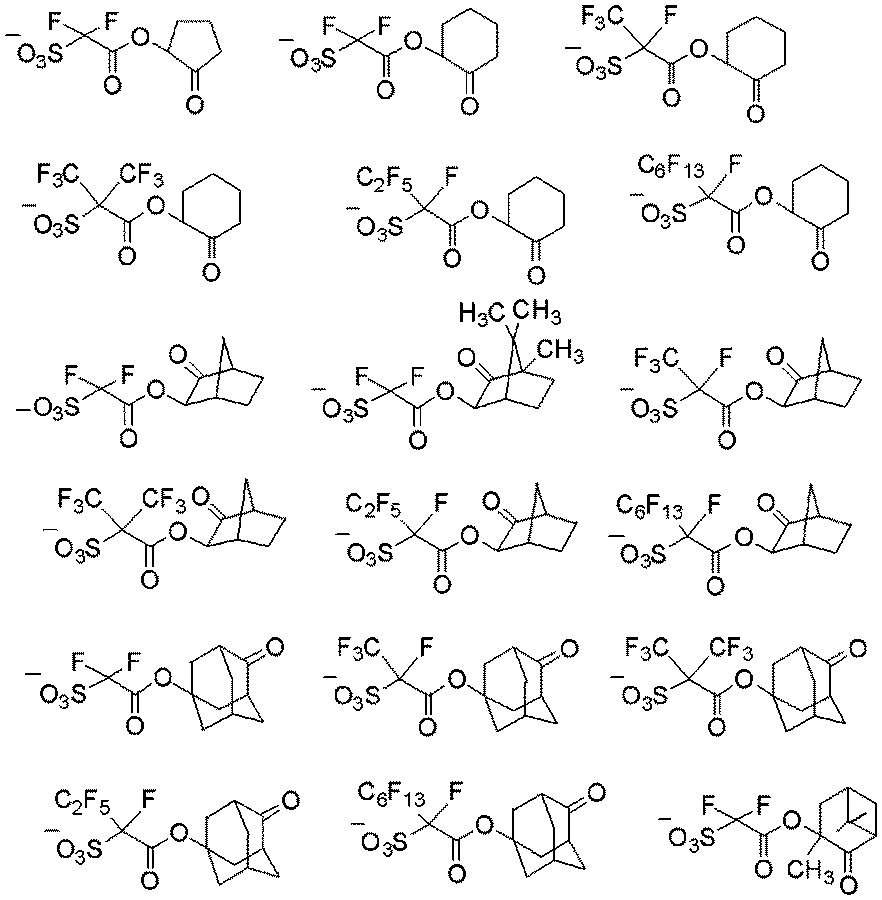
Yが、前記スルトン環構造を含む基であり、Lb1が式(b1-1)で表される基であるスルホン酸アニオンとしては例えば、以下のものが挙げられる。
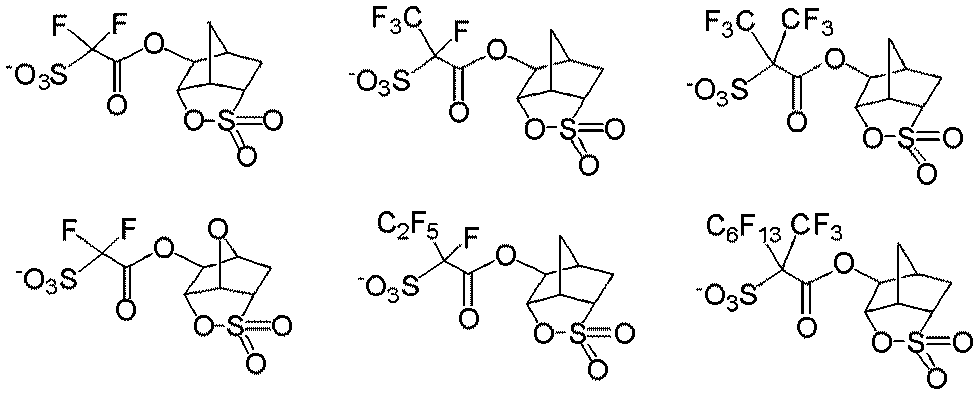
Yが、脂肪族炭化水素基又は無置換の脂環式炭化水素基であり、Lb1が式(b1-2)で表される基であるスルホン酸アニオンとしては例えば、以下のものが挙げられる。

Yが、-(CH2)j2-O-CO-Rb1で表される基を有する脂環式炭化水素基であり、Lb1が式(b1-2)で表される基であるスルホン酸アニオンとしては例えば、以下のものが挙げられる。
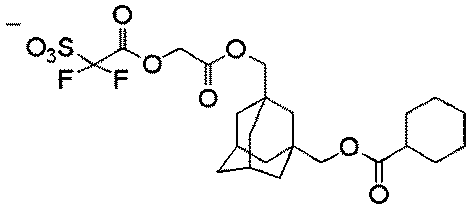
Yが、ヒドロキシ基を有する脂環式炭化水素基であり、Lb1が式(b1-2)で表される基であるスルホン酸アニオンとしては例えば、以下のものが挙げられる。
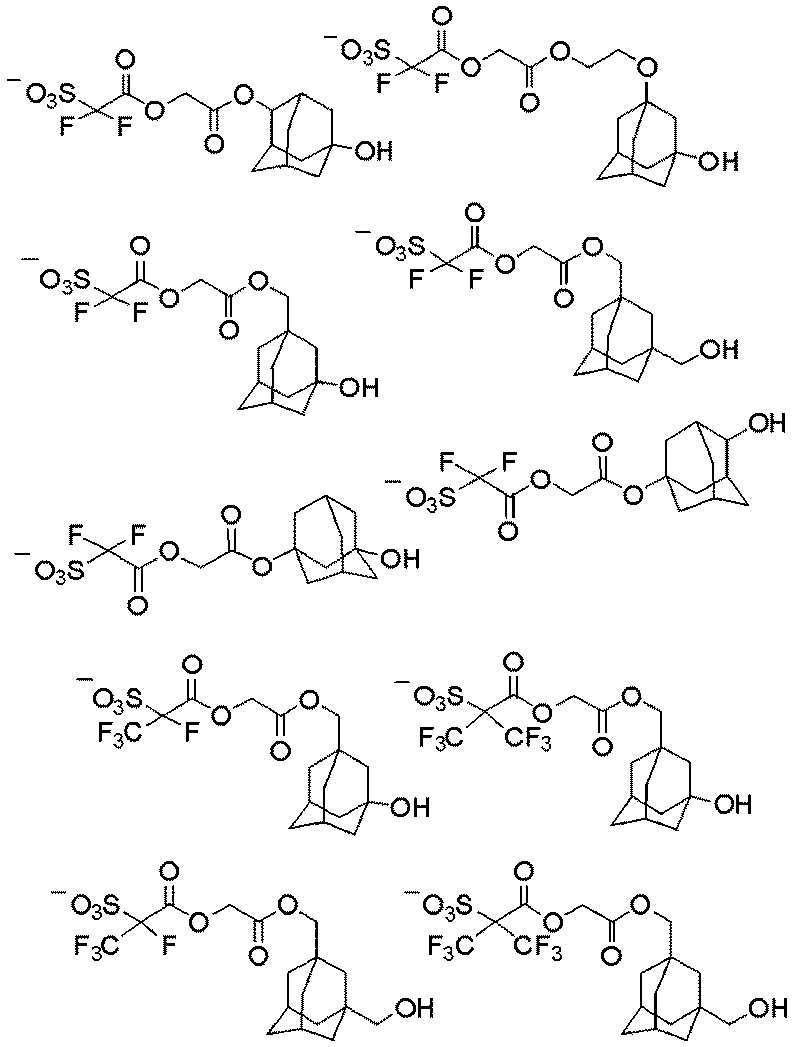
Yが、芳香族炭化水素基を有する脂環式炭化水素基であり、Lb1が式(b1-2)で表される基であるスルホン酸アニオンとしては例えば、以下のものが挙げられる。
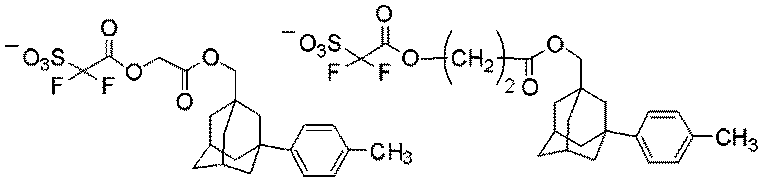
Yが、環状エーテル構造を含む基であり、Lb1が式(b1-2)で表される基であるスルホン酸アニオンとしては例えば、以下のものが挙げられる。

Yが、前記ラクトン環構造を含む基であり、Lb1が式(b1-2)で表される基であるスルホン酸アニオンとしては例えば、以下のものが挙げられる。
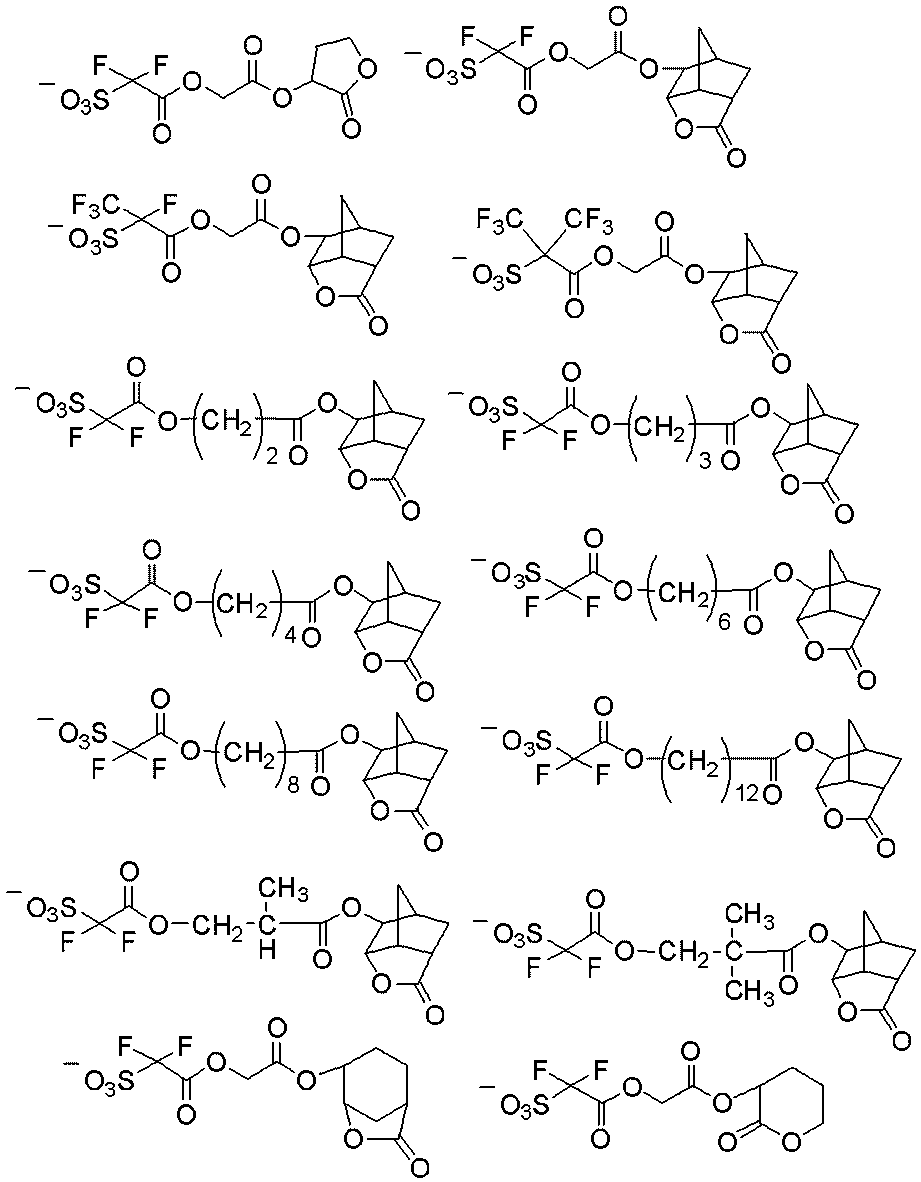
Yが、前記環状ケトン構造を含む基であり、Lb1が式(b1-2)で表される基であるスルホン酸アニオンとしては例えば、以下のものが挙げられる。
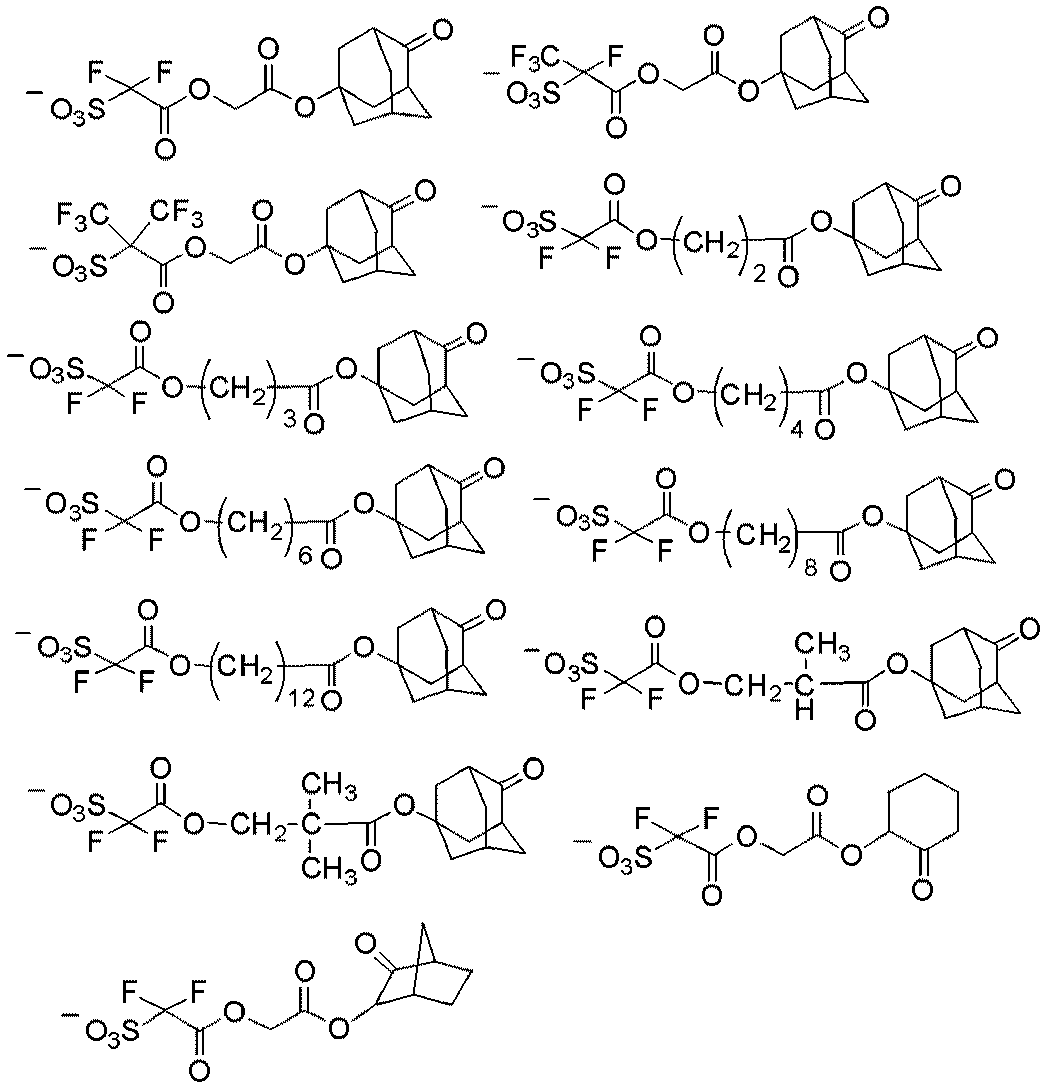
Yが、前記スルトン環構造を含む基であり、Lb1が式(b1-2)で表される基であるスルホン酸アニオンとしては例えば、以下のものが挙げられる。

Yが、脂肪族炭化水素基であり、Lb1が式(b1-3)で表される2価の基であるスルホン酸アニオンとしては例えば、以下のものが挙げられる。
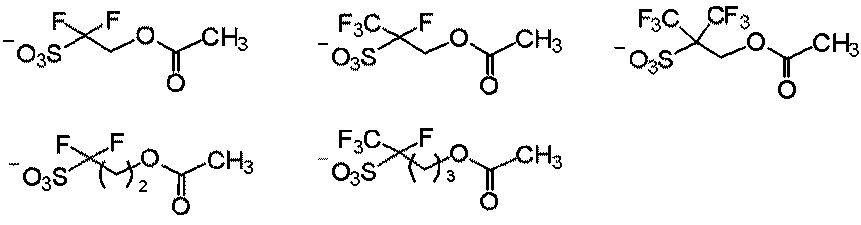
Yが、アルコキシ基を有する脂環式炭化水素基であり、Lb1が式(b1-3)で表される基であるスルホン酸アニオンとしては例えば、以下のものが挙げられる。
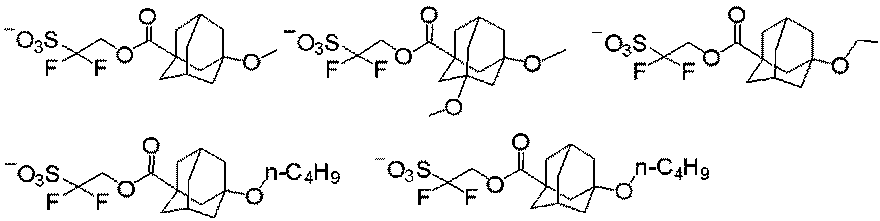
Yが、ヒドロキシ基を有する脂環式炭化水素基であり、Lb1が式(b1-3)で表される2価の基であるスルホン酸アニオンとしては、例えば以下のものが挙げられる。
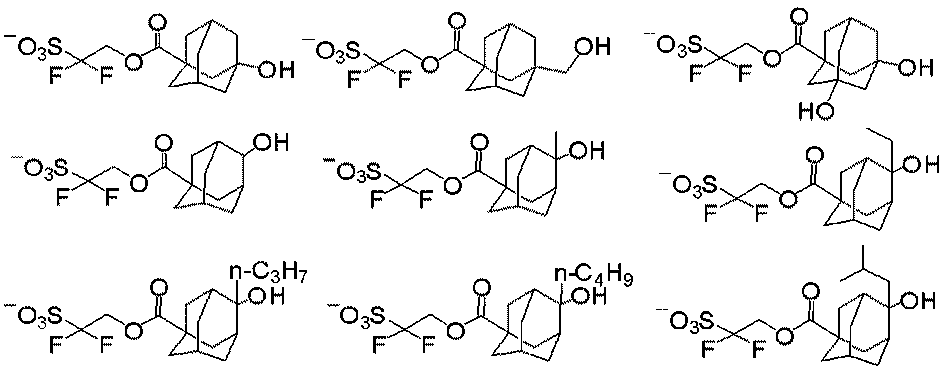
Yが、前記環状ケトン構造を含む基であり、Lb1が式(b1-3)で表される基であるスルホン酸アニオンとしては例えば、以下のものが挙げられる。
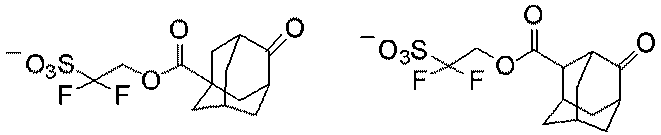
Yが脂環式炭化水素基であり、Lb1が式(b1-4)で表される基であるスルホン酸アニオンとしては例えば、以下のものが挙げられる。
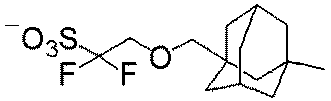
Yが、アルコキシ基を有する脂環式炭化水素基であり、Lb1が式(b1-4)で表される基であるスルホン酸アニオンとしては例えば、以下のものが挙げられる。
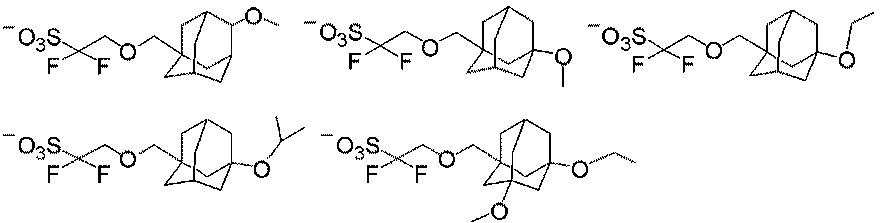
Yが、ヒドロキシ基を有する脂環式炭化水素基であり、Lb1が式(b1-4)で表される基であるスルホン酸アニオンとしては、例えば以下のものが挙げられる。
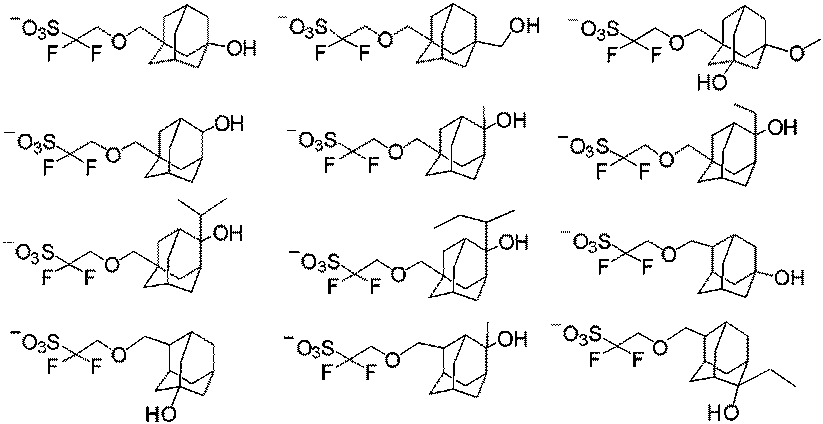
Yが前記環状ケトン構造を含む基であり、Lb1が式(b1-4)で表される2価の基であるスルホン酸アニオンとしては例えば、以下のものが挙げられる。

以上例示したスルホン酸アニオンの中でも、Lb1が式(b1-1)で表される基であるものが好ましい。より好ましいスルホン酸アニオンを以下に示す。
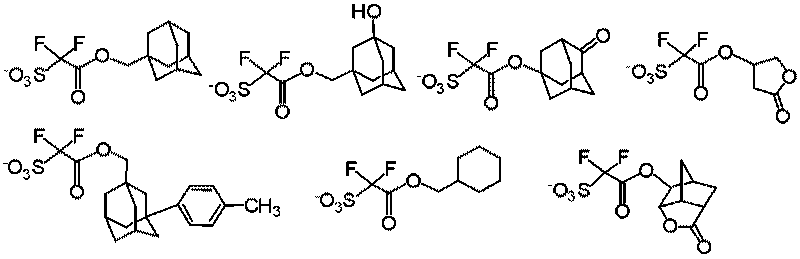
酸発生剤に含まれるカチオンは、例えば、オニウムカチオン、スルホニウムカチオン、ヨードニウムカチオン、アンモニウムカチオン、ベンゾチアゾリウムカチオン及びホスホニウムカチオン等が挙げられる。これらの中でも、スルホニウムカチオン及びヨードニウムカチオンが好ましく、アリールスルホニウムカチオンがより好ましい。
酸発生剤(B1)中の有機カチオン(Z+)としてもスルホニウムカチオン及びヨードニウムカチオンが好ましく、さらに好ましくは、以下の式(b2-1)~式(b2-4)のいずれかで表される有機カチオン〔以下、各式の番号に応じて、「カチオン(b2-1)」、「カチオン(b2-2)」、「カチオン(b2-3)」及び「カチオン(b2-4)」ということがある。〕である。
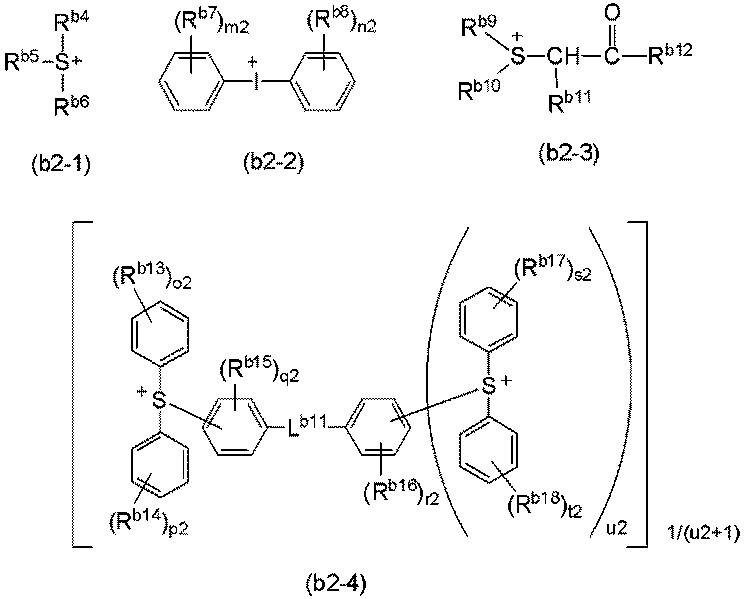
[式(b2-1)~式(b2-4)中、
Rb4、Rb5及びRb6は、それぞれ独立に、脂肪族炭化水素基(好ましくは炭素数1~30)、脂環式炭化水素基(好ましくは炭素数3~18)又は芳香族炭化水素基(好ましくは炭素数6~18)を表す。該脂肪族炭化水素基に含まれる水素原子は、ヒドロキシ基、アルコキシ基(好ましくは炭素数1~12)又は芳香族炭化水素基(好ましくは炭素数6~18)で置換されていてもよく、該脂環式炭化水素基に含まれる水素原子は、ハロゲン原子、アシル基(好ましくは炭素数2~4)又はグリシジルオキシ基で置換されていてもよく、該芳香族炭化水素基は、ハロゲン原子、ヒドロキシ基、脂肪族炭化水素基(好ましくは炭素数1~18)、脂環式炭化水素基(好ましくは炭素数3~18)又はアルコキシ基(好ましくは炭素数1~12)で置換されていてもよい。
Rb4、Rb5及びRb6は、それぞれ独立に、脂肪族炭化水素基(好ましくは炭素数1~30)、脂環式炭化水素基(好ましくは炭素数3~18)又は芳香族炭化水素基(好ましくは炭素数6~18)を表す。該脂肪族炭化水素基に含まれる水素原子は、ヒドロキシ基、アルコキシ基(好ましくは炭素数1~12)又は芳香族炭化水素基(好ましくは炭素数6~18)で置換されていてもよく、該脂環式炭化水素基に含まれる水素原子は、ハロゲン原子、アシル基(好ましくは炭素数2~4)又はグリシジルオキシ基で置換されていてもよく、該芳香族炭化水素基は、ハロゲン原子、ヒドロキシ基、脂肪族炭化水素基(好ましくは炭素数1~18)、脂環式炭化水素基(好ましくは炭素数3~18)又はアルコキシ基(好ましくは炭素数1~12)で置換されていてもよい。
Rb7及びRb8は、それぞれ独立に、ヒドロキシ基、脂肪族炭化水素基(好ましくは炭素数1~12)又はアルコキシ基(好ましくは炭素数1~12)を表す。
m2及びn2は、それぞれ独立に0~5の整数を表す。
Rb9及びRb10は、それぞれ独立に、脂肪族炭化水素基(好ましくは炭素数1~18)又は脂環式炭化水素基(好ましくは炭素数3~18)を表す。
Rb11は、水素原子、脂肪族炭化水素基(好ましくは炭素数1~18)、脂環式炭化水素基(好ましくは炭素数3~18)又は芳香族炭化水素基(好ましくは炭素数6~18)を表す。
Rb9~Rb11は、それぞれ独立に、脂肪族炭化水素基又は脂環式炭化水素基であり、これらが脂肪族炭化水素基である場合、その炭素数は1~12であることが好ましく、脂環式炭化水素基である場合、その炭素数は3~18であることが好ましく、4~12であることがより好ましい。
Rb12は、脂肪族炭化水素基(好ましくは炭素数1~12)、脂環式炭化水素基(好ましくは炭素数3~18)又は芳香族炭化水素基(好ましくは炭素数6~18)を表す。該芳香族炭化水素基に含まれる水素原子は、脂肪族炭化水素基(好ましくは炭素数1~12)、アルコキシ基(好ましくは炭素数1~12)、脂環式炭化水素基(好ましくは炭素数3~18)又はアルキルカルボニルオキシ基(好ましくは炭素数1~12)で置換されていてもよい。
Rb9とRb10は、それらが結合する硫黄原子とともに互いに結合して3員環~12員環(好ましくは3員環~7員環)の脂環式炭化水素環を形成していてもよく、該脂環式炭化水素環に含まれるメチレン基が、オキシ基、チオキシ基又はカルボニル基で置き換わっていてもよい。
Rb13、Rb14、Rb15、Rb16、Rb17及びRb18(以下、「Rb13~Rb18」と表記することがある。)は、それぞれ独立に、ヒドロキシ基、炭素数1~12の脂肪族炭化水素基又は炭素数1~12のアルコキシ基を表す。
Lb11は、-S-又は-O-を表す。
o2、p2、s2及びt2は、それぞれ独立に、0~5の整数を表す。
q2及びr2は、それぞれ独立に、0~4の整数を表す。
u2は0又は1を表す。
o2が2以上であるとき、複数のRb13は互いに同一でも異なっていてもよく、p2が2以上であるとき、複数のRb14は互いに同一でも異なっていてもよく、s2が2以上であるとき、複数のRb15は互いに同一でも異なっていてもよく、t2が2以上であるとき、複数のRb18は互いに同一でも異なっていてもよい。]
アルコキシ基としては、メトキシ基、エトキシ基、プロポキシ基、ブトキシ基、ペンチルオキシ基、ヘキシルオキシ基、ヘプチルオキシ基、オクチルオキシ基、デシルオキシ基及びドデシルオキシ基などが挙げられる。
ハロゲン原子としては、フッ素原子、塩素原子、臭素原子及びヨウ素原子等が挙げられる。
アシル基としては、例えば、アセチル基、プロピオニル基及びブチリル基などが挙げられる。
アルキルカルボニルオキシ基としては、メチルカルボニルオキシ基、エチルカルボニルオキシ基、n-プロピルカルボニルオキシ基、イソプロピルカルボニルオキシ基、n-ブチルカルボニルオキシ基、sec-ブチルカルボニルオキシ基、tert-ブチルカルボニルオキシ基、ペンチルカルボニルオキシ基、ヘキシルカルボニルオキシ基、オクチルカルボニルオキシ基及び2-エチルヘキシルカルボニルオキシ基等が挙げられる。
ハロゲン原子としては、フッ素原子、塩素原子、臭素原子及びヨウ素原子等が挙げられる。
アシル基としては、例えば、アセチル基、プロピオニル基及びブチリル基などが挙げられる。
アルキルカルボニルオキシ基としては、メチルカルボニルオキシ基、エチルカルボニルオキシ基、n-プロピルカルボニルオキシ基、イソプロピルカルボニルオキシ基、n-ブチルカルボニルオキシ基、sec-ブチルカルボニルオキシ基、tert-ブチルカルボニルオキシ基、ペンチルカルボニルオキシ基、ヘキシルカルボニルオキシ基、オクチルカルボニルオキシ基及び2-エチルヘキシルカルボニルオキシ基等が挙げられる。
好ましいアルキル基は、メチル基、エチル基、n-プロピル基、イソプロピル基、n-ブチル基、sec-ブチル基、tert-ブチル基、ペンチル基、ヘキシル基、オクチル基及び2-エチルヘキシル基であり、特に、Rb9~Rb12のアルキル基は、好ましくは炭素数1~12である。
好ましい脂環式炭化水素基は、シクロプロピル基、シクロブチル基、シクロペンチル基、シクロヘキシル基、シクロヘプチル基、シクロデシル基、2-アルキルアダマンタン-2-イル基、1-(アダマンタン-1-イル)-1-アルキル基及びイソボルニル基などである。特に、Rb9~Rb11の脂環式炭化水素基は、好ましくは炭素数3~18、より好ましくは炭素数4~12である。
好ましい芳香族炭化水素基は、フェニル基、4-メチルフェニル基、4-エチルフェニル基、4-tert-ブチルフェニル基、4-シクロへキシルフェニル基、4-メトキシフェニル基、ビフェニリル基及びナフチル基などが好ましい。
芳香族炭化水素基にアルキル基が置換したものは、典型的にはアラルキル基であり、例えば、ベンジル基、フェネチル基、フェニルプロピル基、トリチル基、ナフチルメチル基、ナフチルエチル基等が挙げられる。
好ましい脂環式炭化水素基は、シクロプロピル基、シクロブチル基、シクロペンチル基、シクロヘキシル基、シクロヘプチル基、シクロデシル基、2-アルキルアダマンタン-2-イル基、1-(アダマンタン-1-イル)-1-アルキル基及びイソボルニル基などである。特に、Rb9~Rb11の脂環式炭化水素基は、好ましくは炭素数3~18、より好ましくは炭素数4~12である。
好ましい芳香族炭化水素基は、フェニル基、4-メチルフェニル基、4-エチルフェニル基、4-tert-ブチルフェニル基、4-シクロへキシルフェニル基、4-メトキシフェニル基、ビフェニリル基及びナフチル基などが好ましい。
芳香族炭化水素基にアルキル基が置換したものは、典型的にはアラルキル基であり、例えば、ベンジル基、フェネチル基、フェニルプロピル基、トリチル基、ナフチルメチル基、ナフチルエチル基等が挙げられる。
Rb9とRb10とが結合する硫黄原子とともに形成する環としては、例えば、チオラン-1-イウム環(テトラヒドロチオフェニウム環)、チアン-1-イウム環及び1,4-オキサチアン-4-イウム環などが挙げられる。
Rb11とRb12とが結合する-CH-CO-とともに形成する環としては、例えば、オキソシクロヘプタン環、オキソシクロヘキサン環、オキソノルボルナン環及びオキソアダマンタン環などが挙げられる。
Rb11とRb12とが結合する-CH-CO-とともに形成する環としては、例えば、オキソシクロヘプタン環、オキソシクロヘキサン環、オキソノルボルナン環及びオキソアダマンタン環などが挙げられる。
中でも、カチオン(b2-1)が好ましく、以下の式(b2-1-1)で表される有機カチオン〔以下、「カチオン(b2-1-1)」という。〕がより好ましく、トリフェニルスルホニウムカチオン(式(b2-1-1)中、v2=w2=x2=0である。)又はトリトリルスルホニウムカチオン(式(b2-1-1)中、v2=w2=x2=1であり、Rb19、Rb20及びRb21がいずれもメチル基である。)がさらに好ましい。
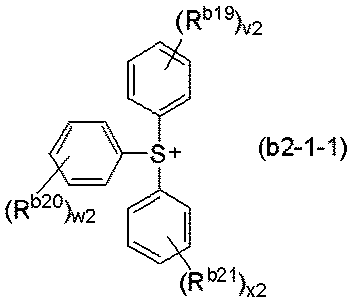
式(b2-1-1)中、
Rb19~Rb21は、それぞれ独立に、ハロゲン原子(より好ましくはフッ素原子)ヒドロキシ基、アルキル基(好ましくは炭素数1~12)、アルコキシ基(好ましくは炭素数1~12)又は脂環式炭化水素基(好ましくは炭素数3~18)を表す。
v2、w2及びx2は、それぞれ独立に0~5の整数(好ましくは0又は1)を表す。
v2が2以上のとき、複数のRb19は互いに同一でも異なっていてもよく、w2が2以上のとき、複数のRb20は互いに同一でも異なっていてもよく、x2が2以上のとき、複数のRb21は互いに同一でも異なっていてもよい。
なかでも、Rb19、Rb20及びRb21は、それぞれ独立に、好ましくは、ハロゲン原子(より好ましくはフッ素原子)、ヒドロキシ基、アルキル基(好ましくは炭素数1~12)又はアルコキシ基(好ましくは炭素数1~12)である。
Rb19~Rb21は、それぞれ独立に、ハロゲン原子(より好ましくはフッ素原子)ヒドロキシ基、アルキル基(好ましくは炭素数1~12)、アルコキシ基(好ましくは炭素数1~12)又は脂環式炭化水素基(好ましくは炭素数3~18)を表す。
v2、w2及びx2は、それぞれ独立に0~5の整数(好ましくは0又は1)を表す。
v2が2以上のとき、複数のRb19は互いに同一でも異なっていてもよく、w2が2以上のとき、複数のRb20は互いに同一でも異なっていてもよく、x2が2以上のとき、複数のRb21は互いに同一でも異なっていてもよい。
なかでも、Rb19、Rb20及びRb21は、それぞれ独立に、好ましくは、ハロゲン原子(より好ましくはフッ素原子)、ヒドロキシ基、アルキル基(好ましくは炭素数1~12)又はアルコキシ基(好ましくは炭素数1~12)である。
カチオン(b2-1-1)の具体例としては、以下のものが挙げられる。

このような有機カチオンを有する酸発生剤(B1)と化合物(I)とを含む本発明のレジスト組成物は、より良好なフォーカスマージンでレジストパターンを製造することができる。
カチオン(b2-2)の具体例としては、以下のものが挙げられる。
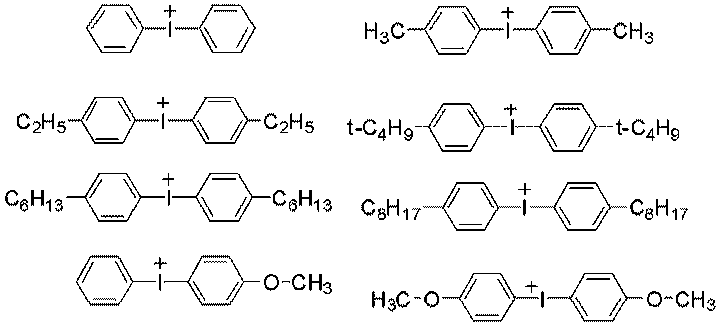
カチオン(b2-3)の具体例としては、以下のものが挙げられる。

カチオン(b2-4)の具体例としては、以下のものが挙げられる。

酸発生剤(B1)は、前記スルホン酸アニオンと前記有機カチオンとを、任意に組み合わせることができる。なかでも、式(b1-1-1)~式(b1-1-9)のいずれかで表されるスルホン酸アニオンとカチオン(b2-1-1)との組合せである酸発生剤(B1)並びに式(b1-1-3)~式(b1-1-5)のいずれかで表されるスルホン酸アニオンとカチオン(b2-3)との組合せである酸発生剤(B1)が好ましい。このような酸発生剤(B1)と、化合物(I)とを含むレジスト組成物は、より一層広いフォーカスマージンでレジストパターンを製造することができる。
好ましい酸発生剤(B1)としては、以下の式(B1-1)~式(B1-17)のいずれかで表されるものが挙げられる。中でもトリフェニルスルホニウムカチオン又はトリトリルスルホニウムカチオンを含む酸発生剤(B1)である、式(B1-1)、式(B1-2)、式(B1-6)、式(B1-11)、式(B1-12)、式(B1-13)及び(B1-14)のいずれかで表されるもの並びに式(B1-3)で表されるものがより好ましい。


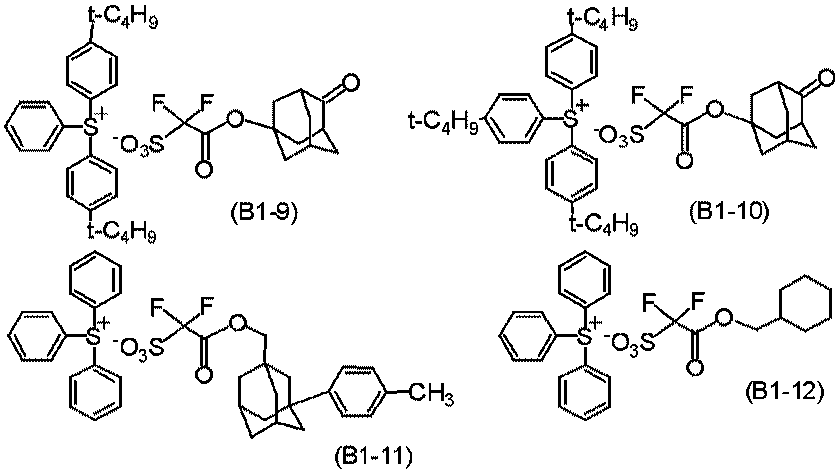

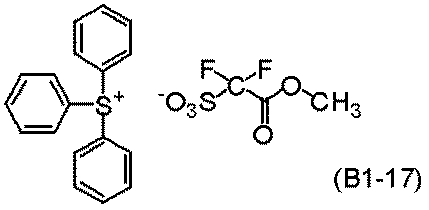
酸発生剤(B)は、1種類で使用してもよく、複数種を使用してもよい。酸発生剤(B)の感活性光線性又は感放射線性樹脂組成物中の含有量(複数種使用する場合は合計量)は、感活性光線性又は感放射線性樹脂組成物の全固形分を基準として、0.1~30質量%が好ましく、より好ましくは0.5~25質量%、更に好ましくは3~20質量%、特に好ましくは3~15質量%である。
<(C)カチオン部位とアニオン部位を同一分子内に有し、かつ、該カチオン部位とアニオン部位が共有結合により連結している化合物(以下、化合物(C)ともいう)>
本発明で使用される感活性光線性又は感放射線性樹脂組成物は、(C)カチオン部位とアニオン部位を同一分子内に有し、かつ、該カチオン部位とアニオン部位が共有結合により連結している化合物を含有する。
化合物(C)としては、下記一般式(C-1)~(C-4)のいずれかで表される化合物であることが好ましい。
本発明で使用される感活性光線性又は感放射線性樹脂組成物は、(C)カチオン部位とアニオン部位を同一分子内に有し、かつ、該カチオン部位とアニオン部位が共有結合により連結している化合物を含有する。
化合物(C)としては、下記一般式(C-1)~(C-4)のいずれかで表される化合物であることが好ましい。

一般式(C-1)~(C-4)中、
R1、R2、R3は、それぞれ独立に炭素数1以上の置換基を表す。
L1は、カチオン部位とアニオン部位を連結する2価の連結基又は単結合を表す。
-X-は、-COO-、-SO3 -、-SO2 -、-N--R4から選択されるアニオン部位を表す。R4は、隣接するN原子との連結部位に、カルボニル基:-C(=O)-、スルホニル基:-S(=O)2-、スルフィニル基:-S(=O)-から選択される基を有する1価の置換基を表す。
一般式(C-1)におけるR1、R2及びL1から選択される2つ以上の基が連結して環構造を形成しても良い(R1又はR2とL1とが連結して環を形成する場合、L1は3価の連結基を表し、R1及びR2とL1とが連結して環構造を形成する場合、L1は4価の連結基を表す。)。
一般式(C-2)におけるR1及びL1は連結して環構造を形成しても良い(R1とL1とが連結して環構造を形成する場合、L1は3価の連結基を表す。)。
一般式(C-3)におけるR1、R2、R3及びL1から選択される2つ以上の基が連結して環構造を形成しても良い(R1、R2及びR3のうちの1つとL1とが連結して環構造を形成する場合、L1は3価の連結基を表し、R1、R2及びR3のうちの2つとL1とが連結して環構造を形成する場合、L1は4価の連結基を表し、R1、R2及びR3のすべてとL1とが連結して環構造を形成する場合、L1は5価の連結基を表す。)。
一般式(C-4)におけるR1、R2、R3及びL1から選択される2つ以上の基が連結して環構造を形成しても良い(R1、R2及びR3のうちの1つとL1とが連結して環構造を形成する場合、L1は3価の連結基を表し、R1、R2及びR3のうちの2つとL1とが連結して環構造を形成する場合、L1は4価の連結基を表し、R1、R2及びR3のすべてとL1とが連結して環構造を形成する場合、L1は5価の連結基を表す。)。
R1、R2、R3は、それぞれ独立に炭素数1以上の置換基を表す。
L1は、カチオン部位とアニオン部位を連結する2価の連結基又は単結合を表す。
-X-は、-COO-、-SO3 -、-SO2 -、-N--R4から選択されるアニオン部位を表す。R4は、隣接するN原子との連結部位に、カルボニル基:-C(=O)-、スルホニル基:-S(=O)2-、スルフィニル基:-S(=O)-から選択される基を有する1価の置換基を表す。
一般式(C-1)におけるR1、R2及びL1から選択される2つ以上の基が連結して環構造を形成しても良い(R1又はR2とL1とが連結して環を形成する場合、L1は3価の連結基を表し、R1及びR2とL1とが連結して環構造を形成する場合、L1は4価の連結基を表す。)。
一般式(C-2)におけるR1及びL1は連結して環構造を形成しても良い(R1とL1とが連結して環構造を形成する場合、L1は3価の連結基を表す。)。
一般式(C-3)におけるR1、R2、R3及びL1から選択される2つ以上の基が連結して環構造を形成しても良い(R1、R2及びR3のうちの1つとL1とが連結して環構造を形成する場合、L1は3価の連結基を表し、R1、R2及びR3のうちの2つとL1とが連結して環構造を形成する場合、L1は4価の連結基を表し、R1、R2及びR3のすべてとL1とが連結して環構造を形成する場合、L1は5価の連結基を表す。)。
一般式(C-4)におけるR1、R2、R3及びL1から選択される2つ以上の基が連結して環構造を形成しても良い(R1、R2及びR3のうちの1つとL1とが連結して環構造を形成する場合、L1は3価の連結基を表し、R1、R2及びR3のうちの2つとL1とが連結して環構造を形成する場合、L1は4価の連結基を表し、R1、R2及びR3のすべてとL1とが連結して環構造を形成する場合、L1は5価の連結基を表す。)。
R1~R3における炭素数1以上の置換基としては、アルキル基、シクロアルキル基、アリール基、アルキルオキシカルボニル基、シクロアルキルオキシカルボニル基、アリールオキシカルボニル基、アルキルアミノカルボニル基、シクロアルキルアミノカルボニル基、アリールアミノカルボニル基などが挙げられる。好ましくは、アルキル基、シクロアルキル基、アリール基である。
2価の連結基としてのL1は、直鎖若しくは分岐鎖状アルキレン基、シクロアルキレン基、アリーレン基、カルボニル基、エーテル結合、エステル結合、アミド結合、ウレタン結合、ウレア結合、及びこれらの2種以上を組み合わせてなる基等が挙げられる。L1は、より好ましくは、アルキレン基、アリーレン基、エーテル結合、エステル結合、及びこれらの2種以上を組み合わせてなる基である。
3~5価の連結基としてのL1の具体例及び好ましい例としては、上述の2価の連結基としてのL1の具体例及び好ましい例から、それぞれ1~3個の任意の水素原子を除してなる連結基が挙げられる。
一般式(C-1)におけるR1、R2及びL1から選択される2つの基が連結して形成してもよい環としては、含硫黄複素環が好ましい。含硫黄複素環構造としては、単環、多環又はスピロ環のものであっても良く、好ましくは、単環の含硫黄複素環構造であり、その炭素数は好ましくは3~10である。中でもジベンゾチオフェン環又はジベンゾチオキサン環が好ましい。
一般式(C-2)におけるR1及びL1が連結して形成してもよい環としては、含沃素複素環が好ましい。含沃素複素環構造としては、単環、多環又はスピロ環のものであっても良く、好ましくは、単環の含沃素複素環構造であり、その炭素数は好ましくは3~10である。
一般式(C-3)におけるR1、R2、R3及びL1から選択される2つ以上の基が連結して形成してもよい環としては、含窒素複素環が好ましい。含窒素複素環構造としては、単環、多環又はスピロ環のものであっても良く、好ましくは、単環の含窒素複素環構造であり、その炭素数は好ましくは3~10である。
一般式(C-4)におけるR1、R2、R3及びL1から選択される2つ以上の基が連結して形成してもよい環としては、含リン複素環が好ましい。含リン複素環構造としては、単環、多環又はスピロ環のものであっても良く、好ましくは、単環の含リン複素環構造であり、その炭素数は好ましくは3~10である。
化合物(C)としては、下記式(I1)で表される化合物が好ましい。

[式(I1)中、
A1及びA2は、それぞれ独立に、1価の脂肪族炭化水素基(好ましくは炭素数1~18)又は1価の芳香族炭化水素基(好ましく炭素数6~18)を表し、A3は、2価の脂肪族炭化水素基(好ましくは炭素数1~18)又は2価の芳香族炭化水素基(好ましくは炭素数6~18)を表す。
A1と、A2又はA3とが互いに結合し、これらが結合する硫黄原子とともに複素環(好ましくは炭素数3~20)を形成していてもよい。該1価の脂肪族炭化水素基及び該2価の脂肪族炭化水素基に含まれる水素原子は、ヒドロキシ基に置換されていてもよく、該1価の芳香族炭化水素基、該2価の芳香族炭化水素基及び該複素環に含まれる水素原子は、ヒドロキシ基、脂肪族炭化水素基(好ましくは炭素数1~12)又はアルコキシ基(好ましくは炭素数1~12)で置換されていてもよい。また、該1価の脂肪族炭化水素基及び該2価の脂肪族炭化水素基を構成するメチレン基は、酸素原子又はカルボニル基に置き換わっていてもよい。
X1は、2価の脂肪族飽和炭化水素基(好ましくは炭素数1~10)を表す。
X2は、オキシカルボニル基、カルボニルオキシ基又は酸素原子を表す。]
A1及びA2は、それぞれ独立に、1価の脂肪族炭化水素基(好ましくは炭素数1~18)又は1価の芳香族炭化水素基(好ましく炭素数6~18)を表し、A3は、2価の脂肪族炭化水素基(好ましくは炭素数1~18)又は2価の芳香族炭化水素基(好ましくは炭素数6~18)を表す。
A1と、A2又はA3とが互いに結合し、これらが結合する硫黄原子とともに複素環(好ましくは炭素数3~20)を形成していてもよい。該1価の脂肪族炭化水素基及び該2価の脂肪族炭化水素基に含まれる水素原子は、ヒドロキシ基に置換されていてもよく、該1価の芳香族炭化水素基、該2価の芳香族炭化水素基及び該複素環に含まれる水素原子は、ヒドロキシ基、脂肪族炭化水素基(好ましくは炭素数1~12)又はアルコキシ基(好ましくは炭素数1~12)で置換されていてもよい。また、該1価の脂肪族炭化水素基及び該2価の脂肪族炭化水素基を構成するメチレン基は、酸素原子又はカルボニル基に置き換わっていてもよい。
X1は、2価の脂肪族飽和炭化水素基(好ましくは炭素数1~10)を表す。
X2は、オキシカルボニル基、カルボニルオキシ基又は酸素原子を表す。]
A1及びA2の1価の脂肪族炭化水素基は、典型的にはアルキル基又は脂環式炭化水素基であり、その具体例は、炭素数18以下の範囲ですでに例示したものを含む。中でも、脂肪族炭化水素基(好ましくは炭素数1~12)が好ましい。
A1及びA2の1価の芳香族炭化水素基の具体例は、炭素数6~18の範囲ですでに例示したものを含む。この1価の芳香族炭化水素基は例えば、アルキル基を有しているものでもよく、当該アルキル基の炭素数を含めて、A1及びA2の芳香族炭化水素基の炭素数とする。具体的に、芳香族炭化水素基及びアルキル基を有する芳香族炭化水素基を例示すると、フェニル基、ナフチル基、アントラニル基、p-メチルフェニル基、p-tert-ブチルフェニル基、p-アダマンチルフェニル基、トリル基、キシリル基、クメニル基、メシチル基、ビフェニル基、アントリル基、フェナントリル基、2,6-ジエチルフェニル基及び2-メチル-6-エチルフェニルなどが挙げられる。
A3は、2価の脂肪族炭化水素基又は2価の芳香族炭化水素基を表す。当該2価の脂肪族炭化水素基及び当該2価の芳香族炭化水素基の具体例は、それぞれの炭素数の範囲において、すでに例示したものを含む。なお、A3の2価の脂肪族炭化水素基を構成するメチレン基は、酸素原子又はカルボニル基に置き換わることもある。
また、A1とA2とが互いに結合して、これらが結合する硫黄原子とともに複素環を形成している場合の具体例は、式(I1)に含まれる。
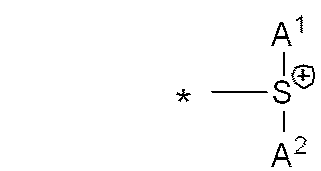
たとえば、上記式で示される部分構造が、以下のいずれかの構造となった場合を挙げることができる。
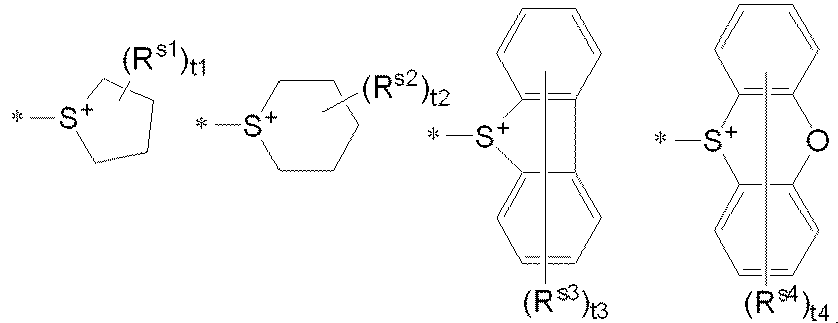
これらの式においては、
Rs1、Rs2、Rs3及びRs4は、それぞれ独立に、ヒドロキシ基、炭素数1~12のアルキル基、アルコキシ基(好ましくは炭素数1~12)又は脂環式炭化水素基(好ましくは炭素数3~12)を表す。また、t1は、0~4の整数、t2は、0~5の整数、t3は、0~8の整数、t4は、0~8の整数をそれぞれ表す。なお、ここでいうアルキル基、アルコキシ基及び脂環式炭化水素基は、炭素数が各々の範囲において、すでに例示したものを含む。
Rs1、Rs2、Rs3及びRs4は、それぞれ独立に、ヒドロキシ基、炭素数1~12のアルキル基、アルコキシ基(好ましくは炭素数1~12)又は脂環式炭化水素基(好ましくは炭素数3~12)を表す。また、t1は、0~4の整数、t2は、0~5の整数、t3は、0~8の整数、t4は、0~8の整数をそれぞれ表す。なお、ここでいうアルキル基、アルコキシ基及び脂環式炭化水素基は、炭素数が各々の範囲において、すでに例示したものを含む。
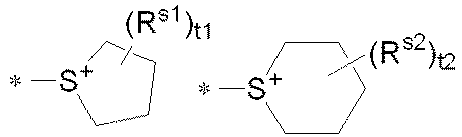
これらのうちの上記部分構造は、環を構成するメチレン基の1つ乃至2つが、酸素原子又はカルボニル基に置き換わっていてもよい。
なお、A1とA2とが互いに結合して形成される複素環は、その炭素数が4~6の範囲であるとさらに好ましい。
なお、A1とA2とが互いに結合して形成される複素環は、その炭素数が4~6の範囲であるとさらに好ましい。
一方、A1とA3とが互いに結合して、これらが結合する硫黄原子とともに複素環を形成している場合の具体例は、式(I1)の下記式

で示される部分構造が、以下のいずれかの構造となった場合を挙げることができる。
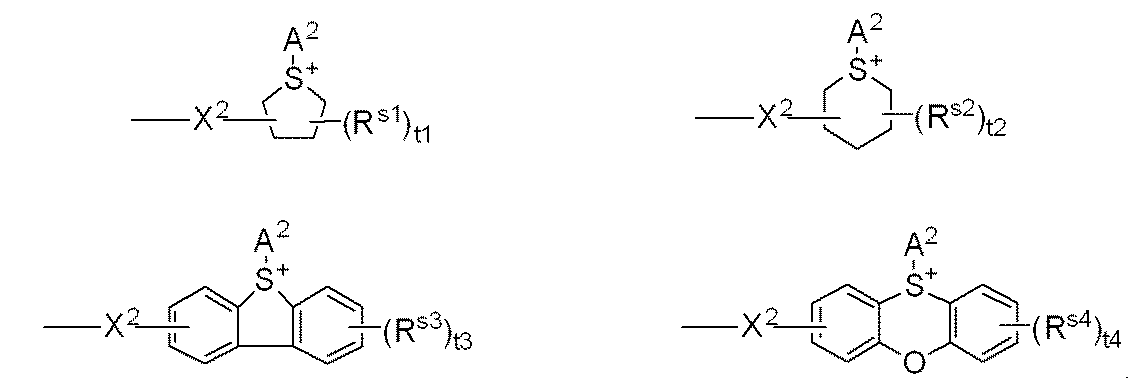
これらの式において、
Rs1、Rs2、Rs3、Rs4、t1、t2、t3、t4、A2及びX2は上記と同じ意味を表す。
Rs1、Rs2、Rs3、Rs4、t1、t2、t3、t4、A2及びX2は上記と同じ意味を表す。
A1及びA2の1価の芳香族炭化水素基、A3の2価の芳香族炭化水素基、或いは、A1と、A2又はA3とが結合して形成される複素環は、上述のとおり、アルキル基及び脂環式炭化水素基といった脂肪族炭化水素基、又はアルコキシ基を有していてもよい。ここでいう脂肪族炭化水素基及びアルコキシ基の具体例は、それぞれの炭素数の範囲ですでに例示したものを含み、このような置換基のある炭素原子の数も含めて、芳香族炭化水素基及び複素環の炭素数とする。
以上、式(I1)のA1~A3について具体例を示しつつ説明したが、A1~A3のうち、少なくとも1つは芳香環を含む基であると好ましい。
A1及びA2は、それぞれ独立に、フェニル基又はナフチル基であるとより好ましく、A1及びA2が、ともにフェニル基であるとさらに好ましい。
A3は、フェニレン基がより好ましく、p-フェニレン基がさらに好ましい。
A1及びA2は、それぞれ独立に、フェニル基又はナフチル基であるとより好ましく、A1及びA2が、ともにフェニル基であるとさらに好ましい。
A3は、フェニレン基がより好ましく、p-フェニレン基がさらに好ましい。
式(I1)で表される化合物の具体例を以下に示す。
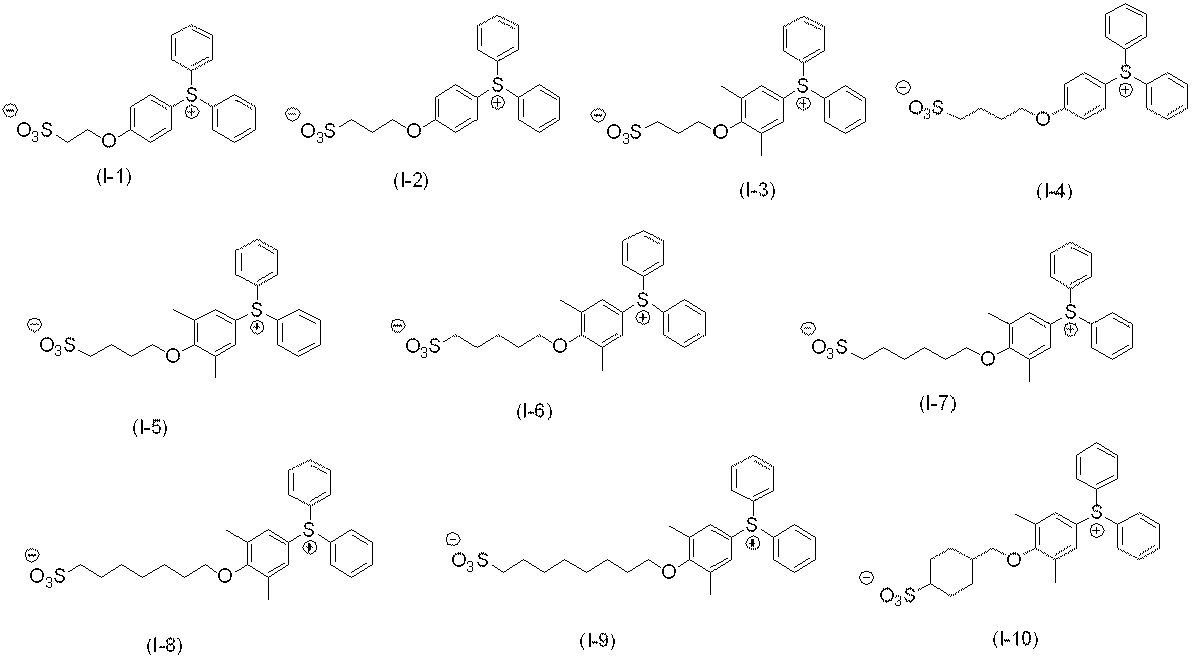
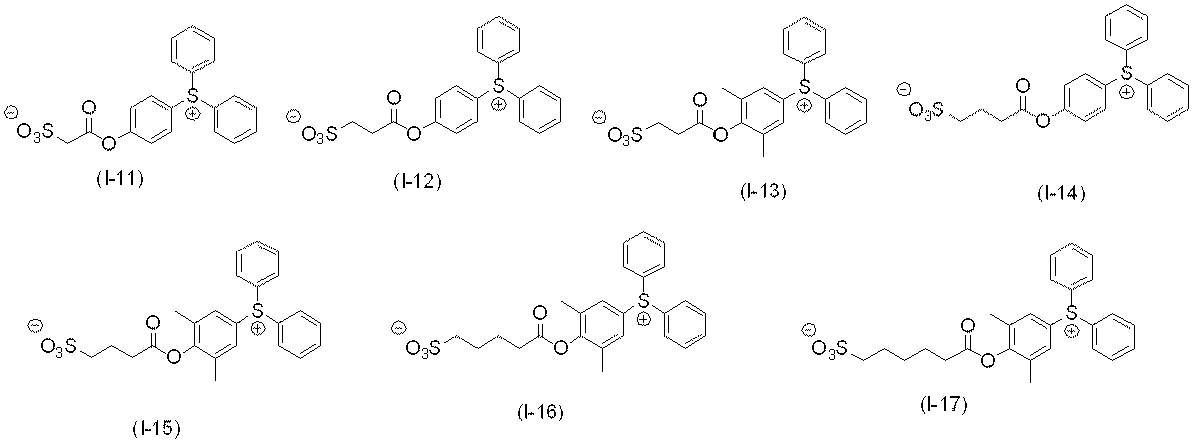

化合物(C)としては、下記式(I2)で表される化合物もまた好ましい。

[式(I2)中、
R1及びR2は、それぞれ独立に、炭化水素基(好ましくは炭素数1~12)、アルコキシ基(好ましくは炭素数1~6)、アシル基(好ましくは炭素数2~7)、アシルオキシ基(好ましくは炭素数2~7)、アルコキシカルボニル基(好ましくは炭素数2~7)、ニトロ基又はハロゲン原子を表す。
m及びnは、それぞれ独立に、0~4の整数を表し、mが2以上の場合、複数のR1は同じでも異なってもよく、nが2以上の場合、複数のR2は同じでも異なってもよい。]
R1及びR2は、それぞれ独立に、炭化水素基(好ましくは炭素数1~12)、アルコキシ基(好ましくは炭素数1~6)、アシル基(好ましくは炭素数2~7)、アシルオキシ基(好ましくは炭素数2~7)、アルコキシカルボニル基(好ましくは炭素数2~7)、ニトロ基又はハロゲン原子を表す。
m及びnは、それぞれ独立に、0~4の整数を表し、mが2以上の場合、複数のR1は同じでも異なってもよく、nが2以上の場合、複数のR2は同じでも異なってもよい。]
R1及びR2の炭化水素基としては、脂肪族炭化水素基、脂環式炭化水素基、芳香族炭化水素基及びこれらの組み合わせ等が挙げられる。
脂肪族炭化水素基としては、メチル基、エチル基、プロピル基、イソプロピル基、ブチル基、イソブチル基、t-ブチル基、ペンチル基、ヘキシル基、ノニル基等のアルキル基が挙げられる。
脂環式炭化水素基としては、単環式及び多環式のいずれでもよく、飽和及び不飽和のいずれでもよい。例えば、シクロプロピル基、シクロブチル基、シクロペンチル基、シクロへキシル基、シクロノニル基、シクロドデシル基等のシクロアルキル基、ノルボルニル基、アダマンチル基等が挙げられる。特に、脂環式炭化水素が好ましい。
芳香族炭化水素基としては、フェニル基、1-ナフチル基、2-ナフチル基、2-メチルフェニル基、3-メチルフェニル基、4-メチルフェニル基、4-エチルフェニル基、4-プロピルフェニル基、4-イソプロピルフェニル基、4-ブチルフェニル基、4-t-ブチルフェニル基、4-ヘキシルフェニル基、4-シクロヘキシルフェニル基、アントラニル基、p-アダマンチルフェニル基、トリル基、キシリル基、クメニル基、メシチル基、ビフェニル基、アントリル基、フェナントリル基、2,6-ジエチルフェニル基、2-メチル-6-エチルフェニル等のアリール基等が挙げられる。
これらの組み合わせとしては、アルキル-シクロアルキル基、シクロアルキル-アルキル基、アラルキル基(例えば、フェニルメチル基、1-フェニルエチル基、2-フェニルエチル基、1-フェニル-1-プロピル基、1-フェニル-2-プロピル基、2-フェニル-2-プロピル基、3-フェニル-1-プロピル基、4-フェニル-1-ブチル基、5-フェニル-1-ペンチル基、6-フェニル-1-ヘキシル基等)等が挙げられる。
脂肪族炭化水素基としては、メチル基、エチル基、プロピル基、イソプロピル基、ブチル基、イソブチル基、t-ブチル基、ペンチル基、ヘキシル基、ノニル基等のアルキル基が挙げられる。
脂環式炭化水素基としては、単環式及び多環式のいずれでもよく、飽和及び不飽和のいずれでもよい。例えば、シクロプロピル基、シクロブチル基、シクロペンチル基、シクロへキシル基、シクロノニル基、シクロドデシル基等のシクロアルキル基、ノルボルニル基、アダマンチル基等が挙げられる。特に、脂環式炭化水素が好ましい。
芳香族炭化水素基としては、フェニル基、1-ナフチル基、2-ナフチル基、2-メチルフェニル基、3-メチルフェニル基、4-メチルフェニル基、4-エチルフェニル基、4-プロピルフェニル基、4-イソプロピルフェニル基、4-ブチルフェニル基、4-t-ブチルフェニル基、4-ヘキシルフェニル基、4-シクロヘキシルフェニル基、アントラニル基、p-アダマンチルフェニル基、トリル基、キシリル基、クメニル基、メシチル基、ビフェニル基、アントリル基、フェナントリル基、2,6-ジエチルフェニル基、2-メチル-6-エチルフェニル等のアリール基等が挙げられる。
これらの組み合わせとしては、アルキル-シクロアルキル基、シクロアルキル-アルキル基、アラルキル基(例えば、フェニルメチル基、1-フェニルエチル基、2-フェニルエチル基、1-フェニル-1-プロピル基、1-フェニル-2-プロピル基、2-フェニル-2-プロピル基、3-フェニル-1-プロピル基、4-フェニル-1-ブチル基、5-フェニル-1-ペンチル基、6-フェニル-1-ヘキシル基等)等が挙げられる。
アルコキシ基としては、メトキシ基、エトキシ基等が挙げられる。
アシル基としては、アセチル基、プロパノイル基、ベンゾイル基、シクロヘキサンカルボニル基等が挙げられる。
アシルオキシ基としては、上記アシル基にオキシ基(-O-)が結合した基等が挙げられる。
アルコキシカルボニル基としては、上記アルコキシ基にカルボニル基(-CO-)が結合した基等が挙げられる。
ハロゲン原子としては、フッ素原子、塩素原子、臭素原子等が挙げられる。
アシル基としては、アセチル基、プロパノイル基、ベンゾイル基、シクロヘキサンカルボニル基等が挙げられる。
アシルオキシ基としては、上記アシル基にオキシ基(-O-)が結合した基等が挙げられる。
アルコキシカルボニル基としては、上記アルコキシ基にカルボニル基(-CO-)が結合した基等が挙げられる。
ハロゲン原子としては、フッ素原子、塩素原子、臭素原子等が挙げられる。
式(I2)においては、R1及びR2は、それぞれ独立に、炭素数1~8のアルキル基、炭素数3~10のシクロアルキル基、炭素数1~6のアルコキシ基、炭素数2~4のアシル基、炭素数2~4のアシルオキシ基、炭素数2~4のアルコキシカルボニル基、ニトロ基又はハロゲン原子が好ましい。
m及びnは、それぞれ独立に、0~2の整数が好ましい。
m及びnは、それぞれ独立に、0~2の整数が好ましい。
式(I2)で表される化合物としては、以下の化合物が挙げられる。
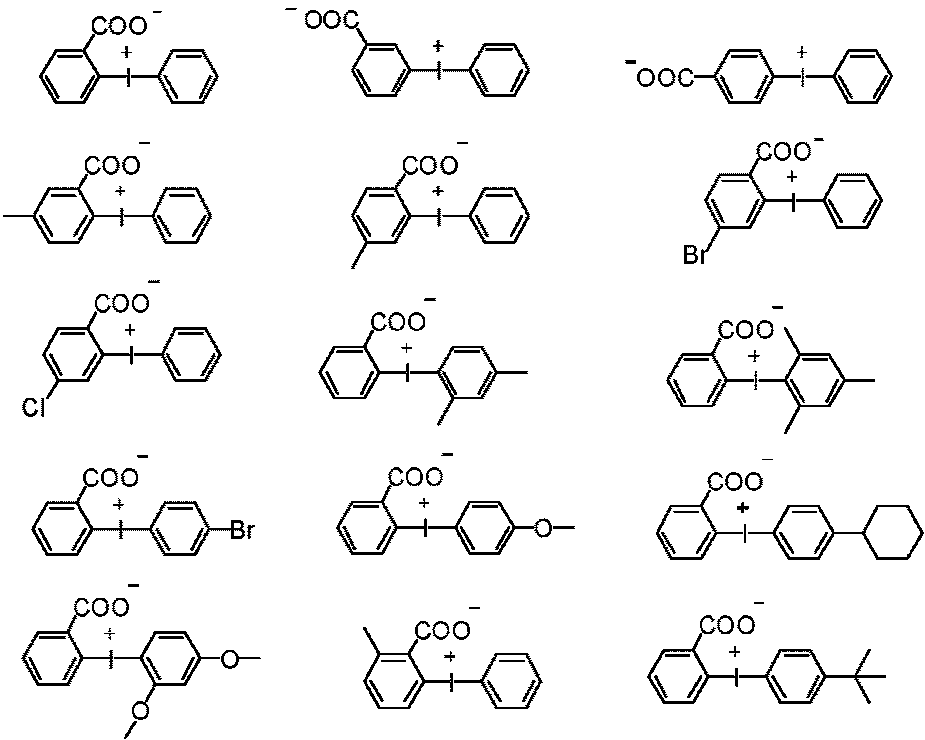
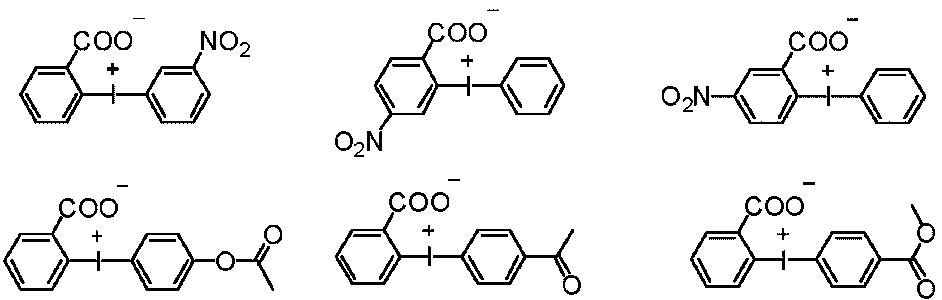
化合物(C)としては、下記式(I3)で表される化合物もまた好ましい。
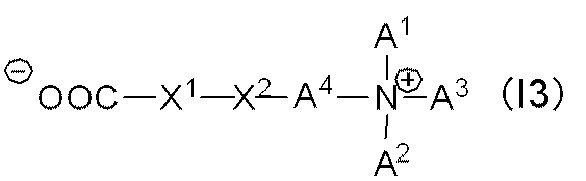
[式(I3)中、
A1、A2及びA3は、それぞれ独立に、水素原子、1価の脂肪族炭化水素基(好ましくは炭素数1~18)又は1価の芳香族炭化水素基(好ましくは炭素数6~18)を表し、A4は、2価の脂肪族炭化水素基(好ましくは炭素数1~18)又は2価の芳香族炭化水素基(好ましくは炭素数6~18)を表す。A2と、A3又はA4とが互いに結合し、これらが結合する窒素原子とともに複素環(好ましくは炭素数3~20)を形成していてもよい。該1価の脂肪族炭化水素基及び該2価の脂肪族炭化水素基に含まれる水素原子は、ヒドロキシ基に置換されていてもよく、該1価の芳香族炭化水素基、該2価の芳香族炭化水素基及び該複素環に含まれる水素原子は、ヒドロキシ基、脂肪族炭化水素基(好ましくは炭素数1~12)又はアルコキシ基(好ましくは炭素数1~12)で置換されていてもよい。また、該1価の脂肪族炭化水素基及び該2価の脂肪族炭化水素基を構成するメチレン基は、酸素原子又はカルボニル基に置き換わっていてもよい。
X1は、2価の脂肪族炭化水素基(好ましくは炭素数1~10)を表す。
X2は、単結合、オキシカルボニル基、カルボニルオキシ基又は酸素原子を表す。]
A1、A2及びA3は、それぞれ独立に、水素原子、1価の脂肪族炭化水素基(好ましくは炭素数1~18)又は1価の芳香族炭化水素基(好ましくは炭素数6~18)を表し、A4は、2価の脂肪族炭化水素基(好ましくは炭素数1~18)又は2価の芳香族炭化水素基(好ましくは炭素数6~18)を表す。A2と、A3又はA4とが互いに結合し、これらが結合する窒素原子とともに複素環(好ましくは炭素数3~20)を形成していてもよい。該1価の脂肪族炭化水素基及び該2価の脂肪族炭化水素基に含まれる水素原子は、ヒドロキシ基に置換されていてもよく、該1価の芳香族炭化水素基、該2価の芳香族炭化水素基及び該複素環に含まれる水素原子は、ヒドロキシ基、脂肪族炭化水素基(好ましくは炭素数1~12)又はアルコキシ基(好ましくは炭素数1~12)で置換されていてもよい。また、該1価の脂肪族炭化水素基及び該2価の脂肪族炭化水素基を構成するメチレン基は、酸素原子又はカルボニル基に置き換わっていてもよい。
X1は、2価の脂肪族炭化水素基(好ましくは炭素数1~10)を表す。
X2は、単結合、オキシカルボニル基、カルボニルオキシ基又は酸素原子を表す。]
A1、A2及びA3の1価の脂肪族炭化水素基は、典型的にはアルキル基又は脂環式炭化水素基であり、これらの具体例は、炭素数18以下の範囲ですでに例示したものを含む。中でも、炭素数1~12の脂肪族炭化水素基が好ましい。
A1、A2及びA3の1価の芳香族炭化水素基の具体例は、炭素数6~18の範囲ですでに例示したものを含む。この1価の芳香族炭化水素基は例えば、アルキル基を有しているものでもよく、当該アルキル基の炭素数を含めて、この芳香族炭化水素基の炭素数とする。具体的に、芳香族炭化水素基及びアルキル基を有する芳香族炭化水素基を例示すると、フェニル基、ナフチル基、アントラニル基、p-メチルフェニル基、p-tert-ブチルフェニル基、p-アダマンチルフェニル基、トリル基、キシリル基、クメニル基、メシチル基、ビフェニル基、アントリル基、フェナントリル基、2,6-ジエチルフェニル基及び2-メチル-6-エチルフェニルなどが挙げられる。
A4は、2価の脂肪族炭化水素基又は2価の芳香族炭化水素基を表す。当該2価の脂肪族炭化水素基及び当該2価の芳香族炭化水素基の具体例は、それぞれの炭素数の範囲において、すでに例示したものを含む。なお、A4の2価の脂肪族炭化水素基を構成するメチレン基は、酸素原子又はカルボニル基に置き換わることもある。
また、A2とA3とが互いに結合し、これらが結合する窒素原子とともに複素環を形成している場合の具体例は、式(I3)に含まれる。
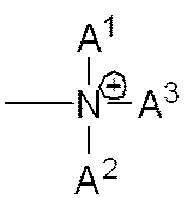
上記式で示される部分構造が、以下のいずれかの構造となった場合を挙げることができる。
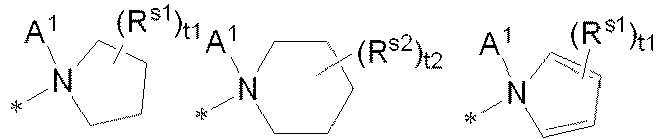
これらの式においては、
Rs1及びRs2は、それぞれ独立に、ヒドロキシ基、アルキル基(好ましくは炭素数1~12)、アルコキシ基(好ましくは炭素数1~12)又は脂環式炭化水素基(好ましくは炭素数3~12)を表す。また、t1は0~4の整数、t2は0~5の整数をそれぞれ表す。なお、ここでいうアルキル基、アルコキシ基及び脂環式炭化水素基のそれぞれの具体例は、炭素数が各々の範囲において、すでに例示したものを含む。また、これらのうちの下記部分構造
Rs1及びRs2は、それぞれ独立に、ヒドロキシ基、アルキル基(好ましくは炭素数1~12)、アルコキシ基(好ましくは炭素数1~12)又は脂環式炭化水素基(好ましくは炭素数3~12)を表す。また、t1は0~4の整数、t2は0~5の整数をそれぞれ表す。なお、ここでいうアルキル基、アルコキシ基及び脂環式炭化水素基のそれぞれの具体例は、炭素数が各々の範囲において、すでに例示したものを含む。また、これらのうちの下記部分構造
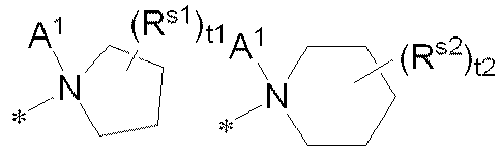
は、環を構成するメチレン基の1つ乃至2つが、酸素原子又はカルボニル基に置き換わっていてもよい。
なお、A2とA3とが互いに結合して形成される複素環は、その炭素数が4~6の範囲であるとさらに好ましい。
なお、A2とA3とが互いに結合して形成される複素環は、その炭素数が4~6の範囲であるとさらに好ましい。
一方、A2とA4とが互いに結合して、これらが結合する硫黄原子とともに複素環を形成している場合の具体例は、以下のいずれかの構造となった場合を挙げることができる。

これらの式において、
Rs1、及びt1は前記と同じ意味を表す。Rs3はヒドロキシ基、アルキル基(好ましくは炭素数1~12)、アルコキシ基(好ましくは炭素数1~12)又は脂環式炭化水素基(好ましくは炭素数3~12)を表す。また、t3は0~2の整数を表す。
Rs1、及びt1は前記と同じ意味を表す。Rs3はヒドロキシ基、アルキル基(好ましくは炭素数1~12)、アルコキシ基(好ましくは炭素数1~12)又は脂環式炭化水素基(好ましくは炭素数3~12)を表す。また、t3は0~2の整数を表す。
一方、A2とA3及びA4とが互いに結合して、これらが結合する硫黄原子とともに複素環を形成している場合の具体例は、以下のいずれかの構造となった場合を挙げることができる。
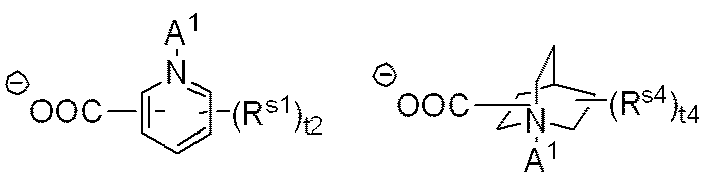
これらの式において、
Rs1及びt2は上記と同じ意味を表す。Rs4はヒドロキシ基、アルキル基(好ましくは炭素数1~12)、アルコキシ基(好ましくは炭素数1~12)又は脂環式炭化水素基(好ましくは炭素数3~12)を表す。また、t4は、0~6の整数を表す。
Rs1及びt2は上記と同じ意味を表す。Rs4はヒドロキシ基、アルキル基(好ましくは炭素数1~12)、アルコキシ基(好ましくは炭素数1~12)又は脂環式炭化水素基(好ましくは炭素数3~12)を表す。また、t4は、0~6の整数を表す。
A1及びA2の1価の芳香族炭化水素基、A3の2価の芳香族炭化水素基、或いは、A1と、A2又はA3とが結合して形成される複素環は、上述のとおり、アルキル基及び脂環式炭化水素基といった脂肪族炭化水素基、又はアルコキシ基を有していてもよい。ここでいう脂肪族炭化水素基及びアルコキシ基各々の具体例は、それぞれの炭素数の範囲ですでに例示したものを含み、このような置換基のある炭素原子の数も含めて、芳香族炭化水素基及び複素環の炭素数とする。
以上、式(I3)で表される化合物のA1~A3について具体例を示しつつ説明したが、A1は、水素原子又はメチル基であると好ましい。
A2及びA3は、それぞれ独立に、メチル基、エチル基、プロピル基又はブチル基であると好ましく、メチル基、エチル基又はプロピル基であるとより好ましい。
A2及びA3は、それぞれ独立に、メチル基、エチル基、プロピル基又はブチル基であると好ましく、メチル基、エチル基又はプロピル基であるとより好ましい。
式(I3)で表される化合物の具体例を以下に示す。
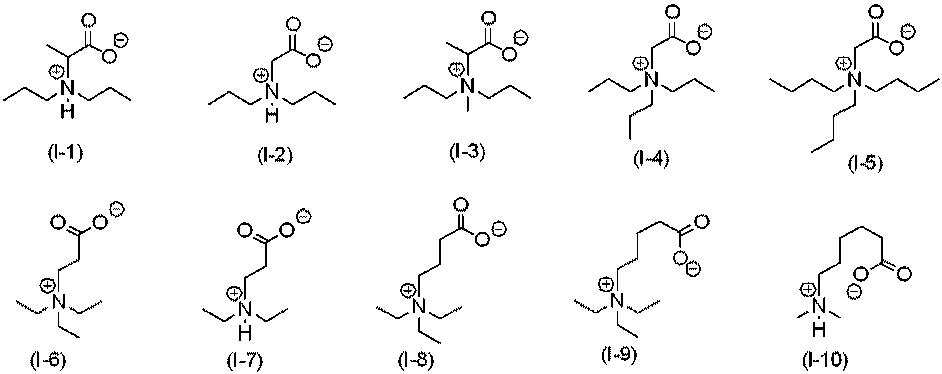
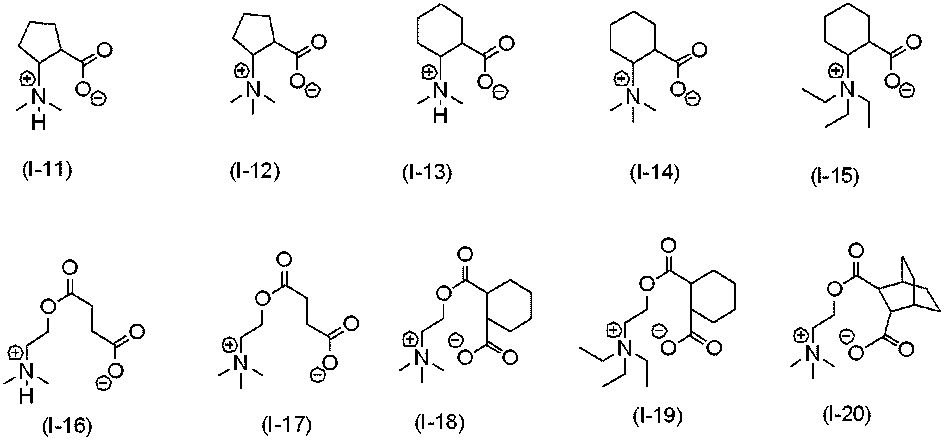
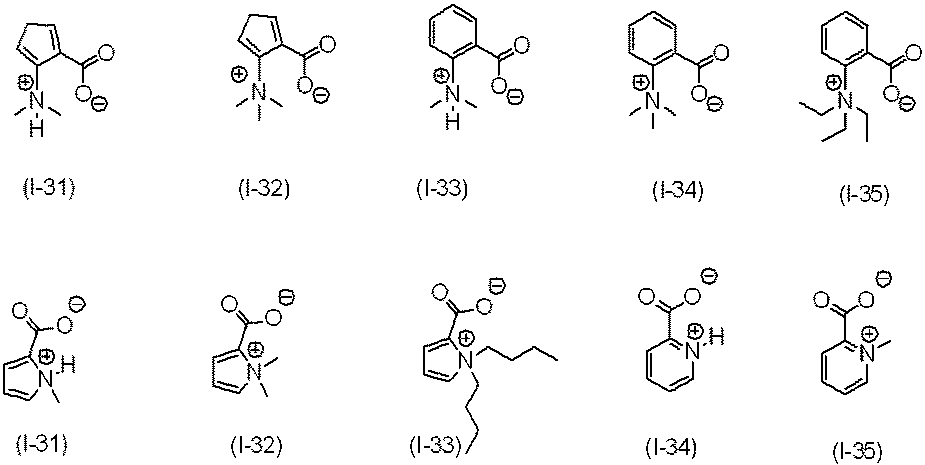
上述した一般式(C-4)で表される化合物の具体例としては、下記の化合物が挙げられる。
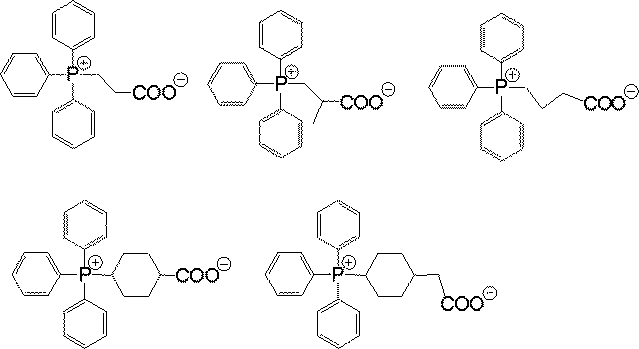
化合物(C)は1種で使用してもよく、複数種を使用してもよい。化合物(C)の感活性光線性又は感放射線性樹脂組成物中の含有量(複数種使用する場合は合計量)は、感活性光線性又は感放射線性樹脂組成物の全固形分を基準として、0.01~15質量%が好ましく、より好ましくは0.05~10質量%、更に好ましくは0.1~5質量%、特に好ましくは0.03~3質量%である。
<(HR)疎水性樹脂>
本発明の感活性光線性又は感放射線性樹脂組成物は、特に液浸露光に適用する際、疎水性樹脂(以下、「疎水性樹脂(HR)」ともいう)を含有してもよい。疎水性樹脂(HR)は、樹脂(A)と比べて、相対的に表面自由エネルギーが小さい樹脂であり、これにより、疎水性樹脂(HR)がレジスト膜の表面に偏在化し、液浸媒体が水の場合、水に対するレジスト膜表面の静的/動的な接触角を向上させ、液浸液追随性を向上させることができる。
疎水性樹脂(HR)は前述のように界面に偏在するものであるが、界面活性剤とは異なり、必ずしも分子内に親水基を有する必要はなく、極性/非極性物質を均一に混合することに寄与しなくてもよい。
本発明の感活性光線性又は感放射線性樹脂組成物は、特に液浸露光に適用する際、疎水性樹脂(以下、「疎水性樹脂(HR)」ともいう)を含有してもよい。疎水性樹脂(HR)は、樹脂(A)と比べて、相対的に表面自由エネルギーが小さい樹脂であり、これにより、疎水性樹脂(HR)がレジスト膜の表面に偏在化し、液浸媒体が水の場合、水に対するレジスト膜表面の静的/動的な接触角を向上させ、液浸液追随性を向上させることができる。
疎水性樹脂(HR)は前述のように界面に偏在するものであるが、界面活性剤とは異なり、必ずしも分子内に親水基を有する必要はなく、極性/非極性物質を均一に混合することに寄与しなくてもよい。
疎水性樹脂(HR)は、フッ素原子及び/又は珪素原子を含むことが好ましい。疎水性樹脂(HR)に於けるフッ素原子及び/又は珪素原子は、樹脂の主鎖中に含まれていてもよく、側鎖中に含まれていてもよい。また、疎水性樹脂(HR)は、分岐アルキル基、長鎖アルキル基(好ましくは炭素数4以上、より好ましくは炭素数6以上、特に好ましくは炭素数8以上)などの疎水的な基を有することも好ましい。
感活性光線性又は感放射線性樹脂組成物中の疎水性樹脂(HR)の含有量は、感活性光線又は感放射線樹脂膜の後退接触角が前記範囲になるよう適宜調整して使用できるが、感活性光線性又は感放射線性樹脂組成物の全固形分を基準として、0.01~20質量%であることが好ましく、より好ましくは0.1~15質量%、更に好ましくは0.1~10質量%であり、特に好ましくは0.2~8質量%である。疎水性樹脂(HR)は1種で使用してもよく、複数種を使用してもよい。
疎水性樹脂(HR)は、式(a)で表される化合物(以下「化合物(a)」という)に由来する構造単位を有していても良い。

[式(a)中、
R1は、水素原子又はメチル基を表す。
R2は、置換基を有していてもよい脂肪族炭化水素基(好ましくは炭素数1~18)を表す。
A1は、置換基を有していてもよいアルカンジイル基(好ましくは炭素数1~6)又は式(a-g1)で表される基を表す。
R1は、水素原子又はメチル基を表す。
R2は、置換基を有していてもよい脂肪族炭化水素基(好ましくは炭素数1~18)を表す。
A1は、置換基を有していてもよいアルカンジイル基(好ましくは炭素数1~6)又は式(a-g1)で表される基を表す。

(式(a-g1)中、
sは0又は1を表す。
A10及びA12は、それぞれ独立に、置換基を有していてもよい脂肪族炭化水素基(好ましくは炭素数1~5)を表す。
A11は、置換基を有していてもよい脂肪族炭化水素基(好ましくは炭素数1~5)又は単結合を表す。X10及びX11は、それぞれ独立に、酸素原子(本明細書では当該酸素原子を「-O-」で示すことがある。)、カルボニル基(本明細書では当該カルボニル基を「-CO-」で示すことがある。)、カルボニルオキシ基(本明細書では当該カルボニルオキシ基を「-CO-O-」で示すことがある。)又はオキシカルボニル基(本明細書では当該オキシカルボニル基を「-O-CO-」で示すことがある)を表す。
ただし、A10、A11、A12、X10及びX11の炭素数の合計は6以下である。)]
sは0又は1を表す。
A10及びA12は、それぞれ独立に、置換基を有していてもよい脂肪族炭化水素基(好ましくは炭素数1~5)を表す。
A11は、置換基を有していてもよい脂肪族炭化水素基(好ましくは炭素数1~5)又は単結合を表す。X10及びX11は、それぞれ独立に、酸素原子(本明細書では当該酸素原子を「-O-」で示すことがある。)、カルボニル基(本明細書では当該カルボニル基を「-CO-」で示すことがある。)、カルボニルオキシ基(本明細書では当該カルボニルオキシ基を「-CO-O-」で示すことがある。)又はオキシカルボニル基(本明細書では当該オキシカルボニル基を「-O-CO-」で示すことがある)を表す。
ただし、A10、A11、A12、X10及びX11の炭素数の合計は6以下である。)]
A1は、炭素数1~6のアルカンジイル基又は前記式(a-g1)で表される基(以下「基(a-g1)」という)である。
A1のアルカンジイル基は、直鎖状であっても、分岐していてもよく、例えば、メチレン基、エチレン基、プロパンジイル基、ブタンジイル基、ペンタンジイル基、及びヘキサンジイル基などが挙げられる。
このアルカンジイル基を構成する水素原子は置換基に置き換わっていてもよい。該置換基としては、ヒドロキシ基及び炭素数1~6のアルコキシ基などが挙げられる。
A1のアルカンジイル基は、直鎖状であっても、分岐していてもよく、例えば、メチレン基、エチレン基、プロパンジイル基、ブタンジイル基、ペンタンジイル基、及びヘキサンジイル基などが挙げられる。
このアルカンジイル基を構成する水素原子は置換基に置き換わっていてもよい。該置換基としては、ヒドロキシ基及び炭素数1~6のアルコキシ基などが挙げられる。
以下に、基(a-g1)の具体例を示す。以下の具体例において、その左右を式(a)に合わせて記載しており、それぞれ*で示される2つの結合手のうち、左側の結合手は、R1側の酸素原子と結合し、右側の結合手はR2側の酸素原子と結合している。
酸素原子を有する基(a-g1)としては、
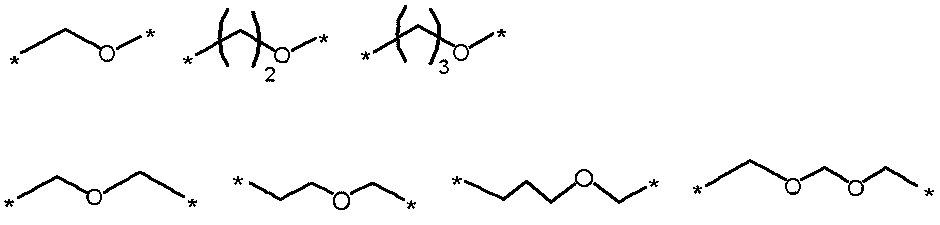
などが挙げられる(*は結合手を表す)。
カルボニル基を有する基(a-g1)としては、

などが挙げられる(*は結合手を表す)。
カルボニルオキシ基を有する基(a-g1)としては、下記の基

などが挙げられる(*は結合手を表す)。
オキシカルボニル基を有する基(a-g1)としては、下記の基

などが挙げられる(*は結合手を表す)。
なかでも、A1はアルカンジイル基が好ましく、置換基を有さないアルカンジイル基がより好ましく、炭素数1~4のアルカンジイル基がさらに好ましく、エチレン基が特に好ましい。
R2の脂肪族炭化水素基は炭素-炭素不飽和結合を有していてもよいが、脂肪族飽和炭化水素基が好ましい。
脂肪族飽和炭化水素基としては、アルキル基(当該アルキル基は直鎖でも分岐していてもよい)及び脂環式炭化水素基、並びに、アルキル基及び脂環式炭化水素基を組み合わせた脂肪族炭化水素基などが挙げられる。
脂肪族飽和炭化水素基としては、アルキル基(当該アルキル基は直鎖でも分岐していてもよい)及び脂環式炭化水素基、並びに、アルキル基及び脂環式炭化水素基を組み合わせた脂肪族炭化水素基などが挙げられる。
アルキル基としては、メチル基、エチル基、プロピル基、ブチル基、ペンチル基、ヘキシル基、ヘプチル基及びオクチル基などが挙げられる。
脂環式炭化水素基は、単環式及び多環式のいずれでもよい。単環式の脂環式炭化水素基としては、例えば、シクロペンチル基、シクロへキシル基、メチルシクロヘキシル基、ジメチルシクロへキシル基、シクロヘプチル基及びシクロオクチル基などのシクロアルキル基が挙げられる。多環式の脂環式炭化水素基としては、デカヒドロナフチル基、アダマンチル基、ノルボルニル基及びメチルノルボルニル基並びに下記に示す基などが挙げられる。
脂環式炭化水素基は、単環式及び多環式のいずれでもよい。単環式の脂環式炭化水素基としては、例えば、シクロペンチル基、シクロへキシル基、メチルシクロヘキシル基、ジメチルシクロへキシル基、シクロヘプチル基及びシクロオクチル基などのシクロアルキル基が挙げられる。多環式の脂環式炭化水素基としては、デカヒドロナフチル基、アダマンチル基、ノルボルニル基及びメチルノルボルニル基並びに下記に示す基などが挙げられる。
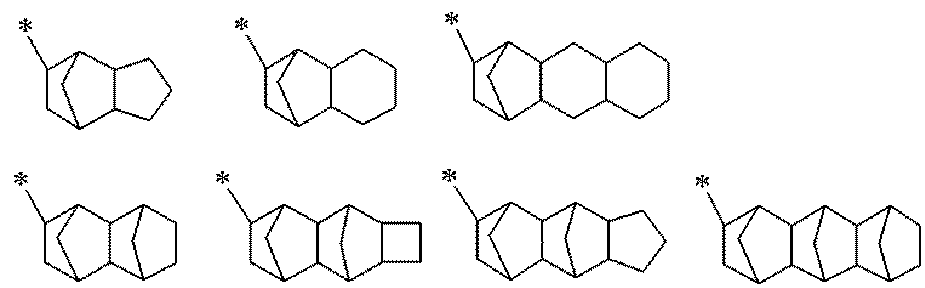
R2の脂肪族炭化水素基は置換基を有していても有していなくてもよいが、R2は置換基を有する脂肪族炭化水素基であることが好ましい。
R2の置換基としては、ハロゲン原子又は式(a-g3)で表される基(以下「基(a-g3)」という)が好ましい。
R2の置換基としては、ハロゲン原子又は式(a-g3)で表される基(以下「基(a-g3)」という)が好ましい。

(式(a-g3)中、
X12は、酸素原子、カルボニル基、カルボニルオキシ基又はオキシカルボニル基を表す。
A14は、ハロゲン原子を有していてもよい脂肪族炭化水素基(好ましくは炭素数3~17)を表す。)
X12は、酸素原子、カルボニル基、カルボニルオキシ基又はオキシカルボニル基を表す。
A14は、ハロゲン原子を有していてもよい脂肪族炭化水素基(好ましくは炭素数3~17)を表す。)
ハロゲン原子を有する脂肪族炭化水素基は、典型的には、ハロゲン原子を有するアルキル基及びハロゲン原子を有する脂環式炭化水素基(好ましくは、ハロゲン原子を有するシクロアルキル基)である。
ハロゲン原子を有するアルキル基とは、該アルキル基を構成する水素原子がハロゲン原子に置換されたものである。同様に、ハロゲン原子を有する脂環式炭化水素基とは、該脂環式炭化水素基を構成する水素原子がハロゲン原子に置換されたものである。
ハロゲン原子としては、フッ素原子、塩素原子、臭素原子又はヨウ素原子が挙げられ、好ましくは、フッ素原子である。
ハロゲン原子を有するアルキル基とは、該アルキル基を構成する水素原子がハロゲン原子に置換されたものである。同様に、ハロゲン原子を有する脂環式炭化水素基とは、該脂環式炭化水素基を構成する水素原子がハロゲン原子に置換されたものである。
ハロゲン原子としては、フッ素原子、塩素原子、臭素原子又はヨウ素原子が挙げられ、好ましくは、フッ素原子である。
R2のハロゲン原子を有する脂肪族炭化水素基は、アルキル基を構成する水素原子の全部がフッ素原子に置換されたペルフルオロアルキル基、シクロアルキル基を構成する水素原子の全部がフッ素原子に置換されたペルフルオロシクロアルキル基が好ましい。なかでも、好ましくはペルフルオロアルキル基であり、より好ましくは、炭素数が1~6のペルフルオロアルキル基であり、さらに好ましくは炭素数1~3のペルフルオロアルキル基である。
ペルフルオロアルキル基としては、トリフルオロメチル基、ペルフルオロエチル基、ペルフルオロプロピル基、ペルフルオロブチル基、ペルフルオロペンチル基、ペルフルオロヘキシル基、ペルフルオロヘプチル基及びペルフルオロオクチル基などが挙げられる。
X12’は、カルボニルオキシ基又はオキシカルボニル基であることが好ましい。
ペルフルオロアルキル基としては、トリフルオロメチル基、ペルフルオロエチル基、ペルフルオロプロピル基、ペルフルオロブチル基、ペルフルオロペンチル基、ペルフルオロヘキシル基、ペルフルオロヘプチル基及びペルフルオロオクチル基などが挙げられる。
X12’は、カルボニルオキシ基又はオキシカルボニル基であることが好ましい。
R2がフッ素原子を有する脂肪族炭化水素基であり、A1がエチレン基である化合物(a)としては、以下の式(a1)~式(a16)で表される化合物が挙げられる。
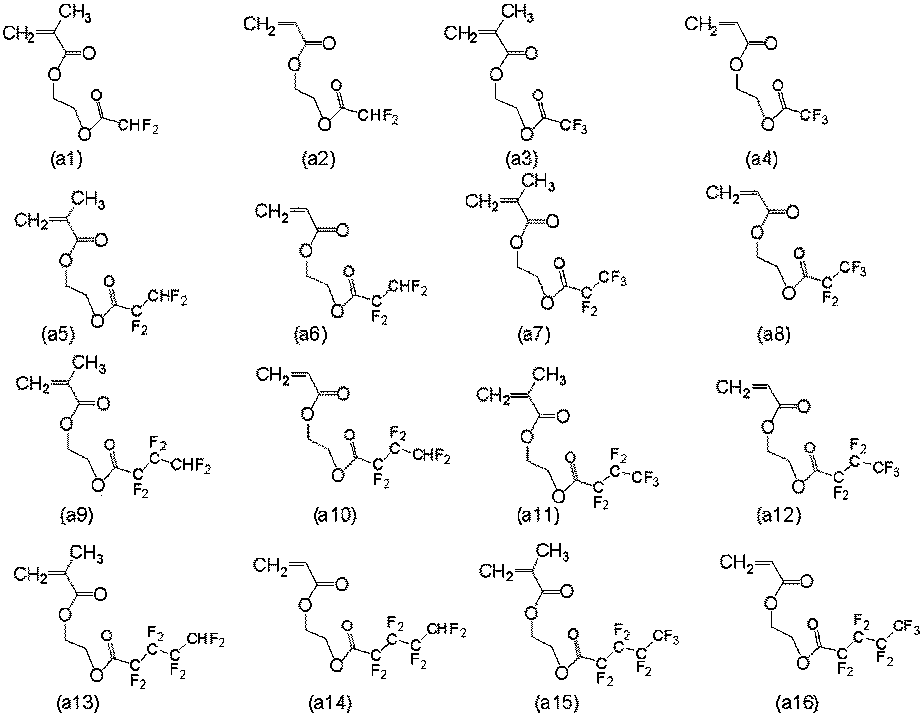
R2が、ペルフルオロアルキル基又はペルフルオロシクロアルキル基である化合物(a)としては、上述の具体例の中では、式(a3)、式(a4)、式(a7)、式(a8)、式(a11)、式(a12)、式(a15)、及び式(a16)のいずれかで表される化合物が該当する。
式(a-g3)で表される基を有する脂肪族炭化水素基としては、基(a-g3)を1個又は複数個有していてもよいが、基(a-g3)に含まれる炭素原子の数を含めて、脂肪族炭化水素基の総炭素数は、15以下が好ましく、12以下がより好ましい。このような好ましい総炭素数を満たすためには、基(a-g3)を1個有する基がR2として好ましい。
基(a-g3)を有する脂肪族炭化水素基、つまり、基(a-g3)を有するR2は、以下の式(a-g2)で表される基(以下「基(a-g2)」という)であることが好ましい。

(式(a-g2)中、
A13は、ハロゲン原子を有していてもよい脂肪族炭化水素基(好ましくは炭素数3~17)を表す。
X12は、カルボニルオキシ基又はオキシカルボニル基を表す。
A14は、ハロゲン原子を有していてもよい脂肪族炭化水素基(好ましくは炭素数3~17)を表す。
ただし、A13、A14及びX12の炭素数の合計は18以下である。)
A13は、ハロゲン原子を有していてもよい脂肪族炭化水素基(好ましくは炭素数3~17)を表す。
X12は、カルボニルオキシ基又はオキシカルボニル基を表す。
A14は、ハロゲン原子を有していてもよい脂肪族炭化水素基(好ましくは炭素数3~17)を表す。
ただし、A13、A14及びX12の炭素数の合計は18以下である。)
基(a-g2)(*はカルボニル基との結合手である)のうち、好ましいものとして、以下の構造が挙げられる。

R2が、式(a-g3)で表される基を1個有する脂肪族炭化水素基である化合物(a)、つまり、R2が式(a-g2)で表される基である化合物(a)は具体的には、以下の式(a’)で表されるもの(以下「化合物(a’)」という)である。
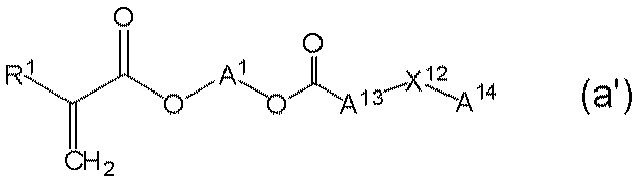
[式(a’)中、
A13は、ハロゲン原子を有していてもよい脂肪族炭化水素基(好ましくは炭素数3~17)を表す。
X12は、カルボニルオキシ基又はオキシカルボニル基を表す。
A14は、ハロゲン原子を有していてもよい脂肪族炭化水素基(好ましくは炭素数3~17)を表す。
ただし、A13及びA14の炭素数の合計は17以下である。
A1及びR1は、前記と同義である。]
化合物(a’)は、本レジスト組成物に含有される疎水性樹脂(HR)の製造用原料として、有用な化合物であり、本発明は、化合物(a’)に係る発明を含む。
A13は、ハロゲン原子を有していてもよい脂肪族炭化水素基(好ましくは炭素数3~17)を表す。
X12は、カルボニルオキシ基又はオキシカルボニル基を表す。
A14は、ハロゲン原子を有していてもよい脂肪族炭化水素基(好ましくは炭素数3~17)を表す。
ただし、A13及びA14の炭素数の合計は17以下である。
A1及びR1は、前記と同義である。]
化合物(a’)は、本レジスト組成物に含有される疎水性樹脂(HR)の製造用原料として、有用な化合物であり、本発明は、化合物(a’)に係る発明を含む。
化合物(a’)において、A13及びA14はともにハロゲン原子を有することもあるが、A13のみが、ハロゲン原子を有する脂肪族炭化水素基であるか、または、A14のみがハロゲン原子を有する脂肪族炭化水素基であることが好ましい。さらには、A13のみがハロゲン原子を有する脂肪族炭化水素基が好ましく、中でも、A13はフッ素原子を有するアルカンジイル基がより好ましく、ペルフルオロアルカンジイル基がさらに好ましい。なお、この「ペルフルオロアルカンジイル基」とは、水素原子の全部がフッ素原子に置換されたアルカンジイル基をいう。
R2がペルフルオロアルカンジイル基であり、A1がエチレン基である化合物(a’)としては、以下の式(a’1)~式(a’10)で表される化合物が挙げられる。
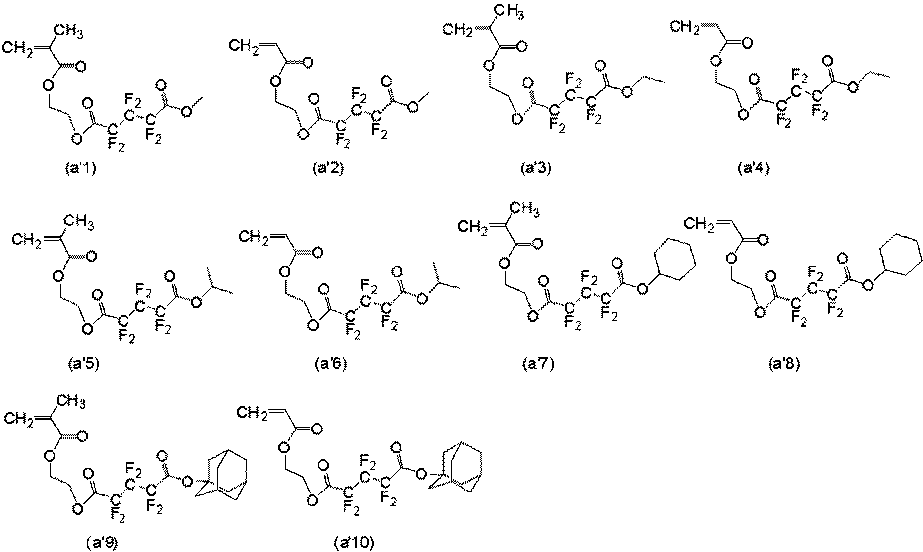
A13及びA14は炭素数の合計が17以下である範囲で任意に選択されるが、A13の炭素数は1~6が好ましく、1~3がより好ましい。A14の炭素数は4~15が好ましく、5~12がより好ましい。さらに好ましいA14は、炭素数6~12の脂環式炭化水素基であり、脂環式炭化水素基としては、シクロヘキシル基及びアダマンチル基が好ましい。
<塩基性化合物(以下、「塩基性化合物(E)」という。)>
レジスト組成物は、さらに、塩基性化合物(E)(ただし、化合物(C)とは異なる。)を含有していてもよい。ここでいう「塩基性化合物」とは、酸を捕捉するという特性を有する化合物、特に、既に説明した酸発生剤から発生する酸を捕捉するという特性を有する化合物を意味する。
塩基性化合物は、オニウムカチオンと、カルボン酸等の弱酸の酸アニオンからなるイオン性化合物であってもよい。
レジスト組成物は、さらに、塩基性化合物(E)(ただし、化合物(C)とは異なる。)を含有していてもよい。ここでいう「塩基性化合物」とは、酸を捕捉するという特性を有する化合物、特に、既に説明した酸発生剤から発生する酸を捕捉するという特性を有する化合物を意味する。
塩基性化合物は、オニウムカチオンと、カルボン酸等の弱酸の酸アニオンからなるイオン性化合物であってもよい。
塩基性化合物(E)は、好ましくは塩基性の含窒素有機化合物であり、例えば、アミン及びアンモニウムヒドロキシドを挙げることができる。アミンは、脂肪族アミンでも、芳香族アミンでもよい。脂肪族アミンは、第一級アミン、第二級アミン及び第三級アミンのいずれも使用できる。芳香族アミンは、アニリンのような芳香環にアミノ基が結合したものや、ピリジンのような複素芳香族アミンのいずれでもよい。好ましい塩基性化合物(E)として、以下の式(E2)で表される芳香族アミン、特に、以下の式(E2-1)で表されるアニリン類が挙げられる。

式(E2)及び式(E2-1)中、Arc1は、芳香族炭化水素基を表す。
Rc5及びRc6は、それぞれ独立に、水素原子、脂肪族炭化水素基(好ましくは、炭素数1~6程度の脂肪族炭化水素基であり、さらに好ましくは、炭素数1~6程度のアルキル基である。)、脂環式炭化水素基(好ましくは、炭素数5~10程度の脂環式炭化水素基である。)又は芳香族炭化水素基(好ましくは、炭素数6~10程度の芳香族炭化水素基である。)を表す。但し、該脂肪族炭化水素基、該脂環式炭化水素基及び該芳香族炭化水素基に含まれる水素原子は、ヒドロキシ基、アミノ基、又は炭素数1~6のアルコキシ基で置換されていてもよく、該アミノ基はさらに、炭素数1~4のアルキル基を有していてもよい。
Rc7は、脂肪族炭化水素基(好ましくは、炭素数1~6程度の脂肪族炭化水素基であり、さらに好ましくは、炭素数1~6程度のアルキル基である。)、炭素数1~6程度のアルコキシ基、脂環式炭化水素基(好ましくは、炭素数5~10程度の脂環式炭化水素基であり、さらに好ましくは、炭素数5~10程度のシクロアルキル基である。)又は芳香族炭化水素基(好ましくは、炭素数6~10程度の芳香族炭化水素基である。)を表す。但し、該脂肪族炭化水素基、該アルコキシ基、該脂環式炭化水素基及び該芳香族炭化水素基に含まれる水素原子も、ヒドロキシ基、アミノ基、又は炭素数1~6のアルコキシ基で置換されていてもよく、該アミノ基はさらに、炭素数1~4のアルキル基を有していてもよい。
m3は0~3の整数を表す。m3が2以上のとき、複数のRc7は、互いに同一でも異なっていてもよい。
Rc5及びRc6は、それぞれ独立に、水素原子、脂肪族炭化水素基(好ましくは、炭素数1~6程度の脂肪族炭化水素基であり、さらに好ましくは、炭素数1~6程度のアルキル基である。)、脂環式炭化水素基(好ましくは、炭素数5~10程度の脂環式炭化水素基である。)又は芳香族炭化水素基(好ましくは、炭素数6~10程度の芳香族炭化水素基である。)を表す。但し、該脂肪族炭化水素基、該脂環式炭化水素基及び該芳香族炭化水素基に含まれる水素原子は、ヒドロキシ基、アミノ基、又は炭素数1~6のアルコキシ基で置換されていてもよく、該アミノ基はさらに、炭素数1~4のアルキル基を有していてもよい。
Rc7は、脂肪族炭化水素基(好ましくは、炭素数1~6程度の脂肪族炭化水素基であり、さらに好ましくは、炭素数1~6程度のアルキル基である。)、炭素数1~6程度のアルコキシ基、脂環式炭化水素基(好ましくは、炭素数5~10程度の脂環式炭化水素基であり、さらに好ましくは、炭素数5~10程度のシクロアルキル基である。)又は芳香族炭化水素基(好ましくは、炭素数6~10程度の芳香族炭化水素基である。)を表す。但し、該脂肪族炭化水素基、該アルコキシ基、該脂環式炭化水素基及び該芳香族炭化水素基に含まれる水素原子も、ヒドロキシ基、アミノ基、又は炭素数1~6のアルコキシ基で置換されていてもよく、該アミノ基はさらに、炭素数1~4のアルキル基を有していてもよい。
m3は0~3の整数を表す。m3が2以上のとき、複数のRc7は、互いに同一でも異なっていてもよい。
式(E2)で表される芳香族アミンは、例えば、1-ナフチルアミン及び2-ナフチルアミン等が挙げられる。
式(E2-1)で表されるアニリン類は、例えば、アニリン、ジイソプロピルアニリン、2-,3-又は4-メチルアニリン、4-ニトロアニリン、N-メチルアニリン、N,N-ジメチルアニリン及びジフェニルアミン等が挙げられる。
式(E2-1)で表されるアニリン類は、例えば、アニリン、ジイソプロピルアニリン、2-,3-又は4-メチルアニリン、4-ニトロアニリン、N-メチルアニリン、N,N-ジメチルアニリン及びジフェニルアミン等が挙げられる。
また、以下の式(E3)、式(E4)、式(E5)、式(E6)、式(E7)、式(E8)、式(E9)、式(E10)及び式(E11)のいずれかで表される化合物(以下、ここでいう化合物を、式番号に応じて、「化合物(E3)」~「化合物(E11)」のように表記する。)を用いてもよい。
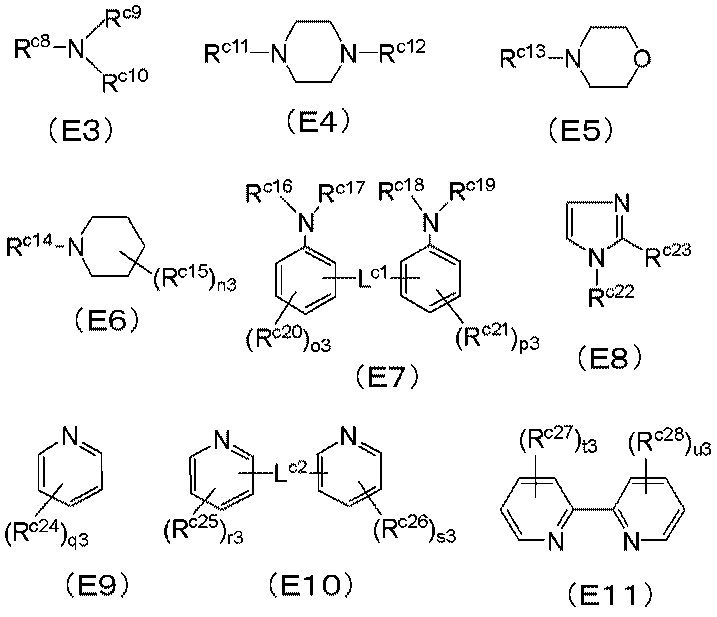
式(E3)~式(E11)中、
Rc8は、上記Rc7で説明したいずれかの基を表す。
Rc20、Rc21、Rc23、Rc24、Rc25、Rc26、Rc27及びRc28とは上記Rc7で説明したいずれかの基を表す。
窒素原子と結合するRc9、Rc10、Rc11、Rc12、Rc13、Rc14、Rc16、Rc17、Rc18、Rc19及びRc22は、それぞれ独立であり、上記のRc5及びRc6で説明したいずれかの基を表す。
o3、p3、q3、r3、s3、t3及びu3は、それぞれ独立に0~3の整数を表す。
o3が2以上であるとき、複数のRc20は互いに同一でも異なっていてもよく、p3が2以上であるとき、複数のRc21は互いに同一でも異なっていてもよく、q3が2以上であるとき、複数のRc24は互いに同一でも異なっていてもよく、r3が2以上であるとき、複数のRc25は互いに同一でも異なっていてもよく、s3が2以上であるとき、複数のRc26は互いに同一でも異なっていてもよく、t3が2以上であるとき、複数のRc27は互いに同一でも異なっていてもよく、u3が2以上であるとき、複数のRc28は互いに同一でも異なっていてもよい。
Rc15は、脂肪族炭化水素基(好ましくは、炭素数1~6程度の脂肪族炭化水素基である。)、脂環式炭化水素基(好ましくは、炭素数3~6程度の脂環式炭化水素基である。)又はアルカノイル基(好ましくは、炭素数2~6程度のアルカノイル基である。)を表す。
n3は0~8の整数を表す。n3が2以上のとき、複数のRc15は、互いに同一でも異なってもよい。
Lc1及びLc2は、それぞれ独立に、2価の脂肪族炭化水素基(好ましくは、炭素数1~6程度の脂肪族炭化水素基であり、より好ましくは、炭素数1~6程度のアルキレン基である。)、カルボニル基、-C(=NH)-、-C(=NRc3)-(但し、Rc3は、炭素数1~4のアルキル基を表す。)、-S-、-S-S-又はこれらの組合せを表す。
Rc15の脂肪族炭化水素基は、好ましくは炭素数1~6程度であり、脂環式炭化水素基は、好ましくは炭素数3~6程度である。
アルカノイル基としては、アセチル基、2-メチルアセチル基、2,2-ジメチルアセチル基、プロピオニル基、ブチリル基、イソブチリル基、ペンタノイル基、2,2-ジメチルプロピオニル基等が挙げられ、好ましくは炭素数2~6程度である。
Rc8は、上記Rc7で説明したいずれかの基を表す。
Rc20、Rc21、Rc23、Rc24、Rc25、Rc26、Rc27及びRc28とは上記Rc7で説明したいずれかの基を表す。
窒素原子と結合するRc9、Rc10、Rc11、Rc12、Rc13、Rc14、Rc16、Rc17、Rc18、Rc19及びRc22は、それぞれ独立であり、上記のRc5及びRc6で説明したいずれかの基を表す。
o3、p3、q3、r3、s3、t3及びu3は、それぞれ独立に0~3の整数を表す。
o3が2以上であるとき、複数のRc20は互いに同一でも異なっていてもよく、p3が2以上であるとき、複数のRc21は互いに同一でも異なっていてもよく、q3が2以上であるとき、複数のRc24は互いに同一でも異なっていてもよく、r3が2以上であるとき、複数のRc25は互いに同一でも異なっていてもよく、s3が2以上であるとき、複数のRc26は互いに同一でも異なっていてもよく、t3が2以上であるとき、複数のRc27は互いに同一でも異なっていてもよく、u3が2以上であるとき、複数のRc28は互いに同一でも異なっていてもよい。
Rc15は、脂肪族炭化水素基(好ましくは、炭素数1~6程度の脂肪族炭化水素基である。)、脂環式炭化水素基(好ましくは、炭素数3~6程度の脂環式炭化水素基である。)又はアルカノイル基(好ましくは、炭素数2~6程度のアルカノイル基である。)を表す。
n3は0~8の整数を表す。n3が2以上のとき、複数のRc15は、互いに同一でも異なってもよい。
Lc1及びLc2は、それぞれ独立に、2価の脂肪族炭化水素基(好ましくは、炭素数1~6程度の脂肪族炭化水素基であり、より好ましくは、炭素数1~6程度のアルキレン基である。)、カルボニル基、-C(=NH)-、-C(=NRc3)-(但し、Rc3は、炭素数1~4のアルキル基を表す。)、-S-、-S-S-又はこれらの組合せを表す。
Rc15の脂肪族炭化水素基は、好ましくは炭素数1~6程度であり、脂環式炭化水素基は、好ましくは炭素数3~6程度である。
アルカノイル基としては、アセチル基、2-メチルアセチル基、2,2-ジメチルアセチル基、プロピオニル基、ブチリル基、イソブチリル基、ペンタノイル基、2,2-ジメチルプロピオニル基等が挙げられ、好ましくは炭素数2~6程度である。
化合物(E3)としては例えば、ヘキシルアミン、ヘプチルアミン、オクチルアミン、ノニルアミン、デシルアミン、ジブチルアミン、ジペンチルアミン、ジヘキシルアミン、ジヘプチルアミン、ジオクチルアミン、ジノニルアミン、ジデシルアミン、トリエチルアミン、トリメチルアミン、トリプロピルアミン、トリブチルアミン、トリペンチルアミン、トリヘキシルアミン、トリヘプチルアミン、トリオクチルアミン、トリノニルアミン、トリデシルアミン、メチルジブチルアミン、メチルジペンチルアミン、メチルジヘキシルアミン、メチルジシクロヘキシルアミン、メチルジヘプチルアミン、メチルジオクチルアミン、メチルジノニルアミン、メチルジデシルアミン、エチルジブチルアミン、エチルジペンチルアミン、エチルジヘキシルアミン、エチルジヘプチルアミン、エチルジオクチルアミン、エチルジノニルアミン、エチルジデシルアミン、ジシクロヘキシルメチルアミン、トリス〔2-(2-メトキシエトキシ)エチル〕アミン、トリイソプロパノールアミンエチレンジアミン、テトラメチレンジアミン、ヘキサメチレンジアミン、4,4’-ジアミノ-1,2-ジフェニルエタン、4,4’-ジアミノ-3,3’-ジメチルジフェニルメタン、4,4’-ジアミノ-3,3’-ジエチルジフェニルメタン等が挙げられる。
化合物(E4)としては例えば、ピペラジン等が挙げられる。
化合物(E5)としては例えば、モルホリン等が挙げられる。
化合物(E6)としては例えば、ピペリジン及び特開平11-52575号公報に記載されているピペリジン骨格を有するヒンダードアミン化合物等が挙げられる。
化合物(E7)としては例えば、2,2’-メチレンビスアニリン等が挙げられる。
化合物(E8)としては例えば、イミダゾール及び4-メチルイミダゾール等が挙げられる。
化合物(E9)としては例えば、ピリジン、4-メチルピリジン等が挙げられる。
化合物(E10)としては例えば、1,2-ジ(2-ピリジル)エタン、1,2-ジ(4-ピリジル)エタン、1,2-ジ(2-ピリジル)エテン、1,2-ジ(4-ピリジル)エテン、1,3-ジ(4-ピリジル)プロパン、1,2-ジ(4-ピリジルオキシ)エタン、ジ(2-ピリジル)ケトン、4,4’-ジピリジルスルフィド、4,4’-ジピリジルジスルフィド、2,2’-ジピリジルアミン及び2,2’-ジピコリルアミン等が挙げられる。
化合物(E11)としては例えば、ビピリジン等が挙げられる。
化合物(E5)としては例えば、モルホリン等が挙げられる。
化合物(E6)としては例えば、ピペリジン及び特開平11-52575号公報に記載されているピペリジン骨格を有するヒンダードアミン化合物等が挙げられる。
化合物(E7)としては例えば、2,2’-メチレンビスアニリン等が挙げられる。
化合物(E8)としては例えば、イミダゾール及び4-メチルイミダゾール等が挙げられる。
化合物(E9)としては例えば、ピリジン、4-メチルピリジン等が挙げられる。
化合物(E10)としては例えば、1,2-ジ(2-ピリジル)エタン、1,2-ジ(4-ピリジル)エタン、1,2-ジ(2-ピリジル)エテン、1,2-ジ(4-ピリジル)エテン、1,3-ジ(4-ピリジル)プロパン、1,2-ジ(4-ピリジルオキシ)エタン、ジ(2-ピリジル)ケトン、4,4’-ジピリジルスルフィド、4,4’-ジピリジルジスルフィド、2,2’-ジピリジルアミン及び2,2’-ジピコリルアミン等が挙げられる。
化合物(E11)としては例えば、ビピリジン等が挙げられる。
アンモニウムヒドロキシドとしては例えば、テトラメチルアンモニウムヒドロキシド、テトライソプロピルアンモニウムヒドロキシド、テトラブチルアンモニウムヒドロキシド、テトラヘキシルアンモニウムヒドロキシド、テトラオクチルアンモニウムヒドロキシド、フェニルトリメチルアンモニウムヒドロキシド、3-(トリフルオロメチル)フェニルトリメチルアンモニウムヒドロキシド及びコリン等が挙げられる。
塩基性化合物(E)としては、これらの中でもジイソプロピルアニリンが好ましく、2,6-ジイソプロピルアニリンが特に好ましい。
塩基性化合物(E)は、1種で使用してもよく、2種類以上を使用してもよい。本発明の感活性光線性又は感放射線性樹脂組成物は、塩基性化合物(E)を含有してもしなくてもよいが、含有する場合、塩基性化合物の含有率(複数種含有する場合はその合計)は、感活性光線性又は感放射線性樹脂組成物の固形分を基準として、0.001~10質量%、好ましくは0.01~5質量%である。
塩基性化合物(E)は、1種で使用してもよく、2種類以上を使用してもよい。本発明の感活性光線性又は感放射線性樹脂組成物は、塩基性化合物(E)を含有してもしなくてもよいが、含有する場合、塩基性化合物の含有率(複数種含有する場合はその合計)は、感活性光線性又は感放射線性樹脂組成物の固形分を基準として、0.001~10質量%、好ましくは0.01~5質量%である。
<溶剤(以下、「溶剤(D)」という。)>
レジスト組成物には、溶剤(D)が含有されていてもよい。溶剤(D)は、用いる化合物(C)の種類及びその量と、樹脂(A)の種類及びその量と、酸発生剤(B)の種類及びその量とに応じ、さらに後述するレジストパターンの製造において、基板上に本発明のレジスト組成物を塗布する際の塗布性が良好となるという点から適宜、最適なものを選ぶことができる。
レジスト組成物には、溶剤(D)が含有されていてもよい。溶剤(D)は、用いる化合物(C)の種類及びその量と、樹脂(A)の種類及びその量と、酸発生剤(B)の種類及びその量とに応じ、さらに後述するレジストパターンの製造において、基板上に本発明のレジスト組成物を塗布する際の塗布性が良好となるという点から適宜、最適なものを選ぶことができる。
溶剤(D)としては、エチルセロソルブアセテート、メチルセロソルブアセテート及びプロピレングリコールモノメチルエーテルアセテート(PGMEA)等のグリコールエーテルエステル類;プロピレングリコールモノメチルエーテル(PGME)等のグリコールエーテル類;乳酸エチル、酢酸ブチル、酢酸アミル及びピルビン酸エチル等のエステル類;アセトン、メチルイソブチルケトン、2-ヘプタノン及びシクロヘキサノン等のケトン類;γ-ブチロラクトン等の環状エステル類、プロピレンカーボネート等のカーボネート類などが挙げられる。溶剤(D)は、1種のみを使用してもよく、2種以上を併用してもよい。好ましい溶剤としては、プロピレングリコールモノメチルエーテルアセテート、プロピレングリコールモノメチルエーテル、2-ヘプタノン、シクロヘキサノン及びγ-ブチロラクトンが挙げられる。2-ヘプタノン及びγ-ブチロラクトンの少なくともいずれか1種を含む溶剤であることがより好ましく、2-ヘプタノン及びγ-ブチロラクトンを含む2種以上の混合溶剤であることが特に好ましい。
具体的には、PGMEA/乳酸エチル、PGMEA/PGME、PGMEA/シクロヘキサノンから選択される2種混合溶剤、PGMEA/乳酸エチル/γ-ブチロラクトン、PGMEA/シクロヘキサノン/γ-ブチロラクトン、PGMEA/2-ヘプタノン/プロピレンカーボネート、PGME/シクロヘキサノン/プロピレンカーボネート、PGMEA/PGME/γ-ブチロラクトンから選択される3種混合溶剤、PGMEA/PGME/シクロヘキサノン/γ-ブチロラクトンの4種混合溶剤などが好ましい。
具体的には、PGMEA/乳酸エチル、PGMEA/PGME、PGMEA/シクロヘキサノンから選択される2種混合溶剤、PGMEA/乳酸エチル/γ-ブチロラクトン、PGMEA/シクロヘキサノン/γ-ブチロラクトン、PGMEA/2-ヘプタノン/プロピレンカーボネート、PGME/シクロヘキサノン/プロピレンカーボネート、PGMEA/PGME/γ-ブチロラクトンから選択される3種混合溶剤、PGMEA/PGME/シクロヘキサノン/γ-ブチロラクトンの4種混合溶剤などが好ましい。
<その他の成分>
レジスト組成物は、必要に応じて、化合物(C)、樹脂(A)、酸発生剤(B)、溶剤(D)及び塩基性化合物(E)以外の構成成分を含んでいてもよい。この構成成分を「成分(F)」という。かかる成分(F)に特に限定はなく、レジスト分野で公知の添加剤、例えば、増感剤、溶解抑止剤、界面活性剤、安定剤及び染料等が挙げられる。
レジスト組成物は、必要に応じて、化合物(C)、樹脂(A)、酸発生剤(B)、溶剤(D)及び塩基性化合物(E)以外の構成成分を含んでいてもよい。この構成成分を「成分(F)」という。かかる成分(F)に特に限定はなく、レジスト分野で公知の添加剤、例えば、増感剤、溶解抑止剤、界面活性剤、安定剤及び染料等が挙げられる。
<パターン形成方法>
次に、本発明に係るパターン形成方法について説明する。
本発明のパターン形成方法(ネガ型パターン形成方法)は、
(ア)本発明の感活性光線性又は感放射線性樹脂組成物を含む膜(レジスト膜)を形成する工程、
(イ)該膜に活性光線又は放射線を照射する工程、及び
(ウ)有機溶剤を含む現像液を用いて上記活性光線又は放射線を照射した膜を現像する工程、
を少なくとも含む。
次に、本発明に係るパターン形成方法について説明する。
本発明のパターン形成方法(ネガ型パターン形成方法)は、
(ア)本発明の感活性光線性又は感放射線性樹脂組成物を含む膜(レジスト膜)を形成する工程、
(イ)該膜に活性光線又は放射線を照射する工程、及び
(ウ)有機溶剤を含む現像液を用いて上記活性光線又は放射線を照射した膜を現像する工程、
を少なくとも含む。
上記工程(イ)における露光は、液浸露光であってもよい。
本発明のパターン形成方法は、(イ)露光工程の後に、(エ)加熱工程を含むことが好ましい。
本発明のパターン形成方法は、(オ)アルカリ現像液を用いて現像する工程を更に含んでいてもよい。有機溶剤を含有する現像液を使用した現像工程によって露光強度の弱い部分が除去されるが、更にアルカリ現像工程を行うことによって露光強度の強い部分も除去される。このように、現像を複数回行う多重現像プロセスによって中間的な露光強度の領域のみを溶解させずにパターン形成が行えるので、通常より微細なパターンを形成できると期待される(特開2008‐292975号公報の段落〔0077〕と同様のメカニズム)。
(オ)アルカリ現像液を用いて現像する工程は、(ウ)有機溶剤を含む現像液を用いて現像する工程の前後どちらでも行うことが出来るが、(ウ)有機溶剤を含む現像液を用いて現像する工程の前に行うことがより好ましい。
本発明のパターン形成方法は、(イ)露光工程を、複数回含んでいてもよい。
本発明のパターン形成方法は、(エ)加熱工程を、複数回含んでいてもよい。
本発明のパターン形成方法は、(イ)露光工程の後に、(エ)加熱工程を含むことが好ましい。
本発明のパターン形成方法は、(オ)アルカリ現像液を用いて現像する工程を更に含んでいてもよい。有機溶剤を含有する現像液を使用した現像工程によって露光強度の弱い部分が除去されるが、更にアルカリ現像工程を行うことによって露光強度の強い部分も除去される。このように、現像を複数回行う多重現像プロセスによって中間的な露光強度の領域のみを溶解させずにパターン形成が行えるので、通常より微細なパターンを形成できると期待される(特開2008‐292975号公報の段落〔0077〕と同様のメカニズム)。
(オ)アルカリ現像液を用いて現像する工程は、(ウ)有機溶剤を含む現像液を用いて現像する工程の前後どちらでも行うことが出来るが、(ウ)有機溶剤を含む現像液を用いて現像する工程の前に行うことがより好ましい。
本発明のパターン形成方法は、(イ)露光工程を、複数回含んでいてもよい。
本発明のパターン形成方法は、(エ)加熱工程を、複数回含んでいてもよい。
本発明のレジスト膜は、上記した本発明の感活性光線性又は感放射線性樹脂組成物から形成されるものであり、より具体的には、基材に、感活性光線性又は感放射線性樹脂組成物を塗布することにより形成される膜であることが好ましい。本発明のパターン形成方法に於いて、感活性光線性又は感放射線性樹脂組成物による膜を基板上に形成する工程、膜を露光する工程、及び現像工程は、一般的に知られている方法により行うことができる。
製膜後、露光工程の前に、前加熱工程(PB;Prebake)を含むことも好ましい。
また、露光工程の後かつ現像工程の前に、露光後加熱工程(PEB;Post Exposure Bake)を含むことも好ましい。
また、露光工程の後かつ現像工程の前に、露光後加熱工程(PEB;Post Exposure Bake)を含むことも好ましい。
加熱温度はPB、PEB共に70~130℃で行うことが好ましく、80~120℃で行うことがより好ましい。
加熱時間は30~300秒が好ましく、30~180秒がより好ましく、30~90秒が更に好ましい。
加熱は通常の露光・現像機に備わっている手段で行うことができ、ホットプレート等を用いて行ってもよい。
ベークにより露光部の反応が促進され、感度やパターンプロファイルが改善する。
加熱時間は30~300秒が好ましく、30~180秒がより好ましく、30~90秒が更に好ましい。
加熱は通常の露光・現像機に備わっている手段で行うことができ、ホットプレート等を用いて行ってもよい。
ベークにより露光部の反応が促進され、感度やパターンプロファイルが改善する。
本発明における露光装置に用いられる光源波長に制限は無いが、赤外光、可視光、紫外光、遠紫外光、極紫外光、X線、電子線等を挙げることができ、好ましくは250nm以下、より好ましくは220nm以下、特に好ましくは1~200nmの波長の遠紫外光、具体的には、KrFエキシマレーザー(248nm)、ArFエキシマレーザー(193nm)、F2エキシマレーザー(157nm)、X線、EUV(13nm)、電子線等であり、KrFエキシマレーザー、ArFエキシマレーザー、EUV又は電子線が好ましく、ArFエキシマレーザーであることがより好ましい。
また、本発明の露光を行う工程においては液浸露光方法を適用することができる。
液浸露光方法とは、解像力を高める技術として、投影レンズと試料の間に高屈折率の液体(以下、「液浸液」ともいう)で満たし露光する技術である。
液浸露光方法とは、解像力を高める技術として、投影レンズと試料の間に高屈折率の液体(以下、「液浸液」ともいう)で満たし露光する技術である。
前述したように、この「液浸の効果」はλ0を露光光の空気中での波長とし、nを空気に対する液浸液の屈折率、θを光線の収束半角としNA0=sinθとすると、液浸した場合、解像力及びフォーカス余裕度(DOF)は次式で表すことができる。ここで、k1及びk2はプロセスに関係する係数である。
(解像力)=k1・(λ0/n)/NA0
(DOF)=±k2・(λ0/n)/NA0 2
すなわち、液浸の効果は波長が1/nの露光波長を使用するのと等価である。言い換えれば、同じNAの投影光学系の場合、液浸により、焦点深度をn倍にすることができる。これは、あらゆるパターン形状に対して有効であり、更に、現在検討されている位相シフト法、変形照明法などの超解像技術と組み合わせることが可能である。
(DOF)=±k2・(λ0/n)/NA0 2
すなわち、液浸の効果は波長が1/nの露光波長を使用するのと等価である。言い換えれば、同じNAの投影光学系の場合、液浸により、焦点深度をn倍にすることができる。これは、あらゆるパターン形状に対して有効であり、更に、現在検討されている位相シフト法、変形照明法などの超解像技術と組み合わせることが可能である。
液浸露光を行う場合には、(1)基板上に膜を形成した後、露光する工程の前に、及び/又は(2)液浸液を介して膜に露光する工程の後、膜を加熱する工程の前に、膜の表面を水系の薬液で洗浄する工程を実施してもよい。
液浸液は、露光波長に対して透明であり、かつ膜上に投影される光学像の歪みを最小限に留めるよう、屈折率の温度係数ができる限り小さい液体が好ましいが、特に露光光源がArFエキシマレーザー(波長;193nm)である場合には、上述の観点に加えて、入手の容易さ、取り扱いのし易さといった点から水を用いるのが好ましい。
水を用いる場合、水の表面張力を減少させるとともに、界面活性力を増大させる添加剤(液体)を僅かな割合で添加しても良い。この添加剤はウエハー上のレジスト層を溶解させず、かつレンズ素子の下面の光学コートに対する影響が無視できるものが好ましい。
このような添加剤としては、例えば、水とほぼ等しい屈折率を有する脂肪族系のアルコールが好ましく、具体的にはメチルアルコール、エチルアルコール、イソプロピルアルコール等が挙げられる。水とほぼ等しい屈折率を有するアルコールを添加することにより、水中のアルコール成分が蒸発して含有濃度が変化しても、液体全体としての屈折率変化を極めて小さくできるといった利点が得られる。
このような添加剤としては、例えば、水とほぼ等しい屈折率を有する脂肪族系のアルコールが好ましく、具体的にはメチルアルコール、エチルアルコール、イソプロピルアルコール等が挙げられる。水とほぼ等しい屈折率を有するアルコールを添加することにより、水中のアルコール成分が蒸発して含有濃度が変化しても、液体全体としての屈折率変化を極めて小さくできるといった利点が得られる。
一方で、193nm光に対して不透明な物質や屈折率が水と大きく異なる不純物が混入した場合、レジスト上に投影される光学像の歪みを招くため、使用する水としては、蒸留水が好ましい。更にイオン交換フィルター等を通して濾過を行った純水を用いてもよい。
液浸液として用いる水の電気抵抗は、18.3MΩcm以上であることが望ましく、TOC(有機物濃度)は20ppb以下であることが望ましく、脱気処理をしていることが望ましい。
液浸液として用いる水の電気抵抗は、18.3MΩcm以上であることが望ましく、TOC(有機物濃度)は20ppb以下であることが望ましく、脱気処理をしていることが望ましい。
また、液浸液の屈折率を高めることにより、リソグラフィー性能を高めることが可能である。このような観点から、屈折率を高めるような添加剤を水に加えたり、水の代わりに重水(D2O)を用いてもよい。
本発明における感活性光線性又は感放射線性樹脂組成物を用いて形成したレジスト膜の後退接触角は温度23±3℃、湿度45±5%において70°以上であることが好ましく、液浸媒体を介して露光する場合に好適であり、75°以上であることがより好ましく、75~85°であることが更に好ましい。
前記後退接触角が小さすぎると、液浸媒体を介して露光する場合に好適に用いることができず、かつ水残り(ウォーターマーク)欠陥低減の効果を十分に発揮することができない。
前記後退接触角が小さすぎると、液浸媒体を介して露光する場合に好適に用いることができず、かつ水残り(ウォーターマーク)欠陥低減の効果を十分に発揮することができない。
前記樹脂(A)がフッ素原子及び珪素原子を実質的に含有しない場合、本発明における感活性光線性又は感放射線性樹脂組成物に前記疎水性樹脂(HR)を含有させることにより、前記レジスト膜表面の後退接触角を向上させることができる。
前記後退接触角を向上させる観点から、前記疎水性樹脂(HR)は前記一般式(II)又は(III)で表される繰り返し単位の少なくとも一方を有することが好ましい。また、前記後退接触角を向上させる観点から、疎水性樹脂(HR)のClogP値は、1.5以上であることが好ましい。更に、前記後退接触角を向上させる観点から、前記疎水性樹脂(HR)中の側鎖部分が有するCH3部分構造の前記疎水性樹脂(HR)中に占める質量含有率は、12.0%以上であることが好ましい。
液浸露光工程に於いては、露光ヘッドが高速でウェハ上をスキャンし露光パターンを形成していく動きに追随して、液浸液がウェハ上を動く必要があるので、動的な状態に於けるレジスト膜に対する液浸液の接触角が重要になり、液滴が残存することなく、露光ヘッドの高速なスキャンに追随する性能がレジストには求められる。
本発明において膜を形成する基板は特に限定されるものではなく、シリコン、SiN、SiO2やSiN等の無機基板、SOG等の塗布系無機基板等、IC等の半導体製造工程、液晶、サーマルヘッド等の回路基板の製造工程、更にはその他のフォトファブリケーションのリソグラフィー工程で一般的に用いられる基板を用いることができる。更に、必要に応じて有機反射防止膜を膜と基板の間に形成させても良い。
本発明のパターン形成方法が、アルカリ現像液を用いて現像する工程を更に有する場合、アルカリ現像液としては、例えば、水酸化ナトリウム、水酸化カリウム、炭酸ナトリウム、ケイ酸ナトリウム、メタケイ酸ナトリウム、アンモニア水等の無機アルカリ類、エチルアミン、n-プロピルアミン等の第一アミン類、ジエチルアミン、ジ-n-ブチルアミン等の第二アミン類、トリエチルアミン、メチルジエチルアミン等の第三アミン類、ジメチルエタノールアミン、トリエタノールアミン等のアルコールアミン類、テトラメチルアンモニウムヒドロキシド、テトラエチルアンモニウムヒドロキシド等の第四級アンモニウム塩、ピロール、ピペリジン等の環状アミン類等のアルカリ性水溶液を使用することができる。
更に、上記アルカリ性水溶液にアルコール類、界面活性剤を適当量添加して使用することもできる。
アルカリ現像液のアルカリ濃度は、通常0.1~20質量%である。
アルカリ現像液のpHは、通常10.0~15.0である。
特に、テトラメチルアンモニウムヒドロキシドの2.38%質量の水溶液が望ましい。
アルカリ現像液のアルカリ濃度は、通常0.1~20質量%である。
アルカリ現像液のpHは、通常10.0~15.0である。
特に、テトラメチルアンモニウムヒドロキシドの2.38%質量の水溶液が望ましい。
アルカリ現像の後に行うリンス処理におけるリンス液としては、純水を使用し、界面活性剤を適当量添加して使用することもできる。
また、現像処理又はリンス処理の後に、パターン上に付着している現像液又はリンス液を超臨界流体により除去する処理を行うことができる。
また、現像処理又はリンス処理の後に、パターン上に付着している現像液又はリンス液を超臨界流体により除去する処理を行うことができる。
本発明のパターン形成方法に含まれる、有機溶剤を含有する現像液を用いて現像する工程における当該現像液(以下、有機系現像液とも言う)としては、ケトン系溶剤、エステル系溶剤、アルコール系溶剤、アミド系溶剤、エーテル系溶剤等の極性溶剤及び炭化水素系溶剤を用いることができる。
ケトン系溶剤としては、例えば、1-オクタノン、2-オクタノン、1-ノナノン、2-ノナノン、アセトン、2-ヘプタノン(メチルアミルケトン)、4-ヘプタノン、1-ヘキサノン、2-ヘキサノン、ジイソブチルケトン、シクロヘキサノン、メチルシクロヘキサノン、フェニルアセトン、メチルエチルケトン、メチルイソブチルケトン、アセチルアセトン、アセトニルアセトン、イオノン、ジアセトニルアルコール、アセチルカービノール、アセトフェノン、メチルナフチルケトン、イソホロン、プロピレンカーボネート等を挙げることができる。
エステル系溶剤としては、例えば、酢酸メチル、酢酸ブチル、酢酸エチル、酢酸イソプロピル、酢酸ペンチル、酢酸イソペンチル、酢酸アミル、プロピレングリコールモノメチルエーテルアセテート、エチレングリコールモノエチルエーテルアセテート、ジエチレングリコールモノブチルエーテルアセテート、ジエチレングリコールモノエチルエーテルアセテート、エチルー3-エトキシプロピオネート、3-メトキシブチルアセテート、3-メチル-3-メトキシブチルアセテート、蟻酸メチル、蟻酸エチル、蟻酸ブチル、蟻酸プロピル、乳酸エチル、乳酸ブチル、乳酸プロピル等を挙げることができる。
アルコール系溶剤としては、例えば、メチルアルコール、エチルアルコール、n-プロピルアルコール、イソプロピルアルコール、n-ブチルアルコール、sec-ブチルアルコール、tert-ブチルアルコール、イソブチルアルコール、n-ヘキシルアルコール、n-ヘプチルアルコール、n-オクチルアルコール、n-デカノール等のアルコールや、エチレングリコール、ジエチレングリコール、トリエチレングリコール等のグリコール系溶剤や、エチレングリコールモノメチルエーテル、プロピレングリコールモノメチルエーテル、エチレングリコールモノエチルエーテル、プロピレングリコールモノエチルエーテル、ジエチレングリコールモノメチルエーテル、トリエチレングリコールモノエチルエーテル、メトキシメチルブタノール等のグリコールエーテル系溶剤等を挙げることができる。
エーテル系溶剤としては、例えば、上記グリコールエーテル系溶剤の他、ジオキサン、テトラヒドロフラン等が挙げられる。
アミド系溶剤としては、例えば、N-メチル-2-ピロリドン、N,N-ジメチルアセトアミド、N,N-ジメチルホルムアミド、ヘキサメチルホスホリックトリアミド、1,3-ジメチル-2-イミダゾリジノン等が使用できる。
炭化水素系溶剤としては、例えば、トルエン、キシレン等の芳香族炭化水素系溶剤、ペンタン、ヘキサン、オクタン、デカン等の脂肪族炭化水素系溶剤が挙げられる。
アミド系溶剤としては、例えば、N-メチル-2-ピロリドン、N,N-ジメチルアセトアミド、N,N-ジメチルホルムアミド、ヘキサメチルホスホリックトリアミド、1,3-ジメチル-2-イミダゾリジノン等が使用できる。
炭化水素系溶剤としては、例えば、トルエン、キシレン等の芳香族炭化水素系溶剤、ペンタン、ヘキサン、オクタン、デカン等の脂肪族炭化水素系溶剤が挙げられる。
上記の溶剤は、複数混合してもよいし、上記以外の溶剤や水と混合し使用してもよい。但し、本発明の効果を十二分に奏するためには、現像液全体としての含水率が10質量%未満であることが好ましく、実質的に水分を含有しないことがより好ましい。
すなわち、有機系現像液に対する有機溶剤の使用量は、現像液の全量に対して、90質量%以上100質量%以下であることが好ましく、95質量%以上100質量%以下であることがより好ましい。
すなわち、有機系現像液に対する有機溶剤の使用量は、現像液の全量に対して、90質量%以上100質量%以下であることが好ましく、95質量%以上100質量%以下であることがより好ましい。
特に、有機系現像液は、ケトン系溶剤、エステル系溶剤、アルコール系溶剤、アミド系溶剤及びエーテル系溶剤からなる群より選択される少なくとも1種類の有機溶剤を含有する現像液であるのが好ましい。
有機系現像液の蒸気圧は、20℃に於いて、5kPa以下が好ましく、3kPa以下が更に好ましく、2kPa以下が特に好ましい。有機系現像液の蒸気圧を5kPa以下にすることにより、現像液の基板上あるいは現像カップ内での蒸発が抑制され、ウェハ面内の温度均一性が向上し、結果としてウェハ面内の寸法均一性が良化する。
5kPa以下の蒸気圧を有する具体的な例としては、1-オクタノン、2-オクタノン、1-ノナノン、2-ノナノン、2-ヘプタノン(メチルアミルケトン)、4-ヘプタノン、2-ヘキサノン、ジイソブチルケトン、シクロヘキサノン、メチルシクロヘキサノン、フェニルアセトン、メチルイソブチルケトン等のケトン系溶剤、酢酸ブチル、酢酸ペンチル、酢酸イソペンチル、酢酸アミル、プロピレングリコールモノメチルエーテルアセテート、エチレングリコールモノエチルエーテルアセテート、ジエチレングリコールモノブチルエーテルアセテート、ジエチレングリコールモノエチルエーテルアセテート、エチル-3-エトキシプロピオネート、3-メトキシブチルアセテート、3-メチル-3-メトキシブチルアセテート、蟻酸ブチル、蟻酸プロピル、乳酸エチル、乳酸ブチル、乳酸プロピル等のエステル系溶剤、n-プロピルアルコール、イソプロピルアルコール、n-ブチルアルコール、sec-ブチルアルコール、tert-ブチルアルコール、イソブチルアルコール、n-ヘキシルアルコール、n-ヘプチルアルコール、n-オクチルアルコール、n-デカノール等のアルコール系溶剤、エチレングリコール、ジエチレングリコール、トリエチレングリコール等のグリコール系溶剤や、エチレングリコールモノメチルエーテル、プロピレングリコールモノメチルエーテル、エチレングリコールモノエチルエーテル、プロピレングリコールモノエチルエーテル、ジエチレングリコールモノメチルエーテル、トリエチレングリコールモノエチルエーテル、メトキシメチルブタノール等のグリコールエーテル系溶剤、テトラヒドロフラン等のエーテル系溶剤、N-メチル-2-ピロリドン、N,N-ジメチルアセトアミド、N,N-ジメチルホルムアミド等のアミド系溶剤、トルエン、キシレン等の芳香族炭化水素系溶剤、オクタン、デカン等の脂肪族炭化水素系溶剤が挙げられる。
特に好ましい範囲である2kPa以下の蒸気圧を有する具体的な例としては、1-オクタノン、2-オクタノン、1-ノナノン、2-ノナノン、4-ヘプタノン、2-ヘキサノン、ジイソブチルケトン、シクロヘキサノン、メチルシクロヘキサノン、フェニルアセトン等のケトン系溶剤、酢酸ブチル、酢酸アミル、プロピレングリコールモノメチルエーテルアセテート、エチレングリコールモノエチルエーテルアセテート、ジエチレングリコールモノブチルエーテルアセテート、ジエチレングリコールモノエチルエーテルアセテート、エチル-3-エトキシプロピオネート、3-メトキシブチルアセテート、3-メチル-3-メトキシブチルアセテート、乳酸エチル、乳酸ブチル、乳酸プロピル等のエステル系溶剤、n-ブチルアルコール、sec-ブチルアルコール、tert-ブチルアルコール、イソブチルアルコール、n-ヘキシルアルコール、n-ヘプチルアルコール、n-オクチルアルコール、n-デカノール等のアルコール系溶剤、エチレングリコール、ジエチレングリコール、トリエチレングリコール等のグリコール系溶剤や、エチレングリコールモノメチルエーテル、プロピレングリコールモノメチルエーテル、エチレングリコールモノエチルエーテル、プロピレングリコールモノエチルエーテル、ジエチレングリコールモノメチルエーテル、トリエチレングリコールモノエチルエーテル、メトキシメチルブタノール等のグリコールエーテル系溶剤、N-メチル-2-ピロリドン、N,N-ジメチルアセトアミド、N,N-ジメチルホルムアミド等のアミド系溶剤、キシレン等の芳香族炭化水素系溶剤、オクタン、デカン等の脂肪族炭化水素系溶剤が挙げられる。
有機系現像液には、必要に応じて界面活性剤を適当量添加することができる。
界面活性剤としては特に限定されないが、例えば、イオン性や非イオン性のフッ素系及び/又はシリコン系界面活性剤等を用いることができる。これらのフッ素及び/又はシリコン系界面活性剤として、例えば特開昭62-36663号公報、特開昭61-226746号公報、特開昭61-226745号公報、特開昭62-170950号公報、特開昭63-34540号公報、特開平7-230165号公報、特開平8-62834号公報、特開平9-54432号公報、特開平9-5988号公報、米国特許第5405720号明細書、同5360692号明細書、同5529881号明細書、同5296330号明細書、同5436098号明細書、同5576143号明細書、同5294511号明細書、同5824451号明細書記載の界面活性剤を挙げることができ、好ましくは、非イオン性の界面活性剤である。非イオン性の界面活性剤としては特に限定されないが、フッ素系界面活性剤又はシリコン系界面活性剤を用いることが更に好ましい。
界面活性剤としては特に限定されないが、例えば、イオン性や非イオン性のフッ素系及び/又はシリコン系界面活性剤等を用いることができる。これらのフッ素及び/又はシリコン系界面活性剤として、例えば特開昭62-36663号公報、特開昭61-226746号公報、特開昭61-226745号公報、特開昭62-170950号公報、特開昭63-34540号公報、特開平7-230165号公報、特開平8-62834号公報、特開平9-54432号公報、特開平9-5988号公報、米国特許第5405720号明細書、同5360692号明細書、同5529881号明細書、同5296330号明細書、同5436098号明細書、同5576143号明細書、同5294511号明細書、同5824451号明細書記載の界面活性剤を挙げることができ、好ましくは、非イオン性の界面活性剤である。非イオン性の界面活性剤としては特に限定されないが、フッ素系界面活性剤又はシリコン系界面活性剤を用いることが更に好ましい。
界面活性剤の使用量は現像液の全量に対して、通常0.001~5質量%、好ましくは0.005~2質量%、更に好ましくは0.01~0.5質量%である。
有機溶剤を含む現像液は、塩基性化合物を含んでいてもよい。本発明で用いられる現像液が含みうる塩基性化合物の具体例及び好ましい例としては、前述した、感活性光線性又は感放射線性樹脂組成物が含みうる塩基性化合物におけるものと同様である。
有機溶剤を含む現像液は、塩基性化合物を含んでいてもよい。本発明で用いられる現像液が含みうる塩基性化合物の具体例及び好ましい例としては、前述した、感活性光線性又は感放射線性樹脂組成物が含みうる塩基性化合物におけるものと同様である。
現像方法としては、たとえば、現像液が満たされた槽中に基板を一定時間浸漬する方法(ディップ法)、基板表面に現像液を表面張力によって盛り上げて一定時間静止することで現像する方法(パドル法)、基板表面に現像液を噴霧する方法(スプレー法)、一定速度で回転している基板上に一定速度で現像液吐出ノズルをスキャンしながら現像液を吐出しつづける方法(ダイナミックディスペンス法)などを適用することができる。
上記各種の現像方法が、現像装置の現像ノズルから現像液をレジスト膜に向けて吐出する工程を含む場合、吐出される現像液の吐出圧(吐出される現像液の単位面積あたりの流速)は好ましくは2mL/sec/mm2以下、より好ましくは1.5mL/sec/mm2以下、更に好ましくは1mL/sec/mm2以下である。流速の下限は特に無いが、スループットを考慮すると0.2mL/sec/mm2以上が好ましい。
吐出される現像液の吐出圧を上記の範囲とすることにより、現像後のレジスト残渣に由来するパターンの欠陥を著しく低減することができる。
このメカニズムの詳細は定かではないが、恐らくは、吐出圧を上記範囲とすることで、現像液がレジスト膜に与える圧力が小さくなり、レジスト膜・レジストパターンが不用意に削られたり崩れたりすることが抑制されるためと考えられる。
このメカニズムの詳細は定かではないが、恐らくは、吐出圧を上記範囲とすることで、現像液がレジスト膜に与える圧力が小さくなり、レジスト膜・レジストパターンが不用意に削られたり崩れたりすることが抑制されるためと考えられる。
なお、現像液の吐出圧(mL/sec/mm2)は、現像装置中の現像ノズル出口における値である。
現像液の吐出圧を調整する方法としては、例えば、ポンプなどで吐出圧を調整する方法や、加圧タンクからの供給で圧力を調整することで変える方法などを挙げることができる。
現像液の吐出圧を調整する方法としては、例えば、ポンプなどで吐出圧を調整する方法や、加圧タンクからの供給で圧力を調整することで変える方法などを挙げることができる。
また、有機溶剤を含む現像液を用いて現像する工程の後に、他の溶媒に置換しながら、現像を停止する工程を実施してもよい。
有機溶剤を含む現像液を用いて現像する工程の後には、リンス液を用いて洗浄する工程を含むことが好ましい。
有機溶剤を含む現像液を用いて現像する工程の後には、リンス液を用いて洗浄する工程を含むことが好ましい。
有機溶剤を含む現像液を用いて現像する工程の後のリンス工程に用いるリンス液としては、レジストパターンを溶解しなければ特に制限はなく、一般的な有機溶剤を含む溶液を使用することができる。前記リンス液としては、炭化水素系溶剤、ケトン系溶剤、エステル系溶剤、アルコール系溶剤、アミド系溶剤及びエーテル系溶剤からなる群より選択される少なくとも1種類の有機溶剤を含有するリンス液を用いることが好ましい。
炭化水素系溶剤、ケトン系溶剤、エステル系溶剤、アルコール系溶剤、アミド系溶剤及びエーテル系溶剤の具体例としては、有機溶剤を含む現像液において説明したものと同様のものを挙げることができる。
有機溶剤を含む現像液を用いて現像する工程の後に、より好ましくは、ケトン系溶剤、エステル系溶剤、アルコール系溶剤、アミド系溶剤からなる群より選択される少なくとも1種類の有機溶剤を含有するリンス液を用いて洗浄する工程を行い、更に好ましくは、アルコール系溶剤又はエステル系溶剤を含有するリンス液を用いて洗浄する工程を行い、特に好ましくは、1価アルコールを含有するリンス液を用いて洗浄する工程を行い、最も好ましくは、炭素数5以上の1価アルコールを含有するリンス液を用いて洗浄する工程を行う。
ここで、リンス工程で用いられる1価アルコールとしては、直鎖状、分岐状、環状の1価アルコールが挙げられ、具体的には、1-ブタノール、2-ブタノール、3-メチル-1-ブタノール、tert―ブチルアルコール、1-ペンタノール、2-ペンタノール、1-ヘキサノール、4-メチル-2-ペンタノール、1-ヘプタノール、1-オクタノール、2-ヘキサノール、シクロペンタノール、2-ヘプタノール、2-オクタノール、3-ヘキサノール、3-ヘプタノール、3-オクタノール、4-オクタノールなどを用いることができ、特に好ましい炭素数5以上の1価アルコールとしては、1-ヘキサノール、2-ヘキサノール、4-メチル-2-ペンタノール、1-ペンタノール、3-メチル-1-ブタノールなどを用いることができる。
前記各成分は、複数混合してもよいし、上記以外の有機溶剤と混合し使用してもよい。
前記各成分は、複数混合してもよいし、上記以外の有機溶剤と混合し使用してもよい。
リンス液中の含水率は、10質量%以下が好ましく、より好ましくは5質量%以下、特に好ましくは3質量%以下である。含水率を10質量%以下にすることで、良好な現像特性を得ることができる。
有機溶剤を含む現像液を用いて現像する工程の後に用いるリンス液の蒸気圧は、20℃に於いて0.05kPa以上、5kPa以下が好ましく、0.1kPa以上、5kPa以下が更に好ましく、0.12kPa以上、3kPa以下が最も好ましい。リンス液の蒸気圧を0.05kPa以上、5kPa以下にすることにより、ウェハ面内の温度均一性が向上し、更にはリンス液の浸透に起因した膨潤が抑制され、ウェハ面内の寸法均一性が良化する。
リンス液には、界面活性剤を適当量添加して使用することもできる。
リンス工程においては、有機溶剤を含む現像液を用いる現像を行ったウェハを前記の有機溶剤を含むリンス液を用いて洗浄処理する。洗浄処理の方法は特に限定されないが、たとえば、一定速度で回転している基板上にリンス液を吐出しつづける方法(回転塗布法)、リンス液が満たされた槽中に基板を一定時間浸漬する方法(ディップ法)、基板表面にリンス液を噴霧する方法(スプレー法)、などを適用することができ、この中でも回転塗布方法で洗浄処理を行い、洗浄後に基板を2000rpm~4000rpmの回転数で回転させ、リンス液を基板上から除去することが好ましい。また、リンス工程の後に加熱工程(Post Bake)を含むことも好ましい。ベークによりパターン間及びパターン内部に残留した現像液及びリンス液が除去される。リンス工程の後の加熱工程は、通常40~160℃、好ましくは70~95℃で、通常10秒~3分、好ましくは30秒から90秒間行う。
リンス工程においては、有機溶剤を含む現像液を用いる現像を行ったウェハを前記の有機溶剤を含むリンス液を用いて洗浄処理する。洗浄処理の方法は特に限定されないが、たとえば、一定速度で回転している基板上にリンス液を吐出しつづける方法(回転塗布法)、リンス液が満たされた槽中に基板を一定時間浸漬する方法(ディップ法)、基板表面にリンス液を噴霧する方法(スプレー法)、などを適用することができ、この中でも回転塗布方法で洗浄処理を行い、洗浄後に基板を2000rpm~4000rpmの回転数で回転させ、リンス液を基板上から除去することが好ましい。また、リンス工程の後に加熱工程(Post Bake)を含むことも好ましい。ベークによりパターン間及びパターン内部に残留した現像液及びリンス液が除去される。リンス工程の後の加熱工程は、通常40~160℃、好ましくは70~95℃で、通常10秒~3分、好ましくは30秒から90秒間行う。
また、本発明は、上記した本発明のネガ型パターン形成方法を含む、電子デバイスの製造方法、及び、この製造方法により製造された電子デバイスにも関する。
本発明の電子デバイスは、電気電子機器(家電、OA・メディア関連機器、光学用機器及び通信機器等)に、好適に、搭載されるものである。
本発明の電子デバイスは、電気電子機器(家電、OA・メディア関連機器、光学用機器及び通信機器等)に、好適に、搭載されるものである。
以下、本発明を実施例により詳細に説明するが、本発明の内容がこれにより限定されるものではない。
樹脂(A)としては、樹脂A1~A10を使用した。樹脂A1~A10は、特開2013-8020号公報に記載された方法に準じて合成を行った。以下に、樹脂A1~A10の構造、組成比(モル比)、分子量、分散度を示す。

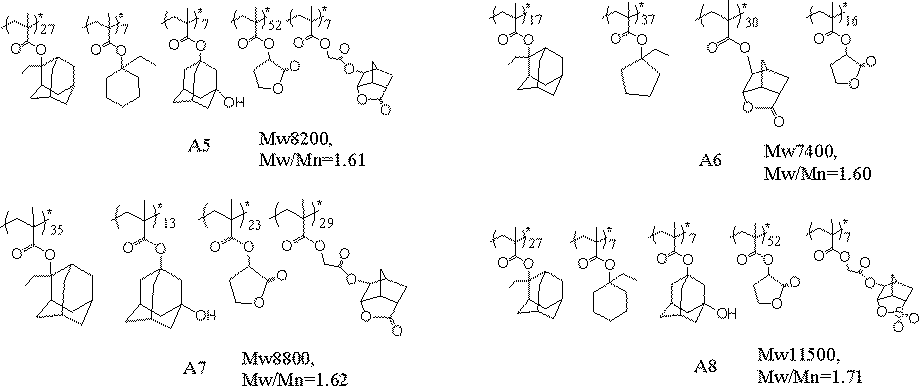

疎水性樹脂(HR)としては、HR1~HR4を使用した。疎水性樹脂HR1~HR4は、特開2012-256011号公報に記載の方法に準じて合成を行った。以下に、疎水性樹脂HR1~HR4の構造、組成比(モル比)、分子量、分散度を示す。
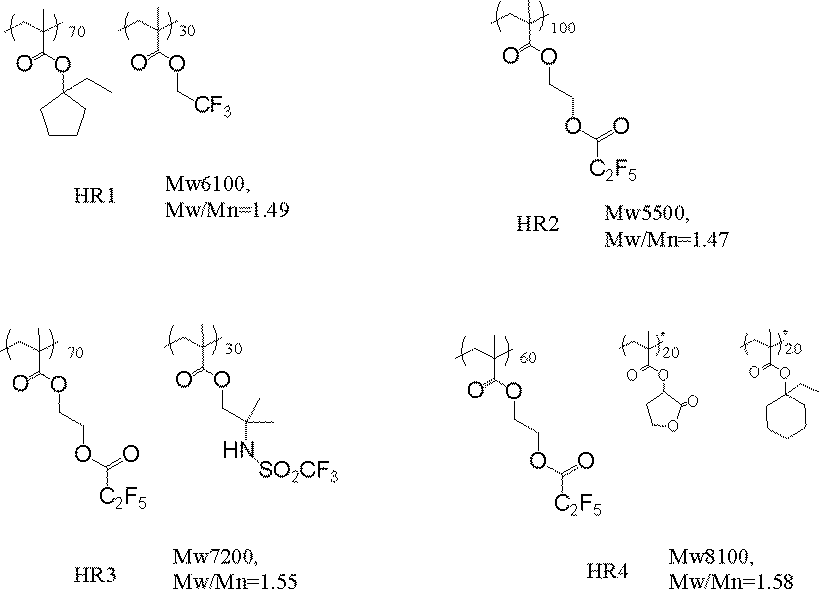
酸発生剤(B)としては、下記B1~B4を使用した。

化合物(C)としては、下記C1~C8を使用した。

必要に応じて、以下に示す塩基性化合物N-1~N-3を使用した。

界面活性剤としては、下記のものを使用した。
W-1:メガファックF176(DIC(株)製)(フッ素系)
W-2:メガファックR08(DIC(株)製)(フッ素及びシリコン系)
W-3:ポリシロキサンポリマーKP-341(信越化学工業(株)製)(シリコン系)W-4:トロイゾルS-366(トロイケミカル(株)製)
W-5:KH-20(旭化成(株)製)
W-6:PolyFoxTM PF-6320(OMNOVA solution inc.製)(フッ素系)
W-1:メガファックF176(DIC(株)製)(フッ素系)
W-2:メガファックR08(DIC(株)製)(フッ素及びシリコン系)
W-3:ポリシロキサンポリマーKP-341(信越化学工業(株)製)(シリコン系)W-4:トロイゾルS-366(トロイケミカル(株)製)
W-5:KH-20(旭化成(株)製)
W-6:PolyFoxTM PF-6320(OMNOVA solution inc.製)(フッ素系)
溶剤としては下記のものを使用した。
a群
SL-1:プロピレングリコールモノメチルエーテルアセテート(PGMEA)
SL-2:プロピレングリコールモノメチルエーテルプロピオネート
SL-3:2-ヘプタノン
b群
SL-4:乳酸エチル
SL-5:プロピレングリコールモノメチルエーテル(PGME)
SL-6:シクロヘキサノン
c群
SL-7:γ-ブチロラクトン
SL-8:プロピレンカーボネート
a群
SL-1:プロピレングリコールモノメチルエーテルアセテート(PGMEA)
SL-2:プロピレングリコールモノメチルエーテルプロピオネート
SL-3:2-ヘプタノン
b群
SL-4:乳酸エチル
SL-5:プロピレングリコールモノメチルエーテル(PGME)
SL-6:シクロヘキサノン
c群
SL-7:γ-ブチロラクトン
SL-8:プロピレンカーボネート
<レジスト組成物の調製>
下記表1に示す成分を溶剤に溶解させ、それぞれを0.03μmのポアサイズを有するポリエチレンフィルターでろ過して、実施例1~12、比較例1及び2のレジスト組成物を調製した。
下記表1に示す成分を溶剤に溶解させ、それぞれを0.03μmのポアサイズを有するポリエチレンフィルターでろ過して、実施例1~12、比較例1及び2のレジスト組成物を調製した。
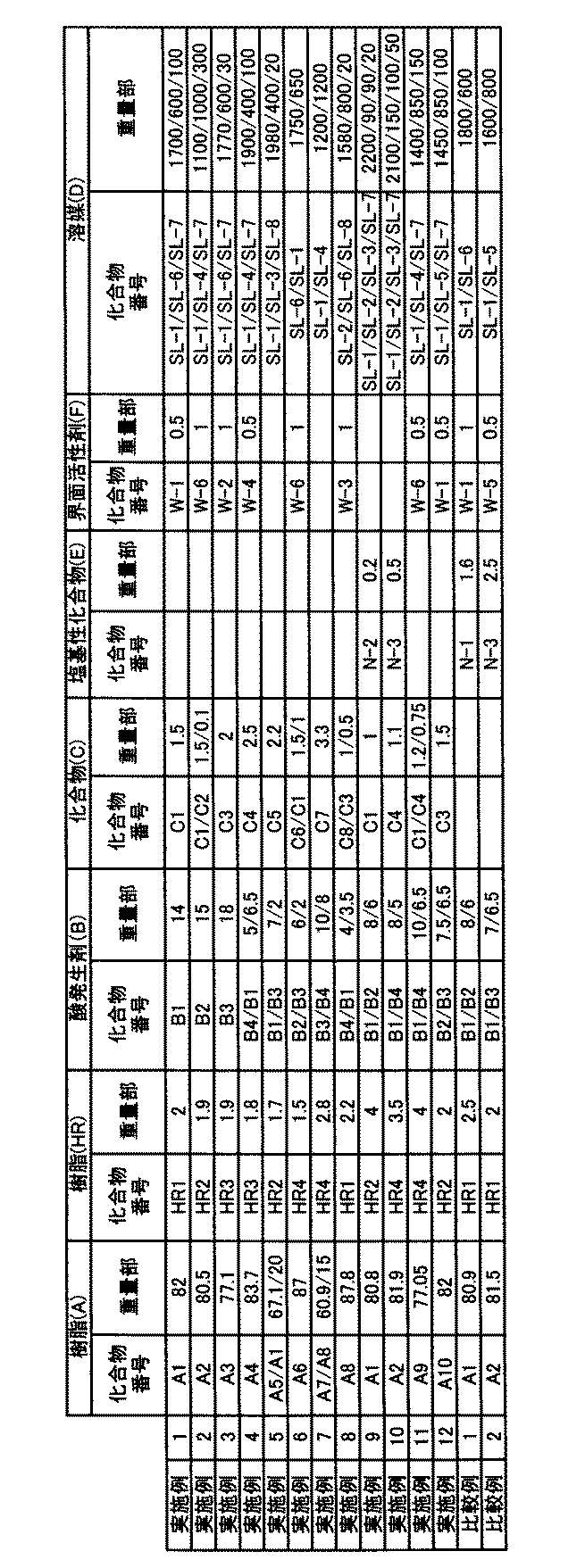
調製したレジスト組成物を用い、下記の方法でレジストパターンを形成した。
<ArF液浸露光1:ラインアンドスペースパターン>
実施例1
シリコンウエハ上に有機反射防止膜形成用のARC29SR(日産化学社製)を塗布し、205℃で、60秒間ベークを行い、膜厚86nmの反射防止膜を形成した。その上に実施例1のレジスト組成物を塗布し100℃で、60秒間ベーク(PB)を行い、膜厚100nmのレジスト膜を形成した。得られたウエハをArFエキシマレーザー液浸スキャナー(ASML社製 XT1700i、NA1.20、C-Quad、アウターシグマ0.981、インナーシグマ0.895、XY偏向)を用い、線幅50nmの1:1ラインアンドスペースパターンの6%ハーフトーンマスクを介して、パターン露光を行った。液浸液としては超純水を用いた。その後100℃で、60秒間加熱(PEB)した後、現像液(酢酸ブチル)を30秒間パドルして現像し、次いでリンス液(4-メチル-2-ペンタノール)で30秒間パドルしてリンスした。その後、4000rpmの回転数で30秒間ウエハを回転させた後に、90℃で60秒間ベークを行うことにより、線幅50nmの1:1ラインアンドスペースのレジストパターンを得た。
実施例1
シリコンウエハ上に有機反射防止膜形成用のARC29SR(日産化学社製)を塗布し、205℃で、60秒間ベークを行い、膜厚86nmの反射防止膜を形成した。その上に実施例1のレジスト組成物を塗布し100℃で、60秒間ベーク(PB)を行い、膜厚100nmのレジスト膜を形成した。得られたウエハをArFエキシマレーザー液浸スキャナー(ASML社製 XT1700i、NA1.20、C-Quad、アウターシグマ0.981、インナーシグマ0.895、XY偏向)を用い、線幅50nmの1:1ラインアンドスペースパターンの6%ハーフトーンマスクを介して、パターン露光を行った。液浸液としては超純水を用いた。その後100℃で、60秒間加熱(PEB)した後、現像液(酢酸ブチル)を30秒間パドルして現像し、次いでリンス液(4-メチル-2-ペンタノール)で30秒間パドルしてリンスした。その後、4000rpmの回転数で30秒間ウエハを回転させた後に、90℃で60秒間ベークを行うことにより、線幅50nmの1:1ラインアンドスペースのレジストパターンを得た。
実施例2~12、比較例1及び2
表1に記載のレジスト組成物を採用した以外は、実施例1の方法と同様にして、線幅50nmの1:1ラインアンドスペースのレジストパターンを得た。
表1に記載のレジスト組成物を採用した以外は、実施例1の方法と同様にして、線幅50nmの1:1ラインアンドスペースのレジストパターンを得た。
〔LWR〕
上記のレジストパターンを形成する際の露光量で、レジストパターンの長さ方向50μmに含まれる任意の50点について、走査型電子顕微鏡を用いて、ライン幅を測定した。そして、この値の標準偏差を求め、3σを算出した。値が小さいほど良好な性能であることを示す。
上記のレジストパターンを形成する際の露光量で、レジストパターンの長さ方向50μmに含まれる任意の50点について、走査型電子顕微鏡を用いて、ライン幅を測定した。そして、この値の標準偏差を求め、3σを算出した。値が小さいほど良好な性能であることを示す。
〔現像欠陥〕
上記の方法にて得られたパターンをアプライド・マテリアルズ社製の欠陥検査装置UVision(商品名)を用い、ピクセルサイズ:120nm、光源偏光Horizontal、検査モードGray Fieldの条件で現像欠陥を検出した。単位面積あたりの現像欠陥数(個数/cm2)を算出し、以下の基準で、現像欠陥性能の評価を行った。
A(特に良好)…値が0.5未満の場合
B(良好)…値が0.5以上1.0未満の場合
C(不良)…値が1.0以上の場合
上記の方法にて得られたパターンをアプライド・マテリアルズ社製の欠陥検査装置UVision(商品名)を用い、ピクセルサイズ:120nm、光源偏光Horizontal、検査モードGray Fieldの条件で現像欠陥を検出した。単位面積あたりの現像欠陥数(個数/cm2)を算出し、以下の基準で、現像欠陥性能の評価を行った。
A(特に良好)…値が0.5未満の場合
B(良好)…値が0.5以上1.0未満の場合
C(不良)…値が1.0以上の場合
〔パターン断面形状〕
上記の方法にて得られたパターンの断面形状を走査型電子顕微鏡により観察し、レジストパターンの底部における線幅Lbと、レジストパターンの上部での線幅Laを測定した。0.9≦(La/Lb)≦1.1である場合は「矩形」、(La/Lb)>1.1である場合を「Tトップ形状」と定義し、得られたパターンの断面形状を走査型電子顕微鏡により観察し、矩形パターンが得られたものをA、Tトップ形状が得られたものをBとして評価した。断面形状としては、矩形パターンが好ましい。
上記の方法にて得られたパターンの断面形状を走査型電子顕微鏡により観察し、レジストパターンの底部における線幅Lbと、レジストパターンの上部での線幅Laを測定した。0.9≦(La/Lb)≦1.1である場合は「矩形」、(La/Lb)>1.1である場合を「Tトップ形状」と定義し、得られたパターンの断面形状を走査型電子顕微鏡により観察し、矩形パターンが得られたものをA、Tトップ形状が得られたものをBとして評価した。断面形状としては、矩形パターンが好ましい。
<ArF液浸露光2:コンタクトホールパターン>
シリコンウエハ上に有機反射防止膜形成用のARC29SR(日産化学社製)を塗布し、205℃で60秒間ベークを行い、膜厚86nmの反射防止膜を形成した。その上にレジスト組成物を塗布し、100℃で60秒間に亘ってベークを行い、膜厚100nmのレジスト膜を形成した。
シリコンウエハ上に有機反射防止膜形成用のARC29SR(日産化学社製)を塗布し、205℃で60秒間ベークを行い、膜厚86nmの反射防止膜を形成した。その上にレジスト組成物を塗布し、100℃で60秒間に亘ってベークを行い、膜厚100nmのレジスト膜を形成した。
得られたウエハについて、ArFエキシマレーザー液浸スキャナー(ASML社製;XT1700i、NA1.20、C-Quad、アウターシグマ0.900、インナーシグマ0.812、XY偏向)を用い、ホール部分が60nmであり且つホール間のピッチが90nmである正方配列のハーフトーンマスク(ここではネガ画像形成のため、ホールに対応する部分が遮光されている)を介して、パターン露光を行った。液浸液としては超純水を用いた。その後、105℃で60秒間加熱(PEB:Post ExposureBake)した。次いで、酢酸ブチルで30秒間パドルして現像し、リンス液(4-メチル-2-ペンタノール)で30秒間パドルしてリンスした。続いて、4000rpmの回転数で30秒間ウエハを回転させることにより、孔径45nmのコンタクトホールパターンを得た。
[パターン寸法の均一性(CDU、nm)]
上記孔径45nmのコンタクトホールパターンを得る際の露光量で露光された1ショット内において、互いの間隔が1μmの20箇所の領域において、各領域ごとに任意の25個(すなわち、計500個)のホールサイズを測定し、これらの標準偏差を求め、3σを算出した。値が小さいほど寸法のばらつきが小さく、良好な性能であることを示す。
上記孔径45nmのコンタクトホールパターンを得る際の露光量で露光された1ショット内において、互いの間隔が1μmの20箇所の領域において、各領域ごとに任意の25個(すなわち、計500個)のホールサイズを測定し、これらの標準偏差を求め、3σを算出した。値が小さいほど寸法のばらつきが小さく、良好な性能であることを示す。
[パターン断面形状]
レジストパターンの断面形状を走査型電子顕微鏡を用いて観察し、レジストパターンの底部におけるホール径Lbと、レジストパターンの上部でのホール径Laを測定し、0.9≦(La/Lb)≦1.1である場合は「A(良好)」と評価し、この範囲外である場合は「B(不良)」と評価した。
レジストパターンの断面形状を走査型電子顕微鏡を用いて観察し、レジストパターンの底部におけるホール径Lbと、レジストパターンの上部でのホール径Laを測定し、0.9≦(La/Lb)≦1.1である場合は「A(良好)」と評価し、この範囲外である場合は「B(不良)」と評価した。
下記表2に評価結果を示す。

上掲の表に記載の結果から、本発明の感活性光線性又は感放射線性樹脂組成物を使用した実施例1~12は、化合物(C)を含有していない感活性光線性又は感放射線性樹脂組成物を使用した比較例1及び2と比べて、LWRが小さく、現像欠陥が少なく、パターンの断面形状及びCDUに優れていることが分かる。
また、モノマー(a3-1)由来の繰り返し単位を有する樹脂を含有する感活性光線性又は感放射線性樹脂組成物を使用した実施例1、3、5~9、11及び12は、現像欠陥が特に少ないことが分かる。
また、モノマー(a1)由来の繰り返し単位の含有率(複数種存在する場合はその合計)が50モル%以上である実施例6及び11は、LWR及びCDUに特に優れることが分かる。
また、モノマー(a3-1)由来の繰り返し単位を有する樹脂を含有する感活性光線性又は感放射線性樹脂組成物を使用した実施例1、3、5~9、11及び12は、現像欠陥が特に少ないことが分かる。
また、モノマー(a1)由来の繰り返し単位の含有率(複数種存在する場合はその合計)が50モル%以上である実施例6及び11は、LWR及びCDUに特に優れることが分かる。
Claims (10)
- (ア)下記(A)~(C)を含有する感活性光線性又は感放射線性樹脂組成物によって膜を形成する工程、
(A)酸の作用により極性が増大して有機溶剤を含む現像液に対する溶解性が減少する樹脂、
(B)活性光線又は放射線の照射により酸を発生する化合物、及び
(C)カチオン部位とアニオン部位を同一分子内に有し、かつ、該カチオン部位と該アニオン部位が共有結合によって連結している化合物
(イ)該膜を露光する工程、及び
(ウ)該露光された膜を、有機溶剤を含む現像液を用いて現像してネガ型のパターンを形成する工程
を有するパターン形成方法。 - 前記化合物(C)が下記一般式(C-1)~(C-4)のいずれかで表される化合物である請求項1に記載のパターン形成方法。

一般式(C-1)~(C-4)中、
R1、R2、R3は、それぞれ独立に炭素数1以上の置換基を表す。
L1は、カチオン部位とアニオン部位を連結する2価の連結基又は単結合を表す。
-X-は、-COO-、-SO3 -、-SO2 -、-N--R4から選択されるアニオン部位を表す。R4は、隣接するN原子との連結部位に、カルボニル基:-C(=O)-、スルホニル基:-S(=O)2-、スルフィニル基:-S(=O)-から選択される基を有する1価の置換基を表す。
一般式(C-1)におけるR1、R2及びL1から選択される2つの基が連結して環構造を形成しても良い。
一般式(C-2)におけるR1及びL1は連結して環構造を形成しても良い。
一般式(C-3)におけるR1、R2、R3及びL1から選択される2つ以上の基が連結して環構造を形成しても良い。
一般式(C-4)におけるR1、R2、R3及びL1から選択される2つ以上の基が連結して環構造を形成しても良い。 - 前記有機溶剤を含む現像液における有機溶剤の含有量が、前記現像液の全量に対して、90質量%以上100質量%以下である、請求項1又は2に記載のパターン形成方法。
- 前記現像液が、ケトン系溶剤、エステル系溶剤、アルコール系溶剤、アミド系溶剤及びエーテル系溶剤からなる群より選択される少なくとも1種類の有機溶剤を含有する現像液である、請求項1~3のいずれか1項に記載のパターン形成方法。
- 前記感活性光線性又は感放射線性樹脂組成物が、前記樹脂(A)とは異なる、疎水性樹脂(HR)を更に含有する、請求項1~4のいずれか1項に記載のパターン形成方法。
- 前記工程(イ)における露光が液浸露光である、請求項1~5のいずれか1項に記載のパターン形成方法。
- 請求項1~6のいずれか1項に記載のパターン形成方法に供せられる感活性光線性又は感放射線性樹脂組成物。
- 請求項7に記載の感活性光線性又は感放射線性樹脂組成物により形成されるレジスト膜。
- 請求項1~6のいずれか1項に記載のパターン形成方法を含む、電子デバイスの製造方法。
- 請求項9に記載の電子デバイスの製造方法により製造された電子デバイス。
Priority Applications (2)
| Application Number | Priority Date | Filing Date | Title |
|---|---|---|---|
| KR1020157018110A KR101962666B1 (ko) | 2013-02-08 | 2013-12-11 | 패턴 형성 방법, 감활성광선성 또는 감방사선성 수지 조성물, 레지스트막, 전자 디바이스의 제조 방법, 및, 전자 디바이스 |
| US14/754,017 US20150301451A1 (en) | 2013-02-08 | 2015-06-29 | Pattern forming method, actinic ray-sensitive or radiation-sensitive resin composition, resist film, method for manufacturing electronic device, and electronic device |
Applications Claiming Priority (4)
| Application Number | Priority Date | Filing Date | Title |
|---|---|---|---|
| JP2013023550 | 2013-02-08 | ||
| JP2013-023550 | 2013-02-08 | ||
| JP2013-075278 | 2013-03-29 | ||
| JP2013075278A JP6140508B2 (ja) | 2013-02-08 | 2013-03-29 | パターン形成方法、及び電子デバイスの製造方法 |
Related Child Applications (1)
| Application Number | Title | Priority Date | Filing Date |
|---|---|---|---|
| US14/754,017 Continuation US20150301451A1 (en) | 2013-02-08 | 2015-06-29 | Pattern forming method, actinic ray-sensitive or radiation-sensitive resin composition, resist film, method for manufacturing electronic device, and electronic device |
Publications (1)
| Publication Number | Publication Date |
|---|---|
| WO2014122852A1 true WO2014122852A1 (ja) | 2014-08-14 |
Family
ID=51299456
Family Applications (1)
| Application Number | Title | Priority Date | Filing Date |
|---|---|---|---|
| PCT/JP2013/083238 Ceased WO2014122852A1 (ja) | 2013-02-08 | 2013-12-11 | パターン形成方法、感活性光線性又は感放射線性樹脂組成物、レジスト膜、電子デバイスの製造方法、及び、電子デバイス |
Country Status (5)
| Country | Link |
|---|---|
| US (1) | US20150301451A1 (ja) |
| JP (1) | JP6140508B2 (ja) |
| KR (1) | KR101962666B1 (ja) |
| TW (1) | TWI585143B (ja) |
| WO (1) | WO2014122852A1 (ja) |
Cited By (3)
| Publication number | Priority date | Publication date | Assignee | Title |
|---|---|---|---|---|
| WO2016035497A1 (ja) * | 2014-09-02 | 2016-03-10 | 富士フイルム株式会社 | パターン形成方法、電子デバイスの製造方法及び電子デバイス |
| KR20160032705A (ko) * | 2014-09-16 | 2016-03-24 | 스미또모 가가꾸 가부시키가이샤 | 수지, 레지스트 조성물 및 레지스트 패턴의 제조 방법 |
| WO2019065262A1 (ja) * | 2017-09-29 | 2019-04-04 | 日本ゼオン株式会社 | ポジ型感放射線性樹脂組成物 |
Families Citing this family (7)
| Publication number | Priority date | Publication date | Assignee | Title |
|---|---|---|---|---|
| JP6640864B2 (ja) * | 2015-09-30 | 2020-02-05 | 富士フイルム株式会社 | ネガ型のパターン形成方法、電子デバイスの製造方法、及び有機溶剤を含有する現像液を用いるネガ型パターン形成用のレジスト材料用積層体 |
| US10416558B2 (en) * | 2016-08-05 | 2019-09-17 | Shin-Etsu Chemical Co., Ltd. | Positive resist composition, resist pattern forming process, and photomask blank |
| JP6561937B2 (ja) * | 2016-08-05 | 2019-08-21 | 信越化学工業株式会社 | ネガ型レジスト組成物及びレジストパターン形成方法 |
| KR102296567B1 (ko) * | 2017-03-13 | 2021-09-01 | 후지필름 가부시키가이샤 | 감활성광선성 또는 감방사선성 수지 조성물, 레지스트막, 패턴 형성 방법, 전자 디바이스의 제조 방법 |
| JP6950357B2 (ja) * | 2017-08-24 | 2021-10-13 | 信越化学工業株式会社 | スルホニウム化合物、レジスト組成物及びパターン形成方法 |
| JP6810728B2 (ja) * | 2017-11-30 | 2021-01-06 | ローム アンド ハース エレクトロニック マテリアルズ エルエルシーRohm and Haas Electronic Materials LLC | 双性イオン化合物およびそれを含むフォトレジスト |
| WO2019167570A1 (ja) * | 2018-03-01 | 2019-09-06 | 富士フイルム株式会社 | 感活性光線性又は感放射線性樹脂組成物、レジスト膜、パターン形成方法、電子デバイスの製造方法 |
Citations (12)
| Publication number | Priority date | Publication date | Assignee | Title |
|---|---|---|---|---|
| JP2011016746A (ja) * | 2009-07-08 | 2011-01-27 | Shin-Etsu Chemical Co Ltd | スルホニウム塩、レジスト材料及びパターン形成方法 |
| JP2011022560A (ja) * | 2009-06-17 | 2011-02-03 | Fujifilm Corp | パターン形成方法、化学増幅型レジスト組成物及びレジスト膜 |
| JP2012083727A (ja) * | 2010-09-17 | 2012-04-26 | Fujifilm Corp | パターン形成方法 |
| JP2012226313A (ja) * | 2011-04-07 | 2012-11-15 | Sumitomo Chemical Co Ltd | レジスト組成物 |
| JP2012252124A (ja) * | 2011-06-02 | 2012-12-20 | Sumitomo Chemical Co Ltd | レジスト組成物 |
| JP2013006827A (ja) * | 2011-05-24 | 2013-01-10 | Sumitomo Chemical Co Ltd | 塩、レジスト組成物及びレジストパターンの製造方法 |
| JP2013008020A (ja) * | 2011-05-25 | 2013-01-10 | Sumitomo Chemical Co Ltd | レジスト組成物 |
| JP2013167825A (ja) * | 2012-02-16 | 2013-08-29 | Fujifilm Corp | パターン形成方法、感活性光線性又は感放射線性樹脂組成物及びレジスト膜、並びにこれらを用いた電子デバイスの製造方法及び電子デバイス |
| JP2013235251A (ja) * | 2012-04-09 | 2013-11-21 | Sumitomo Chemical Co Ltd | レジスト組成物及びレジストパターンの製造方法 |
| JP2013254188A (ja) * | 2012-01-17 | 2013-12-19 | Sumitomo Chemical Co Ltd | レジストパターンの製造方法 |
| JP2013257468A (ja) * | 2012-06-13 | 2013-12-26 | Fujifilm Corp | パターン形成方法、それに用いられる感活性光線性又は感放射線性樹脂組成物、及び、レジスト膜、並びに、これらを用いる電子デバイスの製造方法、及び、電子デバイス |
| JP2014006489A (ja) * | 2012-05-30 | 2014-01-16 | Tokyo Ohka Kogyo Co Ltd | レジスト組成物、レジストパターン形成方法、化合物 |
Family Cites Families (10)
| Publication number | Priority date | Publication date | Assignee | Title |
|---|---|---|---|---|
| JP4554665B2 (ja) * | 2006-12-25 | 2010-09-29 | 富士フイルム株式会社 | パターン形成方法、該パターン形成方法に用いられる多重現像用ポジ型レジスト組成物、該パターン形成方法に用いられるネガ現像用現像液及び該パターン形成方法に用いられるネガ現像用リンス液 |
| JP5601884B2 (ja) | 2009-06-04 | 2014-10-08 | 富士フイルム株式会社 | 感活性光線または感放射線性樹脂組成物を用いたパターン形成方法及びパターン |
| JP5740184B2 (ja) * | 2010-03-25 | 2015-06-24 | 富士フイルム株式会社 | パターン形成方法及びレジスト組成物 |
| KR101148920B1 (ko) | 2010-05-04 | 2012-05-23 | 주식회사 와이즈오토모티브 | 차선 이탈 경보의 오경보 방지 장치 및 방법 |
| KR101841000B1 (ko) * | 2010-07-28 | 2018-03-22 | 스미또모 가가꾸 가부시키가이샤 | 포토레지스트 조성물 |
| JP5829939B2 (ja) * | 2011-02-25 | 2015-12-09 | 住友化学株式会社 | レジスト組成物及びレジストパターンの製造方法 |
| JP5869940B2 (ja) * | 2011-04-07 | 2016-02-24 | 住友化学株式会社 | レジスト組成物及びレジストパターンの製造方法 |
| JP5852490B2 (ja) * | 2011-04-07 | 2016-02-03 | 住友化学株式会社 | レジスト組成物及びレジストパターンの製造方法 |
| JP2013061642A (ja) * | 2011-08-22 | 2013-04-04 | Sumitomo Chemical Co Ltd | レジスト組成物及びレジストパターンの製造方法 |
| JP6218414B2 (ja) * | 2012-04-09 | 2017-10-25 | 住友化学株式会社 | レジスト組成物及びレジストパターンの製造方法 |
-
2013
- 2013-03-29 JP JP2013075278A patent/JP6140508B2/ja active Active
- 2013-12-11 KR KR1020157018110A patent/KR101962666B1/ko active Active
- 2013-12-11 WO PCT/JP2013/083238 patent/WO2014122852A1/ja not_active Ceased
-
2014
- 2014-01-10 TW TW103100882A patent/TWI585143B/zh active
-
2015
- 2015-06-29 US US14/754,017 patent/US20150301451A1/en not_active Abandoned
Patent Citations (12)
| Publication number | Priority date | Publication date | Assignee | Title |
|---|---|---|---|---|
| JP2011022560A (ja) * | 2009-06-17 | 2011-02-03 | Fujifilm Corp | パターン形成方法、化学増幅型レジスト組成物及びレジスト膜 |
| JP2011016746A (ja) * | 2009-07-08 | 2011-01-27 | Shin-Etsu Chemical Co Ltd | スルホニウム塩、レジスト材料及びパターン形成方法 |
| JP2012083727A (ja) * | 2010-09-17 | 2012-04-26 | Fujifilm Corp | パターン形成方法 |
| JP2012226313A (ja) * | 2011-04-07 | 2012-11-15 | Sumitomo Chemical Co Ltd | レジスト組成物 |
| JP2013006827A (ja) * | 2011-05-24 | 2013-01-10 | Sumitomo Chemical Co Ltd | 塩、レジスト組成物及びレジストパターンの製造方法 |
| JP2013008020A (ja) * | 2011-05-25 | 2013-01-10 | Sumitomo Chemical Co Ltd | レジスト組成物 |
| JP2012252124A (ja) * | 2011-06-02 | 2012-12-20 | Sumitomo Chemical Co Ltd | レジスト組成物 |
| JP2013254188A (ja) * | 2012-01-17 | 2013-12-19 | Sumitomo Chemical Co Ltd | レジストパターンの製造方法 |
| JP2013167825A (ja) * | 2012-02-16 | 2013-08-29 | Fujifilm Corp | パターン形成方法、感活性光線性又は感放射線性樹脂組成物及びレジスト膜、並びにこれらを用いた電子デバイスの製造方法及び電子デバイス |
| JP2013235251A (ja) * | 2012-04-09 | 2013-11-21 | Sumitomo Chemical Co Ltd | レジスト組成物及びレジストパターンの製造方法 |
| JP2014006489A (ja) * | 2012-05-30 | 2014-01-16 | Tokyo Ohka Kogyo Co Ltd | レジスト組成物、レジストパターン形成方法、化合物 |
| JP2013257468A (ja) * | 2012-06-13 | 2013-12-26 | Fujifilm Corp | パターン形成方法、それに用いられる感活性光線性又は感放射線性樹脂組成物、及び、レジスト膜、並びに、これらを用いる電子デバイスの製造方法、及び、電子デバイス |
Cited By (9)
| Publication number | Priority date | Publication date | Assignee | Title |
|---|---|---|---|---|
| WO2016035497A1 (ja) * | 2014-09-02 | 2016-03-10 | 富士フイルム株式会社 | パターン形成方法、電子デバイスの製造方法及び電子デバイス |
| KR20170033382A (ko) * | 2014-09-02 | 2017-03-24 | 후지필름 가부시키가이샤 | 패턴 형성 방법, 전자 디바이스의 제조 방법 및 전자 디바이스 |
| JPWO2016035497A1 (ja) * | 2014-09-02 | 2017-04-27 | 富士フイルム株式会社 | パターン形成方法、電子デバイスの製造方法及び電子デバイス |
| KR101904793B1 (ko) * | 2014-09-02 | 2018-10-05 | 후지필름 가부시키가이샤 | 패턴 형성 방법, 전자 디바이스의 제조 방법 및 전자 디바이스 |
| US10095111B2 (en) | 2014-09-02 | 2018-10-09 | Fujifilm Corporation | Pattern forming method, method for manufacturing electronic device, and electronic device |
| TWI677753B (zh) * | 2014-09-02 | 2019-11-21 | 日商富士軟片股份有限公司 | 圖案形成方法、電子元件的製造方法及電子元件 |
| KR20160032705A (ko) * | 2014-09-16 | 2016-03-24 | 스미또모 가가꾸 가부시키가이샤 | 수지, 레지스트 조성물 및 레지스트 패턴의 제조 방법 |
| KR102447905B1 (ko) * | 2014-09-16 | 2022-09-27 | 스미또모 가가꾸 가부시키가이샤 | 수지, 레지스트 조성물 및 레지스트 패턴의 제조 방법 |
| WO2019065262A1 (ja) * | 2017-09-29 | 2019-04-04 | 日本ゼオン株式会社 | ポジ型感放射線性樹脂組成物 |
Also Published As
| Publication number | Publication date |
|---|---|
| JP6140508B2 (ja) | 2017-05-31 |
| KR101962666B1 (ko) | 2019-03-27 |
| TWI585143B (zh) | 2017-06-01 |
| JP2014170205A (ja) | 2014-09-18 |
| US20150301451A1 (en) | 2015-10-22 |
| KR20150093777A (ko) | 2015-08-18 |
| TW201431940A (zh) | 2014-08-16 |
Similar Documents
| Publication | Publication Date | Title |
|---|---|---|
| JP6207065B2 (ja) | 塩、レジスト組成物及びレジストパターンの製造方法 | |
| JP6140508B2 (ja) | パターン形成方法、及び電子デバイスの製造方法 | |
| JP5829939B2 (ja) | レジスト組成物及びレジストパターンの製造方法 | |
| JP5866100B2 (ja) | レジスト組成物及びレジストパターンの製造方法 | |
| WO2014175201A1 (ja) | パターン形成方法、それに用いられる感活性光線性又は感放射線性樹脂組成物、及び、レジスト膜、並びに、これらを用いる電子デバイス及びその製造方法 | |
| JP6369007B2 (ja) | 樹脂、レジスト組成物及びレジストパターンの製造方法 | |
| JP2013061642A (ja) | レジスト組成物及びレジストパターンの製造方法 | |
| JP5829941B2 (ja) | レジスト組成物及びレジストパターンの製造方法 | |
| JP6119487B2 (ja) | レジスト組成物及びレジストパターンの製造方法 | |
| JP6123328B2 (ja) | レジスト組成物及びレジストパターンの製造方法 | |
| JP6292817B2 (ja) | レジスト組成物及びレジストパターンの製造方法 | |
| JP6232838B2 (ja) | レジスト組成物及びレジストパターンの製造方法 | |
| JP6039279B2 (ja) | レジスト組成物及びレジストパターンの製造方法 | |
| JP6182865B2 (ja) | レジストパターンの製造方法 | |
| JP6232837B2 (ja) | レジスト組成物及びレジストパターンの製造方法 | |
| JP6330250B2 (ja) | レジストパターンの製造方法 | |
| JP6398159B2 (ja) | 塩、レジスト組成物及びレジストパターンの製造方法 | |
| JP5996944B2 (ja) | レジスト組成物及びレジストパターンの製造方法 | |
| JP5869940B2 (ja) | レジスト組成物及びレジストパターンの製造方法 | |
| JP6246492B2 (ja) | レジスト組成物及びレジストパターンの製造方法 | |
| JP6246491B2 (ja) | レジスト組成物及びレジストパターンの製造方法 | |
| JP6182864B2 (ja) | レジストパターンの製造方法 | |
| JP2013064986A (ja) | レジスト組成物及びレジストパターンの製造方法 | |
| JP6246493B2 (ja) | レジスト組成物及びレジストパターンの製造方法 | |
| JP2017016124A (ja) | レジストパターンの製造方法 |
Legal Events
| Date | Code | Title | Description |
|---|---|---|---|
| 121 | Ep: the epo has been informed by wipo that ep was designated in this application |
Ref document number: 13874466 Country of ref document: EP Kind code of ref document: A1 |
|
| ENP | Entry into the national phase |
Ref document number: 20157018110 Country of ref document: KR Kind code of ref document: A |
|
| NENP | Non-entry into the national phase |
Ref country code: DE |
|
| 122 | Ep: pct application non-entry in european phase |
Ref document number: 13874466 Country of ref document: EP Kind code of ref document: A1 |