WO2014092151A1 - カプセル、毛髪用液体洗浄剤組成物およびそれらの製造方法 - Google Patents
カプセル、毛髪用液体洗浄剤組成物およびそれらの製造方法 Download PDFInfo
- Publication number
- WO2014092151A1 WO2014092151A1 PCT/JP2013/083326 JP2013083326W WO2014092151A1 WO 2014092151 A1 WO2014092151 A1 WO 2014092151A1 JP 2013083326 W JP2013083326 W JP 2013083326W WO 2014092151 A1 WO2014092151 A1 WO 2014092151A1
- Authority
- WO
- WIPO (PCT)
- Prior art keywords
- component
- capsule
- dispersion
- mass
- temperature
- Prior art date
- Legal status (The legal status is an assumption and is not a legal conclusion. Google has not performed a legal analysis and makes no representation as to the accuracy of the status listed.)
- Ceased
Links
Classifications
-
- A—HUMAN NECESSITIES
- A61—MEDICAL OR VETERINARY SCIENCE; HYGIENE
- A61K—PREPARATIONS FOR MEDICAL, DENTAL OR TOILETRY PURPOSES
- A61K8/00—Cosmetics or similar toiletry preparations
- A61K8/18—Cosmetics or similar toiletry preparations characterised by the composition
- A61K8/72—Cosmetics or similar toiletry preparations characterised by the composition containing organic macromolecular compounds
- A61K8/73—Polysaccharides
- A61K8/731—Cellulose; Quaternized cellulose derivatives
-
- A—HUMAN NECESSITIES
- A61—MEDICAL OR VETERINARY SCIENCE; HYGIENE
- A61K—PREPARATIONS FOR MEDICAL, DENTAL OR TOILETRY PURPOSES
- A61K8/00—Cosmetics or similar toiletry preparations
- A61K8/02—Cosmetics or similar toiletry preparations characterised by special physical form
- A61K8/11—Encapsulated compositions
-
- A—HUMAN NECESSITIES
- A61—MEDICAL OR VETERINARY SCIENCE; HYGIENE
- A61K—PREPARATIONS FOR MEDICAL, DENTAL OR TOILETRY PURPOSES
- A61K8/00—Cosmetics or similar toiletry preparations
- A61K8/18—Cosmetics or similar toiletry preparations characterised by the composition
- A61K8/30—Cosmetics or similar toiletry preparations characterised by the composition containing organic compounds
- A61K8/64—Proteins; Peptides; Derivatives or degradation products thereof
- A61K8/65—Collagen; Gelatin; Keratin; Derivatives or degradation products thereof
-
- A—HUMAN NECESSITIES
- A61—MEDICAL OR VETERINARY SCIENCE; HYGIENE
- A61K—PREPARATIONS FOR MEDICAL, DENTAL OR TOILETRY PURPOSES
- A61K8/00—Cosmetics or similar toiletry preparations
- A61K8/18—Cosmetics or similar toiletry preparations characterised by the composition
- A61K8/72—Cosmetics or similar toiletry preparations characterised by the composition containing organic macromolecular compounds
- A61K8/84—Cosmetics or similar toiletry preparations characterised by the composition containing organic macromolecular compounds obtained by reactions otherwise than those involving only carbon-carbon unsaturated bonds
- A61K8/89—Polysiloxanes
- A61K8/891—Polysiloxanes saturated, e.g. dimethicone, phenyl trimethicone, C24-C28 methicone or stearyl dimethicone
-
- A—HUMAN NECESSITIES
- A61—MEDICAL OR VETERINARY SCIENCE; HYGIENE
- A61Q—SPECIFIC USE OF COSMETICS OR SIMILAR TOILETRY PREPARATIONS
- A61Q13/00—Formulations or additives for perfume preparations
-
- A—HUMAN NECESSITIES
- A61—MEDICAL OR VETERINARY SCIENCE; HYGIENE
- A61Q—SPECIFIC USE OF COSMETICS OR SIMILAR TOILETRY PREPARATIONS
- A61Q5/00—Preparations for care of the hair
- A61Q5/02—Preparations for cleaning the hair
Definitions
- the present invention relates to a capsule, a liquid detergent composition for hair containing the capsule, and a method for producing them.
- This application claims priority on December 14, 2012 based on Japanese Patent Application No. 2012-273709 for which it applied to Japan, and uses the content here.
- fragrance it is generally practiced to blend perfumes into various products such as cleaning agents and cosmetics.
- the function of enhancing the palatability of the product itself for example, by masking the odor of the raw material such as the surfactant, or imparting a scent to the application target is given.
- fragrances have been encapsulated and blended in order to increase the sustainability of the fragrance.
- a film material for wrapping a fragrance during encapsulation a film using a water-soluble polymer is generally used since the fragrance is oily.
- Various methods are conventionally known as capsule manufacturing methods.
- One of them is a complex coacervation method.
- a core substance is coated with a phase separation of a hydrophilic colloid formed from an aqueous solution containing gelatin and an anionic polymer compound, and the phase separation is gelled to form a capsule.
- Patent Documents 1 and 2 For example, Patent Documents 1 and 2.
- capsules manufactured by a conventional method using a fragrance as a core substance are blended into a liquid product and stored at a high temperature (eg, 40 ° C. to 50 ° C.).
- a high temperature eg, 40 ° C. to 50 ° C.
- the liquid product in which the capsule is blended contains a surfactant such as a liquid detergent composition and a liquid cosmetic composition, particularly a liquid detergent composition for hair.
- the present invention has been made in view of the above circumstances, and includes a capsule that is difficult to settle when blended in a liquid product and stored at high temperature, a liquid detergent composition for hair containing the capsule, and a method for producing them.
- the purpose is to provide.
- the present invention has the following aspects.
- a capsule in which a core substance is encapsulated with a membrane material The core substance contains a fragrance (A) and a water-insoluble silicone oil (B), A capsule wherein the mass ratio (A / B) of the fragrance (A) to the water-insoluble silicone oil (B) is 0.1 to 2.5.
- the water-insoluble silicone oil (B) has a kinematic viscosity of 3000 mm 2 / s or less.
- the film material contains gelatin (C) and an anionic polymer compound (D).
- a liquid detergent composition for hair containing the capsule according to any one of [1] to [3] and a surfactant.
- the second step includes A second step a in which the core material solution obtained in the first step is added to an aqueous solution containing gelatin (C) and an anionic polymer compound (D) and mixed to obtain a dispersion;
- the temperature of the dispersion obtained in the second step a is set to 12 ° C. or less, and an inorganic salt (E) is added thereto, and then the temperature of the dispersion is set to 15 ° C. to 25 ° C.
- a step of producing a capsule by the capsule production method according to [5] or [6] And a step of mixing the obtained capsule and a surfactant, and a method for producing a liquid detergent composition for hair.
- the present invention it is possible to provide a capsule that is difficult to settle when blended in a liquid product and stored at high temperature, a liquid detergent composition for hair containing the capsule, and a method for producing them.
- a first aspect of the present invention is a capsule in which a core substance is encapsulated with a membrane material,
- the core substance contains a fragrance (A) (hereinafter “(A) component”) and a water-insoluble silicone oil (B) (hereinafter “(B) component”),
- a capsule having a mass ratio (A / B) of the component (A) to the component (B) of 0.1 to 2.5.
- perfume composition means a mixture comprising a fragrance component, a solvent, a fragrance stabilizer and the like. Examples of the fragrance component include those described in paragraph numbers [0021] to [0035] of JP-A No. 2003-300811.
- the perfume used in the composition of the present invention is hydrocarbon, alcohol, phenol and phenol ether, aldehyde, acetal and ketal, ketone, ether, acid, lactone, ester, It is 1 type, or 2 or more types of fragrance
- hydrocarbon compound examples include ocimene, dihydromyrcene, farnesene, cedrene, ⁇ -pinene and the like.
- alcohol compound examples include 3-methyl-1-pentanol, geraniol, cedrol, citronellol, rosinol and the like.
- phenol type and phenol ether type compounds include anisole, estragole, chabicol, anethole, cresol and the like.
- aldehyde compounds examples include citronellal, citral, 3,7-dimethyl-1-octanal, hydroxycitronellal, methoxycitronellal, and the like.
- acetal compounds and ketal compounds examples include magnolan (2,4-dimethyl-4,4a, 5,9b-tetrahydroindeno [1.2d] -1,3-dioxane), anthoxane (4-isopropyl-5). , 5-dimethyl-1,3-dioxane), indofur (dihydroindenyl-2,4-dioxane) and the like.
- the ketone compound include acetyl caryophyllene, carvone, pulegone, piperithenone, piperiton and the like.
- Examples of the ether compounds include methyl hexyl ether, decyl methyl ether, decyl vinyl ether, diethylene glycol monomethyl ether, diethylene glycol monoethyl ether, and the like.
- Examples of the acid compound include geranic acid, acetic acid, propionic acid, pyruvic acid, butyric acid, and the like.
- Examples of the lactone compound include pentalide (cyclopentadecanolide), habanolide (oxacyclohexadecen-2-one), ambletide, cyclohexadecanolide, 10-oxahexadecanolide, and the like.
- ester compounds include ethyl formate, propyl formate, butyl formate, amyl formate, and isoamyl formate.
- examples of the nitrogen-containing compound include methyl anthranilate, ethyl anthranilate, butyl anthranilate, and cis-3-hexenyl anthranilate.
- examples of the sulfur-containing compound include thiazole, 4-methylthiazole, 4,5-dimethylthiazole, trimethylthiazole and the like.
- natural fragrances include asafetida resinoid, ajowan oil, star anise oil, abies oil, and amylis oil.
- blended fragrances that combine fragrance ingredients include citrus type bases, fresh type bases, and fruity type bases.
- the fragrance solvent is not particularly limited, and a known solvent can be used as a fragrance component solvent.
- Examples of the perfume solvent include those described in paragraph No. [0050] of JP-A-2003-300811.
- Solvents for fragrances include ethanol, acetin (triacetin), MMB acetate (3-methoxy-3-methylbutyl acetate), ethylene glycol dibutyrate, hexylene glycol, dibutyl sebacate, deltile extra (isopropyl myristate), methyl Carbitol (diethylene glycol monomethyl ether), carbitol (diethylene glycol monoethyl ether), TEG (triethylene glycol), benzyl benzoate, propylene glycol, diethyl phthalate, tripropylene glycol, aboline (dimethyl phthalate), deltyl prime (isopropyl) Palmitate), dipropylene glycol DPG-FC (dipropylene glycol), farnesene, dioctyl adipate, tributy (Glyceryl tributanoate), hydrolite-5 (1,2-pentanediol), propylene glycol diacetate, cet
- the content of the fragrance solvent in the fragrance composition is preferably 0.1% by mass to 99% by mass and more preferably 1% by mass to 50% by mass with respect to the total amount of the fragrance composition.
- ⁇ (B) component water-insoluble silicone oil ⁇ “Water-insoluble” in component (B) indicates that the amount that can be dissolved in 1 L of ion-exchanged water at 20 ° C. is 1 g or less.
- Specific examples of the component (B) include diphenyl silicone, dimethyl silicone, long chain alkyl-modified silicone, and methylphenyl silicone.
- the long chain alkyl group in the long chain alkyl-modified silicone preferably has 8 to 20 carbon atoms.
- the component (B) is preferably at least one selected from dimethyl silicone, long-chain alkyl-modified silicone, and methylphenyl silicone, and is more excellent in the capsule sedimentation suppressing effect and compatibility with the component (A). Therefore, methylphenyl silicone is particularly preferable. Among methylphenyl silicones, diphenyl dimethicone and diphenylsiloxyphenyl trimethicone are preferable, and diphenylsiloxyphenyl trimethicone is more preferable. As the component (B), one type may be used alone, or two or more types may be used in combination.
- the component (B) preferably has a kinematic viscosity of 3000 mm 2 / s or less, more preferably 10 mm 2 / s to 3000 mm 2 / s, and further preferably 10 mm 2 / s to 1000 mm 2 / s. It is preferably 10 mm 2 / s to 500 mm 2 / s.
- the kinematic viscosity is 3000 mm 2 / s or less, the capsule sedimentation suppressing effect is excellent.
- the lower limit of the kinematic viscosity is not particularly limited in terms of the effect of suppressing precipitation, but if it is 10 mm 2 / s or more, the affinity with the component (A) is good.
- the kinematic viscosity is a value measured according to JIS Z8803.
- dynamic viscosity should just be 3000 mm ⁇ 2 > / s or less in the state which mixed them.
- the average kinematic viscosity of all the components (B) contained in the core material may be 3000 mm 2 / s or less, and among them, a water-insoluble silicone oil whose kinematic viscosity alone exceeds 3000 mm 2 / s is included. It may be.
- the component (B) is preferably composed only of a water-insoluble silicone oil having a kinematic viscosity of 3000 mm 2 / s or less alone.
- the ratio of the content of the component (A) and the component (B) in the core substance is 0.1 to 2.5 as the mass ratio (A / B) of the component (A) to the component (B). It is preferably 3 to 2.0, more preferably 0.4 to 1.5.
- a / B is in the range of 0.1 to 2.5, the capsule is excellent in sedimentation-preventing effect, and when the capsule is blended in a hair detergent composition for hair, sedimentation due to high-temperature storage hardly occurs. .
- the core substance may contain other components other than the component (A) and the component (B) as long as the effects of the present invention are not impaired.
- the other component may be any component that is miscible with the component (A) and the component (B).
- an additive such as a preservative such as propylparaben and an antioxidant such as butylhydroxyanisole (BHA) may be used.
- BHA butylhydroxyanisole
- the amount of the additive is preferably 0 to 1.0 part by weight, particularly preferably 0.2 to 0.8 part by weight, based on 100 parts by weight in total of the component (A) and the component (B). That is, it is particularly preferable that the components contained in the core substance are substantially only the components (A) and (B).
- the membrane material constitutes a wall that encloses the core substance.
- the membrane material of the capsule of the present invention is not particularly limited, and can be appropriately selected from known materials as the membrane material in consideration of the capsule production method and the like. Specific examples of the film material include those using a water-soluble polymer.
- water-soluble polymer examples include polysaccharides such as pectin, carrageenan, alginic acid, amylopectin, and guar gum; cellulose derivatives such as methyl cellulose, ethyl cellulose, hydroxyethyl cellulose, hydroxypropyl cellulose, and carboxymethyl cellulose; polyvinyl alcohol; gelatin; These water-soluble polymers may be used alone or in combination of two or more. When forming a film material using these water-soluble polymers, insolubilization treatment such as curing (crosslinking) is performed in order to prevent dissolution of the film material in the liquid product.
- insolubilization treatment such as curing (crosslinking) is performed in order to prevent dissolution of the film material in the liquid product.
- the film material preferably contains gelatin (C) (hereinafter “(C) component”) and an anionic polymer compound (D) (hereinafter “(D) component”).
- Capsules encapsulating a core substance with a film material containing the component (C) and the component (D) can be produced by a complex coacervation method.
- a core substance is coated with a hydrophilic colloid phase separation formed from an aqueous solution containing the components (C) and (D), and the phase separation is subjected to gelation, curing, and the like.
- the complex coacervation method has advantages such as easy control of the film strength and easy design of the core protection and release.
- an inorganic salt (E) (hereinafter referred to as “component (E)”) is added as necessary.
- a film curing agent (F) hereinafter referred to as “component (F)”.
- Production of capsules by the complex coacervation method may be carried out by a known method, but in the present invention, the second a step and the second b step, which will be described later in the method for producing a capsule of the present invention, are performed. It is preferable to perform by the manufacturing method of embodiment which contains.
- the capsule produced by the production method of the embodiment is particularly excellent in the sedimentation suppressing effect.
- ⁇ (C) component gelatin ⁇
- the jelly strength of the component (C) is preferably from 100 Bloom to 500 Bloom, more preferably from 150 Bloom to 500 Bloom, and even more preferably from 200 Bloom to 500 Bloom, from the viewpoint of the strength and flexibility of the film.
- the jelly strength in this specification is a value measured by the method defined in JIS K6503-1996 “Niwa and Gelatin” (the surface of a jelly prepared by cooling a 6.67% gelatin solution at 10 ° C. for 17 hours). Is the load required to push down 4 mm with a half inch (12.7 mm) diameter plunger.
- the content (in terms of dry mass) of the component (C) in the capsule of the present invention is preferably 0.1% by mass to 50% by mass and more preferably 0.3% by mass to 40% by mass with respect to the total mass of the capsule. 0.5% by mass to 30% by mass is more preferable.
- the content is 0.1% by mass or more, the core substance protecting effect is sufficiently obtained.
- the capsule is not easily broken.
- the aqueous phase of the dispersion becomes highly viscous at the time of phase separation of the component (C) and the component (D) at the time of capsule production, and there are problems such as foaming and aggregation. May occur.
- ⁇ (D) component anionic polymer compound ⁇
- the component (D) is not particularly limited, and can be appropriately selected from known anionic polymer compounds conventionally used in combination with gelatin by a complex coacervation method.
- examples of the component (D) include gum arabic, sodium alginate, carrageenan, pectin, sodium carboxymethylcellulose, hydroxyethylcellulose, hydroxypropylcellulose, ethylcellulose, butylcellulose, hydroxypropylmethylcellulose phthalate, agar, amylose, glucomannan and dextran.
- Examples include saccharides, methacrylic acid-methacrylic acid ester copolymers, acrylic acid-acrylic acid ester copolymers, methacrylic acid-acrylic acid ester copolymers, acrylic acid-methacrylic acid ester copolymers, and polyvinyl acetal diethylaminoacetate. . These may be used alone or in combination of two or more.
- the content of component (D) in the capsule of the present invention is preferably such that the mass ratio (D / C) of component (D) to component (C) is in the range of 0.05 to 10.
- D / C is more preferably 0.08 to 5, and further preferably 0.1 to 2. If the value of D / C is out of the above range, either one of the components (C) and (D) at the time of capsule production will remain excessively in the system, resulting in a decrease in yield. There is a possibility that the viscosity of the aqueous phase of the dispersion increases, and the subsequent steps are adversely affected.
- the component (E) has sufficient solubility in water at a temperature equal to or lower than the gelation temperature of the component (C) and is suitable for promoting the gelation of the phase separated product of the component (C) and the component (D). For this reason, an electrolyte capable of maintaining a pH range of 4.1 to 4.5 is preferable.
- Specific examples of the component (E) include sodium sulfate, anhydrous sodium sulfate, sodium dihydrogen phosphate, sodium chloride, calcium chloride and the like.
- a component may be used individually by 1 type, or may use 2 or more types together.
- the amount of component (E) added is preferably 100% by mass to 300% by mass and more preferably 150% by mass to 250% by mass with respect to the total amount (100% by mass) of component (C) and component (D). .
- ⁇ (F) component film curing agent
- any conventionally known film curing agent can be used.
- transglutaminase formaldehyde, acetaldehyde, glyoxal, glutaraldehyde, urea, melamine, alum, gallic acid, tannic acid, genipin Etc.
- the component (F) one type may be used alone, or two or more types may be used in combination.
- glutaraldehyde is preferable from the viewpoint of film stability.
- the amount of component (F) added is preferably 10% by mass to 50% by mass and more preferably 15% by mass to 40% by mass with respect to 100 parts by mass of component (C).
- the average particle size of the capsule of the present invention can be appropriately set in consideration of the intended use of the capsule, the fragility and actual feeling of the membrane material at the time of use, dispersion stability, etc., and is not particularly limited, but within the range of 100 ⁇ m to 5000 ⁇ m It is preferable that it is within a range of 200 ⁇ m to 3000 ⁇ m. When it is 100 ⁇ m or more, the membrane material is easily broken during use, and the scent imparting effect by the component (A) is easily obtained. When it is 5000 ⁇ m or less, the dispersion stability is excellent.
- the average particle diameter of the capsules was observed with a phase contrast optical microscope (for example, “AX70” manufactured by Olympus Corporation) for the dispersion in which the capsules were dispersed, and the average particle diameter was 2 from 10 fields of view. A total of 20 capsules are selected, the maximum particle diameter of each capsule is measured, and an average value obtained from the measured values.
- a phase contrast optical microscope for example, “AX70” manufactured by Olympus Corporation
- the stability in the liquid is improved because the component (B) is blended with the component (A) at a specific mass ratio.
- the capsule contains the component (A) as a core substance
- the capsule tends to settle during storage, particularly during high temperature storage. This problem tends to occur particularly when the liquid product containing the capsule contains a surfactant such as a liquid detergent composition or a liquid cosmetic composition, particularly a liquid detergent composition for hair. was there.
- a surfactant such as a liquid detergent composition or a liquid cosmetic composition, particularly a liquid detergent composition for hair.
- the capsule of the present invention is used for liquid products containing surfactants such as liquid detergent compositions and liquid cosmetic compositions, particularly for hair, since precipitation is unlikely to occur even when incorporated into liquid products containing surfactants. Useful for liquid detergent compositions.
- a second aspect of the present invention is a method for producing a capsule in which a core substance is encapsulated with a membrane material, A fragrance (A) and a water-insoluble silicone oil (B) are mixed so that a mass ratio (A / B) of the fragrance (A) to the water-insoluble silicone oil (B) is 0.1 to 2.5.
- a capsule containing a core material containing a component (A) and a component (B) at a specific mass ratio (A / B) with a membrane material, that is, the first of the present invention A capsule of the embodiment is obtained.
- the capsule obtained by the method for producing a capsule of the present invention has improved stability in a liquid, and sedimentation occurs at high temperature storage even when blended in a liquid product containing a surfactant. Hateful.
- each step will be described in detail.
- First step> In the first step, the component (A) and the component (B) are mixed so that the mass ratio (A / B) of the component (A) to the component (B) is 0.1 to 2.5. Prepare substance solution.
- the description of each of the component (A), the component (B), and A / B is as described above.
- Mixing of the component (A) and the component (B) can be carried out by a conventional method. For example, a method of adding and mixing the component (B) to the component (A) can be mentioned.
- the mixing condition of the component (A) and the component (B) is not particularly limited as long as the component (A) and the component (B) are in a uniform solution range. Preferably it is done.
- the first step other components other than the component (A) and the component (B) may be further mixed as necessary.
- the other components include the same additives as mentioned in the explanation of the core substance.
- a preferable blending amount of the additive is the same as described above.
- the obtained core substance solution is preferably maintained at a temperature of about 20 ° C. to 40 ° C. until it is subjected to the second step.
- ⁇ Second step> the droplet of the core material solution is included in the film material. This gives a capsule.
- the second step can be carried out using a known encapsulation method except that the core material solution obtained in the first step is used. For example, complex coacervation method, phase separation method, interfacial polymerization method, drying in liquid Law.
- the second step is A second step a in which the core material solution obtained in the first step is added to an aqueous solution containing gelatin (C) and an anionic polymer compound (D) and mixed to obtain a dispersion;
- the temperature of the dispersion obtained in the second step a is set to 12 ° C. or less, and an inorganic salt (E) is added thereto, and then the temperature of the dispersion is set to 15 ° C. to 25 ° C. (F) is added, and then the temperature of the dispersion is set to 35 ° C. to 45 ° C. to form the film material, and the second b step.
- the core material solution droplets obtained in the first step are dispersed in the aqueous solution, and a film is formed on the surface of the droplets by the phase separated product of the component (C) and the component (D). It is formed. Thereafter, when the temperature of the dispersion is set to 12 ° C. or lower in the second step b, the film is gelled.
- the component (E) is added thereto and the temperature of the dispersion is subsequently set to 15 ° C. to 25 ° C., gelation is promoted by the dehydration effect when the component (E) is dissolved in the aqueous phase, and the film is more becomes solid (solidifies).
- the solidified film is cured (crosslinked and / or modified).
- membrane material containing (C) component and (D) component is formed. .
- the core substance includes the component (A) and the component (B) at a specific mass ratio.
- the component (A) and the component (B) are separately added to the aqueous solution, the component (C) and the component (D) are contained in different capsules, and the sedimentation during high temperature storage cannot be sufficiently suppressed. Further, if the temperature of the dispersion before and after the addition of the component (E) and after the addition of the component (F) is out of the above range, the reason is not clear, but the sedimentation during high temperature storage may not be sufficiently suppressed. .
- Step a the core material solution obtained in the first step is added to and mixed with an aqueous solution containing the component (C) and the component (D) to obtain a dispersion.
- the 2nd a process can be implemented by the normal procedure currently performed by the complex coacervation method.
- the target dispersion can be obtained by sequentially performing the following steps (2-1) to (2-3).
- Step (2-2) A step of adding the core material solution obtained in the first step to the aqueous solution obtained in the step (2-1) and emulsifying to prepare a dispersion.
- step (2-1) the pH of the aqueous solution containing the component (C) and the component (D) is adjusted to be within the range of the isoelectric point of the component (C) to the isoelectric point +0.5 or less. As a result, the component (C) and the component (D) are not phase-separated and are maintained in a uniformly dissolved state.
- step (2-2) the droplet in the dispersion obtained by adding and emulsifying the core material solution to this aqueous solution becomes the core material of the capsule.
- step (2-3) when the pH of this dispersion is adjusted so as to be within the range of the isoelectric point of component (C) -0.5 or more and less than the isoelectric point, the aqueous phase of the dispersion becomes The contained component (C) is positively charged and electrostatically acts with the component (D) to cause phase separation. The phase separated product of the component (C) and the component (D) forms a film that covers the surface of the droplets in the dispersion. The dispersion thus obtained is subjected to the next second step b. In the second step b, as described above, the target capsule is formed by gelation, solidification, curing, and the like of the film.
- aqueous solution (1) an aqueous solution containing the components (C) and (D) (hereinafter referred to as “aqueous solution (1)”) is prepared.
- the description of each of the component (C) and the component (D) is as described above.
- the content of the component (C) in the aqueous solution (1) is preferably 1 to 15% by mass and more preferably 2% to 10% by mass with respect to the total amount (100% by mass) of the aqueous solution (1).
- the content of the component (D) in the aqueous solution (1) is preferably 0.1% by mass to 4% by mass, preferably 0.4% by mass to 2.0% by mass with respect to the total amount (100% by mass) of the aqueous solution (1).
- the mass% is more preferable.
- the preferred range of the ratio of the content of the component (C) in the aqueous solution (1) and the content of the component (D) is the mass ratio of the component (D) to the component (C) in the capsule of the present invention described above. This is the same as the preferable range of (D / C).
- the aqueous solution (1) can be prepared by a conventional method, and the preparation method is not particularly limited. From the viewpoint of the efficiency of swelling and dissolution, the aqueous solution of the component (C) (hereinafter “aqueous solution c”), the aqueous solution of the component (D) (Hereinafter referred to as “aqueous solution d”) is preferably prepared, and the aqueous solution c and the aqueous solution d are mixed.
- the concentration of the component (C) in the aqueous solution c is preferably 3% by mass to 15% by mass and more preferably 5% by mass to 10% by mass with respect to the total amount (100% by mass) of the aqueous solution c.
- the concentration of the component (D) in the aqueous solution d is preferably 1% by mass to 10% by mass and more preferably 1% by mass to 5% by mass with respect to the total amount (100% by mass) of the aqueous solution d.
- the temperature of each aqueous solution when mixing the aqueous solution c and the aqueous solution d is preferably 40 ° C. to 80 ° C., and more preferably 50 ° C. to 70 ° C. After mixing, the resulting aqueous solution (1) is preferably at a temperature of about 30 ° C. to 50 ° C.
- the pH of the obtained aqueous solution (1) is within the range of the isoelectric point of the component (C) to the isoelectric point + 0.5, preferably the isoelectric point of the component (C) +0.1.
- the adjustment is made so that the isoelectric point is within the range of +0.4 or less.
- the pH of the aqueous solution (1) is 4.5 or more and 5.0 or less, preferably 4.6 or more and 4.9. Adjust to: By setting the pH within the above range, the (C) component and the (D) component are not phase-separated, and a uniformly dissolved state is maintained.
- the isoelectric point of (C) component changes with kinds of (C) component to be used.
- the isoelectric point of the component (C) is a value measured by the following procedure. In a 300 mL beaker, 2.1 g of component (C) is weighed, and 210 mL of ion-exchanged water is added to this and allowed to swell for 30 minutes or more. Then, after stirring and dissolving in a 45 ° C.
- the pH in the second step a is defined as a value at 37 ° C. unless otherwise specified. Even if the pH value at other temperatures is outside the range defined in the present specification, if the pH value is within the range defined in the present specification when corrected to the pH value at 37 ° C., the present invention is not limited thereto. Included in the range.
- the pH of the aqueous solution (1) can be adjusted by adding a pH adjuster (acid or alkali).
- the pH adjuster is preferably one that does not impair the properties of the core material (component (A), component (B), etc.) or membrane material (component (C), component (D), etc.).
- the pH adjuster may be an acid or an alkali. In general, when alkali-treated gelatin is used as component (C), pH is adjusted by adding acid, and when acid-treated gelatin is used as component (C), pH is adjusted by adding alkali. Is called.
- Examples of the acid include organic acids such as acetic acid, citric acid, succinic acid, oxalic acid, lactic acid, and salicylic acid, and inorganic acids such as hydrochloric acid, sulfuric acid, and phosphoric acid.
- Examples of the alkali include sodium hydroxide, potassium hydroxide, sodium carbonate, potassium carbonate and the like. However, the present invention is not limited to these.
- a pH adjuster may be used individually by 1 type, or may be used in combination of 2 or more type.
- the pH-adjusted aqueous solution (1) is preferably subjected to step (2-2) while maintaining a temperature of about 30 ° C. to 60 ° C.
- the core substance solution obtained in the first step is added to the aqueous solution (1) adjusted in pH in the step (2-1) (hereinafter “aqueous solution (2)”) and emulsified.
- a dispersion liquid in which the droplets of the core material solution are dispersed in the aqueous solution (2) (hereinafter, “dispersion liquid (1)”) is prepared.
- the amount of the core substance solution added to the aqueous solution (2) is the mass ratio of the total amount of the components (A) and (B) to the total amount of the components (C) and (D) ([A + B] / [C + D ]) Is preferably in the range of 0.1 to 5, more preferably in the range of 0.2 to 4.
- Emulsification can be performed by a known method. For example, a method of adding a core substance solution to the aqueous solution (2) and stirring the solution with a stirrer such as a disk turbine, a propeller, or a pitched paddle can be used.
- the emulsification is preferably performed under conditions of 30 ° C to 50 ° C.
- the obtained dispersion (1) is preferably subjected to the step (2-3) while maintaining a temperature of more than 12 ° C., preferably about 30 ° C. to 50 ° C. If the liquid temperature of the dispersion liquid (1) is 12 ° C. or lower before the pH adjustment in the step (2-3), the component (C) may gel and the pH adjustment may not be sufficiently performed to the inside of the film material. is there. Therefore, after the preparation of the dispersion liquid (1), until the pH adjustment in the step (2-3) is completed, the dispersion liquid (1) is preferably 30 ° C. to 50 ° C. It is maintained within the range, more preferably within the range of 35 ° C to 45 ° C.
- the pH of the dispersion (1) obtained in the step (2-2) is preferably within the range of the isoelectric point of the component (C) -0.5 or more and less than the isoelectric point. Is adjusted so that the isoelectric point of the component (C) is in the range of -0.4 or more and less than the isoelectric point -0.1.
- the pH of the dispersion (1) is 4.0 or more and less than 5.0, preferably 4.1 or more and 4 Adjust to less than 4.
- the (C) component contained in the aqueous phase of the dispersion (1) is positively charged and acts electrostatically with the (D) component.
- the pH of the dispersion (1) can be adjusted by the addition of a pH adjusting agent in the same manner as the pH of the aqueous solution (1).
- the addition of the pH adjuster is preferably performed while stirring the dispersion (1).
- the temperature of the dispersion during phase adjustment is preferably 30 ° C. to 50 ° C., and more preferably 35 ° C. to 45 ° C.
- the pH adjusted dispersion (1) (hereinafter referred to as “dispersion (2)”) is preferably 30 ° C. to less than 12 ° C., similarly to the dispersion (1) after step (2-2). While maintaining a temperature of about 50 ° C., it is subjected to the second step b.
- ⁇ Second b step> the temperature of the dispersion liquid obtained in the second a step (dispersion liquid (1) adjusted in pH, hereinafter “dispersion liquid (2)”) is set to 12 ° C. or lower. As described above, the temperature of the dispersion liquid (2) obtained in the second a step is usually kept higher than 12 ° C. Therefore, in the second step b, first, the dispersion liquid (2) is cooled. By cooling the dispersion liquid (2) to a temperature of 12 ° C. or less (hereinafter “temperature I”), a coating ((C) component and ((C) component) covering the droplets of the core material solution present in the dispersion liquid (2) D) component phase separation) gels.
- temperature I a temperature of 12 ° C. or less
- the temperature I is preferably 0 ° C. to 12 ° C., more preferably 5 ° C. to 10 ° C.
- the cooling rate is preferably 0.1 ° C./min to 1 ° C./min, more preferably 0.3 ° C./min to 0.8 ° C./min.
- the component (E) is added to the dispersion liquid (2) having the temperature I, and the mixture is heated to 15 ° C. to 25 ° C. (hereinafter “temperature II”). By raising the temperature from temperature I to temperature II, the dissolution of component (E) proceeds, and the gelled film solidifies due to the dehydration effect at that time.
- temperature II 15 ° C. to 25 ° C.
- the amount of component (E) added is preferably 100% by mass to 300% by mass and more preferably 150% by mass to 250% by mass with respect to the total amount of component (C) and component (D). It is preferable to add the component (E) while stirring the dispersion liquid (2).
- the dispersion (2) is heated while stirring is continued, and the temperature is raised from temperature I to temperature II.
- the rate of temperature rise at this time is preferably 0.5 ° C./min to 1 ° C./min.
- the temperature of the dispersion liquid (2) while being held may be constant or may be varied as long as it is within the range of 15 ° C to 25 ° C.
- the component (E) is added and heated to the temperature II, and the component (F) is added to the dispersion liquid (2) (hereinafter referred to as “dispersion liquid (3)”) after being kept for an arbitrary time.
- the temperature is raised to 35 ° C. to 45 ° C. (hereinafter “temperature III”).
- temperature III 35 ° C. to 45 ° C.
- the solidified film is cured (cross-linked and / or modified) to form the target capsule.
- the capsule is excellent in dispersion stability in a liquid and does not easily precipitate even under high temperature storage.
- the temperature after the addition of the component (F) is less than 35 ° C., the film curing by the component (F) may be insufficient.
- the film material is eluted, so that the film thickness may decrease.
- the description of the component (F) is as described above.
- the amount of component (F) added is preferably 10% by mass to 50% by mass and more preferably 15% by mass to 40% by mass with respect to 100 parts by mass of component (C). It is preferable to add the component (F) while stirring the dispersion liquid (3). (F) It is preferable to maintain the temperature III for about 1 to 2 hours while continuing stirring after the addition of the component (F).
- the temperature of the dispersion (3) while being held may be constant or may be varied as long as it is within the range of 35 to 45 ° C. Thereafter, it is more preferable to hold at 10 to 30 ° C. for 3 to 6 hours.
- the concentration of the component (A) in the dispersion (3) (hereinafter referred to as “dispersion (4)”) at the time when the component (F) was added was 0 with respect to the total amount (100% by mass) of the dispersion (4). It is preferably 8% by mass to 15% by mass, and more preferably 1.0% by mass to 12% by mass.
- the concentration of the component (B) in the dispersion (4) is preferably 0.4% by mass to 15% by mass and more preferably 0.6% by mass to 12% by mass with respect to the total amount of the dispersion (4).
- the concentration of the component (C) in the dispersion (4) is preferably 0.5% by mass to 10% by mass and more preferably 3% by mass to 7% by mass with respect to the total amount of the dispersion (4).
- the concentration of the component (D) in the dispersion (4) is preferably 0.1% by mass to 2.5% by mass, and 0.3% by mass to 1.2% by mass with respect to the total amount of the dispersion (4). Is more preferable.
- the concentration of the component (E) in the dispersion (4) is preferably 1% by mass to 24% by mass and more preferably 3% by mass to 17% by mass with respect to the total amount of the dispersion (4).
- the concentration of the component (F) in the dispersion (4) is preferably 0.1% by mass to 3% by mass and more preferably 0.5% by mass to 2.5% by mass with respect to the total amount of the dispersion (4). preferable.
- the target capsule is used in the dispersion obtained in the second step b (dispersion after the component (F) is added to the dispersion (3), heated to a predetermined temperature III and held for an arbitrary time). It is included. You may perform the process of isolate
- This step can be performed by a known method.
- the capsule can be recovered by filtering the dispersion and removing the filtrate. Capsules can also be collected by standing and separating the dispersion with a separatory funnel. Moreover, it can also collect
- the recovered capsules may be subjected to a treatment such as washing with ion exchange water or the like, or drying by fluidized bed drying or the like.
- a capsule is obtained in which the core material containing the component (A) and the component (B) is encapsulated with the film material containing the component (C) and the component (D).
- Capsules obtained by the method for producing capsules of the present invention are unlikely to settle when blended into a liquid product and stored at a high temperature (eg, 40 ° C. to 50 ° C.).
- the problem of sedimentation tends to occur easily when the liquid product containing the capsule contains a surfactant, particularly a liquid detergent composition for hair. Therefore, the capsule obtained by the method for producing a capsule of the present invention is useful for a liquid product containing a surfactant such as a liquid detergent composition and a liquid cosmetic composition, particularly for a liquid detergent composition for hair. .
- liquid washing for hair containing the capsule of the first aspect of the present invention (hereinafter referred to as “(X) component”) and a surfactant (hereinafter referred to as “(Y) component”).
- Agent composition The component (X) contained in the hair liquid detergent composition of the present invention may be one type or two or more types.
- the content of the component (X) in the hair liquid detergent composition is not particularly limited, but is usually 0.5% by mass to 5% by mass with respect to the total amount (100% by mass) of the hair liquid detergent composition. %, Preferably 1% to 3% by weight.
- a surfactant that can be blended in the liquid detergent composition for hair can be appropriately selected from known surfactants, and can be used as an anionic surfactant or a nonionic surfactant. Agents, amphoteric surfactants, cationic surfactants and the like.
- an anionic surfactant is usually included, and another surfactant is used in combination as necessary.
- the other surfactant is preferably a nonionic surfactant or an amphoteric surfactant.
- anionic surfactant examples include higher fatty acid salts, polyoxyethylene alkyl ether sulfates, ⁇ -olefin sulfonates, alkyl sulfonates, alkyl sulfates, N-acyl glutamates, and the like.
- the counter ion of the anionic surfactant may be an alkali metal ion, an alkaline earth metal ion, an ammonium ion, or an alkanol group having 2 or 3 carbon atoms. Examples thereof include alkanolamines having individual units.
- anionic surfactant polyoxyethylene alkyl ether sulfate and ⁇ -olefin sulfonate are preferable.
- Nonionic surfactants include lauric acid monoethanolamide, coconut oil fatty acid diethanolamide, polyoxyethylene alkylphenyl ether, polyoxyethylene alkyl ether, and polyoxyethylene lauric acid monoethanolamide. Ethanolamide and coconut oil fatty acid diethanolamide are preferred.
- amphoteric surfactants include alkyldimethylcarboxymethylammonium betaine, alkylcarboxymethylimidazolium betaine, N- (N′-acylaminoalkyl) -N-hydroxyalkylaminocarboxylate, and the like. Methyl ammonium betaine and alkyl carboxymethyl imidazolium betaine are preferred.
- the content of the component (Y) in the hair liquid detergent composition is not particularly limited, but is usually 5% by mass to 20% by mass with respect to the total amount (100% by mass) of the hair liquid detergent composition. Within the range, 8% by mass to 15% by mass is preferable.
- the liquid detergent composition for hair of the present invention usually further contains a liquid medium such as water.
- the liquid detergent composition for hair of this invention may further contain other components other than (X) component and (Y) component in the range which does not impair the effect of this invention as needed.
- the other components can be used by appropriately selecting from known additives as components that can be blended in the liquid detergent composition for hair.
- anionic polymers for example, anionic polymers, nonionic polymers, polyols, salt Organic salts; Moisturizers such as propylene glycol; Tonic agents; Solubilizers; Antioxidants such as BHT and ⁇ -tocopherol; Bactericides such as triclosan and trichlorocarban; Fatty acid monoethanolamide and fatty acids Viscosity modifiers such as diethanolamide; UV absorbers; antioxidants; protein derivatives; animal and plant extracts; antidandruff agents such as piroctone olamine and zinc pyrithione; anti-inflammatory agents such as dipotassium glycyrrhizinate; benzoic acid and its salts; Preservatives such as parabens and caisson CG; pH adjusters such as citric acid and triethanolamine; Nigozai; vitamins; volatile oil; dyes; perfume and the like.
- Moisturizers such as propylene glycol
- Tonic agents such as BHT and ⁇ -tocop
- the pH of the liquid detergent composition for hair of the present invention is preferably 5 to 7 at 25 ° C. in view of skin irritation and preservability of the preparation.
- the viscosity of the hair detergent composition for hair is preferably 2000 mPa ⁇ s to 8000 mPa ⁇ s at 25 ° C. from the viewpoint of the feeling of use and the dispersion stability of the capsule.
- the liquid detergent composition for hair of the present invention contains the component (Y) as a capsule, it is excellent in high-temperature storage stability, and, for example, the capsule does not easily precipitate when stored at 40 ° C. to 50 ° C.
- the fourth aspect of the present invention includes a step of producing a capsule (capsule production step) by the production method of the second aspect of the present invention, And a step of mixing the obtained capsule and a surfactant (active agent blending step). According to the method for producing a hair liquid detergent composition of the present invention, the hair liquid detergent composition of the third aspect of the present invention is obtained.
- the capsule manufacturing process is the same as the manufacturing method of the second aspect.
- the surfactant used in the activator blending step include the same as the component (Y).
- the preferable range of the compounding amount of the surfactant is also the same as the preferable content of the component (Y).
- a liquid medium such as water is usually blended together with the surfactant.
- the other component include the same components as those described in the description of the third embodiment.
- B) -1 Diphenylsiloxyphenyl trimethicone (trade name: KF-56A, manufactured by Shin-Etsu Chemical Co., Ltd., water-insoluble, kinematic viscosity 15 mm 2 / s).
- B) -2 Alkyl-modified silicone (trade name: KF-415, manufactured by Shin-Etsu Chemical Co., Ltd., water-insoluble, kinematic viscosity 635 mm 2 / s).
- B ′)-3 polyether-modified silicone (comparative product) (trade name: SH3771M, manufactured by Toray Dow Corning Co., Ltd., water-soluble).
- Component (C)] C) -1 Gelatin, trade name: Gelatin Type CLV (isoelectric point: 4.5, manufactured by Nitta Gelatin Co., Ltd.).
- D) component [(D) component]
- D) -1 Pectin (trade name: GENU pectin type LM-102AS-J, manufactured by Sanki Co., Ltd.).
- D) -2 Sodium carboxymethylcellulose (trade name: CMC Daicel 1160, manufactured by Daicel Chemical Industries).
- D) -3 gum arabic (trade name: gum arabic (powder), manufactured by Junsei Chemical Co., Ltd.)
- E) component E) -1: anhydrous sodium sulfate (trade name: sodium sulfate (anhydrous) special grade (manufactured by Junsei Co., Ltd.).
- F) component F) -1: Glutaraldehyde (genuine first grade glutaraldehyde solution 50%, manufactured by Junsei Kagaku).
- PH adjuster Acetic acid (trade name: acetic acid special grade, manufactured by Junsei Co., Ltd.).
- AES-Na polyoxyethylene alkyl ether sulfate, alkyl group having 12 to 14 carbon atoms, trade name: Sinoline SPE-1250 (manufactured by Shin Nippon Rika Co., Ltd.).
- LME palm fatty acid monoethanolamide, trade name: Amizole CME-W (manufactured by Kawaken Fine Chemicals).
- Sodium benzoate sodium benzoate, trade name: sodium benzoate (Fushimi Pharmaceutical).
- Citric acid Trade name: Anhydrous citric acid (manufactured by Pure Chemical Co., Ltd.).
- Sodium sulfate Sodium sulfate (anhydrous) special grade (made by Junsei Chemical Co., Ltd.). All the contents shown in Table 1 indicate the contents as pure components.
- the number of capsules maintaining dispersion after storage (the number of dispersed capsules after storage) was visually counted, and the number of sedimented capsules (number of dispersed capsules before storage ⁇ number of dispersed capsules after storage) was calculated. From the results, the capsule sedimentation ratio (number%) was calculated by the following formula. It shows that the dispersion stability of the capsule after a shampoo composition mixing
- Capsule sedimentation ratio (number of sedimented capsules / number of dispersed capsules before storage) ⁇ 100
- capsules were produced by the following procedure.
- the core material solution was prepared by mixing the components (A) and (B) at the temperature I shown in Tables 2 to 4 so that the A / B (mass ratio) shown in Tables 2 to 4 was obtained.
- components (C) and (D) were each dissolved in water at 60 ° C. to prepare aqueous solutions c and d.
- the concentration of component (C) in aqueous solution c was 8% by mass
- the concentration of component (D) in aqueous solution d was 2% by mass.
- the prepared aqueous solution c and aqueous solution d were mixed so as to have the D / C (mass ratio) shown in Tables 2 to 4 to obtain a uniform aqueous solution, and then the cooling rates within 5 ° C. per minute were used. It cooled to the temperature I shown in. After cooling, acetic acid was added to the resulting aqueous solution while maintaining temperature I until pH 4.5 was reached. The core material solution was added to the obtained aqueous solution, and the mixture was stirred and dispersed with a disk turbine blade. Acetic acid was added to the obtained dispersion until the pH reached 4.2 while maintaining the liquid temperature at the temperature I shown in Tables 2-4.
- D / C mass ratio
- the dispersion was stirred for 1 hour while maintaining the temperature III, and then naturally cooled to room temperature (25 ° C.) and stirred for 4 hours. Thereafter, the obtained dispersion was filtered with a filter paper, and the capsules in the dispersion were recovered. The collected capsules were dried for 1 day in a desiccator. The average particle diameter of the obtained capsules was 1200 ⁇ m. The obtained dispersion stability was evaluated for the obtained capsules. The results are shown in Tables 2-4.
- the capsules obtained in Examples 1 to 12 had a low capsule sedimentation ratio when blended into a shampoo composition and stored at high temperature, and were excellent in dispersion stability.
- blend (B) component, the comparative example 2 which used water-soluble silicone oil instead of the (B) component, (A) component and (B) component are not mixed beforehand, but separately
- Comparative Example 3 added to the aqueous solution the capsule sedimentation ratio when blended into a shampoo composition and stored at high temperature was as high as 60% or more.
- the capsule obtained in Comparative Example 3 contains either (A) component or (B) component alone as the core material, even if the average A / B is 1.0 as a whole, Even if both are included, the ratio of either one is very low, and it is considered that the A / B in the core material of each capsule is not in the range of 0.1 to 2.5.
- the capsule which is hard to settle when mix
Landscapes
- Life Sciences & Earth Sciences (AREA)
- Health & Medical Sciences (AREA)
- Animal Behavior & Ethology (AREA)
- General Health & Medical Sciences (AREA)
- Public Health (AREA)
- Veterinary Medicine (AREA)
- Birds (AREA)
- Epidemiology (AREA)
- Cosmetics (AREA)
- Manufacturing Of Micro-Capsules (AREA)
Abstract
このカプセルは、芯物質を膜材で内包したカプセルであって、前記芯物質が、香料(A)と水不溶性シリコーン油(B)とを含有し、前記水不溶性シリコーン油(B)に対する前記香料(A)の質量比(A/B)が0.1~2.5であることを特徴とする。
Description
本発明は、カプセル、カプセルを含有する毛髪用液体洗浄剤組成物およびそれらの製造方法に関する。
本願は、2012年12月14日に、日本に出願された特願2012-273709号に基づき優先権を主張し、その内容をここに援用する。
本願は、2012年12月14日に、日本に出願された特願2012-273709号に基づき優先権を主張し、その内容をここに援用する。
洗浄剤、化粧料等の種々の製品に香料を配合することが一般的に行われている。香料を配合することで、界面活性剤等の原料の臭いをマスキングする等により製品自体の嗜好性を高めたり、適用対象に香りを付与したりする機能を付与している。
近年、香りの持続性を高めるため、香料をカプセル化して配合することが行われている。
カプセル化に際して香料を包む膜材としては、香料が油性であることから、水溶性高分子を用いたものが一般的である。
近年、香りの持続性を高めるため、香料をカプセル化して配合することが行われている。
カプセル化に際して香料を包む膜材としては、香料が油性であることから、水溶性高分子を用いたものが一般的である。
カプセルの製造方法としては、従来、種々の方法が知られている。その一つとしてコンプレックスコアセルベーション法がある。コンプレックスコアセルベーション法では、例えばゼラチンとアニオン性高分子化合物を含む水溶液から形成される親水性コロイドの相分離物で芯物質が被覆され、該相分離物のゲル化等を経てカプセルとされる(例えば特許文献1~2)。
しかし、芯物質として香料を用いて従来法により製造したカプセル、特に膜材としてゼラチンとアニオン性高分子化合物を用いたカプセルは、液体製品に配合して高温(例えば40℃~50℃)保存したときに沈降しやすい問題がある。この問題は、該カプセルを配合する液体製品が、液体洗浄剤組成物、液体化粧料組成物等の界面活性剤を含むもの、特に毛髪用液体洗浄剤組成物である場合に生じやすい。
本発明は、上記事情に鑑みてなされたものであって、液体製品に配合して高温保存したときに沈降しにくいカプセル、該カプセルを含有する毛髪用液体洗浄剤組成物およびそれらの製造方法を提供することを目的とする。
本発明は以下の態様を有する。
[1]芯物質を膜材で内包したカプセルであって、
前記芯物質が、香料(A)と水不溶性シリコーン油(B)とを含有し、
前記水不溶性シリコーン油(B)に対する前記香料(A)の質量比(A/B)が0.1~2.5であることを特徴とするカプセル。
[2]前記水不溶性シリコーン油(B)の動粘度が3000mm2/s以下である[1]記載のカプセル。
[3]前記膜材がゼラチン(C)とアニオン性高分子化合物(D)とを含む[1]または[2]記載のカプセル。
[4][1]~[3]のいずれか一項に記載のカプセルと、界面活性剤と、を含有する毛髪用液体洗浄剤組成物。
[5]芯物質を膜材で内包したカプセルの製造方法であって、
香料(A)と水不溶性シリコーン油(B)とを、前記水不溶性シリコーン油(B)に対する前記香料(A)の質量比(A/B)が0.1~2.5となるように混合し、芯物質溶液を調製する第一工程と、
前記芯物質溶液の液滴を前記膜材で内包する第二工程と、を有することを特徴とするカプセルの製造方法。
[6]前記第二工程が、
前記第一工程で得られた芯物質溶液を、ゼラチン(C)とアニオン性高分子化合物(D)とを含む水溶液に添加、混合して分散液を得る第二a工程と、
前記第二a工程で得られた分散液の温度を12℃以下とし、そこに無機塩(E)を添加し、続いて該分散液の温度を15℃~25℃とし、そこに膜硬化剤(F)を添加し、続いて該分散液の温度を35℃~45℃とすることにより前記膜材を形成する第二b工程と、を有する、[5]に記載のカプセルの製造方法。
[7][5]または[6]に記載のカプセルの製造方法によりカプセルを製造する工程と、
得られたカプセルと界面活性剤とを混合する工程と、を有する毛髪用液体洗浄剤組成物の製造方法。
[1]芯物質を膜材で内包したカプセルであって、
前記芯物質が、香料(A)と水不溶性シリコーン油(B)とを含有し、
前記水不溶性シリコーン油(B)に対する前記香料(A)の質量比(A/B)が0.1~2.5であることを特徴とするカプセル。
[2]前記水不溶性シリコーン油(B)の動粘度が3000mm2/s以下である[1]記載のカプセル。
[3]前記膜材がゼラチン(C)とアニオン性高分子化合物(D)とを含む[1]または[2]記載のカプセル。
[4][1]~[3]のいずれか一項に記載のカプセルと、界面活性剤と、を含有する毛髪用液体洗浄剤組成物。
[5]芯物質を膜材で内包したカプセルの製造方法であって、
香料(A)と水不溶性シリコーン油(B)とを、前記水不溶性シリコーン油(B)に対する前記香料(A)の質量比(A/B)が0.1~2.5となるように混合し、芯物質溶液を調製する第一工程と、
前記芯物質溶液の液滴を前記膜材で内包する第二工程と、を有することを特徴とするカプセルの製造方法。
[6]前記第二工程が、
前記第一工程で得られた芯物質溶液を、ゼラチン(C)とアニオン性高分子化合物(D)とを含む水溶液に添加、混合して分散液を得る第二a工程と、
前記第二a工程で得られた分散液の温度を12℃以下とし、そこに無機塩(E)を添加し、続いて該分散液の温度を15℃~25℃とし、そこに膜硬化剤(F)を添加し、続いて該分散液の温度を35℃~45℃とすることにより前記膜材を形成する第二b工程と、を有する、[5]に記載のカプセルの製造方法。
[7][5]または[6]に記載のカプセルの製造方法によりカプセルを製造する工程と、
得られたカプセルと界面活性剤とを混合する工程と、を有する毛髪用液体洗浄剤組成物の製造方法。
本発明によれば、液体製品に配合して高温保存したときに沈降しにくいカプセル、該カプセルを含有する毛髪用液体洗浄剤組成物およびそれらの製造方法を提供できる。
≪カプセル≫
本発明の第一の態様は、芯物質を膜材で内包したカプセルであって、
前記芯物質が、香料(A)(以下「(A)成分」)と水不溶性シリコーン油(B)(以下「(B)成分」)とを含有し、
(B)成分に対する(A)成分の質量比(A/B)が0.1~2.5であることを特徴とするカプセルである。
本発明の第一の態様は、芯物質を膜材で内包したカプセルであって、
前記芯物質が、香料(A)(以下「(A)成分」)と水不溶性シリコーン油(B)(以下「(B)成分」)とを含有し、
(B)成分に対する(A)成分の質量比(A/B)が0.1~2.5であることを特徴とするカプセルである。
<芯物質>{(A)成分:香料}
(A)成分としては、特に限定されず、公知の香料成分、香料組成物等のなかから、製造するカプセルの用途等によって適宜選択することができる。
「香料組成物」とは、香料成分、溶剤、香料安定化剤等からなる混合物を意味する。香料成分としては、例えば、特開2003-300811号公報の段落番号〔0021〕~〔0035〕に記載のものが挙げられる。
(A)成分としては、特に限定されず、公知の香料成分、香料組成物等のなかから、製造するカプセルの用途等によって適宜選択することができる。
「香料組成物」とは、香料成分、溶剤、香料安定化剤等からなる混合物を意味する。香料成分としては、例えば、特開2003-300811号公報の段落番号〔0021〕~〔0035〕に記載のものが挙げられる。
本発明の組成物に使用される香料は、炭化水素系、アルコール系、フェノール系及びフェノールエーテル系、アルデヒド系、アセタール系及びケタール系、ケトン系、エーテル系、酸系、ラクトン系、エステル系、含窒素系、含硫黄系、天然系、調合系から選ばれる1種又は2種以上の香料である。
炭化水素系化合物としては例えば、オシメン、ジヒドロミルセン、ファルネセン、セドレン、α-ピネン等が挙げられる。
アルコール系化合物としては例えば、3-メチル-1-ペンタノール、ゲラニオール、セドロール、シトロネロール、ロジノール等が挙げられる。
フェノール系及びフェノールエーテル系化合物としては例えば、アニソール、エストラゴール、チャビコール、アネトール、クレオゾール等が挙げられる。
アルデヒド系化合物としては例えば、シトロネラール、シトラール、3,7-ジメチル-1-オクタナール、ヒドロキシシトロネラール、メトキシシトロネラール等が挙げられる。
アセタール系及びケタール系化合物としては例えば、マグノラン(2,4-ジメチル-4,4a,5,9b-テトラヒドロインデノ[1.2d]-1,3-ジオキサン)、アントキサン(4-イソプロピル-5,5-ジメチル-1,3-ジオキサン)、インドフロール(ジヒドロインデニル-2,4-ジオキサン)等が挙げられる。
ケトン系化合物としては例えば、アセチルカリオフィレン、カルボン、プレゴン、ピペリテノン、ピペリトン等が挙げられる。
エーテル系化合物としては例えば、メチルヘキシルエーテル、デシルメチルエーテル、デシルビニルエーテル、ジエチレングリコールモノメチルエーテル、ジエチレングリコールモノエチルエーテル等が挙げられる。
酸系化合物としては例えば、ゲラン酸、酢酸、プロピオン酸、ピルビン酸、酪酸等が挙げられる。
ラクトン系化合物としては例えば、ペンタリド(シクロペンタデカノリド)、ハバノリド(オキサシクロヘキサデセン-2-オン)、アンブレットリド、シクロヘキサデカノリド、10-オキサヘキサデカノリド等が挙げられる。
エステル系化合物としては例えば、ギ酸エチル、ギ酸プロピル、ギ酸ブチル、ギ酸アミル、ギ酸イソアミル等が挙げられる。
含窒素系化合物としては例えば、アントラニル酸メチル、アントラニル酸エチル、アントラニル酸ブチル、アントラニル酸cis-3-ヘキセニル等が挙げられる。
含硫黄系化合物としては例えば、チアゾール、4-メチルチアゾール、4,5-ジメチルチアゾール、トリメチルチアゾール等が挙げられる。
天然系香料としては例えば、アサフェチダレジノイド、アジョワンオイル、スターアニスオイル、アビエスオイル、アミリスオイル等が挙げられる。
香料成分を組み合わせた調合香料としては例えば、シトラスタイプベース、フレッシュタイプベース、フルーティタイプベース等が挙げられる。
アルコール系化合物としては例えば、3-メチル-1-ペンタノール、ゲラニオール、セドロール、シトロネロール、ロジノール等が挙げられる。
フェノール系及びフェノールエーテル系化合物としては例えば、アニソール、エストラゴール、チャビコール、アネトール、クレオゾール等が挙げられる。
アルデヒド系化合物としては例えば、シトロネラール、シトラール、3,7-ジメチル-1-オクタナール、ヒドロキシシトロネラール、メトキシシトロネラール等が挙げられる。
アセタール系及びケタール系化合物としては例えば、マグノラン(2,4-ジメチル-4,4a,5,9b-テトラヒドロインデノ[1.2d]-1,3-ジオキサン)、アントキサン(4-イソプロピル-5,5-ジメチル-1,3-ジオキサン)、インドフロール(ジヒドロインデニル-2,4-ジオキサン)等が挙げられる。
ケトン系化合物としては例えば、アセチルカリオフィレン、カルボン、プレゴン、ピペリテノン、ピペリトン等が挙げられる。
エーテル系化合物としては例えば、メチルヘキシルエーテル、デシルメチルエーテル、デシルビニルエーテル、ジエチレングリコールモノメチルエーテル、ジエチレングリコールモノエチルエーテル等が挙げられる。
酸系化合物としては例えば、ゲラン酸、酢酸、プロピオン酸、ピルビン酸、酪酸等が挙げられる。
ラクトン系化合物としては例えば、ペンタリド(シクロペンタデカノリド)、ハバノリド(オキサシクロヘキサデセン-2-オン)、アンブレットリド、シクロヘキサデカノリド、10-オキサヘキサデカノリド等が挙げられる。
エステル系化合物としては例えば、ギ酸エチル、ギ酸プロピル、ギ酸ブチル、ギ酸アミル、ギ酸イソアミル等が挙げられる。
含窒素系化合物としては例えば、アントラニル酸メチル、アントラニル酸エチル、アントラニル酸ブチル、アントラニル酸cis-3-ヘキセニル等が挙げられる。
含硫黄系化合物としては例えば、チアゾール、4-メチルチアゾール、4,5-ジメチルチアゾール、トリメチルチアゾール等が挙げられる。
天然系香料としては例えば、アサフェチダレジノイド、アジョワンオイル、スターアニスオイル、アビエスオイル、アミリスオイル等が挙げられる。
香料成分を組み合わせた調合香料としては例えば、シトラスタイプベース、フレッシュタイプベース、フルーティタイプベース等が挙げられる。
香料用溶剤としては、特に限定されず、香料成分の溶媒として公知の溶剤を用いることができる。香料用溶剤としては、例えば、特開2003-300811号公報の段落番号〔0050〕に記載のものが挙げられる。
香料用溶剤としては、エタノール、アセチン(トリアセチン)、MMBアセテート(3-メトキシ-3-メチルブチルアセテート)、エチレングリコールジブチレート、ヘキシレングリコール、ジブチルセバケート、デルチールエキストラ(イソプロピルミリステート)、メチルカルビトール(ジエチレングリコールモノメチルエーテル)、カルビトール(ジエチレングリコールモノエチルエーテル)、TEG(トリエチレングリコール)、安息香酸ベンジル、プロピレングリコール、フタル酸ジエチル、トリプロピレングリコール、アボリン(ジメチルフタレート)、デルチルプライム(イソプロピルパルミテート)、ジプロピレングリコールDPG-FC(ジプロピレングリコール)、ファルネセン、ジオクチルアジペート、トリブチリン(グリセリルトリブタノエート)、ヒドロライト-5(1,2-ペンタンジオール)、プロピレングリコールジアセテート、セチルアセテート(ヘキサデシルアセテート)、エチルアビエテート、アバリン(メチルアビエテート)、シトロフレックスA-2(アセチルトリエチルシトレート)、シトロフレックスA-4(トリブチルアセチルシトレート)、シトロフレックスNo.2(トリエチルシトレート)、シトロフレックスNo.4(トリブチルシトレート)、ドゥラフィックス(メチルジヒドロアビエテート)、MITD(イソトリデシルミリステート)、ポリリモネン(リモネンポリマー)、プロピレングリコール、1,3-ブチレングリコール等が挙げられる。
香料組成物における香料用溶剤の含有量は、香料組成物全量に対して、0.1質量%~99質量%が好ましく、1質量%~50質量%がより好ましい。
{(B)成分:水不溶性シリコーン油}
(B)成分における「水不溶性」とは、20℃のイオン交換水1Lに溶解し得る量が1g以下であることを示す。
(B)成分の具体例としては、例えば、ジフェニルシリコーン、ジメチルシリコーン、長鎖アルキル変性シリコーン、メチルフェニルシリコーン等が挙げられる。長鎖アルキル変性シリコーンにおける長鎖アルキル基の炭素数は8~20が好ましい。
(B)成分における「水不溶性」とは、20℃のイオン交換水1Lに溶解し得る量が1g以下であることを示す。
(B)成分の具体例としては、例えば、ジフェニルシリコーン、ジメチルシリコーン、長鎖アルキル変性シリコーン、メチルフェニルシリコーン等が挙げられる。長鎖アルキル変性シリコーンにおける長鎖アルキル基の炭素数は8~20が好ましい。
(B)成分としては、上記の中でも、ジメチルシリコーン、長鎖アルキル変性シリコーン、メチルフェニルシリコーンから選ばれる少なくとも1種が好ましく、カプセルの沈降抑制効果と、(A)成分との相溶性により優れることから、メチルフェニルシリコーンが特に好ましい。メチルフェニルシリコーンの中でも、ジフェニルジメチコン、ジフェニルシロキシフェニルトリメチコンが好ましく、ジフェニルシロキシフェニルトリメチコンがより好ましい。
(B)成分としては1種を単独で用いても2種以上を併用してもよい。
(B)成分としては1種を単独で用いても2種以上を併用してもよい。
(B)成分は、動粘度が3000mm2/s以下であることが好ましく、10mm2/s~3000mm2/sであることがより好ましく、10mm2/s~1000mm2/sであることがさらに好ましく、10mm2/s~500mm2/sであることが特に好ましい。該動粘度が3000mm2/s以下であると、カプセルの沈降抑制効果に優れる。沈降抑制効果の点では該動粘度の下限は特に限定されないが、10mm2/s以上であると、(A)成分との親和性が良好である。
本発明において動粘度は、JIS Z8803により測定される値である。
なお、(B)成分として動粘度が異なる2種以上を併用する場合、それらを混合した状態で動粘度が3000mm2/s以下であればよい。つまり芯物質に含まれる全(B)成分の平均の動粘度が3000mm2/s以下であればよく、それらのなかに、単独での動粘度が3000mm2/sを超える水不溶性シリコーン油が含まれていてもよい。本発明の効果の点からは、(B)成分は、単独での動粘度が3000mm2/s以下の水不溶性シリコーン油のみからなることが好ましい。
本発明において動粘度は、JIS Z8803により測定される値である。
なお、(B)成分として動粘度が異なる2種以上を併用する場合、それらを混合した状態で動粘度が3000mm2/s以下であればよい。つまり芯物質に含まれる全(B)成分の平均の動粘度が3000mm2/s以下であればよく、それらのなかに、単独での動粘度が3000mm2/sを超える水不溶性シリコーン油が含まれていてもよい。本発明の効果の点からは、(B)成分は、単独での動粘度が3000mm2/s以下の水不溶性シリコーン油のみからなることが好ましい。
芯物質における(A)成分と(B)成分との含有量の比率は、(B)成分に対する(A)成分の質量比(A/B)として、0.1~2.5であり、0.3~2.0であることが好ましく、0.4~1.5であることがより好ましい。
A/Bが0.1~2.5の範囲内であると、カプセルの沈降抑制効果に優れ、該カプセルを毛髪用液体洗浄剤組成物等に配合したときに、高温保存による沈降が生じにくい。
A/Bが0.1~2.5の範囲内であると、カプセルの沈降抑制効果に優れ、該カプセルを毛髪用液体洗浄剤組成物等に配合したときに、高温保存による沈降が生じにくい。
芯物質には、必要に応じて、本発明の効果を損なわない範囲で、(A)成分および(B)成分以外の他の成分を含有させてもよい。該他の成分としては、(A)成分および(B)成分と混和可能なものであればよく、たとえばプロピルパラベン等の防腐剤、ブチルヒドロキシアニソール(BHA)等の酸化防止剤等の添加剤が挙げられる。
該添加剤の配合量は、(A)成分および(B)成分の合計100質量部に対し、0~1.0質量部が好ましく、0.2~0.8質量部が特に好ましい。すなわち該芯物質に含まれる成分は、実質的に(A)成分および(B)成分のみであることが特に好ましい。
該添加剤の配合量は、(A)成分および(B)成分の合計100質量部に対し、0~1.0質量部が好ましく、0.2~0.8質量部が特に好ましい。すなわち該芯物質に含まれる成分は、実質的に(A)成分および(B)成分のみであることが特に好ましい。
<膜材>
膜材は、芯物質を包む壁を構成するものである。
本発明のカプセルの膜材としては、特に限定されず、カプセルの製造方法等を考慮し、膜材として公知のもののなかから適宜選択できる。
膜材の具体例としては、水溶性高分子を用いたものが挙げられる。水溶性高分子としては、たとえばペクチン、カラギーナン、アルギン酸、アミロペクチン、グアガム等の多糖類;メチルセルロース、エチルセルロース、ヒドロキシエチルセルロース、ヒドロキシプロピルセルロース、カルボキシメチルセルロース等のセルロース誘導体;ポリビニルアルコール;ゼラチン;等が挙げられる。これらの水溶性高分子はいずれか1種を単独で用いても2種以上を併用してもよい。
これらの水溶性高分子を用いて膜材を形成する場合、液体製品中での膜材の溶解を防止するため、硬化(架橋)等の不溶化処理が行われる。
膜材は、芯物質を包む壁を構成するものである。
本発明のカプセルの膜材としては、特に限定されず、カプセルの製造方法等を考慮し、膜材として公知のもののなかから適宜選択できる。
膜材の具体例としては、水溶性高分子を用いたものが挙げられる。水溶性高分子としては、たとえばペクチン、カラギーナン、アルギン酸、アミロペクチン、グアガム等の多糖類;メチルセルロース、エチルセルロース、ヒドロキシエチルセルロース、ヒドロキシプロピルセルロース、カルボキシメチルセルロース等のセルロース誘導体;ポリビニルアルコール;ゼラチン;等が挙げられる。これらの水溶性高分子はいずれか1種を単独で用いても2種以上を併用してもよい。
これらの水溶性高分子を用いて膜材を形成する場合、液体製品中での膜材の溶解を防止するため、硬化(架橋)等の不溶化処理が行われる。
膜材としては、ゼラチン(C)(以下「(C)成分」)とアニオン性高分子化合物(D)(以下「(D)成分」)とを含むものが好ましい。(C)成分と(D)成分とを含む膜材で芯物質を内包したカプセルは、コンプレックスコアセルベーション法によって製造することができる。コンプレックスコアセルベーション法では、(C)成分と(D)成分とを含む水溶液から形成される親水性コロイドの相分離物で芯物質が被覆され、該相分離物のゲル化、硬化等を経てカプセルとされる。コンプレックスコアセルベーション法は、他の方法に比べて、膜強度のコントロールが容易である、芯の保護と放出の設計をしやすい等の利点がある。
コンプレックスコアセルベーション法によって製造される膜材の具体例として、前記相分離物からなる皮膜をゲル化させ、必要に応じて無機塩(E)(以下「(E)成分」)を添加した後、膜硬化剤(F)(以下「(F)成分」)により硬化させてなるものが挙げられる。
コンプレックスコアセルベーション法によるカプセルの製造は、公知の方法により実施してもよいが、本発明においては、後述する本発明のカプセルの製造方法で説明する、第二a工程および第二b工程を含む実施形態の製造方法により行うことが好ましい。該実施形態の製造方法により製造されたカプセルは、沈降抑制効果に特に優れたものとなる。
コンプレックスコアセルベーション法によって製造される膜材の具体例として、前記相分離物からなる皮膜をゲル化させ、必要に応じて無機塩(E)(以下「(E)成分」)を添加した後、膜硬化剤(F)(以下「(F)成分」)により硬化させてなるものが挙げられる。
コンプレックスコアセルベーション法によるカプセルの製造は、公知の方法により実施してもよいが、本発明においては、後述する本発明のカプセルの製造方法で説明する、第二a工程および第二b工程を含む実施形態の製造方法により行うことが好ましい。該実施形態の製造方法により製造されたカプセルは、沈降抑制効果に特に優れたものとなる。
{(C)成分:ゼラチン}
(C)成分として用いるゼラチンの種類等について特に制限はなく、製造するカプセルの種類、用途等によって適宜選択することができる。
(C)成分としては、例えば牛や豚等の骨や皮、鯨、魚に由来するものが挙げられる。
(C)成分は、酸処理ゼラチン(等電点pH6~9)であってもよいし、アルカリ処理ゼラチン(等電点pH4.8~5.2)であってもよい。
(C)成分のゼリー強度は、膜の強度と柔軟性の点から、100Bloom~500Bloomが好ましく、150Bloom~500Bloomがより好ましく、200Bloom~500Bloomが更に好ましい。
本明細書におけるゼリー強度は、JIS K6503-1996「にかわ及びゼラチン」に定められている方法により測定される値(6.67%ゼラチン溶液を、10℃で17時間冷却して調製したゼリーの表面を、2分の1インチ(12.7mm)径のプランジャーで 4mm押し下げるのに必要な荷重)である。
(C)成分として用いるゼラチンの種類等について特に制限はなく、製造するカプセルの種類、用途等によって適宜選択することができる。
(C)成分としては、例えば牛や豚等の骨や皮、鯨、魚に由来するものが挙げられる。
(C)成分は、酸処理ゼラチン(等電点pH6~9)であってもよいし、アルカリ処理ゼラチン(等電点pH4.8~5.2)であってもよい。
(C)成分のゼリー強度は、膜の強度と柔軟性の点から、100Bloom~500Bloomが好ましく、150Bloom~500Bloomがより好ましく、200Bloom~500Bloomが更に好ましい。
本明細書におけるゼリー強度は、JIS K6503-1996「にかわ及びゼラチン」に定められている方法により測定される値(6.67%ゼラチン溶液を、10℃で17時間冷却して調製したゼリーの表面を、2分の1インチ(12.7mm)径のプランジャーで 4mm押し下げるのに必要な荷重)である。
本発明のカプセル中の(C)成分の含有量(乾燥質量換算)は、カプセルの総質量に対し、0.1質量%~50質量%が好ましく、0.3質量%~40質量%がより好ましく、0.5質量%~30質量%が更に好ましい。該含有量が0.1質量%以上であると芯物質保護効果が充分に得られる。またカプセル製造時に乾燥工程等を行ったときや、カプセルを液体製品に配合して高温保存下においたときに、カプセルが破壊されにくい。前記含有量が50質量%を超えると、カプセル製造時の(C)成分および(D)成分の相分離の際に分散液の水相が高粘度となってしまい、発泡や凝集等の問題が生じることがある。
{(D)成分:アニオン性高分子化合物}
(D)成分としては、特に限定されず、従来、コンプレックスコアセルベーション法でゼラチンと組み合わせて用いられるアニオン性高分子化合物として公知のもののなかから適宜選択することができる。
(D)成分としては、例えばアラビアゴム、アルギン酸ナトリウム、カラギーナン、ペクチン、カルボキシメチルセルロースナトリウム、ヒドロキシエチルセルロース、ヒドロキシプロピルセルロース、エチルセルロース、ブチルセルロース、ヒドロキシプロピルメチルセルロースフタレート、寒天、アミロース、グルコマンナン、デキストランなどの多糖類、メタクリル酸-メタクリル酸エステル共重合体、アクリル酸-アクリル酸エステル共重合体、メタクリル酸-アクリル酸エステル共重合体、アクリル酸-メタクリル酸エステル共重合体、ポリビニルアセタールジエチルアミノアセテート等が挙げられる。これらはいずれか1種を単独で用いても2種以上を併用してもよい。
(D)成分としては、カプセルの強度や安定性の点から、ペクチン、アラビアゴム、カルボキシメチルセルロースナトリウムが好ましい。
(D)成分としては、特に限定されず、従来、コンプレックスコアセルベーション法でゼラチンと組み合わせて用いられるアニオン性高分子化合物として公知のもののなかから適宜選択することができる。
(D)成分としては、例えばアラビアゴム、アルギン酸ナトリウム、カラギーナン、ペクチン、カルボキシメチルセルロースナトリウム、ヒドロキシエチルセルロース、ヒドロキシプロピルセルロース、エチルセルロース、ブチルセルロース、ヒドロキシプロピルメチルセルロースフタレート、寒天、アミロース、グルコマンナン、デキストランなどの多糖類、メタクリル酸-メタクリル酸エステル共重合体、アクリル酸-アクリル酸エステル共重合体、メタクリル酸-アクリル酸エステル共重合体、アクリル酸-メタクリル酸エステル共重合体、ポリビニルアセタールジエチルアミノアセテート等が挙げられる。これらはいずれか1種を単独で用いても2種以上を併用してもよい。
(D)成分としては、カプセルの強度や安定性の点から、ペクチン、アラビアゴム、カルボキシメチルセルロースナトリウムが好ましい。
本発明のカプセル中の(D)成分の含有量は、(C)成分に対する(D)成分の質量比(D/C)が0.05~10の範囲内となる量であることが好ましい。D/Cは、0.08~5がより好ましく、0.1~2がさらに好ましい。D/Cの値が上記の範囲からはずれると、カプセル製造時の(C)成分および(D)成分の相分離の際に、いずれか一方が過剰に系中に残存し、歩留まりが低下したり、分散液の水相の粘度の上昇等が生じてその後の工程に悪影響を及ぼすおそれがある。
{(E)成分:無機塩}
(E)成分としては、(C)成分のゲル化温度以下の温度の水に対する充分な溶解度を有し、かつ(C)成分および(D)成分の相分離物のゲル化の促進に好適であることから、pH4.1~4.5の範囲を保持可能な電解質が好ましい。
(E)成分の具体例としては、例えば、硫酸ナトリウム、無水硫酸ナトリウム、リン酸2水素ナトリウム、塩化ナトリウム、塩化カルシウム等が挙げられる。(E)成分は1種を単独で用いても2種以上を併用してもよい。
(E)成分の添加量は、(C)成分と(D)成分との合計量(100質量%)に対し、100質量%~300質量%が好ましく、150質量%~250質量%がより好ましい。
(E)成分としては、(C)成分のゲル化温度以下の温度の水に対する充分な溶解度を有し、かつ(C)成分および(D)成分の相分離物のゲル化の促進に好適であることから、pH4.1~4.5の範囲を保持可能な電解質が好ましい。
(E)成分の具体例としては、例えば、硫酸ナトリウム、無水硫酸ナトリウム、リン酸2水素ナトリウム、塩化ナトリウム、塩化カルシウム等が挙げられる。(E)成分は1種を単独で用いても2種以上を併用してもよい。
(E)成分の添加量は、(C)成分と(D)成分との合計量(100質量%)に対し、100質量%~300質量%が好ましく、150質量%~250質量%がより好ましい。
{(F)成分:膜硬化剤}
(F)成分としては、従来知られている任意の膜硬化剤を用いることができ、例えば、トランスグルタミナーゼ、ホルムアルデヒド、アセトアルデヒド、グリオキザール、グルタルアルデヒド、尿素、メラミン、ミョウバン、没食子酸、タンニン酸、ゲニピン等が挙げられる。(F)成分は1種を単独で用いても2種以上を組み合わせて用いてもよい。
(F)成分としては、上記の中でも、膜の安定性の点から、グルタルアルデヒドが好ましい。
(F)成分の添加量は、(C)成分100質量部に対し、10質量%~50質量%が好ましく、15質量%~40質量%がより好ましい。
(F)成分としては、従来知られている任意の膜硬化剤を用いることができ、例えば、トランスグルタミナーゼ、ホルムアルデヒド、アセトアルデヒド、グリオキザール、グルタルアルデヒド、尿素、メラミン、ミョウバン、没食子酸、タンニン酸、ゲニピン等が挙げられる。(F)成分は1種を単独で用いても2種以上を組み合わせて用いてもよい。
(F)成分としては、上記の中でも、膜の安定性の点から、グルタルアルデヒドが好ましい。
(F)成分の添加量は、(C)成分100質量部に対し、10質量%~50質量%が好ましく、15質量%~40質量%がより好ましい。
<平均粒子径>
本発明のカプセルの平均粒子径は、当該カプセルの用途、使用時の膜材の壊れやすさや実感、分散安定性等を考慮して適宜設定でき、特に限定されないが、100μm~5000μmの範囲内であることが好ましく、200μm~3000μmの範囲内がより好ましい。100μm以上であると、使用時に膜材が壊れやすく、(A)成分による香りの付与効果が得られやすい。5000μm以下であると、分散安定性に優れる。
本発明において、カプセルの平均粒子径は、カプセルが分散した分散液について、位相差光学顕微鏡(たとえばオリンパス株式会社製「AX70」)を用いて観察(倍率10倍)し、10視野からそれぞれ2個ずつ、計20個のカプセルを選択し、各カプセルの最大粒子径を測定し、それらの測定値から得られる平均値である。
本発明のカプセルの平均粒子径は、当該カプセルの用途、使用時の膜材の壊れやすさや実感、分散安定性等を考慮して適宜設定でき、特に限定されないが、100μm~5000μmの範囲内であることが好ましく、200μm~3000μmの範囲内がより好ましい。100μm以上であると、使用時に膜材が壊れやすく、(A)成分による香りの付与効果が得られやすい。5000μm以下であると、分散安定性に優れる。
本発明において、カプセルの平均粒子径は、カプセルが分散した分散液について、位相差光学顕微鏡(たとえばオリンパス株式会社製「AX70」)を用いて観察(倍率10倍)し、10視野からそれぞれ2個ずつ、計20個のカプセルを選択し、各カプセルの最大粒子径を測定し、それらの測定値から得られる平均値である。
<作用・効果>
本発明のカプセルは、(A)成分に(B)成分が特定の質量比で配合されていることにより、液体中での安定性が向上している。
従来、カプセルが芯物質として(A)成分を含む場合、該カプセルを液体製品に配合すると、保存中、特に高温保存中にカプセルが沈降しやすい問題がある。この問題は、特に、該カプセルを配合する液体製品が、液体洗浄剤組成物、液体化粧料組成物等の界面活性剤を含むもの、特に毛髪用液体洗浄剤組成物である場合に生じやすい傾向があった。
本発明のカプセルは、界面活性剤を含む液体製品に配合した場合でも、高温保存時の沈降が生じにくい。
界面活性剤を含む液体製品に配合しても沈降が生じにくいことから、本発明のカプセルは、液体洗浄剤組成物、液体化粧料組成物等の界面活性剤を含む液体製品用、特に毛髪用液体洗浄剤組成物用として有用である。
本発明のカプセルは、(A)成分に(B)成分が特定の質量比で配合されていることにより、液体中での安定性が向上している。
従来、カプセルが芯物質として(A)成分を含む場合、該カプセルを液体製品に配合すると、保存中、特に高温保存中にカプセルが沈降しやすい問題がある。この問題は、特に、該カプセルを配合する液体製品が、液体洗浄剤組成物、液体化粧料組成物等の界面活性剤を含むもの、特に毛髪用液体洗浄剤組成物である場合に生じやすい傾向があった。
本発明のカプセルは、界面活性剤を含む液体製品に配合した場合でも、高温保存時の沈降が生じにくい。
界面活性剤を含む液体製品に配合しても沈降が生じにくいことから、本発明のカプセルは、液体洗浄剤組成物、液体化粧料組成物等の界面活性剤を含む液体製品用、特に毛髪用液体洗浄剤組成物用として有用である。
≪カプセルの製造方法≫
本発明の第二の態様は、芯物質を膜材で内包したカプセルの製造方法であって、
香料(A)と水不溶性シリコーン油(B)とを、前記水不溶性シリコーン油(B)に対する前記香料(A)の質量比(A/B)が0.1~2.5となるように混合し、芯物質溶液を調製する第一工程と、
前記芯物質溶液の液滴を前記膜材で内包する第二工程と、を有することを特徴とするカプセルの製造方法である。
本発明の第二の態様は、芯物質を膜材で内包したカプセルの製造方法であって、
香料(A)と水不溶性シリコーン油(B)とを、前記水不溶性シリコーン油(B)に対する前記香料(A)の質量比(A/B)が0.1~2.5となるように混合し、芯物質溶液を調製する第一工程と、
前記芯物質溶液の液滴を前記膜材で内包する第二工程と、を有することを特徴とするカプセルの製造方法である。
本発明のカプセルの製造方法によれば、(A)成分と(B)成分とを特定の質量比(A/B)で含む芯物質を膜材で内包したカプセル、すなわち本発明の第一の態様のカプセルが得られる。
本発明のカプセルの製造方法により得られるカプセルは、上述したように、液体中での安定性が向上しており、界面活性剤を含む液体製品に配合した場合でも、高温保存時の沈降が生じにくい。
以下、各工程について詳細に説明する。
本発明のカプセルの製造方法により得られるカプセルは、上述したように、液体中での安定性が向上しており、界面活性剤を含む液体製品に配合した場合でも、高温保存時の沈降が生じにくい。
以下、各工程について詳細に説明する。
<第一工程>
第一工程では、(A)成分と(B)成分とを、(B)成分に対する(A)成分の質量比(A/B)が0.1~2.5となるように混合し、芯物質溶液を調製する。
(A)成分、(B)成分、A/Bそれぞれの説明は前記のとおりである。
(A)成分と(B)成分との混合は、常法により実施でき、例えば(A)成分に(B)成分を添加混合する方法が挙げられる。(A)成分と(B)成分との混合条件は、(A)成分と(B)成分とが均一な溶液となる範囲内であれば特に限定されないが、10℃~40℃の条件下で行うことが好ましい。
第一工程では、必要に応じて、(A)成分および(B)成分以外の他の成分をさらに混合してもよい。該他の成分としては、前記芯物質の説明で挙げた添加剤と同様のものが挙げられる。該添加剤の好ましい配合量も前記と同様である。
得られた芯物質溶液は、第二工程に供するまで、20℃~40℃程度の温度を保持することが好ましい。
第一工程では、(A)成分と(B)成分とを、(B)成分に対する(A)成分の質量比(A/B)が0.1~2.5となるように混合し、芯物質溶液を調製する。
(A)成分、(B)成分、A/Bそれぞれの説明は前記のとおりである。
(A)成分と(B)成分との混合は、常法により実施でき、例えば(A)成分に(B)成分を添加混合する方法が挙げられる。(A)成分と(B)成分との混合条件は、(A)成分と(B)成分とが均一な溶液となる範囲内であれば特に限定されないが、10℃~40℃の条件下で行うことが好ましい。
第一工程では、必要に応じて、(A)成分および(B)成分以外の他の成分をさらに混合してもよい。該他の成分としては、前記芯物質の説明で挙げた添加剤と同様のものが挙げられる。該添加剤の好ましい配合量も前記と同様である。
得られた芯物質溶液は、第二工程に供するまで、20℃~40℃程度の温度を保持することが好ましい。
<第二工程>
第二工程では、前記芯物質溶液の液滴を前記膜材で内包する。これによりカプセルが得られる。
第二工程は、芯物質溶液として第一工程で得たものを用いる以外は公知のカプセル化の手法を用いて実施でき、たとえばコンプレックスコアセルベーション法、相分離法、界面重合法、液中乾燥法等が挙げられる。
第二工程では、前記芯物質溶液の液滴を前記膜材で内包する。これによりカプセルが得られる。
第二工程は、芯物質溶液として第一工程で得たものを用いる以外は公知のカプセル化の手法を用いて実施でき、たとえばコンプレックスコアセルベーション法、相分離法、界面重合法、液中乾燥法等が挙げられる。
本発明者らは、鋭意検討の結果、コンプレックスコアセルベーション法によるカプセル化を特定の手順で行う実施形態において、得られるカプセルの沈降抑制効果が特に優れたものとなることを見出した。
該実施形態は、第二工程が、
前記第一工程で得られた芯物質溶液を、ゼラチン(C)とアニオン性高分子化合物(D)とを含む水溶液に添加、混合して分散液を得る第二a工程と、
前記第二a工程で得られた分散液の温度を12℃以下とし、そこに無機塩(E)を添加し、続いて該分散液の温度を15℃~25℃とし、そこに膜硬化剤(F)を添加し、続いて該分散液の温度を35℃~45℃とすることにより前記膜材を形成する第二b工程と、を有するものである。
該実施形態は、第二工程が、
前記第一工程で得られた芯物質溶液を、ゼラチン(C)とアニオン性高分子化合物(D)とを含む水溶液に添加、混合して分散液を得る第二a工程と、
前記第二a工程で得られた分散液の温度を12℃以下とし、そこに無機塩(E)を添加し、続いて該分散液の温度を15℃~25℃とし、そこに膜硬化剤(F)を添加し、続いて該分散液の温度を35℃~45℃とすることにより前記膜材を形成する第二b工程と、を有するものである。
第二a工程では、第一工程で得た芯物質溶液の液滴が前記水溶液中に分散するとともに、該液滴の表面に、(C)成分と(D)成分の相分離物により皮膜が形成される。
その後、第二b工程で該分散液の温度を12℃以下とすると、該皮膜がゲル化する。そこに(E)成分を添加し、続いて該分散液の温度を15℃~25℃とすると、水相に(E)成分が溶解する際の脱水効果によりゲル化が促進され、皮膜がより強固になる(固化する)。その後、(F)成分を添加し、35℃~45℃まで昇温すると、固化した皮膜が硬化(架橋及び/又は変性)する。これにより、(A)成分と(B)成分とを特定の質量比(A/B)で含む芯物質を、(C)成分と(D)成分を含む膜材で内包したカプセルが形成される。
その後、第二b工程で該分散液の温度を12℃以下とすると、該皮膜がゲル化する。そこに(E)成分を添加し、続いて該分散液の温度を15℃~25℃とすると、水相に(E)成分が溶解する際の脱水効果によりゲル化が促進され、皮膜がより強固になる(固化する)。その後、(F)成分を添加し、35℃~45℃まで昇温すると、固化した皮膜が硬化(架橋及び/又は変性)する。これにより、(A)成分と(B)成分とを特定の質量比(A/B)で含む芯物質を、(C)成分と(D)成分を含む膜材で内包したカプセルが形成される。
本実施形態においては、第一工程と、第二b工程における(E)成分の添加前後および(F)成分の添加後の温度制御が特に重要となる。
第一工程で(A)成分と(B)成分とを事前に混合しておくことで、芯物質が、(A)成分と(B)成分とを特定の質量比で含むものとなる。(A)成分と(B)成分とを別々に前記水溶液に添加した場合、(C)成分と(D)成分は異なるカプセルに含まれてしまい、高温保存時の沈降を充分に抑制できない。また、(E)成分の添加前後および(F)成分の添加後の分散液の温度が上記の範囲をはずれると、理由は明らかではないが、高温保存時の沈降を充分に抑制できないことがある。
第一工程で(A)成分と(B)成分とを事前に混合しておくことで、芯物質が、(A)成分と(B)成分とを特定の質量比で含むものとなる。(A)成分と(B)成分とを別々に前記水溶液に添加した場合、(C)成分と(D)成分は異なるカプセルに含まれてしまい、高温保存時の沈降を充分に抑制できない。また、(E)成分の添加前後および(F)成分の添加後の分散液の温度が上記の範囲をはずれると、理由は明らかではないが、高温保存時の沈降を充分に抑制できないことがある。
<第二a工程>
第二a工程では、第一工程で得られた芯物質溶液を、(C)成分と(D)成分とを含む水溶液に添加、混合して分散液を得る。
第二a工程は、コンプレックスコアセルベーション法にて行われている通常の手順により実施できる。たとえば以下の工程(2-1)~(2-3)を順次行うことで、目的の分散液が得られる。
工程(2-1):(C)成分と(D)成分とを含む水溶液を調製し、該水溶液のpHを、前記(C)成分の等電点以上該等電点+0.5以下の範囲内となるように調整する工程。
工程(2-2):前記工程(2-1)で得られた水溶液に、第一工程で得た芯物質溶液を添加し、乳化して分散液を調製する工程。
工程(2-3):前記工程(2-2)で得られた分散液のpHを、前記(C)成分の等電点-0.5以上該等電点未満の範囲内となるように調整する工程。
第二a工程では、第一工程で得られた芯物質溶液を、(C)成分と(D)成分とを含む水溶液に添加、混合して分散液を得る。
第二a工程は、コンプレックスコアセルベーション法にて行われている通常の手順により実施できる。たとえば以下の工程(2-1)~(2-3)を順次行うことで、目的の分散液が得られる。
工程(2-1):(C)成分と(D)成分とを含む水溶液を調製し、該水溶液のpHを、前記(C)成分の等電点以上該等電点+0.5以下の範囲内となるように調整する工程。
工程(2-2):前記工程(2-1)で得られた水溶液に、第一工程で得た芯物質溶液を添加し、乳化して分散液を調製する工程。
工程(2-3):前記工程(2-2)で得られた分散液のpHを、前記(C)成分の等電点-0.5以上該等電点未満の範囲内となるように調整する工程。
工程(2-1)で、(C)成分と(D)成分とを含む水溶液のpHを、(C)成分の等電点以上該等電点+0.5以下の範囲内となるように調整すると、(C)成分および(D)成分が、相分離せず、均一に溶解した状態が維持される。工程(2-2)で、この水溶液に芯物質溶液を添加、乳化して得られる分散液中の液滴は、カプセルの芯物質となる。
工程(2-3)で、この分散液のpHを、(C)成分の等電点-0.5以上該等電点未満の範囲内となるように調整すると、該分散液の水相に含まれる(C)成分が正の電荷を帯び、(D)成分と静電的に作用して相分離する。この(C)成分と(D)成分の相分離物が、分散液中の液滴の表面を被覆する皮膜を形成する。
このようにして得られた分散液は、次の第二b工程に供される。該第二b工程で、上述したように、皮膜のゲル化、固化、硬化等が行われて目的のカプセルが形成される。
工程(2-3)で、この分散液のpHを、(C)成分の等電点-0.5以上該等電点未満の範囲内となるように調整すると、該分散液の水相に含まれる(C)成分が正の電荷を帯び、(D)成分と静電的に作用して相分離する。この(C)成分と(D)成分の相分離物が、分散液中の液滴の表面を被覆する皮膜を形成する。
このようにして得られた分散液は、次の第二b工程に供される。該第二b工程で、上述したように、皮膜のゲル化、固化、硬化等が行われて目的のカプセルが形成される。
(工程(2-1))
工程(2-1)では、まず、(C)成分と(D)成分を含む水溶液(以下「水溶液(1)」)を調製する。
(C)成分、(D)成分それぞれの説明は前記のとおりである。
水溶液(1)中の(C)成分の含有量は、水溶液(1)の全量(100質量%)に対し、1~15質量%が好ましく、2質量%~10質量%がより好ましい。
水溶液(1)中の(D)成分の含有量は、水溶液(1)の全量(100質量%)に対し、0.1質量%~4質量%が好ましく、0.4質量%~2.0質量%がより好ましい。
水溶液(1)中の(C)成分の含有量と(D)成分の含有量との比率の好ましい範囲は、前述した、本発明のカプセル中の(C)成分に対する(D)成分の質量比(D/C)の好ましい範囲と同様である。
工程(2-1)では、まず、(C)成分と(D)成分を含む水溶液(以下「水溶液(1)」)を調製する。
(C)成分、(D)成分それぞれの説明は前記のとおりである。
水溶液(1)中の(C)成分の含有量は、水溶液(1)の全量(100質量%)に対し、1~15質量%が好ましく、2質量%~10質量%がより好ましい。
水溶液(1)中の(D)成分の含有量は、水溶液(1)の全量(100質量%)に対し、0.1質量%~4質量%が好ましく、0.4質量%~2.0質量%がより好ましい。
水溶液(1)中の(C)成分の含有量と(D)成分の含有量との比率の好ましい範囲は、前述した、本発明のカプセル中の(C)成分に対する(D)成分の質量比(D/C)の好ましい範囲と同様である。
水溶液(1)の調製は常法により実施でき、調製方法に特に限定はないが、膨潤溶解の効率の点で、(C)成分の水溶液(以下「水溶液c」)、(D)成分の水溶液(以下「水溶液d」)をそれぞれ調製し、水溶液cと水溶液dとを混合する方法が好ましい。
水溶液cにおける(C)成分の濃度は、水溶液cの全量(100質量%)に対し、3質量%~15質量%が好ましく、5質量%~10質量%がより好ましい。
水溶液dにおける(D)成分の濃度は、水溶液dの全量(100質量%)に対し、1質量%~10質量%が好ましく、1質量%~5質量%がより好ましい。
水溶液cと水溶液dとを混合する際の各水溶液の温度は、40℃~80℃が好ましく、50℃~70℃がより好ましい。
混合後、得られた水溶液(1)は、30℃~50℃程度の温度とすることが好ましい。
水溶液cにおける(C)成分の濃度は、水溶液cの全量(100質量%)に対し、3質量%~15質量%が好ましく、5質量%~10質量%がより好ましい。
水溶液dにおける(D)成分の濃度は、水溶液dの全量(100質量%)に対し、1質量%~10質量%が好ましく、1質量%~5質量%がより好ましい。
水溶液cと水溶液dとを混合する際の各水溶液の温度は、40℃~80℃が好ましく、50℃~70℃がより好ましい。
混合後、得られた水溶液(1)は、30℃~50℃程度の温度とすることが好ましい。
次に、得られた水溶液(1)のpHを、前記(C)成分の等電点以上該等電点+0.5以下の範囲内、好ましくは前記(C)成分の等電点+0.1以上該等電点+0.4以下の範囲内、となるように調整する。例えば水溶液(1)に含まれる(C)成分の等電点が4.5の場合は、該水溶液(1)のpHを4.5以上5.0以下、好ましくは4.6以上4.9以下に調整する。
pHを上記範囲内とすることで、(C)成分および(D)成分が相分離せず、均一に溶解した状態が維持される。
pHを上記範囲内とすることで、(C)成分および(D)成分が相分離せず、均一に溶解した状態が維持される。
(C)成分の等電点は、使用する(C)成分の種類によって異なる。
本発明において、(C)成分の等電点は、以下の手順で測定される値である。
300mLビーカーに(C)成分2.1gを秤量し、これにイオン交換水210mLを加えて30分間以上膨潤させる。その後、45℃の恒温槽で30分間攪拌溶解させた後、20gのアニオン交換樹脂(たとえば「アンバーライトIRA400J CL」オルガノ(株)製)と10gのカチオン交換樹脂(たとえば「アンバーライトIR120B Na」オルガノ(株)製)とを加えて攪拌し、電導度が10μS/cm以下になった時点で攪拌を停止してアニオン交換樹脂およびカチオン交換樹脂を沈殿させ、上澄み液を採取する。該上澄み液のpHを37℃で測定する。その測定値が等電点である。
なお、本明細書において、第二a工程におけるpHは、特に断りのない限り、37℃における値で定義する。他の温度におけるpH値が本明細書に規定した範囲外のpH値であっても、37℃におけるpH値に補正したとき本明細書に規定した範囲のpH値であれば、それらは本発明の範囲に含まれる。
本発明において、(C)成分の等電点は、以下の手順で測定される値である。
300mLビーカーに(C)成分2.1gを秤量し、これにイオン交換水210mLを加えて30分間以上膨潤させる。その後、45℃の恒温槽で30分間攪拌溶解させた後、20gのアニオン交換樹脂(たとえば「アンバーライトIRA400J CL」オルガノ(株)製)と10gのカチオン交換樹脂(たとえば「アンバーライトIR120B Na」オルガノ(株)製)とを加えて攪拌し、電導度が10μS/cm以下になった時点で攪拌を停止してアニオン交換樹脂およびカチオン交換樹脂を沈殿させ、上澄み液を採取する。該上澄み液のpHを37℃で測定する。その測定値が等電点である。
なお、本明細書において、第二a工程におけるpHは、特に断りのない限り、37℃における値で定義する。他の温度におけるpH値が本明細書に規定した範囲外のpH値であっても、37℃におけるpH値に補正したとき本明細書に規定した範囲のpH値であれば、それらは本発明の範囲に含まれる。
水溶液(1)のpHは、pH調整剤(酸またはアルカリ)を添加することにより調整できる。pH調節剤は、芯物質((A)成分、(B)成分等)や膜材((C)成分、(D)成分等)の性質を損なわないものであることが好ましい。
pH調整剤は、酸でもアルカリでもよい。一般的に、(C)成分としてアルカリ処理ゼラチンを使用した場合は、酸の添加によりpH調整が行われ、(C)成分として酸処理ゼラチンを使用した場合は、アルカリの添加によりpH調整が行われる。
酸としては、例えば酢酸、クエン酸、コハク酸、シュウ酸、乳酸、サリチル酸等の有機酸、塩酸、硫酸、リン酸等の無機酸を例示することができる。アルカリとしては、例えば水酸化ナトリウム、水酸化カリウム、炭酸ナトリウム、炭酸カリウム等を例示することができる。ただし本発明はこれらに限定されるものではない。
pH調整剤は、1種を単独で用いても2種以上を組み合わせて用いてもよい。
pH調整した水溶液(1)は、30℃~60℃程度の温度を保持したまま、工程(2-2)に供することが好ましい。
pH調整剤は、酸でもアルカリでもよい。一般的に、(C)成分としてアルカリ処理ゼラチンを使用した場合は、酸の添加によりpH調整が行われ、(C)成分として酸処理ゼラチンを使用した場合は、アルカリの添加によりpH調整が行われる。
酸としては、例えば酢酸、クエン酸、コハク酸、シュウ酸、乳酸、サリチル酸等の有機酸、塩酸、硫酸、リン酸等の無機酸を例示することができる。アルカリとしては、例えば水酸化ナトリウム、水酸化カリウム、炭酸ナトリウム、炭酸カリウム等を例示することができる。ただし本発明はこれらに限定されるものではない。
pH調整剤は、1種を単独で用いても2種以上を組み合わせて用いてもよい。
pH調整した水溶液(1)は、30℃~60℃程度の温度を保持したまま、工程(2-2)に供することが好ましい。
(工程(2-2))
工程(2-2)では、前記工程(2-1)でpH調整した水溶液(1)(以下「水溶液(2)」)に、第一工程で得た芯物質溶液を添加し、乳化する。これにより、芯物質溶液の液滴が水溶液(2)中に分散した分散液(以下「分散液(1)」)を調製する。
水溶液(2)に対する芯物質溶液の添加量は、(C)成分と(D)成分との合計量に対する(A)成分と(B)成分との合計量の質量比([A+B]/[C+D])が、0.1~5の範囲内となる量が好ましく、0.2~4の範囲内となる量がより好ましい。
乳化は、公知の方法により実施できる。例えば芯物質溶液を水溶液(2)に添加し、これをディスクタービン、プロペラ、ピッチドパドル等の攪拌機により撹拌する方法が挙げられる。
乳化は、30℃~50℃の条件下で行うことが好ましい。
工程(2-2)では、前記工程(2-1)でpH調整した水溶液(1)(以下「水溶液(2)」)に、第一工程で得た芯物質溶液を添加し、乳化する。これにより、芯物質溶液の液滴が水溶液(2)中に分散した分散液(以下「分散液(1)」)を調製する。
水溶液(2)に対する芯物質溶液の添加量は、(C)成分と(D)成分との合計量に対する(A)成分と(B)成分との合計量の質量比([A+B]/[C+D])が、0.1~5の範囲内となる量が好ましく、0.2~4の範囲内となる量がより好ましい。
乳化は、公知の方法により実施できる。例えば芯物質溶液を水溶液(2)に添加し、これをディスクタービン、プロペラ、ピッチドパドル等の攪拌機により撹拌する方法が挙げられる。
乳化は、30℃~50℃の条件下で行うことが好ましい。
得られた分散液(1)は、12℃超、好ましくは30℃~50℃程度の温度を保持したまま、工程(2-3)に供することが好ましい。工程(2-3)でpH調整を行う前に分散液(1)の液温が12℃以下になると、(C)成分がゲル化し、膜材内部までpH調整が十分にされない等のおそれがある。そのため分散液(1)の調製後、工程(2-3)でのpH調整が完了するまでの間、分散液(1)は、12℃以下にならないように、好ましくは30℃~50℃の範囲内、より好ましくは35℃~45℃の範囲内に保持される。
(工程(2-3))
工程(2-3)では、工程(2-2)で得た分散液(1)のpHを、前記(C)成分の等電点-0.5以上該等電点未満の範囲内、好ましくは前記(C)成分の等電点-0.4以上該等電点-0.1未満の範囲内、となるように調整する。例えば分散液(1)に含まれる(C)成分の等電点が4.5の場合は、該分散液(1)のpHを4.0以上5.0未満、好ましくは4.1以上4.4未満に調整する。
分散液(1)のpHを上記範囲内とすることにより、分散液(1)の水相に含まれる(C)成分が正の電荷を帯び、(D)成分と静電的に作用して相分離する。
分散液(1)のpH調整は、前記水溶液(1)のpH調整と同様、pH調整剤の添加により行うことができる。
pH調整剤の添加は、分散液(1)を撹拌しながら行うことが好ましい。
pH調整時の分散液の温度(相分離温度)は、30℃~50℃が好ましく、35℃~45℃がより好ましい。
pH調整した分散液(1)(以下「分散液(2)」)は、工程(2-2)の後の分散液(1)と同様、12℃以下にならないように、好ましくは30℃~50℃程度の温度を保持したまま、第二b工程に供される。
工程(2-3)では、工程(2-2)で得た分散液(1)のpHを、前記(C)成分の等電点-0.5以上該等電点未満の範囲内、好ましくは前記(C)成分の等電点-0.4以上該等電点-0.1未満の範囲内、となるように調整する。例えば分散液(1)に含まれる(C)成分の等電点が4.5の場合は、該分散液(1)のpHを4.0以上5.0未満、好ましくは4.1以上4.4未満に調整する。
分散液(1)のpHを上記範囲内とすることにより、分散液(1)の水相に含まれる(C)成分が正の電荷を帯び、(D)成分と静電的に作用して相分離する。
分散液(1)のpH調整は、前記水溶液(1)のpH調整と同様、pH調整剤の添加により行うことができる。
pH調整剤の添加は、分散液(1)を撹拌しながら行うことが好ましい。
pH調整時の分散液の温度(相分離温度)は、30℃~50℃が好ましく、35℃~45℃がより好ましい。
pH調整した分散液(1)(以下「分散液(2)」)は、工程(2-2)の後の分散液(1)と同様、12℃以下にならないように、好ましくは30℃~50℃程度の温度を保持したまま、第二b工程に供される。
<第二b工程>
第二b工程では、まず、第二a工程で得られた分散液(pH調整した分散液(1)、以下「分散液(2)」)の温度を12℃以下とする。
上述したように、第二a工程で得られた分散液(2)の温度は、通常12℃よりも高い状態で保持されている。そのため第二b工程ではまず、分散液(2)の冷却が行われる。
分散液(2)を12℃以下の温度(以下「温度I」)に冷却することにより、分散液(2)中に存在する芯物質溶液の液滴を被覆する皮膜((C)成分および(D)成分の相分離物)がゲル化する。分散液(2)の温度を12℃以下にしない場合、ゲル化する割合が低下する。また、この後、(E)成分を添加した際に、(E)成分による脱水効果が充分に得られないおそれがある。
温度Iは、0℃~12℃が好ましく、5℃~10℃がより好ましい。冷却速度は0.1℃/分~1℃/分が好ましく、0.3℃/分~0.8℃/分がさらに好ましい。
第二b工程では、まず、第二a工程で得られた分散液(pH調整した分散液(1)、以下「分散液(2)」)の温度を12℃以下とする。
上述したように、第二a工程で得られた分散液(2)の温度は、通常12℃よりも高い状態で保持されている。そのため第二b工程ではまず、分散液(2)の冷却が行われる。
分散液(2)を12℃以下の温度(以下「温度I」)に冷却することにより、分散液(2)中に存在する芯物質溶液の液滴を被覆する皮膜((C)成分および(D)成分の相分離物)がゲル化する。分散液(2)の温度を12℃以下にしない場合、ゲル化する割合が低下する。また、この後、(E)成分を添加した際に、(E)成分による脱水効果が充分に得られないおそれがある。
温度Iは、0℃~12℃が好ましく、5℃~10℃がより好ましい。冷却速度は0.1℃/分~1℃/分が好ましく、0.3℃/分~0.8℃/分がさらに好ましい。
続いて、温度Iとした分散液(2)に(E)成分を添加し、15℃~25℃(以下「温度II」)まで加温する。温度Iから温度IIに昇温することで、(E)成分の溶解が進み、その際の脱水効果により、ゲル化した皮膜が固化する。
(E)成分の説明は前記のとおりである。
(E)成分の添加量は、前述のとおり、(C)成分と(D)成分との合計量に対し、100質量%~300質量%が好ましく、150質量%~250質量%がより好ましい。
(E)成分の添加は、分散液(2)を撹拌しながら行うことが好ましい。
(E)成分の添加後、撹拌を継続しつつ、分散液(2)を加温して、その温度を温度Iから温度IIまで昇温させる。このときの昇温速度は0.5℃/分~1℃/分であることが好ましい。
温度IIとした後、撹拌を継続しつつ、上記の温度IIで15~25分間程度保持することが好ましい。保持している間の分散液(2)の温度は一定でもよく、15℃~25℃の範囲内であれば変動してもよい。
(E)成分の説明は前記のとおりである。
(E)成分の添加量は、前述のとおり、(C)成分と(D)成分との合計量に対し、100質量%~300質量%が好ましく、150質量%~250質量%がより好ましい。
(E)成分の添加は、分散液(2)を撹拌しながら行うことが好ましい。
(E)成分の添加後、撹拌を継続しつつ、分散液(2)を加温して、その温度を温度Iから温度IIまで昇温させる。このときの昇温速度は0.5℃/分~1℃/分であることが好ましい。
温度IIとした後、撹拌を継続しつつ、上記の温度IIで15~25分間程度保持することが好ましい。保持している間の分散液(2)の温度は一定でもよく、15℃~25℃の範囲内であれば変動してもよい。
続いて、前記で(E)成分を添加し、温度IIに加温し、任意の時間保持した後の分散液(2)(以下「分散液(3)」)に(F)成分を添加し、35℃~45℃(以下「温度III」)まで昇温する。
これにより、前記で固化した皮膜が硬化(架橋及び/又は変性)して目的のカプセルが形成される。該カプセルは、液体中での分散安定性に優れ、高温保存下でも沈降が生じにくい。一方、(F)成分添加後の温度が35℃未満であると、(F)成分による膜硬化が不十分となるおそれがある。(F)成分添加後の温度が45℃を超えると、膜材が溶出するため膜厚が減少するおそれがある。
(F)成分の説明は前記のとおりである。
(F)成分の添加量は、前述のとおり、(C)成分100質量部に対し、10質量%~50質量%が好ましく、15質量%~40質量%がより好ましい。
(F)成分の添加は、分散液(3)を撹拌しながら行うことが好ましい。
(F)成分添加後、撹拌を継続しつつ、上記の温度IIIで1~2時間程度保持することが好ましい。保持している間の分散液(3)の温度は一定でもよく、35~45℃の範囲内であれば変動してもよい。その後、10℃~30℃で3~6時間保持することがより好ましい。
これにより、前記で固化した皮膜が硬化(架橋及び/又は変性)して目的のカプセルが形成される。該カプセルは、液体中での分散安定性に優れ、高温保存下でも沈降が生じにくい。一方、(F)成分添加後の温度が35℃未満であると、(F)成分による膜硬化が不十分となるおそれがある。(F)成分添加後の温度が45℃を超えると、膜材が溶出するため膜厚が減少するおそれがある。
(F)成分の説明は前記のとおりである。
(F)成分の添加量は、前述のとおり、(C)成分100質量部に対し、10質量%~50質量%が好ましく、15質量%~40質量%がより好ましい。
(F)成分の添加は、分散液(3)を撹拌しながら行うことが好ましい。
(F)成分添加後、撹拌を継続しつつ、上記の温度IIIで1~2時間程度保持することが好ましい。保持している間の分散液(3)の温度は一定でもよく、35~45℃の範囲内であれば変動してもよい。その後、10℃~30℃で3~6時間保持することがより好ましい。
(F)成分を添加した時点における分散液(3)(以下「分散液(4)」)中の(A)成分の濃度は、分散液(4)の全量(100質量%)に対し、0.8質量%~15質量%が好ましく、1.0質量%~12質量%がより好ましい。
分散液(4)中の(B)成分の濃度は、分散液(4)の全量に対し、0.4質量%~15質量%が好ましく、0.6質量%~12質量%がより好ましい。
分散液(4)中の(C)成分の濃度は、分散液(4)の全量に対し、0.5質量%~10質量%が好ましく、3質量%~7質量%がより好ましい。
分散液(4)中の(D)成分の濃度は、分散液(4)の全量に対し、0.1質量%~2.5質量%が好ましく、0.3質量%~1.2質量%がより好ましい。
分散液(4)中の(E)成分の濃度は、分散液(4)の全量に対し、1質量%~24質量%が好ましく、3質量%~17質量%がより好ましい。
分散液(4)中の(F)成分の濃度は、分散液(4)の全量に対し、0.1質量%~3質量%が好ましく、0.5質量%~2.5質量%がより好ましい。
分散液(4)中の(B)成分の濃度は、分散液(4)の全量に対し、0.4質量%~15質量%が好ましく、0.6質量%~12質量%がより好ましい。
分散液(4)中の(C)成分の濃度は、分散液(4)の全量に対し、0.5質量%~10質量%が好ましく、3質量%~7質量%がより好ましい。
分散液(4)中の(D)成分の濃度は、分散液(4)の全量に対し、0.1質量%~2.5質量%が好ましく、0.3質量%~1.2質量%がより好ましい。
分散液(4)中の(E)成分の濃度は、分散液(4)の全量に対し、1質量%~24質量%が好ましく、3質量%~17質量%がより好ましい。
分散液(4)中の(F)成分の濃度は、分散液(4)の全量に対し、0.1質量%~3質量%が好ましく、0.5質量%~2.5質量%がより好ましい。
上記第二b工程で得られた分散液(分散液(3)に(F)成分を添加し、所定の温度IIIに昇温し、任意の時間保持した後の分散液)には目的のカプセルが含まれている。
第二b工程後、必要に応じて、該カプセルを分散液から分離・回収する工程を行ってもよい。該工程は公知の方法により実施できる。例えば分散液をろ過してろ液を除去することによりカプセルを回収できる。また、分液ロートにより分散液を静置分離することによってもカプセルを回収できる。また、流動槽による水流や、遠心分離方式による方法による方法でも回収することが出来る。
回収したカプセルに対し、イオン交換水等による洗浄、流動層乾燥等による乾燥等の処理を行ってもよい。
第二b工程後、必要に応じて、該カプセルを分散液から分離・回収する工程を行ってもよい。該工程は公知の方法により実施できる。例えば分散液をろ過してろ液を除去することによりカプセルを回収できる。また、分液ロートにより分散液を静置分離することによってもカプセルを回収できる。また、流動槽による水流や、遠心分離方式による方法による方法でも回収することが出来る。
回収したカプセルに対し、イオン交換水等による洗浄、流動層乾燥等による乾燥等の処理を行ってもよい。
上記のようにして、(A)成分および(B)成分を含む芯物質を、(C)成分と(D)成分を含む膜材で内包したカプセルが得られる。
本発明のカプセルの製造方法により得られるカプセルは、液体製品に配合して高温(例えば40℃~50℃)保存したときに沈降しにくい。
この沈降の問題は、上述したように、該カプセルを配合する液体製品が界面活性剤を含むもの、特に毛髪用液体洗浄剤組成物である場合に生じやすい傾向があった。したがって、本発明のカプセルの製造方法により得られるカプセルは、液体洗浄剤組成物、液体化粧料組成物等の界面活性剤を含む液体製品用、特に毛髪用液体洗浄剤組成物用として有用である。
本発明のカプセルの製造方法により得られるカプセルは、液体製品に配合して高温(例えば40℃~50℃)保存したときに沈降しにくい。
この沈降の問題は、上述したように、該カプセルを配合する液体製品が界面活性剤を含むもの、特に毛髪用液体洗浄剤組成物である場合に生じやすい傾向があった。したがって、本発明のカプセルの製造方法により得られるカプセルは、液体洗浄剤組成物、液体化粧料組成物等の界面活性剤を含む液体製品用、特に毛髪用液体洗浄剤組成物用として有用である。
≪毛髪用液体洗浄剤組成物≫
本発明の第三の態様は、本発明の第一の態様のカプセル(以下「(X)成分」)と、界面活性剤(以下「(Y)成分」)と、を含有する毛髪用液体洗浄剤組成物である。
本発明の毛髪用液体洗浄剤組成物に含まれる(X)成分は1種でも2種以上でもよい。
毛髪用液体洗浄剤組成物中の(X)成分の含有量は、特に限定されないが、通常、毛髪用液体洗浄剤組成物の全量(100質量%)に対し、0.5質量%~5質量%の範囲内であり、1質量%~3質量%が好ましい。
本発明の第三の態様は、本発明の第一の態様のカプセル(以下「(X)成分」)と、界面活性剤(以下「(Y)成分」)と、を含有する毛髪用液体洗浄剤組成物である。
本発明の毛髪用液体洗浄剤組成物に含まれる(X)成分は1種でも2種以上でもよい。
毛髪用液体洗浄剤組成物中の(X)成分の含有量は、特に限定されないが、通常、毛髪用液体洗浄剤組成物の全量(100質量%)に対し、0.5質量%~5質量%の範囲内であり、1質量%~3質量%が好ましい。
(Y)成分としては、毛髪用液体洗浄剤組成物に配合し得る界面活性剤として公知の界面活性剤のなかかから適宜選択して使用でき、陰イオン性界面活性剤、非イオン性界面活性剤、両性界面活性剤、陽イオン性界面活性剤等が挙げられる。毛髪用液体洗浄剤組成物の(Y)成分としては、通常、陰イオン性界面活性剤が含まれ、必要に応じて他の界面活性剤が併用される。該他の界面活性剤としては、非イオン性界面活性剤、両性界面活性剤が好ましい。
陰イオン性界面活性剤としては、例えば、高級脂肪酸塩、ポリオキシエチレンアルキルエーテルサルフェート、α-オレフィンスルホネート、アルキルスルホネート、アルキルサルフェート、N-アシルグルタミン酸塩等が挙げられる。また、陰イオン性界面活性剤の対イオン(陰イオンと塩を形成する陽イオン)としては、アルカリ金属イオン、アルカリ土類金属イオン、アンモニウムイオン、炭素数2又は3のアルカノール基を1~3個有するアルカノールアミン等が挙げられる等が挙げられる。陰イオン性界面活性剤としては、ポリオキシエチレンアルキルエーテルサルフェート、α-オレフィンスルホネートが好ましい。
非イオン性界面活性剤としては、ラウリン酸モノエタノールアミド、ヤシ油脂肪酸ジエタノールアミド、ポリオキシエチレンアルキルフェニルエーテル、ポリオキシエチレンアルキルエーテル、及びポリオキシエチレンラウリン酸モノエタノールアミド等が挙げられラウリン酸モノエタノールアミド、ヤシ油脂肪酸ジエタノールアミドが好ましい。
両性界面活性剤としては、例えば、アルキルジメチルカルボキシメチルアンモニウムベタイン、アルキルカルボキシメチルイミダゾリウムベタイン、N-(N’-アシルアミノアルキル)-N-ヒドロキシアルキルアミノカルボン酸塩等が挙げられ、アルキルジメチルカルボキシメチルアンモニウムベタイン、アルキルカルボキシメチルイミダゾリウムベタインが好ましい。
両性界面活性剤としては、例えば、アルキルジメチルカルボキシメチルアンモニウムベタイン、アルキルカルボキシメチルイミダゾリウムベタイン、N-(N’-アシルアミノアルキル)-N-ヒドロキシアルキルアミノカルボン酸塩等が挙げられ、アルキルジメチルカルボキシメチルアンモニウムベタイン、アルキルカルボキシメチルイミダゾリウムベタインが好ましい。
本発明の毛髪用液体洗浄剤組成物に含まれる(Y)成分は1種でも2種以上でもよい。
毛髪用液体洗浄剤組成物中の(Y)成分の含有量は、特に限定されないが、通常、毛髪用液体洗浄剤組成物の全量(100質量%)に対し、5質量%~20質量%の範囲内であり、8質量%~15質量%が好ましい。
毛髪用液体洗浄剤組成物中の(Y)成分の含有量は、特に限定されないが、通常、毛髪用液体洗浄剤組成物の全量(100質量%)に対し、5質量%~20質量%の範囲内であり、8質量%~15質量%が好ましい。
本発明の毛髪用液体洗浄剤組成物は、通常、水等の液体媒体をさらに含有する。
本発明の毛髪用液体洗浄剤組成物は、必要に応じて、本発明の効果を損なわない範囲で、(X)成分および(Y)成分以外の他の成分をさらに含有してもよい。該他の成分としては、毛髪用液体洗浄剤組成物に配合し得る成分として公知の添加剤のなかかから適宜選択して使用でき、例えば、アニオン性ポリマー、ノニオン性ポリマー等、ポリオール類、食塩、芒硝等の無機塩類;有機塩類;プロピレングリコール等の保湿剤;トニック剤;可溶化剤;BHTやα-トコフェロール等の酸化防止剤;トリクロサン、トリクロロカルバン等の殺菌剤;脂肪酸モノエタノールアミド、脂肪酸ジエタノールアミド等の粘度調整剤;紫外線吸収剤;酸化防止剤;タンパク誘導体;動植物抽出液;ピロクトンオラミン、ジンクピリチオン等のフケ防止剤;グリチルリチン酸ジカリウム等の抗炎症剤;安息香酸及びその塩、パラベン類、ケーソンCG等の防腐剤;クエン酸、トリエタノールアミン等のpH調整剤;乳濁剤;ビタミン類;揮発性油分;色素;香料等が挙げられる。
本発明の毛髪用液体洗浄剤組成物は、必要に応じて、本発明の効果を損なわない範囲で、(X)成分および(Y)成分以外の他の成分をさらに含有してもよい。該他の成分としては、毛髪用液体洗浄剤組成物に配合し得る成分として公知の添加剤のなかかから適宜選択して使用でき、例えば、アニオン性ポリマー、ノニオン性ポリマー等、ポリオール類、食塩、芒硝等の無機塩類;有機塩類;プロピレングリコール等の保湿剤;トニック剤;可溶化剤;BHTやα-トコフェロール等の酸化防止剤;トリクロサン、トリクロロカルバン等の殺菌剤;脂肪酸モノエタノールアミド、脂肪酸ジエタノールアミド等の粘度調整剤;紫外線吸収剤;酸化防止剤;タンパク誘導体;動植物抽出液;ピロクトンオラミン、ジンクピリチオン等のフケ防止剤;グリチルリチン酸ジカリウム等の抗炎症剤;安息香酸及びその塩、パラベン類、ケーソンCG等の防腐剤;クエン酸、トリエタノールアミン等のpH調整剤;乳濁剤;ビタミン類;揮発性油分;色素;香料等が挙げられる。
本発明の毛髪用液体洗浄剤組成物のpHは、皮膚刺激や製剤の防腐性から、25℃において5~7であることが好ましい。
毛髪用液体洗浄剤組成物の粘度は、使用感とカプセルの分散安定性の点から25℃において2000mPa・s~8000mPa・sであることが好ましい。
毛髪用液体洗浄剤組成物の粘度は、使用感とカプセルの分散安定性の点から25℃において2000mPa・s~8000mPa・sであることが好ましい。
本発明の毛髪用液体洗浄剤組成物は、カプセルとして(Y)成分を含むことで、高温保存安定性に優れ、例えば40℃~50℃で保存しときにカプセルの沈降が生じにくい。
≪毛髪用液体洗浄剤組成物の製造方法≫
本発明の第四の態様は、本発明の第二の態様の製造方法によりカプセルを製造する工程(カプセル製造工程)と、
得られたカプセルと界面活性剤とを混合する工程(活性剤配合工程)と、を有する毛髪用液体洗浄剤組成物の製造方法である。
本発明の毛髪用液体洗浄剤組成物の製造方法によれば、本発明の第三の態様の毛髪用液体洗浄剤組成物が得られる。
本発明の第四の態様は、本発明の第二の態様の製造方法によりカプセルを製造する工程(カプセル製造工程)と、
得られたカプセルと界面活性剤とを混合する工程(活性剤配合工程)と、を有する毛髪用液体洗浄剤組成物の製造方法である。
本発明の毛髪用液体洗浄剤組成物の製造方法によれば、本発明の第三の態様の毛髪用液体洗浄剤組成物が得られる。
カプセル製造工程は、前記第二の態様の製造方法と同様である。
活性剤配合工程で用いる界面活性剤としては、前記(Y)成分と同様のものが挙げられる。界面活性剤の配合量の好ましい範囲も前記(Y)成分の好ましい含有量と同様である。
活性剤配合工程では、通常、界面活性剤とともに、水等の液体媒体も配合する。また、必要に応じて、本発明の効果を損なわない範囲で、カプセル製造工程で得たカプセルおよび界面活性剤以外の他の成分をさらに配合してもよい。該他の成分としては、第三の態様の説明で挙げた他の成分と同様のものが挙げられる。
活性剤配合工程で用いる界面活性剤としては、前記(Y)成分と同様のものが挙げられる。界面活性剤の配合量の好ましい範囲も前記(Y)成分の好ましい含有量と同様である。
活性剤配合工程では、通常、界面活性剤とともに、水等の液体媒体も配合する。また、必要に応じて、本発明の効果を損なわない範囲で、カプセル製造工程で得たカプセルおよび界面活性剤以外の他の成分をさらに配合してもよい。該他の成分としては、第三の態様の説明で挙げた他の成分と同様のものが挙げられる。
本発明について、実施例を示してさらに具体的に説明する。ただし本発明はこれらに限定されるものではない。
以下の各実施例、比較例で使用した原料、評価方法を以下に示す。
以下の各実施例、比較例で使用した原料、評価方法を以下に示す。
<使用原料>[(A)成分]
A)-1:特開2003-300811号公報記載の香料組成物A。
A)-1:特開2003-300811号公報記載の香料組成物A。
[(B)成分]
B)-1:ジフェニルシロキシフェニルトリメチコン(商品名:KF-56A、信越化学工業株式会社製、水不溶性、動粘度15mm2/s)。
B)-2:アルキル変性シリコーン(商品名:KF-415、信越化学工業株式会社製、水不溶性、動粘度635mm2/s)。
B’)-3:ポリエーテル変性シリコーン(比較品)(商品名:SH3771M、東レ・ダウコーニング株式会社製、水溶性)。
B)-1:ジフェニルシロキシフェニルトリメチコン(商品名:KF-56A、信越化学工業株式会社製、水不溶性、動粘度15mm2/s)。
B)-2:アルキル変性シリコーン(商品名:KF-415、信越化学工業株式会社製、水不溶性、動粘度635mm2/s)。
B’)-3:ポリエーテル変性シリコーン(比較品)(商品名:SH3771M、東レ・ダウコーニング株式会社製、水溶性)。
[(C)成分]
C)-1:ゼラチン、商品名:ゼラチンType CLV(等電点:4.5、新田ゼラチン株式会社製)。
C)-1:ゼラチン、商品名:ゼラチンType CLV(等電点:4.5、新田ゼラチン株式会社製)。
[(D)成分]
D)-1:ペクチン(商品名:GENU pectin type LM-102AS-J、三晶株式会社製)。
D)-2:カルボキシメチルセルロースナトリウム(商品名:CMCダイセル1160、ダイセル化学社製)。
D)-3:アラビアガム(商品名:アラビアゴム(粉末)、純正化学株式会社製)。
D)-1:ペクチン(商品名:GENU pectin type LM-102AS-J、三晶株式会社製)。
D)-2:カルボキシメチルセルロースナトリウム(商品名:CMCダイセル1160、ダイセル化学社製)。
D)-3:アラビアガム(商品名:アラビアゴム(粉末)、純正化学株式会社製)。
[(E)成分]
E)-1:無水硫酸ナトリウム(商品名:硫酸ナトリウム(無水)特級(純正化学株式会社製)。
E)-1:無水硫酸ナトリウム(商品名:硫酸ナトリウム(無水)特級(純正化学株式会社製)。
[(F)成分]
F)-1:グルタルアルデヒド(純正一級 グルタルアルデヒド溶液50%、純正化学製)。
F)-1:グルタルアルデヒド(純正一級 グルタルアルデヒド溶液50%、純正化学製)。
[pH調整剤]
酢酸(商品名:酢酸 特級、純正化学株式会社製)。
酢酸(商品名:酢酸 特級、純正化学株式会社製)。
<分散安定性評価>
表1に示す各成分を混合してシャンプー組成ベースを調製した。
各成分は、それぞれ以下のものを使用した。
AES-Na:ポリオキシエチレンアルキルエーテル硫酸塩、アルキル基の炭素数12~14、商品名:シノリンSPE-1250(新日本理化株式会社製)。
LME:ヤシ脂肪酸モノエタノールアミド、商品名:アミゾールCME-W(川研ファインケミカル製)。
安息香酸Na:安息香酸ナトリウム、商品名:安息香酸ナトリウム(伏見製薬製)。
クエン酸:商品名:無水クエン酸(純正化学株式会社製)。
硫酸ナトリウム:硫酸ナトリウム(無水)特級(純正化学株式会社製)。
表1に示す含有量は、何れも純分としての含有量を示す。
表1に示す各成分を混合してシャンプー組成ベースを調製した。
各成分は、それぞれ以下のものを使用した。
AES-Na:ポリオキシエチレンアルキルエーテル硫酸塩、アルキル基の炭素数12~14、商品名:シノリンSPE-1250(新日本理化株式会社製)。
LME:ヤシ脂肪酸モノエタノールアミド、商品名:アミゾールCME-W(川研ファインケミカル製)。
安息香酸Na:安息香酸ナトリウム、商品名:安息香酸ナトリウム(伏見製薬製)。
クエン酸:商品名:無水クエン酸(純正化学株式会社製)。
硫酸ナトリウム:硫酸ナトリウム(無水)特級(純正化学株式会社製)。
表1に示す含有量は、何れも純分としての含有量を示す。

500mLのガラスビーカーに、上記シャンプー組成ベース396gと、カプセル4gとを入れ、マグネティックスターラーで混合して、総量400gのカプセル入りシャンプー組成物(シャンプー組成ベース:カプセル=99:1)を得た。
140mLのガラス瓶に、上記カプセル入りシャンプー組成物100gを充填し、液中に分散しているカプセルの数(保存前分散カプセル数)を目視でカウントしてから50℃の恒温槽で1ヶ月間保存した。
保存後に分散を維持しているカプセルの数(保存後分散カプセル数)を目視でカウントし、沈降カプセル数(保存前分散カプセル数-保存後分散カプセル数)を算出した。その結果から、以下の式により、カプセル沈降割合(個数%)を算出した。カプセル沈降割合の値が小さいほど、シャンプー組成配合後のカプセルの分散安定性が良好であることを示す。
カプセル沈降割合=(沈降カプセル数/保存前分散カプセル数)×100
140mLのガラス瓶に、上記カプセル入りシャンプー組成物100gを充填し、液中に分散しているカプセルの数(保存前分散カプセル数)を目視でカウントしてから50℃の恒温槽で1ヶ月間保存した。
保存後に分散を維持しているカプセルの数(保存後分散カプセル数)を目視でカウントし、沈降カプセル数(保存前分散カプセル数-保存後分散カプセル数)を算出した。その結果から、以下の式により、カプセル沈降割合(個数%)を算出した。カプセル沈降割合の値が小さいほど、シャンプー組成配合後のカプセルの分散安定性が良好であることを示す。
カプセル沈降割合=(沈降カプセル数/保存前分散カプセル数)×100
<実施例1~12、比較例1~2>
表2~4に示す成分を用い、以下の手順でカプセルを製造した。
(A)成分と(B)成分を、表2~4に示す温度Iで、表2~4に示すA/B(質量比)となるように混合して芯物質溶液を調製した。
別途、(C)成分、(D)成分をそれぞれ60℃で水に溶解して水溶液c、dを調製した。水溶液cの(C)成分濃度は8質量%、水溶液dの(D)成分濃度は2質量%とした。
調製した水溶液cと水溶液dとを、表2~4に示すD/C(質量比)となるように混合し、均一な水溶液とした後、毎分5℃以内の冷却速度で表2~4に示す温度Iまで冷却した。冷却後、得られた水溶液に、温度Iを維持したまま、pH4.5となるまで酢酸を添加した。
得られた水溶液に、上記芯物質溶液を添加し、ディスクタービン翼により撹拌して乳化分散させた。
得られた分散液に、液温を表2~4に示す温度Iに維持したまま、pH4.2となるまで酢酸を添加した。その後、毎分0.1℃~0.3℃の速度で表2~4に示す温度IIまで冷却し、(E)成分を添加し、続いて20℃まで加温した。
その後、(F)成分の水溶液(濃度50質量%)を添加し、撹拌を続けながら表2~4に示す温度IIIまで加温した。(F)成分の水溶液を添加した時点の分散液の組成(質量部)を表2~4に示す。表2~4中、水の「バランス」は、該分散液の全量が100質量部となる量である。
(F)成分の水溶液の添加後、分散液を、温度IIIを維持したまま1時間攪拌し、その後、室温(25℃)まで自然冷却を開始して4時間攪拌した。
その後、得られた分散液をろ紙にてろ過し、分散液中のカプセルを回収した。回収したカプセルは、デシケーター内で1日乾燥した。得られたカプセルの平均粒子径は1200μmであった。
得られたカプセルについて、上記の分散安定性評価を行った。結果を表2~4に示す。
表2~4に示す成分を用い、以下の手順でカプセルを製造した。
(A)成分と(B)成分を、表2~4に示す温度Iで、表2~4に示すA/B(質量比)となるように混合して芯物質溶液を調製した。
別途、(C)成分、(D)成分をそれぞれ60℃で水に溶解して水溶液c、dを調製した。水溶液cの(C)成分濃度は8質量%、水溶液dの(D)成分濃度は2質量%とした。
調製した水溶液cと水溶液dとを、表2~4に示すD/C(質量比)となるように混合し、均一な水溶液とした後、毎分5℃以内の冷却速度で表2~4に示す温度Iまで冷却した。冷却後、得られた水溶液に、温度Iを維持したまま、pH4.5となるまで酢酸を添加した。
得られた水溶液に、上記芯物質溶液を添加し、ディスクタービン翼により撹拌して乳化分散させた。
得られた分散液に、液温を表2~4に示す温度Iに維持したまま、pH4.2となるまで酢酸を添加した。その後、毎分0.1℃~0.3℃の速度で表2~4に示す温度IIまで冷却し、(E)成分を添加し、続いて20℃まで加温した。
その後、(F)成分の水溶液(濃度50質量%)を添加し、撹拌を続けながら表2~4に示す温度IIIまで加温した。(F)成分の水溶液を添加した時点の分散液の組成(質量部)を表2~4に示す。表2~4中、水の「バランス」は、該分散液の全量が100質量部となる量である。
(F)成分の水溶液の添加後、分散液を、温度IIIを維持したまま1時間攪拌し、その後、室温(25℃)まで自然冷却を開始して4時間攪拌した。
その後、得られた分散液をろ紙にてろ過し、分散液中のカプセルを回収した。回収したカプセルは、デシケーター内で1日乾燥した。得られたカプセルの平均粒子径は1200μmであった。
得られたカプセルについて、上記の分散安定性評価を行った。結果を表2~4に示す。
<比較例3>
(A)成分と(B)成分を混合せず、それぞれを直接、pH4.5とした水溶液に添加した以外は、実施例1と同様にしてカプセルを得た。
得られたカプセルについて、上記の分散安定性評価を行った。結果を表4に示す。
(A)成分と(B)成分を混合せず、それぞれを直接、pH4.5とした水溶液に添加した以外は、実施例1と同様にしてカプセルを得た。
得られたカプセルについて、上記の分散安定性評価を行った。結果を表4に示す。
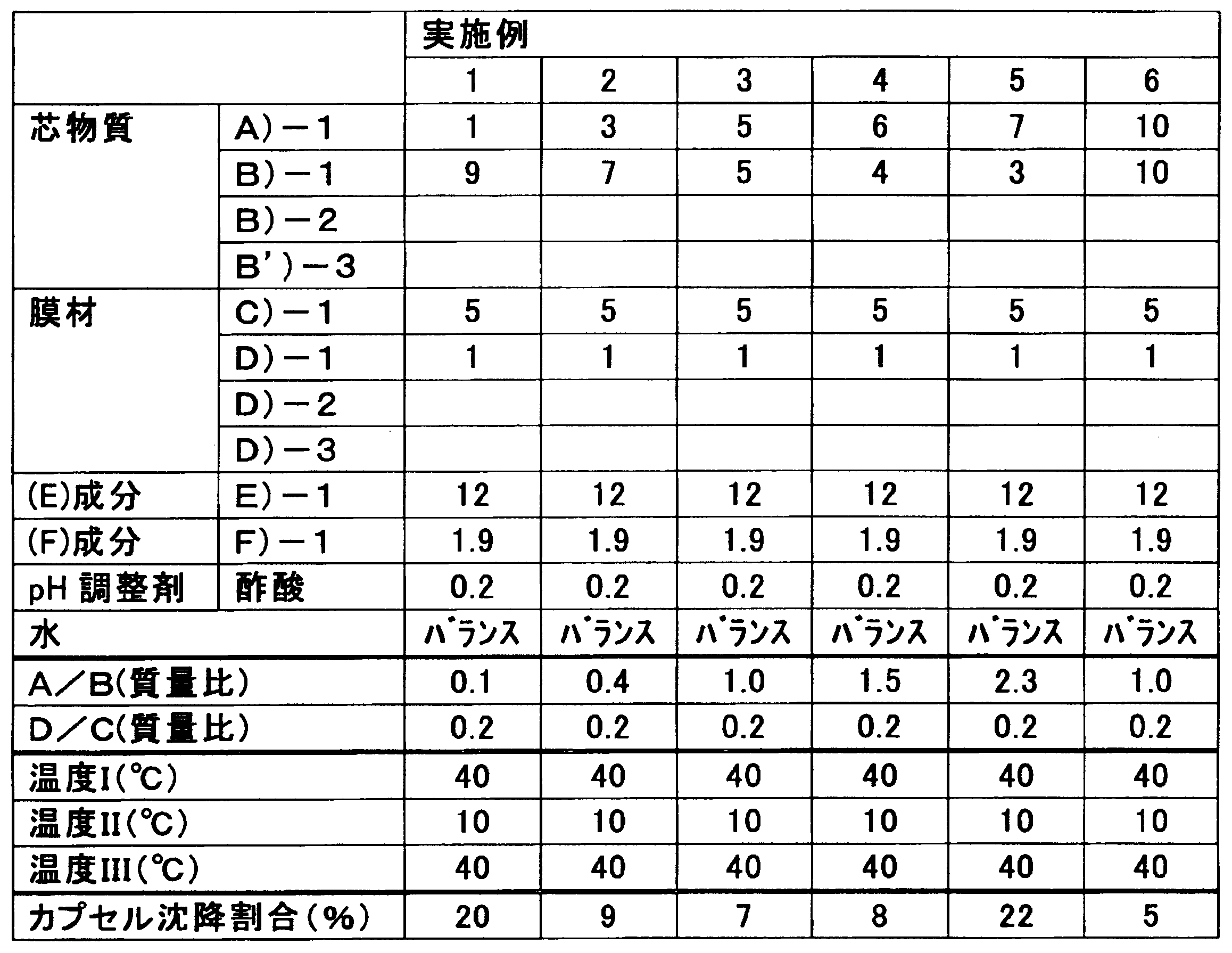
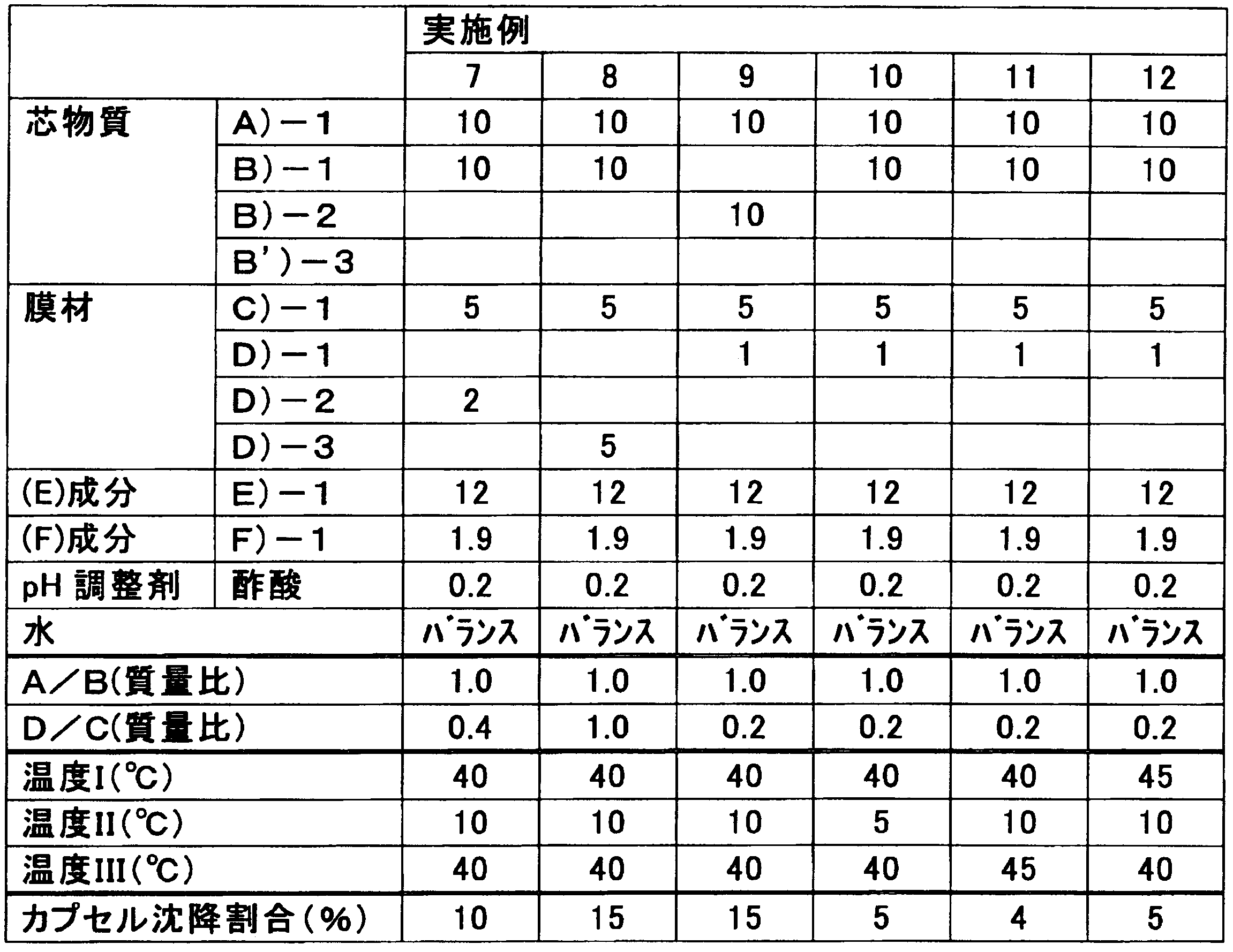
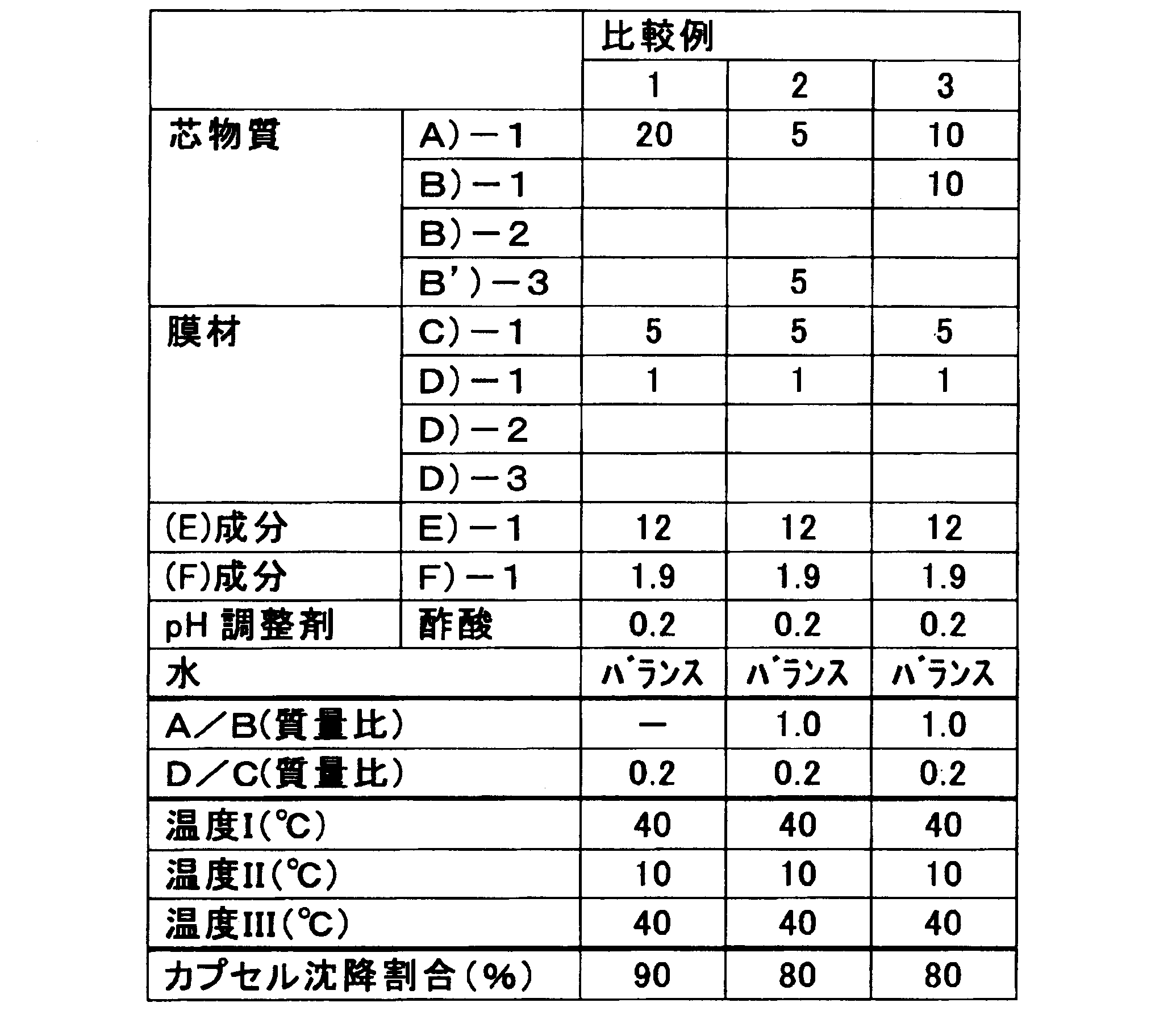
上記結果に示すとおり、実施例1~12で得られたカプセルは、シャンプー組成へ配合し、高温保存したときのカプセル沈降割合が低く、分散安定性に優れていた。
一方、(B)成分を配合しなかった比較例1、(B)成分の代わりに水溶性シリコーン油を用いた比較例2、(A)成分と(B)成分とを事前混合せず、別々に水溶液中に添加した比較例3はそれぞれ、シャンプー組成へ配合し、高温保存したときのカプセル沈降割合が60%以上と高かった。
比較例3で得られたカプセルは、全体での平均でのA/Bが1.0であっても、芯物質として(A)成分、(B)成分のいずれか一方を単独で含むか、両方を含んでもどちらか一方の割合がきわめて低く、個々のカプセルの芯物質におけるA/Bが0.1~2.5の範囲内になっていないと考えられる。
一方、(B)成分を配合しなかった比較例1、(B)成分の代わりに水溶性シリコーン油を用いた比較例2、(A)成分と(B)成分とを事前混合せず、別々に水溶液中に添加した比較例3はそれぞれ、シャンプー組成へ配合し、高温保存したときのカプセル沈降割合が60%以上と高かった。
比較例3で得られたカプセルは、全体での平均でのA/Bが1.0であっても、芯物質として(A)成分、(B)成分のいずれか一方を単独で含むか、両方を含んでもどちらか一方の割合がきわめて低く、個々のカプセルの芯物質におけるA/Bが0.1~2.5の範囲内になっていないと考えられる。
本発明によれば、液体製品に配合して高温保存したときに沈降しにくいカプセル、該カプセルを含有する毛髪用液体洗浄剤組成物およびそれらの製造方法の提供することができる。
Claims (7)
- 芯物質を膜材で内包したカプセルであって、
前記芯物質が、香料(A)と水不溶性シリコーン油(B)とを含有し、
前記水不溶性シリコーン油(B)に対する前記香料(A)の質量比(A/B)が0.1~2.5であることを特徴とするカプセル。 - 前記水不溶性シリコーン油(B)の動粘度が3000mm2/s以下である請求項1記載のカプセル。
- 前記膜材がゼラチン(C)とアニオン性高分子化合物(D)とを含む請求項1または2記載のカプセル。
- 請求項1~3のいずれか一項に記載のカプセルと、界面活性剤と、を含有する毛髪用液体洗浄剤組成物。
- 芯物質を膜材で内包したカプセルの製造方法であって、
香料(A)と水不溶性シリコーン油(B)とを、前記水不溶性シリコーン油(B)に対する前記香料(A)の質量比(A/B)が0.1~2.5となるように混合し、芯物質溶液を調製する第一工程と、
前記芯物質溶液の液滴を前記膜材で内包する第二工程と、を有することを特徴とするカプセルの製造方法。 - 前記第二工程が、
前記第一工程で得られた芯物質溶液を、ゼラチン(C)とアニオン性高分子化合物(D)とを含む水溶液に添加、混合して分散液を得る第二a工程と、
前記第二a工程で得られた分散液の温度を12℃以下とし、そこに無機塩(E)を添加し、続いて該分散液の温度を15~25℃とし、そこに膜硬化剤(F)を添加し、続いて該分散液の温度を35~45℃とすることにより前記膜材を形成する第二b工程と、を有する、請求項5に記載のカプセルの製造方法。 - 請求項5または6に記載のカプセルの製造方法によりカプセルを製造する工程と、
得られたカプセルと界面活性剤とを混合する工程と、を有する毛髪用液体洗浄剤組成物の製造方法。
Applications Claiming Priority (2)
| Application Number | Priority Date | Filing Date | Title |
|---|---|---|---|
| JP2012-273709 | 2012-12-14 | ||
| JP2012273709A JP6106421B2 (ja) | 2012-12-14 | 2012-12-14 | カプセル、毛髪用液体洗浄剤組成物およびそれらの製造方法 |
Publications (1)
| Publication Number | Publication Date |
|---|---|
| WO2014092151A1 true WO2014092151A1 (ja) | 2014-06-19 |
Family
ID=50934434
Family Applications (1)
| Application Number | Title | Priority Date | Filing Date |
|---|---|---|---|
| PCT/JP2013/083326 Ceased WO2014092151A1 (ja) | 2012-12-14 | 2013-12-12 | カプセル、毛髪用液体洗浄剤組成物およびそれらの製造方法 |
Country Status (2)
| Country | Link |
|---|---|
| JP (1) | JP6106421B2 (ja) |
| WO (1) | WO2014092151A1 (ja) |
Citations (4)
| Publication number | Priority date | Publication date | Assignee | Title |
|---|---|---|---|---|
| JPS614527A (ja) * | 1984-06-14 | 1986-01-10 | Nitto Electric Ind Co Ltd | 複合コアセルベーション法によるマイクロカプセルの製造方法 |
| JPS62266136A (ja) * | 1986-05-14 | 1987-11-18 | Lion Corp | 浴用組成物 |
| JPH09505562A (ja) * | 1993-10-01 | 1997-06-03 | アール.ピー.シェーラー コーポレイション | 香料を小分けして提供する方法および組成物 |
| JP2006501219A (ja) * | 2002-08-14 | 2006-01-12 | クエスト・インターナショナル・サービシーズ・ビー・ブイ | カプセル化された材料からなる組成物 |
-
2012
- 2012-12-14 JP JP2012273709A patent/JP6106421B2/ja not_active Expired - Fee Related
-
2013
- 2013-12-12 WO PCT/JP2013/083326 patent/WO2014092151A1/ja not_active Ceased
Patent Citations (4)
| Publication number | Priority date | Publication date | Assignee | Title |
|---|---|---|---|---|
| JPS614527A (ja) * | 1984-06-14 | 1986-01-10 | Nitto Electric Ind Co Ltd | 複合コアセルベーション法によるマイクロカプセルの製造方法 |
| JPS62266136A (ja) * | 1986-05-14 | 1987-11-18 | Lion Corp | 浴用組成物 |
| JPH09505562A (ja) * | 1993-10-01 | 1997-06-03 | アール.ピー.シェーラー コーポレイション | 香料を小分けして提供する方法および組成物 |
| JP2006501219A (ja) * | 2002-08-14 | 2006-01-12 | クエスト・インターナショナル・サービシーズ・ビー・ブイ | カプセル化された材料からなる組成物 |
Also Published As
| Publication number | Publication date |
|---|---|
| JP6106421B2 (ja) | 2017-03-29 |
| JP2014118375A (ja) | 2014-06-30 |
Similar Documents
| Publication | Publication Date | Title |
|---|---|---|
| DE69918703T2 (de) | Filmbildende zusammensetzungen aus modifizierter stärke | |
| RU2636510C2 (ru) | Капсулы-коацерваты с твердым ядром | |
| JP6879904B2 (ja) | 透明な、化粧品組成物およびパーソナルケア組成物 | |
| CN104540931A (zh) | 包含n-甲基-n-酰基葡糖胺的组合物 | |
| JP2000502677A (ja) | カプセルまたは粒子を含むシャンプー組成物 | |
| JP2020512991A (ja) | 離散粒子及び水性ベース組成物を含む製品組成物の調製方法 | |
| CN1802146A (zh) | 包含阳离子交联增稠聚合物和非离子表面活性剂的调理组合物 | |
| JP6070571B2 (ja) | デオドラント組成物 | |
| JP2018515462A (ja) | 利益送達粒子および該粒子を含む組成物 | |
| JP5825053B2 (ja) | 液体制汗デオドラント組成物 | |
| EP3049158A1 (en) | Oral care composition | |
| JP2010536810A (ja) | 水及び有効成分含有ゲル | |
| JP2016538268A (ja) | 制汗組成物 | |
| JP2020523289A (ja) | マイクロカプセルを含むリンスオフコンディショナー組成物 | |
| JP6585360B2 (ja) | アルコール系ゲル組成物およびその製造法 | |
| JP6106421B2 (ja) | カプセル、毛髪用液体洗浄剤組成物およびそれらの製造方法 | |
| WO2023221016A1 (en) | Cosmetic gel composition with reduced stickiness and fast absorption properties | |
| WO1992010989A1 (fr) | Composition cosmetique ou pharmaceutique se presentant sous la forme d'un gel rigide, notamment en vue du maintien d'inclusions en son sein | |
| JP6031902B2 (ja) | 2層分離型液体口腔用組成物 | |
| JP6557519B2 (ja) | 高分子ハイドロゲル被覆型o/wエマルションの製造方法、および該o/wエマルションを調製するための界面活性剤組成物 | |
| JP2020536852A (ja) | パーソナルクレンジング組成物の使用方法 | |
| KR20080020857A (ko) | 자외선 차단 성분 및 향 성분이 충진된 미세캡슐을함유하는 샴푸 조성물 | |
| EP3996663A1 (en) | Hair care composition comprising antidandruff agent | |
| KR102372160B1 (ko) | 겔 형태 조성물 및 이의 제조법 그리고 겔 형태 조성물의 수축 개선제 및 수축 개선 방법 | |
| KR100786492B1 (ko) | 틱소트로피성 젤상 화장료 조성물 |
Legal Events
| Date | Code | Title | Description |
|---|---|---|---|
| 121 | Ep: the epo has been informed by wipo that ep was designated in this application |
Ref document number: 13862981 Country of ref document: EP Kind code of ref document: A1 |
|
| WWE | Wipo information: entry into national phase |
Ref document number: IDP00201503498 Country of ref document: ID |
|
| NENP | Non-entry into the national phase |
Ref country code: DE |
|
| 122 | Ep: pct application non-entry in european phase |
Ref document number: 13862981 Country of ref document: EP Kind code of ref document: A1 |