WO2014091988A1 - 豆乳発酵エキスおよび胚軸発酵エキス - Google Patents
豆乳発酵エキスおよび胚軸発酵エキス Download PDFInfo
- Publication number
- WO2014091988A1 WO2014091988A1 PCT/JP2013/082603 JP2013082603W WO2014091988A1 WO 2014091988 A1 WO2014091988 A1 WO 2014091988A1 JP 2013082603 W JP2013082603 W JP 2013082603W WO 2014091988 A1 WO2014091988 A1 WO 2014091988A1
- Authority
- WO
- WIPO (PCT)
- Prior art keywords
- fermented
- extract
- soymilk
- isoflavone
- lactic acid
- Prior art date
- Legal status (The legal status is an assumption and is not a legal conclusion. Google has not performed a legal analysis and makes no representation as to the accuracy of the status listed.)
- Ceased
Links
- 0 *c(c(I)c(cc1OC=C2c(cc3)ccc3O)O)c1C2=O Chemical compound *c(c(I)c(cc1OC=C2c(cc3)ccc3O)O)c1C2=O 0.000 description 1
Images





Classifications
-
- A—HUMAN NECESSITIES
- A23—FOODS OR FOODSTUFFS; TREATMENT THEREOF, NOT COVERED BY OTHER CLASSES
- A23L—FOODS, FOODSTUFFS OR NON-ALCOHOLIC BEVERAGES, NOT OTHERWISE PROVIDED FOR; PREPARATION OR TREATMENT THEREOF
- A23L11/00—Pulses, i.e. fruits of leguminous plants, for production of food; Products from legumes; Preparation or treatment thereof
- A23L11/50—Fermented pulses or legumes; Fermentation of pulses or legumes based on the addition of microorganisms
-
- A—HUMAN NECESSITIES
- A61—MEDICAL OR VETERINARY SCIENCE; HYGIENE
- A61Q—SPECIFIC USE OF COSMETICS OR SIMILAR TOILETRY PREPARATIONS
- A61Q19/00—Preparations for care of the skin
-
- A—HUMAN NECESSITIES
- A23—FOODS OR FOODSTUFFS; TREATMENT THEREOF, NOT COVERED BY OTHER CLASSES
- A23L—FOODS, FOODSTUFFS OR NON-ALCOHOLIC BEVERAGES, NOT OTHERWISE PROVIDED FOR; PREPARATION OR TREATMENT THEREOF
- A23L33/00—Modifying nutritive qualities of foods; Dietetic products; Preparation or treatment thereof
- A23L33/10—Modifying nutritive qualities of foods; Dietetic products; Preparation or treatment thereof using additives
- A23L33/105—Plant extracts, their artificial duplicates or their derivatives
-
- A—HUMAN NECESSITIES
- A61—MEDICAL OR VETERINARY SCIENCE; HYGIENE
- A61K—PREPARATIONS FOR MEDICAL, DENTAL OR TOILETRY PURPOSES
- A61K36/00—Medicinal preparations of undetermined constitution containing material from algae, lichens, fungi or plants, or derivatives thereof, e.g. traditional herbal medicines
- A61K36/18—Magnoliophyta (angiosperms)
- A61K36/185—Magnoliopsida (dicotyledons)
- A61K36/48—Fabaceae or Leguminosae (Pea or Legume family); Caesalpiniaceae; Mimosaceae; Papilionaceae
-
- A—HUMAN NECESSITIES
- A61—MEDICAL OR VETERINARY SCIENCE; HYGIENE
- A61K—PREPARATIONS FOR MEDICAL, DENTAL OR TOILETRY PURPOSES
- A61K8/00—Cosmetics or similar toiletry preparations
- A61K8/18—Cosmetics or similar toiletry preparations characterised by the composition
- A61K8/30—Cosmetics or similar toiletry preparations characterised by the composition containing organic compounds
- A61K8/49—Cosmetics or similar toiletry preparations characterised by the composition containing organic compounds containing heterocyclic compounds
- A61K8/4973—Cosmetics or similar toiletry preparations characterised by the composition containing organic compounds containing heterocyclic compounds with oxygen as the only hetero atom
- A61K8/498—Cosmetics or similar toiletry preparations characterised by the composition containing organic compounds containing heterocyclic compounds with oxygen as the only hetero atom having 6-membered rings or their condensed derivatives, e.g. coumarin
-
- A—HUMAN NECESSITIES
- A61—MEDICAL OR VETERINARY SCIENCE; HYGIENE
- A61K—PREPARATIONS FOR MEDICAL, DENTAL OR TOILETRY PURPOSES
- A61K8/00—Cosmetics or similar toiletry preparations
- A61K8/18—Cosmetics or similar toiletry preparations characterised by the composition
- A61K8/30—Cosmetics or similar toiletry preparations characterised by the composition containing organic compounds
- A61K8/60—Sugars; Derivatives thereof
- A61K8/602—Glycosides, e.g. rutin
-
- A—HUMAN NECESSITIES
- A61—MEDICAL OR VETERINARY SCIENCE; HYGIENE
- A61K—PREPARATIONS FOR MEDICAL, DENTAL OR TOILETRY PURPOSES
- A61K8/00—Cosmetics or similar toiletry preparations
- A61K8/18—Cosmetics or similar toiletry preparations characterised by the composition
- A61K8/96—Cosmetics or similar toiletry preparations characterised by the composition containing materials, or derivatives thereof of undetermined constitution
- A61K8/97—Cosmetics or similar toiletry preparations characterised by the composition containing materials, or derivatives thereof of undetermined constitution from algae, fungi, lichens or plants; from derivatives thereof
- A61K8/9783—Angiosperms [Magnoliophyta]
- A61K8/9789—Magnoliopsida [dicotyledons]
-
- A—HUMAN NECESSITIES
- A61—MEDICAL OR VETERINARY SCIENCE; HYGIENE
- A61P—SPECIFIC THERAPEUTIC ACTIVITY OF CHEMICAL COMPOUNDS OR MEDICINAL PREPARATIONS
- A61P17/00—Drugs for dermatological disorders
-
- A—HUMAN NECESSITIES
- A61—MEDICAL OR VETERINARY SCIENCE; HYGIENE
- A61P—SPECIFIC THERAPEUTIC ACTIVITY OF CHEMICAL COMPOUNDS OR MEDICINAL PREPARATIONS
- A61P17/00—Drugs for dermatological disorders
- A61P17/16—Emollients or protectives, e.g. against radiation
-
- A—HUMAN NECESSITIES
- A61—MEDICAL OR VETERINARY SCIENCE; HYGIENE
- A61P—SPECIFIC THERAPEUTIC ACTIVITY OF CHEMICAL COMPOUNDS OR MEDICINAL PREPARATIONS
- A61P3/00—Drugs for disorders of the metabolism
- A61P3/08—Drugs for disorders of the metabolism for glucose homeostasis
-
- A—HUMAN NECESSITIES
- A61—MEDICAL OR VETERINARY SCIENCE; HYGIENE
- A61P—SPECIFIC THERAPEUTIC ACTIVITY OF CHEMICAL COMPOUNDS OR MEDICINAL PREPARATIONS
- A61P39/00—General protective or antinoxious agents
- A61P39/06—Free radical scavengers or antioxidants
-
- A—HUMAN NECESSITIES
- A61—MEDICAL OR VETERINARY SCIENCE; HYGIENE
- A61P—SPECIFIC THERAPEUTIC ACTIVITY OF CHEMICAL COMPOUNDS OR MEDICINAL PREPARATIONS
- A61P43/00—Drugs for specific purposes, not provided for in groups A61P1/00-A61P41/00
-
- A—HUMAN NECESSITIES
- A61—MEDICAL OR VETERINARY SCIENCE; HYGIENE
- A61K—PREPARATIONS FOR MEDICAL, DENTAL OR TOILETRY PURPOSES
- A61K2236/00—Isolation or extraction methods of medicinal preparations of undetermined constitution containing material from algae, lichens, fungi or plants, or derivatives thereof, e.g. traditional herbal medicine
-
- A—HUMAN NECESSITIES
- A61—MEDICAL OR VETERINARY SCIENCE; HYGIENE
- A61K—PREPARATIONS FOR MEDICAL, DENTAL OR TOILETRY PURPOSES
- A61K2800/00—Properties of cosmetic compositions or active ingredients thereof or formulation aids used therein and process related aspects
- A61K2800/80—Process related aspects concerning the preparation of the cosmetic composition or the storage or application thereof
- A61K2800/85—Products or compounds obtained by fermentation, e.g. yoghurt, beer, wine
Definitions
- the present invention relates to a fermented soymilk extract containing a high content of isoflavone aglycone and polyamine, and in particular, has a low sugar content and a cell activation effect, an antioxidant effect, an anti-glycation effect and a moisturizing effect on epidermal keratinocytes and skin fibroblasts. It is related with the soymilk fermented extract which has anti-aging effects, such as.
- the present invention also relates to a hypocotyl fermented extract obtained by fermenting soybean hypocotyls with lactic acid bacteria, in particular, high content of isoflavone aglycone and polyamine, cell activation action against epidermal keratinocytes and skin fibroblasts,
- the present invention relates to a hypocotyl fermented extract having an anti-aging action such as an oxidizing action and an anti-glycation action.
- soy milk contains high-quality proteins, isoflavone compounds, and the like, and further, it is expected to exhibit various physiological effects by producing soy peptide, isoflavone aglycone, and the like by fermentation.
- the soymilk fermented extract is a quasi-drug raw material standard (hereinafter sometimes referred to as “Kotohara regulations”) 2006 (March 31, 2006, from the medicinal diet No. 0331030, Ministry of Health, Labor and Welfare, Ministry of Health, Labor and Welfare) "Liquid” (component code 532101).
- the soymilk fermented solution is “an extract obtained by adding ethanol to a culture solution obtained by fermenting soymilk obtained from soybean seeds with Lactobacillus delbrueckii (L. delbrueckii) and filtering. Includes 0.01 to 0.04% nitrogen when quantified. "If it satisfies this, it can be said that safety is confirmed from the viewpoint of actual use.
- L. delbrueckii is a lactic acid bacterium that has been used for a long time in the production of yogurt, and is considered to be highly safe from experience.
- Isoflavone compounds contained in soybean are known to have physiological activities such as estrogenic activity, anti-estrogenic activity, and antioxidant activity, and their usefulness has attracted attention.
- soybean is powdered as it is and the isoflavone compound is measured, the presence of 12 types of isoflavone compounds is confirmed. These are based on three types of daidzein, genistein, and glycitein (these are called isoflavone aglycones) (Chemical Formula 1).
- isoflavone glycosides (daidine, genistin, glycitin) having these as basic skeletons, and compounds in which these isoflavone glycosides are further modified by acetylation or malonylation It exists as (Chemical formula 2).
- isoflavone aglycone is generally considered to have a high pharmacological action because it is closer to the structure of estrogen than isoflavone glycoside. Moreover, since the hydrophobicity is higher than that of the isoflavone glycoside, it can be expected that the permeability to the skin is high. For example, with respect to genistein, it has been shown that application may have an effect of preventing skin aging (see Non-Patent Document 3, for example).
- the amount of isoflavone compound itself is small in nature, and particularly the amount of isoflavone aglycone is extremely small.
- soybeans contain polyamines.
- Polyamine is a generic term for aliphatic hydrocarbons having two or more primary amino groups, and is a natural product that exists universally in the living body, and more than 20 types of polyamines have been found.
- Typical polyamines include putrescine, spermidine, spermine and cadaverine.
- the main physiological functions of polyamines are as follows: (1) Stabilization and structural change of nucleic acid by interaction with nucleic acid (2) Promoting action on various nucleic acid synthesis systems (3) Activation of protein synthesis system (4) Cell membrane (5) Elimination of active oxygen (6) Promotion of cell growth (7) Antiallergic action is known (for example, see Patent Document 5 and Non-Patent Documents 4 and 5) ).
- fermented soy milk rich in isoflavone aglycone can be obtained by using lactic acid bacteria having a ⁇ -glucosidase activity, Bifidobacterium, etc. as a method for degrading isoflavone glycosides into isoflavone aglycones ( For example, see Patent Document 6 and Non-Patent Document 6-11).
- polyamines obtained after these fermentations have not been confirmed.
- Non-Patent Document 6-11 there are particularly few reports on conversion to isoflavone aglycone in soy milk (see, for example, Non-Patent Document 6-11).
- Non-Patent Documents 6 and 7 L. Due to the co-culture of delbrueckii and other lactic acid bacteria, L. It is difficult to say that the conversion is made by delbrueckii alone.
- Non-Patent Document 8 L., which is an enteric bacterium of birds.
- delbrueckii analogues have been reported to convert genistin to genistein in a synthetic medium, the strain has not been fully identified.
- Non-Patent Document 9 L. delbrueckii subsp. Although conversion to isoflavone aglycone by bulgaricus alone has been reported, the isoflavone content of the soymilk used for fermentation (reconstituted liquid with soybean isolate protein) is small (total amount 42 mg / L, 103 ⁇ M), and the resulting isoflavone aglycone is about 24 mg. / L (about 90 ⁇ M). About the nonpatent literature 10 and 11, the fermented liquor of high isoflavone aglycone content is obtained by fermenting soymilk, without adding saccharides.
- Non-Patent Document 12 reports that when glucose is added to soy milk and fermented with lactic acid bacteria, the isoflavone glycoside is converted to the aglycon when a specific strain is used. However, the amount of polyamine has not been confirmed for any of these fermentations.
- soybean hypocotyls which are the parts that become buds and roots when germinating soybeans, are rich in micronutrients such as proteins and oligosaccharides, as well as isoflavones and saponins. It has been reported that a fermented product containing equol is obtained by fermenting with a specific Lactococcus d'Albier having (Patent Document 8).
- Skin is a tissue composed of epidermis and dermis, and functions as a barrier that protects the body from physical or chemical stress from the outside.
- the epidermis existing outside the skin consists of a basal layer, a spiny layer, a granule layer, and a stratum corneum, and is mainly composed of keratinocytes.
- the keratinocytes that have divided in the basement membrane move to the upper layer through differentiation and maturation, reach the outer layer of the horny layer, and then drop off and repeat turnover (metabolism) to form the epidermis.
- epidermal keratinocyte activators are used for improving skin roughness, moisturizing effect, skin dullness improving effect, whitening effect, and skin texture improvement.
- soymilk fermented extract the hair-growth effect by estrogen receptor ⁇ agonist activation has been reported (for example, see Patent Document 3), but remarkable cell activation against epidermal keratinocytes by isoflavone aglycone and polyamine-rich fermented soymilk fermented extract. No effect has been reported so far.
- Skin fibroblasts are cells that exist in the dermis and produce collagen, elastin, hyaluronic acid, and the like, and are known to contribute to forming a dermal structure by using collagen as a fiber bundle.
- an agent having an activating effect on skin fibroblasts is useful as an active ingredient of a skin external preparation, particularly a skin external preparation for preventing aging.
- no significant cell activation effect on skin fibroblasts by isoflavone aglycone and soymilk fermented extract containing a high amount of polyamine has been reported so far.
- the skin is an organ located in the outermost layer of the living body, and is an organ that is greatly affected by the external environment.
- the most important of these is the presence of ultraviolet rays.
- reactive oxygen species are generated and converted into various radical species in the living body, which has the positive effect of sterilization, elimination of invading substances into the body, etc., but due to its high reactivity, the epidermis Attacks hyaluronic acid, collagen, elastin, and fibroblasts, which are constituents of cells and tissues, and the dermis, and negative effects are caused by their deterioration, reduction, or degeneration.
- an agent having an action of eliminating active oxygen species is useful as an active ingredient of a skin external preparation, particularly a skin external preparation for preventing aging.
- a skin external preparation for preventing aging.
- the antioxidant effect of isoflavone aglycone and polyamine-rich soymilk fermented extract has not been reported so far.
- Carbohydrates are very important as energy sources in living organisms including humans.
- carbohydrates are known to cause glycation reactions with proteins.
- the first stage is a non-enzymatic reaction between a carbonyl group of a carbohydrate and an amino group such as a protein, and finally a final glycation product (hereinafter referred to as “AGEs”) from a Schiff base through an Amadori compound.
- AGEs final glycation product
- Due to the saccharification reaction the protein is modified non-enzymatically by sugar, and as a result, denaturation of the protein, cross-linking between proteins, and the like occur, resulting in a decrease in protein function.
- the glycation reaction not only causes direct damage by modifying and changing the structure of extracellular matrix constituent proteins such as collagen, but also affects cellular responses by being recognized by receptors with glycated proteins as ligands. Bring.
- the extracellular matrix components such as collagen occupy the majority of the dry weight in tissues such as bone and skin. Therefore, for example, when collagen is glycated and abnormally crosslinked, osteoporosis, osteoarthritis, etc. occur in bone and cartilage tissue, and elasticity in skin, dullness due to yellowing, etc. occur. . Furthermore, since abnormally cross-linked collagen and the like are less susceptible to degradation by collagenase or the like, expression of collagenase or the like is induced, and problems such as degradation to normal collagen occur.
- the saccharification reaction is suppressed in some form, that is, the formation of AGEs can be suppressed, or the degradation of AGEs can be promoted, it is effective in preventing or improving skin elasticity and dullness. Expected to be.
- N-phenacyl thiazolium bromide is known as a compound having an anti-glycation action (see, for example, Non-Patent Document 14).
- this compound has a safety problem and is not suitable as a pharmaceutical or a topical skin preparation.
- an ingredient derived from a natural product having an anti-glycation action for example, an extract from olive is known (see, for example, Patent Document 12).
- an extract from olive is known (see, for example, Patent Document 12).
- the provision of a substance having an anti-glycation action is not sufficient, and the development and provision of a further new anti-glycation action substance is strongly demanded.
- soybean hot water extract and isoflavone are also reported to have an anti-glycation effect (see, for example, Patent Document 13), the production of AGEs cannot be completely suppressed using these, and the effect Is not enough.
- no anti-glycation action by isoflavone aglycone and polyamine-rich soymilk fermented extract has been reported so far.
- the amount of moisture in the stratum corneum is closely related to the condition of the skin, and in order to maintain healthy bare skin, it is necessary that the stratum corneum retains moderate moisture.
- the stratum corneum has a barrier function that prevents foreign matter from entering the skin and transpiration of moisture necessary for the living body. When the stratum corneum barrier function is lowered, the stratum corneum water content is lowered with an increase in the transdermal water transpiration amount, and rough skin and various aging symptoms are caused.
- an agent having an effect of increasing the amount of moisture in the stratum corneum or an agent having an effect of enhancing the function of the stratum corneum is useful as an active ingredient of an external preparation for skin, particularly an external preparation for preventing aging.
- an external preparation for skin particularly an external preparation for preventing aging.
- the moisturizing action of isoflavone aglycone and polyamine-rich soymilk fermented extract has not been reported so far.
- Japanese Patent No. 2804312 Japanese Patent No. 3184114 JP 2012-176931 A JP 2006-070146 A JP 2009-234939 A JP 2001-340059 A Japanese Patent No. 3014145 Japanese Patent No. 5030790 JP 2012-006954 A JP 2012-46544 A JP 2012-102054 A JP 2001-122758 A JP 2012-2119014 A
- the first problem is that the content of the isoflavone compound, which is a component particularly expected as a physiologically active substance contained in soybean, is extremely small.
- soymilk fermented extracts have a low isoflavone compound content (0 to 120 ⁇ M) and a lower isoflavone aglycone content (0 to 60 ⁇ M, conversion rate to isoflavone aglycone 0 to 50%). From such a background, a fermented soymilk extract having a high content of isoflavone aglycone is strongly demanded.
- the second problem is that the content of polyamine, which is a component expected as another physiologically active substance, is low.
- the total amount of polyamine in the soymilk fermented extract actually marketed is 10 to 15 ⁇ M, and therefore, a fermented soymilk extract having a high polyamine content is strongly demanded.
- the reason for the very low polyamine content of commercially available soymilk fermented extract is that the solubility of polyamine is low in ethanol used in production. Therefore, in order to produce a fermented soymilk extract having a high polyamine content, it is necessary to improve the concentration of the polyamine in the fermentation broth and optimize the concentration of the organic solvent used for extraction.
- a third problem is that carbohydrates such as glucose remain. It has been reported that oligosaccharides contained in soybeans are sucrose (sucrose, 5%), stachyose (4%), raffinose (1.1%), and verbus course (trace) (for example, Fumio Yamauchi et al. Ed., “Soy Science”, Asakura Shoten, 1993, p. 49), in lactic acid bacteria fermentation using soybean raw materials such as soy milk, depending on the type of lactic acid bacteria, there is a shortage of carbohydrates. When sugars such as glucose are added to compensate for this, it is considered that undigested sugars remain in the fermentation broth.
- This invention is made
- the present inventors performed lactic acid bacteria fermentation of soy milk without supplementing carbohydrates, and by extracting this, isoflavone aglycone and polyamine are highly contained, A fermented soymilk extract with a low glucose content is obtained, which further has anti-aging effects such as cell activation, antioxidant, anti-glycation and moisturizing effects on epidermal keratinocytes and skin fibroblasts. I found it.
- fermenting soybean hypocotyls with lactic acid bacteria and extracting them yields a hypocotyl fermented extract containing a high content of isoflavone aglycone and polyamine, which further promotes cell activation against epidermal keratinocytes and skin fibroblasts. It has been found that it has an anti-aging action such as an action, an antioxidant action and an anti-glycation action, and has completed the present invention. That is, the present invention relates to the following.
- step (A), (B) and (C) (A) a step of fermenting soy milk with lactic acid bacteria; (B) a step of mixing the fermented product obtained in step (A) and an organic solvent; and (C) a step of removing the solid content produced in step (B);
- step (A) The fermented soymilk extract according to any one of [1] to [3], wherein the lactic acid bacterium in the step (A) is Lactobacillus delbrueckii.
- step (P) the soymilk fermented extract according to any one of [1] to [4], which is obtained by a method comprising a step of (P) pre-culture with soymilk.
- the anti-aging agent according to [8] which has one or more of a skin keratinocyte activation effect, a skin fibroblast activation effect, an antioxidant effect, an anti-glycation effect and a moisturizing effect.
- a cosmetic, an external preparation for skin, a pharmaceutical or a food or drink comprising the fermented extract according to any one of claims [1] to [7].
- a method for producing a polyamine which comprises fermenting soy milk with lactic acid bacteria and then extracting the polyamine.
- a method for producing a polyamine comprising fermenting a soybean hypocotyl with lactic acid bacteria and then extracting the polyamine.
- a method for producing isoflavone aglycone or polyamine comprising a step of fermenting soybean hypocotyl with Lactobacillus delbrueckii.
- a fermented soymilk product obtained by fermentation with a lactic acid bacterium selected from delbrueckii JCM 1012.
- a soymilk fermented extract containing a high content of isoflavone aglycone and polyamine and in particular, it has a low sugar content and has a cell activation effect and an antioxidant effect on epidermal keratinocytes and skin fibroblasts.
- the fermented soymilk extract exhibiting anti-aging effects such as anti-glycation action and moisturizing action can be provided.
- a hypocotyl fermented extract obtained by fermenting soybean hypocotyls with lactic acid bacteria can be provided, in particular, high content of isoflavone aglycone and polyamine, and epidermal keratinocytes and skin fibers.
- hypocotyl fermented extract having an anti-aging action such as a cell activation action, an antioxidant action and an anti-glycation action on blast cells.
- the fermented soymilk extract and hypocotyl fermented extract of the present invention are useful for cosmetics, pharmaceuticals, and foods and drinks, and particularly useful for cosmetics.
- the “fermented soymilk extract” means the following steps (A), (B) and (C): (A) a step of fermenting soy milk with lactic acid bacteria; (B) refers to an extract obtained by a method comprising a step of mixing the fermented product obtained in step (A) with an organic solvent; and (C) a step of removing the solid content produced in step (B).
- soy milk refers to various known soy milks, and includes, for example, unprepared soy milk, prepared soy milk, soy milk beverages, and the like. It can be prepared from one or more parts of soybean seed endosperm, hypocotyl (also referred to as germ) and skin (hereinafter referred to as soybean raw material), and each is extracted from one or more parts and mixed appropriately. You can also A suspension obtained by appropriately pulverizing and immersing a soybean raw material or a slurry obtained by immersing a soybean raw material and then wet pulverizing it can be used as a fermentation raw material as the soy milk of the present invention.
- soy milk of the present invention also includes so-called soy bean prepared by dissolving, suspending, or homogenizing powdered soy beans or whole-grain soybeans in water, and soy milk made from these soy milk.
- soy milk of the present invention includes so-called protein beverages that have soy protein as a main component and have a soy milk-like flavor.
- Soybean varieties, brands, and colors are not particularly limited, and for example, domestic soybeans, US soybeans such as IOM, genetically modified soybeans, or genetically non-recombinant soybeans can be used. Green soybeans, which are immature seeds of soybeans, can also be used.
- soymilk fermented extract containing a high amount of isoflavone aglycone soymilk having a total content of isoflavone compounds of isoflavone aglycone and isoflavone glycoside (including acetyl glycoside and malonyl glycoside) of 150 ⁇ M or more is preferably used.
- the lactic acid bacterium is not particularly limited as long as it is a bacterium that produces lactic acid from saccharides by fermentation.
- Lactobacillus bacteria are preferably used, and are described in the outer standard of soymilk fermentation broth.
- delbrueckii is particularly preferably used.
- L. As for delbrueckii there is no particular limitation on the subspecies. delbrueckii subsp. lactis, L.L. delbrueckii subsp. bulgaricus, L .; delbrueckii subsp. delbrueckii and the like.
- delbrueckii subsp. lactis JCM 1105 From the viewpoint of obtaining a soymilk fermented extract with a low glucose and sucrose content and a soymilk fermented extract with a high polyamine content, delbrueckii subsp. lactis JCM 1105, L. delbrueckii subsp. lactis JCM 1148, L. delbrueckii subsp. bulgaricus JCM 1001, L. delbrueckii subsp. lactis JCM 1010 and L. delbrueckii subsp. Bacteria selected from delbrueckii JCM 1012 are preferably used.
- a lactic acid bacterium having a high conversion rate from an isoflavone glycoside to isoflavone aglycone described below is preferably used.
- delbrueckii subsp. Lactis JCM 1105 or 1148 strain is particularly preferably used.
- the fermentation conditions for the lactic acid bacteria in the step (A) are not particularly limited as long as the lactic acid bacteria grow and the soymilk is fermented, and can be appropriately selected according to the type of the lactic acid bacteria to be used. Soymilk fermentation can be confirmed by an increase in the amount of lactic acid in the fermented product.
- the conversion rate of isoflavone glycosides in soymilk to isoflavone aglycone is 50% or more, particularly 55% or more are preferable.
- the conversion rate of isoflavone aglycone is calculated by calculating the molar concentration of various isoflavone compounds before and after fermentation, [(isoflavone glycoside before fermentation) ⁇ (isoflavone glycoside after fermentation)] / (before fermentation). It can be calculated as (isoflavone glycoside) ⁇ 100 (%).
- the soy milk used for fermentation can be added with sugars, nitrogen sources, etc. as necessary, pH can be adjusted, and sterilization can be performed by heating or the like.
- soymilk extract with a low content of carbohydrates particularly, reducing sugars used as a raw material for the Maillard reaction
- Such saccharides include: all monosaccharides including, for example, glucose, fructose and glyceraldehyde, reducing sugars such as maltose-type disaccharides or oligosaccharides including lactose, arabinose and maltose; and, for example, by hydrolysis, such as sucrose
- reducing sugars such as maltose-type disaccharides or oligosaccharides including lactose, arabinose and maltose
- hydrolysis such as sucrose
- sucrose Non-reducing sugars that are reducing sugars are exemplified.
- the lactic acid bacteria to be inoculated may be pre-cultured in any medium, and can be cultured in, for example, plant-derived raw material medium (soy milk, plant-derived peptone, etc.), yeast extract, various synthetic media (MRS medium, etc.), etc. .
- pre-culture can be performed using soy milk from the viewpoint of simplifying the production process and avoiding the use of a medium containing animal-derived materials.
- the culture conditions for pre-culture are not particularly limited as long as lactic acid bacteria are increased.
- the fermentation temperature can be appropriately selected according to the type of lactic acid bacteria, and is not particularly limited, but can be carried out at 10 to 50 ° C., preferably 20 to 40 ° C.
- cultivation it may leave as it is or may be controlled with an acid or an alkali.
- Various carbon sources and nitrogen sources can also be fed. Any conditions such as aerobic conditions, anaerobic conditions, stirring culture, and stationary culture can be selected depending on the type of lactic acid bacteria to be used.
- Fermentation time can be appropriately selected according to the type of lactic acid bacteria, and is not particularly limited. Fermentation can be performed for 6 to 72 hours, conveniently 12 to 60 hours.
- lactic acid can be an indicator of the progress of lactic acid bacteria fermentation
- the culture can be stopped depending on the concentration of lactic acid. For example, the culture is stopped when the lactic acid concentration reaches 0.1 to 7 mg / mL. can do.
- the sugar has been reduced by analyzing the sugar in the culture solution, and cultured in a state where the sugar is consumed.
- the saccharide include glucose, fructose, sucrose, and maltose.
- the method for analyzing these carbohydrates is not particularly limited, but is preferably a phosphate-phenylhydrazine method (a method in which a saccharide is separated by a column and then reacted with a phosphate-phenylhydrazine reagent to detect it after fluorescence derivatization. ) Or a method using a biosensor.
- the pH of the fermented product may be adjusted as necessary. For example, the pH lowered due to the production of lactic acid may be appropriately adjusted to neutral with alkali. After completion of fermentation, the formed card may be destroyed by stirring.
- the obtained fermented product may be mixed with an organic solvent in the step (B) as it is, but from the viewpoint of efficiently removing the high molecular protein in the step (B), heat sterilization may be performed after completion of the fermentation. desirable.
- the heating conditions are not particularly limited as long as the solids are sufficiently formed. For example, the heating is performed at 60 to 120 ° C. for 1 to 120 minutes, and conveniently at 80 to 110 ° C. for 20 to 60 minutes. Can be implemented.
- the obtained fermented product is mixed with an organic solvent.
- desired components such as an isoflavone compound
- desired components can be extracted in the organic solvent from the obtained fermented material.
- a polar solvent miscible with water is preferably used.
- those having high safety are preferable, and ethanol, butylene glycol, and the like are particularly preferably used.
- ethanol is described in the outer standard of a soymilk fermentation liquid, it is used especially preferably.
- ethanol is also preferably used when blending fermented soymilk extract with food and drink and oral medicine.
- an amount and a concentration at which a solid content is generated and separated from a clear extract are preferable.
- an organic solvent in an amount of 5 to 90% (v / v) can be added to a culture solution.
- v / v a culture solution
- ethanol 15% (v / v) or more, preferably 50% (v / v) or more of ethanol can be added to the culture solution.
- operations such as heating, cooling, and standing can also be performed.
- Step (C) for removing the solid content generated in the step (B) is performed.
- Step (C) can be performed using any method that can remove solids, and for example, a method of separating the supernatant by standing or centrifuging, a method of filtering, or the like can be used.
- additional steps may be performed depending on the purpose.
- inclusion of desired components such as isoflavone compounds can also be carried out by adding cyclodextrin or the like.
- the addition of cyclodextrin can be performed at any stage as long as it is performed prior to the removal of the solid content in the step (C).
- cyclodextrin ⁇ -cyclodextrin or ⁇ -cyclodextrin can be used, and ⁇ -cyclodextrin can be preferably used for the purpose of inclusion of an isoflavone compound.
- the “hypocotyl ferment extract” means the following steps (A ′), (B ′) and (C ′): (A ′) a step of fermenting soybean hypocotyls with lactic acid bacteria; (B ′) a step of mixing the fermented product obtained in step (A ′) with an organic solvent; and (C ′) a step of removing solids produced in step (B ′); For example, a liquid obtained by removing the solid content in the step (C ′), a concentrated liquid obtained by concentrating this, or a solid obtained by drying the liquid may be used.
- soy hypocotyl refers to a soy hypocotyl (also referred to as germ), which is not only a raw soy hypocotyl but also subjected to any pretreatment such as degreasing, roasting, dipping, and heat treatment. Including.
- the soybean hypocotyl itself can be used, or it may be pulverized.
- a suspension of soybean hypocotyl or its pulverized product suspended in water or a hypocotyl extract obtained by extracting soybean hypocotyl or its pulverized product with water and removing the solid content It can also be used.
- soybean hypocotyl The variety, brand, and color of the soybean from which the soybean hypocotyl is derived are not particularly limited, and any soybean can be used in the same manner as mentioned for the soy milk.
- Steps (A ′), (B ′) and (C ′) are the same as steps (A), (B) and (C), respectively, except that soybean hypocotyl is used instead of soy milk. Can do.
- the soymilk fermented extract or hypocotyl fermented extract (hereinafter also simply referred to as “fermented extract”) thus obtained can be used as it is as a raw material for cosmetics, external preparations for skin, pharmaceuticals and foods and drinks. Further, it can be appropriately diluted with water, an organic solvent or the like, or a preservative such as paraben or phenoxyethanol can be added. Further, for example, the organic solvent can be distilled off by heating or decompression, the components can be concentrated, and pulverization can be performed by freeze drying or spray drying. The powdered product can be dissolved, dispersed or suspended in water or an organic solvent.
- the fermented extract of the present invention preferably has a high content of isoflavone compounds from the viewpoint of exerting various actions.
- the isoflavone analysis can be performed using a known method capable of analyzing various isoflavone compounds, and preferably an HPLC method is used.
- the isoflavone compound refers to daidzein, daidzin, acetyl daidzin, malonyl daidzin, genistein, genistin, acetylgenistin, malonylgenistin, glycitein, glycitin, acetylglycitin and malonylglycitin.
- daidzein, genistein and glycitein which are isoflavone aglycones, are particularly large from the viewpoint of exerting various actions.
- the concentration of the isoflavone compound contained in the fermented extract of the present invention is preferably as high as possible from the viewpoint of exhibiting various actions, and preferably contains 150 ⁇ M or more of the isoflavone compound.
- isoflavone aglycone is preferably 75 ⁇ M or more, and more preferably 150 ⁇ M or more.
- the isoflavone aglycone content is preferably 550 ⁇ M or more, more preferably 700 ⁇ M or more, and further preferably 1000 ⁇ M or more.
- the glycitein content is particularly preferably 100 ⁇ M or more, and more preferably 200 ⁇ M or more.
- the fermented extract of the present invention preferably has a high polyamine content from the viewpoint of exhibiting various effects.
- the polyamine analysis can be performed using a known method capable of analyzing various polyamines such as an HPLC method and an enzymatic method, and the HPLC method is preferably used. Specifically, Novella-Rodriguez S.M. Based on these methods (J. Agric. Food Chem., 48, 5117-5123 (2000)), polyamines can be analyzed using HPLC.
- the polyamine is not particularly limited as long as it is an aliphatic hydrocarbon having two or more primary amino groups, and examples thereof include putrescine, spermidine, spermine, and cadaverine.
- the concentration of the polyamine contained in the fermented extract of the present invention is preferably as high as possible from the viewpoint of exhibiting various effects, and the total of putrescine, spermidine and cadaverine, which are the main polyamines in the fermented extract, is preferably 20 ⁇ M or more, and 30 ⁇ M. More preferably, it is more preferably 40 ⁇ M or more.
- the sum of spermidine and cadaverine is preferably 310 ⁇ M or more, and more preferably 400 ⁇ M or more.
- the fermented extract of the present invention may have the above content by adding each of these components itself (raw powder etc.) to the above isoflavone compound, isoflavone aglycone and polyamine. Since it is expensive, it is desirable that it is a fermented extract satisfying the above content without adding such from the viewpoint of economy.
- the present inventors confirmed that the fermented extract of this invention shows a high effect (an antioxidant action, an anti-glycation action, etc.) compared with an isoflavone compound alone. ing.
- the carbohydrate contained in the obtained fermented extract is a raw material for the Maillard reaction that causes aging, and it causes stickiness when applied to the skin when blended in cosmetics, so less is preferable .
- sugars include glucose, fructose, sucrose, and maltose.
- the method for analyzing these carbohydrates is not particularly limited, but is preferably a phosphate-phenylhydrazine method (a method in which a saccharide is separated by a column and then reacted with a phosphate-phenylhydrazine reagent to detect it after fluorescence derivatization. ) Or a method using a biosensor.
- the fermented extract of the present invention preferably has a saccharide content of 4.0 mg / mL or less, more preferably 3.0 mg or less, and even more preferably 1.5 mg / mL or less.
- the sum of the contents of glucose and sucrose is preferably 3.0 mg / mL or less, and more preferably 1.5 mg / mL or less.
- the fermented extract of the present invention comprises a sum of glucose and sucrose contents (mg / mL): an isoflavone compound content ( ⁇ M), that is, a sum of glucose and sucrose contents (mg / mL) /
- the content ( ⁇ M) of the isoflavone compound is preferably 0.1 or less, more preferably 0.05 or less, further preferably 0.015 or less, and particularly preferably 0.01 or less. preferable.
- the fermented extract of the present invention contains isoflavone aglycone, and sum of glucose and sucrose content (mg / mL): isoflavone aglycone content ( ⁇ M), that is, sum of glucose and sucrose content.
- the content ( ⁇ M) of (mg / mL) / isoflavone aglycone is preferably 0.2 or less, more preferably 0.1 or less, and particularly preferably 0.01 or less.
- the fermented extract of the present invention comprises the sum of glucose and sucrose content (mg / mL): the content of polyamine ( ⁇ M), that is, the sum of glucose and sucrose content (mg / mL) / polyamine.
- the content ( ⁇ M) is preferably 0.3 or less, more preferably 0.25 or less, further preferably 0.1 or less, and particularly preferably 0.05 or less.
- the other components of the fermented extract of the present invention are not particularly limited, but the liquid nitrogen content is preferably 0.01 to 0.04% described in the outer standard.
- the fermented extract of the present invention may be suspended or transparent, and the color is preferably, for example, pale yellow, pale brown or colorless.
- the fragrance is not particularly limited, but a fragrance having a small soybean odor and a refreshing fragrance of lactic acid bacteria fermentation is preferable.
- the fermented extract of the present invention exhibits one or more of cell activation action, antioxidant action, anti-glycation action and moisturizing action on epidermal keratinocytes and dermal fibroblasts, In one embodiment, it preferably exhibits at least one of cell activation and anti-glycation effects on epidermal keratinocytes and dermal fibroblasts.
- the cell activation activity of epidermal keratinocytes is determined by adding 0.01 to 50% of the fermented extract of the present invention to commercially available normal human epidermal keratinocytes (Kurabo Co., Ltd.) to prepare a culture solution. This can be used to determine whether to promote cell growth.
- the sample has an activation activity of epidermal keratinocytes
- the activity when no sample is added is 100%.
- the activation activity of epidermal keratinocytes when a sample is added is 110% or more.
- the cell activation activity of skin fibroblasts is prepared by adding 0.01 to 50% of the fermented extract of the present invention to commercially available normal human skin fibroblasts (manufactured by Kurabo) to prepare a culture solution. This can be used to determine whether to promote cell growth.
- the case where the sample has a fibroblast activation activity refers to a case where the activation activity of the fibroblast when the sample is added is 110% or more, assuming that the activity when the sample is not added is 100%.
- the antioxidant action can be measured by adding the fermented extract of the present invention to DPPH radical, which is a pseudo-active oxygen, and determining whether or not to erase the DPPH radical.
- DPPH radical which is a pseudo-active oxygen
- the case where the sample has an antioxidant action means that the DPPH radical elimination rate when the sample is added is 10% or more when the DPPH radical elimination rate without addition of the sample is 0%.
- Antioxidant action is prepared by adding 0.01 to 50% of the fermented extract of the present invention to commercially available normal human epidermal keratinocytes (Kurabo Co., Ltd.). This can be used to determine whether to reduce cell damage due to exposure to reactive oxygen species.
- the case where the sample has a cytoprotective action refers to the case where the cell viability when the sample is added is increased by 10% or more with respect to the cell viability when the sample is not added under the condition where the active oxygen is exposed.
- the anti-glycation action can be measured by adding the fermented extract of the present invention to a mixed solution of glucose and human serum albumin and using this to determine whether to suppress the production of AGEs.
- the case where the sample has an anti-glycation effect refers to the case where the AGEs production inhibitory activity when the sample is added is 10% or more, for example, when the sample-free AGEs production inhibitory activity is 0%.
- the moisturizing effect is measured by measuring the stratum corneum water content and transdermal water transpiration after applying the skin lotion containing 0.01 to 50% of the fermented extract of the present invention to humans. It can be measured by confirming the decrease in the amount.
- the moisture content of the stratum corneum increases by 10% or more compared to the case where the sample cost-containing lotion is applied by applying the sample-containing lotion, or the transdermal moisture transpiration amount is 10 If it decreases by more than%.
- the present invention also relates to an anti-aging agent containing the fermented extract of the present invention.
- an anti-aging agent containing the fermented extract of the present invention.
- the present invention also relates to a cosmetic and a skin external preparation containing the fermented extract of the present invention.
- the cosmetic and external preparation for skin of the present invention can be prepared by blending the fermented extract of the present invention with various types of base materials known as normal cosmetic and external preparation for skin according to conventional methods.
- the blending amount of the fermented extract is preferably 0.01 to 50% by mass with respect to the total amount from the viewpoint of effects and stability.
- the form of the cosmetic and the external preparation for skin is not particularly limited, and any dosage form such as an emulsion, cream, aqueous solution, pack, etc. can be selected.
- ingredients blended in normal cosmetics and skin external preparations such as oils, powders, purified water, polymer compounds, gelling agents, ultraviolet rays Absorbers, ultraviolet scattering agents, antioxidants, dyes, preservatives, fragrances, and cosmetic ingredients can be appropriately selected and used within a range not impairing the effects of the present invention.
- a pharmaceutical preparation can be prepared by adding a pharmaceutically acceptable excipient.
- the pharmaceutical preparation is not particularly limited, but is externally applied to tablets, capsules, granules, fine granules, powders, liquids, syrups, chewable, troches, etc., ointments, gels, creams, patches, etc.
- the dosage form may be an agent, injection, sublingual, inhalant, eye drop, suppository and the like.
- the pharmaceutical of this invention can also be provided as a kit containing the fermented extract of this invention.
- the fermented extract of the present invention can be added to food and drink from the viewpoint of ease of ingestion.
- the food and drink include supplements, foods for specified health use, functional nutritional foods, health foods, functional foods, health supplements, and normal foods and drinks.
- the shape of the food and drink includes liquids such as juices, soft drinks, drinks, teas, solids such as biscuits, tablets, granule powders, powders and capsules, semi-fluid forms such as pastes, jellies, soups, seasonings, dressings, etc. Is mentioned.
- the present invention is also characterized in that the soy milk is fermented with lactic acid bacteria and then the polyamine is extracted, and the method for producing polyamines, and the soybean hypocotyl is fermented with lactic acid bacteria and then the polyamines are extracted.
- the present invention also relates to a method for producing a polyamine.
- a polyamine can be produced without the addition of an acid.
- the method can be carried out with reference to the above description relating to the fermented extract of the present invention.
- the fermentation of soy milk with lactic acid bacteria and the fermentation of soybean hypocotyls with lactic acid bacteria are carried out by performing the above steps (A) and (A ′). Can be done with reference.
- Extraction of the polyamine from the fermented product can be performed using a technique known to those skilled in the art, for example, referring to the steps (B) and (C) and the steps (B ′) and (C ′). be able to.
- the present invention also relates to a method for producing isoflavone aglycone or polyamine, comprising a step of fermenting soybean hypocotyls with lactic acid bacteria Lactobacillus delbrueckii.
- the method can be carried out with reference to the above description regarding the fermented extract of the present invention.
- soy milk is also added to L. delbrueckii subsp. lactis JCM 1105, L. delbrueckii subsp. lactis JCM 1148, L. delbrueckii subsp. bulgaricus JCM 1001, L. delbrueckii subsp. lactis JCM 1010 and L. delbrueckii subsp.
- the present invention also relates to a fermented soymilk obtained by fermentation with a lactic acid bacterium selected from delbrueckii JCM 1012 and a fermented hypocotyl obtained by fermenting a soy hypocotyl with lactobacillus delbrueckii.
- These fermented products can be obtained by referring to the above description of the fermented extract of the present invention, for example, referring to the above steps (A) and (A ′).
- delbrueckii obtained from RIKEN was inoculated into MRS medium and pre-cultured at 37 ° C. for 24 hours.
- the culture medium was collected by centrifugation, and then the 10-fold concentrated bacterial solution was inoculated into non-adjusted soy milk (manufactured by Kikkoman Soy Foods) and anaerobically cultured at 37 ° C. for 48 hours.
- the mixture was heated at 100 ° C. for 30 minutes, and then ethanol was added to a content of 50% (v / v) and stirred.
- the added solution was allowed to stand at 4 ° C. for 24 hours, and then insoluble matters were removed by centrifugation and filtration to obtain a clear fermented soymilk extract.
- Example 1-2 ⁇ Preparation of fermented soymilk extract that has been pre-cultured with unadjusted soymilk>
- the soymilk fermented extract was prepared by the method shown below.
- L. delbrueckii JCM 1105 was inoculated into unconditioned soymilk and pre-cultured at 37 ° C. for 24 hours.
- the culture medium was collected by centrifugation, and then the 10-fold concentrated bacterial solution was inoculated into unadjusted soymilk (manufactured by Kikkoman Soy Foods) and cultured at 37 ° C. for 48 hours. After completion of the culture, the mixture was heated at 100 ° C.
- L. delbrueckii subsp. lactis JCM 1105 or L. delbrueckii subsp. lactis JCM 1148 obtained from RIKEN
- inoculated into MRS medium pre-cultured at 37 ° C. for 24 hours
- heat at 100 ° C. for 30 minutes add ethanol to 50% (v / v), stir, let stand at 4 ° C. for 24 hours, and then remove insoluble matter by centrifugation and filtration.
- a clear hypocotyl fermented extract was obtained.
- Example 2 Preparation of hypocotyl extract (non-fermented)> The hypocotyl extract prepared in Example 2 is heated at 100 ° C. for 30 minutes, and then ethanol is added to a content of 50% (v / v), followed by centrifugation and filtration to obtain a clear hypocotyl extract. (Non-fermented) was obtained.
- a linear gradient starting with the containing solution and ending with 35% eluent A and 65% eluent B was used.
- the flow rate was 2.0 mL / min, and the absorbance at 254 nm was measured using a UV detector.
- the isoflavone content in the sample was calculated by determining the peak area of each isoflavone from the standard solution and the HPLC chart of the sample.
- a purified product of isoflavone compound manufactured by Wako Pure Chemical Industries (Daidin, glycitin, genistin, daidzein, glycitein, genistein, 6 "-O-acetyldaidine, 6" -O-acetylglycitin, 6 "-O- Acetylgenistin, 6 ′′ -O-malonyldaidine, 6 ′′ -O-malonylglycitin and 6 ′′ -O-malonylgenistin) were used.
- the conversion rate from isoflavone glycosides to isoflavone aglycones was calculated by calculating the molar concentration of isoflavone glycosides (including malonyl glycosides) before and after fermentation, and [(isoflavone glycosides before fermentation)-(fermentation Later isoflavone glycoside)] / (isoflavone glycoside before fermentation) ⁇ 100 (%).
- Table 1 shows the concentrations of various isoflavones in the samples of the examples and comparative examples and the commercially available soymilk fermentation broth.
- Example 1-1 Regarding the fermented soymilk extract prepared in Example 1-1, there was a difference in the presence or absence of aglyconization depending on the type of lactic acid bacteria used.
- Bulgaricus JCM 1001 When Bulgaricus JCM 1001 was used, the reduction of isoflavone glycosides daidin and genistin and the formation of isoflavone aglycones daidzein and genistein were observed, and a fermented soymilk extract containing high isoflavone aglycone content was obtained.
- the concentration of these isoflavone aglycones was higher than the soymilk fermentation broth already on the market.
- the soymilk fermented extract prepared in Example 1-2 also showed aglyconization of isoflavones, not only MRS medium but also unadjusted soymilk can be used for the pre-culture of the soymilk fermented extract. Became clear.
- hypocotyl fermented extract prepared in Example 2 is also described in L.P. delbrueckii subsp. lactis JCM 1105 and L. delbrueckii subsp.
- Lactis JCM 1148 was used, compared to the hypocotyl extract (non-fermented) prepared in Comparative Example 2, the reduction of isoflavone glycosides daidin, glycitin and genistin and isoflavone aglycone daidzein, glycitein and An increase in genistein was observed.
- the isoflavone aglycone content of the hypocotyl fermented extract was higher than that of the fermented soymilk extract of Example 1-1 prepared using the same lactic acid bacteria for fermentation.
- glycitein which was shown to have a particularly large contribution to the AGEs production inhibitory activity in Test Example 4 described later, contained a large amount of 200 ⁇ M or more.
- Example 1-1 concentration of putrescine, spermidine and cadaverine in the fermented soymilk extract prepared in Example 1-1 was about 2.0-2.5 times higher than the soymilk extract (non-fermented) of Comparative Example 1. It was. The concentration of these polyamines was higher than the soymilk fermentation broth already on the market.
- the concentrations of putrescine, cadaverine and spermidine in the hypocotyl fermented extract prepared in Example 2 should be about 1.4 to 3.0 times higher than the hypocotyl extract (non-fermented) of Comparative Example 2. I understood.
- the concentration of spermine was very small compared to the measurement limit or less than putrescine, cadaverine and spermidine.
- the polyamine content of the hypocotyl fermented extract was even higher than that of the soymilk fermented extract, and in particular, contained very large amounts of spermidine and cadaverine.
- each component in Tables 4 and 5 was calculated as follows: (A1) Isoflavone compound: Total amount ( ⁇ M) of nine isoflavones described in Table 1 (A2) Isoflavone aglycone: total amount ( ⁇ M) of daidzein, glycitein and genistein listed in Table 1 (B) Polyamine: Total amount ( ⁇ M) of putrescine, spermidine and cadaverine described in Table 2 (C) Carbohydrate: Total amount (mg / mL) after converting glucose and sucrose contents shown in Table 3 to ⁇ M
- Normal human epidermal keratinocytes [manufactured by Kurabo Industries, product name NHEK (NB)] are seeded in a 96-well microplate so as to be 5 ⁇ 10 3 cells per well, at 37 ° C. in a carbon dioxide concentration of 5 vol%. Cultured for 48 hours.
- HuMedia-KG2 medium HuMedia-KG2 medium (Kurabo) was used. Subsequently, the medium was replaced with a sample culture solution prepared at each concentration using HuMedia-KB2 (manufactured by Kurabo Industries) medium, and further cultured for 48 hours. Each sample culture solution was prepared so that the final ethanol concentration was 1%.
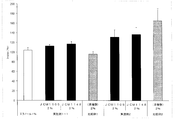
- the cell activation effect evaluation results in the epidermal keratinocytes are shown in FIG. 1 as relative values [Index (%)] with the cell activation effect in the blank with no sample taken as 100. No significant epidermal cell activation effect was observed in the blank ethanol 1% and the soymilk extract of Comparative Example 1 (non-fermented), whereas in the soymilk fermented extract of Example 1-1, L. delbrueckii subsp. lactis JCM 1105 and L. delbrueckii subsp. In both samples fermented with lactis JCM 1148, a significant cell activating effect was observed at 124%. Further, the hypocotyl fermented extract of Example 2 is also described in L. delbrueckii subsp.
- Test Example 2 Evaluation of cell activation effect of fermented extract in skin fibroblasts For the same sample as in Test Example 1, the cell activation action in skin fibroblasts was evaluated by the method shown below. All samples were adjusted to pH 7.4 ⁇ 0.05 using 1N sodium hydroxide, and then sterilized by filtration with a 0.20 ⁇ m filter.
- Normal human skin fibroblasts [manufactured by Kurabo Industries, product name NHDF (NB)] are seeded in a 96-well microplate so as to be 2 ⁇ 10 3 cells per well, at 37 ° C. in a carbon dioxide concentration of 5 vol%. Cultured for 48 hours. As the seeding medium, 10% FBS-containing DMEM medium (manufactured by Life Technology) was used. Subsequently, it replaced
- the number of viable cells was measured using Cell Counting Kit-8 (manufactured by Dojin Chemical).
- 10% FBS-containing DMEM medium was used as a positive control, and 1% ethanol-containing FBS-free DMEM medium was used as a blank for each sample.
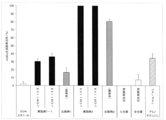
- the cell activation effect evaluation results in skin fibroblasts are shown in FIG. 2 as relative values [Index (%)] with the cell activation effect in the blank with no sample taken as 100.
- 1% ethanol as a blank and the soymilk extract of Comparative Example 1 (non-fermented) no dermal fibroblast activation effect was observed, whereas in the soymilk fermented extract of Example 1-1, L. delbrueckii subsp.
- lactis JCM 1105 113%. delbrueckii subsp.
- a significant cell activation effect was observed at 117%, and a tendency for the action to be enhanced by fermentation was observed.
- hypocotyl fermented extract of Example 2 is also described in L.P. delbrueckii subsp.
- L. delbrueckii subsp L. delbrueckii subsp.
- lactis JCM 1148 a strong cell activation effect was observed at 137%, and the effect of the hypocotyl fermented extract was higher than that of the fermented soymilk extract of Example 1-1.
- FIG. 2 it was confirmed that the fermented extract of the present invention has a very strong cell activation effect on normal human skin fibroblasts.
- DPPH radical elimination rate ⁇ 1 ⁇ (B) / (A) ⁇ ⁇ 100 Trolox was used as a positive control having an antioxidant effect, and 50% ethanol was used as a blank for each sample.
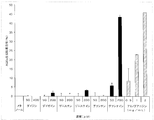
- the evaluation results of antioxidant action are shown in FIG.
- the DPPH radical scavenging activity in the soymilk extract of Comparative Example 1 (non-fermented) was 54%, whereas in the soymilk fermented extract of Example 1-1, L. delbrueckii subsp. 76% for the sample fermented with lactis JCM 1105; delbrueckii subsp.
- a DPPH radical scavenging activity as high as 69% was observed, and a tendency to enhance the action by fermentation was recognized.
- the DPPH radical scavenging activity in the hypocotyl extract (non-fermented) of Comparative Example 2 was 77%, whereas in the hypocotyl fermented extract of Example 2, L. delbrueckii subsp. In the sample fermented with lactis JCM 1105, L. delbrueckii subsp. In the sample fermented with lactis JCM 1148, an extremely high DPPH radical scavenging activity of 80% was observed, and a tendency for the action to be enhanced by fermentation was observed. The effect of the hypocotyl fermented extract was higher than that of the fermented soymilk extract of Example 1-1.
- the results of evaluating the antioxidant activity of the isoflavone preparation by the same method are shown in FIG.
- a high DPPH radical scavenging activity was not observed even in the 200 ⁇ M isoflavone preparation, which is more than the isoflavone contained in the fermented soymilk fermented with lactis JCM 1148. From this, it was considered that most of the DPPH radical scavenging activity of the fermented extract was exhibited by active ingredients other than isoflavones. Therefore, the fermented extract of the present invention contains a component having high antioxidant ability other than isoflavone in addition to isoflavone widely known as an antioxidant substance, and exhibits a very strong antioxidant action. Was confirmed.
- Test Example 4 Evaluation of anti-glycation effect of fermented extract About the same sample as Test Example 3, the anti-glycation effect was evaluated by the method shown below. All samples were adjusted to pH 7.4 ⁇ 0.05 using 1N sodium hydroxide, and then sterilized by filtration with a 0.20 ⁇ m filter.
- the test solution was dispensed into a 96-well plate, and fluorescence was measured at an excitation wavelength of 370 nm and a fluorescence wavelength of 440 nm.
- the fluorescence in the case of sample addition is (A)
- the fluorescence of the reaction blank is (B)
- the fluorescence of the positive control is (C)
- the fluorescence of the positive control blank is (D)
- the AGEs production inhibitory activity is Defined.
- AGEs production inhibitory activity ⁇ 1- (AB) / (CD) ⁇ ⁇ 100
- aminoguanidine was used as a positive control having AGEs production inhibitory activity.
- the anti-glycation effect evaluation results of the fermented extract are shown in FIG.
- the AGEs production inhibitory activity of the soymilk extract of Comparative Example 1 (non-fermented) was 17%, whereas the soymilk fermented extract of Example 1-1 had L. delbrueckii subsp. 30% for the sample fermented with lactis JCM 1105; delbrueckii subsp.
- a high AGEs production inhibitory activity of 36% was observed, and a tendency for the action to be enhanced by fermentation was observed.
- the AGEs production inhibitory activity in the hypocotyl extract (non-fermented) of Comparative Example 2 was 81%, whereas in the hypocotyl fermented extract of Example 2, L. delbrueckii subsp. lactis JCM 1105 and L. delbrueckii subsp. Both samples fermented with lactis JCM 1148 showed a very high AGEs production inhibitory activity of 100%, and a tendency for the action to be enhanced by fermentation was observed, similar to the fermented soymilk extract. The effect of the hypocotyl fermented extract was higher than that of the fermented soymilk extract of Example 1-1.
- the anti-glycation effect of the fermented soymilk extract may have a synergistic effect due to the combination of isoflavones, or may be exhibited by an active ingredient other than isoflavones.
- the anti-glycation action of the hypocotyl fermented extract shown in FIG. 5 may be mainly exerted by glycitein. It was.
- Normal human epidermal keratinocytes [manufactured by Kurabo Industries, product name NHEK (NB)] are seeded in a 96-well microplate so as to be 10 ⁇ 10 3 cells per well, at 37 ° C. in a carbon dioxide concentration of 5 vol%. Cultured for 24 hours. As the seeding medium, HuMedia-KG2 medium (Kurabo) was used. Subsequently, the medium was replaced with a sample culture solution prepared at each concentration using HuMedia-KB2 (Kurabo) medium, and further cultured for 24 hours. Each sample culture solution was prepared so that the final ethanol concentration was 1%.
- tert-butyl hydroxide (t-BHP) was exposed to a final concentration of 0.5 mM and cultured for 2 hours. Next, each well was thoroughly washed with HBSS ( ⁇ ), and further cultured in HuMedia-KB2 medium for 22 hours.
- FIG. 7 shows the evaluation results of the antioxidant effect (cytoprotective action).
- the cell viability of the soymilk extract (non-fermented) of Comparative Example 1 was 14%, whereas the fermented soymilk extract of Example 1-1 had a high cell viability of 48%. A tendency to enhance the protective effect was observed. As is clear from FIG. 7, it was confirmed that the fermented soymilk extract of the present invention has a very strong antioxidant effect.
- Example 6 Evaluation of moisturizing action of fermented soymilk extract Among the fermented soymilk extracts prepared in Example 1-1, L. delbrueckii subsp. About the soymilk fermented extract prepared using lactis JCM 1148, the moisturizing effect in human in vivo was evaluated by the method shown below. All samples were adjusted to pH 7.4 ⁇ 0.05 using 1N sodium hydroxide, and then sterilized by filtration with a 0.20 ⁇ m filter.
- the test site of 3 cm square was taken on the inner side of the forearm of the subject, and the test sample was applied 3 times a day for 3 days.
- the stratum corneum moisture content and transdermal moisture transpiration were measured 8 to 10 hours after the final application of the test sample.
- a highly sensitive stratum corneum film thickness / moisture meter ASA-MX3 was used for the measurement of the stratum corneum moisture content
- Vaposcan AS-VT100RS both manufactured by Asahi Biomed Co., Ltd. was used for the measurement of the transdermal moisture transpiration amount.
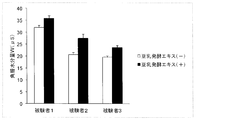
- FIGS. The results of evaluating the moisturizing effect of the fermented soymilk extract are shown in FIGS.
- the stratum corneum moisture content increased by 10% or more by application of the soymilk fermented extract-containing lotion.
- the tendency for the transdermal moisture transpiration amount to decrease by 10% or more by application of the soymilk fermented extract-containing lotion was observed. From this, it was confirmed that the fermented soymilk extract has a stratum corneum moisture content increasing action and a stratum corneum barrier function enhancing action, and exerts a moisturizing action in human in vivo.
- a soymilk fermented extract containing a high content of isoflavone aglycone and polyamine and in particular, it has a low sugar content and has a cell activation effect and an antioxidant effect on epidermal keratinocytes and skin fibroblasts.
- the fermented soymilk extract exhibiting anti-aging effects such as anti-glycation action and moisturizing action can be provided.
- a hypocotyl fermented extract obtained by fermenting soybean hypocotyls with lactic acid bacteria can be provided, in particular, high content of isoflavone aglycone and polyamine, and epidermal keratinocytes and skin fibers.
- hypocotyl fermented extract having an anti-aging action such as a cell activation action, an antioxidant action and an anti-glycation action on blast cells.
- the soymilk fermented extract and hypocotyl fermented extract of the present invention have industrial applicability in the fields of cosmetics, pharmaceuticals, and foods and drinks.
Landscapes
- Health & Medical Sciences (AREA)
- Life Sciences & Earth Sciences (AREA)
- Engineering & Computer Science (AREA)
- Animal Behavior & Ethology (AREA)
- Veterinary Medicine (AREA)
- Public Health (AREA)
- General Health & Medical Sciences (AREA)
- Chemical & Material Sciences (AREA)
- Botany (AREA)
- Medicinal Chemistry (AREA)
- Pharmacology & Pharmacy (AREA)
- General Chemical & Material Sciences (AREA)
- Organic Chemistry (AREA)
- Nuclear Medicine, Radiotherapy & Molecular Imaging (AREA)
- Chemical Kinetics & Catalysis (AREA)
- Microbiology (AREA)
- Biotechnology (AREA)
- Epidemiology (AREA)
- Natural Medicines & Medicinal Plants (AREA)
- Mycology (AREA)
- Bioinformatics & Cheminformatics (AREA)
- Birds (AREA)
- Dermatology (AREA)
- Nutrition Science (AREA)
- Polymers & Plastics (AREA)
- Food Science & Technology (AREA)
- Agronomy & Crop Science (AREA)
- Diabetes (AREA)
- Toxicology (AREA)
- Alternative & Traditional Medicine (AREA)
- Beans For Foods Or Fodder (AREA)
- Endocrinology (AREA)
- Biochemistry (AREA)
- Obesity (AREA)
- Medical Informatics (AREA)
- Hematology (AREA)
- Emergency Medicine (AREA)
- Cosmetics (AREA)
- Pharmaceuticals Containing Other Organic And Inorganic Compounds (AREA)
- Acyclic And Carbocyclic Compounds In Medicinal Compositions (AREA)
Abstract
化粧品、医薬品、飲食品等の原料として有用な発酵エキスを提供することを目的とする。乳酸菌で豆乳または大豆胚軸を発酵する工程、発酵物を有機溶媒と混合する工程、および固形分を除去する工程を含む方法によって、イソフラボンアグリコンおよびポリアミンを含有し、表皮角化細胞の賦活作用、皮膚線維芽細胞の賦活作用、抗酸化作用および抗糖化作用などの抗老化作用の1以上の作用を有する豆乳発酵エキスまたは胚軸発酵エキスを得る。
Description
本発明は、イソフラボンアグリコンおよびポリアミンが高含有である豆乳発酵エキスに関し、特に、糖質含量が少なく、表皮角化細胞および皮膚線維芽細胞に対する細胞賦活作用、抗酸化作用、抗糖化作用ならびに保湿作用などの抗老化作用を有する豆乳発酵エキスに関する。本発明はまた、大豆胚軸を乳酸菌で発酵することによって得られる胚軸発酵エキスに関し、特に、イソフラボンアグリコンおよびポリアミンが高含有であり、表皮角化細胞および皮膚線維芽細胞に対する細胞賦活作用、抗酸化作用ならびに抗糖化作用などの抗老化作用を有する胚軸発酵エキスに関する。
近年、化粧品業界においては、顧客の自然派志向が高まる中、ナチュラル・オーガニック化粧品の需要が増えてきている。このような化粧品市場のニーズに応えるべく、様々な植物由来の機能性素材が開発されている。そして、これらの植物性天然素材にさらなる新たな付加価値を付与すべく、微生物発酵技術の活用が注目されている。例えば、豆乳は良質のタンパク質やイソフラボン化合物等を含んでいるが、さらに、発酵によって大豆ペプチドやイソフラボンアグリコン等を生成させることによって、種々の生理効果を示すことが期待されている。大豆や豆乳を微生物発酵させた素材、エキスの美容効果については、例えば、これまでにメラニン生成抑制による美白作用(例えば、特許文献1参照)、ヒアルロン酸産生能の向上による保湿作用(例えば、特許文献2、非特許文献1、2参照)、エストロゲン受容体αアゴニスト活性化による育毛作用(例えば、特許文献3参照)、抗酸化作用(例えば、特許文献4参照)等について報告されている。
豆乳発酵エキスは、医薬部外品原料規格(以下、「外原規」という場合がある)2006(平成18年3月31日薬食発第0331030号厚生労働省医薬食品局長通知)に“豆乳発酵液”(成分コード532101)として収載されている。外原規では、豆乳発酵液を「大豆の種子から得た豆乳を乳酸菌Lactobacillus delbrueckii(L.delbrueckii)で発酵して得た培養液にエタノールを加え、濾過して得られるエキスである。本品は、定量するとき、窒素0.01~0.04%を含む。」と規定しており、これを満たすものであれば使用実績の観点からも安全性が確認されていると言える。また、これに記載されているL.delbrueckiiは、ヨーグルトの製造に古くから用いられている乳酸菌であり、経験的にみて安全性が高いとみなされている。
大豆に含まれるイソフラボン化合物は、エストロゲン作用、抗エストロゲン作用、酸化防止作用等の生理活性を有していることが知られており、その有用性が注目されている。大豆をそのまま粉末化してイソフラボン化合物を測定すると、12種類のイソフラボン化合物の存在が確認される。これらは、3種類のダイゼイン、ゲニステイン、グリシテイン(これらはイソフラボンアグリコンと呼ばれる)を基本骨格としている(化1)。

大豆中に含まれているイソフラボン化合物のほとんどは、これらを基本骨格とするイソフラボン配糖体(ダイジン、ゲニスチン、グリシチン)とこれらのイソフラボン配糖体がさらにアセチル化やマロニル化の修飾を受けた化合物として存在する(化2)。

これらのイソフラボン化合物の中でも、特にイソフラボンアグリコンは、イソフラボン配糖体よりもエストロゲンの構造に近いことから、一般的に薬理作用が高いとされている。また、イソフラボン配糖体と比較して疎水性が高いため、皮膚への浸透性が高いことも期待できる。例えば、ゲニステインについては、塗布によって肌の老化防止に効果がある可能性が示されている(例えば、非特許文献3参照)。
しかし、イソフラボン化合物自体、天然に存在する量が少なく、とりわけイソフラボンアグリコンの量は極めて少ない。
また、大豆にはポリアミンも含まれることが知られる。ポリアミンとは、第1級アミノ基を2つ以上もつ脂肪族炭化水素の総称で生体内に普遍的に存在する天然物であり、20種類以上のポリアミンが見いだされている。代表的なポリアミンとしては、プトレッシン、スペルミジン、スペルミン、カダベリンがある。
ポリアミンの主な生理作用としては、(1)核酸との相互作用による核酸の安定化と構造変化(2)種々の核酸合成系への促進作用(3)タンパク質合成系の活性化(4)細胞膜の安定化や物質の膜透過性の強化(5)活性酸素の消去(6)細胞増殖の促進(7)抗アレルギー作用が知られている(例えば、特許文献5、非特許文献4、5参照)。
ここで、大豆原料を乳酸菌で発酵する従来技術について説明する。イソフラボン配糖体をイソフラボンアグリコンに分解する手法として、β-グルコシダーゼ活性を有する乳酸菌、ビフィドバクテリウム属細菌等を用いることで、イソフラボンアグリコンの豊富な発酵豆乳が得られることが報告されている(例えば、特許文献6、非特許文献6-11参照)。しかし、これらの発酵後に得られるポリアミンは確認されていない。とりわけ、外原規で規定されている豆乳発酵菌の製造に用いられる乳酸菌L.delbrueckiiに関しては、豆乳中のイソフラボンアグリコンへの変換に関する報告例は特に少ない(例えば、非特許文献6-11参照)。例えば、非特許文献6と7においては、L.delbrueckiiと他の乳酸菌との共培養であるため、L.delbrueckii単独での変換とは言い難い。非特許文献8においては、鳥の腸内細菌であるL.delbrueckii類縁菌が、合成培地においてゲニスチンからゲニステインに変換することが報告されているが、菌株が完全に同定されていない。
非特許文献9においては、L.delbrueckii subsp.bulgaricus単独によるイソフラボンアグリコンへの変換が報告されているが、発酵に用いた豆乳(大豆分離タンパクによる再構成液)のイソフラボン含量が少なく(総量42mg/L、103μM)、得られるイソフラボンアグリコンが約24mg/L(約90μM)と少ないものである。非特許文献10および11については、糖質を添加することなく、豆乳を発酵させることによって、高イソフラボンアグリコン含有量の発酵液を得ている。非特許文献12は、豆乳にグルコースを添加し、乳酸菌で発酵させると、特定の菌株を用いた場合にイソフラボン配糖体がそのアグリコンに変換することを報告する。しかし、これらのいずれの発酵についても、ポリアミン量については確認されていない。
また、大豆原料を微生物で発酵する従来技術として、大豆に麹菌を接種することで、麹菌の酵素活性によってイソフラボン配糖体がイソフラボンアグリコンに分解され、イソフラボンアグリコン高含有な食品が得られることも報告されている(例えば、特許文献7参照)。
また、大豆の発芽時に幼芽、幼根となる部分である大豆胚軸は、たん白質、オリゴ糖などの他、イソフラボンやサポニンなどの微量栄養成分が豊富に含まれ、これを、エクオール産生能を有する特定のラクトコッカス・ダルビエで発酵させてエクオール含有発酵物を得ることが報告されている(特許文献8)。
ポリアミンの製造法については、大豆種子、大豆胚芽、豆乳等を原料として、酸を添加することによって得られることが知られている(例えば、特許文献5、9、10参照)。また、腸内細菌によるポリアミンの生成を促進する成分に関する報告がなされている(例えば、特許文献11参照)。
さらに、豆乳とおからの混合物を乳酸菌で発酵させることにより、発酵前の混合物と比較してポリアミン量が増加することが報告されている(非特許文献13)しかし、豆乳のみを乳酸菌発酵することによって、抽出されるポリアミン量が増加することついては報告されていない。また、大豆胚軸を乳酸菌発酵することによって、ポリアミン高含有な胚軸発酵エキスを作製することついても報告されていない。
さらに、豆乳とおからの混合物を乳酸菌で発酵させることにより、発酵前の混合物と比較してポリアミン量が増加することが報告されている(非特許文献13)しかし、豆乳のみを乳酸菌発酵することによって、抽出されるポリアミン量が増加することついては報告されていない。また、大豆胚軸を乳酸菌発酵することによって、ポリアミン高含有な胚軸発酵エキスを作製することついても報告されていない。
次いで、表皮角化細胞の細胞賦活作用について説明する。皮膚は、表皮と真皮からなる組織であり、外界からの物理的あるいは化学的ストレスから身体を守るバリア機能を果たしている。皮膚の外側に存在する表皮は、基底層、有棘層、顆粒層、角層からなり、主に角化細胞から構成されている。基底膜で分裂した角化細胞は、分化・成熟を経て上層に移行し、外表面の角層まで達した後、脱落し、ターンオーバー(新陳代謝)を繰り返し、表皮を形成している。
表皮のターンオーバーは、皮膚バリア能や水分量の保持、メラニン色素の排出等に関与している。そのため、肌荒れ改善効果、保湿効果、肌のくすみ改善効果、美白効果、肌のキメ改善に、表皮角化細胞賦活剤が用いられている。豆乳発酵エキスについては、エストロゲン受容体αアゴニスト活性化による育毛作用が報告されているが(例えば、特許文献3参照)、イソフラボンアグリコンおよびポリアミン高含有豆乳発酵エキスによる表皮角化細胞に対する顕著な細胞賦活作用については、これまでに報告されていない。
次いで、皮膚線維芽細胞の細胞賦活作用について説明する。皮膚線維芽細胞は、真皮内に存在し、コラーゲン、エラスチン、ヒアルロン酸等を産生する細胞であり、コラーゲンを線維束にして、真皮構造を形成するのに寄与することが知られている。この線維芽細胞が、加齢や紫外線曝露によって損傷を受ける、減少する等すると、規則性をもった線維を生成できなくなり、しわおよびたるみといった肌老化が生じる。従って、皮膚線維芽細胞に対して賦活作用のある剤は、皮膚外用剤、特に老化防止用の皮膚外用剤の有効成分として有用である。しかし、イソフラボンアグリコンおよびポリアミン高含有豆乳発酵エキスによる皮膚線維芽細胞に対する顕著な細胞賦活作用については、これまでに報告されていない。
次いで、抗酸化作用について説明する。皮膚は生体の最外層に位置する器官であり、外環境からの影響を大きく受ける器官である。この中で最も重要視されるのが紫外線の存在である。紫外線存在下においては活性酸素種が発生し生体内で種々のラジカル種に変換され、殺菌、体内への侵入物質の排除等を行う正の効果を持つ反面、その反応性の高さから、表皮細胞および組織の劣化や真皮の構成成分であるヒアルロン酸、コラーゲン、エラスチン、線維芽細胞を攻撃し、これらの劣化や減少あるいは変性により負の効果をももたらす。具体的には、保湿力低下による乾燥、弾力性や柔軟性低下によるしわ、たるみの形成、炎症反応による肌荒れ、凹凸や血流量低下等によるくすみ等が挙げられる。従って、活性酸素種を消去する作用のある剤は、皮膚外用剤、特に老化防止用の皮膚外用剤の有効成分として有用である。しかし、イソフラボンアグリコンおよびポリアミン高含有豆乳発酵エキスによる抗酸化作用については、これまでに報告されていない。
次いで、抗糖化作用について説明する。糖質は、ヒトを初めとする生物においてエネルギー源として非常に重要である。しかし一方で、糖質はタンパク質と糖化反応(グリケーション)を起こすことが知られている。糖化反応は、糖質のカルボニル基とタンパク質等のアミノ基との非酵素的な反応を第一段階とし、シッフ塩基からアマドリ化合物を経て最終的に最終糖化生成物(以下、「AGEs」ということがある。)を形成する一連の反応である。糖化反応により、タンパク質が非酵素的に糖により修飾されるため、これにより当該タンパク質の変性やタンパク質間の架橋等が起こり、その結果タンパク質の機能を低下させる。糖化反応は、コラーゲン等の細胞外マトリックス構成タンパク質を修飾・構造変化させることにより直接的な障害を引き起こすほか、糖化タンパク質をリガンドとする受容体により認識されることで細胞応答を引き起こす等の影響をもたらす。
コラーゲンを初めとする細胞外マトリックス成分は、骨や皮膚等の組織における乾燥重量の過半を占めている。そのため、例えば、コラーゲンが糖化され異常に架橋された状態となると、骨や軟骨組織においては骨粗鬆症や変形性関節症等を発症し、皮膚においては弾力性の低下、黄色化等によるくすみ等を生じる。さらに、異常に架橋したコラーゲン等はコラゲナーゼ等による分解を受けにくくなるため、コラゲナーゼ等の発現が誘導され、正常なコラーゲンまで分解されてしまう等の問題が生じてしまう。
このため、糖化反応を何らかの形で抑制する、すなわちAGEsの形成を抑制したり、またAGEsの分解を促進したりすることができれば、皮膚の弾力性低下やくすみ等の予防または改善にも効果があると期待される。
従来、抗糖化作用を有する化合物として、N-フェナシルチアゾリウムブロミドが知られている(例えば、非特許文献14参照)。しかし、この化合物は安全性に問題があり、医薬品や皮膚外用剤として適していない。また、抗糖化作用を有する天然物由来の成分として、例えば、オリーブからの抽出物が知られている(例えば、特許文献12参照)。しかし、抗糖化作用を有する物質の提供は十分とは言い難く、さらなる新しい抗糖化作用物質の開発および提供が強く求められている。さらに、大豆熱水抽出物およびイソフラボンも抗糖化作用を有すると報告されているが(例えば、特許文献13参照)、これらを用いてもAGEsの生成を完全に抑制することはできず、その効果は十分ではない。一方で、イソフラボンアグリコンおよびポリアミン高含有豆乳発酵エキスによる抗糖化作用については、これまでに報告されていない。
次いで、保湿作用について説明する。角層の水分量は肌の状態と密接に関連し、健康な素肌を保つためには、角層に適度な水分が保持されていることが必要である。また、皮膚角層には、皮膚への異物侵入と生体に必要な水分の蒸散を防止するバリア機能が存在する。角層バリア機能が低下すると、経皮水分蒸散量の増加に伴って角層水分量が低下し、荒れ肌や種々の老化症状が惹起される。従って、角層水分量増加作用のある剤、もしくは角層バリア機能増強作用のある剤は、皮膚外用剤、特に老化防止用の皮膚外用剤の有効成分として有用である。しかし、イソフラボンアグリコンおよびポリアミン高含有豆乳発酵エキスによる保湿作用については、これまでに報告されていない。
「Skin pharmacology and applied skin physiology」,(瑞国),2003年,16巻,p.108-116
「Journal of cosmetic science」,(米国),2004年,55巻,p.473-479
「British journal of pharmacology」,(英国),2012年,165巻,p.994-1005
「Journal of Immunology」,(米国),2005年,175巻,p.237-245
「Journal of Exp. Med.」,(米国),1997年,185巻,p.1759-1768
「Journal of food science」,(米国),2009年,74巻,p.M190-195
「Journal of agricultural and food chemistry」,(米国),2009年,57巻,p.170-175
「FEMS microbiology letters」,(英国),2009年,291巻,p.180-187
「Journal of Food Science」,(米国),2010年,75巻,p.M140-149
「Malaysian Journal of Microbiology」,(馬国),2010年,6巻,p.30-40
「Food Research International」,(加国),2005年,38巻,p.551-559
「Biotechnol Lett」(蘭国)2002,Vol.24, No.24,p.2113-2116
「Food Sci Technol Res」(日本),2010,Vol.16,No.5,p.417-420
「Nature」,(英国),1996年,382巻,p.275-278
現在市販されている豆乳発酵エキスには、3つの課題がある。
第一の課題は、大豆に含まれる生理活性物質として特に期待される成分であるイソフラボン化合物の含量が極めて少ないことである。実際に市販されている豆乳発酵エキスのイソフラボン化合物含量は少なく(0~120μM)、イソフラボンアグリコンの含量はさらに少ない(0~60μM、イソフラボンアグリコンへの変換率0~50%)。このような背景から、イソフラボンアグリコン高含有である豆乳発酵エキスが強く求められている。
第一の課題は、大豆に含まれる生理活性物質として特に期待される成分であるイソフラボン化合物の含量が極めて少ないことである。実際に市販されている豆乳発酵エキスのイソフラボン化合物含量は少なく(0~120μM)、イソフラボンアグリコンの含量はさらに少ない(0~60μM、イソフラボンアグリコンへの変換率0~50%)。このような背景から、イソフラボンアグリコン高含有である豆乳発酵エキスが強く求められている。
第二の課題として、もうひとつの生理活性物質として期待される成分であるポリアミンの含有量が少ないことが挙げられる。実際に市販されている豆乳発酵エキス中のポリアミンの総量は10~15μMであり、従って、ポリアミン高含有である豆乳発酵エキスが強く求められている。市販されている豆乳発酵エキスのポリアミン含量が極めて少ない理由として、製造で用いられるエタノールに対してポリアミンの溶解性が低いことが挙げられる。従って、ポリアミン含有量が高い豆乳発酵エキスを製造するためには、発酵液中のポリアミンの濃度を向上させるとともに、抽出に用いる有機溶媒の濃度を最適化させる必要がある。
第三の課題として、グルコース等の糖質が残存していることが挙げられる。大豆に含まれるオリゴ糖はショ糖(スクロース、5%)、スタキオース(4%)、ラフィノース(1.1%)、ベルバスコース(trace)であるという報告がなされており(例えば、山内文男ら編,「大豆の科学」,朝倉書店,1993年,p.49参照)、豆乳等の大豆原料を用いる乳酸菌発酵において、乳酸菌の種類によっては糖質が不足する。これを補うためにグルコース等の糖質を添加すると、発酵液に未消化の糖質が残存すると考えられる。しかし、これらの糖質は、化粧品原料として配合したときに、べたつきの原因になるとともに、還元糖の場合はメイラード反応の原料となって皮膚の老化を促進する恐れがある(例えば、特開2011-102270号公報参照)。従って、グルコース無添加でも生育が良好な乳酸菌を利用する等の工夫によって、グルコース等の糖質が残存していない豆乳発酵エキスが求められている。
本発明は、上記事情に鑑みてなされたものであり、上記課題の1以上を解決する、化粧品、医薬品、飲食品等への利用に有用な発酵エキスを提供することを課題とする。
本発明者らは、上記課題を解決するため鋭意検討を重ねた結果、豆乳の乳酸菌発酵を、糖質を補うことなく行い、これを抽出することによって、イソフラボンアグリコンやポリアミンが高含有であり、グルコースの含有量が少ない豆乳発酵エキスを得て、さらにこれが顕著な表皮角化細胞および皮膚線維芽細胞に対する細胞賦活作用、抗酸化作用、抗糖化作用ならびに保湿作用などの抗老化作用を有することを見出した。また、大豆胚軸を乳酸菌によって発酵させ、これを抽出することによって、イソフラボンアグリコンやポリアミンが高含有の胚軸発酵エキスを得て、さらにこれが顕著な表皮角化細胞および皮膚線維芽細胞に対する細胞賦活作用、抗酸化作用ならびに抗糖化作用などの抗老化作用を有することを見出し、本発明を完成するに至った。
すなわち、本発明は以下のものに関する。
すなわち、本発明は以下のものに関する。
[1]
次の(A)、(B)および(C)の工程:
(A)豆乳を乳酸菌で発酵する工程;
(B)工程(A)で得られた発酵物と有機溶媒を混合する工程;および
(C)工程(B)で生成する固形分を除去する工程;
を含む方法によって得られる豆乳発酵エキスであって、
次の(i)、(ii)および(iii):
(i)イソフラボン化合物の含有量が150μM以上;
(ii)工程(A)におけるイソフラボン配糖体からイソフラボンアグリコンへの変換率が50%以上;および
(iii)ポリアミンの含有量が20μM以上;
を満たす、豆乳発酵エキス。
[2]
(iv)グルコースおよびスクロースの含有量の和が3.0mg/mL以下である、[1]に記載の豆乳発酵エキス。
[3]
次の(v)および(vi):
(v)グルコースおよびスクロースの含有量の和(mg/mL):イソフラボン化合物の含有量(μM)が0.1以下;および
(vi)グルコースおよびスクロースの含有量の和(mg/mL):ポリアミンの含有量(μM)が0.3以下;
の1以上を満たす、[1]または[2]に記載の豆乳発酵エキス。
[4]
工程(A)における乳酸菌がLactobacillus delbrueckiiである、[1]~[3]のいずれかに記載の豆乳発酵エキス。
[5]
工程(A)に先立って、(P)前培養を豆乳で行う工程を含む方法によって得られる、[1]~[4]のいずれかに記載の豆乳発酵エキス。
[6]
次の(A’)、(B’)および(C’)の工程:
(A’)大豆胚軸を乳酸菌で発酵する工程;
(B’)工程(A’)で得られた発酵物と有機溶媒を混合する工程;および
(C’)工程(B’)で生成する固形分を除去する工程;
を含む方法によって得られる胚軸発酵エキス。
[7]
グリシテインを100μM以上含有する、[6]に記載の胚軸発酵エキス。
[8]
[1]~[7]のいずれかに記載の発酵エキスを含む、抗老化剤。
[9]
表皮角化細胞賦活作用、皮膚線維芽細胞賦活作用、抗酸化作用、抗糖化作用および保湿作用のいずれか1以上の作用を有する、[8]に記載の抗老化剤。
[10]
請求項[1]~[7]のいずれかに記載の発酵エキスを含む、化粧品、皮膚外用剤、医薬品または飲食品。
[11]
豆乳を乳酸菌で発酵し、次いでポリアミンを抽出することを特徴とする、ポリアミンの製造方法。
[12]
大豆胚軸を乳酸菌で発酵し、次いでポリアミンを抽出することを特徴とする、ポリアミンの製造方法。
[13]
大豆胚軸を乳酸菌Lactobacillus delbrueckiiで発酵する工程を含む、イソフラボンアグリコンまたはポリアミンの製造方法。
[14]
豆乳を、L.delbrueckii subsp.lactis JCM 1105、L.delbrueckii subsp.lactis JCM 1148、L.delbrueckii subsp.bulgaricus JCM 1001、L.delbrueckii subsp.lactis JCM 1010およびL.delbrueckii subsp.delbrueckii JCM 1012から選択される乳酸菌で発酵して得られる豆乳発酵物。
[15]
大豆胚軸を乳酸菌Lactobacillus delbrueckiiで発酵して得られる、胚軸発酵物。
次の(A)、(B)および(C)の工程:
(A)豆乳を乳酸菌で発酵する工程;
(B)工程(A)で得られた発酵物と有機溶媒を混合する工程;および
(C)工程(B)で生成する固形分を除去する工程;
を含む方法によって得られる豆乳発酵エキスであって、
次の(i)、(ii)および(iii):
(i)イソフラボン化合物の含有量が150μM以上;
(ii)工程(A)におけるイソフラボン配糖体からイソフラボンアグリコンへの変換率が50%以上;および
(iii)ポリアミンの含有量が20μM以上;
を満たす、豆乳発酵エキス。
[2]
(iv)グルコースおよびスクロースの含有量の和が3.0mg/mL以下である、[1]に記載の豆乳発酵エキス。
[3]
次の(v)および(vi):
(v)グルコースおよびスクロースの含有量の和(mg/mL):イソフラボン化合物の含有量(μM)が0.1以下;および
(vi)グルコースおよびスクロースの含有量の和(mg/mL):ポリアミンの含有量(μM)が0.3以下;
の1以上を満たす、[1]または[2]に記載の豆乳発酵エキス。
[4]
工程(A)における乳酸菌がLactobacillus delbrueckiiである、[1]~[3]のいずれかに記載の豆乳発酵エキス。
[5]
工程(A)に先立って、(P)前培養を豆乳で行う工程を含む方法によって得られる、[1]~[4]のいずれかに記載の豆乳発酵エキス。
[6]
次の(A’)、(B’)および(C’)の工程:
(A’)大豆胚軸を乳酸菌で発酵する工程;
(B’)工程(A’)で得られた発酵物と有機溶媒を混合する工程;および
(C’)工程(B’)で生成する固形分を除去する工程;
を含む方法によって得られる胚軸発酵エキス。
[7]
グリシテインを100μM以上含有する、[6]に記載の胚軸発酵エキス。
[8]
[1]~[7]のいずれかに記載の発酵エキスを含む、抗老化剤。
[9]
表皮角化細胞賦活作用、皮膚線維芽細胞賦活作用、抗酸化作用、抗糖化作用および保湿作用のいずれか1以上の作用を有する、[8]に記載の抗老化剤。
[10]
請求項[1]~[7]のいずれかに記載の発酵エキスを含む、化粧品、皮膚外用剤、医薬品または飲食品。
[11]
豆乳を乳酸菌で発酵し、次いでポリアミンを抽出することを特徴とする、ポリアミンの製造方法。
[12]
大豆胚軸を乳酸菌で発酵し、次いでポリアミンを抽出することを特徴とする、ポリアミンの製造方法。
[13]
大豆胚軸を乳酸菌Lactobacillus delbrueckiiで発酵する工程を含む、イソフラボンアグリコンまたはポリアミンの製造方法。
[14]
豆乳を、L.delbrueckii subsp.lactis JCM 1105、L.delbrueckii subsp.lactis JCM 1148、L.delbrueckii subsp.bulgaricus JCM 1001、L.delbrueckii subsp.lactis JCM 1010およびL.delbrueckii subsp.delbrueckii JCM 1012から選択される乳酸菌で発酵して得られる豆乳発酵物。
[15]
大豆胚軸を乳酸菌Lactobacillus delbrueckiiで発酵して得られる、胚軸発酵物。
本発明によれば、イソフラボンアグリコンおよびポリアミンが高含有である豆乳発酵エキスを提供することができ、特に、糖質含量が少なく、表皮角化細胞および皮膚線維芽細胞に対する細胞賦活作用、抗酸化作用、抗糖化作用ならびに保湿作用などの抗老化作用を示す豆乳発酵エキスを提供することができる。また、本発明によれば、大豆胚軸を乳酸菌で発酵することによって得られる胚軸発酵エキスを提供することができ、特に、イソフラボンアグリコンおよびポリアミンが高含有であり、表皮角化細胞および皮膚線維芽細胞に対する細胞賦活作用、抗酸化作用ならびに抗糖化作用などの抗老化作用を有する胚軸発酵エキスを提供することができる。本発明の豆乳発酵エキスおよび胚軸発酵エキスは、化粧品、医薬品、飲食品への利用に有用であり、特に化粧品への利用に有用である。
以下、本発明を詳細に説明する。以下の説明は、本発明の代表的な実施態様に基づいてなされることがあるが、本発明はそのような実施態様に限定されるものではない。
本明細書において「豆乳発酵エキス」は、次の(A)、(B)および(C)の工程:
(A)豆乳を乳酸菌で発酵する工程;
(B)工程(A)で得られた発酵物と有機溶媒を混合する工程;および
(C)工程(B)で生成する固形分を除去する工程
を含む方法によって得られるエキスをさし、例えば、工程(C)で固形分を除去して得られる液、これを濃縮した濃縮液、またはこれを乾燥した固形物であってもよい。
(A)豆乳を乳酸菌で発酵する工程;
(B)工程(A)で得られた発酵物と有機溶媒を混合する工程;および
(C)工程(B)で生成する固形分を除去する工程
を含む方法によって得られるエキスをさし、例えば、工程(C)で固形分を除去して得られる液、これを濃縮した濃縮液、またはこれを乾燥した固形物であってもよい。
本明細書において「豆乳」とは、各種の公知の豆乳をさし、例えば、無調製豆乳、調製豆乳、豆乳飲料等を含む。大豆の種子の胚乳、胚軸(胚芽ともいう)および皮のいずれか1以上の部位(以下、大豆原料という)から調製することができるし、それぞれ1以上の部位から抽出して、適宜混合することもできる。大豆原料を適宜粉砕して浸漬した懸濁液や、大豆原料を浸漬した後、湿式粉砕して得られたスラリーも本発明の豆乳として、発酵原料とすることもできる。さらに、脱皮大豆や全粒大豆の粉末を水に溶解、懸濁、または均質化させて調製した、いわゆる大豆液や、それらを原料とする大豆飲料も本発明の豆乳に含む。また、大豆タンパク質を主成分とし、豆乳様の風味を呈する、いわゆるプロテイン飲料類も本発明の豆乳に含む。
大豆の品種、ブランド、色は、特に限定されず、例えば、国産大豆、IOM等の米国産大豆、遺伝子組換え大豆、または遺伝子非組換え大豆のいずれも用いることができる。大豆の未熟種子である枝豆を用いることもできる。イソフラボンアグリコン高含有の豆乳発酵エキスを得る場合、イソフラボンアグリコン、イソフラボン配糖体(アセチル配糖体、マロニル配糖体を含む)のイソフラボン化合物の含有量が合計で150μM以上である豆乳が好ましく用いられる。
本明細書において、乳酸菌は、発酵によって糖類から乳酸を産生する菌であれば特に限定されない。特にLactobacillus属の菌が好ましく用いられ、豆乳発酵液の外原規に記載されているL.delbrueckiiが特に好ましく用いられる。L.delbrueckiiについては、亜種について特に制限はなく、例えば、L.delbrueckii subsp.lactis、L.delbrueckii subsp.bulgaricus、L.delbrueckii subsp.delbrueckii等が挙げられる。
グルコースおよびスクロースの含有量が少ない豆乳発酵エキスやポリアミン含有量が多い豆乳発酵エキスを得るという観点からは、L.delbrueckii subsp.lactis JCM 1105、L.delbrueckii subsp.lactis JCM 1148、L.delbrueckii subsp.bulgaricus JCM 1001、L.delbrueckii subsp.lactis JCM 1010およびL.delbrueckii subsp.delbrueckii JCM 1012から選択される菌が好ましく用いられる。イソフラボンアグリコン含有量が多い豆乳発酵エキスを得るという観点からは、後述のイソフラボン配糖体からイソフラボンアグリコンへの変換率の高い乳酸菌が好ましく用いられ、L.delbrueckii subsp.lactis JCM 1105または1148株が特に好ましく用いられる。
工程(A)における乳酸菌の発酵条件については、乳酸菌が増殖し、豆乳が発酵する条件であれば特に限定されず、用いる乳酸菌の種類に応じて適宜選択することができる。豆乳の発酵は、発酵物中の乳酸量の増加により確認することができる。
イソフラボンアグリコン含有量の高い豆乳発酵エキスを得るという観点からは、豆乳中のイソフラボン配糖体のイソフラボンアグリコンへの変換率が50%以上、特に55%以上となる発酵条件が好ましい。ここで、イソフラボンアグリコンの変換率とは、発酵前後の各種イソフラボン化合物のモル濃度を算出し、[(発酵前のイソフラボン配糖体)-(発酵後のイソフラボン配糖体)]/(発酵前のイソフラボン配糖体)×100(%)として算出することができる。
発酵に用いる豆乳は、必要に応じて糖類や窒素源等を添加したり、pHを調整することもでき、加熱等で殺菌処理することもできる。一態様において、糖質(特にメイラード反応の原料となる還元糖)の含有量が少ない豆乳発酵エキスを得るという観点から、糖類、特に還元糖を添加しない豆乳を発酵に用いることが好ましい。そのような、糖類としては:例えばグルコース、フルクトースおよびグリセルアルデヒドを含む全ての単糖、ラクトース、アラビノースおよびマルトースを含むマルトース型二糖またはオリゴ糖等の還元糖;および例えばスクロース等、加水分解により還元糖となる非還元糖が例示される。一態様において、特にグルコースを添加しない豆乳を発酵に用いることが好ましい。
接種する乳酸菌は任意の培地で前培養してもよく、例えば、植物由来の原料の培地(豆乳、植物由来ペプトン等)、酵母エキス、各種合成培地(MRS培地等)等で培養することができる。一態様において、製造工程の簡略化、動物由来原料を含む培地の使用を避ける、等の観点から、前培養を、豆乳を用いて行うこともできる。前培養の培養条件は、乳酸菌が増加する条件であれば特に限定されない。
発酵温度は、乳酸菌の種類に応じて適宜選択することができ、特に限定されないが、10~50℃で行うことができ、好ましくは20~40℃で行うことができる。培養中のpHについては、そのまま放置しても、酸やアルカリで制御してもよい。各種炭素源や窒素源を流加することもできる。用いる乳酸菌の種類に応じて、好気的条件、嫌気的条件、撹拌培養、静置培養等のいずれの条件を選択することもできる。乳酸菌としてL.delbrueckiiを用いる場合、嫌気的条件下で培養を行うことが好ましい。
発酵時間は、乳酸菌の種類に応じて適宜選択することができ、特に限定されないが、6時間から72時間、簡便には12~60時間、発酵を行うことができる。例えば、乳酸は、乳酸菌発酵の進行を示す指標となりうるため、乳酸の濃度に応じて培養を停止することができ、例えば、乳酸濃度が0.1~7mg/mLとなった時点で培養を停止することができる。
また、糖質の含有量が少ない豆乳発酵エキスを得るという観点からは、発酵過程において、培養液の糖質を分析することにより糖質の減少を確認し、糖質が消費された状態で培養を停止すると、含有糖質が少ない豆乳発酵エキスが得られるため、特に好ましい。糖質としては、例えば、グルコース、フルクトース、スクロースおよびマルトースが挙げられる。これらの糖質の分析方法については、特に限定されないが、好ましくはリン酸-フェニルヒドラジン法(糖をカラムで分離した後、リン酸-フェニルヒドラジン試薬と反応させて、蛍光誘導体化後検出する方法)やバイオセンサーを用いる方法が用いられる。
発酵終了後、必要に応じて発酵物のpHを調整してもよい。例えば、乳酸の生成により低下したpHを、適宜、アルカリで中性に調整してもよい。発酵終了後、形成したカードを撹拌で破壊してもよい。
得られた発酵物は、そのまま工程(B)で有機溶媒と混合してもよいが、高分子タンパク質を工程(B)で効率良く除去するという観点からは、発酵終了後に加熱殺菌を行うことが望ましい。加熱条件については、十分に固形分が形成される条件であれば特に限定されず、例えば、60~120℃で1~120分間、簡便には80~110℃で20~60分間、処理することにより実施できる。
次の工程(B)では、得られた発酵物を有機溶媒と混合する。これにより、得られた発酵物から有機溶媒中にイソフラボン化合物等、所望の成分を抽出することができる。有機溶媒は、水と混和する極性溶媒が好ましく用いられる。化粧品への応用を考慮すると安全性が高いものが好ましく、例えば、エタノールやブチレングリコール等が特に好ましく用いられる。なかでも、エタノールは、豆乳発酵液の外原規に記載されているため、特に好ましく用いられる。また、飲食品および経口医薬品に豆乳発酵エキスを配合する場合も、エタノールが好ましく用いられる。有機溶媒の添加量および濃度については、固形分が生成し、イソフラボン化合物等、所望の成分を抽出することができ、結果として所望の成分を含む豆乳発酵エキスが得られる量および濃度であれば特に限定されないが、固形分が生成し、清澄なエキス分と分離する量および濃度が好ましく、例えば、培養液に対して5~90%(v/v)の量の有機溶媒を添加することができる。例えばエタノールの場合、培養液に対して15%(v/v)以上、好ましくは50%(v/v)以上のエタノールを添加することができる。添加した後に、加熱、冷却、静置等の操作を行うこともできる。
次いで、工程(B)で生成する固形分を除去する工程(C)を行う。工程(C)は、固形分を除去することができる任意の方法を用いて行うことができ、例えば、静置や遠心で上清を分離する方法や濾過する方法等を用いることができる。
なお、上記の工程に加えて、目的に応じてさらに追加の工程を行ってもよい。例えば、イソフラボン化合物(特に、イソフラボンアグリコン)の含有量の多い発酵エキスを得るという観点から、サイクロデキストリンなどの添加によってイソフラボン化合物等、所望の成分の包接を行うこともできる。サイクロデキストリンの添加は、工程(C)の固形分の除去に先立って行われる限り、任意の段階で行うことができ、例えば、工程(A)の前、工程(A)の発酵の最中、工程(A)後であって工程(B)の前、工程(B)の有機溶媒との混合の最中、および工程(B)後であって工程(C)の前、のいずれか一以上の段階で行うことができる。サイクロデキストリンとしては、β-サイクロデキストリンまたはγ-サイクロデキストリンが使用でき、イソフラボン化合物の包接を目的とする場合、好ましくはβ-サイクロデキストリンを使用することができる。
本明細書において「胚軸発酵エキス」は、次の(A’)、(B’)および(C’)の工程:
(A’)大豆胚軸を乳酸菌で発酵する工程;
(B’)工程(A’)で得られた発酵物と有機溶媒を混合する工程;および
(C’)工程(B’)で生成する固形分を除去する工程;
を含む方法によって得られるエキスをさし、例えば、工程(C’)で固形分を除去して得られる液、これを濃縮した濃縮液、またはこれを乾燥した固形物であってもよい。
(A’)大豆胚軸を乳酸菌で発酵する工程;
(B’)工程(A’)で得られた発酵物と有機溶媒を混合する工程;および
(C’)工程(B’)で生成する固形分を除去する工程;
を含む方法によって得られるエキスをさし、例えば、工程(C’)で固形分を除去して得られる液、これを濃縮した濃縮液、またはこれを乾燥した固形物であってもよい。
本明細書において、大豆胚軸は、大豆の胚軸(胚芽ともいう)をさし、生の大豆胚軸のみならず、脱脂、焙煎、浸漬、熱処理等の任意の前処理を行ったものも含む。
工程(A’)の発酵には、大豆胚軸そのものを用いることもできるし、粉砕して用いてもよい。より抽出効率を高める観点から、大豆胚軸またはその粉砕物を水に懸濁させた懸濁液や、大豆胚軸またはその粉砕物を水で抽出し、固形分を除去した胚軸抽出液を用いることもできる。
所望の成分(特に、イソフラボンアグリコン)の含有量の高い胚軸発酵エキスを簡便に得るという観点から、大豆胚軸またはその粉砕物を水に浸漬させた浸漬物、この浸漬物をさらに加熱処理した処理物等を、工程(A’)の発酵に用いてもよい。理論に束縛されるものではないが、これらの処理により、大豆胚軸中のイソフラボン配糖体からイソフラボンアグリコンへの変換およびイソフラボンマロニル配糖体からイソフラボン配糖体への変換が促進されると考えられる。
所望の成分(特に、イソフラボンアグリコン)の含有量の高い胚軸発酵エキスを簡便に得るという観点から、大豆胚軸またはその粉砕物を水に浸漬させた浸漬物、この浸漬物をさらに加熱処理した処理物等を、工程(A’)の発酵に用いてもよい。理論に束縛されるものではないが、これらの処理により、大豆胚軸中のイソフラボン配糖体からイソフラボンアグリコンへの変換およびイソフラボンマロニル配糖体からイソフラボン配糖体への変換が促進されると考えられる。
大豆胚軸が由来する大豆の品種、ブランド、色は、特に限定されず、上記豆乳について言及したのと同様任意の大豆を用いることができる。
工程(A’)、(B’)および(C’)は、大豆胚軸を豆乳の代わりに使用するほかは、それぞれ、上記工程(A)、(B)および(C)と同様に行うことができる。
このようにして得られた豆乳発酵エキスまたは胚軸発酵エキス(以下、単に「発酵エキス」ともいう。)は、そのまま、化粧品、皮膚外用剤、医薬品および飲食品の原料として利用することができる。また、水や有機溶媒等で適宜希釈したり、パラベンやフェノキシエタノール等の防腐剤を添加することもできる。また、例えば、加熱や減圧による有機溶媒の留去や成分の濃縮、凍結乾燥やスプレードライによる粉末化の処理を行うことができる。粉末化したものを水や有機溶媒等で溶解、分散、懸濁させることができる。
本発明の発酵エキスは、各種作用を発揮する観点から、イソフラボン化合物の含有量が多いことが好ましい。イソフラボン分析は、各種イソフラボン化合物を分析できる公知の手法を用いて行うことができ、好ましくはHPLC法が用いられる。
本明細書において、イソフラボン化合物とは、ダイゼイン、ダイジン、アセチルダイジン、マロニルダイジン、ゲニステイン、ゲニスチン、アセチルゲニスチン、マロニルゲニスチン、グリシテイン、グリシチン、アセチルグリシチンおよびマロニルグリシチンをさす。このうち、特に、イソフラボンアグリコンであるダイゼイン、ゲニステインおよびグリシテインの含有量が多いことが、各種作用を発揮する観点から、より好ましい。本発明の発酵エキスが含有するイソフラボン化合物の濃度は、各種作用を発揮する観点から高いほど好ましく、イソフラボン化合物を150μM以上含有することが好ましい。例えば、豆乳発酵エキスの場合、イソフラボンアグリコンを75μM以上することが好ましく、150μM以上含有することがさらに好ましい。
また、胚軸発酵エキスの場合、イソフラボンアグリコン含有量は、550μM以上であることが好ましく、700μM以上であることがより好ましく、1000μM以上であることがさらに好ましい。高い抗糖化作用を発揮するという観点から、特に、グリシテイン含有量が100μM以上であることが好ましく、200μM以上であることがより好ましい。
本発明の発酵エキスは、各種作用を発揮する観点から、ポリアミンの含有量が多いことが好ましい。ポリアミン分析は、HPLC法や酵素法等、各種ポリアミンを分析できる公知の手法を用いて行うことができ、好ましくはHPLC法が用いられる。具体的には、Novella-Rodriguez S.らの方法(J.Agric.Food Chem.,48,5117-5123(2000))に基づいて、HPLCを用いてポリアミンを分析することができる。
本明細書において、ポリアミンとは、第1級アミノ基を2つ以上もつ脂肪族炭化水素であれば特に限定されないが、例えば、プトレッシン、スペルミジン、スペルミン、カダベリン等が挙げられる。本発明の発酵エキスが含有するポリアミンの濃度は、各種作用を発揮する観点から高いほど好ましく、発酵エキス中の主要なポリアミンであるプトレッシン、スペルミジンおよびカダベリンの合計が20μM以上であることが好ましく、30μM以上であることがより好ましく、40μM以上であることが特に好ましい。特に、胚軸発酵エキスの場合、スペルミジンおよびカダベリンの合計が310μM以上であることが好ましく、400μM以上であることがより好ましい。
なお、本発明の発酵エキスは、上記のイソフラボン化合物、イソフラボンアグリコンおよびポリアミンについて、これらの各成分自体(原末等)を添加して、上記の含有量としてもよいが、これらの各成分自体は高価であるため、経済性の観点から、そのような添加をすることなく上記の含有量を満たす発酵エキスであることが望ましい。なお、後述の実施例においても示す通り、本発明の発酵エキスは、イソフラボン化合物単独と比較して、高い効果(抗酸化作用、抗糖化作用等)を示すことを、本発明者らは確認している。
得られた発酵エキスが含有する糖質については、老化の原因となるメイラード反応の原料となることや、化粧品に配合したときに、皮膚に塗布したときのべとつきの原因となるため、少ないほうが好ましい。
糖質としては、例えば、グルコース、フルクトース、スクロースおよびマルトースが挙げられる。これらの糖質の分析方法については、特に限定されないが、好ましくはリン酸-フェニルヒドラジン法(糖をカラムで分離した後、リン酸-フェニルヒドラジン試薬と反応させて、蛍光誘導体化後検出する方法)やバイオセンサーを用いる方法が用いられる。
本発明の発酵エキスは、糖質含有量が4.0mg/mL以下であることが好ましく、3.0mg以下であることがより好ましく、1.5mg/mL以下であることがさらに好ましい。特に、グルコースおよびスクロースの含有量の和が3.0mg/mL以下であることが好ましく、1.5mg/mL以下であることがより好ましい。
一態様において、本発明の発酵エキスは、グルコースおよびスクロースの含有量の和(mg/mL):イソフラボン化合物の含有量(μM)、すなわち、グルコースおよびスクロースの含有量の和(mg/mL)/イソフラボン化合物の含有量(μM)が0.1以下であることが好ましく、0.05以下であることがより好ましく、0.015以下であることがさらに好ましく、0.01以下であることが特に好ましい。
一態様において、本発明の発酵エキスは、イソフラボンアグリコンを含有し、グルコースおよびスクロースの含有量の和(mg/mL):イソフラボンアグリコンの含有量(μM)、すなわち、グルコースおよびスクロースの含有量の和(mg/mL)/イソフラボンアグリコンの含有量(μM)が0.2以下であることが好ましく、0.1以下であることがより好ましく、0.01以下であることが特に好ましい。
一態様において、本発明の発酵エキスは、グルコースおよびスクロースの含有量の和(mg/mL):ポリアミンの含有量(μM)、すなわち、グルコースおよびスクロースの含有量の和(mg/mL)/ポリアミンの含有量(μM)が0.3以下であることが好ましく、0.25以下であることがより好ましく、0.1以下であることがさらに好ましく、0.05以下であることが特に好ましい。
本発明の発酵エキスの他の成分については、特に限定されないが、液体状の窒素分については外原規記載の0.01~0.04%であることが好ましい。
本発明の発酵エキスは、懸濁状であっても透明であってもよく、色は、例えば、淡い黄色か淡い褐色か無色であることが好ましい。香りは、特に限定されないが、大豆臭が少なく、乳酸菌発酵のさわやかな香りがするものが好ましい。
本発明の発酵エキスは、後述の実施例に示すように、表皮角化細胞および皮膚線維芽細胞に対する細胞賦活作用、抗酸化作用、抗糖化作用および保湿作用のいずれか1以上の作用を示し、一態様において、好ましくは表皮角化細胞および皮膚線維芽細胞に対する細胞賦活作用ならびに抗糖化作用のいずれか1以上の作用を示す。
表皮角化細胞の細胞賦活活性は、市販されている正常ヒト表皮角化細胞(クラボウ社製)に本発明の発酵エキスを培地に対して0.01~50%添加して培養液を調製し、これを用いて細胞の増殖を促進させるか否かを判定することにより測定することができる。試料が表皮角化細胞の賦活活性を有する場合とは、試料無添加のときの活性を100%とすると、例えば、試料を添加したときの表皮角化細胞の賦活活性が110%以上の場合をさす。
皮膚線維芽細胞の細胞賦活活性は、市販されている正常ヒト皮膚線維芽細胞(クラボウ社製)に本発明の発酵エキスを培地に対して0.01~50%添加して培養液を調製し、これを用いて細胞の増殖を促進させるか否かを判定することにより測定することができる。試料が線維芽細胞の賦活活性を有する場合とは、試料無添加のときの活性を100%とすると、例えば、試料を添加したときの線維芽細胞の賦活活性が110%以上の場合をさす。
抗酸化作用(DPPHラジカル消去活性)は、擬似活性酸素であるDPPHラジカルに本発明の発酵エキスを添加し、DPPHラジカルを消去するか否かを判定することにより測定することができる。試料が抗酸化作用を有する場合とは、試料無添加のDPPHラジカル消去率を0%とすると、例えば、試料を添加したときのDPPHラジカル消去率が10%以上の場合をさす。
抗酸化作用(細胞保護作用)は、市販されている正常ヒト表皮角化細胞(クラボウ社製)に本発明の発酵エキスを培地に対して0.01~50%添加して培養液を調製し、これを用いて活性酸素種曝露による細胞ダメージを軽減させるか否かを判定することにより測定することができる。試料が細胞保護作用を有する場合とは、活性酸素を曝露した条件下において、試料無添加の際の細胞生存率に対して、試料添加の際の細胞生存率が10%以上高まる場合をさす。
抗糖化作用は、グルコースとヒト血清アルブミンの混合液に本発明の発酵エキスを添加し、これを用いてAGEsの生成を抑制するか否かを判定することにより測定することができる。試料が抗糖化作用を有する場合とは、試料無添加のAGEs生成抑制活性を0%とすると、例えば、試料を添加したときのAGEs生成抑制活性が10%以上の場合をさす。
保湿作用は、ヒトに本発明の発酵エキス0.01~50%含有の化粧水を塗布した後に角層水分量および経皮水分蒸散量を測定し、角層水分量の増加または経皮水分蒸散量の減少を確認することにより測定することができる。試料保湿作用を有する場合とは、試料含有化粧水の塗布によって試料費含有化粧水を塗布した場合と比較して、角層水分量が10%以上増加する場合、または経皮水分蒸散量が10%以上減少する場合をさす。
本発明は、また、本発明の発酵エキスを含む抗老化剤にも関する。上記の表皮角化細胞賦活作用、皮膚線維芽細胞賦活作用、抗酸化作用、抗糖化作用および保湿作用のいずれか1以上の作用を有することを確認することにより、抗老化剤が抗老化作用を有することを確認することができる。
本発明は、また、本発明の発酵エキスを含む化粧品および皮膚外用剤にも関する。本発明の化粧品および皮膚外用剤は、常法に従い、通常の化粧品および皮膚外用剤として知られる種々の形態の基材に本発明の発酵エキスを配合して調製することができる。発酵エキスの配合量は、効果や安定性等の点から、全量に対して、0.01~50質量%が好ましい。
化粧品および皮膚外用剤の形態としては、特に限定されず、例えば、乳液、クリーム、水溶液、パック等の任意の剤形を選択することができる。
本発明の化粧品および皮膚外用剤には、上記した必須成分の他に通常の化粧品および皮膚外用剤に配合される成分、例えば、油剤、粉体、精製水、高分子化合物、ゲル化剤、紫外線吸収剤、紫外線散乱剤、酸化防止剤、色素、防腐剤、香料、美容成分を本発明の効果を損なわない範囲で適宜選択して用いることができる。
本発明の発酵エキスを医薬品とする場合、薬学的に許容可能な賦形剤を添加して医薬製剤とすることができる。
医薬製剤は、特に限定されないが、錠剤、カプセル剤、顆粒剤、細粒剤、散剤、液剤、シロップ剤、チュアブル、トローチ等の経口剤、軟膏剤、ゲル剤、クリーム剤、貼付剤等の外用剤、注射剤、舌下剤、吸入剤、点眼剤、坐剤等の剤形であることができる。また、本発明の医薬品は、本発明の発酵エキスを含むキットとして提供することもできる。
医薬製剤は、特に限定されないが、錠剤、カプセル剤、顆粒剤、細粒剤、散剤、液剤、シロップ剤、チュアブル、トローチ等の経口剤、軟膏剤、ゲル剤、クリーム剤、貼付剤等の外用剤、注射剤、舌下剤、吸入剤、点眼剤、坐剤等の剤形であることができる。また、本発明の医薬品は、本発明の発酵エキスを含むキットとして提供することもできる。
本発明の発酵エキスは、摂取容易性の観点から、飲食品に配合することができる。飲食品としては、サプリメント、特定保健用食品、栄養機能食品、健康食品、機能性食品、健康補助食品、通常の飲食品等が挙げられる。飲食品の形状としては、ジュース、清涼飲料、ドリンク剤、茶等の液状、ビスケット、タブレット、顆粒粉末、粉末、カプセル等の固形、ペースト、ゼリー、スープ、調味料、ドレッシング等の半流動状等が挙げられる。
本発明は、また、豆乳を乳酸菌で発酵し、次いでポリアミンを抽出することを特徴とする、ポリアミンの製造方法、および大豆胚軸を乳酸菌で発酵し、次いでポリアミンを抽出することを特徴とする、ポリアミンの製造方法にも関する。これにより、酸の添加なしにポリアミンを製造することができる。該方法は、上記の本発明の発酵エキスに関する記載を参照して行うことができ、例えば、豆乳の乳酸菌による発酵および大豆胚軸の乳酸菌による発酵は、上記工程(A)および(A’)を参照して行うことができる。発酵物からのポリアミンの抽出は、当業者に公知の手法を用いて行うことができ、例えば、上記工程(B)および(C)ならびに工程(B’)および(C’)を参照して行うことができる。
本発明は、また、大豆胚軸を、乳酸菌Lactobacillus delbrueckiiで発酵する工程を含む、イソフラボンアグリコンまたはポリアミンの製造方法にも関する。該方法は、上記の本発明の発酵エキスに関する記載を参照して行うことができる。
本発明は、また、豆乳を、L.delbrueckii subsp.lactis JCM 1105、L.delbrueckii subsp.lactis JCM 1148、L.delbrueckii subsp.bulgaricus JCM 1001、L.delbrueckii subsp.lactis JCM 1010およびL.delbrueckii subsp.delbrueckii JCM 1012から選択される乳酸菌で発酵して得られる豆乳発酵物ならびに大豆胚軸を乳酸菌Lactobacillus delbrueckiiで発酵して得られる、胚軸発酵物にも関する。これらの発酵物は、上記本発明の発酵エキスに関する記載を参照して、例えば上記工程(A)および(A’)を参照して行うことにより得ることができる。
以下、実施例、比較例、分析例および試験例(単に「実施例等」という場合がある)により本発明をさらに具体的に説明する。ただし、本発明の技術的範囲は、それらの例により何ら限定されるものではない。
〔豆乳発酵エキスの作製〕
[実施例1-1]
<菌前培養をMRS培地で行った豆乳発酵エキスの調製>
豆乳発酵エキスは、以下に示す方法で調製した。
[実施例1-1]
<菌前培養をMRS培地で行った豆乳発酵エキスの調製>
豆乳発酵エキスは、以下に示す方法で調製した。
表1に記載の各種L.delbrueckii(独立行政法人理化学研究所より入手)をMRS培地に接種し、37℃で24時間前培養した。培養培地を遠心して集菌した後、10倍濃縮した菌液をそれぞれ無調整豆乳(キッコーマンソイフーズ社製)に接種し、37℃で48時間、嫌気培養した。培養終了後、100℃で30分間加熱し、次いで、エタノールを含量50%(v/v)となるように添加し撹拌した。この添加液を4℃で24時間静置した後、不溶物を遠心および濾過によって除去し、清澄な豆乳発酵エキスを得た。
[実施例1-2]
<菌前培養を無調整豆乳で行った豆乳発酵エキスの調製>
豆乳発酵エキスは、以下に示す方法で調製した。
L.delbrueckii JCM 1105を無調整豆乳に接種し、37℃で24時間前培養した。培養培地を遠心して集菌した後、10倍濃縮した菌液を無調整豆乳(キッコーマンソイフーズ社製)に接種し、37℃で48時間培養した。培養終了後、100℃で30分間加熱し、次いで、エタノールを含量50%(v/v)となるように添加し撹拌した。この添加液を4℃で24時間静置した後、不溶物を遠心および濾過によって除去し、清澄な豆乳発酵エキスを得た。L.delbrueckii JCM 1148を用いて同様の操作を行った場合も、清澄な豆乳発酵エキスが得られた。
<菌前培養を無調整豆乳で行った豆乳発酵エキスの調製>
豆乳発酵エキスは、以下に示す方法で調製した。
L.delbrueckii JCM 1105を無調整豆乳に接種し、37℃で24時間前培養した。培養培地を遠心して集菌した後、10倍濃縮した菌液を無調整豆乳(キッコーマンソイフーズ社製)に接種し、37℃で48時間培養した。培養終了後、100℃で30分間加熱し、次いで、エタノールを含量50%(v/v)となるように添加し撹拌した。この添加液を4℃で24時間静置した後、不溶物を遠心および濾過によって除去し、清澄な豆乳発酵エキスを得た。L.delbrueckii JCM 1148を用いて同様の操作を行った場合も、清澄な豆乳発酵エキスが得られた。
[比較例1]
<豆乳抽出エキス(非発酵)の調製>
無調整豆乳(キッコーマンソイフーズ社製)を100℃で30分間加熱し、次いで、エタノールを含量50%(v/v)となるように添加した後、遠心および濾過を行って清澄な豆乳抽出エキス(非発酵)を得た。
[実施例2]
<胚軸発酵エキスの調製>
胚軸発酵エキスは、以下に示す方法で調製した。
ミルで破砕した胚軸に16%重量で精製水を加え、室温で5時間浸漬させた。次いで、100℃で2時間加熱処理を行った後、遠心および加熱滅菌処理を行い、得られた液を胚軸抽出液とした。L.delbrueckii subsp.lactis JCM 1105またはL.delbrueckii subsp.lactis JCM 1148(独立行政法人理化学研究所より入手)をMRS培地に接種し、37℃で24時間前培養し、培養培地を遠心して集菌した後、胚軸抽出液に接種し、37℃で72時間培養した。培養終了後、100℃で30分間加熱し、含量エタノールを50%(v/v)となるように添加して撹拌し、4℃で24時間静置した後、不溶物を遠心および濾過によって除去し、清澄な胚軸発酵エキスを得た。
<豆乳抽出エキス(非発酵)の調製>
無調整豆乳(キッコーマンソイフーズ社製)を100℃で30分間加熱し、次いで、エタノールを含量50%(v/v)となるように添加した後、遠心および濾過を行って清澄な豆乳抽出エキス(非発酵)を得た。
[実施例2]
<胚軸発酵エキスの調製>
胚軸発酵エキスは、以下に示す方法で調製した。
ミルで破砕した胚軸に16%重量で精製水を加え、室温で5時間浸漬させた。次いで、100℃で2時間加熱処理を行った後、遠心および加熱滅菌処理を行い、得られた液を胚軸抽出液とした。L.delbrueckii subsp.lactis JCM 1105またはL.delbrueckii subsp.lactis JCM 1148(独立行政法人理化学研究所より入手)をMRS培地に接種し、37℃で24時間前培養し、培養培地を遠心して集菌した後、胚軸抽出液に接種し、37℃で72時間培養した。培養終了後、100℃で30分間加熱し、含量エタノールを50%(v/v)となるように添加して撹拌し、4℃で24時間静置した後、不溶物を遠心および濾過によって除去し、清澄な胚軸発酵エキスを得た。
[比較例2]
<胚軸抽出エキス(非発酵)の調製>
実施例2で調製した胚軸抽出液を100℃で30分間加熱し、次いで、エタノールを含量50%(v/v)となるように添加し、遠心および濾過を行って清澄な胚軸抽出エキス(非発酵)を得た。
<胚軸抽出エキス(非発酵)の調製>
実施例2で調製した胚軸抽出液を100℃で30分間加熱し、次いで、エタノールを含量50%(v/v)となるように添加し、遠心および濾過を行って清澄な胚軸抽出エキス(非発酵)を得た。
〔試料の各種分析〕
[分析例1]
(a)イソフラボンの定量分析
試料は全てPTFE 0.45μmフィルターで濾過した後、下記の条件でHPLC(東ソー社製、LC-8020)に付し、イソフラボン配糖体およびイソフラボンアグリコンを分離、検出した。HPLCカラムはYMC-Triart C18(YMC社製,TA12S03-0546WT,50×4.6mmI.D.,粒子径3μm)を使用した。溶離には、溶離液A(アセトニトリル:精製水:蟻酸=10:90:0.1)と溶離液B(アセトニトリル:精製水:蟻酸=60:40:0.1)をそれぞれ5%および95%含む溶液で開始し、溶離液A 35%、溶離液B 65%で終了する直線濃度勾配を用いた。流速は、2.0mL/minとし、UV検出器を用いて、254nmにおける吸光度を測定した。試料中のイソフラボン含量は、標準液と試料のHPLCチャートより、それぞれ各イソフラボンのピーク面積を求めて算出した。標準化合物として、和光純薬社製のイソフラボン化合物の精製品(ダイジン、グリシチン、ゲニスチン、ダイゼイン、グリシテイン、ゲニステイン、6”-O-アセチルダイジン、6”-O-アセチルグリシチン、6”-O-アセチルゲニスチン、6”-O-マロニルダイジン、6”-O-マロニルグリシチンおよび6”-O-マロニルゲニスチン)を用いた。
[分析例1]
(a)イソフラボンの定量分析
試料は全てPTFE 0.45μmフィルターで濾過した後、下記の条件でHPLC(東ソー社製、LC-8020)に付し、イソフラボン配糖体およびイソフラボンアグリコンを分離、検出した。HPLCカラムはYMC-Triart C18(YMC社製,TA12S03-0546WT,50×4.6mmI.D.,粒子径3μm)を使用した。溶離には、溶離液A(アセトニトリル:精製水:蟻酸=10:90:0.1)と溶離液B(アセトニトリル:精製水:蟻酸=60:40:0.1)をそれぞれ5%および95%含む溶液で開始し、溶離液A 35%、溶離液B 65%で終了する直線濃度勾配を用いた。流速は、2.0mL/minとし、UV検出器を用いて、254nmにおける吸光度を測定した。試料中のイソフラボン含量は、標準液と試料のHPLCチャートより、それぞれ各イソフラボンのピーク面積を求めて算出した。標準化合物として、和光純薬社製のイソフラボン化合物の精製品(ダイジン、グリシチン、ゲニスチン、ダイゼイン、グリシテイン、ゲニステイン、6”-O-アセチルダイジン、6”-O-アセチルグリシチン、6”-O-アセチルゲニスチン、6”-O-マロニルダイジン、6”-O-マロニルグリシチンおよび6”-O-マロニルゲニスチン)を用いた。
また、イソフラボン配糖体からイソフラボンアグリコンへの変換率は、発酵前後のイソフラボン配糖体(マロニル配糖体を含む)のモル濃度を算出し、[(発酵前のイソフラボン配糖体)-(発酵後のイソフラボン配糖体)]/(発酵前のイソフラボン配糖体)×100(%)として算出した。
各実施例および比較例のサンプルならびに市販の豆乳発酵液の各種イソフラボンの濃度を表1に示す。
各実施例および比較例のサンプルならびに市販の豆乳発酵液の各種イソフラボンの濃度を表1に示す。
実施例1-1にて調製した豆乳発酵エキスについて、用いる乳酸菌の種類によってアグリコン化の有無に違いがあった。L.delbrueckii subsp.lactis JCM 1105、L.delbrueckii subsp.lactis JCM 1148およびL.delbrueckii subsp.bulgaricus JCM 1001を用いた場合には、イソフラボン配糖体であるダイジンおよびゲニスチンの減少とイソフラボンアグリコンであるダイゼインおよびゲニステインの生成が認められ、イソフラボンアグリコン高含有の豆乳発酵エキスを得た。これらのイソフラボンアグリコンの濃度は、すでに市販されている豆乳発酵液よりも高いものであった。また、実施例1-2にて調製した豆乳発酵エキスおいてもイソフラボンのアグリコン化が認められたことから、豆乳発酵エキス作製の菌前培養には、MRS培地だけでなく無調整豆乳も使用できることが明らかとなった。
一方で、L.delbrueckii subsp.lactis JCM 1010およびL.delbrueckii subsp.delbrueckii JCM 1012を用いて作製した豆乳発酵エキスにおいては、イソフラボンのアグリコン化は認められなかった。
また、実施例2にて調製した胚軸発酵エキスについても、L.delbrueckii subsp.lactis JCM 1105およびL.delbrueckii subsp.lactis JCM 1148を用いたとき、比較例2にて調製した胚軸抽出エキス(非発酵)と比較して、イソフラボン配糖体であるダイジン、グリシチンおよびゲニスチンの減少とイソフラボンアグリコンであるダイゼイン、グリシテインおよびゲニステインの増加が認められた。胚軸発酵エキスのイソフラボンアグリコン含有量は、発酵に同一の乳酸菌を用いて調製した実施例1-1の豆乳発酵エキスよりもさらに高いものであった。特に、後述の試験例4においてAGEs生成阻害活性への寄与が特に大きいことが示されたグリシテインを200μM以上と多量に含むものであった。
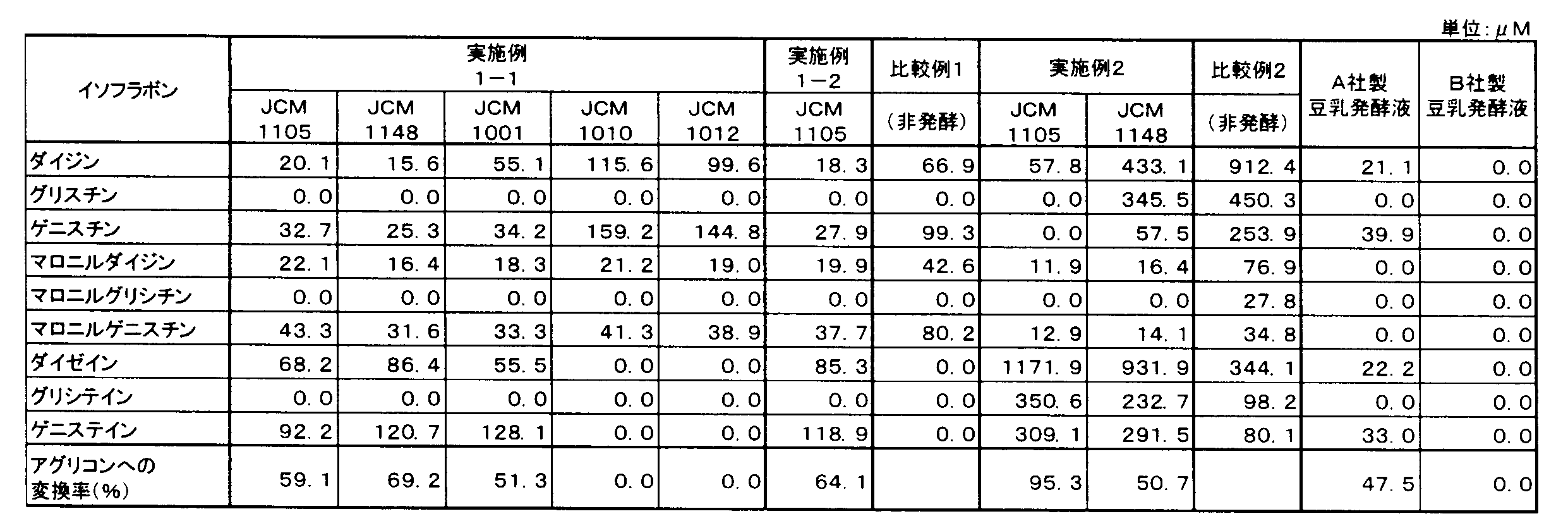
[分析例2]
(b)ポリアミンの定量分析
試料は全てPTFE 0.45μmフィルターで濾過した後、Novella-Rodriguez S.et al.,J.Agric.Food Chem.,48,5117-5123(2000)らの方法に基づいて、HPLCを用いてポリアミンを分析した[カラム:Nova Pack C18, 3.9 ×150mm,粒径4μm(Waters社製)]。
各実施例および比較例のサンプルならびに市販の豆乳発酵エキスの各種ポリアミンの濃度を表2に示す。
(b)ポリアミンの定量分析
試料は全てPTFE 0.45μmフィルターで濾過した後、Novella-Rodriguez S.et al.,J.Agric.Food Chem.,48,5117-5123(2000)らの方法に基づいて、HPLCを用いてポリアミンを分析した[カラム:Nova Pack C18, 3.9 ×150mm,粒径4μm(Waters社製)]。
各実施例および比較例のサンプルならびに市販の豆乳発酵エキスの各種ポリアミンの濃度を表2に示す。
実施例1-1にて調製した豆乳発酵エキスにおけるプトレッシン、スペルミジンおよびカダベリンの濃度は、比較例1の豆乳抽出エキス(非発酵)と比較して約2.0-2.5倍高いことがわかった。これらのポリアミンの濃度は、すでに市販されている豆乳発酵液よりも高いものであった。
また、実施例2にて調製した胚軸発酵エキスにおけるプトレッシン、カダベリンおよびスペルミジンの濃度は、比較例2の胚軸抽出エキス(非発酵)と比較して約1.4-3.0倍高いことがわかった。スペルミンの濃度については、測定限界以下またはプトレッシン、カダベリンおよびスペルミジンの濃度と比較して微量であった。胚軸発酵エキスのポリアミン含有量は、豆乳発酵エキスよりもさらに高いものであり、特に、非常に多量のスペルミジンおよびカダベリンを含有していた。

[分析例3]
(c)全窒素量、pH、グルコース、スクロースおよび乳酸含有量の分析
また、各実施例および比較例のサンプルならびに市販の豆乳発酵液の全窒素量、pH、グルコース、スクロースおよび乳酸含有量を表3に示した。それぞれの分析に用いた手法は以下のとおりである:
(c)全窒素量、pH、グルコース、スクロースおよび乳酸含有量の分析
また、各実施例および比較例のサンプルならびに市販の豆乳発酵液の全窒素量、pH、グルコース、スクロースおよび乳酸含有量を表3に示した。それぞれの分析に用いた手法は以下のとおりである:
豆乳発酵エキスおよび胚軸発酵エキスにおいては、豆乳抽出エキス(非発酵)および胚軸抽出エキス(非発酵)に比較して、pHの低下および乳酸生成が認められた。また、豆乳発酵エキスにおける全窒素量は0.040前後、胚軸発酵エキスにおける全窒素量は、0.110前後であった。豆乳発酵エキスおよび胚軸発酵エキスにおけるグルコースおよびスクロースの合計含有量は、市販の豆乳発酵液に比較して著しく低く、全て1.5mg/mL以下であった。
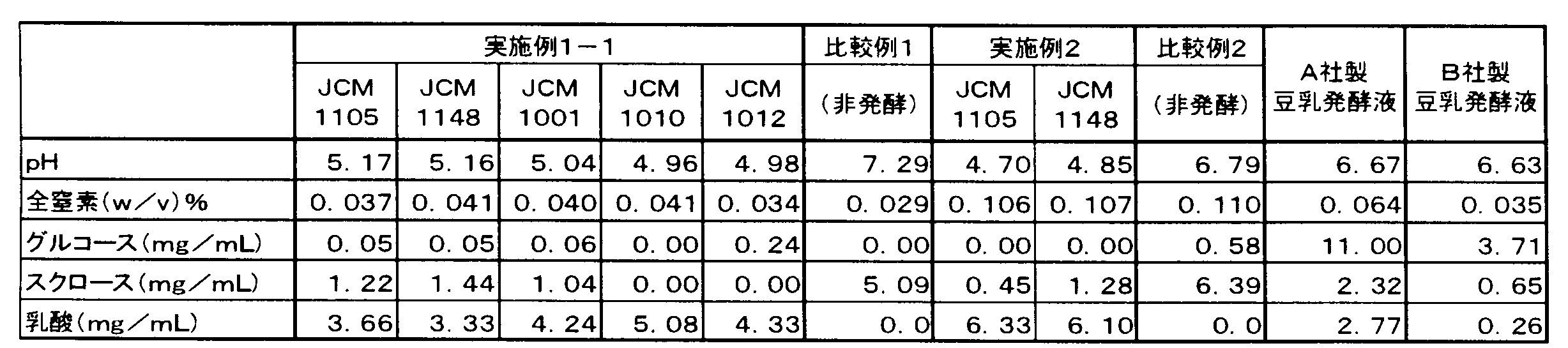
また、上記分析例1~3の結果をもとに、各実施例および比較例のサンプルならびに市販の豆乳発酵液について、イソフラボンまたはポリアミン量に対する糖質量を算出した結果を以下の表4および5に示す。なお、表4および5中の各成分の含有量は以下のとおり算出した:
(a1)イソフラボン化合物:表1に記載の9種のイソフラボンの合計量(μM)
(a2)イソフラボンアグリコン:表1に記載のダイゼイン、グリシテインおよびゲニステインの合計量(μM)
(b)ポリアミン:表2に記載のプトレッシン、スペルミジンおよびカダベリンの合計量(μM)
(c)糖質:表3に記載のグルコースおよびスクロースの含有量をμMに換算後の合計量(mg/mL)


(a1)イソフラボン化合物:表1に記載の9種のイソフラボンの合計量(μM)
(a2)イソフラボンアグリコン:表1に記載のダイゼイン、グリシテインおよびゲニステインの合計量(μM)
(b)ポリアミン:表2に記載のプトレッシン、スペルミジンおよびカダベリンの合計量(μM)
(c)糖質:表3に記載のグルコースおよびスクロースの含有量をμMに換算後の合計量(mg/mL)
〔試作品の効果効能評価〕
[試験例1]表皮角化細胞における発酵エキスの細胞賦活作用の評価
実施例1-1および実施例2で調製した発酵エキスのうち、L.delbrueckii subsp.lactis JCM 1105およびL.delbrueckii subsp.lactis JCM 1148を用いて調製した発酵エキスならびに比較例1および2で調製した抽出エキス(非発酵)について、以下に示す方法で表皮角化細胞における細胞賦活作用を評価した。試料は全て、1規定の水酸化ナトリウムを用いてpH7.4±0.05に調整した後、0.20μmフィルターで濾過滅菌を行った。
[試験例1]表皮角化細胞における発酵エキスの細胞賦活作用の評価
実施例1-1および実施例2で調製した発酵エキスのうち、L.delbrueckii subsp.lactis JCM 1105およびL.delbrueckii subsp.lactis JCM 1148を用いて調製した発酵エキスならびに比較例1および2で調製した抽出エキス(非発酵)について、以下に示す方法で表皮角化細胞における細胞賦活作用を評価した。試料は全て、1規定の水酸化ナトリウムを用いてpH7.4±0.05に調整した後、0.20μmフィルターで濾過滅菌を行った。
正常ヒト表皮角化細胞[クラボウ社製,製品名NHEK(NB)]を1ウェルあたり5×10³個となるように96ウェルマイクロプレートに播種し、37℃、二酸化炭素濃度5vol%中にて48時間培養した。播種培地にはHuMedia-KG2培地(クラボウ社製)を用いた。次いで、HuMedia-KB2(クラボウ社製)培地を用いて各濃度に調製した試料培養液に交換し、さらに48時間培養した。各試料培養液の最終エタノール濃度は1%になるように調製を行った。
培養終了後、Cell Counting Kit-8(同仁化学社製)を用い、生細胞数を測定した。評価には、試料培養液の他に、ポジティブコントロールとしてHuMedia-KG2を、各試料のブランクとして1%エタノール含有HuMedia-KB2を用いた。
表皮角化細胞における細胞賦活作用評価結果を、試料無添加のブランクにおける細胞賦活作用を100とした相対値[Index(%)]にて図1に示した。ブランクであるエタノール1%および比較例1の豆乳抽出エキス(非発酵)においては有意な表皮細胞賦活作用が認められなかったのに対し、実施例1-1の豆乳発酵エキスにおいては、L.delbrueckii subsp.lactis JCM 1105およびL.delbrueckii subsp.lactis JCM 1148で発酵したサンプルではともに124%と、有意な細胞賦活作用が認められた。また、実施例2の胚軸発酵エキスについても、L.delbrueckii subsp.lactis JCM 1105で発酵したサンプルでは152%、L.delbrueckii subsp.lactis JCM 1148で発酵したサンプルでは151%と、いずれも有意な細胞賦活作用が認められ、また、比較例2の胚軸抽出エキス(非発酵)と比較して高い作用を示し、発酵によって作用が増強する傾向が認められた。図1より明らかなように、本発明の発酵エキスは、正常ヒト表皮角化細胞に対して非常に強力な細胞賦活作用を有していることが確認された。
[試験例2]皮膚線維芽細胞における発酵エキスの細胞賦活作用の評価
試験例1と同様のサンプルについて、以下に示す方法で皮膚線維芽細胞における細胞賦活作用を評価した。試料は全て、1規定の水酸化ナトリウムを用いてpH7.4±0.05に調整した後、0.20μmフィルターで濾過滅菌を行った。
試験例1と同様のサンプルについて、以下に示す方法で皮膚線維芽細胞における細胞賦活作用を評価した。試料は全て、1規定の水酸化ナトリウムを用いてpH7.4±0.05に調整した後、0.20μmフィルターで濾過滅菌を行った。
正常ヒト皮膚線維芽細胞[クラボウ社製,製品名NHDF(NB)]を1ウェルあたり2×10³個となるように96ウェルマイクロプレートに播種し、37℃、二酸化炭素濃度5vol%中にて48時間培養した。播種培地には、10%FBS含有DMEM培地(ライフテクノロジー社製)を用いた。次いで、FBS不含DMEM培地を用いて各濃度に調製した試料培養液に交換し、さらに48時間培養した。各試料培養液の最終エタノール濃度は1%になるように調製を行った。
培養終了後、Cell Counting Kit-8(同仁化学社製)を用い、生細胞数を測定した。評価には、試料培養液の他に、ポジティブコントロールとして10%FBS含有DMEM培地を、各試料のブランクとして1%エタノール含有FBS不含DMEM培地を用いた。
皮膚線維芽細胞における細胞賦活作用評価結果を、試料無添加のブランクにおける細胞賦活作用を100とした相対値[Index(%)]にて図2に示した。ブランクであるエタノール1%および比較例1の豆乳抽出エキス(非発酵)においては皮膚線維芽細胞賦活作用が認められなかったのに対し、実施例1-1の豆乳発酵エキスにおいては、L.delbrueckii subsp.lactis JCM 1105で発酵したサンプルでは113%、L.delbrueckii subsp.lactis JCM 1148で発酵したサンプルでは117%と、いずれも有意な細胞賦活作用が認められ、発酵によって作用が増強する傾向が認められた。また、実施例2の胚軸発酵エキスについても、L.delbrueckii subsp.lactis JCM 1105で発酵したサンプルでは132%、L.delbrueckii subsp.lactis JCM 1148で発酵したサンプルでは137%と、強力な細胞賦活作用が認められ、胚軸発酵エキスの効果は、実施例1-1の豆乳発酵エキスと比較してより高いものであった。図2より明らかなように、本発明の発酵エキスは、正常ヒト皮膚線維芽細胞に対して非常に強力な細胞賦活作用を有していることが確認された。
[試験例3]発酵エキスの抗酸化作用(DPPHラジカル消去活性)の評価
試験例1と同様のサンプルおよび市販の豆乳発酵エキスについて、以下に示す方法で抗酸化作用(DPPHラジカル消去活性)を評価した。試料は全て、1規定の水酸化ナトリウムを用いてpH7.4±0.05に調整した後、0.20μmフィルターで濾過滅菌を行った。
試験例1と同様のサンプルおよび市販の豆乳発酵エキスについて、以下に示す方法で抗酸化作用(DPPHラジカル消去活性)を評価した。試料は全て、1規定の水酸化ナトリウムを用いてpH7.4±0.05に調整した後、0.20μmフィルターで濾過滅菌を行った。
96ウェルマイクロプレートに試料を40μLずつ添加した。そこへ、0.1Mリン酸緩衝液(pH5.5)および0.15mMの1,1-ジフェニル-2-ピクリルヒドラジル(DPPH)メタノール溶液をそれぞれ80μLずつ添加し、よく混合した後、室温、暗所にて1時間静置した。静置後、DPPHラジカルに由来する517nmの吸光度を測定した。試料無添加の場合の吸光度を(A)、試料を添加した場合の吸光度を(B)としたとき、DPPHラジカルの消去率は次式に定義される。
DPPHラジカル消去率={1-(B)/(A)}×100
抗酸化作用を有するポジティブコントロールとしてTroloxを、各試料のブランクとして50%エタノールを用いた。
DPPHラジカル消去率={1-(B)/(A)}×100
抗酸化作用を有するポジティブコントロールとしてTroloxを、各試料のブランクとして50%エタノールを用いた。
抗酸化作用(DPPHラジカル消去活性)評価結果を図3に示した。比較例1の豆乳抽出エキス(非発酵)におけるDPPHラジカル消去活性は54%であったのに対し、実施例1-1の豆乳発酵エキスにおいては、L.delbrueckii subsp.lactis JCM 1105で発酵したサンプルでは76%、L.delbrueckii subsp.lactis JCM 1148で発酵したサンプルでは69%と高いDPPHラジカル消去活性が認められ、発酵によって作用が増強する傾向が認められた。また、比較例2の胚軸抽出エキス(非発酵)におけるDPPHラジカル消去活性は77%であったのに対し、実施例2の胚軸発酵エキスにおいては、L.delbrueckii subsp.lactis JCM 1105で発酵したサンプルでは82%、L.delbrueckii subsp.lactis JCM 1148で発酵したサンプルでは80%と非常に高いDPPHラジカル消去活性が認められ、発酵によって作用が増強する傾向が認められた。また、胚軸発酵エキスの効果は、実施例1-1の豆乳発酵エキスに比較してより高いものであった。一方で、A社およびB社製の豆乳発酵エキスには、DPPHラジカル消去活性はほとんど認められなかった。図3より明らかなように、本発明の発酵エキスは、非常に強力な抗酸化作用を有していることが確認された。
同様の方法で、イソフラボン標品の抗酸化作用を評価した結果を図4に示した。実施例1-1のL.delbrueckii subsp.lactis JCM 1105およびL.delbrueckii subsp.lactis JCM 1148で発酵した豆乳発酵エキスに含まれるイソフラボンよりも多い200μMのイソフラボン標品においても、高いDPPHラジカル消去活性は認められなかった。このことから、発酵エキスのDPPHラジカル消去活性の大部分は、イソフラボン以外の有効成分によって発揮されていると考えられた。よって、本発明の発酵エキスは、抗酸化物質として広く知られているイソフラボンに加えて、イソフラボン以外の高い抗酸化能を有する成分を含有しており、非常に強力な抗酸化作用を発揮することが確認された。
[試験例4]発酵エキスの抗糖化作用の評価
試験例3と同様のサンプルについて、以下に示す方法で抗糖化作用を評価した。試料は全て、1規定の水酸化ナトリウムを用いてpH7.4±0.05に調整した後、0.20μmフィルターで濾過滅菌を行った。
試験例3と同様のサンプルについて、以下に示す方法で抗糖化作用を評価した。試料は全て、1規定の水酸化ナトリウムを用いてpH7.4±0.05に調整した後、0.20μmフィルターで濾過滅菌を行った。
1.5mLマイクロチューブに500μLの0.1M PBS、20μLの40mg/mLヒト血清アルブミン、100μLの2Mグルコース溶液、360μLの蒸留水および20μLの試料を添加し、よく混合した後60℃で40時間インキュベートした。同時に各反応ブランクとして、グルコース溶液の代わりに蒸留水を添加したものをインキュベートした。陽性コントロールとして試料の代わりに蒸留水を添加したものを、陽性コントロールブランクとして、陽性コントロールのグルコース溶液の代わりに蒸留水を添加したものをインキュベートした。インキュベート後、96ウェルプレートに試験溶液を分注し、励起波長370nm、蛍光波長440nmにて蛍光を測定した。試料添加の場合の蛍光を(A)、反応ブランクの蛍光を(B)、陽性コントロールの蛍光を(C)、陽性コントロールブランクの蛍光を(D)としたとき、AGEs生成阻害活性は次式に定義される。
AGEs生成阻害活性={1-(A-B)/(C-D)}×100
また、AGEs生成阻害活性を有するポジティブコントロールとして、アミノグアニジンを用いた。
AGEs生成阻害活性={1-(A-B)/(C-D)}×100
また、AGEs生成阻害活性を有するポジティブコントロールとして、アミノグアニジンを用いた。
発酵エキスの抗糖化作用評価結果を図5に示した。比較例1の豆乳抽出エキス(非発酵)におけるAGEs生成阻害活性は17%であったのに対し、実施例1-1の豆乳発酵エキスにおいては、L.delbrueckii subsp.lactis JCM 1105で発酵したサンプルでは30%、L.delbrueckii subsp.lactis JCM 1148で発酵したサンプルでは36%と高いAGEs生成阻害活性が認められ、発酵によって作用が増強する傾向が認められた。また、比較例2の胚軸抽出エキス(非発酵)におけるAGEs生成阻害活性は81%であったのに対し、実施例2の胚軸発酵エキスにおいては、L.delbrueckii subsp.lactis JCM 1105およびL.delbrueckii subsp.lactis JCM 1148で発酵したサンプルともに100%という非常に高いAGEs生成阻害活性が認められ、豆乳発酵エキスと同様に、発酵によって作用が増強する傾向が認められた。また、胚軸発酵エキスの効果は、実施例1-1の豆乳発酵エキスに比較してより高いものであった。一方で、A社およびB社製の豆乳発酵エキスには、AGEs生成阻害活性は認められなかった。図5より明らかなように、本発明の発酵エキスは、非常に強力な抗糖化作用を有していることが確認された。
同様に、イソフラボン標品の抗糖化作用を評価した結果を図6に示した。豆乳発酵エキスに含まれるダイジン、ダイゼイン、ゲニスチンおよびゲニステインについては、実施例1-1のL.delbrueckii subsp.lactis JCM 1105およびL.delbrueckii subsp.lactis JCM 1148で発酵した豆乳発酵エキスに含まれる濃度よりも高い200μMの標品においても、豆乳発酵エキスに匹敵する強力な抗糖化作用は認められなかった。このことから、豆乳発酵エキスの抗糖化作用は、イソフラボンの組み合わせによって相乗的な効果が発揮されているか、もしくはイソフラボン以外の有効成分によっても効果が発揮されている可能性が考えられた。また、グリシテイン200μM標品において非常に顕著なAGEs生成阻害作用が認められたことから、図5で示した胚軸発酵エキスの抗糖化作用は、主にグリシテインによって発揮されている可能性が考えられた。
[試験例5]豆乳発酵エキスの抗酸化作用(細胞保護作用)の評価
実施例1-1で調製した豆乳発酵エキスのうち、L.delbrueckii subsp.lactis JCM 1148を用いて調製した豆乳発酵エキスおよび比較例1で調製した豆乳抽出エキス(非発酵)について、以下に示す方法で抗酸化作用(細胞保護作用)を評価した。試料は全て、1規定の水酸化ナトリウムを用いてpH7.4±0.05に調整した後、0.20μmフィルターで濾過滅菌を行った。
実施例1-1で調製した豆乳発酵エキスのうち、L.delbrueckii subsp.lactis JCM 1148を用いて調製した豆乳発酵エキスおよび比較例1で調製した豆乳抽出エキス(非発酵)について、以下に示す方法で抗酸化作用(細胞保護作用)を評価した。試料は全て、1規定の水酸化ナトリウムを用いてpH7.4±0.05に調整した後、0.20μmフィルターで濾過滅菌を行った。
正常ヒト表皮角化細胞[クラボウ社製,製品名NHEK(NB)]を1ウェルあたり10×103個となるように96ウェルマイクロプレートに播種し、37℃、二酸化炭素濃度5vol%中にて24時間培養した。播種培地にはHuMedia-KG2培地(クラボウ社製)を用いた。次いで、HuMedia-KB2(クラボウ社製)培地を用いて各濃度に調製した試料培養液に交換し、さらに24時間培養した。各試料培養液の最終エタノール濃度は1%になるように調製を行った。試料培養液への交換から24時間後に、tert-butyl hydroperoxide(t-BHP)を最終濃度0.5mMとなるように曝露し、2時間培養した。次いで、各ウェルをHBSS(-)で十分に洗浄した後、HuMedia-KB2培地でさらに22時間培養を行った。
培養終了後、Cell Counting Kit-8(同仁化学社製)を用い、細胞生存率を算出した。評価には、試料培養液の他に、ポジティブコントロールとしてTroloxを、TroloxのブランクとしてDMSOを、各試料のブランクとして1%エタノール含有HuMedia-KB2培地を用いた。
抗酸化作用(細胞保護作用)評価結果を図7に示した。比較例1の豆乳抽出エキス(非発酵)における細胞生存率は14%であったのに対し、実施例1-1の豆乳発酵エキスにおいては48%と高い細胞生存率が認められ、発酵によって細胞保護作用が増強する傾向が認められた。図7より明らかなように、本発明の豆乳発酵エキスは、非常に強力な抗酸化作用を有していることが確認された。
[試験例6]豆乳発酵エキスの保湿作用の評価
実施例1-1で調製した豆乳発酵エキスのうち、L.delbrueckii subsp.lactis JCM 1148を用いて調製した豆乳発酵エキスについて、以下に示す方法でヒトin vivoにおける保湿作用を評価した。試料は全て、1規定の水酸化ナトリウムを用いてpH7.4±0.05に調整した後、0.20μmフィルターで濾過滅菌を行った。
実施例1-1で調製した豆乳発酵エキスのうち、L.delbrueckii subsp.lactis JCM 1148を用いて調製した豆乳発酵エキスについて、以下に示す方法でヒトin vivoにおける保湿作用を評価した。試料は全て、1規定の水酸化ナトリウムを用いてpH7.4±0.05に調整した後、0.20μmフィルターで濾過滅菌を行った。
豆乳発酵エキスを用いて、表6の処方に基づき2種類の化粧水を作製し、試験試料とした。
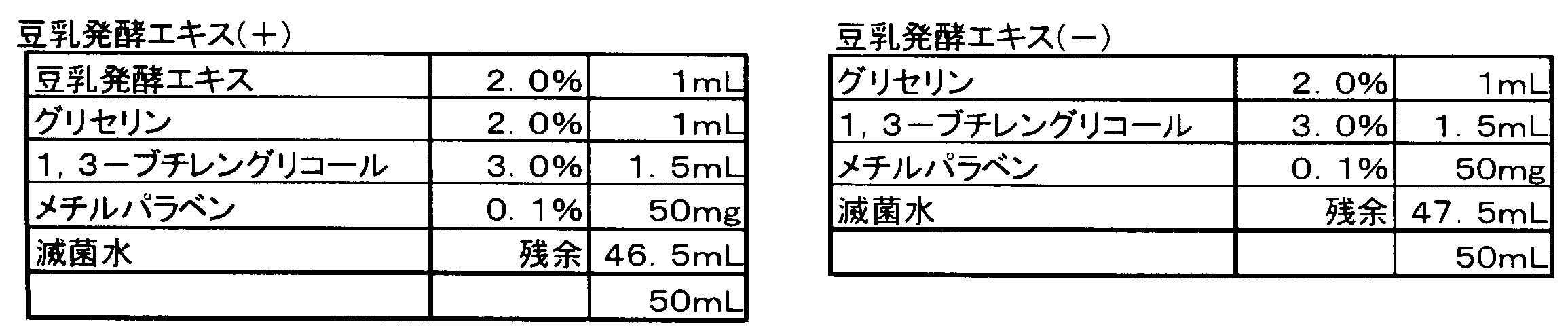
被験者の前腕内側部に3cm四方の試験部位を取り、試験試料を1日3回、3日間塗布した。試験試料の最終塗布から8~10時間後に、角層水分量および経皮水分蒸散量の測定を行った。角層水分量の測定には高感度角層膜厚・水分計ASA-MX3を、経皮水分蒸散量の測定にはバポスキャンAS-VT100RSを用いた(ともにアサヒバイオメッド社製)。
豆乳発酵エキスの保湿作用評価結果を図8および図9に示した。3名の被験者いずれにおいても、豆乳発酵エキス含有化粧水の塗布によって角層水分量が10%以上増加した。また、豆乳発酵エキス含有化粧水の塗布によって経皮水分蒸散量は10%以上減少する傾向が認められた。このことから、豆乳発酵エキスは角層水分量増加作用および角層バリア機能増強作用を有しており、ヒトin vivoにおいて保湿作用を発揮することが確認された。
本出願は、2012年12月11日に出願された日本国特許出願第2012-269928号、2013年7月1日に出願された日本国特許出願第2013-137901号、および2013年7月17日に出願された日本国特許出願第2013-148391号に基づく優先権を主張するものであり、この内容はここに参照として組み込まれる。
本発明によれば、イソフラボンアグリコンおよびポリアミンが高含有である豆乳発酵エキスを提供することができ、特に、糖質含量が少なく、表皮角化細胞および皮膚線維芽細胞に対する細胞賦活作用、抗酸化作用、抗糖化作用ならびに保湿作用などの抗老化作用を示す豆乳発酵エキスを提供することができる。また、本発明によれば、大豆胚軸を乳酸菌で発酵することによって得られる胚軸発酵エキスを提供することができ、特に、イソフラボンアグリコンおよびポリアミンが高含有であり、表皮角化細胞および皮膚線維芽細胞に対する細胞賦活作用、抗酸化作用ならびに抗糖化作用などの抗老化作用を有する胚軸発酵エキスを提供することができる。本発明の豆乳発酵エキスおよび胚軸発酵エキスは、化粧品、医薬品、飲食品の分野において、産業上の利用可能性を有する。
Claims (15)
- 次の(A)、(B)および(C)の工程:
(A)豆乳を乳酸菌で発酵する工程;
(B)工程(A)で得られた発酵物と有機溶媒を混合する工程;および
(C)工程(B)で生成する固形分を除去する工程;
を含む方法によって得られる豆乳発酵エキスであって、
次の(i)、(ii)および(iii):
(i)イソフラボン化合物の含有量が150μM以上;
(ii)工程(A)におけるイソフラボン配糖体からイソフラボンアグリコンへの変換率が50%以上;および
(iii)ポリアミンの含有量が20μM以上;
を満たす、豆乳発酵エキス。 - (iv)グルコースおよびスクロースの含有量の和が3.0mg/mL以下である、請求項1に記載の豆乳発酵エキス。
- 次の(v)および(vi):
(v)グルコースおよびスクロースの含有量の和(mg/mL):イソフラボン化合物の含有量(μM)が0.1以下;および
(vi)グルコースおよびスクロースの含有量の和(mg/mL):ポリアミンの含有量(μM)が0.3以下;
の1以上を満たす、請求項1または2に記載の豆乳発酵エキス。 - 工程(A)における乳酸菌がLactobacillus delbrueckiiである、請求項1~3のいずれか1項に記載の豆乳発酵エキス。
- 工程(A)に先立って、(P)前培養を豆乳で行う工程を含む方法によって得られる、請求項1~4のいずれか1項に記載の豆乳発酵エキス。
- 次の(A’)、(B’)および(C’)の工程:
(A’)大豆胚軸を乳酸菌で発酵する工程;
(B’)工程(A’)で得られた発酵物と有機溶媒を混合する工程;および
(C’)工程(B’)で生成する固形分を除去する工程;
を含む方法によって得られる胚軸発酵エキス。 - グリシテインを100μM以上含有する、請求項6に記載の胚軸発酵エキス。
- 請求項1~7のいずれか1項に記載の発酵エキスを含む、抗老化剤。
- 表皮角化細胞賦活作用、皮膚線維芽細胞賦活作用、抗酸化作用、抗糖化作用および保湿作用のいずれか1以上の作用を有する、請求項8に記載の抗老化剤。
- 請求項1~7のいずれか1項に記載の発酵エキスを含む、化粧品、皮膚外用剤、医薬品または飲食品。
- 豆乳を乳酸菌で発酵し、次いでポリアミンを抽出することを特徴とする、ポリアミンの製造方法。
- 大豆胚軸を乳酸菌で発酵し、次いでポリアミンを抽出することを特徴とする、ポリアミンの製造方法。
- 大豆胚軸を乳酸菌Lactobacillus delbrueckiiで発酵する工程を含む、イソフラボンアグリコンまたはポリアミンの製造方法。
- 豆乳を、L.delbrueckii subsp.lactis JCM 1105、L.delbrueckii subsp.lactis JCM 1148、L.delbrueckii subsp.bulgaricus JCM 1001、L.delbrueckii subsp.lactis JCM 1010およびL.delbrueckii subsp.delbrueckii JCM 1012から選択される乳酸菌で発酵して得られる豆乳発酵物。
- 大豆胚軸を乳酸菌Lactobacillus delbrueckiiで発酵して得られる、胚軸発酵物。
Priority Applications (1)
| Application Number | Priority Date | Filing Date | Title |
|---|---|---|---|
| JP2014552005A JP6322580B2 (ja) | 2012-12-11 | 2013-12-04 | 豆乳発酵エキスおよび胚軸発酵エキス |
Applications Claiming Priority (6)
| Application Number | Priority Date | Filing Date | Title |
|---|---|---|---|
| JP2012269928 | 2012-12-11 | ||
| JP2012-269928 | 2012-12-11 | ||
| JP2013-137901 | 2013-07-01 | ||
| JP2013137901 | 2013-07-01 | ||
| JP2013148391 | 2013-07-17 | ||
| JP2013-148391 | 2013-07-17 |
Publications (1)
| Publication Number | Publication Date |
|---|---|
| WO2014091988A1 true WO2014091988A1 (ja) | 2014-06-19 |
Family
ID=50934280
Family Applications (1)
| Application Number | Title | Priority Date | Filing Date |
|---|---|---|---|
| PCT/JP2013/082603 Ceased WO2014091988A1 (ja) | 2012-12-11 | 2013-12-04 | 豆乳発酵エキスおよび胚軸発酵エキス |
Country Status (2)
| Country | Link |
|---|---|
| JP (1) | JP6322580B2 (ja) |
| WO (1) | WO2014091988A1 (ja) |
Cited By (13)
| Publication number | Priority date | Publication date | Assignee | Title |
|---|---|---|---|---|
| JP2015209423A (ja) * | 2014-04-30 | 2015-11-24 | 学校法人同志社 | イソフラボンアグリコン又はイソフラバノンアグリコンを含有する抗糖化剤 |
| JP2016123395A (ja) * | 2015-01-08 | 2016-07-11 | 学校法人加計学園 | テンペ発酵物の製造方法 |
| JP2016169206A (ja) * | 2015-03-09 | 2016-09-23 | 御木本製薬株式会社 | 皮膚外用剤、しわ改善促進剤、たるみ改善促進剤、マトリックスメタロプロテアーゼ遺伝子発現阻害剤。 |
| JP2017155029A (ja) * | 2016-03-02 | 2017-09-07 | 株式会社ピカソ美化学研究所 | 豆乳発酵物 |
| JP2018186751A (ja) * | 2017-05-02 | 2018-11-29 | 有限会社花立山農業研究所 | 大豆発酵食品、及び大豆発酵食品の製造方法 |
| WO2020032100A1 (ja) * | 2018-08-08 | 2020-02-13 | 株式会社明治 | フィトケミカル吸収促進用組成物 |
| JP2020100574A (ja) * | 2018-12-20 | 2020-07-02 | 株式会社光英科学研究所 | 皮膚用保湿機能剤 |
| KR20200099308A (ko) * | 2019-02-14 | 2020-08-24 | 강원대학교산학협력단 | 대두 배아를 이용한 폴리아민 고함유 발효물의 제조 방법 |
| JP2020203871A (ja) * | 2019-06-12 | 2020-12-24 | 学校法人順天堂 | アクアポリン発現促進剤及び角化マーカー発現促進剤 |
| JP2021075504A (ja) * | 2019-11-13 | 2021-05-20 | 東洋紡株式会社 | 抗糖化剤 |
| JP2021185818A (ja) * | 2020-05-29 | 2021-12-13 | ポーラ化成工業株式会社 | スクリーニング方法 |
| JP2022174615A (ja) * | 2021-05-11 | 2022-11-24 | スノーデン株式会社 | トル様受容体2結合物質の製造方法 |
| JP2022178026A (ja) * | 2021-05-19 | 2022-12-02 | 国立研究開発法人農業・食品産業技術総合研究機構 | プトレシン生産性乳酸菌 |
Families Citing this family (1)
| Publication number | Priority date | Publication date | Assignee | Title |
|---|---|---|---|---|
| KR102489114B1 (ko) * | 2022-03-29 | 2023-01-18 | 주식회사 고결 | 발효 두유를 포함하는 화장료 조성물 및 이의 제조방법 |
Citations (4)
| Publication number | Priority date | Publication date | Assignee | Title |
|---|---|---|---|---|
| JP2003081855A (ja) * | 2002-08-19 | 2003-03-19 | Yakult Honsha Co Ltd | 脂質代謝改善剤およびそれを含有する食品 |
| JP2006022050A (ja) * | 2004-07-08 | 2006-01-26 | Kanebo Cosmetics Inc | 化粧料 |
| WO2008153158A1 (ja) * | 2007-06-13 | 2008-12-18 | Otsuka Pharmaceutical Co., Ltd. | エクオール含有抽出物及びその製造方法、エクオール抽出方法、並びにエクオールを含む食品 |
| WO2013051483A1 (ja) * | 2011-10-04 | 2013-04-11 | 東洋紡株式会社 | 植物からポリアミン組成物を製造する方法 |
Family Cites Families (3)
| Publication number | Priority date | Publication date | Assignee | Title |
|---|---|---|---|---|
| JP4935173B2 (ja) * | 2006-04-26 | 2012-05-23 | 東洋紡績株式会社 | 植物からのポリアミン組成物の調製方法 |
| JP5620650B2 (ja) * | 2009-05-13 | 2014-11-05 | 株式会社ロッテ | ポリアミンを含有する飲食品の製造方法 |
| IT1405780B1 (it) * | 2010-07-12 | 2014-01-24 | Giuliani Spa | Miscela arricchita di isoflavoni-agliconi, equolo e lunasina a base di soia fermentata, procedimento per la sua preparazione e relativi usi in campo alimentare, medico e cosmetico. |
-
2013
- 2013-12-04 WO PCT/JP2013/082603 patent/WO2014091988A1/ja not_active Ceased
- 2013-12-04 JP JP2014552005A patent/JP6322580B2/ja active Active
Patent Citations (4)
| Publication number | Priority date | Publication date | Assignee | Title |
|---|---|---|---|---|
| JP2003081855A (ja) * | 2002-08-19 | 2003-03-19 | Yakult Honsha Co Ltd | 脂質代謝改善剤およびそれを含有する食品 |
| JP2006022050A (ja) * | 2004-07-08 | 2006-01-26 | Kanebo Cosmetics Inc | 化粧料 |
| WO2008153158A1 (ja) * | 2007-06-13 | 2008-12-18 | Otsuka Pharmaceutical Co., Ltd. | エクオール含有抽出物及びその製造方法、エクオール抽出方法、並びにエクオールを含む食品 |
| WO2013051483A1 (ja) * | 2011-10-04 | 2013-04-11 | 東洋紡株式会社 | 植物からポリアミン組成物を製造する方法 |
Non-Patent Citations (4)
| Title |
|---|
| MAKI KOBAYASHI ET AL.: "Nyusan Hakko Tonyu Sesshuji no Rat no Kecchu Isoflavone Polyamine Nodo to Ensho Yokusei Sayo", THE JAPANESE SOCIETY OF NUTRITION AND FOOD SCIENCE TAIKAI KOEN YOSHISHU, vol. 66, no. 2E-15P, April 2012 (2012-04-01), pages 102 * |
| NAOHIRO TAKAGI ET AL.: "Effect of Okara and Soymilk Mixture Fermented with Lactic Acid Bacteria on Short Chain Fatty Acid and Polyamine Concentration in Rat Cecum", JOURNAL OF THE JAPANESE SOCIETY FOR FOOD SCIENCE AND TECHNOLOGY, vol. 56, no. 11, 2009, pages 585 - 590 * |
| TOMEN CORP.: "Hadashitsu Kairyozai 'Shokubutsusei Nyusankin Hakkoeki", FRAGRANCE JOURNAL, vol. 32, no. 4, 2004, pages 129 - 130 * |
| TONYU HAKKOEKI: "The Japanese Standards of Quasi-Drug Ingredients 2006", NEN 6 GATSU, 2006, pages 1124 * |
Cited By (24)
| Publication number | Priority date | Publication date | Assignee | Title |
|---|---|---|---|---|
| JP2015209423A (ja) * | 2014-04-30 | 2015-11-24 | 学校法人同志社 | イソフラボンアグリコン又はイソフラバノンアグリコンを含有する抗糖化剤 |
| JP2016123395A (ja) * | 2015-01-08 | 2016-07-11 | 学校法人加計学園 | テンペ発酵物の製造方法 |
| JP2016169206A (ja) * | 2015-03-09 | 2016-09-23 | 御木本製薬株式会社 | 皮膚外用剤、しわ改善促進剤、たるみ改善促進剤、マトリックスメタロプロテアーゼ遺伝子発現阻害剤。 |
| JP2017155029A (ja) * | 2016-03-02 | 2017-09-07 | 株式会社ピカソ美化学研究所 | 豆乳発酵物 |
| JP2018186751A (ja) * | 2017-05-02 | 2018-11-29 | 有限会社花立山農業研究所 | 大豆発酵食品、及び大豆発酵食品の製造方法 |
| US20210299194A1 (en) * | 2018-08-08 | 2021-09-30 | Meiji Co., Ltd. | Composition for promoting absorption of phytochemicals |
| WO2020032100A1 (ja) * | 2018-08-08 | 2020-02-13 | 株式会社明治 | フィトケミカル吸収促進用組成物 |
| CN112804886B (zh) * | 2018-08-08 | 2024-02-06 | 株式会社明治 | 植物化学物质吸收促进用组合物 |
| US11684644B2 (en) * | 2018-08-08 | 2023-06-27 | Meiji Co., Ltd. | Composition for promoting absorption of phytochemicals |
| CN112804886A (zh) * | 2018-08-08 | 2021-05-14 | 株式会社明治 | 植物化学物质吸收促进用组合物 |
| JP2020100574A (ja) * | 2018-12-20 | 2020-07-02 | 株式会社光英科学研究所 | 皮膚用保湿機能剤 |
| JP7179328B2 (ja) | 2018-12-20 | 2022-11-29 | 株式会社光英科学研究所 | 経口投与用の皮膚用保湿機能剤 |
| KR102288725B1 (ko) | 2019-02-14 | 2021-08-11 | 강원대학교산학협력단 | 대두 배아를 이용한 폴리아민 고함유 발효물의 제조 방법 |
| KR20200099308A (ko) * | 2019-02-14 | 2020-08-24 | 강원대학교산학협력단 | 대두 배아를 이용한 폴리아민 고함유 발효물의 제조 방법 |
| JP2020203871A (ja) * | 2019-06-12 | 2020-12-24 | 学校法人順天堂 | アクアポリン発現促進剤及び角化マーカー発現促進剤 |
| JP7591756B2 (ja) | 2019-06-12 | 2024-11-29 | 学校法人順天堂 | アクアポリン発現促進剤及び角化マーカー発現促進剤 |
| JP7476517B2 (ja) | 2019-11-13 | 2024-05-01 | 東洋紡株式会社 | 抗糖化剤 |
| JP2024010064A (ja) * | 2019-11-13 | 2024-01-23 | 東洋紡株式会社 | 抗糖化剤 |
| JP2021075504A (ja) * | 2019-11-13 | 2021-05-20 | 東洋紡株式会社 | 抗糖化剤 |
| JP2021185818A (ja) * | 2020-05-29 | 2021-12-13 | ポーラ化成工業株式会社 | スクリーニング方法 |
| JP2022174615A (ja) * | 2021-05-11 | 2022-11-24 | スノーデン株式会社 | トル様受容体2結合物質の製造方法 |
| JP7723917B2 (ja) | 2021-05-11 | 2025-08-15 | スノーデン株式会社 | トル様受容体2結合物質の製造方法 |
| JP2022178026A (ja) * | 2021-05-19 | 2022-12-02 | 国立研究開発法人農業・食品産業技術総合研究機構 | プトレシン生産性乳酸菌 |
| JP7670255B2 (ja) | 2021-05-19 | 2025-04-30 | 国立研究開発法人農業・食品産業技術総合研究機構 | プトレシン生産性乳酸菌 |
Also Published As
| Publication number | Publication date |
|---|---|
| JPWO2014091988A1 (ja) | 2017-01-12 |
| JP6322580B2 (ja) | 2018-05-09 |
Similar Documents
| Publication | Publication Date | Title |
|---|---|---|
| JP6322580B2 (ja) | 豆乳発酵エキスおよび胚軸発酵エキス | |
| EP2474237B1 (en) | Equol-containing fermentation product of soybean embryonic axis, and method for production thereof | |
| KR101440469B1 (ko) | 복합 균주를 이용한 산삼배양근 발효물의 제조방법 및 상기 발효물을 함유한 기능성 화장료 조성물 | |
| CN110464003A (zh) | 一种益生菌固态发酵的抗氧化功能性食品及其制备方法 | |
| KR101686112B1 (ko) | 락토바실러스 배양용 배지 조성물, 이를 포함하는 인삼 열매 발효 추출물 및 피부상태 개선용 화장료 조성물 | |
| JP7587562B2 (ja) | バリア機能性組成物及び経口用組成物 | |
| JP2023171950A (ja) | 抗老化剤、抗酸化剤、抗炎症剤、及び美白剤、並びに、化粧料 | |
| KR100974627B1 (ko) | 스피루리나 발효 추출물 및 그 제조방법 | |
| JP2015074623A (ja) | コラーゲン産生作用を有する新規な誘導体及びその製造方法 | |
| KR102720490B1 (ko) | 신규 바실러스 서브틸리스 균주 및 이의 용도 | |
| KR101204875B1 (ko) | 꾸지뽕 발효산물을 함유하는 기능성 소스 및 그 제조방법 | |
| TWI776836B (zh) | 蛋白質l-異天冬胺酸甲酯轉移酶活化用組成物 | |
| TWI737086B (zh) | 用於提升植物中效性成分含量的發酵方法 | |
| KR101806992B1 (ko) | 발효홍삼 추출물을 함유하는 피부세포 사멸방지용 화장료 조성물 | |
| KR102119524B1 (ko) | 새싹삼 잎, 줄기 발효액 또는 발효 추출액을 유효성분으로 하는 피부 주름개선용 화장료 조성물 및 그의 제조방법 | |
| JP6388201B2 (ja) | サイトケラチン増加作用を呈するカロチノイド誘導体 | |
| CN113876833A (zh) | 白桑葚发酵物及其制备方法与用途 | |
| CN114949039B (zh) | 植物发酵物及其用于制备减脂的组合物的用途 | |
| KR20160117035A (ko) | 두피에의 영양분 공급, 흡수 및 이용에 효과적인 백모 개선용 조성물 | |
| CN113855765A (zh) | 糯米发酵提取物及其抗衰老应用 | |
| KR102861184B1 (ko) | 약콩효소발효물의 제조방법 및 상기 약콩발효물을 포함하는 항산화용 조성물 | |
| KR102691022B1 (ko) | 밀씨 유래 다당체, 이의 제조방법 및 이를 포함하는 항노화 화장료 조성물 | |
| JP5312731B2 (ja) | 皮膚外用剤 | |
| TWI916326B (zh) | 抗老化劑以及化妝品 | |
| KR102014960B1 (ko) | 콩뿌리 추출물을 함유하는 항산화용 조성물 |
Legal Events
| Date | Code | Title | Description |
|---|---|---|---|
| 121 | Ep: the epo has been informed by wipo that ep was designated in this application |
Ref document number: 13863010 Country of ref document: EP Kind code of ref document: A1 |
|
| ENP | Entry into the national phase |
Ref document number: 2014552005 Country of ref document: JP Kind code of ref document: A |
|
| NENP | Non-entry into the national phase |
Ref country code: DE |
|
| 122 | Ep: pct application non-entry in european phase |
Ref document number: 13863010 Country of ref document: EP Kind code of ref document: A1 |