WO2014084267A1 - アゾ系化合物、アゾ系化合物を含むインク、該インクを含むディスプレイ並びに電子ペーパー - Google Patents
アゾ系化合物、アゾ系化合物を含むインク、該インクを含むディスプレイ並びに電子ペーパー Download PDFInfo
- Publication number
- WO2014084267A1 WO2014084267A1 PCT/JP2013/081931 JP2013081931W WO2014084267A1 WO 2014084267 A1 WO2014084267 A1 WO 2014084267A1 JP 2013081931 W JP2013081931 W JP 2013081931W WO 2014084267 A1 WO2014084267 A1 WO 2014084267A1
- Authority
- WO
- WIPO (PCT)
- Prior art keywords
- substituent
- group
- general formula
- carbon atoms
- less
- Prior art date
- Legal status (The legal status is an assumption and is not a legal conclusion. Google has not performed a legal analysis and makes no representation as to the accuracy of the status listed.)
- Ceased
Links
Classifications
-
- C—CHEMISTRY; METALLURGY
- C09—DYES; PAINTS; POLISHES; NATURAL RESINS; ADHESIVES; COMPOSITIONS NOT OTHERWISE PROVIDED FOR; APPLICATIONS OF MATERIALS NOT OTHERWISE PROVIDED FOR
- C09D—COATING COMPOSITIONS, e.g. PAINTS, VARNISHES OR LACQUERS; FILLING PASTES; CHEMICAL PAINT OR INK REMOVERS; INKS; CORRECTING FLUIDS; WOODSTAINS; PASTES OR SOLIDS FOR COLOURING OR PRINTING; USE OF MATERIALS THEREFOR
- C09D11/00—Inks
- C09D11/52—Electrically conductive inks
-
- C—CHEMISTRY; METALLURGY
- C09—DYES; PAINTS; POLISHES; NATURAL RESINS; ADHESIVES; COMPOSITIONS NOT OTHERWISE PROVIDED FOR; APPLICATIONS OF MATERIALS NOT OTHERWISE PROVIDED FOR
- C09D—COATING COMPOSITIONS, e.g. PAINTS, VARNISHES OR LACQUERS; FILLING PASTES; CHEMICAL PAINT OR INK REMOVERS; INKS; CORRECTING FLUIDS; WOODSTAINS; PASTES OR SOLIDS FOR COLOURING OR PRINTING; USE OF MATERIALS THEREFOR
- C09D11/00—Inks
- C09D11/02—Printing inks
- C09D11/03—Printing inks characterised by features other than the chemical nature of the binder
-
- C—CHEMISTRY; METALLURGY
- C07—ORGANIC CHEMISTRY
- C07D—HETEROCYCLIC COMPOUNDS
- C07D333/00—Heterocyclic compounds containing five-membered rings having one sulfur atom as the only ring hetero atom
- C07D333/02—Heterocyclic compounds containing five-membered rings having one sulfur atom as the only ring hetero atom not condensed with other rings
- C07D333/04—Heterocyclic compounds containing five-membered rings having one sulfur atom as the only ring hetero atom not condensed with other rings not substituted on the ring sulphur atom
- C07D333/26—Heterocyclic compounds containing five-membered rings having one sulfur atom as the only ring hetero atom not condensed with other rings not substituted on the ring sulphur atom with hetero atoms or with carbon atoms having three bonds to hetero atoms with at the most one bond to halogen, e.g. ester or nitrile radicals, directly attached to ring carbon atoms
- C07D333/38—Carbon atoms having three bonds to hetero atoms with at the most one bond to halogen, e.g. ester or nitrile radicals
-
- C—CHEMISTRY; METALLURGY
- C09—DYES; PAINTS; POLISHES; NATURAL RESINS; ADHESIVES; COMPOSITIONS NOT OTHERWISE PROVIDED FOR; APPLICATIONS OF MATERIALS NOT OTHERWISE PROVIDED FOR
- C09B—ORGANIC DYES OR CLOSELY-RELATED COMPOUNDS FOR PRODUCING DYES, e.g. PIGMENTS; MORDANTS; LAKES
- C09B31/00—Disazo and polyazo dyes of the type A->B->C, A->B->C->D, or the like, prepared by diazotising and coupling
- C09B31/02—Disazo dyes
- C09B31/04—Disazo dyes from a coupling component "C" containing a directive amino group
- C09B31/043—Amino-benzenes
-
- C—CHEMISTRY; METALLURGY
- C09—DYES; PAINTS; POLISHES; NATURAL RESINS; ADHESIVES; COMPOSITIONS NOT OTHERWISE PROVIDED FOR; APPLICATIONS OF MATERIALS NOT OTHERWISE PROVIDED FOR
- C09B—ORGANIC DYES OR CLOSELY-RELATED COMPOUNDS FOR PRODUCING DYES, e.g. PIGMENTS; MORDANTS; LAKES
- C09B31/00—Disazo and polyazo dyes of the type A->B->C, A->B->C->D, or the like, prepared by diazotising and coupling
- C09B31/02—Disazo dyes
- C09B31/12—Disazo dyes from other coupling components "C"
- C09B31/14—Heterocyclic components
- C09B31/143—1,2-Diazoles
-
- C—CHEMISTRY; METALLURGY
- C09—DYES; PAINTS; POLISHES; NATURAL RESINS; ADHESIVES; COMPOSITIONS NOT OTHERWISE PROVIDED FOR; APPLICATIONS OF MATERIALS NOT OTHERWISE PROVIDED FOR
- C09B—ORGANIC DYES OR CLOSELY-RELATED COMPOUNDS FOR PRODUCING DYES, e.g. PIGMENTS; MORDANTS; LAKES
- C09B35/00—Disazo and polyazo dyes of the type A<-D->B prepared by diazotising and coupling
- C09B35/02—Disazo dyes
- C09B35/037—Disazo dyes characterised by two coupling components of different types
-
- C—CHEMISTRY; METALLURGY
- C09—DYES; PAINTS; POLISHES; NATURAL RESINS; ADHESIVES; COMPOSITIONS NOT OTHERWISE PROVIDED FOR; APPLICATIONS OF MATERIALS NOT OTHERWISE PROVIDED FOR
- C09D—COATING COMPOSITIONS, e.g. PAINTS, VARNISHES OR LACQUERS; FILLING PASTES; CHEMICAL PAINT OR INK REMOVERS; INKS; CORRECTING FLUIDS; WOODSTAINS; PASTES OR SOLIDS FOR COLOURING OR PRINTING; USE OF MATERIALS THEREFOR
- C09D11/00—Inks
- C09D11/02—Printing inks
- C09D11/03—Printing inks characterised by features other than the chemical nature of the binder
- C09D11/033—Printing inks characterised by features other than the chemical nature of the binder characterised by the solvent
-
- C—CHEMISTRY; METALLURGY
- C09—DYES; PAINTS; POLISHES; NATURAL RESINS; ADHESIVES; COMPOSITIONS NOT OTHERWISE PROVIDED FOR; APPLICATIONS OF MATERIALS NOT OTHERWISE PROVIDED FOR
- C09D—COATING COMPOSITIONS, e.g. PAINTS, VARNISHES OR LACQUERS; FILLING PASTES; CHEMICAL PAINT OR INK REMOVERS; INKS; CORRECTING FLUIDS; WOODSTAINS; PASTES OR SOLIDS FOR COLOURING OR PRINTING; USE OF MATERIALS THEREFOR
- C09D11/00—Inks
- C09D11/02—Printing inks
- C09D11/03—Printing inks characterised by features other than the chemical nature of the binder
- C09D11/037—Printing inks characterised by features other than the chemical nature of the binder characterised by the pigment
-
- G—PHYSICS
- G02—OPTICS
- G02B—OPTICAL ELEMENTS, SYSTEMS OR APPARATUS
- G02B26/00—Optical devices or arrangements for the control of light using movable or deformable optical elements
- G02B26/02—Optical devices or arrangements for the control of light using movable or deformable optical elements for controlling the intensity of light
-
- G—PHYSICS
- G02—OPTICS
- G02F—OPTICAL DEVICES OR ARRANGEMENTS FOR THE CONTROL OF LIGHT BY MODIFICATION OF THE OPTICAL PROPERTIES OF THE MEDIA OF THE ELEMENTS INVOLVED THEREIN; NON-LINEAR OPTICS; FREQUENCY-CHANGING OF LIGHT; OPTICAL LOGIC ELEMENTS; OPTICAL ANALOGUE/DIGITAL CONVERTERS
- G02F1/00—Devices or arrangements for the control of the intensity, colour, phase, polarisation or direction of light arriving from an independent light source, e.g. switching, gating or modulating; Non-linear optics
- G02F1/01—Devices or arrangements for the control of the intensity, colour, phase, polarisation or direction of light arriving from an independent light source, e.g. switching, gating or modulating; Non-linear optics for the control of the intensity, phase, polarisation or colour
- G02F1/17—Devices or arrangements for the control of the intensity, colour, phase, polarisation or direction of light arriving from an independent light source, e.g. switching, gating or modulating; Non-linear optics for the control of the intensity, phase, polarisation or colour based on variable-absorption elements not provided for in groups G02F1/015 - G02F1/169
-
- G—PHYSICS
- G02—OPTICS
- G02B—OPTICAL ELEMENTS, SYSTEMS OR APPARATUS
- G02B26/00—Optical devices or arrangements for the control of light using movable or deformable optical elements
- G02B26/004—Optical devices or arrangements for the control of light using movable or deformable optical elements based on a displacement or a deformation of a fluid
- G02B26/005—Optical devices or arrangements for the control of light using movable or deformable optical elements based on a displacement or a deformation of a fluid based on electrowetting
-
- G—PHYSICS
- G02—OPTICS
- G02F—OPTICAL DEVICES OR ARRANGEMENTS FOR THE CONTROL OF LIGHT BY MODIFICATION OF THE OPTICAL PROPERTIES OF THE MEDIA OF THE ELEMENTS INVOLVED THEREIN; NON-LINEAR OPTICS; FREQUENCY-CHANGING OF LIGHT; OPTICAL LOGIC ELEMENTS; OPTICAL ANALOGUE/DIGITAL CONVERTERS
- G02F1/00—Devices or arrangements for the control of the intensity, colour, phase, polarisation or direction of light arriving from an independent light source, e.g. switching, gating or modulating; Non-linear optics
- G02F1/01—Devices or arrangements for the control of the intensity, colour, phase, polarisation or direction of light arriving from an independent light source, e.g. switching, gating or modulating; Non-linear optics for the control of the intensity, phase, polarisation or colour
- G02F1/165—Devices or arrangements for the control of the intensity, colour, phase, polarisation or direction of light arriving from an independent light source, e.g. switching, gating or modulating; Non-linear optics for the control of the intensity, phase, polarisation or colour based on translational movement of particles in a fluid under the influence of an applied field
- G02F1/1675—Constructional details
- G02F2001/1678—Constructional details characterised by the composition or particle type
Definitions
- the present invention relates to an azo compound and an ink containing an azo compound, and more particularly to an azo compound having a specific chemical structure, and an ink useful for a display material or an optical shutter containing an azo compound and a solvent. .
- the electrowetting display has a plurality of pixels filled with two phases of an aqueous medium and oil-based colored ink on a substrate, and the affinity of the aqueous medium / substrate interface is controlled by on-off of voltage application for each pixel.
- This is an image display format performed by developing / aggregating oil-based colored ink on a substrate (Non-patent Document 1).
- a dye used for an electrowetting display is required to have high solubility in a low polarity solvent (Patent Documents 1 and 2).
- Patent Documents 3 to 6 show polyester fiber dye pigments using disazo compounds having excellent fastness properties.
- Patent Document 7 discloses a cyan dye used for a thermal transfer sheet that easily undergoes at least one of sublimation or thermal diffusion, and an ink composition using the dye, and includes a medium for ink preparation. It has been.
- Patent Document 2 does not specifically describe a dye having high solubility in a low polarity solvent and a high extinction coefficient.
- Patent Documents 3 to 6 describe dye pigments
- Patent Document 7 describes a pigment and a medium for ink preparation.
- the solubility of a pigment in a solvent in particular, The solubility in a low polarity solvent having a relative dielectric constant of a specific value or less has not been studied.
- an azo compound having a certain chemical structure has excellent solubility in a solvent, and also has a high molar extinction coefficient and high light resistance. Further, it was found that by using a specific solvent and the azo compound, the hue and driving characteristics are excellent. The present invention has been accomplished based on these findings.
- the gist of the present invention is as follows [1] to [15].
- [1] A solvent having a relative dielectric constant of 3 or less measured at a frequency of 1 kHz and a temperature of 22 ° C., and a solubility in water at 25 ° C. of 20 mg / L or less, and an azo represented by the following general formula (1) Ink containing a compound.
- R 1 represents an optional substituent
- R 2 represents a hydrogen atom or an arbitrary substituent
- R 3 and R 4 each independently represents an alkyl group which may have a substituent
- Ring A represents the general formula (2) or (3)
- X represents a nitrogen atom or a methine group which may have a substituent
- X represents a methine group having a cyano group or an alkoxycarbonyl group which may have a substituent
- the ring A is formula (3), when R 2 is hydrogen atom, X represents a methine group having a alkoxycarbonyl group which may have a substituent, n represents an integer of 0 to 5.
- R 5 represents a hydrogen atom or an arbitrary substituent.
- R 6 and R 7 each independently represents a hydrogen atom or an arbitrary substituent.
- the solvent includes at least one selected from hydrocarbon solvents, silicone oils, and fluorocarbon solvents.
- R 101 and R 102 each independently represent a hydrogen atom or an optional substituent; D 3 and D 4 each independently represent an arbitrary substituent, e represents an integer of 0 to 5, and when e is 2 or more, D 3 present in 2 or more in one molecule may be the same or different, g represents an integer of 0 to 4, and when g is 2 or more, D 4 present in 2 or more in one molecule may be the same or different. ]
- R 201 , R 202 , R 203 , R 204 , R 205 , R 206 , R 207 and R 208 each independently represent a hydrogen atom or an optional substituent; Z represents a nitrogen atom or a methine group which may have a substituent.
- R 301 , R 302 , D 5 and D 6 each independently represent an arbitrary substituent, l represents an integer of 0 to 4, and when l is 2 or more, D 5 present in 2 or more in one molecule may be the same or different; j represents an integer of 0 to 4, and when j is 2 or more, D 6 present in 2 or more in one molecule may be the same or different.
- R 601 , R 602 , D 9 or D 10 each independently represents an arbitrary substituent
- a 1 represents a hydrogen atom or an arbitrary substituent
- p represents an integer of 0 to 5
- p represents an integer of 0 to 5
- q represents an integer of 0 to 4
- X 1 represents a nitrogen atom or a methine group optionally having a halogen atom, a cyano group or a —COOR 605 group as a substituent
- R 605 has a hydrogen atom, an optionally substituted alkyl group having 1 to 20 carbon atoms, an optionally substituted aryl group having 6 to 20 carbon atoms, or a substituent.
- D 8 represents an optional substituent
- t represents an integer of 0 to 8
- D 8 present in 2 or more in one molecule may be the same or different.
- [7] The ink according to any one of [1] to [6], which is used for a display or an optical shutter.
- a display having a display part containing the ink according to any one of [1] to [6] and displaying an image by controlling voltage application to the display part.
- R 21 represents an optional substituent
- R 22 and R 23 each independently represents a hydrogen atom or an arbitrary substituent
- R 24 and R 25 each independently represents an alkyl group which may have a substituent
- X 2 represents a nitrogen atom or a methine group optionally having a substituent
- n ′ represents an integer of 0 to 5.
- R 31 represents any substituent
- R 32 represents a hydrogen atom or an alkyl group
- R 33 represents a cyano group or an alkoxycarbonyl group
- R 34 and R 35 each independently represents a hydrogen atom or an arbitrary substituent
- R 36 and R 37 each independently represents a branched alkyl group having 4 to 20 carbon atoms which may have a substituent
- m represents an integer of 0 to 5.
- the azo compound of the present invention and the ink containing the azo compound have both high solubility in a low-polar solvent and a high molar extinction coefficient, and are excellent in hue and driving characteristics.
- Useful for inks used in The display has a display part containing ink, a display that displays an image by controlling voltage application of the display part, a display that displays an image by changing a coloring state by voltage application, and electrophoresis in the display part It is particularly useful for displays that display using particles or aqueous media.
- the electrophoretic particles are charged particles, may have a color, and may include a plurality of types of electrophoretic particles in the display region.
- the aqueous medium is a fluid that may have a color, and may have a plurality of types of aqueous medium at the display site.
- the azo compound and the ink of the present invention are particularly useful as an ink used for an electrowetting display or an electrophoretic display.
- the ink of the present invention can provide each color ink such as excellent black excellent in hue by combining with the azo compound of the present invention and another compound, and as a member that functions as an optical shutter. Is also useful.
- Any display device having a display can be used, but it is particularly useful for electronic paper.
- the ink of the present invention has a relative dielectric constant of 3 or less measured at a frequency of 1 kHz and a temperature of 22 ° C., and a solvent whose solubility in water at 25 ° C. is 20 mg / L or less, and is represented by the following general formula (1).
- Ink containing an azo compound Ink containing an azo compound.
- R 1 represents an optional substituent
- R 2 represents a hydrogen atom or an arbitrary substituent
- R 3 and R 4 each independently represents an alkyl group which may have a substituent
- Ring A represents the general formula (2) or (3)
- X represents a nitrogen atom or a methine group which may have a substituent
- X represents a methine group having a cyano group or an alkoxycarbonyl group which may have a substituent
- the ring A is formula (3), when R 2 is hydrogen atom, X represents a methine group having a alkoxycarbonyl group which may have a substituent, n represents an integer of 0 to 5.
- R 5 represents a hydrogen atom or an arbitrary substituent.
- R 6 and R 7 each independently represents a hydrogen atom or an arbitrary substituent.
- a display or optical shutter to which the ink of the present invention is applied uses a low-polarity solvent as the ink solvent.
- the ink of the present invention has a layer such as a water layer or an oil layer, and can be used for a display device based on a break up or a move side.
- the oil layer containing the ink does not mix with the water layer and stably split or move, so that the solvent has low compatibility with water and low polarity. Something is required.
- the oil layer can be stably split or moved by including a specific solvent and an azo compound in the ink.
- driving may be hindered if the dielectric constant of the solution is large.
- the solution can be colored without hindering the movement of the particles.
- the solvent used in the present invention has a relative dielectric constant of 3 or less measured at a frequency of 1 KHz and 22 ° C. Preferably it is 2.5 or less, More preferably, it is 2.2 or less.
- the lower limit of the relative dielectric constant is not particularly limited, but is usually 1.5 or more, preferably 1.8 or more.
- the method for measuring the relative dielectric constant of the solvent is measured by the method shown in the examples. When a plurality of solvents are mixed and used as the ink solvent, the relative dielectric constant refers to the relative dielectric constant of the mixed solvent.
- the display device tends to be driven without any trouble.
- the other layer not containing ink is an electrically conductive or polar liquid such as water or a salt solution
- the relative dielectric constant of the solvent used for the layer containing the ink is in an appropriate range.
- the layers tend not to mix.
- the solvent used in the present invention has a solubility in water at 25 ° C. of 20 mg / L or less. Preferably it is 10 mg / L or less, More preferably, it is 5 mg / L or less.
- solubility in water is not more than a specific value, for example, the oil layer does not mix with the water layer and the display device tends to be driven without any trouble.
- the method for measuring the solubility of the solvent in water is measured by the method shown in the examples.
- the solubility in water indicates the solubility of the mixed solvent.
- the boiling point of the solvent of the present invention is not particularly limited, but is preferably 120 ° C. or higher, more preferably 150 ° C. or higher, and particularly preferably 170 ° C. or higher. Moreover, it is preferable that it is 300 degrees C or less. If the boiling point is not too high, the melting point and viscosity of the solvent do not become too high, and the drive tends to be smooth when used in a display device. Moreover, since the boiling point is not too low, it becomes difficult to volatilize, and stability and safety tend to be obtained.
- the viscosity of the solvent used in the present invention is not particularly limited, but the viscosity when the solvent temperature is 25 ° C. is preferably 0.1 mPa ⁇ s or more. Further, it is preferably 10000 mPa ⁇ s or less, more preferably 1000 mPa ⁇ s or less, and particularly preferably 100 mPa ⁇ s or less. When the viscosity of the solvent is not too high, the compound or the like is easily dissolved, and the drive tends to be smooth when used in a display device.
- Solvents can be used alone or in combination. Specific examples include hydrocarbon solvents, fluorocarbon solvents, silicone oils, and the like.
- hydrocarbon solvent examples include linear or branched aliphatic hydrocarbon solvents, alicyclic hydrocarbon solvents, aromatic hydrocarbon solvents, and petroleum naphtha.
- Examples of the aliphatic hydrocarbon solvent and the alicyclic hydrocarbon solvent include aliphatic hydrocarbon solvents such as n-decane, isodecane, decalin, nonane, dodecane, isododecane, tetradecane, hexadecane, and isoalkanes. .
- Examples of commercially available products include Isopar E, Isopar G, Isopar H, Isopar L, Isopar M (registered trademark, manufactured by Exxon Mobil Corporation), IP Solvent (registered trademark, manufactured by Idemitsu Petrochemical Co., Ltd.), and Saltol (Philips). Petroleum Co., Ltd.).
- aromatic hydrocarbon solvent examples include alkylnaphthalene and tetralin.
- Examples of petroleum naphtha solvents include shell S.I. B. R. Shellzol 70, Shellzol 71 (manufactured by Shell Petrochemical Co., Ltd.), Pegasol (manufactured by Exxon Mobil Co., Ltd.), Hyzosol (manufactured by Nippon Oil Co., Ltd.), and the like.
- the fluorocarbon solvent is mainly a fluorine-substituted hydrocarbon, and examples thereof include perfluoroalkanes represented by C n F 2n + 2 such as C 7 F 16 and C 8 F 18 .
- Examples of commercially available products include Fluorinert PF5080, Fluorinert PF5070 (manufactured by Sumitomo 3M), and the like.
- fluorinated inert liquid examples include Fluorinert FC series (manufactured by Sumitomo 3M).
- fluorocarbons include Crytox GPL series (registered trademark, manufactured by DuPont Japan Limited).
- chlorofluorocarbons examples include: Examples of iodinated fluorocarbons such as HCFC-141b (manufactured by Daikin Industries, Ltd.), F (CF 2 ) 4 CH 2 CH 2 I, and F (CF 2 ) 6 I include, for example, I-1420, I-1600 (Daikin) Fine Chemicals Laboratory).
- silicone oil examples include low-viscosity synthetic dimethylpolysiloxane, and examples of commercially available products include KF96L (manufactured by Shin-Etsu Silicone) and SH200 (manufactured by Toray Dow Corning Silicone).
- the solvent contains at least one selected from the group consisting of hydrocarbon solvents, fluorocarbon solvents and silicone oils.
- the content of these solvents is usually 50% by mass or more of the solvent, preferably 70% by mass or more, and more preferably 90% by mass or more.
- the relative dielectric constant of the mixed solvent is the volume fraction of each of the relative dielectric constants of each solvent constituting the mixed solvent. It can be approximated by the value obtained by multiplication.
- the solubility of the mixed solvent in water can be approximated by a total value obtained by multiplying the solubility of each solvent constituting the mixed solvent in water by each mole fraction. .
- the ink of the present invention contains a specific solvent and an azo compound, and is obtained by dissolving an azo compound and other compounds and additives used as necessary in a solvent.
- dissolution means that the azo compound does not need to be completely dissolved in the solvent, and the azo compound passes through a filter of about 0.1 micron and the absorption coefficient can be measured.
- the fine particles of the compound may be dispersed.
- R 1 represents an arbitrary substituent.
- the optional substituent is not particularly limited as long as it is a known substituent used in an azo compound, but specifically, for example, fluorine atom, chlorine for high solubility in a solvent and high extinction coefficient.
- a halogen atom such as an atom, bromine atom or iodine atom; an alkyl group having 1 to 20 carbon atoms which may have a substituent; an alkoxy group having 1 to 20 carbon atoms which may have a substituent; And an alkoxycarbonyl group having 2 to 21 carbon atoms which may have a substituent.
- an alkyl group having 1 to 20 carbon atoms which may have a substituent is preferable because of high solubility in a solvent and a high extinction coefficient.
- alkyl group which may have a substituent Specific examples of the alkyl group which may have a substituent for R 1 include, for example, a methyl group, an ethyl group, a propyl group, an isopropyl group, a cyclopropyl group, a butyl group, an isobutyl group, and a sec-butyl group.
- alkoxy group which may have a substituent Specific examples of the alkoxy group optionally having a substituent for R 1 include, for example, a methoxy group, an ethoxy group, a propoxy group, an isopropoxy group, a cyclopropoxy group, a butoxy group, an isobutoxy group, and a sec-butoxy group.
- an alkoxy group having 1 to 20 carbon atoms which may have a linear, branched or cyclic structure, such as a group, a decyloxy group, and a dodecyloxy group.
- the number of carbon atoms is preferably 2-20, and more preferably 2-10. When the carbon number is in an appropriate range, it tends to have a high solubility in a solvent and a high extinction coefficient.
- alkoxycarbonyl group which may have a substituent Specific examples of the alkoxycarbonyl group optionally having a substituent for R 1 include, for example, a methoxycarbonyl group, an ethoxycarbonyl group, a propoxycarbonyl group, an isopropoxycarbonyl group, a cyclopropoxycarbonyl group, and a butoxycarbonyl group.
- Isobutoxycarbonyl group sec-butoxycarbonyl group, tert-butoxycarbonyl group, cyclobutoxycarbonyl group, pentyloxycarbonyl group, cyclopentyloxycarbonyl group, hexyloxycarbonyl group, cyclohexyloxycarbonyl group, heptyloxycarbonyl group, octyloxy Carbonyl group, 2-ethylhexyloxycarbonyl group, 3,5,5-trimethylhexyloxycarbonyl group, decyloxycarbonyl group, dodecyloxycarbonyl group, etc.
- an alkoxycarbonyl group having 2 to 21 carbon atoms which may have a branched chain and a cyclic structure.
- 3 or more carbon atoms are preferable, and 11 or less are preferable.
- the carbon number is in an appropriate range, it tends to have a high solubility in a solvent and a high extinction coefficient.
- the alkyl group, alkoxy group and alkoxycarbonyl group which may have a substituent for R 1 may have an arbitrary substituent.
- the optional substituent include halogen atoms such as fluorine atom, chlorine atom, bromine atom and iodine atom; methoxy group, ethoxy group, propoxy group, isopropoxy group, cyclopropoxy group, butoxy group, isobutoxy group, sec- Butoxy group, tert-butoxy group, cyclobutoxy group, pentyloxy group, cyclopentyloxy group, hexyloxy group, cyclohexyloxy group, heptyloxy group, octyloxy group, 2-ethylhexyloxy group, 3,5,5-trimethylhexyl Examples thereof include a branched chain such as an oxy group, a decyloxy group and a dodecyloxy group, and an alkoxy group having 1 to 20 carbon atom
- n represents an integer of 0 to 5. Among these, 0 or more and 3 or less are preferable, and 0 or more and 2 or less are preferable.
- R 1 present in two or more in one molecule may be the same or different.
- the substitution position of R 1 may be ortho, meta or para with respect to the azo bond.
- R 2 represents a hydrogen atom or an arbitrary substituent.
- R 2 is not particularly limited as long as the effects of the present invention are not impaired, but it is preferable that R 2 is a hydrogen atom, an optionally substituted alkyl group having 1 to 20 carbon atoms, a halogen atom, or the like. It is preferable because of its excellent solubility in water and a high molar extinction coefficient.
- the alkyl group which may have a substituent of R 2 is synonymous with the alkyl group which may have a substituent represented by R 1 in the general formula (1), and may be substituted.
- the group is also synonymous.
- the alkyl group for R 2 preferably has 10 or less carbon atoms, and more preferably 5 or less. When the carbon number is in an appropriate range, it tends to have excellent solubility in a solvent and a high gram extinction coefficient.
- R 3 and R 4 each independently represents an alkyl group which may have a substituent.
- the alkyl group which may have a substituent of R 3 and R 4 has the same meaning as the alkyl group which may have a substituent represented by R 1 in the general formula (1).
- Other substituents are also synonymous.
- R 3 and the carbon number of the alkyl group of R 4 is 2 or more, more preferably 4 or more, and particularly preferably 6 or more. Moreover, 20 or less is preferable and 12 or less is more preferable. When the carbon number is in an appropriate range, high solubility in a solvent and high extinction coefficient tend to be obtained.
- At least one of the alkyl groups of R 3 and R 4 is preferably a branched alkyl group, and more preferably both are branched alkyl groups.
- the alkyl group has a branched structure, high solubility tends to be obtained.
- Ring A represents the general formula (2) or (3).
- R 5 represents a hydrogen atom or an arbitrary substituent.
- R 6 and R 7 each independently represents a hydrogen atom or an arbitrary substituent.
- R 5 represents a hydrogen atom or an arbitrary substituent.
- R 5 is not particularly limited as long as it is a known substituent used in the coupler portion of the azo compound, but may have a hydrogen atom or a substituent for high solubility in a solvent and a high extinction coefficient.
- an alkyl group having 1 to 20 carbon atoms which may have a substituent, or an acylamino group having 1 to 20 carbon atoms which may have a substituent is highly suitable for a solvent. It is preferable because solubility and a high extinction coefficient can be obtained.
- acylamino group which may have a substituent Specific examples of the acylamino group optionally having a substituent for R 5 include, for example, formylamino group, acetylamino group, propionylamino group, butyrylamino group, isobutyrylamino group, cyclopropylcarbonylamino group.
- Valerylamino group isovalerylamino group, pivaloylamino group, hexanoylamino group, cyclopentylcarbonylamino group, heptanoylamino group, cyclohexylcarbonylamino group, octanoylamino group, 2-ethylhexanoylamino group, decanoylamino group
- an aliphatic acylamino group having 2 or more carbon atoms, preferably 10 or less, and more preferably 6 or less is preferable.
- the carbon number is in an appropriate range, it tends to have a high solubility in a solvent and a high extinction coefficient.
- alkylsulfonylamino group which may have a substituent examples include a methylsulfonylamino group, an ethylsulfonylamino group, a propylsulfonylamino group, an isopropylsulfonylamino group, a cyclopropylsulfonylamino group, and a butylsulfonylamino group.
- the carbon number is preferably 1 to 10, and more preferably 1 to 6.
- the carbon number is in an appropriate range, it tends to have a high solubility in a solvent and a high extinction coefficient.
- the acylamino group and alkylsulfonylamino group of R 5 may each independently have an arbitrary substituent.
- the optional substituent include halogen atoms such as fluorine atom, chlorine atom, bromine atom and iodine atom; methoxy group, ethoxy group, propoxy group, isopropoxy group, cyclopropoxy group, butoxy group, isobutoxy group, sec- Butoxy group, tert-butoxy group, cyclobutoxy group, pentyloxy group, cyclopentyloxy group, hexyloxy group, cyclohexyloxy group, heptyloxy group, octyloxy group, 2-ethylhexyloxy group, 3,5,5-trimethylhexyl Examples thereof include a branched chain such as an oxy group, a decyloxy group and a dodecyloxy group, and an alkoxy group having 1 to 20 carbon atoms which may
- R 6 represents a hydrogen atom or an arbitrary substituent.
- the optional substituent is not particularly limited as long as it is a known substituent used in the coupler part of the azo compound, but for high solubility in a solvent and a high extinction coefficient, specifically, a fluorine atom, A halogen atom such as a chlorine atom, a bromine atom or an iodine atom; an alkyl group having 1 to 20 carbon atoms which may have a substituent; an alkoxy group having 1 to 20 carbon atoms which may have a substituent; An acylamino group having 1 to 20 carbon atoms which may have a substituent; an alkylsulfonylamino group having 1 to 20 carbon atoms which may have a substituent; and the like.
- an alkyl group having 1 to 20 carbon atoms which may have a substituent an alkoxy group having 1 to 20 carbon atoms which may have a substituent, or a substituent.
- An acylamino group having 1 to 20 carbon atoms is preferable because it tends to have high solubility in a solvent and a high extinction coefficient.
- the acylamino group which may have a substituent of R 6 has the same meaning as the acylamino group which may have a substituent represented by R 5 in the general formula (2), and may have it.
- the substituent is also synonymous.
- an aliphatic acylamino group having 2 to 10 carbon atoms is preferable, and an aliphatic acylamino group having 2 to 6 carbon atoms is more preferable.
- the carbon number is in an appropriate range, it tends to have a high solubility in a solvent and a high extinction coefficient.
- alkylsulfonylamino group which may have a substituent The alkylsulfonylamino group which may have a substituent of R 6 has the same meaning as the alkylsulfonylamino group which may have a substituent represented by R 5 in the general formula (2), and has The substituents that may be present are also synonymous.
- the number of carbon atoms is preferably 1 or more, 10 or less, more preferably 6 or less.
- the carbon number is in an appropriate range, it tends to have a high solubility in a solvent and a high extinction coefficient.
- X represents a nitrogen atom or an optionally substituted methine group
- X represents a cyano group or a substituent.
- a methine group having an alkoxycarbonyl group which may be present is represented.
- the ring A is formula (3), when R 2 is hydrogen atom, X represents a methine group having a alkoxycarbonyl group which may have a substituent.
- the substituent that the methine group may have is not particularly limited, but the cyano group or the alkoxycarbonyl group that may have a substituent has high solubility in a solvent and high molar extinction coefficient. Preferred for obtaining.
- the alkoxycarbonyl group which may have the above substituent is synonymous with the alkoxycarbonyl group which may have a substituent represented by R 1 in the general formula (1), and may have an optionally substituted group.
- the group is also synonymous.
- the carbon number is preferably 2 to 7. When the carbon number is in an appropriate range, it tends to have a high solubility in a solvent and a high extinction coefficient.
- R 7 represents a hydrogen atom or an arbitrary substituent.
- the optional substituent is not particularly limited as long as it is a known substituent used in the coupler part of the azo compound, but for high solubility in a solvent and a high extinction coefficient, specifically, a hydrogen atom, Examples thereof include an alkyl group having 1 to 20 carbon atoms which may have a substituent and an alkoxy group having 1 to 20 carbon atoms which may have a substituent. Among these, a hydrogen atom or an alkoxy group having 1 to 20 carbon atoms which may have a substituent is preferable because it tends to have high solubility in a solvent and a high extinction coefficient.
- the alkyl group which may have a substituent of R 5 , R 6 and R 7 has the same meaning as the alkyl group which may have a substituent exemplified for R 1 in the general formula (1).
- the substituents that may be present are also synonymous.
- the alkyl group for R 5 , R 6 , and R 7 preferably has 1 or more carbon atoms, preferably 10 or less, and more preferably 6 or less. When the carbon number is in an appropriate range, it tends to have a high solubility in a solvent and a high extinction coefficient.
- alkoxy group which may have a substituent The alkoxy group which may have a substituent of R 6 and R 7 has the same meaning as the alkoxy group which may have the exemplified substituent in R 1 of the general formula (1).
- Good substituents are also synonymous.
- the carbon number is preferably 1 to 10, and more preferably 1 to 6. When the carbon number is in an appropriate range, it tends to have a high solubility in a solvent and a high extinction coefficient.
- the molecular weight including the substituent is preferably 3000 or less, and more preferably 1500 or less. Moreover, it is preferable that it is 350 or more. When the molecular weight is within an appropriate range, a good gram extinction coefficient can be obtained.
- the compound represented by the general formula (1) and the ring A represented by the general formula (2) is, for example, diazotized from the compound represented by the general formula (12) and represented by the general formula (13). It can synthesize
- the compound represented by the general formula (1) and the ring A represented by the general formula (3) is, for example, diazotized from the compound represented by the general formula (14) and represented by the general formula (15). It can synthesize
- the azo compound of the present invention is characterized by excellent solubility in a solvent, particularly in a solvent having a relative dielectric constant of 3 or less and a solubility in water at 25 ° C. of 20 mg / L or less.
- the azo compound of the present invention has a solubility in n-decane at 5 ° C. of usually 1% by mass or more, preferably 3% by mass or more, and more preferably 5% by mass or more.
- display on a display device such as a display may be possible.
- water-insoluble means that the solubility in water at 25 ° C. and 1 atm is 0.1% by mass or less, preferably 0.01% by mass or less.
- the molar extinction coefficient is preferably 10,000 (L ⁇ mol ⁇ 1 ⁇ cm ⁇ 1 ) or more, and 40000 (L ⁇ mol ⁇ 1 ⁇ cm ⁇ 1 ) or more in order to satisfy the performance of the display device. Further preferred.
- the product ⁇ C with C (mol ⁇ L ⁇ 1 ) is preferably 1000 cm ⁇ 1 or more, more preferably 2000 cm ⁇ 1 or more. A higher ⁇ C value is preferable because the colorability is high, and there is no particular upper limit, but it is usually 100,000 cm ⁇ 1 or less.
- the concentration of the azo compound in the ink of the present invention is adjusted to an arbitrary concentration according to the purpose.
- concentration of the azo compound in the ink of the present invention is adjusted to an arbitrary concentration according to the purpose.
- it is usually used at a concentration of 1% by mass or more, diluted to a nonpolar solvent according to the required concentration, preferably 3% by mass or more, more preferably Is 5% by mass or more.
- concentration preferably 3% by mass or more, more preferably Is 5% by mass or more.
- about 80 mass% or less is preferable normally.
- the ink of the present invention may contain the above azo compound alone, or may contain two or more kinds in any combination and ratio.
- the azo compound of the present invention is useful as an optical shutter material, a display material, particularly an electrowetting display material, and an electrophoretic display material because it has excellent solubility in a solvent and a high extinction coefficient.
- the lower limit of the ink viscosity when the ink temperature of the present invention is 25 ° C. is not particularly limited, but it is usually preferably 0.1 mPa ⁇ s or more.
- the upper limit is preferably 10,000 mPa ⁇ s or less, more preferably 1000 mPa ⁇ s or less, and particularly preferably 100 mPa ⁇ s or less. If the viscosity of the ink is too high, the display device may be hindered.
- the relative permittivity and viscosity of the solvent of the present invention and the ink containing the solvent and the pigment are preferably smaller in the difference between the solvent and the ink because the influence on the driving characteristics when used in a display device is reduced. . Therefore, the ink of the present invention may contain any additive suitable for each application as necessary, as long as the effect of the present invention is not impaired, but does not change the characteristics of the solvent. It is preferable.
- the ink of the present invention may be used alone as the azo compound, or may contain other compounds in order to obtain a desired color tone.
- a compound of a plurality of colors such as yellow, red, blue, purple, and orange may be mixed with the azo compound of the present invention to make each color such as black.
- Other compounds that may be contained in the ink of the present invention can be arbitrarily selected from compounds having solubility and dispersibility in the medium to be used within a range not impairing the effects of the present invention. It is.
- any other compound can be selected and used as the other compound.
- Oil Blue N alkylamine substituted anthraquinone
- Solvent Green Solvent Blue
- Sudan Blue Sudan Red
- Sudan Yellow Sudan Yellow
- Disperse Violet Disperse Red
- Disperse Red Disperse Red
- Disperse Red Disperse Red
- Disperse Red examples include compounds described in 2009/063880, compounds described in International Publication No. 2010/031860, compounds described in International Publication No. 2012/033177, and compounds described in Japanese Patent Application Laid-Open No. 57-125263. It is done.
- the ink according to the present invention is not particularly limited, but among them, it is preferable to include at least one selected from the group consisting of a heterocyclic compound, a cyanovinyl compound, and an anthraquinone compound, and it is preferable by arbitrarily combining these. Ink of each color such as black can be realized.
- heterocyclic compound are not particularly limited, but are preferably at least one compound selected from the group consisting of the following general formulas (4) to (7).
- heterocyclic compound examples include compounds represented by the following general formula (4).
- R 101 and R 102 each independently represent a hydrogen atom or an optional substituent; D 3 and D 4 each independently represent an arbitrary substituent, e represents an integer of 0 to 5, and when e is 2 or more, D 3 present in 2 or more in one molecule may be the same or different, g represents an integer of 0 to 4, and when g is 2 or more, D 4 present in 2 or more in one molecule may be the same or different. ]
- R101 and R102 each independently represent a hydrogen atom or an arbitrary substituent.
- the optional substituent for R 101 include a hydrogen atom, an optionally substituted alkyl group having 1 to 20 carbon atoms, and an optionally substituted substituent having 1 to 20 carbon atoms.
- the optional substituent for R 102 includes a hydrogen atom, an optionally substituted alkyl group having 1 to 20 carbon atoms, and an optionally substituted substituent having 6 to 20 carbon atoms.
- Examples thereof include heteroaryl groups having 2 to 20 carbon atoms which may have an aryl group or a substituent.
- R 103 , R 107 , R 108 and R 112 are each independently a hydrogen atom, an alkyl group having 1 to 20 carbon atoms which may have a substituent, or a carbon number optionally having a substituent. Represents an aryl group having 6 to 20 carbon atoms or a heteroaryl group having 2 to 20 carbon atoms which may have a substituent.
- alkyl group which may have a substituent The alkyl group which may have a substituent of R 101 , R 102 , R 103 , R 107 , R 108 and R 112 is specifically the substituent represented by R 1 in the general formula (1). It is synonymous with the alkyl group which may have, respectively, and the substituent which may have is also synonymous respectively.
- the alkyl group of R 102 , R 103 , R 107 , R 108 and R 112 preferably has 16 or less carbon atoms, more preferably 10 or less, and particularly preferably 6 or less. When the number of carbon atoms is in an appropriate range, it may have excellent solubility in a solvent and a high gram extinction coefficient.
- the aryl group which may have a substituent of R 101 , R 102 , R 103 , R 107 , R 108 and R 112 is a single ring or a condensed ring formed by condensing 2 to 4 single rings. Is a group obtained by removing one hydrogen atom.
- Specific examples include groups such as a benzene ring, naphthalene ring, anthracene ring, phenanthrene ring, perylene ring, tetracene ring, pyrene ring, benzpyrene ring, chrysene ring, triphenylene ring, acenaphthene ring, fluoranthene ring, and fluorene ring.
- the heteroaryl group which may have a substituent of R 101 , R 102 , R 103 , R 107 , R 108 and R 112 is a single ring or a condensed product obtained by condensing 2 to 4 single rings. This is a group obtained by removing one hydrogen atom from a ring.
- furan ring benzofuran ring, thiophene ring, benzothiophene ring, pyrrole ring, pyrazole ring, imidazole ring, oxadiazole ring, indole ring, carbazole ring, pyrroloimidazole ring, pyrrolopyrazole ring, pyrrolopyrrole ring, Thienopyrrole ring, thienothiophene ring, furopyrrole ring, furofuran ring, thienofuran ring, benzoisoxazole ring, benzisothiazole ring, benzimidazole ring, pyridine ring, pyrazine ring, pyridazine ring, pyrimidine ring, triazine ring, quinoline ring, isoquinoline ring , A sinoline ring, a quinoxaline ring, a phenanthridine
- the substituent which the aryl group and heteroaryl group of R 101 , R 102 , R 103 , R 107 , R 108 and R 112 may have is not particularly limited, but specific examples include a halogen atom and a carbon number Is an alkyl group having 1 to 20 carbon atoms, an alkoxy group having 1 to 20 carbon atoms, an alkoxycarbonyl group having 1 to 20 carbon atoms, or the like.
- alkoxy group which may have a substituent The alkoxy group which may have a substituent of R 101 and R 102 is specifically synonymous with the alkoxy group which may have a substituent represented by R 1 in the general formula (1), respectively. And the substituents that may be present are also synonymous.
- the alkoxy group of R 101 and R 102 preferably has 16 or less carbon atoms, more preferably 10 or less, and particularly preferably 6 or less. When the number of carbon atoms is in an appropriate range, it may have excellent solubility in a solvent and a high gram extinction coefficient.
- D 3 represents an arbitrary substituent.
- D 3 is not particularly limited as long as the effects of the present invention are not impaired, but the halogen atom, an alkyl group having 1 to 20 carbon atoms which may have a substituent, and a carbon number which may have a substituent 1 to 20 alkoxy groups, cyano groups, hydroxy groups, —COOR 104 groups, —NHCOR 109 groups, —NHSO 2 R 110 groups, —COR 113 groups or —OCOR 115 groups are highly soluble in a solvent. And preferred for high extinction coefficient.
- E represents an integer of 0 to 5, and when e is 2 or more, D 3 present in 2 or more in one molecule may be the same or different.
- R104 , R109 , R110 , R113 and R115 are each independently an alkyl group having 1 to 20 carbon atoms which may have a substituent, or a carbon number which may have a substituent. Represents an aryl group having 6 to 20 carbon atoms or a heteroaryl group having 2 to 20 carbon atoms which may have a substituent.
- alkyl group which may have a substituent The alkyl group which may have a substituent of D 3 , R 104 , R 109 , R 110 , R 113 and R 115 is specifically the substituent exemplified for R 1 in the general formula (1). It is synonymous with the alkyl group which may have, respectively, and the substituent which may have is also synonymous respectively.
- the alkyl group of D 3 , R 104 , R 109 , R 110 , R 113 and R 115 preferably has 16 or less carbon atoms, more preferably 10 or less, and particularly preferably 6 or less. . When the number of carbon atoms is in an appropriate range, it may have excellent solubility in a solvent and a high gram extinction coefficient.
- alkoxy group which may have a substituent (Alkoxy group which may have a substituent)
- the alkoxy group which may have a substituent of D 3 is synonymous with the alkoxy group which may have a substituent exemplified as R 1 in the general formula (1), and may have it.
- the substituent is also synonymous.
- the alkoxy group of D 3 preferably has 16 or less carbon atoms, more preferably 10 or less, and particularly preferably 6 or less. When the number of carbon atoms is in an appropriate range, it may have excellent solubility in a solvent and a high gram extinction coefficient.
- the aryl group which may have a substituent of R 104 , R 109 , R 110 , R 113 and R 115 is specifically an aryl group which may have a substituent exemplified for R 101 and The substituent which may have the same meaning and the aryl group exemplified for R 101 are also synonymous with each other.
- heteroaryl group which may have a substituent Specifically, the heteroaryl group of R 104 , R 109 , R 110 , R 113, and R 115 has the same meaning as the heteroaryl group exemplified for R 101 , and the substituent that may be included is also R 101 . It is synonymous with the illustrated heteroaryl group.
- D 4 represents an arbitrary substituent.
- D 4 is not particularly limited as long as the effects of the present invention are not impaired, but the halogen atom, an alkyl group having 1 to 20 carbon atoms which may have a substituent, and a carbon number which may have a substituent 1 to 20 alkoxy groups, cyano groups, —COOR 105 groups, —NHCOR 106 groups, —NHSO 2 R 111 groups or —COR 114 groups are preferable for high solubility in a solvent and a high extinction coefficient. .
- g represents an integer of 0 to 4, and when g is 2 or more, D 4 present in 2 or more in one molecule may be the same or different.
- R 105 , R 106 , R 111 and R 114 are each independently a hydrogen atom, an alkyl group having 1 to 20 carbon atoms which may have a substituent, or a carbon number optionally having a substituent. Represents an aryl group having 6 to 20 carbon atoms or a heteroaryl group having 2 to 20 carbon atoms which may have a substituent.
- alkyl group which may have a substituent The alkyl group which may have a substituent of D 4 , R 105 , R 106 , R 111 and R 114 specifically has the substituent exemplified in R 1 of the general formula (1).
- R 1 of the general formula (1) Each of the substituents that may be present is synonymous with the alkyl group that may be present.
- the alkyl group of D 4 , R 105 , R 106 , R 111, and R 114 preferably has 16 or less carbon atoms, more preferably 10 or less, and particularly preferably 6 or less. When the number of carbon atoms is in an appropriate range, it may have excellent solubility in a solvent and a high gram extinction coefficient.
- the alkoxy group which may have a substituent of D 4 is synonymous with the alkoxy group which may have the substituent exemplified as R 1 in the general formula (1), and may have it.
- the substituent is also synonymous.
- the alkoxy group for D 4 preferably has 16 or less carbon atoms, more preferably 10 or less, and particularly preferably 6 or less. When the number of carbon atoms is in an appropriate range, it may have excellent solubility in a solvent and a high gram extinction coefficient.
- the aryl group which may have a substituent of R 105 , R 106 , R 111 and R 114 is specifically synonymous with the aryl group which may have a substituent exemplified for R 101 .
- the substituents that may be present are also synonymous with the aryl group exemplified for R 101 .
- heteroaryl group which may have a substituent The heteroaryl group which may have a substituent of R 105 , R 106 , R 111 and R 114 is specifically synonymous with the heteroaryl group which may have a substituent exemplified for R 101. And the substituent which may be present is also synonymous with the heteroaryl group exemplified for R 101 .
- the compound represented by the general formula (4) can be synthesized according to the method described in, for example, International Publication No. 2009/063880.
- heterocyclic compound examples include compounds represented by the following general formula (5).
- R 201 , R 202 , R 203 , R 204 , R 205 , R 206 , R 207 and R 208 each independently represent a hydrogen atom or an optional substituent; Z represents a nitrogen atom or a methine group which may have a substituent.
- R 201 represents a hydrogen atom or an arbitrary substituent.
- R 201 is not particularly limited as long as the effects of the present invention are not impaired, but a hydrogen atom or an alkyl group having 1 to 20 carbon atoms which may have a substituent is preferable because of its high extinction coefficient.
- alkyl group which may have a substituent The alkyl group having 1 to 20 carbon atoms which may have a substituent of R 201 has the same meaning as the alkyl group which may have a substituent exemplified as R 1 in the general formula (1).
- the substituents that may be present are also synonymous.
- R 201 may combine with Z to form a cyclic structure.
- R 201 is preferably a substituent having a small molecular weight from the viewpoint of the Gram extinction coefficient.
- the carbon number is preferably 16 or less, more preferably 10 or less, and particularly preferably 6 or less. When the number of carbon atoms is in an appropriate range, it may have excellent solubility in a solvent and a high gram extinction coefficient.
- R 201 is preferably an unsubstituted alkyl group from the viewpoint of production, and is an unsubstituted alkyl group having 1 to 4 carbon atoms such as a methyl group, an ethyl group, a propyl group, an isopropyl group, or a butyl group. Particularly preferred is a group.
- R 202 represents a hydrogen atom or an arbitrary substituent.
- R 202 is not particularly limited as long as the effects of the present invention are not impaired.
- R 202 is preferably a cyano group or a —COOR 209 group because of its high solubility in a solvent and a high extinction coefficient.
- R 209 may have a substituent and may have a C 1-20 alkyl group, a substituent may have a C 6-20 aryl group, or a substituent.
- a heteroaryl group having 2 to 20 carbon atoms is shown.
- the alkyl group which may have a substituent of R 209 is specifically synonymous with the alkyl group which may have a substituent exemplified as R 1 in the general formula (1), and The substituents that may be used are also synonymous.
- the alkyl group for R 209 preferably has 16 or less carbon atoms, more preferably 10 or less, and particularly preferably 6 or less. When the number of carbon atoms is in an appropriate range, it may have excellent solubility in a solvent and a high gram extinction coefficient.
- the aryl group which may have a substituent of R 209 is specifically synonymous with the aryl group which may have a substituent exemplified in R 101 of the general formula (4), and has The substituent which may be present is also synonymous with the aryl group exemplified for R 101 in the general formula (4).
- Heteroaryl group which may have a substituent group R 209 is specifically a heteroaryl group as defined were good even have exemplified substituents R 101 in the general formula (4) Yes, the substituent which may be present is also synonymous with the heteroaryl group exemplified for R 101 in formula (4).
- R 203 and R 204 each independently represent a hydrogen atom or an arbitrary substituent.
- R 203 and R 204 are not particularly limited as long as the effects of the present invention are not impaired.
- each of R 203 and R 204 is independently an alkyl group having 1 to 20 carbon atoms which may have a substituent, and is highly soluble in a solvent. Is preferred because of its high properties and high extinction coefficient.
- R 203 and R 204 may combine with each other to form a cyclic structure.
- R 203 or R 204 may combine with R 206 and R 207 to form a ring structure.
- the alkyl group which may have a substituent of R 203 and R 204 is specifically an alkyl group which may have a substituent exemplified in R 1 of the general formula (1).
- R 203 and R 204 are specifically an alkyl group which may have a substituent exemplified in R 1 of the general formula (1).
- the alkyl group of R 203 and R 204 preferably has 2 or more carbon atoms, more preferably 4 or more.
- the number of carbon atoms is preferably 16 or less, more preferably 10 or less, and particularly preferably 6 or less. When the number of carbon atoms is in an appropriate range, it may have excellent solubility in a solvent and a high gram extinction coefficient.
- R205 , R206 , R207 and R208 each independently represent a hydrogen atom or an arbitrary substituent.
- R 205 , R 206 , R 207 and R 208 are not particularly limited as long as the effects of the present invention are not impaired, but may be a hydrogen atom, a halogen atom, an alkyl group having 1 to 20 carbon atoms which may have a substituent, An alkoxy group having 1 to 20 carbon atoms, a —NHCOR 210 group, or a —NHSO 2 R 212 group which may have a substituent is preferable because of high solubility in a solvent and a high extinction coefficient.
- R 210 and R 212 are each independently a hydrogen atom, an alkyl group having 1 to 20 carbon atoms which may have a substituent, or an aryl having 6 to 20 carbon atoms which may have a substituent.
- R 205 , R 206 , R 207 and R 208 are each independently methyl, ethyl, propyl, isopropyl, cyclopropyl, butyl, isobutyl, sec-butyl, tert-
- An alkyl group having 1 to 4 carbon atoms such as a butyl group; —NHCOR 210 group; or —NHSO 2 R 212 group is preferable, and a methyl group, —NHCOR 210 group, or —NHSO 2 R 212 group has high solubility in a solvent.
- the gram extinction coefficient is particularly preferable.
- alkyl group which may have a substituent The alkyl group which may have a substituent of R 205 , R 206 , R 207 , R 208 , R 210 and R 212 is specifically the substituent exemplified in R 1 of the general formula (1).
- Each of the substituents that may have a synonym is the same as the alkyl group that may have.
- the alkyl group of R 205 , R 206 , R 207 , R 208 , R 210 and R 212 preferably has 16 or less carbon atoms, more preferably 10 or less, and particularly preferably 6 or less. . When the number of carbon atoms is in an appropriate range, it may have excellent solubility in a solvent and a high gram extinction coefficient.
- alkoxy group which may have a substituent (Alkoxy group which may have a substituent)
- the alkoxy group which may have a substituent of R 205 , R 206 , R 207 and R 208 is an alkoxy group which may have a substituent exemplified for R 1 in the general formula (1), respectively.
- the substituents which are synonymous and may have are also synonymous.
- the alkoxy group of R 205 , R 206 , R 207 and R 208 preferably has 16 or less carbon atoms, more preferably 10 or less, and particularly preferably 6 or less. When the number of carbon atoms is in an appropriate range, it may have excellent solubility in a solvent and a high gram extinction coefficient.
- the aryl group which may have a substituent of R 210 and R 212 is specifically synonymous with the aryl group which may have a substituent exemplified as R 101 in the general formula (4).
- the substituents that may be present are also synonymous.
- heteroaryl group which may have a substituent The heteroaryl group which may have a substituent of R 210 and R 212 is specifically a heteroaryl group which may have a substituent exemplified for R 101 in the general formula (4). Each is synonymous, and the substituents that may be present are also synonymous.
- ⁇ Z> Z represents a nitrogen atom or a methine group which may have a substituent.
- Z When Z is a methine group, Z may be unsubstituted or may have a substituent, but the substituent that Z may have is a carbon number of 1 to 1 that may have a substituent. 10 alkyl groups, -COOR 211 group and the like.
- R 211 represents an alkyl group having 1 to 20 carbon atoms which may have a substituent. Specifically, it is synonymous with the alkyl group which may have the substituent illustrated by R ⁇ 1 > of the said General formula (1), and the substituent which may have is also synonymous.
- the alkyl group for R211 preferably has 16 or less carbon atoms, more preferably 10 or less, and particularly preferably 6 or less. When the number of carbon atoms is in an appropriate range, it may have excellent solubility in a solvent and a high gram extinction coefficient.
- Z is preferably a nitrogen atom, a methine group, a methine group substituted with an alkyl group having 1 to 4 carbon atoms, or a methine group substituted with an alkoxycarbonyl group having 2 to 5 carbon atoms.
- particularly preferred compounds include compounds shown in the following Tables 1 to 3.
- the compound represented by the general formula (5) can be synthesized in accordance with, for example, the method described in Japanese National Publication No. 8-505820.
- heterocyclic compound examples include compounds represented by the following general formula (6). *
- R 301 , R 302 , D 5 and D 6 each independently represent an arbitrary substituent, l represents an integer of 0 to 4, and when l is 2 or more, D 5 present in 2 or more in one molecule may be the same or different; j represents an integer of 0 to 4, and when j is 2 or more, D 6 present in 2 or more in one molecule may be the same or different.
- R 301 and R 302 each independently represent an arbitrary substituent.
- R 301 and R 302 are not particularly limited as long as the effects of the present invention are not impaired, but each of them may independently have an alkyl group having 1 to 20 carbon atoms and a substituent which may have a substituent.
- An aryl group having 6 to 20 carbon atoms or a heteroaryl group having 2 to 20 carbon atoms which may have a substituent is preferable because of its high extinction coefficient and high solubility in a solvent.
- alkyl group which may have a substituent The alkyl group which may have a substituent of R 301 and R 302 is specifically synonymous with the alkyl group which may have a substituent represented by R 1 in the general formula (1). And the substituents that may be present are also synonymous.
- the alkyl group which may have a substituent of R 301 and R 302 preferably has 2 or more carbon atoms, more preferably 4 or more. Moreover, it is preferable that carbon number is 16 or less, and it is further more preferable that it is 12 or less. When the number of carbon atoms is in an appropriate range, it may have excellent solubility in a solvent and a high gram extinction coefficient.
- the aryl group of R 301 and R 302 is specifically synonymous with the aryl group exemplified for R 101 of the general formula (4), and the substituent which may be included is also the general formula (4). It is synonymous with the aryl group illustrated by R 101 , respectively.
- heteroaryl group which may have a substituent Specifically, the heteroaryl group of R 301 and R 302 has the same meaning as the heteroaryl group exemplified for R 101 of the general formula (4), and the substituent that may be included is also the general formula ( It is synonymous with the heteroaryl group illustrated by R 101 of 4).
- D 5 represents an arbitrary substituent.
- D 5 is not particularly limited as long as the effects of the present invention are not impaired, but may have a halogen atom, a cyano group, an alkyl group having 1 to 20 carbon atoms which may have a substituent, or a substituent.
- An alkoxy group having 1 to 20 carbon atoms, a —SCN group, a —COOR 303 group, a —COR 306 group or a —OCOR 307 group is preferable because of its high extinction coefficient and high solubility in a solvent.
- l represents an integer of 0 to 4.
- D 5 present in two or more in one molecule may be the same or different.
- R 303 , R 306 and R 307 each independently represent a hydrogen atom, an alkyl group having 1 to 20 carbon atoms which may have a substituent, or 6 to 6 carbon atoms which may have a substituent.
- alkyl group which may have a substituent the alkyl groups of D 5 , R 303 , R 306 and R 307 have the same meanings as the alkyl groups exemplified for R 1 in the general formula (1), and the substituents that may be included Each is synonymous.
- the alkyl group of D 5 , R 303 , R 306 and R 307 preferably has 16 or less carbon atoms, more preferably 10 or less, and particularly preferably 6 or less. When the number of carbon atoms is in an appropriate range, it may have excellent solubility in a solvent and a high gram extinction coefficient.
- Alkoxy group D 5 has the same meaning as alkoxy groups exemplified for R 1 of the general formula (1), which is also synonymous substituent that may have.
- the alkoxy group for D 5 preferably has 16 or less carbon atoms, more preferably 10 or less, and particularly preferably 6 or less. When the number of carbon atoms is in an appropriate range, it may have excellent solubility in a solvent and a high gram extinction coefficient.
- R 303 , R 306 and R 307 are specifically synonymous with the aryl groups exemplified for R 101 of the general formula (4), and the substituents which may be included are also the general formula ( It is synonymous with the aryl group illustrated by R 101 of 4).
- heteroaryl group which may have a substituent Specifically, the heteroaryl group of R 303 , R 306 and R 307 has the same meaning as the heteroaryl group exemplified for R 101 in the general formula (4), and the substituent which may be included is It is synonymous with the heteroaryl group illustrated by R ⁇ 101 > of General formula (4), respectively.
- D 6 represents an arbitrary substituent.
- D 6 is not particularly limited as long as the effects of the present invention are not impaired, but it may be an alkyl group having 1 to 20 carbon atoms which may have a substituent, and 1 to 20 carbon atoms which may have a substituent.
- j represents an integer of 0 to 4, and when j is 2 or more, D 6 present in 2 or more in one molecule may be the same or different.
- R 304 and R 305 are each independently a hydrogen atom, an alkyl group having 1 to 20 carbon atoms that may have a substituent, or 6 to 20 carbon atoms that may have a substituent.
- alkyl group which may have a substituent has the same meaning as the alkyl group exemplified for R 1 in the general formula (1), and the substituents that may be included are also the same. is there.
- the alkyl group of D 6 , R 304 and R 305 preferably has 16 or less carbon atoms, more preferably 10 or less, and particularly preferably 6 or less. When the number of carbon atoms is in an appropriate range, it may have excellent solubility in a solvent and a high gram extinction coefficient.
- Alkoxy group D 6 has the same meaning as alkoxy groups exemplified for R 1 of the general formula (1), which is also synonymous substituents which may have.
- the alkoxy group for D 6 preferably has 16 or less carbon atoms, more preferably 10 or less, and particularly preferably 6 or less. When the number of carbon atoms is in an appropriate range, it may have excellent solubility in a solvent and a high gram extinction coefficient.
- R 304 and R 305 are specifically the same as the aryl groups exemplified for R 101 of the general formula (4), and the substituents that may be included are those of the general formula (4). It is synonymous with the aryl group illustrated by R 101 , respectively.
- heteroaryl group which may have a substituent Specifically, the heteroaryl group of R 304 and R 305 has the same meaning as the heteroaryl group exemplified for R 101 of the general formula (4), and the substituent that may be included is also the general formula ( It is synonymous with the heteroaryl group illustrated by R 101 of 4).
- heterocyclic compound represented by the general formula (6) can be synthesized according to the methods described in, for example, Japanese Patent Application Laid-Open No. 10-204307 and Japanese Patent Application Laid-Open No. 2000-280635.
- heterocyclic compound examples include compounds represented by the following general formula (7).
- R 601 , R 602 , D 9 or D 10 each independently represents an arbitrary substituent
- a 1 represents a hydrogen atom or an arbitrary substituent
- p represents an integer of 0 to 5
- p represents an integer of 0 to 5
- q represents an integer of 0 to 4
- X 1 represents a nitrogen atom or a methine group optionally having a halogen atom, a cyano group or a —COOR 605 group as a substituent
- R 605 has a hydrogen atom, an optionally substituted alkyl group having 1 to 20 carbon atoms, an optionally substituted aryl group having 6 to 20 carbon atoms, or a substituent.
- R601 and R602 each independently represent an arbitrary substituent. Although it is not particularly limited as long as it does not impair the effects of the present invention, it is preferably an alkyl group having 1 to 20 carbon atoms which may have a substituent. Specifically, they are each an alkyl group expressed example by R 1 of Formula (1) synonymous also synonymous substituents which may have.
- the alkyl group of R 601 and R 602 preferably has 4 or more carbon atoms, and more preferably has 5 or more alkyl groups. Moreover, it is preferable that carbon number is 16 or less, and it is further more preferable that it is 12 or less. When the carbon number is in an appropriate range, it tends to have excellent solubility in a solvent and a high gram extinction coefficient.
- R 601 and R 602 is preferably a branched alkyl group, and at least one is preferably a branched alkyl group having 5 to 20 carbon atoms. Further, it is more preferable that both of R 601 and R 602 are branched alkyl groups. By being branched, the solubility in a solvent tends to be improved.
- D 9 represents an arbitrary substituent and is not particularly limited as long as it does not impair the effects of the present invention, but may be a halogen atom, a cyano group, or an alkyl group having 1 to 20 carbon atoms that may have a substituent.
- R 604 , R 609 and R 610 each independently represent a hydrogen atom, an alkyl group having 1 to 20 carbon atoms which may have a substituent, or 6 to 6 carbon atoms which may have a substituent.
- D 10 represents an arbitrary substituent and is not particularly limited as long as it does not impair the effects of the present invention, but is a halogen atom, an alkyl group having 1 to 20 carbon atoms which may have a substituent, a substituent A C 1-20 alkoxy group, —NHCOR 603 group, or —NHSO 2 R 608 group, etc., which may have a tendency to have excellent solubility in a solvent and a high gram extinction coefficient Therefore, it is preferable.
- R 603 and R 608 are each independently a hydrogen atom, an alkyl group having 1 to 20 carbon atoms which may have a substituent, or an aryl having 6 to 20 carbon atoms which may have a substituent. And a heteroaryl group having 2 to 20 carbon atoms which may have a group or a substituent.
- Q represents an integer of 0 to 5, and when q is 2 or more, D 10 present in 2 or more in one molecule may be the same or different.
- a 1 represents a hydrogen atom or an arbitrary substituent. Although it will not specifically limit if it is a range which does not impair the effect of this invention,
- the carbon number which may have a hydrogen atom, the alkyl group which may have a substituent, a halogen atom, a cyano group, and a substituent is 6
- R 606 represents a hydrogen atom, an optionally substituted alkyl group having 1 to 20 carbon atoms, an optionally substituted aryl group having 6 to 20 carbon atoms or a substituent.
- the heteroaryl group having 2 to 20 carbon atoms that may have is preferable from the viewpoint of high solubility and high extinction coefficient.
- X 1 represents a nitrogen atom or a methine group which may have a halogen atom, a cyano group or —COOR 605 group as a substituent
- R 605 represents a hydrogen atom or a carbon number which may have a substituent.
- the alkyl group which may have a substituent of R 605 is specifically synonymous with the alkyl group which may have a substituent exemplified as R 1 in the general formula (1).
- the substituents that may be used are also synonymous.
- the alkyl group for R 605 preferably has 16 or less carbon atoms, more preferably 10 or less, and particularly preferably 6 or less. When the carbon number is in an appropriate range, it tends to have excellent solubility in a solvent and a high gram extinction coefficient.
- the aryl group which may have a substituent of R 605 is specifically synonymous with the aryl group which may have a substituent exemplified in R 101 of the general formula (4), and has The substituents that may be present are also synonymous.
- heteroaryl groups R 605 is specifically the same meaning as the heteroaryl group exemplified in R 101 in the general formula (4), which is also synonymous substituents which may have.
- alkyl group which may have a substituent The alkyl group which may have a substituent of D 9 , D 10 , R 603 , R 604 , R 605 , R 606 , R 608 , R 609 , R 610 , and A 1 is specifically, It is synonymous with the alkyl group which may have a substituent illustrated by R ⁇ 1 > of General formula (1), respectively, The substituent which may have is also synonymous respectively.
- These alkyl groups preferably have 16 or less carbon atoms, more preferably 10 or less, and particularly preferably 6 or less. When the carbon number is in an appropriate range, it tends to have excellent solubility in a solvent and a high gram extinction coefficient.
- alkoxy group which may have a substituent (Alkoxy group which may have a substituent)
- the alkoxy group which may have a substituent of D 9 , D 10 and A 1 has the same meaning as the alkoxy group which may have a substituent exemplified as R 1 in the general formula (1).
- the substituents that may be present are also synonymous.
- the alkoxy group of D 9 , D 10 and A 1 preferably has 16 or less carbon atoms, more preferably 10 or less, and particularly preferably 6 or less. When the carbon number is in an appropriate range, it tends to have excellent solubility in a solvent and a high gram extinction coefficient.
- Aryl group which may have a substituent The aryl group which may have a substituent of R 603 , R 604 , R 605 , R 606 , R 608 , R 609 , R 610 , and A 1 is specifically R in the general formula (4).
- Each of the aryl groups optionally having substituents exemplified in 101 is synonymous, and each of the substituents optionally having substituents is also synonymous.
- heteroaryl group which may have a substituent The heteroaryl group which may have a substituent of R 603 , R 604 , R 605 , R 606 , R 608 , R 609 , R 610 , and A 1 is specifically the general formula (4).
- R 603 , R 604 , R 605 , R 606 , R 608 , R 609 , R 610 , and A 1 is specifically the general formula (4).
- heterocyclic compound represented by the general formula (7) can be synthesized, for example, according to the method described in Japanese Patent Application Laid-Open No. 3-256793.
- the heterocyclic compounds represented by the general formulas (4) to (7) and the like described above have a molecular weight of usually 2000 or less, including substituents, if they have substituents, in terms of gram extinction coefficient. Preferably it is 1000 or less, and is usually 300 or more, preferably 400 or more.
- cyanovinyl compound examples are not particularly limited, but a compound represented by the following general formula (8) is preferable.
- R 401 , R 402 and D 7 each independently represents an optional substituent
- R 403 and R 404 each independently represent a hydrogen atom or an optional substituent
- r represents an integer of 0 to 4, and when r is 2 or more, D 7 present in 2 or more in one molecule may be the same or different.
- R 401 and R 402 each independently represent an arbitrary substituent.
- R 401 and R 402 are not particularly limited as long as the effects of the present invention are not impaired, but each of them may independently have an alkyl group having 1 to 20 carbon atoms and a substituent which may have a substituent.
- An aryl group having 6 to 20 carbon atoms or a heteroaryl group having 2 to 20 carbon atoms which may have a substituent is preferable because of its high extinction coefficient and high solubility in a solvent.
- the alkyl group which may have a substituent of R 401 and R 402 is specifically synonymous with the alkyl group which may have a substituent exemplified for R 1 in the general formula (1). And the substituents that may be present are also synonymous.
- the alkyl group of R 401 and R 402 preferably has 2 or more carbon atoms, more preferably 4 or more carbon atoms. Moreover, it is preferable that carbon number is 16 or less, and it is further more preferable that it is 12 or less. When the number of carbon atoms is in an appropriate range, it may have excellent solubility in a solvent and a high gram extinction coefficient.
- the aryl group of R 401 and R 402 is specifically synonymous with the aryl group exemplified for R 101 of the general formula (4), and the substituent that may be included is also R of the general formula (4). 101 is the same as the aryl group exemplified in 101 .
- heteroaryl group which may have a substituent (Heteroaryl group which may have a substituent) Specifically, the heteroaryl group of R 401 and R 402 has the same definition as the heteroaryl group exemplified for R 101 of the general formula (4), and the substituent that may be included is also the general formula (4). And the same as the heteroaryl group exemplified for R 101 .
- R 403 and R 404 each independently represent a hydrogen atom or an arbitrary substituent.
- R 403 and R 404 are not particularly limited as long as the effects of the present invention are not impaired, but R 403 is preferably a hydrogen atom or a cyano group, and R 404 is a cyano group or a —COR 405 group. , Because of its high extinction coefficient and high solubility.
- R 405 has a hydrogen atom, an alkyl group having 1 to 20 carbon atoms which may have a substituent, an alkoxy group having 1 to 20 carbon atoms which may have a substituent, or a substituent. And an optionally substituted aryl group having 6 to 20 carbon atoms or a heteroaryl group having 2 to 20 carbon atoms which may have a substituent.
- the alkyl group which may have a substituent of R 405 is specifically synonymous with the alkyl group which may have a substituent exemplified as R 1 in the general formula (1).
- the substituents that may be used are also synonymous.
- the alkyl group for R 405 preferably has 16 or less carbon atoms, more preferably 10 or less, and particularly preferably 6 or less. When the number of carbon atoms is in an appropriate range, it may have excellent solubility in a solvent and a high gram extinction coefficient.
- the alkoxy group which may have a substituent of R 405 has the same meaning as the alkoxy group which may have a substituent exemplified as R 1 in the general formula (1). Good substituents are also synonymous.
- the alkoxy group for R 405 preferably has 16 or less carbon atoms, more preferably 10 or less, and particularly preferably 6 or less. When the number of carbon atoms is in an appropriate range, it may have excellent solubility in a solvent and a high gram extinction coefficient.
- the aryl group which may have a substituent of R 405 is specifically synonymous with the aryl group which may have a substituent exemplified in R 101 of the general formula (4), and has The substituent which may be present is also synonymous with the aryl group exemplified for R 101 in the general formula (4).
- heteroaryl group which may have a substituent The heteroaryl group which may have a substituent of R 405 is specifically synonymous with the heteroaryl group which may have a substituent exemplified as R 101 in the general formula (4).
- the substituent which may be present is also synonymous with the heteroaryl group exemplified for R 101 in formula (4).
- D 7 represents an optional substituent.
- D 7 is not particularly limited as long as the effects of the present invention are not impaired, but may have a hydrogen atom, a halogen atom, an alkyl group having 1 to 20 carbon atoms which may have a substituent, or a substituent.
- An alkoxy group having 1 to 20 carbon atoms, —NHCOR 406 group, or —NHSO 2 R 407 group is preferable because of its high extinction coefficient and high solubility in a solvent.
- r represents an integer of 0 to 4, and when r is 2 or more, D 7 present in 2 or more in one molecule may be the same or different.
- R 406 and R 407 are each independently a hydrogen atom, an alkyl group having 1 to 20 carbon atoms that may have a substituent, or 6 to 20 carbon atoms that may have a substituent.
- alkyl group which may have a substituent The alkyl group which may have a substituent of D 7 , R 406 and R 407 is specifically an alkyl group which may have a substituent exemplified for R 1 in the general formula (1). And the substituents that may be present are also synonymous.
- the alkyl group for D 7 , R 406 and R 407 preferably has 2 or more carbon atoms, and more preferably has 4 or more carbon atoms. Moreover, it is preferable that carbon number is 16 or less, and it is further more preferable that it is 12 or less. When the number of carbon atoms is in an appropriate range, it may have excellent solubility in a solvent and a high gram extinction coefficient.
- the alkoxy group which may have a substituent of D 7 is synonymous with the alkoxy group which may have a substituent exemplified as R 1 in the general formula (1), and may have it.
- the substituent is also synonymous.
- the alkoxy group for D 7 preferably has 16 or less carbon atoms, more preferably 10 or less, and particularly preferably 6 or less. When the number of carbon atoms is in an appropriate range, it may have excellent solubility in a solvent and a high gram extinction coefficient.
- the aryl group which may have a substituent of R 406 and R 407 is specifically synonymous with the aryl group which may have a substituent exemplified as R 101 in the general formula (4).
- the substituents that may be present are also synonymous with the aryl groups exemplified for R 101 in the general formula (4).
- heteroaryl group which may have a substituent The heteroaryl group which may have a substituent of R 406 and R 407 specifically includes a heteroaryl group which may have a substituent exemplified for R 101 in the general formula (4) and The substituents that may be included are also synonymous with the heteroaryl group exemplified for R 101 in formula (4).
- the compound represented by the general formula (8) can be synthesized in accordance with, for example, the method described in Japanese Patent Application Laid-Open No. 11-100533 or Japanese Patent Application Laid-Open No. 2000-247942.
- D 8 represents an optional substituent
- t represents an integer of 0 to 8
- D 8 present in 2 or more in one molecule may be the same or different.
- D 8 represents an arbitrary substituent.
- D 8 is not particularly limited as long as the effects of the present invention are not impaired.
- the halogen atom, an alkyl group having 1 to 20 carbon atoms which may have a substituent, and the carbon number which may have a substituent. Is an alkoxy group of 1 to 20, a cyano group, a hydroxy group, an amino group, a nitro group, a —COOR 501 , a —NHR 502 group, a —NHCOR 503 group, or a —SR 504 group. Preferred because of its high solubility.
- t represents an integer of 0 to 8, and when t is 2 or more, D 8 present in 2 or more in one molecule may be the same or different.
- R 501 , R 502 , R 503 and R 504 are each independently a hydrogen atom, an alkyl group having 1 to 20 carbon atoms which may have a substituent, or an optionally substituted carbon number. Represents an aryl group having 6 to 20 carbon atoms or a heteroaryl group having 2 to 20 carbon atoms which may have a substituent.
- the alkyl group which may have a substituent of D 8 , R 501 , R 502 , R 503 and R 504 specifically has the substituent exemplified for R 1 in the general formula (1).
- Each of the substituents that may be present is synonymous with the alkyl group that may be present.
- the alkyl group of D 8 , R 501 , R 502 , R 503 and R 504 preferably has 16 or less carbon atoms, more preferably 10 or less, and particularly preferably 6 or less. When the number of carbon atoms is in an appropriate range, it may have excellent solubility in a solvent and a high gram extinction coefficient.
- the aryl group which may have a substituent of R 501 , R 502 , R 503 and R 504 may specifically have the substituent exemplified as R 101 in the general formula (4).
- the aryl group is synonymous with the aryl group, and the substituent that may be included is also synonymous with the aryl group exemplified for R 101 in the general formula (4).
- the aryl group of R 502 and R 504 is preferably a phenyl group or a naphthyl group which may have a substituent, because of high solubility in a solvent.
- Examples of the substituent that the phenyl group or naphthyl group may have include a halogen atom, an alkyl group having 1 to 10 carbon atoms, and an alkoxy group having 1 to 10 carbon atoms because of high solubility in a solvent. Is preferred.
- heteroaryl group which may have a substituent The heteroaryl groups of R 501 , R 502 , R 503 and R 504 are specifically the same as the heteroaryl groups exemplified for R 101 in the general formula (4), and may be substituted.
- the group is also synonymous with the heteroaryl group exemplified for R 101 in formula (4).
- anthraquinone compound represented by the general formula (9) is exemplified below, but the invention is not limited to these examples as long as the gist thereof is not exceeded.
- the anthraquinone compound represented by the general formula (9) can be synthesized, for example, according to the methods described in US Pat. No. 5,558,808 and Japanese National Publication No. 11-506151.
- the anthraquinone compound represented by the general formula (9) has a molecular weight of usually 2000 or less, preferably 1000 or less, including a substituent, in the case of having a substituent, from the point of Gram extinction coefficient. Usually 300 or more, preferably 400 or more.
- the concentration of the compound in the ink containing the compounds represented by the general formulas (1) to (9) is prepared at an arbitrary concentration according to the purpose.
- it When used as a compound for an electrowetting display, it is usually used at a concentration of 0.2% by mass or more, diluted in a solvent according to the required ⁇ C value, preferably 1% by mass or more, more preferably It is 5 mass% or more. Moreover, about 80 mass% or less is preferable normally.
- the ink of the present invention When used as black, it preferably contains at least one of the compounds represented by (4) to (9) in addition to the general formula (1).
- the compounds represented by (4) to (9) By containing these compounds, high light absorption can be realized in a wide wavelength range in the visible light region. Moreover, even when these compounds are mixed and used, they are excellent in that they exhibit high solubility without lowering the solubility in a solvent.
- the ink of the present invention may contain any additive suitable for each application as necessary within a range not impairing the effects of the present invention.
- the hue of the ink can be quantitatively evaluated in the CIE color system chromaticity L * a * b * .
- L * represents lightness
- a * b * indicates the color, from a * b *
- C * ⁇ (a * 2 + b * 2) saturation by C * sought is represented, as C * has a value close to 0 Indicates an achromatic color.
- the value of L * and C * is close to 0, and therefore a preferable hue is shown.
- C * is preferably 2 or less, and more preferably 1.5 or less.
- the value of L * is preferably 3 or less, and more preferably 2 or less.
- the optical density (OD) of the ink of the present invention is preferably high, and there is no particular upper limit.
- the OD value of the ink depends on the compound concentration, the absorption wavelength of the compound, etc. For example, if the compound concentration is increased, the OD value of the ink also increases, but increasing the compound concentration increases the ink viscosity. Tend to bring about an increase.
- the ink of the present invention contains a compound having absorption in a wavelength region with high visibility, so that the concentration of the compound required for a desired OD is low, and is a high OD and low viscosity ink. It is particularly useful.
- the ink of the present invention is suitably used as a display ink.
- the display has a display part containing ink, a display that displays an image by controlling the voltage application of the display part, a display that displays an image by changing a coloring state by applying a voltage, and an electrical It is particularly useful for a display that displays using migrating particles or an aqueous medium.
- a display that displays an image by changing a colored state by applying a voltage is, for example, a colored or colorless ink or solvent that moves or unfolds by applying a voltage to change its color and display an image. Examples include, but are not limited to.
- the electrophoretic particles are charged particles, may have a color, and may include a plurality of types of electrophoretic particles in the display region.
- the aqueous medium is a fluid that may have a color, and may have a plurality of types of aqueous medium at the display site. Examples of the aqueous medium include water, a non-charged liquid, a liquid having affinity with water, and a liquid having a surface tension similar to that of water, such as alcohols and alkali metal halides. And a liquid containing an inorganic salt.
- the azo compound and the ink of the present invention are particularly useful as an ink used in an electrowetting display or an electrophoretic display.
- black ink is useful as a member that functions as an optical shutter. It is.
- the ink of the present invention can be used in any device as long as it is a display device having a display, but is particularly useful for electronic paper.
- Examples of the display method include an electrowetting method and an electrophoresis method.
- Examples of the use of the display include various ones such as for computers, electronic paper, digital signage, and electronic ink, and there is a possibility that most of the applications of the existing liquid crystal display can be replaced.
- the ink of the present invention is particularly preferable as an ink for electrowetting display.
- the ink of the present invention has a relative dielectric constant of 3 or less measured at a frequency of 1 kHz and a temperature of 22 ° C., and has a solubility in water of 25 mg / L or less at 25 ° C., and the following (I) to (IV) It is characterized by having at least one compound.
- the ink of the present invention has at least one of the above compounds (I) to (IV), so that it has high absorption in a wide wavelength region and is particularly useful as a black ink.
- concentration of a compound required to make the ink have a desired OD can be lowered, and the ink has a high OD and a low viscosity, and is particularly useful for applications as described later.
- the compounds (I) to (IV) are not particularly limited as long as they have a maximum absorption wavelength in a specific range.
- the solubility of each compound in a solvent it is preferable that the relative dielectric constant is 3 or less and the solubility in water at 25 ° C. is 20 mg / L or less, which is excellent in solubility.
- the compounds (I) to (IV) have a solubility in n-decane at 5 ° C. of preferably 1% by mass or more, more preferably 3% by mass or more, and particularly preferably 5% by mass or more.
- display on a display device such as a display may be possible.
- the compounds (I) to (IV) are desirably water-insoluble in terms of the principle when used in an electrowetting display.
- water-insoluble means that the solubility in water at 25 ° C. and 1 atm is 0.1% by mass or less, preferably 0.01% by mass or less.
- the molar extinction coefficient of the compounds (I) to (IV) is preferably 10,000 (L ⁇ mol ⁇ 1 ⁇ cm ⁇ 1 ) or more, more preferably 40000 (L ⁇ mol ⁇ 1 ⁇ cm ⁇ 1 ) or more. Is more preferably 50000 (L ⁇ mol ⁇ 1 ⁇ cm ⁇ 1 ) or more, in order to satisfy the performance of the display device.
- the value of the product ⁇ C of -1 ) is usually 500 cm -1 or more, preferably 1000 cm -1 or more, particularly preferably 2000 cm -1 or more. Further, although there is no particular upper limit, it is usually 60000 cm ⁇ 1 or less.
- the concentration of the compounds (I) to (IV) in the ink of the present invention is adjusted at an arbitrary concentration according to the purpose.
- concentration of 1% by mass or more diluted to a nonpolar solvent according to the required concentration, preferably 3% by mass or more, more preferably Is 5% by mass or more.
- concentration preferably 3% by mass or more, more preferably Is 5% by mass or more.
- about 80 mass% or less is preferable normally.
- the lower limit of the ink viscosity when the ink temperature is 25 ° C. is not particularly limited, but is usually 0.1 mPa ⁇ s or more. Is preferred.
- the upper limit is preferably 10,000 mPa ⁇ s or less, more preferably 1000 mPa ⁇ s or less, and particularly preferably 100 mPa ⁇ s or less. If the viscosity of the ink is too high, the display device may be hindered.
- the compounds of (I) to (IV) are not particularly limited as long as they have a maximum absorption wavelength in a specific range.
- examples of (I) include compounds represented by the general formula (4), etc.
- (II) includes compounds represented by general formulas (5) and (6)
- (III) includes compounds represented by general formulas (1), (5), (6) and (7).
- (IV) includes a compound represented by the general formula (7).
- the azo compounds represented by the following general formulas (10) and (11) are novel compounds. These compounds are excellent in solubility in a solution and have a high extinction coefficient.
- R 21 represents an optional substituent
- R 22 and R 23 each independently represents a hydrogen atom or an arbitrary substituent
- R 24 and R 25 each independently represents an alkyl group which may have a substituent
- X 2 represents a nitrogen atom or a methine group optionally having a substituent
- n ′ represents an integer of 0 to 5.
- R ⁇ 21 > of General formula (10) is synonymous with R ⁇ 1 > of General formula (1), A preferable range and the substituent which you may have are also synonymous.
- R 22 in the general formula (10) is R 2 in the general formula (1)
- R 23 in the general formula (10) is R 5 in the general formula (2)
- R 24 in the general formula (10) Is R 3 in general formula (1)
- R 25 in general formula (10) is R 4 in general formula (1)
- X 2 in general formula (10) is X in general formula (1)
- general formula N ′ in (8) has the same meaning as n in formula (1), and the preferred range and the substituents that may be present are also synonymous.
- R 31 represents any substituent
- R 32 represents a hydrogen atom or an alkyl group
- R 33 represents a cyano group or an alkoxycarbonyl group
- R 34 and R 35 each independently represents a hydrogen atom or an arbitrary substituent
- R 36 and R 37 each independently represents a branched alkyl group having 4 to 20 carbon atoms which may have a substituent
- m represents an integer of 0 to 5.
- R 31 has the same meaning as R 1 in the general formula (1), which is also synonymous substituent and preferred ranges have.
- R 32 and the formula (1) R 2, R 34 and the formula (3) n in R 7, m and general formula (1) of R 46, R 35 and the formula (3) each The substituents that may be included and the preferred ranges are also synonymous.
- R 23 is a carbon atom in which X in the general formula (1) may have a substituent, and the substituent that X may have is a cyano group or an alkoxycarbonyl group. It is synonymous. Furthermore, a preferable range is also synonymous.
- R 36 and R 37 each independently represents a branched alkyl group having 4 to 20 carbon atoms which may have a substituent. Specifically, among the alkyl groups represented by R 1 in the general formula (1), it is synonymous with a branched alkyl group having 4 to 20 carbon atoms, and the substituents that may be present are also synonymous.
- R 35 and R 36 preferably have 6 to 20 carbon atoms, more preferably 6 to 12 carbon atoms. When the carbon number is in an appropriate range, high solubility in a solvent and high gram extinction coefficient tend to be obtained.
- the reaction solution was warmed to room temperature, added with water (200 ml), extracted with hexane (300 ml), and the organic layer was further washed twice with 10% NaOH aqueous solution (100 ml). The organic layer was dried over magnesium sulfate and concentrated under reduced pressure. The product was purified by silica gel column chromatography, and the solid was washed with methanol to obtain Compound 2 (1.40 g, yield 26%).
- the reaction solution was warmed to room temperature, added with water (200 ml), extracted with hexane (300 ml), and the organic layer was further washed twice with 10% aqueous sodium hydroxide solution (100 ml). The organic layer was dried over magnesium sulfate and concentrated under reduced pressure. The product was purified by silica gel column chromatography, and the solid was washed with methanol (50 ml) to obtain Compound 3 (770 mg, yield 11%).
- reaction solution was warmed to room temperature, added with water (100 ml), extracted twice with n-hexane (200 ml), and the organic layer was further washed twice with 10% NaOH aqueous solution (100 ml).
- the organic layer was dried over magnesium sulfate, concentrated under reduced pressure, purified by silica gel column chromatography, cooled by adding methanol, and the resulting solid was collected by filtration to obtain compound 4 (630 mg, yield 8%). .
- reaction solution was warmed to room temperature, added with water (400 ml), extracted twice with n-hexane (200 ml), and the organic layer was further washed twice with 1N NaOH (200 ml). The organic layer was dried over magnesium sulfate and concentrated under reduced pressure.
- the product was purified by silica gel column chromatography, cooled by adding methanol, and the resulting solid was collected by filtration to give compound 5 (190 mg, yield 4%).
- reaction solution was warmed to room temperature, added with water (300 ml), extracted twice with hexane (400 ml), and the organic layer was further washed twice with 10% NaOH aqueous solution (100 ml). The organic layer was dried over magnesium sulfate and concentrated under reduced pressure.
- the product was purified by silica gel column chromatography, cooled by adding methanol, and the resulting solid was collected by filtration to obtain compound 6 (150 mg, LCarea 98.8%, yield 3%).
- a mixture of CP7 (6.37 g, 16.7 mmol), tetrahydrofuran (41 ml), methanol (6 ml), demineralized water (6 ml) and urea (0.100 g, 1.67 mmol) is taken and the internal temperature is ⁇ 5 ° C.
- the diazo solution was dropped while maintaining the following.
- inks were prepared using n-decane (relative dielectric constant 2.0, solubility in water of 1 mg / L or less) as a solvent.
- n-decane relative dielectric constant 2.0, solubility in water of 1 mg / L or less
- the color of each ink solution, the absorption maximum wavelength ( ⁇ max ), the solubility C in n-decane at 5 ° C., the molar extinction coefficients ⁇ and ⁇ C are summarized in Table 4.
- ⁇ Method of measuring solubility of solvent in water 30 g of pure water and 8 g of solvent were placed in a 110 ml vial and shaken at 200 times / min for 4 hours in a thermostatic bath at 25 ° C. The liquid after shaking was centrifuged (6000 ⁇ g, 5 minutes), the aqueous layer was sampled, and the concentration of the dissolved solvent was quantified by gas chromatography.
- solubility C of each compound in n-decane was measured as follows. Compounds 1 to 11 and Comparative Example Compound 1 were added to n-decane until dissolved residues were formed, and sonicated at 30 ° C. for 30 minutes. Since the compounds 1, 3 to 5 and 11 have high solubility, the addition was terminated when a specific amount of solubility was confirmed.
- each was sonicated at 30 ° C. for 30 minutes. After standing at 5 ° C. for 24 hours, it was subjected to centrifugal filtration with a 0.1 micron filter using a microcentrifuge (centrifugal force 5200 ⁇ g).
- the obtained saturated solution is diluted to an appropriate concentration, and an absorption spectrum is measured with a Hitachi spectrophotometer U-4100 using a quartz cell having a measurement optical path length of 10 mm, and the absorption maximum wavelength ⁇ max (nm) is measured.
- the concentration of each compound was determined from the relationship between the absorbance at and the molar extinction coefficient ⁇ (Lmol ⁇ 1 ⁇ cm ⁇ 1 ) measured in advance, and the solubility C (mol ⁇ L ⁇ 1 ) was calculated. Further, the value of the product ⁇ C of the molar extinction coefficient ⁇ (L ⁇ mol ⁇ 1 ⁇ cm ⁇ 1 ) and the solubility C (mol ⁇ L ⁇ 1 ) was determined.
- ⁇ Preparation of black ink> Compound 3 and composition 1 consisting of yellow compound A, red compound A and blue compound A described below were added to n-decane (relative dielectric constant 2.0, solubility in water 1 mg / L or less, manufactured by Tokyo Chemical Industry Co., Ltd.).
- the black ink 1 was prepared as shown in Table 6 after dissolution.
- the composition 10 and the composition 2 composed of the yellow compound A, the red compound A and the blue compound A described below, and the composition 3 composed of the yellow compound A, the red compound A and the blue compound A are the same as the composition 1.
- the black ink 2 and the comparative black ink were prepared as shown in Table 6 respectively.
- the addition amounts of the respective compounds were adjusted so that the black inks 1 and 2 and the comparative black ink had an optical density (OD) of 2.7 at an optical path length of 0.010 mm.
- the black inks 1 and 2 are good black inks having a small L * value and a C * value of 1 or less, excellent in black hue, despite the same OD as the comparative black ink. It was. Also, it was found that the ink viscosity was small compared to the comparative ink, and excellent in characteristics.
Landscapes
- Chemical & Material Sciences (AREA)
- Organic Chemistry (AREA)
- Physics & Mathematics (AREA)
- Life Sciences & Earth Sciences (AREA)
- Engineering & Computer Science (AREA)
- Materials Engineering (AREA)
- Wood Science & Technology (AREA)
- Chemical Kinetics & Catalysis (AREA)
- General Chemical & Material Sciences (AREA)
- Optics & Photonics (AREA)
- General Physics & Mathematics (AREA)
- Nonlinear Science (AREA)
- Inks, Pencil-Leads, Or Crayons (AREA)
- Electrochromic Elements, Electrophoresis, Or Variable Reflection Or Absorption Elements (AREA)
- Ink Jet Recording Methods And Recording Media Thereof (AREA)
- Health & Medical Sciences (AREA)
- Electrochemistry (AREA)
- Molecular Biology (AREA)
- Heterocyclic Compounds Containing Sulfur Atoms (AREA)
- Plural Heterocyclic Compounds (AREA)
Abstract
Description
また、上記特許文献3~6には染料色素についての記載があり、上記特許文献7には色素及びインキ調製の媒体の記載があるが、これらの文献には色素の溶媒に対する溶解性、特に、比誘電率が特定値以下である低極性溶媒への溶解性については検討されていない。
[1]周波数1kHz及び温度22℃で測定した比誘電率が3以下であり、かつ25℃における水に対する溶解度が20mg/L以下である溶媒、及び、下記一般式(1)で表されるアゾ系化合物を含むインク。
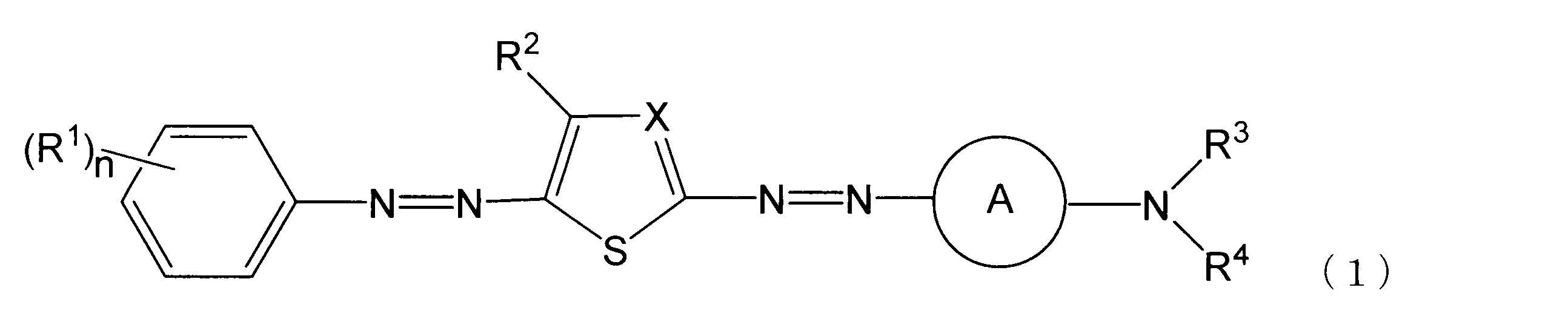
R1は、任意の置換基を表し、
R2は、水素原子又は任意の置換基を表し、
R3及びR4は、それぞれ独立に、置換基を有していてもよいアルキル基を表し、
環Aは、一般式(2)又は(3)を表し、
環Aが一般式(2)の場合、Xは窒素原子又は置換基を有していてもよいメチン基を表し、
環Aが一般式(3)の場合、Xはシアノ基又は置換基を有していてもよいアルコキシカルボニル基を有する、メチン基を表し、
尚、環Aが一般式(3)であり、R2が水素原子の場合、Xは置換基を有していてもよいアルコキシカルボニル基を有するメチン基を表し、
nは、0~5の整数を表す。]
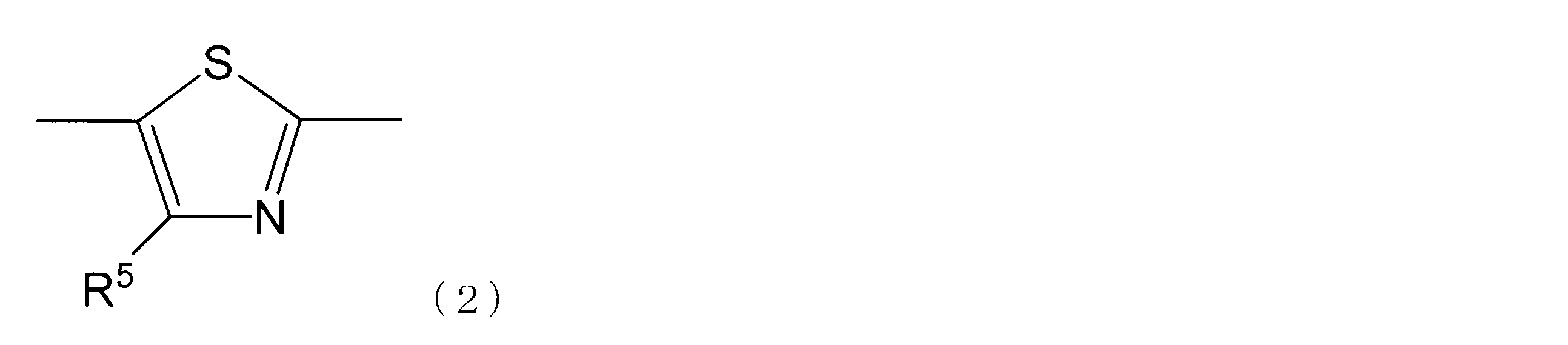
R5は、水素原子又は任意の置換基を表す。]

R6及びR7は、それぞれ独立に、水素原子又は任意の置換基を表す。]
[2]溶媒が、炭化水素系溶媒、シリコーンオイル及びフルオロカーボン系溶媒から選ばれた少なくとも1つを含む、[1]に記載のインク。
[3]前記アゾ系化合物のn-デカン溶液での吸収極大波長におけるモル吸光係数ε(Lmol-1cm-1)と、5℃における該溶液の飽和の濃度C(molL-1)の積εCが、1000cm-1以上である、[1]又は[2]に記載のインク。
[4]さらにヘテロ環化合物、シアノビニル化合物及びアントラキノン化合物からなる群より選ばれた少なくとも1つを含む、[1]~[3]のいずれか1に記載のインク。
[5]前記ヘテロ環化合物が下記一般式(4)~(7)からなる群より選ばれた少なくとも1つである、[4]に記載のインク。

R101及びR102は、それぞれ独立に、水素原子又は任意の置換基を示し、
D3及びD4は、それぞれ独立に、任意の置換基を示し、
eは0~5の整数を示し、eが2以上の場合、1分子中に2以上存在するD3は同一であっても異なっていてもよく、
gは0~4の整数を示し、gが2以上の場合、1分子中に2以上存在するD4は同一であっても異なっていてもよい。]
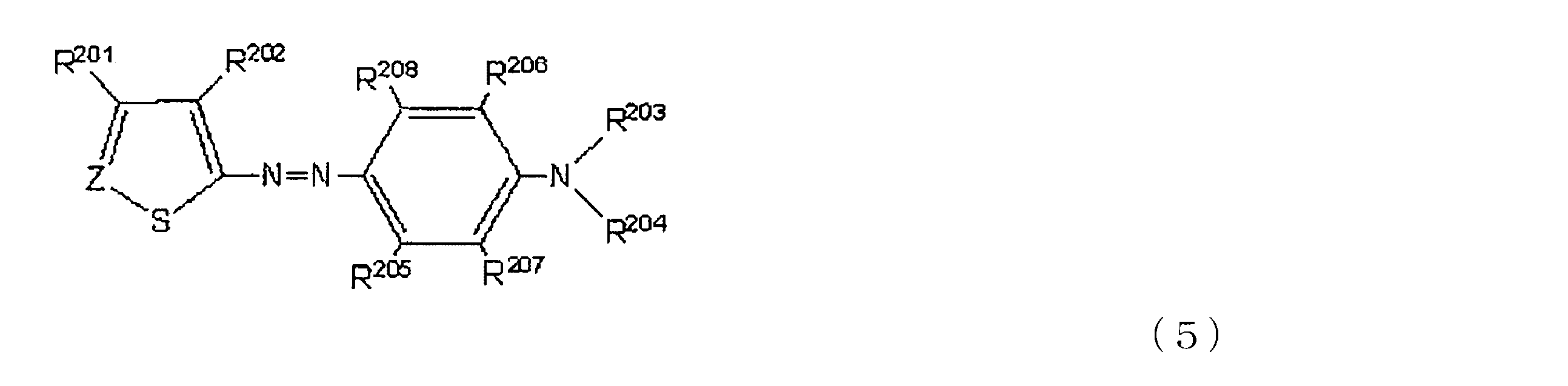
R201、R202、R203、R204、R205、R206、R207及びR208は、それぞれ独立に、水素原子又は任意の置換基を示し、
Zは窒素原子又は置換基を有していてもよいメチン基を示す。]
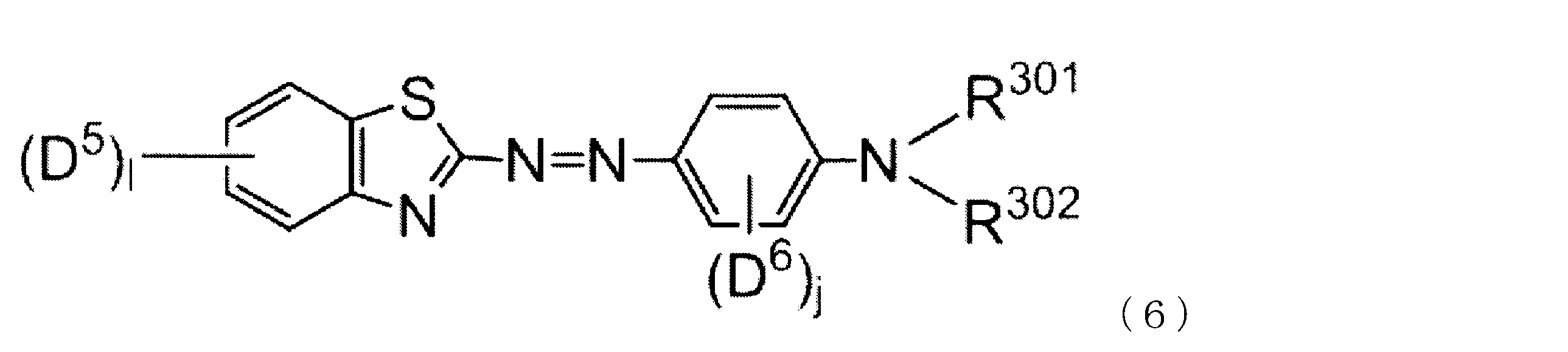
R301、R302、D5及びD6はそれぞれ独立に、任意の置換基を示し、
lは0~4の整数を示し、lが2以上の場合は、1分子中に2以上存在するD5は同一でも異なっていてもよく、
jは0~4の整数を示し、jが2以上の場合は、1分子中に2以上存在するD6は同一でも異なっていてもよい。]
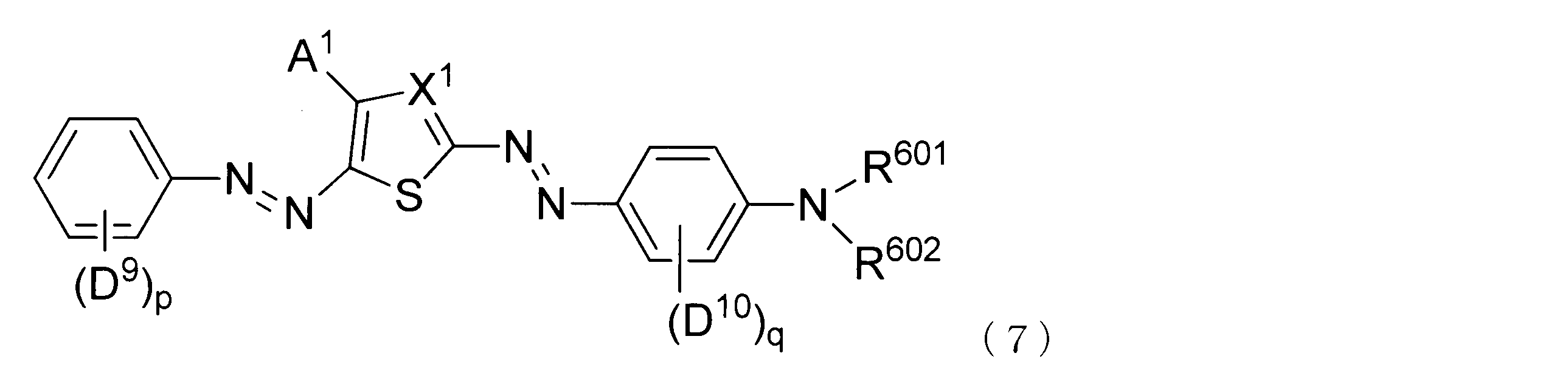
R601、R602、D9又はD10はそれぞれ独立に、任意の置換基を表し、
A1は、水素原子又は任意の置換基を表し、
pは0~5の整数を表し、pが2以上の場合、1分子中に2以上存在するD9は同一であっても異なっていてもよく、
qは0~4の整数を表し、qが2以上の場合、1分子中に2以上存在するD10は同一であっても異なっていてもよく、
X1は窒素原子、又は置換基としてハロゲン原子、シアノ基若しくは-COOR605基を有していてもよいメチン基を表し、
R605は、水素原子、置換基を有していてもよい炭素数が1~20のアルキル基、置換基を有していてもよい炭素数が6~20のアリール基又は置換基を有していてもよい炭素数が2~20のヘテロアリール基を表す。]
[6]前記アントラキノン化合物が下記一般式(8)で表される、[4]又は[5]に記載のインク。
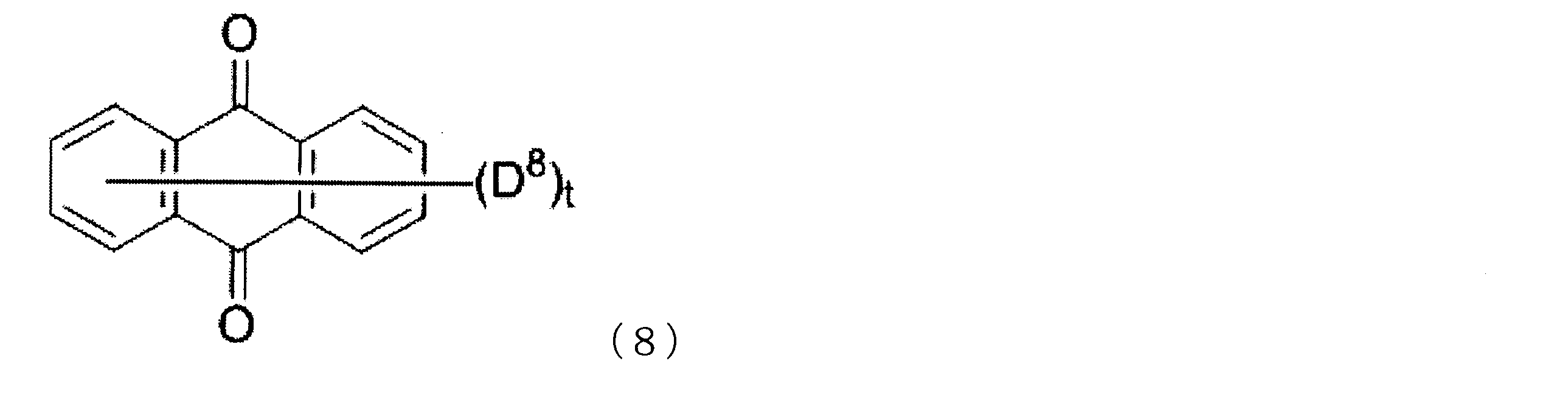
D8は任意の置換基を示し、
tは0~8の整数を示し、tが2以上の場合、1分子中に2以上存在するD8は同一であっても異なっていてもよい。]
[7]ディスプレイ用又は光シャッター用である[1]~[6]のいずれか1に記載のインク。
[8][1]~[6]のいずれか1に記載のインクを含む表示部位を有し、表示部位の電圧印加を制御することで画像を表示するディスプレイ。
[9]前記表示部位が、電気泳動粒子又は水性媒体を含む[8]に記載のディスプレイ。
[10]前記電圧印加によって着色状態を変化させることにより画像を表示する[8]又は[9]に記載のディスプレイ。
[11]エレクトロウェッティング方式又は電気泳動方式により画像を表示する[8]~[10]のいずれか1に記載のディスプレイ。
[12][8]~[11]のいずれか1に記載のディスプレイを有する電子ペーパー。
[13]周波数1kHz及び温度22℃で測定した比誘電率が3以下であり、かつ25℃における水に対する溶解度が20mg/L以下である溶媒、及び以下(I)~(IV)の化合物をそれぞれ少なくとも1つ有することを特徴とするインク。
(I)デカン溶液での吸収極大波長が400nm以上、500nm未満である化合物
(II)デカン溶液での吸収極大波長が500nm以上、570nm未満である化合物
(III)デカン溶液での吸収極大波長が570nm以上、640nm未満であるジスアゾ系化合物
(IV)デカン溶液での吸収極大波長が640nm以上、700nm以下である化合物
[14]下記一般式(10)で表されるアゾ系化合物。

R21は、任意の置換基を表し、
R22及びR23は、それぞれ独立に、水素原子又は任意の置換基を表し、
R24及びR25は、それぞれ独立に、置換基を有していてもよいアルキル基を表し、
X2は、窒素原子又は置換基を有していてもよいメチン基を表し、
n´は、0~5の整数を表す。]
[15]下記一般式(11)で表されるアゾ系化合物。

R31は任意の置換基を表し、
R32は、水素原子又はアルキル基を表し、
R33は、シアノ基又はアルコキシカルボニル基を表し、
但し、R32が水素原子の場合は、R33はアルコキシカルボニル基を表し、
R34及びR35はそれぞれ独立に、水素原子又は任意の置換基を表し、
R36及びR37はそれぞれ独立に、置換基を有していてもよい炭素数が4~20の分岐アルキル基を表し、
mは、0~5の整数を表す。]

R1は、任意の置換基を表し、
R2は、水素原子又は任意の置換基を表し、
R3及びR4は、それぞれ独立に、置換基を有していてもよいアルキル基を表し、
環Aは、一般式(2)又は(3)を表し、
環Aが一般式(2)の場合、Xは窒素原子又は置換基を有していてもよいメチン基を表し、
環Aが一般式(3)の場合、Xはシアノ基又は置換基を有していてもよいアルコキシカルボニル基を有する、メチン基を表し、
尚、環Aが一般式(3)であり、R2が水素原子の場合、Xは置換基を有していてもよいアルコキシカルボニル基を有するメチン基を表し、
nは、0~5の整数を表す。]
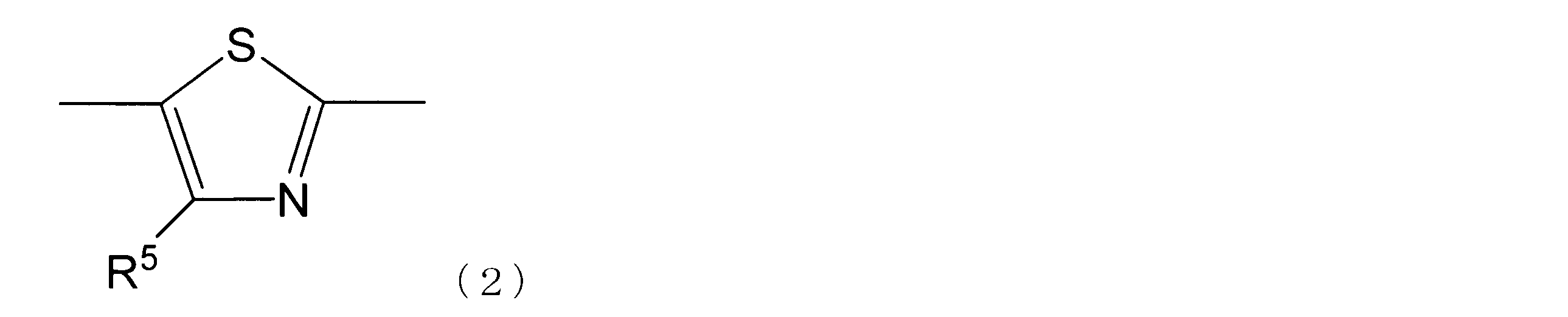
R5は、水素原子又は任意の置換基を表す。]
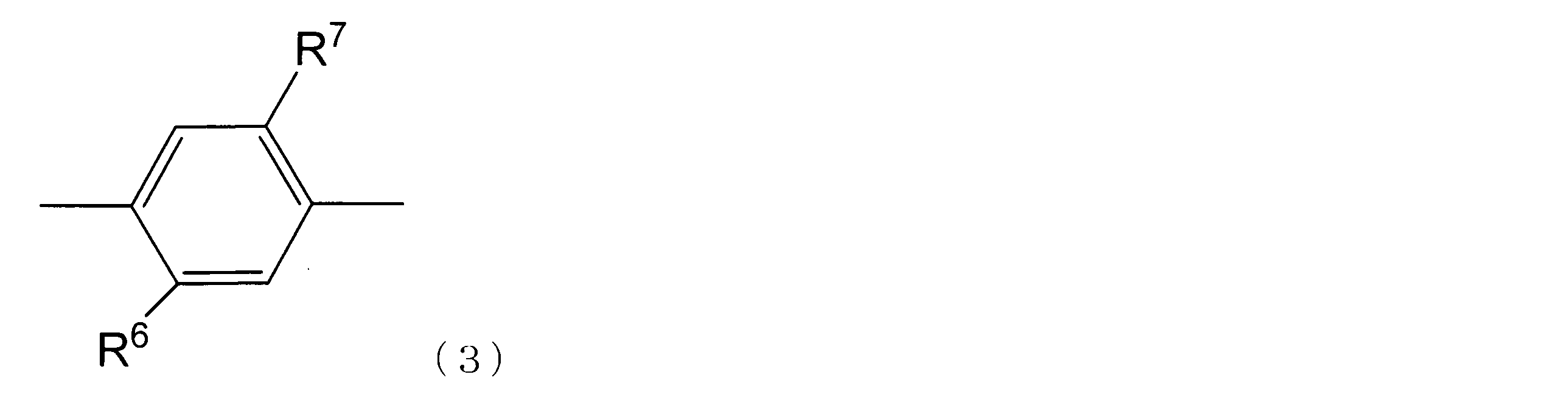
R6及びR7は、それぞれ独立に、水素原子又は任意の置換基を表す。]
本発明のインクが適用されるディスプレイや光シャッターは低極性の溶媒をインクの溶媒として用いる。本発明のインクは、例えば水層、油層などの層を有し、層の分裂(break up)又は層の移動(move aside)に基づいた表示装置に用いることができる。表示を鮮明にするためには、インクが含まれる油層が水層と混合せず、安定的に分裂又は移動することが必要であるため、溶媒は、水との相溶性が低く、低極性であること等が求められる。本発明は特定の溶媒とアゾ系化合物をインクに含むことによって、油層が安定的に分裂又は移動することが可能となる。
本発明の一般式(1)で表される構造を有するアゾ系化合物、及び一般式(1)において用いられるR1~R7、n及びXについて、具体例を以下に説明する。
R1は任意の置換基を示す。任意の置換基としては、アゾ系化合物に用いられる公知の置換基であれば特に限定されないが、溶媒への高溶解性及び高吸光係数のために、具体的には、例えば、フッ素原子、塩素原子、臭素原子、ヨウ素原子等のハロゲン原子;置換基を有していてもよい炭素数が1~20のアルキル基;置換基を有していてもよい炭素数が1~20のアルコキシ基;置換基を有していてもよい炭素数が2~21のアルコキシカルボニル基;等が挙げられる。これらのなかでも、置換基を有していてもよい炭素数が1~20のアルキル基であることが、溶媒への高溶解性及び高吸光係数のために好ましい。
R1の置換基を有していてもよいアルキル基としては、具体的には、例えば、メチル基、エチル基、プロピル基、イソプロピル基、シクロプロピル基、ブチル基、イソブチル基、sec-ブチル基、tert-ブチル基、ペンチル基、シクロペンチル基、ヘキシル基、シクロヘキシル基、ヘプチル基、オクチル基、2-エチルヘキシル基、3,5,5-トリメチルヘキシル基、デシル基、ドデシル基等の分岐鎖および環状構造を有していてもよい炭素数1~20のアルキル基があげられる。この中でも、炭素数が2~20が好ましく、炭素数が2~10がさらに好ましい。炭素数が適当な範囲にあることで、溶媒への高溶解性及び高吸光係数を有することができる傾向に有る。
R1の置換基を有していてもよいアルコキシ基としては、具体的には、例えば、メトキシ基、エトキシ基、プロポキシ基、イソプロポキシ基、シクロプロポキシ基、ブトキシ基、イソブトキシ基、sec-ブトキシ基、tert-ブトキシ基、ペンチルオキシ基、シクロブトキシ基、シクロペンチルオキシ基、ヘキシルオキシ基、シクロヘキシルオキシ基、ヘプチルオキシ基、オクチルオキシ基、2-エチルヘキシルオキシ基、3,5,5-トリメチルヘキシルオキシ基、デシルオキシ基、ドデシルオキシ基等の直鎖、分岐鎖および環状構造を有してもよい炭素数1~20のアルコキシ基が挙げられる。この中でも、炭素数が2~20であることが好ましく、2~10がさらに好ましい。炭素数が適当な範囲にあることで、溶媒への高溶解性及び高吸光係数を有することができる傾向にある。
R1の置換基を有していてもよいアルコキシカルボニル基としては、具体的には、例えば、メトキシカルボニル基、エトキシカルボニル基、プロポキシカルボニル基、イソプロポキシカルボニル基、シクロプロポキシカルボニル基、ブトキシカルボニル基、イソブトキシカルボニル基、sec-ブトキシカルボニル基、tert-ブトキシカルボニル基、シクロブトキシカルボニル基、ペンチルオキシカルボニル基、シクロペンチルオキシカルボニル基、ヘキシルオキシカルボニル基、シクロヘキシルオキシカルボニル基、ヘプチルオキシカルボニル基、オクチルオキシカルボニル基、2-エチルヘキシルオキシカルボニル基、3,5,5-トリメチルヘキシルオキカルボニル基、デシルオキシカルボニル基、ドデシルオキシカルボニル基等の分岐鎖および環状構造を有してもよい炭素数2以上、21以下のアルコキシカルボニル基が挙げられる。この中でも、炭素数は3以上が好ましく、また、11以下が好ましい。炭素数が適当な範囲にあることで、溶媒への高溶解性及び高吸光係数を有することができる傾向にある。
nは0~5の整数を表す。この中でも0以上、3以下であることが好ましく、0以上、2以下であることが好ましい。また、nが2以上の場合は、1分子中に2以上存在するR1は同一であっても異なっていてもよい。R1の置換位置は、アゾ結合に対してオルト位であってもメタ位であっても、パラ位であってもよい。
R2は、水素原子又は任意の置換基を表す。R2は、本発明の効果を損わなければ特に限定はされないが、水素原子、置換基を有していてもよい炭素数1~20のアルキル基、又はハロゲン原子等であることが、溶媒への溶解性に優れ、しかも高いモル吸光係数を有するために好ましい。
R3及びR4はそれぞれ独立に、置換基を有していてもよいアルキル基を示す。R3及びR4の置換基を有していてもよいアルキル基は、一般式(1)のR1で示した置換基を有していてもよいアルキル基と同義であり、有していてもよい置換基も同義である。
環Aは、一般式(2)又は(3)を表す。
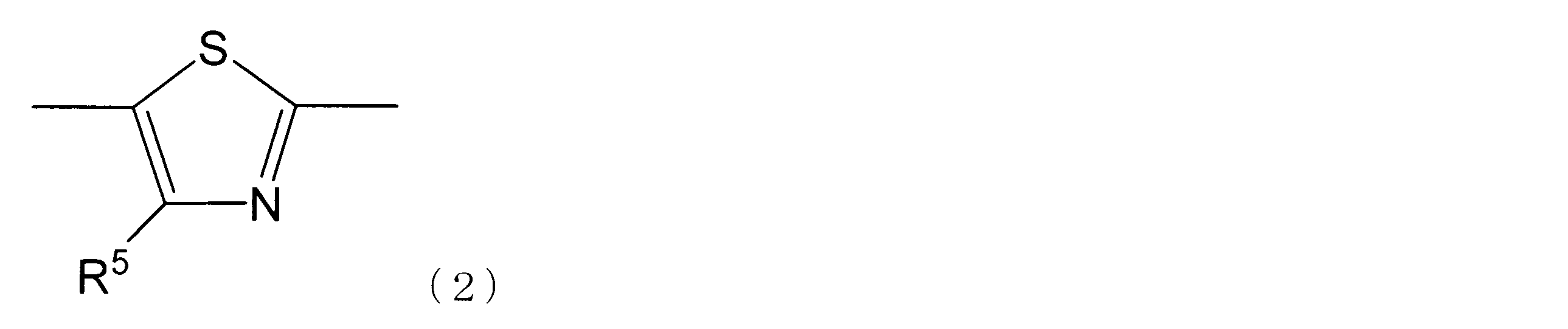
R5は、水素原子又は任意の置換基を表す。]
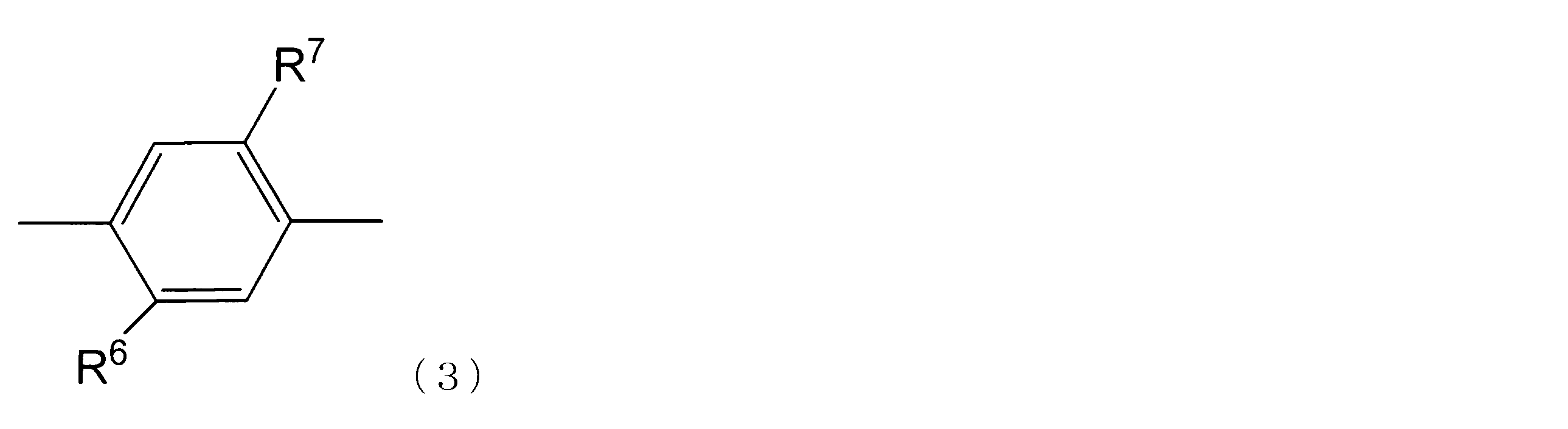
R6及びR7は、それぞれ独立に、水素原子又は任意の置換基を表す。]
R5は、水素原子又は任意の置換基を表す。R5は、アゾ系化合物のカップラー部に用いられる公知の置換基であれば特に限定されないが、溶媒への高溶解性及び高吸光係数のために、水素原子、置換基を有していてもよい炭素数が1~20のアルキル基、置換基を有していてもよい炭素数が1~20のアシルアミノ基、置換基を有していてもよい炭素数が1~20のアルキルスルホニルアミノ基等が挙げられる。
R5の置換基を有していてもよいアシルアミノ基としては、具体的には、例えば、ホルミルアミノ基、アセチルアミノ基、プロピオニルアミノ基、ブチリルアミノ基、イソブチリルアミノ基、シクロプロピルカルボニルアミノ基、バレリルアミノ基、イソバレリルアミノ基、ピバロイルアミノ基、ヘキサノイルアミノ基、シクロペンチルカルボニルアミノ基、ヘプタノイルアミノ基、シクロヘキシルカルボニルアミノ基、オクタノイルアミノ基、2-エチルヘキサノイルアミノ基、デカノイルアミノ基、ドデカノイルアミノ基等の分岐鎖および環状構造を有していてもよい炭素数1~20のアシルアミノ基が挙げられる。
R5の置換基を有していてもよいアルキルスルホニルアミノ基としては、例えば、メチルスルホニルアミノ基、エチルスルホニルアミノ基、プロピルスルホニルアミノ基、イソプロピルスルホニルアミノ基、シクロプロピルスルホニルアミノ基、ブチルスルホニルアミノ基、イソブチルスルホニルアミノ基、sec-ブチルスルホニルアミノ基、tert-ブチルスルホニルアミノ基、ペンチルスルホニルアミノ基、シクロペンチルスルホニルアミノ基、ヘキシルスルホニルアミノ基、シクロヘキシルスルホニルアミノ基、ヘプチルスルホニルアミノ基、オクチルスルホニルアミノ基、2-エチルヘキシルスルホニルアミノ基、3,5,5-トリメチルヘキシルスルホニルアミノ基、デシルスルホニルアミノ基、ドデシルスルホニルアミノ基等の分岐鎖および環状構造を有していてもよい炭素数1~20のアルキルスルホニルアミノ基があげられる。
R6は水素原子又は任意の置換基を示す。任意の置換基としては、アゾ系化合物のカップラー部に用いられる公知の置換基であれば特に限定されないが、溶媒への高溶解性及び高吸光係数のために、具体的には、フッ素原子、塩素原子、臭素原子、ヨウ素原子等のハロゲン原子;置換基を有していてもよい炭素数が1~20のアルキル基;置換基を有していてもよい炭素数が1~20のアルコキシ基;置換基を有していてもよい炭素数が1~20のアシルアミノ基;置換基を有していてもよい炭素数が1~20のアルキルスルホニルアミノ基等が挙げられる。
R6の置換基を有していてもよいアシルアミノ基としては、一般式(2)のR5で示した置換基を有していてもよいアシルアミノ基と同義であり、有していてもよい置換基も同義である。
この中でも、炭素数が2~10の脂肪族のアシルアミノ基が好ましく、炭素数が2~6の脂肪族のアシルアミノ基がさらに好ましい。炭素数が適当な範囲にあることで、溶媒への高溶解性及び高吸光係数を有することができる傾向に有る。
R6の置換基を有していてもよいアルキルスルホニルアミノ基としては、一般式(2)のR5で示した置換基を有していてもよいアルキルスルホニルアミノ基と同義であり、有していてもよい置換基も同義である。
環Aが一般式(2)の場合、Xは窒素原子又は置換基を有していてもよいメチン基を表し、環Aが一般式(3)の場合、Xは、シアノ基又は置換基を有していてもよいアルコキシカルボニル基を有する、メチン基を表す。尚、環Aが一般式(3)であり、R2が水素原子の場合、Xは置換基を有していてもよいアルコキシカルボニル基を有するメチン基を表す。
R7は水素原子又は任意の置換基を示す。任意の置換基としては、アゾ系化合物のカップラー部に用いられる公知の置換基であれば特に限定されないが、溶媒への高溶解性及び高吸光係数のために、具体的には、水素原子、置換基を有していてもよい炭素数が1~20のアルキル基、及び置換基を有していてもよい炭素数が1~20のアルコキシ基等が挙げられる。これらの中でも、水素原子、又は置換基を有していてもよい炭素数が1~20のアルコキシ基であることが、溶媒への高溶解性及び高吸光係数を有する傾向にあるため好ましい。
R5、R6、及びR7の置換基を有していてもよいアルキル基は、一般式(1)のR1で例示した置換基を有していてもよいアルキル基とそれぞれ同義であり、有していてもよい置換基もそれぞれ同義である。R5、R6、及びR7のアルキル基としては、炭素数1以上が好ましく、10以下、さらに好ましくは6以下が好ましい。炭素数が適当な範囲にあることで、溶媒への高溶解性及び高吸光係数を有することができる傾向に有る。
R6及びR7の置換基を有していてもよいアルコキシ基は、一般式(1)のR1で例示置換基を有していてもよいアルコキシ基と同義であり、有していてもよい置換基も同義である。この中でも、炭素数が1~10が好ましく、炭素数が1~6がさらに好ましい。炭素数が適当な範囲にあることで、溶媒への高溶解性及び高吸光係数を有することができる傾向にある。

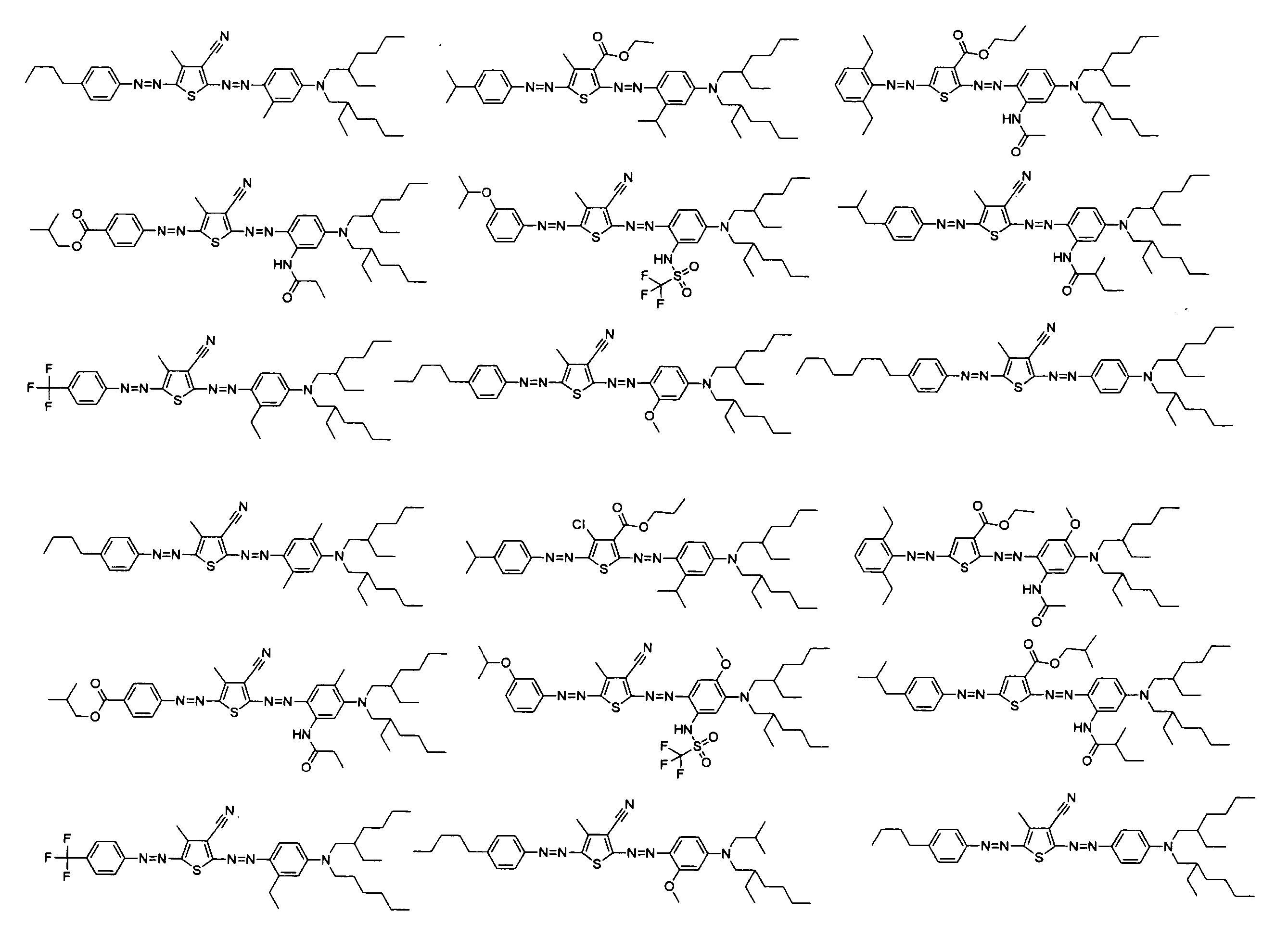


本発明のインクは、上記アゾ系化合物単体で用いてもよく、所望の色調とするために他の化合物を含んでいてもよい。例えば、本発明のアゾ系化合物に、黄色、赤色、青色、紫色、橙色等の複数の色の化合物を混合して黒色等の各色にしてもよい。
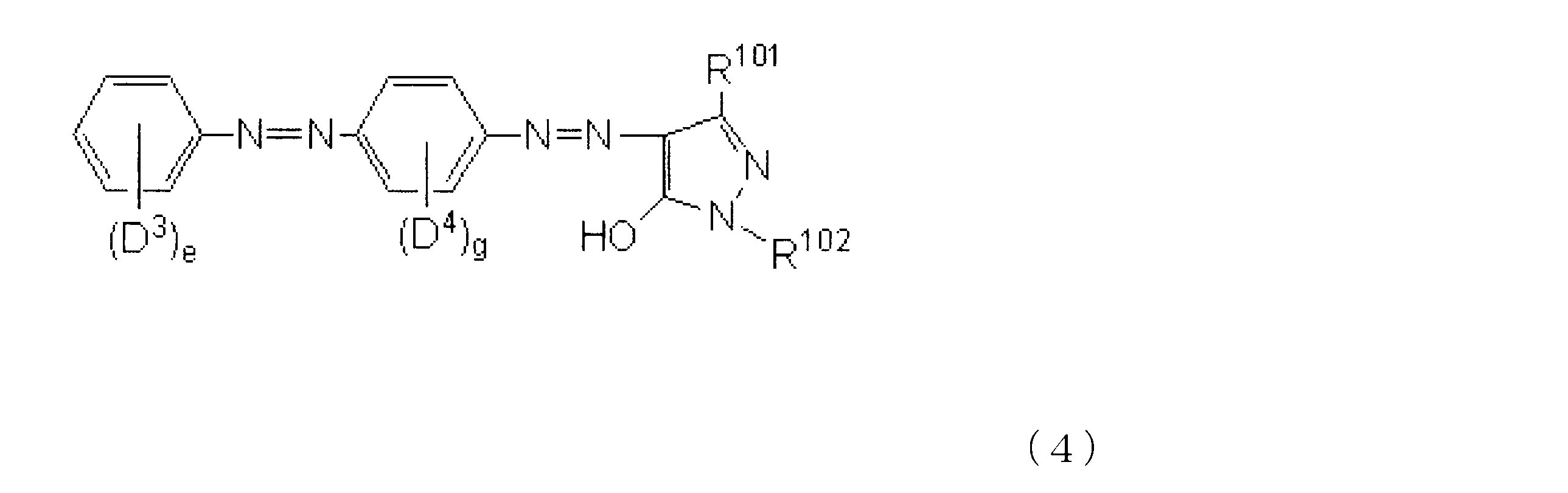
R101及びR102は、それぞれ独立に、水素原子又は任意の置換基を示し、
D3及びD4は、それぞれ独立に、任意の置換基を示し、
eは0~5の整数を示し、eが2以上の場合、1分子中に2以上存在するD3は同一であっても異なっていてもよく、
gは0~4の整数を示し、gが2以上の場合、1分子中に2以上存在するD4は同一であっても異なっていてもよい。]
R101及びR102はそれぞれ独立に、水素原子又は任意の置換基を示す。R101の任意の置換基としては、例えば、水素原子、置換基を有していてもよい炭素数が1~20のアルキル基、置換基を有していてもよい炭素数が1~20のアルコキシ基、置換基を有していてもよい炭素数が6~20のアリール基、置換基を有していてもよい炭素数が2~20のヘテロアリール基、-COOR103基、-NR107R108基又は-COR112基等が挙げられる。これらであることで、溶媒への高溶解性及び高吸光係数が得られる傾向にある。
R103、R107、R108及びR112は、それぞれ独立に、水素原子、置換基を有していてもよい炭素数が1~20のアルキル基、置換基を有していてもよい炭素数が6~20のアリール基又は置換基を有していてもよい炭素数が2~20のヘテロアリール基を示す。
R101、R102、R103、R107、R108及びR112の置換基を有していてもよいアルキル基は、具体的には、一般式(1)のR1で示した置換基を有していてもよいアルキル基とそれぞれ同義であり、有していてもよい置換基もそれぞれ同義である。
R101、R102、R103、R107、R108及びR112の置換基を有していてもよいアリール基は、単環か、又はこの単環が2~4個縮合してなる縮合環から、水素原子を1個除いて得られる基である。
R101、R102、R103、R107、R108及びR112の置換基を有していてもよいヘテロアリール基は、単環か、又はこの単環が2~4個縮合してなる縮合環から、水素原子を1個除いて得られる基である。
R101、及びR102の置換基を有していてもよいアルコキシ基は、具体的には、一般式(1)のR1で示した置換基を有していてもよいアルコキシ基とそれぞれ同義であり、有していてもよい置換基もそれぞれ同義である。
D3は任意の置換基を示す。D3は本発明の効果を損なわなければ特に限定されないが、ハロゲン原子、置換基を有していてもよい炭素数が1~20のアルキル基、置換基を有していてもよい炭素数が1~20のアルコキシ基、シアノ基、ヒドロキシ基、-COOR104基、-NHCOR109基、-NHSO2R110基、-COR113基又は-OCOR115基であることが、溶媒への高溶解性及び高吸光係数のために好ましい。
R104、R109、R110、R113及びR115は、それぞれ独立に、置換基を有していてもよい炭素数が1~20のアルキル基、置換基を有していてもよい炭素数が6~20のアリール基又は置換基を有していてもよい炭素数が2~20のヘテロアリール基を示す。
D3、R104、R109、R110、R113及びR115の置換基を有していてもよいアルキル基は、具体的には、一般式(1)のR1で例示した置換基を有していてもよいアルキル基とそれぞれ同義であり、有していてもよい置換基もそれぞれ同義である。
D3の置換基を有していてもよいアルコキシ基は、前記一般式(1)のR1で例示した置換基を有していてもよいアルコキシ基と同義であり、有していてもよい置換基も同義である。
R104、R109、R110、R113及びR115の置換基を有していてもよいアリール基は、具体的にはR101で例示した置換基を有していてもよいアリール基とそれぞれ同義であり、有していてもよい置換基もR101で例示したアリール基とそれぞれ同義である。
R104、R109、R110、R113及びR115のヘテロアリール基は、具体的には、R101で例示したヘテロアリール基と同義であり、有していてもよい置換基もR101で例示したヘテロアリール基と同義である。
D4は任意の置換基を示す。D4は本発明の効果を損なわなければ特に限定されないが、ハロゲン原子、置換基を有していてもよい炭素数が1~20のアルキル基、置換基を有していてもよい炭素数が1~20のアルコキシ基、シアノ基、-COOR105基、-NHCOR106基、-NHSO2R111基又は-COR114基であることが、溶媒への高溶解性及び高吸光係数のために好ましい。
R105、R106、R111及びR114は、それぞれ独立に、水素原子、置換基を有していてもよい炭素数が1~20のアルキル基、置換基を有していてもよい炭素数が6~20のアリール基又は置換基を有していてもよい炭素数が2~20のヘテロアリール基を示す。
D4、R105、R106、R111及びR114の置換基を有していてもよいアルキル基は、具体的には、前記一般式(1)のR1で例示した置換基を有していてもよいアルキル基とそれぞれ同義であり、有していてもよい置換基もそれぞれ同義である。
D4の置換基を有していてもよいアルコキシ基は、前記一般式(1)のR1で例示した置換基を有していてもよいアルコキシ基と同義であり、有していてもよい置換基も同義である。D4のアルコキシ基は、炭素数が16以下であることが好ましく、10以下であることがさらに好ましく、6以下であることが特に好ましい。炭素数が適当な範囲にあることで、溶媒への溶解性に優れ、しかも高いグラム吸光係数を有することができる場合がある。
R105、R106、R111及びR114の置換基を有していてもよいアリール基は、具体的にはR101で例示した置換基を有していてもよいアリール基とそれぞれ同義であり、有していてもよい置換基もR101で例示したアリール基とそれぞれ同義である。
R105、R106、R111及びR114の置換基を有していてもよいヘテロアリール基は、具体的には、R101で例示した置換基を有していてもよいヘテロアリール基と同義であり、有していてもよい置換基もR101で例示したヘテロアリール基と同義である。
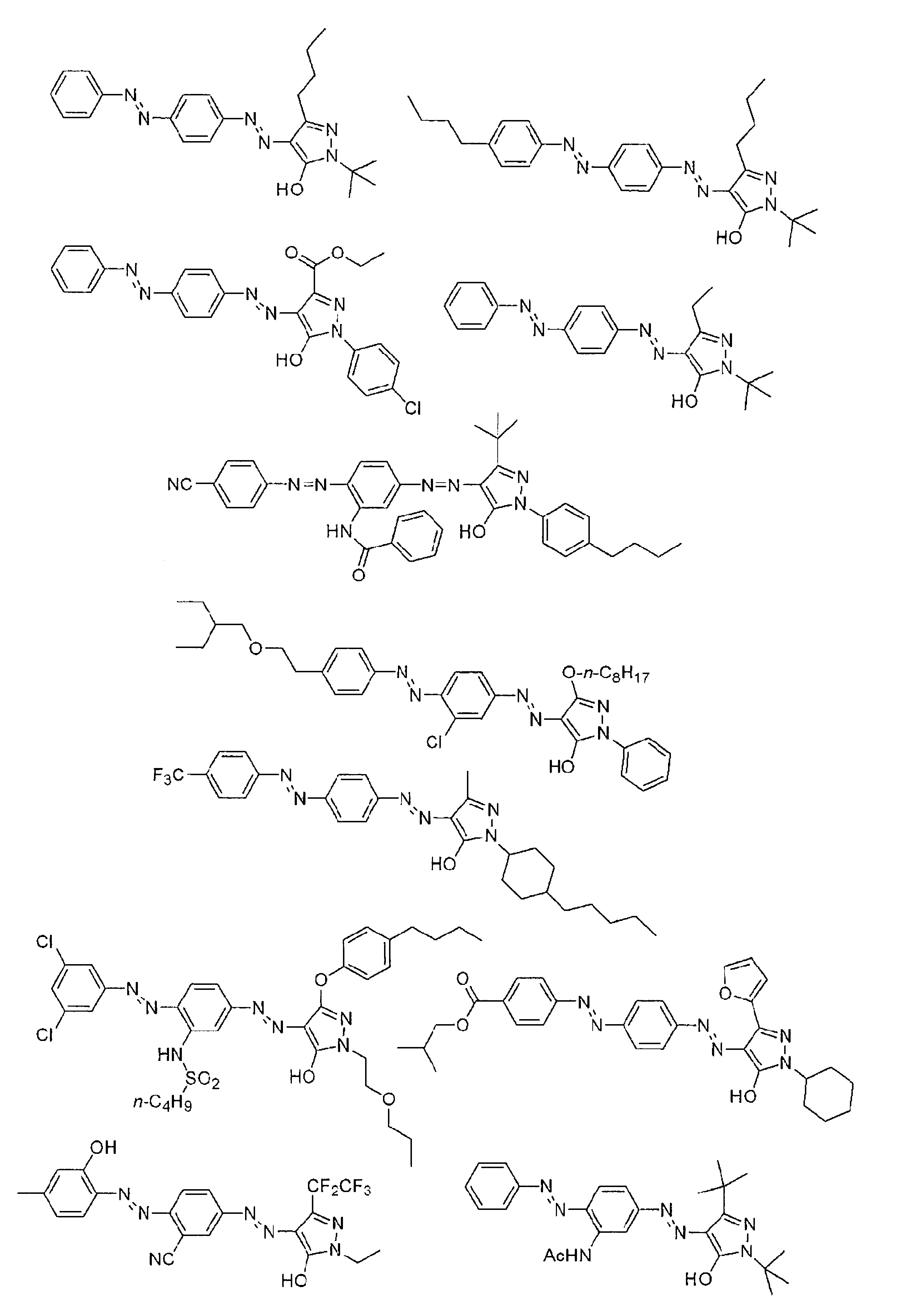

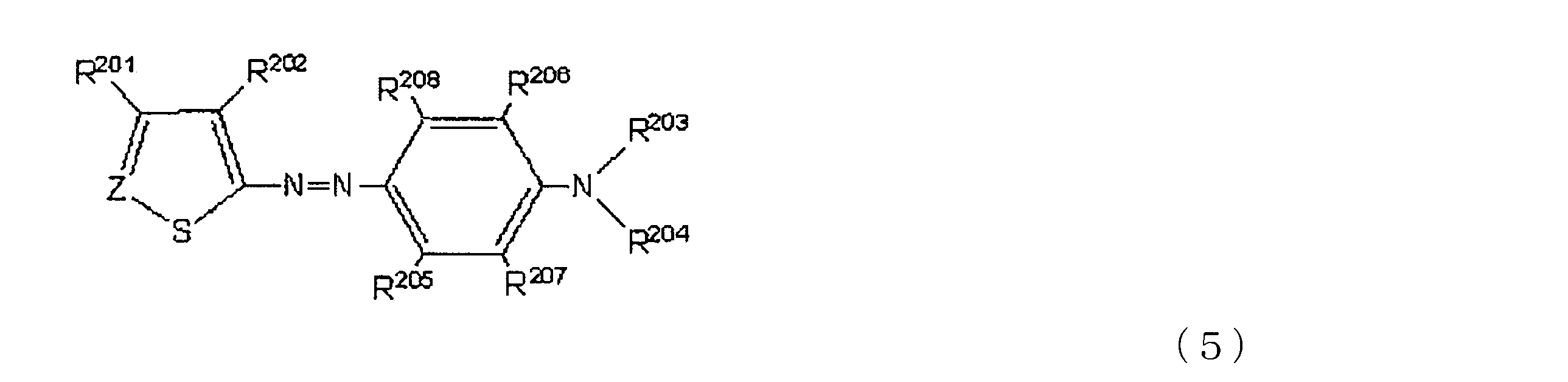
R201、R202、R203、R204、R205、R206、R207及びR208は、それぞれ独立に、水素原子又は任意の置換基を示し、
Zは窒素原子又は置換基を有していてもよいメチン基を示す。]
R201は水素原子又は任意の置換基を示す。R201は本発明の効果を損なわなければ特に限定されないが、水素原子又は置換基を有していてもよい炭素数が1~20のアルキル基であることが高吸光係数のため好ましい。
R201の置換基を有していてもよい炭素数が1~20のアルキル基は、前記一般式(1)のR1で例示した置換基を有していてもよいアルキル基と同義であり、有していてもよい置換基も同義である。また、R201は、Zと結合して環状構造を形成してもよい。
R202は水素原子又は任意の置換基を示す。R202は本発明の効果を損なわなければ特に限定されないが、シアノ基又は-COOR209基であることが溶媒への高溶解性及び高吸光係数のために好ましい。
R203およびR204は、それぞれ独立に、水素原子又は任意の置換基を示す。R203およびR204は本発明の効果を損なわなければ特に限定されないが、それぞれ独立に、置換基を有していてもよい炭素数が1~20のアルキル基であることが溶媒への高溶解性及び高吸光係数のために好ましい。
R205、R206、R207及びR208はそれぞれ独立に、水素原子又は任意の置換基を示す。R205、R206、R207及びR208は本発明の効果を損なわなければ特に限定されないが、水素原子、ハロゲン原子、置換基を有していてもよい炭素数が1~20のアルキル基、置換基を有していてもよい炭素数が1~20のアルコキシ基、-NHCOR210基又は-NHSO2R212基であることが、溶媒への高溶解性及び高吸光係数のために好ましい。
R205、R206、R207、R208、R210及びR212の置換基を有していてもよいアルキル基は、具体的には、前記一般式(1)のR1で例示した置換基を有していてもよいアルキル基とそれぞれ同義であり、有していてもよい置換基もそれぞれ同義である。
R205、R206、R207及びR208の置換基を有していてもよいアルコキシ基は、前記一般式(1)のR1で例示した置換基を有していてもよいアルコキシ基とそれぞれ同義であり、有していてもよい置換基もそれぞれ同義である。
R210及びR212の置換基を有していてもよいアリール基は、具体的には前記一般式(4)のR101で例示した置換基を有していてもよいアリール基とそれぞれ同義であり、有していてもよい置換基もそれぞれ同義である。
R210及びR212の置換基を有していてもよいヘテロアリール基は、具体的には、前記一般式(4)のR101で例示した置換基を有していてもよいヘテロアリール基とそれぞれ同義であり、有していてもよい置換基もそれぞれ同義である。
Zは、窒素原子又は置換基を有していてもよいメチン基を示す。Zがメチン基の場合、Zは無置換でも置換基を有していてもよいが、Zが有していてもよい置換基としては、置換基を有していてもよい炭素数が1~10のアルキル基、及び-COOR211基等が挙げられる。
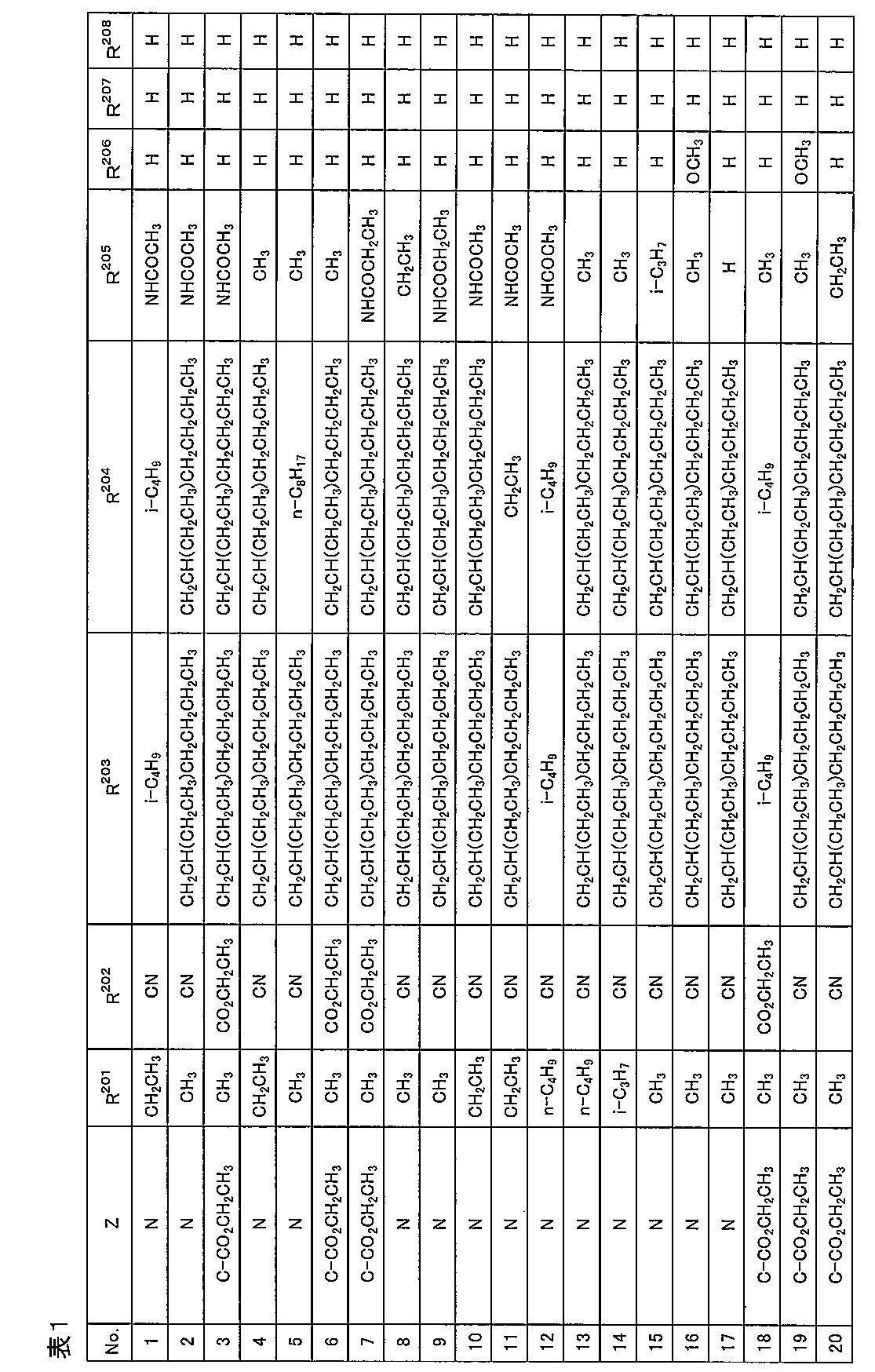
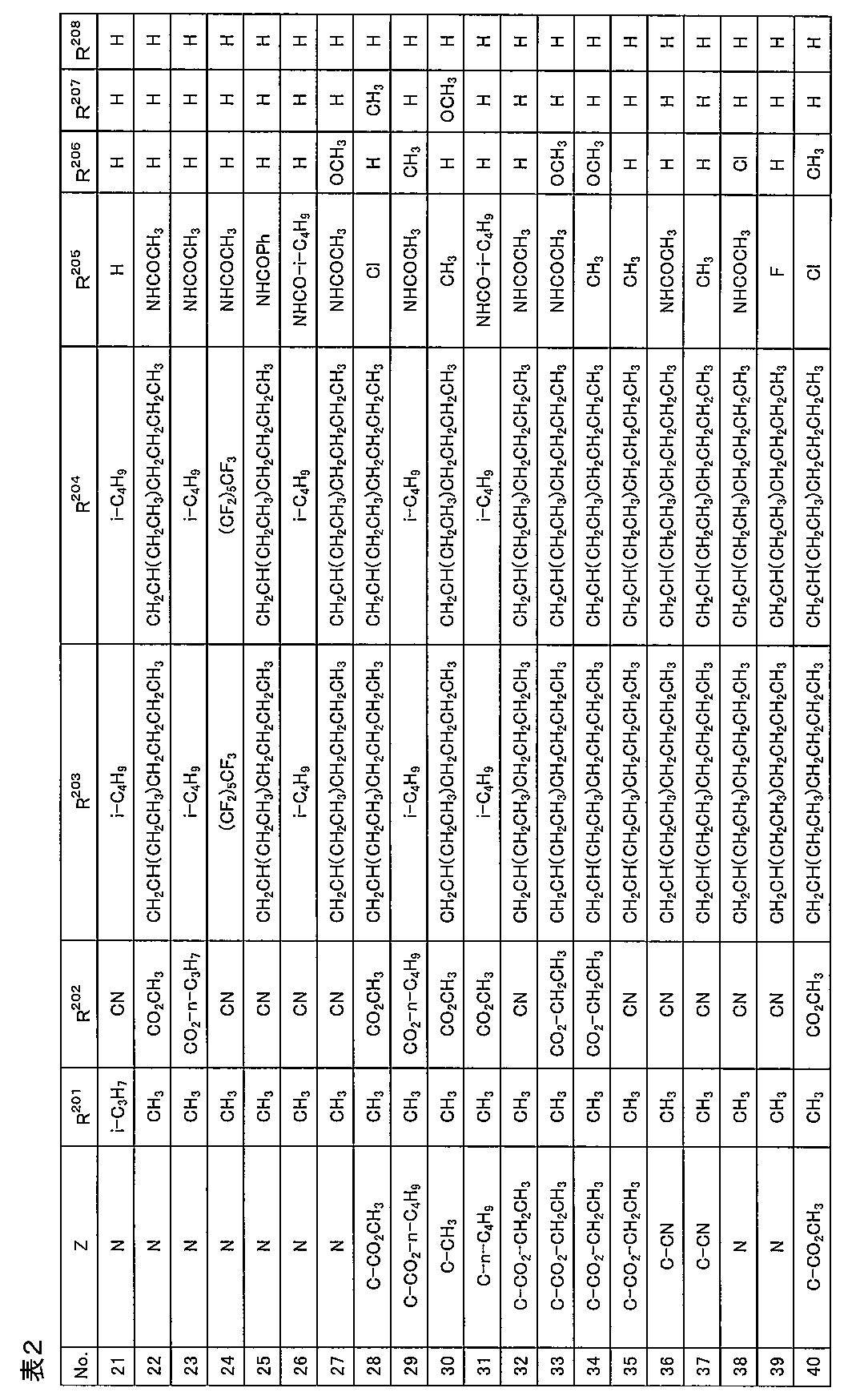


R301、R302、D5及びD6はそれぞれ独立に、任意の置換基を示し、
lは0~4の整数を示し、lが2以上の場合は、1分子中に2以上存在するD5は同一でも異なっていてもよく、
jは0~4の整数を示し、jが2以上の場合は、1分子中に2以上存在するD6は同一でも異なっていてもよい。]
R301及びR302はそれぞれ独立に、任意の置換基を示す。R301及びR302は本発明の効果を損なわなければ特に限定されないが、それぞれ独立に、置換基を有していてもよい炭素数が1~20のアルキル基、置換基を有していてもよい炭素数が6~20のアリール基又は置換基を有していてもよい炭素数が2~20のヘテロアリール基であることが、高吸光係数及び溶媒への高溶解度のために好ましい。
R301及びR302の置換基を有していてもよいアルキル基は、具体的には、前記一般式(1)のR1で示した置換基を有していてもよいアルキル基とそれぞれ同義であり、有していてもよい置換基もそれぞれ同義である。
R301及びR302のアリール基は、具体的には前記一般式(4)のR101で例示したアリール基とそれぞれ同義であり、有していてもよい置換基も前記一般式(4)のR101で例示したアリール基とそれぞれ同義である。
R301及びR302のヘテロアリール基は、具体的には、前記一般式(4)のR101で例示したヘテロアリール基とそれぞれ同義であり、有していてもよい置換基も前記一般式(4)のR101で例示したヘテロアリール基とそれぞれ同義である。
D5は任意の置換基を示す。D5は本発明の効果を損なわなければ特に限定されないが、ハロゲン原子、シアノ基、置換基を有していてもよい炭素数が1~20のアルキル基、置換基を有していてもよい炭素数が1~20のアルコキシ基、-SCN基、-COOR303基、-COR306基又は-OCOR307基であることが、高吸光係数及び溶媒への高溶解度のために好ましい。
D5、R303、R306及びR307のアルキル基は、具体的には、前記一般式(1)のR1で例示したアルキル基とそれぞれ同義であり、有していてもよい置換基もそれぞれ同義である。D5、R303、R306及びR307のアルキル基は、炭素数が16以下であることが好ましく、10以下であることがさらに好ましく、6以下であることが特に好ましい。炭素数が適当な範囲にあることで、溶媒への溶解性に優れ、しかも高いグラム吸光係数を有することができる場合がある。
D5のアルコキシ基は、前記一般式(1)のR1で例示したアルコキシ基と同義であり、有していてもよい置換基も同義である。D5のアルコキシ基は、炭素数が16以下であることが好ましく、10以下であることがさらに好ましく、6以下であることが特に好ましい。炭素数が適当な範囲にあることで、溶媒への溶解性に優れ、しかも高いグラム吸光係数を有することができる場合がある。
R303、R306及びR307のアリール基は、具体的には前記一般式(4)のR101で例示したアリール基とそれぞれ同義であり、有していてもよい置換基も前記一般式(4)のR101で例示したアリール基とそれぞれ同義である。
R303、R306及びR307のヘテロアリール基は、具体的には、前記一般式(4)のR101で例示したヘテロアリール基とそれぞれ同義であり、有していてもよい置換基も前記一般式(4)のR101で例示したヘテロアリール基とそれぞれ同義である。
D6は任意の置換基を示す。D6は本発明の効果を損なわなければ特に限定されないが、置換基を有していてもよい炭素数が1~20のアルキル基、置換基を有していてもよい炭素数が1~20のアルコキシ基、-NHCOR304基又は-NHSO2R305基であることが、高吸光係数及び溶媒への高溶解度のために好ましい。
jは0~4の整数を示し、jが2以上の場合は、1分子中に2以上存在するD6は同一でも異なっていてもよい。
D6、R304及びR305のアルキル基は、具体的には、前記一般式(1)のR1で例示したアルキル基とそれぞれ同義であり、有していてもよい置換基もそれぞれ同義である。D6、R304及びR305のアルキル基は、炭素数が16以下であることが好ましく、10以下であることがさらに好ましく、6以下であることが特に好ましい。炭素数が適当な範囲にあることで、溶媒への溶解性に優れ、しかも高いグラム吸光係数を有することができる場合がある。
D6のアルコキシ基は、前記一般式(1)のR1で例示したアルコキシ基と同義であり、有していてもよい置換基も同義である。D6のアルコキシ基は、炭素数が16以下であることが好ましく、10以下であることがさらに好ましく、6以下であることが特に好ましい。炭素数が適当な範囲にあることで、溶媒への溶解性に優れ、しかも高いグラム吸光係数を有することができる場合がある。
R304及びR305のアリール基は、具体的には前記一般式(4)のR101で例示したアリール基とそれぞれ同義であり、有していてもよい置換基も前記一般式(4)のR101で例示したアリール基とそれぞれ同義である。
R304及びR305のヘテロアリール基は、具体的には、前記一般式(4)のR101で例示したヘテロアリール基とそれぞれ同義であり、有していてもよい置換基も前記一般式(4)のR101で例示したヘテロアリール基とそれぞれ同義である。

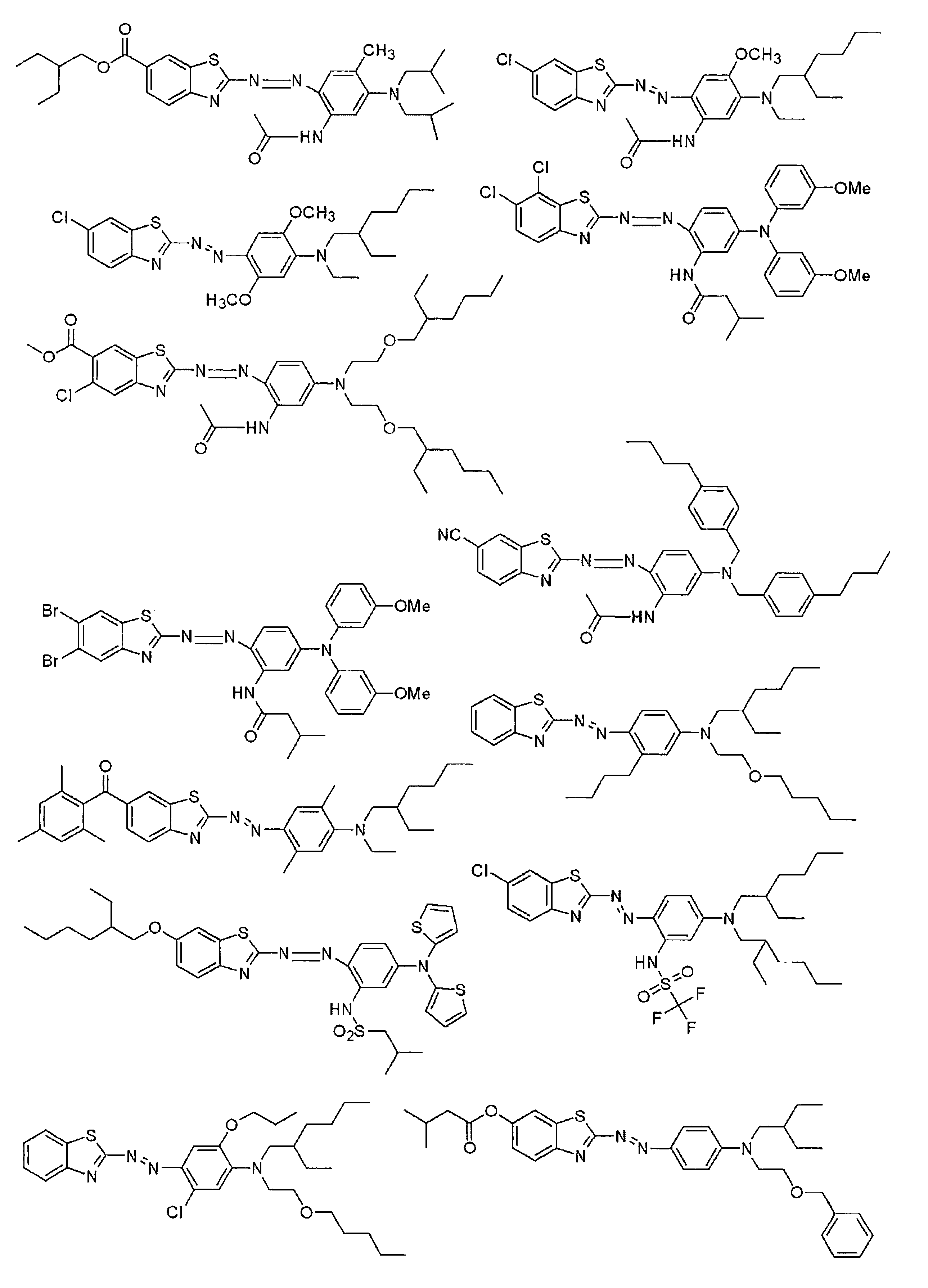

R601、R602、D9又はD10はそれぞれ独立に、任意の置換基を表し、
A1は、水素原子又は任意の置換基を表し、
pは0~5の整数を表し、pが2以上の場合、1分子中に2以上存在するD9は同一であっても異なっていてもよく、
qは0~4の整数を表し、qが2以上の場合、1分子中に2以上存在するD10は同一であっても異なっていてもよく、
X1は窒素原子、又は置換基としてハロゲン原子、シアノ基若しくは-COOR605基を有していてもよいメチン基を表し、
R605は、水素原子、置換基を有していてもよい炭素数が1~20のアルキル基、置換基を有していてもよい炭素数が6~20のアリール基又は置換基を有していてもよい炭素数が2~20のヘテロアリール基を表す。]
R601及びR602は、それぞれ独立に、任意の置換基を示す。本発明の効果を損なわない範囲であれば特に限定されないが、置換基を有していてもよい炭素数が1~20のアルキル基であることが好ましい。具体的には、一般式(1)のR1で例表したアルキル基とそれぞれ同義であり、有していてもよい置換基も同義である。
R601及びR602のアルキル基は、炭素数が4以上であることが好ましく、5以上のアルキル基であることがさらに好ましい。また、炭素数が16以下であることが好ましく、12以下であることがさらに好ましい。炭素数が適当な範囲にあることで、溶媒への溶解性に優れ、しかも高いグラム吸光係数を有する傾向にある。
D9は任意の置換基を表し、本発明の効果を損なわない範囲であれば特に限定されないが、ハロゲン原子、シアノ基、置換基を有していてもよい炭素数が1~20のアルキル基、置換基を有していてもよい炭素数が1~20のアルコキシ基、-COOR604基、-COR609基又は-OCOR610基等であることが、溶媒への溶解性に優れ、しかも高いグラム吸光係数を有する傾向にあるため好ましい。
D10は任意の置換基を表し、本発明の効果を損なわない範囲であれば特に限定されないが、ハロゲン原子、置換基を有していてもよい炭素数が1~20のアルキル基、置換基を有していてもよい炭素数が1~20のアルコキシ基、-NHCOR603基又は-NHSO2R608基等であることが、溶媒への溶解性に優れ、しかも高いグラム吸光係数を有する傾向にあるため好ましい。
A1は水素原子又は任意の置換基を示す。本発明の効果を損なわない範囲であれば特に限定されないが、水素原子、置換基を有していてもよいアルキル基、ハロゲン原子、シアノ基、置換基を有していてもよい炭素数が6~20のアリール基、置換基を有していてもよい炭素数が2~20のヘテロアリール基、置換基を有していてもよい炭素数が1~20のアルコキシ基又は-COOR606基を表し、R606は、水素原子、置換基を有していてもよい炭素数が1~20のアルキル基、置換基を有していてもよい炭素数が6~20のアリール基又は置換基を有していてもよい炭素数が2~20のヘテロアリール基を表すことが、高溶解性及び高吸光係数の点から好ましい。
X1は窒素原子、又は置換基としてハロゲン原子、シアノ基若しくは-COOR605基を有していてもよいメチン基を表し、R605は、水素原子、置換基を有していてもよい炭素数が1~20のアルキル基、置換基を有していてもよい炭素数が6~20のアリール基又は置換基を有していてもよい炭素数が2~20のヘテロアリール基を表す。
D9、D10、R603、R604、R605、R606、R608、R609、R610、及びA1の置換基を有していてもよいアルキル基は、具体的には、前記一般式(1)のR1で例示した置換基を有していてもよいアルキル基とそれぞれ同義であり、有していてもよい置換基もそれぞれ同義である。これらのアルキル基は、炭素数が16以下であることが好ましく、10以下であることがさらに好ましく、6以下であることが特に好ましい。炭素数が適当な範囲にあることで、溶媒への溶解性に優れ、しかも高いグラム吸光係数を有する傾向にある。
D9、D10及びA1の置換基を有していてもよいアルコキシ基は、前記一般式(1)のR1で例示した置換基を有していてもよいアルコキシ基とそれぞれ同義であり、有していてもよい置換基もそれぞれ同義である。
R603、R604、R605、R606、R608、R609、R610、及びA1の置換基を有していてもよいアリール基は、具体的には前記一般式(4)のR101で例示した置換基を有していてもよいアリール基とそれぞれ同義であり、有していてもよい置換基もそれぞれ同義である。
R603、R604、R605、R606、R608、R609、R610、及びA1の置換基を有していてもよいヘテロアリール基は、具体的には、前記一般式(4)のR101で例示した置換基を有していてもよいヘテロアリール基とそれぞれ同義であり、有していてもよい置換基もそれぞれ同義である。


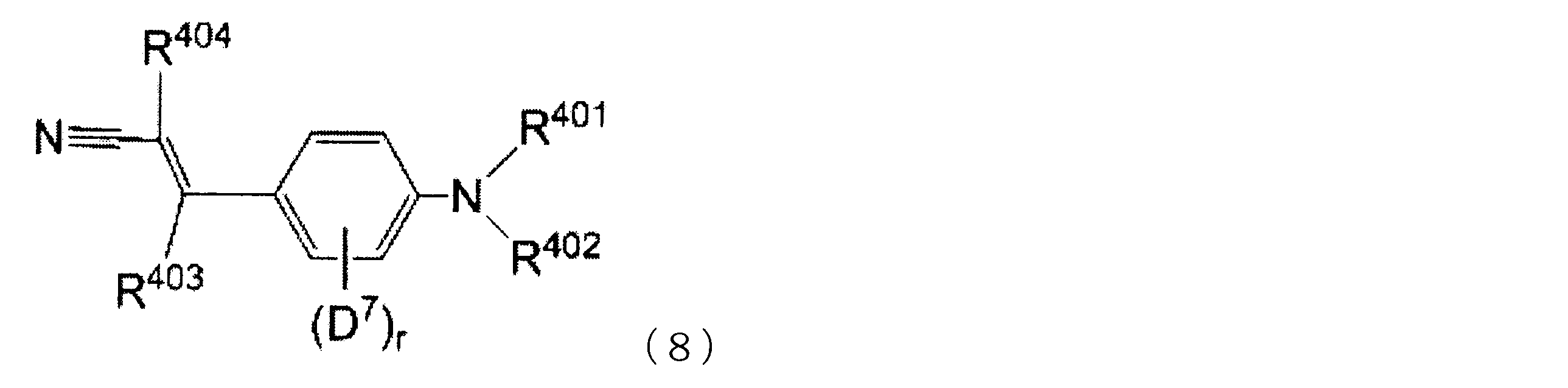
R401、R402及びD7は、それぞれ独立に、任意の置換基を示し、
R403及びR404は、それぞれ独立に、水素原子又は任意の置換基を示し、
rは0~4の整数を示し、rが2以上の場合、1分子中に2以上存在するD7は同一であっても異なっていてもよい。]
R401及びR402はそれぞれ独立に、任意の置換基を示す。R401及びR402は本発明の効果を損なわなければ特に限定されないが、それぞれ独立に、置換基を有していていもよい炭素数1~20のアルキル基、置換基を有していてもよい炭素数が6~20のアリール基又は置換基を有していてもよい炭素数が2~20のヘテロアリール基であることが高吸光係数及び溶媒への高溶解度のために好ましい。
R401及びR402の置換基を有していていもよいアルキル基は、具体的には、前記一般式(1)のR1で例示した置換基を有していていもよいアルキル基とそれぞれ同義であり、有していてもよい置換基もそれぞれ同義である。R401及びR402のアルキル基は炭素数が2以上であることが好ましく、炭素数4以上であることがさらに好ましい。また、炭素数が16以下であることが好ましく、12以下であることがさらに好ましい。炭素数が適当な範囲にあることで、溶媒への溶解性に優れ、しかも高いグラム吸光係数を有することができる場合がある。
R401及びR402のアリール基は、具体的には前記一般式(4)のR101で例示したアリール基と同義であり、有していてもよい置換基も前記一般式(4)のR101で例示したアリール基と同義である。
R401及びR402のヘテロアリール基は、具体的には、前記一般式(4)のR101で例示したヘテロアリール基と同義であり、有していてもよい置換基も前記一般式(4)のR101で例示したヘテロアリール基と同義である。
R403及びR404は、それぞれ独立に、水素原子又は任意の置換基を示す。R403及びR404は、本発明の効果を損なわなければ特に限定されないが、R403は、水素原子又はシアノ基であることが好ましく、R404は、シアノ基又は-COR405基であることが、高吸光係数及び高溶解度のため好ましい。
R405の置換基を有していてもよいアルキル基は、具体的には、前記一般式(1)のR1で例示した置換基を有していてもよいアルキル基と同義であり、有していてもよい置換基も同義である。R405のアルキル基は、炭素数が16以下であることが好ましく、10以下であることがさらに好ましく、6以下であることが特に好ましい。炭素数が適当な範囲にあることで、溶媒への溶解性に優れ、しかも高いグラム吸光係数を有することができる場合がある。
R405の置換基を有していてもよいアルコキシ基は、前記一般式(1)のR1で例示した置換基を有していてもよいアルコキシ基とそれぞれ同義であり、有していてもよい置換基もそれぞれ同義である。R405のアルコキシ基は、炭素数が16以下であることが好ましく、10以下であることがさらに好ましく、6以下であることが特に好ましい。炭素数が適当な範囲にあることで、溶媒への溶解性に優れ、しかも高いグラム吸光係数を有することができる場合がある。
R405の置換基を有していてもよいアリール基は、具体的には前記一般式(4)のR101で例示した置換基を有していてもよいアリール基と同義であり、有していてもよい置換基も前記一般式(4)のR101で例示したアリール基と同義である。
R405の置換基を有していてもよいヘテロアリール基は、具体的には、前記一般(4)のR101で例示した置換基を有していてもよいヘテロアリール基と同義であり、有していてもよい置換基も前記一般式(4)のR101で例示したヘテロアリール基と同義である。
D7は、任意の置換基を示す。D7は、本発明の効果を損なわなければ特に限定されないが、水素原子、ハロゲン原子、置換基を有していてもよい炭素数が1~20のアルキル基、置換基を有していてもよい炭素数が1~20のアルコキシ基、-NHCOR406基又は-NHSO2R407基であることが高吸光係数及び溶媒への高溶解度のため好ましい。
D7、R406及びR407の置換基を有していてもよいアルキル基は、具体的には、前記一般式(1)のR1で例示した置換基を有していてもよいアルキル基とそれぞれ同義であり、有していてもよい置換基もそれぞれ同義である。
D7の置換基を有していてもよいアルコキシ基は、前記一般式(1)のR1で例示した置換基を有していてもよいアルコキシ基と同義であり、有していてもよい置換基も同義である。D7のアルコキシ基は、炭素数が16以下であることが好ましく、10以下であることがさらに好ましく、6以下であることが特に好ましい。炭素数が適当な範囲にあることで、溶媒への溶解性に優れ、しかも高いグラム吸光係数を有することができる場合がある。
R406及びR407の置換基を有していてもよいアリール基は、具体的には前記一般式(4)のR101で例示した置換基を有していてもよいアリール基とそれぞれ同義であり、有していてもよい置換基も前記一般式(4)のR101で例示したアリール基とそれぞれ同義である。
R406及びR407の置換基を有していてもよいヘテロアリール基は、具体的には、前記一般式(4)のR101で例示した置換基を有していてもよいヘテロアリール基とそれぞれ同義であり、有していてもよい置換基も前記一般式(4)のR101で例示したヘテロアリール基とそれぞれ同義である。

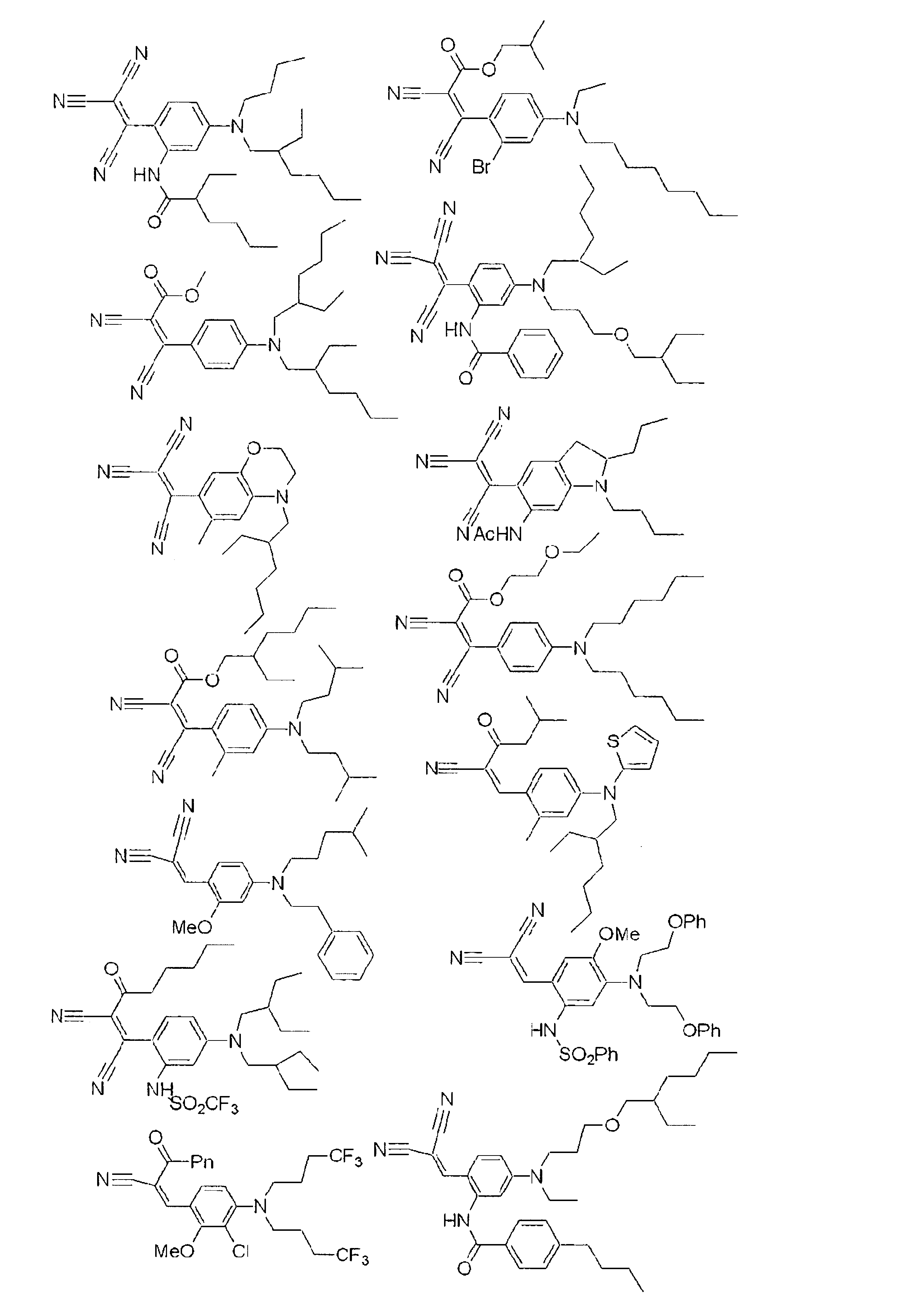
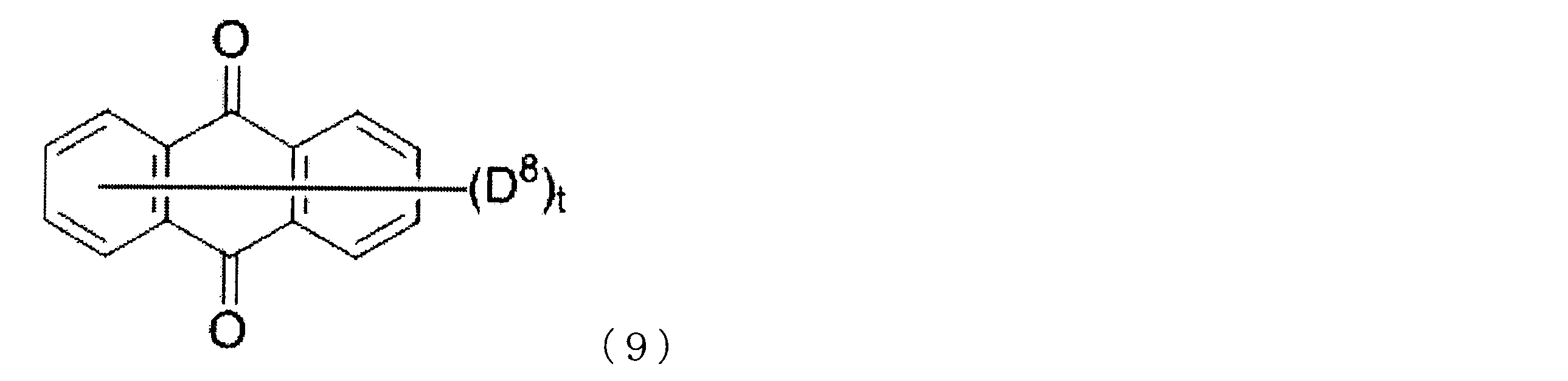
D8は任意の置換基を示し、
tは0~8の整数を示し、tが2以上の場合、1分子中に2以上存在するD8は同一であっても異なっていてもよい。]
D8は任意の置換基を示す。D8は、本発明の効果を損なわなければ特に限定されないが、ハロゲン原子、置換基を有していてもよい炭素数が1~20のアルキル基、置換基を有していてもよい炭素数が1~20のアルコキシ基、シアノ基、ヒドロキシ基、アミノ基、ニトロ基、-COOR501基、-NHR502基、-NHCOR503基又は-SR504基であることが高吸光係数及び溶媒への高溶解度のため好ましい。
D8、R501、R502、R503及びR504の置換基を有していてもよいアルキル基は、具体的には、前記一般式(1)のR1で例示した置換基を有していてもよいアルキル基とそれぞれ同義であり、有していてもよい置換基もそれぞれ同義である。D8、R501、R502、R503及びR504のアルキル基は、炭素数が16以下であることが好ましく、10以下であることがさらに好ましく、6以下であることが特に好ましい。炭素数が適当な範囲にあることで、溶媒への溶解性に優れ、しかも高いグラム吸光係数を有することができる場合がある。
R501、R502、R503及びR504の置換基を有していてもよいアリール基は、具体的には前記一般式(4)のR101で例示した置換基を有していてもよいアリール基とそれぞれ同義であり、有していてもよい置換基も前記一般式(4)のR101で例示したアリール基とそれぞれ同義である。R502及びR504のアリール基としては、溶媒への高溶解性の理由から、置換基を有していてもよいフェニル基又はナフチル基が好ましい。
R501、R502、R503及びR504のヘテロアリール基は、具体的には、前記一般式(4)のR101で例示したヘテロアリール基とそれぞれ同義であり、有していてもよい置換基も前記一般式(4)のR101で例示したヘテロアリール基とそれぞれ同義である。
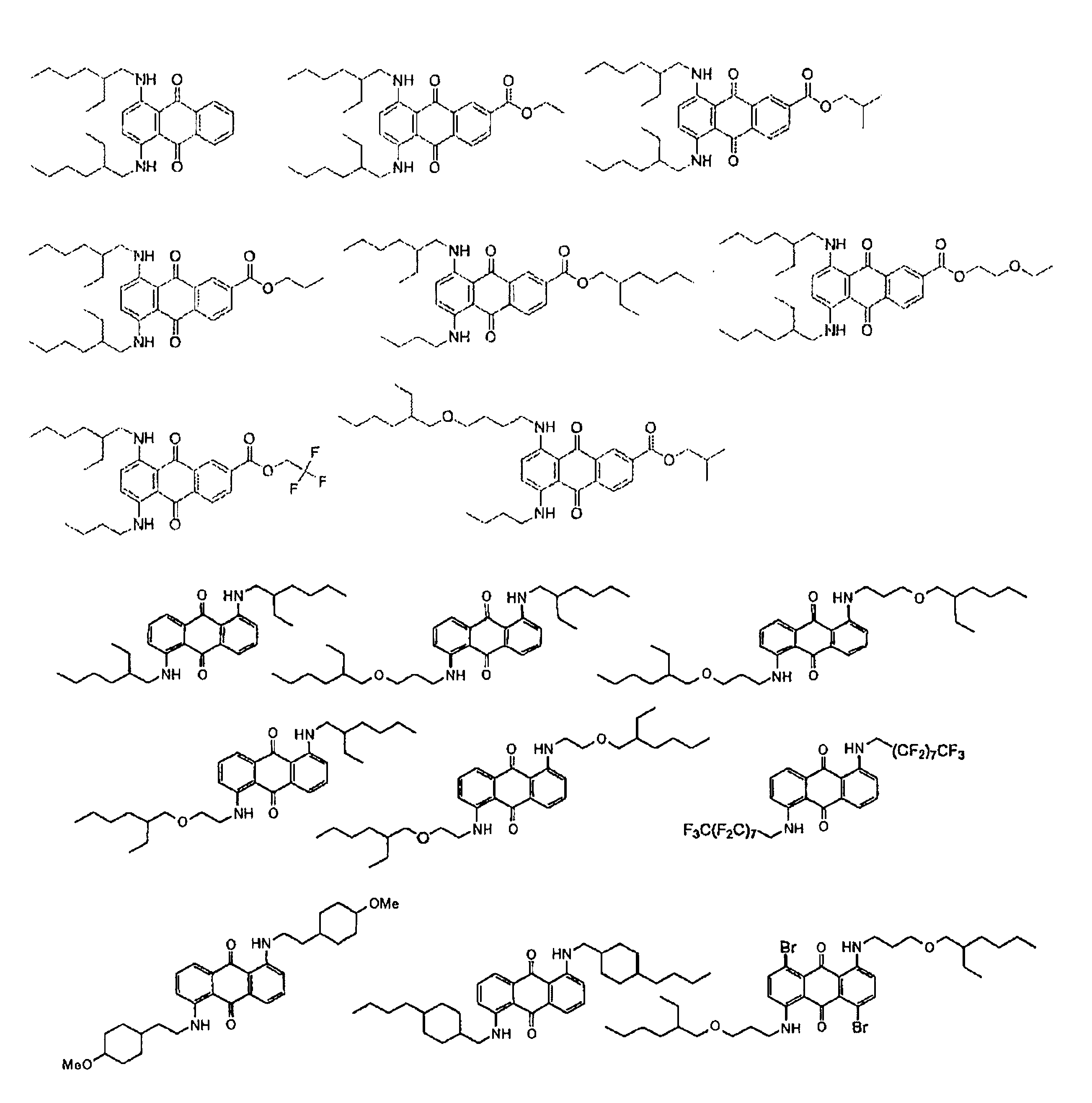
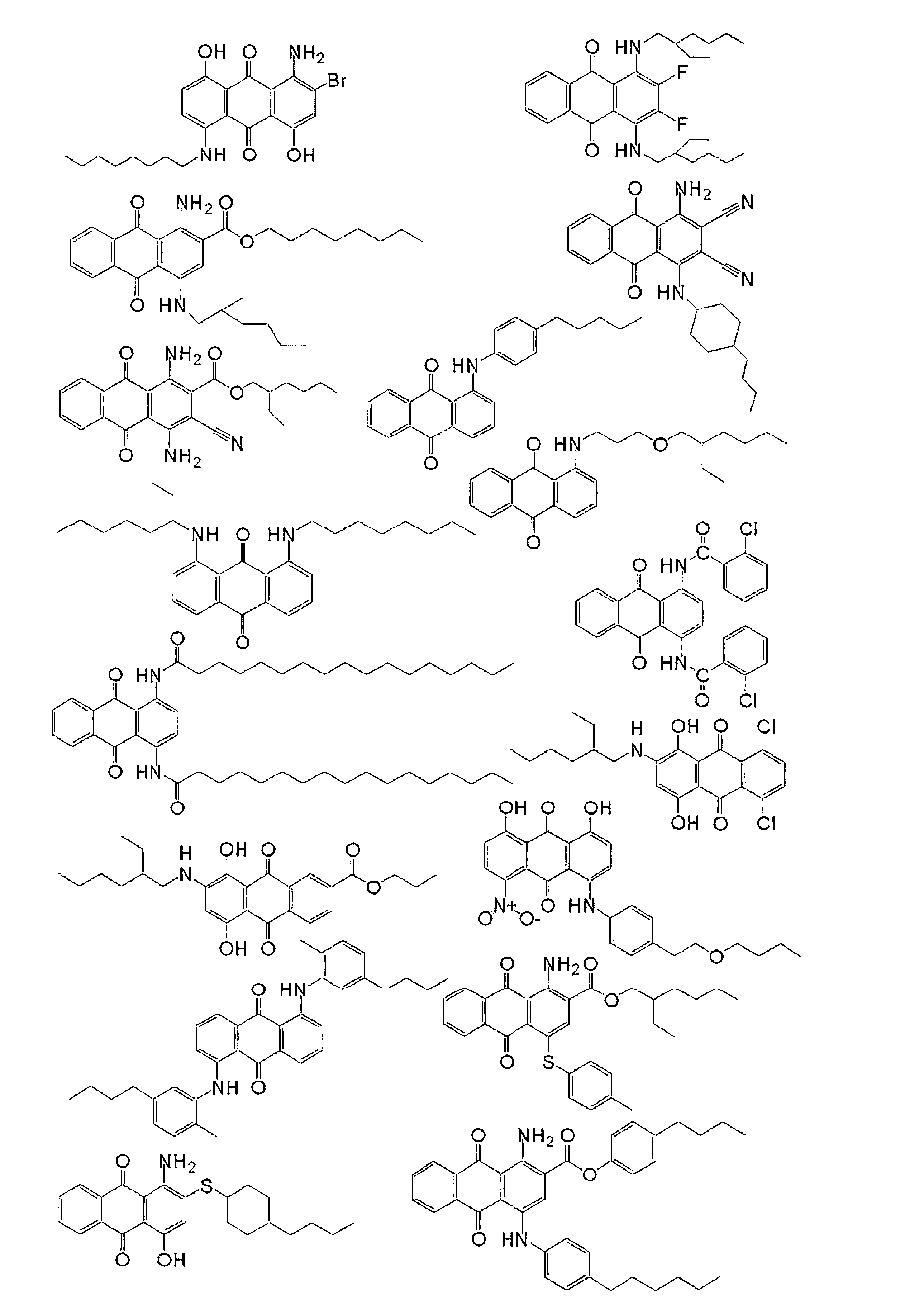
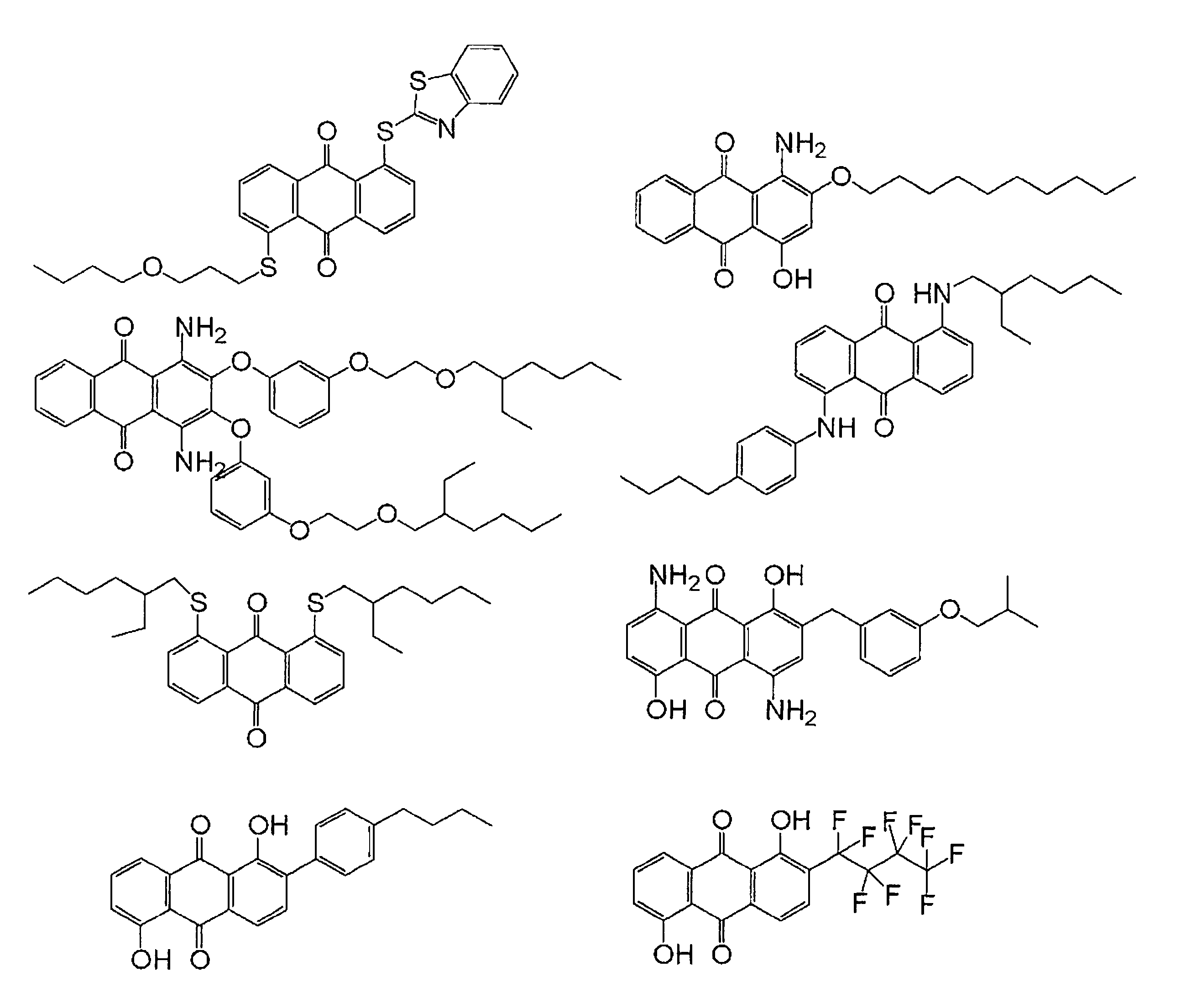
本発明のインクはディスプレイ用インクに好適に用いられる。ディスプレイとしては、インクを含む表示部位を有し、表示部位の電圧印加を制御することで画像を表示するディ
スプレイ、電圧印加によって着色状態を変化させることにより画像を表示するディスプレイ、表示部位にさらに電気泳動粒子又は水性媒体を用いて表示をさせるディスプレイに特に有用である。
本発明のインクは、周波数1kHz及び温度22℃で測定した比誘電率が3以下であり、かつ25℃における水に対する溶解度が25mg/L以下である溶媒、及び以下(I)~(IV)の化合物をそれぞれ少なくとも1つずつ有することを特徴とする。
(I)デカン溶液での吸収極大波長が400nm以上、500nm未満である化合物
(II)デカン溶液での吸収極大波長が500nm以上、570nm未満である化合物
(III)デカン溶液での吸収極大波長が570nm以上、640nm未満である化合物
(IV)デカン溶液での吸収極大波長が640nm以上、700nm以下である化合物

R21は、任意の置換基を表し、
R22及びR23は、それぞれ独立に、水素原子又は任意の置換基を表し、
R24及びR25は、それぞれ独立に、置換基を有していてもよいアルキル基を表し、
X2は、窒素原子又は置換基を有していてもよいメチン基を表し、
n´は、0~5の整数を表す。]

R31は任意の置換基を表し、
R32は、水素原子又はアルキル基を表し、
R33は、シアノ基又はアルコキシカルボニル基を表し、
但し、R32が水素原子の場合は、R33はアルコキシカルボニル基を表し、
R34及びR35はそれぞれ独立に、水素原子又は任意の置換基を表し、
R36及びR37はそれぞれ独立に、置換基を有していてもよい炭素数が4~20の分岐アルキル基を表し、
mは、0~5の整数を表す。]
R31は、一般式(1)のR1と同義であり、有していてもよい置換基及び好ましい範囲も同義である。同様に、R32と一般式(1)のR2、R34と一般式(3)のR46、R35と一般式(3)のR7、mと一般式(1)のnはそれぞれ同義であり、有していてもよい置換基及び好ましい範囲もそれぞれ同義である。
また、R23は、一般式(1)のXが置換基を有していていもよい炭素原子であり、Xが有していてもよい置換基が、シアノ基又はアルコキシカルボニル基である場合と同義である。さらに好ましい範囲も同義である。

2,5-ジメチル-1,4-ジチアン-2,5-ジオール(10g,55.5mmol)およびマロノニトリル(7.33g,111mmol)をメタノール(100ml)に溶解し、トリエチルアミン(15.4ml,111mmol)をゆっくり添加し、室温にて1時間攪拌した。反応液を濃縮し、水で洗浄し後にろ過し、中間体TH1(9.32g、収率:定量的、1H-NMR(400MHz,CDCl3):6.00(s,1H),4.87(br-s,2H),2.19(s,3H))を固体として得た。
1,4-ジチアン-2,5-ジオール(5.0g,32.8mmol),シアノ酢酸エチル(8.53g,75.4mmol)をジメチルホルムアミド(50ml,10VR)に希釈し、トリエチルアミン(9.09ml,65.6mmol)を滴下し、室温にて30分間反応させた。反応液に水(200ml)を添加し、酢酸エチル(150ml)で2回抽出し、有機層をさらに水(50ml)で3回洗浄した。有機層を硫酸マグネシウムで乾燥後、ろ過して得られたろ液を濃縮し、茶色オイルとして中間体TH2(収率:定量的)を得た。
シアノ酢酸プロピル(25.0g,0.19mol)、1,4-ジチアン-2,5-ジオール(16.45g,0.11mol)とメタノール(43mL)の混合物にトリエチルアミン(10.8mL)滴下した。このとき反応溶液は30℃以下に保った。滴下後、40℃に昇温し、2時間撹拌した。室温にもどしたのち、反応溶液を濃縮した。そこに酢酸エチルを加え、析出した固体をろ過により取り除いた。ろ液を濃縮し茶色オイルとして中間体TH3(47.96g)を得た。
シアノ酢酸ブチル(25.0g,0.18mol)、1,4-ジチアン-2,5-ジオール(14.81g,0.097mol)とメタノール(25mL)の混合物にトリエチルアミン(6.4mL)滴下した。このとき反応溶液は30℃以下に保った。滴下後、40℃に昇温し、2時間撹拌した。室温にもどしたのち、反応溶液を濃縮した。そこに酢酸エチルを加え、析出した固体をろ過により取り除いた。ろ液を濃縮し中間体TH4(45.32g,収率:定量的)を得た。

4-プロピルアニリン(東京化成品:5.87g,43.4mmol)を水(60ml)に希釈し、氷冷下、濃塩酸(12.0ml,130mmol)を添加し、さらに亜硝酸ナトリウム(3.14g,61.3mmol)をゆっくりと添加し、氷冷下でさらに30分間攪拌してジアゾ液を得た。別のフラスコに中間体TH1(6.00g,43.4mmol)をメタノール(120ml)に希釈したものを調製し、ここにジアゾ液をゆっくりと滴下し、10分間攪拌後、室温に昇温した。ろ過して得られた個体を少量のメタノールで洗浄して中間体MA1(12.4g,収率:定量的)を得た。
4-ブチルアニリン(東京化成品:8.72g,58.4mmol)を水(90ml)に希釈し、氷冷下、濃塩酸(15.9ml,175mmol)を添加し、さらに亜硝酸ナトリウム(4.23g,61.3mmol)をゆっくりと添加し、氷冷下でさらに30分間攪拌してジアゾ液を得た。別のフラスコに中間体TH1(7.50g,54.2mmol)をメタノール(250ml)に希釈したものを調製し、ここにジアゾ液をゆっくりと滴下し、10分間攪拌後、室温に昇温した。ろ過して得られた個体を少量のメタノールで洗浄して中間体MA2(19.0g,収率:定量的)を得た。
4-ブチルアニリン(東京化成品:8.72g,58.4mmol)を水(90ml)に希釈し、氷冷下、濃塩酸(15.9ml,175mmol)を添加し、さらに亜硝酸ナトリウム(4.23g,61.3mmol)をゆっくりと添加し、氷冷下でさらに30分間攪拌してジアゾ液を得た。別のフラスコに中間体TH2(10.0g,58.4mmol)をメタノール(90ml)に希釈したものを調製し、ここにジアゾ液をゆっくりと滴下し、10分間攪拌後、室温に昇温した。ろ過して得られた個体をメタノール(200ml)で洗浄して中間体MA3(12.1g,収率:62%)を得た。
4-ペンチルアニリン(東京化成品:2.33g,14.3mmol)を水(25ml,10VR)に希釈し、35%塩酸(3.9ml,42.9mmol,3.0MR)を添加し、氷冷下、亜硝酸ナトリウム(1.03g,15.0mmol)を添加してジアゾ液を得た。別のフラスコに中間体TH2(4.5g,13.0mmol)およびメタノール(45ml,10VR)を仕込み、氷浴にて冷却し、ここにジアゾ液をゆっくりと滴下した。途中、メタノール(50ml)を添加した。反応液を室温に昇温し、析出した固体をろ過し、得られた個体をメタノール(100ml)にて懸洗、ろ過し、黄色固体として中間体MA4(4.84g、収率:定量的)を得た。
4-ブチルアニリン(10mL,62.9mmol)、脱塩水(78mL)、35%塩酸(19.4mL)の混合物を0℃以下に冷却し、亜硝酸ナトリウム(4.563g,66.13mol)水溶液(21mL)を滴下した。滴下後、0℃以下のまま、30分間攪拌しジアゾ液を得た。TH3(11.668g,0.153mol)、メタノール(520mL)とスルファミン酸(0.611g,6.29mmol)の混合物を0℃以下に冷却し、ジアゾ液を滴下した。滴下後、0℃以下のまま、30分間攪拌した。反応溶液を室温にもどし、析出した沈殿物をろ取し、水:メタノール=1:1溶液(300mL)でかけ洗することで中間体MA5(13.81g、収率:63%)を得た。
4-ブチルアニリン(10mL,62.9mmol)、脱塩水(78mL)、35%塩酸(19.4mL)の混合物を0℃以下に冷却し、亜硝酸ナトリウム(4.563g,66.13mol)水溶液(21mL)を滴下した。滴下後、0℃以下のまま、30分間攪拌しジアゾ液を得た。TH4(12.55g,62.9mmol)、メタノール(188mL)とスルファミン酸(0.611g,6.29mmol)の混合物を0℃以下に冷却し、ジアゾ液を滴下した。
4-n-ブチルアニリン8.02g(54mmol)と7%塩酸水溶液80mlを攪拌、氷冷した後に亜硝酸ナトリウム3.76g(55mmol)を水25mlに溶かした水溶液を滴下、攪拌してジアゾ液にした。別容器に2-アミノ-3-シアノチオフェン6.68g(54mmol)、メタノール100mlを入れ、氷浴中ジアゾ溶液を滴下してカップリングさせた。生成した沈殿を濾別、乾燥し中間体3を得た(14g、収率92%)。
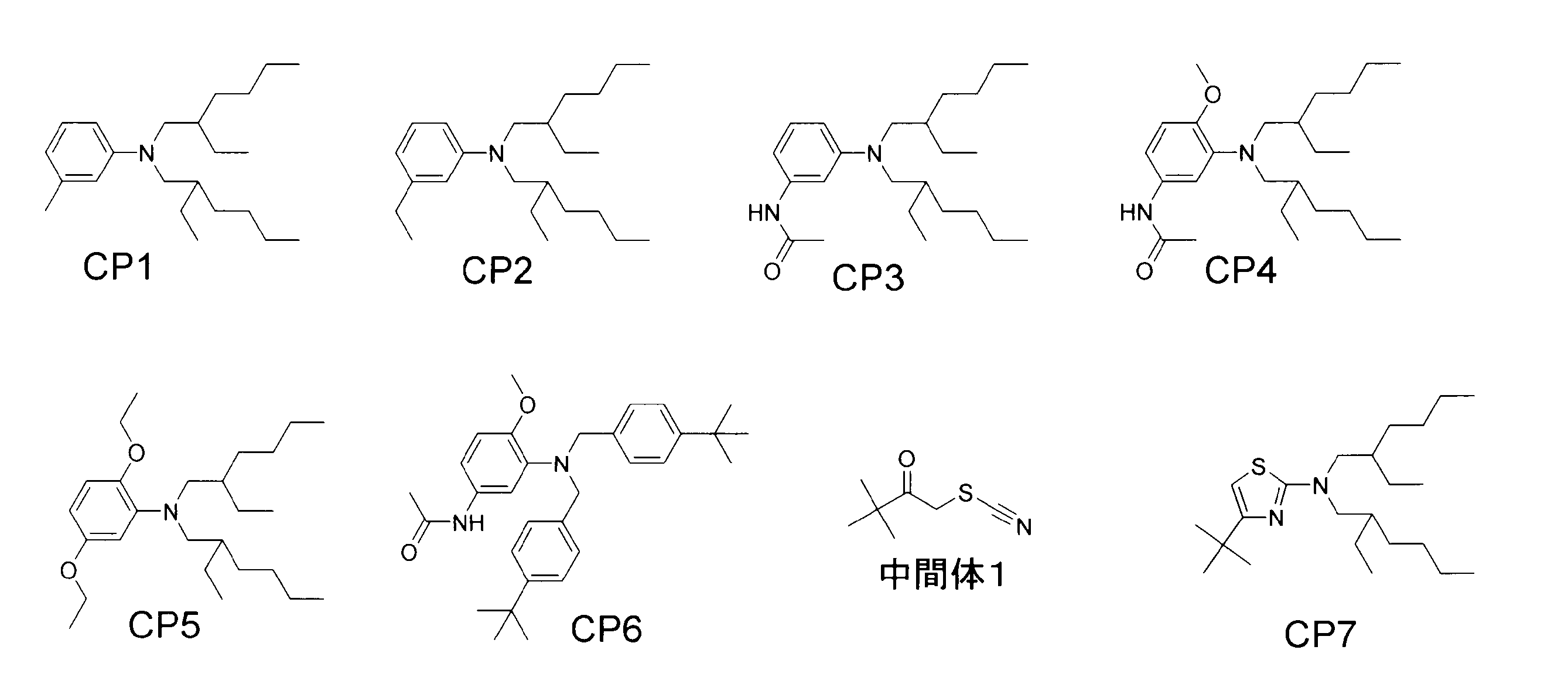
m-トルイジン(51.1g、477mmol)、1-ブロモ-2-エチルヘキサン(357.3g、1.86mol)、炭酸カリウム(221.5g、1.6mol)の混合物を140℃で17時間攪拌した。放冷後、濾過し、得られた有機層を濃縮した後シリカゲルカラムクロマトグラフィーで精製して、中間体CP1(52g、収率33%)を得た。
3-エチルアニリン(10.0g、83mmol)、N,N-ジメチルホルムアミド(50ml)、1-ブロモ-2-エチルヘキサン(47.8g、248mmol)、炭酸カリウム(45.6g、330mmol)の混合物を110℃で24時間攪拌した。放冷後、濾過し、濾液に水を加えトルエンで抽出した。得られた有機層を濃縮した後シリカゲルカラムクロマトグラフィーで精製して、CP2(6.3g、収率22%)を得た。
m-アミノアセトアニリド(13.0g、87mmol)、N,N-ジメチルホルムアミド(60ml)、1-ブロモ-2-エチルヘキサン(50.4g、261mmol)、炭酸カリウム(49.5g、358mmol)の混合物を140℃で14時間攪拌した。放冷後、濾過し、濾液に水を加えトルエンで抽出した。得られた有機層を濃縮した後シリカゲルカラムクロマトグラフィーで精製して、CP3(17.4g、収率54%)を得た。
3’-アミノ-4’-メトキシアセトアニリド(25.0g、139mmol)、N,N-ジメチルホルムアミド(125ml)、1-ブロモ-2-エチルヘキサン(80.4g、416mmol)、炭酸カリウム(76.7g、554mmol)の混合物を140℃で14時間攪拌した。放冷後、濾過し、濾液に水を加えトルエンで抽出した。得られた有機層を濃縮した後シリカゲルカラムクロマトグラフィーで精製して、中間体CP4(9.82g、収率18%)を得た。
2,5-ジエトキシアニリン(東京化成品:50g,276mmol)、2-エチルヘキシルブロミド(286ml)、ヨウ化カリウム(4.58g)、炭酸カリウム(153g)をフラスコに仕込み、内温125℃前後で合計26時間加熱攪拌した。反応液を室温に冷却し、ろ過して得られたろ液に水(400ml)を添加し、へキサン(300ml)にて抽出し、ヘキサン層をさらに水(400ml)で2回洗浄し、硫酸マグネシウムで乾燥後、溶媒を留去した。得られた粗体をシリカゲルカラムクロマトグラフィーで精製し、中間体CP5(23.6g,収率22%)を油状物として得た。
3’-アミノ-4’-メトキシアセトアニリド(7.51g,41.7mmol)、4-tert-ブチルベンジル=ブロミド(28.4g,125mmol)、炭酸カリウム(11.5g,83.4mmol)、N,N-ジメチルホルムアミド(25ml)の混合物を内部温度75度で1.5時間攪拌した。室温まで冷却し、水を加え、トルエンと酢酸エチルの混合溶媒で抽出し、無水硫酸ナトリウムで乾燥し、減圧濃縮した。固体をヘキサンで洗浄して、中間体CP6(17.7g,収率90%)を得た。
メタノール(36mL)とチオシアン酸ナトリウム(15.5g,191mmol)の混合物を60℃に加熱し、1-クロロピナコロン(25mL,191mmol)を15分間かけて滴下した。60℃で2.5時間加熱し、室温まで放冷して、さらに氷浴で10℃以下に冷却した。水(32mL)を滴下し、5℃で1時間攪拌して結晶を濾取し、風乾して中間体1を得た(収量27g、収率90%)。
<化合物1の合成>
中間体MA2(7.50g,25.1mmol)を酢酸:プロピオン酸=17:8(V/V)(375ml)に希釈し、-5℃まで寒剤冷却し、40%二トロシル硫酸(8.77g,1.1eq.)を0℃以下を保ってゆっくりと滴下してジアゾ液を調製した。別のフラスコに中間体CP3(9.39g,25.1mmol)およびTHF(275ml)、酢酸ナトリウム(13.2g)を仕込み、-5℃に冷却し、ここにジアゾ液を0℃以下に保ってゆっくりと滴下した。
<化合物2の合成>
中間体MA2(2.50g,8.38mmol)を酢酸:プロピオン酸=17:8(V/V)(125ml)に希釈し、-5℃以下まで寒剤冷却し、40%二トロシル硫酸(2.93g,9.05mmol)をゆっくりと滴下してジアゾ液を調製した。別のフラスコに中間体CP1(2.78g,8.38mmol)およびTHF(125ml)、酢酸ナトリウム(4.5g)を仕込み、-5℃に冷却し、ここに前述で調製したジアゾ液をゆっくりと滴下した。
<化合物3の合成>
中間体MA1(3.00g,10.5mmol)を酢酸:プロピオン酸=17:8(V/V)(180ml)に希釈し、-5℃以下まで寒剤冷却し、40%二トロシル硫酸(3.67g,9.05mmol)をゆっくりと滴下してジアゾ液を調製した。別のフラスコに中間体CP3(3.95g,10.5mmol)およびTHF(180ml)、酢酸ナトリウム(5.5g)を仕込み、-5℃に冷却し、ここに前述で調製したジアゾ液をゆっくりと滴下した。
<化合物4の合成>
中間体MA2(3.58g,10.5mmol)を酢酸:プロピオン酸=17:8(V/V)(215ml)に希釈し、-5℃以下まで寒剤冷却し、40%二トロシル硫酸(4.19g,13.2mmol)をゆっくりと滴下してジアゾ液を調製した。別のフラスコに中間体CP5(4.87g,12.0mmol)およびTHF(215ml)、酢酸ナトリウム(6.5g)を仕込み、-5℃に冷却し、ここに前述で調製したジアゾ液をゆっくりと滴下した。
<化合物5の合成>
中間体MA4(2.40g,6.95mmol)を酢酸:プロピオン酸=17:8(V/V)(144ml)に希釈し、-5℃以下まで寒剤冷却し、40%二トロシル硫酸(2.65g,8.34mmol)をゆっくりと滴下してジアゾ液を調製した。別のフラスコに中間体CP2(2.30g,6.95mmol)およびTHF(150ml)、酢酸ナトリウム(5.0g)を仕込み、-5℃に冷却し、ここに前述で調製したジアゾ液をゆっくりと滴下した。
<化合物6の合成>
中間体MA3(2.50g,7.54mmol)を酢酸:プロピオン酸=17:8(V/V)(250ml)に希釈し、-5℃以下まで寒剤冷却し、40%二トロシル硫酸(2.87g,9.05mmol)をゆっくりと滴下してジアゾ液を調製した。別のフラスコに中間体CP1(2.50g,7.54mmol)およびTHF(250ml)、酢酸ナトリウム(5.0g)を仕込み、-5℃に冷却し、ここに前述で調製したジアゾ液をゆっくりと滴下した。
<化合物7の合成>
中間体MA5(3.00g,8.68mmol)、85%リン酸(38mL)、酢酸(25mL)、プロピオン酸(13mL)の混合物を0℃以下に冷却し、40%ニトロシル硫酸(2.89g,9.11mmol)を滴下した。滴下後、0℃以下のまま、30分間攪拌しジアゾ液を得た。中間体CP1(2.879g,8.68mmol)、テトラヒドロフラン(18mL)、メタノール(2mL)、脱塩水(3mL)と尿素(52mg,0.868mmol)の混合物を0℃以下に冷却し、そこにジアゾ液を滴下した。
<化合物8の合成>
中間体MA6(3.00g,8.34mmol)、85%リン酸(38mL)、酢酸(25mL)、プロピオン酸(13mL)の混合物を0℃以下に冷却し、40%ニトロシル硫酸(2.78g,8.8mmol)を滴下した。滴下後、0℃以下のまま、30分間攪拌しジアゾ液を得た。中間体CP1(2.767g,8.34mmol)、テトラヒドロフラン(18mL)、メタノール(2mL)、脱塩水(3mL)と尿素(50mg,0.834mmol)の混合物を0℃以下に冷却し、そこにジアゾ液を滴下した。
<化合物9の合成>
中間体MA3(3.31g,10mmol)、リン酸(30ml)、酢酸(24ml)、プロピオン酸(6ml)を、氷-アセトン浴で冷却し、40%ニトロシル硫酸(3.49g,11mmol)を加え、20分間攪拌し、ジアゾ液を得た。別容器に中間体CP4(4.05g,10mmol)、アミド硫酸(0.29g,3mmol)、テトラヒドロフラン(50ml)、水(100ml)を取り、氷浴で冷却し、ジアゾ液を加えた。
<化合物10の合成>
中間体MA7(2.50g,8.79mmol)、85%リン酸(31mL)、酢酸(20mL)、プロピオン酸(10mL)の混合物を-5℃に冷却し、40%ニトロシル硫酸(2.9g,9.2mmol)を滴下した。
中間体MA8(5.0g、16.7mmol)、85%リン酸(63ml)、酢酸(24ml)及びプロピオン酸(21ml)の混合物を-5℃以下に冷却し、40%ニトロシル硫酸(5.85g、18.4mmol)を滴下した。滴下終了後、-5℃以下で30分間撹拌し、ジアゾ液を得た。別容器にCP7(6.37g、16.7mmol)、テトラヒドロフラン(41ml)、メタノール(6ml)、脱塩水(6ml)及び尿素(0.100g、1.67mmol)の混合物を取り、内部温度-5℃以下を保ちつつジアゾ液を滴下した。

<中間体TDの合成>
2-アミノ-5-メルカプト-1,3,4-チアジアゾール(12.9g,96.8mmol)、1-ブロモヘキサン(16.8g,102mmol)、エタノール(100ml)、水酸化カリウム(8.15g,145mmol)の混合物を4時間加熱還流した後、氷水に注ぎ、沈殿を濾取し、メタノール/水(1/1,容量比)で洗浄して、中間体TD(12.3g,収率58%)を得た。
氷浴で冷却下に、44%ニトロシル硫酸(2.52g,10mmol)、酢酸(30ml)、プロピオン酸(10ml)を混合物し、中間体TD(2.17g,10mmol)を加え、氷浴で冷却下に1時間攪拌して、ジアゾ液を得た。別容器に、中間体CP6(4.73g,10mmol)、酢酸ナトリウム(16.4g,100mmol)、テトラヒドロフラン(60ml)を取り、氷浴で冷却下にジアゾ液を滴下した。室温で攪拌後、水を加え、トルエンで抽出し、トルエン層を水洗し、減圧濃縮した。シリカゲルカラムクロマトグラフィーで精製し、比較例化合物1(1.79g,収率26%)を得た。

化合物1~11及び比較例化合物1について、溶媒としてn-デカン(比誘電率2.0、水に対する溶解度1mg/L以下)を用いインクを調製した。各インクの溶液の色、吸収極大波長(λmax)、5℃におけるn-デカンに対する溶解度C、モル吸光係数ε及びεCを表4にまとめた。
アジレント・テクノロジー株式会社製のプレシジョンLCRメータ 4284Aを用いてインピーダンスメーター法により測定した。溶媒及びインクのそれぞれを電極間隔30μmに対向、平行平板のITO電極付きガラス基板で挟持した後、22℃において、周波数1kHz,テスト信号電圧0.1V印加時の等価並列容量を測定し、下式による計算で比誘電率を決定し、評価した。
比誘電率=等価並列容量×電極間隔/電極面積/真空の誘電率(ε0)
純水30gと溶媒8gを110mlのバイアル瓶に入れ、25℃の恒温槽内で200回/分で4時間振盪した。振盪後の液を遠心分離し(6000×g、5分間)、水層をサンプリングして、溶解している溶媒の濃度をガスクロマトグラフィーで定量した。
化合物1、比較例化合物1及び2それぞれ1mgを、各溶媒100mlに溶解し、測定光路長10mmの石英セルを使用して、日立分光光度計U-4100にて吸収スペクトルの測定を行った。得られたスペクトルから吸収極大波長λmax(nm)とモル吸光係数ε(L・mol-1・cm-1)を求めた。
各化合物のn-デカンに対する溶解度Cを次の通り測定した。n-デカンに、化合物1~11及び比較例化合物1をそれぞれ溶解残存分が生じるまで添加し、30℃で30分間超音波処理をした。化合物1、3~5及び11は溶解性が高いため、特定量の溶解度を確認できたところで添加を終了した。

化合物1~3、5、7~11および比較例化合物1の耐光性を次の通り測定した。各化合物0.01をn-デカン0.99gに溶解し、光路長0.004mmのセルに入れエポキシ樹脂を用いて封止した。ウェザーメーター(アトラス Ci4000)を用いキセノン光(340nm 0.55W/m2放射照度)を40時間照射した。照射中、試験槽内温度を33℃に保った。
*残存率(%)=(照射後の最大吸収波長における吸光度)/(照射前の最大吸収波長における吸光度)x100
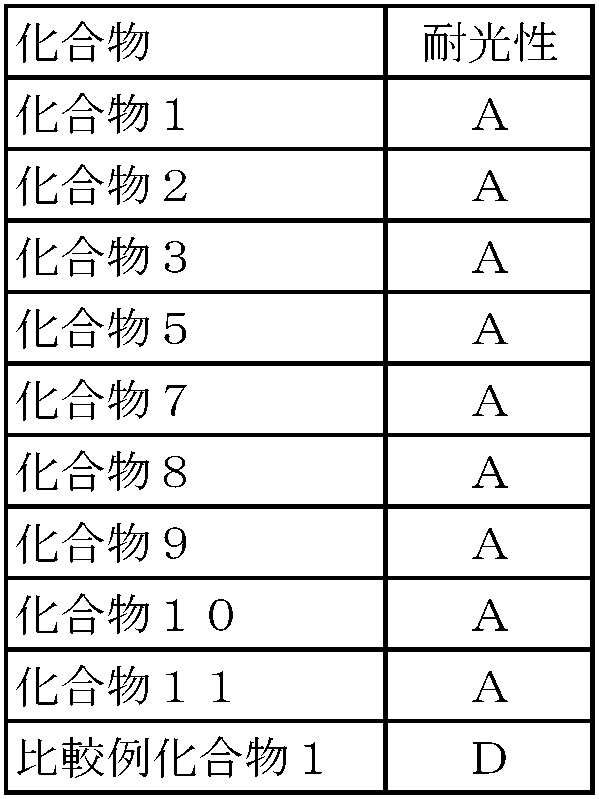
化合物3並びに下記に記載した黄色化合物A、赤色化合物A及び青色化合物Aからなる組成物1を、n-デカン(比誘電率2.0、水に対する溶解度1mg/L以下 東京化成工業社製)に溶解させて黒色インク1を表6の通り調製した。また、化合物10ならびに下記に記載した黄色化合物A、赤色化合物A及び青色化合物Aからなる組成物2、及び黄色化合物A、赤色化合物A及び青色化合物Aからなる組成物3を、組成物1と同様のn-デカンにそれぞれ溶解させ、黒色インク2及び比較例黒色インクを表6の通り調製した。
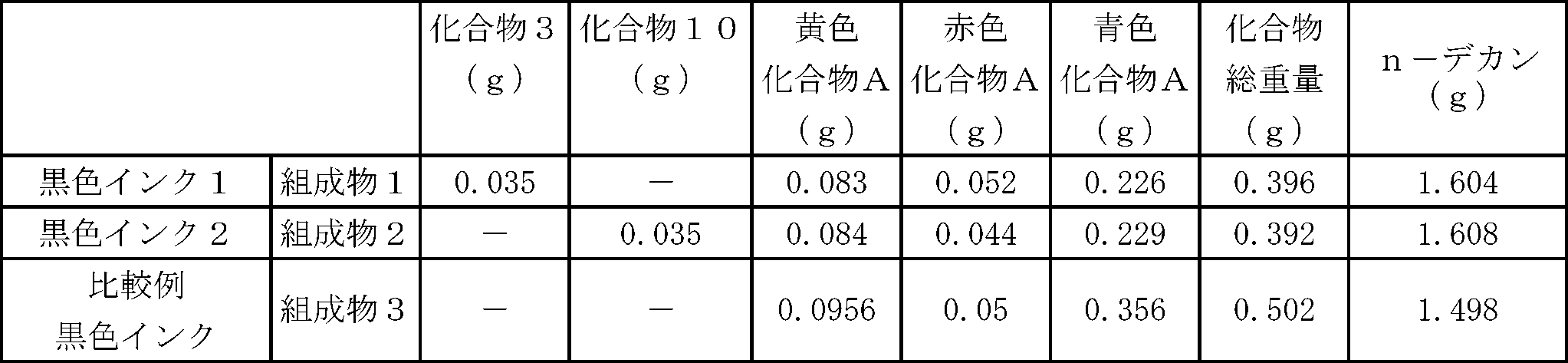
国際公開第2009/063880号に記載の化合物(1-1)

H-1(0.50g、3.3mmol)、氷酢酸(3ml)、プロピオン酸(0.7ml)、硫酸(2.7ml)、脱塩水(0.3ml)の混合物を氷浴で冷却し、系内1℃で44wt%ニトロシル硫酸(1.0g、3.6mmol)を滴下した後、系内0±5℃を保ち1時間攪拌してジアゾ液を得た。別容器に中間体CP1(0.81g、3.1mmol)、テトラヒドロフラン(40ml)、スルファミン酸(0.06g、0.6mmol)、酢酸ナトリウム(5.7g)を取り、氷冷下でジアゾ液を系内0±5℃を保ちながら滴下した。
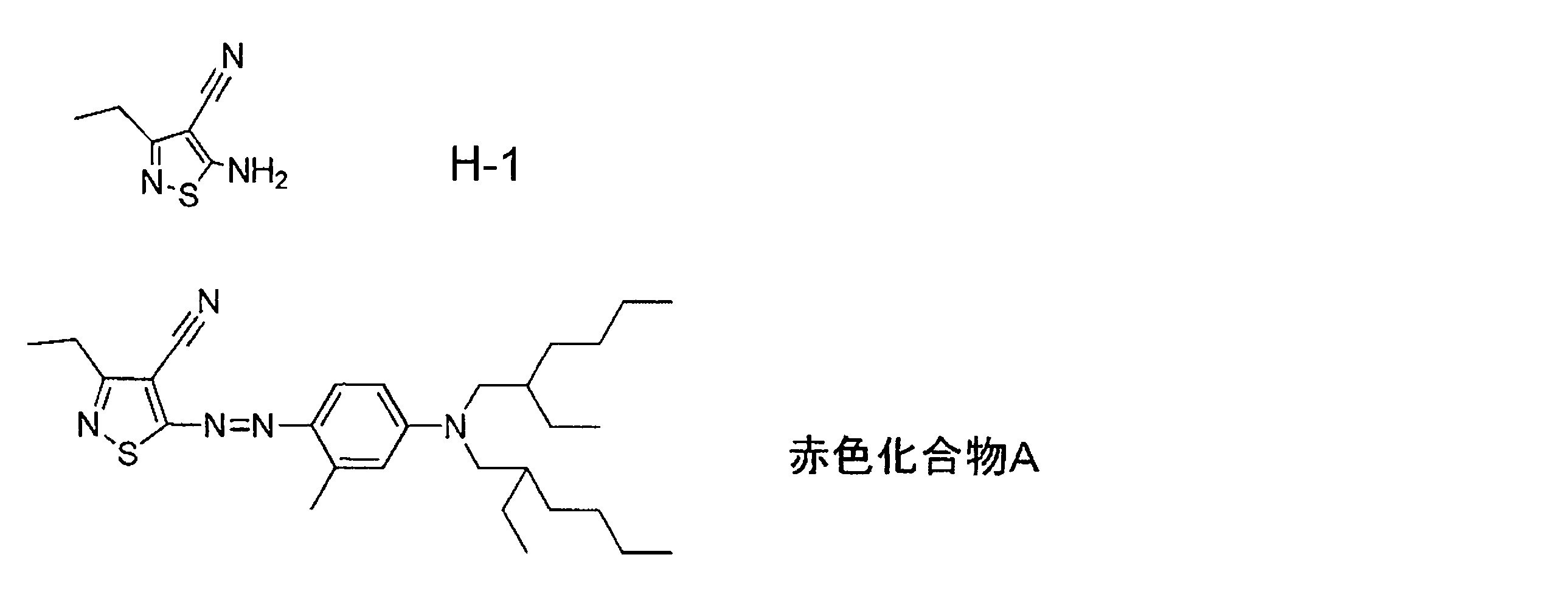
日本国特開2000-313174号公報に記載の化合物
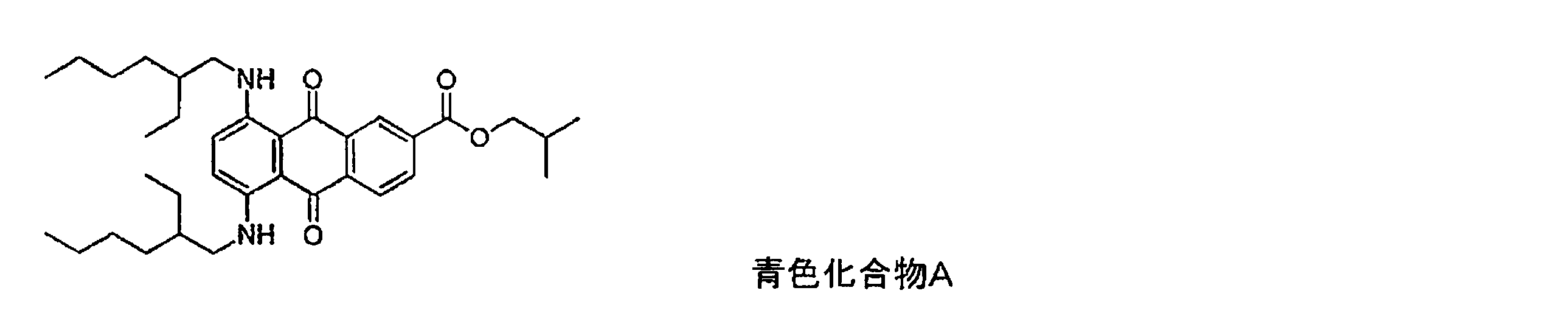
黒色インクおよび比較例インクは測定光路長0.01mmのセルを用いてスペクトルを測定し、日立分光光度計U-4100付属の色彩計算プログラムを用いてD65光源、視野角2度の条件で測色を行うことにより、色相を定量的に評価した。黒色インク1および比較例インクの色相評価結果を表7に示す。
黒インク1、2、及び比較例黒色インクを、回転粘度計(BROOKFIELD LV-1)用いて25℃での粘度を測定した。測定結果を表7に示した。
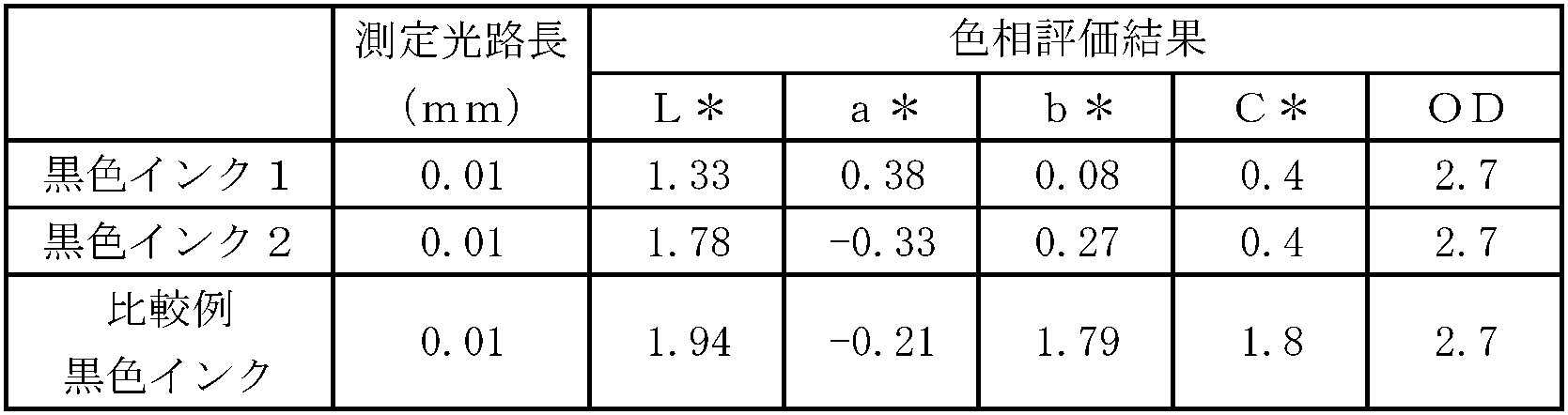
Claims (15)
- 周波数1kHz及び温度22℃で測定した比誘電率が3以下であり、かつ25℃における水に対する溶解度が20mg/L以下である溶媒、及び、下記一般式(1)で表されるアゾ系化合物を含むインク。
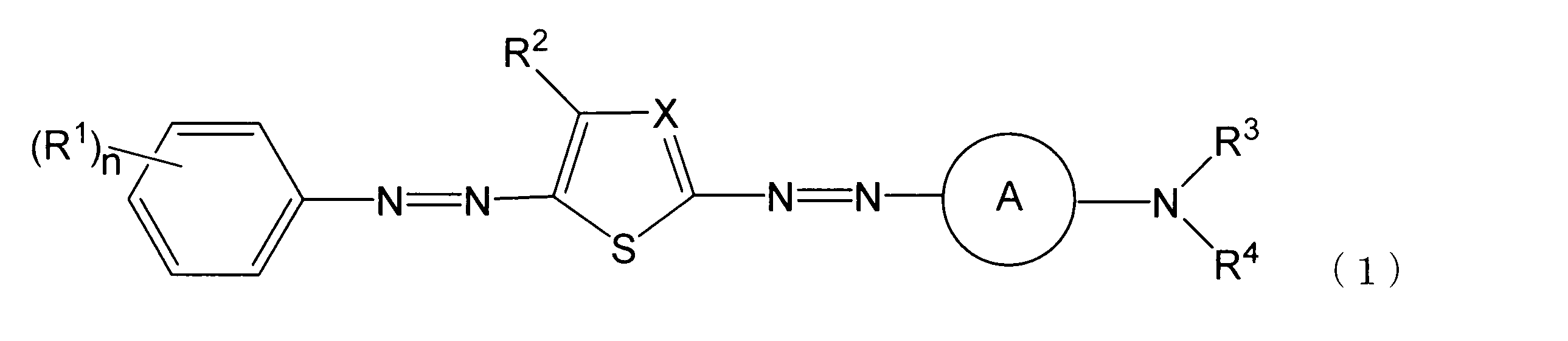
R1は、任意の置換基を表し、
R2は、水素原子又は任意の置換基を表し、
R3及びR4は、それぞれ独立に、置換基を有していてもよいアルキル基を表し、
環Aは、一般式(2)又は(3)を表し、
環Aが一般式(2)の場合、Xは窒素原子又は置換基を有していてもよいメチン基を表し、
環Aが一般式(3)の場合、Xはシアノ基又は置換基を有していてもよいアルコキシカルボニル基を有する、メチン基を表し、
尚、環Aが一般式(3)であり、R2が水素原子の場合、Xは置換基を有していてもよいアルコキシカルボニル基を有するメチン基を表し、
nは、0~5の整数を表す。]
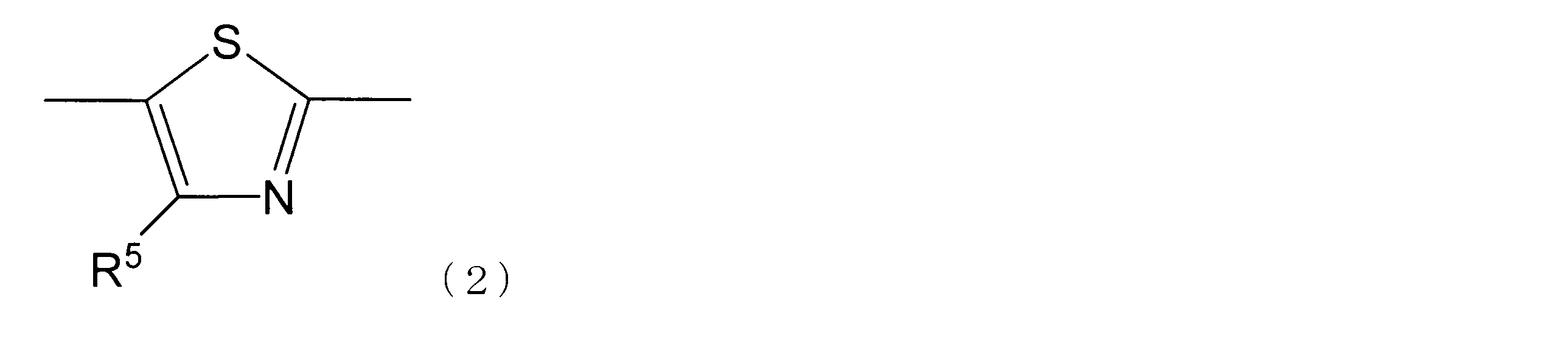
R5は、水素原子又は任意の置換基を表す。]
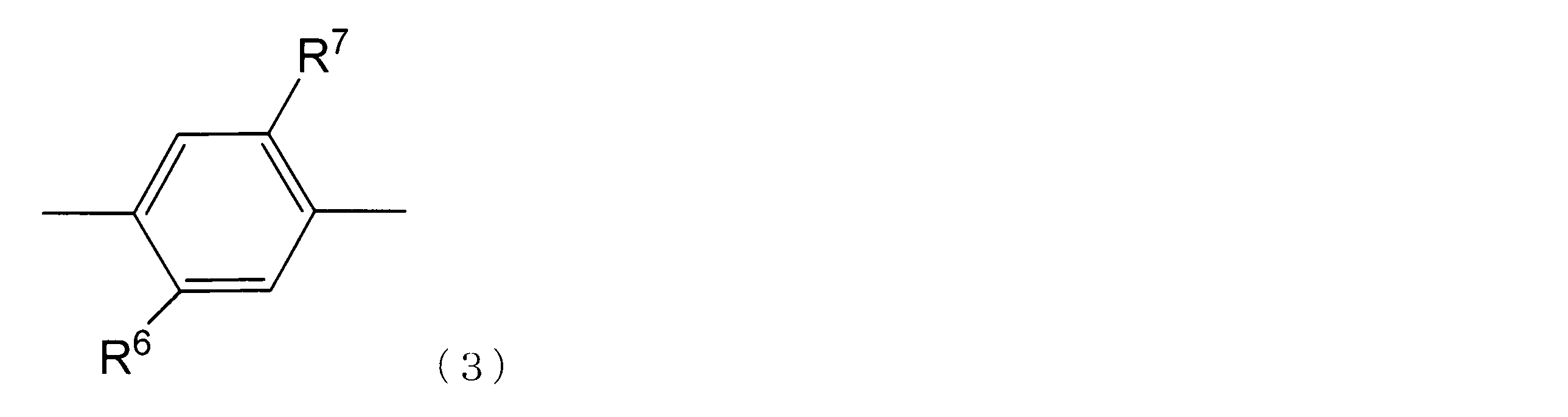
R6及びR7は、それぞれ独立に、水素原子又は任意の置換基を表す。] - 溶媒が、炭化水素系溶媒、シリコーンオイル及びフルオロカーボン系溶媒から選ばれた少なくとも1つを含む、請求項1に記載のインク。
- 前記アゾ系化合物のn-デカン溶液での吸収極大波長におけるモル吸光係数ε(Lmol-1cm-1)と、5℃における該溶液の飽和の濃度C(molL-1)の積εCが、1000cm-1以上である、請求項1又は2に記載のインク。
- さらにヘテロ環化合物、シアノビニル化合物及びアントラキノン化合物からなる群より選ばれた少なくとも1つを含む、請求項1~3のいずれか1項に記載のインク。
- 前記ヘテロ環化合物が下記一般式(4)~(7)からなる群より選ばれた少なくとも1つである、請求項4に記載のインク。
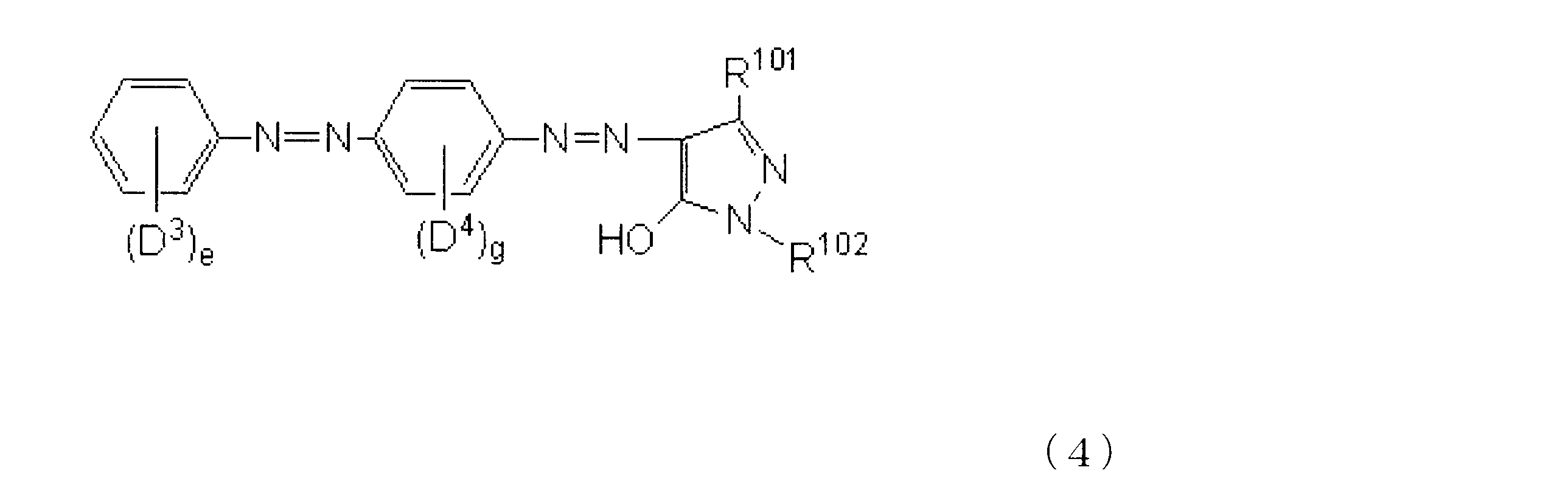
R101及びR102は、それぞれ独立に、水素原子又は任意の置換基を示し、
D3及びD4は、それぞれ独立に、任意の置換基を示し、
eは0~5の整数を示し、eが2以上の場合、1分子中に2以上存在するD3は同一であっても異なっていてもよく、
gは0~4の整数を示し、gが2以上の場合、1分子中に2以上存在するD4は同一であっても異なっていてもよい。]
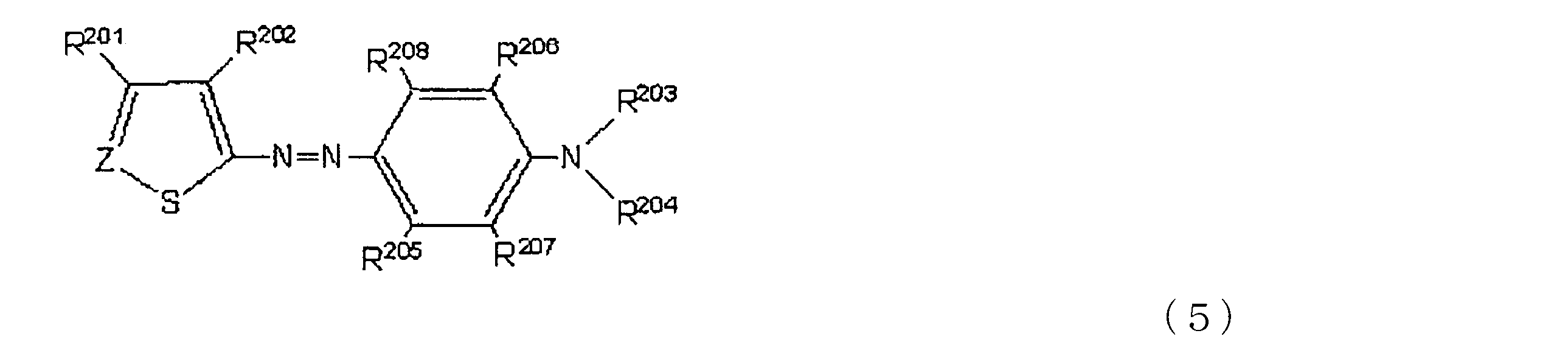
R201、R202、R203、R204、R205、R206、R207及びR208
は、それぞれ独立に、水素原子又は任意の置換基を示し、
Zは窒素原子又は置換基を有していてもよいメチン基を示す。]
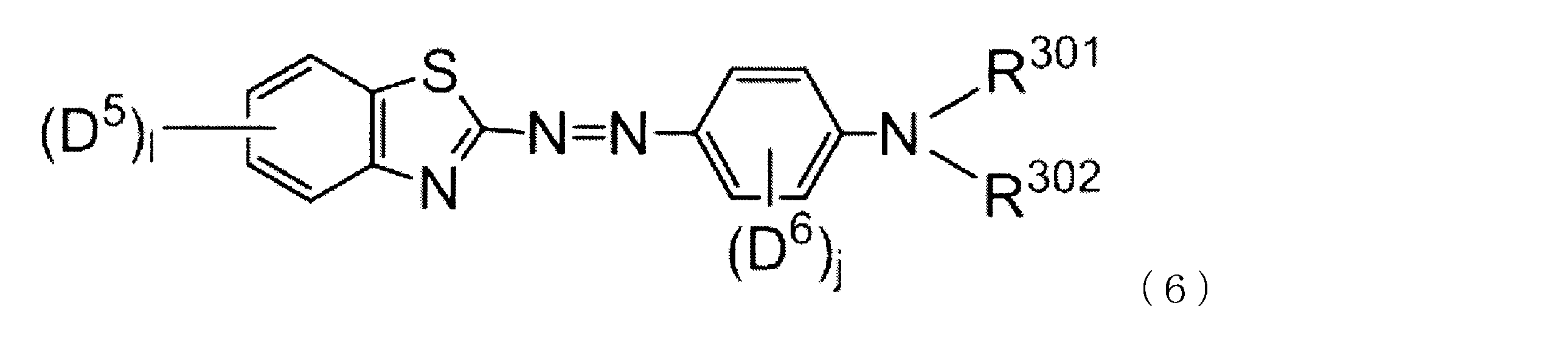
R301、R302、D5及びD6はそれぞれ独立に、任意の置換基を示し、
lは0~4の整数を示し、lが2以上の場合は、1分子中に2以上存在するD5は同一でも異なっていてもよく、
jは0~4の整数を示し、jが2以上の場合は、1分子中に2以上存在するD6は同一でも異なっていてもよい。]
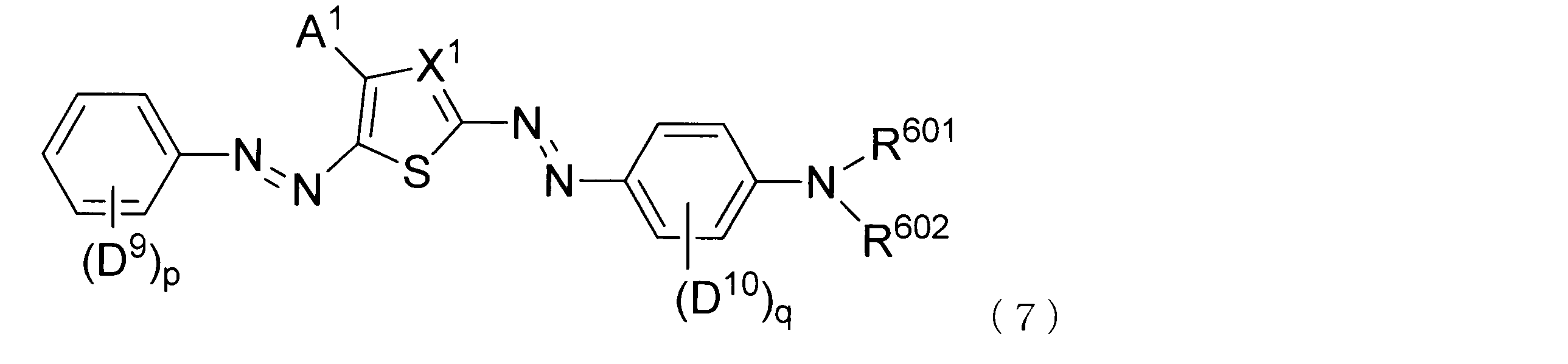
R601、R602、D9又はD10はそれぞれ独立に、任意の置換基を表し、
A1は、水素原子又は任意の置換基を表し、
pは0~5の整数を表し、pが2以上の場合、1分子中に2以上存在するD9は同一であっても異なっていてもよく、
qは0~4の整数を表し、qが2以上の場合、1分子中に2以上存在するD10は同一であっても異なっていてもよく、
X1は窒素原子、又は置換基としてハロゲン原子、シアノ基若しくは-COOR605基を有していてもよいメチン基を表し、
R605は、水素原子、置換基を有していてもよい炭素数が1~20のアルキル基、置換基を有していてもよい炭素数が6~20のアリール基又は置換基を有していてもよい炭素数が2~20のヘテロアリール基を表す。] - 前記アントラキノン化合物が下記一般式(8)で表される、請求項4又は5に記載のインク。
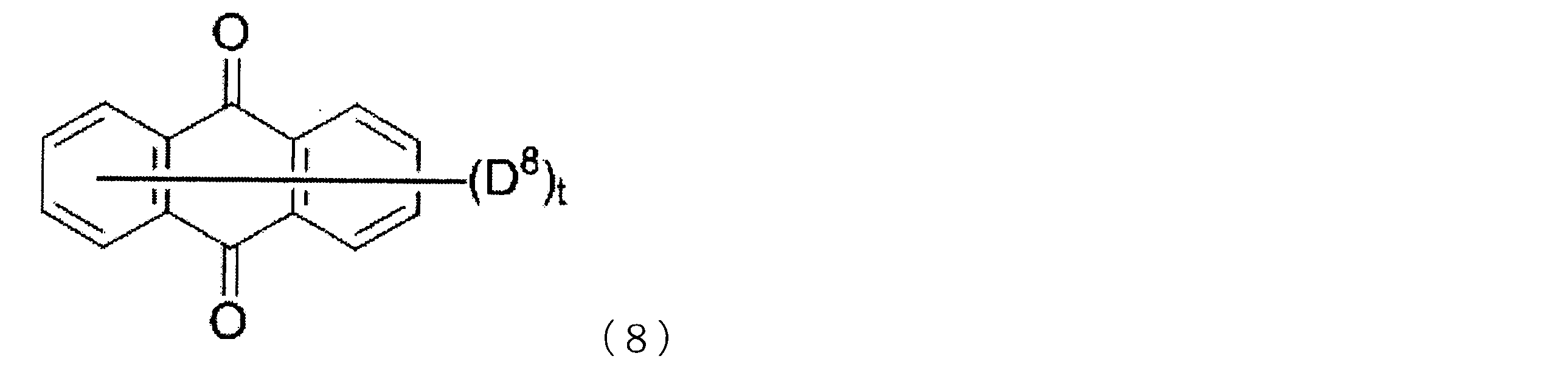
D8は任意の置換基を示し、
tは0~8の整数を示し、tが2以上の場合、1分子中に2以上存在するD8は同一であっても異なっていてもよい。] - ディスプレイ用又は光シャッター用である請求項1~6のいずれか1項に記載のインク。
- 請求項1~6のいずれか1項に記載のインクを含む表示部位を有し、表示部位の電圧印加を制御することで画像を表示するディスプレイ。
- 前記表示部位が、電気泳動粒子又は水性媒体を含む請求項8に記載のディスプレイ。
- 前記電圧印加によって着色状態を変化させることにより画像を表示する請求項8又は9に記載のディスプレイ。
- エレクトロウェッティング方式又は電気泳動方式により画像を表示する請求項8~10のいずれか1項に記載のディスプレイ。
- 請求項8~11のいずれか1項に記載のディスプレイを有する電子ペーパー。
- 周波数1kHz及び温度22℃で測定した比誘電率が3以下であり、かつ25℃における水に対する溶解度が20mg/L以下である溶媒、及び以下(I)~(IV)の化合物をそれぞれ少なくとも1つ有することを特徴とするインク。
(I)デカン溶液での吸収極大波長が400nm以上、500nm未満である化合物
(II)デカン溶液での吸収極大波長が500nm以上、570nm未満である化合物
(III)デカン溶液での吸収極大波長が570nm以上、640nm未満であるジスアゾ系化合物
(IV)デカン溶液での吸収極大波長が640nm以上、700nm以下である化合物 - 下記一般式(10)で表されるアゾ系化合物。

R21は、任意の置換基を表し、
R22及びR23は、それぞれ独立に、水素原子又は任意の置換基を表し、
R24及びR25は、それぞれ独立に、置換基を有していてもよいアルキル基を表し、
X2は、窒素原子又は置換基を有していてもよいメチン基を表し、
n´は、0~5の整数を表す。] - 下記一般式(11)で表されるアゾ系化合物。

R31は任意の置換基を表し、
R32は、水素原子又はアルキル基を表し、
R33は、シアノ基又はアルコキシカルボニル基を表し、
但し、R32が水素原子の場合は、R33はアルコキシカルボニル基を表し、
R34及びR35はそれぞれ独立に、水素原子又は任意の置換基を表し、
R36及びR37はそれぞれ独立に、置換基を有していてもよい炭素数が4~20の分岐アルキル基を表し、
mは、0~5の整数を表す。]
Priority Applications (4)
| Application Number | Priority Date | Filing Date | Title |
|---|---|---|---|
| KR1020157013752A KR20150090076A (ko) | 2012-11-28 | 2013-11-27 | 아조계 화합물, 아조계 화합물을 함유하는 잉크, 그 잉크를 포함하는 디스플레이 그리고 전자 페이퍼 |
| JP2014549867A JP6233316B2 (ja) | 2012-11-28 | 2013-11-27 | アゾ系化合物、アゾ系化合物を含むインク、該インクを含むディスプレイ並びに電子ペーパー |
| CN201380062256.9A CN104822780B (zh) | 2012-11-28 | 2013-11-27 | 偶氮系化合物、包含偶氮系化合物的油墨、包含该油墨的显示器以及电子纸 |
| US14/723,256 US9708498B2 (en) | 2012-11-28 | 2015-05-27 | Azo compound, ink containing azo compound, display including said ink and electronic paper |
Applications Claiming Priority (4)
| Application Number | Priority Date | Filing Date | Title |
|---|---|---|---|
| JP2012-260019 | 2012-11-28 | ||
| JP2012260020 | 2012-11-28 | ||
| JP2012-260020 | 2012-11-28 | ||
| JP2012260019 | 2012-11-28 |
Related Child Applications (1)
| Application Number | Title | Priority Date | Filing Date |
|---|---|---|---|
| US14/723,256 Continuation US9708498B2 (en) | 2012-11-28 | 2015-05-27 | Azo compound, ink containing azo compound, display including said ink and electronic paper |
Publications (1)
| Publication Number | Publication Date |
|---|---|
| WO2014084267A1 true WO2014084267A1 (ja) | 2014-06-05 |
Family
ID=50827899
Family Applications (1)
| Application Number | Title | Priority Date | Filing Date |
|---|---|---|---|
| PCT/JP2013/081931 Ceased WO2014084267A1 (ja) | 2012-11-28 | 2013-11-27 | アゾ系化合物、アゾ系化合物を含むインク、該インクを含むディスプレイ並びに電子ペーパー |
Country Status (5)
| Country | Link |
|---|---|
| US (1) | US9708498B2 (ja) |
| JP (1) | JP6233316B2 (ja) |
| KR (1) | KR20150090076A (ja) |
| CN (1) | CN104822780B (ja) |
| WO (1) | WO2014084267A1 (ja) |
Cited By (1)
| Publication number | Priority date | Publication date | Assignee | Title |
|---|---|---|---|---|
| JP2017066402A (ja) * | 2015-09-29 | 2017-04-06 | 三菱化学株式会社 | ピラゾールジスアゾ系化合物を含むインク及び該インクを含むディスプレイ並びにピラゾールジスアゾ系化合物 |
Families Citing this family (1)
| Publication number | Priority date | Publication date | Assignee | Title |
|---|---|---|---|---|
| US8926065B2 (en) | 2009-08-14 | 2015-01-06 | Advanced Liquid Logic, Inc. | Droplet actuator devices and methods |
Citations (13)
| Publication number | Priority date | Publication date | Assignee | Title |
|---|---|---|---|---|
| JPS59145252A (ja) * | 1983-02-04 | 1984-08-20 | Mitsubishi Chem Ind Ltd | ジスアゾ化合物及びジスアゾ染料 |
| JPS6287393A (ja) * | 1985-10-01 | 1987-04-21 | インペリアル・ケミカル・インダストリーズ・ピーエルシー | 熱転写印刷シ−ト及び転写印刷法 |
| JPS63270882A (ja) * | 1987-04-27 | 1988-11-08 | ダイスタージャパン株式会社 | ポリエステル含有繊維の染色法 |
| JPH02150390A (ja) * | 1988-10-05 | 1990-06-08 | Imperial Chem Ind Plc <Ici> | 熱転写印刷シート、熱転写印刷法および熱転写印刷シートの製造方法 |
| JPH0365393A (ja) * | 1989-08-02 | 1991-03-20 | Dainippon Printing Co Ltd | 熱転写シート |
| JPH03256793A (ja) * | 1990-03-07 | 1991-11-15 | Mitsubishi Kasei Corp | 感熱転写シート及び感熱転写シート用インキ組成物 |
| JPH04278389A (ja) * | 1990-12-21 | 1992-10-02 | Imperial Chem Ind Plc <Ici> | 熱転写プリントシート及び染料拡散熱転写プリント法 |
| JPH08267939A (ja) * | 1995-03-24 | 1996-10-15 | Eastman Kodak Co | 感熱色素転写集成体 |
| JPH09508939A (ja) * | 1994-02-18 | 1997-09-09 | ゼネカ・リミテッド | フルオロスルフォニル基を含有するジズアゾ染料及びその使用 |
| JPH10119441A (ja) * | 1996-10-23 | 1998-05-12 | Mitsubishi Chem Corp | 感熱転写シート |
| JP2000313174A (ja) * | 1999-03-04 | 2000-11-14 | Mitsubishi Chemicals Corp | 感熱転写用アントラキノン系色素及びそれを用いた感熱転写用シート、並びに感熱転写用インク |
| JP2009138189A (ja) * | 2007-11-12 | 2009-06-25 | Mitsubishi Chemicals Corp | ピラゾールジスアゾ系色素および該色素を含むインク |
| JP2013129697A (ja) * | 2011-12-20 | 2013-07-04 | Fujifilm Corp | 着色組成物、及び画像表示構造 |
Family Cites Families (16)
| Publication number | Priority date | Publication date | Assignee | Title |
|---|---|---|---|---|
| BE794996A (fr) | 1972-02-03 | 1973-08-06 | Hoechst Ag | Colorants azoiques insolubles dans l'eau |
| GB2093056B (en) | 1980-12-26 | 1985-06-12 | Mitsubishi Chem Ind | Disazo dyestuffs and dyeing process |
| JPS57111356A (en) | 1980-12-29 | 1982-07-10 | Mitsubishi Chem Ind Ltd | Disazo dye for polyester fiber |
| JPS57109860A (en) | 1980-12-26 | 1982-07-08 | Mitsubishi Chem Ind Ltd | Disazo dye for polyester fiber |
| JPS57125263A (en) | 1981-01-27 | 1982-08-04 | Mitsubishi Chem Ind Ltd | Disazo dye for polyester fiber |
| JPS57125262A (en) | 1981-01-27 | 1982-08-04 | Mitsubishi Chem Ind Ltd | Disazo dye for polyester fiber |
| JPS57145154A (en) * | 1981-03-04 | 1982-09-08 | Mitsubishi Chem Ind Ltd | Disazo dye for polyester fiber |
| JP2005213484A (ja) | 2004-02-02 | 2005-08-11 | Fuji Photo Film Co Ltd | 染料とそれを用いた染色方法、および捺染用水性インク |
| US7800816B2 (en) | 2004-04-05 | 2010-09-21 | Liquavista B.V. | Display device based on electrowetting effect |
| JP2007099823A (ja) | 2005-09-30 | 2007-04-19 | Fujifilm Corp | ジスアゾ染料の製造方法 |
| JP2009056711A (ja) * | 2007-08-31 | 2009-03-19 | Fujifilm Corp | 感熱転写記録用インクシートおよび感熱転写記録方法 |
| GB0817175D0 (en) | 2008-09-19 | 2008-10-29 | Liquavista Bv | Improvements in relation to electrowetting elements |
| WO2011111710A1 (ja) * | 2010-03-09 | 2011-09-15 | 三菱化学株式会社 | アントラキノン系色素を含むインク及び該インクに用いられる色素並びにディスプレイ |
| CN103080245B (zh) * | 2010-09-10 | 2015-06-10 | 三菱化学株式会社 | 含有杂环偶氮系色素的油墨及该油墨中使用的色素 |
| JP2012211293A (ja) | 2011-03-18 | 2012-11-01 | Fujifilm Corp | インク組成物、インクジェット記録用インク及びインクジェット記録方法 |
| WO2012161098A1 (ja) * | 2011-05-20 | 2012-11-29 | 三菱化学株式会社 | アゾ系化合物及び該化合物を含むインク |
-
2013
- 2013-11-27 WO PCT/JP2013/081931 patent/WO2014084267A1/ja not_active Ceased
- 2013-11-27 KR KR1020157013752A patent/KR20150090076A/ko not_active Withdrawn
- 2013-11-27 JP JP2014549867A patent/JP6233316B2/ja active Active
- 2013-11-27 CN CN201380062256.9A patent/CN104822780B/zh active Active
-
2015
- 2015-05-27 US US14/723,256 patent/US9708498B2/en active Active
Patent Citations (13)
| Publication number | Priority date | Publication date | Assignee | Title |
|---|---|---|---|---|
| JPS59145252A (ja) * | 1983-02-04 | 1984-08-20 | Mitsubishi Chem Ind Ltd | ジスアゾ化合物及びジスアゾ染料 |
| JPS6287393A (ja) * | 1985-10-01 | 1987-04-21 | インペリアル・ケミカル・インダストリーズ・ピーエルシー | 熱転写印刷シ−ト及び転写印刷法 |
| JPS63270882A (ja) * | 1987-04-27 | 1988-11-08 | ダイスタージャパン株式会社 | ポリエステル含有繊維の染色法 |
| JPH02150390A (ja) * | 1988-10-05 | 1990-06-08 | Imperial Chem Ind Plc <Ici> | 熱転写印刷シート、熱転写印刷法および熱転写印刷シートの製造方法 |
| JPH0365393A (ja) * | 1989-08-02 | 1991-03-20 | Dainippon Printing Co Ltd | 熱転写シート |
| JPH03256793A (ja) * | 1990-03-07 | 1991-11-15 | Mitsubishi Kasei Corp | 感熱転写シート及び感熱転写シート用インキ組成物 |
| JPH04278389A (ja) * | 1990-12-21 | 1992-10-02 | Imperial Chem Ind Plc <Ici> | 熱転写プリントシート及び染料拡散熱転写プリント法 |
| JPH09508939A (ja) * | 1994-02-18 | 1997-09-09 | ゼネカ・リミテッド | フルオロスルフォニル基を含有するジズアゾ染料及びその使用 |
| JPH08267939A (ja) * | 1995-03-24 | 1996-10-15 | Eastman Kodak Co | 感熱色素転写集成体 |
| JPH10119441A (ja) * | 1996-10-23 | 1998-05-12 | Mitsubishi Chem Corp | 感熱転写シート |
| JP2000313174A (ja) * | 1999-03-04 | 2000-11-14 | Mitsubishi Chemicals Corp | 感熱転写用アントラキノン系色素及びそれを用いた感熱転写用シート、並びに感熱転写用インク |
| JP2009138189A (ja) * | 2007-11-12 | 2009-06-25 | Mitsubishi Chemicals Corp | ピラゾールジスアゾ系色素および該色素を含むインク |
| JP2013129697A (ja) * | 2011-12-20 | 2013-07-04 | Fujifilm Corp | 着色組成物、及び画像表示構造 |
Cited By (1)
| Publication number | Priority date | Publication date | Assignee | Title |
|---|---|---|---|---|
| JP2017066402A (ja) * | 2015-09-29 | 2017-04-06 | 三菱化学株式会社 | ピラゾールジスアゾ系化合物を含むインク及び該インクを含むディスプレイ並びにピラゾールジスアゾ系化合物 |
Also Published As
| Publication number | Publication date |
|---|---|
| US9708498B2 (en) | 2017-07-18 |
| KR20150090076A (ko) | 2015-08-05 |
| JP6233316B2 (ja) | 2017-11-22 |
| JPWO2014084267A1 (ja) | 2017-01-05 |
| US20150284581A1 (en) | 2015-10-08 |
| CN104822780A (zh) | 2015-08-05 |
| CN104822780B (zh) | 2017-09-01 |
Similar Documents
| Publication | Publication Date | Title |
|---|---|---|
| JP5935801B2 (ja) | アゾ系化合物及び該化合物を含むインク | |
| JP5884732B2 (ja) | へテロ環アゾ系色素を含むインク及び該インクに用いられる色素 | |
| JP5747909B2 (ja) | アントラキノン系色素を含むインク及び該インクに用いられる色素並びにディスプレイ | |
| JP6233316B2 (ja) | アゾ系化合物、アゾ系化合物を含むインク、該インクを含むディスプレイ並びに電子ペーパー | |
| JP6112114B2 (ja) | アゾ系化合物、アゾ系化合物を含むインク、該インクを含むディスプレイ並びに電子ペーパー | |
| JP6269318B2 (ja) | アゾ系化合物、アゾ系化合物を含むインク、該インクを含むディスプレイ並びに電子ペーパー | |
| JP6737111B2 (ja) | キノフタロン系化合物、キノフタロン系化合物を含むインク及び該インクを含むディスプレイ | |
| JP2013185126A (ja) | スチリル系、トリシアノビニル系化合物を含むインク | |
| JP5853601B2 (ja) | ベンゾチアゾール系化合物及び該化合物を含むインク | |
| JP5253683B1 (ja) | エレクトロウェッティングディスプレイ用アゾ系色素並びに該アゾ系色素を用いたエレクトロウェッティングディスプレイ | |
| JP5842446B2 (ja) | アントラキノン系色素を含むインク及び該インクに用いられる色素 | |
| JP2013129697A (ja) | 着色組成物、及び画像表示構造 | |
| JP2017066402A (ja) | ピラゾールジスアゾ系化合物を含むインク及び該インクを含むディスプレイ並びにピラゾールジスアゾ系化合物 |
Legal Events
| Date | Code | Title | Description |
|---|---|---|---|
| 121 | Ep: the epo has been informed by wipo that ep was designated in this application |
Ref document number: 13859292 Country of ref document: EP Kind code of ref document: A1 |
|
| ENP | Entry into the national phase |
Ref document number: 20157013752 Country of ref document: KR Kind code of ref document: A |
|
| ENP | Entry into the national phase |
Ref document number: 2014549867 Country of ref document: JP Kind code of ref document: A |
|
| NENP | Non-entry into the national phase |
Ref country code: DE |
|
| 122 | Ep: pct application non-entry in european phase |
Ref document number: 13859292 Country of ref document: EP Kind code of ref document: A1 |