WO2014077167A1 - サルモネラに結合する核酸分子およびその用途 - Google Patents
サルモネラに結合する核酸分子およびその用途 Download PDFInfo
- Publication number
- WO2014077167A1 WO2014077167A1 PCT/JP2013/080040 JP2013080040W WO2014077167A1 WO 2014077167 A1 WO2014077167 A1 WO 2014077167A1 JP 2013080040 W JP2013080040 W JP 2013080040W WO 2014077167 A1 WO2014077167 A1 WO 2014077167A1
- Authority
- WO
- WIPO (PCT)
- Prior art keywords
- salmonella
- nucleic acid
- acid molecule
- sal
- seq
- Prior art date
- Legal status (The legal status is an assumption and is not a legal conclusion. Google has not performed a legal analysis and makes no representation as to the accuracy of the status listed.)
- Ceased
Links
Images




Classifications
-
- C—CHEMISTRY; METALLURGY
- C12—BIOCHEMISTRY; BEER; SPIRITS; WINE; VINEGAR; MICROBIOLOGY; ENZYMOLOGY; MUTATION OR GENETIC ENGINEERING
- C12N—MICROORGANISMS OR ENZYMES; COMPOSITIONS THEREOF; PROPAGATING, PRESERVING, OR MAINTAINING MICROORGANISMS; MUTATION OR GENETIC ENGINEERING; CULTURE MEDIA
- C12N15/00—Mutation or genetic engineering; DNA or RNA concerning genetic engineering, vectors, e.g. plasmids, or their isolation, preparation or purification; Use of hosts therefor
- C12N15/09—Recombinant DNA-technology
- C12N15/11—DNA or RNA fragments; Modified forms thereof; Non-coding nucleic acids having a biological activity
- C12N15/115—Aptamers, i.e. nucleic acids binding a target molecule specifically and with high affinity without hybridising therewith ; Nucleic acids binding to non-nucleic acids, e.g. aptamers
-
- C—CHEMISTRY; METALLURGY
- C12—BIOCHEMISTRY; BEER; SPIRITS; WINE; VINEGAR; MICROBIOLOGY; ENZYMOLOGY; MUTATION OR GENETIC ENGINEERING
- C12Q—MEASURING OR TESTING PROCESSES INVOLVING ENZYMES, NUCLEIC ACIDS OR MICROORGANISMS; COMPOSITIONS OR TEST PAPERS THEREFOR; PROCESSES OF PREPARING SUCH COMPOSITIONS; CONDITION-RESPONSIVE CONTROL IN MICROBIOLOGICAL OR ENZYMOLOGICAL PROCESSES
- C12Q1/00—Measuring or testing processes involving enzymes, nucleic acids or microorganisms; Compositions therefor; Processes of preparing such compositions
- C12Q1/02—Measuring or testing processes involving enzymes, nucleic acids or microorganisms; Compositions therefor; Processes of preparing such compositions involving viable microorganisms
- C12Q1/04—Determining presence or kind of microorganism; Use of selective media for testing antibiotics or bacteriocides; Compositions containing a chemical indicator therefor
- C12Q1/10—Enterobacteria
-
- C—CHEMISTRY; METALLURGY
- C12—BIOCHEMISTRY; BEER; SPIRITS; WINE; VINEGAR; MICROBIOLOGY; ENZYMOLOGY; MUTATION OR GENETIC ENGINEERING
- C12Q—MEASURING OR TESTING PROCESSES INVOLVING ENZYMES, NUCLEIC ACIDS OR MICROORGANISMS; COMPOSITIONS OR TEST PAPERS THEREFOR; PROCESSES OF PREPARING SUCH COMPOSITIONS; CONDITION-RESPONSIVE CONTROL IN MICROBIOLOGICAL OR ENZYMOLOGICAL PROCESSES
- C12Q1/00—Measuring or testing processes involving enzymes, nucleic acids or microorganisms; Compositions therefor; Processes of preparing such compositions
- C12Q1/68—Measuring or testing processes involving enzymes, nucleic acids or microorganisms; Compositions therefor; Processes of preparing such compositions involving nucleic acids
- C12Q1/6876—Nucleic acid products used in the analysis of nucleic acids, e.g. primers or probes
- C12Q1/6888—Nucleic acid products used in the analysis of nucleic acids, e.g. primers or probes for detection or identification of organisms
- C12Q1/689—Nucleic acid products used in the analysis of nucleic acids, e.g. primers or probes for detection or identification of organisms for bacteria
-
- C—CHEMISTRY; METALLURGY
- C12—BIOCHEMISTRY; BEER; SPIRITS; WINE; VINEGAR; MICROBIOLOGY; ENZYMOLOGY; MUTATION OR GENETIC ENGINEERING
- C12N—MICROORGANISMS OR ENZYMES; COMPOSITIONS THEREOF; PROPAGATING, PRESERVING, OR MAINTAINING MICROORGANISMS; MUTATION OR GENETIC ENGINEERING; CULTURE MEDIA
- C12N2310/00—Structure or type of the nucleic acid
- C12N2310/10—Type of nucleic acid
- C12N2310/16—Aptamers
-
- Y—GENERAL TAGGING OF NEW TECHNOLOGICAL DEVELOPMENTS; GENERAL TAGGING OF CROSS-SECTIONAL TECHNOLOGIES SPANNING OVER SEVERAL SECTIONS OF THE IPC; TECHNICAL SUBJECTS COVERED BY FORMER USPC CROSS-REFERENCE ART COLLECTIONS [XRACs] AND DIGESTS
- Y02—TECHNOLOGIES OR APPLICATIONS FOR MITIGATION OR ADAPTATION AGAINST CLIMATE CHANGE
- Y02A—TECHNOLOGIES FOR ADAPTATION TO CLIMATE CHANGE
- Y02A50/00—TECHNOLOGIES FOR ADAPTATION TO CLIMATE CHANGE in human health protection, e.g. against extreme weather
- Y02A50/30—Against vector-borne diseases, e.g. mosquito-borne, fly-borne, tick-borne or waterborne diseases whose impact is exacerbated by climate change
Definitions
- the present invention relates to a nucleic acid molecule that binds to Salmonella and uses thereof, and specifically relates to a nucleic acid molecule that binds to Salmonellas of O4 group, O7 group and / or O9 group, and uses thereof.
- Salmonella In recent years, the increase in food poisoning caused by Salmonella has become a problem.
- Salmonella When Salmonella is classified by serotype, Salmonella belonging to the O4 group, the O7 group, and the O9 group occupies most of the causative bacteria of food poisoning. For this reason, the establishment of a method for specifically detecting Salmonella belonging to these groups is very important.
- a method using a selective medium is known.
- bacteria contained in a sample are grown using a growth medium, and then, Salmonella in the growing bacteria is selectively grown using the selection medium (for example, RV medium).
- the selection medium for example, RV medium.
- Salmonella is detected.
- the selective medium has a problem that, in addition to Salmonella, for example, cytolobacter, which is an opportunistic bacterium, grows. For this reason, it is not realistic to detect Salmonella only by the presence or absence of growth in the selective medium, and identification by a serotype using an antibody or the like is required.
- nucleic acid molecules that specifically bind to the target are being studied as a new tool to replace antibodies. Since aptamers are small molecules compared to antibodies, they are easy to synthesize and can be modified. Therefore, various applications using binding between aptamers and targets are considered. Aptamers that bind to Salmonella have also been reported for Salmonella detection (Non-patent Document 1).
- an object of the present invention is to provide a new nucleic acid molecule that can be used for detection of Salmonella.
- the nucleic acid molecule of the present invention is a nucleic acid molecule that specifically binds to Salmonella, comprising at least one polynucleotide selected from the group consisting of the following (a) to (d).
- A a polynucleotide comprising any one of the nucleotide sequences of SEQ ID NOS: 1 to 17
- B one or several bases deleted, substituted, inserted and / or added in any one of the nucleotide sequences of (a)
- C a polynucleotide comprising a nucleotide sequence having an identity of 80% or more to any one of the nucleotide sequences of (a) and binding to Salmonella
- C a polynucleotide comprising a complementary base sequence to a polynucleotide that hybridizes under stringent conditions to the polynucleotide comprising any one of the base sequences of (a) and binding to Salmonella
- the detection method of the present invention is a method of detecting Salmonella, wherein the sample is contacted with the nucleic acid molecule of the present invention, and the Salmonella in the sample is bound to the nucleic acid molecule to detect Salmonella in the sample. Including the step of:
- the detection reagent of the present invention is a Salmonella detection reagent and includes the nucleic acid molecule of the present invention.
- the detection kit of the present invention is a detection kit for Salmonella, and includes the nucleic acid molecule of the present invention.
- the detection device of the present invention includes the nucleic acid molecule of the present invention.
- the nucleic acid molecule of the present invention can bind to Salmonella, and specifically can bind specifically to Salmonella belonging to the O4 group, O7 group and / or O9 group, which are causative bacteria of food poisoning. Therefore, according to the nucleic acid molecule of the present invention, for example, Salmonella can be detected based on the presence or absence of binding to Salmonella. Therefore, the nucleic acid molecule of the present invention can be said to be an extremely useful tool for detecting Salmonella in the fields of food management, public health, and the like.
- FIG. 1 is a graph showing the binding ability between an aptamer and Salmonella in Example 1 of the present invention.
- FIG. 2 is a graph showing the binding ability between aptamer and cytolobacter in Example 1 of the present invention.
- FIG. 3 is a graph showing the binding ability between an aptamer and Salmonella in Example 2 of the present invention.
- FIG. 4 is a graph showing the binding ability between an aptamer and Salmonella in Example 3 of the present invention.
- FIG. 5 is a graph showing the binding ability between an aptamer and Salmonella in Example 4 of the present invention.
- FIG. 6 is a graph showing the binding ability between an aptamer and Salmonella in Example 5 of the present invention.
- FIG. 1 is a graph showing the binding ability between an aptamer and Salmonella in Example 1 of the present invention.
- FIG. 2 is a graph showing the binding ability between aptamer and cytolobacter in Example 1 of the present invention.
- FIG. 3 is a graph showing the binding
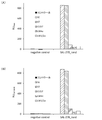
- FIG. 7 is a graph showing the specificity of binding between an aptamer and Salmonella in Example 6 of the present invention.
- FIG. 8 is a graph showing the binding ability between an aptamer and Salmonella in Example 7 of the present invention.
- FIG. 9 is a graph showing the binding ability between an aptamer and Salmonella in Example 8 of the present invention.
- FIG. 10 is a graph showing the binding ability between an aptamer and Salmonella in Example 9 of the present invention.
- FIG. 11 is a graph showing the binding ability between an aptamer and Salmonella in Example 10 of the present invention.
- the nucleic acid molecule of the present invention is a nucleic acid molecule that binds to Salmonella, comprising at least one polynucleotide selected from the group consisting of the following (a) to (d).
- A a polynucleotide comprising any one of the nucleotide sequences of SEQ ID NOS: 1 to 17
- B one or several bases deleted, substituted, inserted and / or added in any one of the nucleotide sequences of (a)
- C a polynucleotide comprising a nucleotide sequence having an identity of 80% or more to any one of the nucleotide sequences of (a) and binding to Salmonella
- C a polynucleotide comprising a complementary base sequence to a polynucleotide that hybridizes under stringent conditions to the polynucleotide comprising any one of the base sequences of (a) and binding to Salmonella
- binding to Salmonella means, for example, having binding ability to the Salmonella or having binding activity to the Salmonella.
- the binding between the nucleic acid molecule of the present invention and the Salmonella can be determined by, for example, surface plasmon resonance molecular interaction (SPR) analysis.
- SPR surface plasmon resonance molecular interaction
- ProteON trade name, BioRad
- BioRad BioRad
- Salmonella examples include those belonging to the O4 group, the O7 group and / or the O9 group.
- Salmonella in the O4 group examples include Salmonella typhimurium , Salmonella paratyphi B, and Salmonella fyris .
- Salmonella in the O7 group examples include Salmonella infantis , Salmonella singapore , and Salmonella brenderup .
- Salmonella in the O9 group examples include Salmonella. enteritidis, Salmonella typhi, Salmonella dublin, and the like.
- the nucleic acid molecules of the present invention bind to, for example, live and / or dead Salmonella.
- the nucleic acid molecule of the present invention specifically binds to Salmonella, for example, compared to bacteria other than Salmonella.
- bacteria other than Salmonella include Listeria and Escherichia.
- the nucleic acid molecule of the present invention exhibits an excellent binding force to Salmonella, for example, as compared with bacteria other than Salmonella.
- the dissociation constant of the nucleic acid molecule of the present invention showing the binding force to Salmonella is, for example, 1 ⁇ M or less, and preferably 500 nM or less.
- the structural units of the polynucleotides (a) to (d) are, for example, nucleotide residues, and examples include deoxyribonucleotide residues and ribonucleotide residues.
- the polynucleotide is, for example, DNA composed of deoxyribonucleotide residues, DNA containing deoxyribonucleotide residues and ribonucleotide residues, and may further contain non-nucleotide residues.
- the nucleic acid molecule of the present invention is hereinafter also referred to as a DNA aptamer, for example.
- the nucleic acid molecule of the present invention may be, for example, a molecule composed of any of the polynucleotides (a) to (d) or a molecule containing the polynucleotide.
- the nucleic acid molecule of the present invention may contain two or more of any of the polynucleotides (a) to (d) as described later.
- the two or more polynucleotides may have the same sequence or different sequences.
- the nucleic acid molecule of the present invention may further have, for example, a linker and / or an additional sequence.
- the polynucleotide (a) is a polynucleotide comprising any one of the nucleotide sequences of SEQ ID NOS: 1 to 17.
- SAL-204 (SEQ ID NO: 1) GGTATCAACGCCTCTCAGTGAATTGCGGGGGTGGATAGTACAGGGTGGGTAGGGGGCAAAGGTTTCGGACGGACATATC SAL-236 (SEQ ID NO: 2) GGTATCAACGCCTCTCAGTGAATTGTTGGGGGTAGGCGCTGGGGTGGGTGGGAGCGCAAAGGTTTCGGACGGACATATC SAL-230 (SEQ ID NO: 3) GGTATCAACGCCTCTCAGTGAATTGGTTGTGGTTGGTGGGGGGTGCGGAGGGTGGGCAAAGGTTTCGGACGGACATATC SAL-203 (SEQ ID NO: 4) GGTATCAACGCCTCTCAGTGAATTGGGCGGAGTTGTGGGGGGTCGGGGGGTGGCGGCAAAGGTTTCGGACGGACATATC SAL-219 (SEQ ID NO: 5) GGTATCAACGCCTCTCAGTGAATTGGGATCGGTGCTGCGGGGGTGGGTGGAGCGGGCAAAGGTTTCGGACGG
- “one or several” may be, for example, within a range in which the polynucleotide of (b) binds to Salmonella.
- the “one or several” is, for example, 1 to 60, preferably 1 to 30, more preferably 1 to 15, and more preferably 1 to 5 in any one of the base sequences of (a). Particularly preferably, one or two.
- the numerical range of numbers such as the number of bases and the number of sequences, for example, discloses all positive integers belonging to the range. That is, for example, the description “1 to 5 bases” means all disclosures of “1, 2, 3, 4, 5 bases” (the same applies hereinafter).
- the “identity” may be, for example, within a range in which the polynucleotide (c) binds to Salmonella.
- the identity is, for example, 80% or more, 85% or more, preferably 90% or more, more preferably 95% or more, 96% or more, 97% or more, more preferably 98% or more, and particularly preferably 99% or more.
- the identity can be calculated with default parameters using analysis software such as BLAST and FASTA (hereinafter the same).
- the “hybridizable polynucleotide” is, for example, a polynucleotide that is completely or partially complementary to the polynucleotide in (a).
- the hybridization can be detected by, for example, various hybridization assays.
- the hybridization assay is not particularly limited, for example, Zanburuku (Sambrook) et al., Eds., "Molecular Cloning: A Laboratory Manual 2nd Edition (Molecular Cloning:. A Laboratory Manual 2 nd Ed) " [(Cold Spring Harbor Laboratory Press (1989)] and the like can also be employed.
- the “stringent conditions” may be, for example, any of low stringent conditions, moderate stringent conditions, and highly stringent conditions.
- Low stringent conditions are, for example, conditions of 5 ⁇ SSC, 5 ⁇ Denhardt's solution, 0.5% SDS, 50% formamide, and 32 ° C.
- Medium stringent conditions are, for example, 5 ⁇ SSC, 5 ⁇ Denhardt's solution, 0.5% SDS, 50% formamide, 42 ° C.
- “High stringent conditions” are, for example, conditions of 5 ⁇ SSC, 5 ⁇ Denhardt's solution, 0.5% SDS, 50% formamide, 50 ° C.
- the degree of stringency can be set by those skilled in the art by appropriately selecting conditions such as temperature, salt concentration, probe concentration and length, ionic strength, time, and the like.
- “Stringent conditions” are, for example, Zanburuku previously described (Sambrook) et al., Eds., "Molecular Cloning: A Laboratory Manual 2nd Edition (Molecular Cloning:. A Laboratory Manual 2 nd Ed) " [(Cold Spring Harbor Laboratory Press (1989)] and the like can also be employed.
- the polynucleotides (b) to (d) are not particularly limited.
- the polynucleotides (a) to (d) do not substantially bind to, for example, Escherichia coli . “Substantially does not bind” includes, for example, that it is below the detection limit when binding between the nucleic acid molecule and E. coli is detected.
- the polynucleotides (b) to (d) are not particularly limited, and specific examples include the following sequences.
- the following sequences are described above, SAL-204 (SEQ ID NO: 1), SAL-230 (SEQ ID NO: 3), SAL-242 (SEQ ID NO: 7), SAL-278 (SEQ ID NO: 8), SAL-262 (SEQ ID NO: 9). ), SAL-396 (SEQ ID NO: 10), SAL-445 (SEQ ID NO: 11), SAL-437 (SEQ ID NO: 12), SAL-455 (SEQ ID NO: 14), SAL-107 (SEQ ID NO: 15), SAL-431
- SAL-204 SEQ ID NO: 1
- SAL-230 SEQ ID NO: 3
- SAL-242 SEQ ID NO: 7
- SAL-278 SEQ ID NO: 8
- SAL-262 SEQ ID NO: 9
- SAL-396 SEQ ID NO: 10
- SAL-445 SEQ ID NO: 11
- SAL-204_s46 (SEQ ID NO: 21) GGGGGTGGATAGTACAGGGTGGGTAGGGGGCAAAGGTTTCGGACGG SAL-204_rand (SEQ ID NO: 22) GCGGGGGTGGATAGTACAGGGTGGGTAGGGGG SAL-230_s48 (SEQ ID NO: 23) GGTTGTGGTTGGTGGGGGGTGCGGAGGGTGGGCAAAGGTTTCGGACGG SAL-230_rand (SEQ ID NO: 24) GGTTGTGGTTGGTGGGGGGTGCGGAGGGTGGG SAL-242_s46 (SEQ ID NO: 25) TATGTGGTTGGGGGGGGGAGGGAGGGCAAAGGTTTCGGACGGACAT SAL-242_rand (SEQ ID NO: 26) GGGTGCTATGTGGTTGGGGGGGGGAGGGAGGG SAL-278_s49 (SEQ ID NO: 27) TGAATTGTGGTAGGGAGATGTGGGGGTGGGTAGGAGGGCAAAGGTTTCG SAL-2
- nucleic acid molecule of the present invention for example, (a) may be, for example, (a ′) a polynucleotide comprising any one of the nucleotide sequences of SEQ ID NOs: 20 to 41.
- any base sequence of (a) can be read as any of the base sequences of (a ′).
- the nucleic acid molecule of the present invention may include, for example, one of the polynucleotide sequences (a) to (d) or a plurality of the polynucleotide sequences. In the latter case, it is preferable that a plurality of polynucleotide sequences are linked to form a single-stranded polynucleotide.
- the sequences of the plurality of polynucleotides may be directly linked to each other or indirectly linked via a linker.
- the polynucleotide sequences are preferably linked directly or indirectly at the respective ends.
- the sequences of the plurality of polynucleotides may be the same or different, for example.
- sequences of the plurality of polynucleotides are preferably the same, for example.
- the number of the sequences is not particularly limited, and is, for example, 2 or more, preferably 2 to 20, more preferably 2 to 10, more preferably 2 Or 3.
- the linker is not particularly limited.
- the length of the linker is not particularly limited, and is, for example, 1 to 200 bases long, preferably 1 to 20 bases long, more preferably 3 to 12 bases long, and further preferably 5 to 9 bases long It is long.
- the structural unit of the linker is, for example, a nucleotide residue, and examples thereof include a deoxyribonucleotide residue and a ribonucleotide residue.
- the linker is not particularly limited, and examples thereof include polynucleotides such as DNA consisting of deoxyribonucleotide residues and DNA containing ribonucleotide residues.
- linker examples include, for example, polydeoxythymine (poly dT), polydeoxyadenine (poly dA), poly dAdT which is a repeating sequence of A and T, and preferably poly dT and poly dAdT. is there.
- the polynucleotide is preferably a single-stranded polynucleotide.
- the single-stranded polynucleotide is preferably capable of forming a stem structure and a loop structure by, for example, self-annealing.
- the polynucleotide is preferably capable of forming a stem loop structure, an internal loop structure, and / or a bulge structure, for example.
- the nucleic acid molecule of the present invention may be, for example, double stranded.
- one single-stranded polynucleotide includes any of the polynucleotides (a) to (d), and the other single-stranded polynucleotide is not limited.
- the other single-stranded polynucleotide include a polynucleotide comprising a base sequence complementary to any one of the polynucleotides (a) to (d).
- the nucleic acid molecule of the present invention is double-stranded, it is preferably dissociated into a single-stranded polynucleotide by denaturation or the like prior to use.
- the dissociated single-stranded polynucleotide of any one of (a) to (d) preferably has, for example, a stem structure and a loop structure as described above.
- the stem structure and the loop structure can be formed means, for example, that the stem structure and the loop structure are actually formed, and even if the stem structure and the loop structure are not formed, the stem structure depending on the conditions. And the ability to form a loop structure.
- a stem structure and a loop structure can be formed includes, for example, both experimental confirmation and prediction by a computer simulation.
- the structural unit of the nucleic acid molecule of the present invention is, for example, a nucleotide residue.
- the nucleotide residue include deoxyribonucleotide residue and ribonucleotide residue.
- Examples of the nucleic acid molecule of the present invention include DNA composed only of deoxyribonucleotide residues, DNA containing one or several ribonucleotide residues, and the like. In the latter case, “one or several” is not particularly limited.
- the nucleic acid molecule of the present invention may contain, for example, one or several modified nucleotide residues.
- the “one or several” is not particularly limited.
- 1 to 91, preferably 1 to 30, more preferably 1 to 15, and further preferably 1 to 7 are used.
- modified nucleotide residue examples include a modified deoxyribonucleotide residue and a modified ribonucleotide residue.
- modified nucleotide residue examples include those in which a sugar residue in the nucleotide residue is modified.
- sugar residue examples include deoxyribose residue and ribose residue.
- the modification site in the nucleotide residue is not particularly limited, and examples thereof include the 2 'position and / or the 4' position of the sugar residue. Examples of the modification include methylation, fluorination, amination, and thiolation.
- the modified nucleotide residue is, for example, a modified nucleotide residue having a pyrimidine base (pyrimidine nucleus) as a base, or a modified nucleotide residue having a purine base (purine nucleus) as a base.
- the former is preferred.
- a nucleotide residue having a pyrimidine base is referred to as a pyrimidine nucleotide residue
- a modified pyrimidine nucleotide residue is referred to as a modified pyrimidine nucleotide residue
- a nucleotide residue having a purine base is referred to as a purine nucleotide residue.
- the purified purine nucleotide residue is referred to as a modified purine nucleotide residue.
- the pyrimidine nucleotide residues include uracil nucleotide residues having uracil, cytosine nucleotide residues having cytosine, thymine nucleotide residues having thymine, and the like.
- the modified nucleotide residue when the base is a pyrimidine base, for example, the 2'-position and / or the 4'-position of the sugar residue is preferably modified.
- modified nucleotide residue examples include, for example, a 2′-methylated-uracil nucleotide residue, a 2′-methylated-cytosine nucleotide residue, and a 2′-modified ribose residue at the 2 ′ position.
- the base in the nucleotide residue may be, for example, a natural base (non-artificial base) of adenine (a), cytosine (c), guanine (g), thymine (t) and uracil (u), or a non-natural base ( Artificial base).
- a natural base non-artificial base
- cytosine c
- guanine g
- thymine t
- uracil u
- Artificial base a non-natural base
- Examples of the artificial base include a modified base and a modified base, and preferably have the same function as the natural base (a, c, g, t, or u).
- the artificial base having the same function is, for example, an artificial base capable of binding to cytosine (c) instead of guanine (g), an artificial base capable of binding to guanine (g) instead of cytosine (c), Instead of adenine (a), an artificial base capable of binding to thymine (t) or uracil (u), instead of thymine (t), an artificial base capable of binding to adenine (a), instead of uracil (u) And an artificial base capable of binding to adenine (a).
- the modified base include a methylated base, a fluorinated base, an aminated base, and a thiolated base.
- the modified base include, for example, 2′-methyluracil, 2′-methylcytosine, 2′-fluorouracil, 2′-fluorocytosine, 2′-aminouracil, 2′-aminocytosine, 2-thiouracil, 2-thiocytosine and the like.
- the bases represented by a, g, c, t and u include the meaning of the artificial base having the same function as each of the natural bases in addition to the natural base.
- the nucleic acid molecule of the present invention may contain, for example, one or several artificial nucleic acid monomer residues.
- the “one or several” is not particularly limited.
- 1 to 91, preferably 1 to 30, more preferably 1 to 15, and further preferably 1 to 7 are used.
- the artificial nucleic acid monomer residue include PNA (peptide nucleic acid), LNA (Locked Nucleic Acid), ENA (2'-O, 4'-C-Ethylenebridged Nucleic Acids) and the like.
- the nucleic acid in the monomer residue is the same as described above, for example.
- the nucleic acid molecule of the present invention is preferably nuclease resistant, for example.
- the nucleic acid molecule of the present invention preferably has, for example, the modified nucleotide residue and / or the artificial nucleic acid monomer residue for nuclease resistance. Since the nucleic acid molecule of the present invention is nuclease resistant, for example, tens of kDa PEG (polyethylene glycol) or deoxythymidine may be bound to the 5 'end or 3' end.
- the nucleic acid molecule of the present invention may further have an additional sequence, for example.
- the additional sequence is preferably bound to, for example, at least one of the 5 'end and the 3' end of the nucleic acid molecule, and more preferably the 3 'end.
- the additional sequence is not particularly limited.
- the length of the additional sequence is not particularly limited, and is, for example, 1 to 200 bases long, preferably 1 to 50 bases long, more preferably 1 to 25 bases long, and further preferably 18 to 24 bases long. It is.
- the structural unit of the additional sequence is, for example, a nucleotide residue, and examples thereof include a deoxyribonucleotide residue and a ribonucleotide residue.
- the additional sequence is not particularly limited, and examples thereof include polynucleotides such as DNA consisting of deoxyribonucleotide residues and DNA containing ribonucleotide residues. Specific examples of the additional sequence include poly dT and poly dA.
- the nucleic acid molecule of the present invention may further have a labeling substance, for example.
- the labeling substance is preferably bound to, for example, at least one of the 5 'end and the 3' end of the nucleic acid molecule, and more preferably the 5 'end.
- the labeling substance is not particularly limited, and examples thereof include fluorescent substances, dyes, isotopes and enzymes. Examples of the fluorescent substance include pyrene, TAMRA, fluorescein, Cy3 dye, Cy5 dye, FAM dye, rhodamine dye, Texas red dye, JOE, MAX, HEX, TYE and the like, and the dye includes, for example, And Alexa dyes such as Alexa 488 and Alexa 647.
- the labeling substance may be linked directly to the nucleic acid molecule or indirectly via a linker, for example.
- the linker is not particularly limited, and for example, the above examples can be used.
- the nucleic acid molecule of the present invention can be used, for example, immobilized on a carrier.
- a carrier for example, either the 5 'end or the 3' end is preferably immobilized, and more preferably the 3 'end.
- the nucleic acid molecule may be immobilized directly or indirectly on the carrier. In the latter case, for example, it is preferable to immobilize via the additional sequence.
- the method for producing the nucleic acid molecule of the present invention is not particularly limited, and can be synthesized by, for example, a genetic engineering technique such as a nucleic acid synthesis method using chemical synthesis or a known method.
- the nucleic acid molecule of the present invention exhibits binding property to the Salmonella.
- the use of the nucleic acid molecule of the present invention is not particularly limited as long as it uses the binding property to Salmonella.
- the nucleic acid molecule of the present invention can be used in various methods, for example, instead of the antibody against Salmonella.
- the Salmonella can be detected, whereby the Salmonella can be detected.
- the method for detecting Salmonella is not particularly limited, and can be performed by detecting the binding between the Salmonella and the nucleic acid molecule.
- the detection method of the present invention is a method for detecting Salmonella, wherein the sample is brought into contact with the nucleic acid molecule of the present invention, and the Salmonella in the sample is bound to the nucleic acid molecule, thereby The method includes a step of detecting Salmonella in a sample.
- the detection method of the present invention is characterized by using the nucleic acid molecule of the present invention, and other steps and conditions are not particularly limited.
- the nucleic acid molecule of the present invention specifically binds to Salmonella, for example, by detecting the binding between Salmonella and the nucleic acid molecule, Salmonella in the sample can be specifically detected. It is. Specifically, for example, since the presence or absence of Salmonella or the amount of Salmonella in a sample can be analyzed, it can be said that qualitative or quantitative determination is also possible. According to the present invention, among Salmonella, for example, Salmonella belonging to the O4 group, the O7 group and / or the O9 group can be specifically detected.
- the sample is not particularly limited.
- the sample include samples derived from living organisms, food and drink, and environment.
- the living body is not particularly limited, and examples thereof include non-human mammals such as humans, cows, pigs, sheep, mice, rats, rabbits, horses, and animals such as birds and fish.
- Examples of the biological sample include excrement, body fluid, skin, meat, mucous membrane, body hair and the like.
- Examples of the sample derived from food and drink include beverages, foods, and food ingredients.
- Examples of the environment-derived sample include living organisms, water, soil, air, and the like. Examples of the water sample include groundwater, river water, seawater, domestic wastewater, and the like.
- the sample derived from the environment includes, for example, deposits in food processing plants, kitchens, and the like.
- a sample collected may be used as it is in the detection method of the present invention, or the collected sample is used as a seed for culturing in a medium, and the obtained culture is sampled in the detection method of the present invention. May be used as As the sample, for example, since the reliability of the detection result can be improved, it is preferable to use the culture in which the amount of bacteria contained in the collected material is increased.
- the culture method is not particularly limited, and for example, a conventionally known method can be employed.
- the medium used for the culture is not particularly limited, and examples of the growth medium include casein peptone 17 g / L, soy peptone 3 g / L, sodium chloride 5 g / L, dipotassium phosphate 2.5 g / L, glucose 2.5 g / L. TSV medium containing L (pH 7.3) and the like, selective medium for Salmonella, for example, soy peptone 5 g / L, sodium chloride 8 g / L, potassium dihydrogen phosphate 1.6 g / L, magnesium chloride hexahydrate RV medium containing 40 g / L, malachite green 0.04 g / L (pH 5.2), etc. can be used, and these may be used in combination.
- the growth medium include casein peptone 17 g / L, soy peptone 3 g / L, sodium chloride 5 g / L, dipotassium phosphate 2.5 g / L, glucose 2.5 g / L. TSV medium containing
- a culture sample cultured in a growth medium can be used as it is. Since the nucleic acid molecule of the present invention specifically binds to Salmonella, for example, even the culture sample containing various bacteria can specifically bind to Salmonella and detect this binding. It is.
- the sample may be, for example, a live cell sample in which bacteria survive, or a dead cell sample in which bacteria have been killed.
- the former includes, for example, the case where the sample collected as described above is used as it is or the culture is used as it is.
- the latter includes, for example, a case where a killing treatment for bacteria contained in the sample is performed before or during contact with the nucleic acid molecule of the present invention.
- the killed bacteria treatment include heat treatment. Specific examples include a form in which the sample is heat-treated at 95 ° C. to 100 ° C. for 10 minutes and then contacted with the nucleic acid molecule of the present invention. If Salmonella is present in the sample, Salmonella may diffuse. However, by performing a killing process on the sample in advance, it is possible to sufficiently prevent Salmonella from spreading during detection and maintain safety.
- the sample may be, for example, a liquid sample or a solid sample.
- the solid sample for example, it is preferable to use it as a liquid sample by mixing it with a liquid because it is easy to contact with the nucleic acid molecule and is easy to handle.
- the liquid is not particularly limited, and examples thereof include water, physiological saline, buffer solution, medium, and the like.
- the detection step includes, for example, a contact step in which the sample and the nucleic acid molecule are brought into contact with each other to bind Salmonella and the nucleic acid molecule in the sample, and a binding detection step in which binding between the Salmonella and the nucleic acid molecule is detected. Including.
- the detection step further includes, for example, a step of analyzing the presence or amount of Salmonella in the sample based on the result of the binding detection step.
- the method for contacting the sample and the nucleic acid molecule is not particularly limited.
- the contact between the sample and the nucleic acid molecule is preferably performed in a liquid, for example.
- the liquid is not particularly limited, and examples thereof include water, physiological saline, and buffer solution.
- the contact condition between the sample and the nucleic acid molecule is not particularly limited.
- the contact temperature is, for example, 4 to 37 ° C., preferably 18 to 25 ° C.
- the contact time is, for example, 10 to 120 minutes, preferably 30 to 60 minutes.
- the sample and the nucleic acid molecule are preferably contacted in the presence of, for example, potassium ions (K + ) and magnesium ions (Mg 2+ ).
- Potassium ions can be supplied by, for example, a potassium compound.
- the potassium compound include an ion donor that ionizes in a liquid to liberate potassium ions.
- a potassium salt can be used, and specific examples include potassium chloride, dipotassium hydrogen phosphate, potassium dihydrogen phosphate, potassium sulfate, potassium acetate and the like.
- Magnesium ions can be supplied by, for example, a magnesium compound.
- the magnesium compound examples include ion donors that ionize in a liquid to release magnesium ions.
- a magnesium salt can be used, and specific examples include magnesium chloride, magnesium acetate, magnesium carbonate, magnesium sulfate, magnesium hydroxide and the like.
- the amount of bacteria in the sample brought into contact with the nucleic acid molecule is not particularly limited.
- bacteria 10 5 to 10 7 cells are preferably contacted per 100 pmol of the nucleic acid molecule, more preferably 10 6 to 10 7 cells.
- the potassium ions are, for example, 100 to 1000 nmol, more preferably 500 to 1000 nmol, and even more preferably 500 nmol per 200 fmol of the nucleic acid molecule.
- Magnesium ions are, for example, 100 to 1000 nmol, more preferably 100 to 500 nmol, and even more preferably 100 nmol.
- the nucleic acid molecule may be, for example, an immobilized nucleic acid molecule immobilized on a carrier or an unfixed free nucleic acid molecule.
- the sample is contacted in a container.
- the nucleic acid molecule is preferably, for example, the immobilized nucleic acid molecule because of its excellent handleability.
- the carrier is not particularly limited, and examples thereof include a substrate, a bead, and a container. Examples of the container include a microplate and a tube.
- the nucleic acid molecule is immobilized as described above, for example.
- the binding detection step is a step of detecting binding between Salmonella in the sample and the nucleic acid molecule as described above.
- the binding detection step is a step of detecting binding between Salmonella in the sample and the nucleic acid molecule as described above.
- the presence or absence of salmonella in the sample can be analyzed (qualitative), and by detecting the degree of binding (binding amount) between the two, for example, the sample Analyzes (quantifies) the amount of salmonella in it.
- the binding between the Salmonella and the nucleic acid molecule cannot be detected, it can be determined that there is no Salmonella in the sample, and when the binding is detected, it can be determined that Salmonella is present in the sample. .
- a correlation between the number of Salmonella bacteria and the binding amount can be obtained in advance, and the number of Salmonella bacteria in the sample can be analyzed from the binding amount based on the correlation.
- the method for detecting the binding between the Salmonella and the nucleic acid molecule is not particularly limited.
- a conventionally known method for detecting the binding between substances can be adopted, and specific examples include the above-mentioned SPR, fluorescence polarization method and the like.
- the binding may be, for example, detection of a complex of the Salmonella and the nucleic acid molecule.
- the fluorescence polarization method is generally characterized in that when the labeling substance is irradiated with polarized excitation light, the fluorescence emitted from the labeling substance exhibits different degrees of polarization depending on the molecular weight of the molecule labeled with the labeling substance.
- a measurement method based on In the present invention for example, by using the nucleic acid molecule (labeled nucleic acid molecule) labeled with the labeling substance, the binding between the Salmonella and the nucleic acid molecule can be detected by the fluorescence polarization method.
- the former when the labeled nucleic acid molecule is compared with a state in which it is not bound to Salmonella and a state in which Salmonella is bound, the former has a relatively low molecular weight, and therefore has a relatively high degree of polarization, The latter has a relatively low degree of polarization because of its relatively large molecular weight. Therefore, for example, by comparing the degree of polarization of the labeled nucleic acid molecule before contact with the sample and the degree of polarization of the labeled nucleic acid molecule after contact with the sample, Salmonella and the labeling are compared. Binding to a nucleic acid molecule can be detected.
- the polarization degree of the labeled nucleic acid molecule after contact with the sample is determined based on the polarization degree of at least one of the labeled nucleic acid molecule not bound to Salmonella and the labeled nucleic acid molecule bound to Salmonella.
- the evaluation can also detect the binding between Salmonella and the labeled nucleic acid molecule.
- the nucleic acid molecule of the present invention can be easily used as a sensor only by labeling with the labeling substance.
- the detection wavelength of the labeling substance varies depending on the type thereof, for example, the influence of the fluorescence derived from the sample can be reduced by selecting the labeling substance according to the type of the sample.
- the labeled nucleic acid molecule is not particularly limited as long as the nucleic acid molecule of the present invention is labeled with the labeling substance, for example.
- Examples of the labeled nucleic acid molecule include a form in which the labeling substance is linked to the nucleic acid molecule of the present invention.
- the labeling substance may be directly linked to the nucleic acid molecule of the present invention, or the labeling substance is indirectly linked via a linker or the like as described above. You may connect to.
- the length of the linker is not particularly limited, and is, for example, 0 to 10 bases long, preferably 0 to 7 bases long, and more preferably 0 to 5 bases long.
- the labeling substance may be linked to, for example, any part of the nucleic acid molecule of the present invention, and specific examples include 5 ′ end and 3 ′ end, and may be linked to both ends. It may be linked to any one of the ends, preferably the 5 ′ end.
- labeled nucleic acid molecule examples include, for example, the nucleic acid molecule of the present invention and a complementary strand that is complementary to the nucleic acid molecule (hereinafter also referred to as “labeled complementary strand”). And a hybrid molecule in which the nucleic acid molecule and the labeled complementary strand are hybridized.
- the complementary strand only needs to have a sequence complementary to a part of the nucleic acid molecule of the present invention, for example, may be composed of only the complementary sequence, or includes the complementary sequence. But you can.
- the complementary strand may be complementary to any region of the nucleic acid molecule of the present invention, and is preferably complementary to the 5 'end region or 3' end region.
- the nucleic acid molecule of the present invention preferably has a linker at the 5 'end or 3' end, and the complementary sequence is preferably complementary to the linker.
- the length of the linker is not particularly limited, and is, for example, 10 to 30 bases long, preferably 15 to 25 bases long, and more preferably 18 to 24 bases long.
- the length of the complementary strand is not particularly limited, and is, for example, 10 to 30 bases long, preferably 15 to 25 bases long, and more preferably 18 to 24 bases long.
- the labeling substance may be linked to, for example, any part of the complementary strand, and specific examples include the 5 ′ end and the 3 ′ end. Alternatively, it may be linked to either one of the ends.
- the labeling substance is preferably linked to the 5 ′ end of the complementary strand
- the labeled complementary strand is When complementary to the 5 ′ end region of the nucleic acid molecule of the present invention, the labeling substance is preferably linked to the 3 ′ end of the complementary strand.
- the labeling substance is not particularly limited, and the examples described above can be used, and among these, the fluorescent substance and the dye are preferable.
- the detection method of the present invention includes, for example, a contact step in which the sample and the nucleic acid molecule are brought into contact with each other, and the Salmonella in the sample is bound to the labeled nucleic acid molecule;
- the measurement step of irradiating the labeled nucleic acid molecule with polarized excitation light to measure the degree of polarization of the labeled nucleic acid molecule, the measurement result in the measurement step and the evaluation criteria are compared, and Salmonella and the labeled nucleic acid molecule It is preferable to include a detection step of detecting a step of detecting binding.
- the wavelength of the polarized excitation light and the detection wavelength of the polarization degree are not particularly limited, and can be appropriately set according to, for example, the type of the labeling substance.
- the wavelength of the polarized excitation light is, for example, 620 to 680 nm
- the detection wavelength of the degree of polarization is, for example, 660 to 800 nm.
- the irradiation time of the polarized excitation light is not particularly limited, and examples thereof include 1 nanosecond to 5 nanoseconds.
- the evaluation criterion may be determined in advance or may be determined for each measurement, for example.
- As the evaluation criteria for example, a salmonella non-bonding standard or a salmonella binding standard can be set.
- the former criterion is, for example, the polarization degree of only the labeled nucleic acid molecule to which Salmonella is not bound
- the latter criterion is, for example, the polarization degree of the labeled nucleic acid molecule to which Salmonella is bound.
- the former standard for example, if the measured value in the measurement step is higher than the standard, it can be determined that salmonella is present, and if the measured value is relatively higher than the standard, a relatively large number of salmonella is determined. Can be determined to exist. On the other hand, if the measurement value in the measurement step is about the same as or lower than the reference, it can be determined that there is no Salmonella.
- the former criterion may be, for example, the degree of polarization of the labeled nucleic acid molecule before the contacting step.
- the measurement value in the measurement step is lower than the standard, it can be determined that there is no Salmonella.
- the measurement value in the measurement step is the same or higher than the reference, it can be determined that there is a salmonella, and if it is relatively higher than the reference, it can be determined that a relatively large amount of salmonella exists.
- the reference may be a correlation between the amount of Salmonella and the degree of polarization.
- a correlation equation showing the correlation by contacting a plurality of known concentrations of Salmonella with a predetermined amount of the labeled nucleic acid molecule and measuring the degree of polarization of the labeled nucleic acid molecule bound to each concentration of Salmonella. Is obtained. And the amount of Salmonella in the sample can be determined from the correlation formula and the measured value in the measuring step.
- the detection reagent of the present invention is a detection reagent for Salmonella and includes the nucleic acid molecule of the present invention.
- the detection reagent of this invention should just contain the nucleic acid molecule of the said this invention, and another structure is not restrict
- the detection kit of the present invention is a Salmonella detection kit, and includes the nucleic acid molecule of the present invention.
- the detection kit of the present invention is not limited as long as it contains the nucleic acid molecule of the present invention. If the detection kit of the present invention is used, for example, the detection of Salmonella can be easily performed as described above.
- the detection kit of the present invention may contain other components in addition to the nucleic acid molecule of the present invention, for example.
- the component include the carrier, a medium for culturing the sample, a buffer, a magnesium compound and a potassium compound, and instructions for use.
- the description of the nucleic acid molecule of the present invention can be used, and the nucleic acid molecule of the present invention and the detection method of the present invention can also be used for the method of use.
- the detection device of the present invention is a Salmonella detection device, and includes the nucleic acid molecule of the present invention.
- the detection device of the present invention is not limited as long as it contains the nucleic acid molecule of the present invention. If the detection device of the present invention is used, for example, detection of the Salmonella can be performed as described above.
- the detection device of the present invention further includes, for example, a carrier, and the nucleic acid molecule is arranged on the carrier.
- the nucleic acid molecule is preferably immobilized on the carrier.
- the type of the carrier and the immobilization of the nucleic acid molecule are as described above, for example.
- the method for using the detection device of the present invention is not particularly limited, and the nucleic acid molecule of the present invention and the detection method of the present invention can be used.
- Example 1 About each aptamer, the binding ability with respect to Salmonella was confirmed.
- SAL-33 a known aptamer that binds to Salmonella was used (Non-patent Document 1: Molecular and Cellular Probes 23, 2009, 20-28).
- the aptamer sequence is shown below.
- SAL-33 (SEQ ID NO: 18) TTTGGTCCTTGTCTTATGTCCAGAATGCTATGGCGGCGTCACCCGACGGGGACTTGACATTATGACAGATTTCTCCTACTGGGATAGGTGGATTAT
- N40 a DNA library containing a plurality of DNAs consisting of the oligonucleotide represented by SEQ ID NO: 19 containing 40-base-long random sequence (N) 40 was designated as negative control N40.
- N is a deoxyribonucleotide residue
- the nucleic acid was adenine, guanine, cytosine and / or thymine.
- N40 SEQ ID NO: 19
- the aptamer was added with polydeoxyadenine (poly dA) having a length of 24 bases at the 3 'end and used as a poly dA added aptamer in SPR described later.
- poly dA polydeoxyadenine
- Salmonella enteritidis Salmonella enteritidis , Salmonella typhimurium , Salmonella infantis , Citrobacter freundii and Eschericia coli (DH5a) were used as bacteria. Each bacterium was killed by heat treatment at 100 ° C. for 10 minutes. The killed bacteria were washed with PBS buffer (137 mmol NaCl, 8.1 mmol Na 2 HPO 4 , 2.68 mmol KCl, 1.48 mmol KH 2 PO so that the absorbance at a wavelength of 600 nm at an optical path length of 1 cm was 0.1. 4 and pH 7.4). This diluted sample was used for the following SPR.
- a ProteON dedicated sensor chip a chip (product name: ProteOn NLC Sensor Chip, BioRad) on which streptavidin was immobilized was set in the ProteON XPR36. 5000 nmol / L of ligand was injected into the flow cell of the sensor chip using ultrapure water (DDW), and was bound until the signal intensity (RU: Resonance Unit) was about 1000 RU.
- RU Resonance Unit
- biotinylated poly dT obtained by biotinylating the 5 'end of 24 base deoxythymidine was used.
- the poly dA-added aptamer was injected into the flow cell of the chip at a flow rate of 25 ⁇ L / min for 80 seconds using an SPR buffer, and was bound until the signal intensity reached about 700 RU.
- the composition of the SPR buffer was 50 mmol / L Tris, 100 mmol / L NaCl, 5 mmol / L KCl, 1 mmol / L MgCl 2 , 0.05% Tween (registered trademark) 20, and the pH was 7.4.
- RU max indicates the amount of target binding to the aptamer at the time of sample injection
- RU constant indicates the amount of target binding to the aptamer at the time of washing.
- RU constant / RU max means that the higher the value, the harder the bond between the aptamer and the target is separated by washing.
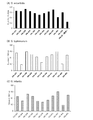
- FIG. 1 and FIG. 1 and FIG. 2 are graphs showing the binding ability of each aptamer to each bacterium.
- FIG. 1 (A) is Salmonella enteritidis
- (B) is Salmonella typhimurium
- (C) is Salmonella infantis
- FIG. 2 is Citrobacter freundii . It is a graph which shows the binding ability of each aptamer.
- the vertical axis represents RU constant / RU max .
- the aptamer of the example shows some binding (RU max ) to Citrobacter freundii at the time of injection, but as a result of dissociation by washing, RU constant / RU max is negative (substantially) No bond).
- the known aptamer SAL-33 of the comparative example bound to Citrobacter freundii , and the binding was maintained after washing.
- all of the aptamers of the examples showed better binding ability to Salmonella enteritidis than the known aptamers of the comparative examples, and excellent binding ability to Salmonella typhimurium and Salmonella infantis . showed that.
- SAL-230, SAL-262, SAL-396, SAL-431, and SAL-437 show excellent binding ability at the time of injection of the diluted sample, and the binding with Salmonella is sufficient even by washing. I was able to maintain it. From these results, it was found that the aptamers of the examples can bind specifically to each salmonella with excellent binding ability.
- Example 2 About each aptamer, the binding ability with respect to Salmonella was confirmed.
- Salmonella was detected by ELAA (Enzyme-linked Aptamer Assay) using an aptamer.
- the aptamer was added with polydeoxyadenine (poly dA) having a length of 24 bases at the 3 'end, and used as a poly dA addition aptamer for ELAA described later.
- poly dA polydeoxyadenine
- Bacterial samples As in the previous examples, dead bacteria of Salmonella enteritidis , Salmonella typhimurium , Salmonella infantis and Eschericia coli (DH5a) were used. The bacteria were diluted with PBS buffer so that the absorbance at a wavelength of 600 nm at a light length of 1 cm was 0.1. This diluted sample was used in the following ELAA.
- a 96-well plate (trade name: Nunc-Immuno (registered trademark) plate, Maxisorp (registered trademark), Nunc), and allowed to adsorb at 4 ° C. overnight.
- the well was washed with 200 ⁇ L of washing solution, 200 ⁇ L of blocking solution was added, and incubated at room temperature for 1 hour. After the incubation, the well was washed 3 times with 200 ⁇ L of the washing solution to prepare a plate on which dead bacteria in the diluted sample were immobilized.
- the poly dA aptamer was not added, and the biotinylated poly dT was added to the plate on which the dead bacteria were immobilized, and ELAA was performed in the same manner.
- FIG. 4 is a graph showing the binding of aptamer and Salmonella.
- the vertical axis represents the relative value of absorbance at a wavelength of 450 nm indicating the binding ability.
- A shows the ability to bind Salmonella enteritidis
- B shows the ability to bind Salmonella typhimurium
- C shows the ability to bind Salmonella infantis .
- SAL-230_s48 (SEQ ID NO: 23) GGTTGTGGTTGGTGGGGGGTGCGGAGGGTGGGCAAAGGTTTCGGACGG
- SAL-230_rand (SEQ ID NO: 24) GGTTGTGGTTGGTGGGGGGTGCGGAGGGTGGG SAL-278_s49 (SEQ ID NO: 27) TGAATTGTGGTAGGGAGATGTGGGGGTGGGTAGGAGGGCAAAGGTTTCG SAL-278_rand (SEQ ID NO: 28) GTGGTAGGGAGATGTGGGGGTGGGTAGGAGGG
- FIG. 5 is a graph showing the binding ability of each aptamer to each Salmonella.
- the vertical axis is RU constant / RU max .
- A shows the ability to bind Salmonella enteritidis
- B shows the ability to bind Salmonella typhimurium
- C shows the ability to bind Salmonella infantis .
- Salmonella was detected by ELAA using an aptamer.
- SAL-204, SAL-242 (SEQ ID NO: 7), SAL-262 (SEQ ID NO: 9), SAL-396 (SEQ ID NO: 10), SAL-445 (SEQ ID NO: 11), SAL-437 (SEQ ID NO: 12) ), SAL-455 (SEQ ID NO: 14), SAL-107 (SEQ ID NO: 15) and SAL-431 (SEQ ID NO: 16) were synthesized in the following nucleotides, and used as aptamers in the examples.
- the aptamer was added with poly dA having a length of 20 bases at the 3 ′ end, and used as a poly dA-added aptamer for ELAA described later.
- SAL-204_s46 (SEQ ID NO: 21) GGGGGTGGATAGTACAGGGTGGGTAGGGGGCAAAGGTTTCGGACGG SAL-204_rand (SEQ ID NO: 22) GCGGGGGTGGATAGTACAGGGTGGGTAGGGGG SAL-242_s46 (SEQ ID NO: 25) TATGTGGTTGGGGGGGGGAGGGAGGGCAAAGGTTTCGGACGGACAT SAL-242_rand (SEQ ID NO: 26) GGGTGCTATGTGGTTGGGGGGGGGAGGGAGGG SAL-262_s36 (SEQ ID NO: 29) GGTGGGGGGGGTGGGCGCGGCAAAGGTTTCGGACGG SAL-262_rand (SEQ ID NO: 30) GCCGCGTGAAGAGGTGGGGGGGGTGGGCGCGG SAL-396_s55 (SEQ ID NO: 22) GCGGGGGTGGATAGTACAGGGTGGGTAGGGGG SAL-242_s46 (SEQ ID NO: 25) TATGT
- FIG. 6 shows the result of calculating the relative value for each reaction with the absorbance of the blank being 1.
- FIG. 6 is a graph showing the binding of aptamer and Salmonella.
- the vertical axis represents the relative value of absorbance at a wavelength of 450 nm indicating the binding ability.
- any of the aptamers of the Examples exhibited binding ability superior to that of the negative control N40 (O pool) with respect to Salmonella.
- the composition of the SPR buffer is 40 mmol / L HEPES, 125 mmol / L NaCl, 5 mmol / L KCl, 1 mmol / L MgCl 2 , 0.05% Tween (registered trademark) 20, pH
- the binding ability was analyzed in the same manner as in Example 1 (3) except that 7.4 was used.
- the results of RU max and RU constant are shown in FIG.
- FIG. 7 is a graph showing aptamer binding ability.
- (A) shows the result of RU max
- (B) shows the result of RU constant .
- the horizontal axis indicates the type of aptamer, in (A), the vertical axis indicates RU max , and in (B), the vertical axis indicates RU constant .
- SAL-278_rand showed excellent binding ability to Salmonella with respect to the negative control. SAL-278_rand did not bind to Eschericia coli O157: H7, Listeria monocytogenes 4a and Listeria monocytogenes 1 / 2a, and showed excellent binding ability only to Salmonella enteritidis and Salmonella typhimurium .
- Salmonella was detected by fluorescence polarization using a labeled aptamer obtained by hybridizing a labeled complementary strand and an aptamer.
- polydeoxyadenine having a length of 24 bases is added to the 3 ′ end of the miniaturized aptamer SAL-278_rand (SEQ ID NO: 28) of Example 4 to obtain a poly dA added aptamer.
- poly dA polydeoxyadenine
- SAL-278_rand SEQ ID NO: 28
- a labeled complementary strand a labeled poly dT in which the 5 ′ end of deoxythymidine having a length of 24 bases was labeled with Alexa 647 (manufactured by Invitrogen) was prepared. Then, in the SB1T buffer (40 mmol / L HEPES, 125 mmol / L NaCl, 5 mmol / L KCl, 1 mmol / L MgCl 2 , 0.05% Tween (registered trademark) 20, pH 7.4), the folding was performed.
- the SB1T buffer 40 mmol / L HEPES, 125 mmol / L NaCl, 5 mmol / L KCl, 1 mmol / L MgCl 2 , 0.05% Tween (registered trademark) 20, pH 7.4
- a poly dA-added aptamer and the labeled poly dT were incubated at room temperature for 10 minutes, and the labeled poly dT was hybridized to the poly dA portion of the poly dA-added aptamer to prepare a labeled hybrid aptamer.
- Example 2 Bacterial sample Bacteria used Salmonella enteritidis (SE), Salmonella typhimurium (ST), Eschericia coli O157: H7 (O157), Listeria monocytogenes 4a (LM4a) and Listeria monocytogenes 1 / 2a (LM1 / 2a), A diluted sample was prepared in the same manner as in Example 1 (2) except that the SB1T buffer was used instead of the PBS buffer. Moreover, it replaced with the said diluted sample and used SB1T buffer and made this into control.
- SE Salmonella enteritidis
- ST Salmonella typhimurium
- O157 Eschericia coli O157: H7
- LM4a Listeria monocytogenes 4a
- LM1 / 2a Listeria monocytogenes 1 / 2a
- FIG. 8 is a graph showing the result of the degree of fluorescence polarization.
- the horizontal axis indicates the type of aptamer, and the vertical axis indicates the degree of fluorescence polarization. Since the labeled poly dT is hybridized to the poly dA-added aptamer, when Salmonella binds to the aptamer part of the poly dA-added aptamer, the degree of fluorescence polarization increases due to an increase in molecular weight. As shown in FIG. 8, SAL-278_rand showed a higher degree of fluorescence polarization for Salmonella than the negative control. From this, it was found that SAL-278_rand was bound to Salmonella by the degree of fluorescence polarization.
- SAL-278_rand showed a degree of fluorescence polarization equivalent to that of the negative control for Eschericia coli O157: H7, Listeria monocytogenes 4a and Listeria monocytogenes 1 / 2a. This indicates that SAL-278_rand does not bind to anything other than Salmonella due to the degree of fluorescence polarization.
- Salmonella was detected by fluorescence polarization using an aptamer.
- Example 4 (2) Labeled aptamer Using the miniaturized aptamer SAL-278_rand (SEQ ID NO: 28) of Example 4, three types of labeled aptamers were prepared as shown below.
- the first labeled aptamer is a labeled hybrid aptamer hybridized with a labeled complementary strand, and the same one as in Example 7 was used.
- the second labeled aptamer was obtained by adding 5 base poly dT to the 5 ′ end of the miniaturized aptamer and labeling the 5 ′ end of the poly dT with Alexa 647 (5 ′ end labeled aptamer). .
- the third labeled aptamer was obtained by adding 5-base poly dT to the 3 ′ end of the miniaturized aptamer and labeling the 3 ′ end of the poly dT with Alexa 647 (3 ′ end labeled aptamer). .
- Example 6 As a negative control, N30 of Example 6 was used, and a labeled hybrid aptamer in which 20 A of poly A was added to the 3 'end and the labeled poly dT was hybridized was used.
- Bacterial sample A diluted sample was prepared in the same manner as in Example 1 (2) except that Salmonella typhimurium was used as the bacterium, and SB1T buffer was used instead of PBS buffer. Moreover, it replaced with the said diluted sample and used SB1T buffer and made this into control.
- FIG. 9 is a graph showing the result of the degree of fluorescence polarization.
- the horizontal axis indicates the type of aptamer, and the vertical axis indicates the degree of fluorescence polarization. Since each labeled aptamer is labeled with a labeling substance, when Salmonella binds to the aptamer part of each labeled aptamer, the degree of fluorescence polarization increases due to an increase in molecular weight.
- the labeled hybrid aptamer (hybrid) the 5 ′ end labeled aptamer (5 ′ label) and the 3 ′ end labeled aptamer (3 ′ label) are more effective against Salmonella than the negative control, respectively.
- Salmonella was detected by fluorescence polarization using an aptamer.
- Example 2 Bacterial sample A SB1T diluted sample was prepared in the same manner as in Example 1 (2) except that Salmonella typhimurium was used as the bacterium, and the SB1T buffer was used instead of the PBS buffer. Further, a TBS diluted sample was prepared in the same manner as in Example 1 (2) except that a culture medium of tryptosome broth (TSB) was used instead of the PBS buffer.
- TBS tryptosome broth
- the concentration of dead bacteria in the diluted sample is a predetermined concentration (10 6 cells / mL, 10 7 cells / mL or 10 8 cells / mL).
- the fluorescence polarization degree of the reaction solution was measured in the same manner as in Example 7 (3) except that each diluted sample was added so that The measurement results of the degree of fluorescence polarization are shown in FIG.
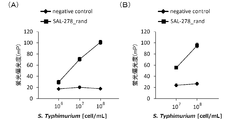
- FIG. 10 is a graph showing the results of the degree of fluorescence polarization.
- (A) shows the results using the SB1T diluted sample
- (B) shows the results using the TBS diluted sample.
- 10A and 10B the horizontal axis represents the concentration of Salmonella, and the vertical axis represents the degree of fluorescence polarization.
- both of the SBT1 diluted sample and the TBS diluted sample showed a high degree of fluorescence polarization with respect to the negative control, and 10 6 cells / mL. It was found that Salmonella can be detected by fluorescence polarization even at a Salmonella concentration.
- Example 10 The dissociation constant of the aptamer for Salmonella was measured by ELAA using the aptamer.
- the biotinylated aptamer was not added, and ELAA was performed in the same manner. Then, the dissociation constant of the biotinylated aptamer for Salmonella was calculated from the absorbance fitting curve.
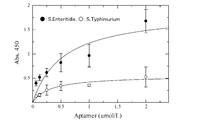
- FIG. 11 is a graph showing the binding between aptamer and Salmonella.
- the horizontal axis indicates the aptamer concentration
- the vertical axis indicates the absorbance at a wavelength of 450 nm indicating the binding ability
- the black circle ( ⁇ ) in the figure indicates the result when Salmonella enteritidis is used.
- the white circles ( ⁇ ) indicate the results when Salmonella typhimurium was used.
- the absorbance increased depending on the concentration of the biotinylated aptamer.
- the dissociation constant of SAL-278 for Salmonella enteritidis was 540 nM, and the dissociation constant for Salmonella typhimurium was 310 nM. From these results, it was found that SAL-278 exhibits extremely excellent binding strength to Salmonella.
- the nucleic acid molecule of the present invention can bind to Salmonella, and specifically can bind specifically to Salmonella belonging to the O4 group, O7 group and / or O9 group, which are causative bacteria of food poisoning. For this reason, according to the nucleic acid molecule of the present invention, for example, Salmonella can be detected by binding to Salmonella. Therefore, the nucleic acid molecule of the present invention is an extremely useful tool for detecting Salmonella in the fields of food management, public health, and the like.
Landscapes
- Chemical & Material Sciences (AREA)
- Life Sciences & Earth Sciences (AREA)
- Health & Medical Sciences (AREA)
- Engineering & Computer Science (AREA)
- Organic Chemistry (AREA)
- Genetics & Genomics (AREA)
- Wood Science & Technology (AREA)
- Zoology (AREA)
- Proteomics, Peptides & Aminoacids (AREA)
- Bioinformatics & Cheminformatics (AREA)
- Biotechnology (AREA)
- General Engineering & Computer Science (AREA)
- Molecular Biology (AREA)
- Analytical Chemistry (AREA)
- Biomedical Technology (AREA)
- Biochemistry (AREA)
- Biophysics (AREA)
- Microbiology (AREA)
- General Health & Medical Sciences (AREA)
- Physics & Mathematics (AREA)
- Immunology (AREA)
- Plant Pathology (AREA)
- Toxicology (AREA)
- Measuring Or Testing Involving Enzymes Or Micro-Organisms (AREA)
- Apparatus Associated With Microorganisms And Enzymes (AREA)
Abstract
Description
(a)配列番号1~17のいずれかの塩基配列からなるポリヌクレオチド
(b)前記(a)のいずれかの塩基配列において、1もしくは数個の塩基が欠失、置換、挿入および/または付加された塩基配列からなり、サルモネラに結合するポリヌクレオチド
(c)前記(a)のいずれかの塩基配列に対して、80%以上の同一性を有する塩基配列からなり、サルモネラに結合するポリヌクレオチド
(d)前記(a)のいずれかの塩基配列からなるポリヌクレオチドに対してストリンジェントな条件下でハイブリダイズするポリヌクレオチドに、相補的な塩基配列からなり、サルモネラに結合するポリヌクレオチド
(a)配列番号1~17のいずれかの塩基配列からなるポリヌクレオチド
(b)前記(a)のいずれかの塩基配列において、1もしくは数個の塩基が欠失、置換、挿入および/または付加された塩基配列からなり、サルモネラに結合するポリヌクレオチド
(c)前記(a)のいずれかの塩基配列に対して、80%以上の同一性を有する塩基配列からなり、サルモネラに結合するポリヌクレオチド
(d)前記(a)のいずれかの塩基配列からなるポリヌクレオチドに対してストリンジェントな条件下でハイブリダイズするポリヌクレオチドに、相補的な塩基配列からなり、サルモネラに結合するポリヌクレオチド
GGTATCAACGCCTCTCAGTGAATTGCGGGGGTGGATAGTACAGGGTGGGTAGGGGGCAAAGGTTTCGGACGGACATATC
SAL-236(配列番号2)
GGTATCAACGCCTCTCAGTGAATTGTTGGGGGTAGGCGCTGGGGTGGGTGGGAGCGCAAAGGTTTCGGACGGACATATC
SAL-230(配列番号3)
GGTATCAACGCCTCTCAGTGAATTGGTTGTGGTTGGTGGGGGGTGCGGAGGGTGGGCAAAGGTTTCGGACGGACATATC
SAL-203(配列番号4)
GGTATCAACGCCTCTCAGTGAATTGGGCGGAGTTGTGGGGGGTCGGGGGGTGGCGGCAAAGGTTTCGGACGGACATATC
SAL-219(配列番号5)
GGTATCAACGCCTCTCAGTGAATTGGGATCGGTGCTGCGGGGGTGGGTGGAGCGGGCAAAGGTTTCGGACGGACATATC
SAL-256(配列番号6)
GGTATCAACGCCTCTCAGTGAATTGTCGGGGGTAGTGCCGGGGGTTGGGTGGGCAGCAAAGGTTTCGGACGGACATATC
SAL-242(配列番号7)
GGTATCAACGCCTCTCAGTGAATTGGGTGCTATGTGGTTGGGGGGGGGAGGGAGGGCAAAGGTTTCGGACGGACATATC
SAL-278(配列番号8)
GGTATCAACGCCTCTCAGTGAATTGTGGTAGGGAGATGTGGGGGTGGGTAGGAGGGCAAAGGTTTCGGACGGACATATC
SAL-262(配列番号9)
GGTATCAACGCCTCTCAGTGAATTGCCGCGTGAAGAGGTGGGGGGGGTGGGCGCGGCAAAGGTTTCGGACGGACATATC
SAL-396(配列番号10)
GGAAATCTGCCCTTGTCCCTAAAGTTGCGGGTGTTGTGGGGGTGGGTTGGTGGGCAAAGCCGTCGAGTGGGTATTC
SAL-445(配列番号11)
GGAAATCTGCCCTTGTCCCTAAAGTCCGGGGTGGGGGGGGGAGGTGGTGGTGTGCAAAGCCGTCGAGTGGGTATTC
SAL-437(配列番号12)
GGAAATCTGCCCTTGTCCCTAAAGGCGGCTACGGGGTGGGTGGGAGTAACTGGGCAAAGCCGTCGAGTGGGTATTC
SAL-409(配列番号13)
GGAAATCTGCCCTTGTCCCTAAAGGGCCTGGTAGGTTGGTGGGGGTGGGGAGGGCAAAGCCGTCGAGTGGGTATTC
SAL-455(配列番号14)
GGAAATCTGCCCTTGTCCCTAAAGCGTGCGGTGGAGAGGTGGGGGGGTGGGCCGCAAAGCCGTCGAGTGGGTATTC
SAL-107(配列番号15)
GGAAATCTGCCCTTGTCCCTAAAGTTGTGGTTGGTGGGGGGTGGGTGGTGGGTGCAAAGCCGTCGAGTGGGTATTC
SAL-431(配列番号16)
GGAAATCTGCCCTTGTCCCTAAAGTGGAGCGGGGTGGGTGTGGTGGGTGAGGGACAAAGCCGTCGAGTGGGTATTC
SAL-123(配列番号17)
GGAAATCTGCCCTTGTCCCTAAAGTTGGGTGTGGTGGGTGGGGGAGGTGGTATGCAAAGCCGTCGAGTGGGTATTC
GGGGGTGGATAGTACAGGGTGGGTAGGGGGCAAAGGTTTCGGACGG
SAL-204_rand(配列番号22)
GCGGGGGTGGATAGTACAGGGTGGGTAGGGGG
SAL-230_s48 (配列番号23)
GGTTGTGGTTGGTGGGGGGTGCGGAGGGTGGGCAAAGGTTTCGGACGG
SAL-230_rand(配列番号24)
GGTTGTGGTTGGTGGGGGGTGCGGAGGGTGGG
SAL-242_s46 (配列番号25)
TATGTGGTTGGGGGGGGGAGGGAGGGCAAAGGTTTCGGACGGACAT
SAL-242_rand(配列番号26)
GGGTGCTATGTGGTTGGGGGGGGGAGGGAGGG
SAL-278_s49 (配列番号27)
TGAATTGTGGTAGGGAGATGTGGGGGTGGGTAGGAGGGCAAAGGTTTCG
SAL-278_rand(配列番号28)
GTGGTAGGGAGATGTGGGGGTGGGTAGGAGGG
SAL-262_s36 (配列番号29)
GGTGGGGGGGGTGGGCGCGGCAAAGGTTTCGGACGG
SAL-262_rand(配列番号30)
GCCGCGTGAAGAGGTGGGGGGGGTGGGCGCGG
SAL-396_s55 (配列番号31)
CCCTAAAGTTGCGGGTGTTGTGGGGGTGGGTTGGTGGGCAAAGCCGTCGAGTGGG
SAL-396_rand(配列番号32)
TTGCGGGTGTTGTGGGGGTGGGTTGGTGGG
SAL-445_s44 (配列番号33)
GGGGTGGGGGGGGGAGGTGGTGGTGTGCAAAGCCGTCGAGTGGG
SAL-445_rand(配列番号34)
TCCGGGGTGGGGGGGGGAGGTGGTGGTGTG
SAL-437_s41 (配列番号35)
GGCGGCTACGGGGTGGGTGGGAGTAACTGGGCAAAGCCGTC
SAL-437_rand(配列番号36)
GCGGCTACGGGGTGGGTGGGAGTAACTGGG
SAL-455_s42 (配列番号37)
GGTGGAGAGGTGGGGGGGTGGGCCGCAAAGCCGTCGAGTGGG
SAL-455_rand(配列番号38)
CGTGCGGTGGAGAGGTGGGGGGGTGGGCCG
SAL-107_s43 (配列番号39)
GGTTGGTGGGGGGTGGGTGGTGGGTGCAAAGCCGTCGAGTGGG
SAL-107_rand(配列番号40)
TTGTGGTTGGTGGGGGGTGGGTGGTGGGTG
SAL-431_s56 (配列番号41)
CTTGTCCCTAAAGTGGAGCGGGGTGGGTGTGGTGGGTGAGGGACAAAGCCGTCGAG
SAL-431_rand(配列番号20)
TGGAGCGGGGTGGGTGTGGTGGGTGAGGG
本発明の検出方法は、前述のように、サルモネラの検出方法であって、試料と前記本発明の核酸分子とを接触させ、前記試料中のサルモネラと前記核酸分子とを結合させることにより、前記試料中のサルモネラを検出する工程を含むことを特徴とする。本発明の検出方法は、前記本発明の核酸分子を使用することが特徴であって、その他の工程および条件等は、特に制限されない。
本発明の検出試薬は、前述のように、サルモネラの検出試薬であって、前記本発明の核酸分子を含むことを特徴とする。本発明の検出試薬は、前記本発明の核酸分子を含んでいればよく、その他の構成は何ら制限されない。本発明の検出試薬を使用すれば、前述のように、例えば、前記サルモネラの検出等を行うことができる。
本発明の検出デバイスは、前述のように、サルモネラの検出デバイスであって、前記本発明の核酸分子を含むことを特徴とする。本発明の検出デバイスは、前記本発明の核酸分子を含んでいればよく、その他の構成は何ら制限されない。本発明の検出デバイスを使用すれば、前述のように、例えば、前記サルモネラの検出等を行うことができる。
各アプタマーについて、サルモネラに対する結合能を確認した。
下記ポリヌクレオチドを合成し、実施例のアプタマーとした。
SAL-107(配列番号15)
GGAAATCTGCCCTTGTCCCTAAAGTTGTGGTTGGTGGGGGGTGGGTGGTGGGTGCAAAGCCGTCGAGTGGGTATTC
SAL‐204(配列番号1)
GGTATCAACGCCTCTCAGTGAATTGCGGGGGTGGATAGTACAGGGTGGGTAGGGGGCAAAGGTTTCGGACGGACATATC
SAL-230(配列番号3)
GGTATCAACGCCTCTCAGTGAATTGGTTGTGGTTGGTGGGGGGTGCGGAGGGTGGGCAAAGGTTTCGGACGGACATATC
SAL-242(配列番号7)
GGTATCAACGCCTCTCAGTGAATTGGGTGCTATGTGGTTGGGGGGGGGAGGGAGGGCAAAGGTTTCGGACGGACATATC
SAL-262(配列番号9)
GGTATCAACGCCTCTCAGTGAATTGCCGCGTGAAGAGGTGGGGGGGGTGGGCGCGGCAAAGGTTTCGGACGGACATATC
SAL-278(配列番号8)
GGTATCAACGCCTCTCAGTGAATTGTGGTAGGGAGATGTGGGGGTGGGTAGGAGGGCAAAGGTTTCGGACGGACATATC
SAL-396(配列番号10)
GGAAATCTGCCCTTGTCCCTAAAGTTGCGGGTGTTGTGGGGGTGGGTTGGTGGGCAAAGCCGTCGAGTGGGTATTC
SAL-431(配列番号16)
GGAAATCTGCCCTTGTCCCTAAAGTGGAGCGGGGTGGGTGTGGTGGGTGAGGGACAAAGCCGTCGAGTGGGTATTC
SAL-437(配列番号12)
GGAAATCTGCCCTTGTCCCTAAAGGCGGCTACGGGGTGGGTGGGAGTAACTGGGCAAAGCCGTCGAGTGGGTATTC
SAL-445(配列番号11)
GGAAATCTGCCCTTGTCCCTAAAGTCCGGGGTGGGGGGGGGAGGTGGTGGTGTGCAAAGCCGTCGAGTGGGTATTC
SAL-455(配列番号14)
GGAAATCTGCCCTTGTCCCTAAAGCGTGCGGTGGAGAGGTGGGGGGGTGGGCCGCAAAGCCGTCGAGTGGGTATTC
SAL-33(配列番号18)
TTTGGTCCTTGTCTTATGTCCAGAATGCTATGGCGGCGTCACCCGACGGGGACTTGACATTATGACAGATTTCTCCTACTGGGATAGGTGGATTAT
N40(配列番号19)
CCTGCACCCAGTGTCCC-(N)40-GACGGAGAGGAGGACGG
細菌は、Salmonella enteritidis、Salmonella typhimurium、Salmonella infantis、Citrobacter freundiiおよびEschericia coli(DH5a)を使用した。各細菌を、100℃、10分間の加熱処理によって、死滅させた。前記死滅した細菌を、光路長1cmでの波長600nmの吸光度が0.1となるように、PBS緩衝液(137mmol NaCl、8.1mmol Na2HPO4、2.68mmol KCl、1.48mmol KH2PO4、pH7.4)で希釈した。この希釈試料を、以下のSPRに使用した。
結合能の解析には、ProteON XPR36(BioRad社)を、その使用説明書にしたがって使用した。
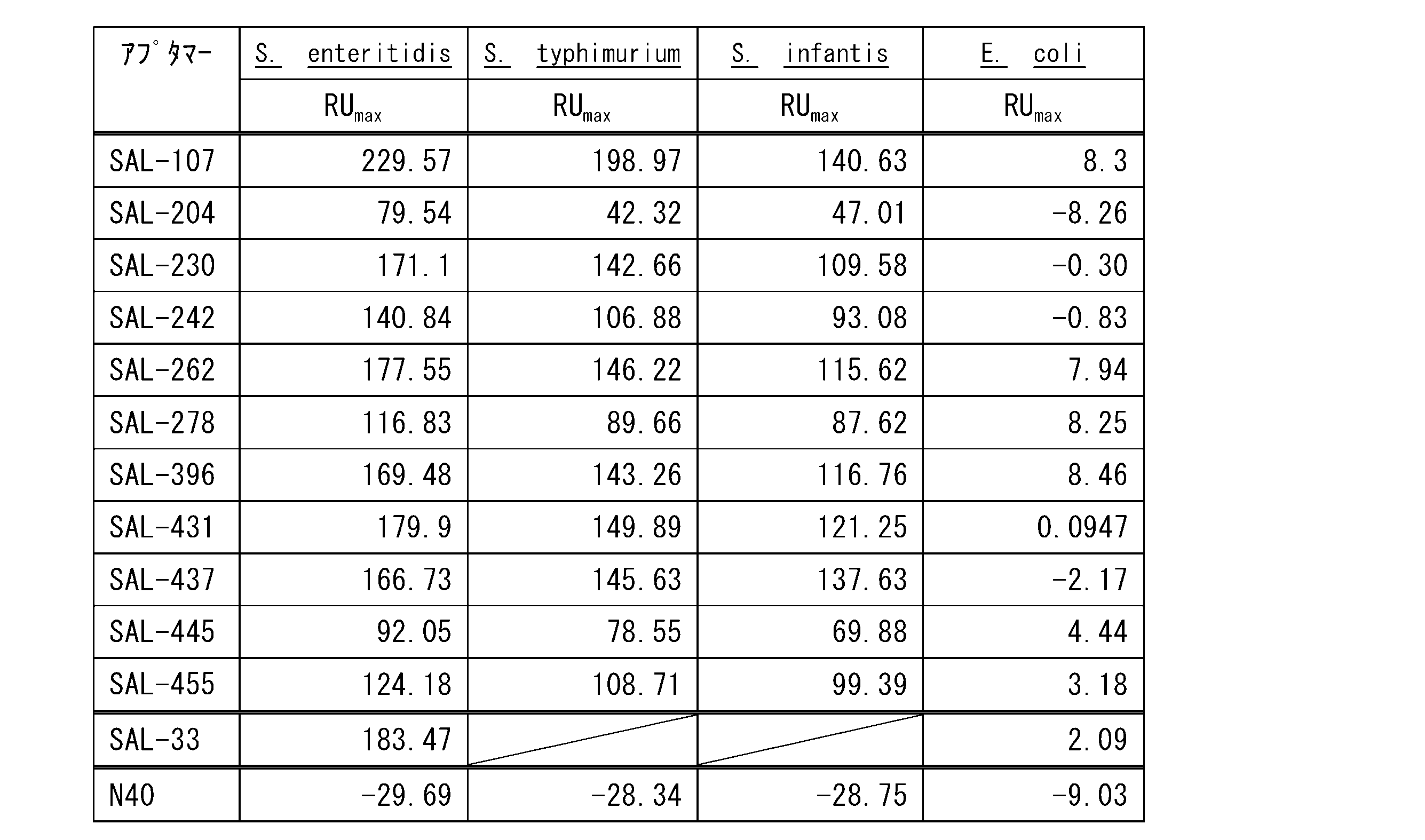
各アプタマーについて、サルモネラに対する結合能を確認した。
下記ポリヌクレオチドを合成し、実施例のアプタマーとした。
SAL-123(配列番号17)
GGAAATCTGCCCTTGTCCCTAAAGTTGGGTGTGGTGGGTGGGGGAGGTGGTATGCAAAGCCGTCGAGTGGGTATTC
SAL-219(配列番号5)
GGTATCAACGCCTCTCAGTGAATTGGGATCGGTGCTGCGGGGGTGGGTGGAGCGGGCAAAGGTTTCGGACGGACATATC
SAL-236(配列番号2)
GGTATCAACGCCTCTCAGTGAATTGTTGGGGGTAGGCGCTGGGGTGGGTGGGAGCGCAAAGGTTTCGGACGGACATATC
SAL-409(配列番号13)
GGAAATCTGCCCTTGTCCCTAAAGGGCCTGGTAGGTTGGTGGGGGTGGGGAGGGCAAAGCCGTCGAGTGGGTATTC
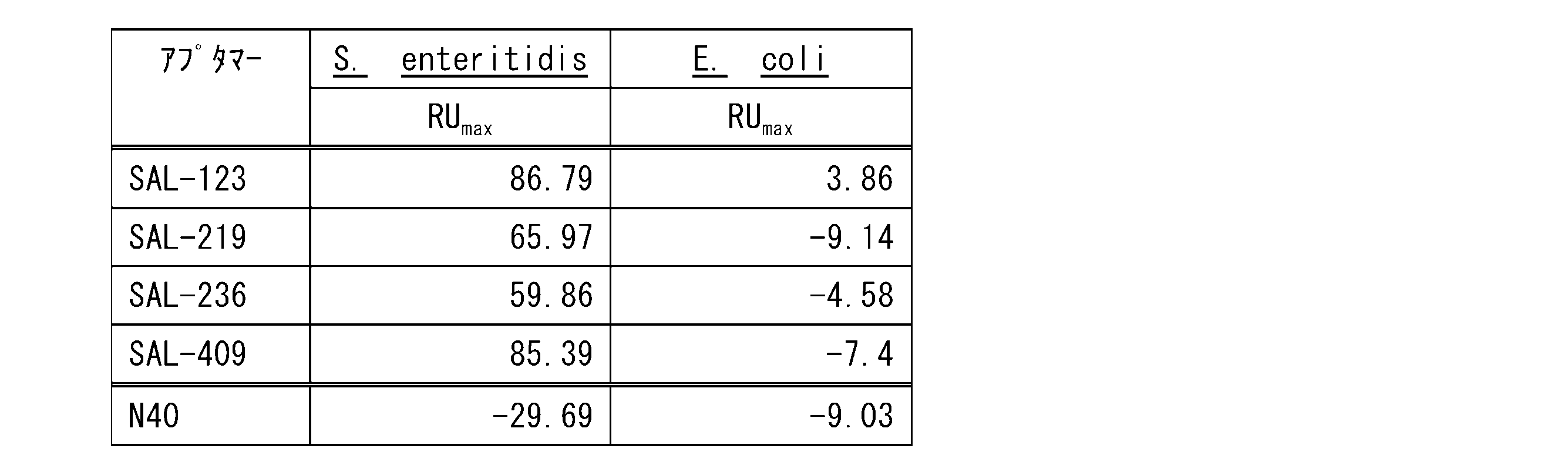
サルモネラとして、Salmonella enteritidisを使用し、アプタマーとして、前記(1)のアプタマーを使用した以外は、前記実施例1と同様にして、結合能を解析した。RUmaxの結果を下記表2に、RUconstant/RUmaxの結果を図3に示す。
アプタマーを用いたELAA(Enzyme‐linked Aptamer Assay)により、サルモネラの検出を行った。
前記実施例1で使用したSAL-230(配列番号3)、SAL-262(配列番号9)、SAL-396(配列番号10)、SAL-431(配列番号16)、SAL-437(配列番号12)、SAL-242(配列番号7)、SAL-107(配列番号15)、SAL‐204(配列番号1)、SAL-278(配列番号8)、SAL-455(配列番号14)を使用した。
前記実施例と同様に、Salmonella enteritidis、Salmonella typhimurium、Salmonella infantisおよびEschericia coli(DH5a)の死滅細菌を使用した。前記細菌を、光長1cmでの波長600nmの吸光度が0.1となるように、PBS緩衝液で希釈した。この希釈試料を、以下のELAAで使用した。
使用した試薬等の組成を以下に示す。
固相化液:
PBS緩衝液(137mmol NaCl、8.1mmol Na2HPO4、2.68mmol KCl、1.48mmol KH2PO4、pH7.4)
ブロッキング液:
Protein Free(TBS)ブロッキングバッファー(PIERCE社)
希釈液:
50mmol/L Tris-HCl(pH7.4)、100mmol/L NaCl、1mmol/L MgCl2、5mmol/L KCl
洗浄液:
PBS緩衝液(137mmol NaCl、8.1mmol Na2HPO4、2.68mmol KCl、1.48mmol KH2PO4、pH7.4)、0.05% Tween20
基質:
TMBE Peroxidase Substrate ELISA(MOSS社)
停止液:
0.5N(0.25mol/L) H2SO4
各アプタマーについて、サルモネラに対する結合を確認した。
前記SAL-230(配列番号3)およびSAL-278(配列番号8)を小型化した下記ポリヌクレオチドを合成し、実施例のアプタマーとした。前記アプタマーは、さらに、その3’末端に、20塩基長のポリdAを付加し、ポリdA付加アプタマーとして、後述するSPRに使用した。
SAL-230_s48 (配列番号23)
GGTTGTGGTTGGTGGGGGGTGCGGAGGGTGGGCAAAGGTTTCGGACGG
SAL-230_rand(配列番号24)
GGTTGTGGTTGGTGGGGGGTGCGGAGGGTGGG
SAL-278_s49 (配列番号27)
TGAATTGTGGTAGGGAGATGTGGGGGTGGGTAGGAGGGCAAAGGTTTCG
SAL-278_rand(配列番号28)
GTGGTAGGGAGATGTGGGGGTGGGTAGGAGGG
サルモネラとしてSalmonella enteritidis、Salmonella typhimuriumおよびSalmonella infantisを使用し、アプタマーとして、前記(1)のアプタマーを使用した以外は、前記実施例1と同様にして、結合能を解析した。

アプタマーを用いたELAAにより、サルモネラの検出を行った。
前記実施例4の小型化アプタマーである、SAL-230_s48(配列番号23)、SAL-230_rand(配列番号24)、SAL-278_s49(配列番号27)およびSAL-278_rand(配列番号28)を使用した。また、前記SAL-204、SAL-242(配列番号7)、SAL-262(配列番号9)、SAL-396(配列番号10)、SAL-445(配列番号11)、SAL-437(配列番号12)、SAL-455(配列番号14)、SAL-107(配列番号15)およびSAL-431(配列番号16)を小型化した下記ヌクレオチドを合成し、実施例のアプタマーとした。前記アプタマーは、その3’末端に、20塩基長のポリdAを付加し、ポリdA付加アプタマーとして、後述するELAAに使用した。また、ネガティブコントロールとして、前記実施例1と同様のN40を使用し、その3’末端に、同様にしてポリdAを付加し、前記ELAAに使用した。
SAL-204_s46 (配列番号21)
GGGGGTGGATAGTACAGGGTGGGTAGGGGGCAAAGGTTTCGGACGG
SAL-204_rand(配列番号22)
GCGGGGGTGGATAGTACAGGGTGGGTAGGGGG
SAL-242_s46 (配列番号25)
TATGTGGTTGGGGGGGGGAGGGAGGGCAAAGGTTTCGGACGGACAT
SAL-242_rand(配列番号26)
GGGTGCTATGTGGTTGGGGGGGGGAGGGAGGG
SAL-262_s36 (配列番号29)
GGTGGGGGGGGTGGGCGCGGCAAAGGTTTCGGACGG
SAL-262_rand(配列番号30)
GCCGCGTGAAGAGGTGGGGGGGGTGGGCGCGG
SAL-396_s55 (配列番号31)
CCCTAAAGTTGCGGGTGTTGTGGGGGTGGGTTGGTGGGCAAAGCCGTCGAGTGGG
SAL-396_rand(配列番号32)
TTGCGGGTGTTGTGGGGGTGGGTTGGTGGG
SAL-445_s44 (配列番号33)
GGGGTGGGGGGGGGAGGTGGTGGTGTGCAAAGCCGTCGAGTGGG
SAL-445_rand(配列番号34)
TCCGGGGTGGGGGGGGGAGGTGGTGGTGTG
SAL-437_s41 (配列番号35)
GGCGGCTACGGGGTGGGTGGGAGTAACTGGGCAAAGCCGTC
SAL-437_rand(配列番号36)
GCGGCTACGGGGTGGGTGGGAGTAACTGGG
SAL-455_s42 (配列番号37)
GGTGGAGAGGTGGGGGGGTGGGCCGCAAAGCCGTCGAGTGGG
SAL-455_rand(配列番号38)
CGTGCGGTGGAGAGGTGGGGGGGTGGGCCG
SAL-107_s43 (配列番号39)
GGTTGGTGGGGGGTGGGTGGTGGGTGCAAAGCCGTCGAGTGGG
SAL-107_rand(配列番号40)
TTGTGGTTGGTGGGGGGTGGGTGGTGGGTG
SAL-431_s56 (配列番号41)
CTTGTCCCTAAAGTGGAGCGGGGTGGGTGTGGTGGGTGAGGGACAAAGCCGTCGAG
SAL-431_rand(配列番号20)
TGGAGCGGGGTGGGTGTGGTGGGTGAGGG
サルモネラとして、Salmonella enteritidisを使用し、アプタマーとして、前記(1)のアプタマーを使用した以外は、前記実施例3と同様にしてサルモネラの検出を行った。ブランクの吸光度を1として、各反応について相対値を求めた結果を図6に示す。
各アプタマーについて、サルモネラに対する結合の特異性を確認した。
前記実施例4の小型化アプタマーSAL-278_rand(配列番号28)を使用した。前記アプタマーは、その3’末端に、24塩基長のポリデオキシアデニン(ポリdA)を付加し、ポリdA付加アプタマーとして、後述するSPRに使用した。また、ネガティブコントロールとして、30塩基のランダム配列(N)30を含む配列番号42で表されるオリゴヌクレオチドを複数含むDNAライブラリーを、ネガティブコントロールN30とし、その3’末端に、同様にしてポリdAを付加し、後述するSPRに使用した。下記配列において、「N」は、N40と同様とした。
N30(配列番号42)
CCTGCACCCAGTGTCCC-(N)30-GACGGAGAGGAGGACGG
細菌は、Salmonella enteritidis(SE)、Salmonella typhimurium(ST)、Eschericia coli O157:H7(0157)、Listeria monocytogenes 4a(LM4a)およびListeria monocytogenes 1/2a(LM1/2a)を使用した以外は、前記実施例1(2)と同様にして、希釈試料を調製し、以下のSPRに使用した。
前記SPRバッファーの組成を、40mmol/L HEPES、125mmol/L NaCl、5mmol/L KCl、1mmol/L MgCl2、0.05% Tween(登録商標)20とし、pHを、7.4とした以外は、前記実施例1(3)と同様にして、結合能を解析した。RUmaxおよびRUconstantの結果を図7に示す。
標識化相補鎖とアプタマーとをハイブリダイズした標識化アプタマーを用いた蛍光偏光法により、サルモネラの検出を行った。
まず、前記実施例4の小型化アプタマーSAL-278_rand(配列番号28)の3’末端に、24塩基長のポリデオキシアデニン(ポリdA)を付加し、ポリdA付加アプタマーを調製した。このポリdA付加アプタマー(1nmol/L)を、95℃で3分処理した後、1分間氷冷してフォールディングさせた。
細菌は、Salmonella enteritidis(SE)、Salmonella typhimurium(ST)、Eschericia coli O157:H7(O157)、Listeria monocytogenes 4a(LM4a)およびListeria monocytogenes 1/2a(LM1/2a)を使用し、PBS緩衝液に代えて、前記SB1T緩衝液を使用した以外は、前記実施例1(2)と同様にして、希釈試料を調製した。また、前記希釈試料に代えて、SB1T緩衝液を使用し、これをコントロールとした。
前記(1)で調製した1nmol/Lの前記標識化ハイブリッドアプタマー1μLに、前記希釈試料中の死菌の濃度が108細胞/mLとなるよう前記希釈試料を添加し、室温15分間反応させた。これにより、前記標識化アプタマーとサルモネラとの複合体を形成させた。前記反応後、Infinite M1000 Pro(TECAN社製)を用いて、前記反応液の蛍光偏光度を測定した。偏光励起光の波長は、635nmとし、偏光度の検出波長は、665nmとした(以下、同様)。偏光度の測定結果を図8に示す。
アプタマーを用いた蛍光偏光法により、サルモネラの検出を行った。
前記実施例4の小型化アプタマーSAL-278_rand(配列番号28)を用いて、以下に示すように、3種類の標識化アプタマーを調製した。1つ目の標識化アプタマーは、標識化相補鎖とハイブリダイズさせた標識化ハイブリッドアプタマーであり、前記実施例7と同じものを使用した。2つ目の標識化アプタマーは、前記小型化アプタマーの5’末端に5塩基のポリdTを付加し、前記ポリdTの5’末端をAlexa647で標識したものを使用した(5’末端標識アプタマー)。3つ目の標識化アプタマーは、前記小型化アプタマーの3’末端に5塩基のポリdTを付加し、前記ポリdTの3’末端をAlexa647で標識したものを使用した(3’末端標識アプタマー)。
細菌は、Salmonella typhimuriumを用い、PBS緩衝液に代えてSB1T緩衝液を使用した以外は、前記実施例1(2)と同様にして、希釈試料を調製した。また、前記希釈試料に代えて、SB1T緩衝液を使用し、これをコントロールとした。
前記(1)の各標識化アプタマーを使用した以外は、前記実施例7(3)と同様にして、蛍光偏光度を測定した。蛍光偏光度の測定結果を図9に示す。
アプタマーを用いた蛍光偏光法により、サルモネラの検出を行った。
前記実施例8の5’末端標識アプタマーを使用した。また、ネガティブコントロールとして、前記実施例1のN40の3’末端に20塩基のポリdAを付加し、前記標識化ポリdTをハイブリダイズさせた標識化ハイブリッドアプタマーを使用した。
細菌は、Salmonella typhimuriumを用い、PBS緩衝液に代えてSB1T緩衝液を使用した以外は、前記実施例1(2)と同様にして、SB1T希釈試料を調製した。また、PBS緩衝液に代えて、トリプトソーヤブイヨン(TSB)培養液を使用した以外は、前記実施例1(2)と同様にして、TBS希釈試料を調製した。
前記(1)の標識化アプタマーを使用し、前記希釈試料における死菌の濃度が、所定濃度(106細胞/mL、107細胞/mLまたは108細胞/mL)となるように前記各希釈試料を添加した以外は、前記実施例7(3)と同様にして、前記反応液の蛍光偏光度を測定した。蛍光偏光度の測定結果を図10に示す。
アプタマーを用いたELAAにより、アプタマーのサルモネラに対する解離定数を測定した。
前記実施例1で使用したSAL-278(配列番号8)の3’末端をビオチン化したビオチン化アプタマーを使用した。
前記実施例3と同様に、Salmonella enteritidisおよびSalmonella typhimuriumの死滅細菌を使用した。前記細菌を、1×10⁸細胞/mLとなるように、PBS緩衝液で希釈した。この希釈試料を、以下のELAAで使用した。
プレートとして、96穴プレート(商品名 PS-MICROPLATE、greinar bio-one社)を用いた以外は、前記実施例3と同様にして、前記希釈試料中の死菌を固定化したプレートを作製した。そして、前記希釈液で、前記ポリdA付加アプタマーを所定濃度(0.06、0.125、0.25、0.5、1または2μmol/L)に希釈した後、前記ウェルに100μL添加した以外は、前記実施例3と同様にして、波長450nmの吸光度を測定した(n=3)。
Claims (12)
- 下記(a)~(d)からなる群から選択された少なくとも一つのポリヌクレオチドを含むことを特徴とするサルモネラに特異的に結合する核酸分子。
(a)配列番号1~17のいずれかの塩基配列からなるポリヌクレオチド
(b)前記(a)のいずれかの塩基配列において、1もしくは数個の塩基が欠失、置換、挿入および/または付加された塩基配列からなり、サルモネラに結合するポリヌクレオチド
(c)前記(a)のいずれかの塩基配列に対して、80%以上の同一性を有する塩基配列からなり、サルモネラに結合するポリヌクレオチド
(d)前記(a)のいずれかの塩基配列からなるポリヌクレオチドに対してストリンジェントな条件下でハイブリダイズするポリヌクレオチドに、相補的な塩基配列からなり、サルモネラに結合するポリヌクレオチド - 前記ポリヌクレオチドが、O4群、O7群および/またはO9群のサルモネラに結合するポリヌクレオチドである、請求項1記載の核酸分子。
- 前記ポリヌクレオチドが、DNAである、請求項1または2記載の核酸分子。
- 試料と請求項1から3のいずれか一項に記載の核酸分子とを接触させ、前記試料中のサルモネラと前記核酸分子とを結合させることにより、前記試料中のサルモネラを検出する工程を含むことを特徴とする、サルモネラの検出方法。
- 検出対象のサルモネラが、O4群、O7群および/またはO9群のサルモネラである、請求項4記載の検出方法。
- 前記試料が、死菌試料である、請求項4または5記載の検出方法。
- 前記試料が、培養試料である、請求項4から6のいずれか一項に記載の検出方法。
- 前記検出工程において、カリウムイオンおよびマグネシウムイオンの存在下、前記試料と前記核酸分子とを接触させる、請求項4から7のいずれか一項に記載の検出方法。
- 請求項1から3のいずれか一項に記載の核酸分子を含むことを特徴とする、サルモネラの検出試薬。
- 請求項1から3のいずれか一項に記載の核酸分子を含むことを特徴とする、サルモネラの検出キット。
- さらに、カリウム化合物およびマグネシウム化合物を含む、請求項10記載の検出キット。
- 請求項1から3のいずれか一項に記載の核酸分子を含むことを特徴とする、サルモネラの検出デバイス。
Priority Applications (2)
| Application Number | Priority Date | Filing Date | Title |
|---|---|---|---|
| US14/441,980 US9783807B2 (en) | 2012-11-13 | 2013-11-06 | Nucleic acid molecule capable of binding to Salmonella and use thereof |
| JP2014546948A JP6012085B2 (ja) | 2012-11-13 | 2013-11-06 | サルモネラに結合する核酸分子およびその用途 |
Applications Claiming Priority (2)
| Application Number | Priority Date | Filing Date | Title |
|---|---|---|---|
| JP2012249665 | 2012-11-13 | ||
| JP2012-249665 | 2012-11-13 |
Publications (1)
| Publication Number | Publication Date |
|---|---|
| WO2014077167A1 true WO2014077167A1 (ja) | 2014-05-22 |
Family
ID=50731081
Family Applications (1)
| Application Number | Title | Priority Date | Filing Date |
|---|---|---|---|
| PCT/JP2013/080040 Ceased WO2014077167A1 (ja) | 2012-11-13 | 2013-11-06 | サルモネラに結合する核酸分子およびその用途 |
Country Status (3)
| Country | Link |
|---|---|
| US (1) | US9783807B2 (ja) |
| JP (1) | JP6012085B2 (ja) |
| WO (1) | WO2014077167A1 (ja) |
Cited By (2)
| Publication number | Priority date | Publication date | Assignee | Title |
|---|---|---|---|---|
| WO2016072115A1 (ja) * | 2014-11-06 | 2016-05-12 | Necソリューションイノベータ株式会社 | 菌検出方法 |
| JP2020165818A (ja) * | 2019-03-29 | 2020-10-08 | Necソリューションイノベータ株式会社 | ターゲットの分析方法および分析キット |
Families Citing this family (1)
| Publication number | Priority date | Publication date | Assignee | Title |
|---|---|---|---|---|
| WO2015001856A1 (ja) * | 2013-07-01 | 2015-01-08 | Necソリューションイノベータ株式会社 | 属性推定システム |
Citations (7)
| Publication number | Priority date | Publication date | Assignee | Title |
|---|---|---|---|---|
| CN1563401A (zh) * | 2004-04-06 | 2005-01-12 | 武汉大学 | 能抑制伤寒杆菌侵入人体细胞的rna适配子及其制备方法 |
| WO2009070749A1 (en) * | 2007-11-30 | 2009-06-04 | Regents Of The University Of Minnesota | Dna aptamers |
| JP2010115177A (ja) * | 2008-11-14 | 2010-05-27 | Nec Soft Ltd | 分解耐性を有するrnaアプタマー分子の修飾ヌクレオチド配列の選択方法 |
| WO2011027869A1 (ja) * | 2009-09-04 | 2011-03-10 | Necソフト株式会社 | モチーフ探索方法およびモチーフ探索装置 |
| WO2012002549A1 (ja) * | 2010-07-02 | 2012-01-05 | Necソフト株式会社 | 予測装置、予測方法、プログラムおよび記録媒体 |
| WO2012081906A2 (ko) * | 2010-12-17 | 2012-06-21 | 한국식품연구원 | 살모넬라 티피뮤리움 균주의 ompC단백질에 대해 결합하는 RNA 앱타머 |
| JP2012143197A (ja) * | 2011-01-13 | 2012-08-02 | Nec Corp | Dnaアプタマーの選択方法およびdnaアプタマー |
Family Cites Families (2)
| Publication number | Priority date | Publication date | Assignee | Title |
|---|---|---|---|---|
| US6582908B2 (en) * | 1990-12-06 | 2003-06-24 | Affymetrix, Inc. | Oligonucleotides |
| US7855054B2 (en) * | 2007-01-16 | 2010-12-21 | Somalogic, Inc. | Multiplexed analyses of test samples |
-
2013
- 2013-11-06 WO PCT/JP2013/080040 patent/WO2014077167A1/ja not_active Ceased
- 2013-11-06 US US14/441,980 patent/US9783807B2/en active Active
- 2013-11-06 JP JP2014546948A patent/JP6012085B2/ja active Active
Patent Citations (7)
| Publication number | Priority date | Publication date | Assignee | Title |
|---|---|---|---|---|
| CN1563401A (zh) * | 2004-04-06 | 2005-01-12 | 武汉大学 | 能抑制伤寒杆菌侵入人体细胞的rna适配子及其制备方法 |
| WO2009070749A1 (en) * | 2007-11-30 | 2009-06-04 | Regents Of The University Of Minnesota | Dna aptamers |
| JP2010115177A (ja) * | 2008-11-14 | 2010-05-27 | Nec Soft Ltd | 分解耐性を有するrnaアプタマー分子の修飾ヌクレオチド配列の選択方法 |
| WO2011027869A1 (ja) * | 2009-09-04 | 2011-03-10 | Necソフト株式会社 | モチーフ探索方法およびモチーフ探索装置 |
| WO2012002549A1 (ja) * | 2010-07-02 | 2012-01-05 | Necソフト株式会社 | 予測装置、予測方法、プログラムおよび記録媒体 |
| WO2012081906A2 (ko) * | 2010-12-17 | 2012-06-21 | 한국식품연구원 | 살모넬라 티피뮤리움 균주의 ompC단백질에 대해 결합하는 RNA 앱타머 |
| JP2012143197A (ja) * | 2011-01-13 | 2012-08-02 | Nec Corp | Dnaアプタマーの選択方法およびdnaアプタマー |
Non-Patent Citations (10)
| Title |
|---|
| C.Y. LANG: "SCREENING OF HIGH-AFFINITY DNA APTAMERS TO SAOMONELLA ANTIGEN BY SELEX TECHNIQUE", FOOD SCIENCE, vol. 32, no. 13, 2 July 2011 (2011-07-02) * |
| I. WAGA ET AL.: "APTAMER GIJUTSU O OYO SHITA SHOKUHIN NO ANZENSEI NI KANSURU KAN 'I RISK HANTEI GIJUTSU NO KAIHATSU.", BRAIN TECHNO NEWS, vol. 143, 1 January 2011 (2011-01-01), pages 18 - 23 * |
| J. AKATOMI AND I. WAGA: "SEQUENCE ANALYSIS OF RNA APTAMERS.", MEDICAL SCIENCE DIGEST, vol. 38, no. 3, 1 March 2012 (2012-03-01), JAPAN, pages 28 - 32 * |
| J.S. MAENG: "RAPID DETECTION OF FOOD PATHOGENS USING RNA APTAMERS-IMMOBILIZED SLIDE", JOURNAL OF NANOSCIENCE AND NANOTECHNOLOGY, vol. 12, no. 7, 1 July 2012 (2012-07-01), pages 5138 - 5142 * |
| JI-YEON HYEON: "DEVELOPMENT OF RNA APTAMERS FOR DETECTION OF SALMONELLA ENTERITIDIS", JOURNAL OF MICROBIOLOGICAL METHODS, vol. 89, no. 1, 1 April 2012 (2012-04-01), pages 79 - 82, DOI: DOI:10.1016/J.MIMET.2012.01.014 * |
| M. LABIB ET AL.: "APTAMER-BASED IMPEDIMETRIC SENSOR FOR BACTERIAL TYPING", ANALYTICAL CHEMISTRY, vol. 84, no. 19, 12 September 2012 (2012-09-12), INTERNET, pages 8114 - 8117, DOI: 10.1021/AC302217U * |
| M. LABIB ET AL.: "APTAMER-BASED VIABILITY IMPEDIMETRIC SENSOR FOR BACTERIA", ANALYTICAL CHEMISTRY, vol. 84, no. 21, 17 October 2012 (2012-10-17), INTERNET, pages 8966 - 8969, DOI: 10.1021/AC302902S * |
| RAGHAVENDRA JOSHI: "SELECTION, CHARACTERIZATION, AND APPLICATION OF DNA APTAMERS FOR THE CAPTURE ANDDETECTION OF SALMONELLA ENTERICA SEROVARS", MOLECULAR AND CELLULAR PROBES, vol. 23, no. 1, 18 November 2008 (2008-11-18), INTERNET, pages 20 - 28 * |
| SHOUTARO TSUJI ET AL.: "EFFECTIVE ISOLATION OF RNA APTAMER THROUGH SUPPRESSION OF PCR BIAS", BIOCHEMICAL AND BIOPHYSICAL RESEARCH COMMUNICATIONS BIOCHEMICAL AND BIOPHYSICAL RESEARCH COMMUNICATIONS, vol. 386, no. 1, 14 August 2009 (2009-08-14), pages 223 - 226, DOI: 10.1016/J.BBRC.2009.06.013 * |
| Y. YOSHIDA ET AL.: "QUANTITATIVE AND SENSITIVE PROTEIN DETECTION STRATEGIES BASED ON APTAMERS", PROTEOMICS CLINICAL APPLICATIONS, vol. 6, no. 11-12, 8 November 2012 (2012-11-08), INTERNET, pages 574 - 580, DOI: 10.1002/PRCA.201200037 * |
Cited By (4)
| Publication number | Priority date | Publication date | Assignee | Title |
|---|---|---|---|---|
| WO2016072115A1 (ja) * | 2014-11-06 | 2016-05-12 | Necソリューションイノベータ株式会社 | 菌検出方法 |
| JPWO2016072115A1 (ja) * | 2014-11-06 | 2017-08-03 | Necソリューションイノベータ株式会社 | 菌検出方法 |
| JP2020165818A (ja) * | 2019-03-29 | 2020-10-08 | Necソリューションイノベータ株式会社 | ターゲットの分析方法および分析キット |
| JP7343138B2 (ja) | 2019-03-29 | 2023-09-12 | Necソリューションイノベータ株式会社 | ターゲットの分析方法および分析キット |
Also Published As
| Publication number | Publication date |
|---|---|
| US9783807B2 (en) | 2017-10-10 |
| JPWO2014077167A1 (ja) | 2017-01-05 |
| JP6012085B2 (ja) | 2016-10-25 |
| US20150299709A1 (en) | 2015-10-22 |
Similar Documents
| Publication | Publication Date | Title |
|---|---|---|
| US20210269866A1 (en) | Crispr effector system based amplification methods, systems, and diagnostics | |
| US20230159986A1 (en) | Methods for detecting and sequencing a target nucleic acid | |
| Shin et al. | Aptamer-based pathogen monitoring for Salmonella enterica ser. Typhimurium | |
| US20200340042A1 (en) | In vitro selection for nucleic acid aptamers | |
| JP6989585B2 (ja) | 蛍光ベースの検出方法によるサンプル中の微生物を検出する方法 | |
| JP6012085B2 (ja) | サルモネラに結合する核酸分子およびその用途 | |
| CN102010865A (zh) | 一种特异识别单核细胞增生李斯特菌的核酸适配子及其筛选方法与应用 | |
| CN103443294B (zh) | 用于修饰核酸的方法 | |
| KR101535892B1 (ko) | 살모넬라 티피뮤리움 균주의 ompC단백질에 대해 결합하는 RNA 앱타머 | |
| Zhou et al. | Bacterial DNA analysis based on target aided self-assembly cycle amplification coupled with DNA-AgNCs/three-way DNA junction | |
| Liu | Handbook of nucleic acid purification | |
| JP5958034B2 (ja) | 分子ビーコン型プローブを用いた標的核酸の検出方法 | |
| KR101362725B1 (ko) | 비브리오 파라해모라이티쿠스 생균의 표면에 특이적으로 결합하는 dna 앱타머 및 이의 용도 | |
| KR101401534B1 (ko) | 비브리오 파라해모라이티쿠스 생균의 표면에 특이적으로 결합하는 dna 앱타머 및 이의 용도 | |
| CN108646014A (zh) | 基于适体构象变化的荧光检测血小板源性生长因子的方法 | |
| WO2015045536A1 (ja) | クレンブテロールに結合する核酸分子およびその用途 | |
| US9624551B2 (en) | Catalytic nucleic acid probes as microbial indicators | |
| CN116083433A (zh) | 一种特异性识别万古霉素的核酸适配体及其应用 | |
| KR101274118B1 (ko) | 리스테리아 모노사이토제네스 생균의 표면에 특이적으로 결합하는 dna 앱타머 및 이의 용도 | |
| JP2020096592A (ja) | 亜硝酸酸化細菌に結合する核酸分子並びに核酸分子を用いた亜硝酸酸化細菌の検出方法、検出キット及び検出試薬 | |
| JP6598315B2 (ja) | 小麦アレルゲンに結合する核酸分子およびその用途 | |
| CN110191950B (zh) | 用于识别候选核酸试剂的组合物、方法和系统 | |
| JPWO2015166689A1 (ja) | エビアレルゲンに結合する核酸分子およびその用途 | |
| WO2015045535A1 (ja) | ラクトパミンに結合する核酸分子およびその用途 | |
| KR102840054B1 (ko) | 루프 매개 등온 증폭법 및 핵산 측방 유동 분석 시스템을 이용한 고감도, 특이적 표적 핵산 검출 방법 |
Legal Events
| Date | Code | Title | Description |
|---|---|---|---|
| 121 | Ep: the epo has been informed by wipo that ep was designated in this application |
Ref document number: 13854662 Country of ref document: EP Kind code of ref document: A1 |
|
| ENP | Entry into the national phase |
Ref document number: 2014546948 Country of ref document: JP Kind code of ref document: A |
|
| WWE | Wipo information: entry into national phase |
Ref document number: 14441980 Country of ref document: US |
|
| NENP | Non-entry into the national phase |
Ref country code: DE |
|
| 122 | Ep: pct application non-entry in european phase |
Ref document number: 13854662 Country of ref document: EP Kind code of ref document: A1 |