WO2014073680A1 - インクジェット印刷用インク - Google Patents
インクジェット印刷用インク Download PDFInfo
- Publication number
- WO2014073680A1 WO2014073680A1 PCT/JP2013/080424 JP2013080424W WO2014073680A1 WO 2014073680 A1 WO2014073680 A1 WO 2014073680A1 JP 2013080424 W JP2013080424 W JP 2013080424W WO 2014073680 A1 WO2014073680 A1 WO 2014073680A1
- Authority
- WO
- WIPO (PCT)
- Prior art keywords
- ink
- pigment particles
- inkjet printing
- white pigment
- resin
- Prior art date
- Legal status (The legal status is an assumption and is not a legal conclusion. Google has not performed a legal analysis and makes no representation as to the accuracy of the status listed.)
- Ceased
Links
Images

Classifications
-
- C—CHEMISTRY; METALLURGY
- C09—DYES; PAINTS; POLISHES; NATURAL RESINS; ADHESIVES; COMPOSITIONS NOT OTHERWISE PROVIDED FOR; APPLICATIONS OF MATERIALS NOT OTHERWISE PROVIDED FOR
- C09D—COATING COMPOSITIONS, e.g. PAINTS, VARNISHES OR LACQUERS; FILLING PASTES; CHEMICAL PAINT OR INK REMOVERS; INKS; CORRECTING FLUIDS; WOODSTAINS; PASTES OR SOLIDS FOR COLOURING OR PRINTING; USE OF MATERIALS THEREFOR
- C09D11/00—Inks
- C09D11/30—Inkjet printing inks
- C09D11/32—Inkjet printing inks characterised by colouring agents
- C09D11/322—Pigment inks
-
- C—CHEMISTRY; METALLURGY
- C09—DYES; PAINTS; POLISHES; NATURAL RESINS; ADHESIVES; COMPOSITIONS NOT OTHERWISE PROVIDED FOR; APPLICATIONS OF MATERIALS NOT OTHERWISE PROVIDED FOR
- C09D—COATING COMPOSITIONS, e.g. PAINTS, VARNISHES OR LACQUERS; FILLING PASTES; CHEMICAL PAINT OR INK REMOVERS; INKS; CORRECTING FLUIDS; WOODSTAINS; PASTES OR SOLIDS FOR COLOURING OR PRINTING; USE OF MATERIALS THEREFOR
- C09D11/00—Inks
- C09D11/02—Printing inks
- C09D11/10—Printing inks based on artificial resins
- C09D11/106—Printing inks based on artificial resins containing macromolecular compounds obtained by reactions only involving carbon-to-carbon unsaturated bonds
Definitions
- the present invention relates to an ink for inkjet printing.
- Patent Document 1 As a method for coating a recording medium in white, a method described in Patent Document 1 is known.
- kaolin having an average particle diameter of 1.5 ⁇ m or more is formed on one or both sides of a base paper mainly composed of pulp, with a coating component mainly composed of a pigment and an adhesive.
- a coating layer of 10 to 25 g / m 2 single layer is provided using a coating apparatus.
- the coating component described in Patent Document 1 cannot be used as an ink for inkjet printing because the average particle diameter of the pigment is large.
- the present invention has been made in view of the above-described problems, and an object thereof is to provide a white ink jet printing ink.
- the ink for inkjet printing according to the present invention is characterized by containing white pigment particles and hollow pigment particles having cavities inside in order to solve the above problems.
- the hollow pigment particles have cavities inside, and therefore have a low specific gravity and do not settle in the ink. Therefore, the ink for inkjet printing is excellent in ejection stability during inkjet printing.
- the white pigment particles preferably have an average particle diameter of 10 nm or more and 200 nm or less.
- the sedimentation of particles in the ink for ink jet printing can be suppressed, it is possible to provide an ink having excellent ejection stability during ink jet printing.
- the average particle diameter of the white pigment particles is 10 nm or more, in the ink for inkjet printing, incident light is suitably diffused or irregularly reflected, and light can be prevented from passing through the ink without being diffused or irregularly reflected.
- an ink with high whiteness can be provided.
- the content volume ratio of the white pigment particles to the total volume of the white pigment particles and the hollow pigment particles is preferably 30% by volume or more and 80% by volume or less.
- the white pigment particles are preferably titanium oxide particles.
- the white pigment particles since titanium oxide is used as the white pigment particles, an ink for inkjet printing with high whiteness can be suitably provided.
- the white pigment particles are more transparent in the visible light region, and the higher the refractive index, the better.
- the hollow pigment particles are preferably formed from a resin selected from the group consisting of an acrylic resin, a styrene resin, a styrene-acrylic resin, and a methyl methacrylate resin. .
- the resin is used as the hollow pigment particles, it is possible to provide an ink for inkjet printing excellent in ejection stability.
- the hollow pigment particles preferably have an average particle size of 0.05 ⁇ m or more and 3 ⁇ m or less.
- the average particle diameter of the hollow pigment particles is within the above range, it is possible to improve the ejection stability of the ink for inkjet printing in inkjet printing.
- the ink for inkjet printing according to the present invention is preferably selected from the group consisting of water-based ink, latex ink, solvent ink, and UV curable ink.
- the ink for inkjet printing according to the present invention includes white pigment particles and hollow pigment particles having cavities therein, and there is a large difference in refractive index between the air in the hollow pigment particles and the white pigment particles. Since irregular reflection at the boundary increases, it is possible to provide an ink for ink jet printing having high whiteness and excellent ejection stability.
- FIG. 1 is a schematic diagram showing a configuration of an ink for inkjet printing according to an embodiment of the present invention.
- the ink for inkjet printing which concerns on one Embodiment of this invention is characterized by including the white pigment particle 1 and the hollow pigment particle 2 which has a cavity inside.
- the ink for inkjet printing is intended to be ejected from an inkjet head of an inkjet printing apparatus.
- the white pigment particle 1 is a white pigment.
- the white pigment particle 1 is not limited as long as it is a white pigment, but is preferably a white pigment containing a metal element.
- the white pigment particles 1 include titanium oxide particles, zinc oxide, kaolin, calcium carbonate, lead white, magnesium oxide, and barium sulfate.
- the white pigment particles 1 are preferably titanium oxide particles.
- titanium oxide particles By using titanium oxide particles as the white pigment particles 1, an ink for ink jet printing with high whiteness can be suitably provided.
- the white pigment particles are more transparent in the visible light region, and the higher the refractive index, the better.
- the particles are in Brownian motion by colliding with other molecules in the ink.
- the specific gravity of the particles in the ink changes according to the particle diameter, and the settling speed changes with the change in specific gravity.
- the influence of Brownian motion on the settling speed of the particles affects the specific gravity on the settling speed of the particles. If greater than the effect, the particles will not settle.
- the Brownian motion becomes more active, so that the sedimentation speed of the particle becomes faster.
- the Brownian motion becomes slower, so the sedimentation speed of the particle becomes slower.
- the specific gravity increases as the particle diameter increases, so that the sedimentation speed increases.
- the specific gravity decreases so that the sedimentation speed decreases. That is, if the particle size of the particle is too small, the specific gravity is not provided, but the sedimentation speed increases due to the effect of Brownian motion, and if the particle size of the particle is too large, it is not affected by the Brownian motion. Increasing the sedimentation rate increases.
- the average particle diameter of the white pigment particles 1 is preferably 10 nm or more and 200 nm or less.
- the white pigment particles 1 By setting the average particle diameter of the white pigment particles 1 to 10 nm or more and 200 nm or less, the white pigment particles 1 can be prevented from settling in the ink, and an ink excellent in ejection stability can be provided.
- the average particle diameter of the white pigment particles 1 is greater than 200 nm and less than or equal to 500 nm, the light incident on the ink is diffused or diffusely reflected, so that the whiteness is increased, but the sedimentation is significant, and stable ink jet printing. It is difficult to provide ink.
- white pigment particles As the white pigment particles 1, commercially available ones can be used, for example, white pigments manufactured by Sakai Chemical Co., Ltd. can be used.
- the hollow pigment particle 2 is a particle having a cavity inside. Since the hollow pigment particles 2 have cavities inside, the specific gravity is light and does not settle in the ink. Therefore, the ink for inkjet printing including the hollow pigment particles 2 is excellent in ejection stability during inkjet printing. Therefore, when ink is ejected using the ink jet printing apparatus, it is not necessary to vibrate the ink in the cartridge, the ink circulation path, or the like to prevent sedimentation of particles. Moreover, since the hollow pigment particle 2 has a cavity inside, light can be irregularly reflected or diffused even at the interface between the particle and the cavity.
- the hollow pigment particle 2 is not limited as long as it has a cavity inside, and examples thereof include an acrylic resin, a styrene resin, a styrene-acrylic resin, and a methyl methacrylate resin.
- the resin By using the resin as the hollow pigment particle 2 in the ink for ink jet printing, the ink for ink jet printing having excellent ejection stability can be suitably generated.
- the average particle diameter of the hollow pigment particles 2 is preferably 0.05 ⁇ m or more and 3 ⁇ m or less, and more preferably 0.1 ⁇ m or more and 1 ⁇ m or less.
- the average particle diameter of the hollow pigment particles 2 can be in the above range.
- a method such as a particle morphology control method during emulsion polymerization may be used.
- hollow pigment particles 2 commercially available ones can be used, for example, highly crosslinked hollow particles manufactured by JSR Corporation, high hollowness hollow particles, and the like. Further, the hollow pigment particles 2 may be generated by a known method, for example, by using the method described in JP-A-2002-241448, JP-A-2002-105148, or JP-A-2001-240627. can do.
- the porosity of the hollow pigment particles 2 is preferably 10% or more and 95% or less.
- an ink having more excellent ejection stability can be provided.
- Such hollow pigment particles having a porosity can be produced by a known method such as a particle morphology control method during emulsion polymerization.
- the content volume ratio of the white pigment particles 1 to the total volume of the white pigment particles 1 and the hollow pigment particles 2 is 30% by volume or more and 80% by volume or less. Is preferable, and it is more preferable that it is 50 volume% or more and 70 volume% or less.
- the content volume ratio of the white pigment particles 1 is within the above range, it is possible to improve the ejection stability of the inkjet printing ink in inkjet printing, and it is possible to provide an ink with high whiteness.
- the ink for ink jet printing As described above, according to the ink for ink jet printing according to the present embodiment, light is diffused or irregularly reflected at the interface between the white pigment particles 1 and the hollow pigment particles 2, the surfaces of the white pigment particles 1 and the hollow pigment particles 2, and the like. Therefore, an ink for inkjet printing with high whiteness can be provided. Moreover, according to the ink for inkjet printing which concerns on this embodiment, since sedimentation of the particle
- the ink for inkjet printing may contain other components as appropriate in addition to the white pigment particles 1 and the hollow pigment particles 2.
- a solvent organic solvent, water, etc.
- an ultraviolet curable resin that is cured by irradiation with ultraviolet rays an electron beam curable resin that is cured by irradiation with electron beams
- a thermosetting resin that is cured by heat such as an epoxy resin
- examples include a heat-drying curable resin that is cured by drying, and other additives.
- the ink for inkjet printing may further contain a curable monomer or curable oligomer that is polymerized by irradiation with ultraviolet rays, a polymerization initiator, and the like.
- the ink for inkjet printing according to the present embodiment may be a solvent ink containing a solvent other than water or a water-based ink containing water.
- the solvent include water, propylene glycol monomethyl ether, ethylene glycol monomethyl ether acetate, ethylene glycol monoethyl ether acetate, ethylene glycol monobutyl ether acetate, diethylene glycol monomethyl ether acetate, diethylene glycol monoethyl ether acetate, diethylene glycol monobutyl ether acetate, propylene glycol.
- the solvent may be a hydrocarbon solvent.
- the hydrocarbon solvent include n-hexane, n-heptane, n-octane, isooctane, cyclohexane, methylcyclohexane, benzene, toluene, o-xylene, m-xylene, p-xylene, ethylbenzene and the like.
- the solvent may be an ester solvent.
- ester solvents include propyl formate, formic acid-n-butyl, formic acid isobutyl, formic acid amyl, ethyl acetate, acetic acid-n-propyl, isopropyl acetate, acetic acid-n-butyl, isobutyl acetate, sec-butyl acetate, acetic acid -N-amyl, isoamyl acetate, methyl isoamyl acetate, hexyl acetate, methyl propionate, ethyl propionate, -n-butyl propionate, methyl butyrate, ethyl butyrate, methyl lactate, ⁇ -butyrolactone and the like.
- the solvent may be a ketone solvent.
- the ketone solvent include methyl ethyl ketone, methyl-n-propyl ketone, methyl-n-butyl ketone, methyl isobutyl ketone, diethyl ketone, ethyl-n-butyl ketone, di-n-propyl ketone, mesityl oxide and the like.
- the solvent used in the present embodiment is preferably at least one selected from the group of the above solvents.
- UV ink In the case of UV ink, a curable monomer or curable oligomer containing a photocuring initiator and a photocuring sensitizer may be used.
- the ink for inkjet printing may be a UV curable ink containing at least one of a curable monomer and a curable oligomer that are polymerized by irradiation with ultraviolet rays.
- curable monomer is a monomer that is polymerized by applying an external stimulus to form a cured resin
- curing oligomer is polymerized by applying an external stimulus. It is an oligomer that forms a cured resin.
- Examples of the curable monomer and curable oligomer include those of the following radical polymerization or cationic polymerization type.
- curable monomer examples include low-viscosity acrylic monomers, vinyl ethers, oxetane monomers, and cycloaliphatic epoxy monomers.
- curable oligomer examples include acrylic oligomers.
- the low-viscosity acrylic monomer is polymerized by radical polymerization to form a cured resin.
- Vinyl ethers are polymerized by cationic polymerization to form a cured resin.
- vinyl ethers include hydroxybutyl vinyl ether, triethylene glycol divinyl ether, cyclohexane dimethanol divinyl ether, propenyl ether of propylene carbonate, dodecyl vinyl ether, cyclohexane dimethanol monovinyl ether, cyclohexane vinyl ether, diethylene glycol divinyl ether, diethylene glycol divinyl ether, 2 -Ethylhexyl vinyl ether, dipropylene glycol divinyl ether, tripropylene glycol divinyl ether, hexanediol divinyl ether, octadecyl vinyl ether, butanediol divinyl ether, isopropyl vinyl ether, allyl vinyl ether, 1,4-butanediol divinyl ether , Nonadiol diviny
- the oxetane monomer is polymerized by cationic polymerization to form a cured resin.
- examples of the oxetane monomer include 3-ethyl-3-hydroxymethyloxetane, 1,4-bis “((3-ethyloxetane-3-yl) methoxy) methyl” benzene, 3-ethyl-3-“(( 3-ethyloxetane-3-yl) methoxy) methyl ”oxetane, 3-ethyl-3- (2-ethylhexyloxymethyl) oxetane, or 3-ethyl-3- (phenoxymethyl) oxetane.
- Cycloaliphatic epoxy monomers are polymerized by cationic polymerization to form a cured resin.
- Examples of cycloaliphatic epoxy monomers include Daicel Celloxide 2000 made by Chemical Industries Co., Ltd , Celloxide 3000, CYRACURE UVR-6015, CYRACURE UVR-6028, CYRACURE UVR-6105, CYRACURE UVR-6128, CYRACURE ERL-4140 and derivatives thereof manufactured by Dow Chemical Co., and DCPD-EP manufactured by Maruzen Petrochemical Co., Ltd. Derivatives and the like.
- the acrylic oligomer is polymerized by cationic polymerization to form a cured resin.
- examples of the acrylic oligomer include hyperbranched polyester acrylate, polyester acrylate, urethane acrylate, and epoxy acrylate.
- the ink for inkjet printing according to an embodiment of the present invention may be a latex ink that further includes a solvent and a resin, and the resin is emulsion or suspended in the solvent.
- resins examples include water-soluble vinyl resins, acrylic resins, alkyd resins, polyester resins, polyurethane resins, silicon resins, fluorine resins, epoxy resins, phenoxy resins, polyolefin resins, etc. And modified resins thereof.
- acrylic resins more preferred are acrylic resins, water-soluble polyurethane resins, water-soluble polyester resins, and water-soluble acrylic resins, and particularly preferred are acrylic resins.
- the resins contained in the aqueous latex ink can be used alone or in combination of two or more.
- the blending amount of the resin can be arbitrarily determined depending on the kind of the resin to be used. It is below, and it is more preferable that it is 10 mass% or less.
- Latex ink can be cured by drying or applying heat.
- latex ink when latex ink is used as the protective ink, it is possible to suppress erosion of the image layer formed of any ink. Therefore, when the ink for inkjet printing which concerns on one Embodiment of this invention is a latex ink, the time for smoothing can be ensured longer and the printed matter of a smoother surface can be obtained. Latex inks can be printed on a variety of media.
- the latex ink may further contain an emulsifier for emulsifying or suspending the resin.
- the solvent may contain another resin dissolved in the solvent in addition to the emulsion or suspended resin. Another resin is dissolved in a solvent and can adjust the viscosity of the ink.
- the solvent flies by drying, when the film is formed by bonding between the emulsion or suspended resins, the other resin is used as a binder to further strengthen the emulsion or suspended resins. It may have a function of combining.
- the ink for inkjet printing according to the present embodiment as described above can be produced by adding the white pigment particles 1 and the hollow pigment particles 2 to a solvent and mixing them. At this time, you may add a thickener, a dispersing agent, surfactant, a leveling agent, etc. to a solvent.
- the ink for inkjet printing which concerns on one Embodiment of this invention contains the white pigment particle 1 and the hollow pigment particle 2 which has a cavity inside.
- the hollow pigment particles 2 have cavities inside, and therefore have a low specific gravity and do not settle in the ink. Therefore, the ink for inkjet printing is excellent in ejection stability during inkjet printing.
- the average particle diameter of the white pigment particles 1 is 10 nm or more and 200 nm or less.
- the sedimentation of particles in the ink for ink jet printing can be suppressed, it is possible to provide an ink having excellent ejection stability during ink jet printing.
- the average particle diameter of the white pigment particles 1 is 10 nm or more, in the ink for inkjet printing, incident light is suitably diffused or irregularly reflected, and light is prevented from passing through the ink without being diffused or irregularly reflected.
- an ink with high whiteness can be provided.
- the content volume ratio of the white pigment particles 1 to the total volume of the white pigment particles 1 and the hollow pigment particles 2 is 30% by volume or more and 80% by volume or less.
- the white pigment particles 1 are titanium oxide particles.
- the white pigment particles since titanium oxide is used as the white pigment particles 1, an ink for ink jet printing with high whiteness can be suitably provided.
- the white pigment particles are more transparent in the visible light region, and the higher the refractive index, the better.
- the hollow pigment particles 2 are formed from a resin selected from the group consisting of an acrylic resin, a styrene resin, a styrene-acrylic resin, and a methyl methacrylate resin.
- the resin is used as the hollow pigment particle 2, an ink for ink jet printing excellent in ejection stability can be suitably provided.
- the average particle diameter of the hollow pigment particles 2 is 0.05 ⁇ m or more and 3 ⁇ m or less.
- the average particle diameter of the hollow pigment particles 2 is within the above range, it is possible to improve the ejection stability of ink for inkjet printing in inkjet printing.
- the ink for inkjet printing is selected from the group consisting of water-based ink, latex ink, solvent ink, and UV curable ink.
- the present invention can be used as ink ejected from an inkjet printing apparatus.
Landscapes
- Chemical & Material Sciences (AREA)
- Life Sciences & Earth Sciences (AREA)
- Engineering & Computer Science (AREA)
- Materials Engineering (AREA)
- Wood Science & Technology (AREA)
- Organic Chemistry (AREA)
- Chemical Kinetics & Catalysis (AREA)
- Inks, Pencil-Leads, Or Crayons (AREA)
Abstract
白色のインクジェット印刷用インクを提供することを課題とする。 解決手段として、インクジェット印刷用インクは、白色顔料粒子(1)と、内部に空洞を有する中空顔料粒子(2)とを含む。
Description
本発明は、インクジェット印刷用インクに関する。
記録媒体を白色に塗工する方法として、特許文献1に記載の方法が知られている。特許文献1に記載の方法においては、パルプを主原料とする原紙の片面または両面に、塗工成分が主成分として顔料及び接着剤からなり、該顔料には平均粒子径1.5μm以上のカオリンを30~65質量部、平均粒子径0.9μm以下のカオリンを5~30質量部、中空顔料を0.5~3.0質量部を含有するものであり、該塗工成分をブレード方式の塗工装置を用いて10~25g/m2単層の塗工層を設けている。
特許文献1に記載の塗工成分は、顔料の平均粒子径が大きいため、インクジェット印刷用のインクとして用いることができない。
本発明は、上述した問題点を鑑みてなされたものであり、白色のインクジェット印刷用インクを提供することを目的とする。
本発明に係るインクジェット印刷用インクは、上記の課題を解決するために、白色顔料粒子と、内部に空洞を有する中空顔料粒子とを含むことを特徴としている。
上記の構成によれば、白色顔料粒子と中空顔料粒子との界面、白色顔料粒子及び中空顔料粒子の表面などにおいて、光が拡散または乱反射するため、白色のインクジェット印刷用インクを提供することができる。
また、本発明に係るインクジェット印刷用インクにおいて、中空顔料粒子は内部に空洞を有するため、比重が軽く、インク中にて沈降しない。そのため、上記インクジェット印刷用インクは、インクジェット印刷時の吐出安定性に優れている。
本発明に係るインクジェット印刷用インクでは、上記白色顔料粒子の平均粒子径は、10nm以上、200nm以下であることが好ましい。
上記の構成によれば、インクジェット印刷用インク中での粒子の沈降を抑制することができるので、インクジェット印刷時の吐出安定性に優れたインクを提供することができる。また、白色顔料粒子の平均粒子径が10nm以上であるので、インクジェット印刷用インクにおいて、入射した光が好適に拡散または乱反射し、拡散または乱反射せずにインク内を光が通過することを抑制でき、白色度の高いインクを提供することができる。
本発明に係るインクジェット印刷用インクでは、上記白色顔料粒子と上記中空顔料粒子との総体積に対する、上記白色顔料粒子の含有体積比率が、30体積%以上、80体積%以下であることが好ましい。
上記構成によれば、インクジェット印刷時におけるインクジェット印刷用インクの吐出安定性を向上させることができるとともに、白色度の高いインクジェット印刷用インクを提供することができる。
本発明に係るインクジェット印刷用インクでは、上記白色顔料粒子は、酸化チタン粒子であることが好ましい。
上記構成によれば、白色顔料粒子として酸化チタンを用いているので、白色度の高いインクジェット印刷用インクを好適に提供することができる。なお、白色顔料粒子は、可視光領域で透明であり、屈折率が大きいほどよい。
本発明に係るインクジェット印刷用インクでは、上記中空顔料粒子は、アクリル樹脂、スチレン樹脂、スチレン-アクリル樹脂、及びメタクリル酸メチル樹脂からなる群より選択される樹脂から形成されたものであることが好ましい。
上記構成によれば、中空顔料粒子として上記樹脂を用いるので、吐出安定性に優れたインクジェット印刷用インクを提供することができる。
本発明に係るインクジェット印刷用インクでは、上記中空顔料粒子の平均粒子径は、0.05μm以上、3μm以下であることが好ましい。
上記構成によれば、中空顔料粒子の平均粒子径が上記範囲内であるので、インクジェット印刷でのインクジェット印刷用インクの吐出安定性を向上させることができる。
本発明に係るインクジェット印刷用インクは、水性インク、ラテックスインク、ソルベントインク、及びUV硬化型インクからなる群より選択されることが好ましい。
上記構成によれば、種々のインクにおいて、白色度が高く、かつ、吐出安定性が優れたインクジェット印刷用インクを提供することができる。
本発明に係るインクジェット印刷用インクは、白色顔料粒子と、内部に空洞を有する中空顔料粒子とを含んでおり、中空顔料粒子中の空気と白色顔料粒子との屈折率の差が大きく、両者の境界での乱反射が大きくなるため、白色度が高く、かつ、吐出安定性が優れたインクジェット印刷用インクを提供することができる。
以下、本発明の実施の形態について、図1を参照して詳細に説明する。図1は、本発明の一実施形態に係るインクジェット印刷用インクの構成を示す模式図である。
〔インクジェット印刷用インク〕
本発明の一実施形態に係るインクジェット印刷用インクは、白色顔料粒子1と、内部に空洞を有する中空顔料粒子2とを含むことを特徴としている。
本発明の一実施形態に係るインクジェット印刷用インクは、白色顔料粒子1と、内部に空洞を有する中空顔料粒子2とを含むことを特徴としている。
本実施形態においては、インクジェット印刷用インクは、インクジェット印刷装置のインクジェットヘッドから吐出されるインクを意図している。
(白色顔料粒子)
白色顔料粒子1は、白色の顔料である。白色顔料粒子1としては、白色の顔料であれば限定されないが、金属元素を含む白色の顔料であることが好ましい。白色顔料粒子1としては、例えば、酸化チタン粒子、酸化亜鉛、カオリン、炭酸カルシウム、鉛白、酸化マグネシウム、硫酸バリウム等が挙げられる。この中でも白色顔料粒子1は、酸化チタン粒子であることが好ましい。白色顔料粒子1として酸化チタン粒子を用いることにより、白色度の高いインクジェット印刷用インクを好適に提供することができる。なお、白色顔料粒子は、可視光領域で透明であり、屈折率が大きいほどよい。
白色顔料粒子1は、白色の顔料である。白色顔料粒子1としては、白色の顔料であれば限定されないが、金属元素を含む白色の顔料であることが好ましい。白色顔料粒子1としては、例えば、酸化チタン粒子、酸化亜鉛、カオリン、炭酸カルシウム、鉛白、酸化マグネシウム、硫酸バリウム等が挙げられる。この中でも白色顔料粒子1は、酸化チタン粒子であることが好ましい。白色顔料粒子1として酸化チタン粒子を用いることにより、白色度の高いインクジェット印刷用インクを好適に提供することができる。なお、白色顔料粒子は、可視光領域で透明であり、屈折率が大きいほどよい。
ここで、インク中に含まれる粒子における、ブラウン運動と沈降との関係について説明する。インク中において、粒子は、インク中の他の分子と衝突することによりブラウン運動している。インク中の粒子は、その粒子径に応じて比重が変化し、比重の変化に伴って沈降速度が変化するが、粒子の沈降速度に及ぼすブラウン運動の影響が、粒子の沈降速度に及ぼす比重の影響よりも大きい場合、粒子は沈降しない。
一般に、粒子の粒子径が小さくなるほど、ブラウン運動は活発になるため、粒子の沈降速度が速くなり、粒子の粒子径が大きくなるほど、ブラウン運動は緩慢になるため、粒子の沈降速度が遅くなる。一方、粒子の粒子径に着目したとき、粒子径が大きくなるほど比重が重くなるため沈降速度が速くなり、粒子径が小さくなるほど比重が軽くなるため沈降速度が遅くなる。すなわち、粒子の粒子径を小さくしすぎると比重の提供は受けないが、ブラウン運動の影響により沈降速度が上昇し、粒子の粒子径を大きくしすぎるとブラウン運動の影響は受けないが、比重の増加により沈降速度が上昇する。
したがって、インクジェット印刷用インクにおいては、ブラウン運動及び比重の両方を考慮した上で、沈降が生じないように白色顔料粒子1の粒子径を設定することが好ましい。すなわち、白色顔料粒子1の平均粒子径は、10nm以上、200nm以下であることが好ましい。
白色顔料粒子1の平均粒子径は、10nm以上、200nm以下であることによって、インク中における白色顔料粒子1の沈降を防ぎ、吐出安定性に優れたインクを提供することができる。
一方、白色顔料粒子1の平均粒子径が200nmより大きく、500nm以下である場合、インクに入射した光が拡散または乱反射するため、白色度は高くなるが、沈降が著しくなり、安定したインクジェット印刷用インクを提供することが困難である。
白色顔料粒子1としては、市販されているものを用いることができ、例えば、堺化学株式会社製の白色顔料を用いることができる。
(中空顔料粒子)
中空顔料粒子2は、内部に空洞を有する粒子である。中空顔料粒子2は、内部に空洞を有するため、比重が軽く、インク中にて沈降しない。そのため、中空顔料粒子2を含むインクジェット印刷用インクは、インクジェット印刷時の吐出安定性に優れている。したがって、インクジェット印刷装置を用いてインクを吐出するとき、カートリッジ内や、インクの循環経路内等においてインクを振動させて粒子の沈降を防ぐ必要がない。また、中空顔料粒子2は、内部に空洞を有しているため、当該粒子と空洞との界面でも光を乱反射または拡散させることができる。
中空顔料粒子2は、内部に空洞を有する粒子である。中空顔料粒子2は、内部に空洞を有するため、比重が軽く、インク中にて沈降しない。そのため、中空顔料粒子2を含むインクジェット印刷用インクは、インクジェット印刷時の吐出安定性に優れている。したがって、インクジェット印刷装置を用いてインクを吐出するとき、カートリッジ内や、インクの循環経路内等においてインクを振動させて粒子の沈降を防ぐ必要がない。また、中空顔料粒子2は、内部に空洞を有しているため、当該粒子と空洞との界面でも光を乱反射または拡散させることができる。
中空顔料粒子2としては、内部に空洞を有していれば限定されないが、例えば、アクリル樹脂、スチレン樹脂、スチレン-アクリル樹脂、メタクリル酸メチル樹脂等が挙げられる。インクジェット印刷用インクにて中空顔料粒子2として上記樹脂を用いることにより、吐出安定性に優れたインクジェット印刷用インクを好適に生成することができる。
中空顔料粒子2の平均粒子径は、0.05μm以上、3μm以下であることが好ましく、0.1μm以上、1μm以下であることがより好ましい。インクジェット印刷用インクにて中空顔料粒子2の平均粒子径が上記範囲内であることにより、インクジェット印刷での上記インクジェット印刷用インクの吐出安定性を向上させることができる。公知の方法を用いることによって、中空顔料粒子2の平均粒子径を、上記の範囲にすることができるが、例えば、乳化重合中の粒子モルフォロジー制御法等の方法を用いてもよい。
中空顔料粒子2としては、市販のものを用いることができ、例えば、JSR株式会社製の高架橋中空粒子、高中空率中空粒子等を用いることができる。また、中空顔料粒子2を公知の方法により生成してもよく、例えば、特開2002―241448号公報、特開2002―105148号公報、特開2001―240627号公報に記載の方法を用いて生成することができる。
なお、中空顔料粒子2の空孔率は、10%以上、95%以下であることが好ましい。空孔率が上記範囲内の中空顔料粒子を用いることによって、より吐出安定性に優れたインクを提供することができる。このような空孔率の中空顔料粒子は、例えば、乳化重合中の粒子モルフォロジー制御法等のような公知の方法により生成することができる。
また、本実施形態に係るインクジェット印刷用インクは、白色顔料粒子1と中空顔料粒子2との総体積に対する、白色顔料粒子1の含有体積比率が、30体積%以上、80体積%以下であることが好ましく、50体積%以上、70体積%以下であることがより好ましい。白色顔料粒子1の含有体積比率が上記範囲内であることにより、インクジェット印刷での上記インクジェット印刷用インクの吐出安定性を向上させることができるとともに、白色度の高いインクを提供することができる。
上述したように、本実施形態に係るインクジェット印刷用インクによれば、白色顔料粒子1と中空顔料粒子2との界面、白色顔料粒子1及び中空顔料粒子2の表面などにおいて、光が拡散または乱反射するため、白色度の高いインクジェット印刷用インクを提供することができる。また、本実施形態に係るインクジェット印刷用インクによれば、インク中に含まれる粒子の沈降が抑制できるため、吐出安定性に優れたインクを提供することができる。
(他の成分)
インクジェット印刷用インクは、白色顔料粒子1及び中空顔料粒子2以外に、他の成分を適宜含んでいてもよい。例えば、溶媒(有機溶媒、水など)、紫外線の照射により硬化する紫外線硬化型樹脂、電子線の照射により硬化する電子線硬化型樹脂、エポキシ樹脂等のように熱で硬化する熱硬化型樹脂、乾燥させることで硬化する熱乾燥型硬化樹脂、その他の添加剤等が挙げられる。また、インクジェット印刷用インクは、紫外線の照射により重合する硬化型モノマー又は硬化型オリゴマー、重合開始剤等をさらに含んでいてもよい。
インクジェット印刷用インクは、白色顔料粒子1及び中空顔料粒子2以外に、他の成分を適宜含んでいてもよい。例えば、溶媒(有機溶媒、水など)、紫外線の照射により硬化する紫外線硬化型樹脂、電子線の照射により硬化する電子線硬化型樹脂、エポキシ樹脂等のように熱で硬化する熱硬化型樹脂、乾燥させることで硬化する熱乾燥型硬化樹脂、その他の添加剤等が挙げられる。また、インクジェット印刷用インクは、紫外線の照射により重合する硬化型モノマー又は硬化型オリゴマー、重合開始剤等をさらに含んでいてもよい。
<溶媒>
本実施形態に係るインクジェット印刷用インクは、水以外の溶媒を含むソルベントインクまたは水を含む水性インクであってもよい。溶媒としては、例えば、水、プロピレングリコールモノメチルエーテル、エチレングリコールモノメチルエーテルアセテート、エチレングリコールモノエチルエーテルアセテート、エチレングリコールモノブチルエーテルアセテート、ジエチレングリコールモノメチルエーテルアセテート、ジエチレングリコールモノエチルエーテルアセテート、ジエチレングリコールモノブチルエーテルアセテート、プロピレングリコールモノメチルエーテルアセテート、ジプロピレングリコールモノメチルエーテルアセテート、エチレングリコールモノメチルエーテルプロピオネート、エチレングリコールモノエチルエーテルプロピオネート、エチレングリコールモノブチルエーテルプロピオネート、ジエチレングリコールモノメチルエーテルプロピオネート、ジエチレングリコールモノエチルエーテルプロピオネート、ジエチレングリコールモノブチルエーテルプロピオネート、プロピレングリコールモノメチルエーテルプロピオネート、ジプロピレングリコールモノメチルエーテルプロピオネート、エチレングリコールモノメチルエーテルブチレート、エチレングリコールモノエチルエーテルブチレート、エチレングリコールモノブチルエーテルブチレート、ジエチレングリコールモノメチルエーテルブチレート、ジエチレングリコールモノエチルエーテルブチレート、ジエチレングリコールモノブチルエーテルブチレート、プロピレングリコールモノメチルエーテルブチレート、ジプロピレングリコールモノメチルエーテルブチレート等のグリコールエーテル類、グリコールエーテルアセテート類が挙げられる。
本実施形態に係るインクジェット印刷用インクは、水以外の溶媒を含むソルベントインクまたは水を含む水性インクであってもよい。溶媒としては、例えば、水、プロピレングリコールモノメチルエーテル、エチレングリコールモノメチルエーテルアセテート、エチレングリコールモノエチルエーテルアセテート、エチレングリコールモノブチルエーテルアセテート、ジエチレングリコールモノメチルエーテルアセテート、ジエチレングリコールモノエチルエーテルアセテート、ジエチレングリコールモノブチルエーテルアセテート、プロピレングリコールモノメチルエーテルアセテート、ジプロピレングリコールモノメチルエーテルアセテート、エチレングリコールモノメチルエーテルプロピオネート、エチレングリコールモノエチルエーテルプロピオネート、エチレングリコールモノブチルエーテルプロピオネート、ジエチレングリコールモノメチルエーテルプロピオネート、ジエチレングリコールモノエチルエーテルプロピオネート、ジエチレングリコールモノブチルエーテルプロピオネート、プロピレングリコールモノメチルエーテルプロピオネート、ジプロピレングリコールモノメチルエーテルプロピオネート、エチレングリコールモノメチルエーテルブチレート、エチレングリコールモノエチルエーテルブチレート、エチレングリコールモノブチルエーテルブチレート、ジエチレングリコールモノメチルエーテルブチレート、ジエチレングリコールモノエチルエーテルブチレート、ジエチレングリコールモノブチルエーテルブチレート、プロピレングリコールモノメチルエーテルブチレート、ジプロピレングリコールモノメチルエーテルブチレート等のグリコールエーテル類、グリコールエーテルアセテート類が挙げられる。
また、上記の他に、溶媒は、炭化水素系溶媒であってもよい。炭化水素系溶媒としては、例えば、n-ヘキサン、n-ヘプタン、n-オクタン、イソオクタン、シクロヘキサン、メチルシクロヘキサン、ベンゼン、トルエン、o-キシレン、m-キシレン、p-キシレン、エチルベンゼンなどが挙げられる。
また、上記の他に、溶媒は、エステル系溶媒であってもよい。エステル系溶媒としては、例えば、ギ酸プロピル、ギ酸-n-ブチル、ギ酸イソブチル、ギ酸アミル、酢酸エチル、酢酸-n-プロピル、酢酸イソプロピル、酢酸-n-ブチル、酢酸イソブチル、酢酸第二ブチル、酢酸-n-アミル、酢酸イソアミル、酢酸メチルイソアミル、酢酸第二ヘキシル、プロピオン酸メチル、プロピオン酸エチル、プロピオン酸-n-ブチル、酪酸メチル、酪酸エチル、乳酸メチル、γ-ブチロラクトンなどが挙げられる。
また、上記の他に、溶媒は、ケトン系溶媒であってもよい。ケトン系溶媒としては、例えば、メチルエチルケトン、メチル-n-プロピルケトン、メチル-n-ブチルケトン、メチルイソブチルケトン、ジエチルケトン、エチル-n-ブチルケトン、ジ-n-プロピルケトン、メシチルオキシドなどが挙げられる。
本実施形態にて用いる溶媒は、以上の溶媒の群から選ばれる少なくとも一つ以上であることが好ましい。
(UVインク)
UVインクの場合は光硬化開始剤、光硬化増感剤を含む硬化型モノマー又は硬化型オリゴマーを用いればよい。
UVインクの場合は光硬化開始剤、光硬化増感剤を含む硬化型モノマー又は硬化型オリゴマーを用いればよい。
(硬化型モノマーおよび硬化型オリゴマー)
本発明の一実施形態に係るインクジェット印刷用インクは、紫外線の照射により重合する硬化型モノマー及び硬化型オリゴマーの少なくとも一種を含んでいるUV硬化型インクであってもよい。なお、本明細書において「硬化型モノマー」は、外部から刺激を与えることによって、重合し、硬化した樹脂を形成するモノマーであり、「硬化型オリゴマー」は、外部から刺激を与えることによって、重合し、硬化した樹脂を形成するオリゴマーである。硬化型モノマー及び硬化型オリゴマーとしては、下記のラジカル重合又はカチオン重合タイプのものが挙げられる。
本発明の一実施形態に係るインクジェット印刷用インクは、紫外線の照射により重合する硬化型モノマー及び硬化型オリゴマーの少なくとも一種を含んでいるUV硬化型インクであってもよい。なお、本明細書において「硬化型モノマー」は、外部から刺激を与えることによって、重合し、硬化した樹脂を形成するモノマーであり、「硬化型オリゴマー」は、外部から刺激を与えることによって、重合し、硬化した樹脂を形成するオリゴマーである。硬化型モノマー及び硬化型オリゴマーとしては、下記のラジカル重合又はカチオン重合タイプのものが挙げられる。
硬化型モノマーとしては、例えば、低粘度アクリルモノマー、ビニルエーテル類、オキセタン系モノマー又は環状脂肪族エポキシモノマー等が挙げられる。硬化型オリゴマーとしては、例えば、アクリル系オリゴマーが挙げられる。
低粘度アクリルモノマーは、ラジカル重合により重合し、硬化した樹脂を形成する。低粘度アクリルモノマーとしては、例えば、メトキシポリエチレングリコール(n=3又は9)アクリレート、フェノキシエチレングリコールアクリレート、フェノキシジエチレングリコールアクリレート、フェノキシヘキサエチレングリコールアクリレート、メトキシポリエチレングリコール(n=2、4又は9)メタアクリレート、3-クロロ-2-ヒドロキシプロピルメタアクリレート、β-カルボキシエチルアクリレート、アクリロイルモルフォリン、ダイアセトンアクリルアマイド、ビニルホルムアミド、N-ビニルピロリドン、ネオペンチルグリコールジメタクリレート、2POネオペンチルグリコールジメタクリレート、ポリエチレングリコール(n=4又は9)ジアクリレート、エチレングリコールジメタアクリレート、ナノエチレングリオールジアメタクリレート、ポリプロピレングリコール(n=2、4又は9)ジアクリレート、テトラエチレングリコールジアクリレート、グリセリンジメタクリレート、グリセリンアクリレートメタクリレート、変性エポキシ化ポリエチレングリコールジアクリレート、アクリル酸-2-(2-ビニロキシエトキシ)エチル、エトキシ化トリメチロールプロパントリアクリレート、エトキシ化グリセリントリアクリレート(EO20モル)、又は、EO変性トリメチロールプロパントリアクリレート等が挙げられる。
ビニルエーテル類は、カチオン重合により重合し、硬化した樹脂を形成する。ビニルエーテル類としては、例えば、ヒドロキシブチルビニルエーテル、トリエチレングリコールジビニルエーテル、シクロヘキサンジメタノールジビニルエーテル、プロピレンカーボネートのプロペニルエーテル、ドデシルビニルエーテル、シクロヘキサンジメタノールモノビニルエーテル、シクロヘキサンビニルエーテル、ジエチレングリコールジビニルエーテル、ジエチレングリコールジビニルエーテル、2-エチルヘキシルビニルエーテル、ジプロピレングリコールジビニルエーテル、トリプロピレングリコールジビニルエーテル、ヘキサンジオールジビニルエーテル、オクタデシルビニルエーテル、ブタンジオールジビニルエーテル、イソプロピルビニルエーテル、アリルビニルエーテル、1,4-ブタンジオールジビニルエーテル、ノナジオールジビニルエーテル、シクロヘキサンジオールビニルエーテル、シクロヘキサンジメタノールビニルエーテル、トリエチレングリコールジビニルエーテル、トリメチロールプロパントリビニルエーテル、ペンタエリスリトールテトラビニルエーテル、VEEAアクリル酸-2-(2-ビニロキシエトキシ)エチル、又は、VEEMメタクリル酸-2-(2-ビニロキシエトキシ)エチル等が挙げられる。また、ビニルエーテル類の硬化型モノマーとしては、例えば、以下の式(I)又は(II)の化学式で表わされるモノマーが挙げられる。

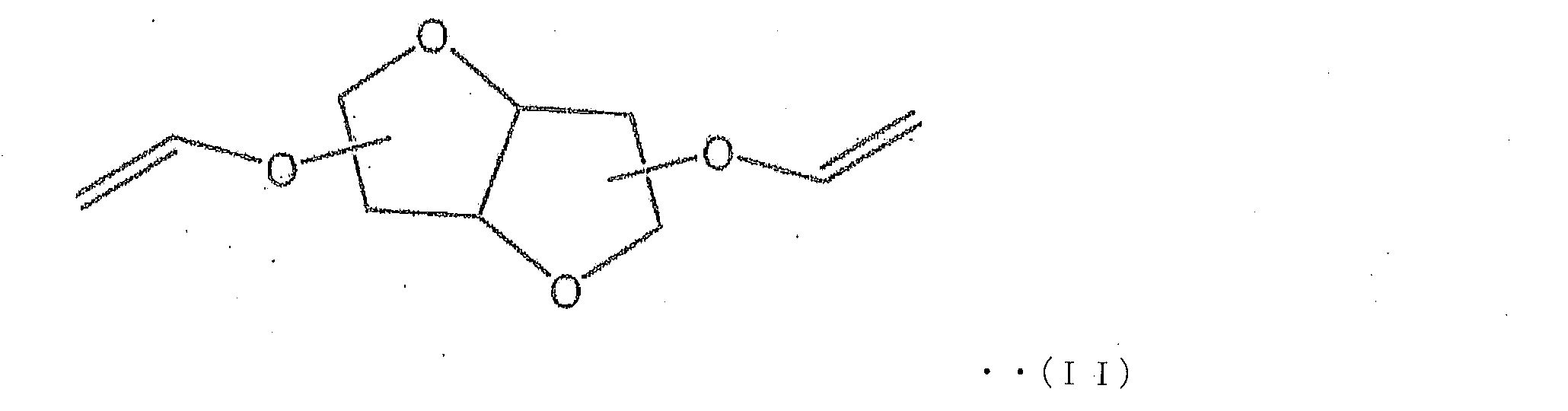
オキセタン系モノマーは、カチオン重合により重合し、硬化した樹脂を形成する。オキセタン系モノマーとしては、例えば、3-エチル-3-ヒドロキシメチルオキセタン、1,4-ビス「((3-エチルオキセタン-3-イル)メトキシ)メチル」ベンゼン、3-エチル-3-「((3-エチルオキセタン-3-イル)メトキシ)メチル」オキセタン、3-エチル-3-(2-エチヘキシロキシメチル)オキセタン、又は3-エチル-3-(フェノキシメチル)オキセタン等が挙げられる。
環状脂肪族エポキシモノマーは、カチオン重合により重合し、硬化した樹脂を形成する。環状脂肪族エポキシモノマーとしては、例えば、Daicel
Chemical Industries Co.,Ltd製のCelloxide 2000
、Celloxide 3000、Dow Chemical Co.製のCYRACURE UVR-6015、CYRACURE UVR-6028、CYRACURE UVR-6105、CYRACURE UVR-6128、CYRACURE ERL-4140およびその誘導体、丸善石油化学株式会社製のDCPD-EPおよびその誘導体等が挙げられる。
Chemical Industries Co.,Ltd製のCelloxide 2000
、Celloxide 3000、Dow Chemical Co.製のCYRACURE UVR-6015、CYRACURE UVR-6028、CYRACURE UVR-6105、CYRACURE UVR-6128、CYRACURE ERL-4140およびその誘導体、丸善石油化学株式会社製のDCPD-EPおよびその誘導体等が挙げられる。
アクリル系オリゴマーは、カチオン重合により重合し、硬化した樹脂を形成する。アクリル系オリゴマーとしては、例えば、ハイパーブランチ型ポリエステルアクリレート、ポリエステルアクリレート、ウレタンアクリレート、又はエポキシアクリレート等が挙げられる。
(ラテックスインク)
本発明の一実施形態に係るインクジェット印刷用インクは、溶媒及び樹脂をさらに含み、当該樹脂が溶媒に乳濁または懸濁しているラテックスインクであってもよい。
本発明の一実施形態に係るインクジェット印刷用インクは、溶媒及び樹脂をさらに含み、当該樹脂が溶媒に乳濁または懸濁しているラテックスインクであってもよい。
樹脂が水に乳濁または懸濁しているものである水性ラテックスインクの場合、当該樹脂による水性エマルションまたは水性サスペンションが形成されているともいえる。
樹脂の例としては、水溶性のビニル系樹脂、アクリル系樹脂、アルキッド系樹脂、ポリエステル系樹脂、ポリウレタン系樹脂、シリコン系樹脂、フッ素系樹脂、エポキシ系樹脂、フェノキシ系樹脂、ポリオレフィン系樹脂等、及びこれらの変性樹脂等が挙げられる。この中でも、より好ましくは、アクリル系樹脂、水溶性ポリウレタン系樹脂、水溶性ポリエステル系樹脂、水溶性アクリル系樹脂であり、特に好ましくはアクリル系樹脂である。水性ラテックスインクに含まれる樹脂は1種単独で用いることも2種以上を併用することも出来る。樹脂の配合量は、使用する樹脂の種類等により任意に決定できるが、例えば、水性ラテックスインクの全量に対して、1重量%以上であり、2重量%以上がより好ましく、また、20質量%以下であり、10質量%以下であることがより好ましい。
ラテックスインクは乾燥させたり、熱を加えたりすることにより硬化できる。ただし、ラテックスインクを保護インクとして用いる場合、どのようなインクで形成された画像層に対しても、侵食することを抑制できる。従って、本発明の一実施形態に係るインクジェット印刷用インクがラテックスインクである場合、より長く平滑化のための時間を確保でき、より平滑な表面の印刷物を得ることができる。また、ラテックスインクは多様なメディアに印刷することができる。
ラテックスインクは、樹脂を乳濁または懸濁させるための乳化剤をさらに含んでいてもよい。
ラテックスインクにおける、溶媒には、乳濁または懸濁している樹脂の他に、溶媒に溶解している別の樹脂を含んでもよい。別の樹脂は溶媒に溶解しており、インクの粘度調整をするものであり得る。また、乾燥によって溶媒が飛ぶと、乳濁または懸濁している樹脂同士の結合により皮膜化する際に、当該別の樹脂が結着材として、乳濁または懸濁している樹脂同士をさらに強力に結合させる機能を有するものであり得る。
上述したような本実施形態に係るインクジェット印刷用インクは、例えば、溶媒に白色顔料粒子1及び中空顔料粒子2を加えて、これらを混合することによって製造することができる。このとき、溶媒に増粘剤、分散剤、界面活性剤、レベリング剤などを加えてもよい。
本発明は上述した各実施形態に限定されるものではなく、請求項に示した範囲で種々の変更が可能であり、異なる実施形態にそれぞれ開示された技術的手段を適宜組み合わせて得られる実施形態についても本発明の技術的範囲に含まれる。
〔付記事項〕
本発明の一実施形態に係るインクジェット印刷用インクは、白色顔料粒子1と、内部に空洞を有する中空顔料粒子2とを含む。
本発明の一実施形態に係るインクジェット印刷用インクは、白色顔料粒子1と、内部に空洞を有する中空顔料粒子2とを含む。
上記の構成によれば、白色顔料粒子1と中空顔料粒子2との界面、白色顔料粒子1及び中空顔料粒子2の表面などにおいて、光が拡散または乱反射するため、白色のインクジェット印刷用インクを提供することができる。
また、本発明に係るインクジェット印刷用インクにおいて、中空顔料粒子2は内部に空洞を有するため、比重が軽く、インク中にて沈降しない。そのため、上記インクジェット印刷用インクは、インクジェット印刷時の吐出安定性に優れている。
また、インクジェット印刷用インクでは、白色顔料粒子1の平均粒子径は、10nm以上、200nm以下である。
上記の構成によれば、インクジェット印刷用インク中での粒子の沈降を抑制することができるので、インクジェット印刷時の吐出安定性に優れたインクを提供することができる。また、白色顔料粒子1の平均粒子径が10nm以上であるので、インクジェット印刷用インクにおいて、入射した光が好適に拡散または乱反射し、拡散または乱反射せずにインク内を光が通過することを抑制でき、白色度の高いインクを提供することができる。
また、インクジェット印刷用インクでは、白色顔料粒子1と中空顔料粒子2との総体積に対する、白色顔料粒子1の含有体積比率が、30体積%以上、80体積%以下である。
上記構成によれば、インクジェット印刷時におけるインクジェット印刷用インクの吐出安定性を向上させることができるとともに、白色の上記インクジェット印刷用インクを好適に提供することができる。
また、インクジェット印刷用インクでは、白色顔料粒子1は、酸化チタン粒子である。
上記の構成によれば、白色顔料粒子1として酸化チタンを用いているので、白色度の高いインクジェット印刷用インクを好適に提供することができる。なお、白色顔料粒子は、可視光領域で透明であり、屈折率が大きいほどよい。
また、インクジェット印刷用インクでは、中空顔料粒子2は、アクリル樹脂、スチレン樹脂、スチレン-アクリル樹脂、及びメタクリル酸メチル樹脂からなる群より選択される樹脂から形成されたものである。
上記の構成によれば、中空顔料粒子2として上記樹脂を用いるので、吐出安定性に優れたインクジェット印刷用インクを好適に提供することができる。
また、インクジェット印刷用インクでは、中空顔料粒子2の平均粒子径は、0.05μm以上、3μm以下である。
上記の構成によれば、中空顔料粒子2の平均粒子径が上記範囲内であるので、インクジェット印刷でのインクジェット印刷用インクの吐出安定性を向上させることができる。
また、インクジェット印刷用インクは、水性インク、ラテックスインク、ソルベントインク、及びUV硬化型インクからなる群より選択される。
上記構成によれば、種々のインクにおいて、白色度が高く、かつ、吐出安定性が優れたインクジェット印刷用インクを提供することができる。
本発明は、インクジェット印刷装置から吐出するインクとして利用することができる。
1 白色顔料粒子
2 中空顔料粒子
2 中空顔料粒子
Claims (7)
- 白色顔料粒子と、内部に空洞を有する中空顔料粒子とを含むことを特徴とするインクジェット印刷用インク。
- 上記白色顔料粒子の平均粒子径は、10nm以上、200nm以下であることを特徴とする請求項1に記載のインクジェット印刷用インク。
- 上記白色顔料粒子と上記中空顔料粒子との総体積に対する、上記白色顔料粒子の含有体積比率が、30体積%以上、80体積%以下であることを特徴とする請求項1に記載のインクジェット印刷用インク。
- 上記白色顔料粒子は、酸化チタン粒子であることを特徴とする請求項1項に記載のインクジェット印刷用インク。
- 上記中空顔料粒子は、アクリル樹脂、スチレン樹脂、スチレン-アクリル樹脂、及びメタクリル酸メチル樹脂からなる群より選択される樹脂から形成されたものであることを特徴とする請求項1に記載のインクジェット印刷用インク。
- 上記中空顔料粒子の平均粒子径は、0.05μm以上、3μm以下であることを特徴とする請求項1項に記載のインクジェット印刷用インク。
- 水性インク、ラテックスインク、ソルベントインク、及びUV硬化型インクからなる群より選択されることを特徴とする請求項1~6のいずれか1項に記載のインクジェット印刷用インク。
Applications Claiming Priority (2)
| Application Number | Priority Date | Filing Date | Title |
|---|---|---|---|
| JP2012-248853 | 2012-11-12 | ||
| JP2012248853A JP6026234B2 (ja) | 2012-11-12 | 2012-11-12 | インクジェット印刷用インク |
Publications (1)
| Publication Number | Publication Date |
|---|---|
| WO2014073680A1 true WO2014073680A1 (ja) | 2014-05-15 |
Family
ID=50684771
Family Applications (1)
| Application Number | Title | Priority Date | Filing Date |
|---|---|---|---|
| PCT/JP2013/080424 Ceased WO2014073680A1 (ja) | 2012-11-12 | 2013-11-11 | インクジェット印刷用インク |
Country Status (2)
| Country | Link |
|---|---|
| JP (1) | JP6026234B2 (ja) |
| WO (1) | WO2014073680A1 (ja) |
Cited By (1)
| Publication number | Priority date | Publication date | Assignee | Title |
|---|---|---|---|---|
| EP4435064A1 (en) * | 2023-03-23 | 2024-09-25 | Konica Minolta, Inc. | Nonaqueous inkjet ink and method for forming cured product |
Families Citing this family (16)
| Publication number | Priority date | Publication date | Assignee | Title |
|---|---|---|---|---|
| JP2014122310A (ja) * | 2012-12-21 | 2014-07-03 | Mimaki Engineering Co Ltd | インクジェットインク、インクジェットインクの製造方法、インクカートリッジ、インクジェット印刷装置、及び、インクジェット印刷方法 |
| JP2016011331A (ja) * | 2014-06-27 | 2016-01-21 | セイコーエプソン株式会社 | インク、インクセット、三次元造形物および三次元造形物の製造方法 |
| JP2016132775A (ja) * | 2015-01-22 | 2016-07-25 | 株式会社ミマキエンジニアリング | インクジェット用インク組成物及び印刷物の製造方法 |
| JP2016137482A (ja) | 2015-01-23 | 2016-08-04 | キヤノン株式会社 | 膜形成方法、画像形成方法、膜、およびインク組成物 |
| JP7067160B2 (ja) * | 2018-03-19 | 2022-05-16 | 株式会社リコー | 白色インク、収容容器、インクジェット印刷装置、インクジェット印刷方法、及び印刷物 |
| CN111936585B (zh) | 2018-03-30 | 2022-10-21 | 富士胶片株式会社 | 喷墨油墨组合物、维护方法、图像记录方法及图像记录物 |
| JP7206988B2 (ja) * | 2019-02-14 | 2023-01-18 | 株式会社リコー | インク、インクジェット印刷装置およびインクジェット印刷方法 |
| KR102212265B1 (ko) * | 2019-08-30 | 2021-02-04 | (주)대성티앤씨 | 섬유 날염용 백색 페이스트 및 이의 제조방법 |
| JP2021155502A (ja) * | 2020-03-25 | 2021-10-07 | セイコーエプソン株式会社 | 白色顔料組成物及び記録物 |
| US12552952B2 (en) | 2021-04-19 | 2026-02-17 | Nippon Kayaku Kabushiki Kaisha | Inkjet ink, inkjet recording method, ink set, ink medium set, and print medium |
| EP4328033A4 (en) | 2021-04-19 | 2025-04-23 | Nippon Kayaku Kabushiki Kaisha | INKJET INK, INK SET, INK MEDIA SET AND PRINT MEDIA |
| JP7266762B2 (ja) | 2021-04-19 | 2023-04-28 | 日本化薬株式会社 | インクジェット用インク、インクセット、インクメディアセット、及び印刷メディア |
| WO2022224789A1 (ja) | 2021-04-19 | 2022-10-27 | 日本化薬株式会社 | 記録用インク、インクセット、インクメディアセット、及び印刷メディア |
| JPWO2024034369A1 (ja) | 2022-08-09 | 2024-02-15 | ||
| EP4636047A1 (en) * | 2022-12-23 | 2025-10-22 | Canon Kabushiki Kaisha | Ink, ink cartridge, and inkjet recording method |
| WO2024203687A1 (ja) | 2023-03-24 | 2024-10-03 | 日本化薬株式会社 | 水系インク組成物、インクセット、及びインクジェット印刷物の製造方法 |
Citations (3)
| Publication number | Priority date | Publication date | Assignee | Title |
|---|---|---|---|---|
| JP2003183551A (ja) * | 2001-12-21 | 2003-07-03 | Konica Corp | インクジェット用白インク組成物 |
| JP2012017383A (ja) * | 2010-07-07 | 2012-01-26 | Seiko Epson Corp | インクセット、画像形成方法 |
| JP2012140491A (ja) * | 2010-12-28 | 2012-07-26 | Fujifilm Corp | インク組成物、インクジェット記録方法、及び、印刷物 |
-
2012
- 2012-11-12 JP JP2012248853A patent/JP6026234B2/ja active Active
-
2013
- 2013-11-11 WO PCT/JP2013/080424 patent/WO2014073680A1/ja not_active Ceased
Patent Citations (3)
| Publication number | Priority date | Publication date | Assignee | Title |
|---|---|---|---|---|
| JP2003183551A (ja) * | 2001-12-21 | 2003-07-03 | Konica Corp | インクジェット用白インク組成物 |
| JP2012017383A (ja) * | 2010-07-07 | 2012-01-26 | Seiko Epson Corp | インクセット、画像形成方法 |
| JP2012140491A (ja) * | 2010-12-28 | 2012-07-26 | Fujifilm Corp | インク組成物、インクジェット記録方法、及び、印刷物 |
Cited By (1)
| Publication number | Priority date | Publication date | Assignee | Title |
|---|---|---|---|---|
| EP4435064A1 (en) * | 2023-03-23 | 2024-09-25 | Konica Minolta, Inc. | Nonaqueous inkjet ink and method for forming cured product |
Also Published As
| Publication number | Publication date |
|---|---|
| JP6026234B2 (ja) | 2016-11-16 |
| JP2014095058A (ja) | 2014-05-22 |
Similar Documents
| Publication | Publication Date | Title |
|---|---|---|
| JP6026234B2 (ja) | インクジェット印刷用インク | |
| JP6071163B2 (ja) | 液体組成物、インクジェット記録方法、インクジェット記録装置、及び記録画像 | |
| JP5181566B2 (ja) | インクジェット用白色インク用中空粒子およびインクジェット用白色インク | |
| EP2707440A1 (en) | Uv ink jet printing ink composition | |
| CN106133071A (zh) | 白色油墨 | |
| JP2007099833A (ja) | インクジェット用インク組成物 | |
| WO1997044363A1 (en) | Photosensitive composition and white coating | |
| US20230002631A1 (en) | Water-washable compositions for use in 3d printing | |
| JP6296742B2 (ja) | 積層体の製造方法 | |
| JPS5824492A (ja) | インクジェット記録方法 | |
| JP5145629B2 (ja) | エネルギー線硬化型インクジェット記録用クリアインク組成物 | |
| JP2008208298A (ja) | インクジェット用インク及びインクジェット記録方法 | |
| JPS6264874A (ja) | 紫外線硬化型インクジェット記録用インク組成物 | |
| JP6260985B2 (ja) | 積層体の製造方法 | |
| JP6103995B2 (ja) | インクジェット記録方法 | |
| JP5137316B2 (ja) | インクジェット用白色インク組成物 | |
| JP2013245241A (ja) | 顔料分散組成物 | |
| JP2003138161A (ja) | 顔料組成物、顔料分散液及びそれらの製造方法 | |
| JP3277365B2 (ja) | 放射線硬化性インキ及びこれを用いた印刷物 | |
| JP2019019249A (ja) | 活性エネルギー線硬化型インク及び該インクを用いた画像形成方法 | |
| JP6912897B2 (ja) | アルミニウム材印刷物の製造方法 | |
| JP2019108455A (ja) | 水性インク、インクカートリッジ、及びインクジェット記録方法 | |
| JP7778465B2 (ja) | 光硬化性吐出用インク | |
| JP2016132775A (ja) | インクジェット用インク組成物及び印刷物の製造方法 | |
| JPH08176428A (ja) | インク受理層用組成物 |
Legal Events
| Date | Code | Title | Description |
|---|---|---|---|
| 121 | Ep: the epo has been informed by wipo that ep was designated in this application |
Ref document number: 13853012 Country of ref document: EP Kind code of ref document: A1 |
|
| NENP | Non-entry into the national phase |
Ref country code: DE |
|
| 122 | Ep: pct application non-entry in european phase |
Ref document number: 13853012 Country of ref document: EP Kind code of ref document: A1 |