WO2014069062A1 - 使い捨ておむつ - Google Patents
使い捨ておむつ Download PDFInfo
- Publication number
- WO2014069062A1 WO2014069062A1 PCT/JP2013/070746 JP2013070746W WO2014069062A1 WO 2014069062 A1 WO2014069062 A1 WO 2014069062A1 JP 2013070746 W JP2013070746 W JP 2013070746W WO 2014069062 A1 WO2014069062 A1 WO 2014069062A1
- Authority
- WO
- WIPO (PCT)
- Prior art keywords
- sheet
- elastic
- disposable diaper
- absorber
- width direction
- Prior art date
- Legal status (The legal status is an assumption and is not a legal conclusion. Google has not performed a legal analysis and makes no representation as to the accuracy of the status listed.)
- Ceased
Links
Images


Classifications
-
- A—HUMAN NECESSITIES
- A61—MEDICAL OR VETERINARY SCIENCE; HYGIENE
- A61F—FILTERS IMPLANTABLE INTO BLOOD VESSELS; PROSTHESES; DEVICES PROVIDING PATENCY TO, OR PREVENTING COLLAPSING OF, TUBULAR STRUCTURES OF THE BODY, e.g. STENTS; ORTHOPAEDIC, NURSING OR CONTRACEPTIVE DEVICES; FOMENTATION; TREATMENT OR PROTECTION OF EYES OR EARS; BANDAGES, DRESSINGS OR ABSORBENT PADS; FIRST-AID KITS
- A61F13/00—Bandages or dressings; Absorbent pads
- A61F13/15—Absorbent pads, e.g. sanitary towels, swabs or tampons for external or internal application to the body; Supporting or fastening means therefor; Tampon applicators
- A61F13/45—Absorbent pads, e.g. sanitary towels, swabs or tampons for external or internal application to the body; Supporting or fastening means therefor; Tampon applicators characterised by the shape
- A61F13/49—Absorbent pads, e.g. sanitary towels, swabs or tampons for external or internal application to the body; Supporting or fastening means therefor; Tampon applicators characterised by the shape specially adapted to be worn around the waist, e.g. diapers, nappies
- A61F13/49007—Form-fitting, self-adjusting disposable diapers
- A61F13/49009—Form-fitting, self-adjusting disposable diapers with elastic means
- A61F13/49011—Form-fitting, self-adjusting disposable diapers with elastic means the elastic means is located at the waist region
-
- A—HUMAN NECESSITIES
- A61—MEDICAL OR VETERINARY SCIENCE; HYGIENE
- A61F—FILTERS IMPLANTABLE INTO BLOOD VESSELS; PROSTHESES; DEVICES PROVIDING PATENCY TO, OR PREVENTING COLLAPSING OF, TUBULAR STRUCTURES OF THE BODY, e.g. STENTS; ORTHOPAEDIC, NURSING OR CONTRACEPTIVE DEVICES; FOMENTATION; TREATMENT OR PROTECTION OF EYES OR EARS; BANDAGES, DRESSINGS OR ABSORBENT PADS; FIRST-AID KITS
- A61F13/00—Bandages or dressings; Absorbent pads
- A61F13/15—Absorbent pads, e.g. sanitary towels, swabs or tampons for external or internal application to the body; Supporting or fastening means therefor; Tampon applicators
- A61F13/56—Supporting or fastening means
- A61F13/5622—Supporting or fastening means specially adapted for diapers or the like
-
- A—HUMAN NECESSITIES
- A61—MEDICAL OR VETERINARY SCIENCE; HYGIENE
- A61F—FILTERS IMPLANTABLE INTO BLOOD VESSELS; PROSTHESES; DEVICES PROVIDING PATENCY TO, OR PREVENTING COLLAPSING OF, TUBULAR STRUCTURES OF THE BODY, e.g. STENTS; ORTHOPAEDIC, NURSING OR CONTRACEPTIVE DEVICES; FOMENTATION; TREATMENT OR PROTECTION OF EYES OR EARS; BANDAGES, DRESSINGS OR ABSORBENT PADS; FIRST-AID KITS
- A61F13/00—Bandages or dressings; Absorbent pads
- A61F13/15—Absorbent pads, e.g. sanitary towels, swabs or tampons for external or internal application to the body; Supporting or fastening means therefor; Tampon applicators
- A61F13/56—Supporting or fastening means
- A61F13/5622—Supporting or fastening means specially adapted for diapers or the like
- A61F13/5633—Supporting or fastening means specially adapted for diapers or the like open type diaper
-
- A—HUMAN NECESSITIES
- A61—MEDICAL OR VETERINARY SCIENCE; HYGIENE
- A61F—FILTERS IMPLANTABLE INTO BLOOD VESSELS; PROSTHESES; DEVICES PROVIDING PATENCY TO, OR PREVENTING COLLAPSING OF, TUBULAR STRUCTURES OF THE BODY, e.g. STENTS; ORTHOPAEDIC, NURSING OR CONTRACEPTIVE DEVICES; FOMENTATION; TREATMENT OR PROTECTION OF EYES OR EARS; BANDAGES, DRESSINGS OR ABSORBENT PADS; FIRST-AID KITS
- A61F13/00—Bandages or dressings; Absorbent pads
- A61F13/15—Absorbent pads, e.g. sanitary towels, swabs or tampons for external or internal application to the body; Supporting or fastening means therefor; Tampon applicators
- A61F13/45—Absorbent pads, e.g. sanitary towels, swabs or tampons for external or internal application to the body; Supporting or fastening means therefor; Tampon applicators characterised by the shape
- A61F13/49—Absorbent pads, e.g. sanitary towels, swabs or tampons for external or internal application to the body; Supporting or fastening means therefor; Tampon applicators characterised by the shape specially adapted to be worn around the waist, e.g. diapers, nappies
- A61F13/49007—Form-fitting, self-adjusting disposable diapers
- A61F13/49009—Form-fitting, self-adjusting disposable diapers with elastic means
- A61F13/49017—Form-fitting, self-adjusting disposable diapers with elastic means the elastic means being located at the crotch region
-
- A—HUMAN NECESSITIES
- A61—MEDICAL OR VETERINARY SCIENCE; HYGIENE
- A61F—FILTERS IMPLANTABLE INTO BLOOD VESSELS; PROSTHESES; DEVICES PROVIDING PATENCY TO, OR PREVENTING COLLAPSING OF, TUBULAR STRUCTURES OF THE BODY, e.g. STENTS; ORTHOPAEDIC, NURSING OR CONTRACEPTIVE DEVICES; FOMENTATION; TREATMENT OR PROTECTION OF EYES OR EARS; BANDAGES, DRESSINGS OR ABSORBENT PADS; FIRST-AID KITS
- A61F13/00—Bandages or dressings; Absorbent pads
- A61F13/15—Absorbent pads, e.g. sanitary towels, swabs or tampons for external or internal application to the body; Supporting or fastening means therefor; Tampon applicators
- A61F13/45—Absorbent pads, e.g. sanitary towels, swabs or tampons for external or internal application to the body; Supporting or fastening means therefor; Tampon applicators characterised by the shape
- A61F13/49—Absorbent pads, e.g. sanitary towels, swabs or tampons for external or internal application to the body; Supporting or fastening means therefor; Tampon applicators characterised by the shape specially adapted to be worn around the waist, e.g. diapers, nappies
- A61F13/49007—Form-fitting, self-adjusting disposable diapers
- A61F13/49009—Form-fitting, self-adjusting disposable diapers with elastic means
- A61F13/4902—Form-fitting, self-adjusting disposable diapers with elastic means characterised by the elastic material
- A61F2013/49022—Form-fitting, self-adjusting disposable diapers with elastic means characterised by the elastic material being elastomeric sheet
-
- A—HUMAN NECESSITIES
- A61—MEDICAL OR VETERINARY SCIENCE; HYGIENE
- A61F—FILTERS IMPLANTABLE INTO BLOOD VESSELS; PROSTHESES; DEVICES PROVIDING PATENCY TO, OR PREVENTING COLLAPSING OF, TUBULAR STRUCTURES OF THE BODY, e.g. STENTS; ORTHOPAEDIC, NURSING OR CONTRACEPTIVE DEVICES; FOMENTATION; TREATMENT OR PROTECTION OF EYES OR EARS; BANDAGES, DRESSINGS OR ABSORBENT PADS; FIRST-AID KITS
- A61F13/00—Bandages or dressings; Absorbent pads
- A61F13/15—Absorbent pads, e.g. sanitary towels, swabs or tampons for external or internal application to the body; Supporting or fastening means therefor; Tampon applicators
- A61F13/45—Absorbent pads, e.g. sanitary towels, swabs or tampons for external or internal application to the body; Supporting or fastening means therefor; Tampon applicators characterised by the shape
- A61F13/49—Absorbent pads, e.g. sanitary towels, swabs or tampons for external or internal application to the body; Supporting or fastening means therefor; Tampon applicators characterised by the shape specially adapted to be worn around the waist, e.g. diapers, nappies
- A61F13/49007—Form-fitting, self-adjusting disposable diapers
- A61F13/49009—Form-fitting, self-adjusting disposable diapers with elastic means
- A61F13/4902—Form-fitting, self-adjusting disposable diapers with elastic means characterised by the elastic material
- A61F2013/49025—Form-fitting, self-adjusting disposable diapers with elastic means characterised by the elastic material having multiple elastic strands
Definitions
- the present invention relates to a disposable diaper that is attached to a wearer's inseam and absorbs and holds a liquid such as urine. More specifically, in the present invention, an elastic sheet constituted by sandwiching an elastic elastic member between base material sheets is arranged on the front body side or the back body side of the abdomen, and the waist part is expanded and contracted. It relates to disposable diapers that are made possible.
- a disposable diaper of a pants type or a tape type in order to improve the close contact with the wearer's body, the abdomen around the front body and the back body are formed to be stretchable.
- a woven cloth stretch cloth
- a stretchable sheet that allows the non-stretchable sheet to be stretched is formed by bonding a thread-like or belt-like elastic stretchable member in a stretched state to a non-stretchable sheet such as a nonwoven fabric or a plastic film.
- patent documents 1 and patent documents 2 As a disposable diaper which has an above-mentioned elastic sheet, the invention indicated by patent documents 1 and patent documents 2 is known, for example.
- an absorbent body is interposed between the top sheet and the back sheet, and the stretchable sheet is disposed in a region around the abdomen on the back body or the front body side.
- This stretchable sheet is formed by bonding a plurality of elastic stretchable members in a stretched state between base material sheets.
- the elastic elastic member contained in an elastic sheet is cut
- an elastic strand is joined to a base sheet in an elongated state to form an elastic sheet, and this elastic sheet is disposed around the stomach of the disposable diaper.
- the elastic stretchable member included in the stretchable sheet is crimped by embossing in a region overlapping with the absorber, and there is no elastic strand in the crimped region or the presence thereof. Even if it is, it is considered as a non-stretchable state.
- the elastic stretchable member (elastic strand) is in a non-stretchable state.
- the stretchability of the stretchable sheet disposed around the abdomen is also expressed in the region overlapping with the absorbent body.
- the stretchability of the stretchable sheet is expressed in the area overlapping with the absorbent body, the stretchable force of the elastic stretchable member is directly transmitted to the absorbent body, and the absorbent body is still twisted and wrinkled, and the diaper is worn. It will lead to a situation where the feeling decreases.
- an elastic sheet formed by sandwiching a plurality of elastic elastic members between the base sheet The elastic stretchable member placed in the part and included in the stretchable sheet is also present in the region overlapping the absorber, while the elastic stretchable member present in the overlapped region is not joined to the base sheet.
- the elastic elastic member located in the region where the elastic sheet and the absorbent body overlap is not joined to the base sheet, and its elasticity is not directly transmitted to the absorbent body, so that the absorbent body is distorted or wrinkled. Can be prevented.
- the inventor has conceived that the problems of the prior art can be solved based on the above knowledge, and completed the present invention.
- the present invention has the following configuration.
- the present invention relates to a disposable diaper.
- the disposable diaper of the present invention includes a liquid-permeable top sheet 1, a liquid-impermeable back sheet 2, an absorbent body 3 interposed between the top sheet 1 and the back sheet 2 in a region including the crotch, and a predecessor.
- the elastic sheet 4 is provided between the top sheet 1 and the back sheet 2 at both or around the back and the back body.
- the elastic sheet 4 includes a base sheet 41 and a plurality of elastic elastic members that extend along the width direction of the disposable diaper between the base sheet 41 and are arranged in an extended state at intervals in the length direction. 42.
- the stretchable sheet 4 has an overlapping portion 43 including a region overlapping with a part of the absorber 3 when viewed in the width direction.
- the plurality of elastic elastic members 42 are continuously arranged in the overlapping portion 43 along the width direction.
- the plurality of elastic elastic members 42 are not joined between the base material sheets 41 in the central region 43 a that overlaps a part of the absorber 3 in the overlapping portion 43, and the central region in the overlapping portion 43.
- the base material sheet 41 is joined in the side region 43b located on the outer side in the width direction of 43a.
- the plurality of elastic elastic members 42 included in the elastic sheet 4 are present in the central region 43 a overlapping the absorber 3, but are not joined between the base material sheets 41.
- the elastic elastic member 42 also exist in the central region 43a where the elastic sheet 4 and the absorbent body 3 overlap, when the elastic elastic member 42 contracts, the absorbent body 3 comes into close contact with the wearer's skin. It becomes like this.
- region 43a where the elastic sheet 4 and the absorber 3 overlap since the elastic property of the elastic sheet 4 is maintained by the elastic elastic member 42, the belly circumference of a diaper extends very well. It improves wearing feeling.
- the elastic stretchable member 42 is not joined between the base material sheets 41. It can be prevented from getting inward in the direction, and it is possible to prevent the absorbent body from being bent or wrinkled.
- this invention implement achieves simultaneously maintaining the adhesiveness of an absorber and keeping the shape of an absorber beautiful.
- the stretchable sheet 4 further includes a non-overlapping portion 44 that does not overlap with the absorber 3 when viewed in the width direction.
- the plurality of elastic elastic members 42 are preferably arranged continuously along the width direction in the non-overlapping portion 44 and joined between the base material sheets 41.
- the elastic sheet 4 contains the non-overlapping part 44 which is an area
- the disposable diaper of the present invention may further include at least a pair of left and right fastening parts 5 attached to the left and right side parts of the front body or the back body so as to protrude from the left and right side edges toward the outside in the width direction.
- This fastening part 5 can be fastened to the outer surface of the front or rear body of the diaper, and the disposable diaper can be worn around the waist of the wearer by fastening the fastening part 5 to the outer surface of the diaper.
- the elastic sheet 4 is arrange
- the elastic elastic member 42 included in the elastic sheet 4 is preferably located on the inner side in the width direction of the fixed ends of the pair of fastening parts 5.
- the space between the pair of fastening parts 5 corresponds to the belly circumference part of the diaper. Therefore, by providing stretchability between the pair of fastening parts 5, the wearer can wear the pulling part 5 while wearing the diaper. Moreover, the belly circumference of a diaper becomes comfortable by providing a stretching property between a pair of fastening parts 5.
- both end portions in the width direction of the plurality of elastic elastic members 42 included in the elastic sheet 4 do not overlap with the fixed ends of the fastening parts 5.
- both ends of the elastic stretchable member 42 overlap the fastening part 5, the fastening part 5 is deformed when the elastic stretchable member 42 contracts, the operability of the fastening part 5 is lowered, and a disposable diaper is attached. It becomes difficult to do. In this regard, such a problem can be avoided by preventing both end portions of the elastic stretchable member 42 from overlapping the fixed end of the fastening portion 5.
- the plurality of elastic elastic members 42 included in the elastic sheet 4 are arranged at substantially constant intervals in the length direction.
- substantially constant means not only when the intervals between the plurality of elastic elastic members 42 are completely matched, but also when the average value of the intervals between the plurality of elastic elastic members 42 is 100%. This includes the case where a plurality of elastic elastic members 42 are arranged at intervals within an error range of ⁇ 5% or less.
- the stretchable sheet 4 is preferably disposed at a distance from the edge in the length direction of the front body or the back body where the stretchable sheet 4 is disposed.
- the base material sheet 41 included in the stretchable sheet 4 overlaps more than double between the elastic stretchable member 42 and the absorber 3 in the overlapping portion 43.
- the present invention does not join the elastic stretchable member 42 between the base sheet 41, so that even when the stretchable sheet 41 contracts, The absorber 3 is prevented from being deformed.
- the base material sheet 41 is provided between the elastic elastic member 42 and the absorber 3.
- the plurality of elastic elastic members 42 included in the elastic sheet 4 are present in the central region 43 a overlapping the absorber 3, they are not joined between the base material sheets 41.
- the elastic elastic member 42 also exist in the central region 43a where the elastic sheet 4 and the absorbent body 3 overlap, when the elastic elastic member 42 contracts, the absorbent body 3 comes into close contact with the wearer's skin. It becomes like this.
- region 43a where the elastic sheet 4 and the absorber 3 overlap since the elastic property of the elastic sheet 4 is maintained by the elastic elastic member 42, the belly circumference of a diaper extends very well. It improves wearing feeling.
- the elastic stretchable member 42 is not joined between the base material sheets 41. It can be prevented from getting inward in the direction, and it is possible to prevent the absorbent body from being bent or wrinkled.
- this invention implement achieves simultaneously maintaining the adhesiveness of an absorber and keeping the shape of an absorber beautiful.
- FIG. 1 shows an example of a disposable diaper according to an embodiment of the present invention.
- Fig.1 (a) shows the expanded view of a disposable diaper.
- FIG.1 (b) is what expanded and extracted the elastic sheet.
- FIG. 2 shows an outline of a cross section taken along line Y1-Y1 shown in FIG.
- FIG. 3 shows an outline of a cross section taken along line Y2-Y2 shown in FIG.
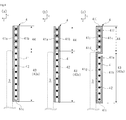
- FIG. 4 shows an example of the structure of the stretchable sheet included in the disposable diaper of the present invention.
- FIG. 4A shows an example in which the base sheet is formed by folding one sheet member in half.
- FIG. 4B shows an example in which the base sheet is formed by two sheet members.
- FIG.4 (c) shows the example in which the base material sheet was comprised by the sheet
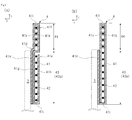
- FIG. 5 shows an example of the structure of the stretchable sheet included in the disposable diaper of the present invention.
- FIG. 5A shows an example in which the cross-section of one base sheet is a figure 8 and the base sheet overlaps between the elastic elastic member and the absorbent body.
- FIG. 5B shows an example in which the elastic stretch member is encapsulated by a single base sheet, and the base sheet overlaps between the elastic stretch member and the absorber.
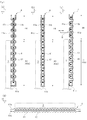
- FIG. 6 shows an example of the structure of the stretchable sheet included in the disposable diaper of the present invention.
- FIG. 5A shows an example in which the cross-section of one base sheet is a figure 8 and the base sheet overlaps between the elastic elastic member and the absorbent body.
- FIG. 5B shows an example in which the elastic stretch member is encapsulated by a single base sheet, and the base sheet overlaps between the elastic stretch member
- FIG. 6A shows an example in which the inner surface portion and the outer surface portion of the stretchable sheet folded in two are joined to each other in the gap region of the elastic stretchable member.
- FIG.6 (b) shows the example in which the outer surface part of the elastic sheet folded in half has a convex part in the area
- FIG.6 (c) shows the example by which the inner surface part and outer surface part of the base material sheet were heat-welded in the area
- FIG. 6D shows an example in which the elastic elastic member is fixed in a state where wrinkles are formed on the inner surface portion and the outer surface portion of the elastic sheet.
- the present invention is not limited to the embodiments described below, and includes those appropriately modified by those skilled in the art from the following embodiments.
- “A to B” means “A to B”.
- the “length direction” means the length direction of the disposable diaper formed vertically, and means the direction connecting the front body and the back body of the disposable diaper (vertical direction in FIG. 1). To do.
- the “width direction” means a width direction of the disposable diaper formed in a vertically long shape and a direction (horizontal direction in FIG. 1) perpendicular to the length direction in a plane.
- the “thickness direction” means a direction in which the sheet members constituting the disposable diaper overlap, and means a direction (right and left direction in FIG. 2) that is three-dimensionally orthogonal to the length direction and the width direction.
- orthogonal coordinates X, Y, and Z are shown.
- the X axis indicates the width direction
- the Y axis indicates the length direction
- the Z axis indicates the thickness direction.
- FIG.1 (a) is an expanded view which shows the example of the tape-type disposable diaper 100, and shows the state which looked at the disposable diaper from the surface (skin contact surface) side which contact
- FIG.1 (b) is the conceptual diagram which extracted and expanded the elastic sheet 4 contained in a disposable diaper.
- a tape-type disposable diaper 100 has a vertically long shape, and in its length direction, a front body 101 that covers a wearer's abdomen when worn, The back body 102 covering the back and the crotch 103 applied to the wearer's crotch are divided into parts.
- the crotch part 103 is a part located between the front body 101 and the back body 102.
- the absorbent body 3 is disposed from the crotch part 3 to the front body 101 and the back body 102.
- the absorber 3 has a function for absorbing and holding a liquid such as urine.
- the absorbent body 3 is configured by covering the absorbent material 31 for absorbing and holding the wearer's urine and body fluid from the skin contact surface side and the skin non-contact surface side with the core wrap sheet 32. ing.
- the absorbent material 31 for example, a material obtained by mixing fluff pulp and a super absorbent polymer (Super Absorbent Polymer; “SAP”) into a mat shape can be used.
- the core wrap sheet 32 is made of a hydrophilic sheet.
- As the hydrophilic sheet for example, tissue, absorbent paper, or a nonwoven fabric subjected to hydrophilic treatment can be used.
- the shape of the absorbent body 3 is such that, when viewed in plan as shown in FIG. 1 (a), an absorbent material 31 molded in an hourglass shape, for example, is encapsulated between rectangular core wrap sheets 32. preferable.
- the shape of the absorbent material 31 may be a known shape such as a rectangular shape, a gourd shape, or a T-shape.
- the absorbent body 3 is covered with a liquid-permeable top sheet 1 from the surface that contacts the skin of the wearer (skin contact surface), and from the surface that does not contact the opposite skin (skin non-contact surface) side. It is covered with a liquid-impermeable back sheet 2. Therefore, liquid such as urine passes through the top sheet 1 and is absorbed and held by the absorber 3, and leakage to the outside is prevented by the back sheet 2.
- a liquid permeable material constituting the top sheet 1 for example, a woven fabric, a nonwoven fabric, or a porous film can be employed.
- the liquid-permeable material it is preferable to use a non-woven fabric made of a thermoplastic resin such as polypropylene, polyethylene, polyester, or nylon and subjected to a hydrophilic treatment.
- sheet 2 the liquid-impermeable film etc. which consist of resin, such as polyethylene, can be employ
- a microporous polyethylene film as the liquid-impermeable material. This microporous polyethylene film has a large number of fine pores of about 0.1 ⁇ m and is liquid impervious but has moisture permeability, so that it is possible to prevent the diaper from being steamed.
- a pair of left and right side sheets 6 may be disposed on both sides of the absorbent body 3 in the width direction.
- the side sheet 6 is preferably formed of a material having high air permeability while having hydrophobicity. Moreover, it is good also as forming a three-dimensional gather by fixing one end of the side seat
- leg periphery gathers by fixing the leg periphery gather expansion-contraction member 62 in the expansion
- the adhesion around the wearer's legs is improved when the diaper is worn.
- a cover sheet 7 may be bonded to the back sheet 2 on the non-skin contact surface side in order to reinforce the back sheet 2 and improve its feel.
- a nonwoven fabric made of a thermoplastic resin such as polyethylene, polypropylene, or polyester, or a wet nonwoven fabric can be used.
- a tape-type disposable diaper 100 has side flaps 101a and 102a extending on the left and right sides in the width direction on the front body 101 and the back body 102.
- a pair of left and right fastening portions 5 are attached to the side flaps 102a formed on the back body 102 so as to protrude outward in the width direction from the side edges of the left and right side flaps.
- Each of the pair of fastening portions 5 includes a fixed end 51 that is fixed while being superimposed on the side flap 102a, and a protruding portion 52 that protrudes from a side edge of the side flap 102a.
- a locking member 53 is provided on the protruding portion 52 of the fastening portion 5 on the skin contact surface side.
- a front patch 8 for fastening the locking member 53 of the fastening portion 5 is provided on the skin non-contact surface side of the front body 101.
- the tape-type disposable diaper 100 has the fastening part 5 attached to the back body 102 with the back body 102 applied to the wearer's back and the front body 101 applied to the wearer's abdomen.
- the stop member 53 can be attached to the wearer by engaging the front patch 8 provided on the front body 101.
- the fastening portion 5 and the front patch 8 may be engaged by an adhesive or an adhesive tape, or may constitute a planar fastener that is mechanically coupled.
- a planar fastener that is fixed by mechanical coupling of a hook material (male member) and a loop material (female member) is used.
- the surface fastener is constituted by, for example, a combination of a hook material having a large number of protrusions (such as hooks and mushrooms) formed on the surface and a loop material having loop-shaped fibers disposed on the surface.
- a hook material may be employed as the locking member 53 of the fastening portion 5 and a loop material may be formed on the outer surface of the front patch 8.
- the planar fastener engages many protrusions of the hook material with the surface of the loop material.
- the surface fastener is preferable in that the hook material and the loop material can be peeled off and can be firmly fixed, and can be used repeatedly, and the fixing strength is high. .
- the fastening part 5 mentioned above can also be attached to the side flap 101a of the front body 101 instead of the side flap 102a of the back body 102.
- the front patch 8 may be provided on the skin non-contact surface side of the back body 102.
- the fastening portions 5 can be provided not only one on each side but also two or more pairs on the left and right.
- the stretchable sheet 4 is interposed between the top sheet 1 and the back sheet 2 in one part of the front body 101 or the back body 101 or in both the front body 101 and the back body 102.
- the stretchable sheet 4 is disposed at a portion of the back body 102 where the fastening portion 5 is provided.
- the stretchable sheet 4 has a structure for causing stretchability to be exerted on the belly circumference portion of the diaper. Below, the structure of the elastic sheet 4 is demonstrated concretely.
- FIG. 2 shows an outline of a cross-sectional view of the disposable diaper taken along the line Y1-Y1 shown in FIG.
- FIG. 3 shows an outline of a cross-sectional view showing a state where the disposable diaper is cut along the line Y2-Y2 shown in FIG. FIG.2 and FIG.3 has shown centering on the elastic sheet 4 of the disposable diaper which concerns on one Embodiment. 2 and 3, the various sheet members constituting the disposable diaper are drawn with a conceptual thickness, but the various sheet materials are originally very thin and have almost no thickness. .
- the stretchable sheet 4 is composed of a non-stretchable base sheet 41 and a plurality of elastic stretch members 42 in the form of stretchable threads or belts.
- the plurality of elastic elastic members 42 extend along the width direction of the diaper, and are arranged between the base material sheets 41 in an extended state at intervals in the length direction of the diaper.
- the base sheet 41 is composed of a single sheet member, and is folded back by a folded portion 41 c located near the crotch, and is located on the skin contact surface side.
- the outer surface part 41b located in the skin non-contact surface side is comprised.
- the elastic sheet 4 having the basic configuration described above is interposed between the top sheet 1 and the back sheet 2.
- the stretchable sheet 4 has a portion near the upper end (upper side in FIG. 2) on the back body 102 side disposed between the topsheet 1 and the backsheet 2,
- the other part (lower part in FIG. 2) near the part is disposed between the absorber 3 and the back sheet 2.
- the base material sheet 41 of the elastic sheet 4 the outer surface part 41b located in the skin non-contact surface side is in contact with the back sheet 2 entirely.
- the base material sheet 41 of the stretchable sheet 4 is such that the inner surface portion 41a located on the skin contact surface side is in contact with the absorber 3 (surface located in the overlapping portion 43) and the surface in contact with the top sheet (non-overlapping). And a surface located in the portion 44).
- the base sheet 41 of the stretchable sheet 4 has a surface in which the inner surface portion 41 a is in contact with the top sheet 1 and a surface in contact with the absorber 3, and the outer surface portion 41 b is in contact with the back sheet 2. Yes.
- the inner surface portion 41a of the base sheet 41 and the top sheet 1 are continuously joined in the length direction and the width direction.
- the outer surface portion 41b of the base sheet 41 and the back sheet 2 are continuously joined in the length direction and the width direction.
- the base sheet 41 is continuously bonded to the top sheet 1 and the back sheet 2, so that the elastic elastic member 42 sandwiched between the base sheet 41 contracts and the top Fine gathers are formed on the sheet 1 and the back sheet 2 to improve the appearance and feel of the diaper and prevent the displacement of the stretchable sheet 4.
- the length direction and the width direction may be joined continuously, or the width direction may be joined intermittently. It is not necessary to join. In particular, in the present invention, it is preferable that the base sheet 41 and the absorbent body 3 are not joined. By not bonding the base material sheet 41 to the absorbent body 3, when the elastic elastic member 42 sandwiched between the base material sheets 41 contracts, the contraction force is hardly transmitted to the absorbent body 3, and the shape of the absorbent body 3 is changed. It is possible to prevent the occurrence of unnecessary wrinkles and twists by deformation.
- intermittently joining the base sheet 41 and the absorbent body 3 in the width direction means that joint portions and non-joint portions are alternately provided along the width direction between the base sheet 41 and the absorbent body 3. Means.
- the absorbent body 3 is bonded to the base sheet 41 in the longitudinal direction range of 1 mm to 30 mm, 5 mm to 25 mm, or 10 mm to 20 mm from the longitudinal edge 3 ′ on the side overlapping the stretchable sheet 4. It is preferable that the other portions are not joined to the base material sheet 41.
- the edge of the absorber 3 is fixed and the shape loss of the absorber 3 can be prevented.
- the stretchable sheet 4 interposed between the top sheet 1 and the back sheet 2 has an overlapping portion 43 near the crotch 103 in the length direction.
- the rear body is divided into a non-overlapping portion 44 near the edge.
- the overlapping portion 43 of the stretchable sheet 4 is a portion including a region overlapping with a part of the absorber 3 when viewed in the width direction. That is, as shown in FIGS. 1A and 1B, the overlapping portion 43 is positioned on the outer side in the width direction of the central region 43 a and the central region 43 a that overlaps with the end portion on the back body side of the absorber 3. It is divided into a side region 43b.
- the elastic elastic member 42 arrange
- the non-overlapping portion 44 of the stretchable sheet 4 is a portion that does not overlap with the absorber 3 when viewed in the width direction.
- the elastic elastic member 42 disposed in the non-overlapping portion 44 of the elastic sheet 4 does not overlap the absorber 3.
- the form in which the stretchable sheet 4 is divided into the overlapping part 43 and the non-overlapping part 44 is a preferable form.
- the stretchable sheet 4 only needs to have at least the overlapping portion 43, and does not necessarily have the non-overlapping portion 44.
- FIG. 1A and FIG. 1B among the plurality of elastic elastic members 42 included in the elastic sheet 4, portions joined between the base material sheets 41 are indicated by “dotted lines”, and between the base material sheets 41. A portion that is not joined to each other is indicated by “one-dot chain line”. 2 and 3, a portion joined to the base material sheet 41 among the plurality of elastic elastic members 42 included in the elastic sheet 4 is surrounded by “circle ( ⁇ )”.
- FIG. 2 is a cross-sectional view taken along line Y1-Y1 shown in FIG. 1, and the cross-sectional boundary of Y1-Y1 is located in the central region 43a.
- 2 is a cross-sectional view taken along the line Y2-Y2 shown in FIG. 1, and the cross-sectional boundary of Y2-Y2 is located in the side region 43b.
- the plurality of elastic elastic members 42 are continuously arranged on the overlapping portion 43 of the elastic sheet 4.
- “continuous” means that the elastic elastic member 42 is arranged so as to extend from one side to the other side along the width direction of the overlapping portion 43 so that the entirety thereof can be extended and contracted. This means that the elastic stretchable member 42 is not in a non-stretched state by being cut or crimped in the middle.
- the plurality of elastic elastic members 42 continuously arranged on the overlapping portion 43 of the elastic sheet 4 are not joined between the base material sheets 41 in the central region 43 a overlapping the absorber 3, while absorbing In the side region 43 b that does not overlap the body 3, it is joined between the base material sheets 41.
- the elastic stretchable member 42 arranged in the overlapping portion 43 exists continuously without being interrupted in the width direction (without being in a non-stretched state), but the portion located in the central region 43a is The portion that is not joined to the base sheet 41 and is located in the side region 43 b is joined to the base sheet 41.
- the plurality of elastic elastic members 42 are also continuously arranged in the non-overlapping portion 44 of the elastic sheet 4.
- the plurality of elastic elastic members 42 arranged in the non-overlapping portion 44 of the elastic sheet 4 exist continuously without interruption in the width direction, and are joined between the base material sheets 41.
- the elastic stretchable member 42 included in the stretchable sheet 4 is joined between the base material sheet 41 except for the region (central region 43a) overlapping the absorbent body 3 in the thickness direction.
- the elastic stretchable member 42 exists in a stretchable state without being joined between the base material sheets 41.
- the elastic elastic member 42 is also present in the central region 43a where the elastic sheet 4 and the absorbent body 3 overlap, and the elastic body 3 is worn when the elastic elastic member 42 contracts. Close contact with the person's skin.
- the elastic elastic member 42 is not joined between the base material sheets 41.
- the contracting force is not easily transmitted to the absorbent body 3, and it is possible to prevent the absorbent body 3 from being twisted or wrinkled.
- a known method can be adopted.
- a joining method using a hot melt adhesive or a joining method using thermocompression bonding can be selected. It is preferable that the elastic elastic member 42 is continuously bonded to the base material sheet 41 at the places where the bonding is necessary (the side regions 43b of the overlapping portion 43 and the non-overlapping portion 44).
- a hot melt adhesive may be applied to a necessary portion of the elastic stretchable member 42 and the elastic stretchable member 42 coated with the hotmelt adhesive may be sandwiched between the base sheet 41.
- the elastic stretchable member 42 included in the stretchable sheet 4 is disposed between the base sheet 41 at a substantially constant interval in the length direction of the diaper.
- the intervals between the adjacent elastic stretch members 42 are preferably substantially the same, and can be, for example, 0.3 mm to 10 mm, or 0.5 mm to 0.8 mm.
- an error of ⁇ 5% or less is assumed when the average value of the intervals between the plurality of elastic elastic members 42 is 100%. There is no problem even if the interval is shifted within the range.
- a uniform gather (claw) is generated around the belly of the diaper, the appearance is improved, and the touch and texture of the diaper are also improved.
- the stretchable sheet 4 is arranged at an interval from the edge in the longitudinal direction on the back body 102 side of the disposable diaper.
- the distance between the upper edge of the stretchable sheet 4 and the upper edge of the back of the disposable diaper is preferably 5 mm to 30 mm, or 10 mm to 20 mm, for example.
- the elastic elastic member 42 positioned in the vicinity of the longitudinal edge 3 ′ of the absorber 3 is It is set as the edge vicinity elastic member 42a.
- the elastic elastic member 42 positioned in the vicinity of the longitudinal edge 3 ′ of the absorber 3 is It is set as the edge vicinity elastic member 42a.
- one to six elastic elastic members 42 close to the longitudinal edge 3 'of the absorber 3 may be used as the edge vicinity elastic members 42a.
- the four elastic elastic members 42 close to the longitudinal edge 3 'of the absorber 3 are used as the edge elastic members 42a.
- the contraction force (A) in which the elastic member 42 a near the edge contracts the base sheet 41 is less than the contraction force of the other elastic elastic members 42.
- elastic elastic members 42 arranged in the overlapping portion 43 of the elastic sheet 4 are superposed elastic.
- the elastic member 42b is used.
- the elastic elastic members other than the above-mentioned end edge vicinity elastic member 42a are defined as non-overlapping elastic elastic members 42c.
- the contraction force (A) of the elastic member 42a near the edge, the contraction force (B) of the superimposed elastic expansion member 42b, and the contraction force (C) of the non-superimposed elastic expansion member 42c are (C)> (B )> (A) is preferably satisfied.
- moderate elasticity can be provided to the part around the belly of a diaper, suppressing the deformation amount of the absorber 3 influenced by the contraction force of the plurality of elastic elastic members 42. it can.
- the contraction force (A) of the near-edge elastic member 42a, the contraction force (B) of the superimposed elastic expansion member 42b, and the contraction force (C) of the non-superimposed elastic expansion member 42c are (B )> (C)> (A).
- high stretchability can be imparted to both sides (side regions 43b) of the absorbent body 3 while suppressing deformation in the vicinity of the longitudinal edge 3 'of the absorbent body 3 to be small.
- the elongation rate when the elastic elastic members are joined to the base sheet may be adjusted.
- the “elongation rate” here is a ratio indicating an increase in the length of the elastic stretchable member in the stretched state, where the length of the elastic stretchable member in the contracted state (natural state) is 100%. When a 10 cm length is stretched to 20 cm, the stretch rate is 200%. The higher the expansion ratio of the elastic elastic member when bonded to the base sheet, the higher the contraction force of the elastic elastic member. It is also possible to adjust the contraction force of the elastic elastic member by adjusting the thickness of the elastic elastic member. If the elastic stretch member has the same elongation rate, the contraction force increases as the thickness increases.
- the “shrinkage force” is a stress applied to the base sheet when the elastic elastic member is joined to the base sheet in a state of being stretched in the width direction of the diaper. What is necessary is just to measure the contraction force of an elastic elastic member as follows. That is, first, cut the region to be measured from the stretched sheet as a specimen, sandwich one end in the width direction of this specimen in one chuck of the tensile tester, and sandwich the other end in the other chuck, A tensile test is performed along the width direction. The distance between chucks in the state in which the specimen is naturally contracted without being pulled (length during natural contraction) is ⁇ , and the distance between chucks (the length at maximum expansion) when the specimen is pulled to a state where there is no contraction by the elastic elastic member.
- a pair of fastening portions 5 are attached to each of the left and right side flaps 102a formed on the back body 102 of the disposable diaper 100.
- the stretchable sheet 4 is also disposed in the back body 102 of the disposable diaper 100, like the pair of fastening portions 5.
- the plurality of elastic elastic members 42 included in the elastic sheet 4 do not overlap the fixed ends 51 of the pair of fastening portions 5 but are located in the region inside the width direction of the fixed ends 51. .
- the end portions on both sides in the width direction of the base sheet 41 constituting the stretchable sheet 4 overlap with the fixed ends 51 of the pair of fastening portions 5 in the thickness direction.
- the elastic sheet 4 has the elastic elastic member 42 that does not overlap the fixed end 51 of the fixing part 5, but the width direction both ends of the base sheet 41 are fixed. It overlaps with the fixed end 51 of the part 5.
- FIG. 4 and FIG. 5 show examples of variations applicable to the present invention.
- the aspect which clamps the some elastic elastic member 42 between the base material sheets 41 is not limited to what is demonstrated below.
- 4 and 5 show a cross-sectional shape of the stretchable sheet 4 cut in the length direction in the central region 43a of the stretchable sheet 4, similarly to the cross-sectional view of FIG.
- the absorber 3 is shown by the "dotted line”.
- the stretchable sheet 4 shown in FIG. 4A has the same configuration as the stretchable sheet 4 shown in FIG. That is, in the example shown in FIG. 4A, the base sheet 41 of the stretchable sheet 4 is composed of a single sheet member.
- the base sheet 41 is folded back by a folded portion 41c provided at a position on the crotch part side (lower side in FIG. 4), and the inner surface located on the skin contact surface side with the folded portion 41c as a boundary. It is divided into the part 41a and the outer surface part 41b located in the skin non-contact surface side.
- the base material sheet 41 is open on the upper edge side (upper side in FIG. 4), and does not have a portion where the sheet members overlap.
- an aspect in which the base sheet 41 is folded in half and the elastic elastic member 42 is sandwiched is generally referred to as a U-wrap structure.
- the base sheet 41 and the absorbent body 3 may be joined continuously in the length direction and the width direction, or intermittently joined in the width direction. It does not have to be joined. In particular, in the present invention, it is preferable that the base sheet 41 and the absorbent body 3 are not joined. By not bonding the base material sheet 41 to the absorbent body 3, when the elastic elastic member 42 sandwiched between the base material sheets 41 contracts, the contraction force is hardly transmitted to the absorbent body 3, and the shape of the absorbent body 3 is changed. It is possible to prevent the occurrence of unnecessary wrinkles and twists by deformation.
- the absorbent body 3 is bonded to the base sheet 41 in the longitudinal direction range of 1 mm to 30 mm, 5 mm to 25 mm, or 10 mm to 20 mm from the longitudinal edge 3 ′ on the side overlapping the stretchable sheet 4. It is preferable that the other portions are not joined to the base material sheet 41.
- FIG. 4 (b) shows an example in which the base sheet 41 is composed of two sheet members.
- the inner surface portion 41a and the outer surface portion 41b of the base sheet 41 can be configured by separate sheet members.
- the plurality of elastic elastic members 42 may be sandwiched between the sheet member constituting the inner surface portion 41a and the sheet member constituting the outer surface portion 41b.
- the base sheet 41 and the absorbent body 3 may be joined continuously in the length direction and the width direction, or intermittently joined in the width direction. It does not have to be joined.
- the absorbent body 3 is joined to the base sheet 41 in the vicinity of the lengthwise edge 3 ′ on the side overlapping the stretchable sheet 4, and is joined to the base sheet 41 in other portions. Preferably not.
- FIG. 4C shows an example in which the base sheet 41 is formed of a single sheet member and has an intersecting portion 41d that crosses between the elastic elastic members 42 in the thickness direction (left-right direction in FIG. 4). ing. More specifically, in the example shown in FIG. 4C, the base sheet 41 includes a lower portion 41e near the crotch portion in the length direction (lower side in FIG. 4) with a crossing portion 41d as a ridge and a long length. It is divided into an upper portion 41f closer to the vertical direction (upper side in FIG. 4).
- the base sheet 41 has a lower inner surface 41g positioned on the skin contact surface side and a lower outer surface 41h positioned on the skin non-contact surface side, the lower edge folded back corresponding to the lower edge of the stretchable sheet 4. It is integrally connected via the part 41i.
- a plurality of elastic elastic members 42 are arranged between the lower inner surface 41g and the lower outer surface 41h.
- the upper inner surface 41j located on the skin contact surface side and the upper outer surface 41k located on the skin non-contact surface side correspond to the upper edge of the stretchable sheet 4 in the upper portion 41f. They are integrally connected via the edge turn part 41l.
- a plurality of elastic elastic members 42 are arranged between the upper inner surface 41j and the upper outer surface 41k.
- the lower inner surface 41 g and the upper outer surface 41 k of the stretchable sheet 4 are integrally connected via an intersecting portion 41 d that crosses the elastic stretchable member 42 in the thickness direction.
- the lower outer surface 41h of the stretchable sheet 4 and the upper inner surface 41j may be integrally connected via an intersecting portion 41d.
- the base material sheet 41 has a shape of a cross section of approximately 8.
- the intersecting portion 41 d is disposed in the elastic stretchable member 42 disposed in the overlapping portion 43 that overlaps with the absorber 3 and the non-overlapping portion 44 in which the absorber 3 does not overlap.
- the elastic elastic member 42 is formed at a position crossing the thickness direction. With this configuration, the elastic elastic member 42 is bonded between the sheets in the upper portion 41f of the base sheet 41, and the elastic elastic member 42 is not bonded between the sheets in the lower portion 41e of the base sheet 41. . Thus, by forming the intersection 41d so as to partition the elastic elastic member 42 joined between the sheets and the elastic elastic member 42 not joined between the sheets, the upper part 41f of the base sheet 41 is formed. The contraction force of the elastic elastic member 42 is less likely to be transmitted to the absorber 3 in contact with the lower portion 41 e of the base sheet 41. Therefore, the deformation amount of the absorber 3 can be suppressed. Also in the example shown in FIG.
- the base sheet 41 and the absorbent body 3 may be joined continuously in the length direction and the width direction, or intermittently joined in the width direction. It does not have to be joined.
- the absorbent body 3 is joined to the base sheet 41 in the vicinity of the lengthwise edge 3 ′ on the side overlapping the stretchable sheet 4, and is joined to the base sheet 41 in other portions. Preferably not.
- FIG. 5 shows a further modification of the embodiment shown in FIG.
- FIG. 5A shows an application example of the structure of the stretchable sheet 4 described with reference to FIG.
- the upper inner surface 41 j of the base sheet 41 has an extended portion 41 m that extends toward the crotch direction (downward in FIG. 5).
- the extended portion 41 m of the upper inner surface 41 j overlaps the lower inner surface 41 g of the base sheet 41.
- the base material sheet 41 overlaps more than double between the elastic elastic member 42 and the absorber 3 in the overlapping portion 43 that overlaps the absorber 3.
- the extended portion 41 m of the upper inner surface 41 j and the lower inner surface 41 g of the base sheet 41 are located between the elastic stretchable member 42 disposed in the overlapping portion 43 and the absorber 3.
- the extended portion 41m and the lower inner surface 41g If not joined, the contraction force of the elastic elastic member 42 can be made difficult to be transmitted to the absorber 3. That is, the lower inner surface 41g that is in direct contact with the elastic expansion / contraction member 42 is easily contracted by the contraction force of the elastic expansion / contraction member 42, but is elastic to the extended portion 41m that is overlapped without being joined to the lower inner surface 41g.
- the absorbent body 3 stacked further on the extended portion 41m is hardly affected by the contraction force of the elastic elastic member 42.
- wrinkles and twists are prevented from occurring in the absorbent body 3 by overlapping two or more base material sheets 41 between the elastic stretchable member 42 disposed in the overlapping portion 43 and the absorbent body 3. it can.
- the extended portion 41m of the base sheet 41 and the absorbent body 3 may be continuously joined in the length direction and the width direction, or the width.
- the directions may be joined intermittently or may not be joined.
- the length direction and the width direction may be joined continuously, or the width direction may be joined intermittently, It is not necessary to join.
- the extension portion 41m and the lower inner surface 41g are non-bonded, when the elastic elastic member 42 sandwiched between the base sheet 41 contracts, the contraction force is not easily transmitted to the absorber 3, It can prevent that the shape of the absorber 3 deform
- the extension portion 41m of the base sheet 41 and the absorber 3 may not be joined, and the extension portion 41m and the lower inner surface 41g may be joined.
- the length of the absorbent body 3 can be prevented.
- the absorbent body 3 is an extended portion of the base sheet 41 in the longitudinal direction range of 1 mm to 30 mm, 5 mm to 25 mm, or 10 mm to 20 mm from the longitudinal edge on the side overlapping the stretchable sheet 4. It is preferably joined to 41 m and not joined to the extended portion 41 m of the base sheet 41 at other portions. Furthermore, for example, it is good also as not joining between the extension part 41m of the base material sheet 41 and the absorber 3, and not joining between the extension part 41m and the lower inner surface 41g.
- FIG. 5B shows another example of the structure of the stretchable sheet 4.
- the base sheet 41 is composed of a single sheet member, and the inner surface portion 41 a and the outer surface portion 41 b are upper edge folded portions 41 l corresponding to the upper edge of the stretchable sheet 4. It is connected integrally through.
- a plurality of elastic elastic members 42 are sandwiched between the inner surface portion 41 and the outer surface portion 41b.
- the outer surface portion 41b has an extending portion 41m extending in the direction in which the crotch portion exists (downward in FIG. 5).
- the extended portion 41m of the outer surface portion 41b is folded back to the skin contact surface side at the lower edge folded portion 41i corresponding to the lower edge of the stretchable sheet 4 and overlaps the inner surface portion 41a.
- the base material sheet 41 overlaps more than double between the elastic elastic member 42 and the absorber 3 in the overlapping portion 43 overlapping the absorber 3. That is, the inner surface portion 41 a of the base sheet 41 and the extended portion 41 m of the outer surface portion 42 b are located between the elastic elastic member 42 disposed in the overlapping portion 43 and the absorber 3.
- the length direction and It may be continuously joined in the width direction, may be joined intermittently in the width direction, or may not be joined.
- the length direction and the width direction may be joined continuously, or the width direction may be joined intermittently, It is not necessary to join.
- the extension portion 41m of the base sheet 41 and the absorber 3 may not be joined, and the extension portion 41m and the lower inner surface 41g may be joined.
- the length of the absorbent body 3 can be prevented.
- the vicinity of the direction edge is preferably joined to the extended portion 41m. Furthermore, for example, it is good also as not joining between the extension part 41m of the base material sheet 41 and the absorber 3, and not joining between the extension part 41m and the lower inner surface 41g.
- the base material sheet 41 constituting the stretchable sheet 4 is folded in half at the folded portion 41c, and the inner surface portion 41a located on the skin contact surface side and the skin contacted portion. It has the outer surface part 41b located in a contact surface side.
- a plurality of elastic elastic members 42 are arranged at regular intervals in the length direction (vertical direction in FIG. 6). And the inner surface part 41a and the outer surface part 41b of the base material sheet 41 are mutually joined in the area
- a joint portion 41n between the inner surface portion 41a and the outer surface portion 41b is formed in a gap region between adjacent elastic elastic members 42.
- the elastic elastic member 42 is joined in the length direction of the diaper by joining the inner surface portion 41a and the outer surface portion 41b of the base sheet 41. It is possible to prevent the situation from being misaligned.
- the elastic elastic member 42 disposed in the overlapping portion 43 that overlaps the absorber 3 is not joined to the base sheet 41, and thus the displacement of the elastic elastic member is regulated by some method. It is preferable. Therefore, in the example of FIG.
- the elastic member Misalignment is prevented.
- the inner surface portion 41a and the outer surface portion 41b may be bonded using, for example, a hot melt adhesive, or may be bonded by heat sealing or ultrasonic sealing.
- the base material sheet 41 constituting the stretchable sheet 4 is folded in half by the folded portion 41c, and the inner surface portion 41a positioned on the skin contact surface side and the skin contact It has the outer surface part 41b located in a contact surface side.
- a plurality of elastic elastic members 42 are arranged at regular intervals in the length direction (vertical direction in FIG. 6). Then, the sheet member constituting the outer surface portion 41b (or the inner surface portion 41a) is deformed, and a plurality of convex portions 41o projecting to the side facing the elastic elastic member 42 are formed in the gap region between the adjacent elastic elastic members 42. Is formed.
- the convex portion 41o can be formed by locally bending the base sheet 41 so as to be convex toward the side facing the elastic elastic member 42. In this manner, by forming the convex portion 41o in the region of the gap between the adjacent elastic stretch members 42, it is possible to prevent the displacement of the elastic stretch members 42.
- the base material sheet 41 constituting the stretchable sheet 4 is folded in half by the folded portion 41c, and the inner surface portion 41a positioned on the skin contact surface side and the skin contact It has the outer surface part 41b located in a contact surface side.
- a plurality of elastic elastic members 42 are arranged at regular intervals in the length direction (vertical direction in FIG. 6).
- the inner surface part 41a is provided by penetrating the heated needle
- the outer surface portion 41b is thermally bonded.
- the size of the perforation 41p is preferably 0.2 mm to 0.5 mm in diameter when only the thermal bonding between the inner surface portion 41a and the outer surface portion 41b is intended.
- the size of the perforations 41p is preferably 0.5 mm to 10 mm in diameter. Providing relatively large perforations 41p in the stretchable sheet 4 improves the breathability and moisture permeability in the thickness direction of the stretchable sheet 4.
- the hole 41p may be formed by selecting a hot needle N having a cross-sectional diameter suitable for the purpose.
- the inner surface portion 41a and the outer surface portion 41b are thermally bonded while providing the perforations 41p with the hot needles N, thereby preventing the displacement of the elastic stretch members 42. .
- FIG. 6D is a cross-sectional view showing a state in which the elastic sheet 4 is cut along the width direction of the disposable diaper in which the elastic elastic member 42 extends, unlike the above-described FIGS. 6A to 6C. ing. Also in the example shown in FIG. 6D, the base sheet 41 constituting the stretchable sheet 4 is folded in half, and the inner surface portion 41a located on the skin contact surface side and the skin non-contact surface side And a plurality of elastic elastic members 42 are disposed between the inner surface portion 41a and the outer surface portion 41b.
- FIG. 6D is a cross-sectional view showing a state in which the elastic sheet 4 is cut along the width direction of the disposable diaper in which the elastic elastic member 42 extends, unlike the above-described FIGS. 6A to 6C. ing.
- the base sheet 41 constituting the stretchable sheet 4 is folded in half, and the inner surface portion 41a located on the skin contact surface side and the skin non-contact surface side And a plurality of elastic elastic members 42 are disposed between the
- the elastic sheet 4 having the structure shown in FIG. 6D is formed.
- the normal elastic sheet 4 is formed with gathers and has a cushioning property in the thickness direction when the elastic elastic member 42 is contracted.
- the elastic stretchable member 42 is made to have the inner surface portion 41a and the outer surface portion 41b so that the base sheet 41 exhibits cushioning properties even when the elastic stretchable member 42 is fully extended. Before being sandwiched between the two, a fine wrinkle-like deformation is imparted to the base sheet 41. Thereby, even when the elastic elastic member 42 is fully extended, the base sheet 41 has wrinkles that are uneven in the thickness direction, so that the elastic sheet 4 always has appropriate cushioning properties.
- the base sheet 41 constituting the stretchable sheet 4 described above, a known material can be used as appropriate.
- the base sheet 41 is preferably hydrophobic.
- a material which comprises the base material sheet 41 a nonwoven fabric or a film is mentioned.
- the raw material which forms the base material sheet 41 can use polyethylene, a polypropylene, or polyester, it is not limited to this.
- the base sheet 41 is made of a nonwoven fabric, it can be obtained by forming a raw material such as polyethylene into a fibrous form, and accumulating and bonding them.
- the method for obtaining the nonwoven fabric include a spunbond method, a spunbond-melt blow-spunbond method (SMS method), an air-through method, and a point bond method.
- SMS method spunbond-melt blow-spunbond method
- the base sheet 41 is composed of a film, it is most preferable to use a polyethylene film.
- the material of the elastic elastic member 42 constituting the elastic sheet 4 a known material can be used as appropriate.
- thread elastic rubber or flat elastic rubber can be applied to the elastic elastic member 42.
- materials such as styrene rubber, olefin rubber, urethane rubber, ester rubber, polyurethane, polyethylene, polystyrene, styrene butadiene, silicone, or polyester can be used.
- a known member having elasticity such as a thermoplastic elastomer, a plastic sheet, or a rubber sheet can be used.
- the number of the elastic elastic members 42 arranged between the base material sheets 41 can be appropriately adjusted according to the application.
- the elastic elastic member 42 may be 4 to 20, 8 to 16, 10 to 14, or 12.
- the disposable diaper is a tape type
- the disposable diaper is not limited to the tape type
- the present invention is an underpants type disposable diaper. Is also applicable.
- the pants-type disposable diaper has a front body, a back body, and a crotch portion positioned between the front body and the front body, and is joined in advance in association with the width direction both sides of the front body and the width direction both sides of the back body. By this, it is a type of diaper in which an opening around the abdomen and an opening around both legs are formed.
- the pants-type disposable diaper is attached to the wearer by inserting both legs of the wearer from the opening around the abdomen and taking out the left and right legs from the openings around the left and right legs.
- the disposable diaper of this invention is a pants type
- the present invention relates to a disposable diaper for elderly people or infants, for example.
- the disposable diaper of this invention can be utilized suitably in the industry regarding care or child care.
Landscapes
- Health & Medical Sciences (AREA)
- Epidemiology (AREA)
- Engineering & Computer Science (AREA)
- Biomedical Technology (AREA)
- Heart & Thoracic Surgery (AREA)
- Vascular Medicine (AREA)
- Life Sciences & Earth Sciences (AREA)
- Animal Behavior & Ethology (AREA)
- General Health & Medical Sciences (AREA)
- Public Health (AREA)
- Veterinary Medicine (AREA)
- Absorbent Articles And Supports Therefor (AREA)
Abstract
Description
特許文献1に開示された使い捨ておむつでは、トップシートとバックシートとの間に吸収体が介在し、後身頃又は前身頃側の腹周りの部位に、伸縮シートが配設されている。この伸縮シートは、基材シート間に複数条の弾性伸縮部材を伸長状態で接着して形成されたものである。特許文献1の使い捨ておむつでは、伸縮シートに含まれる弾性伸縮部材が、吸収体と重なる領域において細かく切断され、非伸縮状態とされている
また、特許文献2に開示された使い捨ておむつも、特許文献1の使い捨ておむつと同様に、弾性ストランドを伸長状態で基材シートに接合して伸縮シートを形成し、この伸縮シートを使い捨ておむつの腹周りの部位に配置している。特許文献2に開示された使い捨ておむつでは、伸縮シートに含まれる弾性伸縮部材が、吸収体と重なる領域において、エンボス加工により圧着され、この圧着領域には弾性ストランドが存在していないか、又は存在していても非伸縮状態とされている。
具体的に説明すると、本発明は以下の構成を有する。
本発明の使い捨ておむつは、液透過性のトップシート1と、液不透過性のバックシート2と、股下部を含む部位においてトップシート1とバックシート2の間に介在する吸収体3と、前身頃及び後身頃の両方又はいずれか一方の部位においてトップシート1とバックシート2の間に介在する伸縮シート4と、を備える。
ここで、伸縮シート4は、基材シート41と、この基材シート41の間に使い捨ておむつの幅方向に沿って延び長さ方向に間隔を置いて伸長状態で配置された複数の弾性伸縮部材42と、を有する。
また、伸縮シート4は、幅方向にみたときに、吸収体3の一部と重畳する領域を含む重畳部分43を有する。
また、上記複数の弾性伸縮部材42は、重畳部分43において、幅方向に沿って連続的に配置されている。
そして、複数の弾性伸縮部材42は、重畳部分43のうち吸収体3の一部と重畳する中央領域43aにおいては、基材シート41の間に接合されておらず、重畳部分43のうち中央領域43aの幅方向の外側に位置する側方領域43bにおいては、基材シート41の間に接合されている。
この場合に、伸縮シート4は、前身頃又は後身頃のうち止着部5が設けられた方の部位に配置される。そして、伸縮シート4に含まれる複数の弾性伸縮部材42は、止着部5が左右両側部に固定された固定端よりも、幅方向の内側に位置することが好ましい。
なお、本願明細書において、「A~B」とは、「A以上B以下」であることを意味する。
また、本願明細書において、「長さ方向」とは、縦長に形成された使い捨ておむつの長さ方向であって、使い捨ておむつの前身頃と後身頃を結ぶ方向(図1の上下方向)を意味する。また、「幅方向」とは、縦長に形成された使い捨ておむつの幅方向であって、前記長さ方向に平面的に直交する方向(図1の左右方向)を意味する。また、「厚み方向」とは、使い捨ておむつを構成するシート部材が重なる方向であって、長さ方向及び幅方向と立体的に直交する方向(図2の左右方向)を意味する。
また、各図において、立体空間における方向を理解し易くするために、直交座標X、Y、Zを示している。各図において、X軸は幅方向を示し、Y軸は長さ方向を示し、Z軸は厚み方向を示している。
図1(a)に示されるように、テープ型の使い捨ておむつ100は、縦長の形状となっており、その長さ方向おいて、装着時に着用者の腹部を覆う前身頃101と、着用者の背部を覆う後身頃102と、着用者の股下にあてがわれる股下部103の各部に区分される。
なお、基材シート41と吸収体3を幅方向に間欠的に接合するとは、基材シート41と吸収体3の間において、接合部と非接合部を、幅方向に沿って交互に設けることを意味している。
なお、本発明において、伸縮シート4が、重畳部分43と非重畳部分44とに区分される形態は、好ましい形態である。伸縮シート4は、少なくとも重畳部分43を有していればよく、必ずしも非重畳部分44を有している必要はない。
他方、複数の弾性伸縮部材42は、伸縮シート4の非重畳部分44にも連続的に配置されている。伸縮シート4の非重畳部分44に配置された複数の弾性伸縮部材42は、幅方向に連続して途切れることなく存在し、基材シート41の間に接合されている。
図5(a)では、図4(c)を参照して説明した伸縮シート4の構造の応用例を示している。図5に示された例では、基材シート41の上部内面41jが、股下部の方向(図5の下方)に向かって延在した延在部分41mを有する。そして、上部内面41jの延在部分41mが、基材シート41の下部内面41gに重なっている。このため、基材シート41は、吸収体3と重なる重畳部分43において、弾性伸縮部材42と吸収体3との間で二重以上に重なっている。すなわち、重畳部分43に配置された弾性伸縮部材42と吸収体3との間には、基材シート41の上部内面41jの延在部分41mと、下部内面41gが位置している。このような構成を採用することで、例えば、基材シート41の上部内面41jの延在部分41mと、吸収体3とを接合した場合であっても、この延在部分41mと下部内面41gを接合しなければ、弾性伸縮部材42の収縮力が吸収体3に伝わりにくくすることができる。すなわち、弾性伸縮部材42に直接接する下部内面41gは、弾性伸縮部材42の収縮力によって縮められ易くなっているが、下部内面41gに接合されずに重ねられた延在部分41mにまでは、弾性伸縮部材42の収縮力が伝わりにくくなる。従って、延在部分41mのさらに上に重ねられた吸収体3は、弾性伸縮部材42の収縮力の影響を受けにくいといえる。このように、重畳部分43に配置された弾性伸縮部材42と、吸収体3との間に、二枚以上の基材シート41を重ねることで、吸収体3にシワやヨレが生じることを防止できる。
例えば、基材シート41の延在部分41mと吸収体3との間を連続的に接合し、延在部分41mと下部内面41gとの間は接合しないことが好ましい。基材シート41の延在部分41mと吸収体3との間を接合することで、吸収体3の型崩れや位置ズレをできる。また、延在部分41mと下部内面41gの間を非接合とすることで、基材シート41に挟持された弾性伸縮部材42が収縮した際に、その収縮力が吸収体3に伝わりにくくなり、吸収体3の形が変形して、不要なシワやヨレが発生することを防止できる。
また、例えば、基材シート41の延在部分41mと吸収体3との間を接合せず、延在部分41mと下部内面41gとの間を接合することとしてもよい。ただし、伸縮シート4の基材シート41の延在部分41mと、吸収体3との間を接合しない場合であっても、吸収体3の型崩れを防止するために、吸収体3の長さ方向端縁近傍は、延在部分41mに接合されていることが好ましい。例えば、吸収体3は、伸縮シート4と重畳する側の長さ方向端縁から、1mm~30mm、5mm~25mm、又は10mm~20mmの長さ方向範囲においては、基材シート41の延在部分41mに接合されており、その他の部分においては、基材シート41の延在部分41mに接合されていないことが好ましい。
さらに、例えば、基材シート41の延在部分41mと吸収体3との間を接合せず、延在部分41mと下部内面41gとの間も接合しないこととしてもよい。ただし、上記と同様に、伸縮シート4の基材シート41の延在部分41mと、吸収体3との間を接合しない場合であっても、吸収体3の長さ方向端縁近傍は、延在部分41mに接合されていることが好ましい。
例えば、基材シート41の延在部分41mと吸収体3との間を連続的に接合し、延在部分41mと下部内面41gとの間は接合しないことが好ましい。また、例えば、基材シート41の延在部分41mと吸収体3との間を接合せず、延在部分41mと下部内面41gとの間を接合することとしてもよい。ただし、伸縮シート4の基材シート41の延在部分41mと、吸収体3との間を接合しない場合であっても、吸収体3の型崩れを防止するために、吸収体3の長さ方向端縁近傍は、延在部分41mに接合されていることが好ましい。さらに、例えば、基材シート41の延在部分41mと吸収体3との間を接合せず、延在部分41mと下部内面41gとの間も接合しないこととしてもよい。
図6(a)に示された例では、伸縮シート4を構成する基材シート41が、折り返し部41cで二つ折りにされて、肌当接面側に位置する内面部41aと、肌非当接面側に位置する外面部41bを有している。基材シート41の内面部41aと外面部41bの間には、複数の弾性伸縮部材42が、長さ方向(図6の上下方向)に一定間隔を置いて配置されている。そして、基材シート41の内面部41aと外面部41bは、隣接する弾性伸縮部材42の隙間の領域において、互いに接合されている。すなわち、隣接する弾性伸縮部材42の隙間の領域に、内面部41aと外面部41bの接合部41nが形成されている。このように、間隔を置いて配置された弾性伸縮部材42の間の領域において、基材シート41の内面部41aと外面部41bを接合することで、弾性伸縮部材42が、おむつの長さ方向にズレる事態を防止できる。特に、本発明では、吸収体3と重なる重畳部分43に配置された弾性伸縮部材42は、基材シート41に対して接合されていないため、何らかの方法によって、その弾性伸縮部材のズレを規制することが好ましい。そこで、図6(a)の例では、隣接する弾性伸縮部材42の隙間の領域に、基材シート41の内面部41aと外面部41bを接合した接合部nを形成することで、弾性部材のズレを防止している。内面部41aと外面部41bは、例えば、ホットメルト接着剤を用いて接合してもよいし、ヒートシール又は超音波シールによって接合してもよい。
2…バックシート
3…吸収体
4…伸縮シート
5…止着部
6…サイドシート
7…カバーシート
8…フロントパッチ
41…基材シート
42…弾性伸縮部材
43…重畳部分
43a…中央領域
43b…側方領域
44…非重畳部分
51…固定端
52…突出部
53…係止部材
61…立体ギャザー伸縮部材
62…脚部周りギャザー伸縮部材
100…使い捨ておむつ
Claims (6)
- 液透過性のトップシート(1)と、
液不透過性のバックシート(2)と、
股下部を含む部位において、前記トップシート(1)と前記バックシート(2)の間に介在する吸収体(3)と、
前身頃及び後身頃の両方又はいずれか一方の部位において、前記トップシート(1)と前記バックシート(2)の間に介在し、前記吸収体(3)の一部と重畳する領域を含む伸縮シート(4)と、
を備える使い捨ておむつであって、
前記伸縮シート(4)は、
基材シート(41)と、
前記基材シート(41)の間に、前記使い捨ておむつの幅方向に沿って延び、前記使い捨ておむつの長さ方向に間隔を置いて、伸長状態で配置された複数の弾性伸縮部材(42)と、を有し、
前記伸縮シート(4)は、
前記幅方向にみたときに、前記吸収体(3)の一部と重畳する領域を含む重畳部分(43)を有し、
前記複数の弾性伸縮部材(42)は、
前記重畳部分(43)において、前記幅方向に沿って連続的に配置され、
前記重畳部分(43)のうち、前記吸収体(3)の一部と重畳する中央領域(43a)においては、前記基材シート(41)の間に接合されておらず、
前記重畳部分(43)のうち、前記中央領域(43a)の前記幅方向の外側に位置する側方領域(43b)においては、前記基材シート(41)の間に接合されている
使い捨ておむつ。 - 前記伸縮シート(4)は、
前記幅方向にみたときに、前記吸収体(3)と重畳しない非重畳部分(44)を、さらに含み、
前記複数の弾性伸縮部材(42)は、
前記非重畳部分(44)において、前記幅方向に沿って連続的に配置され、前記基材シート(41)の間に接合されている
請求項1に記載の使い捨ておむつ。 - 前記前身頃又は前記後身頃の左右両側部に、前記幅方向の外側へ向かって左右両側縁から突出するように取付けられた少なくとも左右一対の止着部(5)を、さらに備え、
前記伸縮シート(4)は、
前記前身頃又は前記後身頃のうち、前記止着部(5)が設けられた方の部位に配置されており、
前記伸縮シート(4)に含まれる前記複数の弾性伸縮部材(42)は、
前記止着部(5)が前記左右両側部に固定された固定端よりも、前記幅方向の内側に位置する
請求項1又は請求項2に記載の使い捨ておむつ。 - 前記伸縮シート(4)に含まれる前記複数の弾性伸縮部材(42)は、
前記長さ方向に、略一定の間隔を置いて配置されている
請求項1から請求項3のいずれかに記載の使い捨ておむつ。 - 前記伸縮シート(4)は、
前記前身頃又は前記後身頃の前記長さ方向の端縁から、間隔を空けて配置されている
請求項1から請求項4のいずれかに記載の使い捨ておむつ。 - 前記伸縮シート(4)に含まれる前記基材シート(41)は、
前記重畳部分(43)において、前記弾性伸縮部材(42)と前記吸収体(3)との間で二重以上に重なる
請求項1から請求項5のいずれかに記載の使い捨ておむつ。
Priority Applications (8)
| Application Number | Priority Date | Filing Date | Title |
|---|---|---|---|
| KR1020157011012A KR101698832B1 (ko) | 2012-10-29 | 2013-07-31 | 일회용 기저귀 |
| BR112015009516A BR112015009516A2 (pt) | 2012-10-29 | 2013-07-31 | fralda descartável |
| HK15107133.6A HK1206581B (en) | 2012-10-29 | 2013-07-31 | Disposable diaper |
| RU2015116124/12A RU2600077C1 (ru) | 2012-10-29 | 2013-07-31 | Одноразовый подгузник |
| US14/438,880 US10143601B2 (en) | 2012-10-29 | 2013-07-31 | Disposable diaper |
| CN201380056963.7A CN104768509B (zh) | 2012-10-29 | 2013-07-31 | 抛弃式尿布 |
| SG11201502726UA SG11201502726UA (en) | 2012-10-29 | 2013-07-31 | Disposable diaper |
| PH12015500851A PH12015500851B1 (en) | 2012-10-29 | 2015-04-17 | Disposable diaper |
Applications Claiming Priority (2)
| Application Number | Priority Date | Filing Date | Title |
|---|---|---|---|
| JP2012237454A JP5210447B1 (ja) | 2012-10-29 | 2012-10-29 | 使い捨ておむつ |
| JP2012-237454 | 2012-10-29 |
Publications (1)
| Publication Number | Publication Date |
|---|---|
| WO2014069062A1 true WO2014069062A1 (ja) | 2014-05-08 |
Family
ID=48713140
Family Applications (1)
| Application Number | Title | Priority Date | Filing Date |
|---|---|---|---|
| PCT/JP2013/070746 Ceased WO2014069062A1 (ja) | 2012-10-29 | 2013-07-31 | 使い捨ておむつ |
Country Status (11)
| Country | Link |
|---|---|
| US (1) | US10143601B2 (ja) |
| JP (1) | JP5210447B1 (ja) |
| KR (1) | KR101698832B1 (ja) |
| CN (1) | CN104768509B (ja) |
| BR (1) | BR112015009516A2 (ja) |
| MY (1) | MY168932A (ja) |
| PH (1) | PH12015500851B1 (ja) |
| RU (1) | RU2600077C1 (ja) |
| SG (1) | SG11201502726UA (ja) |
| TW (1) | TWI533856B (ja) |
| WO (1) | WO2014069062A1 (ja) |
Cited By (1)
| Publication number | Priority date | Publication date | Assignee | Title |
|---|---|---|---|---|
| CN105997351A (zh) * | 2015-03-25 | 2016-10-12 | 新兴机械株式会社 | 一次性穿戴用品、制造装置和制造方法 |
Families Citing this family (12)
| Publication number | Priority date | Publication date | Assignee | Title |
|---|---|---|---|---|
| JP6544889B2 (ja) * | 2013-04-22 | 2019-07-17 | 三菱ケミカル株式会社 | ポリカーボネートジオールおよびその製造方法並びにそれを用いたポリウレタン |
| EP3349706B1 (en) * | 2015-09-18 | 2021-11-03 | The Procter & Gamble Company | Taped absorbent article having a belt portion |
| JP6062093B1 (ja) * | 2016-05-10 | 2017-01-18 | ユニ・チャーム株式会社 | 吸収性物品 |
| JP6017081B1 (ja) * | 2016-05-10 | 2016-10-26 | ユニ・チャーム株式会社 | 吸収性物品 |
| JP6369507B2 (ja) * | 2016-06-30 | 2018-08-08 | 王子ホールディングス株式会社 | 吸収性物品 |
| US11642249B2 (en) | 2016-12-20 | 2023-05-09 | The Procter & Gamble Company | Methods and apparatuses for making elastomeric laminates with elastic strands provided with a spin finish |
| EA038163B1 (ru) * | 2016-12-28 | 2021-07-16 | Юничарм Корпорейшн | Впитывающее изделие |
| WO2019065572A1 (ja) * | 2017-09-27 | 2019-04-04 | 大王製紙株式会社 | 伸縮部材及びこの伸縮部材を有する使い捨て着用物品 |
| JP6633729B2 (ja) * | 2018-12-19 | 2020-01-22 | 大王製紙株式会社 | テープタイプ使い捨ておむつ |
| JP7037630B1 (ja) * | 2020-12-28 | 2022-03-16 | 花王株式会社 | 吸収性物品 |
| US12303365B2 (en) | 2021-03-02 | 2025-05-20 | Essity Hygiene And Health Aktiebolag | Disposable absorbent hygiene article having a waist fringe region |
| EP4301306B1 (en) * | 2021-03-02 | 2025-11-12 | Essity Hygiene and Health Aktiebolag | Disposable absorbent hygiene article |
Citations (3)
| Publication number | Priority date | Publication date | Assignee | Title |
|---|---|---|---|---|
| JP2008188048A (ja) * | 2007-01-31 | 2008-08-21 | Daio Paper Corp | 紙おむつ |
| JP2012091054A (ja) * | 2012-02-16 | 2012-05-17 | Daio Paper Corp | 使い捨ておむつ |
| JP2012200577A (ja) * | 2011-03-28 | 2012-10-22 | Daio Paper Corp | 使い捨ておむつ |
Family Cites Families (8)
| Publication number | Priority date | Publication date | Assignee | Title |
|---|---|---|---|---|
| US5879343A (en) * | 1996-11-22 | 1999-03-09 | Kimberly-Clark Worldwide, Inc. | Highly efficient surge material for absorbent articles |
| JP3699331B2 (ja) * | 2000-05-26 | 2005-09-28 | ユニ・チャーム株式会社 | パンツ型の使い捨て着用物品 |
| US8109915B2 (en) * | 2002-08-30 | 2012-02-07 | Uni-Charm Corporation | Pull-on disposable wearing article |
| JP4652724B2 (ja) * | 2003-08-19 | 2011-03-16 | ユニ・チャーム株式会社 | 使い捨て吸収性物品及びその製造方法 |
| JP4518967B2 (ja) | 2005-01-21 | 2010-08-04 | 花王株式会社 | 吸収性物品の製造方法 |
| JP4864585B2 (ja) | 2006-07-31 | 2012-02-01 | 大王製紙株式会社 | 紙おむつ並びに紙おむつの製造方法及びこれに用いるカッターロール装置 |
| US20100076394A1 (en) * | 2006-11-27 | 2010-03-25 | Kao Corporation | Absorbent article |
| JP5855901B2 (ja) * | 2010-11-02 | 2016-02-09 | 花王株式会社 | 使い捨ておむつ |
-
2012
- 2012-10-29 JP JP2012237454A patent/JP5210447B1/ja not_active Expired - Fee Related
-
2013
- 2013-07-31 WO PCT/JP2013/070746 patent/WO2014069062A1/ja not_active Ceased
- 2013-07-31 MY MYPI2015001120A patent/MY168932A/en unknown
- 2013-07-31 KR KR1020157011012A patent/KR101698832B1/ko not_active Expired - Fee Related
- 2013-07-31 CN CN201380056963.7A patent/CN104768509B/zh active Active
- 2013-07-31 SG SG11201502726UA patent/SG11201502726UA/en unknown
- 2013-07-31 RU RU2015116124/12A patent/RU2600077C1/ru active
- 2013-07-31 US US14/438,880 patent/US10143601B2/en not_active Expired - Fee Related
- 2013-07-31 BR BR112015009516A patent/BR112015009516A2/pt not_active Application Discontinuation
- 2013-08-06 TW TW102128140A patent/TWI533856B/zh not_active IP Right Cessation
-
2015
- 2015-04-17 PH PH12015500851A patent/PH12015500851B1/en unknown
Patent Citations (3)
| Publication number | Priority date | Publication date | Assignee | Title |
|---|---|---|---|---|
| JP2008188048A (ja) * | 2007-01-31 | 2008-08-21 | Daio Paper Corp | 紙おむつ |
| JP2012200577A (ja) * | 2011-03-28 | 2012-10-22 | Daio Paper Corp | 使い捨ておむつ |
| JP2012091054A (ja) * | 2012-02-16 | 2012-05-17 | Daio Paper Corp | 使い捨ておむつ |
Cited By (1)
| Publication number | Priority date | Publication date | Assignee | Title |
|---|---|---|---|---|
| CN105997351A (zh) * | 2015-03-25 | 2016-10-12 | 新兴机械株式会社 | 一次性穿戴用品、制造装置和制造方法 |
Also Published As
| Publication number | Publication date |
|---|---|
| KR20150064134A (ko) | 2015-06-10 |
| BR112015009516A2 (pt) | 2017-07-04 |
| CN104768509A (zh) | 2015-07-08 |
| JP5210447B1 (ja) | 2013-06-12 |
| SG11201502726UA (en) | 2015-05-28 |
| JP2014087383A (ja) | 2014-05-15 |
| CN104768509B (zh) | 2017-05-03 |
| KR101698832B1 (ko) | 2017-01-23 |
| PH12015500851B1 (en) | 2022-03-09 |
| US10143601B2 (en) | 2018-12-04 |
| MY168932A (en) | 2019-01-09 |
| TWI533856B (zh) | 2016-05-21 |
| HK1206581A1 (en) | 2016-01-15 |
| US20150290048A1 (en) | 2015-10-15 |
| TW201416066A (zh) | 2014-05-01 |
| RU2600077C1 (ru) | 2016-10-20 |
| PH12015500851A1 (en) | 2015-06-22 |
Similar Documents
| Publication | Publication Date | Title |
|---|---|---|
| JP5210447B1 (ja) | 使い捨ておむつ | |
| AU2011275260B2 (en) | Disposable diaper | |
| JP4909819B2 (ja) | 使い捨ておむつ | |
| JP7147912B2 (ja) | テープ型使い捨ておむつ | |
| US20120238989A1 (en) | Disposable diaper | |
| KR101509833B1 (ko) | 일회용 기저귀 및 흡수성 물품 | |
| CN205019271U (zh) | 吸收性物品 | |
| JP2016158799A (ja) | パンツ型吸収性物品 | |
| JP2016013199A (ja) | 吸収性物品 | |
| JP2015171400A (ja) | 使い捨て紙おむつ | |
| JP5721987B2 (ja) | 吸収性物品 | |
| JP4982195B2 (ja) | テープ型おむつ | |
| JP6228794B2 (ja) | テープ式使い捨て紙おむつ | |
| JP5313718B2 (ja) | 使い捨ておむつ | |
| JP2016022023A (ja) | 使い捨て着用品 | |
| JP6335558B2 (ja) | 使い捨て紙おむつ | |
| JP5281882B2 (ja) | テープ型使い捨ておむつ | |
| JP5690050B2 (ja) | 吸収性物品 | |
| JP5369311B2 (ja) | 止着テープ、止着テープの製造方法及びテープ型使い捨ておむつ | |
| JP6051789B2 (ja) | 使い捨ておむつ及びシート部材の製造方法 | |
| JP5238106B2 (ja) | テープ型使い捨ておむつ | |
| JP2016185196A (ja) | 使い捨ておむつ | |
| JP5625357B2 (ja) | テープ型使い捨ておむつ | |
| JP2012170516A (ja) | 使い捨ておむつ | |
| JP2010148680A (ja) | 吸収性物品 |
Legal Events
| Date | Code | Title | Description |
|---|---|---|---|
| 121 | Ep: the epo has been informed by wipo that ep was designated in this application |
Ref document number: 13850645 Country of ref document: EP Kind code of ref document: A1 |
|
| WWE | Wipo information: entry into national phase |
Ref document number: 12015500851 Country of ref document: PH |
|
| ENP | Entry into the national phase |
Ref document number: 20157011012 Country of ref document: KR Kind code of ref document: A |
|
| WWE | Wipo information: entry into national phase |
Ref document number: 2015/05133 Country of ref document: TR |
|
| WWE | Wipo information: entry into national phase |
Ref document number: 14438880 Country of ref document: US Ref document number: IDP00201502546 Country of ref document: ID |
|
| NENP | Non-entry into the national phase |
Ref country code: DE |
|
| REG | Reference to national code |
Ref country code: BR Ref legal event code: B01A Ref document number: 112015009516 Country of ref document: BR |
|
| ENP | Entry into the national phase |
Ref document number: 2015116124 Country of ref document: RU Kind code of ref document: A |
|
| 122 | Ep: pct application non-entry in european phase |
Ref document number: 13850645 Country of ref document: EP Kind code of ref document: A1 |
|
| ENP | Entry into the national phase |
Ref document number: 112015009516 Country of ref document: BR Kind code of ref document: A2 Effective date: 20150428 |