WO2014014015A1 - 液晶シール剤及びそれを用いた液晶表示セル - Google Patents
液晶シール剤及びそれを用いた液晶表示セル Download PDFInfo
- Publication number
- WO2014014015A1 WO2014014015A1 PCT/JP2013/069384 JP2013069384W WO2014014015A1 WO 2014014015 A1 WO2014014015 A1 WO 2014014015A1 JP 2013069384 W JP2013069384 W JP 2013069384W WO 2014014015 A1 WO2014014015 A1 WO 2014014015A1
- Authority
- WO
- WIPO (PCT)
- Prior art keywords
- liquid crystal
- sealant
- epoxy resin
- dropping method
- sealing agent
- Prior art date
- Legal status (The legal status is an assumption and is not a legal conclusion. Google has not performed a legal analysis and makes no representation as to the accuracy of the status listed.)
- Ceased
Links
Classifications
-
- G—PHYSICS
- G02—OPTICS
- G02F—OPTICAL DEVICES OR ARRANGEMENTS FOR THE CONTROL OF LIGHT BY MODIFICATION OF THE OPTICAL PROPERTIES OF THE MEDIA OF THE ELEMENTS INVOLVED THEREIN; NON-LINEAR OPTICS; FREQUENCY-CHANGING OF LIGHT; OPTICAL LOGIC ELEMENTS; OPTICAL ANALOGUE/DIGITAL CONVERTERS
- G02F1/00—Devices or arrangements for the control of the intensity, colour, phase, polarisation or direction of light arriving from an independent light source, e.g. switching, gating or modulating; Non-linear optics
- G02F1/01—Devices or arrangements for the control of the intensity, colour, phase, polarisation or direction of light arriving from an independent light source, e.g. switching, gating or modulating; Non-linear optics for the control of the intensity, phase, polarisation or colour
- G02F1/13—Devices or arrangements for the control of the intensity, colour, phase, polarisation or direction of light arriving from an independent light source, e.g. switching, gating or modulating; Non-linear optics for the control of the intensity, phase, polarisation or colour based on liquid crystals, e.g. single liquid crystal display cells
- G02F1/133—Constructional arrangements; Operation of liquid crystal cells; Circuit arrangements
- G02F1/1333—Constructional arrangements; Manufacturing methods
- G02F1/1339—Gaskets; Spacers; Sealing of cells
-
- C—CHEMISTRY; METALLURGY
- C08—ORGANIC MACROMOLECULAR COMPOUNDS; THEIR PREPARATION OR CHEMICAL WORKING-UP; COMPOSITIONS BASED THEREON
- C08G—MACROMOLECULAR COMPOUNDS OBTAINED OTHERWISE THAN BY REACTIONS ONLY INVOLVING UNSATURATED CARBON-TO-CARBON BONDS
- C08G59/00—Polycondensates containing more than one epoxy group per molecule; Macromolecules obtained by polymerising compounds containing more than one epoxy group per molecule using curing agents or catalysts which react with the epoxy groups
- C08G59/14—Polycondensates modified by chemical after-treatment
- C08G59/1433—Polycondensates modified by chemical after-treatment with organic low-molecular-weight compounds
- C08G59/1438—Polycondensates modified by chemical after-treatment with organic low-molecular-weight compounds containing oxygen
- C08G59/1455—Monocarboxylic acids, anhydrides, halides, or low-molecular-weight esters thereof
- C08G59/1461—Unsaturated monoacids
- C08G59/1466—Acrylic or methacrylic acids
-
- C—CHEMISTRY; METALLURGY
- C08—ORGANIC MACROMOLECULAR COMPOUNDS; THEIR PREPARATION OR CHEMICAL WORKING-UP; COMPOSITIONS BASED THEREON
- C08L—COMPOSITIONS OF MACROMOLECULAR COMPOUNDS
- C08L63/00—Compositions of epoxy resins; Compositions of derivatives of epoxy resins
- C08L63/10—Epoxy resins modified by unsaturated compounds
Definitions
- the present invention relates to a liquid crystal sealing agent used in a liquid crystal dropping method and a liquid crystal display cell using the same. More specifically, a liquid crystal sealing agent for liquid crystal dropping method, which has excellent insertion resistance to liquid crystal sealing agent of liquid crystal and also has excellent general characteristics as a liquid crystal sealing agent such as adhesive strength, and the like The present invention relates to a liquid crystal display cell.
- this liquid crystal dropping method is a liquid crystal display in which liquid crystal is dropped inside a weir made of a liquid crystal sealant formed on one substrate, the other substrate is bonded, and then the liquid crystal sealant is cured. It is a manufacturing method of a cell.
- the liquid crystal sealant comes into contact with the liquid crystal sealant before the liquid crystal sealant is cured, and therefore, an insertion phenomenon occurs in the liquid crystal sealant due to the pressure of the liquid crystal. It is a problem that the weir made of may break down. This problem occurs even in a liquid crystal dropping method using both light and heat when there is a portion that is shaded by wiring or the like and is not irradiated with sufficient ultraviolet rays. Further, it is a particularly serious problem when the liquid crystal sealant is cured only by heat without performing ultraviolet irradiation.
- liquid crystal sealing agent for the liquid crystal dropping method needs to solve various problems such as general characteristics such as low liquid crystal contamination, high adhesive strength, high moisture resistance, and high heat resistance, and workability such as storage stability. .
- Patent Document 3 describes a method of performing a B-stage treatment of a liquid crystal sealant using a liquid crystal sealant using fumed silica and polythiol. However, this method has a drawback that the process becomes long and an apparatus for the process becomes necessary.
- Patent Document 5 discloses a liquid crystal sealing agent for a liquid crystal dropping method that uses a thermal radical polymerization initiator to prevent insertion by increasing the curing rate.
- the liquid crystal sealant has been developed very vigorously, but has excellent insertion resistance and low liquid crystal contamination and high adhesive strength. It has not been completed yet with excellent general characteristics.
- the present invention relates to a liquid crystal sealing agent used in a liquid crystal dropping method and a liquid crystal display cell using the same, and more specifically, has excellent resistance to insertion of liquid crystal into a liquid crystal sealing agent, and further has adhesive strength and the like.
- the present invention proposes a liquid crystal sealant for a liquid crystal dropping method that is excellent in general characteristics as a liquid crystal sealant, and a liquid crystal display cell using the same.
- liquid crystal sealing agents containing the solid component (I), and the specific gravity A [g / cm 3 ] of the solid component (I) in the liquid crystal sealing agent, It has been found that when there is a certain relationship between the content B [g] in the liquid crystal sealant of I) and the volume C [cm 3 ] of the liquid crystal sealant, it has very good insertion characteristics, The present invention has been reached.
- “(meth) acryl” means “acryl and / or methacryl”
- (meth) acryloyl group” means “acryloyl group and / or methacryloyl group”.
- liquid crystal sealing agent for liquid crystal dropping method may be simply referred to as “liquid crystal sealing agent”.
- the present invention relates to the following 1) to 12).
- the volume is defined as C [cm 3 ]
- the above A, B, and C satisfy the following formula (a), and are measured using an E-type viscometer under conditions of 5 rpm and 0.5 rpm at 25 ° C.
- a liquid crystal sealant for a liquid crystal dropping method having a viscosity value of 1.1 to 3.0 as indicated by the viscosity at 0.5 rpm / 5 the viscosity at 5 rpm.
- the A [g / cm 3] is, the liquid crystal dropping process for a liquid crystal sealing material according to the above 1) is 0.85 ⁇ 1.10g / cm 3. 3)
- the solid component (I-1) is one or more solid components selected from silicon rubber, styrene rubber, styrene olefin rubber, and acrylic rubber.
- the liquid crystal seal for a liquid crystal dropping method according to any one of 1) to 4) above, which comprises a (meth) acrylated epoxy resin (II), a thermosetting agent (III), and a thermal radical polymerization initiator (IV). Agent.
- the liquid crystal sealant of the present invention is very excellent in resistance to liquid crystal insertion. Therefore, the liquid crystal display cell can be easily manufactured. Moreover, since it is excellent also in the general characteristics as liquid crystal sealing agents, such as adhesive strength, the completed liquid crystal display cell has high long-term reliability. That is, the present invention makes it possible to easily manufacture an excellent liquid crystal display cell.
- the liquid crystal sealant of the present invention contains a solid component (I), and the solid component (I) has a specific gravity of A [g / cm 3 ] and a content in the liquid crystal sealant of B [g].
- the volume of the sealing agent is defined as C [cm 3 ]
- the above A, B, and C satisfy the following formula (a).
- the volume occupancy in the liquid crystal sealant of the solid component (I) can be calculated by the above formula. That is, when the volume occupancy in the liquid crystal sealant is too large, the dispensing characteristics are deteriorated, and when it is too small, sufficient insertion resistance cannot be obtained.
- the upper limit of the volume occupancy is 0.4, and the lower limit is 0.2.
- the specific gravity A of the solid component (I) can be measured by an underwater substitution method (JIS K7112).
- the liquid crystal sealant of the present invention is a thixotropy indicated by a viscosity at 0.5 rpm / 5 a viscosity at a viscosity value of 5 rpm and 25 rpm measured at 25 ° C. using an E-type viscometer.
- the ratio is 1.1 to 3.0.
- the thixo ratio exceeds 3.0, the linearity at the time of applying the seal is deteriorated, and when the thixo ratio is less than 1.1, the sealing agent is not cut well.
- the sealant is not cut well, a thread is drawn at the end point at the time of applying the seal, which causes a problem that drawing cannot be performed cleanly.
- the solid component (I) means an organic filler, an inorganic filler or the like that does not participate in a chemical reaction. That is, it means solid components excluding thermosetting agent (III), thermal radical polymerization initiator (IV), solid curing accelerator, solid epoxy resin, solid epoxy acrylate resin and the like.
- the specific gravity A can also be calculated from the manufacturer catalog value without using the underwater substitution method.
- the specific gravity A in the case of using a mixture of an organic filler and an inorganic filler can be calculated by the following equation.
- a [g / cm 3 ] specific gravity of organic filler ⁇ organic filler content in solid component (I) + Specific gravity of inorganic filler ⁇ content of inorganic filler in solid component (I) This method is applicable even when the solid component (I) is a mixture of three or more components.
- the content B [g] in the liquid crystal sealant and the volume C [cm 3 ] of the liquid crystal sealant are values determined depending on the amount of sample to be arbitrarily collected, and are sufficient using a self-revolving vacuum deaerator or the like. It can be measured from the liquid crystal sealant defoamed by using a graduated cylinder, an electronic balance or the like.
- an organic filler and an inorganic filler are meant.
- organic fillers include natural rubber (NR), isoprene rubber (IR), butadiene rubber (BR), styrene / butadiene rubber (SBR), butyl rubber (IIR), nitrile rubber (NBR), ethylene / propylene rubber ( EPM, EP), chloroprene rubber (CR), acrylic rubber (ACM, ANM), chlorosulfonated polyethylene rubber (CSM), urethane rubber (PUR), silicon rubber (SI, SR), fluoro rubber (FKM, FPM), Examples thereof include polysulfide rubber (thiocol).
- These solid components (I) may be used in combination of two or more. Of these, silicon rubber, styrene rubber, styrene olefin rubber, and acrylic rubber are preferable.
- the silicone rubber is preferably KMP-594, KMP-597, KMP-598 (manufactured by Shin-Etsu Chemical Co., Ltd.), Trefill RTM E-5500, 9701, EP-2001 (manufactured by Toray Dow Corning), and styrene rubber.
- Preferred are Lavalon RTM T320C, T331C, SJ4400, SJ5400, SJ6400, SJ4300C, SJ5300C and SJ6300C (above, manufactured by Mitsubishi Chemical), and preferred styrene olefin rubbers are Septon RTM SEPS2004 and SEPS2063.
- the superscript “RTM” means a registered trademark.
- the acrylic rubber is preferably a core-shell structure acrylic rubber composed of two types of acrylic rubbers, particularly preferably a core layer of n-butyl acrylate and a shell layer of methyl methacrylate. This is sold by Aika Industries Co., Ltd. as Zefiac RTM F-351.
- the average particle size of the organic filler is 20 ⁇ m or less, and preferably 10 ⁇ m or less, because an excessively large average particle size causes a failure such as poor gap formation when the upper and lower glass substrates are bonded together during the production of a narrow gap liquid crystal cell. It is.
- the particle size can be measured by electron microscopy.
- Examples of the inorganic filler of the solid component (I) include fused silica, crystalline silica, silicon carbide, silicon nitride, boron nitride, calcium carbonate, magnesium carbonate, barium sulfate, calcium sulfate, mica, talc, clay, alumina, oxidation Magnesium, zirconium oxide, aluminum hydroxide, magnesium hydroxide, calcium silicate, aluminum silicate, lithium aluminum silicate, zirconium silicate, barium titanate, glass fiber, carbon fiber, molybdenum disulfide, asbestos, etc., preferably fused silica Crystalline silica, silicon nitride, boron nitride, calcium carbonate, barium sulfate, calcium sulfate, mica, talc, clay, alumina, aluminum hydroxide, calcium silicate, aluminum silicate, more preferably fused silica , Crystalline silica, alumina, talc.
- the particle size can be measured with a laser diffraction / scattering particle size distribution analyzer (dry type) (manufactured by Seishin Enterprise Co., Ltd .; LMS-30).
- the specific gravity A [g / cm 3 ] of the solid component (I) is preferably 0.85 to 1.10. In this case, the influence on the insertion resistance becomes more remarkable.
- the solid component (I-1) having a Shore A hardness of 10 to 70 is contained in an amount of 85% by mass or more in the total amount of the solid component (I). More preferably, it is a case of containing 90% by mass or more.
- the Shore A hardness can be measured according to JIS K6253.
- the solid component (I-1) having a Shore A hardness of 10 to 70 corresponds to the above-mentioned silicon rubber, styrene rubber, styrene olefin rubber, acrylic rubber, and the like.
- the liquid crystal sealant of the present invention is particularly limited as long as the volume occupancy of the solid component (I) satisfies the mathematical formula (a) and the thixo ratio is within the predetermined range.
- (Meth) acrylated epoxy resin (II) can be obtained by a known reaction between an epoxy resin and (meth) acrylic acid.
- (meth) acrylic acid in a predetermined equivalent ratio to an epoxy resin and a catalyst (for example, benzyldimethylamine, triethylamine, benzyltrimethylammonium chloride, triphenylphosphine, triphenylstibine, etc.) and a polymerization inhibitor (for example, methoquinone, For example, hydroquinone, methylhydroquinone, phenothiazine, dibutylhydroxytoluene) and the like, and an esterification reaction is performed at 80 to 110 ° C., for example.
- a catalyst for example, benzyldimethylamine, triethylamine, benzyltrimethylammonium chloride, triphenylphosphine, triphenylstibine, etc.
- a polymerization inhibitor for example, methoquinon
- the epoxy resin more than bifunctional is preferable, for example, diglycidyl ether of resorcinol, bisphenol A type epoxy resin, bisphenol F type epoxy resin, bisphenol S type epoxy resin , Phenol novolac type epoxy resin, cresol novolac type epoxy resin, bisphenol A novolac type epoxy resin, bisphenol F novolac type epoxy resin, alicyclic epoxy resin, aliphatic chain epoxy resin, glycidyl ester type epoxy resin, glycidyl amine type epoxy Resin, hydantoin type epoxy resin, isocyanurate type epoxy resin, phenol novolac type epoxy resin having triphenolmethane skeleton, and other difunctional phenols Jill etherate, bifunctional alcohols diglycidyl ethers of, and their halides, hydrogenated product and the like.
- diglycidyl ether of resorcinol bisphenol A type epoxy resin, bisphenol F type epoxy resin, bisphenol S type epoxy resin , Phenol novolac type
- the content of the (meth) acrylated epoxy resin (II) is appropriately determined in consideration of workability and physical properties of the obtained liquid crystal sealant, and is usually about 25 to 80% by mass in the liquid crystal sealant. Preferably, it is 25 to 75% by mass.
- thermosetting agent (III) is not particularly limited, and examples thereof include polyvalent amines, polyhydric phenols, hydrazide compounds, and the like, and polyhydric hydrazide compounds are particularly preferably used.
- aromatic hydrazide terephthalic acid dihydrazide, isophthalic acid dihydrazide, 2,6-naphthoic acid dihydrazide, 2,6-pyridinedihydrazide, 1,2,4-benzenetrihydrazide, 1,4,5,8-naphthoic acid examples include tetrahydrazide and pyromellitic acid tetrahydrazide.
- aliphatic hydrazide compounds include form hydrazide, acetohydrazide, propionic acid hydrazide, oxalic acid dihydrazide, malonic acid dihydrazide, succinic acid dihydrazide, glutaric acid dihydrazide, adipic acid dihydrazide, pimelic acid dihydrazide, 1,4- Cyclohexanedihydrazide, tartaric acid dihydrazide, malic acid dihydrazide, iminodiacetic acid dihydrazide, N, N'-hexamethylenebissemicarbazide, citric acid trihydrazide, nitriloacetic acid trihydrazide, cyclohexanetricarboxylic acid trihydrazide, 1,3-bis (hydrazinocarbono) Hydantoin skeleton such as ethyl) -5-isopropylhydantoin, preferably valine hydan
- isophthalic acid dihydrazide isophthalic acid dihydrazide, malonic acid dihydrazide, adipic acid dihydrazide, tris (1-hydrazinocarbonylmethyl) isocyanurate, tris (2-hydrazinocarbonylethyl) isocyanurate, tris (3-hydrazinocarbonylpropyl) isocyanurate, particularly preferably tris (2-hydrazinocarbonylethyl) isocyanurate.
- the content is preferably 30 to 50 parts by mass when the total amount of the (meth) acrylated epoxy resin (II) is 100 parts by mass, The amount is preferably 35 to 45 parts by mass, and two or more kinds may be mixed and used.
- the thermal radical polymerization initiator (IV) is not particularly limited as long as it is a compound that generates radicals by heating and initiates a chain polymerization reaction, but is not limited to organic peroxides, azo compounds, benzoin compounds, benzoin ether compounds, acetophenone compounds, benzoates. Examples thereof include pinacol, and benzopinacol is preferably used.
- organic peroxides include Kayamek RTM A, M, R, L, LH, SP-30C, Parkadox CH-50L, BC-FF, Kadox B-40ES, Parkadox 14, Trigonox RTM 22-70E, 23-C70, 121, 121-50E, 121-LS50E, 21-LS50E, 42, 42LS, Kayaester RTM P-70, TMPO-70, CND-C70, OO-50E, AN, Kayabutyl RTM B, Parkardox 16 , Kayacarbon RTM BIC-75, AIC-75 (above, manufactured by Kayaku Akzo Co., Ltd.), Permec RTM N, H, S, F, D, G, Perhexa RTM H, HC, Pat TMH, C, V, 22, MC, Pakyua RTM AH, AL, HB, Perbutyl RTM H, C, ND, L , Park Le RTM H, D, PEROYL RTM IB
- azo compounds As azo compounds, VA-044, V-070, VPE-0201, VSP-1001 (manufactured by Wako Pure Chemical Industries, Ltd.) and the like are commercially available. Furthermore, from the viewpoint of reactivity and solubility in liquid crystals, a compound represented by the following general formula (1) is particularly preferably used.
- Y 1 and Y 2 each independently represent a hydrogen atom, a phenyl group, or a silicon atom
- R 1 to R 6 each independently represent a hydrogen atom or a carbon number of 1 to 4
- X 1 to X 4 each independently represents a hydrogen atom, a methyl group, an ethyl group, a methoxy group, an ethoxy group, a phenoxy group, or a halogen atom.
- R 1 to R 3 or R 4 to R 6 bonded to Y 1 or Y 2 respectively do not exist when Y 1 or Y 2 is a hydrogen atom.
- Y 1 and Y 2 each independently represent a hydrogen atom, a phenyl group, or a silicon atom, preferably at least one is a silicon atom, and both are silicon atoms. Is particularly preferred.
- examples of the linear or branched alkyl group having 1 to 4 carbon atoms (hereinafter also simply referred to as C1 to C4 alkyl group) in R 1 to R 6 include, for example, methyl, ethyl, n-propyl, i- Examples thereof include propyl and t-butyl.
- examples of the halogen atom in X 1 to X 4 include a fluorine atom, a chlorine atom, and a bromine atom.
- R 1 R 2 R 3 Y 1 — or R 4 R 5 R 6 Y 2 — represents a phenyl group or 1 to 3 C1-C4 alkyls.
- the di or tri C1-C4 linear or branched alkylsilyl group in R 1 R 2 R 3 Y 1 —, R 4 R 5 R 6 Y 2 — in the formula (1) 2 or 3 C1 to C4
- the alkyl groups may be the same or different.
- silyl groups examples include di-C1 to C4 alkylsilyl groups such as dimethylsilyl, diethylsilyl, methylethylsilyl; trimethylsilyl, triethylsilyl, dimethylethylsilyl, t-butyldimethylsilyl, etc.
- X 1 to X 4 in the formula (1) each independently represent a hydrogen atom, a methyl group, an ethyl group, a methoxy group, an ethoxy group, a phenoxy group, or a halogen atom, preferably X 1 to X 4 are All are hydrogen atoms.
- the compound represented by the formula (1) include benzopinacol, 1,2-dimethoxy-1,1,2,2-tetraphenylethane, 1,2-diethoxy-1,1,2,2 -Tetraphenylethane, 1,2-diphenoxy-1,1,2,2-tetraphenylethane, 1,2-dimethoxy-1,1,2,2-tetra (4-methylphenyl) ethane, 1,2- Diphenoxy-1,1,2,2-tetra (4-methoxyphenyl) ethane, 1,2-bis (trimethylsiloxy) -1,1,2,2-tetraphenylethane, 1,2-bis (triethylsiloxy) -1,1,2,2-tetraphenylethane, 1,2-bis (t-butyldimethylsiloxy) -1,1,2,2-tetraphenylethane, 1-hydroxy-2-trimethylsiloxy-1,1 , , 2-tetraphenylethane, 1-hydroxy-2-triethylsiloxy-1,1,1,2,
- benzopinacol is commercially available from Tokyo Chemical Industry Co., Ltd., Wako Pure Chemical Industries, Ltd.
- a compound obtained by etherifying the hydroxy group of benzopinacol can be easily synthesized by a known method.
- a compound in which the hydroxy group of benzopinacol is converted to a silyl ether can be synthesized by a method in which the corresponding benzopinacol and various silylating agents are heated under a basic catalyst such as pyridine.
- silylating agents examples include trimethylchlorosilane (TMCS), hexamethyldisilazane (HMDS), N, O-bis (trimethylsilyl) trifluoroacetamide (BSTFA), which are generally known trimethylsilylating agents, and triethylsilylating agents. And triethylchlorosilane (TECS), and t-butylmethylsilane (TBMS), which is a t-butyldimethylsilylating agent. These reagents can be easily obtained from markets such as silicon derivative manufacturers.
- the reaction amount of the silylating agent is preferably 1.0 to 5.0 times mol for 1 mol of the hydroxyl group of the target compound.
- the amount is less than 1.0 times mol, the reaction efficiency is poor and the reaction time is prolonged, so that thermal decomposition is promoted.
- the amount is more than 5.0 times mol, separation may be deteriorated during collection or purification may be difficult.
- Examples of basic catalysts include pyridine and triethylamine.
- the basic catalyst has an effect of trapping hydrogen chloride generated during the reaction, keeping the reaction system basic, and drawing out hydroxyl group hydrogen to further promote the reaction.
- the content may be 0.5 times mol or more with respect to the target hydroxyl group, and may be used as a solvent.
- non-polar organic solvents such as hexane, ether and toluene are excellent because they do not participate in the reaction.
- polar solvents such as pyridine, dimethylformaldehyde (DMF), dimethyl sulfoxide (DMSO), tetrahydrofuran (THF), and acetonitrile are also preferable.
- the content is preferably such that the solute weight concentration is 5 to 40%. More preferably, it is 10 to 30%. If it is less than 5%, the reaction is slow, decomposition by heat is accelerated, and the yield is lowered. If it exceeds 40%, the amount of by-products increases and the yield decreases.
- the thermal radical polymerization initiator (IV) has a fine particle size and is uniformly dispersed.
- the average particle size is preferably 5 ⁇ m or less, more preferably 3 ⁇ m or less, because if the average particle size is too large, it becomes a cause of defects such as inability to successfully form a gap when the upper and lower glass substrates are bonded together during the production of a narrow gap liquid crystal display cell. .
- the lower limit is usually about 0.1 ⁇ m.
- the particle size can be measured with a laser diffraction / scattering particle size distribution analyzer (dry type) (manufactured by Seishin Enterprise Co., Ltd .; LMS-30).
- the content of the thermal radical polymerization initiator (IV) is preferably 0.0001 to 10 parts by mass, more preferably 0.0005 when the total amount of the liquid crystal sealant of the present invention is 100 parts by mass. To 7 parts by mass, with 0.001 to 3 parts by mass being particularly preferred.
- the silane coupling agent (V) can be used to improve the adhesive strength and the moisture resistance reliability.
- Silane coupling agents include 3-glycidoxypropyltrimethoxysilane, 3-glycidoxypropylmethyldimethoxysilane, 3-glycidoxypropylmethyldiethoxysilane, 2- (3,4-epoxycyclohexyl) ethyltri Methoxysilane, N-phenyl- ⁇ -aminopropyltrimethoxysilane, N- (2-aminoethyl) 3-aminopropylmethyldimethoxysilane, N- (2-aminoethyl) 3-aminopropylmethyltrimethoxysilane, 3- Aminopropyltriethoxysilane, 3-mercaptopropyltrimethoxysilane, vinyltrimethoxysilane, N- (2- (vinylbenzylamino) ethyl) 3-
- silane coupling agents are sold by Shin-Etsu Chemical Co., Ltd. as KBM series, KBE series, etc., they are easily available from the market.
- the content of the silane coupling agent (V) in the liquid crystal sealant is preferably 0.05 to 3% by mass when the total liquid crystal sealant of the present invention is 100% by mass.
- the liquid crystal sealing agent of the present invention can further improve the adhesive strength by using an epoxy resin (VI).
- the epoxy resin (VI) is not particularly limited, but those having low contamination and solubility in liquid crystals are preferable.
- suitable epoxy resins include bisphenol A type epoxy resin, bisphenol F type epoxy resin, bisphenol S type epoxy resin, diglycidyl ether of resorcinol (resorcin), phenol novolac type epoxy resin, cresol novolac type epoxy resin, bisphenol A Novolac type epoxy resin, bisphenol F novolac type epoxy resin, alicyclic epoxy resin, aliphatic chain epoxy resin, glycidyl ester type epoxy resin, glycidyl amine type epoxy resin, hydantoin type epoxy resin, isocyanurate type epoxy resin, triphenol Phenol novolac type epoxy resin having methane skeleton, diglycidyl etherified product of bifunctional phenols, diglycidyl ether of difunctional alcohols Products, and their halides,
- a monomer and / or oligomer of (meth) acrylic acid ester may be used as necessary.
- Such monomers and oligomers include, for example, a reaction product of dipentaerythritol and (meth) acrylic acid, a reaction product of dipentaerythritol / caprolactone and (meth) acrylic acid, etc., but has a contamination property to liquid crystals. If it is low, it will not be restricted in particular.
- the liquid crystal sealing agent of the present invention may further contain a radical photopolymerization initiator, a curing accelerator such as an organic acid or imidazole, or an additive such as a pigment, a leveling agent, an antifoaming agent or a solvent. Can do.
- a radical photopolymerization initiator such as an organic acid or imidazole
- an additive such as a pigment, a leveling agent, an antifoaming agent or a solvent.
- An example of a method for obtaining the liquid crystal sealant of the present invention is the following method. First, the epoxy resin (VI) is heated and dissolved in the (meth) acrylated epoxy resin (II) as needed, cooled to room temperature, then the solid component (I), and if necessary, the thermosetting agent (III) , Thermal radical polymerization initiator (IV), silane coupling agent (V), antifoaming agent, leveling agent, solvent, etc. are added and mixed uniformly by a known mixing device such as a three-roll, sand mill, ball mill, etc. And the liquid-crystal sealing compound of this invention can be manufactured by filtering with a metal mesh.
- the liquid crystal display cell of the present invention is a cell in which a pair of substrates having predetermined electrodes formed on a substrate are arranged opposite to each other at a predetermined interval, the periphery is sealed with the liquid crystal sealant of the present invention, and liquid crystal is sealed in the gap. is there.
- the kind of liquid crystal to be sealed is not particularly limited.
- the substrate is composed of a combination of substrates made of at least one of glass, quartz, plastic, silicon, etc. and having light transmission properties.
- a spacer spacer (gap control material) such as glass fiber
- the liquid crystal sealant was applied to one of the pair of substrates using a dispenser, a screen printing apparatus or the like.
- the liquid crystal display cell of the present invention can be obtained by curing at 90 to 130 ° C. for 1 to 2 hours.
- the liquid crystal display cell of the present invention thus obtained has no display defects due to liquid crystal contamination, and has excellent adhesion and moisture resistance reliability.
- the spacer include glass fiber, silica beads, and polymer beads.
- the diameter varies depending on the purpose, but is usually 2 to 8 ⁇ m, preferably 4 to 7 ⁇ m.
- the content is usually about 0.1 to 4% by mass, preferably about 0.5 to 2% by mass, and more preferably about 0.9 to 1.5% by mass with respect to 100% by mass of the liquid crystal sealant of the present invention. .
- the liquid crystal sealant of the present invention has very good resistance to liquid crystal insertion, and causes the phenomenon that the liquid crystal is inserted or the seal is broken in the substrate bonding process and heating process in the liquid crystal dropping method. Absent. Therefore, a stable liquid crystal display cell can be produced. Further, since the volume occupancy of the solid component (I) is high, the elution of the constituent components into the liquid crystal is extremely small, and the display defects of the liquid crystal display cell can be reduced. Moreover, since it is excellent also in storage stability, it is suitable for manufacture of a liquid crystal display cell. Furthermore, since the cured product is excellent in various cured product characteristics such as adhesive strength, heat resistance, and moisture resistance, it is possible to produce a liquid crystal display cell with excellent reliability by using the liquid crystal sealing agent of the present invention. is there. In addition, the liquid crystal display cell prepared using the liquid crystal sealant of the present invention satisfies the characteristics required for a liquid crystal display cell having a high voltage holding ratio and a low ion density.
- the obtained reaction solution was cooled and stirred while adding 200 parts of water to precipitate the product and deactivate the unreacted silylating agent.
- the precipitated product was separated by filtration and thoroughly washed with water.
- the obtained product was dissolved in acetone, recrystallized by adding water and purified. 105.6 parts (yield: 88.3%) of the desired 1,2-bis (trimethylsiloxy) -1,1,2,2-tetraphenylethane were obtained.
- HPLC high performance liquid chromatography
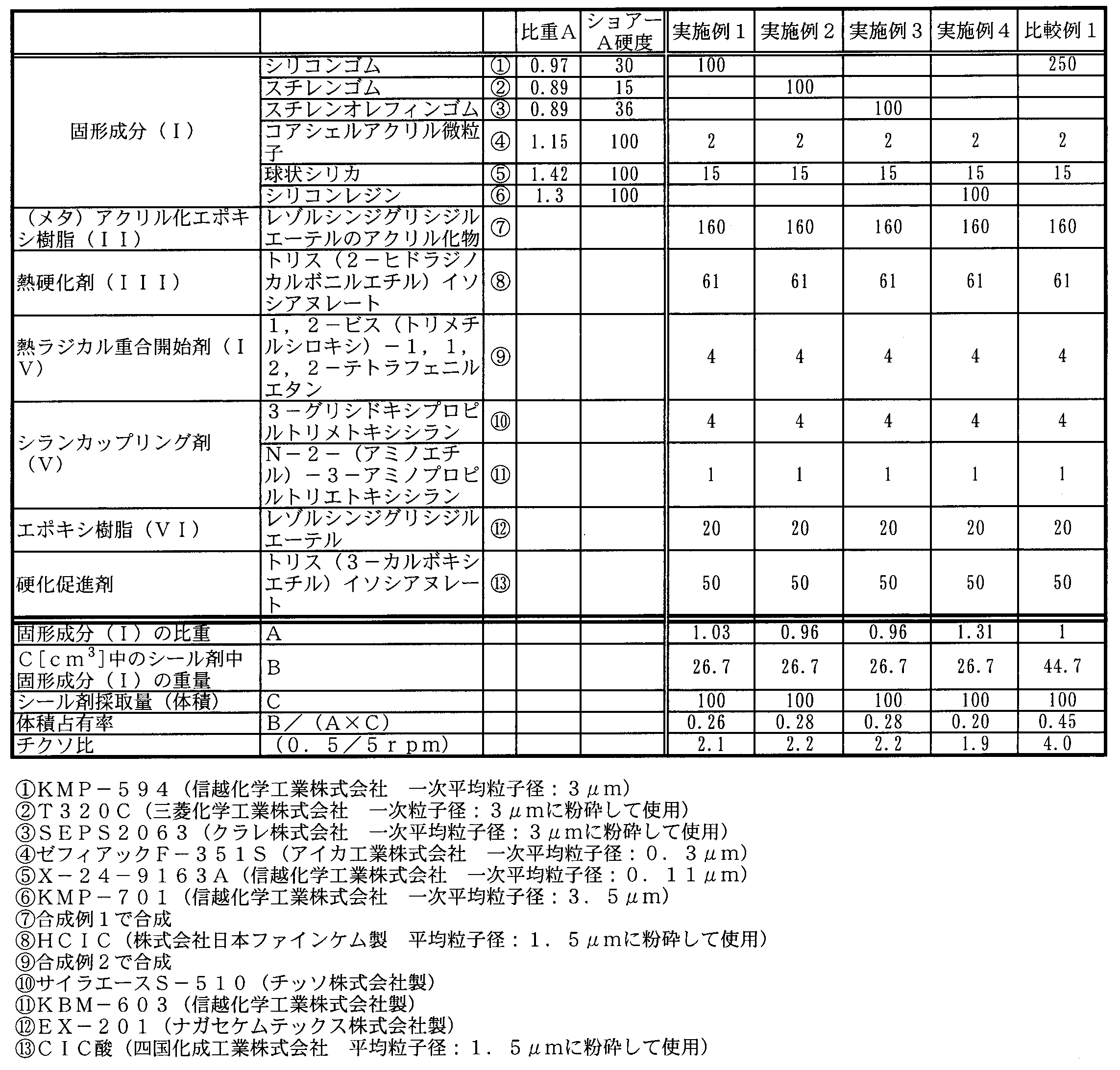
- Examples 1 to 4, Comparative Example 1 The amounts of acrylated epoxy resin (II) and epoxy resin (VI) shown in Table 1 below are heated and mixed, and after cooling, solid component (I), thermosetting agent (III), thermal radical polymerization initiator (IV) Then, a silane coupling agent (V) and a curing accelerator were added and stirred, and then dispersed with a three-roll mill and filtered through a metal mesh (635 mesh) to prepare liquid crystal sealants of Examples 1 to 4. . In addition, the liquid crystal sealant of Comparative Example 1 was prepared by blending the materials shown in Table 1 by the same process. The specific gravity of the solid component (I) was calculated by the above method as the specific gravity of the mixed system.
- the content of the solid component in the liquid crystal sealing material (I) of the C [cm 3] is, C and the weight was measured after harvesting the liquid crystal sealing material of [cm 3], the content of the solid component (I) It was calculated by applying. Note that all C [cm 3 ] were measured to be 100 cm 3 .
- the thixo ratio of each liquid crystal sealant was measured using the E-type viscometer (manufactured by Toki Sangyo Co., Ltd.) to measure the viscosity of the liquid crystal sealant at 25 ° C. at 5 rpm and 0.5 rpm. It was determined by calculating the value of viscosity at 0.5 rpm / 5 viscosity at 5 rpm.
- the liquid crystal sealant of Example 4 has a specific gravity A [g / cm 3 ] of the solid component (I) of 1.31, and a solid component having a Shore A hardness of 10 to 70 in the total amount of the solid component (I). Since 85% by mass or more of (I-1) was not contained, the result was slightly inferior.
- the liquid crystal sealant of the present invention is excellent in resistance to insertion of liquid crystal into the liquid crystal sealant, and is excellent in general properties as a liquid crystal sealant such as adhesive strength, and has excellent long-term reliability.
- the display cell can be easily manufactured.
Landscapes
- Chemical & Material Sciences (AREA)
- Physics & Mathematics (AREA)
- Health & Medical Sciences (AREA)
- Polymers & Plastics (AREA)
- Medicinal Chemistry (AREA)
- Organic Chemistry (AREA)
- Chemical Kinetics & Catalysis (AREA)
- Nonlinear Science (AREA)
- Emergency Medicine (AREA)
- General Chemical & Material Sciences (AREA)
- Mathematical Physics (AREA)
- Crystallography & Structural Chemistry (AREA)
- General Physics & Mathematics (AREA)
- Optics & Photonics (AREA)
- Sealing Material Composition (AREA)
- Liquid Crystal (AREA)
Description
特許文献3では、有機ベントナイトを用いて上記課題の解決を図っている。この方法は、液晶の差し込みに対して一定の成果は有するものの、十分であるとは言いがたい。
特許文献4には、ヒュームドシリカ、ポリチオールを用いた液晶シール剤を用い、液晶シール剤のBステージ化処理を行う方法が記載されている。しかし、この方法には、工程が長くなってしまう、その工程のための装置が必要となってしまうという欠点がある。
特許文献5には、熱ラジカル重合開始剤を用いて、硬化速度を上げることにより差し込みを防止する液晶滴下工法用液晶シール剤が開示されている。
なお、本明細書中、「(メタ)アクリル」とは「アクリル及び/又はメタクリル」を意味し、「(メタ)アクリロイル基」とは「アクリロイル基及び/又はメタクリロイル基」を意味する。また、「液晶滴下工法用液晶シール剤」を単に「液晶シール剤」と記載する場合もある。
1)
固形成分(I)を含有する液晶シール剤であって、上記固形成分(I)の比重をA[g/cm3]、液晶シール剤中の含有量をB[g]とし、液晶シール剤の体積をC[cm3]と定義した場合に、上記A、B、及びCが下記数式(a)を満たし、かつ、E型粘度計を用いて25℃における5rpm及び0.5rpmの条件で測定した粘度の値において、0.5rpmでの粘度/5rpmでの粘度で示されるチクソ比が1.1~3.0である液晶滴下工法用液晶シール剤。
0.2≦B/(A×C)≦0.4・・・(a)
2)
上記A[g/cm3]が、0.85~1.10g/cm3である上記1)に記載の液晶滴下工法用液晶シール剤。
3)
上記固形成分(I)の総量中、ショアA硬度が10~70の固形成分(I-1)を85質量%以上含有する上記1)又は2)に記載の液晶滴下工法用液晶シール剤。
4)
上記固形成分(I-1)が、シリコンゴム、スチレンゴム、スチレンオレフィンゴム、アクリルゴムから選択される1又は2以上の固形成分である上記3)に記載の液晶滴下工法用液晶シール剤。
5)
(メタ)アクリル化エポキシ樹脂(II)、熱硬化剤(III)、及び熱ラジカル重合開始剤(IV)を含有する上記1)乃至4)のいずれか一項に記載の液晶滴下工法用液晶シール剤。
6)
上記(メタ)アクリル化エポキシ樹脂(II)がレゾルシンジグリシジルエーテルの(メタ)アクリルエステル化物である上記5)に記載の液晶滴下工法用液晶シール剤。
7)
上記熱硬化剤(III)が多価ヒドラジド化合物である上記5)又は6)に記載の液晶滴下工法用液晶シール剤。
8)
上記熱ラジカル重合開始剤(IV)が、1,2-ビス(トリメチルシロキシ)-1,1,2,2-テトラフェニルエタンである上記5)乃至7)のいずれか一項に記載の液晶滴下工法用液晶シール剤。
9)
シランカップリング剤(V)を含有する上記1)乃至8)のいずれか一項に記載の液晶滴下工法用液晶シール剤。
10)
エポキシ樹脂(VI)を含有する上記1)乃至9)のいずれか一項に記載の液晶滴下工法用液晶シール剤。
11)
2枚の基板により構成される液晶表示セルにおいて、一方の基板に形成された上記1)乃至10)のいずれか一項に記載の液晶滴下工法用液晶シール剤からなる堰の内側に液晶を滴下した後、もう一方の基板を貼り合わせ、その後熱により上記液晶滴下工法用液晶シール剤を硬化する液晶表示セルの製造方法。
12)
上記1)乃至10)のいずれか一項に記載の液晶滴下工法用液晶シール剤を硬化して得られる硬化物でシールされた液晶表示セル。
0.2≦B/(A×C)≦0.4・・・(a)
上記数式によって、固形成分(I)の液晶シール剤中の体積占有率を計算することができる。すなわち、液晶シール剤中の体積占有率が多すぎると、ディスペンス特性を落とし、少なすぎると十分な差込耐性が得られない。ここで、上記体積占有率の上限は0.4であり、下限は0.2である。この数値を境界として、効果について明確な違いを有する。すなわち、体積占有率が0.4を超えるとチクソ比が上昇し、シール塗布時の直線性が悪くなり、0.2より小さいと貼り合わせた際に液晶の差し込みが生じる。なお、固形成分(I)の比重Aは水中置換法(JIS K7112)で測定することができる。
A[g/cm3]=有機フィラーの比重×固形成分(I)中の有機フィラー含有率+
無機フィラーの比重×固形成分(I)中の無機フィラー含有率
この方法は、固形成分(I)が3成分以上の混合物であっても適用可能である。
有機フィラーの例としては、例えば天然ゴム(NR)、イソプレンゴム(IR)、ブタジエンゴム(BR)、スチレン・ブタジエンゴム(SBR)、ブチルゴム(IIR)、二トリルゴム(NBR)、エチレン・プロピレンゴム(EPM、EP)、クロロプレンゴム(CR)、アクリルゴム(ACM、ANM)、クロロスルホン化ポリエチレンゴム(CSM)、ウレタンゴム(PUR)、シリコンゴム(SI、SR)、フッ素ゴム(FKM、FPM)、多硫化ゴム(チオコール)等が挙げられる。これら固形成分(I)は2種以上を混合して用いてもよい。これらのうち、好ましくは、シリコンゴム、スチレンゴム、スチレンオレフィンゴム、アクリルゴムである。

式(1)のY1又はY2が水素原子以外の場合、R1R2R3Y1-又はR4R5R6Y2-は、フェニル基又は1~3個のC1~C4アルキル基で置換されたフェニル基、あるいは、ジC1~C4アルキルシリル基又はトリC1~C4アルキルシリル基が好ましく、より好ましくは、ジC1~C4アルキルシリル基又はトリC1~C4アルキルシリル基であり、さらに好ましくはトリC1~C4アルキルシリル基である。
式(1)のR1R2R3Y1-、R4R5R6Y2-におけるジ又はトリC1~C4の直鎖又は分岐アルキルシリル基において、2個又は3個のC1~C4アルキル基は同一でも異なってもよく、該シリル基としては例えばジメチルシリル、ジエチルシリル、メチルエチルシリル等のジC1~C4アルキルシリル基;トリメチルシリル、トリエチルシリル、ジメチルエチルシリル、t-ブチルジメチルシリル等のトリC1~C4アルキルシリル基;等が挙げられる。これらの中で、トリC1~C4アルキルシリル基が最も好ましく、より好ましくはトリメチルシリル基である。
式(1)のX1~X4は各々独立して、水素原子、メチル基、エチル基、メトキシ基、エトキシ基、フェノキシ基、又はハロゲン原子を表し、好ましいのは、X1~X4が全て水素原子の場合である。
エポキシ樹脂(VI)の含有量は、液晶シール剤の作業性、物性を考慮して適宜決定され、通常、液晶シール剤中に25~80質量%程度であり、好ましくは25~75質量%である。
[レゾルシンジグリシジルエーテルの全アクリル化物の合成]
レゾルシンジグリシジルエーテル181.2g(EX-201:ナガセケムテックス株式会社製)をトルエン266.8gに溶解し、これに重合禁止剤としてジブチルヒドロキシトルエン0.8gを加え、60℃まで昇温した。その後、エポキシ基の100%当量のアクリル酸117.5gを加え、さらに80℃まで昇温し、これに反応触媒であるトリメチルアンモニウムクロライド0.6gを添加して、98℃で約30時間撹拌し、反応液を得た。この反応液を水洗し、トルエンを留去することにより、目的とするレゾルシンジグリシジルエーテルのエポキシアクリレート293gを得た。得られたエポキシアクリレートの反応性基当量は理論値で183である。
[1,2-ビス(トリメチルシロキシ)-1,1,2,2-テトラフェニルエタンの合成]
市販ベンゾピナコール(東京化成製)100部(0.28モル)をジメチルホルムアルデヒド350部に溶解させた。これに塩基触媒としてピリジン32部(0.4モル)、シリル化剤としてBSTFA(信越化学工業製)150部(0.58モル)を加え、70℃まで昇温し、2時間撹拌した。得られた反応液を冷却し、撹拌しながら、水200部を入れ、生成物を沈殿させると共に未反応シリル化剤を失活させた。沈殿した生成物を濾別分離した後、十分に水洗した。次いで得られた生成物をアセトンに溶解し、水を加えて再結晶させ、精製した。目的の1,2-ビス(トリメチルシロキシ)-1,1,2,2-テトラフェニルエタンを105.6部(収率88.3%)得た。
HPLC(高速液体クロマトグラフィー)で分析した結果、純度は99.0%(面積百分率)であった。
下記表1に示す量のアクリル化エポキシ樹脂(II)とエポキシ樹脂(VI)とを加熱混合し、冷却後、固形成分(I)、熱硬化剤(III)、熱ラジカル重合開始剤(IV)、シランカップリング剤(V)、硬化促進剤を添加し、撹拌した後、3本ロールミルにて分散させ、金属メッシュ(635メッシュ)で濾過し、実施例1~4の液晶シール剤を調製した。また、同様の工程により、表1に示す材料を配合して、比較例1の液晶シール剤を調製した。
なお、固形成分(I)の比重は、混合系の比重として上記手法によって計算した。また、C[cm3]の液晶シール剤中の固形成分(I)の含有量は、C[cm3]の液晶シール剤を採取した後にその重量を測定し、固形成分(I)の含有率をかけることで算出した。なお、C[cm3]は全て100cm3に統一して測定した。
また、各液晶シール剤のチクソ比は、E型粘度計(東機産業株式会社製)を使用して、液晶シール剤の25℃における5rpm及び0.5rpmでの粘度を測定し、その値から0.5rpmでの粘度/5rpmでの粘度の値を算出することによって求めた。
液晶シール剤各100gにスペーサとして直径5μmのグラスファイバー(PF-50S:日本電気硝子株式会社製)1gを添加して混合撹拌脱泡を行い、シリンジに充填した。このシリンジに充填した液晶シール剤を、ディスペンサー(SHOTMASTER300:武蔵エンジニアリング株式会社製)を使ってITO透明電極付きガラス基板(470×370×0.7SP30ITO:ジオマテック株式会社製)に塗布し、シールパターン及びダミーシールパターンを形成した。次いで、液晶(JC-5015LA;チッソ株式会社製)の微小滴をシールパターンの枠内に滴下した。さらにもう一枚のラビング処理済みガラス基板に面内スペーサ(ナトコスペーサKSEB-525F;ナトコ株式会社製;貼り合せ後のギャップ幅5μm)を散布、熱固着し、貼り合わせ装置を用いて真空中で先の液晶滴下済み基板と貼り合わせた。大気開放してギャップ形成した後、10分間放置した後、120℃のオーブンに投入して1時間加熱硬化させ、偏光顕微鏡にてセルギャップ形成を観察した。
以下基準に従って評価した。
○:セル内が均一に3μmのセルギャップとなっている
△:セル内に4μm程度のギャップがでていない場所がある
×:シールが決壊し、セルが形成できない
シリンジに充填した液晶シール剤をディスペンサー(SHOTMASTER300:武蔵エンジニアリング株式会社製)を使って、塗出圧400kPa、塗布速度20mm/sec、クリアランス50μm、ノズル径200μmで直線塗布したときの線形を観察し、以下基準に従って評価した。
○:シール幅のばらつきが5%未満
△:シール幅のばらつきが10%未満
×:シール幅のばらつきが10%以上
液晶シール剤100gにスペーサとして直径3μmのグラスファイバー1gを添加して混合撹拌を行った。この液晶シール剤を50mm×50mmのガラス基板上に塗布し、その液晶シール剤上に1.5mm×1.5mmのガラス片を貼り合わせ、120℃のオーブンに1時間投入して硬化させた。そのガラス片のせん断接着強度をボンドテスター(SS-30WD:西進商事株式会社製)を使用して測定した。その結果を表2に示す。

Claims (12)
- 固形成分(I)を含有する液晶シール剤であって、前記固形成分(I)の比重をA[g/cm3]、液晶シール剤中の含有量をB[g]とし、液晶シール剤の体積をC[cm3]と定義した場合に、前記A、B、及びCが下記数式(a)を満たし、かつ、E型粘度計を用いて25℃における5rpm及び0.5rpmの条件で測定した粘度の値において、0.5rpmでの粘度/5rpmでの粘度で示されるチクソ比が1.1~3.0である液晶滴下工法用液晶シール剤。
0.2≦B/(A×C)≦0.4・・・(a) - 前記A[g/cm3]が、0.85~1.10g/cm3である請求項1に記載の液晶滴下工法用液晶シール剤。
- 前記固形成分(I)の総量中、ショアA硬度が10~70の固形成分(I-1)を85質量%以上含有する請求項1又は2に記載の液晶滴下工法用液晶シール剤。
- 前記固形成分(I-1)が、シリコンゴム、スチレンゴム、スチレンオレフィンゴム、アクリルゴムから選択される1又は2以上の固形成分である請求項3に記載の液晶滴下工法用液晶シール剤。
- (メタ)アクリル化エポキシ樹脂(II)、熱硬化剤(III)、及び熱ラジカル重合開始剤(IV)を含有する請求項1乃至4のいずれか一項に記載の液晶滴下工法用液晶シール剤。
- 前記(メタ)アクリル化エポキシ樹脂(II)がレゾルシンジグリシジルエーテルの(メタ)アクリルエステル化物である請求項5に記載の液晶滴下工法用液晶シール剤。
- 前記熱硬化剤(III)が多価ヒドラジド化合物である請求項5又は6に記載の液晶滴下工法用液晶シール剤。
- 前記熱ラジカル重合開始剤(IV)が、1,2-ビス(トリメチルシロキシ)-1,1,2,2-テトラフェニルエタンである請求項5乃至7のいずれか一項に記載の液晶滴下工法用液晶シール剤。
- シランカップリング剤(V)を含有する請求項1乃至8のいずれか一項に記載の液晶滴下工法用液晶シール剤。
- エポキシ樹脂(VI)を含有する請求項1乃至9のいずれか一項に記載の液晶滴下工法用液晶シール剤。
- 2枚の基板により構成される液晶表示セルにおいて、一方の基板に形成された請求項1乃至10のいずれか一項に記載の液晶滴下工法用液晶シール剤からなる堰の内側に液晶を滴下した後、もう一方の基板を貼り合わせ、その後熱により前記液晶滴下工法用液晶シール剤を硬化する液晶表示セルの製造方法。
- 請求項1乃至10のいずれか一項に記載の液晶滴下工法用液晶シール剤を硬化して得られる硬化物でシールされた液晶表示セル。
Priority Applications (3)
| Application Number | Priority Date | Filing Date | Title |
|---|---|---|---|
| CN201380037808.0A CN104471470A (zh) | 2012-07-17 | 2013-07-17 | 液晶密封剂及使用它的液晶显示单元 |
| JP2013541117A JP5543035B1 (ja) | 2012-07-17 | 2013-07-17 | 液晶シール剤及びそれを用いた液晶表示セル |
| KR1020157002012A KR20150036198A (ko) | 2012-07-17 | 2013-07-17 | 액정 시일제 및 그것을 사용한 액정 표시 셀 |
Applications Claiming Priority (2)
| Application Number | Priority Date | Filing Date | Title |
|---|---|---|---|
| JP2012-158480 | 2012-07-17 | ||
| JP2012158480 | 2012-07-17 |
Publications (1)
| Publication Number | Publication Date |
|---|---|
| WO2014014015A1 true WO2014014015A1 (ja) | 2014-01-23 |
Family
ID=49948840
Family Applications (1)
| Application Number | Title | Priority Date | Filing Date |
|---|---|---|---|
| PCT/JP2013/069384 Ceased WO2014014015A1 (ja) | 2012-07-17 | 2013-07-17 | 液晶シール剤及びそれを用いた液晶表示セル |
Country Status (5)
| Country | Link |
|---|---|
| JP (1) | JP5543035B1 (ja) |
| KR (1) | KR20150036198A (ja) |
| CN (1) | CN104471470A (ja) |
| TW (1) | TW201410853A (ja) |
| WO (1) | WO2014014015A1 (ja) |
Citations (4)
| Publication number | Priority date | Publication date | Assignee | Title |
|---|---|---|---|---|
| JP2007079588A (ja) * | 2006-10-11 | 2007-03-29 | Nippon Kayaku Co Ltd | 液晶シール剤及び液晶セル |
| WO2008102550A1 (ja) * | 2007-02-20 | 2008-08-28 | Mitsui Chemicals, Inc. | 液晶シール用硬化性樹脂組成物および、これを使用した液晶表示パネルの製造方法 |
| JP2009139922A (ja) * | 2007-11-16 | 2009-06-25 | Nippon Kayaku Co Ltd | 液晶シール剤およびそれを用いた液晶表示セル |
| JP2009229722A (ja) * | 2008-03-21 | 2009-10-08 | Sekisui Chem Co Ltd | 液晶表示素子用シール剤、上下導通材料、及び、液晶表示素子 |
Family Cites Families (3)
| Publication number | Priority date | Publication date | Assignee | Title |
|---|---|---|---|---|
| EP1559735B1 (en) * | 2002-11-06 | 2007-09-26 | Nippon Kayaku Kabushiki Kaisha | Sealing material for liquid crystal and liquid crystal display cell using same |
| JP2010014771A (ja) * | 2008-07-01 | 2010-01-21 | Nippon Kayaku Co Ltd | 熱硬化型液晶滴下工法用液晶シール剤及びそれを用いた液晶表示セル |
| KR101618397B1 (ko) * | 2009-07-01 | 2016-05-04 | 니폰 가야꾸 가부시끼가이샤 | 액정 적하 공법용 액정 실링제 및 이를 이용한 액정 표시 셀 |
-
2013
- 2013-07-15 TW TW102125249A patent/TW201410853A/zh unknown
- 2013-07-17 KR KR1020157002012A patent/KR20150036198A/ko not_active Withdrawn
- 2013-07-17 JP JP2013541117A patent/JP5543035B1/ja active Active
- 2013-07-17 WO PCT/JP2013/069384 patent/WO2014014015A1/ja not_active Ceased
- 2013-07-17 CN CN201380037808.0A patent/CN104471470A/zh active Pending
Patent Citations (4)
| Publication number | Priority date | Publication date | Assignee | Title |
|---|---|---|---|---|
| JP2007079588A (ja) * | 2006-10-11 | 2007-03-29 | Nippon Kayaku Co Ltd | 液晶シール剤及び液晶セル |
| WO2008102550A1 (ja) * | 2007-02-20 | 2008-08-28 | Mitsui Chemicals, Inc. | 液晶シール用硬化性樹脂組成物および、これを使用した液晶表示パネルの製造方法 |
| JP2009139922A (ja) * | 2007-11-16 | 2009-06-25 | Nippon Kayaku Co Ltd | 液晶シール剤およびそれを用いた液晶表示セル |
| JP2009229722A (ja) * | 2008-03-21 | 2009-10-08 | Sekisui Chem Co Ltd | 液晶表示素子用シール剤、上下導通材料、及び、液晶表示素子 |
Also Published As
| Publication number | Publication date |
|---|---|
| CN104471470A (zh) | 2015-03-25 |
| KR20150036198A (ko) | 2015-04-07 |
| TW201410853A (zh) | 2014-03-16 |
| JPWO2014014015A1 (ja) | 2016-07-07 |
| JP5543035B1 (ja) | 2014-07-09 |
Similar Documents
| Publication | Publication Date | Title |
|---|---|---|
| JP5757522B2 (ja) | 液晶シール剤及びそれを用いた液晶表示セル | |
| WO2014014013A1 (ja) | 液晶シール剤及びそれを用いた液晶表示セル | |
| JP2015069011A (ja) | 液晶シール剤及びそれを用いた液晶表示セル | |
| JP6289372B2 (ja) | 液晶シール剤及びそれを用いた液晶表示セル | |
| JP6231230B2 (ja) | 液晶シール剤及びそれを用いた液晶表示セル | |
| JP6304803B2 (ja) | 樹脂組成物の製造方法 | |
| JP6235297B2 (ja) | 液晶シール剤及びそれを用いた液晶表示セル | |
| JP6253638B2 (ja) | 液晶シール剤及びそれを用いた液晶表示セル | |
| JP2017027041A (ja) | 液晶シール剤及びそれを用いた液晶表示セル | |
| JPWO2016010152A1 (ja) | 液晶シール剤及びそれを用いた液晶表示セル | |
| JP6482371B2 (ja) | 樹脂組成物の製造方法 | |
| JP2017027043A (ja) | 液晶シール剤及びそれを用いた液晶表示セル | |
| JP2016038508A (ja) | 液晶シール剤及びそれを用いた液晶表示セル | |
| JP5543035B1 (ja) | 液晶シール剤及びそれを用いた液晶表示セル | |
| JP6497809B2 (ja) | 液晶シール剤及びそれを用いた液晶表示セル | |
| JP6288756B2 (ja) | 液晶表示セルの製造方法及びその方法で得られる液晶表示セル | |
| JP2017198726A (ja) | 液晶光学素子用シール剤及びそれを用いた液晶光学素子 | |
| JP2018022052A (ja) | 液晶シール剤及びそれを用いた液晶表示セル | |
| JP6584132B2 (ja) | 樹脂組成物の製造方法 | |
| WO2014010731A1 (ja) | 液晶シール剤及びそれを用いた液晶表示セル | |
| JP2015203834A (ja) | 液晶滴下工法用液晶シール剤及びそれを用いた液晶表示セル | |
| JP6452194B2 (ja) | 液晶シール剤及びそれを用いた液晶表示セル | |
| JP5531166B1 (ja) | 液晶表示セルの製造方法及びその方法で得られる液晶表示セル | |
| JP2016038507A (ja) | 液晶シール剤及びそれを用いた液晶表示セル | |
| JP2018146813A (ja) | 液晶滴下工法用液晶シール剤及びそれを用いた液晶表示セルの製造方法 |
Legal Events
| Date | Code | Title | Description |
|---|---|---|---|
| ENP | Entry into the national phase |
Ref document number: 2013541117 Country of ref document: JP Kind code of ref document: A |
|
| 121 | Ep: the epo has been informed by wipo that ep was designated in this application |
Ref document number: 13820258 Country of ref document: EP Kind code of ref document: A1 |
|
| NENP | Non-entry into the national phase |
Ref country code: DE |
|
| ENP | Entry into the national phase |
Ref document number: 20157002012 Country of ref document: KR Kind code of ref document: A |
|
| 122 | Ep: pct application non-entry in european phase |
Ref document number: 13820258 Country of ref document: EP Kind code of ref document: A1 |