WO2014010340A1 - 複合伸縮部材、該複合伸縮部材の製造方法、該複合伸縮部材を用いた着用物品及び該着用物品の製造方法 - Google Patents
複合伸縮部材、該複合伸縮部材の製造方法、該複合伸縮部材を用いた着用物品及び該着用物品の製造方法 Download PDFInfo
- Publication number
- WO2014010340A1 WO2014010340A1 PCT/JP2013/065570 JP2013065570W WO2014010340A1 WO 2014010340 A1 WO2014010340 A1 WO 2014010340A1 JP 2013065570 W JP2013065570 W JP 2013065570W WO 2014010340 A1 WO2014010340 A1 WO 2014010340A1
- Authority
- WO
- WIPO (PCT)
- Prior art keywords
- sheet
- longitudinal direction
- elastic member
- composite
- sheet materials
- Prior art date
- Legal status (The legal status is an assumption and is not a legal conclusion. Google has not performed a legal analysis and makes no representation as to the accuracy of the status listed.)
- Ceased
Links
Images




Classifications
-
- A—HUMAN NECESSITIES
- A61—MEDICAL OR VETERINARY SCIENCE; HYGIENE
- A61F—FILTERS IMPLANTABLE INTO BLOOD VESSELS; PROSTHESES; DEVICES PROVIDING PATENCY TO, OR PREVENTING COLLAPSING OF, TUBULAR STRUCTURES OF THE BODY, e.g. STENTS; ORTHOPAEDIC, NURSING OR CONTRACEPTIVE DEVICES; FOMENTATION; TREATMENT OR PROTECTION OF EYES OR EARS; BANDAGES, DRESSINGS OR ABSORBENT PADS; FIRST-AID KITS
- A61F13/00—Bandages or dressings; Absorbent pads
- A61F13/15—Absorbent pads, e.g. sanitary towels, swabs or tampons for external or internal application to the body; Supporting or fastening means therefor; Tampon applicators
- A61F13/15577—Apparatus or processes for manufacturing
- A61F13/15585—Apparatus or processes for manufacturing of babies' napkins, e.g. diapers
- A61F13/15593—Apparatus or processes for manufacturing of babies' napkins, e.g. diapers having elastic ribbons fixed thereto; Devices for applying the ribbons
-
- A—HUMAN NECESSITIES
- A61—MEDICAL OR VETERINARY SCIENCE; HYGIENE
- A61F—FILTERS IMPLANTABLE INTO BLOOD VESSELS; PROSTHESES; DEVICES PROVIDING PATENCY TO, OR PREVENTING COLLAPSING OF, TUBULAR STRUCTURES OF THE BODY, e.g. STENTS; ORTHOPAEDIC, NURSING OR CONTRACEPTIVE DEVICES; FOMENTATION; TREATMENT OR PROTECTION OF EYES OR EARS; BANDAGES, DRESSINGS OR ABSORBENT PADS; FIRST-AID KITS
- A61F13/00—Bandages or dressings; Absorbent pads
- A61F13/15—Absorbent pads, e.g. sanitary towels, swabs or tampons for external or internal application to the body; Supporting or fastening means therefor; Tampon applicators
- A61F13/15577—Apparatus or processes for manufacturing
- A61F13/15699—Forming webs by bringing together several webs, e.g. by laminating or folding several webs, with or without additional treatment of the webs
-
- A—HUMAN NECESSITIES
- A61—MEDICAL OR VETERINARY SCIENCE; HYGIENE
- A61F—FILTERS IMPLANTABLE INTO BLOOD VESSELS; PROSTHESES; DEVICES PROVIDING PATENCY TO, OR PREVENTING COLLAPSING OF, TUBULAR STRUCTURES OF THE BODY, e.g. STENTS; ORTHOPAEDIC, NURSING OR CONTRACEPTIVE DEVICES; FOMENTATION; TREATMENT OR PROTECTION OF EYES OR EARS; BANDAGES, DRESSINGS OR ABSORBENT PADS; FIRST-AID KITS
- A61F13/00—Bandages or dressings; Absorbent pads
- A61F13/15—Absorbent pads, e.g. sanitary towels, swabs or tampons for external or internal application to the body; Supporting or fastening means therefor; Tampon applicators
- A61F13/15577—Apparatus or processes for manufacturing
- A61F13/15756—Applying tabs, strips, tapes, loops; Knotting the ends of pads
-
- A—HUMAN NECESSITIES
- A61—MEDICAL OR VETERINARY SCIENCE; HYGIENE
- A61F—FILTERS IMPLANTABLE INTO BLOOD VESSELS; PROSTHESES; DEVICES PROVIDING PATENCY TO, OR PREVENTING COLLAPSING OF, TUBULAR STRUCTURES OF THE BODY, e.g. STENTS; ORTHOPAEDIC, NURSING OR CONTRACEPTIVE DEVICES; FOMENTATION; TREATMENT OR PROTECTION OF EYES OR EARS; BANDAGES, DRESSINGS OR ABSORBENT PADS; FIRST-AID KITS
- A61F13/00—Bandages or dressings; Absorbent pads
- A61F13/15—Absorbent pads, e.g. sanitary towels, swabs or tampons for external or internal application to the body; Supporting or fastening means therefor; Tampon applicators
- A61F13/45—Absorbent pads, e.g. sanitary towels, swabs or tampons for external or internal application to the body; Supporting or fastening means therefor; Tampon applicators characterised by the shape
- A61F13/49—Absorbent pads, e.g. sanitary towels, swabs or tampons for external or internal application to the body; Supporting or fastening means therefor; Tampon applicators characterised by the shape specially adapted to be worn around the waist, e.g. diapers, nappies
- A61F13/49007—Form-fitting, self-adjusting disposable diapers
- A61F13/49009—Form-fitting, self-adjusting disposable diapers with elastic means
- A61F13/4902—Form-fitting, self-adjusting disposable diapers with elastic means characterised by the elastic material
-
- B—PERFORMING OPERATIONS; TRANSPORTING
- B32—LAYERED PRODUCTS
- B32B—LAYERED PRODUCTS, i.e. PRODUCTS BUILT-UP OF STRATA OF FLAT OR NON-FLAT, e.g. CELLULAR OR HONEYCOMB, FORM
- B32B3/00—Layered products comprising a layer with external or internal discontinuities or unevennesses, or a layer of non-planar shape; Layered products comprising a layer having particular features of form
- B32B3/26—Layered products comprising a layer with external or internal discontinuities or unevennesses, or a layer of non-planar shape; Layered products comprising a layer having particular features of form characterised by a particular shape of the outline of the cross-section of a continuous layer; characterised by a layer with cavities or internal voids ; characterised by an apertured layer
- B32B3/28—Layered products comprising a layer with external or internal discontinuities or unevennesses, or a layer of non-planar shape; Layered products comprising a layer having particular features of form characterised by a particular shape of the outline of the cross-section of a continuous layer; characterised by a layer with cavities or internal voids ; characterised by an apertured layer characterised by a layer comprising a deformed thin sheet, i.e. the layer having its entire thickness deformed out of the plane, e.g. corrugated, crumpled
-
- B—PERFORMING OPERATIONS; TRANSPORTING
- B32—LAYERED PRODUCTS
- B32B—LAYERED PRODUCTS, i.e. PRODUCTS BUILT-UP OF STRATA OF FLAT OR NON-FLAT, e.g. CELLULAR OR HONEYCOMB, FORM
- B32B7/00—Layered products characterised by the relation between layers; Layered products characterised by the relative orientation of features between layers, or by the relative values of a measurable parameter between layers, i.e. products comprising layers having different physical, chemical or physicochemical properties; Layered products characterised by the interconnection of layers
- B32B7/04—Interconnection of layers
- B32B7/12—Interconnection of layers using interposed adhesives or interposed materials with bonding properties
- B32B7/14—Interconnection of layers using interposed adhesives or interposed materials with bonding properties applied in spaced arrangements, e.g. in stripes
-
- A—HUMAN NECESSITIES
- A61—MEDICAL OR VETERINARY SCIENCE; HYGIENE
- A61F—FILTERS IMPLANTABLE INTO BLOOD VESSELS; PROSTHESES; DEVICES PROVIDING PATENCY TO, OR PREVENTING COLLAPSING OF, TUBULAR STRUCTURES OF THE BODY, e.g. STENTS; ORTHOPAEDIC, NURSING OR CONTRACEPTIVE DEVICES; FOMENTATION; TREATMENT OR PROTECTION OF EYES OR EARS; BANDAGES, DRESSINGS OR ABSORBENT PADS; FIRST-AID KITS
- A61F13/00—Bandages or dressings; Absorbent pads
- A61F13/15—Absorbent pads, e.g. sanitary towels, swabs or tampons for external or internal application to the body; Supporting or fastening means therefor; Tampon applicators
- A61F13/45—Absorbent pads, e.g. sanitary towels, swabs or tampons for external or internal application to the body; Supporting or fastening means therefor; Tampon applicators characterised by the shape
- A61F13/49—Absorbent pads, e.g. sanitary towels, swabs or tampons for external or internal application to the body; Supporting or fastening means therefor; Tampon applicators characterised by the shape specially adapted to be worn around the waist, e.g. diapers, nappies
- A61F13/49007—Form-fitting, self-adjusting disposable diapers
- A61F13/49009—Form-fitting, self-adjusting disposable diapers with elastic means
- A61F13/4902—Form-fitting, self-adjusting disposable diapers with elastic means characterised by the elastic material
- A61F2013/49025—Form-fitting, self-adjusting disposable diapers with elastic means characterised by the elastic material having multiple elastic strands
-
- B—PERFORMING OPERATIONS; TRANSPORTING
- B32—LAYERED PRODUCTS
- B32B—LAYERED PRODUCTS, i.e. PRODUCTS BUILT-UP OF STRATA OF FLAT OR NON-FLAT, e.g. CELLULAR OR HONEYCOMB, FORM
- B32B2250/00—Layers arrangement
- B32B2250/03—3 layers
-
- B—PERFORMING OPERATIONS; TRANSPORTING
- B32—LAYERED PRODUCTS
- B32B—LAYERED PRODUCTS, i.e. PRODUCTS BUILT-UP OF STRATA OF FLAT OR NON-FLAT, e.g. CELLULAR OR HONEYCOMB, FORM
- B32B2250/00—Layers arrangement
- B32B2250/40—Symmetrical or sandwich layers, e.g. ABA, ABCBA, ABCCBA
-
- B—PERFORMING OPERATIONS; TRANSPORTING
- B32—LAYERED PRODUCTS
- B32B—LAYERED PRODUCTS, i.e. PRODUCTS BUILT-UP OF STRATA OF FLAT OR NON-FLAT, e.g. CELLULAR OR HONEYCOMB, FORM
- B32B2307/00—Properties of the layers or laminate
- B32B2307/50—Properties of the layers or laminate having particular mechanical properties
- B32B2307/51—Elastic
Definitions
- the present invention is a composite elastic member formed by laminating two long sheet materials with the longitudinal direction aligned, and sandwiching an elastic member extending along the longitudinal direction of both sheet materials,
- the present invention relates to a method for producing the composite elastic member, a wearing article such as a diaper using the composite elastic member, and a method for producing the wearing article.
- Patent Document 1 There is one disclosed in Patent Document 1 as a composite elastic member used around the waist of a diaper. This is formed by laminating two long sheet materials made of non-woven fabric or the like with the longitudinal direction aligned, and sandwiching an elastic member such as rubber thread extending along the longitudinal direction of both sheet materials between both sheet materials. The Both sheet materials are intermittently heat-sealed along the longitudinal direction of the sheet material and the direction orthogonal to the longitudinal direction. The elastic member does not pass through the heat fusion part of both sheet materials. That is, the heat fusion part is provided so as to avoid the elastic member.
- both sheet materials are heat-sealed to each other.
- heat fusion has a pattern-shaped protrusion on the peripheral surface and is sandwiched and pressed between rolls heated to a high temperature.
- an elastic member is formed by heat or pressure. May be disconnected. Therefore, complicated control is required so that the elastic member is not cut carelessly, and the equipment becomes expensive.
- heat sealing a predetermined time is required to heat the sheet material to the melting point, and it is not possible to realize a high speed for improving productivity.
- An object of the present invention is a composite elastic member formed by sandwiching an elastic member between both sheet materials and joining both sheet materials, and a composite elastic member having high manufacturing efficiency and less possibility of the elastic member being cut. It is to provide.
- the composite elastic member is composed of two long sheet materials that are aligned in the longitudinal direction, and a plurality of elastic members that extend along the longitudinal direction of both sheet materials are sandwiched between the two sheet materials substantially parallel to each other. It is formed. Both sheet materials are joined to each other at a plurality of joint portions made of a hot melt material continuously applied along a direction orthogonal to the longitudinal direction of the sheet material, and the joint portions are formed by joining the plurality of elastic members. As described above, a plurality of wrinkles extending across the plurality of elastic members perpendicular to the longitudinal direction of the sheet material are caused between the joint portions adjacent to each other on both sheet materials by the contracting action of the elastic members. Is formed.
- the joint between both sheet materials is formed from a hot melt material.
- a hot melt material By forming the joining portion from a hot melt material, there is no need to sandwich and press the two sheet materials from both sides with a heat-sealing roll, and the elastic member is cut by heat or pressure. The possibility is reduced. In addition, time for heating the sheet material to the melting point is not required, and the production speed can be increased.
- the hot melt material forming the joint is applied along the direction orthogonal to the longitudinal direction of the sheet material, there is little risk of cutting the elastic member even if the hot melt material touches the elastic member. For this reason, it is not necessary to apply the hot melt material intermittently while avoiding the elastic member. Therefore, since the hot melt material is continuously applied along the direction orthogonal to the longitudinal direction of the sheet material, the workability of applying the hot melt material is improved. Further, since the hot melt material is continuously applied, the bonding strength is higher than that of the composite stretchable member in which both sheet materials are intermittently bonded so that the bonded portion avoids the elastic member.
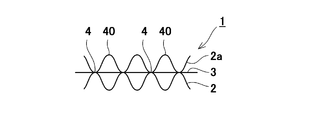
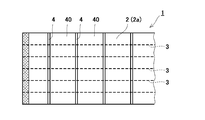
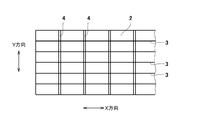
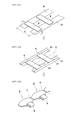
- FIG. 1 It is a perspective view of the composite elastic member which concerns on embodiment of this invention. It is the figure which looked at FIG. 1 from the A direction. It is a top view of FIG. It is a figure which shows the manufacturing process of a composite elastic member. It is a figure which shows the apparatus which apply
- FIG. 1 It is a top view which shows the manufacturing process of a 2nd cross-flow type diaper. It is the top view which looked at the diaper which provided the non-shrink area
- FIG. 1 is a perspective view of a composite elastic member according to an embodiment of the present invention
- FIG. 2 is a view of FIG. 1 viewed from the direction A
- FIG. 3 is a plan view of FIG.
- the composite stretchable member 1 includes a plurality of elastic members extending in the longitudinal direction of the two sheet materials 2 and 2a by stacking two long sheet materials 2 and 2a in the longitudinal direction (X direction in FIG. 1). 3 is sandwiched between the sheet materials 2 and 2a substantially parallel to each other.
- Both the sheet materials 2 and 2a are comprised, for example from a nonwoven fabric
- the elastic member 3 is comprised from string-like bodies, such as a rubber thread, for example.
- Both sheet materials 2 and 2a are joined by a linear joining portion 4 extending along a direction (Y direction in FIG. 1) perpendicular to the longitudinal direction of the sheet materials 2 and 2a.
- the plurality of elastic members 3 pass through the joint portion 4, that is, are fixed on the sheet materials 2, 2 a at the joint portion 4.
- a plurality of joint portions 4 are provided along the longitudinal direction of the sheet materials 2 and 2a so as to be substantially parallel to each other and at equal intervals.
- a convex ridge 40 is formed between the adjacent joint portions 4 on the elastic member 3.
- a plurality of ridges 40 are provided at equal intervals along the longitudinal direction of the sheet materials 2 and 2a, and expand and contract along the X direction.
- the collar 40 is formed by the elastic member 3 contracting and the sheet materials 2 and 2a deforming.
- the joint 4 is composed of a hot melt material that is continuously applied on the one sheet material 2 along the Y direction.
- the hot melt material is melted at a predetermined temperature and is used in this molten state to join the two sheet materials 2 and 2a. Since the hot melt material has a relatively low temperature on the coated sheet, the elastic member 3 is less likely to be cut even if it receives heat from the hot melt material.
- the plurality of elastic members 3 are fixed to both sheet materials 2 and 2a with hot melt materials at both ends in the longitudinal direction.
- the composite elastic member 1 of the present embodiment since a plurality of ridges 40 are formed, a volume appears in the thickness direction of the sheet material 2. Moreover, since the inside of the heel 40 is air, the touch when touching the heel 40 is soft. Accordingly, the composite stretchable member 1 is suitable around the waist of the diaper as described later.
- the plurality of ridges 40 extend along the Y direction and are formed at equal intervals along the X direction. Is done. This makes it look beautiful. If the joint portion 4 is continuously formed in a spiral shape along the elastic member 3 (that is, in the X direction), the top portion of the flange 40 is recessed at a location where the joint portion 4 and the elastic member 3 intersect. That is, the ridge 40 does not continuously extend straight along the Y direction. This not only impairs the beauty of the appearance, but also reduces the amount of deformation when subjected to an external force because the ridge 40 is uneven. This impairs the softness of the touch. Therefore, the collar 40 is formed so as to continuously extend along the Y direction.
- nonwoven fabric used for both the sheet materials 2 and 2a an air-through nonwoven fabric, a spunlace nonwoven fabric, a spunbonded nonwoven fabric, a melt blown nonwoven fabric, and the like are used from the viewpoint of beauty of appearance and touch. Of course, other non-woven fabrics may be used. Furthermore, the forming material may be the same or different between one sheet material and the other sheet material of the two sheet materials 2 and 2a.
- examples of the elastic member 3 include synthetic rubbers such as styrene-butadiene, butadiene, isoprene, and neoprene, natural rubber, stretchable polyolefin, and polyurethane.
- the elastic member 3 is not limited to thread rubber, but may be a string-like body such as flat rubber, and the cross section may be any of a rectangle, a square, a circle, and a polygon.
- a hot melt material is a kneaded material composed of a thermoplastic polymer resin, a tackifier, a viscosity modifier, an antioxidant, a heat stabilizer, an ultraviolet absorber, a filler, a plasticizer, etc. It is an adhesive that does not contain.
- thermoplastic polymer resin constituting the hot-melt material include olefin-based, rubber-based, polyamide-based, and polyester-based elastic resins, and these are used alone or in a blend.
- Said composite elastic member 1 can be manufactured, for example with the following method. First, as shown in FIG. 4, the heated hot melt material is continuously applied in a straight line along a direction (Y direction) perpendicular to the longitudinal direction (X direction) of one sheet material 2. Thereby, the junction part 4 is formed. A plurality of joining portions 4 are formed so as to be substantially parallel to each other and substantially parallel to each other over the longitudinal direction of the sheet material 2. A hot melt material is also applied to both ends in the longitudinal direction of the sheet material 2.
- each elastic member 3 is disposed on the sheet material 2 in a state of being stretched against elasticity.
- the other sheet material 2a is overlapped on the sheet material 2 coated with the hot melt material, and lightly pressed over the entire surface of the sheet material 2, 2a. Then, both the sheet materials 2, 2 a and the elastic member 3 are bonded by the joint portion 4. Since the hot melt material is also applied to both end portions of the sheet material 2 in the longitudinal direction, both end portions of the elastic member 3 are fixed to both end portions of both the sheet materials 2 and 2a. When the force that stretched the elastic member 3 is released after the joining of the two sheet materials 2 and 2a, the elastic member 3 contracts and both the sheet materials 2 and 2a are deformed to be adjacent on the sheet materials 2 and 2a. A plurality of ridges 40 are formed between the joint portions 4.
- the hot melt material applied on the sheet is relatively lower than the temperature at the time of heat fusion, even if the elastic member touches the joint, there is a possibility that it is cut by the heat at the time of joining. Less.
- the joining portion from a hot melt material, it is not necessary to sandwich and pressurize the two sheet materials from both sides with a heat fusion roll. Also in this respect, the possibility that the elastic member is cut by heat or pressure is reduced.
- the hot melt material forming the joint is applied along the direction orthogonal to the longitudinal direction of the sheet material, there is little risk of cutting the elastic member even if the hot melt material touches the elastic member. For this reason, it is not necessary to apply the hot melt material intermittently while avoiding the elastic member. Therefore, since the hot melt material is continuously applied along the direction orthogonal to the longitudinal direction of the sheet material, the workability of applying the hot melt material is improved. Further, since the hot melt material is continuously applied, the bonding strength is higher than that of the composite stretchable member in which both sheet materials are intermittently bonded so that the bonded portion avoids the elastic member.
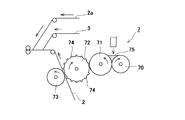
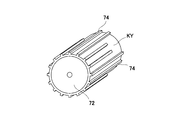
- the coating device 7 includes a main roll 70 and a driven roll 71 whose peripheral surfaces are in contact with each other, a coating roll 72 whose peripheral surface is in contact with the peripheral surface of the driven roll 71, and a sheet between the coating roll 72 and the coating roll 72.
- An auxiliary roll 73 that conveys the material 2 is provided.
- the pitch between the adjacent protrusions 74 is set equal to the pitch between the joint portions 4.
- a storage portion 75 to which a hot melt material is supplied is formed at a contact portion between the main roll 70 and the driven roll 71.
- the driven roll 71 and the coating roll 72 rotate, and the hot melt material supplied to the storage unit 75 adheres to the protrusion 74 of the coating roll 72 via the driven roll 71. .
- the coating roll 72 and the auxiliary roll 73 rotate to convey the sheet material 2
- the hot melt material on the protrusions 74 of the coating roll 72 is applied to the sheet material 2. Since the protrusions 74 are formed at equal intervals, the linear joint portions 4 are formed on the sheet material 2 at equal intervals.
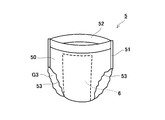
- FIG. 6 is a perspective view of the infant diaper 5
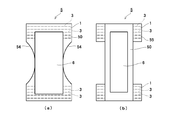
- FIGS. 7A and 7B are plan views of the developed diaper 5.
- the diaper 5 is a so-called pant-type, and is folded in half and joined to the side seal portion 51 so that the waist opening 52 where the inner side contacts the wearer's torso and the pair of legs into which the wearer's legs are inserted
- An opening 53 is formed.
- the waist opening 52 is formed by overlapping both ends in the longitudinal direction of the breathable outer packaging sheet 50, and is installed inside the outer packaging sheet 50 between the leg opening 53 and the side seal portion 51.
- a long absorbent body 6 for absorbing a person's urine is provided.
- the envelope sheet 50 is made of non-woven fabric, but any material can be used as long as it is breathable and heat-sealable.
- arc-shaped notches 54 are formed on both side edges of the outer sheet 50, and the both ends of the outer sheet 50 in the longitudinal direction overlap with each other.
- the absorbent body 6 is oriented in the longitudinal direction of the outer sheet 50, and the outer sheet 50 is joined to the non-skin contact surface of the absorbent body 6. In other words, the absorbent body 6 is oriented in the longitudinal direction of the wearer in the developed state of the diaper 5.
- an inner sheet (not shown) may be covered on the absorbent body 6 and the absorbent body 6 may be wrapped with the outer sheet 50 and the internal sheet.
- the absorbent body 6 has a known configuration in which an absorbent core composed of absorbent polymer particles and a fiber material is wrapped with a thin wrapping paper.
- the absorbent body 6 includes a liquid-permeable top sheet on the skin contact surface side and a liquid-impermeable back sheet on the non-skin contact surface side, and prevents the urine and the like from leaking out of the absorbent body 6.
- a leak-proof wall called is provided, this is a known configuration and will not be described and illustrated.
- the diaper 5 includes a type in which a waist gather and / or waist gathers are formed on the outer sheet 50 by the composite stretchable member 1, and the composite stretchable as shown in FIG. 7 (b).
- the waistline gather is configured as the side panels 55 provided on the both ends of the outer sheet 50 in the short side direction of the member 1.
- the diaper 5 of the type shown in FIG. 7A is referred to as a transverse flow type, and the diaper 5 of the type shown in FIG.
- the composite stretchable member 1 may be provided at the peripheral edge of the notch 54, and a known leg gather (G 3 in FIG. 6) may be provided at the leg opening 53.
- the horizontal flow type diaper 5 has the composite stretchable member 1 over the entire width, the stretchability in the lateral direction is good. Therefore, if the waist opening part 52 is pulled sideways, the waist opening part 52 can be enlarged and there exists a merit that it is easy to give to a wearer.
- the diaper 5 is for infants, a pattern such as a cartoon character between the leg opening portions 53 or the side seal portions 51 on the outer sheet 50, particularly on the non-skin surface side of the absorber. May be drawn.
- a pattern such as a cartoon character between the leg opening portions 53 or the side seal portions 51 on the outer sheet 50, particularly on the non-skin surface side of the absorber. May be drawn.
- the composite elastic member 1 expands and contracts in the lateral direction, this pattern is contracted near the composite elastic member 1 and is difficult to understand.
- the longitudinal flow type diaper 5 is provided on the non-skin surface of the absorbent body 6 because the composite elastic member 1 is provided as a side panel 55 that is located on both sides of the absorbent body 6 and contacts the waist of the wearer.
- the drawn pattern does not shrink so much and is easy to understand. That is, the transverse flow type diaper 5 and the longitudinal flow type diaper 5 each have advantages and disadvantages. Below, the manufacturing method of both types of diapers is shown.
- FIG. 8 is a top view which shows the manufacturing process of a 1st crossflow type diaper.
- belt made from a nonwoven fabric extended in the horizontal direction are prepared.
- the second strip 80 is a continuous body of the composite stretchable member 1 manufactured at least at both ends by the above-described manufacturing method, and becomes the outer sheet 50. Both strips 8 and 80 are transported along a transport direction X along the longitudinal direction of the second strip 80.
- the width of the second strip 80 is greater than the length L of the absorber 6.
- the manufacturing process includes stages 1 to 6.
- the first strip 8 is cut one after another at the stage 1 and divided into absorbent bodies 6 each having a length L.
- Each absorber 6 is conveyed to the stage 2.
- the absorber 6 is placed on a drum (not shown) and rotated 90 ° or 270 ° during the rotary conveyance of the drum.
- a plurality of absorbers 6 are placed on the second strip 80 by being spaced apart from each other by a certain distance in the transport direction, and this is placed on the second strip 80 by hot melt material or heat fusion. Join. Thereafter, an inner sheet may be placed on the second strip 80 so as to cover the absorber 6.
- the second strip 80 is folded in two so that the center line C in the width direction is a crease and the absorbent body 6 is on the inside.
- the second band 80 that is folded in half is joined to the side seal part 51 by thermal fusion or the like at an intermediate part between the adjacent absorbent bodies 6. Then, it cut
- FIG. 9 is a plan view showing a manufacturing process of the longitudinal flow type diaper 5.
- a first strip 8 having the absorbent body 6 connected in the transport direction and a second strip 80, which is a non-woven fabric strip extending in the transport direction, are prepared.
- the second strip 80 is the outer sheet 50. Both strips 8, 80 are transported along the transport direction X.
- the manufacturing process includes stages 1 to 4.
- the first strip 8 is cut one after another at the stage 1 and divided into absorbent bodies 6 each having a length L. Each absorber 6 is conveyed to the stage 2.
- the composite stretchable member 1 having a predetermined length is joined at equal intervals along the longitudinal direction of the second strip 80 on both sides of the second strip 80.
- a distance L ⁇ b> 1 between the central portions of the adjacent composite stretchable members 1 is longer than the length L of the absorber 6.
- the absorbent body 6 is placed between the adjacent composite elastic members 1 on the second strip 80 and joined to the second strip 80.
- an inner sheet may be placed on the second strip 80 so as to cover the absorber 6.
- the second strip 80 and the composite elastic member 1 are cut so as to pass through the center K ⁇ b> 1 in the longitudinal direction of the composite elastic member 1, as shown in the stage 3. To obtain an open diaper 5.
- the second belt-like body 80 that has been cut is folded in two along the center line in the longitudinal direction of the envelope sheet 50 that has been individually cut and formed, and the side portions of the overlapped composite elastic members 1 are joined together. By joining, a longitudinal flow type diaper 5 is completed.
- the manufacturing process of the pant-type diaper 5 is described, but the diaper 5 can also be manufactured as a tape type.
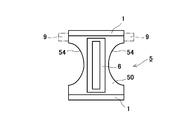
- the tape-type diaper 5 is used in a state where the side seal portion 51 of the outer sheet 50 is not heat-sealed during the manufacturing process and is unfolded.
- the tape-type diaper 5 is attached to the wearer by putting the absorbent body 6 on the wearer's crotch and putting the leg of the wearer out of the notch 54, and then folding the outer sheet 50 in half. .
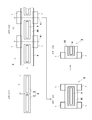
- Flap 9 provided with mechanical fasteners (not shown) that are stretchable in the width direction and engageable with the non-skin surface of the other body on both sides in the width direction of at least one of the front body and the back body Is attached, and the flap 9 can be fastened to both sides on the non-skin surface of the other body in a state where the outer sheet 50 is folded in half. This is effective in that it can be fitted more to the waist of the wearer than the pants-type diaper 5.
- the flap 9 is a composite elastic member formed by sandwiching a plurality of string-like elastic members 91 made of polyurethane or the like between two flap sheets 90 having elasticity in the width direction. 1 can be used. Moreover, you may provide the composite elastic member 1 along the width direction of a waist opening part periphery.
- FIG. 12 is a diagram illustrating a manufacturing process of the second transverse flow type diaper, and the manufacturing process includes stages 1 to 3.
- a pair of third strips 81 which are continuous bodies in which the composite elastic members 1 manufactured by the manufacturing method described above are connected in the transport direction are prepared.
- the width of the third strip 81 is shorter than the length L of the absorber.
- Both the third strips 81 are placed parallel to each other, and the absorbent body 6 is placed across the third strips 81 so that the longitudinal direction is perpendicular to the longitudinal direction of the third strips 81.
- the outer edges along the longitudinal direction of both third strips 81 are folded and overlapped on both ends of the absorbent body 6 in the longitudinal direction.
- a through hole 21 serving as a leg opening 53 may be provided between adjacent absorbers 6. Since both the third strips 81 are separated from each other, when the through hole 21 is opened, the amount of cutting the third strip 81 is very small. Thereby, the material loss of a strip
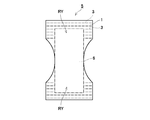
- a non-shrinkable region RY in which the contracting force of the elastic member 3 does not occur may be provided in a portion where the absorber 6 overlaps on the composite contracting member 1. Thereby, the pattern provided on the non-skin surface of the absorbent body 6 does not shrink and becomes easy to see.
- the non-shrinkable region RY can be formed as an empty region where the elastic member 3 is not provided.
- the elastic member 3 is formed by pressurizing or heating a portion where the absorbent body of the composite stretchable member 1 overlaps after the outer packaging material 50 made of the composite stretchable member 1 is formed and before the absorbent body 6 is disposed.
- the non-stretchable region RY can be formed by removing the contraction force at the intermediate portion in the longitudinal direction.
- a roll (not shown) having protrusions and blades provided in a predetermined pattern at intervals along the axial direction and / or circumferential direction is provided. It may be used. It is desirable to substantially remove the contraction force by pressing or heating the composite stretchable member 1 between the roll and the roll facing the roll to finely cut the elastic member 3.
- positioned to the sheet materials 2 and 2a is formed, and the non-joining area
- the non-shrinkable region RY can also be formed by applying pressure to cut the elastic member 3 and snapping back toward both sides in the width direction.
- the coating device 7 shown in FIG. 5 is used to apply the hot melt material to the elastic member 3.
- the hot melt material is not applied to the ridge empty area KY.
- a non-bonded region can be formed on the member 1.
- the elastic member 3 when the elastic member 3 is cut by heating or pressurizing the composite elastic member 1, it is preferable to heat or press from the skin surface side rather than the non-skin surface side of the composite elastic member 1.
- the part where the absorbent body 6 is arranged becomes smooth, and the absorbent body 6 is securely joined. Can do.
- the infant diaper is exemplified as the wearing article using the composite elastic member 1, but the present invention is not limited to this, and for example, an adult diaper may be used. Further, the wearing article may be sanitary shorts or the like.
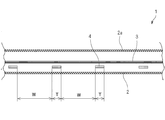
- FIG. 15 is an exploded cross-sectional view of the composite elastic member 1.
- the elastic member 3 is in a stretched state.
- the hot melt material is applied at an equal pitch
- the width T of the joint 4 is 0.5 to 1.5 mm
- the interval W between the adjacent joints 4 is 3 to 10 mm, preferably 4 to
- the composite elastic member 1 which is 8 mm and the sheet materials 2 and 2a are non-woven fabrics can be suitably used for wearing articles such as diapers.
- FIG. 16 is a schematic cross-sectional view of the composite elastic member 1 having the above dimensions.
- the former is clearly distinguished between the heel 2s and the portion 2p between the heel 2s.
- the heel 2s is formed in the same shape and orderly, whereas in the latter, the boundary between the heel 2t and the portion 2q between the heel 2t is ambiguous, and the shape of the heel 2t varies.
- the hot melt material is relatively hot immediately after the hot melt material is applied, so that the hot melt material enters the inside of the nonwoven fabric sheet material 2, but the temperature decreases when the other nonwoven fabric sheet material 2 a is bonded. Therefore, it is considered that the hot melt material is only adhered to the surface of the other nonwoven fabric sheet material 2a.
- a wearing article having an excellent appearance can be obtained by using the non-skin surface side of the wearing article on the non-skin surface side of the non-skin surface of the wearing article, On the contrary, by using the hot melt material 2 on the skin side of the wearing article, a wearing article having good air permeability can be obtained.
- the composite elastic member according to the present invention is useful when used for a wearing article such as a diaper.
Landscapes
- Health & Medical Sciences (AREA)
- Engineering & Computer Science (AREA)
- Life Sciences & Earth Sciences (AREA)
- Biomedical Technology (AREA)
- Heart & Thoracic Surgery (AREA)
- Vascular Medicine (AREA)
- Epidemiology (AREA)
- Animal Behavior & Ethology (AREA)
- General Health & Medical Sciences (AREA)
- Public Health (AREA)
- Veterinary Medicine (AREA)
- Manufacturing & Machinery (AREA)
- Absorbent Articles And Supports Therefor (AREA)
- Laminated Bodies (AREA)
- Shaping Of Tube Ends By Bending Or Straightening (AREA)
Abstract
Description
上記の複合伸縮部材1は、例えば以下の方法により、製造することが出来る。先ず、図4に示すように、加熱したホットメルト材を一方のシート材2の長手方向(X方向)に直交する方向(Y方向)に沿って直線状に連続して塗布する。これにより、接合部4が形成される。接合部4はシート材2の長手方向に亘って、互いに等間隔且つ略平行となるように複数形成される。シート材2の長手方向の両端部にも、ホットメルト材を塗布する。
前記複合伸縮部材1は、幼児用おむつ等の着用物品に用いられる。図6は、該幼児用おむつ5の斜視図であり、図7(a)、(b)は、該おむつ5を展開した平面図である。おむつ5は、所謂パンツ型であって、2つ折りにしてサイドシール部51を接合することにより、内側が装着者の胴部に接するウエスト開口部52、装着者の脚が挿入される一対のレッグ開口部53が形成される。前記ウエスト開口部52は、通気性の外包シート50の長手方向の両端部を重ねて形成され、該外包シート50の内側であって、レッグ開口部53及びサイドシール部51の間には、装着者の尿を吸収する長尺の吸収体6が設けられている。外包シート50は不織布製であるが、通気性且つ熱融着性であれば、材質は問わない。
図8は、第1の横流れタイプのおむつの製造工程を示す平面図である。先ず吸収体6を横方向に連ねた第1帯状体8と、横方向に延びた不織布製の帯である第2帯状体80を用意する。該第2帯状体80は、少なくともその両端部が前述した製造方法により製造された複合伸縮部材1の連続体であり、外包シート50となるものである。両帯状体8、80は第2帯状体80の長手方向に沿う搬送方向Xに沿って搬送される。第2帯状体80の幅は、吸収体6の長さLよりも大きい。製造工程は、ステージ1からステージ6にて構成される。
図9は、縦流れタイプのおむつ5の製造工程を示す平面図である。先ず吸収体6を搬送方向に連ねた第1帯状体8と、搬送方向に延びた不織布製の帯である第2帯状体80を用意する。該第2帯状体80が外包シート50となる。両帯状体8、80は搬送方向Xに沿って搬送される。製造工程は、ステージ1からステージ4にて構成される。
図12は、第2の横流れタイプのおむつの製造工程を示す図であり、該製造工程はステージ1からステージ3にて構成される。先ずステージに示すように、前述した製造方法により製造された複合伸縮部材1を搬送方向に連ねた連続体である第3帯状体81を一対用意する。第3帯状体81の幅は、吸収体の長さLよりも短い。両第3帯状体81を互いに平行に置き、吸収体6を長手方向が第3帯状体81の長手方向に直交するように、両第3帯状体81に跨って置く。複数の吸収体6を搬送方向に離間して置いた後、両第3帯状体81の長手方向に沿う外側縁を折り曲げて、吸収体6の長手方向の両端部に重ねる。
図13に示すように、複合収縮部材1上にて吸収体6が重なる部分に、弾性部材3の収縮力が生じない非収縮領域RYを設けてもよい。これにより、吸収体6の非肌面に設けられる図柄が収縮せず、見易くなる。
2,2a シート材
2s,2t 襞
2p,2q 襞の間の部分
3 弾性部材
4 接合部
5 おむつ
6 吸収体
40 襞
Claims (8)
- 長尺の2枚のシート材を、長手方向を揃えて重ね、両シート材の長手方向に沿って延びた複数本の弾性部材を互いに略平行に両シート材間に挟んで形成される複合伸縮部材であって、
両シート材は、該シート材の長手方向に直交する向きに沿って連続的に塗布されたホットメルト材からなる複数の接合部にて互いに接合され、該接合部は前記複数本の弾性部材を通り、
両シート材上にて隣り合う前記接合部間には、前記弾性部材の収縮作用によって、該シート材の長手方向に直交し前記複数本の弾性部材に亘って延びた複数本の襞が形成されている、複合伸縮部材。 - 前記複数の接合部は、互いに略平行となるように設けられた、請求項1に記載の複合伸縮部材。
- 前記複数本の弾性部材は、長手方向の両端部が前記両シート材に固定されている、請求項1又は2に記載の複合伸縮部材。
- 長尺の2枚のシート材と、両シート材の長手方向に沿って延びた複数本の弾性部材を用意し、一方のシート材上に、該シート材の長手方向に直交する向きに沿ってホットメルト材を連続的に塗布し、接合部を形成する工程と、
伸長状態の複数本の弾性部材を該一方のシート材の長手方向に向け、該弾性部材が接合部を通るように、該一方のシート材上に載置する工程と、
該一方のシート材上に他方のシート材を、長手方向を揃えるように重ねて、前記両シート材を接合する工程を含む、複合伸縮部材の製造方法。 - 周縁部内側が装着者の胴回りに接するウエスト開口部を有する着用物品であって、
請求項1乃至3の何れかに記載の複合伸縮部材を、前記ウエスト開口部及び/又は胴回り部の周縁部に設けてウエストギャザー及び/又は胴回りギャザーを構成した、着用物品。 - 内側が装着者の腰部に接するサイドパネルを有する着用物品であって、
前記サイドパネルとして、請求項1乃至3の何れかに記載の複合伸縮部材を、用いて胴回りギャザーを構成した、着用物品。 - 外包シートを有し、該外包シートには装着者の脚が挿入されるレッグ開口部と、周縁部内側が装着者の胴部に接するウエスト開口部とが設けられ、該外包シートの内側には長尺の吸収体が設けられ、前記ウエスト開口部及び/又は胴回り部の周縁部に請求項1乃至3の何れかに記載の複合伸縮部材が用いられた着用物品の製造方法であって、
前記吸収体を複数用意し、且つ外包シートとなる帯状体を用意する工程と、
各吸収体の長手方向を帯状体の長手方向に直交するように向ける工程と、
前記帯状体の少なくとも両側部は、該複合伸縮部材により形成されるとともに、該帯状体の内側に、前記複数の吸収体本体を互いに離間した状態で接合する工程と、
前記帯状体上にて、隣り合う吸収体間に前記レッグ開口部となる透孔を開設する工程と、
前記帯状体の幅方向の中心線を折り目として、前記吸収体が内側となるように前記帯状体を2つ折りにする工程と、
該2つ折りにされた帯状体を、隣り合う吸収体の中間部にて、該帯状体の長手方向に直交する面内にて接合する工程と、
該接合された帯状体の側部どうしを切断する工程とを有する、着用物品の製造方法。 - 外包シートを有し、該外包シートには、内側が装着者の腰部に接するサイドパネルが設けられ、該外包シートの内側には長尺の吸収体が設けられ、前記サイドパネルに請求項1乃至3の何れかに記載の複合伸縮部材が用いられた着用物品の製造方法であって、
前記吸収体を複数用意し、且つ外包シートとなる帯状体を用意する工程と、
各吸収体の長手方向を前記帯状体の長手方向に向ける工程と、
前記帯状体の側部に、該複合伸縮部材を複数且つ互いに前記吸収体の長手方向の長さ以上の間隔を開けて接合するとともに、該帯状体上にて該複合伸縮部材の内側に、前記複数の吸収体本体を互いに離間した状態で接合する工程と、
前記複合伸縮部材の幅方向に沿って、前記帯状体及び複合伸縮部材を、該複合伸縮部材の長手方向の中心部を通るように切断する工程と、
前記外包シートの長手方向の中心線を折り目として、切断した前記帯状体を2つ折りにして、重なった複合伸縮部材の側部どうしを接合する工程とを有する、着用物品の製造方法。
Priority Applications (3)
| Application Number | Priority Date | Filing Date | Title |
|---|---|---|---|
| CN201380037206.5A CN104470710B (zh) | 2012-07-13 | 2013-06-05 | 设有复合伸缩部件的穿戴物品及其生产方法 |
| BR112014032504A BR112014032504A2 (pt) | 2012-07-13 | 2013-06-05 | elemento extensível composto, método para a produção do dito elemento extensível composto, artigo usado usando o dito elemento extensível composto e método para a produção do dito artigo usado |
| JP2014524693A JP5913594B2 (ja) | 2012-07-13 | 2013-06-05 | 複合伸縮部材を用いた着用物品及び該着用物品の製造方法 |
Applications Claiming Priority (2)
| Application Number | Priority Date | Filing Date | Title |
|---|---|---|---|
| JP2012157365 | 2012-07-13 | ||
| JP2012-157365 | 2012-07-13 |
Publications (1)
| Publication Number | Publication Date |
|---|---|
| WO2014010340A1 true WO2014010340A1 (ja) | 2014-01-16 |
Family
ID=49915813
Family Applications (1)
| Application Number | Title | Priority Date | Filing Date |
|---|---|---|---|
| PCT/JP2013/065570 Ceased WO2014010340A1 (ja) | 2012-07-13 | 2013-06-05 | 複合伸縮部材、該複合伸縮部材の製造方法、該複合伸縮部材を用いた着用物品及び該着用物品の製造方法 |
Country Status (5)
| Country | Link |
|---|---|
| JP (1) | JP5913594B2 (ja) |
| CN (1) | CN104470710B (ja) |
| BR (1) | BR112014032504A2 (ja) |
| MY (1) | MY171071A (ja) |
| WO (1) | WO2014010340A1 (ja) |
Cited By (9)
| Publication number | Priority date | Publication date | Assignee | Title |
|---|---|---|---|---|
| CN106029028A (zh) * | 2014-03-31 | 2016-10-12 | 大王制纸株式会社 | 吸收性物品的伸缩结构的制造方法、短裤型一次性尿布的制造方法以及短裤型一次性尿布 |
| KR20160132846A (ko) * | 2014-03-12 | 2016-11-21 | 다이오 페이퍼 코퍼레이션 | 팬츠 타입 일회용 기저귀 |
| WO2018189780A1 (ja) * | 2017-04-10 | 2018-10-18 | 花王株式会社 | 複合伸縮部材及びそれを備えた使い捨ておむつ |
| WO2018189781A1 (ja) * | 2017-04-10 | 2018-10-18 | 花王株式会社 | 複合伸縮部材及びそれを備えた使い捨ておむつ |
| JP2019098702A (ja) * | 2017-12-07 | 2019-06-24 | 東レ・オペロンテックス株式会社 | 複合積層体 |
| JP2019119069A (ja) * | 2017-12-28 | 2019-07-22 | 花王株式会社 | 伸縮性シート |
| JP2020055266A (ja) * | 2018-10-04 | 2020-04-09 | ユニ・チャーム株式会社 | 伸縮性シート |
| KR20200096520A (ko) * | 2017-12-07 | 2020-08-12 | 도레이 오페론텍스 가부시키가이샤 | 복합 적층체 및 일회용 기저귀 |
| US10786398B2 (en) | 2015-06-22 | 2020-09-29 | Zuiko Corporation | Production device and production method for composite stretchable member |
Families Citing this family (3)
| Publication number | Priority date | Publication date | Assignee | Title |
|---|---|---|---|---|
| CN105890512B (zh) * | 2016-05-27 | 2018-07-10 | 何泽熹 | 穿戴物内腔数据采集机及其采集方法 |
| US11642249B2 (en) | 2016-12-20 | 2023-05-09 | The Procter & Gamble Company | Methods and apparatuses for making elastomeric laminates with elastic strands provided with a spin finish |
| CN111050718B (zh) * | 2017-09-01 | 2021-12-14 | 宝洁公司 | 制备弹性体层合物的方法和设备 |
Citations (8)
| Publication number | Priority date | Publication date | Assignee | Title |
|---|---|---|---|---|
| JP2004065924A (ja) * | 2002-06-14 | 2004-03-04 | Kao Corp | 吸収性物品 |
| JP2005000296A (ja) * | 2003-06-10 | 2005-01-06 | Zuiko Corp | パンツ型着用物品の製造方法 |
| JP2006027089A (ja) * | 2004-07-16 | 2006-02-02 | Kao Corp | 複合伸縮部材及びその製造方法 |
| JP2008229246A (ja) * | 2007-03-23 | 2008-10-02 | Kao Corp | 吸収性物品 |
| JP2009072532A (ja) * | 2007-09-25 | 2009-04-09 | Kao Corp | パンツ型吸収性物品 |
| JP2009148447A (ja) * | 2007-12-21 | 2009-07-09 | Kao Corp | 伸縮性複合シート及びその製造方法 |
| JP2010094879A (ja) * | 2008-10-15 | 2010-04-30 | Uni Charm Corp | 複合シートの製造方法、複合シートを用いた吸収性物品の製造方法、及び複合シートの製造装置 |
| JP2013106939A (ja) * | 2011-10-24 | 2013-06-06 | Kao Corp | 伸縮性シートの製造方法 |
-
2013
- 2013-06-05 CN CN201380037206.5A patent/CN104470710B/zh active Active
- 2013-06-05 BR BR112014032504A patent/BR112014032504A2/pt not_active IP Right Cessation
- 2013-06-05 WO PCT/JP2013/065570 patent/WO2014010340A1/ja not_active Ceased
- 2013-06-05 JP JP2014524693A patent/JP5913594B2/ja not_active Expired - Fee Related
- 2013-06-05 MY MYPI2015700082A patent/MY171071A/en unknown
Patent Citations (8)
| Publication number | Priority date | Publication date | Assignee | Title |
|---|---|---|---|---|
| JP2004065924A (ja) * | 2002-06-14 | 2004-03-04 | Kao Corp | 吸収性物品 |
| JP2005000296A (ja) * | 2003-06-10 | 2005-01-06 | Zuiko Corp | パンツ型着用物品の製造方法 |
| JP2006027089A (ja) * | 2004-07-16 | 2006-02-02 | Kao Corp | 複合伸縮部材及びその製造方法 |
| JP2008229246A (ja) * | 2007-03-23 | 2008-10-02 | Kao Corp | 吸収性物品 |
| JP2009072532A (ja) * | 2007-09-25 | 2009-04-09 | Kao Corp | パンツ型吸収性物品 |
| JP2009148447A (ja) * | 2007-12-21 | 2009-07-09 | Kao Corp | 伸縮性複合シート及びその製造方法 |
| JP2010094879A (ja) * | 2008-10-15 | 2010-04-30 | Uni Charm Corp | 複合シートの製造方法、複合シートを用いた吸収性物品の製造方法、及び複合シートの製造装置 |
| JP2013106939A (ja) * | 2011-10-24 | 2013-06-06 | Kao Corp | 伸縮性シートの製造方法 |
Cited By (23)
| Publication number | Priority date | Publication date | Assignee | Title |
|---|---|---|---|---|
| KR20160132846A (ko) * | 2014-03-12 | 2016-11-21 | 다이오 페이퍼 코퍼레이션 | 팬츠 타입 일회용 기저귀 |
| EP3117811A4 (en) * | 2014-03-12 | 2017-11-22 | Daio Paper Corporation | Disposable pants-type diaper |
| US10092457B2 (en) | 2014-03-12 | 2018-10-09 | Daio Paper Corporation | Underpants-type disposable diaper |
| KR102296409B1 (ko) | 2014-03-12 | 2021-08-31 | 다이오 페이퍼 코퍼레이션 | 팬츠 타입 일회용 기저귀 |
| US10492958B2 (en) | 2014-03-31 | 2019-12-03 | Daio Paper Corporation | Stretchable structure with striped adhesive, method for producing, and absorbent article comprising the stretchable structure |
| EP3127517A4 (en) * | 2014-03-31 | 2017-08-16 | Daio Paper Corporation | Method for producing stretchable structure for absorbent article, method for producing pants-type disposable diaper, and pants-type disposable diaper |
| CN106029028A (zh) * | 2014-03-31 | 2016-10-12 | 大王制纸株式会社 | 吸收性物品的伸缩结构的制造方法、短裤型一次性尿布的制造方法以及短裤型一次性尿布 |
| CN106029028B (zh) * | 2014-03-31 | 2019-12-24 | 大王制纸株式会社 | 吸收性物品的伸缩结构的制造方法、短裤型一次性尿布的制造方法以及短裤型一次性尿布 |
| US10786398B2 (en) | 2015-06-22 | 2020-09-29 | Zuiko Corporation | Production device and production method for composite stretchable member |
| WO2018189781A1 (ja) * | 2017-04-10 | 2018-10-18 | 花王株式会社 | 複合伸縮部材及びそれを備えた使い捨ておむつ |
| WO2018189780A1 (ja) * | 2017-04-10 | 2018-10-18 | 花王株式会社 | 複合伸縮部材及びそれを備えた使い捨ておむつ |
| JPWO2018189781A1 (ja) * | 2017-04-10 | 2020-03-05 | 花王株式会社 | 複合伸縮部材及びそれを備えた使い捨ておむつ |
| JPWO2018189780A1 (ja) * | 2017-04-10 | 2020-03-05 | 花王株式会社 | 複合伸縮部材及びそれを備えた使い捨ておむつ |
| TWI755495B (zh) * | 2017-04-10 | 2022-02-21 | 日商花王股份有限公司 | 複合伸縮構件及具備其之拋棄式尿布 |
| KR102640140B1 (ko) | 2017-12-07 | 2024-02-27 | 도레이 오페론텍스 가부시키가이샤 | 복합 적층체 및 일회용 기저귀 |
| KR20200096520A (ko) * | 2017-12-07 | 2020-08-12 | 도레이 오페론텍스 가부시키가이샤 | 복합 적층체 및 일회용 기저귀 |
| JP2019098702A (ja) * | 2017-12-07 | 2019-06-24 | 東レ・オペロンテックス株式会社 | 複合積層体 |
| JP6995617B2 (ja) | 2017-12-28 | 2022-02-04 | 花王株式会社 | 伸縮性シート |
| JP2019119069A (ja) * | 2017-12-28 | 2019-07-22 | 花王株式会社 | 伸縮性シート |
| JP7383768B2 (ja) | 2018-10-04 | 2023-11-20 | ユニ・チャーム株式会社 | 伸縮性シート |
| JP2022169644A (ja) * | 2018-10-04 | 2022-11-09 | ユニ・チャーム株式会社 | 伸縮性シート |
| JP7125884B2 (ja) | 2018-10-04 | 2022-08-25 | ユニ・チャーム株式会社 | 伸縮性シート |
| JP2020055266A (ja) * | 2018-10-04 | 2020-04-09 | ユニ・チャーム株式会社 | 伸縮性シート |
Also Published As
| Publication number | Publication date |
|---|---|
| MY171071A (en) | 2019-09-24 |
| BR112014032504A2 (pt) | 2017-06-27 |
| CN104470710A (zh) | 2015-03-25 |
| JPWO2014010340A1 (ja) | 2016-06-20 |
| JP5913594B2 (ja) | 2016-04-27 |
| CN104470710B (zh) | 2017-03-08 |
Similar Documents
| Publication | Publication Date | Title |
|---|---|---|
| JP5913594B2 (ja) | 複合伸縮部材を用いた着用物品及び該着用物品の製造方法 | |
| CN110139632B (zh) | 用于吸收性物品的片状构件的制造方法和制造设备 | |
| CN109310546B (zh) | 吸收性物品 | |
| CN106102673B (zh) | 吸收性物品制造方法 | |
| JP4083027B2 (ja) | 使い捨て着用物品の製造方法 | |
| JP5919319B2 (ja) | 吸収性物品製造方法 | |
| JP4769891B2 (ja) | 使い捨て着用物品の製造方法 | |
| JP2006087564A (ja) | 吸収性物品の製造方法 | |
| JP6393503B2 (ja) | パンツ型吸収性物品 | |
| JP5508060B2 (ja) | 吸収性物品の製造方法 | |
| JP5953331B2 (ja) | 吸収性物品製造方法 | |
| WO2020241300A1 (ja) | 着用物品の製造方法 | |
| JP2021171299A (ja) | 使い捨て着用物品の製造方法 | |
| JP5899256B2 (ja) | 吸収性物品製造方法 | |
| JP5879379B2 (ja) | 吸収性物品製造装置 | |
| JPH06114084A (ja) | 着用物品の製造方法 | |
| JPH05137745A (ja) | 使い捨てパンツの製造方法 | |
| JP7684896B2 (ja) | 伸縮性積層体の製造方法 | |
| JP5970575B2 (ja) | 吸収性物品製造方法 | |
| JPH05137746A (ja) | 使い捨てパンツの製造方法 | |
| WO2025028578A1 (ja) | 着用物品の製造方法及び着用物品の製造装置 | |
| JPH05137747A (ja) | 使い捨てパンツの製造方法 |
Legal Events
| Date | Code | Title | Description |
|---|---|---|---|
| 121 | Ep: the epo has been informed by wipo that ep was designated in this application |
Ref document number: 13817142 Country of ref document: EP Kind code of ref document: A1 |
|
| ENP | Entry into the national phase |
Ref document number: 2014524693 Country of ref document: JP Kind code of ref document: A |
|
| NENP | Non-entry into the national phase |
Ref country code: DE |
|
| WWE | Wipo information: entry into national phase |
Ref document number: IDP00201500840 Country of ref document: ID |
|
| REG | Reference to national code |
Ref country code: BR Ref legal event code: B01A Ref document number: 112014032504 Country of ref document: BR |
|
| 122 | Ep: pct application non-entry in european phase |
Ref document number: 13817142 Country of ref document: EP Kind code of ref document: A1 |
|
| ENP | Entry into the national phase |
Ref document number: 112014032504 Country of ref document: BR Kind code of ref document: A2 Effective date: 20141223 |