WO2014007541A1 - 폴리아릴렌 설파이드계 수지 조성물 및 성형품 - Google Patents
폴리아릴렌 설파이드계 수지 조성물 및 성형품 Download PDFInfo
- Publication number
- WO2014007541A1 WO2014007541A1 PCT/KR2013/005904 KR2013005904W WO2014007541A1 WO 2014007541 A1 WO2014007541 A1 WO 2014007541A1 KR 2013005904 W KR2013005904 W KR 2013005904W WO 2014007541 A1 WO2014007541 A1 WO 2014007541A1
- Authority
- WO
- WIPO (PCT)
- Prior art keywords
- polyarylene sulfide
- resin composition
- group
- weight
- composition according
- Prior art date
- Legal status (The legal status is an assumption and is not a legal conclusion. Google has not performed a legal analysis and makes no representation as to the accuracy of the status listed.)
- Ceased
Links
Classifications
-
- C—CHEMISTRY; METALLURGY
- C08—ORGANIC MACROMOLECULAR COMPOUNDS; THEIR PREPARATION OR CHEMICAL WORKING-UP; COMPOSITIONS BASED THEREON
- C08L—COMPOSITIONS OF MACROMOLECULAR COMPOUNDS
- C08L81/00—Compositions of macromolecular compounds obtained by reactions forming in the main chain of the macromolecule a linkage containing sulfur with or without nitrogen, oxygen or carbon only; Compositions of polysulfones; Compositions of derivatives of such polymers
- C08L81/02—Polythioethers; Polythioether-ethers
-
- C—CHEMISTRY; METALLURGY
- C08—ORGANIC MACROMOLECULAR COMPOUNDS; THEIR PREPARATION OR CHEMICAL WORKING-UP; COMPOSITIONS BASED THEREON
- C08K—Use of inorganic or non-macromolecular organic substances as compounding ingredients
- C08K3/00—Use of inorganic substances as compounding ingredients
- C08K3/02—Elements
- C08K3/04—Carbon
-
- C—CHEMISTRY; METALLURGY
- C08—ORGANIC MACROMOLECULAR COMPOUNDS; THEIR PREPARATION OR CHEMICAL WORKING-UP; COMPOSITIONS BASED THEREON
- C08K—Use of inorganic or non-macromolecular organic substances as compounding ingredients
- C08K3/00—Use of inorganic substances as compounding ingredients
- C08K3/18—Oxygen-containing compounds, e.g. metal carbonyls
- C08K3/20—Oxides; Hydroxides
- C08K3/22—Oxides; Hydroxides of metals
-
- C—CHEMISTRY; METALLURGY
- C08—ORGANIC MACROMOLECULAR COMPOUNDS; THEIR PREPARATION OR CHEMICAL WORKING-UP; COMPOSITIONS BASED THEREON
- C08K—Use of inorganic or non-macromolecular organic substances as compounding ingredients
- C08K3/00—Use of inorganic substances as compounding ingredients
- C08K3/30—Sulfur-, selenium- or tellurium-containing compounds
-
- C—CHEMISTRY; METALLURGY
- C08—ORGANIC MACROMOLECULAR COMPOUNDS; THEIR PREPARATION OR CHEMICAL WORKING-UP; COMPOSITIONS BASED THEREON
- C08K—Use of inorganic or non-macromolecular organic substances as compounding ingredients
- C08K3/00—Use of inorganic substances as compounding ingredients
- C08K3/38—Boron-containing compounds
-
- C—CHEMISTRY; METALLURGY
- C08—ORGANIC MACROMOLECULAR COMPOUNDS; THEIR PREPARATION OR CHEMICAL WORKING-UP; COMPOSITIONS BASED THEREON
- C08K—Use of inorganic or non-macromolecular organic substances as compounding ingredients
- C08K7/00—Use of ingredients characterised by shape
- C08K7/02—Fibres or whiskers
- C08K7/04—Fibres or whiskers inorganic
- C08K7/14—Glass
-
- C—CHEMISTRY; METALLURGY
- C08—ORGANIC MACROMOLECULAR COMPOUNDS; THEIR PREPARATION OR CHEMICAL WORKING-UP; COMPOSITIONS BASED THEREON
- C08K—Use of inorganic or non-macromolecular organic substances as compounding ingredients
- C08K9/00—Use of pretreated ingredients
- C08K9/04—Ingredients treated with organic substances
-
- C—CHEMISTRY; METALLURGY
- C08—ORGANIC MACROMOLECULAR COMPOUNDS; THEIR PREPARATION OR CHEMICAL WORKING-UP; COMPOSITIONS BASED THEREON
- C08K—Use of inorganic or non-macromolecular organic substances as compounding ingredients
- C08K3/00—Use of inorganic substances as compounding ingredients
- C08K3/30—Sulfur-, selenium- or tellurium-containing compounds
- C08K2003/3009—Sulfides
- C08K2003/3036—Sulfides of zinc
-
- C—CHEMISTRY; METALLURGY
- C08—ORGANIC MACROMOLECULAR COMPOUNDS; THEIR PREPARATION OR CHEMICAL WORKING-UP; COMPOSITIONS BASED THEREON
- C08K—Use of inorganic or non-macromolecular organic substances as compounding ingredients
- C08K3/00—Use of inorganic substances as compounding ingredients
- C08K3/38—Boron-containing compounds
- C08K2003/382—Boron-containing compounds and nitrogen
- C08K2003/385—Binary compounds of nitrogen with boron
-
- C—CHEMISTRY; METALLURGY
- C08—ORGANIC MACROMOLECULAR COMPOUNDS; THEIR PREPARATION OR CHEMICAL WORKING-UP; COMPOSITIONS BASED THEREON
- C08K—Use of inorganic or non-macromolecular organic substances as compounding ingredients
- C08K2201/00—Specific properties of additives
- C08K2201/002—Physical properties
- C08K2201/003—Additives being defined by their diameter
-
- C—CHEMISTRY; METALLURGY
- C08—ORGANIC MACROMOLECULAR COMPOUNDS; THEIR PREPARATION OR CHEMICAL WORKING-UP; COMPOSITIONS BASED THEREON
- C08K—Use of inorganic or non-macromolecular organic substances as compounding ingredients
- C08K2201/00—Specific properties of additives
- C08K2201/002—Physical properties
- C08K2201/005—Additives being defined by their particle size in general
Definitions
- the present invention relates to a polyarylene sulfide-based resin composition and molded article having improved compatibility with other polymer materials and layered materials, and exhibiting mechanical properties such as excellent tensile strength or laminar strength with higher thermal conductivity.
- polyarylene sulfide is a representative engineering plastic. It is used for various products or electronic products used in high temperature and corrosive environments due to high heat resistance, chemical resistance, flame resistance, and electrical insulation. Demand is increasing.
- TPS polyphenylene sulfide
- PDCB P-dichlorobenzene
- Sulfide sodium sulfide as N-methyl pyrrolidone.
- Solution polymerization in a polar organic solvent This method is known as the Macallum process.
- polyarylene sulfides such as malleable PPS
- a method of producing polyarylene sulfides has been proposed as a method of melt polymerizing a semi-coast containing a diiodine aromatic compound and elemental sulfur.
- the polyarylene sulfide thus prepared has excellent mechanical properties even at high temperatures, and does not require the use of an organic solvent, and also has excellent advantages in productivity.
- the main chain terminal is composed of iodine and most aryl groups (typically, benzene). have.
- compatibility with various reinforcing materials such as other polymer materials or glass fibers or layered materials is inferior in view of the main chain structure.
- the present invention provides a polyarylene sulfide-based resin composition having improved compatibility with other polymer materials and layered materials, and exhibiting mechanical properties such as excellent tensile strength or laminar strength with higher thermal conductivity.
- the present invention is to provide a molded article showing the physical properties optimized for each use, including the poly arylene sulfide resin composition.
- the present invention relates to polyarylene sulfide, expandable graphite; Boron nitride; And it provides a polyarylene sulfide-based resin composition comprising an inorganic filler including at least one selected from the group consisting of zinc sulfide, magnesium oxide and zinc oxide.
- the present invention also provides a molded article comprising the poly arylene sulfide resin composition. It will be described with respect to the polyarylene sulfide resin composition, and last hyeongpum comprising the same according to specific embodiments of the 'hereinafter invention. However, this is presented as an example of the invention, whereby the scope of the invention is not limited, it is apparent to those skilled in the art that various modifications to the embodiments are possible within the scope of the invention.
- the present inventors are the expanded graphite; Boron nitride; And polyarylene sulfides that exhibit excellent thermal conductivity while using relatively small amounts of inorganic fillers by mixing three types of inorganic fillers of zinc sulfide, magnesium oxide or zinc oxide with polyarylene sulfide. It was found that the resin composition can be provided and the invention was completed. Such a water composition can express excellent thermal conductivity while relatively reducing the amount of inorganic filler used. It is confirmed that the polyarylene sulfide may exhibit excellent mechanical properties, and to provide a plastic heat dissipation material having excellent physical properties in response to the demands of the art.
- the polyarylene sulfide may be introduced into at least a portion of the end group of the main chain, such as a carboxyl group (-COOH) or an amine group (-NH 2 ),
- the polyarylene sulfide in which such a reactive group is introduced may exhibit higher compatibility with the inorganic filler as well as other components. Therefore, due to the use of the polyarylene sulfide having the semi-maleic group introduced therein, the resin composition of one embodiment may not only exhibit improved thermal conductivity and mechanical properties, but also more excellent synergistic effect through compounding with various other materials. Can be expressed.
- polyarylene sulfides previously prepared by melt polymerization, since the main chain ends are composed of iodine and most of aryl groups (typically benzene), there is substantially no semi-acyclic group at the main chain ends. For this reason, the polyarylene sulfide seems to exhibit the disadvantage of incompatibility with other polymer materials or fillers including various reinforcing materials such as glass fiber or inorganic filler.
- the increase in physical properties due to compatibility with the material can be optimized to show improved thermal conductivity and mechanical properties, and additionally by mixing with other components, excellent properties for various applications can be achieved. It allows the provision of molded parts.
- the polyarylene sulfide to which the reactive group is introduced is analyzed by FT-IR spectroscopy, and from about 1600 to about 1600 derived from the carboxy group at the main chain terminal in the FT-IR spectrum
- the polyarylene sulfide to which the carboxyl group or the amine group is introduced has a height intensity of a ring stretch peak appearing at about 1500 to 1600 cm " 1 on the FT-IR spectrum at 100%.
- the relative height intensity of the peak of 1 or about 3300 to 3500 cm 1 may be about 0.001 to 10%, or about 0.01 to 7%, or about 0,1 to 4%, or about 0.5 to 3.5%.
- the ring stretch peak appearing in the 1500 to ⁇ ⁇ 1 may be derived from an arylene group such as phenylene contained in the main chain of polyarylene sulfide.
- a peak from about 3300 to 3500cm- 1 is arylene group derived from an approximately 1600 to peak, or amine group of 1800 ⁇ -1 derived from the carboxyl group (e.g., phenylene group), the above-mentioned range for the high strength of a peak derived from
- the height strength of the polyarylene sulfide contained in the resin composition of one embodiment while showing excellent compatibility with other polymer materials or fillers including inorganic fillers, while maintaining the excellent physical properties unique to polyarylene sulfide Can be.
- the resin composition of one embodiment including the same may exhibit better thermal conductivity and mechanical properties due to mixing with a predetermined inorganic filler, and further, a more excellent synergistic effect due to compounding of other polymer materials or layered materials. Can be represented.
- the polyarylene sulfide described above may include disulfide repeating units in the repeating units of the main chain.
- the disulfide repeating unit refers to a polyarylene disulfide repeating unit of Formula 2 including a disulfide bond (-SS- bond) instead of a sulfur bond in a general repeating unit of polyarylene sulfide represented by the following general formula (1): May refer to: [Formula 1] [General Formula
- Ar represents a substituted or unsubstituted arylene group.
- the polyarylene sulfide included in the resin composition of the embodiment includes a disulfide repeating unit, it is possible to suppress that the polyarylene sulfide contains a considerable amount of an oligomeric polymer chain having a low molecular weight. . This seems to be because the disulfide bonds of the disulfide repeat unit can continue to cause sulfur exchange reactions between the polymer chains contained in the polyarylene sulfide, thereby substantially homogenizing the molecular weight of the polymer chains contained in the polyarylene sulfide.
- the polyarylene sulfide included in the resin composition of one embodiment may include a polymer chain in an oligomeric form having a low molecular weight with a minimum content, and the molecular weight distribution curve of the entire polymer chains is uniform, resulting in a relatively narrow molecular weight distribution curve. It can be derived with a symmetry close to the normal distribution curve. Therefore, the resin composition of one embodiment including such polyarylene sulfide can greatly reduce the amount of flash generated even when forming a product requiring high precision by using the same, and can exhibit more improved workability.
- these disulfide repeat units from about 3 parts by weight 0/0 or less, or about 0.01 to 3.0 parts by weight 0/0, the black over the entire polyarylene sulfide may be contained as about 0.1% to 2.0% by weight.
- the effect of improving the workability due to the disulfide repeating unit can be optimized, and the disulfide repeating unit can be excessively increased to suppress the deterioration of the physical properties of the polyarylene sulfide.
- the polyarylene sulfide included in the resin composition of one embodiment may have a melting point of about 265 to 290 ° C., or about 270 to 285 ° C., or about 275 to 283 ° C. With this melting range, reactive groups are introduced
- the poly arylene sulfide and the resin composition of the embodiment including the same obtained by melt polymerization can exhibit excellent heat resistance and flame resistance.
- the polyarylene sulfide may have a number average molecular weight of about 5,000 to 50,000, or about 8,000 to 40,000, or about 10,000 to 30,000.
- the polyarylene sulfide may have a dispersion degree defined as a weight average molecular weight relative to a number average molecular weight of about 2.0 to 4.5, or about 2.0 to 4.0, or about 2.0 to 3.5.
- the resin composition of one embodiment including the same may exhibit excellent mechanical properties and processability, and various properties that can be used for various purposes. It can be processed into molds.
- polyarylene sulfide described above may have a melt viscosity of about 10 to 50,000 poise, or about 1,00 to 20,000, or about 3,00 to 10,000, measured by a rotating plate viscometer at 300 ⁇ .
- the polyarylene sulfide exhibiting such melt viscosity and the resin composition of one embodiment including the same may exhibit excellent mechanical properties, together with excellent processability.
- polyarylene sulfide included in the resin composition of one embodiment has a tensile strength value of about 100 to 900 kgf / ciii 2 , or about 200 to 800 kgf / cin 2 , or about 300, measured according to ASTM D 638.
- the elongation measured according to ASTM D 638 may be about 1 to 10%, black is about 1 to 8%, or about 1 to 6%.
- the polyarylene sulfide may have a flexural strength value measured according to ASTM D 790 of about 100 to 2000 kgf / cin 2 , or about 500 to 2000 kgf / ciif, or about 1000 to 2000 kgf / cuf,
- the layer strength measured according to ASTM D 256 may be about 1 to 100 J / m, black to about 5 to 50 J / m, or about 10 to 20 J / m.
- the polyarylene sulfide included in the resin composition of one embodiment may exhibit various physical properties such as excellent mechanical properties, and may also exhibit excellent compatibility with other polymer materials or layered materials including inorganic fillers. Therefore, the resin composition of one embodiment may exhibit a higher synergistic effect according to the mixing of each component and excellent physical properties suitable for various applications.
- the resin composition of one embodiment together with the poly arylene sulfide described above Certain inorganic fillers such as expandable graphite; Boron nitride; And three or more inorganic fillers comprising one or more selected from the group consisting of zinc sulfide, magnesium oxide and zinc oxide.
- these three inorganic fillers may be dispersed and present in a form in which they are structurally connected in surface contact with each other in a polyarylene sulfide which is a polymer matrix.
- the resin composition of one embodiment can exhibit more excellent thermal conductivity, it is possible to use a relatively small amount of inorganic fillers can express and maintain excellent mechanical properties and the like.
- the inorganic filler may be included in a separate surface treatment state, but at least one inorganic filler, for example, boron nitride, may be included in a state in which the surface is organically coated.
- the organic coating treatment of such inorganic fillers can be carried out by any method well known to those skilled in the art, and for example, organic matter containing boron nitride with stearic acid, organic titanate, organic zirconate or polydimethylsiloxane, etc. It can be coated.
- the inorganic filler coated with the organic coating may further improve substantial contact area, affinity, and compatibility between the inorganic filler and the polymer matrix including polyarylene sulfide, and as a result, the thermal conductivity of the resin composition of one embodiment may be improved. Degree and general physical properties can be more optimized.
- expandable graphite those having an average particle diameter of 1 to 1000 and an aspect ratio of 50 or more can be used.
- the expanded graphite may be obtained by physically chemically separating natural graphite, and the crystal structure may be hexagonal.
- the thermal conductivity and other physical properties of the resin composition of one embodiment are greatly reduced.
- the boron nitride may have an average particle diameter of 5 to 1000 mi and an aspect ratio of 50 to 300, and the crystal structure may be hexagonal. have.
- two or more types of boron nitride which have a different average particle diameter can be mixed and used. According to such a mixed use of boron nitride, the packing density of the inorganic filler can be more optimized, so that the resin composition of one embodiment can exhibit improved thermal conductivity.
- the resin composition of one embodiment may include one or more of zinc sulfide, magnesium oxide or zinc oxide
- the zinc sulfide may have a specific surface area of 50 to 300 m 2 / g, zincite-like structure ( zinc blende structure).
- the magnesium oxide has a purity of about 97% or more and an average particle diameter of about 3 to 5 // D1, and a specific surface area of about 30 to 200 m 2 / g, or about 30 to 100 m 2 / g, as appropriate. Can be.
- it in order to suppress reaction of magnesium oxide in the air, it may be used in a surface-coated form.
- the zinc oxide may be suitably used having a purity of about 99% or more, an average particle diameter of about 0.3 to 0.8, and a specific surface area of about 3 to 7 m 2 / g, or about 3.5 to 6 m 2 / g.
- the polyarylene sulfide resin composition described above is polyarylene sulfide from 10 to 80 weight 0/0, the expansion hokyeon 1 to 50 parts by weight 0 / 0,1 to 50% by weight of boron nitride, and zinc sulfide, magnesium oxide and oxide It may include 1 to 50% by weight of one or more selected from the group consisting of zinc.
- the resin composition of one embodiment exhibits excellent thermal conductivity and mechanical properties due to mixing with a predetermined inorganic filler while maintaining excellent properties of polyarylene sulfide. Can be.
- the polyarylene sulfide for example, the polyarylene sulfide in which the semi-ungsung group is introduced in the resin composition of the embodiment may exhibit excellent compatibility with various polymer materials or layered materials, as described above. same. Therefore, the resin composition of one embodiment may exhibit excellent synergistic effect by being mixed with various other polymer materials or layering materials (for example, compounding). It is possible to exhibit optimized physical properties for various applications.
- the resin composition of one embodiment may include, in addition to the above-described components, another polymer material or a layered material of a thermoplastic resin or a thermoplastic elastomer.
- the polymer material which may be included in the resin composition of one embodiment include various thermoplastic resins such as polyvinyl alcohol resin, vinyl chloride resin, polyamide resin, polyolefin resin or polyester resin; Or various thermoplastic elastomers such as polyvinyl chloride-based elastomers, polyolefin-based elastomers, polyurethane-based elastomers, polyester-based elastomers, polyamide-based elastomers, and polybutadiene-based elastomers.
- the layered material which may be further included in the resin composition in addition to the predetermined inorganic filler may be an organic or inorganic layered material in the form of fibers, beads, flakes, or powders. Specific examples thereof include glass fibers, carbon fibers, Various reinforcing materials / layered materials such as boron fibers, glass beads, glass flakes, talc or calcium carbonate.
- Such fillers include glass fibers, and the addition of such glass fibers may reinforce the mechanical properties of the resin composition and the molded article of one embodiment.
- Such glass fibers may be used in a form whose surface is treated with a silane coupling agent or the like or is untreated. However, when the surface treatment with a silane coupling agent, the cohesion or compatibility of the layered material and the polyarylene sulfide may be more improved.
- the glass fiber may have an average particle diameter of 2 to 5mm and a thickness of 10 to 15 mm 3.
- the content of the glass fiber (glass fiber) in the resin composition may be 1 to 50% by weight.
- the resin composition of the above-described embodiment in addition to each component described above, may further comprise a compatibilizer to further improve the compatibility and interfacial adhesion of the polyarylene sulfide and the inorganic filler.
- a compatibilizer examples include silane compounds, maleic anhydride, titanate, zirconate, ftmiaric acid, phosphate
- stearic acid (Stearic Acid), metal stearate or wax, and the like, two or more kinds selected from these may be used.
- compatibilizers may be further included in 0.1 to 20% by weight of the resin composition.
- each of the inorganic fillers need to be evenly dispersed in the matrix including polyarylene sulfide, and be structurally and organically connected in surface contact with each other. This requirement must be met, due to the linkage and synergism between each inorganic filler, so that the resin composition of one embodiment can exhibit more improved thermal conductivity.
- the compatibilizer may be further included, whereby the resin composition of one embodiment may exhibit more improved thermal conductivity and mechanical properties.
- the addition of a larger amount of inorganic fillers may be necessary.
- a separate feeding device for the introduction of the inorganic filler may be used.
- the resin composition of the embodiment may further include additional additives and / or stabilizers, etc. to further improve its mechanical properties, heat resistance, weather resistance or moldability.
- additives are not particularly limited, and examples thereof include oxidation stabilizers, light stabilizers (UV stabilizers, etc.), plasticizers, lubricants, nucleating agents, or layered reinforcement materials, and two or more selected from them. You may. "
- oxidation stabilizer primary or secondary antioxidants may be used, and specific examples thereof include hindered phenolic, amine, sulfur and phosphorus antioxidants.
- the light stabilizer may be included when the resin composition of one embodiment is applied to the exterior material, in particular, UV stabilizers are typically used, for example, benzotriazole or benzophenol.
- the lubricant is a component used for improving moldability in molding and processing the resin composition of one embodiment, and a hydrocarbon-based lubricant may be representatively used.
- a lubricating agent By using such a lubricating agent, provision of mold release property, such as friction prevention of a resin composition and a metal mold
- Nucleating agents can be used, and this enables the product to increase the solidification speed of the product during pressure and injection, and to shorten the cycle time.
- various other polymer materials, reinforcing materials / layering materials or additives may be included with the polyarylene sulfide described above in the resin composition of one embodiment to exhibit more excellent physical properties.
- various polymer materials or layered materials for further improving mechanical properties, heat resistance, weather resistance, or moldability of the resin composition may be included in the resin composition of one embodiment without particular limitation.
- the resin composition of the above-described embodiment may include a melt-polymerized polyarylene sulfide in which a reactive group such as a carboxyl group (-COOH) or an amine group (-NH 2 ) is introduced into the main chain terminal as a main resin component.
- a reactive group such as a carboxyl group (-COOH) or an amine group (-NH 2 ) is introduced into the main chain terminal as a main resin component.
- Such polyarylene sulfides may include, for example, polymerizing a reactant comprising a diiodine aromatic compound and elemental sulfur; And while proceeding with the polymerization step, it may be prepared by a method comprising the step of further adding a compound having a reactive group of a carboxyl group or an amine group.
- the method may further include adding 30 parts by weight of elemental sulfur.
- the compound having the semi-atom group has a polymerization reaction between the diiodine aromatic compound and the elemental sulfur when the degree of progress of the polymerization reaction is measured as a ratio of the current viscosity to the target viscosity.
- black may be added (eg, at the end of the polymerization reaction) when progressed to about 90% or more and less than 100%.
- the progress of the polymerization reaction is set as the ratio of the current viscosity to the target viscosity by setting the molecular weight of the polyarylene sulfide to be obtained and the target viscosity of the polymerization product according thereto, and measuring the current viscosity according to the progress of the polymerization reaction. It can be measured. At this time, the current viscosity
- the method of measurement can be determined by methods obvious to those skilled in the art depending on the reactor scale.
- a sample pole in which the polymerization reaction is in progress can be taken in the reaction vessel and measured by a viscometer.
- the present viscosity can be automatically measured in a continuous and real time with a viscometer installed in the reactor.
- a compound having a semi-cyclic group of a carboxyl group or an amine group is added at the end of the polymerization reaction to react the polyarylene sulfide main chain.
- Melt-polymerized polyarylene sulfide having such a semi-maleic group introduced into at least some of the end groups can be prepared.
- an appropriate semi-ungsung group is introduced at the end of the main chain to exhibit excellent compatibility with other polymer materials or layered materials including a predetermined inorganic filler.
- polyarylene sulfide having excellent physical properties unique to polyarylene sulfide can be effectively produced.
- the compound which has the said carboxyl group or an amine group as a compound which has the said carboxyl group or an amine group, the compound of the arbitrary monomer (monomer) form which has a carboxyl group or an amine group can be used. More specific examples of such a compound having a carboxyl group or an amine group include 2-iodobenzoic acid, 3-iodobenzoic acid, 4-iodobenzoic acid, and 2,2.
- the compound having the above-described reactive group may be added in an amount of about 0.0001 to 5 parts by weight, or about ⁇ to 3 parts by weight, or about 0.01 to 2 parts by weight based on about loo parts by weight of the diiodine aromatic compound.
- a compound having a semi-aromatic group in such a content, it is possible to introduce an appropriate amount of reactive group into the main chain terminal group.
- a polyarylene sulfide having excellent physical properties peculiar to polyarylene sulfide can be effectively produced while showing excellent compatibility with other polymer materials or fillers such as inorganic fillers.
- the polyarylene sulfide described above is basically prepared by a method of polymerizing a reactant including a diiodine aromatic compound and elemental sulfur, and thus exhibits superior mechanical properties, etc., compared with those produced by the conventional MacColumn process. Can be.
- the diiodine aromatic compounds that can be used in the polymerization reaction is diiobenzene (DIB), diiodonaphthalene (diiodonaphthalene), diiodobiphenyl (diiodobiphenyl), diiodobisphenol (diiodobisphenol), and diiodine benzophenone (diiodobenzophenone) may be one or more selected from the group consisting of, but is not limited thereto, and an alkyl group, a sulfone group, or the like is bonded to these compounds by a substituent, or an oxygen group in an aromatic group. Or diiodine aromatic compounds containing atoms such as nitrogen may also be used.
- diiodine aromatic compounds include isomers of various diiodine compounds depending on the positions at which iodine atoms are attached, among which para-diiodinebenzene (pDIB), 2,6-diiodonaphthalene, or ⁇ , Compounds in which the iodine is bonded in the para position, such as ⁇ '-diiodobiphenyl, may be used more suitably.
- elemental sulfur which reacts with the said diiodine aromatic compound.
- elemental sulfur exists in the form of a ring (cyclooctasuli r; S8) in which 8 atoms are connected at room temperature, and if it is not in this form, any commercially available solid or liquid sulfur can be used without any limitation.
- the elemental sulfur is added during the polymerization step. May be applied.
- the amount of elemental sulfur added in this way may be properly determined by those skilled in the art in view of the content of appropriate disulfide repeat units, but, for example, based on 100 parts by weight of elemental sulfur contained in the initial reactant, It may be added in an amount of 0.01 to 30 parts by weight.
- This additional element of sulfur can be added, for example, when the polymerization reaction proceeds by about 50 to 99%, and may be added separately from the compound having the above-mentioned semi-group, or together with it. .
- the reactants for the preparation of the polyarylene sulfide may further include a polymerization initiator, a stabilizer, or a mixture thereof in addition to the diiodine aromatic compound and the elemental sulfur.
- a polymerization initiator Zero in the group consisting of 1,3-diiodine-4-nitrobenzene, mercaptobenzothiazole, 2,2'-dithiobenzothiazole, cyclonuxylbenzothiazole sulfenamide, and butylbenzothiazole sulfenamide
- a polymerization initiator e.g., 1,3-diiodine-4-nitrobenzene, mercaptobenzothiazole, 2,2'-dithiobenzothiazole, cyclonuxylbenzothiazole sulfenamide, and butylbenzothiazole sulfenamide
- One or more selected may be used, but is not limited to the examples described above.
- the stabilizer there is no limitation in the constitution as long as it is a stabilizer which is usually used for polymerization of the resin.
- a polymerization terminator may be added at a time when the polymerization is made to some extent.
- the polymerization inhibitor which can be used at this time is a compound which can remove superposition
- diphenyl sulfide diphenyl ether, diphenyl, diphenyl, benzophenone, dibenzothiazole disulfide, and monoiodoaryl compound
- Benzothiazoles benzothiazolesulfenamides, thiurams, dithiocarbamates and diphenyl disulfides.
- the polymerization terminating agent is iodobiphenyl, iodophenol, iodoaniline, iodobenzophenone, 2-mercaptobenzothiazole, and 2-mercaptobenzothiazole.
- 2,2'-dithiobisbenzothiazole N-cyclohexylbenzothiazole-2-sulfenamide, 2-morpholinothiobenzo Thiazole (2-morpholmothiobenzothiazole), ⁇ , ⁇ -dicyclonuxylbenzothiazole-2-sulfenamide (N, N-dicyclohexylbenzothiazole-2- sulfenamide, tetramethylthiuram monosulfide, tetramethylthiuram dissulfide, zinc dimethyldithiocarbamate, zinc diethyldithiocarbamate and zinc diethyldithiocarbamate It may be at least one selected from the group consisting of diphenyl disulfide.
- the time of administration of the polymerization terminator may be determined in consideration of the molecular weight of the polyarylene sulfide to be subjected to the final polymerization. For example, it may be administered in an aromatic di-iodine compound is depleted of about 70 to 100 parts by weight 0/0 banung point is included in the initial banung water.
- the polymerization reaction as described above may be carried out under any conditions as long as the polymerization of the reactant containing the diiodine aromatic compound and elemental sulfur can be initiated.
- the polymerization reaction can be carried out under elevated pressure reaction conditions, in this case, the final reaction conditions by performing the temperature rise and pressure drop at the initial reaction conditions of the temperature of about 180 to 250 ° C and pressure of about 50 to 450 torr Phosphorus temperature is changed to about 270 to 350 ° C and pressure about 0.001 to 20 torr, and may proceed for about 1 to 30 hours.
- the final reaction conditions can be carried out the polymerization reaction at a temperature of about 280 to 300 ° C and a pressure of about 0.1 to 0.5 torr.
- the above-described method for producing a poly arylene sulfide may further comprise the step of melting and mixing the reactant containing a diiodine aromatic compound and elemental sulfur before the polymerization reaction.
- Such melt mixing is not limited in the configuration as long as the above-mentioned semi-composites are all melt-mixed, for example, at a temperature of about 130 ° C to 200 ° C, or about 160 ° C to 190 ° C You can proceed.
- melt mixing step is performed before the polymerization reaction, and a subsequent performer can proceed the polymerization reaction more easily.
- the polymerization may be performed in the presence of a nitrobenzene catalyst.
- the catalyst in the case of undergoing a melt mixing step before the polymerization reaction, the catalyst is It may be added in the melt mixing step.
- the nitrobenzene-based catalyst include 1,3-diiodine-4-nitrobenzene, 1-iodine-4-nitrobenzene, and the like, but are not limited to the examples described above.
- a melt-polymerized polyarylene sulfide having a predetermined reactive group introduced into the main chain terminal can be obtained, and such polyarylene sulfide has excellent compatibility with other polymer materials or layering agents such as inorganic fillers. Since it is shown, it is possible to obtain a resin composition of one embodiment showing various physical properties including excellent thermal conductivity and mechanical properties.
- a molded article comprising the polyarylene sulfide-based resin composition of the embodiment described above and a method for producing the same.
- the molded article may be manufactured by a method including extruding the resin composition of the embodiment.
- the molded article of another embodiment may optionally include a molten polymerized polyarylene sulfide having a predetermined reactive group introduced therein, a predetermined inorganic filler, optionally other additives, and the like, and each of these components may be mixed to obtain a resin composition of one embodiment. It can then be produced by extrusion.
- a twin screw extruder may be used, and the diameter ratio (L / D) of the twin screw extruder may be It may be about 30 to 50.
- additives added in small amounts may be first mixed with polyarylene sulfide in a mixer such as a supermixer, and may be pre-mixed.
- the primary composition can be introduced through the main inlet of the twin screw extruder.
- the predetermined inorganic filler and the like may be separately input through a side feeder located on the side of the extruder. At this time, the side injection position is the outlet of the entire barrel of the extruder Approximately 1/3 1/2 from the side. In this way, the inorganic filler and the like can be prevented from being broken by rotation and friction by the extruder screw in the extruder.
- Molded articles of such other embodiments may be in various forms such as films, sheets, or fibers.
- the molded article may be an injection molded article, a press molded article, or a blow molded article.
- the mold temperature may be about 50 ° C. or more, about 60 ° C. or more, or black or about 80 ° C. or more, in terms of crystallization, and about 190 ° C. or less, in view of deformation of the test piece. Or up to about 170 ° C, or up to about 160 ° C.
- the fibers may be various fibers such as undrawn yarn, drawn yarn, or superdrawn yarn, and may be used as woven fabrics, knitted fabrics, nonwoven fabrics (spunbonds, melt blowers, staples), ropes, or nets.
- Such molded articles can be used as electrical / electronic parts such as computer accessories, building parts, automobile parts, mechanical parts, daily products or coatings of chemical contact parts, industrial chemical resistant fibers, and the like.
- the molded article may exhibit more excellent thermal conductivity and mechanical properties, the molded article may be suitably applied as a high heat dissipation plastic applied to electronic products.
- the present invention provides a polyarylene sulfide-based resin composition having improved compatibility with other polymer materials or fillers and exhibiting mechanical properties such as excellent tensile strength or laminar strength with higher thermal conductivity and a resin molded article prepared therefrom. can do.
- Such a resin composition may be suitably applied as a high heat dissipation plastic for electronics, and exhibits excellent physical properties optimized for each application including the same. It is possible to exhibit excellent physical properties peculiar to polyarylene sulfide. This seems to be because the compatibility of each component of the resin composition is improved and the physical properties of each component can exhibit a synergistic effect.
- Synthesis Example 1 Synthesis of polyarylene sulfide containing carboxyl group or amine group at main chain end
- the polyarylene sulfide resin of Synthesis Example 1 was analyzed by FT-IR to confirm the presence of an amine group peak of about 3300 to 3500 cm ⁇ 1 on the spectrum. In addition, when the height intensity of the ring stretch peak appearing at about 1500 to 1600cm 1 on the FT-IR spectrum is 100%, the about 3300 It was confirmed that the relative height intensity of the to 3500 cm 1 peak was about 1.4%.
- Synthesis Example 2 Synthesis of Polyarylene Sulfide without Carboxylic or Amine Group
- the polyarylene sulfide resin of Comparative Example 1 was analyzed by FT-IR to confirm that there were no carboxyl or amine group peaks of about 1600 to 1800 cm & quot ; or about 3300 to 3500 cm 1 on the spectrum.
- antioxidants PPS resins, compatibilizers and The HDPE was mixed uniformly in a mummy with a super mixer, and the mixed primary composition was automatically metered into a hopper of a twin screw extruder (40 mm extruder, L / D: 40).
- the layered materials including inorganic fillers such as carbon fiber, boron nitride (BN), graphite, zinc sulfide, zinc oxide and magnesium oxide are weighed according to each composition, and uniformly mixed with a supermixer or blender in advance.
- the side of the twin screw extruder was injected side by using the primary side feeder.
- an inorganic filler was supplied to the side feeder using a separate quantitative metering feeder, and the inorganic filler was introduced into the twin screw extruder using the side feeder.
- the injected inorganic filler was uniformly mixed with the primary composition by the kneading screw in the twin screw extruder.
- the following physical properties were measured about the resin composition obtained by the said Example and the comparative example.
- the following physical properties are based on the results of measurement of room temperature (23 ° C.) by preparing each resin composition through a twin screw extruder, a sample of the physical properties, and a flat sample of about 1.2 mm in size.
- Thermal Conductivity (ASTM D1461): Measure the heat capacity and thermal diffusivity of the resin composition samples obtained in Examples and Comparative Examples using a NETZSCH (Netzsch, LFA 427) laser flash device, and measure the density using a density gradient tube. After that, the thermal conductivity was calculated by multiplying the heat capacity, the thermal diffusion rate and the density.
- 10 to 12 cm is an insulation type (non-electrically conductive) material, and when it is 10 6 ⁇ . « ⁇ or less, it may be referred to as a conductive type (electrically conductive) material.
- volume resistance is the resistivity of a given pure material, taking into account the resistance and area of the measurement surface and the thickness of the object. Electrodes were placed on the upper and lower portions of a flat sample of a predetermined thickness, and the resistance was measured, and obtained by the following equation.
- A contact cross-sectional area of the electrode (ciif), t: thickness of the workpiece (cm), Rm: measurement resistance ( ⁇ )
- Lamellar Strength According to the ASTM D 256 method, the lamellar strength of the resin composition samples obtained in Examples and Comparative Examples was measured. The following measurement results are shown in Tables 4 and 5. Table 4 Experimental Results for the Resin Compositions of Examples
- the resin composition of Examples 1 to 6 including three inorganic fillers together with PPS into which a predetermined semi-amenorative group is introduced has excellent thermal conductivity, in particular, high heat dissipation plastic of 5 W / mK or more. It has been found to exhibit excellent thermal conductivity suitable for application. In addition, it was confirmed that such a resin composition possesses thermal conductivity of an insulating TYPE exhibiting excellent characteristics also in mechanical properties such as tensile strength and laminar strength.
- Examples 1 to 6 appear to be due to the synergistic effect of using a predetermined inorganic filler together, and furthermore, it is expected to be due to the use of PPS introduced with a reactive group having excellent compatibility with the inorganic filler. do.
- PPS a reactive group having excellent compatibility with the inorganic filler.
- Comparative Example 1 using natural graphite instead of expandable graphite, or the resin compositions of Comparative Examples 2 and 3 that do not contain expanded graphite or boron nitride the total content of the inorganic filler is similar to that of Examples. Even in the case, it was confirmed that thermal conductivity and mechanical properties were poor. In addition, it was confirmed that the resin composition of Comparative Example 4 containing no zinc sulfide, magnesium oxide, and zinc oxide was also inferior in thermal conductivity and mechanical properties.
Landscapes
- Chemical & Material Sciences (AREA)
- Health & Medical Sciences (AREA)
- Chemical Kinetics & Catalysis (AREA)
- Medicinal Chemistry (AREA)
- Polymers & Plastics (AREA)
- Organic Chemistry (AREA)
- Compositions Of Macromolecular Compounds (AREA)
Description
【명세서】
【발명의 명칭】
폴리아릴렌 설파이드계 수지 조성물 및 성형품
【기술분야】
본 발명은 다른 고분자 소재나 층진재 등과의 보다 향상된 상용성을 - 가지며, 보다 높은 열전도도와 함께 우수한 인장강도 또는 층격 강도 등의 기계적 물성을 나타내는 폴리아릴렌 설파이드계 수지 조성물 및 성형품에 관한 것이다.
[배경기술】
현재 플리아릴렌 설파이드는 대표적인 엔지니어링 플라스틱 (Engineering Plastic)으로, 높은 내열성과 내화학성, 내화염성 (flame resistance), 전기 절연성 등으로 인해 고온과 부식성 환경에서 사용되는 각종 제품이나 전자 제품에 사용되는 용도로 수요가 증대되고 있다.
이러한 폴리아릴렌 설파이드 중에서 상업적으로 판매되는 것은 현재 폴리페닐렌 설파이드 (polyphenylene sulfide; 이하 TPS')가 유일하다. 현재까지 주로 적용되는 PPS의 상업적 생산 공정은, 파라-디클로로벤젠 (P- dichlorobenzene; 이하 'pDCB')과 황화나트륨 (sodium sulfide)을 원료로 하여 N- 메틸파이를리돈 (N-methyl pyrrolidone) 등의 극성 유기 용매에서 용액중합 반응시키는 방법이다. 이 방법은 맥컬럼 공정 (Macallum process)으로 알려져 있다.
그러나, 이러한 용액중합 방식의 맥컬럼 공정으로 제조한 폴리아릴렌설파이드의 경우, 고온에서 인장강도 등 기계적 물성이 열악하고, 이의 생산성 또한 우수하지 않은 단점이 있다.
이에 따라, 디요오드 방향족 화합물과 황 원소를 포함하는 반웅물을 용융중합하는 방법으로 상가 PPS 등의 폴리아릴렌 설파이드를 제조하는 방법이 제안된 바 있다. 이렇게 제조된 폴리아릴렌 설파이드는 고온에서도 우수한 기계적 물성을 가지며, 유기 용매의 사용이 요구되지 않을 뿐 아니라, 생산성 또한 우수한 장점이 있다.
그런데, 상기 용융중합 방식으로 제조된 폴리아릴렌 설파이드의 경우, 그 주쇄 말단이 요오드와 대부분의 아릴기 (대표적으로, 벤젠)으로 이루어져
있다. 이러한 폴리아릴렌 설파이드의 경우, 주쇄 구조의 특성상 다른 고분자 소재 또는 유리 섬유 등 각종 강화재나 층진재와의 상용성이 떨어지는 단점이 있다.
이로 인해, 상기 용융중합 방식으로 제조된 폴리아릴렌 설파이드의 경우, 다양한 용도에 적합한 최적화된 물성을 나타내게 하기 위해 다른 고분자 소재 또는 층진재 등과 컴파운딩하기가 힘들었으며, 컴파운딩하더라도 원하는 최적화된 물성을 나타내기 어려운 단점이 있었다. 이러한 문제점으로 인해, 이전에 알려진 폴리아릴렌 설파이드계 수지 조성물의 경우, 각 용도에 맞는 층분한 물성을 나타내기 어려웠고, 다양한 용도에의 적용에 있어 한계가 있었던 것이 사실이다.
한편, 최근 전자소재 및 기기의 경박 단소화에 의해 고밀도 실장이 되고 기능화됨에 따라, 제품 내부에 발열 부품에 의한 내부 온도 상승이 이루어지고, 온도 상승에 의해 전자부품의 속도 저하 둥의 문제가 발행하고 있으며 이에 따라 절연성을 띠는 5W/mK 이상의 고방열 플라스틱의 개발이 요구되고 있다.
이전부터 이러한 고방열 플라스틱으로 적용 가능한 여러 가지 열전도성 플라스틱이 알려진 바 있지만, 상대적으로 다량의 무기 필러를 첨가하여야 당업계에서 요구되는 열전도도의 발현이 가능하였으며, 이러한 다량의 무기 필러를 사용할 경우, 기계적 물성, 성형성 또는 경제성 등이 저하되는 단점이 있었다.
이에 따라, 기존의 열전도 플라스틱의 단점을 극복하고 무기 필러의 작은 사용량으로도 우수한 열전도도의 발현이 가능하고, 이에 따라 우수한 기계적 물성 등을 발현 및 유지하는 플라스틱 방열 소재가 계속적으로 요구되고 있다.
【발명의 내용】
【해결하려는 과제】
본 발명은 다른 고분자 소재나 층진재 등과의 보다 향상된 상용성을 가지며, 보다 높은 열전도도와 함께 우수한 인장강도 또는 층격 강도 등의 기계적 물성을 나타내는 폴리아릴렌 설파이드계 수지 조성물을 제공하는 것이다.
또한, 본 발명은 상기 폴리 아릴렌 설파이드계 수지 조성물을 포함하여 각 용도에 최 적화된 물성을 나타내는 성 형품을 제공하는 것이다.
[과제의 해결 수단】
본 발명은 폴리 아릴렌 설파이드와, 팽창 혹연 (expandable graphite); 질화 붕소; 및 황화 아연, 산화마그네슴 및 산화아연으로 이루어진 군에서 선택된 1종 이상을 포함한 무기 필러를 포함하는 폴리아릴렌 설파이드계 수지 조성물을 제공한다. 또한, 본 발명은 상기 폴리 아릴렌 설파이드계 수지 조성물을 포함하는 성 형품을 제공한다. ' 이하, 발명의 구체적 인 구현예에 따른 폴리아릴렌 설파이드계 수지 조성물 및 이를 포함하는 성 형품에 대하여 설명하기로 한다. 다만, 이는 발명의 하나의 예시로서 제시되는 것으로, 이에 의해 발명 의 권리범위가 한정되는 것은 아니 며 , 발명의 권리 범위 내에서 구현예에 대한 다양한 변형 이 가능함은 당업자에 게 자명하다.
본 명세서 전체에서 특별한 언급이 없는 한 "포함" 또는 "함유 "라 함은 어떤 구성 요소 (또는 구성 성분)를 별다른 제한 없이 포함함을 지 칭하며 , 다른 구성 요소 (또는 구성 성분)의 부가를 제외하는 것으로 해석될 수 없다.
발명의 일 구현예에 따르면, 폴리아릴렌 설파이드와, 팽창 혹연 (expandable graphite); 질화 붕소; 및 황화 아연, 산화마그네슘 및 산화아연으로 이루어 진 군에서 선택된 1종 이상을 포함한 무기 필러를 포함하는 폴리아릴렌 설파이드계 수지 조성물이 제공된다.
본 발명자들은 상기 팽창 흑연; 질화 붕소; 및 황화 아연, 산화마그네슴 또는 산화아연의 3 종의 무기 필러를 폴리 아릴렌 설파이드와 흔합함에 따라, 상대적으로 그리 많지 않은 양의 무기 필러를 사용하면서도 우수한 열전도도 등을 나타내는 폴리 아릴렌 설파이드계 수지 조성물을 제공할 수 있음을 밝혀 내고 발명을 완성하였다. 이 러 한 수자 조성물은 무기 필러의 사용량을 상대적으로 줄이면서도 우수한 열 전도도를 발현할 수
있어, 폴리아릴렌 설파이드 특유의 우수한 기계적 물성을 나타낼 수 있으며, 당업계의 요구에 부응하여 우수한 물성을 갖는 플라스틱 방열 소재의 제공을 가능케 함이 확인되었다.
그리고, 일 구현예의 수지 조성물에서, 상기 폴리아릴렌 설파이드는 주쇄의 말단기 (End Group) 중 적어도 일부에 카르복시기 (-COOH) 또는 아민기 (-NH2) 등의 반웅성기가 도입될 수 있는데, 이러한 반응성기가 도입된 폴리아릴렌 설파이드는 상기 무기 필러뿐 아니라 다른 성분과의 보다 높은 상용성을 나타낼 수 있다. 따라서, 상기 반웅성기가 도입된 폴리아릴렌 설파이드의 사용으로 인해, 일 구현예의 수지 조성물은 보다 향상된 열전도도 및 기계적 물성을 나타낼 수 있을 뿐 아니라, 여타 다양한 소재와의 컴파운딩을 통해 보다 뛰어난 상승 효과를 발현할 수 있다.
이러한 반응성기의 도입에 따른 우수한 상용성은 다음의 기술적 원리에 기인하는 것으로 예측될 수 있다.
이전에 용융중합 방식으로 제조된 폴리아릴렌 설파이드의 경우, 그 주쇄 말단이 요오드와 대부분의 아릴기 (대표적으로, 벤젠)으로 이루어져 있기 때문에, 주쇄 말단에 반웅성기가 실질적으로 존재하지 않는다. 이 때문에, 상기 폴리아릴렌 설파이드가 다른 고분자 소재 또는 유리 섬유 등 각종 강화재나 무기 필러를 포함한 충진재와의 상용성이 떨어지는 단점을 나타내게 되는 것으로 보인다.
이에 비해, 주쇄 말단의 적어도 일부에 카르복시기 (-COOH) 또는 아민기 (-NH2) 등의 반웅성기가 도입된 폴리아릴렌 설파이드의 경우, 상기 반응성기의 존재로 인해 다른 고분자 소재나, 층진재 또는 열전도도 향상을 위한 무기 필러 등과의 우수한 상용성을 나타냄이 확인되었다. 그 결과, 일 구현예의 수지 조성물이 이러한 폴리아릴렌 설파이드와 함께 상술한 무기 필러를 포함하는 경우, 폴리아릴렌 설파이드 특유의 우수한 내열성, 내화학성 및 뛰어난 기계적 물성 등을 나타내면서도, 무기 필러 등의 다른 소재와의 흔합 (예를 들어, 컴파운딩)에 따른 물성의 상승이 최적화되어 보다 향상된 열전도도 및 기계적 물성을 나타낼 수 있을 뿐 아니라, 추가적으로 다른 성분과의 흔합을 통해 다양한 용도에 적합한 뛰어난 물성을 나타내는 성형품의 제공을 가능케 한다.
이러한 일 구현예의 수지 조성물에서, 상기 반응성기가 도입된 폴리아릴렌 설파이드는 FT-IR 분광법으로 분석하였을 때, FT-IR 스펙트럼에서 상기 주쇄 말단의 카르복시기에서 유래한 약 1600 내지
1800cm1의 피크 또는 아민기에서 유래한 약 3300 내지 3500cm"1를 나타낼 수 있다. 이러한 각 피크의 강도는 주쇄 말단기에 결합된 각각의 반웅성기의 함량에 대웅할 수 있다.
일 예에 따르면, 상기 카르복시기 또는 아민기가 도입된 폴리아릴렌 설파이드는 FT-IR 스펙트럼 상에서, 약 1500 내지 1600cm"1에서 나타나는 Ring stretch 피크의 높이 강도를 100%로 하였을 때, 상기 약 1000 내지 1800cm"1 또는 약 3300 내지 3500cm1의 피크의 상대적 높이 강도가 약 0.001 내지 10%, 혹은 약 0.01 내지 7%, 혹은 약 0,1 내지 4%, 혹은 약 0.5 내지 3.5%로 될 수 있다. 이때, 상기 1500 내지 ΙόΟΟ η·1에서 나타나는 Ring stretch 피크는 폴리아릴렌 설파이드의 주쇄 중에 포함된 페닐렌 등의 아릴렌기에서 유래한 것으로 될 수 있다. 상기 카르복시기에서 유래한 약 1600 내지 1800αη-1의 피크 또는 아민기에서 유래한 약 3300 내지 3500cm-1의 피크가 아릴렌기 (예를 들어, 페닐렌기)에서 유래한 피크의 높이 강도에 대해 상술한 범위의 높이 강도를 나타냄에 따라, 일 구현예의 수지 조성물에 포함된 폴리아릴렌 설파이드는 다른 고분자 소재 또는 무기 필러를 포함한 충진재 등과의 보다 우수한 상용성을 나타내면서도, 폴리아릴렌 설파이드 특유의 우수한 물성을 유지할 수 있다. 따라서, 이를 포함하는 일 구현예의 수지 조성물은 소정의 무기 필러와의 흔합에 따른 보다 우수한 열전도도 및 기계적 물성을 나타낼 수 있고, 더 나아가, 다른 고분자 소재나 층진재의 컴파운딩에 따른 보다 뛰어난 상승 효과를 나타낼 수 있다.
한편, 상술한 폴리아릴렌 설파이드는 주쇄의 반복 단위 중에 디설파이드 반복 단위를 포함하는 것으로 될 수 있다. 이때, 디설파이드 반복 단위라 함은 하기 일반식 1로 표시되는 폴리아릴렌 설파이드의 일반적인 반복 단위에서, 황 결합 대신 디설파이드 결합 (-S-S- 결합)을 포함하는 일반식 2의 폴리아릴렌 디설파이드 반복 단위를 지칭할 수 있다: [일반식 1]
[일반식

상기 일반식 1 및 2에서, Ar은 치환 또는 비치환된 아릴렌기를 나타낸다.
이와 같이, 상기 일 구현예의 수지 조성물에 포함된 폴리아릴렌 설파이드가 디설파이드 반복 단위를 포함함에 따라, 상기 폴리아릴렌 설파이드 중에 분자량이 지나치게 낮은 올리고머 형태의 고분자 쇄가 상당 함량 포함되는 것을 억제할 수 있다. 이는 상기 디설파이드 반복 단위 증의 디설파이드 결합이 폴리아릴렌 설파이드에 포함된 고분자 쇄들 간의 황 교환 반웅을 계속적으로 일으키면서 폴리아릴렌 설파이드에 포함된 고분자 쇄들의 분자량을 대체로 균일화할 수 있기 때문으로 보인다. 그 결과, 일 구현예의 수지 조성물에 포함된 폴리아릴렌 설파이드는 분자량이 지나치게 낮은 올리고머 형태의 고분자 쇄를 최소한의 함량으로 포함할 수 있고, 전체 고분자 쇄들의 분자량 분포가 균일화되어 분자량 분포 곡선이 비교적 좁고 정규 분포 곡선에 가까운 대칭형으로 도출될 수 있다. 따라서, 이러한 폴리아릴렌 설파이드를 포함하는 일 구현예의 수지 조성물은 이를 사용해 높은 정밀도가 요구되는 제품을 성형하고자 하는 경우에도 바리 (flash)의 발생량을 크게 줄일 수 있고, 보다 향상된 가공성을 나타낼 수 있다.
또, 이러한 디설파이드 반복 단위는 전체 폴리아릴렌 설파이드에 대해 약 3 중량0 /0 이하, 혹은 약 0.01 내지 3.0 중량0 /0, 흑은 약 0.1 내지 2.0 중량 %로 포함될 수 있다. 이에 따라, 상기 디설파이드 반복 단위에 기인한 가공성 향상 효과가 최적화될 수 있고, 이러한 디설파이드 반복 단위가 지나치게 많아져 상기 폴리아릴렌 설파이드의 물성이 오히려 저하되는 것을 억제할 수 있다.
한편, 일 구현예의 수지 조성물에 포함된 폴리아릴렌 설파이드는 융점이 약 265 내지 290°C, 혹은 약 270 내지 285 °C, 혹은 약 275 내지 283°C로 될 수 있다. 이러한 융점 범위를 가짐에 따라, 반응성기가 도입되며
용융증합 방식으로 얻어진 상기 폴리 아릴렌 설파이드와 이를 포함하는 일 구현예의 수지 조성물은 우수한 내열성 및 난연성을 나타낼 수 있다.
또한, 상기 폴리아릴렌 설파이드는 수 평균 분자량이 약 5,000 내지 50,000, 혹은 약 8,000 내지 40,000, 혹은 약 10,000 내지 30,000으로 될 수 있다. 그리고, 상기 폴리 아릴렌 설파이드는 수평균 분자량에 대한 중량평균 분자량으로 정의되는 분산도가 약 2.0 내지 4.5, 혹은 약 2.0 내지 4.0, 혹은 약 2.0 내지 3.5로 될 수 있다. 상기 폴리아릴렌 설파이드가 상술한 범위의 분산도 및 분자량을 가짐에 따라, 이를 포함하는 일 구현예의 수지 조성물이 우수한 기 계적 물성 및 가공성 등을 나타낼 수 있고, 보다 다양한 용도로 사용 가능한 여 러 가지 성 형품으로 가공될 수 있다.
그리고, 상술한 폴리 아릴렌 설파이드는 회 전 원판 점도계로 300 !:에서 측정한 용융 점도가 약 10 내지 50,000 poise, 혹은 약 1,00 내지 20,000, 혹은 약 3,00 내지 10,000으로 될 수 있다. 이 러 한 용융 점도를 나타내는 폴리아릴렌 설파이드 및 이를 포함하는 일 구현예의 수지 조성물은 우수한 가공성과 함께, 뛰 어난 기 계적 물성 등을 나타낼 수 있다. 예를 들어, 일 구현예의 수지 조성물에 포함된 폴리 아릴렌 설파이드는 ASTM D 638에 따라 측정 한 인장강도 값이 약 100 내지 900 kgf/ciii2, 혹은 약 200 내지 800 kgf/cin2, 혹은 약 300 내지 700 kgf/αη2일 수 있으며, ASTM D 638에 따라 측정 한 신율이 약 1 내지 10%, 흑은 약 1 내지 8%, 혹은 약 1 내지 6%로 될 수 있다. 또, 상기 폴리아릴렌 설파이드는 ASTM D 790에 따라 측정 한 굴곡강도 값이 약 100 내지 2000 kgf/cin2, 혹은 약 500 내지 2000 kgf/ciif, 혹은 약 1000 내지 2000 kgf/cuf으로 될 수 있고, ASTM D 256에 따라 측정한 층격강도가 약 1 내지 100J/m, 흑은 약 5 내지 50 J/m, 혹은 약 10 내지 20 J/m 로 될 수 있다. 이와 같이 , 일 구현예의 수지 조성물에 포함된 폴리아릴렌 설파이드는 우수한 기 계적 물성 등 제반 물성을 나타낼 수 있으며, 이와 함께, 다른 고분자 소재 또는 무기 필러를 포함한 층진재와의 우수한 상용성을 나타낼 수 있기 때문에 , 일 구현예의 수지 조성물은 각 성분의 흔합에 따른 보다 높은 상승 효과 및 다양한 용도에 적 합한 뛰 어난 물성을 나타낼 수 있다.
한편, 일 구현예의 수지 조성물은 상술한 폴리 아릴렌 설파이드와 함께,
소정의 무기 필러, 예를 들어, 팽창 혹연 (expandable graphite); 질화 붕소; 및 황화 아연, 산화마그네슘 및 산화아연으로 이루어진 군에서 선택된 1종 이상으로 되는 3종 이상의 무기 필러를 포함한다. 일 구현예의 수지 조성물에서, 이들 3종의 무기 필러는 고분자 매트릭스로 되는 폴리아릴렌 설파이드 내에서 서로 표면 접촉하여 구조적으로 연결되어 있는 형태로 분산되어 존재할 수 있다. 이들 3종의 무기 필러의 상호 작용으로 인해, 일 구현예의 수지 조성물은 보다 우수한 열전도도를 나타낼 수 있게 되며, 상대적으로 작은 양의 무기 필러의 사용이 가능케 되어 우수한 기계적 물성 등을 발현 및 유지할 수 있다. - 또한, 상기 무기 필러는 별도의 표면 처리되지 않은 상태로 포함될 수도 있지만, 적어도 1종 이상의 무기 필러, 예를 들어, 질화 붕소가 표면이 유기 코팅 처리된 상태로 포함될 수도 있다. 이러한 무기 필러의 유기 코팅 처리는 당업자에게 널리 알려진 임의의 방법으로 수행될 수 있고, 예를 들어, 스테아르산 (stearic acid), 유기 티타네이트, 유기 지르코네이트 또는 폴리디메틸실록산등으로 질화 붕소를 유기 코팅 처리할 수 있다.
이렇게 유기 코팅 처리된 무기 필러를 포함함에 따라, 무기 필러와 폴리아릴렌 설파이드를 포함한 고분자 매트릭스와의 실질적 접촉 면적, 친화성 및 상용성이 보다 향상될 수 있으며, 그 결과 일 구현예의 수지 조성물의 열전도도 및 제반 물성이 보다 최적화될 수 있다.
한편, 상기 3종의 무기 필러 중에서, 팽창 흑연 (expandable graphite)으로는, 1 내지 1000 의 평균 입경 및 50 이상의 편평비 (Aspect ratio)를 갖는 것을 사용할 수 있다. 이러한 팽창 흑연 (expanded graphite)은 천연 graphite를 물리화학적으로 층 분리하여 얻어진 것일 수 있으며, 결정구조가 hexagonal 형태일 수 있다. 그리고, 상기 수지 조성물에서는 서로 다른 편평비 또는 평균 입경 등을 갖는 2종 이상의 팽창 혹연을 흔합하여 사용할 수도 있다. 만일, 이러한 팽창 흑연과 다른 형태의 천연 혹연 등을 사용하는 경우 등에 있어서는, 일 구현예의 수지 조성물의 열전도도나 다른 물성이 크게 저하됨이 확인되었다.
또, 상기 질화 붕소는 5 내지 1000 mi의 평균 입경 및 50 내지 300의 편평비 (Aspect ratio)를 가질 수 있으며, 결정 구조가 육방정계 (hexagonal)일 수
있다. 그리고, 상기 수지 조성물에서는 서로 다른 평균 입 경을 갖는 2종 이상의 질화 붕소를 흔합하여 사용할 수 있다. 이 러 한 질화 붕소의 흔합 사용에 따라, 무기 필러 의 팩킹 밀도 (packing density)가 보다 최 적화되 어 일 구현예의 수지 조성물이 보다 향상된 열전도도를 나타낼 수 있다.
그리고, 일 구현예의 수지 조성물은 황화 아연, 산화마그네슴 또는 산화아연을 1종 이상 포함할 수 있는데, 상기 황화 아연은 50 내지 300 m2/g의 비표면적을 가질 수 있으며, 섬아연석 형구조 (zinc blende structure)의 결정 구조를 가질 수 있다. 그리고, 상기 산화마그네슘은 순도가 약 97%이상이고 평균 입 경 이 약 3 내지 5//D1이며, 비표면적 이 약 30 내지 200m2/g, 혹은 약 30 내지 100m2/g 인 것을 적 절히 사용할 수 있다. 그리고, 산화마그네슘의 공기 중의 반웅을 억제하기 위해, 표면 코팅 된 형 태로 사용될 수 있다. 또, 상기 산화아연은 순도가 약 99%이상이고 평균 입 경 이 약 0.3 내지 0.8 이며 , 비표면적 이 약 3 내지 7m2/g, 혹은 약 3.5 내지 6m2/g 인 것을 적 절히 사용할 수 있다. 그리고, 상기 수지 조성물에서는 이들 성분을 2종 이상 사용하거나, 각각의 성분으로서 서로 다른 비표면적 등을 갖는 2종 이상의 성분을 흔합하여 사용할 수도 있다.
한편, 상술한 폴리아릴렌 설파이드계 수지 조성물은 폴리아릴렌 설파이드 10 내지 80중량0 /0, 팽창 혹연 1 내지 50 중량0 /0, 질화 붕소 1 내지 50중량 %, 및 황화 아연, 산화마그네슘 및 산화아연으로 이루어진 군에서 선택된 1종 이상의 1 내지 50중량 %를 포함할 수 있다. 각 성분을 이 러 한 함량 범위로 포함함에 따라, 일 구현예의 수지 조성물은 폴리 아릴렌 설파이드 특유의 우수한 물성을 유지하면서도, 소정의 무기 필러와의 흔합에 따른 보다 우수한 열전도도 및 기 계적 물성을 나타낼 수 있다.
한편, 상기 일 구현예의 수지 조성물에 포함된 폴리아릴렌 설파이드, 예를 들어, 반웅성기가 도입된 폴리아릴렌 설파이드가 다론 다양한 고분자 소재나 층진재 등과 우수한 상용성을 나타낼 수 있음은 이미 상술한 바와 같다. 따라서, 일 구현예의 수지 조성물은 다양한 다른 고분자 소재나 층진재 등과 흔합 (예를 들어, 컴파운딩)되어 뛰 어난 상승 효과를 나타낼 수
있고, 다양한 용도에 맞는 최적화된 물성을 나타낼 수 있게 된다.
이에 일 구현예의 수지 조성물은 상술한 성분 외에 열가소성 수지 또는 열가소성 엘라스토머의 다른 고분자 소재나, 층진재 등을 포함할 수 있다. 이때, 일 구현예의 수지 조성물에 포함될 수 있는 고분자 소재의 예로는, 폴리비닐알코올계 수지, 염화비닐계 수지, 폴리아미드계 수지, 폴리올레핀계 수지 또는 폴리에스테르계 수지 등의 다양한 열가소성 수지; 혹은 폴리염화비닐계 ¾라스토머, 폴리올레핀계 엘라스토머, 폴리우레탄계 엘라스토머, 폴리에스테르계 엘라스토머, 폴리아미드계 엘라스토머 또는 폴리부타디엔계 엘라스토머 등의 다양한 열가소성 엘라스토머 등을 들 수 있다.
또, 상기 소정의 무기 필러 외에 수지 조성물에 추가로 포함될 수 있는 층진재는 섬유, 비드, 플레이크, 또는 분말 형태의 유기 또는 무기 층진재로 될 수 있고, 이의 구체적인 예로는, 유리 섬유, 탄소 섬유, 붕소 섬유, 유리 비드, 유리 플레이크, 탈크 또는 탄산칼슘 등의 다양한 강화재 /층진재를 들 수 있다.
이러한 충진재의 대표적인 예로서, 유리 섬유를 들 수 있는데, 이러한 유리 섬유의 첨가에 의해 일 구현예의 수지 조성물 및 성형품의 기계적 물성올 보강할 수 있다. 이러한 유리 섬유는 그 표면이 실란 커플링제 등으로 처리되거나 미처리된 형태로 사용될 수도 있다. 다만, 실란 커플링제로 표면 처리시 상기 층진재와 폴리아릴렌 설파이드의 웅집력 또는 상용성이 보다 향상될 수 있다. 또, 상기 유리 섬유는 2 내지 5mm의 평균 입경 및 10 내지 15 皿의 두께를 가질 수 있다. 그리고, 상기 수지 조성물 중 유리 섬유 (glass fiber)의 함량은 1 내지 50 중량 %으로 될 수 있다.
한편, 상술한 일 구현예의 수지 조성물은, 상술한 각 성분 외에도, 폴리아릴렌 설파이드와 무기 필러의 상용성 및 계면 접착력을 보다 향상시키기 위하여 상용화제를 더 포함할 수 있다. 이러한 상용화제의 예로는, 실란 화합물, 말레익 언하이드라이드 (Maleic anhydride), 티타산 염 (titanate), 지르콘산염 (zirconate), 푸마르산 (ftmiaric acid), 포스페이트
(Phosphate), 스테아르산 (Stearic Acid), 금속 스테아레이트 (Metal Stearate) 또는 왁스 등을 들 수 있고, 이들 중에 선택된 2종 이상의 흔합물을 사용할 수도
있다. 이러한 상용화제는 수지 조성물 중 0. 1 내지 20 중량%로 더 포함될 수 있다.
참고로, 일 구현예의 수지 조성물에서, 각 무기 필러들은 폴리아릴렌 설파이드를 포함하는 매트릭스 내에 고르게 분산되고, 서로 표면 접촉하여 구조적, 유기적으로 연결될 필요가 있다. 이러한 요건을 층족하여야, 각 무기 필러 간의 연결 및 상승 작용으로 인해, 일 구현예의 수지 조성물이 보다 향상된 열전도도를 나타낼 수 있다. 이를 위해, 상기 상용화제를 더 포함할 수 있고, 이로 인해, 일 구현예의 수지 조성물이 보다 향상된 열전도도 및 기계적 물성을 나타낼 수 있다.
한편, 일 구현예의 수지 조성물의 제조에서, 보다 높은 열전도도를 얻고자 하는 경우에는, 보다 많은 양의 무기 필러의 첨가가 필요한 경우가 있다. 이러한 경우, 무기 필러의 투입을 위한 별도의 피딩 장치가 사용될 수 있다.
그리고, 상기 일 구현예의 수지 조성물은 이의 기계적 물성, 내열성, 내후성 또는 성형성 등을 추가적으로 향상시키기 위해 추가적인 첨가제 및 /또는 안정제 등을 더 포함할 수도 있다. 이러한 첨가제 등의 종류는 별달리 한정되지는 않지만, 예를 들어, 산화 안정제, 광 안정제 (UV 안정제 등), 가소제, 활제, 핵제 또는 층격 보강재 등을 들 수 있으며, 이들 중에 선택된 2종 이상을 더 포함할 수도 있다. "
이들 첨가제 중, 산화 안정제로는 1차 또는 2차 산화 방지제를 사용할 수 있고, 보다 구체적인 예로는, 힌더드 페놀계, 아민계, 유황계, 또는 인계 산화 방지제를 들 수 있다. 또, 상기 광안정제는 일 구현예의 수지 조성물이 외장재에 적용될 경우 포함될 수 있는데, 특히 UV 안정제가 대표적으로 사용되며, 예를 들어, 벤조트리아졸 또는 벤조페놀 등을 들 수 있다.
그리고, 활제는 일 구현예의 수지 조성물을 성형, 가공함에 있어 성형성의 향상을 위해 사용되는 성분으로서, 탄화수소계 활제를 대표적으로 사용할 수 있다. 이러한 활제의 사용으로, 수지 조성물과 금형 금속과의 마찰방지나, 금형에서의 탈착 등 이형성의 부여가 가능해진다.
또한, 수지 조성물의 성형 과정에서 결정화 속도 개선을 위해 다양한
핵제를 사용할 수 있고, 이를 통해 압, 사출시 제품의 고화 속도 향상, 제품제조 시간 (Cycle time) 단축 등이 가능해진다.
다만, 위에서 나열된 고분자 소재, 층진재 또는 첨가제 등 외에도, 다른 여러 가지 고분자 소재, 강화재 /층진재 또는 첨가제 등이 일 구현예의 수지 조성물에 상술한 폴리아릴렌 설파이드와 함께 포함되어 보다 우수한 물성을 나타낼 수 있음은 물론이다. 보다 구체적으로, 수지 조성물의 기계적 물성, 내열성, 내후성 또는 성형성 등을 보다 향상시키기 위한 다양한 고분자 소재 또는 층진재 등이 별다른 제한없이 일 구현예의 수지 조성물에 포함될 수 있다.
한편, 상술한 일 구현예의 수지 조성물은 주된 수지 성분으로서 주쇄 말단에 카르복시기 (-COOH) 또는 아민기 (-NH2) 등의 반응성 기가 도입된 용융중합형 폴리아릴렌 설파이드가 포함될 수 있다. 이러한 폴리아릴렌 설파이드는, 예를 들어, 디요오드 방향족 화합물과 황 원소를 포함하는 반응물을 중합반웅시키는 단계; 및 상기 중합반응 단계를 진행하면서, 카르복시기 또는 아민기의 반응성 기를 갖는 화합물을 추가로 첨가하는 단계를 포함하는 방법으로 제조될 수 있다. 또, 상기 폴리아릴렌 설파이드에 포함된 디설파이드 반복 단위의 함량을 적절한 범위로 조절하기 위해, 예를 들어, 상기 중합반웅 단계를 진행하면서, 상기 반응물에 포함된 황 원소 100 중량부에 대해, 0.01 내지 30 중량부의 황 원소를 추가로 가하는 단계를 더 포함할 수도 있다.
이하 이러한 폴리아릴렌 설파이드의 제조 방법에 대해 설명하기로 한다.
상기 폴리아릴렌 설파이드의 제조 방법에서, 상기 반웅성 기를 갖는 화합물은 목표 점도에 대한 현재 점도의 비율로 중합반웅의 진행 정도를 측정하였을 때, 상기 디요오드 방향족 화합물과 황 원소 간의 중합반웅이 약
90% 이상, 흑은 약 90% 이상 100% 미만으로 진행되었을 때 (예를 들어, 중합반웅 후기에) 첨가될 수 있다. 상기 중합반웅의 진행 정도는 얻고자 하는 폴리아릴렌 설파이드의 분자량 및 이에 따른 중합 산물의 목표 점도를 설정하고, 중합 반응의 진행 정도에 따른 현재 점도를 측정하여 상기 목표 점도에 대한 현재 점도의 비율로서 측정할 수 있다. 이때, 현재 점도를
측정하는 방법은 반응기 스케일에 따라 당업자에게 자명한 방법으로 결정할 수 있다. 예를 들어, 상대적으로 소형 중합 반응기에서 중합을 진행하는 경우, 반웅기에서 중합 반웅이 진행 중인 샘폴을 취하여 점도계로 측정할 수 있다. 이와 달리, 대형의 연속 중합 반웅기에서 중합을 진행하는 경우, 반웅기 자체에 설치된 점도계로 연속적, 실시간으로 현재 점도가 자동 측정될 수 있다.
이와 같이, 상기 디요오드 방향족 화합물과 황 원소를 포함하는 반응물을 중합반응시키는 과정에서, 중합반웅 후기에 카르복시기 또는 아민기의 반웅성 기를 갖는 화합물을 첨가하여 반응시킴에 따라, 폴리아릴렌 설파이드 주쇄의 말단기 (End Group) 중 적어도 일부에 이러한 반웅성기가 도입된 용융중합형 폴리아릴렌 설파이드를 제조할 수 있다. 특히, 상기 중합반응 후기에 반응성기를 갖는 화합물을 추가로 첨가하여, 주쇄 말단기에 적절한 함량의 반웅성기가 도입되어 상술한 다른 고분자 소재 또는 소정의 무기 필러를 포함한 층진재 등과의 우수한 상용성올 나타내면서도, 폴리아릴렌 설파이드 특유의 우수한 물성을 갖는 일 구현예의 폴리아릴렌 설파이드가 효과적으로 제조될 수 있다.
또한, 상기 폴리아릴렌 설파이드의 제조 방법에서, 상기 카르복시기 또는 아민기를 갖는 화합물로는, 카르복시기 또는 아민기를 갖는 임의의 모노머 (단분자) 형태의 화합물을 사용할 수 있다. 이러한 카르복시기 또는 아민기를 갖는 화합물의 보다 구체적인 예로는, 2-요오드벤조산 (2- Iodobenzoic acid), 3-요요드벤조산 (3-Iodobenzoic acid), 4-요오드벤조산 (4- Iodobenzoic acid), 2,2,-디티오벤조산 (2,2'-Dithiobenzoic acid), 2-요오드아닐린 (2- Iodoaniline), 3-요오드아닐린 (3-Iodoaniline), 4-요오드아닐린 (4-Iodoaniline), 2,2'- 디티오아닐린 (2,2'-Dithiodianiline), 또는 4,4,-디티오아닐린 (4,4,- Dithiodianiline) 등을 들 수 있고, 이외에도 다양한 카르복시기 또는 아민기를 갖는 화합물을 사용할 수 있다.
또, 상술한 반응성기를 갖는 화합물은 디요오드 방향족 화합물의 약 loo 중량부에 대해 약 0.0001 내지 5 중량부, 혹은 약 αοοι 내지 3 중량부, 혹은 약 0.01 내지 2 중량부로 첨가될 수 있다. 이러한 함량으로 반웅성기를 갖는 화합물을 첨가하여, 주쇄 말단기에 적절한 함량의 반응성기를 도입할
수 있고, 그 결과, 다른 고분자 소재 또는 무기 필러 등의 충진재와의 우수한 상용성을 나타내면서도, 폴리아릴렌 설파이드 특유의 우수한 물성을 갖는 폴리아릴렌 설파이드가 효과적으로 제조될 수 있다.
또한, 상술한 폴리아릴렌 설파이드는 기본적으로 디요오드 방향족 화합물과 황 원소를 포함하는 반응물을 중합반응시키는 방법으로 제조되며, 이에 따라 종래의 맥컬럼 공정으로 제조된 것에 비해 보다 우수한 기계적 물성 등을 나타낼 수 있다.
이때, 상기 중합반웅에 사용 가능한 디요오드 방향족 화합물로는 디요오드화벤젠 (diiodobenzene; DIB), 디요오드화나프탈렌 (diiodonaphthalene), 디요오드화비페닐 (diiodobiphenyl), 디요오드화비스페놀 (diiodobisphenol), 및 디요오드화벤조페논 (diiodobenzophenone)로 이루어진 군에서 선택되는 1종 이상을 들 수 있지만, 이에 한정되지 않고, 이러한 화합물들에 알킬 원자단 (alkyl group)이나 술폰 원자단 (sulfone group) 등이 치환기로 결합되어 있거나, 방향족기에 산소나 질소 등의 원자가 함유된 형태의 디요오드 방향족 화합물도 사용될 수 있다. 또, 상기 디요오드 방향족 화합물에는 요오드 원자가 붙은 위치에 따라 여러 가지 디요오드 화합물의 이성질체 (isomer)가 있는데, 이 중에서도 파라-디요오드벤젠 (pDIB), 2,6- 디요오도나프탈렌, 또는 ρ,ρ'-디요오도비페닐처럼 파라 위치에 요오드가 결합된 화합물이 보다 적합하게 사용될 수 있다.
그리고, 상기 디요오드 방향족 화합물과 반웅하는 황 원소의 형태에는 별다른 제한이 없다. 보통 황 원소는 상온에서 원자 8개가 연결된 고리 형태 (cyclooctasuli r; S8)로 존재하는데, 이러한 형태가 아니더라도 상업적으로 사용 가능한 고체 또는 액체 상태의 황이라면 별다른 한정 없이 모두 사용할 수 있다.
또, 이미 상술한 바와 같이, 상술한 폴리아릴렌 설파이드에 포함된 디설파이드 반복 단위의 함량을, 예를 들어, 약 3 중량 % 이하의 적절한 범위로 조절하기 위해, 상기 황 원소는 중합반응 단계 중에 추가적으로 가해질 수도 있다. 이렇게 추가적으로 가해지는 황 원소의 양은 적절한 디설파이드 반복 단위의 함량을 고려하여 당업자가 적절히 결정할 수 있지만, 예를 들어, 상기 최초 반응물에 포함된 황 원소 100 중량부에 대해,
0.01 내지 30 중량부의 양으로 가해질 수 있다. 이 렇게 추가적으로 가해지는 황 원소는, 예를 들어 , 중합반웅이 약 50 내지 99% 정도 진행되 었을 때, 가해질 수 있고, 이미 상술한 반웅성 기를 갖는 화합물과 별도로 가해지거나, 이 와 함께 가해질 수도 있다.
한편, 상기 폴리아릴렌 설파이드의 제조를 위 한 반응물에는 디요오드 방향족 화합물과 황 원소 외 에도 중합개시 제, 안정 제, 또는 이들의 흔합물을 추가로 포함시 킬 수 있는데, 구체적으로 사용 가능한 중합개시 제로는 1,3- 디요오드 -4-니트로벤젠, 머캅토벤조티 아졸, 2, 2'-디티오벤조티아졸, 사이클로핵실벤조티아졸 술펜아미드, 및 부틸벤조티아졸 술펜아미드로 이루어진 군에서 선택되는 1 종 이상을 사용할 수 있으나, 상술한 예에 한정되지는 않는다.
그리고, 상기 안정 제로는 통상 수지 의 중합반응에 사용되는 안정 제이면 그 구성의 한정은 없다.
한편, 상기와 같은 중합반웅 도중, 중합이 어느 정도 이루어진 시 점에 중합중지 제를 첨가할 수 있다. 이 때 사용 가능한 중합 중지 제는 중합되는 고분자에 포함되는 요오드 그룹을 제거하여 중합을 증지 시킬 수 있는 화합물이면, 그 구성의 한정은 없다. 구체적으로는 디 페닐 설파이드 (diphenyl suldife), 디페닐 에 테르 (diphenyl ether), 디 페닐 (diphenyl), 벤조페논 (benzophenone), 디 벤조티 아졸 디설파이드 (dibenzothiazole disulfide), 모노요오도아릴화합물 (monoiodoaryl compound), 벤조티 아졸류 (benzothiazole)류, 벤조티 아졸술펜아미드 (benzothiazolesulfenamide)류, 티우람 (thiuram)류, 디티오카바메이트 (dithiocarbamate)류 및 디 페닐 디 설파이드로 이루어지는 군에서 선택되는 1종 이상일 수 있다.
더욱 바람직하게로, 상기 중합중지 제는 요오도비 페닐 (iodobiphenyl), 요오도페놀 (iodophenol), 요오도아닐린 (iodoaniline), 요오도벤조페논 (iodobenzophenone), 2-메르캅토벤조티 아졸 (2- mercaptobenzothiazole), 2,2'-디티오비스벤조티 아졸 (2,2'-dithiobisbenzothiazole), N- 시클로핵실벤조티 아졸 -2-술펜아미드 (N-cyclohexylbenzothiazole-2-sulfenamide), 2- 모르폴리노티오벤조티 아졸 (2-morpholmothiobenzothiazole), Ν,Ν- 디시클로핵실벤조티아졸 -2-술펜아미드 (N,N-dicyclohexylbenzothiazole-2-
sulfenamide), 테트라메틸티우람 모노술파이드 (tetramethylthiuram monosulfide), 테트라메틸티우람 디술파이드 (tetramethylthiuram disulfide), 아연 디메틸디티오카바메이트 (Zinc dimethyldithiocarbamate), 아연 디에 틸디티오카바메이트 (Zinc diethyldithiocarbamate) 및 디페닐 디 설파이드 (diphenyl disulfide)로 이루어지는 군에서 선택되는 1종 이상일 수 있다.
한편, 중합중지 제의 투여 시 점은 최종 중합시 키고자 하는 폴리아릴렌 설파이드의 분자량을 고려하여 그 시 기를 결정할 수 있다. 예를 들어 , 초기 반웅물 내에 포함된 디요오드 방향족 화합물이 약 70 내지 100 중량0 /0이 반웅되어 소진된 시 점 에서 투여할 수 있다.
그리고, 상기와 같은 중합반웅은 디요오드 방향족 화합물과 황 원소를 포함하는 반응물의 중합이 개시될 수 있는 조건이면 어떠 한 조건에서든 진행될 수 있다. 예를 들어 , 상기 중합반웅은 승온 감압 반웅 조건에서 진행될 수 있는데, 이 경우, 온도 약 180 내지 250°C 및 압력 약 50 내지 450 torr의 초기 반응조건에서 온도 상승 및 압력 강하를 수행하여 최종 반웅조건인 온도 약 270 내지 350 °C 및 압력 약 0.001 내지 20 torr로 변화시 키 며, 약 1 내지 30시간 동안 진행할 수 있다. 보다 구체적 인 예로서, 최종 반응조건을 온도 약 280 내지 300 °C 및 압력 약 0.1내지 0.5 torr로 하여 중합반응을 진행할 수 있다.
한편, 상술한 폴리 아릴렌 설파이드의 제조 방법은 상기 중합반웅 전에 , 디요오드 방향족 화합물과 황 원소를 포함하는 반응물을 용융 흔합하는 단계를 추가로 포함할 수 있다. 이와 같은 용융 흔합은 상술한 반웅물들이 모두 용융 흔합될 수 있는 조건이면 그 구성의 한정은 없으나, 예를 들어, 약 130 °C 내지 200 °C , 혹은 약 160 °C 내지 190 °C의 온도에서 진행할 수 있다.
이와 같이 중합반웅 전에 용융 흔합 단계를 진행하여, 추후 행해자는 중합반웅을 보다 용이하게 진행할 수 있다.
그리고, 상술한 폴리 아릴렌 설파이드의 제조 방법에 있어서, 중합반응은 니트로벤젠계 촉매의 존재 하에서 진행될 수 있다. 또한, 상술한 바와 같이 중합반응 전에 용융흔합 단계를 거치는 경우, 상기 촉매는
용융흔합 단계에서 추가될 수 있다. 니트로벤젠계 촉매의 종류로는 1,3- 디요오드 -4-니트로벤젠, 또는 1-요오드 -4-니트로벤젠 등을 들 수 있으나, 상술한 예에 한정되는 것은 아니다.
상술한 제조 방법으로, 주쇄 말단에 소정의 반응성기가 도입된 용융중합형 폴리아릴렌 설파이드가 얻어질 수 있고, 이러한 폴리아릴렌 설파이드는 다른 고분자 소재 또는 무기 필러 등의 층진제 등과의 우수한 상용성을 나타내므로, 이를 이용해 우수한 열전도도 및 기계적 물성을 포함한 제반 물성을 나타내는 일 구현예의 수지 조성물을 얻을 수 있게 된다.
한편, 발명의 다른 구현예에 따르면, 상술한 일 구현예의 폴리아릴렌 설파이드계 수지 조성물을 포함하는 성형품 및 이의 제조 방법이 제공된다. 상기 성형품은 상기 일 구현예의 수지 조성물을 압출하는 단계를 포함하는 방법으로 제조될 수 있다. '
이하 이러한 성형품 및 제조 방법에 대해 보다 구체적으로 설명하기로 한다. 다만, 상기 성형품에 포함될 수 있는 성분의 종류 및 함량에 대해서는 이미 일 구현예의 수지 조성물에 대해 설명한 바가 있으므로, 이에 대한 추가적인 구체적인 설명은 생략하기로 한다.
다른 구현예의 성형품은 선택적으로 소정의 반응성기가 도입된 용융중합형 폴리아릴렌 설파이드, 소정의 무기 필러와, 선택적으로 다른 첨가제 등을 포함하게 되는데, 이들 각 성분을 흔합하여 일 구현예의 수지 조성물을 얻은 후 이를 압출하여 제조될 수 있다.
또한, 상술한 각 성분을 포함하는 수지 조성물을 흔합 및 압출하여 성형품을 제조함에 있어서는, 예를 들어, 이축 압출기 (Twin Screw Extruder)를 사용할 수 있으며, 이러한 이축 압출기의 직경비 (L/D)는 약 30에서 50 내외로 될 수 있다.
일 예에 따르면, 먼저 소량 첨가되는 기타 첨가제 등을 수퍼믹서 등의 흔합기로 폴리아릴렌 설파이드와 사전에 흔합할 수 있고, 사전 흔합된
1차 조성물을 2축 압출기의 주 투입구를 통해 투입할 수 있다. 또한, 소정의 무기 필러 등은 압출기의 측면에 위치한 투입구 (side feeder)를 통해 별도로 투입할 수 있다. 이때, 측면 투입하는 위치는 압출기 전체 배럴의 배출구
측으로부터 대략 1/3 1/2 지점으로 될 수 있다. 이렇게 하면, 상기 무기 필러 등이 압출기 내에서 압출기 스크루에 의한 회전 및 마찰에 의해 깨지는 것이 방지할 수 있다.
이러한 방식으로 일 구현예의 수지 조성물의 각 성분을 흔합한 후, 이축 압출기로 압출함으로서, 다른 구현예의 성형품을 얻을 수 있다.
이러한 다른 구현예의 성형품은 필름, 시트, 또는 섬유 등의 다양한 형태로 될 수 있다. 또, 상기 성형품은 사출 성형품, 압 성형품, 또는 블로우 성형품일 수 있다. 사출 성형하는 경우의 금형 온도는, 결정화의 관점에서, 약 50 °C 이상, 약 60 °C 이상, 흑은 약 80 °C 이상으로 될 수 있고, 시험편의 변형의 관점에서, 약 190 °C 이하, 혹은 약 170 °C 이하, 혹은 약 160 °C 이하로 될 수 있다.
그리고, 상기 성형품이 필름 또는 시트 형태로 되는 경우, 미연신, 1축 연신, 2축 연신 등의 각종 필름 또는 시트로 제조할 수 있다. 섬유로서는, 미연신사, 연신사, 또는 초연신사 등 각종 섬유로 하고, 직물, 편물, 부직포 (스펀본드, 멜트블로우, 스테이플), 로프, 또는 네트로서 이용할 수 있다.
이러한 성형품은 컴퓨터 부속품 등의 전기 ·전자 부품, 건축 부재, 자동차 부품, 기계 부품, 일용품 또는 화학물질이 접촉하는 부분의 코팅, 산업용 내화학성 섬유 등으로서 이용할 수 있다. 특히 , 상기 성형품은 보다 우수한 열 전도도 및 기계적 물성을 나타낼 수 있으므로, 전자제품 등에 적용되는 고방열 플라스틱으로서 매우 적합하게 적용될 수 있다.
본 발명에 있어서 상기 기재된 내용 이외의 사항은 필요에 따라 가감이 가능한 것이므로, 본 발명에서는 특별히 한정하지 아니한다.
【발명의 효과】
본 발명은 다른 고분자 소재나 충진재 등과의 보다 향상된 상용성을 가지며, 보다 높은 열전도도와 함께 우수한 인장강도 또는 층격 강도 등의 기계적 물성을 나타내는 폴리아릴렌 설파이드계 수지 조성물 및 이로부터 제조되는 수지 성형품을 제공할 수 있다.
이러한 수지 조성물은 전자제품의 고방열 플라스틱으로 매우 적합하게 적용될 수 있으며 , 이를 포함한 각 용도에 최적화된 우수한 물성을 나타낼
수 있으면서도, 폴리아릴렌 설파이드 특유의 우수한 물성을 나타낼 수 있다. 이는 수지 조성물의 각 성분의 상용성이 향상되어 각 성분의 물성이 상승 효과를 나타낼 수 있기 때문으로 보인다.
【발명을 실시하기 위한 구체적인 내용】
이하, 본 발명의 이해를 돕기 위하여 바람직한 실시예를 제시하나, 하기 실시예는 본 발명을 예시하는 것일 뿐 본 발명의 범위가 하기 실시예에 한정되는 것은 아니다. 합성예 1: 카르복시기 또는 아민기를 주쇄 말단에 포함하는 폴리아릴렌 설파이드의 합성
반응기의 내온 측정이 가능한 써모커플, 그리고 질소 층전 및 진공을 걸 수 있는 진공라인이 부착된 5 L 반웅기에 파라디요오드벤젠 (p-DIB) 5130g, 황 450g, 반웅개시제로 1,3-디요오드 -4-니트로벤젠 4g을 포함한 반응물을 180°C로 가열하여 완전히 용융 및 흔합한 후, 220 °C 및 350Torr의 초기 반응 조건에서 시작하여, 최종 반응온도는 300°C, 압력은 lTorr 이하까지 단계적으로 온도 상승 및 압력 강하를 수행하면서 중합반응을 진행하였다. 상기 중합반웅이 80% 진행되었을 때 (이러한 중합반응의 진행 정도는 "(현재점도 /목표점도) * 100%"의 식으로, 목표 점도에 대한 현재 점도의 상대 비율로서 측정하였으며, 현재점도는 중합 진행 중의 샘플을 채취해 점도계로 측정하였다.), 중합중지제로 2,2,-디티오비스벤조트리아졸을 25g 첨가하고 1시간 반웅을 진행하였다. 이어서, 상기 중합반응이 90% 진행되었을 때, 4- Iodoaniline을 51g 첨가하고 10분 동안 질소 분위기 하에서 반응을 진행한 후, 0.5Torr 이하로 서서히 진공을 가하여 1시간 반웅을 진행한 후 종료하여, 카르복시기 또는 아민기를 주쇄 말단에 포함하는 폴리아릴렌 설파이드 수지를 합성하였다. 반웅이 완료된 수지를 소형 스트랜드 커터기를 사용하여 펠렛 형태로 제조하였다.
이러한 합성예 1의 폴리아릴렌 설파이드 수지를 FT-IR로 분석하여 스펙트럼 상에서, 약 3300 내지 3500cmᅳ1 의 아민기 피크의 존재를 확인하였다. 또한, 상기 FT-IR 스펙트럼 상에서, 약 1500 내지 1600cm1에서 나타나는 Ring stretch 피크의 높이 강도를 100%로 하였을 때, 상기 약 3300
내지 3500cm1 피크의 상대적 높이 강도는 약 1.4%임이 확인되었다. 합성예 2: 카르복시기 또는 아민기를 갖지 않는 폴리아릴렌 설파이드의 합성
반응기의 내온 측정이 가능한 써모커플, 그리고 질소 충전 및 진공을 걸 수 있는 진공라인이 부착된 5 L 반웅기에 파라디요오드벤젠 (p-DIB) 5130g, 황 450g, 반응개시제로 1,3-디요오드 -4-니트로벤젠 4g을 포함한 반응물을 180°C로 가열하여 완전히 용융 및 흔합한 후, 220°C 및 350Torr의 초기 반웅 조건에서 시작하여, 최종 반웅온도는 300 °C, 압력은 lTorr 이하까지 단계적으로 온도 상승 및 압력 강하를 수행하면서 중합반웅을 진행하였다. 상기 중합반웅이 80% 진행되었을 때 (이러한 중합반응의 진행 정도는 "(현재점도 /목표점도) * 100%"의 식으로, 목표 점도에 대한 현재 점도의 상대 비율로서 측정하였으며, 현재점도는 중합 진행 중의 샘플을 채취해 점도계로 측정하였다.), 중합중지제로 2,2,-디티오비스벤조트리아졸을 25g 첨가하고 10분 동안 질소 분위기 하에서 반응을 진행한 후, 0.5Torr 이하로 서서히 진공을 가하여 목표점도에 도달 한 후 반웅을 종료하여, 카르복시기 또는 아민기를 주쇄 말단에 포함하지 않은 폴리아릴렌 설파이드 수지를 합성하였다. 반웅이 완료된 수지를 소형 스트랜드 커터기를 사용하여 펠렛 형태로 제조하였다.
이러한 비교예 1의 폴리아릴렌 설파이드 수지를 FT-IR로 분석하여 스펙트럼 상에서, 약 1600 내지 1800cm"1 또는 약 3300 내지 3500cm1의 카르복시기 또는 아민기 피크가 없음을 확인하였다.
[실시예 및 비교예: 폴리아릴렌 설파이드계 수지 조성물의 제조 Γ 하기 표 1 및 표 2의 조성을 갖는 폴리아릴렌 설파이드계 수지 조성물을 다음의 방법으로 제조하였다. 실시예 1 내지 6 및 비교예 1 내지 4: 폴리아릴렌 설파이드계 수지 조성물의 제조
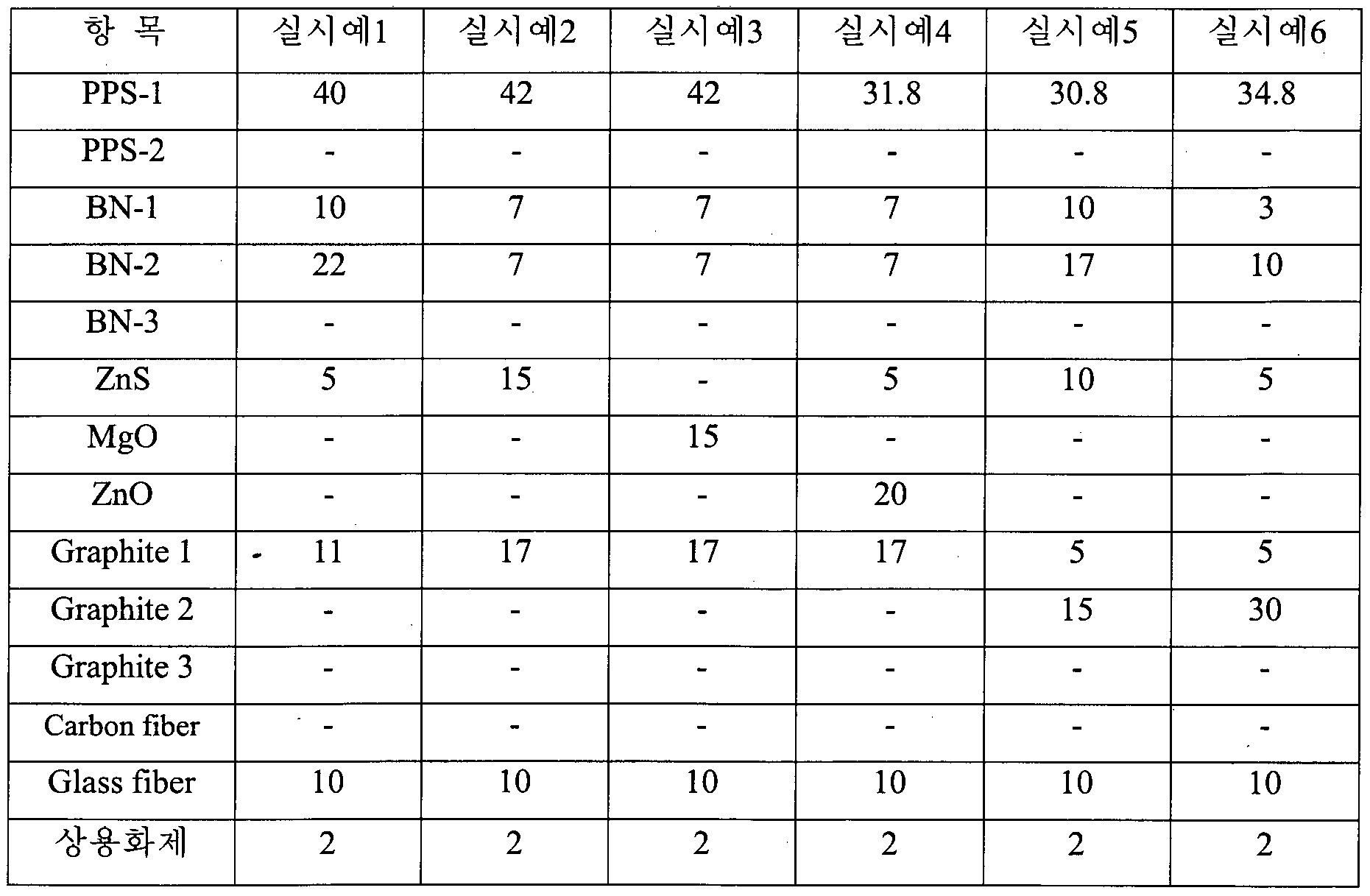
하기 표 1 및 2의 조성에 따라, 산화방지제, PPS 수지, 상용화제 및
HDPE를 수퍼 믹서로 미라 균일하게 흔합하고, 이 렇게 흔합된 1차 조성물을 2축 압출기 (40mm Extruder, L/D: 40)의 Hopper로 자동 계량 투입 하였다.
한편, 카본파이버, 질화붕소 (BN), 그라파이트, 황화아연, 산화아연 및 산화마그네슘 등의 무기 필러를 포함한 층진재를 각 조성에 따라 계량하여 , 사전에 슈퍼믹서나 블렌더를 이용하여 균일하게 흔합하고, 이축 압출기의 옆에서 1차 Side Feeder를 이용하여 측면 투입하였다. 무기 필러의 함량을 일정하게 투입하기 위해서 , 별도의 정량 계량 공급설비를 이용하여 Side Feeder에 무기 필러를 공급하고, Side Feeder를 이용하여 이축 압출기의 내부로 무기 필러를 투입하였다. 이 렇게 투입된 무기 필러는 이축 압출기내에 있는 흔합 (Kneading)스크류에 의 해 1차 조성물과 균일하게 흔합되 었다.
2차 Side Feeder를 이용하여 유리 섬유를 투입한 후, 흔합 및 휘 발성 개스를 감압제거하고, 방열 Compo皿 d 스트랜드를 Chip Cutting기를 사용하여 펠렛 (Pellet) 형태로 제조하였다.
[표 1] 실시 예의 수지 조성물

[표 2] 비교예의 수지 조성물

[표 3] 실시예 및 비교예에서 사용한 각 성분


[실험예]
상기 실시예 및 비교예에서 얻어진 수지 조성물에 대하여 하기 물성을 측정하였다. 참고로, 이하의 물성은 이축 압출기를 통하여 각 수지 조성물을 제조하고 그 물성 샘플 및 약 1.2mm 크기의 평판 샘플을 제조해 상온 (23°C) 측정한 결과를 기준으로 하는 것이다.
1. 열전도도 (ASTM D1461): 네취 (Netzsch, LFA 427) 레이저플래쉬 장치를 이용하여 실시예 및 비교예에서 얻어진 수지 조성물 샘플의 열용량 및 열확산율을 측정하고, 밀도구배관을 이용하여 밀도를 측정한 후, 열용량, 열확산율 및 밀도를 곱하여 열전도율을 계산하였다.
2. 체적저항 (전기 전도도) (ASTM D257): 각 수지 조성물 샘플의 전기전도도는 ASTMD257에 따라 체적저항을 측정해 평가하였다.
일반적으로 1012 cm 이면 절연 Type (전기가통하지 않는) 소재이며, 106 Ω.«η 이하인 경우 전도 Type (전기가 통하는) 소재로 지칭될 수 있다.
체적저항 (Volume Resistance, ilcm)은 주어진 순수한 물질의 고유저항으로, 측정 표면의 저항과 면적 그리고 물체의 두께를 고려한 값이다. 일정 두께의 평판 샘플의 상, 하부에 전극을 배치하고 저항을 측정하여 다음과 같은 식에 의해 구하였다.
체적저항 (pv)= A/t ' Rm (Q.cm)
A: 전극의 접촉 단면적 (ciif),t: 측정물의 두께 (cm),Rm: 측정저항 (Ω)
3. 인장강도: ASTM D 638법에 따라, 실시예 및 비교예에서 얻어진 수지 조성물 샘플의 인장강도를 측정하였다.
4. 층격강도 (Izod): ASTM D 256법에 따라, 실시예 및 비교예에서 얻어진 수지 조성물 샘플의 층격 강도를 측정하였다 하기 측정 결과를 표 4 및 표 5에 나타내었다.
[표 4] 실시예의 수지 조성물에 대한 실험 결과

이러한 실시예 1 내지 6의 우수한 물성은 소정의 무기 필러가 3종 함께 사용됨에 따른 상승 작용에 따른 것으로 보이며, 더 나아가, 무기 필러와의 상용성이 우수한 반응성기가 도입된 PPS의 사용에 따른 것으로 예측된다. 또, 서로 다른 평균 입경을 갖는 표면 코팅된 질화 붕소의 2종 이상을 함께 사용함에 따라, 보다 우수한 물성의 발현이 가능해진 것으로 예측된다.
이에 비해, 팽창 혹연 (expandable graphite) 대신 천연 혹연을 사용한 비교예 1이나, 팽창 혹연 또는 질화 붕소를 포함하지 않는 비교예 2 및 3의 수지 조성물의 경우, 무기 필러의 전체 함량이 실시예와 유사한 범위인 경우에도, 열전도도 및 기계적 물성이 열악하게 나타남이 확인되었다. 또, 황화 아연, 산화마그네슘 및 산화아연을 전혀 포함하지 않는 비교예 4의 수지 조성물 역시 열전도도 및 기계적 물성이 열악하게 나타남이 확인되었다.
Claims
【청구항 1】
폴리아릴렌 설파이드와,
팽창 혹연 (expandable graphite); 질화 붕소; 및 황화 아연, 산화마그네슘 및 산화아연으로 이루어진 군에서 선택된 1종 이상을 포함한 무기 필러를 포함하는 폴리아릴렌 설파이드계 수지 조성물.
【청구항 2】
제 1 항에 있어서 , 상기 폴리아릴렌 설파이드는 주쇄의 반복 단위 중에 디설파이드 반복 단위를 포함하는 폴리아릴렌 설파이드계 수지 조성물.
【청구항 3】
제 1 항에 있어서, 상기 디설파이드 반복 단위는 전체 폴리 아릴렌 설파이드에 대해 3 중량% 이하로 포함되는 폴리 아랄렌 설파이드계 수지 조성물.
[청구항 4】
제 1 항에 있어서, 상기 폴리아릴렌 설파이드는 수평균 분자량이 5,000 내지 50,000인 폴리아릴렌 설파이드계 수지 조성물.
【청구항 5]
제 1 항에 있어서 , 회 전 원판 점도계로 300°C에서 측정 한 상기 폴리아릴렌 설파이드의 용융점도가 10 내지 50,000 poise인 폴리아릴렌 설파이드계 수지 조성물.
【청구항 6】
제 1 항에 있어서, 상기 폴리아릴렌 설파이드 주쇄의 말단기 (End Group) 중 적어도 일부에 카르복시 기 (-COOH) 또는 아민기 (-NH2)가 도입 되어 있는 폴리 아릴렌 설파이드계 수지 조성물.
【청구항 7]
제 6 항에 있어서, 상기 폴리아릴렌 설파이드는 FT-IR 스펙트럼 상에서, 1600 내지 1800 cm'1 또는 3300 내지 3500 cm1의 피크를 나타내는 폴리아릴렌 설파이드계 수지 조성물.
【청구항 8]
제 1 항에 있어서, 상기 무기 필러는 폴리아릴렌 설파이드 내에서 서로 표면 접촉하여 구조적으로 연결되어 있는 폴리아릴렌 설파이드계 수지 조성물.
【청구항 9]
제 1 항에 있어서, 상기 무기 필러는 표면이 유기 코팅 처리되어 있는 폴리아릴렌 설파이드계 수지 조성물.
【청구항 10]
거 1 1 항에 있어서, 상기 팽창 흑연은 1 내지 1000 의 평균 입경 및 50 이상의 편평비 (Aspect ratio)를 갖는 1종 이상의 팽창 혹연을 포함하는 폴리아릴렌 설파이드계 수지 조성물.
【청구항 11】
제 1 항에 있어서, 상기 팽창 혹연은 육방정계 (hexagonal) 결정 구조 갖는 플리아릴렌 설파이드계 수지 조성물.
【청구항 12]
제 1 항에 있어서, 상기 질화 붕소는 5 내지 1000 /m의 평균 입경 및
50 내지 300의 편평비 (Aspect ratio)를 갖는 육방정계 (hexagonal) 질화 붕소를 1종 이상 포함하는 폴리아릴렌 설파이드계 수지 조성물.
【청구항 13】
제 12 항에 있어서, 상기 질화 붕소는 서로 다른 평균 입경을 갖는
2종 이상의 질화 붕소를 포함하는 폴리아릴렌 설파이드계 조성물.
【청구항 14】
제 1 항에 있어서 ,
폴리아릴렌 설파이드 10 내지 80중량0 /。,
팽창 혹연 1 내지 50 중량0 /0,
질화 붕소 1 내지 50중량0 /0, 및
황화 아연, 산화마그네슘 및 산화아연으로 이루어진 군에서 선택된 1종 이상의 1 내지 50중량 %을 포함하는 폴리 아릴렌 설파이드계 수지 조성물.
【청구항 15】
제 1 항에 있어서, 열가소성 수지 , 열가소성 엘라스토머 또는 충진재를 더 포함하는 플리 아릴렌 설파이드계 수지 조성물.
【청구항 16】
제 1 항에 있어서, 실란 화합물, 말레익 언하이드라이드 (Maleic anhydride), 티타산 염 (titanate), 지르콘산염 (zirconate), 푸마르산 (fUmaric acid), 포스페이트 (Phosphate), 스테아르산 (Stearic Acid), 금속 스테아레이트 (Metal Stearate) 및 왁스로 이루어진 군에서 선택된 1종 이상의 상용화제의 0.1 내지 20 중량%를 더 포함하는 폴리아릴렌 설파이드계 수지 조성물.
【청구항 17】
제 1 항에 있어서 , 유리 섬유 (glass fiber)의 1 내지 50 증량%를 더 포함하는 플리 아릴렌 설파이드계 수지 조성물.
【청구항 18]
제 17 항에 있어서 , 상기 유리 섬유가 2 내지 5mm의 평균 입 경 및 10 내지 15 의 두께를 갖는 폴리아릴렌 설파이드계 수지 조성물. 【청구항 19】
제 1 항의 폴리아릴렌설파이드계 수지 조성물을 포함하는 성형품. 【청구항 20】
제 19 항에 있어서, 필름, 시트, 또는 섬유 형태인 성형품. 【청구항 21]
제 19 항에 있어서, 자동자 내장 부품, 자동차 외장 부품, 전기 부품 전자 부품 또는 산업재로 사용되는 성형품.
Applications Claiming Priority (2)
| Application Number | Priority Date | Filing Date | Title |
|---|---|---|---|
| KR10-2012-0072865 | 2012-07-04 | ||
| KR1020120072865A KR101890915B1 (ko) | 2012-07-04 | 2012-07-04 | 폴리아릴렌 설파이드계 수지 조성물 및 성형품 |
Publications (1)
| Publication Number | Publication Date |
|---|---|
| WO2014007541A1 true WO2014007541A1 (ko) | 2014-01-09 |
Family
ID=49882243
Family Applications (1)
| Application Number | Title | Priority Date | Filing Date |
|---|---|---|---|
| PCT/KR2013/005904 Ceased WO2014007541A1 (ko) | 2012-07-04 | 2013-07-03 | 폴리아릴렌 설파이드계 수지 조성물 및 성형품 |
Country Status (3)
| Country | Link |
|---|---|
| KR (1) | KR101890915B1 (ko) |
| TW (1) | TWI596140B (ko) |
| WO (1) | WO2014007541A1 (ko) |
Families Citing this family (6)
| Publication number | Priority date | Publication date | Assignee | Title |
|---|---|---|---|---|
| EP3250633A1 (en) | 2015-01-29 | 2017-12-06 | SABIC Global Technologies B.V. | Preparation of high thermally conductive polymer compositions and uses thereof |
| KR20170095569A (ko) * | 2016-02-15 | 2017-08-23 | 이니츠 주식회사 | 금속과의 접착성이 우수한 폴리아릴렌 설파이드 조성물 |
| KR20170102590A (ko) * | 2016-03-02 | 2017-09-12 | 주식회사 대신테크젠 | 자동차 조명 하우징 적용을 위한 고열전도성 복합조성물 및 그 제조방법 |
| KR102277011B1 (ko) * | 2017-03-20 | 2021-07-13 | 에스케이케미칼 주식회사 | 폴리아릴렌 설파이드계 수지 조성물 및 이의 성형품 |
| US11434368B2 (en) * | 2020-03-30 | 2022-09-06 | Ticona Llc | Ammunition cartridge containing a polymer composition |
| KR102481189B1 (ko) * | 2022-01-11 | 2022-12-26 | 대진첨단소재 주식회사 | 난연성 수지 조성물 및 이를 이용하여 제조된 배터리팩 |
Citations (7)
| Publication number | Priority date | Publication date | Assignee | Title |
|---|---|---|---|---|
| US5500471A (en) * | 1992-02-19 | 1996-03-19 | Polyplastics Co., Ltd. | Polyarylene sulfide resin composition |
| KR19990077115A (ko) * | 1996-11-08 | 1999-10-25 | 히라이 가쯔히꼬 | 다층 성형품 및 폴리페닐렌 설파이드 수지 조성물 |
| KR20010041518A (ko) * | 1998-03-03 | 2001-05-25 | 리타 버어그스트롬 | 유리 섬유-강화 라미네이트, 전자 회로판 및 직물의직조방법 |
| JP2002188006A (ja) * | 2000-12-20 | 2002-07-05 | Sumitomo Bakelite Co Ltd | ポリフェニレンサルファイド樹脂組成物 |
| KR20060074919A (ko) * | 1997-09-03 | 2006-07-03 | 다이닛뽄 잉크 앤드 케미칼즈, 인코포레이티드 | 관능기-함유 폴리아릴렌 설파이드 수지의 제조방법 |
| KR100771181B1 (ko) * | 2006-12-29 | 2007-10-29 | 제일모직주식회사 | 폴리페닐렌 설파이드계 수지 조성물 및 플라스틱 성형품 |
| KR20100075227A (ko) * | 2008-12-24 | 2010-07-02 | 제일모직주식회사 | 열전도성 절연 수지 조성물 및 플라스틱 성형품 |
Family Cites Families (2)
| Publication number | Priority date | Publication date | Assignee | Title |
|---|---|---|---|---|
| JP4747918B2 (ja) * | 2005-11-04 | 2011-08-17 | 東ソー株式会社 | ポリアリーレンスルフィド組成物 |
| KR101750014B1 (ko) * | 2010-05-12 | 2017-06-23 | 에스케이케미칼 주식회사 | 가공성이 우수한 폴리아릴렌 설파이드 및 이의 제조 방법 |
-
2012
- 2012-07-04 KR KR1020120072865A patent/KR101890915B1/ko not_active Expired - Fee Related
-
2013
- 2013-07-03 WO PCT/KR2013/005904 patent/WO2014007541A1/ko not_active Ceased
- 2013-07-04 TW TW102123988A patent/TWI596140B/zh not_active IP Right Cessation
Patent Citations (7)
| Publication number | Priority date | Publication date | Assignee | Title |
|---|---|---|---|---|
| US5500471A (en) * | 1992-02-19 | 1996-03-19 | Polyplastics Co., Ltd. | Polyarylene sulfide resin composition |
| KR19990077115A (ko) * | 1996-11-08 | 1999-10-25 | 히라이 가쯔히꼬 | 다층 성형품 및 폴리페닐렌 설파이드 수지 조성물 |
| KR20060074919A (ko) * | 1997-09-03 | 2006-07-03 | 다이닛뽄 잉크 앤드 케미칼즈, 인코포레이티드 | 관능기-함유 폴리아릴렌 설파이드 수지의 제조방법 |
| KR20010041518A (ko) * | 1998-03-03 | 2001-05-25 | 리타 버어그스트롬 | 유리 섬유-강화 라미네이트, 전자 회로판 및 직물의직조방법 |
| JP2002188006A (ja) * | 2000-12-20 | 2002-07-05 | Sumitomo Bakelite Co Ltd | ポリフェニレンサルファイド樹脂組成物 |
| KR100771181B1 (ko) * | 2006-12-29 | 2007-10-29 | 제일모직주식회사 | 폴리페닐렌 설파이드계 수지 조성물 및 플라스틱 성형품 |
| KR20100075227A (ko) * | 2008-12-24 | 2010-07-02 | 제일모직주식회사 | 열전도성 절연 수지 조성물 및 플라스틱 성형품 |
Also Published As
| Publication number | Publication date |
|---|---|
| TW201406825A (zh) | 2014-02-16 |
| KR20140005493A (ko) | 2014-01-15 |
| KR101890915B1 (ko) | 2018-09-28 |
| TWI596140B (zh) | 2017-08-21 |
Similar Documents
| Publication | Publication Date | Title |
|---|---|---|
| KR102210480B1 (ko) | 폴리아릴렌 설파이드계 수지 조성물 및 성형품 | |
| JP6348487B2 (ja) | ポリアリーレンスルフィド樹脂組成物およびその製造方法 | |
| CN102822240B (zh) | 具有减少的排气的聚亚芳基硫醚及其制备方法 | |
| TWI426094B (zh) | 具有優良光度之聚芳硫醚樹脂及其製造方法 | |
| CN108178926B (zh) | 聚亚芳基硫醚树脂及其制备方法 | |
| WO2014007541A1 (ko) | 폴리아릴렌 설파이드계 수지 조성물 및 성형품 | |
| KR20080064736A (ko) | 백색도가 높은 폴리아릴렌설파이드 수지의 제조방법 및이로부터 제조되는 폴리아릴렌설파이드 수지 | |
| JP7100222B2 (ja) | ポリアリーレンスルフィド系樹脂組成物および成形品 | |
| JP6901480B2 (ja) | ポリアリーレンスルフィドおよび成形品 | |
| KR102502509B1 (ko) | 유동성이 우수한 폴리아릴렌 설파이드 수지 조성물 | |
| JP2008069194A (ja) | 耐熱性樹脂複合組成物及びその製造方法 | |
| JP7619798B2 (ja) | 薄肉難燃成形品用樹脂組成物および薄肉難燃成形品 | |
| KR20180106311A (ko) | 폴리아릴렌 설파이드계 수지 조성물 및 이의 성형품 | |
| HK1206768B (en) | A polyarylene sulfide resin composition and a preparation method thereof |
Legal Events
| Date | Code | Title | Description |
|---|---|---|---|
| 121 | Ep: the epo has been informed by wipo that ep was designated in this application |
Ref document number: 13812836 Country of ref document: EP Kind code of ref document: A1 |
|
| NENP | Non-entry into the national phase |
Ref country code: DE |
|
| 122 | Ep: pct application non-entry in european phase |
Ref document number: 13812836 Country of ref document: EP Kind code of ref document: A1 |