WO2014006775A1 - 車両の走行制御装置 - Google Patents
車両の走行制御装置 Download PDFInfo
- Publication number
- WO2014006775A1 WO2014006775A1 PCT/JP2012/078811 JP2012078811W WO2014006775A1 WO 2014006775 A1 WO2014006775 A1 WO 2014006775A1 JP 2012078811 W JP2012078811 W JP 2012078811W WO 2014006775 A1 WO2014006775 A1 WO 2014006775A1
- Authority
- WO
- WIPO (PCT)
- Prior art keywords
- vehicle
- function
- vehicle speed
- target
- travel
- Prior art date
- Legal status (The legal status is an assumption and is not a legal conclusion. Google has not performed a legal analysis and makes no representation as to the accuracy of the status listed.)
- Ceased
Links
Images




Classifications
-
- B—PERFORMING OPERATIONS; TRANSPORTING
- B60—VEHICLES IN GENERAL
- B60W—CONJOINT CONTROL OF VEHICLE SUB-UNITS OF DIFFERENT TYPE OR DIFFERENT FUNCTION; CONTROL SYSTEMS SPECIALLY ADAPTED FOR HYBRID VEHICLES; ROAD VEHICLE DRIVE CONTROL SYSTEMS FOR PURPOSES NOT RELATED TO THE CONTROL OF A PARTICULAR SUB-UNIT
- B60W30/00—Purposes of road vehicle drive control systems not related to the control of a particular sub-unit, e.g. of systems using conjoint control of vehicle sub-units
- B60W30/14—Adaptive cruise control
- B60W30/143—Speed control
-
- B—PERFORMING OPERATIONS; TRANSPORTING
- B60—VEHICLES IN GENERAL
- B60T—VEHICLE BRAKE CONTROL SYSTEMS OR PARTS THEREOF; BRAKE CONTROL SYSTEMS OR PARTS THEREOF, IN GENERAL; ARRANGEMENT OF BRAKING ELEMENTS ON VEHICLES IN GENERAL; PORTABLE DEVICES FOR PREVENTING UNWANTED MOVEMENT OF VEHICLES; VEHICLE MODIFICATIONS TO FACILITATE COOLING OF BRAKES
- B60T7/00—Brake-action initiating means
- B60T7/12—Brake-action initiating means for automatic initiation; for initiation not subject to will of driver or passenger
- B60T7/22—Brake-action initiating means for automatic initiation; for initiation not subject to will of driver or passenger initiated by contact of vehicle, e.g. bumper, with an external object, e.g. another vehicle, or by means of contactless obstacle detectors mounted on the vehicle
-
- B—PERFORMING OPERATIONS; TRANSPORTING
- B60—VEHICLES IN GENERAL
- B60T—VEHICLE BRAKE CONTROL SYSTEMS OR PARTS THEREOF; BRAKE CONTROL SYSTEMS OR PARTS THEREOF, IN GENERAL; ARRANGEMENT OF BRAKING ELEMENTS ON VEHICLES IN GENERAL; PORTABLE DEVICES FOR PREVENTING UNWANTED MOVEMENT OF VEHICLES; VEHICLE MODIFICATIONS TO FACILITATE COOLING OF BRAKES
- B60T8/00—Arrangements for adjusting wheel-braking force to meet varying vehicular or ground-surface conditions, e.g. limiting or varying distribution of braking force
- B60T8/32—Arrangements for adjusting wheel-braking force to meet varying vehicular or ground-surface conditions, e.g. limiting or varying distribution of braking force responsive to a speed condition, e.g. acceleration or deceleration
-
- B—PERFORMING OPERATIONS; TRANSPORTING
- B60—VEHICLES IN GENERAL
- B60W—CONJOINT CONTROL OF VEHICLE SUB-UNITS OF DIFFERENT TYPE OR DIFFERENT FUNCTION; CONTROL SYSTEMS SPECIALLY ADAPTED FOR HYBRID VEHICLES; ROAD VEHICLE DRIVE CONTROL SYSTEMS FOR PURPOSES NOT RELATED TO THE CONTROL OF A PARTICULAR SUB-UNIT
- B60W10/00—Conjoint control of vehicle sub-units of different type or different function
- B60W10/04—Conjoint control of vehicle sub-units of different type or different function including control of propulsion units
-
- B—PERFORMING OPERATIONS; TRANSPORTING
- B60—VEHICLES IN GENERAL
- B60W—CONJOINT CONTROL OF VEHICLE SUB-UNITS OF DIFFERENT TYPE OR DIFFERENT FUNCTION; CONTROL SYSTEMS SPECIALLY ADAPTED FOR HYBRID VEHICLES; ROAD VEHICLE DRIVE CONTROL SYSTEMS FOR PURPOSES NOT RELATED TO THE CONTROL OF A PARTICULAR SUB-UNIT
- B60W10/00—Conjoint control of vehicle sub-units of different type or different function
- B60W10/18—Conjoint control of vehicle sub-units of different type or different function including control of braking systems
-
- B—PERFORMING OPERATIONS; TRANSPORTING
- B60—VEHICLES IN GENERAL
- B60W—CONJOINT CONTROL OF VEHICLE SUB-UNITS OF DIFFERENT TYPE OR DIFFERENT FUNCTION; CONTROL SYSTEMS SPECIALLY ADAPTED FOR HYBRID VEHICLES; ROAD VEHICLE DRIVE CONTROL SYSTEMS FOR PURPOSES NOT RELATED TO THE CONTROL OF A PARTICULAR SUB-UNIT
- B60W30/00—Purposes of road vehicle drive control systems not related to the control of a particular sub-unit, e.g. of systems using conjoint control of vehicle sub-units
- B60W30/14—Adaptive cruise control
- B60W30/16—Control of distance between vehicles, e.g. keeping a distance to preceding vehicle
-
- B—PERFORMING OPERATIONS; TRANSPORTING
- B60—VEHICLES IN GENERAL
- B60W—CONJOINT CONTROL OF VEHICLE SUB-UNITS OF DIFFERENT TYPE OR DIFFERENT FUNCTION; CONTROL SYSTEMS SPECIALLY ADAPTED FOR HYBRID VEHICLES; ROAD VEHICLE DRIVE CONTROL SYSTEMS FOR PURPOSES NOT RELATED TO THE CONTROL OF A PARTICULAR SUB-UNIT
- B60W30/00—Purposes of road vehicle drive control systems not related to the control of a particular sub-unit, e.g. of systems using conjoint control of vehicle sub-units
- B60W30/14—Adaptive cruise control
- B60W30/16—Control of distance between vehicles, e.g. keeping a distance to preceding vehicle
- B60W30/162—Speed limiting therefor
-
- B—PERFORMING OPERATIONS; TRANSPORTING
- B60—VEHICLES IN GENERAL
- B60W—CONJOINT CONTROL OF VEHICLE SUB-UNITS OF DIFFERENT TYPE OR DIFFERENT FUNCTION; CONTROL SYSTEMS SPECIALLY ADAPTED FOR HYBRID VEHICLES; ROAD VEHICLE DRIVE CONTROL SYSTEMS FOR PURPOSES NOT RELATED TO THE CONTROL OF A PARTICULAR SUB-UNIT
- B60W40/00—Estimation or calculation of non-directly measurable driving parameters for road vehicle drive control systems not related to the control of a particular sub unit, e.g. by using mathematical models
- B60W40/02—Estimation or calculation of non-directly measurable driving parameters for road vehicle drive control systems not related to the control of a particular sub unit, e.g. by using mathematical models related to ambient conditions
- B60W40/04—Traffic conditions
-
- G—PHYSICS
- G05—CONTROLLING; REGULATING
- G05D—SYSTEMS FOR CONTROLLING OR REGULATING NON-ELECTRIC VARIABLES
- G05D13/00—Control of linear speed; Control of angular speed; Control of acceleration or deceleration, e.g. of a prime mover
- G05D13/02—Details
-
- B—PERFORMING OPERATIONS; TRANSPORTING
- B60—VEHICLES IN GENERAL
- B60K—ARRANGEMENT OR MOUNTING OF PROPULSION UNITS OR OF TRANSMISSIONS IN VEHICLES; ARRANGEMENT OR MOUNTING OF PLURAL DIVERSE PRIME-MOVERS IN VEHICLES; AUXILIARY DRIVES FOR VEHICLES; INSTRUMENTATION OR DASHBOARDS FOR VEHICLES; ARRANGEMENTS IN CONNECTION WITH COOLING, AIR INTAKE, GAS EXHAUST OR FUEL SUPPLY OF PROPULSION UNITS IN VEHICLES
- B60K2310/00—Arrangements, adaptations or methods for cruise controls
- B60K2310/30—Mode switching, e.g. changing from one cruise control mode to another
-
- B—PERFORMING OPERATIONS; TRANSPORTING
- B60—VEHICLES IN GENERAL
- B60T—VEHICLE BRAKE CONTROL SYSTEMS OR PARTS THEREOF; BRAKE CONTROL SYSTEMS OR PARTS THEREOF, IN GENERAL; ARRANGEMENT OF BRAKING ELEMENTS ON VEHICLES IN GENERAL; PORTABLE DEVICES FOR PREVENTING UNWANTED MOVEMENT OF VEHICLES; VEHICLE MODIFICATIONS TO FACILITATE COOLING OF BRAKES
- B60T2210/00—Detection or estimation of road or environment conditions; Detection or estimation of road shapes
- B60T2210/30—Environment conditions or position therewithin
- B60T2210/32—Vehicle surroundings
-
- B—PERFORMING OPERATIONS; TRANSPORTING
- B60—VEHICLES IN GENERAL
- B60W—CONJOINT CONTROL OF VEHICLE SUB-UNITS OF DIFFERENT TYPE OR DIFFERENT FUNCTION; CONTROL SYSTEMS SPECIALLY ADAPTED FOR HYBRID VEHICLES; ROAD VEHICLE DRIVE CONTROL SYSTEMS FOR PURPOSES NOT RELATED TO THE CONTROL OF A PARTICULAR SUB-UNIT
- B60W10/00—Conjoint control of vehicle sub-units of different type or different function
- B60W10/18—Conjoint control of vehicle sub-units of different type or different function including control of braking systems
- B60W10/184—Conjoint control of vehicle sub-units of different type or different function including control of braking systems with wheel brakes
-
- B—PERFORMING OPERATIONS; TRANSPORTING
- B60—VEHICLES IN GENERAL
- B60W—CONJOINT CONTROL OF VEHICLE SUB-UNITS OF DIFFERENT TYPE OR DIFFERENT FUNCTION; CONTROL SYSTEMS SPECIALLY ADAPTED FOR HYBRID VEHICLES; ROAD VEHICLE DRIVE CONTROL SYSTEMS FOR PURPOSES NOT RELATED TO THE CONTROL OF A PARTICULAR SUB-UNIT
- B60W50/00—Details of control systems for road vehicle drive control not related to the control of a particular sub-unit, e.g. process diagnostic or vehicle driver interfaces
- B60W2050/0062—Adapting control system settings
- B60W2050/0075—Automatic parameter input, automatic initialising or calibrating means
- B60W2050/0095—Automatic control mode change
-
- B—PERFORMING OPERATIONS; TRANSPORTING
- B60—VEHICLES IN GENERAL
- B60W—CONJOINT CONTROL OF VEHICLE SUB-UNITS OF DIFFERENT TYPE OR DIFFERENT FUNCTION; CONTROL SYSTEMS SPECIALLY ADAPTED FOR HYBRID VEHICLES; ROAD VEHICLE DRIVE CONTROL SYSTEMS FOR PURPOSES NOT RELATED TO THE CONTROL OF A PARTICULAR SUB-UNIT
- B60W2520/00—Input parameters relating to overall vehicle dynamics
- B60W2520/10—Longitudinal speed
-
- B—PERFORMING OPERATIONS; TRANSPORTING
- B60—VEHICLES IN GENERAL
- B60W—CONJOINT CONTROL OF VEHICLE SUB-UNITS OF DIFFERENT TYPE OR DIFFERENT FUNCTION; CONTROL SYSTEMS SPECIALLY ADAPTED FOR HYBRID VEHICLES; ROAD VEHICLE DRIVE CONTROL SYSTEMS FOR PURPOSES NOT RELATED TO THE CONTROL OF A PARTICULAR SUB-UNIT
- B60W2554/00—Input parameters relating to objects
-
- B—PERFORMING OPERATIONS; TRANSPORTING
- B60—VEHICLES IN GENERAL
- B60W—CONJOINT CONTROL OF VEHICLE SUB-UNITS OF DIFFERENT TYPE OR DIFFERENT FUNCTION; CONTROL SYSTEMS SPECIALLY ADAPTED FOR HYBRID VEHICLES; ROAD VEHICLE DRIVE CONTROL SYSTEMS FOR PURPOSES NOT RELATED TO THE CONTROL OF A PARTICULAR SUB-UNIT
- B60W2554/00—Input parameters relating to objects
- B60W2554/80—Spatial relation or speed relative to objects
-
- B—PERFORMING OPERATIONS; TRANSPORTING
- B60—VEHICLES IN GENERAL
- B60W—CONJOINT CONTROL OF VEHICLE SUB-UNITS OF DIFFERENT TYPE OR DIFFERENT FUNCTION; CONTROL SYSTEMS SPECIALLY ADAPTED FOR HYBRID VEHICLES; ROAD VEHICLE DRIVE CONTROL SYSTEMS FOR PURPOSES NOT RELATED TO THE CONTROL OF A PARTICULAR SUB-UNIT
- B60W2554/00—Input parameters relating to objects
- B60W2554/80—Spatial relation or speed relative to objects
- B60W2554/801—Lateral distance
-
- B—PERFORMING OPERATIONS; TRANSPORTING
- B60—VEHICLES IN GENERAL
- B60W—CONJOINT CONTROL OF VEHICLE SUB-UNITS OF DIFFERENT TYPE OR DIFFERENT FUNCTION; CONTROL SYSTEMS SPECIALLY ADAPTED FOR HYBRID VEHICLES; ROAD VEHICLE DRIVE CONTROL SYSTEMS FOR PURPOSES NOT RELATED TO THE CONTROL OF A PARTICULAR SUB-UNIT
- B60W2554/00—Input parameters relating to objects
- B60W2554/80—Spatial relation or speed relative to objects
- B60W2554/802—Longitudinal distance
-
- B—PERFORMING OPERATIONS; TRANSPORTING
- B60—VEHICLES IN GENERAL
- B60W—CONJOINT CONTROL OF VEHICLE SUB-UNITS OF DIFFERENT TYPE OR DIFFERENT FUNCTION; CONTROL SYSTEMS SPECIALLY ADAPTED FOR HYBRID VEHICLES; ROAD VEHICLE DRIVE CONTROL SYSTEMS FOR PURPOSES NOT RELATED TO THE CONTROL OF A PARTICULAR SUB-UNIT
- B60W2554/00—Input parameters relating to objects
- B60W2554/80—Spatial relation or speed relative to objects
- B60W2554/804—Relative longitudinal speed
-
- B—PERFORMING OPERATIONS; TRANSPORTING
- B60—VEHICLES IN GENERAL
- B60W—CONJOINT CONTROL OF VEHICLE SUB-UNITS OF DIFFERENT TYPE OR DIFFERENT FUNCTION; CONTROL SYSTEMS SPECIALLY ADAPTED FOR HYBRID VEHICLES; ROAD VEHICLE DRIVE CONTROL SYSTEMS FOR PURPOSES NOT RELATED TO THE CONTROL OF A PARTICULAR SUB-UNIT
- B60W2554/00—Input parameters relating to objects
- B60W2554/80—Spatial relation or speed relative to objects
- B60W2554/805—Azimuth angle
Definitions
- the present invention relates to a travel control device that controls the vehicle speed of a vehicle.
- the vehicle speed is controlled to a constant target vehicle speed set by the driver, or the vehicle speed is controlled so that the inter-vehicle distance between the host vehicle and the preceding vehicle is kept at the set target inter-vehicle distance.
- Technology is generally known.
- Patent Document 1 for example, in a traveling environment determined to be safe, the vehicle speed of the vehicle is controlled to achieve the target acceleration / deceleration requested by the driver, while in a traveling environment determined to be dangerous. Conventionally, a technique in which the target acceleration / deceleration is forcibly changed to give priority to safety is known.
- the present invention has been made in view of such a background, and satisfies as much as possible the requirements regarding the vehicle speed of the own vehicle or the inter-vehicle distance with the preceding vehicle, and the traveling of the own vehicle is performed in the vicinity of the own vehicle. It is an object of the present invention to provide a travel control device capable of controlling the vehicle speed of the host vehicle so as to achieve a good balance between preventing the vehicle from being obstructed by another vehicle or the like.
- a travel control device for a vehicle is a travel control device having a vehicle speed control unit that controls the vehicle speed of the host vehicle based on a preset target vehicle speed of the host vehicle. And A vehicle speed detector for detecting an actual vehicle speed of the host vehicle; An external situation recognition unit for recognizing an external situation around the vehicle; A vehicle speed control operation amount that is an operation amount for controlling the vehicle speed of the host vehicle, and an index value that represents an effective degree of controlling the vehicle speed of the host vehicle according to each value of the vehicle speed control operation amount.
- a utility function determination unit that determines a utility function representing a relationship between a certain utility index value according to at least the target vehicle speed and the detected vehicle speed of the host vehicle, A travel inhibition degree that is an index value indicating a degree of inhibition of travel of the host vehicle that is predicted when the vehicle speed of the host vehicle is controlled according to the vehicle speed control operation amount and each value of the vehicle speed control operation amount
- a travel inhibition degree function determination unit that determines a travel inhibition degree function representing a relationship between the index values according to the recognized external environment;
- An appropriateness function determining unit for determining The vehicle speed control unit controls the vehicle speed of the host vehicle by operating the driving braking force of the host vehicle according to the value of the operation amount for the vehicle speed control corresponding to the highest appropriateness in the determined suitability function. It is comprised so that it may control (1st invention).
- determining a “function” means that a plurality of types of values for the vehicle speed control operation amount as independent variables of the function and function values corresponding to the values (the utility index values). Or a parameter that defines the function (a parameter that can uniquely identify a function value corresponding to an arbitrary value of the operation amount for vehicle speed control). It means to do. This applies not only to the first invention but also to the second to fourteenth inventions described later.
- the function value corresponding to any value of the vehicle speed control operation amount is: It can be determined by a complementary process such as linear interpolation.
- the utility function determined by the utility function determining unit and the travel inhibition degree function determined by the traveling inhibition function determining unit are combined by the appropriateness function determining unit, The appropriateness function is determined.
- the function value (utility index value) of the utility function corresponding to an arbitrary value of the operation amount for vehicle speed control is the vehicle speed control of the host vehicle according to the value of the operation amount for vehicle speed control.
- it is an index value indicating how effective it is to satisfy a request including at least the target vehicle speed (a request related to vehicle speed control of the host vehicle).
- the function value (travel inhibition degree index value) of the travel inhibition degree function corresponding to an arbitrary value of the vehicle speed control operation amount performs vehicle speed control of the host vehicle according to the value of the vehicle speed control operation amount. It is an index value indicating how much the traveling of the host vehicle is likely to be hindered according to the external environment surrounding the host vehicle.
- the function value (appropriateness) of the appropriateness function corresponding to an arbitrary value of the operation amount for vehicle speed control is Assuming that the vehicle speed control of the host vehicle is performed according to the value of the operation amount for the vehicle speed control, satisfying the request including at least the target vehicle speed, and the traveling of the host vehicle according to the external environment surrounding the host vehicle It shows how appropriate it is to realize the prevention of obstruction.
- the vehicle speed control unit operates the driving braking force of the host vehicle in accordance with the value of the vehicle speed control operation amount corresponding to the highest appropriateness in the determined appropriateness function. Control the vehicle speed.
- the first aspect of the invention further includes an inter-vehicle distance detection unit that detects an inter-vehicle distance between the host vehicle and a preceding vehicle ahead of the host vehicle, wherein the vehicle speed control unit includes the target vehicle speed and the preset vehicle speed.
- the vehicle may have a function of controlling the vehicle speed of the host vehicle based on the target inter-vehicle distance that is a target value of the inter-vehicle distance.
- the utility function determination unit is configured to display a first sub-relation representing a relationship between the vehicle speed control operation amount and the utility index value according to the target vehicle speed and the detected vehicle speed of the host vehicle.
- a second sub-utility function representing a relationship between the operation amount for controlling the vehicle speed and the utility index value according to a first process for determining a utility function, and the target inter-vehicle distance and the detected inter-vehicle distance; It is preferable that the second function to be determined is executed and the utility function is determined by synthesizing at least the first sub utility function and the second sub utility function (second invention). .
- the utility function determined by the utility function determination unit is a function obtained by synthesizing at least the first sub utility function and the second sub utility function.
- the first sub utility function is such that a function value (utility index value) corresponding to an arbitrary value of the vehicle speed control operation amount controls the vehicle speed according to the value of the vehicle speed control operation amount.
- a function value serving as an index value indicating how effective the target vehicle speed is when the target vehicle speed is realized.
- a function value (utility index value) corresponding to an arbitrary value of the vehicle speed control operation amount performs vehicle speed control of the host vehicle according to the value of the vehicle speed control operation amount. It is a function that serves as an index value indicating how effective the target inter-vehicle distance is to be realized when it is assumed.
- the utility function obtained by synthesizing the first sub-utility function and the second sub-utility function has a function value (utility index value) corresponding to an arbitrary value of the manipulated variable for the vehicle speed control.
- An index value indicating how effective it is to satisfy the requirement including at least the target inter-vehicle distance in addition to the target vehicle speed, assuming that the vehicle speed control of the host vehicle is performed according to the value of the control operation amount Is a function.
- the second aspect of the present invention it is possible to satisfy as much as possible the requirement including at least the target inter-vehicle distance in addition to the target vehicle speed, and to prevent the traveling of the own vehicle from being hindered according to the external environment surrounding the own vehicle.
- the vehicle speed of the host vehicle can be controlled so that the prevention can be realized with a good balance.
- the vehicle speed control unit is configured to determine whether the target vehicle speed, the target travel mode variably determined in advance as defining the acceleration operation pattern of the host vehicle, and the recognized outside world condition are predetermined.
- Two or more target parameters including at least the target vehicle speed among the target acceleration / deceleration / steepness characteristics variably determined in advance as prescribing the degree of acceleration / deceleration of the host vehicle in the case of the external environment. Based on this, the vehicle may have a function of controlling the vehicle speed.
- a first sub-utility function representing a relationship between the operation amount for controlling the vehicle speed and the utility index value is determined according to the target vehicle speed and the detected vehicle speed of the host vehicle.
- a third process for determining a third sub-utility function representing a relationship between the operation amount for controlling the vehicle speed and the utility index value according to the target travel mode, and the recognized external situation is the And a fourth process for determining a fourth sub-utility function representing a relationship between the vehicle speed control operation amount and the utility index value in accordance with the target acceleration / deceleration / steepness characteristics in a predetermined external environment situation.
- Two or more processes including at least the first process are executed, and the first sub utility function, the third sub utility function, and the fourth sub utility function are executed.
- the vehicle speed control unit includes a target travel mode that is variably determined in advance to define the target vehicle speed, the target inter-vehicle distance, and the acceleration operation pattern of the host vehicle. At least the target vehicle speed of the target acceleration / deceleration / deceleration characteristics that are variably determined in advance as prescribing the degree of acceleration / deceleration of the host vehicle when the recognized external environment is a predetermined external environment And a function of controlling the vehicle speed of the host vehicle based on three or more target parameters including the target inter-vehicle distance.
- the utility function determination unit is configured to display a first sub-relation representing a relationship between the vehicle speed control operation amount and the utility index value according to the target vehicle speed and the detected vehicle speed of the host vehicle.
- a second sub-utility function representing a relationship between the operation amount for controlling the vehicle speed and the utility index value according to a first process for determining a utility function, and the target inter-vehicle distance and the detected inter-vehicle distance;
- the outside world situation is the predetermined outside world situation, a relationship between the operation amount for vehicle speed control and the utility index value according to the target acceleration / deceleration / steepness characteristics
- executing at least three processes including at least the first process and the second process in a fourth process for determining a fourth sub utility function to be represented, the first sub utility function, and the second sub utility
- the utility function determined by the utility function determination unit is at least the first sub utility among the first sub utility function, the third sub utility function, and the fourth sub utility. It is a function obtained by synthesizing two or more sub utility functions including a function.
- the first sub-utility function is a function similar to that described with respect to the second invention.
- the third sub-utility function is that a function value (utility index value) corresponding to an arbitrary value of the vehicle speed control operation amount performs vehicle speed control of the host vehicle according to the value of the vehicle speed control operation amount. It is a function that serves as an index value indicating how effective the acceleration operation pattern of the target travel mode is when assumed.
- the fourth sub-utility function has a function value (utility index value) corresponding to an arbitrary value of the vehicle speed control operation amount in accordance with the value of the vehicle speed control operation amount in the predetermined external environment.
- This is a function that serves as an index value that indicates how effective the vehicle speed control is in realizing the target acceleration / deceleration / steepness characteristics.
- a utility function obtained by synthesizing two or more sub utility functions including at least the first sub utility function among the first sub utility function, the third sub utility function, and the fourth sub utility function is obtained as follows:
- a function value (utility index value) corresponding to an arbitrary value of the operation amount for vehicle speed control performs vehicle speed control of the host vehicle according to the value of the operation amount for vehicle speed control
- the target vehicle speed is
- it is a function that serves as an index value indicating how effective it is to satisfy a requirement including at least one or both of the target travel mode and the target acceleration / deceleration / rapidity characteristics.
- the third aspect of the invention it is possible to satisfy as much as possible the requirement including at least one or both of the target travel mode and the target acceleration / deceleration characteristics in addition to the target vehicle speed,
- the vehicle speed of the host vehicle can be controlled so as to achieve a well-balanced prevention from being obstructed according to the external environment.
- the utility function determined by the utility function determination unit includes the first sub utility function, the second sub utility function, the third sub utility function, and the fourth sub utility function. And a combination of three or more sub-utility functions including at least a first sub-utility function and a second sub-utility function.
- first sub-utility function and the second sub-utility function are functions similar to those described with respect to the second invention.
- third sub utility function and the fourth sub utility function are the same functions as those described with respect to the third invention.
- the utility function obtained by synthesizing the utility function is such that a function value (utility index value) corresponding to an arbitrary value of the vehicle speed control operation amount is controlled according to the value of the vehicle speed control operation amount.
- a function value (utility index value) corresponding to an arbitrary value of the vehicle speed control operation amount is controlled according to the value of the vehicle speed control operation amount.
- an index value indicating how effective it is in satisfying a request including one or both of the target travel mode and the target acceleration / deceleration / steepness characteristic. Is a function.
- the fourth aspect of the present invention it is possible to satisfy the requirements including the target vehicle speed and the target inter-vehicle distance, and one or both of the target travel mode and the target acceleration / deceleration characteristics as much as possible,
- the vehicle speed of the host vehicle can be controlled so as to achieve a well-balanced prevention of being obstructed according to the external environment surrounding the vehicle.
- the target inter-vehicle distance may be set without setting the target vehicle speed.
- the vehicle travel control apparatus includes a vehicle speed control unit that controls the vehicle speed of the host vehicle based on a preset target inter-vehicle distance between the host vehicle and a preceding vehicle ahead of the host vehicle.
- a travel control device comprising: An inter-vehicle distance detector that detects an inter-vehicle distance between the host vehicle and a preceding vehicle ahead of the host vehicle; An external situation recognition unit for recognizing an external situation around the vehicle; A vehicle speed control operation amount that is an operation amount for controlling the vehicle speed of the host vehicle, and an index value that represents an effective degree of controlling the vehicle speed of the host vehicle according to each value of the vehicle speed control operation amount.
- a utility function determining unit that determines a utility function representing a relationship between a certain utility index value according to at least the target inter-vehicle distance and the detected inter-vehicle distance;
- a travel inhibition degree that is an index value indicating a degree of inhibition of travel of the host vehicle that is predicted when the vehicle speed of the host vehicle is controlled according to the vehicle speed control operation amount and each value of the vehicle speed control operation amount
- a travel inhibition degree function determination unit that determines a travel inhibition degree function representing a relationship between the index values according to the recognized external environment;
- An appropriateness function determining unit for determining The vehicle speed control unit controls the vehicle speed of the host vehicle by operating the driving braking force of the host vehicle according to the value of the operation amount for the vehicle speed control corresponding to the highest appropriateness in the determined suitability function. It is comprised so that it may control (5th invention).
- the utility function determined by the utility function determining unit and the travel inhibition degree function determined by the traveling inhibition function determining unit are combined by the appropriateness function determining unit, The appropriateness function is determined.
- the function value (utility index value) of the utility function corresponding to an arbitrary value of the operation amount for vehicle speed control is the vehicle speed control of the host vehicle according to the value of the operation amount for vehicle speed control. This is an index value indicating how effective it is in satisfying a request (request for vehicle speed control of the host vehicle) including at least the target inter-vehicle distance.
- the function value (travel inhibition degree index value) of the travel inhibition degree function corresponding to an arbitrary value of the vehicle speed control operation amount performs vehicle speed control of the host vehicle according to the value of the vehicle speed control operation amount. It is an index value indicating how much the traveling of the host vehicle is likely to be hindered according to the external environment surrounding the host vehicle.
- the function value (appropriateness) of the appropriateness function corresponding to an arbitrary value of the operation amount for vehicle speed control is Assuming that the vehicle speed control of the host vehicle is performed according to the value of the operation amount for the vehicle speed control, satisfying the request including at least the target inter-vehicle distance, and the traveling of the host vehicle in an external environment around the host vehicle. Accordingly, it shows how appropriate it is to realize that it is prevented from being obstructed.
- the vehicle speed control unit operates the driving braking force of the host vehicle in accordance with the value of the vehicle speed control operation amount corresponding to the highest appropriateness in the determined appropriateness function. Control the vehicle speed.
- the vehicle speed control unit includes the target inter-vehicle distance, a target travel mode that is variably determined in advance as defining the acceleration operation pattern of the host vehicle, and the recognized external environment situation. Two or more including at least the target inter-vehicle distance among the target acceleration / deceleration / steepness characteristics that are variably determined in advance as prescribing the degree of acceleration / deceleration of the host vehicle when the vehicle is in a predetermined external environment
- the vehicle may have a function of controlling the vehicle speed of the host vehicle based on the target parameter.
- the utility function determination unit is a second sub-utility that represents a relationship between the vehicle speed control operation amount and the utility index value according to the target inter-vehicle distance and the detected inter-vehicle distance.
- a fourth sub-utility function representing a relationship between the operation amount for vehicle speed control and the utility index value is determined according to the target acceleration / deceleration / steepness characteristic when the external environment condition is the predetermined external environment condition
- Two or more processes including at least the second process of the fourth process to be executed, and the second sub-utility function and the third sub-utility It is preferable that the utility function is determined by combining two or more sub-utility functions determined by the two or more processes of the function and the fourth sub-utility function ( (Sixth invention).
- the utility function determined by the utility function determination unit is at least the second sub utility function of the second sub utility function, the third sub utility function, and the fourth sub utility function. This is a function obtained by synthesizing two or more sub-utility functions including a utility function.
- a function value (utility index value) corresponding to an arbitrary value of the operation amount for vehicle speed control performs vehicle speed control of the host vehicle according to the value of the operation amount for vehicle speed control. It is a function that serves as an index value indicating how effective the target inter-vehicle distance is in realizing the target inter-vehicle distance.
- the third sub-utility function is that a function value (utility index value) corresponding to an arbitrary value of the vehicle speed control operation amount performs vehicle speed control of the host vehicle according to the value of the vehicle speed control operation amount. It is a function that serves as an index value indicating how effective the acceleration operation pattern of the target travel mode is when assumed.
- the fourth sub-utility function has a function value (utility index value) corresponding to an arbitrary value of the vehicle speed control operation amount in accordance with the value of the vehicle speed control operation amount in the predetermined external environment.
- This is a function that serves as an index value that indicates how effective the vehicle speed control is in realizing the target acceleration / deceleration / steepness characteristics.
- a utility function obtained by synthesizing two or more sub-utility functions including at least the second sub-utility function among these second sub-utility function, third sub-utility function, and fourth sub-utility function is:
- the sixth aspect of the invention it is possible to satisfy as much as possible the requirement including at least one or both of the target travel mode and the target acceleration / deceleration characteristics in addition to the target inter-vehicle distance,
- the vehicle speed of the host vehicle can be controlled so as to achieve a well-balanced prevention of being obstructed in accordance with the external environment.
- the predetermined external situation includes at least a situation where a preceding vehicle is present in front of the host vehicle (seventh invention).
- the host vehicle in a situation where a preceding vehicle is present in front of the host vehicle, the host vehicle can be accelerated or decelerated quickly according to the target acceleration / deceleration characteristics, The vehicle can be accelerated or decelerated slowly.
- the “preceding vehicle” in the seventh aspect of the invention is not limited to other vehicles running in the same lane area as the own vehicle, but immediately after the current time, an attempt is made to interrupt from the side lane area of the own vehicle. Other vehicles or other vehicles that are likely to come in may be included.
- the outside world situation around the own vehicle recognized by the outside world situation recognizing unit includes at least a front area in front of the own vehicle and a side area thereof.
- the presence status of other vehicles in the vicinity is included, and the travel inhibition degree function determining unit is configured to recognize the other vehicle in the case where the outside situation recognition unit recognizes that there is another vehicle around the host vehicle.
- the probability that the vehicle is predicted to travel in front of the host vehicle in the future is determined, and the travel inhibition degree index value corresponding to each value of the operation amount for vehicle speed control increases as the determined probability increases. It is preferable that the travel inhibition degree function is determined so as to increase (eighth invention).
- the other vehicle travels in front of the host vehicle in the future.
- the travel inhibition degree function is determined by reflecting the probability predicted to be.
- the function value of the travel inhibition degree function corresponding to each value of the operation amount for vehicle speed control (running inhibition degree index) Value) is determined to be large.
- the travel inhibition degree function can be determined by appropriately taking into account the possibility of occurrence of such a situation.
- the reliability of the appropriateness function can be improved.
- a highly reliable vehicle speed control operation amount is determined, The vehicle speed of the vehicle can be controlled.
- the travel inhibition degree function determination unit is configured to recognize the presence of a plurality of other vehicles in the vicinity of the own vehicle when the outside world recognition unit recognizes the other vehicle for each other vehicle. And determining a secondary travel inhibition degree function representing a relationship between the operation amount for controlling the vehicle speed and the travel inhibition degree index value caused by the other vehicle according to the probability. It is preferable that the travel inhibition degree function is determined by synthesizing the auxiliary travel inhibition degree function determined corresponding to each vehicle (the ninth invention).
- the travel inhibition degree is obtained by synthesizing the auxiliary travel inhibition degree function determined according to the probability for each other vehicle. The function is determined.
- the travel inhibition degree function can be determined by comprehensively reflecting the possibility that each of a plurality of other vehicles existing around the host vehicle will travel in front of the host vehicle in the future. .
- the reliability of the travel inhibition degree function, and hence the reliability of the appropriateness function can be further enhanced.
- the travel inhibition degree function determination unit determines the sub-level when it is assumed that the other vehicle will travel in front of the host vehicle in the future for each other vehicle.
- a reference sub-travel inhibition degree function that is a travel inhibition degree function and the probability are determined, and a function obtained by multiplying the reference sub-travel inhibition degree function by the probability is determined as the sub-travel inhibition degree function. It is preferable (10th invention).
- the secondary travel is performed so that the function value of the secondary travel inhibition degree function corresponding to each other vehicle is an appropriate value as a predicted value of the degree of inhibition of the travel of the host vehicle by the other vehicle.
- An inhibition degree function can be determined.
- the travel inhibition degree function determining unit is based on the relative relationship between at least one of the relative relationship between the host vehicle and the other vehicle and the relative relationship between the other vehicles. It is preferable to determine the probability (11th invention).
- the relative relationship is, for example, a relative position or a relative speed.
- the eleventh aspect of the present invention it is possible to determine with high reliability the probability that another vehicle will travel in front of the host vehicle in the future. As a result, the reliability of the travel inhibition degree function or the auxiliary travel inhibition degree function can be improved.
- the external environment surrounding the host vehicle recognized by the external environment recognition unit may be at least one of the degree of congestion around the host vehicle, the visibility state, and the road surface state. Related information may be included.
- the appropriateness function determination unit determines the dependence of the appropriateness function on the utility function and the appropriateness function according to information related to the degree of congestion around the host vehicle, the visibility state, or the road surface state. It is preferable that the utility function and the travel inhibition degree function are weighted and synthesized so as to be different from the dependence on the travel inhibition degree function (the twelfth invention).
- the dependence of the appropriateness function on the utility function and the dependence of the appropriateness function on the travel inhibition degree function according to the degree of congestion around the host vehicle, the visibility state, or the road surface state.
- the degree can be made different.
- the outside world situation around the host vehicle recognized by the outside world situation recognition unit includes information indicating whether or not the neighborhood of the host vehicle is an intersection.
- the appropriateness function determining unit has a relatively low dependency of the appropriateness function on the utility function when the periphery of the host vehicle is an intersection, and the travel inhibition of the appropriateness function is performed. It is preferable that the utility function and the travel inhibition degree function are weighted and synthesized so that the degree of dependence on the degree function is relatively high (13th invention).
- the appropriateness function determination unit weights and combines the utility function and the travel inhibition degree function as described above.
- the area around the host vehicle recognized by the external environment recognition unit When the outside world situation includes information indicating whether or not the surroundings of the vehicle is a night environment or an environment of a commuting time zone, the appropriateness function determining unit When the vicinity of the host vehicle is a night environment or a commuting time zone environment, the dependence of the appropriateness function on the utility function is relatively low, and the appropriateness function Preferably, the utility function and the travel inhibition degree function are weighted and combined so that the dependence on the travel inhibition degree function is relatively high (14th invention).
- the appropriateness function determination unit weights and combines the utility function and the travel inhibition degree function as described above.
- the appropriateness function determination unit determines that the dependence of the appropriateness function on the utility function is relative when the periphery of the host vehicle is a rainy environment or a snowy environment. And the utility function and the travel inhibition degree function are weighted and combined so that the dependence of the appropriateness function on the travel inhibition degree function is relatively high.
- the appropriateness function determination unit weights and combines the utility function and the travel inhibition degree function as described above.
- the vehicle speed both-control operation amount includes, for example, the target acceleration / deceleration of the host vehicle, the target vehicle speed (the instantaneous target vehicle speed), and the target target of the host vehicle.
- a driving force and a braking force can be employed.
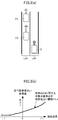
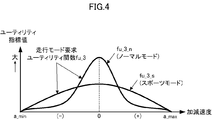
- FIGS. 2A and 2B are diagrams for explaining processing of the travel inhibition degree function determining unit shown in FIG.
- FIGS. 3A and 3B are diagrams for explaining processing of the travel inhibition degree function determining unit shown in FIG.
- FIGS. 7A and 7B are diagrams for explaining processing of the appropriateness function determination unit and the control appropriate operation amount determination unit shown in FIG. 1.
- the block diagram which shows the structure of the driver
- a vehicle 2 equipped with a travel control device 1 of the present embodiment includes an engine 4 and a brake device as an actuator device 3 for driving or braking the travel wheels (not shown). 5.
- An electric motor may be provided instead of the engine 4 or in addition to the engine 4.
- the vehicle 2 (hereinafter also referred to as the host vehicle 2) is equipped with a radar 11 and a camera 12 as sensors for observing the surroundings of the host vehicle 2.
- the radar 11 is a known radar such as an FM-CW radar or a laser radar.
- the radar 11 is mounted on the vehicle 2 so as to transmit an exploration signal (radar radio wave or laser light) to a predetermined area in front of the vehicle 2 and to receive a reflection signal thereof. Then, based on the received reflected signal, the radar 11 determines the distance of the object such as another vehicle existing on the front side of the own vehicle 2 (the search signal transmission area) from the own vehicle 2 and the speed of the object (the own vehicle). 2 is generated, and the detection signal is output to the travel control device 1.
- an exploration signal radar radio wave or laser light
- the radar 11 determines the distance of the object such as another vehicle existing on the front side of the own vehicle 2 (the search signal transmission area) from the own vehicle 2 and the speed of the object (the own vehicle). 2 is generated, and the detection signal is output to the travel control device 1.
- the camera 12 is mounted on the vehicle 2 so as to image a predetermined area on the front side of the vehicle 2. Then, the camera 12 outputs video signals of a plurality of pixels constituting a captured image (monotone image or color image) in front of the vehicle 2 to the travel control device 1.
- the vehicle 2 is equipped with a vehicle speed sensor 13 that outputs a detection signal corresponding to the vehicle speed of the host vehicle 2 to the travel control device 1 as a sensor for detecting the state of the host vehicle 2.
- operating devices 15 to 18 are arranged for the driver to instruct the travel control device 1 about a request related to traveling of the host vehicle 2.
- the vehicle speed control ON / OFF controller 15 that performs an operation to instruct whether or not to perform automatic control of the vehicle speed of the host vehicle 2 (hereinafter referred to as vehicle speed control), and the host vehicle 2 at the time of executing the vehicle speed control.
- vehicle speed control an operation to instruct whether or not to perform automatic control of the vehicle speed of the host vehicle 2
- vehicle speed control the host vehicle 2 at the time of executing the vehicle speed control.
- An inter-vehicle distance setting operation unit 17 for performing the above-described operation and a travel mode setting operation unit 18 for performing an operation for setting the target travel mode of the host vehicle 2 when the vehicle speed control is executed are in the vicinity of the driver's seat of the host vehicle 2. (For example, a steering handle).
- These operating devices 15 to 18 output an operation signal indicating
- the traveling control device 1 is an electronic circuit unit that includes a CPU, a RAM, a ROM, an interface circuit, and the like.
- the traveling control apparatus 1 does not need to be comprised by the single electronic circuit unit, and may be comprised by the several electronic circuit unit which can communicate mutually.
- the travel control device 1 includes the following functional units as functions realized by executing a mounted program by a CPU (functions realized by a software configuration) or functions realized by a hardware configuration. .
- the traveling control device 1 uses the signals input from the radar 11 and the camera 12 to detect the ambient condition recognition unit 21 that recognizes the surrounding condition (external condition) of the host vehicle 2 and the detection input from the vehicle speed sensor 13 and the like.
- a vehicle state recognition unit 22 for recognizing the state of the host vehicle 2 based on the signal, and a driver request for recognizing the driver's request regarding the travel of the host vehicle 2 based on the operation signals input from the operating devices 15 to 18.
- a recognition unit 23 and a vehicle speed control unit 24 that executes control processing for vehicle speed control of the host vehicle 2 are provided.
- the outside world situation recognition unit 21 recognizes, as its main function, an other vehicle detection unit 211 that detects an other vehicle existing in front of the own vehicle 2 and a lane region (lane) on the road surface in front of the own vehicle 2.
- a lane recognition unit 212 that detects the distance between the other vehicle and the host vehicle 2 (an inter-vehicle distance) that is present on the front side of the host vehicle 2.
- the inter-vehicle distance detection unit 213 also detects the relative vehicle speed (relative speed) of another vehicle with respect to the host vehicle 2.
- the other vehicle detection unit 211 detects the other vehicle in the captured image based on, for example, the shape characteristics of the image of the object in the captured image configured by the video signal of the camera 12.
- Other vehicles to be detected by the other vehicle detection unit 211 include a preceding vehicle that is traveling in the same direction as the own vehicle 2 in front of the own vehicle 2, and a lane in which the own vehicle 2 is traveling. Other vehicles traveling in other lane areas on the right or left side of the area are also included.
- the direction of the other vehicle with respect to the host vehicle 2 (the azimuth angle with respect to the optical axis of the camera 12) is also detected based on the position of the image of the other vehicle in the captured image.
- the distance or speed indicated by the output signal of the radar 11 (the distance from the own vehicle 2 or the distance from the own vehicle 2 to an object that seems to be another vehicle) Information on relative vehicle speed may be used.
- the communication information other than the captured image of the camera 12 may be used.
- the lane recognition unit 212 detects a marker such as a white line on the road surface on the front side of the host vehicle 2 from the captured image of the camera 12 (a marker that classifies the traveling region of the vehicle), and the host vehicle classified by the marker. 2. Recognize the lane area of the road surface on the front side.
- the lane area to be recognized by the lane recognition unit 212 includes a lane area in which the host vehicle 2 is traveling, and also includes a lane area that exists on the right or left side of the lane area.
- map information of the navigation device (information on the road on which the host vehicle 2 exists) or road information provided from an external server may be used as appropriate.
- the inter-vehicle distance detection unit 213 detects the inter-vehicle distance between the other vehicle and the host vehicle 2 based on the detection signal of the radar 11 when the other vehicle is detected by the other vehicle detection unit 211. Further, the inter-vehicle distance detection unit 213 changes the position of the other vehicle (relative position with respect to the host vehicle 2) over time based on the detection signal of the radar 11 or by the detected inter-vehicle distance and the direction of the other vehicle. Based on the rate, the relative vehicle speed of the other vehicle with respect to the host vehicle 2 is detected.
- the inter-vehicle distance between the other vehicle and the host vehicle 2 may be detected by a stereo distance measuring method.
- the radar 11 may be omitted.
- the distance information by the stereo camera and the distance information based on the output signal of the radar 11 are used in combination, and the distance between the other vehicle and the host vehicle 2 is increased.
- the inter-vehicle distance and the relative vehicle speed of other vehicles may be detected.
- the vehicle state recognition unit 22 includes a vehicle speed detection unit 221 that detects the vehicle speed of the host vehicle 2 as its main function.
- the vehicle speed detector 221 detects the vehicle speed of the host vehicle 2 based on the detection signal of the vehicle speed sensor 13.
- the driver request recognition unit 23 has, as its main functions, a target vehicle speed setting unit 231 that sets the target vehicle speed of the host vehicle 2 according to the driver's instruction, and a preceding vehicle in front of the host vehicle 2.
- a target inter-vehicle distance setting unit 232 that sets the target inter-vehicle distance according to the driver's instruction
- a target travel mode setting unit 233 that sets the target travel mode of the host vehicle 2 according to the driver's instruction.
- the driver request recognition unit 23 performs setting processing by the setting units 231, 232, and 233 when the vehicle speed control is instructed by an operation signal from the vehicle speed control ON / OFF controller 15.
- the target vehicle speed setting unit 231 sets a target vehicle speed desired by the driver based on the operation signal of the vehicle speed setting operation device 16.
- a desired increase (> 0) or decrease ( ⁇ 0) is added to the current vehicle speed of the host vehicle 2 or the current vehicle speed within a predetermined vehicle speed range by the operation of the vehicle speed setting operation device 16.
- the added vehicle speed can be instructed to the driver request recognition unit 23 as the target vehicle speed.
- the target vehicle speed setting unit 231 sets the target vehicle speed according to the instruction by the operation of the vehicle speed setting operation device 16.
- the vehicle speed value (latest value) detected by the vehicle speed detection unit 221 is used as the current vehicle speed of the host vehicle 2 necessary for this setting.
- a target vehicle speed value (a vehicle speed value within a predetermined vehicle speed range) may be directly instructed to the driver request recognition unit 23 by operating the vehicle speed setting operation device 16.
- the target inter-vehicle distance setting unit 232 sets the target inter-vehicle distance desired by the driver based on the operation signal of the inter-vehicle distance setting operation unit 17.
- the degree of magnitude of the target inter-vehicle distance in a plurality of stages (for example, the degree of the inter-vehicle distance classified into three stages of large, medium, and small) by operating the inter-vehicle distance setting operation unit 17. )
- the target inter-vehicle distance setting unit 232 uses an arithmetic expression or map determined in advance from the degree of the instructed inter-vehicle distance and the current vehicle speed of the host vehicle 2 detected by the vehicle speed detection unit 221. Set the target inter-vehicle distance.
- the target inter-vehicle distance value (the inter-vehicle distance value within a predetermined range corresponding to the vehicle speed) can be directly instructed to the driver request recognition unit 23 by operating the inter-vehicle distance setting operation unit 17. You may do it.
- the target travel mode setting unit 233 sets a target travel mode desired by the driver based on the operation signal from the travel mode setting operation device 18.
- the target travel mode represents the type of travel mode (particularly the mode of acceleration (acceleration operation pattern)) of the host vehicle 2.
- the normal mode is a general-purpose target travel mode (more specifically, a target travel mode in which the acceleration / deceleration of the vehicle 2 is maintained at a relatively small magnitude), and the sport mode is more than the normal mode.
- This is a target travel mode that emphasizes the acceleration / deceleration performance of the vehicle 2 (more specifically, a target travel mode in which significant acceleration or deceleration is more easily performed than in the normal mode).
- the target travel mode setting unit 233 sets the target travel mode instructed by the operation signal of the travel mode setting operation device 18 as a target in the actual vehicle speed control of the host vehicle 2 (mode of acceleration method). Is specified as a factor (an element reflected in actual vehicle speed control).
- the target travel mode is determined by operating the travel mode setting operation device 18, but the target travel mode is automatically determined based on the past travel history of the vehicle 2. You may make it obtain. For example, in the travel history of the vehicle 2 in a certain past period, when the driver is accelerating or decelerating at an acceleration / deceleration greater than a predetermined magnitude at a high frequency (number of times), the target travel mode If the frequency is low, the normal mode may be determined as the target travel mode.
- the vehicle speed control unit 24 is a functional unit that executes control processing for vehicle speed control when the vehicle speed control is instructed to be performed by operating the vehicle speed control ON / OFF operation unit 15.
- the vehicle speed control unit 24 basically controls the vehicle speed of the host vehicle 2 based on the target vehicle speed, the target inter-vehicle distance, and the target travel mode set by the driver request recognition unit 23.
- the control operation amount (control input) is sequentially determined at a predetermined control processing cycle.
- the operation amount for control corresponds to the operation amount for vehicle speed control in the present invention.
- the control operation amount is a target acceleration / deceleration (target value of acceleration / deceleration) of the host vehicle 2.
- acceleration / deceleration means acceleration in the acceleration direction when the value is positive, and acceleration (deceleration) in the deceleration direction when the value is negative.
- the vehicle speed control unit 24 drives the driving braking force (driving force (propulsive force)) of the vehicle 2 via the actuator device 3 (the engine 4 and the brake device 5) according to the determined target acceleration / deceleration (control operation amount).
- the vehicle speed is controlled by controlling the braking force.
- the vehicle speed control unit 24 is basically configured when there is no preceding vehicle in front of the host vehicle 2 (when the preceding vehicle is not detected by the other vehicle detection unit 211 of the external environment recognition unit 21).
- the target acceleration / deceleration (control operation amount) is sequentially determined so that the actual vehicle speed of the host vehicle 2 is kept at the target vehicle speed or the vehicle speed in the vicinity thereof as much as possible.
- the vehicle speed control unit 24 basically has a preceding vehicle when the preceding vehicle is present in front of the host vehicle 2 (when the preceding vehicle is detected by the other vehicle detection unit 211 of the external environment recognition unit 21). Sequentially determines the target acceleration / deceleration (control operation amount) so that the actual inter-vehicle distance between the host vehicle 2 and the preceding vehicle is kept at the target inter-vehicle distance or the inter-vehicle distance in the vicinity thereof as much as possible.
- the vehicle speed control unit 24 determines the degree of travel inhibition of the host vehicle 2 predicted from the surrounding situation of the host vehicle 2 recognized by the external environment recognition unit 21 (the possibility that the travel of the host vehicle 2 may be inhibited by other vehicles or the like).
- the target acceleration / deceleration (control operation amount) is determined sequentially while balancing the driver's requirements (target vehicle speed, target inter-vehicle distance, target travel mode) as much as possible. To do.
- the vehicle speed control unit 24 that performs the control process as described above has, as its main function, a travel inhibition degree index value that represents the predicted degree of travel inhibition of the host vehicle 2 as a target acceleration / deceleration (control operation amount) value.
- a travel inhibition degree function determining unit 241 that determines a travel inhibition degree function that is expressed as a function, and a utility index value that represents the degree of effectiveness for satisfying the driver's request, is set as a target acceleration / deceleration (control operation amount).
- the utility function determination unit 242 that determines the utility function expressed as a function of the value, and the travel inhibition degree function and the utility function, each value of the target acceleration / deceleration (control operation amount) is optimized.
- the appropriateness function determining unit 243 for determining the appropriateness function representing the degree of control, and the appropriate control amount for control (appropriate control operation amount based on the appropriateness function)
- the control appropriate operation amount determination unit 244 for determining the appropriate target acceleration / deceleration as a driving force, and the driving braking force for controlling the driving braking force (driving force or braking force) generated by the actuator device 3 according to the appropriate target acceleration / deceleration And a control unit 245.
- the travel inhibition degree index value is a real value of zero or more in the present embodiment.
- the vehicle speed of the host vehicle 2 is controlled in accordance with the target acceleration / deceleration value corresponding to the index value (
- the index value means that the possibility that the traveling of the host vehicle 2 is hindered (for example, in contact with another vehicle) is increased.
- the utility index value is a real value of zero or more in the present embodiment.
- the utility index value corresponding to an arbitrary value of the target acceleration / deceleration is such that when the vehicle speed of the host vehicle 2 is controlled according to the value of the target acceleration / deceleration corresponding to the index value as the index value increases (the vehicle speed It is an index value that means that it is highly effective in satisfying the driver's request when acceleration or deceleration is performed.
- the appropriateness is a real value of zero or more in the present embodiment.
- the degree of appropriateness corresponding to an arbitrary value of the target acceleration / deceleration is such that the greater the value, the higher the appropriateness of controlling the vehicle speed of the host vehicle 2 according to the value of the target acceleration / deceleration corresponding to the value. Means.
- the travel control device 1 When it is instructed to perform vehicle speed control by the operation of the vehicle speed control ON / OFF operation device 15 by the driver of the vehicle 2, the travel control device 1 performs an external environment recognition unit 21 at a predetermined control processing cycle. The above-described processes of the vehicle state recognition unit 22 and the driver request recognition unit 23 are executed.
- the traveling control device 1 executes the control processing of the vehicle speed control unit 24 at a predetermined calculation processing cycle.
- the vehicle speed control unit 24 first executes the processing of the travel inhibition degree function determination unit 241 and the utility function determination unit 242 as described below.
- the travel inhibition degree function determination unit 241 determines a travel inhibition degree function according to the surrounding situation of the vehicle 2 recognized by the external environment recognition unit 21.
- the travel inhibition degree function determination unit 241 first detects each other vehicle (the vehicle 2 is traveling) whose presence has been detected by the other vehicle detection unit 211 on the front side of the vehicle 2. (Including other vehicles that are traveling in a lane region different from the lane region), the degree of possibility that the other vehicle is obstructing the traveling of the host vehicle 2 (the travel inhibition degree index value for the other vehicle), and the target adjustment A function indicating the relationship with the speed (control operation amount) is determined.
- fr_i this function is referred to as a subject-specific travel inhibition degree function fr_i.
- the subscript “i” of fr_i means an identifier (for example, an integer value of 1 or more) that distinguishes each other vehicle whose presence is detected by the other vehicle detection unit 211.
- the object-specific travel inhibition degree function fr_i corresponds to the auxiliary travel inhibition degree function in the present invention.
- the function value of the target travel inhibition degree function fr_i (function value corresponding to each value of the target acceleration / deceleration) is a real value not less than “0” and not more than a predetermined upper limit value (for example, “1”). .
- the function value of fr_i corresponding to each value of the target acceleration / deceleration (control operation amount) has a higher degree of possibility that the other vehicle of the target obstructs the traveling of the host vehicle 2 as the value increases. Means.
- a method for determining the target travel inhibition degree function fr_i is determined in advance. Then, the travel inhibition degree function determining unit 241 determines, in the predetermined manner, the object-specific travel inhibition degree function fr_i for each other vehicle whose presence is detected by the other vehicle detection unit 211.
- the function value of the function-specific travel inhibition degree function fr_i (function value corresponding to each value of the target acceleration / deceleration) increases as the possibility of predicted future contact between the target other vehicle and the host vehicle 2 increases. , Determined to be larger.
- the travel inhibition degree function determination unit 241 determines whether the other vehicle is in the future (the future immediately after the current time) for each other vehicle whose presence is detected by the other vehicle detection unit 211 of the outside world situation recognition unit 21. Next, the probability that the vehicle will travel in front of the vehicle 2 is determined. This probability is determined based on a relative relationship (relative position, relative speed, etc.) between the host vehicle 2 and another vehicle, or a relative relationship (relative position, relative speed, etc.) between other vehicles.
- the object-specific travel inhibition degree function is determined as a reference object-specific travel inhibition degree function fr0_i.
- This reference-specific travel inhibition degree function fr0_i (hereinafter referred to as “target-specific reference travel inhibition degree function fr0_i”) is based on the assumption that the function value corresponding to each target acceleration / deceleration is the host vehicle 2 and the target other vehicle. The greater the chances of future contact with, the larger it will be.
- the target reference travel inhibition degree function fr0_i corresponds to the reference sub-travel inhibition degree function in the present invention.
- the travel inhibition degree function determining unit 241 finally obtains the target travel inhibition degree function fr_i for each other vehicle based on the reference target travel inhibition degree function fr0_i and the probability for each other vehicle. decide.
- FIG. 2 (a) As a first example, as shown in FIG. 2 (a), two other vehicles C1 and C2 are traveling back and forth in a normal travel lane area LA2, and the normal travel lane is present. Assume a situation in which the host vehicle 2 is traveling behind the other vehicles C1 and C2 in the overtaking lane region LA1 on the left side of the region LA2.
- the external environment situation recognition unit 21 detects the direction, the inter-vehicle distance, and the relative vehicle speed of the other vehicles C1 and C2, and recognizes the lane areas LA1 and LA2, respectively.
- the first example is an example of the case where the host vehicle 2 is traveling in a country (such as the United States) in which the region on the right side of the road is the normal traveling region of the vehicle due to laws and regulations. The same applies to the second example described later.
- the travel inhibition degree function determination unit 241 determines the target travel inhibition degree function fr_1 regarding the other vehicle C1, the probability that the other vehicle C1 changes the lane and interrupts in front of the host vehicle 2 (hereinafter, referred to as the following).
- Interrupt probability Pr_1 is a probability that the other vehicle C1 is predicted to travel in front of the host vehicle 2 in the future.
- the interrupt probability Pr_1 is determined using, for example, a predetermined map or the like from the positions and vehicle speeds of the other vehicles C1 and C2 (relative position and vehicle speed with respect to the host vehicle 2).
- the travel inhibition degree function determination unit 241 determines that the above-described interruption becomes greater as the vehicle speed of the other vehicle C1 on the near side is larger than the vehicle speed of the other vehicle C2 on the far side.
- the interrupt probability Pr_1 is determined so that the interrupt probability Pr_1 increases as the probability Pr_1 increases and the inter-vehicle distance between the other vehicles C1 and C2 decreases.
- the travel inhibition degree function determining unit 241 assumes that the other vehicle C1 has changed the lane as described above and has interrupted in front of the host vehicle 2 in the situation shown in FIG.
- the target-specific travel inhibition degree function when the probability is assumed to be “1”) is determined as the target-specific reference travel inhibition degree function fr0_1 for the other vehicle C1.
- the target reference travel inhibition degree function fr0_1 for each target defines a reference change pattern with respect to the target acceleration / deceleration (control operation amount) of the function value of the target travel inhibition degree function fr_1 for the other vehicle C1.
- the subject reference running inhibition degree function fr0_1 is determined by the waveform pattern shown in FIG. 2 (b), for example.
- the target acceleration / deceleration of the host vehicle 2 is set to a value near zero (the host vehicle 2).
- the possibility of contact between the host vehicle 2 and the other vehicle C1 increases. it is conceivable that.
- the acceleration / deceleration value on the horizontal axis is a value near zero and the value on the acceleration side (> 0).
- the function value of fr0_1 at each value of the target acceleration / deceleration is, for example, the state of the host vehicle 2 (vehicle speed or acceleration) detected by the vehicle state recognition unit 22 and other vehicles assumed to interrupt the front of the host vehicle 2 The value depends on the position of C1 and the relative vehicle speed.
- the host vehicle 2 is traveling in a lane area LA2 for normal travel, and the vehicle is on the left side of the lane area LA2 for normal travel. Is assumed that the other vehicles C3 and C4 are traveling back and forth in front of the host vehicle 2 in the lane area LA1.
- the external situation recognition unit 21 detects the azimuths, the inter-vehicle distances, and the relative vehicle speeds of the other vehicles C3 and C4, and the lane areas LA1 and LA2 are recognized.
- the travel inhibition degree function determining unit 241 determines the target travel inhibition degree function fr_4 related to the other vehicle C4, the probability that the other vehicle C4 changes the lane and interrupts in front of the host vehicle 2 (hereinafter, referred to as the following). Interrupt probability Pr_4).
- the interrupt probability Pr_4 is determined using, for example, a predetermined map from the positions and vehicle speeds of the other vehicles C3 and C4 (relative position and vehicle speed with respect to the host vehicle 2). It is determined.
- the travel inhibition degree function determination unit 241 determines that the above-described interruption becomes greater as the vehicle speed of the other vehicle C3 on the near side is larger than the vehicle speed of the other vehicle C4 on the far side.
- the interrupt probability Pr_4 is determined so that the interrupt probability Pr_4 increases as the probability Pr_4 increases and the inter-vehicle distance between the other vehicles C3 and C4 decreases.
- the travel inhibition degree function determining unit 241 assumes that the other vehicle C4 has changed the lane as described above and has interrupted in front of the host vehicle 2 in the situation shown in FIG.
- a target-specific travel inhibition degree function in a case where the probability Pr_4 is assumed to be “1”) is determined as a target-specific reference travel inhibition degree function fr0_4 for the other vehicle C4.
- the target reference travel inhibition degree function fr0_4 defines the reference change pattern with respect to the target acceleration / deceleration (control operation amount) of the function value of the target travel inhibition degree function fr_4 related to the other vehicle C4.
- the target-specific reference inhibition degree function fr0_4 is determined by the waveform pattern shown in FIG. 3B, for example.
- the target acceleration / deceleration of the host vehicle 2 is set to a large acceleration on the acceleration side. Moreover, it is considered that the possibility of contact between the host vehicle 2 and the other vehicle C4 is increased.
- the reference-specific reference travel inhibition degree function fr0_4 shown in FIG. 3B is such that the function value (travel inhibition degree index value) increases as the acceleration / deceleration value on the horizontal axis increases toward the acceleration side. Determined by waveform pattern.
- the function value of fr0_4 in each value of the target acceleration / deceleration is, for example, the state of the host vehicle 2 (vehicle speed or acceleration) detected by the vehicle state recognition unit 22 and other vehicles that are assumed to interrupt in front of the host vehicle 2 The value depends on the position of C4 and the relative vehicle speed.
- the travel inhibition degree function determination unit 241 determines the target travel inhibition degree function fr_i for each other vehicle detected by the other vehicle detection unit 211.
- the interrupt probabilities Pr_i such as the interrupt probabilities Pr_1 and Pr_4
- the degree of the size of the empty space in the lane area (the lane area in front of the host vehicle 2) that the other vehicle tries to interrupt is determined. It may be reflected in the interrupt probability Pr_i.
- Pr_i the interrupt probability
- the interrupt probability Pr_i when the distance between the preceding vehicle of the host vehicle 2 and the host vehicle 2 in the lane region in which the host vehicle 2 is traveling is reflected in the interrupt probability Pr_i and the distance is small (the empty space of the interrupt destination is When the distance is small, the interrupt probability may be made smaller than when the distance is large (when there is enough free space at the interrupt destination).
- the other vehicle C1 when the vehicle speed of the host vehicle 2 is higher than the vehicle speed of the other vehicle C1, the other vehicle C1 is in the overtaking lane area LA1 where the host vehicle 2 is traveling. Is likely to be interrupted. Therefore, when the vehicle speed of the host vehicle 2 is higher than the vehicle speed of the other vehicle C1, the interruption probability Pr_1 regarding the other vehicle C1 may be made smaller than when the vehicle speed is not.
- the interrupt probability Pr_i can be determined by appropriately reflecting the relative relationship between the host vehicle 2 and the other vehicle in addition to the relative relationship between the other vehicles.
- the travel inhibition degree function determination unit 241 determines the travel inhibition degree function fr corresponding to the current situation around the host vehicle 2 by synthesizing the subject-specific travel inhibition degree function fr_ for each other vehicle. .
- a function obtained by adding the target travel inhibition degree function fr_i for each other vehicle is a function of the target travel inhibition degree function fr_i for each other vehicle.
- the normalization is performed by multiplying the function obtained by adding the object-specific travel inhibition degree function fr_i for each other vehicle by the reciprocal value of the sum of the upper limit values of the object-specific travel inhibition degree functions fr_i for each other vehicle. This is a process of limiting the function value of the inhibition degree function fr to a value of “1” or less.
- the upper limit of each function value of the target travel inhibition degree function fr_1, fr_2, fr_3 for each other vehicle is determined as the travel inhibition degree function fr.
- the utility function determination unit 242 determines the driver's request (target vehicle speed, target inter-vehicle distance, target travel mode) recognized by the driver request recognition unit 23 and the state of the host vehicle 2 recognized by the vehicle state recognition unit 22 ( The utility function is determined according to the vehicle speed.
- the utility function determination unit 242 first determines the degree of effectiveness (utility index value corresponding to each request) and the target acceleration / deceleration (control) for satisfying each request of the target vehicle speed, the target inter-vehicle distance, and the target travel mode. A function for each request indicating the relationship with the operation amount).
- fu_j this function for each request is generically referred to as a request-specific utility function fu_j.
- the subscript “j” of fu_j means an identifier (for example, an integer value of 1 or more) that distinguishes the type of the driver's request.
- a demand-specific utility function fu_j corresponding to the target vehicle speed is executed as a vehicle speed request utility function fu_1
- a request-specific utility function fu_j corresponding to the target inter-vehicle distance is executed as an inter-vehicle request utility function fu_2
- a request-specific utility function fu_j corresponding to the target travel mode is executed. This is called a mode request utility function fu_3.
- These request-specific utility functions fu_1, fu_2, and fu_3 correspond to the first sub utility function, the second sub utility function, and the third sub utility function in the present invention, respectively.
- each utility function fu_j for each request has a meaning as a utility index value related to the driver's request corresponding to the function fu_j, and is “0” or more. And a real value less than or equal to a predetermined upper limit value (for example, “1”).
- the function value of fu_j corresponding to each value of the target acceleration / deceleration means that the larger the value is, the higher the degree of effectiveness in satisfying the driver's request is.
- the travel mode request utility function fu_3 is determined as follows.
- the travel mode request utility function fu_3 is determined in advance for each type of target travel mode (normal mode or sport mode). Then, the utility function determination unit 242 selects a travel mode request utility function fu_3 corresponding to the target travel mode set by the driver using the travel mode setting operation device 18 from the travel mode request utility functions fu_3.
- the running mode request utility function fu_3 corresponding to each of the normal mode and the sport mode is predetermined in a waveform pattern as shown in the graph of FIG. 4, for example.
- the travel mode request utility function fu_3 (hereinafter referred to as fu_3_n) corresponding to the normal mode is a convex waveform function whose function value (utility index value) has a peak value when the target acceleration / deceleration is “0”. Has been.
- the waveform of fu_3_n is more specifically compared with the function value in the region where the target acceleration is relatively close to “0” compared to the function value in the region where the target acceleration / deceleration is away from “0”. Therefore, it is set to be remarkably large.
- the waveform of fu_3_n is larger when the target acceleration / deceleration value is a relatively small value near “0” than when the target acceleration / deceleration value is a relatively large value. Therefore, the effectiveness is set to be remarkably high.
- the running mode request utility function fu_3 (hereinafter referred to as fu_3_s) corresponding to the sport mode has a convex waveform whose function value (utility index value) has a peak value when the target acceleration / deceleration is “0”. It is a function.
- fu_3_s is set such that the function value decreases more gradually than fu_3_n as the target acceleration / deceleration value deviates from “0”. For this reason, fu_3_s is such that the function value is kept close to the peak in a wider range than fu_3_n.
- the fu_3_s waveform is set to have a relatively high degree of effectiveness even when the target acceleration / deceleration value is relatively large.
- the vehicle speed request utility function fu_1 among the request-specific utility functions fu_j is determined as follows.
- the vehicle speed request utility function fu_1 is a function of a normally distributed waveform as shown in FIG.
- a target acceleration / deceleration value a_opt1 (hereinafter referred to as a peak corresponding acceleration / deceleration value a_opt1) at which the function value becomes a peak value is determined according to the operation of the vehicle speed setting operation unit 16 by the driver request recognition unit 23. It is determined according to the target vehicle speed set by the vehicle speed setting unit 231 and the detection value of the vehicle speed acquired based on the output of the vehicle speed sensor 13 by the vehicle speed detection unit 221 of the vehicle state recognition unit 22.
- the peak-corresponding acceleration / deceleration value a_opt1 is the current set target vehicle speed (hereinafter referred to as Vset) and the current vehicle speed detection value (hereinafter referred to as Vego).
- Vset current set target vehicle speed
- Vego current vehicle speed detection value
- a_opt1 is determined as shown by the following equations (1a) to (1e).
- the peak-corresponding acceleration / deceleration value a_opt1 is a positive value (acceleration / deceleration value in the acceleration direction of the vehicle speed) when Vset> Vego, and the absolute value of a_opt1 is less than the magnitude of a_max Within the range, the larger the absolute value of Vset ⁇ Vego, the larger is determined.
- the peak-corresponding acceleration / deceleration value a_opt1 is a negative value (acceleration / deceleration value in the acceleration direction of the vehicle speed) when Vset ⁇ Vego, and the absolute value of a_opt1 is equal to or less than the magnitude of a_min. Within the range, the larger the absolute value of Vset ⁇ Vego, the larger is determined.
- the peak-corresponding acceleration / deceleration value a_opt1 determined in this way means an appropriate acceleration / deceleration value for bringing the actual vehicle speed of the host vehicle 2 close to the target vehicle speed Vset.
- the vehicle speed request utility function fu_1 is a function of a normally distributed waveform, determining the peak corresponding acceleration / deceleration value a_opt1 as described above results in the determination of the vehicle speed request utility function fu_1.
- the vehicle speed request utility function fu_1 is determined so that the function value (utility index value) becomes large in the vicinity of an acceleration / deceleration appropriate for bringing the actual vehicle speed of the host vehicle 2 close to the target vehicle speed Vset. .
- inter-vehicle request utility function fu_2 among the utility functions by request fu_j is determined as follows.
- the inter-vehicle request utility function fu_2 is a function of a normally distributed waveform as shown in FIG. 6A, like the vehicle speed request utility function fu_1.
- a target acceleration / deceleration value a_opt2 (hereinafter referred to as a peak corresponding acceleration / deceleration value a_opt2) at which the function value becomes a peak value is determined according to the operation of the vehicle speed setting operation unit 16 by the driver request recognition unit 23. It is determined according to the target inter-vehicle distance set by the inter-vehicle distance setting unit 232 and the detected value of the inter-vehicle distance acquired by the inter-vehicle distance detection unit 213 of the external environment situation recognition unit 21.
- a_opt2 is determined as shown by the following equations (2a) to (2e).
- the peak-corresponding acceleration / deceleration value a_opt2 is a negative value (acceleration / deceleration value in the deceleration direction of the vehicle speed) when GSset> GSsens, and the absolute value of a_opt2 is within a range of a_min or less.
- the peak-corresponding acceleration / deceleration value a_opt2 is a positive value (acceleration / deceleration value in the acceleration direction of the vehicle speed) when GSset ⁇ GSsens, and the absolute value of a_opt2 is equal to or less than the magnitude of a_max. Within the range, the larger the absolute value of GSset ⁇ GSsens, the larger the value.
- the peak-corresponding acceleration / deceleration value a_opt2 determined in this way means an appropriate acceleration / deceleration value for bringing the actual inter-vehicle distance between the host vehicle 2 and the preceding vehicle closer to the target inter-vehicle distance GSset.
- inter-vehicle request utility function fu_2 is a function of a normally distributed waveform, determining the peak corresponding acceleration / deceleration value a_opt2 as described above results in the determination of the inter-vehicle request utility function fu_2.
- the inter-vehicle request utility function fu_2 has a large function value (utility index value) in the vicinity of the acceleration / deceleration appropriate for bringing the actual inter-vehicle distance between the host vehicle 2 and the preceding vehicle closer to the target inter-vehicle distance GSset. It is decided to become a thing.
- the utility function determining unit 242 sets the inter-vehicle request utility function fu_2 to “0” when the function value is an arbitrary target acceleration / deceleration. Is determined as a function.
- the utility function determination unit 242 sets the vehicle speed request utility function fu_1 to “0” when the function value is an arbitrary target acceleration / deceleration. Is determined as a function.
- the utility function determination unit 242 determines the utility function fu corresponding to the current request of the driver by synthesizing the utility functions fu_j for each request, similarly to the case of determining the travel inhibition degree function fr.
- a function obtained by adding each request-specific utility function fu_i (a function value corresponding to each target acceleration / deceleration value matches the sum of the function values of each request-specific utility function fu_i) is normalized.
- the utility function fu corresponding to the overall request of the driver of the host vehicle 2 is determined.
- the vehicle speed control unit 24 executes the processing of the travel inhibition degree function determining unit 241 and the utility function determining unit 242, and then executes the processing of the appropriateness function determining unit 243.
- the appropriateness function determining unit 243 determines the appropriateness function fap by synthesizing the travel inhibition degree function fr and the utility function fu.
- the appropriateness function fap has a function value (function value at each target acceleration / deceleration value) of a function value of fu and an upper limit value of the function value of fr (
- the function is determined to be a product of a value obtained by subtracting the function value of fr from “1”).
- the function value (appropriateness) of the appropriateness function fap determined as described above is such that the corresponding target acceleration / deceleration value satisfies the driver's request as much as possible, and the traveling of the host vehicle 2 is hindered. The more appropriate it is, the larger the value.
- the vehicle speed control unit 24 next executes the process of the control proper operation amount determination unit 244.
- the control appropriate operation amount determination unit 244 is based on the appropriateness function fap determined as described above, and a target appropriate acceleration / deceleration (hereinafter, referred to as an appropriate control operation amount for controlling the vehicle speed of the host vehicle 2). This is expressed as a_opt_cmd).
- control appropriate operation amount determination unit 244 determines the acceleration / deceleration value at which the function value (appropriateness) is maximum in the appropriateness function fap as the target appropriate acceleration / deceleration a_opt_cmd. Determine as.
- the target appropriate acceleration / deceleration a_opt_cmd is determined as the most appropriate acceleration / deceleration value in satisfying the driver's request as much as possible and preventing the traveling of the host vehicle 2 from being hindered.
- the vehicle speed control unit 24 executes processing of the drive braking force control unit 245.
- the drive braking force control unit 245 controls the engine 4 or the brake device 5 in accordance with the target appropriate acceleration / deceleration a_opt_cmd determined by the control appropriate operation amount determination unit 244.
- the drive braking force control unit 245 determines the target value of the output torque of the engine 4 necessary for realizing the target appropriate acceleration / deceleration speed a_opt_cmd. Then, the operation of the engine 4 is controlled so as to generate the output torque of the target value.
- the drive braking force control unit 245 determines a target value of the braking force of the brake device 5 necessary to realize the target appropriate acceleration / deceleration a_opt_cmd, The braking force of the brake device 5 is controlled so as to generate the braking force of this target value.
- working is mounted in the vehicle 2, you may make it generate
- the function value of the appropriateness function fap obtained by synthesizing the travel inhibition degree function fr and the utility function fu has a target acceleration / deceleration value corresponding to the driver's request ( In order to satisfy the target vehicle speed, the target inter-vehicle distance, and the target travel mode) as much as possible and to prevent the travel of the host vehicle 2 from being obstructed by other vehicles, is there.
- the driving force of the vehicle 2 by the engine 4 or the driving force of the vehicle 2 by the brake device 5 is determined according to the target appropriate acceleration / deceleration a_opt_cmd that is the acceleration / deceleration value at which the function value (appropriateness) is maximum.
- the braking force is controlled.
- both the requirements of the driver are satisfied as much as possible and the travel of the host vehicle 2 is prevented from being obstructed by another vehicle in a balanced manner.
- the vehicle speed of the host vehicle 2 can be controlled.
- the travel inhibition degree function fr has a function value that increases as the probability (interrupt probability Pr_i) that the other vehicle cuts in front of the host vehicle 2 and travels in front of the front is higher. To be determined. Further, the travel inhibition degree function fr is determined by combining the object-specific travel inhibition degree functions fr_i determined for each other vehicle.
- the driver request recognition unit 23 is added to the target vehicle speed setting unit 231, the target inter-vehicle distance setting unit 232, and the target travel mode setting unit 233 described in the first embodiment. Furthermore, a target acceleration / deceleration / sudden characteristic that defines the degree of acceleration / deceleration (braking) of the own vehicle 2 when the surrounding situation of the own vehicle 2 recognized by the outside situation recognition unit 21 is a predetermined outside situation. A target acceleration / deceleration / rapidity setting unit 234 that is variably set is provided.
- the predetermined outside world situation is, for example, a situation where there is a preceding vehicle traveling in front of the host vehicle 2.
- the preceding vehicle includes other vehicles that are traveling in front of the host vehicle 2 in the same lane region as the host vehicle 2 (including other vehicles that have entered the lane region on the side of the host vehicle 2 immediately before the current time). ), Or another vehicle that is about to come in front of the front of the host vehicle 2 or a vehicle that is predicted to be likely to get into the front of the front of the host vehicle 2 in the future immediately after the current time. is there.
- the distance from the host vehicle 2 to the preceding vehicle is greater than a certain reference distance (or a distance within a predetermined range including the reference distance).
- the acceleration-side target deceleration characteristic that defines the degree of acceleration / deceleration when accelerating the host vehicle 2 and the preceding vehicle distance are within a certain reference distance (or within a predetermined range including the reference distance).
- the deceleration side target slow / slow characteristic that defines the slow / slow degree of deceleration when the host vehicle 2 decelerates is decelerated accordingly.
- acceleration-side target slow / fast characteristics there are two types of acceleration-side target slow / fast characteristics: an agile acceleration characteristic that accelerates the own vehicle 2 quickly (swiftly) and a slow acceleration characteristic that accelerates the own vehicle 2 relatively slowly than the agile acceleration characteristic. It is possible to selectively set from the characteristics of.
- deceleration-side target gradual characteristics there are two types of deceleration-side target gradual characteristics: an agile deceleration characteristic that makes the host vehicle 2 decelerate quickly (swiftly) and a slow deceleration characteristic that makes the acceleration of the host vehicle 2 relatively slower than the agile deceleration characteristic. It can be selectively (variably) set based on the characteristics.
- the reference distance is a target inter-vehicle distance set by the target inter-vehicle distance setting unit 232, for example.
- the reference distance may be a distance different from the target inter-vehicle distance.
- the driver himself / herself may set the reference distance by a predetermined operation, or the target acceleration / deceleration / rapidity setting unit 234 may automatically set the reference distance according to the target inter-vehicle distance.
- the reference distance is controlled based on the past history of the travel mode of the host vehicle 2 (such as a change in vehicle speed or a change in steering according to the preceding vehicle distance) by the driver's steering in the vehicle speed control OFF state.
- the apparatus 1 may be automatically set as a learning value.
- the target acceleration / deceleration / rapidity characteristic setting unit 234 is detected by the inter-vehicle distance detection unit 213 in a situation where the preceding vehicle is detected in front of the host vehicle 2 by the external environment recognition unit 21. Further, the target acceleration / deceleration characteristics are set according to the distance (preceding vehicle distance) between the preceding vehicle and the host vehicle 2 and an instruction (operation on the degree of acceleration / deceleration at the time of acceleration / deceleration) by operating an unillustrated controller. To do.
- the target acceleration / deceleration characteristic setting unit 234 determines that the preceding vehicle distance detected by the inter-vehicle distance detection unit 213 is greater than the reference distance (or a distance within a predetermined range including the reference distance).
- the acceleration-side target slow / fast characteristic is set as the quick acceleration / deceleration characteristic
- the acceleration-side target The slow / quick characteristic is the slow acceleration characteristic.
- the target acceleration / deceleration / rapidity setting unit 234 determines whether the preceding vehicle distance detected by the inter-vehicle distance detection unit 213 is smaller than the reference distance (or a distance within a predetermined range including the reference distance). If it is instructed to perform acceleration / deceleration quickly, the deceleration-side target deceleration characteristic is set to the agile deceleration characteristic, and if acceleration / deceleration is instructed slowly, the deceleration-side target deceleration characteristic is set to Slow deceleration characteristics.
- the acceleration / deceleration is controlled based on the past history of the travel mode of the host vehicle 2 by the driver's control in the vehicle speed control OFF state (vehicle speed change or steering change mode according to the preceding vehicle distance).
- the driver's favorite characteristics (high frequency characteristics) may be learned by the travel control device 1. Then, when setting the target acceleration / deceleration characteristics, the driver's favorite speed / least learned as described above between the characteristics of the agility side and the characteristics of the slow side without using the driver's acceleration / deceleration instruction.
- the target acceleration / deceleration / rapidity characteristics may be automatically set in the characteristics.
- the utility function determination unit 242 first determines the utility function fu as a request-specific utility function fu_j corresponding to each request of the driver recognized by the driver request recognition unit 23.
- the utility function fu_4 is determined.
- function fu_1, fu_2, fu_3, and fu_4 correspond to the first sub utility function, the second sub utility function, the third sub utility function, and the fourth sub utility function in the present invention, respectively.
- the utility function determination unit 242 determines the utility function fu by synthesizing these request-specific utility functions fu_1, fu_2, fu_3, and fu_4. The method of synthesis is the same as that described in the first embodiment.
- Acceleration / deceleration / sudden characteristic request utility function fu_4 is determined as follows.
- the utility function determination unit 242 uses the target acceleration / deceleration / sudden characteristic setting unit 234 of the driver request recognition unit 23 as described above when the preceding vehicle is detected in front of the host vehicle 2 by the external environment recognition unit 21.
- the acceleration / deceleration characteristics request utility function fu_4 is determined.
- the agile acceleration characteristic is set as the currently set target acceleration / deceleration characteristic
- the slow acceleration characteristic is set
- the agile deceleration characteristic is set
- the slow deceleration characteristic is set
- the acceleration / deceleration / sudden characteristic request utility function fu_4 is determined to have a waveform function as shown by graphs a1, a2, b1, and b2 in FIG.
- Fu_4 (a1) Acceleration / deceleration / sudden characteristics request utility function fu_4 (hereinafter referred to as fu_4 (a2)) corresponding to the quick acceleration characteristics and fu_4 (hereinafter referred to as fu_4 (a2)) corresponding to the slow acceleration characteristics are both used.
- fu_4 (a2) A function of a convex waveform such that the target acceleration value at which the function value (utility index value) has a peak value becomes a positive value.
- the waveform of fu_4 (a2) corresponding to the slow acceleration characteristic is such that the target acceleration value at which the function value is a peak value and a value close thereto is a positive value region slightly larger than “0”. Is preset.
- the waveform of fu_4 (a1) corresponding to the agile acceleration characteristic is a positive value in which the target acceleration value at which the function value is a peak value and a value close thereto is larger than fu_4 (a2) corresponding to the slow acceleration characteristic. It is set in advance so as to be an area of.
- fu_4 (hereinafter referred to as fu_4 (b1)) corresponding to the agile deceleration characteristic and fu_4 (hereinafter referred to as fu_4 (b2)) corresponding to the slow deceleration characteristic are both function values (utility It is a function of a convex waveform such that the target acceleration value at which the index value becomes a peak value becomes a negative value.
- the waveform of fu_4 (b2) corresponding to the slow deceleration characteristic is such that the target acceleration value at which the function value is a peak value and a value close thereto is a negative value area slightly smaller than “0”. Is preset.
- the waveform of fu_4 (b1) corresponding to the agile deceleration characteristic is larger in magnitude (absolutely) than the fu_4 (b2) corresponding to the slow acceleration characteristic, where the function value is the peak value and the target acceleration value is close to this. Value) is set in advance so as to be a negative region with a large negative value.
- the acceleration / deceleration / sudden characteristic request utility function fu_4 is a function having a function value of “0”.
- the utility function fu determined by the utility function determination unit 242 has a target acceleration / deceleration value in addition to the target vehicle speed, the target inter-vehicle distance, and the target travel mode. However, the more effective, the larger the function value.
- the utility function can be determined by reflecting the driver's request regarding the acceleration / deceleration of the host vehicle 2 when a preceding vehicle is present ahead of the host vehicle 2.
- the driver's more demands (target vehicle speed, target inter-vehicle distance, target travel mode, and target acceleration / deceleration characteristics) than the first embodiment are satisfied as much as possible, and the host vehicle 2 It is possible to control the vehicle speed of the host vehicle 2 so as to achieve a good balance between preventing the vehicle from being obstructed by other vehicles. ⁇ Next, some modifications of the embodiment described above will be described.
- the appropriateness function fap is obtained by weighting and combining the travel inhibition degree function fr and the utility function fu in accordance with the external environment surrounding the host vehicle 2. May be.
- information on whether or not the vicinity of the host vehicle 2 is an intersection can be acquired based on, for example, navigation information, external communication information, a captured image of the camera 12, and the like.
- Information about whether or not the vicinity of the host vehicle 2 is a night environment is based on, for example, time information, headlight ON / OFF information of the host vehicle 2, output of a brightness sensor, a captured image of the camera 12, and the like. It is possible to obtain.
- information on whether or not the surroundings of the host vehicle 2 are in the commuting time zone environment can be acquired based on time information, for example.
- Information about whether or not the vicinity of the host vehicle 2 is a rainy environment or a snowing environment includes the wiper operation information of the host vehicle 2, the output of the raindrop sensor, or communication information (weather information) from the outside. Can be obtained based on
- the periphery of the own vehicle 2 when the periphery of the own vehicle 2 is an intersection, or when the periphery of the own vehicle 2 is a night environment, or when the periphery of the own vehicle 2 is an environment of a commuting time zone, or the own vehicle 2
- the surrounding area of the vehicle is a rainy environment or the surrounding area of the host vehicle 2 is a snowy environment, generally, the possibility of contact between the host vehicle 2 and an external object is higher than in a normal case. Cheap. Therefore, it is highly necessary to prevent the traveling of the host vehicle 2 from being hindered.
- the dependence degree of the appropriateness function fap on the travel inhibition degree function fr is higher than the dependence degree on the utility function fu than in the normal case. In this way, fu and fr are synthesized.
- the appropriateness function determination unit 243 corrects the function value of the travel inhibition degree function fr determined as described above by the travel inhibition degree function determination unit 241, for example, to thereby set the target acceleration / deceleration (control operation amount).
- the corrected travel inhibition degree function fr ′ is determined so that the function value corresponding to each value becomes larger. Then, using this fr ′ instead of fr in the equation (3), the appropriateness function fap is determined.
- the traveling inhibition degree function is more than the dependence of the appropriateness function fap on the utility function fu.
- the appropriateness function fap can be determined so that the degree of dependence on fr is higher.
- the vehicle speed of the host vehicle 2 can be controlled so as to further increase the certainty of preventing the traveling of the host vehicle 2 from being hindered.
- the vehicle 2 in each of the above embodiments is the vehicle 2 (first embodiment) in which the target vehicle speed, the target inter-vehicle distance, and the target travel mode can be set, or the target vehicle speed, the target inter-vehicle distance, the target travel mode, and the target
- the vehicle 2 (second embodiment) is capable of setting acceleration / deceleration / rapidity characteristics, but only one of the target vehicle speed and the target inter-vehicle distance, or one of the target vehicle speed and the target inter-vehicle distance, the target travel mode, and the target acceleration. Even a vehicle capable of setting three targets, either one of the target speed and the target inter-vehicle distance, and both the target travel mode and the target acceleration / deceleration characteristics, with either one of the deceleration deceleration characteristics Good.
- the utility function determination unit 242 determines the vehicle speed request utility function fu_1 or the inter-vehicle request utility function fu_2 as the utility function fu. That's fine.
- the vehicle speed request A combination of the utility function fu_1 or the inter-vehicle request utility function fu_2 and the travel mode request utility function fu_3 or the acceleration / deceleration / deceleration characteristics request utility function fu_4 may be determined as the utility function fu.
- a function function fu may be determined by synthesizing fu_1 or the inter-vehicle request utility function fu_2, the travel mode request utility function fu_3, and the acceleration / deceleration / deceleration characteristics request utility function fu_4.
- the target acceleration / deceleration / rapidity characteristic is set only in a situation where a preceding vehicle is present in front of the host vehicle 2, but the target acceleration / deceleration / rapidity characteristic is set in other situations. May be.
Landscapes
- Engineering & Computer Science (AREA)
- Transportation (AREA)
- Mechanical Engineering (AREA)
- Automation & Control Theory (AREA)
- Combustion & Propulsion (AREA)
- Chemical & Material Sciences (AREA)
- Physics & Mathematics (AREA)
- Mathematical Physics (AREA)
- General Physics & Mathematics (AREA)
- Control Of Driving Devices And Active Controlling Of Vehicle (AREA)
- Controls For Constant Speed Travelling (AREA)
- Regulating Braking Force (AREA)
- Control Of Vehicle Engines Or Engines For Specific Uses (AREA)
Description
前記自車両の実際の車速を検出する車速検出部と、
前記自車両の周辺の外界状況を認識する外界状況認識部と、
前記自車両の車速を制御するための操作量である車速制御用操作量と、該車速制御用操作量の各値に応じて前記自車両の車速を制御することの有効度合いを表す指標値であるユーティリティ指標値との間の関係を表すユーティリティ関数を、少なくとも前記目標車速と、前記検出された自車両の車速とに応じて決定するユーティリティ関数決定部と、
前記車速制御用操作量と、該車速制御用操作量の各値に応じて前記自車両の車速を制御した場合に予測される該自車両の走行の阻害度合いを表す指標値である走行阻害度合い指標値との間の関係を表す走行阻害度合い関数を、前記認識された外界状況に応じて決定する走行阻害度合い関数決定部と、
前記決定されたユーティリティ関数と前記決定された走行阻害度合い関数とを合成することにより、前記車速制御用操作量と、該車速制御用操作量の各値の適正度との関係を表す適正度関数を決定する適正度関数決定部とを備え、
前記車速制御部は、前記決定された適正度関数において最も高い適正度に対応する前記車速制御用操作量の値に応じて前記自車両の駆動制動力を操作することにより該自車両の車速を制御するように構成されていることを特徴とする(第1発明)。
前記自車両とその前方の先行車との間の車間距離を検出する車間距離検出部と、
前記自車両の周辺の外界状況を認識する外界状況認識部と、
前記自車両の車速を制御するための操作量である車速制御用操作量と、該車速制御用操作量の各値に応じて前記自車両の車速を制御することの有効度合いを表す指標値であるユーティリティ指標値との間の関係を表すユーティリティ関数を、少なくとも前記目標車間距離と、前記検出された車間距離とに応じて決定するユーティリティ関数決定部と、
前記車速制御用操作量と、該車速制御用操作量の各値に応じて前記自車両の車速を制御した場合に予測される該自車両の走行の阻害度合いを表す指標値である走行阻害度合い指標値との間の関係を表す走行阻害度合い関数を、前記認識された外界状況に応じて決定する走行阻害度合い関数決定部と、
前記決定されたユーティリティ関数と前記決定された走行阻害度合い関数とを合成することにより、前記車速制御用操作量と、該車速制御用操作量の各値の適正度との関係を表す適正度関数を決定する適正度関数決定部とを備え、
前記車速制御部は、前記決定された適正度関数において最も高い適正度に対応する前記車速制御用操作量の値に応じて前記自車両の駆動制動力を操作することにより該自車両の車速を制御するように構成されていることを特徴とする(第5発明)。
外界状況に、自車両の周辺が夜間の環境であるか否か、又は通勤時間帯の環境であるか否かを示す情報が含まれている場合には、前記適正度関数決定部は、前記自車両の周辺が夜間の環境であるか、又は通勤時間帯の環境である場合には、前記適正度関数の前記ユーティリティ関数に対する依存度が相対的に低くなり、且つ、前記適正度関数の前記走行阻害度合い関数に対する依存度が相対的に高くなるように、前記ユーティリティ関数及び走行阻害度合い関数を重み付けして合成するように構成されていることが好ましい(第14発明)。
本発明の第1実施形態を図1~図7を参照して説明する。図1を参照して、本実施形態の走行制御装置1が搭載された車両2は、その走行用の車輪(図示省略)の駆動又は制動を行なうためのアクチュエータ装置3として、エンジン4とブレーキ装置5とを備える。なお、エンジン4の代わりに、又はエンジン4に加えて、電動モータが備えられていてもよい。
Vset-Vego>VΔ+である場合
a_opt1=a_max ……(1a)
0<Vset-Vego≦VΔ+である場合
a_opt1=(a_max/VΔ+)・(Vset-Vego) ……(1b)
Vset-Vego=0である場合(Vset=Vegoである場合)
a_opt1=0 ……(1c)
0>Vset-Vego≧VΔ-である場合
a_opt1=(a_min/VΔ-)・(Vset-Vego) ……(1d)
Vset-Vego<VΔ-である場合
a_opt1=a_min ……(1e)
なお、a_maxは車両2の加減速度の最大値(>0)、a_minは車両2の加減速度の最小値(<0)、VΔ+は正の所定値、VΔ-は負の所定値である。これらの値は、あらかじめ定められた値である。
降、これをGSsetと表記する)と、自車両2とその前方の他車両との間の現在の車間距
離の検出値(以降、これをGSsensと表記する)との偏差(=GSset-GSsens)に応
じて、図6(b)のグラフで示す如く決定される。
GSset-GSsens>GSΔ+である場合
a_opt2=a_min ……(2a)
0<GSset-GSsens≦GSΔ+である場合
a_opt2=(a_min/GSΔ+)・(GSset-GSsens) ……(2b)
GSset-GSsens=0である場合(GSset=GSegoである場合)
a_opt2=0 ……(2c)
0>GSset-GSsens≧GSΔ-である場合
a_opt2=(a_max/GSΔ-)・(GSset-GSsens) ……(2d)
GSset-GSsens<GSΔ-である場合
a_opt2=a_max ……(2e)
なお、GSΔ+は正の所定値、GSΔ-は負の所定値である。これらの値は、あらかじめ定められた値である。また、a_max,a_minは、前記した如く、それぞれ車両2の加減速度の最大値(>0)、最小値(<0)である。
fap=fu・(1-fr) ……(3)
例えば、走行阻害度合い関数frと、ユーティリティ関数fuとがそれぞれ、図7(a),図7(b)に示すような波形の関数である場合、図7(c)に示すような波形の関数が適正度関数fapとして決定される。
★(以降、次の★★まで、新規文章)
[第2実施形態]
次に、本発明の第2実施形態を図8及び図9を参照して説明する。なお、本実施形態は、走行制御装置1の運転者要求認識部23の処理、及び車速制御部24のユーティリティ関数決定部242の処理だけが前記第1実施形態と相違するものである。このため、本実施形態の説明は、その相違点を中心に行い、第1実施形態と同一の事項については説明を省略する。
以上説明した本実施形態によれば、ユーティリティ関数決定部242が決定するユーティリティ関数fuは、目標加減速度の値が、目標車速、目標車間距離及び目標走行モードに加えて、目標加減速緩急特性をも極力満たすようにする上で、より有効であるほど、大きな関数値となるような関数となる。
★★
次に、以上説明した実施形態の変形態様をいくつか説明する。
Claims (15)
- あらかじめ設定された自車両の目標車速に基づいて、該自車両の車速を制御する車速制御部を有する走行制御装置であって、
前記自車両の実際の車速を検出する車速検出部と、
前記自車両の周辺の外界状況を認識する外界状況認識部と、
前記自車両の車速を制御するための操作量である車速制御用操作量と、該車速制御用操作量の各値に応じて前記自車両の車速を制御することの有効度合いを表す指標値であるユーティリティ指標値との間の関係を表すユーティリティ関数を、少なくとも前記目標車速と、前記検出された自車両の車速とに応じて決定するユーティリティ関数決定部と、
前記車速制御用操作量と、該車速制御用操作量の各値に応じて前記自車両の車速を制御した場合に予測される該自車両の走行の阻害度合いを表す指標値である走行阻害度合い指標値との間の関係を表す走行阻害度合い関数を、前記認識された外界状況に応じて決定する走行阻害度合い関数決定部と、
前記決定されたユーティリティ関数と前記決定された走行阻害度合い関数とを合成することにより、前記車速制御用操作量と、該車速制御用操作量の各値の適正度との関係を表す適正度関数を決定する適正度関数決定部とを備え、
前記車速制御部は、前記決定された適正度関数において最も高い適正度に対応する前記車速制御用操作量の値に応じて前記自車両の駆動制動力を操作することにより該自車両の車速を制御するように構成されていることを特徴とする車両の走行制御装置。 - 請求項1記載の車両の走行制御装置において、
前記自車両とその前方の先行車との間の車間距離を検出する車間距離検出部をさらに備えており、
前記車速制御部は、前記目標車速と、あらかじめ設定された前記車間距離の目標値である目標車間距離とに基づいて、該自車両の車速を制御する機能を有するものであり、
前記ユーティリティ関数決定部は、前記目標車速と前記検出された自車両の車速とに応じて、前記車速制御用操作量と前記ユーティリティ指標値との間の関係を表す第1副ユーティリティ関数を決定する第1処理と、前記目標車間距離と前記検出された車間距離とに応じて、前記車速制御用操作量と前記ユーティリティ指標値との間の関係を表す第2副ユーティリティ関数を決定する第2処理とを実行し、少なくとも該第1副ユーティリティ関数と第2副ユーティリティ関数とを合成することにより、前記ユーティリティ関数を決定するように構成されていることを特徴とする車両の走行制御装置。 - 請求項1記載の車両の走行制御装置において、
前記車速制御部は、前記目標車速と、前記自車両の加速動作パターンを規定するものとしてあらかじめ可変的に決定された目標走行モードと、前記認識された外界状況が所定の外界状況である場合における前記自車両の加速又は減速の緩急度合いを規定するものとしてあらかじめ可変的に決定された目標加減速緩急特性とのうちの少なくとも前記目標車速を含む2つ以上の目標パラメータに基づいて、該自車両の車速を制御する機能を有するものであり、
前記ユーティリティ関数決定部は、前記目標車速と前記検出された自車両の車速とに応じて、前記車速制御用操作量と前記ユーティリティ指標値との間の関係を表す第1副ユーティリティ関数を決定する第1処理と、前記目標走行モードに応じて、前記車速制御用操作量と前記ユーティリティ指標値との間の関係を表す第3副ユーティリティ関数を決定する第3処理と、前記認識された外界状況が前記所定の外界状況である場合において、前記目標加減速緩急特性に応じて、前記車速制御用操作量と前記ユーティリティ指標値との間の関係を表す第4副ユーティリティ関数を決定する第4処理とのうちの、少なくとも前記第1処理を含む2つ以上の処理を実行し、前記第1副ユーティリティ関数、第3副ユーティリティ関数及び第4副ユーティリティ関数のうちの、前記2つ以上の処理により決定された2つ以上の副ユーティリティ関数を合成することにより、前記ユーティリティ関数を決定するように構成されていることを特徴とする車両の走行制御装置。 - 請求項2記載の車両の走行制御装置において、
前記車速制御部は、前記目標車速と、前記目標車間距離と、前記自車両の加速動作パターンを規定するものとしてあらかじめ可変的に決定された目標走行モードと、前記認識された外界状況が所定の外界状況である場合における前記自車両の加速又は減速の緩急度合いを規定するものとしてあらかじめ可変的に決定された目標加減速緩急特性とのうちの少なくとも前記目標車速及び目標車間距離を含む3つ以上の目標パラメータに基づいて、該自車両の車速を制御する機能を有するものであり、
前記ユーティリティ関数決定部は、前記目標車速と前記検出された自車両の車速とに応じて、前記車速制御用操作量と前記ユーティリティ指標値との間の関係を表す第1副ユーティリティ関数を決定する第1処理と、前記目標車間距離と前記検出された車間距離とに応じて、前記車速制御用操作量と前記ユーティリティ指標値との間の関係を表す第2副ユーティリティ関数を決定する第2処理と、前記目標走行モードに応じて、前記車速制御用操作量と前記ユーティリティ指標値との間の関係を表す第3副ユーティリティ関数を決定する第3処理と、前記認識された外界状況が前記所定の外界状況である場合において、前記目標加減速緩急特性に応じて、前記車速制御用操作量と前記ユーティリティ指標値との間の関係を表す第4副ユーティリティ関数を決定する第4処理とのうちの、少なくとも前記第1処理及び第2処理を含む3つ以上の処理を実行し、前記第1副ユーティリティ関数、前記第2副ユーティリティ関数、第3副ユーティリティ関数及び第4副ユーティリティ関数のうちの、前記3つ以上の処理により決定された3つ以上の副ユーティリティ関数を合成することにより、前記ユーティリティ関数を決定するように構成されていることを特徴とする車両の走行制御装置。 - 自車両とその前方の先行車との間のあらかじめ設定された目標車間距離に基づいて、該自車両の車速を制御する車速制御部を有する走行制御装置であって、
前記自車両とその前方の先行車との間の車間距離を検出する車間距離検出部と、
前記自車両の周辺の外界状況を認識する外界状況認識部と、
前記自車両の車速を制御するための操作量である車速制御用操作量と、該車速制御用操作量の各値に応じて前記自車両の車速を制御することの有効度合いを表す指標値であるユーティリティ指標値との間の関係を表すユーティリティ関数を、少なくとも前記目標車間距離と、前記検出された車間距離とに応じて決定するユーティリティ関数決定部と、
前記車速制御用操作量と、該車速制御用操作量の各値に応じて前記自車両の車速を制御した場合に予測される該自車両の走行の阻害度合いを表す指標値である走行阻害度合い指標値との間の関係を表す走行阻害度合い関数を、前記認識された外界状況に応じて決定する走行阻害度合い関数決定部と、
前記決定されたユーティリティ関数と前記決定された走行阻害度合い関数とを合成することにより、前記車速制御用操作量と、該車速制御用操作量の各値の適正度との関係を表す適正度関数を決定する適正度関数決定部とを備え、
前記車速制御部は、前記決定された適正度関数において最も高い適正度に対応する前記車速制御用操作量の値に応じて前記自車両の駆動制動力を操作することにより該自車両の車速を制御するように構成されていることを特徴とする車両の走行制御装置。 - 請求項5記載の車両の走行制御装置において、
前記車速制御部は、前記目標車間距離と、前記自車両の加速動作パターンを規定するものとしてあらかじめ可変的に決定された目標走行モードと、前記認識された外界状況が所定の外界状況である場合における前記自車両の加速又は減速の緩急度合いを規定するものとしてあらかじめ可変的に決定された目標加減速緩急特性とのうちの少なくとも前記目標車間距離を含む2つ以上の目標パラメータに基づいて、該自車両の車速を制御する機能を有するものであり、
前記ユーティリティ関数決定部は、前記目標車間距離と前記検出された車間距離とに応じて、前記車速制御用操作量と前記ユーティリティ指標値との間の関係を表す第2副ユーティリティ関数を決定する第2処理と、前記目標走行モードに応じて、前記車速制御用操作量と前記ユーティリティ指標値との間の関係を表す第3副ユーティリティ関数を決定する第3処理と、前記認識された外界状況が前記所定の外界状況である場合において、前記目標加減速緩急特性に応じて、前記車速制御用操作量と前記ユーティリティ指標値との間の関係を表す第4副ユーティリティ関数を決定する第4処理とのうちの少なくとも前記第2処理を含む2つ以上の処理を実行し、前記第2副ユーティリティ関数、前記第3副ユーティリティ関数及び第4副ユーティリティ関数のうちの、前記2つ以上の処理により決定された2つ以上の副ユーティリティ関数を合成することにより、前記ユーティリティ関数を決定するように構成されていることを特徴とする車両の走行制御装置。 - 請求項3、4、6のいずれか1項に記載の車両の走行制御装置において、
前記所定の外界状況は、少なくとも前記自車両の前方に先行車が存在する状況を少なくとも含むことを特徴とする車両の走行制御装置。 - 請求項1又は5記載の車両の走行制御装置において、
前記外界状況認識部が認識する自車両の周辺の外界状況には、自車両の正面前方の領域とその側方の領域とを少なくとも含めた自車両の周辺における他車両の存在状況が含まれており、
前記走行阻害度合い関数決定部は、前記自車両の周辺に他車両が存在することが前記外界状況認識部により認識されている場合において、該他車両が将来に自車両の正面前方を走行することとなると予測される確率を決定し、前記車速制御用操作量の各値に対応する前記走行阻害度合い指標値が、前記決定した確率が高いほど、大きくなるように前記走行阻害度合い関数を決定するように構成されていることを特徴とする車両の走行制御装置。 - 請求項8記載の車両の走行制御装置において、
前記走行阻害度合い関数決定部は、前記自車両の周辺に複数の他車両が存在することが前記外界状況認識部により認識されている場合において、各他車両毎に、前記確率を決定すると共に、前記車速制御用操作量と該他車両に起因する前記走行阻害度合い指標値との間の関係を表す副走行阻害度合い関数を該確率に応じて決定し、前記複数の他車両のそれぞれに対応して決定した副走行阻害度合い関数を合成することにより前記走行阻害度合い関数を決定するように構成されていることを特徴とする車両の走行制御装置。 - 請求項9記載の車両の走行制御装置において、
前記走行阻害度合い関数決定部は、各他車両毎に、該他車両が将来に自車両の正面前方を走行することとなると仮定した場合の前記副走行阻害度合い関数である基準副走行阻害度合い関数と前記確率とを決定し、該基準副走行阻害度合い関数に前記確率を乗じてなる関数を前記副走行阻害度合い関数として決定するように構成されていることを特徴とする車両の走行制御装置。 - 請求項8記載の車両の走行制御装置において、
前記走行阻害度合い関数決定部は、前記自車両と前記他車両との相対関係、及び他車両同士の相対関係の少なくともいずれか一方の相対関係に基づいて、前記確率を決定することを特徴とする車両の走行制御装置。 - 請求項1又は5記載の車両の走行制御装置において、
前記外界状況認識部が認識する自車両の周辺の外界状況には、自車両の周辺の混雑度合い、視界状態、及び路面状態のうちの少なくともいずれかに関連する情報が含まれており、
前記適正度関数決定部は、前記自車両の周辺の混雑度合い又は視界状態又は路面状態に関連する情報に応じて、前記適正度関数の前記ユーティリティ関数に対する依存度と、前記適正度関数の前記走行阻害度合い関数に対する依存度とを異ならせるように、前記ユーティリティ関数及び走行阻害度合い関数を重み付けして合成するように構成されていることを特徴とする車両の走行制御装置。 - 請求項1又は5記載の車両の走行制御装置において、
前記外界状況認識部が認識する自車両の周辺の外界状況には、自車両の周辺が交差点であるか否かを示す情報が含まれており、
前記適正度関数決定部は、前記自車両の周辺が交差点である場合には、前記適正度関数の前記ユーティリティ関数に対する依存度が相対的に低くなり、且つ、前記適正度関数の前記走行阻害度合い関数に対する依存度が相対的に高くなるように、前記ユーティリティ関数及び走行阻害度合い関数を重み付けして合成するように構成されていることを特徴とする車両の走行制御装置。 - 請求項1又は5記載の車両の走行制御装置において、
前記外界状況認識部が認識する自車両の周辺の外界状況には、自車両の周辺が夜間の環境であるか否か、又は通勤時間帯の環境であるか否かを示す情報が含まれており、
前記適正度関数決定部は、前記自車両の周辺が夜間の環境であるか、又は通勤時間帯の環境である場合には、前記適正度関数の前記ユーティリティ関数に対する依存度が相対的に低くなり、且つ、前記適正度関数の前記走行阻害度合い関数に対する依存度が相対的に高くなるように、前記ユーティリティ関数及び走行阻害度合い関数を重み付けして合成するように構成されていることを特徴とする車両の走行制御装置。 - 請求項1又は5記載の車両の走行制御装置において、
前記外界状況認識部が認識する自車両の周辺の外界状況には、自車両の周辺が降雨環境であるか否か、又は降雪環境であるか否かを示す情報が含まれており、
前記適正度関数決定部は、前記自車両の周辺が降雨環境又は降雪環境である場合には、前記適正度関数の前記ユーティリティ関数に対する依存度が相対的に低くなり、且つ、前記適正度関数の前記走行阻害度合い関数に対する依存度が相対的に高くなるように、前記ユーティリティ関数及び走行阻害度合い関数を重み付けして合成するように構成されていることを特徴とする車両の走行制御装置。
Priority Applications (3)
| Application Number | Priority Date | Filing Date | Title |
|---|---|---|---|
| US14/407,606 US9452755B2 (en) | 2012-07-06 | 2012-11-07 | Vehicle travel control apparatus |
| DE112012006667.7T DE112012006667B4 (de) | 2012-07-06 | 2012-11-07 | Fahrzeug - Fahrt -Steuer-/Regeleinrichtung |
| JP2014523548A JP5897126B2 (ja) | 2012-07-06 | 2012-11-07 | 車両の走行制御装置 |
Applications Claiming Priority (2)
| Application Number | Priority Date | Filing Date | Title |
|---|---|---|---|
| JP2012152701 | 2012-07-06 | ||
| JP2012-152701 | 2012-07-06 |
Publications (1)
| Publication Number | Publication Date |
|---|---|
| WO2014006775A1 true WO2014006775A1 (ja) | 2014-01-09 |
Family
ID=49881556
Family Applications (2)
| Application Number | Title | Priority Date | Filing Date |
|---|---|---|---|
| PCT/JP2012/075954 Ceased WO2014006770A1 (ja) | 2012-07-06 | 2012-10-05 | 車両の走行制御装置 |
| PCT/JP2012/078811 Ceased WO2014006775A1 (ja) | 2012-07-06 | 2012-11-07 | 車両の走行制御装置 |
Family Applications Before (1)
| Application Number | Title | Priority Date | Filing Date |
|---|---|---|---|
| PCT/JP2012/075954 Ceased WO2014006770A1 (ja) | 2012-07-06 | 2012-10-05 | 車両の走行制御装置 |
Country Status (4)
| Country | Link |
|---|---|
| US (1) | US9452755B2 (ja) |
| JP (1) | JP5897126B2 (ja) |
| DE (1) | DE112012006667B4 (ja) |
| WO (2) | WO2014006770A1 (ja) |
Cited By (1)
| Publication number | Priority date | Publication date | Assignee | Title |
|---|---|---|---|---|
| CN113353077A (zh) * | 2021-06-11 | 2021-09-07 | 中汽创智科技有限公司 | 车辆行驶控制方法、装置及设备 |
Families Citing this family (16)
| Publication number | Priority date | Publication date | Assignee | Title |
|---|---|---|---|---|
| WO2015176723A1 (de) * | 2014-05-22 | 2015-11-26 | Conti Temic Microelectronic Gmbh | Verfahren und vorrichtung zur erhöhung der sicherheit bei einem überholvorgang eines fahrzeuges |
| DE102015012377A1 (de) * | 2015-09-21 | 2017-03-23 | Wabco Gmbh | Verfahren zum Einstellen von Bremsdrücken eines Kraftfahrzeugs, Bremsanlage zur Durchführung des Verfahrens sowie Kraftfahrzeug |
| US9988046B2 (en) * | 2016-07-26 | 2018-06-05 | Ford Global Technologies, Llc | Enhanced collision avoidance |
| JP6705413B2 (ja) * | 2017-03-28 | 2020-06-03 | トヨタ自動車株式会社 | 自動運転システム |
| WO2019003302A1 (ja) * | 2017-06-27 | 2019-01-03 | 本田技研工業株式会社 | 車両制御装置 |
| US10392001B2 (en) | 2017-08-11 | 2019-08-27 | Toyota Motor Engineering & Manufacturing North America, Inc. | Efficient acceleration semi-autonomous feature |
| CN109421711B (zh) * | 2017-08-28 | 2021-07-13 | 腾讯科技(北京)有限公司 | 跟车速度控制方法、装置、系统、计算机设备及存储介质 |
| CN108287540B (zh) * | 2017-10-19 | 2020-05-08 | 腾讯科技(深圳)有限公司 | 车辆控制方法、装置、车辆及存储介质 |
| KR102540937B1 (ko) * | 2018-12-14 | 2023-06-08 | 현대자동차주식회사 | 운전자 보조 장치 및 그 작동 방법 |
| JP7136054B2 (ja) | 2019-08-29 | 2022-09-13 | トヨタ自動車株式会社 | 車両制御システム |
| KR102899259B1 (ko) * | 2020-03-11 | 2025-12-12 | 주식회사 에이치엘클레무브 | 차량 및 그 제어 방법 |
| US11975736B2 (en) * | 2020-08-27 | 2024-05-07 | Ford Global Technologies, Llc | Vehicle path planning |
| JP7132447B1 (ja) * | 2020-12-28 | 2022-09-06 | 本田技研工業株式会社 | 車両制御装置、車両制御方法、およびプログラム |
| DE102021212458A1 (de) * | 2021-11-05 | 2023-05-11 | Zf Friedrichshafen Ag | Verfahren zum Betreiben eines Antriebsstranges einer Arbeitsmaschine |
| JP7476910B2 (ja) * | 2022-01-26 | 2024-05-01 | トヨタ自動車株式会社 | 車両の制御システムおよび制御方法 |
| CN118840875B (zh) * | 2024-06-24 | 2025-01-24 | 交通运输部科学研究院 | 高速公路超速识别方法、装置、计算机设备及存储介质 |
Citations (8)
| Publication number | Priority date | Publication date | Assignee | Title |
|---|---|---|---|---|
| JPH0754944A (ja) * | 1993-08-09 | 1995-02-28 | Honda Motor Co Ltd | 車両用無段変速機の変速制御装置 |
| JPH08318765A (ja) * | 1995-05-25 | 1996-12-03 | Hitachi Ltd | 情報化自動車制御装置及び方法 |
| JP2001243600A (ja) * | 2000-02-28 | 2001-09-07 | Hitachi Ltd | 車両走行制御装置 |
| JP2002123894A (ja) * | 2000-10-16 | 2002-04-26 | Hitachi Ltd | プローブカー制御方法及び装置並びにプローブカーを用いた交通制御システム |
| JP2006131055A (ja) * | 2004-11-04 | 2006-05-25 | Denso Corp | 車両走行制御装置 |
| JP2008201149A (ja) * | 2007-02-16 | 2008-09-04 | Hitachi Ltd | 車両の衝突防止装置 |
| JP2009051356A (ja) * | 2007-08-27 | 2009-03-12 | Toyota Motor Corp | 走行計画生成装置 |
| JP2010083402A (ja) * | 2008-10-01 | 2010-04-15 | Toyota Motor Corp | 車速制御装置 |
Family Cites Families (13)
| Publication number | Priority date | Publication date | Assignee | Title |
|---|---|---|---|---|
| JPH06121405A (ja) * | 1992-10-06 | 1994-04-28 | Hitachi Ltd | 電気車制御装置 |
| US8965677B2 (en) * | 1998-10-22 | 2015-02-24 | Intelligent Technologies International, Inc. | Intra-vehicle information conveyance system and method |
| JP4389567B2 (ja) * | 2003-12-03 | 2009-12-24 | 日産自動車株式会社 | 車線逸脱防止装置 |
| JP4246084B2 (ja) * | 2004-02-17 | 2009-04-02 | 日産自動車株式会社 | 車両用走行制御装置 |
| JP4792248B2 (ja) * | 2005-06-30 | 2011-10-12 | 日立オートモティブシステムズ株式会社 | 走行制御装置,走行制御システム及びその走行制御に用いる情報を格納したナビゲーション用情報記録媒体 |
| JP4862036B2 (ja) * | 2006-03-06 | 2012-01-25 | 日立オートモティブシステムズ株式会社 | 自動車の制御装置及び制御方法 |
| DE102006056631B4 (de) * | 2006-11-30 | 2019-05-29 | Bayerische Motoren Werke Aktiengesellschaft | Verfahren zur Geschwindigkeits- und/oder Abstandsregelung bei Kraftfahrzeugen |
| JP4497231B2 (ja) * | 2007-10-09 | 2010-07-07 | 株式会社デンソー | 車両用速度制御装置 |
| DE102008011228B4 (de) * | 2008-02-26 | 2026-01-22 | Robert Bosch Gmbh | Verfahren zur Unterstützung eines Nutzers eines Fahrzeugs, Steuereinrichtung für ein Fahrerassistenzsystem eines Fahrzeugs und Fahrzeug mit einer derartigen Steuereinrichtung |
| JP5369504B2 (ja) * | 2008-06-06 | 2013-12-18 | トヨタ自動車株式会社 | 車両用走行制御装置 |
| US20100023265A1 (en) * | 2008-07-24 | 2010-01-28 | Gm Global Technology Operations, Inc. | Adaptive vehicle control system with integrated driving style recognition |
| JP5018925B2 (ja) * | 2010-04-12 | 2012-09-05 | 日産自動車株式会社 | 車両のオートクルーズ装置 |
| US20150104757A1 (en) * | 2013-10-15 | 2015-04-16 | Mbfarr, Llc | Driving assessment and training method and apparatus |
-
2012
- 2012-10-05 WO PCT/JP2012/075954 patent/WO2014006770A1/ja not_active Ceased
- 2012-11-07 WO PCT/JP2012/078811 patent/WO2014006775A1/ja not_active Ceased
- 2012-11-07 DE DE112012006667.7T patent/DE112012006667B4/de active Active
- 2012-11-07 JP JP2014523548A patent/JP5897126B2/ja not_active Expired - Fee Related
- 2012-11-07 US US14/407,606 patent/US9452755B2/en not_active Expired - Fee Related
Patent Citations (8)
| Publication number | Priority date | Publication date | Assignee | Title |
|---|---|---|---|---|
| JPH0754944A (ja) * | 1993-08-09 | 1995-02-28 | Honda Motor Co Ltd | 車両用無段変速機の変速制御装置 |
| JPH08318765A (ja) * | 1995-05-25 | 1996-12-03 | Hitachi Ltd | 情報化自動車制御装置及び方法 |
| JP2001243600A (ja) * | 2000-02-28 | 2001-09-07 | Hitachi Ltd | 車両走行制御装置 |
| JP2002123894A (ja) * | 2000-10-16 | 2002-04-26 | Hitachi Ltd | プローブカー制御方法及び装置並びにプローブカーを用いた交通制御システム |
| JP2006131055A (ja) * | 2004-11-04 | 2006-05-25 | Denso Corp | 車両走行制御装置 |
| JP2008201149A (ja) * | 2007-02-16 | 2008-09-04 | Hitachi Ltd | 車両の衝突防止装置 |
| JP2009051356A (ja) * | 2007-08-27 | 2009-03-12 | Toyota Motor Corp | 走行計画生成装置 |
| JP2010083402A (ja) * | 2008-10-01 | 2010-04-15 | Toyota Motor Corp | 車速制御装置 |
Cited By (1)
| Publication number | Priority date | Publication date | Assignee | Title |
|---|---|---|---|---|
| CN113353077A (zh) * | 2021-06-11 | 2021-09-07 | 中汽创智科技有限公司 | 车辆行驶控制方法、装置及设备 |
Also Published As
| Publication number | Publication date |
|---|---|
| DE112012006667B4 (de) | 2021-04-01 |
| US9452755B2 (en) | 2016-09-27 |
| JP5897126B2 (ja) | 2016-03-30 |
| JPWO2014006775A1 (ja) | 2016-06-02 |
| US20150142292A1 (en) | 2015-05-21 |
| DE112012006667T5 (de) | 2015-04-16 |
| WO2014006770A1 (ja) | 2014-01-09 |
Similar Documents
| Publication | Publication Date | Title |
|---|---|---|
| JP5897126B2 (ja) | 車両の走行制御装置 | |
| JP6507839B2 (ja) | 車両の走行制御装置 | |
| EP3208165B1 (en) | Vehicle safety assist system | |
| JP4333797B2 (ja) | 車両用制御装置 | |
| CN100581866C (zh) | 用于车辆的驾驶辅助方法和系统 | |
| US11433897B2 (en) | Method and apparatus for determination of optimal cruising lane in an assisted driving system | |
| US20210394752A1 (en) | Traveling Control Device, Vehicle, and Traveling Control Method | |
| JP6705388B2 (ja) | 自動運転システム | |
| JP6409720B2 (ja) | 車両走行制御装置 | |
| WO2020044904A1 (ja) | 走行制御装置及び走行制御方法 | |
| US20230021000A1 (en) | Vehicle Control Device, Vehicle Control Method, and Vehicle Control System | |
| JP6729326B2 (ja) | 自動運転装置 | |
| JP2021088289A (ja) | 運転支援装置 | |
| US20210213918A1 (en) | Vehicle control device | |
| US10976739B2 (en) | Vehicle control device | |
| JPWO2018220851A1 (ja) | 自動運転車の制御のための車両制御装置及び方法 | |
| JP6535537B2 (ja) | 車両の運転支援装置 | |
| CN112441013A (zh) | 基于地图的车辆超速规避 | |
| US12377838B2 (en) | Driving assistance device, driving assistance method, and storage medium | |
| US12391239B2 (en) | Driving assistance device, driving assistance method, and storage medium | |
| US20210284142A1 (en) | Control device and vehicle | |
| US20230294673A1 (en) | Driving assistance device, driving assistance method, and storage medium | |
| JP7639662B2 (ja) | 車両 | |
| JP6322062B2 (ja) | 車両用運転支援装置 | |
| KR20230158694A (ko) | 운전자 보조 시스템 및 그를 가지는 차량 |
Legal Events
| Date | Code | Title | Description |
|---|---|---|---|
| 121 | Ep: the epo has been informed by wipo that ep was designated in this application |
Ref document number: 12880374 Country of ref document: EP Kind code of ref document: A1 |
|
| ENP | Entry into the national phase |
Ref document number: 2014523548 Country of ref document: JP Kind code of ref document: A |
|
| WWE | Wipo information: entry into national phase |
Ref document number: 14407606 Country of ref document: US |
|
| WWE | Wipo information: entry into national phase |
Ref document number: 1120120066677 Country of ref document: DE Ref document number: 112012006667 Country of ref document: DE |
|
| 122 | Ep: pct application non-entry in european phase |
Ref document number: 12880374 Country of ref document: EP Kind code of ref document: A1 |