WO2014006697A1 - 高温排ガス用脱硝触媒の製造方法 - Google Patents
高温排ガス用脱硝触媒の製造方法 Download PDFInfo
- Publication number
- WO2014006697A1 WO2014006697A1 PCT/JP2012/067059 JP2012067059W WO2014006697A1 WO 2014006697 A1 WO2014006697 A1 WO 2014006697A1 JP 2012067059 W JP2012067059 W JP 2012067059W WO 2014006697 A1 WO2014006697 A1 WO 2014006697A1
- Authority
- WO
- WIPO (PCT)
- Prior art keywords
- exhaust gas
- catalyst
- denitration
- composite oxide
- denitration catalyst
- Prior art date
- Legal status (The legal status is an assumption and is not a legal conclusion. Google has not performed a legal analysis and makes no representation as to the accuracy of the status listed.)
- Ceased
Links
Images

Classifications
-
- B—PERFORMING OPERATIONS; TRANSPORTING
- B01—PHYSICAL OR CHEMICAL PROCESSES OR APPARATUS IN GENERAL
- B01J—CHEMICAL OR PHYSICAL PROCESSES, e.g. CATALYSIS OR COLLOID CHEMISTRY; THEIR RELEVANT APPARATUS
- B01J37/00—Processes, in general, for preparing catalysts; Processes, in general, for activation of catalysts
- B01J37/08—Heat treatment
-
- B—PERFORMING OPERATIONS; TRANSPORTING
- B01—PHYSICAL OR CHEMICAL PROCESSES OR APPARATUS IN GENERAL
- B01J—CHEMICAL OR PHYSICAL PROCESSES, e.g. CATALYSIS OR COLLOID CHEMISTRY; THEIR RELEVANT APPARATUS
- B01J21/00—Catalysts comprising the elements, oxides, or hydroxides of magnesium, boron, aluminium, carbon, silicon, titanium, zirconium, or hafnium
- B01J21/06—Silicon, titanium, zirconium or hafnium; Oxides or hydroxides thereof
- B01J21/063—Titanium; Oxides or hydroxides thereof
-
- B—PERFORMING OPERATIONS; TRANSPORTING
- B01—PHYSICAL OR CHEMICAL PROCESSES OR APPARATUS IN GENERAL
- B01J—CHEMICAL OR PHYSICAL PROCESSES, e.g. CATALYSIS OR COLLOID CHEMISTRY; THEIR RELEVANT APPARATUS
- B01J21/00—Catalysts comprising the elements, oxides, or hydroxides of magnesium, boron, aluminium, carbon, silicon, titanium, zirconium, or hafnium
- B01J21/06—Silicon, titanium, zirconium or hafnium; Oxides or hydroxides thereof
- B01J21/066—Zirconium or hafnium; Oxides or hydroxides thereof
-
- B—PERFORMING OPERATIONS; TRANSPORTING
- B01—PHYSICAL OR CHEMICAL PROCESSES OR APPARATUS IN GENERAL
- B01J—CHEMICAL OR PHYSICAL PROCESSES, e.g. CATALYSIS OR COLLOID CHEMISTRY; THEIR RELEVANT APPARATUS
- B01J23/00—Catalysts comprising metals or metal oxides or hydroxides, not provided for in group B01J21/00
- B01J23/16—Catalysts comprising metals or metal oxides or hydroxides, not provided for in group B01J21/00 of arsenic, antimony, bismuth, vanadium, niobium, tantalum, polonium, chromium, molybdenum, tungsten, manganese, technetium or rhenium
- B01J23/24—Chromium, molybdenum or tungsten
- B01J23/30—Tungsten
-
- B—PERFORMING OPERATIONS; TRANSPORTING
- B01—PHYSICAL OR CHEMICAL PROCESSES OR APPARATUS IN GENERAL
- B01J—CHEMICAL OR PHYSICAL PROCESSES, e.g. CATALYSIS OR COLLOID CHEMISTRY; THEIR RELEVANT APPARATUS
- B01J27/00—Catalysts comprising the elements or compounds of halogens, sulfur, selenium, tellurium, phosphorus or nitrogen; Catalysts comprising carbon compounds
- B01J27/02—Sulfur, selenium or tellurium; Compounds thereof
- B01J27/053—Sulfates
-
- B—PERFORMING OPERATIONS; TRANSPORTING
- B01—PHYSICAL OR CHEMICAL PROCESSES OR APPARATUS IN GENERAL
- B01J—CHEMICAL OR PHYSICAL PROCESSES, e.g. CATALYSIS OR COLLOID CHEMISTRY; THEIR RELEVANT APPARATUS
- B01J35/00—Catalysts, in general, characterised by their form or physical properties
- B01J35/40—Catalysts, in general, characterised by their form or physical properties characterised by dimensions, e.g. grain size
-
- B—PERFORMING OPERATIONS; TRANSPORTING
- B01—PHYSICAL OR CHEMICAL PROCESSES OR APPARATUS IN GENERAL
- B01J—CHEMICAL OR PHYSICAL PROCESSES, e.g. CATALYSIS OR COLLOID CHEMISTRY; THEIR RELEVANT APPARATUS
- B01J37/00—Processes, in general, for preparing catalysts; Processes, in general, for activation of catalysts
- B01J37/02—Impregnation, coating or precipitation
- B01J37/0201—Impregnation
-
- B—PERFORMING OPERATIONS; TRANSPORTING
- B01—PHYSICAL OR CHEMICAL PROCESSES OR APPARATUS IN GENERAL
- B01J—CHEMICAL OR PHYSICAL PROCESSES, e.g. CATALYSIS OR COLLOID CHEMISTRY; THEIR RELEVANT APPARATUS
- B01J37/00—Processes, in general, for preparing catalysts; Processes, in general, for activation of catalysts
- B01J37/02—Impregnation, coating or precipitation
- B01J37/0201—Impregnation
- B01J37/0203—Impregnation the impregnation liquid containing organic compounds
-
- B—PERFORMING OPERATIONS; TRANSPORTING
- B01—PHYSICAL OR CHEMICAL PROCESSES OR APPARATUS IN GENERAL
- B01J—CHEMICAL OR PHYSICAL PROCESSES, e.g. CATALYSIS OR COLLOID CHEMISTRY; THEIR RELEVANT APPARATUS
- B01J37/00—Processes, in general, for preparing catalysts; Processes, in general, for activation of catalysts
- B01J37/02—Impregnation, coating or precipitation
- B01J37/03—Precipitation; Co-precipitation
- B01J37/031—Precipitation
-
- B—PERFORMING OPERATIONS; TRANSPORTING
- B01—PHYSICAL OR CHEMICAL PROCESSES OR APPARATUS IN GENERAL
- B01D—SEPARATION
- B01D2255/00—Catalysts
- B01D2255/20—Metals or compounds thereof
- B01D2255/207—Transition metals
- B01D2255/20707—Titanium
-
- B—PERFORMING OPERATIONS; TRANSPORTING
- B01—PHYSICAL OR CHEMICAL PROCESSES OR APPARATUS IN GENERAL
- B01D—SEPARATION
- B01D2255/00—Catalysts
- B01D2255/20—Metals or compounds thereof
- B01D2255/207—Transition metals
- B01D2255/20715—Zirconium
-
- B—PERFORMING OPERATIONS; TRANSPORTING
- B01—PHYSICAL OR CHEMICAL PROCESSES OR APPARATUS IN GENERAL
- B01D—SEPARATION
- B01D2255/00—Catalysts
- B01D2255/20—Metals or compounds thereof
- B01D2255/207—Transition metals
- B01D2255/20776—Tungsten
-
- B—PERFORMING OPERATIONS; TRANSPORTING
- B01—PHYSICAL OR CHEMICAL PROCESSES OR APPARATUS IN GENERAL
- B01D—SEPARATION
- B01D2258/00—Sources of waste gases
- B01D2258/02—Other waste gases
- B01D2258/0283—Flue gases
-
- B—PERFORMING OPERATIONS; TRANSPORTING
- B01—PHYSICAL OR CHEMICAL PROCESSES OR APPARATUS IN GENERAL
- B01D—SEPARATION
- B01D53/00—Separation of gases or vapours; Recovering vapours of volatile solvents from gases; Chemical or biological purification of waste gases, e.g. engine exhaust gases, smoke, fumes, flue gases, aerosols
- B01D53/34—Chemical or biological purification of waste gases
- B01D53/74—General processes for purification of waste gases; Apparatus or devices specially adapted therefor
- B01D53/86—Catalytic processes
- B01D53/8621—Removing nitrogen compounds
- B01D53/8625—Nitrogen oxides
- B01D53/8631—Processes characterised by a specific device
Definitions
- the present invention relates to a method for producing a denitration catalyst for high-temperature exhaust gas.
- the present invention relates to a method for producing a denitration catalyst for high-temperature exhaust gas, and more specifically, for high-temperature exhaust gas suitable for reducing and removing nitrogen oxides contained in high-temperature gas discharged from a thermal power plant or a gas turbine.
- the present invention relates to a method for producing a denitration catalyst.
- High-temperature combustion exhaust gas discharged from thermal power plants and gas turbines is a gas containing nitrogen oxides, and it is necessary to remove nitrogen oxides in the exhaust gas to release it. Therefore, a denitration device is installed in the downstream of the combustion engine, a reducing agent is injected from the injection nozzle into the combustion exhaust gas, and reacted reductively with nitrogen oxides (NO, NO 2 ), harmless nitrogen (N 2 ) Decompose into water (H 2 ).
- nitrogen oxides NO, NO 2
- N 2 harmless nitrogen
- H 2 water
- ammonia (NH 3 ) or urea is usually added because it is necessary to cause a sufficient denitration reaction.
- the treatment is usually performed in a high temperature range of 300 ° C. or higher.
- the denitration reaction proceeds according to the following formula (1), and is decomposed into N 2 and H 2 O by a reaction of 1 mol of NO and 1 mol of NH 3 . 4NH 3 + 4NO + O 2 ⁇ 4N 2 + 6H 2 O (1)
- the present invention has been made in view of the above circumstances, and uses a composite oxide of ZrO 2 and TiO 2 to control to have a solid acid point at a desired ratio so as to obtain a suitable denitration catalyst for high-temperature exhaust gas.
- An object of the present invention is to provide a method for producing a denitration catalyst for high temperature exhaust gas.
- the present invention is a method for producing a high-temperature exhaust gas denitration catalyst, a mixture of ZrO 2 and TiO 2 Metropolitan containing ZrO 2 in a proportion of 15 wt% to 55 wt%, and calcined at 500 ⁇ 15 ° C., the composite
- tungsten oxide is supported on the composite oxide carrier and calcined at 650 ⁇ 15 ° C. to form a powder catalyst.
- 3 is a graph showing solid acid amounts of denitration catalysts III-A, B, and C for high temperature exhaust gas obtained by the present invention.
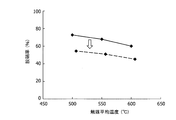
- 3 is a graph showing the catalytic activity of a denitration catalyst III-A for high temperature exhaust gas obtained by the present invention.
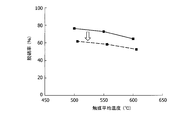
- 3 is a graph showing the catalytic activity of a denitration catalyst III-C for high temperature exhaust gas obtained by the present invention.
- the denitration catalyst for high-temperature exhaust gas obtained by the production method according to the present invention is a denitration catalyst for high-temperature exhaust gas containing nitrogen oxide, and tungsten oxide (WO 3 ) is supported on a composite oxide support containing titanium oxide.
- tungsten oxide having a WO 3 molecular layer number of 5 or less is supported.
- the composite oxide constituting the carrier is a composite oxide obtained by firing ZrO 2 and TiO 2 at a high temperature.
- the production method according to the present invention carries tungsten oxide (WO 3 ) used as an active component, but preferably tungsten oxide (WO 3 ) having a molecular layer number of 5 or less is carried.
- the number of molecular layers refers to the thickness of the tungsten oxide (WO 3 ) molecular layer formed on the catalyst support.
- the specific surface area of the catalyst carrier increases, so that the number of molecular layers increases as shown in Examples and Comparative Examples described later, and the denitration rate tends to decrease.
- the “number of WO 3 molecular layers” described in the present invention is defined as follows.
- the supported amount of tungsten oxide (WO 3 ) with respect to the entire catalyst is preferably 8% by weight or more, more preferably 12 to 24% by weight, based on the weight ratio of the entire catalyst. This is because when the amount exceeds 24% by weight, the effect of further increasing the amount of tungsten cannot be obtained and the cost becomes high.
- the denitration catalyst for high-temperature exhaust gas obtained by the present invention suppresses the decomposition of ammonia as a reducing agent to a high temperature range by increasing the acid amount or acid strength of the catalyst carrier, and the added amount of reducing agent is catalyzed.
- sulfuric acid treatment may be performed. This sulfuric acid treatment is a treatment method in which, for example, a composite oxide for a carrier is immersed in sulfuric acid, dried and then dried in a heating furnace in a high-temperature (eg, 500 to 600 ° C.) atmosphere to leave a sulfate radical on the carrier component. It is.
- a mixture of ZrO 2 and TiO 2 is fired at 600 ° C. or lower (preferably around 5000 ° C.) to obtain a composite oxide carrier.
- tungsten oxide is supported on the carrier of this composite oxide, and calcined at a temperature that is about the same as or higher than the use temperature (for example, 650 ° C.) to obtain a powder catalyst.
- firing at a temperature that is about the same as the use temperature or about 50 ° C. higher than the use temperature is performed by firing at the same level as the use temperature. This is because cracking of the catalyst can be prevented.
- any one of a coprecipitation method (CP), a homogeneous precipitation method (Homogeneous Precipitation: HP), and a sol-gel method (sol-gel) can be used.
- the temperature is room temperature.
- This slurry is kneaded and matured for a predetermined time, and then filtered and washed to obtain a cake.
- the obtained cake is dried at 110 ° C. and further fired at 600 ° C.
- TiO 2 / ZrO 2 composite oxide For 100 parts by weight of TiO 2 / ZrO 2 composite oxide, ammonium paratungstate is dissolved in a methylamine aqueous solution so that WO 3 becomes predetermined (8 parts by weight or more), and the powdered composite oxide is deposited on the powdered composite oxide. Dropping, kneading and drying are repeated to carry tungsten oxide (WO 3 ).
- the supported material is calcined for a predetermined time at the same temperature as the use temperature (for example, 650 ° C.) to obtain a powder catalyst.
- the obtained powder is fixed with, for example, a 30-ton pressure molding machine, and then crushed so that the particle size is in the range of 2 to 4 mm, for example, and sieved to obtain a denitration catalyst for high-temperature exhaust gas. Obtainable.
- the number of WO 3 molecular layers is preferably 5 or less, and further, the amount of WO 3 supported is 8% by weight or more in terms of the total catalyst weight ratio. Even when high-temperature denitration at a temperature equal to or higher than 0 ° C. is continued, the effect of suppressing volatilization while maintaining a high bonding strength with the WO 3 carrier and maintaining high denitration performance is achieved.
- the exhaust gas at 500 ° C. or more, preferably 600 ° C. or more is passed through the denitration catalyst for high temperature exhaust gas to decompose and remove nitrogen oxides in the exhaust gas.
- the shape of the denitration catalyst is not particularly limited, and for example, a honey force shape, or a stack of these, or a catalyst filled with a granular catalyst, can be used.
- the catalyst is preferably composed of
- the size of the honeycomb-shaped catalyst can be arbitrarily determined according to the exhaust gas properties, flow rate, etc., and is not particularly limited.
- the outer shape of the exhaust gas inlet is, for example, 50 to 150 mm square, and the length L is Those having a thickness of about 100 to 500 mm can be used.
- nitrogen oxides can be removed by the above-described denitration catalyst according to the above-described formula (1).
- the treatment method of exhaust gas discharged from various combustion devices the exhaust gas discharged is sent to a denitration catalyst for high temperature exhaust gas, and a denitration process is performed.
- Add as Exhaust gas that can be treated with the denitration catalyst for high-temperature exhaust gas obtained in the present invention is not particularly limited and can be applied to the treatment of exhaust gas containing nitrogen oxides.
- thermal power plants and factories that burn fuel such as coal and heavy oil It is preferably used for the treatment of gas discharged from a thermal power plant or a gas turbine.
- a composite oxide support is obtained by calcining a mixture of ZrO 2 and TiO 2 containing ZrO 2 in a proportion of 15% by weight to 55% by weight, and the resulting solid acid point of the denitration catalyst for high-temperature exhaust gas is obtained.
- An amount of 80.0 ⁇ mol / g or more can be secured in the initial stage, and 20.0 ⁇ mol / g or more can be secured even after aging by baking at 850 ° C. for 100 hours. Therefore, the denitration performance at a high temperature can be maintained for a long time.
- TiO 2 / ZrO 2 composite oxide was designated as composite oxide IA.
- TiO 2 / ZrO 2 composite oxide was designated as composite oxide IB.
- TiO 2 / ZrO 2 composite oxide was designated as composite oxide IC.
- a pyridine adsorption temperature programmed desorption (TPD) method was used to measure the solid acid amount of the denitration catalyst for high temperature exhaust gas.
- the measurement conditions for the amount of solid acid were as follows. Under these measurement conditions, pyridine was saturated and adsorbed, and the amount of pyridine desorbed was defined as the acid amount.
- Desorption conditions 30 ° C./min. The temperature is raised from 150 ° C. to 800 ° C.
- the carrier gas is He Detector: FID The results are shown in FIG.
- the rhombus plots with a large amount of solid acid are the initial ones of the denitration catalysts III-A, B, and C for high temperature exhaust gas, respectively.
- the square plots are obtained after aging of the denitration catalysts III-A, B, and C for high temperature exhaust gas by firing at 850 ° C. for 100 hours, respectively.
- 80.0 ⁇ mol / g or more can be secured in the initial stage, and 20.0 ⁇ mol / g or more can be secured even after aging by baking at 850 ° C. for 100 hours.
- the top is the initial catalytic activity, and the bottom is the result after applying a load of 15 hours at 800 ° C. Good performance is exhibited over 500 to 600 ° C., and the performance after application of load is not excessively reduced. This is a characteristic obtained from the fact that the denitration catalyst for high temperature exhaust gas obtained in the present invention has a sufficient amount of solid acid.
- the denitration catalyst for high-temperature exhaust gas obtained by the production method according to the present invention is particularly suitable for reducing and removing nitrogen oxides contained in high-temperature gas discharged from a thermal power plant or a high-temperature boiler. ing.
Landscapes
- Chemical & Material Sciences (AREA)
- Engineering & Computer Science (AREA)
- Materials Engineering (AREA)
- Organic Chemistry (AREA)
- Chemical Kinetics & Catalysis (AREA)
- Physics & Mathematics (AREA)
- Thermal Sciences (AREA)
- Exhaust Gas Treatment By Means Of Catalyst (AREA)
- Catalysts (AREA)
Description
4NH3 + 4NO + O2 → 4N2 + 6H2O・・・(1)
2NH3 + 5/2O2 → 2NO + 3H2O ・・・(2)
4NH3 + 3O2 → 2N2 + 6H2O ・・・(3)
上記式(2)又は式(3)の反応によって、NH3がNOの還元に有効に使用されず、温度の上昇に伴って脱硝性能は低下してしまっていた。このようなことから、例えば500℃以上のガスターピン出口排ガスを処理する場合には、還元剤不足となり、従来のアンモニア添加を伴う還元処理は適用が難しかった。
しかしながら、タングステンを活性成分として、担体である酸化チタン上に単に担持させた触媒では、無機繊維等の物理的強度による最適化を図っても触媒活性としては限界があり、効率的に脱硝反応を促進することが困難であった。
ここで、上記複合酸化物担体に硫酸根を残留させ、次いで、該硫酸根を残留させた担体に酸化タングステンを担持させ、焼成することもできる。
ここで、分子層数とは、触媒担体上に形成される酸化タングステン(WO3)分子層の厚さをいう。特に、高温脱硝を継続すると、触媒担体の比表面積が増加するため、後述する実施例及び比較例に示すようにこの分子層数が増加するので、脱硝率が低下する傾向がある。
また、本発明で記述する「WO3分子層数」は以下のように定義される。
「分子層数」=「WO3単分子層の面積(*1)」[m2/100g-触媒]/触媒担体表面積[m2/100g-触媒]
ここで、(*1)については、「WO3単分子層の面積」[m2/100g-触媒]
=触媒中のWO3モル数」[mol / 100g-触媒J/WO3単分子層のモル数(*2)[mo1/1cm2の単分子層]である。
cm3]、分子量を231.8[g/mo1]とし、タングステンの原子半径
を193[pm]とした場合の「WO3単分子層のモル数」
=(7.16/231.8)〔酸化タングステンの1cm3当たりのモル数〕
×193/1010 〔pmをcmに変換〕
=5.96e-10
これは24重量%を超える場合には、タングステンのさらなる増量効果が得られず、コスト高となってしまうからである。
この硫酸処理は、例えば硫酸に担体用複合酸化物を浸漬処理させ、乾燥後、高温(例えば500~600℃)雰囲気下、加熱炉内で乾燥させて、担体成分に硫酸根を残留させる処理方法である。
先ず、ZrO2と、TiO2とから成る混合物を600℃以下(好適には5000℃前後)で焼成して、複合酸化物の担体を得る。
混合水溶液にアンモニア水溶液をpH=7となるまで滴下して共沈物スラリを形成させる。
このスラリを所定間程度揖梓・熟成し、その後ろ過、洗浄を行い、ケーキ物を得る。得られたケーキ物を110℃で乾燥し、さらに600℃以下(例えば500℃)で所定時間焼成し、TiO2・ZrO2複合酸化物を得る。
100重量部のTiO2・ZrO2複合酸化物に対して、パラタングステン酸アンモニウムをWO3が所定(8重量部以上)となるようにメチルアミン水溶液に溶解させ、粉末状の複合酸化物上に滴下し、混練・乾燥を繰り返して、酸化タングステン(WO3)を担持させる。
この担持物を使用温度と同程度(例えば650℃)で所定時間焼成し、粉末触媒を得る。
得られた粉末を、例えば30トンの加圧成形器で粉末を固定化させた後、粒径が例えば2~4mmの範囲となるように破砕した後、篩分けして高温排ガス用脱硝触媒を得ることができる。
ここで、脱硝触媒の形状は特に限定されるものではなく、例えばハニ力ム形状、又はこれを積み重ねたものや、粒状の触媒を充填させたもの等を用いることができるが特にハニ力ム形状からなる触媒であることが好ましい。ハニ力ム形状触媒の大きさは排ガス性状や流量等によって任意に定めることが可能であり、特に限定されるものではないが、例えば排ガス流入口の外形は例えば50~150mm角、長さLは100~500mm程度のものを用いることができる。
各種燃焼装置から排出される排ガスの処理方法では、排出された排ガスが高温排ガス用脱硝触媒に送られ脱硝工程が行われるが、高温排ガス用脱硝触媒の前流にてアンモニア又は尿素等を還元剤として添加する。
本発明で得られる高温排ガス用脱硝触媒で処理できる排ガスは特に限定されず、窒素酸化物を含む排ガスの処理に適用できるが、例えば石炭、重質油等の燃料を燃焼する火力発電所、工場等のボイラ排ガス、あるいは、金属工場、石油精製所、石油化学工場等の加熱炉排ガスであり、特に、火力発電所やガスタービンから排出されるガスの処理に好適に用いられる。
以下、本発明の効果を示す実施例について説明するが、本発明はこれに限定されるものではない。
加熱した混合水溶液にアンモニア水溶液を滴下して共沈物スラリを形成し、熟成させた。
このスラリを800Cで5時間撹拌・熟成し、その後ろ過、洗浄を行い、ケーキ物を得た。得られたケーキ物を110℃で乾燥し、さらに500℃で5時間焼成し、TiO2・ZrO2複合酸化物を得た。このTiO2・ZrO2複合酸化物を複合酸化物I-Aとした。
100重量部の複合酸化物I-Aに対して、パラタングステン酸アンモニウムをWO3が16重量部となるようにメチルアミン水溶液に溶解させ、粉末状の複合酸化物上に滴下し、混練・乾燥を繰り返して、酸化タングステン(WO3) を担持させた。
この担持物を650℃で3時間焼成し、粉末触媒II-Aを得た。得られた粉末触媒IIを30トンの加圧成形器で粉末を固定化させた後、粒径が2~4mmの範囲となるように破砕した後、篩分けして高温排ガス用脱硝触媒III-Aを得た。
加熱した混合水溶液にアンモニア水溶液を滴下して共沈物スラリを形成し、熟成させた。
このスラリを800Cで5時間撹拌・熟成し、その後ろ過、洗浄を行い、ケーキ物を得た。得られたケーキ物を110℃で乾燥し、さらに500℃で5時間焼成し、TiO2・ZrO2複合酸化物を得た。このTiO2・ZrO2複合酸化物を複合酸化物I-Bとした。
100重量部の複合酸化物I-Bに対して、パラタングステン酸アンモニウムをWO3が16重量部となるようにメチルアミン水溶液に溶解させ、粉末状の複合酸化物上に滴下し、混練・乾燥を繰り返して、酸化タングステン(WO3) を担持させた。
この担持物を650℃で3時間焼成し、粉末触媒II-Bを得た。得られた粉末触媒IIを30トンの加圧成形器で粉末を固定化させた後、粒径が2~4mmの範囲となるように破砕した後、篩分けして高温排ガス用脱硝触媒III-Bを得た。
加熱した混合水溶液にアンモニア水溶液を滴下して共沈物スラリを形成し、熟成させた。
このスラリを800Cで5時間撹拌・熟成し、その後ろ過、洗浄を行い、ケーキ物を得た。得られたケーキ物を110℃で乾燥し、さらに500℃で5時間焼成し、TiO2・ZrO2複合酸化物を得た。このTiO2・ZrO2複合酸化物を複合酸化物I-Cとした。
100重量部の複合酸化物I-Cに対して、パラタングステン酸アンモニウムをWO3が16重量部となるようにメチルアミン水溶液に溶解させ、粉末状の複合酸化物上に滴下し、混練・乾燥を繰り返して、酸化タングステン(WO3) を担持させた。
この担持物を650℃で3時間焼成し、粉末触媒II-Cを得た。得られた粉末触媒IIを30トンの加圧成形器で粉末を固定化させた後、粒径が2~4mmの範囲となるように破砕した後、篩分けして高温排ガス用脱硝触媒III-Cを得た。
〔固体酸量測定方法〕
高温排ガス用脱硝触媒の固体酸量の測定には、ピリジン吸着昇温脱離(TPD)法を用いた。固体酸量の測定条件は下記の通りであった。この測定条件でピリジンを飽和吸着させ、脱離するピリジン量を酸量とした。
試料重量: 6.3mg
前処理: 450℃、0.5h、Heパージ
吸着条件: 150℃
脱着条件: 30℃/min.で150℃から800℃まで昇温
キャリヤーガスは、He
検出器: FID
結果を図1に示す。
固体酸量の多い、ひし形のプロットは、それぞれ高温排ガス用脱硝触媒III-A,B,Cの初期のものである。四角のプロットは、それぞれ高温排ガス用脱硝触媒III-A,B,Cを850℃で100時間の焼成によるエイジングした後のものである。
いずれにおいても、初期に80.0μmol/g以上確保でき、かつ850℃で100時間の焼成によるエイジングの後でも、20.0μmol/g以上確保できている。
脱硝活性の評価条件は、以下の通りである。
NO:65ppm、O2:14%、NH3: 51.3ppm、CO2:4.8%、H2O:8.8%、N2: 残、AV: 22.2Nm3/m2hrなお、
脱硝率は下記式にて表される。
脱硝率(%)=(1-出口NOx濃度/入口NOx濃度)×100
結果を図2(高温排ガス用脱硝触媒III-A)及び図3(高温排ガス用脱硝触媒III-C)に示す。
上が初期の触媒活性、下が800℃で15時間という負荷をかけた後の結果である。
500~600℃に亘って良好な性能を示し、負荷をかけた後の性能も過度に落ちていない。
これは、本発明で得られる高温排ガス用脱硝触媒が、十分な固体酸量を持っていることから得られる特性である。
Claims (2)
- ZrO2を15重量%~55重量%の割合で含むZrO2とTiO2とから成る混合物を、500±15℃で焼成し、複合酸化物の担体とし、該複合酸化物担体に酸化タングステンを担持させ、650±15℃で焼成し、粉末触媒とすることを特徴とする高温排ガス用脱硝触媒の製造方法。
- 上記複合酸化物担体に硫酸根を残留させ、次いで、該硫酸根を残留させた担体に酸化タングステンを担持させ、焼成することを特徴とする請求項1に記載の高温排ガス用脱硝触媒の製造方法。
Priority Applications (3)
| Application Number | Priority Date | Filing Date | Title |
|---|---|---|---|
| PCT/JP2012/067059 WO2014006697A1 (ja) | 2012-07-04 | 2012-07-04 | 高温排ガス用脱硝触媒の製造方法 |
| US14/409,071 US9463453B2 (en) | 2012-07-04 | 2012-07-04 | Method for producing NOx removal catalyst for high-temperature exhaust gas |
| JP2014523476A JP5988514B2 (ja) | 2012-07-04 | 2012-07-04 | 高温排ガス用脱硝触媒の製造方法 |
Applications Claiming Priority (1)
| Application Number | Priority Date | Filing Date | Title |
|---|---|---|---|
| PCT/JP2012/067059 WO2014006697A1 (ja) | 2012-07-04 | 2012-07-04 | 高温排ガス用脱硝触媒の製造方法 |
Publications (1)
| Publication Number | Publication Date |
|---|---|
| WO2014006697A1 true WO2014006697A1 (ja) | 2014-01-09 |
Family
ID=49881488
Family Applications (1)
| Application Number | Title | Priority Date | Filing Date |
|---|---|---|---|
| PCT/JP2012/067059 Ceased WO2014006697A1 (ja) | 2012-07-04 | 2012-07-04 | 高温排ガス用脱硝触媒の製造方法 |
Country Status (3)
| Country | Link |
|---|---|
| US (1) | US9463453B2 (ja) |
| JP (1) | JP5988514B2 (ja) |
| WO (1) | WO2014006697A1 (ja) |
Families Citing this family (1)
| Publication number | Priority date | Publication date | Assignee | Title |
|---|---|---|---|---|
| CN109513438B (zh) * | 2018-11-21 | 2022-07-08 | 南京工业大学 | 一种环境友好型高温脱硝催化剂及其制备方法 |
Citations (9)
| Publication number | Priority date | Publication date | Assignee | Title |
|---|---|---|---|---|
| JPS58131135A (ja) * | 1982-01-29 | 1983-08-04 | Hitachi Ltd | 高温排ガス用脱硝触媒 |
| JPH02229547A (ja) * | 1988-11-25 | 1990-09-12 | Nippon Shokubai Kagaku Kogyo Co Ltd | 排ガス処理触媒用担体、その製造方法ならびに該担体を含有してなる排ガス処理用触媒 |
| JPH06327944A (ja) * | 1993-05-19 | 1994-11-29 | Catalysts & Chem Ind Co Ltd | 窒素酸化物を除去する方法 |
| JPH09234340A (ja) * | 1996-03-01 | 1997-09-09 | Nippon Shokubai Co Ltd | 被酸化性窒素化合物含有排ガスの浄化方法 |
| JP2000093750A (ja) * | 1998-04-16 | 2000-04-04 | Mitsubishi Heavy Ind Ltd | 排ガス処理用触媒、排ガス処理方法及び処理装置 |
| JP2004105964A (ja) * | 2001-05-16 | 2004-04-08 | Kh Chemicals Co Ltd | ディーゼルエンジン排気ガスの浄化用触媒 |
| JP2005081189A (ja) * | 2003-09-05 | 2005-03-31 | Mitsubishi Heavy Ind Ltd | 高温排ガス用脱硝触媒 |
| JP2008049289A (ja) * | 2006-08-25 | 2008-03-06 | Tokyo Roki Co Ltd | 窒素酸化物を浄化する触媒、方法、及び装置 |
| JP2010506713A (ja) * | 2006-10-20 | 2010-03-04 | ロデイア・オペラシヨン | 酸化ジルコニウム、酸化チタンおよび酸化タングステンを含有する高酸性度組成物、この調製方法、ならびに排気ガスの処理におけるこの使用 |
Family Cites Families (11)
| Publication number | Priority date | Publication date | Assignee | Title |
|---|---|---|---|---|
| JPS52122293A (en) * | 1976-04-08 | 1977-10-14 | Nippon Shokubai Kagaku Kogyo Co Ltd | Catalyst for purifying nox |
| JPS5926331A (ja) | 1982-08-03 | 1984-02-10 | Nissan Motor Co Ltd | オ−トマチツクトランスミツシヨンのセレクト位置表示装置 |
| JPS6214336A (ja) | 1985-07-12 | 1987-01-22 | Canon Inc | 光学系駆動装置 |
| US4929586A (en) * | 1988-06-09 | 1990-05-29 | W. R. Grace & Co.-Conn. | Catalysts for selective catalytic reduction DeNOx technology |
| JP2825343B2 (ja) | 1990-11-29 | 1998-11-18 | 株式会社日本触媒 | 窒素酸化物除去用触媒の製造方法 |
| US5214017A (en) * | 1991-11-27 | 1993-05-25 | Sun Company, Inc. (R&M) | Solid-acid alkylation catalyst compositions for alkylation processes |
| US5212136A (en) * | 1991-11-27 | 1993-05-18 | Sun Company, Inc (R&M) | Solid-acid alkylation catalyst compositions for alkylation processes |
| JPH0724774A (ja) | 1993-07-08 | 1995-01-27 | Bridgestone Corp | ロボット |
| US20090022643A1 (en) * | 2005-04-06 | 2009-01-22 | Mitsubishi Heavy Industries, Ltd. | So3 reduction catalyst for purifying an exhaust gas, preparation process thereof, and exhaust gas purifying method using the catalyst |
| US7879759B2 (en) * | 2009-02-16 | 2011-02-01 | Augustine Steve M | Mobile DeNOx catalyst |
| WO2011042953A1 (ja) * | 2009-10-06 | 2011-04-14 | 三菱重工業株式会社 | 高温排ガス用脱硝触媒及びその製造方法、高温排ガス脱硝方法 |
-
2012
- 2012-07-04 JP JP2014523476A patent/JP5988514B2/ja active Active
- 2012-07-04 US US14/409,071 patent/US9463453B2/en active Active
- 2012-07-04 WO PCT/JP2012/067059 patent/WO2014006697A1/ja not_active Ceased
Patent Citations (9)
| Publication number | Priority date | Publication date | Assignee | Title |
|---|---|---|---|---|
| JPS58131135A (ja) * | 1982-01-29 | 1983-08-04 | Hitachi Ltd | 高温排ガス用脱硝触媒 |
| JPH02229547A (ja) * | 1988-11-25 | 1990-09-12 | Nippon Shokubai Kagaku Kogyo Co Ltd | 排ガス処理触媒用担体、その製造方法ならびに該担体を含有してなる排ガス処理用触媒 |
| JPH06327944A (ja) * | 1993-05-19 | 1994-11-29 | Catalysts & Chem Ind Co Ltd | 窒素酸化物を除去する方法 |
| JPH09234340A (ja) * | 1996-03-01 | 1997-09-09 | Nippon Shokubai Co Ltd | 被酸化性窒素化合物含有排ガスの浄化方法 |
| JP2000093750A (ja) * | 1998-04-16 | 2000-04-04 | Mitsubishi Heavy Ind Ltd | 排ガス処理用触媒、排ガス処理方法及び処理装置 |
| JP2004105964A (ja) * | 2001-05-16 | 2004-04-08 | Kh Chemicals Co Ltd | ディーゼルエンジン排気ガスの浄化用触媒 |
| JP2005081189A (ja) * | 2003-09-05 | 2005-03-31 | Mitsubishi Heavy Ind Ltd | 高温排ガス用脱硝触媒 |
| JP2008049289A (ja) * | 2006-08-25 | 2008-03-06 | Tokyo Roki Co Ltd | 窒素酸化物を浄化する触媒、方法、及び装置 |
| JP2010506713A (ja) * | 2006-10-20 | 2010-03-04 | ロデイア・オペラシヨン | 酸化ジルコニウム、酸化チタンおよび酸化タングステンを含有する高酸性度組成物、この調製方法、ならびに排気ガスの処理におけるこの使用 |
Also Published As
| Publication number | Publication date |
|---|---|
| JPWO2014006697A1 (ja) | 2016-06-02 |
| US20150148217A1 (en) | 2015-05-28 |
| JP5988514B2 (ja) | 2016-09-07 |
| US9463453B2 (en) | 2016-10-11 |
Similar Documents
| Publication | Publication Date | Title |
|---|---|---|
| JP7125391B2 (ja) | 排ガス処理のための骨格外の鉄及び/又はマンガンを有するlta触媒 | |
| JP6558560B2 (ja) | 触媒反応装置 | |
| JP6411358B2 (ja) | アンモニア酸化触媒 | |
| CN105611998B (zh) | 用于处理包含nox的废气的沸石共混物催化剂 | |
| CN101185886A (zh) | 一种scr脱硝催化剂及其制备方法 | |
| US9302251B2 (en) | NOx removal catalyst for high-temperature flue gas, manufacturing method thereof, and NOx removal method for high-temperature flue gas | |
| CN104415796B (zh) | 一种以偏钛酸为原料一步法制备脱硝催化剂的方法 | |
| JP6962966B2 (ja) | 排気ガス処理のための方法及びシステム | |
| JP2017502839A (ja) | ドープされたセリアを使用する選択的触媒的還元方法 | |
| CN106076318A (zh) | 一种整体式催化剂的制备方法 | |
| JP4508584B2 (ja) | 高温排ガス用脱硝触媒 | |
| CN108136372B (zh) | 整料式蜂窝状氧化催化剂及其制备方法 | |
| JPWO2012086413A1 (ja) | 脱硝触媒用担体、脱硝触媒及び脱硝装置 | |
| JP5988514B2 (ja) | 高温排ガス用脱硝触媒の製造方法 | |
| CN101933115B (zh) | 从尾气中除去氮氧化物的催化剂、其制备方法和使用该催化剂从尾气中除去氮氧化物的方法 | |
| JP2005319422A (ja) | 窒素酸化物除去用触媒の製造法 | |
| JP2013078768A (ja) | 高温排ガス用脱硝触媒及びその製造方法、高温排ガス脱硝方法 | |
| KR101400608B1 (ko) | 암모니아를 질소로 전환하는 선택적 산화 촉매와 그 제조방법 및 이를 이용하여 암모니아를 선택적으로 산화시키는 방법 | |
| KR20140102925A (ko) | 암모니아를 질소로 전환하는 선택적 산화 촉매 및 이를 이용한 선택적 산화 효율을 증진시키는 촉매의 제조방법 | |
| CN107126956A (zh) | 一种蜂窝式无钒烟气脱硝催化剂及其制备方法 | |
| CN104349839A (zh) | Scr催化剂及其制备方法 | |
| HK1165353B (en) | Catalyst composition for selective catalytic reduction of exhaust gases | |
| HK1165353A1 (en) | Catalyst composition for selective catalytic reduction of exhaust gases |
Legal Events
| Date | Code | Title | Description |
|---|---|---|---|
| 121 | Ep: the epo has been informed by wipo that ep was designated in this application |
Ref document number: 12880656 Country of ref document: EP Kind code of ref document: A1 |
|
| WWE | Wipo information: entry into national phase |
Ref document number: 14409071 Country of ref document: US |
|
| ENP | Entry into the national phase |
Ref document number: 2014523476 Country of ref document: JP Kind code of ref document: A |
|
| NENP | Non-entry into the national phase |
Ref country code: DE |
|
| 122 | Ep: pct application non-entry in european phase |
Ref document number: 12880656 Country of ref document: EP Kind code of ref document: A1 |