WO2013146738A1 - サトウキビ野生種ゲノムに由来する茎長関連マーカーとその利用 - Google Patents
サトウキビ野生種ゲノムに由来する茎長関連マーカーとその利用 Download PDFInfo
- Publication number
- WO2013146738A1 WO2013146738A1 PCT/JP2013/058698 JP2013058698W WO2013146738A1 WO 2013146738 A1 WO2013146738 A1 WO 2013146738A1 JP 2013058698 W JP2013058698 W JP 2013058698W WO 2013146738 A1 WO2013146738 A1 WO 2013146738A1
- Authority
- WO
- WIPO (PCT)
- Prior art keywords
- stem length
- sugarcane
- gramineous
- plant
- gramineous plant
- Prior art date
- Legal status (The legal status is an assumption and is not a legal conclusion. Google has not performed a legal analysis and makes no representation as to the accuracy of the status listed.)
- Ceased
Links
Images


Classifications
-
- A—HUMAN NECESSITIES
- A01—AGRICULTURE; FORESTRY; ANIMAL HUSBANDRY; HUNTING; TRAPPING; FISHING
- A01H—NEW PLANTS OR NON-TRANSGENIC PROCESSES FOR OBTAINING THEM; PLANT REPRODUCTION BY TISSUE CULTURE TECHNIQUES
- A01H1/00—Processes for modifying genotypes ; Plants characterised by associated natural traits
- A01H1/04—Processes of selection involving genotypic or phenotypic markers; Methods of using phenotypic markers for selection
- A01H1/045—Processes of selection involving genotypic or phenotypic markers; Methods of using phenotypic markers for selection using molecular markers
-
- C—CHEMISTRY; METALLURGY
- C12—BIOCHEMISTRY; BEER; SPIRITS; WINE; VINEGAR; MICROBIOLOGY; ENZYMOLOGY; MUTATION OR GENETIC ENGINEERING
- C12Q—MEASURING OR TESTING PROCESSES INVOLVING ENZYMES, NUCLEIC ACIDS OR MICROORGANISMS; COMPOSITIONS OR TEST PAPERS THEREFOR; PROCESSES OF PREPARING SUCH COMPOSITIONS; CONDITION-RESPONSIVE CONTROL IN MICROBIOLOGICAL OR ENZYMOLOGICAL PROCESSES
- C12Q1/00—Measuring or testing processes involving enzymes, nucleic acids or microorganisms; Compositions therefor; Processes of preparing such compositions
- C12Q1/68—Measuring or testing processes involving enzymes, nucleic acids or microorganisms; Compositions therefor; Processes of preparing such compositions involving nucleic acids
- C12Q1/6876—Nucleic acid products used in the analysis of nucleic acids, e.g. primers or probes
- C12Q1/6888—Nucleic acid products used in the analysis of nucleic acids, e.g. primers or probes for detection or identification of organisms
- C12Q1/6895—Nucleic acid products used in the analysis of nucleic acids, e.g. primers or probes for detection or identification of organisms for plants, fungi or algae
-
- C—CHEMISTRY; METALLURGY
- C12—BIOCHEMISTRY; BEER; SPIRITS; WINE; VINEGAR; MICROBIOLOGY; ENZYMOLOGY; MUTATION OR GENETIC ENGINEERING
- C12Q—MEASURING OR TESTING PROCESSES INVOLVING ENZYMES, NUCLEIC ACIDS OR MICROORGANISMS; COMPOSITIONS OR TEST PAPERS THEREFOR; PROCESSES OF PREPARING SUCH COMPOSITIONS; CONDITION-RESPONSIVE CONTROL IN MICROBIOLOGICAL OR ENZYMOLOGICAL PROCESSES
- C12Q2600/00—Oligonucleotides characterized by their use
- C12Q2600/13—Plant traits
-
- C—CHEMISTRY; METALLURGY
- C12—BIOCHEMISTRY; BEER; SPIRITS; WINE; VINEGAR; MICROBIOLOGY; ENZYMOLOGY; MUTATION OR GENETIC ENGINEERING
- C12Q—MEASURING OR TESTING PROCESSES INVOLVING ENZYMES, NUCLEIC ACIDS OR MICROORGANISMS; COMPOSITIONS OR TEST PAPERS THEREFOR; PROCESSES OF PREPARING SUCH COMPOSITIONS; CONDITION-RESPONSIVE CONTROL IN MICROBIOLOGICAL OR ENZYMOLOGICAL PROCESSES
- C12Q2600/00—Oligonucleotides characterized by their use
- C12Q2600/156—Polymorphic or mutational markers
Definitions
- the present invention relates to a stem length-related marker capable of selecting a grass family plant having a stem length trait characteristic of wild sugarcane species and a method of using the same.
- Sugarcane is cultivated for food, such as sugar raw materials and liquor raw materials, and is used in various industrial fields including use as a biofuel raw material. Under such circumstances, desired properties (e.g., sugar content, growth potential, shoot-forming ability, disease resistance and insect resistance, cold resistance, increased leaf length, increased leaf area, increased stem length, etc. There is a need to develop new varieties of sugarcane plants with In addition, gramineous plants including sugar cane are generally used as a raw material for alcoholic beverages and biofuels.
- sugarcane is much larger than other crops, and it is difficult to identify strains by field survey.
- it is necessary to cultivate and evaluate a large number of strains and it is necessary to prepare a greenhouse and a farm as described above and take a great deal of labor.
- Non-Patent Document 1 USDA reports on genotyping using SSR markers (Non-Patent Document 1), the accuracy is low due to the small number of markers and the number of polymorphisms from each marker, and the scope of application is American. ⁇ Because it is limited to Australian varieties, it cannot be used for system identification of major varieties and useful genetic resources in Japan and Taiwan / India.
- Non-Patent Document 2 suggests the possibility of creating a genetic map in sugarcane by increasing the number of markers, comparing the characteristic relationship of each marker, and verifying. However, Non-Patent Document 2 does not disclose a sufficient number of markers, and no marker linked to the target characteristics has been found.
- An example of marker development is, for example, development of a marker for resistance to black root disease in sugar beet as described in Patent Document 1. Moreover, as shown in Patent Document 2, a technique for selecting a variety using a marker linked to a target character in corn is disclosed.
- sugarcane has a species called wild species (scientific name: Saccharum spontaneum L.).
- Known sugarcane wild species include Glagah from Indonesia, Waseobana found in Japan, and Kash (Kans Grass) in Bengali. Glagah, Wasobana, and Kash are all common names for wild sugarcane species. In order to indicate a specific variety / system, an individual system name with information such as a collection place name and a collection number of each country may be used as necessary.
- Sugarcane wild species generally have the characteristics of vigorous growth and high environmental resistance, have thin and strong stems, are rich in fiber, and are excellent in resistance to pests such as atrophy disease and yellow stripe disease. The sugar content is generally low, and it is often 1 to 3% or less in Glagah. However, the range of mutations is large, with more than 10% being observed in wild sugarcane species collected in Japan.
- an object of the present invention is to provide a stem length-related marker derived from the sugarcane wild species genome and its use, which are related to the stem length characteristics in the sugarcane wild species.
- the present inventors prepared a large number of markers in sugarcane plants including wild sugarcane species, and linked analysis of quantitative traits and markers in hybrid progeny lines, A marker derived from sugarcane wild species linked to quantitative traits such as stem length was found, and the present invention was completed.
- the present invention includes the following.
- a gramineous plant stem-length-related marker comprising a continuous nucleic acid region selected from a region sandwiched by a nucleotide sequence shown in SEQ ID NO: 1 and a nucleotide sequence shown in SEQ ID NO: 2 in the chromosome of a grass plant.
- nucleic acid region stem-related marker according to (1), wherein the nucleic acid region comprises the base sequence described in SEQ ID NO: 1 or 2, or a part of the base sequence.
- the present invention it is possible to provide a novel gramineous plant stem length-related marker linked to stem length among quantitative traits in gramineous plants such as sugarcane.
- the stem length in a mating line of gramineous plants such as sugar cane can be assayed.
- the gramineous plant stem length-related marker according to the present invention is a specific region present on the chromosome of a gramineous plant such as sugarcane, and is linked to a causative gene (group) of a trait such as a stem length of a gramineous plant. It has the function of distinguishing the traits of stem length of gramineous plants. That is, in a progeny line obtained using a known grass family such as a sugarcane line, it is a line having a trait of increased stem length by confirming the presence / absence of a grass plant stem length related marker. Judgment can be made.
- the gramineous plant stem length-related marker according to the present invention is a marker linked to a trait that increases stem length.
- the stem length means including an increase in stem length particularly in the early stage of growth, and it can be paraphrased that the stem elongation rate in the early stage of growth is fast.
- the stem length means the height from the germination position to the thickening zone of +1 leaf (the most developed leaf) with respect to the highest stem in the strain.
- the initial stem length generally means the stem length in a period of 5 months after germination in Japan (the period may vary depending on the cultivation area, cropping type, etc.).
- the grass family plant is not particularly limited and means a plant belonging to the grass family. That is, the gramineous plant stem length-related marker according to the present invention can be used for any plant classified into the gramineous family. Gramineae plants are further classified into bamboo subfamily, strawberry subfamily, orilla subfamily and millet subfamily.
- Arundinaria Bambusa, Chimonobambusa, Kusquara ( Chusquea, Dendrocalamus, Melocanna, Oxytenanthera, Phyllostachys, Pleioblastus, Pseudosasa, Sasa, Smorph , Plants of the genus Semiarundinaria, Shibataea, Sinobambusa, Tetragonocalamus.
- the strawberry subfamily includes the genus Beckmannia, Brachypodium, Briza, Vulgaris ( Bromus, Dactylis, Festuca, Glyceria, Lamarckia, Lolium, Melica, Strawberry (Poa), Chishimadotsugi Genus (Puccinellia), Sesleria, Triodia, Camellia (Agropyron), Elymus, Barley (Secale), Wheat (Triticum), Konukagusa (Agrostis), Arenaterem (Arrhenatherum), Oenaceae (Avena), Deschampsia, Helicotolicon (Heli) ctotrichon), Shiragaya (Holcus), Minoboro (Koeleria), Lagurus, Arundo, Cortaderia, Hakonechloa, Molinia, Phragmites, Plants of the genus Arundin
- the Micraila subfamily includes plants of the genus Micraira.
- the genus Sphagnum (Diplachne), the genus Eleusine, the genus Sorghum (Eragrostis), the genus Muhlenbergia, Plants of the genus Sporobolus, Tripogon, Chloris, Cynodon, Aristida, and Zoysia are included.
- the plants belonging to the Gramineae family include plants of the genus Leersia, Oryza, and Zizania.
- the Orilla subfamily includes plants of the genus Ollyra, the genus Cryptochloa, and the Leptaspis.
- the subfamily Milletaria Brachiaria, Digitaria, Echinochloa, Panicum, Genus Paspalum, Pennisetum, Setaria and Isachne, Merikenkarkaya (Andropogon), Schizachachium, Arthraxon, Brio , Genus Cymbopogon, Dimeria, Eccoilopus, Erianthus, Eremochloa, Eulalia, Hemarthria, Hemarthria, Imperata), Platypus (Ischaemum), Ashiboso (Microstegium), Susuki (Miscanthus), relatively (P Included are plants of the genus Hacelurus, Pogonatherum, Saccharum, Sorghum, Themeda, Coix, and Zea.
- the gramineous stem length related marker according to the present invention can be applied to all gramineous plants classified into these subfamily. That is, for example, by detecting the presence / absence of the gramineous plant stem length-related marker according to the present invention for the progeny lines of these gramineous plants, it is determined whether or not the progeny line has a trait that increases the stem length. can do.
- a plant belonging to the subfamily Oxaceae belonging to the genus Sugarcane and a progeny line from the plant are preferable.
- the “species / genus crossing” between a sugarcane plant and a plant such as Susuki, Sorghum, Eliansus, etc. can be performed by a conventionally known method.
- sugar cane means a plant belonging to the genus Sugaraceae.
- Sugarcane is a so-called noble species (Saccharum officinarum), wild species (Saccharum spontaneum), Barberi species (Saccharum barberi), Sincharse species (Saccharum ⁇ sinense) and officinalum species. (Saccharum robustum) is included.
- Known sugarcane varieties / lines are not particularly limited, and include all varieties / lines usable in Japan, varieties / lines used outside Japan, and the like.
- sugarcane domestic breeds in Japan are not particularly limited, but Ni1, NiN2, NiF3, NiF4, NiF5, Ni6, NiN7, NiF8, Ni9, NiTn10, Ni11, Ni12, Ni14, Ni15, Ni16, Ni17, NiTn19, NiTn20 , Ni22, Ni23, and the like.
- the main sugarcane varieties in Japan are not particularly limited, and examples thereof include NiF8, Ni9, NiTn10, and Ni15.
- the main varieties introduced into sugarcane in Japan are not particularly limited, and examples include F177, Nco310, and F172.
- wild sugarcane species include, but are not limited to, Glagah Kloet, Glagah 1286, Mandalay, SES14, US56-15-8, and JW599.
- the present invention relates to a progeny line obtained by crossing a sugarcane wild species having a trait such as excellent initial stem length and / or a progeny line (for example, S3-19) of the wild type as one parent. It is preferable to determine a trait related to stem length using a gramineous plant stem length-related marker.
- the gramineous plant stem length-related marker according to the present invention corresponds to the chromosomal region of line S3-19 derived from Glagah, which is a sugarcane wild species having a trait such as excellent initial stem length.
- stem length traits Therefore, by detecting the presence / absence of the gramineous plant stem length-related marker according to the present invention, it is possible to confirm whether or not the inheritance that the progeny varieties to cope with the inspection are excellent in the initial stem length is inherited. it can.
- the progeny line may be a homozygous line in which both mother and father are sugarcane varieties / lines, either one is sugarcane varieties / lines and the other is closely related Erianthus arundinaceus Such a hybrid system may be used.
- the progeny varieties may be those obtained by so-called backcrossing.
- the gramineous plant stem length related marker according to the present invention is a gene linkage map comprising 9,485 markers derived from NiF8 and 11,238 markers derived from S3-19 from the signal data of 214 strains of NiF8, S3-19 And QTL (Quantitative Trait Loci) analysis using stem length data.
- the stem length is a quantitative trait that is considered to involve many genes and has a continuous distribution.
- QTL analysis uses genetic analysis software QTL Cartographer (Wang S., CJCBasten, and ZB Zeng (2010). QTL Cartographer 1.17. Department of Statistics, North Carolina State University, Raleigh, C) (Composite interval mapping) CIM) law is applied.
- a region where the rod score (LOD score) is a predetermined threshold (for example, 2.5) or more was found in the gene linkage map. That is, a region consisting of about 5.38 cM at the position of about 93.72 cM (centiorgan) in the 10th linkage group of S3-19 was identified as a QTL region related to stem length.
- Morgan (M) is a unit that relatively indicates the distance between genes on a chromosome, and is a value obtained by setting the cross value as a percentage. In the sugarcane chromosome, 1 cM corresponds to about 2000 kb.
- the causative gene (group) of the trait which increases the stem length in S3-19 or its wild species Glagah is present at or near this peak position.
- the region of about 5.38 cM is a region sandwiched between the markers S310951 and S311375 shown in Table 1.
- a linkage group is a number assigned to each of a plurality of linkage groups identified in the QTL analysis.
- a marker name is a name given to a marker uniquely acquired in the present invention.
- the signal threshold is a threshold for determining the presence or absence of a marker.
- the nucleic acid region containing the marker shown in Table 1 can be used as a gramineous plant stem length related marker.
- the nucleic acid region is such that the identity with other regions present in the chromosome of the grass family is 95% or less, preferably 90% or less, more preferably 80% or less, and most preferably 70% or less. This means a region consisting of a simple base sequence. If the identity of the nucleic acid region serving as a gramineous plant stem length-related marker and other regions is in the above range, the nucleic acid region can be specifically detected according to a conventional method.
- the identity value can be calculated using default parameters using, for example, BLAST.
- the base length of the nucleic acid region serving as a gramineous plant stem length-related marker can be at least 8 bases or more, preferably 15 bases or more, more preferably 20 or more, and most preferably 30 bases in length. If the base length of the nucleic acid region serving as a gramineous plant stem length-related marker is within the above range, the nucleic acid region can be specifically detected according to a conventional method.
- the gramineous plant stem length-related marker is preferably selected from the 5.38 cM region, that is, the region sandwiched between the base sequence shown in SEQ ID NO: 1 and the base sequence shown in SEQ ID NO: 2. This is because the peak exists in a region sandwiched between the base sequence shown in SEQ ID NO: 1 and the base sequence shown in SEQ ID NO: 2.
- the gramineous plant stem length-related marker may be a nucleic acid region containing one type of marker selected from the two types of markers shown in Table 1 above.
- a gramineous plant stem length-related marker a nucleic acid region containing a marker (S310951) consisting of the base sequence shown in SEQ ID NO: 1 or a nucleic acid region containing a marker (S31135) consisting of the base sequence shown in SEQ ID NO: 2 is used. It is preferable to do.
- the base sequence of the nucleic acid region containing the marker can be specified by an adjacent sequence acquisition method such as inverse PCR using a primer designed based on the base sequence of the marker.
- the above two types of markers themselves can be used as the gramineous plant stem length related markers. That is, one or more of these two types of markers can be used as a gramineous plant stem length related marker.
- the gramineous plant stem length-related marker it is preferable to use a marker consisting of the base sequence shown in SEQ ID NO: 1 (S310951) or a marker consisting of the base sequence shown in SEQ ID NO: 2 (S31135).
- ⁇ Use of gramineous plant stem length related markers By using the gramineous stem length-related marker, it is possible to determine whether the phenotype relating to the stem length is an unknown strain that exhibits a phenotype of increasing stem length.
- using a gramineous plant stem length-related marker means to include a form using a DNA microarray having a probe corresponding to the marker.
- the probe corresponding to the gramineous stem length-related marker means an oligonucleotide that can specifically hybridize under stringent conditions to the gramineous stem length-related marker defined as described above.
- Such oligonucleotides are, for example, at least 10 bases, 15 bases, 20 bases, 25 bases, 30 bases, 35 bases of the base sequence of the gramineous stem length-related marker defined as described above or its complementary strand. It can be designed as a partial region or a whole region of a base length of 40 bases, 45 bases, 50 bases or more.
- the DNA microarray having the probe may be any microarray using a flat substrate such as glass or silicone as a carrier, a bead array using a microbead as a carrier, or a three-dimensional microarray in which a probe is fixed to the inner wall of a hollow fiber. It may be a type of microarray.
- the method of using the DNA microarray is disclosed in detail in JP2011-120558A and WO2011 / 074510.
- it is detected whether or not the gramineous plant stem length related marker according to the present invention is present in the gramineous plant to be tested.
- the gramineous plant stem-length-related marker according to the present invention is present, it can be determined that the tested gramineous plant is a variety whose stem length increases.
- a new sugarcane variety when producing a new sugarcane variety, it is possible to first determine the presence or absence of a gramineous plant stem length-related marker in the parent variety used for mating, and select a parent variety whose stem length increases.
- a progeny line having a trait such as an increase in stem length will appear frequently. Thereby, the number which cultivates a good system
- DNA microarray probe Preparation of DNA microarray probe> (1) Materials Sugarcane varieties: NiF8, Ni9, US56-15-8, POJ2878, Q165, R570, Co290 and B3439, sugarcane-related wild species: Glagah Kloet, Chunee, Natal Uba and Robustum9, and Eliansus: IJ76-349 And JW630 was used.
- Genomic DNA was extracted from each of these sugarcane varieties, wild relatives of sugarcane, and Eliansus using DNeasy Plant Mini Kit (Qiagen). Genomic DNA (750 ng) was treated with restriction enzyme PstI (NEB, 25 units) at 37 ° C. for 2 hours, restriction enzyme BstNI (NEB, 25 unit) was added, and treated at 60 ° C. for 2 hours.
- PstI restriction enzyme
- BstNI NEB, 25 unit
- genomic DNA fragment (15 ng) having the adapter obtained in (3) was added to a PstI sequence adapter recognition primer (5′-GATGGATCCAGTGCAG-3 ′ (SEQ ID NO: 5)) and Taq polymerase (TAKARA PrimeSTAR, 1.25 unit), and genomic DNA fragments were amplified by PCR (98 ° C for 10 seconds, 55 ° C for 15 seconds, 72 ° C for 1 minute, 30 cycles, treated at 72 ° C for 3 minutes, and stored at 4 ° C).
- PstI sequence adapter recognition primer 5′-GATGGATCCAGTGCAG-3 ′ (SEQ ID NO: 5)
- Taq polymerase TAKARA PrimeSTAR, 1.25 unit
- Probe design and preparation of DNA microarray A 50-75 bp probe was designed based on the genomic sequence information of (5). Based on the nucleotide sequence information of the designed probes, a DNA microarray having these probes was prepared.
- Genomic DNA was extracted from these NiF8, S3-19, and 214 progeny lines using DNeasy Plant Mini Kit (Qiagen). Genomic DNA (750 ng) was treated with restriction enzyme PstI (NEB, 25 units) at 37 ° C. for 2 hours, restriction enzyme BstNI (NEB, 25 unit) was added, and treated at 60 ° C. for 2 hours.
- PstI restriction enzyme
- BstNI restriction enzyme BstNI
- genomic DNA fragment (15 ng) having the adapter obtained in (3) was added to a PstI sequence adapter recognition primer (5′-GATGGATCCAGTGCAG-3 ′ (SEQ ID NO: 5)) and Taq polymerase (TAKARA PrimeSTAR, 1.25 unit), and genomic DNA fragments were amplified by PCR (98 ° C for 10 seconds, 55 ° C for 15 seconds, 72 ° C for 1 minute, 30 cycles, treated at 72 ° C for 3 minutes, and stored at 4 ° C).
- PstI sequence adapter recognition primer 5′-GATGGATCCAGTGCAG-3 ′ (SEQ ID NO: 5)
- Taq polymerase TAKARA PrimeSTAR, 1.25 unit
- Hybrid signal detection Using the labeled sample of (5), according to NimbleGen Array User's Guide, 1. Hybridization was carried out using the DNA microarray prepared in step 1, and a signal based on the label was detected.
- NiF8 was included in the data section of 62 (cm) and S3-19 was included in the data section of 67.7 (cm).
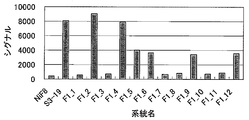
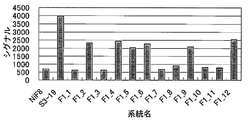
- the marker located in the vicinity of the peak is linked to a causative gene (group) having a function of increasing stem length, it can be used as a gramineous stem length related marker. It has been shown. That is, it was clarified that the two types of markers shown in FIG. 4 can be used as gramineous plant stem length related markers.
- “Glaga_1” and “Glaga_2” are the results of using the same sample in the DNA array, and similarly, IRK67-1_1 and IRK67-1_2 show the results of the same sample.
- A means that it can be determined that the cultivar shown in that column is derived from the genome.
- B means that it cannot be determined that the cultivar shown in that column is derived from the genome.
Landscapes
- Life Sciences & Earth Sciences (AREA)
- Chemical & Material Sciences (AREA)
- Health & Medical Sciences (AREA)
- Engineering & Computer Science (AREA)
- Organic Chemistry (AREA)
- Genetics & Genomics (AREA)
- Analytical Chemistry (AREA)
- Proteomics, Peptides & Aminoacids (AREA)
- Botany (AREA)
- General Health & Medical Sciences (AREA)
- Zoology (AREA)
- Biotechnology (AREA)
- Wood Science & Technology (AREA)
- Physics & Mathematics (AREA)
- Microbiology (AREA)
- Molecular Biology (AREA)
- Immunology (AREA)
- Biochemistry (AREA)
- Bioinformatics & Cheminformatics (AREA)
- General Engineering & Computer Science (AREA)
- Biophysics (AREA)
- Mycology (AREA)
- Developmental Biology & Embryology (AREA)
- Environmental Sciences (AREA)
- Spectroscopy & Molecular Physics (AREA)
- Breeding Of Plants And Reproduction By Means Of Culturing (AREA)
- Measuring Or Testing Involving Enzymes Or Micro-Organisms (AREA)
Priority Applications (5)
| Application Number | Priority Date | Filing Date | Title |
|---|---|---|---|
| BR112014023742A BR112014023742B8 (pt) | 2012-03-26 | 2013-03-26 | Método para selecionar uma planta de progênie de cana-deaçúcar com comprimento de caule aumentado |
| IN8330DEN2014 IN2014DN08330A (https=) | 2012-03-26 | 2013-03-26 | |
| US14/388,161 US10617076B2 (en) | 2012-03-26 | 2013-03-26 | Stalk-length-related marker derived from genome of wild-type sugarcane and use thereof |
| CN201380016777.0A CN104321440B (zh) | 2012-03-26 | 2013-03-26 | 来源于甘蔗野生种基因组的茎长相关标志物及其利用 |
| AU2013241423A AU2013241423B2 (en) | 2012-03-26 | 2013-03-26 | Stalk-length-related marker derived from genome of wild-type sugarcane and use thereof |
Applications Claiming Priority (2)
| Application Number | Priority Date | Filing Date | Title |
|---|---|---|---|
| JP2012-069850 | 2012-03-26 | ||
| JP2012069850A JP2013198453A (ja) | 2012-03-26 | 2012-03-26 | サトウキビ野生種ゲノムに由来する茎長関連マーカーとその利用 |
Publications (1)
| Publication Number | Publication Date |
|---|---|
| WO2013146738A1 true WO2013146738A1 (ja) | 2013-10-03 |
Family
ID=49259989
Family Applications (1)
| Application Number | Title | Priority Date | Filing Date |
|---|---|---|---|
| PCT/JP2013/058698 Ceased WO2013146738A1 (ja) | 2012-03-26 | 2013-03-26 | サトウキビ野生種ゲノムに由来する茎長関連マーカーとその利用 |
Country Status (7)
| Country | Link |
|---|---|
| US (1) | US10617076B2 (https=) |
| JP (1) | JP2013198453A (https=) |
| CN (1) | CN104321440B (https=) |
| AU (1) | AU2013241423B2 (https=) |
| BR (1) | BR112014023742B8 (https=) |
| IN (1) | IN2014DN08330A (https=) |
| WO (1) | WO2013146738A1 (https=) |
Families Citing this family (3)
| Publication number | Priority date | Publication date | Assignee | Title |
|---|---|---|---|---|
| JP2012115242A (ja) | 2010-12-03 | 2012-06-21 | Toyota Motor Corp | サトウキビの茎中糖度関連マーカーとその利用 |
| JP6566480B2 (ja) * | 2015-03-18 | 2019-08-28 | 国立研究開発法人農業・食品産業技術総合研究機構 | イチゴ属植物のうどんこ病抵抗性関連マーカーとその利用 |
| CN111663001B (zh) * | 2020-07-14 | 2022-10-14 | 福建农林大学 | 一种区分甘蔗种间三号染色体遗传背景的ssr标记与应用 |
Citations (1)
| Publication number | Priority date | Publication date | Assignee | Title |
|---|---|---|---|---|
| JP2012050429A (ja) * | 2010-08-06 | 2012-03-15 | Toyota Motor Corp | サトウキビ属植物の茎長関連マーカーとその利用 |
Family Cites Families (4)
| Publication number | Priority date | Publication date | Assignee | Title |
|---|---|---|---|---|
| US8519223B2 (en) | 2006-04-28 | 2013-08-27 | National Agriculture And Food Research Organization | Marker for selecting an aphanomyces cochlioides-resistant variety and selection method therefor |
| EP1947198A1 (en) | 2007-01-18 | 2008-07-23 | Syngeta Participations AG | Maize plants characterised by quantitative trait loci (QTL) |
| US8362325B2 (en) | 2007-10-03 | 2013-01-29 | Ceres, Inc. | Nucleotide sequences and corresponding polypeptides conferring modulated plant characteristics |
| MY151826A (en) * | 2010-10-13 | 2014-07-14 | Tan Chabau Kow Tan Poi Heong | Locking device |
-
2012
- 2012-03-26 JP JP2012069850A patent/JP2013198453A/ja active Pending
-
2013
- 2013-03-26 US US14/388,161 patent/US10617076B2/en not_active Expired - Fee Related
- 2013-03-26 CN CN201380016777.0A patent/CN104321440B/zh not_active Expired - Fee Related
- 2013-03-26 BR BR112014023742A patent/BR112014023742B8/pt not_active IP Right Cessation
- 2013-03-26 AU AU2013241423A patent/AU2013241423B2/en not_active Ceased
- 2013-03-26 IN IN8330DEN2014 patent/IN2014DN08330A/en unknown
- 2013-03-26 WO PCT/JP2013/058698 patent/WO2013146738A1/ja not_active Ceased
Patent Citations (1)
| Publication number | Priority date | Publication date | Assignee | Title |
|---|---|---|---|---|
| JP2012050429A (ja) * | 2010-08-06 | 2012-03-15 | Toyota Motor Corp | サトウキビ属植物の茎長関連マーカーとその利用 |
Non-Patent Citations (2)
| Title |
|---|
| J. -Y. HOARAU ET AL.: "Genetic dissection of a modern sugarcane cultivar (Saccharum spp.).II. Detection of QTLs for yield components", THEOR. APPL. GENET., vol. 105, 2002, pages 1027 - 1037, XP002662392, DOI: doi:10.1007/S00122-002-1047-5 * |
| K. S. AITKEN ET AL.: "Genetic control of yield related stalk traits in sugarcane", THEOR. APPL. GENET., vol. 117, 2008, pages 1191 - 1203 * |
Also Published As
| Publication number | Publication date |
|---|---|
| BR112014023742B8 (pt) | 2022-10-18 |
| AU2013241423B2 (en) | 2017-08-10 |
| CN104321440A (zh) | 2015-01-28 |
| BR112014023742A2 (pt) | 2017-07-18 |
| CN104321440B (zh) | 2017-05-17 |
| AU2013241423A1 (en) | 2014-10-23 |
| BR112014023742B1 (pt) | 2022-09-13 |
| JP2013198453A (ja) | 2013-10-03 |
| US20150052631A1 (en) | 2015-02-19 |
| US10617076B2 (en) | 2020-04-14 |
| IN2014DN08330A (https=) | 2015-05-15 |
Similar Documents
| Publication | Publication Date | Title |
|---|---|---|
| Miyatake et al. | Development of selective markers linked to a major QTL for parthenocarpy in eggplant (Solanum melongena L.) | |
| Zhu et al. | Mapping resistance to spot blotch in a CIMMYT synthetic-derived bread wheat | |
| JP2015231359A (ja) | ホウレンソウにおけるペロノスポラ耐性のための組成物及び方法 | |
| JP5653957B2 (ja) | サトウキビ属植物の黒穂病抵抗性関連マーカーとその利用 | |
| WO2013146738A1 (ja) | サトウキビ野生種ゲノムに由来する茎長関連マーカーとその利用 | |
| JP7094681B2 (ja) | Xanthomonas抵抗性のBrassica oleracea植物 | |
| CN112752843B (zh) | 甘蔗属植物的黑穗病抗性相关标记及其利用 | |
| CA2804853C (en) | Soybean gene cluster regions associated with aphid resistance and methods of use | |
| JP2012050429A (ja) | サトウキビ属植物の茎長関連マーカーとその利用 | |
| JP2012034629A (ja) | サトウキビ属植物の葉長関連マーカーとその利用 | |
| AU2018339091B2 (en) | Cucumber mosaic virus resistant pepper plants | |
| WO2020009113A1 (ja) | サトウキビ属植物の黒穂病抵抗性関連マーカーとその利用 | |
| JP2012115245A (ja) | サトウキビの茎径関連マーカーとその利用 | |
| JP2012034626A (ja) | サトウキビ属植物の葉面積関連マーカーとその利用 | |
| KR102953913B1 (ko) | 흰가루병 저항성 고추류 식물 | |
| JP2012115239A (ja) | サトウキビの茎数関連マーカーとその利用 | |
| US9677134B2 (en) | Sugarcane-stalk-sugar-content-related marker and the use thereof | |
| JP2012115244A (ja) | サトウキビの可製糖量関連マーカーとその利用 | |
| KR20220007592A (ko) | 흰가루병 저항성 고추류 식물 | |
| JP2012115241A (ja) | サトウキビの茎重関連マーカーとその利用 | |
| WO2012073497A2 (en) | Sugarcane-single-stalk-weight-related marker and the use thereof |
Legal Events
| Date | Code | Title | Description |
|---|---|---|---|
| 121 | Ep: the epo has been informed by wipo that ep was designated in this application |
Ref document number: 13767547 Country of ref document: EP Kind code of ref document: A1 |
|
| WWE | Wipo information: entry into national phase |
Ref document number: 14388161 Country of ref document: US |
|
| REG | Reference to national code |
Ref country code: BR Ref legal event code: B01A Ref document number: 112014023742 Country of ref document: BR |
|
| ENP | Entry into the national phase |
Ref document number: 2013241423 Country of ref document: AU Date of ref document: 20130326 Kind code of ref document: A |
|
| NENP | Non-entry into the national phase |
Ref country code: DE |
|
| 122 | Ep: pct application non-entry in european phase |
Ref document number: 13767547 Country of ref document: EP Kind code of ref document: A1 |
|
| ENP | Entry into the national phase |
Ref document number: 112014023742 Country of ref document: BR Kind code of ref document: A2 Effective date: 20140924 |