WO2013129334A1 - 運動効果模倣作用剤並びにAMPK及びPPARδ共活性化剤 - Google Patents
運動効果模倣作用剤並びにAMPK及びPPARδ共活性化剤 Download PDFInfo
- Publication number
- WO2013129334A1 WO2013129334A1 PCT/JP2013/054806 JP2013054806W WO2013129334A1 WO 2013129334 A1 WO2013129334 A1 WO 2013129334A1 JP 2013054806 W JP2013054806 W JP 2013054806W WO 2013129334 A1 WO2013129334 A1 WO 2013129334A1
- Authority
- WO
- WIPO (PCT)
- Prior art keywords
- mangosteen
- extract
- mangostin
- pparδ
- agent
- Prior art date
- Legal status (The legal status is an assumption and is not a legal conclusion. Google has not performed a legal analysis and makes no representation as to the accuracy of the status listed.)
- Ceased
Links
Images


Classifications
-
- A—HUMAN NECESSITIES
- A61—MEDICAL OR VETERINARY SCIENCE; HYGIENE
- A61K—PREPARATIONS FOR MEDICAL, DENTAL OR TOILETRY PURPOSES
- A61K31/00—Medicinal preparations containing organic active ingredients
- A61K31/33—Heterocyclic compounds
- A61K31/335—Heterocyclic compounds having oxygen as the only ring hetero atom, e.g. fungichromin
- A61K31/35—Heterocyclic compounds having oxygen as the only ring hetero atom, e.g. fungichromin having six-membered rings with one oxygen as the only ring hetero atom
- A61K31/352—Heterocyclic compounds having oxygen as the only ring hetero atom, e.g. fungichromin having six-membered rings with one oxygen as the only ring hetero atom condensed with carbocyclic rings, e.g. methantheline
-
- A—HUMAN NECESSITIES
- A23—FOODS OR FOODSTUFFS; TREATMENT THEREOF, NOT COVERED BY OTHER CLASSES
- A23L—FOODS, FOODSTUFFS OR NON-ALCOHOLIC BEVERAGES, NOT OTHERWISE PROVIDED FOR; PREPARATION OR TREATMENT THEREOF
- A23L33/00—Modifying nutritive qualities of foods; Dietetic products; Preparation or treatment thereof
- A23L33/10—Modifying nutritive qualities of foods; Dietetic products; Preparation or treatment thereof using additives
- A23L33/105—Plant extracts, their artificial duplicates or their derivatives
-
- A—HUMAN NECESSITIES
- A61—MEDICAL OR VETERINARY SCIENCE; HYGIENE
- A61K—PREPARATIONS FOR MEDICAL, DENTAL OR TOILETRY PURPOSES
- A61K36/00—Medicinal preparations of undetermined constitution containing material from algae, lichens, fungi or plants, or derivatives thereof, e.g. traditional herbal medicines
- A61K36/18—Magnoliophyta (angiosperms)
- A61K36/185—Magnoliopsida (dicotyledons)
- A61K36/38—Clusiaceae, Hypericaceae or Guttiferae (Hypericum or Mangosteen family), e.g. common St. Johnswort
-
- A—HUMAN NECESSITIES
- A61—MEDICAL OR VETERINARY SCIENCE; HYGIENE
- A61P—SPECIFIC THERAPEUTIC ACTIVITY OF CHEMICAL COMPOUNDS OR MEDICINAL PREPARATIONS
- A61P3/00—Drugs for disorders of the metabolism
-
- A—HUMAN NECESSITIES
- A61—MEDICAL OR VETERINARY SCIENCE; HYGIENE
- A61P—SPECIFIC THERAPEUTIC ACTIVITY OF CHEMICAL COMPOUNDS OR MEDICINAL PREPARATIONS
- A61P3/00—Drugs for disorders of the metabolism
- A61P3/06—Antihyperlipidemics
-
- A—HUMAN NECESSITIES
- A61—MEDICAL OR VETERINARY SCIENCE; HYGIENE
- A61P—SPECIFIC THERAPEUTIC ACTIVITY OF CHEMICAL COMPOUNDS OR MEDICINAL PREPARATIONS
- A61P43/00—Drugs for specific purposes, not provided for in groups A61P1/00-A61P41/00
Definitions
- the present invention relates to a motor effect mimicking agent and a AMPK and PPAR ⁇ coactivator containing a mangosteen extract and / or a specific compound derived from mangosteen.
- AMPK AMP-activated protein kinase
- GW501516 is known as a compound that activates PPAR ⁇ , and is used in the field of basic experiments as a synthetic agonist.
- certain pyrrole derivatives have PPAR ⁇ agonist activity (see, for example, Patent Document 4).
- Mangosteen (scientific name: Garcinia mangostana L.) is a hypericaceae plant native to Southeast Asia. Mangosteen fruit or pericarp has traditionally been used as a therapeutic agent for dysentery and infectious diarrhea, antibacterial and parasite control, malaria, urinary tract infection, syphilis, mania, etc. 3). Also known are 5 ⁇ -reductase inhibitors (see, for example, Patent Document 5), whitening / anti-inflammatory effects (see, for example, Patent Document 6), and I ⁇ B kinase inhibitors (for example, see, Patent Document 7).
- a safer agent that can be obtained with less exercise is, for example, prevention of bedridden patients due to muscle weakness of elderly people who cannot exercise, prevention of muscle weakness of hospitalized patients such as fractures
- prevention of muscle weakness in space (low-gravity) space suppression of muscle weakness due to genetic disease (eg muscular dystrophy), diet by improving basal metabolism more efficiently with less exercise there is a possibility.
- an object of the present invention is to provide a highly safe coactivator capable of activating both AMPK and PPAR ⁇ .
- the present invention also provides a safe and effective exercise effect mimicking agent capable of obtaining a favorable biological response recognized when exercise is performed without performing exercise or with less exercise.
- Another object of the present invention is to provide the above agent at a low cost and in a form suitable for continuous intake.
- the present inventor has conducted extensive research and found that an extract derived from mangosteen and a specific compound contained in the extract have an action of activating both AMPK and PPAR ⁇ . It was. It has also been found that when a mangosteen-derived extract is administered to a rat, a favorable biological response that is inherently observed when exercising can be obtained without exercising. Furthermore, it has also been found that a mangosteen extract having the above-mentioned action can be easily obtained from mangosteen peel and the like, and that a food and drink containing the mangosteen extract is a food and drink having a taste suitable for continuous intake, The present invention has been completed.
- the present invention based on the above findings by the present inventors is as follows.
- Mangosteen extract has the following formula (I) (Where R 1 and R 4 are independently of each other C 1 -C 5 -alkyl or alkenyl; R 2 and R 3 independently of one another are hydroxy or C 1 -C 6 -alkoxy; Here, R 1 and R 2 may be bonded to each other to form a 5- to 8-membered ring containing an oxygen atom in addition to a carbon atom as a ring atom.
- a food or drink containing the agent according to [5] Contains 0.001 to 50% by weight of ⁇ -mangostin; and 0.0001 to 50% by weight of ⁇ -mangostin; Food and drink.
- Exercise including mangosteen extract, comprising extracting one or more raw materials selected from the group consisting of mangosteen fruit, fruit juice, concentrated fruit juice, squeezed residue, pericarp and these dried products using an ethanol solvent A method for producing an effect mimicking agent or an AMPK and PPAR ⁇ coactivator.
- a method of exerting an effect of mimicking exercise effect comprising a step of administering an effective amount of a mangosteen extract to a subject.
- a method for activating AMPK and PPAR ⁇ comprising a step of administering an effective amount of a mangosteen extract to a subject.
- the method according to [18], wherein the exercise effect mimicking action is fat accumulation suppression, heat production promotion, muscle differentiation promotion, exercise endurance improvement or muscle atrophy suppression.
- a method of exerting an effect of mimicking a movement effect comprising a step of administering an effective amount of ⁇ -mangostin to a subject.
- a method for exerting a mimicking effect on a motor effect comprising a step of administering an effective amount of ⁇ -mangostin and ⁇ -mangostin to a subject.
- a method for activating AMPK and PPAR ⁇ comprising a step of administering an effective amount of ⁇ -mangostin to a subject.
- a method for activating AMPK and PPAR ⁇ comprising a step of administering an effective amount of ⁇ -mangostin to a subject.
- a method for activating AMPK and PPAR ⁇ comprising a step of administering an effective amount of ⁇ -mangostin to a subject.
- 3- A method for activating PPAR ⁇ comprising administering an effective amount of isomangosteen to a subject.
- both AMPK and PPAR ⁇ can be activated, and a highly safe coactivator can be provided.
- a safe and highly effective mimicking effect mimicking agent capable of obtaining a favorable biological response that is originally recognized when exercising, without exercising or with less exercising.
- the active ingredient of the agent of the present invention is an ingredient that can be obtained from mangosteen and can be safely ingested.
- said agent can also be provided as taste food-drinks suitable for continuous ingestion.
- the above-mentioned highly effective agent can be obtained easily and efficiently from mangosteen peel and the like, so that the waste can be effectively used.
- Example 2 shows enhancement of phosphorylated AMPK (p-AMPK, activated form) in C2C12 cells by ⁇ -mangostin, ⁇ -mangosteen or mangosteen extract.
- Example 5 which shows the raise of the gene expression in connection with the heat production in a gastrocnemius by a mangosteen extract.
- Example 5 which shows the raise of the gene expression in connection with muscle differentiation in a gastrocnemius by a mangosteen extract.
- Example 6) which shows the raise of the gene expression in connection with muscle differentiation in C2C12 cell by (alpha) -mangostin.
- Example 8 The measurement result of the exercise endurance in the mouse
- Example 11 which shows suppression of the gene (Atrogin-1) related to disuse muscle atrophy by the mangosteen extract.
- Example 11 which shows suppression of gene (MuRF-1) expression related to disuse muscle atrophy by mangosteen extract.
- the present invention relates to an exercise effect mimicking agent; AMPK and PPAR ⁇ coactivator; fat accumulation inhibitor; heat production promoter; muscle differentiation promoter; exercise endurance improver; muscle atrophy inhibitor; AMPK activator; Activators; PPAR ⁇ activators; and PPAR ⁇ and PPAR ⁇ coactivators.
- AMPK activator Activators
- PPAR ⁇ activators PPAR ⁇ and PPAR ⁇ coactivators
- the agent of the present invention contains a mangosteen extract as an active ingredient.
- the above mangosteen extract is one or more raw materials selected from mangosteen fruit, fruit juice, concentrated fruit juice, juice residue, pericarp and / or dried products thereof (hereinafter simply referred to as “mangosteen raw material”).
- mangosteen raw material Is a processed product extracted with a polar solvent (hereinafter, a processed product obtained by extraction using a polar solvent may be simply abbreviated as “mangosteen extract”).
- Mangosteen is known to contain about 40 types of polyphenols collectively called xanthones, and the above mangosteen extract is considered to contain these xanthones at a high concentration.
- the mangosteen raw material is not particularly limited, and may contain solids such as mangosteen fruit and skin, or may be a solution obtained by removing solids such as mangosteen fruit and skin by filtration.
- Mangosteen juice used in mangosteen juice, etc. is obtained by washing mangosteen fruit, removing the peel and crushing it, and then squeezing it. In the process of squeezing, squeezed residue and fruit skin are generated.
- the juice residue and pericarp (especially pericarp) are rich in xanthones.
- the squeezed residue and peel are generally discarded or used as livestock feed, but if this squeezed residue and peel are used, the waste raw material can be used effectively, and a composition containing a high concentration of xanthones is used. Since it can be obtained easily and efficiently, it is preferable from the viewpoint of effective utilization of waste raw materials.
- the mangosteen extract in the agent of the present invention is preferably a mangosteen peel extract.
- the extraction temperature of the mangosteen raw material using a polar solvent is from 0 ° C. to the boiling point of the polar solvent, and is usually performed at room temperature.
- ethanol used as the polar solvent
- it is preferably 0 ° C. or higher and lower than 55 ° C., more preferably 5 ° C. or higher and 40 ° C. or lower from the viewpoint of extraction efficiency.
- it is particularly preferable to perform extraction at around 25 ° C., which is about room temperature.
- water is used as the polar solvent, it is preferably 0 ° C. or higher and 100 ° C. or lower, more preferably 25 ° C. or higher and 100 ° C. or lower, from the viewpoint of extraction efficiency.
- Extraction time is preferably 1 minute to 24 hours, but extraction may be performed for a longer time. Extraction may be performed by either standing or stirring.
- a mangosteen extract can be obtained by adding 1 to 50 times, preferably 2 to 20 times the amount of polar solvent to the mangosteen raw material (in terms of dry product) and extracting.
- the mangosteen raw material may be a dried product.
- the polar solvent is not particularly limited as long as it is a polar solvent that can be an extraction solvent for food additives.
- a polar solvent that can be an extraction solvent for food additives.
- One or more organic solvents can be used.
- ethanol (10 to 100 volume%), methanol (10 to 99.5 volume%), 1-butanol (30 to 99.5 volume%), hexane ( 5% by volume and less than 70% by volume) and an organic solvent selected from water can be used, more preferably ethanol or water can be used, and most preferably ethanol can be used.
- an ethanol solvent of 10% by volume to 100% by volume can be used, preferably an ethanol solvent of 50% by volume to 100% by volume can be used, and more preferably about 70% by volume.
- An ethanol solvent can be used.
- the 70% by volume ethanol solvent refers to a mixture of water and ethanol in a volume ratio of 3: 7.
- the mangosteen extract contained in the agent of the present invention is preferably an organic solvent extract of mangosteen, more preferably an alcoholic extract of mangosteen, and an ethanol extract of mangosteen. It is particularly preferred.
- the mangosteen extract in the present invention may be in the form of a solution or puree, and can also be made into a concentrated liquid composition by concentration under reduced pressure or membrane concentration to an appropriate concentration. It may be a solid obtained by drying the mangosteen extract.
- the dried product can be obtained by drying the solution-like extract using a known method such as drum drying, spray drying, or freeze drying. A dried mangosteen extract having excellent storage stability is obtained.
- mangosteen extract varies slightly depending on the degree of purification, but since it has a small specific taste and odor, it can be added to the agent of the present invention in a relatively wide range of concentrations.
- the mangosteen extract in the present invention contains 0.01% by weight or more of xanthones (preferably xanthones selected from the group consisting of ⁇ -mangosteen, ⁇ -mangosteen and 3-isomangosteen) in terms of dry weight.
- xanthones preferably xanthones selected from the group consisting of ⁇ -mangosteen, ⁇ -mangosteen and 3-isomangosteen
- the content is preferably 0.1% by weight or more, more preferably 0.5% by weight or more, and still more preferably 1% by weight or more.
- More than 40 types of xanthones are known. Among them, the total amount of ⁇ -mangostin, ⁇ -mangosteen, ⁇ -mangostin, gartanine, 8-deoxygartanine and 3-isomangostin, which is high in the content, Can be prescribed.
- xanthones are considered to have antioxidant power.
- the xanthones in the mangosteen extract can be analyzed using a technique known to those skilled in the art, and for example, can be analyzed using a high-performance liquid chromatograph with reference to the technique described in Example 1 described later. .
- the mangosteen extract contains a compound represented by the following formula (I). It can be an active ingredient of the agent of the present invention.
- the compound represented by the formula (I) can be an active ingredient of a PPAR ⁇ activator.
- R 1 and R 4 are independently of each other C 1 -C 6 -alkyl or alkenyl, preferably C 1 -C 5 -alkyl or alkenyl, more preferably C 1 -C 5 -alkenyl.
- R 1 and R 2 may be bonded to each other to form a 5- to 8-membered ring (preferably a 5- or 6-membered ring) containing not only a carbon atom but also an oxygen atom as a ring atom,
- the 5- to 8-membered ring may have a substituent, and may preferably form a 6-membered ring containing an oxygen atom.
- the compound represented by the above formula (I) is a compound represented by the following formula (II), and in the formula (II), R 3 and R 4 are defined for the above formula (I). It is as follows.
- ⁇ -mangosteen has the formula (I) in which R 1 and R 4 are —CH 2 —CH ⁇ C (CH 3 ) 2 and R 2 is OH.
- R 3 is a compound represented by —O—CH 3 .
- ⁇ -Mangosteen is a compound in which R 1 and R 4 are —CH 2 —CH ⁇ C (CH 3 ) 2 and R 2 and R 3 are represented by OH in the above formula (I).
- 3-Isomangosteen is a compound represented by the formula (II) wherein R 3 is —O—CH 3 and R 4 is represented by —CH 2 —CH ⁇ C (CH 3 ) 2 .
- the compound represented by the above formula (I) is an active ingredient of the agent of the present invention.
- ⁇ -mangosteen and ⁇ -mangosteen are Have also been found to be active ingredients of the agents of the present invention (particularly AMPK and PPAR ⁇ co-activators), and ⁇ -mangostin, ⁇ -mangostin and 3-isomangosteen are each independently It has been found that it becomes an active ingredient (particularly a PPAR ⁇ activator), and in particular, ⁇ -mangostin has been found to have a very high PPAR ⁇ activation action.
- the agent of the present invention or the mangosteen extract contained in the agent of the present invention contains the compound represented by the above formula (I).
- it contains one or more compounds selected from the group consisting of ⁇ -mangostin, ⁇ -mangostin and 3-isomangosteen, and more preferably a group consisting of ⁇ -mangostin, ⁇ -mangostin and 3-isomangostin.
- the agent of the present invention or the mangosteen extract contained in the agent of the present invention exhibits a desired effect: ⁇ -mangostin, preferably 0.001 wt% or more and 100 wt% or less, more Preferably 0.01 wt% or more and 100 wt% or less; ⁇ -mangostin, preferably 0.0001 wt% or more and 100 wt% or less, more preferably 0.01 wt% or more and 100 wt% or less; Isomangostin is preferably contained in an amount of 0.001 to 100% by weight, more preferably 0.01 to 100% by weight.
- the agent of the present invention when added to food and drink, it is 0.0001% by weight or more for ⁇ -mangostin, 0.00001% by weight or more for ⁇ -mangostin, and 0.001 for 3-isomangostin. It is desirable that the food or drink contains 0001% by weight or more. For example, the food or drink contains 0.001 to 50% by weight of ⁇ -mangostin; and 0.0001 to 50% by weight of ⁇ -mangostin. be able to. When ingested for the purpose of maintaining health over a long period, the amount may be smaller than the above range.
- the mangosteen extract contained in the agent of the present invention preferably contains ⁇ -mangosteen and ⁇ -mangostin in a ratio of 1: 0.01 to 1: 100, and 1: 0.1 to 1: More preferably, it is included in a ratio of 10 and more preferably in a ratio of 1: 0.1 to 1: 1 (for example, about 1: 0.2).
- the mangosteen extract contained in the agent of the present invention contains one or more compounds selected from the group consisting of ⁇ -mangostin, ⁇ -mangosteen and 3-isomangostin, and further includes ⁇ -mangostin, gartanine and One or more compounds selected from the group consisting of 8-deoxygartanine.
- the present invention provides an exercise effect mimicking agent.
- the “exercise effect mimicking agent” is a preferable biological response that is recognized when exercise is performed, such as fat accumulation suppression, heat production promotion, muscle differentiation promotion, skeletal muscle weight increase, exercise endurance Provide increased skeletal muscle fiber composition, increased energy metabolism, increased basal metabolism, improved musculoskeletal function, reduced muscle atrophy, etc. without exercise or more exercise with less exercise It refers to an agent that provides as much as obtained by exercise.
- the action as a motor effect mimicking agent can be confirmed by examining whether or not one or more of the above biological responses can be obtained in vivo, as described in Examples 4, 8 and 10 below, for example. . Further, for example, as described in Examples 5, 6 and 11 described later, it can also be confirmed by examining whether the expression level of the gene involved in the biological response is changed in vivo or in vitro.
- the action effect mimicking agent of the present invention is a fat accumulation inhibitor, a heat production promoter, a muscle differentiation promoter, a skeletal muscle weight increase agent, an exercise endurance improver, a skeletal muscle fiber composition change agent, an energy metabolism. It may be an enhancer, a basal metabolic rate increasing agent, a musculoskeletal function improving agent, or a muscle atrophy inhibitor.
- the exercise effect mimicking agent of the present invention can be a heat production promoter, a muscle differentiation promoter, an exercise endurance improver, or a muscle atrophy inhibitor.
- the action of these agents can be confirmed by examining whether a biological response corresponding to each agent can be obtained in vivo, or involved in a biological response corresponding to each agent in vivo or in vitro. It can also be confirmed by examining whether the expression level of the gene is changed.
- the action as a “thermoproduction promoter” can be confirmed by examining whether the expression levels of UCP2 and UCP3, which are genes involved in heat production, increase as described in Example 5 described later. it can.
- the action as a “muscle differentiation promoting agent” is to determine whether the expression level of MyoD, Myf5, Myogenin, MRF4, and the like, which are genes involved in muscle differentiation, increases.
- the action as a “muscle atrophy inhibitor” is to examine whether the expression levels of Atrogin-1 and MuRF-1, which are genes involved in muscle atrophy, are reduced, as described in Example 11 described later, for example. Can be confirmed.
- the “fat accumulation inhibitor” refers not only to an agent that suppresses the accumulation of new fat, but also to an agent that reduces the existing fat.
- “Exercise endurance improver” refers to an agent that can improve exercise performance, such as enabling extension of travelable time.
- “Muscle atrophy inhibitor” refers to an agent that delays or prevents the loss of muscle mass.
- the present invention provides an AMPK activator and a PPAR ⁇ coactivator, an AMPK activator, a PPAR ⁇ activator, a PPAR ⁇ activator, and a PPAR ⁇ and PPAR ⁇ coactivator.
- AMPK plays an extremely important role in the regulation of energy metabolism, and is activated by phosphorylation under conditions where the intracellular AMP / ATP ratio is increased, such as skeletal muscle movement. It is known to promote metabolism. In addition, in cells having PPAR ⁇ , it has been reported that exercise endurance is improved by AMPK activation (Non-patent Document 1, etc.). Therefore, the AMPK activator can be used as an agent that exhibits the above effects.
- the action as an AMPK activator can be confirmed with reference to, for example, Example 2 described later.
- PPAR- ⁇ leads to a decrease in blood triglyceride concentration through peroxisome growth.
- lipid metabolism-related genes are the main target genes, they are targets for the development of drugs for improving hyperlipidemia. Therefore, the PPAR ⁇ activator can be used as an agent that exhibits the above effects.
- the inventors of the present invention have the mangosteen extract (including ⁇ -mangostin and ⁇ -mangostin) obtained in Example 1 described below to act as a PPAR ⁇ activator and as a PPAR ⁇ and PPAR ⁇ coactivator. I have confirmed that.
- PPAR ⁇ is expressed in many organs and plays a role in the transcriptional regulation of skeletal muscle metabolism. Further, it has been reported that endurance is improved by combining PPAR ⁇ activation and exercise (Non-patent Document 1, etc.). Therefore, the PPAR ⁇ activator can be used as an agent that exhibits the above effects.
- the present inventors have confirmed that the mangosteen extract, ⁇ -mangosteen, ⁇ -mangosteen and 3-isomangosteen obtained in Example 1 described later act as a PPAR ⁇ activator.
- the action as a PPAR ⁇ activator and a PPAR ⁇ activator can be confirmed with reference to, for example, Example 3 described later.
- Non-patent Document 1 It has been reported that combining the activation of AMPK with the activation of PPAR ⁇ results in favorable biological responses observed during exercise, such as improvement in exercise endurance (Non-patent Document 1).
- the AMPK and PPAR ⁇ coactivator to be used can also be used as an agent exhibiting the above-described effects.
- the present inventors have confirmed that the mangosteen extract, ⁇ -mangostin and ⁇ -mangostin obtained in Example 1 described later act as an AMPK and PPAR ⁇ coactivator.
- “AMPK and PPAR ⁇ co-activator” refers to an agent having both an AMPK activating action and a PPAR ⁇ activating action.
- the “PPAR ⁇ and PPAR ⁇ co-activator” refers to an agent having both a PPAR ⁇ activation action and a PPAR ⁇ activation action.
- the “AMPK activator” means an agent for AMPK activation. The same applies to other activators.
- the agent of the present invention can be administered as it is to animals including humans, and can also be used as a reagent. Moreover, it can mix
- the above-mentioned food / beverage products are preferably food for specified health use, nutritional functional food, health food, functional food, health supplement and the like.
- the agent of the present invention further includes food additives such as sweeteners, coloring agents, preservatives, thickening stabilizers, antioxidants, bittering agents, sour agents, emulsifiers, strengthening agents, manufacturing agents, and flavors. It can also be used by blending with beverages such as soft drinks and other foods.
- the above foods and drinks are exercise effect mimicking action, fat accumulation inhibiting action, heat production promoting action, muscle differentiation promoting action, skeletal muscle weight increasing action, exercise endurance improving action, skeletal muscle fiber composition changing action, energy metabolism enhancing action, Since it can have actions such as an action to increase basal metabolic rate, an action to improve function of the musculoskeletal action, an action to suppress muscle atrophy, etc., it can also be a food or drink with a display indicating that it has these actions.
- Preferred forms of food and drink include foods and beverages such as rice cake, jelly, tablet confectionery, beverages, soup, noodles, rice crackers, Japanese confectionery, frozen confectionery, baked confectionery, etc., preferably fruit juice beverage, vegetable juice, fruit vegetable juice , Bottled beverages such as tea beverages, coffee beverages and sports drinks.
- the agent of the present invention contains any one or more of mangosteen extract, ⁇ -mangosteen, ⁇ -mangosteen and 3-isomangosteen as an active ingredient, these all have less specific taste and odor, Even when the agent of the present invention is blended with food and drink such as fruit juice, vegetable juice, tomato processed beverage, mixed juice and soy milk, the original flavor of each food and drink is not impaired, and will be described later. As described in Example 13, the flavor and palatability of these foods and drinks (especially beverages having a blue odor) are improved. In recent years, these foods and drinks that have been drunk for the purpose of eliminating vegetable shortages, nutritional supplementation, health maintenance, beauty, etc.
- the agent of the present invention can be blended in a beverage having a blue odor, preferably blended in fruit juice, vegetable juice, tomato processed beverage, mixed juice or soy milk, more preferably, It can be blended in vegetable juice, tomato processed beverage or soy milk.
- amino acid-containing beverages that have been released many times in recent years have been drunk for the purpose of maintaining health such as reducing muscle fatigue, maintaining stamina, and increasing metabolism.
- L-type amino acids such as isoleucine, leucine, valine, serine, asparagine, glutamine, arginine, lysine, cysteine, methionine, phenylalanine, tryptophan, histidine, and proline have a bitter taste depending on the concentration.
- the mangosteen extract is equivalent to or more than BCAA (combination of branched chain amino acids leucine, isoleucine and valine) and has an effect of improving exercise endurance and suppressing fat accumulation.
- BCAA combination of branched chain amino acids leucine, isoleucine and valine
- the agent of the present invention containing a mangosteen extract can be taken as an alternative to a beverage containing amino acids.
- the agent of the present invention containing a mangosteen extract can be added to a beverage containing amino acids in the hope of an additive / synergistic effect with amino acids.
- the mangosteen extract when a mangosteen extract is added to a beverage to make a food or drink containing the agent of the present invention, the mangosteen extract is somewhat different depending on the degree of purification, but because there is little peculiar taste to taste and smell, comparison For example, it can be added in an amount of 10 mg to 25,000 mg, more preferably 100 mg to 10,000 mg in terms of dry matter per 1,000 mL of beverage.
- the agent of the present invention contains a mangosteen extract and the agent of the present invention is blended in a food or drink
- its intake can be adjusted as appropriate according to the use, but preferably in terms of dry matter of the mangosteen extract Can be 10 mg to 25,000 mg at a time, more preferably 100 mg to 10,000 mg at a time, and even more preferably 100 mg to 1,000 mg at a time.
- the number of intakes is not particularly limited, but is preferably 1 to 3 times a day, and the number of intakes may be increased or decreased as necessary.
- the agent of the present invention When the agent of the present invention is blended into a pharmaceutical composition, it can be formulated by a known technique together with pharmaceutically acceptable excipients and the like.
- a pharmaceutical composition include those in known dosage forms such as powders, granules, solids such as tablets, and liquids such as liquids and pastes.
- the pharmaceutical composition includes tablets, capsules, granules, fine granules, powders, solutions, syrups, oral preparations such as chewable and troches, liquids, ointments and other coatings, poultices, patches, injections, tongues It can be used as dosage forms such as laxatives, inhalants, eye drops and suppositories. From the viewpoint that the flavor is not impaired even if the agent of the present invention is blended, the pharmaceutical composition is preferably an oral agent.
- the dosage is appropriately adjusted according to various conditions such as the activity of individual drugs, patient symptoms, age, weight, etc. For example, it is preferably 10 mg to 25,000 mg at a time, more preferably 100 mg to 10,000 mg at a time, and more preferably 100 mg to 1,000 mg at a time in terms of dried mangosteen extract.
- the agent of the present invention is a pharmaceutical composition containing ⁇ -mangosteen
- the dose is, for example, 0.1 mg to 25 mg at a time, preferably 1 mg to 10 mg at a time in terms of ⁇ -mangostin.
- the number of administrations is not particularly limited, but is preferably 1 to 3 times a day, and the number of administrations may be increased or decreased as necessary.
- a pharmaceutical composition containing the same can be used for the treatment or prevention of diseases in which the action of the above-mentioned agent of the present invention can be related to treatment or prevention.
- diseases include, for example, muscular dystrophy, low back pain, amyotrophic lateral sclerosis (ALS), and spinal muscular atrophy (muscle dystrophy, skeletal muscle weight increasing action, etc., which can be related to treatment or prevention. SMA) and the like. Therefore, the present invention can also provide a method for treating or preventing these diseases.
- the agent of the present invention is an exercise effect mimicking action, fat accumulation inhibiting action, heat production promoting action, muscle differentiation promoting action, skeletal muscle weight increasing action, exercise endurance improving action, skeletal muscle fiber composition changing action, energy metabolism enhancing action, Since it can have effects such as basal metabolic rate increasing action, musculoskeletal function improving action, muscle atrophy suppressing action, etc., animals, especially mammals (dogs, cats, cows, horses, etc.) can be mentioned with the expectation of the above actions. ).
- the agent of the present invention having the above-mentioned action is, for example, prevention of bedridden patients due to muscle weakness of elderly people who cannot exercise, prevention of muscle weakness of hospitalized patients such as fractures, prevention of muscle weakness in space (low gravity) space, There is a possibility that it can be used in various fields such as suppression of muscle weakness (for example, muscular dystrophy) due to a genetic disease, diet by improving basal metabolism more efficiently with less exercise.
- the present invention also includes: a method of exerting a mimicking effect on a motor effect comprising the step of administering to a subject an effective amount of a mangosteen extract; a co-activity of AMPK and PPAR ⁇ comprising the step of administering an effective amount of a mangosteen extract to a subject
- a method of exerting a mimicking effect on a motor effect comprising a step of administering an effective amount of ⁇ -mangostin to a subject; a mimicking effect of a motor effect comprising a step of administering an effective amount of ⁇ -mangostin and ⁇ -mangostin to a subject
- AMPK and PPAR ⁇ co-activation method comprising the step of administering an effective amount of ⁇ -mangostin to the subject;
- AMPK and PPAR ⁇ co-activation method comprising the step of administering an effective amount of ⁇ -mangostin to the subject
- a method of activating PPAR ⁇ comprising administering to the subject an
- the cells were collected, and a sample for Western blotting was prepared by the following procedure.
- the cells were washed with ice-cooled PBS, 700 ⁇ L / well of PBS was added, and the cells were collected in a 1.5 mL tube using a cell scraper on ice. Centrifugation was performed at 5,000 rpm and 4 ° C. for 5 minutes, and the supernatant was aspirated.
- lysis buffer (1 ⁇ PBS, 1% NP-40, 0.25% sodium deoxycholate, 0.1% SDS, 1 mM PMSF, 1 ⁇ inhibitor cocktail: Sigma)
- lysis buffer 1 ⁇ PBS, 1% NP-40, 0.25% sodium deoxycholate, 0.1% SDS, 1 mM PMSF, 1 ⁇ inhibitor cocktail: Sigma
- SDS sample buffer final concentration 0.05M Tris-HCl, 1% SDS, 10% glycerol, 0.1% BPB, 0.1M DTT
- the sample was subjected to blotting after electrophoresis on a 7.5% acrylamide gel, and blocked with a 5% BSA-PBST solution at room temperature for 60 minutes. Thereafter, the primary antibodies (anti-AMPK, anti-phospho AMPK (Thr172), anti-ACC and anti-phospho ACC; all manufactured by Cell signaling technology) were each diluted 1000 times, and the antibody reaction was overnight at 4 ° C. Went. After the primary antibody reaction, the membrane was washed three times with PBS-T, and the secondary antibody (anti-rabbit IgG HRP conjugate; manufactured by Sigma) was diluted 5,000 times and the antibody reaction was performed at room temperature for 1 hour. It was. After the secondary antibody reaction, the membrane was washed 3 times with PBS-T, reacted with an HRP luminescent substrate (Immobilon), and detected with Image Gauge (Fujifilm).
- the primary antibodies anti-AMPK, anti-phospho AMPK (Thr172), anti-ACC and anti-phospho ACC; all manufactured by
- FIG. 1 shows bands in which total AMPK (t-AMPK) and phosphorylated AMPK (p-AMPK) were detected.
- t-AMPK total AMPK
- p-AMPK phosphorylated AMPK
- FIG. 1 reveals that mangosteen extract 1 obtained in Example 1 has AMPK activation ability.
- ⁇ -mangosteen and ⁇ -mangostin contained in the mangosteen extract 1 each have AMPK activation ability alone. It should be noted that ⁇ -mangosteen and ⁇ -mangostin had the same ability to activate AMPK.
- the mangosteen extract 1 containing both of these has higher AMPK activation ability than the ⁇ -mangostin or ⁇ -mangostin alone contained in the extract, and the additive effect of ⁇ -mangostin and ⁇ -mangostin is higher. It was considered to have AMPK activation ability.
- a human fetal kidney cell line (HEK293, ATCC) was cultured at 37 ° C. in a 5% CO 2 incubator using DMEM supplemented with 10% FBS. Cells were seeded on a 24 well plate at 5 ⁇ 10 4 cells / well and cultured for 1 day.
- a chimeric protein expression plasmid (pGal4DBD / PPAR LBD) of a DNA binding domain of Gal4 (Gal-4DBD) and a ligand binding domain of PPAR ⁇ (or ⁇ or ⁇ ) (PPAR-LBD), a plasmid containing a Gal4 response element and a firefly luciferase gene ( pG5-Luc), and a control plasmid (pRL-CMV) in which a CMV promoter was linked upstream of the Renilla luciferase gene (both plasmids from Promega) were simultaneously added at 0.05 ⁇ g, 0.075 ⁇ g, and 0.025 ⁇ g, respectively.
- OPTI-MEM (G) supplemented with 0.75 ⁇ L / well of transfection reagent (Lipofectamine 2000 Reagent; manufactured by Invitrogen)
- transfection reagent Lipofectamine 2000 Reagent; manufactured by Invitrogen
- the medium was changed and the plasmid was introduced.
- 250 ⁇ L / well of DMEM supplemented with 10% FBS was added to each well.
- Table 2 shows the ability of mangosteen extract 1 to activate PPAR ⁇ (or ⁇ or ⁇ ).
- the values in Table 2 are relative to PPAR ⁇ (or ⁇ or ⁇ ) -dependent transcription activity in the control (DMSO added instead of sample) as 100. ** indicates a significant difference of 1% risk rate by T test of each group relative to the control group. From Table 2, it was revealed that the mangosteen extract 1 obtained in Example 1 is effective for activating PPAR ⁇ or ⁇ . Mangosteen extract 1 obtained in Example 1 has PPAR ⁇ activation action and PPAR ⁇ activation action, but does not have PPAR ⁇ activation action, and it was revealed that the specificity to PPAR ⁇ and PPAR ⁇ is high. .
- Table 3 shows the PPAR ⁇ activation ability of mangosteen extract 1, ⁇ -mangosteen, ⁇ -mangosteen and 3-isomangosteen at various concentrations. From Table 3, it was revealed that not only the mangosteen extract 1 obtained in Example 1, but also ⁇ -mangosteen, ⁇ -mangosteen and 3-isomangosteen all have PPAR ⁇ activation ability. In particular, it was revealed that ⁇ -mangostin exhibits PPAR ⁇ activation ability even at a low concentration and has high PPAR ⁇ activation ability. Regarding the PPAR ⁇ activation ability of mangosteen extract 1, it was considered that ⁇ -mangostin contributed more than ⁇ -mangostin present in the extract.
- PPAR ⁇ activation action may be effective for activation of fatty acid metabolism, prevention / improvement of hypertriglyceridemia, prevention / improvement of hypercholesterolemia, prevention / improvement of fatty liver, It is considered that PPAR ⁇ activation may be effective for activation of fatty acid metabolism, promotion of burning of body fat, prevention / improvement of obesity, improvement of basal metabolism, along with prevention / improvement of insulin resistance and diabetes, It was thought that it may be effective for prevention and improvement of arteriosclerosis.
- subcutaneous adipose tissue, epididymal adipose tissue, mesenteric adipose tissue, perirenal adipose tissue and gastrocnemius muscle were collected, and for each, after measuring the adipose tissue weight and muscle tissue weight, divided by the body weight of each individual, Each tissue amount was measured and compared in both groups. In addition, liver was also collected.
- Table 4 shows the ratio of each tissue to the total weight, calculated by dividing the weight of each tissue by the body weight.
- Table 4 shows the sum of the epididymal adipose tissue, mesenteric adipose tissue and perirenal adipose tissue as the total abdominal fat weight and the addition of subcutaneous fat to the total adipose tissue weight.
- * indicates a significant difference in the risk rate of 5% according to the T test of each group relative to the control group.
- Table 4 shows the ratio of the gastrocnemius muscle to the total weight, calculated by dividing the gastrocnemius muscle weight by the body weight. From Table 4, when the mangosteen extract was administered, an increase in the ratio of the gastrocnemius muscle (skeletal muscle) weight to the total weight was observed in KKAy mice that are genetically obese. Mangosteen extract was considered to have an increasing effect on muscle mass without active exercise. When the mangosteen extract was administered, the adipose tissue weight decreased, while the muscle mass increased, suggesting that there was no difference in body weight from the control group.
- RNA was RNA sequenced using PrimeScript RT reagent kit (manufactured by Takara) according to the protocol attached to the product to obtain cDNA.
- PrimeScript RT reagent kit manufactured by Takara
- real-time quantitative PCR was performed by SYBR Premix Ex Taq (manufactured by Takara) and MX3005P Real Time QPCR System (manufactured by Agilent Technology). The primer sequences used are as follows.
- GAPDH forward 5′-TGACCATCAAGAAGGTGGTGA-3 ′ (SEQ ID NO: 1) GAPDH reverse: 5′-CCTGTTGCTGTAGCCGTATT-3 ′ (SEQ ID NO: 2)
- UCP2 forward 5′-ACAGATGTGGTAAAGGTCCG-3 ′ (SEQ ID NO: 3)
- UCP2 reverse 5′-CAGTTGACAATGGCATTACG-3 ′ (SEQ ID NO: 4)
- UCP3 forward 5′-TTTGGAGCTGGCTTCTTGTG-3 ′ (SEQ ID NO: 5)
- Myf5 forward 5′-AGGAAAAAGACCCTGA
- FIG. 2 it was revealed that the gene expression of UCP2 and UCP3, which are genes involved in heat production, increased in the group administered with the mangosteen extract.
- FIG. 3 revealed that in the group to which the mangosteen extract was administered, the gene expression of MyoD, which is a gene involved in muscle differentiation, showed an increasing tendency, and the gene expression of Myf5 was increased. From these results, it was suggested that ingestion of the mangosteen extract promotes muscle differentiation and increases heat production in the muscle without actively exercising.
- ⁇ -Mangostin C2C12 cells (mouse-derived myoblasts similar to those used in Example 1) were seeded on a 6-well plate and added to 2 mL of DMEM supplemented with 10% FBS. And cultured until confluent. Thereafter, differentiation was induced in a differentiation induction medium of 2 mL of DMEM supplemented with 2% HS containing 10 ⁇ M ⁇ -mangostin. As a control, cells with DMSO added to the medium were cultured. Three days after differentiation induction, all of the medium was removed, and 1 mL of TRIZOL (manufactured by Invitrogen) was added to recover the cells.
- TRIZOL manufactured by Invitrogen
- RNA extraction, reverse transcription reaction, PCR and the like were performed using the same method as in Example 5, and the gene expression of MyoD, Myf5, Myogenin and MRF4, which are genes involved in muscle differentiation, was measured by real-time PCR.
- the same primer as in Example 4 was used.
- mangosteen extract 2 (mangosteen peel extract): 8,210 g of pericarp was collected from 11,824 g of Thai mangosteen fruit, freeze-dried and then pulverized to obtain 2,701 g of pericarp powder. 500 g of this skin powder was stirred and extracted for 2 hours at room temperature using 10 times the amount of 70% ethanol. The extract was concentrated and freeze-dried to obtain 224.96 g of mangosteen extract 2.
- Table 5 shows the results of analyzing the contents of ⁇ -mangosteen and ⁇ -mangostin for the mangosteen extract 2 using the same method as in Example (1-2).
- the mangosteen extract 2 derived from the fruit skin contained xanthones at a higher concentration than the mangosteen extract 1 derived from the flesh part.
- a group containing 5% by weight of BCAA leucine: isoleucine: valine prepared at a ratio of 2: 1: 1) in a dry matter equivalent (positive control); and any of mangosteen extract and BCAA
- the animals were divided into groups (controls) that received a control diet that did not contain any food, and were fed by free intake for 8 weeks. The animal's exercise endurance was measured once every two weeks. After the measurement, a recovery period of one week was provided, and the next measurement was performed. In addition, during the measurement (recovery period), the mice were allowed to run at 15 m / min for 30 minutes at a frequency of once every two days in order to maintain acclimatization of the treadmill of the mice.
- Table 8 shows the ratio of each tissue per body weight, calculated by dividing the weight of each tissue by the body weight.
- Table 8 shows the ratio of each muscle per body weight calculated by dividing the weight of each muscle by the body weight. From Table 8, when the mangosteen extract was administered, the increase in the ratio per body weight was observed in all of the gastrocnemius, soleus, thigh and tibialis. The effect was equivalent to or more than that of the BCAA group administered 10 times the amount of mangosteen extract. When moderate exercise was performed, the mangosteen extract was considered to have an increasing effect on muscle mass.
- mangosteen extract 3 (mangosteen peel extract): The skin was collected from the freshly purchased Thai mangosteen fruit, freeze-dried, and pulverized to obtain a skin powder. 1,000 g of the skin part powder was extracted by stirring at room temperature for 2 hours with 10 times the amount of 70% ethanol. The extract was concentrated and freeze-dried to obtain 288.63 g of mangosteen extract 3 (mangosteen peel extract). Table 9 shows the results of analyzing the contents of ⁇ -mangosteen and ⁇ -mangostin for the mangosteen extract 3 using the same method as in Example (1-2). The mangosteen extract 3 derived from the fruit skin contained xanthones at a higher concentration than the mangosteen extract 1 derived from the flesh part.
- FIG. 6 shows the result of calculating the ratio of muscle atrophy in each skeletal muscle by the muscle weight of the left limb with respect to the muscle weight of the right limb.
- the muscle weight of the left limb (nervectomy) relative to the right limb (sham surgery) is small, indicating that the induction of disuse muscle atrophy has occurred reliably.
- the mangosteen extract was administered, the atrophy of the soleus and tibial muscles was reduced, and when BCAA (positive control) was administered, the atrophy of the soleus and tibial muscles was reduced.
- the mangosteen extract was considered to have a disuse muscular atrophy inhibitory effect.
- Atrogin-1 forward 5′-ACCTGCCCTTGTGCTTACAA-3 ′ (SEQ ID NO: 15)
- FIG. 7 shows that the expression of Atrogin-1 in the right limb (sham surgery) of the mangosteen peel extract group is lower than that in the right limb (sham surgery) of the control group, and the same is true for the left limb (nervectomy).
- FIG. 8 shows a similar tendency with MuRF-1, suggesting that the consumption of mangosteen extract suppresses disuse muscle atrophy.
- Mangosteen extracts 4 and 5 Mangosteen juice extract
- Mangosteen juice containing 100% pulp from Thailand hereinafter 100% mangosteen juice
- 70% mangosteen juice containing 30% peel extract hereinafter "mangosteen juice" 70% pulpy mangosteen juice
- the pericarp extract is a hot water extract of pericarp obtained by washing mangosteen fruit and extracting the pericarp generated in the process of obtaining mangosteen fruit juice with hot water, followed by filtration. Add 49.5 volumes of 99.5% ethanol to each 1L of juice, stir at room temperature for 2 hours, filter using filter paper, concentrate the liquid layer with an evaporator, and freeze-dry.
- a method for producing season packed mangosteen juice includes mangosteen washing, sorting, crushing, heating, squeezing, blending, deaeration, sterilization, filling, cooling, and boxing.
- the mangosteen extract is added to the squeezed mangosteen juice and prepared in the preparation step.
- Salt is added only in the case of salt, nitrogen gas is mixed and degassed under reduced pressure, and the dissolved oxygen concentration is 3 ppm or less. Then, it is sterilized by heating at 121 ° C. for about 1 minute, cooled to 90 ° C., and filled into cans.
- the manufacturing method of a concentrated reduction product opens a mangosteen concentrate in an opening process, and dilutes with water to a normal salt-free soluble solid content (4.5 or more). Thereafter, the mangosteen extract is added and prepared, and it is manufactured through deaeration, sterilization, filling, cooling, and boxing processes.
- the mangosteen extract used as a raw material can be produced by referring to the method described in Example 1, 7, 9 or 12, for example.
- Vegetable Mixed Juice Mangosteen juice obtained by diluting squeezed mangosteen juice or mangosteen concentrate to a specified salt-free soluble solid content (4.5 or more), various vegetable juices and xanthones It is prepared through degassing, sterilization, filling, cooling, and boxing processes.
- xanthones used as raw materials include ⁇ -mangostin, ⁇ -mangostin, ⁇ -mangosteen, gartanine, isomangosteen, desoxygaltanine, caravaxanthone, hydroxy caravaxanthone, garcinone, mangostanol and the like.
- both AMPK and PPAR ⁇ can be activated, and a highly safe coactivator can be provided.
- a safe and highly effective exercise effect mimicking agent that can obtain a preferable biological response that is recognized when exercise is performed without performing exercise or with less exercise. You can also.
- said agent can also be provided as taste food-drinks suitable for continuous ingestion.
- the above-mentioned highly effective agent can be obtained easily and efficiently from mangosteen peel and the like, so that the waste can be effectively used.
- the present invention has industrial applicability in the fields of foods and drinks, pharmaceuticals and reagents.
Landscapes
- Health & Medical Sciences (AREA)
- Life Sciences & Earth Sciences (AREA)
- Chemical & Material Sciences (AREA)
- Pharmacology & Pharmacy (AREA)
- Veterinary Medicine (AREA)
- Public Health (AREA)
- General Health & Medical Sciences (AREA)
- Animal Behavior & Ethology (AREA)
- Medicinal Chemistry (AREA)
- Engineering & Computer Science (AREA)
- Natural Medicines & Medicinal Plants (AREA)
- General Chemical & Material Sciences (AREA)
- Organic Chemistry (AREA)
- Nuclear Medicine, Radiotherapy & Molecular Imaging (AREA)
- Chemical Kinetics & Catalysis (AREA)
- Epidemiology (AREA)
- Bioinformatics & Cheminformatics (AREA)
- Obesity (AREA)
- Hematology (AREA)
- Diabetes (AREA)
- Botany (AREA)
- Mycology (AREA)
- Polymers & Plastics (AREA)
- Food Science & Technology (AREA)
- Alternative & Traditional Medicine (AREA)
- Biotechnology (AREA)
- Medical Informatics (AREA)
- Microbiology (AREA)
- Nutrition Science (AREA)
- Medicines Containing Plant Substances (AREA)
- Pharmaceuticals Containing Other Organic And Inorganic Compounds (AREA)
- Coloring Foods And Improving Nutritive Qualities (AREA)
Abstract
本発明は、運動効果模倣作用剤並びにAMPK及びPPARδの共活性化剤を提供することを目的とする。本発明は、マンゴスチン抽出物を含有する運動効果模倣作用剤並びにマンゴスチン抽出物を含有するAMPK及びPPARδ共活性化剤を提供する。
Description
本発明は、マンゴスチン抽出物及び/又はマンゴスチン由来の特定の化合物を含有する運動効果模倣作用剤並びにAMPK及びPPARδ共活性化剤に関する。
近年の高齢者人口の増加、運動不足や過剰な脂質摂取等にみられる生活習慣の変化による平均寿命と健康寿命の乖離が社会的な問題として顕在化しつつあり、その対策として、代謝機能改善作用や運動器機能改善作用が期待できる運動の重要性が再認識されてきている。
一方で、最近の研究により、AMPK(AMP-activated protein kinase)がエネルギー代謝調節に極めて重要な役割を担っていることが明らかとなりつつある。AMPKは、骨格筋運動のように細胞内AMP/ATP比が上昇するような状況下においてリン酸化されることにより活性化され、糖及び脂質の代謝を促進する。
更に近年:AMPK活性化により、運動持久力の向上がみられるが、PPARδ(peroxisome proliferator-activated recepter delta、ペルオキシソーム増殖剤応答性受容体)欠損細胞ではAMPKを活性化してもこのような効果が認められないこと;PPARδのみ活性化させても積極的に運動させない場合は持久力の向上が認められないこと;そしてAMPKの活性化をPPARδの活性化と組み合わせることにより、運動持久力の向上など、運動時に認められる好ましい生体応答がもたらされることが報告された(例えば、特許文献1~2及び非特許文献1参照)。
これまでにAMPKを活性化する化合物として、糖尿病治療薬のメトホルミンやAICAR(5-aminoimidazole-4-carboxamide ribonucleoside)等が知られている。また、天然由来の化合物として数種のポリフェノールがAMPKを活性化することが知られている(例えば、特許文献3及び非特許文献2参照)。
一方、PPARδを活性化する化合物としてはGW501516が知られており、合成アゴニストとして基礎実験の場で用いられている。また、ある種のピロール誘導体がPPARδアゴニスト活性を有することが知られている(例えば、特許文献4参照)。
しかし、現在までにAMPKとPPARδを共に活性化する天然物由来の化合物及び組成物は知られていない。
マンゴスチン(Mangosteen、学名:Garcinia mangostana L.)は、東南アジアを原産とするオトギリソウ科の植物である。マンゴスチンの果実又は果皮は伝統的に、赤痢や伝染性下痢症の治療薬、抗菌や寄生虫駆除、マラリア、尿路感染症、梅毒、淋病の治療薬などとして使用されている(例えば非特許文献3参照)。また、5α-レダクターゼ阻害剤(例えば特許文献5参照)、美白・抗炎症作用(例えば特許文献6参照)及びIκBキナーゼ阻害剤(例えば特許文献7参照)としての利用法も知られている。更に、マンゴスチン中の1成分であるα-マンゴスチンをマウスに投与した場合に、体重及び体重に対する体脂肪量が低下し、体重に対する除脂肪体重及び特定の筋群の割合が増加し、運動時における持久力が向上したことが報告されている(例えば特許文献8参照)。
また、マンゴスチンジュースの製造工程において搾汁残渣や果皮が多量に発生するが、通常はほとんどが廃棄されている。搾汁残渣や果皮は、腐敗しやすく、公害防止の観点からも処理策が求められている。
Cell,vol.134,p405-415,2008
Biochem.Biophys.Res.Commun.vol.388,p377-382,2009
Food and Chemical Toxicology 2008 Vol.46 3227-3239
以上のとおり、現在までにAMPKとPPARδを共に活性化する天然物由来の化合物及び組成物は知られていない。単一の天然物由来の抽出物又は組成物が、AMPKとPPARδを共に活性化する場合、複数素材の摂取による意図しない副作用の発症などが起こりにくいため、安全性を確保しやすく、安心して長期に亘って服用できる作用剤を提供することができると考えられる。
また、骨格筋重量の増加、脂肪蓄積抑制、熱産生促進、筋肉分化促進、運動持久力向上、筋萎縮抑制等、本来運動を行った時に認められる好ましい生体応答を、運動を行うことなく、又はより少ない運動で得ることができる、安全性の高い作用剤(運動効果模倣作用剤)は、例えば運動の出来ない高齢者の筋力低下による寝たきり患者の防止、骨折等の入院患者の筋力低下の防止、宇宙(低重力)空間における筋力低下の防止、遺伝的疾患による筋力低下(例えば筋ジストロフィー)の抑制、少ない運動でより効率よく基礎代謝量を向上させることによるダイエットなど、様々な分野において、利用できる可能性がある。
以上のような背景のもと、本発明は、AMPK及びPPARδを共に活性化することができる、安全性の高い共活性化剤を提供することを目的とする。本発明はまた、本来運動を行った時に認められる好ましい生体応答を、運動を行うことなく、又はより少ない運動で得ることができる、安全性及び効果の高い運動効果模倣作用剤を提供することも目的とする。更に、本発明は、上記の剤を、安価に提供すること、及び継続摂取に好適な形態で提供することも目的とする。
上記の課題を解決するために、本発明者は鋭意研究を重ね、マンゴスチン由来の抽出物及び該抽出物中に含まれる特定の化合物が、AMPK及びPPARδを共に活性化する作用を有することを見出した。また、マンゴスチン由来の抽出物をラットに投与すると、本来運動を行った時に認められる好ましい生体応答を、運動を行うことなく得ることができることも見出した。更に、上記の作用を有するマンゴスチン抽出物をマンゴスチンの果皮等からも簡便に得ることができること、及びマンゴスチン抽出物を配合した飲食品が、継続摂取に好適な呈味の飲食品なることも見出し、本発明を完成させた。
本発明者による前記の知見に基づく本発明は、以下のとおりである。
[1]
マンゴスチン抽出物を含有する運動効果模倣作用剤。
[2]
マンゴスチン抽出物を含有するAMPK及びPPARδ共活性化剤。
[3]
脂肪蓄積抑制剤、熱産生促進剤、筋肉分化促進剤、運動持久力向上剤又は筋萎縮抑制剤である、[1]に記載の作用剤。
[4]
マンゴスチン抽出物が、下記式(I)
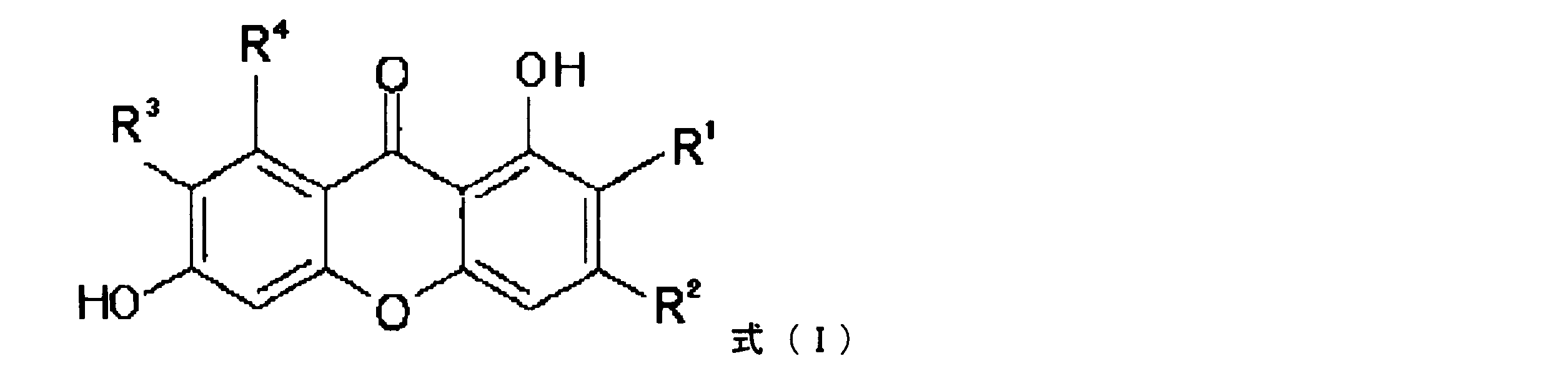
(式中、
R1及びR4は、互いに独立してC1~C5-アルキル又はアルケニルであり;
R2及びR3は、互いに独立してヒドロキシ又はC1~C6-アルコキシであり;
ここで、R1とR2は、互いに結合して、環原子として、炭素原子に加えて酸素原子を含む5~8員環を形成してもよい。)
で表される化合物を含有する、[1]~[3]のいずれかに記載の剤。
[5]
マンゴスチン抽出物が、α-マンゴスチン、γ-マンゴスチン及び3-イソマンゴスチンからなる群から選択される1以上の化合物を含有する、[1]~[4]のいずれかに記載の剤。
[6]
[1]~[5]のいずれかに記載の剤を配合した飲食品であって、マンゴスチン抽出物の含有量が、0.001~10重量%である飲食品。
[7]
[5]に記載の剤を配合した飲食品であって、
0.001~50重量%のα-マンゴスチンを含有し;かつ
0.0001~50重量%のγ-マンゴスチンを含有する;
飲食品。
[8]
果汁、野菜ジュース、トマト加工飲料、ミックスジュース又は豆乳である、[6]又は[7]に記載の飲食品。
[9]
γ-マンゴスチンを含有する運動効果模倣作用剤。
[10]
α-マンゴスチン及びγ-マンゴスチンを含有する運動効果模倣作用剤。
[11]
γ-マンゴスチンを含有するAMPK及びPPARδ共活性化剤。
[12]
α-マンゴスチンを含有するAMPK及びPPARδ共活性化剤。
[13]
3-イソマンゴスチンを含有するPPARδ活性化剤。
[1]
マンゴスチン抽出物を含有する運動効果模倣作用剤。
[2]
マンゴスチン抽出物を含有するAMPK及びPPARδ共活性化剤。
[3]
脂肪蓄積抑制剤、熱産生促進剤、筋肉分化促進剤、運動持久力向上剤又は筋萎縮抑制剤である、[1]に記載の作用剤。
[4]
マンゴスチン抽出物が、下記式(I)
R1及びR4は、互いに独立してC1~C5-アルキル又はアルケニルであり;
R2及びR3は、互いに独立してヒドロキシ又はC1~C6-アルコキシであり;
ここで、R1とR2は、互いに結合して、環原子として、炭素原子に加えて酸素原子を含む5~8員環を形成してもよい。)
で表される化合物を含有する、[1]~[3]のいずれかに記載の剤。
[5]
マンゴスチン抽出物が、α-マンゴスチン、γ-マンゴスチン及び3-イソマンゴスチンからなる群から選択される1以上の化合物を含有する、[1]~[4]のいずれかに記載の剤。
[6]
[1]~[5]のいずれかに記載の剤を配合した飲食品であって、マンゴスチン抽出物の含有量が、0.001~10重量%である飲食品。
[7]
[5]に記載の剤を配合した飲食品であって、
0.001~50重量%のα-マンゴスチンを含有し;かつ
0.0001~50重量%のγ-マンゴスチンを含有する;
飲食品。
[8]
果汁、野菜ジュース、トマト加工飲料、ミックスジュース又は豆乳である、[6]又は[7]に記載の飲食品。
[9]
γ-マンゴスチンを含有する運動効果模倣作用剤。
[10]
α-マンゴスチン及びγ-マンゴスチンを含有する運動効果模倣作用剤。
[11]
γ-マンゴスチンを含有するAMPK及びPPARδ共活性化剤。
[12]
α-マンゴスチンを含有するAMPK及びPPARδ共活性化剤。
[13]
3-イソマンゴスチンを含有するPPARδ活性化剤。
[14]
マンゴスチン抽出物の含有量が、0.001~100重量%である、[1]~[5]のいずれかに記載の剤。
[15]
マンゴスチン抽出物が、β-マンゴスチン、ガルタニン及び8-デオキシガルタニンからなる群から選択される1以上の化合物を更に含む、[5]に記載の剤。
[16]
マンゴスチン抽出物が、マンゴスチン果皮抽出物を含む、[1]~[5]のいずれかに記載の剤。
[17]
マンゴスチンの果実、果汁、濃縮果汁、搾汁残渣、果皮及びこれらの乾燥物からなる群から選択される1以上の原料を、エタノール溶媒を用いて抽出する工程を含む、マンゴスチン抽出物を含む、運動効果模倣作用剤又はAMPK及びPPARδ共活性化剤の製造方法。
マンゴスチン抽出物の含有量が、0.001~100重量%である、[1]~[5]のいずれかに記載の剤。
[15]
マンゴスチン抽出物が、β-マンゴスチン、ガルタニン及び8-デオキシガルタニンからなる群から選択される1以上の化合物を更に含む、[5]に記載の剤。
[16]
マンゴスチン抽出物が、マンゴスチン果皮抽出物を含む、[1]~[5]のいずれかに記載の剤。
[17]
マンゴスチンの果実、果汁、濃縮果汁、搾汁残渣、果皮及びこれらの乾燥物からなる群から選択される1以上の原料を、エタノール溶媒を用いて抽出する工程を含む、マンゴスチン抽出物を含む、運動効果模倣作用剤又はAMPK及びPPARδ共活性化剤の製造方法。
[18]
マンゴスチン抽出物の有効量を対象に投与する工程を含む、運動効果模倣作用を発揮させる方法。
[19]
マンゴスチン抽出物の有効量を対象に投与する工程を含む、AMPK及びPPARδ共活性化方法。
[20]
運動効果模倣作用が、脂肪蓄積抑制、熱産生促進、筋肉分化促進、運動持久力向上又は筋萎縮抑制である、[18]に記載の方法。
[21]
γ-マンゴスチンの有効量を対象に投与する工程を含む、運動効果模倣作用を発揮させる方法。
[22]
α-マンゴスチン及びγ-マンゴスチンの有効量を対象に投与する工程を含む、運動効果模倣作用を発揮させる方法。
[23]
γ-マンゴスチンの有効量を対象に投与する工程を含む、AMPK及びPPARδ共活性化方法。
[24]
α-マンゴスチンの有効量を対象に投与する工程を含む、AMPK及びPPARδ共活性化方法。
[25]
3-イソマンゴスチンの有効量を対象に投与する工程を含む、PPARδ活性化方法。
マンゴスチン抽出物の有効量を対象に投与する工程を含む、運動効果模倣作用を発揮させる方法。
[19]
マンゴスチン抽出物の有効量を対象に投与する工程を含む、AMPK及びPPARδ共活性化方法。
[20]
運動効果模倣作用が、脂肪蓄積抑制、熱産生促進、筋肉分化促進、運動持久力向上又は筋萎縮抑制である、[18]に記載の方法。
[21]
γ-マンゴスチンの有効量を対象に投与する工程を含む、運動効果模倣作用を発揮させる方法。
[22]
α-マンゴスチン及びγ-マンゴスチンの有効量を対象に投与する工程を含む、運動効果模倣作用を発揮させる方法。
[23]
γ-マンゴスチンの有効量を対象に投与する工程を含む、AMPK及びPPARδ共活性化方法。
[24]
α-マンゴスチンの有効量を対象に投与する工程を含む、AMPK及びPPARδ共活性化方法。
[25]
3-イソマンゴスチンの有効量を対象に投与する工程を含む、PPARδ活性化方法。
本発明によれば、AMPK及びPPARδを共に活性化することができ、安全性の高い共活性化剤を提供することができる。更に、本発明によれば、本来運動を行った時に認められる好ましい生体応答を、運動を行うことなく、又はより少ない運動で得ることができる、安全性及び効果の高い運動効果模倣作用剤を提供することもできる。本発明の剤の有効成分は、マンゴスチンから得ることができる成分であり、安全に摂取することができる。また、本発明によれば、上記の剤を、継続摂取に好適な呈味の飲食品として提供することもできる。更に、本発明によれば、効果の高い上記の剤を、マンゴスチンの果皮等より容易に効率よく得ることができるため、廃棄物の有効利用が可能である。
以下、本発明を実施するための形態について詳細に説明する。なお、本発明は以下の実施の形態に限定されるものではなく、その要旨の範囲内で種々変形して実施することができる。
本発明は、運動効果模倣作用剤;AMPK及びPPARδ共活性化剤;脂肪蓄積抑制剤;熱産生促進剤;筋肉分化促進剤;運動持久力向上剤;筋萎縮抑制剤;AMPK活性化剤;PPARα活性化剤;PPARδ活性化剤;並びにPPARα及びPPARδ共活性化剤に関する。以下、これらを単に「本発明の剤」ともいう。
一態様において、本発明の剤は、マンゴスチン抽出物を有効成分として含有する。
上記のマンゴスチン抽出物は、マンゴスチン果実、果汁、濃縮果汁、搾汁残渣、果皮及び/又はこれらの乾燥物から選ばれる1種又は2種以上の原料(以下、単に「マンゴスチン原料」と略記する場合がある)を極性溶媒で抽出した処理物である(以下、極性溶媒を用いた抽出処理をして得られる処理物を単に「マンゴスチン抽出物」と略記する場合がある)。マンゴスチンには、キサントン類と総称される約40種類のポリフェノールが含まれることが知られており、上記のマンゴスチン抽出物は、これらのキサントン類を高濃度で含有すると考えられる。
マンゴスチン原料は、特に限定されず、マンゴスチン果実や果皮等の固形分を含んでいてもよく、マンゴスチン果実や果皮等の固形分をろ過により除去した溶液であってもよい。
マンゴスチンジュースなどに用いるマンゴスチンの搾汁液は、マンゴスチン果実を洗浄し、果皮を除き、破砕したのち、これを搾汁して得られる。この搾汁の過程において、搾汁残渣や果皮が発生する。搾汁残渣や果皮(特に果皮)にはキサントン類が豊富に含まれている。上記搾汁残渣や果皮は、一般的に廃棄されるか、家畜飼料となるが、この搾汁残渣や果皮を用いれば、廃棄原料を有効利用でき、しかも高濃度のキサントン類を含む組成物を容易に効率よく得ることができるため、廃棄原料の有効利用の観点から好ましい。一態様において、本発明の剤におけるマンゴスチン抽出物は、マンゴスチン果皮抽出物であることが好ましい。
マンゴスチン原料の極性溶媒を用いた抽出の温度は、0℃~極性溶媒の沸点程度であり、通常は常温で行う。例えば、極性溶媒としてエタノールを使用する場合、抽出効率の観点から、0℃以上55℃未満が好ましく、5℃以上40℃以下がより好ましい。作業容易性の観点から、室温程度の25℃前後で抽出を行うことが特に好ましい。例えば、極性溶媒として水を使用する場合、抽出効率の観点から、0℃以上100℃以下が好ましく、25℃以上100℃以下がより好ましい。
抽出時間は、1分~24時間が好ましいが、これより長時間抽出を行ってもよい。抽出は、静置、攪拌のいずれの手法を用いてもよい。極性溶媒の濃度によっても異なるが、マンゴスチン原料(乾燥品換算)に1~50倍量、好ましくは2~20倍量程度の極性溶媒を加え抽出することによって、マンゴスチン抽出物を得ることができる。抽出効率を高めるため、マンゴスチン原料は乾燥品であってもよい。
極性溶媒としては、食品添加物の抽出溶剤となり得る極性溶媒であれば特に限定されず、例えば、アセトン、エタノール、エチルメチルケトン、グリセリン、酢酸エチル、酢酸メチル、ジエチルエーテル、シクロヘキサン、ジクロロメタン、食用油脂、1,1,1,2-テトラフルオロエタン、1,1,2-トリクロロエテン、1-ブタノール、2-ブタノール、1-プロパノール、2-プロパノール、プロピレングリコール、ヘキサン、水、メタノール等から選択される1又は複数の有機溶媒を用いることができる。
これらのうち好ましくは、エタノール(10体積%以上100体積%以下)、メタノール(10体積%以上99.5体積%未満)、1-ブタノール(30体積%以上99.5体積%未満)、ヘキサン(5体積%70体積%未満)及び水から選択される有機溶媒を用いることができ、より好ましくは、エタノール又は水を用いることができ、最も好ましくはエタノールを用いることができる。
これらのうち好ましくは、エタノール(10体積%以上100体積%以下)、メタノール(10体積%以上99.5体積%未満)、1-ブタノール(30体積%以上99.5体積%未満)、ヘキサン(5体積%70体積%未満)及び水から選択される有機溶媒を用いることができ、より好ましくは、エタノール又は水を用いることができ、最も好ましくはエタノールを用いることができる。
例えば、極性溶媒として、10体積%以上100体積%以下のエタノール溶媒を用いることができ、好ましくは50体積%以上100体積%以下のエタノール溶媒を用いることができ、より好ましくは70体積%程度のエタノール溶媒用いることができる。なお、70体積%のエタノール溶媒とは、水とエタノールの体積比3:7の混合物を指す。
一態様において、本発明の剤に含まれるマンゴスチン抽出物は、上記のとおり、マンゴスチンの有機溶媒抽出物であることが好ましく、マンゴスチンのアルコール抽出物であることがより好ましく、マンゴスチンのエタノール抽出物であることが特に好ましい。
本発明におけるマンゴスチン抽出物は、溶液状やピューレ状であってもよく、適当な濃度まで減圧濃縮又は膜濃縮することによって濃厚な液状組成物とすることも可能である。マンゴスチン抽出物を乾燥させて得られる固形物であってもよい。例えば、乾燥物は、溶液状抽出物をドラム式乾燥、噴霧乾燥又は凍結乾燥等公知の手法を用いて乾燥させて、得ることができる。乾燥物とすることにより保存安定性に優れたマンゴスチン抽出物となる。
上記のマンゴスチン抽出物は、精製度によっても多少異なるが、特異的な味及び臭いが少ないことから、比較的広範な濃度で本発明の剤に添加することができる。
本発明におけるマンゴスチン抽出物は、乾燥重量換算でキサントン類(好ましくは、α-マンゴスチン、γ-マンゴスチン及び3-イソマンゴスチンからなる群から選択されるキサントン類)を0.01重量%以上含有することが望ましく、0.1重量%以上含有することが好ましく、0.5重量%以上含有することがより好ましく、1重量%以上含有することが更に好ましい。キサントン類は、40種類以上が知られるが、その中でも含有量の多いα-マンゴスチン、β-マンゴスチン、γ-マンゴスチン、ガルタニン、8-デオキシガルタニン及び3-イソマンゴスチンの総量をキサントン類の総量として規定することができる。これらのキサントン類はいずれも抗酸化力を有すると考えられる。
マンゴスチン抽出物中のキサントン類は、当業者に公知の手法を用いて分析することができ、例えば後述の実施例1に記載の手法を参照して高速液体クロマトグラフを用いて分析することができる。
マンゴスチン抽出物中のキサントン類は、当業者に公知の手法を用いて分析することができ、例えば後述の実施例1に記載の手法を参照して高速液体クロマトグラフを用いて分析することができる。
本発明の好ましい態様において、マンゴスチン抽出物は、下記式(I)で表される化合物を含有する。本発明の剤の有効成分となることができる。例えば、式(I)で表される化合物は、PPARδ活性化剤の有効成分となることができる。
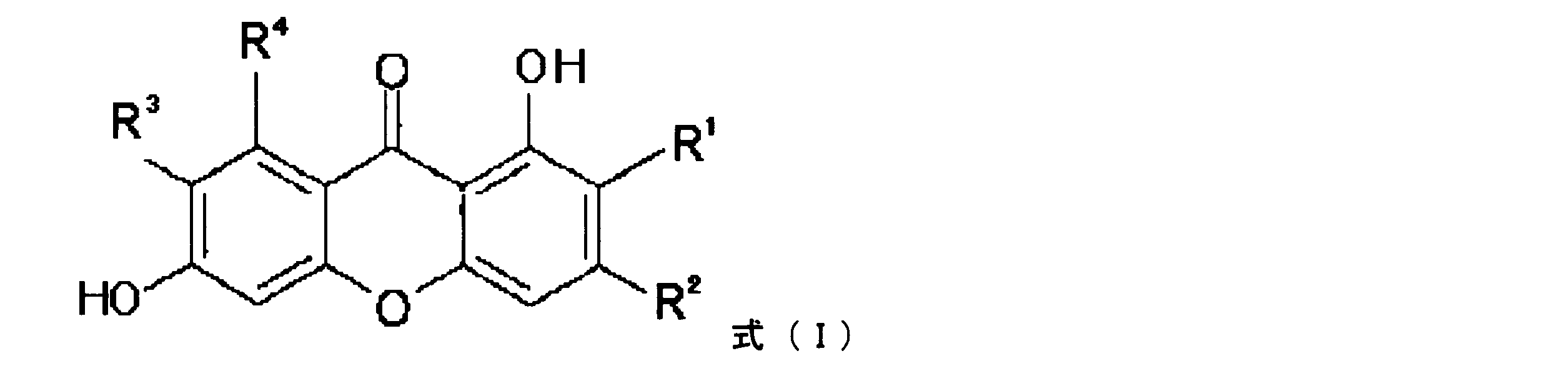
式(I)中、
R1及びR4は、互いに独立して、C1~C6-アルキル又はアルケニルであり、好ましくは、C1~C5-アルキル又はアルケニルであり、より好ましくは、C1~C5-アルケニルであり、更に好ましくはC5-アルケニルであり、例えば、-CH2-CH=C(CH3)2であり;
R2及びR3は、互いに独立してヒドロキシ又はC1~C6-アルコキシであり、好ましくは、ヒドロキシ又はメトキシであり;
ここで、R1とR2は、互いに結合して、環原子として、炭素原子に加えて酸素原子を含む5~8員環(好ましくは5又は6員環)を形成してもよく、該5~8員環は、置換基を有してもよく、好ましくは、酸素原子を含む6員環を形成してもよい。
R1及びR4は、互いに独立して、C1~C6-アルキル又はアルケニルであり、好ましくは、C1~C5-アルキル又はアルケニルであり、より好ましくは、C1~C5-アルケニルであり、更に好ましくはC5-アルケニルであり、例えば、-CH2-CH=C(CH3)2であり;
R2及びR3は、互いに独立してヒドロキシ又はC1~C6-アルコキシであり、好ましくは、ヒドロキシ又はメトキシであり;
ここで、R1とR2は、互いに結合して、環原子として、炭素原子に加えて酸素原子を含む5~8員環(好ましくは5又は6員環)を形成してもよく、該5~8員環は、置換基を有してもよく、好ましくは、酸素原子を含む6員環を形成してもよい。
一態様において、上記式(I)で表される化合物は、下記式(II)で表される化合物であり、式(II)中、R3及びR4は、上記式(I)について定義したとおりである。
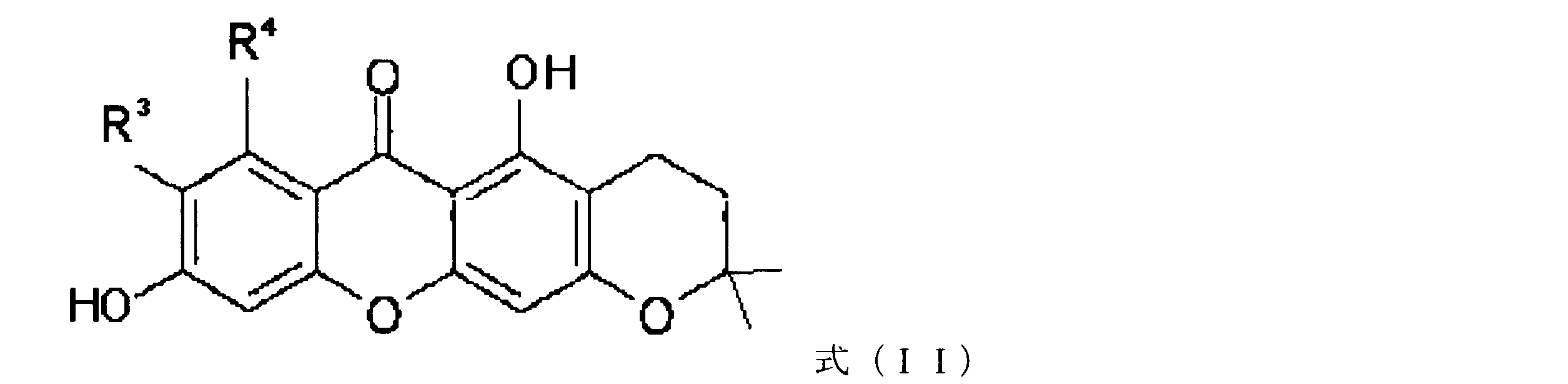
マンゴスチン抽出物に含まれるキサントン類のうち、α-マンゴスチンは、上記式(I)中、R1及びR4が-CH2-CH=C(CH3)2であり、R2がOHであり、R3が-O-CH3で表される化合物である。γ-マンゴスチンは、上記式(I)中、R1及びR4が-CH2-CH=C(CH3)2であり、R2及びR3がOHで表される化合物である。3-イソマンゴスチンは、上記式(II)中、R3が-O-CH3であり、R4が-CH2-CH=C(CH3)2で表される化合物である。
本発明者らは、上記式(I)で表される化合物が本発明の剤の有効成分となることを見出し、特に、後述の実施例に記載のとおり、α-マンゴスチン及びγ-マンゴスチンはいずれもそれぞれ単独で本発明の剤(特にAMPK及びPPARδ共同時活性化剤)の有効成分となることを見出し、α-マンゴスチン、γ-マンゴスチン及び3-イソマンゴスチンはいずれもそれぞれ単独で本発明の剤(特にPPARδ活性化剤)の有効成分となることを見出し、特にγ-マンゴスチンは非常に高いPPARδ活性化作用を有することを見出している。よって、本発明の一態様において、より高い所望の効果を得るという観点から、本発明の剤又は本発明の剤が含有するマンゴスチン抽出物は、上記式(I)で表される化合物を含有することが好ましく、α-マンゴスチン、γ-マンゴスチン及び3-イソマンゴスチンからなる群から選択される1以上の化合物を含有することがより好ましく、α-マンゴスチン、γ-マンゴスチン及び3-イソマンゴスチンからなる群から選択される2以上の化合物を含有することが更に好ましく、α-マンゴスチン、γ-マンゴスチン及び3-イソマンゴスチンをいずれも含有することが特に好ましい。
一態様において、本発明の剤又は本発明の剤が含有するマンゴスチン抽出物は、所望の効果を発揮するという観点から:α-マンゴスチンを、好ましくは0.001重量%以上100重量%以下、より好ましくは0.01重量%以上100重量%以下;γ-マンゴスチンを、好ましくは0.0001重量%以上100重量%以下、より好ましくは0.01重量%以上100重量%以下;並びに/或いは3-イソマンゴスチンを、好ましくは0.001重量%以上100重量%以下、より好ましくは0.01重量%以上100重量%以下;含有する。本発明の剤を例えば飲食品に配合する場合、例えば、α-マンゴスチンであれば0.0001重量%以上、γ-マンゴスチンであれば0.00001重量%以上、3-イソマンゴスチンであれば0.0001重量%以上含有する飲食品とすることが望ましく、例えば、0.001~50重量%のα-マンゴスチンを含有し;かつ0.0001~50重量%のγ-マンゴスチンを含有する飲食品とすることができる。長期間に亘って健康維持の目的で摂取する場合には、上記範囲より少量であってもよい。
一態様において、本発明の剤が含有するマンゴスチン抽出物は、α-マンゴスチン及びγ-マンゴスチンを、1:0.01~1:100の比で含むことが好ましく、1:0.1~1:10の比で含むことがより好ましく、1:0.1~1:1の比(例えば1:0.2程度)で含むことが更に好ましい。
一態様において、本発明の剤が含有するマンゴスチン抽出物は、α-マンゴスチン、γ-マンゴスチン及び3-イソマンゴスチンからなる群から選択される1以上の化合物を含み、更に、β-マンゴスチン、ガルタニン及び8-デオキシガルタニンからなる群から選択される1以上の化合物を含む。
一態様において、本発明は、運動効果模倣作用剤を提供する。本明細書において、「運動効果模倣作用剤」とは、本来運動を行った時に認められる好ましい生体応答、例えば、脂肪蓄積抑制、熱産生促進、筋肉分化促進、骨格筋重量の増加、運動持久力の向上、骨格筋繊維組成の変化、エネルギー代謝亢進、基礎代謝量の増加、運動器の機能改善、筋萎縮の抑制などを、運動を行うことなく提供するか、又はより少ない運動でより多くの運動で得られるのと同等に提供する作用剤を指す。このような運動効果模倣作用剤としての作用は、例えば後述の実施例4、8及び10に記載のとおり、in vivoで上記の生体応答の1以上が得られるか調べることで確認することができる。また、例えば後述の実施例5、6及び11に記載のとおり、in vivo又はin vitroで上記の生体応答に関与する遺伝子の発現量を変化させるか調べることでも確認することができる。
一態様において、本発明の運動効果模倣作用剤は、脂肪蓄積抑制剤、熱産生促進剤、筋肉分化促進剤、骨格筋重量増加剤、運動持久力向上剤、骨格筋繊維組成変化剤、エネルギー代謝亢進剤、基礎代謝量増加剤、運動器の機能改善剤又は筋萎縮抑制剤であってもよい。好ましくは、本発明の運動効果模倣作用剤は、熱産生促進剤、筋肉分化促進剤、運動持久力向上剤又は筋萎縮抑制剤であることができる。これらの剤としての作用は、in vivoでそれぞれの剤に対応する生体応答が得られるか調べることで確認することができるし、in vivo又はin vitroでそれぞれの剤に対応する生体応答に関与する遺伝子の発現量を変化させるか調べることでも確認することができる。例えば、「熱産生促進剤」としての作用は、後述の実施例5に記載のとおり、熱産生に関わる遺伝子である、UCP2及びUCP3等の発現量が増加するかを調べることで確認することができる。また、「筋肉分化促進剤」としての作用は、例えば後述の実施例5及び6に記載のとおり、筋肉分化に関わる遺伝子である、MyoD、Myf5、Myogenin及びMRF4等の発現量が増加するかを調べることで確認することができる。さらに、「筋萎縮抑制剤」としての作用は、例えば後述の実施例11に記載のとおり、筋萎縮に関わる遺伝子である、Atrogin-1及びMuRF-1等の発現量が低下するかを調べることで確認することができる。
本明細書において、「脂肪蓄積抑制剤」とは、新たな脂肪の蓄積を抑制する作用剤のみならず、既に存在する脂肪を減少させる作用剤も指す。「運動持久力向上剤」とは、走行可能時間の延長を可能とする等の運動パフォーマンスの向上を可能とする作用剤を指す。「筋萎縮抑制剤」とは、筋肉量の減少を遅らせる又は予防する作用剤を指す。
一態様において、本発明は、AMPK活性化剤及びPPARδ共活性化剤、AMPK活性化剤、PPARα活性化剤、PPARδ活性化剤並びにPPARα及びPPARδ共活性化剤を提供する。
AMPKは、エネルギー代謝調節に極めて重要な役割を担っており、骨格筋運動のように細胞内AMP/ATP比が上昇するような状況下においてリン酸化されることにより活性化され、糖及び脂質の代謝を促進することが知られる。また、PPARδを有する細胞では、AMPK活性化により運動持久力が向上することが報告されている(非特許文献1等)。したがって、AMPK活性化剤は、上記の効果を発揮する作用剤として用い得る。AMPK活性化剤としての作用は、例えば後述の実施例2を参照して確認することができる。本発明者らは、後述の実施例1で得られたマンゴスチン抽出物(α-マンゴスチン及びγ-マンゴスチンを含む)、α-マンゴスチン及びγ-マンゴスチンが、AMPK活性化剤として作用することを確認している。
PPARは、現在α、γ及びδ(β)の3つのサブタイプが報告されている。PPAR-αは、ペルオキシゾームの増生を通じて血中トリグリセリド濃度の低下を導く。また、脂質代謝関連遺伝子を主な標的遺伝子とするため、高脂血症改善薬開発の標的となっている。したがって、PPARα活性化剤は、上記の効果を発揮する作用剤として用い得る。本発明者らは、後述の実施例1で得られたマンゴスチン抽出物(α-マンゴスチン及びγ-マンゴスチンを含む)が、PPARα活性化剤として作用すること並びにPPARα及びPPARδ共活性化剤として作用することを確認している。
また、PPARδは、多くの臓器で発現しており、骨格筋代謝の転写調節における役割等がしてきされている。また、PPARδ活性化と運動を組み合わせることで、持久力が向上することが報告されている(非特許文献1等)。したがって、PPARδ活性化剤は、上記の効果を発揮する作用剤として用い得る。本発明者らは、後述の実施例1で得られたマンゴスチン抽出物、α-マンゴスチン、γ-マンゴスチン及び3-イソマンゴスチンが、PPARδ活性化剤として作用することを確認している。
PPARα活性化剤及びPPARδ活性化剤としての作用は、例えば後述の実施例3を参照して確認することができる。
また、PPARδは、多くの臓器で発現しており、骨格筋代謝の転写調節における役割等がしてきされている。また、PPARδ活性化と運動を組み合わせることで、持久力が向上することが報告されている(非特許文献1等)。したがって、PPARδ活性化剤は、上記の効果を発揮する作用剤として用い得る。本発明者らは、後述の実施例1で得られたマンゴスチン抽出物、α-マンゴスチン、γ-マンゴスチン及び3-イソマンゴスチンが、PPARδ活性化剤として作用することを確認している。
PPARα活性化剤及びPPARδ活性化剤としての作用は、例えば後述の実施例3を参照して確認することができる。
AMPKの活性化をPPARδの活性化と組み合わせることにより、運動持久力の向上など、運動時に認められる好ましい生体応答がもたらされることが報告されているため(非特許文献1)、これらを共に活性化させるAMPK及びPPARδ共活性化剤は、上記の効果を発揮する作用剤としても用い得る。本発明者らは、後述の実施例1で得られたマンゴスチン抽出物、α-マンゴスチン及びγ-マンゴスチンが、AMPK及びPPARδ共活性化剤として作用することを確認している。なお、本明細書中において「AMPK及びPPARδ共活性化剤」とは、AMPK活性化作用とPPARδ活性化作用をいずれも有する作用剤を指す。同様に、本明細書中において、「PPARα及びPPARδ共活性化剤」とは、PPARα活性化作用とPPARδ活性化作用をいずれも有する作用剤を指す。また、本明細書中において、「AMPK活性化剤」とは、AMPK活性化用の剤を意味する。他の活性化剤についても同様である。
本発明の剤は、そのまま、ヒトを含む動物等に投与することができるほか、試薬としても利用することができる。また、飲食品、医薬組成物等の素材として、これらに配合して摂取することができる。
上記の飲食品は好ましくは、特定保健用食品、栄養機能食品、健康食品、機能性食品、健康補助食品等である。本発明の剤は、更に食品添加物、例えば、甘味料、着色料、保存料、増粘安定剤、酸化防止剤、苦味料、酸味料、乳化剤、強化剤、製造用剤及び香料などとともに、清涼飲料水等の飲料や他の食品に配合して利用することもできる。
上記の飲食品は、運動効果模倣作用、脂肪蓄積抑制作用、熱産生促進作用、筋肉分化促進作用、骨格筋重量増加作用、運動持久力向上作用、骨格筋繊維組成変化作用、エネルギー代謝亢進作用、基礎代謝量増加作用、運動器の機能改善作用、筋萎縮抑制作用等の作用を有し得るため、これらの作用を有する旨の表示を付した飲食品とすることもできる。
飲食品の好ましい形態としては、飴、ゼリー、錠菓、飲料、スープ、麺、煎餅、和菓子、冷菓、焼き菓子等の食品や飲料が挙げられ、好ましくは、果汁飲料、野菜ジュース、果物野菜ジュース、茶飲料、コーヒー飲料、スポーツドリンク等の容器詰飲料が挙げられる。
また、本発明の剤が有効成分としてマンゴスチン抽出物、α-マンゴスチン、γ-マンゴスチン及び3-イソマンゴスチンのいずれか1以上を含む場合、これらはいずれも特異的な味及び臭いが少ないことから、本発明の剤を、果汁、野菜ジュース、トマト加工飲料、ミックスジュース、豆乳等の飲食品に配合した場合であっても、各飲食品の本来の風味が損なわれることがないばかりか、後述の実施例13に記載のとおり、これらの飲食品(特に青臭さを有する飲料)の風味や嗜好性を改善する。近年、野菜不足の解消、栄養補給、健康維持、美容などの目的で飲用されているこれらの飲食品は、独特の青臭さ、野菜臭さ、苦味を有するため、飲用に抵抗を持つ人も多いが、本発明の剤を配合することで、風味や嗜好性が改善され、継続摂取に好適な呈味の飲食品となる。したがって、一態様において、本発明の剤は、青臭さを有する飲料に配合することができ、好ましくは果汁、野菜ジュース、トマト加工飲料、ミックスジュース又は豆乳に配合することができ、より好ましくは、野菜ジュース、トマト加工飲料又は豆乳に配合することができる。
また、近年多く発売されるようになったアミノ酸入り飲料は、筋肉疲労軽減やスタミナ維持、代謝亢進などの健康維持を目的として飲用されている。しかし、イソロイシン、ロイシン、バリン、セリン、アスパラギン、グルタミン、アルギニン、リジン、システイン、メチオニン、フェニルアラニン、トリプトファン、ヒスチジン、プロリン等多くのL型アミノ酸が、濃度によっては苦味を有することが分かっている。一方、後述の実施例8及び10に示すように、マンゴスチン抽出物は、BCAA(分岐鎖アミノ酸であるロイシン、イソロイシン及びバリンの組合せ)と同等又はそれ以上の、運動持久力向上作用、脂肪蓄積抑制作用、筋肉量増加作用及び筋萎縮抑制作用を有する。したがって、アミノ酸入り飲料の代替としてマンゴスチン抽出物を含有する本発明の剤を摂取することができる。また、アミノ酸との相加・相乗効果を期待して、アミノ酸入り飲料にマンゴスチン抽出物を含有する本発明の剤を添加することもできる。
例えば、マンゴスチン抽出物を飲料に添加して本発明の剤を配合した飲食品とする場合、マンゴスチン抽出物は、精製度によっても多少異なるが、味や臭いに特異な厭味が少ないことから、比較的広範な濃度で添加することができ、例えば、飲料1,000mL当り、乾燥物換算で、好ましくは10mg~25,000mg、より好ましくは100mg~10,000mg添加することができる。
本発明の剤がマンゴスチン抽出物を含み、本発明の剤を飲食品に配合した場合、その摂取量は、用途に応じて適宜調整することができるが、マンゴスチン抽出物の乾燥物換算で、好ましくは1回10mg~25,000mg、より好ましくは1回100mg~10,000mg、更に好ましくは1回100mg~1,000mgとすることができる。摂取回数は、特に限定されないが、好ましくは1日1~3回であり、必要に応じて摂取回数を増減してもよい。
本発明の剤を医薬組成物に配合する場合、薬学的に許容可能な賦形剤等とともに公知の手法で製剤化して用いることができる。そのような医薬組成物としては、粉末、顆粒、錠剤等の固形剤、液体、ペースト等の液剤等、公知の剤型のものが挙げられる。医薬組成物は、錠剤、カプセル剤、顆粒剤、細粒剤、散剤、液剤、シロップ剤、チュアブル、トローチ等の経口剤、液剤、軟膏等の塗布剤、湿布剤、貼付剤、注射剤、舌下剤、吸入剤、点眼剤、坐剤等の剤形として用いることができる。本発明の剤を配合しても風味が損なわれないという観点から、医薬組成物を経口剤とすることが好ましい。
本発明の剤がマンゴスチン抽出物を含み、本発明の剤を医薬組成物に配合した場合、その投与量は、個々の薬剤の活性、患者の症状、年齢、体重等の種々の条件により適宜調整することができるが、例えば、マンゴスチン抽出物乾燥物換算で、好ましくは1回10mg~25,000mg、より好ましくは1回100mg~10,000mg、更に好ましくは1回100mg~1,000mgである。同様に、本発明の剤がα-マンゴスチンを含む医薬組成物である場合、その投与量は、α-マンゴスチン換算で、例えば1回0.1mg~25mg、好ましくは1回1mg~10mgである。投与回数は、特に限定されないが、好ましくは1日1~3回であり、必要に応じて投与回数を増減してもよい。本発明の剤は上記の作用を有するため、これを配合した医薬組成物は、上記の本発明の剤の作用が治療又は予防に関連し得る疾患の治療又は予防に用いることができる。そのような疾患としては、例えば、筋力分化促進作用や骨格筋重量増加作用等が治療又は予防に関連し得る、筋ジストロフィー、腰痛、筋萎縮性側索硬化症(ALS)及び脊髄性筋萎縮症(SMA)等が挙げられる。したがって、本発明は、これらの疾患の治療又は予防方法も提供することができる。
本発明の剤は、運動効果模倣作用、脂肪蓄積抑制作用、熱産生促進作用、筋肉分化促進作用、骨格筋重量増加作用、運動持久力向上作用、骨格筋繊維組成変化作用、エネルギー代謝亢進作用、基礎代謝量増加作用、運動器の機能改善作用、筋萎縮抑制作用等の作用を有し得るため、上記の作用を期待して、動物、中でも哺乳類(イヌ、ネコ、ウシ、ウマなどが挙げられる)に対して使用してもよい。上記の作用を有する本発明の剤は、例えば運動の出来ない高齢者の筋力低下による寝たきり患者の防止、骨折等の入院患者の筋力低下の防止、宇宙(低重力)空間における筋力低下の防止、遺伝的疾患による筋力低下(例えば筋ジストロフィー)の抑制、少ない運動でより効率よく基礎代謝量を向上させることによるダイエットなど、様々な分野において、利用できる可能性がある。
本発明は、また:マンゴスチン抽出物の有効量を対象に投与する工程を含む、運動効果模倣作用を発揮させる方法;マンゴスチン抽出物の有効量を対象に投与する工程を含む、AMPK及びPPARδ共活性化方法;γ-マンゴスチンの有効量を対象に投与する工程を含む、運動効果模倣作用を発揮させる方法;α-マンゴスチン及びγ-マンゴスチンの有効量を対象に投与する工程を含む、運動効果模倣作用を発揮させる方法;γ-マンゴスチンの有効量を対象に投与する工程を含む、AMPK及びPPARδ共活性化方法;α-マンゴスチンの有効量を対象に投与する工程を含む、AMPK及びPPARδ共活性化方法;並びに3-イソマンゴスチンの有効量を対象に投与する工程を含む、PPARδ活性化方法も提供する。これらの方法は、具体的には、上記の本発明の剤に関する記載を参照して行うことができる。
[実施例]
以下、本発明を実施例及び比較例により具体的に説明するが、本発明は、これらの実施例に何ら限定されるものではない。
以下、本発明を実施例及び比較例により具体的に説明するが、本発明は、これらの実施例に何ら限定されるものではない。
(1-1)マンゴスチン抽出物1の調製:
タイ産マンゴスチン(Garcinia mangostana)の果実6,034gから果肉部を2,037g採取し、凍結乾燥し、粉砕し、果肉部粉末368gを得た。この果肉部粉末368gを20倍量の100%エタノールを用いて室温で2時間攪拌し、抽出した。抽出液を濃縮後、凍結乾燥することによりマンゴスチン抽出物1を60g得た。
タイ産マンゴスチン(Garcinia mangostana)の果実6,034gから果肉部を2,037g採取し、凍結乾燥し、粉砕し、果肉部粉末368gを得た。この果肉部粉末368gを20倍量の100%エタノールを用いて室温で2時間攪拌し、抽出した。抽出液を濃縮後、凍結乾燥することによりマンゴスチン抽出物1を60g得た。
(1-2)マンゴスチン抽出物1の分析:
(1-1)で得られたマンゴスチン抽出物1を10μg/mLの濃度でDMSOに溶解した試料溶液をフィルター(0.45μm)で濾過し、逆相系カラム(Capcell Pak C18、4.6mm×250mm、資生堂社製)を装着した高速液体クロマトグラフ(型式600、Waters社製)を用いて分析した。移動相A液は0.1%ギ酸を含有した蒸留水、B液は0.1%ギ酸を含有したアセトニトリル溶液とし、試料注入量は10μL、検出はフォトダイオードアレイ検出器(型式2996、Waters社製)により行った。表1に示す化合物の標準物質との比較により、マンゴスチン抽出物1に含まれる化合物を分析した。分析結果を表1に示す。
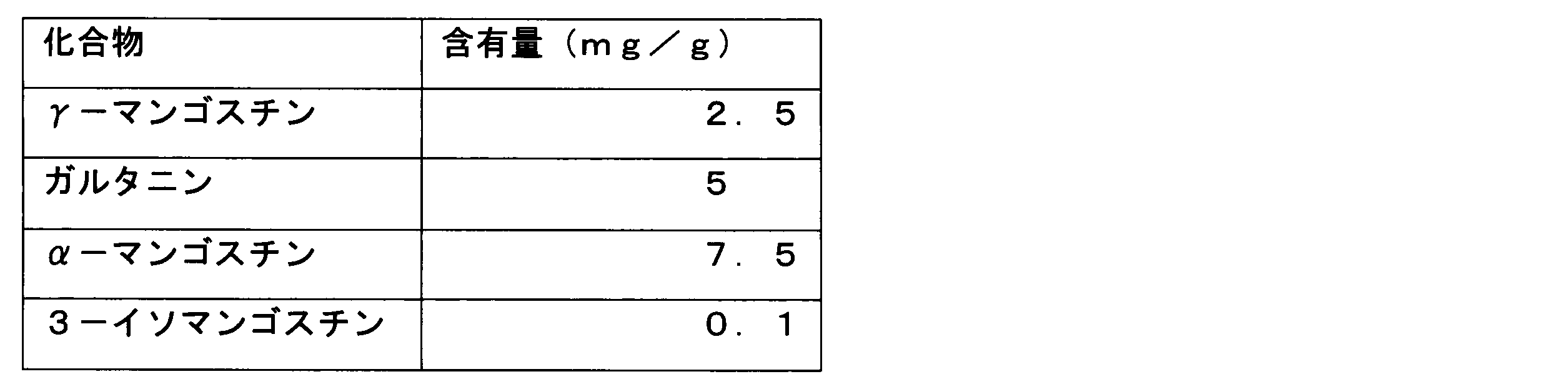
(1-1)で得られたマンゴスチン抽出物1を10μg/mLの濃度でDMSOに溶解した試料溶液をフィルター(0.45μm)で濾過し、逆相系カラム(Capcell Pak C18、4.6mm×250mm、資生堂社製)を装着した高速液体クロマトグラフ(型式600、Waters社製)を用いて分析した。移動相A液は0.1%ギ酸を含有した蒸留水、B液は0.1%ギ酸を含有したアセトニトリル溶液とし、試料注入量は10μL、検出はフォトダイオードアレイ検出器(型式2996、Waters社製)により行った。表1に示す化合物の標準物質との比較により、マンゴスチン抽出物1に含まれる化合物を分析した。分析結果を表1に示す。
(1-3)マンゴスチン抽出物1の分析結果:
表1から、(1-1)で得られたマンゴスチン抽出物1は、100重量部に対し、α-マンゴスチン0.75重量部、γ-マンゴスチン0.25重量部及び3-イソマンゴスチン0.01重量部を含むことが明らかになった。
表1から、(1-1)で得られたマンゴスチン抽出物1は、100重量部に対し、α-マンゴスチン0.75重量部、γ-マンゴスチン0.25重量部及び3-イソマンゴスチン0.01重量部を含むことが明らかになった。
(2-1)AMPKリン酸化の測定方法
C2C12細胞(マウス由来筋芽細胞、DSファーマバイオメディカル社製)を、10%FBSを添加したダルベッコ変法イーグル培地(DMEM)を用い、5% CO2インキュベーター内、37℃で培養した。60mL dish plateに5×10⁴cells/wellで細胞を播種し、コンフルエントに達した後に2%HS(Horse Serum)を添加したDMEM(分化誘導培地)に交換し、筋管への分化誘導を行った。分化誘導3日後に筋管が形成されていることを確認し、無血清のDMEMに培地交換した。約16時間後に、サンプル(それぞれDMSOに溶解させた、実施例1で得たマンゴスチン抽出物1 100μg/mL、α-マンゴスチン0.75μg/mL又はγ-マンゴスチン0.25μg/mL)を添加したDMEMに交換した。
C2C12細胞(マウス由来筋芽細胞、DSファーマバイオメディカル社製)を、10%FBSを添加したダルベッコ変法イーグル培地(DMEM)を用い、5% CO2インキュベーター内、37℃で培養した。60mL dish plateに5×10⁴cells/wellで細胞を播種し、コンフルエントに達した後に2%HS(Horse Serum)を添加したDMEM(分化誘導培地)に交換し、筋管への分化誘導を行った。分化誘導3日後に筋管が形成されていることを確認し、無血清のDMEMに培地交換した。約16時間後に、サンプル(それぞれDMSOに溶解させた、実施例1で得たマンゴスチン抽出物1 100μg/mL、α-マンゴスチン0.75μg/mL又はγ-マンゴスチン0.25μg/mL)を添加したDMEMに交換した。
30分培養した後、細胞を回収し、以下の手順によりウェスタンブロット用のサンプルを調製した。
細胞を氷冷したPBSで洗浄した後、700μL/wellのPBSを加え、氷上でセルスクレイパーを用いて細胞を1.5mLチューブに回収した。5,000rpm、4℃で5分間遠心し、上清を吸引した。ペレットにlysis buffer(1×PBS、1% NP-40、0.25%sodium deoxycholate、0.1% SDS、1 mM PMSF、1×inhibitor cocktail:Sigma社製)を50μL加えてボルテックスし、氷上で30分静置した後、15,000rpm、4℃で5分間遠心し、上清を回収した。これにSDS sample buffer(終濃度 0.05M Tris-HCl、1% SDS、10% glycerol、0.1% BPB、 0.1M DTT)を加え95℃、3分間処理したものをSDS-PAGEに供するサンプルとした。
細胞を氷冷したPBSで洗浄した後、700μL/wellのPBSを加え、氷上でセルスクレイパーを用いて細胞を1.5mLチューブに回収した。5,000rpm、4℃で5分間遠心し、上清を吸引した。ペレットにlysis buffer(1×PBS、1% NP-40、0.25%sodium deoxycholate、0.1% SDS、1 mM PMSF、1×inhibitor cocktail:Sigma社製)を50μL加えてボルテックスし、氷上で30分静置した後、15,000rpm、4℃で5分間遠心し、上清を回収した。これにSDS sample buffer(終濃度 0.05M Tris-HCl、1% SDS、10% glycerol、0.1% BPB、 0.1M DTT)を加え95℃、3分間処理したものをSDS-PAGEに供するサンプルとした。
サンプルは7.5%のアクリルアミドゲルにて泳動後ブロッティングを行い、5% BSA-PBST溶液により室温で60分間ブロッキングを行った。その後、1次抗体(anti-AMPK、anti-phospho AMPK(Thr172)、anti-ACC及びanti-phospho ACC;いずれもCell signaling technology社製)を各々1000倍に希釈し、4℃で一晩抗体反応を行った。1次抗体反応後、PBS-Tにてメンブレンを3回洗浄し、2次抗体(anti-rabbit IgG HRP conjugate;Sigma社製)を5,000倍に希釈し、室温で1時間抗体反応を行った。2次抗体反応後、PBS-Tにてメンブレンを3回洗浄し、HRP発光基質(Immobilon社製)と反応させImage Gauge(Fujifilm社製)により検出を行った。
(2-2)AMPKリン酸化の測定結果
総AMPK(t-AMPK)及びリン酸化されたAMPK(p-AMPK)を検出したバンドを図1に示す。Controlには、サンプルのかわりにvehicleのDMSOで同様に処理したものを用いた。
図1から、実施例1で得られたマンゴスチン抽出物1はAMPK活性化能を有することが明らかになった。また、マンゴスチン抽出物1に含まれるα-マンゴスチン及びγ-マンゴスチンは、それぞれ単独でAMPK活性化能を有することが明らかになった。なお、α-マンゴスチンとγ-マンゴスチンのAMPK活性化能は同程度であった。抽出物に含まれるα-マンゴスチン又はγ-マンゴスチン単独よりも、これらをいずれも含むマンゴスチン抽出物1の方が、AMPK活性化能が高く、α-マンゴスチンとγ-マンゴスチンによる相加効果よりも高いAMPK活性化能を有すると考えられた。
総AMPK(t-AMPK)及びリン酸化されたAMPK(p-AMPK)を検出したバンドを図1に示す。Controlには、サンプルのかわりにvehicleのDMSOで同様に処理したものを用いた。
図1から、実施例1で得られたマンゴスチン抽出物1はAMPK活性化能を有することが明らかになった。また、マンゴスチン抽出物1に含まれるα-マンゴスチン及びγ-マンゴスチンは、それぞれ単独でAMPK活性化能を有することが明らかになった。なお、α-マンゴスチンとγ-マンゴスチンのAMPK活性化能は同程度であった。抽出物に含まれるα-マンゴスチン又はγ-マンゴスチン単独よりも、これらをいずれも含むマンゴスチン抽出物1の方が、AMPK活性化能が高く、α-マンゴスチンとγ-マンゴスチンによる相加効果よりも高いAMPK活性化能を有すると考えられた。
(3-1)PPAR活性化の測定方法
ヒト胎児腎細胞株(HEK293、ATCC)を、10%FBSを添加したDMEMを用い、5% CO2インキュベーター内、37℃で培養した。24well plateに5×10⁴cells/wellで細胞を播種し、1日培養した。Gal4のDNA結合ドメイン(Gal-4DBD)及びPPARα(又はγもしくはδ)のリガンド結合ドメイン(PPAR-LBD)のキメラタンパク発現プラスミド(pGal4DBD/PPAR LBD)、Gal4応答配列及びホタルルシフェラーゼ遺伝子を含むプラスミド(pG5-Luc)、並びにウミシイタケルシフェラーゼ遺伝子の上流にCMVプロモーターを連結したコントロールプラスミド(pRL-CMV)(いずれもPromega社からのプラスミド)を、同時に、各々0.05μg、0.075μg及び0.025μg/wellとなるように、トランスフェクション試薬(Lipofectamine2000 Reagent;Invitrogen社製)0.75μL/wellを加えたOPTI-MEM(GIBCO社製)250μL/wellに加え、前記の培地を交換し、プラスミドを導入した。4時間後、各wellに、10%FBSを添加したDMEMを250μL/wellずつ加えた。その1日後、サンプル(DMSOに溶解させた実施例1で得られたマンゴスチン抽出物1:2、4、10、40又は100μg/well;DMSOに溶解させたα-マンゴスチン:0.015、0.03、0.075、0.3又は0.75μg/mL;DMSOに溶解させたγ-マンゴスチン:0.005、0.01、0.025、0.1又は0.25μg/mL;或いはDMSOに溶解させた3-イソマンゴスチン:0.1、0.5又は1μg/mLのいずれか)及び10%FBSを添加したDMEMに交換し、1日培養した。
その後、Passive lysis buffer(Promega社製)で細胞を溶解し、デュアルルシフェラーゼアッセイシステム(Promega社製)を用いて、ホタルルシフェラーゼ及びウミシイタケルシフェラーゼ活性を各々測定した。PPARδ依存的な遺伝子の転写活性(ルシフェラーゼ活性)は以下のように定義した:
PPARδ依存的な遺伝子の転写活性(ルシフェラーゼ活性)=(pG5-Lucによるホタルルシフェラーゼ活性)/(pRL-CMVによるウミシイタケルシフェラーゼ活性)
ヒト胎児腎細胞株(HEK293、ATCC)を、10%FBSを添加したDMEMを用い、5% CO2インキュベーター内、37℃で培養した。24well plateに5×10⁴cells/wellで細胞を播種し、1日培養した。Gal4のDNA結合ドメイン(Gal-4DBD)及びPPARα(又はγもしくはδ)のリガンド結合ドメイン(PPAR-LBD)のキメラタンパク発現プラスミド(pGal4DBD/PPAR LBD)、Gal4応答配列及びホタルルシフェラーゼ遺伝子を含むプラスミド(pG5-Luc)、並びにウミシイタケルシフェラーゼ遺伝子の上流にCMVプロモーターを連結したコントロールプラスミド(pRL-CMV)(いずれもPromega社からのプラスミド)を、同時に、各々0.05μg、0.075μg及び0.025μg/wellとなるように、トランスフェクション試薬(Lipofectamine2000 Reagent;Invitrogen社製)0.75μL/wellを加えたOPTI-MEM(GIBCO社製)250μL/wellに加え、前記の培地を交換し、プラスミドを導入した。4時間後、各wellに、10%FBSを添加したDMEMを250μL/wellずつ加えた。その1日後、サンプル(DMSOに溶解させた実施例1で得られたマンゴスチン抽出物1:2、4、10、40又は100μg/well;DMSOに溶解させたα-マンゴスチン:0.015、0.03、0.075、0.3又は0.75μg/mL;DMSOに溶解させたγ-マンゴスチン:0.005、0.01、0.025、0.1又は0.25μg/mL;或いはDMSOに溶解させた3-イソマンゴスチン:0.1、0.5又は1μg/mLのいずれか)及び10%FBSを添加したDMEMに交換し、1日培養した。
その後、Passive lysis buffer(Promega社製)で細胞を溶解し、デュアルルシフェラーゼアッセイシステム(Promega社製)を用いて、ホタルルシフェラーゼ及びウミシイタケルシフェラーゼ活性を各々測定した。PPARδ依存的な遺伝子の転写活性(ルシフェラーゼ活性)は以下のように定義した:
PPARδ依存的な遺伝子の転写活性(ルシフェラーゼ活性)=(pG5-Lucによるホタルルシフェラーゼ活性)/(pRL-CMVによるウミシイタケルシフェラーゼ活性)
(3-2)PPAR活性化の測定結果
マンゴスチン抽出物1のPPARα(又はγ若しくはδ)の活性化能を表2に示す。表2の値は、コントロール(サンプルの代わりにDMSOを添加したもの)におけるPPARα(若しくはγ又はδ)依存的転写活性を100とし、それに対する相対値を示す。**はコントロール群に対する各群のT検定による危険率1%の有意差を示す。表2より、実施例1で得たマンゴスチン抽出物1がPPARα又はδ活性化に有効であることが明らかになった。実施例1で得たマンゴスチン抽出物1は、PPARα活性化作用及びPPARδ活性化作用を有するが、PPARγ活性化作用は有しておらず、PPARα及びPPARδに対する特異性が高いことが明らかになった。

マンゴスチン抽出物1のPPARα(又はγ若しくはδ)の活性化能を表2に示す。表2の値は、コントロール(サンプルの代わりにDMSOを添加したもの)におけるPPARα(若しくはγ又はδ)依存的転写活性を100とし、それに対する相対値を示す。**はコントロール群に対する各群のT検定による危険率1%の有意差を示す。表2より、実施例1で得たマンゴスチン抽出物1がPPARα又はδ活性化に有効であることが明らかになった。実施例1で得たマンゴスチン抽出物1は、PPARα活性化作用及びPPARδ活性化作用を有するが、PPARγ活性化作用は有しておらず、PPARα及びPPARδに対する特異性が高いことが明らかになった。
表3に、様々な濃度のマンゴスチン抽出物1、α-マンゴスチン、γ-マンゴスチン及び3-イソマンゴスチンのPPARδ活性化能を示す。表3より、実施例1で得たマンゴスチン抽出物1のみならず、α-マンゴスチン、γ-マンゴスチン及び3-イソマンゴスチンは、いずれもPPARδ活性化能を有することが明らかになった。特に、γ-マンゴスチンは、低濃度でもPPARδ活性化能を示し、PPARδ活性化能が高いことが明らかになった。マンゴスチン抽出物1のPPARδ活性化能については、抽出物中に存在するα-マンゴスチンよりも、γ-マンゴスチンの寄与が大きいと考えられた。

以上のように、マンゴスチン抽出物は、PPARα及びPPARδ活性化作用を有する。よって、PPARα活性化作用により、脂肪酸代謝の活性化、高トリグリセリド血症の予防・改善、高コレステロール血症の予防・改善、脂肪肝の予防・改善に有効である可能性が考えられ、また、PPARδ活性化作用により、脂肪酸代謝の活性化、体脂肪の燃焼促進、肥満の予防・改善、基礎代謝の向上に有効であり得ると考えられ、これに伴いインスリン抵抗性や糖尿病の予防・改善、動脈硬化の予防・改善にも有効であり得ると考えられた。
更に、実施例2及び3の結果から、マンゴスチン抽出物、α-マンゴスチン及びγ-マンゴスチンは、いずれもPPARδ活性化作用と共にAMPK活性化作用を有することが明らかになった。
(4-1)脂肪蓄積抑制作用の測定方法
5週齢の雄のKKAyマウス(日本クレア株式会社)16匹を、1週間の予備飼育をした後、2群に分けた(1群8匹)。KKAyマウスは、2型糖尿病モデルマウスであり、高脂肪食下で、肥満、インスリン抵抗性及び高脂血症をおこすマウスである。試料として、実施例1で得られたマンゴスチン抽出物1を乾燥物換算で5重量%含む飼料を与える群と、マンゴスチン抽出物を含まない対照飼料を与える群(コントロール)とに分けて4週間、自由摂取により給餌をした。その後、皮下脂肪組織、精巣上体脂肪組織、腸間膜脂肪組織、腎周囲脂肪組織及び腓腹筋を採取し、それぞれについて、脂肪組織重量及び筋肉組織重量を測定後、各個体の体重で割り、体重当たりの各組織量を測定し、両群で比較した。その他、肝臓も採取した。
5週齢の雄のKKAyマウス(日本クレア株式会社)16匹を、1週間の予備飼育をした後、2群に分けた(1群8匹)。KKAyマウスは、2型糖尿病モデルマウスであり、高脂肪食下で、肥満、インスリン抵抗性及び高脂血症をおこすマウスである。試料として、実施例1で得られたマンゴスチン抽出物1を乾燥物換算で5重量%含む飼料を与える群と、マンゴスチン抽出物を含まない対照飼料を与える群(コントロール)とに分けて4週間、自由摂取により給餌をした。その後、皮下脂肪組織、精巣上体脂肪組織、腸間膜脂肪組織、腎周囲脂肪組織及び腓腹筋を採取し、それぞれについて、脂肪組織重量及び筋肉組織重量を測定後、各個体の体重で割り、体重当たりの各組織量を測定し、両群で比較した。その他、肝臓も採取した。
(4-2)脂肪蓄積抑制作用の測定結果
各組織重量を体重で割って算出した、全体重における各組織の割合を表4に示す。また、精巣上体脂肪組織、腸間膜脂肪組織及び腎周囲脂肪組織の和を腹腔内脂肪重量合計として、これに更に皮下脂肪を足したものを脂肪組織重量合計として、表4に示す。表4中、*はコントロール群に対する各群のT検定による危険率5%の有意差を示す。表4から、マンゴスチン抽出物を投与した場合、全体重に対する脂肪組織の割合が減少することが明らかになり、マンゴスチン抽出物は脂肪蓄積に対する抑制効果を有すると考えられた。なお、肝臓重量についてはコントロールとマンゴスチン抽出物投与群とで優位差が確認されなかったが、肝臓中の脂肪量が減少し、肝臓重量が若干減少したと考えられた。
各組織重量を体重で割って算出した、全体重における各組織の割合を表4に示す。また、精巣上体脂肪組織、腸間膜脂肪組織及び腎周囲脂肪組織の和を腹腔内脂肪重量合計として、これに更に皮下脂肪を足したものを脂肪組織重量合計として、表4に示す。表4中、*はコントロール群に対する各群のT検定による危険率5%の有意差を示す。表4から、マンゴスチン抽出物を投与した場合、全体重に対する脂肪組織の割合が減少することが明らかになり、マンゴスチン抽出物は脂肪蓄積に対する抑制効果を有すると考えられた。なお、肝臓重量についてはコントロールとマンゴスチン抽出物投与群とで優位差が確認されなかったが、肝臓中の脂肪量が減少し、肝臓重量が若干減少したと考えられた。
(4-3)筋肉量増加作用の測定結果
腓腹筋重量を体重で割って算出した、全体重における腓腹筋の割合を表4に示す。表4から、マンゴスチン抽出物を投与した場合、遺伝的に肥満になるKKAyマウスにおいて、全体重に対する腓腹筋(骨格筋)重量の割合の増加が認められた。積極的な運動をすることなく、マンゴスチン抽出物は筋肉量に対する増加作用を有すると考えられた。なお、マンゴスチン抽出物を投与した場合、脂肪組織重量が減少する一方、筋肉量が増加し、コントロール群と体重差が生じなかったと考えられた。

腓腹筋重量を体重で割って算出した、全体重における腓腹筋の割合を表4に示す。表4から、マンゴスチン抽出物を投与した場合、遺伝的に肥満になるKKAyマウスにおいて、全体重に対する腓腹筋(骨格筋)重量の割合の増加が認められた。積極的な運動をすることなく、マンゴスチン抽出物は筋肉量に対する増加作用を有すると考えられた。なお、マンゴスチン抽出物を投与した場合、脂肪組織重量が減少する一方、筋肉量が増加し、コントロール群と体重差が生じなかったと考えられた。
(5-1)腓腹筋(骨格筋)における、熱産生又は筋肉分化に関わる遺伝子発現の測定方法
上記の実施例4で採取した腓腹筋における、熱産生に関わる遺伝子であるUCP2及びUCP3並びに筋肉分化に関わる遺伝子であるMyoD、Myf5、Myogenin及びMRF4の遺伝子発現を、リアルタイム定量PCR法によって測定した。
腓腹筋約0.1gを1,000μLのTRIZOL(Invitrogen社製)内で破砕した。その後、クロロホルムを200μL加え、攪拌した。遠心分離後、上清を取り、等量の2-イソプロパノールを加え、攪拌した。遠心分離後、上清を捨て、70%エタノールを加え、攪拌した。遠心分離後、上清を捨て、再び70%エタノールを加え、攪拌した。その後、遠心分離し、上清を捨て、自然乾燥させ、RNAを得た。PrimeScript RT reagent kit(Takara社製)を用い、製品に添付のプロトコールに従い逆転写反応を行い、cDNAを得た。得られたcDNAを用い、SYBR Premix Ex Taq(Takara社製)及びMX3005P Real Time QPCR System(Agilent Technology社製)によりリアルタイム定量PCRを行った。使用したプライマー配列は以下のとおりである。
上記の実施例4で採取した腓腹筋における、熱産生に関わる遺伝子であるUCP2及びUCP3並びに筋肉分化に関わる遺伝子であるMyoD、Myf5、Myogenin及びMRF4の遺伝子発現を、リアルタイム定量PCR法によって測定した。
腓腹筋約0.1gを1,000μLのTRIZOL(Invitrogen社製)内で破砕した。その後、クロロホルムを200μL加え、攪拌した。遠心分離後、上清を取り、等量の2-イソプロパノールを加え、攪拌した。遠心分離後、上清を捨て、70%エタノールを加え、攪拌した。遠心分離後、上清を捨て、再び70%エタノールを加え、攪拌した。その後、遠心分離し、上清を捨て、自然乾燥させ、RNAを得た。PrimeScript RT reagent kit(Takara社製)を用い、製品に添付のプロトコールに従い逆転写反応を行い、cDNAを得た。得られたcDNAを用い、SYBR Premix Ex Taq(Takara社製)及びMX3005P Real Time QPCR System(Agilent Technology社製)によりリアルタイム定量PCRを行った。使用したプライマー配列は以下のとおりである。
GAPDHフォワード:
5’-TGACATCAAGAAGGTGGTGA-3’(配列番号1)
GAPDHリバース:
5’-CCTGTTGCTGTAGCCGTATT-3’(配列番号2)
UCP2フォワード:
5’-ACAGATGTGGTAAAGGTCCG-3’(配列番号3)
UCP2リバース:
5’-CAGTTGACAATGGCATTACG-3’(配列番号4)
UCP3フォワード:
5’-TTTGGAGCTGGCTTCTGTG-3’(配列番号5)
UCP3リバース:
5’-AAGGCCCTCTTCAGTTGCTC-3’(配列番号6)
MyoDフォワード:
5’-GACCTGCGCTTTTTTGAGGACC-3’(配列番号7)
MyoDリバース:
5’-CAGGCCCACAGCAAGCAGCGAC-3’(配列番号8)
Myf5フォワード:
5’-AGGAAAAGAAGCCCTGAAGC-3’(配列番号9)
Myf5リバース:
5’-GCAAAAAGAACAGGCAGAGG-3’(配列番号10)
Myogeninフォワード:
5’-ACTCTTCGCCCCCGT-3’(配列番号11)
Myogeninリバース:
5’-CCGCCCTGCCACTCAT-3’(配列番号12)
MRF4フォワード:
5’-CTACATTGAGCGTCTACAGGACC-3’(配列番号13)
MRF4リバース:
5’-CTGAAGACTGCTGGAGGCTG-3’(配列番号14)
5’-TGACATCAAGAAGGTGGTGA-3’(配列番号1)
GAPDHリバース:
5’-CCTGTTGCTGTAGCCGTATT-3’(配列番号2)
UCP2フォワード:
5’-ACAGATGTGGTAAAGGTCCG-3’(配列番号3)
UCP2リバース:
5’-CAGTTGACAATGGCATTACG-3’(配列番号4)
UCP3フォワード:
5’-TTTGGAGCTGGCTTCTGTG-3’(配列番号5)
UCP3リバース:
5’-AAGGCCCTCTTCAGTTGCTC-3’(配列番号6)
MyoDフォワード:
5’-GACCTGCGCTTTTTTGAGGACC-3’(配列番号7)
MyoDリバース:
5’-CAGGCCCACAGCAAGCAGCGAC-3’(配列番号8)
Myf5フォワード:
5’-AGGAAAAGAAGCCCTGAAGC-3’(配列番号9)
Myf5リバース:
5’-GCAAAAAGAACAGGCAGAGG-3’(配列番号10)
Myogeninフォワード:
5’-ACTCTTCGCCCCCGT-3’(配列番号11)
Myogeninリバース:
5’-CCGCCCTGCCACTCAT-3’(配列番号12)
MRF4フォワード:
5’-CTACATTGAGCGTCTACAGGACC-3’(配列番号13)
MRF4リバース:
5’-CTGAAGACTGCTGGAGGCTG-3’(配列番号14)
(5-2)腓腹筋(骨格筋)における、熱産生又は筋肉分化に関わる遺伝子発現の測定結果
熱産生に関わる遺伝子であるUCP2及びUCP3の遺伝子発現をリアルタイムPCRで測定した結果を、コントロールの値を1とした相対値で図2に示した。また、筋肉分化に関わる遺伝子であるMyoD、Myf5、Myogenin及びMRF4の遺伝子発現をリアルタイムPCRで測定した結果を、コントロールの値を1とした相対値で図3に示した。図2及び3中、*はコントロール群に対する各群のT検定による危険率5%での有意差を示す。
熱産生に関わる遺伝子であるUCP2及びUCP3の遺伝子発現をリアルタイムPCRで測定した結果を、コントロールの値を1とした相対値で図2に示した。また、筋肉分化に関わる遺伝子であるMyoD、Myf5、Myogenin及びMRF4の遺伝子発現をリアルタイムPCRで測定した結果を、コントロールの値を1とした相対値で図3に示した。図2及び3中、*はコントロール群に対する各群のT検定による危険率5%での有意差を示す。
図2から、マンゴスチン抽出物を投与した群で、熱産生に関わる遺伝子であるUCP2及びUCP3の遺伝子発現がいずれも上昇していることが明らかになった。
また、図3から、マンゴスチン抽出物を投与した群で、筋肉分化に関わる遺伝子であるMyoDの遺伝子発現が上昇傾向を示し、Myf5の遺伝子発現が上昇していることが明らかになった。
これらの結果から、マンゴスチン抽出物を摂取することで、積極的に運動することなく、筋肉分化が促進されると共に、筋肉における熱産生が増大することが示唆された。
また、図3から、マンゴスチン抽出物を投与した群で、筋肉分化に関わる遺伝子であるMyoDの遺伝子発現が上昇傾向を示し、Myf5の遺伝子発現が上昇していることが明らかになった。
これらの結果から、マンゴスチン抽出物を摂取することで、積極的に運動することなく、筋肉分化が促進されると共に、筋肉における熱産生が増大することが示唆された。
(6-1)α-マンゴスチンによる筋肉分化促進効果の測定方法
6well plateにC2C12細胞(実施例1で用いたものと同様のマウス由来筋芽細胞)を播種し、10%FBSを添加したDMEM2mLにて、コンフルエントになるまで培養した。その後、α-マンゴスチンを10μM含む、2%HSを添加したDMEM2mLの分化誘導培地にて分化を誘導した。対照として、DMSOを培地に加えた細胞を培養した。
分化誘導3日後、培地を全て取り除き、TRIZOL(Invitrogen社製)を1mL加え、細胞を回収した。その後、実施例5と同様の手法を用いて、RNAの抽出、逆転写反応、PCR等を行い、筋肉分化に関わる遺伝子であるMyoD、Myf5、Myogenin及びMRF4の遺伝子発現をリアルタイムPCRで測定した。なお、プライマーも実施例4と同一のものを使用した。
6well plateにC2C12細胞(実施例1で用いたものと同様のマウス由来筋芽細胞)を播種し、10%FBSを添加したDMEM2mLにて、コンフルエントになるまで培養した。その後、α-マンゴスチンを10μM含む、2%HSを添加したDMEM2mLの分化誘導培地にて分化を誘導した。対照として、DMSOを培地に加えた細胞を培養した。
分化誘導3日後、培地を全て取り除き、TRIZOL(Invitrogen社製)を1mL加え、細胞を回収した。その後、実施例5と同様の手法を用いて、RNAの抽出、逆転写反応、PCR等を行い、筋肉分化に関わる遺伝子であるMyoD、Myf5、Myogenin及びMRF4の遺伝子発現をリアルタイムPCRで測定した。なお、プライマーも実施例4と同一のものを使用した。
(6-2)α-マンゴスチンによる筋肉分化促進効果の測定結果
筋肉分化に関わる遺伝子であるMyoD、Myf5、Myogenin及びMRF4の遺伝子発現をリアルタイムPCRで測定した結果を、コントロールの値を1とした相対値で図4に示した。図4中、*はコントロール群に対する各群のT検定による危険率5%での有意差を示す。
図4から、α-マンゴスチンを添加して筋芽細胞を培養及び分化させるとことで、筋肉分化に関わる遺伝子であるMyf5及びMRF4の遺伝子発現が上昇することが明らかになった。また、目視にて、明らかな筋管形成の促進が観察された。これらのことから、α-マンゴスチンは筋肉分化促進効果が確認された。
筋肉分化に関わる遺伝子であるMyoD、Myf5、Myogenin及びMRF4の遺伝子発現をリアルタイムPCRで測定した結果を、コントロールの値を1とした相対値で図4に示した。図4中、*はコントロール群に対する各群のT検定による危険率5%での有意差を示す。
図4から、α-マンゴスチンを添加して筋芽細胞を培養及び分化させるとことで、筋肉分化に関わる遺伝子であるMyf5及びMRF4の遺伝子発現が上昇することが明らかになった。また、目視にて、明らかな筋管形成の促進が観察された。これらのことから、α-マンゴスチンは筋肉分化促進効果が確認された。
マンゴスチン抽出物2(マンゴスチン果皮抽出物)の調製:
タイ産マンゴスチンの果実11,824gから果皮を8,210g採取し、凍結乾燥した後、粉砕し、果皮粉末2,701gを得た。この果皮部粉末500gを10倍量の70%エタノールを用いて室温で2時間攪拌し、抽出した。抽出液を濃縮後、凍結乾燥することによりマンゴスチン抽出物2を224.96g得た。このマンゴスチン抽出物2について、実施例(1-2)と同様の手法を用いてγ-マンゴスチン及びα-マンゴスチンの含有量を分析した結果を表5に示す。果皮由来のマンゴスチン抽出物2には、果肉部由来のマンゴスチン抽出物1よりも高濃度のキサントン類が含まれていた。

タイ産マンゴスチンの果実11,824gから果皮を8,210g採取し、凍結乾燥した後、粉砕し、果皮粉末2,701gを得た。この果皮部粉末500gを10倍量の70%エタノールを用いて室温で2時間攪拌し、抽出した。抽出液を濃縮後、凍結乾燥することによりマンゴスチン抽出物2を224.96g得た。このマンゴスチン抽出物2について、実施例(1-2)と同様の手法を用いてγ-マンゴスチン及びα-マンゴスチンの含有量を分析した結果を表5に示す。果皮由来のマンゴスチン抽出物2には、果肉部由来のマンゴスチン抽出物1よりも高濃度のキサントン類が含まれていた。
(8―1)運動持久力向上作用の測定方法:
3週齢の雄ICRマウス(日本クレア株式会社)60匹について、1週間の予備飼育及び表6の条件でのトレッドミル走行への馴化を行った。トレッドミルはKN-73(夏目製作所社製)を用いた。馴化期間終了後、表7のプログラムにて運動できなくなるまでの時間を測定することで、運動持久力評価を行った。60匹の運動持久力を評価し、走行時間について上下25%に該当する個体を除外し、運動持久力及び体重にて3群に分けた(1群10匹)。
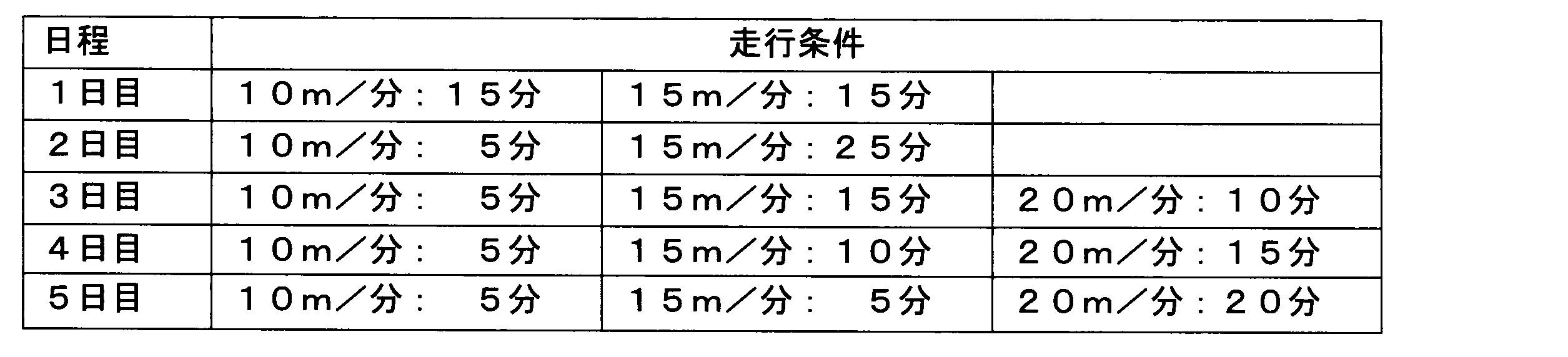

3週齢の雄ICRマウス(日本クレア株式会社)60匹について、1週間の予備飼育及び表6の条件でのトレッドミル走行への馴化を行った。トレッドミルはKN-73(夏目製作所社製)を用いた。馴化期間終了後、表7のプログラムにて運動できなくなるまでの時間を測定することで、運動持久力評価を行った。60匹の運動持久力を評価し、走行時間について上下25%に該当する個体を除外し、運動持久力及び体重にて3群に分けた(1群10匹)。
飼料として:実施例7で得られたマンゴスチン抽出物2を乾燥物換算で0.5重量%含む飼料(α-マンゴスチン0.05重量%及びγ-マンゴスチン0.01重量%を飼料中に含む)を与える群;BCAA(ロイシン:イソロイシン:バリンを2:1:1の比率で調製したもの)を乾燥物換算で5重量%含む飼料を与える群(ポジティブコントロール);並びにマンゴスチン抽出物及びBCAAをいずれも含まない対照飼料を与える群(コントロール);に分けて、8週間、自由摂取により給餌した。
動物の運動持久力測定は2週に1度実施し、測定を行った後に1週間の回復期間を設け、次回の測定を行った。また、測定の間の期間(回復期間)はマウスのトレッドミル馴化性維持のため、2日に1回の頻度で、15m/分で30分間走行させた。
動物の運動持久力測定は2週に1度実施し、測定を行った後に1週間の回復期間を設け、次回の測定を行った。また、測定の間の期間(回復期間)はマウスのトレッドミル馴化性維持のため、2日に1回の頻度で、15m/分で30分間走行させた。
(8-2)運動持久力の測定結果:
0週間後、6週間後及び8週間後に最大走行時間を測定した結果を、図5に示した。6週目、8週目の測定では各回共にマンゴスチン群、及びポジティブコントロールのBCAA群で走行可能時間が再現良く延長しており、マンゴスチンは運動持久力を増加させることが示唆された。
0週間後、6週間後及び8週間後に最大走行時間を測定した結果を、図5に示した。6週目、8週目の測定では各回共にマンゴスチン群、及びポジティブコントロールのBCAA群で走行可能時間が再現良く延長しており、マンゴスチンは運動持久力を増加させることが示唆された。
(8-3)脂肪蓄積抑制作用及び筋肉量増加作用の測定方法
上記(8-1)の8週間の試験後、肝臓、皮下脂肪組織、精巣上体脂肪組織、腸間膜脂肪組織、腎周囲脂肪組織、腓腹筋、ヒラメ筋、大腿筋及び脛骨筋を採取し、それぞれについて、脂肪組織重量及び筋肉組織重量を測定後、各個体の体重で割り、体重当たりの各組織量を測定し、各群で比較した。
上記(8-1)の8週間の試験後、肝臓、皮下脂肪組織、精巣上体脂肪組織、腸間膜脂肪組織、腎周囲脂肪組織、腓腹筋、ヒラメ筋、大腿筋及び脛骨筋を採取し、それぞれについて、脂肪組織重量及び筋肉組織重量を測定後、各個体の体重で割り、体重当たりの各組織量を測定し、各群で比較した。
(8-4)脂肪蓄積抑制作用の測定結果
各組織重量を体重で割って算出した、体重当たりの各組織の割合を表8に示す。マンゴスチン抽出物を投与した場合、体重当たりの脂肪組織の割合が減少することが明らかになり、その効果はマンゴスチン抽出物の10倍量投与したBCAA群と同等又はそれ以上であった。適度な運動を行った場合において、マンゴスチン抽出物は脂肪蓄積に対する抑制作用を有すると考えられた。
各組織重量を体重で割って算出した、体重当たりの各組織の割合を表8に示す。マンゴスチン抽出物を投与した場合、体重当たりの脂肪組織の割合が減少することが明らかになり、その効果はマンゴスチン抽出物の10倍量投与したBCAA群と同等又はそれ以上であった。適度な運動を行った場合において、マンゴスチン抽出物は脂肪蓄積に対する抑制作用を有すると考えられた。
(8-5)筋肉量増加作用の測定結果
各筋肉重量を体重で割って算出した、体重当たりの各筋肉の割合を表8に示す。表8から、マンゴスチン抽出物を投与した場合、腓腹筋、ヒラメ筋、大腿筋及び脛骨筋のいずれも、体重あたりの割合の増加が認められた。その効果はマンゴスチン抽出物の10倍量投与したBCAA群と同等又はそれ以上であった。適度な運動を行った場合において、マンゴスチン抽出物は筋肉量に対する増加作用を有すると考えられた。
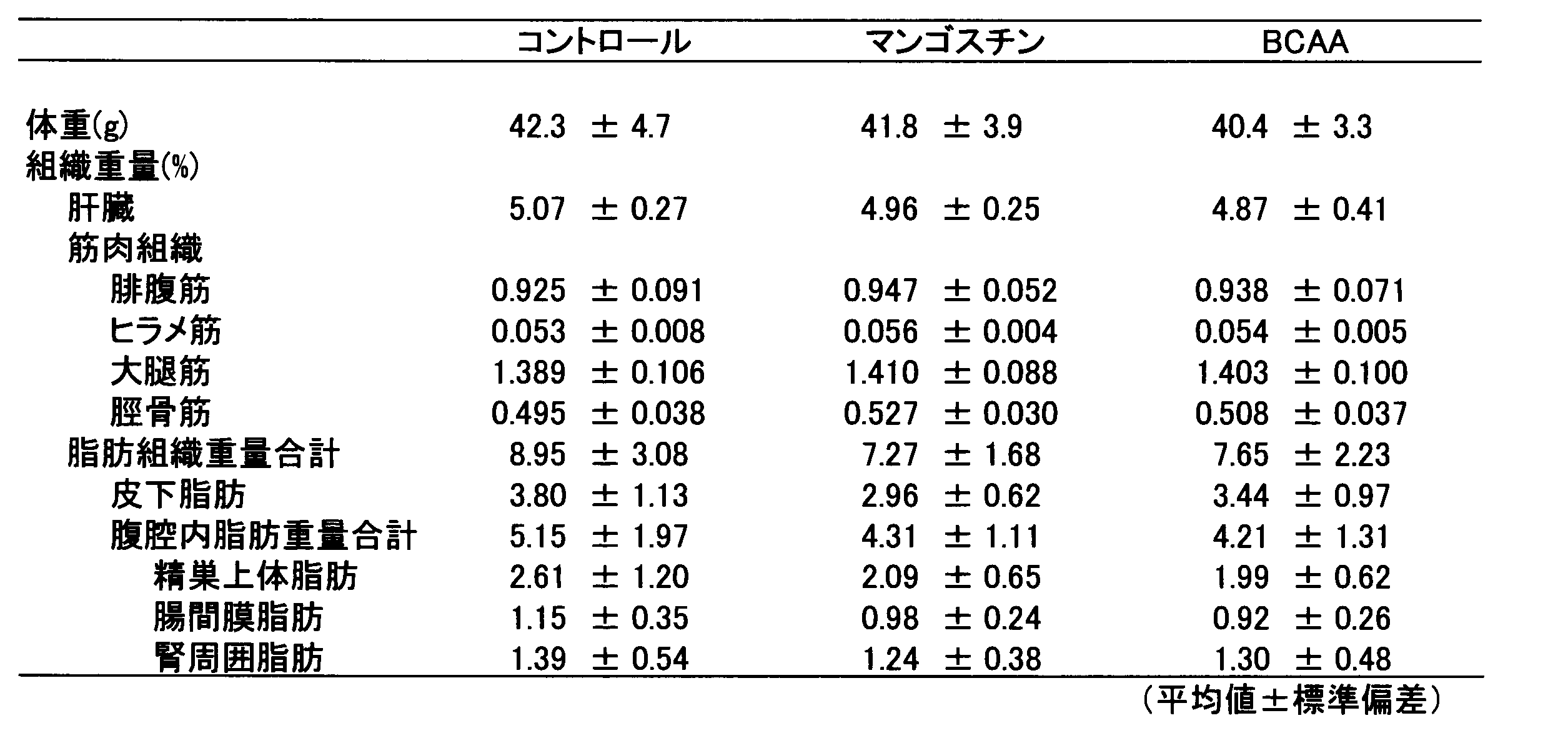
各筋肉重量を体重で割って算出した、体重当たりの各筋肉の割合を表8に示す。表8から、マンゴスチン抽出物を投与した場合、腓腹筋、ヒラメ筋、大腿筋及び脛骨筋のいずれも、体重あたりの割合の増加が認められた。その効果はマンゴスチン抽出物の10倍量投与したBCAA群と同等又はそれ以上であった。適度な運動を行った場合において、マンゴスチン抽出物は筋肉量に対する増加作用を有すると考えられた。
マンゴスチン抽出物3(マンゴスチン果皮抽出物)の調製:
新たに購入したタイ産マンゴスチンの果実から果皮を採取し、凍結乾燥した後、粉砕し、果皮粉末を得た。この果皮部粉末1,000gを10倍量の70%エタノールを用いて室温で2時間攪拌し、抽出した。抽出液を濃縮後、凍結乾燥することによりマンゴスチン抽出物3(マンゴスチン果皮抽出物)を288.63g得た。このマンゴスチン抽出物3について、実施例(1-2)と同様の手法を用いてγ-マンゴスチン及びα-マンゴスチンの含有量を分析した結果を表9に示す。果皮由来のマンゴスチン抽出物3には、果肉部由来のマンゴスチン抽出物1よりも高濃度のキサントン類が含まれていた。

新たに購入したタイ産マンゴスチンの果実から果皮を採取し、凍結乾燥した後、粉砕し、果皮粉末を得た。この果皮部粉末1,000gを10倍量の70%エタノールを用いて室温で2時間攪拌し、抽出した。抽出液を濃縮後、凍結乾燥することによりマンゴスチン抽出物3(マンゴスチン果皮抽出物)を288.63g得た。このマンゴスチン抽出物3について、実施例(1-2)と同様の手法を用いてγ-マンゴスチン及びα-マンゴスチンの含有量を分析した結果を表9に示す。果皮由来のマンゴスチン抽出物3には、果肉部由来のマンゴスチン抽出物1よりも高濃度のキサントン類が含まれていた。
(10―1)廃用性筋萎縮抑制作用の測定方法
3週齢の雄のC57/BLマウス(日本クレア株式会社)30匹を、1週間の予備飼育をした後、3群に分けた(1群10匹)。飼料として:実施例9で得られたマンゴスチン抽出物3を乾燥物換算で0.3重量%含む飼料(α―マンゴスチン0.05重量%、γ-マンゴスチン0.01重量%飼料中に含む)を与える群;BCAA(ロイシン:イソロイシン:バリンが2:1:1の比率で調製したもの)を乾燥物換算で5重量%含む飼料を与える群(ポジティブコントロール);並びにマンゴスチン果皮抽出物及びBCAAをいずれも含まない対照飼料を与える群(コントロール);とに分けて、3週間、自由摂取により給餌した。
3週間後、廃用性筋萎縮を誘導する坐骨神経切除を行った。C57/BLマウスをペントバルビタール腹腔投与で麻酔し、消炎鎮痛剤(メタカム(登録商標))を皮下投与した。両後肢の臀部を切開し、左後肢の坐骨神経を切除し、右後肢はコントロールとして無処置とした。縫合後、ヨードチンキで消毒し、37℃の保温シート上で回復させてケージに戻し、通常通り飼育を行った。施術後5日間廃用性筋萎縮を誘導し、骨格筋重量を測定した。筋萎縮の程度は右足の筋重量に対する左足の筋重量で評価した。
3週齢の雄のC57/BLマウス(日本クレア株式会社)30匹を、1週間の予備飼育をした後、3群に分けた(1群10匹)。飼料として:実施例9で得られたマンゴスチン抽出物3を乾燥物換算で0.3重量%含む飼料(α―マンゴスチン0.05重量%、γ-マンゴスチン0.01重量%飼料中に含む)を与える群;BCAA(ロイシン:イソロイシン:バリンが2:1:1の比率で調製したもの)を乾燥物換算で5重量%含む飼料を与える群(ポジティブコントロール);並びにマンゴスチン果皮抽出物及びBCAAをいずれも含まない対照飼料を与える群(コントロール);とに分けて、3週間、自由摂取により給餌した。
3週間後、廃用性筋萎縮を誘導する坐骨神経切除を行った。C57/BLマウスをペントバルビタール腹腔投与で麻酔し、消炎鎮痛剤(メタカム(登録商標))を皮下投与した。両後肢の臀部を切開し、左後肢の坐骨神経を切除し、右後肢はコントロールとして無処置とした。縫合後、ヨードチンキで消毒し、37℃の保温シート上で回復させてケージに戻し、通常通り飼育を行った。施術後5日間廃用性筋萎縮を誘導し、骨格筋重量を測定した。筋萎縮の程度は右足の筋重量に対する左足の筋重量で評価した。
(10―2)廃用性筋萎縮抑制作用の測定結果
各骨格筋における筋萎縮の割合を、右肢の筋重量に対する左肢の筋重量で算出した結果を図6に示す。コントロールの各骨格筋において、右肢(偽手術)に対する左肢(神経切除)の筋重量が小さいことから、廃用性筋萎縮の誘導が確実に起こっていることが分かる。マンゴスチン抽出物を投与した場合、ヒラメ筋及び脛骨筋の萎縮が低減され、BCAA(ポジティブコントロール)を投与した場合、ヒラメ筋及び脛骨筋の萎縮が低減された。マンゴスチン抽出物は、廃用性筋萎縮抑制作用を有すると考えられた。
各骨格筋における筋萎縮の割合を、右肢の筋重量に対する左肢の筋重量で算出した結果を図6に示す。コントロールの各骨格筋において、右肢(偽手術)に対する左肢(神経切除)の筋重量が小さいことから、廃用性筋萎縮の誘導が確実に起こっていることが分かる。マンゴスチン抽出物を投与した場合、ヒラメ筋及び脛骨筋の萎縮が低減され、BCAA(ポジティブコントロール)を投与した場合、ヒラメ筋及び脛骨筋の萎縮が低減された。マンゴスチン抽出物は、廃用性筋萎縮抑制作用を有すると考えられた。
(11―1)廃用性筋萎縮に関わる遺伝子発現の測定方法
3週齢の雄のICRマウス(日本クレア株式会社)30匹を1週間の予備飼育をした後、3群に分けた(1群10匹)。飼料として:実施例9で得られたマンゴスチン抽出物3を乾燥物換算で0.3重量%含む飼料(α―マンゴスチン0.05重量%、γ-マンゴスチン0.01重量%飼料中に含む)を与える群;BCAA(ロイシン:イソロイシン:バリンが2:1:1の比率で調製したもの)を乾燥物換算で5重量%含む飼料を与える群;並びにマンゴスチン果皮抽出物及びBCAAをいずれも含まない対照飼料を与える群(コントロール);に分けて、3週間、自由摂取により給餌した。上記(10-1)と同様に、廃用性筋萎縮を誘導する坐骨神経切除を行った。施術後5日間廃用性筋萎縮を誘導し、腓腹筋を採取し、筋萎縮に関わる遺伝子であるAtrogin-1及びMuRF-1の遺伝子発現を、リアルタイム定量PCR法によって測定した。使用したプライマー配列は以下のとおりである。
3週齢の雄のICRマウス(日本クレア株式会社)30匹を1週間の予備飼育をした後、3群に分けた(1群10匹)。飼料として:実施例9で得られたマンゴスチン抽出物3を乾燥物換算で0.3重量%含む飼料(α―マンゴスチン0.05重量%、γ-マンゴスチン0.01重量%飼料中に含む)を与える群;BCAA(ロイシン:イソロイシン:バリンが2:1:1の比率で調製したもの)を乾燥物換算で5重量%含む飼料を与える群;並びにマンゴスチン果皮抽出物及びBCAAをいずれも含まない対照飼料を与える群(コントロール);に分けて、3週間、自由摂取により給餌した。上記(10-1)と同様に、廃用性筋萎縮を誘導する坐骨神経切除を行った。施術後5日間廃用性筋萎縮を誘導し、腓腹筋を採取し、筋萎縮に関わる遺伝子であるAtrogin-1及びMuRF-1の遺伝子発現を、リアルタイム定量PCR法によって測定した。使用したプライマー配列は以下のとおりである。
Atrogin-1フォワード:
5’-ACCTGCCTGTGTGCTTACAA-3’(配列番号15)
Atrogin-1リバース:
5’-TCTCTTCCACAGTAGCCGGT-3’(配列番号16)
MuRF-1フォワード:
5’-TCCTGATGGAAACGCTATGGA-3’(配列番号17)
MuRF-1リバース:
5’-ATTCGCAGCCTGGAAGATGT-3’(配列番号18)
5’-ACCTGCCTGTGTGCTTACAA-3’(配列番号15)
Atrogin-1リバース:
5’-TCTCTTCCACAGTAGCCGGT-3’(配列番号16)
MuRF-1フォワード:
5’-TCCTGATGGAAACGCTATGGA-3’(配列番号17)
MuRF-1リバース:
5’-ATTCGCAGCCTGGAAGATGT-3’(配列番号18)
(11―2)廃用性筋萎縮に関わる遺伝子発現抑制作用の測定結果
廃用性筋萎縮に関わる遺伝子であるAtrogin-1及びMuRF-1の遺伝子発現をリアルタイムPCRで測定した結果を、コントロール群の偽手術(右肢)を1とした相対値で図7及び図8に示した。
図7及び図8から、対照群の右肢(偽手術)に比べ、左肢(神経切除)のAtrogin-1及びMuRF-1の発現量が増加していたことから、廃用性筋萎縮の誘導が確実に行われていることが分かる。図7から、対照群の右肢(偽手術)と比べマンゴスチン果皮抽出物群の右肢(偽手術)のAtrogin-1の発現が低下しており、左肢(神経切除)でも同様であった。図8から、MuRF-1でも同様の傾向がみられ、マンゴスチン抽出物を摂取することで、廃用性筋萎縮が抑制されることが示唆された。
廃用性筋萎縮に関わる遺伝子であるAtrogin-1及びMuRF-1の遺伝子発現をリアルタイムPCRで測定した結果を、コントロール群の偽手術(右肢)を1とした相対値で図7及び図8に示した。
図7及び図8から、対照群の右肢(偽手術)に比べ、左肢(神経切除)のAtrogin-1及びMuRF-1の発現量が増加していたことから、廃用性筋萎縮の誘導が確実に行われていることが分かる。図7から、対照群の右肢(偽手術)と比べマンゴスチン果皮抽出物群の右肢(偽手術)のAtrogin-1の発現が低下しており、左肢(神経切除)でも同様であった。図8から、MuRF-1でも同様の傾向がみられ、マンゴスチン抽出物を摂取することで、廃用性筋萎縮が抑制されることが示唆された。
マンゴスチン抽出物4及び5(マンゴスチンジュース抽出物)の製造
タイから100%果肉部を含むマンゴスチンジュース(以下、100%果肉部マンゴスチンジュース)及び70%果肉部30%果皮抽出物を含むマンゴスチンジュース(以下、70%果肉部マンゴスチンジュース)を輸入した。果皮抽出物は、マンゴスチン果実を洗浄し、マンゴスチン果実ジュースを得る過程で発生した果皮を熱水で抽出した後、濾過して得られた果皮の熱水抽出液である。
それぞれ1Lのジュースに、4倍量の99.5%エタノールを加え、室温で2時間攪拌後、濾紙を用いて濾過し、液層をエバポレーターにより濃縮し、凍結乾燥することで、100%果肉部マンゴスチンジュースでは196gの抽出物(マンゴスチン抽出物4)、70%果肉部マンゴスチンジュースでは142.7gの抽出物(マンゴスチン抽出物5)を得た。
得られたマンゴスチン抽出物4及び5について、実施例1と同様の手法を用いて分析した結果を表10に示す。
タイから100%果肉部を含むマンゴスチンジュース(以下、100%果肉部マンゴスチンジュース)及び70%果肉部30%果皮抽出物を含むマンゴスチンジュース(以下、70%果肉部マンゴスチンジュース)を輸入した。果皮抽出物は、マンゴスチン果実を洗浄し、マンゴスチン果実ジュースを得る過程で発生した果皮を熱水で抽出した後、濾過して得られた果皮の熱水抽出液である。
それぞれ1Lのジュースに、4倍量の99.5%エタノールを加え、室温で2時間攪拌後、濾紙を用いて濾過し、液層をエバポレーターにより濃縮し、凍結乾燥することで、100%果肉部マンゴスチンジュースでは196gの抽出物(マンゴスチン抽出物4)、70%果肉部マンゴスチンジュースでは142.7gの抽出物(マンゴスチン抽出物5)を得た。
得られたマンゴスチン抽出物4及び5について、実施例1と同様の手法を用いて分析した結果を表10に示す。
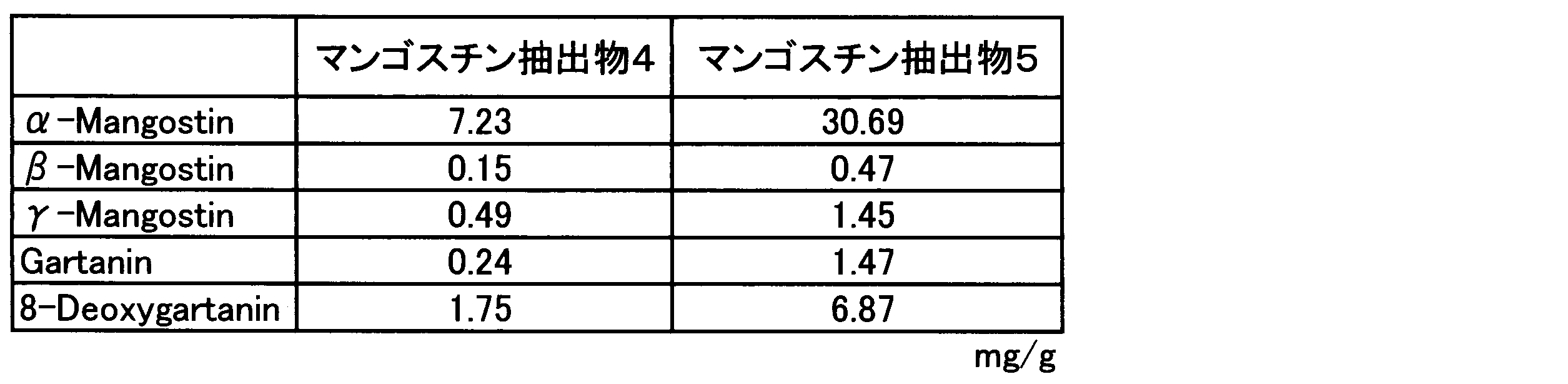
マンゴスチン抽出物を含有する飲料及び食品の官能評価
市販の野菜ジュース(食塩無添加)、トマト加工飲料(食塩無添加)又は豆乳(無調製)に、上記実施例12で得たマンゴスチン抽出物4又はマンゴスチン抽出物5を1重量%含有する飲料をそれぞれ作製し、嗜好性及び青臭さ(トマト臭さ、豆臭さを含む)に関してパネラー10又は11名による官能評価を行った。
抽出物を添加しない飲料(対照)の嗜好性及び青臭さの強さを5段階中3としたときの、各飲料の嗜好性及び青臭さの強さを5段階で評価し、パネラー10又は11名の評価の平均を算出した。結果を表11~13に示す。*はコントロール群に対する各群のTukey法による有意差を示す。
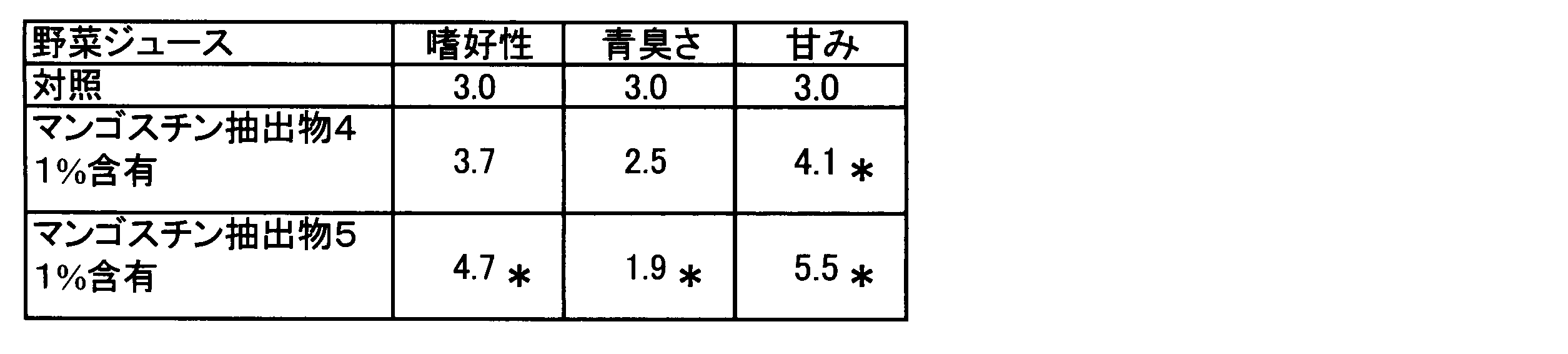
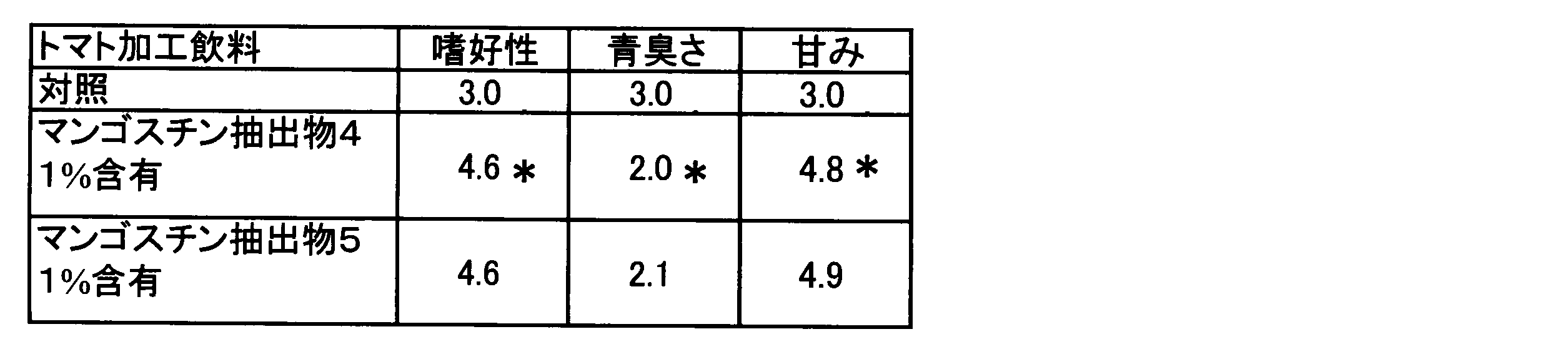
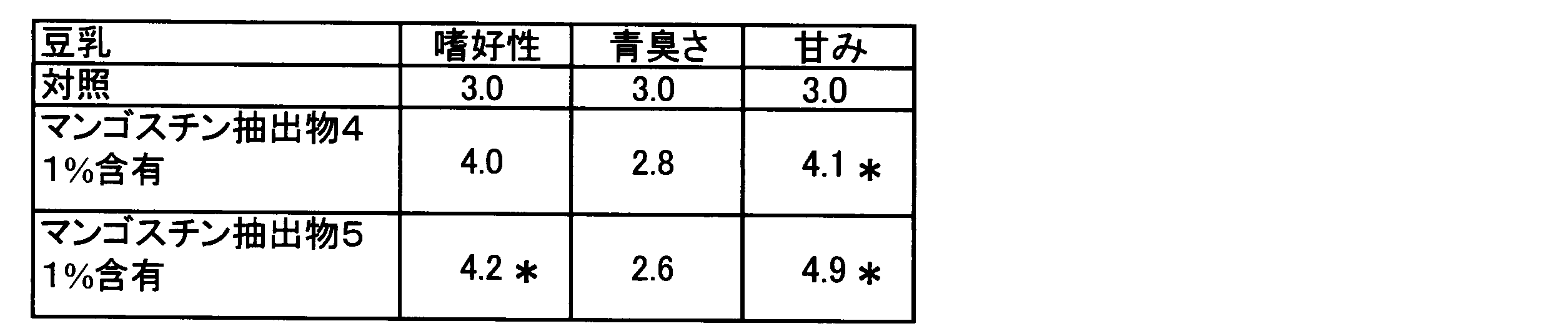
市販の野菜ジュース(食塩無添加)、トマト加工飲料(食塩無添加)又は豆乳(無調製)に、上記実施例12で得たマンゴスチン抽出物4又はマンゴスチン抽出物5を1重量%含有する飲料をそれぞれ作製し、嗜好性及び青臭さ(トマト臭さ、豆臭さを含む)に関してパネラー10又は11名による官能評価を行った。
抽出物を添加しない飲料(対照)の嗜好性及び青臭さの強さを5段階中3としたときの、各飲料の嗜好性及び青臭さの強さを5段階で評価し、パネラー10又は11名の評価の平均を算出した。結果を表11~13に示す。*はコントロール群に対する各群のTukey法による有意差を示す。
マンゴスチン抽出物4又は5を添加することで、野菜ジュース、トマト加工飲料及び豆乳のいずれにおいても甘みが増加した。マンゴスチン抽出物4を添加することで、野菜ジュースの青臭さが低減され、嗜好性が向上した飲料となった。トマトジュースでは、マンゴスチン抽出物4又は5を添加することで、トマトジュースの青臭さ(トマト臭さ)が低減され、嗜好性が向上した。豆乳では、マンゴスチン抽出物4を添加することで、青臭さ(豆臭さ)が低減し、嗜好性が向上した。マンゴスチン抽出物を飲食品(特に青臭さを有する飲料)に添加すると、呈味が改善され、継続摂取しやすい飲食品が得られると考えられた。
(キサントン類を含有する飲食品の製造)
以下にキサントン類を原料の一部として使用する飲食品(マンゴスチン加工飲食品)の製造例を示す。
以下にキサントン類を原料の一部として使用する飲食品(マンゴスチン加工飲食品)の製造例を示す。
(14-1)マンゴスチンジュース
シーズンパックマンゴスチンジュースの製造方法には、マンゴスチン洗浄、選別、破砕、加熱、搾汁、調合、脱気、殺菌、充填、冷却及び箱詰め工程がある。このうち調合工程で、搾汁したマンゴスチンジュースにマンゴスチン抽出物を添加して調合し、有塩の場合のみ食塩が加えられ、窒素ガスを混合して減圧脱気して、溶存酸素濃度を3ppm以下とした後、121℃、約1分の加熱殺菌をして、90℃まで冷却され、缶に充填される。
また、濃縮還元品の製造方法は、開けだし工程で、マンゴスチン濃縮物を開けだし、規定の無塩可溶性固形分(4.5以上)に水希釈する。その後、マンゴスチン抽出物を添加して調合し、脱気、殺菌、充填、冷却及び箱詰め工程を経て製造される。
原材料として用いるマンゴスチン抽出物は、例えば実施例1、7、9又は12に記載の手法を参照して製造することができる。
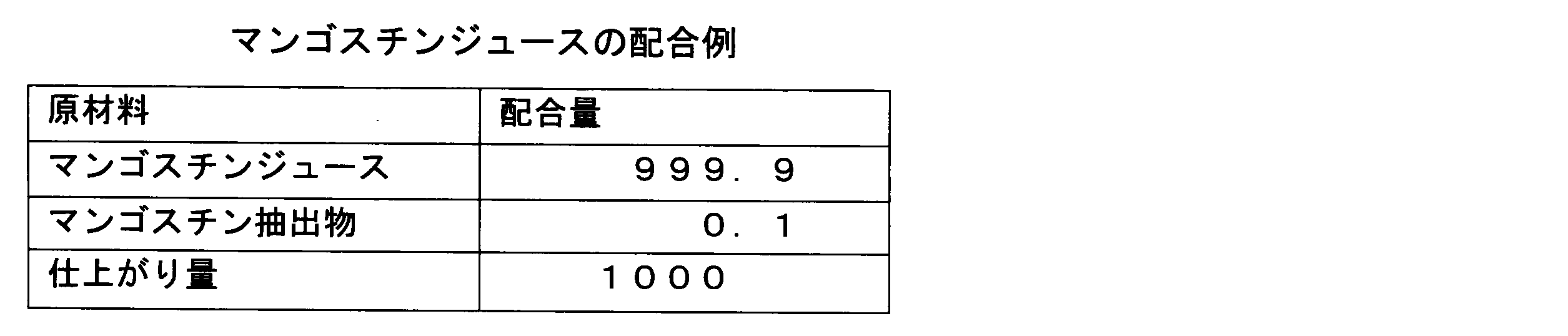
シーズンパックマンゴスチンジュースの製造方法には、マンゴスチン洗浄、選別、破砕、加熱、搾汁、調合、脱気、殺菌、充填、冷却及び箱詰め工程がある。このうち調合工程で、搾汁したマンゴスチンジュースにマンゴスチン抽出物を添加して調合し、有塩の場合のみ食塩が加えられ、窒素ガスを混合して減圧脱気して、溶存酸素濃度を3ppm以下とした後、121℃、約1分の加熱殺菌をして、90℃まで冷却され、缶に充填される。
また、濃縮還元品の製造方法は、開けだし工程で、マンゴスチン濃縮物を開けだし、規定の無塩可溶性固形分(4.5以上)に水希釈する。その後、マンゴスチン抽出物を添加して調合し、脱気、殺菌、充填、冷却及び箱詰め工程を経て製造される。
原材料として用いるマンゴスチン抽出物は、例えば実施例1、7、9又は12に記載の手法を参照して製造することができる。
(14-2)野菜ミックスジュース
搾汁したマンゴスチンジュース、或いは、マンゴスチン濃縮物を規定の無塩可溶性固形分(4.5以上)に水希釈して得たマンゴスチンジュースに、各種野菜汁及びキサントン類を添加して調合し、脱気、殺菌、充填、冷却及び箱詰め工程を経て製造される。
原材料として用いるキサントン類としては、例えば、α-マンゴスチン、β-マンゴスチン、γ-マンゴスチン、ガルタニン、イソマンゴスチン、デソキシガルタニン、カラバキサントン、ヒドロキシカラバキサントン、ガルシノン、マンゴスタノールなどが挙げられる。

搾汁したマンゴスチンジュース、或いは、マンゴスチン濃縮物を規定の無塩可溶性固形分(4.5以上)に水希釈して得たマンゴスチンジュースに、各種野菜汁及びキサントン類を添加して調合し、脱気、殺菌、充填、冷却及び箱詰め工程を経て製造される。
原材料として用いるキサントン類としては、例えば、α-マンゴスチン、β-マンゴスチン、γ-マンゴスチン、ガルタニン、イソマンゴスチン、デソキシガルタニン、カラバキサントン、ヒドロキシカラバキサントン、ガルシノン、マンゴスタノールなどが挙げられる。
本出願は、2012年2月28日に出願された日本国特許出願第2012-42067号に基づく優先権を主張するものであり、この内容はここに参照として組み込まれる。
本発明によれば、AMPK及びPPARδを共に活性化することができ、安全性の高い共活性化剤を提供することができる。本発明によれば、本来運動を行った時に認められる好ましい生体応答を、運動を行うことなく、又はより少ない運動で得ることができる、安全性及び効果の高い運動効果模倣作用剤を提供することもできる。また、本発明によれば、上記の剤を、継続摂取に好適な呈味の飲食品として提供することもできる。更に、本発明によれば、効果の高い上記の剤を、マンゴスチンの果皮等より容易に効率よく得ることができるため、廃棄物の有効利用が可能である。本発明は、飲食品、医薬品及び試薬等の分野において産業上の利用可能性を有する。
Claims (13)
- マンゴスチン抽出物を含有する運動効果模倣作用剤。
- マンゴスチン抽出物を含有するAMPK及びPPARδ共活性化剤。
- 脂肪蓄積抑制剤、熱産生促進剤、筋肉分化促進剤、運動持久力向上剤又は筋萎縮抑制剤である、請求項1に記載の作用剤。
- マンゴスチン抽出物が、下記式(I)

R1及びR4は、互いに独立してC1~C5-アルキル又はアルケニルであり;
R2及びR3は、互いに独立してヒドロキシ又はC1~C6-アルコキシであり;
ここで、R1とR2は、互いに結合して、環原子として、炭素原子に加えて酸素原子を含む5~8員環を形成してもよい。)
で表される化合物を含有する、請求項1~3のいずれか1項に記載の剤。 - マンゴスチン抽出物が、α-マンゴスチン、γ-マンゴスチン及び3-イソマンゴスチンからなる群から選択される1以上の化合物を含有する、請求項1~4のいずれか1項に記載の剤。
- 請求項1~5のいずれか1項に記載の剤を配合した飲食品であって、マンゴスチン抽出物の含有量が、0.001~10重量%である飲食品。
- 請求項5に記載の剤を配合した飲食品であって、
0.001~50重量%のα-マンゴスチンを含有し;かつ
0.0001~50重量%のγ-マンゴスチンを含有する;
飲食品。 - 果汁、野菜ジュース、トマト加工飲料、ミックスジュース又は豆乳である、請求項6又は7に記載の飲食品。
- γ-マンゴスチンを含有する運動効果模倣作用剤。
- α-マンゴスチン及びγ-マンゴスチンを含有する運動効果模倣作用剤。
- γ-マンゴスチンを含有するAMPK及びPPARδ共活性化剤。
- α-マンゴスチンを含有するAMPK及びPPARδ共活性化剤。
- 3-イソマンゴスチンを含有するPPARδ活性化剤。
Applications Claiming Priority (2)
| Application Number | Priority Date | Filing Date | Title |
|---|---|---|---|
| JP2012-042067 | 2012-02-28 | ||
| JP2012042067 | 2012-02-28 |
Publications (1)
| Publication Number | Publication Date |
|---|---|
| WO2013129334A1 true WO2013129334A1 (ja) | 2013-09-06 |
Family
ID=49082531
Family Applications (1)
| Application Number | Title | Priority Date | Filing Date |
|---|---|---|---|
| PCT/JP2013/054806 Ceased WO2013129334A1 (ja) | 2012-02-28 | 2013-02-25 | 運動効果模倣作用剤並びにAMPK及びPPARδ共活性化剤 |
Country Status (2)
| Country | Link |
|---|---|
| JP (1) | JPWO2013129334A1 (ja) |
| WO (1) | WO2013129334A1 (ja) |
Cited By (5)
| Publication number | Priority date | Publication date | Assignee | Title |
|---|---|---|---|---|
| WO2017086232A1 (ja) * | 2015-11-17 | 2017-05-26 | 国立研究開発法人国立循環器病研究センター | 予防・治療剤 |
| JP2018058792A (ja) * | 2016-10-05 | 2018-04-12 | サッポロホールディングス株式会社 | Pcsk9阻害剤及びコレステロール代謝改善用食品組成物 |
| JP2018523678A (ja) * | 2015-09-21 | 2018-08-23 | インダストリー−アカデミック コーオペレイション ファウンデーション キョンサン ナショナル ユニバーシティ | β−マンゴスチンを有効成分として含有する肌美白用組成物 |
| CN112438922B (zh) * | 2019-08-27 | 2023-04-07 | 百岳特生物技术(上海)有限公司 | 山竹发酵液用于制备美肌及/或减脂组合物的用途 |
| JP2023544537A (ja) * | 2020-09-25 | 2023-10-24 | シージェイ チェルジェダン コーポレイション | マンゴスチンを含む抗コクシジウム用組成物およびその用途 |
Citations (5)
| Publication number | Priority date | Publication date | Assignee | Title |
|---|---|---|---|---|
| JPH07147951A (ja) * | 1991-01-25 | 1995-06-13 | Asama Kasei Kk | 食品用保存剤および保存性の優れた食品の製造法 |
| JP2006504790A (ja) * | 2002-10-30 | 2006-02-09 | ディービーシー エルエルシー | マンゴスチン栄養補給組成物 |
| WO2006047416A2 (en) * | 2004-10-25 | 2006-05-04 | Wadsworth John W | Garcinia mangostana l. enhanced animal food product |
| JP2009536167A (ja) * | 2006-05-10 | 2009-10-08 | ディーエスエム アイピー アセッツ ビー.ブイ. | 筋肉障害の治療のためのキサントン誘導体 |
| JP2011079752A (ja) * | 2009-10-05 | 2011-04-21 | Kracie Home Products Ltd | 膵リパーゼ阻害剤並びにそれを含有する飲食品組成物及び医薬品組成物 |
-
2013
- 2013-02-25 WO PCT/JP2013/054806 patent/WO2013129334A1/ja not_active Ceased
- 2013-02-25 JP JP2014502216A patent/JPWO2013129334A1/ja active Pending
Patent Citations (5)
| Publication number | Priority date | Publication date | Assignee | Title |
|---|---|---|---|---|
| JPH07147951A (ja) * | 1991-01-25 | 1995-06-13 | Asama Kasei Kk | 食品用保存剤および保存性の優れた食品の製造法 |
| JP2006504790A (ja) * | 2002-10-30 | 2006-02-09 | ディービーシー エルエルシー | マンゴスチン栄養補給組成物 |
| WO2006047416A2 (en) * | 2004-10-25 | 2006-05-04 | Wadsworth John W | Garcinia mangostana l. enhanced animal food product |
| JP2009536167A (ja) * | 2006-05-10 | 2009-10-08 | ディーエスエム アイピー アセッツ ビー.ブイ. | 筋肉障害の治療のためのキサントン誘導体 |
| JP2011079752A (ja) * | 2009-10-05 | 2011-04-21 | Kracie Home Products Ltd | 膵リパーゼ阻害剤並びにそれを含有する飲食品組成物及び医薬品組成物 |
Non-Patent Citations (5)
| Title |
|---|
| BUMRUNGPERT A ET AL.: "Xanthones from mangosteen prevent lipopolysaccharide-mediated inflammation and insulin resistance in primary cultures of human adipocytes.", J NUTR., vol. 139, no. 6, 2009, pages 1185 - 1191 * |
| CHAO AC ET AL.: "a-Mangostin, a dietary xanthone, induces autophagic cell death by activating the AMP-activated protein kinase pathway in glioblastoma cells.", J AGRIC FOOD CHEM., vol. 59, no. 5, 9 March 2011 (2011-03-09), pages 2086 - 2096 * |
| HIROYASU INOUE: "Kakunai Juyotai PPAR Kasseika o Shihyo to shita Shokuhin Seibun no Tansaku to Seitainai deno Kino Hyoka", JAPAN SOCIETY FOR BIOSCIENCE, BIOTECHNOLOGY, AND AGROCHEMISTRY KANSAI SHIBU KOENKAI KOEN YOSHISHU, vol. 465TH, 2010, pages 6 - 7 * |
| KANAE KAMO ET AL.: "Ko-Himan'yaku Kaihatsu o Mokuteki to shita Kakunai Juyotai PPAR6 Kasseika Busshitsu no Tansaku 2", ABSTRACTS OF ANNUAL MEETING OF PHARMACEUTICAL SOCIETY OF JAPAN, vol. 130, no. 3, 5 March 2010 (2010-03-05), pages 230 * |
| NARKAR VA ET AL.: "AMPK and PPAR6 agonists are exercise mimetics.", CELL, vol. 134, no. 3, 8 August 2008 (2008-08-08), pages 405 - 415 * |
Cited By (8)
| Publication number | Priority date | Publication date | Assignee | Title |
|---|---|---|---|---|
| JP2018523678A (ja) * | 2015-09-21 | 2018-08-23 | インダストリー−アカデミック コーオペレイション ファウンデーション キョンサン ナショナル ユニバーシティ | β−マンゴスチンを有効成分として含有する肌美白用組成物 |
| US11882858B2 (en) | 2015-09-21 | 2024-01-30 | Industry-Academic Cooperation Foundation Gyeongsang National University | Composition for skin whitening comprising β-mangostin as effective ingredient |
| WO2017086232A1 (ja) * | 2015-11-17 | 2017-05-26 | 国立研究開発法人国立循環器病研究センター | 予防・治療剤 |
| JP2018058792A (ja) * | 2016-10-05 | 2018-04-12 | サッポロホールディングス株式会社 | Pcsk9阻害剤及びコレステロール代謝改善用食品組成物 |
| JP7105536B2 (ja) | 2016-10-05 | 2022-07-25 | ポッカサッポロフード&ビバレッジ株式会社 | Pcsk9阻害剤及びコレステロール代謝改善用食品組成物 |
| CN112438922B (zh) * | 2019-08-27 | 2023-04-07 | 百岳特生物技术(上海)有限公司 | 山竹发酵液用于制备美肌及/或减脂组合物的用途 |
| JP2023544537A (ja) * | 2020-09-25 | 2023-10-24 | シージェイ チェルジェダン コーポレイション | マンゴスチンを含む抗コクシジウム用組成物およびその用途 |
| JP7574430B2 (ja) | 2020-09-25 | 2024-10-28 | シージェイ チェルジェダン コーポレイション | マンゴスチンを含む抗コクシジウム用組成物およびその用途 |
Also Published As
| Publication number | Publication date |
|---|---|
| JPWO2013129334A1 (ja) | 2015-07-30 |
Similar Documents
| Publication | Publication Date | Title |
|---|---|---|
| JP5985138B2 (ja) | エネルギー消費促進剤 | |
| TW200934505A (en) | Ligand agent for peroxisome proliferator-activated receptor (ppar) | |
| WO2009136611A1 (ja) | グルタチオン産生促進剤、グルタチオンの欠乏に起因する疾患の予防・治療剤、飲食品及び飼料 | |
| WO2013129334A1 (ja) | 運動効果模倣作用剤並びにAMPK及びPPARδ共活性化剤 | |
| JP2013237657A (ja) | PPARγ活性抑制剤 | |
| JP7058225B2 (ja) | イソキサントフモールを含む脂質代謝促進用組成物 | |
| JP2023157951A (ja) | 肝臓機能改善用組成物 | |
| JP5403942B2 (ja) | グルタチオン産生促進剤およびグルタチオンの欠乏に起因する疾患の予防・治療剤 | |
| JP5923381B2 (ja) | PPARγ活性抑制剤 | |
| JPWO2005115366A1 (ja) | ウコン精油成分を含有する生活習慣病予防・改善剤 | |
| JP6660668B2 (ja) | Ucp−1発現促進剤 | |
| JP2010083796A (ja) | Cb1受容体阻害物質 | |
| US9301986B2 (en) | PPAR activator | |
| JP5346623B2 (ja) | Ppar活性化剤 | |
| JPWO2014103410A1 (ja) | Igf−1産生促進剤 | |
| JP2012171924A (ja) | Ppar活性化剤 | |
| WO2007001080A1 (ja) | ビワ葉抽出物を含有する飲食品及び医薬品 | |
| JP5931633B2 (ja) | Trpv4活性抑制剤 | |
| JP2009249331A (ja) | 植物由来の高脂血症の予防または改善剤 | |
| JP5346624B2 (ja) | Ppar活性化剤 | |
| JP7729581B2 (ja) | 肝機能向上剤および肝機能向上用経口組成物 | |
| JP2012171923A (ja) | Ppar活性化剤 | |
| JP2009114138A (ja) | コレステロール上昇抑制剤 | |
| KR20240125995A (ko) | 멜린조 잎을 유효성분으로 함유하는 항비만 조성물 | |
| JP2018104383A (ja) | Trpv4活性阻害剤 |
Legal Events
| Date | Code | Title | Description |
|---|---|---|---|
| 121 | Ep: the epo has been informed by wipo that ep was designated in this application |
Ref document number: 13755736 Country of ref document: EP Kind code of ref document: A1 |
|
| ENP | Entry into the national phase |
Ref document number: 2014502216 Country of ref document: JP Kind code of ref document: A |
|
| NENP | Non-entry into the national phase |
Ref country code: DE |
|
| 122 | Ep: pct application non-entry in european phase |
Ref document number: 13755736 Country of ref document: EP Kind code of ref document: A1 |