WO2013115178A1 - 偏光板およびこれを用いた表示装置 - Google Patents
偏光板およびこれを用いた表示装置 Download PDFInfo
- Publication number
- WO2013115178A1 WO2013115178A1 PCT/JP2013/051890 JP2013051890W WO2013115178A1 WO 2013115178 A1 WO2013115178 A1 WO 2013115178A1 JP 2013051890 W JP2013051890 W JP 2013051890W WO 2013115178 A1 WO2013115178 A1 WO 2013115178A1
- Authority
- WO
- WIPO (PCT)
- Prior art keywords
- acid
- polarizing plate
- base material
- material layer
- hydrophilic polymer
- Prior art date
- Legal status (The legal status is an assumption and is not a legal conclusion. Google has not performed a legal analysis and makes no representation as to the accuracy of the status listed.)
- Ceased
Links
Classifications
-
- G—PHYSICS
- G02—OPTICS
- G02B—OPTICAL ELEMENTS, SYSTEMS OR APPARATUS
- G02B5/00—Optical elements other than lenses
- G02B5/30—Polarising elements
- G02B5/3025—Polarisers, i.e. arrangements capable of producing a definite output polarisation state from an unpolarised input state
- G02B5/3033—Polarisers, i.e. arrangements capable of producing a definite output polarisation state from an unpolarised input state in the form of a thin sheet or foil, e.g. Polaroid
-
- G—PHYSICS
- G02—OPTICS
- G02B—OPTICAL ELEMENTS, SYSTEMS OR APPARATUS
- G02B5/00—Optical elements other than lenses
- G02B5/20—Filters
- G02B5/208—Filters for use with infrared or ultraviolet radiation, e.g. for separating visible light from infrared and/or ultraviolet radiation
-
- G—PHYSICS
- G02—OPTICS
- G02B—OPTICAL ELEMENTS, SYSTEMS OR APPARATUS
- G02B5/00—Optical elements other than lenses
- G02B5/20—Filters
- G02B5/22—Absorbing filters
- G02B5/223—Absorbing filters containing organic substances, e.g. dyes, inks or pigments
-
- G—PHYSICS
- G02—OPTICS
- G02F—OPTICAL DEVICES OR ARRANGEMENTS FOR THE CONTROL OF LIGHT BY MODIFICATION OF THE OPTICAL PROPERTIES OF THE MEDIA OF THE ELEMENTS INVOLVED THEREIN; NON-LINEAR OPTICS; FREQUENCY-CHANGING OF LIGHT; OPTICAL LOGIC ELEMENTS; OPTICAL ANALOGUE/DIGITAL CONVERTERS
- G02F1/00—Devices or arrangements for the control of the intensity, colour, phase, polarisation or direction of light arriving from an independent light source, e.g. switching, gating or modulating; Non-linear optics
- G02F1/01—Devices or arrangements for the control of the intensity, colour, phase, polarisation or direction of light arriving from an independent light source, e.g. switching, gating or modulating; Non-linear optics for the control of the intensity, phase, polarisation or colour
- G02F1/13—Devices or arrangements for the control of the intensity, colour, phase, polarisation or direction of light arriving from an independent light source, e.g. switching, gating or modulating; Non-linear optics for the control of the intensity, phase, polarisation or colour based on liquid crystals, e.g. single liquid crystal display cells
- G02F1/133—Constructional arrangements; Operation of liquid crystal cells; Circuit arrangements
- G02F1/1333—Constructional arrangements; Manufacturing methods
- G02F1/1335—Structural association of cells with optical devices, e.g. polarisers or reflectors
- G02F1/133528—Polarisers
Definitions
- the present invention relates to a polarizing plate and a display device using the same.
- the liquid crystal display device usually includes a liquid crystal cell having a liquid crystal layer and a pair of substrates sandwiching the liquid crystal layer, and polarizing plates respectively disposed on both sides (viewing side and backlight side) of the liquid crystal cell. is there.
- IPS In-Plane Switching
- IPS type liquid crystal display devices are widely used in portable devices such as tablet display devices and smartphones. It has been.
- the liquid crystal molecules contained in the liquid crystal layer are aligned in parallel to the surfaces of the pair of substrates during black display, and thus the IPS liquid crystal display device has an advantage of excellent black display performance. Further, the IPS liquid crystal display device has an advantage that a certain high viewing angle can be secured without using a so-called optical compensation film (viewing angle widening film). On the other hand, due to the optical characteristics of the liquid crystal cell provided in the IPS liquid crystal display device, there is a problem that light leakage occurs when the screen is viewed from an oblique direction, and the contrast of the display image is lowered.
- a retardation film is used in a liquid crystal display device for the purpose of preventing such a decrease in contrast.
- a retardation film capable of supporting various optical designs is required. It is getting to be.
- the retardation film mounted on the portable device as described above there is a strong demand for further reduction in thickness and weight.
- the polarizing plate has a configuration in which a polarizer and a polarizing plate protective film for protecting the polarizer are laminated.
- a so-called coating type polarizing plate is known as one type of polarizing plate, but this coating type polarizing plate has a problem that curling occurs in a humidified environment. When curling occurs in the polarizing plate, display unevenness (color unevenness) locally occurs when the display device is configured.
- the hydrophilicity of the stretched laminate obtained by stretching the laminate of the base material layer and the hydrophilic polymer layer is a technique capable of preventing the occurrence of curling even in a humidified environment.
- a technique has been proposed in which a dichroic substance adsorbed on a functional polymer layer is used as a polarizing plate (see Patent Document 1).
- polyolefin resin, cyclic polyolefin resin, and (meth) acrylic resin are illustrated as a preferable material which comprises a base material layer.
- the example which used the acrylic resin film (lactone-ized polymethylmethacrylate film) and the norbornene-type resin film as a base material layer is disclosed.
- an object of the present invention is to provide a polarizing plate that can suppress the occurrence of color unevenness when a display device displays a panel.
- a polarizing plate having a stretched laminate in which a laminate of a hydrophilic polymer layer and a base material layer containing a thermoplastic resin is stretched and a dichroic substance is adsorbed on the hydrophilic polymer layer.
- the inventors have found that the above problem can be solved by controlling the fluctuation of the curl in two environments having different temperatures and humidity to be a predetermined value or less, and have completed the present invention.
- a polarizing plate having a stretched laminate in which a laminate of a hydrophilic polymer layer and a base material layer containing a thermoplastic resin is stretched, and a dichroic substance is adsorbed on the hydrophilic polymer layer, ,
- the difference ⁇ C
- Polarizer 2.
- the thermoplastic resin contained in the base material layer comprises an acrylic resin, a styrene resin, a cycloolefin resin, a cellulose resin, a polypropylene resin, a polyester resin, or a combination thereof.
- the base material layer is at least A first base material layer containing a first thermoplastic resin; A second substrate layer comprising a second thermoplastic resin, disposed on the opposite side of the hydrophilic polymer layer with respect to the first substrate layer; 5.
- the polarizing plate according to any one of the above 1 to 4 which has
- a display device comprising the polarizing plate according to any one of 1 to 9 or the polarizing plate produced by the production method according to any one of 10 to 12; 14 14.
- ⁇ Polarizing plate ⁇ One embodiment of the present invention is a polarizing plate having a stretched laminate in which a laminate of a hydrophilic polymer layer and a thermoplastic resin layer is stretched, and a dichroic substance is adsorbed on the hydrophilic polymer layer.
- ADVANTAGE OF THE INVENTION According to this invention, the polarizing plate which can suppress generation
- the polarizing plate according to the present embodiment is obtained by stretching a laminate of a hydrophilic polymer layer and a thermoplastic resin layer and adsorbing a dichroic substance on the hydrophilic polymer layer. It has a laminate.
- the constituent elements of the stretched laminate will be described in more detail.
- the stretched laminate is first provided with a hydrophilic polymer layer.
- the hydrophilic polymer layer is a layer containing a hydrophilic polymer as a main component. And in the polarizing plate which concerns on this form, a hydrophilic polymer layer adsorb
- a polyvinyl alcohol-type material is illustrated preferably.
- the polyvinyl alcohol material include polyvinyl alcohol and derivatives thereof.
- Derivatives of polyvinyl alcohol include polyvinyl formal, polyvinyl acetal and the like, olefins such as ethylene and propylene, unsaturated carboxylic acids such as acrylic acid, methacrylic acid and crotonic acid, alkyl esters thereof, acrylamide and the like.
- the degree of polymerization of polyvinyl alcohol is preferably about 100 to 10,000, and more preferably 1,000 to 10,000. A saponification degree of about 80 to 100 mol% is generally used.
- hydrophilic polymer examples include partially saponified ethylene / vinyl acetate copolymer, dehydrated polyvinyl alcohol and dehydrochlorinated polyvinyl chloride.
- hydrophilic polymer it is preferable to use polyvinyl alcohol among polyvinyl alcohol materials.
- the hydrophilic polymer layer may contain additives such as a plasticizer and a surfactant in addition to the hydrophilic polymer described above.
- the plasticizer include polyols and condensates thereof, and examples thereof include glycerin, diglycerin, triglycerin, ethylene glycol, propylene glycol, and polyethylene glycol.
- the amount of the plasticizer used is not particularly limited, but it is preferably 20% by mass or less with respect to 100% by mass of the total amount of the hydrophilic polymer layer.
- the specific configuration of the dichroic substance adsorbed on the hydrophilic polymer layer is not particularly limited, and examples thereof include iodine and organic dyes.
- Organic dyes include, for example, Red BR, Red LR, Red R, Pink LB, Rubin BL, Bordeaux GS, Sky Blue LG, Lemon Yellow, Blue BR, Blue 2R, Navy RY, Green LG, Violet LB, Violet B, Black H, Black B, Black GSP, Yellow 3G, Yellow R, Orange LR, Orange 3R, Scarlet GL, Scarlet KGL, Congo Red, Brilliant Violet BK, Spura Blue G, Spura Blue GL, Spura Orange GL, Direct Sky Blue, Direct First orange S, first black, etc. can be used.
- iodine is preferably used as the dichroic material from the viewpoint of water solubility and process suitability. As for these dichroic substances, only 1 type may be used independently and 2 or more types may be used together.
- the amount of dichroic substance adsorbed in the hydrophilic polymer layer is not particularly limited, and can be set as appropriate with reference to known knowledge.
- the thickness of the hydrophilic polymer layer after stretching is not particularly limited, but is preferably 0.5 to 30 ⁇ m, more preferably 1 to 10 ⁇ m. If the thickness is a value equal to or greater than the lower limit, there is an advantage that the influence of thickness variation during manufacturing is reduced and appearance defects are less likely to occur. On the other hand, if the thickness is a value equal to or less than the upper limit, there is an advantage that the drying property of the aqueous solution is improved and the productivity is improved.
- the value of the thickness of the hydrophilic polymer layer a value measured by a method of subtracting the thickness of the film obtained by stretching only the base film under the same conditions from the thickness of the stretched laminate is adopted. The thickness is measured using a film thickness meter or the like.
- the stretched laminate also includes a substrate layer.
- the base material layer can function as a base material for preparing the hydrophilic polymer layer when the stretched laminate (polarizing plate) is prepared.
- a base material layer functions as a protective layer (protective film) for protecting a polarizer in the polarizing plate which concerns on this form.
- the base material layer includes a thermoplastic resin.
- a thermoplastic resin there is no restriction
- the base material layer is composed of a stretchable thermoplastic resin.
- stretchable thermoplastic resins include acrylic resins, styrene resins, cycloolefin resins, cellulose resins, polypropylene resins, polyester resins, or combinations thereof.
- an acrylic resin containing a structural unit derived from methyl methacrylate as a main component and further comprising a structural unit derived from a monomer component copolymerizable therewith is preferably used.
- the copolymerizable monomer component also includes an acrylic acid derivative having a ring structure.
- the styrenic resin include a styrenic resin containing a structural unit derived from styrene as a main component and further containing a structural unit derived from a monomer component copolymerizable therewith.
- examples of the cycloolefin resin include a norbornene resin called a cycloolefin polymer.
- examples of the polypropylene-based resin include polypropylene partially containing polyethylene
- examples of the polyester-based resin include polyethylene terephthalate (PET).
- the base material layer contains a cellulosic resin.
- a cellulosic resin Cellulose resin polymerized in presence of cellulose ester, cellulose ether, cationized cellulose, various vinyl monomers, various vinyl monomers, etc. A graft polymer or the like is used. Of these, cellulose ester resins are particularly preferably used.
- the specific form of the cellulose ester resin is not particularly limited, but in particular from the viewpoint of improving brittleness and transparency, the following formulas (1) to (3):
- A represents the degree of substitution of the acetyl group
- B represents the sum of the degree of substitution of the acyl group having 3 to 7 carbon atoms. It is preferable to have an acyl group substitution degree that satisfies the above relationship.
- the total substitution degree (A + B) of the acyl group having 2 to 7 carbon atoms of the cellulose ester resin is 2.0 or more (that is, the residual degree of hydroxyl groups at the 2, 3, 6 positions of the cellulose ester molecule is 1.0 or less If the substrate layer functions as a polarizing plate protective film, an increase in haze is prevented. If the total acyl group substitution degree (A + B) is 2.0 or more and the substitution degree of the acyl group having 3 to 7 carbon atoms is 1.0 or more, the brittleness is prevented from being lowered.
- the cellulose ester resin has an acyl group substitution degree of 2.0 to 3.0 in total substitution degree (A), 0.15 to 2.0 substitution degree of acetyl group (A), and 3 carbon atoms.
- substitution degree (B) of the acyl group of 7 to 1.2 is 1.2 to 3.0, but an acyl group other than 3 to 7 carbon atoms, that is, an acetyl group or an acyl group having 8 or more carbon atoms It is preferable that the total degree of substitution is 1.3 or less.
- the total substitution degree (A + B) of the acyl group having 2 to 7 carbon atoms of the cellulose ester resin is more preferably in the range of 2.5 to 3.0.
- the acyl group may be an aliphatic acyl group or an aromatic acyl group. In the case of an aliphatic acyl group, it may be linear or branched and may further have a substituent.
- the number of carbon atoms of the acyl group in the present invention includes an acyl group substituent.
- the number of substituents X substituted on the aromatic ring is preferably 0 to 5.
- the substitution degree of the acyl group having 3 to 7 carbon atoms including the substituent is 1.0 to 2.75.
- the benzoyl group has 7 carbon atoms, when it has a substituent containing carbon, the benzoyl group has 8 or more carbon atoms and is not included in the acyl group having 3 to 7 carbon atoms. Become.
- substituents substituted on the aromatic ring when the number of substituents substituted on the aromatic ring is 2 or more, these may be the same or different from each other, and are connected to each other to form a condensed polycyclic compound (for example, naphthalene, indene, indane, phenanthrene, Quinoline, isoquinoline, chromene, chromane, phthalazine, acridine, indole, indoline, etc.).
- a condensed polycyclic compound for example, naphthalene, indene, indane, phenanthrene, Quinoline, isoquinoline, chromene, chromane, phthalazine, acridine, indole, indoline, etc.
- the cellulose ester resin is preferably at least one selected from cellulose acetate propionate, cellulose acetate butyrate, cellulose acetate benzoate, cellulose propionate, and cellulose butyrate.
- cellulose ester resins that are particularly preferred are cellulose acetate propionate and cellulose propionate.
- two or more kinds of cellulose ester resins can be mixed and used.
- the portion not substituted with an acyl group is usually present as a hydroxyl group. These can be synthesized by known methods. Further, the substitution degree of acetyl group and the substitution degree of other acyl groups are determined by the method prescribed in ASTM-D817-96.
- the weight average molecular weight (Mw) of the cellulose ester resin is preferably 75,000 or more, more preferably in the range of 75,000 to 300,000, and still more preferably in the range of 100,000 to 24,000, particularly from the viewpoint of improving brittleness. 160000-240000 are particularly preferred. When the weight average molecular weight (Mw) of the cellulose ester resin is less than 75,000, the heat resistance and brittleness improvement effects may not be sufficiently obtained.
- the thickness of the base material layer constituting the stretched laminate is not particularly limited, but is preferably 10 to 200 ⁇ m, and more preferably 20 to 80 ⁇ m. If the said thickness is more than a lower limit, the intensity
- the value of the thickness of the base material layer a value obtained by preparing a film obtained by stretching only the base material film under the same conditions and measuring the thickness is adopted.
- the water absorption when the base material layer is impregnated in 23 ° C. water for 24 hours is preferably 1.0 to 8.0 mass%.
- the water absorption rate is preferably 2.0 to 5.0% by mass, more preferably 3.0 to 5.0% by mass.
- the value measured with the following method shall be employ
- a cellulose ether resin has an ether bond in the at least 1 substituent of the 2, 3, 6 position in a cellulose molecule.
- the ether bond referred to here is a carbon-oxygen-carbon bond.
- the cellulose ether include, but are not limited to, methyl cellulose, ethyl cellulose, carboxymethyl cellulose, carboxymethyl ethyl cellulose, hydroxyethyl cellulose, hydroxyethyl methyl cellulose, hydroxypropyl methyl cellulose, and the like. Further, ethyl cellulose is optimal for ensuring transparency and durability as an optical film.
- the degree of ethoxyl substitution is preferably in the range of 1.9 to 2.9, and in the range of 2.2 to 2.9 from the balance between the viscosity at the time of melting and the stability of the moist heat resistant environment. Particularly preferred.
- the degree of ether substitution can be quantified by the method described in ASTM D4794-94.
- the molecular weight of the cellulose ether only needs to be able to be formed into a film alone. Specifically, the number average molecular weight Mn may be in the range of 30,000 ⁇ Mn ⁇ 300,000 (polystyrene conversion). Preferably, 50,000 to 200,000 are used. If the molecular weight is too small, the film becomes fragile, and if the molecular weight is too high, the viscosity is high and the molding stability at the time of molding processing is deteriorated, which is not preferable for production.
- the base material layer includes at least two kinds of thermoplastic resins.
- at least two types of thermoplastic resins included in the base material layer include a cellulose ester resin and an acrylic resin as essential components, and only these two types are included as the thermoplastic resin. It is particularly preferred.
- a base material layer contains two or more kinds of thermoplastic resins
- thermoplastic resins constitute a single base material layer having a uniform composition as a mixture in a compatible state
- iii) a mode in which these (i) and (ii) are combined, and the like are exemplified.
- Examples of the form (i) include a form in which a cellulose ester resin and an acrylic resin are included in a compatible state.
- a form in which a cellulose ester resin and an acrylic resin are included in a compatible state the disclosure content etc. of the international publication 2011/121720 pamphlet and the international publication 2011/121817 pamphlet can be referred.
- the base material layer containing one of the thermoplastic resins mentioned above and the base material layer containing the thermoplastic resin different from the said thermoplastic resin are laminated
- the base material layer located on the hydrophilic polymer layer side in the present specification, A substrate layer (also referred to as “first substrate layer”) containing a cellulose-based resin (preferably a cellulose ester resin) and located on the side opposite to the hydrophilic polymer layer (in the present specification, “ It is preferable that the second base layer ” also includes an acrylic resin.
- the difference ⁇ E
- ⁇ E ⁇ 2500 is more preferably satisfied, and ⁇ E ⁇ 2000 is further preferably satisfied.
- the elastic moduli Ea and Eb in the environment of 23 ° C. and 55% RH are Ea 1 and Eb 1 , respectively, and the elastic moduli Ea and Eb in the environment of 40 ° C. and 20% RH are Ea 2 and Eb 2 , respectively.
- the draw ratio, the stretch speed, the temperature at the time of stretching, the humidity at the time of stretching, etc. May be adjusted as appropriate.
- the base material layer may contain various additives in addition to the above-described thermoplastic resin.
- Examples of the additive that can be added to the base material layer include a low molecular weight acrylic polymer.
- the weight average molecular weight (Mw) of the low molecular weight acrylic polymer is preferably 500 to 30000.
- examples of the ethylenically unsaturated monomer Xa having no aromatic ring and no hydrophilic group in the molecule include (meth) acrylic acid esters as described later, and methyl methacrylate (MMA) is particularly preferable.
- examples of the ethylenically unsaturated monomer Xb having no hydrophilic ring in the molecule and having a hydrophilic group include acryloylmorpholine, vinyl pyrrolidone, and hydroxyethyl methacrylate.
- the content ratio of the structural unit derived from Xa and the structural unit derived from Xb in X 2 is not particularly limited, but the mass ratio of the structural unit derived from Xa to the structural unit derived from Xb is preferably 50:50 to 95: 5. 60:40 to 90:10 is more preferable, and 70:30 to 80:20 is particularly preferable.
- the weight average molecular weight of the above-mentioned acrylic polymer is preferably 1500 to 20000, more preferably 2000 to 10000, and particularly preferably 2500 to 5000. If the weight average molecular weight of the acrylic polymer is within such a range, there is an advantage that a balance between volatility and compatibility can be easily obtained.
- the content of the acrylic polymer in the base material layer is preferably 10 to 40% by mass, more preferably 20 to 30% by mass with respect to 100% by mass of the thermoplastic resin.
- the value of this content is a mass ratio with respect to the total amount of the thermoplastic resin which comprises the base material layer in which the said additive is contained (hereinafter the same). ).
- additives other than the low molecular weight acrylic polymer include plasticizers, sugar ester compounds, retardation adjusting agents, and coloring agents.
- ⁇ Plasticizer> Although there is no restriction
- polyester compound represented by these is mentioned.
- B represents a linear or branched alkylene group or cycloalkylene group having 2 to 6 carbon atoms
- A represents an aromatic ring having 6 to 14 carbon atoms or a C 2 to 6 carbon atoms.
- a linear or branched alkylene group or a cycloalkylene group is represented
- X represents a monocarboxylic acid residue containing a hydrogen atom or an aromatic ring having 6 to 14 carbon atoms
- n represents a natural number of 1 or more.
- the polyester compound represented by the general formula (4) includes a dicarboxylic acid having an aromatic ring (having 6 to 14 carbon atoms) or a linear or branched alkylene group or cycloalkylene group (both having 2 to 6 carbon atoms) and a carbon number.
- the aromatic dicarboxylic acid and the dicarboxylic acid having a linear or branched alkylene group or cycloalkylene group may be used alone or as a mixture, but the main component constituting the polarizing plate protective film may be used.
- both ends may be sealed with a monocarboxylic acid having an aromatic ring (having 6 to 14 carbon atoms).
- dicarboxylic acids having an aromatic ring (6 to 14 carbon atoms) that is, aromatic dicarboxylic acids having 6 to 16 carbon atoms
- aromatic dicarboxylic acids having 6 to 16 carbon atoms include phthalic acid, isophthalic acid, terephthalic acid, 1,5-naphthalenedicarboxylic acid, 1, 4-naphthalenedicarboxylic acid, 1,8-naphthalenedicarboxylic acid, 2,3-naphthalenedicarboxylic acid, 2,6-naphthalenedicarboxylic acid, 2,8-naphthalenedicarboxylic acid, 2,2′-biphenyldicarboxylic acid, 4,4 And '-biphenyldicarboxylic acid.
- terephthalic acid, 2,6-naphthalenedicarboxylic acid, and 4,4'-biphenyldicarboxylic acid are preferable.
- dicarboxylic acid having a linear or branched alkylene group or cycloalkylene group (2 to 6 carbon atoms) examples include malonic acid, succinic acid, glutaric acid, adipic acid, pimelic acid, suberic acid, and 1,2-cyclohexane. Examples thereof include dicarboxylic acid and 1,4-cyclohexanedicarboxylic acid. Of these, succinic acid, adipic acid, and 1,4-cyclohexanedicarboxylic acid are preferable.
- linear or branched alkylene diol or cycloalkylene diol having 2 to 6 carbon atoms examples include ethanediol (ethylene glycol), 1,2-propanediol, 1,3-propanediol, 1,2- Butanediol, 1,3-butanediol, 2-methyl-1,3-propanediol, 1,4-butanediol, 1,5-pentanediol, 3-methyl-1,5-pentanediol, 1,6- Examples include hexanediol, 1,4-cyclohexanediol, and 1,4-cyclohexanedimethanol. Among these, ethanediol (ethylene glycol), 1,2-propanediol, 1,3-propanediol, and 1,3-butanediol are preferable.
- A is preferably a benzene ring, naphthalene ring or biphenyl ring which may have a substituent, from the viewpoint of excellent plasticity imparting performance.
- the “substituent” that the benzene ring, naphthalene ring or biphenyl ring may have is an alkyl group having 1 to 6 carbon atoms, an alkenyl group having 2 to 6 carbon atoms, or an alkoxy group having 1 to 6 carbon atoms. is there.
- Examples of the monocarboxylic acid having an aromatic ring (having 6 to 14 carbon atoms) that seals both ends of the polyester compound include benzoic acid, orthotoluic acid, metatoluic acid, p-toluic acid, p-tert-butylbenzoic acid, and dimethylbenzoic acid. Examples include acids and paramethoxybenzoic acid. Of these, benzoic acid, p-toluic acid and p-tert-butylbenzoic acid are preferred.
- Aromatic polyester compounds can be prepared by the conventional methods, such as the above-mentioned hot-melt condensation method by the polyesterification reaction or transesterification reaction between the dicarboxylic acid and alkylene diol or cycloalkylene diol, or the interfacial condensation method between acid chlorides of these acids and glycols. It can be easily synthesized by either method. Furthermore, by adding the above-described aromatic monocarboxylic acid, a polyester compound in which both ends are sealed can be synthesized.
- the base material layer can further contain a plasticizer other than the polyester compound represented by the general formula (4).
- plasticizers other than the polyester compound represented by General formula (4)
- polyhydric carboxylic acid ester plasticizer glycolate type plasticizer, phthalate ester type plasticizer, fatty acid ester type It is selected from plasticizers and polyhydric alcohol ester plasticizers, ester plasticizers, acrylic plasticizers and the like.
- At least one is preferably a polyhydric alcohol ester plasticizer.
- the polyhydric alcohol ester plasticizer is a plasticizer composed of an ester of a divalent or higher aliphatic polyhydric alcohol and a monocarboxylic acid, and preferably has an aromatic ring or a cycloalkyl ring in the molecule.
- a divalent to 20-valent aliphatic polyhydric alcohol ester is preferred.
- the polyhydric alcohol preferably used in the present invention is represented by the following general formula (a).
- R 11 represents an n-valent organic group
- n represents a positive integer of 2 or more
- the OH group represents an alcoholic and / or phenolic hydroxy group (hydroxyl group).
- Examples of preferable polyhydric alcohols include the following, but are not limited thereto.
- triethylene glycol triethylene glycol, tetraethylene glycol, dipropylene glycol, tripropylene glycol, sorbitol, trimethylolpropane, and xylitol are preferable.
- monocarboxylic acid used for polyhydric alcohol ester there is no restriction
- Examples of preferable monocarboxylic acids include the following, but are not limited thereto.
- aliphatic monocarboxylic acid a fatty acid having a straight chain or a side chain having 1 to 32 carbon atoms can be preferably used.
- the number of carbon atoms is more preferably 1-20, and particularly preferably 1-10.
- the inclusion of acetic acid is preferred because the compatibility with cellulose acetate increases, and it is also preferred to use a mixture of acetic acid and other monocarboxylic acids.
- Preferred aliphatic monocarboxylic acids include acetic acid, propionic acid, butyric acid, valeric acid, caproic acid, enanthic acid, caprylic acid, pelargonic acid, capric acid, 2-ethyl-hexanoic acid, undecylic acid, lauric acid, tridecylic acid, Saturated fatty acids such as myristic acid, pentadecylic acid, palmitic acid, heptadecylic acid, stearic acid, nonadecanoic acid, arachidic acid, behenic acid, lignoceric acid, serotic acid, heptacosanoic acid, montanic acid, melicic acid, laccelic acid, undecylenic acid, olein Examples thereof include unsaturated fatty acids such as acid, sorbic acid, linoleic acid, linolenic acid, and arachidonic acid.
- Examples of preferable alicyclic monocarboxylic acids include cyclopentane carboxylic acid, cyclohexane carboxylic acid, cyclooctane carboxylic acid, and derivatives thereof.
- aromatic monocarboxylic acids examples include those in which 1 to 3 alkoxy groups such as alkyl group, methoxy group or ethoxy group are introduced into the benzene ring of benzoic acid such as benzoic acid and toluic acid, biphenylcarboxylic acid, Examples thereof include aromatic monocarboxylic acids having two or more benzene rings such as naphthalenecarboxylic acid and tetralincarboxylic acid, or derivatives thereof. Benzoic acid is particularly preferable.
- the molecular weight of the polyhydric alcohol ester is not particularly limited, but is preferably 300 to 1500, and more preferably 350 to 750. A higher molecular weight is preferred because it is less likely to volatilize, and a smaller one is preferred in terms of moisture permeability and compatibility with cellulose acetate.
- the carboxylic acid used for the polyhydric alcohol ester may be one kind or a mixture of two or more kinds. Moreover, all the OH groups in the polyhydric alcohol may be esterified, or a part of the OH groups may be left as they are.
- the glycolate plasticizer is not particularly limited, but alkylphthalylalkyl glycolates can be preferably used.
- alkyl phthalyl alkyl glycolates include methyl phthalyl methyl glycolate, ethyl phthalyl ethyl glycolate, propyl phthalyl propyl glycolate, butyl phthalyl butyl glycolate, octyl phthalyl octyl glycolate, methyl phthalyl ethyl Glycolate, ethyl phthalyl methyl glycolate, ethyl phthalyl propyl glycolate, methyl phthalyl butyl glycolate, ethyl phthalyl butyl glycolate, butyl phthalyl methyl glycolate, butyl phthalyl ethyl glycolate, propyl phthalyl butyl glycol Butyl phthalyl propyl glycolate, methyl phthalyl octyl glycolate, ethyl phthalyl octyl glycolate, octyl phthalyl
- phthalate ester plasticizer examples include diethyl phthalate, dimethoxyethyl phthalate, dimethyl phthalate, dioctyl phthalate, dibutyl phthalate, di-2-ethylhexyl phthalate, dioctyl phthalate, dicyclohexyl phthalate, and dicyclohexyl terephthalate.
- citrate plasticizer examples include acetyltrimethyl citrate, acetyltriethyl citrate, and acetyltributyl citrate.
- fatty acid ester plasticizers examples include butyl oleate, methylacetyl ricinoleate, and dibutyl sebacate.
- phosphate ester plasticizer examples include triphenyl phosphate, tricresyl phosphate, cresyl diphenyl phosphate, octyl diphenyl phosphate, diphenyl biphenyl phosphate, trioctyl phosphate, tributyl phosphate, and the like.
- the polyvalent carboxylic acid ester compound is composed of an ester of a divalent or higher, preferably a divalent to 20valent polyvalent carboxylic acid and an alcohol.
- the aliphatic polyvalent carboxylic acid is preferably divalent to 20-valent, and in the case of an aromatic polyvalent carboxylic acid or alicyclic polyvalent carboxylic acid, it is preferably trivalent to 20-valent.
- the polyvalent carboxylic acid is represented by the following general formula (b).
- R 12 represents an (m1 + n1) -valent organic group
- m1 represents a positive integer of 2 or more
- n1 represents an integer of 0 or more
- a COOH group represents a carboxy group
- an OH group represents an alcoholic or phenolic hydroxy group
- Examples of preferable polyvalent carboxylic acids include, but are not limited to, the following.
- Trivalent or higher aromatic polyvalent carboxylic acids such as trimellitic acid, trimesic acid, pyromellitic acid or derivatives thereof, succinic acid, adipic acid, azelaic acid, sebacic acid, oxalic acid, fumaric acid, maleic acid, tetrahydrophthal
- An aliphatic polyvalent carboxylic acid such as an acid, an oxypolyvalent carboxylic acid such as tartaric acid, tartronic acid, malic acid and citric acid can be preferably used.
- the alcohol used in the polyvalent carboxylic acid ester compound that can be used in the present invention is not particularly limited, and known alcohols and phenols can be used.
- an aliphatic saturated alcohol or aliphatic unsaturated alcohol having a straight chain or a side chain having 1 to 32 carbon atoms can be preferably used. More preferably, it has 1 to 20 carbon atoms, and particularly preferably 1 to 10 carbon atoms.
- alicyclic alcohols such as cyclopentanol and cyclohexanol or derivatives thereof
- aromatic alcohols such as benzyl alcohol and cinnamyl alcohol, or derivatives thereof can be preferably used.
- the alcoholic or phenolic hydroxy group (hydroxyl group) of the oxypolycarboxylic acid may be esterified with a monocarboxylic acid.
- monocarboxylic acids include the following, but the present invention is not limited thereto.
- aliphatic monocarboxylic acid a straight-chain or side-chain fatty acid having 1 to 32 carbon atoms can be preferably used. More preferably, it has 1 to 20 carbon atoms, and particularly preferably 1 to 10 carbon atoms.
- Preferred aliphatic monocarboxylic acids include acetic acid, propionic acid, butyric acid, valeric acid, caproic acid, enanthic acid, caprylic acid, pelargonic acid, capric acid, 2-ethyl-hexanecarboxylic acid, undecylic acid, lauric acid, tridecylic acid, Saturated fatty acids such as myristic acid, pentadecylic acid, palmitic acid, heptadecylic acid, stearic acid, nonadecanoic acid, arachidic acid, behenic acid, lignoceric acid, serotic acid, heptacosanoic acid, montanic acid, melicic acid, and laccelic acid, undecylenic acid, olein Examples thereof include unsaturated fatty acids such as acid, sorbic acid, linoleic acid, linolenic acid, and arachidonic acid.
- Examples of preferable alicyclic monocarboxylic acids include cyclopentane carboxylic acid, cyclohexane carboxylic acid, cyclooctane carboxylic acid, and derivatives thereof.
- aromatic monocarboxylic acids examples include those in which an alkyl group is introduced into the benzene ring of benzoic acid such as benzoic acid and toluic acid, and two or more benzene rings such as biphenyl carboxylic acid, naphthalene carboxylic acid, and tetralin carboxylic acid.
- benzoic acid and toluic acid examples include those in which an alkyl group is introduced into the benzene ring of benzoic acid such as benzoic acid and toluic acid, and two or more benzene rings such as biphenyl carboxylic acid, naphthalene carboxylic acid, and tetralin carboxylic acid.
- the aromatic monocarboxylic acid which has, or those derivatives can be mentioned.
- Particularly preferred are acetic acid, propionic acid, and benzoic acid.
- the molecular weight of the polyvalent carboxylic acid ester compound is not particularly limited, but is preferably in the range of 300 to 1000, and more preferably in the range of 350 to 750. The larger one is preferable in terms of improving the retention, and the smaller one is preferable in terms of moisture permeability and compatibility with the cellulose resin.
- the alcohol used for the polyvalent carboxylic acid ester that can be used in the present invention may be one kind or a mixture of two or more kinds.
- the acid value of the polyvalent carboxylic acid ester compound that can be used in the present invention is preferably 1 mgKOH / g or less, and more preferably 0.2 mgKOH / g or less. Setting the acid value in the above range is preferable because the environmental fluctuation of the retardation is also suppressed.
- the acid value refers to the number of milligrams of potassium hydroxide necessary for neutralizing the acid (carboxy group present in the sample) contained in 1 g of the sample.
- the acid value is measured according to JIS K0070.
- tributyl trimellitic acid and tetrabutyl pyromellitic acid.
- the plasticizer is preferably contained in an amount of 0.1 to 30% by mass, more preferably 2 to 20% by mass with respect to 100% by mass of the total amount of the base material layer.
- Q represents a monosaccharide or disaccharide residue
- R represents an aliphatic group or an aromatic group
- m is bonded directly to the monosaccharide or disaccharide residue.
- 1 is the total number of — (O—C ( ⁇ O) —R) groups directly bonded to monosaccharide or disaccharide residues, and 3 ⁇ m + 1 ⁇ 8 and l ⁇ 0.
- Q represents a monosaccharide or disaccharide residue.
- monosaccharides include allose, altrose, glucose, mannose, gulose, idose, galactose, talose, ribose, arabinose, xylose, lyxose, and the like.
- disaccharide examples include trehalose, sucrose, maltose, cellobiose, gentiobiose, lactose, and isotrehalose.
- R represents an aliphatic group or an aromatic group.
- the aliphatic group and the aromatic group may each independently have a substituent.
- m is the total number of hydroxyl groups directly bonded to the monosaccharide or disaccharide residue
- l is directly bonded to the monosaccharide or disaccharide residue. This is the total number of — (O—C ( ⁇ O) —R) groups present. And it is necessary that 3 ⁇ m + 1 ⁇ 8, and it is preferable that 4 ⁇ m + 1 ⁇ 8. Also, l ⁇ 0. When l is 2 or more, the — (O—C ( ⁇ O) —R) groups may be the same or different.
- the aliphatic group in the definition of R may be linear, branched or cyclic, preferably has 1 to 25 carbon atoms, more preferably has 1 to 20 carbon atoms, and more preferably has 2 to 2 carbon atoms. 15 is particularly preferred.
- aliphatic group examples include, for example, methyl, ethyl, n-propyl, iso-propyl, cyclopropyl, n-butyl, iso-butyl, tert-butyl, amyl, iso-amyl, tert-amyl, n- Examples include hexyl, cyclohexyl, n-heptyl, n-octyl, bicyclooctyl, adamantyl, n-decyl, tert-octyl, dodecyl, hexadecyl, octadecyl, didecyl and the like.
- the aromatic group in the definition of R may be an aromatic hydrocarbon group or an aromatic heterocyclic group, and more preferably an aromatic hydrocarbon group.
- the aromatic hydrocarbon group preferably has 6 to 24 carbon atoms, more preferably 6 to 12 carbon atoms.
- Specific examples of the aromatic hydrocarbon group include benzene, naphthalene, anthracene, biphenyl, terphenyl and the like.
- aromatic hydrocarbon group benzene, naphthalene, and biphenyl are particularly preferable.
- the aromatic heterocyclic group those containing at least one of an oxygen atom, a nitrogen atom or a sulfur atom are preferable.
- heterocyclic ring examples include, for example, furan, pyrrole, thiophene, imidazole, pyrazole, pyridine, pyrazine, pyridazine, triazole, triazine, indole, indazole, purine, thiazoline, thiadiazole, oxazoline, oxazole, oxadiazole, quinoline, Examples thereof include isoquinoline, phthalazine, naphthyridine, quinoxaline, quinazoline, cinnoline, pteridine, acridine, phenanthroline, phenazine, tetrazole, benzimidazole, benzoxazole, benzthiazole, benzotriazole, tetrazaindene and the like.
- aromatic heterocyclic group pyridine, triazine, and quinoline are particularly preferable.
- Example Compound 1 When the obtained mixture was analyzed by HPLC and LC-MASS, exemplary compound 1 was 7% by mass, exemplary compound 2 was 58% by mass, exemplary compound 3 was 23% by mass, exemplary compound 4 was 9% by mass, exemplary compound 5 was 3% by mass.
- Example Compound 1, Example Compound 2, Example Compound 3, Example Compound 4, and Example Compound 5 having a purity of 100% were obtained by purifying a part of the obtained mixture by silica gel column chromatography.
- the sugar ester compound is preferably contained in an amount of 0.1 to 30% by mass, more preferably 2 to 20% by mass with respect to 100% by mass of the total amount of the base material layer.
- the base material layer may contain a retardation adjusting agent.
- the retardation adjusting agent is an additive capable of adjusting the retardation development property of the film by its addition.
- the retardation adjusting agent is an additive capable of adjusting the retardation development property of the film by its addition.
- Examples of the retardation adjusting agent that can be used in the present invention include aromatic compounds having two or more aromatic rings as described in EP 911,656A2. Two or more aromatic compounds may be used in combination.
- the aromatic ring of the aromatic compound includes an aromatic heterocyclic ring in addition to the aromatic hydrocarbon ring.
- An aromatic heterocyclic ring is particularly preferred, and the aromatic heterocyclic ring is generally an unsaturated heterocyclic ring. Of these, compounds having a 1,3,5-triazine ring are particularly preferred.
- a compound disclosed as a general formula (I) in JP 2010-163482 A can be mentioned. Specific examples of the general formula (I) are disclosed in paragraphs “0052” to “0058” of the publication. In addition, the compound disclosed as the general formula (I) in JP2010-163483A can also be used as a retardation adjusting agent. Specific examples of the general formula (I) are disclosed in paragraphs “0054” to “0068” of the publication.
- the retardation adjusting agent is preferably contained in an amount of 0.1 to 30% by mass, more preferably 2 to 20% by mass with respect to 100% by mass of the total amount of the base material layer.
- the base material layer contains the following polyester.
- the base material layer may contain polyester represented by the following general formula (d) or (e).
- B1 represents a monocarboxylic acid
- G represents a divalent alcohol
- A represents a dibasic acid
- B1, G, and A do not contain an aromatic ring.
- M represents the number of repetitions.
- B2 represents a monoalcohol
- G represents a divalent alcohol
- A represents a dibasic acid
- B2, G, and A do not contain an aromatic ring.
- N represents the number of repetitions.
- B1 represents a monocarboxylic acid component
- B2 represents a monoalcohol component
- G represents a divalent alcohol component
- A represents a dibasic acid component
- B1, B2, G, and A are all characterized by containing no aromatic ring.
- m and n represent the number of repetitions.
- the monocarboxylic acid represented by B1 is not particularly limited, and known aliphatic monocarboxylic acid, alicyclic monocarboxylic acid, and the like can be used.
- Preferred examples of the monocarboxylic acid include the following, but the present invention is not limited to this.
- aliphatic monocarboxylic acid a straight-chain or side-chain fatty acid having 1 to 32 carbon atoms can be preferably used. More preferably, it has 1-20 carbon atoms, and particularly preferably has 1-12 carbon atoms.
- acetic acid is contained, the compatibility with cellulose acylate is increased, and it is also preferable to use a mixture of acetic acid and another monocarboxylic acid.
- Preferred aliphatic monocarboxylic acids include formic acid, acetic acid, propionic acid, butyric acid, valeric acid, caproic acid, enanthic acid, caprylic acid, pelargonic acid, capric acid, 2-ethyl-hexanecarboxylic acid, undecylic acid, lauric acid, Saturated fatty acids such as tridecylic acid, myristic acid, pentadecylic acid, palmitic acid, heptadecylic acid, stearic acid, nonadecanoic acid, arachidic acid, behenic acid, lignoceric acid, serotic acid, heptacosanoic acid, montanic acid, melicic acid, and laccellic acid; Examples thereof include unsaturated fatty acids such as acid, oleic acid, sorbic acid, linoleic acid, linolenic acid, and arachidonic acid.
- the monoalcohol component represented by B2 is not particularly limited, and known alcohols can be used.
- an aliphatic saturated alcohol or aliphatic unsaturated alcohol having a straight chain or a side chain having 1 to 32 carbon atoms can be preferably used. More preferably, it has 1-20 carbon atoms, and particularly preferably has 1-12 carbon atoms.
- Examples of the divalent alcohol component represented by G include the following, but the present invention is not limited thereto.
- ethylene glycol, diethylene glycol, 1,2-propylene glycol, 1,3-propylene glycol, 1,2-butylene glycol, 1,3-butylene glycol, 1,4-butylene glycol, 1,5-pentanediol, , 6-hexanediol, 1,5-pentylene glycol, diethylene glycol, triethylene glycol, tetraethylene glycol, etc. among which ethylene glycol, 1,2-propylene glycol, 1,3-propylene glycol, 1 , 2-butylene glycol, 1,3-butylene glycol, 1,4-butylene glycol, 1,6-hexanediol, diethylene glycol and triethylene glycol are preferred, and 1,3-propylene glycol, 1,4 Butylene glycol 1,6-hexanediol, diethylene glycol is preferably used.
- the dibasic acid (dicarboxylic acid) component represented by A is preferably an aliphatic dibasic acid or an alicyclic dibasic acid.
- the aliphatic dibasic acid include malonic acid, succinic acid, glutaric acid, Adipic acid, pimelic acid, suberic acid, azelaic acid, sebacic acid, undecanedicarboxylic acid, dodecanedicarboxylic acid, etc., especially aliphatic dicarboxylic acids having 4 to 12 carbon atoms, and at least one selected from these are used. Can be done. That is, two or more dibasic acids may be used in combination.
- M and n represent the number of repetitions and are preferably 1 or more and 170 or less.
- the base material layer may contain polyester represented by the following general formula (f) or (g).
- B1 represents a monocarboxylic acid having 1 to 12 carbon atoms
- G represents a divalent alcohol having 2 to 12 carbon atoms
- A represents a dibasic acid having 2 to 12 carbon atoms.
- B1, G , A does not contain an aromatic ring, and m represents the number of repetitions.
- B2 represents a monoalcohol having 1 to 12 carbon atoms
- G represents a divalent alcohol having 2 to 12 carbon atoms
- A represents a dibasic acid having 2 to 12 carbon atoms.
- B2, G, (A does not contain an aromatic ring.
- N represents the number of repetitions.
- B1 represents a monocarboxylic acid component
- B2 represents a monoalcohol component
- G represents a divalent alcohol component having 2 to 12 carbon atoms
- A represents 2 to 2 carbon atoms. Twelve dibasic acid components are represented and synthesized by them.
- B1, G, and A do not contain an aromatic ring.
- m and n represent the number of repetitions.
- B1 and B2 have the same meanings as B1 and B2 in the general formula (d) or (e) described above.
- G and A correspond to an alcohol component or a dibasic acid component having 2 to 12 carbon atoms in G and A in the general formula (d) or (e).
- the number average molecular weight of the polyester is 1000 or more and 10,000 or less. If the number average molecular weight is less than 1000, breakage tends to occur at high temperature and high magnification stretching, and if it exceeds 10,000, whitening due to phase separation tends to increase.
- Polyester polycondensation is performed by conventional methods. For example, a direct reaction of the dibasic acid with a glycol, a hot melt condensation method using the dibasic acid or an alkyl ester thereof, for example, a polyesterification reaction or a transesterification reaction between a methyl ester of a dibasic acid and a glycol. Alternatively, it can be easily synthesized by any method of dehydrohalogenation reaction between acid chloride of these acids and glycol, but it is preferable to synthesize a polyester having a weight average molecular weight not so large by direct reaction.
- Polyester having a high distribution on the low molecular weight side has very good compatibility with cellulose acylate, and after forming the film, it is possible to obtain a cellulose acylate film having low moisture permeability and high transparency.
- a conventional method can be used as a method for adjusting the molecular weight without particular limitation. For example, although depending on the polymerization conditions, when a method of blocking the molecular ends with a monovalent acid or monovalent alcohol is used, the molecular weight is adjusted by adjusting the addition amount of these monovalent raw material compounds. be able to. In this case, it is preferable from the viewpoint of the stability of the polymer to adjust the addition amount of the monovalent acid.
- the weight average molecular weight can also be adjusted by measuring the timing for stopping the reaction based on the amount of water produced during the reaction.
- the molecular weight can be adjusted by biasing the number of moles of glycol or dibasic acid to be charged, or the molecular weight can be adjusted by controlling the reaction temperature.
- the polyester is preferably contained in an amount of 0.1 to 30% by mass and more preferably 2 to 20% by mass with respect to 100% by mass of the total amount of the base material layer.
- the base material layer can also contain an ultraviolet absorber.
- the ultraviolet absorber is intended to improve durability by absorbing ultraviolet light having a wavelength of 400 nm or less.
- the transmittance at a wavelength of 370 nm is preferably 10% or less, more preferably 5% or less, Preferably it is 2% or less.
- the said ultraviolet absorber is contained 2 or more types.
- the ultraviolet absorber used in the present invention is not particularly limited, for example, oxybenzophenone compounds, benzotriazole compounds, salicylic acid ester compounds, benzophenone compounds, cyanoacrylate compounds, triazine compounds, nickel complex compounds, inorganic powders Examples include the body.
- These are commercially available products made by BASF Japan Ltd. and can be preferably used.
- the UV absorbers preferably used in the present invention are benzotriazole UV absorbers, benzophenone UV absorbers, and triazine UV absorbers, particularly preferably benzotriazole UV absorbers and benzophenone UV absorbers.
- a discotic compound such as a compound having a 1,3,5 triazine ring is also preferably used as the ultraviolet absorber.
- a polymer UV absorber can also be preferably used, and in particular, a polymer type UV absorber described in JP-A-6-148430 is preferably used.
- the method of adding the UV absorber can be added to the dope after dissolving the UV absorber in an alcohol such as methanol, ethanol or butanol, an organic solvent such as methylene chloride, methyl acetate, acetone or dioxolane or a mixed solvent thereof. Or you may add directly in dope composition. Moreover, what does not melt
- the ultraviolet absorber is preferably contained in an amount of 0.1 to 15% by mass, more preferably 1 to 10% by mass with respect to 100% by mass of the total amount of the base material layer.
- the base material layer may include an infrared absorber. By setting it as such a structure, the reverse wavelength dispersion of a film can be adjusted.
- the infrared absorber preferably has a maximum absorption in a wavelength region of 750 to 1100 nm, and more preferably has a maximum absorption in a wavelength region of 800 to 1000 nm. Moreover, it is preferable that the infrared absorber has substantially no absorption in the visible region.
- an infrared absorbing dye or an infrared absorbing pigment is preferably used, and an infrared absorbing dye is particularly preferably used.
- the infrared absorbing dye includes an organic compound and an inorganic compound. It is preferable to use an infrared absorbing dye that is an organic compound.
- Organic infrared absorbing dyes include cyanine compounds, metal chelate compounds, aminium compounds, diimonium compounds, quinone compounds, squarylium compounds, and methine compounds. Infrared absorbing dyes are described in Coloring Materials, 61 [4] 215-226 (1988), and Chemical Industry, 43-53 (1986, May).
- infrared absorbing dyes developed in the technical field of silver halide photographic light-sensitive materials are excellent.
- Infrared absorbing dyes developed in the technical field of silver halide photographic light-sensitive materials include dihydroperimidine squarylium dyes (described in US Pat. No. 5,380,635 and Japanese Patent Application No. 8-189817), cyanine dyes (Japanese Patent Application Laid-Open No. Sho). Nos. 62-123454, 3-138640, 3-221542, 3-226636, 5-313305, 6-43583, Japanese Patent Application No. 7-269097 and European Patent No.
- the infrared absorbing agent is preferably contained in an amount of 0.1 to 30% by mass, more preferably 2 to 20% by mass with respect to 100% by mass of the total amount of the base material layer.
- ⁇ Matting agent fine particles
- silicon dioxide titanium dioxide, aluminum oxide, zirconium oxide, calcium carbonate, kaolin, talc, calcined calcium silicate, hydrated calcium silicate, aluminum silicate, silicic acid.
- inorganic fine particles such as magnesium and calcium phosphate and fine particles such as a crosslinked polymer as a matting agent.
- silicon dioxide is preferable because it can reduce the haze of the film.
- the average primary particle diameter of the fine particles is preferably 20 nm or less, more preferably 5 to 16 nm, and particularly preferably 5 to 12 nm.
- These fine particles preferably form secondary particles having a particle size of 0.1 to 5 ⁇ m and are contained in the film, and the preferable average particle size is 0.1 to 2 ⁇ m, more preferably 0.2 to 0. .6 ⁇ m.
- irregularities having a height of about 0.1 to 1.0 ⁇ m are formed on the film surface, thereby providing appropriate slipperiness to the film surface.
- the average primary particle size of the fine particles used in the present invention is measured by observing the particles with a transmission electron microscope (magnification 500,000 to 2,000,000 times), observing 100 particles, measuring the particle size, and measuring the average value. Is the average primary particle size.
- the apparent specific gravity of the fine particles is preferably 70 g / liter or more, more preferably 90 to 200 g / liter, and particularly preferably 100 to 200 g / liter.
- a higher apparent specific gravity is preferable because a high-concentration dispersion can be produced and haze and aggregates are improved, and it is particularly preferably used when preparing a dope having a high solid content concentration.
- Silicon dioxide fine particles having an average primary particle diameter of 20 nm or less and an apparent specific gravity of 70 g / liter or more are, for example, a mixture of vaporized silicon tetrachloride and hydrogen burned in air at 1000 to 1200 ° C. Can be obtained.
- Aerosil R812, Aerosil 200V, Aerosil R972V are commercially available and can be used.
- the apparent specific gravity described above is calculated by the following equation by measuring a weight of silicon dioxide fine particles in a graduated cylinder and measuring the weight.
- the matting agent (fine particles) is preferably contained in an amount of 0.01 to 5% by mass and more preferably in an amount of 0.1 to 3% by mass with respect to 100% by mass of the total amount of the base material layer. preferable.
- the base material layer may contain a colorant.
- the “colorant” means a dye or a pigment. In the present invention, those having an effect of making the color tone of the liquid crystal screen blue, adjusting the yellow index, and reducing haze are particularly preferable.
- Various dyes and pigments can be used as the colorant, and anthraquinone dyes, azo dyes, phthalocyanine pigments and the like are particularly effective.
- the colorant is preferably contained in an amount of 0.01 to 5% by mass, more preferably 0.1 to 3% by mass with respect to 100% by mass of the total amount of the base material layer.
- a base material layer is what is called a "zero phase difference film.” Because the base material layer that functions as a polarizing plate protective film is a zero retardation film, there is no retardation even when a high-magnification stretching process is performed, and rainbow unevenness does not appear when incorporated in an image display device. There are advantages. In addition, if this is expressed quantitatively, the base material layer has the following mathematical formula (1) and the following mathematical formula (2):
- nx represents the refractive index in the slow axis direction in the film plane
- ny represents the refractive index in the fast axis direction in the film plane
- nz represents the refractive index in the film thickness direction
- d represents the film.
- the refractive index is measured at a wavelength of 590 nm under an environment of 23 ° C. and 55% RH)
- Ro and Rth respectively represented by
- Ro is more preferably -4 to 4, and particularly preferably -3 to 3.
- Rth is more preferably ⁇ 4 to 4, and particularly preferably ⁇ 3 to 3.
- the composition of the film, the stretching conditions, the type and amount of the retardation adjusting agent, and the like may be appropriately adjusted during the production of the base material layer. Good.
- the hydrophilic polymer layer and the base material layer described above are preferably bonded through an adhesive.
- an adhesive agent Any adhesive agent will be used if it does not impair the effect of this invention.
- An example of the adhesive is an aqueous polyvinyl alcohol solution (so-called water paste).
- a photo-curable adhesive may be used as the adhesive.
- the photocurable adhesive preferably contains an epoxy compound and a cationic polymerization initiator.
- the epoxy compound is a polyvalent epoxy.
- a compound an epoxy compound having at least two epoxy groups in the molecule is preferable.
- the polyvalent epoxy compound includes an aromatic polyvalent epoxy compound having at least two epoxy groups and an aromatic ring in the molecule, and at least two epoxy groups in the molecule, at least one of which is alicyclic One carbon atom of a ring (usually an oxirane ring) that has an alicyclic polyvalent epoxy compound bonded to the ring, does not have an aromatic ring in the molecule, and contains an epoxy group and two carbon atoms to which it is bonded Is an aliphatic polyvalent epoxy compound in which is bonded to another aliphatic carbon atom.
- Examples of such polyvalent epoxy compounds include those represented by any one of the following general formulas (A) to (D).
- R 1 to R 3 each independently represents an alkyl group or a halogen atom
- L 1 and L 2 each independently represents a divalent aliphatic organic group
- M represents oxygen Represents an atom or a nitrogen atom
- A represents an m-valent linking group
- a, b and c each independently represent an integer of 0 to 4
- x and y each independently represents a real number of 0 to 20
- l represents 1 or 2
- m represents an integer of 2 to 4.
- the alkyl group for R 1 , R 2 , and R 3 preferably has 1 to 3 carbon atoms, and examples of the halogen atom include Br, Cl, and F.
- n is an integer of 0 to 20.
- variables x and y in the structural formula are real numbers and may be anything in the range of 0 to 20, respectively.
- the reason why x and y are not necessarily integers is that an epoxy compound having several kinds of integer values is mixed in a certain ratio and shows an average value thereof.
- These polyvalent epoxy compounds may be used alone or in combination of two or more.
- polyvalent epoxy compound examples include those represented by any of the following general formulas (E) to (O).
- R 4 to R 25 each independently represents a hydrogen atom or an alkyl group having 1 to 6 carbon atoms, and when R 4 to R 25 are alkyl groups, the position bonded to the alicyclic ring is an arbitrary number of positions 1 to 6 of.
- an alkyl group having 1 to 6 carbon atoms may be linear, may be branched, it may have an alicyclic ring .
- Y 8 Represents an oxygen atom or an alkanediyl group having 1 to 20 carbon atoms, and Y 1 to Y 7 may each independently be linear or branched and have an alicyclic ring.
- the alicyclic diepoxy compound represented by the general formula (F) is preferable because it is easily available.
- the alicyclic diepoxy compound of the general formula (F) includes 3,4-epoxycyclohexylmethanol (an alkyl group having 1 to 6 carbon atoms may be bonded to the cyclohexane ring) and 3,4-epoxycyclohexanecarboxylic acid.
- An esterified product of an acid an alkyl group having 1 to 6 carbon atoms may be bonded to the cyclohexane ring. Specific examples thereof include the following compounds.
- a photocationic polymerization initiator is blended in the photocurable adhesive.
- This cationic photopolymerization initiator generates a cationic species or a Lewis acid by irradiation with active energy rays such as visible light, ultraviolet rays, X-rays, and electron beams, and starts an epoxy group polymerization reaction.
- a cationic photopolymerization initiator By blending such a cationic photopolymerization initiator, curing at room temperature is possible, and the need to consider the heat resistance of the polarizer and distortion due to expansion or contraction is reduced, and the cellulose acylate film adheres well. be able to.
- the cationic photopolymerization initiator acts catalytically upon irradiation with active energy rays, it is excellent in storage stability and workability even when mixed with an epoxy compound or an oxetane compound described later.
- Examples of compounds that generate cation species and Lewis acids upon irradiation with active energy rays include onium salts such as aromatic diazonium salts, aromatic iodonium salts and aromatic sulfonium salts, and iron-allene complexes.
- aromatic diazonium salt examples include the following compounds.
- aromatic iodonium salts include the following compounds.
- aromatic sulfonium salt examples include the following compounds.
- iron-allene complex examples include the following compounds.
- photocationic polymerization initiators may be used alone or in combination of two or more.
- aromatic sulfonium salts are particularly preferably used because they have ultraviolet absorption characteristics even in a wavelength region of 300 nm or more, and therefore can provide a cured product having excellent curability and good mechanical strength and adhesive strength. It is done.
- the proportion of the photocationic polymerization initiator is preferably in the range of 0.5 to 20% by mass based on the entire photocurable adhesive. If the ratio is 0.5% by mass or more, curing of the adhesive is sufficiently achieved, and mechanical strength and adhesive strength are ensured. On the other hand, if the ratio is 20% by mass or less, an increase in hygroscopicity of the cured product accompanying an increase in the ionic substance in the cured product and a decrease in durability due to the increase are suppressed.
- the photocurable adhesive may further contain an oxetane compound or an unsaturated compound, if necessary, in addition to the components described above.
- a photocurable adhesive agent contains an unsaturated compound, it is preferable to further contain radical photopolymerization initiator.
- Still other components include photosensitizers, thermal cationic polymerization initiators, polyols, silane coupling agents, ion trapping agents, antioxidants, light stabilizers, chain transfer agents, sensitizers, tackifiers, Thermoplastic resins, fillers, flow regulators, plasticizers, antifoaming agents, leveling agents, dyes, organic solvents and the like can be mentioned.
- the hydrophilic polymer layer functions as a polarizer
- the base material layer serves as a polarizing plate protective film. Function.
- the stretched laminate can be used as a polarizing plate.
- the conventionally well-known polarizing plate protective film may further be bonded by the surface on the opposite side to a base material layer of the hydrophilic polymer layer which functions as a polarizer.
- a commercially available cellulose ester film can be used as such a polarizing plate protective film.
- cellulose ester films include, for example, Konica Minoltac® KC8UX, KC5UX, KC8UCR3, KC8UCR4, KC8UCR5, KC8UY, KC4UA, KC4UY, KC4UE, KC8UE, KC8UY-HA, KC8UX-H-K, -NC, KC4UXW-RHA-NC (manufactured by Konica Minolta Advanced Layer Co., Ltd.) and the like are preferably used.
- a polarizing plate protective film that also serves as an optical compensation film having an optical anisotropic layer formed by aligning liquid crystal compounds such as discotic liquid crystal, rod-shaped liquid crystal, and cholesteric liquid crystal.
- the optically anisotropic layer can be formed by the method described in JP2003-98348A.
- anti-reflection anti-reflection
- anti-glare anti-glare
- HC hard coat
- low reflection low reflection
- dust adhesion prevention dust adhesion prevention
- brightness improvement anti-static
- a film containing a known functional layer as a display for antifouling and back coating can be used as a polarizing plate protective film.
- the polarizing plate having the above-described configuration can be configured by further bonding a protective film on one side and a separate film on the other side.
- the protective film and the separate film are used for the purpose of protecting the polarizing plate at the time of shipping the polarizing plate and at the time of product inspection.
- the protect film is bonded for the purpose of protecting the surface of the polarizing plate, and is used on the side opposite to the surface where the polarizing plate is bonded to the display panel.
- a separate film is used in order to cover the contact bonding layer bonded to a panel, and is used for the surface side which bonds a polarizing plate to a liquid crystal cell.
- the film thickness of the stretched laminate is preferably 10 to 100 ⁇ m. More preferably, the thickness is 20 to 95 ⁇ m, and still more preferably 30 to 90 ⁇ m.
- the film thickness of the stretched laminate is 10 ⁇ m or more, the reworkability at the time of panel bonding is sufficient.
- the film thickness of the stretched laminate is 100 ⁇ m or less, advantages such as curling suppression of the polarizing plate, thinning of the member, and weight reduction are obtained.
- the polarizing plate according to the present invention is characterized in that the variation in curl behavior under different environments is small.
- ⁇ C preferably satisfies ⁇ C ⁇ 60, more preferably satisfies ⁇ C ⁇ 50, and more preferably satisfies ⁇ C ⁇ 40.
- the coating type polarizing plate is configured such that the variation in curl behavior under different environments is reduced, so that the display device can display the panel. It has been found that a polarizing plate capable of suppressing the occurrence of color unevenness is provided.
- C 1 and C 2 as well as the value of [Delta] C, which should be adopted a value determined by the method described in the column of Examples described later.
- the elastic modulus of the first base material layer is matched with the elastic modulus of the second base material layer at the time of producing the polarizing plate. It is possible to perform operations such as appropriately adjusting the thickness, controlling the film thickness to a suitable thickness, and selecting a suitable thermoplastic resin species.
- the base material layer and the hydrophilic polymer layer are laminated directly with the base material layer and the hydrophilic polymer layer, or preferably via a layer of a photocurable adhesive, so that the base material layer and the hydrophilic polymer layer are hydrophilic.
- a laminated body in which the conductive polymer layer is integrated is obtained.
- the base material layer is preferably formed by a solution casting method using a dope solution prepared in advance, but if possible, the base material layer may be formed by a melt casting method.
- the base material layer may be subjected to a stretching treatment in advance before the application of the aqueous solution containing the hydrophilic polymer.
- the stretching process can be uniaxial stretching, biaxial stretching, oblique stretching, or the like. Uniaxial stretching may be either longitudinal stretching performed in the longitudinal direction of the base material layer or transverse stretching performed in the width direction of the base material layer. In transverse stretching, the film can be contracted in the longitudinal direction while stretching in the width direction. Examples of the transverse stretching method include a fixed end uniaxial stretching method in which one end is fixed via a tenter, and a free end uniaxial stretching method in which one end is not fixed. Examples of the longitudinal stretching method include an inter-roll stretching method, a compression stretching method, and a stretching method using a tenter. The stretching process can be performed in multiple stages. In addition, when the extending
- the temperature during the stretching treatment of the base material layer is not particularly limited, but is preferably 130 to 200 ° C, more preferably 150 to 180 ° C. Further, the stretching treatment of the base material layer is preferably performed such that the total stretching ratio in all directions is in the range of 1.1 to 10 times the original length of the base material layer. Preferably it is 2-6 times, more preferably 3-5 times.
- the substrate layer is composed of a laminate of two or more layers
- such a substrate layer can be produced by a conventionally known method for producing a resin laminate.
- two types of dope solutions having different compositions are prepared, a film is prepared by a solution casting method using one, and the film is dried and the other A base material layer in which two base material layers are laminated can be produced by further casting and drying the dope solution.
- An aqueous solution containing a hydrophilic polymer can be prepared by dissolving a powder of a hydrophilic polymer or a pulverized product or a cut product of a hydrophilic polymer film in appropriately heated water (hot water). .
- Application of the aqueous solution onto the base material layer is performed by a wire bar coating method, a roll coating method such as reverse coating or gravure coating, a spin coating method, a screen coating method, a fountain coating method, a dipping method, or a spray method. Etc. can be selected and adopted as appropriate.
- the base material layer has a layer of a photocurable adhesive
- the aqueous solution is applied directly to the layer.
- the base material layer does not have the layer, the aqueous solution is applied directly to the base material layer.
- the drying temperature is usually 50 to 200 ° C., preferably 80 to 150 ° C., and the drying time is usually about 5 to 30 minutes.
- the laminate used in the present invention can also be formed by co-extrusion of a base material layer forming material and a hydrophilic polymer layer forming material.
- a laminate in which the base material layer and the hydrophilic polymer layer are integrated may be obtained by such coextrusion.
- the material of the base material layer and the material of the hydrophilic polymer layer are respectively charged into the coextrusion machine as a forming material for each layer, and the thickness of the base material layer and the hydrophilic polymer layer to be coextruded is desired. It is preferable to control to be in the range.
- the laminate before stretching obtained above is subjected to stretching treatment and dyeing treatment with a dichroic substance.
- the stretched laminate subjected to the above treatments has a dichroic substance adsorbed on the resulting hydrophilic polymer layer by stretching the hydrophilic polymer layer and dyeing with a dichroic substance. Functions as a polarizer.
- the stretching treatment is performed by subjecting the laminate obtained above to uniaxial stretching, biaxial stretching, or oblique stretching. This stretching process can also be performed in multiple stages.
- the uniaxial stretching is preferably longitudinal stretching (stretching in the MD direction).
- the base material layer has been previously stretched in the longitudinal direction (stretching in the MD direction) and the stretching treatment of the laminate is uniaxial stretching, the uniaxial stretching is transverse stretching (stretching in the TD direction). ) Is preferable.
- the temperature at the time of the stretching treatment of the laminate is not particularly limited, but is preferably 130 to 200 ° C, more preferably 150 to 180 ° C.
- the stretching process of the laminate may be performed so that the total stretch ratio in all directions is in the range of 2 to 10 times the original length of the laminate. Preferably it is 3 to 8 times, more preferably 3 to 7 times.
- the dyeing process is performed by adsorbing a dichroic substance to the hydrophilic polymer layer of the laminate. Since the dichroic substance is as described above, the description is omitted here.
- the dyeing process is performed, for example, by immersing the laminate in a solution (dyeing solution) containing a dichroic substance.
- a solution in which a dichroic substance is dissolved in a solvent can be used.
- water is generally used, but an organic solvent compatible with water may be further added.
- the concentration of the dichroic substance in the dyeing solution is preferably in the range of 0.01 to 10% by mass, more preferably in the range of 0.02 to 7% by mass, and 0.025 to 5% by mass. % Is particularly preferred.
- iodine when used as the dichroic substance, it is preferable to further add an iodide because the dyeing efficiency can be further improved.
- the iodide include potassium iodide, lithium iodide, sodium iodide, zinc iodide, aluminum iodide, lead iodide, copper iodide, barium iodide, calcium iodide, tin iodide, and iodide.
- examples include titanium.
- the addition ratio of these iodides is preferably 0.01 to 10% by mass, and more preferably 0.1 to 5% by mass in the dyeing solution.
- the ratio (mass ratio) of iodine and potassium iodide is preferably in the range of 1: 5 to 1: 100, and in the range of 1: 6 to 1:80. More preferably, it is in the range of 1: 7 to 1:70.
- the immersion time of the laminate in the dyeing solution is not particularly limited, but usually it is preferably in the range of 15 seconds to 5 minutes, more preferably 1 minute to 3 minutes.
- the temperature of the dyeing solution is preferably in the range of 10 to 60 ° C., more preferably in the range of 20 to 40 ° C.
- the dichroic substance is oriented by adsorbing the dichroic substance to the hydrophilic polymer layer of the laminate.
- the dyeing process can be performed before, simultaneously with, or after the stretching process of the laminate. From the viewpoint of satisfactorily orienting the dichroic material adsorbed on the hydrophilic polymer layer, the dyeing process is performed on the laminate. It is preferable to carry out after the treatment.
- the polarizing plate according to the present invention can be used in various display devices such as a liquid crystal display device and an organic electroluminescence (EL) display device.
- a liquid crystal display device and an organic electroluminescence (EL) display device.
- EL organic electroluminescence
- the polarizing plate according to the present invention can be used for liquid crystal display devices of various drive systems such as STN, TN, OCB, HAN, VA (MVA, PVA), and IPS.
- VA MVA, PVA
- IPS IPS type liquid crystal display devices.
- it is preferably incorporated in an IPS mode liquid crystal display device.
- the liquid crystal layer of the liquid crystal panel in the IPS mode type liquid crystal display device is homogeneously aligned parallel to the substrate surface in the initial state, and the director of the liquid crystal layer is parallel to the electrode wiring direction when no voltage is applied.
- the direction of the director of the liquid crystal layer shifts to a direction perpendicular to the electrode wiring direction when a voltage is applied, and the director direction of the liquid crystal layer is the direction of the director when no voltage is applied.
- the thickness of the liquid crystal layer is constant, but since it is driven by a transverse electric field, it may be possible to increase the response speed to switching by slightly increasing the thickness of the liquid crystal layer, but the thickness of the liquid crystal layer is constant. Even if it is not, it is possible to make the most of the effect, and there is little influence on the change in the thickness of the liquid crystal layer.
- the thickness of the liquid crystal layer is 2 to 6 ⁇ m, preferably 3 to 5.5 ⁇ m.
- the liquid crystal display device according to this embodiment can be preferably used for portable devices such as a tablet display device and a smartphone in addition to being used for a large liquid crystal television.
- IPS mode type liquid crystal cell The details of the IPS mode type liquid crystal cell are not particularly limited, and it is of course possible to implement the present invention by referring to other conventionally known technical matters (for example, JP 2010-3060 A). .
- a polyvinyl alcohol film (average polymerization degree 2400, saponification degree 99 mol%, trade name: VF-PS2400) manufactured by Kuraray Co., Ltd., which is a film made of a hydrophilic polymer, is cut into small pieces having a side of 5 mm or less. And dissolved in hot water at 95 ° C. to prepare a polyvinyl alcohol aqueous solution having a concentration of 10% by mass.
- ⁇ Preparation of polarizing plate> (Preparation of optical film F1) (Preparation of dope solution a) Diacetylcellulose (L50, manufactured by Daicel) 30 parts by mass Methylene chloride 227 parts by mass Ethanol 43 parts by mass The above materials are put into a pressure-sealed container, heated to 80 ° C., and the pressure in the container is set to 2 atm. While the resin component was completely dissolved, a dope was obtained.
- the solution was Azumi Filter Paper No. 1 manufactured by Azumi Filter Paper Co., Ltd. After filtering using 244, the dope was lowered to 35 ° C. and allowed to stand overnight to degas the dope.
- the dope solution b prepared above was uniformly cast on a stainless steel band support at a temperature of 22 ° C. and a width of 2 m using a belt casting apparatus. With the stainless steel band support, the solvent was evaporated until the amount of residual solvent reached 100%, and peeling was performed from the stainless steel band support with a peeling tension of 162 N / m.
- the solvent was evaporated from the peeled web at 35 ° C., slit to 1.6 m width, and then dried at a drying temperature of 135 ° C. while being stretched 1.1 times in the width direction by a tenter.
- the residual solvent amount when starting stretching with a tenter was 10%.
- drying is completed while transporting a drying zone at 120 ° C. and 130 ° C. with a number of rolls, slitting to a width of 1.5 m, and a width of 10 mm at both ends of the film.
- a knurling process having a height of 5 ⁇ m was performed, and an optical film was obtained by winding it around a 6-inch inner diameter core with an initial tension of 220 N / m and a final tension of 110 N / m.
- the draw ratio in the MD direction calculated from the rotational speed of the stainless steel band support and the operating speed of the tenter was 1.1 times.
- the residual solvent amount was 0.1%
- the film thickness was 60 ⁇ m
- the number of turns was 4000 m.
- the wound film is unwound, the dope liquid a prepared above is cast on the unwound film, and dried at 50 ° C. until the residual solvent amount of the resin layer made of the dope liquid a becomes 100%. Thereafter, drying was carried out stepwise at 120 ° C. and 130 ° C., and drying was carried out until the residual solvent amount in the total film became 0.3%, and then wound to obtain an optical film F1.
- the thickness of the resin layer made of the dope liquid a was 15 ⁇ m.
- stretching) in obtained PL1 was 30 micrometers.
- the thickness of the hydrophilic polymer layer (after stretching) in the polarizing plate PL1 was 2 ⁇ m.
- Fine particle addition liquid 1 The fine particle dispersion 1 was slowly added to the dissolution tank containing methylene chloride with sufficient stirring. Further, the particles were dispersed by an attritor so that the secondary particles had a predetermined particle size. This was filtered through Finemet NF manufactured by Nippon Seisen Co., Ltd. to prepare a fine particle additive solution 1.
- a main dope solution having the following composition was prepared. First, methylene chloride and ethanol were added to the pressure dissolution tank. Cellulose acetate having an acetyl substitution degree of 2.30 was added to a pressure dissolution tank containing a solvent while stirring. This is completely dissolved with heating and stirring. This was designated as Azumi Filter Paper No. The main dope solution was prepared by filtration using 244.
- composition of main dope solution The following two types of dopes were prepared, and an optical film F2 having a structure of skin layer / core layer / skin layer was prepared by co-casting.
- the dope was co-cast with a band casting machine so as to have a three-layer structure of skin layer / core layer / skin layer.
- the core layer is made the thickest.
- the film thickness after stretching is 15 ⁇ m for the core layer, 10 ⁇ m for the skin layer, and 35 ⁇ m in total. Went.
- a film peeled off from the band with a residual solvent amount of about 30% by mass was applied with hot air at 160 ° C. by a tenter and widened to a draw ratio of 1.32 times, and then 140 ° C. so that the draw ratio became 1.3 times. For 60 seconds. Thereafter, the tenter conveyance was shifted to the roll conveyance, and the film was further dried at 120 to 150 ° C. and wound up.
- stretching) in obtained PL2 was 25 micrometers.
- the thickness of the hydrophilic polymer layer (after stretching) in the polarizing plate PL2 was 3 ⁇ m.
- optical film F3 (thickness 55 ⁇ m) was produced by the method described in Example 1 of JP 2010-30225 A.
- Extension process The laminate obtained above is heated at 150 ° C. in a clip type tenter, stretched twice in the film width direction (TD direction), and then in the longitudinal direction at 150 ° C. with a roll-to-roll in a transport roll. The film was stretched in the MD direction at a stretch ratio of 5 to obtain a stretched laminate.
- stretching) in obtained PL5 was 25 micrometers.
- the thickness of the hydrophilic polymer layer (after stretching) in the polarizing plate PL5 was 0.5 ⁇ m.
- the dope solution b prepared above was uniformly cast on a stainless steel band support at a temperature of 22 ° C. and a width of 2 m using a belt casting apparatus. With the stainless steel band support, the solvent was evaporated until the amount of residual solvent reached 100%, and peeling was performed from the stainless steel band support with a peeling tension of 162 N / m.
- the solvent was evaporated from the peeled web at 35 ° C., slit to 1.6 m width, and then dried at a drying temperature of 135 ° C. while being stretched 1.1 times in the width direction by a tenter.
- the residual solvent amount when starting stretching with a tenter was 10%.
- drying is completed while transporting a drying zone at 120 ° C. and 130 ° C. with a number of rolls, slitting to a width of 1.5 m, and a width of 10 mm at both ends of the film.
- a knurling process having a height of 5 ⁇ m was performed, and an optical film was obtained by winding it around a 6-inch inner diameter core with an initial tension of 220 N / m and a final tension of 110 N / m.
- the draw ratio in the MD direction calculated from the rotational speed of the stainless steel band support and the operating speed of the tenter was 1.1 times.
- the residual solvent amount was 0.1%
- the film thickness was 60 ⁇ m
- the number of turns was 4000 m.
- the wound film is unwound, the dope liquid a prepared above is cast on the unwound film, and dried at 50 ° C. until the residual solvent amount of the resin layer made of the dope liquid a becomes 100%. Thereafter, drying was carried out stepwise at 120 ° C. and 130 ° C., and drying was carried out until the residual solvent amount in the total film became 0.3%, and then wound to obtain an optical film F6.
- the thickness of the resin layer made of the dope liquid a was 15 ⁇ m.
- Extension process The laminated body obtained above is heated at 150 ° C. in a clip type tenter, stretched twice in the film width direction, and then in the longitudinal direction (MD direction) at 150 ° C. by roll-to-roll with a transport roll. The film was stretched at a stretch ratio of 5 to obtain a stretched laminate.
- the solvent was evaporated from the peeled web at 35 ° C., slit to 1.6 m width, and then dried at a drying temperature of 135 ° C. while being stretched 1.1 times in the width direction by a tenter.
- the residual solvent amount when starting stretching with a tenter was 15%.
- drying is completed while transporting a drying zone at 120 ° C. and 130 ° C. with a number of rolls, slitting to a width of 1.5 m, and a width of 10 mm at both ends of the film.
- a knurling process having a height of 5 ⁇ m was performed, and an optical film was obtained by winding it around a 6-inch inner diameter core with an initial tension of 300 N / m and a final tension of 180 N / m.
- the draw ratio in the MD direction calculated from the rotational speed of the stainless steel band support and the operating speed of the tenter was 1.1 times.
- the residual solvent amount was 0.1%
- the film thickness was 250 ⁇ m
- the number of turns was 1000 m.
- the wound film is unwound, the dope liquid a prepared above is cast on the unwound film, and dried at 50 ° C. until the residual solvent amount of the resin layer made of the dope liquid a becomes 100%. Thereafter, drying was carried out stepwise at 120 ° C. and 130 ° C., and drying was carried out until the residual solvent amount in the total film became 0.3%, and then wound to obtain an optical film F9.
- the thickness of the resin layer made of the dope liquid a was 15 ⁇ m.
- the solvent was evaporated from the peeled web at 35 ° C., slit to 1.6 m width, and then dried at a drying temperature of 135 ° C. while being stretched 1.1 times in the width direction by a tenter.
- the residual solvent amount when starting stretching with a tenter was 15%.
- drying is completed while transporting a drying zone at 120 ° C. and 130 ° C. with a number of rolls, slitting to a width of 1.5 m, and a width of 10 mm at both ends of the film.
- a knurling process having a height of 5 ⁇ m was performed, and an optical film was obtained by winding it around a 6-inch inner diameter core with an initial tension of 300 N / m and a final tension of 180 N / m.
- the draw ratio in the MD direction calculated from the rotational speed of the stainless steel band support and the operating speed of the tenter was 1.1 times.
- the residual solvent amount was 0.1%
- the film thickness was 280 ⁇ m
- the number of turns was 1000 m.
- the wound film is unwound, the dope liquid a prepared above is cast on the unwound film, and dried at 50 ° C. until the residual solvent amount of the resin layer made of the dope liquid a becomes 100%.
- the film was dried stepwise at 120 ° C. and 130 ° C., and dried until the residual solvent amount in the total film became 0.3%, and then wound to obtain an optical film F10.
- the thickness of the resin layer made of the dope liquid a was 15 ⁇ m.
- Extension process The laminate obtained above is heated at 145 ° C. in a clip-type tenter, stretched twice in the width direction of the film, and then in the longitudinal direction (MD direction) at 145 ° C. by roll-to-roll with a transport roll. The film was stretched at a stretch ratio of 6 to obtain a stretched laminate.
- stretching) in obtained PL10 was 103 micrometers.
- the thickness of the hydrophilic polymer layer (after stretching) in the polarizing plate PL10 was 2 ⁇ m.
- a polarizing plate PL11 (thickness: 41 ⁇ m) was produced by the method described in Example 1 of JP-A-2009-98653.
- a 2.5 mass% polyvinyl alcohol aqueous solution was applied to both surfaces of the polarizer produced above with a wire bar, and an optical film F3 saponified under the following conditions was bonded and dried to obtain a polarizing plate PL12.
- the obtained PL12 had a thickness of 92 ⁇ m.
- the prepared optical film F3 was immersed in an aqueous KOH solution at 50 ° C. and 2.0 N for 60 seconds, and then washed with water.
- An optical film F4 was produced based on Examples (a) and (b) of JP2010-250091A.
- the optical film F3 produced above and the optical film F4 are bonded together, and the polyvinyl alcohol aqueous solution prepared above is applied onto the optical film F3, and then dried at 120 ° C. for 10 minutes to obtain a thickness of 10 ⁇ m.
- a hydrophilic polymer layer comprising a polyvinyl alcohol coating film was formed to obtain a laminate.
- the elastic moduli Ea and Eb in the environment of 23 ° C. and 55% RH are Ea 1 and Eb 1 , respectively, and the elastic moduli Ea and Eb in the environment of 40 ° C. and 20% RH are Ea 2 and Eb 2 , respectively.
- Differences ⁇ Ea
- and ⁇ Eb
- the display device After that, the display device is left in an environment of 23 ° C. and 55% RH for 2 hours, the power source (backlight) is turned on, and the display unevenness and light leakage after 12 hours and 24 hours are displayed in black on the screen.
- the following criteria were used for the evaluation. The results are shown in Table 1 below.
- Image display is uniform: ⁇ Image display is almost uniform: ⁇ There is unevenness in the center and surroundings: There is clear unevenness in the center and surrounding area: ⁇ (Light leakage) No light leakage: ⁇ There is slight light leakage: ⁇ Some light leaks and feels bright: ⁇ There is light leakage and feels dazzling: ⁇
- the liquid crystal display device used in the configuration of the present invention can obtain uniform image quality without unevenness and light leakage.
Landscapes
- Physics & Mathematics (AREA)
- General Physics & Mathematics (AREA)
- Optics & Photonics (AREA)
- Polarising Elements (AREA)
Description
23℃55%RH環境下でのカールC1と、40℃20%RH環境下でのカールC2との差ΔC=|C1-C2|が、ΔC≦80[1/m]を満たす、偏光板;
2.前記基材層が、少なくとも2種の熱可塑性樹脂を含有する、上記1に記載の偏光板;
3.前記親水性高分子層の膜厚が0.5~30μmである、上記1または2に記載の偏光板;
4.前記基材層に含まれる熱可塑性樹脂が、アクリル系樹脂、スチレン系樹脂、シクロオレフィン系樹脂、セルロース系樹脂、ポリプロピレン系樹脂、ポリエステル系樹脂、またはこれらの組み合わせからなる、上記1~3のいずれか1項に記載の偏光板;
5.前記基材層が、少なくとも、
第1の熱可塑性樹脂を含む第1の基材層と、
前記第1の基材層に対して前記親水性高分子層とは反対の側に配置された、第2の熱可塑性樹脂を含む第2の基材層と、
を有する、上記1~4のいずれか1項に記載の偏光板。
23℃55%RH環境下での弾性率Ea1およびEb1と、40℃20%RH環境下での弾性率Ea2およびEb2とのそれぞれの差ΔEa=|Ea1-Ea2|およびΔEb=|Eb1-Eb2|が、ΔEa,ΔEb≦2000[MPa]を満たす、上記5に記載の偏光板;
7.前記延伸積層体の膜厚が10~100μmである、上記1~6のいずれか1項に記載の偏光板;
8.前記親水性高分子層が、親水性高分子としてポリビニルアルコールを含む、上記1~7のいずれか1項に記載の偏光板;
9.前記二色性物質がヨウ素である、上記1~8のいずれか1項に記載の偏光板;
10.上記1~9のいずれか1項に記載の偏光板の製造方法であって、
前記基材層を溶液流延法により製膜する工程を含む、製造方法;
11.製膜された前記基材層の一方の表面に、親水性高分子を含有する溶液を塗布し、乾燥させて積層体を得る工程をさらに含む、上記10に記載の製造方法;
12.前記積層体を2~10倍の延伸倍率で延伸処理する工程をさらに含む、上記11に記載の製造方法;
13.上記1~9のいずれか1項に記載の偏光板、または上記10~12のいずれか1項に記載の製造方法によって製造された偏光板を備えた表示装置;
14.IPSモード型液晶表示装置である、上記13に記載の表示装置。
本発明の一形態は、親水性高分子層と熱可塑性樹脂層との積層体が延伸処理されてなり、前記親水性高分子層に二色性物質が吸着された延伸積層体を有する偏光板に関する。そして、本形態に係る偏光板は、23℃55%RH環境下でのカールC1と、40℃20%RH環境下でのカールC2との差ΔC=|C1-C2|が、ΔC≦80[1/m]を満たす点に特徴を有する。本発明によれば、表示装置のパネル表示時の色ムラの発生を抑制することができる偏光板が提供される。
延伸積層体は、まず、親水性高分子層を備える。親水性高分子層は、親水性高分子を主成分として含有する層である。そして、本形態に係る偏光板において、親水性高分子層は二色性物質を吸着したものである。これにより、親水性高分子層は、本形態に係る偏光板において偏光子として機能することになる。
延伸積層体はまた、基材層を備える。基材層は、延伸積層体(偏光板)の作製時において、親水性高分子層を作製するための基材として機能しうる。また、基材層は、本形態に係る偏光板において、偏光子を保護するための保護層(保護フィルム)として機能する。なお、基材層と親水性高分子層との間に、必要に応じて別の層を設けてもよい。

の関係を満たすアシル基置換度を有するものであることが好ましい。
延伸積層体から基材層のみを分離し、これを23℃の水中に24時間含浸した後、水中から引き上げて基材層の質量(M1)を測定する。続いて、基材層に対して23℃55%RHにて24時間静置した後、基材層の質量(M0)を測定する。これらの測定結果から、下記数式(4)に従って、吸水率を算出する。

基材層に添加されうる添加剤としては、まず、低分子量アクリルポリマーが挙げられる。当該低分子量アクリルポリマーの重量平均分子量(Mw)は、好ましくは500~30000である。低分子量アクリルポリマーのなかでも分子内に芳香環および親水性基を有しないエチレン性不飽和モノマーXaを重合して得られた重量平均分子量500~30000のポリマーX1、または、分子内に芳香環および親水性基を有しないエチレン性不飽和モノマーXaと分子内に芳香環を有さず親水性基を有するエチレン性不飽和モノマーXbとを共重合して得られた重量平均分子量500~30000のポリマーX2を含有することが好ましい。ここで、分子内に芳香環および親水性基を有しないエチレン性不飽和モノマーXaとしては、後述するような(メタ)アクリル酸エステルが挙げられ、なかでもメタクリル酸メチル(MMA)が特に好ましい。また、分子内に芳香環を有さず親水性基を有するエチレン性不飽和モノマーXbとしては、アクリロイルモルホリン、ビニルピロリドン、ヒドロキシエチルメタクリレートなどが挙げられる。X2におけるXa由来の構成単位とXb由来の構成単位との含有比率について特に制限はないが、Xa由来の構成単位:Xb由来の構成単位の質量比として、50:50~95:5が好ましく、60:40~90:10がより好ましく、70:30~80:20が特に好ましい。
可塑剤の具体的な形態について特に制限はないが、例えば、ポリエステル系可塑剤が挙げられる。ポリエステル系可塑剤の具体的な構造について特に制限はなく、分子内に芳香環またはシクロアルキル環を有するポリエステル系可塑剤が用いることができる。ポリエステル系可塑剤としては、例えば、下記一般式(4)で表されるポリエステル化合物が挙げられる。

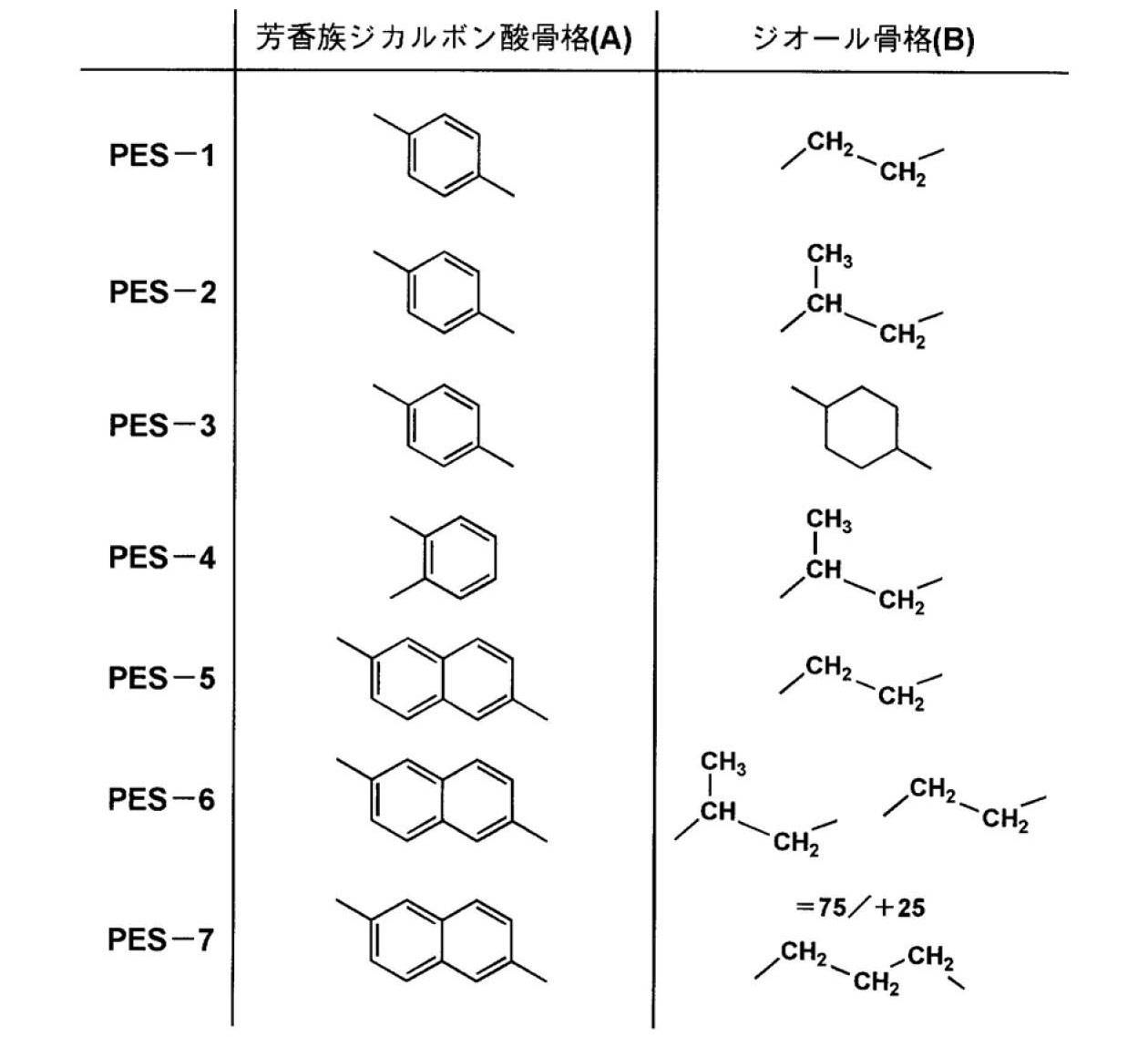


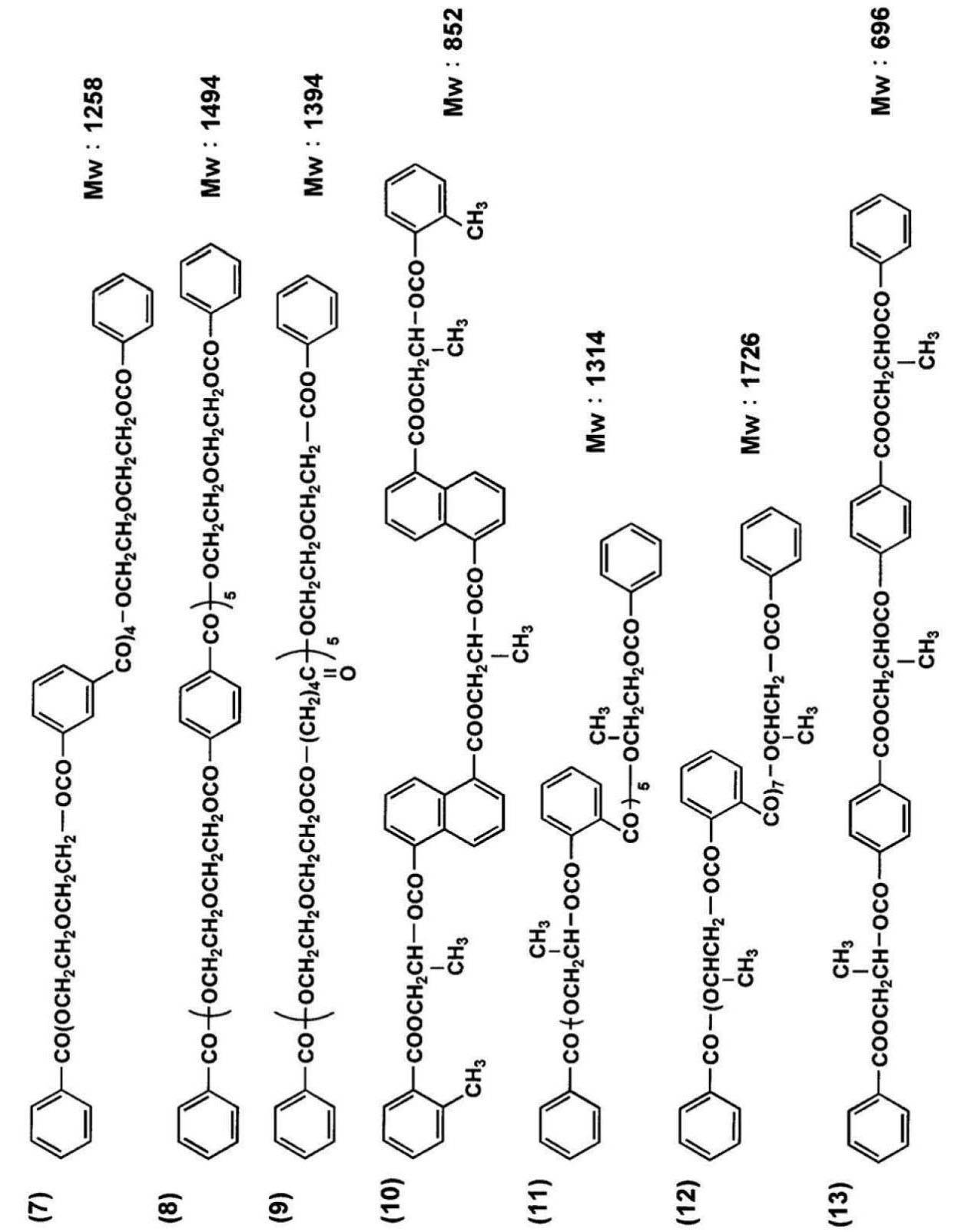

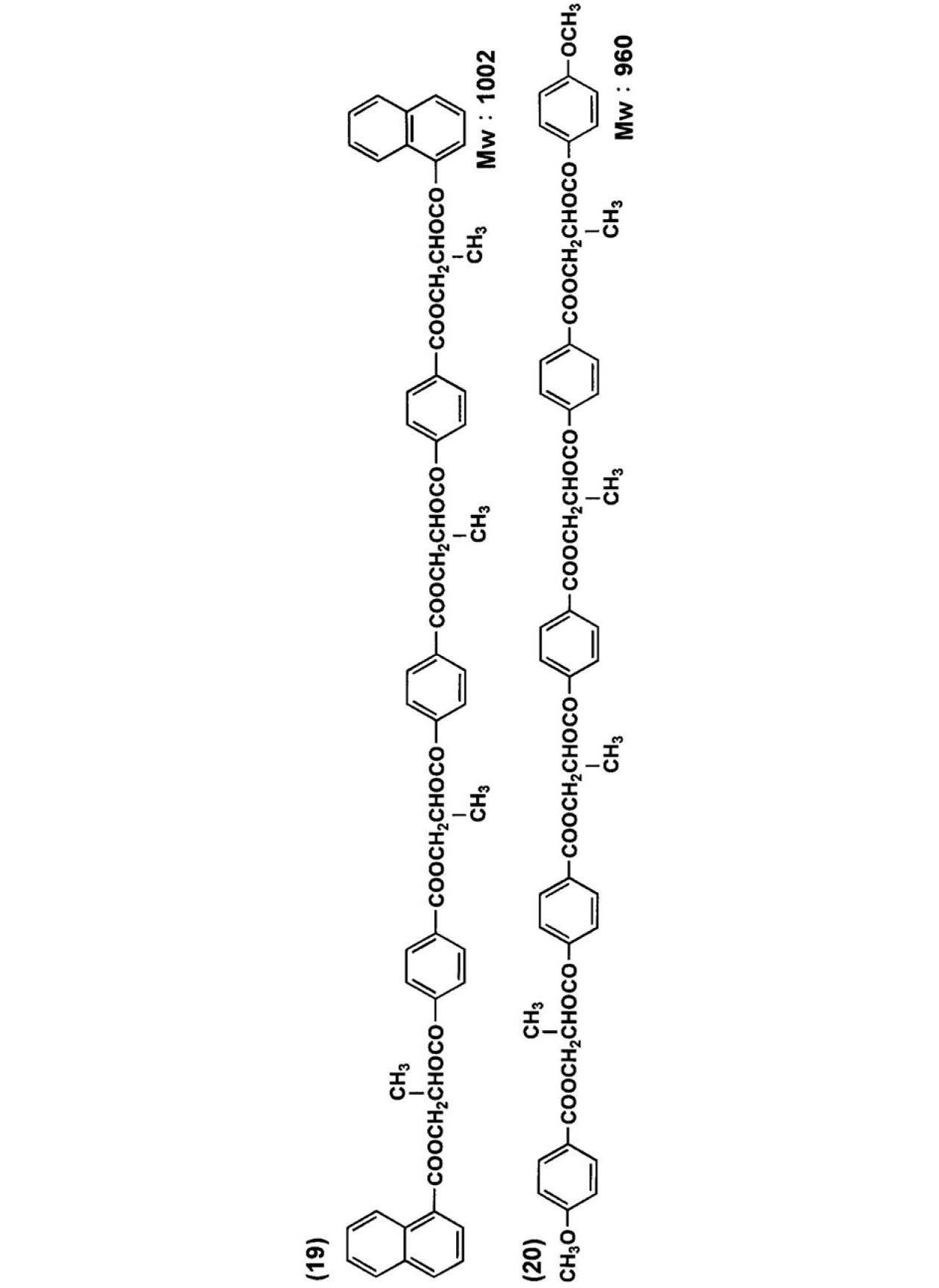


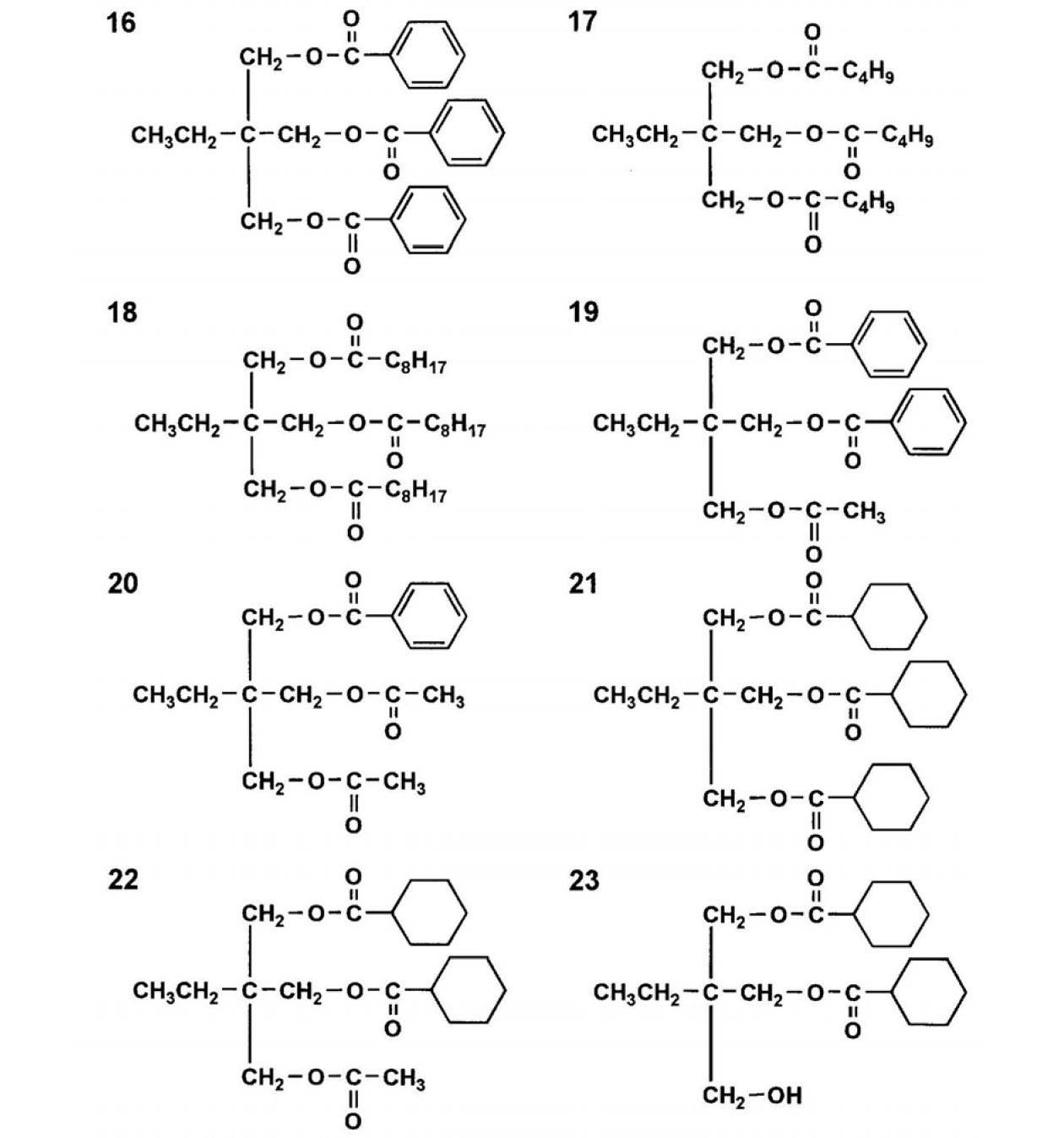
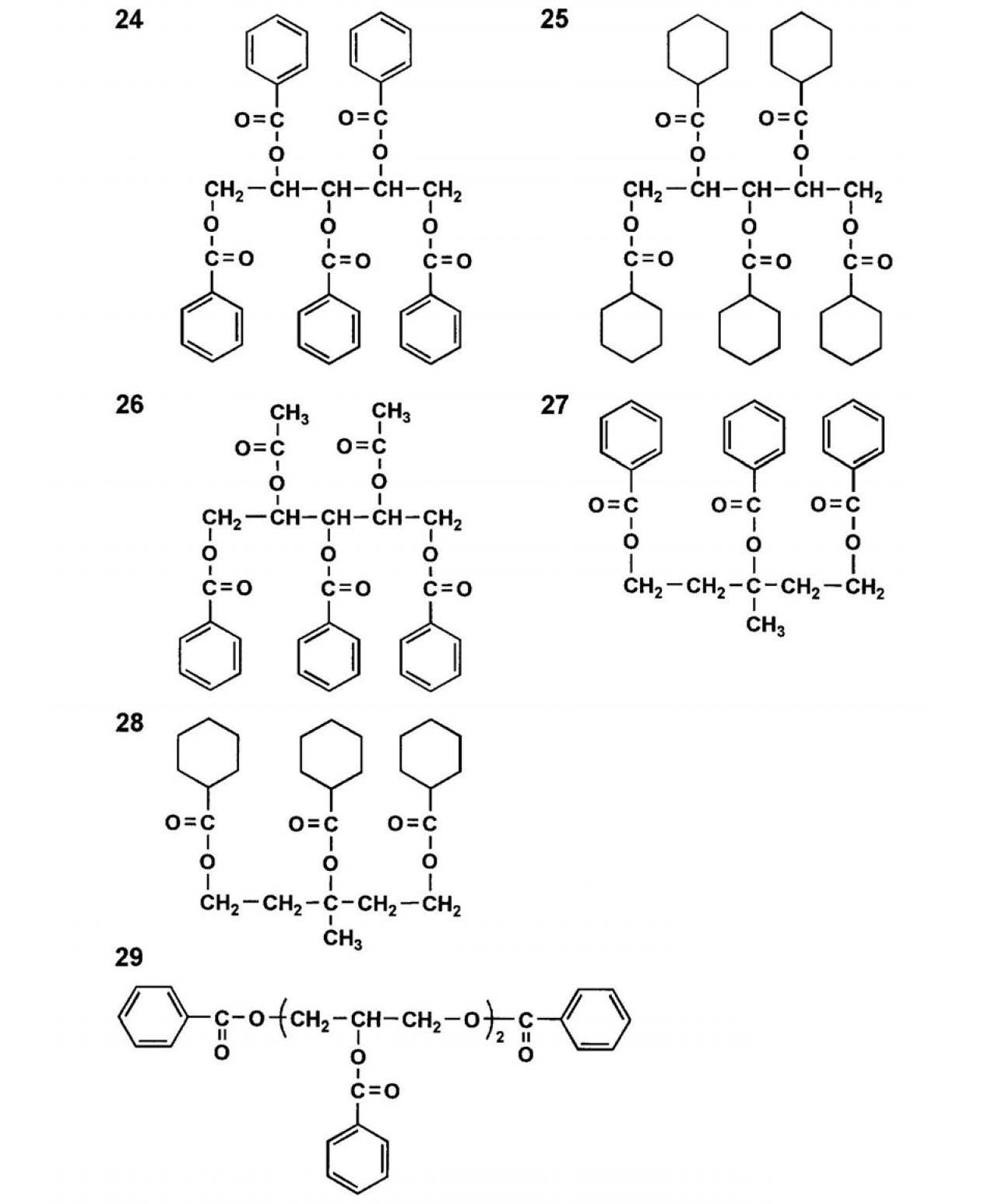
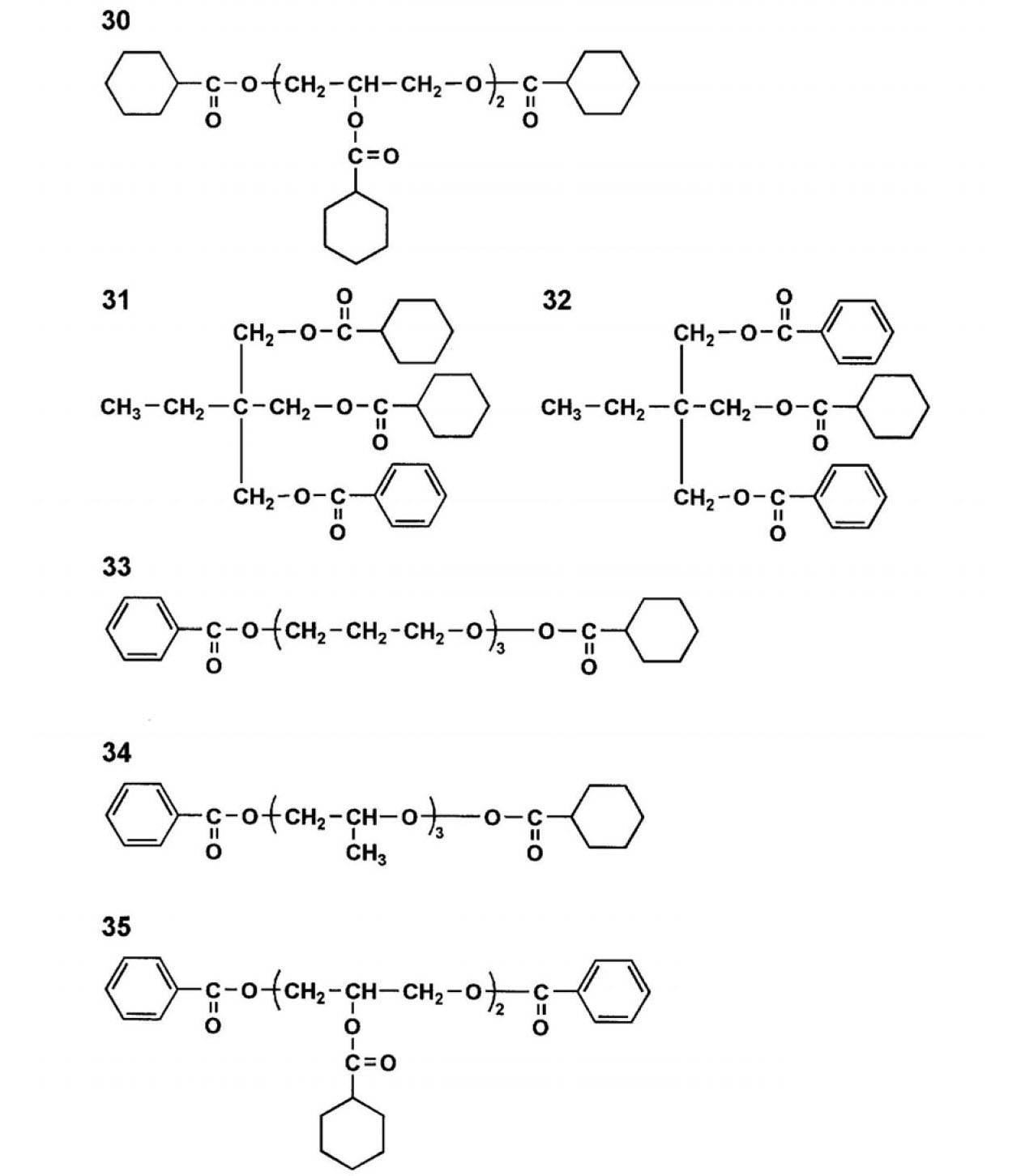

基材層が糖エステル化合物をさらに含むことで、セルロースエステル樹脂の加水分解が防止されることから、フィルムの耐水性が向上しうる。

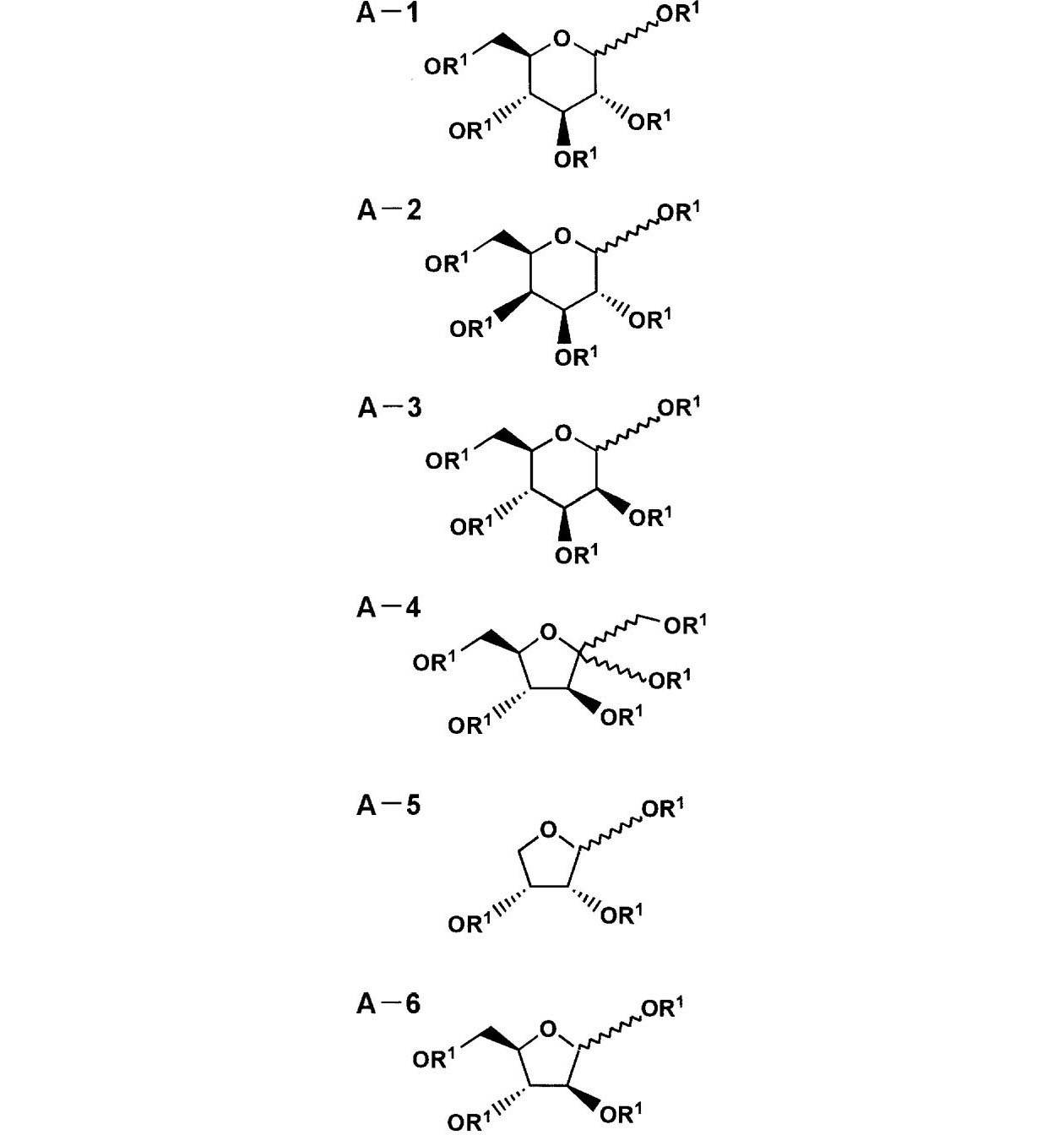
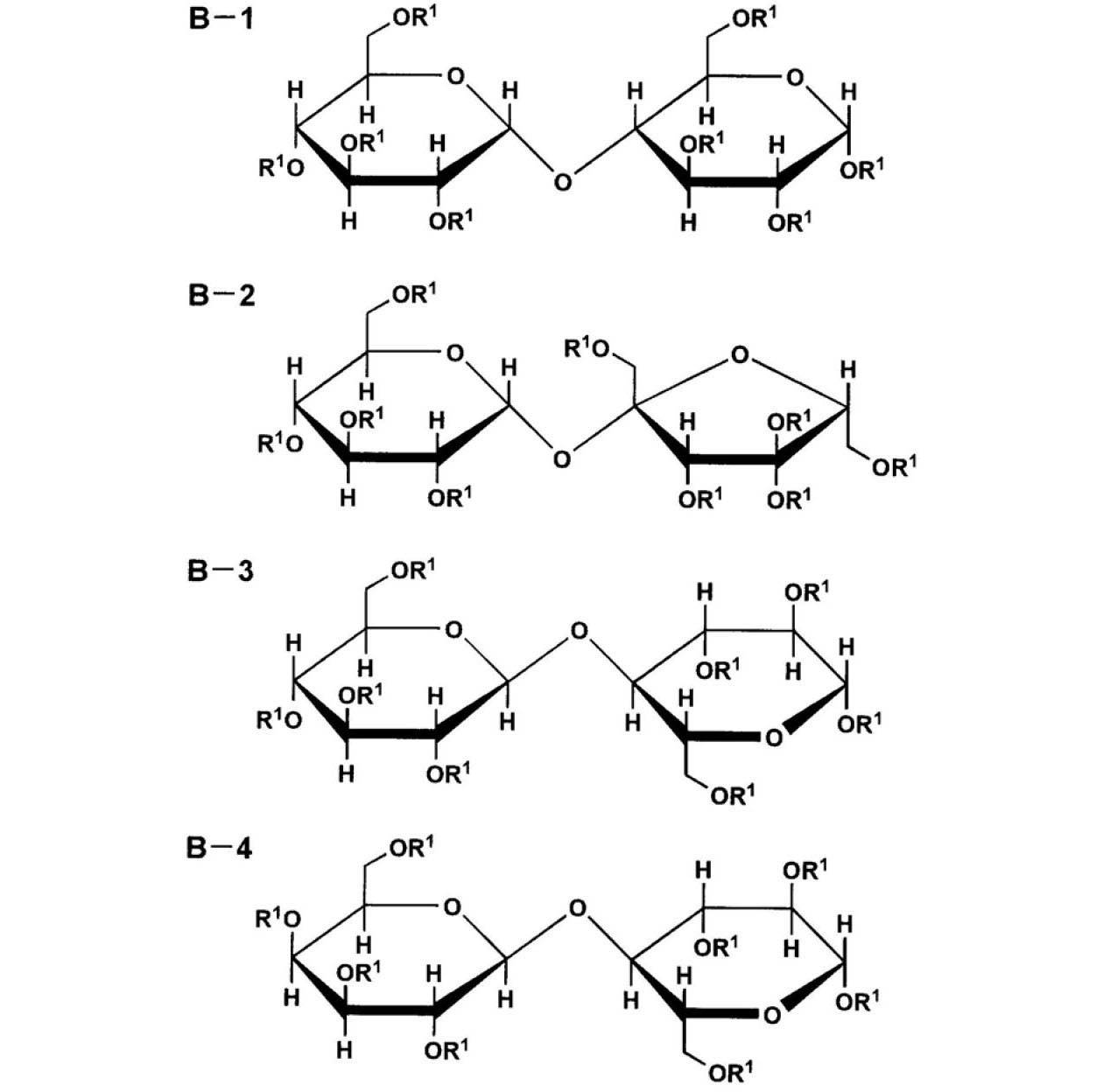

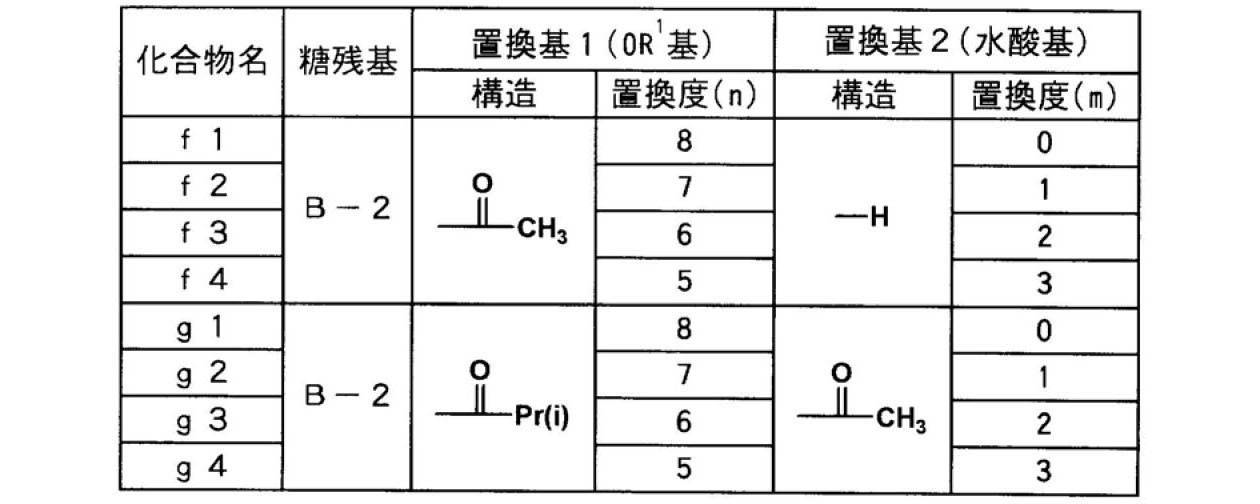

基材層は、リターデーション調整剤を含んでもよい。リターデーション調整剤とは、その添加によってフィルムのリターデーション発現性を調整できる添加剤である。その具体的な構成について特に制限はなく、従来公知の知見が適宜参照されうる。また、波長分散を調整する効果を同時に有するリターデーション調整剤も存在するが、これを用いてもよい。
基材層は、下記のポリエステルを含有することも好ましい。
基材層は、下記一般式(d)または(e)で表されるポリエステルを含みうる。


一般式(d)、(e)において、B1はモノカルボン酸成分を表し、B2はモノアルコール成分を表し、Gは2価のアルコール成分を表し、Aは2塩基酸成分を表し、これらによって合成されたことを表す。B1、B2、G、Aはいずれも芳香環を含まないことが特徴である。m、nは繰り返し数を表す。
基材層は、下記一般式(f)または(g)で表されるポリエステルを含みうる。


一般式(f)、(g)において、B1はモノカルボン酸成分を表し、B2はモノアルコール成分を表し、Gは炭素数2~12の2価のアルコール成分を表し、Aは炭素数2~12の2塩基酸成分を表し、これらによって合成されたことを表す。B1、G、Aはいずれも芳香環を含まない。m、nは繰り返し数を表す。なお、B1、B2は、前述の一般式(d)または(e)におけるB1、B2と同義である。また、G、Aは、前述の一般式(d)または(e)におけるG、Aの中で炭素数2~12のアルコール成分または2塩基酸成分に相当する。
基材層は、紫外線吸収剤を含有することもできる。紫外線吸収剤は400nm以下の紫外線を吸収することで、耐久性を向上させることを目的としており、特に波長370nmでの透過率が10%以下であることが好ましく、より好ましくは5%以下、さらに好ましくは2%以下である。なお、基材層が紫外線吸収剤を含む場合、当該紫外線吸収剤は2種以上含まれることが好ましい。
基材層は、赤外線吸収剤を含んでもよい。かような構成とすることにより、フィルムの逆波長分散性が調整されうる。
基材層には、取扱性を向上させるため、例えば二酸化珪素、二酸化チタン、酸化アルミニウム、酸化ジルコニウム、炭酸カルシウム、カオリン、タルク、焼成ケイ酸カルシウム、水和ケイ酸カルシウム、ケイ酸アルミニウム、ケイ酸マグネシウム、リン酸カルシウム等の無機微粒子や架橋高分子などの微粒子をマット剤として含有させることが好ましい。なかでも二酸化珪素がフィルムのヘイズを小さくできるので好ましい。

基材層は、着色剤を含んでもよい。「着色剤」とは、染料や顔料を意味するが、本発明では、液晶画面の色調を青色調にする効果またはイエローインデックスの調整、ヘイズの低減を有するものが特に好ましい。着色剤としては各種の染料や顔料が使用可能であるが、特に、アントラキノン染料、アゾ染料、フタロシアニン顔料などが有効である。

でそれぞれ表されるRoおよびRthについて、


一般式(A)、(B)、(D)において、L1、L2としては例えば、
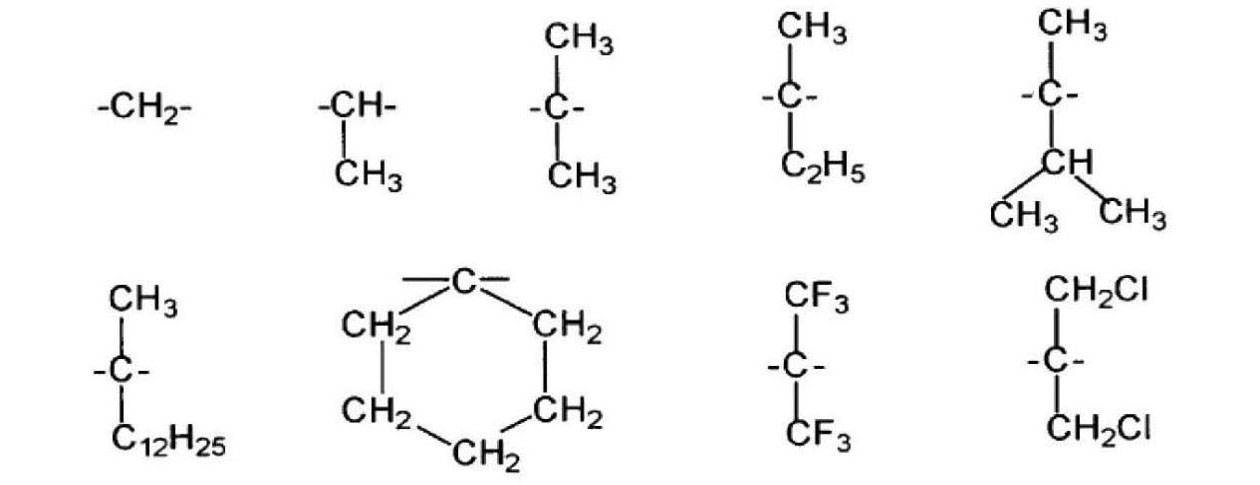


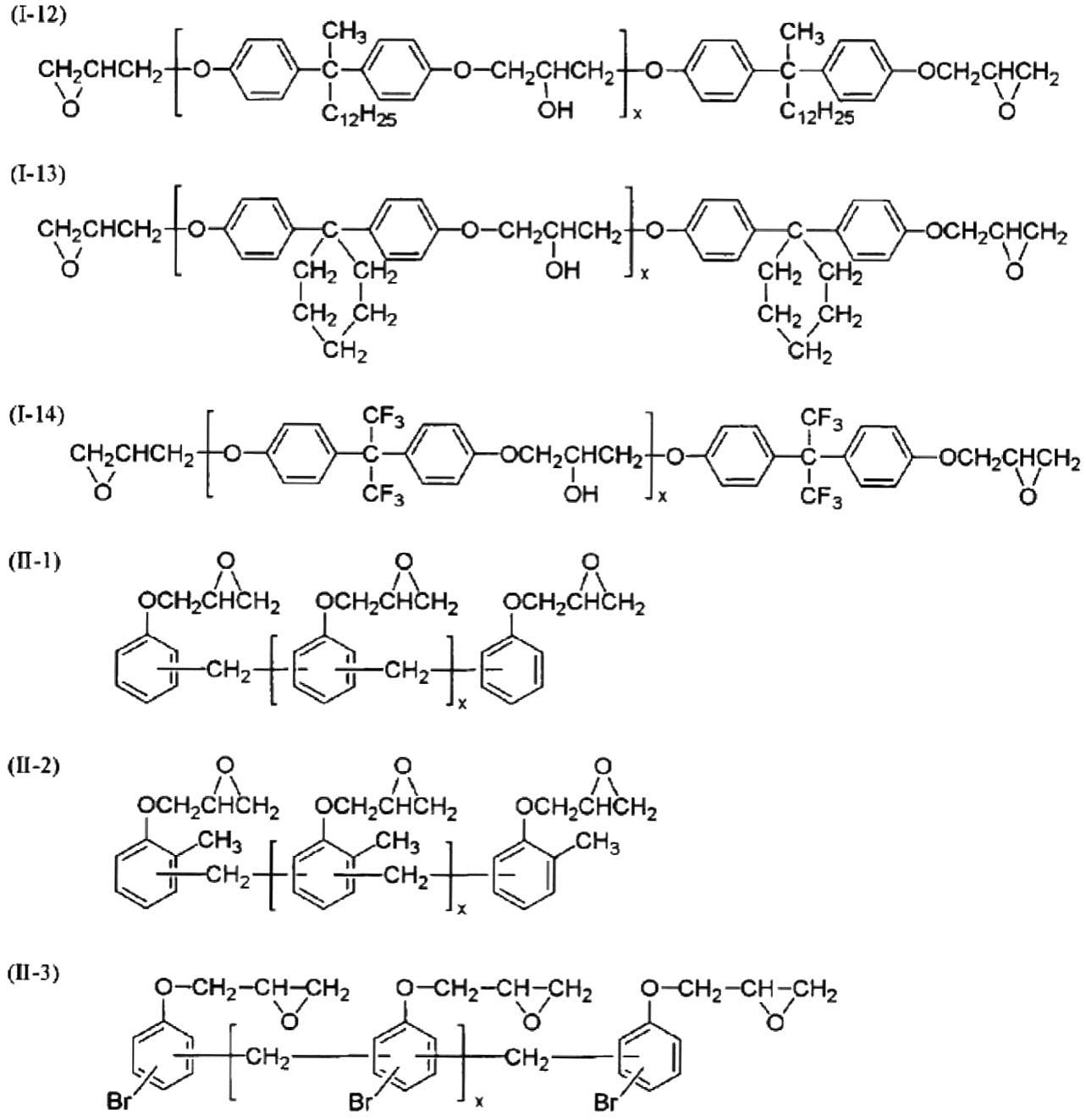

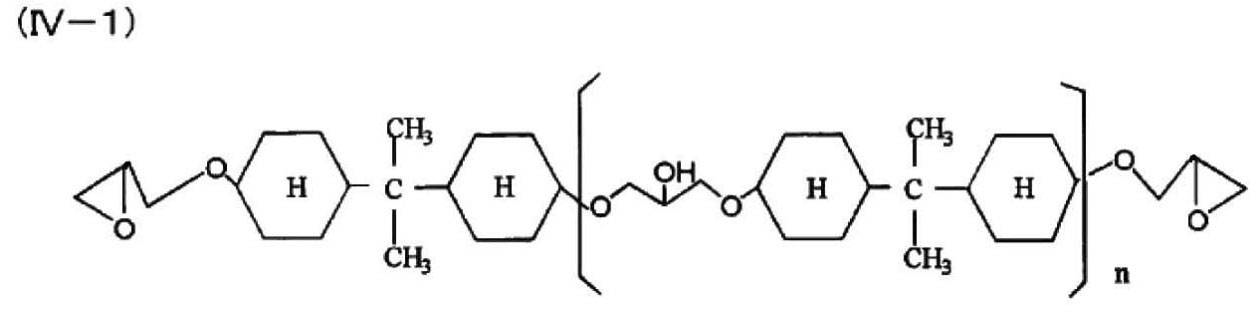
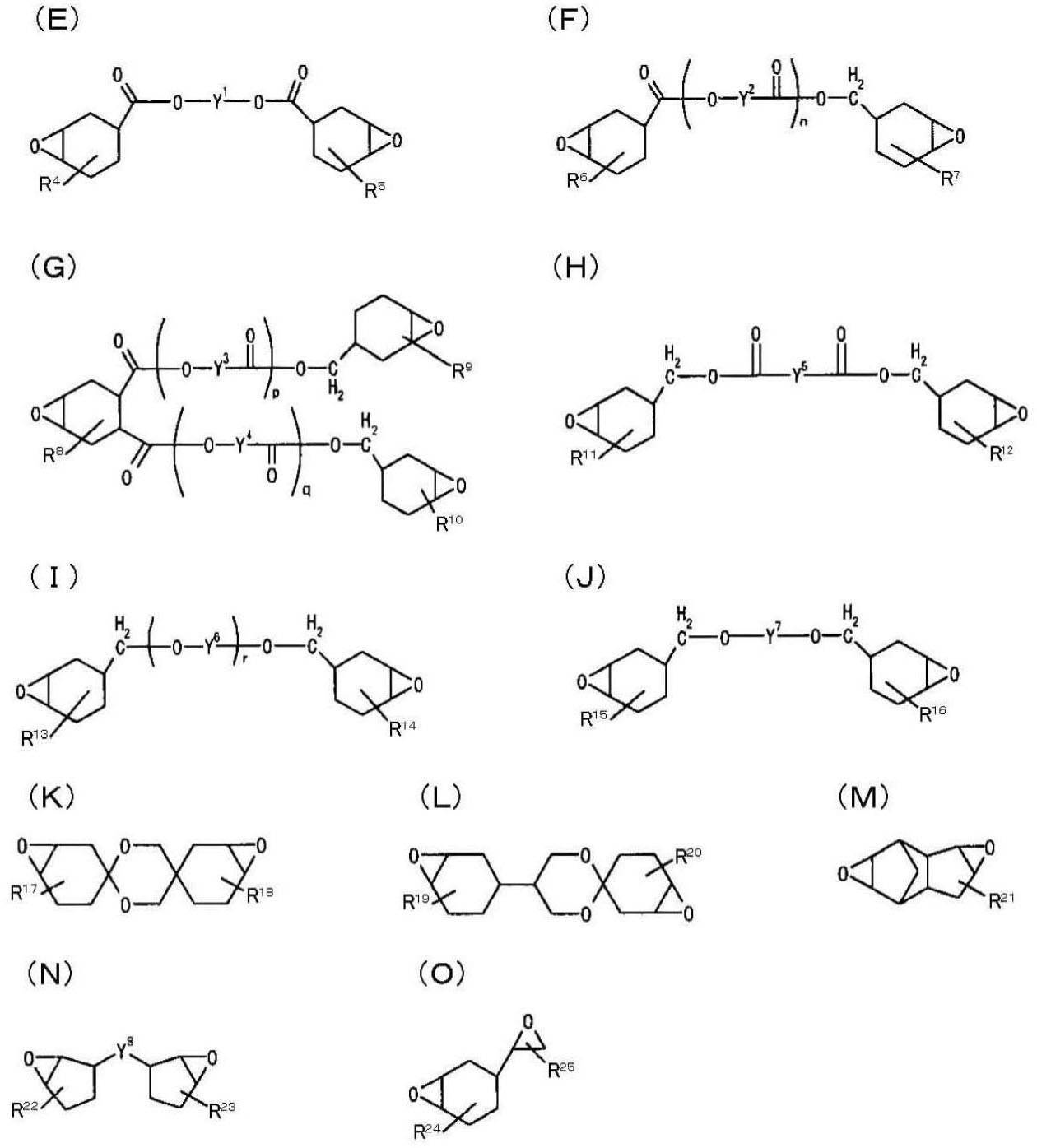
これらのうち、一般式(F)で示される脂環式ジエポキシ化合物が、入手が容易なので好ましい。一般式(F)の脂環式ジエポキシ化合物は、3,4-エポキシシクロヘキシルメタノール(そのシクロヘキサン環に炭素数1~6のアルキル基が結合していてもよい)と、3,4-エポキシシクロヘキサンカルボン酸(そのシクロヘキサン環に炭素数1~6のアルキル基が結合していてもよい)とのエステル化物である。その具体例として、次のような化合物が挙げられる。
3,4-エポキシ-6-メチルシクロヘキシルメチル 3,4-エポキシ-6-メチルシクロヘキサンカルボキシレート〔一般式(F)において、R6=6-メチル、R7=6-メチル、n=0である化合物〕など。
ベンゼンジアゾニウム ヘキサフルオロホスフェート、
ベンゼンジアゾニウム ヘキサフルオロボレート等。
ジフェニルヨードニウム ヘキサフルオロホスフェート、
ジフェニルヨードニウム ヘキサフルオロアンチモネート、
ジ(4-ノニルフェニル)ヨードニウム ヘキサフルオロホスフェート等。
トリフェニルスルホニウム ヘキサフルオロアンチモネート、
トリフェニルスルホニウム テトラキス(ペンタフルオロフェニル)ボレート、
ジフェニル〔4-(フェニルチオ)フェニル〕スルホニウム ヘキサフルオロホスフェート、
ジフェニル〔4-(フェニルチオ)フェニル〕スルホニウム ヘキサフルオロアンチモネート、
4,4’-ビス(ジフェニルスルホニオ)ジフェニルスルフィド ビスヘキサフルオロホスフェート、
4,4’-ビス〔ジ(β-ヒドロキシエトキシ)フェニルスルホニオ〕ジフェニルスルフィド ビスヘキサフルオロアンチモネート、
4,4’-ビス〔ジ(β-ヒドロキシエトキシ)フェニルスルホニオ〕ジフェニルスルフィド ビスヘキサフルオロホスフェート、
7-〔ジ(p-トルイル)スルホニオ〕-2-イソプロピルチオキサントン ヘキサフルオロアンチモネート、
7-〔ジ(p-トルイル)スルホニオ〕-2-イソプロピルチオキサントン テトラキス(ペンタフルオロフェニル)ボレート、
4-フェニルカルボニル-4’-ジフェニルスルホニオ-ジフェニルスルフィド ヘキサフルオロホスフェート、
4-(p-tert-ブチルフェニルカルボニル)-4’-ジフェニルスルホニオ-ジフェニルスルフィド ヘキサフルオロアンチモネート、
4-(p-tert-ブチルフェニルカルボニル)-4’-ジ(p-トルイル)スルホニオ-ジフェニルスルフィド テトラキス(ペンタフルオロフェニル)ボレート等。
クメン-シクロペンタジエニル鉄(II)ヘキサフルオロホスフェート、
キシレン-シクロペンタジエニル鉄(II)-トリス(トリフルオロメチルスルホニル)メタナイド等。
本発明に係る偏光板(延伸積層体)の製造方法について特に制限はなく、従来公知の知見、および後述する実施例の欄の記載を参照しつつ、適宜製造が可能である。偏光板(延伸積層体)の製造方法の一例を挙げると、例えば、基材層に、親水性高分子を含有する水溶液を塗布し、乾燥させて積層体の形態として得ることができる。かかる塗布により、基材層と親水性高分子層とが基材層と親水性高分子層とが直接、または好ましくは光硬化性接着剤の層を介して積層することで基材層と親水性高分子層が一体化した状態の積層体が得られる。
本発明に係る偏光板は、液晶表示装置、有機エレクトロルミネッセンス(EL)表示装置などの各種の表示装置に用いられうる。
親水性高分子からなるフィルムである(株)クラレ製のポリビニルアルコールフィルム(平均重合度2400、ケン化度99モル%、商品名:VF-PS2400)を、1辺が5mm以下の小片に裁断し、95℃の熱水中に溶解して、濃度10質量%のポリビニルアルコール水溶液を調製した。
(光学フィルムF1の作製)
(ドープ液aの調製)
ジアセチルセルロース(L50、ダイセル社製) 30質量部
メチレンクロライド 227質量部
エタノール 43質量部
上記の材料を加圧密閉容器に投入し、80℃に加温して容器内圧力を2気圧とし、撹拌しながら樹脂成分を完全に溶解させドープを得た。溶液を安積濾紙(株)製の安積濾紙No.244を使用して濾過した後、ドープを35℃まで下げて一晩静置して、ドープ中の脱泡を行った。
ダイヤナールBR-85(アクリル系樹脂、三菱レイヨン社製) 70質量部
CAP482-20(セルロースアセテートプロピオネート、イーストマンケミカル製、アセチル置換度0.18、プロピオニル置換度2.60) 30質量部
メチレンクロライド 252質量部
エタノール 48質量部
上記の材料を加圧密閉容器に投入し、80℃に加温して容器内圧力を2気圧とし、撹拌しながら樹脂成分を完全に溶解させドープを得た。溶液を安積濾紙(株)製の安積濾紙No.244を使用して濾過した後、ドープを35℃まで下げて一晩静置して、ドープ中の脱泡を行った。
上記で調製したドープ液bを、ベルト流延装置を用い、温度22℃、2m幅でステンレスバンド支持体に均一に流延した。ステンレスバンド支持体で、残留溶剤量が100%になるまで溶媒を蒸発させ、剥離張力162N/mでステンレスバンド支持体上から剥離した。
(積層工程)
上記で得られた光学フィルムF1上に、上記で調製したポリビニルアルコール水溶液を塗工した後、120℃にて10分間乾燥させて、厚み10μmのポリビニルアルコール塗膜からなる親水性高分子層を形成して、積層体を得た。
上記で得られた積層体をロールtoロールにて、145℃にて長手方向(MD方向)に延伸倍率6倍で延伸して、延伸積層体を得た。
上記で得られた延伸積層体を、張力を保持した状態で、30℃のヨウ素溶液(質量比:ヨウ素/ヨウ化カリウム/水=1/10/100)に60秒間浸漬した。その後、60℃にて4分間乾燥を行って、偏光板PL1を得た。なお、得られたPL1における基材層(F1;延伸後)の厚みは30μmであった。また、偏光板PL1における親水性高分子層(延伸後)の厚みは2μmであった。
〈微粒子分散液1〉
微粒子(アエロジル R812 日本アエロジル(株)製) 11質量部
エタノール 89質量部
以上をディゾルバーで50分間攪拌混合した後、マントンゴーリンで分散を行った。
メチレンクロライドを入れた溶解タンクに十分攪拌しながら、微粒子分散液1をゆっくりと添加した。さらに、二次粒子の粒径が所定の大きさとなるようにアトライターにて分散を行った。これを日本精線(株)製のファインメットNFで濾過し、微粒子添加液1を調製した。
微粒子分散液1 5質量部
下記組成の主ドープ液を調製した。まず加圧溶解タンクにメチレンクロライドとエタノールを添加した。溶剤の入った加圧溶解タンクにアセチル置換度2.30のセルロースアセテートを攪拌しながら投入した。これを加熱し、攪拌しながら、完全に溶解し。これを安積濾紙(株)製の安積濾紙No.244を使用して濾過し、主ドープ液を調製した。
下記2種のドープを作製し、共流延によってスキン層/コア層/スキン層の構成である光学フィルムF2を作製した。
セルロースアセテート(アセチル置換度2.30) 100質量部
トリフェニルホスフェート/ビフェニルジフェニルホスフェート共重合体(共重合体比1:1) 10質量部
ジクロロメタン 406質量部
メタノール 61質量部
(スキン層用セルロースアシレートドープの調製)
セルロースアセテート(アセチル置換度2.80) 100質量部
トリフェニルホスフェート/ビフェニルジフェニルホスフェート共重合体(共重合体比1:1) 13質量部
微粒子添加液1 2質量部
ジクロロメタン 406質量部
メタノール 61質量部
上記の組成物を各々ミキシングタンクに投入し、攪拌して各成分を溶解した後、平均孔径34μmの濾紙及び平均孔径10μmの焼結金属フィルターでろ過し、各セルロースアシレートドープを調製した。ドープをバンド流延機にてスキン層/コア層/スキン層の3層構成になるように共流延した。ここで、各ドープの流延量を調整することによりコア層を最も厚くし、結果的に延伸後のフィルムの膜厚がコア層15μm、スキン層10μm、計35μmとなるように同時多層流延を行った。残留溶剤量が約30質量%でバンドから剥ぎ取ったフィルムをテンターにより160℃の熱風を当てて、延伸倍率1.32倍まで拡幅した後、延伸倍率が1.3倍となるように140℃で60秒間緩和させた。その後テンター搬送からロール搬送に移行し、さらに120℃から150℃で乾燥し巻き取った。
(積層工程)
得られた光学フィルムF2上に、上記で調製したポリビニルアルコール水溶液を塗工した後、120℃にて10分間乾燥させて、厚み10μmのポリビニルアルコール塗膜からなる親水性高分子層を形成して、積層体を得た。
上記で得られた積層体をロールtoロールにて、150℃にて長手方向(MD方向)に延伸倍率2倍で延伸して、延伸積層体を得た。
上記で得られた延伸積層体を、張力を保持した状態で、30℃のヨウ素溶液(質量比:ヨウ素/ヨウ化カリウム/水=1/10/100)に60秒間浸漬した。その後、60℃にて4分間乾燥を行って、偏光板PL2を得た。なお、得られたPL2における基材層(F2;延伸後)の厚みは25μmであった。また、偏光板PL2における親水性高分子層(延伸後)の厚みは3μmであった。
特開2010-30225号公報の実施例1に記載の手法により、光学フィルムF3(厚み55μm)を作製した。
(積層工程)
得られた光学フィルムF3上に、上記で調製したポリビニルアルコール水溶液を塗工した後、120℃にて10分間乾燥させて、厚み10μmのポリビニルアルコール塗膜からなる親水性高分子層を形成して、積層体を得た。
上記で得られた積層体をロールtoロールにて、150℃にて長手方向(MD方向)に延伸倍率2倍で延伸して、延伸積層体を得た。
上記で得られた延伸積層体を、張力を保持した状態で、30℃のヨウ素溶液(質量比:ヨウ素/ヨウ化カリウム/水=1/10/100)に60秒間浸漬した。その後、60℃にて4分間乾燥を行って、偏光板PL3を得た。なお、得られたPL3における基材層(F3;延伸後)の厚みは40μmであった。また、偏光板PL3における親水性高分子層(延伸後)の厚みは3μmであった。
特開2011-76026号公報の実施例1に記載の手法により、積層体光学フィルムF4(厚み135μm)を得た。
(積層工程)
得られた光学フィルムF4上に、上記で調製したポリビニルアルコール水溶液を塗工した後、120℃にて10分間乾燥させて、厚み10μmのポリビニルアルコール塗膜からなる親水性高分子層を形成して、積層体を得た。
上記で得られた積層体をロールtoロールにて、150℃にて長手方向(MD方向)に延伸倍率6倍で延伸して、延伸積層体を得た。
上記で得られた延伸積層体を、張力を保持した状態で、30℃のヨウ素溶液(質量比:ヨウ素/ヨウ化カリウム/水=1/10/100)に60秒間浸漬した。その後、60℃にて4分間乾燥を行って、偏光板PL4を得た。なお、得られたPL4における基材層(F4;延伸後)の厚みは45μmであった。また、偏光板PL4における親水性高分子層(延伸後)の厚みは2μmであった。
特開2009-192844号公報の実施例1の記載に基づき、積層体フィルムF5(厚み185μm)を得た。
(積層工程)
得られた光学フィルムF5上に、上記で調製したポリビニルアルコール水溶液を塗工した後、120℃にて10分間乾燥させて、厚み10μmのポリビニルアルコール塗膜からなる親水性高分子層を形成して、積層体を得た。
上記で得られた積層体をクリップ式テンター内にて150℃で加熱し、フィルム幅手方向(TD方向)に2倍延伸後、搬送ロールでのロールtoロールにて、150℃にて長手方向(MD方向)に延伸倍率5倍で延伸して、延伸積層体を得た。
上記で作製した延伸積層体を、張力を保持した状態で、30℃のヨウ素溶液(質量比:ヨウ素/ヨウ化カリウム/水=1/10/100)に60秒間浸漬した。その後、60℃にて4分間乾燥を行って、偏光板PL5を得た。なお、得られたPL5における基材層(F5;延伸後)の厚みは25μmであった。また、偏光板PL5における親水性高分子層(延伸後)の厚みは0.5μmであった。
(ドープ液aの調製)
ジアセチルセルロース(L50、ダイセル社製) 50質量部
メチレンクロライド 227質量部
エタノール 43質量部
上記の材料を加圧密閉容器に投入し、80℃に加温して容器内圧力を2気圧とし、撹拌しながら樹脂成分を完全に溶解させドープを得た。溶液を安積濾紙(株)製の安積濾紙No.244を使用して濾過した後、ドープを35℃まで下げて一晩静置して、ドープ中の脱泡を行った。
ダイヤナールBR-52(アクリル系樹脂、三菱レイヨン社製) 100質量部
メチレンクロライド 252質量部
エタノール 48質量部
上記の材料を加圧密閉容器に投入し、80℃に加温して容器内圧力を2気圧とし、撹拌しながら樹脂成分を完全に溶解させドープを得た。溶液を安積濾紙(株)製の安積濾紙No.244を使用して濾過した後、ドープを35℃まで下げて一晩静置して、ドープ中の脱泡を行った。
上記で調製したドープ液bを、ベルト流延装置を用い、温度22℃、2m幅でステンレスバンド支持体に均一に流延した。ステンレスバンド支持体で、残留溶剤量が100%になるまで溶媒を蒸発させ、剥離張力162N/mでステンレスバンド支持体上から剥離した。
(積層工程)
得られた光学フィルムF6上に、上記で調製したポリビニルアルコール水溶液を塗工した後、120℃にて10分間乾燥させて、厚み10μmのポリビニルアルコール塗膜からなる親水性高分子層を形成して、積層体を得た。
上記で得られた積層体をクリップ式テンター内にて150℃で加熱し、フィルム幅手方向に2倍延伸後、搬送ロールでのロールtoロールにて、150℃にて長手方向(MD方向)に延伸倍率5倍で延伸して、延伸積層体を得た。
上記で得られた延伸積層体を、張力を保持した状態で、30℃のヨウ素溶液(質量比:ヨウ素/ヨウ化カリウム/水=1/10/100)に60秒間浸漬した。その後、60℃にて4分間乾燥を行って、偏光板PL6を得た。なお、得られたPL6における基材層(F6;延伸後)の厚みは15μmであった。また、偏光板PL6における親水性高分子層(延伸後)の厚みは0.5μmであった。
PL1の作製方法において、得られた光学フィルムF1上にポリビニルアルコール水溶液を塗工する際、仕上がりの塗布層の厚みが、25μmまたは32μmとなるようポリビニルアルコールを塗膜し、それぞれ積層体を得た。
光学フィルムF1の作製方法において、調製したドープ液bを、ベルト流延装置を用い、温度22℃、2m幅でステンレスバンド支持体に流延する際に、光学フィルムF1の仕上がり膜厚が250μmとなるようにダイスのギャップを調整した。その後、ステンレスバンド支持体で、残留溶剤量が100%になるまで充分に時間をかけて溶媒を蒸発させ、剥離張力100N/mでステンレスバンド支持体上から剥離した。
得られた光学フィルムF9上に、上記で調製したポリビニルアルコール水溶液を塗工した後、120℃にて10分間乾燥させて、厚み10μmのポリビニルアルコール塗膜からなる親水性高分子層を形成して、積層体を得た。
(延伸処理)
上記で得られた積層体をクリップ式テンター内にて145℃で加熱し、フィルム幅手方向に2倍延伸後、搬送ロールでのロールtoロールにて、145℃にて長手方向(MD方向)に延伸倍率6倍で延伸して、延伸積層体を得た。
上記で得られた延伸積層体を、張力を保持した状態で、30℃のヨウ素溶液(質量比:ヨウ素/ヨウ化カリウム/水=1/10/100)に60秒間浸漬した。その後、60℃にて4分間乾燥を行って、偏光板PL9を得た。なお、得られたPL9における基材層(F9;延伸後)の厚みは93μmであった。また、偏光板PL9における親水性高分子層(延伸後)の厚みは2μmであった。
光学フィルムF1の作製方法において、調製したドープ液bを、ベルト流延装置を用い、温度22℃、2m幅でステンレスバンド支持体に流延する際に、光学フィルムF1の仕上がり膜厚が280μmとなるようにダイスのギャップを調整した。その後、ステンレスバンド支持体で、残留溶剤量が100%になるまで充分に時間をかけて溶媒を蒸発させ、剥離張力100N/mでステンレスバンド支持体上から剥離した。
得られた光学フィルムF10上に、上記で調製したポリビニルアルコール水溶液を塗工した後、120℃にて10分間乾燥させて、厚み10μmのポリビニルアルコール塗膜からなる親水性高分子層を形成して、積層体を得た。
上記で得られた積層体をクリップ式テンター内にて145℃で加熱し、フィルム幅手方向に2倍延伸後、搬送ロールでのロールtoロールにて、145℃にて長手方向(MD方向)に延伸倍率6倍で延伸して、延伸積層体を得た。
上記で作製した延伸積層体を、張力を保持した状態で、30℃のヨウ素溶液(質量比:ヨウ素/ヨウ化カリウム/水=1/10/100)に60秒間浸漬した。その後、60℃にて4分間乾燥を行って、偏光板PL10を得た。なお、得られたPL10における基材層(F10;延伸後)の厚みは103μmであった。また、偏光板PL10における親水性高分子層(延伸後)の厚みは2μmであった。
特開2009-98653号公報の実施例1に記載の手法により、偏光板PL11(厚み41μm)を作製した。
厚さ120μmの長尺ロールポリビニルアルコールフイルムをヨウ素1質量部、ホウ酸4質量部を含む水溶液100質量部に浸漬し、50℃で5倍に搬送方向に延伸して偏光子を作製した。
準備した光学フィルムF3を、50℃2.0NのKOH水溶液に60秒間浸漬し、その後水洗処理を行った。
特開2010-250091号公報の実施例(a)、(b)に基づいて、光学フィルムF4を作製した。上記で作製した光学フィルムF3と、当該光学フィルムF4とを貼り合わせ、光学フィルムF3上に、上記で調製したポリビニルアルコール水溶液を塗工した後、120℃にて10分間乾燥させて、厚み10μmのポリビニルアルコール塗膜からなる親水性高分子層を形成して、積層体を得た。
上記で得られた積層体をロールtoロールにて、160℃にて長手方向(MD方向)に延伸倍率2倍で延伸して、延伸積層体を得た。
上記で得られた延伸積層体を、張力を保持した状態で、30℃のヨウ素溶液(質量比:ヨウ素/ヨウ化カリウム/水=1/10/100)に60秒間浸漬した。その後、60℃にて4分間乾燥を行って、偏光板PL13を得た。なお、得られたPL13における基材層の厚みは40μmであった。また、偏光板PL13における親水性高分子層(延伸後)の厚みは3μmであった。
(カール評価)
カールの測定は、JIS K-7619-1988の「写真フィルムのカールの測定法」中の、方法Aのカール測定用型板を用いて、サンプルを25℃湿度60%RHの環境下、10時間調湿後に測定を行った。23℃55%RH環境下でのカールの値をC1とし、40℃20%RH環境下でのカールの値をC2として、これらの差ΔC=|C1-C2|を算出した。その結果を下記の表1に示す。
テンシロン試験機(ORIENTEC社製、RTC-1225A)を用いて、以下のような評価を行った。
<液晶表示装置の評価>
IPS型液晶表示装置であるLG電子社製42型テレビ LEDREGZA42RE1の予め貼合されていた偏光板を剥がして、上記で作製した偏光板PL1~PL12のいずれかを、予め貼合されていた偏光板と同一の方向に吸収軸が向くように貼合し、液晶表示装置を各々作製した。なお、コニカミノルタオプト社製コニカミノルタタックKC4UYの一方の面を鹸化処理し、各偏光板の親水性高分子層の基材層が形成された面とは反対側の面に当該鹸化処理面を貼り合わせた。そして、偏光板を液晶表示装置に貼り合わせる際には、コニカミノルタタックKC4UYが液晶パネル側に位置するように、粘着剤を用いて貼り合わせた。
画像表示が均一である:◎
画像表示がほぼ均一である:○
中央部と周囲にムラがある:△
中央部と周囲にはっきりとしたムラがある:×
(光漏れ)
光漏れが全くない:◎
光漏れが僅かにある:○
光漏れが一部あり、明るいと感じる:△
光漏れがあり、眩しいと感じる:×
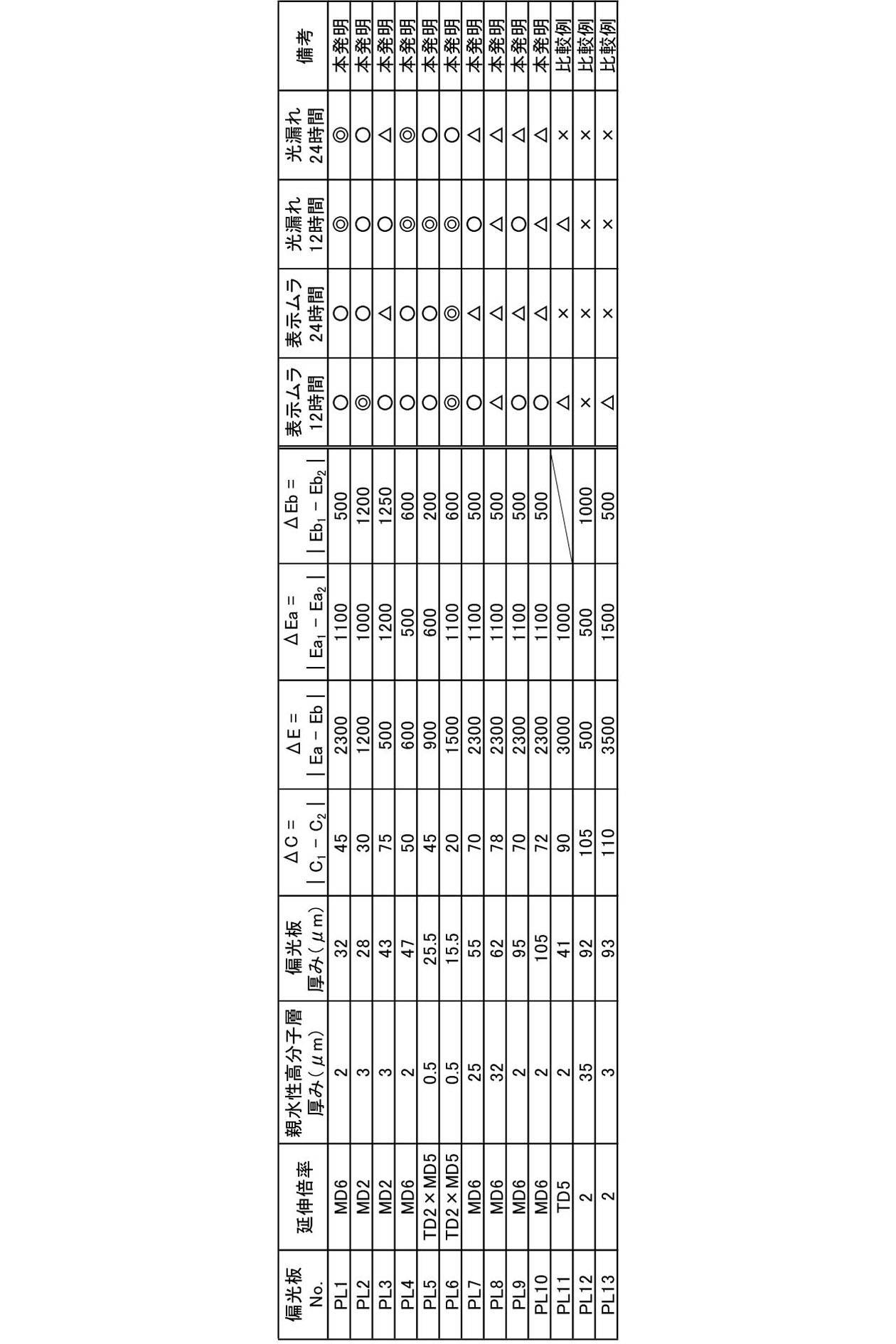
Claims (14)
- 親水性高分子層と熱可塑性樹脂を含む基材層との積層体が延伸処理されてなり、前記親水性高分子層に二色性物質が吸着された延伸積層体を有する偏光板であって、
23℃55%RH環境下でのカールC1と、40℃20%RH環境下でのカールC2との差ΔC=|C1-C2|が、ΔC≦80[1/m]を満たす、偏光板。 - 前記基材層が、少なくとも2種の熱可塑性樹脂を含有する、請求項1に記載の偏光板。
- 前記親水性高分子層の膜厚が0.5~30μmである、請求項1または2に記載の偏光板。
- 前記基材層に含まれる熱可塑性樹脂が、アクリル系樹脂、スチレン系樹脂、シクロオレフィン系樹脂、セルロース系樹脂、ポリプロピレン系樹脂、ポリエステル系樹脂、またはこれらの組み合わせからなる、請求項1~3のいずれか1項に記載の偏光板。
- 前記基材層が、少なくとも、
第1の熱可塑性樹脂を含む第1の基材層と、
前記第1の基材層に対して前記親水性高分子層とは反対の側に配置された、第2の熱可塑性樹脂を含む第2の基材層と、
を有する、請求項1~4のいずれか1項に記載の偏光板。 - 前記第1の基材層の弾性率Eaと、前記第2の基材層の弾性率Ebとの差ΔE=|Ea-Eb|(MPa)が、ΔE≦3000[MPa]を満たし、かつ、
23℃55%RH環境下での弾性率Ea1およびEb1と、40℃20%RH環境下での弾性率Ea2およびEb2とのそれぞれの差ΔEa=|Ea1-Ea2|およびΔEb=|Eb1-Eb2|が、ΔEa,ΔEb≦2000[MPa]を満たす、請求項5に記載の偏光板。 - 前記延伸積層体の膜厚が10~100μmである、請求項1~6のいずれか1項に記載の偏光板。
- 前記親水性高分子層が、親水性高分子としてポリビニルアルコールを含む、請求項1~7のいずれか1項に記載の偏光板。
- 前記二色性物質がヨウ素である、請求項1~8のいずれか1項に記載の偏光板。
- 請求項1~9のいずれか1項に記載の偏光板の製造方法であって、
前記基材層を溶液流延法により製膜する工程を含む、製造方法。 - 製膜された前記基材層の一方の表面に、親水性高分子を含有する溶液を塗布し、乾燥させて積層体を得る工程をさらに含む、請求項10に記載の製造方法。
- 前記積層体を2~10倍の延伸倍率で延伸処理する工程をさらに含む、請求項11に記載の製造方法。
- 請求項1~9のいずれか1項に記載の偏光板、または請求項10~12のいずれか1項に記載の製造方法によって製造された偏光板を備えた表示装置。
- IPSモード型液晶表示装置である、請求項13に記載の表示装置。
Priority Applications (1)
| Application Number | Priority Date | Filing Date | Title |
|---|---|---|---|
| KR1020147023811A KR101634026B1 (ko) | 2012-01-30 | 2013-01-29 | 편광판 및 이것을 사용한 표시 장치 |
Applications Claiming Priority (2)
| Application Number | Priority Date | Filing Date | Title |
|---|---|---|---|
| JP2012017226 | 2012-01-30 | ||
| JP2012-017226 | 2012-01-30 |
Publications (1)
| Publication Number | Publication Date |
|---|---|
| WO2013115178A1 true WO2013115178A1 (ja) | 2013-08-08 |
Family
ID=48905213
Family Applications (1)
| Application Number | Title | Priority Date | Filing Date |
|---|---|---|---|
| PCT/JP2013/051890 Ceased WO2013115178A1 (ja) | 2012-01-30 | 2013-01-29 | 偏光板およびこれを用いた表示装置 |
Country Status (3)
| Country | Link |
|---|---|
| JP (1) | JPWO2013115178A1 (ja) |
| KR (1) | KR101634026B1 (ja) |
| WO (1) | WO2013115178A1 (ja) |
Cited By (4)
| Publication number | Priority date | Publication date | Assignee | Title |
|---|---|---|---|---|
| JP2014238612A (ja) * | 2012-03-29 | 2014-12-18 | 住友化学株式会社 | 偏光性積層フィルムの製造方法及び偏光板の製造方法 |
| CN104635288A (zh) * | 2013-11-06 | 2015-05-20 | 富士胶片株式会社 | 偏振片的制造方法 |
| JP2016114634A (ja) * | 2014-12-11 | 2016-06-23 | 日東電工株式会社 | 偏光膜製造用の積層体 |
| WO2020153233A1 (ja) * | 2019-01-23 | 2020-07-30 | 日本ゼオン株式会社 | 積層体、偏光板、積層体の製造方法、偏光板の製造方法及び表示装置の製造方法 |
Families Citing this family (2)
| Publication number | Priority date | Publication date | Assignee | Title |
|---|---|---|---|---|
| KR20160087236A (ko) | 2015-01-13 | 2016-07-21 | 동우 화인켐 주식회사 | 편광판 및 이를 포함하는 화상 표시 장치 |
| KR20160093885A (ko) | 2015-01-30 | 2016-08-09 | 동우 화인켐 주식회사 | 편광판 및 이를 포함하는 화상 표시 장치 |
Citations (4)
| Publication number | Priority date | Publication date | Assignee | Title |
|---|---|---|---|---|
| JP2000338329A (ja) * | 1999-06-01 | 2000-12-08 | Sanritsutsu:Kk | 偏光板及びその製造方法 |
| JP2007272172A (ja) * | 2005-07-06 | 2007-10-18 | Konica Minolta Opto Inc | セルロースエステルフィルム、偏光板及び液晶表示装置 |
| JP2008529038A (ja) * | 2005-02-03 | 2008-07-31 | 富士フイルム株式会社 | 偏光板および液晶表示装置 |
| JP2009098653A (ja) * | 2007-09-27 | 2009-05-07 | Nitto Denko Corp | 偏光板、光学フィルムおよび画像表示装置 |
Family Cites Families (1)
| Publication number | Priority date | Publication date | Assignee | Title |
|---|---|---|---|---|
| WO2009031433A1 (ja) * | 2007-09-05 | 2009-03-12 | Konica Minolta Opto, Inc. | 位相差フィルムの製造方法、位相差フィルム、偏光板及び液晶表示装置 |
-
2013
- 2013-01-29 JP JP2013556412A patent/JPWO2013115178A1/ja active Pending
- 2013-01-29 KR KR1020147023811A patent/KR101634026B1/ko active Active
- 2013-01-29 WO PCT/JP2013/051890 patent/WO2013115178A1/ja not_active Ceased
Patent Citations (4)
| Publication number | Priority date | Publication date | Assignee | Title |
|---|---|---|---|---|
| JP2000338329A (ja) * | 1999-06-01 | 2000-12-08 | Sanritsutsu:Kk | 偏光板及びその製造方法 |
| JP2008529038A (ja) * | 2005-02-03 | 2008-07-31 | 富士フイルム株式会社 | 偏光板および液晶表示装置 |
| JP2007272172A (ja) * | 2005-07-06 | 2007-10-18 | Konica Minolta Opto Inc | セルロースエステルフィルム、偏光板及び液晶表示装置 |
| JP2009098653A (ja) * | 2007-09-27 | 2009-05-07 | Nitto Denko Corp | 偏光板、光学フィルムおよび画像表示装置 |
Cited By (7)
| Publication number | Priority date | Publication date | Assignee | Title |
|---|---|---|---|---|
| JP2014238612A (ja) * | 2012-03-29 | 2014-12-18 | 住友化学株式会社 | 偏光性積層フィルムの製造方法及び偏光板の製造方法 |
| JP2017134415A (ja) * | 2012-03-29 | 2017-08-03 | 住友化学株式会社 | 偏光性積層フィルムの製造方法及び偏光板の製造方法 |
| CN104635288A (zh) * | 2013-11-06 | 2015-05-20 | 富士胶片株式会社 | 偏振片的制造方法 |
| JP2015111245A (ja) * | 2013-11-06 | 2015-06-18 | 富士フイルム株式会社 | 偏光板の製造方法 |
| JP2016114634A (ja) * | 2014-12-11 | 2016-06-23 | 日東電工株式会社 | 偏光膜製造用の積層体 |
| TWI666117B (zh) * | 2014-12-11 | 2019-07-21 | 日商日東電工股份有限公司 | 偏光膜製造用之積層體,以及偏光膜之製造方法 |
| WO2020153233A1 (ja) * | 2019-01-23 | 2020-07-30 | 日本ゼオン株式会社 | 積層体、偏光板、積層体の製造方法、偏光板の製造方法及び表示装置の製造方法 |
Also Published As
| Publication number | Publication date |
|---|---|
| JPWO2013115178A1 (ja) | 2015-05-11 |
| KR20140125406A (ko) | 2014-10-28 |
| KR101634026B1 (ko) | 2016-06-27 |
Similar Documents
| Publication | Publication Date | Title |
|---|---|---|
| JP2013061561A (ja) | 偏光板およびこれを用いた表示装置 | |
| JP5725011B2 (ja) | 偏光板の製造方法、それを用いた偏光板、及び液晶表示装置 | |
| WO2013115178A1 (ja) | 偏光板およびこれを用いた表示装置 | |
| JP2013156391A (ja) | ロール状円偏光板の製造方法、有機エレクトロルミネッセンス表示装置及び横電界型スイッチングモード型液晶表示装置 | |
| WO2014057784A1 (ja) | 光学補償フィルム、偏光板及び液晶表示装置 | |
| JPWO2015098491A1 (ja) | セルロースエステルフィルム、その製造方法及び偏光板 | |
| JP5821849B2 (ja) | セルロースアセテートフィルムの製造方法 | |
| JP6212836B2 (ja) | 光学フィルムおよびその製造方法、並びにこれを用いた偏光板 | |
| JP4900540B1 (ja) | セルロースアセテートフィルム、及びそれを用いた偏光板、液晶表示装置 | |
| JPWO2013133276A1 (ja) | 偏光板およびこれを用いた表示装置 | |
| JP6136226B2 (ja) | 光学フィルムのロール体とその製造方法、包装体、偏光板および液晶表示装置 | |
| JP2016501386A (ja) | 偏光板及びこれを含む液晶表示装置 | |
| JP5655634B2 (ja) | λ/4板、λ/4板の製造方法、円偏光板、液晶表示装置、及び立体映像表示装置 | |
| JP2013152457A (ja) | 偏光板およびこれを用いた表示装置 | |
| JP5699519B2 (ja) | 位相差フィルム、位相差フィルムの製造方法、偏光板及び液晶表示装置 | |
| JP5888333B2 (ja) | 偏光板及び液晶表示装置 | |
| JP5935810B2 (ja) | Ipsモード型液晶表示装置 | |
| WO2011114764A1 (ja) | 位相差フィルム及びそれが備えられた偏光板 | |
| JP5942710B2 (ja) | 光学フィルム、偏光板及び液晶表示装置 | |
| JP6083113B2 (ja) | 偏光板およびこれを用いた表示装置 | |
| WO2022215407A1 (ja) | 偏光板保護フィルムの製造方法 | |
| WO2012176546A1 (ja) | セルロースアシレートフィルムおよびその製造方法、並びにこれを用いた偏光板および液晶表示装置 | |
| JP2013022775A (ja) | 積層セルロースアシレートフィルムおよびその製造方法 | |
| JP2013025013A (ja) | セルロースアシレートフィルム、偏光板、及び液晶表示装置 | |
| JP2014132281A (ja) | 光学補償フィルム、その製造方法、偏光板、及び液晶表示装置 |
Legal Events
| Date | Code | Title | Description |
|---|---|---|---|
| 121 | Ep: the epo has been informed by wipo that ep was designated in this application |
Ref document number: 13743459 Country of ref document: EP Kind code of ref document: A1 |
|
| ENP | Entry into the national phase |
Ref document number: 2013556412 Country of ref document: JP Kind code of ref document: A |
|
| NENP | Non-entry into the national phase |
Ref country code: DE |
|
| ENP | Entry into the national phase |
Ref document number: 20147023811 Country of ref document: KR Kind code of ref document: A |
|
| 122 | Ep: pct application non-entry in european phase |
Ref document number: 13743459 Country of ref document: EP Kind code of ref document: A1 |