WO2013108796A1 - 断熱材用組成物、断熱材及びそれを備えた宇宙機 - Google Patents
断熱材用組成物、断熱材及びそれを備えた宇宙機 Download PDFInfo
- Publication number
- WO2013108796A1 WO2013108796A1 PCT/JP2013/050696 JP2013050696W WO2013108796A1 WO 2013108796 A1 WO2013108796 A1 WO 2013108796A1 JP 2013050696 W JP2013050696 W JP 2013050696W WO 2013108796 A1 WO2013108796 A1 WO 2013108796A1
- Authority
- WO
- WIPO (PCT)
- Prior art keywords
- heat insulating
- insulating material
- fibrous
- composition
- heat
- Prior art date
- Legal status (The legal status is an assumption and is not a legal conclusion. Google has not performed a legal analysis and makes no representation as to the accuracy of the status listed.)
- Ceased
Links
Images


Classifications
-
- B—PERFORMING OPERATIONS; TRANSPORTING
- B64—AIRCRAFT; AVIATION; COSMONAUTICS
- B64G—COSMONAUTICS; VEHICLES OR EQUIPMENT THEREFOR
- B64G1/00—Cosmonautic vehicles
- B64G1/22—Parts of, or equipment specially adapted for fitting in or to, cosmonautic vehicles
- B64G1/52—Protection, safety or emergency devices; Survival aids
- B64G1/58—Thermal protection, e.g. heat shields
-
- B—PERFORMING OPERATIONS; TRANSPORTING
- B32—LAYERED PRODUCTS
- B32B—LAYERED PRODUCTS, i.e. PRODUCTS BUILT-UP OF STRATA OF FLAT OR NON-FLAT, e.g. CELLULAR OR HONEYCOMB, FORM
- B32B3/00—Layered products comprising a layer with external or internal discontinuities or unevennesses, or a layer of non-planar shape; Layered products comprising a layer having particular features of form
- B32B3/10—Layered products comprising a layer with external or internal discontinuities or unevennesses, or a layer of non-planar shape; Layered products comprising a layer having particular features of form characterised by a discontinuous layer, i.e. formed of separate pieces of material
- B32B3/12—Layered products comprising a layer with external or internal discontinuities or unevennesses, or a layer of non-planar shape; Layered products comprising a layer having particular features of form characterised by a discontinuous layer, i.e. formed of separate pieces of material characterised by a layer of regularly- arranged cells, e.g. a honeycomb structure
-
- B—PERFORMING OPERATIONS; TRANSPORTING
- B32—LAYERED PRODUCTS
- B32B—LAYERED PRODUCTS, i.e. PRODUCTS BUILT-UP OF STRATA OF FLAT OR NON-FLAT, e.g. CELLULAR OR HONEYCOMB, FORM
- B32B5/00—Layered products characterised by the non- homogeneity or physical structure, i.e. comprising a fibrous, filamentary, particulate or foam layer; Layered products characterised by having a layer differing constitutionally or physically in different parts
- B32B5/22—Layered products characterised by the non- homogeneity or physical structure, i.e. comprising a fibrous, filamentary, particulate or foam layer; Layered products characterised by having a layer differing constitutionally or physically in different parts characterised by the presence of two or more layers which are next to each other and are fibrous, filamentary, formed of particles or foamed
- B32B5/24—Layered products characterised by the non- homogeneity or physical structure, i.e. comprising a fibrous, filamentary, particulate or foam layer; Layered products characterised by having a layer differing constitutionally or physically in different parts characterised by the presence of two or more layers which are next to each other and are fibrous, filamentary, formed of particles or foamed one layer being a fibrous or filamentary layer
-
- B—PERFORMING OPERATIONS; TRANSPORTING
- B32—LAYERED PRODUCTS
- B32B—LAYERED PRODUCTS, i.e. PRODUCTS BUILT-UP OF STRATA OF FLAT OR NON-FLAT, e.g. CELLULAR OR HONEYCOMB, FORM
- B32B5/00—Layered products characterised by the non- homogeneity or physical structure, i.e. comprising a fibrous, filamentary, particulate or foam layer; Layered products characterised by having a layer differing constitutionally or physically in different parts
- B32B5/22—Layered products characterised by the non- homogeneity or physical structure, i.e. comprising a fibrous, filamentary, particulate or foam layer; Layered products characterised by having a layer differing constitutionally or physically in different parts characterised by the presence of two or more layers which are next to each other and are fibrous, filamentary, formed of particles or foamed
- B32B5/24—Layered products characterised by the non- homogeneity or physical structure, i.e. comprising a fibrous, filamentary, particulate or foam layer; Layered products characterised by having a layer differing constitutionally or physically in different parts characterised by the presence of two or more layers which are next to each other and are fibrous, filamentary, formed of particles or foamed one layer being a fibrous or filamentary layer
- B32B5/245—Layered products characterised by the non- homogeneity or physical structure, i.e. comprising a fibrous, filamentary, particulate or foam layer; Layered products characterised by having a layer differing constitutionally or physically in different parts characterised by the presence of two or more layers which are next to each other and are fibrous, filamentary, formed of particles or foamed one layer being a fibrous or filamentary layer another layer next to it being a foam layer
-
- B—PERFORMING OPERATIONS; TRANSPORTING
- B32—LAYERED PRODUCTS
- B32B—LAYERED PRODUCTS, i.e. PRODUCTS BUILT-UP OF STRATA OF FLAT OR NON-FLAT, e.g. CELLULAR OR HONEYCOMB, FORM
- B32B5/00—Layered products characterised by the non- homogeneity or physical structure, i.e. comprising a fibrous, filamentary, particulate or foam layer; Layered products characterised by having a layer differing constitutionally or physically in different parts
- B32B5/22—Layered products characterised by the non- homogeneity or physical structure, i.e. comprising a fibrous, filamentary, particulate or foam layer; Layered products characterised by having a layer differing constitutionally or physically in different parts characterised by the presence of two or more layers which are next to each other and are fibrous, filamentary, formed of particles or foamed
- B32B5/24—Layered products characterised by the non- homogeneity or physical structure, i.e. comprising a fibrous, filamentary, particulate or foam layer; Layered products characterised by having a layer differing constitutionally or physically in different parts characterised by the presence of two or more layers which are next to each other and are fibrous, filamentary, formed of particles or foamed one layer being a fibrous or filamentary layer
- B32B5/26—Layered products characterised by the non- homogeneity or physical structure, i.e. comprising a fibrous, filamentary, particulate or foam layer; Layered products characterised by having a layer differing constitutionally or physically in different parts characterised by the presence of two or more layers which are next to each other and are fibrous, filamentary, formed of particles or foamed one layer being a fibrous or filamentary layer another layer next to it also being fibrous or filamentary
-
- C—CHEMISTRY; METALLURGY
- C08—ORGANIC MACROMOLECULAR COMPOUNDS; THEIR PREPARATION OR CHEMICAL WORKING-UP; COMPOSITIONS BASED THEREON
- C08J—WORKING-UP; GENERAL PROCESSES OF COMPOUNDING; AFTER-TREATMENT NOT COVERED BY SUBCLASSES C08B, C08C, C08F, C08G or C08H
- C08J9/00—Working-up of macromolecular substances to porous or cellular articles or materials; After-treatment thereof
- C08J9/0066—Use of inorganic compounding ingredients
-
- C—CHEMISTRY; METALLURGY
- C08—ORGANIC MACROMOLECULAR COMPOUNDS; THEIR PREPARATION OR CHEMICAL WORKING-UP; COMPOSITIONS BASED THEREON
- C08L—COMPOSITIONS OF MACROMOLECULAR COMPOUNDS
- C08L61/00—Compositions of condensation polymers of aldehydes or ketones; Compositions of derivatives of such polymers
- C08L61/04—Condensation polymers of aldehydes or ketones with phenols only
- C08L61/06—Condensation polymers of aldehydes or ketones with phenols only of aldehydes with phenols
-
- B—PERFORMING OPERATIONS; TRANSPORTING
- B32—LAYERED PRODUCTS
- B32B—LAYERED PRODUCTS, i.e. PRODUCTS BUILT-UP OF STRATA OF FLAT OR NON-FLAT, e.g. CELLULAR OR HONEYCOMB, FORM
- B32B2250/00—Layers arrangement
- B32B2250/02—2 layers
-
- B—PERFORMING OPERATIONS; TRANSPORTING
- B32—LAYERED PRODUCTS
- B32B—LAYERED PRODUCTS, i.e. PRODUCTS BUILT-UP OF STRATA OF FLAT OR NON-FLAT, e.g. CELLULAR OR HONEYCOMB, FORM
- B32B2250/00—Layers arrangement
- B32B2250/22—All layers being foamed
-
- B—PERFORMING OPERATIONS; TRANSPORTING
- B32—LAYERED PRODUCTS
- B32B—LAYERED PRODUCTS, i.e. PRODUCTS BUILT-UP OF STRATA OF FLAT OR NON-FLAT, e.g. CELLULAR OR HONEYCOMB, FORM
- B32B2250/00—Layers arrangement
- B32B2250/24—All layers being polymeric
-
- B—PERFORMING OPERATIONS; TRANSPORTING
- B32—LAYERED PRODUCTS
- B32B—LAYERED PRODUCTS, i.e. PRODUCTS BUILT-UP OF STRATA OF FLAT OR NON-FLAT, e.g. CELLULAR OR HONEYCOMB, FORM
- B32B2262/00—Composition or structural features of fibres which form a fibrous or filamentary layer or are present as additives
- B32B2262/14—Mixture of at least two fibres made of different materials
-
- B—PERFORMING OPERATIONS; TRANSPORTING
- B32—LAYERED PRODUCTS
- B32B—LAYERED PRODUCTS, i.e. PRODUCTS BUILT-UP OF STRATA OF FLAT OR NON-FLAT, e.g. CELLULAR OR HONEYCOMB, FORM
- B32B2266/00—Composition of foam
- B32B2266/02—Organic
-
- B—PERFORMING OPERATIONS; TRANSPORTING
- B32—LAYERED PRODUCTS
- B32B—LAYERED PRODUCTS, i.e. PRODUCTS BUILT-UP OF STRATA OF FLAT OR NON-FLAT, e.g. CELLULAR OR HONEYCOMB, FORM
- B32B2266/00—Composition of foam
- B32B2266/02—Organic
- B32B2266/0214—Materials belonging to B32B27/00
-
- B—PERFORMING OPERATIONS; TRANSPORTING
- B32—LAYERED PRODUCTS
- B32B—LAYERED PRODUCTS, i.e. PRODUCTS BUILT-UP OF STRATA OF FLAT OR NON-FLAT, e.g. CELLULAR OR HONEYCOMB, FORM
- B32B2266/00—Composition of foam
- B32B2266/02—Organic
- B32B2266/0214—Materials belonging to B32B27/00
- B32B2266/0264—Polyester
-
- B—PERFORMING OPERATIONS; TRANSPORTING
- B32—LAYERED PRODUCTS
- B32B—LAYERED PRODUCTS, i.e. PRODUCTS BUILT-UP OF STRATA OF FLAT OR NON-FLAT, e.g. CELLULAR OR HONEYCOMB, FORM
- B32B2266/00—Composition of foam
- B32B2266/02—Organic
- B32B2266/0214—Materials belonging to B32B27/00
- B32B2266/0271—Epoxy resin
-
- B—PERFORMING OPERATIONS; TRANSPORTING
- B32—LAYERED PRODUCTS
- B32B—LAYERED PRODUCTS, i.e. PRODUCTS BUILT-UP OF STRATA OF FLAT OR NON-FLAT, e.g. CELLULAR OR HONEYCOMB, FORM
- B32B2266/00—Composition of foam
- B32B2266/02—Organic
- B32B2266/0214—Materials belonging to B32B27/00
- B32B2266/0278—Polyurethane
-
- B—PERFORMING OPERATIONS; TRANSPORTING
- B32—LAYERED PRODUCTS
- B32B—LAYERED PRODUCTS, i.e. PRODUCTS BUILT-UP OF STRATA OF FLAT OR NON-FLAT, e.g. CELLULAR OR HONEYCOMB, FORM
- B32B2266/00—Composition of foam
- B32B2266/02—Organic
- B32B2266/0214—Materials belonging to B32B27/00
- B32B2266/0285—Condensation resins of aldehydes, e.g. with phenols, ureas, melamines
-
- B—PERFORMING OPERATIONS; TRANSPORTING
- B32—LAYERED PRODUCTS
- B32B—LAYERED PRODUCTS, i.e. PRODUCTS BUILT-UP OF STRATA OF FLAT OR NON-FLAT, e.g. CELLULAR OR HONEYCOMB, FORM
- B32B2305/00—Condition, form or state of the layers or laminate
- B32B2305/72—Cured, e.g. vulcanised, cross-linked
-
- B—PERFORMING OPERATIONS; TRANSPORTING
- B32—LAYERED PRODUCTS
- B32B—LAYERED PRODUCTS, i.e. PRODUCTS BUILT-UP OF STRATA OF FLAT OR NON-FLAT, e.g. CELLULAR OR HONEYCOMB, FORM
- B32B2307/00—Properties of the layers or laminate
- B32B2307/30—Properties of the layers or laminate having particular thermal properties
- B32B2307/304—Insulating
-
- B—PERFORMING OPERATIONS; TRANSPORTING
- B32—LAYERED PRODUCTS
- B32B—LAYERED PRODUCTS, i.e. PRODUCTS BUILT-UP OF STRATA OF FLAT OR NON-FLAT, e.g. CELLULAR OR HONEYCOMB, FORM
- B32B2605/00—Vehicles
- B32B2605/18—Aircraft
-
- C—CHEMISTRY; METALLURGY
- C08—ORGANIC MACROMOLECULAR COMPOUNDS; THEIR PREPARATION OR CHEMICAL WORKING-UP; COMPOSITIONS BASED THEREON
- C08J—WORKING-UP; GENERAL PROCESSES OF COMPOUNDING; AFTER-TREATMENT NOT COVERED BY SUBCLASSES C08B, C08C, C08F, C08G or C08H
- C08J2361/00—Characterised by the use of condensation polymers of aldehydes or ketones; Derivatives of such polymers
- C08J2361/04—Condensation polymers of aldehydes or ketones with phenols only
- C08J2361/06—Condensation polymers of aldehydes or ketones with phenols only of aldehydes with phenols
- C08J2361/08—Condensation polymers of aldehydes or ketones with phenols only of aldehydes with phenols with monohydric phenols
- C08J2361/10—Phenol-formaldehyde condensates
-
- C—CHEMISTRY; METALLURGY
- C08—ORGANIC MACROMOLECULAR COMPOUNDS; THEIR PREPARATION OR CHEMICAL WORKING-UP; COMPOSITIONS BASED THEREON
- C08L—COMPOSITIONS OF MACROMOLECULAR COMPOUNDS
- C08L2205/00—Polymer mixtures characterised by other features
- C08L2205/02—Polymer mixtures characterised by other features containing two or more polymers of the same C08L -group
- C08L2205/025—Polymer mixtures characterised by other features containing two or more polymers of the same C08L -group containing two or more polymers of the same hierarchy C08L, and differing only in parameters such as density, comonomer content, molecular weight, structure
-
- Y—GENERAL TAGGING OF NEW TECHNOLOGICAL DEVELOPMENTS; GENERAL TAGGING OF CROSS-SECTIONAL TECHNOLOGIES SPANNING OVER SEVERAL SECTIONS OF THE IPC; TECHNICAL SUBJECTS COVERED BY FORMER USPC CROSS-REFERENCE ART COLLECTIONS [XRACs] AND DIGESTS
- Y10—TECHNICAL SUBJECTS COVERED BY FORMER USPC
- Y10T—TECHNICAL SUBJECTS COVERED BY FORMER US CLASSIFICATION
- Y10T428/00—Stock material or miscellaneous articles
- Y10T428/24—Structurally defined web or sheet [e.g., overall dimension, etc.]
- Y10T428/24149—Honeycomb-like
- Y10T428/24157—Filled honeycomb cells [e.g., solid substance in cavities, etc.]
-
- Y—GENERAL TAGGING OF NEW TECHNOLOGICAL DEVELOPMENTS; GENERAL TAGGING OF CROSS-SECTIONAL TECHNOLOGIES SPANNING OVER SEVERAL SECTIONS OF THE IPC; TECHNICAL SUBJECTS COVERED BY FORMER USPC CROSS-REFERENCE ART COLLECTIONS [XRACs] AND DIGESTS
- Y10—TECHNICAL SUBJECTS COVERED BY FORMER USPC
- Y10T—TECHNICAL SUBJECTS COVERED BY FORMER US CLASSIFICATION
- Y10T428/00—Stock material or miscellaneous articles
- Y10T428/249921—Web or sheet containing structurally defined element or component
- Y10T428/249953—Composite having voids in a component [e.g., porous, cellular, etc.]
- Y10T428/249981—Plural void-containing components
Definitions
- the present invention relates to a composition for a heat insulating material used in the atmosphere or vacuum, a heat insulating material, and a spacecraft including the same.
- a re-entry machine such as a spacecraft used in outer space is exposed to a high temperature of about 2000 ° C due to aerodynamic heating when entering the atmosphere.
- a heat insulating material is used for the airframe.
- a heat insulating material used for a space shuttle, etc. there is one manufactured by mixing a thermosetting resin with microballoons and short fibers and heat-curing the thermosetting resin (see Patent Document 1).
- the heat insulating material described in Patent Document 1 is configured to prevent heat energy from being decomposed and carbonized by itself when the temperature rises when re-entering the atmosphere, thereby preventing the airframe from becoming hot. .
- the amount of recession refers to the amount by which the thermal insulation material itself decreases in size due to melting, scattering and wear when subjected to heating.
- Patent Document 1 uses a single type of carbon fiber (carbon fiber) as the fibrous material.
- the carbon fiber can reduce the amount of recession, but exhibits a characteristic that the heat insulation performance is not so high.
- silica fiber has a high heat insulation performance, but exhibits a characteristic that the amount of recession increases. For this reason, all of the current technologies require further improvement in characteristics to be applied to products.
- the present invention has been made in view of such circumstances, and provides a composition for a heat insulating material that can suppress recession while satisfying a desired heat insulating performance, a heat insulating material, and a spacecraft including the same.
- the purpose is to do.
- a first aspect of the present invention is a composition for a heat insulating material containing a fibrous substance, inorganic foamed particles, a thermosetting resin, and a foaming agent, and the fibrous substance At least a first fibrous substance and a second fibrous substance made of a material different from the first fibrous substance, and the melting point of the first fibrous substance is the second fiber
- a heat insulating material composition having a melting point higher than the melting point of the fibrous substance and having a thermal conductivity of the second fibrous substance lower than that of the first fibrous substance.
- the second aspect of the present invention is the second aspect in which the inorganic foam particles, the thermosetting resin, the foaming agent, the first fibrous substance, and the first fibrous substance are made of different materials. At least one fibrous substance, the melting point of the first fibrous substance is higher than the melting point of the second fibrous substance, and the thermal conductivity of the second fibrous substance is the first fibrous substance.
- a heat insulating material including a heat insulating layer obtained by foaming and curing a heat insulating material composition having a thermal conductivity lower than that of the fibrous material.
- the first fibrous material having a high melting point has the effect of reducing recession.
- the second fibrous material having a low thermal conductivity has an effect of improving the heat insulation. According to the said invention, it becomes possible to set it as the heat insulating material which has the said effect by mixing two or more types of fibrous substances from which a characteristic differs.
- the heat insulating material is foamed with a composition for heat insulating material including inorganic foam particles, a thermosetting resin, a foaming agent, and only the second fibrous material as a fibrous material.
- the other heat insulation layer formed by hardening is provided in the back surface side of the said heat insulation layer.
- the heat insulating material has a two-layer structure, and a heat insulating layer and another heat insulating layer on the back surface side are arranged on the front surface side of the heat insulating material.
- the heat insulating layer on the surface side is a layer in which two or more kinds of fibrous substances are mixed, and mainly plays a role of reducing recession.
- the other heat-insulating layer on the back side is a layer made of a material having low thermal conductivity and having heat insulation as a main function.
- the surface of the heat insulating material is a surface that is located on the outer surface side of the airframe and is directly exposed to a high temperature when the heat insulating material is applied to the airframe such as a spacecraft.
- the ratio of the first fibrous material to the total amount of the fibrous material may increase stepwise or continuously from the back surface side to the front surface side of the heat insulating layer.
- a composition for a heat insulating material that can maintain heat insulation and suppress recession by mixing two kinds of fibrous substances, a composition for a heat insulating material that can maintain heat insulation and suppress recession, a heat insulating material, and a spacecraft including the same.
- the composition for heat insulating materials according to the present embodiment includes a fibrous substance, a thermosetting resin, inorganic foamed particles, and a foaming agent. Each element except the foaming agent contained in the composition for heat insulating materials is blended so as to be 100% by mass in total.
- the thermosetting resin is not particularly limited, but may be contained in the heat insulating composition at a blending ratio of 10% by mass to 60% by mass.
- the thermosetting resin mainly serves as a binder (binder).
- binder binder
- the heat insulating material applied to the spacecraft such as the spacecraft and the re-entry capsule is lightweight, but if the blending amount of the thermosetting resin exceeds 60% by mass, the bulk of the heat insulating material will be increased. The density increases and it is difficult to reduce the weight.
- thermosetting resin is not particularly limited, and examples thereof include a phenol resin, a furan resin, a polyimide, a silicon resin, an epoxy resin, an unsaturated polyester, a polyurethane, a melamine resin, and modified resins thereof. .
- thermosetting resin one type of thermosetting resin can be used alone, or a plurality of types of thermosetting resins can be used in combination.
- a phenol resin is employed as the thermosetting resin.
- the phenolic resin may be either a novolac type resin or a resol type resin.
- the novolac type resin and the resol type resin may be used singly or may be used by mixing both in an arbitrary ratio.
- Various modified phenolic resins such as silicon modified, rubber modified, and boron modified can also be used.
- the phenol resin can be prepared by reacting phenols and aldehydes in the presence of a reaction catalyst.
- the blending ratio of phenols and aldehydes is preferably set so that the molar ratio is in the range of 1: 0.5 to 1: 3.5.
- Phenols means phenol and phenol derivatives.
- phenols include trifunctional compounds such as phenol, resorcinol and 3,5-xylenol, tetrafunctional compounds such as bisphenol A and dihydroxydiphenylmethane, o-cresol, p-cresol, p-ter-butylphenol, Mention may be made of bifunctional o- or p-substituted phenols such as p-phenylphenol, p-cumylphenol, p-nonylphenol, 2,4-xylenol, 2,6-xylenol.
- the phenols may be halogenated phenols substituted with chlorine or bromine.
- the phenols can be used alone or in combination of a plurality of phenols.
- aldehydes formalin in the form of an aqueous solution is optimal.
- aldehyde paraformaldehyde, acetaldehyde, benzaldehyde, trioxane, tetraoxane, or the like may be used.
- Aldehydes may be used by replacing part of formaldehyde with 2-furaldehyde or furfuryl alcohol. Aldehydes can be used alone or in combination of a plurality of aldehydes.
- an inorganic acid, an organic acid, a divalent metal salt, or the like can be used as a reaction catalyst.
- the inorganic acid include hydrochloric acid, sulfuric acid, phosphoric acid and the like.
- the organic acid include oxalic acid, p-toluenesulfonic acid, benzenesulfonic acid, xylenesulfonic acid and the like.
- the divalent metal salt include zinc acetate.
- an alkaline earth metal oxide or an alkaline earth metal hydroxide can be used as the reaction catalyst.
- the reaction catalyst may be amines, ammonia, hexamethylenetetramine, or other divalent metal hydroxide. Examples of amines include dimethylamine, triethylamine, butylamine, dibutylamine, tributylamine, dimethylenetriamine, dicyandiamide and the like.
- Fibrous material plays a role of reinforcing the heat insulating material when it is mainly used as the heat insulating material.
- a fibrous substance is not specifically limited, It is good to be contained in the composition for heat insulation with the mixture ratio of 1 to 50 mass%. If the fibrous substance is less than 1% by mass, the reinforcing effect cannot be sufficiently obtained. If the fibrous substance exceeds 50% by mass, the dispersibility of the fibrous substance in the heat insulating material composition is deteriorated, and the uniformity may be impaired when the heat insulating material is used.
- the fibrous material is not particularly limited, and oxide-based inorganic fibers, inorganic fibers, organic fibers, and the like can be used.
- oxide-based inorganic fibers include alumina fibers, glass fibers, silica fibers, and alumina-silica composite oxide fibers.
- examples of the inorganic fiber include silicon carbide fiber, boron fiber, and carbon fiber.
- examples of the organic fiber include aramid fiber, polyparaphenylbenzobisoxazole fiber, acrylic fiber, acetate fiber, nylon fiber, and vinylidene fiber.
- the said fibrous substance is used combining 2 or more types of fibrous substances containing a 1st fibrous substance and a 2nd fibrous substance.
- the second fibrous substance is more than 0% by volume and not more than 50% by volume with respect to the total amount of the fibrous substance. It should be included. In that case, the remainder is the first fibrous material.
- the first fibrous material is selected to have a higher melting point than the second fibrous material.
- the first fibrous material bears heat resistance and plays a role of improving recession.
- the melting point of the first fibrous material is preferably 1000 ° C. or higher.
- the first fibrous material is preferably a ceramic fiber such as carbon fiber (CF), silicon carbide fiber or Tyranno fiber (registered trademark), silica fiber, alumina fiber, and the like.
- the first fibrous substance may be a first fibrous substance group in which a plurality of types of fibrous substances are mixed and has a melting point higher than that of the second fibrous substance.
- the second fibrous material is selected to have a lower thermal conductivity than the first fibrous material.
- the 2nd fibrous substance plays the role which improves heat insulation.
- the second fibrous material is preferably an oxide fiber such as silica fiber, alumina fiber, glass fiber, polyparaphenylbenzobisoxazole fiber, polybenzimidazole fiber, or polyimide fiber.
- the second fibrous material should have a heat resistance of 300 ° C. or higher.
- the second fibrous material may be a second fibrous material group having a lower thermal conductivity than the first fibrous material and a mixture of a plurality of types of fibrous materials.
- the fiber diameter and fiber length of the first fibrous substance and the second fibrous substance may be the same or different.
- the fiber diameter and fiber length of the fibrous material are not particularly limited, but the fiber diameter is preferably in the range of 1 ⁇ m to 30 ⁇ m, and the fiber length is preferably in the range of 1 mm to 30 mm.
- the fiber length of the fibrous material is short, the heat insulating property can be improved when the heat insulating material is used.
- the fiber length of the fibrous substance is long, the reinforcing effect when the heat insulating material is used can be improved. Therefore, the fiber length of the fibrous substance may be set as appropriate according to the application.
- the inorganic foam particles play a role of improving the heat insulating performance by reducing the heat conductivity of the heat insulating material when it is mainly used as the heat insulating material and further reducing the thermal conductivity of the heat insulating material.
- the bulk specific gravity of the inorganic foam particles when used as a heat insulating material is not particularly limited, but is preferably in the range of 0.05 to 0.5. When the bulk specific gravity exceeds 0.5, the effects of weight reduction and heat insulation cannot be sufficiently obtained. When the bulk specific gravity is less than 0.05, the strength of the inorganic foamed particles is lowered, so that the strength may be lowered when the heat insulating material is used.
- the inorganic expanded particles are not particularly limited, but may be contained in the heat insulating composition at a blending ratio of 5% by mass or more and 50% by mass or less. If the blending amount of the inorganic foamed particles is less than 5% by mass, the effect of reducing the weight and improving the heat insulating property by blending the inorganic foamed particles cannot be sufficiently obtained. If the blending amount exceeds 50% by mass, There is a risk that the strength will decrease.
- the inorganic foam particles are not particularly limited, and may be glassy or mineral hollow balloons.
- vitreous materials include low alkali glass, soda lime glass, borosilicate glass, borosilicate soda glass, and aluminosilicate.
- the inorganic foam particles can be used alone or in combination with a plurality of inorganic foam particles.
- the particle diameter of the inorganic foam particles is not particularly limited, but is preferably in the range of 1 ⁇ m to 1000 ⁇ m.
- the foaming agent plays a role of foaming the thermosetting resin.
- the heat insulating material By foaming the thermosetting resin with the foaming agent, the heat insulating material can be reduced in weight when used as a heat insulating material, and at the same time, the thermal conductivity of the heat insulating material can be lowered to improve the heat insulating property.
- the expansion ratio is preferably set in the range of about 2 to 5 times. If the expansion ratio is less than 2, the effects of weight reduction and heat insulation cannot be sufficiently obtained. When the expansion ratio exceeds 5 times, the strength is lowered when the heat insulating material is used.
- the blending amount of the foaming agent is appropriately set according to the target foaming ratio. Although not particularly limited, the blending amount of the foaming agent is preferably in the range of 5 to 20 parts by mass with respect to 100 parts by mass of the thermosetting resin.
- the foaming agent is not particularly limited, and may be an inorganic foaming agent, an organic foaming agent, a microcapsule foaming agent, or the like.
- the inorganic foaming agent include ammonium carbonate and sodium hydrogen carbonate.
- organic blowing agents include dinitropentanemethylenetetramine, azodicarbonamide, p, p'-oxybenzenesulfonylhydrazine, hydradicarbonamide, and the like. And the like encapsulated with a shell wall of a copolymer.
- the inorganic foam particles can be used alone or in combination with a plurality of inorganic foam particles.
- the composition for a heat insulating material may contain a coupling agent.
- a coupling agent plays the role which improves the adhesiveness of a fibrous material and an inorganic foamed particle, and a thermosetting resin.
- the coupling agent include ⁇ -aminopropyltriethoxysilane, ⁇ - (2-aminoethyl) aminopropyltrimethoxysilane, and ⁇ -glycidoxypropyltrimethoxysilane.
- the composition for a heat insulating material may include a polyvinyl alcohol-based material.
- the polyvinyl alcohol material include polyvinyl alcohol and polyvinyl acetal resin obtained by acetalizing polyvinyl alcohol.
- the polyvinyl alcohol-based material is in the form of a powder or a spun fiber such as vinylon fiber.
- a fibrous material such as vinylon fiber is used as the polyvinyl alcohol-based material, a reinforcing effect can be obtained even at low temperatures when used as a heat insulating material.
- a polyvinyl alcohol-type material can be used individually by 1 type or in combination of multiple types.
- the polyvinyl alcohol-based material is not particularly limited, but may be contained in the heat insulating composition at a blending ratio of 1% by mass or more and 20% by mass or less.
- the blending amount of the polyvinyl alcohol-based material is less than 1% by mass, the effect obtained by blending the polyvinyl alcohol-based material cannot be sufficiently obtained.
- the blending amount of the polyvinyl alcohol-based material that is not in a fiber state exceeds 20% by mass, the strength may be reduced when the heat insulating material is used.
- the heat insulating material composition may contain cork grains.
- Cork is obtained from the bark of cork oak, which is an evergreen tree of the genus Quercus cultivated in the Mediterranean region (Portugal, Spain, Italy, etc.).
- cork grains obtained by pulverizing and refining cork bark bark can be used.
- Cork has a superfine bubble structure, and has a feature of high measurement and heat insulation by this bubble structure.
- Cork grains when used as a heat insulating material, can be made lighter and play a role of improving thermal insulation performance by lowering thermal conductivity. Cork grains consume thermal energy by being decomposed, burned, sublimated, and carbonized when a high temperature is applied. Thereby, it is possible to obtain high heat insulating performance by blocking high temperature from passing through the heat insulating material.
- the heat insulation effect can also be obtained by forming a layer of gas generated from the cork grains by thermal decomposition or the like on the surface of the heat insulating material.
- the particle diameter of the cork grains is not particularly limited, but is preferably in the range of about 1 ⁇ m to 2000 ⁇ m.
- a cork grain is not specifically limited, It is good to be contained in the composition for heat insulation with the mixture ratio of 5 mass% or more and 40 mass% or less.
- the amount of the cork grain is less than 5% by mass, it is difficult to obtain sufficient effects such as weight reduction and heat insulation improvement by blending the cork grain.
- the amount of cork grains exceeds 40% by mass, the strength of the heat insulating material may be reduced.
- the composition for a heat insulating material is prepared by blending at least a fibrous substance, a thermosetting resin, inorganic foamed particles, and a foaming agent in a predetermined ratio and then kneading with a kneading apparatus.
- a kneading apparatus a Henschel mixer, a Simpson mill, a melanger, an Eirich, a speed muller, a whirl mix, etc. can be used. These kneaders may be properly used according to the form and properties of the binder component and according to the kneading method.
- the heat insulating material manufactured using the composition for heat insulating materials prepared above is demonstrated.
- the heat insulating material according to the present embodiment is manufactured by filling a mold with the above composition for a heat insulating material, heating and melting the thermosetting resin, and curing the foaming agent in a foamed state.
- the heating temperature, the heating time, and the like are appropriately set depending on the type of the thermosetting resin and the foaming agent contained in the heat insulating material composition.
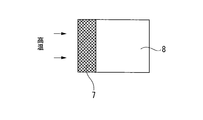
- FIG. 1 the schematic sectional drawing of the layer structure of the heat insulating material which concerns on this embodiment is shown.
- the heat insulating material according to the present embodiment has a two-layer configuration in which a heat insulating layer 7 is disposed on the front surface side of the heat insulating material and another heat insulating layer 8 is disposed on the back surface side.
- the surface of the heat insulating material is a surface that faces the outer surface of the airframe and is directly exposed to a high temperature when applied to a spacecraft and a re-entry capsule.
- FIG. 2 the schematic sectional drawing of the heat insulation layer 7 of the heat insulating material which concerns on this embodiment is shown.
- the heat insulating layer 7 is configured such that the fibrous substance 1 and the inorganic foamed particles 2 are dispersed in the resin layer 3.
- the resin layer 3 is a layer formed by foaming the foaming agent contained in the heat insulating material composition and curing the thermosetting resin.
- the fibrous substance 1 is described with one kind of line for simplification of the drawing.
- two or more kinds of fibrous substances first fibrous substance and different kinds of materials are described. 2nd fibrous material) is mixed.
- the heat insulating layer 7 of the heat insulating material includes the resin layer 3 as a base material and further includes inorganic foam particles 2. Thereby, the heat insulating layer 7 of the heat insulating material is formed with a small bulk density and also has a low thermal conductivity. Accordingly, the heat insulating material is lightweight and has high heat insulating properties. Although not particularly limited, the bulk density of the heat insulating material is 1.0 or less, preferably 0.3 or more and 1.0 or less.
- the heat conductivity of the heat insulating material is 0.2 W / (m ⁇ K) or less, preferably 0.1 W / (m ⁇ K) or more and 0.2 W / (m ⁇ K) or less.
- the fibrous substance 1 is dispersed and contained. Thereby, since the heat insulating material is reinforced, the mechanical strength of the heat insulating material can be increased. By mixing two or more kinds of fibrous substances having different materials, a heat insulating material having characteristics (advantages) of each fibrous substance is obtained.
- the heat insulating layer 7 is configured so that a large amount of the first fibrous material is contained on the front surface side of the heat insulating material, and the blending amount of the first fibrous material is decreased stepwise or continuously toward the back surface side. May be.
- the thickness (distance from the front surface side to the back surface side) of the heat insulating layer 7 disposed on the front surface side of the heat insulating material is appropriately set according to a region where the first fibrous material is preferably contained.
- the region in which the first fibrous material is preferably contained is based on how much heat reaches the inside in the length of time during which a certain flight path is heated, depending on the application. It is good to set.
- the composition for a heat insulating material used in the first embodiment includes a first fibrous material having a higher melting point than the second fibrous material.
- carbon fiber which is an option for the first fibrous material, does not melt at a high temperature of about 2000 ° C.
- the recession by causing more carbon fibers to be present on the front surface side of the heat insulating material than on the rear surface side.
- a heat insulating material When applying a heat insulating material to a re-entry capsule, when the surface of the heat insulating material (thickness of about 40 mm) is heated at 2 MW / m 2 for 200 seconds, a large amount of carbon fiber is contained from the surface to a region of about 10 mm. It is good to use a layer. That is, in the above case, the thickness of the heat insulating layer 7 disposed on the surface side of the heat insulating material is preferably about 10 mm.
- the heat insulating material according to the present embodiment is used in the atmosphere or in a vacuum, and can be used as a heat insulating material for protecting a gas flying at high speed, such as a spacecraft.
- the spacecraft may be a space shuttle, a re-entry capsule, or the like.
- the other heat insulating layer 8 disposed on the back surface side of the heat insulating material is formed by foaming and curing a heat insulating material composition different from the heat insulating material composition used in the heat insulating layer 7.
- Another heat insulating material composition is the same as the heat insulating layer 7 except for the fibrous material.
- the fibrous substance the second fibrous substance is contained alone.
- the second fibrous substance is a fibrous substance having a lower thermal conductivity than the first fibrous substance contained in the heat insulating layer 7.
- oxide fibers such as silica fibers and alumina fibers are suitable.
- the 2nd fibrous substance plays the role which improves heat insulation.
- the second fibrous material When applied to a space shuttle and a heat-insulating material (ablator) for a re-entry capsule, the second fibrous material should have a heat resistance of 500 ° C. or higher.
- the second fibrous substance may be a second fibrous substance group in which a plurality of types of fibrous substances are mixed, the thermal conductivity of which is lower than that of the first fibrous substance.
- the fiber diameter and fiber length of the second fibrous material may be the same as or different from the first fibrous material included in the heat insulating layer 7.
- the fiber diameter and fiber length of the second fibrous substance are not particularly limited, but the fiber diameter is preferably in the range of 1 to 30 ⁇ m, and the fiber length is preferably in the range of 1 to 30 mm.
- the fiber length of the fibrous substance is preferably set as appropriate according to the application.
- a heat insulating material composition is charged into a mold cavity to make it uniform, and then another heat insulating material composition is charged thereon and the mold is heated.
- the foaming agent can be foamed and the thermosetting resin can be integrally formed by melting and curing.
- the layer may be broken at the interface between the stacked layers when cured for each layer, but the above concerns can be eliminated by integral molding.
- the curing operation needs to be repeated a plurality of times, resulting in an increase in manufacturing cost.
- integrally molding the work efficiency is improved and the manufacturing cost can be reduced.
- Aircraft flying at high speed are exposed to high temperatures due to friction with the atmosphere.
- the aerodynamic heating becomes about 1 MW / m 2 to 5 MW / m 2 and is exposed to a very high temperature.
- the resin of the resin layer 3 that is a base material is decomposed, melted / sublimated, or burned / carbonized, and heat energy is consumed by latent heat absorption accompanying the phase change of the substance. The consumption of heat energy can block high temperature from passing through the insulation.
- the gas generated by the decomposition or sublimation is ejected to the surface of the heat insulating material and plays a role of shielding the surface of the heat insulating material.
- This shield reduces the high aerodynamic heating from acting directly on the insulation, thus blocking high temperatures from passing through the insulation.
- the heat insulating material which concerns on this embodiment can protect the inside of a body from high temperature by the said heat insulation effect.
- the heat insulating layer on the surface side is a layer in which two or more kinds of fibrous materials are mixed, and mainly plays a role of reducing the amount of recession.
- the other heat-insulating layer on the back side is a layer made of a material having low thermal conductivity and having heat insulation as a main function.
- the composition for a heat insulating material may be filled in the voids of the honeycomb structure.
- a honeycomb structure is a structure in which a large number of voids that are open on both sides are regularly arranged.
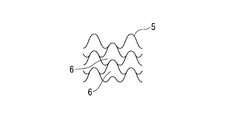
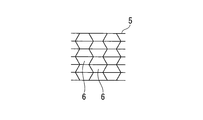
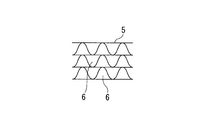
- the shape of the void is illustrated in FIGS. 3 (A) to 3 (E).
- the shape of the void 6 is not limited to that shown in FIG. 3A, and may be the shape shown in FIGS. 3B to 3E.
- the honeycomb structure having the shape shown in FIGS. 3B to 3E can be obtained from Showa Aircraft Industry Co., Ltd. as “OX”, “Flex”, “Bisect”, “Feather”, for example. It is.
- the shape of the void 6 is appropriately selected according to the application.
- the material of the honeycomb structure 5 is paper, metal, composite material, or the like.
- paper include paper and non-combustible paper.
- metal include aluminum, stainless steel, and titanium.
- the composite material include aramid paper, polyparaphenylene benzobisoxazole paper, and carbon glass. In order to reduce the weight of the honeycomb structure 5, it is preferable to use aramid paper as a material.
- Filling the space 6 of the honeycomb structure 5 with the heat insulating material composition is performed, for example, by setting the honeycomb structure 5 in a mold and supplying the heat insulating material composition into the mold. Then, the heat insulating material is filled in the voids 6 of the honeycomb structure 5 by heating and curing.
- the heat insulating material manufactured in this way has high strength because the honeycomb structure is a framework. Moreover, since shape retention property also becomes favorable, it becomes a heat insulating material excellent in handleability.
- Example 1 As Example 1, a heat insulating material was produced using the following heat insulating material composition A.
- ⁇ Insulation composition A Thermosetting resin: Novolak type phenolic resin with curing agent (11 parts by mass) / Resol type phenolic resin varnish (52 parts by weight, 34 parts by mass in terms of solid content)
- Fibrous material carbon fiber (7.5 parts by mass) / silica fiber (7.5 parts by mass)
- Inorganic foam particles aluminosilicate microballoon (40 parts by mass)
- Foaming agent Microcapsule foaming agent (5.5 parts by mass)
- the novolac type phenol resin obtained above was applied to a hammer mill and pulverized to a particle size of 106 ⁇ m or less to obtain a powder. 10 parts by mass of hexamethylenetetramine was added as a curing agent to 100 parts by mass of the novolak type phenol resin of the powder. This was mixed well to obtain a novolak type phenol resin containing a curing agent.
- a solvent was added as a solvent to the resol type phenol resin obtained above to obtain a resol type phenol resin varnish having a solid content of 65% by mass.
- the resol type phenolic resin varnish had a viscosity at 25 ° C. of 160 mPa ⁇ s.
- Carbon fiber (CF, first fibrous substance) used was “TR-066” manufactured by Mitsubishi Rayon Co., Ltd .: fiber diameter 6 ⁇ m, fiber length 6 mm.
- silica fiber (SF, second fibrous substance) “KA-300E” manufactured by Kashimori Kogyo Co., Ltd .: fiber diameter 6 ⁇ m, fiber length 5 mm was used.
- inorganic expanded particles “Philite 200/7” manufactured by Nippon Philite Co., Ltd .: particle diameter of 5 ⁇ m to 150 ⁇ m and bulk specific gravity of 0.4 was used.
- As the foaming agent “Microsphere-F-50” manufactured by Matsumoto Yushi Seiyaku Co., Ltd. was used.
- the 56 g of the heat insulating material composition obtained above was put into a mold having a cavity with a diameter of 50 mm and a height of 60 mm.
- thrown-in was put into the hot air circulation type dryer previously set to 135 degreeC, and was heated at 135 degreeC for 1 hour. The temperature was further raised to 175 ° C. and heated at 175 ° C. for 1 hour to melt and cure the thermosetting resin, and the foaming agent was foamed to form a heat insulating material. Thereafter, the mold was cooled and the heat insulating material was taken out.
- Example 2 As Example 2, the heat insulating material was produced using the following heat insulating material compositions A and B.
- the composition A for a heat insulating material had the same composition as in Example 1.
- the thermal insulation composition B was prepared in the same manner as the thermal insulation composition A except that the fibrous material contained only silica fibers (second fibrous material).
- ⁇ Insulation material composition B Thermosetting resin: Novolak type phenolic resin with curing agent (11 parts by mass) / Resol type phenolic resin varnish (52 parts by weight, 34 parts by mass in terms of solid content)
- Fibrous material Silica fiber (15 parts by mass)
- Inorganic foam particles aluminosilicate microballoon (40 parts by mass)
- Foaming agent Microcapsule foaming agent (5.5 parts by mass)
- the heat insulating material composition A28g and the heat insulating material composition B28g obtained above were sequentially charged into a mold having a cavity with a diameter of 50 mm and a height of 60 mm.
- the molds into which the thermal insulation compositions A and B were charged were heated in the same manner as in Example 1 to melt and cure the thermosetting resin and foam the foaming agent to form the thermal insulation. Thereafter, the mold was cooled and the heat insulating material was taken out.
- Comparative Example 1 As Comparative Example 1, a heat insulating material was produced in the same manner as in Example 1 using the following heat insulating material composition C.
- the fibrous material contains only carbon fiber (first fibrous material), and the other composition is the same as that of the composition A for heat insulating material.
- ⁇ Insulation composition C Thermosetting resin: Novolak type phenolic resin with curing agent (11 parts by mass) / Resol type phenolic resin varnish (52 parts by weight, 34 parts by mass in terms of solid content)
- Fibrous material Carbon fiber (15 parts by mass)
- Inorganic foam particles aluminosilicate microballoon (40 parts by mass)
- Foaming agent Microcapsule foaming agent (5.5 parts by mass)
- Comparative Example 2 As Comparative Example 2, a heat insulating material was produced in the same manner as in Example 1 using the following heat insulating material composition B.
- the composition B for a heat insulating material was prepared in the same manner as that used in Example 2.
- An arc heating wind tunnel test was conducted on the heat insulating materials of Examples 1 and 2 and Comparative Examples 1 and 2. The test was conducted using a 750 kW arc heating wind tunnel owned by the JAXA Wind Tunnel Technology Development Center under the conditions of heating rate: 2.0 MW / m 2 , heating time: 200 seconds, specimen size: ⁇ 40 mm ⁇ 58 mm. The thickness at which the surface was damaged was measured and used as the amount of recession. In addition, the internal temperature of the specimen was measured. The internal temperature of the specimen was measured with a thermocouple previously embedded in a predetermined position (position 20 mm from the heating surface) of the specimen.
- the heat insulating material containing the carbon fiber alone had a recession amount of about 1 mm less than the heat insulating material containing the silica fiber alone (Comparative Example 2). It was higher than 300 ° C.
- the heat insulating material (Example 1 and Example 2) including a heat insulating layer in which carbon fibers and silica fibers are mixed has a lower specimen internal temperature than Comparative Example 1, and the amount of recession is smaller than that of Comparative Example 2. became. From this result, it was confirmed that by mixing the carbon fiber and the silica fiber, it becomes a heat insulating material having the advantages of each fibrous substance. Further, in Example 2 in which the silica fiber and the heat insulating material have a two-layer structure, the internal temperature of the specimen could be kept lower while suppressing the amount of recession.
Landscapes
- Chemical & Material Sciences (AREA)
- Engineering & Computer Science (AREA)
- Health & Medical Sciences (AREA)
- Organic Chemistry (AREA)
- Materials Engineering (AREA)
- Chemical Kinetics & Catalysis (AREA)
- Medicinal Chemistry (AREA)
- Polymers & Plastics (AREA)
- Thermal Sciences (AREA)
- Physics & Mathematics (AREA)
- Critical Care (AREA)
- Emergency Medicine (AREA)
- General Health & Medical Sciences (AREA)
- Remote Sensing (AREA)
- Aviation & Aerospace Engineering (AREA)
- Inorganic Chemistry (AREA)
- Laminated Bodies (AREA)
- Thermal Insulation (AREA)
- Building Environments (AREA)
- Compositions Of Macromolecular Compounds (AREA)
Description
本発明は、大気中や真空中で使用される断熱材用組成物、断熱材及びそれを備えた宇宙機に関する。
宇宙空間で使用される宇宙往還機などの再突入機は、大気圏に突入する際の空力加熱によって、機体表面が2000℃程度の高温に曝される。この高温から機体を保護するために、機体には断熱材が用いられる。宇宙往還機などに用いられる断熱材としては、熱硬化性樹脂にマイクロバルーンおよび短繊維を混合し、熱硬化性樹脂を加熱硬化させることによって作製したものがある(特許文献1参照)。
特許文献1に記載の断熱材は、大気圏に再突入する際の高温上昇時に、自身が分解や炭化することによって熱エネルギーを消費し、機体内部が高温になることを防ぐような構成とされる。
宇宙往還機などに用いられる断熱材は、高温に曝されるため、高い断熱性能とともに、リセッション量を低減させることが要求される。リセッション量とは、加熱を受けた時に断熱材材料そのものが溶融、飛散、損耗による寸法の減少する量を指す。
従来の断熱材においては、熱硬化性樹脂、発泡粒子、繊維状物質などの成分が各単一種混合されている。断熱材に含まれる成分のうち、繊維状物質は繊維種により個々に異なる特性を発現する。例えば、特許文献1では繊維状物質としてカーボン繊維(炭素繊維)を単一種で用いている。カーボン繊維は、リセッション量を低減させることができる反面、断熱性能があまり高くないという特性を示す。例えば、シリカ繊維は、断熱性能が高いが、リセッション量が多くなるという特性を示す。そのため、現状の技術では、いずれも製品に適用するには更なる特性の向上が求められる。
本発明は、このような事情に鑑みてなされたものであって、所望の断熱性能を満たしつつ、リセッションを抑えることができる断熱材用組成物、断熱材、及びそれを備えた宇宙機を提供することを目的とする。
上記課題を解決するために、本発明の第1の態様は、繊維状物質、無機質発泡粒子、熱硬化性樹脂、及び発泡剤を含有する断熱材用組成物であって、前記繊維状物質として少なくとも、第1の繊維状物質と、前記第1の繊維状物質とは異なる材料からなる第2の繊維状物質と、を含み、前記第1の繊維状物質の融点が、前記第2の繊維状物質の融点よりも高く、前記第2の繊維状物質の熱伝導率が、前記第1の繊維状物質の熱伝導率よりも低い断熱材用組成物を提供する。
また、本発明の第2の態様は、無機質発泡粒子と、熱硬化性樹脂と、発泡剤と、第1の繊維状物質と、前記第1の繊維状物質とは異なる材料からなる第2の繊維状物質と、を少なくとも含有し、前記第1の繊維状物質の融点が、前記第2の繊維状物質の融点よりも高く、前記第2の繊維状物質の熱伝導率が、前記第1の繊維状物質の熱伝導率よりも低い、断熱材用組成物を、発泡及び硬化させてなる断熱層を含む断熱材を提供する。
融点の高い第1の繊維状物質は、リセッションを低減させる効果がある。熱伝導率が低い第2の繊維状物質は断熱性を向上させる効果がある。上記発明によれば、特性の異なる2種類以上の繊維状物質を混在させることで、上記効果を併せ持つ断熱材とすることが可能となる。
前記第2の態様において、断熱材は、無機質発泡粒子と、熱硬化性樹脂と、発泡剤と、繊維状物質として前記第2の繊維状物質のみと、を含む断熱材用組成物を発泡及び硬化させてなる他の断熱層を、前記断熱層の裏面側に備える。
断熱材を2層構造とし、断熱材の表面側に断熱層、裏面側の他の断熱層が配置される。表面側の断熱層は、2種以上の繊維状物質が混在した層であり、主にリセッションを低減させる役割を果たす。裏面側の他の断熱層は、熱伝導率が低い材料からなり、断熱を主機能とする層である。裏面側に他の断熱層を設けることで、断熱材の断熱性が向上すると共に、リセッションをより低減させることが可能となる。ここで、断熱材の表面とは、断熱材を宇宙機などの機体に適用した際に、機体の外表面側に位置し、直接高温に曝される表面とされる。
前記断熱層において、繊維状物質の総量に対する前記第1の繊維状物質の割合が、該断熱層の裏面側から表面側に向けて段階的または連続的に増加しても良い。
断熱材は、断熱材の表面が高温に曝された場合に、断熱材の裏面側に高温を伝達させない役割の部材であるが、断熱材の表面側では、リセッション量を抑制することも要求される。前記第2の態様によれば、断熱材の表面側では、より高融点な第1の繊維状物質の割合が多くなるためリセッション量を低減させる効果が得られる。一方、断熱材の裏面側では、第1の繊維状物質の割合が減少し、より熱伝導率の低い第2の繊維状物質の割合が多くなるため断熱性を向上させる効果が得られる。それによって、複数の繊維状物質の長所を併せ持った断熱材とすることができる。
前記第2の態様において、断熱材は、前記断熱材組成物A及び前記断熱材用組成物Bを、ハニカム構造物の空所内で発泡及び硬化させて形成しても良い。そうすることで、ハニカム構造物が骨組となって、強度の高い断熱材を得ることができる。
上記記載の特性の異なる2種類以上の繊維状物質が混在した断熱材を宇宙機に設けることで、宇宙から大気圏に再突入する際の空力加熱から機体をより確実に保護することが可能となる。
本発明によれば、2種類の繊維状物質を混在させることで、断熱性を維持するとともに、リセッションを抑えることができる断熱材用組成物、断熱材、及びそれを備えた宇宙機となる。
以下に、本発明に係る断熱材用組成物及び断熱材の一実施形態について、図面を参照して説明する。
〔第1実施形態〕
本実施形態に係る断熱材用組成物は、繊維状物質、熱硬化性樹脂、無機質発泡粒子、及び発泡剤を含む。断熱材用組成物に含まれる発泡剤を除く各要素は、合計で100質量%となるように配合される。
本実施形態に係る断熱材用組成物は、繊維状物質、熱硬化性樹脂、無機質発泡粒子、及び発泡剤を含む。断熱材用組成物に含まれる発泡剤を除く各要素は、合計で100質量%となるように配合される。
熱硬化性樹脂は、特に限定されるものではないが、10質量%以上60質量%以下の配合割合で断熱用組成物中に含まれると良い。熱硬化性樹脂は、主として粘結剤(バインダー)としての役割を果たす。熱硬化性樹脂の配合量が10質量%未満では接着力が不十分となり、断熱材としたときの強度が不足する恐れがある。また、宇宙往還機や再突入カプセルなどの宇宙機に適用される断熱材は軽量であることが望ましいが、熱硬化性樹脂の配合量が60質量%を超えると、断熱材としたときの嵩密度が高くなって、軽量化することが困難となる。
熱硬化性樹脂としては、特に限定されるものではないが、フェノール樹脂、フラン樹脂、ポリイミド、ケイ素樹脂、エポキシ樹脂、不飽和ポリエステル、ポリウレタン、メラミン樹脂、及びこれらの変性樹脂などを挙げることができる。熱硬化性樹脂は、1種類の熱硬化樹脂を単独で、または複数種類の熱硬化性樹脂を組み合わせて使用され得る。
本実施形態では、熱硬化性樹脂としてフェノール樹脂が採用される。フェノール樹脂はノボラック型樹脂とレゾール型樹脂とのいずれであっても良い。ノボラック型樹脂及びレゾール型樹脂は、それぞれ単独で使用されてよく、または両者を任意の割合で混合して使用されても良い。また、シリコン変性、ゴム変性、ホウ素変性など各種の変性フェノール樹脂を用いることもできる。
フェノール樹脂は、フェノール類とアルデヒド類を反応触媒の存在下で反応させることによって調製され得る。フェノール類とアルデヒド類との配合比率は、モル比で1:0.5~1:3.5の範囲になるように設定するのが好ましい。
フェノール類とは、フェノール及びフェノール誘導体を意味する。例えば、フェノール類は、フェノール、レゾルシノール、3,5-キシレノールなどの3官能性のもの、ビスフェノールA、ジヒドロキシジフェニルメタンなどの4官能性のもの、o-クレゾール、p-クレゾール、p-ter-ブチルフェノール、p-フェニルフェノール、p-クミルフェノール、p-ノニルフェノール、2,4-キシレノール、2,6-キシレノールなどの2官能性のo-又はp-置換のフェノール類を挙げることができる。フェノール類は、塩素又は臭素で置換されたハロゲン化フェノールなどとされても良い。また、フェノール類は、1種類のフェノール類を単独で、または複数種類のフェノール類を組み合わせて使用され得る。
アルデヒド類は、水溶液の形態であるホルマリンが最適とされる。アルデヒド類は、パラホルムアルデヒド、アセトアルデヒド、ベンズアルデヒド、トリオキサン、及びテトラオキサンなどを使用しても良い。アルデヒド類は、ホルムアルデヒドの一部を2-フルアルデヒドまたはフルフリルアルコールに置き換えて使用されても良い。また、アルデヒド類は、1種類のアルデヒド類を単独で、または複数種類のアルデヒド類を組み合わせて使用され得る。
ノボラック型フェノール樹脂を調製する場合、反応触媒は、無機酸、有機酸、または二価金属塩などを用いることができる。無機酸としては、塩酸、硫酸、リン酸などが挙げられる。有機酸としては、シュウ酸、パラトルエンスルホン酸、ベンゼンスルホン酸、キシレンスルホン酸などが挙げられる。二価金属塩としては、酢酸亜鉛などが挙げられる。
レゾール型フェノール樹脂を調製する場合、反応触媒は、アルカリ土類金属の酸化物またはアルカリ土類金属の水酸化物を用いることができる。また、反応触媒は、アミン類、アンモニア、ヘキサメチレンテトラミン、またはその他二価金属の水酸化物を用いることができる。アミン類としては、ジメチルアミン、トリエチルアミン、ブチルアミン、ジブチルアミン、トリブチルアミン、ジメチレントリアミン、ジシアンジアミドなどが挙げられる。
繊維状物質は、主として断熱材としたときに断熱材を補強する役割を果たす。繊維状物質は、特に限定されるものではないが、1質量%以上50質量%以下の配合割合で断熱用組成物中に含まれると良い。繊維状物質が1質量%未満であると、補強効果を十分に得ることができない。繊維状物質が50質量%を超えると、断熱材用組成物への繊維状物質の分散性が悪くなり、断熱材としたときに均一性が損なわれる恐れがある。
繊維状物質は、特に限定されるものではないが、酸化物系無機繊維、無機繊維、有機繊維などを用いることができる。酸化物系無機繊維としては、アルミナ繊維、ガラス繊維、シリカ繊維、アルミナ-シリカの複合酸化物繊維が挙げられる。無機繊維としては、炭化ケイ素繊維、ボロン繊維、カーボン繊維などが挙げられる。有機繊維としては、アラミド繊維、ポリパラフェニルベンゾビスオキサゾール繊維、アクリル繊維、アセテート繊維、ナイロン繊維、ビニリデン繊維などが挙げられる。
本実施形態において、上記繊維状物質は、第1の繊維状物質と第2の繊維状物質とを含む、2種類以上の繊維状物質を組み合わせて用いられる。繊維状物質として第1の繊維状物質及び第2の繊維状物質のみを組み合わせて用いる場合、第2の繊維状物質は、繊維状物質の総量に対して0体積%より多く50体積%以下で含まれると良い。その場合、残部は、第1の繊維状物質とされる。
第1の繊維状物質は、第2の繊維状物質よりも高融点のものが選択される。第1の繊維状物質は耐熱性を担い、リセッションを向上させる役割を果たす。第1の繊維状物質の融点は、1000℃以上であることが好ましい。第1の繊維状物質は、セラミックス系繊維、例えば、炭素繊維(CF)、炭化ケイ素繊維またはチラノ繊維(登録商標)、シリカ繊維、アルミナ繊維などが好適である。
なお、第1の繊維状物質は、第2の繊維状物質よりも融点が高い、複数種類の繊維状物質が混在した第1の繊維状物質群であっても良い。
第1の繊維状物質は、第2の繊維状物質よりも高融点のものが選択される。第1の繊維状物質は耐熱性を担い、リセッションを向上させる役割を果たす。第1の繊維状物質の融点は、1000℃以上であることが好ましい。第1の繊維状物質は、セラミックス系繊維、例えば、炭素繊維(CF)、炭化ケイ素繊維またはチラノ繊維(登録商標)、シリカ繊維、アルミナ繊維などが好適である。
なお、第1の繊維状物質は、第2の繊維状物質よりも融点が高い、複数種類の繊維状物質が混在した第1の繊維状物質群であっても良い。
第2の繊維状物質は、第1の繊維状物質よりも熱伝導率が低いものが選択される。第2の繊維状物質は、断熱性を向上させる役割を果たす。第2の繊維状物質は、酸化物系繊維、例えばシリカ繊維、アルミナ繊維、ガラス繊維、ポリパラフェニルベンゾビスオキサゾール繊維、ポリベンゾイミダゾール繊維、ポリイミド繊維などが好適である。宇宙往還機の断熱材(アブレータ)に適用される場合、第2の繊維状物質は300℃以上の耐熱性があると良い。
なお、第2の繊維状物質は、第1の繊維状物質よりも熱伝導率が低い、複数種類の繊維状物質が混在した第2の繊維状物質群であっても良い。
なお、第2の繊維状物質は、第1の繊維状物質よりも熱伝導率が低い、複数種類の繊維状物質が混在した第2の繊維状物質群であっても良い。
第1の繊維状物質及び第2の繊維状物質の繊維径及び繊維長は、同じであって良く、異なっていても良い。繊維状物質の繊維径や繊維長は、特に限定されるものではないが、繊維径が1μm~30μmの範囲、繊維長が1mm~30mmの範囲が好ましい。繊維状物質の繊維長が短いと断熱材としたときに断熱性を向上させることができる。繊維状物質の繊維長が長いと断熱材としたときの補強効果を向上させることができる。よって、繊維状物質の繊維長は、適用に応じて適宜設定すると良い。
無機質発泡粒子は、主として断熱材としたときに断熱材を軽量化し、更に断熱材の熱伝導率を低くして断熱性能を向上させる役割を果たす。断熱材としたときの無機質発泡粒子の嵩比重は、特に限定されるものではないが、0.05以上0.5以下の範囲であることが好ましい。嵩比重が0.5を超えると、軽量化及び断熱性向上の効果を十分に得ることができない。嵩比重が0.05未満であると、無機質発泡粒子の強度が低くなるため、断熱材としたときに強度が低下する恐れがある。
無機質発泡粒子は、特に限定されるものではないが、5質量%以上50質量%以下の配合割合で断熱用組成物中に含まれると良い。無機質発泡粒子の配合量が5質量%未満では、無機質発泡粒子を配合することによる軽量化及び断熱性向上の効果を十分に得ることができない、配合量が50質量%を超えると、断熱材としたときに強度が低下する恐れがある。
無機質発泡粒子は、特に限定されるのもではないが、ガラス質または鉱物質の中空バルーンなどとされる。ガラス質としては、低アルカリガラス、ソーダ石灰ガラス、ホウケイ酸ガラス、ホウケイ酸ソーダガラス、またはアルミノシリケートなどが挙げられる。無機質発泡粒子は、1種類の無機質発泡粒子を単独で、または複数種類の無機質発泡粒子を組み合わせて使用され得る。
無機質発泡粒子の粒径は、特に限定されるものではないが、1μm~1000μmの範囲であることが好ましい。
発泡剤は、熱硬化性樹脂を発泡させる役割を果たす。発泡剤により熱硬化樹脂を発泡させることで、断熱材としたときに断熱材を軽量化すると同時に、断熱材の熱伝導率を低くして断熱性を向上させることができる。発泡倍率は、2倍~5倍程度の範囲に設定するのが好ましい。発泡倍率が2倍未満では、軽量化や断熱性向上の効果を十分に得ることができない。発泡倍率が5倍を超えると、断熱材としたときに強度が低下するので好ましくない。発泡剤の配合量は、目的とする発泡倍率に応じて適宜設定される。特に限定されるものではないが、発泡剤の配合量は、熱硬化性樹脂100質量部に対して5質量部~20質量部の範囲が好ましい。
発泡剤は、特に限定されるのもではないが、無機発泡剤、有機発泡剤、マイクロカプセル発泡剤などとされる。無機発泡剤は、炭酸アンモニウム、炭酸水素ナトリウムなどが挙げられる。有機発泡剤は、ジニトロペンタンメチレンテトラミン、アゾジカルボンアミド、p,p’-オキシベンゼンスルホニルヒドラジン、ヒドラジカルボンアミドなどが挙げられる、マイクロカプセル化発泡剤は、低沸点炭化水素を塩化ビニリデン、アクリロニトリル、ポリウレタンなどの共重合物の殻壁でカプセル化したものが挙げられる。無機質発泡粒子は、1種類の無機質発泡粒子を単独で、または複数種類の無機質発泡粒子を組み合わせて使用され得る。
断熱材用組成物は、カップリング剤を含んでいても良い。カップリング剤は、繊維状物質及び無機質発泡粒子と、熱硬化性樹脂との接着性を高める役割を果たす。カップリング剤としては、γ-アミノプロピルトリエトキシシラン、γ-(2-アミノエチル)アミノプロピルトリメトキシシラン、γ-グリシドキシプロピルトリメトキシシランなどが挙げられる。
断熱材用組成物は、ポリビニルアルコール系材料を含んでも良い。ポリビニルアルコール系材料としては、ポリビニルアルコール、ポリビニルアルコールをアセタール化したポリビニルアセタール樹脂などが挙げられる。ポリビニルアルコール系材料は、粉末状、ビニロン繊維などの紡糸した繊維状の形態などとされる。ポリビニルアルコール系材料としてビニロン繊維などの繊維状のものを用いた場合、断熱材としたときに、低温時でも補強効果を得ることができる。ポリビニルアルコール系材料は、1種を単独で、または複数種を組み合わせて使用され得る。
ポリビニルアルコール系材料は、特に限定されるものではないが、1質量%以上20質量%以下の配合割合で断熱用組成物中に含まれると良い。ポリビニルアルコール系材料の配合量が1質量%未満では、ポリビニルアルコール系材料を配合することによる効果を十分に得ることができない。繊維状態でないポリビニルアルコール系材料の配合量が20質量%を超えると、断熱材としたときに強度が低下する恐れがある。
ポリビニルアルコール系材料を高温に曝すと、酸素が不足する雰囲気であっても、分解される際に水が生成される。ポリビニルアルコール系材料が分解される際に熱エネルギーが消費されると同時に、生成された水の気化熱などとしても熱エネルギーが消費される。よって、熱エネルギーの消費による熱の遮断効果を高く得ることができる。
断熱材用組成物は、コルク粒を含んでも良い。コルクは地中海地方(ポルトガル、スペイン、イタリアなど)で栽培されるブナ科コナラ属の常緑樹であるコルク樫の樹皮から得られるものである。本実施形態において、コルク粒はコルク樫の樹皮を粉砕・精製したものを用いることができる。コルクは、超微細な気泡構造を持っており、この気泡構造によって計量で且つ断熱性が高いという特徴を有する。
コルク粒は、断熱材としたときに、より軽量化できると共に、熱伝導率を低くして断熱性能を向上させる役割を果たす。コルク粒は、高温が作用したときに分解、燃焼、昇華、炭化されることによって、熱エネルギーを消費する。それによって、高温が断熱材を通過することを遮断して断熱性能を高く得ることができる。熱分解などでコルク粒から発生するガスの層が断熱材の表面に形成されることによっても断熱効果を得ることができる。
コルク粒の粒径は、特に限定されるものではないが、1μm~2000μm程度の範囲であることが好ましい。コルク粒は、特に限定されるものではないが、5質量%以上40質量%以下の配合割合で断熱用組成物中に含まれると良い。コルク粒の配合量が5質量%未満では、コルク粒を配合することによる軽量化及び断熱性向上などの効果を十分に得ることが難しい。コルク粒の配合量が40質量%を超えると、断熱材の強度が低下する恐れがある。
断熱材用組成物は、少なくとも繊維状物質、熱硬化性樹脂、無機質発泡粒子、及び発泡剤を所定の割合で配合した後、混練装置で混練して調製される。混練装置としては、ヘンシェルミキサー、シンプソンミル、メランジャ、アイリッヒ、スピードマラー、ワールミックスなどを用いることができる。これらの混練装置は、バインダー成分の形態や性状に応じて、また混練方法に応じて、適宜使い分ければ良い。
次に、上記で調製した断熱材用組成物を用いて製造した断熱材について説明する。
本実施形態に係る断熱材は、上記断熱材用組成物を金型に充填し、加熱して熱硬化性樹脂を溶融させるとともに発泡剤を発泡させた状態で硬化させることによって製造する。加熱温度及び加熱時間などは、断熱材用組成物に含まれる熱硬化性樹脂及び発泡剤の種類などによって適宜設定する。
本実施形態に係る断熱材は、上記断熱材用組成物を金型に充填し、加熱して熱硬化性樹脂を溶融させるとともに発泡剤を発泡させた状態で硬化させることによって製造する。加熱温度及び加熱時間などは、断熱材用組成物に含まれる熱硬化性樹脂及び発泡剤の種類などによって適宜設定する。
図1に、本実施形態に係る断熱材の層構成の概略断面図を示す。本実施形態に係る断熱材は、断熱材の表面側に断熱層7、裏面側に他の断熱層8が配置された2層構成とされる。断熱材の表面は、宇宙往還機並びに再突入カプセルなどに適用した場合に、機体の外表面側を向き、直接高温に曝される面である。
図2に、本実施形態に係る断熱材の断熱層7の概略断面図を示す。断熱層7は、樹脂層3中に繊維状物質1や無機質発泡粒子2が分散された構成とされる。樹脂層3は、断熱材用組成物に含まれる発泡剤が発泡し、且つ、熱硬化性樹脂が硬化して形成された層である。図2において繊維状物質1は図の簡略化のため1種類の線種で記載されているが、断熱材中には、材料の異なる2種類以上の繊維状物質(第1の繊維状物質及第2の繊維状物質)が混在している。
図2に、本実施形態に係る断熱材の断熱層7の概略断面図を示す。断熱層7は、樹脂層3中に繊維状物質1や無機質発泡粒子2が分散された構成とされる。樹脂層3は、断熱材用組成物に含まれる発泡剤が発泡し、且つ、熱硬化性樹脂が硬化して形成された層である。図2において繊維状物質1は図の簡略化のため1種類の線種で記載されているが、断熱材中には、材料の異なる2種類以上の繊維状物質(第1の繊維状物質及第2の繊維状物質)が混在している。
断熱材の断熱層7は、樹脂層3を母材とし、更に無機質発泡粒子2を含む。これによって、断熱材の断熱層7は、嵩密度が小さく形成されると共に、熱伝導率も低くなる。従って、軽量で、且つ、高い断熱性を有する断熱材となる。特に限定されるものではないが、断熱材の嵩密度は1.0以下、好ましくは0.3以上1.0以下の範囲とされる。断熱材の熱伝導率は0.2W/(m・K)以下、好ましくは0.1W/(m・K)以上0.2W/(m・K)以下の範囲とされる。
樹脂層3中には、繊維状物質1が分散して含有されている。それによって、断熱材が補強されるため、断熱材の機械的強度を高めることができる。材料の異なる2種類以上の繊維状物質を混在させることで、各繊維状物質の特性(長所)を兼ね備えた断熱材となる。
なお、断熱層7は、断熱材の表面側に第1の繊維状物質が多く含まれ、裏面側に向けて、段階的または連続的に第1の繊維状物質の配合量が減少するよう構成されても良い。
なお、断熱層7は、断熱材の表面側に第1の繊維状物質が多く含まれ、裏面側に向けて、段階的または連続的に第1の繊維状物質の配合量が減少するよう構成されても良い。
断熱材の表面側に配置される断熱層7の厚さ(表面側から裏面側までの距離)は、第1の繊維状物質が入っていた方が好ましい領域に応じて適宜設定される。第1の繊維状物質が入っていた方が好ましい領域は、あるフライトパスの加熱されている時間の長さの中で、どの程度内部まで熱が到達するかを想定した上で、適用に応じて設定すると良い。第1実施形態で用いられる断熱材用組成物には、第2の繊維状物質よりも高融点である第1の繊維状物質が含まれている。例えば、第1の繊維状物質の選択肢である炭素繊維は、2000℃程度の高温では溶融しない。そのため、断熱材の表面側に裏面側よりも多く炭素繊維を存在させることで、リセッションを抑制することが可能となる。断熱材を再突入カプセルに適用する場合、断熱材(厚さ40mm程度)の表面が2MW/m2、200秒で加熱されたときに、表面から10mm程度の領域までを炭素繊維が多く含有された層とすると良い。すなわち、上記の場合、断熱材の表面側に配置される断熱層7の厚さは、10mm程度が好適となる。
本実施形態に係る断熱材は、大気中や真空中で使用されるものであり、例えば、宇宙機など高速で飛翔する気体の保護用の断熱材として用いることができる。宇宙機は、宇宙往還機、再突入カプセルなどとされる。
断熱材の裏面側に配置される他の断熱層8は、断熱層7で用いられた断熱材用組成物とは別の断熱材組成物を発泡及び硬化させてなる。
別の断熱材組成物は、繊維状物質以外の構成が断熱層7と同様とされる。繊維状物質としては、第2の繊維状物質が単独で含まれている。第2の繊維状物質は、断熱層7に含まれる第1の繊維状物質よりも熱伝導率の低い繊維状の物質である。例えば、酸化物系繊維、例えばシリカ繊維、アルミナ繊維などが好適である。第2の繊維状物質は、断熱性を向上させる役割を果たす。宇宙往還機並びに再突入カプセルの断熱材(アブレータ)に適用される場合、第2の繊維状物質は500℃以上の耐熱性があると良い。
なお、第2の繊維状物質は、第1の繊維状物質よりも熱伝導率が低い、複数種類の繊維状物質が混在した第2の繊維状物質群であっても良い。
別の断熱材組成物は、繊維状物質以外の構成が断熱層7と同様とされる。繊維状物質としては、第2の繊維状物質が単独で含まれている。第2の繊維状物質は、断熱層7に含まれる第1の繊維状物質よりも熱伝導率の低い繊維状の物質である。例えば、酸化物系繊維、例えばシリカ繊維、アルミナ繊維などが好適である。第2の繊維状物質は、断熱性を向上させる役割を果たす。宇宙往還機並びに再突入カプセルの断熱材(アブレータ)に適用される場合、第2の繊維状物質は500℃以上の耐熱性があると良い。
なお、第2の繊維状物質は、第1の繊維状物質よりも熱伝導率が低い、複数種類の繊維状物質が混在した第2の繊維状物質群であっても良い。
第2の繊維状物質の繊維径及び繊維長は、断熱層7に含まれる第1の繊維状物質と同じであって良く、異なっていても良い。第2の繊維状物質の繊維径や繊維長は、特に限定されるものではないが、繊維径が1μm~30μmの範囲、繊維長が1mm~30mmの範囲が好ましい。繊維状物質の繊維長は、適用に応じて適宜設定すると良い。
本実施形態に係る断熱材は、例えば、金型のキャビティ内に、断熱材用組成物を投入し均一にした後、その上に別の断熱材用組成物を投入し、この金型を加熱することで、発泡剤を発泡させるとともに、熱硬化性樹脂を溶融・硬化させることで一体形成することができる。断熱材を複数層構成とする場合、各層毎に硬化させると、積層された層界面で壊れることが懸念されるが、一体成型することにより上記懸念を払拭することができる。また、各層毎に硬化させると、硬化作業を複数回繰り返す必要があり製造コストが高くなるが、一体成型することにより作業効率が改善され、製造コストを下げることが可能となる。
高速で飛翔する機体は大気との摩擦で高温に曝される。特に、宇宙空間から地球の大気圏に再突入する際には、空力加熱が1MW/m2~5MW/m2程度となり、非常な高温に曝されることになる。断熱材表面が高温に曝されると、母材である樹脂層3の樹脂が分解、溶融・昇華、または燃焼・炭化し、物質の相変化に伴う潜熱吸収により熱エネルギーが消費される。熱エネルギーが消費されることによって、高温が断熱材を通過することを遮断することができる。また、分解または昇華によって発生したガスは、断熱材の表面に噴出し、断熱材の表面をシールドする役割を果たす。このシールドは、高い空力加熱が断熱材へと直接作用することを低減させるため、高温が断熱材を通過することから遮断できる。本実施形態に係る断熱材は、上記断熱作用により機体内部を高温から保護することができる。
本実施形態の断熱材によれば、表面側の断熱層は、2種以上の繊維状物質が混在した層であり、主にリセッション量を低減させる役割を果たす。裏面側の他の断熱層は、熱伝導率が低い材料からなり、断熱を主機能とする層である。裏面側に他の断熱層を設けることで、断熱材の断熱性が向上すると共に、リセッションをより低減させることが可能となる。このような断熱材は、特に、宇宙往還機及び再突入カプセルなど、表面温度が短時間に高温となる宇宙機の機体への適用が好適である。
(第1実施形態の変形例)
断熱材用組成物は、ハニカム構造物の空所内に充填されても良い。ハニカム構造物は、両面に開口する多数の空所が規則的に配置された構造物である。空所の形状を図3(A)~図3(E)に例示する。空所6の形状は、図3(A)に限定されず、図3(B)~図3(E)に示す形状などであっても良い。図3(B)~図3(E)に示された形状のハニカム構造物は、例えば、「OX」、「フレックス」、「バイセクト」、「フェザー」として、昭和飛行機工業(株)から入手可能である。空所6の形状は、適用に応じて適宜選択される。
断熱材用組成物は、ハニカム構造物の空所内に充填されても良い。ハニカム構造物は、両面に開口する多数の空所が規則的に配置された構造物である。空所の形状を図3(A)~図3(E)に例示する。空所6の形状は、図3(A)に限定されず、図3(B)~図3(E)に示す形状などであっても良い。図3(B)~図3(E)に示された形状のハニカム構造物は、例えば、「OX」、「フレックス」、「バイセクト」、「フェザー」として、昭和飛行機工業(株)から入手可能である。空所6の形状は、適用に応じて適宜選択される。
ハニカム構造物5の材質は、紙類、金属類、複合材などとされる。紙類としては、紙、不燃紙などが挙げられる。金属類は、アルミニウム、ステンレス、チタンなどが挙げられる。複合材は、アラミッド紙、ポリパラフェニレンベンゾビスオキサゾール紙、カーボン・ガラスなどが挙げられる。ハニカム構造物5を軽量化させるためには、材質としてアラミッド紙を用いると良い。
ハニカム構造物5の空所6内への断熱材用組成物の充填は、例えば、金型内にハニカム構造物5をセットしておき、この金型内に断熱材用組成物を供給する。その後、加熱・硬化させることで、ハニカム構造物5の空所6内に断熱材が充填される。このようにして製造された断熱材は、ハニカム構造物が骨組みとなるため、強度が高くなる。また、保形性も良好になるため、取り扱い性に優れた断熱材となる。
(実施例1)
実施例1として、以下の断熱材組成物Aを用いて断熱材を作製した。
≪断熱材組成物A≫
熱硬化性樹脂 :硬化剤入りノボラック型フェノール樹脂(11質量部)/レゾール型フェノール樹脂ワニス(52重量部、固形分換算で34質量部)
繊維状物質 :炭素繊維(7.5質量部)/シリカ繊維(7.5質量部)
無機質発泡粒子:アルミノシリケート系マイクロバルーン(40質量部)
発泡剤 :マイクロカプセル発泡剤(5.5質量部)
実施例1として、以下の断熱材組成物Aを用いて断熱材を作製した。
≪断熱材組成物A≫
熱硬化性樹脂 :硬化剤入りノボラック型フェノール樹脂(11質量部)/レゾール型フェノール樹脂ワニス(52重量部、固形分換算で34質量部)
繊維状物質 :炭素繊維(7.5質量部)/シリカ繊維(7.5質量部)
無機質発泡粒子:アルミノシリケート系マイクロバルーン(40質量部)
発泡剤 :マイクロカプセル発泡剤(5.5質量部)
詳細には、反応容器にフェノール940質量部、37質量%ホルマリン649質量部、シュウ酸4.7質量部を仕込み、約60分間還流させ、そのまま120分間反応させた。常圧で内温160℃まで脱液を行った後、133hPaで減圧脱液を行うことによって、軟化点99℃のノボラック型フェノール樹脂を得た。
上記で得たノボラック型フェノール樹脂をハンマーミルにかけ、106μm以下の粒径に粉砕して粉末とした。該粉末のノボラック型フェノール樹脂100質量部に硬化剤としてヘキサメチレンテトラミン10質量部を添加した。これを良く混合し、硬化剤入りノボラック型フェノール樹脂を得た。
反応容器にフェノール940質量部、37質量%ホルマリン649質量部、48質量%濃度の苛性ソーダ水溶液23.5質量部を仕込み、約60分間還流させ、そのまま90分間反応させた。133hPaの減圧下で100℃まで脱液を行うことによって、半固形状のレゾール型フェノール樹脂を得た。
上記で得たレゾール型フェノール樹脂に溶剤としてメタノールを添加し、固形分が65質量%のレゾール型フェノール樹脂ワニスを得た。レゾール型フェノール樹脂ワニスは、25℃における粘度が160mPa・sであった。
炭素繊維(CF、第1の繊維状物質)は、三菱レイヨン(株)製「TR-066」:繊維径6μm、繊維長6mmを用いた。シリカ繊維(SF、第2の繊維状物質)は、芦森工業(株)製「KA-300E」:繊維径6μm、繊維長5mmを用いた。無機質発泡粒子は、日本フィライト(株)製「フィライト200/7」:粒子径5μm~150μm、嵩比重0.4を用いた。発泡剤は、松本油脂製薬(株)製、「マイクロスフェア-F-50」)を用いた。
上記各成分をヘンシェルミキサーに投入して10分間混合した。次に、この混合物をステンレスバットに払い出し、室温で24時間放置してメタノールを蒸発させることによって、粉末状の断熱材用組成物を得た。
上記で得た断熱材用組成物56gを、直径50mm、高さ60mmのキャビティを有する金型に投入した。断熱材用組成物を投入した金型を、予め135℃にセットした熱風循環式乾燥機に入れて、135℃で1時間加熱した。更に175℃に昇温させて、175℃で1時間加熱し、熱硬化性樹脂を溶融・硬化させるとともに、発泡剤を発泡させて断熱材を成形した。その後、金型を冷却して断熱材を取り出した。
(実施例2)
実施例2として、以下の断熱材組成物Aおよび断熱材組成物Bを用いて断熱材を作製した。断熱材用組成物Aは、実施例1と同様の組成とした。断熱材用組成物Bは、繊維状物質がシリカ繊維(第2の繊維状物質)のみ含まれ、それ以外は断熱材用組成物Aと同様に調製した。
実施例2として、以下の断熱材組成物Aおよび断熱材組成物Bを用いて断熱材を作製した。断熱材用組成物Aは、実施例1と同様の組成とした。断熱材用組成物Bは、繊維状物質がシリカ繊維(第2の繊維状物質)のみ含まれ、それ以外は断熱材用組成物Aと同様に調製した。
≪断熱材組成物B≫
熱硬化性樹脂 :硬化剤入りノボラック型フェノール樹脂(11質量部)/レゾール型フェノール樹脂ワニス(52重量部、固形分換算で34質量部)
繊維状物質 :シリカ繊維(15質量部)
無機質発泡粒子:アルミノシリケート系マイクロバルーン(40質量部)
発泡剤 :マイクロカプセル発泡剤(5.5質量部)
熱硬化性樹脂 :硬化剤入りノボラック型フェノール樹脂(11質量部)/レゾール型フェノール樹脂ワニス(52重量部、固形分換算で34質量部)
繊維状物質 :シリカ繊維(15質量部)
無機質発泡粒子:アルミノシリケート系マイクロバルーン(40質量部)
発泡剤 :マイクロカプセル発泡剤(5.5質量部)
上記で得た断熱材用組成物A28g及び断熱材用組成物B28gを、直径50mm、高さ60mmのキャビティを有する金型に順次投入した。断熱材用組成物A,Bを投入した金型を、実施例1と同様に加熱し、熱硬化性樹脂を溶融・硬化させるとともに、発泡剤を発泡させて断熱材を成形した。その後、金型を冷却して断熱材を取り出した。
(比較例1)
比較例1として、以下の断熱材組成物Cを用いて実施例1と同様に断熱材を作製した。断熱材用組成物Cは、繊維状物質が炭素繊維(第1の繊維状物質)のみ含まれ、それ以外の組成は断熱材用組成物Aと同様とした。
比較例1として、以下の断熱材組成物Cを用いて実施例1と同様に断熱材を作製した。断熱材用組成物Cは、繊維状物質が炭素繊維(第1の繊維状物質)のみ含まれ、それ以外の組成は断熱材用組成物Aと同様とした。
≪断熱材組成物C≫
熱硬化性樹脂 :硬化剤入りノボラック型フェノール樹脂(11質量部)/レゾール型フェノール樹脂ワニス(52重量部、固形分換算で34質量部)
繊維状物質 :炭素繊維(15質量部)
無機質発泡粒子:アルミノシリケート系マイクロバルーン(40質量部)
発泡剤 :マイクロカプセル発泡剤(5.5質量部)
熱硬化性樹脂 :硬化剤入りノボラック型フェノール樹脂(11質量部)/レゾール型フェノール樹脂ワニス(52重量部、固形分換算で34質量部)
繊維状物質 :炭素繊維(15質量部)
無機質発泡粒子:アルミノシリケート系マイクロバルーン(40質量部)
発泡剤 :マイクロカプセル発泡剤(5.5質量部)
(比較例2)
比較例2として、以下の断熱材組成物Bを用いて実施例1と同様に断熱材を作製した。断熱材用組成物Bは、実施例2で用いたものと同様に調製した。
比較例2として、以下の断熱材組成物Bを用いて実施例1と同様に断熱材を作製した。断熱材用組成物Bは、実施例2で用いたものと同様に調製した。
実施例1~2、比較例1~2の断熱材について、アーク加熱風洞試験を行った。試験は、JAXA風洞技術開発センタ所有 750kWアーク加熱風洞を用い、加熱率:2.0MW/m2、加熱時間:200秒、供試体サイズ:Φ40mm×58mmの条件で行った。表面が破損された厚さを測定し、リセッション量とした。また、供試体内部温度を測定した。供試体の内部温度は、予め供試体の所定位置(加熱表面から20mmの位置)に埋め込んでおいた熱電対によって測定した。

表1によれば、炭素繊維を単独で含む断熱材(比較例1)は、シリカ繊維を単独で含む断熱材(比較例2)よりもリセッション量が1mm程度少なかったが、供試体内部温度が300℃以上高かった。炭素繊維とシリカ繊維とが混在した断熱層を含む断熱材(実施例1及び実施例2)は、比較例1よりも供試体内部温度が低くなり、かつ、リセッション量は比較例2よりも少なくなった。この結果から、炭素繊維及びシリカ繊維を混在させることで、各繊維状物質の長所を兼ね備えた断熱材となることが確認された。また、シリカ繊維また、断熱材が2層構成とされた実施例2では、リセッション量を抑えつつ、より供試体内部温度を低く維持することができた。
1 繊維状物質
2 無機質発泡粒子
3 樹脂層
5 ハニカム構造物
6 空所
7 断熱層
8 他の断熱層
2 無機質発泡粒子
3 樹脂層
5 ハニカム構造物
6 空所
7 断熱層
8 他の断熱層
Claims (5)
- 繊維状物質、無機質発泡粒子、熱硬化性樹脂、及び発泡剤を含有する断熱材用組成物であって、
前記繊維状物質として少なくとも、第1の繊維状物質と、前記第1の繊維状物質とは異なる材料からなる第2の繊維状物質と、を含み、
前記第1の繊維状物質の融点が、前記第2の繊維状物質の融点よりも高く、
前記第2の繊維状物質の熱伝導率が、前記第1の繊維状物質の熱伝導率よりも低い、
断熱材用組成物。 - 無機質発泡粒子と、熱硬化性樹脂と、発泡剤と、第1の繊維状物質と、前記第1の繊維状物質とは異なる材料からなる第2の繊維状物質と、を少なくとも含有し、
前記第1の繊維状物質の融点が、前記第2の繊維状物質の融点よりも高く、
前記第2の繊維状物質の熱伝導率が、前記第1の繊維状物質の熱伝導率よりも低い、
断熱材用組成物Aを、発泡及び硬化させてなる断熱層と、
無機質発泡粒子と、熱硬化性樹脂と、発泡剤と、繊維状物質として前記第2の繊維状物質のみと、を含む断熱材用組成物Bを、発泡及び硬化させてなる他の断熱層と、
を含み、
前記他の断熱層が前記断熱層の裏面側に配置される断熱材。 - 前記断熱層において、
繊維状物質の総量に対する前記第1の繊維状物質の割合が、該断熱層の裏面側から表面側に向けて段階的または連続的に増加する請求項2に記載の断熱材。 - 前記断熱材組成物A及び前記断熱材用組成物Bを、ハニカム構造物の空所内で発泡及び硬化させてなる請求項2または請求項3に記載の断熱材。
- 請求項2乃至請求項4のいずれかに記載の断熱材を備えた宇宙機。
Priority Applications (1)
| Application Number | Priority Date | Filing Date | Title |
|---|---|---|---|
| US14/369,846 US20140356571A1 (en) | 2012-01-17 | 2013-01-16 | Composition for heat insulator, heat insulator, and spacecraft equipped therewith |
Applications Claiming Priority (2)
| Application Number | Priority Date | Filing Date | Title |
|---|---|---|---|
| JP2012007097A JP6253871B2 (ja) | 2012-01-17 | 2012-01-17 | 断熱材及びそれを備えた宇宙機、並びに断熱材の製造方法 |
| JP2012-007097 | 2012-01-17 |
Publications (1)
| Publication Number | Publication Date |
|---|---|
| WO2013108796A1 true WO2013108796A1 (ja) | 2013-07-25 |
Family
ID=48799221
Family Applications (1)
| Application Number | Title | Priority Date | Filing Date |
|---|---|---|---|
| PCT/JP2013/050696 Ceased WO2013108796A1 (ja) | 2012-01-17 | 2013-01-16 | 断熱材用組成物、断熱材及びそれを備えた宇宙機 |
Country Status (3)
| Country | Link |
|---|---|
| US (1) | US20140356571A1 (ja) |
| JP (1) | JP6253871B2 (ja) |
| WO (1) | WO2013108796A1 (ja) |
Cited By (1)
| Publication number | Priority date | Publication date | Assignee | Title |
|---|---|---|---|---|
| US10926862B2 (en) | 2015-12-25 | 2021-02-23 | Mitsubishi Aircraft Corporation | Insertion sheet between high-temperature duct and structural member of aircraft, duct of aircraft, and aircraft |
Families Citing this family (7)
| Publication number | Priority date | Publication date | Assignee | Title |
|---|---|---|---|---|
| US9822919B2 (en) * | 2014-01-31 | 2017-11-21 | Lockheed Martin Corporation | Thermal insulation including a cellular matrix |
| US10604872B1 (en) * | 2014-03-06 | 2020-03-31 | United States Of America As Represented By The Administrator Of Nasa | Woven thermal protection system |
| JP6353686B2 (ja) * | 2014-04-10 | 2018-07-04 | 三菱重工業株式会社 | 再突入機の製造方法 |
| JP2017179244A (ja) * | 2016-03-31 | 2017-10-05 | 住友ベークライト株式会社 | 発泡体および発泡体の製造方法 |
| CN109749447B (zh) * | 2017-11-03 | 2021-10-22 | 航天特种材料及工艺技术研究所 | 一种热分解材料及其制备方法 |
| FR3088700B1 (fr) * | 2018-11-20 | 2022-02-11 | Arianegroup Sas | Matériau composite pour la protection thermique d’une pièce structurale |
| JP7464937B2 (ja) * | 2019-05-13 | 2024-04-10 | 本田技研工業株式会社 | 飛翔体 |
Citations (9)
| Publication number | Priority date | Publication date | Assignee | Title |
|---|---|---|---|---|
| US3407110A (en) * | 1964-11-25 | 1968-10-22 | Gen Electric | Heat shield |
| US3565740A (en) * | 1966-05-06 | 1971-02-23 | Trw Inc | Reinforcement form for use in structural composites,ablative structures and the like |
| JPH01202600A (ja) * | 1987-12-09 | 1989-08-15 | Messerschmitt Boelkow Blohm Gmbh <Mbb> | 多層断熱材 |
| JPH09239847A (ja) * | 1996-03-14 | 1997-09-16 | Nissan Motor Co Ltd | 低密度frpアブレータ |
| JPH10226582A (ja) * | 1997-02-12 | 1998-08-25 | Mitsubishi Heavy Ind Ltd | 複層断熱材及びその製造法 |
| JP2002292755A (ja) * | 2001-03-30 | 2002-10-09 | Kawasaki Heavy Ind Ltd | 熱防護材の製造方法 |
| JP2006103460A (ja) * | 2004-10-04 | 2006-04-20 | Kawasaki Heavy Ind Ltd | 熱防御・耐損耗複合機能構造体及びそれを備えた高速飛しょう体 |
| JP2011000921A (ja) * | 2009-06-17 | 2011-01-06 | Ihi Aerospace Co Ltd | 突入カプセル、およびその頭頂部の製造方法 |
| JP2011207401A (ja) * | 2010-03-30 | 2011-10-20 | Mitsubishi Heavy Ind Ltd | 飛翔体 |
Family Cites Families (12)
| Publication number | Priority date | Publication date | Assignee | Title |
|---|---|---|---|---|
| US2789095A (en) * | 1952-11-22 | 1957-04-16 | Du Pont | Process for preparing urea-formaldehyde solid foam |
| US4867393A (en) * | 1988-08-17 | 1989-09-19 | Morton Thiokol, Inc. | Reduced fin span thrust vector controlled pulsed tactical missile |
| JPH10120815A (ja) * | 1996-10-23 | 1998-05-12 | Riboole:Kk | 不燃性フェノール樹脂発泡体及びその製造方法 |
| CA2231461C (en) * | 1997-03-18 | 2001-11-06 | Mitsuo Minagawa | Process for producing non-flammable phenolic resin foam |
| JPH10324762A (ja) * | 1997-05-22 | 1998-12-08 | Riboole:Kk | 高強度不燃性フェノール樹脂発泡体 |
| US6605343B1 (en) * | 1999-02-22 | 2003-08-12 | Sekisui Chemical Co., Ltd. | Composite material and synthetic sleeper using the composite material |
| EP1055699B1 (en) * | 1999-05-28 | 2004-08-11 | Neo-Ex Lab. Inc. | Epoxy foam precursor |
| US20050281999A1 (en) * | 2003-03-12 | 2005-12-22 | Petritech, Inc. | Structural and other composite materials and methods for making same |
| US7294218B2 (en) * | 2003-10-17 | 2007-11-13 | Owens Corning Intellectual Capital, Llc | Composite material with improved structural, acoustic and thermal properties |
| US20050281979A1 (en) * | 2004-06-17 | 2005-12-22 | Toas Murray S | Loose fill insulation product having phase change material therein |
| EP1878450A1 (en) * | 2006-07-10 | 2008-01-16 | Ecole Polytechnique Federale De Lausanne (Epfl) | Cellular gradient polymer composites |
| JP5225806B2 (ja) * | 2008-10-28 | 2013-07-03 | 川崎重工業株式会社 | 断熱材ならびにそれを備えるフェアリング、回収カプセル、および宇宙往還機 |
-
2012
- 2012-01-17 JP JP2012007097A patent/JP6253871B2/ja active Active
-
2013
- 2013-01-16 WO PCT/JP2013/050696 patent/WO2013108796A1/ja not_active Ceased
- 2013-01-16 US US14/369,846 patent/US20140356571A1/en not_active Abandoned
Patent Citations (9)
| Publication number | Priority date | Publication date | Assignee | Title |
|---|---|---|---|---|
| US3407110A (en) * | 1964-11-25 | 1968-10-22 | Gen Electric | Heat shield |
| US3565740A (en) * | 1966-05-06 | 1971-02-23 | Trw Inc | Reinforcement form for use in structural composites,ablative structures and the like |
| JPH01202600A (ja) * | 1987-12-09 | 1989-08-15 | Messerschmitt Boelkow Blohm Gmbh <Mbb> | 多層断熱材 |
| JPH09239847A (ja) * | 1996-03-14 | 1997-09-16 | Nissan Motor Co Ltd | 低密度frpアブレータ |
| JPH10226582A (ja) * | 1997-02-12 | 1998-08-25 | Mitsubishi Heavy Ind Ltd | 複層断熱材及びその製造法 |
| JP2002292755A (ja) * | 2001-03-30 | 2002-10-09 | Kawasaki Heavy Ind Ltd | 熱防護材の製造方法 |
| JP2006103460A (ja) * | 2004-10-04 | 2006-04-20 | Kawasaki Heavy Ind Ltd | 熱防御・耐損耗複合機能構造体及びそれを備えた高速飛しょう体 |
| JP2011000921A (ja) * | 2009-06-17 | 2011-01-06 | Ihi Aerospace Co Ltd | 突入カプセル、およびその頭頂部の製造方法 |
| JP2011207401A (ja) * | 2010-03-30 | 2011-10-20 | Mitsubishi Heavy Ind Ltd | 飛翔体 |
Cited By (1)
| Publication number | Priority date | Publication date | Assignee | Title |
|---|---|---|---|---|
| US10926862B2 (en) | 2015-12-25 | 2021-02-23 | Mitsubishi Aircraft Corporation | Insertion sheet between high-temperature duct and structural member of aircraft, duct of aircraft, and aircraft |
Also Published As
| Publication number | Publication date |
|---|---|
| JP2013147798A (ja) | 2013-08-01 |
| US20140356571A1 (en) | 2014-12-04 |
| JP6253871B2 (ja) | 2017-12-27 |
Similar Documents
| Publication | Publication Date | Title |
|---|---|---|
| JP5878298B2 (ja) | 断熱材用組成物及び断熱材 | |
| JP6253871B2 (ja) | 断熱材及びそれを備えた宇宙機、並びに断熱材の製造方法 | |
| US8690978B2 (en) | Liquid resin composition for abrasive articles | |
| US8523967B2 (en) | Liquid resin composition for abrasive articles | |
| JP6259770B2 (ja) | 樹脂組成物及びそれを用いて得られる、炭素繊維強化複合材料の前駆体、炭素繊維強化複合材料並びに炭素繊維強化炭素材料 | |
| JP2013519063A (ja) | 防御用のセラミックスベースの付加装甲、発射物に対する装甲防護を提供するための装置、および中空形状を有するセラミックスベースの発射物装甲の製造方法 | |
| JP5536384B2 (ja) | 変性フェノール樹脂の製造方法、フェノール樹脂組成物、耐火物組成物、鋳型用レジンコーテッドサンド、成形材料、不織布、硬化物、炭化物、活性炭 | |
| JP2010105891A (ja) | 耐火物組成物 | |
| CN118879019A (zh) | 一种混杂纤维增强酚醛防隔热复合材料及其制备方法 | |
| CA2231461C (en) | Process for producing non-flammable phenolic resin foam | |
| JP5924832B2 (ja) | フェノール樹脂粒子の製造方法 | |
| JP4019123B2 (ja) | 炭素繊維Ti−Al複合材料及びその製造方法 | |
| JP2002316237A (ja) | シェルモールド用レジンコーテッドサンド | |
| JP6684418B2 (ja) | 鋳型の製造方法 | |
| CN110643143B (zh) | 一种可轻微陶瓷化反应的树脂及其复合材料制备方法 | |
| JP3568269B2 (ja) | 高性能アブレータ材料 | |
| JPH0147433B2 (ja) | ||
| EP3849804B1 (en) | Decorative laminate | |
| JP2012206897A (ja) | 耐火物用組成物及び耐火物 | |
| JPH0148228B2 (ja) | ||
| JP5815311B2 (ja) | 耐火性ボードの製造方法 | |
| CN110354768A (zh) | 一种硅硼改性的热固性酚醛树脂中空微球及其制备方法和应用 | |
| JP2014065049A (ja) | 鋳型の製造方法 | |
| JP5275124B2 (ja) | 耐火物組成物、不定形耐火物、定形耐火物 | |
| US8734551B2 (en) | Formaldehyde-free abrasive article |
Legal Events
| Date | Code | Title | Description |
|---|---|---|---|
| 121 | Ep: the epo has been informed by wipo that ep was designated in this application |
Ref document number: 13738675 Country of ref document: EP Kind code of ref document: A1 |
|
| WWE | Wipo information: entry into national phase |
Ref document number: 14369846 Country of ref document: US |
|
| 122 | Ep: pct application non-entry in european phase |
Ref document number: 13738675 Country of ref document: EP Kind code of ref document: A1 |
|
| NENP | Non-entry into the national phase |
Ref country code: DE |