WO2013081034A1 - ハロゲン化触媒及びその製造方法 - Google Patents
ハロゲン化触媒及びその製造方法 Download PDFInfo
- Publication number
- WO2013081034A1 WO2013081034A1 PCT/JP2012/080866 JP2012080866W WO2013081034A1 WO 2013081034 A1 WO2013081034 A1 WO 2013081034A1 JP 2012080866 W JP2012080866 W JP 2012080866W WO 2013081034 A1 WO2013081034 A1 WO 2013081034A1
- Authority
- WO
- WIPO (PCT)
- Prior art keywords
- reaction
- catalyst
- halogenated
- halogenated catalyst
- oxide
- Prior art date
- Legal status (The legal status is an assumption and is not a legal conclusion. Google has not performed a legal analysis and makes no representation as to the accuracy of the status listed.)
- Ceased
Links
Images
Classifications
-
- B—PERFORMING OPERATIONS; TRANSPORTING
- B01—PHYSICAL OR CHEMICAL PROCESSES OR APPARATUS IN GENERAL
- B01J—CHEMICAL OR PHYSICAL PROCESSES, e.g. CATALYSIS OR COLLOID CHEMISTRY; THEIR RELEVANT APPARATUS
- B01J23/00—Catalysts comprising metals or metal oxides or hydroxides, not provided for in group B01J21/00
- B01J23/70—Catalysts comprising metals or metal oxides or hydroxides, not provided for in group B01J21/00 of the iron group metals or copper
- B01J23/74—Iron group metals
- B01J23/745—Iron
-
- B—PERFORMING OPERATIONS; TRANSPORTING
- B01—PHYSICAL OR CHEMICAL PROCESSES OR APPARATUS IN GENERAL
- B01J—CHEMICAL OR PHYSICAL PROCESSES, e.g. CATALYSIS OR COLLOID CHEMISTRY; THEIR RELEVANT APPARATUS
- B01J29/00—Catalysts comprising molecular sieves
- B01J29/03—Catalysts comprising molecular sieves not having base-exchange properties
- B01J29/0308—Mesoporous materials not having base exchange properties, e.g. Si-MCM-41
- B01J29/0316—Mesoporous materials not having base exchange properties, e.g. Si-MCM-41 containing iron group metals, noble metals or copper
- B01J29/0333—Iron group metals or copper
-
- B—PERFORMING OPERATIONS; TRANSPORTING
- B01—PHYSICAL OR CHEMICAL PROCESSES OR APPARATUS IN GENERAL
- B01J—CHEMICAL OR PHYSICAL PROCESSES, e.g. CATALYSIS OR COLLOID CHEMISTRY; THEIR RELEVANT APPARATUS
- B01J29/00—Catalysts comprising molecular sieves
- B01J29/04—Catalysts comprising molecular sieves having base-exchange properties, e.g. crystalline zeolites
- B01J29/041—Mesoporous materials having base exchange properties, e.g. Si/Al-MCM-41
- B01J29/042—Mesoporous materials having base exchange properties, e.g. Si/Al-MCM-41 containing iron group metals, noble metals or copper
- B01J29/044—Iron group metals or copper
-
- B—PERFORMING OPERATIONS; TRANSPORTING
- B01—PHYSICAL OR CHEMICAL PROCESSES OR APPARATUS IN GENERAL
- B01J—CHEMICAL OR PHYSICAL PROCESSES, e.g. CATALYSIS OR COLLOID CHEMISTRY; THEIR RELEVANT APPARATUS
- B01J29/00—Catalysts comprising molecular sieves
- B01J29/04—Catalysts comprising molecular sieves having base-exchange properties, e.g. crystalline zeolites
- B01J29/06—Crystalline aluminosilicate zeolites; Isomorphous compounds thereof
- B01J29/70—Crystalline aluminosilicate zeolites; Isomorphous compounds thereof of types characterised by their specific structure not provided for in groups B01J29/08 - B01J29/65
- B01J29/72—Crystalline aluminosilicate zeolites; Isomorphous compounds thereof of types characterised by their specific structure not provided for in groups B01J29/08 - B01J29/65 containing iron group metals, noble metals or copper
- B01J29/76—Iron group metals or copper
-
- B—PERFORMING OPERATIONS; TRANSPORTING
- B01—PHYSICAL OR CHEMICAL PROCESSES OR APPARATUS IN GENERAL
- B01J—CHEMICAL OR PHYSICAL PROCESSES, e.g. CATALYSIS OR COLLOID CHEMISTRY; THEIR RELEVANT APPARATUS
- B01J29/00—Catalysts comprising molecular sieves
- B01J29/88—Ferrosilicates; Ferroaluminosilicates
-
- C—CHEMISTRY; METALLURGY
- C07—ORGANIC CHEMISTRY
- C07C—ACYCLIC OR CARBOCYCLIC COMPOUNDS
- C07C17/00—Preparation of halogenated hydrocarbons
- C07C17/093—Preparation of halogenated hydrocarbons by replacement by halogens
- C07C17/10—Preparation of halogenated hydrocarbons by replacement by halogens of hydrogen atoms
- C07C17/12—Preparation of halogenated hydrocarbons by replacement by halogens of hydrogen atoms in the ring of aromatic compounds
-
- B—PERFORMING OPERATIONS; TRANSPORTING
- B01—PHYSICAL OR CHEMICAL PROCESSES OR APPARATUS IN GENERAL
- B01J—CHEMICAL OR PHYSICAL PROCESSES, e.g. CATALYSIS OR COLLOID CHEMISTRY; THEIR RELEVANT APPARATUS
- B01J21/00—Catalysts comprising the elements, oxides, or hydroxides of magnesium, boron, aluminium, carbon, silicon, titanium, zirconium, or hafnium
- B01J21/02—Boron or aluminium; Oxides or hydroxides thereof
- B01J21/04—Alumina
-
- B—PERFORMING OPERATIONS; TRANSPORTING
- B01—PHYSICAL OR CHEMICAL PROCESSES OR APPARATUS IN GENERAL
- B01J—CHEMICAL OR PHYSICAL PROCESSES, e.g. CATALYSIS OR COLLOID CHEMISTRY; THEIR RELEVANT APPARATUS
- B01J21/00—Catalysts comprising the elements, oxides, or hydroxides of magnesium, boron, aluminium, carbon, silicon, titanium, zirconium, or hafnium
- B01J21/06—Silicon, titanium, zirconium or hafnium; Oxides or hydroxides thereof
- B01J21/08—Silica
-
- B—PERFORMING OPERATIONS; TRANSPORTING
- B01—PHYSICAL OR CHEMICAL PROCESSES OR APPARATUS IN GENERAL
- B01J—CHEMICAL OR PHYSICAL PROCESSES, e.g. CATALYSIS OR COLLOID CHEMISTRY; THEIR RELEVANT APPARATUS
- B01J21/00—Catalysts comprising the elements, oxides, or hydroxides of magnesium, boron, aluminium, carbon, silicon, titanium, zirconium, or hafnium
- B01J21/12—Silica and alumina
-
- B—PERFORMING OPERATIONS; TRANSPORTING
- B01—PHYSICAL OR CHEMICAL PROCESSES OR APPARATUS IN GENERAL
- B01J—CHEMICAL OR PHYSICAL PROCESSES, e.g. CATALYSIS OR COLLOID CHEMISTRY; THEIR RELEVANT APPARATUS
- B01J2235/00—Indexing scheme associated with group B01J35/00, related to the analysis techniques used to determine the catalysts form or properties
- B01J2235/15—X-ray diffraction
-
- B—PERFORMING OPERATIONS; TRANSPORTING
- B01—PHYSICAL OR CHEMICAL PROCESSES OR APPARATUS IN GENERAL
- B01J—CHEMICAL OR PHYSICAL PROCESSES, e.g. CATALYSIS OR COLLOID CHEMISTRY; THEIR RELEVANT APPARATUS
- B01J29/00—Catalysts comprising molecular sieves
- B01J29/04—Catalysts comprising molecular sieves having base-exchange properties, e.g. crystalline zeolites
- B01J29/06—Crystalline aluminosilicate zeolites; Isomorphous compounds thereof
- B01J29/70—Crystalline aluminosilicate zeolites; Isomorphous compounds thereof of types characterised by their specific structure not provided for in groups B01J29/08 - B01J29/65
- B01J29/78—Crystalline aluminosilicate zeolites; Isomorphous compounds thereof of types characterised by their specific structure not provided for in groups B01J29/08 - B01J29/65 containing arsenic, antimony, bismuth, vanadium, niobium, tantalum, polonium, chromium, molybdenum, tungsten, manganese, technetium or rhenium
-
- Y—GENERAL TAGGING OF NEW TECHNOLOGICAL DEVELOPMENTS; GENERAL TAGGING OF CROSS-SECTIONAL TECHNOLOGIES SPANNING OVER SEVERAL SECTIONS OF THE IPC; TECHNICAL SUBJECTS COVERED BY FORMER USPC CROSS-REFERENCE ART COLLECTIONS [XRACs] AND DIGESTS
- Y02—TECHNOLOGIES OR APPLICATIONS FOR MITIGATION OR ADAPTATION AGAINST CLIMATE CHANGE
- Y02P—CLIMATE CHANGE MITIGATION TECHNOLOGIES IN THE PRODUCTION OR PROCESSING OF GOODS
- Y02P20/00—Technologies relating to chemical industry
- Y02P20/50—Improvements relating to the production of bulk chemicals
Definitions
- the present invention relates to a halogenation catalyst for halogenating an aromatic ring and a method for producing the same.
- the present invention also relates to a method for producing a halogen compound using a halogenated catalyst.
- Non-Patent Document 1 describes a method of synthesizing bromobenzene by reacting benzene and bromine in the presence of mercury oxide and sulfuric acid.
- this method it is necessary to add mercury oxide in a stoichiometric amount or more.
- this method has a problem that a neutralization step is required after the reaction because the reaction is performed under acidic conditions.
- Patent Document 1 describes a method of synthesizing bromobenzene by reacting benzene and bromine using sodium lauryl sulfate as a catalyst.
- this method has a problem that the reaction time is long and a neutralization step is required after the reaction because an aqueous sulfuric acid solution is used as a solvent.
- Non-Patent Document 2 describes a method of synthesizing 1,2,4,5-tetrabromobenzene by reacting benzene and bromine using aluminum bromide as a catalyst.
- Patent Document 2 describes a method of synthesizing 2-bromo-1,4-difluorobenzene by reacting 1,4-difluorobenzene and bromine using iron powder as a catalyst.
- these catalysts are uniformly dissolved in the reaction solution, it is difficult to separate from the product after the reaction, and there is a problem that the catalyst cannot be reused.
- Non-Patent Document 3 describes a method of synthesizing bromobenzene by reacting benzene and bromine in the presence of zeolite.
- this synthesis method has a problem that an excessive amount of zeolite is required with respect to the amount of bromobenzene and bromine.
- the present invention has been made to solve the above problems, and provides a halogenation catalyst for halogenating an aromatic ring, which can obtain a halogen compound in a high yield and can be easily recovered. It is intended. Moreover, it aims at providing the manufacturing method of such a halogenated catalyst. Furthermore, it aims at providing the method of manufacturing a halogen compound using such a halogenated catalyst.
- a halogenation catalyst for halogenating an aromatic ring wherein iron oxide or zinc oxide is supported on a support composed of a composite oxide containing silicon and aluminum.
- the halogenation catalyst is preferably a bromination catalyst for brominating an aromatic ring. It is also preferable to contain 0.1 to 10 mmol of iron element or zinc element with respect to 1 g of the composite oxide. It is also preferable that iron oxide is supported on the carrier made of the composite oxide.
- the ratio (Si / Al) of silicon atoms to aluminum atoms in the composite oxide is 1 to 1000. It is also preferable that the composite oxide is zeolite.
- the said subject is a manufacturing method of the said halogenated catalyst, Comprising: The 1st process which mixes the complex oxide containing a silicon and aluminum, and an iron salt or a zinc salt in a solvent, and obtained by the said 1st process.
- a method for producing a halogenated catalyst comprising: a second step of removing the solvent from the obtained mixture; and a third step of heating the mixture from which the solvent has been removed in the second step in an oxidizable atmosphere. It is also solved by providing.
- the subject is a method for producing a halogen compound using the halogenated catalyst; and a method for producing a halogen compound comprising reacting a compound having an aromatic ring with halogen in the presence of the halogenated catalyst. It is also solved by providing.
- a halogen compound can be obtained in a high yield.
- the halogenated catalyst of the present invention is easily separated from the reaction system and easily recovered. According to the production method of the present invention, such a halogenated catalyst can be easily obtained. If the halogenated catalyst of the present invention is used, a halogen compound can be easily produced.
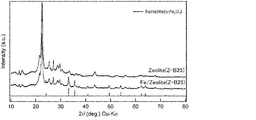
- FIG. 6 is a diagram showing the results of analysis by powder X-ray diffraction of Na- ⁇ zeolite and Na- ⁇ zeolite supporting iron oxide.
- the halogenation catalyst of the present invention is a catalyst for halogenating an aromatic ring, and iron oxide or zinc oxide is supported on a support made of a composite oxide containing silicon and aluminum.
- the reaction system becomes a so-called heterogeneous system, and the catalyst can be easily separated and recovered from the reaction system.
- the composite oxide used in the present invention contains at least silicon (Si), aluminum (Al), and oxygen (O). Specifically, it is a composite oxide containing a silicon oxide and an aluminum oxide, in which at least a part of silicon atoms and aluminum atoms are chemically bonded through oxygen.
- the ratio of silicon atom to aluminum atom (Si / Al) in the composite oxide is preferably 1 to 1000, more preferably 2 to 500, and 5 to 300. Further preferred.
- Specific examples of the complex oxide used in the present invention preferably include zeolite, silica alumina, and aluminosilicate, and more preferably zeolite.
- iron element or zinc element it is preferable that 0.1 to 10 mmol of iron element or zinc element is contained with respect to 1 g of the composite oxide. If the content of the iron element or zinc element relative to 1 g of the composite oxide is less than 0.1 mmol, the reactivity of the halogenation reaction may be lowered, more preferably 0.2 mmol or more, and even more preferably 0. .5 mmol or more. On the other hand, when the content of the iron element or zinc element with respect to 1 g of the composite oxide exceeds 10 mmol, the production cost may increase, more preferably 8 mmol or less, and further preferably 5 mmol or less.
- the iron element and the zinc element are supported in an oxide state on a support made of a composite oxide containing silicon and aluminum.
- iron oxide is supported on a support made of a composite oxide containing silicon and aluminum.
- the iron oxide supported on the carrier is preferably hematite.
- a preferred method for producing the halogenated catalyst of the present invention comprises a first step of mixing a composite oxide containing silicon and aluminum, an iron salt or a zinc salt in a solvent, and a mixture obtained in the first step. A second step of removing the solvent and a third step of heating the mixture from which the solvent has been removed in the second step in an oxidizable atmosphere.
- the iron salt or zinc salt used in the first step is not particularly limited as long as it is a metal salt that becomes an oxide when heated.
- the metal salts include iron chloride, iron nitrate, iron sulfate, iron acetate, iron acetylacetonate, zinc chloride, zinc nitrate, zinc sulfate, zinc acetate, zinc acetylacetonate, etc., which are inexpensive and easily available. Can do.
- the solvent used in the first step is not particularly limited as long as the metal salt is dissolved and can be easily distilled off, and examples thereof include polar organic solvents such as alcohol and water. Of these, alcohols having 3 or less carbon atoms, particularly methanol, are preferred.
- the mixing operation in the first step is not particularly limited.
- the complex oxide may be added to and mixed with the metal salt solution, or the metal salt may be added and dissolved in a mixture of the complex oxide and the solvent.
- the method for removing the solvent in the second step is not particularly limited, and methods such as reduced pressure and heating can be employed.
- the mixture from which the solvent has been removed is heated in an oxidizable atmosphere.
- the oxidizable atmosphere here means an atmosphere in which the metal salt contained in the mixture can be oxidized by heating. Therefore, the atmosphere for heating may be an atmosphere containing oxygen, and heating in the air is simple and preferable.
- the heating temperature is preferably 150 to 500 ° C.
- the heating time is set in relation to the heating temperature, but may be set as appropriate so that the metal salt contained in the mixture becomes an oxide.
- the heating method is not particularly limited, and examples thereof include a method of heating in an oven and a method of heating using a heater.
- a halogen compound can be produced by reacting a compound having an aromatic ring with halogen.
- a hydrogen atom on the aromatic ring is substituted with a halogen atom by an aromatic electrophilic substitution reaction.
- a halogen compound can be obtained with a sufficient yield.
- the compound having an aromatic ring may be a compound having an aromatic ring and at least one of the atoms bonded to the carbon atom of the aromatic ring being a hydrogen atom.
- the aromatic ring include a benzene ring, a naphthalene ring, an anthracene ring, and biphenyl. Further, it may be a 5-membered heteroaromatic ring such as a thiophene ring, a pyrrole ring or a furan ring, or a 6-membered heteroaromatic ring such as a pyridine ring or a pyrimidine ring. Moreover, the compound which these aromatic rings condensed may be sufficient. Examples of the substituent introduced into these aromatic rings include halogen, amino group, hydroxy group, alkoxy group, alkyl group, aryl group, cyano group, nitro group and the like. A plurality of such substituents may be introduced.
- the reaction temperature when producing the halogen compound is usually room temperature to 150 ° C., and the reaction time is appropriately set in relation to the reaction temperature.
- the molar ratio of the starting compound having an aromatic ring and the halogen is not particularly limited. It may be equivalent, or one may be in excess.
- the amount of the halogenated catalyst is not particularly limited.
- the amount of the halogenated catalyst used per 1 mol of the raw material is preferably 0.5 mol or less, and more preferably 0.1 mol or less, as the number of mols of iron element or zinc element.
- the usage-amount of the halogenated catalyst with respect to 1 mol of raw materials is 0.001 mol or more normally as a mol number of an iron element or a zinc element.
- the halogenation catalyst is preferably a bromination catalyst for brominating an aromatic ring.
- the halogen used in the halogenation reaction in the present invention include chlorine, bromine and iodine. Among these, when the halogenated catalyst of the present invention is used for bromination reaction, the reaction proceeds efficiently.
- a preferred embodiment of the present invention is to separate the halogenated catalyst from the reaction system after completion of the reaction. More preferably, the separated halogenated catalyst is reused. Since the halogenated catalyst of the present invention is a so-called heterogeneous catalyst, the halogenated catalyst can be separated by a simple method such as centrifugation or filtration after completion of the halogenation reaction. At this time, the halogenated catalyst separated from the reaction system is preferably reused after being heated. As the heating conditions, the same conditions as in the third step in the method for producing a halogenated catalyst are preferably employed. Thus, even when the halogenated catalyst of the present invention is separated and reused, a halogen compound can be obtained in high yield. Therefore, the halogenated catalyst of the present invention is excellent in terms of environment and cost.
- Example 1 (Examination of metal species supported on a carrier)
- Example 1 is an example in which the reactivity of the halogenation reaction was examined when the metal species supported on the carrier was changed. Specifically, halogenation catalysts each having iron, zinc, manganese, copper, chromium, and cobalt supported on a carrier were prepared, and the reactivity of bromination reaction and chlorination reaction using these catalysts was examined. Further, the halogenated catalyst used in Reaction Example 1-1 was analyzed by a powder X-ray diffraction method.
- Reaction Example 1-2 0.14 g (1 mmol) of zinc chloride (ZnCl 2 ) was used as the metal salt, and in Reaction Example 1-3, manganese (II) chloride tetrahydrate was used as the metal salt.
- Reaction Examples 1-1 to 8 (bromination reaction) Under an argon atmosphere (1 atm), the halogenated catalyst shown in Table 1 (0.01 g), benzene (1 mL) and bromine (0.08 g, 0.5 mmol) were added to a test tube using dichloromethane as a solvent. The mixture was heated and stirred for 1.5 hours. Thereafter, the reaction mixture was treated with an aqueous sodium thiosulfate solution, and organic substances were extracted with hexane. The organic phase was analyzed by gas chromatography to determine the yield of bromobenzene.
- the hematite used in Reaction Example 1-8 is iron (III) oxide manufactured by Wako Pure Chemical Industries, Ltd. The results are shown in Table 1.
- the reaction formula is as shown in the following formula (I).
- Reaction Example 1-9 (bromination reaction) Under an argon atmosphere (1 atm), the halogenated catalyst of Reaction Example 1-1 (0.05 g), benzene (6 mL) and bromine (3.2 g, 20 mmol) were added to a 50 mL eggplant flask, and the top of the eggplant flask was added. A balloon filled with argon was attached. After stirring with heating at 40 ° C. for 2 hours, the reaction mixture was treated with an aqueous sodium thiosulfate solution, and organic substances were extracted with hexane. The organic phase was analyzed by gas chromatography to determine the yield of bromobenzene. The yield of bromobenzene was 87%.
- the reaction formula is as shown in the following formula (II).
- Reaction Example 1-10 (chlorination reaction)
- the halogenated catalyst (0.01 g) and benzene (1 mL) of Reaction Example 1-1 were put in a test tube, and the air in the test tube was replaced with chlorine and sealed, and a chlorine atmosphere (1 atm) was obtained. At this time, the chlorine added to the test tube was 2 mmol.
- the reaction mixture was treated with an aqueous sodium thiosulfate solution, and organic substances were extracted with hexane. The organic phase was analyzed by gas chromatography to determine the yield of chlorobenzene. The yield of chlorobenzene was 77%.
- the reaction formula is as shown in the following formula (III).
- Example 2 is an example in which the reactivity of the halogenation reaction when the carrier was changed was examined. Specifically, except that the support was changed as shown in Table 2, a halogenated catalyst was prepared in the same manner as when the halogenated catalyst of Reaction Example 1-1 was prepared, and the reactivity of the bromination reaction was examined. .
- the halogenation catalyst of Reaction Example 1-1 that is, the halogenation catalyst in which iron oxide is supported on a zeolite carrier was used.
- a halogenated catalyst was prepared using aluminum oxide as a carrier that is not a complex oxide, and in Reaction Example 2-5, silicon dioxide was used as a carrier that was not a complex oxide. is there.
- Example 3 (Examination of reusability)
- Example 3 is an example of examining whether or not the halogenated catalyst can be separated from the reaction system and reused.
- the bromination reaction of benzene was performed using the halogenation catalyst of Reaction Example 1-1, that is, the halogenation catalyst in which iron oxide is supported on a zeolite carrier.
- the reaction solution was filtered through a membrane filter to recover the halogenated catalyst, washed with a very small amount of hexane, and then heated in the atmosphere at 300 ° C. for 1 hour using an electric furnace.
- the halogenated catalyst thus recovered was reused in the next reaction.
- the reactivity of the bromination reaction when this operation was repeated was examined.
- the conditions for the bromination reaction are the same as in Reaction Example 1-1 of Example 1, except that 3 mL of benzene and 0.24 g (1.5 mmol) of bromine were used and the reaction time was 2 hours. The results are shown in Table 3.
- Example 4 is an example in which the reactivity of the bromination reaction when the reaction substrate was changed was examined. Specifically, bromination reaction was carried out using the reaction substrate shown in Table 4 using the halogenation catalyst used in Reaction Example 1-1, that is, the halogenation catalyst in which iron oxide was supported on a zeolite carrier. The conditions for the bromination reaction are as shown in Table 4.
Landscapes
- Chemical & Material Sciences (AREA)
- Organic Chemistry (AREA)
- Engineering & Computer Science (AREA)
- Materials Engineering (AREA)
- Chemical Kinetics & Catalysis (AREA)
- Dispersion Chemistry (AREA)
- Crystallography & Structural Chemistry (AREA)
- Organic Low-Molecular-Weight Compounds And Preparation Thereof (AREA)
- Low-Molecular Organic Synthesis Reactions Using Catalysts (AREA)
- Catalysts (AREA)
Abstract
ケイ素及びアルミニウムを含有する複合酸化物からなる担体に酸化鉄又は酸化亜鉛が担持されてなることを特徴とする芳香環をハロゲン化するためのハロゲン化触媒である。このとき、前記ハロゲン化触媒が芳香環を臭素化するための臭素化触媒であることが好ましい。前記複合酸化物1gに対して0.1~10mmolの鉄元素又は亜鉛元素を含有することも好ましい。前記複合酸化物のケイ素原子とアルミニウム原子との比(Si/Al)が、1~1000であることも好ましい。これによって、ハロゲン化合物を高収率で得ることが可能となる。
Description
本発明は、芳香環をハロゲン化するためのハロゲン化触媒及びその製造方法に関する。また、本発明は、ハロゲン化触媒を用いてハロゲン化合物を製造する方法に関する。
従来、有機化学工業の分野において、ハロゲン化合物は重要な中間体あるいは最終生成物となっており、その製造方法については多くの先行技術が知られている。例えば、最も単純な芳香族化合物であるベンゼンの臭素化反応は、これまで数多く報告されている。
非特許文献1には、酸化水銀及び硫酸の存在下で、ベンゼンと臭素とを反応させブロモベンゼンを合成する方法が記載されている。しかしながら、この方法では、化学量論量以上の酸化水銀を加える必要があった。また、この方法は、酸性条件下で反応を行うため反応後に中和工程が必要になるという問題もあった。
特許文献1には、ラウリル硫酸ナトリウムを触媒として、ベンゼンと臭素とを反応させブロモベンゼンを合成する方法が記載されている。しかしながら、この方法は、反応時間が長いうえに、硫酸水溶液を溶媒としているため反応後に中和工程が必要になるという問題があった。
非特許文献2には、臭化アルミニウムを触媒として、ベンゼンと臭素とを反応させ1,2,4,5-テトラブロモベンゼンを合成する方法が記載されている。また、特許文献2には、鉄粉を触媒として、1,4-ジフルオロベンゼンと臭素とを反応させ2-ブロモ-1,4-ジフルオロベンゼンを合成する方法が記載されている。しかしながら、これらの触媒は反応溶液中に均一状態で溶解しているため、反応後に生成物と分離するのが困難であり、触媒が再利用できないという問題があった。
非特許文献3には、ゼオライトの存在下で、ベンゼンと臭素とを反応させブロモベンゼンを合成する方法が記載されている。しかしながら、この合成法は、ブロモベンゼン及び臭素の量に対して過剰重量のゼオライトが必要であるという問題があった。
J. Org. Chem. 1988, 53, 1799-1800
Russian Journal of Organic Chemistry, 2008, 44(9), 1323-1326
J. Chem. Soc., Perkin Trans. 1, 2000, 2745-2752
本発明は上記課題を解決するためになされたものであり、ハロゲン化合物を高収率で得ることが可能で、かつ回収容易である、芳香環をハロゲン化するためのハロゲン化触媒を提供することを目的とするものである。また、そのようなハロゲン化触媒の製造方法を提供することを目的とする。さらには、そのようなハロゲン化触媒を用いてハロゲン化合物を製造する方法を提供することを目的とする。
上記課題は、ケイ素及びアルミニウムを含有する複合酸化物からなる担体に酸化鉄又は酸化亜鉛が担持されてなることを特徴とする芳香環をハロゲン化するためのハロゲン化触媒を提供することによって解決される。このとき、前記ハロゲン化触媒が芳香環を臭素化するための臭素化触媒であることが好ましい。前記複合酸化物1gに対して0.1~10mmolの鉄元素又は亜鉛元素を含有することも好ましい。前記複合酸化物からなる担体に酸化鉄が担持されてなることも好ましい。
前記複合酸化物のケイ素原子とアルミニウム原子との比(Si/Al)が、1~1000であることも好ましい。前記複合酸化物が、ゼオライトであることも好ましい。
また、上記課題は、上記ハロゲン化触媒の製造方法であって;ケイ素及びアルミニウムを含有する複合酸化物と、鉄塩又は亜鉛塩を溶媒中で混合する第1工程と、前記第1工程で得られた混合物から溶媒を除去する第2工程と、前記第2工程で溶媒が除去された混合物を酸化可能雰囲気下で加熱する第3工程とを備えることを特徴とするハロゲン化触媒の製造方法を提供することによっても解決される。
さらに、上記課題は、上記ハロゲン化触媒を用いたハロゲン化合物の製造方法であって;芳香環を有する化合物とハロゲンとを前記ハロゲン化触媒存在下で反応させることを特徴とするハロゲン化合物の製造方法を提供することによっても解決される。
本発明のハロゲン化触媒によれば、ハロゲン化合物を高収率で得ることが可能となる。また、本発明のハロゲン化触媒は、反応系から分離しやすく回収が容易である。本発明の製造方法によれば、このようなハロゲン化触媒が簡便に得られる。本発明のハロゲン化触媒を用いれば、ハロゲン化合物を簡便に製造することができる。
本発明のハロゲン化触媒は、芳香環をハロゲン化するための触媒であり、ケイ素及びアルミニウムを含有する複合酸化物からなる担体に酸化鉄又は酸化亜鉛が担持されているものである。本発明のハロゲン化触媒を用いて芳香環をハロゲン化すると、反応系がいわゆる不均一系となり、反応系からの触媒の分離回収が容易になる。
ここで本発明で用いられる複合酸化物は、少なくとも、ケイ素(Si)、アルミニウム(Al)、酸素(O)を含有するものである。具体的にはケイ素の酸化物とアルミニウムの酸化物とを含み、少なくとも一部のケイ素原子とアルミニウム原子とが酸素を介し化学的に結合されてなる複合酸化物である。
本発明において、複合酸化物のケイ素原子とアルミニウム原子との比(Si/Al)が、1~1000であることが好適であり、2~500であることがより好適であり、5~300がさらに好適である。本発明で用いられる具体的な複合酸化物としては、好適にはゼオライト、シリカアルミナ、アルミノシリケートを挙げることができ、より好適にはゼオライトである。
また、複合酸化物1gに対して0.1~10mmolの鉄元素又は亜鉛元素を含有することが好適である。複合酸化物1gに対する鉄元素又は亜鉛元素の含有量が0.1mmol未満であるとハロゲン化反応の反応性が低下するおそれがあり、より好適には0.2mmol以上であり、さらに好適には0.5mmol以上である。一方、複合酸化物1gに対する鉄元素又は亜鉛元素の含有量が10mmolを超えると製造コストが上昇するおそれがあり、より好適には8mmol以下であり、さらに好適には5mmol以下である。本発明において、鉄元素及び亜鉛元素はケイ素及びアルミニウムを含有する複合酸化物からなる担体に酸化物の状態で担持されている。
ハロゲン化合物を高収率で得る観点から、ケイ素及びアルミニウムを含有する複合酸化物からなる担体に酸化鉄が担持されてなることが好適である。このとき、担体に担持されている酸化鉄がヘマタイトであることが好ましい。
本発明のハロゲン化触媒の好適な製造方法は、ケイ素及びアルミニウムを含有する複合酸化物と、鉄塩又は亜鉛塩を溶媒中で混合する第1工程と、該第1工程で得られた混合物から溶媒を除去する第2工程と、該第2工程で溶媒が除去された混合物を酸化可能雰囲気下で加熱する第3工程とを備えるものである。
第1工程で用いられる鉄塩又は亜鉛塩は、加熱することにより酸化物となる金属塩であれば特に限定されない。当該金属塩としては、例えば安価で入手容易な塩化鉄、硝酸鉄、硫酸鉄、酢酸鉄、鉄アセチルアセトナート、塩化亜鉛、硝酸亜鉛、硫酸亜鉛、酢酸亜鉛、亜鉛アセチルアセトナートなどを例示することができる。第1工程で用いられる溶媒は、上記金属塩が溶解し、容易に留去させることのできるものであればよく、例えばアルコールなどの極性有機溶媒や水を例示することができる。中でも炭素数が3以下のアルコール、特にメタノールが好適である。また、第1工程における混合操作は特に限定されない。上記金属塩の溶液に複合酸化物を加えて混合してもよいし、複合酸化物及び溶媒の混合物に上記金属塩を加えて溶解させてもよい。
第2工程において溶媒を除去する方法は、特に限定されず、減圧、加熱等の方法を採用することができる。
第3工程において、溶媒が除去された混合物を酸化可能雰囲気下で加熱する。ここでいう酸化可能雰囲気下とは、加熱することによって、上記混合物に含まれる金属塩が酸化することが可能な雰囲気のことである。したがって、加熱する際の雰囲気が酸素を含有する雰囲気であればよく、大気中で加熱するのが簡便であり好ましい。加熱温度は、150~500℃であることが好ましい。加熱時間は加熱温度との関係で設定されるが、上記混合物に含まれる金属塩が酸化物になるように適宜設定すればよい。また、加熱方法は、特に限定はされず、オーブン中で加熱する方法やヒーターを用いて加熱する方法などが例示される。
本発明のハロゲン化触媒を用いて、芳香環を有する化合物とハロゲンとを反応させハロゲン化合物を製造することができる。本発明のハロゲン化触媒を用いると芳香族求電子置換反応により芳香環上の水素原子がハロゲン原子に置換される。そして、収率良くハロゲン化合物を得ることができる。
ここで、芳香環を有する化合物とは、芳香環を有し芳香環の炭素原子に結合している原子の少なくとも1つが水素原子であるものであればよい。芳香環としては、ベンゼン環、ナフタレン環、アントラセン環、ビフェニルなどが例示される。また、チオフェン環、ピロール環、フラン環などの五員複素芳香環、ピリジン環、ピリミジン環などの六員複素芳香環であっても構わない。また、これらの芳香環が縮合した化合物であっても構わない。これらの芳香環に導入される置換基は、ハロゲン、アミノ基、ヒドロキシ基、アルコキシ基、アルキル基、アリール基、シアノ基、ニトロ基などが例示される。当該置換基は複数導入されても構わない。
ハロゲン化合物を製造するときの反応温度は、通常、室温~150℃であり、反応時間は反応温度との関係で適宜設定される。ハロゲン化合物を製造するとき、原料の芳香環を有する化合物とハロゲンとのmol比は特に限定されない。当量であっても構わないし、一方が過剰量であっても構わない。ハロゲン化触媒の量も特に限定されない。原料1molに対するハロゲン化触媒の使用量は、鉄元素又は亜鉛元素のmol数として、0.5mol以下であることが好適あり、0.1mol以下であることがより好適である。また、原料1molに対するハロゲン化触媒の使用量は、鉄元素又は亜鉛元素のmol数として、通常、0.001mol以上である。
本発明において、上記ハロゲン化触媒が芳香環を臭素化するための臭素化触媒であることが好適である。本発明におけるハロゲン化反応に使用されるハロゲンとしては、塩素、臭素、ヨウ素を挙げることができる。中でも本発明のハロゲン化触媒を臭素化反応に用いると効率良く反応が進行する。
また、本発明の好適な実施形態は、反応終了後に反応系からハロゲン化触媒を分離することである。より好適には、分離したハロゲン化触媒を再使用することである。本発明のハロゲン化触媒は、いわゆる不均一系触媒であるため、ハロゲン化反応の終了後、遠心分離やろ過などの簡易な方法でハロゲン化触媒を分離することができる。このとき、反応系から分離されたハロゲン化触媒は、加熱してから再使用することが好ましい。加熱条件としてはハロゲン化触媒の製造方法における上記第3工程と同じ条件が好適に採用される。このように、本発明のハロゲン化触媒を分離して再使用した場合にもハロゲン化合物を高収率で得ることができる。したがって本発明のハロゲン化触媒は、環境面、コスト面からも優れている。
以下、実施例を用いて本発明を更に具体的に説明する。
実施例1(担体に担持させる金属種の検討)
実施例1は、担体に担持させる金属種を変えた場合のハロゲン化反応の反応性を検討した例である。具体的には、担体に鉄、亜鉛、マンガン、銅、クロム、コバルトをそれぞれ担持させたハロゲン化触媒を調製し、それら触媒を用いた臭素化反応及び塩素化反応の反応性について検討した。また、反応例1-1で用いたハロゲン化触媒については粉末X線回折法による分析を行った。
実施例1は、担体に担持させる金属種を変えた場合のハロゲン化反応の反応性を検討した例である。具体的には、担体に鉄、亜鉛、マンガン、銅、クロム、コバルトをそれぞれ担持させたハロゲン化触媒を調製し、それら触媒を用いた臭素化反応及び塩素化反応の反応性について検討した。また、反応例1-1で用いたハロゲン化触媒については粉末X線回折法による分析を行った。
[ハロゲン化触媒の調製]
金属塩として塩化鉄(III)六水和物(FeCl3・6H2O)0.27g(1mmol)を10mlのメタノールに溶かした。得られた溶液に、担体としてゼオライトを1g入れ、室温にて1時間撹拌した。その後、エバポレーターを用いてメタノールを留去し、電気炉を用いて大気中、300℃で1時間加熱し、反応例1-1に用いるハロゲン化触媒を得た。また、表1に示すように、反応例1-2では金属塩として塩化亜鉛(ZnCl2)0.14g(1mmol)を用い、反応例1-3では金属塩として塩化マンガン(II)四水和物(MnCl2・4H2O)0.20g(1mmol)を用い、反応例1-4では金属塩として塩化銅(II)(CuCl2)0.13g(1mmol)を用い、反応例1-5では金属塩として塩化クロム(III)六水和物(CrCl3・6H2O)0.27g(1mmol)を用い、反応例1-6では金属塩として塩化コバルト(II)六水和物(CoCl2・6H2O)0.24g(1mmol)を用いてぞれぞれハロゲン化触媒を得た。ゼオライトはNa-βゼオライト(触媒学会参照触媒「JRC-Z-B25」、SiO2/Al2O3=25/1)を用いた。
金属塩として塩化鉄(III)六水和物(FeCl3・6H2O)0.27g(1mmol)を10mlのメタノールに溶かした。得られた溶液に、担体としてゼオライトを1g入れ、室温にて1時間撹拌した。その後、エバポレーターを用いてメタノールを留去し、電気炉を用いて大気中、300℃で1時間加熱し、反応例1-1に用いるハロゲン化触媒を得た。また、表1に示すように、反応例1-2では金属塩として塩化亜鉛(ZnCl2)0.14g(1mmol)を用い、反応例1-3では金属塩として塩化マンガン(II)四水和物(MnCl2・4H2O)0.20g(1mmol)を用い、反応例1-4では金属塩として塩化銅(II)(CuCl2)0.13g(1mmol)を用い、反応例1-5では金属塩として塩化クロム(III)六水和物(CrCl3・6H2O)0.27g(1mmol)を用い、反応例1-6では金属塩として塩化コバルト(II)六水和物(CoCl2・6H2O)0.24g(1mmol)を用いてぞれぞれハロゲン化触媒を得た。ゼオライトはNa-βゼオライト(触媒学会参照触媒「JRC-Z-B25」、SiO2/Al2O3=25/1)を用いた。
[粉末X線回折法による分析]
X線回折装置を用いて、Cu-Kα線による粉末X線回折法により、上記Na-βゼオライト及び反応例1-1に用いるハロゲン化触媒について分析を行った。その結果を図1に示す。図1に示すように、反応例1-1に用いるハロゲン化触媒においては、ヘマタイト由来のピークが観察され、当該ハロゲン化触媒はヘマタイト(Fe2O3)を含むことがわかった。X線回折装置は、株式会社リガク社製のRINT-2000を用いた。
X線回折装置を用いて、Cu-Kα線による粉末X線回折法により、上記Na-βゼオライト及び反応例1-1に用いるハロゲン化触媒について分析を行った。その結果を図1に示す。図1に示すように、反応例1-1に用いるハロゲン化触媒においては、ヘマタイト由来のピークが観察され、当該ハロゲン化触媒はヘマタイト(Fe2O3)を含むことがわかった。X線回折装置は、株式会社リガク社製のRINT-2000を用いた。
反応例1-1~8(臭素化反応)
アルゴン雰囲気下(1atm)で、ジクロロメタンを溶媒として表1に示したハロゲン化触媒(0.01g)、ベンゼン(1mL)及び臭素(0.08g、0.5mmol)を試験管に加え、40℃で1.5時間加熱撹拌した。その後、反応混合物をチオ硫酸ナトリウム水溶液で処理し、ヘキサンで有機物を抽出した。有機相をガスクロマトグラフィーで分析し、ブロモベンゼンの収率を求めた。反応例1-8で用いたヘマタイトは和光純薬工業株式会社製の酸化鉄(III)である。結果を表1に示す。反応式は下記式(I)の通りである。
アルゴン雰囲気下(1atm)で、ジクロロメタンを溶媒として表1に示したハロゲン化触媒(0.01g)、ベンゼン(1mL)及び臭素(0.08g、0.5mmol)を試験管に加え、40℃で1.5時間加熱撹拌した。その後、反応混合物をチオ硫酸ナトリウム水溶液で処理し、ヘキサンで有機物を抽出した。有機相をガスクロマトグラフィーで分析し、ブロモベンゼンの収率を求めた。反応例1-8で用いたヘマタイトは和光純薬工業株式会社製の酸化鉄(III)である。結果を表1に示す。反応式は下記式(I)の通りである。


表1に示すように、ゼオライト担体に担持させる金属種として鉄を用いた場合には、ベンゼンの臭素化反応が、ほぼ定量的に進行した(反応例1-1)。また、ゼオライト担体に担持させる金属種として亜鉛(反応例1-2)を用いた場合も高収率でブロモベンゼンを得ることができた。一方、ゼオライト担体に担持させる金属種としてマンガン(反応例1-3)、銅(反応例1-4)、クロム(反応例1-5)、コバルト(反応例1-6)を用いた場合の収率は低かった。また、ベンゼンの臭素化反応の触媒として単にゼオライトを用いた場合も収率は低かった(反応例1-7)。ベンゼンの臭素化反応の触媒として単に酸化鉄(ヘマタイト)を用いた場合には、臭素化反応はほとんど進行しなかった(反応例1-8)。
反応例1-9(臭素化反応)
アルゴン雰囲気下(1atm)で、反応例1-1のハロゲン化触媒(0.05g)、ベンゼン(6mL)及び臭素(3.2g、20mmol)を50mLのナスフラスコに加え、当該ナスフラスコの上部にアルゴンを入れた風船を付けた。40℃で2時間加熱撹拌した後、反応混合物をチオ硫酸ナトリウム水溶液で処理し、ヘキサンで有機物を抽出した。有機相をガスクロマトグラフィーで分析し、ブロモベンゼンの収率を求めた。ブロモベンゼンの収率は87%であった。反応式は下記式(II)の通りである。
アルゴン雰囲気下(1atm)で、反応例1-1のハロゲン化触媒(0.05g)、ベンゼン(6mL)及び臭素(3.2g、20mmol)を50mLのナスフラスコに加え、当該ナスフラスコの上部にアルゴンを入れた風船を付けた。40℃で2時間加熱撹拌した後、反応混合物をチオ硫酸ナトリウム水溶液で処理し、ヘキサンで有機物を抽出した。有機相をガスクロマトグラフィーで分析し、ブロモベンゼンの収率を求めた。ブロモベンゼンの収率は87%であった。反応式は下記式(II)の通りである。

反応例1-10(塩素化反応)
反応例1-1のハロゲン化触媒(0.01g)及びベンゼン(1mL)を試験管に入れ、当該試験管内の空気を塩素で置換して密閉し塩素雰囲気下(1atm)にした。このとき試験管に加えた塩素は2mmolであった。40℃で1.5時間加熱撹拌した後、反応混合物をチオ硫酸ナトリウム水溶液で処理し、ヘキサンで有機物を抽出した。有機相をガスクロマトグラフィーで分析し、クロロベンゼンの収率を求めた。クロロベンゼンの収率は77%であった。反応式は下記式(III)の通りである。
反応例1-1のハロゲン化触媒(0.01g)及びベンゼン(1mL)を試験管に入れ、当該試験管内の空気を塩素で置換して密閉し塩素雰囲気下(1atm)にした。このとき試験管に加えた塩素は2mmolであった。40℃で1.5時間加熱撹拌した後、反応混合物をチオ硫酸ナトリウム水溶液で処理し、ヘキサンで有機物を抽出した。有機相をガスクロマトグラフィーで分析し、クロロベンゼンの収率を求めた。クロロベンゼンの収率は77%であった。反応式は下記式(III)の通りである。

実施例2(担体の検討)
実施例2は、担体を変えた場合のハロゲン化反応の反応性を検討した例である。具体的には、担体を表2に示すように変更した以外は反応例1-1のハロゲン化触媒を調製したときと同じ方法でハロゲン化触媒を調製し、臭素化反応の反応性を検討した。ここで、反応例2-1では、反応例1-1のハロゲン化触媒、すなわちゼオライト担体に酸化鉄が担持されなるハロゲン化触媒を用いた。反応例2-2で用いたアルミノシリケートは「MCM-41」(SiO2/Al2O3=74/1)であり、反応例2-3で用いたシリカアルミナは触媒学会参照触媒「JRC-SAL-3」(SiO2/Al2O3=87/13)である。また、反応例2-4では複合酸化物ではない担体として酸化アルミニウムを用いてハロゲン化触媒を調製した例であり、反応例2-5では複合酸化物ではない担体として二酸化ケイ素を用いた例である。
実施例2は、担体を変えた場合のハロゲン化反応の反応性を検討した例である。具体的には、担体を表2に示すように変更した以外は反応例1-1のハロゲン化触媒を調製したときと同じ方法でハロゲン化触媒を調製し、臭素化反応の反応性を検討した。ここで、反応例2-1では、反応例1-1のハロゲン化触媒、すなわちゼオライト担体に酸化鉄が担持されなるハロゲン化触媒を用いた。反応例2-2で用いたアルミノシリケートは「MCM-41」(SiO2/Al2O3=74/1)であり、反応例2-3で用いたシリカアルミナは触媒学会参照触媒「JRC-SAL-3」(SiO2/Al2O3=87/13)である。また、反応例2-4では複合酸化物ではない担体として酸化アルミニウムを用いてハロゲン化触媒を調製した例であり、反応例2-5では複合酸化物ではない担体として二酸化ケイ素を用いた例である。
これらのハロゲン化触媒を用いてベンゼンの臭素化反応を行った。その方法は、実施例1の臭素化反応において、反応時間を2時間にした以外は実施例1の反応例1-1と同様である。結果を表2に示す。
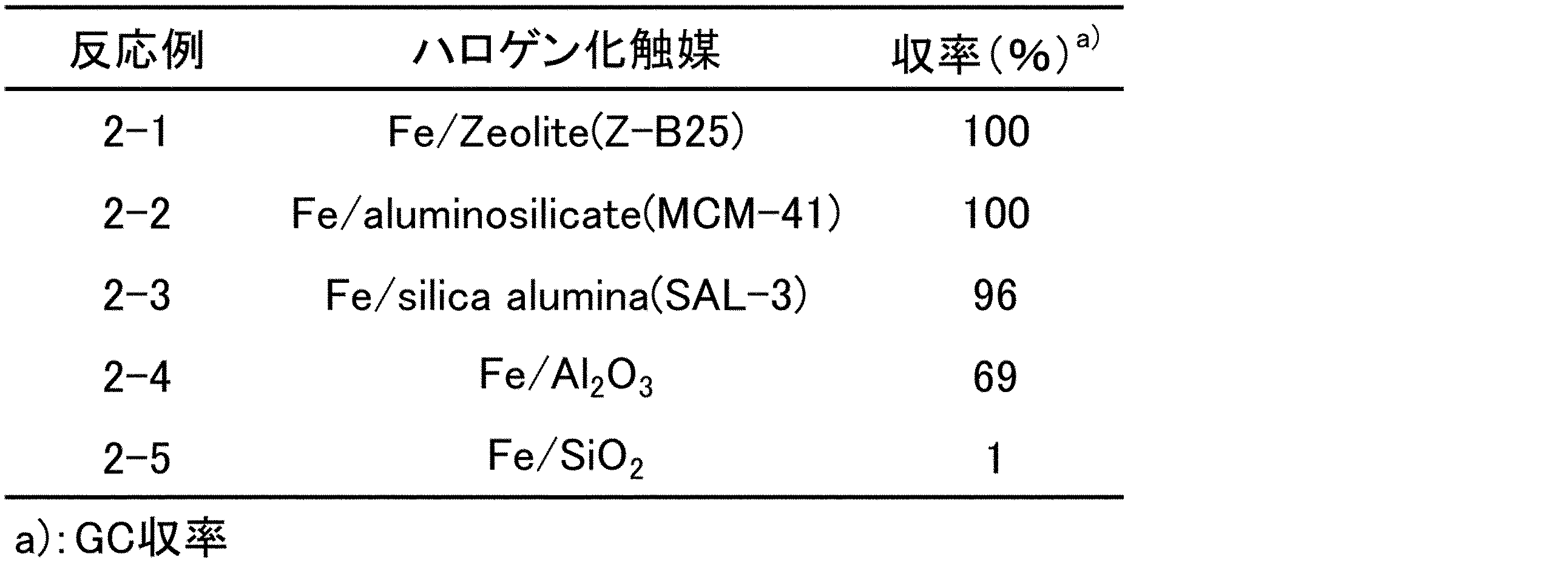
表2に示すように、酸化鉄を担持させる担体としてゼオライトを用いた場合には、ベンゼンの臭素化反応が定量的に進行した(反応例2-1)。また、アルミノシリケートを担体として用いた場合でもベンゼンの臭素化反応が定量的に進行した(反応例2-2)。さらに、シリカアルミナを担体として用いた場合も、ベンゼンの臭素化反応が、ほぼ定量的に進行した(反応例2-3)。一方、酸化アルミニウムを担体として用いた場合の収率は70%程度であり(反応例2-4)、二酸化ケイ素を担体として用いた場合には、臭素化反応はほとんど進行しなかった(反応例2-5)。
実施例3(再使用可能性の検討)
実施例3は、反応系からハロゲン化触媒を分離して再使用することが可能かどうかについて検討した例である。
実施例3は、反応系からハロゲン化触媒を分離して再使用することが可能かどうかについて検討した例である。
まず、反応例1-1のハロゲン化触媒、すなわちゼオライト担体に酸化鉄が担持されなるハロゲン化触媒を用いてベンゼンの臭素化反応を行った。そして、反応後に反応溶液をメンブレンフィルターでろ過してハロゲン化触媒を回収し、極少量のヘキサンで洗浄してから電気炉を用いて大気中、300℃で1時間加熱した。こうして回収されたハロゲン化触媒を次の反応に再使用した。この操作を繰り返し行った場合の臭素化反応の反応性を検討した。臭素化反応の条件は、ベンゼンを3mL及び臭素を0.24g(1.5mmol)にして反応時間を2時間にした以外は実施例1の反応例1-1と同じである。結果を表3に示す。

表3に示すように、4回繰り返し使用しても臭素化反応は進行しブロモベンゼンを得ることができ、しかも反応が定量的に進行した。これにより、反応系からハロゲン化触媒を回収して再使用することが可能であることが確認された。
実施例4(反応基質の検討)
実施例4は、反応基質を変えた場合の臭素化反応の反応性を検討した例である。具体的には、反応例1-1で用いたハロゲン化触媒、すなわちゼオライト担体に酸化鉄が担持されなるハロゲン化触媒を用いて、表4に示す反応基質を用いて臭素化反応を行った。臭素化反応の条件は、表4に示す通りである。
実施例4は、反応基質を変えた場合の臭素化反応の反応性を検討した例である。具体的には、反応例1-1で用いたハロゲン化触媒、すなわちゼオライト担体に酸化鉄が担持されなるハロゲン化触媒を用いて、表4に示す反応基質を用いて臭素化反応を行った。臭素化反応の条件は、表4に示す通りである。
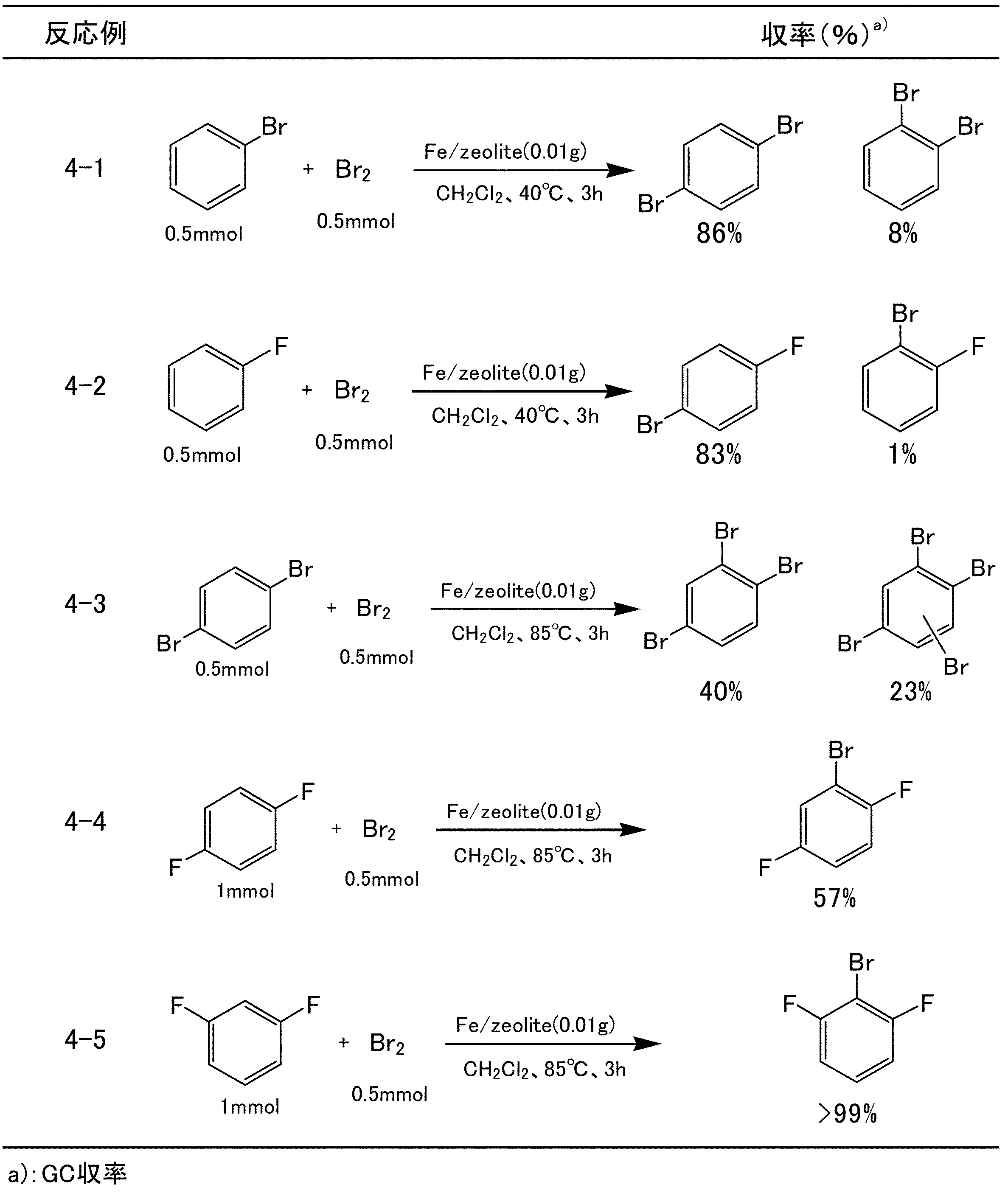
表4に示す条件でブロモベンゼンの臭素化反応を行った結果、ブロモベンゼンは高収率で臭素化されp-及びo-ジブロモベンゼンが得られた(反応例4-1)。また、フルオロベンゼンの臭素化反応を行った結果、高収率かつ高選択的にp-臭素化反応が進行した(反応例4-2)。表4に示す条件で1,4-ジブロモベンゼンの臭素化反応を行うと、モノ及びジ臭素化反応が進行した(反応例4-3)。また、一般的に、フッ素置換ベンゼンの臭素化反応性は臭素置換ベンゼンに比べて低いことが知られているが、反応例1-1のハロゲン化触媒を用いて臭素化反応を行うとフッ素置換ベンゼンでも反応が進行し、収率も悪くはなかった(反応例4-4、4-5)。
Claims (8)
- ケイ素及びアルミニウムを含有する複合酸化物からなる担体に酸化鉄又は酸化亜鉛が担持されてなることを特徴とする芳香環をハロゲン化するためのハロゲン化触媒。
- 前記ハロゲン化触媒が芳香環を臭素化するための臭素化触媒である請求項1に記載のハロゲン化触媒。
- 前記複合酸化物1gに対して0.1~10mmolの鉄元素又は亜鉛元素を含有する請求項1又は2に記載のハロゲン化触媒。
- 前記複合酸化物からなる担体に酸化鉄が担持されてなる請求項1~3のいずれかに記載のハロゲン化触媒。
- 前記複合酸化物のケイ素原子とアルミニウム原子との比(Si/Al)が、1~1000である請求項1~4のいずれかに記載のハロゲン化触媒。
- 前記複合酸化物が、ゼオライトである請求項1~5のいずれかに記載のハロゲン化触媒。
- 請求項1~6のいずれかに記載のハロゲン化触媒の製造方法であって;
ケイ素及びアルミニウムを含有する複合酸化物と、鉄塩又は亜鉛塩を溶媒中で混合する第1工程と、
前記第1工程で得られた混合物から溶媒を除去する第2工程と、
前記第2工程で溶媒が除去された混合物を酸化可能雰囲気下で加熱する第3工程とを備えることを特徴とするハロゲン化触媒の製造方法。 - 請求項1~6のいずれかに記載のハロゲン化触媒を用いたハロゲン化合物の製造方法であって;
芳香環を有する化合物とハロゲンとを前記ハロゲン化触媒存在下で反応させることを特徴とするハロゲン化合物の製造方法。
Applications Claiming Priority (2)
| Application Number | Priority Date | Filing Date | Title |
|---|---|---|---|
| JP2011-263954 | 2011-12-01 | ||
| JP2011263954 | 2011-12-01 |
Publications (1)
| Publication Number | Publication Date |
|---|---|
| WO2013081034A1 true WO2013081034A1 (ja) | 2013-06-06 |
Family
ID=48535484
Family Applications (1)
| Application Number | Title | Priority Date | Filing Date |
|---|---|---|---|
| PCT/JP2012/080866 Ceased WO2013081034A1 (ja) | 2011-12-01 | 2012-11-29 | ハロゲン化触媒及びその製造方法 |
Country Status (2)
| Country | Link |
|---|---|
| JP (1) | JPWO2013081034A1 (ja) |
| WO (1) | WO2013081034A1 (ja) |
Cited By (2)
| Publication number | Priority date | Publication date | Assignee | Title |
|---|---|---|---|---|
| CN105566183A (zh) * | 2016-03-21 | 2016-05-11 | 太原理工大学 | 一种4,4’-二巯基二苯硫醚的制备方法 |
| CN115141079A (zh) * | 2022-08-11 | 2022-10-04 | 安徽东至广信农化有限公司 | 一种氯化苯生产中降低杂质二氯苯的方法 |
Families Citing this family (1)
| Publication number | Priority date | Publication date | Assignee | Title |
|---|---|---|---|---|
| CN112194562A (zh) * | 2020-09-03 | 2021-01-08 | 潍坊摩根化工有限公司 | 一种溴代苯的制备方法 |
Citations (3)
| Publication number | Priority date | Publication date | Assignee | Title |
|---|---|---|---|---|
| JPH01503066A (ja) * | 1987-03-25 | 1989-10-19 | イーストマン コダック カンパニー | 芳香族化合物の改良蒸気相臭素化 |
| JPH07330665A (ja) * | 1994-06-03 | 1995-12-19 | Mitsubishi Chem Corp | ハロゲン化芳香族化合物の製造法 |
| EP0866046A1 (en) * | 1997-03-20 | 1998-09-23 | Contract Chemicals Limited | Catalytic process for selective aromatic bromination |
-
2012
- 2012-11-29 WO PCT/JP2012/080866 patent/WO2013081034A1/ja not_active Ceased
- 2012-11-29 JP JP2013547200A patent/JPWO2013081034A1/ja active Pending
Patent Citations (3)
| Publication number | Priority date | Publication date | Assignee | Title |
|---|---|---|---|---|
| JPH01503066A (ja) * | 1987-03-25 | 1989-10-19 | イーストマン コダック カンパニー | 芳香族化合物の改良蒸気相臭素化 |
| JPH07330665A (ja) * | 1994-06-03 | 1995-12-19 | Mitsubishi Chem Corp | ハロゲン化芳香族化合物の製造法 |
| EP0866046A1 (en) * | 1997-03-20 | 1998-09-23 | Contract Chemicals Limited | Catalytic process for selective aromatic bromination |
Non-Patent Citations (1)
| Title |
|---|
| J. ZABICKY ET AL.: "Molecular sieves as catalysts for aromatic bromination", ZEOLITES, vol. 7, no. 6, 1987, pages 499 - 502, XP055070942 * |
Cited By (2)
| Publication number | Priority date | Publication date | Assignee | Title |
|---|---|---|---|---|
| CN105566183A (zh) * | 2016-03-21 | 2016-05-11 | 太原理工大学 | 一种4,4’-二巯基二苯硫醚的制备方法 |
| CN115141079A (zh) * | 2022-08-11 | 2022-10-04 | 安徽东至广信农化有限公司 | 一种氯化苯生产中降低杂质二氯苯的方法 |
Also Published As
| Publication number | Publication date |
|---|---|
| JPWO2013081034A1 (ja) | 2015-04-27 |
Similar Documents
| Publication | Publication Date | Title |
|---|---|---|
| WO2012009818A1 (en) | Protected aldehydes for use as intermediates in chemical syntheses, and processes for their preparation | |
| Wu et al. | P, N, N-Pincer nickel-catalyzed cross-coupling of aryl fluorides and chlorides | |
| JP5210639B2 (ja) | ビフェニル誘導体の製造方法 | |
| JP2005510550A (ja) | 3,3’,5,5’,6,6’−ヘキサアルキル−2,2’−ビフェノール、3,3’,4,4’,5,5’−ヘキサアルキル−2,2’−ビフェノール、および3,3’,4,4’,5,5’,6,6’−オクタアルキル−2,2’−ビフェノールの調製法 | |
| WO2013081034A1 (ja) | ハロゲン化触媒及びその製造方法 | |
| CN104098607B (zh) | 含三环己基膦的单膦单氮杂环卡宾镍(ii)配合物及其应用 | |
| JP2007230999A (ja) | 置換芳香族ニトリル化合物およびその製造方法 | |
| JP5358184B2 (ja) | 活性炭素原子のルイス酸触媒によるハロゲン化 | |
| Shirvandi et al. | Transition-metal-catalyzed one-pot selenylation of electrophilic arylating agents using triphenyltin chloride/Se as a phenylselenating agent | |
| JP6498048B2 (ja) | 含フッ素有機化合物及びこれとグリニャール試薬によるビアリール化合物の製造方法 | |
| JP2008255037A (ja) | ビフェニル誘導体の製造方法 | |
| WO2015170688A1 (ja) | 金属担持多孔性配位高分子触媒 | |
| CN111039923A (zh) | 2,6-二咔唑基吡啶的制备方法 | |
| CN106431822B (zh) | 3,3’,4,4’-四氟联苯工业生产方法 | |
| CN110944965A (zh) | 非均相钴催化制备烷基化或氟代烷基化、氯代烷基化、和氟代氯代烷基化化合物的方法 | |
| WO2004022512A1 (ja) | p−ジクロロベンゼンの製造方法 | |
| JP2005255561A (ja) | 多置換ピリミジン及びその選択的製造方法 | |
| JP2753858B2 (ja) | ニトリル類の製造法 | |
| JP2006104200A (ja) | ペンタフルオロスルファニルナフタレンの合成 | |
| JP2016169165A (ja) | 2,6−ジフルオロベンゾイル蟻酸化合物の製造方法 | |
| JP2008174519A (ja) | テトラヒドロピランを溶媒とする対称ビフェニル化合物の製造方法 | |
| JP5397907B2 (ja) | 光学活性リン化合物の製造方法 | |
| JP2009028645A (ja) | パラジウム不均一系触媒 | |
| JP4316854B2 (ja) | 光学活性多価フェノール誘導体、その製造方法及びその用途 | |
| WO2023190846A1 (ja) | フッ素含有芳香族化合物の製造方法 |
Legal Events
| Date | Code | Title | Description |
|---|---|---|---|
| 121 | Ep: the epo has been informed by wipo that ep was designated in this application |
Ref document number: 12854241 Country of ref document: EP Kind code of ref document: A1 |
|
| ENP | Entry into the national phase |
Ref document number: 2013547200 Country of ref document: JP Kind code of ref document: A |
|
| NENP | Non-entry into the national phase |
Ref country code: DE |
|
| 122 | Ep: pct application non-entry in european phase |
Ref document number: 12854241 Country of ref document: EP Kind code of ref document: A1 |