WO2013076970A1 - 内面被覆鋼管 - Google Patents
内面被覆鋼管 Download PDFInfo
- Publication number
- WO2013076970A1 WO2013076970A1 PCT/JP2012/007453 JP2012007453W WO2013076970A1 WO 2013076970 A1 WO2013076970 A1 WO 2013076970A1 JP 2012007453 W JP2012007453 W JP 2012007453W WO 2013076970 A1 WO2013076970 A1 WO 2013076970A1
- Authority
- WO
- WIPO (PCT)
- Prior art keywords
- epoxy resin
- steel pipe
- resin layer
- layer
- polyolefin
- Prior art date
- Legal status (The legal status is an assumption and is not a legal conclusion. Google has not performed a legal analysis and makes no representation as to the accuracy of the status listed.)
- Ceased
Links
Classifications
-
- B—PERFORMING OPERATIONS; TRANSPORTING
- B32—LAYERED PRODUCTS
- B32B—LAYERED PRODUCTS, i.e. PRODUCTS BUILT-UP OF STRATA OF FLAT OR NON-FLAT, e.g. CELLULAR OR HONEYCOMB, FORM
- B32B1/00—Layered products having a non-planar shape
- B32B1/08—Tubular products
-
- B—PERFORMING OPERATIONS; TRANSPORTING
- B32—LAYERED PRODUCTS
- B32B—LAYERED PRODUCTS, i.e. PRODUCTS BUILT-UP OF STRATA OF FLAT OR NON-FLAT, e.g. CELLULAR OR HONEYCOMB, FORM
- B32B15/00—Layered products comprising a layer of metal
- B32B15/04—Layered products comprising a layer of metal comprising metal as the main or only constituent of a layer, which is next to another layer of the same or of a different material
- B32B15/08—Layered products comprising a layer of metal comprising metal as the main or only constituent of a layer, which is next to another layer of the same or of a different material of synthetic resin
- B32B15/085—Layered products comprising a layer of metal comprising metal as the main or only constituent of a layer, which is next to another layer of the same or of a different material of synthetic resin comprising polyolefins
-
- B—PERFORMING OPERATIONS; TRANSPORTING
- B32—LAYERED PRODUCTS
- B32B—LAYERED PRODUCTS, i.e. PRODUCTS BUILT-UP OF STRATA OF FLAT OR NON-FLAT, e.g. CELLULAR OR HONEYCOMB, FORM
- B32B15/00—Layered products comprising a layer of metal
- B32B15/18—Layered products comprising a layer of metal comprising iron or steel
-
- C—CHEMISTRY; METALLURGY
- C22—METALLURGY; FERROUS OR NON-FERROUS ALLOYS; TREATMENT OF ALLOYS OR NON-FERROUS METALS
- C22C—ALLOYS
- C22C38/00—Ferrous alloys, e.g. steel alloys
- C22C38/02—Ferrous alloys, e.g. steel alloys containing silicon
-
- C—CHEMISTRY; METALLURGY
- C22—METALLURGY; FERROUS OR NON-FERROUS ALLOYS; TREATMENT OF ALLOYS OR NON-FERROUS METALS
- C22C—ALLOYS
- C22C38/00—Ferrous alloys, e.g. steel alloys
- C22C38/04—Ferrous alloys, e.g. steel alloys containing manganese
-
- B—PERFORMING OPERATIONS; TRANSPORTING
- B32—LAYERED PRODUCTS
- B32B—LAYERED PRODUCTS, i.e. PRODUCTS BUILT-UP OF STRATA OF FLAT OR NON-FLAT, e.g. CELLULAR OR HONEYCOMB, FORM
- B32B2255/00—Coating on the layer surface
- B32B2255/06—Coating on the layer surface on metal layer
-
- B—PERFORMING OPERATIONS; TRANSPORTING
- B32—LAYERED PRODUCTS
- B32B—LAYERED PRODUCTS, i.e. PRODUCTS BUILT-UP OF STRATA OF FLAT OR NON-FLAT, e.g. CELLULAR OR HONEYCOMB, FORM
- B32B2255/00—Coating on the layer surface
- B32B2255/26—Polymeric coating
-
- B—PERFORMING OPERATIONS; TRANSPORTING
- B32—LAYERED PRODUCTS
- B32B—LAYERED PRODUCTS, i.e. PRODUCTS BUILT-UP OF STRATA OF FLAT OR NON-FLAT, e.g. CELLULAR OR HONEYCOMB, FORM
- B32B2307/00—Properties of the layers or laminate
- B32B2307/70—Other properties
- B32B2307/714—Inert, i.e. inert to chemical degradation, corrosion
-
- B—PERFORMING OPERATIONS; TRANSPORTING
- B32—LAYERED PRODUCTS
- B32B—LAYERED PRODUCTS, i.e. PRODUCTS BUILT-UP OF STRATA OF FLAT OR NON-FLAT, e.g. CELLULAR OR HONEYCOMB, FORM
- B32B2597/00—Tubular articles, e.g. hoses, pipes
Definitions
- the present invention relates to an inner surface-coated steel pipe excellent in alcohol resistance.
- the present invention is an inner surface coating excellent in bioalcohol corrosion resistance suitable for use in parts directly contacting with bioalcohol in pipes for plants for purifying bioalcohol such as bioethanol and steel pipe materials used for pipeline transportation It relates to steel pipes.
- bioethanol is produced mainly by decomposing and purifying sugars such as corn and wheat.
- it has been widely used all over the world as an alternative fuel for petroleum (gasoline) and as a fuel mixed with gasoline, and its usage tends to increase year by year.
- the amount of bioethanol handled is increasing, even though the amount of bioethanol is high, that is, stress corrosion cracking (SCC)
- SCC stress corrosion cracking
- Patent Document 1 discloses that a steel material for tanks for biofuels that has been subjected to zinc-nickel plating containing 5 to 25% of Ni, or hexavalent chromium on this plating. Techniques for performing chemical conversion treatments that do not contain have been proposed. According to this technique, corrosion resistance to methanol-containing gasoline is considered to be good.
- Non-Patent Document 1 two types of inhibitors are examined for SCC of steel in a simulated bioethanol solution. It has been reported that the addition of these inhibitors alleviates such SCC phenomenon.
- Patent Document 2 discloses an inner surface coated steel pipe in which an adhesive modified polyolefin resin layer and a polyolefin resin layer are provided on a primer layer of about 10 ⁇ m.
- Patent Document 1 The zinc-nickel plating disclosed in Patent Document 1 is considered to be effective in improving the corrosion resistance.
- Zn-Ni plating needs to be processed by electroplating, it can be applied to small fuel tanks for automobiles, for example. Even if there is no problem, large structures, for example, thick steel materials such as storage tanks and line pipes with a capacity of 1000 kL or more, are extremely impossible to apply because the processing costs become enormous.
- Non-Patent Document 1 the addition of an inhibitor certainly alleviates corrosion phenomena such as SCC, but the effect is not sufficient. This is because the inhibitor is adsorbed on the surface and exerts its effect, but its adsorption behavior is greatly influenced by the surrounding pH and so on, and if corrosion occurs locally, adsorption may not be sufficient. This is possible.
- the polyolefin resin inner surface coated steel pipe described in Patent Document 2 is intended for cold water and hot water, but not for bioalcohol such as bioethanol. Therefore, in this inner surface coating configuration, durability was inferior from the viewpoint of bioethanol resistance.
- the anticorrosion method by plating is not suitable for large structures, and the addition of an inhibitor is not effective in reducing corrosion on average, and the inner surface coating is also bioethanol for conventional water supply.
- the durability was not sufficient. Therefore, in order to apply to the inner surface of a pipe steel pipe or the like, it is necessary to improve the corrosion resistance of the inner surface coating layer in a bioethanol environment.
- the present invention advantageously responds to the above requirements, and an object of the present invention is to propose an inner surface-coated steel pipe excellent in alcohol resistance with improved corrosion resistance to bioalcohol such as bioethanol on the inner surface of the steel pipe.
- an epoxy resin layer hardened with an amine-based curing agent on the surface of the steel layer as an underlayer of the polyolefin layer, particularly an amine containing an appropriate amount of an oxyacid salt such as tungsten, vanadium, molybdenum and zirconium.
- the present invention is based on the above findings.
- the gist configuration of the present invention is as follows. 1. An internally coated steel pipe having an epoxy resin layer on the inner surface of the steel pipe, and a polyolefin layer having a thickness of 300 to 5000 ⁇ m formed thereon, The epoxy resin layer has a thickness of 20 to 200 ⁇ m and is cured by an amine-based curing agent. In the epoxy resin layer, at least one selected from oxyacid salts of tungsten, vanadium, molybdenum, and zirconium is used. An internally coated steel pipe characterized by containing 0.5 to 30% by mass.
- An internally coated steel pipe having an epoxy resin layer on the inner surface of the steel pipe, and a polyolefin layer having a thickness of 300 to 5000 ⁇ m formed thereon,
- the epoxy resin layer has a thickness of 20 to 200 ⁇ m and is cured with an amine-based curing agent, and in the epoxy resin layer, at least one selected from the oxyacid salts of tungsten, vanadium, molybdenum, and zirconium
- An inner surface-coated steel pipe comprising 0.5 to 40% by mass in total of at least one selected from oxides of tungsten, vanadium, molybdenum and zirconium and oxides of nickel, zinc and magnesium.
- the inner coating according to the present invention When the inner coating according to the present invention is applied to the inner coating of a steel pipe for pipelines of alcohol, especially bioethanol, it can be used for a longer period of time compared to conventional coating layers, and bioethanol caused by corrosion In addition to avoiding leakage accidents, it is possible to provide these facilities at low cost, which is extremely useful in industry.
- the present invention will be specifically described below. First, the inner surface coating layer will be described in detail.
- the main component in bioethanol is 95% or more ethanol. Ethanol dissolves part of the organic resin layer, but polyolefin resin hardly dissolves and is extremely stable even in ethanol.
- the polyolefin here refers to polyethylene, polypropylene, polybutene and the like. From the viewpoint of cost, polyethylene is preferable from the viewpoint of stability, and polypropylene is more preferable from the viewpoint of heat resistance in an environment where temperature is applied. Moreover, you may use the modified polyolefin which has adhesiveness about a polyolefin layer.
- the modified polyolefin resin a maleic anhydride-modified polyolefin resin is preferable because it exhibits particularly high adhesiveness.
- acrylic acid or carboxylic acid-modified polyolefin resins and ethylene copolymers are preferable.
- a system adhesive or the like is also suitable.
- it is also effective to divide the polyolefin layer into two layers and use a two-layer structure in which a modified polyolefin resin having higher adhesion is used on the steel material side and a polyolefin resin is used on the side in contact with ethanol.
- an epoxy resin layer is inferior to ethanol resistance compared with polyolefin resin. Therefore, it is necessary to completely cure the epoxy resin using an amine-based curing agent.
- Amine-based curing agents are preferable in that they are highly reactive with epoxy resins and can be reliably cured as compared with other acid anhydrides, phenol-based and imidazole-based curing agents.
- the epoxy resin include bisphenol A type, F type, phenol novolac type, rubber modification, urethane modification, and the like. More preferably, a resin having a low molecular weight and a high epoxy group concentration so as to increase the crosslinking density is preferable. For example, a bisphenol A type epoxy resin or a trifunctional or higher functional phenol novolak type is preferable.
- amines examples include chain aliphatic polyamines (diethylenetriamine, triethylenetetramine, tetraethylenepentamine, diproprenediamine, (diethylamino) propylamine, etc.), cyclic aliphatic polyamines (mensendiamine, isophoronediamine, N-aminoethylpiperazine, etc.), aliphatic aromatic amines (metaxylenediamine, xylenediamine trimer, xylenediamine derivatives, etc.), aromatic amines (metaphenylenediamine, diaminodiphenylmethane, diaminodiphenylsulfone, etc.) And an amine adduct obtained by reacting these with an epoxy resin.
- chain aliphatic polyamines diethylenetriamine, triethylenetetramine, tetraethylenepentamine, diproprenediamine, (diethylamino) propylamine, etc.
- heterocyclic diamines More preferred are heterocyclic diamines, amine adducts (polyamine epoxy resin adducts), and aliphatic aromatic amines.
- amine adducts polyamine epoxy resin adducts
- aliphatic aromatic amines More preferred are heterocyclic diamines, amine adducts (polyamine epoxy resin adducts), and aliphatic aromatic amines.
- curing agent what has three or more active hydrogens (active hydrogen) in 1 molecule is preferable.
- the epoxy resin layer at least one selected from oxyacid salts of tungsten, vanadium, molybdenum and zirconium, and further, oxides of these oxyacid salts and tungsten, vanadium, molybdenum and zirconium, and At least one selected from the oxides of nickel, zinc and magnesium was added and blended.
- the various oxyacid salts described above have an effect of protecting the adhesive interface because they have a function of dissolving in water and suppressing the corrosion reaction of the steel material surface.
- the blending amount in the epoxy resin layer is less than 0.5% by mass, the effect of addition is poor.
- it exceeds 30% by mass the ratio of the pigment in the epoxy resin layer is high. Since the epoxy resin layer becomes porous after dissolution of these oxyacid salts because it becomes defective or dissolves in water, the adhesion strength may be reduced on the contrary, so the blending amount of the above oxyacid salt is 0.5-30% by mass It was limited to the range.
- the above-mentioned various oxides when dissolved in water, are presumed to have the property of changing their form depending on the pH, and as a surface property, there is a function to keep the surrounding pH near the isoelectric point, It is possible to suppress a decrease in pH due to the diffusion of slag.
- the blending amount in the epoxy resin layer is less than 0.5% by mass with the total amount of the above-mentioned oxyacid salt, the addition effect is poor.
- the epoxy resin layer becomes porous to prevent corrosion. Therefore, the total amount of the oxyacid salt and the oxide is limited to the range of 0.5 to 40% by mass. More preferably, it is in the range of 1.0 to 30% by mass.
- the blending amount of the above oxide alone is preferably about 0.5 to 20% by mass.
- the thickness of the polyolefin layer needs to be 300 to 5000 ⁇ m. This is because if the thickness of the polyolefin layer is less than 300 ⁇ m, hydrogen ions cannot be sufficiently prevented from entering, while if it exceeds 5000 ⁇ m, peeling due to an increase in the heat shrinkage stress of the polyolefin film may occur. This is because it is not advantageous.
- the thickness of the epoxy resin layer needs to be 20 to 200 ⁇ m. This is because if the thickness of the epoxy resin layer is less than 20 ⁇ m, the penetration of hydrogen ions cannot be sufficiently prevented, while if it exceeds 200 ⁇ m, the effect is saturated, which is economically disadvantageous.
- the inner surface of the steel pipe may be treated with a silane coupling agent as a base treatment.
- the silane coupling treatment reinforces the adhesion between the upper epoxy resin layer and the steel interface.
- the silanol group and the steel surface react with the other side, for example, the amino group and the epoxy group, to form a covalent bond.
- the stability of the interface is improved.
- the coupling agent used for such a silane coupling treatment aminosilane, epoxysilane and mercaptosilane which are easy to handle and easily react with steel materials are advantageously suitable.
- aminosilane, epoxysilane, and mercaptosilane are silane coupling agents having an amino group, an epoxy group, and a mercapto group, respectively, in the molecule.
- the reason why the coupling agent having these functional groups is advantageous is that it has an amino group, an epoxy group, and a mercapto group, which are considered to easily react with the upper layer through an amine-based epoxy resin layer. Because.
- These surface treatments can be easily carried out by dissolving about 0.1 to 1% by mass of a coupling agent in water or a water-alcohol mixed solution, applying it to the surface of a steel material, and then heating to about 100 ° C. .
- silane coupling agents may be added to the epoxy resin layer. Some of the added silane coupling agents react and are consumed in the resin, but some react at the interface between the steel surface and the epoxy resin, and an effect close to that obtained by treating the steel surface with silane coupling is obtained. It is. However, if the content in the epoxy resin layer is less than 0.1% by mass, there is no effect of addition, while if it exceeds 5% by mass, it cannot be stably present in the resin, leading to an increase in the viscosity of the epoxy resin.
- the blending amount of the silane coupling agent is preferably 0.1 to 5% by mass.
- the component composition of the steel material is not particularly limited, but the following steel types are particularly suitable.
- the unit of element content in the component composition of steel materials is “mass%”, hereinafter, unless otherwise specified, it is simply indicated by “%”.
- C: 0.03-0.3% C is an element necessary for ensuring the strength of the steel, and in order to ensure the target strength (400 MPa or more) in the present invention, it should contain at least 0.03%. On the other hand, if it exceeds 0.3%, the weldability decreases. Since a limit is added during welding, the upper limit is set to 0.3%.
- Si 0.01-1.0% Si is added for deoxidation. If the content is less than 0.01%, the deoxidation effect is poor. On the other hand, if it exceeds 1.0%, the toughness and weldability are deteriorated, so the Si content is set to 0.01 to 1.0%.
- Mn 0.1-2.0% Mn is added to improve strength and toughness, but if it is less than 0.1%, the effect is not sufficient, while if it exceeds 2.0%, the weldability deteriorates, so the Mn content is 0.1 to 2.0%.
- P 0.03% or less P is contained as an inevitable impurity. However, in order to deteriorate toughness and weldability, the P content is suppressed to 0.03% or less.
- S 0.005% or less S is also included as an unavoidable impurity.
- MnS inclusions such as MnS increase, which becomes the starting point of SCC and decreases the corrosion resistance. Although it is desirable to reduce as much as possible, 0.005% or less is acceptable.
- elements such as Cr, Cu, Sn, Mo, W, Ge, Sb, Bi, and Se may be added in order to improve the corrosion resistance of the steel.
- elements such as Nb, V and Ti may be added.
- the molten steel having the preferred component composition described above is melted in a known furnace such as a converter or an electric furnace, and is made into a steel material such as a slab or billet by a known method such as a continuous casting method or an ingot forming method.
- a known method such as a continuous casting method or an ingot forming method.
- vacuum degassing refining or the like may be performed at the time of melting.
- the component adjustment method of molten steel should just follow a well-known steel smelting method.
- a steel material rolled into a plate is bent into a tube shape, and a UOE steel pipe for welding the end, a method of forming a plate bending pipe, a steel plate is wound in a spiral shape, and a spiral shape is obtained. It is processed into a steel pipe by a known method such as a spiral pipe manufactured by welding the end.
- a known method such as a spiral pipe manufactured by welding the end.
- To coat the outer surface the outer surface of the steel pipe is blasted, an epoxy resin layer is formed on the surface by spraying or ironing, etc., and heated (150 to 250 ° C), and then the polyolefin layer is coated with the T die method or the round die method. Extrude and adhere to the steel pipe surface.
- the polyolefin layer can also be formed by electrostatic powder coating using a powdered polyolefin or fluidized dipping method.
- a surface coating treatment is applied to the inner surface of the steel pipe.
- Inner surface coating is performed by blasting the inner surface of the steel pipe to remove the dirt and scale layer on the surface, and then rotating the steel pipe to the inner surface of the steel pipe with a spray device while rotating the steel pipe at a constant speed or rotating the spray head at a constant speed. Then, apply an epoxy resin layer. Further, it is possible to rotate the tube while pouring an epoxy resin from one end of the tube and attach it to the surface. The epoxy resin is cured by heating at room temperature or if necessary to form an epoxy resin layer. Next, the steel pipe on which the epoxy resin layer is formed is heated (150 to 250 ° C.), and two layers of adhesive polyethylene and polyethylene layer are processed into a circular shape on the inner surface. Form.
- powder may be used for forming the polyolefin layer, and the inner surface coating can be formed by a powder coating method or a fluidized dipping method. Finally, it is cooled to form an inner surface coating layer.
- Example 1 An inner surface coated steel material having the configuration shown in Table 1 was produced, and the following corrosion resistance test was performed. A steel pipe having a diameter (outer diameter) of 6 cm, a length of 15 cm, and a thickness of 6 mm was cut out, and after pickling, the surface scale was removed. Next, an epoxy resin layer was formed on the inner surface of the steel pipe.
- the epoxy resin is a mixture of bisphenol A type epoxy resin (Mitsubishi Chemical 828) and amine curing agent (Japan epoxy resin B002 or Mitsubishi Chemical ST-13) in a ratio of 2: 1, or similarly.
- a phenol novolac type epoxy resin Mitsubishi Chemical 152 and a meta-xylenediamine (MXDA) as a fatty aromatic amine-based curing agent mixed at a ratio of 4: 1 or the above-mentioned Mitsubishi Chemical 828
- MXDA meta-xylenediamine
- ST-13 + MXDA metaxylenediamine
- oxyacid salt added to the epoxy resin sodium tungstate, sodium vanadate, sodium molybdate, ammonium molybdate and sodium zirconate were used. These powders were ground in a mortar and mixed with an epoxy resin with a mixer so as to obtain a predetermined blending amount.
- Epoxy resin was applied to the inner surface of the steel pipe while rotating the steel pipe with a bar coater, and the thickness of the primer layer was changed by changing the count.
- As the polyolefin maleic anhydride-modified polyethylene powder was used.
- the test material coated with the above epoxy resin primer is heated in an electric furnace at 180 to 240 ° C. for 20 minutes and placed in a powder to fuse maleic anhydride-modified polyethylene to the entire steel pipe.
- a modified polyethylene layer was formed.
- the fused thickness of the maleic anhydride-modified polyethylene (the thickness of the polyolefin layer) was changed. Thereafter, it was air-cooled, and the back and end portions were sealed with a silicon-based sealant to obtain a corrosion test material.
- the obtained corrosion test material was subjected to a corrosivity test using a bioethanol simulation solution. That is, a solution obtained by adding 0.075 g of acetic acid and 0.05 g of NaCl to a solution mixed with ethanol: 1000 cc, water: 10 cc, methanol: 5 cc was used as a bioethanol simulation solution. This solution was put into a beaker, and the test material was immersed in an equilibrium state at a constant temperature (30 ° C.) and atmospheric pressure. After immersion for 60 days, the test material was taken out, and the adhesion strength of the coating layer was evaluated as 90 ° peel strength.
- the 90 ° peel strength was obtained by cutting the steel pipe in the length direction (axial direction) to a width of 10 mm, making a cut at one end, and forcibly peeling about 30 mm. One of them was held and held with a jig so that the tensile direction of the test material and the coating layer was 90 °, and the reaction force when peeled at a speed of 10 mm / min by a tensile tester was measured. Similarly, the 90 ° peel strength of each test material before the test was also measured. The obtained results are also shown in Table 1.
- Example 2 In the same manner as in Example 1, an inner surface coated steel material having the structure shown in Table 2 was produced, and a corrosion resistance test was performed.
- the epoxy resin as an additive to the epoxy resin, as the oxyacid salt, sodium tungstate, sodium vanadate, sodium molybdate, ammonium molybdate and sodium zirconate, and as the oxide, tungsten trioxide, vanadium pentoxide, 3 Molybdenum oxide, zirconium oxide, nickel oxide, nickel dioxide, zinc oxide and magnesium oxide were used.
- silane coupling agent For some samples, a predetermined amount of silane coupling agent was mixed with epoxy resin with a mixer. KBE903 (manufactured by Shin-Etsu Chemical) was used as an amino-based silane coupling agent, KBE403 (manufactured by Shin-Etsu Chemical) was used as an epoxy-based silane coupling agent, and KBE803 (manufactured by Shin-Etsu Chemical) was used as a mercapto-based silane coupling agent. Furthermore, a silane coupling treatment was applied to the inner surface of the steel pipe for some samples.
- each silane coupling agent 0.5 parts by mass of each silane coupling agent is added to 100 parts by mass of water, and after stirring for about 30 minutes, this solution is applied (sprayed) to the inner surface of the steel pipe and allowed to stand for 15 seconds. After dropping the liquid film, it was placed in an electric furnace at 120 ° C. and heated for 20 minutes. Other processes were performed in the same manner as in Example 1. The test results obtained are also shown in Table 2.
Landscapes
- Chemical & Material Sciences (AREA)
- Engineering & Computer Science (AREA)
- Mechanical Engineering (AREA)
- Materials Engineering (AREA)
- Metallurgy (AREA)
- Organic Chemistry (AREA)
- Laminated Bodies (AREA)
- Rigid Pipes And Flexible Pipes (AREA)
- Preventing Corrosion Or Incrustation Of Metals (AREA)
Abstract
鋼管の内面について、バイオエタノール等のバイオアルコールに対する耐食性を向上させた耐アルコール性に優れた内面被覆鋼管を提供することを目的とする。 本発明は、鋼管の内面にエポキシ樹脂層、及び、その上に形成された300~5000μmの厚みのポリオレフィン層をそなえる内面被覆鋼管であって、前記エポキシ樹脂層が20~200μmの厚みで、アミン系硬化剤により硬化されたものであり、該エポキシ樹脂層中に、タングステン、バナジウム、モリブデンおよびジルコニウムの酸素酸塩のうちから選んだ少なくとも一種を0.5~30質量%配合する。
Description
本発明は、耐アルコール性に優れた内面被覆鋼管に関するものである。
特に本発明は、バイオエタノール等のバイオアルコールを精製するプラント用配管やパイプライン輸送に使用される鋼管材において、バイオアルコールと直接接触する部位に使用して好適なバイオアルコール耐食性に優れた内面被覆鋼管に関するものである。
特に本発明は、バイオエタノール等のバイオアルコールを精製するプラント用配管やパイプライン輸送に使用される鋼管材において、バイオアルコールと直接接触する部位に使用して好適なバイオアルコール耐食性に優れた内面被覆鋼管に関するものである。
バイオアルコールのうち、例えばバイオエタノールは、主にとうもろこしや小麦などの糖分を分解・精製して造られる。近年では、石油(ガソリン)の代替燃料として、またガソリンと混合する燃料として世界中で広く使用されており、その使用量は年々増加する傾向にある。
そのため、バイオエタノールを貯蔵・運搬する工程あるいはガソリンと混合する工程等において、バイオエタノールの扱い量は増加しているにも関わらず、バイオエタノールの腐食性が高い点、すなわち応力腐食割れ(SCC)の発生や腐食量が増加する点が、その取り扱いを困難にしている。
バイオエタノールは、その製造工程で酢酸が極微量ながら不純物として混入することや、貯蔵中に水分や溶存酸素を取り込むことが、腐食性を高める一因となっている。
そのため、耐エタノール用の措置を施した設備、例えばタンクとしては耐エタノール腐食に優れたステンレス鋼やステンレスクラッド鋼を使用したタンクでしか扱えないという欠点があった。また、輸送も、これらの防食措置を施した船舶や貨車、自動車に限定され、従来石油を輸送するパイプラインなどは使用できないという問題があった。
このように、バイオエタノールを扱う設備は、多大な費用を必要とするところに問題を残していた。
そのため、耐エタノール用の措置を施した設備、例えばタンクとしては耐エタノール腐食に優れたステンレス鋼やステンレスクラッド鋼を使用したタンクでしか扱えないという欠点があった。また、輸送も、これらの防食措置を施した船舶や貨車、自動車に限定され、従来石油を輸送するパイプラインなどは使用できないという問題があった。
このように、バイオエタノールを扱う設備は、多大な費用を必要とするところに問題を残していた。
上記の問題を解決するものとして、例えば特許文献1には、バイオ燃料に対するタンク用鋼材として、Niを5~25%含有する亜鉛―ニッケルめっきを施したものや、このめっき上に6価クロムを含有しない化成処理を施す技術が提案されている。この技術によれば、メタノール含有ガソリンに対する耐食性は良好であるとされている。
また、非特許文献1では、バイオエタノールの模擬液中での鋼材のSCCに対して、2種類のインヒビターを検討している。そして、これらインヒビターの添加は、かようなSCC現象を緩和することが報告されている。
さらに、水配管の内面防食方法として、ポリオレフィン系や塩化ビニル系の樹脂による内面ライニングが知られている。例えば、特許文献2には、10μm程度のプライマー層の上に、接着性の変性ポリオレフィン樹脂層とポリオレフィン樹脂層を設けた内面被覆鋼管が開示されている。
J. A. Beavers, M. P. Brongers and A. K. Agrawal , Prevention internal scc in ethanol pipelaine, NACE Corrosion Paper,No.08153 (2008)
特許文献1に開示された亜鉛―ニッケルめっきは、耐食性の向上には有効であると考えられるが、かかるZn-Niめっきは電気めっきによる処理が必要なため、小型の例えば自動車用燃料タンク等には問題ないとしても、大型構造物、例えば1000kL以上の貯蔵タンクやラインパイプなどの厚肉鋼材では、処理コストが膨大になるため、その適用は事実上不可能である。
また、非特許文献1における記載では、インヒビターの添加は確かにSCCなどの腐食現象を緩和しているが、その効果は十分とはいえない。何故なら、インヒビターは表面に吸着して効果を発揮するのであるが、その吸着挙動は周囲のpHなどに大きく影響されるため、局所的に腐食が起きた場合には、吸着が十分できない場合が起こり得るためである。
さらに、特許文献2に記載されたポリオレフィン樹脂内面被覆鋼管は、冷水や熱水を対象としており、バイオエタノール等のバイオアルコールは対象としていない。そのために、かかる内面被覆構成では、耐バイオエタノールという観点からは耐久性が劣っていた。
このように、めっきによる防食方法は、大型構造物に適さず、またインヒビターの添加は、平均的には腐食を低減する効果が十分ではなく、さらに内面被覆も従来の水道用では、バイオエタノールに対しては耐久性が十分ではなかった。
従って、パイプライン用鋼管等の内面に適用するためには、バイオエタノール環境下において、内面被覆層の耐食性を向上させる必要がある。
従って、パイプライン用鋼管等の内面に適用するためには、バイオエタノール環境下において、内面被覆層の耐食性を向上させる必要がある。
本発明は、上記の要請に有利に応えるもので、鋼管の内面について、バイオエタノール等のバイオアルコールに対する耐食性を向上させた耐アルコール性に優れた内面被覆鋼管を提案することを目的とする。
さて、発明者らは、上記の課題を解決すべく、バイオエタノール模擬液中での防食について鋭意研究を重ねた。
その結果、厚膜のポリオレフィン被覆層と言えども、被覆層を透過するバイオエタノールおよび不純物によりその内面被覆層の接着耐久性が劣化することが判明した。バイオエタノールは、主成分がエタノールであるが、不純物として数ppmの塩化物イオンや酢酸を含有している。かようなエタノールに加えて酢酸の含有による酸性環境下では、水素イオンの透過が著しく、内面被覆層の耐久性に大きな影響を及ぼす。水素イオンは、水と容易に置換できるので、有機被覆層内の拡散が他のイオンよりも早いのが特徴である。この水素イオンが、有機被覆層と鋼材界面で腐食反応を起こし、その結果として内面被覆層の接着耐久性が低下する。
その結果、厚膜のポリオレフィン被覆層と言えども、被覆層を透過するバイオエタノールおよび不純物によりその内面被覆層の接着耐久性が劣化することが判明した。バイオエタノールは、主成分がエタノールであるが、不純物として数ppmの塩化物イオンや酢酸を含有している。かようなエタノールに加えて酢酸の含有による酸性環境下では、水素イオンの透過が著しく、内面被覆層の耐久性に大きな影響を及ぼす。水素イオンは、水と容易に置換できるので、有機被覆層内の拡散が他のイオンよりも早いのが特徴である。この水素イオンが、有機被覆層と鋼材界面で腐食反応を起こし、その結果として内面被覆層の接着耐久性が低下する。
これを解決するには、ポリオレフィン層の下地層として、鋼材の表面に、アミン系硬化剤により硬化させたエポキシ樹脂層、特に適量のタングステン、バナジウム、モリブデンおよびジルコニウム等の酸素酸塩を含有するアミン系硬化エポキシ樹脂層、さらには上記した酸素酸塩と、タングステン、バナジウム、モリブデン、ジルコニウムの酸化物やニッケル、亜鉛、マグネシウムの酸化物とを複合含有するアミン系硬化エポキシ樹脂層を形成することが、極めて有効であるとの知見を得た。
本発明は、上記の知見に立脚するものである。
本発明は、上記の知見に立脚するものである。
すなわち、本発明の要旨構成は次のとおりである。
1.鋼管の内面にエポキシ樹脂層、及び、その上に形成された300~5000μmの厚みのポリオレフィン層をそなえる内面被覆鋼管であって、
前記エポキシ樹脂層が20~200μmの厚みで、アミン系硬化剤により硬化されたものであり、該エポキシ樹脂層中に、タングステン、バナジウム、モリブデンおよびジルコニウムの酸素酸塩のうちから選んだ少なくとも一種を0.5~30質量%配合したことを特徴とする内面被覆鋼管。
1.鋼管の内面にエポキシ樹脂層、及び、その上に形成された300~5000μmの厚みのポリオレフィン層をそなえる内面被覆鋼管であって、
前記エポキシ樹脂層が20~200μmの厚みで、アミン系硬化剤により硬化されたものであり、該エポキシ樹脂層中に、タングステン、バナジウム、モリブデンおよびジルコニウムの酸素酸塩のうちから選んだ少なくとも一種を0.5~30質量%配合したことを特徴とする内面被覆鋼管。
2.鋼管の内面にエポキシ樹脂層、及び、その上に形成された300~5000μmの厚みのポリオレフィン層をそなえる内面被覆鋼管であって、
前記エポキシ樹脂層が20~200μmの厚みで、アミン系硬化剤により硬化されたものであり、該エポキシ樹脂層中に、タングステン、バナジウム、モリブデンおよびジルコニウムの酸素酸塩のうちから選んだ少なくとも一種と、タングステン、バナジウム、モリブデンおよびジルコニウムの酸化物ならびにニッケル、亜鉛およびマグネシウムの酸化物のうちから選んだ少なくとも一種とを、合計で0.5~40質量%配合したことを特徴とする内面被覆鋼管。
前記エポキシ樹脂層が20~200μmの厚みで、アミン系硬化剤により硬化されたものであり、該エポキシ樹脂層中に、タングステン、バナジウム、モリブデンおよびジルコニウムの酸素酸塩のうちから選んだ少なくとも一種と、タングステン、バナジウム、モリブデンおよびジルコニウムの酸化物ならびにニッケル、亜鉛およびマグネシウムの酸化物のうちから選んだ少なくとも一種とを、合計で0.5~40質量%配合したことを特徴とする内面被覆鋼管。
3.前記鋼管と前記エポキシ樹脂層との間に、アミノシラン、エポキシシランおよびメルカプトシランのうちから選ばれる一種以上を用いたシランカップリング処理層を有することを特徴とする上記1または2に記載の内面被覆鋼管。
4.前記エポキシ樹脂層中に、さらに、アミノシラン、エポキシシランおよびメルカプトシランのうちから選んだ少なくとも一種のシランカップリング剤を0.1~5質量%配合したことを特徴とする上記1ないし3のいずれかに記載の内面被覆鋼管。
本発明に従う内面被覆を、アルコール、特にバイオエタノールのパイプライン用鋼管の内面被覆に適用した場合、従来の被覆層に比較してより長期間にわたる使用が可能になり、また腐食に起因したバイオエタノールの漏洩事故を回避できるばかりか、これらの諸施設を安価に提供することが可能となり、産業上極めて有用である。
以下、本発明を具体的に説明する。
まず、内面被覆層について詳述する。
バイオエタノール中の主成分はエタノールが95%以上を占めている。エタノールは、一部の有機樹脂層を溶解するが、ポリオレフィン系樹脂は殆ど溶解せずエタノール中でも極めて安定である。ここで言うポリオレフィンとは、ポリエチレン、ポリプロピレン、ポリブテンなどである。耐バイオエタノールの安定性からはいずれの樹脂系でも問題はないが、コストの観点からポリエチレンが好ましく、また温度の付与される環境であれば耐熱性からポリプロピレンがより好ましい。
また、ポリオレフィン層については、接着性を有する変性ポリオレフィンを用いても良い。変性ポリオレフィン樹脂としては、無水マレイン酸変性ポリオレフィン樹脂が特に高い接着性を示すので好ましいが、その他、アクリル酸またはカルボン酸変性ポリオレフィン樹脂や、エチレン共重合体(例えば、エチレンと酢酸ビニル共重合体)系の接着剤なども好適である。
さらに、ポリオレフィン層を2層に分けて、鋼材側にはより接着性の高い変性ポリオレフィン樹脂を用い、エタノールに触れる側には、ポリオレフィン樹脂を用いるなどの2層構造にすることも有効である。
まず、内面被覆層について詳述する。
バイオエタノール中の主成分はエタノールが95%以上を占めている。エタノールは、一部の有機樹脂層を溶解するが、ポリオレフィン系樹脂は殆ど溶解せずエタノール中でも極めて安定である。ここで言うポリオレフィンとは、ポリエチレン、ポリプロピレン、ポリブテンなどである。耐バイオエタノールの安定性からはいずれの樹脂系でも問題はないが、コストの観点からポリエチレンが好ましく、また温度の付与される環境であれば耐熱性からポリプロピレンがより好ましい。
また、ポリオレフィン層については、接着性を有する変性ポリオレフィンを用いても良い。変性ポリオレフィン樹脂としては、無水マレイン酸変性ポリオレフィン樹脂が特に高い接着性を示すので好ましいが、その他、アクリル酸またはカルボン酸変性ポリオレフィン樹脂や、エチレン共重合体(例えば、エチレンと酢酸ビニル共重合体)系の接着剤なども好適である。
さらに、ポリオレフィン層を2層に分けて、鋼材側にはより接着性の高い変性ポリオレフィン樹脂を用い、エタノールに触れる側には、ポリオレフィン樹脂を用いるなどの2層構造にすることも有効である。
一方、エポキシ樹脂層は、ポリオレフィン樹脂に比較すると耐エタノール性に劣る。そのためエポキシ樹脂は、アミン系の硬化剤を使用して完全に硬化させる必要がある。アミン系硬化剤は、エポキシ樹脂と反応性が高く、他の酸無水物やフェノール系、イミダゾール系硬化剤に比較して、確実に硬化が得られる点で好ましい。
エポキシ樹脂としては、ビスフェノールA型、F型、フェノールノボラック型、ゴム変性、ウレタン変性などが挙げられるが、より好ましくは分子量が小さく、より架橋密度が高くなるようエポキシ基濃度の高いものが良い。その例としては、ビスフェノールA型エポキシ樹脂、あるいは3官能以上のフェノールノボラック型が好ましい。
エポキシ樹脂としては、ビスフェノールA型、F型、フェノールノボラック型、ゴム変性、ウレタン変性などが挙げられるが、より好ましくは分子量が小さく、より架橋密度が高くなるようエポキシ基濃度の高いものが良い。その例としては、ビスフェノールA型エポキシ樹脂、あるいは3官能以上のフェノールノボラック型が好ましい。
アミン類としては、鎖状脂肪族ポリアミン(ジエチレントリアミン、トリエチレンテトラミン、テトラエチレンペンタミン、ジプロプレンジアミン(Diproprenediamine)、(ジエチルアミノ)プロピルアミンなど)、環状脂肪族ポリアミン(メンセンジアミン、イソフォロンジアミン、N-アミノエチルピペラジン(N-Aminoethylpiperazine)など)、脂肪芳香族アミン(メタキシレンジアミン、キシレンジアミン3量体、キシレンジアミン誘導体など)、芳香族アミン(メタフェニレンジアミン、ジアミノジフェニルメタン、ジアミノジフェニルスルフォンなど)や複素環式ジアミンなどが挙げられ、更にこれらをエポキシ樹脂と反応させたアミンアダクトなどが良い。より好ましいのは、複素環式ジアミンやアミンアダクト(ポリアミンエポキシ樹脂アダクト)や、脂肪芳香族アミンである。またエポキシ樹脂と同様に架橋密度や構造を向上させるため、アミン系硬化剤としては、一分子中に3つ以上の活性水素(active hydrogens)を有するものが好ましい。
また、水素イオンの透過に関しても完全に遮断できる有機被覆層はなく、ポリオレフィン層、エポキシ樹脂層を介して水素イオンは侵入する。鋼材の界面に到達した水素イオンは水分子とともに腐食反応を誘発する。
そのためエポキシ樹脂層に次の機能を持たせる必要がある。
(1)溶出して鋼材表面に防食効果を付与する。
(2)溶出してpHを調整する。
そのためエポキシ樹脂層に次の機能を持たせる必要がある。
(1)溶出して鋼材表面に防食効果を付与する。
(2)溶出してpHを調整する。
そのため、本発明では、エポキシ樹脂層中に、タングステン、バナジウム、モリブデンおよびジルコニウムの酸素酸塩のうちから選んだ少なくとも一種、さらにはこれらの酸素酸塩とタングステン、バナジウム、モリブデンおよびジルコニウムの酸化物ならびにニッケル、亜鉛およびマグネシウムの酸化物のうちから選んだ少なくとも一種とを、添加配合することにしたのである。
ここで、上記した各種の酸素酸塩は、水に溶解し、鋼材表面の腐食反応を抑制する機能を有するので、接着界面を保護するという効果を有している。しかしながら、エポキシ樹脂層中における配合量が0.5質量%に満たないとその添加効果に乏しく、一方30質量%を超えるとエポキシ樹脂層中の顔料割合が高く、エポキシ樹脂を塗布する際に、造膜不良になったり、水に溶解するので、エポキシ樹脂層がこれら酸素酸塩溶解後にポーラスになり、かえって密着強度を低下させることなどがあるので、上記酸素酸塩の配合量は0.5~30質量%の範囲に限定した。
また、上記した各種酸化物は、水に溶解すると、pHによってその形態を変える性質があると推定され、その表面特性として等電点付近に周囲のpHを保持しようとする機能があり、水素イオンの拡散によるpHの低下を抑止することができる。しかしながら、エポキシ樹脂層中における配合量が、上記した酸素酸塩との合計量で0.5質量%に満たないとその添加効果に乏しく、一方40質量%を超えるとエポキシ樹脂層がポーラスになりかえって防食性の低下を招くので、上記酸素酸塩と上記酸化物の合計配合量は0.5~40質量%の範囲に限定した。より好ましくは1.0~30質量%の範囲である。
なお、上記した酸化物単独での配合量は0.5~20質量%程度とするのが好適である。
なお、上記した酸化物単独での配合量は0.5~20質量%程度とするのが好適である。
ここで、ポリオレフィン層の厚みは300~5000μmとする必要がある。というのは、ポリオレフィン層の厚みが300μmに満たないと水素イオンの侵入を十分に阻止することができず、一方5000μmを超えるとポリオレフィン膜の熱収縮応力の増加による剥離が起きたり、経済的に有利ではないためである。
また、エポキシ樹脂層の厚みは20~200μmとする必要がある。というのは、エポキシ樹脂層の厚みが20μmに満たないとやはり水素イオンの侵入を十分に阻止することができず、一方200μmを超えると効果が飽和し、経済的に不利になるためである。
また、エポキシ樹脂層の厚みは20~200μmとする必要がある。というのは、エポキシ樹脂層の厚みが20μmに満たないとやはり水素イオンの侵入を十分に阻止することができず、一方200μmを超えると効果が飽和し、経済的に不利になるためである。
さらに、エポキシ樹脂層の接着耐久性を高めるためには、鋼管の内面に、下地処理としてシランカップリング剤による処理を施しても良い。シランカップリング処理は、上層のエポキシ樹脂層と鋼界面の接着性を強化し、特にシラノール基と鋼材表面が、他方の例えばアミノ基、エポキシ基が樹脂側と反応して、両者を共有結合で結ぶために、界面の安定性が向上する作用を持つ。かようなシランカップリング処理に用いるカップリング剤としては、取り扱いが容易で鋼材と反応し易い、アミノシラン、エポキシシランおよびメルカプトシランが有利に適合する。ここで、アミノシラン、エポキシシランおよびメルカプトシランは、それぞれ、アミノ基、エポキシ基、メルカプト基を分子中に有するシランカップリング剤のことを示す。これらの官能基を有するカップリング剤が有利な理由は、上層にアミン系エポキシ樹脂層を介することになるので、これらと容易に反応すると考えられるアミノ基、エポキシ基、メルカプト基を有しているからである。
これらの下地処理は、水または水-アルコール混合溶液にカップリング剤を0.1~1質量%程度を溶解し、鋼材表面に塗布したのち、100℃程度に加熱することで容易に実施することができる。
これらの下地処理は、水または水-アルコール混合溶液にカップリング剤を0.1~1質量%程度を溶解し、鋼材表面に塗布したのち、100℃程度に加熱することで容易に実施することができる。
また、これらのシランカップリング剤を、エポキシ樹脂層中に添加しても良い。添加したシランカップリング剤は、樹脂中で反応し消費されるものもあるが、鋼材表面とエポキシ樹脂界面で反応するものもあり、鋼材表面をシランカップリング処理したものに近い効果が得られるからである。ただし、エポキシ樹脂層中の含有量が0.1質量%に満たないとその添加効果がなく、一方5質量%を超えると樹脂中で安定的に存在し得なくなり、エポキシ樹脂の粘度上昇を招くので、シランカップリング剤の配合量は0.1~5質量%とするのが好ましい。
本発明において、鋼材の成分組成は特に限定されないが、以下に示すような鋼種は特に好適である。なお、鋼材の成分組成における元素の含有量の単位はいずれも「質量%」であるが、以下、特に断らない限り単に「%」で示す。
C:0.03~0.3%
Cは、鋼の強度確保に必要な元素であり、本発明で目標とする強度(400MPa以上)を確保するため少なくとも0.03%を含有するものとし、一方0.3%を超えると溶接性が低下し、溶接の際に制限が加わるため、0.3%を上限とした。
C:0.03~0.3%
Cは、鋼の強度確保に必要な元素であり、本発明で目標とする強度(400MPa以上)を確保するため少なくとも0.03%を含有するものとし、一方0.3%を超えると溶接性が低下し、溶接の際に制限が加わるため、0.3%を上限とした。
Si:0.01~1.0%
Siは、脱酸のため添加するが、含有量が0.01%未満では脱酸効果に乏しく、一方1.0%を超えると靭性や溶接性を劣化させるため、Si含有量は0.01~1.0%とする。
Siは、脱酸のため添加するが、含有量が0.01%未満では脱酸効果に乏しく、一方1.0%を超えると靭性や溶接性を劣化させるため、Si含有量は0.01~1.0%とする。
Mn:0.1~2.0%
Mnは、強度、靭性を改善するために添加するが、0.1%未満ではその効果が十分でなく、一方2.0%を超えると溶接性が劣化するため、Mn含有量は0.1~2.0%とする。
Mnは、強度、靭性を改善するために添加するが、0.1%未満ではその効果が十分でなく、一方2.0%を超えると溶接性が劣化するため、Mn含有量は0.1~2.0%とする。
P:0.03%以下
Pは、不可避不純物として含有されるが、靭性及び溶接性を劣化させるため、P含有量は0.03%以下に抑制するものとした。
Pは、不可避不純物として含有されるが、靭性及び溶接性を劣化させるため、P含有量は0.03%以下に抑制するものとした。
S:0.005%以下
Sも、不可避的不純物として含有されるが、含有量が多くなると耐食性が低下するだけでなく、MnSなどの介在物が増加してSCCの起点になり耐食性を低下させるので、極力低減することが望ましいが、0.005%以下であれば許容できる。
Sも、不可避的不純物として含有されるが、含有量が多くなると耐食性が低下するだけでなく、MnSなどの介在物が増加してSCCの起点になり耐食性を低下させるので、極力低減することが望ましいが、0.005%以下であれば許容できる。
以上、鋼の基本5元素に加えて、鋼の耐食性を向上させるために、Cr,Cu,Sn,Mo,W,Ge,Sb,Bi,Se等の元素を添加してもよい。
また、機械的性質および耐食性を向上させるために、Nb,V,Ti等の元素を添加しても良い。
さらに、上記以外の成分の含有を拒むものではない。例えば、これらの成分の他に、AlやREMを脱酸剤として少量添加することもできる。
なお、上記以外の成分は、Feおよび不可避的不純物である。
なお、上記以外の成分は、Feおよび不可避的不純物である。
次に、本発明鋼管の好適製造方法について説明する。
上記した好適成分組成になる溶鋼を、転炉や電気炉等の公知の炉で溶製し、連続鋳造法や造塊法等の公知の方法でスラブやビレット等の鋼素材とする。なお、溶製に際して、真空脱ガス精錬等を実施しても良い。
溶鋼の成分調整方法は、公知の鋼製錬方法に従えばよい。
上記した好適成分組成になる溶鋼を、転炉や電気炉等の公知の炉で溶製し、連続鋳造法や造塊法等の公知の方法でスラブやビレット等の鋼素材とする。なお、溶製に際して、真空脱ガス精錬等を実施しても良い。
溶鋼の成分調整方法は、公知の鋼製錬方法に従えばよい。
鋼管を製造するためには、板に圧延された鋼材を、管形に曲げ加工し、端部を溶接するUOE鋼管や、板曲げ管とする方法や、鋼板をスパイラル状に巻き、螺旋状の端部を溶接して製造するスパイラル管とするなど、公知の方法で鋼管に加工する。
外面被覆は、鋼管の外面をブラスト処理し、スプレー法やしごき塗りなどで、表面にエポキシ樹脂層を形成させ、加熱(150~250℃)した後に、ポリオレフィン層をTダイ方式や丸ダイ方式で押し出し成形し、鋼管表面へ付着させる。また、粉体のポリオレフィンを使用した静電粉体塗装や流動浸漬方法などにより、ポリオレフィン層を形成することもできる。
外面被覆は、鋼管の外面をブラスト処理し、スプレー法やしごき塗りなどで、表面にエポキシ樹脂層を形成させ、加熱(150~250℃)した後に、ポリオレフィン層をTダイ方式や丸ダイ方式で押し出し成形し、鋼管表面へ付着させる。また、粉体のポリオレフィンを使用した静電粉体塗装や流動浸漬方法などにより、ポリオレフィン層を形成することもできる。
ついで、鋼管の内面に表面被覆処理を施す。
内面被覆は、鋼管の内面をブラスト処理し、表面の汚れやスケール層を除去した後に、鋼管内面へスプレー装置にて、鋼管を一定速度で回転させながら、あるいは、スプレーヘッドを一定速度で回転させながら、エポキシ樹脂層を塗布する。また、一方の管端よりエポキシ樹脂を流し込みながら、管を回転させ、表面に付着させる方法などによることもできる。エポキシ樹脂を室温もしくは必要により加熱して硬化させ、エポキシ樹脂層を形成する。次に、エポキシ樹脂層を形成した鋼管を加熱し(150~250℃)、内面に接着性ポリエチレン、ポリエチレン層の2層を円形状に加工したものを入れ、内面に加圧することで内面被覆層を形成する。また、ポリオレフィン層形成には、粉体を用いてもよく、粉体塗装方や流動浸漬法などで、内面被覆を形成することが出来る。最後に冷却して、内面被覆層が形成される。
内面被覆は、鋼管の内面をブラスト処理し、表面の汚れやスケール層を除去した後に、鋼管内面へスプレー装置にて、鋼管を一定速度で回転させながら、あるいは、スプレーヘッドを一定速度で回転させながら、エポキシ樹脂層を塗布する。また、一方の管端よりエポキシ樹脂を流し込みながら、管を回転させ、表面に付着させる方法などによることもできる。エポキシ樹脂を室温もしくは必要により加熱して硬化させ、エポキシ樹脂層を形成する。次に、エポキシ樹脂層を形成した鋼管を加熱し(150~250℃)、内面に接着性ポリエチレン、ポリエチレン層の2層を円形状に加工したものを入れ、内面に加圧することで内面被覆層を形成する。また、ポリオレフィン層形成には、粉体を用いてもよく、粉体塗装方や流動浸漬法などで、内面被覆を形成することが出来る。最後に冷却して、内面被覆層が形成される。
次に、本発明の実施例について説明する。なお、本発明はこれらの実施例のみに限定されるものではない。
(実施例1)
表1に示す構成になる内面被覆鋼材を作製し、下記の耐食性試験を実施した。
直径(外径):6cm、長さ:15cm、厚み:6mmの鋼管を切り出し、酸洗後、表面スケールを取り除いた。ついで、鋼管の内面にエポキシ樹脂層を形成した。エポキシ樹脂としては、ビスフェノールA型エポキシ樹脂(三菱化学製 828)とアミン系硬化剤(Japan epoxy resin製 B002もしくは三菱化学製ST-13)とを2:1の割合で混合したものか、同様にフェノールノボラック型エポキシ樹脂(三菱化学製 152)と脂肪芳香族アミン系硬化剤としてのメタキシレンジアミン(MXDA)とを4:1の割合で混合したものか、又は、同様に前記の三菱化学製 828とアミン系硬化剤としてのST-13およびメタキシレンジアミンの3:1混合物(ST-13+MXDA)とを100:44の割合で混合したものを使用した。
エポキシ樹脂に添加する酸素酸塩としては、タングステン酸ナトリウム、バナジン酸ナトリウム、モリブデン酸ナトリウム、モリブデン酸アンモニウムおよびジルコン酸ナトリウムを用いた。
これらの粉末を乳鉢ですりつぶし、所定の配合量となるようにエポキシ樹脂にミキサーにて混合した。
(実施例1)
表1に示す構成になる内面被覆鋼材を作製し、下記の耐食性試験を実施した。
直径(外径):6cm、長さ:15cm、厚み:6mmの鋼管を切り出し、酸洗後、表面スケールを取り除いた。ついで、鋼管の内面にエポキシ樹脂層を形成した。エポキシ樹脂としては、ビスフェノールA型エポキシ樹脂(三菱化学製 828)とアミン系硬化剤(Japan epoxy resin製 B002もしくは三菱化学製ST-13)とを2:1の割合で混合したものか、同様にフェノールノボラック型エポキシ樹脂(三菱化学製 152)と脂肪芳香族アミン系硬化剤としてのメタキシレンジアミン(MXDA)とを4:1の割合で混合したものか、又は、同様に前記の三菱化学製 828とアミン系硬化剤としてのST-13およびメタキシレンジアミンの3:1混合物(ST-13+MXDA)とを100:44の割合で混合したものを使用した。
エポキシ樹脂に添加する酸素酸塩としては、タングステン酸ナトリウム、バナジン酸ナトリウム、モリブデン酸ナトリウム、モリブデン酸アンモニウムおよびジルコン酸ナトリウムを用いた。
これらの粉末を乳鉢ですりつぶし、所定の配合量となるようにエポキシ樹脂にミキサーにて混合した。
鋼管の内面に、エポキシ樹脂をバーコーターにて鋼管を回転させつつ塗布し、番手を変えることでプライマー層の厚みを変えた。
また、ポリオレフィンとしては、無水マレイン酸変性ポリエチレンの粉体を使用した。
上記のエポキシ樹脂プライマーを塗布した試験材を、180~240℃に20分間電気炉中で加熱し、粉体の中に入れることで鋼管全体に無水マレイン酸変性ポリエチレンを融着させ、無水マレイン酸変性ポリエチレン層を形成した。加熱温度を調整することにより無水マレイン酸変性ポリエチレンの融着した厚み(ポリオレフィン層の厚み)を変化させた。その後空冷して、さらに裏面と端部をシリコン系シール剤でシールして腐食試験材とした。
また、ポリオレフィンとしては、無水マレイン酸変性ポリエチレンの粉体を使用した。
上記のエポキシ樹脂プライマーを塗布した試験材を、180~240℃に20分間電気炉中で加熱し、粉体の中に入れることで鋼管全体に無水マレイン酸変性ポリエチレンを融着させ、無水マレイン酸変性ポリエチレン層を形成した。加熱温度を調整することにより無水マレイン酸変性ポリエチレンの融着した厚み(ポリオレフィン層の厚み)を変化させた。その後空冷して、さらに裏面と端部をシリコン系シール剤でシールして腐食試験材とした。
得られた腐食試験材に対し、バイオエタノール模擬液による腐食性試験を実施した。
すなわち、エタノール:1000ccに対して、水:10cc, メタノール:5ccの割合で混合した溶液に対して、酢酸:0.075g、NaCl:0.05gを添加した溶液をバイオエタノール模擬液として使用した。この溶液をビーカーに入れ、一定温度(30℃)・大気圧下の平衡状態にて試験材を浸漬した。60日間の浸漬を行った後に、試験材を取り出し、被覆層の付着強度を90°剥離強度として評価した。90°剥離強度は、鋼管を長さ方向(軸方向)に幅:10mmに切断し、一方の端に切り込みを入れ、30mmほどを強制的に剥離した。その一方をつかみ、試験材と被覆層の引張方向が90°になるように治具で保持し、引張試験機による10mm/minの速度で剥離した時の反力を測定した。同様に、各試験材の試験前の90°剥離強度も測定した。得られた結果を表1に併記する。
すなわち、エタノール:1000ccに対して、水:10cc, メタノール:5ccの割合で混合した溶液に対して、酢酸:0.075g、NaCl:0.05gを添加した溶液をバイオエタノール模擬液として使用した。この溶液をビーカーに入れ、一定温度(30℃)・大気圧下の平衡状態にて試験材を浸漬した。60日間の浸漬を行った後に、試験材を取り出し、被覆層の付着強度を90°剥離強度として評価した。90°剥離強度は、鋼管を長さ方向(軸方向)に幅:10mmに切断し、一方の端に切り込みを入れ、30mmほどを強制的に剥離した。その一方をつかみ、試験材と被覆層の引張方向が90°になるように治具で保持し、引張試験機による10mm/minの速度で剥離した時の反力を測定した。同様に、各試験材の試験前の90°剥離強度も測定した。得られた結果を表1に併記する。

表1から明らかなように、発明例はいずれも、バイオエタノール模擬液中での接着強度の低下が抑制され、改善されていることが分かる。これに対し、酸素酸塩の配合量が発明範囲から外れた比較例はいずれも、耐食性試験後の接着強度の低下が大きいことから、本発明の改善効果は明らかである。
(実施例2)
実施例1と同様にして、表2に示す構成になる内面被覆鋼材を作製し、耐食性試験を実施した。
但し、エポキシ樹脂に対する添加剤としては、酸素酸塩として、タングステン酸ナトリウム、バナジン酸ナトリウム、モリブデン酸ナトリウム、モリブデン酸アンモニウムおよびジルコン酸ナトリウムを、また酸化物として、3酸化タングステン、5酸化バナジウム、3酸化モリブデン、酸化ジルコニウム、酸化ニッケル、二酸化ニッケル、酸化亜鉛および酸化マグネシウムを用いた。
実施例1と同様にして、表2に示す構成になる内面被覆鋼材を作製し、耐食性試験を実施した。
但し、エポキシ樹脂に対する添加剤としては、酸素酸塩として、タングステン酸ナトリウム、バナジン酸ナトリウム、モリブデン酸ナトリウム、モリブデン酸アンモニウムおよびジルコン酸ナトリウムを、また酸化物として、3酸化タングステン、5酸化バナジウム、3酸化モリブデン、酸化ジルコニウム、酸化ニッケル、二酸化ニッケル、酸化亜鉛および酸化マグネシウムを用いた。
また、一部の試料については、所定量のシランカップリング剤をエポキシ樹脂にミキサーにて混合した。アミノ系シランカップリング剤としてKBE903(信越化学製)を、エポキシ系シランカップリング剤としてKBE403(信越化学製)を、メルカプト系シランカップリング剤としてKBE803(信越化学製)を使用した。
さらに、一部の試料について、鋼管の内面に対するシランカップリング処理を施した。この処理は、水:100質量部に対して、各シランカップリング剤:0.5質量部を添加し、約30分撹拌した後、鋼管内面にこの溶液を塗布(流しかけ)し、15秒間静置して液膜を落とした後、120℃の電気炉中に入れ、20分間加熱した。
その他の処理については実施例1と同様に行った。
得られた試験結果を表2に併記する。
さらに、一部の試料について、鋼管の内面に対するシランカップリング処理を施した。この処理は、水:100質量部に対して、各シランカップリング剤:0.5質量部を添加し、約30分撹拌した後、鋼管内面にこの溶液を塗布(流しかけ)し、15秒間静置して液膜を落とした後、120℃の電気炉中に入れ、20分間加熱した。
その他の処理については実施例1と同様に行った。
得られた試験結果を表2に併記する。
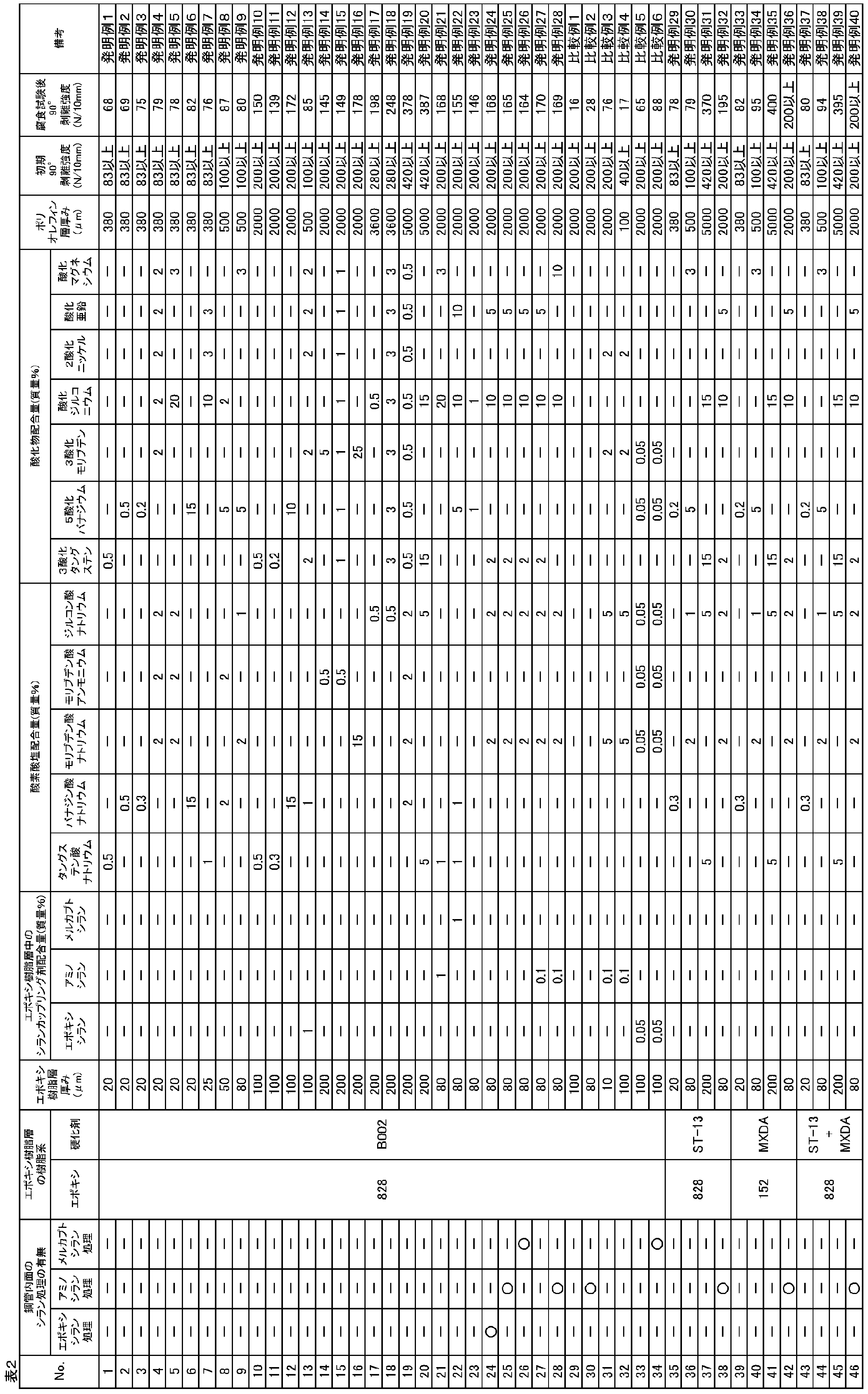
表2から明らかなように、発明例はいずれも、バイオエタノール模擬液中での接着強度の低下が抑制され、改善されていることが分かる。これに対し、エポキシ樹脂層やポリオレフィン層の厚み、さらには酸素酸塩や酸化物の配合量が発明範囲から外れた比較例はいずれも、耐食性試験後の接着強度の低下が大きかった。
Claims (4)
- 鋼管の内面にエポキシ樹脂層、及び、その上に形成された300~5000μmの厚みのポリオレフィン層をそなえる内面被覆鋼管であって、
前記エポキシ樹脂層が20~200μmの厚みで、アミン系硬化剤により硬化されたものであり、該エポキシ樹脂層中に、タングステン、バナジウム、モリブデンおよびジルコニウムの酸素酸塩のうちから選んだ少なくとも一種を0.5~30質量%配合したことを特徴とする内面被覆鋼管。 - 鋼管の内面にエポキシ樹脂層、及び、その上に形成された300~5000μmの厚みのポリオレフィン層をそなえる内面被覆鋼管であって、
前記エポキシ樹脂層が20~200μmの厚みで、アミン系硬化剤により硬化されたものであり、該エポキシ樹脂層中に、タングステン、バナジウム、モリブデンおよびジルコニウムの酸素酸塩のうちから選んだ少なくとも一種と、タングステン、バナジウム、モリブデンおよびジルコニウムの酸化物ならびにニッケル、亜鉛およびマグネシウムの酸化物のうちから選んだ少なくとも一種とを、合計で0.5~40質量%配合したことを特徴とする内面被覆鋼管。 - 前記鋼管と前記エポキシ樹脂層との間に、アミノシラン、エポキシシランおよびメルカプトシランのうちから選ばれる一種以上を用いたシランカップリング処理層を有することを特徴とする請求項1または2に記載の内面被覆鋼管。
- 前記エポキシ樹脂層中に、さらに、アミノシラン、エポキシシランおよびメルカプトシランのうちから選んだ少なくとも一種のシランカップリング剤を0.1~5質量%配合したことを特徴とする請求項1ないし3に記載の内面被覆鋼管。
Priority Applications (1)
| Application Number | Priority Date | Filing Date | Title |
|---|---|---|---|
| JP2013545794A JP5765436B2 (ja) | 2011-11-21 | 2012-11-20 | 内面被覆鋼管 |
Applications Claiming Priority (2)
| Application Number | Priority Date | Filing Date | Title |
|---|---|---|---|
| JP2011-254256 | 2011-11-21 | ||
| JP2011254256 | 2011-11-21 |
Publications (1)
| Publication Number | Publication Date |
|---|---|
| WO2013076970A1 true WO2013076970A1 (ja) | 2013-05-30 |
Family
ID=48469435
Family Applications (1)
| Application Number | Title | Priority Date | Filing Date |
|---|---|---|---|
| PCT/JP2012/007453 Ceased WO2013076970A1 (ja) | 2011-11-21 | 2012-11-20 | 内面被覆鋼管 |
Country Status (2)
| Country | Link |
|---|---|
| JP (1) | JP5765436B2 (ja) |
| WO (1) | WO2013076970A1 (ja) |
Cited By (3)
| Publication number | Priority date | Publication date | Assignee | Title |
|---|---|---|---|---|
| JP2018069592A (ja) * | 2016-10-31 | 2018-05-10 | Jfeスチール株式会社 | ポリエチレン被覆鋼管及びその製造方法 |
| JP2018134861A (ja) * | 2017-02-22 | 2018-08-30 | Jfeスチール株式会社 | ポリエチレン被覆鋼管およびその製造方法 |
| JP2018134862A (ja) * | 2017-02-22 | 2018-08-30 | Jfeスチール株式会社 | ポリエチレン被覆鋼管およびその製造方法 |
Citations (4)
| Publication number | Priority date | Publication date | Assignee | Title |
|---|---|---|---|---|
| JPS59222275A (ja) * | 1983-05-28 | 1984-12-13 | Nippon Steel Corp | 金属表面の被覆方法 |
| JPH0811258A (ja) * | 1994-06-30 | 1996-01-16 | Kawasaki Steel Corp | 二次密着性に優れた被覆鋼材 |
| JPH08159368A (ja) * | 1994-12-07 | 1996-06-21 | Mitsubishi Chem Corp | ポリプロピレン樹脂被覆鋼管 |
| JP2002172730A (ja) * | 2000-12-07 | 2002-06-18 | Kawasaki Steel Corp | 有機被覆鋼材及びその製造方法 |
-
2012
- 2012-11-20 JP JP2013545794A patent/JP5765436B2/ja active Active
- 2012-11-20 WO PCT/JP2012/007453 patent/WO2013076970A1/ja not_active Ceased
Patent Citations (4)
| Publication number | Priority date | Publication date | Assignee | Title |
|---|---|---|---|---|
| JPS59222275A (ja) * | 1983-05-28 | 1984-12-13 | Nippon Steel Corp | 金属表面の被覆方法 |
| JPH0811258A (ja) * | 1994-06-30 | 1996-01-16 | Kawasaki Steel Corp | 二次密着性に優れた被覆鋼材 |
| JPH08159368A (ja) * | 1994-12-07 | 1996-06-21 | Mitsubishi Chem Corp | ポリプロピレン樹脂被覆鋼管 |
| JP2002172730A (ja) * | 2000-12-07 | 2002-06-18 | Kawasaki Steel Corp | 有機被覆鋼材及びその製造方法 |
Cited By (3)
| Publication number | Priority date | Publication date | Assignee | Title |
|---|---|---|---|---|
| JP2018069592A (ja) * | 2016-10-31 | 2018-05-10 | Jfeスチール株式会社 | ポリエチレン被覆鋼管及びその製造方法 |
| JP2018134861A (ja) * | 2017-02-22 | 2018-08-30 | Jfeスチール株式会社 | ポリエチレン被覆鋼管およびその製造方法 |
| JP2018134862A (ja) * | 2017-02-22 | 2018-08-30 | Jfeスチール株式会社 | ポリエチレン被覆鋼管およびその製造方法 |
Also Published As
| Publication number | Publication date |
|---|---|
| JP5765436B2 (ja) | 2015-08-19 |
| JPWO2013076970A1 (ja) | 2015-04-27 |
Similar Documents
| Publication | Publication Date | Title |
|---|---|---|
| KR100526919B1 (ko) | 자동차용 내식성 연료탱크 및 급유관 | |
| JP4898543B2 (ja) | 耐ピット性に優れた鋼板およびその製造方法 | |
| CN103122186B (zh) | 一种钢轨防腐用环保型处理液及防腐钢轨材料 | |
| TW492917B (en) | Steel sheet for fuel tank having high corrosion resistance | |
| WO1998045114A1 (en) | Steel plate for highly corrosion-resistant fuel tank | |
| CN102179641A (zh) | 用于建造油船货油舱的埋弧焊丝 | |
| CN102699566A (zh) | 油船货油舱用药芯焊丝 | |
| CN102794579A (zh) | 一种用于建造油船货油舱的耐蚀焊条 | |
| CN106103769B (zh) | 钢材、使用该钢材的船舶的压载舱和船舱、以及具备该压载舱或船舱的船舶 | |
| CN107208277A (zh) | 燃料罐用钢板 | |
| JP5765436B2 (ja) | 内面被覆鋼管 | |
| JP2005290479A (ja) | 原油タンク底板用鋼材 | |
| JP5771011B2 (ja) | 耐食性に優れた構造部材用鋼材 | |
| JP5958103B2 (ja) | 耐塗膜膨れ性に優れた船舶バラストタンク用鋼材 | |
| JP6085932B2 (ja) | ポリエチレン被覆鋼材、及びエポキシ樹脂プライマー層形成材料 | |
| US10519532B2 (en) | Steel material having excellent alcohol-induced pitting corrosion resistance and alcohol-induced SCC resistance | |
| JP5640960B2 (ja) | 重防食被覆鋼管 | |
| JP5998675B2 (ja) | 酸性・アルカリ性環境下での防食性に優れた内面被覆鋼管 | |
| JP4616181B2 (ja) | 大入熱溶接時のhaz靱性および耐食性に優れた船舶用鋼材 | |
| JP2008133536A (ja) | 耐食性に優れた船舶用鋼材 | |
| CN107636185A (zh) | 乙醇储存及输送设备用钢 | |
| JP2006118002A (ja) | 石油類タンク用鋼材 | |
| CN105836047A (zh) | 一种防腐船体的制造工艺 | |
| JP6583012B2 (ja) | ポリオレフィン被覆鋼管及びその製造方法 | |
| TWI531660B (zh) | 鋼材、使用該鋼材之船舶的壓載艙及船艙、以及具備該壓載艙或船艙之船舶 |
Legal Events
| Date | Code | Title | Description |
|---|---|---|---|
| 121 | Ep: the epo has been informed by wipo that ep was designated in this application |
Ref document number: 12851349 Country of ref document: EP Kind code of ref document: A1 |
|
| ENP | Entry into the national phase |
Ref document number: 2013545794 Country of ref document: JP Kind code of ref document: A |
|
| NENP | Non-entry into the national phase |
Ref country code: DE |
|
| 122 | Ep: pct application non-entry in european phase |
Ref document number: 12851349 Country of ref document: EP Kind code of ref document: A1 |