WO2013073665A1 - アルキレンオキシド付加物の製造方法 - Google Patents
アルキレンオキシド付加物の製造方法 Download PDFInfo
- Publication number
- WO2013073665A1 WO2013073665A1 PCT/JP2012/079779 JP2012079779W WO2013073665A1 WO 2013073665 A1 WO2013073665 A1 WO 2013073665A1 JP 2012079779 W JP2012079779 W JP 2012079779W WO 2013073665 A1 WO2013073665 A1 WO 2013073665A1
- Authority
- WO
- WIPO (PCT)
- Prior art keywords
- alkylene oxide
- oxide adduct
- crude product
- catalyst
- temperature
- Prior art date
- Legal status (The legal status is an assumption and is not a legal conclusion. Google has not performed a legal analysis and makes no representation as to the accuracy of the status listed.)
- Ceased
Links
Classifications
-
- C—CHEMISTRY; METALLURGY
- C08—ORGANIC MACROMOLECULAR COMPOUNDS; THEIR PREPARATION OR CHEMICAL WORKING-UP; COMPOSITIONS BASED THEREON
- C08G—MACROMOLECULAR COMPOUNDS OBTAINED OTHERWISE THAN BY REACTIONS ONLY INVOLVING UNSATURATED CARBON-TO-CARBON BONDS
- C08G65/00—Macromolecular compounds obtained by reactions forming an ether link in the main chain of the macromolecule
- C08G65/02—Macromolecular compounds obtained by reactions forming an ether link in the main chain of the macromolecule from cyclic ethers by opening of the heterocyclic ring
- C08G65/30—Post-polymerisation treatment, e.g. recovery, purification, drying
Definitions
- the present invention relates to a method for producing an alkylene oxide adduct, which makes it possible to easily separate and remove a catalyst and a by-product from a target product.
- Polyoxyalkylene type nonionic surfactants produced by adding alkylene oxide to active hydrogen-containing compounds such as higher alcohols and higher amines or higher fatty acid alkyl esters adjust the number of moles of alkylene oxide to be a hydrophilic group as appropriate. Therefore, the hydrophilic-hydrophobic balance (HLB) can be arbitrarily controlled, and thus it is widely used for various uses such as washing, emulsification and dispersion.
- HLB hydrophilic-hydrophobic balance
- As preparation of this alkylene oxide adduct there is a method of obtaining a reaction product having a narrow distribution of alkylene oxide addition mole number using a solid catalyst for alkoxylation, in particular, a solid catalyst for alkoxylation treated with alkali.
- Patent Document 1 As a method for efficiently separating and removing the catalyst with respect to the above problems, there has been proposed a method in which an acrylic polymer as an aggregation accelerator and water are brought into contact with an alkylene oxide-added crude product (Patent Document 1). In this method, the by-produced polyalkylene glycol is aggregated to be separated from the alkoxylation solid catalyst and removed.
- this method does not always have sufficient filterability for a crude product having a high amount of high molecular weight polyalkylene glycol as a by-product and a high number of added moles of alkylene oxide. There are disadvantages such as an increase.
- Patent Document 2 a method for adjusting the pH and water content of an alkylene oxide-added crude product is disclosed (Patent Document 2). However, even in this method, problems such as a long time for filtration and a large amount of waste filter cake have not been solved.
- the present invention makes it possible to efficiently separate and remove a catalyst and a by-product polyalkylene glycol from an alkylene oxide adduct in a method for producing an alkylene oxide adduct using a solid catalyst for alkoxylation. It aims at providing the manufacturing method of an alkylene oxide adduct.
- the present invention provides (A) an alkylene oxide-added crude product obtained by adding an alkylene oxide to an active hydrogen-containing compound and / or a fatty acid alkyl ester in the presence of a solid catalyst for alkoxylation. A step of adding an organic carboxylic acid aqueous solution while maintaining the temperature at 130 ° C.
- the present invention it is possible to easily and efficiently separate and remove the solid catalyst and the polyalkylene glycol by-product from the alkylene oxide adduct.
- the amount of the alkylene oxide adduct mixed in the waste can be reduced, the yield of the alkylene oxide adduct is increased.
- Step (A) In the presence of a solid catalyst for alkoxylation, an alkylene oxide addition crude product is obtained by subjecting an active hydrogen-containing compound and / or a fatty acid alkyl ester to an addition reaction of alkylene oxide.
- Solid catalyst for alkoxylation examples include, for example, magnesium ion-added magnesium oxide (JP-B-6-15038, JP-A-7-227540, JP-A-6-198169, 6-182206, JP-A-5-170688), calcined hydrotalcite (JP-A-2-71841), aluminum hydroxide / magnesium calcined product (JP-A-8-268919), etc.
- alkoxylated solid catalysts such as a composite oxide catalyst.
- the catalyst may be surface-modified by alkali modification treatment (JP-A-8-169860, JP-A-8-169861).
- alkali modification treatment JP-A-8-169860, JP-A-8-169861.
- the calcined aluminum hydroxide / magnesium is not particularly limited and may be appropriately selected depending on the intended purpose. Examples thereof include those described in JP-A-8-268919. Specifically, an aluminum-magnesium composite metal oxide represented by the following formula (I) is applicable, and this can be obtained by firing a coprecipitate of aluminum hydroxide and magnesium hydroxide.
- nMgO.Al 2 O 3 .mH 2 O (I) In the formula (I), n and m are positive numbers and are not particularly limited, but n is preferably 1 to 3, and particularly preferably about 2.5. m can be appropriately selected according to the purpose.
- the firing temperature can be appropriately selected according to the purpose, but is preferably 400 to 950 ° C., more preferably 800 to 900 ° C., from the viewpoint of the expression of catalyst activity and suppression of the amount of by-products generated. .
- the firing time can be selected as appropriate, but it is usually 2 to 4 hours when firing within the above-mentioned range.
- the calcination temperature is too low, there is a problem that the catalytic activity is not exhibited or the amount of by-products generated is increased.
- the catalytic acid sites involved in the ring-opening polymerization reaction of the alkylene oxide may be reduced by reducing the specific surface area of the catalyst particles due to the occurrence of sintering or by changing the structure of the composite oxide of aluminum and magnesium.
- the reaction activity decreases due to a decrease. That is, it is desirable to appropriately manage the catalyst firing conditions from the two viewpoints of keeping the reaction activity high and reducing the amount of by-products.
- the specific surface area of the catalyst particles can be used as an index for process control.
- the particle size of the catalyst particles is not particularly limited, but usually the average particle size is in the range of 10 to 1000 ⁇ m.
- the average particle size of the catalyst means a value calculated by measuring acetonitrile as a dispersion medium using a laser light scattering particle size distribution analyzer LA-920 (manufactured by HORIBA) and calculating it as a median size.
- the catalyst obtained by surface modification of the calcined aluminum hydroxide / magnesium by alkali modification treatment is not particularly limited and can be appropriately selected according to the purpose.
- the aluminum hydroxide / magnesium fired product can be surface-modified with a metal hydroxide or a metal alkoxide to obtain a modified aluminum hydroxide / magnesium fired product catalyst.
- the metal hydroxide alkali metal or alkaline earth metal hydroxide is preferable, and sodium hydroxide and potassium hydroxide are more preferable.
- the metal alkoxide is preferably an alkali metal or alkaline earth metal alkoxide, and more preferably sodium alkoxide or potassium alkoxide.
- the alkoxide preferably has 1 to 4 carbon atoms.
- the alkali modification treatment may be performed by, for example, a method in which the catalyst is modified with an alkali metal or alkaline earth metal hydroxide or alkoxide and then used as a reaction catalyst, or a raw material fatty acid alkyl in an alkoxylation reactor. An ester and a metal hydroxide or a metal alkoxide can be mixed and the catalyst can be reformed in the raw material. That is, the alkali modification treatment may be performed during the preparation of the catalyst, or may be performed by adding an alkali during the addition reaction.
- the said catalyst may be used individually by 1 type, and may use 2 or more types together.
- the particle size of the catalyst is not particularly limited, but usually during the alkylene oxide addition reaction, for example, accumulation of reaction heat inside the catalyst particle, generation of high molecular weight by-products, generation of a sudden pressure difference, mechanical action by a stirring blade, etc. Since the catalyst particles are disintegrated due to shearing or the like, the particle size of the catalyst can vary. Furthermore, as will be described later, the catalyst may be further refined by adding a polyhydric alcohol to the reaction mixture in order to improve the activity of the catalyst. Therefore, the particle diameter of the catalyst contained in the crude product after the reaction can be, for example, 0.1 ⁇ m to 500 ⁇ m as an average particle diameter.
- the amount of the catalyst used is not particularly limited as long as the reaction proceeds appropriately, and can be appropriately selected according to the activity of the catalyst to be used.
- the reaction raw materials (fatty acid alkyl ester and alkylene) Oxide) is preferably from 0.01 to 5% by weight, more preferably from 0.03 to 1% by weight, particularly preferably from 0.05 to 0.2% by weight, based on the total weight of the oxide.
- the active hydrogen-containing compound is not particularly limited and may be appropriately selected depending on the intended purpose.
- examples thereof include alcohols, amines, amides, phenols and derivatives thereof, and thiols and derivatives thereof.
- alcohol is preferable and alcohol represented by the following general formula (1) is more preferable.
- R 1 is not particularly limited and can be appropriately selected according to the performance required for the product to be obtained.
- the linear or branched alkyl group, linear or branched An alkenyl group etc. are mentioned.
- the number of carbon atoms in R 1 is not particularly limited and can be appropriately selected according to the purpose, but is preferably 1 to 40, more preferably 3 to 30, and particularly preferably 6 to 22.
- alcohol examples include n-octanol, n-decanol, n-dodecanol, n-tetradecanol, n-hexadecanol, n-octadecanol, oleyl alcohol, etcosanol, behenol, nonanol, undecanol, tridecanol, etc.
- amines include primary or secondary amines having a saturated or unsaturated alkyl group having 8 to 24 carbon atoms, such as octylamine, dioctylamine, laurylamine, dilaurylamine, stearylamine, distearylamine and the like.
- polyamines such as ethylenediamine and diethylenetriamine.
- amide include alkanolamides having 12 to 18 carbon atoms such as lauric acid monoethanolamide and lauric acid diethanolamide.
- active hydrogen-containing compounds linear or branched saturated or unsaturated alcohols having 8 to 22 carbon atoms are preferred.
- the fatty acid alkyl ester is not particularly limited and may be appropriately selected depending on the purpose.
- the fatty acid ester is represented by the following formula (2): R 2 COOR 3 (2)
- R 2 and R 3 are a linear or branched alkyl group or a linear or branched alkenyl group.
- the carbon number of R 2 is, for example, preferably 1 to 40, more preferably 3 to 30, and particularly preferably 5 to 21.
- the carbon number of R 3 is, for example, preferably 1-30, more preferably 1-10, and particularly preferably 1-4.
- Fatty acid alkyl ester may be used individually by 1 type, and may use 2 or more types together.
- fatty acid alkyl ester triglyceride which is a fatty acid ester of glycerin can also be used.
- the amount of fatty acid alkyl ester used is not particularly limited, and can be appropriately selected according to the amount of product to be obtained, the amount of catalyst and the amount of alkylene oxide described below, and the like.
- alkylene oxide used in the present invention is not particularly limited as long as it can be reacted with the active hydrogen-containing compound and / or the fatty acid alkyl ester to obtain an alkylene oxide adduct, and can be appropriately selected according to the purpose.
- alkylene oxide having 2 to 4 carbon atoms is preferable.
- ethylene oxide, propylene oxide, butylene oxide and the like can be used, and these can be used as one kind or a mixture of two or more kinds.
- Alkylene oxide addition crude product In the present invention, it is preferable to add 1 to 50 moles of alkylene oxide per mole of active hydrogen-containing compound and / or fatty acid alkyl ester, more preferable to add 3 to 30 moles of alkylene oxide, particularly An alkylene oxide obtained by adding 5 to 20 moles of alkylene oxide is preferred.
- the alkylene oxide adduct is a nonionic surfactant, it preferably has a structure having an HLB (Griffin method) of 3 to 20.
- HLB Griffin method
- the amount of the alkylene oxide used is not particularly limited and can be appropriately selected according to the type of the fatty acid alkyl ester used, the performance required for the product to be obtained, etc.
- the amount is preferably 1 to 50 mol, more preferably 3 to 30 mol, and particularly preferably 5 to 20 mol with respect to 1 mol.
- the reaction in the step (A) may be performed by adding a low molecular weight polyhydric alcohol.
- a low molecular weight polyhydric alcohol By adding a low molecular weight polyhydric alcohol to the reaction system, the effect of miniaturizing the catalyst and improving its activity can be obtained.
- the polyhydric alcohol is not particularly limited as long as it has two or more hydroxyl groups in the molecule and the effect of refining the catalyst is obtained.
- the fatty acid alkyl ester is uniformly emulsified or dispersed.
- the said polyhydric alcohol may be used individually by 1 type, and may use 2 or more types together.
- the amount of the polyhydric alcohol used is not particularly limited and may be appropriately selected depending on the purpose. However, with respect to the total mass of the reaction raw materials (active hydrogen-containing compound and / or fatty acid alkyl ester and alkylene oxide), It is preferably 0.02 to 0.5% by mass. Moreover, 1.0 times or more is preferable with respect to the mass of the said catalyst, and 1.25 times or more is more preferable. By making the usage-amount of a polyhydric alcohol into the said preferable range, it becomes possible to refine
- an alkylene oxide-added crude product can be easily prepared by well-known operating procedures and reaction conditions.
- the reaction temperature is preferably from 80 to 230 ° C.
- the reaction pressure is preferably from 0 to 2 MPa, more preferably from 0.2 to 0.8 MPa, depending on the reaction temperature.
- An addition reaction can also be carried out.
- the above reaction can be carried out, for example, by charging an active hydrogen-containing compound and / or fatty acid alkyl ester and a solid catalyst for alkoxylation into an autoclave and introducing alkylene oxide under a predetermined temperature and pressure under a nitrogen atmosphere. .
- organic carboxylic acid aqueous solution While maintaining the temperature of 90 ° C. or higher and 130 ° C. or lower to the crude product of alkylene oxide addition obtained in the above step, an aqueous organic carboxylic acid solution is added thereto, and the pH at 5 mass% and 25 ° C. is adjusted to 5-7. In other words, an organic carboxylic acid aqueous solution is added to the crude product in such an amount that the pH is 5 to 7 when measured at 5% by mass at 25 ° C.
- the concentration of the organic carboxylic acid in the organic carboxylic acid aqueous solution is not limited, but is preferably 3 to 20% by mass.
- organic carboxylic acid malic acid, lactic acid, citric acid, glycolic acid, acetic acid or a hydrate thereof is preferable.
- Malic acid, lactic acid, citric acid, glycolic acid, citric acid or their hydrates are more preferred.
- citric acid or hydrates thereof are more preferred.
- These acids may be used individually by 1 type, and may use 2 or more types together. Without being bound by any theory, it is speculated that the organic carboxylic acid adsorbs to the solid catalyst and polyalkylene glycol by-product to form an aggregate.
- the temperature of the crude product is maintained at 90 ° C. or higher and 130 ° C. or lower. It is preferable to maintain the temperature at 100 ° C. or higher and 125 ° C. or lower. If it is less than 90 ° C., the amount of waste increases. This is probably because the organic acid is not sufficiently adsorbed on the solid catalyst. When it exceeds 130 degreeC, the vapor pressure of water will become high and operativity will worsen.
- the temperature of the organic carboxylic acid aqueous solution added to the crude product is not particularly limited. When an organic carboxylic acid aqueous solution having a temperature of less than 90 ° C. is added, the temperature of the crude product is temporarily decreased.
- the organic carboxylic acid aqueous solution is usually added to the crude alkylene oxide addition product over 5 to 30 minutes, preferably over 10 to 20 minutes.
- stirring time is 5 minutes to 60 minutes. It is.
- the stirring time is less than 5 minutes, the organic carboxylic acid aqueous solution and the alkylene oxide addition crude product may not be sufficiently mixed, and the solid catalyst and the polyalkylene glycol may not be sufficiently separated by centrifugation.
- the stirring time exceeds 60 minutes, the stirring effect cannot be obtained any more, and the required time is extended. Stirring can be performed using a stirring tank.
- a general stirring device such as a paddle, a propeller, a turbine blade or an anchor blade can be used.
- the stirring speed can be arbitrarily set under the condition that the whole can be mixed.
- the stirring power per unit volume is preferably in the range of 0.1 to 0.9 kW / m 3 .
- the temperature of the mixture of the organic carboxylic acid aqueous solution and the alkylene oxide addition crude product when stirring is maintained at 90 ° C. or higher and 130 ° C. or lower. It is more preferable that the temperature is 100 ° C. or higher and 125 ° C. or lower.
- the time for adjusting the crude product of 90 ° C. or higher and 130 ° C. or lower to a temperature of 50 ° C. or higher and 80 ° C. or lower is not particularly limited. Usually 30-60 minutes. Cooling can also be performed by leaving the crude product undisturbed, or can be performed by flowing cooling water through a jacket or an internal coil in a stirring tank.
- the moisture content is preferably 8% by mass or more and 12% by mass or less, and 9% by mass or more and 11% by mass or less.
- the water content is less than 8% by mass, aggregation of the high molecular weight polyalkylene glycol does not proceed, and the polyalkylene glycol is not sufficiently separated and removed from the alkylene oxide adduct, so that the turbidity is deteriorated.
- the water content exceeds 12% by mass, the polyalkylene glycol is dissolved, so that the polyalkylene glycol is not sufficiently separated and removed from the alkylene oxide adduct and white turbidity occurs.
- the adjustment of the amount of water can be usually performed by adding water to the crude product.
- the water used in the present invention is not particularly limited, and for example, distilled water or ion exchange water can be used.
- the amount of water is usually adjusted for 5 to 30 minutes, preferably 10 to 20 minutes.
- the water content measurement in the present invention is determined by measuring the water content by the Karl Fischer method using the crude alkylene oxide-added crude product solution after the addition of the organic carboxylic acid aqueous solution.
- Karl Fischer moisture meter for example, AQV-7 manufactured by Hiranuma Sangyo Co., Ltd. can be used.
- step (B) the aggregate of the alkoxylation catalyst and the by-produced polyalkylene glycol or a mixture thereof is separated from the alkylene oxide adduct and removed from the alkylene oxide adduct by centrifugation or normal filtration. Can do.
- the alkylene oxide adduct may be stirred before removing the catalyst and the like.
- the temperature of the alkylene oxide adduct at this time is preferably 30 to 60 ° C., more preferably 40 to 60 ° C.
- the stirring time is preferably 10 to 120 minutes, more preferably 30 to 60 minutes.
- the stirring speed can be arbitrarily set under the condition that the whole can be mixed.
- the stirring power per unit volume is preferably in the range of 0.1 to 0.9 kW / m 3 .
- a general stirring device described in connection with the step (A) can be used.
- the alkylene oxide adduct thus obtained has a clear and uniform appearance.
- the clarity of the alkylene oxide adduct can be evaluated by turbidity at 50 ° C. Turbidity can be measured with an integrating sphere turbidimeter (such as Mitsubishi Chemical Corporation SEP-PT-760D). The unit of turbidity is ppm. The clearer, the smaller the turbidity value.
- the turbidity at 50 ° C. of the resulting alkylene oxide adduct is preferably less than 2 ppm, more preferably less than 1.5 ppm, and still more preferably less than 1 ppm.
- the turbidity exceeds 2 ppm slight white turbidity is visually recognized, and turbidity may occur in the product appearance when blended into a product such as a cleaning agent.
- the uniformity of the alkylene oxide adduct shows a state in which there is no precipitate or suspended matter when the appearance at 50 ° C. is visually confirmed in a transparent container. If the alkylene oxide adduct contains precipitates or suspended matters, problems such as turbidity or precipitation of the product may occur when blended with products such as cleaning agents.
- filter paper In the case of separation by a normal filtration operation, for example, a two-layer filter of cellulose and polyester or a metal mesh type filter is used as filter paper, and filtration is performed under reduced pressure or increased pressure at a temperature of 35 to 100 ° C., particularly 40 to 85 ° C. It is preferable to do this. In that case, preferably filterability can be improved by using a filter aid.
- the filter aid any filter aid known to those skilled in the art can be used.
- amorphous siliceous diatomaceous earth containing 80 to 95% of SiO 2 as a main component
- the aluminum silicate containing about 70% of SiO 2 as the main component include Topco # 31, Topco # 34, and the like
- cellulose filter aids include KC Flock, SW40, BW20, BW40, BW100, and BW200. , BNB20, and the like, each of which can be used alone or as a mixture of two or more.
- the amount of the filter aid used is preferably about 0.05 to 5% by mass, particularly 0.1 to 2% by mass, based on the crude product.
- the temperature of the crude product during filtration is preferably 40 ° C to 60 ° C, more preferably 45 ° C to 55 ° C.
- the solubility of polyalkylene glycol in the alkylene oxide adduct is high, so that the polyalkylene glycol is not sufficiently separated, and the resulting alkylene oxide adduct may become cloudy.
- the temperature is lower than 40 ° C., the viscosity of the crude product of alkylene oxide addition becomes high, the solid catalyst and the polyalkylene glycol are not sufficiently separated and removed, and the resulting alkylene oxide adduct may become cloudy.
- a decanter centrifuge that continuously discharges the separated solids can be preferably used.
- a decanter centrifuge includes an external rotating cylinder and a screw conveyor that rotate at a high speed with a slight speed difference with the same rotation direction.
- agglomerates with heavy specific gravity are stuck to the inner wall of the rotating cylinder by centrifugal force, and the parts separated from the liquid components are scraped and removed by the screw conveyor.
- Decanter-type centrifuges include a “vertical type” and a “horizontal type” depending on the installation direction of the rotating body, but both can be used in the present invention.
- the temperature of the crude product in the centrifugation step is preferably 40 ° C to 60 ° C, more preferably 45 ° C to 55 ° C.
- the temperature exceeds 60 ° C.
- the polyalkylene glycol is highly soluble in the alkylene oxide adduct, so that the polyalkylene glycol is not sufficiently separated, and the resulting alkylene oxide adduct may become cloudy.
- the temperature is lower than 40 ° C., the viscosity of the crude alkylene oxide addition product becomes high, the solid catalyst and the polyalkylene glycol are not sufficiently separated and removed, and the resulting alkylene oxide adduct may become cloudy.
- centrifugal force is preferably in the range of 1500 G to 3500 G, and more preferably 1500 G to 3000 G. If the centrifugal force is too small, aggregates of the solid catalyst and polyalkylene oxide are not sufficiently removed from the alkylene oxide adduct, and the resulting alkylene oxide adduct becomes cloudy or precipitates are mixed into the separated liquid. There is a case. On the other hand, if the centrifugal force is too large, the centrifuged aggregates are strongly pressed against the inner wall of the rotating cylinder, so that the aggregates are not smoothly discharged by the screw conveyor, and the precipitate may be mixed into the separated liquid. is there.
- the “differential speed”, which is the difference between the rotational speed of the rotating cylinder of the decanter centrifuge and the rotational speed of the screw conveyor, is preferably in the range of 5 to 20 rpm, more preferably in the range of 10 to 15 rpm. If the differential speed is too small, the residence time of the solid separated in the rotating cylinder becomes long, and the ratio of the solid to the separating liquid increases in the rotating cylinder, so that precipitates may be mixed in the separating liquid. On the other hand, if the differential speed is too large, the residence time of the solid matter separated in the rotating cylinder is shortened, so that the liquid content of the separated solid matter becomes high and the amount of waste may increase.
- a “defoaming step” for removing the bubbles using a defoaming device may be added.
- Various devices such as a vacuum defoamer, a pressure defoamer, a stirring defoamer, and a centrifugal defoamer can be selected as the defoaming device.
- defoaming pumps such as those manufactured by Yokota Seisakusho and ASP type are suitable in the present invention in that they can be continuously processed and can also be used as a transfer pump.
- Example 1 [Process (A)] In a 15 kL stirring reaction vessel, 1840 kg of methyl laurate (Plion M12, manufactured by Lion Chemical Co., Ltd.), 660 kg of methyl myristate (Patel M14 manufactured by Lion Chemical Co., Ltd.), 10 kg of the composite metal oxide catalyst prepared above, After charging 12.5 kg of glycerin (0.5% by weight with respect to the total amount of methyl laurate and methyl myristate) as a monohydric alcohol, 0.5 kg of potassium hydroxide was added and stirred for 10 minutes. Denaturation treatment was performed.
- the inside of the reaction vessel was purged with nitrogen, heated to 100 ° C., and dehydrated under reduced pressure conditions of 1.3 kPa or less for 30 minutes. Subsequently, it heated up to 180 degreeC and 7480 kg (15 times mole of fatty acid methyl ester) of ethylene oxide was introduce
- transduced on the conditions whose pressure upper limit is 0.49 MPa. After further aging reaction for 0.5 hour, the reaction mixture was cooled to 80 ° C. to obtain 10,000 kg of an ethylene oxide addition crude product (ethylene oxide average addition mole number 15). This crude product contained 0.9% by weight of polyethylene glycol as a by-product.
- the average number of moles of ethylene oxide added was measured by a high performance liquid chromatography (HPLC) method (measurement conditions Column: Intersil C8 (particle diameter 5 ⁇ m, inner diameter 4.6 mm ⁇ length 250 mm), manufactured by GL Sciences Inc.), mobile phase: acetonitrile / Water (60/40 volume ratio) 1 mL / min, differential refractive index detector (manufactured by Hitachi, Ltd., L-7490), column temperature: 15 ° C., injection amount: 200 ⁇ L).
- HPLC high performance liquid chromatography
- the concentration of by-product polyethylene glycol contained in the crude product was measured by gel permeation chromatography (GPC) method (measurement conditions Column: GF-310HQ manufactured by Shodex Co., Ltd., mobile phase: acetonitrile / water (45 / 55 volume ratio) 1 mL / min, differential refractive index detector (manufactured by Shimadzu Corporation, RID-6A), column temperature: 30 ° C., injection amount: 200 ⁇ L).
- GPC gel permeation chromatography
- a small amount of the crude product was taken from the stirring tank, diluted 20 times (5 wt%) with water, and the pH at 25 ° C. was measured. The pH was 5.8.
- the crude product in the stirring vessel was heated to 120 ° C., and then stirred for 10 minutes while controlling the temperature in the range of 120 ⁇ 2 ° C.
- the weight of the solids (including the solid catalyst and polyethylene glycol aggregates and moisture) separated by the centrifuge was 210 kg.
- the separated solid (waste) was 2.1% by weight with respect to the obtained refined product. It was confirmed that the purified product was uniform with no sediment or suspended matter that could be observed with the naked eye. Moreover, the turbidity in 50 degreeC of a refined product was 0.1 ppm, and it confirmed that it was clear.
- Example 2 to Example 5 The same procedure as in Example 1 was performed except that glycolic acid, malic acid, lactic acid or acetic acid was used in place of citric acid in step (A).
- the obtained alkylene oxide adduct had no precipitates or suspended matter that could be observed with the naked eye, and since the turbidity was small, it was confirmed that there was no problem in the uniformity and clarity of the liquid.
- Example 6 to Example 7 The same procedure as in Example 1 was performed except that the temperature of the crude product when adding citric acid in step (A) was 90 ° C. and 130 ° C. As in Example 1, the obtained alkylene oxide adduct had no precipitates or suspended matter that could be observed with the naked eye, and since the turbidity was small, it was confirmed that there was no problem in the uniformity and clarity of the liquid.
- Example 8 to 9 The same procedure as in Example 1 was performed except that the pH was adjusted to 5.0 and 7.0 in the step (A). As in Example 1, the obtained alkylene oxide adduct had no precipitates or suspended matter that could be observed with the naked eye, and since the turbidity was small, it was confirmed that there was no problem in the uniformity and clarity of the liquid.
- Example 10 to Example 11 The same procedure as in Example 1 was performed except that the water content was adjusted to 8% and 12%, respectively, in the step (B).
- the obtained alkylene oxide adduct had no precipitates or suspended matter that could be observed with the naked eye, and since the turbidity was small, it was confirmed that there was no problem in the uniformity and clarity of the liquid.
- Example 12 to Example 13 The same procedure as in Example 1 was performed except that the temperature of the crude product when adding water in step (B) was 50 ° C. and 130 ° C. As in Example 1, the obtained alkylene oxide adduct had no precipitates or suspended matter that could be observed with the naked eye, and since the turbidity was small, it was confirmed that there was no problem in the uniformity and clarity of the liquid.
- Example 14 to 15 The same procedure as in Example 1 was carried out except that the temperature of the crude product when citric acid was added in step (A) was 90 ° C., and the water content was adjusted to 8% and 12%, respectively, in step (B). As in Example 1, the obtained alkylene oxide adduct had no precipitates or suspended matter that could be observed with the naked eye, and since the turbidity was small, it was confirmed that there was no problem in the uniformity and clarity of the liquid.
- Example 16 The same procedure as in Example 1 was performed except that the temperature of the crude product when adding citric acid in step (A) was 130 ° C., the pH was 5.0, and the water content was adjusted to 8% in step (B). It was. As in Example 1, the obtained alkylene oxide adduct had no precipitates or suspended matter that could be observed with the naked eye, and since the turbidity was small, it was confirmed that there was no problem in the uniformity and clarity of the liquid.
- Example 17 The same procedure as in Example 1 was performed except that lactic acid was added in place of citric acid in step (B) to adjust the pH to 5.0 and the water content was adjusted to 12% in step (B).
- the obtained alkylene oxide adduct had no precipitates or suspended matter that could be observed with the naked eye, and since the turbidity was small, it was confirmed that there was no problem in the uniformity and clarity of the liquid.
- Example 18 The same procedure as in Example 1 was performed except that lactic acid was added at 90 ° C. instead of citric acid in the step (A) to adjust the pH to 7.0 and the water content was adjusted to 8% in the step (B).
- lactic acid was added at 90 ° C. instead of citric acid in the step (A) to adjust the pH to 7.0 and the water content was adjusted to 8% in the step (B).
- the obtained alkylene oxide adduct had no precipitates or suspended matter that could be observed with the naked eye, and since the turbidity was small, it was confirmed that there was no problem in the uniformity and clarity of the liquid.
- Example 19 Example 1 except that lactic acid was added at 90 ° C. instead of citric acid in step (A), the pH was adjusted to 7.0, the water content was adjusted to 12% in step (B) and added at 50 ° C. As well as. As in Example 1, the obtained alkylene oxide adduct had no precipitates or suspended matter that could be observed with the naked eye, and since the turbidity was small, it was confirmed that there was no problem in the uniformity and clarity of the liquid.
- Comparative Example 1 The same procedure as in Example 1 was performed except that the temperature at which citric acid was added in step (A) was 80 ° C. Clarity was obtained when the turbidity was less than 1.5 ppm, but the amount of waste was 3.0% by weight or more based on the purified product.
- Comparative Example 2 to Comparative Example 3 The same procedure as in Example 1 was performed except that the pH in the step (B) was 4.0 and 8.0, respectively. In any of the comparative examples, the turbidity exceeded 5 ppm, became cloudy and did not provide clarity, and the amount of waste was 3.0% by weight or more based on the obtained refined product.
- Comparative Example 4 The same procedure as in Example 1 was performed except that hydrochloric acid was used in place of the organic carboxylic acid in the step (A). The turbidity exceeded 2 ppm, no clearness was obtained, and the amount of waste was 2.5% by weight or more based on the obtained refined product.
- Comparative Example 5 to Comparative Example 6 The same procedure as in Example 1 was performed except that the water content was adjusted to 5% and 15%, respectively, in the step (B). In all cases, the turbidity exceeded 5 ppm, became cloudy and no clearness was obtained, and the amount of waste was 2.5% by weight or more based on the obtained refined product.
- the pH was diluted with ion-exchanged water so that the concentration of the alkylene adduct was 5% by weight and measured at 25 ° C. with a pH meter (Toa DKK Co., Ltd., HM-30V).
- the moisture was measured with a Karl Fischer moisture meter (Hiranuma Sangyo Co., Ltd., AQV-7).
- the clarity of the resulting alkylene oxide adduct (purified product) was evaluated by turbidity (unit: ppm) at 50 ° C. The smaller the turbidity, the higher the clarity and the better the separation of the solid catalyst and polyalkylene glycol.
- the turbidity was measured with an integrating sphere turbidimeter (Mitsubishi Chemical Corporation SEP-PT-760D), and the following five steps were determined.
- ⁇ Turbidity less than 1 ppm ⁇ : Turbidity 1 ppm or more, less than 1.5 ppm ⁇ : Turbidity 1.5 ppm or more, less than 2 ppm ⁇ : Turbidity 2 ppm or more, less than 5 ppm
- X Turbidity 5 ppm or more
- centrifugal force (G) ( ⁇ 2 ⁇ R ⁇ N 2 ) / (900 ⁇ g) ⁇ : Circumference ratio
- R Inner radius of rotating cylinder (m)
- N Number of rotations of the rotating cylinder (rpm)
- g Gravitational acceleration (m / s 2 )
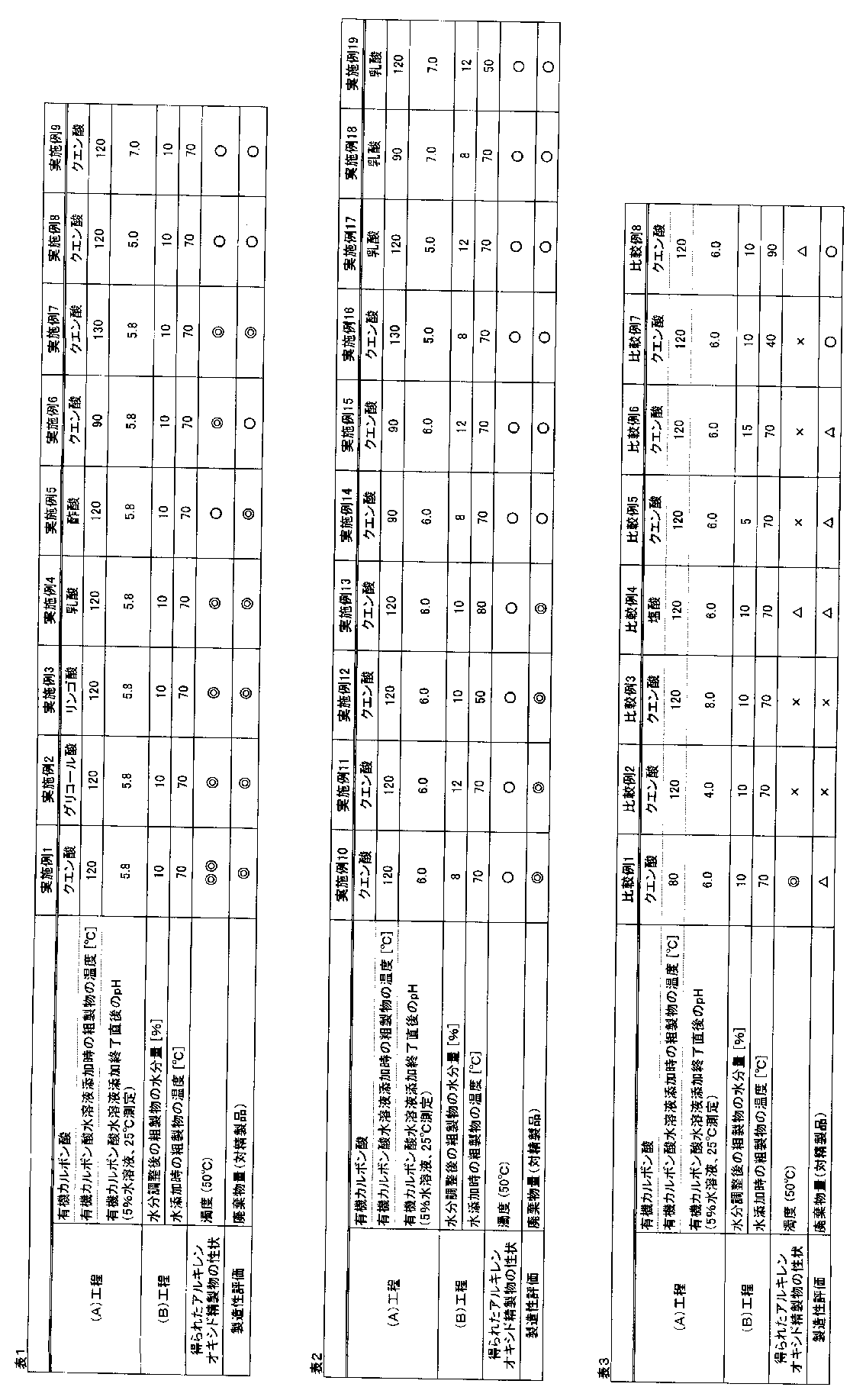
- Tables 1 and 2 show examples, and Table 3 shows comparative examples.
Landscapes
- Chemical & Material Sciences (AREA)
- Health & Medical Sciences (AREA)
- Chemical Kinetics & Catalysis (AREA)
- Medicinal Chemistry (AREA)
- Polymers & Plastics (AREA)
- Organic Chemistry (AREA)
- Polyethers (AREA)
- Organic Low-Molecular-Weight Compounds And Preparation Thereof (AREA)
Abstract
本発明により、(A)アルコキシル化用固体触媒の存在下、活性水素含有化合物および/または脂肪酸アルキルエステルにアルキレンオキシドを付加することにより得られる、アルキレンオキシド付加粗製物に、温度を90℃以上130℃以下に維持しながら、有機カルボン酸水溶液を添加し、5質量%、25℃で測定したときのpHを5~7に調整する工程、及び (B)次いで、50℃以上80℃以下に調整したアルキレンオキシド付加粗製物の水分量を、8質量%以上12質量%以下に調整する工程、 を含む、アルキレンオキシド付加物の製造方法を提供する。 本発明によれば、触媒及び副生するポリアルキレングリコールを、アルキレンオキシド付加物から効率的に分離及び除去することができる。
Description
本発明は、目的生成物から、触媒ならびに副生物を容易に分離及び除去することを可能とする、アルキレンオキシド付加物の製造方法に関する。
高級アルコール、高級アミンなど活性水素含有化合物や高級脂肪酸アルキルエステルにアルキレンオキシドを付加して製造されるポリオキシアルキレン型非イオン界面活性剤は、親水基となるアルキレンオキシドの付加モル数を適宜調整することにより、親水性-疎水性バランス(HLB)を任意にコントロールできるため、洗浄、乳化、分散といった各種用途に広く利用されている。
このアルキレンオキシド付加物の調製として、アルコキシル化用固体触媒、特にアルカリ変性処理したアルコキシル化用固体触媒を用いてアルキレンオキシド付加モル数分布の狭い反応物を得る方法がある。しかしながら、固体触媒を使用する場合には、反応液中に、重量平均分子量が1万以上である高分子量ポリエチレングリコール等の副反応物が生成し、目的物であるアルキレンオキシド付加物を固体触媒から分離する際のトラブル原因となる問題があった。具体的には、固体触媒をろ過分離する際の濾布目詰まり、分離廃棄する「廃ケーク」中へのアルキレンオキシド付加物の混入による収率の低下、目的物であるアルキレンオキシド付加物に濁りが生ずるなどの課題があり、これを解決することが必要であった。
上記課題に対し、触媒の分離及び除去を効率よく行う方法として、凝集促進剤としてのアクリル系重合体と水とをアルキレンオキシド付加粗製物に接触させる方法が提案されている(特許文献1)。副生したポリアルキレングリコールを凝集させることで、アルコキシル化用固体触媒と分離させて除去する方法である。しかしながら、この方法は、高分子量ポリアルキレングリコールの副生量の多い、アルキレンオキシドの付加モル数が高い粗製物に対しては、ろ過性が必ずしも十分ではなく、しかも、廃棄物の増加や、コスト増加などのデメリットがある。
また、アルキレンオキシド付加粗製物のpHおよび水分量を調整する方法が開示されている(特許文献2)。しかしながら、この方法においても、ろ過に多大の時間がかかること、また、廃棄ろ過ケーク量が多いことなどの課題が未解決であった。
このアルキレンオキシド付加物の調製として、アルコキシル化用固体触媒、特にアルカリ変性処理したアルコキシル化用固体触媒を用いてアルキレンオキシド付加モル数分布の狭い反応物を得る方法がある。しかしながら、固体触媒を使用する場合には、反応液中に、重量平均分子量が1万以上である高分子量ポリエチレングリコール等の副反応物が生成し、目的物であるアルキレンオキシド付加物を固体触媒から分離する際のトラブル原因となる問題があった。具体的には、固体触媒をろ過分離する際の濾布目詰まり、分離廃棄する「廃ケーク」中へのアルキレンオキシド付加物の混入による収率の低下、目的物であるアルキレンオキシド付加物に濁りが生ずるなどの課題があり、これを解決することが必要であった。
上記課題に対し、触媒の分離及び除去を効率よく行う方法として、凝集促進剤としてのアクリル系重合体と水とをアルキレンオキシド付加粗製物に接触させる方法が提案されている(特許文献1)。副生したポリアルキレングリコールを凝集させることで、アルコキシル化用固体触媒と分離させて除去する方法である。しかしながら、この方法は、高分子量ポリアルキレングリコールの副生量の多い、アルキレンオキシドの付加モル数が高い粗製物に対しては、ろ過性が必ずしも十分ではなく、しかも、廃棄物の増加や、コスト増加などのデメリットがある。
また、アルキレンオキシド付加粗製物のpHおよび水分量を調整する方法が開示されている(特許文献2)。しかしながら、この方法においても、ろ過に多大の時間がかかること、また、廃棄ろ過ケーク量が多いことなどの課題が未解決であった。
本発明は、アルコキシル化用固体触媒を用いてアルキレンオキシド付加物を製造する方法において、触媒及び副生するポリアルキレングリコールを、アルキレンオキシド付加物から効率的に分離及び除去することを可能とする、アルキレンオキシド付加物の製造方法を提供することを目的とする。
本発明者らが鋭意検討を重ねた結果、アルコキシル化用固体触媒を使用して得たアルキレンオキシド付加粗製物を加温した上で有機カルボン酸水溶液を添加し、冷却後、水分量を適切に調整すると、固体触媒とポリアルキレングリコールが効率的に凝集物を形成することを見出し、本発明に至った。
即ち、本発明は、(A)アルコキシル化用固体触媒の存在下、活性水素含有化合物および/または脂肪酸アルキルエステルにアルキレンオキシドを付加することにより得られる、アルキレンオキシド付加粗製物に、温度を90℃以上130℃以下に維持しながら、有機カルボン酸水溶液を添加し、5質量%、25℃で測定したときのpHを5~7に調整する工程、及び
(B)次いで、50℃以上80℃以下に調整したアルキレンオキシド付加粗製物の水分量を、8質量%以上12質量%以下に調整する工程、
を含む、アルキレンオキシド付加物の製造方法を提供する。
即ち、本発明は、(A)アルコキシル化用固体触媒の存在下、活性水素含有化合物および/または脂肪酸アルキルエステルにアルキレンオキシドを付加することにより得られる、アルキレンオキシド付加粗製物に、温度を90℃以上130℃以下に維持しながら、有機カルボン酸水溶液を添加し、5質量%、25℃で測定したときのpHを5~7に調整する工程、及び
(B)次いで、50℃以上80℃以下に調整したアルキレンオキシド付加粗製物の水分量を、8質量%以上12質量%以下に調整する工程、
を含む、アルキレンオキシド付加物の製造方法を提供する。
本発明によれば、固体触媒及びポリアルキレングリコール副生物を、アルキレンオキシド付加物から容易に効率良く分離及び除去することが可能となる。その結果、廃棄物に混入するアルキレンオキシド付加物の量を削減することができるため、アルキレンオキシド付加物の収率が高くなる。同時に、得られるアルキレンオキシド付加物に残存する固体触媒とポリアルキレングリコールの量が少ない、清澄性の高いアルキレンオキシド付加物を得ることが可能となる。
工程(A)
アルコキシル化用固体触媒の存在下で、活性水素含有化合物および/または脂肪酸アルキルエステルにアルキレンオキシドを付加反応させてアルキレンオキシド付加粗製物を得る。
〔アルコキシル化用固体触媒〕
本発明に使用される「アルコキシル化用固体触媒」としては、例えば、金属イオン添加酸化マグネシウム(特公平6-15038号公報、特開平7-227540号公報、特開平6-198169号公報、特開平6-182206号公報、特開平5-170688号公報)、焼成ハイドロタルサイト(特開平2-71841号公報)、水酸化アルミニウム・マグネシウム焼成物(特開平8-268919号公報)等のAl-Mg系複合酸化物触媒などのアルコキシル化固体触媒が挙げられる。上記触媒は、アルカリ変性処理により表面改質していてもよい(特開平8-169860号公報、特開平8-169861号公報)。特に、アルカリ変性処理した触媒を使用して反応を行うと、残存する未反応脂肪酸アルキルエステル量が少なく、アルキレンオキシド付加モル数分布が極めて狭い生成物を得ることが可能となる。本発明においては、水酸化アルミニウム・マグネシウム焼成物をアルカリ変性処理により表面改質した触媒を用いるのが好ましい。
アルコキシル化用固体触媒の存在下で、活性水素含有化合物および/または脂肪酸アルキルエステルにアルキレンオキシドを付加反応させてアルキレンオキシド付加粗製物を得る。
〔アルコキシル化用固体触媒〕
本発明に使用される「アルコキシル化用固体触媒」としては、例えば、金属イオン添加酸化マグネシウム(特公平6-15038号公報、特開平7-227540号公報、特開平6-198169号公報、特開平6-182206号公報、特開平5-170688号公報)、焼成ハイドロタルサイト(特開平2-71841号公報)、水酸化アルミニウム・マグネシウム焼成物(特開平8-268919号公報)等のAl-Mg系複合酸化物触媒などのアルコキシル化固体触媒が挙げられる。上記触媒は、アルカリ変性処理により表面改質していてもよい(特開平8-169860号公報、特開平8-169861号公報)。特に、アルカリ変性処理した触媒を使用して反応を行うと、残存する未反応脂肪酸アルキルエステル量が少なく、アルキレンオキシド付加モル数分布が極めて狭い生成物を得ることが可能となる。本発明においては、水酸化アルミニウム・マグネシウム焼成物をアルカリ変性処理により表面改質した触媒を用いるのが好ましい。
前記水酸化アルミニウム・マグネシウム焼成物としては、特に制限はなく、目的に応じて適宜選択することができ、例えば、特開平8-268919号公報に記載のものなどが挙げられる。具体的には、下記式(I)で表されるアルミニウム-マグネシウム複合金属酸化物が該当し、これは水酸化アルミニウムと水酸化マグネシウムとの共沈物を焼成することによって得ることができる。
nMgO・Al2O3・mH2O (I)
式(I)中、nおよびmは正数であり特に限定されないが、nは、1~3が好適であり、特に2.5程度が特に好適に利用し得る。mは、目的に応じて適宜選択することができる。
触媒の焼成条件のうち焼成温度は、目的に応じて適宜選択することができるが、触媒活性発現と副生物の生成量抑制の点から、400~950℃が好ましく、800~900℃がより好ましい。焼成時間は適宜選択することができるが、前述の範囲で焼成を行う場合には通常2~4時間である。
焼成温度が低すぎると、触媒活性を発現しない場合や副生物の生成量が多くなるという問題がある。
一方、焼成温度が高すぎると、シンタリング発生による触媒粒子の比表面積の減少や、アルミニウムとマグネシウムの複合酸化物が構造変化することにより、アルキレンオキサイドの開環重合反応に関与する触媒酸点が減少して、反応活性が低下するという問題がある。
すなわち触媒の焼成条件は、反応活性を高く保つことと、副生物量を低減させることとの2つの観点から適切に管理することが望ましい。その際、触媒粒子の比表面積を工程管理の指標とすることができる。他にもアンモニア吸着法等による表面酸点の強度測定や、X線回折による結晶構造の解析によるスピネル化度の測定も有効な指標である。
比表面積を触媒性状の指標とする場合には、BET表面積測定装置(柴田科学機器工業(株)、表面積測定装置SA-1000 等)で測定した値を用いることができ、触媒粒子の比表面積は、100~200m2/gであることが好ましい。
触媒粒子の粒子径については特に制限がないが、通常は平均粒子径として10~1000μmの範囲にある。
触媒の平均粒子径とは、レーザー光散乱式粒度分布測定装置 LA-920(HORIBA社製)を使用してアセトニトリルを分散媒として測定し、メジアン径として算出した値を意味する。
nMgO・Al2O3・mH2O (I)
式(I)中、nおよびmは正数であり特に限定されないが、nは、1~3が好適であり、特に2.5程度が特に好適に利用し得る。mは、目的に応じて適宜選択することができる。
触媒の焼成条件のうち焼成温度は、目的に応じて適宜選択することができるが、触媒活性発現と副生物の生成量抑制の点から、400~950℃が好ましく、800~900℃がより好ましい。焼成時間は適宜選択することができるが、前述の範囲で焼成を行う場合には通常2~4時間である。
焼成温度が低すぎると、触媒活性を発現しない場合や副生物の生成量が多くなるという問題がある。
一方、焼成温度が高すぎると、シンタリング発生による触媒粒子の比表面積の減少や、アルミニウムとマグネシウムの複合酸化物が構造変化することにより、アルキレンオキサイドの開環重合反応に関与する触媒酸点が減少して、反応活性が低下するという問題がある。
すなわち触媒の焼成条件は、反応活性を高く保つことと、副生物量を低減させることとの2つの観点から適切に管理することが望ましい。その際、触媒粒子の比表面積を工程管理の指標とすることができる。他にもアンモニア吸着法等による表面酸点の強度測定や、X線回折による結晶構造の解析によるスピネル化度の測定も有効な指標である。
比表面積を触媒性状の指標とする場合には、BET表面積測定装置(柴田科学機器工業(株)、表面積測定装置SA-1000 等)で測定した値を用いることができ、触媒粒子の比表面積は、100~200m2/gであることが好ましい。
触媒粒子の粒子径については特に制限がないが、通常は平均粒子径として10~1000μmの範囲にある。
触媒の平均粒子径とは、レーザー光散乱式粒度分布測定装置 LA-920(HORIBA社製)を使用してアセトニトリルを分散媒として測定し、メジアン径として算出した値を意味する。
また、前記水酸化アルミニウム・マグネシウム焼成物をアルカリ変性処理により表面改質した触媒としては、特に制限はなく、目的に応じて適宜選択することができ、例えば、前述の特開平8-169860号公報、特開平8-169861号公報に記載のものなどが挙げられる。具体的には、前記水酸化アルミニウム・マグネシウム焼成物を、金属水酸化物又は金属アルコキシドで表面改質して、改質水酸化アルミニウム・マグネシウム焼成物触媒とすることができる。前記金属水酸化物としては、アルカリ金属又はアルカリ土類金属の水酸化物が好ましく、中でも、水酸化ナトリウム、水酸化カリウムがより好ましい。前記金属アルコキシドとしては、アルカリ金属又はアルカリ土類金属のアルコキシドが好ましく、中でも、ナトリウムアルコキシド、カリウムアルコキシドがより好ましい。アルコキシドの炭素数は1~4が好ましい。
アルカリ変性処理は、例えば、触媒をアルカリ金属又はアルカリ土類金属の水酸化物またはアルコキシドで改質した後、反応用触媒として使用する方法や、アルコキシル化用反応器の中で、原料の脂肪酸アルキルエステルと金属水酸化物又は金属アルコキシドを混合し、原料中で触媒の改質をする方法などにより行うことができる。すなわち、アルカリ変性処理は、触媒の調製時に行ってもよいし、付加反応の際にアルカリを添加することによって行ってもよい。
アルカリ変性処理は、例えば、触媒をアルカリ金属又はアルカリ土類金属の水酸化物またはアルコキシドで改質した後、反応用触媒として使用する方法や、アルコキシル化用反応器の中で、原料の脂肪酸アルキルエステルと金属水酸化物又は金属アルコキシドを混合し、原料中で触媒の改質をする方法などにより行うことができる。すなわち、アルカリ変性処理は、触媒の調製時に行ってもよいし、付加反応の際にアルカリを添加することによって行ってもよい。
前記触媒は、1種単独で使用してもよいし、2種以上を併用してもよい。
触媒の粒子径に特に制限は無いが、通常、アルキレンオキシド付加反応時には、例えば触媒粒子内部での反応熱の蓄積や高分子量副生物の生成、急激な圧力差の発生、撹拌翼等による機械的な剪断などによって触媒粒子が崩壊するため、触媒の粒子径は変動し得る。
さらには、後述するように、触媒の活性を向上させるために反応混合物に多価アルコールを加えることにより触媒をさらに微細化する場合もある。従って、反応後の粗製物中に含まれる触媒の粒子径は、平均粒子径として例えば0.1μm~500μmであり得る。
前記触媒の使用量としては、反応が適切に進行する量であれば、特に制限はなく、使用する触媒の活性等に応じて適宜選択することができるが、前記反応原料(脂肪酸アルキルエステルとアルキレンオキシド)の総質量に対し、0.01~5質量%が好ましく、0.03~1質量%がより好ましく、0.05~0.2質量%が特に好ましい。触媒の使用量を前記好ましい範囲とすることにより反応を適切に進行することができる。
触媒の粒子径に特に制限は無いが、通常、アルキレンオキシド付加反応時には、例えば触媒粒子内部での反応熱の蓄積や高分子量副生物の生成、急激な圧力差の発生、撹拌翼等による機械的な剪断などによって触媒粒子が崩壊するため、触媒の粒子径は変動し得る。
さらには、後述するように、触媒の活性を向上させるために反応混合物に多価アルコールを加えることにより触媒をさらに微細化する場合もある。従って、反応後の粗製物中に含まれる触媒の粒子径は、平均粒子径として例えば0.1μm~500μmであり得る。
前記触媒の使用量としては、反応が適切に進行する量であれば、特に制限はなく、使用する触媒の活性等に応じて適宜選択することができるが、前記反応原料(脂肪酸アルキルエステルとアルキレンオキシド)の総質量に対し、0.01~5質量%が好ましく、0.03~1質量%がより好ましく、0.05~0.2質量%が特に好ましい。触媒の使用量を前記好ましい範囲とすることにより反応を適切に進行することができる。
〔活性水素含有化合物〕
本発明において、活性水素含有化合物としては、特に制限はなく、目的に応じて適宜選択することができ、例えば、アルコール、アミン、アミド、フェノール及びその誘導体、チオール及びその誘導体などが挙げられる。これらの中でも、アルコールが好ましく、下記一般式(1)で表されるアルコールがより好ましい。
R1OH (1)
式(1)中、R1は、特に制限はなく、得ようとする生成物に要求される性能等に応じて適宜選択することができ、例えば、直鎖又は分岐アルキル基、直鎖又は分岐アルケニル基などが挙げられる。R1の炭素数も特に制限はなく、目的に応じて適宜選択することができるが、1~40が好ましく、3~30がより好ましく、6~22が特に好ましい。
本発明において、活性水素含有化合物としては、特に制限はなく、目的に応じて適宜選択することができ、例えば、アルコール、アミン、アミド、フェノール及びその誘導体、チオール及びその誘導体などが挙げられる。これらの中でも、アルコールが好ましく、下記一般式(1)で表されるアルコールがより好ましい。
R1OH (1)
式(1)中、R1は、特に制限はなく、得ようとする生成物に要求される性能等に応じて適宜選択することができ、例えば、直鎖又は分岐アルキル基、直鎖又は分岐アルケニル基などが挙げられる。R1の炭素数も特に制限はなく、目的に応じて適宜選択することができるが、1~40が好ましく、3~30がより好ましく、6~22が特に好ましい。
アルコールの具体例としては、n-オクタノール、n-デカノール、n-ドデカノール、n-テトラデカノール、n-ヘキサデカノール、n-オクタデカノール、オレイルアルコール、エトコサノール、ベヘノール、ノナノール、ウンデカノール、トリデカノール等の炭素数8~22の飽和又は不飽和の直鎖アルキル基を有する高級脂肪族第一級アルコール;2-エチルヘキサノール、炭素数16~36のゲルベ型アルコール等の分岐鎖アルキル第一級アルコール;及び、2-オクタノール、2-デカノール、2-ドデカノール等の第二級アルコール;更に、ベンジルアルコール等が挙げられる。
アミンの具体例としては、オクチルアミン、ジオクチルアミン、ラウリルアミン、ジラウリルアミン、ステアリルアミン、ジステアリルアミン等の炭素数8~24の飽和又は不飽和アルキル基を有する第一級又は第二級アミン、また、エチレンジアミン、ジエチレントリアミン等のポリアミンなどが挙げられる。
アミドの具体例としては、ラウリン酸モノエタノールアミド、ラウリン酸ジエタノールアミド等の炭素数12~18のアルカノールアミドが挙げられる。
これらの活性水素含有化合物の中で炭素数8~22の直鎖または分岐の飽和又は不飽和のアルコールが好ましい。
アミンの具体例としては、オクチルアミン、ジオクチルアミン、ラウリルアミン、ジラウリルアミン、ステアリルアミン、ジステアリルアミン等の炭素数8~24の飽和又は不飽和アルキル基を有する第一級又は第二級アミン、また、エチレンジアミン、ジエチレントリアミン等のポリアミンなどが挙げられる。
アミドの具体例としては、ラウリン酸モノエタノールアミド、ラウリン酸ジエタノールアミド等の炭素数12~18のアルカノールアミドが挙げられる。
これらの活性水素含有化合物の中で炭素数8~22の直鎖または分岐の飽和又は不飽和のアルコールが好ましい。
〔脂肪酸アルキルエステル〕
本発明において、脂肪酸アルキルエステルとしては、特に制限はなく、目的に応じて適宜選択することができる。前記脂肪酸エステルは、下記式(2)で示される:
R2COOR3 (2)
式中、R2及びR3は、直鎖又は分岐アルキル基又は直鎖又は分岐アルケニル基である。
R2の炭素数は、例えば1~40が好ましく、3~30がより好ましく、5~21が特に好ましい。R3の炭素数は、例えば1~30が好ましく、1~10がより好ましく、1~4が特に好ましい。
脂肪酸アルキルエステルは、1種単独で使用してもよいし、2種以上を併用してもよい。脂肪酸アルキルエステルとしては、グリセリンの脂肪酸エステルであるトリグリセライドも使用することができる。
脂肪酸アルキルエステルの使用量は、特に制限はなく、得ようとする生成物量や、触媒や後述のアルキレンオキシドの使用量等に応じて、適宜選択することができる。
本発明において、脂肪酸アルキルエステルとしては、特に制限はなく、目的に応じて適宜選択することができる。前記脂肪酸エステルは、下記式(2)で示される:
R2COOR3 (2)
式中、R2及びR3は、直鎖又は分岐アルキル基又は直鎖又は分岐アルケニル基である。
R2の炭素数は、例えば1~40が好ましく、3~30がより好ましく、5~21が特に好ましい。R3の炭素数は、例えば1~30が好ましく、1~10がより好ましく、1~4が特に好ましい。
脂肪酸アルキルエステルは、1種単独で使用してもよいし、2種以上を併用してもよい。脂肪酸アルキルエステルとしては、グリセリンの脂肪酸エステルであるトリグリセライドも使用することができる。
脂肪酸アルキルエステルの使用量は、特に制限はなく、得ようとする生成物量や、触媒や後述のアルキレンオキシドの使用量等に応じて、適宜選択することができる。
〔アルキレンオキシド〕
本発明において用いるアルキレンオキシドとしては、前記活性水素含有化合物および/または脂肪酸アルキルエステルと反応してアルキレンオキシド付加物が得られるものであれば、特に制限はなく、目的に応じて適宜選択することができるが、例えば炭素数2~4のアルキレンオキシドが好ましい。具体的には、エチレンオキシド、プロピレンオキシド、ブチレンオキシドなどを使用し得、これらは一種又は二種以上の混合物として用いることができる。
本発明において用いるアルキレンオキシドとしては、前記活性水素含有化合物および/または脂肪酸アルキルエステルと反応してアルキレンオキシド付加物が得られるものであれば、特に制限はなく、目的に応じて適宜選択することができるが、例えば炭素数2~4のアルキレンオキシドが好ましい。具体的には、エチレンオキシド、プロピレンオキシド、ブチレンオキシドなどを使用し得、これらは一種又は二種以上の混合物として用いることができる。
〔アルキレンオキシド付加粗製物〕
本発明では、活性水素含有化合物および/または脂肪酸アルキルエステル1モルあたり、1~50モルのアルキレンオキシドを付加させたものが好ましく、3~30モルのアルキレンオキシドを付加させたものがより好ましく、特に好ましくは5~20モルのアルキレンオキシドを付加したアルキレンオキシドである。アルキレンオキシド付加物が非イオン界面活性剤である場合、そのHLB(グリフィン法)が3~20となる構造を有するものが好ましい。
前記アルキレンオキシドの使用量は特に制限はなく、使用する前記脂肪酸アルキルエステルの種類、得ようとする生成物に要求される性能等に応じて適宜選択することができるが、前記脂肪酸アルキルエステルの使用量1モルに対して、1~50モルが好ましく、3~30モルがより好ましく、5~20モルが特に好ましい。
本発明では、活性水素含有化合物および/または脂肪酸アルキルエステル1モルあたり、1~50モルのアルキレンオキシドを付加させたものが好ましく、3~30モルのアルキレンオキシドを付加させたものがより好ましく、特に好ましくは5~20モルのアルキレンオキシドを付加したアルキレンオキシドである。アルキレンオキシド付加物が非イオン界面活性剤である場合、そのHLB(グリフィン法)が3~20となる構造を有するものが好ましい。
前記アルキレンオキシドの使用量は特に制限はなく、使用する前記脂肪酸アルキルエステルの種類、得ようとする生成物に要求される性能等に応じて適宜選択することができるが、前記脂肪酸アルキルエステルの使用量1モルに対して、1~50モルが好ましく、3~30モルがより好ましく、5~20モルが特に好ましい。
〔工程(A)の付加反応において使用できる任意成分〕
工程(A)の反応は、低分子多価アルコールを加えて行ってもよい。低分子多価アルコールを反応系に加えることにより、触媒が微細化し、その活性が向上するという効果が得られる。
前記多価アルコールとしては、水酸基を分子内に2基以上有し、かつ、前記触媒を微細化する効果が得られるものであれば特に制限はなく、例えば、前記脂肪酸アルキルエステルに乳化又は分散均一化できる化合物の中から目的に応じて適宜選択することができ、グリセリン、エチレングリコール、ジエチレングリコールなどが好ましく挙げられる。これらの中でも、グリセリンが特に好ましい。前記多価アルコールは、1種単独で使用してもよいし、2種以上を併用してもよい。
前記多価アルコールの使用量は、特に制限はなく、目的に応じて適宜選択することができるが、前記反応原料(活性水素含有化合物および/または脂肪酸アルキルエステルとアルキレンオキシド)の総質量に対し、0.02~0.5質量%が好ましい。また、前記触媒の質量に対し、1.0倍以上が好ましく、1.25倍以上がより好ましい。多価アルコールの使用量を前記好ましい範囲とすることにより、触媒を速やかにかつ十分に微細化することが可能となる。
工程(A)の反応は、低分子多価アルコールを加えて行ってもよい。低分子多価アルコールを反応系に加えることにより、触媒が微細化し、その活性が向上するという効果が得られる。
前記多価アルコールとしては、水酸基を分子内に2基以上有し、かつ、前記触媒を微細化する効果が得られるものであれば特に制限はなく、例えば、前記脂肪酸アルキルエステルに乳化又は分散均一化できる化合物の中から目的に応じて適宜選択することができ、グリセリン、エチレングリコール、ジエチレングリコールなどが好ましく挙げられる。これらの中でも、グリセリンが特に好ましい。前記多価アルコールは、1種単独で使用してもよいし、2種以上を併用してもよい。
前記多価アルコールの使用量は、特に制限はなく、目的に応じて適宜選択することができるが、前記反応原料(活性水素含有化合物および/または脂肪酸アルキルエステルとアルキレンオキシド)の総質量に対し、0.02~0.5質量%が好ましい。また、前記触媒の質量に対し、1.0倍以上が好ましく、1.25倍以上がより好ましい。多価アルコールの使用量を前記好ましい範囲とすることにより、触媒を速やかにかつ十分に微細化することが可能となる。
〔工程(A)の操作手順及び反応条件〕
上記原料から、周知の操作手順及び反応条件によりアルキレンオキシド付加粗製物を容易に調製することができる。反応温度は80~230℃が好ましく、反応圧力は反応温度にもよるが、好ましくは0~2MPa、より好ましくは0.2~0.8MPaであり、必要により窒素希釈した条件下でアルキレンオキシドを付加反応させることもできる。
上記反応は、たとえばオートクレーブ中に活性水素含有化合物および/または脂肪酸アルキルエステルとアルコキシル化用固体触媒とを仕込み、窒素雰囲気下で所定の温度、圧力条件下でアルキレンオキシドを導入して行うことができる。
上記原料から、周知の操作手順及び反応条件によりアルキレンオキシド付加粗製物を容易に調製することができる。反応温度は80~230℃が好ましく、反応圧力は反応温度にもよるが、好ましくは0~2MPa、より好ましくは0.2~0.8MPaであり、必要により窒素希釈した条件下でアルキレンオキシドを付加反応させることもできる。
上記反応は、たとえばオートクレーブ中に活性水素含有化合物および/または脂肪酸アルキルエステルとアルコキシル化用固体触媒とを仕込み、窒素雰囲気下で所定の温度、圧力条件下でアルキレンオキシドを導入して行うことができる。
〔有機カルボン酸水溶液の添加〕
上記工程で得たアルキレンオキシド付加粗製物を90℃以上130℃以下の温度を保ちながら、そこへ有機カルボン酸水溶液を添加し、5質量%、25℃におけるpHを5~7に調整する。換言すれば、5質量%、25℃において測定したときのpHが5~7となる量の有機カルボン酸水溶液を粗製物に添加する。有機カルボン酸水溶液の有機カルボン酸濃度は限定するものではないが、3~20質量%が好ましい。
上記工程で得たアルキレンオキシド付加粗製物を90℃以上130℃以下の温度を保ちながら、そこへ有機カルボン酸水溶液を添加し、5質量%、25℃におけるpHを5~7に調整する。換言すれば、5質量%、25℃において測定したときのpHが5~7となる量の有機カルボン酸水溶液を粗製物に添加する。有機カルボン酸水溶液の有機カルボン酸濃度は限定するものではないが、3~20質量%が好ましい。
有機カルボン酸としては、リンゴ酸、乳酸、クエン酸、グリコール酸、酢酸又はこれらの水和物が好ましい。リンゴ酸、乳酸、クエン酸、グリコール酸、クエン酸又はこれらの水和物がより好ましい。クエン酸又はこれらの水和物が最も好ましい。これらの酸は、一種単独で使用しても良いし、二種以上を併用しても良い。如何なる理論にも拘束されるものではないが、有機カルボン酸は、固体触媒及びポリアルキレングリコール副生物に吸着し、凝集物を形成するものと推測される。
有機カルボン酸水溶液を添加するとき、粗製物の温度を90℃以上130℃以下に維持する。100℃以上125℃以下に維持するのが好ましい。90℃未満であると、廃棄物量が増加する。固体触媒への有機酸の吸着が十分でないためと思われる。130℃を超えると、水の蒸気圧が高くなり、操作性が悪くなる。粗製物に添加する有機カルボン酸水溶液の温度は特に限定されない。90℃未満の温度の有機カルボン酸水溶液を添加すると、粗製物の温度は一時的に低下するが、粗製物の温度が90℃以上130℃以下の範囲を一時的に外れても、廃棄物量や操作性に大きな影響はない。
有機カルボン酸水溶液は、通常5~30分間、好ましくは10~20分間かけてアルキレンオキシド付加粗製物に添加する。
有機カルボン酸水溶液は、通常5~30分間、好ましくは10~20分間かけてアルキレンオキシド付加粗製物に添加する。
有機カルボン酸水溶液添加後の粗製物のpHが5未満であると、固体触媒への有機カルボン酸の吸着が十分でないため廃棄物量が増加する。pHが7を超える場合も、固体触媒への有機カルボン酸の吸着が十分でないため廃棄物量が増加する。
有機カルボン酸水溶液添加後、粗製物と有機カルボン酸とを均一に混合するために、撹拌速度にもよるが、5分間以上の攪拌を行うことが好ましく、より好ましい攪拌時間は5分間~60分間である。攪拌時間が5分間を下回ると、有機カルボン酸水溶液とアルキレンオキシド付加粗製物が充分に混合されない場合があり、遠心分離によって固体触媒とポリアルキレングリコールが充分に分離できない場合がある。一方、攪拌時間が60分間を超えた場合、それ以上に攪拌の効果は得られず、所要時間が延びる不具合がある。
撹拌は、攪拌槽を用いて行うことができる。攪拌条件については、パドルやプロペラ、タービン翼やアンカー翼等、一般的な攪拌装置が使用できる。撹拌速度は、全体混合ができる条件で任意に設定できるが、単位体積あたりの攪拌所要動力で0.1~0.9kW/m3の範囲が好ましい。
撹拌するときの有機カルボン酸水溶液とアルキレンオキシド付加粗製物との混合物の温度は、90℃以上130℃以下に維持する。100℃以上125℃以下であるのがより好ましい。
撹拌は、攪拌槽を用いて行うことができる。攪拌条件については、パドルやプロペラ、タービン翼やアンカー翼等、一般的な攪拌装置が使用できる。撹拌速度は、全体混合ができる条件で任意に設定できるが、単位体積あたりの攪拌所要動力で0.1~0.9kW/m3の範囲が好ましい。
撹拌するときの有機カルボン酸水溶液とアルキレンオキシド付加粗製物との混合物の温度は、90℃以上130℃以下に維持する。100℃以上125℃以下であるのがより好ましい。
〔工程(B)〕
次いで、50℃以上80℃以下の温度に調整した後に、好ましくは60℃以上75℃以下の温度に調整した後に、粗製物の水分量を8質量%以上12質量%以下に調整する。この温度範囲内であれば、例えば、冷却して80℃に達した後、継続して冷却しながら水分量を調整することもできるし、冷却して80℃に達した後、冷却を止めてから水分量を調整することもできる。
温度が50℃未満だと、固体触媒とポリアルキレングリコールとの凝集物の形成が充分に進まず、固体触媒とポリアルキレングリコールが充分に除去されず、白濁する問題がある。また、温度が80℃を超えると、ポリアルキレングリコールが溶解するために、アルキレンオキシド付加物からポリアルキレングリコールが充分に除去されず、白濁が起こる。
90℃以上130℃以下の粗製物を50℃以上80℃以下の温度に調整する時間は特に制限されない。通常30~60分間である。
冷却は、粗製物を放置することにより行うこともできるし、攪拌槽でジャケットや内部コイルに冷却水を流すことなどによって行うこともできる。
次いで、50℃以上80℃以下の温度に調整した後に、好ましくは60℃以上75℃以下の温度に調整した後に、粗製物の水分量を8質量%以上12質量%以下に調整する。この温度範囲内であれば、例えば、冷却して80℃に達した後、継続して冷却しながら水分量を調整することもできるし、冷却して80℃に達した後、冷却を止めてから水分量を調整することもできる。
温度が50℃未満だと、固体触媒とポリアルキレングリコールとの凝集物の形成が充分に進まず、固体触媒とポリアルキレングリコールが充分に除去されず、白濁する問題がある。また、温度が80℃を超えると、ポリアルキレングリコールが溶解するために、アルキレンオキシド付加物からポリアルキレングリコールが充分に除去されず、白濁が起こる。
90℃以上130℃以下の粗製物を50℃以上80℃以下の温度に調整する時間は特に制限されない。通常30~60分間である。
冷却は、粗製物を放置することにより行うこともできるし、攪拌槽でジャケットや内部コイルに冷却水を流すことなどによって行うこともできる。
水分量は8質量%以上12質量%以下、9質量%以上11質量%以下が好ましい。水分量が8質量%未満では、高分子量ポリアルキレングリコールの凝集が進行せず、アルキレンオキシド付加物からポリアルキレングリコールが充分に分離除去されないため濁度が悪化する。また、水分量が12質量%を超えると、ポリアルキレングリコールが溶解するために、アルキレンオキシド付加物からポリアルキレングリコールが充分に分離除去されず、白濁が起こる。
50℃以上80℃以下の温度に冷却した後の粗製物の水分量は、通常、8質量%未満である。従って、水分量の調整は、通常、粗製物に水を添加することにより行うことができる。本発明において使用する水は特に限定されるものではなく、例えば蒸留水やイオン交換水を用いることができる。水分量は、通常5~30分間、好ましくは10~20分間かけて調整する。
本発明における水分量測定は、有機カルボン酸水溶液を添加した後のアルキレンオキシド付加粗製物液を用いて、カールフィッシャー法により水分を測定することにより求められる。なお、カールフィッシャー水分計としては、例えば平沼産業(株)製のAQV-7等を使用することができる。
50℃以上80℃以下の温度に冷却した後の粗製物の水分量は、通常、8質量%未満である。従って、水分量の調整は、通常、粗製物に水を添加することにより行うことができる。本発明において使用する水は特に限定されるものではなく、例えば蒸留水やイオン交換水を用いることができる。水分量は、通常5~30分間、好ましくは10~20分間かけて調整する。
本発明における水分量測定は、有機カルボン酸水溶液を添加した後のアルキレンオキシド付加粗製物液を用いて、カールフィッシャー法により水分を測定することにより求められる。なお、カールフィッシャー水分計としては、例えば平沼産業(株)製のAQV-7等を使用することができる。
〔任意工程〕
工程(B)の後、遠心分離または通常のろ過操作により、アルコキシル化用触媒および副生ポリアルキレングリコール或いはその混合物の凝集物を、アルキレンオキシド付加物から分離し、アルキレンオキシド付加物から除去することができる。触媒等を除去する前に、アルキレンオキシド付加物を撹拌してもよい。このときのアルキレンオキシド付加物の温度は、30~60℃であるのが好ましく、40~60℃であるのがより好ましい。撹拌時間は10~120分間であるのが好ましく、30~60分間であるのがより好ましい。撹拌速度は、全体混合ができる条件で任意に設定できるが、単位体積あたりの攪拌所要動力で0.1~0.9kW/m3の範囲が好ましい。撹拌には、工程(A)に関連して記載した一般的な攪拌装置が使用できる。
このようにして得られたアルキレンオキシド付加物は、清澄で均一な外観である。
アルキレンオキシド付加物の清澄性は50℃における濁度によって評価することができる。濁度は積分球式濁度計(三菱化学(株)SEP-PT-760Dなど)により測定することができる。濁度の単位はppmで、清澄であるほど、濁度の数値は小さい。
工程(B)の後、遠心分離または通常のろ過操作により、アルコキシル化用触媒および副生ポリアルキレングリコール或いはその混合物の凝集物を、アルキレンオキシド付加物から分離し、アルキレンオキシド付加物から除去することができる。触媒等を除去する前に、アルキレンオキシド付加物を撹拌してもよい。このときのアルキレンオキシド付加物の温度は、30~60℃であるのが好ましく、40~60℃であるのがより好ましい。撹拌時間は10~120分間であるのが好ましく、30~60分間であるのがより好ましい。撹拌速度は、全体混合ができる条件で任意に設定できるが、単位体積あたりの攪拌所要動力で0.1~0.9kW/m3の範囲が好ましい。撹拌には、工程(A)に関連して記載した一般的な攪拌装置が使用できる。
このようにして得られたアルキレンオキシド付加物は、清澄で均一な外観である。
アルキレンオキシド付加物の清澄性は50℃における濁度によって評価することができる。濁度は積分球式濁度計(三菱化学(株)SEP-PT-760Dなど)により測定することができる。濁度の単位はppmで、清澄であるほど、濁度の数値は小さい。
得られたアルキレンオキシド付加物の50℃における濁度は2ppm未満が好ましく、1.5ppm未満がより好ましく、1ppm未満が更に好ましい。濁度が2ppmを上回ると、わずかな白濁が目視で認められるようになり、洗浄剤等の製品に配合したときに、製品外観で濁りが生じる場合がある。
また、アルキレンオキシド付加物の均一性は、透明容器に入れて50℃における外観を目視で確認したとき、沈殿物や浮遊物がない状態を示す。アルキレンオキシド付加物に沈殿物や浮遊物があると、洗浄剤などの製品に配合したとき、製品の濁りや沈殿など、製品外観において問題が生じる場合がある。
また、アルキレンオキシド付加物の均一性は、透明容器に入れて50℃における外観を目視で確認したとき、沈殿物や浮遊物がない状態を示す。アルキレンオキシド付加物に沈殿物や浮遊物があると、洗浄剤などの製品に配合したとき、製品の濁りや沈殿など、製品外観において問題が生じる場合がある。
通常のろ過操作による分離の場合、濾紙として例えばセルロースとポリエステルの二層フィルター、金属メッシュ型フィルターなどを用いて、減圧又は加圧下、温度35~100℃、特に40~85℃の条件下でろ過するのが好ましい。その際、好ましくはろ過助剤を使用することでろ過性を向上させることができる。ろ過助剤としては、当業者に知られる任意のろ過助剤を用いることができるが、例えば、主成分であるSiO2を80~95%含有する非結晶質ケイ酸のケイソウ土として、例えばラジオライト♯100、ラジオライト♯200、ラジオライト♯500、ラジオライト♯600、ラジオライト♯900、ゼムライトスーパーM、ゼムライトスーパー1、ゼムライトスーパー56、ゼムライトスーパー2、セライト501、セライト503、セライト535、セライト545、ハイフロスーパーセル、スタンダードスーパーセル、フィルターセル等が挙げられる。主成分であるSiO2を約70%含有するケイ酸アルミニウムとして、例えば、トプコ♯31、トプコ♯34等が挙げられ、セルロース系ろ過助剤としてはKCフロック、SW40、BW20、BW40、BW100、BW200、BNB20等が挙げられ、それぞれ単独又は2種以上の混合物として用いることができる。ろ過助剤の使用量は、粗製物に対して0.05~5質量%程度、特に0.1~2質量%とすることが好ましい。
ろ過する際の粗製物の温度は、40℃~60℃が好ましく、45℃以上55℃以下がより好ましい。温度が60℃を上回ると、アルキレンオキシド付加物に対するポリアルキレンレングリコールの溶解性が高いため、ポリアルキレングリコールが充分に分離されず、得られたアルキレンオキシド付加物が白濁する場合がある。一方、温度が40℃を下回ると、アルキレンオキシド付加粗製物の粘度が高くなり、固体触媒とポリアルキレングリコールの分離除去が充分に行われず、得られたアルキレンオキシド付加物が白濁する場合がある。
一方、遠心分離装置を用いる場合は、分離した固形物を連続的に排出するデカンター型遠心分離機が好ましく使用できる。
デカンター式遠心分離機とは、回転方向を一にし、若干の速度差を持って高速で回転する外部回転筒とスクリューコンベアとを備える。回転筒の内部に供給された被処理液のうち比重の重い凝集体は、遠心力によって回転筒内壁に張り付いた状態となり、液成分と分離されたところをスクリューコンベアによって掻き出され、除去されるものである。
デカンター型遠心分離機には、回転体の設置方向により「縦型」「横型」があるが、本発明においてはどちらも使用可能である。また、装置内への送液方式として、液送りの方向と回転体内での液の移動方向が同じ「併流式」と逆方向へ流れる「向流式」とがあるが、いずれでも分離は可能である。
デカンター型遠心分離機の例として巴工業(株)製のBDN型等があげられる。
デカンター式遠心分離機とは、回転方向を一にし、若干の速度差を持って高速で回転する外部回転筒とスクリューコンベアとを備える。回転筒の内部に供給された被処理液のうち比重の重い凝集体は、遠心力によって回転筒内壁に張り付いた状態となり、液成分と分離されたところをスクリューコンベアによって掻き出され、除去されるものである。
デカンター型遠心分離機には、回転体の設置方向により「縦型」「横型」があるが、本発明においてはどちらも使用可能である。また、装置内への送液方式として、液送りの方向と回転体内での液の移動方向が同じ「併流式」と逆方向へ流れる「向流式」とがあるが、いずれでも分離は可能である。
デカンター型遠心分離機の例として巴工業(株)製のBDN型等があげられる。
遠心分離工程における粗製物の温度は、40℃~60℃が好ましく、45℃以上55℃以下がより好ましい。
温度が60℃を上回ると、アルキレンオキシド付加物に対するポリアルキレンレングリコールの溶解性が高いため、ポリアルキレングリコールが充分に分離されず、得られたアルキレンオキシド付加物が白濁する場合がある。一方、温度が40℃を下回ると、アルキレンオキシド付加粗製物の粘度が高くなり、固体触媒とポリアルキレングリコールの分離除去が充分に行われず、得られたアルキレンオキシド付加物が白濁する場合がある。
温度が60℃を上回ると、アルキレンオキシド付加物に対するポリアルキレンレングリコールの溶解性が高いため、ポリアルキレングリコールが充分に分離されず、得られたアルキレンオキシド付加物が白濁する場合がある。一方、温度が40℃を下回ると、アルキレンオキシド付加粗製物の粘度が高くなり、固体触媒とポリアルキレングリコールの分離除去が充分に行われず、得られたアルキレンオキシド付加物が白濁する場合がある。
デカンター型遠心分離機の操作条件としては、「遠心力」は1500G~3500Gの範囲が好ましく、1500G~3000Gがより好ましい。遠心力が小さすぎると、アルキレンオキシド付加物から固体触媒とポリアルキレンオキシドの凝集物が充分に除去されず、得られたアルキレンオキシド付加物が白濁したり、分離液に沈殿物が混入したりする場合がある。一方、遠心力が大きすぎる場合、遠心分離された凝集物が回転筒の内壁に強く押し付けられるために、スクリューコンベアによる凝集物の排出が円滑に行われず、分離液に沈殿物が混入する場合がある。
デカンター型遠心分離機の回転筒の回転速度とスクリューコンベアの回転速度との差である「差速」は、5~20rpmの範囲が好ましく、10~15rpmの範囲がより好ましい。差速が小さすぎると、回転筒内で分離した固形物の滞留時間が長くなり、回転筒内で分離液に対する固形物の割合が多くなるため、分離液に沈殿物が混入する場合がある。
一方、差速が大きすぎると、回転筒内で分離した固形物の滞留時間が短くなるため、分離した固形物の含液率が高くなり、廃棄物の量が増える場合がある。
一方、差速が大きすぎると、回転筒内で分離した固形物の滞留時間が短くなるため、分離した固形物の含液率が高くなり、廃棄物の量が増える場合がある。
デカンター型遠心分離機による固液分離においてアルキレンオキシド付加物に気泡が混入する場合には、脱泡装置を用いて気泡を取り除く「脱泡工程」を付加してもよい。脱泡装置としては真空脱泡機、加圧脱泡機、撹拌脱泡機、遠心脱泡機など各種の装置を選択することができる。特に、横田製作所製、ASP型等の脱泡ポンプは、連続的な処理が可能であり、移送ポンプとの兼用ができる点で、本発明において好適である。
以下、実施例及び比較例を挙げ、本発明を具体的に説明するが、本発明はこれらの実施例に何ら限定されるものではない。
〔触媒の調製〕
2.5MgO・Al2O3・mH2Oからなる化学組成の水酸化アルミニウム・マグネシウム(協和化学工業社製、キョーワード300)を、トンネル型キルンを用いて880℃、焼成帯通過時間として3時間かけて焼成して、マグネシウム・アルミニウム複合金属酸化物触媒粉末を得た。
〔触媒の調製〕
2.5MgO・Al2O3・mH2Oからなる化学組成の水酸化アルミニウム・マグネシウム(協和化学工業社製、キョーワード300)を、トンネル型キルンを用いて880℃、焼成帯通過時間として3時間かけて焼成して、マグネシウム・アルミニウム複合金属酸化物触媒粉末を得た。
実施例1
〔工程(A)〕
15kL攪拌反応槽に、ラウリン酸メチル(ライオンケミカル(株)製、パステルM12)1840kg、ミリスチン酸メチル(ライオンケミカル(株)製、パステルM14)660kg、上で調製した複合金属酸化物触媒10kg、多価アルコールとしてグリセリン12.5kg(ラウリン酸メチル及びミリスチン酸メチルの合計量に対して0.5重量%)を仕込んだ後、水酸化カリウム0.5kgを加え、10分間攪拌して、触媒のアルカリ変性処理をした。
その後、攪拌混合しながら、反応槽内を窒素置換し、100℃まで加温して、1.3kPa以下の減圧条件で30分間、脱水を行った。
次いで、180℃まで加温し、圧力上限値が0.49MPaの条件で、エチレンオキシド 7480kg(脂肪酸メチルエステルの15倍モル)を導入した。
更に0.5時間の熟成反応を行った後、80℃まで冷却し、エチレンオキシド付加粗製物(エチレンオキシド平均付加モル数=15)10000kgを得た。この粗製物中には、副生物であるポリエチレングリコールが0.9重量%含まれていた。
尚、エチレンオキシド平均付加モル数は高速液体クロマトグラフィ(HPLC)法により測定した(測定条件 カラム:ジーエルサイエンス(株)製 Intersil C8(粒子径 5μm、内径4.6mm×長さ250mm)、移動相:アセトニトリル/水(60/40 体積比)1mL/分、示差屈折率検出器(日立製作所(株)製、L-7490)、カラム温度:15℃、注入量:200μL)。
また、粗製物中に含まれる副生物ポリエチレングリコールの濃度は、ゲルパーミエィションクロマトグラフィ(GPC)法により測定した(測定条件 カラム:Shodex(株)製 GF-310HQ、移動相:アセトニトリル/水(45/55 体積比)1mL/分、示差屈折率検出器(島津製作所(株)製、RID-6A)、カラム温度:30℃、)、注入量:200μL)。
〔工程(A)〕
15kL攪拌反応槽に、ラウリン酸メチル(ライオンケミカル(株)製、パステルM12)1840kg、ミリスチン酸メチル(ライオンケミカル(株)製、パステルM14)660kg、上で調製した複合金属酸化物触媒10kg、多価アルコールとしてグリセリン12.5kg(ラウリン酸メチル及びミリスチン酸メチルの合計量に対して0.5重量%)を仕込んだ後、水酸化カリウム0.5kgを加え、10分間攪拌して、触媒のアルカリ変性処理をした。
その後、攪拌混合しながら、反応槽内を窒素置換し、100℃まで加温して、1.3kPa以下の減圧条件で30分間、脱水を行った。
次いで、180℃まで加温し、圧力上限値が0.49MPaの条件で、エチレンオキシド 7480kg(脂肪酸メチルエステルの15倍モル)を導入した。
更に0.5時間の熟成反応を行った後、80℃まで冷却し、エチレンオキシド付加粗製物(エチレンオキシド平均付加モル数=15)10000kgを得た。この粗製物中には、副生物であるポリエチレングリコールが0.9重量%含まれていた。
尚、エチレンオキシド平均付加モル数は高速液体クロマトグラフィ(HPLC)法により測定した(測定条件 カラム:ジーエルサイエンス(株)製 Intersil C8(粒子径 5μm、内径4.6mm×長さ250mm)、移動相:アセトニトリル/水(60/40 体積比)1mL/分、示差屈折率検出器(日立製作所(株)製、L-7490)、カラム温度:15℃、注入量:200μL)。
また、粗製物中に含まれる副生物ポリエチレングリコールの濃度は、ゲルパーミエィションクロマトグラフィ(GPC)法により測定した(測定条件 カラム:Shodex(株)製 GF-310HQ、移動相:アセトニトリル/水(45/55 体積比)1mL/分、示差屈折率検出器(島津製作所(株)製、RID-6A)、カラム温度:30℃、)、注入量:200μL)。
別途、クエン酸一水和物11kgを、常温の精製水121kgに溶解し、クエン酸一水和物水溶液を準備した。
上で得られた粗製物9000kgを、15kL攪拌槽に入れて、撹拌しながら120℃に加温した。攪拌内の粗製物の温度を120℃に保ち、撹拌しながら(単位体積あたりの攪拌所要動力:約0.5kw/m3)、クエン酸一水和物水溶液を10分間にわたって添加した。クエン酸一水和物水溶液の添加終了直後の粗製物の温度は118℃であった。少量の粗製物を撹拌槽から採取し、20倍に(5重量%)水希釈し、25℃におけるpHを測定した。pHは5.8であった。
攪拌槽中の粗製物を加温して120℃にした後、120±2℃の範囲に温度を制御しながら、10分間攪拌を行った。
上で得られた粗製物9000kgを、15kL攪拌槽に入れて、撹拌しながら120℃に加温した。攪拌内の粗製物の温度を120℃に保ち、撹拌しながら(単位体積あたりの攪拌所要動力:約0.5kw/m3)、クエン酸一水和物水溶液を10分間にわたって添加した。クエン酸一水和物水溶液の添加終了直後の粗製物の温度は118℃であった。少量の粗製物を撹拌槽から採取し、20倍に(5重量%)水希釈し、25℃におけるpHを測定した。pHは5.8であった。
攪拌槽中の粗製物を加温して120℃にした後、120±2℃の範囲に温度を制御しながら、10分間攪拌を行った。
〔工程(B)〕
その後、前記粗製物を70℃に冷却した。そこへ、常温の精製水879kgを添加し、粗製物の水分量を10%とした。
その後、前記粗製物を70℃に冷却した。そこへ、常温の精製水879kgを添加し、粗製物の水分量を10%とした。
次いで、50℃まで冷却した後、温度を50℃に保ちながら、傾斜パドル型攪拌翼で60分間攪拌をした(単位体積あたりの攪拌所要動力:約0.5kw/m3)。これにより、副生物のポリエチレングリコールと触媒が凝集した固形物を粗製物中に分散させた。
上記の粗製物から、ポリエチレングリコールと触媒とが凝集した固形物を、遠心分離で除去した。
具体的には、工程(B)で得られた50℃の粗製物を、デカンター型遠心分離機(巴工業(株) BDN-34型、回転筒の半径:0.18m)に、1時間あたり1000kgの流速で供給した。回転筒の回転数は3250rpm(遠心分離効果:2100G)とし、回転筒とスクリューコンベアとの差速は15rpmとした。この条件で粗製物を遠心分離することにより、固形物と分離液とに分け、それぞれ遠心分離器から排出させた。
遠心分離機からの分離液を、脱泡ポンプ((株)横田製作所 ASP-0310S)を用いて、1時間あたり10000kgの処理速度で、連続的に脱泡処理を行い、分離液に含まれる気泡を除去し、精製品(エチレンオキシド付加物の水希釈品)9790kgを得た(収率 97.9%)。
遠心分離機で分離した固形物(固体触媒とポリエチレングリコールの凝集物及び水分を含む)の重量は210kgであった。分離した固形物(廃棄物)は、得られた精製品に対して2.1%の重量比であった。
精製品は、肉眼で観察できる沈殿や浮遊物などがなく、均一であることを確認した。また、精製品の50℃における濁度は0.1ppmであり、清澄であることを確認した。
上記の粗製物から、ポリエチレングリコールと触媒とが凝集した固形物を、遠心分離で除去した。
具体的には、工程(B)で得られた50℃の粗製物を、デカンター型遠心分離機(巴工業(株) BDN-34型、回転筒の半径:0.18m)に、1時間あたり1000kgの流速で供給した。回転筒の回転数は3250rpm(遠心分離効果:2100G)とし、回転筒とスクリューコンベアとの差速は15rpmとした。この条件で粗製物を遠心分離することにより、固形物と分離液とに分け、それぞれ遠心分離器から排出させた。
遠心分離機からの分離液を、脱泡ポンプ((株)横田製作所 ASP-0310S)を用いて、1時間あたり10000kgの処理速度で、連続的に脱泡処理を行い、分離液に含まれる気泡を除去し、精製品(エチレンオキシド付加物の水希釈品)9790kgを得た(収率 97.9%)。
遠心分離機で分離した固形物(固体触媒とポリエチレングリコールの凝集物及び水分を含む)の重量は210kgであった。分離した固形物(廃棄物)は、得られた精製品に対して2.1%の重量比であった。
精製品は、肉眼で観察できる沈殿や浮遊物などがなく、均一であることを確認した。また、精製品の50℃における濁度は0.1ppmであり、清澄であることを確認した。
実施例2~実施例5
工程(A)においてクエン酸の代わりに、グリコール酸、リンゴ酸、乳酸又は酢酸をそれぞれ用いたこと以外は実施例1と同様に行った。
実施例1と同様、得られたアルキレンオキシド付加物に肉眼で観察できる沈殿物や浮遊物はなく、濁度が小さいことから、液の均一性と清澄性に問題がないことを確認した。
工程(A)においてクエン酸の代わりに、グリコール酸、リンゴ酸、乳酸又は酢酸をそれぞれ用いたこと以外は実施例1と同様に行った。
実施例1と同様、得られたアルキレンオキシド付加物に肉眼で観察できる沈殿物や浮遊物はなく、濁度が小さいことから、液の均一性と清澄性に問題がないことを確認した。
実施例6~実施例7
工程(A)においてクエン酸を添加する時の粗製物の温度を90℃、130℃とした以外は、実施例1と同様に行った。
実施例1と同様に、得られたアルキレンオキシド付加物に肉眼で観察できる沈殿物や浮遊物はなく、濁度が小さいことから、液の均一性と清澄性に問題がないことを確認した。
工程(A)においてクエン酸を添加する時の粗製物の温度を90℃、130℃とした以外は、実施例1と同様に行った。
実施例1と同様に、得られたアルキレンオキシド付加物に肉眼で観察できる沈殿物や浮遊物はなく、濁度が小さいことから、液の均一性と清澄性に問題がないことを確認した。
実施例8~実施例9
工程(A)においてpHを5.0、7.0に調整したこと以外は実施例1と同様に行った。
実施例1と同様に、得られたアルキレンオキシド付加物に肉眼で観察できる沈殿物や浮遊物はなく、濁度が小さいことから、液の均一性と清澄性に問題がないことを確認した。
工程(A)においてpHを5.0、7.0に調整したこと以外は実施例1と同様に行った。
実施例1と同様に、得られたアルキレンオキシド付加物に肉眼で観察できる沈殿物や浮遊物はなく、濁度が小さいことから、液の均一性と清澄性に問題がないことを確認した。
実施例10~実施例11
工程(B)において水分量をそれぞれ8%、12%に調整したこと以外は実施例1と同様に行った。
実施例1と同様に、得られたアルキレンオキシド付加物に肉眼で観察できる沈殿物や浮遊物はなく、濁度が小さいことから、液の均一性と清澄性に問題がないことを確認した。
工程(B)において水分量をそれぞれ8%、12%に調整したこと以外は実施例1と同様に行った。
実施例1と同様に、得られたアルキレンオキシド付加物に肉眼で観察できる沈殿物や浮遊物はなく、濁度が小さいことから、液の均一性と清澄性に問題がないことを確認した。
実施例12~実施例13
工程(B)において水を添加する時の粗製物の温度を50℃、130℃とすること以外は実施例1に準じて行った。
実施例1と同様に、得られたアルキレンオキシド付加物に肉眼で観察できる沈殿物や浮遊物はなく、濁度が小さいことから、液の均一性と清澄性に問題がないことを確認した。
工程(B)において水を添加する時の粗製物の温度を50℃、130℃とすること以外は実施例1に準じて行った。
実施例1と同様に、得られたアルキレンオキシド付加物に肉眼で観察できる沈殿物や浮遊物はなく、濁度が小さいことから、液の均一性と清澄性に問題がないことを確認した。
実施例14~実施例15
工程(A)においてクエン酸を添加する時の粗製物の温度を90℃とし、工程(B)において水分量をそれぞれ8%、12%に調整したこと以外は実施例1と同様に行った。
実施例1と同様に、得られたアルキレンオキシド付加物に肉眼で観察できる沈殿物や浮遊物はなく、濁度が小さいことから、液の均一性と清澄性に問題がないことを確認した。
工程(A)においてクエン酸を添加する時の粗製物の温度を90℃とし、工程(B)において水分量をそれぞれ8%、12%に調整したこと以外は実施例1と同様に行った。
実施例1と同様に、得られたアルキレンオキシド付加物に肉眼で観察できる沈殿物や浮遊物はなく、濁度が小さいことから、液の均一性と清澄性に問題がないことを確認した。
実施例16
工程(A)においてクエン酸を添加する時の粗製物の温度を130℃、pHを5.0とし、工程(B)において水分量を8%に調整したこと以外は実施例1と同様に行った。
実施例1と同様に、得られたアルキレンオキシド付加物に肉眼で観察できる沈殿物や浮遊物はなく、濁度が小さいことから、液の均一性と清澄性に問題がないことを確認した。
工程(A)においてクエン酸を添加する時の粗製物の温度を130℃、pHを5.0とし、工程(B)において水分量を8%に調整したこと以外は実施例1と同様に行った。
実施例1と同様に、得られたアルキレンオキシド付加物に肉眼で観察できる沈殿物や浮遊物はなく、濁度が小さいことから、液の均一性と清澄性に問題がないことを確認した。
実施例17
工程(B)においてクエン酸の代わりに乳酸を添加し、pHを5.0とし、工程(B)において水分量を12%に調整したこと以外は実施例1と同様に行った。
実施例1と同様に、得られたアルキレンオキシド付加物に肉眼で観察できる沈殿物や浮遊物はなく、濁度が小さいことから、液の均一性と清澄性に問題がないことを確認した。
工程(B)においてクエン酸の代わりに乳酸を添加し、pHを5.0とし、工程(B)において水分量を12%に調整したこと以外は実施例1と同様に行った。
実施例1と同様に、得られたアルキレンオキシド付加物に肉眼で観察できる沈殿物や浮遊物はなく、濁度が小さいことから、液の均一性と清澄性に問題がないことを確認した。
実施例18
工程(A)においてクエン酸の代わりに乳酸を90℃で添加し、pHを7.0とし、工程(B)において水分量を8%に調整したこと以外は実施例1に準じて行った。実施例1と同様に、得られたアルキレンオキシド付加物に肉眼で観察できる沈殿物や浮遊物はなく、濁度が小さいことから、液の均一性と清澄性に問題がないことを確認した。
工程(A)においてクエン酸の代わりに乳酸を90℃で添加し、pHを7.0とし、工程(B)において水分量を8%に調整したこと以外は実施例1に準じて行った。実施例1と同様に、得られたアルキレンオキシド付加物に肉眼で観察できる沈殿物や浮遊物はなく、濁度が小さいことから、液の均一性と清澄性に問題がないことを確認した。
実施例19
工程(A)においてクエン酸の代わりに乳酸を90℃で添加し、pHを7.0とし、工程(B)において水分量を12%に調整し、50℃で添加したこと以外は実施例1と同様に行った。
実施例1と同様に、得られたアルキレンオキシド付加物に肉眼で観察できる沈殿物や浮遊物はなく、濁度が小さいことから、液の均一性と清澄性に問題がないことを確認した。
工程(A)においてクエン酸の代わりに乳酸を90℃で添加し、pHを7.0とし、工程(B)において水分量を12%に調整し、50℃で添加したこと以外は実施例1と同様に行った。
実施例1と同様に、得られたアルキレンオキシド付加物に肉眼で観察できる沈殿物や浮遊物はなく、濁度が小さいことから、液の均一性と清澄性に問題がないことを確認した。
比較例1
工程(A)においてクエン酸を添加する温度を80℃とした以外は実施例1と同様に行った。
濁度が1.5ppm未満で清澄性は得られたが、廃棄物量が得られた精製品に対して3.0重量%以上となった。
工程(A)においてクエン酸を添加する温度を80℃とした以外は実施例1と同様に行った。
濁度が1.5ppm未満で清澄性は得られたが、廃棄物量が得られた精製品に対して3.0重量%以上となった。
比較例2~比較例3
工程(B)においてpHをそれぞれ4.0、8.0とした以外は実施例1と同様に行った。
いずれの比較例も濁度が5ppmを上回り、白濁して清澄性が得られず、廃棄物量も得られた精製品に対して3.0重量%以上となった。
工程(B)においてpHをそれぞれ4.0、8.0とした以外は実施例1と同様に行った。
いずれの比較例も濁度が5ppmを上回り、白濁して清澄性が得られず、廃棄物量も得られた精製品に対して3.0重量%以上となった。
比較例4
工程(A)において、有機カルボン酸に代えて塩酸を使用したこと以外は実施例1と同様に行った。
濁度が2ppmを上回り清澄性が得られず、廃棄物量も得られた精製品に対して2.5重量%以上となった。
工程(A)において、有機カルボン酸に代えて塩酸を使用したこと以外は実施例1と同様に行った。
濁度が2ppmを上回り清澄性が得られず、廃棄物量も得られた精製品に対して2.5重量%以上となった。
比較例5~比較例6
工程(B)において水分量をそれぞれ5%、15%に調整した以外は実施例1と同様に行った。
いずれも濁度が5ppmを上回り、白濁して清澄性が得られず、廃棄物量も得られた精製品に対して2.5重量%以上となった。
工程(B)において水分量をそれぞれ5%、15%に調整した以外は実施例1と同様に行った。
いずれも濁度が5ppmを上回り、白濁して清澄性が得られず、廃棄物量も得られた精製品に対して2.5重量%以上となった。
pHは、アルキレン付加物の濃度が5重量%となるようにイオン交換水で希釈し、25℃においてpHメーター(東亜ディーケーケー(株)、HM-30V)により測定した。
水分は、カールフィッシャー水分計(平沼産業(株)、AQV-7)により測定した。
水分は、カールフィッシャー水分計(平沼産業(株)、AQV-7)により測定した。
得られたアルキレンオキシド付加物(精製品)の清澄性を、50℃における濁度(単位:ppm)により評価した。濁度が小さいほど、清澄性が高く、固体触媒やポリアルキレングリコールの分離が良好である。濁度の測定は積分球式濁度計(三菱化学(株)SEP-PT-760D)により行い、下記5段階の判定をした。
◎◎:濁度 1ppm未満
◎:濁度 1ppm以上、1.5ppm未満
○:濁度 1.5ppm以上、2ppm未満
△:濁度 2ppm以上、5ppm未満
×:濁度 5ppm以上
◎◎:濁度 1ppm未満
◎:濁度 1ppm以上、1.5ppm未満
○:濁度 1.5ppm以上、2ppm未満
△:濁度 2ppm以上、5ppm未満
×:濁度 5ppm以上
遠心分離工程の「遠心力」は下記の数式により算出した。
遠心力(G)=(π2×R×N2)/(900×g)
π:円周率
R:回転筒の内半径(m)
N:回転筒の回転数(rpm)
g:重力加速度(m/s2)
遠心力(G)=(π2×R×N2)/(900×g)
π:円周率
R:回転筒の内半径(m)
N:回転筒の回転数(rpm)
g:重力加速度(m/s2)
製造性の評価は、得られたアルキレンオキシド付加物(精製品)の歩留まりで示し、下記4段階の判定をした。
◎:歩留まり 97.7wt%以上
○:歩留まり 97.5wt%以上、97.7wt%未満
△:歩留まり 97wt%以上、97.5wt%未満
×:歩留まり 97wt%未満
◎:歩留まり 97.7wt%以上
○:歩留まり 97.5wt%以上、97.7wt%未満
△:歩留まり 97wt%以上、97.5wt%未満
×:歩留まり 97wt%未満
表1、表2に実施例、表3に比較例を示した。
Claims (6)
- (A)アルコキシル化用固体触媒の存在下、活性水素含有化合物および/または脂肪酸アルキルエステルにアルキレンオキシドを付加することにより得られる、アルキレンオキシド付加粗製物に、温度を90℃以上130℃以下に維持しながら、有機カルボン酸水溶液を添加し、5質量%、25℃で測定したときのpHを5~7に調整する工程、及び
(B)次いで、50℃以上80℃以下に調整したアルキレンオキシド付加粗製物の水分量を、8質量%以上12質量%以下に調整する工程、
を含む、アルキレンオキシド付加物の製造方法。 - 工程(A)において、アルキレンオキシド付加粗製物の温度を100℃以上125℃に維持する、請求項1記載の製造方法。
- 有機カルボン酸が、リンゴ酸、乳酸、クエン酸、グリコール酸及びこれらの水和物からなる群から選ばれる少なくとも一種である請求項1又は2記載の製造方法。
- 工程(B)において、アルキレンオキシド付加粗製物の温度を60℃以上75℃以下に調整する、請求項1~3のいずれか1項記載の製造方法。
- 工程(B)において、水を添加することにより、アルキレンオキシド付加粗製物の水分量を8質量%以上12質量%以下に調整する、請求項1~4のいずれか1項記載の製造方法。
- 更に、工程(B)の後に、アルキレンオキシド付加物を遠心分離又は濾過する工程を含む、請求項1~5のいずれか1項記載のアルキレンオキシド付加物の製造方法。
Priority Applications (3)
| Application Number | Priority Date | Filing Date | Title |
|---|---|---|---|
| SG11201401741PA SG11201401741PA (en) | 2011-11-16 | 2012-11-16 | Method for producing alkylene oxide adduct |
| CN201280049761.5A CN103874720B (zh) | 2011-11-16 | 2012-11-16 | 环氧烷加成物的制造方法 |
| KR1020147010816A KR101982367B1 (ko) | 2011-11-16 | 2012-11-16 | 알킬렌옥시드 부가물의 제조 방법 |
Applications Claiming Priority (2)
| Application Number | Priority Date | Filing Date | Title |
|---|---|---|---|
| JP2011-250565 | 2011-11-16 | ||
| JP2011250565A JP5711648B2 (ja) | 2011-11-16 | 2011-11-16 | アルキレンオキシド付加物の製造方法 |
Publications (1)
| Publication Number | Publication Date |
|---|---|
| WO2013073665A1 true WO2013073665A1 (ja) | 2013-05-23 |
Family
ID=48429718
Family Applications (1)
| Application Number | Title | Priority Date | Filing Date |
|---|---|---|---|
| PCT/JP2012/079779 Ceased WO2013073665A1 (ja) | 2011-11-16 | 2012-11-16 | アルキレンオキシド付加物の製造方法 |
Country Status (6)
| Country | Link |
|---|---|
| JP (1) | JP5711648B2 (ja) |
| KR (1) | KR101982367B1 (ja) |
| CN (1) | CN103874720B (ja) |
| SG (1) | SG11201401741PA (ja) |
| TW (1) | TWI535756B (ja) |
| WO (1) | WO2013073665A1 (ja) |
Cited By (1)
| Publication number | Priority date | Publication date | Assignee | Title |
|---|---|---|---|---|
| JP2016124972A (ja) * | 2014-12-26 | 2016-07-11 | ライオン株式会社 | 脂肪酸アルキルエステルアルコキシレートの製造方法 |
Families Citing this family (4)
| Publication number | Priority date | Publication date | Assignee | Title |
|---|---|---|---|---|
| CN104707587B (zh) * | 2013-12-12 | 2017-11-21 | 辽宁奥克化学股份有限公司 | 一种复合金属氧化物的制备方法以及一种醇醚羧酸酯的合成方法 |
| JP6935059B2 (ja) * | 2017-03-30 | 2021-09-15 | 日油株式会社 | カルボキシル基を一つ有するポリエチレングリコールの精製方法 |
| JP6978369B2 (ja) * | 2018-03-30 | 2021-12-08 | 株式会社カネカ | ポリエーテルの製造方法 |
| KR102624002B1 (ko) | 2019-09-30 | 2024-01-12 | 주식회사 엘지화학 | 폴리알킬렌 카보네이트 중합 용액으로부터 유기 아연 촉매를 분리하는 방법 |
Citations (6)
| Publication number | Priority date | Publication date | Assignee | Title |
|---|---|---|---|---|
| JPS56112931A (en) * | 1980-02-12 | 1981-09-05 | Sanyo Chem Ind Ltd | Polyol composition |
| JPH08268919A (ja) * | 1995-03-28 | 1996-10-15 | Lion Corp | 活性水素を有する化合物のアルキレンオキサイド付加物の製造方法 |
| JP2005187415A (ja) * | 2003-12-26 | 2005-07-14 | Lion Corp | 脂肪酸ポリオキシアルキレンアルキルエーテル及びその製造方法 |
| JP2005314617A (ja) * | 2004-04-30 | 2005-11-10 | Sanyo Chem Ind Ltd | ポリエーテルの精製方法 |
| WO2008078768A1 (ja) * | 2006-12-27 | 2008-07-03 | Lion Corporation | アルキレンオキシド付加物の製造方法 |
| JP2010006964A (ja) * | 2008-06-27 | 2010-01-14 | Lion Corp | アルキレンオキシド付加物の製造方法 |
Family Cites Families (3)
| Publication number | Priority date | Publication date | Assignee | Title |
|---|---|---|---|---|
| JP3550248B2 (ja) | 1996-03-28 | 2004-08-04 | ライオン株式会社 | 非イオン界面活性剤の精製方法 |
| US6869543B2 (en) * | 2003-02-21 | 2005-03-22 | Bayer Polymers Llc | Amine-initiated polyether polyols and a process for their production |
| KR101138885B1 (ko) | 2007-02-24 | 2012-05-15 | 삼성전자주식회사 | 세탁기의 도어 록 제어 장치 및 방법 |
-
2011
- 2011-11-16 JP JP2011250565A patent/JP5711648B2/ja not_active Expired - Fee Related
-
2012
- 2012-11-15 TW TW101142587A patent/TWI535756B/zh not_active IP Right Cessation
- 2012-11-16 CN CN201280049761.5A patent/CN103874720B/zh not_active Expired - Fee Related
- 2012-11-16 WO PCT/JP2012/079779 patent/WO2013073665A1/ja not_active Ceased
- 2012-11-16 SG SG11201401741PA patent/SG11201401741PA/en unknown
- 2012-11-16 KR KR1020147010816A patent/KR101982367B1/ko not_active Expired - Fee Related
Patent Citations (6)
| Publication number | Priority date | Publication date | Assignee | Title |
|---|---|---|---|---|
| JPS56112931A (en) * | 1980-02-12 | 1981-09-05 | Sanyo Chem Ind Ltd | Polyol composition |
| JPH08268919A (ja) * | 1995-03-28 | 1996-10-15 | Lion Corp | 活性水素を有する化合物のアルキレンオキサイド付加物の製造方法 |
| JP2005187415A (ja) * | 2003-12-26 | 2005-07-14 | Lion Corp | 脂肪酸ポリオキシアルキレンアルキルエーテル及びその製造方法 |
| JP2005314617A (ja) * | 2004-04-30 | 2005-11-10 | Sanyo Chem Ind Ltd | ポリエーテルの精製方法 |
| WO2008078768A1 (ja) * | 2006-12-27 | 2008-07-03 | Lion Corporation | アルキレンオキシド付加物の製造方法 |
| JP2010006964A (ja) * | 2008-06-27 | 2010-01-14 | Lion Corp | アルキレンオキシド付加物の製造方法 |
Cited By (1)
| Publication number | Priority date | Publication date | Assignee | Title |
|---|---|---|---|---|
| JP2016124972A (ja) * | 2014-12-26 | 2016-07-11 | ライオン株式会社 | 脂肪酸アルキルエステルアルコキシレートの製造方法 |
Also Published As
| Publication number | Publication date |
|---|---|
| JP2013104039A (ja) | 2013-05-30 |
| JP5711648B2 (ja) | 2015-05-07 |
| KR20140097136A (ko) | 2014-08-06 |
| TWI535756B (zh) | 2016-06-01 |
| CN103874720B (zh) | 2016-08-17 |
| SG11201401741PA (en) | 2014-08-28 |
| KR101982367B1 (ko) | 2019-08-28 |
| CN103874720A (zh) | 2014-06-18 |
| TW201333070A (zh) | 2013-08-16 |
Similar Documents
| Publication | Publication Date | Title |
|---|---|---|
| JP5711648B2 (ja) | アルキレンオキシド付加物の製造方法 | |
| US4254287A (en) | Removal of catalyst from ethoxylates by centrifugation | |
| WO2013154189A1 (ja) | アルコキシル化触媒、前記触媒の製造方法、及び前記触媒を用いた脂肪酸アルキルエステルアルコキシレートの製造方法 | |
| EP4245804A1 (en) | Method for manufacturing nanocellulose-containing composition | |
| JP5531328B2 (ja) | アルキレンオキシド付加物の製造方法 | |
| RU2691360C1 (ru) | Высококонцентрированный осажденный карбонат кальция с сополимерной добавкой | |
| JP2012001522A (ja) | アルキレンオキシド付加物の製造方法 | |
| TW201708107A (zh) | 具有解聚羧基化纖維素的高固體pcc | |
| CN107921421B (zh) | 乙氧基化催化剂及其制造方法 | |
| JP5203186B2 (ja) | アルキレンオキサイド付加物及びその製造方法、並びに界面活性剤組成物 | |
| LT5236B (lt) | Katalizatorių sistemos, skirtos polikondensacijos reakcijoms | |
| AU2016229798B2 (en) | Oil-free crystal growth modifiers for alumina recovery | |
| WO2019181516A1 (ja) | グリコリドの製造方法 | |
| JP2010006964A (ja) | アルキレンオキシド付加物の製造方法 | |
| EP1767563B1 (en) | Method for producing polyether | |
| EP4484473A1 (en) | Preparation method for polyhydroxyalkanoate aggregate | |
| CN112694397B (zh) | 2,6-萘二甲酸的提纯方法 | |
| JP6403325B2 (ja) | 脂肪酸アルキルエステルアルコキシレートの製造方法 | |
| JP6059519B2 (ja) | シリカ含有粒子の製造方法 | |
| US6680392B1 (en) | Process for removing polysorbitols from sorbitan esters | |
| CN120965990B (zh) | 甲基封端聚醚精制处理方法 | |
| JP2003105078A (ja) | 粗製ポリエーテルからの金属化合物除去方法 | |
| JPH11116669A (ja) | アルキレンオキサイド付加体から低沸点化合物を除去する方法 | |
| JP2000095859A (ja) | アルキレンオキサイド付加体の製造方法 | |
| TW201113251A (en) | Process and plant for purifying reaction mixtures which comprise polyalkylene glycol mono(meth)acrylates |
Legal Events
| Date | Code | Title | Description |
|---|---|---|---|
| 121 | Ep: the epo has been informed by wipo that ep was designated in this application |
Ref document number: 12849658 Country of ref document: EP Kind code of ref document: A1 |
|
| ENP | Entry into the national phase |
Ref document number: 20147010816 Country of ref document: KR Kind code of ref document: A |
|
| NENP | Non-entry into the national phase |
Ref country code: DE |
|
| 122 | Ep: pct application non-entry in european phase |
Ref document number: 12849658 Country of ref document: EP Kind code of ref document: A1 |