WO2013047652A1 - エアバッグ基布用塗料及びエアバッグ基布 - Google Patents
エアバッグ基布用塗料及びエアバッグ基布 Download PDFInfo
- Publication number
- WO2013047652A1 WO2013047652A1 PCT/JP2012/074875 JP2012074875W WO2013047652A1 WO 2013047652 A1 WO2013047652 A1 WO 2013047652A1 JP 2012074875 W JP2012074875 W JP 2012074875W WO 2013047652 A1 WO2013047652 A1 WO 2013047652A1
- Authority
- WO
- WIPO (PCT)
- Prior art keywords
- base fabric
- airbag base
- paint
- fabric
- coating film
- Prior art date
- Legal status (The legal status is an assumption and is not a legal conclusion. Google has not performed a legal analysis and makes no representation as to the accuracy of the status listed.)
- Ceased
Links
Images





Classifications
-
- C—CHEMISTRY; METALLURGY
- C09—DYES; PAINTS; POLISHES; NATURAL RESINS; ADHESIVES; COMPOSITIONS NOT OTHERWISE PROVIDED FOR; APPLICATIONS OF MATERIALS NOT OTHERWISE PROVIDED FOR
- C09D—COATING COMPOSITIONS, e.g. PAINTS, VARNISHES OR LACQUERS; FILLING PASTES; CHEMICAL PAINT OR INK REMOVERS; INKS; CORRECTING FLUIDS; WOODSTAINS; PASTES OR SOLIDS FOR COLOURING OR PRINTING; USE OF MATERIALS THEREFOR
- C09D7/00—Features of coating compositions, not provided for in group C09D5/00; Processes for incorporating ingredients in coating compositions
- C09D7/40—Additives
- C09D7/60—Additives non-macromolecular
- C09D7/63—Additives non-macromolecular organic
-
- B—PERFORMING OPERATIONS; TRANSPORTING
- B60—VEHICLES IN GENERAL
- B60R—VEHICLES, VEHICLE FITTINGS, OR VEHICLE PARTS, NOT OTHERWISE PROVIDED FOR
- B60R21/00—Arrangements or fittings on vehicles for protecting or preventing injuries to occupants or pedestrians in case of accidents or other traffic risks
- B60R21/02—Occupant safety arrangements or fittings, e.g. crash pads
- B60R21/16—Inflatable occupant restraints or confinements designed to inflate upon impact or impending impact, e.g. air bags
- B60R21/23—Inflatable members
- B60R21/235—Inflatable members characterised by their material
-
- C—CHEMISTRY; METALLURGY
- C08—ORGANIC MACROMOLECULAR COMPOUNDS; THEIR PREPARATION OR CHEMICAL WORKING-UP; COMPOSITIONS BASED THEREON
- C08G—MACROMOLECULAR COMPOUNDS OBTAINED OTHERWISE THAN BY REACTIONS ONLY INVOLVING UNSATURATED CARBON-TO-CARBON BONDS
- C08G18/00—Polymeric products of isocyanates or isothiocyanates
- C08G18/06—Polymeric products of isocyanates or isothiocyanates with compounds having active hydrogen
- C08G18/28—Polymeric products of isocyanates or isothiocyanates with compounds having active hydrogen characterised by the compounds used containing active hydrogen
- C08G18/40—High-molecular-weight compounds
- C08G18/62—Polymers of compounds having carbon-to-carbon double bonds
- C08G18/6212—Polymers of alkenylalcohols; Acetals thereof; Oxyalkylation products thereof
-
- C—CHEMISTRY; METALLURGY
- C08—ORGANIC MACROMOLECULAR COMPOUNDS; THEIR PREPARATION OR CHEMICAL WORKING-UP; COMPOSITIONS BASED THEREON
- C08G—MACROMOLECULAR COMPOUNDS OBTAINED OTHERWISE THAN BY REACTIONS ONLY INVOLVING UNSATURATED CARBON-TO-CARBON BONDS
- C08G18/00—Polymeric products of isocyanates or isothiocyanates
- C08G18/06—Polymeric products of isocyanates or isothiocyanates with compounds having active hydrogen
- C08G18/70—Polymeric products of isocyanates or isothiocyanates with compounds having active hydrogen characterised by the isocyanates or isothiocyanates used
- C08G18/72—Polyisocyanates or polyisothiocyanates
- C08G18/73—Polyisocyanates or polyisothiocyanates acyclic
-
- C—CHEMISTRY; METALLURGY
- C08—ORGANIC MACROMOLECULAR COMPOUNDS; THEIR PREPARATION OR CHEMICAL WORKING-UP; COMPOSITIONS BASED THEREON
- C08G—MACROMOLECULAR COMPOUNDS OBTAINED OTHERWISE THAN BY REACTIONS ONLY INVOLVING UNSATURATED CARBON-TO-CARBON BONDS
- C08G18/00—Polymeric products of isocyanates or isothiocyanates
- C08G18/06—Polymeric products of isocyanates or isothiocyanates with compounds having active hydrogen
- C08G18/70—Polymeric products of isocyanates or isothiocyanates with compounds having active hydrogen characterised by the isocyanates or isothiocyanates used
- C08G18/72—Polyisocyanates or polyisothiocyanates
- C08G18/74—Polyisocyanates or polyisothiocyanates cyclic
- C08G18/76—Polyisocyanates or polyisothiocyanates cyclic aromatic
- C08G18/7657—Polyisocyanates or polyisothiocyanates cyclic aromatic containing two or more aromatic rings
- C08G18/7664—Polyisocyanates or polyisothiocyanates cyclic aromatic containing two or more aromatic rings containing alkylene polyphenyl groups
- C08G18/7671—Polyisocyanates or polyisothiocyanates cyclic aromatic containing two or more aromatic rings containing alkylene polyphenyl groups containing only one alkylene bisphenyl group
-
- C—CHEMISTRY; METALLURGY
- C09—DYES; PAINTS; POLISHES; NATURAL RESINS; ADHESIVES; COMPOSITIONS NOT OTHERWISE PROVIDED FOR; APPLICATIONS OF MATERIALS NOT OTHERWISE PROVIDED FOR
- C09D—COATING COMPOSITIONS, e.g. PAINTS, VARNISHES OR LACQUERS; FILLING PASTES; CHEMICAL PAINT OR INK REMOVERS; INKS; CORRECTING FLUIDS; WOODSTAINS; PASTES OR SOLIDS FOR COLOURING OR PRINTING; USE OF MATERIALS THEREFOR
- C09D175/00—Coating compositions based on polyureas or polyurethanes; Coating compositions based on derivatives of such polymers
- C09D175/04—Polyurethanes
-
- C—CHEMISTRY; METALLURGY
- C09—DYES; PAINTS; POLISHES; NATURAL RESINS; ADHESIVES; COMPOSITIONS NOT OTHERWISE PROVIDED FOR; APPLICATIONS OF MATERIALS NOT OTHERWISE PROVIDED FOR
- C09D—COATING COMPOSITIONS, e.g. PAINTS, VARNISHES OR LACQUERS; FILLING PASTES; CHEMICAL PAINT OR INK REMOVERS; INKS; CORRECTING FLUIDS; WOODSTAINS; PASTES OR SOLIDS FOR COLOURING OR PRINTING; USE OF MATERIALS THEREFOR
- C09D5/00—Coating compositions, e.g. paints, varnishes or lacquers, characterised by their physical nature or the effects produced; Filling pastes
- C09D5/02—Emulsion paints including aerosols
- C09D5/024—Emulsion paints including aerosols characterised by the additives
-
- D—TEXTILES; PAPER
- D03—WEAVING
- D03D—WOVEN FABRICS; METHODS OF WEAVING; LOOMS
- D03D1/00—Woven fabrics designed to make specified articles
- D03D1/02—Inflatable articles
-
- D—TEXTILES; PAPER
- D03—WEAVING
- D03D—WOVEN FABRICS; METHODS OF WEAVING; LOOMS
- D03D13/00—Woven fabrics characterised by the special disposition of the warp or weft threads, e.g. with curved weft threads, with discontinuous warp threads, with diagonal warp or weft
- D03D13/008—Woven fabrics characterised by the special disposition of the warp or weft threads, e.g. with curved weft threads, with discontinuous warp threads, with diagonal warp or weft characterised by weave density or surface weight
-
- D—TEXTILES; PAPER
- D06—TREATMENT OF TEXTILES OR THE LIKE; LAUNDERING; FLEXIBLE MATERIALS NOT OTHERWISE PROVIDED FOR
- D06M—TREATMENT, NOT PROVIDED FOR ELSEWHERE IN CLASS D06, OF FIBRES, THREADS, YARNS, FABRICS, FEATHERS OR FIBROUS GOODS MADE FROM SUCH MATERIALS
- D06M15/00—Treating fibres, threads, yarns, fabrics, or fibrous goods made from such materials, with macromolecular compounds; Such treatment combined with mechanical treatment
- D06M15/19—Treating fibres, threads, yarns, fabrics, or fibrous goods made from such materials, with macromolecular compounds; Such treatment combined with mechanical treatment with synthetic macromolecular compounds
- D06M15/21—Macromolecular compounds obtained by reactions only involving carbon-to-carbon unsaturated bonds
- D06M15/263—Macromolecular compounds obtained by reactions only involving carbon-to-carbon unsaturated bonds of unsaturated carboxylic acids; Salts or esters thereof
-
- D—TEXTILES; PAPER
- D06—TREATMENT OF TEXTILES OR THE LIKE; LAUNDERING; FLEXIBLE MATERIALS NOT OTHERWISE PROVIDED FOR
- D06M—TREATMENT, NOT PROVIDED FOR ELSEWHERE IN CLASS D06, OF FIBRES, THREADS, YARNS, FABRICS, FEATHERS OR FIBROUS GOODS MADE FROM SUCH MATERIALS
- D06M15/00—Treating fibres, threads, yarns, fabrics, or fibrous goods made from such materials, with macromolecular compounds; Such treatment combined with mechanical treatment
- D06M15/19—Treating fibres, threads, yarns, fabrics, or fibrous goods made from such materials, with macromolecular compounds; Such treatment combined with mechanical treatment with synthetic macromolecular compounds
- D06M15/21—Macromolecular compounds obtained by reactions only involving carbon-to-carbon unsaturated bonds
- D06M15/327—Macromolecular compounds obtained by reactions only involving carbon-to-carbon unsaturated bonds of unsaturated alcohols or esters thereof
- D06M15/333—Macromolecular compounds obtained by reactions only involving carbon-to-carbon unsaturated bonds of unsaturated alcohols or esters thereof of vinyl acetate; Polyvinylalcohol
-
- D—TEXTILES; PAPER
- D06—TREATMENT OF TEXTILES OR THE LIKE; LAUNDERING; FLEXIBLE MATERIALS NOT OTHERWISE PROVIDED FOR
- D06M—TREATMENT, NOT PROVIDED FOR ELSEWHERE IN CLASS D06, OF FIBRES, THREADS, YARNS, FABRICS, FEATHERS OR FIBROUS GOODS MADE FROM SUCH MATERIALS
- D06M15/00—Treating fibres, threads, yarns, fabrics, or fibrous goods made from such materials, with macromolecular compounds; Such treatment combined with mechanical treatment
- D06M15/19—Treating fibres, threads, yarns, fabrics, or fibrous goods made from such materials, with macromolecular compounds; Such treatment combined with mechanical treatment with synthetic macromolecular compounds
- D06M15/37—Macromolecular compounds obtained otherwise than by reactions only involving carbon-to-carbon unsaturated bonds
- D06M15/564—Polyureas, polyurethanes or other polymers having ureide or urethane links; Precondensation products forming them
-
- D—TEXTILES; PAPER
- D06—TREATMENT OF TEXTILES OR THE LIKE; LAUNDERING; FLEXIBLE MATERIALS NOT OTHERWISE PROVIDED FOR
- D06N—WALL, FLOOR, OR LIKE COVERING MATERIALS, e.g. LINOLEUM, OILCLOTH, ARTIFICIAL LEATHER, ROOFING FELT, CONSISTING OF A FIBROUS WEB COATED WITH A LAYER OF MACROMOLECULAR MATERIAL; FLEXIBLE SHEET MATERIAL NOT OTHERWISE PROVIDED FOR
- D06N3/00—Artificial leather, oilcloth or other material obtained by covering fibrous webs with macromolecular material, e.g. resins, rubber or derivatives thereof
- D06N3/04—Artificial leather, oilcloth or other material obtained by covering fibrous webs with macromolecular material, e.g. resins, rubber or derivatives thereof with macromolecular compounds obtained by reactions only involving carbon-to-carbon unsaturated bonds
-
- D—TEXTILES; PAPER
- D06—TREATMENT OF TEXTILES OR THE LIKE; LAUNDERING; FLEXIBLE MATERIALS NOT OTHERWISE PROVIDED FOR
- D06N—WALL, FLOOR, OR LIKE COVERING MATERIALS, e.g. LINOLEUM, OILCLOTH, ARTIFICIAL LEATHER, ROOFING FELT, CONSISTING OF A FIBROUS WEB COATED WITH A LAYER OF MACROMOLECULAR MATERIAL; FLEXIBLE SHEET MATERIAL NOT OTHERWISE PROVIDED FOR
- D06N2205/00—Condition, form or state of the materials
- D06N2205/20—Cured materials, e.g. vulcanised, cross-linked
-
- D—TEXTILES; PAPER
- D06—TREATMENT OF TEXTILES OR THE LIKE; LAUNDERING; FLEXIBLE MATERIALS NOT OTHERWISE PROVIDED FOR
- D06N—WALL, FLOOR, OR LIKE COVERING MATERIALS, e.g. LINOLEUM, OILCLOTH, ARTIFICIAL LEATHER, ROOFING FELT, CONSISTING OF A FIBROUS WEB COATED WITH A LAYER OF MACROMOLECULAR MATERIAL; FLEXIBLE SHEET MATERIAL NOT OTHERWISE PROVIDED FOR
- D06N2211/00—Specially adapted uses
- D06N2211/12—Decorative or sun protection articles
- D06N2211/26—Vehicles, transportation
- D06N2211/268—Airbags
-
- Y—GENERAL TAGGING OF NEW TECHNOLOGICAL DEVELOPMENTS; GENERAL TAGGING OF CROSS-SECTIONAL TECHNOLOGIES SPANNING OVER SEVERAL SECTIONS OF THE IPC; TECHNICAL SUBJECTS COVERED BY FORMER USPC CROSS-REFERENCE ART COLLECTIONS [XRACs] AND DIGESTS
- Y10—TECHNICAL SUBJECTS COVERED BY FORMER USPC
- Y10T—TECHNICAL SUBJECTS COVERED BY FORMER US CLASSIFICATION
- Y10T442/00—Fabric [woven, knitted, or nonwoven textile or cloth, etc.]
- Y10T442/20—Coated or impregnated woven, knit, or nonwoven fabric which is not [a] associated with another preformed layer or fiber layer or, [b] with respect to woven and knit, characterized, respectively, by a particular or differential weave or knit, wherein the coating or impregnation is neither a foamed material nor a free metal or alloy layer
- Y10T442/2041—Two or more non-extruded coatings or impregnations
- Y10T442/2049—Each major face of the fabric has at least one coating or impregnation
-
- Y—GENERAL TAGGING OF NEW TECHNOLOGICAL DEVELOPMENTS; GENERAL TAGGING OF CROSS-SECTIONAL TECHNOLOGIES SPANNING OVER SEVERAL SECTIONS OF THE IPC; TECHNICAL SUBJECTS COVERED BY FORMER USPC CROSS-REFERENCE ART COLLECTIONS [XRACs] AND DIGESTS
- Y10—TECHNICAL SUBJECTS COVERED BY FORMER USPC
- Y10T—TECHNICAL SUBJECTS COVERED BY FORMER US CLASSIFICATION
- Y10T442/00—Fabric [woven, knitted, or nonwoven textile or cloth, etc.]
- Y10T442/20—Coated or impregnated woven, knit, or nonwoven fabric which is not [a] associated with another preformed layer or fiber layer or, [b] with respect to woven and knit, characterized, respectively, by a particular or differential weave or knit, wherein the coating or impregnation is neither a foamed material nor a free metal or alloy layer
- Y10T442/2213—Coating or impregnation is specified as weather proof, water vapor resistant, or moisture resistant
-
- Y—GENERAL TAGGING OF NEW TECHNOLOGICAL DEVELOPMENTS; GENERAL TAGGING OF CROSS-SECTIONAL TECHNOLOGIES SPANNING OVER SEVERAL SECTIONS OF THE IPC; TECHNICAL SUBJECTS COVERED BY FORMER USPC CROSS-REFERENCE ART COLLECTIONS [XRACs] AND DIGESTS
- Y10—TECHNICAL SUBJECTS COVERED BY FORMER USPC
- Y10T—TECHNICAL SUBJECTS COVERED BY FORMER US CLASSIFICATION
- Y10T442/00—Fabric [woven, knitted, or nonwoven textile or cloth, etc.]
- Y10T442/20—Coated or impregnated woven, knit, or nonwoven fabric which is not [a] associated with another preformed layer or fiber layer or, [b] with respect to woven and knit, characterized, respectively, by a particular or differential weave or knit, wherein the coating or impregnation is neither a foamed material nor a free metal or alloy layer
- Y10T442/2369—Coating or impregnation improves elasticity, bendability, resiliency, flexibility, or shape retention of the fabric
Definitions
- the present invention relates to an airbag base fabric paint and an airbag base fabric based on a water-soluble resin.
- the present invention relates to a coating material for an airbag base fabric that can form a coating film (film) having excellent heat resistance and moisture resistance (hot water resistance) and flexibility on an airbag base fabric.
- part indicating a blending unit is a mass unit unless otherwise specified.
- the car is equipped with an air bag device for passenger protection.
- an air bag device for passenger protection.
- the airbag base fabric incorporated in the airbag apparatus a fabric woven (for example, plain weave) with fiber yarns (for example, polyamide fibers and polyester fibers) is used.
- the purpose of the airbag is to protect the passengers of the car. As its basic performance, in order to expand instantaneously and maintain air pressure for a sufficient time, it must have an air barrier property (paragraph 0002, paragraphs 5 to 7 in Patent Document 1).
- one or both surfaces of the fabric were covered with a coating (coating film) of silicone elastomer or urethane elastomer (paragraph 0003 of the same document).
- the air bag is required to have heat and humidity resistance so that the film performance can be exhibited under the heat and humidity conditions encountered by a parked automobile (see Patent Document 1, paragraph 0002, etc.).
- the cover factor (K) is represented by the following formula (1) (hereinafter the same).
- K NW x DW 0.5 + NF x DF 0.5 (1)
- NW Warp density (lines / in)
- DW Warp fineness (denier)
- NF Weft density (main / in)
- DF Weft fineness (denier) If the cover factor (K) is too low or too high, it means that the warp / weft density and / or the warp / weft fineness is relatively low or high.
- the coating film has been required to have higher heat and humidity resistance (hot water resistance) and flexibility (elongation) than ever before.
- the airbag since the airbag is stored in the storage part and mounted on the vehicle in a folded state, it is easy to make a crease during folding work, and the folding after the fold is once folded is eliminated. It is desirable to form a base fabric that can suppress such restoration (spring back) as much as possible.
- the present invention is an air bag based on a water-soluble resin that is excellent in heat and moisture resistance (hot water resistance) and that can form a flexible water-insoluble coating film (coating film) on one or both sides of a fabric. It aims at providing the paint for base fabrics.
- Another object of the present invention is to provide an airbag base fabric that is easy to make a crease during folding work when mounted on a vehicle and that can suppress restoration so as to eliminate folding after folding.
- the airbag base fabric paint of the present invention solves the above problem (purpose) by the following constitution.
- the water-soluble resin is polyvinyl alcohol (PVAL), An aliphatic polycarboxylic acid or polyisocyanate capable of reacting with the OH group of the PVAL as a crosslinking agent, and A liquid polyol is added as a plasticity-imparting agent.
- PVAL polyvinyl alcohol
- An aliphatic polycarboxylic acid or polyisocyanate capable of reacting with the OH group of the PVAL as a crosslinking agent
- a liquid polyol is added as a plasticity-imparting agent.
- An aqueous airbag base fabric paint based on a water-soluble resin has an OH group as a water-soluble imparting group
- An organic crosslinking agent having a functional group (reactive group) capable of forming a crosslinked coating film by reacting with an OH group, and capable of imparting the required heat and moisture resistance to the crosslinked coating film; and
- a plasticizer that contains a plurality of OH groups is added.
- the airbag base fabric of the present invention achieves the above-described problems with the following configuration.
- An airbag base fabric characterized by being.
- a 150 mm ⁇ 30 mm strip-shaped test piece is prepared by cutting the airbag base fabric so that its longitudinal direction is parallel to the warp or weft.
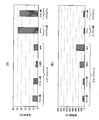
- FIG. 5 is a graph showing the test results of each item of dissolution rate (A) and degree of swelling (B) in a hot water resistance test of a coating film (film) formed with water-based paints having different PVAL-crosslinking agent system cross-linking agents.
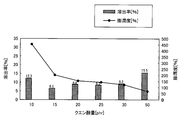
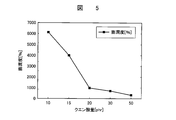
- FIG. 5 is a graph showing test results for each item of dissolution rate and swelling degree in a hot water resistance test of coating films formed with water-based paints having different PVAL-citric acid-based citric acid contents.
- the PVAL-citric acid-based citric acid content is constant (20 parts citric acid with respect to 100 parts PVAL), and the stiffness of the coating film formed with each water-based paint with different polyethylene glycol (PEG) content is determined by the B method.
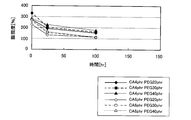
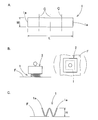
- FIG. 3 is a graph showing initial dynamic viscoelasticity (E ′) at ⁇ 50 ° C. to 80 ° C. for each coating film with a variable amount of PEG. It is the schematic explaining the method of the springback test of an airbag base fabric. It is a schematic sectional drawing of the airbag apparatus for steering wheels which is an example of the airbag apparatus using the airbag base fabric of embodiment. It is the schematic explaining the folding process of the airbag used for the airbag apparatus of FIG.
- Paint according to the first embodiment is based on a water-soluble resin, and the water-soluble resin is premised on having OH as a water-solubilizing group.
- water-soluble resin examples include PVAL and carboxymethyl cellulose.
- PVAL is desirable. More specifically, PVAL having a saponification degree of 70 mol% or more and a polymerization degree of 1000 to 4000, and preferably a saponification degree of 80 to 95 mol% and a polymerization degree of 1500 to 3800 is preferable. If the degree of saponification is too low, it will be difficult to ensure the required heat and humidity resistance in the crosslinked coating film. On the other hand, if the degree of saponification is too high, the crystallinity becomes high, and it becomes difficult to obtain the required flexibility in the crosslinked coating film. On the other hand, if the degree of polymerization is too low, it is difficult to obtain the required strength. On the other hand, if the degree of polymerization is too high, the viscosity of the coating tends to increase greatly, causing problems in handling.
- JP-33 (saponification degree: 86.5-89.5%, viscosity: 70-802 mPa ⁇ s), “JP-24” Saponification degree 87.0 to 89.0%, viscosity 40 to 502 mPa ⁇ s), “JP-18” (saponification degree 87.0 to 89.0%, viscosity 23 to 272 mPa ⁇ s), and the like.
- the viscosity is at “4%, 20 ° C.”.
- An organic crosslinking agent having a functional group (reactive group) capable of forming a crosslinked coating film by reacting with OH groups is added to the water-soluble resin. This is because the coating film is crosslinked to improve the heat and humidity resistance.
- Examples of the functional group capable of undergoing a crosslinking reaction with the OH group include a carboxyl group (COOH), an isocyanate group (NCO), and an aldehyde group (CHO).
- the compound having a COOH group crosslinking agent
- a compound mainly composed of an aliphatic polyvalent carboxylic acid having a valence of 2 or more (including saturated / unsaturated aliphatic) is desirable.
- saturated aliphatic polycarboxylic acids having a valence of 2 or more include citric acid (C6, valence: 3), succinic acid (C4, valence: 2), adipic acid (C6, valence: 2), sulphur
- unsaturated aliphatic polyvalent carboxylic acid having a valence of 2 or more such as acid (C2, valence: 2) include maleic acid (C4) and fumaric acid (C4).
- polyisocyanates include aromatics such as tolylene diisocyanate (TDI), diphenylmethane 4,4′diisocyanate (MDI), and metaxylylene diisocyanate (XDI).
- aromatics such as tolylene diisocyanate (TDI), diphenylmethane 4,4′diisocyanate (MDI), and metaxylylene diisocyanate (XDI).
- Non-aromatic systems aliphatic, cycloaliphatic
- HMDI hexamethylene diisocyanate
- HMDI hexamethylene diisocyanate
- HMDI hexamethylene diisocyanate
- HMDI hexamethylene diisocyanate
- HMDI hexamethylene diisocyanate
- HMDI hexamethylene diisocyanate
- water-soluble HMDI is desirable from the viewpoint of paint preparation (Test Example 1, see FIG. 1).
- Examples of the compound having an aldehyde group (crosslinking agent), that is, cyclic / non-cyclic aldehyde include formaldehyde, acetaldehyde, butyraldehyde, valeraldehyde, acrylic aldehyde, benzaldehyde and the like.
- aldehydes since aldehydes have high reactivity, a modified or polymerized one is usually used.
- the blending amount of these crosslinking agents includes the molecular weight and valence (number of functional groups) of the crosslinking agent itself, the OH group content of the water-soluble resin (in the case of PVAL, the degree of saponification), the degree of polymerization (molecular weight), and the plasticity described later. It varies slightly depending on the blending amount of the imparting agent. Usually, the crosslinking agent is used in an amount of 5 to 50 parts, preferably 5 to 30 parts, and more preferably 10 to 30 parts with respect to 100 parts of the water-soluble resin. If the blending amount of the crosslinking agent is too small, it is difficult to impart the required heat and moisture resistance to the coating film. If the blending amount is excessive, the coating film becomes hard and the flexibility of the airbag may be hindered.
- a water-soluble plasticity imparting agent is added to the paint of the present invention.
- the plasticity imparting agent contains an OH group and does not volatilize at the heat treatment temperature of the coating film, that is, the boiling point is equal to or higher than the heat treatment temperature.
- the plasticizer may include one having one OH group, but usually one having a plurality of OH groups or a main one is used.
- Alkylene glycol ethylene glycol (bp: 197.6 ° C) (C2), propylene glycol (bp: 187 ° C) (C3), 1,2-butanediol (bp 193 ° C) (C4), 1,3-butanediol (Bp: 208 ° C.) (C4), hexylene glycol (bp: 198 ° C.) (C6)
- Polyalkylene glycol diethylene glycol (bp: 244 ° C), triethylene glycol (bp: 287 ° C), PEG200 (bp: 287 ° C), PEG300 (bp :?)
- a plasticizer near the heat treatment temperature such as ethanolamine (bp: 171 ° C.) and ethanolacetamide (bp: 160 ° C.) other than the above can be used in combination.
- the blending amount of the plasticizer varies slightly depending on the OH group content of the water-soluble resin (in the case of PVAL, the degree of saponification), the degree of polymerization (molecular weight), and the blending amount of the crosslinking agent.
- the amount is usually 25 to 150 parts, preferably 30 to 150 parts, and more preferably 40 to 100 parts with respect to 100 parts of the water-soluble resin. If the blending amount of the plasticizer is too small, it is difficult to impart the required flexibility (mainly elongation (E B )) to the coating film. If the blending amount is excessive, the ratio of the water-soluble resin as the base becomes relatively low. It becomes difficult to secure the strength required for the coating film.
- E B elongation
- the airbag base fabric to which the paint of this embodiment is applied is a fabric woven with polar synthetic fibers such as polyamide (PA) fiber yarns and polyester (PET) fiber yarns.
- polar synthetic fibers such as polyamide (PA) fiber yarns and polyester (PET) fiber yarns.
- PA fiber for example, an aliphatic polyamide such as nylon 66, nylon 6, nylon 46, nylon 12 or the like; an aromatic polyamide such as aramid or the like is used.
- the weaving mode of the fabric is usually a plain weave, but it may be an oblique weave or a satin weave.
- the cover factor (K) represented by the formula (1) of the fabric is 1200 to 2400, preferably 1400 to 2100, more preferably 1600 to 2000, and most preferably 1800 to 2000.
- a fabric with a low cover factor that is, a high air permeability
- the weight and cost of the airbag can be reduced.
- the cover factor is too low, it becomes difficult to obtain a predetermined mechanical strength for the fabric, and in addition, it becomes difficult to ensure the air density or flexibility of the airbag base fabric due to the molten resin penetrating and flowing between the fabric weaves. .
- the fabric stiffness will not easily fall within a predetermined value, and if the yarn density is high, the fabric will be thick and problems with the folding and storage properties of the airbag will tend to occur.
- the paint is applied to one side or both sides of the fabric.
- the coating method is not particularly limited as long as the coating material is a method suitable for an aqueous coating material based on a water-soluble resin.
- the coating material is a method suitable for an aqueous coating material based on a water-soluble resin.
- knife coating die coating
- roller coating national, reverse
- brush coating and spray coating are applied.
- dip impregnation
- the coating amount (in terms of solid content) varies depending on the composition of the paint and the required properties (air permeability and flexibility) for the base fabric, but is usually 3 to 50 g / m 2 , preferably 6 to 30 g / m 2 , more preferably 8 ⁇ 15 g / m 2 .
- the coating thickness (dry film thickness) is usually 0.1 to 50 ⁇ m, preferably 0.5 to 20 ⁇ m, and more preferably 0.5 to 10 ⁇ m.
- the coating amount is too large or the coating film thickness is too thick, it tends to increase the weight of the airbag or decrease the flexibility.
- the air permeability is below 20 kPa (hereinafter the same), usually 3.0L / (cm 2 ⁇ min) or less, further 1.0L / (cm 2 ⁇ min), and further 0.1L / (cm 2 ⁇ min) It is desirable that
- the heating means is usually a thermostatic bath (hot air), but may be replaced or used in combination with other heating means (for example, microwaves, infrared rays, etc.).
- the thus formed crosslinked coating film has a tensile elongation (E B ) (tensile elongation at break) (ASTM D638, the same applies hereinafter): 50% or more, desirably 100% or more, and more desirably 200% or more. If the tensile elongation is too low, it will be difficult to ensure flexibility in the bag base fabric after the formation of the dried coating film (coating film), and cracks will occur in the elastomer coating film due to the stress at the time of bag deployment, resulting in a predetermined airtightness. May be difficult to secure.
- E B tensile elongation at break
- the bending resistance of the airbag base fabric according to the present invention on which a cross-linked coating film is formed is the bending resistance B method (Circular Bend B method) (ASTM-D4032: the same applies hereinafter). 55N or less, preferably 30N or less.
- the paint based on the water-soluble resin of the present invention to an airbag base fabric, a water-insoluble crosslinked film (coating film) having excellent heat resistance and moisture resistance (heat resistance and water resistance) and flexibility is obtained. It becomes possible to form an airbag base fabric provided on one side or both sides. In this way, the present invention can be applied as an airbag base fabric of an airbag installed in an automobile or the like used in a hot summer area.
- the combination of PVAL and citric acid or maleic acid shows a degree of swelling of 100% or less, which is further desirable.
- Tests similar to Test Example 2 were performed on combinations of different amounts of citric acid with respect to 100 parts of PVAL, with 80 parts of plasticizer (PEG200) added.
- ⁇ Application example> 1 Four types of paints (aqueous solutions) for airbag fabrics having the following composition were prepared.
- PVAL degree of polymerization 1800, degree of saponification 87-89%
- Citric acid 20 parts
- Water 800 parts 2
- the above aqueous solution which has been slightly heated (30 ° C.), is dipped and applied to a PET base fabric (plain weave: 560 dtex, 46 pieces, cover factor: 2065) fed from a feeding roller (solid)
- Application amount 10 g / m 2 , coating film thickness: about 3 ⁇ m).
- the dip-coated PET base fabric is introduced into a thermostatic bath, heated with hot air under conditions of 170 ° C. ⁇ 330 s, and wound up by a winding roller.
- the bending resistance of the PET base cloth (airbag base cloth) after coating having a cross-linked coating film on both sides thus prepared was measured by the bending resistance B method.
- the paint of the second embodiment is the same as the paint of the first embodiment, in which the water-soluble resin is PVAL, the crosslinking agent is citric acid, and the plasticizer is a liquid polyalkylene glycol. It is an invention relating to a paint that focuses on (fogging) properties and heat aging resistance. In the following description, “phr” means “parts per hundred parts of resin”.
- a paint for an airbag base fabric containing citric acid, liquid PEG and liquid polyalkylene glycol (liquid PAG) having a molecular weight of 1000 or more together with PVAL The plasticity imparting agent is mainly composed of liquid PEG, and the liquid PAG is added in an amount capable of forming a film so that the fogging resistance is not more than 10.0 (Haze: JIS K 7105). .
- PEG has a molecular weight of 1000 or more and does not exist in liquid form.
- the liquid PAG means a molecular weight of 1000 or more.
- the amount of citric acid can be maintained at 150% or higher (E B ) (ASTM D 638) in the heat aging test (120 ° C. ⁇ 400 h) without progressing post-crosslinking, and further 200% or more.
- the amount is desirable.
- the liquid PEG is preferably selected from the range of average molecular weight (M W ): 250 to 550 from the viewpoint of fogging resistance and low temperature flexibility. Easily volatilized and M W is small, M W is large, the solidifying point becomes near ordinary temperature, it becomes difficult to secure a low-temperature flexibility.
- liquid PAG having a molecular weight of 1000 or more a copolymer of ethylene oxide and propylene oxide is desirable because it is easy to obtain a liquid at room temperature of 1000 or more.
- M W is selected from the range of 1500 to 4500 (preferably 2000 to 4000), and is 2 times or less (preferably 1.5 times or less, more preferably 0.5 times or less) of liquid PEG. The blending amount is desirable. It has been confirmed that it is difficult to obtain a uniform coating film only with a liquid PAG.
- liquid PAG having a high molecular weight (1000 or more) can be compatible with PVAL.
- liquid PAG contributes to the suppression of thermal degradation and decomposition of PVAL.
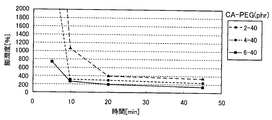
- the present inventors show that heat aging resistance is improved if the amount of citric acid is relatively low compared to the first embodiment. It was found (see FIG. 4).
- the blending amount of citric acid is preferably 3 to 5 phr in the range of PEG: 20 to 60 phr.
- PEG has the lowest boiling point of diethylene glycol, which is 244 ° C, and hardly volatilizes at the normal use atmosphere temperature of the airbag.
- FIG. 8 showing the result shows that the elasticity E ′ changes greatly between PEG: 20 phr and 30 phr.
- the lower limit is preferably 25 phr, more preferably 30 phr, from the viewpoint of low temperature resistance
- the upper limit is preferably 70 phr, more preferably 60 phr, from the viewpoint of fogging resistance.
- the air bag base fabric paint of the present invention is added with the following auxiliary materials in various amounts (the paint of the first embodiment is also included).
- Anti-aging agent antioxidant
- amines such as N, N'-di-2-naphthyl-P-phenylenediamine, 2,5-di- (t-amyl) hydroquinone, etc.
- quinone series and phenol series such as 2,6-di-t-butyl-p-cresol, those of heat resistant type can be suitably used.
- the blending amount of the anti-aging agent varies depending on the type of anti-aging agent and required characteristics, but is usually selected appropriately from the range of 0.2 to 1 phr.
- Rust preventive agent Although not particularly limited, Na citrate, Na sebacate, Na molybdate, Na benzoate, Na nitrite, and the like can be suitably used.
- the blending amount of the rust inhibitor varies depending on the type of rust inhibitor and the required degree of rust prevention, but is appropriately selected from the range of 0.01 to 1 phr.
- Flame retardant Phosphate ester (TCP, TPP, TXP, etc.), guanidine phosphate, ammonium phosphate, guanidine sulfate, antimony trioxide, titanium oxide, melamine, aluminum hydroxide, chlorinated paraffin, etc. are suitably used. It can.
- the blending amount of the flame retardant varies depending on the type of flame retardant and required characteristics, but is appropriately selected from the range of 1 to 10 phr.
- the paint of this embodiment is applied to one side or both sides of a base fabric (fabric) and heat-treated to produce an airbag base fabric having a crosslinked coating film.
- a base fabric fabric
- the kind of base fabric used at that time, the application method and the conditions of the heat treatment, as well as the properties of the crosslinked coating film and the properties of the airbag base fabric are the same as in the first embodiment. For this reason, those descriptions are omitted.
- C Airbag Base Fabric
- the airbag base fabric of the embodiment is obtained by forming a coating film by applying a paint to the surface of a fabric (base fabric) formed from polyester fibers.
- PET polyethylene terephthalate
- PBT polybutylene terephthalate
- the polyester fibers constituting the fabric are those having a Young's modulus of 10 to 25 GPa (preferably 10 to 22 GPa). If the Young's modulus is less than 10 GPa, the fabric is too soft and it is difficult to crease the base fabric when the airbag is folded. On the other hand, when the Young's modulus exceeds 25 GPa, the fabric is too hard and folding is easily canceled by the spring back.
- the fabric has a cover factor (K) represented by the formula (1) of 1000 to 2700 (preferably 1200 to 2400, more preferably 1400 to 2200, still more preferably 1600 to 2100, most preferably 1800). ⁇ 2100).
- a low cover factor (K) means that the warp / weft density and / or the warp / weft fineness is relatively low.
- a high cover factor (K) means that the warp / weft density and / or the warp / weft fineness is relatively high.
- cover factor (K) When the cover factor (K) is less than 1000, it is difficult to obtain the required mechanical strength (tensile strength, etc.) in the airbag, and the molten paint penetrates between the weaves. It becomes difficult to ensure airtightness and flexibility. On the other hand, if the cover factor (K) exceeds 2700, the fabric becomes so rigid that it is difficult to obtain the flexibility required for the airbag, and an airbag formed using the airbag base fabric is added to the vehicle. Problems are also likely to occur in folding workability and stowability during mounting.
- the paint described in the first and second embodiments can be suitably used as the paint used in the present invention.
- the thickness of the coating film formed from the paint is 0.1 to 50 ⁇ m (desirably 0.5 to 20 ⁇ m, more desirably 0.5 to 10 ⁇ m). If the coating film is too thick, it tends to lead to an increase in weight of the airbag and a decrease in flexibility of the base fabric.
- the coating film has a tensile elongation (E B ) (tensile elongation at break) (ASTM D638) of 50% or more (preferably 100% or more, more preferably 200% or more).
- E B tensile elongation at break
- ASTM D638 tensile elongation at break
- the Young's modulus of the coating film is smaller than that of the fabric and is set within the range of 5 to 300 MPa, further 5 to 200 MPa, and more preferably 10 to 100 MPa. If the Young's modulus is too small, it is difficult to crease the base fabric when the airbag is folded because the coating film is soft. On the other hand, if the Young's modulus is too high, the coating film is hard, so that the springback force is increased, the folding is eliminated, and it is difficult to maintain the folded form.
- the airbag base fabric according to the embodiment in which a coating film is formed on the fabric surface as described above has an air permeability under 20 KPa of 0.3 L / (min ⁇ cm 2 ) or less, and further 0.1 L / It is desirable to set it to (min ⁇ cm 2 ) or less. If the air permeability is too high, the inflation gas escapes through the base fabric after the airbag has been inflated, and it is difficult to maintain the internal pressure at the completion of the inflation for a predetermined time.
- the airbag base fabric of the present embodiment has the bending resistance set to 55 N or less, more preferably 30 N or less in the bending resistance B method (Circular Bend B method) (ASTM-D4032).
- the bending resistance B method Currcular Bend B method
- the method of the springback test is as shown in FIG.
- a strip-shaped test piece 1 having a width dimension W: 30 mm ⁇ length dimension L: 150 mm is prepared with the longitudinal direction parallel to the warp or weft.
- test piece 1 is folded into four sheets while making three creases C along the edge in the short direction and reducing the width dimension in the longitudinal direction.
- test piece 1 folded in this way is placed on a horizontal plane F as shown in FIG. 9B, a weight 2 is placed on the test piece 1 and pressed for 60 seconds.
- the weight is assumed to have a mass of 3000 g having a bottom surface of 50 mm square.
- test piece 1 is placed on the horizontal plane F with the longitudinal ends 1a facing upward and left in a state of being left for 2 minutes (substantially W-shaped).
- the height dimension H of the test piece is measured. In the embodiment, this test was performed under conditions of temperature: 25 ° C. and humidity: 50%.
- test piece height dimension H was 19 mm in the example, while it was 7 mm in the comparative example. Moreover, the test piece height dimension H of Reference Examples 1 and 2 was 20 mm and 10 mm, respectively.
- the base fabric of the present invention desirably has a test piece height dimension H of 15 to 35 mm, more preferably 16 to 30 mm, and even more preferably 18 to 25 mm in the springback test.
- the low test piece height dimension H means that the base fabric has a large springback force (elastic recovery force). For this reason, a problem easily occurs in the folding workability of the airbag. That is, it is difficult to make a crease during the folding operation, and it is difficult to maintain the folded shape without applying external force.
- a high test piece height dimension H means that the spring back force (elastic recovery force) of the base fabric is small and the rigidity is high.
- an airbag folded using a base fabric that maintains a test piece height that approximates a fold pitch of 37.5 mm (150 mm / 4) has little flexibility. For this reason, the problem that the workability
- the polyester fiber fabric has a large Young's modulus and high rigidity, even in a non-coated state where no paint is applied, even if it can be folded once, it has a springback force to eliminate folding. large. For this reason, it is hard to maintain a folded state compared with the base fabric of the reference example 1 which uses nylon 66 whose Young's modulus is smaller than PET fiber.
- Reference Example 2 is an example in which a coating film having a smaller Young's modulus than the fibers constituting the fabric is formed on the fabric used in Reference Example 1.
- the rigidity of the coating film is low, the rigidity of the base fabric is too low. For this reason, it is difficult to make a crease when it is folded, and it is difficult to fold it so as to overlap multiple layers when used as an airbag. Therefore, it is easy to collapse, it is difficult to maintain the folded state, and there is a problem in the workability of storing the airbag.
- the base fabric of the example is folded as shown in FIG. 11 and used as the airbag 11 of the airbag apparatus M for the steering wheel shown in FIG.
- Two base fabrics (vehicle body side base fabric 12 and occupant side base fabric 13) that are flattened and stitched at the outer periphery are overlapped in the left and right direction to reduce the width in the left and right direction, and in the front and rear direction. After folding back and forth so as to reduce the width dimension, it is folded so as to overlap in multiple layers. Thus, even if the airbag 11 is folded, it can be folded with good workability, and the folded shape can be held without applying external force.
- the folded base fabric (the vehicle body-side base fabric 12 and the occupant-side base fabric 13) has appropriate flexibility. For this reason, when mounted on the vehicle, as shown in FIG. 10, it can be smoothly accommodated in a narrow gap between the airbag cover 16 and the inflator 17 in the case 15 so as to be further bent.
- Test piece height dimension 1 ... Test piece, 2 ... Weight, F ... Horizontal plane H: Test piece height dimension.
Landscapes
- Chemical & Material Sciences (AREA)
- Engineering & Computer Science (AREA)
- Organic Chemistry (AREA)
- Chemical Kinetics & Catalysis (AREA)
- Textile Engineering (AREA)
- Wood Science & Technology (AREA)
- Health & Medical Sciences (AREA)
- Medicinal Chemistry (AREA)
- Polymers & Plastics (AREA)
- Life Sciences & Earth Sciences (AREA)
- Materials Engineering (AREA)
- Dispersion Chemistry (AREA)
- Mechanical Engineering (AREA)
- Air Bags (AREA)
- Treatments For Attaching Organic Compounds To Fibrous Goods (AREA)
- Paints Or Removers (AREA)
Abstract
Description
但し、NW:経糸密度(本/in)、DW:経糸繊度(デニール)
NF:緯糸密度(本/in)、DF:緯糸繊度(デニール)
カバーファクター(K)が、低過ぎる又は高過ぎるということは、経・緯糸密度及び/又は経・緯糸繊度が相対的に低いこと又は高いことを意味する。
前記水溶性樹脂がポリビニルアルコール(PVAL)であるとともに、
架橋剤として前記PVALのOH基と反応可能な脂肪族多価カルボン酸又はポリイソシアナート、及び、
可塑性付与剤として液状ポリオールが添加されてなる、ことを特徴とする。
前記水溶性樹脂が、水溶性付与基としてOH基を備えたものであるともに、
OH基と反応して架橋塗膜を形成可能な官能基(反応基)を有し、架橋塗膜に所要の耐熱湿性を付与可能な有機架橋剤、及び、
複数のOH基を含有する可塑性付与剤が添加されている、ことを特徴とする。
ポリエステル繊維から形成されて、
カバーファクター(K)=NW×DW0.5+NF×DF0.5
(但し、NW:経糸密度(本/in)、DW:経糸繊度(デニール)
NF:緯糸密度(本/in)、DF:緯糸繊度(デニール))
が1200~2400の範囲内に設定される前記布帛と、
前記布帛よりもヤング率を小さく設定される前記塗膜と、
を有して、
前記エアバッグ基布が、20KPa下での通気度0.3L/(min・cm2)以下を示すとともに、下記条件の<スプリングバック試験>後の試験片高さが15~35mmの範囲内にある、ことを特徴とするエアバッグ基布。
1)前記エアバッグ基布から、長手方向が経糸又は緯糸と平行となるように裁断して150mm×30mmの帯状の試験片を調製する。
本実施形態群の塗料は、水溶性樹脂をベースとし、該水溶性樹脂が水溶性付与基としてOHを備えていることを前提とする。
ポリアルキレングリコール・・・ジエチレングリコール(bp:244℃)、トリエチレングリコール(bp:287℃)、PEG200(bp:287℃)、PEG300(bp:?)
なお、上記可塑性付与剤を主体とし、上記以外のエタノールアミン(bp:171℃)やエタノールアセトアミド(bp:160℃)等の加熱処理温度近傍の可塑性付与剤も併用することもできる。
ポリアクリル酸・・・Mw:2500
ポリアリルアミン・・・日東紡社製「IIA-25」(商品番号)10%水溶液
<試験例1>
各水溶性樹脂の水溶液に、水溶性樹脂(固形分)100部に対して各架橋剤50部を添加して水性塗料を調製した。そして、各水性塗料をガラス板に塗布後、170℃×330s(5.5min)の条件で加熱処理をして、ガラス板からフィルム状の塗膜(100μm)を引き剥がして矩形試験片(50mm×50mm)を調製した。
上記試験結果から、PVALをクエン酸と組合わせたものとし、クエン酸の配合量の異なる水性塗料を調製して、同様の試験を行った。
上記PVAL100部に対するクエン酸の配合量が異なる組合わせで、さらに、可塑性付与剤(PEG200)80部を添加したものにおいて、試験例2と同様の試験(膨潤度のみ)を行った。
1)下記組成のエアバッグ基布用塗料(水溶液)を4種類調製した。
PEG300:20・30・60・80部
クエン酸:20部、
水:800部
2)上記水溶液の若干加温(30℃)させたものを、繰り出しローラから繰り出されたPET基布(平織り:560dtex、46本打込み、カバーファクター:2065)に浸漬塗布する(固形分塗布量:10g/m2、塗布膜厚:約3μm)。
(B)第二実施形態の塗料:
本実施形態の塗料は、第一実施形態の塗料において、水溶性樹脂をPVALとし、架橋剤をクエン酸とし、可塑性付与剤を液状のポリアルキレングリコールとした場合において、夏季乃至酷暑地における耐フォッギング(fogging)性、さらには、耐熱老化性に着目した塗料に係る発明である。以下の説明で「phr」は「parts per hundred parts of resin」を意味する。
前記可塑性付与剤が液状PEGを主体とし成膜可能な量の前記液状PAGが添加されて耐フォッギング性において曇価(Haze:JIS K 7105)10.0以下であるものとされていることを特徴とする。
PVAL:100部に対して、クエン酸:1~10部(望ましくは3~5部)、液状PEG:25~75部、液状PAG:10~30部が配合され、且つ、液状PAGが液状PEGの2倍(望ましくは1倍、さらに望ましくは0.5倍)以下であることを特徴とする。なお、上記において
上記において、液状PEGは、耐フォッギング性および低温柔軟性の見地から、平均分子量(MW):250~550の範囲のものから選択することが望ましい。MWが小さいと揮発し易く、MWが大きいと凝固点が常温付近となり、低温柔軟性を確保し難くなる。

1)老化防止剤(酸化防止剤):特に限定されないが、N,N´‐ジ‐2‐ナフチル‐P‐フェニレンジアミンなどのアミン系、2,5-ジ-(t-アミル)ヒドロキノンなどのキノン系、2,6-ジ-t-ブチル-p-クレゾールなどのフェノール系、のうちで耐熱タイプのものを好適に使用できる。老化防止剤の配合量は、老化防止剤の種類、要求特性により異なるが、通常、0.2~1phrの範囲から適宜選定する。
(C)エアバッグ基布
次に、車両搭載時における折り畳み作業時に折目を付けやすく、かつ、折畳後に折りを解消するような復元を抑制可能なエアバッグ基布について、説明する。
布帛:PET繊維布帛
ヤング率=11.8GPaで、560dtexのPET繊維合糸からなる織糸を、平織(経糸:46本/in、緯糸:46本/in)により織成したカバーファクター(K)=2065のもの、
塗料:下記組成からなり、塗膜ヤング率30MPaのもの、
PVAL (重合度:1800、けん化度:87~89%):100部
クエン酸:20部、
PEG300:80部
水:800部
上記塗料を布帛の表面の両面に、塗膜厚2μm(加熱処理後)となるように塗布して基布を調製した。該基布の通気度は0.04L/(min・cm2)であった。
布帛:実施例1の布帛と同じ
塗料:なし
布帛の通気度は、4.7L/(min・cm2)であった。
布帛:ナイロン66
ヤング率=8.1GPaで、470dtexのナイロン66繊維合糸からなる織糸を、平織(経糸:46本/in、緯糸:46本/in)により織成したカバーファクター(K)=1892のもの
塗料:なし
布帛の通気度は、4.9L/(min・cm2)であった。
布帛:参照例1の布帛と同じ
塗料:塗膜形成時のヤング率を2MPaとされるシリコーンエラストマー樹脂からなるエマルション塗料
上記塗料を布帛の両面に、塗膜厚15μmとなるように塗布して基布を調製した。該基布の通気度は、0.0L/(min・cm2)であった。
2…錘、
F…水平面、
H…試験片高さ寸法。
Claims (14)
- 水溶性樹脂をベースとする水性のエアバッグ基布用塗料であって、
前記水溶性樹脂がポリビニルアルコール(PVAL)であるとともに、
架橋剤として前記PVALのOH基と反応可能な脂肪族多価カルボン酸又はポリイソシアナート、及び、
可塑性付与剤として液状ポリオールが添加されてなる、
ことを特徴とするエアバッグ基布用塗料。 - 前記PVALのけん化度が70mol%以上で重合度が1000~4000であり、
前記脂肪族多価カルボン酸が、炭素数2~6の脂肪族多価カルボン酸であり、
前記液状ポリオールが、アルキレングリコール(炭素数2~6)、又は、ポリアルキレングリコール(モノマー炭素数2又は3)である、
ことを特徴とする請求項1記載のエアバッグ基布用塗料。 - 前記PVALのけん化度が80~95mol%以上で重合度が1500~3800であり、
前記脂肪族多価カルボン酸が、クエン酸又はマレイン酸であり、
前記ポリイソシアナートが、ヘキサメチレンジイソシアナート又はジフェニルメタン4,4´ジイソシアナートであり、
前記液状ポリオールが、エチレングリコール若しくはプロピレングリコールから選択されるアルキレングリコール、及び/又は、液状ポリアルキレングリコールである、
ことを特徴とする請求項1記載のエアバッグ基布用塗料。 - PVALとともに、クエン酸、液状ポリエチレングリコール(液状PEG)を含むエアバッグ基布用塗料であって、
前記PVAL100質量部に対して、前記クエン酸1~50質量部、前記液状PEG25~150質量部である、
ことを特徴とするエアバッグ基布用塗料。 - PVALとともに、クエン酸、液状PEGおよび分子量1000以上の液状ポリアルキレングリコール(液状PAG)を含むエアバッグ基布用塗料であって、
前記PVAL:100質量部に対して、前記クエン酸:1~10質量部、前記液状PEG:25~75質量部、前記液状PAG:10~30質量部が配合され、且つ、前記液状PAGの配合量が前記液状PEGの2倍以下であることを特徴とするエアバッグ基布用塗料。 - 水溶性樹脂をベースとする水性のエアバッグ基布用塗料であって、
前記水溶性樹脂が、水溶性付与基としてOH基を備えたものであるともに、
OH基と反応して架橋塗膜を形成可能な官能基(反応基)を有し、架橋塗膜に所要の耐熱湿性を付与可能な有機架橋剤、及び、
複数のOH基を含有する可塑性付与剤が添加されている、
ことを特徴とするエアバッグ基布用塗料。 - 極性合成繊維で織成されてなる布帛の片面又は両面に、請求項1~6いずれか一記載のエアバッグ基布用塗料で形成された水不溶性の架橋塗膜(塗膜)を備えていることを特徴とするエアバッグ基布。
- 前記架橋塗膜を備えているエアバッグ基布の剛軟度が、剛軟度B法(ASTM-D4032)で55N以下を示すものであることを特徴とする請求項7記載のエアバッグ基布。
- 極性合成繊維で織成されてなる布帛の片面又は両面に、請求項1~6いずれか一記載のエアバッグ基布用塗料を塗布して、加熱処理により水不溶性の架橋塗膜を形成することを特徴とするエアバッグ基布の製造方法。
- 極性合成繊維からなる布帛の片面又は両面に、請求項1~6のいずれかに記載のエアバッグ基布用塗料を、塗布量(乾燥)が3~50g/m2となるように塗布することを特徴とするエアバッグ基布の製造方法。
- 織布からなる布帛の表面に、塗料により塗膜を形成させて構成されるエアバッグ基布であって、
ポリエステル繊維から形成されて、
カバーファクター(K)=NW×DW0.5+NF×DF0.5
(但し、NW:経糸密度(本/in)、DW:経糸繊度(デニール)
NF:緯糸密度(本/in)、DF:緯糸繊度(デニール))
が1000~2700の範囲内に設定される前記布帛と、
前記布帛よりもヤング率を小さく設定される前記塗膜と、
を有して、
前記エアバッグ基布が、20KPa下での通気度0.3L/(min・cm2)以下を示すとともに、下記条件の<スプリングバック試験>後の試験片高さが15~35mmの範囲内にある、ことを特徴とするエアバッグ基布。
<スプリングバッグ試験>
1)前記エアバッグ基布から、長手方向が経糸又は緯糸と平行となるように裁断して150mm×30mmの帯状の試験片を調製する。
2)該試験片を長手方向側の幅寸法を縮めつつ4枚重ねに折り畳む。
3)該折り畳み後の試験片を水平面に置き、50mm四方の底面を有する3000gの錘を載置して60秒間押圧する。
4)該錘を除去した試験片を、長手方向両端を上に向けて水平面に2分間放置後、前記試験片の高さを測定する。 - 前記塗膜のヤング率(JIS L 1013)が5~300MPaの範囲内に設定されていることを特徴とする請求項11記載のエアバッグ基布。
- 前記塗膜の厚さが0.1~50μmの範囲内に設定されていることを特徴とする請求項11記載のエアバッグ基布。
- 前記塗料が請求項1~6のいずれかに記載のエアバッグ基布用塗料であることを特徴とする請求項11記載のエアバッグ基布。
Priority Applications (2)
| Application Number | Priority Date | Filing Date | Title |
|---|---|---|---|
| US14/125,428 US20140113516A1 (en) | 2011-09-28 | 2012-09-27 | Coating material for airbag base fabric, and airbag base fabric |
| CN201280048031.3A CN103842454A (zh) | 2011-09-28 | 2012-09-27 | 气囊基布用涂料以及气囊基布 |
Applications Claiming Priority (6)
| Application Number | Priority Date | Filing Date | Title |
|---|---|---|---|
| JP2011211808 | 2011-09-28 | ||
| JP2011-211808 | 2011-09-28 | ||
| JP2012-074443 | 2012-03-28 | ||
| JP2012074443 | 2012-03-28 | ||
| JP2012080716 | 2012-03-30 | ||
| JP2012-080716 | 2012-03-30 |
Publications (1)
| Publication Number | Publication Date |
|---|---|
| WO2013047652A1 true WO2013047652A1 (ja) | 2013-04-04 |
Family
ID=47995680
Family Applications (1)
| Application Number | Title | Priority Date | Filing Date |
|---|---|---|---|
| PCT/JP2012/074875 Ceased WO2013047652A1 (ja) | 2011-09-28 | 2012-09-27 | エアバッグ基布用塗料及びエアバッグ基布 |
Country Status (4)
| Country | Link |
|---|---|
| US (1) | US20140113516A1 (ja) |
| JP (1) | JPWO2013047652A1 (ja) |
| CN (1) | CN103842454A (ja) |
| WO (1) | WO2013047652A1 (ja) |
Cited By (3)
| Publication number | Priority date | Publication date | Assignee | Title |
|---|---|---|---|---|
| CN104514155A (zh) * | 2013-09-27 | 2015-04-15 | 丰田合成株式会社 | 气囊基布用涂料、气囊基布及其制造方法 |
| WO2017183535A1 (ja) * | 2016-04-18 | 2017-10-26 | 昭和電工株式会社 | 繊維処理剤、繊維加工品の製造方法及び繊維加工品 |
| JP2023076356A (ja) * | 2021-11-22 | 2023-06-01 | 豊田合成株式会社 | エアバッグ用基布 |
Families Citing this family (5)
| Publication number | Priority date | Publication date | Assignee | Title |
|---|---|---|---|---|
| WO2014075036A1 (en) | 2012-11-12 | 2014-05-15 | Dow Corning Corporation | Flexible heat shield with silicone elastomer and a topcoat for inflatible safety devices |
| CN106347280A (zh) * | 2016-09-21 | 2017-01-25 | 成都创慧科达科技有限公司 | 一种多功能汽车辅助驾驶系统及方法 |
| EP4073158A1 (en) * | 2019-12-11 | 2022-10-19 | PPG Industries Ohio Inc. | Compositions containing thermally conductive fillers |
| US20230183445A1 (en) * | 2020-04-15 | 2023-06-15 | Ppg Industries Ohio, Inc. | Compositions containing thermally conductive fillers |
| US20230354807A1 (en) * | 2020-09-23 | 2023-11-09 | Veri Nano Inc. | Surface disinfectant and coating |
Citations (9)
| Publication number | Priority date | Publication date | Assignee | Title |
|---|---|---|---|---|
| JPS5891775A (ja) * | 1981-11-27 | 1983-05-31 | Res Inst For Prod Dev | 水性塗料の製造法 |
| JP2001089949A (ja) * | 1999-09-14 | 2001-04-03 | Toray Ind Inc | エアバッグ用織物 |
| JP2001214371A (ja) * | 2000-01-31 | 2001-08-07 | Asahi Kasei Corp | エアバッグ用基布およびエアバッグ |
| JP2002301422A (ja) * | 2001-01-30 | 2002-10-15 | Kowa Industry Co Ltd | 粉体塗装方法 |
| JP2008230291A (ja) * | 2007-03-16 | 2008-10-02 | Takata Corp | エアバッグ及びエアバッグ装置 |
| JP2009097134A (ja) * | 2007-09-27 | 2009-05-07 | Toyoda Gosei Co Ltd | エアバッグ用コート基布 |
| WO2009072354A1 (ja) * | 2007-12-07 | 2009-06-11 | Toyo Boseki Kabushiki Kaisha | エアバッグ用織物 |
| WO2009139087A1 (ja) * | 2008-05-15 | 2009-11-19 | 東洋紡績株式会社 | 共重合ポリエーテルポリアミド樹脂 |
| JP2010047036A (ja) * | 2008-08-19 | 2010-03-04 | Toray Ind Inc | エアバッグ用基布およびその製造方法 |
Family Cites Families (4)
| Publication number | Priority date | Publication date | Assignee | Title |
|---|---|---|---|---|
| JPH0415143A (ja) * | 1990-05-02 | 1992-01-20 | Bando Chem Ind Ltd | 衝撃吸収用バツグ |
| US20030198767A1 (en) * | 2002-04-19 | 2003-10-23 | Breed David S. | Airbags including barrier coating and method of manufacture of same |
| JP4419378B2 (ja) * | 2002-10-04 | 2010-02-24 | 東レ株式会社 | エアバッグ用基布およびその製造方法 |
| US7407898B2 (en) * | 2005-03-28 | 2008-08-05 | Milliken & Company | Liquid polymeric coating compositions and air bags coated therewith |
-
2012
- 2012-09-27 JP JP2013536375A patent/JPWO2013047652A1/ja not_active Withdrawn
- 2012-09-27 CN CN201280048031.3A patent/CN103842454A/zh active Pending
- 2012-09-27 WO PCT/JP2012/074875 patent/WO2013047652A1/ja not_active Ceased
- 2012-09-27 US US14/125,428 patent/US20140113516A1/en not_active Abandoned
Patent Citations (9)
| Publication number | Priority date | Publication date | Assignee | Title |
|---|---|---|---|---|
| JPS5891775A (ja) * | 1981-11-27 | 1983-05-31 | Res Inst For Prod Dev | 水性塗料の製造法 |
| JP2001089949A (ja) * | 1999-09-14 | 2001-04-03 | Toray Ind Inc | エアバッグ用織物 |
| JP2001214371A (ja) * | 2000-01-31 | 2001-08-07 | Asahi Kasei Corp | エアバッグ用基布およびエアバッグ |
| JP2002301422A (ja) * | 2001-01-30 | 2002-10-15 | Kowa Industry Co Ltd | 粉体塗装方法 |
| JP2008230291A (ja) * | 2007-03-16 | 2008-10-02 | Takata Corp | エアバッグ及びエアバッグ装置 |
| JP2009097134A (ja) * | 2007-09-27 | 2009-05-07 | Toyoda Gosei Co Ltd | エアバッグ用コート基布 |
| WO2009072354A1 (ja) * | 2007-12-07 | 2009-06-11 | Toyo Boseki Kabushiki Kaisha | エアバッグ用織物 |
| WO2009139087A1 (ja) * | 2008-05-15 | 2009-11-19 | 東洋紡績株式会社 | 共重合ポリエーテルポリアミド樹脂 |
| JP2010047036A (ja) * | 2008-08-19 | 2010-03-04 | Toray Ind Inc | エアバッグ用基布およびその製造方法 |
Cited By (9)
| Publication number | Priority date | Publication date | Assignee | Title |
|---|---|---|---|---|
| CN104514155A (zh) * | 2013-09-27 | 2015-04-15 | 丰田合成株式会社 | 气囊基布用涂料、气囊基布及其制造方法 |
| JP2015165059A (ja) * | 2013-09-27 | 2015-09-17 | 豊田合成株式会社 | エアバッグ基布用塗料並びにエアバッグ基布及びその製造方法 |
| US9863088B2 (en) | 2013-09-27 | 2018-01-09 | Toyoda Gosei Co., Ltd. | Airbag base fabric coating material, airbag base fabric, and method for manufacturing the same |
| WO2017183535A1 (ja) * | 2016-04-18 | 2017-10-26 | 昭和電工株式会社 | 繊維処理剤、繊維加工品の製造方法及び繊維加工品 |
| JPWO2017183535A1 (ja) * | 2016-04-18 | 2019-02-21 | 昭和電工株式会社 | 繊維処理剤、繊維加工品の製造方法及び繊維加工品 |
| TWI724154B (zh) * | 2016-04-18 | 2021-04-11 | 日商昭和電工股份有限公司 | 纖維處理劑、纖維加工品的製造方法及纖維加工品 |
| JP7012007B2 (ja) | 2016-04-18 | 2022-01-27 | 昭和電工株式会社 | 繊維処理剤、繊維加工品の製造方法及び繊維加工品 |
| JP2023076356A (ja) * | 2021-11-22 | 2023-06-01 | 豊田合成株式会社 | エアバッグ用基布 |
| JP7501504B2 (ja) | 2021-11-22 | 2024-06-18 | 豊田合成株式会社 | エアバッグ用基布 |
Also Published As
| Publication number | Publication date |
|---|---|
| US20140113516A1 (en) | 2014-04-24 |
| CN103842454A (zh) | 2014-06-04 |
| JPWO2013047652A1 (ja) | 2015-03-26 |
Similar Documents
| Publication | Publication Date | Title |
|---|---|---|
| WO2013047652A1 (ja) | エアバッグ基布用塗料及びエアバッグ基布 | |
| US10000625B2 (en) | Flame retarding agent, flame-retardant aqueous resin composition and flame-retardant urethane resin composition containing said flame-retarding agent, and use therefor | |
| EP1916329B1 (en) | Artificial sueded leather being excellent in flame retardance and method of producing the same | |
| US7737058B2 (en) | Airbag with flame retardant monolithic coating layer | |
| CN101965422B (zh) | 共聚聚醚聚酰胺树脂 | |
| JP5711803B2 (ja) | エアバッグ用基布 | |
| EP1263582A2 (en) | Laminated fabric for airbag | |
| JP2019501310A (ja) | 低通気度及び高強度の布地ならびにその製造方法 | |
| US7737059B1 (en) | Airbag coating | |
| JP6210327B2 (ja) | エアバッグ基布用塗料並びにエアバッグ基布及びその製造方法 | |
| EP2977508B1 (en) | Fabric for airbag | |
| CN104284815B (zh) | 一种碰撞时难以触底的安全气囊用基布 | |
| JP4404427B2 (ja) | エアバッグ用基布及びエアバッグ | |
| TW201348331A (zh) | 胺基甲酸酯樹脂組成物、塗布劑、物品及仿皮革片 | |
| JP4372297B2 (ja) | エアバッグ用基布およびエアバッグ | |
| JP7683811B2 (ja) | エアバッグ用基布およびそれを用いたエアバッグ | |
| KR102636613B1 (ko) | 코팅 조성물 및 에어백 원단 | |
| US20170190932A1 (en) | Method of making a textile substrate with a continuous coating of a mixture of polyester polyurethane and polycarbonate polyurethane | |
| WO2025187236A1 (ja) | 有機リン化合物 | |
| CN120752385A (zh) | 气囊用聚酯基布 |
Legal Events
| Date | Code | Title | Description |
|---|---|---|---|
| 121 | Ep: the epo has been informed by wipo that ep was designated in this application |
Ref document number: 12837230 Country of ref document: EP Kind code of ref document: A1 |
|
| WWE | Wipo information: entry into national phase |
Ref document number: 14125428 Country of ref document: US |
|
| ENP | Entry into the national phase |
Ref document number: 2013536375 Country of ref document: JP Kind code of ref document: A |
|
| NENP | Non-entry into the national phase |
Ref country code: DE |
|
| 122 | Ep: pct application non-entry in european phase |
Ref document number: 12837230 Country of ref document: EP Kind code of ref document: A1 |