WO2012176717A1 - ピラゾール化合物の製造方法 - Google Patents
ピラゾール化合物の製造方法 Download PDFInfo
- Publication number
- WO2012176717A1 WO2012176717A1 PCT/JP2012/065459 JP2012065459W WO2012176717A1 WO 2012176717 A1 WO2012176717 A1 WO 2012176717A1 JP 2012065459 W JP2012065459 W JP 2012065459W WO 2012176717 A1 WO2012176717 A1 WO 2012176717A1
- Authority
- WO
- WIPO (PCT)
- Prior art keywords
- pyrazole compound
- general formula
- group
- pyrazole
- represented
- Prior art date
- Legal status (The legal status is an assumption and is not a legal conclusion. Google has not performed a legal analysis and makes no representation as to the accuracy of the status listed.)
- Ceased
Links
- 0 CC1C(C)CC(*)C1 Chemical compound CC1C(C)CC(*)C1 0.000 description 2
Classifications
-
- C—CHEMISTRY; METALLURGY
- C07—ORGANIC CHEMISTRY
- C07D—HETEROCYCLIC COMPOUNDS
- C07D231/00—Heterocyclic compounds containing 1,2-diazole or hydrogenated 1,2-diazole rings
- C07D231/02—Heterocyclic compounds containing 1,2-diazole or hydrogenated 1,2-diazole rings not condensed with other rings
- C07D231/10—Heterocyclic compounds containing 1,2-diazole or hydrogenated 1,2-diazole rings not condensed with other rings having two or three double bonds between ring members or between ring members and non-ring members
- C07D231/14—Heterocyclic compounds containing 1,2-diazole or hydrogenated 1,2-diazole rings not condensed with other rings having two or three double bonds between ring members or between ring members and non-ring members with hetero atoms or with carbon atoms having three bonds to hetero atoms with at the most one bond to halogen, e.g. ester or nitrile radicals, directly attached to ring carbon atoms
- C07D231/28—Two oxygen or sulfur atoms
-
- C—CHEMISTRY; METALLURGY
- C07—ORGANIC CHEMISTRY
- C07D—HETEROCYCLIC COMPOUNDS
- C07D231/00—Heterocyclic compounds containing 1,2-diazole or hydrogenated 1,2-diazole rings
- C07D231/02—Heterocyclic compounds containing 1,2-diazole or hydrogenated 1,2-diazole rings not condensed with other rings
- C07D231/10—Heterocyclic compounds containing 1,2-diazole or hydrogenated 1,2-diazole rings not condensed with other rings having two or three double bonds between ring members or between ring members and non-ring members
- C07D231/14—Heterocyclic compounds containing 1,2-diazole or hydrogenated 1,2-diazole rings not condensed with other rings having two or three double bonds between ring members or between ring members and non-ring members with hetero atoms or with carbon atoms having three bonds to hetero atoms with at the most one bond to halogen, e.g. ester or nitrile radicals, directly attached to ring carbon atoms
Definitions
- the present invention relates to a method for producing a pyrazole compound useful as an intermediate for medical and agricultural chemicals.
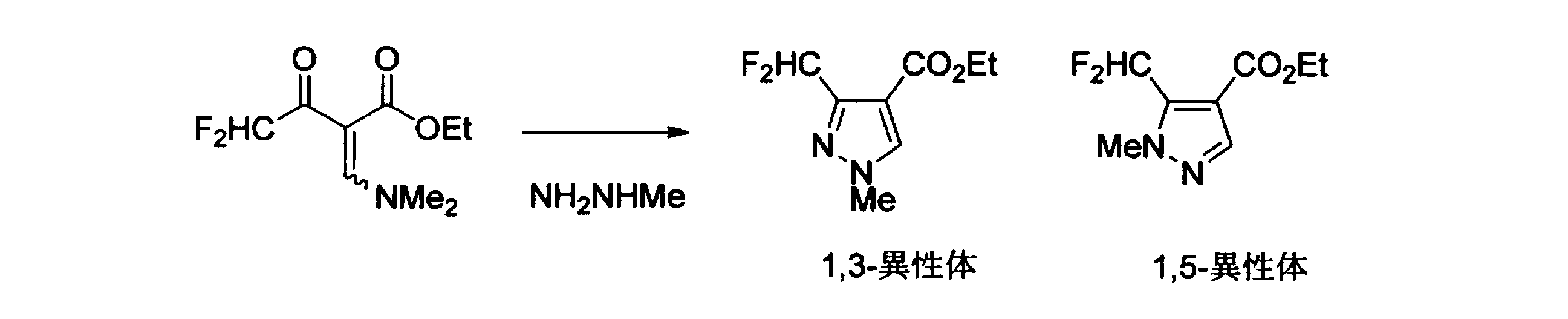
- Patent Documents 1, 2, 3 and Patent Document 3 include 3- (difluoromethyl) -1-methyl-1H-pyrazole-from ethyl 2-ethoxymethylene-4,4-difluoroacetoacetate and methylhydrazine aqueous solution. It is described that an isomeric mixture of ethyl 4-carboxylate and ethyl 5- (difluoromethyl) -1-methyl-1H-pyrazole-4-carboxylate is obtained.
- Patent Document 4 discloses that 2-perhaloacyl-3-aminoacrylic acid derivatives react with hydrazines to give 3-perhalo-substituted pyrazoles. Disclosure. Patent Document 5 discloses ethyl 2- (difluoroacetyl) -3- (dimethylamino) acrylate and methyl hydrazine to ethyl 3- (difluoromethyl) -1-methyl-1H-pyrazole-4-carboxylate and its isomerism. It is disclosed that a mixture with the form (ethyl 5- (difluoromethyl) -1-methyl-1H-pyrazole-4-carboxylate) in a ratio of 89.2: 10.8 is obtained.
- ethyl 3- (difluoromethyl) -1-methyl-1H-pyrazole-4-carboxylate was produced, and coloring was observed in the obtained product.
- the causative substance of coloring is not clear, ethyl 3- (difluoromethyl) -1-methyl-1H-pyrazole-4-carboxylate and its isomer 5- (difluoromethyl) -1-methyl-1H-pyrazole Since ethyl-4-carboxylate is a colorless solid, the presence of some unidentified substance is suspected.
- the pyrazole compound is a compound having a use as a pharmaceutical intermediate, and it is not preferable that an unidentified substance is contained even though the amount is small.
- an object of the present invention is to produce a 1,3-disubstituted pyrazole-4-carboxylic acid ester with little coloring.
- ethyl 2- (difluoroacetyl) -3- (dimethylamino) acrylate using a dialkylaminoacrylic acid ester as a starting material.
- ethyl 3- (difluoromethyl) -1-methyl-1H-pyrazole-4-carboxylate is produced in two stages, an acylation reaction and a cyclization reaction.
- an organic base such as triethylamine is often added to suppress the formation of trimesic acid ester.
- a base such as triethylamine is an acid produced as a by-product in the acylation reaction.
- an organic base / hydrogen halide salt hereinafter sometimes referred to as “salt”).
- the present inventors examined the influence of the salt on the cyclization reaction. As a result, when the salt was present, the formation of an isomer (1,5-disubstituted pyrazole-4-carboxylic acid ester) was increased, and The present inventors have found that the ratio of isomers can be reduced by removing salts from the reaction solution obtained in the acylation step by purification means such as water washing and drying. However, these purification means simultaneously reduce the yield of the acylation reaction product, resulting in a decrease in the yield of the desired product. However, without removing the salt from the reaction solution obtained in the acylation step, an inorganic base such as potassium hydroxide is added to the reaction solution to carry out the cyclization reaction in the second step (cyclization step). The present inventors have found that 1,3-disubstituted pyrazole-4-carboxylic acid esters having a low isomer content can be obtained with high efficiency.
- the present invention is as follows.
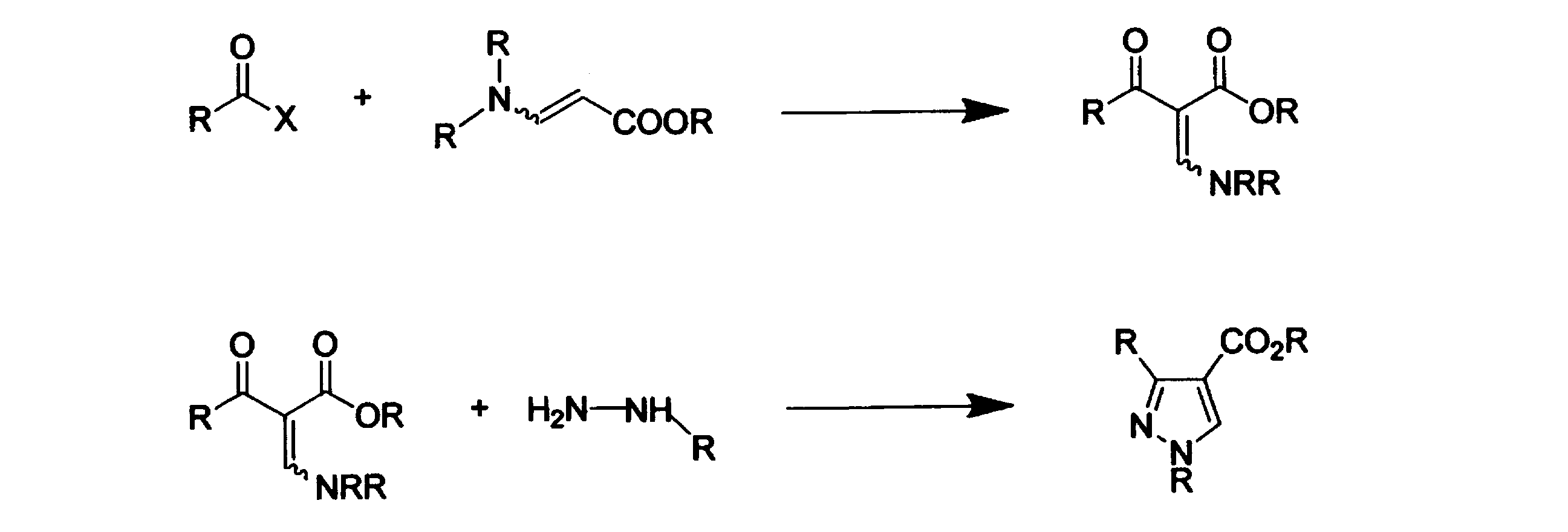
- [Invention 1] A reaction step of reacting a 2-acyl-3-aminoacrylic acid ester represented by the general formula (1) with a hydrazine represented by the general formula (4) in the presence of a base; The manufacturing method of the pyrazole compound represented.
- R 1 , R 2 , R 3 and R 4 each independently represents an alkyl group.
- R 5 represents an alkyl group or an aryl group.
- R 1, R 4, R 5 are as defined above.
- invention 9 The method for producing a pyrazole compound according to any one of Inventions 1 to 8, wherein the reaction step comprises the following two steps (substeps).
- Second step A step of synthesizing a pyrazole compound represented by the general formula (5) by mixing the reactor contents, the inorganic base and the substituted hydrazine represented by the general formula (4) obtained in the first step.
- invention 11 The method for producing a pyrazole compound according to invention 9 or 10, wherein the organic base used in the first step is a tertiary amine and the inorganic base used in the second step is potassium hydroxide or sodium hydroxide.
- invention 12 The method for producing a pyrazole compound according to any one of inventions 9 to 11, wherein the carboxylic acid halide represented by the general formula (2) is difluoroacetic acid fluoride.
- 1,3-disubstituted pyrazole-4-carboxylic acid ester with less coloring can be produced with high yield and good selectivity. Further, according to the method of the present invention, there is an effect that the content of isomer (1,5-disubstituted pyrazole-4-carboxylic acid ester) in the product is remarkably low.
- an acylation reaction is carried out in the presence of an organic base using a dialkylaminoacrylic acid ester as a starting material, and without removing salts from the reactor contents obtained,
- a cyclization reaction by adding an inorganic base to the reactor contents, 1,3-disubstituted pyrazole-4-carboxylic acid ester having a low isomer content can be efficiently produced.
- 1,3-disubstituted pyrazole-4 -Carboxylic acid esters and the like are referred to as 1,3-isomers, and 1,5-disubstituted pyrazole-4-carboxylic acid esters and the like are sometimes referred to as 1,5-isomers. It does not mean a specific pyrazole compound.
- an alkyl group shall include a linear, branched and cyclic alkyl group. When referring to an alkyl group or an aryl group, each may have a substituent.
- the 2-acyl-3-aminoacrylate represented by the general formula (1) is obtained by reacting the carboxylic acid halide represented by the general formula (2) with the dialkylaminoacrylate represented by the general formula (3). It can be synthesized by (acylation reaction).
- R 1 , R 2 , R 3 and R 4 each independently represents an alkyl group.
- the alkyl group is preferably an alkyl group having 1 to 10 carbon atoms, and more preferably an alkyl group having 1 to 4 carbon atoms.
- Each hydrogen atom may be substituted with a halogen atom. Examples of the halogen include fluorine, chlorine, bromine and iodine, and fluorine or chlorine is preferable.
- alkyl group examples include methyl group, ethyl group, n-propyl group, isopropyl group, n-butyl group, s-butyl group, t-butyl group, cyclohexyl group, cyclopentyl group, and any of them.
- a hydrogen atom is substituted with a halogen atom.
- R 1 is preferably a halogenated alkyl having 1 to 4 carbon atoms, more preferably a fluoroalkyl group having 1 to 4 carbon atoms, a chloroalkyl group or a chlorofluoroalkyl group.
- a trifluoromethyl group, a difluoromethyl group, a dichloromethyl group, and the like are more preferable.
- R 2 and R 3 function as a leaving group —NR 2 R 3 , and are not particularly limited, and may be those not substituted by halogen.
- alkyl groups a methyl group or an ethyl group is preferable, and R 2 2, those R 3 are both methyl groups are particularly preferred.
- R 4 should be selected according to the purpose of the reaction using a pyrazole compound as a reaction reagent, but functions as a leaving group when R 4 in the resulting pyrazole compound is deprotected and derived into a carboxylic acid. Therefore, it is not particularly limited, and among the alkyl groups, an ethyl group or an isopropyl group is preferable.
- X in the general formula (2) represents a halogen atom, and the halogen is fluorine, chlorine, bromine or iodine.
- a method for producing a carboxylic acid halide a known method may be adopted. For example, a method in which a corresponding carboxylic acid is chlorinated with a chlorinating agent such as thionyl chloride or a halogenated hydrocarbon is oxidized to form a carboxylic acid chloride. And a method for producing difluoroacetic acid fluoride by thermally decomposing 1-alkoxy-1,1,2,2-tetrafluoroethane in the presence of a catalyst (JP-A-8-20560).
- the acylation reaction is performed in a non-aqueous solvent.
- the solvent include aliphatic or aromatic hydrocarbons. Examples include petroleum ether, n-hexane, n-heptane, cyclohexane, benzene, toluene, xylene or decalin, and halogenated hydrocarbons such as chlorobenzene, dichlorobenzene, dichloromethane, chloroform, tetrachloromethane, dichloroethane or trichloroethane it can.
- Use of toluene, xylene, chlorobenzene, n-hexane or cyclohexane is preferred, and toluene or xylene is more preferred.
- These solvents can be used in combination.
- the acylation reaction is usually performed in the presence of a base.
- a base By adding a base, the generated hydrogen halides such as HF and HCl can be captured to prevent by-production of trimesic acid ester.
- the base include a tertiary amine (tertiary amine), pyridine or a pyridine derivative (also sometimes referred to as “pyridines”).
- bases such as pyridine or pyridine derivatives include pyridine, 2-, 3- or 4-methylpyridine, 2-methyl-5-ethyl-pyridine, 4-ethyl-2-methylpyridine, 3-ethyl-4-methylpyridine 2,4,6-collidine, 2- or 4-n-propylpyridine, 2,6-dimethylpyridine (lutidine), 4-dimethylaminopyridine, quinoline or quinaldine, and the like, such as pyridine, 2-methyl-5 -Ethylpyridine, 2,4,6-collidine, quinoline or quinaldine are preferred. Of these, pyridine is more preferred.
- Tertiary amines include trimethylamine, triethylamine, tri-n-propylamine, tri-isopropylamine, tri-n-butylamine, tri-isobutylamine, tri-sec-butylamine, tri-tert-butylamine, tri-n- Symmetric tertiary amines such as amylamine, tri-isoamylamine, tri-sec-amylamine, tri-tert-amylamine, N-methyldi-n-butylamine, N-methyldiisobutylamine, N-methyldi-tert-butylamine, N, N-diisopropylbutylamine, N, N-dimethyl-n-octylamine, N, N-dimethylnonylamine, N, N-dimethyldecylamine, N, N-dimethylundecylamine, N, N-dimethyldodecylamine, N -
- Symmetrical amines are preferred in terms of boiling point, water solubility, and availability. Trimethylamine, triethylamine, tri-n-propylamine, tri-isopropylamine, and tri-n-butylamine are more preferred, and triethylamine is even more preferred. As the base used for the production, pyridine or triethylamine is particularly preferable.
- the acylation reaction is performed at a temperature of ⁇ 20 ° C. to + 50 ° C., preferably ⁇ 10 ° C. to + 45 ° C., more preferably 0 to 40 ° C.
- the reaction pressure is not particularly limited because it does not affect the reaction, but it may be carried out under a pressure of about 0.1 to 10 MPa, and usually it may be carried out at atmospheric pressure to about 1 MPa.
- the reaction time depends on the reaction temperature and the ratio of the reaction reagent, it is usually about 10 minutes to 10 hours, and is determined based on the decrease or disappearance of the substrate while following the reaction.
- the base may be in an equimolar amount with respect to 1 mol of the carboxylic acid halide, but is 0.5 to 5 mol, preferably 0.8 to 2 mol, and more preferably 0.9 to 1.5 mol.
- the acylation reaction can be carried out by dissolving a dialkylaminoacrylic acid ester and a base in a solvent and maintaining the temperature below the upper limit of the reaction temperature while blowing a carboxylic acid halide therein, but it can also be a scrubber type.
- the base can be added continuously or sequentially with the progress of the reaction.
- the reactor contents (reaction solution) containing 2-acyl-3-aminoacrylic acid ester thus obtained can be used without further purification or remaining for use in the cyclization reaction of the next step. It can be used after distilling off the solvent or base (for example, distilling off the solvent by flash distillation).
- an organic base such as pyridines or trialkylamine
- the hydrogen halide generated in the acylation reaction forms a salt with the organic base.
- the contents of the reactor containing this salt can be directly subjected to the cyclization reaction in the next step.
- an undesirable isomer (1,5-disubstituted pyrazole-4-carboxylic acid ester) is produced as a by-product. May be promoted. It is desirable to remove this salt by washing with water.
- the 2-acyl-3-aminoacrylic acid ester is highly soluble in water, the recovery rate may be lowered by washing with water.
- R 5 in the general formula (4) and the general formula (5) represents an alkyl group or an aryl group, and these may have a substituent.
- R 5 is a linear, branched or cyclic alkyl group having 1 to 10 carbon atoms, an alkoxyalkyl group or an aryl group, and any number of hydrogen atoms in the alkyl group and alkoxy group are halogen atoms.
- the oxygen atom of the alkoxy group may be substituted with a sulfur atom.
- Halogen is fluorine, chlorine or bromine.
- the hydrazines represented by the general formula (4) are preferably substituted hydrazines such as methyl hydrazine and ethyl hydrazine.
- Hydrazines may be anhydrous, but aqueous solutions are preferred because they are readily available and easy to handle.
- the cyclization reaction is performed in the presence of a base.
- the base is a water-soluble inorganic base.
- the inorganic base is more preferably an alkaline earth metal or alkali metal hydroxide, carbonate or bicarbonate, and particularly preferably an alkali metal hydroxide.
- Specific examples of the base include sodium hydroxide, potassium hydroxide, lithium hydroxide, calcium hydroxide, sodium carbonate, potassium carbonate, potassium bicarbonate, and sodium bicarbonate. Of these, sodium hydroxide, potassium hydroxide, or lithium hydroxide is preferable, and sodium hydroxide or potassium hydroxide is more preferable. Potassium hydroxide is more preferable because of its high solubility in aqueous solvents and excellent operability in reaction, purification, and the like.
- the base used is not particularly required to be a high-purity product, and general-purpose grades such as ordinary industrial chemicals and reagents are economical and preferable.
- the amount of base added in the cyclization reaction is generally 0.05 to 2 mol, preferably 0.2 to 0.6 mol, per 1 mol of 2-acyl-3-aminoacrylic acid ester. 0.3 to 0.5 mol is more preferable.
- the addition amount is less than 0.05 mol, the decoloring effect is low, and when it is more than 2 mol, the raw material or product may be hydrolyzed to lower the yield of the desired product.
- an acylation reaction is carried out using an organic base, and an inorganic base is added to the reactor contents to carry out a cyclization reaction without removing salts from the reactor contents.
- an inorganic base is added to the reactor contents to carry out a cyclization reaction without removing salts from the reactor contents.
- the presence of a salt in the reaction system of the cyclization reaction increases the formation of an isomer (1,5-disubstituted pyrazole-4-carboxylic acid ester), but in a preferred embodiment of the present invention, the reaction By carrying out the cyclization reaction by adding an inorganic base without removing the salt from the system, the amount of isomer (1,5-disubstituted pyrazole-4-carboxylic acid ester) produced can be kept low.
- the amount of inorganic base added in the cyclization reaction is 1.1 to 3 mol, preferably 1.2 to 2 mol, more preferably 1 to 1 mol of 2-acyl-3-aminoacrylic acid ester. It may be 3 to 1.5 mol.
- the addition amount is less than 1.1 mol, the inhibitory effect of the 1,5-isomer is low.
- the addition amount is more than 3 mol, the raw material or product is hydrolyzed to lower the yield of the desired product.
- the carboxylic acid halide represented by the general formula (2) is preferably difluoroacetic acid fluoride.
- the cyclization reaction is preferably performed in the presence of a solvent.
- Solvents include water or halogenated hydrocarbons such as aliphatic, alicyclic or aromatic hydrocarbons such as petroleum ether, n-hexane, n-heptane, cyclohexane, benzene, toluene, xylene or decalin, such as Chlorobenzene, dichlorobenzene, dichloromethane, chloroform, tetrachloromethane, dichloroethane, trichloroethane, etc., ethers such as diethyl ether, diisopropyl ether, methyl tert-butyl ether, methyl tert-amyl ether, dioxane, tetrahydrofuran, 1,2-dimethoxyethane, 1,2-diethoxyethane, anisole, and other alcohols such as methanol, ethanol, n-propano
- Hydrocarbons and halogenated hydrocarbons are preferred, and aromatic hydrocarbons are more preferred.
- toluene, xylene, chlorobenzene, n-hexane or cyclohexane is preferable, and toluene or xylene is more preferable.
- the reaction product in the synthesis of 2-acyl-3-aminoacrylic ester in the previous stage is subjected to a pyrazole cyclization reaction without being separated or purified, it is particularly preferable to select the same solvent. Two or more solvents can be used in combination.
- the cyclization reaction is preferably performed at a low temperature, but is practically performed at ⁇ 78 ° C. to + 30 ° C., and preferably ⁇ 30 ° C. to + 20 ° C.
- the selectivity is high at a low temperature, but it is not preferable at a temperature lower than ⁇ 78 ° C. from the viewpoint of difficulty in operation due to solidification of the solvent or increase in viscosity, an increase in cooling cost, and a decrease in reaction rate.
- the temperature exceeds + 30 ° C., side reactions occur and the selectivity is lowered, which is not preferable.
- the reaction pressure is arbitrary because it does not affect the reaction in the normal pressure range, but it may be pressurized or depressurized, and generally it may be carried out at atmospheric pressure without conscious pressure or depressurization. . Since it is not preferable from the viewpoint of safety that hydrazines which are strong reducing agents come into contact with air, it is preferable to carry out in a nitrogen or argon atmosphere.
- the reaction time is 10 minutes to 10 hours, depending on conditions such as temperature.
- the order of introducing the substrate and auxiliary materials involved in the reaction into the reaction system is not limited.
- the base is easy to handle as a composition containing hydrazines and a solvent, and a procedure of bringing this composition into contact with a composition containing 2-acyl-3-aminoacrylic acid ester is preferred.
- the object of the present invention can be achieved by any method along the line. Specifically, it is preferable to gradually introduce the other composition into any one of the compositions charged in the reactor, for example, by dropping or injection with a metering pump.
- the reactor content obtained by the acylation reaction, the inorganic base and the substituted hydrazine may be mixed, and the composition containing the reactor content obtained by the acylation reaction and the base is substituted. It is preferable to mix with a composition containing hydrazine.
- the addition is preferably carried out gradually within a range not exceeding the upper limit of the reaction temperature while observing the progress of the temperature rise of the reactor contents and the change of the components.
- the reactor contents are preferably stirred.
- the purification of the pyrazole compound can be performed according to a general purification method.
- the reactor contents can be washed with water and the solvent removed from the organic phase by distillation.
- the components of the reactor contents differ depending on the purification method between the acylation step and the cyclization step, and whether or not a solvent is used in the acylation step or the cyclization step.
- the organic layer may contain a pyrazole compound, and may additionally contain an organic base and an organic solvent (only when used) used in the acylation step.
- the aqueous layer contains a secondary amine such as dimethylamine that has been detached, and may further contain inorganic fluorides such as potassium fluoride, inorganic hydroxides, hydrazines, and the like.
- the organic layer can be flash distilled to obtain the pyrazole compound, and the solvent containing the distilled base can be used again in the acylation step. Alternatively, the organic layer is washed with water to remove the organic base, and then the solvent is distilled off to obtain a pyrazole compound.
- the pyrazole compound purified by these methods can be further dried by heating or reducing the pressure.
- Isomers (1,5-disubstituted pyrazole-4-carboxylic acid esters) contained in 1,3-disubstituted pyrazole-4-carboxylic acid esters can be removed by crystallization (crystal folding) using a solvent. .
- the 1,3-disubstituted pyrazole-4-carboxylic acid ester and its isomer can be hydrolyzed in advance to be converted into 1,3-disubstituted pyrazole-4-carboxylic acid and then recrystallized. Further, it can be further purified using an adsorption column or the like.
- the 1,3-disubstituted pyrazole-4-carboxylic acid ester synthesized by the method of the present invention is effective in washing with a nonpolar solvent, and 99.9% or more is obtained by this washing instead of the recrystallization treatment. It can also be made high purity. Although it does not specifically limit as a nonpolar solvent, Hydrocarbons, such as a cyclohexane, pentane, hexane, heptane, are mentioned.
- the washing temperature is preferably 0 to 25 ° C.
- the temperature is less than 0 ° C., the impurity removal efficiency is low, and if the temperature is higher than 25 ° C., the 1,3-disubstituted pyrazole-4-carboxylic acid ester may elute and the recovery rate may decrease.
- the washing method include stirring washing, hanging washing, or a combination thereof, but after stirring washing, it is preferable to filter and wash.
- a 1,3-disubstituted pyrazole-4-carboxylic acid ester containing a 1,5-isomer can be dissolved in an organic solvent and contacted with hydrochloric acid to remove polar substances or specific impurities.
- an organic solvent having low water solubility is preferable, and examples thereof include benzene, toluene, xylene, ethylbenzene, diisopropyl ether, methylene chloride, and chloroform. Toluene and xylene are preferred.
- a pyrazole compound and these solvents may be mixed.
- the organic solvent is contained in the reactor content after cyclization reaction, what removed the secondary amine etc.
- the contact temperature is 0 to 80 ° C., but may be performed at room temperature without heating or cooling.
- the volume ratio of the treatment solution / hydrochloric acid is not particularly limited, but is preferably 9/1 to 1/1. If the amount of hydrochloric acid is larger than these, the space yield decreases, and if it is smaller, the treatment takes time. Or sufficient processing efficiency cannot be obtained.
- the treatment time depends on the content of polar substances, the hydrochloric acid concentration, the treatment solution / hydrochloric acid volume ratio, and the mixing state, but is usually from 30 minutes to 3 hours.
- any method such as a normal stirring tank, static mixer, pump circulation and the like can be applied, but a method of static setting and separation after mixing in the stirring tank is simple.
- the treated organic liquid is separated from hydrochloric acid, and then the solvent is distilled off to recover pyrazole.
- Example 1 A toluene solution (191 g) was obtained in the same manner as in Comparative Example 1 except that an aqueous solution in which NaOH (1.8 g) was dissolved in 9.0 g of water was added instead of 9.0 g of water.
- the toluene solution obtained by the experiment was analyzed by gas chromatography. As a result, the target compound was 9.58 area%, the 1,5-isomer was 0.02 area%, and other compounds except toluene were 0.01 area%.
- the ratio of the target compound: 1,5-isomer was 99.8: 0.2. 100 ml of the above solution was collected in a colorimetric tube and visually compared with the Hazen standard solution, which was 300.
- a Hazen standard solution used in Comparative Example 1 and Example 1 shown in Table 1 was prepared by diluting a color standard solution (1000 degrees) manufactured by Kanto Chemical with distilled water.
- the 300 degree standard solution used in Example 1 is prepared by charging 30 ml of a 1000 degree stock solution into a volumetric flask and diluting it to 100 ml with distilled water.
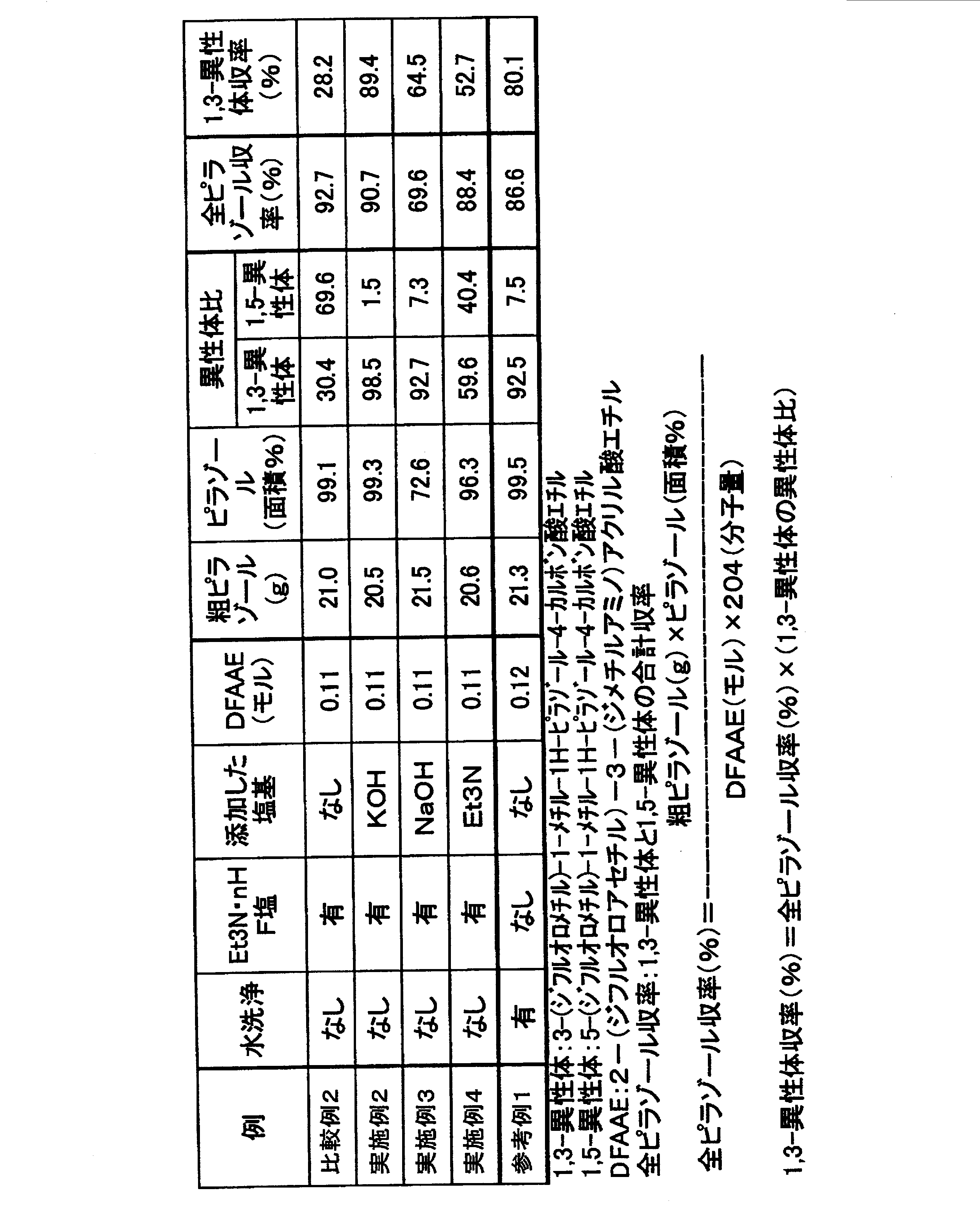
- Example 2 Experiment similar to Comparative Example 2 except that an aqueous solution in which 8.6 g of potassium hydroxide (KOH) (1.4 equivalents to DFAAE) was dissolved in 9.0 g of water was charged instead of 9.0 g of water. Went. As a result, 20.5 g of crude pyrazole (crude yield 91.4%) was obtained. When dissolved in acetone and analyzed by gas chromatography, the total pyrazole purity was 99.3 area%, and the 1,5-isomer was present at a ratio of 1.5 to the 1,3-isomer 98.5. . For pyrazole synthesis from DMAE, the total pyrazole yield was 90.7% and the 1,3-isomer yield was 89.4%.
- KOH potassium hydroxide
- Example 3 Experiment similar to Comparative Example 2 except that instead of 9.0 g of water, an aqueous solution in which 6.2 g of sodium hydroxide (NaOH) (1.4 equivalents to DFAAE) was dissolved in 9.0 g of water was charged. Went. As a result, 21.5 g of crude pyrazole (crude yield 95.8%) was obtained. When dissolved in acetone and analyzed by gas chromatography, the total pyrazole purity was 72.6 area%, and the 1,5-isomer was present in a ratio of 7.3 to the 9,3-isomer 92.7. . For pyrazole synthesis from DMAE, the total pyrazole yield was 69.6% and the 1,3-isomer yield was 64.5%.
- NaOH sodium hydroxide
- Example 4 An experiment similar to Comparative Example 2 was performed, except that a solution of Et 3 N (11 g) and water 9.0 g was charged instead of water 9.0 g. As a result, 20.6 g of crude pyrazole (crude yield 91.8%) was obtained. When dissolved in acetone and analyzed by gas chromatography, the total pyrazole purity was 96.3 area%, and the 1,5-isomer was present at a ratio of 40.4 to the 1,3-isomer 59.6. . For pyrazole synthesis from DMAE, the total pyrazole yield was 88.4% and the 1,3-isomer yield was 52.7%.
- the total pyrazole purity was 99.5 area%, and the 1,5-isomer was present in a ratio of 7.5 to the 1,3-isomer 92.5. .
- the total pyrazole yield was 86.6% and the 1,3-isomer yield was 80.1%.
- 1,3-disubstituted pyrazole-4-carboxylic acid ester was obtained more efficiently when an inorganic base was used than when an organic base was used in the cyclization reaction. Further, 1,3-disubstituted pyrazole-4-carboxylic acid ester can be efficiently obtained by adding an inorganic base and removing the salt from the reaction solution obtained by the acylation reaction without washing with water. As a result, the amount of 1,5-isomer produced could be suppressed.
- reaction solution After the introduction, the temperature of the reaction solution was set to 30 ° C., and stirring was continued for 1 hour to complete the reaction. The content (reaction solution) after the reaction was 463 g. The reaction solution was washed twice with 250 g of water to remove the Et 3 N ⁇ nHF salt to obtain 382 g of a 25.9 mass% DFAAE toluene solution.
- a 1,3-disubstituted pyrazole-4-carboxylic acid ester with less coloring can be produced with high yield and good selectivity, and the isomer (1,5 -Disubstituted pyrazole-4-carboxylic acid ester) content can be kept low.
- the method of the present invention is useful as a method for producing a pyrazole derivative useful as an intermediate for medical and agricultural chemicals.
Landscapes
- Chemical & Material Sciences (AREA)
- Organic Chemistry (AREA)
- Organic Low-Molecular-Weight Compounds And Preparation Thereof (AREA)
- Plural Heterocyclic Compounds (AREA)
Abstract
Description
一般式(1)で表される2-アシル-3-アミノアクリル酸エステルと一般式(4)で表されるヒドラジン類を塩基の存在下で反応させる反応工程を含む、一般式(5)で表されるピラゾール化合物の製造方法。



塩基が無機塩基である、発明1のピラゾール化合物の製造方法。
塩基がアルカリ金属水酸化物である、発明2のピラゾール化合物の製造方法。
R1が炭素数1~10のハロゲン化アルキル基である、発明1~3のいずれかのピラゾール化合物の製造方法。
R1が炭素数1~4のフルオロアルキル基である、発明4のピラゾール化合物の製造方法。
R1がトリフルオロメチル基またはジフルオロメチル基である、発明5のピラゾール化合物の製造方法。
R1が炭素数1~4のクロロアルキル基である、発明4のピラゾール化合物の製造方法。
R1がジクロロメチル基である、発明7のピラゾール化合物の製造方法。
前記反応工程は下記の2工程(サブステップ)を含む、発明1~8のいずれかのピラゾール化合物の製造方法。
第一工程:一般式(2)で表されるカルボン酸ハライドと一般式(3)で表されるジアルキルアミノアクリル酸エステルを有機塩基の存在下で反応させて一般式(1)で表される2-アシル-3-アミノアクリル酸エステルを含む反応器内容物を得る工程。


第二工程:第一工程で得られた反応器内容物、無機塩基および一般式(4)で表される置換ヒドラジンを混合して一般式(5)で表されるピラゾール化合物を合成する工程。
第二工程が、第一工程で得られた反応器内容物および塩基を含む組成物と、置換ヒドラジンを含む組成物とを混合して、一般式(5)で表されるピラゾール化合物を合成する、発明9のピラゾール化合物の製造方法。
第一工程で用いる有機塩基が第三級アミンであり、かつ、第二工程で用いる無機塩基が水酸化カリウムまたは水酸化ナトリウムである、発明9または10のピラゾール化合物の製造方法。
一般式(2)で表されるカルボン酸ハライドがジフルオロ酢酸フルオライドである、発明9~11のいずれかのピラゾール化合物の製造方法。
一般式(1)で表される2-アシル-3-アミノアクリル酸エステルは、一般式(2)で表されるカルボン酸ハライドと一般式(3)で表されるジアルキルアミノアクリル酸エステルを反応(アシル化反応)させることにより合成できる。



上述の一般式(1)で表される2-アシル-3-アミノアクリル酸エステルを一般式(4)で表されるヒドラジン類と塩基の存在下で反応(環化反応)させることにより、一般式(5)で表されるピラゾール化合物を製造できる。


ガスクロマトグラフで分析した結果、3-(ジフルオロメチル)-1-メチル-1H-ピラゾール-4-カルボン酸エチル(目的化合物、1,3-異性体):9.70面積%、5-(ジフルオロメチル)-1-メチル-1H-ピラゾール-4-カルボン酸エチル(1,5-異性体):0.7面積%、トルエンを除いたその他化合物0.03面積%であり、目的化合物:1,5-異性体の比は93.3:6.7であった。上記の溶液を比色管に100ml採取して、目視でハーゼン標準液と比較したところ500であった。また、JIS色見本と比較した所、赤みが強い向日葵色がもっとも近かった。
水9.0gの代わりに、NaOH(1.8g)を9.0gの水に溶かした水溶液を添加したこと以外、比較例1と同様の実験を行い、トルエン溶液(191g)を得た。
実験により得られたトルエン溶液をガスクロマトグラフで分析した結果、目的化合物:9.58面積%、1,5-異性体:0.02面積%、トルエンを除いたその他化合物0.01面積%であり、目的化合物:1,5-異性体の比は99.8:0.2であった。上記の溶液を比色管に100ml採取して、目視でハーゼン標準液と比較したところ300であった。また、JIS色見本と比較した所、比較例1よりも赤みが弱い刈安色がもっとも近かった。
また、実験により得られたトルエン溶液をロータリーエバポレーターで濃縮後、ヘキサン25gを加え、5℃に保ってマグネティックスターラーで1時間攪拌した。濾過後、ヘキサンで掛け洗浄し、濾物を真空乾燥して、17.7gの白色結晶を得た。その結晶をアセトンに溶解してガスクロマトグラフで分析したところ、3-(ジフルオロメチル)-1-メチル-1H-ピラゾール-4-カルボン酸エチルが99.9面積%含まれていた。
関東化学製の色度標準溶液(Color standard solution,1000度)を蒸留水で希釈して、表1に示す比較例1および実施例1で用いたハーゼン標準液を調製した。例えば、実施例1で使用した300度の標準液は、1000度の原液30mlをメスフラスコに仕込み、蒸留水で100mlに希釈したものであり、他も同様である。

2-(ジフルオロアセチル)-3-(ジメチルアミノ)アクリル酸エチル(DFAAE)の合成
吹き込み管、温度計、ドライアイスコンデンサーを備え、窒素シールした2000ml三口フラスコに、3-N,Nジメチルアミノアクリル酸エチル(DMAE)143g、トルエン570g、トリエチルアミン(以下、Et3N)111gを仕込み、攪拌しながら水浴で20℃に冷却した。そこへ、ジフルオロ酢酸フルオライド(純度95%)111gを1g/分の速度で吹き込み管から反応器に導入した。導入後、反応液の温度を30℃として1時間攪拌を継続し、反応を終了した。
反応後の内容物(反応液)は、927gであった。反応液をガスクロマトグラフ分析したところ、DFAAE:8.22面積%、Et3NとEt3N・フッ化水素塩(Et3N・nHF塩)の合計:10.48面積%(Et3N・nHF塩のピークは約1面積%でブロードであった。)、DMAE:0.082面積%、トルエン:80.62面積%であった。

水9.0gの代わりに、水酸化カリウム(KOH)8.6g(DFAAEに対して1.4当量)を9.0gの水に溶かした水溶液を仕込んだこと以外、比較例2と同様の実験を行った。その結果、粗ピラゾール20.5g(粗収率91.4%)を得た。アセトンに溶解してガスクロマトグラフ分析したところ全ピラゾール純度が99.3面積%で、1,3-異性体98.5に対して1,5-異性体が1.5の比率で存在していた。DMAEからのピラゾール合成について、全ピラゾール収率は、90.7%、1,3-異性体収率は89.4%であった。
水9.0gの代わりに、水酸化ナトリウム(NaOH)6.2g(DFAAEに対して1.4当量)を9.0gの水に溶かした水溶液を仕込んだこと以外、比較例2と同様の実験を行った。その結果、粗ピラゾール21.5g(粗収率95.8%)を得た。アセトンに溶解してガスクロマトグラフ分析したところ全ピラゾール純度が72.6面積%で、1,3-異性体92.7に対して1,5-異性体が7.3の比率で存在していた。DMAEからのピラゾール合成について、全ピラゾール収率は、69.6%、1,3-異性体収率は64.5%であった。
水9.0gの代わりに、Et3N(11g)と水9.0gの溶液を仕込んだこと以外、比較例2と同様の実験を行った。その結果、粗ピラゾール20.6g(粗収率91.8%)を得た。アセトンに溶解してガスクロマトグラフ分析したところ全ピラゾール純度が96.3面積%で、1,3-異性体59.6に対して1,5-異性体が40.4の比率で存在していた。DMAEからのピラゾール合成について、全ピラゾール収率は、88.4%、1,3-異性体収率は52.7%であった。
合成例1で得られた反応液463gを水250gで二回洗浄したところ、DFAAEトルエン溶液384gが得られた。この溶液の10gを溶媒留去して2.45gのDFAAEを得た。このとき、合成例1の反応でのDFAAE理論収率に基づいて、水洗浄での回収率は90%であった。
得られたDFAAEトルエン溶液113g(DFAAE:0.12モル)を用いて他の基質等の量は変えずに比較例2と同様の実験を行い、粗ピラゾール21.3g(粗収率87.0%)を得た。アセトンに溶解してガスクロマトグラフ分析したところ全ピラゾール純度が99.5面積%で、1,3-異性体92.5に対して1,5-異性体が7.5の比率で存在していた。DMAEからのピラゾール合成について、全ピラゾール収率は、86.6%、1,3-異性体収率は80.1%であった。
吹き込み管、温度計、ドライアイスコンデンサーを備え、窒素シールした1000ml三口フラスコに、3-N,Nジメチルアミノアクリル酸エチル(DMAE)72g、トルエン285g、トリエチルアミン(以下、Et3N)56gを仕込み、攪拌しながら水浴で20℃に冷却した。そこへ、ジフルオロ酢酸フルオライド(純度95%)56gを0.5g/分の速度で吹き込み管から反応器に導入した。導入後、反応液の温度を30℃として1時間攪拌を継続し、反応を終了した。
反応後の内容物(反応液)は、463gであった。反応液を水250gで二回洗浄してEt3N・nHF塩を除去し、25.9質量%DFAAEトルエン溶液382gを得た。
滴下ロート、温度計を備え、窒素風船でシールした2000ml三口フラスコに、水36.0g、水酸化ナトリウム6.4g、トルエン400ml、モノメチルヒドラジン24.0g(0.52モル)を仕込み、攪拌しながら-15℃の低温恒温槽で-10℃以下に冷却した。そこへ、水で洗浄したDFAAEトルエン溶液375g(DFAAE:0.11モル)を滴下ロートから内温が-10℃を超えないように徐々に滴下した。滴下終了後-12℃で1時間攪拌を継続した後、0℃に昇温し水400mlを添加した。分液ロートで有機層を回収し、水400mlで水洗して9.7質量%のピラゾールトルエン溶液702gを得た。
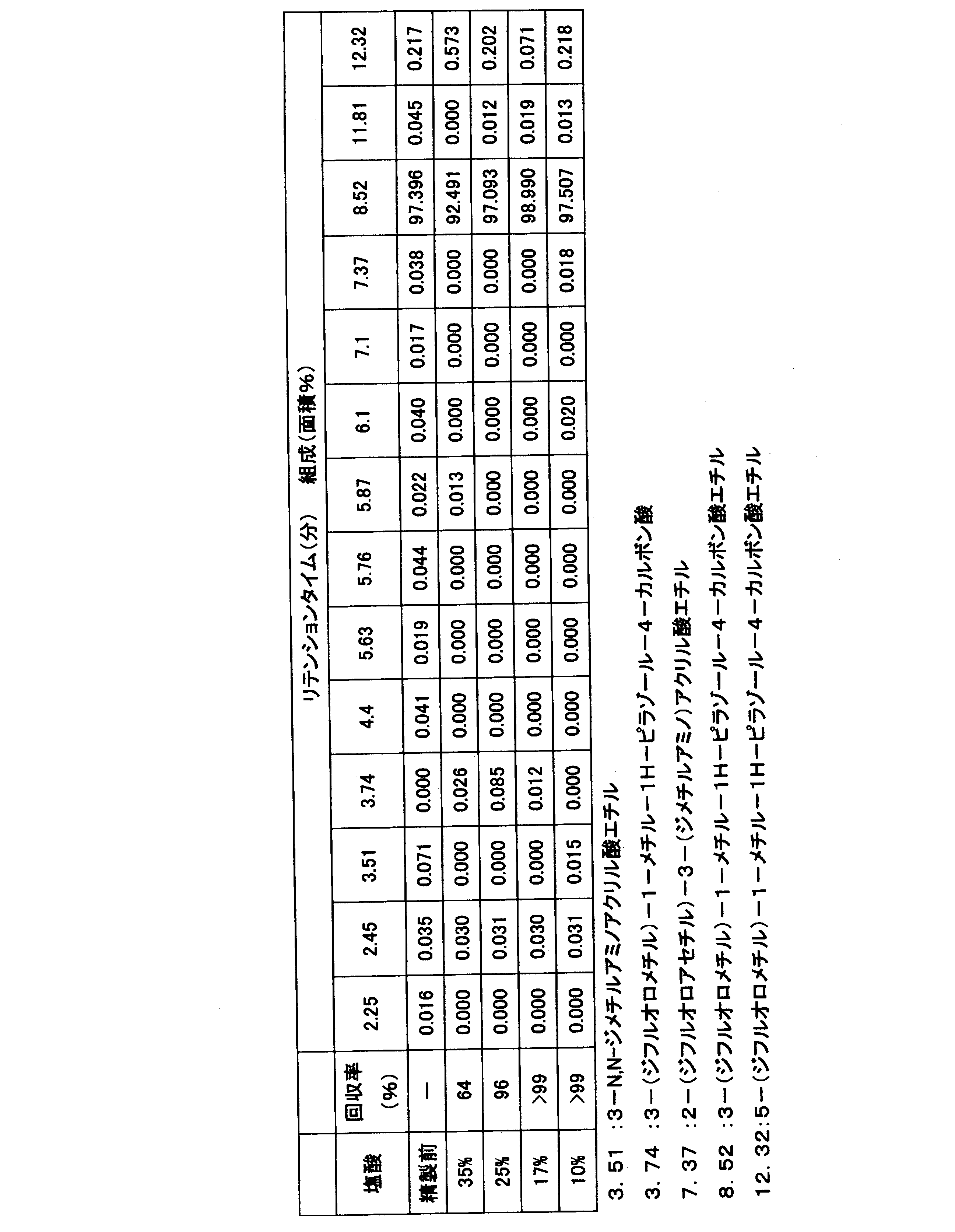
温度計と還流管を備えた三口フラスコに、合成例2で合成したピラゾールトルエン溶液150g、表1に示す各濃度(35質量%、25質量%、17質量%、10質量%、)の塩酸50gを添加し、室温(25℃)で1時間攪拌した。分液した有機層を濃縮後、粗ピラゾールを次に示す分析法および試料調製法で高速液体クロマトグラフィ(HPLC)分析した。
分析機器:agilent HP-1100 LC system
流量:1ml/min.
6mMメタンスルホン酸:ACN=6:4、30分間で3:7へグラジェント
UV detector:λ=210nm
カラム:Cadenza CD-C18 (径:4.6mm、長さ:250mm、粒径:3μm)
温度:35℃
試料を採取し、窒素パージにより溶媒を除去した後、重量を測定して2mg/mlの濃度(6mMメタンスルホン酸:ACN=6:4)となるように移動相を加え均一溶解し、分析に供した。
Claims (12)
- 一般式(1)で表される2-アシル-3-アミノアクリル酸エステルと一般式(4)で表されるヒドラジン類を塩基の存在下で反応させる反応工程を含む、一般式(5)で表されるピラゾール化合物の製造方法。



- 塩基が無機塩基である、請求項1に記載のピラゾール化合物の製造方法。
- 塩基がアルカリ金属水酸化物である、請求項2に記載のピラゾール化合物の製造方法。
- R1が炭素数1~10のハロゲン化アルキル基である、請求項1~3のいずれか1項に記載のピラゾール化合物の製造方法。
- R1が炭素数1~4のフルオロアルキル基である、請求項4に記載のピラゾール化合物の製造方法。
- R1がトリフルオロメチル基またはジフルオロメチル基である、請求項5に記載のピラゾール化合物の製造方法。
- R1が炭素数1~4のクロロアルキル基である、請求項4に記載のピラゾール化合物の製造方法。
- R1がジクロロメチル基である、請求項7に記載のピラゾール化合物の製造方法。
- 前記反応工程は下記の2工程(サブステップ)を含む、請求項1~8のいずれか1項に記載のピラゾール化合物の製造方法。
第一工程:一般式(2)で表されるカルボン酸ハライドと一般式(3)で表されるジアルキルアミノアクリル酸エステルを有機塩基の存在下で反応させて一般式(1)で表される2-アシル-3-アミノアクリル酸エステルを含む反応器内容物を得る工程。


第二工程:第一工程で得られた反応器内容物、無機塩基および一般式(4)で表される置換ヒドラジンを混合して一般式(5)で表されるピラゾール化合物を合成する工程。 - 第二工程が、第一工程で得られた反応器内容物および塩基を含む組成物と、置換ヒドラジンを含む組成物とを混合して、一般式(5)で表されるピラゾール化合物を合成する、請求項9に記載のピラゾール化合物の製造方法。
- 第一工程で用いる有機塩基が第三級アミンであり、かつ、第二工程で用いる無機塩基が水酸化カリウムまたは水酸化ナトリウムである、請求項9または10に記載のピラゾール化合物の製造方法。
- 一般式(2)で表されるカルボン酸ハライドがジフルオロ酢酸フルオライドである、請求項9~11のいずれかに記載のピラゾール化合物の製造方法。
Priority Applications (4)
| Application Number | Priority Date | Filing Date | Title |
|---|---|---|---|
| CN201280030741.3A CN103635461B (zh) | 2011-06-22 | 2012-06-18 | 吡唑化合物的制造方法 |
| US14/009,483 US9012657B2 (en) | 2011-06-22 | 2012-06-18 | Method for producing pyrazole compound |
| CH02093/13A CH706864B1 (de) | 2011-06-22 | 2012-06-18 | Verfahren zur Herstellung einer Pyrazol-Verbindung. |
| DE112012002522.9T DE112012002522T5 (de) | 2011-06-22 | 2012-06-18 | Verfahren zur Herstellung einer Pyrazol-Verbindung |
Applications Claiming Priority (4)
| Application Number | Priority Date | Filing Date | Title |
|---|---|---|---|
| JP2011-138737 | 2011-06-22 | ||
| JP2011138737A JP5915004B2 (ja) | 2011-06-22 | 2011-06-22 | ピラゾール化合物の製造方法 |
| JP2011138740A JP2013006779A (ja) | 2011-06-22 | 2011-06-22 | ピラゾール化合物の製造方法 |
| JP2011-138740 | 2011-06-22 |
Publications (1)
| Publication Number | Publication Date |
|---|---|
| WO2012176717A1 true WO2012176717A1 (ja) | 2012-12-27 |
Family
ID=47422554
Family Applications (1)
| Application Number | Title | Priority Date | Filing Date |
|---|---|---|---|
| PCT/JP2012/065459 Ceased WO2012176717A1 (ja) | 2011-06-22 | 2012-06-18 | ピラゾール化合物の製造方法 |
Country Status (5)
| Country | Link |
|---|---|
| US (1) | US9012657B2 (ja) |
| CN (1) | CN103635461B (ja) |
| CH (1) | CH706864B1 (ja) |
| DE (1) | DE112012002522T5 (ja) |
| WO (1) | WO2012176717A1 (ja) |
Cited By (2)
| Publication number | Priority date | Publication date | Assignee | Title |
|---|---|---|---|---|
| CN103936673A (zh) * | 2014-03-27 | 2014-07-23 | 华东师范大学 | 一种1,4,5-三取代吡唑类化合物及其制备方法 |
| WO2016152886A1 (ja) * | 2015-03-26 | 2016-09-29 | 旭硝子株式会社 | ピラゾール誘導体の製造方法 |
Families Citing this family (6)
| Publication number | Priority date | Publication date | Assignee | Title |
|---|---|---|---|---|
| US8871947B2 (en) | 2013-02-04 | 2014-10-28 | KingChem LLC | Preparation of alkyl 3-difluoromethyl-1-methyl-1H-pyrazole-4-carboxylic acid ester |
| WO2015085464A1 (en) | 2013-12-09 | 2015-06-18 | King Chem, Llc | Process for preparing alkyl 3-difluoromethyl-1-methyl-1h-pyrazole-4-carboxylate and its analogs |
| CN104529899A (zh) * | 2014-12-19 | 2015-04-22 | 浙江泰达作物科技有限公司 | 高区域选择性制备1-烷基-3-卤代烷基吡唑衍生物的方法 |
| JP6995195B2 (ja) * | 2018-05-18 | 2022-02-04 | 富士フイルム株式会社 | 3-ジフルオロメチルピラゾール化合物の製造方法及び3-ジフルオロメチルピラゾール-4-カルボン酸化合物の製造方法、並びに、ピラゾリジン化合物 |
| CN119823044B (zh) * | 2024-12-18 | 2025-10-17 | 湖南化工研究院有限公司 | 一种3-(二氟甲基)-1-甲基-1h-吡唑-4-羧酸乙酯的制备方法 |
| CN119823045B (zh) * | 2024-12-18 | 2025-10-17 | 湖南化工研究院有限公司 | 一种3-二氟甲基-1-甲基吡唑-4-甲酸乙酯的合成方法 |
Citations (6)
| Publication number | Priority date | Publication date | Assignee | Title |
|---|---|---|---|---|
| WO2003051820A1 (de) * | 2001-12-17 | 2003-06-26 | Bayer Chemicals Ag | Verfahren zur herstellung von 2-halogenacyl-3-amino-acrylsäure- derivaten |
| WO2005042468A1 (de) * | 2003-10-23 | 2005-05-12 | Bayer Cropscience Aktiengesellschaft | Verfahren zum herstellen von 2-dihalogenacyl-3-amino-acrylsäureestern und 3-dihalogenmethyl-pyrazol-4-carbonsäureestern |
| WO2006090778A1 (ja) * | 2005-02-25 | 2006-08-31 | Sagami Chemical Research Center | 1-置換-3-フルオロアルキルピラゾール-4-カルボン酸エステルの製造方法 |
| WO2009029384A2 (en) * | 2007-08-09 | 2009-03-05 | Bristol-Myers Squibb Company | Compounds for the treatment of hepatitis c |
| WO2009106230A2 (de) * | 2008-02-25 | 2009-09-03 | Bayer Cropscience Aktengesellschaft | Verfahren zur regioselektiven synthese von 1-alkyl-3-haloalkyl-pyrazol-4-carbonsäur e-derivaten |
| JP2012056906A (ja) * | 2010-09-10 | 2012-03-22 | Central Glass Co Ltd | ピラゾール化合物の製造方法 |
Family Cites Families (7)
| Publication number | Priority date | Publication date | Assignee | Title |
|---|---|---|---|---|
| JPH0820560A (ja) | 1994-07-07 | 1996-01-23 | Shin Etsu Chem Co Ltd | エステル化合物の製造方法 |
| JP2000128763A (ja) | 1998-10-28 | 2000-05-09 | Kose Corp | 抗菌剤組成物及びこれを含有する皮膚外用剤 |
| JP2000212166A (ja) | 1999-01-26 | 2000-08-02 | Mitsui Chemicals Inc | 1,3―ジアルキルピラゾ―ル―4―カルボン酸エステルの製造法 |
| HUE026011T2 (en) | 2006-03-22 | 2016-05-30 | Hoffmann La Roche | Pyrazoles as 11-beta-HSD-1 |
| AU2007338031B2 (en) * | 2006-12-21 | 2012-08-16 | Basf Se | Process for preparing fluoromethyl-substituted heterocyclic compounds |
| TW200836719A (en) | 2007-02-12 | 2008-09-16 | Astrazeneca Ab | Chemical compounds |
| JP5388338B2 (ja) | 2009-03-02 | 2014-01-15 | 株式会社オプナス | ボタン錠 |
-
2012
- 2012-06-18 CH CH02093/13A patent/CH706864B1/de not_active IP Right Cessation
- 2012-06-18 CN CN201280030741.3A patent/CN103635461B/zh not_active Expired - Fee Related
- 2012-06-18 US US14/009,483 patent/US9012657B2/en not_active Expired - Fee Related
- 2012-06-18 WO PCT/JP2012/065459 patent/WO2012176717A1/ja not_active Ceased
- 2012-06-18 DE DE112012002522.9T patent/DE112012002522T5/de not_active Ceased
Patent Citations (6)
| Publication number | Priority date | Publication date | Assignee | Title |
|---|---|---|---|---|
| WO2003051820A1 (de) * | 2001-12-17 | 2003-06-26 | Bayer Chemicals Ag | Verfahren zur herstellung von 2-halogenacyl-3-amino-acrylsäure- derivaten |
| WO2005042468A1 (de) * | 2003-10-23 | 2005-05-12 | Bayer Cropscience Aktiengesellschaft | Verfahren zum herstellen von 2-dihalogenacyl-3-amino-acrylsäureestern und 3-dihalogenmethyl-pyrazol-4-carbonsäureestern |
| WO2006090778A1 (ja) * | 2005-02-25 | 2006-08-31 | Sagami Chemical Research Center | 1-置換-3-フルオロアルキルピラゾール-4-カルボン酸エステルの製造方法 |
| WO2009029384A2 (en) * | 2007-08-09 | 2009-03-05 | Bristol-Myers Squibb Company | Compounds for the treatment of hepatitis c |
| WO2009106230A2 (de) * | 2008-02-25 | 2009-09-03 | Bayer Cropscience Aktengesellschaft | Verfahren zur regioselektiven synthese von 1-alkyl-3-haloalkyl-pyrazol-4-carbonsäur e-derivaten |
| JP2012056906A (ja) * | 2010-09-10 | 2012-03-22 | Central Glass Co Ltd | ピラゾール化合物の製造方法 |
Non-Patent Citations (1)
| Title |
|---|
| NEITHNADKA PREMSAI ET AL.: "Synthesis, characterization and antibacterial activity of 2-[1-(5-chloro-2-methoxy-phenyl)-5-methyl-1H-pyrazol-4-yl]-5-(substituted-phenyl)-[1,3,4] oxadiazoles", EUROPEAN JOURNAL OF MEDICINAL CHEMISTRY, vol. 44, 2009, pages 4522 - 4527 * |
Cited By (5)
| Publication number | Priority date | Publication date | Assignee | Title |
|---|---|---|---|---|
| CN103936673A (zh) * | 2014-03-27 | 2014-07-23 | 华东师范大学 | 一种1,4,5-三取代吡唑类化合物及其制备方法 |
| CN103936673B (zh) * | 2014-03-27 | 2016-06-29 | 华东师范大学 | 一种1,4,5-三取代吡唑类化合物及其制备方法 |
| WO2016152886A1 (ja) * | 2015-03-26 | 2016-09-29 | 旭硝子株式会社 | ピラゾール誘導体の製造方法 |
| JPWO2016152886A1 (ja) * | 2015-03-26 | 2018-01-18 | 旭硝子株式会社 | ピラゾール誘導体の製造方法 |
| US10239841B2 (en) | 2015-03-26 | 2019-03-26 | AGC Inc. | Method for producing pyrazole derivative |
Also Published As
| Publication number | Publication date |
|---|---|
| CH706864B1 (de) | 2016-03-31 |
| DE112012002522T5 (de) | 2014-03-13 |
| CN103635461A (zh) | 2014-03-12 |
| CN103635461B (zh) | 2016-01-20 |
| US9012657B2 (en) | 2015-04-21 |
| US20140107347A1 (en) | 2014-04-17 |
Similar Documents
| Publication | Publication Date | Title |
|---|---|---|
| WO2012176717A1 (ja) | ピラゾール化合物の製造方法 | |
| CN1926114B (zh) | 用于制备经取代n-芳基-n′-′3-(1h-吡唑-5-基)苯基脲及其中间体的方法 | |
| US20080154045A1 (en) | Process for Producing 1-Substituted-3-Fluoroalkylpyrazole-4-Carboxylate | |
| CN101166727A (zh) | 制备经取代1-[3-(吡唑基)苯基]-3-苯脲的方法 | |
| JP2018533635A (ja) | 4−((6−(2−(2,4−ジフルオロフェニル)−1,1−ジフルオロ−2−ヒドロキシ−3−(1h−1,2,4−トリアゾ−ル−1−イル)プロピル)ピリジン−3−イル)オキシ)ベンゾニトリル及び製造方法 | |
| CN101142216A (zh) | 制备吡唑并[3,4-d]嘧啶醚的方法 | |
| JP2013006778A (ja) | ピラゾール化合物の製造方法 | |
| KR20070098906A (ko) | 4-(페녹시-5-메틸-피리미딘-4-일옥시)피페리딘-1-카르복실산 유도체 및 관련된 화합물의 제조 방법 | |
| JP5793983B2 (ja) | ピラゾール化合物の製造方法 | |
| JP5830957B2 (ja) | ピラゾール化合物の製造方法 | |
| EP2894150B1 (en) | Method for producing 1-substituted-3-fluoroalkylpyrazole-4-carboxylic acid ester | |
| JP2013006782A (ja) | ピラゾール化合物の製造方法 | |
| JP2013006779A (ja) | ピラゾール化合物の製造方法 | |
| JP5915004B2 (ja) | ピラゾール化合物の製造方法 | |
| JP5605104B2 (ja) | ピラゾール化合物の製造方法 | |
| CN106478508B (zh) | 一种含卤素吡唑甲腈衍生物的合成方法 | |
| US9334241B2 (en) | Process for the preparation of N-substituted pyrazole compounds | |
| JP5790195B2 (ja) | ピラゾール化合物の製造方法 | |
| US20190276431A1 (en) | 4-((6-(2-(2,4-difluorophenyl)-1,1-difluoro-2-hydroxy-3-(5-mercapto-1h-1,2,4-triazol-1-yl)propyl)pyridin-3-yl)oxy)benzonitrile and processes of preparation | |
| JP7291782B2 (ja) | 3-[5-アミノ-4-(3-シアノベンゾイル)-ピラゾール化合物の調製のための合成方法 | |
| US20190330184A1 (en) | 4-((6-(2,4-difluorophenyl)-1,1-difluoro-2-hydroxy-3(5-mercapto-1h-1,2,4-triazol-1-yl)propyl)pyridin-3-yl)oxy)benzonitrile and processes of preparation | |
| JP4126944B2 (ja) | 5−アミノ−4−ニトロソピラゾール化合物の製法 | |
| JP2003300963A (ja) | 5−アミノ−4−ニトロソピラゾール誘導体の製造法 | |
| KR20210065110A (ko) | 알콕시메틸렌-벤조일아세토니트릴의 제조를 위한 합성 방법 | |
| KR20210065111A (ko) | 히드라진 화합물의 제조를 위한 합성 방법 |
Legal Events
| Date | Code | Title | Description |
|---|---|---|---|
| 121 | Ep: the epo has been informed by wipo that ep was designated in this application |
Ref document number: 12801835 Country of ref document: EP Kind code of ref document: A1 |
|
| WWE | Wipo information: entry into national phase |
Ref document number: 14009483 Country of ref document: US |
|
| WWE | Wipo information: entry into national phase |
Ref document number: 10201300002093 Country of ref document: CH |
|
| WWE | Wipo information: entry into national phase |
Ref document number: 112012002522 Country of ref document: DE Ref document number: 1120120025229 Country of ref document: DE |
|
| 122 | Ep: pct application non-entry in european phase |
Ref document number: 12801835 Country of ref document: EP Kind code of ref document: A1 |