WO2012176631A1 - エチレン性不飽和基含有イソシアネート化合物の製造方法 - Google Patents
エチレン性不飽和基含有イソシアネート化合物の製造方法 Download PDFInfo
- Publication number
- WO2012176631A1 WO2012176631A1 PCT/JP2012/064785 JP2012064785W WO2012176631A1 WO 2012176631 A1 WO2012176631 A1 WO 2012176631A1 JP 2012064785 W JP2012064785 W JP 2012064785W WO 2012176631 A1 WO2012176631 A1 WO 2012176631A1
- Authority
- WO
- WIPO (PCT)
- Prior art keywords
- group
- ethylenically unsaturated
- isocyanate compound
- unsaturated group
- producing
- Prior art date
- Legal status (The legal status is an assumption and is not a legal conclusion. Google has not performed a legal analysis and makes no representation as to the accuracy of the status listed.)
- Ceased
Links
- 0 CC(COC(C=C)O)(COC(C=C)=O)NC(N(C(C)(COC(C=C)=O)COC(C=C)=O)C(*)=O)=O Chemical compound CC(COC(C=C)O)(COC(C=C)=O)NC(N(C(C)(COC(C=C)=O)COC(C=C)=O)C(*)=O)=O 0.000 description 1
Classifications
-
- C—CHEMISTRY; METALLURGY
- C07—ORGANIC CHEMISTRY
- C07C—ACYCLIC OR CARBOCYCLIC COMPOUNDS
- C07C263/00—Preparation of derivatives of isocyanic acid
- C07C263/04—Preparation of derivatives of isocyanic acid from or via carbamates or carbamoyl halides
Definitions
- the present invention relates to a method for producing an ethylenically unsaturated group-containing isocyanate compound. More specifically, the present invention relates to a method for producing an ethylenically unsaturated group-containing isocyanate compound by thermal decomposition of a trisubstituted urea compound, at least one of which is a substituent having an ethylenically unsaturated bond.
- Such monomer compounds having an unsaturated group and an isocyanate group in the molecule are coating materials, ultraviolet curable coatings, thermosetting coatings, molding materials, adhesives, inks, resists, optical materials, stereolithography materials, and printing plate materials. It is useful as a raw material monomer for resins used in fields such as dental materials and polymer battery materials.
- Japanese Patent Application Laid-Open No. 2006-232797 (Pamphlet of International Publication No. 2005/092842; Patent Document 1) and Japanese Patent Application Laid-Open No. 2007-55993 (Pamphlet of International Publication No. 2006/049264; Patent Document) 2) discloses a method for producing a compound having an ethylenically unsaturated group and an isocyanate group in the molecule by synthesizing carbamic acid chloride using an amine derivative and phosgene as a reaction raw material and further thermally decomposing them. .
- Patent Document 1 and Patent Document 2 are widely used industrially.
- toxic phosgene is used as a raw material, it is necessary to be careful in management, and the generated hydrogen chloride is Since by-products added to the ethylenically unsaturated double bond are formed, it is necessary to distill through zinc chloride, activated carbon, silicic acid catalyst, etc., or a complicated step of dehydrochlorination using an equivalent amount of base is required. Therefore, development of an alternative manufacturing method is desired.
- JP-A-6-263712 discloses a method for producing an isocyanate group-containing ester compound that is thermally decomposed at a temperature of 100 to 160 ° C. using an organotin catalyst. There is a problem that is low.
- Japanese Patent Laid-Open No. 10-182484 discloses silylation of the nitrogen position of ethylenically unsaturated urethane using a silylation aid and the obtained ethylenic unsaturated compound.
- a method for decomposing saturated N-silyl-urethane at a temperature of 70 to 120 ° C. is disclosed, trimethylchlorosilane used as a silylating agent is highly sensitive to moisture and reacts violently with water. It has to be handled in an inert gas such as argon and has a drawback that it is difficult to use as an industrial raw material.
- JP-A-55-33480 U.S. Pat. No. 4,223,145; Patent Document 5
- JP-A-03-48651 European Patent No. 0408277; Patent Document 6
- JP-A-55-33480 U.S. Pat. No. 4,223,145; Patent Document 5
- JP-A-03-48651 European Patent No. 0408277; Patent Document 6
- JP-A-55-33480 U.S. Pat. No. 4,223,145; Patent Document 5
- JP-A-03-48651 European Patent No. 0408277
- Patent Document 6 disclose trisubstituted ureas.
- JP 2006-232797 A (Pamphlet of International Publication No. 2005/092842) JP 2007-55993 A (Pamphlet of International Publication No. 2006/049264) JP-A-6-263712 Japanese Patent Laid-Open No. 10-182484 (US Pat. No. 5,990,345) JP 55-33480 A (US Pat. No. 4,223,145) JP-A-3-48651 (European Patent No. 0408277)
- An object of the present invention is to provide a method for producing an ethylenically unsaturated group-containing isocyanate compound without using phosgene as a raw material in view of the problems of the prior art, wherein hydrogen chloride is an ethylenically unsaturated double bond. It is an object of the present invention to provide a production method capable of obtaining an ethylenically unsaturated group-containing isocyanate compound in a high yield, in which the formation of by-products added to the polymer and the polymerization reaction of double bonds are suppressed.
- the inventors of the present invention have used hydrogen chloride in which a trisubstituted urea compound, at least one of which has an ethylenically unsaturated bond, is used in the presence of hydrogen chloride gas.
- hydrogen chloride gas By pyrolysis under specific conditions in which the gas precipitates as amine hydrochloride, ethylene by which hydrogen chloride is added to the ethylenically unsaturated double bond can be greatly reduced and no dehydrochlorination step is required.
- the present inventors have found a method capable of stably obtaining a polymerizable unsaturated group-containing isocyanate compound in a high yield, and have completed the present invention.
- the present invention includes the following matters.
- [1] (i) The following general formula (1) at a temperature of 50 to 200 ° C. (Wherein R 0 represents an ethylenically unsaturated group, R 2 and R 3 each independently represents an optionally branched alkyl group having 1 to 8 carbon atoms, or an aryl group having 6 to 8 carbon atoms)
- (Iii) A method for producing an ethylenically unsaturated group-containing isocyanate compound, characterized by further comprising a step (aging step B) of maintaining the temperature after completion of the aging step A.
- the trisubstituted urea compound represented by the general formula (1) is represented by the general formula (2) (In the formula, m is 1 or 2, X represents an alkylene group which may be substituted with a single bond or an alkyl group having 1 to 4 carbon atoms when m is 1, and when m is 2, Represents a methine group which may be substituted with an alkyl group having 1 to 4 carbon atoms, R 1 represents a hydrogen atom or a methyl group, R 2 and R 3 represent the same meaning as in the above item [1], and Z represents (1) an alkyl group having 1 to 4 carbon atoms, an alkoxycarbonyl group having 1 to 5 carbon atoms, or an alkylene group having 1 to 4 carbon atoms which may be substituted with a phenyl group, and (2) an ether bond.
- a good alkylene group having 1 to 12 carbon atoms, (3) an arylene group having 6 to 15 carbon atoms, or (4) —C 6 H 4 —CH 2 — or —C 6 H 4 —C 2 H 4 — n is 0 or 1.
- the method for producing an ethylenically unsaturated group-containing isocyanate compound according to any one of items [1] to [3], wherein the isocyanate compound represented by the formula: [5] The process for producing an ethylenically unsaturated group-containing isocyanate compound as described in any one of [1] to [4] above, wherein a solvent to which a polymerization inhibitor is added is used.
- the polymerization inhibitor is selected from the group consisting of 2,6-di-t-butyl-4-hydroxytoluene, phenothiazine, and 4-hydroxy-2,2,6,6-tetramethylpiperidine-1-oxyl
- m represents 1, X represents a methine group substituted with a single bond or a methyl group, and Z represents a methylene group optionally substituted with a phenyl group An ethylene group optionally substituted with a phenyl group, a propylene group optionally substituted with two methyl groups or two ethoxycarbonyl groups, a butylene group optionally containing an ether bond, a phenylene group, or a methylenephenyl group.
- R 2 and R 3 in formula (2) each independently represents a methyl group or an ethyl group.
- a highly polymerizable ethylenically unsaturated group-containing isocyanate compound can be produced in a high yield by a thermal decomposition reaction of a trisubstituted urea compound having an ethylenically unsaturated bond. Since the production method of the present invention does not use toxic phosgene as a raw material and can significantly reduce the by-product of adding hydrogen chloride to an ethylenically unsaturated double bond, a complicated processing step is unnecessary, and environmental and safety. Easy management.
- the ethylenically unsaturated group-containing isocyanate compound obtained by the production method of the present invention has an ethylenically unsaturated double bond and an isocyanate group in the same molecule, other unsaturated compounds such as methyl methacrylate and methyl acrylate
- a functional polymer material having an isocyanate group can be produced by copolymerization with (meth) acrylates such as styrene or the like.
- an electronic material in which a monomer, oligomer or polymer having an active hydrogen such as hydroxyl group, amino group or carboxyl group is reacted with an isocyanate group to introduce an unsaturated bond and cured by ultraviolet rays, electron beams, heat, etc.
- Materials resist, pressure-sensitive adhesive, film, etc.
- the target compound is obtained by thermal decomposition.
- the compounds represented by all general formulas in this specification include all stereoisomers such as cis and trans.
- R 0 represents an ethylenically unsaturated group, preferably an acryloyloxyethyl group, a methacryloyloxyethyl group, an acryloyloxyethyloxyethyl group, a methacryloyloxyethyloxyethyl group or a bisacryloyloxymethyl group
- R 2 and Each R 3 independently represents an optionally branched alkyl group having 1 to 8 carbon atoms or an aryl group having 6 to 8 carbon atoms, preferably a methyl group or an ethyl group.
- R 2 and R 3 may be the same or different.
- the trisubstituted urea compound is preferably a compound represented by the general formula (2).
- m is 1 or 2
- X represents an alkylene group which may be substituted with a single bond or an alkyl group having 1 to 4 carbon atoms when m is 1, and when m is 2, carbon This represents a methine group optionally substituted with an alkyl group of 1 to 4, and a methine group substituted with a single bond or a methyl group is preferred.
- R 1 represents a hydrogen atom or a methyl group.
- R 2 and R 3 represent the same meaning as described above.
- Z represents (1) an alkyl group having 1 to 4 carbon atoms, an alkoxycarbonyl group having 1 to 5 carbon atoms, or an alkylene group having 1 to 4 carbon atoms which may be substituted with a phenyl group, and (2) an ether bond.
- n is 0 or 1.
- the compound represented by the general formula (2) can be produced by a conventionally known method, but a commercially available product may be used.
- known production methods for example, JP-A-60-87254 and JP-A-2009-229499 disclose N-methyl-N ′-(1-methyl-1-phenyl-3-butenyl-N— ( A method for obtaining 1-phenylethyl) urea and 2- (N, N-diethylureido) ethyl methacrylate is disclosed, and a commercially available product is, for example, sold by MP Biomedical. And N-allyl-N′-ethylurea.
- Ethylenically unsaturated group-containing isocyanate compound having an isocyanate group and at least one ethylenically unsaturated bond in the molecule obtained by the production method of the present invention is obtained from a trisubstituted urea compound represented by the general formula (1).
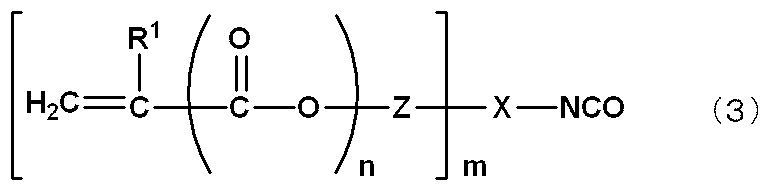
- R 0 —NCO obtained, preferably represented by the following general formula (3).
- the symbols in the formula have the same meaning as described above.
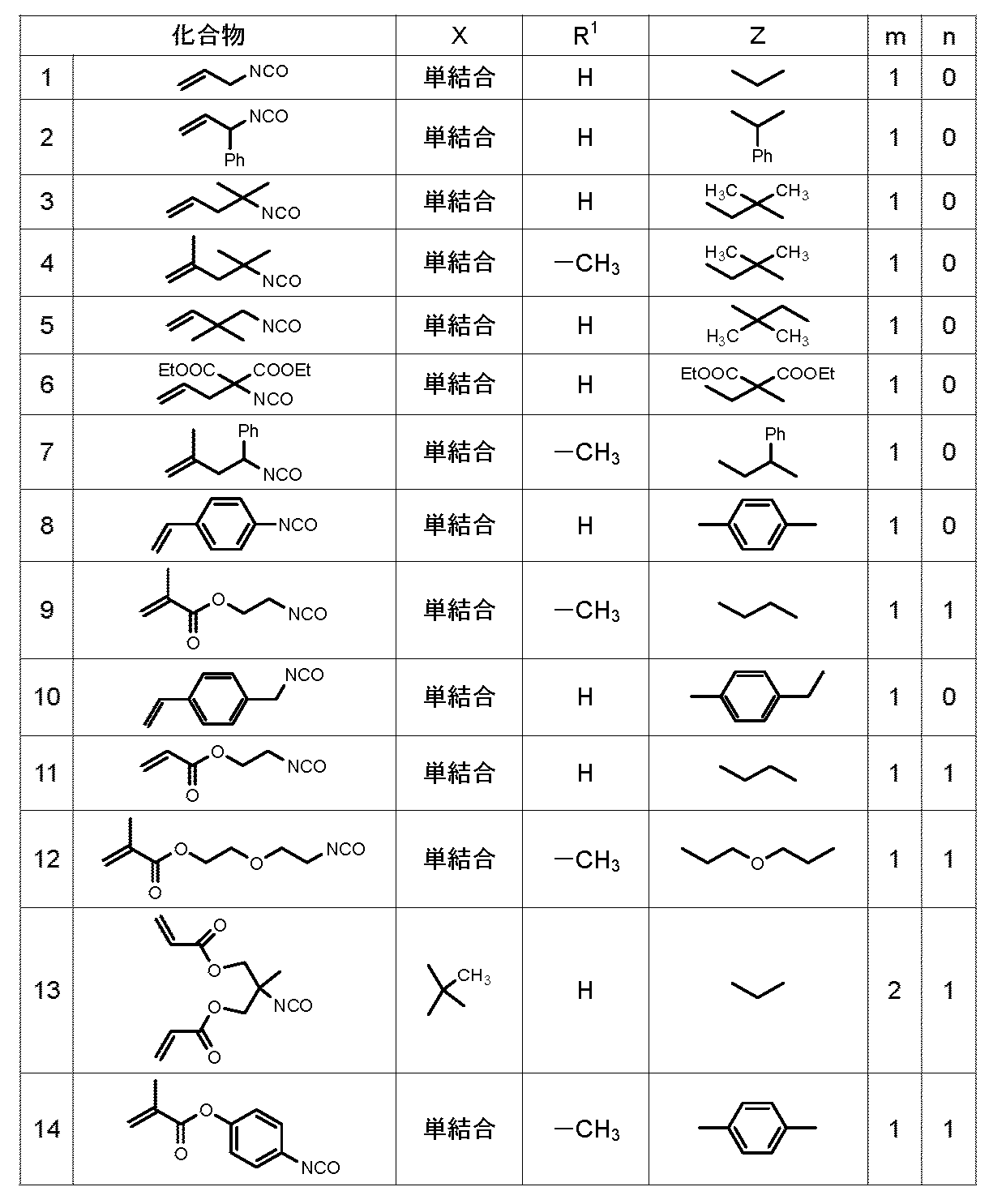
- the compound represented by the general formula (3) is not particularly limited, but preferred specific examples include 2-propylene isocyanate (compound 1), 1-phenyl-2-propylene isocyanate (compound 2), 4 , 4-dimethylpentene-5-isocyanate (compound 3), 2,4,4-trimethylpentene-5-isocyanate (compound 4), 3,3-dimethylpentene-5-isocyanate (compound 5), 2-allyl- 2-isocyanatomethyl-malonic acid diethyl ester (compound 6), 1-phenyl-3-methyl-3-butene isocyanate (compound 7), 4-vinylbenzene isocyanate (compound 8), 2-methacryloyloxyethyl isocyanate (compound 9) ), 1-isocyanatomethyl-4-vinyl-benzene (compound 10), 2-acryloyloxyethyl isocyanate (compound 11), 2- (2-methacryloyloxyethyloxy) e
- Table 1 shows the relationship between the preferable compounds 1 to 14 and the general formula (3).
- the compound represented by the general formula (4) is one of the intermediates of the production method of the present invention (hereinafter, the compound represented by the general formula (4) may be abbreviated as a production intermediate). .)
- the production intermediate obtained by the production method according to the present invention is not particularly limited, but as a preferred specific example, a compound represented by the following formula (5) (production intermediate of 2-acryloyloxyethyl isocyanate)
- an intermediate (by-product) of the production method according to the present invention there is a biuret obtained by reacting the trisubstituted urea and isocyanate in addition to the compound represented by the general formula (4), and also includes an ester bond.
- an ester decomposition product generated by ester decomposition in the presence of an acidic substance (hydrogen chloride) is also mentioned as a by-product.
- the method for producing an ethylenically unsaturated group-containing isocyanate compound of the present invention comprises: (I) a step (thermal decomposition step) of subjecting the trisubstituted urea compound represented by the general formula (1) to a thermal decomposition reaction in a solution containing hydrogen chloride at a predetermined temperature; (Ii) after completion of the thermal decomposition step, a step of blowing hydrogen chloride gas into the reaction solution maintained at the temperature (aging step A); (Iii) After completion of the aging step A, a step of holding at the temperature (aging step B) is further included.
- Thermal decomposition process It is preferable to perform a thermal decomposition process by dripping the solution of a trisubstituted urea compound, blowing hydrogen chloride gas in the solvent hold
- the amount of hydrogen chloride gas used in the pyrolysis step is usually 0.2 to 4.0 molar equivalents, preferably 0, of hydrogen chloride gas per mole of trisubstituted urea compound by the end of the reaction.
- the amount is from 5 to 2.0 molar equivalents, more preferably from 1.0 to 2.0 molar equivalents.
- the solvent used in the pyrolysis step the solvent in which hydrogen chloride gas is blown and the raw material trisubstituted urea compound solution is added dropwise, and the raw material trisubstituted urea compound solution solvent
- the hydrogen chloride blown in is not limited. What precipitates the salt (amine hydrochloride) of gas and the decomposition product (amine compound) of a trisubstituted urea compound is preferable.
- xylene, toluene, ethylbenzene, dichlorobenzene, chlorobenzene, decane, and undecane are preferable because they are easily available.
- the amount of solvent used is usually 0.2 to 10.0 L, preferably 0.5 to 8.0 L, more preferably 1.0 to 5.0 L with respect to 1 mole of the trisubstituted urea compound. .
- the side reaction rate such as ester decomposition becomes faster due to the increase in concentration, so that the yield decreases.
- stirring is hindered by the generated salt, which may cause a reduction in reaction efficiency.
- the amount of the solvent used is large, the reaction rate may be remarkably reduced due to a decrease in concentration.
- a polymerization inhibitor may be used to avoid polymerization reaction.
- the polymerization inhibitor is not particularly limited, but phenol, hydroquinone, p-methoxyphenol, hydroquinone monomethyl ether, t-butylcatechol, 2,6-di-t-butylhydroxytoluene (BHT), cresol, Catechol, 2,5-di-t-butylhydroquinone, 2,6-di-t-butylphenol, 6-t-butyl-m-cresol, 2,6-di-t-butyl-p-cresol, 4-t -Phenols such as butylcatechol, 2,4-dimethyl-6-t-butylphenol, 2-t-butylhydroquinone, 2-t-butyl-4-methoxyphenol, benzoquinone, 1,2-naphthoquinone, phenothiazine, methylene blue, 4-Hydroxy-2,2,6,6
- the amount of the polymerization inhibitor used is 500 to 10000 mass ppm, preferably 1000 to 8000 mass ppm, more preferably 2000 to 6000 mass ppm, and particularly preferably 3000 to 5000 ppm by mass with respect to the reaction solvent.
- the amount of the polymerization inhibitor used is small, the yield is remarkably lowered due to the polymerization of the product or the trisubstituted urea compound.
- an isocyanate group and a polymerization inhibitor will react, and a yield will fall.
- the concentration of the raw material trisubstituted urea compound solution to be dropped is 2.0 mol / L to 20.0 mol / L, preferably 3.0 mol / L to 15.0 mol / L, more preferably 5.0 mol / L. L to 10.0 mol / L.
- concentration of the raw material trisubstituted urea compound is low, the supply takes time, the reaction time becomes long, and the yield due to an increase in heat history decreases.
- the concentration of the raw material trisubstituted urea compound is high, the viscosity is high and it is difficult to supply.
- the concentration of the trisubstituted urea compound in the reaction solution after being dropped into the solvent maintained at a predetermined temperature is 0.1 to 5.0 mol / L, preferably 0.1 to 2.0 mol with respect to the reaction solution. / L, more preferably 0.1 to 1.0 mol / L or more.
- concentration of the tri-substituted urea compound is small, the reaction rate decreases.
- concentration of the trisubstituted urea compound is large, the yield decreases due to an increase in the side reaction progress rate such as ester decomposition.
- the dropping rate of the trisubstituted urea compound solution represented by the general formula (1) is 0.1 to 10.0 g / min, preferably 0.5 to 8.0 g / min in terms of mass of the trisubstituted urea compound.
- the amount is preferably 0.9 to 4.0 g / min.
- the amount of hydrogen chloride gas blown is 0.5 to 6.0 molar equivalents, preferably 0.8 to 4.0 molar equivalents, more preferably 1 to 2.0 molar equivalents per mole of the trisubstituted urea compound. It is.
- the blowing amount is small, the unreacted trisubstituted urea compound increases, and the yield decreases due to insufficient decomposition of a specific byproduct.
- the amount of blowing is large, the hydrogen chloride Michael adduct to the double bond increases and the yield decreases.
- the blowing time of hydrogen chloride gas is usually 0.2 to 10.0 hours, preferably 0.5 to 8.0 hours, more preferably 1.0 to 5.0 hours. If the blowing time is short, the loss of hydrogen chloride due to excessive blowing of hydrogen chloride increases. On the other hand, if the blowing time is long, by-products such as ester decomposition increase due to an increase in thermal history, and the yield decreases.
- the hydrogen chloride gas is preferably blown into the liquid phase part in the reaction system.
- hydrogen chloride gas is blown into the gas phase portion in the reaction system, blow-through hydrogen chloride increases and the reaction rate decreases. It is preferable to stir the reaction system.
- the stirring conditions are usually 50 to 1000 rpm, preferably 100 to 800 rpm, more preferably 200 to 600 rpm. When the stirring speed is low, the reaction speed decreases due to a decrease in stirring efficiency.
- the system temperature in the pyrolysis step is usually 50 to 200 ° C, preferably 80 to 180 ° C, more preferably 120 to 140 ° C. A lower temperature results in a slower reaction rate. On the other hand, higher temperatures increase the possibility of polymerization.
- the aging step is performed in the same reaction system following the thermal reaction step.
- the hydrogen chloride gas blowing location in the aging step A and the system temperature in the aging steps A and B are the same as those in the thermal decomposition step.
- the system temperature may be changed within ⁇ 10 ° C. of the temperature of the pyrolysis step.
- the blowing rate of hydrogen chloride gas in the aging step A is preferably the same as or lower than the blowing rate in the thermal decomposition step. If it is faster than the blowing speed in the thermal decomposition process, the loss due to blow-through of hydrogen chloride increases.
- the amount of hydrogen chloride gas blown in the aging step A is usually 0 to 5.0 molar equivalents, preferably 0 to 2.0 molar equivalents, more preferably 0 to 1.0 molar equivalents per 1 mole of the trisubstituted urea compound. It is. If the amount blown is small, the yield decreases due to insufficient decomposition of a specific by-product (production intermediate). On the other hand, when the blowing amount is large, hydrogen chloride loss due to blowing through increases.
- the aging time is 0.1 to 6.0 hours, preferably 0.3 to 4.0 hours, more preferably 0.5 to 2.0 hours in the aging step A in which hydrogen chloride gas is blown.
- the aging step B after the completion of the hydrogen chloride gas blowing, it is 0.1 to 4.0 hours, preferably 0.3 to 2.0 hours, more preferably 0.5 to 1.0 hours. If the aging time is short, the yield decreases due to insufficient decomposition of a specific by-product (production intermediate). On the other hand, if the aging time is long, by-products increase due to an increase in heat history, and the yield decreases.
- the amine hydrochloride generated by the reaction of the blown hydrogen chloride gas and the decomposition product (amine compound) of the trisubstituted urea compound and precipitated in the reaction system may be removed. Filtration is common as a removal method. Moreover, when it reacts in the solvent with low solubility with respect to water, you may extract the produced
- the remaining solvent is distilled off.
- the operation and apparatus for the distillation are not particularly limited, but those having a rectification and reflux apparatus are preferred.
- a thin film distillation apparatus can also be used.
- Example 1 Preparation of Compound 9 A 1 L four-necked flask equipped with a stirrer, a condenser and a thermometer was charged with 570 g of solvent xylene and 0.5 g of polymerization inhibitor BHT and heated to 130 ° C. in an oil bath. While blowing dry hydrogen chloride gas into the solvent at 90 mL / min, in a separate 250 mL container, 121 g of 2- (N, N-diethylureido) ethyl methacrylate and 100 g of xylene were mixed and added dropwise over 2 hours. (Pyrolysis process).
- Comparative Example 1 The thermal decomposition process part in Example 1 is referred to as Comparative Example 1.
- the yield of 2-methacryloyloxyethyl isocyanate (compound 9) sampled, analyzed and calculated at the end of the thermal decomposition step of Example 1 was 69.5% (see Table 2).
- Example 2 Preparation of compound 11 In the same manner as in Example 1, except that 116 g of 2- (N, N-diethylureido) ethyl acrylate was used instead of 121 g of 2- (N, N-diethylureido) ethyl methacrylate.
- the desired 2-acryloyloxyethyl isocyanate (Compound 11) was obtained (yield 78%).
- the yield of the by-product (production intermediate represented by the formula (5)) was 9.4%.
- Example 3 Preparation of Compound 13 The procedure was carried out except that 156 g of 2,2-[(N, N-diethylureido) -methyl] ethyl bisacrylate was used instead of 121 g of 2- (N, N-diethylureido) ethyl methacrylate.
- the desired 1,1- (bisacryloyloxymethyl) ethyl isocyanate (Compound 13) was obtained (yield 76%).
- the yield of the by-product (production intermediate represented by the formula (8)) was 4.2%.
- Example 4 Preparation of Compound 12 Example 1 except that 136 g of 2- [2- (N, N-diethylureido) ethyloxy] ethyl methacrylate was used instead of 121 g of 2- (N, N-diethylureido) ethyl methacrylate.
- the desired 2- (2-methacryloyloxyethyloxy) ethyl isocyanate was obtained (yield 85%).
- the yield of the by-product (production intermediate represented by the formula (7)) was 5.2%.
- Comparative Example 2 In a 200 mL four-necked flask equipped with a stirrer and a thermometer, 110 g of xylene as a solvent, 0.2 g of BHT as a polymerization inhibitor and 20 g of 2- (N, N-diethylureido) ethyl methacrylate were added, and the system temperature was cooled with ice. Then, 3.3 g of hydrogen chloride was blown in at 10 ° C. or lower. The liquid into which hydrogen chloride was blown was placed in an autoclave container, sealed, and reacted at 130 ° C. for 2 hours.
- Comparative Example 3 In a 100 mL three-necked flask equipped with a stirrer, a condenser, and a thermometer, 60 g of solvent xylene, 0.1 g of polymerization inhibitor BHT, 10 g of 2- (N, N-diethylureido) ethyl methacrylate and pyridine hydrochloride11. 1 g was added and stirred at 130 ° C. for 2 hours. The reaction solution was cooled, the salt was removed by filtration, and the solvent was distilled off to obtain the desired 2-methacryloyloxyethyl isocyanate (yield 10%).
Landscapes
- Chemical & Material Sciences (AREA)
- Organic Chemistry (AREA)
- Organic Low-Molecular-Weight Compounds And Preparation Thereof (AREA)
Abstract
本発明は、(i)50~200℃の温度で下記一般式(1)(式中の記号は明細書中に記載の通り。)で示される三置換尿素化合物を塩化水素を含有する溶液中で熱分解反応に付する工程(熱分解工程)と、(ii)熱分解工程終了後、前記温度に保持した反応溶液に塩化水素ガスを吹き込む工程(熟成工程A)と、(iii)熟成工程A終了後、さらに前記温度に保持する工程(熟成工程B)とを含むことを特徴とするエチレン性不飽和基含有イソシアネート化合物の製造方法に関する。本発明によれば、副生成物を大幅に低減でき、原料としてホスゲンを使用せずに、また脱塩酸工程を必要とせずに、エチレン性不飽和基含有イソシアネート化合物を高収率で安定的に得ることができる。
Description
本発明は、エチレン性不飽和基含有イソシアネート化合物の製造方法に関する。より詳しく言えば、少なくとも1つがエチレン性不飽和結合を有する置換基である三置換尿素化合物の熱分解によるエチレン性不飽和基含有イソシアネート化合物の製造方法に関する。
分子内にエチレン性不飽和基とイソシアネート基を有する化合物として、2-イソシアナートエチルメタクリレート(カレンズMOI(登録商標)、昭和電工)や2-イソシアナートエチルアクリレート(カレンズAOI(登録商標)、昭和電工)などが知られている。このような不飽和基とイソシアネート基とを分子内に有するモノマー化合物は、コーティング材料、紫外線硬化塗料、熱硬化塗料、成形材料、接着剤、インキ、レジスト、光学材料、光造形材料、印刷版材料、歯科材料、ポリマー電池材料などの分野で使用される樹脂の原料モノマーとして有用である。
このような化合物の製造方法として、特開2006-232797号公報(国際公開第2005/092842号パンフレット;特許文献1)及び特開2007-55993号公報(国際公開第2006/049264号パンフレット;特許文献2)には、反応原料としてアミン誘導体とホスゲンを用いてカルバミン酸クロリドを合成し、さらに熱分解させることにより分子内にエチレン性不飽和基とイソシアネート基を有する化合物の製造方法が開示されている。
特許文献1と特許文献2に記載の方法は、工業的に広く用いられている方法であるが、有毒なホスゲンを原料に使用するため、管理に注意が必要であること、生成する塩化水素がエチレン性不飽和二重結合に付加した副生物が生成するため、塩化亜鉛や活性炭、珪酸触媒などを通して蒸留する必要があること、あるいは当量の塩基を用いて脱塩酸処理する煩雑なステップを必要とすることなどから、代替となる製造方法の開発が望まれている。
代替法としては、例えばウレタンを熱分解してイソシアネート化合物を得る方法が知られている。しかしながら、一般的にウレタンの熱分解に必要な温度は200~300℃の高温であることから、重合性のエチレン性不飽和基を有するイソシアネート化合物の製造には適していない。そこで、ウレタンの熱分解温度を下げるために、様々な触媒や助剤を用いる方法も提案されている。例えば、特開平6-263712号公報(特許文献3)には、有機錫触媒を用いて100~160℃の温度で熱分解するイソシアネート基含有エステル化合物の製造方法が開示されているが、収率が低いという問題点がある。また、特開平10-182584号公報(米国特許第5990345号明細書;特許文献4)には、シリル化助剤を用いてエチレン性不飽和ウレタンの窒素位置をシリル化し、得られたエチレン性不飽和N-シリル-ウレタンを70~120℃の温度で分解する方法が開示されているが、シリル化剤として用いているトリメチルクロロシランは湿気への感受性が高く、水と激しく反応するため、窒素やアルゴンのような不活性気体中で扱う必要があり、工業原料として使用しにくいという欠点がある。
また、特開昭55-33480号公報(米国特許第4223145号明細書;特許文献5)及び特開平03-48651号公報(欧州特許第0408277号明細書;特許文献6)には、三置換尿素化合物を熱分解するイソシアネート化合物の製造方法が提案されているが、開示されているイソシアネート化合物はいずれも脂肪族または芳香族イソシアネート化合物であり、エチレン性不飽和基を有するイソシアネート化合物の製造方法は記載されていない。
本発明の課題は、前記従来技術の問題点に鑑み、原料としてホスゲンを使用せずに、エチレン性不飽和基含有イソシアネート化合物を製造する方法であって、塩化水素がエチレン性不飽和二重結合に付加した副生物の生成や二重結合の重合反応が抑制された、エチレン性不飽和基含有イソシアネート化合物を高収率で得ることができる製造方法を提供することにある。
本発明者らは、前記課題を解決すべく鋭意検討を行った結果、少なくとも1つがエチレン性不飽和結合を有する置換基である三置換尿素化合物を、塩化水素ガスの存在下、使用した塩化水素ガスがアミン塩酸塩として沈澱する特定の条件下で熱分解することにより、塩化水素がエチレン性不飽和二重結合に付加した副生成物を大幅に低減でき、かつ脱塩酸工程を必要としないエチレン性不飽和基含有イソシアネート化合物を高収率で安定的に得ることができる方法を見出し、本発明を完成するに至った。
すなわち、本発明は以下の事項を含む。
[1](i)50~200℃の温度で下記一般式(1)
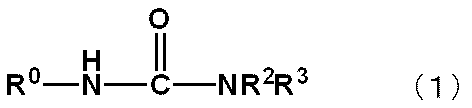
(式中、R0はエチレン性不飽和基を表し、R2及びR3はそれぞれ独立して、炭素数1~8の分岐していてもよいアルキル基、または炭素数6~8のアリール基を表す。)で示される三置換尿素化合物を塩化水素を含有する溶液中で熱分解反応に付する工程(熱分解工程)と、
(ii)熱分解工程終了後、前記温度に保持した反応溶液に塩化水素ガスを吹き込む工程(熟成工程A)と、
(iii)熟成工程A終了後、さらに前記温度に保持する工程(熟成工程B)とを含むことを特徴とするエチレン性不飽和基含有イソシアネート化合物の製造方法。
[2]熱分解工程が前記温度に保持した溶媒に塩化水素ガスを吹き込みながら行われる前項[1]に記載のエチレン性不飽和基含有イソシアネート化合物の製造方法。
[3]熱分解工程が前記温度で三置換尿素化合物の溶液を滴下しながら行われる前項[1]または[2]に記載のエチレン性不飽和基含有イソシアネート化合物の製造方法。
[4]一般式(1)で示される三置換尿素化合物が一般式(2)

(式中、mは1または2であり、Xは、mが1の場合、単結合または炭素数1~4のアルキル基で置換されていてもよいアルキレン基を表し、mが2の場合、炭素数1~4のアルキル基で置換されていてもよいメチン基を表し、R1は水素原子またはメチル基を表し、R2及びR3は前項[1]と同じ意味を表し、Zは、(1)炭素数1~4のアルキル基、炭素数1~5のアルコキシカルボニル基またはフェニル基で置換されていてもよい炭素数1~4のアルキレン基、(2)エーテル結合を含んでいてもよい炭素数1~12のアルキレン基、(3)炭素数6~15のアリーレン基、または(4)-C6H4-CH2-または-C6H4-C2H4-を表し、nは0または1である。)で示される化合物である三置換尿素化合物から一般式(3)
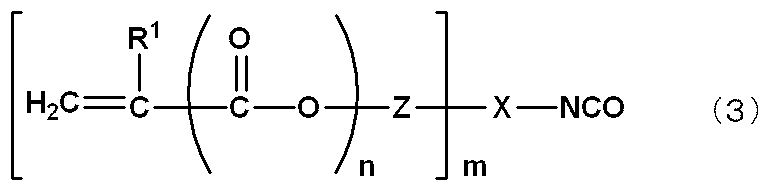
(式中の記号は前記と同じ意味を表す。)
で示されるイソシアネート化合物を製造する前項[1]~[3]のいずれか1項に記載のエチレン性不飽和基含有イソシアネート化合物の製造方法。
[5]重合禁止剤を添加した溶媒を用いる前項[1]~[4]のいずれか1項に記載のエチレン性不飽和基含有イソシアネート化合物の製造方法。
[6]重合禁止剤が、2,6-ジ-t-ブチル-4-ヒドロキシトルエン、フェノチアジン、及び4-ヒドロキシ-2,2,6,6-テトラメチルピペリジン-1-オキシルからなる群から選択される前項[5]に記載のエチレン性不飽和基含有イソシアネート化合物の製造方法。
[7]溶媒として、キシレン、トルエン、エチルベンゼン、ジクロロベンゼン、クロロベンゼン、デカン及びウンデカンからなる群から選択される少なくとも1種を使用する前項[1]~[6]のいずれか1項に記載のエチレン性不飽和基含有イソシアネート化合物の製造方法。
[8]一般式(2)及び(3)中、mが1であり、Xが単結合またはメチル基で置換されたメチン基を表し、Zが、フェニル基で置換されていてもよいメチレン基、フェニル基で置換されていてもよいエチレン基、2個のメチル基あるいは2個のエトキシカルボニル基で置換されていてもよいプロピレン基、エーテル結合を含んでもよいブチレン基、フェニレン基、またはメチレンフェニル基を表し、一般式(2)中のR2及びR3がそれぞれ独立してメチル基またはエチル基を表す前項[4]に記載のエチレン性不飽和基含有イソシアネート化合物の製造方法。
[9]熱分解工程における塩化水素ガスの吹き込み量が、三置換尿素化合物1モルに対して0.5~6.0モル当量である前項[2]~[8]のいずれか1項に記載のエチレン性不飽和基含有イソシアネート化合物の製造方法。
[10]滴下する三置換尿素化合物溶液の濃度が、2.0~20.0モル/Lである前項[3]~[8]のいずれか1項に記載のエチレン性不飽和基含有イソシアネート化合物の製造方法。
[11]三置換尿素化合物溶液を滴下する速度が、三置換尿素化合物の質量換算で0.1~10.0g/minである前項[3]~[10]のいずれか1項に記載のエチレン性不飽和基含有イソシアネート化合物の製造方法。
[12]熱分解工程における塩化水素ガスの吹き込み時間が0.2~10.0時間である前項[2]~[11]のいずれか1項に記載のエチレン性不飽和基含有イソシアネート化合物の製造方法。
[1](i)50~200℃の温度で下記一般式(1)
(ii)熱分解工程終了後、前記温度に保持した反応溶液に塩化水素ガスを吹き込む工程(熟成工程A)と、
(iii)熟成工程A終了後、さらに前記温度に保持する工程(熟成工程B)とを含むことを特徴とするエチレン性不飽和基含有イソシアネート化合物の製造方法。
[2]熱分解工程が前記温度に保持した溶媒に塩化水素ガスを吹き込みながら行われる前項[1]に記載のエチレン性不飽和基含有イソシアネート化合物の製造方法。
[3]熱分解工程が前記温度で三置換尿素化合物の溶液を滴下しながら行われる前項[1]または[2]に記載のエチレン性不飽和基含有イソシアネート化合物の製造方法。
[4]一般式(1)で示される三置換尿素化合物が一般式(2)
で示されるイソシアネート化合物を製造する前項[1]~[3]のいずれか1項に記載のエチレン性不飽和基含有イソシアネート化合物の製造方法。
[5]重合禁止剤を添加した溶媒を用いる前項[1]~[4]のいずれか1項に記載のエチレン性不飽和基含有イソシアネート化合物の製造方法。
[6]重合禁止剤が、2,6-ジ-t-ブチル-4-ヒドロキシトルエン、フェノチアジン、及び4-ヒドロキシ-2,2,6,6-テトラメチルピペリジン-1-オキシルからなる群から選択される前項[5]に記載のエチレン性不飽和基含有イソシアネート化合物の製造方法。
[7]溶媒として、キシレン、トルエン、エチルベンゼン、ジクロロベンゼン、クロロベンゼン、デカン及びウンデカンからなる群から選択される少なくとも1種を使用する前項[1]~[6]のいずれか1項に記載のエチレン性不飽和基含有イソシアネート化合物の製造方法。
[8]一般式(2)及び(3)中、mが1であり、Xが単結合またはメチル基で置換されたメチン基を表し、Zが、フェニル基で置換されていてもよいメチレン基、フェニル基で置換されていてもよいエチレン基、2個のメチル基あるいは2個のエトキシカルボニル基で置換されていてもよいプロピレン基、エーテル結合を含んでもよいブチレン基、フェニレン基、またはメチレンフェニル基を表し、一般式(2)中のR2及びR3がそれぞれ独立してメチル基またはエチル基を表す前項[4]に記載のエチレン性不飽和基含有イソシアネート化合物の製造方法。
[9]熱分解工程における塩化水素ガスの吹き込み量が、三置換尿素化合物1モルに対して0.5~6.0モル当量である前項[2]~[8]のいずれか1項に記載のエチレン性不飽和基含有イソシアネート化合物の製造方法。
[10]滴下する三置換尿素化合物溶液の濃度が、2.0~20.0モル/Lである前項[3]~[8]のいずれか1項に記載のエチレン性不飽和基含有イソシアネート化合物の製造方法。
[11]三置換尿素化合物溶液を滴下する速度が、三置換尿素化合物の質量換算で0.1~10.0g/minである前項[3]~[10]のいずれか1項に記載のエチレン性不飽和基含有イソシアネート化合物の製造方法。
[12]熱分解工程における塩化水素ガスの吹き込み時間が0.2~10.0時間である前項[2]~[11]のいずれか1項に記載のエチレン性不飽和基含有イソシアネート化合物の製造方法。
本発明によれば、エチレン性不飽和結合を有する三置換尿素化合物の熱分解反応により重合性の高いエチレン性不飽和基含有イソシアネート化合物を高収率で製造することができる。本発明の製造方法は、原料として有毒なホスゲンを使用しないこと、エチレン性不飽和二重結合に塩化水素が付加した副生物を大幅に低減できることから煩雑な処理工程が不要であり、環境及び安全面での管理が容易である。
本発明の製造方法で得られるエチレン性不飽和基含有イソシアネート化合物は、エチレン性不飽和二重結合とイソシアネート基を同一分子内に有することから、他の不飽和化合物、例えば、メチルメタクリレート、メチルアクリレートなどの(メタ)アクリレート類またはスチレン類などと共重合させることにより、イソシアネート基を有する機能性ポリマー材料を製造するができる。また、ヒドロキシル基、アミノ基、カルボキシル基のような活性水素を有するモノマー、オリゴマーまたはポリマーをイソシアネート基と反応させ不飽和結合を導入して、紫外線、電子線、熱などにより硬化する、電子材料、歯科材料、医療分野、塗料及び各種接着剤などの様々な用途に有用な材料(レジスト、粘着剤、フィルムなど)を製造することができる。
以下、本発明について詳細に説明する。
I.三置換尿素化合物
本発明に係るエチレン性不飽和基含有イソシアネート化合物の製造方法は、下記の一般式(1)で示される少なくとも1つがエチレン性不飽和結合を有する置換基である三置換尿素化合物を熱分解することにより目的化合物を得る方法である。なお、本明細書中におけるすべての一般式で示される化合物は、シス、トランス等の立体異性体をすべて含む。

式中、R0はエチレン性不飽和基を表し、アクリロイルオキシエチル基、メタアクリロイルオキシエチル基、アクリロイルオキシエチルオキシエチル基、メタクリロイルオキシエチルオキシエチル基またはビスアクリロイルオキシメチル基が好ましい、R2及びR3はそれぞれ独立して、分岐していてもよい炭素数1~8のアルキル基、または炭素数6~8のアリール基を表し、メチル基またはエチル基が好ましい。R2及びR3は同一でもよく、異なってもよい。
I.三置換尿素化合物
本発明に係るエチレン性不飽和基含有イソシアネート化合物の製造方法は、下記の一般式(1)で示される少なくとも1つがエチレン性不飽和結合を有する置換基である三置換尿素化合物を熱分解することにより目的化合物を得る方法である。なお、本明細書中におけるすべての一般式で示される化合物は、シス、トランス等の立体異性体をすべて含む。
三置換尿素化合物としては一般式(2)で示される化合物が好ましい。

式中、mは1または2であり、Xは、mが1の場合、単結合または炭素数1~4のアルキル基で置換されていてもよいアルキレン基を表し、mが2の場合、炭素数1~4のアルキル基で置換されていてもよいメチン基を表し、単結合またはメチル基で置換されたメチン基が好ましい。
R1は水素原子またはメチル基を表す。
R2及びR3は前記と同じ意味を表す。
Zは、(1)炭素数1~4のアルキル基、炭素数1~5のアルコキシカルボニル基、またはフェニル基で置換されていてもよい炭素数1~4のアルキレン基、(2)エーテル結合を含んでいてもよい炭素数1~12のアルキレン基、(3)炭素数6~15のアリーレン基、または(4)-C6H4-CH2-または-C6H4-C2H4-を表し、フェニル基で置換されていてもよいメチレン基、フェニル基で置換されていてもよいエチレン基、2個のメチル基あるいは2個のエトキシカルボニル基で置換されていてもよいプロピレン基、エーテル結合を含んでもよいブチレン基、フェニレン基、またはメチレンフェニル基が好ましい。
nは0または1である。
R1は水素原子またはメチル基を表す。
R2及びR3は前記と同じ意味を表す。
Zは、(1)炭素数1~4のアルキル基、炭素数1~5のアルコキシカルボニル基、またはフェニル基で置換されていてもよい炭素数1~4のアルキレン基、(2)エーテル結合を含んでいてもよい炭素数1~12のアルキレン基、(3)炭素数6~15のアリーレン基、または(4)-C6H4-CH2-または-C6H4-C2H4-を表し、フェニル基で置換されていてもよいメチレン基、フェニル基で置換されていてもよいエチレン基、2個のメチル基あるいは2個のエトキシカルボニル基で置換されていてもよいプロピレン基、エーテル結合を含んでもよいブチレン基、フェニレン基、またはメチレンフェニル基が好ましい。
nは0または1である。
上記一般式(2)で示される化合物は、従来公知の方法によって製造することができるが、市販品を用いても良い。公知の製造方法としては、例えば、特開昭60-87254公報、特開2009-229499公報に、それぞれにN-メチル-N’-(1-メチル-1-フェニル-3-ブテニル-N-(1-フェニルエチル)ウレア、2-(N,N-ジエチルウレイド)エチルメタクリレートを得る方法が開示されている。また、市販品としては、例えば、エムピー・バイオメディカル(MP Biomedical)で販売されているN-アリル-N’-エチルウレアなどが挙げられる。
II.エチレン性不飽和基含有イソシアネート化合物
本発明の製造方法により得られる、分子中にイソシアネート基及び少なくとも1つのエチレン性不飽和結合を有するイソシアネート化合物は、一般式(1)で示される三置換尿素化合物から得られるR0-NCOであり、好ましくは下記の一般式(3)で示される。
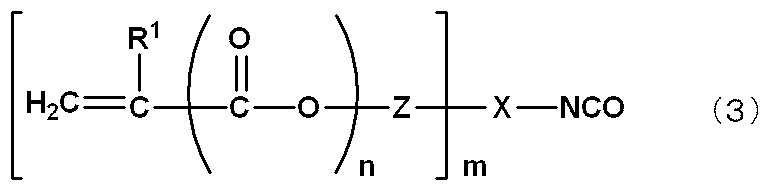
式中の記号は前記と同じ意味を表す。
本発明の製造方法により得られる、分子中にイソシアネート基及び少なくとも1つのエチレン性不飽和結合を有するイソシアネート化合物は、一般式(1)で示される三置換尿素化合物から得られるR0-NCOであり、好ましくは下記の一般式(3)で示される。
上記一般式(3)で示される化合物は、特に限定されるものではないが、好ましい具体例としては、2-プロピレンイソシアネート(化合物1)、1-フェニル-2-プロピレンイソシアネート(化合物2)、4,4-ジメチルペンテン-5-イソシアネート(化合物3)、2,4,4-トリメチルペンテン-5-イソシアネート(化合物4)、3,3-ジメチルペンテン-5-イソシアネート(化合物5)、2-アリル-2-イソシアネートメチル-マロン酸ジエチルエステル(化合物6)、1-フェニル-3-メチル-3-ブテンイソシアネート(化合物7)、4-ビニルベンゼンイソシアネート(化合物8)、2-メタクリロイルオキシエチルイソシアネート(化合物9)、1-イソシアネートメチル-4-ビニル-ベンゼン(化合物10)、2-アクリロイルオキシエチルイソシアネート(化合物11)、2-(2-メタクリロイルオキシエチルオキシ)エチルイソシアネート(化合物12)、1,1-(ビスアクリロイルオキシメチル)エチルイソシアネート(化合物13)、2-メタクリロイルオキシベンジルイソシアネート(化合物14)などが挙げられる。
上記の好ましい化合物1~14と一般式(3)の関係を表1に示す。
III.副生成物(製造中間体)
本発明の製造方法では、原料の三置換尿素化合物が、分解生成物であるイソシアネート化合物と反応した下記の一般式(4)

(式中の記号は前記と同じ意味を表す。)
で示される副生成物を生成することがある。
本発明の製造方法では、原料の三置換尿素化合物が、分解生成物であるイソシアネート化合物と反応した下記の一般式(4)
で示される副生成物を生成することがある。
この副生成物は、塩化水素ガスを吹き込みつつ原料三置換尿素化合物を熱分解する反応条件下で目的生成物に変換される。従って、一般式(4)で示される化合物は、本発明の製造方法の中間体の一つということができる(以下、一般式(4)で示される化合物を製造中間体と略記することがある。)。
本発明に係る製造方法で得られる製造中間体には、特に限定されるものではないが、好ましい具体例として、下記式(5)で示される化合物(2-アクリロイルオキシエチルイソシアネートの製造中間体)、(6)で示される化合物(2-メタクリロイルオキシエチルイソシアネートの製造中間体)(以下、Biu-1という。)、(7)で示される化合物(2-(2-メタクリオイルオキシエチルオキシ)エチルイソシアネートの製造中間体)及び(8)で示される化合物(1,1-(ビスアクリロイルオキシメチル)エチルイソシアネート)が挙げられる。
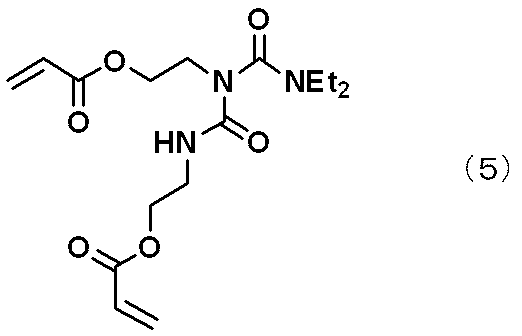
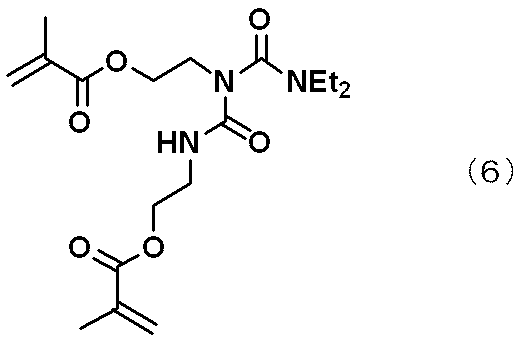

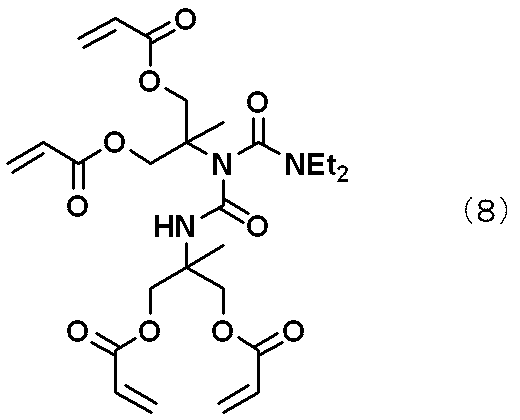
本発明に係る製造方法の中間体(副生成物)としては、前記一般式(4)で示される化合物のほか、前記三置換尿素とイソシアネートが反応したビウレット体があり、また、エステル結合を含む原料三置換尿素の場合には酸性物質(塩化水素)の存在下でエステル分解により生成するエステル分解物も副生成物として挙げられる。
IV.エチレン性不飽和基含有イソシアネート化合物の製造方法
本発明のエチレン性不飽和基含有イソシアネート化合物の製造方法は、
(i)所定の温度で前記一般式(1)で示される三置換尿素化合物を塩化水素を含有する溶液中で熱分解反応に付する工程(熱分解工程)と、
(ii)熱分解工程終了後、前記温度に保持した反応溶液に塩化水素ガスを吹き込む工程(熟成工程A)と、
(iii)熟成工程A終了後、さらに前記温度に保持する工程(熟成工程B)と含む。
本発明のエチレン性不飽和基含有イソシアネート化合物の製造方法は、
(i)所定の温度で前記一般式(1)で示される三置換尿素化合物を塩化水素を含有する溶液中で熱分解反応に付する工程(熱分解工程)と、
(ii)熱分解工程終了後、前記温度に保持した反応溶液に塩化水素ガスを吹き込む工程(熟成工程A)と、
(iii)熟成工程A終了後、さらに前記温度に保持する工程(熟成工程B)と含む。
以下にそれぞれの工程について説明する。
(1)熱分解工程
熱分解工程は、所定の温度に保持した溶媒に塩化水素ガスを吹き込みながら、三置換尿素化合物の溶液を滴下して行うことが好ましい。
(1)熱分解工程
熱分解工程は、所定の温度に保持した溶媒に塩化水素ガスを吹き込みながら、三置換尿素化合物の溶液を滴下して行うことが好ましい。
熱分解工程で用いられる塩化水素ガスの使用量は、反応の終了時までに、通常は、三置換尿素化合物1モルに対して塩化水素ガスを0.2~4.0モル当量、好ましくは0.5~2.0モル当量、より好ましくは1.0~2.0モル当量となる量である。使用する塩化水素ガスが少ないと、未反応三置換尿素化合物が増加し、特定の副生成物(製造中間体)の分解不足により収率が低下する。一方、使用する塩化水素ガスが多いと、二重結合への塩化水素マイケル付加物が増加し、収率が低下する。
熱分解工程で用いられる溶媒(塩化水素ガスを吹き込み原料三置換尿素化合物溶液を滴下する溶媒、及び原料三置換尿素化合物溶液の溶媒)としては、特に限定されるものはないが、吹き込んだ塩化水素ガスと三置換尿素化合物の分解生成物(アミン化合物)との塩(アミン塩酸塩)が沈殿するものが好ましい。例えば、ホルムアミド、N-メチルホルムアミド、N,N-ジメチルホルムアミド、ジメチルスルフォキシド、ジオキサン、テトラヒドロフラン、ピリジン、スルホラン、ベンゼン、エチルベンゼン、ジクロロベンゼン、クロロベンゼン、デカン、ウンデカン、トルエン、キシレン、ジエチルエーテル、アセトン、メチルエチルケトン、メチルイソブチルケトン等が挙げられる。これらの中でも、容易に入手できることから、キシレン、トルエン、エチルベンゼン、ジクロロベンゼン、クロロベンゼン、デカン、ウンデカンが好ましい。
溶媒の使用量は、通常、三置換尿素化合物1モルに対して0.2~10.0L、好ましくは0.5~8.0L、より好ましくは1.0~5.0Lとなる量である。使用する溶媒量は少ないと、濃度増加により、エステル分解などの副反応速度が速くなるため、収率が低下する。また、極端に少ないと生成する塩により撹拌が阻害され、反応効率低下を招く恐れがある。一方、使用する溶媒量が多いと、濃度低下により、反応速度が著しく低下する可能性がある。
熱分解工程では重合反応を避けるために、重合禁止剤を使用してもよい。重合禁止剤としては、特に限定されるものはないが、フェノール、ハイドロキノン、p-メトキシフェノール、ハイドロキノンモノメチルエーテル、t-ブチルカテコール、2,6-ジ-t-ブチルヒドロキシトルエン(BHT)、クレゾール、カテコール、2,5-ジ-t-ブチルハイドロキノン、2,6-ジ-t-ブチルフェノール、6-t-ブチル-m-クレゾール、2,6-ジ-t-ブチル-p-クレゾール、4-t-ブチルカテコール、2,4-ジメチル-6-t-ブチルフェノール、2-t-ブチルハイドロキノン、2-t-ブチル-4-メトキシフェノール等のフェノール類、ベンゾキノン、1,2-ナフトキノン、フェノチアジン、メチレンブルー、4-ヒドロキシ-2,2,6,6-テトラメチルピペリジン-1-オキシル(4H-TEMPO)、ジメチルジチオカルバミン酸銅塩、ジエチルジチオカルバミン酸銅塩、ジプロピルジチオカルバミン酸銅塩、ジブチルジチオカルバミン酸銅塩、及びスチレン化フェノチアジン(STDP-D、Styrenated phenothiazine、川口化学工業)のうち少なくとも1種などが挙げられる。好ましくはBHT、フェノチアジン及び4H-TEMPOである。上記重合禁止剤は、1種を単独で用いてもよいし、2種以上を組み合わせて用いてもよい。
重合禁止剤の使用量は、反応溶媒に対して500~10000質量ppm、好ましくは1000~8000質量ppm、より好ましくは2000~6000質量ppm、特に好ましくは3000~5000質量ppmである。使用する重合禁止剤が少ないと、生成物または三置換尿素化合物の重合により、著しく収率が低下する。一方、使用する重合禁止剤が多いとイソシアネート基と重合禁止剤が反応し、収率が低下する。
滴下する原料三置換尿素化合物溶液の濃度は、2.0モル/L~20.0モル/L、好ましくは3.0モル/L~15.0モル/L、より好ましくは5.0モル/L~10.0モル/Lである。原料三置換尿素化合物の濃度が低いと供給に時間がかかり反応時間が長くなり熱履歴増加による収率が低下する。一方、原料三置換尿素化合物の濃度が高いと粘度が高いため供給しにくくなる。
所定温度に保持した溶媒に滴下した後の反応液内の三置換尿素化合物の濃度としては、反応液に対して0.1~5.0モル/L、好ましくは0.1~2.0モル/L、より好ましくは0.1~1.0モル/L以上である。三置換尿素化合物の濃度が少ないと、反応速度が低下する。一方、三置換尿素化合物の濃度が多いと、エステル分解などの副反応進行速度増加により、収率が低下する。
一般式(1)で示される三置換尿素化合物溶液の滴下速度としては、三置換尿素化合物の質量換算で0.1~10.0g/min、好ましくは0.5~8.0g/min、より好ましくは0.9~4.0g/minとなる量である。原料三置換尿素化合物溶液の滴下速度が遅いと、系内の塩化水素濃度が過剰となり、エステル分解、塩化水素のマイケル付加などの副反応が進行し、収率が低下する。一方、原料三置換尿素化合物溶液の滴下速度が速いと、未反応の三置換尿素化合物が増加し、収率が低下する。
塩化水素ガスの吹き込み量としては、三置換尿素化合物1モルに対して0.5~6.0モル当量、好ましくは0.8~4.0モル当量、より好ましくは1~2.0モル当量である。吹き込み量が少ないと未反応の三置換尿素化合物が増加し、特定の副生物の分解不足により収率が低下する。一方、吹き込み量が多いと、二重結合への塩化水素マイケル付加物が増加し、収率が低下する。
塩化水素ガスの吹き込み時間は、通常は0.2~10.0時間、好ましくは0.5~8.0時間、より好ましくは1.0~5.0時間である。吹き込み時間が短いと過剰な塩化水素の吹き抜けによる塩化水素のロスが増加する、一方、吹き込み時間が長いと熱履歴増加により、エステル分解等の副生物が増加し、収率が低下する。
本発明では、塩化水素ガスは反応系内の液相部に吹き込むことが好ましい。反応系内の気相部に塩化水素ガスを吹き込むと、吹き抜け塩化水素が増加し、反応速度が低下する。
反応系内は撹拌することが好ましい。撹拌条件としては、通常は50~1000rpm、好ましくは100~800rpm、より好ましくは200~600rpmである。撹拌速度が低いと、撹拌効率の低下により反応速度が低下する。
反応系内は撹拌することが好ましい。撹拌条件としては、通常は50~1000rpm、好ましくは100~800rpm、より好ましくは200~600rpmである。撹拌速度が低いと、撹拌効率の低下により反応速度が低下する。
熱分解工程の系内温度は、通常50~200℃、好ましくは80~180℃、より好ましくは120~140℃である。温度が低いと、反応速度が遅くなる。一方、温度が高いと重合の可能性が増加する。
(2)熟成工程A及びB
熟成工程は前記熱反応工程に引き続き同一の反応系内で行われる。
熟成工程Aにおける塩化水素ガスの吹き込み箇所及び熟成工程A及びBにおける系内温度は、上記の熱分解工程と同様である。系内温度は、熱分解工程の温度の±10℃以内で変更してもよい。
熟成工程Aにおける塩化水素ガスの吹き込み速度は、熱分解工程における吹き込み速度と同じか、またはそれ以下の速度が好ましい。熱分解工程における吹き込み速度より速いと塩化水素の吹き抜けによるロスが増加する。
熟成工程は前記熱反応工程に引き続き同一の反応系内で行われる。
熟成工程Aにおける塩化水素ガスの吹き込み箇所及び熟成工程A及びBにおける系内温度は、上記の熱分解工程と同様である。系内温度は、熱分解工程の温度の±10℃以内で変更してもよい。
熟成工程Aにおける塩化水素ガスの吹き込み速度は、熱分解工程における吹き込み速度と同じか、またはそれ以下の速度が好ましい。熱分解工程における吹き込み速度より速いと塩化水素の吹き抜けによるロスが増加する。
熟成工程Aにおける塩化水素ガスの吹き込み量は、通常三置換尿素化合物1モルに対して0~5.0モル当量、好ましくは0~2.0モル当量、より好ましくは0~1.0モル当量である。吹き込み量が少ないと、特定の副生成物(製造中間体)の分解不足により収率が低下する。一方、吹き込み量が多いと、吹き抜けによる塩化水素ロスが増加する。
熟成時間は、塩化水素ガスを吹き込む熟成工程Aでは、0.1~6.0時間、好ましくは0.3~4.0時間、より好ましくは0.5~2.0時間である。塩化水素ガス吹き込み終了後の熟成工程Bでは、0.1~4.0時間、好ましくは0.3~2.0時間、より好ましくは0.5~1.0時間である。熟成時間が短いと、特定の副生成物(製造中間体)の分解不足により収率が低下する。一方、熟成時間が長いと、熱履歴増加により、副生物が増加し、収率が低下する。
熟成工程Aにおいて塩化水素ガスを吹き込むことにより、特定の副生成物(製造中間体)が分解し目的生成物を得ることができる。
熟成工程B終了後、吹き込んだ塩化水素ガスと三置換尿素化合物の分解生成物(アミン化合物)との反応により生成し、反応系に沈殿したアミン塩酸塩を除去してもよい。除去方法としては、ろ過が一般的である。また、水に対する溶解度が低い溶媒中で反応を行った場合は、生成したアミン塩酸塩を水で抽出してもよい。
アミン塩酸塩を除去した後、残余の溶媒を留去する。留去の操作及び装置は特に限定されないが、精留、還流装置があるものが好ましい。また、薄膜蒸留装置を使用することもできる。
以下、実施例及び比較例に基づいて本発明をより具体的に説明するが、本発明はこれらの例により何ら限定されるものではない。
実施例及び比較例で合成した化合物は、下記の条件で高速液体クロマトグラフィー分析により定量した。
高速液体クロマトグラフィー分析条件:
カラム:昭和電工(株)製、商品名「Shodex KF-801」4本、
カラム温度:40℃、
溶離液:テトラヒドロフラン、
流速:0.8ml/分、
検出:RI/UV(210nm)。
高速液体クロマトグラフィー分析条件:
カラム:昭和電工(株)製、商品名「Shodex KF-801」4本、
カラム温度:40℃、
溶離液:テトラヒドロフラン、
流速:0.8ml/分、
検出:RI/UV(210nm)。
実施例1:化合物9の製造
撹拌機、コンデンサー及び温度計を備えた1L四つ口フラスコに、溶媒のキシレン570g及び重合禁止剤のBHT0.5gを入れてオイルバスで130℃に加熱した。その溶媒に乾燥塩化水素ガスを90mL/minで吹き込みながら、別の250mL容器で2-(N,N-ジエチルウレイド)エチルメタクリレート121gとキシレン100gを入れて混合した原料化合物溶液を2時間かけて滴下した(熱分解工程)。滴下終了後、反応溶液を30分間130℃に保持しながら、乾燥塩化水素ガスを90mL/minで吹き込んだ(熟成工程A)。その後、さらに130℃に保持して30分間反応溶液を熟成した(熟成工程B)。熟成終了後、反応液を冷却し、ジエチルアミン塩酸塩をろ過除去し、溶媒を留去し、目的の2-メタクリロイルオキシエチルイソシアネート(化合物9)を得た(収率87%)。
反応の途中で反応溶液をサンプリングして高速液体クロマトグラフィー分析を行い、反応時間ごとの目的生成物の収率及び副生成物(式(6)で示されるBiu-1)の収率を、予め標品を用いて作成した検量線から算出した。その結果を表2に示す。
撹拌機、コンデンサー及び温度計を備えた1L四つ口フラスコに、溶媒のキシレン570g及び重合禁止剤のBHT0.5gを入れてオイルバスで130℃に加熱した。その溶媒に乾燥塩化水素ガスを90mL/minで吹き込みながら、別の250mL容器で2-(N,N-ジエチルウレイド)エチルメタクリレート121gとキシレン100gを入れて混合した原料化合物溶液を2時間かけて滴下した(熱分解工程)。滴下終了後、反応溶液を30分間130℃に保持しながら、乾燥塩化水素ガスを90mL/minで吹き込んだ(熟成工程A)。その後、さらに130℃に保持して30分間反応溶液を熟成した(熟成工程B)。熟成終了後、反応液を冷却し、ジエチルアミン塩酸塩をろ過除去し、溶媒を留去し、目的の2-メタクリロイルオキシエチルイソシアネート(化合物9)を得た(収率87%)。
反応の途中で反応溶液をサンプリングして高速液体クロマトグラフィー分析を行い、反応時間ごとの目的生成物の収率及び副生成物(式(6)で示されるBiu-1)の収率を、予め標品を用いて作成した検量線から算出した。その結果を表2に示す。
比較例1:
実施例1における熱分解工程部分を比較例1とする。実施例1の熱分解工程終了時にサンプリングして分析・算出した2-メタクリロイルオキシエチルイソシアネート(化合物9)の収率は69.5%であった(表2参照。)。
実施例1における熱分解工程部分を比較例1とする。実施例1の熱分解工程終了時にサンプリングして分析・算出した2-メタクリロイルオキシエチルイソシアネート(化合物9)の収率は69.5%であった(表2参照。)。

表2から、熱分解工程のみの比較例1に比べ、熱分解工程後に塩化水素ガスを吹き込む熟成工程を経た実施例1では、目的生成物の収率が向上していることがわかる。
熟成工程で特定の副生成物(製造中間体)であるBiu-1の生成率が低下したことから、熱分解工程後の反応液に塩化水素ガスを吹き込むことによりBiu-1が分解し目的生成物が得られることが判明した。
熟成工程で特定の副生成物(製造中間体)であるBiu-1の生成率が低下したことから、熱分解工程後の反応液に塩化水素ガスを吹き込むことによりBiu-1が分解し目的生成物が得られることが判明した。
実施例2:化合物11の製造
2-(N,N-ジエチルウレイド)エチルメタクリレート121gの代わりに2-(N,N-ジエチルウレイド)エチルアクリレート116gを使用した以外は実施例1と同様にして、目的の2-アクリロイルオキシエチルイソシアネート(化合物11)を得た(収率78%)。副生成物(式(5)で示される製造中間体)の収率は9.4%であった。
2-(N,N-ジエチルウレイド)エチルメタクリレート121gの代わりに2-(N,N-ジエチルウレイド)エチルアクリレート116gを使用した以外は実施例1と同様にして、目的の2-アクリロイルオキシエチルイソシアネート(化合物11)を得た(収率78%)。副生成物(式(5)で示される製造中間体)の収率は9.4%であった。
実施例3:化合物13の製造
2-(N,N-ジエチルウレイド)エチルメタクリレート121gの代わりに2,2-[(N,N-ジエチルウレイド)-メチル]エチルビズアクリレート156gを使用した以外は実施例1と同様にして目的の1,1-(ビスアクリロイルオキシメチル)エチルイソシアネート(化合物13)を得た(収率76%)。副生成物(式(8)で示される製造中間体)の収率は4.2%であった。
2-(N,N-ジエチルウレイド)エチルメタクリレート121gの代わりに2,2-[(N,N-ジエチルウレイド)-メチル]エチルビズアクリレート156gを使用した以外は実施例1と同様にして目的の1,1-(ビスアクリロイルオキシメチル)エチルイソシアネート(化合物13)を得た(収率76%)。副生成物(式(8)で示される製造中間体)の収率は4.2%であった。
実施例4:化合物12の製造
2-(N,N-ジエチルウレイド)エチルメタクリレート121gの代わりに2-[2-(N,N-ジエチルウレイド)エチルオキシ]エチルメタクリレート136gを使用した以外は実施例1と同様にして目的の2-(2-メタクリロイルオキシエチルオキシ)エチルイソシアネート(化合物12)を得た(収率85%)。副生成物(式(7)で示される製造中間体)の収率は5.2%であった。
2-(N,N-ジエチルウレイド)エチルメタクリレート121gの代わりに2-[2-(N,N-ジエチルウレイド)エチルオキシ]エチルメタクリレート136gを使用した以外は実施例1と同様にして目的の2-(2-メタクリロイルオキシエチルオキシ)エチルイソシアネート(化合物12)を得た(収率85%)。副生成物(式(7)で示される製造中間体)の収率は5.2%であった。
比較例2:
撹拌機及び温度計を備えた200mL四つ口フラスコに、溶媒のキシレン110g、重合禁止剤のBHT0.2g及び2-(N,N-ジエチルウレイド)エチルメタクリレート20gを入れ、系内温度を氷冷で10℃以下に保ちながら、塩化水素を3.3g吹き込んだ。塩化水素を吹き込んだ液をオートクレーブ用の容器に入れて密閉し、130℃で2時間反応させた。反応終了後、反応液を冷却し、ジエチルアミン塩酸塩をろ過し、溶媒を留去し、目的の2-メタクリロイルオキシエチルイソシアネートを得た(収率67%)。副生成物(Biu-1)の収率は13.2%であった。
撹拌機及び温度計を備えた200mL四つ口フラスコに、溶媒のキシレン110g、重合禁止剤のBHT0.2g及び2-(N,N-ジエチルウレイド)エチルメタクリレート20gを入れ、系内温度を氷冷で10℃以下に保ちながら、塩化水素を3.3g吹き込んだ。塩化水素を吹き込んだ液をオートクレーブ用の容器に入れて密閉し、130℃で2時間反応させた。反応終了後、反応液を冷却し、ジエチルアミン塩酸塩をろ過し、溶媒を留去し、目的の2-メタクリロイルオキシエチルイソシアネートを得た(収率67%)。副生成物(Biu-1)の収率は13.2%であった。
比較例3:
撹拌機、コンデンサー、及び温度計を備えた100mL三つ口フラスコに、溶媒のキシレン60g、重合防止剤のBHT0.1g、2-(N,N-ジエチルウレイド)エチルメタクリレート10g及びピリジン塩酸塩11.1gを入れて130℃で2時間撹拌した。反応液を冷却し、塩をろ過除去し、溶媒を留去し、目的の2-メタクリロイルオキシエチルイソシアネートを得た(収率10%)。
撹拌機、コンデンサー、及び温度計を備えた100mL三つ口フラスコに、溶媒のキシレン60g、重合防止剤のBHT0.1g、2-(N,N-ジエチルウレイド)エチルメタクリレート10g及びピリジン塩酸塩11.1gを入れて130℃で2時間撹拌した。反応液を冷却し、塩をろ過除去し、溶媒を留去し、目的の2-メタクリロイルオキシエチルイソシアネートを得た(収率10%)。
実施例1~4と比較例1~3を比較すると、特に熟成工程を経た実施例1~4により目的生成物であるエチレン性不飽和基含有イソシアネート化合物が高い収率で得られることがわかる。
Claims (12)
- (i)50~200℃の温度で下記一般式(1)

(ii)熱分解工程終了後、前記温度に保持した反応溶液に塩化水素ガスを吹き込む工程(熟成工程A)と、
(iii)熟成工程A終了後、さらに前記温度に保持する工程(熟成工程B)とを含むことを特徴とするエチレン性不飽和基含有イソシアネート化合物の製造方法。 - 熱分解工程が前記温度に保持した溶媒に塩化水素ガスを吹き込みながら行われる請求項1に記載のエチレン性不飽和基含有イソシアネート化合物の製造方法。
- 熱分解工程が前記温度で三置換尿素化合物の溶液を滴下しながら行われる請求項1または2に記載のエチレン性不飽和基含有イソシアネート化合物の製造方法。
- 一般式(1)で示される三置換尿素化合物が一般式(2)

で示されるイソシアネート化合物を製造する請求項1に記載のエチレン性不飽和基含有イソシアネート化合物の製造方法。 - 重合禁止剤を添加した溶媒を用いる請求項1に記載のエチレン性不飽和基含有イソシアネート化合物の製造方法。
- 重合禁止剤が、2,6-ジ-t-ブチル-4-ヒドロキシトルエン、フェノチアジン、及び4-ヒドロキシ-2,2,6,6-テトラメチルピペリジン-1-オキシルからなる群から選択される請求項5に記載のエチレン性不飽和基含有イソシアネート化合物の製造方法。
- 溶媒として、キシレン、トルエン、エチルベンゼン、ジクロロベンゼン、クロロベンゼン、デカン及びウンデカンからなる群から選択される少なくとも1種を使用する請求項1に記載のエチレン性不飽和基含有イソシアネート化合物の製造方法。
- 一般式(2)及び(3)中、mが1であり、Xが単結合またはメチル基で置換されたメチン基を表し、Zが、フェニル基で置換されていてもよいメチレン基、フェニル基で置換されていてもよいエチレン基、2個のメチル基あるいは2個のエトキシカルボニル基で置換されていてもよいプロピレン基、エーテル結合を含んでもよいブチレン基、フェニレン基、またはメチレンフェニル基を表し、一般式(2)中のR2及びR3がそれぞれ独立してメチル基またはエチル基を表す請求項4に記載のエチレン性不飽和基含有イソシアネート化合物の製造方法。
- 熱分解工程における塩化水素ガスの吹き込み量が、三置換尿素化合物1モルに対して0.5~6.0モル当量である請求項2に記載のエチレン性不飽和基含有イソシアネート化合物の製造方法。
- 滴下する三置換尿素化合物溶液の濃度が、2.0~20.0モル/Lである請求項3に記載のエチレン性不飽和基含有イソシアネート化合物の製造方法。
- 三置換尿素化合物溶液を滴下する速度が、三置換尿素化合物の質量換算で0.1~10.0g/minである請求項3に記載のエチレン性不飽和基含有イソシアネート化合物の製造方法。
- 熱分解工程における塩化水素ガスの吹き込み時間が0.2~10.0時間である請求項2に記載のエチレン性不飽和基含有イソシアネート化合物の製造方法。
Priority Applications (1)
| Application Number | Priority Date | Filing Date | Title |
|---|---|---|---|
| JP2012546656A JP5165815B2 (ja) | 2011-06-24 | 2012-06-08 | エチレン性不飽和基含有イソシアネート化合物の製造方法 |
Applications Claiming Priority (2)
| Application Number | Priority Date | Filing Date | Title |
|---|---|---|---|
| JP2011-140841 | 2011-06-24 | ||
| JP2011140841 | 2011-06-24 |
Publications (1)
| Publication Number | Publication Date |
|---|---|
| WO2012176631A1 true WO2012176631A1 (ja) | 2012-12-27 |
Family
ID=47422471
Family Applications (1)
| Application Number | Title | Priority Date | Filing Date |
|---|---|---|---|
| PCT/JP2012/064785 Ceased WO2012176631A1 (ja) | 2011-06-24 | 2012-06-08 | エチレン性不飽和基含有イソシアネート化合物の製造方法 |
Country Status (2)
| Country | Link |
|---|---|
| JP (1) | JP5165815B2 (ja) |
| WO (1) | WO2012176631A1 (ja) |
Cited By (1)
| Publication number | Priority date | Publication date | Assignee | Title |
|---|---|---|---|---|
| JP2014210735A (ja) * | 2013-04-19 | 2014-11-13 | 株式会社リコー | (メタ)アクリル酸エステル化合物、活性エネルギー線硬化型組成物、インクジェット記録用インク |
Families Citing this family (2)
| Publication number | Priority date | Publication date | Assignee | Title |
|---|---|---|---|---|
| WO2022108350A1 (ko) | 2020-11-18 | 2022-05-27 | 덕산네오룩스 주식회사 | 반도체나노입자-리간드 복합체, 그 제조방법, 감광성 수지 조성물, 광학필름, 전기발광다이오드 및 전자장치 |
| ES2970697T3 (es) * | 2021-09-10 | 2024-05-30 | Evonik Operations Gmbh | (Met)acrilatos de urea espaciados |
Citations (7)
| Publication number | Priority date | Publication date | Assignee | Title |
|---|---|---|---|---|
| JPS5533480A (en) * | 1978-08-26 | 1980-03-08 | Akzo Nv | Manufacture of organic monoisocyanate or polyisocyanate |
| JPS61277659A (ja) * | 1985-05-28 | 1986-12-08 | ザ・グツドイヤ−・タイヤ・アンド・ラバ−・カンパニ− | (1―イソシアナト―1―メチルエチル)―3又は4―(1―メチルエテニル)ベンゼンからの官能基が付与された単量体単位を含む重合体 |
| US4873364A (en) * | 1988-12-09 | 1989-10-10 | Arco Chemical Technology, Inc. | Process for the preparation of methylene diphenylene diisocyanates and polymethylene polyphenylene poly (diisocyanates) |
| JPH0348651A (ja) * | 1989-07-12 | 1991-03-01 | Arco Chem Technol Inc | 脂肪族イソシアネートの製造方法 |
| JPH06157449A (ja) * | 1992-08-13 | 1994-06-03 | Chem Linz Ag | N,n,n’− トリ置換された尿素の分解によってイソシアナートを製造する方法 |
| JP2003040927A (ja) * | 2001-07-30 | 2003-02-13 | Yamaguchi Technology Licensing Organization Ltd | 光学活性ポリメタクリレート誘導体及び分離剤並びに分離方法 |
| JP2004035841A (ja) * | 2002-07-08 | 2004-02-05 | Hitachi Chem Co Ltd | 接着シート並びに半導体装置及びその製造方法 |
-
2012
- 2012-06-08 JP JP2012546656A patent/JP5165815B2/ja not_active Expired - Fee Related
- 2012-06-08 WO PCT/JP2012/064785 patent/WO2012176631A1/ja not_active Ceased
Patent Citations (7)
| Publication number | Priority date | Publication date | Assignee | Title |
|---|---|---|---|---|
| JPS5533480A (en) * | 1978-08-26 | 1980-03-08 | Akzo Nv | Manufacture of organic monoisocyanate or polyisocyanate |
| JPS61277659A (ja) * | 1985-05-28 | 1986-12-08 | ザ・グツドイヤ−・タイヤ・アンド・ラバ−・カンパニ− | (1―イソシアナト―1―メチルエチル)―3又は4―(1―メチルエテニル)ベンゼンからの官能基が付与された単量体単位を含む重合体 |
| US4873364A (en) * | 1988-12-09 | 1989-10-10 | Arco Chemical Technology, Inc. | Process for the preparation of methylene diphenylene diisocyanates and polymethylene polyphenylene poly (diisocyanates) |
| JPH0348651A (ja) * | 1989-07-12 | 1991-03-01 | Arco Chem Technol Inc | 脂肪族イソシアネートの製造方法 |
| JPH06157449A (ja) * | 1992-08-13 | 1994-06-03 | Chem Linz Ag | N,n,n’− トリ置換された尿素の分解によってイソシアナートを製造する方法 |
| JP2003040927A (ja) * | 2001-07-30 | 2003-02-13 | Yamaguchi Technology Licensing Organization Ltd | 光学活性ポリメタクリレート誘導体及び分離剤並びに分離方法 |
| JP2004035841A (ja) * | 2002-07-08 | 2004-02-05 | Hitachi Chem Co Ltd | 接着シート並びに半導体装置及びその製造方法 |
Cited By (1)
| Publication number | Priority date | Publication date | Assignee | Title |
|---|---|---|---|---|
| JP2014210735A (ja) * | 2013-04-19 | 2014-11-13 | 株式会社リコー | (メタ)アクリル酸エステル化合物、活性エネルギー線硬化型組成物、インクジェット記録用インク |
Also Published As
| Publication number | Publication date |
|---|---|
| JPWO2012176631A1 (ja) | 2015-02-23 |
| JP5165815B2 (ja) | 2013-03-21 |
Similar Documents
| Publication | Publication Date | Title |
|---|---|---|
| CN102292371B (zh) | 使用可嵌入抑制剂条件下的活性烯属化合物和二异氰酸酯的低单体含量1∶1单加合物 | |
| JP5165815B2 (ja) | エチレン性不飽和基含有イソシアネート化合物の製造方法 | |
| JP5435193B2 (ja) | 1,4−ナフタレンジエーテル化合物及びその製造方法 | |
| JP5881317B2 (ja) | 不飽和第4級アンモニウム塩化合物の製造方法及びそれからなる帯電防止剤と帯電防止組成物 | |
| US7863473B2 (en) | Method of producing organosilylamine containing radiation-polymerizable functional group and organosilylamine containing radiation-polymerizable functional group | |
| JP6025476B2 (ja) | エチレン性不飽和基含有イソシアネート化合物の製造方法 | |
| JP5274454B2 (ja) | エーテル結合を有するエチレン性不飽和基含有イソシアネート化合物の製造方法 | |
| JP5591857B2 (ja) | (メタ)アクリルアミド化合物前駆体 | |
| JP5657710B2 (ja) | 安定化されたイソシアネート基含有エチレン性不飽和化合物 | |
| JPH07316111A (ja) | N,n−二置換(メタ)アクリルアミド誘導体の製造方法 | |
| US8729259B2 (en) | Method for producing 1:1 adducts having a low monomer content from hydroxyalkyl(meth)acrylates and diisocyanates | |
| JP5357780B2 (ja) | 安定性及び重合性の改善されたn−メチル−n−ビニルアセトアミドの製造方法 | |
| US9994720B2 (en) | Methods for producing 1,5,7-triazabicyclo[4.4.0]dec-5-ene by reaction of a disubstituted carbodiimide and dipropylene triamine | |
| JP2001172336A (ja) | 活性エネルギー線硬化型樹脂組成物 | |
| US20100219371A1 (en) | Compositions based on alkylimidazolidone (meth)acrylates | |
| JP4651178B2 (ja) | 2−グリシジルオキシエチル(メタ)アクリレートの製造方法 | |
| JP5564824B2 (ja) | アントラセン−9,10−ジエーテル化合物、その製造法及びその重合物 | |
| JP7821283B2 (ja) | アミノ基含有多官能(メタ)アクリレート組成物、及びアミノ基含有多官能(メタ)アクリレートの製造方法 | |
| WO2012111445A1 (ja) | 安定化されたイソシアネート基含有エチレン性不飽和化合物 | |
| TWI648249B (zh) | 反應促進劑、以及使用其之胺甲酸乙酯化合物、硫基胺甲酸乙酯化合物、醯胺化合物或尿素化合物之製造方法 | |
| CN101437786A (zh) | (甲基)丙烯酸酯的制造方法及(甲基)丙烯酸酯系组合物 | |
| JP2010006719A (ja) | 1,4−ナフタレンジエーテル誘導体及びその製造方法並びに該1,4−ナフタレンジエーテル誘導体を含有する光重合性組成物 | |
| JP5305580B2 (ja) | オキセタン化合物 | |
| JP2010189331A (ja) | 新規なアンモニウム塩 | |
| JP2008137938A (ja) | チオビスフェノール骨格を有する(メタ)アクリレートの製造方法 |
Legal Events
| Date | Code | Title | Description |
|---|---|---|---|
| ENP | Entry into the national phase |
Ref document number: 2012546656 Country of ref document: JP Kind code of ref document: A |
|
| 121 | Ep: the epo has been informed by wipo that ep was designated in this application |
Ref document number: 12802528 Country of ref document: EP Kind code of ref document: A1 |
|
| NENP | Non-entry into the national phase |
Ref country code: DE |
|
| 122 | Ep: pct application non-entry in european phase |
Ref document number: 12802528 Country of ref document: EP Kind code of ref document: A1 |