WO2012173312A1 - 파이토케미컬로 표면처리된 금나노입자를 유효성분으로 함유하는 피부노화방지용 화장료 조성물 - Google Patents
파이토케미컬로 표면처리된 금나노입자를 유효성분으로 함유하는 피부노화방지용 화장료 조성물 Download PDFInfo
- Publication number
- WO2012173312A1 WO2012173312A1 PCT/KR2011/008533 KR2011008533W WO2012173312A1 WO 2012173312 A1 WO2012173312 A1 WO 2012173312A1 KR 2011008533 W KR2011008533 W KR 2011008533W WO 2012173312 A1 WO2012173312 A1 WO 2012173312A1
- Authority
- WO
- WIPO (PCT)
- Prior art keywords
- nps
- gold nanoparticles
- treated
- cosmetic composition
- acid
- Prior art date
- Legal status (The legal status is an assumption and is not a legal conclusion. Google has not performed a legal analysis and makes no representation as to the accuracy of the status listed.)
- Ceased
Links
Images

Classifications
-
- A—HUMAN NECESSITIES
- A61—MEDICAL OR VETERINARY SCIENCE; HYGIENE
- A61K—PREPARATIONS FOR MEDICAL, DENTAL OR TOILETRY PURPOSES
- A61K8/00—Cosmetics or similar toiletry preparations
- A61K8/18—Cosmetics or similar toiletry preparations characterised by the composition
- A61K8/19—Cosmetics or similar toiletry preparations characterised by the composition containing inorganic ingredients
-
- A—HUMAN NECESSITIES
- A61—MEDICAL OR VETERINARY SCIENCE; HYGIENE
- A61K—PREPARATIONS FOR MEDICAL, DENTAL OR TOILETRY PURPOSES
- A61K8/00—Cosmetics or similar toiletry preparations
- A61K8/18—Cosmetics or similar toiletry preparations characterised by the composition
- A61K8/30—Cosmetics or similar toiletry preparations characterised by the composition containing organic compounds
-
- A—HUMAN NECESSITIES
- A61—MEDICAL OR VETERINARY SCIENCE; HYGIENE
- A61K—PREPARATIONS FOR MEDICAL, DENTAL OR TOILETRY PURPOSES
- A61K8/00—Cosmetics or similar toiletry preparations
- A61K8/02—Cosmetics or similar toiletry preparations characterised by special physical form
- A61K8/0241—Containing particulates characterized by their shape and/or structure
-
- A—HUMAN NECESSITIES
- A61—MEDICAL OR VETERINARY SCIENCE; HYGIENE
- A61K—PREPARATIONS FOR MEDICAL, DENTAL OR TOILETRY PURPOSES
- A61K8/00—Cosmetics or similar toiletry preparations
- A61K8/18—Cosmetics or similar toiletry preparations characterised by the composition
- A61K8/30—Cosmetics or similar toiletry preparations characterised by the composition containing organic compounds
- A61K8/49—Cosmetics or similar toiletry preparations characterised by the composition containing organic compounds containing heterocyclic compounds
-
- A—HUMAN NECESSITIES
- A61—MEDICAL OR VETERINARY SCIENCE; HYGIENE
- A61K—PREPARATIONS FOR MEDICAL, DENTAL OR TOILETRY PURPOSES
- A61K8/00—Cosmetics or similar toiletry preparations
- A61K8/18—Cosmetics or similar toiletry preparations characterised by the composition
- A61K8/30—Cosmetics or similar toiletry preparations characterised by the composition containing organic compounds
- A61K8/49—Cosmetics or similar toiletry preparations characterised by the composition containing organic compounds containing heterocyclic compounds
- A61K8/4973—Cosmetics or similar toiletry preparations characterised by the composition containing organic compounds containing heterocyclic compounds with oxygen as the only hetero atom
- A61K8/498—Cosmetics or similar toiletry preparations characterised by the composition containing organic compounds containing heterocyclic compounds with oxygen as the only hetero atom having 6-membered rings or their condensed derivatives, e.g. coumarin
-
- A—HUMAN NECESSITIES
- A61—MEDICAL OR VETERINARY SCIENCE; HYGIENE
- A61Q—SPECIFIC USE OF COSMETICS OR SIMILAR TOILETRY PREPARATIONS
- A61Q19/00—Preparations for care of the skin
- A61Q19/08—Anti-ageing preparations
-
- A—HUMAN NECESSITIES
- A61—MEDICAL OR VETERINARY SCIENCE; HYGIENE
- A61K—PREPARATIONS FOR MEDICAL, DENTAL OR TOILETRY PURPOSES
- A61K2800/00—Properties of cosmetic compositions or active ingredients thereof or formulation aids used therein and process related aspects
- A61K2800/40—Chemical, physico-chemical or functional or structural properties of particular ingredients
- A61K2800/41—Particular ingredients further characterized by their size
- A61K2800/413—Nanosized, i.e. having sizes below 100 nm
-
- A—HUMAN NECESSITIES
- A61—MEDICAL OR VETERINARY SCIENCE; HYGIENE
- A61K—PREPARATIONS FOR MEDICAL, DENTAL OR TOILETRY PURPOSES
- A61K2800/00—Properties of cosmetic compositions or active ingredients thereof or formulation aids used therein and process related aspects
- A61K2800/40—Chemical, physico-chemical or functional or structural properties of particular ingredients
- A61K2800/60—Particulates further characterized by their structure or composition
- A61K2800/61—Surface treated
- A61K2800/612—By organic compounds
Definitions
- the present invention relates to a cosmetic composition for preventing skin aging containing gold nanoparticles treated with a phytochemical as an active ingredient, and in detail, a surface treatment with a mixed solution of an organic acid and isoflavone selected from gallic acid or protocatechinic acid.
- the present invention relates to a cosmetic composition for preventing skin aging containing gold nanoparticles as an active ingredient.
- the main causes of skin aging include sunlight and free radicals. While active oxygen plays a positive role as a substance that dissolves and removes foreign substances in the process of eliminating foreign substances entering the body, when excessively produced by various factors, it invades its own cellular tissues and binds to unsaturated fatty acids in the body. To form lipid peroxide. In particular, the skin combines with protein lipids to form oxides to promote aging and to strongly act on the oxidation of melanin, causing pigmentation.
- phytochemicals In general, free radicals are known as a very dangerous substance that causes not only skin aging but also cancer.
- Various methods for removing such active oxygen have been known, and among them, a method of using a phytochemical substance contained in a plant called phytochemicals has been widely used in recent years.
- the phytochemicals extracted from the physiologically active substances there are mainly organic acids and polyphenols.
- Galic acid a type of organic acid in phytochemicals, is mainly contained in materials such as chestnut peel, acorns, dried fruits, Schisandra chinensis and blastella, and has a structure with three hydroxy groups.
- the chemical name is 3,4,5-trihydroxy benzoic acid. .
- This substance has excellent anti-oxidant effects and has properties such as anti-inflammatory, antimutagenic and anti-allergic effects.
- Protocatechinic acid another type of organic acid among phytochemicals, is mainly contained in plants such as peony, schisandra chinensis, and Ogapi, and has a structure having two hydroxy groups, and its chemical name is 2,3-dihydroxy benzoic acid, Has activity. In particular, it has properties such as blood anticoagulant, anti-inflammatory and antioxidant effects.
- isoflavones which are polyphenols in phytochemicals, are mainly contained in soybeans, and are mainly present in embryos among soybeans. Isoflavones are also called phytoestrogen because their structure and activity are similar to estrogens. Isoflavones are structurally belong to flavonoids, sugar-attached isoflavones are called glycosides, and sugar-free isoflavones are called aglycones. Isoflavones have been reported to prevent breast cancer, prostate cancer, uterine cancer, colon cancer, cardiovascular disease and osteoporosis.
- Au has biocompatibility and is widely used in oriental medicine and western medicine.
- pure gold maintains the ion balance of minute electric current flowing in the body, has sedation and waste detoxification, improves the flow of groups, and especially gold applied to the skin promotes blood circulation through ionic action. have.
- the use of gold promotes the secretion of hormones to prevent the formation of wrinkles, detoxification and purification to prevent skin problems, and is said to have the effect of nerve stabilization.
- gold is known to be effective in removing hangovers and preventing various adult diseases such as arteriosclerosis and anti-aging.
- Western medicine is known to use gold to treat asthma and rheumatism.
- many drugs and cosmetics using gold have been developed, and are also applied as CT contrast agents and heat treatment agents.
- the inventors of the present invention while studying whether it is effective in preventing skin aging using gold nanoparticles treated with phytochemicals such as gallic acid, protocatechinic acid and isoflavone, the strong antioxidant properties of gallic acid and isoflavone or protocatechinic acid and isoflavone Gold nanoparticles prepared by inducing the reduction of HA (Cl) acidic acid (HAuCl 4 ) by using a non-cytotoxic, excellent antioxidant effect, inhibits collagen degrading enzymes, excellent skin regeneration ability, SOD It was confirmed that the excellent activity of the antioxidant activity of the skin cells, and completed the present invention.
- the present invention is to provide a cosmetic composition for preventing skin aging containing gold nanoparticles surface treated with a mixed solution of one organic acid and isoflavone selected from gallic acid or protocatechinic acid as an active ingredient.
- the present invention provides a cosmetic composition for preventing skin aging containing gold nanoparticles surface-treated with a mixed solution of one organic acid and isoflavone selected from gallic acid or protocatechinic acid as an active ingredient.
- Gold nano-particles surface-treated with phytochemicals as an active ingredient in the skin anti-aging cosmetic composition of the present invention geum chloride (HAuCl) using the antioxidant power of a mixed solution of one organic acid and isoflavone selected from gallic acid or protocatechinic acid It is characterized in that the surface treatment by inducing the reduction of 4 ).
- chlorochloric acid HAV 4
- a glycoside isoflavone is mixed in one organic acid solution selected from 0.01 to 0.03 M gallic acid or protocatechinic acid.
- This mixed solution is added to the gold chloride solution and stirred to prepare gold nanoparticles (GI-Au NPs, PI-Au NPs).
- the method may further include coating the prepared gold nanoparticles with a biocompatible polymer solution.
- the biocompatible polymer is preferably polyethylene glycol (PEG), but is not limited thereto, and may be any biocompatible polymer.
- the polymer solution is preferably used 1 to 4% (w / v) of the polymer solution, and the coating of the gold nanoparticles and the polymer solution is preferably 1: 1 to 2 by volume ratio.
- GI-Au NPs, PI-Au NPs Phytochemically treated gold nanoparticles according to the present invention, have no cytotoxicity, excellent antioxidant effect, collagen degrading enzymes (MMP-1 and MMP-) of skin cells 8) It is excellent in skin regeneration ability by inhibiting it, and it is excellent in skin cell antioxidant activity because of its excellent SOD activity. Therefore, gold nanoparticles (GI-Au NPs, PI-Au NPs) surface-treated with phytochemicals according to the present invention may be usefully used in cosmetic compositions for preventing skin aging.
- MMP-1 and MMP- collagen degrading enzymes
- the cosmetic composition of the present invention may contain one or more known active ingredients having antioxidant activity together with phytochemically treated gold nanoparticles (GI-Au NPs, PI-Au NPs).
- composition of the present invention may be prepared in cosmetic formulations commonly prepared in the art, including one or more cosmetically acceptable carriers in addition to the active ingredient described above.
- cosmetically acceptable carriers in addition to the active ingredient described above.
- the content of phytochemically treated gold nanoparticles is 0.0001 to 20% by weight, preferably 0.001 to 5% by weight based on the total weight of the cosmetic composition. It may include. If the content of gold nanoparticles is less than 0.0001% by weight, it is difficult to show an anti-aging effect, and if it exceeds 20% by weight, it is highly likely to cause irritation to the skin and may greatly affect the stabilization of the formulation.
- GI-Au NPs, PI-Au NPs Phytochemically treated gold nanoparticles according to the present invention, have no cytotoxicity, excellent antioxidant effect, collagen degrading enzymes (MMP-1 and MMP-) of skin cells 8) It is excellent in skin regeneration ability by inhibiting and excellent in antioxidant activity (SOD) of skin cells, so it can be useful in the cosmetic composition for preventing skin aging.
- MMP-1 and MMP- collagen degrading enzymes
- SOD antioxidant activity
- GI-Au NPs concentration of gold nanoparticles
- PI-Au NPs concentration of gold nanoparticles according to the present invention (0 ⁇ 50 ⁇ g / ml) and period (1 day, 3 days, 5 days, 7 days)
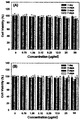
- the survival rate of 929 cells is shown ((A) GI-Au NPs, (B) PI-Au NPs).
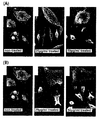
- FIG. 2 is a diagram illustrating L-929 cells treated with gold nanoparticles (GI-Au NPs, PI-Au NPs) according to the present invention at 25 ⁇ g / ml and 50 ⁇ g / ml with a scanning electron microscope (SEM). .
- SEM scanning electron microscope
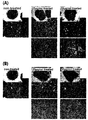
- FIG. 3 is a diagram illustrating L-929 cells treated with gold nanoparticles (GI-Au NPs, PI-Au NPs) according to the present invention at 25 ⁇ g / ml and 50 ⁇ g / ml with a transmission electron microscope (TEM). .
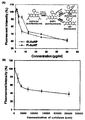
- Figure 4 is the antioxidant effect of the gold nanoparticles (GI-Au NPs, PI-Au NPs) of the present invention on L-929 cells treated with 200 ⁇ M hydrogen peroxide (A, inserted figure shows the antioxidant effect mechanism) and It is a figure which shows the measurement result of the antioxidant effect (B) of antioxidant enzyme (catalase).
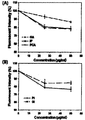
- FIG. 5 is a diagram showing the results of the antioxidant effect ((A): GA, IF, PCA, (B): PI, GI) of phytochemical compounds on 200 ⁇ M hydrogen peroxide-treated L-929 cells.
- FIG. 6 is a diagram illustrating fluorescence microscopy of L-929 cells treated with gold nanoparticles (GI-Au NPs, PI-Au NPs) and 200 ⁇ M hydrogen peroxide of the present invention
- A control (untreated),
- B 200 ⁇ M hydrogen peroxide treatment,
- C 25 ⁇ g / ml gold nanoparticles (GI-Au NPs) treatment,
- D 25 ⁇ g / ml gold nanoparticles (PI-Au NPs) treatment,
- E 25 ⁇ g / Ml GI-Au NPs + 200 ⁇ M hydrogen peroxide treatment,
- F 25 ⁇ g / ml PI-Au NPs + 200 ⁇ M hydrogen peroxide treatment.
- FIG. 8 shows Western blot expression of MMPs (MMP-1, MMP-8 and MMP-9) proteins in hairless mouse skin tissues treated with gold nanoparticles (GI-Au NPs, PI-Au NPs) of the present invention. This is confirmed through.
- FIG. 9 is a diagram confirming the expression level of MMP-1 in hairless mouse skin tissues treated with phytochemical compounds (GI, PI) and commercially available cosmetics through Western blot.
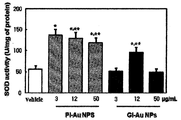
- FIG. 10 is a diagram showing peroxidase inhibitory activity (SOD) activity in the skin cells of hairless mice treated with the gold nanoparticles (GI-Au NPs, PI-Au NPs) of the present invention.
- SOD peroxidase inhibitory activity
- Gold nanoparticles were prepared by the method described in PCT / KR2010 / 007516 filed by the present inventors. Specifically, geum chloride (HAuCl 4 ) (7.8 mg, 0.02 mmol) was dissolved in 20 mL of distilled water to prepare a geum chloride solution. Then, after preparing a mixed solution of 10 mg glycoside isoflavone dissolved in a 0.01 M gallic acid solution, 0.3 ml of the mixed solution was added to the geum chloride solution and stirred for 30 minutes to prepare gold nanoparticles.
- Geum chloride (HAuCl 4 ) (7.8 mg, 0.02 mmol) was dissolved in 20 mL of distilled water to prepare a geum chloride solution. Then, after preparing a mixed solution in which 10 mg of glycoside isoflavone was dissolved in a solution of 0.01 M protocatechin acid, 0.3 ml of the mixed solution was added to the chlorochloric acid solution and stirred for 30 minutes to prepare gold nanoparticles.
- GI-Au NPs, PI-Au NPs gold nanoparticles prepared in Preparation Examples 1 and 2, respectively.
- L-929 cells were present, followed by 7 days. Incubated for After incubation, absorbance was measured at 450 nm using ELISA to confirm cell viability.
- L-929 cells treated with 25 ⁇ g / ml and 50 ⁇ g / ml gold nanoparticles were observed by scanning electron microscopy (SEM) and transmission electron microscopy (TEM). .
- the survival rate of L-929 cells according to the concentration of gold nanoparticles according to the present invention (0 ⁇ 50 ⁇ g / ml) and period (1 day, 3 days, 5 days, 7 days) is shown in Figure 1 [(A) GI-Au NPs, (B) PI-Au NPs], and L-929 cells treated with 25 ⁇ g / ml and 50 ⁇ g / ml gold nanoparticles (GI-Au NPs, PI-Au NPs) were scanned by scanning electron microscopy ( SEM and transmission electron microscope (TEM) are shown in Figures 2 and 3, respectively.
- the cell viability of the gold nanoparticles (GI-Au NPs, PI-Au NPs) of the present invention showed more than 90% at all concentrations (0 ⁇ 50 ⁇ g / ml), almost even with the control There was no difference. Therefore, it can be seen that the gold nanoparticles (GI-Au NPs, PI-Au NPs) of the present invention have almost no cytotoxicity.
- the gold nanoparticles (GI-Au NPs, PI-Au NPs) of the present invention sufficiently enters the cells. Therefore, it is thought that the gold nanoparticles of the present invention can be usefully used as a drug carrier.
- DCFH-DA in the cell does not deacetylate and does not express fluorescence. Therefore, antioxidant effects were measured based on fluorescence not expressed. Then, L-929 cells were observed by fluorescence microscope.
- gold nanoparticles (GI-Au NPs, PI-Au NPs) according to the present invention have excellent antioxidant effects.
- Example 3 Measurement of skin cell regeneration ability of gold nanoparticles
- 35 10-week-old hairless mice were divided into seven groups by assigning five to each group.
- 3 ⁇ g / ml, 12 ⁇ g / ml, and 50 ⁇ g / ml of gold nanoparticles (GI-Au NPs, PI-Au NPs) prepared in Preparation Examples 1 and 2 above were identified on specific regions of the hairless mouse skin in each group.
- 50 ⁇ l of distilled water was treated.
- Gold nanoparticles were treated on the skin of hairless mice once a day at the same time every day, and the skin was extracted after carbon dioxide anesthesia after the experiment. The extracted skin tissues were stored below -70 °C until biopsy and protein analysis were performed.
- MMPs MMP-1, MMP-8 and MMP-9 proteins in skin tissues of hairless mice was confirmed by Western blot. .
- MMP-1 and MMP-8 represent skin collagen degrading enzymes
- MMP-9 represents skin gelatin degrading enzymes.
- MMP-1 a collagen degrading enzyme
- the thickness of the epidermis and dermis of the hairless mouse skin treated with the gold nanoparticles (GI-Au NPs, PI-Au NPs) of the present invention was thicker than the control group. Therefore, it can be seen that the gold nanoparticles (GI-Au NPs, PI-Au NPs) of the present invention have excellent skin cell regeneration ability.
- the gold nanoparticles (GI-Au NPs, PI-Au NPs) of the present invention reduce the degradation of collagen in the skin through suppressing the expression of MMP-1 and MMP-8 (collagenase). It can be expected to have a good effect on skin regeneration.
- SOD activity was measured using a SOD assay kit-WST by colorimetric analysis. Specifically, 100 mg of frozen hairless mouse skin cell tissue was immersed in sucrose buffer solution, and then the absorbance of the mixed solution was measured and analyzed by comparison with the background solution.
- peroxidase inhibitory activity of gold nanoparticles (PI-Au NPs) of the present invention was excellent in skin cells of hairless mice, and 12 ⁇ g / ml for gold nanoparticles (GI-Au NPs).
- GI-Au NPs gold nanoparticles
- the gold nanoparticles (GI-Au NPs, PI-Au NPs) of the present invention have excellent skin cell antioxidant properties.
Landscapes
- Health & Medical Sciences (AREA)
- Life Sciences & Earth Sciences (AREA)
- Public Health (AREA)
- Veterinary Medicine (AREA)
- Animal Behavior & Ethology (AREA)
- General Health & Medical Sciences (AREA)
- Epidemiology (AREA)
- Birds (AREA)
- Gerontology & Geriatric Medicine (AREA)
- Dermatology (AREA)
- Chemical & Material Sciences (AREA)
- Inorganic Chemistry (AREA)
- Cosmetics (AREA)
- Pharmaceuticals Containing Other Organic And Inorganic Compounds (AREA)
Abstract
본 발명은 갈산 또는 프로토카테킨산 중에서 선택된 1종의 유기산과, 이소플라본의 혼합용액으로 표면처리된 금나노입자를 유효성분으로 함유하는 피부노화방지용 화장료 조성물에 관한 것이다. 본 발명에 따른 파이토케미컬로 표면처리된 금나노입자(GI-Au NPs, PI-Au NPs)는, 세포독성이 없고, 항산화 효과가 우수하며, 피부세포의 콜라겐 분해효소(MMP-1 및 MMP-8)를 억제하여 피부재생능력이 우수하고, 과산화 억제효소(SOD) 활성이 우수하여 피부세포 항산화도가 우수함으로, 피부노화방지용 화장료 조성물에 유용하게 사용될 수 있다.
Description
본 발명은 파이토케미컬로 표면처리된 금나노입자를 유효성분으로 함유하는 피부노화방지용 화장료 조성물에 관한 것으로, 상세하게는 갈산 또는 프로토카테킨산 중에서 선택된 1종의 유기산과 이소플라본의 혼합용액으로 표면처리된 금나노입자를 유효성분으로 함유하는 피부노화방지용 화장료 조성물에 관한 것이다.
피부 노화의 주요 원인으로는 햇빛과 활성산소를 들 수 있다. 활성산소는 체내에 들어온 이물질을 없애는 과정에서 이물질을 녹여 없애는 작용을 하는 물질로서 긍정적인 역할을 하는 반면에 여러 가지 요인에 의해 과잉 생성되면 자체의 세포조직을 침범할 뿐만 아니라 체내의 불포화 지방산과 결합하여 과산화지질을 형성한다. 특히, 피부에서는 단백질 지질 등과 결합하여 산화물을 만들어 노화를 촉진시키고, 멜라닌의 산화과정에 강력하게 작용하여 색소 침착을 일으킨다.
일반적으로 활성산소는 피부노화 뿐만 아니라, 암까지 유발하는 매우 위험한 물질로 알려져 있다. 이러한 활성산소를 제거하는 방법으로는 다양하게 알려져 있으며, 그 중 파이토케미컬(phytochemicals)이라는 식물에 포함되어 있는 생리활성 물질을 이용하는 방법이 최근들어 많이 활용되고 있다. 이러한 파이토케미컬로부터 추출되는 물질들 중 생리활성 물질은 주로 유기산 종류와 폴리페놀류 등이 있다.
파이토케미컬 중 유기산의 한 종류인 갈산은 밤 껍질, 도토리, 마름, 오미자 및 오배자와 같은 물질에 주로 함유되어 있으며, 히드록시기를 3개 가진 구조로, 화학명은 3,4,5-트리히드록시 벤조산이다. 이 물질은 항산화 효과가 뛰어나며, 항염증, 항돌연변이, 항알러지 효과와 같은 특성을 가지고 있다.
또한, 파이토케미컬 중 유기산의 다른 한 종류인 프로토카테킨산은 작약, 오미자, 오가피 등의 식물에 주로 함유되어 있으며, 히드록시기를 2개 가진 구조로, 화학명은 2,3-디히드록시 벤조산이고 역시 다양한 생리활성을 지닌다. 특히, 혈액의 항응고, 항염증, 항산화 효과 등의 특성을 가지고 있다.
또한, 파이토케미컬 중 폴리페놀류인 이소플라본의 경우 주로 대두에 함유되어 있으며, 대두 가운데에서도 배아에 주로 존재한다. 이소플라본은 그 구조 및 활성이 에스트로겐(estrogen)과 유사하여 파이토에스트로겐(phytoestrogen)이라고도 한다. 이소플라본은 구조적으로 플라보노이드(flavonoid)에 속하며, 당이 붙어있는 이소플라본은 배당체(glucoside)라고 하고 당이 없는 이소플라본은 비배당체 (aglycone)라고 한다. 이소플라본은 유방암, 전립선암, 자궁암, 대장암, 심혈관 질환 및 골다공증을 예방한다는 연구 결과들이 보고되어 있다.
한편, 순금(Au; gold)은 생체적합성을 지니고 있어, 동양의학 및 서양의학에서 많이 활용되고 있다. 동의보감에서는 순금이 체내에 흐르고 있는 미세한 전류의 이온밸런스를 유지시켜주며, 진정작용 및 노폐물 해독작용이 있고, 기의 흐름을 좋게 하며, 특히 피부에 바르는 금은 이온작용을 통해 혈액순환을 촉진시킨다고 알려져 있다. 또한, 금을 이용하면 호르몬 분비를 촉진시켜 주름생성을 방지하며, 해독 및 정화작용으로 피부 트러블을 예방하고, 신경 안정 등의 효과가 있다고 한다. 또한, 금은 숙취를 제거하며, 동맥경화 등 각종 성인병을 예방하는 효과와 항노화에도 효과가 있다고 알려져 있다. 서양의학에서는 금을 천식이나 류마티즘 치료에 사용하고 있는 것으로 알려져 있다. 상기한 바와 같이, 금은 생체적합성 및 다양한 생리활성을 가지고 있으므로, 금을 이용한 의약품이나 화장품 등이 많이 개발되고 있으며, CT 조영제 및 온열치료제로도 응용되고 있다.
현재까지 금나노입자를 이용한 의약품이나 화장품 등은 많이 개발되어 왔으나, 갈산과 이소플라본 또는 프로토카테킨산과 이소플라본 등의 파이토케미컬로 표면처리된 금나노입자를 이용한 피부노화방지용 화장료 조성물에 관하여는 아직까지 알려져 있지 않으며, 이에 관한 연구도 전무한 상태이다.
본 발명자들은 갈산, 프로토카테킨산, 이소플라본 등의 파이토케미컬로 표면처리된 금나노입자를 이용하여 피부노화방지에 효과가 있는지 연구하던 중, 갈산과 이소플라본 또는 프로토카테킨산과 이소플라본의 강력한 항산화 성질을 이용하여 염화금산(HAuCl4)의 환원을 유도하여 제조된 금나노입자가 세포독성이 없고, 항산화 효과가 우수하며, 콜라겐 분해효소를 억제하여 피부재생능력이 우수하고, 과산화 억제효소(SOD) 활성이 우수하여 피부세포 항산화도가 우수함을 확인하고, 본 발명을 완성하였다.
따라서, 본 발명은 갈산 또는 프로토카테킨산 중에서 선택된 1종의 유기산과 이소플라본의 혼합용액으로 표면처리된 금나노입자를 유효성분으로 함유하는 피부노화방지용 화장료 조성물을 제공하고자 한다.
본 발명은 갈산 또는 프로토카테킨산 중에서 선택된 1종의 유기산과 이소플라본의 혼합용액으로 표면처리된 금나노입자를 유효성분으로 함유하는 피부노화방지용 화장료 조성물을 제공한다.
이하, 본 발명에 대해 상세히 설명한다.
본 발명의 피부노화방지용 화장료 조성물에서 유효성분인 파이토케미컬로 표면처리된 금나노입자는, 갈산 또는 프로토카테킨산 중에서 선택된 1종의 유기산과 이소플라본의 혼합용액의 항산화력을 이용하여 염화금산(HAuCl4)의 환원을 유도하여 표면처리된 것을 특징으로 한다.
구체적으로는, 0.01 내지 0.05 mmol의 염화금산(HAuCl4)을 증류수에 녹여 염화금산 용액을 제조하고, 0.01 내지 0.03 M의 갈산 또는 프로토카테킨산 중에서 선택된 1종의 유기산 용액에 배당체 이소플라본을 녹인 혼합용액을 제조한다. 이 혼합용액을 상기 염화금산 용액에 첨가하고 교반하여 금나노입자를 제조한다(GI-Au NPs, PI-Au NPs).
상기 제조된 금나노입자를 생체적합성 고분자 용액으로 코팅하는 단계를 추가로 포함할 수 있다. 상기 생체적합성 고분자는 폴리에틸렌글리콜(PEG)이 바람직하나, 이에 한정되지 않고 생체적합성이 있는 고분자라면 모두 가능하다. 상기 고분자 용액은 1~4% (w/v)의 고분자 용액을 사용하는 것이 바람직하며, 코팅시 금나노입자와 고분자 용액은 1 : 2~4의 부피비로 하는 것이 바람직하다.
본 발명에 따른 파이토케미컬로 표면처리된 금나노입자(GI-Au NPs, PI-Au NPs)는, 세포독성이 없고, 항산화 효과가 우수하며, 피부세포의 콜라겐 분해효소 (MMP-1 및 MMP-8)를 억제하여 피부재생능력이 우수하고, 과산화 억제효소(SOD) 활성이 우수하여 피부세포 항산화도가 우수하다. 따라서, 본 발명에 따른 파이토케미컬로 표면처리된 금나노입자(GI-Au NPs, PI-Au NPs)는 피부노화방지용 화장료 조성물에 유용하게 사용될 수 있다.
본 발명의 화장료 조성물은 파이토케미컬로 표면처리된 금나노입자(GI-Au NPs, PI-Au NPs)와 함께 항산화 활성을 갖는 공지의 유효성분을 1종 이상 함유할 수 있다.
또한, 본 발명의 조성물은 상기 기재한 유효성분 이외에 추가로 화장품학적으로 허용가능한 담체를 1종 이상 포함하여 당업계에서 통상적으로 제조되는 화장료 제형으로 제조될 수 있다. 구체적으로는, 지방 물질, 유기 용매, 용해제, 농축제, 겔화제, 연화제, 항산화제, 현탁화제, 안정화제, 발포제, 방향제, 계면활성제, 물, 이온형 또는 비이온형 유화제, 충전제, 금속이온 봉쇄제 및 킬레이트화제, 보존제, 비타민, 차단제, 습윤화제, 필수 오일, 염료, 안료, 친수성 또는 친유성 활성제, 지질 소낭 또는 화장품에 통상적으로 사용되는 임의의 다른 성분과, 화장품 분야에서 통상적으로 사용되는 보조제를 함유하여, 용액, 현탁액, 유탁액, 페이스트, 겔, 크림, 로션, 파우더, 비누, 계면활성제-함유 클렌징 오일, 분말 파운데이션, 유탁액 파운데이션, 왁스 파운데이션 및 스프레이 등으로 제형화될 수 있으나, 이에 한정되는 것은 아니다. 보다 상세하게는, 유연 화장수, 영양 화장수, 밀크로션, 영양 크림, 마사지 크림, 에센스, 아이 크림, 클렌징 크림, 클렌징 폼, 클렌징 워터, 팩, 스프레이 또는 파우더의 제형으로 제조될 수 있다.
본 발명의 화장료 조성물에서 파이토케미컬로 표면처리된 금나노입자(GI-Au NPs, PI-Au NPs)의 함량은 화장료 조성물 총 중량에 대하여 0.0001~20 중량%, 바람직하게는 0.001~5 중량%를 포함할 수 있다. 만일, 금나노입자의 함량이 0.0001 중량% 미만이면 피부노화방지 효과가 나타나기 어렵고, 20 중량%를 초과하면 피부에 자극을 유발할 가능성이 높고, 제형의 안정화에도 크게 영향을 미칠 수 있다.
본 발명에 따른 파이토케미컬로 표면처리된 금나노입자(GI-Au NPs, PI-Au NPs)는, 세포독성이 없고, 항산화 효과가 우수하며, 피부세포의 콜라겐 분해효소 (MMP-1 및 MMP-8)를 억제하여 피부재생능력이 우수하고, 과산화 억제효소(SOD) 활성이 우수하여 피부세포 항산화도가 우수함으로, 피부노화방지용 화장료 조성물에 유용하게 사용될 수 있다.
도 1은 본 발명에 따른 금나노입자(GI-Au NPs, PI-Au NPs)의 농도(0~50㎍/㎖)와 기간(1일, 3일, 5일, 7일)에 따른 L-929 세포의 생존율을 나타낸 도이다 [(A) GI-Au NPs, (B) PI-Au NPs].
도 2는 본 발명에 따른 금나노입자(GI-Au NPs, PI-Au NPs)를 25㎍/㎖와 50㎍/㎖로 처리한 L-929 세포를 주사전자현미경(SEM)으로 관찰한 도이다.
도 3은 본 발명에 따른 금나노입자(GI-Au NPs, PI-Au NPs)를 25㎍/㎖와 50㎍/㎖로 처리한 L-929 세포를 투과전자현미경(TEM)으로 관찰한 도이다.
도 4는 200μM의 과산화수소가 처리된 L-929 세포에 대한 본 발명의 금나노입자(GI-Au NPs, PI-Au NPs)의 항산화 효과(A, 삽입된 그림은 항산화 효과 메커니즘을 나타낸 것임)와 항산화 효소(카탈라아제)의 항산화 효과(B)의 측정 결과를 나타낸 도이다.
도 5는 200μM의 과산화수소가 처리된 L-929 세포에 대한 파이토케미컬 화합물의 항산화효과((A): GA, IF, PCA, (B): PI, GI)의 측정결과를 나타낸 도이다.
도 6은 본 발명의 금나노입자(GI-Au NPs, PI-Au NPs)와 200μM의 과산화수소가 처리된 L-929 세포를 형광현미경으로 관찰한 도이다[(A) 대조군(무처리), (B) 200μM의 과산화수소 처리, (C) 25㎍/㎖의 금나노입자(GI-Au NPs) 처리, (D) 25㎍/㎖의 금나노입자(PI-Au NPs) 처리, (E) 25㎍/㎖의 GI-Au NPs + 200μM의 과산화수소 처리, (F) 25㎍/㎖의 PI-Au NPs + 200μM의 과산화수소 처리].
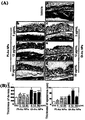
도 7은 본 발명의 금나노입자(GI-Au NPs, PI-Au NPs)가 처리된 무모 마우스 피부의 표피와 진피를 광학현미경으로 관찰한 결과(A)와, 표피와 진피 두께의 히스토그램(B)을 나타낸 도이다.
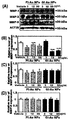
도 8은 본 발명의 금나노입자(GI-Au NPs, PI-Au NPs)가 처리된 무모 마우스 피부 조직에서 MMPs(MMP-1, MMP-8 및 MMP-9) 단백질의 발현 정도를 웨스턴 블롯을 통해 확인한 도이다.
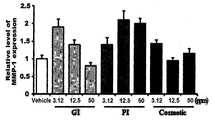
도 9는 파이토케미컬 화합물(GI, PI)과 시판되는 화장품을 처리한 무모 마우스 피부 조직에서 MMP-1의 발현정도를 웨스턴 블롯을 통해 확인한 도이다.
도 10은 본 발명의 금나노입자(GI-Au NPs, PI-Au NPs)가 처리된 무모 마우스의 피부세포에서 과산화 억제효소(SOD) 활성을 나타낸 도이다.
이하, 본 발명의 이해를 돕기 위하여 바람직한 실시예를 제시한다. 그러나 하기의 실시예는 본 발명을 보다 쉽게 이해하기 위하여 제공되는 것일 뿐, 실시예에 의해 본 발명의 내용이 한정되는 것은 아니다.
제조예 1
: 갈산과 이소플라본으로 표면처리된 금나노입자의 제조(GI-Au NPs)
본 발명자들이 출원한 PCT/KR2010/007516에 기재되어 있는 방법으로 금나노입자를 제조하였다. 구체적으로는, 염화금산(HAuCl4) (7.8㎎, 0.02mmol)을 증류수 20㎖에 녹여 염화금산 용액을 제조하였다. 그 다음, 0.01M의 갈산 용액에 배당체 이소플라본 10㎎을 녹인 혼합용액을 제조한 후, 이 혼합용액 0.3㎖를 상기 염화금산 용액에 첨가하고 30분 동안 교반하여 금나노입자를 제조하였다.
제조예 2
: 프로토카테킨산과 이소플라본으로 표면처리된 금나노입자의 제조 (PI-Au NPs)
염화금산(HAuCl4) (7.8㎎, 0.02mmol)을 증류수 20㎖에 녹여 염화금산 용액을 제조하였다. 그 다음, 0.01M의 프로토카테킨산 용액에 배당체 이소플라본 10㎎을 녹인 혼합용액을 제조한 후, 이 혼합용액 0.3㎖를 상기 염화금산 용액에 첨가하고 30분 동안 교반하여 금나노입자를 제조하였다.
실시예 1
: 금나노입자의 세포독성 측정
본 발명에 따른 금나노입자의 세포독성을 확인하기 위하여, 근육세포의 한 종류인 L-929 세포를 이용하여 WST-8을 통해 하기와 같은 실험을 수행하였다.
구체적으로는, 상기 제조예 1 및 2에서 제조한 금나노입자(GI-Au NPs, PI-Au NPs) 0~50㎍/㎖를 각각 L-929 세포가 존재하는 웰에 첨가한 다음, 7일 동안 배양하였다. 배양 후, ELISA를 이용하여 450㎚에서 흡광도를 측정하여 세포 생존율을 확인하였다. 또한, 25㎍/㎖와 50㎍/㎖의 금나노입자(GI-Au NPs, PI-Au NPs)로 처리된 L-929 세포를 주사전자현미경(SEM)과 투과전자현미경(TEM)으로 관찰하였다.
본 발명에 따른 금나노입자의 농도(0~50㎍/㎖)와 기간(1일, 3일, 5일, 7일)에 따른 L-929 세포의 생존율은 도 1에 나타내었으며[(A) GI-Au NPs, (B) PI-Au NPs], 25㎍/㎖와 50㎍/㎖의 금나노입자(GI-Au NPs, PI-Au NPs)로 처리된 L-929 세포를 주사전자현미경(SEM)과 투과전자현미경(TEM)으로 관찰한 결과는 각각 도 2 및 도 3에 나타내었다.
도 1에 나타난 바와 같이, 본 발명의 금나노입자(GI-Au NPs, PI-Au NPs)의 세포 생존율은 모든 농도(0~50㎍/㎖)에서 90% 이상을 나타내었으며, 대조군과도 거의 차이를 나타내지 않았다. 따라서, 본 발명의 금나노입자(GI-Au NPs, PI-Au NPs)는 세포독성이 거의 없음을 알 수 있다.
또한 도 2에 나타난 바와 같이, 본 발명의 금나노입자(GI-Au NPs, PI-Au NPs)가 세포 표면에 부착하거나 내부로 침투하였음에도 불구하고 세포가 생존해 있는 것을 확인하였다.
또한 도 3에 나타난 바와 같이, 본 발명의 금나노입자(GI-Au NPs, PI-Au NPs)가 충분히 세포 내로 들어가 있음을 확인하였다. 따라서, 본 발명의 금나노입자는 약물전달체로도 유용하게 사용될 수 있을 것으로 생각된다.
실시예 2
: 금나노입자의 항산화 효과 측정
본 발명에 따른 금나노입자의 항산화 효과를 확인하기 위하여, ROS(reactve oxygen species) assay 키트를 이용하여 하기와 같은 실험을 수행하였다.
구체적으로는, 상기 제조예 1 및 2에서 제조한 0~50㎍/㎖의 금나노입자(GI-Au NPs, PI-Au NPs)가 각각 포함된 배지에 L-929 세포를 하루 동안 배양한 후, 30분 동안 200μM의 과산화수소를 처리하였다. 그 후, 형광체 프로브인 2',7'-디클로로디히드로플루오레세인 디아세테이트(2',7'-dichlorodihydrofluorescein diacetate; DCFH-DA)를 상기 L-929 세포에 처리해주어 세포 안으로 침투시켰다. 이때, 과산화수소에 의해서 DCFH-DA는 탈아세틸화가 일어나며 형광을 띠게 되는데, 금나노입자가 과산화수소를 제거하게 되면 세포 내에 있던 DCFH-DA는 탈아세틸화를 못하게 되어 형광이 발현되지 않는다. 따라서, 발현되지 않는 형광을 기준으로 항산화 효과를 측정하였다. 그 다음, L-929 세포를 형광현미경으로 관찰하였다.
또한 상기의 항산화 효과 측정과 동일한 농도와 동일한 방법으로 파이토케미컬 화합물(PCA, IF, GA, PI, GI) 고유의 항산화 효과를 측정하였다.
200μM의 과산화수소가 처리된 L-929 세포에 대한 본 발명의 금나노입자(GI-Au NPs, PI-Au NPs)의 항산화 효과(A, 삽입된 그림은 항산화 효과 메커니즘을 나타낸 것임)와 항산화 효소(카탈라아제)의 항산화 효과(B)를 측정한 결과는 도 4 및 도 5에 나타내었으며, 본 발명의 금나노입자(GI-Au NPs, PI-Au NPs)와 200μM의 과산화수소가 처리된 L-929 세포를 형광현미경으로 관찰한 결과는 도 6에 나타내었다[(A) 대조군 (무처리), (B) 200μM의 과산화수소 처리, (C) 25㎍/㎖의 금나노입자(GI-Au NPs) 처리, (D) 25㎍/㎖의 금나노입자(PI-Au NPs) 처리, (E) 25㎍/㎖의 GI-Au NPs + 200μM의 과산화수소 처리, (F) 25㎍/㎖의 PI-Au NPs + 200μM의 과산화수소 처리].
도 4에 나타난 바와 같이, 약 7㎍/㎖의 금나노입자(PI-Au NPs)를 L-929 세포에 처리하였을 때 과산화수소가 25% 이상 감소하는 것을 확인하였고, 약 10㎍/㎖의 금나노입자(PI-Au NPs)를 L-929 세포에 처리하였을 때 과산화수소가 30% 이상 감소하는 것을 확인하였다. 또한, 본 발명의 금나노입자(PI-Au NPs, GI-Au NPs) 모두 50㎍/㎖로 L-929 세포에 처리하였을 때 과산화수소가 50% 이상 감소하는 것을 확인하였다. 이는 항산화 효소(카탈라아제)의 약 3,000 unit 정도와 비슷한 활성을 보이는 것으로 확인되었다.
또한, 도 5에 나타난 바와 같이, 각각의 파이토케미컬 화합물에 대한 항산화 효과를 확인한 결과, 50㎍/㎖의 GA의 경우 10% 정도의 항산화 효과를 나타내었고, IF, PCA, PI(PCA+IF)와, GI(GA+IF)의 경우 20%의 항산화 효과가 나타나는 것으로 확인되었다. 따라서 50㎍/㎖의 금나노입자를 세포에 처리하였을 때, 약 40%의 항산화 효과가 있는 것으로 나타난 상기 도 4의 결과와 비교할 때, 본 발명에 따른 금나노입자(PI-Au NPs, GI-Au NPs)의 항산화 효과가 훨씬 우수한 것을 확인할 수 있었다. .
또한 도 6에 나타난 바와 같이, (A) 대조군(무처리)에서는 형광을 띠는 세포가 전혀 관찰되지 않았다. 그러나, (B) 과산화수소 처리군에서는 형광을 띤 세포들이 많이 관찰되었는데, 이는 대부분의 세포가 산화되어 손상을 입었다는 것을 의미한다. 또한, (C, D) 본 발명의 금나노입자(GI-Au NPs, PI-Au NPs) 처리군에서는 대조군에서와 마찬가지로 형광을 띠는 세포가 전혀 관찰되지 않았다. 또한, (E, F) 본 발명의 금나노입자(GI-Au NPs, PI-Au NPs)를 전처리한 다음 과산화수소를 처리한 군에서는 형광을 띠는 세포수가 상당히 감소된 것을 확인하였다.
따라서, 본 발명에 따른 금나노입자(GI-Au NPs, PI-Au NPs)는 항산화 효과가 우수함을 알 수 있다.
실시예 3
: 금나노입자의 피부세포 재생능력 측정
본 발명에 따른 금나노입자의 피부세포 재생능력을 확인하기 위하여, 하기와 같은 실험을 수행하였다.
구체적으로는, 10주령 된 무모 마우스(hairless mice) 35마리를 1군당 5마리씩 할당하여 7개 군으로 나누었다. 각 군에 있는 무모 마우스 피부의 특정부위에 상기 제조예 1 및 2에서 제조한 3㎍/㎖, 12㎍/㎖, 50㎍/㎖의 금나노입자(GI-Au NPs, PI-Au NPs)와 증류수를 각각 50㎕씩 처리하였다. 금나노입자는 매일 같은 시간에 하루에 한 번씩 총 1달간 무모 마우스의 피부에 처리하였고, 실험이 끝난 뒤 이산화탄소 마취 후 피부를 적출하였다. 적출한 피부 조직들은 조직검사와 단백질 분석을 진행할 때까지 -70℃ 이하에 보관하였다.
무모 마우스의 피부 조직(표피, 진피)의 변화를 광학현미경으로 관찰하였으며, 무모 마우스의 피부 조직에서 MMPs(MMP-1, MMP-8 및 MMP-9) 단백질의 발현 정도를 웨스턴 블롯을 통해 확인하였다. MMPs 중에서 MMP-1과 MMP-8은 피부의 콜라겐 분해 효소를 나타내고, MMP-9는 피부의 젤라틴 분해 효소를 나타낸다.
또한 상기의 방법과 동일한 농도와 동일한 방법으로, 파이토케미컬 화합물(GI, PI)과 시판되고 있는 L사 화장품에 대하여 무모 마우스의 피부 세포 재생효과를 알아보기 위하여, 콜라겐 분해효소인 MMP-1의 발현 정도를 확인하였다.
본 발명의 금나노입자(GI-Au NPs, PI-Au NPs)가 처리된 무모 마우스 피부의 표피와 진피를 광학현미경으로 관찰한 결과(A)와, 표피와 진피 두께의 히스토그램 (B)은 도 7에 나타내었고, MMPs(MMP-1, MMP-8 및 MMP-9) 단백질의 발현 정도를 웨스턴 블롯을 통해 확인한 결과는 도 8에 나타내었으며, 파이토케미컬 화합물과 L사 화장품에 대한 MMP-1 발현정도를 웨스턴 블롯을 통해 확인한 결과는 도 9에 나타내었다.
도 7에 나타난 바와 같이, 본 발명의 금나노입자(GI-Au NPs, PI-Au NPs)가 처리된 무모 마우스 피부의 표피와 진피의 두께가 모두 대조군에 비해 두꺼워진 것을 관찰하였다. 따라서, 본 발명의 금나노입자(GI-Au NPs, PI-Au NPs)는 피부세포 재생능력이 우수함을 알 수 있다.
또한 도 8에 나타난 바와 같이, 본 발명의 금나노입자(GI-Au NPs, PI-Au NPs)에 의해 MMPs의 발현이 억제됨을 확인하였다. 구체적으로는, MMP-1의 경우 금나노입자(PI-Au NPs)에 의해 발현이 억제되지만 12㎍/㎖ 및 50㎍/㎖의 금나노입자 (GI-Au NPs)에 의해 그 발현이 현저히 감소되는 것을 확인하였고, MMP-8의 경우 금나노입자(PI-Au NPs)에 의해 발현이 감소되는 것을 확인하였다. 그러나, MMP-9의 경우 금나노입자(GI-Au NPs, PI-Au NPs)에 의해 발현이 감소되지 않았다.
한편, 도 9에 나타난 바와 같이 파이토케미컬 화합물(GI, PI)과 L사 화장품의 경우에는 콜라겐 분해효소인 MMP-1의 발현이 억제되지 않은 것을 확인할 수 있었는 바, 본 발명에 따른 금나노입자에 의하여 MMP-1의 발현이 억제(도 8(B))된 것과 비교하면, 파이토케미컬 화합물로 표면처리된 금나노입자가 피부 재생효과를 더 높을 수 있는 것으로 판단되었다.
따라서, 본 발명의 금나노입자(GI-Au NPs, PI-Au NPs)는 MMP-1 및 MMP-8(콜라겐 분해 효소)의 발현 억제를 통해 피부의 콜라겐이 분해되는 현상을 감소시킴을 알 수 있고, 피부재생에 좋은 영향을 끼침을 예측할 수 있다.
실시예 4
: 금나노입자의 피부세포 항산화도 측정
본 발명에 따른 금나노입자의 피부세포 항산화도를 확인하기 위하여, 비색계 분석법으로 SOD assay kit-WST를 이용하여 과산화 억제효소(superoxide dismutase; SOD) 활성을 측정하였다. 구체적으로는, 100㎎의 냉동된 무모 마우스의 피부세포 조직을 수크로오스 완충용액에 담근 다음, 혼합용액의 흡광도를 측정하고 바탕용액과 비교하여 분석하였다.
결과는 도 10에 나타내었다.
도 10에 나타난 바와 같이, 무모 마우스의 피부세포에서 본 발명의 금나노입자(PI-Au NPs)의 과산화 억제효소 활성은 매우 우수하였으며, 금나노입자(GI-Au NPs)의 경우 12㎍/㎖의 농도로 처리하였을 때 과산화 억제효소 활성이 우수하였다. 따라서, 본 발명의 금나노입자(GI-Au NPs, PI-Au NPs)는 피부세포 항산화도가 우수함을 알 수 있다.
하기에 본 발명의 화장료 조성물을 위한 제제예를 예시한다.
제제예 1
: 화장료 제제의 제조
1. 유연 화장수의 제조
표 1
| 성분 | 함량(중량%) |
| 금나노입자(GI-Au NPs 또는 PI-Au NPs) | 0.5 |
| 1,3-부틸렌글리콜 | 5.2 |
| 올레일알콜 | 1.5 |
| 에탄올 | 3.2 |
| 폴리소르베이트 20 | 3.2 |
| 벤조페논-9 | 2.0 |
| 카복실비닐폴리머 | 1.0 |
| 글리세린 | 3.5 |
| 향 | 미량 |
| 방부제 | 미량 |
| 정제수 | 잔량 |
| 계 | 100 |
상기 성분을 혼합한 후, 통상의 유연 화장수의 제조방법에 따라 제조하였다.
2. 밀크로션의 제조
표 2
| 성분 | 함량(중량%) |
| 금나노입자(GI-Au NPs 또는 PI-Au NPs) | 0.6 |
| 글리세린 | 5.1 |
| 프로필렌글리콜 | 4.2 |
| 토코페릴아세테이트 | 3.0 |
| 유동파라핀 | 4.6 |
| 트리에탄올아민 | 1.0 |
| 스쿠알란 | 3.1 |
| 마카다미아너트오일 | 2.5 |
| 폴리소르베이트60 | 1.6 |
| 소르비탄세스퀴올리에이트 | 1.6 |
| 프로필파라벤 | 0.6 |
| 카복실비닐폴리머 | 1.5 |
| 향 | 미량 |
| 방부제 | 미량 |
| 정제수 | 잔량 |
| 계 | 100 |
상기 성분을 혼합한 후, 통상의 밀크로션의 제조방법에 따라 제조하였다.
3. 영양크림의 제조
표 3
| 성분 | 함량(중량%) |
| 금나노입자(GI-Au NPs 또는 PI-Au NPs) | 1.0 |
| 글리세린 | 4.0 |
| 바셀린 | 3.5 |
| 트리에탄올아민 | 2.1 |
| 유동파라핀 | 5.3 |
| 스쿠알란 | 3.0 |
| 밀납 | 2.6 |
| 코토페릴아세테이트 | 5.4 |
| 폴리소르베이트60 | 3.2 |
| 카복실비닐폴리머 | 1.0 |
| 소르비탄세스퀴올리에이트 | 3.1 |
| 향 | 미량 |
| 방부제 | 미량 |
| 정제수 | 잔량 |
| 계 | 100 |
상기 성분을 혼합한 후, 통상의 영양크림의 제조방법에 따라 제조하였다.
Claims (4)
- 갈산 또는 프로토카테킨산 중에서 선택된 1종의 유기산과, 이소플라본의 혼합용액으로 표면처리된 금나노입자를 유효성분으로 함유하는 피부노화방지용 화장료 조성물.
- 제 1항에 있어서, 상기 금나노입자는 0.01 내지 0.05 mmol의 염화금산 (HAuCl4)을 증류수에 녹인 염화금산 용액을 제조하고, 0.01 내지 0.03 M의 갈산 또는 프로토카테킨산 중에서 선택된 1종의 유기산 용액에 배당체 이소플라본을 녹인 혼합용액을 제조한 다음, 이 혼합용액을 상기 염화금산 용액에 첨가하고 교반하여 제조된 것을 특징으로 하는 피부노화방지용 화장료 조성물.
- 제 1항에 있어서, 상기 금나노입자의 함량은 화장료 조성물 총 중량에 대하여 0.0001~20 중량%인 것을 특징으로 하는 피부노화방지용 화장료 조성물.
- 제 1항에 있어서, 상기 조성물은 유연 화장수, 영양 화장수, 밀크로션, 영양 크림, 마사지 크림, 에센스, 아이 크림, 클렌징 크림, 클렌징 폼, 클렌징 워터, 팩, 스프레이 및 파우더로 이루어진 군으로부터 선택된 1종 이상의 제형으로 제조되는 것을 특징으로 하는 피부노화방지용 화장료 조성물.
Applications Claiming Priority (2)
| Application Number | Priority Date | Filing Date | Title |
|---|---|---|---|
| KR10-2011-0058918 | 2011-06-17 | ||
| KR1020110058918A KR101333209B1 (ko) | 2011-06-17 | 2011-06-17 | 파이토케미컬로 표면처리된 금나노입자를 유효성분으로 함유하는 피부노화방지용 화장료 조성물 |
Publications (1)
| Publication Number | Publication Date |
|---|---|
| WO2012173312A1 true WO2012173312A1 (ko) | 2012-12-20 |
Family
ID=47327727
Family Applications (1)
| Application Number | Title | Priority Date | Filing Date |
|---|---|---|---|
| PCT/KR2011/008533 Ceased WO2012173312A1 (ko) | 2011-06-17 | 2011-11-10 | 파이토케미컬로 표면처리된 금나노입자를 유효성분으로 함유하는 피부노화방지용 화장료 조성물 |
Country Status (3)
| Country | Link |
|---|---|
| KR (1) | KR101333209B1 (ko) |
| CN (1) | CN102824278B (ko) |
| WO (1) | WO2012173312A1 (ko) |
Cited By (11)
| Publication number | Priority date | Publication date | Assignee | Title |
|---|---|---|---|---|
| WO2019185696A1 (en) * | 2018-03-28 | 2019-10-03 | Infinitec Activos, S.L. | Gold and palmitoyl pentapeptide-4 nanoparticles |
| EP3756697A1 (en) * | 2019-06-27 | 2020-12-30 | Pegavision Corporation | Ophthalmic product with antioxidative function |
| WO2021009443A1 (fr) * | 2019-07-16 | 2021-01-21 | Torskal | Nanoparticules d'or comprenant un extrait de plantes et leur utilisation cosmetique |
| KR102360781B1 (ko) | 2021-09-30 | 2022-02-14 | (주)쥬넥스 | 염증완화용 하이드로콜로이드 패치 |
| KR102445952B1 (ko) | 2021-09-30 | 2022-09-22 | 주식회사 에이유랩스 | 금 나노입자가 증착된 나이아신아마이드를 포함하는 항산화 조성물의 제조방법 |
| KR102445954B1 (ko) | 2021-09-30 | 2022-09-22 | 주식회사 에이유랩스 | 금 나노입자가 증착된 나이아신아마이드를 포함하는 미백개선용 조성물의 제조방법 |
| KR102445955B1 (ko) | 2021-09-30 | 2022-09-22 | 주식회사 에이유랩스 | 금 나노입자가 증착된 나이아신아마이드를 포함하는 피부재생용 조성물의 제조방법 |
| KR102445953B1 (ko) | 2021-09-30 | 2022-09-22 | 주식회사 에이유랩스 | 금 나노입자가 증착된 나이아신아마이드를 포함하는 주름개선용 조성물의 제조방법 |
| KR102445951B1 (ko) | 2021-09-30 | 2022-09-22 | 주식회사 에이유랩스 | 금 나노입자가 증착된 나이아신아마이드를 포함하는 조성물의 제조방법 |
| KR102478642B1 (ko) | 2022-04-14 | 2022-12-16 | 주식회사 에이유랩스 | 금 입자가 함유된 나이아신아마이드 분말의 제조방법 |
| KR102515749B1 (ko) | 2022-07-13 | 2023-03-30 | 주식회사 에이유랩스 | 금 입자가 함유된 나이아신아마이드 분말의 콜로이드 용액 제조방법 |
Families Citing this family (7)
| Publication number | Priority date | Publication date | Assignee | Title |
|---|---|---|---|---|
| WO2014168424A1 (ko) * | 2013-04-10 | 2014-10-16 | 주식회사 유엑스엔 | 골드비드를 함유한 비누, 화장품 조성물 및 이를 이용한 비누, 화장품 제조방법 |
| KR102094061B1 (ko) * | 2017-09-18 | 2020-03-26 | 진명종 | 금 콜로이드를 이용한 주름 개선 및 노화 방지용 화장품 조성물 제조방법 |
| CN109464314A (zh) * | 2018-11-02 | 2019-03-15 | 蝶柔化妆品(浙江)有限公司 | 黄金弹润修护面膜及其制备方法 |
| CN112387980A (zh) * | 2019-08-19 | 2021-02-23 | 近镒生技股份有限公司 | 纳米金粒子、包含其的药物载体、其制备方法及其用途 |
| KR102318369B1 (ko) * | 2019-11-15 | 2021-10-28 | 부산대학교 산학협력단 | 생체 적합 나노전달체를 포함하는 자외선 차단용 화장료 조성물 |
| CN115607666A (zh) * | 2021-07-12 | 2023-01-17 | 南开大学 | 一种用于光动力学疗法治疗肿瘤的荧光探针 |
| WO2023077338A1 (zh) * | 2021-11-04 | 2023-05-11 | 深圳市维琪科技股份有限公司 | 一种六肽衍生物及其美容组合物或药用组合物和用途 |
Citations (4)
| Publication number | Priority date | Publication date | Assignee | Title |
|---|---|---|---|---|
| US20030064086A1 (en) * | 2001-08-31 | 2003-04-03 | Danuvio Carrion | Cosmetic compositions comprising nanoparticles and processes for using the same |
| US20050175649A1 (en) * | 2003-10-30 | 2005-08-11 | Disalvo Anthony L. | Enhancing properties by the use of nanoparticles |
| KR100732249B1 (ko) * | 2005-07-18 | 2007-06-27 | 한국생명공학연구원 | 금 및/또는 은 나노입자를 함유하는 화장료용 안료 조성물 |
| US20090022766A1 (en) * | 2007-07-18 | 2009-01-22 | Geddes Chris D | Metal-enhanced fluorescence nanoparticles |
Family Cites Families (1)
| Publication number | Priority date | Publication date | Assignee | Title |
|---|---|---|---|---|
| WO2011053037A2 (ko) * | 2009-10-30 | 2011-05-05 | 부산대학교 산학협력단 | 금나노입자의 제조방법 |
-
2011
- 2011-06-17 KR KR1020110058918A patent/KR101333209B1/ko not_active Expired - Fee Related
- 2011-11-09 CN CN201110351737.4A patent/CN102824278B/zh not_active Expired - Fee Related
- 2011-11-10 WO PCT/KR2011/008533 patent/WO2012173312A1/ko not_active Ceased
Patent Citations (4)
| Publication number | Priority date | Publication date | Assignee | Title |
|---|---|---|---|---|
| US20030064086A1 (en) * | 2001-08-31 | 2003-04-03 | Danuvio Carrion | Cosmetic compositions comprising nanoparticles and processes for using the same |
| US20050175649A1 (en) * | 2003-10-30 | 2005-08-11 | Disalvo Anthony L. | Enhancing properties by the use of nanoparticles |
| KR100732249B1 (ko) * | 2005-07-18 | 2007-06-27 | 한국생명공학연구원 | 금 및/또는 은 나노입자를 함유하는 화장료용 안료 조성물 |
| US20090022766A1 (en) * | 2007-07-18 | 2009-01-22 | Geddes Chris D | Metal-enhanced fluorescence nanoparticles |
Cited By (13)
| Publication number | Priority date | Publication date | Assignee | Title |
|---|---|---|---|---|
| WO2019185696A1 (en) * | 2018-03-28 | 2019-10-03 | Infinitec Activos, S.L. | Gold and palmitoyl pentapeptide-4 nanoparticles |
| US12396932B2 (en) | 2018-03-28 | 2025-08-26 | Infinitec Activos, S.L. | Gold and palmitoyl pentapeptide-4 nanoparticles |
| EP3756697A1 (en) * | 2019-06-27 | 2020-12-30 | Pegavision Corporation | Ophthalmic product with antioxidative function |
| WO2021009443A1 (fr) * | 2019-07-16 | 2021-01-21 | Torskal | Nanoparticules d'or comprenant un extrait de plantes et leur utilisation cosmetique |
| FR3098713A1 (fr) * | 2019-07-16 | 2021-01-22 | Torskal | Nanoparticules d’or comprenant un extrait de plantes et leur utilisation cosmetique |
| KR102445954B1 (ko) | 2021-09-30 | 2022-09-22 | 주식회사 에이유랩스 | 금 나노입자가 증착된 나이아신아마이드를 포함하는 미백개선용 조성물의 제조방법 |
| KR102445952B1 (ko) | 2021-09-30 | 2022-09-22 | 주식회사 에이유랩스 | 금 나노입자가 증착된 나이아신아마이드를 포함하는 항산화 조성물의 제조방법 |
| KR102445955B1 (ko) | 2021-09-30 | 2022-09-22 | 주식회사 에이유랩스 | 금 나노입자가 증착된 나이아신아마이드를 포함하는 피부재생용 조성물의 제조방법 |
| KR102445953B1 (ko) | 2021-09-30 | 2022-09-22 | 주식회사 에이유랩스 | 금 나노입자가 증착된 나이아신아마이드를 포함하는 주름개선용 조성물의 제조방법 |
| KR102445951B1 (ko) | 2021-09-30 | 2022-09-22 | 주식회사 에이유랩스 | 금 나노입자가 증착된 나이아신아마이드를 포함하는 조성물의 제조방법 |
| KR102360781B1 (ko) | 2021-09-30 | 2022-02-14 | (주)쥬넥스 | 염증완화용 하이드로콜로이드 패치 |
| KR102478642B1 (ko) | 2022-04-14 | 2022-12-16 | 주식회사 에이유랩스 | 금 입자가 함유된 나이아신아마이드 분말의 제조방법 |
| KR102515749B1 (ko) | 2022-07-13 | 2023-03-30 | 주식회사 에이유랩스 | 금 입자가 함유된 나이아신아마이드 분말의 콜로이드 용액 제조방법 |
Also Published As
| Publication number | Publication date |
|---|---|
| KR101333209B1 (ko) | 2013-11-26 |
| KR20120139229A (ko) | 2012-12-27 |
| CN102824278A (zh) | 2012-12-19 |
| CN102824278B (zh) | 2015-05-13 |
Similar Documents
| Publication | Publication Date | Title |
|---|---|---|
| WO2012173312A1 (ko) | 파이토케미컬로 표면처리된 금나노입자를 유효성분으로 함유하는 피부노화방지용 화장료 조성물 | |
| CN101116654B (zh) | 鞣花酸治疗灰发症的应用 | |
| KR100972777B1 (ko) | 항산화 조성물과 외용 조성물 | |
| CN106580797A (zh) | 一种美白祛斑霜及其制备方法 | |
| KR101601954B1 (ko) | 화장료 조성물용 난용성 물질 함유 나노입자의 제조방법 | |
| WO2013027984A2 (ko) | 녹차 성분을 함유하는 화장료 조성물 | |
| CN101141946B (zh) | 水飞蓟素和/或其成分作为皮肤或毛发色素沉着促进剂的用途 | |
| KR20140003198A (ko) | 컴파운드 k를 함유하는 피부 외용제 조성물 | |
| WO2012002730A2 (ko) | 봉독 추출물을 함유하는 피부 미백 및 보습용 조성물 | |
| KR101627051B1 (ko) | 비타민 c 함유 천연 리포좀, 그 제조방법 및 이를 포함하는 화장료 조성물 | |
| CN101491485A (zh) | 含有水飞蓟宾糖苷的皮肤外用组合物 | |
| KR101810229B1 (ko) | 티트리 잎 미세침 분말을 함유하는 여드름 개선용 화장료 조성물 | |
| TW202228748A (zh) | 用於在敏感性皮膚正常化皮膚微生物群之方法與組成物 | |
| WO2013077569A1 (ko) | 흰감국 추출물을 함유하는 피부 외용제 조성물 | |
| JP4035481B2 (ja) | 皮膚外用剤 | |
| JP2005247826A (ja) | デコリン産生促進剤及びそれを含有する皮膚外用剤 | |
| KR101208120B1 (ko) | 비타민 복합체, 이를 제조하는 방법 및 이를 포함하는 화장료 조성물 | |
| JPH0812560A (ja) | 皮膚外用剤 | |
| JP3889894B2 (ja) | 抗アレルギー剤、美白剤および皮膚化粧料 | |
| KR20180068909A (ko) | 발아 녹차씨 추출물을 함유하는 피부 외용제 조성물 | |
| JP3998085B2 (ja) | ヒアルロン酸量増加促進剤 | |
| CA2700335C (en) | Composition comprising mucilaginous polysaccharides derived from aloe barbadensis combined with liposomes, method for obtaining same and use thereof as a sun protector, an anti-acne agent, an epidermal regenerator and a moisturiser | |
| KR101934564B1 (ko) | 발아 녹차씨 추출물을 함유하는 피부 외용제 조성물 | |
| JP2010229062A (ja) | 美白剤 | |
| KR20150050235A (ko) | 에틸헥실갈레이트를 함유하는 피부 외용제 조성물 |
Legal Events
| Date | Code | Title | Description |
|---|---|---|---|
| 121 | Ep: the epo has been informed by wipo that ep was designated in this application |
Ref document number: 11867602 Country of ref document: EP Kind code of ref document: A1 |
|
| NENP | Non-entry into the national phase |
Ref country code: DE |
|
| 122 | Ep: pct application non-entry in european phase |
Ref document number: 11867602 Country of ref document: EP Kind code of ref document: A1 |