WO2012157336A1 - モリブデン造粒粉の製造方法およびモリブデン造粒粉 - Google Patents
モリブデン造粒粉の製造方法およびモリブデン造粒粉 Download PDFInfo
- Publication number
- WO2012157336A1 WO2012157336A1 PCT/JP2012/057271 JP2012057271W WO2012157336A1 WO 2012157336 A1 WO2012157336 A1 WO 2012157336A1 JP 2012057271 W JP2012057271 W JP 2012057271W WO 2012157336 A1 WO2012157336 A1 WO 2012157336A1
- Authority
- WO
- WIPO (PCT)
- Prior art keywords
- molybdenum
- granulated powder
- powder
- average particle
- organic solvent
- Prior art date
- Legal status (The legal status is an assumption and is not a legal conclusion. Google has not performed a legal analysis and makes no representation as to the accuracy of the status listed.)
- Ceased
Links
Images


Classifications
-
- C—CHEMISTRY; METALLURGY
- C22—METALLURGY; FERROUS OR NON-FERROUS ALLOYS; TREATMENT OF ALLOYS OR NON-FERROUS METALS
- C22C—ALLOYS
- C22C27/00—Alloys based on rhenium or a refractory metal not mentioned in groups C22C14/00 or C22C16/00
- C22C27/04—Alloys based on tungsten or molybdenum
-
- B—PERFORMING OPERATIONS; TRANSPORTING
- B22—CASTING; POWDER METALLURGY
- B22F—WORKING METALLIC POWDER; MANUFACTURE OF ARTICLES FROM METALLIC POWDER; MAKING METALLIC POWDER; APPARATUS OR DEVICES SPECIALLY ADAPTED FOR METALLIC POWDER
- B22F1/00—Metallic powder; Treatment of metallic powder, e.g. to facilitate working or to improve properties
-
- B—PERFORMING OPERATIONS; TRANSPORTING
- B22—CASTING; POWDER METALLURGY
- B22F—WORKING METALLIC POWDER; MANUFACTURE OF ARTICLES FROM METALLIC POWDER; MAKING METALLIC POWDER; APPARATUS OR DEVICES SPECIALLY ADAPTED FOR METALLIC POWDER
- B22F9/00—Making metallic powder or suspensions thereof
- B22F9/02—Making metallic powder or suspensions thereof using physical processes
- B22F9/026—Spray drying of solutions or suspensions
Definitions
- the present invention relates to a method for producing molybdenum granulated powder and molybdenum granulated powder.
- Molybdenum (Mo) is used in various fields as a heat resistant material because it has a high melting point of 2620 ° C.
- it is used for thermal spraying materials, sintering furnace plate materials, electrode parts, magnetron stems, sputtering targets, and the like.
- the plate material may be manufactured by sintering, or may be manufactured by combining rolling and forging.
- electrode parts and the like may be manufactured by processing a plate material, drawing a wire by wire drawing, or manufacturing by a sintering method.
- Patent Document 1 discloses a sintered electrode for a cold cathode tube having a U-shaped cross section (cup shape).
- a cup-shaped electrode having a diameter of about 1 to 2 mm is manufactured using a sintering method.
- a granulation process, a formation process, a degreasing process, a sintering process, etc. are implemented with respect to Mo powder.
- the improvement of the degreasing process and the sintering process has been mainly performed in the sintering method.
- the degreasing step is performed in a wet hydrogen atmosphere while the sintering step is performed in a hydrogen atmosphere. This improves the sinterability and improves the product yield.
- Patent Document 2 of International Publication WO2011 / 004887A1 discloses a method for producing high-purity molybdenum powder having an average particle size of 0.5 to 100 ⁇ m.
- Patent Document 2 discloses a molybdenum powder in which the proportion of primary particles is 50% or more.
- various improvements on the Mo raw material powder, the degreasing process, and the sintering process have been advanced. However, the yield of the product has not necessarily reached 100%.
- the inventors have investigated the reason why the yield of products using Mo powder as an initial raw material is not improved. As a result, it has been found that when the variation in the size, density, fluidity, etc. of the granulated powder is increased, the filling density and the supply amount of the raw material in the molding process are varied, causing the product yield to decrease.
- Mo granulated powder is used as the thermal spray powder, there is a problem in that the amount supplied to the thermal spray flame flame varies and the characteristics as the thermal spray film are not stable. As a result of pursuing this cause, it was found that there was a cause that the management according to the average particle size of the intended granulated powder was not performed in the granulation step.
- This invention is for solving such a problem, and it aims at providing the manufacturing method of the molybdenum granulated powder which can stabilize the quality of Mo product (powder or sintered compact), and can improve a yield. And
- the method for producing molybdenum granulated powder includes a step of injecting an organic solvent into a container, a step of adding polyvinyl butyral as a binder to the organic solvent, and an average particle size while stirring the organic solvent.
- Preparing a molybdenum-containing solution by introducing a molybdenum powder having a thickness of 1 to 10 ⁇ m; A / B is in the range of 50 to 700, where A (rpm) is the rotational speed of the rotating plate of the spray dryer for dispersing the molybdenum-containing solution and B ( ⁇ m) is the average particle size of the molybdenum granulated powder.
- a molybdenum-containing solution to the spray dryer, dispersing the molybdenum-containing solution, and drying to prepare a molybdenum granulated powder. Further, it is preferable to further carry out a sieving step of passing a sieve having a mesh size 2 to 3 times the average particle size B with respect to the granulated powder after completion of the granulation step by a spray dryer.
- the average particle diameter B of the molybdenum granulated powder is preferably 20 to 150 ⁇ m.
- the rotational speed A of the rotating plate of the spray dryer is preferably 5000 to 16000 rpm.
- an organic solvent is ethanol.
- the volume of the binder is preferably 3 to 20 parts by volume.
- the apparent density of the resulting molybdenum granulated powder is preferably 1.3 to 3.0 g / cc.
- the molybdenum-containing solution preferably has an organic solvent amount of 0.2 to 1 liter when the molybdenum powder amount is 100 parts by mass.
- the spray dryer preferably dries the molybdenum granulated powder while supplying hot air at 100 to 300 ° C. Moreover, it is preferable that the spray dryer performs drying of the molybdenum granulated powder in a reduced-pressure atmosphere of atmospheric pressure or lower.
- the fluidity of the obtained granulated powder is 50 sec / 50 g or less.
- the molybdenum granulated powder according to the present invention is characterized by an apparent density of 1.3 to 3.0 g / cc.
- the average particle diameter of the molybdenum granulated powder is preferably 20 to 150 ⁇ m.
- the volume of the binder is preferably 3 to 20 parts by volume.
- the fluidity of the molybdenum granulated powder is preferably 50 sec / 50 g or less.
- the molybdenum powder and the binder are supplied while stirring the organic solvent. Since the ratio with the rotation speed of the rotating plate is controlled within a predetermined range, molybdenum granulated powder having excellent average particle diameter, apparent density and fluidity can be produced efficiently.
- the method for producing molybdenum granulated powder according to an embodiment of the present invention includes a step of injecting an organic solvent into a container, a step of adding polyvinyl butyral as a binder to the organic solvent, and an average particle size while stirring the organic solvent.
- the step of preparing a molybdenum-containing solution by introducing molybdenum powder having a particle size of 1 to 10 ⁇ m, and the rotational speed of the rotating plate of the spray dryer for dispersing the molybdenum-containing solution as A (rpm)
- the particle size is B ( ⁇ m)
- the molybdenum-containing solution is put into a spray drier in which A / B is in the range of 50 to 700, and the molybdenum-containing solution is dispersed and dried to obtain a granulated molybdenum powder.
- FIG. 1 shows an example of a process for preparing a molybdenum-containing solution.
- reference numeral 1 is a container (a container for preparing a molybdenum-containing solution), 2 is an organic solvent, 3 is a molybdenum powder, 4 is a binder, and 5 is charged again as necessary.
- An organic solvent, and 6 is a molybdenum-containing solution.
- an organic solvent is poured into the container. Alcohol etc. can be used as this organic solvent.
- the alcohol is preferably ethanol (ethyl alcohol: C 2 H 5 OH). Ethyl alcohol is preferable because it easily dissolves a binder (polyvinyl butyral) described later.
- an organic solvent is injected into the container 1. Then, you may implement the process heated to 50 degrees C or less as needed. Heating above 50 ° C. is not preferable because the organic solvent evaporates too much. If it is a heating of 50 degrees C or less, a binder can be melt
- a step of adding a binder to the organic solvent is performed.
- Polyvinyl butyral (PVB) is used as the binder material.
- Polyvinyl butyral is well soluble in organic solvents, especially ethanol.
- a binder stirring an organic solvent.
- a step of preparing a molybdenum-containing solution is performed by adding molybdenum powder having an average particle diameter of 1 to 10 ⁇ m while stirring the organic solvent.
- the average particle size of the molybdenum powder is the average particle size of the primary particle size.
- the value obtained by the FSSS method Fischer method is taken as the average particle size.
- the average particle size of the molybdenum powder is 1 to 10 ⁇ m, and more preferably 2 to 5 ⁇ m.
- the molybdenum powder easily aggregates more than necessary, so it is preferable to add a small amount, for example, 0.5 to 2 kg.
- molybdenum powder after confirming that the entire amount of the binder is dissolved in the organic solvent. If the binder is added in a powder state, it can be visually discriminated whether or not it has been dissolved.
- organic solvent ethanol
- the organic solvent (ethanol) before adding the molybdenum powder becomes translucent. In order to make it easy to determine whether or not the binder is completely dissolved in the organic solvent (ethanol), it is preferable to add the molybdenum powder after the binder is added.
- the volume of the binder is 3 to 20 when the total amount of the molybdenum powder to be added is 100 parts by volume. A volume part is preferred.
- the binder serves as an adhesive that bonds the molybdenum powders together when forming the molybdenum granulated powder. Therefore, when the total amount of molybdenum powder is 100 parts by volume, if the amount of binder added is less than 3 parts by volume, the amount of binder is too small and uniform granulated powder may not be obtained.
- the addition amount of a binder exceeds 20 volume parts and becomes excessive, a binder will enter too much into the clearance gap between molybdenum powders, and it will become a granulated powder with a large dispersion
- the molybdenum-containing solution preferably has an organic solvent amount of 0.2 to 1 liter when the molybdenum powder amount is 100 parts by mass.
- the spray dryer is charged in a molybdenum-containing solution.
- the amount of the organic solvent is less than 0.2 liter with respect to 100 parts by mass of the molybdenum powder, the amount of the organic solvent is too small, the viscosity of the molybdenum-containing solution increases, and it is difficult to stably supply it to the spray dryer.
- the amount of the organic solvent exceeds 1 liter, the amount of the organic solvent becomes excessive, and it is difficult to supply stably.
- the amount of the organic solvent when the amount of the organic solvent is large, a method of stably supplying by supplying with stirring is also effective.
- the supply of the molybdenum-containing solution to the spray dryer can be mechanized and automated.
- ethanol since ethanol has a relatively low boiling point of 78.3 ° C., ethanol may evaporate and the amount of the solvent may change greatly when a binder and molybdenum powder are added and mixed.
- the remaining organic solvent is mixed after the binder and molybdenum powder are mixed when 30 to 60% of the final amount of the organic solvent is injected.
- a method of adjusting the blending ratio of the molybdenum powder and the amount of organic solvent by adding 70 to 40% in an additional amount is also possible.
- a method of adding the organic solvent is also effective.
- the purity of the molybdenum powder is not particularly limited, but the Mo purity is preferably 99% by mass or more, and more preferably 99.9% by mass or more.
- Main impurities of the molybdenum powder include Fe (iron), Al (aluminum), Ca (calcium), Mg (magnesium), and Si (silicon).
- Ni nickel
- Na sodium
- K potassium
- Pb lead
- Bi bismuth
- Cd cadmium
- Cu copper
- Mn manganesese
- the measurement of the purity of molybdenum is Fe (iron), Al (aluminum), Ca (calcium), Mg (magnesium), Si (silicon), Ni (nickel), Na (sodium), K (potassium), Pb (lead). ), Bi (bismuth), Cd (cadmium), Cu (copper), Mn (manganese), and Sn (tin) are subtracted from 100% by mass.
- Fe iron
- Al aluminum
- Ca calcium
- Mg manganesium
- Si silicon
- Ni nickel
- Na sodium
- K potassium
- Pb lead
- Bi bismuth
- Cd cadmium
- Cu copper
- Mn manganesese
- Sn tin
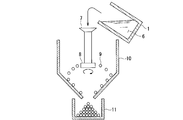
- FIG. 2 shows an example of the spray dryer process.
- reference numeral 1 is a container containing a molybdenum-containing solution
- 6 is a molybdenum-containing solution
- 7 is an inlet for an aqueous solution containing molybdenum
- 8 is a rotating plate of a spray dryer for dispersing the molybdenum-containing solution.
- 9 is a molybdenum granulated powder
- 10 is an outer wall of a spray dryer
- 11 is a recovery container for the molybdenum granulated powder.
- the molybdenum-containing solution 6 prepared in the above process is poured into the charging port 7.
- the charging speed to the charging port 7 is preferably 10 to 80 cc / min.
- the input speed is less than 10 cc / min, the input amount is too small and the mass productivity is deteriorated.
- the charging speed exceeds 80 cc / min, the characteristics of the granulated powder that can be input excessively vary.
- the charged molybdenum-containing solution 6 is supplied onto a rotating plate 8 of a spray dryer.
- the rotating plate 8 rotates at a constant rotational speed.
- the molybdenum-containing solution is supplied to the rotating rotating plate 8, it is repelled by a certain amount and spherical granulated powder 9 is formed by surface tension.
- the granulated powder 9 falls along the outer wall 10 of the spray dryer and is collected in a molybdenum granulated powder collection container 11.
- the average particle diameter of the molybdenum granulated powder is highly related to the rotation speed of the rotating plate 8 of the spray dryer.
- the ratio value A / B is in the range of 50 to 700. It is characterized by controlling.
- the molybdenum-containing solution 6 is supplied to the rotating plate 8, it is repelled by a certain amount on the rotating plate, and the repelled molybdenum-containing solution becomes spherical granulated powder due to surface tension.
- uniform granulated powder can be manufactured also from adding the binder.
- the rotation speed of the rotating plate is insufficient with respect to the average particle diameter of the intended granulated powder, and thus the average particle diameter B of the intended granulated powder is obtained. I can't.
- a / B is less than 50, it becomes a granulated powder having a larger average particle size than the average particle size B of the intended granulated powder.
- a / B exceeds 700, the rotation speed of the rotating plate is too high with respect to the average particle diameter of the intended granulated powder, and thus the average particle diameter B of the intended granulated powder cannot be obtained.
- a / B exceeds 700, it becomes a small average particle diameter with respect to the average particle diameter B of the intended granulated powder.
- a / B in the range of 50 to 700, a granulated powder having an average particle diameter in the range of ⁇ 50% with respect to the average particle diameter B of the intended granulated powder can be obtained.
- the average particle size B of the intended granulated powder is 50 ⁇ m
- the average particle diameter of granulated powder uses an enlarged photograph, and makes the maximum diameter of the granulated powder reflected there the particle diameter, and the average value of 100 granulated powder is the average particle diameter of the granulated powder.
- the average particle size B of the granulated powder is preferably 20 to 150 ⁇ m. If the average particle diameter of the granulated powder is in the range of 20 to 150 ⁇ m, it can be applied to various applications.
- the rotation speed A of the rotary plate 8 of the spray dryer is preferably 5000 to 16000 rpm. When the rotational speed A is in the range of 5000 to 16000 rpm, the molybdenum-containing solution is efficiently repelled on the rotating plate, and molybdenum granulated powder having a target average particle diameter is easily obtained.
- the spray dryer preferably dries the molybdenum granulated powder while supplying hot air at 100 to 300 ° C.
- hot air By supplying hot air of 100 to 300 ° C. into the outer wall of the spray dryer, the organic solvent in the granulated powder can be evaporated, and the binding force between the molybdenum powders by the binder can be enhanced. As a result, molybdenum granulated powder having the target average particle diameter can be efficiently produced.
- the hot air is supplied into the outer wall 10 of the spray dryer from a hot air supply port (not shown) and exhausted from an exhaust port (not shown).
- the spray drier carries out the drying of the molybdenum granulated powder in a reduced-pressure atmosphere below atmospheric pressure.
- the rotational speed of the rotating plate of the spray dryer is adjusted in accordance with the average particle diameter of the granulated powder.
- molybdenum granulated powder having an average particle size in the range of ⁇ 50% can be obtained.
- the apparent density of the resulting molybdenum granulated powder is preferably 1.3 to 3.0 g / cc.
- the average particle size of the molybdenum granulated powder is obtained using an enlarged photograph. With this method, the average particle diameter on appearance can be determined.
- the molybdenum powder content will vary partially. Occurs. Variation in the existence ratio leads to variation in the product. For example, when granulated powder is used for thermal spraying powder, if granulated powder having greatly different densities is present, the amount of molybdenum powder charged into the flame flame flame varies, resulting in variations in the thermal sprayed Mo film. Become. Moreover, when producing a sintered compact, the variation in the amount of molybdenum inserted into the molding die occurs, and the pores in the sintered compact may become larger than necessary.
- the apparent density of the molybdenum granulated powder is less than 1.3 g / cc, the amount of molybdenum in the granulated powder is too small, which causes variations in quality in the subsequent commercialization.
- the apparent density exceeds 3.0 g / cc, the molybdenum powder is tightly packed, so that it is difficult to stably manufacture with a spray dryer.
- the apparent density is measured by a measuring method based on JIS-Z-2504.
- the fluidity of the obtained granulated powder is 50 sec / 50 g or less. This fluidity measurement is also performed by a measuring method based on JIS-Z-2504.
- the fluidity is an index indicating how smoothly the granulated powder moves (flows).
- this fluidity is good (fluidity 50 sec / 50 g or less)
- supply and filling into a molding die can be carried out smoothly and rapidly at the time of commercialization.
- the granulated powder has good handleability.
- liquidity is good means that the shape of granulated powder is close to a sphere.
- the aspect ratio is 1.5 or less.
- FIG. 3 shows an example of the shape of molybdenum granulated powder.
- reference numeral 3 is molybdenum powder
- 9 is granulated molybdenum powder
- L1 has a short diameter
- L2 has a long diameter.
- the aspect ratio is calculated by “major axis L2 / minor axis L1”.
- An aspect ratio of 1.0 indicates a state close to a true sphere.
- the molybdenum granulated powder excellent in average particle diameter, apparent density, and fluidity
- a means for controlling the average particle size of the molybdenum granulated powder, particularly the particle size distribution it is 2 to 3 times the average particle size B of the granulated powder with respect to the granulated powder after completion of the granulation process by the spray dryer.
- molybdenum granulated powder having excellent average particle diameter, apparent density, and fluidity can be efficiently produced with a high yield. Therefore, the granulated powder according to each product can be manufactured with a good yield.
- the use of the granulated powder include thermal spraying powder, raw powders of various sintered bodies, and the like.
- the average particle diameter of the granulated powder is set to about 50 ⁇ m
- the average particle diameter of the granulated powder is set to about 100 ⁇ m.
- Example 1 Molybdenum powder (purity 99.9% or more), polyvinyl butyral (PVB) powder and ethanol as a binder were prepared. Ethanol was poured into a stainless steel container and the polyvinyl butyral powder was added while stirring at room temperature to dissolve all the added polyvinyl butyral powder. When all the polyvinyl butyral powder was dissolved, it was confirmed that the solution was a translucent solution. Thereafter, molybdenum powder was added in an amount of 1 to 2 kg at a time, for a total of 40 kg. When the molybdenum powder was agitated, ethanol was additionally added as needed for the shortage of ethanol evaporation.
- Examples 1 to 5 are molybdenum-containing solutions using polyvinyl alcohol powder as a binder. The conditions in the adjustment process of the molybdenum-containing solution so far are shown in Table 1 below.
- the average particle diameter, aspect ratio, apparent density, fluidity, and product yield of each of the molybdenum granulated powders obtained by the production methods of Examples 1A to 5B and Comparative Examples 1 and 2 carried out as described above were determined. investigated.
- the average particle diameter extracted arbitrary 100 grains of the obtained molybdenum granulated powder took the enlarged photograph, calculated
- the aspect ratio used the same enlarged photograph, calculated
- the product yield was obtained from the ratio of the amount of molybdenum powder 40 kg added and the total amount of molybdenum granulated powder ((total amount of granulated powder / 40 kg) ⁇ 100%).
- the measurement results are shown in Table 3 below.
- each molybdenum granulated powder produced by the method for producing a molybdenum granulated powder according to this example has a small deviation from the target average particle diameter B, an aspect ratio, The apparent density and fluidity were excellent. In addition, it can be said that this is an efficient manufacturing method with a high yield.
- Comparative Example 1 and Comparative Example 2 in which A / B is outside the range of the present invention both parameters showed bad characteristics.
Landscapes
- Chemical & Material Sciences (AREA)
- Engineering & Computer Science (AREA)
- Materials Engineering (AREA)
- Mechanical Engineering (AREA)
- Metallurgy (AREA)
- Organic Chemistry (AREA)
- Powder Metallurgy (AREA)
Abstract
容器に有機溶媒を注入する工程と、容器にバインダーとしてポリビニルブチラールを添加する工程と、上記有機溶媒を攪拌しながら平均粒径が1~10μmであるモリブデン粉末を投入することによりモリブデン含有溶液を調製する工程と、上記モリブデン含有溶液を分散するスプレードライヤーの回転板の回転数をA(rpm)とし、モリブデン造粒粉の平均粒径をB(μm)としたときに、A/Bが50~700の範囲内であるスプレードライヤーにモリブデン含有溶液を投入し、上記モリブデン含有溶液を分散すると共に乾燥してモリブデン造粒粉を調製する工程と、を有することを特徴とするモリブデン造粒粉の製造方法である。上記構成によれば、目的とする平均粒径を有するモリブデン造粒粉を効率的に製造することができる。
Description
本発明は、モリブデン造粒粉の製造方法およびモリブデン造粒粉に関する。
モリブデン(Mo)は、融点が2620℃と高いことから耐熱材料として様々な分野に用いられている。例えば、溶射用材料、焼結炉用板材、電極部品、マグネトロン用ステム、スパッタリングターゲットなどに用いられている。溶射用材料は、Mo粉末やMoロッドで供給する方法がある。また、板材は、焼結で製造する場合や、圧延と鍛造を組合せて製造する場合がある。また、電極部品などは板材を加工する場合、線引き加工してワイヤ加工される場合や焼結法によって製造される場合がある。
このようにMoを使用する場合、(1)Moを粉末のまま使用する方法、(2)Moを焼結した焼結体として使用する方法、(3)圧延、鍛造、鋳造などにより板状に加工する方法、(4)線引き加工してワイヤとして使用する方法、などが挙げられる。
いずれの使用方法であっても、Mo粉末かMo溶湯を初期原料として用いることになる。Mo溶湯は溶解して鋳造して目的の形状に加工する方法で使用される。Mo溶湯を使用する方法は、金型に溶湯を流し込む方法であるため、比較的に単純な形状で、かつ大きな形状に加工することができる方法である。一方、Moは前述の通り、高融点を有する金属材料であるため、Mo溶湯を厳格に管理するためには、耐熱性が高い大型設備が必要である。また、Mo溶湯を型に流し込む方法であるため、複雑な形状には対応できない欠点がある。
このため、Mo粉末を焼結してMo焼結体として使用することが行われている。焼結法であれば、金型にMo粉末を充填することにより、複雑な形状を有する製品も作製が可能である。
例えば、特許第4157369号公報(特許文献1)では、断面コの字状(カップ形状)の冷陰極管用焼結電極が開示されている。特許文献1に記載の製法では、焼結法を用いて直径が1~2mm程度であるカップ形状の電極を作製している。
焼結法により、焼結体を作製する場合、Mo粉末に対して、造粒工程、成形工程、脱脂工程、焼結工程などが実施される。これまで焼結法では脱脂工程や焼結工程の改良が中心的に進められてきた。特許文献1の[0027]段落では、脱脂工程をウエット水素雰囲気中で実施する一方、焼結工程を水素雰囲気中で実施することが開示されている。これにより焼結性が上がり、製品歩留りの向上が図られている。
また、国際公開WO2011/004887A1のパンフレット(特許文献2)では、平均粒径が0.5~100μmである高純度モリブデン粉末の製造方法が開示されている。特許文献2では、1次粒子の割合が50%以上であるモリブデン粉末が開示されている。
これまでのMo焼結法においては、Mo原料粉末、脱脂工程および焼結工程に関しての改良が種々進められてきた。しかしながら、その製品の歩留りは必ずしも100%には到達されてはいなかった。
このようにMoを使用する場合、(1)Moを粉末のまま使用する方法、(2)Moを焼結した焼結体として使用する方法、(3)圧延、鍛造、鋳造などにより板状に加工する方法、(4)線引き加工してワイヤとして使用する方法、などが挙げられる。
いずれの使用方法であっても、Mo粉末かMo溶湯を初期原料として用いることになる。Mo溶湯は溶解して鋳造して目的の形状に加工する方法で使用される。Mo溶湯を使用する方法は、金型に溶湯を流し込む方法であるため、比較的に単純な形状で、かつ大きな形状に加工することができる方法である。一方、Moは前述の通り、高融点を有する金属材料であるため、Mo溶湯を厳格に管理するためには、耐熱性が高い大型設備が必要である。また、Mo溶湯を型に流し込む方法であるため、複雑な形状には対応できない欠点がある。
このため、Mo粉末を焼結してMo焼結体として使用することが行われている。焼結法であれば、金型にMo粉末を充填することにより、複雑な形状を有する製品も作製が可能である。
例えば、特許第4157369号公報(特許文献1)では、断面コの字状(カップ形状)の冷陰極管用焼結電極が開示されている。特許文献1に記載の製法では、焼結法を用いて直径が1~2mm程度であるカップ形状の電極を作製している。
焼結法により、焼結体を作製する場合、Mo粉末に対して、造粒工程、成形工程、脱脂工程、焼結工程などが実施される。これまで焼結法では脱脂工程や焼結工程の改良が中心的に進められてきた。特許文献1の[0027]段落では、脱脂工程をウエット水素雰囲気中で実施する一方、焼結工程を水素雰囲気中で実施することが開示されている。これにより焼結性が上がり、製品歩留りの向上が図られている。
また、国際公開WO2011/004887A1のパンフレット(特許文献2)では、平均粒径が0.5~100μmである高純度モリブデン粉末の製造方法が開示されている。特許文献2では、1次粒子の割合が50%以上であるモリブデン粉末が開示されている。
これまでのMo焼結法においては、Mo原料粉末、脱脂工程および焼結工程に関しての改良が種々進められてきた。しかしながら、その製品の歩留りは必ずしも100%には到達されてはいなかった。
本発明者らは、Mo粉末を初期原料として使用した製品の歩留りが向上しない原因を追究した。その結果、造粒粉のサイズ、密度、流動性などのばらつきが大きくなると、成形工程での原料の充填密度や供給量のばらつきを生じ、製品歩留りが低下する原因となることが判明した。また、溶射粉としてMo造粒粉を使用する場合には、溶射フレーム炎への供給量のばらつきが生じ、溶射膜としての特性が安定しないなどの問題が生じていた。この原因を追及したところ、造粒工程において目的とする造粒粉の平均粒径に応じた管理がなされていないことに原因があることを見出した。
本発明は、このような問題を解決するためのものであり、Mo製品(粉末または焼結体)の品質の安定化や歩留り向上が可能なモリブデン造粒粉の製造方法を提供することを目的とする。
本発明は、このような問題を解決するためのものであり、Mo製品(粉末または焼結体)の品質の安定化や歩留り向上が可能なモリブデン造粒粉の製造方法を提供することを目的とする。
本発明の実施形態に係るモリブデン造粒粉の製造方法は、容器に有機溶媒を注入する工程と、上記有機溶媒にバインダーとしてポリビニルブチラールを添加する工程と、上記有機溶媒を攪拌しながら平均粒径が1~10μmであるモリブデン粉末を投入することによりモリブデン含有溶液を調製する工程と、
上記モリブデン含有溶液を分散するスプレードライヤーの回転板の回転数をA(rpm)とし、モリブデン造粒粉の平均粒径をB(μm)としたときに、A/Bが50~700の範囲内であるスプレードライヤーにモリブデン含有溶液を投入し、上記モリブデン含有溶液を分散すると共に乾燥してモリブデン造粒粉を調製する工程と、を有することを特徴とするものである。
また、スプレードライヤーによる造粒工程完了後の造粒粉に対して、平均粒径Bの2~3倍のメッシュ径を有する篩を通す篩分け工程をさらに実施することが好ましい。またモリブデン造粒粉の平均粒径Bが20~150μmであることが好ましい。また、スプレードライヤーの回転板の回転数Aが5000~16000rpmであることが好ましい。また、有機溶媒がエタノールであることが好ましい。
また、投入するモリブデン粉末の合計量を100体積部にしたときに、バインダーの体積を3~20体積部とすることが好ましい。また、得られるモリブデン造粒粉の見掛け密度が1.3~3.0g/ccであることが好ましい。また、モリブデン含有溶液は、モリブデン粉末量を100質量部としたときに、有機溶媒量が0.2~1リットルであることが好ましい。また、スプレードライヤーは、100~300℃の熱風を供給しながらモリブデン造粒粉の乾燥を実施することが好ましい。また、スプレードライヤーは大気圧以下の減圧雰囲気でモリブデン造粒粉の乾燥を実施することが好ましい。また、得られた造粒粉の流動性が50sec/50g以下であることが好ましい。
また、本発明に係るモリブデン造粒粉は、見かけ密度が1.3~3.0g/ccであることを特徴とするものである。
また、モリブデン造粒粉の平均粒径が20~150μmであることが好ましい。また、モリブデン粉末の合計量を100体積部にしたときに、バインダーの体積が3~20体積部であることが好ましい。また、モリブデン造粒粉の流動性が50sec/50g以下であることが好ましい。
上記モリブデン含有溶液を分散するスプレードライヤーの回転板の回転数をA(rpm)とし、モリブデン造粒粉の平均粒径をB(μm)としたときに、A/Bが50~700の範囲内であるスプレードライヤーにモリブデン含有溶液を投入し、上記モリブデン含有溶液を分散すると共に乾燥してモリブデン造粒粉を調製する工程と、を有することを特徴とするものである。
また、スプレードライヤーによる造粒工程完了後の造粒粉に対して、平均粒径Bの2~3倍のメッシュ径を有する篩を通す篩分け工程をさらに実施することが好ましい。またモリブデン造粒粉の平均粒径Bが20~150μmであることが好ましい。また、スプレードライヤーの回転板の回転数Aが5000~16000rpmであることが好ましい。また、有機溶媒がエタノールであることが好ましい。
また、投入するモリブデン粉末の合計量を100体積部にしたときに、バインダーの体積を3~20体積部とすることが好ましい。また、得られるモリブデン造粒粉の見掛け密度が1.3~3.0g/ccであることが好ましい。また、モリブデン含有溶液は、モリブデン粉末量を100質量部としたときに、有機溶媒量が0.2~1リットルであることが好ましい。また、スプレードライヤーは、100~300℃の熱風を供給しながらモリブデン造粒粉の乾燥を実施することが好ましい。また、スプレードライヤーは大気圧以下の減圧雰囲気でモリブデン造粒粉の乾燥を実施することが好ましい。また、得られた造粒粉の流動性が50sec/50g以下であることが好ましい。
また、本発明に係るモリブデン造粒粉は、見かけ密度が1.3~3.0g/ccであることを特徴とするものである。
また、モリブデン造粒粉の平均粒径が20~150μmであることが好ましい。また、モリブデン粉末の合計量を100体積部にしたときに、バインダーの体積が3~20体積部であることが好ましい。また、モリブデン造粒粉の流動性が50sec/50g以下であることが好ましい。
本発明に係るモリブデン造粒粉の製造方法によれば、造粒工程において、有機溶媒を攪拌しながらモリブデン粉末およびバインダーを供給し、さらに目的とするモリブデン造粒粉の平均粒径とスプレードライヤーの回転板の回転速度との比を所定範囲内に制御しているため、平均粒径、見かけ密度および流動性が優れたモリブデン造粒粉を効率的に製造することができる。
本発明の実施形態に係るモリブデン造粒粉の製造方法は、容器に有機溶媒を注入する工程と、上記有機溶媒にバインダーとしてポリビニルブチラールを添加する工程と、上記有機溶媒を攪拌しながら平均粒径が1~10μmであるモリブデン粉末を投入することによりモリブデン含有溶液を調製する工程と、上記モリブデン含有溶液を分散するスプレードライヤーの回転板の回転数をA(rpm)とし、モリブデン造粒粉の平均粒径をB(μm)としたときにに、A/Bが50~700の範囲内であるスプレードライヤーにモリブデン含有溶液を投入し、上記モリブデン含有溶液を分散すると共に乾燥してモリブデン造粒粉を調製する工程と、を有することを特徴とするものである。
図1に、モリブデン含有溶液を調製する工程の一例を示す。図中、符号1は容器(モリブデン含有溶液を調製するための容器)であり、2は有機溶媒であり、3はモリブデン粉末であり、4はバインダーであり、5は必要に応じて再度投入する有機溶媒であり、6はモリブデン含有溶液である。
まず、容器に有機溶媒を注入する。この有機溶媒としては、アルコールなどが使用できる。アルコールは、エタノール(エチルアルコール:C2H5OH)が好ましい。エチルアルコールは、後述するバインダー(ポリビニルブチラール)を溶解し易いので好ましい。
まず容器1に有機溶媒を注入する。その後、必要に応じ50℃以下に加熱する工程を実施してもよい。50℃を超える加熱は有機溶媒が蒸発し過ぎてしまうので好ましくない。50℃以下の加熱であれば、バインダーを効率的に溶解することができる。
図1に、モリブデン含有溶液を調製する工程の一例を示す。図中、符号1は容器(モリブデン含有溶液を調製するための容器)であり、2は有機溶媒であり、3はモリブデン粉末であり、4はバインダーであり、5は必要に応じて再度投入する有機溶媒であり、6はモリブデン含有溶液である。
まず、容器に有機溶媒を注入する。この有機溶媒としては、アルコールなどが使用できる。アルコールは、エタノール(エチルアルコール:C2H5OH)が好ましい。エチルアルコールは、後述するバインダー(ポリビニルブチラール)を溶解し易いので好ましい。
まず容器1に有機溶媒を注入する。その後、必要に応じ50℃以下に加熱する工程を実施してもよい。50℃を超える加熱は有機溶媒が蒸発し過ぎてしまうので好ましくない。50℃以下の加熱であれば、バインダーを効率的に溶解することができる。
次に、有機溶媒にバインダーを添加する工程を実施する。バインダーの材質はポリビニルブチラール(PVB:polyvinyl butyral)を使用する。ポリビニルブチラールは、有機溶媒、特にエタノールによく溶解する。また、均一に有機溶媒に溶け込ませるには、有機溶媒を攪拌しながらバインダーを添加することが好ましい。
次に、有機溶媒を攪拌しながら平均粒径が1~10μmであるモリブデン粉末を投入することによりモリブデン含有溶液を調製する工程を実施する。モリブデン粉末の平均粒径とは一次粒径の平均粒径である。本発明ではFSSS法(フィッシャー法)により求めた値を平均粒径とする。
平均粒径が1μm未満では、Mo粉が過小であり、製造することが困難であり、コストアップの要因となる。一方、平均粒径が10μmを超えると一次粒径が過大になって造粒粉の特性を安定させることが困難となる。そのため、モリブデン粉末の平均粒径は1~10μmとされるが、さらには2~5μmが好ましい。また、モリブデン粉末を一度に大量の粉末を投入すると、モリブデン粉末が必要以上に凝集し易いので、少量ずつ、例えば0.5~2kgずつ投入することが好ましい。
次に、有機溶媒を攪拌しながら平均粒径が1~10μmであるモリブデン粉末を投入することによりモリブデン含有溶液を調製する工程を実施する。モリブデン粉末の平均粒径とは一次粒径の平均粒径である。本発明ではFSSS法(フィッシャー法)により求めた値を平均粒径とする。
平均粒径が1μm未満では、Mo粉が過小であり、製造することが困難であり、コストアップの要因となる。一方、平均粒径が10μmを超えると一次粒径が過大になって造粒粉の特性を安定させることが困難となる。そのため、モリブデン粉末の平均粒径は1~10μmとされるが、さらには2~5μmが好ましい。また、モリブデン粉末を一度に大量の粉末を投入すると、モリブデン粉末が必要以上に凝集し易いので、少量ずつ、例えば0.5~2kgずつ投入することが好ましい。
また、バインダーの全量が有機溶媒に溶解したことを確認した後に、モリブデン粉末を添加することが好ましい。バインダーを粉末状態で添加すれば、溶解したか否かが肉眼で判別できる。なお、バインダーとしてポリビニルブチラール粉末を使用したときに、ポリビニルブチラール粉末が有機溶媒(エタノール)に完全に溶解するとモリブデン粉末を添加する前の有機溶媒(エタノール)が半透明になる。バインダーが有機溶媒(エタノール)に完全に溶解したか否かを判定し易くするためにも、バインダーを添加した後、モリブデン粉末を添加する順番であることが好ましい。
有機溶媒2に、モリブデン粉末3と、バインダー4とを添加して、モリブデン含有溶液6を調製するに際して、投入するモリブデン粉末の合計量を100体積部にしたときに、バインダーの体積を3~20体積部とすることが好ましい。バインダーはモリブデン造粒粉を形成する際に、モリブデン粉末同士を接着する接着剤の役割を果たす。
そのため、モリブデン粉末の合計量を100体積部としたときに、バインダーの添加量が3体積部未満では、バインダー量が過少であり、均一な造粒粉が得られない恐れがある。また、バインダーの添加量が20体積部を超えて過大になると、モリブデン粉末同士の隙間にバインダーが入りすぎて密度のばらつきが大きな造粒粉となってしまう。そのため、バインダーの添加量はモリブデン粉末100体積部に対し、3~20体積部に設定されるが、さらには5~15体積部であることが好ましい。
有機溶媒2に、モリブデン粉末3と、バインダー4とを添加して、モリブデン含有溶液6を調製するに際して、投入するモリブデン粉末の合計量を100体積部にしたときに、バインダーの体積を3~20体積部とすることが好ましい。バインダーはモリブデン造粒粉を形成する際に、モリブデン粉末同士を接着する接着剤の役割を果たす。
そのため、モリブデン粉末の合計量を100体積部としたときに、バインダーの添加量が3体積部未満では、バインダー量が過少であり、均一な造粒粉が得られない恐れがある。また、バインダーの添加量が20体積部を超えて過大になると、モリブデン粉末同士の隙間にバインダーが入りすぎて密度のばらつきが大きな造粒粉となってしまう。そのため、バインダーの添加量はモリブデン粉末100体積部に対し、3~20体積部に設定されるが、さらには5~15体積部であることが好ましい。
また、モリブデン含有溶液は、モリブデン粉末量を100質量部としたときに、有機溶媒量が0.2~1リットルであることが好ましい。スプレードライヤーには、モリブデン含有溶液の状態で投入される。このとき、モリブデン粉末量100質量部に対し、有機溶媒量が0.2リットル未満では有機溶媒の量が過少でありモリブデン含有溶液の粘性が上昇し、スプレードライヤーに安定的に供給し難い。
一方、有機溶媒量が1リットルを超えると有機溶媒の量が過多になり、安定的に供給し難い。なお、有機溶媒量が多いときには、攪拌しながら供給することにより安定供給する方法も有効である。このスプレードライヤーへのモリブデン含有溶液の供給は、機械化して自動化することも可能である。
また、必要に応じて、有機溶媒5を追加投入してもよい。例えば、エタノールは沸点が78.3℃と比較的低いため、バインダーおよびモリブデン粉末を投入、混合している段階でエタノールが蒸発して溶媒量が大きく変わってしまう恐れもある。また、容器1として20リットル以上の容積を有する大きな容器を使用する場合、有機溶媒量を最終的な量の30~60%を注入した時点でバインダーおよびモリブデン粉末を混合した後に、残りの有機溶媒量70~40%を追加投入して、モリブデン粉末と有機溶媒量との配合比率を調整する方法も可能である。バインダーが有機溶媒に完全に溶解したかを目視により確認し易くするためにも、有機溶媒を追加投入する方法は有効である。
一方、有機溶媒量が1リットルを超えると有機溶媒の量が過多になり、安定的に供給し難い。なお、有機溶媒量が多いときには、攪拌しながら供給することにより安定供給する方法も有効である。このスプレードライヤーへのモリブデン含有溶液の供給は、機械化して自動化することも可能である。
また、必要に応じて、有機溶媒5を追加投入してもよい。例えば、エタノールは沸点が78.3℃と比較的低いため、バインダーおよびモリブデン粉末を投入、混合している段階でエタノールが蒸発して溶媒量が大きく変わってしまう恐れもある。また、容器1として20リットル以上の容積を有する大きな容器を使用する場合、有機溶媒量を最終的な量の30~60%を注入した時点でバインダーおよびモリブデン粉末を混合した後に、残りの有機溶媒量70~40%を追加投入して、モリブデン粉末と有機溶媒量との配合比率を調整する方法も可能である。バインダーが有機溶媒に完全に溶解したかを目視により確認し易くするためにも、有機溶媒を追加投入する方法は有効である。
また、モリブデン粉末の純度に関しては、特に限定されるものではないが、Mo純度が99質量%以上、さらには99.9%質量以上であることが好ましい。モリブデン粉末の主な不純物は、Fe(鉄)、Al(アルミニウム)、Ca(カルシウム)、Mg(マグネシウム)、Si(ケイ素)が挙げられる。
また、これ以外の不純物としては、Ni(ニッケル)、Na(ナトリウム)、K(カリウム)、Pb(鉛)、Bi(ビスマス)、Cd(カドミウム)、Cu(銅)、Mn(マンガン)、Sn(錫)が挙げられる。
モリブデンの純度の測定は、Fe(鉄)、Al(アルミニウム)、Ca(カルシウム)、Mg(マグネシウム)、Si(ケイ素)、Ni(ニッケル)、Na(ナトリウム)、K(カリウム)、Pb(鉛)、Bi(ビスマス)、Cd(カドミウム)、Cu(銅)、Mn(マンガン)、Sn(錫)の合計量を100質量%から差し引いて求めるものとする。また、それぞれの不純物量としては、Fe(鉄)は10質量ppm以下、Al(アルミニウム)は50質量ppm以下、Ca(カルシウム)は30質量ppm以下、Mg(マグネシウム)は20質量ppm以下、Si(ケイ素)は50質量ppm以下、Ni(ニッケル)は50質量ppm以下、Na(ナトリウム)は10質量ppm以下、K(カリウム)は20質量ppm以下、Pb(鉛)は70質量ppm以下、Bi(ビスマス)は70質量ppm以下、Cd(カドミウム)は70質量ppm以下、Cu(銅)は70質量ppm以下、Mn(マンガン)は20質量ppm以下、Sn(錫)は30質量ppm以下であることが好ましい。
また、上記金属不純物以外の不純物として酸素などのガス成分が挙げられる。酸素量は7質量%以下とし、窒素量は7質量%以下とすることが好ましい。
また、これ以外の不純物としては、Ni(ニッケル)、Na(ナトリウム)、K(カリウム)、Pb(鉛)、Bi(ビスマス)、Cd(カドミウム)、Cu(銅)、Mn(マンガン)、Sn(錫)が挙げられる。
モリブデンの純度の測定は、Fe(鉄)、Al(アルミニウム)、Ca(カルシウム)、Mg(マグネシウム)、Si(ケイ素)、Ni(ニッケル)、Na(ナトリウム)、K(カリウム)、Pb(鉛)、Bi(ビスマス)、Cd(カドミウム)、Cu(銅)、Mn(マンガン)、Sn(錫)の合計量を100質量%から差し引いて求めるものとする。また、それぞれの不純物量としては、Fe(鉄)は10質量ppm以下、Al(アルミニウム)は50質量ppm以下、Ca(カルシウム)は30質量ppm以下、Mg(マグネシウム)は20質量ppm以下、Si(ケイ素)は50質量ppm以下、Ni(ニッケル)は50質量ppm以下、Na(ナトリウム)は10質量ppm以下、K(カリウム)は20質量ppm以下、Pb(鉛)は70質量ppm以下、Bi(ビスマス)は70質量ppm以下、Cd(カドミウム)は70質量ppm以下、Cu(銅)は70質量ppm以下、Mn(マンガン)は20質量ppm以下、Sn(錫)は30質量ppm以下であることが好ましい。
また、上記金属不純物以外の不純物として酸素などのガス成分が挙げられる。酸素量は7質量%以下とし、窒素量は7質量%以下とすることが好ましい。
次に、得られたモリブデン含有溶液をスプレードライヤーに投入する工程を実施する。図2にスプレードライヤー工程の一例を示す。図中、符号1はモリブデン含有溶液を入れた容器であり、6はモリブデン含有溶液であり、7はモリブデン含有水溶液の投入口であり、8はモリブデン含有溶液を分散するスプレードライヤーの回転板であり、9はモリブデン造粒粉であり、10はスプレードライヤーの外壁であり、11はモリブデン造粒粉の回収容器である。
前記工程にて調製されたモリブデン含有溶液6を投入口7に流し込む。投入口7への投入速度は、10~80cc/分が好ましい。投入速度が10cc/分未満では投入量が過少であり量産性が悪化する。一方、投入速度が80cc/分を超えると、投入量が過多になり得られる造粒粉の特性にばらつきが生じる。
前記工程にて調製されたモリブデン含有溶液6を投入口7に流し込む。投入口7への投入速度は、10~80cc/分が好ましい。投入速度が10cc/分未満では投入量が過少であり量産性が悪化する。一方、投入速度が80cc/分を超えると、投入量が過多になり得られる造粒粉の特性にばらつきが生じる。
次に、投入されたモリブデン含有溶液6は、スプレードライヤーの回転板8上に供給される。回転板8は一定の回転数で回転している。回転している回転板8にモリブデン含有溶液が供給されると、一定量ずつ弾かれ表面張力により、球状の造粒粉9が形成される。造粒粉9はスプレードライヤーの外壁10に沿って落下しモリブデン造粒粉の回収容器11に回収される。
モリブデン造粒粉の平均粒径は、スプレードライヤーの回転板8の回転速度との関連性が高い。そこで本発明ではスプレードライヤーの回転板8の回転速度をA(rpm)、造粒粉の平均粒径をB(μm)としたときに、その比の値A/Bが50~700の範囲に制御することを特徴とするものである。モリブデン含有溶液6を回転板8に供給したとき、回転板に一定量ずつ弾かれ、弾かれたモリブデン含有溶液は表面張力により球状の造粒粉になる。また、バインダーを添加していることからも、均一な造粒粉を製造することができる。
モリブデン造粒粉の平均粒径は、スプレードライヤーの回転板8の回転速度との関連性が高い。そこで本発明ではスプレードライヤーの回転板8の回転速度をA(rpm)、造粒粉の平均粒径をB(μm)としたときに、その比の値A/Bが50~700の範囲に制御することを特徴とするものである。モリブデン含有溶液6を回転板8に供給したとき、回転板に一定量ずつ弾かれ、弾かれたモリブデン含有溶液は表面張力により球状の造粒粉になる。また、バインダーを添加していることからも、均一な造粒粉を製造することができる。
上記比の値A/Bが50未満では、目的とする造粒粉の平均粒径に対して回転板の回転速度が不足しているため、目的とする造粒粉の平均粒径Bが得られない。またA/Bが50未満の場合は、目的とする造粒粉の平均粒径Bに対して大きな平均粒径を有する造粒粉となる。
一方、A/Bが700を超えると、目的とする造粒粉の平均粒径に対して回転板の回転速度が速すぎるため、目的とする造粒粉の平均粒径Bが得られない。また、A/Bが700を超えると目的とする造粒粉の平均粒径Bに対して、小さな平均粒径となる。
A/Bを50~700の範囲に制御することにより、目的とする造粒粉の平均粒径Bに対して±50%の範囲の平均粒径を有する造粒粉が得られる。例えば、目的とする造粒粉の平均粒径Bを50μmとしたときに、±50%とは50×0.5=25μmから平均粒径が25~75μmのものが得られることを意味している。なお、造粒粉の平均粒径は拡大写真を使って、そこに写る造粒粉の最大径を粒径とし、造粒粉100粒の平均値を造粒粉の平均粒径とする。
一方、A/Bが700を超えると、目的とする造粒粉の平均粒径に対して回転板の回転速度が速すぎるため、目的とする造粒粉の平均粒径Bが得られない。また、A/Bが700を超えると目的とする造粒粉の平均粒径Bに対して、小さな平均粒径となる。
A/Bを50~700の範囲に制御することにより、目的とする造粒粉の平均粒径Bに対して±50%の範囲の平均粒径を有する造粒粉が得られる。例えば、目的とする造粒粉の平均粒径Bを50μmとしたときに、±50%とは50×0.5=25μmから平均粒径が25~75μmのものが得られることを意味している。なお、造粒粉の平均粒径は拡大写真を使って、そこに写る造粒粉の最大径を粒径とし、造粒粉100粒の平均値を造粒粉の平均粒径とする。
また、造粒粉の平均粒径Bは20~150μmであることが好ましい。造粒粉の平均粒径が20~150μmの範囲であれば、様々な用途に適用できる。また、スプレードライヤーの回転板8の回転数Aは5000~16000rpmであることが好ましい。回転数Aが5000~16000rpmの範囲であれば、効率的に回転板上でモリブデン含有溶液が弾かれ、目的とする平均粒径を有するモリブデン造粒粉が得られ易い。
また、スプレードライヤーは、100~300℃の熱風を供給しながらモリブデン造粒粉の乾燥を実施することが好ましい。スプレードライヤーの外壁内に100~300℃の熱風を供給することにより、造粒粉中の有機溶媒を蒸発させ、バインダーによるモリブデン粉末同士の結合力を強化することができる。その結果、目的とする平均粒径を有するモリブデン造粒粉を効率的に製造することができる。
上記熱風は図示しない熱風供給口からスプレードライヤーの外壁10内に供給され、図示しない排気口から排気される。熱風を供給口から排気口に排気しながら供給することにより、常に新鮮な熱風を供給することが可能になり、造粒粉から蒸発した水分が他の造粒粉に取り込まれることを防止することができる。なお、熱風の供給温度が100℃未満では、有機溶媒分の蒸発速度が遅い。一方、300℃を超えると有機溶媒が瞬間的に蒸発し過ぎて造粒粉の粒径のばらつきが発生する原因となる。
上記熱風は図示しない熱風供給口からスプレードライヤーの外壁10内に供給され、図示しない排気口から排気される。熱風を供給口から排気口に排気しながら供給することにより、常に新鮮な熱風を供給することが可能になり、造粒粉から蒸発した水分が他の造粒粉に取り込まれることを防止することができる。なお、熱風の供給温度が100℃未満では、有機溶媒分の蒸発速度が遅い。一方、300℃を超えると有機溶媒が瞬間的に蒸発し過ぎて造粒粉の粒径のばらつきが発生する原因となる。
また、スプレードライヤーは、大気圧以下の減圧雰囲気でモリブデン造粒粉の乾燥を実施することが好ましい。スプレードライヤーの外壁10内を大気圧以下の減圧雰囲気とすることにより、造粒粉中の有機溶媒を蒸発し易くすることができる。なお、減圧雰囲気は、大気圧(1atm=1.01×10⁵Pa)から100~500Pa低い減圧雰囲気であることが好ましい。100Pa未満では、減圧雰囲気とする効果が十分でなく、500Paを超えると減圧雰囲気を制御する負担が大きくなりコストアップの要因となる。
本発明の実施形態に係るモリブデン造粒粉の製造方法によれば造粒粉の平均粒径に合わせてスプレードライヤーの回転板の回転速度を調整しているために、目的とする平均粒径に対し±50%の範囲の平均粒径を有するモリブデン造粒粉を得ることができる。
また、得られるモリブデン造粒粉の見かけ密度が1.3~3.0g/ccであることが好ましい。前述のように本発明ではモリブデン造粒粉の平均粒径は拡大写真を使って求めている。この方法であれば、外観上の平均粒径は判断できる。
しかしながら、モリブデン造粒粉の内部に空隙が多く密度が小さな造粒粉が存在すると、その後の製品(溶射用粉末や焼結体)に使用するときに、部分的にモリブデン粉末の存在比率にばらつきが生じる。存在比率のばらつきは、製品のばらつきに繋がる。例えば、造粒粉を溶射用粉末に使用する場合、密度が大きく異なる造粒粉が存在すると、溶射フレーム炎に投入されるモリブデン粉末量にばらつきが生じ、結果として溶射Mo膜のばらつきの原因となる。また、焼結体を作製する場合は、成形金型に挿入されるモリブデン量のばらつきが生じ、焼結体中のポアが必要以上に大きくなる恐れがある。
また、得られるモリブデン造粒粉の見かけ密度が1.3~3.0g/ccであることが好ましい。前述のように本発明ではモリブデン造粒粉の平均粒径は拡大写真を使って求めている。この方法であれば、外観上の平均粒径は判断できる。
しかしながら、モリブデン造粒粉の内部に空隙が多く密度が小さな造粒粉が存在すると、その後の製品(溶射用粉末や焼結体)に使用するときに、部分的にモリブデン粉末の存在比率にばらつきが生じる。存在比率のばらつきは、製品のばらつきに繋がる。例えば、造粒粉を溶射用粉末に使用する場合、密度が大きく異なる造粒粉が存在すると、溶射フレーム炎に投入されるモリブデン粉末量にばらつきが生じ、結果として溶射Mo膜のばらつきの原因となる。また、焼結体を作製する場合は、成形金型に挿入されるモリブデン量のばらつきが生じ、焼結体中のポアが必要以上に大きくなる恐れがある。
モリブデン造粒粉の見かけ密度が1.3g/cc未満であると造粒粉中のモリブデン量が過少であり、その後の製品化における品質にばらつきを生じる原因となる。一方、見かけ密度が3.0g/ccを超えて過大であるとモリブデン粉末がぎっしり詰まった状態であるため、スプレードライヤーで安定的に製造することが困難である。見かけ密度の測定方法は、JIS-Z-2504に準拠した測定方法で実施するものとする。
また、得られた造粒粉の流動性が50sec/50g以下であることが好ましい。この流動性の測定もJIS-Z-2504に準拠した測定方法で実施するものとする。ここで流動性とは、造粒粉がどれだけ円滑に移動する(流れる)かを示す指標となる。
この流動性が良好(流動性50sec/50g以下)であると、製品化する際の成形金型への供給充填が円滑迅速に実施できる。つまりは、取扱い性が良好な造粒粉であると言える。また、流動性が良いということは、造粒粉の形状が球体に近いことを意味している。造粒粉が球体に近いとは、アスペクト比が1.5以下を示すものとする。
図3にモリブデン造粒粉の形状例を示す。図中、符号3はモリブデン粉末であり、9はモリブデン造粒粉であり、L1は短径であり、L2は長径である。アスペクト比は「長径L2/短径L1」により算出される。アスペクト比1.0とは真球に近い状態であることを示す。
また、得られた造粒粉の流動性が50sec/50g以下であることが好ましい。この流動性の測定もJIS-Z-2504に準拠した測定方法で実施するものとする。ここで流動性とは、造粒粉がどれだけ円滑に移動する(流れる)かを示す指標となる。
この流動性が良好(流動性50sec/50g以下)であると、製品化する際の成形金型への供給充填が円滑迅速に実施できる。つまりは、取扱い性が良好な造粒粉であると言える。また、流動性が良いということは、造粒粉の形状が球体に近いことを意味している。造粒粉が球体に近いとは、アスペクト比が1.5以下を示すものとする。
図3にモリブデン造粒粉の形状例を示す。図中、符号3はモリブデン粉末であり、9はモリブデン造粒粉であり、L1は短径であり、L2は長径である。アスペクト比は「長径L2/短径L1」により算出される。アスペクト比1.0とは真球に近い状態であることを示す。
このように本発明に係るモリブデン造粒粉の製造方法によれば、平均粒径、見かけ密度、流動性が優れたモリブデン造粒粉を歩留り良く効率的に製造することができる。
また、モリブデン造粒粉の平均粒径、特に粒度分布を制御する手段として、スプレードライヤーによる造粒工程完了後の造粒粉に対して、造粒粉の平均粒径Bの2~3倍のメッシュ径を有する篩を通す篩分け工程を実施する方法もある。上記篩分け工程を実施することにより、過大な造粒粉を除去することができる。これにより、さらに平均粒径の制御が可能となる。また、この篩分け工程により、より小さな造粒粉を除去することも可能であり、有効である。
また、モリブデン造粒粉の平均粒径、特に粒度分布を制御する手段として、スプレードライヤーによる造粒工程完了後の造粒粉に対して、造粒粉の平均粒径Bの2~3倍のメッシュ径を有する篩を通す篩分け工程を実施する方法もある。上記篩分け工程を実施することにより、過大な造粒粉を除去することができる。これにより、さらに平均粒径の制御が可能となる。また、この篩分け工程により、より小さな造粒粉を除去することも可能であり、有効である。
以上のように本発明に係るモリブデン造粒粉の製造方法によれば、平均粒径、見かけ密度、流動性が優れたモリブデン造粒粉を歩留り良く効率的に製造することができる。そのため、各製品に応じた造粒粉を歩留り良く製造することができる。
造粒粉の用途としては、溶射用粉末、各種焼結体の原料粉などが挙げられる。溶射用粉末として、平均粒径、見かけ密度および流動性に優れたモリブデン造粒粉を使用することにより、溶射フレーム炎への供給量を安定化させることができる。その結果、溶射膜の品質を均質なものとすることができる。
また、各種焼結体の原料粉末としてモリブデン造粒粉を使用する場合に、上記平均粒径、見かけ密度および流動性に優れたモリブデン造粒粉を使用することにより成形金型への充填量を均質化できる。その結果、焼結体の密度などを安定化させることができる。特に、成形用金型の形状に応じて、平均粒径を変化させることにより、さらに歩留りの向上を図ることができる。
例えば、厚さが1mm以下の焼結体では造粒粉の平均粒径を50μm程度とし、厚さが5mmの焼結体では造粒粉の平均粒径を100μm程度にすることにより成形金型への充填を効率よく実施することができる。
造粒粉の用途としては、溶射用粉末、各種焼結体の原料粉などが挙げられる。溶射用粉末として、平均粒径、見かけ密度および流動性に優れたモリブデン造粒粉を使用することにより、溶射フレーム炎への供給量を安定化させることができる。その結果、溶射膜の品質を均質なものとすることができる。
また、各種焼結体の原料粉末としてモリブデン造粒粉を使用する場合に、上記平均粒径、見かけ密度および流動性に優れたモリブデン造粒粉を使用することにより成形金型への充填量を均質化できる。その結果、焼結体の密度などを安定化させることができる。特に、成形用金型の形状に応じて、平均粒径を変化させることにより、さらに歩留りの向上を図ることができる。
例えば、厚さが1mm以下の焼結体では造粒粉の平均粒径を50μm程度とし、厚さが5mmの焼結体では造粒粉の平均粒径を100μm程度にすることにより成形金型への充填を効率よく実施することができる。
(実施例)
(実施例1~5および比較例1~2)
モリブデン粉末(純度99.9%以上)と、バインダーとしてのポリビニルブチラール(PVB)粉末およびエタノールを用意した。ステンレス製容器に、エタノールを注入し、常温で攪拌しながら、ポリビニルブチラール粉末を添加し、添加したポリビニルブチラール粉末を全て溶解させた。ポリビニルブチラール粉末が全て溶解したときには、半透明の溶液となっていることが確認できた。その後、モリブデン粉末を1回に1~2kgずつ、合計40kg投入した。モリブデン粉末の攪拌に際して、エタノールが蒸発して不足する分は、必要に応じてエタノールを追加投入した。バインダーとしてポリビニルアルコール粉末を使ったモリブデン含有溶液を実施例1~5とした。
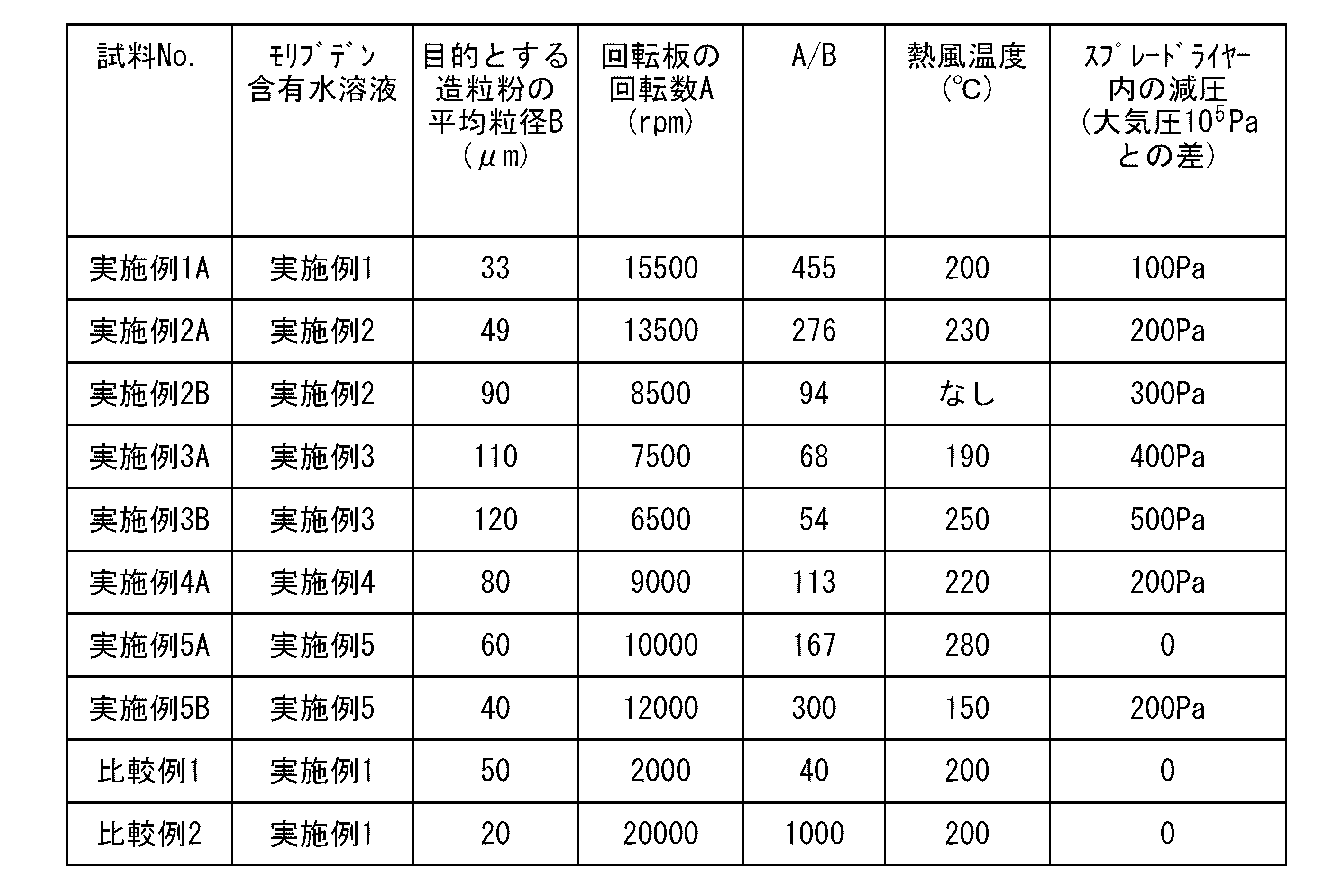
ここまでのモリブデン含有溶液の調整工程における条件を下記表1に示す。
(実施例1~5および比較例1~2)
モリブデン粉末(純度99.9%以上)と、バインダーとしてのポリビニルブチラール(PVB)粉末およびエタノールを用意した。ステンレス製容器に、エタノールを注入し、常温で攪拌しながら、ポリビニルブチラール粉末を添加し、添加したポリビニルブチラール粉末を全て溶解させた。ポリビニルブチラール粉末が全て溶解したときには、半透明の溶液となっていることが確認できた。その後、モリブデン粉末を1回に1~2kgずつ、合計40kg投入した。モリブデン粉末の攪拌に際して、エタノールが蒸発して不足する分は、必要に応じてエタノールを追加投入した。バインダーとしてポリビニルアルコール粉末を使ったモリブデン含有溶液を実施例1~5とした。
ここまでのモリブデン含有溶液の調整工程における条件を下記表1に示す。

次に、上記実施例1~5で調製したモリブデン含有溶液を用いて、スプレードライヤーによる造粒工程を実施した。スプレードライヤーによる造粒工程の条件を下記表2に示す。
次に、上記のように実施した実施例1A~5Bおよび比較例1~2の製造方法によって得られた各モリブデン造粒粉の平均粒径、アスペクト比、見掛け密度、流動性、および製品歩留りを調査した。
なお、平均粒径は得られたモリブデン造粒粉の任意の100粒を抜き出し、拡大写真を撮り、そこに写る最大径を求め、100粒の平均値を平均粒径とした。また、アスペクト比は同様の拡大写真を使用して、短径L1および長径L2を求め、それぞれのL2/L1の平均値をアスペクト比とした。さらに、見掛け密度および流動性はJIS-Z-2504に準拠した測定方法で測定した。また、製品歩留りは、投入したモリブデン粉末40kg量とモリブデン造粒粉の合計量との比「(造粒粉の合計量/40kg)×100%」から求めた。
それらの測定結果を下記表3に示す。
なお、平均粒径は得られたモリブデン造粒粉の任意の100粒を抜き出し、拡大写真を撮り、そこに写る最大径を求め、100粒の平均値を平均粒径とした。また、アスペクト比は同様の拡大写真を使用して、短径L1および長径L2を求め、それぞれのL2/L1の平均値をアスペクト比とした。さらに、見掛け密度および流動性はJIS-Z-2504に準拠した測定方法で測定した。また、製品歩留りは、投入したモリブデン粉末40kg量とモリブデン造粒粉の合計量との比「(造粒粉の合計量/40kg)×100%」から求めた。
それらの測定結果を下記表3に示す。
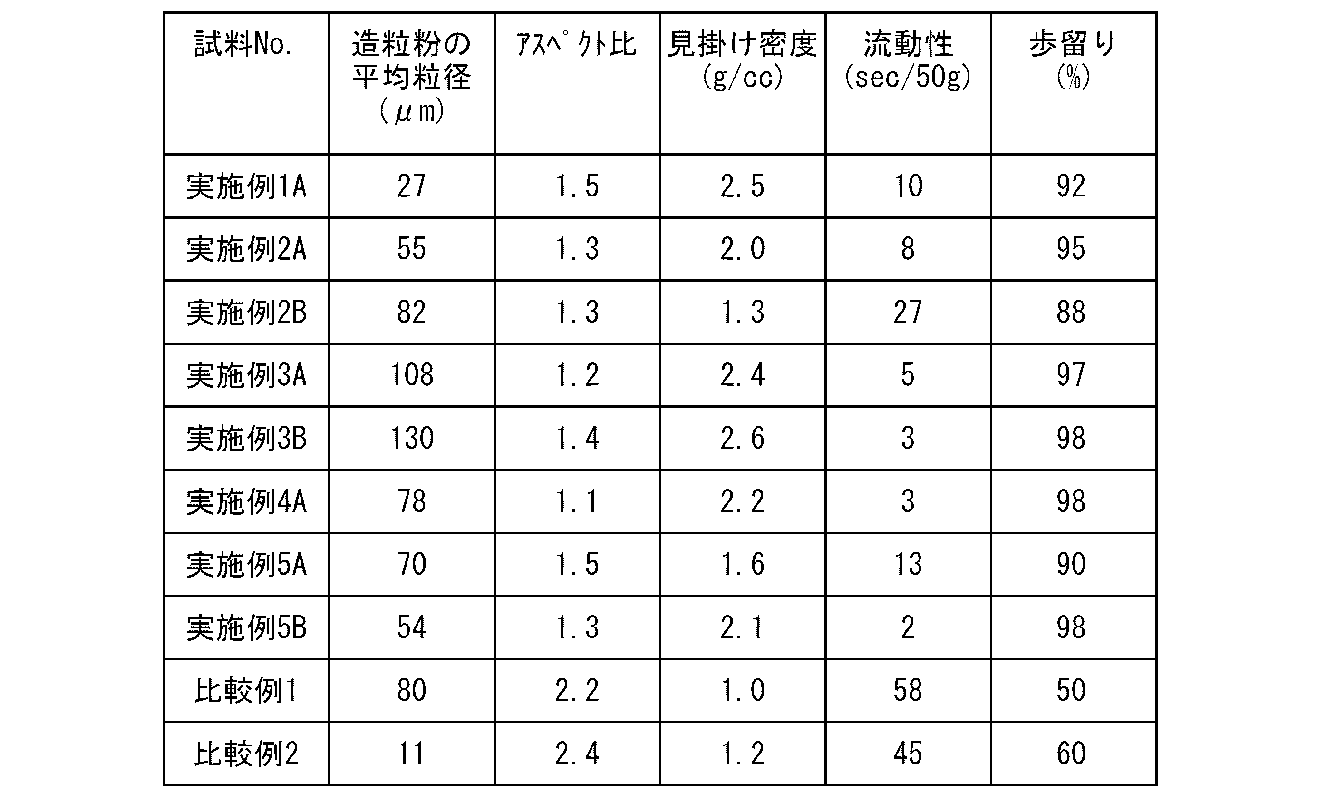
上記表3に示す結果から明らかなように、本実施例に係るモリブデン造粒粉の製造方法により製造された各モリブデン造粒粉は、目的とする平均粒径Bに対するずれが小さく、アスペクト比、見かけ密度および流動性が優れていた。また、歩留りも高く効率の良い製造方法であると言える。それに対し、A/Bが本発明の範囲外である比較例1および比較例2では、いずれのパラメータも悪い特性を示した。
1…容器(モリブデン含有溶液を調製するための容器)
2…有機溶媒(エチルアルコール)
3…モリブデン粉末
4…バインダー
5…必要に応じて再度投入する有機溶媒
6…モリブデン含有溶液
7…モリブデン含有溶液の投入口
8…回転板
9…モリブデン造粒粉
10…スプレードライヤーの外壁
11…モリブデン造粒粉の回収容器
2…有機溶媒(エチルアルコール)
3…モリブデン粉末
4…バインダー
5…必要に応じて再度投入する有機溶媒
6…モリブデン含有溶液
7…モリブデン含有溶液の投入口
8…回転板
9…モリブデン造粒粉
10…スプレードライヤーの外壁
11…モリブデン造粒粉の回収容器
Claims (15)
- 容器に有機溶媒を注入する工程と、
上記有機溶媒にバインダーとしてポリビニルブチラールを添加する工程と、
上記有機溶媒を攪拌しながら平均粒径が1~10μmであるモリブデン粉末を投入することによりモリブデン含有溶液を調製する工程と、
上記モリブデン含有溶液を分散するスプレードライヤーの回転板の回転数をA(rpm)とし、モリブデン造粒粉の平均粒径をB(μm)としたときに、A/Bが50~700の範囲内であるスプレードライヤーにモリブデン含有溶液を投入し、上記モリブデン含有溶液を分散すると共に乾燥してモリブデン造粒粉を調製する工程と、
を有することを特徴とするモリブデン造粒粉の製造方法。 - 前記スプレードライヤーによる造粒工程完了後の造粒粉に対して、平均粒径Bの2~3倍のメッシュ径を有する篩を通す篩分け工程をさらに実施することを特徴とする請求項1記載のモリブデン造粒粉の製造方法。
- 前記モリブデン造粒粉の平均粒径Bが20~150μmであることを特徴とする請求項1または請求項2に記載のモリブデン造粒粉の製造方法。
- 前記スプレードライヤーの回転板の回転数Aが5000~16000rpmであることを特徴とする請求項1乃至請求項3のいずれか1項に記載のモリブデン造粒粉の製造方法。
- 前記有機溶媒がエタノールであることを特徴とする請求項1乃至請求項4のいずれか1項に記載のモリブデン造粒粉の製造方法。
- 前記投入するモリブデン粉末の合計量を100体積部にしたときに、バインダーの体積を3~20体積部とすることを特徴とする請求項1乃至請求項5のいずれか1項に記載のモリブデン造粒粉の製造方法。
- 得られるモリブデン造粒粉の見掛け密度が1.3~3.0g/ccであることを特徴とする請求項1乃至請求項6のいずれか1項に記載のモリブデン造粒粉の製造方法。
- 前記モリブデン含有溶液は、モリブデン粉末量を100質量部としたときに、有機溶媒量が0.2~1リットルであることを特徴とする請求項1乃至請求項7のいずれか1項に記載のモリブデン造粒粉の製造方法。
- 前記スプレードライヤーは、100~300℃の熱風を供給しながらモリブデン造粒粉の乾燥を実施することを特徴とする請求項1乃至請求項7のいずれか1項に記載のモリブデン造粒粉の製造方法。
- 前記スプレードライヤーは大気圧以下の減圧雰囲気でモリブデン造粒粉の乾燥を実施することを特徴とする請求項1乃至請求項9のいずれか1項に記載のモリブデン造粒粉の製造方法。
- 得られた造粒粉の流動性が50sec/50g以下であることを特徴とする請求項1乃至請求項10のいずれか1項に記載のモリブデン造粒粉の製造方法。
- 見かけ密度が1.3~3.0g/ccであることを特徴とするモリブデン造粒粉。
- モリブデン造粒粉の平均粒径が20~150μmであること特徴とする請求項12に記載のモリブデン造粒粉。
- モリブデン粉末の合計量を100体積部にしたときに、バインダーの体積が3~20体積部であることを特徴とする請求項12または請求項13に記載のモリブデン造粒粉。
- モリブデン造粒粉の流動性が50sec/50g以下であることを特徴とする請求項12乃至請求項14のいずれか1項に記載のモリブデン造粒粉。
Priority Applications (2)
| Application Number | Priority Date | Filing Date | Title |
|---|---|---|---|
| JP2013515032A JP5917503B2 (ja) | 2011-05-19 | 2012-03-22 | モリブデン造粒粉の製造方法 |
| CN201280016010.3A CN103442829B (zh) | 2011-05-19 | 2012-03-22 | 钼造粒粉的制造方法及钼造粒粉 |
Applications Claiming Priority (2)
| Application Number | Priority Date | Filing Date | Title |
|---|---|---|---|
| JP2011112894 | 2011-05-19 | ||
| JP2011-112894 | 2011-05-19 |
Publications (1)
| Publication Number | Publication Date |
|---|---|
| WO2012157336A1 true WO2012157336A1 (ja) | 2012-11-22 |
Family
ID=47176677
Family Applications (1)
| Application Number | Title | Priority Date | Filing Date |
|---|---|---|---|
| PCT/JP2012/057271 Ceased WO2012157336A1 (ja) | 2011-05-19 | 2012-03-22 | モリブデン造粒粉の製造方法およびモリブデン造粒粉 |
Country Status (3)
| Country | Link |
|---|---|
| JP (1) | JP5917503B2 (ja) |
| CN (1) | CN103442829B (ja) |
| WO (1) | WO2012157336A1 (ja) |
Cited By (1)
| Publication number | Priority date | Publication date | Assignee | Title |
|---|---|---|---|---|
| CN103276266A (zh) * | 2013-06-08 | 2013-09-04 | 金堆城钼业股份有限公司 | 一种喷雾干燥制备tzm合金材料的方法 |
Citations (6)
| Publication number | Priority date | Publication date | Assignee | Title |
|---|---|---|---|---|
| JPH0198764A (ja) * | 1987-10-08 | 1989-04-17 | Teikoku Piston Ring Co Ltd | シリンダとピストンリングとの組合わせ |
| JPH11199948A (ja) * | 1998-01-06 | 1999-07-27 | Toshiba Corp | 低温延性材料 |
| JP2004052020A (ja) * | 2002-07-17 | 2004-02-19 | Matsushita Electric Ind Co Ltd | タングステン重合金からなる振動子の製造方法 |
| JP2005120400A (ja) * | 2003-10-15 | 2005-05-12 | Sumitomo Electric Ind Ltd | 顆粒状の金属粉末 |
| JP2005291530A (ja) * | 2004-03-31 | 2005-10-20 | Tdk Corp | 噴霧乾燥装置、粉体の乾燥方法およびフェライト粒の製造方法 |
| JP2008285759A (ja) * | 1995-11-27 | 2008-11-27 | Hc Starck Gmbh | 金属粉末造粒物製造方法 |
Family Cites Families (7)
| Publication number | Priority date | Publication date | Assignee | Title |
|---|---|---|---|---|
| JPS5848601A (ja) * | 1981-09-17 | 1983-03-22 | Toshiba Corp | 焼結部品の製造方法 |
| JPS58141307A (ja) * | 1982-02-17 | 1983-08-22 | Toshiba Corp | モリブデン造粒粉末の製造方法 |
| DE69429326T2 (de) * | 1993-12-27 | 2002-05-16 | Sumitomo Special Metals Co., Ltd. | Verfahren zum Granulieren von Pulver |
| WO2008032359A1 (en) * | 2006-09-11 | 2008-03-20 | Mitsubishi Electric Corporation | Process for producing electrode for electric discharge surface treatment and electrode for electric discharge surface treatment |
| CN100506438C (zh) * | 2006-11-29 | 2009-07-01 | 金堆城钼业股份有限公司 | 一种制取喷涂钼粉的方法 |
| CA2783209C (en) * | 2009-12-22 | 2017-03-14 | Msd Oss B.V. | Amino-heteroaryl derivatives as hcn blockers |
| JP5917502B2 (ja) * | 2011-05-16 | 2016-05-18 | 株式会社東芝 | モリブデン造粒粉の製造方法 |
-
2012
- 2012-03-22 WO PCT/JP2012/057271 patent/WO2012157336A1/ja not_active Ceased
- 2012-03-22 JP JP2013515032A patent/JP5917503B2/ja active Active
- 2012-03-22 CN CN201280016010.3A patent/CN103442829B/zh active Active
Patent Citations (6)
| Publication number | Priority date | Publication date | Assignee | Title |
|---|---|---|---|---|
| JPH0198764A (ja) * | 1987-10-08 | 1989-04-17 | Teikoku Piston Ring Co Ltd | シリンダとピストンリングとの組合わせ |
| JP2008285759A (ja) * | 1995-11-27 | 2008-11-27 | Hc Starck Gmbh | 金属粉末造粒物製造方法 |
| JPH11199948A (ja) * | 1998-01-06 | 1999-07-27 | Toshiba Corp | 低温延性材料 |
| JP2004052020A (ja) * | 2002-07-17 | 2004-02-19 | Matsushita Electric Ind Co Ltd | タングステン重合金からなる振動子の製造方法 |
| JP2005120400A (ja) * | 2003-10-15 | 2005-05-12 | Sumitomo Electric Ind Ltd | 顆粒状の金属粉末 |
| JP2005291530A (ja) * | 2004-03-31 | 2005-10-20 | Tdk Corp | 噴霧乾燥装置、粉体の乾燥方法およびフェライト粒の製造方法 |
Cited By (2)
| Publication number | Priority date | Publication date | Assignee | Title |
|---|---|---|---|---|
| CN103276266A (zh) * | 2013-06-08 | 2013-09-04 | 金堆城钼业股份有限公司 | 一种喷雾干燥制备tzm合金材料的方法 |
| CN103276266B (zh) * | 2013-06-08 | 2015-07-29 | 金堆城钼业股份有限公司 | 一种喷雾干燥制备tzm合金材料的方法 |
Also Published As
| Publication number | Publication date |
|---|---|
| JPWO2012157336A1 (ja) | 2014-07-31 |
| CN103442829B (zh) | 2016-11-16 |
| JP5917503B2 (ja) | 2016-05-18 |
| CN103442829A (zh) | 2013-12-11 |
Similar Documents
| Publication | Publication Date | Title |
|---|---|---|
| CN107309434B (zh) | 一种高纯致密球形钼粉的制备方法及应用 | |
| CN105618723B (zh) | 一种基于惰性气氛的钛合金自耗电极凝壳熔炼铸造工艺 | |
| CN106216705A (zh) | 一种3d打印用细颗粒单质球形金属粉末的制备方法 | |
| CN109513944A (zh) | 等离子旋转电极制备铜合金粉末的方法 | |
| CN111139390A (zh) | 一种铬掺杂改性Mo2NiB2基金属陶瓷及其制备方法 | |
| JP7369046B2 (ja) | スカンジウムアルミニウム窒化物粉末の製造方法及びターゲットの製造方法 | |
| WO2018169428A1 (ru) | Способ получения нанокомпозитных материалов на основе медной матрицы | |
| US10329661B2 (en) | Cu—Ga—In—Na target | |
| CN109014228A (zh) | 一种基于等离子旋转电极制备铜合金粉末的方法 | |
| CN110625127A (zh) | 一种钴铬镍钨合金钎料粉末的制备方法 | |
| JP5917502B2 (ja) | モリブデン造粒粉の製造方法 | |
| WO2012169257A1 (ja) | モリブデン造粒粉の製造方法およびモリブデン造粒粉 | |
| JP5917503B2 (ja) | モリブデン造粒粉の製造方法 | |
| CN114029492A (zh) | 一种无缝镍铝复合粉芯丝材及其制备方法 | |
| JP2023512126A (ja) | バナジウムタングステン合金ターゲット素材の製造方法 | |
| CN103781934B (zh) | 喷涂用Mo粉末及采用它的Mo喷涂膜以及Mo喷涂膜部件 | |
| WO2012169255A1 (ja) | モリブデン造粒粉の製造方法およびモリブデン造粒粉 | |
| WO2012169262A1 (ja) | モリブデン造粒粉の製造方法およびモリブデン造粒粉 | |
| CN104827044B (zh) | 一种Cu50Zr40Ti10/Cu非晶合金片状复合粉末及其制备工艺 | |
| KR101280285B1 (ko) | 구형 텅스텐 복합 분말, 및 그 제조방법 | |
| WO2012169258A1 (ja) | モリブデン造粒粉の製造方法およびモリブデン造粒粉 | |
| CN109420758A (zh) | In-Cu合金粉末及其制法、In-Cu合金溅射靶及其制法 | |
| WO2012169256A1 (ja) | モリブデン造粒粉の製造方法およびモリブデン造粒粉 | |
| CN117900499A (zh) | 一种增材制造用难熔高熵合金复合粉末的制备方法 | |
| JPWO2012169259A1 (ja) | 炭化モリブデン造粒粉の製造方法および炭化モリブデン造粒粉 |
Legal Events
| Date | Code | Title | Description |
|---|---|---|---|
| 121 | Ep: the epo has been informed by wipo that ep was designated in this application |
Ref document number: 12786515 Country of ref document: EP Kind code of ref document: A1 |
|
| ENP | Entry into the national phase |
Ref document number: 2013515032 Country of ref document: JP Kind code of ref document: A |
|
| NENP | Non-entry into the national phase |
Ref country code: DE |
|
| 122 | Ep: pct application non-entry in european phase |
Ref document number: 12786515 Country of ref document: EP Kind code of ref document: A1 |